EP0802574B1 - Zusätze für Mangandioxidkathoden von alkalischen Primärzellen - Google Patents
Zusätze für Mangandioxidkathoden von alkalischen Primärzellen Download PDFInfo
- Publication number
- EP0802574B1 EP0802574B1 EP97102945A EP97102945A EP0802574B1 EP 0802574 B1 EP0802574 B1 EP 0802574B1 EP 97102945 A EP97102945 A EP 97102945A EP 97102945 A EP97102945 A EP 97102945A EP 0802574 B1 EP0802574 B1 EP 0802574B1
- Authority
- EP
- European Patent Office
- Prior art keywords
- cathode
- tio
- electrolyte
- manganese dioxide
- lithium titanate
- Prior art date
- Legal status (The legal status is an assumption and is not a legal conclusion. Google has not performed a legal analysis and makes no representation as to the accuracy of the status listed.)
- Expired - Lifetime
Links
- NUJOXMJBOLGQSY-UHFFFAOYSA-N manganese dioxide Chemical compound O=[Mn]=O NUJOXMJBOLGQSY-UHFFFAOYSA-N 0.000 title claims description 10
- 239000000654 additive Substances 0.000 title description 4
- 239000003792 electrolyte Substances 0.000 claims description 20
- RTAQQCXQSZGOHL-UHFFFAOYSA-N Titanium Chemical compound [Ti] RTAQQCXQSZGOHL-UHFFFAOYSA-N 0.000 claims description 11
- WHXSMMKQMYFTQS-UHFFFAOYSA-N Lithium Chemical compound [Li] WHXSMMKQMYFTQS-UHFFFAOYSA-N 0.000 claims description 10
- 229910052744 lithium Inorganic materials 0.000 claims description 10
- HCHKCACWOHOZIP-UHFFFAOYSA-N Zinc Chemical compound [Zn] HCHKCACWOHOZIP-UHFFFAOYSA-N 0.000 claims description 6
- 239000002245 particle Substances 0.000 claims description 6
- 239000011701 zinc Substances 0.000 claims description 5
- 229910052725 zinc Inorganic materials 0.000 claims description 5
- 239000000843 powder Substances 0.000 claims description 4
- 239000010405 anode material Substances 0.000 claims description 2
- 229910007848 Li2TiO3 Inorganic materials 0.000 claims 4
- 239000010406 cathode material Substances 0.000 claims 4
- KWYUFKZDYYNOTN-UHFFFAOYSA-M Potassium hydroxide Chemical compound [OH-].[K+] KWYUFKZDYYNOTN-UHFFFAOYSA-M 0.000 description 19
- OKTJSMMVPCPJKN-UHFFFAOYSA-N Carbon Chemical compound [C] OKTJSMMVPCPJKN-UHFFFAOYSA-N 0.000 description 8
- 229910002804 graphite Inorganic materials 0.000 description 8
- 239000010439 graphite Substances 0.000 description 8
- 239000011230 binding agent Substances 0.000 description 7
- 238000004519 manufacturing process Methods 0.000 description 7
- OGIDPMRJRNCKJF-UHFFFAOYSA-N titanium oxide Inorganic materials [Ti]=O OGIDPMRJRNCKJF-UHFFFAOYSA-N 0.000 description 7
- HEMHJVSKTPXQMS-UHFFFAOYSA-M Sodium hydroxide Chemical compound [OH-].[Na+] HEMHJVSKTPXQMS-UHFFFAOYSA-M 0.000 description 6
- 238000007792 addition Methods 0.000 description 6
- -1 polyethylenes Polymers 0.000 description 6
- 239000000203 mixture Substances 0.000 description 5
- 239000004094 surface-active agent Substances 0.000 description 5
- WMFOQBRAJBCJND-UHFFFAOYSA-M Lithium hydroxide Chemical compound [Li+].[OH-] WMFOQBRAJBCJND-UHFFFAOYSA-M 0.000 description 4
- GWEVSGVZZGPLCZ-UHFFFAOYSA-N Titan oxide Chemical compound O=[Ti]=O GWEVSGVZZGPLCZ-UHFFFAOYSA-N 0.000 description 4
- 239000004698 Polyethylene Substances 0.000 description 3
- 238000000034 method Methods 0.000 description 3
- 229920000573 polyethylene Polymers 0.000 description 3
- 229920001343 polytetrafluoroethylene Polymers 0.000 description 3
- 239000004810 polytetrafluoroethylene Substances 0.000 description 3
- 238000003825 pressing Methods 0.000 description 3
- LYCAIKOWRPUZTN-UHFFFAOYSA-N Ethylene glycol Chemical compound OCCO LYCAIKOWRPUZTN-UHFFFAOYSA-N 0.000 description 2
- 239000004743 Polypropylene Substances 0.000 description 2
- 229910010413 TiO 2 Inorganic materials 0.000 description 2
- 239000006185 dispersion Substances 0.000 description 2
- 230000002209 hydrophobic effect Effects 0.000 description 2
- 229920000058 polyacrylate Polymers 0.000 description 2
- 229920002857 polybutadiene Polymers 0.000 description 2
- 229920001223 polyethylene glycol Polymers 0.000 description 2
- 229920000139 polyethylene terephthalate Polymers 0.000 description 2
- 229920001155 polypropylene Polymers 0.000 description 2
- 150000003609 titanium compounds Chemical class 0.000 description 2
- NIXOWILDQLNWCW-UHFFFAOYSA-N Acrylic acid Chemical compound OC(=O)C=C NIXOWILDQLNWCW-UHFFFAOYSA-N 0.000 description 1
- 229910000851 Alloy steel Inorganic materials 0.000 description 1
- 239000002202 Polyethylene glycol Substances 0.000 description 1
- 239000011149 active material Substances 0.000 description 1
- 239000013543 active substance Substances 0.000 description 1
- 230000000996 additive effect Effects 0.000 description 1
- 125000000129 anionic group Chemical group 0.000 description 1
- 229910021383 artificial graphite Inorganic materials 0.000 description 1
- 125000003118 aryl group Chemical group 0.000 description 1
- 239000006182 cathode active material Substances 0.000 description 1
- 125000002091 cationic group Chemical group 0.000 description 1
- 150000001875 compounds Chemical class 0.000 description 1
- 239000004020 conductor Substances 0.000 description 1
- 229920001577 copolymer Polymers 0.000 description 1
- 238000009826 distribution Methods 0.000 description 1
- 238000009472 formulation Methods 0.000 description 1
- 239000003349 gelling agent Substances 0.000 description 1
- WGCNASOHLSPBMP-UHFFFAOYSA-N hydroxyacetaldehyde Natural products OCC=O WGCNASOHLSPBMP-UHFFFAOYSA-N 0.000 description 1
- 238000010348 incorporation Methods 0.000 description 1
- 239000003112 inhibitor Substances 0.000 description 1
- 150000002500 ions Chemical class 0.000 description 1
- 239000007788 liquid Substances 0.000 description 1
- 239000011159 matrix material Substances 0.000 description 1
- 238000010327 methods by industry Methods 0.000 description 1
- 230000004048 modification Effects 0.000 description 1
- 238000012986 modification Methods 0.000 description 1
- 229910021382 natural graphite Inorganic materials 0.000 description 1
- 239000004033 plastic Substances 0.000 description 1
- 229920003023 plastic Polymers 0.000 description 1
- 239000011148 porous material Substances 0.000 description 1
- 230000008092 positive effect Effects 0.000 description 1
- 239000007787 solid Substances 0.000 description 1
- 238000003860 storage Methods 0.000 description 1
- 229910052719 titanium Inorganic materials 0.000 description 1
- 239000010936 titanium Substances 0.000 description 1
- 239000004408 titanium dioxide Substances 0.000 description 1
- XLYOFNOQVPJJNP-UHFFFAOYSA-N water Substances O XLYOFNOQVPJJNP-UHFFFAOYSA-N 0.000 description 1
Classifications
-
- H—ELECTRICITY
- H01—ELECTRIC ELEMENTS
- H01M—PROCESSES OR MEANS, e.g. BATTERIES, FOR THE DIRECT CONVERSION OF CHEMICAL ENERGY INTO ELECTRICAL ENERGY
- H01M4/00—Electrodes
- H01M4/02—Electrodes composed of, or comprising, active material
- H01M4/36—Selection of substances as active materials, active masses, active liquids
- H01M4/38—Selection of substances as active materials, active masses, active liquids of elements or alloys
-
- H—ELECTRICITY
- H01—ELECTRIC ELEMENTS
- H01M—PROCESSES OR MEANS, e.g. BATTERIES, FOR THE DIRECT CONVERSION OF CHEMICAL ENERGY INTO ELECTRICAL ENERGY
- H01M6/00—Primary cells; Manufacture thereof
- H01M6/04—Cells with aqueous electrolyte
- H01M6/06—Dry cells, i.e. cells wherein the electrolyte is rendered non-fluid
-
- H—ELECTRICITY
- H01—ELECTRIC ELEMENTS
- H01M—PROCESSES OR MEANS, e.g. BATTERIES, FOR THE DIRECT CONVERSION OF CHEMICAL ENERGY INTO ELECTRICAL ENERGY
- H01M4/00—Electrodes
- H01M4/02—Electrodes composed of, or comprising, active material
- H01M4/36—Selection of substances as active materials, active masses, active liquids
- H01M4/48—Selection of substances as active materials, active masses, active liquids of inorganic oxides or hydroxides
- H01M4/50—Selection of substances as active materials, active masses, active liquids of inorganic oxides or hydroxides of manganese
-
- H—ELECTRICITY
- H01—ELECTRIC ELEMENTS
- H01M—PROCESSES OR MEANS, e.g. BATTERIES, FOR THE DIRECT CONVERSION OF CHEMICAL ENERGY INTO ELECTRICAL ENERGY
- H01M4/00—Electrodes
- H01M4/02—Electrodes composed of, or comprising, active material
- H01M4/62—Selection of inactive substances as ingredients for active masses, e.g. binders, fillers
-
- H—ELECTRICITY
- H01—ELECTRIC ELEMENTS
- H01M—PROCESSES OR MEANS, e.g. BATTERIES, FOR THE DIRECT CONVERSION OF CHEMICAL ENERGY INTO ELECTRICAL ENERGY
- H01M2300/00—Electrolytes
- H01M2300/0002—Aqueous electrolytes
- H01M2300/0014—Alkaline electrolytes
-
- Y—GENERAL TAGGING OF NEW TECHNOLOGICAL DEVELOPMENTS; GENERAL TAGGING OF CROSS-SECTIONAL TECHNOLOGIES SPANNING OVER SEVERAL SECTIONS OF THE IPC; TECHNICAL SUBJECTS COVERED BY FORMER USPC CROSS-REFERENCE ART COLLECTIONS [XRACs] AND DIGESTS
- Y02—TECHNOLOGIES OR APPLICATIONS FOR MITIGATION OR ADAPTATION AGAINST CLIMATE CHANGE
- Y02E—REDUCTION OF GREENHOUSE GAS [GHG] EMISSIONS, RELATED TO ENERGY GENERATION, TRANSMISSION OR DISTRIBUTION
- Y02E60/00—Enabling technologies; Technologies with a potential or indirect contribution to GHG emissions mitigation
- Y02E60/10—Energy storage using batteries
Definitions
- the invention relates to alkaline primary cells with a zinc gel as anode material, one aqueous alkaline electrolytes, a separator and a manganese dioxide Cathode mass.
- the cathodes used in alkaline primary cells usually consist of manganese dioxide, graphite and a binder. It can also contain electrolyte, surfactants and other additives.
- the manganese dioxide is used as an active cathode material, in particular in the electrochemically deposited form (EMD).
- Synthetic graphite of high purity or expanded graphite, made from natural graphite, in powder form with a typical particle size of e.g. 10 - 50 ⁇ m for synthetic graphites and particle size of 1 - 20 ⁇ m for expanded graphites are considered electrical conductive material added to the cathode mass.
- Graphite has the function of being uniform in the cathode press electrode distributes the conductive skeletal matrix of the first order to ensure electrical charge transport within the cathode.
- A is common Graphite content of 7 to 10% by weight when synthetic graphites are used.
- the graphite content can be reduced to approximately 5% by weight, with an improvement at the same time the discharge characteristic of the cathode is achieved.
- the cathode is made up of cathode rings inserted into the cell cup.
- a binding agent brings about the required mechanical stability of these cathode pressed bodies.
- Modern production plants for alkaline primary cells run at very high speed. For example, a production speed of 1000 LR6 cells per minute can be achieved.
- These so-called "high speed lines” impose certain minimum requirements on the mechanical stability of the cathode rings, which are transported in feeder sections and dwell plates.
- a disadvantage of most binders is that they require volumes that are not available for active material.
- many binders are hydrophobic and make the electrolyte uptake of the cathode more difficult in the process of cell production. This has a negative impact on cell performance.
- Typical binders are plastic powders from the group of polyethylenes (PE), polypropylenes (PP), polyethylene terephthalates (PET), polytetrafluoroethylene (PTFE), polyacrylates (PA), polybutadienes (PB) and block or copolymers of the aforementioned compounds.
- PE polyethylenes
- PP polypropylenes
- PET polyethylene terephthalates
- PTFE polytetrafluoroethylene
- PA polyacrylates
- PB polybutadienes
- block or copolymers of the aforementioned compounds The incorporation of binders in the form of aqueous dispersions is also known (for example PTFE or PE dispersions).
- the water added also has binding properties on the cathode compact.
- the cathode mass also contains additions of alkaline electrolytes, preferably potassium hydroxide solution in a concentration of 10 to 55%.
- alkaline electrolytes preferably potassium hydroxide solution in a concentration of 10 to 55%.
- Binary electrolytes such as KOH / NaOH or KOH / LiOH as well as temporary electrolytes such as KOH / NaOH / LiOH can be used.
- the electrolyte is intended to fill the pores of the cathode in order to achieve ion conductivity in the cathode. A number of positive properties are achieved in this way.
- the use of binders can be dispensed with in whole or in part, since alkalis also have binding properties on the cathode compact.
- An optimal porosity of the cathode can be set by the choice of the amount of electrolyte, which leads to a minimization of the diaphragm resistance of the cathode pressing body.
- a reduced diaphragm resistance in turn significantly improves the performance of the complete cells.
- a cathode with, for example, 6% by weight of a 50% KOH electrolyte improves the discharge properties of the cells produced therewith compared to a cathode with a lower or no electrolyte content.
- a high concentration of the electrolyte can significantly reduce the contact resistance between the cell cup and the cathode ring after storage.
- the addition of surfactants to the cathode mass improves the electrolyte uptake of the cathode.
- the surfactant is usually added in very low concentrations of, for example, 1-100 ppm based on the cathode weight and can either be added homogeneously to the cathode mixture or applied to the graphite component in a preceding step in order to reduce the hydrophobic properties of the graphite .
- Usual surface-active substances can be liquid or solid and belong to the non-ionic, anionic or cationic type. For example, aliphatic fluorine compounds, aromatic and aliphatic phosphonic acids or polyethylene glycols are suitable.
- Titanium compounds are used as further additives.
- US Pat. No. 5,342,712 proposes anatase TiO 2 as an additive to the cathode.
- the addition of 0.1 to 2% by weight of the titanium dioxide modification of anatase to the cathode mass of alkaline primary cells is said to allow an increase in the period of use by 15% at higher currents (3.9 ohm discharge).
- a dry component cathode remains desirable, ie without or with reduced addition of electrolyte, which, however, has the advantages of a wet-mass cathode in the assembled cell. Furthermore, the aim is to extend the service life of rotary tools for cathode production, which leads to cost savings in the production process.
- the object of the invention is to provide a solution to the aforementioned problems.
- the object is achieved in that the cathode mass of alkaline primary cells contains 0.1-5% by weight of lithium titanate (Li 2 TiO 3 ).
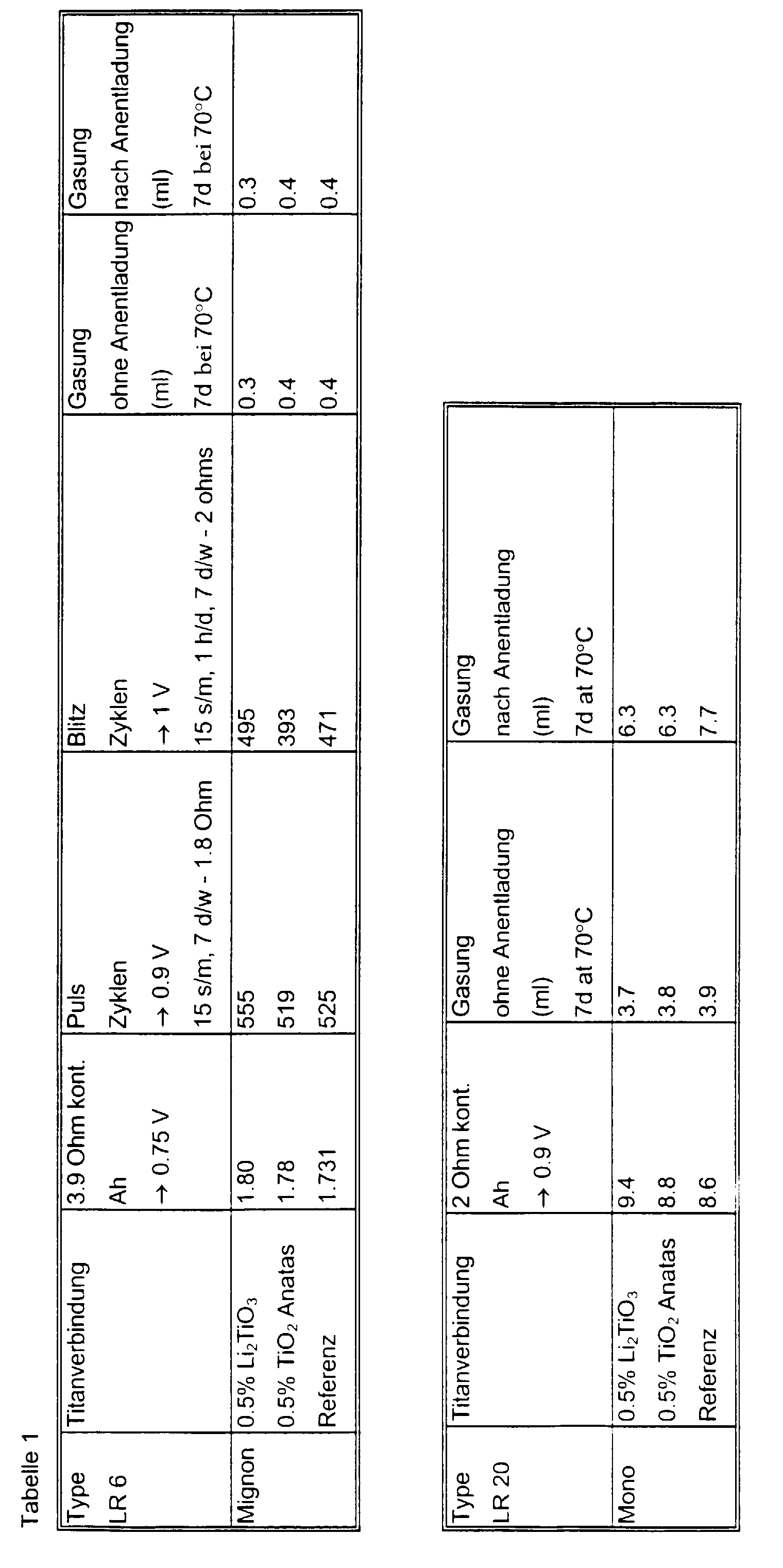
- the addition of lithium titanate (Li 2 TiO 3 ) to the cathode mass improves the discharge behavior of the battery and reduces gassing in the cell.
- the process for producing alkaline primary cells according to the invention is characterized in that lithium titanate (Li 2 TiO 3 ) is added in powder form to the cathode mass with an electrolyte content of 4 to 5% by weight.
- Lithium titanate (Li 2 TiO 3 ) with a particle size of 0.1 ⁇ m to 200 ⁇ m and a BET surface area of 0.5-500 m 2 / g is preferably added to the cathode mass.
- Lithium titanate (Li 2 TiO 3 ) is preferably added to the cathode mass in a purity of greater than 95%.
- cathode mixtures consisting of the components: 86.0% EMD 9.0% graphite 4.5% electrolyte (50% KOH) becomes 0.5% by weight Li 2 Ti0 3 lithium titanate. added.
- a cell without the addition of titanium and a cell with 0.5% by weight of anatase-TiO 2 are produced in the cathode mass.
- the mixtures are granulated and then compacted into ring-shaped compacts. These are pushed into the cell cup and then the separator is inserted, either in the form of a cross wrap or in the form of a bundle separator.
- the gel-shaped zinc electrode is then metered in.
- the zinc anode consists of 68% by weight of a zinc powder with a particle size distribution of typically 50-500 ⁇ m particle size and approximately 32% by weight of an alkaline electrolyte (for example a 40% KOH).
- a gassing inhibitor eg In 2 0 3 or In (OH) 3
- a gelling agent eg Carbopol 940
- a surface-active substance eg glycol, polyethylene glycol or a fluorosurfactant
- Table 1 shows the test results with various titanium compounds with regard to performance and gassing. It is clear that Li 2 Ti0 3 reduces the gassing of the cell in addition to improving the continuous and intermittent discharge properties.
Landscapes
- Chemical & Material Sciences (AREA)
- Chemical Kinetics & Catalysis (AREA)
- Electrochemistry (AREA)
- General Chemical & Material Sciences (AREA)
- Inorganic Chemistry (AREA)
- Engineering & Computer Science (AREA)
- Manufacturing & Machinery (AREA)
- Battery Electrode And Active Subsutance (AREA)
- Primary Cells (AREA)
Description
Weiterhin können Elektrolyt, Tenside sowie weitere Zusätze enthalten sein.
Das Mangandioxid wird, insbesondere in der elektrochemisch abgeschiedenen Form (EMD) als aktives Kathodenmaterial eingesetzt.
Ein Nachteil der meisten Bindemittel ist, daß diese Volumen benötigen, welches nicht für aktives Material zur Verfügung steht. Weiterhin sind viele Bindemittel hydrophob und erschweren die Elektrolytaufnahme der Kathode im Prozeß der Zellenherstellung. Dadurch ergeben sich negative Auswirkungen auf die Zellenperformance.
Typische Bindemittel sind Kunststoffpulver aus der Gruppe der Polyethylene (PE), Polypropylene (PP), Polyethylenterephthalate (PET), Polytetrafluorethylen (PTFE) Polyacrylate (PA), Polybutadiene (PB) und Block- oder Copolymere der vorgenannten Verbindungen. Auch die Einbringung von Bindemitteln in Form von wäßrigen Dispersionen ist bekannt (z.B. PTFE- oder PE-Dispersionen). Hierbei hat das zugefügte Wasser ebenfalls bindende Eigenschaften auf den Kathodenpreßkörper.
Der Elektrolyt soll die Poren der Kathode füllen, um eine lonenleitfähigkeit in der Kathode zu erreichen. Eine Reihe von positiven Eigenschaften werden so erreicht. So kann auf den Einsatz von Bindemitteln ganz oder teilweise verzichtet werden, da Laugen ebenfalls bindende Eigenschaften auf den Kathodenpreßkörper haben. Durch die Wahl der Elektrolytmenge kann eine optimale Porosität der Kathode eingestellt werden, was zu einer Minimierung des Diaphragmenwiderstandes des Kathodenpreßkörpers führt. Ein reduzierter Diaphragmenwiderstand wiederum verbessert die Performance der kompletten Zellen deutlich. Eine Kathode mit z.B. 6 Gew.% eines 50 %igen KOH-Elektrolyten verbessert die Entlade-Eigenschaften der damit hergestellten Zellen im Vergleich zu einer Kathode mit niedrigerem oder ohne Elektrolytgehalt. Außerdem kann durch eine hohe Konzentration des Elektrolyten der Übergangswiderstand Zellenbecher zum Kathodenring nach einer Lagerung deutlich reduziert werden.
Die Herstellung einer Kathode mit einem hohen Elektrolytgehalt in der Kathoden-masse hat jedoch prozeßtechnische Nachteile im Vergleich zu einer trockenen Kathodenmischung. Für die Herstellung der Kathodenpreßkörper werden üblicherweise sogenannte Rundläufer-Preßwerkzeuge eingesetzt. Diese Preßwerkzeuge bestehen in der Regel aus speziellen Stahllegierungen, die einen deutlich ansteigenden Verschleiß bei ansteigendem Elektrolytgehalt in der Kathodenrezeptur aufweisen.
Übliche oberflächenaktive Substanzen können flüssig oder fest sein und dem nichtionischen-, anionischen- oder kationische Typ angehören. So sind z.B. aliphatische Fluorverbindungen, aromatische und aliphatische Phosphonsäuren oder Polyethylenglykole geeignet.
Als Nachteil solcher Tenside kann jedoch gelegentlich beobachtet werden, daß diese aufgrund ihrer hohen Molekülmobilität zur Zinkelektrode als Gegenelektrode gelangen und dort bei bestimmten Entladearten (z.B. pulsförmige Entladungen) eine Depression der Spannungslage bewirken.
In der Patentschrift US 5,342,712 wird als Zusatz zur Kathode Anatas-TiO2 vorgeschlagen. Der Zusatz von 0,1 bis 2 Gew.% der Titandioxid-Modifikation Anatas zur Kathodenmasse von alkalischen Primärzellen soll eine Erhöhung der Benutzungszeitdauer um 15% bei höheren Strömen (3,9 Ohm-Entladung) gestatten.
Aufgabe der Erfindung ist es, eine Lösung für die vorgenannten Probleme anzugeben.
Der Zusatz von Lithiumtitanat (Li2TiO3) zur Kathodenmasse verbessert das Entladeverhalten der Batterie und verringert die Gasung in der Zelle.
Das Verfahren zur Herstellung erfindungsgemäßen alkalischer Primärzellen ist dadurch gekennzeichnet, daß Lithiumtitanat (Li2TiO3) pulverförmig der Kathodenmasse mit einem Elektrolytgehalt von 4 bis 5 Gew.% zugesetzt wird.
Vorzugsweise wird Lithiumtitanat (Li2TiO3) mit einer Partikelgröße von 0,1 µm bis 200 µm und einer BET-Oberfläche von 0,5 - 500 m2/g der Kathodenmasse zugesetzt. Lithiumtitanat (Li2TiO3) wird vorzugsweise der Kathodenmasse in einer Reinheit von größer 95% zugesetzt.
86.0 % EMD
9.0 % Graphit
4.5 % Elektrolyt (50%ige KOH) wird 0,5 Gew.%
Li2Ti03 Lithiumtitanat. zugemischt.
Die Mischungen werden granuliert und anschließend zu ringförmigen Preßkörpern verdichtet. Diese werden in den Zellbecher eingestoßen und nachfolgend der Separator eingefügt, entweder in Form eines Kreuzwickels oder in Form eines Konvolutseparators. Anschließend wird die gelförmige Zinkelektrode zudosiert. Die Zinkanode besteht aus 68 Gew.% eines Zinkpulvers mit einer Kornverteilung von typischerweise 50 - 500 µm Partikelgröße und circa 32 Gew.% eines alkalischen Elektrolyten (z.B. eine 40%ige KOH). Weiterhin werden dieser Anode geringe Mengen eines Gasungsinhibitors (z.B. In203 oder In(OH)3), eines Geliermittels (z.B. Carbopol 940) einer oberflächenaktiven Substanz (z.B. Glycol, Polyethylenglycol oder ein Fluortensid) zugesetzt.
Claims (4)
- Alkalische Primärzelle mit einem Zinkgel als Anodenmaterial, einem wäßrigen alkalischen Elektrolyten, einem Separator und einer Mangandioxid enthaltenden Kathodenmasse, dadurch gekennzeichnet, daß die Kathodenmasse 0,1 - 5 Gew.% Lithiumtitanat (Li2TiO3) enthält.
- Alkalische Primärzelle nach einem der Ansprüche 1 oder 2, dadurch gekennzeichnet, daß Lithiumtitanat (Li2TiO3) pulverförmig der Kathodenmasse mit einem Elektrolytgehalt von 4 bis 5 Gew.% zugesetzt ist.
- Alkalische Primärzelle nach Anspruch 3, dadurch gekennzeichnet, daß Lithiumtitanat (Li2TiO3) mit einer Partikelgröße von 0,1 µm bis 200 µm und einer BET-Oberfläche von 0,5 - 500 m2/g der Kathodenmasse zugesetzt ist.
- Alkalische Primärzelle nach einem der Ansprüche 3 oder 4, dadurch gekennzeichnet, daß das zugesetzte Lithiumtitanat (Li2TiO3) eine Reinheit von größer 95% besitzt.
Applications Claiming Priority (2)
| Application Number | Priority Date | Filing Date | Title |
|---|---|---|---|
| DE19615845A DE19615845A1 (de) | 1996-04-20 | 1996-04-20 | Kathodenzusatz für alkalische Primärzellen |
| DE19615845 | 1996-04-20 |
Publications (2)
| Publication Number | Publication Date |
|---|---|
| EP0802574A1 EP0802574A1 (de) | 1997-10-22 |
| EP0802574B1 true EP0802574B1 (de) | 2000-04-26 |
Family
ID=7791984
Family Applications (1)
| Application Number | Title | Priority Date | Filing Date |
|---|---|---|---|
| EP97102945A Expired - Lifetime EP0802574B1 (de) | 1996-04-20 | 1997-02-22 | Zusätze für Mangandioxidkathoden von alkalischen Primärzellen |
Country Status (13)
| Country | Link |
|---|---|
| US (1) | US5919588A (de) |
| EP (1) | EP0802574B1 (de) |
| JP (1) | JPH1040903A (de) |
| KR (1) | KR100441166B1 (de) |
| CN (1) | CN1098540C (de) |
| BR (1) | BR9701888A (de) |
| CA (1) | CA2203046A1 (de) |
| CO (1) | CO4560530A1 (de) |
| CZ (1) | CZ294824B6 (de) |
| DE (2) | DE19615845A1 (de) |
| ES (1) | ES2146432T3 (de) |
| PL (1) | PL184396B1 (de) |
| SK (1) | SK47697A3 (de) |
Families Citing this family (18)
| Publication number | Priority date | Publication date | Assignee | Title |
|---|---|---|---|---|
| US6828064B1 (en) * | 1998-01-07 | 2004-12-07 | Eveready Battery Company, Inc. | Alkaline cell having a cathode incorporating enhanced graphite |
| US6143446A (en) * | 1998-10-21 | 2000-11-07 | Duracell Inc. | Battery cathode |
| AU3499100A (en) * | 1999-02-26 | 2000-09-14 | Gillette Company, The | High performance alkaline battery |
| JP3625679B2 (ja) * | 1999-03-19 | 2005-03-02 | 三洋電機株式会社 | リチウム二次電池 |
| US6162561A (en) * | 1999-05-03 | 2000-12-19 | The Gillette Company | Akaline cell with improved cathode |
| US6660434B2 (en) | 2000-03-06 | 2003-12-09 | Superior Graphite Co. | Engineered carbonaceous materials and power sources using these materials |
| US7211350B2 (en) * | 2001-01-29 | 2007-05-01 | Rutgers University Foundation | Nanostructure lithium titanate electrode for high cycle rate rechargeable electrochemical cell |
| US6878490B2 (en) * | 2001-08-20 | 2005-04-12 | Fmc Corporation | Positive electrode active materials for secondary batteries and methods of preparing same |
| DE10220486C1 (de) * | 2002-05-07 | 2003-09-18 | Nbt Gmbh | Alkalischer Akkumulator |
| ES2209656B2 (es) * | 2002-12-13 | 2005-06-16 | Celaya Emparanza Y Galdos, S.A. (Cegasa) | Un elemento electroquimico o pila y un catodo para el mismo. |
| US20070009799A1 (en) * | 2005-07-07 | 2007-01-11 | Eveready Battery Company, Inc. | Electrochemical cell having a partially oxidized conductor |
| BRPI0703826A2 (pt) * | 2007-08-28 | 2009-04-28 | Nac De Grafite Ltda | bateria alcalina |
| JP5802489B2 (ja) * | 2011-09-01 | 2015-10-28 | Fdkエナジー株式会社 | アルカリ電池 |
| US11075382B2 (en) | 2014-05-30 | 2021-07-27 | Duracell U.S. Operations, Inc. | Cathode for an electrochemical cell including at least one cathode additive |
| WO2021046151A1 (en) * | 2019-09-05 | 2021-03-11 | Urban Electric Power Inc. | Aqueous electrochemical cells using polymer gel electrolytes |
| CN110993934A (zh) * | 2019-11-08 | 2020-04-10 | 武汉船用电力推进装置研究所(中国船舶重工集团公司第七一二研究所) | 一种钛酸锂正极金属锂负极锂原电池及其制备方法 |
| US12603272B2 (en) | 2020-01-29 | 2026-04-14 | Panasonic Intellectual Property Management Co., Ltd. | Alkaline dry battery |
| CN117117164A (zh) * | 2023-09-28 | 2023-11-24 | 福建南平南孚电池有限公司 | 以二氧化锰为主材的电极活性材料及其应用 |
Family Cites Families (10)
| Publication number | Priority date | Publication date | Assignee | Title |
|---|---|---|---|---|
| US5108852A (en) * | 1990-03-23 | 1992-04-28 | Battery Technologies Inc. | Manganese dioxide cathode for a rechargeable alkaline cell, and cell containing the same |
| US5156934A (en) * | 1991-02-11 | 1992-10-20 | Rbc Universal Ltd. | Method of making a rechargable modified manganese dioxide material and related compound and electrode material |
| US5342712A (en) * | 1993-05-17 | 1994-08-30 | Duracell Inc. | Additives for primary electrochemical cells having manganese dioxide cathodes |
| CA2111757C (en) * | 1993-12-17 | 2004-03-16 | Lijun Bai | Rechargeable manganese dioxide cathode |
| DE19546333A1 (de) * | 1994-12-17 | 1996-06-20 | Grillo Werke Ag | Zellen auf Basis von Zink-Alkali-Mangan und Verfahren zur Herstellung derselben |
| US5516604A (en) * | 1995-02-13 | 1996-05-14 | Duracell Inc. | Additives for primary electrochemical cells having manganese dioxide cathodes |
| US5569564A (en) * | 1995-06-07 | 1996-10-29 | Eveready Battery Company, Inc. | Alkaline cell having a cathode including a titanate additive |
| US5599644A (en) * | 1995-06-07 | 1997-02-04 | Eveready Battery Company, Inc. | Cathodes for electrochemical cells having additives |
| US5532085A (en) * | 1995-08-22 | 1996-07-02 | Duracell Inc. | Additives for alkaline electrochemical cells having manganese dioxide cathodes |
| IT1278764B1 (it) * | 1995-10-03 | 1997-11-27 | Volta Ind Srl | Pila a secco con catodo additivato |
-
1996
- 1996-04-20 DE DE19615845A patent/DE19615845A1/de not_active Withdrawn
-
1997
- 1997-02-22 ES ES97102945T patent/ES2146432T3/es not_active Expired - Lifetime
- 1997-02-22 EP EP97102945A patent/EP0802574B1/de not_active Expired - Lifetime
- 1997-02-22 DE DE59701495T patent/DE59701495D1/de not_active Expired - Fee Related
- 1997-03-18 KR KR1019970009053A patent/KR100441166B1/ko not_active Expired - Fee Related
- 1997-04-10 CZ CZ19971094A patent/CZ294824B6/cs not_active IP Right Cessation
- 1997-04-15 US US08/839,650 patent/US5919588A/en not_active Expired - Fee Related
- 1997-04-16 CO CO97019978A patent/CO4560530A1/es unknown
- 1997-04-16 SK SK476-97A patent/SK47697A3/sk unknown
- 1997-04-17 JP JP9099968A patent/JPH1040903A/ja active Pending
- 1997-04-17 PL PL97319531A patent/PL184396B1/pl not_active IP Right Cessation
- 1997-04-18 CA CA002203046A patent/CA2203046A1/en not_active Abandoned
- 1997-04-18 CN CN97110562A patent/CN1098540C/zh not_active Expired - Fee Related
- 1997-04-22 BR BR9701888A patent/BR9701888A/pt not_active IP Right Cessation
Also Published As
| Publication number | Publication date |
|---|---|
| PL319531A1 (en) | 1997-10-27 |
| CZ294824B6 (cs) | 2005-03-16 |
| ES2146432T3 (es) | 2000-08-01 |
| MX9702838A (es) | 1998-05-31 |
| US5919588A (en) | 1999-07-06 |
| JPH1040903A (ja) | 1998-02-13 |
| EP0802574A1 (de) | 1997-10-22 |
| PL184396B1 (pl) | 2002-10-31 |
| CN1098540C (zh) | 2003-01-08 |
| CO4560530A1 (es) | 1998-02-10 |
| SK47697A3 (en) | 1997-11-05 |
| CN1169597A (zh) | 1998-01-07 |
| KR100441166B1 (ko) | 2004-10-02 |
| HK1005964A1 (en) | 1999-02-05 |
| CZ109497A3 (en) | 1997-12-17 |
| CA2203046A1 (en) | 1997-10-20 |
| DE19615845A1 (de) | 1997-10-23 |
| BR9701888A (pt) | 1998-09-29 |
| DE59701495D1 (de) | 2000-05-31 |
| KR970072534A (ko) | 1997-11-07 |
Similar Documents
| Publication | Publication Date | Title |
|---|---|---|
| DE69129483T2 (de) | Elektrochemische Zellen ohne wesentlichen Quecksilbergehalt | |
| DE69418492T2 (de) | Geschlossene wiederaufladbare zellen die quecksilberfreie zinkanoden enthalten und vefahren zur herstellung | |
| EP0802574A1 (de) | Zusätze für Mangandioxidkathoden von alkalischen Primärzellen | |
| DE69621302T2 (de) | Elektrochemische Zelle mit niedrigem Gehalt an Quecksilber | |
| DE69603670T2 (de) | Alkalische Zelle mit Additiv enthaltender Kathode | |
| DD160205A5 (de) | Elektrochemische zellen mit zinkanoden | |
| DE102018222129A1 (de) | Kathodeneinheit und Verfahren zum Herstellen einer Kathodeneinheit | |
| DE2558550A1 (de) | Verfahren zur herstellung einer primaeren, elektrischen stromerzeugenden trockenzelle mit einer (cf tief x ) tief n -kathode und einem waessrigen alkalischen elektrolyten | |
| DE2738386C3 (de) | Gepreßte Nickelelektrode für galvanische Elemente | |
| DE2413954A1 (de) | Batterie-trennwand und batterie | |
| DE2929303A1 (de) | Zinkelektrode und verfahren zu ihrer herstellung | |
| DE2852668A1 (de) | Batteriezelle | |
| DE69208268T2 (de) | Kathoden fuer zink-mangandioxidzellen mit zusaetzen von barium | |
| CH499884A (de) | Verfahren zur Herstellung einer elektrischen Zelle und nach diesem Verfahren hergestellte elektrische Zelle | |
| DE2137753A1 (de) | Alkalische elektrochemische Zelle | |
| DE1909669A1 (de) | Sekundaerbatterie | |
| DE2246753B2 (de) | Galvanisches Element mit sich verbrauchender Zinkelektrode | |
| EP2687622B1 (de) | Zink-zellen mit verbesserter anodenzusammensetzung | |
| DE3026048A1 (de) | Batterieseparator fuer alkali- batteriezellen | |
| DE69824598T2 (de) | Elektrochemische darstellung von kobalt-oxyhydroxid | |
| DE2542923C3 (de) | Galvanische Zelle mit einer Depolarisatormischung und Verfahren zur Herstellung der Depolarisatormischung | |
| EP2720304B1 (de) | Elektrochemische Zelle mit Zink-Indium-Elektrode | |
| DE60110786T2 (de) | Elektrochemische zelle mit schwefel enthaltender anode | |
| EP2433324A1 (de) | Galvanisches element mit quecksilberfreier negativer elektrode | |
| DE3309833A1 (de) | Kathode fuer eine elektrochemische zelle, verfahren zu ihrer herstellung sowie verwendung |
Legal Events
| Date | Code | Title | Description |
|---|---|---|---|
| PUAI | Public reference made under article 153(3) epc to a published international application that has entered the european phase |
Free format text: ORIGINAL CODE: 0009012 |
|
| AK | Designated contracting states |
Kind code of ref document: A1 Designated state(s): BE CH DE ES FR GB GR IT LI NL |
|
| AX | Request for extension of the european patent |
Free format text: SI PAYMENT 970314 |
|
| 17P | Request for examination filed |
Effective date: 19971121 |
|
| 17Q | First examination report despatched |
Effective date: 19990322 |
|
| GRAG | Despatch of communication of intention to grant |
Free format text: ORIGINAL CODE: EPIDOS AGRA |
|
| GRAG | Despatch of communication of intention to grant |
Free format text: ORIGINAL CODE: EPIDOS AGRA |
|
| GRAH | Despatch of communication of intention to grant a patent |
Free format text: ORIGINAL CODE: EPIDOS IGRA |
|
| RAP1 | Party data changed (applicant data changed or rights of an application transferred) |
Owner name: VARTA GERAETEBATTERIE GMBH |
|
| GRAH | Despatch of communication of intention to grant a patent |
Free format text: ORIGINAL CODE: EPIDOS IGRA |
|
| GRAA | (expected) grant |
Free format text: ORIGINAL CODE: 0009210 |
|
| AK | Designated contracting states |
Kind code of ref document: B1 Designated state(s): BE CH DE ES FR GB GR IT LI NL |
|
| AX | Request for extension of the european patent |
Free format text: SI PAYMENT 19970314 |
|
| PG25 | Lapsed in a contracting state [announced via postgrant information from national office to epo] |
Ref country code: NL Free format text: LAPSE BECAUSE OF FAILURE TO SUBMIT A TRANSLATION OF THE DESCRIPTION OR TO PAY THE FEE WITHIN THE PRESCRIBED TIME-LIMIT Effective date: 20000426 Ref country code: IT Free format text: LAPSE BECAUSE OF FAILURE TO SUBMIT A TRANSLATION OF THE DESCRIPTION OR TO PAY THE FEE WITHIN THE PRESCRIBED TIME-LIMIT;WARNING: LAPSES OF ITALIAN PATENTS WITH EFFECTIVE DATE BEFORE 2007 MAY HAVE OCCURRED AT ANY TIME BEFORE 2007. THE CORRECT EFFECTIVE DATE MAY BE DIFFERENT FROM THE ONE RECORDED. Effective date: 20000426 |
|
| REG | Reference to a national code |
Ref country code: CH Ref legal event code: EP |
|
| REF | Corresponds to: |
Ref document number: 59701495 Country of ref document: DE Date of ref document: 20000531 |
|
| GBT | Gb: translation of ep patent filed (gb section 77(6)(a)/1977) |
Effective date: 20000523 |
|
| REG | Reference to a national code |
Ref country code: CH Ref legal event code: NV Representative=s name: E. BLUM & CO. PATENTANWAELTE |
|
| ET | Fr: translation filed | ||
| PG25 | Lapsed in a contracting state [announced via postgrant information from national office to epo] |
Ref country code: GR Free format text: LAPSE BECAUSE OF FAILURE TO SUBMIT A TRANSLATION OF THE DESCRIPTION OR TO PAY THE FEE WITHIN THE PRESCRIBED TIME-LIMIT Effective date: 20000728 |
|
| REG | Reference to a national code |
Ref country code: ES Ref legal event code: FG2A Ref document number: 2146432 Country of ref document: ES Kind code of ref document: T3 |
|
| NLV1 | Nl: lapsed or annulled due to failure to fulfill the requirements of art. 29p and 29m of the patents act | ||
| PLBE | No opposition filed within time limit |
Free format text: ORIGINAL CODE: 0009261 |
|
| STAA | Information on the status of an ep patent application or granted ep patent |
Free format text: STATUS: NO OPPOSITION FILED WITHIN TIME LIMIT |
|
| 26N | No opposition filed | ||
| REG | Reference to a national code |
Ref country code: GB Ref legal event code: IF02 |
|
| PGFP | Annual fee paid to national office [announced via postgrant information from national office to epo] |
Ref country code: BE Payment date: 20051216 Year of fee payment: 10 |
|
| PGFP | Annual fee paid to national office [announced via postgrant information from national office to epo] |
Ref country code: CH Payment date: 20060217 Year of fee payment: 10 |
|
| PGFP | Annual fee paid to national office [announced via postgrant information from national office to epo] |
Ref country code: FR Payment date: 20060227 Year of fee payment: 10 |
|
| PGFP | Annual fee paid to national office [announced via postgrant information from national office to epo] |
Ref country code: ES Payment date: 20060322 Year of fee payment: 10 |
|
| PGFP | Annual fee paid to national office [announced via postgrant information from national office to epo] |
Ref country code: GB Payment date: 20070223 Year of fee payment: 11 |
|
| PG25 | Lapsed in a contracting state [announced via postgrant information from national office to epo] |
Ref country code: LI Free format text: LAPSE BECAUSE OF NON-PAYMENT OF DUE FEES Effective date: 20070228 Ref country code: CH Free format text: LAPSE BECAUSE OF NON-PAYMENT OF DUE FEES Effective date: 20070228 |
|
| PGFP | Annual fee paid to national office [announced via postgrant information from national office to epo] |
Ref country code: DE Payment date: 20070330 Year of fee payment: 11 |
|
| REG | Reference to a national code |
Ref country code: CH Ref legal event code: PL |
|
| REG | Reference to a national code |
Ref country code: FR Ref legal event code: ST Effective date: 20071030 |
|
| BERE | Be: lapsed |
Owner name: *VARTA GERATEBATTERIE G.M.B.H. Effective date: 20070228 |
|
| PG25 | Lapsed in a contracting state [announced via postgrant information from national office to epo] |
Ref country code: BE Free format text: LAPSE BECAUSE OF NON-PAYMENT OF DUE FEES Effective date: 20070228 |
|
| PG25 | Lapsed in a contracting state [announced via postgrant information from national office to epo] |
Ref country code: FR Free format text: LAPSE BECAUSE OF NON-PAYMENT OF DUE FEES Effective date: 20070228 |
|
| REG | Reference to a national code |
Ref country code: ES Ref legal event code: FD2A Effective date: 20070223 |
|
| PG25 | Lapsed in a contracting state [announced via postgrant information from national office to epo] |
Ref country code: ES Free format text: LAPSE BECAUSE OF NON-PAYMENT OF DUE FEES Effective date: 20070223 |
|
| GBPC | Gb: european patent ceased through non-payment of renewal fee |
Effective date: 20080222 |
|
| PG25 | Lapsed in a contracting state [announced via postgrant information from national office to epo] |
Ref country code: DE Free format text: LAPSE BECAUSE OF NON-PAYMENT OF DUE FEES Effective date: 20080902 |
|
| PG25 | Lapsed in a contracting state [announced via postgrant information from national office to epo] |
Ref country code: GB Free format text: LAPSE BECAUSE OF NON-PAYMENT OF DUE FEES Effective date: 20080222 |