EP0765871A1 - Substituierte Chinolin-2-Carbonsäureamide, ihre Herstellung und ihre Verwendung als Prolyl-4-hydroylase Inhibitoren - Google Patents
Substituierte Chinolin-2-Carbonsäureamide, ihre Herstellung und ihre Verwendung als Prolyl-4-hydroylase Inhibitoren Download PDFInfo
- Publication number
- EP0765871A1 EP0765871A1 EP96115110A EP96115110A EP0765871A1 EP 0765871 A1 EP0765871 A1 EP 0765871A1 EP 96115110 A EP96115110 A EP 96115110A EP 96115110 A EP96115110 A EP 96115110A EP 0765871 A1 EP0765871 A1 EP 0765871A1
- Authority
- EP
- European Patent Office
- Prior art keywords
- alkyl
- alkoxy
- cycloalkyl
- carbamoyl
- aryloxy
- Prior art date
- Legal status (The legal status is an assumption and is not a legal conclusion. Google has not performed a legal analysis and makes no representation as to the accuracy of the status listed.)
- Granted
Links
- 239000003112 inhibitor Substances 0.000 title claims description 15
- 238000002360 preparation method Methods 0.000 title claims description 11
- ZEXKKIXCRDTKBF-UHFFFAOYSA-N quinoline-2-carboxamide Chemical class C1=CC=CC2=NC(C(=O)N)=CC=C21 ZEXKKIXCRDTKBF-UHFFFAOYSA-N 0.000 title description 3
- -1 benzyloxy, anilino, N-methylanilino Chemical group 0.000 claims abstract description 279
- 125000003917 carbamoyl group Chemical group [H]N([H])C(*)=O 0.000 claims abstract description 122
- 125000002023 trifluoromethyl group Chemical group FC(F)(F)* 0.000 claims abstract description 100
- 229910052801 chlorine Inorganic materials 0.000 claims abstract description 77
- 229910052731 fluorine Inorganic materials 0.000 claims abstract description 71
- 125000003545 alkoxy group Chemical group 0.000 claims abstract description 70
- 229910052794 bromium Inorganic materials 0.000 claims abstract description 63
- 125000003118 aryl group Chemical group 0.000 claims abstract description 40
- 229910052760 oxygen Inorganic materials 0.000 claims abstract description 39
- 150000003839 salts Chemical class 0.000 claims abstract description 39
- 229910052717 sulfur Inorganic materials 0.000 claims abstract description 39
- 125000000951 phenoxy group Chemical group [H]C1=C([H])C([H])=C(O*)C([H])=C1[H] 0.000 claims abstract description 37
- 125000003170 phenylsulfonyl group Chemical group C1(=CC=CC=C1)S(=O)(=O)* 0.000 claims abstract description 37
- 125000000217 alkyl group Chemical group 0.000 claims abstract description 32
- 125000005277 alkyl imino group Chemical group 0.000 claims abstract description 31
- 125000004390 alkyl sulfonyl group Chemical group 0.000 claims abstract description 28
- 125000001797 benzyl group Chemical group [H]C1=C([H])C([H])=C(C([H])=C1[H])C([H])([H])* 0.000 claims abstract description 24
- 125000004644 alkyl sulfinyl group Chemical group 0.000 claims abstract description 22
- 125000004453 alkoxycarbonyl group Chemical group 0.000 claims abstract description 20
- 125000001589 carboacyl group Chemical group 0.000 claims abstract description 20
- 125000003710 aryl alkyl group Chemical group 0.000 claims abstract description 18
- 125000003178 carboxy group Chemical group [H]OC(*)=O 0.000 claims abstract description 15
- 125000005196 alkyl carbonyloxy group Chemical group 0.000 claims abstract description 13
- 125000004104 aryloxy group Chemical group 0.000 claims abstract description 12
- 125000002768 hydroxyalkyl group Chemical group 0.000 claims abstract description 11
- 125000001072 heteroaryl group Chemical group 0.000 claims abstract description 9
- 229910052740 iodine Inorganic materials 0.000 claims abstract description 7
- 125000004414 alkyl thio group Chemical group 0.000 claims abstract description 6
- 125000002947 alkylene group Chemical group 0.000 claims abstract description 6
- 125000002924 primary amino group Chemical group [H]N([H])* 0.000 claims abstract description 6
- 125000004448 alkyl carbonyl group Chemical group 0.000 claims abstract description 5
- 150000007650 D alpha amino acids Chemical class 0.000 claims abstract description 4
- 125000002883 imidazolyl group Chemical group 0.000 claims abstract description 4
- 125000003831 tetrazolyl group Chemical group 0.000 claims abstract description 4
- 125000005010 perfluoroalkyl group Chemical group 0.000 claims abstract description 3
- 125000004169 (C1-C6) alkyl group Chemical group 0.000 claims description 167
- 150000001875 compounds Chemical class 0.000 claims description 157
- 125000000008 (C1-C10) alkyl group Chemical group 0.000 claims description 121
- 229910052739 hydrogen Inorganic materials 0.000 claims description 97
- 239000001257 hydrogen Substances 0.000 claims description 97
- 239000000460 chlorine Substances 0.000 claims description 92
- 125000001424 substituent group Chemical group 0.000 claims description 80
- ZAMOUSCENKQFHK-UHFFFAOYSA-N Chlorine atom Chemical compound [Cl] ZAMOUSCENKQFHK-UHFFFAOYSA-N 0.000 claims description 79
- UFHFLCQGNIYNRP-UHFFFAOYSA-N Hydrogen Chemical compound [H][H] UFHFLCQGNIYNRP-UHFFFAOYSA-N 0.000 claims description 76
- PXGOKWXKJXAPGV-UHFFFAOYSA-N Fluorine Chemical compound FF PXGOKWXKJXAPGV-UHFFFAOYSA-N 0.000 claims description 73
- 239000011737 fluorine Substances 0.000 claims description 67
- WKBOTKDWSSQWDR-UHFFFAOYSA-N Bromine atom Chemical compound [Br] WKBOTKDWSSQWDR-UHFFFAOYSA-N 0.000 claims description 59
- GDTBXPJZTBHREO-UHFFFAOYSA-N bromine Substances BrBr GDTBXPJZTBHREO-UHFFFAOYSA-N 0.000 claims description 59
- 125000001997 phenyl group Chemical group [H]C1=C([H])C([H])=C(*)C([H])=C1[H] 0.000 claims description 57
- 150000002431 hydrogen Chemical class 0.000 claims description 51
- 229910052757 nitrogen Inorganic materials 0.000 claims description 48
- 125000004191 (C1-C6) alkoxy group Chemical group 0.000 claims description 47
- 125000005115 alkyl carbamoyl group Chemical group 0.000 claims description 35
- 125000005146 naphthylsulfonyl group Chemical group C1(=CC=CC2=CC=CC=C12)S(=O)(=O)* 0.000 claims description 31
- 125000006625 (C3-C8) cycloalkyloxy group Chemical group 0.000 claims description 28
- 125000004093 cyano group Chemical group *C#N 0.000 claims description 28
- 229910052736 halogen Inorganic materials 0.000 claims description 28
- 150000002367 halogens Chemical class 0.000 claims description 28
- 125000003342 alkenyl group Chemical group 0.000 claims description 27
- 125000004739 (C1-C6) alkylsulfonyl group Chemical group 0.000 claims description 24
- 125000006552 (C3-C8) cycloalkyl group Chemical group 0.000 claims description 24
- 125000001624 naphthyl group Chemical group 0.000 claims description 23
- 125000004209 (C1-C8) alkyl group Chemical group 0.000 claims description 20
- 102000004079 Prolyl Hydroxylases Human genes 0.000 claims description 19
- 108010043005 Prolyl Hydroxylases Proteins 0.000 claims description 19
- 125000004642 (C1-C12) alkoxy group Chemical group 0.000 claims description 17
- 125000004769 (C1-C4) alkylsulfonyl group Chemical group 0.000 claims description 17
- 125000005153 alkyl sulfamoyl group Chemical group 0.000 claims description 17
- 210000004185 liver Anatomy 0.000 claims description 17
- 125000002496 methyl group Chemical group [H]C([H])([H])* 0.000 claims description 17
- 125000006702 (C1-C18) alkyl group Chemical group 0.000 claims description 16
- 125000002887 hydroxy group Chemical group [H]O* 0.000 claims description 16
- 125000004400 (C1-C12) alkyl group Chemical group 0.000 claims description 15
- 125000003837 (C1-C20) alkyl group Chemical group 0.000 claims description 15
- 125000003302 alkenyloxy group Chemical group 0.000 claims description 15
- 125000002102 aryl alkyloxo group Chemical group 0.000 claims description 15
- 125000003282 alkyl amino group Chemical group 0.000 claims description 14
- 125000000051 benzyloxy group Chemical group [H]C1=C([H])C([H])=C(C([H])=C1[H])C([H])([H])O* 0.000 claims description 14
- 125000006621 (C3-C8) cycloalkyl-(C1-C6) alkyl group Chemical group 0.000 claims description 13
- 125000006577 C1-C6 hydroxyalkyl group Chemical group 0.000 claims description 13
- 125000004397 aminosulfonyl group Chemical group NS(=O)(=O)* 0.000 claims description 13
- 125000005116 aryl carbamoyl group Chemical group 0.000 claims description 13
- 239000003814 drug Substances 0.000 claims description 13
- 125000006239 protecting group Chemical group 0.000 claims description 13
- 125000004454 (C1-C6) alkoxycarbonyl group Chemical group 0.000 claims description 12
- 125000004738 (C1-C6) alkyl sulfinyl group Chemical group 0.000 claims description 12
- 125000004916 (C1-C6) alkylcarbonyl group Chemical group 0.000 claims description 12
- 125000003236 benzoyl group Chemical group [H]C1=C([H])C([H])=C(C([H])=C1[H])C(*)=O 0.000 claims description 12
- 238000000034 method Methods 0.000 claims description 11
- LOAUVZALPPNFOQ-UHFFFAOYSA-N quinaldic acid Chemical class C1=CC=CC2=NC(C(=O)O)=CC=C21 LOAUVZALPPNFOQ-UHFFFAOYSA-N 0.000 claims description 11
- 125000004178 (C1-C4) alkyl group Chemical group 0.000 claims description 10
- 125000004467 aryl imino group Chemical group 0.000 claims description 10
- 150000002825 nitriles Chemical class 0.000 claims description 10
- 125000005092 alkenyloxycarbonyl group Chemical group 0.000 claims description 9
- 125000005140 aralkylsulfonyl group Chemical group 0.000 claims description 9
- 125000003435 aroyl group Chemical group 0.000 claims description 9
- 125000005161 aryl oxy carbonyl group Chemical group 0.000 claims description 9
- 125000005135 aryl sulfinyl group Chemical group 0.000 claims description 9
- 125000001153 fluoro group Chemical group F* 0.000 claims description 9
- 125000000229 (C1-C4)alkoxy group Chemical group 0.000 claims description 8
- 125000005194 alkoxycarbonyloxy group Chemical group 0.000 claims description 8
- 125000005225 alkynyloxycarbonyl group Chemical group 0.000 claims description 8
- 125000004391 aryl sulfonyl group Chemical group 0.000 claims description 8
- 201000010099 disease Diseases 0.000 claims description 8
- 208000037265 diseases, disorders, signs and symptoms Diseases 0.000 claims description 8
- 230000003176 fibrotic effect Effects 0.000 claims description 8
- 239000000543 intermediate Substances 0.000 claims description 8
- 125000000876 trifluoromethoxy group Chemical group FC(F)(F)O* 0.000 claims description 8
- 125000006649 (C2-C20) alkynyl group Chemical group 0.000 claims description 7
- 125000004432 carbon atom Chemical group C* 0.000 claims description 7
- 239000000651 prodrug Substances 0.000 claims description 7
- 229940002612 prodrug Drugs 0.000 claims description 7
- 125000006636 (C3-C8) cycloalkylcarbonyl group Chemical group 0.000 claims description 6
- 125000000304 alkynyl group Chemical group 0.000 claims description 6
- 230000036570 collagen biosynthesis Effects 0.000 claims description 6
- 125000005133 alkynyloxy group Chemical group 0.000 claims description 5
- 125000001495 ethyl group Chemical group [H]C([H])([H])C([H])([H])* 0.000 claims description 5
- 125000000449 nitro group Chemical group [O-][N+](*)=O 0.000 claims description 5
- 125000000027 (C1-C10) alkoxy group Chemical group 0.000 claims description 4
- 125000006376 (C3-C10) cycloalkyl group Chemical group 0.000 claims description 4
- 150000008575 L-amino acids Chemical class 0.000 claims description 4
- 230000002378 acidificating effect Effects 0.000 claims description 4
- 125000005422 alkyl sulfonamido group Chemical group 0.000 claims description 4
- 125000005198 alkynylcarbonyloxy group Chemical group 0.000 claims description 4
- 235000008206 alpha-amino acids Nutrition 0.000 claims description 4
- 125000005099 aryl alkyl carbonyl group Chemical group 0.000 claims description 4
- 125000005129 aryl carbonyl group Chemical group 0.000 claims description 4
- 125000005199 aryl carbonyloxy group Chemical group 0.000 claims description 4
- 125000005200 aryloxy carbonyloxy group Chemical group 0.000 claims description 4
- 125000005201 cycloalkylcarbonyloxy group Chemical group 0.000 claims description 4
- 230000002401 inhibitory effect Effects 0.000 claims description 4
- 150000003254 radicals Chemical class 0.000 claims description 4
- 125000006272 (C3-C7) cycloalkyl group Chemical group 0.000 claims description 3
- 125000005090 alkenylcarbonyl group Chemical group 0.000 claims description 3
- 150000002148 esters Chemical class 0.000 claims description 3
- 210000004072 lung Anatomy 0.000 claims description 3
- 229920006395 saturated elastomer Polymers 0.000 claims description 3
- 125000006711 (C2-C12) alkynyl group Chemical group 0.000 claims description 2
- KKFDJZZADQONDE-UHFFFAOYSA-N (hydridonitrato)hydroxidocarbon(.) Chemical compound O[C]=N KKFDJZZADQONDE-UHFFFAOYSA-N 0.000 claims description 2
- 229910004013 NO 2 Inorganic materials 0.000 claims description 2
- 125000005236 alkanoylamino group Chemical group 0.000 claims description 2
- 125000006323 alkenyl amino group Chemical group 0.000 claims description 2
- 125000000033 alkoxyamino group Chemical group 0.000 claims description 2
- 125000006319 alkynyl amino group Chemical group 0.000 claims description 2
- 125000005087 alkynylcarbonyl group Chemical group 0.000 claims description 2
- 238000007098 aminolysis reaction Methods 0.000 claims description 2
- 125000005239 aroylamino group Chemical group 0.000 claims description 2
- 125000001691 aryl alkyl amino group Chemical group 0.000 claims description 2
- 125000001769 aryl amino group Chemical group 0.000 claims description 2
- 150000005840 aryl radicals Chemical class 0.000 claims description 2
- 125000006310 cycloalkyl amino group Chemical group 0.000 claims description 2
- 125000000956 methoxy group Chemical group [H]C([H])([H])O* 0.000 claims description 2
- 230000008569 process Effects 0.000 claims description 2
- 238000004519 manufacturing process Methods 0.000 claims 4
- 150000001371 alpha-amino acids Chemical class 0.000 claims 2
- 125000006710 (C2-C12) alkenyl group Chemical group 0.000 claims 1
- 125000000475 sulfinyl group Chemical group [*:2]S([*:1])=O 0.000 claims 1
- 125000000472 sulfonyl group Chemical group *S(*)(=O)=O 0.000 claims 1
- 125000004001 thioalkyl group Chemical group 0.000 claims 1
- 125000000753 cycloalkyl group Chemical group 0.000 abstract description 8
- RAHZWNYVWXNFOC-UHFFFAOYSA-N Sulphur dioxide Chemical compound O=S=O RAHZWNYVWXNFOC-UHFFFAOYSA-N 0.000 abstract 3
- 125000001475 halogen functional group Chemical group 0.000 abstract 2
- AYTYZMKHTZTURR-UHFFFAOYSA-N 3-hydroxyquinoline-2-carboxamide Chemical compound C1=CC=C2C=C(O)C(C(=O)N)=NC2=C1 AYTYZMKHTZTURR-UHFFFAOYSA-N 0.000 abstract 1
- 150000007649 L alpha amino acids Chemical group 0.000 abstract 1
- 229910006074 SO2NH2 Inorganic materials 0.000 abstract 1
- 125000000000 cycloalkoxy group Chemical group 0.000 abstract 1
- WWUZIQQURGPMPG-KRWOKUGFSA-N sphingosine Chemical compound CCCCCCCCCCCCC\C=C\[C@@H](O)[C@@H](N)CO WWUZIQQURGPMPG-KRWOKUGFSA-N 0.000 abstract 1
- 125000000565 sulfonamide group Chemical group 0.000 abstract 1
- DHMQDGOQFOQNFH-UHFFFAOYSA-N Glycine Chemical compound NCC(O)=O DHMQDGOQFOQNFH-UHFFFAOYSA-N 0.000 description 145
- 239000000047 product Substances 0.000 description 91
- XEKOWRVHYACXOJ-UHFFFAOYSA-N Ethyl acetate Chemical compound CCOC(C)=O XEKOWRVHYACXOJ-UHFFFAOYSA-N 0.000 description 86
- RTZKZFJDLAIYFH-UHFFFAOYSA-N Diethyl ether Chemical compound CCOCC RTZKZFJDLAIYFH-UHFFFAOYSA-N 0.000 description 80
- 239000004471 Glycine Substances 0.000 description 74
- 229960002449 glycine Drugs 0.000 description 74
- IMNFDUFMRHMDMM-UHFFFAOYSA-N N-Heptane Chemical compound CCCCCCC IMNFDUFMRHMDMM-UHFFFAOYSA-N 0.000 description 71
- HEMHJVSKTPXQMS-UHFFFAOYSA-M Sodium hydroxide Chemical compound [OH-].[Na+] HEMHJVSKTPXQMS-UHFFFAOYSA-M 0.000 description 45
- VEXZGXHMUGYJMC-UHFFFAOYSA-N Hydrochloric acid Chemical compound Cl VEXZGXHMUGYJMC-UHFFFAOYSA-N 0.000 description 40
- WYURNTSHIVDZCO-UHFFFAOYSA-N Tetrahydrofuran Chemical compound C1CCOC1 WYURNTSHIVDZCO-UHFFFAOYSA-N 0.000 description 40
- XLYOFNOQVPJJNP-UHFFFAOYSA-N water Substances O XLYOFNOQVPJJNP-UHFFFAOYSA-N 0.000 description 34
- YMWUJEATGCHHMB-UHFFFAOYSA-N Dichloromethane Chemical compound ClCCl YMWUJEATGCHHMB-UHFFFAOYSA-N 0.000 description 33
- 239000003208 petroleum Substances 0.000 description 28
- KWYUFKZDYYNOTN-UHFFFAOYSA-M Potassium hydroxide Chemical compound [OH-].[K+] KWYUFKZDYYNOTN-UHFFFAOYSA-M 0.000 description 27
- ZAFNJMIOTHYJRJ-UHFFFAOYSA-N Diisopropyl ether Chemical compound CC(C)OC(C)C ZAFNJMIOTHYJRJ-UHFFFAOYSA-N 0.000 description 23
- 239000000203 mixture Substances 0.000 description 23
- BWHMMNNQKKPAPP-UHFFFAOYSA-L potassium carbonate Substances [K+].[K+].[O-]C([O-])=O BWHMMNNQKKPAPP-UHFFFAOYSA-L 0.000 description 23
- VYPSYNLAJGMNEJ-UHFFFAOYSA-N Silicium dioxide Chemical compound O=[Si]=O VYPSYNLAJGMNEJ-UHFFFAOYSA-N 0.000 description 22
- 239000012043 crude product Substances 0.000 description 22
- 239000000741 silica gel Substances 0.000 description 21
- 229910002027 silica gel Inorganic materials 0.000 description 21
- 239000000243 solution Substances 0.000 description 21
- YLQBMQCUIZJEEH-UHFFFAOYSA-N tetrahydrofuran Natural products C=1C=COC=1 YLQBMQCUIZJEEH-UHFFFAOYSA-N 0.000 description 20
- 108010035532 Collagen Proteins 0.000 description 14
- 102000008186 Collagen Human genes 0.000 description 14
- 229920001436 collagen Polymers 0.000 description 14
- 238000001816 cooling Methods 0.000 description 14
- FDPIMTJIUBPUKL-UHFFFAOYSA-N pentan-3-one Chemical compound CCC(=O)CC FDPIMTJIUBPUKL-UHFFFAOYSA-N 0.000 description 14
- 239000000126 substance Substances 0.000 description 14
- HVCNXQOWACZAFN-UHFFFAOYSA-N 4-ethylmorpholine Chemical compound CCN1CCOCC1 HVCNXQOWACZAFN-UHFFFAOYSA-N 0.000 description 13
- 241000700159 Rattus Species 0.000 description 13
- 238000004587 chromatography analysis Methods 0.000 description 13
- ASOKPJOREAFHNY-UHFFFAOYSA-N 1-Hydroxybenzotriazole Chemical compound C1=CC=C2N(O)N=NC2=C1 ASOKPJOREAFHNY-UHFFFAOYSA-N 0.000 description 12
- JXYACYYPACQCDM-UHFFFAOYSA-N Benzyl glycinate Chemical compound NCC(=O)OCC1=CC=CC=C1 JXYACYYPACQCDM-UHFFFAOYSA-N 0.000 description 12
- YXFVVABEGXRONW-UHFFFAOYSA-N Toluene Chemical compound CC1=CC=CC=C1 YXFVVABEGXRONW-UHFFFAOYSA-N 0.000 description 12
- RYHBNJHYFVUHQT-UHFFFAOYSA-N 1,4-Dioxane Chemical compound C1COCCO1 RYHBNJHYFVUHQT-UHFFFAOYSA-N 0.000 description 11
- AGEZXYOZHKGVCM-UHFFFAOYSA-N benzyl bromide Chemical compound BrCC1=CC=CC=C1 AGEZXYOZHKGVCM-UHFFFAOYSA-N 0.000 description 11
- CODNYICXDISAEA-UHFFFAOYSA-N bromine monochloride Chemical compound BrCl CODNYICXDISAEA-UHFFFAOYSA-N 0.000 description 11
- GBCAVSYHPPARHX-UHFFFAOYSA-M n'-cyclohexyl-n-[2-(4-methylmorpholin-4-ium-4-yl)ethyl]methanediimine;4-methylbenzenesulfonate Chemical compound CC1=CC=C(S([O-])(=O)=O)C=C1.C1CCCCC1N=C=NCC[N+]1(C)CCOCC1 GBCAVSYHPPARHX-UHFFFAOYSA-M 0.000 description 11
- 229910000027 potassium carbonate Inorganic materials 0.000 description 11
- 235000011181 potassium carbonates Nutrition 0.000 description 11
- 150000001732 carboxylic acid derivatives Chemical class 0.000 description 10
- NPZTUJOABDZTLV-UHFFFAOYSA-N hydroxybenzotriazole Substances O=C1C=CC=C2NNN=C12 NPZTUJOABDZTLV-UHFFFAOYSA-N 0.000 description 10
- CTSLXHKWHWQRSH-UHFFFAOYSA-N oxalyl chloride Chemical class ClC(=O)C(Cl)=O CTSLXHKWHWQRSH-UHFFFAOYSA-N 0.000 description 10
- 238000003756 stirring Methods 0.000 description 10
- WJKJXKRHMUXQSL-UHFFFAOYSA-N benzyl glycinate 4-methylbenzenesulfonate salt Chemical compound CC1=CC=C(S(O)(=O)=O)C=C1.NCC(=O)OCC1=CC=CC=C1 WJKJXKRHMUXQSL-UHFFFAOYSA-N 0.000 description 9
- 125000004356 hydroxy functional group Chemical group O* 0.000 description 9
- VZGDMQKNWNREIO-UHFFFAOYSA-N tetrachloromethane Chemical compound ClC(Cl)(Cl)Cl VZGDMQKNWNREIO-UHFFFAOYSA-N 0.000 description 9
- JUJWROOIHBZHMG-UHFFFAOYSA-N Pyridine Chemical compound C1=CC=NC=C1 JUJWROOIHBZHMG-UHFFFAOYSA-N 0.000 description 8
- JHFOWEGCZWLHNW-UHFFFAOYSA-N 4-fluoro-2-methyl-1-nitrobenzene Chemical compound CC1=CC(F)=CC=C1[N+]([O-])=O JHFOWEGCZWLHNW-UHFFFAOYSA-N 0.000 description 7
- LFQSCWFLJHTTHZ-UHFFFAOYSA-N Ethanol Chemical compound CCO LFQSCWFLJHTTHZ-UHFFFAOYSA-N 0.000 description 7
- 238000006243 chemical reaction Methods 0.000 description 7
- 239000000706 filtrate Substances 0.000 description 7
- 230000005764 inhibitory process Effects 0.000 description 7
- OKKJLVBELUTLKV-UHFFFAOYSA-N Methanol Chemical compound OC OKKJLVBELUTLKV-UHFFFAOYSA-N 0.000 description 6
- ZMXDDKWLCZADIW-UHFFFAOYSA-N N,N-Dimethylformamide Chemical compound CN(C)C=O ZMXDDKWLCZADIW-UHFFFAOYSA-N 0.000 description 6
- YRKCREAYFQTBPV-UHFFFAOYSA-N acetylacetone Chemical class CC(=O)CC(C)=O YRKCREAYFQTBPV-UHFFFAOYSA-N 0.000 description 6
- WPYMKLBDIGXBTP-UHFFFAOYSA-N benzoic acid Chemical compound OC(=O)C1=CC=CC=C1 WPYMKLBDIGXBTP-UHFFFAOYSA-N 0.000 description 6
- 239000003054 catalyst Substances 0.000 description 6
- 238000001727 in vivo Methods 0.000 description 6
- 239000012074 organic phase Substances 0.000 description 6
- 241000272525 Anas platyrhynchos Species 0.000 description 5
- FXHOOIRPVKKKFG-UHFFFAOYSA-N N,N-Dimethylacetamide Chemical compound CN(C)C(C)=O FXHOOIRPVKKKFG-UHFFFAOYSA-N 0.000 description 5
- 239000003153 chemical reaction reagent Substances 0.000 description 5
- 238000002425 crystallisation Methods 0.000 description 5
- 230000008025 crystallization Effects 0.000 description 5
- WVDDGKGOMKODPV-UHFFFAOYSA-N hydroxymethyl benzene Natural products OCC1=CC=CC=C1 WVDDGKGOMKODPV-UHFFFAOYSA-N 0.000 description 5
- 229960002591 hydroxyproline Drugs 0.000 description 5
- 239000003921 oil Substances 0.000 description 5
- 235000019198 oils Nutrition 0.000 description 5
- 238000007254 oxidation reaction Methods 0.000 description 5
- ISWSIDIOOBJBQZ-UHFFFAOYSA-N phenol group Chemical group C1(=CC=CC=C1)O ISWSIDIOOBJBQZ-UHFFFAOYSA-N 0.000 description 5
- 238000005245 sintering Methods 0.000 description 5
- 238000005160 1H NMR spectroscopy Methods 0.000 description 4
- CPELXLSAUQHCOX-UHFFFAOYSA-N Hydrogen bromide Chemical compound Br CPELXLSAUQHCOX-UHFFFAOYSA-N 0.000 description 4
- 150000001204 N-oxides Chemical class 0.000 description 4
- JCXJVPUVTGWSNB-UHFFFAOYSA-N Nitrogen dioxide Chemical class O=[N]=O JCXJVPUVTGWSNB-UHFFFAOYSA-N 0.000 description 4
- KDLHZDBZIXYQEI-UHFFFAOYSA-N Palladium Chemical compound [Pd] KDLHZDBZIXYQEI-UHFFFAOYSA-N 0.000 description 4
- 235000010233 benzoic acid Nutrition 0.000 description 4
- 210000004027 cell Anatomy 0.000 description 4
- 238000004113 cell culture Methods 0.000 description 4
- 238000005911 haloform reaction Methods 0.000 description 4
- HZOJBKMCYYWXAE-UHFFFAOYSA-N magnesium pentane-2,4-dione Chemical compound [Mg+2].CC(=O)CC([CH2-])=O.CC(=O)CC([CH2-])=O HZOJBKMCYYWXAE-UHFFFAOYSA-N 0.000 description 4
- BDAGIHXWWSANSR-UHFFFAOYSA-N methanoic acid Natural products OC=O BDAGIHXWWSANSR-UHFFFAOYSA-N 0.000 description 4
- 230000003647 oxidation Effects 0.000 description 4
- 239000012286 potassium permanganate Substances 0.000 description 4
- UMJSCPRVCHMLSP-UHFFFAOYSA-N pyridine Natural products COC1=CC=CN=C1 UMJSCPRVCHMLSP-UHFFFAOYSA-N 0.000 description 4
- 238000010992 reflux Methods 0.000 description 4
- 238000012360 testing method Methods 0.000 description 4
- 0 *C(c1c(*)c(*)c(c(*)c(*)c(*)c2*)c2*1O)=O Chemical compound *C(c1c(*)c(*)c(c(*)c(*)c(*)c2*)c2*1O)=O 0.000 description 3
- 150000005341 2-nitrobenzoic acids Chemical class 0.000 description 3
- ODWVFIWBWJXDMT-UHFFFAOYSA-N 3-(hydroxymethyl)-4-nitrophenol Chemical compound OCC1=CC(O)=CC=C1[N+]([O-])=O ODWVFIWBWJXDMT-UHFFFAOYSA-N 0.000 description 3
- CSCPPACGZOOCGX-UHFFFAOYSA-N Acetone Chemical compound CC(C)=O CSCPPACGZOOCGX-UHFFFAOYSA-N 0.000 description 3
- WEVYAHXRMPXWCK-UHFFFAOYSA-N Acetonitrile Chemical compound CC#N WEVYAHXRMPXWCK-UHFFFAOYSA-N 0.000 description 3
- 239000005711 Benzoic acid Substances 0.000 description 3
- 102000004266 Collagen Type IV Human genes 0.000 description 3
- 108010042086 Collagen Type IV Proteins 0.000 description 3
- QAOWNCQODCNURD-UHFFFAOYSA-N Sulfuric acid Chemical compound OS(O)(=O)=O QAOWNCQODCNURD-UHFFFAOYSA-N 0.000 description 3
- 230000004913 activation Effects 0.000 description 3
- 230000029936 alkylation Effects 0.000 description 3
- 238000005804 alkylation reaction Methods 0.000 description 3
- 150000001408 amides Chemical group 0.000 description 3
- 239000008346 aqueous phase Substances 0.000 description 3
- ONDMKQWGMAVUNZ-UHFFFAOYSA-N butyl 2-aminoacetate Chemical compound CCCCOC(=O)CN ONDMKQWGMAVUNZ-UHFFFAOYSA-N 0.000 description 3
- NFCPBBXWCPNVDP-UHFFFAOYSA-N butyl 2-aminoacetate;4-methylbenzenesulfonic acid Chemical compound CCCCOC(=O)CN.CC1=CC=C(S(O)(=O)=O)C=C1 NFCPBBXWCPNVDP-UHFFFAOYSA-N 0.000 description 3
- 125000002915 carbonyl group Chemical group [*:2]C([*:1])=O 0.000 description 3
- 208000019425 cirrhosis of liver Diseases 0.000 description 3
- 230000000694 effects Effects 0.000 description 3
- 210000002919 epithelial cell Anatomy 0.000 description 3
- 210000003494 hepatocyte Anatomy 0.000 description 3
- 238000005805 hydroxylation reaction Methods 0.000 description 3
- 108090000765 processed proteins & peptides Proteins 0.000 description 3
- HRZFUMHJMZEROT-UHFFFAOYSA-L sodium disulfite Chemical compound [Na+].[Na+].[O-]S(=O)S([O-])(=O)=O HRZFUMHJMZEROT-UHFFFAOYSA-L 0.000 description 3
- RMVRSNDYEFQCLF-UHFFFAOYSA-N thiophenol Chemical compound SC1=CC=CC=C1 RMVRSNDYEFQCLF-UHFFFAOYSA-N 0.000 description 3
- BTOXVQJLTUMIEN-UHFFFAOYSA-N 1-(3-hydroxy-6-octoxyquinolin-2-yl)ethanone Chemical compound N1=C(C(C)=O)C(O)=CC2=CC(OCCCCCCCC)=CC=C21 BTOXVQJLTUMIEN-UHFFFAOYSA-N 0.000 description 2
- JMGKOWLVRNNJCO-UHFFFAOYSA-N 1-(3-hydroxyquinolin-2-yl)ethanone Chemical class C1=CC=C2C=C(O)C(C(=O)C)=NC2=C1 JMGKOWLVRNNJCO-UHFFFAOYSA-N 0.000 description 2
- RQCABDQTEGOEBW-UHFFFAOYSA-N 1-(6-octoxy-3-phenylmethoxyquinolin-2-yl)ethanone Chemical compound C=1C2=CC(OCCCCCCCC)=CC=C2N=C(C(C)=O)C=1OCC1=CC=CC=C1 RQCABDQTEGOEBW-UHFFFAOYSA-N 0.000 description 2
- ITZQXKLKVGCBEU-UHFFFAOYSA-N 1-[3-hydroxy-6-[3-(trifluoromethyl)phenoxy]quinolin-2-yl]ethanone Chemical compound C1=C2C=C(O)C(C(=O)C)=NC2=CC=C1OC1=CC=CC(C(F)(F)F)=C1 ITZQXKLKVGCBEU-UHFFFAOYSA-N 0.000 description 2
- ZJVIUSMHMIAJNN-UHFFFAOYSA-N 1-[3-phenylmethoxy-6-[3-(trifluoromethyl)phenoxy]quinolin-2-yl]ethanone Chemical compound C1=C2C=C(OCC=3C=CC=CC=3)C(C(=O)C)=NC2=CC=C1OC1=CC=CC(C(F)(F)F)=C1 ZJVIUSMHMIAJNN-UHFFFAOYSA-N 0.000 description 2
- HZAXFHJVJLSVMW-UHFFFAOYSA-N 2-Aminoethan-1-ol Chemical compound NCCO HZAXFHJVJLSVMW-UHFFFAOYSA-N 0.000 description 2
- 102000008490 2-Oxoglutarate 5-Dioxygenase Procollagen-Lysine Human genes 0.000 description 2
- 108010020504 2-Oxoglutarate 5-Dioxygenase Procollagen-Lysine Proteins 0.000 description 2
- RELQTLPNMSOGRU-UHFFFAOYSA-N 2-[[7-chloro-3-hydroxy-6-(2,2,2-trifluoroethoxy)quinoline-2-carbonyl]amino]acetic acid Chemical compound ClC1=C(OCC(F)(F)F)C=C2C=C(O)C(C(=O)NCC(=O)O)=NC2=C1 RELQTLPNMSOGRU-UHFFFAOYSA-N 0.000 description 2
- CRKAFKBUDGGQAB-UHFFFAOYSA-N 2-methyl-1-nitro-4-[3-(trifluoromethyl)phenoxy]benzene Chemical compound C1=C([N+]([O-])=O)C(C)=CC(OC=2C=C(C=CC=2)C(F)(F)F)=C1 CRKAFKBUDGGQAB-UHFFFAOYSA-N 0.000 description 2
- GQEIKAXUKWLVPL-UHFFFAOYSA-N 2-nitro-5-(trifluoromethoxy)benzoic acid Chemical compound OC(=O)C1=CC(OC(F)(F)F)=CC=C1[N+]([O-])=O GQEIKAXUKWLVPL-UHFFFAOYSA-N 0.000 description 2
- JVPZKFKKGZYVAD-UHFFFAOYSA-N 2-nitro-5-[3-(trifluoromethyl)phenoxy]benzoic acid Chemical compound C1=C([N+]([O-])=O)C(C(=O)O)=CC(OC=2C=C(C=CC=2)C(F)(F)F)=C1 JVPZKFKKGZYVAD-UHFFFAOYSA-N 0.000 description 2
- ZUJJBPSUSBXVRI-UHFFFAOYSA-N 2-nitro-5-octoxybenzoic acid Chemical compound CCCCCCCCOC1=CC=C([N+]([O-])=O)C(C(O)=O)=C1 ZUJJBPSUSBXVRI-UHFFFAOYSA-N 0.000 description 2
- BCRPUBPRQSGJFL-UHFFFAOYSA-N 3-(2-nitrobenzoyl)pentane-2,4-dione Chemical compound CC(=O)C(C(C)=O)C(=O)C1=CC=CC=C1[N+]([O-])=O BCRPUBPRQSGJFL-UHFFFAOYSA-N 0.000 description 2
- UGEJOEBBMPOJMT-UHFFFAOYSA-N 3-(trifluoromethyl)phenol Chemical compound OC1=CC=CC(C(F)(F)F)=C1 UGEJOEBBMPOJMT-UHFFFAOYSA-N 0.000 description 2
- ASHGTJPOSUFTGB-UHFFFAOYSA-N 3-methoxyphenol Chemical compound COC1=CC=CC(O)=C1 ASHGTJPOSUFTGB-UHFFFAOYSA-N 0.000 description 2
- BJWCXGSEOMOVMN-UHFFFAOYSA-N 3-phenylmethoxyquinoline-2-carboxylic acid Chemical compound OC(=O)C1=NC2=CC=CC=C2C=C1OCC1=CC=CC=C1 BJWCXGSEOMOVMN-UHFFFAOYSA-N 0.000 description 2
- OSWFIVFLDKOXQC-UHFFFAOYSA-N 4-(3-methoxyphenyl)aniline Chemical compound COC1=CC=CC(C=2C=CC(N)=CC=2)=C1 OSWFIVFLDKOXQC-UHFFFAOYSA-N 0.000 description 2
- RUFWBMHXSJVLHE-UHFFFAOYSA-N 4-(benzenesulfonyl)-2-methyl-1-nitrobenzene Chemical compound C1=C([N+]([O-])=O)C(C)=CC(S(=O)(=O)C=2C=CC=CC=2)=C1 RUFWBMHXSJVLHE-UHFFFAOYSA-N 0.000 description 2
- BVKZGUZCCUSVTD-UHFFFAOYSA-M Bicarbonate Chemical compound OC([O-])=O BVKZGUZCCUSVTD-UHFFFAOYSA-M 0.000 description 2
- ROFVEXUMMXZLPA-UHFFFAOYSA-N Bipyridyl Chemical group N1=CC=CC=C1C1=CC=CC=N1 ROFVEXUMMXZLPA-UHFFFAOYSA-N 0.000 description 2
- QOSSAOTZNIDXMA-UHFFFAOYSA-N Dicylcohexylcarbodiimide Chemical compound C1CCCCC1N=C=NC1CCCCC1 QOSSAOTZNIDXMA-UHFFFAOYSA-N 0.000 description 2
- IAZDPXIOMUYVGZ-UHFFFAOYSA-N Dimethylsulphoxide Chemical compound CS(C)=O IAZDPXIOMUYVGZ-UHFFFAOYSA-N 0.000 description 2
- CFQSIYDPHWZRTM-UHFFFAOYSA-N F[Br]Cl Chemical compound F[Br]Cl CFQSIYDPHWZRTM-UHFFFAOYSA-N 0.000 description 2
- PMMYEEVYMWASQN-DMTCNVIQSA-N Hydroxyproline Chemical compound O[C@H]1CN[C@H](C(O)=O)C1 PMMYEEVYMWASQN-DMTCNVIQSA-N 0.000 description 2
- ONIBWKKTOPOVIA-BYPYZUCNSA-N L-Proline Chemical compound OC(=O)[C@@H]1CCCN1 ONIBWKKTOPOVIA-BYPYZUCNSA-N 0.000 description 2
- KDXKERNSBIXSRK-YFKPBYRVSA-N L-lysine Chemical compound NCCCC[C@H](N)C(O)=O KDXKERNSBIXSRK-YFKPBYRVSA-N 0.000 description 2
- GUBGYTABKSRVRQ-QKKXKWKRSA-N Lactose Chemical compound OC[C@H]1O[C@@H](O[C@H]2[C@H](O)[C@@H](O)C(O)O[C@@H]2CO)[C@H](O)[C@@H](O)[C@H]1O GUBGYTABKSRVRQ-QKKXKWKRSA-N 0.000 description 2
- KDXKERNSBIXSRK-UHFFFAOYSA-N Lysine Natural products NCCCCC(N)C(O)=O KDXKERNSBIXSRK-UHFFFAOYSA-N 0.000 description 2
- 239000004472 Lysine Substances 0.000 description 2
- CSNNHWWHGAXBCP-UHFFFAOYSA-L Magnesium sulfate Chemical compound [Mg+2].[O-][S+2]([O-])([O-])[O-] CSNNHWWHGAXBCP-UHFFFAOYSA-L 0.000 description 2
- GRYLNZFGIOXLOG-UHFFFAOYSA-N Nitric acid Chemical compound O[N+]([O-])=O GRYLNZFGIOXLOG-UHFFFAOYSA-N 0.000 description 2
- 108010050808 Procollagen Proteins 0.000 description 2
- ONIBWKKTOPOVIA-UHFFFAOYSA-N Proline Natural products OC(=O)C1CCCN1 ONIBWKKTOPOVIA-UHFFFAOYSA-N 0.000 description 2
- 231100000644 Toxic injury Toxicity 0.000 description 2
- 239000002253 acid Substances 0.000 description 2
- 125000003172 aldehyde group Chemical group 0.000 description 2
- 150000001370 alpha-amino acid derivatives Chemical class 0.000 description 2
- 235000001014 amino acid Nutrition 0.000 description 2
- 230000003510 anti-fibrotic effect Effects 0.000 description 2
- 239000002585 base Substances 0.000 description 2
- 235000019445 benzyl alcohol Nutrition 0.000 description 2
- 230000037396 body weight Effects 0.000 description 2
- 244000309464 bull Species 0.000 description 2
- 239000006227 byproduct Substances 0.000 description 2
- 150000007942 carboxylates Chemical group 0.000 description 2
- 230000037319 collagen production Effects 0.000 description 2
- 238000000354 decomposition reaction Methods 0.000 description 2
- PMMYEEVYMWASQN-UHFFFAOYSA-N dl-hydroxyproline Natural products OC1C[NH2+]C(C([O-])=O)C1 PMMYEEVYMWASQN-UHFFFAOYSA-N 0.000 description 2
- NTNZTEQNFHNYBC-UHFFFAOYSA-N ethyl 2-aminoacetate Chemical compound CCOC(=O)CN NTNZTEQNFHNYBC-UHFFFAOYSA-N 0.000 description 2
- 238000005187 foaming Methods 0.000 description 2
- 235000019253 formic acid Nutrition 0.000 description 2
- 230000002440 hepatic effect Effects 0.000 description 2
- 229910000042 hydrogen bromide Inorganic materials 0.000 description 2
- 238000005984 hydrogenation reaction Methods 0.000 description 2
- 230000033444 hydroxylation Effects 0.000 description 2
- 125000004029 hydroxymethyl group Chemical group [H]OC([H])([H])* 0.000 description 2
- 239000011777 magnesium Substances 0.000 description 2
- HQKMJHAJHXVSDF-UHFFFAOYSA-L magnesium stearate Chemical compound [Mg+2].CCCCCCCCCCCCCCCCCC([O-])=O.CCCCCCCCCCCCCCCCCC([O-])=O HQKMJHAJHXVSDF-UHFFFAOYSA-L 0.000 description 2
- 125000004184 methoxymethyl group Chemical group [H]C([H])([H])OC([H])([H])* 0.000 description 2
- 238000006396 nitration reaction Methods 0.000 description 2
- 230000020477 pH reduction Effects 0.000 description 2
- WEXRUCMBJFQVBZ-UHFFFAOYSA-N pentobarbital Chemical compound CCCC(C)C1(CC)C(=O)NC(=O)NC1=O WEXRUCMBJFQVBZ-UHFFFAOYSA-N 0.000 description 2
- 239000000825 pharmaceutical preparation Substances 0.000 description 2
- 239000012071 phase Substances 0.000 description 2
- 239000002244 precipitate Substances 0.000 description 2
- 239000011541 reaction mixture Substances 0.000 description 2
- 239000013558 reference substance Substances 0.000 description 2
- 210000002966 serum Anatomy 0.000 description 2
- 210000003491 skin Anatomy 0.000 description 2
- 239000011734 sodium Substances 0.000 description 2
- 235000010262 sodium metabisulphite Nutrition 0.000 description 2
- 239000002904 solvent Substances 0.000 description 2
- 239000007858 starting material Substances 0.000 description 2
- 125000001412 tetrahydropyranyl group Chemical group 0.000 description 2
- FYSNRJHAOHDILO-UHFFFAOYSA-N thionyl chloride Chemical class ClS(Cl)=O FYSNRJHAOHDILO-UHFFFAOYSA-N 0.000 description 2
- FGMPLJWBKKVCDB-UHFFFAOYSA-N trans-L-hydroxy-proline Natural products ON1CCCC1C(O)=O FGMPLJWBKKVCDB-UHFFFAOYSA-N 0.000 description 2
- LENZDBCJOHFCAS-UHFFFAOYSA-N tris Chemical compound OCC(N)(CO)CO LENZDBCJOHFCAS-UHFFFAOYSA-N 0.000 description 2
- TXTWXQXDMWILOF-UHFFFAOYSA-N (2-ethoxy-2-oxoethyl)azanium;chloride Chemical compound [Cl-].CCOC(=O)C[NH3+] TXTWXQXDMWILOF-UHFFFAOYSA-N 0.000 description 1
- MSCDXMCEPBWNTI-UHFFFAOYSA-N (2-nitro-5-octoxyphenyl)methanol Chemical compound CCCCCCCCOC1=CC=C([N+]([O-])=O)C(CO)=C1 MSCDXMCEPBWNTI-UHFFFAOYSA-N 0.000 description 1
- XTGAHWLIOPRXOC-UHFFFAOYSA-N (2-nitro-5-propan-2-yloxyphenyl)methanol Chemical compound CC(C)OC1=CC=C([N+]([O-])=O)C(CO)=C1 XTGAHWLIOPRXOC-UHFFFAOYSA-N 0.000 description 1
- ONIBWKKTOPOVIA-FXLFCPKBSA-N (2S)-(214C)azolidine-2-carboxylic acid Chemical compound N1[14C@@H](CCC1)C(=O)O ONIBWKKTOPOVIA-FXLFCPKBSA-N 0.000 description 1
- HPFWZNWHCWZFBD-UHFFFAOYSA-N 1,1,2,2,3,3,4-heptafluorobutan-1-ol Chemical compound OC(F)(F)C(F)(F)C(F)(F)CF HPFWZNWHCWZFBD-UHFFFAOYSA-N 0.000 description 1
- CSUFEOXMCRPQBB-UHFFFAOYSA-N 1,1,2,2-tetrafluoropropan-1-ol Chemical compound CC(F)(F)C(O)(F)F CSUFEOXMCRPQBB-UHFFFAOYSA-N 0.000 description 1
- AOTWCYSQDSKAQT-UHFFFAOYSA-N 1,2-dichloro-4-methyl-5-nitrobenzene Chemical compound CC1=CC(Cl)=C(Cl)C=C1[N+]([O-])=O AOTWCYSQDSKAQT-UHFFFAOYSA-N 0.000 description 1
- AWWSWICILMKCNG-UHFFFAOYSA-N 1-(2-nitro-5-octoxyphenyl)hexane-1,3,5-trione Chemical compound CCCCCCCCOC1=CC=C([N+]([O-])=O)C(C(=O)CC(=O)CC(C)=O)=C1 AWWSWICILMKCNG-UHFFFAOYSA-N 0.000 description 1
- BMJPNKJBJWHTAI-UHFFFAOYSA-N 1-(3-hydroxy-6-methoxyquinolin-2-yl)ethanone Chemical compound N1=C(C(C)=O)C(O)=CC2=CC(OC)=CC=C21 BMJPNKJBJWHTAI-UHFFFAOYSA-N 0.000 description 1
- RCPPXRFOMCZWAE-UHFFFAOYSA-N 1-(3-hydroxy-6-phenoxyquinolin-2-yl)ethanone Chemical compound C1=C2C=C(O)C(C(=O)C)=NC2=CC=C1OC1=CC=CC=C1 RCPPXRFOMCZWAE-UHFFFAOYSA-N 0.000 description 1
- VIBNKESZHRSNQF-UHFFFAOYSA-N 1-(3-hydroxy-6-propan-2-yloxyquinolin-2-yl)ethanone Chemical compound N1=C(C(C)=O)C(O)=CC2=CC(OC(C)C)=CC=C21 VIBNKESZHRSNQF-UHFFFAOYSA-N 0.000 description 1
- AXRTYICXFGDBFQ-UHFFFAOYSA-N 1-(3-phenylmethoxy-6-propan-2-yloxyquinolin-2-yl)ethanone Chemical compound C=1C2=CC(OC(C)C)=CC=C2N=C(C(C)=O)C=1OCC1=CC=CC=C1 AXRTYICXFGDBFQ-UHFFFAOYSA-N 0.000 description 1
- FSOAXUWBQUKXNN-UHFFFAOYSA-N 1-(3-phenylmethoxyquinolin-2-yl)ethanone Chemical compound CC(=O)C1=NC2=CC=CC=C2C=C1OCC1=CC=CC=C1 FSOAXUWBQUKXNN-UHFFFAOYSA-N 0.000 description 1
- RBQLWHDVBKXSKU-UHFFFAOYSA-N 1-(5-phenoxy-3-phenylmethoxyquinolin-2-yl)ethanone Chemical compound C=12C=C(OCC=3C=CC=CC=3)C(C(=O)C)=NC2=CC=CC=1OC1=CC=CC=C1 RBQLWHDVBKXSKU-UHFFFAOYSA-N 0.000 description 1
- USYRXFWXMSHKKD-UHFFFAOYSA-N 1-(6-butoxy-3-hydroxyquinolin-2-yl)ethanone Chemical compound N1=C(C(C)=O)C(O)=CC2=CC(OCCCC)=CC=C21 USYRXFWXMSHKKD-UHFFFAOYSA-N 0.000 description 1
- HGKBGWPQNSFPBN-UHFFFAOYSA-N 1-(6-butoxy-3-phenylmethoxyquinolin-2-yl)ethanone Chemical compound C=1C2=CC(OCCCC)=CC=C2N=C(C(C)=O)C=1OCC1=CC=CC=C1 HGKBGWPQNSFPBN-UHFFFAOYSA-N 0.000 description 1
- HFWDFLHGKWHSTD-UHFFFAOYSA-N 1-(6-chloro-3-hydroxyquinolin-2-yl)ethanone Chemical compound C1=C(Cl)C=C2C=C(O)C(C(=O)C)=NC2=C1 HFWDFLHGKWHSTD-UHFFFAOYSA-N 0.000 description 1
- MXHDBGCOKGSBCC-UHFFFAOYSA-N 1-(6-chloro-3-phenylmethoxyquinolin-2-yl)ethanone Chemical compound CC(=O)C1=NC2=CC=C(Cl)C=C2C=C1OCC1=CC=CC=C1 MXHDBGCOKGSBCC-UHFFFAOYSA-N 0.000 description 1
- OPJCMOGNCSSKAW-UHFFFAOYSA-N 1-(6-methoxy-3-phenylmethoxyquinolin-2-yl)ethanone Chemical compound C=1C2=CC(OC)=CC=C2N=C(C(C)=O)C=1OCC1=CC=CC=C1 OPJCMOGNCSSKAW-UHFFFAOYSA-N 0.000 description 1
- ZGLJHFYNAHGIKS-UHFFFAOYSA-N 1-(7-chloro-3-hydroxyquinolin-2-yl)ethanone Chemical compound ClC1=CC=C2C=C(O)C(C(=O)C)=NC2=C1 ZGLJHFYNAHGIKS-UHFFFAOYSA-N 0.000 description 1
- ZKKXDQCLZYMNCC-UHFFFAOYSA-N 1-(7-chloro-3-phenylmethoxyquinolin-2-yl)ethanone Chemical compound CC(=O)C1=NC2=CC(Cl)=CC=C2C=C1OCC1=CC=CC=C1 ZKKXDQCLZYMNCC-UHFFFAOYSA-N 0.000 description 1
- QHHIDIDFXZIYBR-UHFFFAOYSA-N 1-[2-nitro-5-[3-(trifluoromethyl)phenoxy]phenyl]hexane-1,3,5-trione Chemical compound C1=C([N+]([O-])=O)C(C(=O)CC(=O)CC(=O)C)=CC(OC=2C=C(C=CC=2)C(F)(F)F)=C1 QHHIDIDFXZIYBR-UHFFFAOYSA-N 0.000 description 1
- LBJHMKIIQJOGBJ-UHFFFAOYSA-N 1-[3-hydroxy-6-(2,2,3,3,4,4,5,5-octafluoropentoxy)quinolin-2-yl]ethanone Chemical compound C1=C(OCC(F)(F)C(F)(F)C(F)(F)C(F)F)C=C2C=C(O)C(C(=O)C)=NC2=C1 LBJHMKIIQJOGBJ-UHFFFAOYSA-N 0.000 description 1
- QHOZQQPTVXEYDX-UHFFFAOYSA-N 1-[3-hydroxy-6-(2,2,3,3-tetrafluoropropoxy)quinolin-2-yl]ethanone Chemical compound C1=C(OCC(F)(F)C(F)F)C=C2C=C(O)C(C(=O)C)=NC2=C1 QHOZQQPTVXEYDX-UHFFFAOYSA-N 0.000 description 1
- GZAHKGWGVSRDIA-UHFFFAOYSA-N 1-[3-hydroxy-6-(3-methoxyphenoxy)quinolin-2-yl]ethanone Chemical compound COC1=CC=CC(OC=2C=C3C=C(O)C(C(C)=O)=NC3=CC=2)=C1 GZAHKGWGVSRDIA-UHFFFAOYSA-N 0.000 description 1
- OLBRBTZAYJYWNA-UHFFFAOYSA-N 1-[3-hydroxy-6-(trifluoromethoxy)quinolin-2-yl]ethanone Chemical compound C1=C(OC(F)(F)F)C=C2C=C(O)C(C(=O)C)=NC2=C1 OLBRBTZAYJYWNA-UHFFFAOYSA-N 0.000 description 1
- ONJCKUZFKQUDGP-UHFFFAOYSA-N 1-[3-phenylmethoxy-5-(trifluoromethoxy)quinolin-2-yl]ethanone Chemical compound CC(=O)C1=NC2=CC=CC(OC(F)(F)F)=C2C=C1OCC1=CC=CC=C1 ONJCKUZFKQUDGP-UHFFFAOYSA-N 0.000 description 1
- LYXIAYFZGMWWDQ-UHFFFAOYSA-N 1-[3-phenylmethoxy-6-(2,2,3,3-tetrafluoropropoxy)quinolin-2-yl]ethanone Chemical compound CC(=O)C1=NC2=CC=C(OCC(F)(F)C(F)F)C=C2C=C1OCC1=CC=CC=C1 LYXIAYFZGMWWDQ-UHFFFAOYSA-N 0.000 description 1
- IAFBERKGDTYIPC-UHFFFAOYSA-N 1-[6-(2,2,3,3,4,4,5,5-octafluoropentoxy)-3-phenylmethoxyquinolin-2-yl]ethanone Chemical compound CC(=O)C1=NC2=CC=C(OCC(F)(F)C(F)(F)C(F)(F)C(F)F)C=C2C=C1OCC1=CC=CC=C1 IAFBERKGDTYIPC-UHFFFAOYSA-N 0.000 description 1
- NLDYLTHAJHYYKS-UHFFFAOYSA-N 1-[6-(3-ethoxypropoxy)-3-hydroxyquinolin-2-yl]ethanone Chemical compound N1=C(C(C)=O)C(O)=CC2=CC(OCCCOCC)=CC=C21 NLDYLTHAJHYYKS-UHFFFAOYSA-N 0.000 description 1
- OJYPDFULQJHIQB-UHFFFAOYSA-N 1-[6-(3-ethoxypropoxy)-3-phenylmethoxyquinolin-2-yl]ethanone Chemical compound C=1C2=CC(OCCCOCC)=CC=C2N=C(C(C)=O)C=1OCC1=CC=CC=C1 OJYPDFULQJHIQB-UHFFFAOYSA-N 0.000 description 1
- UUDJMNLIICNERT-UHFFFAOYSA-N 1-[6-(3-methoxyphenoxy)-3-phenylmethoxyquinolin-2-yl]ethanone Chemical compound COC1=CC=CC(OC=2C=C3C=C(OCC=4C=CC=CC=4)C(C(C)=O)=NC3=CC=2)=C1 UUDJMNLIICNERT-UHFFFAOYSA-N 0.000 description 1
- BPTCEZWFSBVDPI-UHFFFAOYSA-N 1-[6-(benzenesulfonyl)-3-hydroxyquinolin-2-yl]ethanone Chemical compound C1=C2C=C(O)C(C(=O)C)=NC2=CC=C1S(=O)(=O)C1=CC=CC=C1 BPTCEZWFSBVDPI-UHFFFAOYSA-N 0.000 description 1
- GNEJVTUTTIWISR-UHFFFAOYSA-N 1-[6-(benzenesulfonyl)-3-phenylmethoxyquinolin-2-yl]ethanone Chemical compound CC(=O)C1=NC2=CC=C(S(=O)(=O)C=3C=CC=CC=3)C=C2C=C1OCC1=CC=CC=C1 GNEJVTUTTIWISR-UHFFFAOYSA-N 0.000 description 1
- DLRCHQJGHQVZJY-UHFFFAOYSA-N 1-[7-chloro-3-hydroxy-6-(2,2,2-trifluoroethoxy)quinolin-2-yl]ethanone Chemical compound ClC1=C(OCC(F)(F)F)C=C2C=C(O)C(C(=O)C)=NC2=C1 DLRCHQJGHQVZJY-UHFFFAOYSA-N 0.000 description 1
- CMYVZXJGBZZQCJ-UHFFFAOYSA-N 1-[7-chloro-3-phenylmethoxy-6-(2,2,2-trifluoroethoxy)quinolin-2-yl]ethanone Chemical compound CC(=O)C1=NC2=CC(Cl)=C(OCC(F)(F)F)C=C2C=C1OCC1=CC=CC=C1 CMYVZXJGBZZQCJ-UHFFFAOYSA-N 0.000 description 1
- PBBZBCJJWDJPDV-UHFFFAOYSA-N 1-[7-chloro-6-(2,2,3,3,4,4,4-heptafluorobutoxy)-3-hydroxyquinolin-2-yl]ethanone Chemical compound ClC1=C(OCC(F)(F)C(F)(F)C(F)(F)F)C=C2C=C(O)C(C(=O)C)=NC2=C1 PBBZBCJJWDJPDV-UHFFFAOYSA-N 0.000 description 1
- SCZOKAULUZUGGS-UHFFFAOYSA-N 1-[7-chloro-6-(2,2,3,3,4,4,4-heptafluorobutoxy)-3-phenylmethoxyquinolin-2-yl]ethanone Chemical compound CC(=O)C1=NC2=CC(Cl)=C(OCC(F)(F)C(F)(F)C(F)(F)F)C=C2C=C1OCC1=CC=CC=C1 SCZOKAULUZUGGS-UHFFFAOYSA-N 0.000 description 1
- JOZWPJGRGUOZGY-UHFFFAOYSA-N 1-bromo-3-ethoxypropane Chemical compound CCOCCCBr JOZWPJGRGUOZGY-UHFFFAOYSA-N 0.000 description 1
- MPPPKRYCTPRNTB-UHFFFAOYSA-N 1-bromobutane Chemical compound CCCCBr MPPPKRYCTPRNTB-UHFFFAOYSA-N 0.000 description 1
- NULPUEPVMWSRRM-UHFFFAOYSA-N 1-chloro-2-(2,2,3,3,4,4,4-heptafluorobutoxy)-4-methyl-5-nitrobenzene Chemical compound CC1=CC(OCC(F)(F)C(F)(F)C(F)(F)F)=C(Cl)C=C1[N+]([O-])=O NULPUEPVMWSRRM-UHFFFAOYSA-N 0.000 description 1
- DSNVDSYVELRNLU-UHFFFAOYSA-N 1-chloro-4-methyl-5-nitro-2-(2,2,2-trifluoroethoxy)benzene Chemical compound CC1=CC(OCC(F)(F)F)=C(Cl)C=C1[N+]([O-])=O DSNVDSYVELRNLU-UHFFFAOYSA-N 0.000 description 1
- JVSFQJZRHXAUGT-UHFFFAOYSA-N 2,2-dimethylpropanoyl chloride Chemical class CC(C)(C)C(Cl)=O JVSFQJZRHXAUGT-UHFFFAOYSA-N 0.000 description 1
- SGTNSNPWRIOYBX-UHFFFAOYSA-N 2-(3,4-dimethoxyphenyl)-5-{[2-(3,4-dimethoxyphenyl)ethyl](methyl)amino}-2-(propan-2-yl)pentanenitrile Chemical compound C1=C(OC)C(OC)=CC=C1CCN(C)CCCC(C#N)(C(C)C)C1=CC=C(OC)C(OC)=C1 SGTNSNPWRIOYBX-UHFFFAOYSA-N 0.000 description 1
- HCIAAULRYYHQQS-UHFFFAOYSA-N 2-(quinoline-2-carbonylamino)acetic acid Chemical class C1=CC=CC2=NC(C(=O)NCC(=O)O)=CC=C21 HCIAAULRYYHQQS-UHFFFAOYSA-N 0.000 description 1
- IZQMRNMMPSNPJM-UHFFFAOYSA-N 2-[(3-hydroxypyridine-2-carbonyl)amino]acetic acid Chemical compound OC(=O)CNC(=O)C1=NC=CC=C1O IZQMRNMMPSNPJM-UHFFFAOYSA-N 0.000 description 1
- JMVWZMFXDTXDFI-UHFFFAOYSA-N 2-[(3-hydroxyquinoline-2-carbonyl)amino]acetic acid Chemical compound C1=CC=C2C=C(O)C(C(=O)NCC(=O)O)=NC2=C1 JMVWZMFXDTXDFI-UHFFFAOYSA-N 0.000 description 1
- NGNBDVOYPDDBFK-UHFFFAOYSA-N 2-[2,4-di(pentan-2-yl)phenoxy]acetyl chloride Chemical compound CCCC(C)C1=CC=C(OCC(Cl)=O)C(C(C)CCC)=C1 NGNBDVOYPDDBFK-UHFFFAOYSA-N 0.000 description 1
- SDFNBPBTEPADHL-UHFFFAOYSA-N 2-[[3-hydroxy-6-(2,2,2-trifluoroethoxy)quinoline-2-carbonyl]amino]acetic acid;hydrochloride Chemical compound Cl.C1=C(OCC(F)(F)F)C=C2C=C(O)C(C(=O)NCC(=O)O)=NC2=C1 SDFNBPBTEPADHL-UHFFFAOYSA-N 0.000 description 1
- OFUFXTHGZWIDDB-UHFFFAOYSA-N 2-chloroquinoline Chemical compound C1=CC=CC2=NC(Cl)=CC=C21 OFUFXTHGZWIDDB-UHFFFAOYSA-N 0.000 description 1
- ASUDFOJKTJLAIK-UHFFFAOYSA-N 2-methoxyethanamine Chemical compound COCCN ASUDFOJKTJLAIK-UHFFFAOYSA-N 0.000 description 1
- UPAJHGJZTJECSC-UHFFFAOYSA-N 2-methyl-1-nitro-4-(2,2,3,3,4,4,5,5-octafluoropentoxy)benzene Chemical compound CC1=CC(OCC(F)(F)C(F)(F)C(F)(F)C(F)F)=CC=C1[N+]([O-])=O UPAJHGJZTJECSC-UHFFFAOYSA-N 0.000 description 1
- GTKUDFVFYVPIGG-UHFFFAOYSA-N 2-methyl-1-nitro-4-(2,2,3,3-tetrafluoropropoxy)benzene Chemical compound CC1=CC(OCC(F)(F)C(F)F)=CC=C1[N+]([O-])=O GTKUDFVFYVPIGG-UHFFFAOYSA-N 0.000 description 1
- COHVZTXZLIRSTM-UHFFFAOYSA-N 2-methyl-1-nitro-4-phenoxybenzene Chemical compound C1=C([N+]([O-])=O)C(C)=CC(OC=2C=CC=CC=2)=C1 COHVZTXZLIRSTM-UHFFFAOYSA-N 0.000 description 1
- XNZIISMDVPNKIU-UHFFFAOYSA-N 2-methyl-1-nitro-4-phenylsulfanylbenzene Chemical compound C1=C([N+]([O-])=O)C(C)=CC(SC=2C=CC=CC=2)=C1 XNZIISMDVPNKIU-UHFFFAOYSA-N 0.000 description 1
- RRHLRAMBNZHBBI-UHFFFAOYSA-N 2-nitro-5-(2,2,3,3,4,4,5,5-octafluoropentoxy)benzoic acid Chemical compound OC(=O)C1=CC(OCC(F)(F)C(F)(F)C(F)(F)C(F)F)=CC=C1[N+]([O-])=O RRHLRAMBNZHBBI-UHFFFAOYSA-N 0.000 description 1
- ZIGTZLFKRARISF-UHFFFAOYSA-N 2-nitro-5-(2,2,3,3-tetrafluoropropoxy)benzoic acid Chemical compound OC(=O)C1=CC(OCC(F)(F)C(F)F)=CC=C1[N+]([O-])=O ZIGTZLFKRARISF-UHFFFAOYSA-N 0.000 description 1
- ZSNNELPPGKIDBW-UHFFFAOYSA-N 2-nitro-5-phenoxybenzoic acid Chemical compound C1=C([N+]([O-])=O)C(C(=O)O)=CC(OC=2C=CC=CC=2)=C1 ZSNNELPPGKIDBW-UHFFFAOYSA-N 0.000 description 1
- MHNZLVZHPKIHLO-UHFFFAOYSA-N 2-nitro-5-propan-2-yloxybenzoic acid Chemical compound CC(C)OC1=CC=C([N+]([O-])=O)C(C(O)=O)=C1 MHNZLVZHPKIHLO-UHFFFAOYSA-N 0.000 description 1
- SLAMLWHELXOEJZ-UHFFFAOYSA-N 2-nitrobenzoic acid Chemical class OC(=O)C1=CC=CC=C1[N+]([O-])=O SLAMLWHELXOEJZ-UHFFFAOYSA-N 0.000 description 1
- BWWHTIHDQBHTHP-UHFFFAOYSA-N 2-nitrobenzoyl chloride Chemical compound [O-][N+](=O)C1=CC=CC=C1C(Cl)=O BWWHTIHDQBHTHP-UHFFFAOYSA-N 0.000 description 1
- 125000002774 3,4-dimethoxybenzyl group Chemical group [H]C1=C([H])C(=C([H])C(OC([H])([H])[H])=C1OC([H])([H])[H])C([H])([H])* 0.000 description 1
- IZQDHXOJQGUDDO-UHFFFAOYSA-N 3-(2-nitro-5-octoxybenzoyl)pentane-2,4-dione Chemical compound CCCCCCCCOC1=CC=C([N+]([O-])=O)C(C(=O)C(C(C)=O)C(C)=O)=C1 IZQDHXOJQGUDDO-UHFFFAOYSA-N 0.000 description 1
- YGCGSZLOVGDRCS-UHFFFAOYSA-N 3-(2-nitro-5-phenoxybenzoyl)pentane-2,4-dione Chemical compound C1=C([N+]([O-])=O)C(C(=O)C(C(C)=O)C(=O)C)=CC(OC=2C=CC=CC=2)=C1 YGCGSZLOVGDRCS-UHFFFAOYSA-N 0.000 description 1
- IBEBVLNXSUBPDU-UHFFFAOYSA-N 3-(2-nitro-5-propan-2-yloxybenzoyl)pentane-2,4-dione Chemical compound CC(C)OC1=CC=C([N+]([O-])=O)C(C(=O)C(C(C)=O)C(C)=O)=C1 IBEBVLNXSUBPDU-UHFFFAOYSA-N 0.000 description 1
- IAJLVVBHVJPJIU-UHFFFAOYSA-N 3-(4-chloro-2-nitrobenzoyl)pentane-2,4-dione Chemical compound CC(=O)C(C(C)=O)C(=O)C1=CC=C(Cl)C=C1[N+]([O-])=O IAJLVVBHVJPJIU-UHFFFAOYSA-N 0.000 description 1
- AURDQYMQRHNONV-UHFFFAOYSA-N 3-(5-butoxy-2-nitrobenzoyl)pentane-2,4-dione Chemical compound CCCCOC1=CC=C([N+]([O-])=O)C(C(=O)C(C(C)=O)C(C)=O)=C1 AURDQYMQRHNONV-UHFFFAOYSA-N 0.000 description 1
- PJLKABHSDZUXAG-UHFFFAOYSA-N 3-(5-methoxy-2-nitrobenzoyl)pentane-2,4-dione Chemical compound COC1=CC=C([N+]([O-])=O)C(C(=O)C(C(C)=O)C(C)=O)=C1 PJLKABHSDZUXAG-UHFFFAOYSA-N 0.000 description 1
- OKPFIWIMBJNFSE-UHFFFAOYSA-N 3-(trifluoromethoxy)benzoic acid Chemical compound OC(=O)C1=CC=CC(OC(F)(F)F)=C1 OKPFIWIMBJNFSE-UHFFFAOYSA-N 0.000 description 1
- ADVIGVDVMPMBFQ-UHFFFAOYSA-N 3-[2-nitro-5-(2,2,3,3,4,4,5,5-octafluoropentoxy)benzoyl]pentane-2,4-dione Chemical compound CC(=O)C(C(C)=O)C(=O)C1=CC(OCC(F)(F)C(F)(F)C(F)(F)C(F)F)=CC=C1[N+]([O-])=O ADVIGVDVMPMBFQ-UHFFFAOYSA-N 0.000 description 1
- VEACYYUVQDTTPK-UHFFFAOYSA-N 3-[2-nitro-5-(2,2,3,3-tetrafluoropropoxy)benzoyl]pentane-2,4-dione Chemical compound CC(=O)C(C(C)=O)C(=O)C1=CC(OCC(F)(F)C(F)F)=CC=C1[N+]([O-])=O VEACYYUVQDTTPK-UHFFFAOYSA-N 0.000 description 1
- QLYRBTFMWLIFIZ-UHFFFAOYSA-N 3-[2-nitro-5-(trifluoromethoxy)benzoyl]pentane-2,4-dione Chemical compound CC(=O)C(C(C)=O)C(=O)C1=CC(OC(F)(F)F)=CC=C1[N+]([O-])=O QLYRBTFMWLIFIZ-UHFFFAOYSA-N 0.000 description 1
- MFFNVKOPHZDHJU-UHFFFAOYSA-N 3-[2-nitro-5-[3-(trifluoromethyl)phenoxy]benzoyl]pentane-2,4-dione Chemical compound C1=C([N+]([O-])=O)C(C(=O)C(C(C)=O)C(=O)C)=CC(OC=2C=C(C=CC=2)C(F)(F)F)=C1 MFFNVKOPHZDHJU-UHFFFAOYSA-N 0.000 description 1
- QTTMCNKNXNEBGY-UHFFFAOYSA-N 3-[4-chloro-2-nitro-5-(2,2,2-trifluoroethoxy)benzoyl]pentane-2,4-dione Chemical compound CC(=O)C(C(C)=O)C(=O)C1=CC(OCC(F)(F)F)=C(Cl)C=C1[N+]([O-])=O QTTMCNKNXNEBGY-UHFFFAOYSA-N 0.000 description 1
- SCNXHHHNXDXYHM-UHFFFAOYSA-N 3-[4-chloro-5-(2,2,3,3,4,4,4-heptafluorobutoxy)-2-nitrobenzoyl]pentane-2,4-dione Chemical compound CC(=O)C(C(C)=O)C(=O)C1=CC(OCC(F)(F)C(F)(F)C(F)(F)F)=C(Cl)C=C1[N+]([O-])=O SCNXHHHNXDXYHM-UHFFFAOYSA-N 0.000 description 1
- ABFJHRRWPFZSQN-UHFFFAOYSA-N 3-[5-(3-ethoxypropoxy)-2-nitrobenzoyl]pentane-2,4-dione Chemical compound CCOCCCOC1=CC=C([N+]([O-])=O)C(C(=O)C(C(C)=O)C(C)=O)=C1 ABFJHRRWPFZSQN-UHFFFAOYSA-N 0.000 description 1
- KRJWQEGZEFOEEJ-UHFFFAOYSA-N 3-[5-(3-methoxyphenoxy)-2-nitrobenzoyl]pentane-2,4-dione Chemical compound COC1=CC=CC(OC=2C=C(C(=CC=2)[N+]([O-])=O)C(=O)C(C(C)=O)C(C)=O)=C1 KRJWQEGZEFOEEJ-UHFFFAOYSA-N 0.000 description 1
- UFGPLAZCYJEIRY-UHFFFAOYSA-N 3-[5-(benzenesulfonyl)-2-nitrobenzoyl]pentane-2,4-dione Chemical compound C1=C([N+]([O-])=O)C(C(=O)C(C(C)=O)C(=O)C)=CC(S(=O)(=O)C=2C=CC=CC=2)=C1 UFGPLAZCYJEIRY-UHFFFAOYSA-N 0.000 description 1
- NHQDETIJWKXCTC-UHFFFAOYSA-N 3-chloroperbenzoic acid Chemical compound OOC(=O)C1=CC=CC(Cl)=C1 NHQDETIJWKXCTC-UHFFFAOYSA-N 0.000 description 1
- XHMWPVBQGARKQM-UHFFFAOYSA-N 3-ethoxy-1-propanol Chemical compound CCOCCCO XHMWPVBQGARKQM-UHFFFAOYSA-N 0.000 description 1
- SOYBEXQHNURCGE-UHFFFAOYSA-N 3-ethoxypropan-1-amine Chemical compound CCOCCCN SOYBEXQHNURCGE-UHFFFAOYSA-N 0.000 description 1
- WTRAGVLPOKIUTD-UHFFFAOYSA-N 3-hydroxy-6-methoxyquinoline-2-carboxylic acid Chemical compound N1=C(C(O)=O)C(O)=CC2=CC(OC)=CC=C21 WTRAGVLPOKIUTD-UHFFFAOYSA-N 0.000 description 1
- WHKZBVQIMVUGIH-UHFFFAOYSA-N 3-hydroxyquinoline-2-carboxylic acid Chemical compound C1=CC=C2C=C(O)C(C(=O)O)=NC2=C1 WHKZBVQIMVUGIH-UHFFFAOYSA-N 0.000 description 1
- JJNRPVDJAVHGHY-UHFFFAOYSA-N 3-methoxyquinoline-2-carboxylic acid Chemical compound C1=CC=C2N=C(C(O)=O)C(OC)=CC2=C1 JJNRPVDJAVHGHY-UHFFFAOYSA-N 0.000 description 1
- LWAFIXKWJUJRML-UHFFFAOYSA-N 3-phenylmethoxy-5-(trifluoromethoxy)quinoline-2-carboxylic acid Chemical compound OC(=O)C1=NC2=CC=CC(OC(F)(F)F)=C2C=C1OCC1=CC=CC=C1 LWAFIXKWJUJRML-UHFFFAOYSA-N 0.000 description 1
- OTJWFYTYRYVRQX-UHFFFAOYSA-N 3-phenylmethoxy-6-(2,2,3,3-tetrafluoropropoxy)quinoline-2-carboxylic acid Chemical compound OC(=O)C1=NC2=CC=C(OCC(F)(F)C(F)F)C=C2C=C1OCC1=CC=CC=C1 OTJWFYTYRYVRQX-UHFFFAOYSA-N 0.000 description 1
- CSSULASVGGUFAV-UHFFFAOYSA-N 3-phenylmethoxy-6-[3-(trifluoromethyl)phenoxy]quinoline-2-carboxylic acid Chemical compound C1=C2C=C(OCC=3C=CC=CC=3)C(C(=O)O)=NC2=CC=C1OC1=CC=CC(C(F)(F)F)=C1 CSSULASVGGUFAV-UHFFFAOYSA-N 0.000 description 1
- DUJTYONPTYGXKW-UHFFFAOYSA-N 3-phenylmethoxy-6-propan-2-yloxyquinoline-2-carboxylic acid Chemical compound C=1C2=CC(OC(C)C)=CC=C2N=C(C(O)=O)C=1OCC1=CC=CC=C1 DUJTYONPTYGXKW-UHFFFAOYSA-N 0.000 description 1
- SMJYMTQQYUQMDX-UHFFFAOYSA-N 4-(3-methoxyphenoxy)-2-methyl-1-nitrobenzene Chemical compound COC1=CC=CC(OC=2C=C(C)C(=CC=2)[N+]([O-])=O)=C1 SMJYMTQQYUQMDX-UHFFFAOYSA-N 0.000 description 1
- QGBJRGFUHWUVHT-UHFFFAOYSA-N 4-chloro-2-nitro-5-(2,2,2-trifluoroethoxy)benzoic acid Chemical compound OC(=O)C1=CC(OCC(F)(F)F)=C(Cl)C=C1[N+]([O-])=O QGBJRGFUHWUVHT-UHFFFAOYSA-N 0.000 description 1
- JAHIPDTWWVYVRV-UHFFFAOYSA-N 4-chloro-2-nitrobenzoic acid Chemical compound OC(=O)C1=CC=C(Cl)C=C1[N+]([O-])=O JAHIPDTWWVYVRV-UHFFFAOYSA-N 0.000 description 1
- LHMGTCOSAXENPT-UHFFFAOYSA-N 4-chloro-5-(2,2,3,3,4,4,4-heptafluorobutoxy)-2-nitrobenzoic acid Chemical compound OC(=O)C1=CC(OCC(F)(F)C(F)(F)C(F)(F)F)=C(Cl)C=C1[N+]([O-])=O LHMGTCOSAXENPT-UHFFFAOYSA-N 0.000 description 1
- ROUNLYFUNZAGCZ-UHFFFAOYSA-N 5-(3-ethoxypropoxy)-2-nitrobenzoic acid Chemical compound CCOCCCOC1=CC=C([N+]([O-])=O)C(C(O)=O)=C1 ROUNLYFUNZAGCZ-UHFFFAOYSA-N 0.000 description 1
- BVNBROPUSFUBTD-UHFFFAOYSA-N 5-(3-methoxyphenoxy)-2-nitrobenzoic acid Chemical compound COC1=CC=CC(OC=2C=C(C(=CC=2)[N+]([O-])=O)C(O)=O)=C1 BVNBROPUSFUBTD-UHFFFAOYSA-N 0.000 description 1
- XCXZXXAUKQKWOJ-UHFFFAOYSA-N 5-(benzenesulfonyl)-2-nitrobenzoic acid Chemical compound C1=C([N+]([O-])=O)C(C(=O)O)=CC(S(=O)(=O)C=2C=CC=CC=2)=C1 XCXZXXAUKQKWOJ-UHFFFAOYSA-N 0.000 description 1
- NXORGPAOMLHVFM-UHFFFAOYSA-N 5-butoxy-2-nitrobenzoic acid Chemical compound CCCCOC1=CC=C([N+]([O-])=O)C(C(O)=O)=C1 NXORGPAOMLHVFM-UHFFFAOYSA-N 0.000 description 1
- KVYNESAFSIBRCS-UHFFFAOYSA-N 5-butoxy-2-nitrobenzoyl chloride Chemical compound CCCCOC1=CC=C([N+]([O-])=O)C(C(Cl)=O)=C1 KVYNESAFSIBRCS-UHFFFAOYSA-N 0.000 description 1
- URADKXVAIGMTEG-UHFFFAOYSA-N 5-methoxy-2-nitrobenzoic acid Chemical compound COC1=CC=C([N+]([O-])=O)C(C(O)=O)=C1 URADKXVAIGMTEG-UHFFFAOYSA-N 0.000 description 1
- FRGGQUVDTHUMMK-UHFFFAOYSA-N 6-(2,2,3,3,4,4,5,5-octafluoropentoxy)-3-phenylmethoxyquinoline-2-carboxylic acid Chemical compound OC(=O)C1=NC2=CC=C(OCC(F)(F)C(F)(F)C(F)(F)C(F)F)C=C2C=C1OCC1=CC=CC=C1 FRGGQUVDTHUMMK-UHFFFAOYSA-N 0.000 description 1
- BENVFGBIDCGSKT-UHFFFAOYSA-N 6-(3-ethoxypropoxy)-3-phenylmethoxyquinoline-2-carboxylic acid Chemical compound C=1C2=CC(OCCCOCC)=CC=C2N=C(C(O)=O)C=1OCC1=CC=CC=C1 BENVFGBIDCGSKT-UHFFFAOYSA-N 0.000 description 1
- HUTNVLYDHNTBDL-UHFFFAOYSA-N 6-(3-methoxyphenoxy)-3-phenylmethoxyquinoline-2-carboxylic acid Chemical compound COC1=CC=CC(OC=2C=C3C=C(OCC=4C=CC=CC=4)C(C(O)=O)=NC3=CC=2)=C1 HUTNVLYDHNTBDL-UHFFFAOYSA-N 0.000 description 1
- NRHPTOQENPWDHT-UHFFFAOYSA-N 6-(benzenesulfonyl)-3-phenylmethoxyquinoline-2-carboxylic acid Chemical compound OC(=O)C1=NC2=CC=C(S(=O)(=O)C=3C=CC=CC=3)C=C2C=C1OCC1=CC=CC=C1 NRHPTOQENPWDHT-UHFFFAOYSA-N 0.000 description 1
- HIYIPXNUSSBSNP-UHFFFAOYSA-N 6-butoxy-3-phenylmethoxyquinoline-2-carboxylic acid Chemical compound C=1C2=CC(OCCCC)=CC=C2N=C(C(O)=O)C=1OCC1=CC=CC=C1 HIYIPXNUSSBSNP-UHFFFAOYSA-N 0.000 description 1
- WUIZVBDCSFZMDI-UHFFFAOYSA-N 6-chloro-3-phenylmethoxyquinoline-2-carboxylic acid Chemical compound OC(=O)C1=NC2=CC=C(Cl)C=C2C=C1OCC1=CC=CC=C1 WUIZVBDCSFZMDI-UHFFFAOYSA-N 0.000 description 1
- PUTAOZJNFRWAIA-UHFFFAOYSA-N 6-methoxy-3-phenylmethoxyquinoline-2-carboxylic acid Chemical compound C=1C2=CC(OC)=CC=C2N=C(C(O)=O)C=1OCC1=CC=CC=C1 PUTAOZJNFRWAIA-UHFFFAOYSA-N 0.000 description 1
- LAQXAOSDCQIDBE-UHFFFAOYSA-N 6-octoxy-3-phenylmethoxyquinoline-2-carboxylic acid Chemical compound C=1C2=CC(OCCCCCCCC)=CC=C2N=C(C(O)=O)C=1OCC1=CC=CC=C1 LAQXAOSDCQIDBE-UHFFFAOYSA-N 0.000 description 1
- XGHREJRCUZSTPV-UHFFFAOYSA-N 6-phenoxy-3-phenylmethoxyquinoline-2-carboxylic acid Chemical compound C1=C2C=C(OCC=3C=CC=CC=3)C(C(=O)O)=NC2=CC=C1OC1=CC=CC=C1 XGHREJRCUZSTPV-UHFFFAOYSA-N 0.000 description 1
- ODMOKSXCVPXLGL-UHFFFAOYSA-N 7-chloro-3-phenylmethoxyquinoline-2-carboxylic acid Chemical compound OC(=O)C1=NC2=CC(Cl)=CC=C2C=C1OCC1=CC=CC=C1 ODMOKSXCVPXLGL-UHFFFAOYSA-N 0.000 description 1
- SBULMCMEPQXCHX-UHFFFAOYSA-N 7-chloro-6-(2,2,3,3,4,4,4-heptafluorobutoxy)-3-phenylmethoxyquinoline-2-carboxylic acid Chemical compound OC(=O)C1=NC2=CC(Cl)=C(OCC(F)(F)C(F)(F)C(F)(F)F)C=C2C=C1OCC1=CC=CC=C1 SBULMCMEPQXCHX-UHFFFAOYSA-N 0.000 description 1
- ZCYVEMRRCGMTRW-UHFFFAOYSA-N 7553-56-2 Chemical compound [I] ZCYVEMRRCGMTRW-UHFFFAOYSA-N 0.000 description 1
- 244000215068 Acacia senegal Species 0.000 description 1
- 206010002091 Anaesthesia Diseases 0.000 description 1
- 239000004475 Arginine Substances 0.000 description 1
- 201000001320 Atherosclerosis Diseases 0.000 description 1
- DKPFZGUDAPQIHT-UHFFFAOYSA-N Butyl acetate Natural products CCCCOC(C)=O DKPFZGUDAPQIHT-UHFFFAOYSA-N 0.000 description 1
- WFLOFEOFRYPJED-UHFFFAOYSA-N CC(=O)CC([CH2-])=O Chemical compound CC(=O)CC([CH2-])=O WFLOFEOFRYPJED-UHFFFAOYSA-N 0.000 description 1
- 102000001187 Collagen Type III Human genes 0.000 description 1
- 108010069502 Collagen Type III Proteins 0.000 description 1
- 102000029816 Collagenase Human genes 0.000 description 1
- 108060005980 Collagenase Proteins 0.000 description 1
- XTHFKEDIFFGKHM-UHFFFAOYSA-N Dimethoxyethane Chemical compound COCCOC XTHFKEDIFFGKHM-UHFFFAOYSA-N 0.000 description 1
- 102000004190 Enzymes Human genes 0.000 description 1
- 108090000790 Enzymes Proteins 0.000 description 1
- 206010016654 Fibrosis Diseases 0.000 description 1
- 108010010803 Gelatin Proteins 0.000 description 1
- 229920000084 Gum arabic Polymers 0.000 description 1
- AVXURJPOCDRRFD-UHFFFAOYSA-N Hydroxylamine Chemical compound ON AVXURJPOCDRRFD-UHFFFAOYSA-N 0.000 description 1
- ODKSFYDXXFIFQN-BYPYZUCNSA-P L-argininium(2+) Chemical compound NC(=[NH2+])NCCC[C@H]([NH3+])C(O)=O ODKSFYDXXFIFQN-BYPYZUCNSA-P 0.000 description 1
- HNDVDQJCIGZPNO-YFKPBYRVSA-N L-histidine Chemical compound OC(=O)[C@@H](N)CC1=CN=CN1 HNDVDQJCIGZPNO-YFKPBYRVSA-N 0.000 description 1
- 238000005684 Liebig rearrangement reaction Methods 0.000 description 1
- FYYHWMGAXLPEAU-UHFFFAOYSA-N Magnesium Chemical compound [Mg] FYYHWMGAXLPEAU-UHFFFAOYSA-N 0.000 description 1
- 241001465754 Metazoa Species 0.000 description 1
- PHSPJQZRQAJPPF-UHFFFAOYSA-N N-alpha-Methylhistamine Chemical compound CNCCC1=CN=CN1 PHSPJQZRQAJPPF-UHFFFAOYSA-N 0.000 description 1
- BIMZLRFONYSTPT-UHFFFAOYSA-N N-oxalylglycine Chemical class OC(=O)CNC(=O)C(O)=O BIMZLRFONYSTPT-UHFFFAOYSA-N 0.000 description 1
- XFDUHJPVQKIXHO-UHFFFAOYSA-N Nc1cc(C(O)=O)ccc1 Chemical compound Nc1cc(C(O)=O)ccc1 XFDUHJPVQKIXHO-UHFFFAOYSA-N 0.000 description 1
- CTQNGGLPUBDAKN-UHFFFAOYSA-N O-Xylene Chemical compound CC1=CC=CC=C1C CTQNGGLPUBDAKN-UHFFFAOYSA-N 0.000 description 1
- BWFJUMITJBCAOB-UHFFFAOYSA-N O1CCCC1.NCC(=O)O Chemical compound O1CCCC1.NCC(=O)O BWFJUMITJBCAOB-UHFFFAOYSA-N 0.000 description 1
- 102000057297 Pepsin A Human genes 0.000 description 1
- 108090000284 Pepsin A Proteins 0.000 description 1
- NBIIXXVUZAFLBC-UHFFFAOYSA-N Phosphoric acid Chemical class OP(O)(O)=O NBIIXXVUZAFLBC-UHFFFAOYSA-N 0.000 description 1
- WUGQZFFCHPXWKQ-UHFFFAOYSA-N Propanolamine Chemical compound NCCCO WUGQZFFCHPXWKQ-UHFFFAOYSA-N 0.000 description 1
- GIIWGCBLYNDKBO-UHFFFAOYSA-N Quinoline 1-oxide Chemical class C1=CC=C2[N+]([O-])=CC=CC2=C1 GIIWGCBLYNDKBO-UHFFFAOYSA-N 0.000 description 1
- 206010039710 Scleroderma Diseases 0.000 description 1
- 238000007351 Smiles rearrangement reaction Methods 0.000 description 1
- 229920002472 Starch Polymers 0.000 description 1
- RHQDFWAXVIIEBN-UHFFFAOYSA-N Trifluoroethanol Chemical compound OCC(F)(F)F RHQDFWAXVIIEBN-UHFFFAOYSA-N 0.000 description 1
- 239000007983 Tris buffer Substances 0.000 description 1
- 208000027418 Wounds and injury Diseases 0.000 description 1
- 235000010489 acacia gum Nutrition 0.000 description 1
- 239000000205 acacia gum Substances 0.000 description 1
- 125000000218 acetic acid group Chemical group C(C)(=O)* 0.000 description 1
- 150000008062 acetophenones Chemical class 0.000 description 1
- 230000001154 acute effect Effects 0.000 description 1
- 210000001789 adipocyte Anatomy 0.000 description 1
- 239000003513 alkali Substances 0.000 description 1
- 229910000272 alkali metal oxide Inorganic materials 0.000 description 1
- 150000001340 alkali metals Chemical class 0.000 description 1
- 229910001860 alkaline earth metal hydroxide Inorganic materials 0.000 description 1
- 239000012670 alkaline solution Substances 0.000 description 1
- 125000006193 alkinyl group Chemical group 0.000 description 1
- 238000010640 amide synthesis reaction Methods 0.000 description 1
- XSDQTOBWRPYKKA-UHFFFAOYSA-N amiloride Chemical compound NC(=N)NC(=O)C1=NC(Cl)=C(N)N=C1N XSDQTOBWRPYKKA-UHFFFAOYSA-N 0.000 description 1
- 229960002576 amiloride Drugs 0.000 description 1
- 150000001412 amines Chemical class 0.000 description 1
- 229940093740 amino acid and derivative Drugs 0.000 description 1
- 125000000539 amino acid group Chemical group 0.000 description 1
- 150000001413 amino acids Chemical class 0.000 description 1
- 238000012870 ammonium sulfate precipitation Methods 0.000 description 1
- 230000037005 anaesthesia Effects 0.000 description 1
- 238000004458 analytical method Methods 0.000 description 1
- 150000008064 anhydrides Chemical class 0.000 description 1
- SMWDFEZZVXVKRB-UHFFFAOYSA-N anhydrous quinoline Natural products N1=CC=CC2=CC=CC=C21 SMWDFEZZVXVKRB-UHFFFAOYSA-N 0.000 description 1
- 229940111121 antirheumatic drug quinolines Drugs 0.000 description 1
- ODKSFYDXXFIFQN-UHFFFAOYSA-N arginine Natural products OC(=O)C(N)CCCNC(N)=N ODKSFYDXXFIFQN-UHFFFAOYSA-N 0.000 description 1
- 150000003935 benzaldehydes Chemical class 0.000 description 1
- 150000001559 benzoic acids Chemical class 0.000 description 1
- XGQJSMLGIQREBL-UHFFFAOYSA-N benzyl 2-[(3-phenylmethoxy-6-propan-2-yloxyquinoline-2-carbonyl)amino]acetate Chemical compound C=1C=CC=CC=1COC1=CC2=CC(OC(C)C)=CC=C2N=C1C(=O)NCC(=O)OCC1=CC=CC=C1 XGQJSMLGIQREBL-UHFFFAOYSA-N 0.000 description 1
- DZZPNUGSSGDLRA-UHFFFAOYSA-N benzyl 2-[(3-phenylmethoxyquinoline-2-carbonyl)amino]acetate Chemical compound C=1C=CC=CC=1COC(=O)CNC(=O)C1=NC2=CC=CC=C2C=C1OCC1=CC=CC=C1 DZZPNUGSSGDLRA-UHFFFAOYSA-N 0.000 description 1
- 239000002876 beta blocker Substances 0.000 description 1
- 229940097320 beta blocking agent Drugs 0.000 description 1
- 230000015572 biosynthetic process Effects 0.000 description 1
- 210000004899 c-terminal region Anatomy 0.000 description 1
- 229910052799 carbon Inorganic materials 0.000 description 1
- BVKZGUZCCUSVTD-UHFFFAOYSA-N carbonic acid Chemical class OC(O)=O BVKZGUZCCUSVTD-UHFFFAOYSA-N 0.000 description 1
- 150000004649 carbonic acid derivatives Chemical class 0.000 description 1
- PFKFTWBEEFSNDU-UHFFFAOYSA-N carbonyldiimidazole Chemical compound C1=CN=CN1C(=O)N1C=CN=C1 PFKFTWBEEFSNDU-UHFFFAOYSA-N 0.000 description 1
- 125000003636 chemical group Chemical group 0.000 description 1
- 239000003795 chemical substances by application Substances 0.000 description 1
- FZFAMSAMCHXGEF-UHFFFAOYSA-N chloro formate Chemical compound ClOC=O FZFAMSAMCHXGEF-UHFFFAOYSA-N 0.000 description 1
- 238000004140 cleaning Methods 0.000 description 1
- 229960002424 collagenase Drugs 0.000 description 1
- 238000004440 column chromatography Methods 0.000 description 1
- 238000006482 condensation reaction Methods 0.000 description 1
- 230000008878 coupling Effects 0.000 description 1
- 238000010168 coupling process Methods 0.000 description 1
- 238000005859 coupling reaction Methods 0.000 description 1
- 238000004132 cross linking Methods 0.000 description 1
- 239000013078 crystal Substances 0.000 description 1
- 125000000113 cyclohexyl group Chemical group [H]C1([H])C([H])([H])C([H])([H])C([H])(*)C([H])([H])C1([H])[H] 0.000 description 1
- 230000006378 damage Effects 0.000 description 1
- 238000004042 decolorization Methods 0.000 description 1
- 230000008021 deposition Effects 0.000 description 1
- 230000029087 digestion Effects 0.000 description 1
- 229940079593 drug Drugs 0.000 description 1
- 239000003937 drug carrier Substances 0.000 description 1
- 238000001035 drying Methods 0.000 description 1
- 230000008030 elimination Effects 0.000 description 1
- 238000003379 elimination reaction Methods 0.000 description 1
- 229940088598 enzyme Drugs 0.000 description 1
- 125000004185 ester group Chemical group 0.000 description 1
- YEMPERUHXORKOO-UHFFFAOYSA-N ethyl 3-hydroxyquinoline-2-carboxylate Chemical compound C1=CC=C2C=C(O)C(C(=O)OCC)=NC2=C1 YEMPERUHXORKOO-UHFFFAOYSA-N 0.000 description 1
- 210000001723 extracellular space Anatomy 0.000 description 1
- 230000004761 fibrosis Effects 0.000 description 1
- 125000004428 fluoroalkoxy group Chemical group 0.000 description 1
- 239000006260 foam Substances 0.000 description 1
- 239000012634 fragment Substances 0.000 description 1
- 239000007789 gas Substances 0.000 description 1
- 239000008273 gelatin Substances 0.000 description 1
- 229920000159 gelatin Polymers 0.000 description 1
- 235000019322 gelatine Nutrition 0.000 description 1
- 235000011852 gelatine desserts Nutrition 0.000 description 1
- 102000005396 glutamine synthetase Human genes 0.000 description 1
- 108020002326 glutamine synthetase Proteins 0.000 description 1
- 238000010438 heat treatment Methods 0.000 description 1
- FUZZWVXGSFPDMH-UHFFFAOYSA-N hexanoic acid Chemical compound CCCCCC(O)=O FUZZWVXGSFPDMH-UHFFFAOYSA-N 0.000 description 1
- HNDVDQJCIGZPNO-UHFFFAOYSA-N histidine Natural products OC(=O)C(N)CC1=CN=CN1 HNDVDQJCIGZPNO-UHFFFAOYSA-N 0.000 description 1
- 150000004679 hydroxides Chemical class 0.000 description 1
- 239000005457 ice water Substances 0.000 description 1
- 238000011065 in-situ storage Methods 0.000 description 1
- 230000006698 induction Effects 0.000 description 1
- 208000014674 injury Diseases 0.000 description 1
- 238000007912 intraperitoneal administration Methods 0.000 description 1
- 239000011630 iodine Substances 0.000 description 1
- 238000004255 ion exchange chromatography Methods 0.000 description 1
- 238000002955 isolation Methods 0.000 description 1
- FMKOJHQHASLBPH-UHFFFAOYSA-N isopropyl iodide Chemical compound CC(C)I FMKOJHQHASLBPH-UHFFFAOYSA-N 0.000 description 1
- VDBNYAPERZTOOF-UHFFFAOYSA-N isoquinolin-1(2H)-one Chemical compound C1=CC=C2C(=O)NC=CC2=C1 VDBNYAPERZTOOF-UHFFFAOYSA-N 0.000 description 1
- 229910052749 magnesium Inorganic materials 0.000 description 1
- 235000019359 magnesium stearate Nutrition 0.000 description 1
- 229910052943 magnesium sulfate Inorganic materials 0.000 description 1
- 235000019341 magnesium sulphate Nutrition 0.000 description 1
- 239000011159 matrix material Substances 0.000 description 1
- 229910052751 metal Inorganic materials 0.000 description 1
- 239000002184 metal Substances 0.000 description 1
- ZDIVCPODDCJMDM-UHFFFAOYSA-N methyl 3-methoxyquinoline-2-carboxylate Chemical compound C1=CC=C2C=C(OC)C(C(=O)OC)=NC2=C1 ZDIVCPODDCJMDM-UHFFFAOYSA-N 0.000 description 1
- HXPXISSNEJVFRA-UHFFFAOYSA-N n,n-diethylbutan-2-amine Chemical compound CCC(C)N(CC)CC HXPXISSNEJVFRA-UHFFFAOYSA-N 0.000 description 1
- VMESOKCXSYNAKD-UHFFFAOYSA-N n,n-dimethylhydroxylamine Chemical compound CN(C)O VMESOKCXSYNAKD-UHFFFAOYSA-N 0.000 description 1
- STXXGKPYWQIUSQ-UHFFFAOYSA-N n-(2-aminoacetyl)-4-oxo-1h-cinnoline-3-carboxamide Chemical class C1=CC=CC2=C(O)C(C(=O)NC(=O)CN)=NN=C21 STXXGKPYWQIUSQ-UHFFFAOYSA-N 0.000 description 1
- 229910017604 nitric acid Inorganic materials 0.000 description 1
- LYGJENNIWJXYER-UHFFFAOYSA-N nitromethane Chemical compound C[N+]([O-])=O LYGJENNIWJXYER-UHFFFAOYSA-N 0.000 description 1
- 238000007339 nucleophilic aromatic substitution reaction Methods 0.000 description 1
- 235000008390 olive oil Nutrition 0.000 description 1
- 239000004006 olive oil Substances 0.000 description 1
- 125000001190 organyl group Chemical group 0.000 description 1
- 239000007800 oxidant agent Substances 0.000 description 1
- 238000007911 parenteral administration Methods 0.000 description 1
- 229960001412 pentobarbital Drugs 0.000 description 1
- 229940111202 pepsin Drugs 0.000 description 1
- 230000000737 periodic effect Effects 0.000 description 1
- 235000019271 petrolatum Nutrition 0.000 description 1
- 230000000144 pharmacologic effect Effects 0.000 description 1
- 229920001515 polyalkylene glycol Polymers 0.000 description 1
- 229940072033 potash Drugs 0.000 description 1
- 235000015320 potassium carbonate Nutrition 0.000 description 1
- SATVIFGJTRRDQU-UHFFFAOYSA-N potassium hypochlorite Chemical compound [K+].Cl[O-] SATVIFGJTRRDQU-UHFFFAOYSA-N 0.000 description 1
- LPNYRYFBWFDTMA-UHFFFAOYSA-N potassium tert-butoxide Chemical compound [K+].CC(C)(C)[O-] LPNYRYFBWFDTMA-UHFFFAOYSA-N 0.000 description 1
- 239000002243 precursor Substances 0.000 description 1
- 102000004196 processed proteins & peptides Human genes 0.000 description 1
- 235000018102 proteins Nutrition 0.000 description 1
- 102000004169 proteins and genes Human genes 0.000 description 1
- 108090000623 proteins and genes Proteins 0.000 description 1
- 238000000746 purification Methods 0.000 description 1
- 125000004076 pyridyl group Chemical group 0.000 description 1
- 125000004159 quinolin-2-yl group Chemical group [H]C1=C([H])C([H])=C2C([H])=C([H])C(*)=NC2=C1[H] 0.000 description 1
- 150000003248 quinolines Chemical class 0.000 description 1
- 125000002943 quinolinyl group Chemical group N1=C(C=CC2=CC=CC=C12)* 0.000 description 1
- 239000012262 resinous product Substances 0.000 description 1
- 238000007127 saponification reaction Methods 0.000 description 1
- 230000037390 scarring Effects 0.000 description 1
- 239000002002 slurry Substances 0.000 description 1
- 159000000000 sodium salts Chemical class 0.000 description 1
- RPACBEVZENYWOL-XFULWGLBSA-M sodium;(2r)-2-[6-(4-chlorophenoxy)hexyl]oxirane-2-carboxylate Chemical compound [Na+].C=1C=C(Cl)C=CC=1OCCCCCC[C@]1(C(=O)[O-])CO1 RPACBEVZENYWOL-XFULWGLBSA-M 0.000 description 1
- WWXRNIUGUCMPRR-UHFFFAOYSA-M sodium;7-chloro-3-phenylmethoxy-6-(2,2,2-trifluoroethoxy)quinoline-2-carboxylate Chemical compound [Na+].[O-]C(=O)C1=NC2=CC(Cl)=C(OCC(F)(F)F)C=C2C=C1OCC1=CC=CC=C1 WWXRNIUGUCMPRR-UHFFFAOYSA-M 0.000 description 1
- 235000019698 starch Nutrition 0.000 description 1
- 239000008107 starch Substances 0.000 description 1
- 210000004500 stellate cell Anatomy 0.000 description 1
- 239000004575 stone Substances 0.000 description 1
- 210000000352 storage cell Anatomy 0.000 description 1
- 238000006467 substitution reaction Methods 0.000 description 1
- 238000011477 surgical intervention Methods 0.000 description 1
- 238000003786 synthesis reaction Methods 0.000 description 1
- 238000010189 synthetic method Methods 0.000 description 1
- 239000000454 talc Substances 0.000 description 1
- 229910052623 talc Inorganic materials 0.000 description 1
- 235000012222 talc Nutrition 0.000 description 1
- 238000010998 test method Methods 0.000 description 1
- 238000002560 therapeutic procedure Methods 0.000 description 1
- 125000005301 thienylmethyl group Chemical group [H]C1=C([H])C([H])=C(S1)C([H])([H])* 0.000 description 1
- JOXIMZWYDAKGHI-UHFFFAOYSA-N toluene-4-sulfonic acid Chemical compound CC1=CC=C(S(O)(=O)=O)C=C1 JOXIMZWYDAKGHI-UHFFFAOYSA-N 0.000 description 1
- 150000003613 toluenes Chemical class 0.000 description 1
- 229910052723 transition metal Inorganic materials 0.000 description 1
- 150000003624 transition metals Chemical class 0.000 description 1
- 235000015112 vegetable and seed oil Nutrition 0.000 description 1
- 239000008158 vegetable oil Substances 0.000 description 1
- 239000003981 vehicle Substances 0.000 description 1
- 229960001722 verapamil Drugs 0.000 description 1
- 238000005303 weighing Methods 0.000 description 1
- 239000008096 xylene Substances 0.000 description 1
Classifications
-
- C—CHEMISTRY; METALLURGY
- C07—ORGANIC CHEMISTRY
- C07D—HETEROCYCLIC COMPOUNDS
- C07D215/00—Heterocyclic compounds containing quinoline or hydrogenated quinoline ring systems
- C07D215/02—Heterocyclic compounds containing quinoline or hydrogenated quinoline ring systems having no bond between the ring nitrogen atom and a non-ring member or having only hydrogen atoms or carbon atoms directly attached to the ring nitrogen atom
- C07D215/16—Heterocyclic compounds containing quinoline or hydrogenated quinoline ring systems having no bond between the ring nitrogen atom and a non-ring member or having only hydrogen atoms or carbon atoms directly attached to the ring nitrogen atom with hetero atoms or with carbon atoms having three bonds to hetero atoms with at the most one bond to halogen, e.g. ester or nitrile radicals, directly attached to ring carbon atoms
-
- C—CHEMISTRY; METALLURGY
- C07—ORGANIC CHEMISTRY
- C07K—PEPTIDES
- C07K5/00—Peptides containing up to four amino acids in a fully defined sequence; Derivatives thereof
- C07K5/04—Peptides containing up to four amino acids in a fully defined sequence; Derivatives thereof containing only normal peptide links
- C07K5/06—Dipeptides
- C07K5/06139—Dipeptides with the first amino acid being heterocyclic
-
- A—HUMAN NECESSITIES
- A61—MEDICAL OR VETERINARY SCIENCE; HYGIENE
- A61P—SPECIFIC THERAPEUTIC ACTIVITY OF CHEMICAL COMPOUNDS OR MEDICINAL PREPARATIONS
- A61P1/00—Drugs for disorders of the alimentary tract or the digestive system
- A61P1/16—Drugs for disorders of the alimentary tract or the digestive system for liver or gallbladder disorders, e.g. hepatoprotective agents, cholagogues, litholytics
-
- A—HUMAN NECESSITIES
- A61—MEDICAL OR VETERINARY SCIENCE; HYGIENE
- A61P—SPECIFIC THERAPEUTIC ACTIVITY OF CHEMICAL COMPOUNDS OR MEDICINAL PREPARATIONS
- A61P11/00—Drugs for disorders of the respiratory system
-
- A—HUMAN NECESSITIES
- A61—MEDICAL OR VETERINARY SCIENCE; HYGIENE
- A61P—SPECIFIC THERAPEUTIC ACTIVITY OF CHEMICAL COMPOUNDS OR MEDICINAL PREPARATIONS
- A61P17/00—Drugs for dermatological disorders
-
- A—HUMAN NECESSITIES
- A61—MEDICAL OR VETERINARY SCIENCE; HYGIENE
- A61P—SPECIFIC THERAPEUTIC ACTIVITY OF CHEMICAL COMPOUNDS OR MEDICINAL PREPARATIONS
- A61P37/00—Drugs for immunological or allergic disorders
-
- A—HUMAN NECESSITIES
- A61—MEDICAL OR VETERINARY SCIENCE; HYGIENE
- A61P—SPECIFIC THERAPEUTIC ACTIVITY OF CHEMICAL COMPOUNDS OR MEDICINAL PREPARATIONS
- A61P43/00—Drugs for specific purposes, not provided for in groups A61P1/00-A61P41/00
-
- C—CHEMISTRY; METALLURGY
- C07—ORGANIC CHEMISTRY
- C07D—HETEROCYCLIC COMPOUNDS
- C07D215/00—Heterocyclic compounds containing quinoline or hydrogenated quinoline ring systems
- C07D215/02—Heterocyclic compounds containing quinoline or hydrogenated quinoline ring systems having no bond between the ring nitrogen atom and a non-ring member or having only hydrogen atoms or carbon atoms directly attached to the ring nitrogen atom
- C07D215/16—Heterocyclic compounds containing quinoline or hydrogenated quinoline ring systems having no bond between the ring nitrogen atom and a non-ring member or having only hydrogen atoms or carbon atoms directly attached to the ring nitrogen atom with hetero atoms or with carbon atoms having three bonds to hetero atoms with at the most one bond to halogen, e.g. ester or nitrile radicals, directly attached to ring carbon atoms
- C07D215/48—Carbon atoms having three bonds to hetero atoms with at the most one bond to halogen
Definitions
- the invention relates to substituted quinoline-2-carboxamides, their preparation and their use as inhibitors of prolyl-4-hydroxylase and their use as medicaments for the treatment of fibrotic diseases and intermediates in their preparation.
- Inhibitors of prolyl hydroxylase are therefore suitable substances in the therapy of diseases in which the deposition of collagens contributes significantly to the clinical picture. These include fibrosis of the lungs, liver and skin (scleroderma and scarring after burns, injuries and surgical interventions) and atherosclerosis.
- Prodrugs of the pyridine-2,4 (5) dicarboxylates are also known. These are described in EP-A-0 590 520 and EP-A-0 562 512.
- N-oxalylglycines as inhibitors of prolyl-4-hydroxylase are known from J. Med. Chem. 1992, 35, 2652 to 2658 (Cunliffe et al.), And EP-A-0 457 163 (Baader et al.).
- 3-hydroxypyridine-2-carboxylic acid N- (carboxymethyl) amide is known from G. Yolles et al. in: Bull. Soc. Chim. 1965, 8, 2252 to 2259.
- Hydroxyisoquinoline and hydroxycinnoline carboxylic acid glycylamides are from Biochem. Soc. Trans. 1991, 19, 812 to 815 (Franklin et al.).
- EP-A-0 661 269 describes substituted heterocyclic carboxamides and their use as inhibitors of prolyl-4-hydroxylase and as inhibitors of collagen biosynthesis.
- the task was to look for even more effective inhibitors of prolyl hydroxylase and for other inhibitors of collagen biosynthesis.
- EP-A-0 661 269 a selection of the compounds covered by EP-A-0 661 269, namely the quinoline-2-carboxamides with an OH function in the ortho position to the amide function, has a surprisingly high inhibition of prolyl-4-hydroxylase exhibit in cell cultures.
- Aryl is understood to mean, in particular, unsubstituted, preferably substituted as indicated, phenyl and naphthyl, heteroaryl, in particular unsubstituted or as indicated substituted pyridyl, picolyl or thienylmethyl, cycloalkyl, preferably cyclohexyl and halogen, in particular fluorine, chlorine and bromine.
- the invention further comprises salts of the compounds of the general formula I.
- Salt formation with basic reagents can be carried out once or twice on the acidic groups of the compounds of the formula I, ie on the radicals B, R 1 , R 2 , R 3 , R 4 and R 5 and / or on the acidic phenolic OH group , in particular on the radicals B and the phenolic OH group.
- Reagents used are, for example, alcoholates, hydroxides, carbonates, hydrogen carbonates, hydrogen phosphates and / or metal organyls of the alkali and alkaline earth elements, the elements of the 3rd and 4th main group of the periodic table and the elements of the transition metals, Amines, optionally 1 to 3 times substituted with (C 1 -C 8 ) hydroxyalkyl, (C 1 -C 4 ) alkoxy- (C 1 -C 8 ) alkyl, phenyl, benzyl or (C 1 -C 8 ) -alkyl, which can be substituted 1 to 3 times with hydroxy or (C 1 -C 4 ) -alkoxy, for example tromethane (Tris buffer), 2-aminoethanol, 3-aminopropanol, hydroxylamine, dimethylhydroxylamine, 2-methoxyethylamine, 3-ethoxypropylamine, and basic amino acids and derivatives, such as amino acid esters, his
- the invention further relates to the compounds of the formula I for use as medicaments.
- the invention further encompasses prodrugs to the compounds of the formula (I) which inhibit collagen biosynthesis in vivo by releasing compounds of the formula I or their salts.
- the invention also includes prodrugs which have an inhibitory effect on prolyl-4-hydroxylase in vivo by the release of compounds of the formula I or their salts.
- prodrug groups in question are known to the person skilled in the art.
- prodrug groups are mentioned in particular: for the carboxylate group ester, amide, hydroxymethyl and aldehyde groups and their derivatives, for the quinoline N atom N-oxides and N-alkyl derivatives.
- the invention relates to the use of compounds of the general formula I and the physiologically tolerable salts for inhibiting collagen biosynthesis.
- the invention relates to the use of compounds of general formula I and the physiologically tolerable salts for inhibiting prolyl-4-hydroxylase.
- the invention further relates to the use of compounds of the general formula I and the physiologically tolerable salts for the preparation of a medicament for fibrotic diseases.
- the invention further relates to the use of compounds of the general formula I and the physiologically tolerable salts for the preparation of a medicament for fibrotic diseases of the liver, lungs and skin.
- the invention relates to the compounds of general formula I for use as medicaments.
- the invention relates to the compounds of formula I for use as fibrosuppressants.
- the invention further relates to a process for the preparation of compounds of the general formula I.
- Suitable protecting groups as are known to the person skilled in the art are in particular benzyl, p-methoxybenzyl, 3,4-dimethoxybenzyl, alkyl, methoxymethyl (MOM), methylthio, benzyloxymethyl (BOM), t-butyloxymethyl, 2- Methoxyethoxymethyl (MEM) and tetrahydropyranyl (THP).
- reaction 1.i1. Suitable methods for amide formation (reaction 1.i1.) are the methods of carboxy activation and the condensation reactions known from peptide chemistry.
- the substances known to the person skilled in the art such as thionyl chloride, oxalyl chloride, pivaloyl chloride, chloroformate ester derivatives or N, N'-carbonyldimidazole, can be used as reagents for carboxylic acid activation. After preparation, the activated derivatives of the compounds of the formula II are reacted in situ with the amide derivatives of the formula III.
- a suitable condensing agent is, for example, the combination of N, N'-dicyclohexylcarbodiimide, 1-hydroxy-1H-benzotriazole and N-ethylmorpholine.
- Suitable solvents are dichloromethane, carbon tetrachloride, butyl acetate, ethyl acetate, toluene, tetrahydrofuran, dimethoxyethane, 1,4-dioxane, acetonitrile, N, N-dimethylformamide, N, N-dimethylacetamide, dimethyl sulfoxide, nitromethane and / or pyridine.
- the compounds of the formula XI can be mildly oxidized to the compounds of the formula II (IIb) under the conditions of the haloform reaction (aqueous alkali metal or alkaline earth metal hydroxide / bromine).
- 2-Nitrobenzoic acids of the formula VIII are commercially available, known from the literature, or - depending on the desired substitution pattern - can be prepared by a variety of synthetic methods.
- Alkoxy- and benzyloxy-substituted quinoline systems of the present invention are introduced by alkylation of phenolic OH group (s) of 2-nitrobenzoic acids or their derivatives, in which, after alkylation, the carboxylate group by oxidation of methyl, acetyl, hydroxymethyl or aldehyde groups or is obtained by saponification of an ester group, see. e.g. scheme 3.1.
- 6-Aryloxyquinoline and 6-arylsulfonyl derivatives are obtained by nucleophilic aromatic substitution on 4-halo-2-nitrotoluenes XV and subsequent ones Oxidation to the corresponding 5-aryloxy (5-arylsulfonyl) -2-nitrobenzoic acids XVII accessible, cf. Scheme 3.2 ..
- Another option is the nitration of appropriately substituted toluenes, benzoic acids, benzaldehydes or acetophenones. This method is preferably used if the existing substituents exclusively or predominantly control the nitration in the 2-position, cf. e.g. scheme 3.3 ..
- the compounds of the formulas XIII and XVI were converted into the 2-nitrobenzoic acid derivatives using an oxidizing agent, preferably KMnO 4 in an aqueous alkaline medium implemented.
- the compounds of formula I are inhibitors of prolyl 4-hydroxylase.
- the inhibition of this enzyme has been described by Kaule and Günzler in Annal. Biochem. 184, 291 to 297 (1990).
- the compounds of the formula I according to the invention also have valuable pharmacological properties and in particular show antifibrotic activity.
- the antifibrotic effect can be determined in the carbon tetrachloride-induced liver fibrosis model.
- rats are treated with CCl 4 (1 ml / kg) - dissolved in olive oil - twice a week.
- the test substance is administered daily, if necessary even twice a day, orally or intraperitoneally - dissolved in a suitable compatible solvent.
- the extent of liver fibrosis is determined histologically and the proportion of collagen in the liver by hydroxyproline determination - as in Kivirikko et al. (Anal. Biochem. 19, 249 f. (1967)) - analyzed.
- the activity of fibrogenesis can be determined by radioimmunological determination of collagen fragments and procollagen peptides in the serum.
- the compounds according to the invention are active in this model in a concentration of 1 to 100 mg / kg.
- the activity of fibrogenesis can be determined by radioimmunological determination of the N-terminal propeptide of collagen type III or the N- or C-terminal cross-linking domain of collagen type IV (7s collagen or type IV collagen NC 1 ) in the serum be determined.
- This model serves to demonstrate the acute inhibition of prolyl-4-hydroxylase in vivo.
- rats of both sexes (healthy or with induced liver fibrosis) are administered the test substance or the corresponding vehicle (intraperitoneally, intravenously, per os) and, after administration of the substance, 14 CL-proline (250 ⁇ Ci / kg body weight) is administered intraperitoneally. Then another intraperitoneal application of 14 CL-proline (250 ⁇ Ci / kg body weight) takes place. Finally, the animals are bled under pentobarbital anesthesia and the liver removed. The hepatic collagen was purified by pepsin digestion and fractionated ammonium sulfate precipitation in accordance with published protocols (Ref.
- the following cell types are used for testing prolyl-4-hydroxylase inhibitors in cell cultures: Normal human Hautfibrolasten (N ormal h uman f ibrolasts, NHDF), rat liver epithelial cells (rat liver epithelial cells, Ref. 1) and primary fat storage cells from the rat liver (Storing fat cells, Ref. 2).
- the cells are cultivated in the presence of inhibitors.
- the collagen newly synthesized during this time is metabolically marked by 4- 3 HL-proline and 14 C-proline.
- the influence of the test substances on the degree of hydroxylation of the collagen is then determined according to the method of Chojkier et al (Ref. 3).
- 2,2'-Dipyridyl is used as the reference substance.
- the compounds of the formula I can be used as medicaments in the form of pharmaceutical preparations which they may contain with compatible pharmaceutical carriers.
- the compounds can be used as medicaments, for example in the form of pharmaceutical preparations, which these compounds are mixed with a pharmaceutical, organic or inorganic carrier suitable for enteral, percutaneous or parenteral administration, such as water, gum arabic, gelatin, milk sugar, starch, Contain magnesium stearate, talc, vegetable oils, polyalkylene glycols, petroleum jelly etc.
- they can be administered orally in doses of 0.1 to 25 mg / kg / day, preferably 1 to 5 mg / kg / day, or parenterally in doses of 0.01 to 5 mg / kg / day, preferably 0.01 to 2.5 mg / kg / day, in particular 0.5 to 1.0 mg / kg / day.
- the dosage can also be increased in severe cases. In many cases, however, lower doses are sufficient.
- These figures refer to an adult weighing approximately 75 kg.
- the compounds of the formula I according to the invention are understood as substituted quinoline-2-carboxylic acid N- (carboxymethyl) amides (quinoline-2-carboxylic acid glycinamides) by the examples described below.
- the designation as substituted N - ((quinolin-2-yl) carbonyl) glycine is used in parallel.
- Examples 22, 23 and 24 were obtained analogously to example 21 from corresponding precursors.
Landscapes
- Chemical & Material Sciences (AREA)
- Organic Chemistry (AREA)
- Health & Medical Sciences (AREA)
- Medicinal Chemistry (AREA)
- General Health & Medical Sciences (AREA)
- Life Sciences & Earth Sciences (AREA)
- Public Health (AREA)
- Veterinary Medicine (AREA)
- Nuclear Medicine, Radiotherapy & Molecular Imaging (AREA)
- Chemical Kinetics & Catalysis (AREA)
- Pharmacology & Pharmacy (AREA)
- General Chemical & Material Sciences (AREA)
- Animal Behavior & Ethology (AREA)
- Bioinformatics & Cheminformatics (AREA)
- Engineering & Computer Science (AREA)
- Biochemistry (AREA)
- Molecular Biology (AREA)
- Proteomics, Peptides & Aminoacids (AREA)
- Biophysics (AREA)
- Genetics & Genomics (AREA)
- Dermatology (AREA)
- Immunology (AREA)
- Pulmonology (AREA)
- Gastroenterology & Hepatology (AREA)
- Pharmaceuticals Containing Other Organic And Inorganic Compounds (AREA)
- Quinoline Compounds (AREA)
- Organic Low-Molecular-Weight Compounds And Preparation Thereof (AREA)
- Plural Heterocyclic Compounds (AREA)
- Electroluminescent Light Sources (AREA)
- Nitrogen Condensed Heterocyclic Rings (AREA)
Abstract
Description
- Die Erfindung betrifft substituierte Chinolin-2-carbonsäureamide, ihre Herstellung und ihre Verwendung als Inhibitoren der Prolyl-4-hydroxylase und ihre Verwendung als Arzneimittel zur Behandlung von fibrotischen Erkrankungen sowie Zwischenprodukte bei deren Herstellung.
- Verbindungen, die die Enzyme Prolyl- und Lysylhydroxylase inhibieren, bewirken eine sehr selektive Hemmung der Kollagenbiosynthese durch Beeinflussung der kollagenspezifischen Hydroxylierungsreaktionen. In deren Verlauf wird proteingebundenes Prolin oder Lysin durch die Enzyme Prolyl- bzw. Lysylhydroxylase hydroxyliert. Wird diese Reaktion durch Inhibitoren unterbunden, so entsteht ein nicht funktionsfähiges, unterhydroxyliertes Kollagenmolekül, das von den Zellen nur in geringer Menge in den extrazellulären Raum abgegeben werden kann. Das unterhydroxylierte Kollagen kann außerdem nicht in die Kollagenmatrix eingebaut werden und wird sehr leicht proteolytisch abgebaut. Als Folge dieser Effekte verringert sich insgesamt die Menge des extrazellulär abgelagerten Kollagens.
- Inhibitoren der Prolylhydroxylase sind deshalb geeignete Substanzen in der Therapie von Erkrankungen, in denen die Ablagerung von Kollagenen maßgeblich zum Krankheitsbild beiträgt. Hierzu gehören u. a. Fibrosen der Lunge, Leber und Haut (Skleroderma und Vernarbungen nach Verbrennungen, Verletzungen und chirurgischen Eingriffen) und sowie die Atherosklerose.
- Es ist bekannt, daß das Enzym Prolylhydroxylase durch Pyridin-2,4- und -2,5-dicarbonsäure effektiv gehemmt wird (K. Majamaa et al., Eur. J. Biochem. 138 (1984) 239-245). Diese Verbindungen sind in der Zellkultur allerdings nur in sehr hohen Konzentrationen als Hemmstoffe wirksam (Tschank, G. et al., Biochem. J. 238 (1987) 625 bis 633).
- Auch Prodrugs der Pyridin-2,4(5)-dicarboxylate sind bekannt. Diese sind in den EP-A-0 590 520 und EP-A-0 562 512 beschrieben.
- N-Oxalylglycine als Inhibitoren der Prolyl-4-hydroxylase sind aus J. Med. Chem. 1992, 35, 2652 bis 2658 (Cunliffe et al.), und EP-A-0 457 163 (Baader et al.) bekannt.
- 3-Hydroxypyridin-2-carbonsäure-N-(carboxymethyl)amid ist aus G. Yolles et al. in: Bull. Soc. Chim. Fr. 1965, 8, 2252 bis 2259 bekannt.
- Hydroxyisochinolin- und Hydroxycinnolincarbonsäureglycylamide sind aus Biochem. Soc. Trans. 1991, 19, 812 bis 815 (Franklin et al.) bekannt.
- In der EP-A-0 661 269 werden substituierte heterocyclische Carbonsäureamide und ihre Verwendung als Inhibitoren der Prolyl-4-hydroxylase und als Hemmstoffe der Kollagenbiosynthese beschrieben.
- Es bestand die Aufgabe, nach noch wirksameren Inhibitoren der Prolylhydroxylase und nach weiteren Hemmstoffen der Kollagenbiosynthese zu suchen.
- Es wurde nun gefunden, daß eine Auswahl von den von der EP-A-0 661 269 umfaßten Verbindungen, nämlich die Chinolin-2-carbonsäureamide mit einer OH-Funktion in ortho-Position zur Amidfunktion eine überraschend hohe Hemmung der Prolyl-4-hydroxylase in Zellkulturen aufweisen.
- Die erfindungsgemäßen Verbindungen entsprechen der allgemeinen Formel (I)

- A
- (C1-C4)-Alkylen, das gegebenenfalls substituiert ist mit einem oder zwei Substituenten aus der Reihe Halogen, Cyano, Nitro, Trifluormethyl, (C1-C6)-Alkyl, (C1-C6)-Hydroxyalkyl, (C1-C6)-Alkoxy, -O-[CH2]x-CfH(2f + 1-g)Halg, vorzugsweise (C1-C8)-Fluoralkoxy, (C1-C8)-Fluoralkenyloxy, (C1-C8)-Fluoralkinyloxy, -OCF2Cl oder -O-CF2-CHFCl, (C1-C6)-Alkylmercapto, (C1-C6)-Alkylsulfinyl, (C1-C6)-Alkylsulfonyl, (C1-C6)-Alkylcarbonyl, (C1-C6)-Alkoxycarbonyl, Carbamoyl, N-(C1-C4)-Alkylcarbamoyl, N,N-Di-(C1-C4)-alkylcarbamoyl, (C1-C6)-Alkylcarbonyloxy, (C3-C8)-Cycloalkyl, Phenyl, Benzyl, Phenoxy, Benzyloxy, Anilino, N-Methylanilino, Phenylmercapto, Phenylsulfonyl, Phenylsulfinyl, Sulfamoyl, N-(C1-C4)-Alkylsulfamoyl, N,N-Di-(C1-C4)-alkylsulfamoyl, oder
mit einem (C6-C12)-Aryloxy-, (C7-C11)-Aralkyloxy-, (C6-C12)-Aryl- oder (C7-C11)-Aralkyl-Rest, der im Arylteil 1, 2, 3, 4 oder 5 gleiche oder verschiedene Substituenten aus der Reihe Halogen, Cyano, Nitro, Trifluormethyl, (C1-C6)-Alkyl, (C1-C6)-Alkoxy, -O-[CH2]x-CfH(2f + 1-g)Halg, -OCF2Cl,-O-CF2-CHFCl, (C1-C6)-Alkylmercapto, (C1-C6)-Alkylsulfinyl, (C1-C6)-Alkylsulfonyl, (C1-C6)-Alkylcarbonyl, (C1-C6)-Alkoxycarbonyl, Carbamoyl, N-(C1-C4)-Alkylcarbamoyl, N,N-Di-(C1-C4)-alkylcarbamoyl, (C1-C6)-Alkylcarbonyloxy, (C3-C8)-Cycloalkyl, Sulfamoyl, N-(C1-C4)-Alkylsulfamoyl oder N,N-Di-(C1-C4)-alkylsulfamoyl trägt, oder
mit einem oder mehreren Substituenten Rx des α-C-Atoms einer α-Aminosäure, wobei die natürlichen L-Aminosäuren und ihre D-Isomeren Verwendung finden können bedeutet; - B
- eine saure Gruppierung aus der Reihe -CO2H, -CONHCOR''', -CONHSOR''', CONHSO2R''', -NHSO2CF3, Tetrazolyl, Imidazolyl oder 3-Hydroxyisoxazolyl bedeutet, wobei R''' Aryl, Heteroaryl, (C3-C7)-Cycloalkyl oder (C1-C4)-Alkyl, gegebenenfalls monosubstituiert mit (C6-C12)-Aryl, Heteroaryl, OH, SH, (C1-C4)-Alkyl, (C1-C4)-Alkoxy, (C1-C4)-Thioalkyl, -Sulfinyl oder -Sulfonyl, CF3, Cl, Br, F, I, NO2, -COOH, (C2-C5)-Alkoxycarbonyl, NH2, Mono- oder Di-(C1-C4-alkyl)-amino oder (C1-C4)-Perfluoroalkyl bedeutet,
- R1, R2, R3, R4 und R5
- gleich oder verschieden sind und Wasserstoff, Hydroxy, Halogen, Cyano, Trifluormethyl, Nitro, Carboxy, (C1-C20)-Alkyl, (C3-C8)-Cycloalkyl, (C3-C8)-Cycloalkyl-(C1-C12)-alkyl, (C3-C8)-Cycloalkoxy, (C3-C8)-Cycloalkyl-(C1-C12)-alkoxy, (C3-C8)-Cycloalkyloxy-(C1-C12)-alkyl, (C3-C8)-Cycloalkyloxy-(C1-C12)-alkoxy, (C3-C8)-Cycloalkyl-(C1-C8)-alkyl-(C1-C6)-alkoxy, (C3-C8)-Cycloalkyl-(C1-C8)-alkoxy-(C1-C6)-alkyl, (C3-C8)-Cycloalkyloxy-(C1-C8)-alkoxy-(C1-C6)-alkyl, (C3-C8)-Cycloalkoxy-(C1-C8)-alkoxy-(C1-C8)-alkoxy, (C6-C12)-Aryl, (C7-C16)-Aralkyl, (C7-C16)-Aralkenyl, (C7-C16)-Aralkinyl, (C2-C20)-Alkenyl, (C2-C20)-Alkinyl, (C1-C20)-Alkoxy, (C2-C20)-Alkenyloxy, (C2-C20)-Alkinyloxy, Retinyloxy, (C1-C20)-Alkoxy-(C1-C12)-alkyl, (C1-C12)-Alkoxy-(C1-C12)-alkoxy, (C1-C12)-Alkoxy-(C1-C8)-alkoxy-(C1-C8)-alkyl, (C6-C12)-Aryloxy, (C7-C16)-Aralkyloxy, (C6-C12)-Aryloxy-(C1-C6)-alkoxy, (C7-C16)-Aralkoxy-(C1-C6)-alkoxy, (C1-C16)-Hydroxyalkyl, (C6-C16)-Aryloxy-(C1-C8)-alkyl, (C7-C16)-Aralkoxy-(C1-C8)-alkyl, (C6-C12)-Aryloxy-(C1-C8)-alkoxy-(C1-C6)-alkyl, (C7-C12)-Aralkyloxy-(C1-C8)-alkoxy-(C1-C6)-alkyl, (C2-C20)-Alkenyloxy-(C1-C6)-alkyl, (C2-C20)-Alkinyloxy-(C1-C6)-alkyl, Retinyloxy-(C1-C6)-alkyl, -O-[CH2-]xCfH(2f + 1-g)Halg, (C1-C6)-Chlorfluoralkoxy wie -OCF2Cl, -OCF2-CHFCl,
(C1-C20)-Alkylcarbonyl, (C3-C8)-Cycloalkylcarbonyl, (C6-C12)-Arylcarbonyl, (C7-C16)-Aralkylcarbonyl, Cinnamoyl, (C2-C20) Alkenylcarbonyl, (C2-C20)-Alkinylcarbonyl,
(C1-C20)-Alkoxycarbonyl, (C1-C12)-Alkoxy-(C1-C12)-alkoxycarbonyl, (C6-C12)- Aryloxycarbonyl, (C7-C16)-Aralkoxycarbonyl, (C3-C8)-Cycloalkoxycarbonyl, (C2-C20)-Alkenyloxycarbonyl, Retinyloxycarbonyl, (C2-C20)-Alkinyloxycarbonyl, (C6-C12)-Aryloxy-(C1-C6)-alkoxycarbonyl, (C7-C16)-Aralkoxy-(C1-C6)-alkoxycarbonyl, (C3-C8)-Cycloalkyl-(C1-C6)-alkoxycarbonyl, (C3-C8)-Cycloalkoxy-(C1-C6)-alkoxycarbonyl,
(C1-C12)-Alkylcarbonyloxy, (C3-C8)-Cycloalkylcarbonyloxy, (C6-C12)-Arylcarbonyloxy, (C7-C16)-Aralkylcarbonyloxy, Cinnamoyloxy, (C2-C12)-Alkenylcarbonyloxy, (C2-C12)-Alkinylcarbonyloxy,
(C1-C12)-Alkoxycarbonyloxy, (C1-C12)-Alkoxy-(C1-C12)-alkoxycarbonyloxy, (C6-C12)-Aryloxycarbonyloxy, (C7-C16)-Aralkyloxycarbonyloxy, (C3-C8)-Cycloalkoxycarbonyloxy, (C2-C12)-Alkenyloxycarbonyloxy, (C2-C12)-Alkinyloxycarbonyloxy,
Carbamoyl, N-(C1-C12)-Alkylcarbamoyl, N, N-Di-(C1-C12)-alkylcarbamoyl, N-(C3-C8)-Cycloalkylcarbamoyl, N,N-Dicyclo-(C3-C8)-alkylcarbamoyl, N-(C1-C10)-Alkyl-N-(C3-C8)-Cycloalkylcarbamoyl, N-((C3-C8)-Cycloalkyl-(C1-C6)-alkyl)carbamoyl, N-(C1-C6)-Alkyl-N-((C3-C8)-cycloalkyl-(C1-C6)-alkyl)carbamoyl, N-(+)-Dehydroabietylcarbamoyl, N-(C1-C6)-Alkyl-N-( + )-dehydroabietylcarbamoyl, N-(C6-C12)-Arylcarbamoyl, N-(C7-C16)-Aralkylcarbamoyl, N-(C1-C10)-Alkyl-N-(C6-C16)-arylcarbamoyl, N-(C1-C10)-Alkyl-N-(C7-C16)-aralkylcarbamoyl, N-((C1-C12)-Alkoxy-(C1-C10)-alkyl)carbamoyl, N-((C6-C16)-Aryloxy-(C1-C10)-alkyl)carbamoyl, N-((C7-C16)-Aralkyloxy-(C1-C10)-alkyl)carbamoyl, N-(C1-C10)-Alkyl-N-((C1-C10)-alkoxy-(C1-C10)-alkyl)carbamoyl, N-(C1-C10)-Alkyl-N-((C6-C12)-aryloxy-(C1-C10)-alkyl)carbamoyl, N-(C1-C10)-Alkyl-N-((C7-C16)-aralkyloxy-(C1-C10)-alkyl)carbamoyl, CON(CH2)h, worin eine CH2-Gruppe durch O, S, N-(C1-C8)-Alkylimino, N-(C3-C8)-Cycloalkylimino, N-(C3-C8)-Cycloalkyl-(C1-C12)-alkylimino, N-(C6-C12)-Arylimino, N-(C7-C16)-Aralkylimino oder N-(C1-C12)-Alkoxy-(C1-C6)-alkylimino ersetzt sein kann und h 3 bis 7 bedeutet, einen Carbamoyl-Rest der allgemeinen Formel J
- Rx
- den Substituenten einer L- oder D-α-Aminosäure bedeutet,
- s
- 1, 2, 3, 4 oder 5 und
- T
- OH, OR oder NR*R** bedeutet, wobei
- R*, R** und R***
- gleich oder verschieden sind und Wasserstoff, (C6-C12)-Aryl, (C7-C11)-Aralkyl, (C1-C8)-Alkyl, (C3-C8)-Cycloalkyl, ( + )-Dehydroabietyl, (C1-C8)-Alkoxy-(C1-C8)-alkyl, (C7-C12)-Aralkoxy-(C1-C8)-alkyl, (C6-C12)-Aryloxy-(C1-C8)-alkyl, (C1-C10)-Alkanoyl, ggf. substituiertes (C7-C16)-Aralkanoyl, ggf. substituiertes (C6-C12)-Aroyl bedeuten, oder
- R* und R**
- gemeinsam für -[CH2]h stehen, worin eine CH2 Gruppe durch O, S, SO, SO2, N-Acylamino, N-(C1-C10)-Alkoxycarbonylimino, N-(C1-C8)-Alkylimino, N-(C3-C8)-Cycloalkylimino, N-(C3-C8)-Cycloalkyl-(C1-C4)-alkylimino, N-(C6-C12)-Arylimino, N-(C7-C16)-Aralkylimino oder N-(C1-C4)-Alkoxy-(C1-C6)-alkylimino ersetzt sein kann und h 3 bis 7 bedeutet,
R1, R2, R3, R4 und R5 weiterhin gleich oder verschieden sind und bedeuten
Carbamoyloxy, N-(C1-C12)-Alkylcarbamoyloxy, N,N-Di-(C1-C12)-alkylcarbamoyloxy, N-(C3-C8)-Cycloalkylcarbamoyloxy, N-(C6-C12)-Arylcarbamoyloxy, N-(C7-C16)-Aralkylcarbamoyloxy, N-(C1-C10)-Alkyl-N-(C6-C12)-arylcarbamoyloxy, N-(C1-C10)-Alkyl-N-(C7-C16)-Aralkylcarbamoyloxy, N-((C1-C10)-alkyl))carbamoyloxy, N-((C6-C12)-Aryloxy-(C1-C10)-alkyl)carbamoyloxy, N-((C7-C16)-Aralkyloxy-(C1-C10)-alkyl)carbamoyloxy, N-(C1-C10)-Alkyl-N-((C1-C10)-alkoxy-(C1-C10)-alkyl)carbamoyloxy, N-(C1-C10)-Alkyl-N-((C6-C12)-aryloxy-(C1-C10)-alkyl)carbamoyloxy, N-(C1-C10)-Alkyl-N-((C7-C16]-aralkyloxy-(C1-C10)-alkyl)carbamoyloxy,
NRYRZ, wobei RY und RZ unabhängig ausgewählt sind aus (C1-C12)-Alkyl, (C3-C8)-Cycloalkyl, (C3-C12)-Alkenyl, (C3-C12) Alkinyl, (C6-C12)-Aryl, (C7-C11)-Aralkyl, (C1-C12)-Alkoxy, (C7-C12)-Aralkoxy,
(C1-C12)-Alkanoyl, (C3-C8)-Cycloalkanoyl, (C6-C12)-Aroyl, (C7-C16)-Aralkanoyl und weiterhin RY und RZ zusammen eine -[CH2]h-Kette bilden, worin eine CH2-Gruppe durch O, S, N-(C1-C4)-alkyl-carbonylimino oder N-(C1-C4)-alkoxycarbonylimino ersetzt sein kann und h 3 bis 6 bedeutet,
(C1-C12)-Alkanoylamino-(C1-C8)-alkyl, (C3-C8)-Cycloalkanoylamino-(C1-C8)-alkyl, (C6-C12)-Aroylamino-(C1-C8)-alkyl, (C7-C16)-Aralkanoylamino-(C1-C8)-alkyl, Amino-(C1-C10)-alkyl, N-(C1-C10)-alkylamino-(C1-C10)-alkyl, N,N-Di(C1-C10)-alkylamino-(C1-C10)-alkyl, (C3-C8)-Cycloalkylamino-(C1-C10)-alkyl, (C1-C20)-Alkylmercapto, (C1-C20)-Alkylsulfinyl, (C1-C20)-Alkylsulfonyl, (C6-C12)-Arylmercapto, (C6-C12)-Arylsulfinyl, (C6-C12)-Arylsulfonyl, (C7-C16)-Aralkylmercapto, (C7-C16)-Aralkylsulfinyl, (C7-C16)-Aralkylsulfonyl, (C1-C12)-Alkylmercapto-(C1-C6)-alkyl, (C1-C12)-Alkylsulfinyl-(C1-C6)-alkyl, (C1-C12)-Alkylsulfonyl-(C1-C6)-alkyl, (C6-C12)-Arylmercapto-(C1-C6)-alkyl, (C6-C12)-Arylsulfinyl-(C1-C6)-alkyl, (C6-C12)-Arylsulfonyl-(C1-C6)-alkyl, (C7-C16)-Aralkylmercapto-(C1-C6)-alkyl, (C7-C16)-Aralkylsulfinyl-(C1-C6)-alkyl, (C7-C16)-Aralkylsulfonyl-(C1-C6)-alkyl,
Sulfamoyl, N-(C1-C10)-Alkylsulfamoyl, N,N-Di-(C1-C10)-alkylsulfamoyl, (C3-C8)-Cycloalkylsulfamoyl, N-(C6-C12)-Arylsulfamoyl, N-(C7-C16)-Aralkylsulfamoyl, N-(C1-C10)-Alkyl-N-(C6-C12)-arylsulfamoyl, N-(C1-C10)-Alkyl-N-(C7-C16)-aralkylsulfamoyl, (C1-C10)-Alkyl-sulfonamido, N-((C1-C10)-alkyl)-(C1-C10)-alkylsulfonamido, (C7-C16)-Aralkylsulfonamido, N-((C1-C10)-alkyl-(C7-C16)-aralkylsulfonamido bedeuten, wobei die Reste, die einen Arylrest enthalten, ihrerseits am Aryl substituiert sein können durch 1 bis 5 gleiche oder verschiedene Reste aus der Reihe:
Hydroxy, Halogen, Cyano, Trifluormethyl, Nitro, Carboxy, (C1-C16)-Alkyl, (C3-C8)-Cycloalkyl, (C3-C8)-Cycloalkyl-(C1-C12)-alkyl, (C3-C8)-Cycloalkoxy, (C3-C8)-Cycloalkyl-(C1-C12)-alkoxy, (C3-C8)-Cycloalkyloxy-(C1-C12)-alkyl, (C3-C8)-Cycloalkyloxy-(C1-C12)-alkoxy, (C3-C8)-Cycloalkyl-(C1-C8)-alkyl-(C1-C6)-alkoxy, (C3-C8)-Cycloalkyl-(C1-C8)-alkoxy-(C1-C6)-alkyl, (C3-C8)-Cycloalkyloxy-(C1-C8)-alkoxy-(C1-C6)-alkyl, (C3-C8)-Cycloalkoxy-(C1-C8)-alkoxy-(C1-C8)-alkoxy, (C6-C12)-Aryl, (C7-C16)-Aralkyl, (C2-C16)-Alkenyl, (C2-C12)-Alkinyl, (C1-C16)-Alkoxy, (C1-C16)-Alkenyloxy, (C1-C12)-Alkoxy-(C1-C12)-alkyl, (C1-C12)-Alkoxy-(C1-C12)-alkoxy, (C1-C12)-Alkoxy-(C1-C8)-alkoxy-(C1-C8)-alkyl, (C6-C12)-Aryloxy, (C7-C16)-Aralkyloxy, (C6-C12)-Aryloxy-(C1-C6)-alkoxy, (C7-C16)-Aralkoxy-(C1-C6)-alkoxy, (C1-C8)-Hydroxyalkyl, (C6-C16)-Aryloxy-(C1-C8)-alkyl, (C7-C16)-Aralkoxy-(C1-C8)-alkyl, (C6-C12)-Aryloxy-(C1-C8)-alkoxy-(C1-C6)-alkyl, (C7-C12)-Aralkyloxy-(C1-C8)-alkoxy-(C1-C6)-alkyl, -O-[CH2-]xCfH(2f + 1-g)Fg, -OCF2Cl, -OCF2-CHFCl,
(C1-C12)-Alkylcarbonyl, (C3-C8)-Cycloalkylcarbonyl, (C6-C12)-Arylcarbonyl, (C7-C16)-Aralkylcarbonyl,
(C1-C12)-Alkoxycarbonyl, (C1-C12)-Alkoxy-(C1-C12)-alkoxycarbonyl, (C6-C12)- Aryloxycarbonyl, (C7-C16)-Aralkoxycarbonyl, (C3-C8)-Cycloalkoxycarbonyl, (C2-C12)-Alkenyloxycarbonyl, (C2-C12)-Alkinyloxycarbonyl, (C6-C12)-Aryloxy-(C1-C6)-alkoxycarbonyl, (C7-C16)-Aralkoxy-(C1-C6)-alkoxycarbonyl, (C3-C8)-Cycloalkyl-(C1-C6)-alkoxycarbonyl, (C3-C8)-Cycloalkoxy-(C1-C6)-alkoxycarbonyl,
(C1-C12)-Alkylcarbonyloxy, (C3-C8)-Cycloalkylcarbonyloxy, (C6-C12)-Arylcarbonyloxy, (C7-C16)-Aralkylcarbonyloxy, Cinnamoyloxy, (C2-C12)-Alkenylcarbonyloxy, (C2-C12)-Alkinylcarbonyloxy,
(C1-C12)-Alkoxycarbonyloxy, (C1-C12)-Alkoxy-(C1-C12)-alkoxycarbonyloxy, (C6-C12)-Aryloxycarbonyloxy, (C7-C16)-Aralkyloxycarbonyloxy, (C3-C8)-Cycloalkoxycarbonyloxy, (C2-C12)-Alkenyloxycarbonyloxy, (C2-C12)-Alkinyloxycarbonyloxy,
Carbamoyl, N-(C1-C12)-Alkylcarbamoyl, N, N-Di-(C1-C12)-alkylcarbamoyl, N-(C3-C8)-Cycloalkylcarbamoyl, N,N-Dicyclo-(C3-C8)-alkylcarbamoyl, N-(C1-C10)-Alkyl-N-(C3-C8)-cycloalkylcarbamoyl, N-((C3-C8)-Cycloalkyl-(C1-C6)-alkyl)carbamoyl, N-(C1-C6)-Alkyl-N-((C3-C8)-cycloalkyl-(C1-C6)-alkyl)carbamoyl, N-( + )-Dehydroabietylcarbamoyl, N-(C1-C6)-Alkyl-N-( + )-dehydroabietylcarbamoyl, N-(C6-C12)-Arylcarbamoyl, N-(C7-C16)-Aralkylcarbamoyl, N-(C1-C10)-Alkyl-N-(C6-C16)-arylcarbamoyl, N-(C1-C10)-Alkyl-N-(C7-C16)-aralkylcarbamoyl, N-((C1-C16)-Alkoxy-(C1-C10)-alkyl)carbamoyl, N-((C6-C16)-Aryloxy-(C1-C10)-alkyl)carbamoyl, N-((C7-C16)-Aralkyloxy-(C1-C10)-alkyl)carbamoyl, N-(C1-C10]-Alkyl-N-((C1-C10)-alkoxy-(C1-C10)-alkyl)carbamoyl, N-(C1-C10)-Alkyl-N-((C6-C12)-aryloxy-(C1-C10)-alkyl)carbamoyl, N-(C1-C10)-Alkyl-N-((C7-C16)-aralkyloxy-(C1-C10)-alkyl)carbamoyl, CON(CH2)h, worin eine CH2-Gruppe durch O, S, N-(C1-C8)-Alkylimino, N-(C3-C8)-Cycloalkylimino, N-(C3-C8)-Cycloalkyl-(C1-C4)-alkylimino, N-(C6-C12)-Arylimino, N-(C7-C16)-Aralkylimino oder N-(C1-C4)-Alkoxy-(C1-C6)-alkylimino ersetzt ein kann und h 3 bis 7 bedeutet,
Carbamoyloxy, N-(C1-C12)-Alkylcarbamoyloxy, N,N-Di-(C1-C12)-alkylcarbamoyloxy, N-(C3-C8)-Cycloalkylcarbamoyloxy N-(C6-C16)-Arylcarbamoyloxy, N-(C7-C16)-Aralkylcarbamoyloxy, N-(C1-C10)-Alkyl-N-(C6-C12)-arylcarbamoyloxy, N-(C1-C10)-Alkyl-N-(C7-C16)-Aralkylcarbamoyloxy, N-((C1-C10)-alkyl))carbamoyloxy, N-((C6-C12)-Aryloxy-(C1-C10)-alkyl)-carbamoyloxy, N-((C7-C16)-Aralkyloxy-(C1-C10)-alkyl)carbamoyloxy, N-(C1-C10)-Alkyl-N-((C1-C10)-alkoxy-(C1-C10)-alkyl)carbamoyloxy, N-(C1-C10)-Alkyl-N-((C6-C12)-aryloxy-(C1-C10)-alkyl)carbamoyloxy, N-(C1-C10)-Alkyl-N-((C7-C16)-aralkyloxy-(C1-C10)-alkyl)carbamoyloxy,
Amino, (C1-C12)-Alkylamino, Di-(C1-C12)-alkylamino, (C3-C8)-Cycloalkylamino, (C3-C12)-Alkenylamino, (C3-C12) Alkinylamino, N-(C6-C12)-Arylamino, N-(C7-C11)-Aralkylamino, N-Alkyl-Aralkylamino, N-Alkyl-Arylamino, (C1-C12)-Alkoxyamino, (C1-C12)-Alkoxy-N-(C1-C10)-alkylamino,
(C1-C12)-Alkanoylamino, (C3-C8)-Cycloalkanoylamino, (C6-C12)-Aroylamino, (C7-C16)-Aralkanoylamino, (C1-C12)-Alkanoyl-N-(C1-C10)-alkylamino, (C3-C8)-Cycloalkanoyl-N-(C1-C10)-alkylamino, (C6-C12)-Aroyl-N-(C1-C10)-alkylamino, (C7-C11)-Aralkanoyl-N-(C1-C10)-alkylamino,
(C1-C12)-Alkanoylamino-(C1-C8)-alkyl, (C3-C8)-Cycloalkanoylamino-(C1-C8)-alkyl, (C6-C12)-Aroylamino-(C1-C8)-alkyl, (C7-C16)-Aralkanoylamino-(C1-C8)-alkyl, Amino-(C1-C10)-alkyl, N-(C1-C10)-Alkylamino-(C1-C10)-alkyl, N,N-Di-(C1-C10)-alkylamino-(C1-C10)-alkyl, (C3-C8)-Cycloalkylamino-(C1-C10)-alkyl,
(C1-C12)-Alkylmercapto, (C1-C12)-Alkylsulfinyl, (C1-C12)-Alkylsulfonyl, (C6-C16)-Arylmercapto, (C6-C16)-Arylsulfinyl, (C6-C16)-Arylsulfonyl, (C7-C16)-Aralkylmercapto, (C7-C16)-Aralkylsulfinyl, (C7-C16)-Aralkylsulfonyl, oder gegebenenfalls bis zu 3 der genannten Aryl Substituenten trägt und zwei benachbarte C-Atome eines Arylalkoxyradikals, die für R1-R5 definiert sind, zusammen eine -[CH2]- und/oder -CH = CH-CH = CH- Kette bilden, worin einen CH2-Gruppe der Kette gegebenenfalls deren O, S, SO, SO2 oder NR' substituiert sein kann, - R1 und R2, R2 und R3, R3 und R4 oder R4 und R5
- eine Kette [CH2]o bilden, in welcher eine oder zwei CH2-Gruppen der gesättigten oder mit einer C = C-Doppelbindung ungesättigten Kette gegebenenfalls durch O, S, SO, SO2 oder NR' ersetzt sind, worin o = 3, 4 oder 5 und
- R'
- Wasserstoff, (C6-C12)-Aryl, (C1-C8)-Alkyl, (C1-C8)-Alkoxy-(C1-C8)-alkyl, (C7-C12)-Aralkoxy-(C1-C8)-alkyl, (C6-C12)-Aryloxy-(C1-C8)-alkyl, (C1-C10)-Alkanoyl, ggf. substituiertes (C7-C16)-Aralkanoyl, ggf. substituiertes (C6-C12)-Aroyl bedeutet, und
- m
- 0 und 1,
- f
- 1 bis 8,
- g
- 0 oder 1 bis (2f + 1),
- x
- 0 bis 3 und
- h
- 3 bis 6 bedeuten, einschließlich der physiologisch wirksamen Salze.
- Unter Aryl wird insbesondere unsubstituiertes, bevorzugt wie angegeben substituiertes Phenyl und Napthyl, unter Heteroaryl insbesondere unsubstituiertes oder wie angegeben substituiertes Pyridyl, Picolyl oder Thienylmethyl, unter Cycloalkyl vorzugsweise Cyclohexyl und unter Halogen insbesondere Fluor, Chlor und Brom verstanden.
- Die Erfindung umfaßt weiterhin Salze der Verbindungen der allgemeinen Formel I.
- Die Salzbildung mit basischen Reagenzien kann ein- oder zweifach an den aciden Gruppen der Verbindungen der Formel I, d.h. an den Resten B, R1, R2, R3, R4 und R5 und/oder an der aciden phenolischen OH-Gruppe, insbesondere an den Resten B und der phenolischen OH-Gruppe erfolgen.
- Zur Anwendung kommende Reagenzien sind beispielsweise Alkoholate, Hydroxide, Carbonate, Hydrogencarbonate, Hydrogenphosphate und/oder Metallorganyle der Alkali- und Erdalkalielemente, der Elemente der 3. und 4. Hauptgruppe des Periodensystems und der Elemente der Übergangsmetalle,
Amine, gegebenenfalls 1- bis 3-fach substituiert mit (C1-C8)-Hydroxyalkyl, (C1-C4)-Alkoxy-(C1-C8)-alkyl, Phenyl, Benzyl oder (C1-C8)-Alkyl, welches 1- bis 3-fach substituiert sein kann mit Hydroxy oder (C1-C4)-Alkoxy, beispielsweise Tromethan (Tris-Puffer), 2-Aminoethanol, 3-Aminopropanol, Hydroxylamin, Dimethylhydroxylamin, 2-Methoxy-ethylamin, 3-Ethoxypropylamin, und
basische Aminosäuren und -derivate, wie Aminosäureester, Histidin, Arginin und Lysin und deren Derivate, sowie
Arzneimittel, die eine basische Gruppe enthalten, wie beispielsweise Amilorid, Verapamil und Betablocker. - Die Erfindung betrifft weiterhin die Verbindungen gemäß Formel I, zur Anwendung als Arzneimittel.
- Von besonderer Bedeutung sind Verbindungen der Formel I, in der
- A
- (C1-C3)-Alkylen, das gegebenenfalls einfach substituiert ist mit Halogen, Cyano, Trifluormethyl, (C1-C6)-Alkyl, (C1-C6)-Hydroxyalkyl, (C1-C6)-Alkoxy, -O-[CH2]x-CfH(2f + 1-g)Fg oder
- A
- -CHRx- bedeutet, wobei Rx einen der Substituenten des α-C-Atoms einer α-Aminosäure bedeutet, insbesondere einer natürlichen L-Aminosäure oder ihres D-Isomeren,
- B
- -CO2H bedeutet,
- R1 und R5
- gleich oder verschieden sind und Wasserstoff, (C1-C12)-Alkyl, (C1-C12)-Alkenyl, Chlor, Fluor, Brom, Trifluormethyl, (C1-C12)-Alkylsulfonyl, (C1-C12)-Alkylsulfinyl, Phenylsulfonyl, Phenylsulfinyl; wobei Phenyl gegebenenfalls mit Fluor, Chlor oder (C1-C5)-Alkoxy substituiert ist, (C1-C10)-Alkoxy, -O-[CH2]x-Cf(H(2f + 1-g)Fg, (C1-C6)-Alkoxy-(C1-C6)-alkoxy, (C3-C8)-Cycloalkoxy bedeuten,
- R2, R3 und R4
- gleich oder verschieden sind und Wasserstoff, Hydroxy, (C1-C20)-Alkyl, (C2-C20)-Alkenyl, (C2-C20)-Alkinyl, (C1-C20)-Alkoxy, (C2-C20)-Alkenyloxy, (C2-C20)-Alkinyloxy, Retinyloxy, (C1-C20)-Alkoxy-(C1-C8)-alkyl, (C2-C20)-Alkenyloxy-(C1-C8)-alkyl, Retinyloxy-(C1-C6)-alkyl, (C2-C20)-Alkinyloxy-(C1-C8)-alkyl, Halogen, Cyano, Trifluormethyl, (C1-C12)-Hydroxyalkyl, (C1-C20)-Alkanoyl,(C7-C16)-Aralkanoyl, (C6-C12)-Aroyl, (C6-C12)-Aryl, (C7-C16)-Aralkyl, -O-[CH2]xCfH(2f + 1-g)Fg, (C1-C18)-Alkylmercapto, (C1-C18)-Alkylsulfinyl, (C1-C18)-Alkylsulfonyl, (C6-C12)-Arylmercapto, (C6-C12)-Arylsulfinyl), (C6-C12)-Arylsulfonyl, (C7-C12)-Aralkylmercapto, (C7-C12)-Aralkylsulfinyl, (C7-C12)-Aralkylsulfonyl, (C6-C12)-Aryloxy, (C7-C16)-Aralkyloxy, Carboxy, (C1-C20)-Alkoxycarbonyl, (C1-C12)-Alkoxy-(C1-C12)-alkoxycarbonyl, (C6-C12)-Aryloxycarbonyl, (C7-C16)-Aralkoxycarbonyl, (C3-C8)-Cycloalkoxycarbonyl, (C2-C20)-Alkenyloxycarbonyl, Retinyloxycarbonyl, (C2-C20)-Alkinyloxycarbonyl, (C3-C8)-Cycloalkyl-(C1-C6)-alkoxycarbonyl, (C3-C8)-Cycloalkoxy-(C1-C6)-alkoxycarbonyl, (C6-C12)-Aryloxy-(C1-C6)-alkoxycarbonyl, (C7-C16)-Aralkoxy-(C1-C6)-alkoxycarbonyl,
(C1-C12)-Alkoxy-(C1-C12)-alkyl, (C1-C12)-Alkoxy-(C1-C12)-alkoxy, (C1-C12)-Alkoxy-(C1-C12)-alkoxy-(C1-C6)-alkyl, (C7-C11)-Aralkyloxy, (C3-C8)-Cycloalkyl, (C3-C8)-Cycloalkyl-(C1-C12)-alkyl, (C3-C8)-Cycloalkyloxy, (C3-C8)-Cycloalkyl-(C1-C8)-alkoxy, (C3-C8)-Cycloalkyloxy-(C1-C12)-alkyl, (C3-C8)-Cycloalkyloxy-(C1-C8)-alkoxy, (C3-C8)-Cycloalkyl-(C1-C12)-alkyl-(C1-C6)-alkoxy, (C3-C8)-Cycloalkyl-(C1-C6)-alkoxy-(C1-C6)-alkyl, (C3-C8)-Cycloalkoxy-(C1-C6)-alkoxy-(C1-C6)-alkyl, NRYRZ, substituiertes (C6-C12)-Aryloxy-(C1-C6)-alkyl, (C7-C11)-Aralkoxy-(C1-C6)-alkyl, (C6-C12)-Aryloxy-(C1-C6)-alkoxy-(C1-C6)-alkyl, (C7-C11)-Aralkyloxy-(C1-C6)-alkoxy-(C1-C6)-alkyl, (C6-C12)-Aryloxy-(C1-C6)-alkoxy, (C7-C11)-Aralkoxy-(C1-C6)-alkoxy bedeutet,
Carbamoyl, N-(C1-C12)-Alkylcarbamoyl, N, N-Di-(C1-C12)-alkylcarbamoyl, N-(C3-C8)-Cycloalkylcarbamoyl, N,N-Dicyclo(C3-C8)-alkylcarbamoyl, N-(C1-C10)-Alkyl-N-(C3-C8)-cycloalkylcarbamoyl, N-(C3-C8)-Cycloalkyl-(C1-C16)-alkyl)carbamoyl, N-(C1-C6)-Alkyl-N-((C3-C8)-cycloalkyl-(C1-C6)-alkyl)carbamoyl, N-( + )-Dehydroabietylcarbamoyl, N-(C1-C6)-Alkyl-N-( + )-dehydroabietylcarbamoyl, N-(C6-C12)-Arylcarbamoyl, N-(C7-C16)-Aralkylcarbamoyl, N-(C1-C10)-Alkyl-N-(C6-C16)-arylcarbamoyl, N-(C1-C10)-Alkyl-N-(C7-C16)-aralkylcarbamoyl, N-((C1-C12)-Alkoxy-(C1-C10)-alkyl)carbamoyl, N-((C6-C16)-Aryloxy-(C1-C10)-alkyl)carbamoyl, N-((C7-C16)-Aralkyloxy-(C1-C6)-alkyl)carbamoyl,N-(C1-C10)-Alkyl-N-((C1-C10)-alkoxy-(C1-C10)-alkyl)carbamoyl, N-(C1-C10)-Alkyl-N-((C6-C12)-aryloxy-(C1-C10)-alkyl)carbamoyl, N-(C1-C10)-Alkyl-N-((C7-C16)-aralkyloxy-(C1-C10)-alkyl)carbamoyl, CON(CH2)h, worin eine CH2-Gruppe durch O, S, N-(C1-C16)-alkylimino, N-(C3-C8)-Cycloalkylimino, N-(C3-C8)-Cycloalkyl-(C1-C12)-alkylimino, N-(C6-C12)-Arylimino, N-(C7-C16)-Aralkylimino oder N-(C1-C12)-Alkoxy-(C1-C6)-alkylimino ersetzt ein kann und h 3 bis 7 bedeuten, wobei ein aromatischer Rest 1, 2, 3, 4 oder 5 gleiche oder verschiedene Substituenten aus der Reihe Wasserstoff, Halogen, Cyano, Nitro, Hydroxy, Trifluormethyl, (C1-C16)-Alkyl,(C2-C16)-Alkenyl, (C1-C6)-Hydroxyalkyl, (C1-C16)-Alkoxy, (C1-C16)-Alkenyloxy, -O-[CH2]xCf-H(2f + 1-g)Fg, -OCF2Cl, -O-CF2-CHFCl, (C1-C6)-Alkylmercapto, (C1-C6)-Alkylsulfinyl, (C1-C6)-Alkylsulfonyl, (C1-C6)-Alkylcarbonyl, (C1-C6)-Alkoxycarbonyl, Carbamoyl, N-(C1-C4)-Alkylcarbamoyl, N,N-Di-(C1-C4)-alkylcarbamoyl, (C1-C6)-Alkylcarbonyloxy, (C3-C8)-Cycloalkylcarbamoyl, Phenyl, Benzyl, Phenoxy, Benzyloxy, Phenylmercapto, Phenylsulfonyl, Phenylsulfinyl, Sufamoyl, N-(C1-C4)-Alkylsulfamoyl oder N,N-Di-(C1-C4)-alkylsulfamoyl trägt, oder gegebenenfalls bis zu 3 der vorstehend genannten gleichen oder verschiedenen Substituenten trägt und zwei benachbarte C-Atome eines Aralkyloxyrestes aus den Substituenten für R1 bis R5 gemeinsam eine Kette -[CH2] und/oder -CH = CH-CH = CH-tragen, wobei eine CH2-Gruppe der Kette gegebenenfalls durch O, S, SO, SO2 oder NR' ersetzt ist, - RY und RZ
- gleich oder verschieden sind und Wasserstoff, (C6-C12)-Aryl, (C1-C10)-Alkyl, (C3-C10)-Cycloalkyl, (C1-C8)-Alkoxy-(C1-C8)-alkyl, (C7-C12)-Aralkoxy-(C1-C8)-alkyl, (C6-C12)-Aryloxy-(C1-C8)-alkyl, (C1-C10)-Alkanoyl, ggf. substituiertes (C7-C16)-Aralkanoyl, ggf. substituiertes (C6-C12)-Aroyl bedeuten, oder
- RY und RZ
- gemeinsam für -[CH2]h- stehen, worin eine CH2-Gruppe durch O, S, N-(C1-C4)-Alkanoylimino oder N-(C1-C4)-Alkoxycarbonylimino ersetzt sein kann, und
- m
- 0 und 1,
- f
- 1 bis 8,
- g
- 0, 1 bis (2f + 1),
- h
- 3 bis 6,
- x
- 0 bis 3 bedeuten, einschließlich der physiologisch wirksamen Salze.
- Besonders bevorzugt sind Verbindungen der Formel I, in der
- m
- 0,
- A
- eine -CH2-Gruppe, die mit einer Methylgruppe substituiert sein kann,
- B
- -CO2H,
- R1
- Wasserstoff, (C1-C4)-Alkyl, (C1-C4)-Alkoxy, Chlor, Brom,
- R5
- Wasserstoff, Fluro, Chlor, Methyl,
- R2, R3 und R4
- gleich oder verschieden sind und Wasserstoff, (C1-C18)-Alkyl, (C2-C18)-Alkenyl, (C2-C18)-Alkinyl, Phenyl, Chlor, Fluor, Brom, Hydroxy, Trifluormethyl, (C1-C18)-Alkylsulfinyl, (C1-C18)-Alkylsulfonyl, Phenylsulfinyl, Phenylsulfonyl, Naphthylsulfinyl, Naphthylsulfonyl, (C1-C18)-Alkoxy, (C3-C8)-Cycloalkoxy, (C1-C8)-Alkoxy-(C1-C8)-alkoxy, -O-[CH2]x-CfH(2f + 1-g)Fg, Phenyl-(C1-C4)-alkoxy, Phenoxy, (C1-C12)-Alkanoyl, Phenyl-(C1-C4)-alkanoyl oder Benzoyl bedeuten, wobei in Substituenten mit einem Phenyl- oder Naphthyl-Ring dieser gegebenenfalls bis zu 5 gleiche oder verschiedene Substituenten aus der Reihe Fluor, Chlor, Brom, Nitril, Trifluormethyl, (C1-C6)-Alkyl, (C1-C6)-Alkoxy, -O-[CH2]x-CfH(2f + 1-g)Fg oder (C1-C6)-Alkylsulfonyl trägt, einschließlich der physiologisch wirksamen Salze.
- Ganz besonders bevorzugt sind Verbindungen der Formel I, in der
- m
- 0,
- A
- eine -CH2-Gruppe,
- B
- -CO2H,
- R1 und R5
- Wasserstoff,
- R2, R3 und R4
- gleich oder verschieden sind und Wasserstoff, (C1-C18)-Alkyl, (C1-C18)-Alkenyl, Phenyl, Chlor, Fluor, Brom, Trifluormethyl, (C1-C18)-Alkylsulfinyl, (C1-C18)-Alkylsulfonyl, Phenylsulfinyl, Phenylsulfonyl, Naphthylsulfinyl, Naphthylsulfonyl, (C1-C18)-Alkoxy, (C3-C8)-Cycloalkoxy, (C1-C8)-Alkoxy-(C1-C8)-alkoxy, -O-[CH2]x-CfH(2f + 1-g)Fg, Phenyl-(C1-C4)-alkoxy, Phenoxy, (C1-C12)-Alkanoyl, Phenyl-(C1-C4)-alkanoyl oder Benzoyl bedeuten, wobei in Substituenten mit einem Phenyl- oder Naphthyl-Ring dieser gegebenenfalls bis zu 5 gleiche oder verschiedene Substituenten aus der Reihe Fluor, Chlor, Brom, Nitril, Trifluormethyl, (C1-C6)-Alkyl, (C1-C6)-Alkoxy, -O-[CH2]x-CfH(2f + 1-g)Fg oder (C1-C6)-Alkylsulfonyl trägt, einschließlich der physiologisch wirksamen Salze.
- Im Besonderen bevorzugt sind Verbindungen der Formel I, in der
- m
- 0,
- A
- eine -CH2-Gruppe,
- R1 und R5
- Wasserstoff,
- Im Besonderen bevorzugt sind Verbindungen der Formel I, in der
- m
- 0,
- A
- eine -CH2-Gruppe,
- R1, R2 und R5
- Wasserstoff,
- R3 und R4
- gleich oder verschieden sind und Wasserstoff, (C1-C16)-Alkyl, Fluor, Chlor, Trifluormethyl, (C1-C16)-Alkylsulfonyl, Phenylsulfonyl, Naphthylsulfonyl, (C1-C16)-Alkoxy, (C1-C8)-Alkoxy-(C1-C8)-alkoxy, -O-[CH2]x-CfH(2f + 1-g)Fg, Benzyloxy oder Phenoxy bedeuten, wobei in Substituenten, die einen Phenylring enthalten, dieser gegebenenfalls bis zu 3 Substituenten aus der Reihe Fluor, Chlor, Trifluormethyl, (C1-C6)-Alkyl, (C1-C6)-Alkoxy, -O-[CH2]x-CfH(2f + 1-g)Fg oder (C1-C4)-Alkylsulfonyl, trägt, einschließlich der physiologisch wirksamen Salze.
- Im Besonderen bevorzugt sind weiterhin Verbindungen der Formel I, in der
- m
- 0,
- A
- eine -CH2-Gruppe,
- R1, R2, R3 und R5
- Wasserstoff,
- Im Besonderen bevorzugt sind daneben Verbindungen der Formel I, in der
- m
- 0,
- A
- eine -CH2-Gruppe,
- R1, R3, R4 und R5
- Wasserstoff,
- Im Besonderen bevorzugt sind weiterhin Verbindungen der Formel I, in der
- m
- 0,
- A
- eine -CH2-Gruppe,
- R1, R2 und R5
- Wasserstoff,
- R4
- Wasserstoff und Chlor,
- Im Besonderen bevorzugt sind weiterhin Verbindungen der Formel I, in der
- m
- 0,
- A
- eine -CH2-Gruppe,
- R1, R2, R4 und R5
- Wasserstoff,
- Die Erfindung umfaßt weiterhin Prodrugs zu den Verbindungen der Formel (I), die eine Hemmung der Kollagenbiosynthese in vivo durch Freisetzung von Verbindungen der Formel I oder deren Salzen bewirken.
- Schließlich umfaßt die Erfindung auch Prodrugs, die in vivo durch Freisetzung von Verbindungen der Formel I oder deren Salzen eine inhibitorische Wirkung auf die Prolyl-4-hydroxylase bewirken.
- Prodrug-Gruppierungen sind chemische Gruppen, die in vivo
- ― zur Carboxylatgruppe der Verbindungen der Formel I umgewandelt werden und/oder
- ― vom Amid-N-Atom abgespalten werden können und/oder
- ― zu einem Chinolinring umgewandelt werden können.
- Die in Betracht kommenden Prodrug-Gruppen sind dem Fachmann bekannt.
- Insbesondere sind folgende Prodrug-Gruppierungen genannt:
für die Carboxylatgruppe Ester-, Amid-, Hydroxymethyl- und Aldehydgruppen und deren Abkömmlinge, für das Chinolin-N-Atom N-Oxide und N-Alkylderivate. - Die Erfindung betrifft die Verwendung von Verbindungen der allgemeinen Formel I sowie die physiologisch verträglichen Salze zur Inhibierung der Kollagenbiosynthese.
- Die Erfindung betrifft die Verwendung von Verbindungen der allgemeinen Formel I sowie die physiologisch verträglichen Salze zur Hemmung der Prolyl-4-hydroxylase.
- Weiterhin betrifft die Erfindung die Verwendung von Verbindungen der allgemeinen Formel I sowie die physiologisch verträglichen Salze zur Herstellung eines Arzneimittels gegen fibrotische Erkrankungen.
- Weiterhin betrifft die Erfindung die Verwendung von Verbindungen der allgemeinen Formel I sowie die physiologisch verträglichen Salze zur Herstellung eines Arzneimittels gegen fibrotische Erkrankungen der Leber, der Lunge und der Haut.
- Schließlich betrifft die Erfindung die Verbindungen der allgemeinen Formel I zur Verwendung als Arzneimittel.
- Insbesondere betrifft die Erfindung die Verbindungen der Formel I zur Anwendung als Fibrosuppressiva.
- Weiterhin betrifft die Erfindung ein Verfahren zur Herstellung von Verbindungen der allgemeinen Formel I.
- Die Herstellung der Verbindungen der Formel I, in der
A - B = -(CH2)1-4-CO2H
und - m =
- 0 bedeuten, erfolgt, indem
- 1.i1.) Chinolin-2-carbonsäuren der Formel II (R11 = H) mit den Aminoestern der Formel III zu den Amidestern der Formel IV umgesetzt werden, oder
- 1.i2.) Chinolin-2-carbonsäureester der Formel II (R11 = niedrig Alkyl) unter den Bedingungen der Aminolyse zu den Verbindungen der Formel IV umgesetzt werden;
- 1.ii) die Verbindungen der Formeln I bzw. V aus ihren Estern der Formeln IV bzw. VI freigesetzt werden; und
- 1.iii) die Verbindungen der Formeln I bzw. VI aus den Verbindungen der Formeln V bzw. IV durch Abspaltung der Hydroxy-Schutzgruppe R10 erhalten werden und ggf.
- 1.iv) die Verbindungen der Formel I, IV, V oder VI zu Verbindungen der Formeln Ia, IVa, Va oder VIa oxidiert werden.
- Geeignete Schutzgruppen, (PG = Protecting Groups) wie sie dem Fachmann geläufig sind, sind insbesondere Benzyl, p-Methoxybenzyl, 3,4-Dimethoxybenzyl, Alkyl, Methoxymethyl (MOM), Methylthio, Benzyloxymethyl (BOM), t-Butyloxymethyl, 2-Methoxyethoxymethyl (MEM) und Tetrahydropyranyl (THP).
- Weitere Schutzgruppen und die Bedingungen ihrer Abspaltung (Überführung von Verbindungen der Formel V in Verbindungen der Formel I) sind von Theodoro W. Greene, Peter G.M. Wuts, in Protective Groups in Organic Synthesis, Second Edition 1991, John Wiley, Kapitel 2 und 3, Seiten 10 bis 174 beschrieben.

- Liegt die 3-OH-Funktion in den Chinolin-2-carbonsäuren der Formel II a ohne Schutzgruppe vor, so können diese Verbindungen mit den Aminosäureresten der Formel III direkt zu den Verbindungen der Formel VI umgesetzt werden.

- Zur Herstellung der Chinolin-N-Oxide der Formel I (= Ia) werden die Verbindungen der Formeln I, IV, V oder VI zu ihren entsprechenden N-Oxiden der Formeln Ia, IVa, Va oder VIa umgesetzt und diese analog zu Schema 1.1. weiterbehandelt.
- Geeignete Verfahren zur Amidbildung (Umsetzung 1.i1.) sind die Methoden der Carboxylaktivierung und die aus der Peptidchemie bekannten Kondensationsreaktionen.
- Als Reagenzien zur Carbonsäureaktivierung können die dem Fachmann bekannten Substanzen, wie Thionylchlorid, Oxalylchlorid, Pivaloylchlorid, Chlorameisensäureester-Derivate oder N,N'-Carbonyldimidazol Verwendung finden. Die aktivierten Derivate der Verbindungen der Formel II werden nach Herstellung in situ mit den Amidderivaten der Formel III umgesetzt.
- Ein geeignetes Kondensationsmittel ist beispielsweise die Kombination von N,N'-Dicyclohexylcarbodiimid, 1-Hydroxy-1H-benzotriazol und N-Ethylmorpholin.
- Geeignete Lösungsmittel sind Dichlormethan, Tetrachlormethan, Butylacetat, Ethylacetat, Toluol, Tetrahydrofuran, Dimethoxyethan, 1,4-Dioxan, Acetonitril, N,N-Dimethylformamid, N,N-Dimethylacetamid, Dimethylsulfoxid, Nitromethan und/oder Pyridin.
- Zur Herstellung der Verbindungen der Formel II werden entsprechend substituierte Chinoline mit einer geschützten Hydroxyfunktion in 3-Position und einer oxidierbaren Gruppe G in 2-Stellung Oxidationsreaktionen unterworfen (Schema 2.1.).
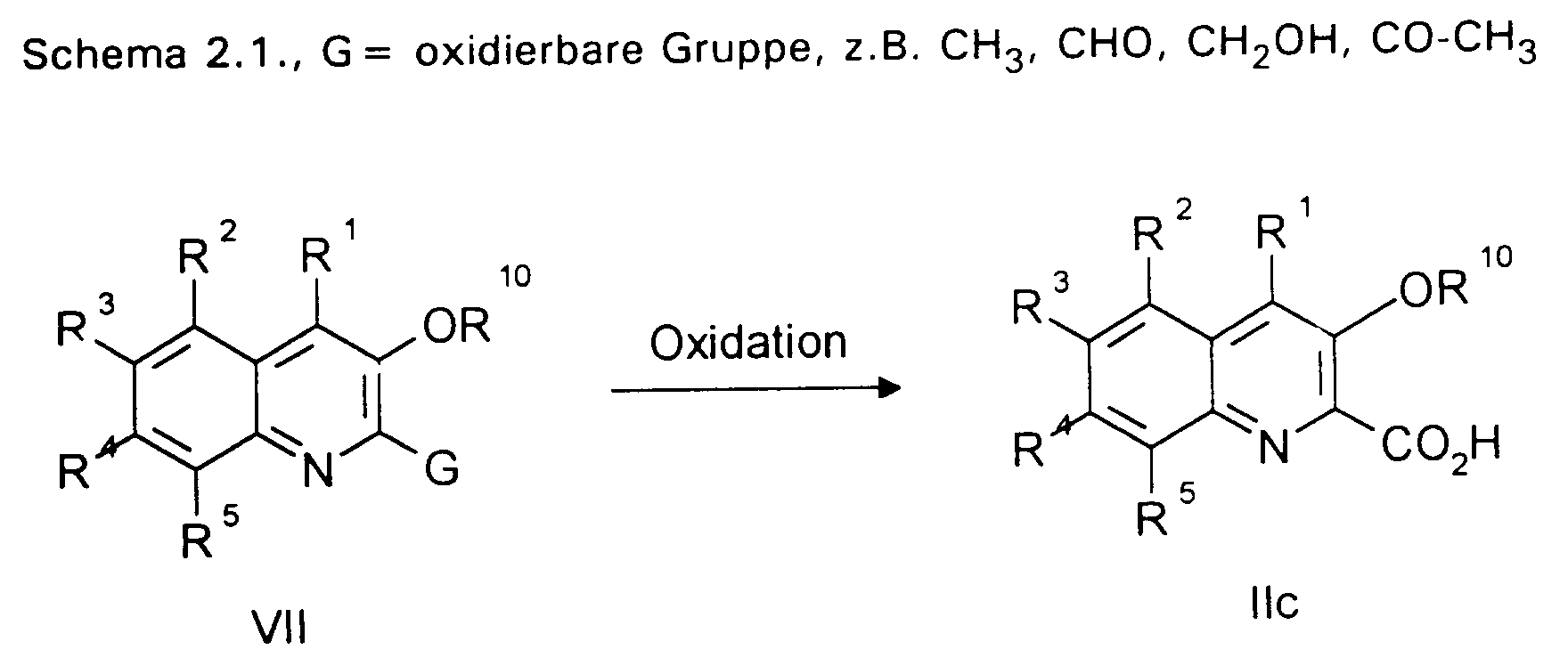
- Vielfältig substituierte 3-Hydroxy-Derivate der Chinolin-2-carbonsäuren der Formel II werden entsprechend Schema 2.2 erhalten.
- 2.i) Substituierte 2-Nitrobenzoesäuren der Formel VIII werden nach den üblichen Methoden der Carbonsäure-Aktivierung behandelt und mit Salzen des Acetylacetons zu den Verbindungen der Formel IX umgesetzt.
- 2.ii) Die Verbindungen der Formel IX werden mit einer Base zu den 2-Acetyl-3-hydroxychinolinen der Formeln Xa/b cyclisiert.
- 2.iii) Die Verbindungen der Formel Xa werden mit einem Reagenz R10-X zu den Hydroxy-geschützten Verbindungen der Formel XI umgesetzt.
- 2.iv) Die Verbindungen der Formel XI werden zu den Verbindungen der Formel II oxidiert, vorzugsweise unter den Bedingungen der Haloform-Reaktion.
- Die Herstellung von 3-(2-Nitrobenzoyl)acetylaceton (Formel IX; R2-R5 = H) ist bekannt, J. Prakt. Chem. 1987, 329, S. 1063.
- Die Umsetzung der Verbindungen der Formel IX mit wäßriger Kaliumhydroxidlösung zu den Verbindungen der Formel Xa, in denen R2, R4 und R5 Wasserstoff und R3 Wasserstoff, Methyl und Chlor ist, ist von G. Tennant et al., J. Chem. Soc. Chem. Comm. 1975, 782, bekannt.
- Es wurde nun gefunden, daß die Substituenten R2, R3, R4 und R5 erfindungsgemäß variiert werden können, um die beschriebene Aufgabe zu lösen.
- Weiterhin wurde gefunden, daß die Verbindungen der Formel XI unter den Bedingungen der Haloform-Reaktion (Wäßriges Alkali- oder Erdalkalihydroxid/Brom) mild zu den Verbindungen der Formel II (IIb) oxidierbar sind.
- 2-Nitrobenzoesäuren der Formel VIII sind käuflich zu erhalten, literaturbekannt, oder können - je nach gewünschtem Substitutionsmuster - durch vielfältige synthetische Methoden hergestellt werden.
- Die Verbindungen der Formeln II, IIa und IIb (Zwischenprodukte) sind neu mit folgenden Ausnahmen:
Verbindungen der Formel II, in denen - sofern R1 bis R5 und R11 Wasserstoff bedeuten - R10 Benzyl oder Methyl ist,
(bzw. Verbindungen der Formel IIb, in denen - sofern R2 bis R5 Wasserstoff bedeutet - R10 Benzyl oder Methyl ist) und
Verbindungen der Formel II, in denen - sofern R1 bis R5 Wasserstoff und R11 Ethyl bedeuten - R10 Wasserstoff, Benzyl oder p-Toluolsulfonyl ist und - Verbindungen der Formel IIa, in denen - sofern R1, R2, R4 und R5 Wasserstoff bedeutet - R3 Wasserstoff oder Methoxy ist.
- 3-Benzyloxychinolin-2-carbonsäure ist aus J.Am. Chem. Soc., Vol. 115, No. 24, 1993, Seiten 11624-11625 bekannt.
- 3-Hydroxychinolin-2-carbonsäure und 3-Methoxychinolin-2-carbonsäuremethylester sind in J. Antibiot. 1987, 40 (7), Seiten 953-960 beschrieben, ersteres auch in Chem. Pharm. Bull. 1967, 15 (5), Seiten 663-669.
- 3-Hydroxy-6-methoxychinolin-2-carbonsäure ist in J. Am. Chem. Soc., Vol. 103, No.5, 1981, Seiten 1241 - 1243 beschrieben.
- 3-Methoxychinolin-2-carbonsäure ist aus J. Chem. Soc. 1960, Seiten 3371-3377 bekannt.
- 3-Hydroxychinolin-2-carbonsäureethylester und 3-(p-Toluolsulfonyloxy)chinolin-2-carbonsäureethylester sind aus J. Chem. Soc. C. 1967, 4, Seiten 256-261 bekannt.
- Weiterhin sind Zwischenprodukte der Formeln Xa und Xb neu, mit folgenden Ausnahmen:
Verbindungen der Formel Xa, in denen - sofern R2, R4 und R5 Wasserstoff bedeuten - R3 Wasserstoff, Methyl oder Chlor ist. Diese bekannten Verbindungen der Formel Xa sind in J. Chem. Soc. Chem. Comm. 1975, Seiten 782 bis 783 beschrieben. - Die Erfindung betrifft daher auch folgende Zwischenprodukte zur Herstellung der Verbindungen der Formel I:
Zwischenprodukte der Formel II, in denen R1 bis R5 die Bedeutungen haben, die für die Verbindungen der Formel I gelten, - R10
- H oder eine HO-Schutzgruppe (Protecting Group PG) ist und
- R11
- Wasserstoff, (C1-C8)-Alkyl und Benzyl bedeuten,
- Zwischenprodukte der Formel Xa, in denen R2 bis R5 die Bedeutungen haben, die für die Verbindungen der Formel I gelten,
mit der Ausnahme von Verbindungen der Formel Xa, in denen R3 Wasserstoff, Methyl oder Chlor ist, sofern R2, R4 und R5 Wasserstoff bedeuten. - Alkoxy- und Benzyloxy-substituierte Chinolinsysteme der vorliegenden Erfindung werden durch Alkylierung von phenolischen OH-Gruppe(n) von 2-Nitrobenzoesäuren oder deren Derivaten, in denen nach Alkylierung die Carboxylatgruppe durch Oxidation von Methyl-, Acetyl-, Hydroxymethyl- oder Aldehydgruppen eingeführt oder durch Verseifung einer Estergruppe erhalten wird, hergestellt, vgl. z.B. Schema 3.1.

- 6-Aryloxychinolin- und 6-Arylsulfonyl-Derivate werden durch nucleophile aromatische Substitution an 4-Halo-2-nitrotoluolen XV und nachfolgende Oxidation zu den enstprechenden 5-Aryloxy(5-Arylsulfonyl)-2-nitrobenzoesäuren XVII zugänglich, vgl. Schema 3.2..

- Eine weitere Möglichkeit bietet die Nitrierung von entsprechend substituierten Toluolen, Benzoesäuren, Benzaldehyden oder Acetophenonen. Bevorzugt wird diese Methode angewandt, wenn die vorhandenen Substituenten ausschließlich oder vorwiegend die Nitrierung in 2-Position lenken, vgl. z.B. Schema 3.3..

- Die Verbindungen der Formeln XIII und XVI wurden mit einem Oxidationsmittel, vorzugsweise mit KMnO4 in wäßrigem alkalischen Milieu, zu den 2-Nitrobenzoesäurederivaten umgesetzt.
- Die Verbindungen der Formel I sind Inhibitoren der Prolyl-4-hydroxylase. Die Hemmung dieses Enzyms wurde, wie von Kaule und Günzler in Annal. Biochem. 184, 291 bis 297 (1990) beschrieben, bestimmt.
- Die erfindungsgemäßen Verbindungen der Formel I besitzen weiterhin wertvolle pharmakologische Eigenschaften und zeigen insbesondere antifibrotische Wirksamkeit.
- Die antifibrotische Wirkung kann im Modell der Tetrachlorkohlenstoffinduzierten Leberfibrose bestimmt werden. Dazu werden Ratten mit CCl4 (1 ml/kg) - gelöst in Olivenöl - zweimal wöchentlich behandelt. Die Prüfsubstanz wird täglich, gegebenenfalls sogar zweimal täglich per os oder intraperitoneal - gelöst in einem geeigneten verträglichen Lösungsmittel - verabreicht. Das Ausmaß der Leberfibrose wird histologisch bestimmt und der Anteil Kollagen in der Leber per Hydroxyprolinbestimmung - wie bei Kivirikko et al. (Anal. Biochem. 19, 249 f. (1967)) beschrieben - analysiert. Die Aktivität der Fibrogenese kann durch radioimmunologische Bestimmung von Kollagenfragmenten und Prokollagenpeptiden im Serum bestimmt werden. Die erfindungsgemäßen Verbindungen sind in diesem Modell in Konzentration 1 bis 100 mg/kg wirksam.
- Die Aktivität der Fibrogenese kann durch radioimmunologische Bestimmung des N-terminalen Propeptids des Kollagen Typ-III oder der N- bzw. C-terminalen Quervernetzungsdomäne des Kollagen-Typ-IV (7s-Kollagen bzw. Typ-IV-Kollagen NC1) im Serum bestimmt werden.
- Zu diesem Zweck wurden die Hydroxyprolin-, Prokollagen-III-Peptid-, 7s-Kollagen- und Typ-IV-Kollagen-NC-Konzentrationen in der Leber von
- a) unbehandelten Ratten (Kontrolle)
- b) Ratten, denen Tetrachlorkohlenstoff verabreicht wurden (CCl4-Kontrolle)
- c) Ratten, denen zunächst CCl4 und anschließend eine erfindungsgemäße Verbindung verabreicht wurde
- Weiterhin kann eine Wirksamkeit der erfindungsgemäßen Verbindungen in folgenden Systemen nachgewiesen werden.
- Dieses Modell dient zum Nachweis der akuten Hemmung der Prolyl-4-hydroxylase in vivo. Dazu werden Ratten beiderlei Geschlechts (gesund bzw. mit induzierter Leberfibrose) die Prüfusubstanz bzw. das entsprechende Vehikel appliziert (intraperitoneal, intravenös, per os) und nach Substanzgabe 14C-L-Prolin (250 µCi/kg Körpergewicht) intraperitoneal verabreicht. Danach erfolgt erneut eine intraperitoneale Applikation von 14C-L-Prolin (250 µCi/kg Körpergewicht). Schließlich werden die Tiere unter Pentobarbitalnarkose entblutet und die Leber entnommen. Die Aufreinigung des hepatischen Kollagens durch Pepsinverdau und fraktionierte Ammoniumsulfatfällung erfolgte entsprechend publizierten Protokollen (Ref. 1, 2). Das gereinigte Leberkollagen wurde hydrolysiert und der Gehalt an 14C-Hydroxyprolin und 14C-Prolin durch Aminosäureanalyse mittels Ionenaustauschchromatografie bestimmt. Eine Hemmung der Prolyl-4-hydroxylase ergibt sich aus einer Absenkung des Quotienten 14C-Hydroxyprolin/[14C-Hydroxyprolin + 14C-Prolin]. Als Referenzsubstanz wird 2,2'-Dipyridyl verwendet. (Ref. 1: Chojkier, M. 1986. Hepatocyte collagen production in vivo in normal rats. J. Clin. Invest. 78: 333-339 und Ref. 2: Ogata I., et al. 1991. Minor contribution of hepatocytes to collagen production in normal and early fibrotic livers. Hepatology 14: 361-367).
- Für die Testung von Prolyl-4-hydroxylasehemmstoffen in Zellkulturen werden folgende Zelltypen verwendet:
Normale humane Hautfibrolasten (Normal human fibrolasts, NHDF), Rattenleber-Epithelzellen (rat liver epithelial cells, Ref. 1) und primäre Fettspeicherzellen aus der Rattenleber (fat storing cells, Ref. 2). Dazu werden die Zellen in Gegenwart von Hemmstoffen kultiviert. Gleichzeitig wird das in dieser Zeit neu synthetisierte Kollagen durch 4-3H-L-Prolin und 14C-Prolin metabolisch markiert. Der Einfluß der Testsubstanzen auf den Hydroxylierungsgrad des Kollagens wird anschließend entsprechend der Methode von Chojkier et al (Ref. 3) bestimmt. Als Referenzsubstanz wird 2,2'-Dipyridyl eingesetzt. (1.: Schrode, W., Mecke, D., Gebhard, R. 1990. Induction of glutamine synthetase in periportal hepatocytes by co-cultivation with a liver epithelial cell line. Eur. J. Cell. Biol. 53: 35-41, 2. Biomhoff, R., Berg T. 1990. Isolation and cultivation of rat liver stellate cells. Methods Enzymol. 190: 59-71 und 3.: Chojkier, M. Peterkofsky, B. Bateman,, J. 1980. A new method for determining the extent of proline hydroxylation by measuring changes in the ration of [4-3H]:[14C] proline in collagenase digests. Anal. Biochem. 108: 385-393). - Die Verbindungen der Formel I können als Medikamente in Form von pharmazeutischer Präparate Verwendung finden, welche sie gegebenenfalls mit verträglichen pharmazeutischen Trägern enthalten. Die Verbindungen können als Heilmittel, z.B. in Form pharmazeutischer Präparate Verwendung finden, welche diese Verbindungen in Mischung mit einem für die enterale, perkutane oder parenterale Applikation geeigneten pharmazeutischen, organischen oder anorganischen Träger, wie z.B. Wasser, Gummi arabicum, Gelatine, Milchzucker, Stärke, Magnesiumstearat, Talk, pflanzliche Öle, Polyalkylenglykole, Vaseline usw. enthalten.
- Sie können zu diesem Zweck oral in Dosen von 0,1 bis 25 mg/kg/Tag, vorzugsweise 1 bis 5 mg/kg/Tag oder parenteral in Dosen von 0,01 bis 5 mg/kg/Tag, vorzugsweise 0,01 bis 2,5 mg/kg/Tag, insbesondere 0,5 bis 1,0 mg/kg/Tag, appliziert werden. Die Dosierung kann in schweren Fällen auch erhöht werden. In vielen Fällen genügen jedoch auch geringere Dosen. Diese Angaben beziehen sich auf einen Erwachsenen von etwa 75 kg Gewicht.
- Unter den im folgenden beschriebenen Beispielen werden die erfindungsgemäßen Verbindungen der Formel I als substituierte Chinolin-2-carbonsäure-N-(carboxymethyl)amide (Chinolin-2-carbonsäure-glycinamide) verstanden.
Die Bezeichnung als substituierte N-((Chinolin-2-yl)-carbonyl)glycine wird parallel verwandt. -
- a) 3-(2-Nitrobenzoyl)acetylaceton wurde aus Acetylaceton und 2-Nitrobenzoylchorid erhalten, Fp. 69°C; vgl. J. Prakt. Chem. 1987, 329, S. 1063, 29 % Ausbeute.
- b) 2-Acetyl-3-hydroxychinolin wurde aus dem Produkt a) unter basischen Bedingungen (KOH/Wasser, Smiles-Umlagerung) erhalten, Fp. 105°C; vgl. J. Chem. Soc. Chem. Comm. 1975, 782; 53 % Ausbeute.
- c) 2-Acetyl-3-benzyloxychinolin wurde aus dem Produkt b) mit Benzylbromid (Pottasche/Aceton) erhalten, 52 % Ausbeute,
1H-NMR (CDCl3): δ = 2,89 (s, 3 H), 5,25 (s, 2 H), 7,38 (m, 3 H), 7,58 (m, 5 H), 7,70 (m, 1 H), 8,08 (m, 1 H). - d) 3-Benzyloxychinolin-2-carbonsäure wurde aus dem Produkt c) mit Kaliumhypochlorit (Dioxan/Wasser) erhalten, öliges Rohprodukt, 47 % Ausbeute,
1H-NMR (CDCl3): δ = 5,40 (s, 2 H), 7,40 (m, 3 H), 7,63 (m, 4 H), 7,75 (m, 2 H), 8,07 (m, 1 H). - e) 3-Benzyloxychinolin-2-carbonsäure-N-((benzyloxycarbonyl)methyl)amid wurde aus dem Produkt d) mit Triethylamin/Chlorameisensäureethylester (gemischte Anhydrid-Methode) und Glycinbenzylester-Tosylat erhalten, öliges Rohprodukt, 64 % Ausbeute,
1H-NMR (CDCl3): δ = 4,40 (d, 2 H), 5,25 (s, 2 H), 5,35 (s, 2 H), 7,10 bis 7,75 (m, 14 H), 8,10 (m, 1 H), 7,28 (t, 1 H). - f) Die Titelverbindung wurde erhalten, indem das Produkt e) in Methanol mit Pd/C (10 %) in der Schüttelente hydriert wurde, Fp. 191 °C (aus wäßriger Salzsäure), 40 % Ausbeute.
-
- a) 3-(5-Methoxy-2-nitrobenzoyl) acetylaceton
Aus 19,75 g 5-Methoxy-2-nitrobenzoesäure wurden analog Beispiel 4c) mit Oxalylchlorid und Mg-Acetylacetonid 28 g Rohprodukt erhalten. - b) 2-Acetyl-3-hydroxy-6-methoxychinolin
28 g (0,1 Mol) des vorstehenden Rohprodukts wurden in 250 ml 20 %iger wäßriger KOH-Lösung 30 min unter Rückfluß erhitzt. Man arbeitete wie unter Beispiel 4d) auf, chromatographierte das Rohprodukt mit n-Heptan/Ethylacetat (1:1) an Kieselgel und brachte aus entsprechenden Fraktionen mit Diisopropylether 5,1 g Produkt zur Kristallisation, Fp. 124-126°C. - c) 2-Acetyl-3-benzyloxy-6-methoxychinolin, aus vorstehender Verbindung durch Alkylierung mit Benzylbromid, Fp. 100-102°C (aus Diisopropylether).
- d) 3-Benzyloxy-6-methoxychinolin-2-carbonsäure
1,2 g (4mMol) der vorstehenden Acetylverbindung wurden in 5 mit 1,4-Dioxan gelöst zu einer Lösung von 1,6 g NaOH (40 mMol) in 8 ml Wasser; die bei 5-10°C mit 0,6 ml (12 mMol) Brom versetzt worden war, hinzugetropft. Nach Versetzen mit wenig Diethylether, Abtrennen der organischen Phase wurde die alkalische Lösung mit einer Lösung von 0,4 g Natriumdisulfit in 6 ml Wasser versetzt, im Vakuum eingeengt, der Rückstand in 8 ml Wasser aufgenommen, mit konz. HCl unter Kühlung auf pH 2 gestellt und das kristallisierte Produkt abgesaugt und getrocknet, 0,83 g, Fp. 272-275°C (sintern 90°C). - e) N-((3-Benzyloxy-6-methoxychinolin-2-yl)carbonyl)glycin-(1-butyl)ester
0,83 g (2,7 mMol) der vorstehenden Carbonsäure wurden in 200 ml wasserfreiem Dichlormethan analog Beispiel 4 g) mit 0,82 g (2,7 mMol) Glycinbutylester-Tosylat, 1,1 ml (8,1 mMol) NEM, 0,405 g (3mMol) HOBT und 1,14 g (2,7 mMol) CMC umgesetzt. Das Rohprodukt wurde mit Ethylacetat an Kieselgel chromatographiert. Aus entsprechenden Fraktionen wurden mit Diisopropylether 0,8 g Produkt zur Kristallisation gebracht, Fp. 90-92°C. - f) N-((3-Benzyloxy-6-methoxychinolin-2-yl)carbonyl)glycin
0,5 g (1,2mMol) des vorstehenden Esters wurden in 1,5 N methanolischer Natronlauge verseift, 0,45 g Produkt, Fp. 118°C (sintern bei 105°C, aus wäßriger Salzsäure). - g) Die Titelverbindung wurde erhalten, indem 0,4 g (1,1 mMol) der obigen Benzylverbindung in Methanol/Tretrahydrofuran (1:1) mit Pd/C (10 %) in der Schüttelente hydriert wurden. Nach Absaugen des Katalysators, Einengen im Vakuum brachte man den Rückstand mit Diethylether zur Kristallisation, 0,16 g, Fp. 258-260°C.
-
- a) 5-(1-Butyloxy)-2-nitrobenzylalkohol
5,1 g (30 mMol) 5-Hydroxy-2-nitrobenzylalkohol wurden in 25 ml N,N-dimethylacetamid mit 2,5 g (18 mMol) Kaliumcarbonat 30 min bei 70°-80°C gerührt. Nach Abkühlung auf 20°C wurden 3,9 ml (36 mMol) 1-Butylbromid zugetropft und 2 h bei 90°C gerührt. Nach Abkühlen wurde das Reaktionsgemisch im Vakuum eingeengt, der Rückstand mit Wasser behandelt und mit 2n HCl auf pH 7 gebracht. Das erhaltene Öl kristallisiert nach ca. 30 min; das Produkt wurde abgesaugt, mit Wasser gewaschen und getrocknet; 6 g, Fp. 47-49°C. - b) 5-(1-Butyloxy)-2-nitrobenzoesäure
0,5 g (10 mMol) Kaliumhydroxid wurden in 40 ml Wasser gelöst, bei 20°C unter Rühren mit 2,2 g (10 mMol) des obigen Alkohols versetzt, auf 70-80°C erwärmt und portionsweise 3,16 g (20 mMol) Kaliumpermanganat zugegeben. Nachdem 30 min bei 60-70°C gerührt wurde, saugte man heiß ab, wusch den Filterrückstand mit heißem Wasser, engte das Filtrat auf 20 ml ein und versetzte mit halbkonz. Salzsäure bis zu einem pH-Wert von 1-2. Das sich abscheidende Öl kristallisierte nach 1 h. Das Produkt wurde abgesaugt und mit Wasser gewaschen, 2 g, Fp. 82-84°C. - c) 3-(5-(1-Butyloxy)-2-nitrobenzoyl)acetylaceton
- 1. 5-(1-Butyloxy)-2-nitrobenzoylchlorid
12 g (50 mMol) der obigen Benzoesäure wurden in 90 ml wasserfreiem Tetrahydrofuran bei 5° C mit 3 Tropfen N,N-Dimethylformamid und tropfenweise mit 7 ml Oxalylchlorid (in 12 ml Tetrahydrofuran) versetzt. Man ließ auf Raumtemperatur erwärmen, rührte 1 h, engte im Vakuum ein und nahm den Rückstand in 25 ml wasserfreiem Toluol auf. - 2. Magnesium-acetylacetonid
1,23 g (50 mMol) Magnesium-Späne wurden in 20 ml wasserfreiem Ethanol, 2,5 ml Xylol mit einem Jodkristall 8 h rückfließend erhitzt. Sodann wurde im Vakuum eingeengt, der Rückstand in 100 ml wasserfreiem Toluol aufgenommen und bei 20°C tropfenweise mit 5,2 ml (50 mMol) frisch destilliertem Acetylaceton versetzt und 30 min gerührt.
Diese Lösung des Magnesium-acetylacetonids in Toluol wurde auf 0°C gekühlt und unter Rühren tropfenweise mit der unter 1. hergestellen Lösung des Säurechlorids versetzt. Man rührte 1 h bei 0°C, ließ über Nacht bei 20°C stehen, versetzte mit 200 ml Eiswasser und konz. Salzsäure auf pH 1, rührte 30 min, wusch die organische Phase mit Wasser, trocknete und erhielt nach dem Einengen im Vakuum 14 g öliges Rohprodukt.
- 1. 5-(1-Butyloxy)-2-nitrobenzoylchlorid
- d) 2-Acetyl-6-(1-butyloxy)-3-hydroxychinolin
14 g (43,6 mMol) des vorstehenden Produktes wurden in 150 ml 20 %iger wäßriger KOH-Lösung 30 min rückfließend erhitzt. Nach dem Abkühlen wurde unter Rühren mit halbkonz. Salzsäure auf pH 1-2 gebracht, dreimal mit Dichlormethan extrahiert, die organische Phase getrocknet, im Vakuum eingeengt und der Rückstand mit n-Heptan/Ethylacetat (3:1) an Kieselgel chromatographiert. Aus entsprechenden Fraktionen wurden 2,5 g Produkt mit Petrolether zur Kristallisation gebracht, Fp. 71-73°C. - e) 2-Acetyl-3-benzyloxy-6-(1-butyloxy)chinolin
2,5 g (ca. 10 mMol) des vorstehenden Produkts wurden in 30 ml N,N-Dimethylacetamid mit 1,38 g (10 mmol) Kaliumcarbonat und 1,2 ml (10 mMol) Benzylbromid umgesetzt (1 h bei 75-80°C). Man erhielt 2,2 g Produkt, Fp. 91-93°C (aus Diisopropylether). - f) 3-Benzyloxy-6-(1-butyloxy)chinolin-2-carbonsäure (Haloform-Oxidation)
Eine Lösung von 1,2 g (30 mMol) NaOH in 6 ml Wasser wurde bei 5-10°C unter Rühren mit 0,45 ml (9 mMol) Brom versetzt. Sodann tropfte man eine Lösung von 1,05 g (3 mMol) der vorstehenden Acetylverbindung, gelöst in 5 ml 1,4-Dioxan, zu. Es wurde noch 1 h bei 20°C gerührt, mit 5 ml Diethylether extrahiert, die organische Phase eingeengt, der Rückstand mit 2n wäßriger HCl behandelt, abdekantiert, der Rückstand in Ethylacetat gelöst, mit Magnesiumsulfat getrocknet, eingeengt und der Rückstand mit Diisopropylether zur Kristallisation gebracht. Man erhielt 0,8 g, Fp. 108-110°C. - g) N-((3-Benzyloxy-6-(1-butyloxy)chinolin-2-yl)-carbonyl)glycin-(1-butyl)ester
0,8 g (2,28 mMol) der vorstehenden Chinolin-2-carbonsäure wurden in 200 ml wasserfreiem Dichlormethan gelöst und nacheinander mit 0,74 g (2,43 mMol) Glycin-(1-butyl)ester-Tosylat, 1,1 ml (8,1 mMol) N-Ethylmorpholin (NEM), 0,405 g (3 mMol) 1-Hydroxybenztriazol (HOBT), und 1,0 g (2,43 mMol) N-Cyclohexyl-N'-(2-morpholinoethyl)carbodiimidmethyl-p-toluolsulfonat (CMC) versetzt und 30 h bei 20°C gerührt.
Die Reaktionslösung wurde sodann mit 2n wäßriger HCl geschüttelt, ein Niederschlag mit verdünnter NaOH versetzt und mit Diethylether extrahiert, die vereinten organischen Phasen mit wäßriger Na-bicarbonat-Lösung extrahiert, getrocknet, eingeengt und der Rückstand mit n-Heptan/Ethylacetat (2:1) an Kieselgel chromatographiert. Nachdem entsprechende Fraktionen eingeengt und mit Diisopropylether behandelt wurden, erhielt man 0,55 g Produkt, Fp. 99-101°C. - h) Die Titelverbindung wurde erhalten, indem 0,5 g des vorstehenden Glycinesters mit 50 ml 1 n methanolischer NaOH bei 20°C verseift wurden. Man engte im Vakuum ein, versetzte den Rückstand mit Wasser, extrahierte mit Diethylether, säuerte die wäßrige, ölige Phase nach Zusatz von Tetrahydrofuran unter Kühlung an, engte im Vakuum ein, extrahierte die wäßrige Phase mit Dichlormethan, trocknete, engte ein und erhielt 0,46 g öliges Produkt. 0,3 g des erhaltenen Glycins wurden in 75 ml Tetrahydrofuran gelöst, mit Pd/C (10 %) versetzt und in der Schüttelente hydriert. Der Katalysator wurde abgesaugt, das Filtrat eingeengt und der Rückstand mit Diisopropylether zur Kristallisation gebracht. Man erhielt 140 mg der Titelverbindung als farblos kristalline Substanz, Fp. 180-182°C.
- Die Titelverbindung wurde analog zu Beispiel 4 erhalten:
- a) 2-Nitro-5-(1-octyloxy)benzylalkohol
Das nach Behandeln mit 1n Salzsäure erhaltene Öl kristallisierte langsam durch, Fp. 55-57°C. - b) 2-Nitro-5-(1-octyloxy)benzoesäure, öliges Rohprodukt.
- c) 3-(2-Nitro-5-(1-octyloxy)benzoyl)acetylaceton; öliges Produkt (nach Chromatographie mit n-Heptan/Ethylacetat (3:1) an Kieselgel).
- d) 2-Acetyl-3-hydroxy-6-(1-octyloxy)chinolin, öliges Produkt, das beim Stehen erstarrt.
- e) 2-Acetyl-3-benzyloxy-6-(1-octyloxy)chinolin; öliges Produkt, das beim Stehen durchkristallisierte.
- f) 3-Benzyloxy-6-(1-octyloxy)chinolin-2-carbonsäure; Fp. 145°C (unter Zers., aus wäßriger Salzsäure/Tetrahydrofuran).
- g) N-((3-Benzyloxy-6-(1-octyloxy)chinolin-2-yl)carbonyl)glycinbenzylester; Fp. 93-95°C (aus Petrolether).
- h) Die Titelverbindung wurde erhalten, indem die vorstehende Benzylverbindung mit Pd/C hydriert wurde; Fp. 153-155°C (aus Petrolether).
- 0,5 g (1,3 mMol) N-((7-Chlor-3-hydroxy-6-(2,2,2-trifluorethyloxy)chinolin-2-yl)carbonyl)glycin (Titelverbindung aus Beispiel 31) wurden in 26 ml methanolischer Ameisensäure (4,4%) gelöst und bei 20°C mit weiteren 26 ml methanolischer Ameisensäure versetzt. Nach Zugabe von 0,5 g Pd/C (10%) wurde 1 h bei 20°C gerührt, vom Katalysator abfiltriert, das Filtrat eingeengt und der Rückstand mit Diisopropylether zur Kristallisation gebracht. Man erhielt 250 mg Produkt, Fp. > 300°C (sintern bei 207°C).
-
- a) 2-Acetyl-6-chlor-3-hydroxychinolin, vgl. J. Chem. Soc. Chem. Comm. 1975, 782.
- b) 2-Acetyl-3-benzyloxy-6-chlorchinolin
5,0 g (22,5 mMol) des vorstehenden Chlorchinolins wurden in 50 ml N,N-Dimethylacetamid gelöst, 30 min mit 3,4 g (25 mMol) Kaliumcarbonat bei 70-80°C gerührt, bei 20°C 3,1 ml (25 mMol) Benzylbromid zugetropft und 2 h bei 90°C gerührt. Nach Aufarbeitung wurde mit n-Heptan/Ethylacetat (4:1) an Kieselgel chromatographiert und aus entsprechenden Fraktionen 4,2 g Produkt mit Diisopropylether zur Kristallisation gebracht, Fp. 107-110°C. - c) 3-Benzyloxy-6-chlorchinolin-2-carbonsäure
2,1 g (6,7 mMol) der vorstehenden Acetylverbindung, gelöst in 7 ml 1,4-Dioxan, wurden bei 0°C zu einer Lösung von 1 ml (20 mMol) Brom in wäßriger Natronlauge (aus 2,7 g (6,7 mMol) in 13,5 ml Wasser) hinzugetropft. Nach Aufarbeitung erhielt man 1,2 g Produkt, Fp. 90-93°C (sintern ab 80°C, aus wäßriger Salzsäure). - d) N-((3-Benzyloxy-6-chlorchinolin-2-yl)carbonyl)glycin-(1-butyl)ester
Das Produkt wurde analog Beispiel 4g) aus 1,1 g (3,3 mMol) der vorstehenden Chinolincarbonsäure und den Kupplungsreagenzien NEM, HOBT, CMC und Glycin-(1-butyl)ester-Tosylat erhalten, 0,75 g, Fp. 121-123°C (aus Diisopropylether). - e) Die Titelverbindung wurde erhalten, indem 0,3 g (0,75 mMol) des vorstehenden Glycinesters in 25 ml 1 n methanolischer Natronlauge 1 h bei 20°C verseift wurden. Man isolierte 0,3 g des harzigen Na-Salzes, das mit 12,5 ml 48 %iger wäßriger HBr versetzt und 1 h bei 80-85°C Badtemperatur gerührt wurde. Nach Einengen im Vakuum wurde der kristalline Rückstand mit Tetrahydrofuran extrahiert, im Vakuum eingeengt und der Rückstand mit Diisopropylether zur Kristallisation gebracht. Man erhielt 0,16 g der Titelverbindung, Fp. 224°C (unter Zers.).
-
- a) 2-Nitro-5-(phenylsulfonyl)toluol
In 150 ml wasserfreiem Ethanol wurden unter Rühren und Erwärmen 4 g (100 mMol) NaOH gelöst, bei 20°C 10,3 ml (100 mMol) Thiophenol zugetropft und nach 10 min. 15,5 g (12,2 ml; 100 mMol) 5-Fluor-2-nitrotoluol, gelöst in 20 ml Ethanol zugetropft. Nach 30 min bei 20°C wurde 30 min zum Rückfluß erhitzt und heiß abfiltriert. Nach Anreiben setzte die Kristallisation ein. Nach Zugabe von Wasser wurde abgesaugt und getrocknet; 19 g 2-Nitro-5-phenylthiotoluol, Fp. 70-71°C. Anschließend wurde in Dichlormethan mit m-Chlorperbenzoesäure oxidiert; 20,5 g Produkt, Fp. 108-110°C (aus Petrolether). - b) 2-Nitro-5-(phenylsulfonyl)benzoesäure
15 g (55 mMol) 2-Nitro-5-phenylsulfonyltoluol wurden in 210 ml Pyridin/Wasser (1:2) suspendiert und unter Rückfluß jeweils bis zur Entfärbung portionsweise mit 79 g (500 mMol) Kaliumpermanganat versetzt. Dann wurde heiß abgesaugt, dreimal mit heißem Wasser nachgewaschen. Im Filtrat ausgefallenes Ausgangsmaterial (2,8 g) wurden zurückgewonnen. Das zweite Filtrat wurde eingeengt, mit 200 ml Wasser versetzt, mit Diethylether extrahiert und die wäßrige Phase unter Kühlung mit halbkonz. wäßriger HCl auf pH 1 gebracht. Das ausgefallene Produkt wurde abgesaugt und getrocknet; 9 g, Fp. 210-212°C. - c) 3-(2-Nitro-5-(phenylsulfonyl)benzoyl)acetylaceton
Aus 9 g (30 mMol) der vorstehenden Substanz wurden analog zu Beispiel 4 c) mit Oxalylchlorid und Magnesiumacetylacetonid 9,4 g Produkt erhalten, Fp. 143-145°C (sintern bei 140°C, aus Diisopropylether). - d) 2-Acetyl-3-hydroxy-6-(phenylsulfonyl)chinolin
9,5 g der vorstehenden Verbindung wurden unter Rühren bei 20°C in 95 ml wäßrige Kaliumhydroxid-Lösung (20%) eingetragen, wobei nach 45 min eine klare Lösung entstand. Nach 90 min wurde unter Kühlung mit halbkonz. wäßriger HCL auf pH 1 gebracht und das Rohprodukt abgesaugt. Dieses wurde mit n-Heptan/Ethylacetat (3:1) an Kieselgel chromatographiert. Aus entsprechenden Fraktionen isolierte man 1,5 g Produkt, Fp. 179-180°C. - e) 2-Acetyl-3-benzyloxy-6-(phenylsulfonyl)chinolin
1,5 g (4,6 mMol) der vorstehenden Verbindung wurden in 50 ml Diethylketon mit 0,63 g (4,6 mMol) Kaliumcarbonat und 0,55 ml (4,6 mMol) Benzylbromid umgesetzt (3 h zum Rückfluß erhitzt). Man erhielt 2,0 g Produkt, Fp. 160-162°C (aus Wasser). - f) 3-Benzyloxy-6-(phenylsulfonyl)chinolin-2-carbonsäure
2,0 g (4,8 mMol) der vorstehenden Acetyl-Verbindung wurden analog Beispiel 4 f) der Haloform Reaktion unterworfen. Man erhielt 1,4 g Produkt, das weiter umgesetzt wurde. - g) N-((3-Benzyloxy-6-(phenylsulfonyl)chinolin-2-yl)carbonyl)glycinbenzylester
1,4 g (3,3 mMol) der vorstehenden Carbonsäure wurden analog Beispiel 4 g) mit Glycinbenzylester-Tosylat, N-Ethylmorpholin, 1-Hydroxy-1H-benztriazol und CMC umgesetzt. Man erhielt 1,1 g Produkt, Fp. 165-167°C (aus Diethylether). - h) Die Titelverbindung wurde erhalten, indem 1,1 g (1,9 mMol) des vorstehenden Benzylesters in Tetrahydrofuran mit Pd/C (10%) in der Schüttelente hydriert wurden. Man erhielt 0,5 g farbloses Produkt, Fp. 196-198°C (aus Diisopropylether).
-
- a) 2-Nitro-5-trifluormethoxybenzoesäure
76,5 ml konz. Schwefelsäure wurden unter Kühlung und Rühren tropfenweise mit 29,7 ml Salpetersäure versetzt und anschließend 9,0 g (43,7 mMol) 3-Trifluormethoxybenzoesäure hinzugegeben. Man erwärmt 1 h auf 50-55°C, gibt die Reaktionsmischung nach Abkühlen auf Eis, saugt den Rückstand ab und erhält nach dem Trocknen 8,8 g Produkt, Fp. 90-93°C (sintern bei 85°C). - b) 3-(2-Nitro-5-trifluormethoxybenzoyl)acetylaceton
wurde analog Beispiel 4c) aus 8,8 g (35 mMol) der vorstehenden 2-Nitro-5-trifluormethoxybenzoesäure erhalten, 13 g öliges Rohprodukt. - c) 2-Acetyl-3-hydroxy-6-trifluormethoxychinolin
11,5 g (34,5 mMol) des vorstehenden Produkts wurden unter Rühren bei 20°C in 105 ml 20 %ige wäßrige Kaliumhydroxid-Lösung eingetragen und 30 min rückfließend erhitzt. Nach dem Abkühlen wurde mit halbkonz. wäßriger HCl auf pH 1 gebracht, abgesaugt und das Rohprodukt (11 g) mit n-Heptan/Ethylacetat an Kieselgel chromatographiert. Entsprechende Fraktionen wurden eingeengt und mit Petrolether zur Kristallisation gebracht; 5,1 g, Fp. 87-88°C. Als Nebenprodukt wurden 0,45 g des entsprechenden N-Oxids erhalten, Fp. 190-191°C. - d) 2-Acetyl-3-benzyloxy-5-trifluormethoxychinolin
5,0 g (18,4 mMol) der vorstehenden Verbindung wurden analog Beispiel 4e) in Diethylketon mit 2,2 ml (18,4 mMol) Benzylbromid umgesetzt; 5,6 g Produkt, Fp. 90-92°C (aus Petrolether). - e) 3-Benzyloxy-5-trifluormethoxychinolin-2-carbonsäure
Aus 2,7 g (7,5 mMol) der vorstehenden Verbindung wurden mit 1,15 ml (22,5 mMol) Brom in Natronlauge /1,4-Dioxan 2,9 g Produkt erhalten, Fp. 286°C (unter Gasentwicklung, aus der Reaktionslösung). - f) N-((3-Benzyloxy-5-trifluormethoxychinolin-2-yl)carbonyl)glycinbenzylester
Aus 1,8 g (5mMol) der vorstehenden Chinolin-2-carbonsäure, 1,7 g (5 mMol) Glycinbenzylester-Tosylat, 2,7 ml (20 mMol) NEM, 0,74 g (5,5 mMol) HOBT und 2,1 g (5 mMol) CMC wurden analog Beispiel 4 g) 1,35 g Produkt erhalten, Fp. 123-124°C (aus Diisopropylether). - g) Die Titelverbindung wurde erhalten, indem 1,35 g (2,65 mMol) des vorstehenden Glycinbenzylester in 100 ml Tetrahydrofuran in der Schüttelente mit Pd/C (10 %) hydriert wurden. Nach Absaugen des Katalysators, Einengen wurde der Rückstand mit Petrolether zur Kristallisation gebracht und man erhielt 0,7 g Produkt, Fp. 192-194°C.
- Aus entsprechenden Vorstufen wurden die Beispiele 22, 23 und 24 analog zu Beispiel 21 erhalten.
-
- a) 5-(3-Ethyloxy)-1-propyloxy)-2-nitro-benzylalkohol
Analog Beispiel 4a) wurden 5,0 g (∼ 30 mMol) 5-Hydroxy-2-nitrobenzylalkohol mit 7,1 g (ca. 40 mMol) 3-Ethoxy-1-propylbromid (aus 8,3 g (9,2 ml, 80 mMol) 3-Ethoxy-1-propanol und 15,3 ml (160 mMol) Phosphortribromid in Dichlormethan hergestellt) umgesetzt; 6,1 g Rohprodukt. - b) 5-(3-(Ethyloxy)-1-propyloxy)-2-nitrobenzoesäure
Analog Beispiel 4b) wurden aus 10,2 g (40 mMol) des vorstehenden Alkohols 8,1 g Produkt erhalten, Fp. 109-111°C (aus wäßriger Salzsäure). - c) 3-(5-(3-Ethyloxy-1-propyloxy)-2-nitrobenzoyl)acetylaceton
Aus 10,2 g (ca. 40 mMol) der vorstehenden Benzoesäure wurden analog Beispiel 4c) nach Chromatographie mit n-Heptan/Ethylacetat (1:1) an Kieselgel 10,3 öliges Rohprodukt erhalten. - d) 2-Acetyl-6-(3-ethyloxy-1-propyloxy)-3-hydroxychinolin wurde durch Umsetzung von 10 g der vorstehenden Verbindung in 100 ml 20 %iger, wäßriger Kaliumhydroxid-Lösung (40 min, 60°C) erhalten, 2,8 g, Fp. 62-64°C (aus n-Heptan/Ethylacetat (3:1)).
- e) 2-Acetyl-3-benzyloxy-6-(3-ethyloxy-1-propyloxy)chinolin
2,8 g (10 mMol) der vorstehenden Verbindung wurden in 80 ml Diethylketon mit 1,4 g Kaliumcarbonat und 1,2 ml (10 mMol) Benzylbromid umgesetzt, nach Chromatographie mit n-Heptan/Ethylacetat (1:1) an Kieselgel 3,8 g öliges Produkt. - f) 3-Benzyloxy-6-(3-ethyloxy-1-propyloxy)chinolin-2-carbonsäure
3,8 g (10 mMol) der vorstehenden Acetylverbindung wurden mit wäßriger NaOH/Brom/1,4-Dioxan oxidiert (Haloform-Reaktion). Man erhielt 3,0 g Produkt, Fp. 117-119°C (aus wäßriger Salzsäure). - g) N-((3-Benzyloxy-6-(3-ethyloxy-1-propyloxy)chinolin-2-yl)carbonyl)glycinbenzylester
Analog den Beispielen 4g) und 21f) wurden aus 2,3 g (6 mMol) der vorstehenden Carbonsäure in 300 ml wasserfreiem Dichlormethan mit 2,0 g (6 mMol) Glycinbenzylester-Tosylat, 3,3 ml (24 mMol) NEM, 1,0 g (7,5 mMol) HOBT und 2,7 g (6,3 mMol) CMC nach Chromatographie mit Ethylacetat an Kieselgel 2,7 g öliges Produkt erhalten. - h) Die Titelverbindung wurde erhalten, indem 2,7 g der vorstehenden Dibenzylverbindung in 100 ml Tetrahydrofuran gelöst und mit Pd/C (10 %) in der Schüttelente hydriert wurden. Dann wurde der Katalysator abgesaugt, das Filtrat im Vakuum eingeengt und der Rückstand mit Petrolether zur Kristallisation gebracht. Man erhielt 1,3 g Produkt, Fp. 133-135°C.
-
- a) 2-Nitro-5-(2-propyloxy)benzylalkohol
10 g (60 mMol) 5-Hydroxy-2-nitrobenzylalkohol wurden analog Beispiel 4a) mit 7,0 ml (70 mMol) Isopropyljodid umgesetzt; nach Reinigung mit n-Heptan/Ethylacetat (3:2) an Kieselgel, 10,3 g öliges Rohprodukt. - b) 2-Nitro-5-(2-propyloxy)benzoesäure
10,3 g (ca. 50 mMol) des vorstehenden Benzylalkohols wurden analog Beispiel 4b) oxidiert; 9,4 g Produkt, Fp. 131-133°C (aus Dichlormethan). - c) 3-(5-(2-Propyloxy)-2-nitrobenzoyl)acetylaceton
Aus 9 g (40 mMol) des vorstehenden Produkts wurden 12,4 g Produkt gewonnen (analog Bspl. 4c)). - d) 2-Acetyl-3-hydroxy-6-(2-propyloxy)chinolin
Analog Beispiel 4d) wurden 12,3 g (40 mMol) des vorstehenden Produkts in 150 ml 20 %iger wäßriger Kaliumhydroxid-Lösung 45 min bei 50°C umgesetzt. Man erhielt nach Chromatographie 4,3 g Produkt, Fp. 95-97°C (aus n-Heptan/Ethylacetat (3:1)). - e) 2-Acetyl-3-benzyloxy-6-(2-propyloxy)chinolin
4,2 g (17 mMol) der vorstehenden Substanz wurden in 100 ml Diethylketon mit 1,4 g (10 mMol) Kaliumcarbonat und 2,9 g (2,0 ml, 17 mMol) Benzylbromid umgesetzt, 5,0 g Produkt, Fp. 102-104°C (aus Petrolether). - f) 3-Benzyloxy-6-(2-propyloxy)chinolin-2-carbonsäure
3,4 g (10 mMol) der vorstehenden Acetylverbindung wurden bei 0 bis 5°C, in 10 ml 1,4-Dioxan gelöst, zu einer Lösung von 4 g NaOH und 1,6 g (30 mMol) Brom in 20 ml Wasser getropft. Nachdem ein dicker Brei entstanden war, gab man 50 ml Diethylether zu, rührte, gab dann 1 g Natriumdisulfit in 15 ml Wasser zu, saugte die Fällung ab, löste diese in Tetrahydrofuran/Wasser, säuerte mit halbkonz. wäßriger Salzsäure an, extrahierte die wäßrige Phase mit Ethylacetat, engte ein und brachte den Rückstand mit Diisopropylether zur Kristallisation. Man erhielt 3,0 g Produkt, Fp. 140°C (unter Zers.). - g) N-((3-Benzyloxy-6-(2-propyloxy)chinolin-2-yl)carbonyl)glycinbenzylester
Analog Beispiel 25g) wurden 2,7 g (8 mMol) der vorstehenden Chinolincarbonsäure in 300 ml wasserfreiem Dichlormethan mit 2,7 g (8 mMol) Glycinbenzylester-Tosylat, 4,4 ml (32 mMol) NEM, 1,35 g (10 mMol) HOBT und 3,6 g (8,8 mMol) CMC 24 h bei 20°C umgesetzt. Nach Aufarbeitung und Chromatographie mit n-Heptan/Ethylacetat (3:2) an Kieselgel erhielt man 3,5 g öliges Produkt. - h) Die Titelverbindung wurde erhalten, indem 3,4 g (7 mMol) der vorstehenden Dibenzylverbindung in 100 ml Tetrahydrofuran mit Pd/C (10 %) in der Schüttelente hydriert wurden (260 ml Wasserstoff-Aufnahme). Man saugte den Katalysator ab, engte ein, brachte den Rückstand mit Diisopropylether zur Kristallisation. Man erhielt 1,5 g der farblosen Titelverbindung, Fp. 149-151 °C.
-
- a) 2-Nitro-5-phenoxytoluol
14,1 g (150 mMol) Phenol wurden unter Rühren in 120 ml wasserfreiem N,N-Dimethylacetamid gelöst, mit 20,6 g (150 mMol) fein gepulvertem Kaliumcarbonat versetzt und 30 min bei 70-80°C gerührt. Nach dem Abkühlen auf 20°C wurden 23,25 g (18,3 ml, 150 mMol) 5-Fluor-2-nitrotoluol zugetropft und 2 h auf 135-140°C erhitzt, nach dem Abkühlen im Vakuum eingeengt, der Rückstand in Eis eingetragen, das kristalline Produkt abgesaugt, mit Wasser gewaschen und getrocknet, 30 g, Fp. 43-46°C. - b) 2-Nitro-5-phenoxybenzoesäure
(vgl. auch Liebigs Ann. 593, 113 (1955))
13 g (56,7 mMol) der vorstehenden Substanz wurden in Pyridin/Wasser (1:2) mit 85 g Kaliumpermanganat 4 h unter Rückfluß gerührt. Es wurde heiß vom Braunstein abgesaugt, mit heißem Wasser nachgewaschen, eingeengt, der Rückstand in 250 ml gesättigter wäßriger Na-bicarbonat-Lösung aufgenommen, nicht umgesetztes Edukt abgesaugt und das Filtrat mit halbkonzentrierter HCl auf pH 1 gebracht, 4,3 g, Fp. 148-150°C. - c) 3-(2-Nitro-5-phenoxybenzoyl)acetylaceton
Aus 15,6 g (60 mMol) der vorstehenden Benzoesäure wurden analog zu Beispiel 4 c) mit Oxalylchlorid und Magnesium-acetylacetonid 12 g öliges Rohprodukt erhalten. - d) 2-Acetyl-3-hydroxy-6-phenoxychinolin
10 g (29,3 mMol) der vorstehenden Verbindung wurden analog Beispiel 4 d) in 100 ml 20 %iger wäßriger KOH-Lösung umgesetzt. Nach Chromatographie des Rohproduktes mit n-Heptan/Ethylacetat (3:1) an Kieselgel wurden 2,5 g Produkt erhalten, Fp. 131-133°C. Als Nebenprodukt wurden 0,55 g des entsprechenden N-Oxids erhalten, Fp. 173-175°C. - e) 2-Acetyl-3-benzyloxy-5-phenoxychinolin
2,5 g (8,9 mMol) der vorstehenden Verbindung wurden in 80 ml Diethylketon mit 1,2 g (8,9 mMol) Kaliumcarbonat und 1,1 ml (8,9 mMol) Benzylbromid umgesetzt, 3,3 g Produkt, Fp. 116-118°C (aus Wasser, sintern bei 100°C). - f) 3-Benzyloxy-6-phenoxychinolin-2-carbonsäure
2,2 g (5,96 mMol) der obigen Verbindung wurden analog Beispiel 4 f) (12 ml Wasser, 2,6 g NaOH (60 mMol), 0,9 ml (18 mMol) Brom, 10 ml Dioxan) der Haloform-Reaktion unterworfen, 2,1 g Produkt, Fp. 281°C-283°C. - g) N-((3-Benzyloxy-6-phenoxychinolin-2-yl)carbonyl)glycinbenzylester
1,5 g (4 mMol) der vorstehenden Carbonsäure wurden in 250 ml wasserfreiem Dichlormethan mit 1,35 g (4 mMol) Glycinbenzylester-Tosylat, 2,2 ml (16 mMol) NEM, 0,67 g (5 mMol) HOBT und 1,8 g (4,2 mMol) CMC analog Beispiel 4 g), umgesetzt. Man erhielt 1,5 g Produkt, Fp. 143-145°C (aus Diisopropylether). - h) Die Titelverbindung wurde erhalten, indem 1,5 g des vorstehenden Glycinesters in Tetrahydrofuran mit Pd/C (10 %) in der Schüttelente hydriert wurden. Man erhielt 0,7 g der Titelverbindung, Fp. 225-227°C (aus Diisopropylether).
-
- a) 5-((3-Methoxyphenyl)oxy)-2-nitrotoluol
Aus 18 g (150 mMol) 3-Methoxyphenol und 23,3 g (150 mMol) 5-Fluor-2-nitrotoluol erhielt man 35 g Produkt, Fp. 48-50°C (aus Wasser). - b) 5-(3-Methoxyphenoxy)-2-nitrobenzoesäure
Fp. 146-151°C (aus wäßriger Salzsäure). - c) 3-(5-((3-Methoxyphenyl)oxy)-2-nitrobenzoyl)acetylaceton nach Säulenchromatographie öliges Produkt.
- d) 2-Acetyl-3-hydroxy-6-((3-methoxyphenyl)oxy)chinolin
Aus 7,5 g (20 mMol) der vorstehenden Substanz wurden nach Behandlung mit 75 ml 20%iger KOH (90 min, 55°C) 4,9 g Produkt erhalten, Fp. 102-104°C (aus n-Heptan/Ethylacetat (3:1)). - e) 2-Acetyl-3-benzyloxy-6-((3-methoxyphenyl)oxy)chinolin
öliges Produkt nach Chromatographie an Kieselgel. - f) 3-Benzyloxy-6-((3-methoxyphenyl)oxy)chinolin-2-carbonsäure,
Fp. 142°C (unter Zers., aus Diisopropylether). - g) N-((3-Benzyloxy-6-((3-methoxyphenyl)oxy)chinolin-2-yl)carbonyl)glycinbenzylester,
Fp. 118-120°C (aus Petrolether). - h) Die Titelverbindung wurde analog Beispiel 27 h) erhalten.
Aus 2 g der vorstehenden Substanz erhielt man 1,1 g Produkt, Fp. 166-167°C (aus Diisopropylether). - Die Titelverbindung wurde analog Beispiel 27 erhalten.
- a) 2-Nitro-5-((3-trifluormethylphenyl)oxy)toluol
Aus 36,5 g ( 225 mMol) 3-Hydroxybenzotrifluorid und 27,9 g (225 mMol) 5-Fluor-2-nitrotoluol wurden 62 g öliges Rohprodukt erhalten. - b) 2-Nitro-5-((3-trifluormethylphenyl)oxy)benzoesäure, Fp. 153-155°C (aus wäßriger Salzsäure).
- c) 3-(2-Nitro-5-((3-trifluormethylphenyl)oxy)benzoyl)acetylaceton
Aus 18 g ( 55 mMol) der vorstehenden Verbindung wurden nach Chromatographie mit n-Heptan/Ethylacetat (4:1) 15 g öliges Produkt erhalten. - d) 2-Acetyl-3-hydroxy-6-((3-trifluormethylphenyl)oxy)chinolin, Fp. 97-99°C (aus Petrolether).
- e) 2-Acetyl-3-benzyloxy-6-((3-trifluormethylphenyl)oxy)chinolin, nach Chromatographie öliges Produkt.
- f) 3-Benzyloxy-6-((3-trifluormethylphenyl)oxy)chinolin-2-carbonsäure
5,7 g (13 mMol) der vorstehenden Acetylverbindung wurden analog Beispiel 4 f) oxidiert. Ohne Ansäuern erhielt man aus der organischen Phase 5,7 g Produkt, Fp. 150°C (aus Petrolether, schäumen). - g) N-((3-Benzyloxy-6-((3-trifluormethylphenyl)oxy)chinolin-2-yl)carbonyl)glycinbenzylester
5,6 g (12,7 mMol) der vorstehenden Carbonsäure wurden analog Beispiel 4 g) mit Glycinbenzylester-Tosylat, NEM, HOBT und CMC umgesetzt; 3,5 g Produkt, Fp. 103-105°C. - h) Die Titelverbindung wurde erhalten, indem 3,4 g des obigen Benzylesters in Tetrahydrofuran mit Pd/C (10%) in der Schüttelente hydriert wurden. Man isolierte 2,2 g Produkt, Fp. 166-168°C (aus Petrolether).
-
- a) 3-(4-Chlor-2-nitrobenzoyl)acetylaceton
Aus 60,5 g (0,3 Mol) 4-Chlor-2-nitrobenzoesäure wurden analog Beispiel 4 e) 45 g Rohprodukt erhalten. - b) 2-Acetyl-7-chlor-3-hydroxychinolin
Aus 44 g (0,15 Mol) der obigen Verbindung wurden analog Beispiel 4 d) nach Chromatographie mit n-Heptan/Ethylacetat (2:1) an Kieselgel 18,3 g Produkt erhalten, Fp. 97-99°C (aus Petrolether). Weiterhin wurden 2,6 g des entsprechenden N-Oxids erhalten, Fp. 191°C (aus Diisopropylether). - c) 2-Acetyl-3-benzyloxy-7-chlorchinolin
7,5 g (34 mMol) der vorstehenden Substanz wurden in 120 ml Diethylketon mit 4,7 g (34 mMol) Kaliumcarbonat und 4,1 ml (34 mMol) Benzylbromid umgesetzt. Man erhielt nach Chromatographie mit n-Heptan/Ethylacetat (4:1) an Kieselgel 8 g Produkt, Fp. 76-77°C (aus Petrolether). - d) 3-Benzyloxy-7-chlorchinolin-2-carbonsäure
Aus 4,7 g (15 mMol) der vorstehenden Acetylverbindung wurden nach Haloform-Oxidation (NaOH/Wasser/Brom/Dioxan) 4,1 g Produkt erhalten, Fp. 140°C (u. Zers., aus Wasser). - e) N-((3-Benzyloxy-7-chlorchinolin-2-yl)carbonyl)glycinethylester
Aus 3,2 g (10 mMol) der vorstehenden Carbonsäure, 1,4 g (10 mMol) Glycinethylester-Hydrochlorid, 3,8 ml (30 mMol) NEM, 1,5 g (11 mMol) HOBT und 4,3 g (10 mMol) CMC wurden analog zu Beispiel 4 g) 3,5 g Produkt erhalten, Fp. 138-140°C (aus Diisopropylether). - f) N-((3-Benzyloxy-7-chlorchinolin-2-yl)carbonyl)glycin
2,0 g (5,0 mMol) des obigen Glycinethylesters wurden in 150 ml 1,5 N methanolischer NaOH verseift. Man erhielt 1,3 g Produkt, Fp. 105-108°C (sintern 70°C, schäumen, aus Diisopropylether). - g) Die Titelverbindung wurde erhalten, indem 1,2 g (3,2 mMol) der obigen Benzylverbindung in 60 ml 48 %igen wäßrigen Bromwasserstoff eingetragen und 45 min bei 80°C gerührt wurden. Nach dem Abkühlen engte man im Vakuum ein, wusch den Rückstand dreimal mit je 50 ml Tetrahydrofuran und erhält 0,57 g Produkt, Fp. 268-270°C.
-
- a) 4,5-Dichlor-2-nitrotoluol
3,4-Dichlortoluol wurde mit konzentrierter Schwefelsäure und rauchender Salpetersäure (d = 1,52) nitriert. - b) 4-Chlor-2-nitro-5-(2,2,2-trifluorethyloxy)toluol
60 ml Trifluorethanol wurden unter Rühren und Kühlung portionsweise mit 40,4 g (360 mMol) Kalium-tert.butylat versetzt und auf 80-90°C erwärmt. Nach dem Abkühlen wurden 14,4 g (70 mMol) 4,5-Dichlor-2-nitrotoluol zugegeben und 1 h bei 105°C gerührt. Man engte im Vakuum ein, behandelte den Rückstand mit 300 ml Wasser und erhält nach dem Absaugen 12 g Rohprodukt, die mit n-Heptan/Ethylacetat an Kieselgel gereinigt wurden, 10 g Produkt, Fp. 76-79°C. - c) 4-Chlor-2-nitro-5-(2,2,2-trifluorethyloxy)benzoesäure
10 g der vorstehenden Verbindung wurden in Pyridin/Wasser (1:2) mit 85 g Kaliumpermanganat oxidiert; 8,2 g Produkt, Fp. 153-155°C (aus wäßriger Salzsäure). - d) 3-(4-Chlor-2-nitro-5-(2,2,2-trifluorethyloxy)benzoyl)acetylaceton
Aus 10 g (34 mMol) der vorstehenden Säure wurden analog Beispiel 4c) 10,3 g Produkt erhalten, Fp. 138-140°C (aus Petrolether). - e) 2-Acetyl-7-chlor-3-hydroxy-6-(2,2,2-trifluorethyloxy)chinolin
10,2 g (26,6 mMol) der vorstehenden Verbindung wurden in 100 ml10%iger wäßriger KoH bei 50-70°C umgesetzt. Nach dem Ansäuern mit halbkonzentrierter HCL wurden 10 g Rohprodukt mit n-Heptan/Ethylacetat (4:1) an Kieselgel gereinigt; 4,2 g Produkt, Fp. 104-105°C. - f) 2-Acetyl-3-benzyloxy-7-chlor-6-(2,2,2-trifluorethyloxy)chinolin
4,2 g (13 mMol) der vorstehenden Verbindung wurden in 100 ml Diethylketon mit 1,8 g (13 mMol) Kaliumcarbonat und 1,6 ml (13 mMol) Benzylbromid umgesetzt, 4,4 g Produkt, Fp. 110-112°C (aus Wasser). - g) 3-Benzyloxy-7-chlor-6-(2,2,2-trifluorethyloxy)chinolin-2-carbonsäure-Natriumsalz
3,3 g (8 mMol) der vorstehenden Acetylverbindung wurden in wäßriger NaOH/Brom/1.4-Dioxan oxidiert. Nach dem Versetzen mit wäßriger Natriumpyrosulfit-(Na2S2O5)-Lösung saugte man das ausgefallene Produkt ab und erhielt 3,6 g Natriumsalz, Fp. > 325°C. - h) N-((3-Benzyloxy-7-chlor-6-(2,2,2-trifluorethyloxy)chinolin-2-yl)carbonyl)glycinbenzylester
3,3 g (8 mMol) der vorstehenden Carbonsäure wurden analog Beispiel 4 g) mit Glycinbenzylester-Tosylat umgesetzt; 2,92 g Produkt, das weiter umgesetzt wurde. - i) N-((3-Hydroxy-7-chlor-6-(2,2,2-trifluorethyloxy)chinolin-2-yl)carbonyl)glycin-Tetrahydrofuran-Komplex (0.5 Äquivalente)
1,12 g (2 mMol) der vorstehenden Benzylverbindung wurden in Tetrahydrofuran gelöst und in der Schüttelente mit Pd/C (10%) hydriert. Es wurde 0,58 g farbloses Produkt erhalten, Fp. 204-206°C (aus Petrolether), das laut 1H-NMR 0.5 Äquivalente Tetrahydrofuran enthält. -
- a) 4-Chlor-2-nitro-5-(2,2,3,3,4,4,4-heptafluorbutyloxy)toluol wurde analog Beispiel 31 b) mit Heptafluorbutanol erhalten, öliges Rohprodukt.
- b) 4-Chlor-5-(2,2,3,3,4,4,4-heptafluorbutyloxy)-2-nitrobenzoesäure, analog Beispiel 31c), Fp. 115-117°C (aus Petrolether).
- c) 3-(4-Chlor-5-(2,2,3,3,4,4,4-heptafluorbutyloxy)-2-nitrobenzoyl)acetylaceton
Analog Beispiel 31 d) und 4 c) wurden aus 7,7 g (19 mMol) der vorstehenden Säure 7,77g Produkt erhalten, Fp. 80-81°C (aus Petrolether). - d) 2-Acetyl-7-chlor-6-(2,2,3,3,4,4,4-heptafluorbutyloxy)-3-hydroxychinolin wurde aus 7,7 g der vorstehenden Verbindung analog Beispiel 31 e) erhalten, nach Chromatographie mit n-Heptan/Ethylacetat (4:1) an Kieselgel 2,9 g öliges Produkt.
- e) 2-Acetyl-3-benzyloxy-7-chlor-6-(2,2,3,3,4,4,4-heptafluorbutyloxy)chinolin
Aus 2,9 g (6,9 mMol) der vorstehenden Verbindung wurden analog Beispiel 31 f) 3,8 g öliges Produkt erhalten. - f) 3-Benzyloxy-7-chlor-6-(2,2,3,3,4,4,4-heptafluorbutyloxy)chinolin-2-carbonsäure
Aus 3,6 g (7 mMol) der vorstehenden Acetylverbindung wurden analog Beispiel 31 g) 3,4 g Produkt erhalten, Fp. 183-185°C (aus Petrolether). - g) N-((3-Benzyloxy-7-chlor-6-(2,2,3,3,4,4,4-heptafluorbutyloxy)chinolin-2-yl)carbonyl)glycinbenzylester
- h) 3,3 g (6,5 mMol) der vorstehenden Carbonsäure wurden analog Beispiel 4 g) mit Glycinbenzylester-Tosylat umgesetzt. Nach Reinigung des Rohprodukts mit n-Heptan/Ethylacetat (2:1) an Kieslegel erhielt man 3,3 g öliges Produkt.
- i) 1,32 g (2 mMol) der vorstehenden Verbindung wurden analog Beispiel 31 i) hydriert; 0,72 g farbloses Produkt, Fp. 172-173°C (aus Petrolether).
-
- a) 2-Nitro-5-(2,2,3,3-tetrafluorpropyloxy)toluol
28 g Kaliumcarbonat, 70 ml Tetrafluorpropanol und 26,4 g 5-Fluor-2-nitrotoluol wurden umgesetzt; 45 g öliges Rohprodukt. - b) 2-Nitro-5-(2,2,3,3-tetrafluorpropyloxy)benzoesäure,
Fp. 140°C (unter Schäumen, aus wäßriger Salzsäure). - c) 3-(2-Nitro-5-(2,2,3,3-tetrafluorpropyloxy)benzoyl)acetylaceton, öliges Produkt.
- d) 2-Acetyl-3-hydroxy-6-(2,2,3,3-tetrafluorpropyloxy)chinolin
13,3 g (35 mMol) der vorstehenden Substanz wurden in 125 ml 20% iger wäßriger KOH 45 min bei 50°C gerührt; 7,5 g Produkt, Fp. 119-121°C (aus Petrolether). - e) 2-Acetyl-3-benzyloxy-6-(2,2,3,3-tetrafluorpropyloxy)chinolin
Fp. 121-123°C (aus Petrolether). - f) 3-Benzyloxy-6-(2,2,3,3-tetrafIuorpropyloxy)chinolin-2-carbonsäure
Fp. 123°C (unter Zers., aus Petrolether). - g) N-((3-Benzyloxy-6-(2,2,3,3-tetrafluorpropyloxy)chinolin-2-yl)carbonyl)glycinbenzylester, Fp. 99-101°C (aus Petrolether).
- h) Die Titelverbindung wurde durch Hydrierung der vorstehenden Benzylverbindung erhalten, Fp. 175-177°C (aus Petrolether).
-
- a) 2-Nitro-5-(2,2,3,3,4,4,5,5-octafluorpentyloxy)toluol aus 5-Fluor-2-nitrotoluol und Octafluor-1-pentanol hergestellt, Öl.
- b) 2-Nitro-5-(2,2,3,3,4,4,5,5-octafluorpentyloxy)benzoesäure
Fp. 95-96°C (aus Petrolether). - c) 3-(2-Nitro-5-(2,2,3,3,4,4,5,5-octafluorpentyloxy)benzoyl)acetylaceton öliges Produkt.
- d) 2-Acetyl-3-hydroxy-6-(2,2,3,3,4,4,5,5-octafluorpentyloxy)chinolin
Fp. 69-71°C (aus n-Heptan/Ethylacetat (3:1)). - e) 2-Acetyl-3-benzyloxy-6-(2,2,3,3,4,4,5,5-octafluorpentyloxy)chinolin
- f) 3-Benzyloxy-6-(2,2,3,3,4,4,5,5-octafluorpentyloxy)chinolin-2-carbonsäure harziges Produkt.
- g) N-((3-Benzyloxy-(2,2,3,3,4,4,5,5-octafluorpentyloxy)chinolin-2-yl)carbonyl)-glycinbenzylester, Öl.
- h) Die Titelverbindung wurde durch Hydrierung erhalten, Fp. 170-172°C (sintern 115°C, aus Petrolether).
-

Claims (32)
- Verbindungen der allgemeinen Formel (I)
 A (C1-C4)-Alkylen, das gegebenenfalls substituiert ist mit einem oder zwei Substituenten aus der Reihe Halogen, Cyano, Nitro, Trifluormethyl, (C1-C6)-Alkyl, (C1-C6)-Hydroxyalkyl, (C1-C6)-Alkoxy, -O-[CH2]x-CfH(2f + 1-g)Halg, (C1-C6)-Alkylmercapto, (C1-C6)-Alkylsulfinyl, (C1-C6)-Alkylsulfonyl, (C1-C6)-Alkylcarbonyl, (C1-C6)-Alkoxycarbonyl, Carbamoyl, N-(C1-C4)-Alkylcarbamoyl, N,N-Di-(C1-C4)-alkylcarbamoyl, (C1-C6)-Alkylcarbonyloxy, (C3-C8)-Cycloalkyl, Phenyl, Benzyl, Phenoxy, Benzyloxy, Anilino, N-Methylanilino, Phenylmercapto, Phenylsulfonyl, Phenylsulfinyl, Sulfamoyl, N-(C1-C4)-Alkylsulfamoyl, N,N-Di-(C1-C4)-alkylsulfamoyl, oder
mit einem (C6-C12)-Aryloxy-, (C7-C11)-Aralkyloxy-, (C6-C12)-Aryl- oder (C7-C11)-Aralkyl-Rest, der im Arylteil 1, 2, 3, 4 oder 5 gleiche oder verschiedene Substituenten aus der Reihe Halogen, Cyano, Nitro, Trifluormethyl, (C1-C6)-Alkyl, (C1-C6)-Alkoxy, -O-[CH2]x-CfH(2f + 1-g)Halg, -OCF2Cl,-O-CF2-CHFCl, (C1-C6)-Alkylmercapto, (C1-C6)-Alkylsulfinyl, (C1-C6)-Alkylsulfonyl, (C1-C6)-Alkylcarbonyl, (C1-C6)-Alkoxycarbonyl, Carbamoyl, N-(C1-C4)-Alkylcarbamoyl, N,N-Di-(C1-C4)-alkylcarbamoyl, (C1-C6)-Alkylcarbonyloxy, (C3-C8)-Cycloalkyl, Sulfamoyl, N-(C1-C4)-Alkylsulfamoyl oder N,N-Di-(C1-C4)-alkylsulfamoyl trägt, oder
mit einem oder mehreren Substituenten Rx des α-C-Atoms einer L- oder D-α-Aminosäure,B eine saure Gruppierung aus der Reihe -CO2H, -CONHCOR''', -CONHSOR''', CONHSO2R''', -NHSO2CF3, Tetrazolyl, Imidazolyl oder 3-Hydroxyisoxazolyl bedeutet, wobei R''' Aryl, Heteroaryl, (C3-C7)-Cycloalkyl oder (C1-C4)-Alkyl, gegebenenfalls monosubstituiert mit (C6-C12)-Aryl, Heteroaryl, OH, SH, (C1-C4)-Alkyl, (C1-C4)-Alkoxy, (C1-C4)-Thioalkyl, -Sulfinyl oder Sulfonyl, CF3, Cl, Br, F, I, NO2, -COOH, (C2-C5)-Alkoxycarbonyl, NH2, Mono- oder Di-(C1-C4-alkyl)-amino oder (C1-C4)-Perfluoroalkyl bedeutet,R1, R2, R3, R4 und R5 gleich oder verschieden sind und Wasserstoff, Hydroxy, Halogen, Cyano, Trifluormethyl, Nitro, Carboxy, (C1-C20)-Alkyl, (C3-C8)-Cycloalkyl, (C3-C8)-Cycloalkyl-(C1-C12)-alkyl, (C3-C8)-Cycloalkoxy, (C3-C8)-Cycloalkyl-(C1-C12)-alkoxy, (C3-C8)-Cycloalkyloxy-(C1-C12)-alkyl. (C3-C8)-Cycloalkyloxy-(C1-C12)-alkoxy, (C3-C8)-Cycloalkyl-(C1-C8)-alkyl-(C1-C6)-alkoxy, (C3-C8)-Cycloalkyl-(C1-C8)-alkoxy-(C1-C6)-alkyl, (C3-C8)-Cycloalkyloxy-(C1-C8)-alkoxy-(C1-C6)-alkyl, (C3-C8)-Cycloalkoxy-(C1-C8)-alkoxy-(C1-C8)-alkoxy, (C6-C12)-Aryl, (C7-C16)-Aralkyl, (C7-C16)-Aralkenyl, (C7-C16)-Aralkinyl, (C2-C20)-Alkenyl, (C2-C20)-Alkinyl, (C1-C20)-Alkoxy, (C2-C20)-Alkenyloxy, (C2-C20)-Alkinyloxy, Retinyloxy, (C1-C20)-Alkoxy-(C1-C12)-alkyl, (C1-C12)-Alkoxy-(C1-C12)-alkoxy, (C1-C12)-Alkoxy-(C1-C8)-alkoxy-(C1-C8)-alkyl, (C6-C12)-Aryloxy, (C7-C16)-Aralkyloxy, (C6-C12)-Aryloxy-(C1-C6)-alkoxy, (C7-C16)-Aralkoxy-(C1-C6)-alkoxy, (C1-C16)-Hydroxyalkyl, (C6-C16)-Aryloxy-(C1-C8)-alkyl, (C7-C16)-Aralkoxy-(C1-C8)-alkyl, (C6-C12)-Aryloxy-(C1-C8)-alkoxy-(C1-C6)-alkyl, (C7-C12)-Aralkyloxy-(C1-C8)-alkoxy-(C1-C6)-alkyl, (C2-C20)-Alkenyloxy-(C1-C6)-alkyl, (C2-C20)-Alkinyloxy-(C1-C6)-alkyl, Retinyloxy-(C1-C6)-alkyl, -O-[CH2-]xCfH(2f + 1-g)Halg, (C1-C6)-Chlorfluoralkoxy,worin
(C1-C20)-Alkylcarbonyl, (C3-C8)-Cycloalkylcarbonyl, (C6-C12)-Arylcarbonyl, (C7-C16)-Aralkylcarbonyl, Cinnamoyl, (C2-C20) Alkenylcarbonyl, (C2-C20)-Alkinylcarbonyl,
(C1-C20)-Alkoxycarbonyl, (C1-C12)-Alkoxy-(C1-C12)-alkoxycarbonyl, (C6-C12)- Aryloxycarbonyl, (C7-C16)-Aralkoxycarbonyl, (C3-C8)-Cycloalkoxycarbonyl, (C2-C20)-Alkenyloxycarbonyl, Retinyloxycarbonyl, (C2-C20)-Alkinyloxycarbonyl, (C6-C12)-Aryloxy-(C1-C6)-alkoxycarbonyl, (C7-C16)-Aralkoxy-(C1-C6)-alkoxycarbonyl, (C3-C8)-Cycloalkyl-(C1-C6)-alkoxycarbonyl, (C3-C8)-Cycloalkoxy-(C1-C6)-alkoxycarbonyl,
(C1-C12)-Alkylcarbonyloxy, (C3-C8)-Cycloalkylcarbonyloxy, (C6-C12)-Arylcarbonyloxy, (C7-C16)-Aralkylcarbonyloxy, Cinnamoyloxy, (C2-C12)-Alkenylcarbonyloxy, (C2-C12)-Alkinylcarbonyloxy,
(C1-C12)-Alkoxycarbonyloxy, (C1-C12)-Alkoxy-(C1-C12)-alkoxycarbonyloxy, (C6-C12)-Aryloxycarbonyloxy, (C7-C16)-Aralkyloxycarbonyloxy, (C3-C8)-Cycloalkoxycarbonyloxy, (C2-C12)-Alkenyloxycarbonyloxy, (C2-C12)-Alkinyloxycarbonyloxy,
Carbamoyl, N-(C1-C12)-Alkylcarbamoyl, N, N-Di-(C1-C12)-alkylcarbamoyl, N-(C3-C8)-Cycloalkylcarbamoyl, N,N-Dicyclo-(C3-C8)-alkylcarbamoyl, N-(C1-C10)-Alkyl-N-(C3-C8)-Cycloalkylcarbamoyl, N-((C3-C8)-Cycloalkyl-(C1-C6)-alkyl)carbamoyl, N-(C1-C6)-Alkyl-N-((C3-C8)-cycloalkyl-(C1-C6)-alkyl)carbamoyl, N-( + )-Dehydroabietylcarbamoyl, N-(C1-C6)-Alkyl-N-( + )-dehydroabietylcarbamoyl, N-(C6-C12)-Arylcarbamoyl, N-(C7-C16)-Aralkylcarbamoyl, N-(C1-C10)-Alkyl-N-(C6-C16)-arylcarbamoyl, N-(C1-C10)-Alkyl-N-(C7-C16)-aralkylcarbamoyl, N-((C1-C12)-Alkoxy-(C1-C10)-alkyl)carbamoyl, N-((C6-C16)-Aryloxy-(C1-C10)-alkyl)carbamoyl, N-((C7-C16)-Aralkyloxy-(C1-C10)-alkyl)carbamoyl, N-(C1-C10)-Alkyl-N-((C1-C10)-alkoxy-(C1-C10)-alkyl)carbamoyl, N-(C1-C10)-Alkyl-N-((C6-C12)-aryloxy-(C1-C10)-alkyl)carbamoyl, N-(C1-C10)-Alkyl-N((C7-C16)-aralkyloxy-(C1-C10)-alkyl)carbamoyl, CON(CH2)h, worin eine CH2-Gruppe durch O, S, N-(C1-C8)-Alkylimino, N-(C3-C8)-Cycloalkylimino, N-(C3-C8)-Cycloalkyl-(C1-C12)-alkylimino, N-(C6-C12)-Arylimino, N-(C7-C16)-Aralkylimino oder N-(C1-C12)-Alkoxy-(C1-C6)-alkylimino ersetzt ein kann und h 3 bis 7 bedeutet, einen Carbamoyl-Rest der allgemeinen Formel J Rx den Substituenten einer L- oder D-α-Aminosäure bedeutet,s 1, 2, 3, 4 oder 5 undT OH, OR oder NR*R** bedeutet, wobeiR*, R** und R*** gleich oder verschieden sind und Wasserstoff, (C6-C12)-Aryl, (C7-C11)-Aralkyl, (C1-C8)-Alkyl, (C3-C8)-Cycloalkyl, ( + )-Dehydroabietyl, (C1-C8)-Alkoxy-(C1-C8)-alkyl, (C7-C12)-Aralkoxy-(C1-C8)-alkyl, (C6-C12)-Aryloxy-(C1-C8)-alkyl, (C1-C10)-Alkanoyl, ggf.
substituiertes (C7-C16)-Aralkanoyl, ggf. substituiertes (C6-C12)-Aroyl bedeuten, oderR* und R** gemeinsam für -[CH2]h stehen, worin eine CH2 Gruppe durch O, S, SO, SO2, N-Acylamino, N-(C1-C10)-Alkoxycarbonylimino, N-(C1-C8)-Alkylimino, N-(C3-C8)-Cycloalkylimino, N-(C3-C8)-Cycloalkyl-(C1-C4)-alkylimino, N-(C6-C12)-Arylimino, N-(C7-C16)-Aralkylimino oder N-(C1-C4)-Alkoxy-(C1-C6)-alkylimino ersetzt sein kann und h 3 bis 7 bedeutet, und weiterhinR1, R2, R3, R4 und R5 gleich oder verschieden sind und bedeuten:
Carbamoyloxy, N-(C1-C12)-Alkylcarbamoyloxy, N,N-Di-(C1-C12)-alkylcarbamoyloxy, N-(C3-C8)-Cycloalkylcarbamoyloxy, N-(C6-C12)-Arylcarbamoyloxy, N-(C7-C16)-Aralkylcarbamoyloxy, N-(C1-C10)-Alkyl-N-(C6-C12)-arylcarbamoyloxy, N-(C1-C10)-Alkyl-N-(C7-C16)-Aralkylcarbamoyloxy, N-((C1-C10)-alkyl))carbamoyloxy, N-((C6-C12)-Aryloxy-(C1-C10)-alkyl)carbamoyloxy, N-((C7-C16)-Aralkyloxy-(C1-C10)-alkyl)carbamoyloxy, N-(C1-C10)-Alkyl-N-((C1-C10)-alkoxy-(C1-C10)-alkyl)carbamoyloxy, N-(C1-C10)-Alkyl-N-((C6-C12)-aryloxy-(C1-C10)-alkyl)carbamoyloxy, N-(C1-C10)-Alkyl-N-((C7-C16)-aralkyloxy-(C1-C10)-alkyl)carbamoyloxy,
NRYRZ, worin RY und RZ unabhängig voneinander bedeuten:
(C1-C12)-Alkyl, (C3-C8)-Cycloalkyl, (C3-C12)-Alkenyl, (C3-C12) Alkinyl, (C6-C12)-Aryl, (C7-C11)-Aralkyl, (C1-C12)-Alkoxy, (C7-C12)-Aralkoxy,
(C1-C12)-Alkanoyl, (C3-C8)-Cycloalkanoyl, (C6-C12)-Aroyl, (C7-C16)-Aralkanoyl, und weiterhin RY und RZ zusammen eine -[CH2]-Kette bilden, worin eine CH2-Gruppe durch O,S, N-(C1-C4)-alkylcarbonylimino oder N-(C1-C4)-alkoxycarbonylimino ersetzt sein kann, und h 3 bis 6 bedeutet, (C1-C12)-Alkanoylamino-(C1-C8)-alkyl, (C3-C8)-Cycloalkanoylamino-(C1-C8)-alkyl, (C6-C12)-Aroylamino-(C1-C8)-alkyl, (C7-C16)-Aralkanoylamino-(C1-C8)-alkyl, Amino-(C1-C10)-alkyl, N-(C1-C10)-alkylamino-(C1-C10)-alkyl, N-N-Di(C1-C10)-alkylamino-(C1-C10)-alkyl, (C3-C8)-Cycloalkylamino-(C1-C10)-alkyl, (C1-C20)-Alkylmercapto, (C1-C20)-Alkylsulfinyl, (C1-C20)-Alkylsulfonyl, (C6-C12)-Arylmercapto, (C6-C12)-Arylsulfinyl, (C6-C12)-Arylsulfonyl, (C7-C16)-Aralkylmercapto, (C7-C16)-Aralkylsulfinyl, (C7-C16)-Aralkylsulfonyl, (C1-C12)-Alkylmercapto-(C1-C6)-alkyl, (C1-C12)-Alkylsulfinyl-(C1-C6)-alkyl, (C1-C12)-Alkylsulfonyl-(C1-C6)-alkyl, (C6-C12)-Arylmercapto-(C1-C6)-alkyl, (C6-C12)-Arylsulfinyl-(C1-C6)-alkyl, (C6-C12)-Arylsulfonyl-(C1-C6)-alkyl, (C7-C16)-Aralkylmercapto-(C1-C6)-alkyl, (C7-C16)-Aralkylsulfinyl-(C1-C6)-alkyl, (C7-C16)-Aralkylsulfonyl-(C1-C6)-alkyl,
Sulfamoyl, N-(C1-C10)-Alkylsulfamoyl, N,N-Di-(C1-C10)-alkylsulfamoyl, (C3-C8)-Cycloalkylsulfamoyl, N-(C6-C12)-Arylsulfamoyl, N-(C7-C16)-Aralkylsulfamoyl, N-(C1-C10)-Alkyl-N-(C6-C12)-arylsulfamoyl, N-(C1-C10)-Alkyl-N-(C7-C16)-aralkylsulfamoyl, (C1-C10)-Alkyl-sulfonamido, N-((C1-C10)-alkyl)-(C1-C10)-alkylsulfonamido, (C7-C16)-Aralkylsulfonamido, N-((C1-C10)-alkyl-(C7-C16)-aralkylsulfonamido bedeutet, wobei die Reste, die einen Arylrest enthalten, ihrerseits am Aryl substituiert sein können durch 1 bis 5 gleiche oder verschiedene Reste aus der Reihe:
Hydroxy, Halogen, Cyano, Trifluormethyl, Nitro, Carboxy, (C1-C16)-Alkyl, (C3-C8)-Cycloalkyl, (C3-C8)-Cycloalkyl-(C1-C12)-alkyl, (C3-C8)-Cycloalkoxy, (C3-C8)-Cycloalkyl-(C1-C12)-alkoxy, (C3-C8)-Cycloalkyloxy-(C1-C12)-alkyl, (C3-C8)-Cycloalkyloxy-(C1-C12)-alkoxy, (C3-C8)-Cycloalkyl-(C1-C8)-alkyl-(C1-C6)-alkoxy, (C3-C8)-Cycloalkyl-(C1-C8)-alkoxy-(C1-C6)-alkyl, (C3-C8)-Cycloalkyloxy-(C1-C8)-alkoxy-(C1-C6)-alkyl, (C3-C8)-Cycloalkoxy-(C1-C8)-alkoxy-(C1-C8)-alkoxy, (C6-C12)-Aryl, (C7-C16)-Aralkyl, (C2-C16)-Alkenyl, (C2-C12)-Alkinyl, (C1-C16)-Alkoxy, (C1-C16)-Alkenyloxy, (C1-C12)-Alkoxy-(C1-C12)-alkyl, (C1-C12)-Alkoxy-(C1-C12)-alkoxy, (C1-C12)-Alkoxy-(C1-C8)-alkoxy-(C1-C8)-alkyl, (C6-C12)-Aryloxy, (C7-C16)-Aralkyloxy, (C6-C12)-Aryloxy-(C1-C6)-alkoxy, (C7-C16)-Aralkoxy-(C1-C6)-alkoxy, (C1-C8)-Hydroxyalkyl, (C6-C16)-Aryloxy-(C1-C8)-alkyl, (C7-C16)-Aralkoxy-(C1-C8)-alkyl, (C6-C12)-Aryloxy-(C1-C8)-alkoxy-(C1-C6)-alkyl, (C7-C12)-Aralkyloxy-(C1-C8)-alkoxy-(C1-C6)-alkyl, -O-[CH2-]xCfH(2f + 1-g)Fg, -OCF2Cl, -OCF2-CHFCl,
(C1-C12)-Alkylcarbonyl, (C3-C8)-Cycloalkylcarbonyl, (C6-C12)-Arylcarbonyl, (C7-C16)-Aralkylcarbonyl,
(C1-C12)-Alkoxycarbonyl, (C1-C12)-Alkoxy-(C1-C12)-alkoxycarbonyl, (C6-C12)- Aryloxycarbonyl, (C7-C16)-Aralkoxycarbonyl, (C3-C8)-Cycloalkoxycarbonyl, (C2-C12)-Alkenyloxycarbonyl, (C2-C12)-Alkinyloxycarbonyl, (C6-C12)-Aryloxy-(C1-C6)-alkoxycarbonyl, (C7-C16)-Aralkoxy-(C1-C6)-alkoxycarbonyl, (C3-C8)-Cycloalkyl-(C1-C6)-alkoxycarbonyl, (C3-C8)-Cycloalkoxy-(C1-C6)-alkoxycarbonyl,
(C1-C12)-Alkylcarbonyloxy, (C3-C8)-Cycloalkylcarbonyloxy, (C6-C12)-Arylcarbonyloxy, (C7-C16)-Aralkylcarbonyloxy, Cinnamoyloxy, (C2-C12)-Alkenylcarbonyloxy, (C2-C12)-Alkinylcarbonyloxy,
(C1-C12)-Alkoxycarbonyloxy, (C1-C12)-Alkoxy-(C1-C12)-alkoxycarbonyloxy, (C6-C12)-Aryloxycarbonyloxy, (C7-C16)-Aralkyloxycarbonyloxy, (C3-C8)-Cycloalkoxycarbonyloxy, (C2-C12)-Alkenyloxycarbonyloxy, (C2-C12)-Alkinyloxycarbonyloxy,
Carbamoyl, N-(C1-C12)-Alkylcarbamoyl, N, N-Di-(C1-C12)-alkylcarbamoyl, N-(C3-C8)-Cycloalkylcarbamoyl, N,N-Dicyclo-(C3-C8)-alkylcarbamoyl, N-(C1-C10)-Alkyl-N-(C3-C8)-cycloalkylcarbamoyl, N-((C3-C8)-Cycloalkyl-(C1-C6)-alkyl)carbamoyl, N-(C1-C6)-Alkyl-N-((C3-C8)-cycloalkyl-(C1-C6)-alkyl)carbamoyl, N-( + )-Dehydroabietylcarbamoyl, N-(C1-C6)-Alkyl-N-( + )-dehydroabietylcarbamoyl, N-(C6-C12)-Arylcarbamoyl, N-(C7-C16)-Aralkylcarbamoyl, N-(C1-C10)-Alkyl-N-(C6-C16)-arylcarbamoyl, N-(C1-C10)-Alkyl-N-(C7-C16)-aralkylcarbamoyl, N-((C1-C16)-Alkoxy-(C1-C10)-alkyl)carbamoyl, N-((C6-C16)-Aryloxy-(C1-C10)-alkyl)carbamoyl, N-((C7-C16)-Aralkyloxy-(C1-C10)-alkyl)carbamoyl, N-(C1-C10)-Alkyl-N-((C1-C10)-alkoxy-(C1-C10)-alkyl)carbamoyl, N-(C1-C10)-Alkyl-N-((C6-C12)-aryloxy-(C1-C10)-alkyl)carbamoyl, N-(C1-C10)-Alkyl-N-((C7-C16)-aralkyloxy-(C1-C10)-alkyl)carbamoyl, CON(CH2)h, worin eine CH2-Gruppe durch O, S, N-(C1-C8)-Alkylimino, N-(C3-C8)-Cycloalkylimino, N-(C3-C8)-Cycloalkyl-(C1-C4)-alkylimino, N-(C6-C12)-Arylimino, N-(C7-C16)-Aralkylimino oder N-(C1-C4)-Alkoxy-(C1-C6)-alkylimino ersetzt ein kann und h 3 bis 7 bedeutet,
Carbamoyloxy, N-(C1-C12)-Alkylcarbamoyloxy, N,N-Di-(C1-C12)-alkylcarbamoyloxy, N-(C3-C8)-Cycloalkylcarbamoyloxy, N-(C6-C16)-Arylcarbamoyloxy, N-(C7-C16)-Aralkylcarbamoyloxy, N-(C1-C10)-Alkyl-N-(C6-C12)-arylcarbamoyloxy, N-(C1-C10)-Alkyl-N-(C7-C16)-Aralkylcarbamoyloxy, N-((C1-C10)-alkyl))carbamoyloxy, N-((C6-C12)-Aryloxy-(C1-C10)-alkyl)-carbamoyloxy, N-((C7-C16)-Aralkyloxy-(C1-C10)-alkyl)carbamoyloxy, N-(C1-C10)-Alkyl-N-((C1-C10)-alkoxy-(C1-C10)-alkyl)carbamoyloxy, N-(C1-C10)-Alkyl-N-((C6-C12)-aryloxy-(C1-C10)-alkyl)carbamoyloxy, N-(C1-C10)-Alkyl-N-((C7-C16)-aralkyloxy-(C1-C10)-alkyl)carbamoyloxy,
Amino, (C1-C12)-Alkylamino, Di-(C1-C12)-alkylamino, (C3-C8)-Cycloalkylamino, (C3-C12)-Alkenylamino, (C3-C12) Alkinylamino, N-(C6-C12)-Arylamino, N-(C7-C11)-Aralkylamino, N-Alkyl-Aralkylamino, N-Alkyl-Arylamino, (C1-C12)-Alkoxyamino, (C1-C12)-Alkoxy-N-(C1-C10)-alkylamino,
(C1-C12)-Alkanoylamino, (C3-C8)-Cycloalkanoylamino, (C6-C12)-Aroylamino, (C7-C16)-Aralkanoylamino, (C1-C12)-Alkanoyl-N-(C1-C10)-alkylamino, (C3-C8)-Cycloalkanoyl-N-(C1-C10)-alkylamino, (C6-C12)-Aroyl-N-(C1-C10)-alkylamino, (C7-C11)-Aralkanoyl-N-(C1-C10)-alkylamino,
(C1-C12)-Alkanoylamino-(C1-C8)-alkyl, (C3-C8)-Cycloalkanoylamino-(C1-C8)-alkyl, (C6-C12)-Aroylamino-(C1-C8)-alkyl, (C7-C16)-Aralkanoylamino-(C1-C8)-alkyl, Amino-(C1-C10)-alkyl, N-(C1-C10)-Alkylamino-(C1-C10)-alkyl, N,N-Di-(C1-C10)-alkylamino-(C1-C10)-alkyl, (C3-C8)-Cycloalkylamino-(C1-C10)-alkyl,
(C1-C12)-Alkylmercapto, (C1-C12)-Alkylsulfinyl, (C1-C12)-Alkylsulfonyl, (C6-C16)-Arylmercapto, (C6-C16)-Arylsulfinyl, (C6-C16)-Arylsulfonyl, (C7-C16)-Aralkylmercapto, (C7-C16)-Aralkylsulfinyl, (C7-C16)-Aralkylsulfonyl, oder gegebenenfalls bis zu 3 der genannten Aryl Substituenten trägt und zwei benachbarte C-Atome eines Arylalkoxyradikals, die für R1-R5 definiert sind, zusammen eine -[CH2]- und/oder -CH = CH-CH = CH-Kette bilden, worin eine CH2-Gruppe der Kette gegebenenfalls deren O, S, SO, SO2 oder NR' substituiert sein kann,R1 und R2, R2 und R3, R3 und R4 oder R4 und R5 eine Kette [CH2]o bilden, in welcher eine oder zwei CH2-Gruppen der gesättigten oder mit einer C = C-Doppelbindung ungesättigten Kette gegebenenfalls durch O, S, SO, SO2 oder NR' ersetzt sind, worin o = 3, 4 oder 5 undR' Wasserstoff, (C6-C12)-Aryl, (C1-C8)-Alkyl, (C1-C8)-Alkoxy-(C1-C8)-alkyl, (C7-C12)-Aralkoxy-(C1-C8)-alkyl, (C6-C12)-Aryloxy-(C1-C8)-alkyl, (C1-C10)-Alkanoyl, ggf. substituiertes (C7-C16)-Aralkanoyl, ggf. substituiertes (C6-C12)-Aroyl bedeuten, undm 0 und 1,f 1 bis 8,g 0 oder 1 bis (2f + 1),x 0 bis 3 undh 3 bis 6 bedeuten, einschließlich der physiologisch wirksamen Salze. - Verbindungen der Formel I gemäß Anspruch 1, in welcherA (C1-C3)-Alkylen, das gegebenenfalls einfach substituiert ist mit Halogen, Cyano, Trifluormethyl, (C1-C6)-Alkyl, (C1-C6)-Hydroxyalkyl, (C1-C6)-Alkoxy, -O-[CH2]x-CfH(2f + 1-g)Fg oderA -CHRx- bedeutet, wobei Rx einen der Substituenten des α-C-Atoms einer α-Aminosäure bedeutet, insbesondere einer natürlichen L-Aminosäure oder ihres D-Isomeren,B -CO2H bedeutet,R1 und R5 gleich oder verschieden sind und Wasserstoff, (C1-C12)-Alkyl, (C2-C12)-Alkenyl, Chlor, Fluor, Brom, Trifluormethyl, (C1-C12)-Alkylsulfonyl, (C1-C12)-Alkylsulfinyl, Phenylsulfonyl, Phenylsulfinyl; wobei Phenyl gegebenenfalls mit Fluor, Chlor oder (C1-C5)-Alkoxy substituiert ist, (C1-C10)-Alkoxy, -O-[CH2]x-CfH(2f + 1-g)Fg, (C1-C6)-Alkoxy-(C1-C6)-alkoxy, (C3-C8)-Cycloalkoxy bedeutet,R2, R3 und R4 gleich oder verschieden sind und Wasserstoff, Hydroxy, (C1-C20)-Alkyl, (C2-C20)-Alkenyl, (C2-C20)-Alkinyl, (C1-C20)-Alkoxy, (C2-C20)-Alkenyloxy, (C2-C20)-Alkinyloxy, Retinyloxy, (C1-C20)-Alkoxy-(C1-C6)-alkyl, (C2-C20)-Alkenyloxy-(C1-C8)-alkyl, Retinyloxy-(C1-C6)-alkyl, (C2-C20)-Alkinyloxy-(C1-C8)-alkyl, Halogen, Cyano, Trifluormethyl, (C1-C12)-Hydroxyalkyl, (C1-C20)-Alkanoyl,(C7-C16)-Aralkanoyl, (C6-C12)-Aroyl, (C6-C12)-Aryl, (C7-C16)-Aralkyl, -O-[CH2]xCfH(2f + 1-g)Fg, (C1-C18)-Alkylmercapto, (C1-C18)-Alkylsulfinyl, (C1-C18)-Alkylsulfonyl, (C6-C12)-Arylmercapto, (C6-C12)-Arylsulfinyl), (C6-C12)-Arylsulfonyl, (C7-C12)-Aralkylmercapto, (C7-C12)-Aralkylsulfinyl, (C7-C12)-Aralkylsulfonyl, (C6-C12)-Aryloxy, (C7-C16)-Aralkyloxy, Carboxy, (C1-C20)-Alkoxycarbonyl, (C1-C12)-Alkoxy-(C1-C12)-alkoxycarbonyl, (C6-C12)-Aryloxycarbonyl, (C7-C16)-Aralkoxycarbonyl, (C3-C8)-Cycloalkoxycarbonyl, (C2-C20)-Alkenyloxycarbonyl, Retinyloxycarbonyl, (C2-C20)-Alkinyloxycarbonyl, (C3-C8)-Cycloalkyl-(C1-C6)-alkoxycarbonyl, (C3-C8)-Cycloalkoxy-(C1-C6)-alkoxycarbonyl, (C6-C12)-Aryloxy-(C1-C6)-alkoxycarbonyl, (C7-C16)-Aralkoxy-(C1-C6)-alkoxycarbonyl,
(C1-C12)-Alkoxy-(C1-C12)-alkyl, (C1-C12)-Alkoxy-(C1-C12)-alkoxy, (C1-C12)-Alkoxy-(C1-C12)-alkoxy-(C1-C6)-alkyl, (C7-C11)-Aralkyloxy, (C3-C8)-Cycloalkyl, (C3-C8)-Cycloalkyl-(C1-C12)-alkyl, (C3-C8)-Cycloalkyloxy, (C3-C8)-Cycloalkyl-(C1-C8)-alkoxy, (C3-C8)-Cycloalkyloxy-(C1-C12)-alkyl, (C3-C8)-Cycloalkyloxy-(C1-C8)-alkoxy, (C3-C8)-Cycloalkyl-(C1-C12)-alkyl-(C1-C6)-alkoxy, (C3-C8)-Cycloalkyl-(C1-C6)-alkoxy-(C1-C6)-alkyl, (C3-C8)-Cycloalkoxy-(C1-C6)-alkoxy-(C1-C6)-alkyl, NRYRZ, substituiertes (C6-C12)-Aryloxy-(C1-C6)-alkyl, (C7-C11)-Aralkoxy-(C1-C6)-alkyl, (C6-C12)-Aryloxy-(C1-C6)-alkoxy-(C1-C6)-alkyl, (C7-C11)-Aralkyloxy-(C1-C6)-alkoxy-(C1-C6)-alkyl, (C6-C12)-Aryloxy-(C1-C6)-alkoxy, (C7-C11)-Aralkoxy-(C1-C6)-alkoxy bedeutet,
Carbamoyl, N-(C1-C12)-Alkylcarbamoyl, N, N-Di-(C1-C12)-alkylcarbamoyl, N-(C3-C8)-Cycloalkylcarbamoyl, N-N-Dicyclo(C3-C8)-alkylcarbamoyl, N-(C1-C10)-Alkyl-N-(C3-C8)-cycloalkylcarbamoyl, N-(C3-C8)-Cycloalkyl-(C1-C16)-alkyl)carbamoyl, N-(C1-C6)-Alkyl-N-((C3-C8)-cycloalkyl-(C1-C6)-alkyl)carbamoyl, N-( + )-Dehydroabietylcarbamoyl, N-(C1-C6)-Alkyl-N-( + )-dehydroabietylcarbamoyl, N-(C6-C12)-Arylcarbamoyl, N-(C7-C16)-Aralkylcarbamoyl, N-(C1-C10)-Alkyl-N-(C6-C16)-arylcarbamoyl, N-(C1-C10)-Alkyl-N-(C7-C16)-aralkylcarbamoyl, N-((C1-C12)-Alkoxy-(C1-C10)-alkyl)carbamoyl, N-((C6-C16)-Aryloxy-(C1-C10)-alkyl)carbamoyl, N-((C7-C16)-Aralkyloxy-(C1-C6)-alkyl)carbamoyl,N-(C1-C10)-Alkyl-N-((C1-C10)-alkoxy-(C1-C10)-alkyl)carbamoyl, N-(C1-C10)-Alkyl-N-((C6-C12)-aryloxy-(C1-C10)-alkyl)carbamoyl, N-(C1-C10)-Alkyl-N-((C7-C16)-aralkyloxy-(C1-C10)-alkyl)carbamoyl, CON(CH2)h, worin eine CH2-Gruppe durch O, S, N-(C1-C16)-alkylimino, N-(C3-C8)-Cycloalkylimino, N-(C3-C8)-Cycloalkyl-(C1-C12)-alkylimino, N-(C6-C12)-Arylimino, N-(C7-C16)-Aralkylimino oder N-(C1-C12)-Alkoxy-(C1-C6)-alkylimino ersetzt ein kann und h 3 bis 7 bedeuten, wobei ein aromatischer Rest 1, 2, 3, 4 oder 5 gleiche oder verschiedene Substituenten aus der Reihe Wasserstoff, Halogen, Cyano, Nitro, Hydroxy, Trifluormethyl, (C1-C16)-Alkyl,(C2-C16)-Alkenyl, (C1-C6)-Hydroxyalkyl, (C1-C16)-Alkoxy, (C1-C16)-Alkenyloxy, -O-[CH2]xCfH(2f + 1-g)Fg, -OCF2Cl, -O-CF2-CHFCl, (C1-C6)-Alkylmercapto, (C1-C6)-Alkylsulfinyl, (C1-C6)-Alkylsulfonyl, (C1-C6)-Alkylcarbonyl, (C1-C6)-Alkoxycarbonyl, Carbamoyl, N-(C1-C4)-Alkylcarbamoyl, N,N-Di-(C1-C4)-alkylcarbamoyl, (C1-C6)-Alkylcarbonyloxy, (C3-C8)-Cycloalkylcarbamoyl, Phenyl, Benzyl, Phenoxy, Benzyloxy, Phenylmercapto, Phenylsulfonyl, Phenylsulfinyl, Sulfamoyl, N-(C1-C4)-Alkylsulfamoyl oder N,N-Di-(C1-C4)-alkylsulfamoyl trägt, oder gegebenenfalls bis zu 3 der vorstehend genannten gleichen oder verschiedenen Substituenten trägt und zwei benachbarte C-Atome eines Aralkyloxyrestes der Substituenten R1 bis R5 gemeinsam eine Kette -[CH2-] und/oder -CH = CH-CH = CH- tragen, wobei eine CH2-Gruppe der Kette gegebenenfalls durch O, S, SO, SO2 oder NR' ersetzt ist,RY und RZ gleich oder verschieden sind und Wasserstoff, (C6-C12)-Aryl, (C1-C10)-Alkyl, (C3-C10)-Cycloalkyl, (C1-C8)-Alkoxy-(C1-C8)-alkyl, (C7-C12)-Aralkoxy-(C1-C8)-alkyl, (C6-C12)-Aryloxy-(C1-C8)-alkyl, (C1-C10)-(C6-C12)-Aroyl bedeuten, oderRY und RZ gemeinsam für -[CH2]h- stehen, worin eine CH2-Gruppe durch O, S, N-(C1-C4)-Alkanoylimino oder N-(C1-C4)-Alkoxycarbonylimino ersetzt sein kann, undm 0 und 1,f 1 bis 8,g 0, 1 bis (2f + 1),h 3 bis 6,x 0 bis 3 bedeuten, einschließlich der physiologisch wirksamen Salze. - Verbindungen der Formel I gemäß den Ansprüchen 1 oder 2, in derm 0,A eine -CH2-Gruppe, die mit einer Methylgruppe substituiert sein kann,B -CO2H,R1 Wasserstoff, (C1-C4)-Alkyl, (C1-C4)-Alkoxy, Chlor, Brom,R5 Wasserstoff, Fluro, Chlor, Methyl bedeutet,R2, R3 und R4 gleich oder verschieden sind und Wasserstoff, (C1-C18)-Alkyl, (C2-C18)-Alkenyl, (C2-C18)-Alkinyl, Phenyl, Chlor, Fluor, Brom, Hydroxy, Trifluormethyl, (C1-C18)-Alkylsulfinyl, (C1-C18)-Alkylsulfonyl, Phenylsulfinyl, Phenylsulfonyl, Naphthylsulfinyl, Naphthylsulfonyl, (C1-C18)-Alkoxy, (C3-C8)-Cycloalkoxy, (C1-C8)-Alkoxy-(C1-C8)-alkoxy, -O-[CH2]x-CfH(2f + 1-g) Fg, Phenyl-(C1-C4)-alkoxy, Phenoxy, (C1-C12)-Alkanoyl, Phenyl-(C1-C4)-alkanoyl oder Benzoyl bedeuten, wobei in Substituenten mit einem Phenyl- oder Naphthyl-Ring dieser gegebenenfalls bis zu 5 gleiche oder verschiedene Substituenten aus der Reihe Fluor, Chlor, Brom, Nitril, Trifluormethyl, (C1-C6)-Alkyl, (C1-C6)-Alkoxy, -O-[CH2]x-CfH(2f + 1-g) Fg oder (C1-C6)-Alkylsulfonyl trägt, einschließlich der physiologisch wirksamen Salze.
- Verbindungen der Formel I gemäß den Ansprüchen 1 bis 3, in derm 0,A eine -CH2-Gruppe,B -CO2H,R1 und R5 Wasserstoff bedeutet,R2, R3 und R4 gleich oder verschieden sind und Wasserstoff, (C1-C18)-Alkyl, (C1-C18)-Alkenyl, Phenyl, Chlor, Fluor, Brom, Trifluormethyl, (C1-C18)-Alkylsulfinyl, (C1-C18)-Alkylsulfonyl, Phenylsulfinyl, Phenylsulfonyl, Naphthylsulfinyl, Naphthylsulfonyl, (C1-C18)-Alkoxy, (C3-C8)-Cycloalkoxy, (C1-C8)-Alkoxy-(C1-C8)-alkoxy, -O-[CH2]x-CfH(2f + 1-g) Fg, Phenyl-(C1-C4)-alkoxy, Phenoxy, (C1-C12)-Alkanoyl, Phenyl-(C1-C4)-alkanoyl oder Benzoyl bedeuten, wobei in Substituenten mit einem Phenyl- oder Naphthyl-Ring dieser gegebenenfalls bis zu 5 gleiche oder verschiedene Substituenten aus der Reihe Fluor, Chlor, Brom, Nitril, Trifluormethyl, (C1-C6)-Alkyl, (C1-C6)-Alkoxy, -O-[CH2]x-CfH(2f + 1-g) Fg oder (C1-C6)-Alkylsulfonyl trägt, einschließlich der physiologisch wirksamen Salze.
- Verbindungen der Formel I gemäß den Ansprüchen 1 bis 4, in derm 0,A eine -CH2-Gruppe,R1 und R5 Wasserstoff bedeutet,einer der Substituenten R2, R3 oder R4 Wasserstoff bedeutet und die beiden anderen gleich oder verschieden sind und Wasserstoff, (C1-C16)-Alkyl, Fluor, Chlor, Brom, Trifluormethyl, (C1-C16)-Alkylsulfonyl, Phenylsulfonyl, (C1-C16)-Alkoxy, (C1-C8)-Alkoxy-(C1-C8)-alkoxy,-O-[CH2]x-CfH(2f + 1-g)Fg, Benzyloxy oder Phenoxy bedeuten, wobei in Substituenten, die einen Phenylring enthalten, dieser gegebenenfalls bis zu 3 Substituenten aus der Reihe Fluor, Chlor, Brom, Trifluormethyl, (C1-C6)-Alkyl, (C1-C6)-Alkoxy, -O-[CH2]x-CfH(2f + 1-g)Fg oder (C1-C4)-Alkylsulfonyl, trägt, einschließlich der physiologisch wirksamen Salze.
- Verbindungen der Formel I gemäß den Ansprüchen 1 bis 5, in derm 0,A eine -CH2-Gruppe,R1, R2 und R5 Wasserstoff bedeutet,R3 und R4 gleich oder verschieden sind und Wasserstoff, (C1-C16)-Alkyl, Fluor, Chlor, Trifluormethyl, (C1-C16)-Alkylsulfonyl, Phenylsulfonyl, Naphthylsulfonyl, (C1-C16)-Alkoxy, (C1-C8)-Alkoxy-(C1-C8)-alkoxy,-O-[CH2]x-CfH(2f + 1-g)Fg, Benzyloxy oder Phenoxy bedeuten, wobei in Substituenten, die einen Phenylring enthalten, dieser gegebenenfalls bis zu 3 Substituenten aus der Reihe Fluor, Chlor, Trifluormethyl, (C1-C6)-Alkyl, (C1-C6)-Alkoxy, -O-[CH2]x-CfH(2f + 1-g)Fg oder (C1-C4)-Alkylsulfonyl, trägt, einschließlich der physiologisch wirksamen Salze.
- Verbindungen der Formel I gemäß den Ansprüchen 1 bis 6, in derm 0,A eine -CH2-Gruppe,R1, R2, R3 und R5 Wasserstoff bedeutet,R4 Wasserstoff, (C1-C12)-Alkyl, Fluor, Chlor, Brom, Trifluormethyl, (C1-C12)-Alkylsulfonyl, Phenylsulfonyl, Naphthylsulfonyl, (C1-C12)-Alkoxy, (C1-C6)-Alkoxy-(C1-C6)-alkoxy, -O-[CH2]xCfH(2f + 1-g)Fg, Benzyloxy oder Phenoxy bedeutet, wobei in Substituenten, die einen Phenyl- oder Naphthyl-Ring enthalten, dieser gegebenenfalls einfach substituiert ist mit Fluor, Chlor, Brom, Trifluormethyl, (C1-C6)-Alkyl, (C1-C6)-Alkoxy, -O-[CH2]x-CfH(2f + 1-g)Fg oder (C1-C4)-Alkylsulfonyl, einschließlich der physiologisch wirksamen Salze.
- Verbindungen der Formel I gemäß den Ansprüchen 1 bis 6, in derm 0,A eine -CH2-Gruppe,R1, R3, R4 und R5 Wasserstoff bedeutet,R2 Wasserstoff, (C1-C12)-Alkyl, Fluor, Chlor, Brom, Trifluormethyl, (C1-C12)-Alkylsulfonyl, Phenylsulfonyl, Naphthylsulfonyl, (C1-C12)-Alkoxy, (C1-C6)-Alkoxy-(C1-C6)-alkoxy, -O-[CH2]xCfH(2f + 1-g)Fg, Benzyloxy oder Phenoxy bedeutet, wobei in Substituenten, die einen Phenyl- oder Naphthyl-Ring enthalten, dieser gegebenenfalls einfach substituiert ist mit Fluor, Chlor, Brom, Trifluormethyl, (C1-C6)-Alkyl, (C1-C6)-Alkoxy, -O-[CH2]x-CfH(2f + 1-g)Fg oder (C1-C4)-Alkylsulfonyl, einschließlich der physiologisch wirksamen Salze.
- Verbindungen der Formel I gemäß den Ansprüchen 1 bis 6, in derm 0,A eine -CH2-Gruppe,R1, R2 und R5 Wasserstoff,R4 Wasserstoff und Chlor bedeutet,R3 Wasserstoff, Fluor, Chlor, (C1-C12)-Alkoxy, (C1-C4)-Alkoxy-(C1-C6)-alkoxy, -O-[CH2]x-CfH(2f + 1-g)Fg, Phenylsulfonyl, Naphthylsulfonyl oder Phenoxy bedeutet, wobei in Substituenten, die einen Phenyl- oder Naphthyl-Ring enthalten, dieser gegebenenfalls bis zu 3 gleiche oder verschiedene, vorzugsweise einen Substituenten aus der Reihe Fluor, Chlor, Brom, Trifluormethyl, Trifluormethoxy, (C1-C6)-Alkyl und (C1-C6)-Alkoxy trägt, einschließlich der physiologisch wirksamen Salze.
- Verbindungen der Formel I gemäß den Ansprüchen 1 bis 6 und 9, in derm 0,A eine -CH2-Gruppe,R1, R2, R4 und R5 Wasserstoff,R3 Wasserstoff, Fluor, Chlor, (C1-C12)-Alkoxy, (C1-C4)-Alkoxy-(C1-C6)-alkoxy, -O-[CH2]x-CfH(2f + 1-g)Fg, Phenylsulfonyl, Naphthylsulfonyl oder Phenoxy bedeutet, wobei in Substituenten, die einen Phenyl- oder Naphthyl-Ring enthalten, dieser gegebenenfalls bis zu 3 gleiche oder verschiedene, vorzugsweise einen Substituenten aus der Reihe Fluor, Chlor, Brom, Trifluormethyl, Trifluormethoxy, (C1-C6)-Alkyl und (C1-C6)-Alkoxy trägt, einschließlich der physiologisch wirksamen Salze.
- Verbindungen der Formel I gemäß den Ansprüchen 1 und 2, in welcherA (C1-C3)-Alkylen, das gegebenenfalls einfach substituiert ist mit Halogen, Cyano, Trifluormethyl, (C1-C6)-Alkyl, (C1-C6)-Hydroxyalkyl, (C1-C6)-Alkoxy, -O-[CH2]x-CfH(2f + 1-g)Fg oderA -CHRx- bedeutet, wobei Rx einen der Substituenten des α-C-Atoms einer α-Aminosäure bedeutet, insbesondere einer natürlichen L-Aminosäure oder ihres D-Isomeren,B -CO2H bedeutet,R1 und R5 gleich oder verschieden sind und Wasserstoff, (C1-C12)-Alkyl, (C1-C12)-Alkenyl, Chlor, Fluor, Brom, Trifluormethyl, (C1-C12)-Alkylsulfonyl, (C1-C12)-Alkylsulfinyl, Phenylsulfonyl, Phenylsulfinyl; wobei Phenyl gegebenenfalls mit Fluor, Chlor oder (C1-C5)-Alkoxy substituiert ist, (C1-C10)-Alkoxy, -O-[CH2]x-CfH(2f + 1-g), Fg, (C1-C6)-Alkoxy-(C1-C6)-alkoxy, (C3-C8)-Cycloalkoxy bedeutet,R2 Hydroxy, (C1-C20)-Alkyl, (C2-C20)-Alkenyl, (C2-C20)-Alkinyl, (C1-C20)-Alkoxy, (C2-C20)-Alkenyloxy, (C2-C20)-Alkinyloxy, Retinyloxy, (C1-C20)-Alkoxy-(C1-C8)-alkyl, (C2-C20)-Alkenyloxy-(C1-C8)-alkyl, Retinyloxy-(C1-C6)-alkyl, (C2-C20)-Alkinyloxy-(C1-C8)-alkyl, Halogen, Cyano, Trifluormethyl, (C1-C12)-Hydroxyalkyl, (C1-C20)-Alkanoyl,(C7-C16)-Aralkanoyl, (C6-C12)-Aroyl, (C6-C12)-Aryl, (C7-C16)-Aralkyl, -O-[CH2]xCfH(2f + 1-g)Fg, (C1-C18)-Alkylmercapto, (C1-C18)-Alkylsulfinyl, (C1-C18)-Alkylsulfonyl, (C6-C12)-Arylmercapto, (C6-C12)-Arylsulfinyl, (C6-C12)-Arylsulfonyl, (C7-C12)-Aralkylmercapto, (C7-C12)-Aralkylsulfinyl, (C7-C12)-Aralkylsulfonyl, (C6-C12)-Aryloxy, (C7-C16)-Aralkyloxy, Carboxy, (C1-C20)-Alkoxycarbonyl, (C1-C12)-Alkoxy-(C1-C12)-alkoxycarbonyl, (C6-C12)- Aryloxycarbonyl, (C7-C16)-Aralkoxycarbonyl, (C3-C8)-Cycloalkoxycarbonyl, (C2-C20)-Alkenyloxycarbonyl, Retinyloxycarbonyl, (C2-C20)-Alkinyloxycarbonyl, (C3-C8)-Cycloalkyl-(C1-C6)-alkoxycarbonyl, (C3-C8)-Cycloalkoxy-(C1-C6)-alkoxycarbonyl, (C6-C12)-Aryloxy-(C1-C6)-alkoxycarbonyl, (C7-C16)-Aralkoxy-(C1-C6)-alkoxycarbonyl,
(C1-C12)-Alkoxy-(C1-C12)-alkyl, (C1-C12)-Alkoxy-(C1-C12)-alkoxy, (C1-C12)-Alkoxy-(C1-C12)-alkoxy-(C1-C6)-alkyl, (C7-C11)-Aralkyloxy, (C3-C8)-Cycloalkyl, (C3-C8)-Cycloalkyl-(C1-C12)-alkyl, (C3-C8)-Cycloalkyloxy, (C3-C8)-Cycloalkyl-(C1-C8)-alkoxy, (C3-C8)-Cycloalkyloxy-(C1-C12)-alkyl, (C3-C8)-Cycloalkyloxy-(C1-C8)-alkoxy, (C3-C8)-Cycloalkyl-(C1-C12)-alkyl-(C1-C6)-alkoxy, (C3-C8)-Cycloalkyl-(C1-C6)-alkoxy-(C1-C6)-alkyl, (C3-C8)-Cycloalkoxy-(C1-C6)-alkoxy-(C1-C6)-alkyl, NRYRZ, substituiertes (C6-C12)-Aryloxy-(C1-C6)-alkyl, (C7-C11)-Aralkoxy-(C1-C6)-alkyl, (C6-C12)-Aryloxy-(C1-C6)-alkoxy-(C1-C6)-alkyl, (C7-C11)-Aralkyloxy-(C1-C6)-alkoxy-(C1-C6)-alkyl, (C6-C12)-Aryloxy-(C1-C6)-alkoxy, (C7-C11)-Aralkoxy-(C1-C6)-alkoxy bedeutet,
Carbamoyl, N-(C1-C12)-Alkylcarbamoyl, N, N-Di-(C1-C12)-alkylcarbamoyl, N-(C3-C8)-Cycloalkylcarbamoyl, N,N-Dicyclo(C3-C8)-alkylcarbamoyl, N-(C1-C10)-Alkyl-N-(C3-C8)-cycloalkylcarbamoyl, N-(C3-C8)-Cycloalkyl-(C1-C16)-alkyl)carbamoyl, N-(C1-C6)-Alkyl-N-((C3-C8)-cycloalkyl-(C1-C6)-alkyl)carbamoyl, N-( + )-Dehydroabietylcarbamoyl, N-(C1-C6)-Alkyl-N-( + )-dehydroabietylcarbamoyl, N-(C6-C12)-Arylcarbamoyl, N-(C7-C16)-Aralkylcarbamoyl, N-(C1-C10)-Alkyl-N-(C6-C16)-arylcarbamoyl, N-(C1-C10)-Alkyl-N-(C7-C16)-aralkylcarbamoyl, N-((C1-C12)-Alkoxy-(C1-C10)-alkyl)carbamoyl, N-(C6-C16)-Aryloxy-(C1-C10)-alkyl)carbamoyl, N-((C7-C16)-Aralkyloxy-(C1-C6)-alkyl)carbamoyl,N-(C1-C10)-Alkyl-N-((C1-C10)-alkoxy-(C1-C10)-alkyl)carbamoyl, N-(C1-C10)-Alkyl-N-((C6-C12)-aryloxy-(C1-C10)-alkyl)carbamoyl, N-(C1-C10)-Alkyl-N-((C7-C16)-aralkyloxy-(C1-C10)-alkyl)carbamoyl, CON(CH2)h, worin eine CH2-Gruppe durch O, S, N-(C1-C16)-alkylimino, N-(C3-C8)-Cycloalkylimino, N-(C3-C8)-Cycloalkyl-(C1-C12)-alkylimino, N-(C6-C12)-Arylimino, N-(C7-C16)-Aralkylimino oder N-(C1-C12)-Alkoxy-(C1-C6)-alkylimino ersetzt ein kann und h 3 bis 7 bedeutet, wobei ein aromatischer Rest 1, 2, 3, 4 oder 5 gleiche oder verschiedene Substituenten aus der Reihe Wasserstoff, Halogen, Cyano, Nitro, Hydroxy, Trifluormethyl, (C1-C16)-Alkyl,(C2-C16)-Alkenyl, (C1-C6)-Hydroxyalkyl, (C1-C16)-Alkoxy, (C1-C16)-Alkenyloxy, -O-[CH2]x-CfH(2f + 1-g)Fg, -OCF2Cl, -O-CF2-CHFCl, (C1-C6)-Alkylmercapto, (C1-C6)-Alkylsulfinyl, (C1-C6)-Alkylsulfonyl, (C1-C6)-Alkylcarbonyl, (C1-C6)-Alkoxycarbonyl, Carbamoyl, N-(C1-C4)-Alkylcarbamoyl, N,N-Di-(C1-C4)-alkylcarbamoyl, (C1-C6)-Alkylcarbonyloxy, (C3-C8)-Cycloalkylcarbamoyl, Phenyl, Benzyl, Phenoxy, Benzyloxy, Phenylmercapto, Phenylsulfonyl, Phenylsulfinyl, Sulfamoyl, N-(C1-C4)-Alkylsulfamoyl oder N,N-Di-(C1-C4)-alkylsulfamoyl trägt, oder gegebenenfalls bis zu 3 der vorstehend genannten gleichen oder verschiedenen Substituenten trägt und zwei benachbarte C-Atome des Aralkyloxyrestes gemeinsam eine Kette -[CH2] und/oder -CH = CH-CH = CH- tragen, wobei eine CH2-Gruppe der Kette gegebenenfalls durch O, S, SO, SO2 oder NR' ersetzt ist,R3 Hydroxy, (C1-C20)-Alkyl, (C2-C20)-Alkenyl, (C2-C20)-Alkinyl, (C11-C20)-Alkoxy, (C7-C20)-Alkenyloxy, (C2-C20)-Alkinyloxy, Retinyloxy, (C1-C20)-Alkoxy-(C1-C8)-alkyl, (C2-C20)-Alkenyloxy-(C1-C8)-alkyl, Retinyloxy-(C1-C6)-alkyl, (C2-C20)-Alkinyloxy-(C1-C8)-alkyl, Fluor, Cyano, Trifluormethyl, (C1-C12)-Hydroxyalkyl, (C1-C20)-Alkanoyl,(C7-C16)-Aralkanoyl, (C6-C12)-Aroyl, (C6-C12)-Aryl, (C7-C16)-Aralkyl, (C1-C18)-Alkylmercapto, (C1-C18)-Alkylsulfinyl, (C1-C18)-Alkylsulfonyl, (C6-C12)-Arylmercapto, (C6-C12)-Arylsulfinyl, (C7-C12)-Aralkylmercapto, (C7-C12)-Aralkylsulfinyl, (C7-C12)-Aralkylsulfonyl, (C6-C12)-Aryloxy, (C7-C16)-Aralkyloxy außer Benzyloxy, Carboxy, (C1-C20)-Alkoxycarbonyl, (C1-C12)-Alkoxy-(C1-C12)-alkoxycarbonyl, (C6-C12)- Aryloxycarbonyl, (C7-C16)-Aralkoxycarbonyl, (C3-C8)-Cycloalkoxycarbonyl, (C2-C20)-Alkenyloxycarbonyl, Retinyloxycarbonyl, (C2-C20)-Alkinyloxycarbonyl, (C3-C8)-Cycloalkyl-(C1-C6)-alkoxycarbonyl, (C3-C8)-Cycloalkoxy-(C1-C6)-alkoxycarbonyl, (C6-C12)-Aryloxy-(C1-C6)-alkoxycarbonyl, (C7-C16)-Aralkoxy-(C1-C6)-alkoxycarbonyl,
-O-[CH2]x-CfH(2f + 1-g)Halg außer Trifluorethoxy, Pentafluorpropoxy, und Heptafluorbutoxy, (C1-C12)-Alkoxy-(C1-C12)-alkoxy, (C1-C12)-Alkoxy-(C1-C12)-alkoxy-(C1-C6)-alkyl, (C7-C11)-Aralkyloxy, (C3-C8)-Cycloalkyl, (C3-C8)-Cycloalkyl-(C1-C12)-alkyl, (C3-C8)-Cycloalkyloxy, (C3-C8)-Cycloalkyl-(C1-C8)-alkoxy, (C3-C8)-Cycloalkyloxy-(C1-C12)-alkyl, (C3-C8)-Cycloalkyloxy-(C1-C8)-alkoxy, (C3-C8)-Cycloalkyl-(C1-C12)-alkyl-(C1-C6)-alkoxy, (C3-C8)-Cycloalkyl-(C1-C6)-alkoxy-(C1-C6)-alkyl, (C3-C8)-Cycloalkoxy-(C1-C6)-alkoxy-(C1-C6)-alkyl, NRYRZ, substituiertes (C6-C12)-Aryloxy-(C1-C6)-alkyl, (C7-C11)-Aralkoxy-(C1-C6)-alkyl, (C6-C12)-Aryloxy-(C1-C6)-alkoxy-(C1-C6)-alkyl, (C7-C11)-Aralkyloxy-(C1-C6)-alkoxy-(C1-C6)-alkyl, (C6-C12)-Aryloxy-(C1-C6)-alkoxy oder (C7-C11)-Aralkoxy-(C1-C6)-alkoxy bedeutet,
Carbamoyl, N-(C1-C12)-Alkylcarbamoyl, N, N-Di-(C1-C12)-alkylcarbamoyl, N-(C3-C8)-Cycloalkylcarbamoyl, N,N-Dicyclo(C3-C8)-alkylcarbamoyl, N-(C1-C10)-Alkyl-N-(C3-C8)-cycloalkylcarbamoyl, N-(C3-C8)-Cycloalkyl-(C1-C16)-alkyl)carbamoyl, N-(C1-C6)-Alkyl-N-((C3-C8)-cycloalkyl-(C1-C6)-alkyl)carbamoyl, N-( + )-Dehydroabietylcarbamoyl, N-(C1-C6)-Alkyl-N-( + )-dehydroabietylcarbamoyl, N-(C6-C12)-Arylcarbamoyl, N-(C7-C16)-Aralkylcarbamoyl, N-(C1-C10)-Alkyl-N-(C6-C16)-arylcarbamoyl, N-(C1-C10)-Alkyl-N-(C7-C16)-aralkylcarbamoyl, N-((C1-C12)-Alkoxy-(C1-C10)-alkyl)carbamoyl, N-((C6-C16)-Aryloxy-(C1-C10)-alkyl)carbamoyl, N-((C7-C16)-Aralkyloxy-(C1-C6)-alkyl)carbamoyl,N-(C1-C10)-Alkyl-N-((C1-C10)-alkoxy-(C1-C10)-alkyl)carbamoyl, N-(C1-C10)-Alkyl-N-((C6-C12)-aryloxy-(C1-C10)-alkyl)carbamoyl, N-(C1-C10)-Alkyl-N-((C7-C16)-aralkyloxy-(C1-C10)-alkyl)carbamoyl, CON(CH2)h, worin eine CH2-Gruppe durch O, S, N-(C1-C16)-alkylimino, N-(C3-C8)-Cycloalkylimino, N-(C3-C8)-Cycloalkyl-(C1-C12)-alkylimino, N-(C6-C12)-Arylimino, N-(C7-C16)-Aralkylimino oder N-(C1-C12)-Alkoxy-(C1-C6)-alkylimino ersetzt ein kann und h 3 bis 7 bedeutet, wobei ein aromatischer Rest 1, 2, 3, 4 oder 5 gleiche oder verschiedene Substituenten aus der Reihe Wasserstoff, Halogen, Cyano, Nitro, Hydroxy, Trifluormethyl, (C1-C16)-Alkyl,(C2-C16)-Alkenyl, (C1-C6)-Hydroxyalkyl, (C1-C16)-Alkoxy, (C1-C16)-Alkenyloxy, -O-[CH2]xCfH(2f + 1-g)Fg, -OCF2Cl, -O-CF2-CHFCl, (C1-C6)-Alkylmercapto, (C1-C6)-Alkylsulfinyl, (C1-C6)-Alkylsulfonyl, (C1-C6)-Alkylcarbonyl, (C1-C6)-Alkoxycarbonyl, Carbamoyl, N-(C1-C4)-Alkylcarbamoyl, N,N-Di-(C1-C4)-alkylcarbamoyl, (C1-C6)-Alkylcarbonyloxy, (C3-C8)-Cycloalkylcarbamoyl, Phenyl, Benzyl, Phenoxy, Benzyloxy, Phenylmercapto, Phenylsulfonyl, Phenylsulfinyl, Sulfamoyl, N-(C1-C4)-Alkylsulfamoyl oder N,N-Di-(C1-C4)-alkylsulfamoyl trägt, oder gegebenenfalls bis zu 3 der vorstehend genannten gleichen oder verschiedenen Substituenten trägt und zwei benachbarte C-Atome des Aralkyloxyrestes gemeinsam eine Kette -[CH2-] und/oder -CH = CH-CH = CH- tragen, wobei eine CH2-Gruppe der Kette gegebenenfalls durch O, S, SO, SO2 oder NR' ersetzt ist, undR4 Hydroxy, (C1-C20)-Alkyl, (C2-C20)-Alkenyl, (C2-C20)-Alkinyl, (C1-C20)-Alkoxy außer 1-Butoxy, (C2-C20)-Alkenyloxy, (C2-C20)-Alkinyloxy, Retinyloxy, (C1-C20)-Alkoxy-(C1-C8)-alkyl, (C2-C20)-Alkenyloxy-(C1-C8)-alkyl, Retinyloxy-(C1-C6)-alkyl, (C2-C20)-Alkinyloxy-(C1-C8)-alkyl, Halogen, Cyano, Trifluormethyl, (C1-C12)-Hydroxyalkyl, (C1-C20)-Alkanoyl-(C7-C16)-Aralkanoyl, (C6-C12)-Aroyl, (C6-C12)-Aryl, (C7-C16)-Aralkyl, -O-[CH2]xCfH(2f + 1-g)Fg, (C1-C18)-Alkylmercapto, (C1-C18)-Alkylsulfinyl, (C1-C18)-Alkylsulfonyl, (C6-C12)-Arylmercapto, (C6-C12)-Arylsulfinyl, (C6-C12)-Arylsulfonyl, (C7-C12)-Aralkylmercapto, (C7-C12)-Aralkylsulfinyl, (C7-C12)-Aralkylsulfonyl, (C6-C12)-Aryloxy, (C7-C16)-Aralkyloxy außer Benzyloxy, Carboxy, (C1-C20)-Alkoxycarbonyl, (C1-C12)-Alkoxy-(C1-C12)-alkoxycarbonyl, (C6-C12)- Aryloxycarbonyl, (C7-C16)-Aralkoxycarbonyl, (C3-C8)-Cycloalkoxycarbonyl, (C2-C20)-Alkenyloxycarbonyl, Retinyloxycarbonyl, (C2-C20)-Alkinyloxycarbonyl, (C3-C8)-Cycloalkyl-(C1-C6)-alkoxycarbonyl, (C3-C8)-Cycloalkoxy-(C1-C6)-alkoxycarbonyl, (C6-C12)-Aryloxy-(C1-C6)-alkoxycarbonyl, (C7-C16)-Aralkoxy-(C1-C6)-alkoxycarbonyl,
(C1-C12)-Alkoxy-(C1-C12)-alkyl, (C1-C12)-Alkoxy-(C1-C12)-alkoxy, (C1-C12)-Alkoxy-(C1-C12)-alkoxy-(C1-C6)-alkyl, (C7-C11)-Aralkyloxy, (C3-C8)-Cycloalkyl, (C3-C8)-Cycloalkyl-(C1-C12)-alkyl, (C3-C8)-Cycloalkyloxy, (C3-C8)-Cycloalkyl-(C1-C8)-alkoxy, (C3-C8)-Cycloalkyloxy-(C1-C12)-alkyl, (C3-C8)-Cycloalkyloxy-(C1-C8)-alkoxy, (C3-C8)-Cycloalkyl-(C1-C12)-alkyl-(C1-C6)-alkoxy, (C3-C8)-Cycloalkyl-(C1-C6)-alkoxy-(C1-C6)-alkyl, (C3-C8)-Cycloalkoxy-(C1-C6)-alkoxy-(C1-C6)-alkyl, NRYRZ, substituiertes (C6-C12)-Aryloxy-(C1-C6)-alkyl, (C7-C11)-Aralkoxy-(C1-C6)-alkyl, (C6-C12)-Aryloxy-(C1-C6)-alkoxy-(C1-C6)-alkyl, (C7-C11)-Aralkyloxy-(C1-C6)-alkoxy-(C1-C6)-alkyl, (C6-C12)-Aryloxy-(C1-C6)-alkoxy oder (C7-C11)-Aralkoxy-(C1-C6)-alkoxy bedeutet,
Carbamoyl, N-(C1-C12)-Alkylcarbamoyl, N, N-Di-(C1-C12)-alkylcarbamoyl, N-(C3-C8)-Cycloalkylcarbamoyl, N,N-Dicyclo(C3-C8)-alkylcarbamoyl, N-(C1-C10)-Alkyl-N-(C3-C8)-cycloalkylcarbamoyl, N-(C3-C8)-Cycloalkyl-(C1-C16)-alkyl)carbamoyl, N-(C1-C6)-Alkyl-N-((C3-C8)-cycloalkyl-(C1-C6)-alkyl)carbamoyl, N-( + )-Dehydroabietylcarbamoyl, N-(C1-C6)-Alkyl-N-( + )-dehydroabietylcarbamoyl, N-(C6-C12)-Arylcarbamoyl, N-(C7-C16)-Aralkylcarbamoyl, N-(C1-C10)-Alkyl-N-(C6-C16)-arylcarbamoyl, N-(C1-C10)-Alkyl-N-(C7-C16)-aralkylcarbamoyl, N-((C1-C12)-Alkoxy-(C1-C10)-alkyl)carbamoyl, N-((C6-C16)-Aryloxy-(C1-C10)-alkyl)carbamoyl, N-((C7-C16)-Aralkyloxy-(C1-C6)-alkyl)carbamoyl,N-(C1-C10)-Alkyl-N-((C1-C10)-alkoxy-(C1-C10)-alkyl)carbamoyl, N-(C1-C10)-Alkyl-N-((C6-C12)-aryloxy-(C1-C10)-alkyl)carbamoyl, N-(C1-C10)-Alkyl-N-((C7-C16)-aralkyloxy-(C1-C10)-alkyl)carbamoyl, CON(CH2)h, worin eine CH2-Gruppe durch O, S, N-(C1-C16)-alkylimino, N-(C3-C8)-Cycloalkylimino, N-(C3-C8)-Cycloalkyl-(C1-C12)-alkylimino, N-(C6-C12)-Arylimino, N-(C7-C16)-Aralkylimino oder N-(C1-C12)-Alkoxy-(C1-C6)-alkylimino ersetzt ein kann und h 3 bis 7 bedeuten, wobei ein aromatischer Rest 1, 2, 3, 4 oder 5 gleiche oder verschiedene Substituenten aus der Reihe Wasserstoff, Halogen, Cyano, Nitro, Hydroxy, Trifluormethyl, (C1-C16)-Alkyl,(C2-C16)-Alkenyl, (C1-C6)-Hydroxyalkyl, (C1-C16)-Alkoxy, (C1-C16)-Alkenyloxy, -O-[CH2]xCfH(2f + 1-g)Fg, -OCF2Cl, -O-CF2-CHFCl, (C1-C6)-Alkylmercapto, (C1-C6)-Alkylsulfinyl, (C1-C6)-Alkylsulfonyl, (C1-C6)-Alkylcarbonyl, (C1-C6)-Alkoxycarbonyl, Carbamoyl, N-(C1-C4)-Alkylcarbamoyl, N,N-Di-(C1-C4)-alkylcarbamoyl, (C1-C6)-Alkylcarbonyloxy, (C3-C8)-Cycloalkylcarbamoyl, Phenyl, Benzyl, Phenoxy, Benzyloxy, Phenylmercapto, Phenylsulfonyl, Phenylsulfinyl, Sulfamoyl, N-(C1-C4)-Alkylsulfamoyl oder N,N-Di-(C1-C4)-alkylsulfamoyl trägt, oder gegebenenfalls bis zu 3 der vorstehend genannten gleichen oder verschiedenen Substituenten trägt und zwei benachbarte C-Atome des Aralkyloxyrestes gemeinsam eine Kette -[CH2] und/oder -CH = CH-CH = CH- tragen, wobei eine CH2-Gruppe der Kette gegebenenfalls durch O, S, SO, SO2 oder NR' ersetzt ist,RY und RZ gleich oder verschieden sind und Wasserstoff, (C6-C12)-Aryl, (C1-C10)-Alkyl, (C3-C10)-Cycloalkyl, (C1-C8)-Alkoxy-(C1-C8)-alkyl, (C7-C12)-Aralkoxy-(C1-C8)-alkyl, (C6-C12)-Aryloxy-(C1-C8)-alkyl, (C1-C10)-Alkanoyl, ggf. substituiertes (C7-C16)-Aralkanoyl, ggf. substituiertes (C6-C12)-Aroyl bedeuten, oderRY und RZ gemeinsam für -[CH2]h- stehen, worin eine CH2-Gruppe durch O, S, N-(C1-C4)-Alkanoylimino oder N-(C1-C4)-Alkoxycarbonylimino ersetzt sein kann, undm 0 und 1,f 1 bis 8,g 0, 1 bis (2f + 1),h 3 bis 6,x 0 bis 3 bedeuten, einschließlich der physiologisch wirksamen Salze. - Verbindungen der Formel I gemäß den Ansprüchen 3 und 11, in derm 0,A eine -CH2-Gruppe, die mit einer Methylgruppe substituiert sein kann,B -CO2H,R1 Wasserstoff, (C1-C4)-Alkyl, (C1-C4)-Alkoxy, Chlor, Brom,R5 Wasserstoff, Fluor, Chlor, Methyl bedeutet,R2 (C1-C18)-Alkyl, (C2-C18)-Alkenyl, (C2-C18)-Alkenyloxy, (C2-C18)-Alkinyl, Phenyl, Chlor, Fluor, Brom, Hydroxy, Trifluormethyl, (C1-C18)-Alkylsulfinyl, (C1-C18)-Alkylsulfonyl, Phenylsulfinyl, Phenylsulfonyl, Naphthylsulfinyl, Naphthylsulfonyl, (C1-C18)-Alkoxy, (C3-C8)-Cycloalkoxy, (C1-C8)-Alkoxy-(C1-C8)-alkoxy, -O-[CH2]x-CfH(2f + 1-g)Fg, Phenyl-(C1-C4)-alkoxy, Phenoxy, (C1-C12)-Alkanoyl, Phenyl-(C1-C4)-alkanoyl oder Benzoyl bedeuten, wobei in Substituenten mit einem Phenyl- oder Naphthyl-Ring dieser gegebenenfalls bis zu 5 gleiche oder verschiedene Substituenten aus der Reihe Fluor, Chlor, Brom, Nitril, Trifluormethyl, (C1-C6)-Alkyl, (C1-C6)-Alkoxy, -O-[CH2]x-CfH(2f + 1-g)Fg oder (C1-C6)-Alkylsulfonyl trägt, undR3 (C1-C18)-Alkyl, (C2-C18)-Alkenyl, (C7-C18)-Alkenyloxy, (C2-C18)-Alkinyl, Phenyl, Fluor, Hydroxy, Trifluormethyl, (C1-C18)-Alkylsulfinyl, (C1-C18)-Alkylsulfonyl, Phenylsulfinyl, Naphthylsulfinyl, Naphthylsulfonyl, (C11-C18)-Alkoxy, (C3-C8)-Cycloalkoxy, (C1-C8)-Alkoxy-(C1-C8)-alkoxy, -O-[CH2]x-CfH(2f + 1-g)Fg außer Trifluorethoxy, Pentafluorpropoxy und Heptafluorbutoxy, Phenyl-(C2-C4)-alkoxy, Phenoxy, (C1-C12)-Alkanoyl, Phenyl-(C1-C4)-alkanoyl oder Benzoyl bedeuten, wobei in Substituenten mit einem Phenyl- oder Naphthyl-Ring dieser gegebenenfalls bis zu 5 gleiche oder verschiedene Substituenten aus der Reihe Fluor, Chlor, Brom, Nitril, Trifluormethyl, (C1-C6)-Alkyl, (C1-C6)-Alkoxy, -O-[CH2]x-CfH(2f + 1-g)Fg oder (C1-C6)-Alkylsulfonyl trägt, undR4 (C1-C18)-Alkyl, (C2-C18)-Alkenyl, (C2-C18)-Alkenyloxy, (C2-C18)-Alkinyl, Phenyl, Chlor, Fluor, Brom, Hydroxy, Trifluormethyl, (C1-C18)-Alkylsulfinyl, (C1-C18)-Alkylsulfonyl, Phenylsulfinyl, Phenylsulfonyl, Naphthylsulfinyl, Naphthylsulfonyl, (C1-C18)-Alkoxy außer 1-Butoxy, (C3-C8)-Cycloalkoxy, (C1-C8)-Alkoxy-(C1-C8)-alkoxy, -O-[CH2]x-CfH(2f + 1-g)Fg, Phenyl-(C2-C4)-alkoxy, Phenoxy, (C1-C12)-Alkanoyl, Phenyl-(C1-C4)-alkanoyl oder Benzoyl bedeuten, wobei in Substituenten mit einem Phenyl- oder Naphthyl-Ring dieser gegebenenfalls bis zu 5 gleiche oder verschiedene Substituenten aus der Reihe Fluor, Chlor, Brom, Nitril, Trifluormethyl, (C1-C6)-Alkyl, (C1-C6)-Alkoxy, -O-[CH2]x-CfH(2f + 1-g)Fg oder (C1-C6)-Alkylsulfonyl trägt,einschließlich der physiologisch wirksamen Salze.
- Verbindungen der Formel I gemäß den Ansprüchen 4 und 12, in derm 0,A eine -CH2-Gruppe,B -CO2H,R1 und R5 Wasserstoff bedeutet,R2 (C1-C18)-Alkyl, (C1-C18)-Alkenyl, Phenyl, Chlor, Fluor, Brom, Trifluormethyl, (C1-C18)-Alkylsulfinyl, (C1-C18)-Alkylsulfonyl, Phenylsulfinyl, Phenylsulfonyl, Naphthylsulfinyl, Naphthylsulfonyl, (C1-C18)-Alkoxy, (C3-C8)-Cycloalkoxy, (C1-C8)-Alkoxy-(C1-C8)-alkoxy, -O-[CH2]x-CfH(2f + 1-g)Fg, Phenyl-(C1-C4)-alkoxy, Phenoxy, (C1-C12)-Alkanoyl, Phenyl-(C1-C4)-alkanoyl oder Benzoyl bedeuten, wobei in Substituenten mit einem Phenyl- oder Naphthyl-Ring dieser gegebenenfalls bis zu 5 gleiche oder verschiedene Substituenten aus der Reihe Fluor, Chlor, Brom, Nitril, Trifluormethyl, (C1-C6)-Alkyl, (C1-C6)-Alkoxy, -O-[CH2]x-CfH(2f + 1-g)Fg oder (C1-C6)-Alkylsulfonyl trägt, undR3 (C1-C18)-Alkyl, (C1-C18)-Alkenyl, Phenyl, Fluor, Trifluormethyl, (C1-C18)-Alkylsulfinyl, (C1-C18)-Alkylsulfonyl, Phenylsulfinyl, Naphthylsulfinyl, Naphthylsulfonyl, (C11-C18)-Alkoxy, (C3-C8)-Cycloalkoxy, (C1-C8)-Alkoxy-(C1-C8)-alkoxy, -O-[CH2]x-CfH(2f + 1-g)Fg, außer Trifluorethoxy, Pentafluorpropoxy und Heptafluorbutoxy, Phenyl-(C2-C4)-alkoxy, Phenoxy, (C1-C12)-Alkanoyl, Phenyl-(C1-C4)-alkanoyl oder Benzoyl bedeuten, wobei in Substituenten mit einem Phenyl- oder Naphthyl-Ring dieser gegebenenfalls bis zu 5 gleiche oder verschiedene Substituenten aus der Reihe Fluor, Chlor, Brom, Nitril, Trifluormethyl, (C1-C6)-Alkyl, (C1-C6)-Alkoxy, -O-[CH2]x-CfH(2f + 1-g)Fg oder (C1-C6)-Alkylsulfonyl trägt, undR4 (C1-C18)-Alkyl, (C1-C18)-Alkenyl, Phenyl, Chlor, Fluor, Brom, Trifluormethyl, (C1-C18)-Alkylsulfinyl, (C1-C18)-Alkylsulfonyl, Phenylsulfinyl, Phenylsulfonyl, Naphthylsulfinyl, Naphthylsulfonyl, (C1-C18)-Alkoxy, außer 1-Butoxy, (C3-C8)-Cycloalkoxy, (C1-C8)-Alkoxy-(C1-C8)-alkoxy, -O-[CH2]x-CfH(2f + 1-g)Fg, Phenyl-(C2-C4)-alkoxy, Phenoxy, (C1-C12)-Alkanoyl, Phenyl-(C2-C4)-alkanoyl oder Benzoyl bedeuten, wobei in Substituenten mit einem Phenyl- oder Naphthyl-Ring dieser gegebenenfalls bis zu 5 gleiche oder verschiedene Substituenten aus der Reihe Fluor, Chlor, Brom, Nitril, Trifluormethyl, (C1-C6)-Alkyl, (C1-C6)-Alkoxy, -O-[CH2]x-CfH(2f + 1-g)Fg oder (C1-C6)-Alkylsulfonyl trägt,einschließlich der physiologisch wirksamen Salze.
- Verbindungen der Formel I gemäß den Ansprüchen 5 und 13, in derm 0,A eine -CH2-Gruppe,R1 und R5 Wasserstoff bedeutet,einer der Substituenten R2, R3 oder R4 Wasserstoff bedeutet und die beiden anderen gleich oder verschieden sind und Wasserstoff, (C1-C16)-Alkyl, Fluor, Chlor, Brom, Trifluormethyl, (C1-C16)-Alkylsulfonyl, Phenylsulfonyl, (C1-C16)-Alkoxy, (C1-C8)-Alkoxy-(C1-C8)-alkoxy, -O-[CH2]x-CfH(2f + 1-g)Fg, Benzyloxy oder Phenoxy bedeuten, wobei in Substituenten, die einen Phenylring enthalten, dieser gegebenenfalls bis zu 3 Substituenten aus der Reihe Fluor, Chlor, Brom, Trifluormethyl, (C1-C6)-Alkyl, (C1-C6)-Alkoxy, -O-[CH2]x-CfH(2f + 1-g)Fg oder (C1-C4)-Alkylsulfonyl, trägt, einschließlich der physiologisch wirksamen Salze.
- Verbindungen der Formel I gemäß den Ansprüchen 6 und 14, in derm 0,A eine -CH2-Gruppe,R1, R2 und R5 Wasserstoff bedeutet,R3 (C1-C16)-Alkyl, Fluor, Trifluormethyl, (C1-C16)-Alkylsulfonyl, Naphthylsulfonyl, (C11-C16)-Alkoxy, (C1-C8)-Alkoxy-(C1-C8)-alkoxy,-O-[CH2]x-CfH(2f + 1-g)Fg außer Trifluorethoxy, Pentafluorpropoxy und Heptafluorbutoxy, Phenoxy bedeuten, wobei in Substituenten, die einen Phenylring enthalten, dieser gegebenenfalls bis zu 3 Substituenten aus der Reihe Fluor, Chlor, Trifluormethyl, (C1-C6)-Alkyl, (C1-C6)-Alkoxy, -O-[CH2]x-CfH(2f + 1-g)Fg oder (C1-C4)-Alkylsulfonyl, trägt, undR4 (C1-C16)-Alkyl, Fluor, Chlor, Trifluormethyl, (C1-C16)-Alkylsulfonyl, Phenylsulfonyl, Naphthylsulfonyl, (C1-C16)-Alkoxy, außer 1-Butoxy, (C1-C8)-Alkoxy-(C1-C8)-alkoxy, -O-[CH2]x-CfH(2f + 1-g)Fg, bedeuten, wobei in Substituenten, die einen Phenylring enthalten, dieser gegebenenfalls bis zu 3 Substituenten aus der Reihe Fluor, Chlor, Trifluormethyl, (C1-C6)-Alkyl, (C1-C6)-Alkoxy, -O-[CH2]x-CfH(2f + 1-g)Fg oder (C1-C4)-Alkylsulfonyl, trägt, einschließlich der physiologisch wirksamen Salze.
- Verbindungen der Formel I gemäß den Ansprüchen 7 und 15, in derm 0,A eine -CH2-Gruppe,R1, R2, R3 und R5 Wasserstoff bedeutet,R4 (C1-C12)-Alkyl, Fluor, Chlor, Brom, Trifluormethyl, (C1-C12)-Alkylsulfonyl, Phenylsulfonyl, Naphthylsulfonyl, (C1-C12)-Alkoxy außer 1-Butoxy, (C1-C6)-Alkoxy-(C1-C6)-alkoxy, -O-[CH2]xCfH(2f + 1-g)Fg, Phenoxy bedeutet, wobei in Substituenten, die einen Phenyl- oder Naphthyl-Ring enthalten, dieser gegebenenfalls einfach substituiert ist mit Fluor, Chlor, Brom, Trifluormethyl, (C1-C6)-Alkyl, (C1-C6)-Alkoxy, -O-[CH2]x-CfH(2f + 1-g)Fg oder (C1-C4)-Alkylsulfonyl, einschließlich der physiologisch wirksamen Salze.
- Verbindungen der Formel I gemäß den Ansprüchen 8 und 16, in derm 0,A eine -CH2-Gruppe,R1, R3, R4 und R5 Wasserstoff bedeutet,R2 (C1-C12)-Alkyl, Fluor, Chlor, Brom, Trifluormethyl, (C1-C12)-Alkylsulfonyl, Phenylsulfonyl, Naphthylsulfonyl, (C1-C12)-Alkoxy, (C1-C6)-Alkoxy-(C1-C6)-alkoxy, -O-[CH2]xCfH(2f + 1-g)Fg, Benzyloxy oder Phenoxy bedeutet, wobei in Substituenten, die einen Phenyl- oder Naphthyl-Ring enthalten, dieser gegebenenfalls einfach substituiert ist mit Fluor, Chlor, Brom, Trifluormethyl, (C1-C6)-Alkyl, (C1-C6)-Alkoxy, -O-[CH2]x-CfH(2f + 1-g)Fg oder (C1-C4)-Alkylsulfonyl, einschließlich der physiologisch wirksamen Salze.
- Verbindungen der Formel I gemäß den Ansprüchen 9 und 17, in derm 0,A eine -CH2-Gruppe,R1, R2 und R5 Wasserstoff,R4 Wasserstoff und Chlor bedeutet,R3 Wasserstoff, Fluor, (C1-C4)-Alkoxy-(C1-C6)-alkoxy, -O-[CH2]x-CfH(2f + 1-g)Fg außer Trifluorethoxy, Pentafluorpropoxy und Heptafluorbutoxy, Naphthylsulfonyl oder Phenoxy bedeutet, wobei in Substituenten, die einen Phenyl- oder Naphthyl-Ring enthalten, dieser gegebenenfalls bis zu 3 gleiche oder verschiedene, vorzugsweise einen Substituenten aus der Reihe Fluor, Chlor, Brom, Trifluormethyl, Trifluormethoxy, (C1-C6)-Alkyl und (C1-C6)-Alkoxy trägt, einschließlich der physiologisch wirksamen Salze.
- Verbindungen der Formel I gemäß den Ansprüchen 10 und 18, in derm 0,A eine -CH2-Gruppe,R1, R2, R4 und R5 Wasserstoff,R3 Wasserstoff, Fluor,(C1-C4)-Alkoxy-(C1-C6)-alkoxy, -O-[CH2]x-CfH(2f + 1-g)Fg außer Trifluorethoxy, Pentafluorpropoxy und Heptafluorbutoxy, Naphthylsulfonyl oder Phenoxy bedeutet, wobei in Substituenten, die einen Phenyl- oder Naphthyl-Ring enthalten, dieser gegebenenfalls bis zu 3 gleiche oder verschiedene, vorzugsweise einen Substituenten aus der Reihe Fluor, Chlor, Brom, Trifluormethyl, Trifluormethoxy, (C1-C6)-Alkyl und (C1-C6)-Alkoxy trägt, einschließlich der physiologisch wirksamen Salze.
- Prodrugs zu den Verbindungen der Formel I, gemäß den Ansprüchen 1 bis 19.
- Verfahren zur Herstellung von Verbindungen der Formel I gemäß den Ansprüchen 1 bis 19, dadurch gekennzeichnet, daß1.i1.) Chinolin-2-carbonsäuren der Formel II (R11 = H) mit den Aminoestern der Formel III zu den Amidestern der Formel IV umgesetzt werden, oder1.i2.) Chinolin-2-carbonsäureester der Formel II (R11 = niedrig Alkyl) unter den Bedingungen der Aminolyse zu den Verbindungen der Formel IV umgesetzt werden; wobei R10 = PG (Protecting Group) und A-B = (CH2)1-4-CO2H bedeutet
 1.ii) die Verbindungen der Formeln I bzw. V aus ihren Estern der Formeln IV bzw. VI freigesetzt werden; und/oder
 1.iii) die Verbindungen der Formeln I bzw. VI aus den Verbindungen der Formeln V bzw. IV durch Abspaltung der Hydroxy-Schutzgruppe R10 erhalten werden und ggf.
 1.iv) die Verbindungen der Formel I, IV, V oder VI zu Verbindungen der Formeln Ia, IVa, Va oder VIa oxidiert werden.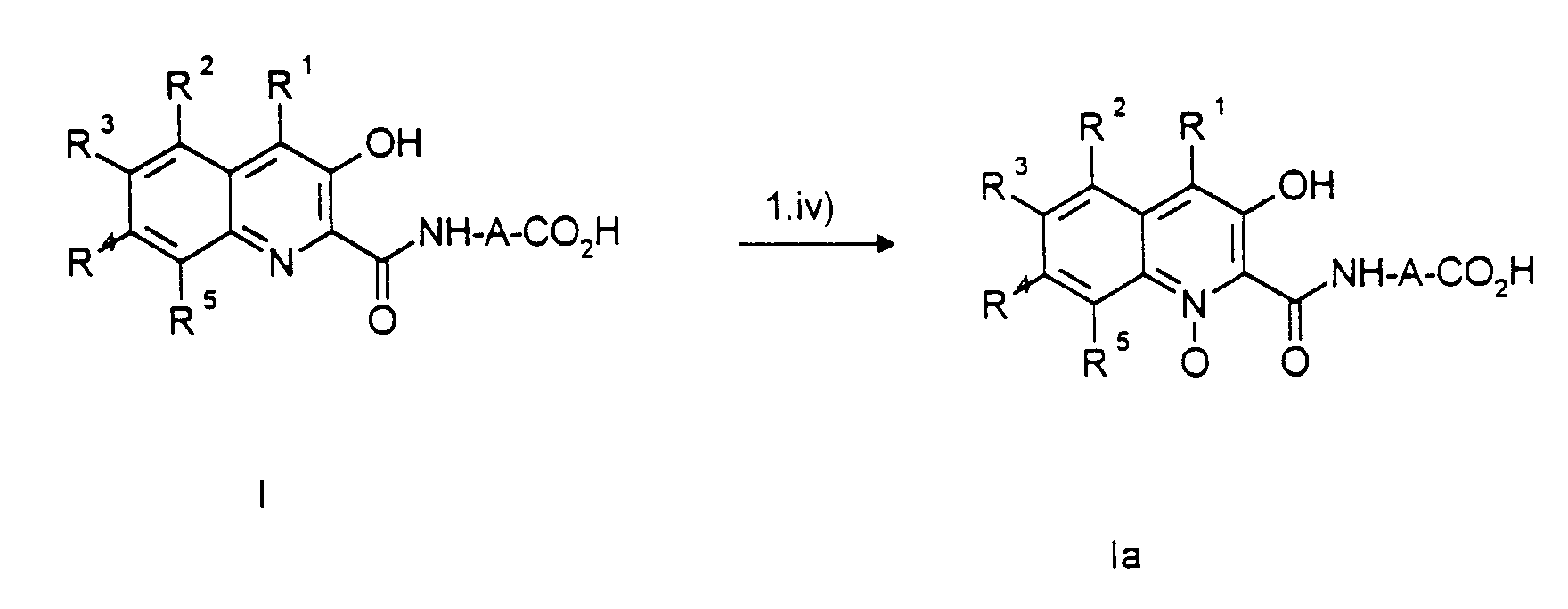
- Verbindungen gemäß den Ansprüchen 1 bis 19 für die Anwendung zur Hemmung der Kollagenbiosynthese.
- Verbindungen gemäß den Ansprüchen 1 bis 19 als Inhibitoren der Prolylhydroxylase.
- Verbindungen gemäß den Ansprüchen 1 bis 19 zur Anwendung als Fibrosupressiva.
- Verbindungen gemäß den Ansprüchen 1 bis 19 zur Herstellung eines Arzneimittels gegen fibrotische Erkrankungen.
- Verbindungen gemäß den Ansprüchen 1 bis 19 zur Herstellung eines Arzneimittels gegen fibrotische Erkrankungen der Leber.
- Verbindungen gemäß den Ansprüchen 1 bis 19 zur Herstellung eines Arzneimittels gegen fibrotische Erkrankungen der Lunge.
- Verbindungen gemäß den Ansprüchen 1 bis 19 zur Herstellung eines Arzneimittels gegen fibrotische Erkrankungen der Haut.
- Verwendung der Verbindungen der Formel I gemäß den Ansprüchen 1 bis 19 als Inhibitoren der Prolyl-hydroxylase und als Fibrosuppressiva.
- Arzneimittel, enthaltend Verbindungen der Formel I gemäß den Ansprüchen 1 bis 19.
- Zwischenprodukte der Formel II
 R1 bis R5 die Bedeutungen haben, die für die Verbindungen der Formel I gemäß den Ansprüchen 1 bis 19 gelten,R10 Wasserstoff oder eine HO-Schutzgruppe ist undR11 Wasserstoff, (C1-C8)-Alkyl und Benzyl bedeuten,mit der Ausnahme von Verbindungen der Formel II, in denen R10 Benzyl oder Methyl ist, sofern R1 bis R5 und R11 Wasserstoff bedeutet und solchen Verbindungen der Formel II, in denen R10 Wasserstoff, Benzyl oder p-Toluolsulfonyl ist, sofern R1 bis R5 Wasserstoff und R11 Ethyl bedeutet und solchen Verbindungen der Formel II, in denen R3 Wasserstoff oder Methoxy ist, sofern R1, R2, R3, R4, R5, R10 und R11 Wasserstoff sind.
 - Zwischenprodukte der Formel X
 m 0 oder 1 undR2 bis R5 die Bedeutungen haben, die für die Verbindungen der Formel I gemäß den Ansprüchen 1 bis 19 gelten,mit der Ausnahme von Verbindungen der Formel X, in denen m=0, R3 Wasserstoff, Methyl oder Chlor ist, sofern R2, R4 und R5 Wasserstoff bedeutet.
Applications Claiming Priority (4)
| Application Number | Priority Date | Filing Date | Title |
|---|---|---|---|
| DE19536263A DE19536263A1 (de) | 1995-09-28 | 1995-09-28 | Substituierte Chinolin-2-carbonsäureamide, ihre Herstellung und ihre Verwendung als Arzneimittel |
| DE19536263 | 1995-09-28 | ||
| DE19605170 | 1996-02-13 | ||
| DE19605170 | 1996-02-13 |
Publications (2)
| Publication Number | Publication Date |
|---|---|
| EP0765871A1 true EP0765871A1 (de) | 1997-04-02 |
| EP0765871B1 EP0765871B1 (de) | 2004-03-31 |
Family
ID=26019051
Family Applications (1)
| Application Number | Title | Priority Date | Filing Date |
|---|---|---|---|
| EP96115110A Expired - Lifetime EP0765871B1 (de) | 1995-09-28 | 1996-09-20 | Substituierte Chinolin-2-Carbonsäureamide, ihre Herstellung und ihre Verwendung als Prolyl-4-hydroylase Inhibitoren |
Country Status (20)
| Country | Link |
|---|---|
| US (2) | US5726305A (de) |
| EP (1) | EP0765871B1 (de) |
| JP (1) | JPH09124606A (de) |
| KR (1) | KR970061869A (de) |
| CN (2) | CN1120157C (de) |
| AT (1) | ATE263155T1 (de) |
| AU (1) | AU728208B2 (de) |
| CA (1) | CA2186717A1 (de) |
| CZ (1) | CZ283396A3 (de) |
| DE (1) | DE59610950D1 (de) |
| ES (1) | ES2215184T3 (de) |
| HU (1) | HUP9602685A3 (de) |
| IL (2) | IL135495A (de) |
| MX (1) | MX9604378A (de) |
| MY (1) | MY133647A (de) |
| NO (1) | NO308600B1 (de) |
| NZ (1) | NZ299455A (de) |
| PL (1) | PL316321A1 (de) |
| SG (1) | SG45503A1 (de) |
| SI (1) | SI9600287A (de) |
Cited By (8)
| Publication number | Priority date | Publication date | Assignee | Title |
|---|---|---|---|---|
| EP0846685A1 (de) * | 1996-12-04 | 1998-06-10 | Hoechst Aktiengesellschaft | 3-Hydrox-Pyridin-2-carbonsäureamidester, ihre Herstellung und ihre Verwendung als Arzneimittel |
| EP0911340A3 (de) * | 1997-10-20 | 1999-07-07 | Hoechst Marion Roussel Deutschland GmbH | Substituierte Isochinolin-3-Carbonsäureamide, ihre Herstellung und ihre Verwendung als Arzneimittel |
| WO2007070359A2 (en) | 2005-12-09 | 2007-06-21 | Amgen Inc. | Quinolone based compounds exhibiting prolyl hydroxylase inhibitory activity, and compositions, and uses thereof |
| WO2007101204A1 (en) * | 2006-02-27 | 2007-09-07 | Alcon Research, Ltd. | Method of treating glaucoma |
| US7307089B2 (en) | 2005-07-27 | 2007-12-11 | Roche Palo Alto Llc | Aryloxy quinolines and uses thereof |
| EP2298301B1 (de) * | 2001-12-06 | 2018-07-04 | Fibrogen, Inc. | Medikamente zur behandlung der anämie im zusammenhang mit nierenerkrankungen |
| US11420935B2 (en) | 2019-04-16 | 2022-08-23 | Vivace Therapeutics, Inc. | Bicyclic compounds |
| US11866431B2 (en) | 2018-11-09 | 2024-01-09 | Vivace Therapeutics, Inc. | Bicyclic compounds |
Families Citing this family (42)
| Publication number | Priority date | Publication date | Assignee | Title |
|---|---|---|---|---|
| US20020198145A1 (en) * | 1999-06-10 | 2002-12-26 | Cognetix, Inc. | MuO-conopeptides and their use as local anesthetics |
| CA2432642A1 (en) * | 2000-12-21 | 2002-08-08 | Subhash P. Khanapure | Substituted aryl compounds as novel cyclooxygenase-2 selective inhibitors, compositions and methods of use |
| JP4590157B2 (ja) * | 2001-03-21 | 2010-12-01 | アイシス イノヴェイション リミテッド | アッセイ、方法および手段 |
| EP2295060B1 (de) | 2001-12-06 | 2018-10-31 | Fibrogen, Inc. | Behandlung ischämischer oder hypoxischer Zustände |
| US7618940B2 (en) | 2002-12-06 | 2009-11-17 | Fibrogen, Inc. | Fat regulation |
| US8124582B2 (en) | 2002-12-06 | 2012-02-28 | Fibrogen, Inc. | Treatment of diabetes |
| US8614204B2 (en) | 2003-06-06 | 2013-12-24 | Fibrogen, Inc. | Enhanced erythropoiesis and iron metabolism |
| CN103145616B (zh) | 2003-06-06 | 2015-09-30 | 菲布罗根有限公司 | 含氮杂芳基化合物及其在增加内源性促红细胞生成素中的用途 |
| WO2005034929A2 (en) * | 2003-10-10 | 2005-04-21 | Fibrogen, Inc. | Tissue remodeling and vascularization |
| CN101849943A (zh) * | 2005-06-06 | 2010-10-06 | 菲布罗根公司 | 使用HIFα稳定剂的改进的贫血治疗 |
| AU2006259352A1 (en) | 2005-06-15 | 2006-12-28 | Fibrogen, Inc. | Use of HIF 1alfa modulators for treatment of cancer |
| CN102351791B (zh) * | 2006-01-27 | 2014-10-29 | 菲布罗根有限公司 | 使低氧诱导因子(hif)稳定的氰基异喹啉化合物 |
| US7745461B1 (en) | 2006-02-27 | 2010-06-29 | Alcon Research, Ltd. | Method of treating dry eye disorders |
| KR100934671B1 (ko) * | 2006-03-30 | 2009-12-31 | 엘지전자 주식회사 | 비디오 신호를 디코딩/인코딩하기 위한 방법 및 장치 |
| AU2007234408B2 (en) * | 2006-04-04 | 2011-05-19 | Fibrogen, Inc. | Pyrrolo- and thiazolo-pyridine compounds as HIF modulators |
| NZ623002A (en) | 2006-06-26 | 2015-08-28 | Akebia Therapeutics Inc | Prolyl hydroxylase inhibitors and methods of use |
| US8048892B2 (en) * | 2006-12-18 | 2011-11-01 | Amgen Inc. | Azaquinolone based compounds exhibiting prolyl hydroxylase inhibitory activity, compositions, and uses thereof |
| WO2008076427A2 (en) * | 2006-12-18 | 2008-06-26 | Amgen Inc. | Naphthalenone compounds exhibiting prolyl hydroxylase inhibitory activity, compositions, and uses thereof |
| ES2446418T3 (es) * | 2007-04-18 | 2014-03-07 | Amgen, Inc | Derivados de indanona que inhiben la prolil hidroxilasa |
| EP2142509B1 (de) * | 2007-04-18 | 2013-12-04 | Amgen, Inc | Chinolone und azachinolone, die prolylhydroxylase inhibieren |
| CA2685219C (en) * | 2007-05-04 | 2012-06-19 | Amgen Inc. | Diazaquinolones that inhibit prolyl hydroxylase activity |
| US8030346B2 (en) * | 2007-05-04 | 2011-10-04 | Amgen Inc. | Heterocyclic quinolone derivatives that inhibit prolyl hydroxylase activity |
| US8962530B2 (en) * | 2007-06-27 | 2015-02-24 | Regents Of The University Of Colorado | Inflammatory bowel disease therapies |
| WO2010056767A1 (en) | 2008-11-14 | 2010-05-20 | Fibrogen, Inc. | Thiochromene derivatives as hip hydroxylase inhibitors |
| UA107360C2 (en) | 2009-08-05 | 2014-12-25 | Biogen Idec Inc | Bicyclic aryl sphingosine 1-phosphate analogs |
| AU2010340142B2 (en) * | 2009-12-17 | 2014-05-08 | Merck Sharp & Dohme Corp. | Quinoline amide M1 receptor positive allosteric modulators |
| CN106278999B (zh) | 2011-02-07 | 2019-10-25 | 比奥根Ma公司 | S1p调节剂 |
| NO2686520T3 (de) | 2011-06-06 | 2018-03-17 | ||
| WO2013134660A1 (en) | 2012-03-09 | 2013-09-12 | Fibrogen, Inc. | 4 -hydroxy- isoquinoline compounds as hif hydroxylase inhibitors |
| US8883823B2 (en) | 2012-07-16 | 2014-11-11 | Fibrogen, Inc. | Crystalline forms of a prolyl hydroxylase inhibitor |
| EP3470397B1 (de) | 2012-07-16 | 2021-12-29 | Fibrogen, Inc. | Kristalline formen eines prolylhydroxylaseinhibitors |
| SG11201500234YA (en) | 2012-07-16 | 2015-02-27 | Fibrogen Inc | Process for making isoquinoline compounds |
| ES2668694T3 (es) * | 2012-07-27 | 2018-05-21 | Biogen Ma Inc. | Derivados de ácido 1-[7-(cis-4-metil-ciclohexiloxi)-8-trifluorometil-naftalen-2-ilmetil]-piperidin-4-carboxílico como moduladores de autotaxina (ATX) para tratar inflamaciones y trastornos autoinmunitarios |
| SG10202009266PA (en) | 2013-01-24 | 2020-10-29 | Fibrogen Inc | Crystalline forms of {[1-cyano-5-(4-chlorophenoxy)-4-hydroxy-isoquinoline-3-carbonyl]-amino}-acetic acid |
| HUE066123T2 (hu) | 2013-06-13 | 2024-07-28 | Akebia Therapeutics Inc | Készítmények és módszerek anémia kezelésére |
| TWI665190B (zh) | 2013-11-15 | 2019-07-11 | 阿克比治療有限公司 | {[5-(3-氯苯基)-3-羥基吡啶-2-羰基]胺基}乙酸之固體型式,其組合物及用途 |
| CA2974691A1 (en) | 2015-01-23 | 2016-07-28 | Akebia Therapeutics, Inc. | Solid forms of 2-(5-(3-fluorophenyl)-3-hydroxypicolinamido)acetic acid, compositions, and uses thereof |
| NZ735973A (en) | 2015-04-01 | 2023-06-30 | Akebia Therapeutics Inc | Compositions and methods for treating anemia |
| US11713298B2 (en) | 2018-05-09 | 2023-08-01 | Akebia Therapeutics, Inc. | Process for preparing 2-[[5-(3-chlorophenyl)-3-hydroxypyridine-2-carbonyl]amino]acetic acid |
| US11524939B2 (en) | 2019-11-13 | 2022-12-13 | Akebia Therapeutics, Inc. | Solid forms of {[5-(3-chlorophenyl)-3-hydroxypyridine-2-carbonyl]amino} acetic acid |
| US12612367B2 (en) | 2019-12-10 | 2026-04-28 | Akebia Therapeutics, Inc. | Method for producing nitrogen-containing heteroarylcarboxamide acetic acid derivative |
| WO2021216530A1 (en) | 2020-04-20 | 2021-10-28 | Akebia Therapeutics, Inc. | Treatment of viral infections, of organ injury, and of related conditions using a hif prolyl hydroxylase inhibitor or a hif-alpha stabilizer |
Citations (5)
| Publication number | Priority date | Publication date | Assignee | Title |
|---|---|---|---|---|
| EP0562512A1 (de) * | 1992-03-24 | 1993-09-29 | Hoechst Aktiengesellschaft | Sulfonamido- und Sulfonamidocarbonyl-pyridin-2-carbonsäureamide sowie ihre Pyridin-N-oxide, Verfahren zu ihrer Herstellung und ihre Verwendung als Arzneimittel |
| EP0590520A1 (de) * | 1992-10-02 | 1994-04-06 | Hoechst Aktiengesellschaft | Acylsulfonamido-und Sulfonamidopyridin-2-carbonsäureester sowie ihre Pyridin-N-oxide, Verfahren zur ihrer Herstellung und ihre Verwendung als Arzneimittel |
| EP0650960A1 (de) * | 1993-11-02 | 1995-05-03 | Hoechst Aktiengesellschaft | Substituierte heterocyclische Carbonsäureamidester, ihre Herstellung und ihre Verwendung als Arzneimittel |
| EP0650961A1 (de) * | 1993-11-02 | 1995-05-03 | Hoechst Aktiengesellschaft | Substituierte heterocyclische Carbonsäureamide, ihre Herstellung und ihre Verwendung als Arzneimittel |
| EP0661269A1 (de) * | 1993-12-30 | 1995-07-05 | Hoechst Aktiengesellschaft | Substituierte heterocyclische Carbonsäureamide, ihre Herstellung und ihre Verwendung als Arzneimittel |
Family Cites Families (4)
| Publication number | Priority date | Publication date | Assignee | Title |
|---|---|---|---|---|
| DE4015255A1 (de) * | 1990-05-12 | 1991-11-14 | Hoechst Ag | Oxalyl-aminosaeurederivate, verfahren zu ihrer herstellung und ihrer verwendung als arzneimittel zur inhibierung der prolyl-hydroxylase |
| US5192773A (en) * | 1990-07-02 | 1993-03-09 | Vertex Pharmaceuticals, Inc. | Immunosuppressive compounds |
| EP0541042A1 (de) * | 1991-11-05 | 1993-05-12 | Hoechst Aktiengesellschaft | Pyridin-2,4- und 2,5-dicarbonsäureamide und deren Derivate, Verfahren zu ihrer Herstellung sowie deren Verwendung als Arzneimittel |
| DK122693D0 (da) * | 1993-10-29 | 1993-10-29 | Hempels Skibsfarve Fab J C | Marin struktur |
-
1996
- 1996-06-29 IL IL13549596A patent/IL135495A/en not_active IP Right Cessation
- 1996-07-03 US US08/675,155 patent/US5726305A/en not_active Expired - Lifetime
- 1996-07-03 US US08/675,208 patent/US5719164A/en not_active Expired - Lifetime
- 1996-09-20 ES ES96115110T patent/ES2215184T3/es not_active Expired - Lifetime
- 1996-09-20 AT AT96115110T patent/ATE263155T1/de not_active IP Right Cessation
- 1996-09-20 EP EP96115110A patent/EP0765871B1/de not_active Expired - Lifetime
- 1996-09-20 DE DE59610950T patent/DE59610950D1/de not_active Expired - Lifetime
- 1996-09-25 KR KR1019960042606A patent/KR970061869A/ko not_active Ceased
- 1996-09-26 AU AU65838/96A patent/AU728208B2/en not_active Ceased
- 1996-09-26 CN CN96122806A patent/CN1120157C/zh not_active Expired - Lifetime
- 1996-09-26 IL IL11930296A patent/IL119302A0/xx unknown
- 1996-09-26 CZ CZ962833A patent/CZ283396A3/cs unknown
- 1996-09-26 NZ NZ299455A patent/NZ299455A/en unknown
- 1996-09-27 NO NO964093A patent/NO308600B1/no not_active IP Right Cessation
- 1996-09-27 CA CA002186717A patent/CA2186717A1/en not_active Abandoned
- 1996-09-27 MY MYPI96004023A patent/MY133647A/en unknown
- 1996-09-27 HU HU9602685A patent/HUP9602685A3/hu unknown
- 1996-09-27 SI SI9600287A patent/SI9600287A/sl unknown
- 1996-09-27 SG SG1996010735A patent/SG45503A1/en unknown
- 1996-09-27 MX MX9604378A patent/MX9604378A/es unknown
- 1996-09-27 PL PL96316321A patent/PL316321A1/xx unknown
- 1996-09-30 JP JP8276901A patent/JPH09124606A/ja active Pending
-
2000
- 2000-06-14 CN CN00118801A patent/CN1282737A/zh active Pending
Patent Citations (5)
| Publication number | Priority date | Publication date | Assignee | Title |
|---|---|---|---|---|
| EP0562512A1 (de) * | 1992-03-24 | 1993-09-29 | Hoechst Aktiengesellschaft | Sulfonamido- und Sulfonamidocarbonyl-pyridin-2-carbonsäureamide sowie ihre Pyridin-N-oxide, Verfahren zu ihrer Herstellung und ihre Verwendung als Arzneimittel |
| EP0590520A1 (de) * | 1992-10-02 | 1994-04-06 | Hoechst Aktiengesellschaft | Acylsulfonamido-und Sulfonamidopyridin-2-carbonsäureester sowie ihre Pyridin-N-oxide, Verfahren zur ihrer Herstellung und ihre Verwendung als Arzneimittel |
| EP0650960A1 (de) * | 1993-11-02 | 1995-05-03 | Hoechst Aktiengesellschaft | Substituierte heterocyclische Carbonsäureamidester, ihre Herstellung und ihre Verwendung als Arzneimittel |
| EP0650961A1 (de) * | 1993-11-02 | 1995-05-03 | Hoechst Aktiengesellschaft | Substituierte heterocyclische Carbonsäureamide, ihre Herstellung und ihre Verwendung als Arzneimittel |
| EP0661269A1 (de) * | 1993-12-30 | 1995-07-05 | Hoechst Aktiengesellschaft | Substituierte heterocyclische Carbonsäureamide, ihre Herstellung und ihre Verwendung als Arzneimittel |
Non-Patent Citations (8)
| Title |
|---|
| BAYNE,D.W.ET AL.: "Synthesis of 2-Acyl-3-hydroxyquinolines Embodying a Novel Variant of the Smiles Rearrangement", J.CHEM.SOC.,CHEM.COMMUM., no. 19, 1975, LONDON, pages 782 - 783, XP002022671 * |
| BOGER,D.L. ET AL.: "(-)Sandramycin: Totoal Syntesei and Preliminary DNA Binding Properties", J.AM.CHEM.SOC., vol. 115, 1993, WASHINGTON, pages 11624 - 11625, XP002022669 * |
| BRESLOW,D.S. ET AL.: "Synthesis of Antimalerials. V. The Syntheis of Certain 4-Aminoquinoline Derivatives", J.AM.CHEM.SOC., vol. 68, 1946, WASHINGTON, pages 1232 - 1238, XP002022665 * |
| FATTORUSSO,E. ET AL.: "Isolation of 3,4-dihydroxyquinoline2-carboxylic acid from the sponge Aplysina aerophoba", GAZZ.CHIM.ITAL., vol. 101, 1971, ROM, pages 104 - 105, XP002022667 * |
| FRANKLIN,J.F. ET AL.: "Approaches to the design of anti-fibrotic drugs", BIOCHEM.SOC.TRANS., vol. 19, 1991, pages 812 - 815, XP002022664 * |
| HANNAH,E.D. ET AL.: "Removal of tolyl-sulphonyl groups from sulfonamides. III. some N-(tolyl-p-sulphonyl) glycine esters", J.CHEM.SOC. C, no. 4, 1967, pages 256 - 261, XP002022668 * |
| KANEKO,C. ET AL.: "The Isomerisation of 1aH-Oxazirino[2,3-a]quinoline 1a-carbonitrile ....", CHEM.PHARM.BULL., vol. 15, no. 5, 1967, TOKYO, pages 663 - 669, XP002022666 * |
| KONISHI,M. ET AL.: "Structures of BBM-928 A,B and C....", J.AM.CHEM.SOC., vol. 103, no. 5, 1981, WASHINGTON, pages 1241 - 1243, XP002022670 * |
Cited By (19)
| Publication number | Priority date | Publication date | Assignee | Title |
|---|---|---|---|---|
| EP0846685A1 (de) * | 1996-12-04 | 1998-06-10 | Hoechst Aktiengesellschaft | 3-Hydrox-Pyridin-2-carbonsäureamidester, ihre Herstellung und ihre Verwendung als Arzneimittel |
| US6020350A (en) * | 1996-12-04 | 2000-02-01 | Hoechst Aktiengesellschaft | 3-hydroxypyridine-2-carboxamidoesters, their preparation and their use as pharmaceuticals |
| EP0911340A3 (de) * | 1997-10-20 | 1999-07-07 | Hoechst Marion Roussel Deutschland GmbH | Substituierte Isochinolin-3-Carbonsäureamide, ihre Herstellung und ihre Verwendung als Arzneimittel |
| US6093730A (en) * | 1997-10-20 | 2000-07-25 | Hoechst Marion Roussel Deutschland Gmbh | Substituted isoquinoline-3-carboxamides, their preparation and their use as pharmaceuticals |
| SG87776A1 (en) * | 1997-10-20 | 2002-04-16 | Aventis Pharma Gmbh | Substituted isoquinoline-3-carboxamides, their preparation and their use as pharmaceuticals |
| EP1538160A1 (de) * | 1997-10-20 | 2005-06-08 | Fibrogen, Inc. | Substituierte Isochinolin-3-Carbonsäureamide, ihre Herstellung und ihre Verwendung als Arzneimittel |
| KR100618922B1 (ko) * | 1997-10-20 | 2007-04-25 | 아베가 파텐트마나게멘트 게엠베하 | 치환된이소퀴놀린-3-카복스아미드,이의제조방법및이를포함하는약제학적조성물 |
| EP2298301B2 (de) † | 2001-12-06 | 2022-11-16 | Fibrogen, Inc. | Medikamente zur behandlung der anämie im zusammenhang mit nierenerkrankungen |
| EP2289531B1 (de) * | 2001-12-06 | 2018-07-04 | Fibrogen, Inc. | Medikamente zur Behandlung oder Prävention der Anämie |
| EP2298301B1 (de) * | 2001-12-06 | 2018-07-04 | Fibrogen, Inc. | Medikamente zur behandlung der anämie im zusammenhang mit nierenerkrankungen |
| US7307089B2 (en) | 2005-07-27 | 2007-12-11 | Roche Palo Alto Llc | Aryloxy quinolines and uses thereof |
| US8017626B2 (en) | 2005-12-09 | 2011-09-13 | Amgen Inc. | Quinolone based compounds exhibiting, prolyl hydroxylase inhibitory activity, and compositions, and uses thereof |
| US8012968B2 (en) | 2005-12-09 | 2011-09-06 | Amgen Inc. | Quinolone based compounds exhibiting prolyl hydroxylase inhibitory activity, and compositions, and uses thereof |
| WO2007070359A2 (en) | 2005-12-09 | 2007-06-21 | Amgen Inc. | Quinolone based compounds exhibiting prolyl hydroxylase inhibitory activity, and compositions, and uses thereof |
| US7625927B2 (en) | 2006-02-27 | 2009-12-01 | Alcon Research, Ltd. | Method of treating glaucoma |
| WO2007101204A1 (en) * | 2006-02-27 | 2007-09-07 | Alcon Research, Ltd. | Method of treating glaucoma |
| US11866431B2 (en) | 2018-11-09 | 2024-01-09 | Vivace Therapeutics, Inc. | Bicyclic compounds |
| US11420935B2 (en) | 2019-04-16 | 2022-08-23 | Vivace Therapeutics, Inc. | Bicyclic compounds |
| US12103902B2 (en) | 2019-04-16 | 2024-10-01 | Vivace Therapeutics, Inc. | Bicyclic compounds |
Also Published As
| Publication number | Publication date |
|---|---|
| NO308600B1 (no) | 2000-10-02 |
| CN1282737A (zh) | 2001-02-07 |
| SI9600287A (en) | 1997-04-30 |
| CN1154365A (zh) | 1997-07-16 |
| CA2186717A1 (en) | 1997-03-29 |
| US5719164A (en) | 1998-02-17 |
| IL119302A0 (en) | 1996-12-05 |
| EP0765871B1 (de) | 2004-03-31 |
| NO964093D0 (no) | 1996-09-27 |
| HU9602685D0 (en) | 1996-11-28 |
| ES2215184T3 (es) | 2004-10-01 |
| KR970061869A (ko) | 1997-09-12 |
| US5726305A (en) | 1998-03-10 |
| IL135495A (en) | 2002-12-01 |
| AU728208B2 (en) | 2001-01-04 |
| HUP9602685A3 (en) | 2001-04-28 |
| MY133647A (en) | 2007-11-30 |
| CZ283396A3 (en) | 1997-04-16 |
| MX9604378A (es) | 1997-03-29 |
| SG45503A1 (en) | 1998-01-16 |
| NO964093L (no) | 1997-04-01 |
| DE59610950D1 (de) | 2004-05-06 |
| NZ299455A (en) | 1997-06-24 |
| JPH09124606A (ja) | 1997-05-13 |
| CN1120157C (zh) | 2003-09-03 |
| ATE263155T1 (de) | 2004-04-15 |
| PL316321A1 (en) | 1997-04-01 |
| AU6583896A (en) | 1997-04-10 |
| HUP9602685A2 (hu) | 1998-09-28 |
Similar Documents
| Publication | Publication Date | Title |
|---|---|---|
| EP0765871B1 (de) | Substituierte Chinolin-2-Carbonsäureamide, ihre Herstellung und ihre Verwendung als Prolyl-4-hydroylase Inhibitoren | |
| EP0661269B1 (de) | Substituierte heterocyclische Carbonsäureamide, ihre Herstellung und ihre Verwendung als Arzneimittel | |
| EP0650961B1 (de) | Substituierte heterocyclische Carbonsäureamide, ihre Herstellung und ihre Verwendung als Arzneimittel | |
| EP0650960B1 (de) | Substituierte heterocyclische Carbonsäureamidester, ihre Herstellung und ihre Verwendung als Arzneimittel | |
| EP1538160B1 (de) | Substituierte Isochinolin-3-Carbonsäureamide, ihre Herstellung und ihre Verwendung als Arzneimittel | |
| EP0562512B1 (de) | Sulfonamidocarbonylpyridin-2-carbonsäureamide und ihre Verwendung als Arzneimittel | |
| EP0673931B1 (de) | Sulfonamidocarbonylpyridin-2-carbonsäureamide sowie ihre Pyridin-N-oxide, Verfahren zu ihrer Herstellung und ihre Verwendung als Arzneimittel | |
| EP0900202A1 (de) | 3-alkoxypyridin-2-carbonsäureamidester, ihre herstellung und ihre verwendung als arzneimittel | |
| DE69921994T2 (de) | Heterozyklische verbindungen mit faktor xa hemmender wirkung | |
| EP0673932A1 (de) | Sulfonamidocarbonylpyridin-2-carbonsäureesteramide sowie ihre Pyridin-N-oxide, Verfahren zu ihrer Herstellung und ihre Verwendung als Arzneimittel | |
| DE69923444T2 (de) | Heterozyklische verbindungen mit faktor xa hemmender wirkung | |
| EP0673930A1 (de) | Substituierte heterocyclische Carbonsäureamidester, ihre Herstellung und ihre Verwendung als Arzneimittel | |
| DD159069A5 (de) | Verfahren zur herstellung von n-(zycloalkyl)amino saurer-verbindungen | |
| DE19536263A1 (de) | Substituierte Chinolin-2-carbonsäureamide, ihre Herstellung und ihre Verwendung als Arzneimittel | |
| DE19504226A1 (de) | Substituierte Chinoxaline, ihre Herstellung und ihre Verwendung als Arzneimittel | |
| DE4439935A1 (de) | Substituierte heterocyclische Carbonsäureamide, ihre Herstellung und ihre Verwendung als Arzneimittel | |
| DE4337271A1 (de) | Substituierte heterocyclische Carbonsäureamide, ihre Herstellung und ihre Verwendung als Arzneimittel | |
| DE4344958A1 (de) | Substituierte heterocyclische Carbonsäureamide, ihre Herstellung und ihre Verwendung als Arzneimittel | |
| DE4433928A1 (de) | Substituierte heterocyclische Carbonsäureamide, ihre Herstellung und ihre Verwendung als Arzneimittel | |
| DE4410881A1 (de) | Substituierte heterocyclische Carbonsäureamide, ihre Herstellung und ihre Verwendung als Arzneimittel | |
| DE4337270A1 (de) | Substituierte heterocyclische Carbonsäureamidester, ihre Herstellung und ihre Verwendung als Arzneimittel | |
| DE4434288A1 (de) | Substituierte heterocyclische Carbonsäureamidester, ihre Herstellung und ihre Verwendung als Arzneimittel | |
| EP0673929A1 (de) | Substituierte heterocyclische Carbonsäureamide, ihre Herstellung und ihre Verwendung als Arzneimittel |
Legal Events
| Date | Code | Title | Description |
|---|---|---|---|
| PUAI | Public reference made under article 153(3) epc to a published international application that has entered the european phase |
Free format text: ORIGINAL CODE: 0009012 |
|
| AK | Designated contracting states |
Kind code of ref document: A1 Designated state(s): AT BE CH DE DK ES FI FR GB GR IE IT LI LU NL PT SE |
|
| 17P | Request for examination filed |
Effective date: 19971002 |
|
| 17Q | First examination report despatched |
Effective date: 19990830 |
|
| RAP1 | Party data changed (applicant data changed or rights of an application transferred) |
Owner name: FIBROGEN, INC. |
|
| GRAP | Despatch of communication of intention to grant a patent |
Free format text: ORIGINAL CODE: EPIDOSNIGR1 |
|
| GRAS | Grant fee paid |
Free format text: ORIGINAL CODE: EPIDOSNIGR3 |
|
| GRAA | (expected) grant |
Free format text: ORIGINAL CODE: 0009210 |
|
| AK | Designated contracting states |
Kind code of ref document: B1 Designated state(s): AT BE CH DE DK ES FI FR GB GR IE IT LI LU NL PT SE |
|
| PG25 | Lapsed in a contracting state [announced via postgrant information from national office to epo] |
Ref country code: NL Free format text: LAPSE BECAUSE OF FAILURE TO SUBMIT A TRANSLATION OF THE DESCRIPTION OR TO PAY THE FEE WITHIN THE PRESCRIBED TIME-LIMIT Effective date: 20040331 Ref country code: IE Free format text: LAPSE BECAUSE OF FAILURE TO SUBMIT A TRANSLATION OF THE DESCRIPTION OR TO PAY THE FEE WITHIN THE PRESCRIBED TIME-LIMIT Effective date: 20040331 Ref country code: FI Free format text: LAPSE BECAUSE OF FAILURE TO SUBMIT A TRANSLATION OF THE DESCRIPTION OR TO PAY THE FEE WITHIN THE PRESCRIBED TIME-LIMIT Effective date: 20040331 |
|
| REG | Reference to a national code |
Ref country code: GB Ref legal event code: FG4D Free format text: NOT ENGLISH Ref country code: CH Ref legal event code: EP |
|
| REG | Reference to a national code |
Ref country code: IE Ref legal event code: FG4D Free format text: GERMAN |
|
| REF | Corresponds to: |
Ref document number: 59610950 Country of ref document: DE Date of ref document: 20040506 Kind code of ref document: P |
|
| PG25 | Lapsed in a contracting state [announced via postgrant information from national office to epo] |
Ref country code: SE Free format text: LAPSE BECAUSE OF FAILURE TO SUBMIT A TRANSLATION OF THE DESCRIPTION OR TO PAY THE FEE WITHIN THE PRESCRIBED TIME-LIMIT Effective date: 20040630 Ref country code: GR Free format text: LAPSE BECAUSE OF FAILURE TO SUBMIT A TRANSLATION OF THE DESCRIPTION OR TO PAY THE FEE WITHIN THE PRESCRIBED TIME-LIMIT Effective date: 20040630 Ref country code: DK Free format text: LAPSE BECAUSE OF FAILURE TO SUBMIT A TRANSLATION OF THE DESCRIPTION OR TO PAY THE FEE WITHIN THE PRESCRIBED TIME-LIMIT Effective date: 20040630 |
|
| GBT | Gb: translation of ep patent filed (gb section 77(6)(a)/1977) |
Effective date: 20040624 |
|
| PG25 | Lapsed in a contracting state [announced via postgrant information from national office to epo] |
Ref country code: LU Free format text: LAPSE BECAUSE OF NON-PAYMENT OF DUE FEES Effective date: 20040920 Ref country code: AT Free format text: LAPSE BECAUSE OF NON-PAYMENT OF DUE FEES Effective date: 20040920 |
|
| PG25 | Lapsed in a contracting state [announced via postgrant information from national office to epo] |
Ref country code: LI Free format text: LAPSE BECAUSE OF NON-PAYMENT OF DUE FEES Effective date: 20040930 Ref country code: CH Free format text: LAPSE BECAUSE OF NON-PAYMENT OF DUE FEES Effective date: 20040930 Ref country code: BE Free format text: LAPSE BECAUSE OF NON-PAYMENT OF DUE FEES Effective date: 20040930 |
|
| NLV1 | Nl: lapsed or annulled due to failure to fulfill the requirements of art. 29p and 29m of the patents act | ||
| REG | Reference to a national code |
Ref country code: ES Ref legal event code: FG2A Ref document number: 2215184 Country of ref document: ES Kind code of ref document: T3 |
|
| ET | Fr: translation filed | ||
| REG | Reference to a national code |
Ref country code: IE Ref legal event code: FD4D |
|
| PLBE | No opposition filed within time limit |
Free format text: ORIGINAL CODE: 0009261 |
|
| STAA | Information on the status of an ep patent application or granted ep patent |
Free format text: STATUS: NO OPPOSITION FILED WITHIN TIME LIMIT |
|
| 26N | No opposition filed |
Effective date: 20050104 |
|
| BERE | Be: lapsed |
Owner name: *FIBROGEN INC. Effective date: 20040930 |
|
| REG | Reference to a national code |
Ref country code: CH Ref legal event code: PL |
|
| BERE | Be: lapsed |
Owner name: *FIBROGEN INC. Effective date: 20040930 |
|
| PG25 | Lapsed in a contracting state [announced via postgrant information from national office to epo] |
Ref country code: PT Free format text: LAPSE BECAUSE OF NON-PAYMENT OF DUE FEES Effective date: 20040831 |
|
| PGFP | Annual fee paid to national office [announced via postgrant information from national office to epo] |
Ref country code: IT Payment date: 20100921 Year of fee payment: 15 |
|
| PGFP | Annual fee paid to national office [announced via postgrant information from national office to epo] |
Ref country code: ES Payment date: 20111130 Year of fee payment: 16 |
|
| PG25 | Lapsed in a contracting state [announced via postgrant information from national office to epo] |
Ref country code: IT Free format text: LAPSE BECAUSE OF NON-PAYMENT OF DUE FEES Effective date: 20120920 |
|
| REG | Reference to a national code |
Ref country code: ES Ref legal event code: FD2A Effective date: 20131018 |
|
| PG25 | Lapsed in a contracting state [announced via postgrant information from national office to epo] |
Ref country code: ES Free format text: LAPSE BECAUSE OF NON-PAYMENT OF DUE FEES Effective date: 20120921 |
|
| REG | Reference to a national code |
Ref country code: FR Ref legal event code: PLFP Year of fee payment: 20 |
|
| PGFP | Annual fee paid to national office [announced via postgrant information from national office to epo] |
Ref country code: GB Payment date: 20150916 Year of fee payment: 20 Ref country code: DE Payment date: 20150922 Year of fee payment: 20 |
|
| PGFP | Annual fee paid to national office [announced via postgrant information from national office to epo] |
Ref country code: FR Payment date: 20150825 Year of fee payment: 20 |
|
| REG | Reference to a national code |
Ref country code: DE Ref legal event code: R071 Ref document number: 59610950 Country of ref document: DE |
|
| REG | Reference to a national code |
Ref country code: GB Ref legal event code: PE20 Expiry date: 20160919 |
|
| PG25 | Lapsed in a contracting state [announced via postgrant information from national office to epo] |
Ref country code: GB Free format text: LAPSE BECAUSE OF EXPIRATION OF PROTECTION Effective date: 20160919 |