EP0621908B1 - Verfahren zur herstellung vernickelter formteile - Google Patents
Verfahren zur herstellung vernickelter formteile Download PDFInfo
- Publication number
- EP0621908B1 EP0621908B1 EP93902188A EP93902188A EP0621908B1 EP 0621908 B1 EP0621908 B1 EP 0621908B1 EP 93902188 A EP93902188 A EP 93902188A EP 93902188 A EP93902188 A EP 93902188A EP 0621908 B1 EP0621908 B1 EP 0621908B1
- Authority
- EP
- European Patent Office
- Prior art keywords
- alkyl
- hydrogen
- mixture
- compounds
- amino
- Prior art date
- Legal status (The legal status is an assumption and is not a legal conclusion. Google has not performed a legal analysis and makes no representation as to the accuracy of the status listed.)
- Expired - Lifetime
Links
- 238000000034 method Methods 0.000 title claims description 8
- 238000000465 moulding Methods 0.000 title description 3
- PXHVJJICTQNCMI-UHFFFAOYSA-N Nickel Chemical group [Ni] PXHVJJICTQNCMI-UHFFFAOYSA-N 0.000 claims abstract description 44
- 239000000203 mixture Substances 0.000 claims abstract description 32
- 229910052759 nickel Inorganic materials 0.000 claims abstract description 22
- UFHFLCQGNIYNRP-UHFFFAOYSA-N Hydrogen Chemical compound [H][H] UFHFLCQGNIYNRP-UHFFFAOYSA-N 0.000 claims abstract description 21
- -1 sulfo, amino Chemical group 0.000 claims abstract description 21
- 150000001875 compounds Chemical class 0.000 claims abstract description 19
- 229910052739 hydrogen Inorganic materials 0.000 claims abstract description 18
- 239000001257 hydrogen Substances 0.000 claims abstract description 18
- JUJWROOIHBZHMG-UHFFFAOYSA-N Pyridine Chemical compound C1=CC=NC=C1 JUJWROOIHBZHMG-UHFFFAOYSA-N 0.000 claims abstract description 15
- 125000002887 hydroxy group Chemical group [H]O* 0.000 claims abstract description 14
- SMWDFEZZVXVKRB-UHFFFAOYSA-N Quinoline Chemical compound N1=CC=CC2=CC=CC=C21 SMWDFEZZVXVKRB-UHFFFAOYSA-N 0.000 claims abstract description 12
- 125000004122 cyclic group Chemical group 0.000 claims abstract description 11
- 125000002496 methyl group Chemical group [H]C([H])([H])* 0.000 claims abstract description 11
- 125000002947 alkylene group Chemical group 0.000 claims abstract description 10
- XLYOFNOQVPJJNP-UHFFFAOYSA-N water Substances O XLYOFNOQVPJJNP-UHFFFAOYSA-N 0.000 claims abstract description 9
- UYMKPFRHYYNDTL-UHFFFAOYSA-N ethenamine Chemical class NC=C UYMKPFRHYYNDTL-UHFFFAOYSA-N 0.000 claims abstract description 8
- 230000002378 acidificating effect Effects 0.000 claims abstract description 7
- 125000004433 nitrogen atom Chemical group N* 0.000 claims abstract description 7
- 150000001449 anionic compounds Chemical class 0.000 claims abstract description 6
- 238000004070 electrodeposition Methods 0.000 claims abstract description 6
- 125000005843 halogen group Chemical group 0.000 claims abstract description 6
- 150000002891 organic anions Chemical class 0.000 claims abstract description 6
- UMJSCPRVCHMLSP-UHFFFAOYSA-N pyridine Natural products COC1=CC=CN=C1 UMJSCPRVCHMLSP-UHFFFAOYSA-N 0.000 claims abstract description 6
- 125000002183 isoquinolinyl group Chemical group C1(=NC=CC2=CC=CC=C12)* 0.000 claims abstract description 5
- 150000007522 mineralic acids Chemical class 0.000 claims abstract description 5
- 150000002815 nickel Chemical class 0.000 claims abstract description 5
- 229910052757 nitrogen Inorganic materials 0.000 claims abstract description 4
- 239000000470 constituent Substances 0.000 claims abstract description 3
- 125000001495 ethyl group Chemical group [H]C([H])([H])C([H])([H])* 0.000 claims description 5
- 150000002431 hydrogen Chemical class 0.000 claims description 2
- 125000002924 primary amino group Chemical group [H]N([H])* 0.000 abstract description 3
- 125000004435 hydrogen atom Chemical group [H]* 0.000 abstract 1
- 239000003795 chemical substances by application Substances 0.000 description 14
- 239000003792 electrolyte Substances 0.000 description 14
- QAOWNCQODCNURD-UHFFFAOYSA-N Sulfuric acid Chemical compound OS(O)(=O)=O QAOWNCQODCNURD-UHFFFAOYSA-N 0.000 description 6
- 239000002253 acid Substances 0.000 description 5
- 150000001450 anions Chemical class 0.000 description 5
- CVHZOJJKTDOEJC-UHFFFAOYSA-N saccharin Chemical compound C1=CC=C2C(=O)NS(=O)(=O)C2=C1 CVHZOJJKTDOEJC-UHFFFAOYSA-N 0.000 description 4
- LFQSCWFLJHTTHZ-UHFFFAOYSA-N Ethanol Chemical compound CCO LFQSCWFLJHTTHZ-UHFFFAOYSA-N 0.000 description 3
- XEKOWRVHYACXOJ-UHFFFAOYSA-N Ethyl acetate Chemical compound CCOC(C)=O XEKOWRVHYACXOJ-UHFFFAOYSA-N 0.000 description 3
- OKKJLVBELUTLKV-UHFFFAOYSA-N Methanol Chemical compound OC OKKJLVBELUTLKV-UHFFFAOYSA-N 0.000 description 3
- 229910021586 Nickel(II) chloride Inorganic materials 0.000 description 3
- NINIDFKCEFEMDL-UHFFFAOYSA-N Sulfur Chemical compound [S] NINIDFKCEFEMDL-UHFFFAOYSA-N 0.000 description 3
- WYURNTSHIVDZCO-UHFFFAOYSA-N Tetrahydrofuran Chemical compound C1CCOC1 WYURNTSHIVDZCO-UHFFFAOYSA-N 0.000 description 3
- YXFVVABEGXRONW-UHFFFAOYSA-N Toluene Chemical compound CC1=CC=CC=C1 YXFVVABEGXRONW-UHFFFAOYSA-N 0.000 description 3
- 229910052783 alkali metal Inorganic materials 0.000 description 3
- 150000001340 alkali metals Chemical class 0.000 description 3
- 150000003863 ammonium salts Chemical class 0.000 description 3
- KGBXLFKZBHKPEV-UHFFFAOYSA-N boric acid Chemical compound OB(O)O KGBXLFKZBHKPEV-UHFFFAOYSA-N 0.000 description 3
- 238000005282 brightening Methods 0.000 description 3
- ZYGHJZDHTFUPRJ-UHFFFAOYSA-N coumarin Chemical compound C1=CC=C2OC(=O)C=CC2=C1 ZYGHJZDHTFUPRJ-UHFFFAOYSA-N 0.000 description 3
- 238000000151 deposition Methods 0.000 description 3
- 230000008021 deposition Effects 0.000 description 3
- 125000000623 heterocyclic group Chemical group 0.000 description 3
- QMMRZOWCJAIUJA-UHFFFAOYSA-L nickel dichloride Chemical compound Cl[Ni]Cl QMMRZOWCJAIUJA-UHFFFAOYSA-L 0.000 description 3
- UIIIBRHUICCMAI-UHFFFAOYSA-N prop-2-ene-1-sulfonic acid Chemical compound OS(=O)(=O)CC=C UIIIBRHUICCMAI-UHFFFAOYSA-N 0.000 description 3
- TVDSBUOJIPERQY-UHFFFAOYSA-N prop-2-yn-1-ol Chemical compound OCC#C TVDSBUOJIPERQY-UHFFFAOYSA-N 0.000 description 3
- 229940081974 saccharin Drugs 0.000 description 3
- 235000019204 saccharin Nutrition 0.000 description 3
- 239000000901 saccharin and its Na,K and Ca salt Substances 0.000 description 3
- 239000000126 substance Substances 0.000 description 3
- 229940124530 sulfonamide Drugs 0.000 description 3
- 150000003456 sulfonamides Chemical class 0.000 description 3
- CSCPPACGZOOCGX-UHFFFAOYSA-N Acetone Chemical compound CC(C)=O CSCPPACGZOOCGX-UHFFFAOYSA-N 0.000 description 2
- IJGRMHOSHXDMSA-UHFFFAOYSA-N Atomic nitrogen Chemical compound N#N IJGRMHOSHXDMSA-UHFFFAOYSA-N 0.000 description 2
- 229910001369 Brass Inorganic materials 0.000 description 2
- CPELXLSAUQHCOX-UHFFFAOYSA-M Bromide Chemical compound [Br-] CPELXLSAUQHCOX-UHFFFAOYSA-M 0.000 description 2
- WKBOTKDWSSQWDR-UHFFFAOYSA-N Bromine atom Chemical compound [Br] WKBOTKDWSSQWDR-UHFFFAOYSA-N 0.000 description 2
- 0 C*1ccccc1 Chemical compound C*1ccccc1 0.000 description 2
- VEXZGXHMUGYJMC-UHFFFAOYSA-M Chloride anion Chemical compound [Cl-] VEXZGXHMUGYJMC-UHFFFAOYSA-M 0.000 description 2
- ZAMOUSCENKQFHK-UHFFFAOYSA-N Chlorine atom Chemical compound [Cl] ZAMOUSCENKQFHK-UHFFFAOYSA-N 0.000 description 2
- RTZKZFJDLAIYFH-UHFFFAOYSA-N Diethyl ether Chemical compound CCOCC RTZKZFJDLAIYFH-UHFFFAOYSA-N 0.000 description 2
- KRHYYFGTRYWZRS-UHFFFAOYSA-M Fluoride anion Chemical compound [F-] KRHYYFGTRYWZRS-UHFFFAOYSA-M 0.000 description 2
- KFZMGEQAYNKOFK-UHFFFAOYSA-N Isopropanol Chemical compound CC(C)O KFZMGEQAYNKOFK-UHFFFAOYSA-N 0.000 description 2
- AFVFQIVMOAPDHO-UHFFFAOYSA-N Methanesulfonic acid Chemical compound CS(O)(=O)=O AFVFQIVMOAPDHO-UHFFFAOYSA-N 0.000 description 2
- 229910002651 NO3 Inorganic materials 0.000 description 2
- NHNBFGGVMKEFGY-UHFFFAOYSA-N Nitrate Chemical compound [O-][N+]([O-])=O NHNBFGGVMKEFGY-UHFFFAOYSA-N 0.000 description 2
- BUGBHKTXTAQXES-UHFFFAOYSA-N Selenium Chemical compound [Se] BUGBHKTXTAQXES-UHFFFAOYSA-N 0.000 description 2
- 150000001412 amines Chemical class 0.000 description 2
- 239000011260 aqueous acid Substances 0.000 description 2
- 239000010951 brass Substances 0.000 description 2
- GDTBXPJZTBHREO-UHFFFAOYSA-N bromine Substances BrBr GDTBXPJZTBHREO-UHFFFAOYSA-N 0.000 description 2
- 229910052794 bromium Inorganic materials 0.000 description 2
- 229910052799 carbon Inorganic materials 0.000 description 2
- 239000000460 chlorine Substances 0.000 description 2
- 229910052801 chlorine Inorganic materials 0.000 description 2
- 238000000576 coating method Methods 0.000 description 2
- 238000004519 manufacturing process Methods 0.000 description 2
- QPJVMBTYPHYUOC-UHFFFAOYSA-N methyl benzoate Chemical compound COC(=O)C1=CC=CC=C1 QPJVMBTYPHYUOC-UHFFFAOYSA-N 0.000 description 2
- LGQLOGILCSXPEA-UHFFFAOYSA-L nickel sulfate Chemical compound [Ni+2].[O-]S([O-])(=O)=O LGQLOGILCSXPEA-UHFFFAOYSA-L 0.000 description 2
- 229910000363 nickel(II) sulfate Inorganic materials 0.000 description 2
- 239000003960 organic solvent Substances 0.000 description 2
- 125000000020 sulfo group Chemical group O=S(=O)([*])O[H] 0.000 description 2
- 229910052717 sulfur Inorganic materials 0.000 description 2
- 239000011593 sulfur Substances 0.000 description 2
- 239000000080 wetting agent Substances 0.000 description 2
- RYHBNJHYFVUHQT-UHFFFAOYSA-N 1,4-Dioxane Chemical compound C1COCCO1 RYHBNJHYFVUHQT-UHFFFAOYSA-N 0.000 description 1
- QNBJYUUUYZVIJP-UHFFFAOYSA-N 2,4-dichloroquinoline Chemical compound C1=CC=CC2=NC(Cl)=CC(Cl)=C21 QNBJYUUUYZVIJP-UHFFFAOYSA-N 0.000 description 1
- BSKHPKMHTQYZBB-UHFFFAOYSA-O 2-methylpyridin-1-ium Chemical compound CC1=CC=CC=[NH+]1 BSKHPKMHTQYZBB-UHFFFAOYSA-O 0.000 description 1
- HWWYDZCSSYKIAD-UHFFFAOYSA-N 3,5-dimethylpyridine Chemical compound CC1=CN=CC(C)=C1 HWWYDZCSSYKIAD-UHFFFAOYSA-N 0.000 description 1
- UKBISELCYWEMGD-UHFFFAOYSA-N 3-methyl-4-propan-2-ylpyridine Chemical compound CC(C)C1=CC=NC=C1C UKBISELCYWEMGD-UHFFFAOYSA-N 0.000 description 1
- ITQTTZVARXURQS-UHFFFAOYSA-O 3-methylpyridin-1-ium Chemical compound CC1=CC=C[NH+]=C1 ITQTTZVARXURQS-UHFFFAOYSA-O 0.000 description 1
- BSDGZUDFPKIYQG-UHFFFAOYSA-O 4-bromopyridin-1-ium Chemical compound BrC1=CC=[NH+]C=C1 BSDGZUDFPKIYQG-UHFFFAOYSA-O 0.000 description 1
- LWMDPZVQAMQFOC-UHFFFAOYSA-N 4-butylpyridine Chemical compound CCCCC1=CC=NC=C1 LWMDPZVQAMQFOC-UHFFFAOYSA-N 0.000 description 1
- PVMNPAUTCMBOMO-UHFFFAOYSA-N 4-chloropyridine Chemical compound ClC1=CC=NC=C1 PVMNPAUTCMBOMO-UHFFFAOYSA-N 0.000 description 1
- VJXRKZJMGVSXPX-UHFFFAOYSA-N 4-ethylpyridine Chemical compound CCC1=CC=NC=C1 VJXRKZJMGVSXPX-UHFFFAOYSA-N 0.000 description 1
- FKNQCJSGGFJEIZ-UHFFFAOYSA-O 4-methylpyridin-1-ium Chemical compound CC1=CC=[NH+]C=C1 FKNQCJSGGFJEIZ-UHFFFAOYSA-O 0.000 description 1
- FRGXNJWEDDQLFH-UHFFFAOYSA-N 4-propan-2-ylpyridine Chemical compound CC(C)C1=CC=NC=C1 FRGXNJWEDDQLFH-UHFFFAOYSA-N 0.000 description 1
- JAWZAONCXMJLFT-UHFFFAOYSA-N 4-propylpyridine Chemical compound CCCC1=CC=NC=C1 JAWZAONCXMJLFT-UHFFFAOYSA-N 0.000 description 1
- DFXVYXVJTZPDAD-UHFFFAOYSA-N 4-tert-butyl-3-methylpyridine Chemical compound CC1=CN=CC=C1C(C)(C)C DFXVYXVJTZPDAD-UHFFFAOYSA-N 0.000 description 1
- YSHMQTRICHYLGF-UHFFFAOYSA-N 4-tert-butylpyridine Chemical compound CC(C)(C)C1=CC=NC=C1 YSHMQTRICHYLGF-UHFFFAOYSA-N 0.000 description 1
- VVLZEQKZPNOPNS-UHFFFAOYSA-N 5,8-dimethylquinoline Chemical compound C1=CC=C2C(C)=CC=C(C)C2=N1 VVLZEQKZPNOPNS-UHFFFAOYSA-N 0.000 description 1
- IFIHYLCUKYCKRH-UHFFFAOYSA-N 6-bromoquinoline Chemical compound N1=CC=CC2=CC(Br)=CC=C21 IFIHYLCUKYCKRH-UHFFFAOYSA-N 0.000 description 1
- ZCYVEMRRCGMTRW-UHFFFAOYSA-N 7553-56-2 Chemical compound [I] ZCYVEMRRCGMTRW-UHFFFAOYSA-N 0.000 description 1
- IEZFKBBOGATCFW-UHFFFAOYSA-N 8-methylisoquinoline Chemical compound C1=NC=C2C(C)=CC=CC2=C1 IEZFKBBOGATCFW-UHFFFAOYSA-N 0.000 description 1
- JRLTTZUODKEYDH-UHFFFAOYSA-N 8-methylquinoline Chemical compound C1=CN=C2C(C)=CC=CC2=C1 JRLTTZUODKEYDH-UHFFFAOYSA-N 0.000 description 1
- QTBSBXVTEAMEQO-UHFFFAOYSA-M Acetate Chemical compound CC([O-])=O QTBSBXVTEAMEQO-UHFFFAOYSA-M 0.000 description 1
- PQMOXTJVIYEOQL-UHFFFAOYSA-N Cumarin Natural products CC(C)=CCC1=C(O)C(C(=O)C(C)CC)=C(O)C2=C1OC(=O)C=C2CCC PQMOXTJVIYEOQL-UHFFFAOYSA-N 0.000 description 1
- XDTMQSROBMDMFD-UHFFFAOYSA-N Cyclohexane Chemical compound C1CCCCC1 XDTMQSROBMDMFD-UHFFFAOYSA-N 0.000 description 1
- VGGSQFUCUMXWEO-UHFFFAOYSA-N Ethene Chemical compound C=C VGGSQFUCUMXWEO-UHFFFAOYSA-N 0.000 description 1
- 239000005977 Ethylene Substances 0.000 description 1
- IAYPIBMASNFSPL-UHFFFAOYSA-N Ethylene oxide Chemical compound C1CO1 IAYPIBMASNFSPL-UHFFFAOYSA-N 0.000 description 1
- DBVJJBKOTRCVKF-UHFFFAOYSA-N Etidronic acid Chemical compound OP(=O)(O)C(O)(C)P(O)(O)=O DBVJJBKOTRCVKF-UHFFFAOYSA-N 0.000 description 1
- PXGOKWXKJXAPGV-UHFFFAOYSA-N Fluorine Chemical compound FF PXGOKWXKJXAPGV-UHFFFAOYSA-N 0.000 description 1
- BDAGIHXWWSANSR-UHFFFAOYSA-M Formate Chemical compound [O-]C=O BDAGIHXWWSANSR-UHFFFAOYSA-M 0.000 description 1
- DGAQECJNVWCQMB-PUAWFVPOSA-M Ilexoside XXIX Chemical compound C[C@@H]1CC[C@@]2(CC[C@@]3(C(=CC[C@H]4[C@]3(CC[C@@H]5[C@@]4(CC[C@@H](C5(C)C)OS(=O)(=O)[O-])C)C)[C@@H]2[C@]1(C)O)C)C(=O)O[C@H]6[C@@H]([C@H]([C@@H]([C@H](O6)CO)O)O)O.[Na+] DGAQECJNVWCQMB-PUAWFVPOSA-M 0.000 description 1
- FEWJPZIEWOKRBE-JCYAYHJZSA-L L-tartrate(2-) Chemical compound [O-]C(=O)[C@H](O)[C@@H](O)C([O-])=O FEWJPZIEWOKRBE-JCYAYHJZSA-L 0.000 description 1
- FSOGIJPGPZWNGO-UHFFFAOYSA-N Meomammein Natural products CCC(C)C(=O)C1=C(O)C(CC=C(C)C)=C(O)C2=C1OC(=O)C=C2CCC FSOGIJPGPZWNGO-UHFFFAOYSA-N 0.000 description 1
- CTQNGGLPUBDAKN-UHFFFAOYSA-N O-Xylene Chemical compound CC1=CC=CC=C1C CTQNGGLPUBDAKN-UHFFFAOYSA-N 0.000 description 1
- MUBZPKHOEPUJKR-UHFFFAOYSA-N Oxalic acid Chemical compound OC(=O)C(O)=O MUBZPKHOEPUJKR-UHFFFAOYSA-N 0.000 description 1
- 229910019142 PO4 Inorganic materials 0.000 description 1
- ZLMJMSJWJFRBEC-UHFFFAOYSA-N Potassium Chemical compound [K] ZLMJMSJWJFRBEC-UHFFFAOYSA-N 0.000 description 1
- GOOHAUXETOMSMM-UHFFFAOYSA-N Propylene oxide Chemical compound CC1CO1 GOOHAUXETOMSMM-UHFFFAOYSA-N 0.000 description 1
- 229910000831 Steel Inorganic materials 0.000 description 1
- QAOWNCQODCNURD-UHFFFAOYSA-L Sulfate Chemical compound [O-]S([O-])(=O)=O QAOWNCQODCNURD-UHFFFAOYSA-L 0.000 description 1
- 150000000475 acetylene derivatives Chemical class 0.000 description 1
- 150000007513 acids Chemical class 0.000 description 1
- 239000000654 additive Substances 0.000 description 1
- 150000007824 aliphatic compounds Chemical class 0.000 description 1
- 239000012736 aqueous medium Substances 0.000 description 1
- 125000003118 aryl group Chemical group 0.000 description 1
- 239000002585 base Substances 0.000 description 1
- WRUAHXANJKHFIL-UHFFFAOYSA-N benzene-1,3-disulfonic acid Chemical compound OS(=O)(=O)C1=CC=CC(S(O)(=O)=O)=C1 WRUAHXANJKHFIL-UHFFFAOYSA-N 0.000 description 1
- 150000008107 benzenesulfonic acids Chemical class 0.000 description 1
- 230000015572 biosynthetic process Effects 0.000 description 1
- 239000004327 boric acid Substances 0.000 description 1
- JHRWWRDRBPCWTF-OLQVQODUSA-N captafol Chemical compound C1C=CC[C@H]2C(=O)N(SC(Cl)(Cl)C(Cl)Cl)C(=O)[C@H]21 JHRWWRDRBPCWTF-OLQVQODUSA-N 0.000 description 1
- 239000007795 chemical reaction product Substances 0.000 description 1
- 239000011248 coating agent Substances 0.000 description 1
- 229960000956 coumarin Drugs 0.000 description 1
- 235000001671 coumarin Nutrition 0.000 description 1
- NBIIXXVUZAFLBC-UHFFFAOYSA-M dihydrogenphosphate Chemical compound OP(O)([O-])=O NBIIXXVUZAFLBC-UHFFFAOYSA-M 0.000 description 1
- 125000002147 dimethylamino group Chemical group [H]C([H])([H])N(*)C([H])([H])[H] 0.000 description 1
- 230000000694 effects Effects 0.000 description 1
- 238000009713 electroplating Methods 0.000 description 1
- 125000005677 ethinylene group Chemical group [*:2]C#C[*:1] 0.000 description 1
- 150000002191 fatty alcohols Chemical class 0.000 description 1
- 229910052731 fluorine Inorganic materials 0.000 description 1
- 239000011737 fluorine Substances 0.000 description 1
- 125000000524 functional group Chemical group 0.000 description 1
- 125000005842 heteroatom Chemical group 0.000 description 1
- QAOWNCQODCNURD-UHFFFAOYSA-M hydrogensulfate Chemical compound OS([O-])(=O)=O QAOWNCQODCNURD-UHFFFAOYSA-M 0.000 description 1
- 229910052500 inorganic mineral Inorganic materials 0.000 description 1
- 229910052740 iodine Inorganic materials 0.000 description 1
- 239000011630 iodine Substances 0.000 description 1
- SUMDYPCJJOFFON-UHFFFAOYSA-M isethionate Chemical compound OCCS([O-])(=O)=O SUMDYPCJJOFFON-UHFFFAOYSA-M 0.000 description 1
- 125000000959 isobutyl group Chemical group [H]C([H])([H])C([H])(C([H])([H])[H])C([H])([H])* 0.000 description 1
- 125000001449 isopropyl group Chemical group [H]C([H])([H])C([H])(*)C([H])([H])[H] 0.000 description 1
- 150000002537 isoquinolines Chemical class 0.000 description 1
- 239000000463 material Substances 0.000 description 1
- 238000001465 metallisation Methods 0.000 description 1
- 229940095102 methyl benzoate Drugs 0.000 description 1
- 239000011707 mineral Substances 0.000 description 1
- 125000004108 n-butyl group Chemical group [H]C([H])([H])C([H])([H])C([H])([H])C([H])([H])* 0.000 description 1
- 125000004123 n-propyl group Chemical group [H]C([H])([H])C([H])([H])C([H])([H])* 0.000 description 1
- PSZYNBSKGUBXEH-UHFFFAOYSA-N naphthalene-1-sulfonic acid Chemical class C1=CC=C2C(S(=O)(=O)O)=CC=CC2=C1 PSZYNBSKGUBXEH-UHFFFAOYSA-N 0.000 description 1
- YCWSUKQGVSGXJO-NTUHNPAUSA-N nifuroxazide Chemical group C1=CC(O)=CC=C1C(=O)N\N=C\C1=CC=C([N+]([O-])=O)O1 YCWSUKQGVSGXJO-NTUHNPAUSA-N 0.000 description 1
- VLTRZXGMWDSKGL-UHFFFAOYSA-M perchlorate Inorganic materials [O-]Cl(=O)(=O)=O VLTRZXGMWDSKGL-UHFFFAOYSA-M 0.000 description 1
- VLTRZXGMWDSKGL-UHFFFAOYSA-N perchloric acid Chemical compound OCl(=O)(=O)=O VLTRZXGMWDSKGL-UHFFFAOYSA-N 0.000 description 1
- 239000003208 petroleum Substances 0.000 description 1
- 239000003444 phase transfer catalyst Substances 0.000 description 1
- NBIIXXVUZAFLBC-UHFFFAOYSA-K phosphate Chemical compound [O-]P([O-])([O-])=O NBIIXXVUZAFLBC-UHFFFAOYSA-K 0.000 description 1
- 239000010452 phosphate Substances 0.000 description 1
- 239000011148 porous material Substances 0.000 description 1
- 229910052700 potassium Inorganic materials 0.000 description 1
- 239000011591 potassium Substances 0.000 description 1
- 239000002243 precursor Substances 0.000 description 1
- 230000002265 prevention Effects 0.000 description 1
- JUJWROOIHBZHMG-UHFFFAOYSA-O pyridinium Chemical class C1=CC=[NH+]C=C1 JUJWROOIHBZHMG-UHFFFAOYSA-O 0.000 description 1
- 150000003856 quaternary ammonium compounds Chemical class 0.000 description 1
- 125000002914 sec-butyl group Chemical group [H]C([H])([H])C([H])([H])C([H])(*)C([H])([H])[H] 0.000 description 1
- 229910052711 selenium Chemical group 0.000 description 1
- 239000011669 selenium Chemical group 0.000 description 1
- 229910052708 sodium Inorganic materials 0.000 description 1
- 239000011734 sodium Substances 0.000 description 1
- 239000010959 steel Substances 0.000 description 1
- BUUPQKDIAURBJP-UHFFFAOYSA-N sulfinic acid Chemical compound OS=O BUUPQKDIAURBJP-UHFFFAOYSA-N 0.000 description 1
- 229940095064 tartrate Drugs 0.000 description 1
- 125000000999 tert-butyl group Chemical group [H]C([H])([H])C(*)(C([H])([H])[H])C([H])([H])[H] 0.000 description 1
- YLQBMQCUIZJEEH-UHFFFAOYSA-N tetrahydrofuran Natural products C=1C=COC=1 YLQBMQCUIZJEEH-UHFFFAOYSA-N 0.000 description 1
- JOXIMZWYDAKGHI-UHFFFAOYSA-N toluene-4-sulfonic acid Chemical compound CC1=CC=C(S(O)(=O)=O)C=C1 JOXIMZWYDAKGHI-UHFFFAOYSA-N 0.000 description 1
- ITMCEJHCFYSIIV-UHFFFAOYSA-M triflate Chemical compound [O-]S(=O)(=O)C(F)(F)F ITMCEJHCFYSIIV-UHFFFAOYSA-M 0.000 description 1
- 229930195735 unsaturated hydrocarbon Natural products 0.000 description 1
- NLVXSWCKKBEXTG-UHFFFAOYSA-N vinylsulfonic acid Chemical compound OS(=O)(=O)C=C NLVXSWCKKBEXTG-UHFFFAOYSA-N 0.000 description 1
- 239000008096 xylene Substances 0.000 description 1
Classifications
-
- C—CHEMISTRY; METALLURGY
- C25—ELECTROLYTIC OR ELECTROPHORETIC PROCESSES; APPARATUS THEREFOR
- C25D—PROCESSES FOR THE ELECTROLYTIC OR ELECTROPHORETIC PRODUCTION OF COATINGS; ELECTROFORMING; APPARATUS THEREFOR
- C25D3/00—Electroplating: Baths therefor
- C25D3/02—Electroplating: Baths therefor from solutions
- C25D3/12—Electroplating: Baths therefor from solutions of nickel or cobalt
- C25D3/14—Electroplating: Baths therefor from solutions of nickel or cobalt from baths containing acetylenic or heterocyclic compounds
Definitions
- the present invention relates to an improved process for the production of nickel-plated moldings by electrodeposition of nickel from aqueous acid baths which contain one or more nickel salts, one or more inorganic acids and at least two brightening agents as essential components.
- the invention further relates to a gloss agent mixture that can be used for this purpose.
- Such brighteners which are generally divided into primary brighteners (“brighteners”) and secondary brighteners (“brighteners”), are usually used as a combination of several of these agents in order to increase the effect.
- DE-B 11 91 652 (2) describes mono- or polynuclear heterocyclic nitrogen bases of the aromatic type in quaternized form such as pyridinium salts, e.g. 2-pyridinium-1-sulfatoethane, as a leveling agent, i.e. Brightener, described for acidic galvanic nickel baths. These agents are used together with conventional basic gloss agents such as benzene-m-disulfonic acid, diaryl disulfimides or sulfonamides.
- pyridinium salts e.g. 2-pyridinium-1-sulfatoethane
- Brightener i.e. Brightener
- a disadvantage of the agents known from the prior art is, on the one hand, the generally relatively high use concentrations in the nickel electrolyte baths used, on the other hand, the gloss and the leveling that can be achieved with these agents are still in need of improvement.
- GB-A-1192036 describes nickel baths with an acetylene derivative as the primary brightener and a pyridine, quinoline or isoquinoline derivative as the secondary brightener.
- the object of the invention was therefore to remedy the shortcomings of the prior art described.
- C1 to C4 alkyl radicals are generally n-propyl, iso-propyl, n-butyl, iso-butyl, sec-butyl, tert-butyl and especially methyl and ethyl.
- alkyl-substituted or halogen-substituted heterocyclic ring systems for I are: 2-, 3- or 4-methylpyridinium, 2-, 3- or 4-chloropyridinium, 2-, 3- or 4-bromopyridinium, 2-, 3- or 4-ethylpyridinium, 3- or 4-n-propylpyridinium, 3- or 4-iso-propylpyridinium, 3- or 4-n-butylpyridinium, 4-tert-butylpyridinium, 2,3-, 2,4-, 2,5-, 2,6-, 3,4- or 3,5-dimethylpyridinium, 3-methyl-4-isopropylpyridinium, 4-tert-butyl-3-methylpyridinium, 2-, 3-, 4-, 5-, 6-, 7- or 8-methylquinolinium, 2- or 6-bromoquinolinium, 2,4-dichloroquinolinium, 2,4-, 2,8- or 5,8-dimethylquinolinium and 1-, 3-,
- halogen atom here includes fluorine, iodine and especially bromine and chlorine.
- Unsubstituted pyridinium is preferred.
- the radicals R1, R3 and R4 are preferably hydrogen.
- variable m preferably stands for 1.
- Suitable n-valent anions X are the customary inorganic or organic anions which normally promote water solubility, in particular chloride, bromide, fluoride, sulfate, hydrogen sulfate, methanesulfonate, trifluoromethanesulfonate, 2-hydro-xyethanesulfonate, p-toluenesulfonate, nitrate, Tetrafluoroborate, perchlorate, 1-hydroxyethane-1,1-diphosphonate, dihydrogen phosphate, phosphate, formate, acetate, oxalate and tartrate.
- single or double (n-1 or 2) charged anions especially fluoride, sulfate, methanesulfonate, nitrate and tetrafluoroborate, but especially chloride and bromide, are preferred.
- cyclic N-allylammonium compounds of the general formula Ia are used as component A. in which R2, n and X ⁇ have the meanings given above.
- the cyclic N-allyl or N-vinylanmonium compounds I and Ia can best be known in a known manner by reacting the corresponding precursor of the general formula in which Z represents a nucleofugic leaving group, preferably chlorine or bromine, with a heterocycle of the general formula IV and, if desired, then exchange the anion Z ⁇ for X ⁇ .
- Z represents a nucleofugic leaving group, preferably chlorine or bromine
- the reaction of components III and IV is advantageously carried out in an inert organic solvent such as toluene, xylene, petroleum ether, ligroin, cyclohexane, acetone, tetrahydrofuran, dioxane, methanol, ethanol, isopropanol, ethyl acetate or methyl benzoate or in a mixture thereof.
- an inert organic solvent such as toluene, xylene, petroleum ether, ligroin, cyclohexane, acetone, tetrahydrofuran, dioxane, methanol, ethanol, isopropanol, ethyl acetate or methyl benzoate or in a mixture thereof.
- the reaction can also be carried out in water or in a single-phase or two-phase mixture of water and one or more organic solvents.
- a customary phase transfer catalyst can be used. It is usually carried out at temperatures from 40 to 130
- acetylenically unsaturated compounds II are used which have at least one polar functional group, preferably in the ⁇ -position of the C1- to C4-alkyl radicals.
- Unfunctionalized acetylenically unsaturated hydrocarbons are unsuitable mainly because of their low solubility in aqueous media and their high volatility.
- these can be alkoxylated by a C2- to C4-alkylene oxide such as ethylene oxide, propylene oxide or butylene oxide or a mixture of such alkylene oxides.
- the degree of alkoxylation is preferably 1 to 3, in particular 1.
- Compounds II containing sulfo groups can be in the form of the free acid or preferably in the form of their alkali metal, e.g. Sodium or potassium or ammonium salts can be used.
- component B uses acetylenically unsaturated compounds II in which the radicals R4 and R5 are identical or different and denote methyl or ethyl substituted by hydroxyl, sulfo or dimethyl- or diethylamino, hydroxyl groups having 1 to 3 mol of one C2- to C4-alkylene oxide or a mixture of such alkylene oxides can be implemented and one of the radicals R4 or R5 can also be hydrogen, methyl or ethyl.
- Examples of compounds II are: Prop-2-in-1-ol, But-2-in-1,4-diol, Hex-3-in-2,5-diol, Prop-2-in-1-ol ethoxylate, Prop-2-in-1-ol propoxylate, But-2-in-1,4-diol-monoethoxylate, But-2-in-1,4-diol-diethoxylate, But-2-in-1,4-diol monopropoxylate, But-2-in-1,4-diol dipropoxylate, Prop-2-in-1-sulfonic acid, 1-dimethylamino-prop-2-in, 1-diethylamino-prop-2-in, 1-diethylamino-pent-2-in-4-ol and 1-amino-1,1-dimethylprop-2-in.
- Ethoxylate, monoethoxylate, diethoxylate, propoxylate, monopropoxylate and dipropoxylate are to be understood here as meaning the reaction products with 1 mol of alkylene oxide per hydroxyl group in the compounds II.
- the mixture of the cyclic N-allyl or N-vinylammonium compounds I and the acetylenically unsaturated compounds II is preferably composed of 10 to 90% by weight, in particular 25 to 75% by weight of component A and 90 to 10% by weight. %, in particular 75 to 25% by weight of component B together. A mixture of 28 to 50% by weight of A and 72 to 50% by weight of B is very particularly preferred.
- a mixture of one or more cyclic N-allyl or N-vinylammonium compounds I is used as component A and at least three, in particular three to seven, acetylenically unsaturated compounds II as component B.
- mixtures of components A and B can additionally be used together with other customary brighteners, for example with saccharin, allylsulfonic acid or their alkali metal or ammonium salts, vinylsulfonic acid or their alkali metal or ammonium salts, bisbenzenesulfonylimide or commercially available brighteners based on a thio compound.
- other customary brighteners for example with saccharin, allylsulfonic acid or their alkali metal or ammonium salts, vinylsulfonic acid or their alkali metal or ammonium salts, bisbenzenesulfonylimide or commercially available brighteners based on a thio compound.
- the aqueous acidic nickel electrolyte baths contain one or usually more nickel salts, e.g. nickel sulfate and nickel chloride, one or more inorganic acids, preferably boric acid and sulfuric acid, as a brightening agent, the mixture of components A and B alone or in combination with other customary ones Brighteners and, if appropriate, other customary auxiliaries and additives in the concentrations customary for this, for example wetting agents and pore prevention agents.
- nickel salts e.g. nickel sulfate and nickel chloride
- inorganic acids preferably boric acid and sulfuric acid
- Watts electrolytes have the following basic composition: 200 to 350 g / l NiSO4 ⁇ 7 H2O 30 to 150 g / l NiCl2 ⁇ 6 H2O 30 to 50 g / l H3BO3.
- the pH of the electrolyte baths is usually between 3 and 6, preferably between 4 and 5.
- a strong mineral acid preferably sulfuric acid, is expediently used to set this pH.
- the mixture of components A and B is present in the electrolyte baths in low concentrations, generally between 0.05 and 1.0 g / l, preferably between 0.1 and 0.5 g / l.
- concentrations of other customary brighteners are normally in the range from 0.1 to 10 g / l, in particular 0.1 to 2.0 g / l.
- the nickel electrolyte baths described above can be used to produce nickel coatings on molded parts made of steel, but also on molded parts made of other materials, for example brass, which have been pretreated as usual. This is usually done at temperatures of 30 to 80 ° C, preferably 40 to 60 ° C.
- the mixture of gloss agents according to the invention is distinguished by an extraordinarily high gloss formation. As a rule, it achieves a stronger shine and a better leveling than with the usual brighteners at a significantly lower dosage in the nickel electrolyte baths.
- the aqueous nickel electrolyte used had the following composition: 300 g / l NiSO47 H2O 60 g / l NiCl2 ⁇ 6 H2O 45 g / l H3BO3 0.5 g / l of a fatty alcohol derivative of the formula C12H25 / C14H29-O- (CH2CH2O) 2-SO3Na as a wetting agent
- concentrations of brighteners are given in the following table.
- the pH of the electrolyte was adjusted to 4.2 with sulfuric acid.
- Brass sheets were used, which were degreased cathodically in an alkaline electrolyte by the usual methods before the coating with nickel.
- the nickel deposition was carried out in a 250 ml Hull cell at 55 ° C. and a current of 2A over a period of 10 minutes.
- the sheets were then rinsed with water and dried with compressed air.
Landscapes
- Chemical & Material Sciences (AREA)
- Organic Chemistry (AREA)
- Chemical Kinetics & Catalysis (AREA)
- Electrochemistry (AREA)
- Materials Engineering (AREA)
- Metallurgy (AREA)
- Engineering & Computer Science (AREA)
- Electroplating And Plating Baths Therefor (AREA)
- Pyridine Compounds (AREA)
- Chemically Coating (AREA)
- Organic Low-Molecular-Weight Compounds And Preparation Thereof (AREA)
- Detergent Compositions (AREA)
- Battery Electrode And Active Subsutance (AREA)
- Solid-Sorbent Or Filter-Aiding Compositions (AREA)
- Electroplating Methods And Accessories (AREA)
Description
- Die vorliegende Erfindung betrifft ein verbessertes Verfahren zur Herstellung vernickelter Formteile durch galvanisches Abscheiden von Nickel aus wäßrig-sauren Bädern, die als wesentliche Bestandteile ein oder mehrere Nickelsalze, ein oder mehrere anorganische Säuren und mindestens zwei Glanzmittel enthalten. Weiterhin betrifft die Erfindung eine hierzu verwendbare Glanzmittelmischung.
- Es ist bekannt, daß saure Nickelelektrolyte in geringer Menge organische Substanzen enthalten müssen, wenn bei der galvanischen Nickelabscheidung eine glänzende, duktile und an der Oberfläche ebene Abscheidung des Metalls erzielt werden soll. Derartige Glanzmittel, die man in der Regel in primäre Glanzmittel ("Glanzträger") und sekundäre Glanzmittel ("Glanzbildner") unterteilt, werden üblicherweise als Kombination aus mehreren dieser Mittel eingesetzt, um die Wirkung zu steigern.
- In der Literaturstelle "Praktische Galvanotechnik", Eugen G. Lenze Verlag, Saulgau, 4. Auflage 1984, Seite 268 bis 271 (1) werden Substanzklassen für übliche Glanzmittel für Nickelelektrolyte beschrieben. Eine Einteilung in primäre und sekundäre Glanzmittel und Einebner wird zwar getroffen, es wird aber gleichzeitig darauf hingewiesen, daß diese Einteilung nicht immer eindeutig vorgenommen werden kann. Als glanzerzeugende Substanzklassen werden genannt:
- Sulfonimide, z.B. Benzoesäuresulfimid
- Sulfonamide
- Benzolsulfonsäuren, z.B. Mono-, Di- und Tribenzolsulfonsäure
- Naphthalinsulfonsäuren, z.B. Mono-, Di- und Trinaphthalinsulfonsäure
- Alkylsulfonsäuren
- Sulfinsäure
- Arylsulfonsulfonate
- aliphatische Verbindungen mit Ethylen- und/oder Acetylenverbindungen, z.B. Butindiol
- ein- und mehrkernige stickstoffhaltige Heterocyclen, welche noch weitere Heteroatome wie Schwefel oder Selen enthalten können
- Cumarin
- Amine und quaternäre Ammoniumverbindungen als Einebnungsmittel
- Saccharin.
- In der DE-B 11 91 652 (2) werden ein- oder mehrkernige heterocyclische Stickstoffbasen vom aromatischen Typ in quaternisierter Form wie Pyridiniumsalze, z.B. 2-Pyridinium-1-sulfatoethan, als Einebnungsmittel, d.h. Glanzmittel, für saure galvanische Nickelbäder beschrieben. Diese Mittel werden zusammen mit üblichen Grundglanzmitteln wie Benzol-m-disulfonsäure, Diaryldisulfimiden oder Sulfonamiden verwendet.
- In der US-A 2 647 866 (3) werden Mischungen von N-substituierten Pyridiniumverbindungen, z.B. N-Allyl- oder N-Methallylpyridinium halogeniden, mit bestimmten schwefelhaltigen Verbindungen, z.B. Allylsulfonsäure, als gut wirksame Glanzmittel bei der galvanischen Abscheidung von Nickel beschrieben. Dabei wird für Allylsulfonsäure eine Einsatzkonzentration von 4 bis 12 g/l empfohlen.
- Nachteilig bei den aus dem Stand der Technik bekannten Mitteln sind allerdings zum einen die in der Regel relativ hohen Einsatzkonzentrationen in den verwendeten Nickelelektrolyt-Bädern, zum anderen sind der Glanz und die Einebnung, die mit diesen Mitteln erzielt werden können, noch verbesserungsbedürftig.
- In der GB-A-1192036 werden Nickelbäder mit einem Acetylen derivat als primärem Glanzbildner und einem Pyridin-,Chinolin- oder Isochinolin-derivat als sekundärem Glanzbildner beschrieben.
- Der Erfindung lag daher als Aufgabe zugrunde, den geschilderten Mängeln des Standes der Technik abzuhelfen.
- Demgemaß wurde eine Verfahren zur Herstellung vernickelter Formteile durch galvanisches Abscheiden von Nickel aus wäßrig-sauren Bädern, die als wesentliche Bestandteile ein oder mehrere Nickelsalze, eine oder mehrere anorganische Säuren und mindestens zwei Glanzmittel enthalten, gefunden, welches dadurch gekennzeichnet ist, daß man als Glanzmittel eine Mischung aus
- A) 2 bis 98 Gew.-% einer oder mehrerer cyclischer N-Allyl- oder N-Vinylammoniumverbindungen der allgemeinen Formel I

- R¹, R³ und R⁴
- für Wasserstoff oder C₁- bis C₄-Alkyl stehen,
- R²
- Wasserstoff oder Methyl bedeutet,
- m
- für eine Zahl von 0 bis 4 steht,
- n
- für eine Zahl von 1 bis 4 steht
und - X⊖
- ein n-wertiges anorganisches oder organisches Anion, welches die Wasserlöslichkeit fördert, bezeichnet, und
- B) 98 bis 2 Gew.-% einer oder mehrerer acetylenisch ungesättigter Verbindungen der allgemeinen Formel II
R⁴― C ≡ C― R⁵ (II)
in der die Reste R⁴ und R⁵ gleich oder verschieden sind und durch Hydroxyl, Sulfo, Amino, C₁- bis C₄-Alkylamino oder Di(C₁- bis C₄-alkyl)amino substituiertes C₁- bis C₄-Alkyl bezeichnen, wobei Hydroxylgruppen mit 1 bis 10 mol eines C₂- bis C₄-Alkylenoxids oder einer Mischung solcher Alkylenoxide umgesetzt sein können und einer der Reste R⁴ oder R⁵ auch Wasserstoff oder C₁- bis C₄-Alkyl sein kann, - Als C₁- bis C₄-Alkylreste kommen generell n-Propyl, iso-Propyl, n-Butyl, iso-Butyl, sec.-Butyl, tert.-Butyl und vor allem Methyl und Ethyl in Betracht.
- Als alkylsubstituierte oder halogensubstituierte heterocyclische Ringsysteme für I seien beispielhaft genannt:
2-, 3- oder 4-Methylpyridinium,
2-, 3- oder 4-Chlorpyridinium,
2-, 3- oder 4-Brompyridinium,
2-, 3- oder 4-Ethylpyridinium,
3- oder 4-n-Propylpyridinium,
3- oder 4-iso-Propylpyridinium,
3- oder 4-n-Butylpyridinium,
4-tert.-Butylpyridinium,
2,3-, 2,4-, 2,5-, 2,6-, 3,4- oder 3,5-Dimethylpyridinium,
3-Methyl-4-isopropylpyridinium,
4-tert.-Butyl-3-methylpyridinium,
2-, 3-, 4-, 5-, 6-, 7- oder 8-Methylchninolinium,
2- oder 6-Bromchinolinium,
2,4-Dichlorchinolinium,
2,4-, 2,8- oder 5,8-Dimethylchinolinium und
1-, 3-, 4-, 5-, 6-, 7- oder 8-Methylisochinolinium. - Der Begriff Halogenatom umfaßt hierbei Fluor, Jod und vor allem Brom und Chlor.
- Bevorzugt wird unsubstituiertes Pyridinium.
- Die Reste R¹, R³ und R⁴ stehen vorzugsweise für Wasserstoff.
- Die Variable m steht vorzugsweise für 1.
- Als n-wertige Anionen X kommen die üblichen, normalerweise die Wasserlöslichkeit fördernden anorganischen oder organischen Anionen in Betracht, so vor allem Chlorid, Bromid, Fluorid, Sulfat, Hydrogensulfat, Methansulfonat, Trifluormethansulfonat, 2-Hydro-xyethansulfonat, p-Toluolsulfonat, Nitrat, Tetrafluoroborat, Perchlorat, 1-Hydroxyethan-1,1-diphosphonat, Dihydrogenphosphat, Phosphat, Formiat, Acetat, Oxalat und Tartrat.
- Hiervon werden ein- oder zweifach (n - 1 oder 2) geladene Anionen, vor allem Fluorid, Sulfat, Methansulfonat, Nitrat und Tetrafluoroborat, insbesondere jedoch Chlorid und Bromid bevorzugt.
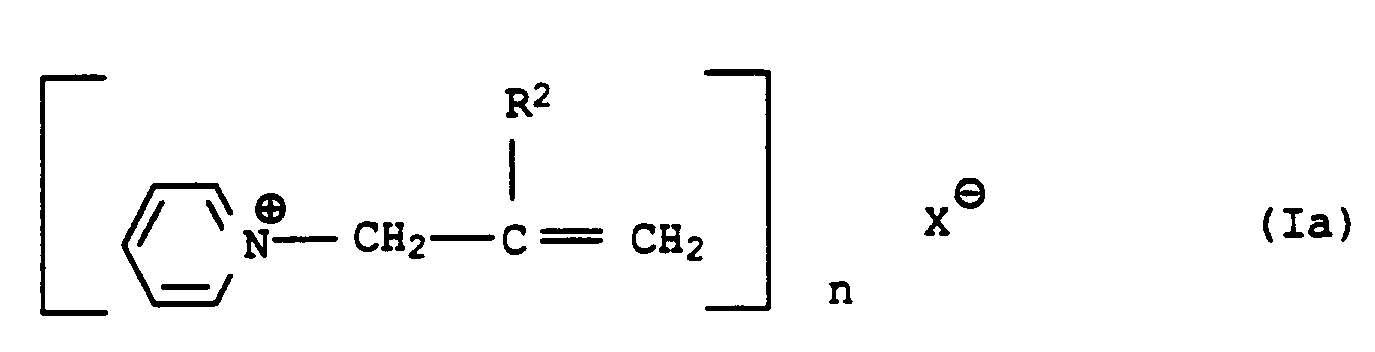
- In einer bevorzugten Ausführungsform setzt man als Komponente A cyclische N-Allylammoniumverbindungen der allgemeinen Formel Ia

in der R², n und X⊖ die oben genannten Bedeutungen haben, ein. - Die cyclischen N-Allyl- oder N-Vinylanmoniumverbindungen I bzw. Ia lassen sich am besten in bekannter Weise durch Umsetzung der entsprechenden Vorstufe der allgemeinen Formel

in der Z eine nucleofuge Abgangsgruppe, vorzugsweise Chlor oder Brom, darstellt, mit einem Heterocyclus der allgemeinen Formel IV
und gewünschtenfalls anschließenden Austausch des Anions Z⊖ gegen X⊖ herstellen. - Die Umsetzung der Komponenten III und IV wird zweckmäßigerweise in einem inerten organischen Lösungsmittel wie Toluol, Xylol, Petrolether, Ligroin, Cyclohexan, Aceton, Tetrahydrofuran, Dioxan, Methanol, Ethanol, iso-Propanol, Essigsäureethylester oder Benzoesäuremethylester oder in einer Mischung hieraus durchgeführt. Man kann die Umsetzung aber auch in Wasser oder in einem einphasigen oder zweiphasigen Gemisch aus Wasser und einem oder mehreren organischen Lösungsmitteln, vornehmen. Bei Zweiphasengemischen kann ein üblicher Phasentransferkatalysator eingesetzt werden. Man arbeitet in der Regel bei Temperaturen von 40 bis 130°C, insbesondere bei 60 bis 110°C, und bei Normaldruck.
- Als Komponente B setzt man acetylenisch ungesättigte Verbindungen II ein, die mindestens eine polare funktionelle Gruppe, vorzugsweise in der α-Position der C₁- bis C₄-Alkylreste, tragen. Nicht funktionalisierte acetylenisch ungesättigte Kohlenwasserstoffe sind hauptsächlich wegen ihrer geringen Löslichkeit in wäßrigen Medien und ihrer hohen Flüchtigkeit ungeeignet.
- Bei Verwendung von Hydroxylgruppen enthaltenden Verbindungen II können diese durch ein C₂- bis C₄-Alkylenoxid wie Ethylenoxid, Propylenoxid oder Butylenoxid oder eine Mischung solcher Alkylenoxide alkoxyliert sein. Der Alkoxylierungsgrad beträgt hierbei vorzugsweise 1 bis 3, insbesondere 1.
- Sulfogruppenhaltige Verbindungen II können in Form der freien Säure oder vorzugsweise in Form ihrer Alkalimetall-, z.B. Natrium- oder Kalium-, oder Ammoniumsalze eingesetzt werden.
- In einer bevorzugten Ausführungsform setzt man als Komponente B acetylenisch ungesättigte Verbindungen II ein, bei denen die Reste R⁴ und R⁵ gleich oder verschieden sind und durch Hydroxyl, Sulfo oder Dimethyl- oder Diethylamino substituiertes Methyl oder Ethyl bezeichnen, wobei Hydroxylgruppen mit 1 bis 3 mol eines C₂- bis C₄-Alkylenoxids oder einer Mischung solcher Alkylenoxide umgesetzt sein können und einer der Reste R⁴ oder R⁵ auch Wasserstoff, Methyl oder Ethyl sein kann.
- Als Beispiele für Verbindungen II lassen sich nennen:
Prop-2-in-1-ol,
But-2-in-1,4-diol,
Hex-3-in-2,5-diol,
Prop-2-in-1-ol-ethoxylat,
Prop-2-in-1-ol-propoxylat,
But-2-in-1,4-diol-monoethoxylat,
But-2-in-1,4-diol-diethoxylat,
But-2-in-1,4-diol-monopropoxylat,
But-2-in-1,4-diol-dipropoxylat,
Prop-2-in-1-sulfonsäure,
1-Dimethylamino-prop-2-in,
1-Diethylamino-prop-2-in,
1-Diethylamino-pent-2-in-4-ol und
1-Amino-1,1-dimethylprop-2-in. - Unter Ethoxylat, Monoethoxylat, Diethoxylat, Propoxylat,Monopropoxylat und Dipropoxylat sind hier jeweils die Umsetzungsprodukte mit 1 mol Alkylenoxid pro Hydroxylgruppe in den Verbindungen II zu verstehen.
- Die Mischung aus den cyclischen N-Allyl- oder N-Vinylammoniumverbindungen I und den acetylenisch ungesättigten Verbindungen II setzt sich vorzugsweise aus 10 bis 90 Gew.-%, insbesondere 25 bis 75 Gew.-% der Komponente A und 90 bis 10 Gew.-%, insbesondere 75 bis 25 Gew.-% der Komponente B zusammen. Ganz besonders bevorzugt wird eine Mischung aus 28 bis 50 Gew.-% A und 72 bis 50 Gew.-% B.
- In einer bevorzugten Ausführungsform setzt man eine Mischung aus einer oder mehreren cyclischen N-Allyl- oder N-Vinylammoniumverbindungen I als Komponente A und mindestens drei, insbesondere drei bis sieben acetylenisch ungesättigten Verbindungen II als Komponente B ein.
- Weiterhin können die Mischungen aus den Komponenten A und B zusätzlich noch zusammen mit anderen üblichen Glanzmitteln eingesetzt werden, beispielsweise mit Saccharin, Allylsulfonsäure oder ihren Alkalimetall- oder Ammoniumsalzen, Vinylsulfonsäure oder ihren Alkalimetall- oder Ammoniumsalzen, Bisbenzolsulfonylimid oder handelsüblichen Glanzmitteln auf Basis einer Thioverbindung.
- Die verwendeten wäßrig-sauren Nickelelektrolyt-Bäder enthalten ein oder meist mehrere Nickelsalze, z.B. Nickelsulfat und Nickelchlorid, eine oder mehrere anorganische Säuren, vorzugsweise Borsäure und Schwefelsäure, als Glanzmittel die Mischung aus den Komponenten A und B allein oder in Kombination mit weiteren üblichen Glanzmitteln sowie gegebenenfalls weitere übliche Hilfsmittel und Zusätze in den hierfür üblichen Konzentrationen, z.B. Netzmittel und Porenverhütungsmittel. Gebräuchlich wäßrig-saure Nickelelektrolyte ("Watts-Elektrolyte") haben die folgende Grundzusammensetzung:
200 bis 350 g/l NiSO₄ · 7 H₂O
30 bis 150 g/l NiCl₂ · 6 H₂O
30 bis 50 g/l H₃BO₃. - Der pH-Wert der Elektrolyt-Bäder liegt üblicherweise zwischen 3 und 6, vorzugsweise zwischen 4 und 5. Zur Einstellung dieses pH-Wertes dient zweckmäßigerweise eine starke Mineralsäure, vorzugsweise Schwefelsäure.
- Die Mischung aus den Komponenten A und B liegt in den Elektrolyt-Bädern in niedrigen Konzentrationen, in der Regel zwischen 0,05 und 1,0 g/l, vorzugsweise zwischen 0,1 und 0,5 g/l, vor. Die Konzentrationen weiterer üblicher Glanzmittel liegen normalerweise im Bereich von jeweils 0,1 bis 10 g/l, insbesondere 0,1 bis 2,0 g/l.
- Mit den beschriebenen Nickelelektrolyt-Bädern können vor allem Nickelüberzüge auf Formteilen aus Stahl, daneben aber auch auf Formteilen aus anderen Materialien, beispielsweise Messing, die wie üblich vorbehandelt worden sind, galvanisch erzeugt werden. Hierzu arbeitet man in der Regel bei Temperaturen von 30 bis 80°C, vorzugsweise 40 bis 60°C.
- Gegenstand der vorliegenden Erfindung ist weiterhin eine Glanzmittelmischung für wäßrig-saure galvanische Bäder zur Abscheidung von Nickel, enthaltend eine Mischung aus
- A) 2 bis 98 Gew.-% einer oder mehrerer cyclischer N-Allyl- oder N-Vinylammoniumverbindungen der allgemeinen Formel I

- R¹, R³ und R⁴
- für Wasserstoff oder C₁- bis C₄-Alkyl stehen,
- R²
- Wasserstoff oder Methyl bedeutet,
- m
- für eine Zahl von 0 bis 4 steht,
- n
- für eine Zahl von 1 bis 4 steht
und - X⊖
- ein n-wertiges anorganisches oder organisches Anion, welches die Wasserlöslichkeit fördert, bezeichnet, und
- B) 98 bis 2 Gew.-% einer oder mehrerer acetylenisch ungesättigter Verbindungen der allgemeinen Formel II
R⁴― C ≡ C― R⁵ (II)
in der die Reste R⁴ und R⁵ gleich oder verschieden sind und durch Hydroxyl, Sulfo, Amino, C₁- bis C₄-Alkylamino oder Di(C₁- bis C₄-alkyl)amino substituiertes C₁- bis C₄-Alkyl bezeichnen, wobei Hydroxylgruppen mit 1 bis 10 mol eines C₂- bis C₄-Alkylenoxids oder einer Mischung solcher Alkylenoxide umgesetzt sein können und einer der Reste R⁴ oder R⁵ auch Wasserstoff oder C₁- bis C₄-Alkyl sein kann. - Die erfindungsgemäße Glanzmittelmischung zeichnet sich durch eine außerordentlich hohe Glanzbildung aus. Man erreicht mit ihr in der Regel einen stärkeren Glanz und eine bessere Einebnung als mit den üblichen Glanzbildnern bei deutlich niedrigerer Dosierung in den Nickelelektrolyt-Bädern.
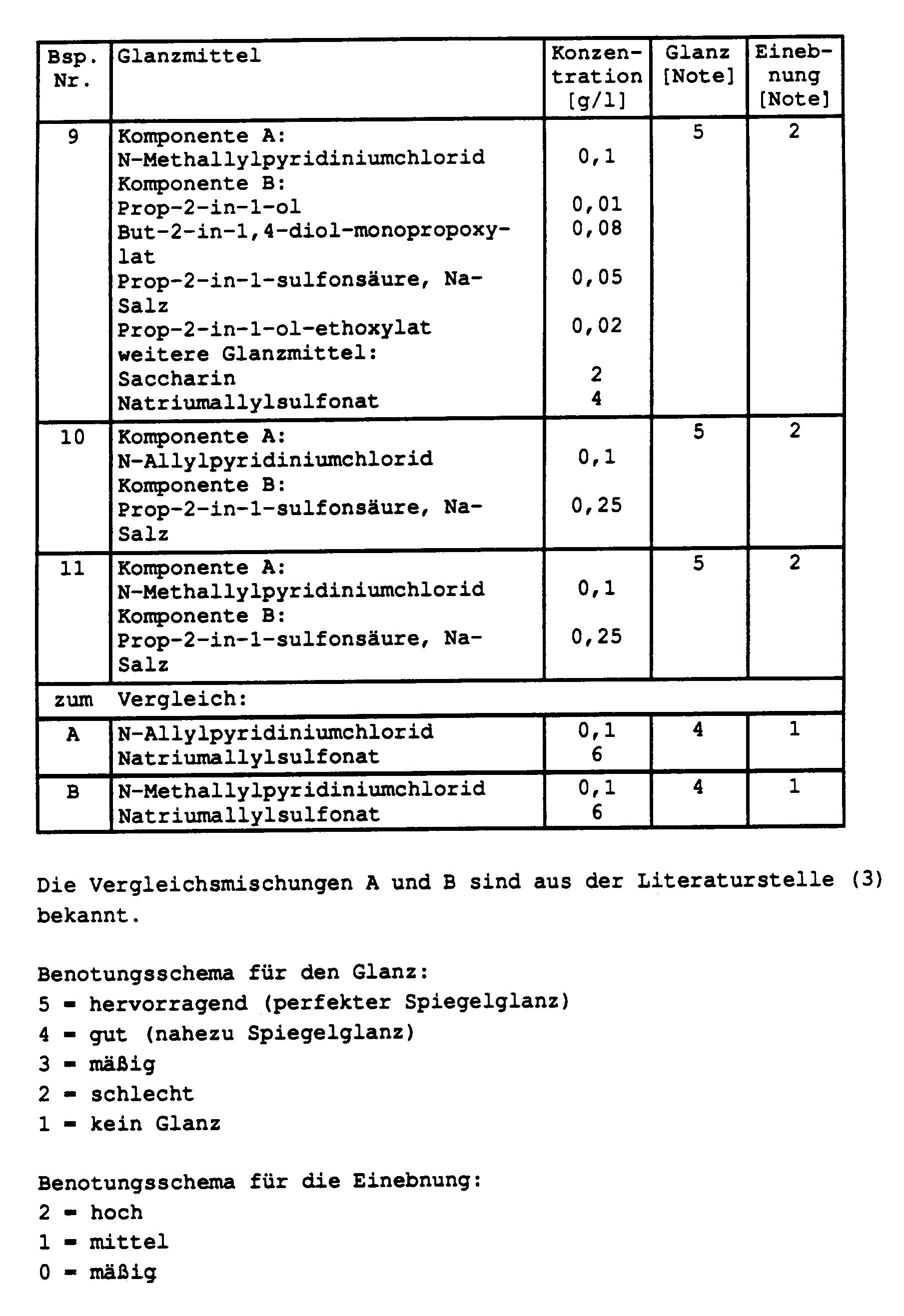
- Die in der folgenden Tabelle als Beispiele 1 bis 11 aufgeführten Mischungen wurden als Glanzmittel in schwach sauren galvanischen Bädern zur Abscheidung von Nickel eingesetzt.
- Der dabei verwendete wäßrige Nickelelektrolyt hatte folgende Zusammensetzung:
300 g/l NiSO₄ · 7 H₂O
60 g/l NiCl₂ · 6 H₂O
45 g/l H₃BO₃
0,5 g/l eines Fettalkoholderivates der Formel C₁₂H₂₅/C₁₄H₂₉-O-(CH₂CH₂O)₂-SO₃Na als Netzmittel
Die jeweiligen Konzentrationen an Glanzbildnern sind in der folgenden Tabelle angegeben. - Der pH-Wert des Elektrolyten wurde mit Schwefelsäure auf 4,2 eingestellt.
- Es wurden Messingbleche verwendet, die vor der Beschichtung mit Nickel in einem alkalischen Elektrolyten nach den üblichen Methoden kathodisch entfettet wurden. Die Nickelabscheidung erfolgte in einer 250 ml-Hull-Zelle bei 55°C und einer Stromstärke von 2A während eines Zeitraums von 10 Minuten. Anschließend wurden die Bleche mit Wasser gespült und mit Preßluft getrocknet.
- Die folgende Tabelle zeigt die Ergebnisse dieser Versuche. Man erkennt, daß mit der erfindungsgemäßen Glanzmittelmischung ein stärkerer Glanz und eine bessere Einebnung erzielt wurde als mit den Glanzbildnern des Standes der Technik, und das zum Teil bei deutlich niedrigerer Dosierung in den Nickelelektrolyt-Bädern.


Claims (5)
- Verfahren zur Herstellung vernickelter Formteile durch galvanisches Abscheiden von Nickel aus wäßrig-sauren Bädern, die als wesentliche Bestandteile ein oder mehrere Nickelsalze, eine oder mehrere anorganische Säuren und mindestens zwei Glanzmittel enthalten, dadurch gekennzeichnet, daß man als Glanzmittel eine Mischung ausA) 2 bis 98 Gew.-% einer oder mehrerer cyclischer N-Allyl- oder N-Vinylammoniumverbindungen der allgemeinen Formel I
 R¹, R³ und R⁴ für Wasserstoff oder C₁- bis C₄-Alkyl stehen,R² Wasserstoff oder Methyl bedeutet,m für eine Zahl von 0 bis 4 steht,n für eine Zahl von 1 bis 4 steht
undX⊖ ein n-wertiges anorganisches oder organisches Anion, welches die Wasserlöslichkeit fördert, bezeichnet, undB) 98 bis 2 Gew.-% einer oder mehrerer acetylenisch ungesättigter Verbindungen der allgemeinen Formel IIeinsetzt.
R⁴― C ≡ C― R⁵ (II)
in der die Reste R⁴ und R⁵ gleich oder verschieden sind und durch Hydroxyl, Sulfo, Amino, C₁- bis C₄-Alkylamino oder Di(C₁- bis C₄-alkyl)amino substituiertes C₁- bis C₄-Alkyl bezeichnen, wobei Hydroxylgruppen mit 1 bis 10 mol eines C₂- bis C₄-Alkylenoxids oder einer Mischung solcher Alkylenoxide umgesetzt sein können und einer der Reste R⁴ oder R⁵ auch Wasserstoff oder C₁- bis C₄-Alkyl sein kann, - Verfahren zur Herstellung vernickelter Formteile nach Anspruch 1, dadurch gekennzeichnet, daß man als Komponente A cyclische N-Allylammoniumverbindungen der allgemeinen Formel Ia
- Verfahren zur Herstellung vernickelter Formteile nach Anspruch 1 oder 2, dadurch gekennzeichnet, daß man als Komponente B acetylenisch ungesättigte Verbindungen II einsetzt, bei denen die Reste R⁴ und R⁵ gleich oder verschieden sind und durch Hydroxyl, Sulfo oder Dimethyl- oder Diethylamino substituiertes Methyl oder Ethyl bezeichnen, wobei Hydroxylgruppen mit 1 bis 3 mol eines C₂- bis C₄-Alkylenoxids oder einer Mischung solcher Alkylenoxide umgesetzt sein können und einer der Reste R⁴ oder R⁵ auch Wasserstoff, Methyl oder Ethyl sein kann.
- Verfahren zur Herstellung vernickelter Formteile nach den Ansprüchen 1 bis 3, dadurch gekennzeichnet, daß man eine Mischung aus einer oder mehreren cyclischen N-Allyl- oder N-Vinylammoniumverbindungen I als Komponente A und mindestens drei acetylenisch ungesättigten Verbindungen II als Komponente B einsetzt.
- Glanzmittelmischung für wäßrig-saure galvanische Bäder zur Abscheidung von Nickel, enthaltend eine Mischung ausA) 2 bis 98 Gew.-% einer oder mehrerer cyclischer N-Allyl- oder N-Vinylammoniumverbindungen der allgemeinen Formel I
 R¹, R³ und R⁴ für Wasserstoff oder C₁- bis C₄-Alkyl stehen,R² Wasserstoff oder Methyl bedeutet,m für eine Zahl von 0 bis 4 steht,n für eine Zahl von 1 bis 4 steht
undX⊖ ein n-wertiges anorganisches oder organisches Anion, welches die Wasserlöslichkeit fördert, bezeichnet, undB) 98 bis 2 Gew.-% einer oder mehrerer acetylenisch ungesättigter Verbindungen der allgemeinen Formel IIeinsetzt.
R⁴― C ≡ C― R⁵ (II)
in der die Reste R⁴ und R⁵ gleich oder verschieden sind und durch Hydroxyl, Sulfo, Amino, C₁- bis C₄-Alkylamino oder Di(C₁- bis C₄-alkyl)amino substituiertes C₁- bis C₄-Alkyl bezeichnen, wobei Hydroxylgruppen mit 1 bis 10 mol eines C₂- bis C₄-Alkylenoxids oder einer Mischung solcher Alkylenoxide umgesetzt sein können und einer der Reste R⁴ oder R⁵ auch Wasserstoff oder C₁- bis C₄-Alkyl sein kann,
Applications Claiming Priority (3)
| Application Number | Priority Date | Filing Date | Title |
|---|---|---|---|
| DE4202003 | 1992-01-25 | ||
| DE4202003 | 1992-01-25 | ||
| PCT/EP1993/000063 WO1993015241A1 (de) | 1992-01-25 | 1993-01-14 | Verfahren zur herstellung vernickelter formteile |
Publications (2)
| Publication Number | Publication Date |
|---|---|
| EP0621908A1 EP0621908A1 (de) | 1994-11-02 |
| EP0621908B1 true EP0621908B1 (de) | 1995-09-06 |
Family
ID=6450226
Family Applications (1)
| Application Number | Title | Priority Date | Filing Date |
|---|---|---|---|
| EP93902188A Expired - Lifetime EP0621908B1 (de) | 1992-01-25 | 1993-01-14 | Verfahren zur herstellung vernickelter formteile |
Country Status (9)
| Country | Link |
|---|---|
| US (1) | US5445727A (de) |
| EP (1) | EP0621908B1 (de) |
| JP (1) | JPH07503282A (de) |
| AT (1) | ATE127541T1 (de) |
| CA (1) | CA2128022A1 (de) |
| DE (1) | DE59300569D1 (de) |
| ES (1) | ES2076056T3 (de) |
| GR (1) | GR3017532T3 (de) |
| WO (1) | WO1993015241A1 (de) |
Families Citing this family (5)
| Publication number | Priority date | Publication date | Assignee | Title |
|---|---|---|---|---|
| DE19610361A1 (de) * | 1996-03-15 | 1997-09-18 | Basf Ag | Bad und Verfahren für die galvanische Abscheidung von Halbglanznickel |
| US7300563B2 (en) * | 2003-02-07 | 2007-11-27 | Pavco, Inc. | Use of N-alllyl substituted amines and their salts as brightening agents in nickel plating baths |
| DE102005011708B3 (de) * | 2005-03-11 | 2007-03-01 | Atotech Deutschland Gmbh | Polyvinylammoniumverbindung und Verfahren zu deren Herstellung sowie diese Verbindung enthaltende saure Lösung und Verfahren zum elektrolytischen Abscheiden eines Kupferniederschlages |
| DE102014207778B3 (de) * | 2014-04-25 | 2015-05-21 | Kiesow Dr. Brinkmann GmbH & Co. KG | Verwendung einer Mischung zur Verwendung in einem galvanischen Bad oder eines galvanischen Bades zur Herstellung einer Glanznickelschicht sowie Verfahren zur Herstellung eines Artikels mit einer Glanznickelschicht |
| US20250137156A1 (en) * | 2023-10-26 | 2025-05-01 | Macdermid Enthone Inc. | Boric acid-free satin nickel |
Family Cites Families (7)
| Publication number | Priority date | Publication date | Assignee | Title |
|---|---|---|---|---|
| US2647866A (en) * | 1950-07-17 | 1953-08-04 | Udylite Corp | Electroplating of nickel |
| DE1191652B (de) * | 1963-05-15 | 1965-04-22 | Dehydag Gmbh | Saures galvanisches Nickelbad |
| ES346165A0 (es) * | 1966-10-18 | 1970-12-01 | M & T Chemicals Inc | Procedimiento para galvanoplastia de niquel. |
| DE1496832C3 (de) * | 1966-11-26 | 1978-04-06 | Henkel Kgaa, 4000 Duesseldorf | Saures galvanisches Nickelbad |
| US3758389A (en) * | 1971-11-30 | 1973-09-11 | Okuno Chem Ind Co | Process for nickel and chromium plating |
| US3862019A (en) * | 1974-04-26 | 1975-01-21 | R O Hull & Company Inc | Composition of electroplating bath for the electrodeposition of bright nickel |
| FR2292057A1 (fr) * | 1974-11-20 | 1976-06-18 | Popescu Francine | Bain galvanique pour nickelage brillant |
-
1993
- 1993-01-14 WO PCT/EP1993/000063 patent/WO1993015241A1/de not_active Ceased
- 1993-01-14 AT AT93902188T patent/ATE127541T1/de not_active IP Right Cessation
- 1993-01-14 JP JP5512888A patent/JPH07503282A/ja active Pending
- 1993-01-14 CA CA002128022A patent/CA2128022A1/en not_active Abandoned
- 1993-01-14 ES ES93902188T patent/ES2076056T3/es not_active Expired - Lifetime
- 1993-01-14 EP EP93902188A patent/EP0621908B1/de not_active Expired - Lifetime
- 1993-01-14 DE DE59300569T patent/DE59300569D1/de not_active Expired - Lifetime
- 1993-01-14 US US08/256,374 patent/US5445727A/en not_active Expired - Fee Related
-
1995
- 1995-09-27 GR GR950402652T patent/GR3017532T3/el unknown
Also Published As
| Publication number | Publication date |
|---|---|
| ES2076056T3 (es) | 1995-10-16 |
| CA2128022A1 (en) | 1993-08-05 |
| GR3017532T3 (en) | 1995-12-31 |
| EP0621908A1 (de) | 1994-11-02 |
| WO1993015241A1 (de) | 1993-08-05 |
| JPH07503282A (ja) | 1995-04-06 |
| ATE127541T1 (de) | 1995-09-15 |
| DE59300569D1 (de) | 1995-10-12 |
| US5445727A (en) | 1995-08-29 |
Similar Documents
| Publication | Publication Date | Title |
|---|---|---|
| DE971806C (de) | Galvanische Vernickelung | |
| DE1053274B (de) | Bad zur Herstellung von galvanischen Metallueberzuegen | |
| DE2706521A1 (de) | Verfahren zur herstellung von ebenen kupferueberzuegen und dafuer geeignetes saures plattierungsbad | |
| EP0006461B1 (de) | Saures galvanisches Nickelbad, das Sulfobetaine als Glanz- und Einebnungsmittel enthält | |
| DE1066068B (de) | Elektrolyt zur galvanischen Abscheidung spiegelglänzender, eingeebneter, duktiler Nickelniederschläge | |
| EP0633888B1 (de) | Phosphoniumsalze und ihre verwendung als glanzmittel für wässrig-saure galvanische nickelbäder | |
| DE2506467C2 (de) | Bad und Verfahren zur galvanischen Abscheidung von Palladium-Nickel-Legierungen | |
| US3314868A (en) | Acid nickel electroplating baths and processes | |
| EP0621908A1 (de) | Verfahren zur herstellung vernickelter formteile. | |
| EP0610236B1 (de) | Verfahren zur herstellung vernickelter formteile | |
| DE3817722A1 (de) | Verwendung von 2-substituierten ethansulfon-verbindungen als galvanotechnische hilfsstoffe | |
| US3414493A (en) | Electrodeposition of copper | |
| EP0675975B1 (de) | Verwendung von thiuroniumsalzen als glanzmittel für wässrig-saure galvanische nickelbäder | |
| DE1133208B (de) | Saures galvanisches Nickelbad | |
| US2294311A (en) | Nickel plating | |
| DE4034788A1 (de) | Verfahren zur herstellung vernickelter formteile | |
| AT202829B (de) | Verfahren zur Herstellung von galvanischen Metallüberzügen | |
| US4270987A (en) | Acid galvanic nickel baths containing N-(2,3-dihydroxypropyl)-pyridinium sulfates | |
| DE939662C (de) | Verfahren zum galvanischen Erzeugen von glaenzenden Nickelniederschlaegen | |
| DE1235101B (de) | Elektrolyt mit Glanzzusatz zur galvanischen Abscheidung spiegelglaenzender, eingeebneter, duktiler Nickelniederschlaege | |
| DE4134061A1 (de) | Verfahren zur herstellung vernickelter formteile | |
| AT397248B (de) | Verfahren zur herstellung von alpha-hydroxipropinsulfonsäure und deren salzen sowie diese verbindungen enthaltende saure nickelbäder | |
| DE1228886C2 (de) | Saures galvanisches Bad | |
| DE1621146A1 (de) | Galvanisches Vernickelungsbad | |
| DE1264205B (de) | Saure galvanische Baeder zum Abscheiden von insbesondere Nickelueberzuegen |
Legal Events
| Date | Code | Title | Description |
|---|---|---|---|
| PUAI | Public reference made under article 153(3) epc to a published international application that has entered the european phase |
Free format text: ORIGINAL CODE: 0009012 |
|
| 17P | Request for examination filed |
Effective date: 19940528 |
|
| AK | Designated contracting states |
Kind code of ref document: A1 Designated state(s): AT BE CH DE DK ES FR GB GR IE IT LI NL PT SE |
|
| 17Q | First examination report despatched |
Effective date: 19941213 |
|
| GRAA | (expected) grant |
Free format text: ORIGINAL CODE: 0009210 |
|
| AK | Designated contracting states |
Kind code of ref document: B1 Designated state(s): AT BE CH DE DK ES FR GB GR IE IT LI NL PT SE |
|
| PG25 | Lapsed in a contracting state [announced via postgrant information from national office to epo] |
Ref country code: DK Effective date: 19950906 |
|
| REF | Corresponds to: |
Ref document number: 127541 Country of ref document: AT Date of ref document: 19950915 Kind code of ref document: T |
|
| REG | Reference to a national code |
Ref country code: IE Ref legal event code: FG4D Free format text: 65142 |
|
| REF | Corresponds to: |
Ref document number: 59300569 Country of ref document: DE Date of ref document: 19951012 |
|
| REG | Reference to a national code |
Ref country code: ES Ref legal event code: FG2A Ref document number: 2076056 Country of ref document: ES Kind code of ref document: T3 |
|
| GBT | Gb: translation of ep patent filed (gb section 77(6)(a)/1977) |
Effective date: 19951002 |
|
| ITF | It: translation for a ep patent filed | ||
| REG | Reference to a national code |
Ref country code: GR Ref legal event code: FG4A Free format text: 3017532 |
|
| SC4A | Pt: translation is available |
Free format text: 950919 AVAILABILITY OF NATIONAL TRANSLATION |
|
| PGFP | Annual fee paid to national office [announced via postgrant information from national office to epo] |
Ref country code: NL Payment date: 19951230 Year of fee payment: 5 |
|
| ET | Fr: translation filed | ||
| PG25 | Lapsed in a contracting state [announced via postgrant information from national office to epo] |
Ref country code: IE Free format text: LAPSE BECAUSE OF NON-PAYMENT OF DUE FEES Effective date: 19960402 |
|
| REG | Reference to a national code |
Ref country code: IE Ref legal event code: FD4D Ref document number: 65142 Country of ref document: IE |
|
| PLBE | No opposition filed within time limit |
Free format text: ORIGINAL CODE: 0009261 |
|
| STAA | Information on the status of an ep patent application or granted ep patent |
Free format text: STATUS: NO OPPOSITION FILED WITHIN TIME LIMIT |
|
| 26N | No opposition filed | ||
| PGFP | Annual fee paid to national office [announced via postgrant information from national office to epo] |
Ref country code: FR Payment date: 19971210 Year of fee payment: 6 |
|
| PGFP | Annual fee paid to national office [announced via postgrant information from national office to epo] |
Ref country code: SE Payment date: 19971211 Year of fee payment: 6 |
|
| PGFP | Annual fee paid to national office [announced via postgrant information from national office to epo] |
Ref country code: GR Payment date: 19971217 Year of fee payment: 6 |
|
| PGFP | Annual fee paid to national office [announced via postgrant information from national office to epo] |
Ref country code: PT Payment date: 19971219 Year of fee payment: 6 Ref country code: CH Payment date: 19971219 Year of fee payment: 6 |
|
| PGFP | Annual fee paid to national office [announced via postgrant information from national office to epo] |
Ref country code: AT Payment date: 19971222 Year of fee payment: 6 |
|
| PGFP | Annual fee paid to national office [announced via postgrant information from national office to epo] |
Ref country code: GB Payment date: 19980102 Year of fee payment: 6 |
|
| PGFP | Annual fee paid to national office [announced via postgrant information from national office to epo] |
Ref country code: BE Payment date: 19980108 Year of fee payment: 6 |
|
| PGFP | Annual fee paid to national office [announced via postgrant information from national office to epo] |
Ref country code: ES Payment date: 19980115 Year of fee payment: 6 |
|
| PGFP | Annual fee paid to national office [announced via postgrant information from national office to epo] |
Ref country code: DE Payment date: 19980123 Year of fee payment: 6 |
|
| PG25 | Lapsed in a contracting state [announced via postgrant information from national office to epo] |
Ref country code: GB Free format text: LAPSE BECAUSE OF NON-PAYMENT OF DUE FEES Effective date: 19990114 Ref country code: AT Free format text: LAPSE BECAUSE OF NON-PAYMENT OF DUE FEES Effective date: 19990114 |
|
| PG25 | Lapsed in a contracting state [announced via postgrant information from national office to epo] |
Ref country code: SE Free format text: LAPSE BECAUSE OF NON-PAYMENT OF DUE FEES Effective date: 19990115 Ref country code: ES Free format text: LAPSE BECAUSE OF NON-PAYMENT OF DUE FEES Effective date: 19990115 |
|
| PG25 | Lapsed in a contracting state [announced via postgrant information from national office to epo] |
Ref country code: DE Free format text: LAPSE BECAUSE OF THE APPLICANT RENOUNCES Effective date: 19990129 |
|
| PG25 | Lapsed in a contracting state [announced via postgrant information from national office to epo] |
Ref country code: LI Free format text: LAPSE BECAUSE OF NON-PAYMENT OF DUE FEES Effective date: 19990131 Ref country code: GR Free format text: LAPSE BECAUSE OF NON-PAYMENT OF DUE FEES Effective date: 19990131 Ref country code: CH Free format text: LAPSE BECAUSE OF NON-PAYMENT OF DUE FEES Effective date: 19990131 Ref country code: BE Free format text: LAPSE BECAUSE OF NON-PAYMENT OF DUE FEES Effective date: 19990131 |
|
| BERE | Be: lapsed |
Owner name: BASF A.G. Effective date: 19990131 |
|
| PG25 | Lapsed in a contracting state [announced via postgrant information from national office to epo] |
Ref country code: PT Free format text: LAPSE BECAUSE OF NON-PAYMENT OF DUE FEES Effective date: 19990731 |
|
| PG25 | Lapsed in a contracting state [announced via postgrant information from national office to epo] |
Ref country code: NL Free format text: LAPSE BECAUSE OF NON-PAYMENT OF DUE FEES Effective date: 19990801 |
|
| GBPC | Gb: european patent ceased through non-payment of renewal fee |
Effective date: 19990114 |
|
| REG | Reference to a national code |
Ref country code: CH Ref legal event code: PL |
|
| PG25 | Lapsed in a contracting state [announced via postgrant information from national office to epo] |
Ref country code: FR Free format text: LAPSE BECAUSE OF NON-PAYMENT OF DUE FEES Effective date: 19990930 |
|
| REG | Reference to a national code |
Ref country code: FR Ref legal event code: ST |
|
| REG | Reference to a national code |
Ref country code: PT Ref legal event code: MM4A Free format text: LAPSE DUE TO NON-PAYMENT OF FEES Effective date: 19990731 |
|
| REG | Reference to a national code |
Ref country code: ES Ref legal event code: FD2A Effective date: 20010503 |
|
| PG25 | Lapsed in a contracting state [announced via postgrant information from national office to epo] |
Ref country code: IT Free format text: LAPSE BECAUSE OF NON-PAYMENT OF DUE FEES;WARNING: LAPSES OF ITALIAN PATENTS WITH EFFECTIVE DATE BEFORE 2007 MAY HAVE OCCURRED AT ANY TIME BEFORE 2007. THE CORRECT EFFECTIVE DATE MAY BE DIFFERENT FROM THE ONE RECORDED. Effective date: 20050114 |