EP0512901A1 - Composés polycycliques aminés et leurs énantiomères, procédé pour leur préparation et compositions pharmaceutiques en contenant - Google Patents
Composés polycycliques aminés et leurs énantiomères, procédé pour leur préparation et compositions pharmaceutiques en contenant Download PDFInfo
- Publication number
- EP0512901A1 EP0512901A1 EP92401235A EP92401235A EP0512901A1 EP 0512901 A1 EP0512901 A1 EP 0512901A1 EP 92401235 A EP92401235 A EP 92401235A EP 92401235 A EP92401235 A EP 92401235A EP 0512901 A1 EP0512901 A1 EP 0512901A1
- Authority
- EP
- European Patent Office
- Prior art keywords
- group
- formula
- compound
- hydroxyl
- alkyl
- Prior art date
- Legal status (The legal status is an assumption and is not a legal conclusion. Google has not performed a legal analysis and makes no representation as to the accuracy of the status listed.)
- Granted
Links
- 238000002360 preparation method Methods 0.000 title claims description 15
- 238000000034 method Methods 0.000 title claims description 11
- 239000008194 pharmaceutical composition Substances 0.000 title claims description 6
- HBAQYPYDRFILMT-UHFFFAOYSA-N 8-[3-(1-cyclopropylpyrazol-4-yl)-1H-pyrazolo[4,3-d]pyrimidin-5-yl]-3-methyl-3,8-diazabicyclo[3.2.1]octan-2-one Chemical class C1(CC1)N1N=CC(=C1)C1=NNC2=C1N=C(N=C2)N1C2C(N(CC1CC2)C)=O HBAQYPYDRFILMT-UHFFFAOYSA-N 0.000 title abstract description 8
- 125000003367 polycyclic group Chemical group 0.000 title 1
- 150000001875 compounds Chemical class 0.000 claims abstract description 74
- IJGRMHOSHXDMSA-UHFFFAOYSA-N Atomic nitrogen Chemical compound N#N IJGRMHOSHXDMSA-UHFFFAOYSA-N 0.000 claims abstract description 29
- 125000002887 hydroxy group Chemical group [H]O* 0.000 claims abstract description 28
- 150000003839 salts Chemical class 0.000 claims abstract description 26
- NQRYJNQNLNOLGT-UHFFFAOYSA-N Piperidine Chemical class C1CCNCC1 NQRYJNQNLNOLGT-UHFFFAOYSA-N 0.000 claims abstract description 23
- 229910052739 hydrogen Inorganic materials 0.000 claims abstract description 21
- 239000001257 hydrogen Substances 0.000 claims abstract description 21
- 229910052757 nitrogen Inorganic materials 0.000 claims abstract description 21
- 125000001997 phenyl group Chemical group [H]C1=C([H])C([H])=C(*)C([H])=C1[H] 0.000 claims abstract description 20
- 125000004435 hydrogen atom Chemical group [H]* 0.000 claims abstract description 17
- 150000003242 quaternary ammonium salts Chemical class 0.000 claims abstract description 14
- 125000000217 alkyl group Chemical group 0.000 claims abstract description 12
- 229910052799 carbon Inorganic materials 0.000 claims abstract description 12
- 150000001204 N-oxides Chemical class 0.000 claims abstract description 11
- 150000007522 mineralic acids Chemical class 0.000 claims abstract description 11
- 150000007524 organic acids Chemical class 0.000 claims abstract description 11
- 235000005985 organic acids Nutrition 0.000 claims abstract description 11
- 150000001721 carbon Chemical group 0.000 claims abstract description 10
- 125000003118 aryl group Chemical group 0.000 claims abstract description 9
- 125000001797 benzyl group Chemical group [H]C1=C([H])C([H])=C(C([H])=C1[H])C([H])([H])* 0.000 claims abstract description 9
- 125000004433 nitrogen atom Chemical group N* 0.000 claims abstract description 8
- 125000004076 pyridyl group Chemical group 0.000 claims abstract description 8
- 125000001544 thienyl group Chemical group 0.000 claims abstract description 8
- 125000004196 benzothienyl group Chemical group S1C(=CC2=C1C=CC=C2)* 0.000 claims abstract description 7
- 125000001041 indolyl group Chemical group 0.000 claims abstract description 7
- 125000001624 naphthyl group Chemical group 0.000 claims abstract description 7
- 125000004093 cyano group Chemical group *C#N 0.000 claims abstract description 6
- 125000000623 heterocyclic group Chemical group 0.000 claims abstract description 6
- 125000004423 acyloxy group Chemical group 0.000 claims abstract description 5
- 125000003178 carboxy group Chemical group [H]OC(*)=O 0.000 claims abstract description 4
- 125000001072 heteroaryl group Chemical group 0.000 claims abstract description 4
- 125000002883 imidazolyl group Chemical group 0.000 claims abstract description 4
- 125000002252 acyl group Chemical group 0.000 claims abstract description 3
- QVGXLLKOCUKJST-UHFFFAOYSA-N atomic oxygen Chemical group [O] QVGXLLKOCUKJST-UHFFFAOYSA-N 0.000 claims abstract description 3
- 229910052760 oxygen Inorganic materials 0.000 claims abstract description 3
- 239000001301 oxygen Substances 0.000 claims abstract description 3
- -1 tetrahydropyranyloxy group Chemical group 0.000 claims description 182
- LFQSCWFLJHTTHZ-UHFFFAOYSA-N Ethanol Chemical compound CCO LFQSCWFLJHTTHZ-UHFFFAOYSA-N 0.000 claims description 30
- 239000000203 mixture Substances 0.000 claims description 29
- 239000002253 acid Substances 0.000 claims description 18
- 125000001424 substituent group Chemical group 0.000 claims description 18
- 125000004178 (C1-C4) alkyl group Chemical group 0.000 claims description 17
- 229910052500 inorganic mineral Inorganic materials 0.000 claims description 14
- 239000011707 mineral Substances 0.000 claims description 14
- 125000000229 (C1-C4)alkoxy group Chemical group 0.000 claims description 13
- 125000002023 trifluoromethyl group Chemical group FC(F)(F)* 0.000 claims description 13
- 239000012359 Methanesulfonyl chloride Substances 0.000 claims description 11
- QARBMVPHQWIHKH-UHFFFAOYSA-N methanesulfonyl chloride Chemical compound CS(Cl)(=O)=O QARBMVPHQWIHKH-UHFFFAOYSA-N 0.000 claims description 11
- VEXZGXHMUGYJMC-UHFFFAOYSA-M Chloride anion Chemical compound [Cl-] VEXZGXHMUGYJMC-UHFFFAOYSA-M 0.000 claims description 9
- RWRDLPDLKQPQOW-UHFFFAOYSA-N Pyrrolidine Chemical compound C1CCNC1 RWRDLPDLKQPQOW-UHFFFAOYSA-N 0.000 claims description 9
- AFVFQIVMOAPDHO-UHFFFAOYSA-N Methanesulfonic acid Chemical compound CS(O)(=O)=O AFVFQIVMOAPDHO-UHFFFAOYSA-N 0.000 claims description 8
- 229910052801 chlorine Inorganic materials 0.000 claims description 8
- 229910052736 halogen Inorganic materials 0.000 claims description 8
- 125000005843 halogen group Chemical group 0.000 claims description 8
- 150000002367 halogens Chemical class 0.000 claims description 8
- 229910052731 fluorine Inorganic materials 0.000 claims description 7
- 125000001153 fluoro group Chemical group F* 0.000 claims description 7
- KZBUYRJDOAKODT-UHFFFAOYSA-N Chlorine Chemical compound ClCl KZBUYRJDOAKODT-UHFFFAOYSA-N 0.000 claims description 6
- YNAVUWVOSKDBBP-UHFFFAOYSA-N Morpholine Chemical compound C1COCCN1 YNAVUWVOSKDBBP-UHFFFAOYSA-N 0.000 claims description 6
- 239000000460 chlorine Substances 0.000 claims description 6
- XMBWDFGMSWQBCA-UHFFFAOYSA-N hydrogen iodide Chemical compound I XMBWDFGMSWQBCA-UHFFFAOYSA-N 0.000 claims description 6
- 150000001450 anions Chemical class 0.000 claims description 5
- QTBSBXVTEAMEQO-UHFFFAOYSA-M Acetate Chemical compound CC([O-])=O QTBSBXVTEAMEQO-UHFFFAOYSA-M 0.000 claims description 4
- 239000004480 active ingredient Substances 0.000 claims description 4
- GDTBXPJZTBHREO-UHFFFAOYSA-N bromine Chemical compound BrBr GDTBXPJZTBHREO-UHFFFAOYSA-N 0.000 claims description 4
- 125000000753 cycloalkyl group Chemical group 0.000 claims description 4
- 125000004170 methylsulfonyl group Chemical group [H]C([H])([H])S(*)(=O)=O 0.000 claims description 4
- CPELXLSAUQHCOX-UHFFFAOYSA-M Bromide Chemical compound [Br-] CPELXLSAUQHCOX-UHFFFAOYSA-M 0.000 claims description 3
- 238000010511 deprotection reaction Methods 0.000 claims description 3
- 125000000714 pyrimidinyl group Chemical group 0.000 claims description 3
- 150000003335 secondary amines Chemical class 0.000 claims description 3
- 125000004169 (C1-C6) alkyl group Chemical group 0.000 claims description 2
- 125000002853 C1-C4 hydroxyalkyl group Chemical group 0.000 claims description 2
- 229910052794 bromium Inorganic materials 0.000 claims description 2
- 125000001309 chloro group Chemical group Cl* 0.000 claims description 2
- 239000000546 pharmaceutical excipient Substances 0.000 claims description 2
- 229940124531 pharmaceutical excipient Drugs 0.000 claims description 2
- JOXIMZWYDAKGHI-UHFFFAOYSA-M toluene-4-sulfonate Chemical compound CC1=CC=C(S([O-])(=O)=O)C=C1 JOXIMZWYDAKGHI-UHFFFAOYSA-M 0.000 claims description 2
- 125000003545 alkoxy group Chemical group 0.000 abstract description 6
- 102000009493 Neurokinin receptors Human genes 0.000 abstract description 4
- 108050000302 Neurokinin receptors Proteins 0.000 abstract description 4
- 125000002768 hydroxyalkyl group Chemical group 0.000 abstract description 4
- 239000005557 antagonist Substances 0.000 abstract description 2
- 238000004519 manufacturing process Methods 0.000 abstract 1
- 125000005493 quinolyl group Chemical group 0.000 abstract 1
- YMWUJEATGCHHMB-UHFFFAOYSA-N Dichloromethane Chemical compound ClCCl YMWUJEATGCHHMB-UHFFFAOYSA-N 0.000 description 175
- RTZKZFJDLAIYFH-UHFFFAOYSA-N Diethyl ether Chemical compound CCOCC RTZKZFJDLAIYFH-UHFFFAOYSA-N 0.000 description 117
- 239000000047 product Substances 0.000 description 94
- XLYOFNOQVPJJNP-UHFFFAOYSA-N water Substances O XLYOFNOQVPJJNP-UHFFFAOYSA-N 0.000 description 84
- OKKJLVBELUTLKV-UHFFFAOYSA-N Methanol Chemical compound OC OKKJLVBELUTLKV-UHFFFAOYSA-N 0.000 description 74
- 239000000243 solution Substances 0.000 description 63
- VEXZGXHMUGYJMC-UHFFFAOYSA-N Hydrochloric acid Chemical compound Cl VEXZGXHMUGYJMC-UHFFFAOYSA-N 0.000 description 57
- ZMANZCXQSJIPKH-UHFFFAOYSA-N Triethylamine Chemical compound CCN(CC)CC ZMANZCXQSJIPKH-UHFFFAOYSA-N 0.000 description 54
- ZMXDDKWLCZADIW-UHFFFAOYSA-N N,N-Dimethylformamide Chemical compound CN(C)C=O ZMXDDKWLCZADIW-UHFFFAOYSA-N 0.000 description 53
- XEKOWRVHYACXOJ-UHFFFAOYSA-N Ethyl acetate Chemical compound CCOC(C)=O XEKOWRVHYACXOJ-UHFFFAOYSA-N 0.000 description 46
- CSNNHWWHGAXBCP-UHFFFAOYSA-L Magnesium sulfate Chemical compound [Mg+2].[O-][S+2]([O-])([O-])[O-] CSNNHWWHGAXBCP-UHFFFAOYSA-L 0.000 description 44
- HEMHJVSKTPXQMS-UHFFFAOYSA-M Sodium hydroxide Chemical compound [OH-].[Na+] HEMHJVSKTPXQMS-UHFFFAOYSA-M 0.000 description 42
- VNWKTOKETHGBQD-UHFFFAOYSA-N methane Natural products C VNWKTOKETHGBQD-UHFFFAOYSA-N 0.000 description 38
- 125000004432 carbon atom Chemical group C* 0.000 description 35
- VYPSYNLAJGMNEJ-UHFFFAOYSA-N Silicium dioxide Chemical compound O=[Si]=O VYPSYNLAJGMNEJ-UHFFFAOYSA-N 0.000 description 33
- 239000003480 eluent Substances 0.000 description 32
- 239000011541 reaction mixture Substances 0.000 description 32
- 239000000741 silica gel Substances 0.000 description 32
- 229910002027 silica gel Inorganic materials 0.000 description 32
- 238000004587 chromatography analysis Methods 0.000 description 29
- 125000004189 3,4-dichlorophenyl group Chemical group [H]C1=C([H])C(Cl)=C(Cl)C([H])=C1* 0.000 description 28
- 239000007832 Na2SO4 Substances 0.000 description 25
- PMZURENOXWZQFD-UHFFFAOYSA-L Sodium Sulfate Chemical compound [Na+].[Na+].[O-]S([O-])(=O)=O PMZURENOXWZQFD-UHFFFAOYSA-L 0.000 description 25
- 229910052938 sodium sulfate Inorganic materials 0.000 description 25
- 235000011152 sodium sulphate Nutrition 0.000 description 25
- 125000001495 ethyl group Chemical group [H]C([H])([H])C([H])([H])* 0.000 description 24
- WYURNTSHIVDZCO-UHFFFAOYSA-N Tetrahydrofuran Chemical compound C1CCOC1 WYURNTSHIVDZCO-UHFFFAOYSA-N 0.000 description 22
- 239000000543 intermediate Substances 0.000 description 22
- 229910052943 magnesium sulfate Inorganic materials 0.000 description 22
- 235000019341 magnesium sulphate Nutrition 0.000 description 22
- ABGXADJDTPFFSZ-UHFFFAOYSA-N 4-benzylpiperidine Chemical compound C=1C=CC=CC=1CC1CCNCC1 ABGXADJDTPFFSZ-UHFFFAOYSA-N 0.000 description 18
- 229920006395 saturated elastomer Polymers 0.000 description 18
- OFBQJSOFQDEBGM-UHFFFAOYSA-N Pentane Chemical compound CCCCC OFBQJSOFQDEBGM-UHFFFAOYSA-N 0.000 description 16
- 0 C1*CC[N-]C1 Chemical compound C1*CC[N-]C1 0.000 description 13
- FAPWRFPIFSIZLT-UHFFFAOYSA-M Sodium chloride Chemical compound [Na+].[Cl-] FAPWRFPIFSIZLT-UHFFFAOYSA-M 0.000 description 11
- YLQBMQCUIZJEEH-UHFFFAOYSA-N tetrahydrofuran Natural products C=1C=COC=1 YLQBMQCUIZJEEH-UHFFFAOYSA-N 0.000 description 11
- NFEQUCGNNCYRCD-UHFFFAOYSA-N 2-[3-(3,4-dichlorophenyl)piperidin-3-yl]ethanol Chemical compound C=1C=C(Cl)C(Cl)=CC=1C1(CCO)CCCNC1 NFEQUCGNNCYRCD-UHFFFAOYSA-N 0.000 description 8
- 239000002244 precipitate Substances 0.000 description 8
- 235000010755 mineral Nutrition 0.000 description 7
- 239000012074 organic phase Substances 0.000 description 7
- 238000010992 reflux Methods 0.000 description 7
- 239000002904 solvent Substances 0.000 description 7
- QDZOEBFLNHCSSF-PFFBOGFISA-N (2S)-2-[[(2R)-2-[[(2S)-1-[(2S)-6-amino-2-[[(2S)-1-[(2R)-2-amino-5-carbamimidamidopentanoyl]pyrrolidine-2-carbonyl]amino]hexanoyl]pyrrolidine-2-carbonyl]amino]-3-(1H-indol-3-yl)propanoyl]amino]-N-[(2R)-1-[[(2S)-1-[[(2R)-1-[[(2S)-1-[[(2S)-1-amino-4-methyl-1-oxopentan-2-yl]amino]-4-methyl-1-oxopentan-2-yl]amino]-3-(1H-indol-3-yl)-1-oxopropan-2-yl]amino]-1-oxo-3-phenylpropan-2-yl]amino]-3-(1H-indol-3-yl)-1-oxopropan-2-yl]pentanediamide Chemical compound C([C@@H](C(=O)N[C@H](CC=1C2=CC=CC=C2NC=1)C(=O)N[C@@H](CC(C)C)C(=O)N[C@@H](CC(C)C)C(N)=O)NC(=O)[C@@H](CC=1C2=CC=CC=C2NC=1)NC(=O)[C@H](CCC(N)=O)NC(=O)[C@@H](CC=1C2=CC=CC=C2NC=1)NC(=O)[C@H]1N(CCC1)C(=O)[C@H](CCCCN)NC(=O)[C@H]1N(CCC1)C(=O)[C@H](N)CCCNC(N)=N)C1=CC=CC=C1 QDZOEBFLNHCSSF-PFFBOGFISA-N 0.000 description 6
- CSCPPACGZOOCGX-UHFFFAOYSA-N Acetone Chemical compound CC(C)=O CSCPPACGZOOCGX-UHFFFAOYSA-N 0.000 description 6
- KFZMGEQAYNKOFK-UHFFFAOYSA-N Isopropanol Chemical compound CC(C)O KFZMGEQAYNKOFK-UHFFFAOYSA-N 0.000 description 6
- 102100024304 Protachykinin-1 Human genes 0.000 description 6
- 101800003906 Substance P Proteins 0.000 description 6
- YXFVVABEGXRONW-UHFFFAOYSA-N Toluene Chemical compound CC1=CC=CC=C1 YXFVVABEGXRONW-UHFFFAOYSA-N 0.000 description 6
- 238000006243 chemical reaction Methods 0.000 description 6
- NGNBDVOYPDDBFK-UHFFFAOYSA-N 2-[2,4-di(pentan-2-yl)phenoxy]acetyl chloride Chemical compound CCCC(C)C1=CC=C(OCC(Cl)=O)C(C(C)CCC)=C1 NGNBDVOYPDDBFK-UHFFFAOYSA-N 0.000 description 5
- ZAFNJMIOTHYJRJ-UHFFFAOYSA-N Diisopropyl ether Chemical compound CC(C)OC(C)C ZAFNJMIOTHYJRJ-UHFFFAOYSA-N 0.000 description 5
- UFHFLCQGNIYNRP-UHFFFAOYSA-N Hydrogen Chemical compound [H][H] UFHFLCQGNIYNRP-UHFFFAOYSA-N 0.000 description 5
- MUBZPKHOEPUJKR-UHFFFAOYSA-N Oxalic acid Chemical compound OC(=O)C(O)=O MUBZPKHOEPUJKR-UHFFFAOYSA-N 0.000 description 5
- 239000012458 free base Substances 0.000 description 5
- 150000002431 hydrogen Chemical class 0.000 description 5
- 239000012280 lithium aluminium hydride Substances 0.000 description 5
- 125000002496 methyl group Chemical group [H]C([H])([H])* 0.000 description 5
- 239000012071 phase Substances 0.000 description 5
- 239000000725 suspension Substances 0.000 description 5
- MLOPJPKEWAYLTG-UHFFFAOYSA-N 1-piperidin-1-ium-1-ylethanone;chloride Chemical compound Cl.CC(=O)N1CCCCC1 MLOPJPKEWAYLTG-UHFFFAOYSA-N 0.000 description 4
- QWZNCAFWRZZJMA-UHFFFAOYSA-N 2-(3,4-dichlorophenyl)acetonitrile Chemical compound ClC1=CC=C(CC#N)C=C1Cl QWZNCAFWRZZJMA-UHFFFAOYSA-N 0.000 description 4
- OQOCAQQLUIKZBE-UHFFFAOYSA-N 3-[2-(4-benzylpiperidin-1-yl)ethyl]-3-(3,4-dichlorophenyl)piperidine Chemical compound C1=C(Cl)C(Cl)=CC=C1C1(CCN2CCC(CC=3C=CC=CC=3)CC2)CNCCC1 OQOCAQQLUIKZBE-UHFFFAOYSA-N 0.000 description 4
- 125000004179 3-chlorophenyl group Chemical group [H]C1=C([H])C(*)=C([H])C(Cl)=C1[H] 0.000 description 4
- ZAMOUSCENKQFHK-UHFFFAOYSA-N Chlorine atom Chemical compound [Cl] ZAMOUSCENKQFHK-UHFFFAOYSA-N 0.000 description 4
- NPXOKRUENSOPAO-UHFFFAOYSA-N Raney nickel Chemical compound [Al].[Ni] NPXOKRUENSOPAO-UHFFFAOYSA-N 0.000 description 4
- 150000001412 amines Chemical class 0.000 description 4
- 238000010586 diagram Methods 0.000 description 4
- 229910000104 sodium hydride Inorganic materials 0.000 description 4
- 239000007858 starting material Substances 0.000 description 4
- VZCYOOQTPOCHFL-UHFFFAOYSA-N trans-butenedioic acid Natural products OC(=O)C=CC(O)=O VZCYOOQTPOCHFL-UHFFFAOYSA-N 0.000 description 4
- SAMVPMGKGGLIPF-UHFFFAOYSA-N 2-(3-chlorophenyl)-2-hydroxyacetic acid Chemical compound OC(=O)C(O)C1=CC=CC(Cl)=C1 SAMVPMGKGGLIPF-UHFFFAOYSA-N 0.000 description 3
- WEVYAHXRMPXWCK-UHFFFAOYSA-N Acetonitrile Chemical compound CC#N WEVYAHXRMPXWCK-UHFFFAOYSA-N 0.000 description 3
- NLXLAEXVIDQMFP-UHFFFAOYSA-N Ammonia chloride Chemical compound [NH4+].[Cl-] NLXLAEXVIDQMFP-UHFFFAOYSA-N 0.000 description 3
- QGZKDVFQNNGYKY-UHFFFAOYSA-O Ammonium Chemical compound [NH4+] QGZKDVFQNNGYKY-UHFFFAOYSA-O 0.000 description 3
- 108010051021 Eledoisin Proteins 0.000 description 3
- 101800000399 Neurokinin A Proteins 0.000 description 3
- HEAUFJZALFKPBA-YRVBCFNBSA-N Neurokinin A Chemical compound C([C@@H](C(=O)N[C@H](C(=O)NCC(=O)N[C@@H](CC(C)C)C(=O)N[C@@H](CCSC)C(N)=O)C(C)C)NC(=O)[C@H](CO)NC(=O)[C@H](CC(O)=O)NC(=O)[C@@H](NC(=O)[C@H](CCCCN)NC(=O)[C@@H](N)CC=1NC=NC=1)C(C)O)C1=CC=CC=C1 HEAUFJZALFKPBA-YRVBCFNBSA-N 0.000 description 3
- 102400000097 Neurokinin A Human genes 0.000 description 3
- NHXYSAFTNPANFK-HDMCBQFHSA-N Neurokinin B Chemical compound C([C@@H](C(=O)N[C@H](C(=O)NCC(=O)N[C@@H](CC(C)C)C(=O)N[C@@H](CCSC)C(N)=O)C(C)C)NC(=O)[C@H](CC=1C=CC=CC=1)NC(=O)[C@H](CC(O)=O)NC(=O)[C@H](CC=1N=CNC=1)NC(=O)[C@H](CCSC)NC(=O)[C@@H](N)CC(O)=O)C1=CC=CC=C1 NHXYSAFTNPANFK-HDMCBQFHSA-N 0.000 description 3
- 102000046798 Neurokinin B Human genes 0.000 description 3
- 101800002813 Neurokinin-B Proteins 0.000 description 3
- DNIAPMSPPWPWGF-UHFFFAOYSA-N Propylene glycol Chemical compound CC(O)CO DNIAPMSPPWPWGF-UHFFFAOYSA-N 0.000 description 3
- 239000007868 Raney catalyst Substances 0.000 description 3
- 229910000564 Raney nickel Inorganic materials 0.000 description 3
- 125000004453 alkoxycarbonyl group Chemical group 0.000 description 3
- 150000001414 amino alcohols Chemical class 0.000 description 3
- 230000003042 antagnostic effect Effects 0.000 description 3
- 239000002585 base Substances 0.000 description 3
- 239000003054 catalyst Substances 0.000 description 3
- 238000007796 conventional method Methods 0.000 description 3
- AYLPVIWBPZMVSH-FCKMLYJASA-N eledoisin Chemical compound C([C@@H](C(=O)N[C@@H]([C@@H](C)CC)C(=O)NCC(=O)N[C@@H](CC(C)C)C(=O)N[C@@H](CCSC)C(N)=O)NC(=O)[C@H](C)NC(=O)[C@H](CC(O)=O)NC(=O)[C@H](CCCCN)NC(=O)[C@H](CO)NC(=O)[C@H]1N(CCC1)C(=O)[C@H]1NC(=O)CC1)C1=CC=CC=C1 AYLPVIWBPZMVSH-FCKMLYJASA-N 0.000 description 3
- 229950011049 eledoisin Drugs 0.000 description 3
- 239000000706 filtrate Substances 0.000 description 3
- 238000001914 filtration Methods 0.000 description 3
- 239000012528 membrane Substances 0.000 description 3
- CWWARWOPSKGELM-SARDKLJWSA-N methyl (2s)-2-[[(2s)-2-[[2-[[(2s)-2-[[(2s)-2-[[(2s)-5-amino-2-[[(2s)-5-amino-2-[[(2s)-1-[(2s)-6-amino-2-[[(2s)-1-[(2s)-2-amino-5-(diaminomethylideneamino)pentanoyl]pyrrolidine-2-carbonyl]amino]hexanoyl]pyrrolidine-2-carbonyl]amino]-5-oxopentanoyl]amino]-5 Chemical compound C([C@@H](C(=O)NCC(=O)N[C@@H](CC(C)C)C(=O)N[C@@H](CCSC)C(=O)OC)NC(=O)[C@H](CC=1C=CC=CC=1)NC(=O)[C@H](CCC(N)=O)NC(=O)[C@H](CCC(N)=O)NC(=O)[C@H]1N(CCC1)C(=O)[C@H](CCCCN)NC(=O)[C@H]1N(CCC1)C(=O)[C@@H](N)CCCN=C(N)N)C1=CC=CC=C1 CWWARWOPSKGELM-SARDKLJWSA-N 0.000 description 3
- 238000000746 purification Methods 0.000 description 3
- 150000003254 radicals Chemical class 0.000 description 3
- 102000005962 receptors Human genes 0.000 description 3
- 108020003175 receptors Proteins 0.000 description 3
- 239000011780 sodium chloride Substances 0.000 description 3
- NWUYHJFMYQTDRP-UHFFFAOYSA-N 1,2-bis(ethenyl)benzene;1-ethenyl-2-ethylbenzene;styrene Chemical compound C=CC1=CC=CC=C1.CCC1=CC=CC=C1C=C.C=CC1=CC=CC=C1C=C NWUYHJFMYQTDRP-UHFFFAOYSA-N 0.000 description 2
- RYHBNJHYFVUHQT-UHFFFAOYSA-N 1,4-Dioxane Chemical compound C1COCCO1 RYHBNJHYFVUHQT-UHFFFAOYSA-N 0.000 description 2
- WEPSCPAKEDUQJY-UHFFFAOYSA-N 2-[1-(tert-butylcarbamoyl)-3-(3,4-dichlorophenyl)piperidin-3-yl]ethyl methanesulfonate Chemical compound C1N(C(=O)NC(C)(C)C)CCCC1(CCOS(C)(=O)=O)C1=CC=C(Cl)C(Cl)=C1 WEPSCPAKEDUQJY-UHFFFAOYSA-N 0.000 description 2
- TVTJUIAKQFIXCE-HUKYDQBMSA-N 2-amino-9-[(2R,3S,4S,5R)-4-fluoro-3-hydroxy-5-(hydroxymethyl)oxolan-2-yl]-7-prop-2-ynyl-1H-purine-6,8-dione Chemical compound NC=1NC(C=2N(C(N(C=2N=1)[C@@H]1O[C@@H]([C@H]([C@H]1O)F)CO)=O)CC#C)=O TVTJUIAKQFIXCE-HUKYDQBMSA-N 0.000 description 2
- 229940080296 2-naphthalenesulfonate Drugs 0.000 description 2
- OSOZRKHOLZZQJY-UHFFFAOYSA-N 3-(3,4-dichlorophenyl)-1-[3-(oxan-2-yloxy)propyl]piperidine Chemical compound C1=C(Cl)C(Cl)=CC=C1C1CN(CCCOC2OCCCC2)CCC1 OSOZRKHOLZZQJY-UHFFFAOYSA-N 0.000 description 2
- MOEXBGWSMFSVPB-UHFFFAOYSA-N 3-(3,4-dichlorophenyl)-3-[2-(oxan-2-yloxy)ethyl]piperidine Chemical compound C1=C(Cl)C(Cl)=CC=C1C1(CCOC2OCCCC2)CNCCC1 MOEXBGWSMFSVPB-UHFFFAOYSA-N 0.000 description 2
- LEGPZHPSIPPYIO-UHFFFAOYSA-N 3-Methoxyphenylacetic acid Chemical compound COC1=CC=CC(CC(O)=O)=C1 LEGPZHPSIPPYIO-UHFFFAOYSA-N 0.000 description 2
- NHQDETIJWKXCTC-UHFFFAOYSA-N 3-chloroperbenzoic acid Chemical compound OOC(=O)C1=CC=CC(Cl)=C1 NHQDETIJWKXCTC-UHFFFAOYSA-N 0.000 description 2
- IAVREABSGIHHMO-UHFFFAOYSA-N 3-hydroxybenzaldehyde Chemical compound OC1=CC=CC(C=O)=C1 IAVREABSGIHHMO-UHFFFAOYSA-N 0.000 description 2
- KQKFQBTWXOGINC-UHFFFAOYSA-N 4-phenylpiperidin-4-ol Chemical compound C=1C=CC=CC=1C1(O)CCNCC1 KQKFQBTWXOGINC-UHFFFAOYSA-N 0.000 description 2
- BMXFCVNVGSVBQO-UHFFFAOYSA-N 5-(3,4-dichlorophenyl)-5-[2-(oxan-2-yloxy)ethyl]piperidin-2-one Chemical compound C1=C(Cl)C(Cl)=CC=C1C1(CCOC2OCCCC2)CNC(=O)CC1 BMXFCVNVGSVBQO-UHFFFAOYSA-N 0.000 description 2
- BCQMZCJLPVBVLL-UHFFFAOYSA-N 5-(3,4-dichlorophenyl)-5-[3-(oxan-2-yloxy)propyl]piperidin-2-one Chemical compound C1=C(Cl)C(Cl)=CC=C1C1(CCCOC2OCCCC2)CNC(=O)CC1 BCQMZCJLPVBVLL-UHFFFAOYSA-N 0.000 description 2
- QGZKDVFQNNGYKY-UHFFFAOYSA-N Ammonia Chemical compound N QGZKDVFQNNGYKY-UHFFFAOYSA-N 0.000 description 2
- BVKZGUZCCUSVTD-UHFFFAOYSA-M Bicarbonate Chemical compound OC([O-])=O BVKZGUZCCUSVTD-UHFFFAOYSA-M 0.000 description 2
- BQXUPNKLZNSUMC-YUQWMIPFSA-N CCN(CCCCCOCC(=O)N[C@H](C(=O)N1C[C@H](O)C[C@H]1C(=O)N[C@@H](C)c1ccc(cc1)-c1scnc1C)C(C)(C)C)CCOc1ccc(cc1)C(=O)c1c(sc2cc(O)ccc12)-c1ccc(O)cc1 Chemical compound CCN(CCCCCOCC(=O)N[C@H](C(=O)N1C[C@H](O)C[C@H]1C(=O)N[C@@H](C)c1ccc(cc1)-c1scnc1C)C(C)(C)C)CCOc1ccc(cc1)C(=O)c1c(sc2cc(O)ccc12)-c1ccc(O)cc1 BQXUPNKLZNSUMC-YUQWMIPFSA-N 0.000 description 2
- OSIGJGFTADMDOB-UHFFFAOYSA-N Cc1cccc(OC)c1 Chemical compound Cc1cccc(OC)c1 OSIGJGFTADMDOB-UHFFFAOYSA-N 0.000 description 2
- HEDRZPFGACZZDS-UHFFFAOYSA-N Chloroform Chemical compound ClC(Cl)Cl HEDRZPFGACZZDS-UHFFFAOYSA-N 0.000 description 2
- FEWJPZIEWOKRBE-JCYAYHJZSA-N Dextrotartaric acid Chemical compound OC(=O)[C@H](O)[C@@H](O)C(O)=O FEWJPZIEWOKRBE-JCYAYHJZSA-N 0.000 description 2
- IAZDPXIOMUYVGZ-UHFFFAOYSA-N Dimethylsulphoxide Chemical compound CS(C)=O IAZDPXIOMUYVGZ-UHFFFAOYSA-N 0.000 description 2
- VZCYOOQTPOCHFL-OWOJBTEDSA-N Fumaric acid Chemical compound OC(=O)\C=C\C(O)=O VZCYOOQTPOCHFL-OWOJBTEDSA-N 0.000 description 2
- CPELXLSAUQHCOX-UHFFFAOYSA-N Hydrogen bromide Chemical compound Br CPELXLSAUQHCOX-UHFFFAOYSA-N 0.000 description 2
- IMNFDUFMRHMDMM-UHFFFAOYSA-N N-Heptane Chemical compound CCCCCCC IMNFDUFMRHMDMM-UHFFFAOYSA-N 0.000 description 2
- KEAYESYHFKHZAL-UHFFFAOYSA-N Sodium Chemical compound [Na] KEAYESYHFKHZAL-UHFFFAOYSA-N 0.000 description 2
- CDBYLPFSWZWCQE-UHFFFAOYSA-L Sodium Carbonate Chemical compound [Na+].[Na+].[O-]C([O-])=O CDBYLPFSWZWCQE-UHFFFAOYSA-L 0.000 description 2
- FEWJPZIEWOKRBE-UHFFFAOYSA-N Tartaric acid Natural products [H+].[H+].[O-]C(=O)C(O)C(O)C([O-])=O FEWJPZIEWOKRBE-UHFFFAOYSA-N 0.000 description 2
- DZSVAINWYKYLBI-UHFFFAOYSA-N [3-(3,4-dichlorophenyl)-3-[2-(4-hydroxy-4-phenylpiperidin-1-yl)ethyl]piperidin-1-yl]-phenylmethanone hydrochloride Chemical compound Cl.OC1(CCN(CCC2(CCCN(C2)C(=O)c2ccccc2)c2ccc(Cl)c(Cl)c2)CC1)c1ccccc1 DZSVAINWYKYLBI-UHFFFAOYSA-N 0.000 description 2
- 125000003806 alkyl carbonyl amino group Chemical group 0.000 description 2
- 239000002168 alkylating agent Substances 0.000 description 2
- 229940100198 alkylating agent Drugs 0.000 description 2
- 150000008064 anhydrides Chemical class 0.000 description 2
- 239000008346 aqueous phase Substances 0.000 description 2
- 125000004429 atom Chemical group 0.000 description 2
- PASDCCFISLVPSO-UHFFFAOYSA-N benzoyl chloride Chemical compound ClC(=O)C1=CC=CC=C1 PASDCCFISLVPSO-UHFFFAOYSA-N 0.000 description 2
- 230000015572 biosynthetic process Effects 0.000 description 2
- 239000000872 buffer Substances 0.000 description 2
- 239000002775 capsule Substances 0.000 description 2
- 238000001460 carbon-13 nuclear magnetic resonance spectrum Methods 0.000 description 2
- 229920001429 chelating resin Polymers 0.000 description 2
- 229940125782 compound 2 Drugs 0.000 description 2
- 229940125851 compound 27 Drugs 0.000 description 2
- 239000012141 concentrate Substances 0.000 description 2
- 235000008504 concentrate Nutrition 0.000 description 2
- 239000013078 crystal Substances 0.000 description 2
- 238000002425 crystallisation Methods 0.000 description 2
- 230000008025 crystallization Effects 0.000 description 2
- 238000010908 decantation Methods 0.000 description 2
- NBIIXXVUZAFLBC-UHFFFAOYSA-M dihydrogenphosphate Chemical compound OP(O)([O-])=O NBIIXXVUZAFLBC-UHFFFAOYSA-M 0.000 description 2
- 239000002270 dispersing agent Substances 0.000 description 2
- 229940082150 encore Drugs 0.000 description 2
- ARFLASKVLJTEJD-UHFFFAOYSA-N ethyl 2-bromopropanoate Chemical compound CCOC(=O)C(C)Br ARFLASKVLJTEJD-UHFFFAOYSA-N 0.000 description 2
- 239000006260 foam Substances 0.000 description 2
- 235000003599 food sweetener Nutrition 0.000 description 2
- 239000008187 granular material Substances 0.000 description 2
- QAOWNCQODCNURD-UHFFFAOYSA-M hydrogensulfate Chemical compound OS([O-])(=O)=O QAOWNCQODCNURD-UHFFFAOYSA-M 0.000 description 2
- 238000007918 intramuscular administration Methods 0.000 description 2
- 238000001990 intravenous administration Methods 0.000 description 2
- INQOMBQAUSQDDS-UHFFFAOYSA-N iodomethane Chemical compound IC INQOMBQAUSQDDS-UHFFFAOYSA-N 0.000 description 2
- 239000003456 ion exchange resin Substances 0.000 description 2
- 229920003303 ion-exchange polymer Polymers 0.000 description 2
- 125000003253 isopropoxy group Chemical group [H]C([H])([H])C([H])(O*)C([H])([H])[H] 0.000 description 2
- ZCSHNCUQKCANBX-UHFFFAOYSA-N lithium diisopropylamide Chemical compound [Li+].CC(C)[N-]C(C)C ZCSHNCUQKCANBX-UHFFFAOYSA-N 0.000 description 2
- HQKMJHAJHXVSDF-UHFFFAOYSA-L magnesium stearate Chemical compound [Mg+2].CCCCCCCCCCCCCCCCCC([O-])=O.CCCCCCCCCCCCCCCCCC([O-])=O HQKMJHAJHXVSDF-UHFFFAOYSA-L 0.000 description 2
- VZCYOOQTPOCHFL-UPHRSURJSA-N maleic acid Chemical compound OC(=O)\C=C/C(O)=O VZCYOOQTPOCHFL-UPHRSURJSA-N 0.000 description 2
- LULAYUGMBFYYEX-UHFFFAOYSA-N metachloroperbenzoic acid Natural products OC(=O)C1=CC=CC(Cl)=C1 LULAYUGMBFYYEX-UHFFFAOYSA-N 0.000 description 2
- BDAGIHXWWSANSR-UHFFFAOYSA-N methanoic acid Natural products OC=O BDAGIHXWWSANSR-UHFFFAOYSA-N 0.000 description 2
- LXCFILQKKLGQFO-UHFFFAOYSA-N methylparaben Chemical compound COC(=O)C1=CC=C(O)C=C1 LXCFILQKKLGQFO-UHFFFAOYSA-N 0.000 description 2
- KVBGVZZKJNLNJU-UHFFFAOYSA-M naphthalene-2-sulfonate Chemical compound C1=CC=CC2=CC(S(=O)(=O)[O-])=CC=C21 KVBGVZZKJNLNJU-UHFFFAOYSA-M 0.000 description 2
- 150000002825 nitriles Chemical class 0.000 description 2
- 150000007530 organic bases Chemical class 0.000 description 2
- BWHMMNNQKKPAPP-UHFFFAOYSA-L potassium carbonate Chemical compound [K+].[K+].[O-]C([O-])=O BWHMMNNQKKPAPP-UHFFFAOYSA-L 0.000 description 2
- 239000000843 powder Substances 0.000 description 2
- 125000002924 primary amino group Chemical group [H]N([H])* 0.000 description 2
- QELSKZZBTMNZEB-UHFFFAOYSA-N propylparaben Chemical compound CCCOC(=O)C1=CC=C(O)C=C1 QELSKZZBTMNZEB-UHFFFAOYSA-N 0.000 description 2
- 238000001953 recrystallisation Methods 0.000 description 2
- UIIMBOGNXHQVGW-UHFFFAOYSA-M sodium bicarbonate Substances [Na+].OC([O-])=O UIIMBOGNXHQVGW-UHFFFAOYSA-M 0.000 description 2
- 239000012312 sodium hydride Substances 0.000 description 2
- 238000007920 subcutaneous administration Methods 0.000 description 2
- 239000003765 sweetening agent Substances 0.000 description 2
- 238000003786 synthesis reaction Methods 0.000 description 2
- DYHSDKLCOJIUFX-UHFFFAOYSA-N tert-butoxycarbonyl anhydride Chemical compound CC(C)(C)OC(=O)OC(=O)OC(C)(C)C DYHSDKLCOJIUFX-UHFFFAOYSA-N 0.000 description 2
- 125000004001 thioalkyl group Chemical group 0.000 description 2
- 239000000080 wetting agent Substances 0.000 description 2
- PUPZLCDOIYMWBV-UHFFFAOYSA-N (+/-)-1,3-Butanediol Chemical compound CC(O)CCO PUPZLCDOIYMWBV-UHFFFAOYSA-N 0.000 description 1
- UAOUIVVJBYDFKD-XKCDOFEDSA-N (1R,9R,10S,11R,12R,15S,18S,21R)-10,11,21-trihydroxy-8,8-dimethyl-14-methylidene-4-(prop-2-enylamino)-20-oxa-5-thia-3-azahexacyclo[9.7.2.112,15.01,9.02,6.012,18]henicosa-2(6),3-dien-13-one Chemical compound C([C@@H]1[C@@H](O)[C@@]23C(C1=C)=O)C[C@H]2[C@]12C(N=C(NCC=C)S4)=C4CC(C)(C)[C@H]1[C@H](O)[C@]3(O)OC2 UAOUIVVJBYDFKD-XKCDOFEDSA-N 0.000 description 1
- WWTBZEKOSBFBEM-SPWPXUSOSA-N (2s)-2-[[2-benzyl-3-[hydroxy-[(1r)-2-phenyl-1-(phenylmethoxycarbonylamino)ethyl]phosphoryl]propanoyl]amino]-3-(1h-indol-3-yl)propanoic acid Chemical compound N([C@@H](CC=1C2=CC=CC=C2NC=1)C(=O)O)C(=O)C(CP(O)(=O)[C@H](CC=1C=CC=CC=1)NC(=O)OCC=1C=CC=CC=1)CC1=CC=CC=C1 WWTBZEKOSBFBEM-SPWPXUSOSA-N 0.000 description 1
- WRIDQFICGBMAFQ-UHFFFAOYSA-N (E)-8-Octadecenoic acid Natural products CCCCCCCCCC=CCCCCCCC(O)=O WRIDQFICGBMAFQ-UHFFFAOYSA-N 0.000 description 1
- DDMOUSALMHHKOS-UHFFFAOYSA-N 1,2-dichloro-1,1,2,2-tetrafluoroethane Chemical compound FC(F)(Cl)C(F)(F)Cl DDMOUSALMHHKOS-UHFFFAOYSA-N 0.000 description 1
- VGISFWWEOGVMED-UHFFFAOYSA-N 1-(chloromethyl)-3-methoxybenzene Chemical compound COC1=CC=CC(CCl)=C1 VGISFWWEOGVMED-UHFFFAOYSA-N 0.000 description 1
- CWUCMOVOPOZJBC-UHFFFAOYSA-N 1-[2-[3-(3,4-dichlorophenyl)piperidin-3-yl]ethyl]-4-phenylpiperidin-4-ol Chemical compound C1CC(O)(C=2C=CC=CC=2)CCN1CCC1(C=2C=C(Cl)C(Cl)=CC=2)CCCNC1 CWUCMOVOPOZJBC-UHFFFAOYSA-N 0.000 description 1
- YTKAYLJJRWVFBM-UHFFFAOYSA-N 1-[3-[3-(3,4-dichlorophenyl)-1-[(3-methoxyphenyl)methyl]piperidin-3-yl]propyl]-4-phenylpiperidin-4-ol;dihydrochloride Chemical compound Cl.Cl.COC1=CC=CC(CN2CC(CCCN3CCC(O)(CC3)C=3C=CC=CC=3)(CCC2)C=2C=C(Cl)C(Cl)=CC=2)=C1 YTKAYLJJRWVFBM-UHFFFAOYSA-N 0.000 description 1
- LQAQDJBQGCNYSR-UHFFFAOYSA-N 1-benzyl-3-[2-(4-benzylpiperidin-1-yl)ethyl]-3-naphthalen-1-ylpiperidine;dihydrochloride Chemical compound Cl.Cl.C1CC(CC=2C=CC=CC=2)CCN1CCC(C1)(C=2C3=CC=CC=C3C=CC=2)CCCN1CC1=CC=CC=C1 LQAQDJBQGCNYSR-UHFFFAOYSA-N 0.000 description 1
- SQSUMWGKFZHRJJ-UHFFFAOYSA-N 1-benzyl-5-(3,4-dichlorophenyl)-5-[2-(oxan-2-yloxy)ethyl]piperidin-2-one Chemical compound C1=C(Cl)C(Cl)=CC=C1C1(CCOC2OCCCC2)CN(CC=2C=CC=CC=2)C(=O)CC1 SQSUMWGKFZHRJJ-UHFFFAOYSA-N 0.000 description 1
- DSAFOKQRSCVPGL-UHFFFAOYSA-N 1-benzyl-5-[2-(4-benzylpiperidin-1-yl)ethyl]-5-(3,4-dichlorophenyl)piperidin-2-one;hydrochloride Chemical compound Cl.C1=C(Cl)C(Cl)=CC=C1C1(CCN2CCC(CC=3C=CC=CC=3)CC2)CN(CC=2C=CC=CC=2)C(=O)CC1 DSAFOKQRSCVPGL-UHFFFAOYSA-N 0.000 description 1
- 125000004066 1-hydroxyethyl group Chemical group [H]OC([H])([*])C([H])([H])[H] 0.000 description 1
- 125000001637 1-naphthyl group Chemical group [H]C1=C([H])C([H])=C2C(*)=C([H])C([H])=C([H])C2=C1[H] 0.000 description 1
- 125000006017 1-propenyl group Chemical group 0.000 description 1
- BRLYANXNEVIPQB-UHFFFAOYSA-N 1-tert-butyl-3-(3,4-dichlorophenyl)-3-[2-(4-hydroxy-4-phenylpiperidin-1-yl)ethyl]piperidine-2-carboxamide Chemical compound NC(=O)C1N(C(C)(C)C)CCCC1(C=1C=C(Cl)C(Cl)=CC=1)CCN1CCC(O)(C=2C=CC=CC=2)CC1 BRLYANXNEVIPQB-UHFFFAOYSA-N 0.000 description 1
- GCUOLJOTJRUDIZ-UHFFFAOYSA-N 2-(2-bromoethoxy)oxane Chemical compound BrCCOC1CCCCO1 GCUOLJOTJRUDIZ-UHFFFAOYSA-N 0.000 description 1
- HJNHUFQGDJLQRS-UHFFFAOYSA-N 2-(3-bromopropoxy)oxane Chemical compound BrCCCOC1CCCCO1 HJNHUFQGDJLQRS-UHFFFAOYSA-N 0.000 description 1
- WFPMUFXQDKMVCO-UHFFFAOYSA-N 2-(3-chlorophenyl)acetic acid Chemical compound OC(=O)CC1=CC=CC(Cl)=C1 WFPMUFXQDKMVCO-UHFFFAOYSA-N 0.000 description 1
- ZRQHMGUMVCESKV-UHFFFAOYSA-N 2-(3-propan-2-yloxyphenyl)acetic acid Chemical compound CC(C)OC1=CC=CC(CC(O)=O)=C1 ZRQHMGUMVCESKV-UHFFFAOYSA-N 0.000 description 1
- VXYGEFPSFJTARJ-UHFFFAOYSA-N 2-[1-benzyl-3-(3,4-dichlorophenyl)-6-oxopiperidin-3-yl]ethyl methanesulfonate Chemical compound C1C(CCOS(=O)(=O)C)(C=2C=C(Cl)C(Cl)=CC=2)CCC(=O)N1CC1=CC=CC=C1 VXYGEFPSFJTARJ-UHFFFAOYSA-N 0.000 description 1
- AHPMCRHSASLOHA-UHFFFAOYSA-N 2-[4-(3-methylphenyl)-1-tritylpiperidin-4-yl]ethanol Chemical compound CC1=CC=CC(C2(CCO)CCN(CC2)C(C=2C=CC=CC=2)(C=2C=CC=CC=2)C=2C=CC=CC=2)=C1 AHPMCRHSASLOHA-UHFFFAOYSA-N 0.000 description 1
- QZMHVRUBIMJVSE-UHFFFAOYSA-N 2-[4-(3-methylphenyl)-1-tritylpiperidin-4-yl]ethyl methanesulfonate Chemical compound CC1=CC=CC(C2(CCOS(C)(=O)=O)CCN(CC2)C(C=2C=CC=CC=2)(C=2C=CC=CC=2)C=2C=CC=CC=2)=C1 QZMHVRUBIMJVSE-UHFFFAOYSA-N 0.000 description 1
- YSUIQYOGTINQIN-UZFYAQMZSA-N 2-amino-9-[(1S,6R,8R,9S,10R,15R,17R,18R)-8-(6-aminopurin-9-yl)-9,18-difluoro-3,12-dihydroxy-3,12-bis(sulfanylidene)-2,4,7,11,13,16-hexaoxa-3lambda5,12lambda5-diphosphatricyclo[13.2.1.06,10]octadecan-17-yl]-1H-purin-6-one Chemical compound NC1=NC2=C(N=CN2[C@@H]2O[C@@H]3COP(S)(=O)O[C@@H]4[C@@H](COP(S)(=O)O[C@@H]2[C@@H]3F)O[C@H]([C@H]4F)N2C=NC3=C2N=CN=C3N)C(=O)N1 YSUIQYOGTINQIN-UZFYAQMZSA-N 0.000 description 1
- ZENPHMBQSJBMDX-UHFFFAOYSA-N 2-hydroxy-2-(3-propan-2-yloxyphenyl)acetic acid Chemical compound CC(C)OC1=CC=CC(C(O)C(O)=O)=C1 ZENPHMBQSJBMDX-UHFFFAOYSA-N 0.000 description 1
- 125000000954 2-hydroxyethyl group Chemical group [H]C([*])([H])C([H])([H])O[H] 0.000 description 1
- 125000004200 2-methoxyethyl group Chemical group [H]C([H])([H])OC([H])([H])C([H])([H])* 0.000 description 1
- 125000006227 2-n-butoxyethyl group Chemical group [H]C([H])([H])C([H])([H])C([H])([H])C([H])([H])OC([H])([H])C([H])([H])* 0.000 description 1
- OQRMWUNUKVUHQO-UHFFFAOYSA-N 2-naphthalen-1-ylacetonitrile Chemical compound C1=CC=C2C(CC#N)=CC=CC2=C1 OQRMWUNUKVUHQO-UHFFFAOYSA-N 0.000 description 1
- 125000001622 2-naphthyl group Chemical group [H]C1=C([H])C([H])=C2C([H])=C(*)C([H])=C([H])C2=C1[H] 0.000 description 1
- VMZCDNSFRSVYKQ-UHFFFAOYSA-N 2-phenylacetyl chloride Chemical compound ClC(=O)CC1=CC=CC=C1 VMZCDNSFRSVYKQ-UHFFFAOYSA-N 0.000 description 1
- 125000003903 2-propenyl group Chemical group [H]C([*])([H])C([H])=C([H])[H] 0.000 description 1
- 125000001494 2-propynyl group Chemical group [H]C#CC([H])([H])* 0.000 description 1
- LQJBNNIYVWPHFW-UHFFFAOYSA-N 20:1omega9c fatty acid Natural products CCCCCCCCCCC=CCCCCCCCC(O)=O LQJBNNIYVWPHFW-UHFFFAOYSA-N 0.000 description 1
- OLOBCJKJPLGUFV-UHFFFAOYSA-N 3-(3,4-dichlorophenyl)-3-[2-(oxan-2-yloxy)ethyl]azepine Chemical compound C1=C(Cl)C(Cl)=CC=C1C1(CCOC2OCCCC2)C=NC=CC=C1 OLOBCJKJPLGUFV-UHFFFAOYSA-N 0.000 description 1
- ORDSLTHQSODTGI-UHFFFAOYSA-N 3-(3,4-dichlorophenyl)-3-[2-(oxan-2-yloxy)ethyl]azetidine Chemical compound C1=C(Cl)C(Cl)=CC=C1C1(CCOC2OCCCC2)CNC1 ORDSLTHQSODTGI-UHFFFAOYSA-N 0.000 description 1
- SAFXEFKEUNFXIK-UHFFFAOYSA-N 3-[1-benzoyl-3-(3,4-dichlorophenyl)piperidin-2-yl]propyl methanesulfonate Chemical compound CS(=O)(=O)OCCCC1C(C=2C=C(Cl)C(Cl)=CC=2)CCCN1C(=O)C1=CC=CC=C1 SAFXEFKEUNFXIK-UHFFFAOYSA-N 0.000 description 1
- KWLXBAPHMVXAPY-UHFFFAOYSA-N 3-[2-(4-benzylpiperidin-1-yl)ethyl]-3-(3,4-dichlorophenyl)piperidine;dihydrochloride Chemical compound Cl.Cl.C1=C(Cl)C(Cl)=CC=C1C1(CCN2CCC(CC=3C=CC=CC=3)CC2)CNCCC1 KWLXBAPHMVXAPY-UHFFFAOYSA-N 0.000 description 1
- KTKKLBURRDBULV-UHFFFAOYSA-N 3-[2-(4-benzylpiperidin-1-yl)ethyl]-n-tert-butyl-3-(3,4-dichlorophenyl)piperidine-1-carboxamide Chemical compound C1N(C(=O)NC(C)(C)C)CCCC1(C=1C=C(Cl)C(Cl)=CC=1)CCN1CCC(CC=2C=CC=CC=2)CC1 KTKKLBURRDBULV-UHFFFAOYSA-N 0.000 description 1
- SDXKLABSHSMNES-UHFFFAOYSA-N 3-[3-(3,4-dichlorophenyl)-1-[(3-methoxyphenyl)methyl]-6-oxopiperidin-3-yl]propyl methanesulfonate Chemical compound COC1=CC=CC(CN2C(CCC(CCCOS(C)(=O)=O)(C2)C=2C=C(Cl)C(Cl)=CC=2)=O)=C1 SDXKLABSHSMNES-UHFFFAOYSA-N 0.000 description 1
- OSWFIVFLDKOXQC-UHFFFAOYSA-N 4-(3-methoxyphenyl)aniline Chemical compound COC1=CC=CC(C=2C=CC(N)=CC=2)=C1 OSWFIVFLDKOXQC-UHFFFAOYSA-N 0.000 description 1
- VEPVUBHEQTYFIV-UHFFFAOYSA-N 4-(4-benzylpiperidin-1-yl)-2-(3,4-dichlorophenyl)butanenitrile Chemical compound C1=C(Cl)C(Cl)=CC=C1C(C#N)CCN1CCC(CC=2C=CC=CC=2)CC1 VEPVUBHEQTYFIV-UHFFFAOYSA-N 0.000 description 1
- NHHJTWKMFNICJX-UHFFFAOYSA-N 4-[2-(4-benzylpiperidin-1-yl)ethyl]-4-(3-methylphenyl)-1-tritylpiperidine Chemical compound CC1=CC=CC(C2(CCN3CCC(CC=4C=CC=CC=4)CC3)CCN(CC2)C(C=2C=CC=CC=2)(C=2C=CC=CC=2)C=2C=CC=CC=2)=C1 NHHJTWKMFNICJX-UHFFFAOYSA-N 0.000 description 1
- BBDCCXMBOJDLMO-UHFFFAOYSA-N 4-benzyl-1-(2-chloroethyl)piperidine Chemical compound C1CN(CCCl)CCC1CC1=CC=CC=C1 BBDCCXMBOJDLMO-UHFFFAOYSA-N 0.000 description 1
- LSKCCCUURUEJHM-UHFFFAOYSA-N 4-benzyl-1-[2-[4-(3-methylphenyl)piperidin-4-yl]ethyl]piperidine;dihydrochloride Chemical compound Cl.Cl.CC1=CC=CC(C2(CCN3CCC(CC=4C=CC=CC=4)CC3)CCNCC2)=C1 LSKCCCUURUEJHM-UHFFFAOYSA-N 0.000 description 1
- LFBUPBLZKAJJQY-UHFFFAOYSA-N 5-(3,4-dichlorophenyl)-1-[(3-methoxyphenyl)methyl]-5-[3-(oxan-2-yloxy)propyl]piperidin-2-one Chemical compound COC1=CC=CC(CN2C(CCC(CCCOC3OCCCC3)(C2)C=2C=C(Cl)C(Cl)=CC=2)=O)=C1 LFBUPBLZKAJJQY-UHFFFAOYSA-N 0.000 description 1
- FEKPJAXVCCGZIV-UHFFFAOYSA-N 5-(3,4-dichlorophenyl)-5-(3-hydroxypropyl)-1-[(3-methoxyphenyl)methyl]piperidin-2-one Chemical compound COC1=CC=CC(CN2C(CCC(CCCO)(C2)C=2C=C(Cl)C(Cl)=CC=2)=O)=C1 FEKPJAXVCCGZIV-UHFFFAOYSA-N 0.000 description 1
- SMIGWNOIKBLCRS-UHFFFAOYSA-N 5-(3,4-dichlorophenyl)-5-[3-(4-hydroxy-4-phenylpiperidin-1-yl)propyl]-1-[(3-methoxyphenyl)methyl]piperidin-2-one Chemical compound COC1=CC=CC(CN2C(CCC(CCCN3CCC(O)(CC3)C=3C=CC=CC=3)(C2)C=2C=C(Cl)C(Cl)=CC=2)=O)=C1 SMIGWNOIKBLCRS-UHFFFAOYSA-N 0.000 description 1
- GVEOOQQRDGTXLM-UHFFFAOYSA-N 5-(3,4-dichlorophenyl)-5-[3-(4-hydroxy-4-phenylpiperidin-1-yl)propyl]-1-[(3-methoxyphenyl)methyl]piperidin-2-one;hydrochloride Chemical compound Cl.COC1=CC=CC(CN2C(CCC(CCCN3CCC(O)(CC3)C=3C=CC=CC=3)(C2)C=2C=C(Cl)C(Cl)=CC=2)=O)=C1 GVEOOQQRDGTXLM-UHFFFAOYSA-N 0.000 description 1
- GBUAOQNJPCWHLA-UHFFFAOYSA-N 5-[2-(4-benzylpiperidin-1-yl)ethyl]-5-(3,4-dichlorophenyl)piperidin-2-one Chemical compound C1=C(Cl)C(Cl)=CC=C1C1(CCN2CCC(CC=3C=CC=CC=3)CC2)CNC(=O)CC1 GBUAOQNJPCWHLA-UHFFFAOYSA-N 0.000 description 1
- QSBYPNXLFMSGKH-UHFFFAOYSA-N 9-Heptadecensaeure Natural products CCCCCCCC=CCCCCCCCC(O)=O QSBYPNXLFMSGKH-UHFFFAOYSA-N 0.000 description 1
- 244000215068 Acacia senegal Species 0.000 description 1
- GUBGYTABKSRVRQ-XLOQQCSPSA-N Alpha-Lactose Chemical compound O[C@@H]1[C@@H](O)[C@@H](O)[C@@H](CO)O[C@H]1O[C@@H]1[C@@H](CO)O[C@H](O)[C@H](O)[C@H]1O GUBGYTABKSRVRQ-XLOQQCSPSA-N 0.000 description 1
- WKBOTKDWSSQWDR-UHFFFAOYSA-N Bromine atom Chemical compound [Br] WKBOTKDWSSQWDR-UHFFFAOYSA-N 0.000 description 1
- RMVOEKSHKZRBIM-UHFFFAOYSA-N CCCOc1cccc(C)c1 Chemical compound CCCOc1cccc(C)c1 RMVOEKSHKZRBIM-UHFFFAOYSA-N 0.000 description 1
- QLAQDAALXYBLIF-UHFFFAOYSA-N CN1CCC(Cc2ccccc2)CC1 Chemical compound CN1CCC(Cc2ccccc2)CC1 QLAQDAALXYBLIF-UHFFFAOYSA-N 0.000 description 1
- OKTJSMMVPCPJKN-UHFFFAOYSA-N Carbon Chemical compound [C] OKTJSMMVPCPJKN-UHFFFAOYSA-N 0.000 description 1
- BVKZGUZCCUSVTD-UHFFFAOYSA-L Carbonate Chemical compound [O-]C([O-])=O BVKZGUZCCUSVTD-UHFFFAOYSA-L 0.000 description 1
- 241000700199 Cavia porcellus Species 0.000 description 1
- WYUIWKFIFOJVKW-UHFFFAOYSA-N Cc(cc1Cl)ccc1Cl Chemical compound Cc(cc1Cl)ccc1Cl WYUIWKFIFOJVKW-UHFFFAOYSA-N 0.000 description 1
- SFDZULAGQCKCGP-UHFFFAOYSA-N Cc1ccc(C=[IH])cc1C Chemical compound Cc1ccc(C=[IH])cc1C SFDZULAGQCKCGP-UHFFFAOYSA-N 0.000 description 1
- KRKNYBCHXYNGOX-UHFFFAOYSA-K Citrate Chemical compound [O-]C(=O)CC(O)(CC([O-])=O)C([O-])=O KRKNYBCHXYNGOX-UHFFFAOYSA-K 0.000 description 1
- KGNPBVYVQFPRRI-UHFFFAOYSA-N ClC(CC(C=C1)=[IH])=C1Cl Chemical compound ClC(CC(C=C1)=[IH])=C1Cl KGNPBVYVQFPRRI-UHFFFAOYSA-N 0.000 description 1
- 229940126639 Compound 33 Drugs 0.000 description 1
- 241000557626 Corvus corax Species 0.000 description 1
- RGHNJXZEOKUKBD-SQOUGZDYSA-M D-gluconate Chemical compound OC[C@@H](O)[C@@H](O)[C@H](O)[C@@H](O)C([O-])=O RGHNJXZEOKUKBD-SQOUGZDYSA-M 0.000 description 1
- DIWVBIXQCNRCFE-UHFFFAOYSA-N DL-alpha-Methoxyphenylacetic acid Chemical compound COC(C(O)=O)C1=CC=CC=C1 DIWVBIXQCNRCFE-UHFFFAOYSA-N 0.000 description 1
- JIGUQPWFLRLWPJ-UHFFFAOYSA-N Ethyl acrylate Chemical compound CCOC(=O)C=C JIGUQPWFLRLWPJ-UHFFFAOYSA-N 0.000 description 1
- 208000018522 Gastrointestinal disease Diseases 0.000 description 1
- 108010010803 Gelatin Proteins 0.000 description 1
- AEMRFAOFKBGASW-UHFFFAOYSA-M Glycolate Chemical compound OCC([O-])=O AEMRFAOFKBGASW-UHFFFAOYSA-M 0.000 description 1
- 229920000084 Gum arabic Polymers 0.000 description 1
- 206010020751 Hypersensitivity Diseases 0.000 description 1
- 206010061218 Inflammation Diseases 0.000 description 1
- 239000001358 L(+)-tartaric acid Substances 0.000 description 1
- 235000011002 L(+)-tartaric acid Nutrition 0.000 description 1
- FEWJPZIEWOKRBE-LWMBPPNESA-N L-(+)-Tartaric acid Natural products OC(=O)[C@@H](O)[C@H](O)C(O)=O FEWJPZIEWOKRBE-LWMBPPNESA-N 0.000 description 1
- GUBGYTABKSRVRQ-QKKXKWKRSA-N Lactose Natural products OC[C@H]1O[C@@H](O[C@H]2[C@H](O)[C@@H](O)C(O)O[C@@H]2CO)[C@H](O)[C@@H](O)[C@H]1O GUBGYTABKSRVRQ-QKKXKWKRSA-N 0.000 description 1
- 241000124008 Mammalia Species 0.000 description 1
- 241001465754 Metazoa Species 0.000 description 1
- AFVFQIVMOAPDHO-UHFFFAOYSA-M Methanesulfonate Chemical compound CS([O-])(=O)=O AFVFQIVMOAPDHO-UHFFFAOYSA-M 0.000 description 1
- OPFJDXRVMFKJJO-ZHHKINOHSA-N N-{[3-(2-benzamido-4-methyl-1,3-thiazol-5-yl)-pyrazol-5-yl]carbonyl}-G-dR-G-dD-dD-dD-NH2 Chemical compound S1C(C=2NN=C(C=2)C(=O)NCC(=O)N[C@H](CCCN=C(N)N)C(=O)NCC(=O)N[C@H](CC(O)=O)C(=O)N[C@H](CC(O)=O)C(=O)N[C@H](CC(O)=O)C(N)=O)=C(C)N=C1NC(=O)C1=CC=CC=C1 OPFJDXRVMFKJJO-ZHHKINOHSA-N 0.000 description 1
- JCXJVPUVTGWSNB-UHFFFAOYSA-N Nitrogen dioxide Chemical compound O=[N]=O JCXJVPUVTGWSNB-UHFFFAOYSA-N 0.000 description 1
- CTQNGGLPUBDAKN-UHFFFAOYSA-N O-Xylene Chemical compound CC1=CC=CC=C1C CTQNGGLPUBDAKN-UHFFFAOYSA-N 0.000 description 1
- 239000005642 Oleic acid Substances 0.000 description 1
- ZQPPMHVWECSIRJ-UHFFFAOYSA-N Oleic acid Natural products CCCCCCCCC=CCCCCCCCC(O)=O ZQPPMHVWECSIRJ-UHFFFAOYSA-N 0.000 description 1
- 241000283973 Oryctolagus cuniculus Species 0.000 description 1
- ZLMJMSJWJFRBEC-UHFFFAOYSA-N Potassium Chemical compound [K] ZLMJMSJWJFRBEC-UHFFFAOYSA-N 0.000 description 1
- PNUZDKCDAWUEGK-CYZMBNFOSA-N Sitafloxacin Chemical compound C([C@H]1N)N(C=2C(=C3C(C(C(C(O)=O)=CN3[C@H]3[C@H](C3)F)=O)=CC=2F)Cl)CC11CC1 PNUZDKCDAWUEGK-CYZMBNFOSA-N 0.000 description 1
- DWAQJAXMDSEUJJ-UHFFFAOYSA-M Sodium bisulfite Chemical compound [Na+].OS([O-])=O DWAQJAXMDSEUJJ-UHFFFAOYSA-M 0.000 description 1
- 229920002125 Sokalan® Polymers 0.000 description 1
- 239000004147 Sorbitan trioleate Substances 0.000 description 1
- PRXRUNOAOLTIEF-ADSICKODSA-N Sorbitan trioleate Chemical compound CCCCCCCC\C=C/CCCCCCCC(=O)OC[C@@H](OC(=O)CCCCCCC\C=C/CCCCCCCC)[C@H]1OC[C@H](O)[C@H]1OC(=O)CCCCCCC\C=C/CCCCCCCC PRXRUNOAOLTIEF-ADSICKODSA-N 0.000 description 1
- 229920002472 Starch Polymers 0.000 description 1
- 229930006000 Sucrose Natural products 0.000 description 1
- CZMRCDWAGMRECN-UGDNZRGBSA-N Sucrose Chemical compound O[C@H]1[C@H](O)[C@@H](CO)O[C@@]1(CO)O[C@@H]1[C@H](O)[C@@H](O)[C@H](O)[C@@H](CO)O1 CZMRCDWAGMRECN-UGDNZRGBSA-N 0.000 description 1
- SPXSEZMVRJLHQG-XMMPIXPASA-N [(2R)-1-[[4-[(3-phenylmethoxyphenoxy)methyl]phenyl]methyl]pyrrolidin-2-yl]methanol Chemical compound C(C1=CC=CC=C1)OC=1C=C(OCC2=CC=C(CN3[C@H](CCC3)CO)C=C2)C=CC=1 SPXSEZMVRJLHQG-XMMPIXPASA-N 0.000 description 1
- MESLXQMHTZBKCB-UHFFFAOYSA-N [3-(3,4-dichlorophenyl)-2-[3-(oxan-2-yloxy)propyl]piperidin-1-yl]-phenylmethanone Chemical compound C1=C(Cl)C(Cl)=CC=C1C1C(CCCOC2OCCCC2)N(C(=O)C=2C=CC=CC=2)CCC1 MESLXQMHTZBKCB-UHFFFAOYSA-N 0.000 description 1
- SMNRFWMNPDABKZ-WVALLCKVSA-N [[(2R,3S,4R,5S)-5-(2,6-dioxo-3H-pyridin-3-yl)-3,4-dihydroxyoxolan-2-yl]methoxy-hydroxyphosphoryl] [[[(2R,3S,4S,5R,6R)-4-fluoro-3,5-dihydroxy-6-(hydroxymethyl)oxan-2-yl]oxy-hydroxyphosphoryl]oxy-hydroxyphosphoryl] hydrogen phosphate Chemical compound OC[C@H]1O[C@H](OP(O)(=O)OP(O)(=O)OP(O)(=O)OP(O)(=O)OC[C@H]2O[C@H]([C@H](O)[C@@H]2O)C2C=CC(=O)NC2=O)[C@H](O)[C@@H](F)[C@@H]1O SMNRFWMNPDABKZ-WVALLCKVSA-N 0.000 description 1
- 239000000205 acacia gum Substances 0.000 description 1
- 235000010489 acacia gum Nutrition 0.000 description 1
- 125000000738 acetamido group Chemical group [H]C([H])([H])C(=O)N([H])[*] 0.000 description 1
- WZDRZSWYJUFBJH-UHFFFAOYSA-N acetonitrile;2-[1-(3,4-dichlorophenyl)ethoxy]oxane Chemical compound CC#N.C=1C=C(Cl)C(Cl)=CC=1C(C)OC1CCCCO1 WZDRZSWYJUFBJH-UHFFFAOYSA-N 0.000 description 1
- YRKCREAYFQTBPV-UHFFFAOYSA-N acetylacetone Chemical compound CC(=O)CC(C)=O YRKCREAYFQTBPV-UHFFFAOYSA-N 0.000 description 1
- 238000005903 acid hydrolysis reaction Methods 0.000 description 1
- 239000012445 acidic reagent Substances 0.000 description 1
- 150000007513 acids Chemical class 0.000 description 1
- 125000000641 acridinyl group Chemical group C1(=CC=CC2=NC3=CC=CC=C3C=C12)* 0.000 description 1
- 125000004442 acylamino group Chemical group 0.000 description 1
- 125000004945 acylaminoalkyl group Chemical group 0.000 description 1
- 239000000654 additive Substances 0.000 description 1
- 239000000443 aerosol Substances 0.000 description 1
- 239000000556 agonist Substances 0.000 description 1
- 239000003513 alkali Substances 0.000 description 1
- 125000005236 alkanoylamino group Chemical group 0.000 description 1
- 125000003342 alkenyl group Chemical group 0.000 description 1
- 125000003302 alkenyloxy group Chemical group 0.000 description 1
- 125000005452 alkenyloxyalkyl group Chemical group 0.000 description 1
- 125000004183 alkoxy alkyl group Chemical group 0.000 description 1
- 125000005083 alkoxyalkoxy group Chemical group 0.000 description 1
- 125000005081 alkoxyalkoxyalkyl group Chemical group 0.000 description 1
- 125000004848 alkoxyethyl group Chemical group 0.000 description 1
- 125000004849 alkoxymethyl group Chemical group 0.000 description 1
- 125000004689 alkyl amino carbonyl alkyl group Chemical group 0.000 description 1
- 125000004949 alkyl amino carbonyl amino group Chemical group 0.000 description 1
- 125000006350 alkyl thio alkyl group Chemical group 0.000 description 1
- 125000004414 alkyl thio group Chemical group 0.000 description 1
- 125000000304 alkynyl group Chemical group 0.000 description 1
- 125000005133 alkynyloxy group Chemical group 0.000 description 1
- 208000026935 allergic disease Diseases 0.000 description 1
- 230000007815 allergy Effects 0.000 description 1
- 125000005336 allyloxy group Chemical group 0.000 description 1
- 229940061720 alpha hydroxy acid Drugs 0.000 description 1
- 150000001280 alpha hydroxy acids Chemical class 0.000 description 1
- HSFWRNGVRCDJHI-UHFFFAOYSA-N alpha-acetylene Natural products C#C HSFWRNGVRCDJHI-UHFFFAOYSA-N 0.000 description 1
- 150000001408 amides Chemical group 0.000 description 1
- 125000003277 amino group Chemical group 0.000 description 1
- 229910021529 ammonia Inorganic materials 0.000 description 1
- 235000019270 ammonium chloride Nutrition 0.000 description 1
- 230000000954 anitussive effect Effects 0.000 description 1
- 230000002421 anti-septic effect Effects 0.000 description 1
- 229940125715 antihistaminic agent Drugs 0.000 description 1
- 239000000739 antihistaminic agent Substances 0.000 description 1
- 239000003434 antitussive agent Substances 0.000 description 1
- 229940124584 antitussives Drugs 0.000 description 1
- 239000007900 aqueous suspension Substances 0.000 description 1
- 125000005239 aroylamino group Chemical group 0.000 description 1
- 210000001367 artery Anatomy 0.000 description 1
- 125000003785 benzimidazolyl group Chemical group N1=C(NC2=C1C=CC=C2)* 0.000 description 1
- 125000004604 benzisothiazolyl group Chemical group S1N=C(C2=C1C=CC=C2)* 0.000 description 1
- 125000000499 benzofuranyl group Chemical group O1C(=CC2=C1C=CC=C2)* 0.000 description 1
- 125000001164 benzothiazolyl group Chemical group S1C(=NC2=C1C=CC=C2)* 0.000 description 1
- 125000003354 benzotriazolyl group Chemical group N1N=NC2=C1C=CC=C2* 0.000 description 1
- 125000004622 benzoxazinyl group Chemical group O1NC(=CC2=C1C=CC=C2)* 0.000 description 1
- 125000004541 benzoxazolyl group Chemical group O1C(=NC2=C1C=CC=C2)* 0.000 description 1
- 125000003236 benzoyl group Chemical group [H]C1=C([H])C([H])=C(C([H])=C1[H])C(*)=O 0.000 description 1
- AGEZXYOZHKGVCM-UHFFFAOYSA-N benzyl bromide Chemical compound BrCC1=CC=CC=C1 AGEZXYOZHKGVCM-UHFFFAOYSA-N 0.000 description 1
- 125000000440 benzylamino group Chemical group [H]N(*)C([H])([H])C1=C([H])C([H])=C([H])C([H])=C1[H] 0.000 description 1
- 150000001602 bicycloalkyls Chemical group 0.000 description 1
- 239000011230 binding agent Substances 0.000 description 1
- 238000010876 biochemical test Methods 0.000 description 1
- 230000037396 body weight Effects 0.000 description 1
- 229940124630 bronchodilator Drugs 0.000 description 1
- 239000000168 bronchodilator agent Substances 0.000 description 1
- 239000007853 buffer solution Substances 0.000 description 1
- 125000004369 butenyl group Chemical group C(=CCC)* 0.000 description 1
- 125000000480 butynyl group Chemical group [*]C#CC([H])([H])C([H])([H])[H] 0.000 description 1
- FGNLEIGUMSBZQP-UHFFFAOYSA-N cadaverine dihydrochloride Chemical compound Cl.Cl.NCCCCCN FGNLEIGUMSBZQP-UHFFFAOYSA-N 0.000 description 1
- 125000005242 carbamoyl alkyl group Chemical group 0.000 description 1
- 125000003917 carbamoyl group Chemical group [H]N([H])C(*)=O 0.000 description 1
- 239000000969 carrier Substances 0.000 description 1
- 238000012512 characterization method Methods 0.000 description 1
- 239000003153 chemical reaction reagent Substances 0.000 description 1
- 150000001805 chlorine compounds Chemical class 0.000 description 1
- HRYZWHHZPQKTII-UHFFFAOYSA-N chloroethane Chemical compound CCCl HRYZWHHZPQKTII-UHFFFAOYSA-N 0.000 description 1
- 125000003016 chromanyl group Chemical group O1C(CCC2=CC=CC=C12)* 0.000 description 1
- 125000004230 chromenyl group Chemical group O1C(C=CC2=CC=CC=C12)* 0.000 description 1
- 229940110456 cocoa butter Drugs 0.000 description 1
- 235000019868 cocoa butter Nutrition 0.000 description 1
- 229940125904 compound 1 Drugs 0.000 description 1
- 229940125810 compound 20 Drugs 0.000 description 1
- 229940126086 compound 21 Drugs 0.000 description 1
- 229940126208 compound 22 Drugs 0.000 description 1
- 229940126214 compound 3 Drugs 0.000 description 1
- 229940127271 compound 49 Drugs 0.000 description 1
- 239000012059 conventional drug carrier Substances 0.000 description 1
- 238000001816 cooling Methods 0.000 description 1
- 230000008878 coupling Effects 0.000 description 1
- 238000010168 coupling process Methods 0.000 description 1
- 238000005859 coupling reaction Methods 0.000 description 1
- WZHCOOQXZCIUNC-UHFFFAOYSA-N cyclandelate Chemical compound C1C(C)(C)CC(C)CC1OC(=O)C(O)C1=CC=CC=C1 WZHCOOQXZCIUNC-UHFFFAOYSA-N 0.000 description 1
- 125000000000 cycloalkoxy group Chemical group 0.000 description 1
- 125000001995 cyclobutyl group Chemical group [H]C1([H])C([H])([H])C([H])(*)C1([H])[H] 0.000 description 1
- 125000000582 cycloheptyl group Chemical group [H]C1([H])C([H])([H])C([H])([H])C([H])([H])C([H])(*)C([H])([H])C1([H])[H] 0.000 description 1
- 125000000113 cyclohexyl group Chemical group [H]C1([H])C([H])([H])C([H])([H])C([H])(*)C([H])([H])C1([H])[H] 0.000 description 1
- 125000002933 cyclohexyloxy group Chemical group C1(CCCCC1)O* 0.000 description 1
- 125000000640 cyclooctyl group Chemical group [H]C1([H])C([H])([H])C([H])([H])C([H])([H])C([H])(*)C([H])([H])C([H])([H])C1([H])[H] 0.000 description 1
- 125000004410 cyclooctyloxy group Chemical group C1(CCCCCCC1)O* 0.000 description 1
- 125000001511 cyclopentyl group Chemical group [H]C1([H])C([H])([H])C([H])([H])C([H])(*)C1([H])[H] 0.000 description 1
- 125000001887 cyclopentyloxy group Chemical group C1(CCCC1)O* 0.000 description 1
- 125000001559 cyclopropyl group Chemical group [H]C1([H])C([H])([H])C1([H])* 0.000 description 1
- 125000003493 decenyl group Chemical group [H]C([*])=C([H])C([H])([H])C([H])([H])C([H])([H])C([H])([H])C([H])([H])C([H])([H])C([H])([H])C([H])([H])[H] 0.000 description 1
- 238000000354 decomposition reaction Methods 0.000 description 1
- 125000002704 decyl group Chemical group [H]C([H])([H])C([H])([H])C([H])([H])C([H])([H])C([H])([H])C([H])([H])C([H])([H])C([H])([H])C([H])([H])C([H])([H])* 0.000 description 1
- 125000006612 decyloxy group Chemical group 0.000 description 1
- 125000005070 decynyl group Chemical group [H]C([H])([H])C([H])([H])C([H])([H])C([H])([H])C([H])([H])C([H])([H])C([H])([H])C([H])([H])C#C* 0.000 description 1
- 230000003111 delayed effect Effects 0.000 description 1
- 230000001419 dependent effect Effects 0.000 description 1
- 150000004985 diamines Chemical class 0.000 description 1
- UMNKXPULIDJLSU-UHFFFAOYSA-N dichlorofluoromethane Chemical compound FC(Cl)Cl UMNKXPULIDJLSU-UHFFFAOYSA-N 0.000 description 1
- 229940099364 dichlorofluoromethane Drugs 0.000 description 1
- 229940087091 dichlorotetrafluoroethane Drugs 0.000 description 1
- 239000003085 diluting agent Substances 0.000 description 1
- 239000003937 drug carrier Substances 0.000 description 1
- 210000001198 duodenum Anatomy 0.000 description 1
- 230000000694 effects Effects 0.000 description 1
- 238000010828 elution Methods 0.000 description 1
- 239000006274 endogenous ligand Substances 0.000 description 1
- 210000003038 endothelium Anatomy 0.000 description 1
- 150000002148 esters Chemical class 0.000 description 1
- 125000003754 ethoxycarbonyl group Chemical group C(=O)(OCC)* 0.000 description 1
- XBPOBCXHALHJFP-UHFFFAOYSA-N ethyl 4-bromobutanoate Chemical compound CCOC(=O)CCCBr XBPOBCXHALHJFP-UHFFFAOYSA-N 0.000 description 1
- 125000004705 ethylthio group Chemical group C(C)S* 0.000 description 1
- 125000002534 ethynyl group Chemical group [H]C#C* 0.000 description 1
- 125000005290 ethynyloxy group Chemical group C(#C)O* 0.000 description 1
- 238000000605 extraction Methods 0.000 description 1
- 239000000796 flavoring agent Substances 0.000 description 1
- 235000013355 food flavoring agent Nutrition 0.000 description 1
- 235000019253 formic acid Nutrition 0.000 description 1
- 239000008273 gelatin Substances 0.000 description 1
- 229920000159 gelatin Polymers 0.000 description 1
- 235000019322 gelatine Nutrition 0.000 description 1
- 235000011852 gelatine desserts Nutrition 0.000 description 1
- 229940050410 gluconate Drugs 0.000 description 1
- JAXFJECJQZDFJS-XHEPKHHKSA-N gtpl8555 Chemical compound OC(=O)C[C@H](N)C(=O)N[C@@H](CCC(O)=O)C(=O)N[C@@H](C(C)C)C(=O)N[C@@H](C(C)C)C(=O)N1CCC[C@@H]1C(=O)N[C@H](B1O[C@@]2(C)[C@H]3C[C@H](C3(C)C)C[C@H]2O1)CCC1=CC=C(F)C=C1 JAXFJECJQZDFJS-XHEPKHHKSA-N 0.000 description 1
- 239000007902 hard capsule Substances 0.000 description 1
- 238000010438 heat treatment Methods 0.000 description 1
- 125000003187 heptyl group Chemical group [H]C([*])([H])C([H])([H])C([H])([H])C([H])([H])C([H])([H])C([H])([H])C([H])([H])[H] 0.000 description 1
- 125000006038 hexenyl group Chemical group 0.000 description 1
- 125000004051 hexyl group Chemical group [H]C([H])([H])C([H])([H])C([H])([H])C([H])([H])C([H])([H])C([H])([H])* 0.000 description 1
- 230000007062 hydrolysis Effects 0.000 description 1
- 238000006460 hydrolysis reaction Methods 0.000 description 1
- 125000004356 hydroxy functional group Chemical group O* 0.000 description 1
- 125000004029 hydroxymethyl group Chemical group [H]OC([H])([H])* 0.000 description 1
- 239000005457 ice water Substances 0.000 description 1
- AUONNNVJUCSETH-UHFFFAOYSA-N icosanoyl icosanoate Chemical compound CCCCCCCCCCCCCCCCCCCC(=O)OC(=O)CCCCCCCCCCCCCCCCCCC AUONNNVJUCSETH-UHFFFAOYSA-N 0.000 description 1
- 210000003405 ileum Anatomy 0.000 description 1
- 125000003453 indazolyl group Chemical group N1N=C(C2=C1C=CC=C2)* 0.000 description 1
- 125000003406 indolizinyl group Chemical group C=1(C=CN2C=CC=CC12)* 0.000 description 1
- 230000004054 inflammatory process Effects 0.000 description 1
- 150000007529 inorganic bases Chemical class 0.000 description 1
- XMBWDFGMSWQBCA-UHFFFAOYSA-M iodide Chemical compound [I-] XMBWDFGMSWQBCA-UHFFFAOYSA-M 0.000 description 1
- 229940006461 iodide ion Drugs 0.000 description 1
- 150000004694 iodide salts Chemical class 0.000 description 1
- SUMDYPCJJOFFON-UHFFFAOYSA-N isethionic acid Chemical compound OCCS(O)(=O)=O SUMDYPCJJOFFON-UHFFFAOYSA-N 0.000 description 1
- 125000001977 isobenzofuranyl group Chemical group C=1(OC=C2C=CC=CC12)* 0.000 description 1
- 125000000959 isobutyl group Chemical group [H]C([H])([H])C([H])(C([H])([H])[H])C([H])([H])* 0.000 description 1
- 125000005929 isobutyloxycarbonyl group Chemical group [H]C([H])([H])C([H])(C([H])([H])[H])C([H])([H])OC(*)=O 0.000 description 1
- 125000003384 isochromanyl group Chemical group C1(OCCC2=CC=CC=C12)* 0.000 description 1
- QXJSBBXBKPUZAA-UHFFFAOYSA-N isooleic acid Natural products CCCCCCCC=CCCCCCCCCC(O)=O QXJSBBXBKPUZAA-UHFFFAOYSA-N 0.000 description 1
- 125000000555 isopropenyl group Chemical group [H]\C([H])=C(\*)C([H])([H])[H] 0.000 description 1
- 125000001449 isopropyl group Chemical group [H]C([H])([H])C([H])(*)C([H])([H])[H] 0.000 description 1
- FMKOJHQHASLBPH-UHFFFAOYSA-N isopropyl iodide Chemical compound CC(C)I FMKOJHQHASLBPH-UHFFFAOYSA-N 0.000 description 1
- 125000005928 isopropyloxycarbonyl group Chemical group [H]C([H])([H])C([H])(OC(*)=O)C([H])([H])[H] 0.000 description 1
- 125000005956 isoquinolyl group Chemical group 0.000 description 1
- 125000001786 isothiazolyl group Chemical group 0.000 description 1
- 239000008101 lactose Substances 0.000 description 1
- 239000007788 liquid Substances 0.000 description 1
- 125000000040 m-tolyl group Chemical group [H]C1=C([H])C(*)=C([H])C(=C1[H])C([H])([H])[H] 0.000 description 1
- 235000019359 magnesium stearate Nutrition 0.000 description 1
- 239000000463 material Substances 0.000 description 1
- 238000002844 melting Methods 0.000 description 1
- 230000008018 melting Effects 0.000 description 1
- 125000001160 methoxycarbonyl group Chemical group [H]C([H])([H])OC(*)=O 0.000 description 1
- 125000004184 methoxymethyl group Chemical group [H]C([H])([H])OC([H])([H])* 0.000 description 1
- 235000010270 methyl p-hydroxybenzoate Nutrition 0.000 description 1
- 239000004292 methyl p-hydroxybenzoate Substances 0.000 description 1
- JZMJDSHXVKJFKW-UHFFFAOYSA-M methyl sulfate(1-) Chemical compound COS([O-])(=O)=O JZMJDSHXVKJFKW-UHFFFAOYSA-M 0.000 description 1
- 229960002216 methylparaben Drugs 0.000 description 1
- 125000002816 methylsulfanyl group Chemical group [H]C([H])([H])S[*] 0.000 description 1
- 125000004092 methylthiomethyl group Chemical group [H]C([H])([H])SC([H])([H])* 0.000 description 1
- 239000003094 microcapsule Substances 0.000 description 1
- 238000002156 mixing Methods 0.000 description 1
- PBMIETCUUSQZCG-UHFFFAOYSA-N n'-cyclohexylmethanediimine Chemical compound N=C=NC1CCCCC1 PBMIETCUUSQZCG-UHFFFAOYSA-N 0.000 description 1
- RSWVTFKEQVIXPQ-UHFFFAOYSA-N n-(4-phenylpiperidin-4-yl)acetamide Chemical compound C=1C=CC=CC=1C1(NC(=O)C)CCNCC1 RSWVTFKEQVIXPQ-UHFFFAOYSA-N 0.000 description 1
- OBNNRRDUTBXEII-UHFFFAOYSA-N n-[1-[3-[1-benzoyl-3-(3,4-dichlorophenyl)piperidin-3-yl]propyl]-4-phenylpiperidin-4-yl]acetamide;hydrochloride Chemical compound Cl.C1CC(NC(=O)C)(C=2C=CC=CC=2)CCN1CCCC(C1)(C=2C=C(Cl)C(Cl)=CC=2)CCCN1C(=O)C1=CC=CC=C1 OBNNRRDUTBXEII-UHFFFAOYSA-N 0.000 description 1
- 125000004108 n-butyl group Chemical group [H]C([H])([H])C([H])([H])C([H])([H])C([H])([H])* 0.000 description 1
- 125000003136 n-heptyl group Chemical group [H]C([H])([H])C([H])([H])C([H])([H])C([H])([H])C([H])([H])C([H])([H])C([H])([H])* 0.000 description 1
- 125000001280 n-hexyl group Chemical group C(CCCCC)* 0.000 description 1
- 125000000740 n-pentyl group Chemical group [H]C([H])([H])C([H])([H])C([H])([H])C([H])([H])C([H])([H])* 0.000 description 1
- 125000004123 n-propyl group Chemical group [H]C([H])([H])C([H])([H])C([H])([H])* 0.000 description 1
- URVZBHQGGFGBOQ-UHFFFAOYSA-N n-tert-butyl-3-(3,4-dichlorophenyl)-3-(2-hydroxyethyl)piperidine-1-carboxamide Chemical compound C1N(C(=O)NC(C)(C)C)CCCC1(CCO)C1=CC=C(Cl)C(Cl)=C1 URVZBHQGGFGBOQ-UHFFFAOYSA-N 0.000 description 1
- 230000003472 neutralizing effect Effects 0.000 description 1
- 125000001400 nonyl group Chemical group [H]C([*])([H])C([H])([H])C([H])([H])C([H])([H])C([H])([H])C([H])([H])C([H])([H])C([H])([H])C([H])([H])[H] 0.000 description 1
- 238000000655 nuclear magnetic resonance spectrum Methods 0.000 description 1
- 125000002347 octyl group Chemical group [H]C([*])([H])C([H])([H])C([H])([H])C([H])([H])C([H])([H])C([H])([H])C([H])([H])C([H])([H])[H] 0.000 description 1
- ZQPPMHVWECSIRJ-KTKRTIGZSA-N oleic acid Chemical compound CCCCCCCC\C=C/CCCCCCCC(O)=O ZQPPMHVWECSIRJ-KTKRTIGZSA-N 0.000 description 1
- 239000003960 organic solvent Substances 0.000 description 1
- 235000006408 oxalic acid Nutrition 0.000 description 1
- 125000004043 oxo group Chemical group O=* 0.000 description 1
- 230000001575 pathological effect Effects 0.000 description 1
- 230000007170 pathology Effects 0.000 description 1
- 125000002255 pentenyl group Chemical group C(=CCCC)* 0.000 description 1
- 125000001147 pentyl group Chemical group C(CCCC)* 0.000 description 1
- 125000005981 pentynyl group Chemical group 0.000 description 1
- PNJWIWWMYCMZRO-UHFFFAOYSA-N pent‐4‐en‐2‐one Natural products CC(=O)CC=C PNJWIWWMYCMZRO-UHFFFAOYSA-N 0.000 description 1
- 230000000144 pharmacologic effect Effects 0.000 description 1
- 229910052698 phosphorus Inorganic materials 0.000 description 1
- 125000004592 phthalazinyl group Chemical group C1(=NN=CC2=CC=CC=C12)* 0.000 description 1
- OXNIZHLAWKMVMX-UHFFFAOYSA-N picric acid Chemical compound OC1=C([N+]([O-])=O)C=C([N+]([O-])=O)C=C1[N+]([O-])=O OXNIZHLAWKMVMX-UHFFFAOYSA-N 0.000 description 1
- 229920001223 polyethylene glycol Polymers 0.000 description 1
- 229920000036 polyvinylpyrrolidone Polymers 0.000 description 1
- 239000001267 polyvinylpyrrolidone Substances 0.000 description 1
- 235000013855 polyvinylpyrrolidone Nutrition 0.000 description 1
- 210000003240 portal vein Anatomy 0.000 description 1
- 239000011591 potassium Substances 0.000 description 1
- 229910052700 potassium Inorganic materials 0.000 description 1
- 235000015320 potassium carbonate Nutrition 0.000 description 1
- 229910000027 potassium carbonate Inorganic materials 0.000 description 1
- NNFCIKHAZHQZJG-UHFFFAOYSA-N potassium cyanide Chemical compound [K+].N#[C-] NNFCIKHAZHQZJG-UHFFFAOYSA-N 0.000 description 1
- 108090000765 processed proteins & peptides Proteins 0.000 description 1
- 230000002035 prolonged effect Effects 0.000 description 1
- 239000003380 propellant Substances 0.000 description 1
- 230000000069 prophylactic effect Effects 0.000 description 1
- 125000001436 propyl group Chemical group [H]C([*])([H])C([H])([H])C([H])([H])[H] 0.000 description 1
- 235000010232 propyl p-hydroxybenzoate Nutrition 0.000 description 1
- 239000004405 propyl p-hydroxybenzoate Substances 0.000 description 1
- 229960003415 propylparaben Drugs 0.000 description 1
- 210000001147 pulmonary artery Anatomy 0.000 description 1
- 125000003373 pyrazinyl group Chemical group 0.000 description 1
- 125000003226 pyrazolyl group Chemical group 0.000 description 1
- 125000002098 pyridazinyl group Chemical group 0.000 description 1
- 125000000168 pyrrolyl group Chemical group 0.000 description 1
- 125000002294 quinazolinyl group Chemical group N1=C(N=CC2=CC=CC=C12)* 0.000 description 1
- 239000002464 receptor antagonist Substances 0.000 description 1
- 229940044551 receptor antagonist Drugs 0.000 description 1
- 208000023504 respiratory system disease Diseases 0.000 description 1
- 239000012047 saturated solution Substances 0.000 description 1
- 125000002914 sec-butyl group Chemical group [H]C([H])([H])C([H])([H])C([H])(*)C([H])([H])[H] 0.000 description 1
- 125000005930 sec-butyloxycarbonyl group Chemical group [H]C([H])([H])C([H])([H])C([H])(OC(*)=O)C([H])([H])[H] 0.000 description 1
- 238000000926 separation method Methods 0.000 description 1
- ODZPKZBBUMBTMG-UHFFFAOYSA-N sodium amide Chemical compound [NH2-].[Na+] ODZPKZBBUMBTMG-UHFFFAOYSA-N 0.000 description 1
- 235000017557 sodium bicarbonate Nutrition 0.000 description 1
- 229910000030 sodium bicarbonate Inorganic materials 0.000 description 1
- 229910000029 sodium carbonate Inorganic materials 0.000 description 1
- 235000010267 sodium hydrogen sulphite Nutrition 0.000 description 1
- 239000007901 soft capsule Substances 0.000 description 1
- 239000008247 solid mixture Substances 0.000 description 1
- 235000019337 sorbitan trioleate Nutrition 0.000 description 1
- 229960000391 sorbitan trioleate Drugs 0.000 description 1
- 239000008107 starch Substances 0.000 description 1
- 235000019698 starch Nutrition 0.000 description 1
- 238000003756 stirring Methods 0.000 description 1
- 239000005720 sucrose Substances 0.000 description 1
- 239000000829 suppository Substances 0.000 description 1
- 239000000375 suspending agent Substances 0.000 description 1
- 239000006188 syrup Substances 0.000 description 1
- 235000020357 syrup Nutrition 0.000 description 1
- 239000003826 tablet Substances 0.000 description 1
- 239000000454 talc Substances 0.000 description 1
- 229910052623 talc Inorganic materials 0.000 description 1
- 235000012222 talc Nutrition 0.000 description 1
- 229940095064 tartrate Drugs 0.000 description 1
- 125000000999 tert-butyl group Chemical group [H]C([H])([H])C(*)(C([H])([H])[H])C([H])([H])[H] 0.000 description 1
- 125000005931 tert-butyloxycarbonyl group Chemical group [H]C([H])([H])C(OC(*)=O)(C([H])([H])[H])C([H])([H])[H] 0.000 description 1
- 230000001225 therapeutic effect Effects 0.000 description 1
- 125000001113 thiadiazolyl group Chemical group 0.000 description 1
- CYRMSUTZVYGINF-UHFFFAOYSA-N trichlorofluoromethane Chemical compound FC(Cl)(Cl)Cl CYRMSUTZVYGINF-UHFFFAOYSA-N 0.000 description 1
- 229940029284 trichlorofluoromethane Drugs 0.000 description 1
- LZTRCELOJRDYMQ-UHFFFAOYSA-N triphenylmethanol Chemical compound C=1C=CC=CC=1C(C=1C=CC=CC=1)(O)C1=CC=CC=C1 LZTRCELOJRDYMQ-UHFFFAOYSA-N 0.000 description 1
- 125000000391 vinyl group Chemical group [H]C([*])=C([H])[H] 0.000 description 1
- 229920002554 vinyl polymer Polymers 0.000 description 1
- 238000005406 washing Methods 0.000 description 1
- 239000008096 xylene Substances 0.000 description 1
Classifications
-
- C—CHEMISTRY; METALLURGY
- C07—ORGANIC CHEMISTRY
- C07D—HETEROCYCLIC COMPOUNDS
- C07D207/00—Heterocyclic compounds containing five-membered rings not condensed with other rings, with one nitrogen atom as the only ring hetero atom
- C07D207/02—Heterocyclic compounds containing five-membered rings not condensed with other rings, with one nitrogen atom as the only ring hetero atom with only hydrogen or carbon atoms directly attached to the ring nitrogen atom
- C07D207/04—Heterocyclic compounds containing five-membered rings not condensed with other rings, with one nitrogen atom as the only ring hetero atom with only hydrogen or carbon atoms directly attached to the ring nitrogen atom having no double bonds between ring members or between ring members and non-ring members
- C07D207/08—Heterocyclic compounds containing five-membered rings not condensed with other rings, with one nitrogen atom as the only ring hetero atom with only hydrogen or carbon atoms directly attached to the ring nitrogen atom having no double bonds between ring members or between ring members and non-ring members with hydrocarbon radicals, substituted by hetero atoms, attached to ring carbon atoms
-
- C—CHEMISTRY; METALLURGY
- C07—ORGANIC CHEMISTRY
- C07D—HETEROCYCLIC COMPOUNDS
- C07D409/00—Heterocyclic compounds containing two or more hetero rings, at least one ring having sulfur atoms as the only ring hetero atoms
- C07D409/02—Heterocyclic compounds containing two or more hetero rings, at least one ring having sulfur atoms as the only ring hetero atoms containing two hetero rings
- C07D409/06—Heterocyclic compounds containing two or more hetero rings, at least one ring having sulfur atoms as the only ring hetero atoms containing two hetero rings linked by a carbon chain containing only aliphatic carbon atoms
-
- A—HUMAN NECESSITIES
- A61—MEDICAL OR VETERINARY SCIENCE; HYGIENE
- A61P—SPECIFIC THERAPEUTIC ACTIVITY OF CHEMICAL COMPOUNDS OR MEDICINAL PREPARATIONS
- A61P1/00—Drugs for disorders of the alimentary tract or the digestive system
-
- A—HUMAN NECESSITIES
- A61—MEDICAL OR VETERINARY SCIENCE; HYGIENE
- A61P—SPECIFIC THERAPEUTIC ACTIVITY OF CHEMICAL COMPOUNDS OR MEDICINAL PREPARATIONS
- A61P11/00—Drugs for disorders of the respiratory system
-
- A—HUMAN NECESSITIES
- A61—MEDICAL OR VETERINARY SCIENCE; HYGIENE
- A61P—SPECIFIC THERAPEUTIC ACTIVITY OF CHEMICAL COMPOUNDS OR MEDICINAL PREPARATIONS
- A61P29/00—Non-central analgesic, antipyretic or antiinflammatory agents, e.g. antirheumatic agents; Non-steroidal antiinflammatory drugs [NSAID]
-
- A—HUMAN NECESSITIES
- A61—MEDICAL OR VETERINARY SCIENCE; HYGIENE
- A61P—SPECIFIC THERAPEUTIC ACTIVITY OF CHEMICAL COMPOUNDS OR MEDICINAL PREPARATIONS
- A61P37/00—Drugs for immunological or allergic disorders
- A61P37/08—Antiallergic agents
-
- A—HUMAN NECESSITIES
- A61—MEDICAL OR VETERINARY SCIENCE; HYGIENE
- A61P—SPECIFIC THERAPEUTIC ACTIVITY OF CHEMICAL COMPOUNDS OR MEDICINAL PREPARATIONS
- A61P43/00—Drugs for specific purposes, not provided for in groups A61P1/00-A61P41/00
-
- A—HUMAN NECESSITIES
- A61—MEDICAL OR VETERINARY SCIENCE; HYGIENE
- A61P—SPECIFIC THERAPEUTIC ACTIVITY OF CHEMICAL COMPOUNDS OR MEDICINAL PREPARATIONS
- A61P9/00—Drugs for disorders of the cardiovascular system
-
- C—CHEMISTRY; METALLURGY
- C07—ORGANIC CHEMISTRY
- C07D—HETEROCYCLIC COMPOUNDS
- C07D207/00—Heterocyclic compounds containing five-membered rings not condensed with other rings, with one nitrogen atom as the only ring hetero atom
- C07D207/02—Heterocyclic compounds containing five-membered rings not condensed with other rings, with one nitrogen atom as the only ring hetero atom with only hydrogen or carbon atoms directly attached to the ring nitrogen atom
- C07D207/18—Heterocyclic compounds containing five-membered rings not condensed with other rings, with one nitrogen atom as the only ring hetero atom with only hydrogen or carbon atoms directly attached to the ring nitrogen atom having one double bond between ring members or between a ring member and a non-ring member
- C07D207/22—Heterocyclic compounds containing five-membered rings not condensed with other rings, with one nitrogen atom as the only ring hetero atom with only hydrogen or carbon atoms directly attached to the ring nitrogen atom having one double bond between ring members or between a ring member and a non-ring member with hetero atoms or with carbon atoms having three bonds to hetero atoms with at the most one bond to halogen, e.g. ester or nitrile radicals, directly attached to ring carbon atoms
- C07D207/24—Oxygen or sulfur atoms
- C07D207/26—2-Pyrrolidones
-
- C—CHEMISTRY; METALLURGY
- C07—ORGANIC CHEMISTRY
- C07D—HETEROCYCLIC COMPOUNDS
- C07D211/00—Heterocyclic compounds containing hydrogenated pyridine rings, not condensed with other rings
- C07D211/04—Heterocyclic compounds containing hydrogenated pyridine rings, not condensed with other rings with only hydrogen or carbon atoms directly attached to the ring nitrogen atom
- C07D211/06—Heterocyclic compounds containing hydrogenated pyridine rings, not condensed with other rings with only hydrogen or carbon atoms directly attached to the ring nitrogen atom having no double bonds between ring members or between ring members and non-ring members
- C07D211/08—Heterocyclic compounds containing hydrogenated pyridine rings, not condensed with other rings with only hydrogen or carbon atoms directly attached to the ring nitrogen atom having no double bonds between ring members or between ring members and non-ring members with hydrocarbon or substituted hydrocarbon radicals directly attached to ring carbon atoms
- C07D211/18—Heterocyclic compounds containing hydrogenated pyridine rings, not condensed with other rings with only hydrogen or carbon atoms directly attached to the ring nitrogen atom having no double bonds between ring members or between ring members and non-ring members with hydrocarbon or substituted hydrocarbon radicals directly attached to ring carbon atoms with substituted hydrocarbon radicals attached to ring carbon atoms
- C07D211/20—Heterocyclic compounds containing hydrogenated pyridine rings, not condensed with other rings with only hydrogen or carbon atoms directly attached to the ring nitrogen atom having no double bonds between ring members or between ring members and non-ring members with hydrocarbon or substituted hydrocarbon radicals directly attached to ring carbon atoms with substituted hydrocarbon radicals attached to ring carbon atoms with hydrocarbon radicals, substituted by singly bound oxygen or sulphur atoms
- C07D211/22—Heterocyclic compounds containing hydrogenated pyridine rings, not condensed with other rings with only hydrogen or carbon atoms directly attached to the ring nitrogen atom having no double bonds between ring members or between ring members and non-ring members with hydrocarbon or substituted hydrocarbon radicals directly attached to ring carbon atoms with substituted hydrocarbon radicals attached to ring carbon atoms with hydrocarbon radicals, substituted by singly bound oxygen or sulphur atoms by oxygen atoms
-
- C—CHEMISTRY; METALLURGY
- C07—ORGANIC CHEMISTRY
- C07D—HETEROCYCLIC COMPOUNDS
- C07D211/00—Heterocyclic compounds containing hydrogenated pyridine rings, not condensed with other rings
- C07D211/04—Heterocyclic compounds containing hydrogenated pyridine rings, not condensed with other rings with only hydrogen or carbon atoms directly attached to the ring nitrogen atom
- C07D211/06—Heterocyclic compounds containing hydrogenated pyridine rings, not condensed with other rings with only hydrogen or carbon atoms directly attached to the ring nitrogen atom having no double bonds between ring members or between ring members and non-ring members
- C07D211/08—Heterocyclic compounds containing hydrogenated pyridine rings, not condensed with other rings with only hydrogen or carbon atoms directly attached to the ring nitrogen atom having no double bonds between ring members or between ring members and non-ring members with hydrocarbon or substituted hydrocarbon radicals directly attached to ring carbon atoms
- C07D211/18—Heterocyclic compounds containing hydrogenated pyridine rings, not condensed with other rings with only hydrogen or carbon atoms directly attached to the ring nitrogen atom having no double bonds between ring members or between ring members and non-ring members with hydrocarbon or substituted hydrocarbon radicals directly attached to ring carbon atoms with substituted hydrocarbon radicals attached to ring carbon atoms
- C07D211/20—Heterocyclic compounds containing hydrogenated pyridine rings, not condensed with other rings with only hydrogen or carbon atoms directly attached to the ring nitrogen atom having no double bonds between ring members or between ring members and non-ring members with hydrocarbon or substituted hydrocarbon radicals directly attached to ring carbon atoms with substituted hydrocarbon radicals attached to ring carbon atoms with hydrocarbon radicals, substituted by singly bound oxygen or sulphur atoms
- C07D211/24—Heterocyclic compounds containing hydrogenated pyridine rings, not condensed with other rings with only hydrogen or carbon atoms directly attached to the ring nitrogen atom having no double bonds between ring members or between ring members and non-ring members with hydrocarbon or substituted hydrocarbon radicals directly attached to ring carbon atoms with substituted hydrocarbon radicals attached to ring carbon atoms with hydrocarbon radicals, substituted by singly bound oxygen or sulphur atoms by sulfur atoms to which a second hetero atom is attached
-
- C—CHEMISTRY; METALLURGY
- C07—ORGANIC CHEMISTRY
- C07D—HETEROCYCLIC COMPOUNDS
- C07D211/00—Heterocyclic compounds containing hydrogenated pyridine rings, not condensed with other rings
- C07D211/04—Heterocyclic compounds containing hydrogenated pyridine rings, not condensed with other rings with only hydrogen or carbon atoms directly attached to the ring nitrogen atom
- C07D211/06—Heterocyclic compounds containing hydrogenated pyridine rings, not condensed with other rings with only hydrogen or carbon atoms directly attached to the ring nitrogen atom having no double bonds between ring members or between ring members and non-ring members
- C07D211/08—Heterocyclic compounds containing hydrogenated pyridine rings, not condensed with other rings with only hydrogen or carbon atoms directly attached to the ring nitrogen atom having no double bonds between ring members or between ring members and non-ring members with hydrocarbon or substituted hydrocarbon radicals directly attached to ring carbon atoms
- C07D211/18—Heterocyclic compounds containing hydrogenated pyridine rings, not condensed with other rings with only hydrogen or carbon atoms directly attached to the ring nitrogen atom having no double bonds between ring members or between ring members and non-ring members with hydrocarbon or substituted hydrocarbon radicals directly attached to ring carbon atoms with substituted hydrocarbon radicals attached to ring carbon atoms
- C07D211/26—Heterocyclic compounds containing hydrogenated pyridine rings, not condensed with other rings with only hydrogen or carbon atoms directly attached to the ring nitrogen atom having no double bonds between ring members or between ring members and non-ring members with hydrocarbon or substituted hydrocarbon radicals directly attached to ring carbon atoms with substituted hydrocarbon radicals attached to ring carbon atoms with hydrocarbon radicals, substituted by nitrogen atoms
-
- C—CHEMISTRY; METALLURGY
- C07—ORGANIC CHEMISTRY
- C07D—HETEROCYCLIC COMPOUNDS
- C07D211/00—Heterocyclic compounds containing hydrogenated pyridine rings, not condensed with other rings
- C07D211/04—Heterocyclic compounds containing hydrogenated pyridine rings, not condensed with other rings with only hydrogen or carbon atoms directly attached to the ring nitrogen atom
- C07D211/06—Heterocyclic compounds containing hydrogenated pyridine rings, not condensed with other rings with only hydrogen or carbon atoms directly attached to the ring nitrogen atom having no double bonds between ring members or between ring members and non-ring members
- C07D211/08—Heterocyclic compounds containing hydrogenated pyridine rings, not condensed with other rings with only hydrogen or carbon atoms directly attached to the ring nitrogen atom having no double bonds between ring members or between ring members and non-ring members with hydrocarbon or substituted hydrocarbon radicals directly attached to ring carbon atoms
- C07D211/18—Heterocyclic compounds containing hydrogenated pyridine rings, not condensed with other rings with only hydrogen or carbon atoms directly attached to the ring nitrogen atom having no double bonds between ring members or between ring members and non-ring members with hydrocarbon or substituted hydrocarbon radicals directly attached to ring carbon atoms with substituted hydrocarbon radicals attached to ring carbon atoms
- C07D211/34—Heterocyclic compounds containing hydrogenated pyridine rings, not condensed with other rings with only hydrogen or carbon atoms directly attached to the ring nitrogen atom having no double bonds between ring members or between ring members and non-ring members with hydrocarbon or substituted hydrocarbon radicals directly attached to ring carbon atoms with substituted hydrocarbon radicals attached to ring carbon atoms with hydrocarbon radicals, substituted by carbon atoms having three bonds to hetero atoms with at the most one bond to halogen, e.g. ester or nitrile radicals
-
- C—CHEMISTRY; METALLURGY
- C07—ORGANIC CHEMISTRY
- C07D—HETEROCYCLIC COMPOUNDS
- C07D211/00—Heterocyclic compounds containing hydrogenated pyridine rings, not condensed with other rings
- C07D211/04—Heterocyclic compounds containing hydrogenated pyridine rings, not condensed with other rings with only hydrogen or carbon atoms directly attached to the ring nitrogen atom
- C07D211/06—Heterocyclic compounds containing hydrogenated pyridine rings, not condensed with other rings with only hydrogen or carbon atoms directly attached to the ring nitrogen atom having no double bonds between ring members or between ring members and non-ring members
- C07D211/36—Heterocyclic compounds containing hydrogenated pyridine rings, not condensed with other rings with only hydrogen or carbon atoms directly attached to the ring nitrogen atom having no double bonds between ring members or between ring members and non-ring members with hetero atoms or with carbon atoms having three bonds to hetero atoms with at the most one bond to halogen, e.g. ester or nitrile radicals, directly attached to ring carbon atoms
- C07D211/40—Oxygen atoms
- C07D211/44—Oxygen atoms attached in position 4
- C07D211/52—Oxygen atoms attached in position 4 having an aryl radical as the second substituent in position 4
-
- C—CHEMISTRY; METALLURGY
- C07—ORGANIC CHEMISTRY
- C07D—HETEROCYCLIC COMPOUNDS
- C07D211/00—Heterocyclic compounds containing hydrogenated pyridine rings, not condensed with other rings
- C07D211/04—Heterocyclic compounds containing hydrogenated pyridine rings, not condensed with other rings with only hydrogen or carbon atoms directly attached to the ring nitrogen atom
- C07D211/68—Heterocyclic compounds containing hydrogenated pyridine rings, not condensed with other rings with only hydrogen or carbon atoms directly attached to the ring nitrogen atom having one double bond between ring members or between a ring member and a non-ring member
- C07D211/72—Heterocyclic compounds containing hydrogenated pyridine rings, not condensed with other rings with only hydrogen or carbon atoms directly attached to the ring nitrogen atom having one double bond between ring members or between a ring member and a non-ring member with hetero atoms or with carbon atoms having three bonds to hetero atoms, with at the most one bond to halogen, directly attached to ring carbon atoms
- C07D211/74—Oxygen atoms
- C07D211/76—Oxygen atoms attached in position 2 or 6
-
- C—CHEMISTRY; METALLURGY
- C07—ORGANIC CHEMISTRY
- C07D—HETEROCYCLIC COMPOUNDS
- C07D401/00—Heterocyclic compounds containing two or more hetero rings, having nitrogen atoms as the only ring hetero atoms, at least one ring being a six-membered ring with only one nitrogen atom
- C07D401/02—Heterocyclic compounds containing two or more hetero rings, having nitrogen atoms as the only ring hetero atoms, at least one ring being a six-membered ring with only one nitrogen atom containing two hetero rings
- C07D401/06—Heterocyclic compounds containing two or more hetero rings, having nitrogen atoms as the only ring hetero atoms, at least one ring being a six-membered ring with only one nitrogen atom containing two hetero rings linked by a carbon chain containing only aliphatic carbon atoms
-
- C—CHEMISTRY; METALLURGY
- C07—ORGANIC CHEMISTRY
- C07D—HETEROCYCLIC COMPOUNDS
- C07D405/00—Heterocyclic compounds containing both one or more hetero rings having oxygen atoms as the only ring hetero atoms, and one or more rings having nitrogen as the only ring hetero atom
- C07D405/02—Heterocyclic compounds containing both one or more hetero rings having oxygen atoms as the only ring hetero atoms, and one or more rings having nitrogen as the only ring hetero atom containing two hetero rings
- C07D405/12—Heterocyclic compounds containing both one or more hetero rings having oxygen atoms as the only ring hetero atoms, and one or more rings having nitrogen as the only ring hetero atom containing two hetero rings linked by a chain containing hetero atoms as chain links
-
- Y—GENERAL TAGGING OF NEW TECHNOLOGICAL DEVELOPMENTS; GENERAL TAGGING OF CROSS-SECTIONAL TECHNOLOGIES SPANNING OVER SEVERAL SECTIONS OF THE IPC; TECHNICAL SUBJECTS COVERED BY FORMER USPC CROSS-REFERENCE ART COLLECTIONS [XRACs] AND DIGESTS
- Y02—TECHNOLOGIES OR APPLICATIONS FOR MITIGATION OR ADAPTATION AGAINST CLIMATE CHANGE
- Y02P—CLIMATE CHANGE MITIGATION TECHNOLOGIES IN THE PRODUCTION OR PROCESSING OF GOODS
- Y02P20/00—Technologies relating to chemical industry
- Y02P20/50—Improvements relating to the production of bulk chemicals
- Y02P20/55—Design of synthesis routes, e.g. reducing the use of auxiliary or protecting groups
Definitions
- the subject of the present invention is new aromatic derivatives substituted by an amino group and by amine or amide functions, as well as their enantiomers.
- the present invention also relates to the process for obtaining the compounds, which can be enantioselective and to the use of the compounds according to the invention in compositions for therapeutic use and more particularly in pathological phenomena which involve the neurokinin system such as: pain (D. Regoli et al., Life Sciences, 1987, 40 , 109-117), allergy and inflammation (J, E. Morlay et al., Life Sciences, 1987, 41 ) 527-544), l insufficiency (J. Losay et al., 1977, Substance P, Von Euler, US and Pernow ed., 287-293, Raven Press, New York), gastrointestinal disorders (D. Regoli ct al., Trends Pharmacol. Sci., 1985, 6 , 481-484), respiratory disorders (J. Mizrahi et al., Pharmacology, 1982, 25 , 39-50).
- pain D. Regoli et al., Life Sciences, 1987, 40 , 109-117
- allergy and inflammation J
- SP substance P
- NK A neurokinin A
- NK B neurokinin B
- Neurokinin receptors have been recognized on many preparations and are currently classified into three types, NK1, NK2 and NK3. While most of the preparations studied so far have several types of receptor, such as the guinea pig ileum (NK1, NK2 and NK3), some of them have only one, such as the artery dog carotid (NK1), rabbit pulmonary artery without endothelium (NK2) and rat portal vein (NK3) (D. Regoli et al., Trends Pharmacol. Sci., 1988, 9 , 290-295 and Pharmarcology, 1989, 38 , 1-15).
- NK1 artery dog carotid
- NK2 rabbit pulmonary artery without endothelium
- NK3 rat portal vein
- the alkyl groups or the alkoxy groups are straight or branched.
- the salts of the compounds of formula (I) according to the present invention also include those with mineral or organic acids which allow a separation or suitable crystallization of the compounds of formula (I), such as picric acid or oxalic acid or an optically active acid, for example a mandelic or camphosulfonic acid, than those which form pharmaceutically acceptable salts such as the hydrochloride , hydrobromide, sulfate, hydrogen sulfate, dihydrogen phosphate, methanesulfonate, methyl sulfate, maleate, fumarate, 2-naphthalenesulfonate, glycolate, gluconate, citrate, isethionate.
- mineral or organic acids which allow a separation or suitable crystallization of the compounds of formula (I)
- such as picric acid or oxalic acid or an optically active acid for example a mandelic or camphosulfonic acid
- pharmaceutically acceptable salts such as the hydrochloride , hydrobromide, sul
- Z represents a mono-, di- or tricyclic aromatic or heteroaromatic group, which can carry one or more substituents, of which a carbon atom of the aromatic carbocycle or of the aromatic heterocycle is directly linked to group T.
- the radical Z may be a phenyl group or a benzyl group, which may be unsubstituted or optionally contain one or more substituents.
- Z is a phenyl group
- the latter may preferably be mono- or disubstituted in particular in position 2.4, but also for example in position 2.3, 4.5, 3.4 or 3.5; it can also be trisubstituted, in particular in position 2,4,6 but also for example in 2,3,4, 2,3,5 or 2,4,5 3,4,5; tetrasubstituted, for example in 2,3,4,5; or pentasubstituted.
- the substituents of the phenyl group can be: F; THIS; Br; I; CN; OH; NH2; NH-CONH2; NO2; CONH2; CF3; C1-C10, preferably C1-C4 alkyl, methyl or ethyl being preferred, as well as for example n-propyl, isopropyl, n-butyl, isobutyl, sec-butyl, tert-butyl, pentyl or n-pentyl, hexyl or n-hexyl, heptyl or n-heptyl, octyl or n-octyl, nonyl or n-nonyl as well as decyl or n-decyl; alkenyl containing 2 to 10, preferably 2-4 carbon atoms, for example vinyl, allyl, 1-propenyl, isopropenyl, butenyl or 1-buten
- the group Z is advantageously a phenyl group; a benzyl group; a benzoyl group; a phenylthioalkyl group in which the alkyl is C1-C3; a naphthyl group.
- the phenyl group Z is preferably mono or disubstituted by a halogen, or an alkoxy, the isopropoxy group being preferred.
- the radical Z can also represent a bicyclic aromatic group such as 1- or 2-naphthyl; 1-, 2-, 3-, 4-, 5-, 6-, 7-indenyl; including one or several bonds may be hydrogenated, said groups possibly being unsubstituted or optionally containing one or more substituents such as: a halogen and more particularly a fluorine atom, alkyl, phenyl, cyano, hydroxyalkyl, hydroxy, oxo, alkylcarbonylamino and alkoxycarbonyl groups, thioalkyl in which the alkyls are C1-C4.
- a halogen and more particularly a fluorine atom, alkyl, phenyl, cyano, hydroxyalkyl, hydroxy, oxo, alkylcarbonylamino and alkoxycarbonyl groups thioalkyl in which the alkyls are C1-C4.
- the radical Z can also be a pyridyl, thiadiazolyl, indolyl, indazolyl, imidazolyl, benzimidazolyl, quinoleyl, benzotriazolyl, benzofuranyl, benzothienyl, benzothiazolyl, benzisothiazolyl, isoquinolyl, benzoxazolyl, benzoxazylyl, benzoxazinyl, benzoxazinyl pyranyl, chromenyl, isobenzofuranyl, pyrrolyl, pyrazolyl, pyrazinyl, pyrimidinyl, pyridazinyl, indolizinyl, phthalazinyl, quinazolinyl, acridinyl, isothiazolyl, isochromanyl, chromanyl, one or more double bonds of which may or may not be substituted, said groups possibly being or not substituted or several substituent
- the quaternary ammonium salts possibly formed with the nitrogen (b) of piperidine when are prepared by reaction of the free bases of the compounds (I), for which the other amino functions, possibly present, are N-protected by a usual N-protecting group, with an excess of alkylating agent of formula: AQ ′ in which A represents a leaving group and is as defined above for (I), preferably a chloride or an iodide and Q ′ is as defined above for (I) and the reaction mixture is heated in a solvent for example chosen from dichloromethane, chloroform, acetone or acetonitrile at a temperature between room temperature and reflux for one to several hours to obtain, after treatment according to the usual methods and after possible deprotection, a mixture of the axial and equatorial diastereoisomers of quaternary ammonium salts.
- a solvent for example chosen from dichloromethane, chloroform, acetone or acetonitrile
- a ⁇ represents an iodide which can be exchanged with another anion or with a pharmacologically acceptable anion, for example a chloride, by elution of the compound (I) on an ion exchange resin, for example Amberlite IRA68® or Duolite A375®.
- an ion exchange resin for example Amberlite IRA68® or Duolite A375®.
- the diastereoisomers are separated according to the usual methods, for example by chromatography or by recrystallization.
- N-oxide derivatives optionally formed with the nitrogen (b) of piperidine when are prepared by reaction with a peroxidized derivative, for example metachloroperbenzoic acid or oxygenated water, according to the usual methods.
- the acid itself is used, suitably activated for example by cyclohexylcarbodiimide or by benzotriazolyl hexafluorophosphate N-oxy-trisdimethylaminophosphonium (BOP), or else one of the functional derivatives which react with amines, for example an anhydride, a mixed anhydride, acid chloride or an activated ester.
- BOP benzotriazolyl hexafluorophosphate N-oxy-trisdimethylaminophosphonium
- acid chloride is considered as a reactive functional derivative of acid (III).
- the compounds (1) obtained are isolated and purified according to the usual methods, such as for example chromatography or recrystallization.
- the salification is carried out by treatment with the chosen acid in an organic solvent.
- the free base dissolved for example in an alcohol such as isopropanol
- the corresponding salt is obtained which is isolated according to conventional techniques.
- the hydrochloride, hydrobromide, sulfate, hydrogen sulfate, dihydrogen phosphate, methanesulfonate, oxalate, maleate, fumarate, 2-naphthalenesulfonate are prepared.
- the compounds of formula (I) can be isolated in the form of one of their salts, for example the hydrochloride or the oxalate; in this case, if necessary, the free base can be prepared by neutralizing said salt with an inorganic or organic base, such as sodium hydroxide or triethylamine or with an alkali carbonate or bicarbonate, such as sodium carbonate or bicarbonate or potassium.
- an inorganic or organic base such as sodium hydroxide or triethylamine
- an alkali carbonate or bicarbonate such as sodium carbonate or bicarbonate or potassium.
- the starting compounds of formula (II) are prepared from commercial nitriles or prepared according to known methods according to the diagrams below.
- the OH and NH groups may or may not be protected by conventional O-protecting or N-protecting groups well known to those skilled in the art.
- optically pure amino alcohol thus prepared is a new compound forming part of the invention, of formula: in which "*" means that the carbon atom thus labeled has a (+) or (-) configuration determined.
- optically pure compounds (V *) are prepared according to the sequence of reactions indicated in Scheme 2 above from the optically pure compounds (II) (II *) to yield the final products according to the invention in optically pure form ( I *).
- substituent - (CH2) q -Z represents a benzyl group substituted on the -CH- by a hydroxyl, an alkoxy or a C1-C4 alkyl one obtains either a mixture of two or four diastereoisomers depending on whether one reacts an optically pure or non-optically pure benzyl derivative with an optically pure or non-amino derivative.
- the compounds according to the invention have been the subject of biochemical tests.
- the compounds (I) and their salts have shown antagonistic properties of the binding of substance P in tests carried out on membranes of rat cortex and IM9 lymphoblastic cells, according to MA Cascieri et al., J. Biol. Chem., 1983, 258 , 5158-5164 and DD Paya et al., J. Immunol., 1984, 133 , 3260-3265.
- Eledoisin is a batraceous peptide which is equivalent to neurokinin B.
- the compounds according to the invention are antagonists of substance P, of neurokinin A or of neurokinin B.
- compound 2 of example 2 antagonizes the binding of substance P with a Ki of 8.3 nanomolar
- compound 7 of example 7 antagonizes the binding of neurokinin A with a Ki of 1.3 nanomolar
- Compound 3 of Example 3 antagonizes the binding of eledoisin with a Ki of 200 nanomolar.
- the compounds of the present invention are generally administered in dosage units.
- Said dosage units are preferably formulated in pharmaceutical compositions in which the active principle is mixed with a pharmaceutical excipient.
- the present invention relates to pharmaceutical compositions containing, as active principle, a compound of formula (I) or one of its pharmaceutically acceptable salts.
- the compounds of formula (I) above and their pharmaceutically acceptable salts can be used in daily doses of 0.01 to 100 mg per kg of body weight of the mammal to be treated, preferably in daily doses of 0.1 to 50 mg / kg.
- the dose may preferably vary from 0.5 to 4000 mg per day, more particularly from 2.5 to 1000 mg depending on the age of the subject to be treated or the type of treatment: prophylactic or curative.
- compositions of the present invention for oral, sublingual, subcutaneous, intramuscular, intravenous, transdermal, local or rectal administration, the active ingredients which can be administered in unit administration forms, in admixture with conventional pharmaceutical carriers , animals and humans.
- suitable unit administration forms include oral forms such as tablets, capsules, powders, granules and oral solutions or suspensions, sublingual and oral administration forms, subcutaneous administration forms , intramuscular, intravenous, intranasal or intraocular and forms of rectal administration.
- the main active principle is mixed with a pharmaceutical vehicle such as gelatin, starch, lactose, magnesium stearate, talc, gum arabic or the like.
- a pharmaceutical vehicle such as gelatin, starch, lactose, magnesium stearate, talc, gum arabic or the like.
- the tablets can be coated with sucrose or other suitable materials or they can be treated so that they have a prolonged activity or delayed and that they continuously release a predetermined amount of active ingredient.
- a preparation in capsules is obtained by mixing the active principle with a diluent and by pouring the mixture obtained into soft or hard capsules.
- a preparation in the form of a syrup or elixir may contain the active principle together with a sweetener, preferably calorie-free, methylparaben and propylparaben as an antiseptic, as well as a flavoring agent and an appropriate color.
- a sweetener preferably calorie-free, methylparaben and propylparaben as an antiseptic, as well as a flavoring agent and an appropriate color.
- the water-dispersible powders or granules may contain the active ingredient in admixture with dispersing agents or wetting agents, or suspending agents, such as polyvinylpyrrolidone, as well as with sweeteners or taste.
- Suppositories are used for rectal administration which are prepared with binders which melt at rectal temperature, for example cocoa butter or polyethylene glycols.
- aqueous suspensions for parenteral, intranasal or intraocular administration, aqueous suspensions, isotonic saline solutions or sterile injectable solutions are used which contain pharmacologically compatible dispersing agents and / or wetting agents, for example propylene glycol or butylene glycol.
- an aerosol containing, for example, sorbitan trioleate or oleic acid, as well as trichlorofluoromethane, dichlorofluoromethane, dichlorotetrafluoroethane or any other biologically compatible propellant is used.
- the active principle can also be formulated in the form of microcapsules, optionally with one or more carriers or additives.
- compositions may also contain other active products such as, for example, bronchodilators, antitussives or antihistamines.
- the melting or decomposition points of the products, F were measured using a Koffler heating bench.
- the nuclear magnetic resonance spectra of 13C were performed at 50 MHz in dimethyl sulfoxide.
- the concentration of pure fractions provides 1 g of the expected product.
- step A From 2 g of product previously obtained, 0.49 g of lithium aluminum hydride and by proceeding according to example 2, step A, 1.7 g of expected product is obtained in the form of an oil.
- step B From 1.7 g of the product previously obtained and by proceeding according to Example 2, step B, 1.7 g of the expected product are obtained.
- step C 1.5 g of expected product is obtained.
- the oil obtained is taken up in 30 ml of dichloromethane and 0.20 g of triethylamine and 0.12 g of mesyl chloride are added.
- the reaction mixture is stirred at room temperature for 1 hour, evaporated to dryness, the residue is taken up in ethyl acetate, washed with water, dried over MgSO4 and evaporated to dryness.
- the clean fractions are concentrated under vacuum and the hydrochloride is prepared by adding ether saturated with hydrochloric acid.
- the residue is taken up in dichloromethane and the hydrochloride precipitates on ether, filtered, washed with ether and dried under vacuum.
- step A according to Example 1 Similarly to step A according to Example 1 and from 37.2 g of 3,4-dichlorophenylacetonitrile and 44.6 g of 3-bromopropoxytetrahydropyran, 35 of the expected product is obtained.
- the temperature is maintained at 60 ° C for 1 hour.
- the reaction mixture is cooled, hydrolysis by addition of 3 ml of water, 3 ml of a 4N NaOH solution and 9 ml of water.
- the mineral is separated and the organic phase is evaporated under vacuum.
- the concentration of pure fractions provides 3 g of the expected product.
- the expected compound is obtained by proceeding as described according to step C of Example 2. After purification by chromatography on silica gel, eluent: CH2Cl2 / CH3OH 100 / 1.5 (v / v) and concentration of the fractions of pure product, 2 g of the expected product are obtained.
- the aqueous phase is stirred and the product precipitates in the form of the hydrochloride. It is filtered, washed with water and dried under vacuum. The residue is recrystallized from 600 ml of isopropanol. 95 g are thus obtained.
- the ⁇ -hydroxy-3-isopropoxyphenylacetic acid reagent useful for the preparation of the compounds of Examples 56 and 57 which is a new product, can be prepared as indicated below.
- the reaction mixture is heated at 50 ° C for 18 hours.
- the mixture obtained is poured into 2.5 l of water. Extracted with ether, washed with a dilute NaOH solution, then with water. Dried over MgSO4, the solvent evaporated to obtain 53.5 g of a liquid residue.
Landscapes
- Chemical & Material Sciences (AREA)
- Organic Chemistry (AREA)
- Health & Medical Sciences (AREA)
- General Health & Medical Sciences (AREA)
- Animal Behavior & Ethology (AREA)
- Veterinary Medicine (AREA)
- Chemical Kinetics & Catalysis (AREA)
- General Chemical & Material Sciences (AREA)
- Medicinal Chemistry (AREA)
- Nuclear Medicine, Radiotherapy & Molecular Imaging (AREA)
- Public Health (AREA)
- Pharmacology & Pharmacy (AREA)
- Life Sciences & Earth Sciences (AREA)
- Bioinformatics & Cheminformatics (AREA)
- Engineering & Computer Science (AREA)
- Pulmonology (AREA)
- Rheumatology (AREA)
- Cardiology (AREA)
- Immunology (AREA)
- Pain & Pain Management (AREA)
- Heart & Thoracic Surgery (AREA)
- Pharmaceuticals Containing Other Organic And Inorganic Compounds (AREA)
- Organic Low-Molecular-Weight Compounds And Preparation Thereof (AREA)
- Hydrogenated Pyridines (AREA)
- Acyclic And Carbocyclic Compounds In Medicinal Compositions (AREA)
- Plural Heterocyclic Compounds (AREA)
- Polyesters Or Polycarbonates (AREA)
- Materials For Medical Uses (AREA)
- Nitrogen Condensed Heterocyclic Rings (AREA)
Abstract
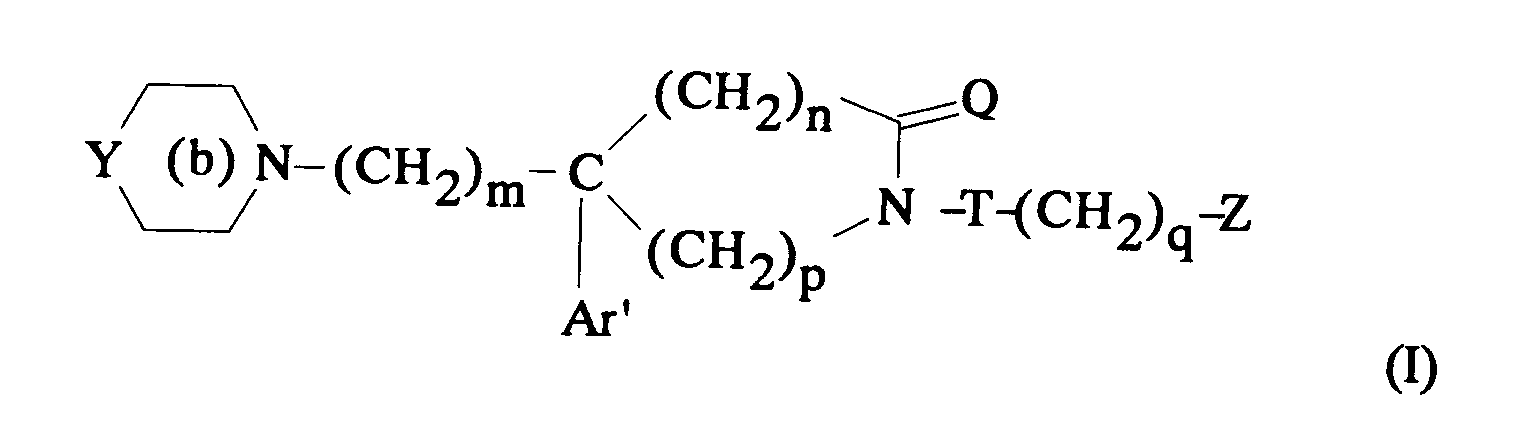
dans laquelle
- Y représente
- soit un groupe Cy-N ou Cy-CH₂-N dans lequel
- . Cy représente un phényle éventuellement substitué;
- soit un groupe
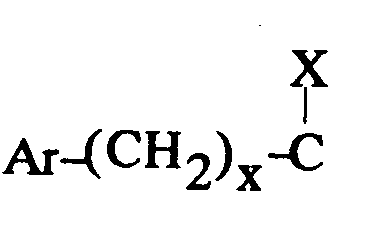
- . Ar représente un phényle éventuellement substitué;
- . x est zéro ou un ;
- . X représente un hydrogène, un hydroxyle, un alcoxy ; un acyloxy en; un carboxy ; un carbalcoxy; un cyano ; un groupe -N(X₁)₂ dans lequel les groupes X₁ représentent indépendamment l'hydrogène, un alkyle, un hydroxyalkyle,un acyle, ou bien -(X₁)₂ constitue avec l'atome d'azote auquel il est lié, un hétérocycle ; un groupe -S-X₂ dans lequel X₂ représente l'hydrogène ou un groupe alkyle ;
- soit un groupe Cy-N ou Cy-CH₂-N dans lequel
- m est 2 ou 3;
- Ar′ représente un phényle éventuellement substitué ou substitué une ou plusieurs fois par un thiényle ; un benzothiényle ; un naphtyle ou un indolyle;
- n est 0, 1, 2 ou 3;
- p est 1 ou 2 et lorsque p = 2, alors n = 1 et Q représente deux atomes d'hydrogène ;
- Q représente l'oxygène ou deux atomes d'hydrogène ;
- T représente un groupe choisi parmi

- q est 0, 1, 2 ou 3;
- Z représente un phényle éventuellement substitué ; un naphtyle éventuellement substitué ; un pyridyle ; un thiényle ; un indolyle ; un quinoléyle ; un benzothiényle ; un imidazolyle ; ou encore lorsque T est -C = O, -(CH₂)q-Z peut aussi représenter un groupe benzyle substitué sur le -CH- et éventuellement substitué sur le cycle aromatique ; un groupe aromatique ou hétéroaromatique mono-, di- ou tricyclique éventuellement substitué ;
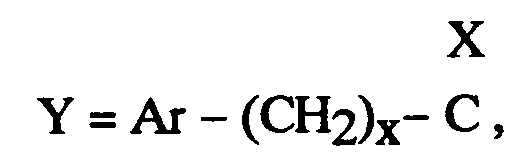
un de leurs sels d'ammonium quaternaire avec l'azote (b) de la pipéridine ou dérivés N-oxyde avec ce même atome d'azote.
Description
- La présente invention a pour objet de nouveaux dérivés aromatiques substitués par un groupement amino et par des fonctions amines ou amides, ainsi que leurs énantiomères.
- La présente invention concerne également le procédé d'obtention des composés, qui peut être énantiosélectif et l'utilisation des composés selon l'invention dans des compositions à usage thérapeutique et plus particulièrement dans les phénomènes pathologiques qui impliquent le système des neurokinines comme : la douleur (D. Regoli et al., Life Sciences, 1987, 40, 109-117), l'allergie et l'inflammation (J,E. Morlay et al., Life Sciences, 1987, 41) 527-544), l'insuffisance circulatoire (J. Losay et al., 1977, Substance P, Von Euler, U.S. and Pernow ed., 287-293, Raven Press, New York), les troubles gastro-intestinaux (D. Regoli ct al., Trends Pharmacol. Sci., 1985, 6, 481-484), les troubles respiratoires (J. Mizrahi et al., Pharmacology, 1982, 25, 39-50).
- Des ligands endogènes aux récepteurs des neurokinines ont été décrits, telles la substance P (SP), la neurokinine A (NKA) (S.J. Bailey et al., 1983, Substance P, P. Skrabanck cd., 16-17 Boole Press, Dublin) et la neurokinine B (NKB) (S.P. Watson, Life Sciences, 1983, 25, 797-808).
- Les récepteurs aux neurokinines ont été reconnus sur de nombreuses préparations et sont actuellement classés en trois types , NK₁, NK₂ et NK₃. Alors que la plupart des préparations étudiées jusqu'à maintenant, présentent plusieurs types de récepteurs, tel l'iléon de cobaye (NK₁, NK₂ et NK₃), certaines d'entre elles n'en possèderaient qu'un seul, telles l'artère carotide de chien (NK₁), l'artère pulmonaire de lapin dépourvue d'endothélium (NK₂) et la veine porte de rat (NK₃) (D. Regoli et al., Trends Pharmacol. Sci., 1988, 9, 290-295 et Pharmarcology, 1989, 38, 1-15).
- Une caractérisation plus précise des différents récepteurs est rendue possible par la synthèse récente d'agonistes sélectifs. Ainsi, la [Sar⁹, Met-(O₂)¹¹] SP, la [Nle¹⁰] NKA₄₋₁₀, et la [Me Phe⁷] -NKB présenteraient une sélectivité respective pour les récepteurs NK₁, NK₂ et NK₃ (cf D. Regoli, 1988 et 1989 précédemment cité).
- On a maintenant trouvé que certains composés aromatiques aminés possèdent des propriétés pharmacologiques intéressantes, en tant qu'antagonistes des recepteurs des neurokinines et sont notamment utiles pour le traitement de toute pathologie substance P et neurokinine dépendante.
- Ainsi selon un de ses aspects, la présente invention concerne des dérivés aromatiques aminés de formule :

dans laquelle - Y représente
- soit un groupe Cy-N ou Cy-CH₂-N dans lequel
- . Cy représente un phényle non substitué ou substitué une ou plusieurs fois par un des substituants choisis parmi : un atome d'halogène, un hydroxyle, un alcoxy en C₁-C₄, un alkyle en C₁-C₄, un trifluorométhyle, lesdits substituants étant identiques ou différents ; un groupe cycloalkyle en C₃-C₇ ; un groupe pyrimidyle ou un groupe pyridyle ;
- soit un groupe

- . Ar représente un phényle non substitué ou substitué une ou plusieurs fois par un des substituants choisis parmi : l'hydrogène, un atome d'halogène, un hydroxyle, un alcoxy en C₁-C₄, un trifluorométhyle, un alkyle en C₁-C₄, lesdits substituants étant identiques ou différents ; un groupe pyridyle ; un groupe thiényle ;
- . x est zéro ou un ;
- . X représente un hydrogène, un hydroxyle, un alcoxy en C₁-C₄ ; un acyloxy en C₁-C₄ ; un carboxy ; un carbalcoxy en C₁-C₄ ; un cyano ; un groupe-N(X₁)₂ dans lequel les groupes X₁ représentent indépendamment l'hydrogène, un alkyle en C₁-C₄, un hydroxyalkyle en C₁-C₄, un acyle en C₁-C₄, ou bien -(X₁)₂ constitue avec l'atome d'azote auquel il est lié, un hétérocycle choisi parmi pyrrolidine, pipéridine ou morpholine ; un groupe-S-X₂ dans lequel X₂ représente l'hydrogène ou un groupe alkyle en C₁-C₄;
- soit un groupe Cy-N ou Cy-CH₂-N dans lequel
- m est 2 ou 3;
- Ar′ représente un phényle non substitué ou substitué une ou plusieurs fois par un des substituants choisis parmi : un atome d'halogène, de préférence un atome de chlore ou de fluor, un trifluorométhyle, un alcoxy en C₁-C₄, un alkyle en C₁-C₄, lesdits substituants étant identiques ou différents ; un thiényle ; un benzothiényle ; un naphtyle ou un indolyle ;
- n est 0, 1,2 ou 3;
- p est 1 ou 2 et lorsque p est égal à 2, alors n est égal à 1 et Q représente deux atomes d'hydrogène ;
- Q représente l'oxygène ou deux atomes d'hydrogène ;
- T représente un groupe choisi parmi

- q est 0, 1, 2 ou 3;
- Z représente un phényle non substitué ou substitué une ou plusieurs fois par un atome d'halogène, plus particulièrement un atome de chlore ou de fluor, un trifluorométhyle, un alkyle en C₁-C₄, un hydroxyle, un alcoxy en C₁-C₄ ; un naphtyle non substitué ou substitué une ou plusieurs fois par un halogène, un trifluorométhyle, un alkyle en C₁-C₄, un hydroxyle ; un pyridyle ; un thiényle ; un indolyle ; un quinoléyle ; un benzothiényle ; un imidazolyle ; ou encore lorsque T est -C = O, -(CH₂)q-Z peut aussi représenter un groupe benzyle substitué sur le -CH- par un hydroxyle, un alcoxy en C₁-C₄, un alkyle en C₁-C₄ et éventuellement substitué sur le cycle aromatique par un halogène, plus particulièrement un atome de chlore ou de fluor, un trifluorométhyle, un alkyle en C₁-C₄, un hydroxyle, un alcoxy en C₁-C₄ ; un groupe aromatique ou hétéroaromatique mono-, di- ou tricyclique éventuellement substitué ;
- Dans la présente description les groupes alkyle ou les groupes alcoxy sont droits ou ramifiés.
- Les sels des composés de formule (I) selon la présente invention comprennent aussi bien ceux avec des acides minéraux ou organiques qui permettent une séparation ou une cristallisation convenable des composés de formule (I), tels que l'acide picrique ou l'acide oxalique ou un acide optiquement actif, par exemple un acide mandélique ou camphosulfonique, que ceux qui forment des sels pharmaceutiquement acceptables tels que le chlorhydrate, le bromhydrate, le sulfate, l'hydrogénosulfate, le dihydrogénophosphate, le méthanesulfonate, le méthylsulfate, le maléate, le fumarate, le 2-naphtalènesulfonate, le glycolate, le gluconate, le citrate, l'iséthionate.
- Lorsque

les composés de formule (I) peuvent se trouver sous forme d'un sel d'ammonium quaternaire formé avec l'azote (b) de la pipéridine ou d'un dérivé N-oxyde formé avec l'azote (b). le groupe
est alors représenté par le groupe
dans lequel - . Q′ représente un groupe alkyle en C₁-C₆ ou un groupe benzyle et
- . A ⊖ représente un anion choisi parmi chlorure, bromure, iodure, acétate, méthanesulfonate ou paratoluènesulfonate.
- De façon particulière, dans la formule (I), Z représente un groupe aromatique ou hétéroaromatique mono-, di- ou tricyclique, pouvant porter un ou plusieurs substituants, dont un atome de carbone du carbocycle aromatique ou de l'hétérocycle aromatique est directement lié au groupe T.
- Plus particulièrement, le radical Z peut être un groupe phényle ou un groupe benzyle, qui peut être non substitué ou éventuellement contenir un ou plusieurs substituants.
- Lorsque Z est un groupe phényle, celui-ci peut être de préférence mono- ou disubstitué notamment en position 2,4, mais aussi par exemple en position 2,3, 4,5, 3,4 ou 3,5 ; il peut aussi être trisubstitué, notamment en position 2,4,6 mais aussi par exemple en 2,3,4, 2,3,5 ou 2,4,5 3,4,5 ; tétrasubstitué, par exemple en 2,3,4,5 ; ou pentasubstitué. Les substituants du groupe phényle peuvent être : F ; CI; Br; I; CN; OH; NH₂; NH-CONH₂;NO₂; CONH₂; CF₃; alkyle en C₁-C₁₀, de préférence en C₁-C₄, méthyle ou éthyle étant préférés, ainsi que par exemple n-propyle, isopropyle, n-butyle, isobutyle, sec-butyle, tert-butyle, pentyle ou n-pentyle, hexyle ou n-hexyle,heptyle ou n-heptyle, octyle ou n-octyle, nonyle ou n-nonyle ainsi que décyle ou n-décyle ; alcényle contenant 2 à 10, de préférence 2-4 atomes de carbone, par exemple vinyle, allyle, 1-propényle, isopropényle, butényle ou 1-butèn-1-, -2-, -3- ou -4-yle, 2-butèn-1-yle, 2-butèn-2-yle, pentényle, hexényle ou décényle ; alcynyle contenant 2 à 10, de préférence 2-4 atomes de carbone, par exemple éthynyle, 1-propyn-1-yle, propargyle, butynyle ou 2-butyn-1-yle, pentynyle, décynyle ; cycloalkyle contenant 3 à 8, de préférence 5 ou 6 atomes de carbone, cyclopentyle ou cyclohexyle étant préférés, ainsi que par exemple cyclopropyle, cyclobutyle, 1-, 2- ou 3-méthylcyclopentyle, 1-, 2-, 3- ou 4-méthylcyclohexyle, cycloheptyle ou cyclooctyle ; bicycloalkyle contenant 4 à 11, de préférence 7 atomes de carbone, exo ou endo 2-norbomyle étant préférés, ainsi que par exemple 2-isobornyle ou 5-camphyle ; hydroxyalkyle contenant 1 à 5, de préférence 1-2 atomes de carbone, hydroxyméthyle et 1- ou 2-hydroxyéthyle étant préférés, ainsi que par exemple 1-hydroxyprop-1-yle, 2-hydroxyprop-1-yle, 3-hydroxyprop-1-yle, 1-hydroxyprop-2-yle, 1-hydroxybut-1-yle, 1-hydroxypent-1-yle ; alcoxy contenant 1 à 10, de préférence 1-4 atomes de carbone, méthoxy, éthoxy ou isopropoxy étant préférés, ainsi que par exemple n-propoxy, n-butoxy, isobutoxy, sec-butoxy, tert-butoxy, pentyloxy, hexyloxy, heptyloxy, octyloxy, nonyloxy ou décyloxy ; alcoxyalkyle contenant 2 à 10, de préférence de 2 à 6 atomes de carbone, par exemple alcoxyméthyle ou alcoxyéthyle, tel que méthoxyméthyle ou 1- ou 2-méthoxyéthyle, 1- ou 2-n-butoxyéthyle, 1- ou 2-n-octyloxyéthyle ; alcoxyalcoxyalkyle contenant jusqu'à 10, de préférence - de 4 à 7 atomes de carbone, par exemple alcoxyalcoxyméthyle,par exemple 2-méthoxyéthoxyméthyle, 2-éthoxyéthoxyméthyle ou 2-isopropoxyéthoxyméthyle, alcoxyalcoxyéthyle par exemple 2-(2-méthoxyéthoxy)éthyle ou 2-(2-éthoxyéthoxy)éthyle ; alcoxyalcoxy contenant de 2 à 10, de préférence de 3 à 6 atomes de carbone, par exemple 2-méthoxyéthoxy, 2-éthoxyéthoxy ou 2-n-butoxyéthoxy ; alcényloxy contenant 2 à 10, de préférence 2 à 4 atomes de carbone, allyloxy étant préféré, ainsi que par exemple vinyloxy, propényloxy, isopropényloxy, butényloxy tel que 1-butèn-1-, -2-, -3- ou -4-yloxy, 2-butèn-1-yloxy, 2-butèn-yloxy, pentènyloxy, hexényloxy ou décényloxy ; alcényloxyalkyle contenant de 3 à 10, de préférence 3-6 atomes de carbone, par exemple allyloxyméthyle ; alcynyloxy contenant de 2 à 10, de préférence 2 à 4 atomes de carbone, propargyloxy étant préférés, ainsi que par exemple éthynyloxy, 1-propyn-1-yloxy, butynyloxy ou 2-butyn-1-yloxy, pentynyloxy ou décynyloxy ; alcynyloxyalkyle contenant de 3 à 10 de préférence 3 à 6 atomes de carbone, par exemple éthynyloxyméthyle, propargyloxyméthyle ou 2-(2-butyn-1-yloxy)éthyle ; cycloalcoxy contenant 3 à 8, de préférence 5 ou 6 atomes de carbone, cyclopentyloxy ou cyclohexyloxy étant préférés, ainsi que par exemple cyclopropyloxy, cyclobutyloxy, 1-, 2- ou 3-méthylcyclopentyloxy, 1-, 2-, 3- ou 4-méthylcyclohexyloxy, cycloheptyloxy ou cyclooctyloxy ; alkylthio contenant de 1 à 10, de préférence 1 à 4 atomes de carbone, méthylthio ou éthylthio étant préférés, ainsi que par exemple n-propylthio, isopropylthio, n-butylthio, isobutylthio, sec-butylthio, tert-butylthio, pentylthio, hexylthio, octylthio, nonylthio ou décylthio ; alkylthioalkyle contenant de 2 à 10, de préférence 2 à 6 atomes de carbone, par exemple méthylthiométhyle, 2-méthylthioéthyle ou 2-n-butylthioéthyle ; acylamino, à savoir alcanoylamino contenant de 1 à 7, de préférence 1 à 4 atomes de carbone, formylamino et acétylamino étant préférés, ainsi que propionylamino, butyrylamino, isobutyrylamino, valérylamino, caproylamino, heptanoylamino, ainsi que aroylamino ou benzylamino ; acylaminoalkyle, de préférence alcanoylaminoalkyle contenant de 2 à 8, de préférence 3 à 6 atomes de carbone, tel que formylaminoéthyle, acétylaminoéthyle, propionylaminoéthyle, n-butyrylaminoéthyle, formylaminopropyle, acétylaminopropyle, propionylaminopropyle, formylaminobutyle, acétylaminobutyle, ainsi que propionylaminobutyle, butyrylaminobutyle ; acyloxy contenant de 1 à 6, de préférence 2 à 4 atomes de carbone, acétyloxy, propionyloxy ou butyryloxy étant préférés, ainsi que par exemple formyloxy, valéryloxy, caproyloxy ; alcoxycarbonyle contenant de 2 à 5, de préférence 2 ou 3 atomes de carbone, méthoxycarbonyle et éthoxycarbonyle étant préférés, ainsi que par exemple n-propoxycarbonyle, isopropoxycarbonyle, n-butoxycarbonyle, isobutoxycarbonyle, sec-butoxycarbonyle ou tert-butoxycarbonyle ; cycloalcoxycarbonyle contenant de 4 à 8, de préférence 6 ou 7 atomes de carbone, cyclopentyloxycarbonyle, cyclohexyloxycarbonyle étant préférés, ainsi que cyclopropyloxycarbonyle, cyclobutyloxycarbonyle ou cycloheptyloxycarbonyle ; alkylaminocarbonylamino contenant de 2 à 4 atomes de carbone, tel que méthylaminocarbonylamino, éthylaminocarbonylamino, propylaminocarbonylamino ; dialkylaminocarbonylamino contenant de 3 à 7, de préférence 3 à 5 atomes de carbone, de préférence diméthylaminocarbonylamino, ainsi que di-n-propylaminocarbonylamino, diisopropylaminocarbonylamino ; (1-pyrrolidino)-carbonylamino ; cycloalkylaminocarbonylamino contenant de 4 à 8, de préférence 6 ou 7 atomes de carbone, cyclopentylaminocarbonylamino, cyclohexylamino-carbonylamino étant préférés, ainsi que cyclopropylaminocarbonylamino, cyclobutylaminocarbonylamino, cycloheptylaminocarbonyl-amino; alkylamino-carbonylaminoalkyle contenant de 3 à 9, de préférence 4 à 7 atomes de carbone, méthylaminocarbonylaminoéthyle, éthylaminocarbonylaminoéthyle, éthylamino-carbonylaminopropyle, éthylaminocarbonylaminobutyle étant préférés, ainsi que par exemple méthylaminocarbonylaminométhyle, n-propylaminocarbonylamino-butyle, n-butylaminocarbonylaminobutyle ; dialkylaminocarbonylaminoalkyle contenant de 4 à 11 atomes de carbone, par exemple diméthylamino-carbonylaminométhyle, diéthylaminocarbonylaminoéthyle, diéthylaminocarbonylaminopropyle, diéthylaminocarbonylaminobutyle, (1-pyrrolidino) carbonylaminoéthyle, (1-pipéridino)-carbonylaminoéthyle, cycloalkylaminocarbonylaminoalkyle contenant de 5 à 12, de préférence 8 à 11 atomes de carbone, cyclopentylaminocarbonylaminoéthyle, cyclopentylaminocarbonylaminopropyle, cyclopentylaminocarbonylaminobutyle, cyclohexylaminocarbonylaminoéthyle, cyclohexylaminocarbonylaminopropyle et cyclohexylaminocarbonylaminobutyle étant préférés, ainsi que par exemple cyclopropylaminocarbonylaminométhyle, cycloheptylaminocarbonylaminoéthyle ; alcoxycarbonylaminoalkyle contenant de 3 à 12, de préférence 4 à 9 atomes de carbone, méthoxycarbonylaminoéthyle, éthoxycarbonylaminoéthyle, n-propoxycarbonylaminoéthyle, isopropoxycarbonylaminoéthyle, n-butoxycarbonyl-aminoéthyle, isobutoxycarbonylaminoéthyle, sec-butoxycarbonylaminoéthyle, tert-butoxycarbonylaminoéthyle, éthoxycarbonylaminopropyle, n-butoxycarbonylaminopropyle, éthoxycarbonylaminobutyle, n-butoxycarbonylaminobutyle étant préférés, ainsi que par exemple n-propoxycarbonylaminopropyle, n-propoxycarbonylaminobutyle, isopropoxycarbonylaminobutyle ; cycloalcoxycarbonylaminoalkyle contenant de 5 à 12, de préférence 8 à 11 atomes de carbone, cyclopentyloxycarbonylaminoéthyle, cyclopentyloxycarbonylaminopropyle, cyclopentyloxycarbonylaminobutyle, cyclohexyloxycarbonylaminoéthyle, cyclohexyloxy-carbonylaminopropyle, cyclohexyloxycarbonylaminobutyle étant préférés, ainsi que par exemple cyclopropyloxycarbonylaminométhyle, cycloheptyloxycarbonyl-aminoéthyle ; carbamoylalkyle contenant de 2 à 5, de préférence 2 atomes de carbone, de préférence carbamoylméthyle, ainsi que carbamoyléthyle, carbamoylpropyle, carbamoylbutyle ; alkylaminocarbonylalkyle contenant de 3 à 9, de préférence 3 à 6 atomes de carbone, méthylaminocarbonyléthyle, éthylaminocarbonylméthyle, n-propylaminocarbonylméthyle, isopropylamino-carbonylméthyle, n-butylaminocarbonylméthyle, isobutylaminocarbonylméthyle, sec-butylaminocarbonylméthyle, tert-butylaminocarbonylméthyle étant préférés, ainsi que par exemple éthylaminocarbonyléthyle, éthylaminocarbonylpropyle, éthylaminocarbonylbutyle, n-propylaminocarbonylbutyle, n-butylaminocarbonylbutyle ; dialkylaminocarbonyl-alkyle contenant de 4 à 11, de préférence 4 à 8 atomes de carbone, diméthylamino-carbonylméthyle, diéthylaminocarbonylméthyle, di-n-propylaminocarbonylméthyle ; ainsi que par exemple diéthylaminocarbonyléthyle, diéthylaminocarbonylpropyle, diéthylaminocarbonylbutyle (1-pyrrolidino)carbonylméthyle, (1-pipéridino)carbonylméthyle (1-pipéridino)carbonyléthyle ; cycloalkylaminocarbonylalkyle contenant de 5 à 12, de préférence 7 ou 8 atomes de carbone, cyclopentylaminocarbonylméthyle et cyclohexylaminocarbonylméthyle étant préférés, ainsi que par exemple cyclopropylaminocarbonylméthyle, cyclobutylaminocarbonylméthyle, cycloheptylaminocarbonylméthyle, cyclohexylaminocarbonyléthyle, cyclohexylaminocarbonylpropyle, cyclohexylaminocarbonylbutyle ; alkylaminocarbonylalcoxy contenant de 3 à 10, de préférence 3 à 5 atomes de carbone, méthylaminocarbonylméthoxy étant préféré, ainsi que par exemple méthylaminocarbonyléthoxy, méthylaminocarbonylpropoxy ; dialkylamino-carbonylalcoxy contenant de 4 à 10, de préférence 4 à 7 atomes de carbone, tel que diméthylaminocarbonylméthoxy, diéthylaminocarbonyléthoxy, (pipéridinyl-1) carbonylméthoxy ; cycloalkylaminocarbonylalcoxy contenant de 5 à 11, de préférence 7 ou 8 atomes de carbone, tel que cyclopentylaminocarbonylméthoxy, cyclohexylaminocarbonylméthoxy.
- Le groupe Z est avantageusement un groupe phényle ; un groupe benzyle ; un groupe benzoyle ; un groupe phénylthioalkyle dans lequel l'alkyle est en C₁-C₃; un groupe naphtyle.
- Le groupe phényle Z est de préférence mono ou disubstitué par un halogène, ou un alcoxy, le groupe isopropoxy étant préféré.
- Le radical Z peut également représenter un groupe aromatique bicyclique tel que le 1- ou 2-naphtyle ; 1-, 2-, 3-, 4-, 5-, 6-, 7-indényle ; dont une ou plusieurs liaisons peuvent être hydrogénées, lesdits groupes pouvant être non substitués ou contenir éventuellement un ou plusieurs substituants tels que : un halogène et plus particulièrement un atome de fluor, les groupes alkyle, phényle, cyano, hydroxyalkyle, hydroxy, oxo, alkylcarbonylamino et alcoxycarbonyle, thioalkyle dans lesquels les alkyles sont en C₁-C₄.
- Le radical Z peut être aussi un groupe pyridyle, thiadiazolyle, indolyle, indazolyle, imidazolyle, benzimidazolyle, quinoléyle, benzotriazolyle, benzofuranyle, benzothiényle, benzothiazolyle, benzisothiazolyle, isoquinolyle, benzoxazolyle, benzoxazinyle, benzodioxynyle, isoxazolyle, benzopyranyle, thiazolyle, thiényle, furyle, pyranyle, chroményle, isobenzofuranyle, pyrrolyle, pyrazolyle, pyrazinyle, pyrimidinyle, pyridazinyle, indolizinyle, phtalazinyle, quinazolinyle, acridinyle, isothiazolyle, isochromanyle, chromanyle, dont une ou plusieurs doubles liaisons peuvent être hydrogénées, lesdits groupes pouvant être non substitués ou contenir éventuellement un ou plusieurs substituants tels que : les groupes alkyle, phényle, cyano, hydroxyalkyle, hydroxy, alkylcarbonylamino et alcoxycarbonyle, thioalkyle dans lesquels les alkyles sont en C₁-C₄.
- Selon un autre de ses aspects, la présente invention concerne un procédé pour la préparation des composés de formule (I) et de leurs sels caractérisé en ce que :
- a) on traite un composé de formule :


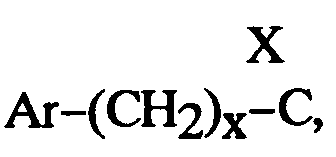
- . soit avec un dérivé fonctionnel d'un acide de formule :

- . soit avec un dérivé halogéné de formule :
Hal-(CH₂)q+1-Z (IV)
dans laquelle q et Z sont tels que définis précédemment et où Hal représente un halogène et préférentiellement un atome de brome ou de chlore, lorsqu'on doit préparer un composé de formule (I) où T est -CH₂-,

- . soit avec un dérivé fonctionnel d'un acide de formule :
- b) puis, lorsque E représente un groupe tétrahydropyranyloxy on élimine le groupe tétrahydropyranyloxy par action d'un acide,
- c) on traite l'alcool ainsi obtenu de formule :

- d) on fait réagir le mésylate ainsi obtenu de formule :


- e) après déprotection éventuelle de l'hydroxyle représenté par X, on transforme éventuellement le produit ainsi obtenu en un de ses sels.
- Les sels d'ammonium quaternaires éventuellement formés avec l'azote (b) de la pipéridine lorsque

sont préparés par réaction des bases libres des composés (I), pour lesquelles les fonctions aminés autres, éventuellement présentes sont N-protégées par un groupe N-protecteur habituel, avec un excès d'agent alkylant de formule :
A-Q′
dans lequel A représente un groupe partant et est tel que défini précédemment pour (I), de préférence un chlorure ou un iodure et Q′ est tel que défini précédemment pour (I) et on chauffe le mélange réactionnel dans un solvant par exemple choisi parmi le dichlorométhane, le chloroforme, l'acétone ou l'acétonitrile à une température comprise entre la température ambiante et le reflux pendant une à plusieurs heures pour obtenir après traitement selon les méthodes habituelles et après déprotection éventuelle, un mélange des diastéréoisomères axiaux et équatoriaux des sels d'ammonium quaternaires. - De préférence, A ⊖ représente un iodure qui peut être échangé par un autre anion ou par un anion pharmacologiquement acceptable, par exemple un chlorure, par élution du composé (I) sur une résine échangeuse d'ion, par exemple l'Amberlite IRA68® ou Duolite A375®.
- Les diastéréoisomères sont séparés selon les méthodes habituelles, par exemple par chromatographie ou par recristallisation.
- Chacun des diastéréoisomères axiaux ou équatoriaux des composés (I) sous forme de racémiques ou sous forme d'énantiomères R ou S optiquement purs font partie de l'invention.
- Les dérivés N-oxydes éventuellement formés avec l'azote (b) de la pipéridine lorsque

sont préparés par réaction avec un dérivé peroxydé, par exemple l'acide métachloroperbenzoïque ou l'eau oxyénée, selon les méthodes habituelles. - Comme dérivé fonctionnel de l'acide (III), on utilise l'acide lui-même, convenablement activé par exemple par le cyclohexylcarbodiimide ou par l'hexafluorophosphate de benzotriazolyl N-oxy-trisdiméthylaminophosphonium (BOP), ou bien un des dérivés fonctionnels qui réagissent avec les amines, par exemple un anhydride, un anhydride mixte, le chlorure d'acide ou un ester activé.
- Lorsque comme produit de départ on utilise un composé de formule (II) où E représente un groupe :
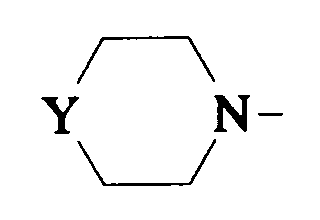
le procédé de la présente invention peut être représenté et illustré en détail par le schéma 1 ci-après :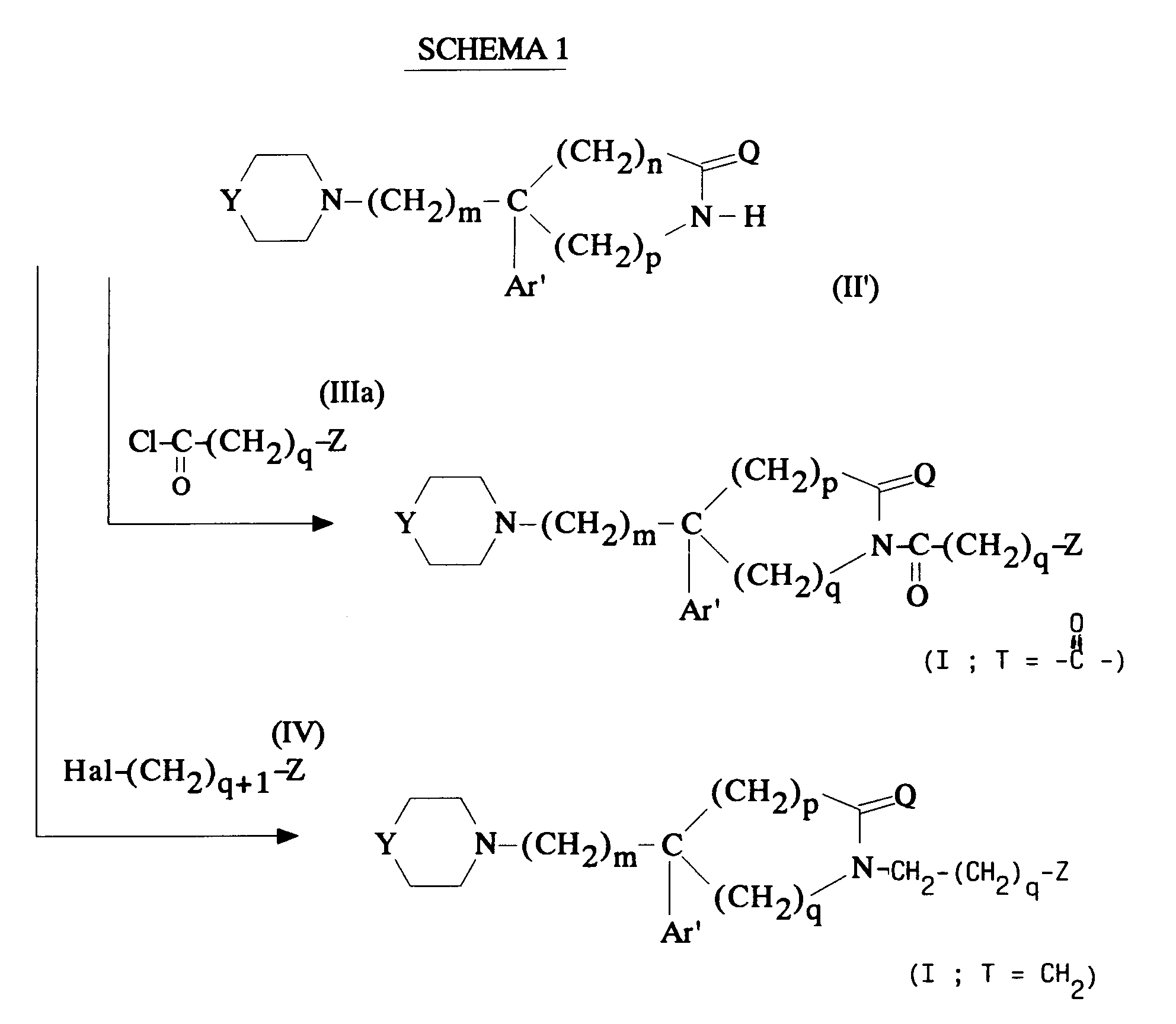
- Dans la formule (IIIa) ci-dessus, on considère le chlorure d'acide comme dérivé fonctionnel réactif de l'acide (III). On peut cependant utiliser un autre dérivé fonctionnel ou on peut partir de l'acide libre (III) en réalisant un couplage (II′) avec le BOP, puis, en additionnant l'acide (III) en présence d'une base organique comme par exemple la triéthylamine, dans un solvant comme le dichlorométhane ou le diméthylformamide, à température ambiante. Les composés (1) obtenus sont isolés et purifiés selon les méthodes habituelles, comme par exemple la chromatographie ou la recristallisation.
- Lorsque comme produit de départ on utilise un composé de formule (II) où E représente un groupe tétrahydropyranyloxy (THP-O-), le procédé de la présente invention peut être représenté et illustré à partir du schéma 2.
- Les réactions du composé (II) avec les réactifs (IIIA) et (IV) se déroulent comme décrit ci-dessus pour le schéma 1, le chlorure d'acide (IIIA) pouvant être remplacé par un autre dérivé fonctionnel ou par l'acide libre activé par exemple par le BOP.
- L'intermédiaire (V) ainsi obtenu est déprotégé par hydrolyse acide douce pour conduire au composé hydroxylé libre (VI) duquel on prépare le mésylate (VII) pour le substituer par une amine secondaire de formule (VIII) pour obtenir finalement les composés (I) selon l'invention.


- Les produits de formule (I) ainsi obtenus sont isolés, sous forme de base libre ou de sel, selon les techniques classiques.
- Lorsque le composé de formule (I) est obtenu sous forme de base libre, la salification est effectuée par traitement avec l'acide choisi dans un solvant organique. Par traitement de la base libre, dissoute par exemple dans un alcool tel que l'isopropanol, avec une solution de l'acide choisi dans le même solvant, on obtient le sel correspondant qui est isolé selon les techniques classiques. Ainsi, on prépare par exemple le chlorhydrate, le bromhydrate, le sulfate, l'hydrogénosulfate, le dihydrogénophosphate, le méthanesulfonate, l'oxalate, le maléate, le fumarate, le 2-naphtalènesulfonate.
- A la fin de la réaction, les composés de formule (I) peuvent être isolés sous forme d'un de leurs sels, par exemple le chlorhydrate ou l'oxalate ; dans ce cas, si nécessaire, la base libre peut être préparée par neutralisation dudit sel avec une base minérale ou organique, telle que l'hydroxyde de sodium ou la triéthylamine ou avec un carbonate ou bicarbonate alcalin, tel que le carbonate ou bicarbonate de sodium ou de potassium.
- On peut aussi préparer à partir des bases libres, les sels d'ammonium quaternaires, par réaction avec un agent alkylant, ou les dérivés N-oxydes, sur l'azote (b) de la pipéridine étant entendu que les autres fonctions aminés éventuellement présentes sur (I) sont N-protégées par des groupes N-protecteurs bien connus de l'homme de l'art.
- Les composés de départ de formule (II) sont préparés à partir de nitriles commerciaux ou préparés selon des méthodes connues selon les schémas ci-dessous.
- Lorsque n est égal à zéro, le composé (II) est préparé selon D.C. Bishop et al., J. Med. Chem., 1968, 11, 466-470 selon le schéma 3 suivant.

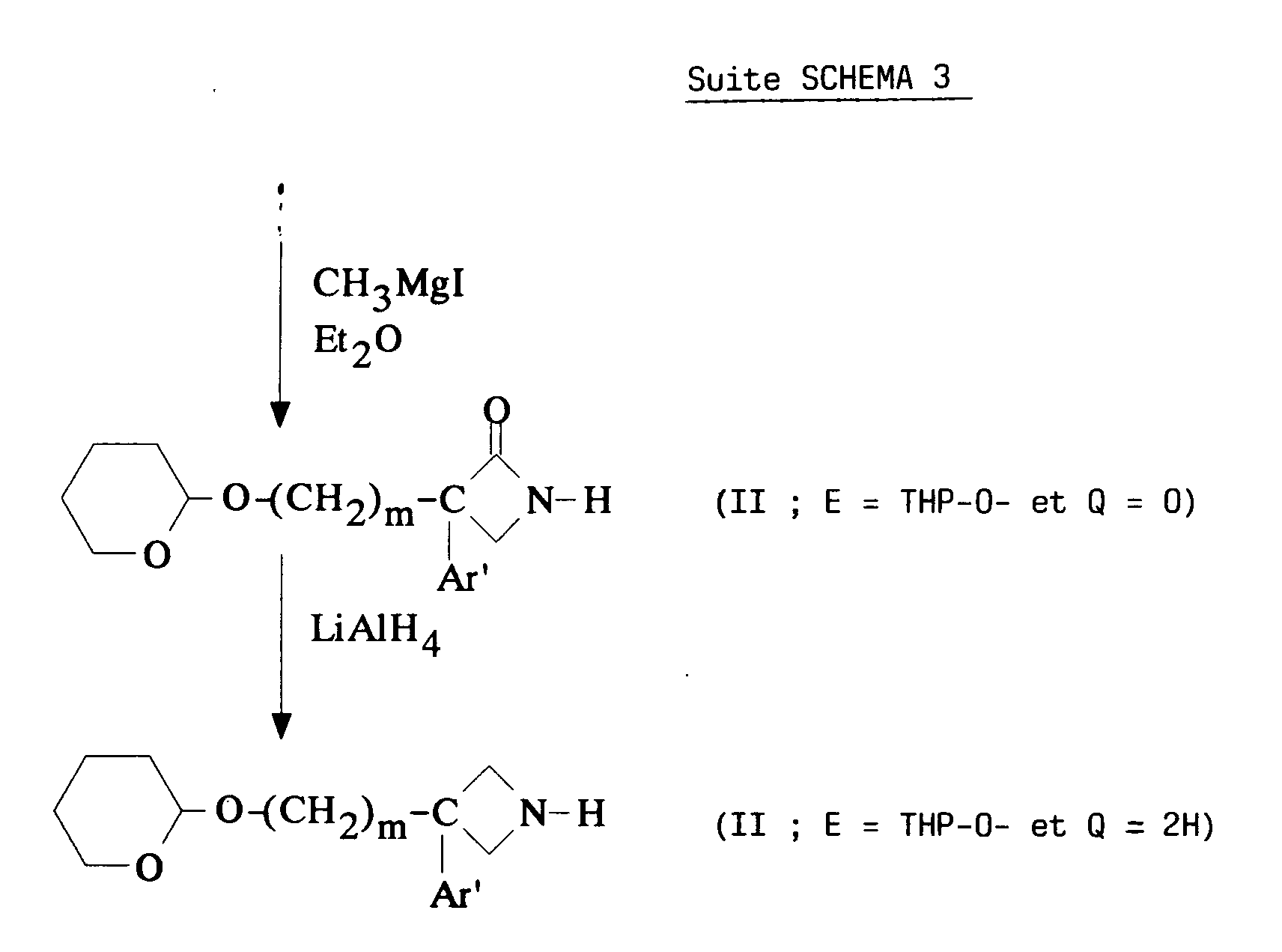
- Lorsque n = 1, 2 ou 3, les composés (II) correspondant sont préparés selon le schéma 4 suivant.

- Lorsque p = 2, alors n = 1, Q = 2H et m = 2 et l'intermédiaire (II) est préparé selon H. Bochow et al., Chem. Ber., 1975, 108, 3475-3482. La préparation est illustrée par le schéma 5 ci-dessous.

- Les groupes OH et NH peuvent ou non être protégés par des groupes O-protecteurs ou N-protecteurs classiques bien connus de l'homme de l'art.
- La résolution des mélanges racémiques (I) permet d'isoler les énantiomères (I*) de formule

dans laquelle - "*" signifie que l'atome de carbone ainsi marqué à la configuration absolue (+) ou (-) déterminée,
- Y, m, Ar′, n, p, Q, T, q et Z sont tels que définis plus haut pour les dérivés de formule (I), ou un de leurs sels avec des acides minéraux ou organiques, ou encore avec l'atome d'azote (b) un de leurs sels d'ammonium quaternaires ou dérivés N-oxyde.
- Lesdits sels ou dérivés N-oxyde sont préparés comme indiqué plus haut pour les sels et dérivés correspondants des dérivés de formule (I).
- Les énantiomères de formule (I*) sont des produits nouveaux qui font partie de l'invention.
- On peut aussi effectuer le dédoublement des mélanges racémiques des produits de formule (II) dans lesquels m, Ar′, n, et p sont tels que définis pour (I), E représente un hydroxyle et Q représente l'hydrogène, afin de préparer les énantiomères (I*) des produits de formule (I).
- Le dédoublement des racémiques est effectué sur les intermédiaires (II) susceptibles de donner des sels avec des acides optiquement actifs. Les énantiomères sont alors séparés par les méthodes classiques telles que la cristallisation ou la chromatographie haute pression préparative chirale.
- L'aminoalcool optiquement pur ainsi préparé, est un composé nouveau faisant partie de l'invention, de formule :

dans laquelle "*" signifie que l'atome de carbone ainsi marqué est de configuration (+) ou (-) déterminée. - Les intermédiaires de formules (VI) et (VII) , dans lesquels Q représente l'hydrogène, sous forme optiquement pure, sont des produits nouveaux particulièrement intéressants et représentent un aspect ultérieur de la présente invention. Ces produits peuvent être regroupés dans la formule suivante :

dans laquelle :
"*", m, Ar′, n, p, T, q et Z sont tels que définis précédemment et G représente l'hydrogène ou un groupe méthanesulfonyle. - Les mélanges racémiques des composés (II) sont préparés comme indiqué dans les Schéma 3, 4 et 5 ci-dessus.
- Les composés (V*) optiquement purs sont préparés selon la suite de réactions indiquées dans le Schéma 2 ci-dessus à partir des composés (II) optiquement purs (II*) pour conduire aux produits finaux selon l'invention sous forme optiquement pure (I*).
- Lorsque le substituant -(CH₂)q-Z représente un groupe benzyle substitué sur le -CH- par un hydroxyle, un alcoxy ou un alkyle en C₁-C₄ on obtient soit un mélange de deux ou quatre diastéréoisomères selon que l'on fait réagir un dérivé benzylique a-substitué optiquement pur ou non avec un dérivé aminé optiquement pur ou non.
- Ces diastéréoisomères font partie de l'invention.
- Les composés selon l'invention ont fait l'objet d'essais biochimiques.
- Les composés (I) et leurs sels ont montré des propriétés antagonistes de la liaison de la substance P dans des essais réalisés sur des membranes de cortex de rat et de cellules lymphoblastiques IM9, selon M.A. Cascieri et al., J. Biol. Chem., 1983, 258, 5158-5164 et D.D. Paya et al., J. Immunol., 1984, 133, 3260-3265.
- Les mêmes composés et leurs sels ont montré des propriétés antagonistes de la liaison de la NKA dans des essais réalisés sur des membranes de duodénum de rat, selon L. Bergstom et al., Mol. Pharmacol., 1987, 32, 764-771.
- Les mêmes composés et leurs sels ont montré des propriétés antagonistes de la liaison de l'élédoïsine dans des essais réalisés sur des membranes de rat selon A.C. Foster et al., Br. J. Pharmacol., 1988, 94 602-608.
- L'élédoïsine est un peptide d'origine batracienne qui est équivalent à la neurokinine B.
- Les composés selon l'invention sont des antagonistes de la substance P, de la neurokinine A ou de la neurokinine B.
- Ainsi, le composé 2 de l'exemple 2 antagonise la liaison de la substance P avec un Ki de 8,3 nanomolaire, le composé 7 de l'exemple 7 antagonise la liaison de la neurokinine A avec un Ki de 1,3 nanomolaire et le composé 3 de l'exemple 3 antagonise la liaison de l'élédoïsine avec un Ki de 200 nanomolaire.
- Les composés de la présente invention sont généralement administrés en unité de dosage. Lesdites unités de dosage sont de préférence formulées dans des compositions pharmaceutiques dans lesquelles le principe actif est mélangé avec un excipient pharmaceutique.
- Ainsi, selon un autre de ses aspects, la présente invention concerne des compositions pharmaceutiques renfermant, en tant que principe actif, un composé de formule (I) ou un de ses sels pharmaceutiquement acceptables.
- Les composés de formule (I) ci-dessus et leurs sels pharmaceutiquement acceptables penvent être utilisés à des doses journalières de 0,01 à 100 mg par kilo de poids corporel du mammifère à traiter, de préférence à des doses journalières de 0,1 à 50 mg/kg. Chez l'être humain, la dose peut varier de préférence de 0,5 à 4000 mg par jour, plus particulièrement de 2,5 à 1000 mg selon l'âge du sujet à traiter ou le type de traitement : prophylactique ou curatif.
- Dans les compositions pharmaceutiques de la présente invention pour l'administration orale, sublinguale, sous-cutanée, intramusculaire, intraveineuse, transdermique, locale ou rectale, les principes actifs pouvant être administrés sous formes unitaires d'administration, en mélange avec des supports pharmaceutiques classiques, aux animaux et aux êtres humains. Les formes unitaires d'administration appropriées comprennent les formes par voie orale telles que les comprimés, les gélules, les poudres, les granules et les solutions ou suspensions orales, les formes d'administration sublinguale et buccale, les formes d'administration sous-cutanée, intramusculaire, intraveineuse, intranasale ou intraoculaire et les formes d'administration rectale.
- Lorsque l'on prépare une composition solide sous forme de comprimés, on mélange le principe actif principal avec un véhicule pharmaceutique tel que la gélatine, l'amidon, le lactose, le stéarate de magnésium, le talc, la gomme arabique ou analogues. On peut enrober les comprimés de saccharose ou d'autres matières appropriées ou encore les traiter de telle sorte qu'ils aient une activité prolongée ou retardée et qu'ils libèrent d'une façon continue une quantité prédéterminée de principe actif.
- On obtient une préparation en gélules en mélangeant le principe actif avec un diluant et en versant le mélange obtenu dans des gélules molles ou dures.
- Une préparation sous forme de sirop ou d'élixir peut contenir le principe actif conjointement avec un édulcorant, acalorique de préférence, du méthylparaben et du propylparaben comme antiseptique, ainsi qu'un agent donnant du goût et un colorant approprié.
- Les poudres ou les granules dispersibles dans l'eau peuvent contenir le principe actif en mélange avec des agents de dispersion ou des agents mouillants, ou des agents de mise en suspension, comme la polyvinylpyrrolidone, de même qu'avec des édulcorants ou des correcteurs du goût.
- Pour une administration rectale, on recourt à des suppositoires qui sont préparés avec de liants fondant à la température rectale, par exemple du beurre de cacao ou des polyéthylèneglycols.
- Pour une administration parentérale, intranasale ou intraoculaire, on utilise des suspensions aqueuses, des solutions salines isotoniques ou des solutions stériles et injectables qui contiennent des agents de dispersion et/ou des agents mouillants pharmacologiquement compatibles, par exemple le propylèneglycol ou le butylèneglycol.
- Pour une administration par inhalation on utilise un aérosol contenant par exemple du trioléate de sorbitane ou de l'acide oléique ainsi que du trichlorofluorométhane, du dichlorofluorométhane, du dichlorotétrafluoroéthane ou tout autre gaz propulseur biologiquement compatible.
- Le principe actif peut être formulé également sous forme de microcapsules, éventuellement avec un ou plusieurs supports ou additifs.
- Les compositions susdites peuvent également renfermer d'autres produits actifs tels que, par exemple, des bronchodilatateurs, des antitussifs ou antihistaminiques.
- Les exemples suivants illustrent l'invention sans toutefois la limiter.
- Les points de fusion ou de décomposition des produits, F, ont été mesurés au banc chauffant Koffler. Les spectres de résonnance magnétique nucléaire du ¹³C ont été effectués à 50 MHz dans le diméthylsulfoxyde.
-

- 20 g d'hydrure de sodium à 55-60 % dans l'huile sont mis en suspension dans 200 ml de tétrahydrofurane sec. On ajoute goutte à goutte à 20°C, en 30 minutes, une solution de 85 g de 3,4-dichlorophénylacétonitrile dans 500 ml de tétrahydrofurane puis on agite le mélange réactionnel à température ambiante pendant 2 heures. Le mélange est refroidi à -20°C et on ajoute une solution de 98 g de 2-bromoéthoxytétrahydropyrane dans 100 ml de tétrahydrofurane, on laisse revenir le mélange à température ambiante et après 2 heures on ajoute une solution de 50 g de chlorure d'ammonium dans 3 litres d'eau. On extrait avec 1,5 litres d'éther, lave avec une solution saturée de chlorure de sodium, décante, sèche sur MgSO₄ et concentre sous vide.
- Le résidu est chromatographié sur gel de silice, éluant : dichlorométhane. Les fractions de produit pur sont concentrées sous vide pour fournir 83,6 g d'une huile.
- 21 g du nitrile préparé précédemment selon A) sont mis en solution dans 100 ml de tétrahydrofurane, puis on ajoute goutte à goutte et à température ambiante une solution de 0,067 mole de diisopropylamidure de lithium dans 100 ml de tétrahydrofurane et agite le mélange réactionnel pendant une heure à température ambiante. On ajoute alors 12 g de bromopropionate d'éthyle et chauffe à 50°C pendant deux heures. Le mélange est refroidi et on le verse dans une solution saturée de chlorure d'ammonium et extrait à l'éther, lave à l'eau, sépare la phase éthérée par décantation, la sèche sur Na₂SO₄ et concentre sous vide. Le résidu est purifié par chromatographie sur gel de silice, éluant : dichlorométhane/acétate d'éthyle 100/1 (v/v). La concentration des fractions pures fournit 13 g du composé attendu.
- 13 g du composé préparé précédemment sont mis en solution dans 250 ml d'éthanol et 40 ml d'ammoniaque et sont hydrogénés à température ambiante et pression atmosphérique en présence de nickel de Raney. Lorsque le volume théorique d'hydrogène est absorbé, on filtre le mélange sur célite et on concentre le filtrat sous vide. Le résidu est repris dans l'eau, extrait à l'éther, puis on lave la phase éthérée à l'eau, la sèche sur MgSO₄ et concentre sous vide.
m = 9g. - 2,05 g de bromure de benzyle sont additionnés à une solution de 4,5 g du produit préparé précédemment dans 60 ml de diméthylformamide et en présence de 0,3 g d'hydrure de sodium. Le mélange réactionnel est chauffé à 40-50°C pendant deux heures et concentré sous vide. Le résidu est repris dans l'eau, extrait à l'éther et la phase éthérée est lavée à l'eau, séchée sur MgSO₄, et concentrée sous vide. Le résidu est chromatographié sur gel de silice, éluant : dichlorométhane/méthanol 100/1 (v/v).
- Les fractions de produit pur sont concentrées sous vide.
m = 2g. - 2 g du produit préparé précédemment sont mis en solution dans 40 ml de méthanol saturé en acide chlorhydrique gazeux et la solution est agitée pendant deux heures à température ambiante. Les solvants sont concentrés sous vide et le résidu est repris dans un mélange pentane/éther 50-50 puis on filtre le précipité. Le précipité est mis en solution dans 50 ml de dichlorométhane et on ajoute 0,4 g de triéthylamine et 0,45 g de chlorure de mésyle et agite le mélange pendant une demi heure à température ambiante. On concentre sous vide, reprend le résidu dans l'eau, extrait à l'éther, lave la phase éthérée à l'eau, décante, sèche sur MgSO₄ et concentre sous vide.
m = 1,6 g. - 0,68 g du produit préparé précédemment et 0,63 g de 4-benzylpipéridine sont mis en solution dans 2 ml de diméthylformamide et le mélange est chauffé à 80°C pendant deux heures. On refroidit la solution, verse dans l'eau, extrait à l'acétate d'éthyle, décante la phase organique, sèche sur MgSO₄ et concentre sous vide. Le résidu est purifié par chromatographie sur gel de silice, éluant : dichlorométhane/méthanol 100/3 (v/v).
- Les fractions de produit pur sont concentrées sous vide puis on fait le chlorhydrate qui est concrétisé dans un mélange éther/pentane 50/50.
m = 0,25 g
F = 115°C -

- 4,5 g de 5-tétrahydropyranyloxyéthyl-5-(3,4-dichlorophényl)pipéridinone préparés selon l'exemple 1 C) sont mis en solution dans 50 ml de tétrahydrofurane et on ajoute la solution à une suspension de 0,9 g d'hydrure de lithium aluminium chauffée à 60°C . Le mélange réactionnel est chauffé pendant une heure à 60°C puis refroidi. On ajoute 1 ml d'eau, 1 ml d'hydroxyde de sodium 4N et 3 ml d'eau. On sépare le minéral par filtration et concentre le filtrat sous vide. Le résidu est repris dans l'éther, séché sur MgSO₄ et concentré sous vide pour fournir 3,5 g du produit attendu.
- 0,75 g de chlorure de l'acide phénylacétique sont ajoutés à une solution de 1,7 g du produit préparé précédemment et de 0,9 g de triéthylamine dans 50 ml de dichlorométhane. Le mélange réactionnel est agité pendant une heure à température ambiante et concentré sous vide. Le résidu est repris dans l'acétate d'éthyle, puis lavé à l'eau, la phase organique est séchée sur MgSO₄ et concentrée sous vide. Le résidu est purifié par chromatographie sur gel de silice, éluant : dichlorométhane/méthanol 100/0,5 (v/v).
- La concentration des fractions pures fournit 1 g du produit attendu.
- 0,8 g du produit obtenu précédemment sont mis en solution dans 40 ml de méthanol saturé d'acide chlorhydrique et le mélange est agité pendant une demi-heure à température ambiante. On concentre sous vide et le résidu est repris dans 40 ml de dichlorométhane. On ajoute 0,4 g de triéthylamine et 0,23 g de chlorure de mésyle et le mélange réactionnel est agité pendant une heure à température ambiante puis concentré sous vide. Le résidu est repris dans l'acétate d'éthyle, on lave à l'eau, sépare la phase organique par décantation, sèche sur MgSO₄ et concentre sous vide.
m = 0,71 g. - 0,7 g du produit préparé précédemment et 0,52 g de 4-benzylpipéridine en solution dans 2 ml de diméthylformamide sont chauffés à 80°C pendant trois heures. On refroidit le mélange réactionnel, le verse dans l'eau, extrait à l'éther, lave la phase éthérée à l'eau, sèche sur MgSO₄ et concentre sous vide puis recristallise le chlorhydrate dans un mélange dichlorométhane/éther.
m = 0,12 g
F = 210-212°C. - En procédant selon l'exemple 1, on prépare les composés 3 à 6 décrits dans le tableau I ci-dessous.

- En procédant selon l'exemple 2, on prépare les composés 7 à 15 décrits dans le tableau II ci-dessous.


- En procédant selon les exemples 1 et 2 ci-dessus et en remplaçant le 3,4-dichlorophénylacétonitrile par l'α-naphtylacétonitrile on obtient les composés 16 à 19 décrits dans le tableau III ci-dessous.

-

- A 36 g de 3,4-dichloro-α-tétrahydropyranyloxyéthylbenzène acétonitrile (préparé selon l'étape A de l'exemple 1) en solution dans 100 ml de diméthylformamide, on ajoute par petites portions 4,6 g de NaH à 60 %. On agite le mélange réactionnel 3 heures à température ambiante, refroidit à 0°C puis on ajoute 22,4 g de 4-bromobutyrate d'éthyle dans 40 ml de diméthylformamide. On agite le mélange réactionnel pendant 3 heures à température ambiante, on verse sur l'eau, extrait à l'éther, lave avec une solution saturée NaCl, sèche sur Na₂SO₄ et concentre sous vide On purifie le résidu obtenu par chromatographie sur gel de silice, éluant : toluène.
m = 24 g. - 8 g de produit précédemment obtenu sont hydrogénés à pression atmosphérique et température ambiante en présence de nickel de Raney en solution, dans 120 ml d'éthanol.
- Quand le volume théorique d'hydrogène est consommé on filtre le catalyseur et concentre sous vide.
- L'huile obtenue est ensuite reprise dans 20 ml de xylène et on chauffe le mélange réactionnel à reflux pendant 48 heures. On évapore et purifie le résidu obtenu par chromatographie sur gel de silice, éluant : dichlorométhane/méthanol 100/1 (v/v).
- On obtient ainsi 4 g d'une huile.
- A partir de 2 g de produit précédemment obtenu, de 0,49 g d'hydrure de lithium aluminium et en procédant selon l'exemple 2, étape A, on obtient 1,7 g de produit attendu sous forme d'huile.
- A partir de 1,7 g du produit précédemment obtenu et en procédant selon l'exemple 2, étape B, on obtient 1,7 g du produit attendu.
- A partir de 1,7 g du produit précédemment obtenu et de 0,34 g de chlorure de mésyle, en procédant selon l'exemple 2, étape C, on obtient 1,5 g de produit attendu.
- 1,5 g du produit précédemment obtenu et 1,4 g de 4-benzylpipéridine en solution dans 3 ml de diméthylformamide sont chauffés à 80°C pendant 2 heures. On refroidit, verse le mélange réactionnel dans l'eau, extrait à l'éther, lave la phase organique à l'eau, sèche sur Na₂SO₄ et concentre sous vide.
- On purifie le résidu ainsi obtenu par chromatographie sur gel de silice, éluant : CH₂Cl₂/CH₃OH 100/2 (v/v). On concentre les fractions pures et prépare le chlorhydrate dans l'éther isopropylique, on filtre lave à l'éther et sèche sous vide. On obtient ainsi 1,3 g du produit attendu.
F = 164°C -

- Le composé ci-dessus a été préparé selon le Schéma 3 de la description.
- A 1 g de 3-tétrahydropyranyloxyéthyl-3-(3,4-dichlorophényl)azétidine en solution dans 50 ml de dichlorométhane en présence de 1 g de triéthylamine et 0,5 g d'acide 3-méthoxyphénylacétique, on ajoute 1,5 g de BOP. On agite le mélange réactionnel pendant 1 heure à température ambiante, évapore à sec, reprend le résidu à l'acétate d'éthyle, lave à l'eau, à la soude diluée, au tampon pH = 2 et finalement à l'eau saturée de NaCl. On sèche la phase organique sur MgSO₄ et évapore à sec. On purifie par chromatographie sur gel de silice, éluant : CH₂Cl₂/CH₃OH 100/0,75 (v/v).
- On obtient ainsi 0,50 g d'une huile.
- A 0,50 g de produit préparé précédemment en solution dans 50 ml de méthanol on ajoute de l'éther saturé d'acide chlorhydrique jusqu'à pH = 1. On agite la solution à température ambiante pendant 1 heure, évapore à sec, reprend le résidu à l'eau, extrait à l'AcOEt, lave à l'eau, sèche sur MgSO₄ et évapore à sec.
- L'huile obtenue est reprise dans 30 ml de dichlorométhane et on ajoute 0,20 g de triéthylamine et 0,12 g de chlorure de mésyle. On agite le mélange réactionnel à température ambiante pendant 1 heure, on évapore à sec, reprend le résidu à l'acétate d'éthyle, lave à l'eau, sèche sur MgSO₄ et évapore à sec.
- On obtient ainsi 0,50 g d'une huile.
- 0,50 g de produit précédemment décrit en solution dans 2 ml de diméthylformamide avec 0,40 g de 4-benzylpipéridine sont chauffés à 80°C pendant 3 heures. On refroidit le mélange réactionnel,, verse dans l'eau, extrait à l'acétate d'éthyle, lave à l'eau, sèche sur MgSO₄ et évapore à sec.
- On purifie le résidu ainsi obtenu par chromatographie sur gel de silice, éluant : CH₂Cl₂/CH₃OH 100/2,5 (v/v)
- On concentre les fractions propres sous vide et prépare le chlorhydrate par addition d'éther saturé d'acide chlorhydrique. On reprend le résidu dans le dichlorométhane et précipite le chlorhydrate sur l'éther, filtre, lave à l'éther et sèche sous vide.
- On obtient ainsi 0,22 g du produit attendu.
F = 102°C -
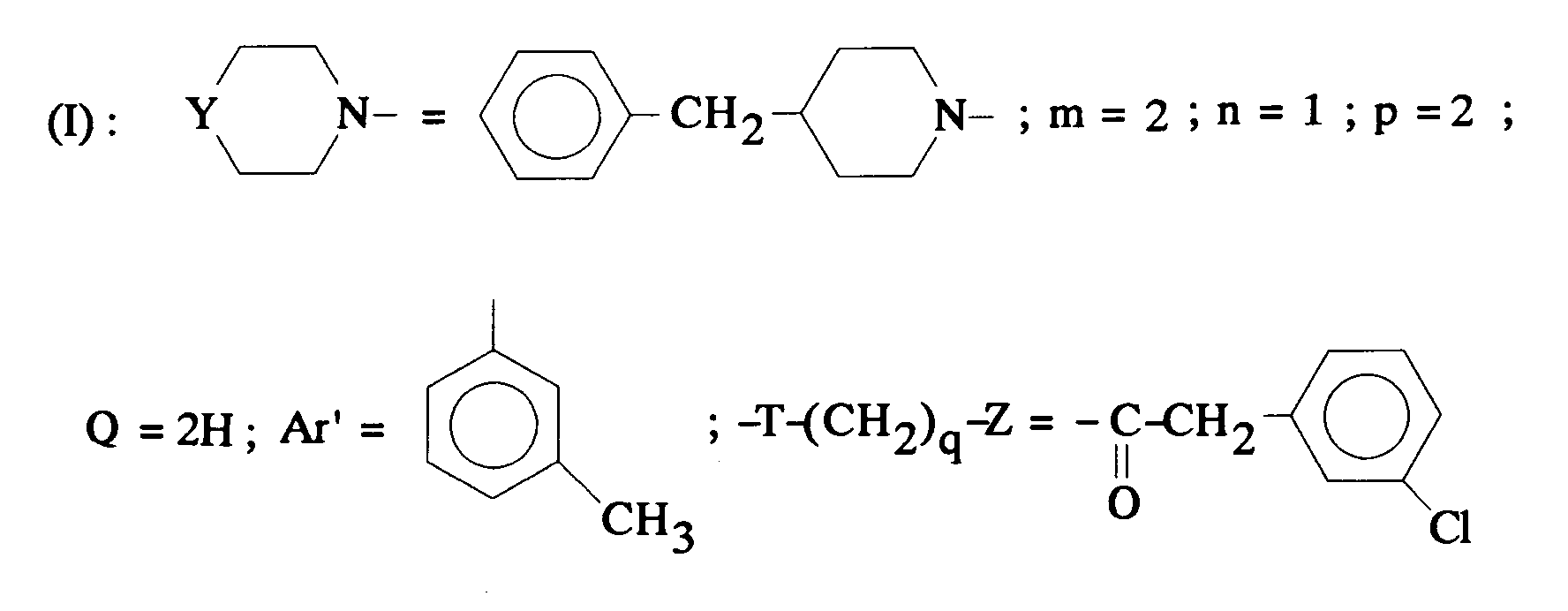
- Le composé ci-dessus est préparé selon le Schéma 5 de la description.
- A 21 g de 4-(2-hydroxyéthyl)-4-(3-méthylphényl)-N-tritylpipéridine (préparé selon le schéma 5) en solution dans 200 ml de dichlorométhane et refroidis à 0°C, on ajoute goutte à goutte 3,8 ml de chlorure de méthanesulfonyle. Le mélange réactionnel est laissé une demi-heure à température ambiante, lavé deux fois à l'eau, séché sur MgSO₄ et concentré sous vide.
- On obtient ainsi 23,5 g d'une mousse.
- 18,5 g du mésylate précédemment décrit et 13,5 g de 4-benzylpipéridine en solution dans 40 ml de diméthylformamide sont chauffés pendant 4 heures à 60°C. On verse le mélange réactionnel sur 500 ml d'eau glacée, filtre le précipité et rince à l'eau. On reprend le précipité dans l'éther, lave avec NaOH diluée puis à l'eau, sèche sur MgSO₄ et concentre à sec.
- On purifie le résidu obtenu par chromatographie sur gel de silice, éluant : CH₂Cl₂/CH₃OH 100/3 (v/v). On obtient ainsi 18 g d'une mousse.
- 18 g du produit précédent en solution dans 150 ml d'acide formique à 50 % sont chauffés à 60°C pendant 30 minutes. On refroidit, sépare le triphénylcarbinol par filtration, rince à l'eau, concentre à sec. Le résidu est repris à l'eau, lavé à l'éther, alcalinisé avec une solution de NaOH, extrait au dichlorométhane, séché sur MgSO₄ et concentré à sec.
- La base est dissoute dans du dichlorméthane, on additionne de l'éther saturé d'acide chlorhydrique et concentre à sec. On agite le chlorhydrate ainsi préparé dans l'éther, filtre et sèche.
m = 12,7 g
F = 160°C. - A 2 g de produit précédemment préparé en solution dans 30 ml de dichlorométhane avec 0,77 g d'acide 3-chlorophénylacétique et 2,2 g de triéthylamine on ajoute 2,4 g de BOP. On agite le mélange réactionnel pendant 30 minutes à température ambiante, concentre à sec, reprend le résidu dans l'acétate d'éthyle, lave à l'eau, puis avec une solution de NaOH diluée, puis à l'eau saturée en NaCl, sèche sur MgSO₄ et concentre sous vide. On purifie le résidu par chromatographie sur gel de silice, éluant : CH₂Cl₂/CH₃OH 100/10 (v/v). On prépare le chlorhydrate par addition d'éther saturé d'acide chlorhydrique et, on concentre à sec. On reprend le résidu dans l'éther isopropylique filtre et sèche sous vide.
m = 2,1 g.
F = 106°C. - En procédant comme indiqué ci-dessus à l'exemple 22 on prépare les composés décrits dans le Tableau IV ci-dessous.

-

- De façon identique à l'étape A selon l'exemple 1 et à partir de 37,2 g de 3,4-dichlorophénylacétonitrile et de 44,6 g de 3-bromopropoxytétrahydropyrane, on obtient 35 de produit attendu.
- A partir de 35 g du produit précedemment obtenu et de 19,2 g de bromopropionate d'éthyle, en procédant de façon identique à l'étape B selon l'exemple 1 on obtient 28 g de produit attendu.
- 23 g du produit précédemment obtenu, en solution dans 650 ml d'éthanol, sont hydrogénés à pression atmosphérique et température ambiante en présence de nickel de Raney. Lorsque le volume théorique d'hydrogène est consommé, on filtre le catalyseur, évapore à sec, reprend le résidu à l'éther, lave à l'eau, au tampon pH = 2, sèche sur Na₂SO₄ et évapore à sec.
- On obtient ainsi 18 de produit attendu.
- 14 g du produit précédemment obtenu en solution dans 50 ml de tétrahydrofurane sont ajoutés goutte à goutte à une suspension de 2,75 g d'hydrure de lithium aluminium chauffée à 60°C.
- On maintient la température à 60°C pendant 1 heure. On refroidit le mélange réactionnel, hydrolyse par addition de 3 ml d'eau, 3 ml d'une solution de NaOH 4N et 9 ml d'eau. On sépare le minéral et évapore la phase organique sous vide.
- On obtient ainsi 12,4 g de produit attendu.
- 3,9 g de BOP sont ajoutés à une solution de 3 g du produit précédemment préparé, 2,4 g de triéthylamine et 1,3 g d'acide 3-méthoxyphénylacétique dans 50 ml de dichlorométhane. On agite le mélange réactionnel pendant 1 heure à température ambiante, évapore à sec, reprend à l'AcOEt, lave à l'eau sèche sur Na₂SO₄ et évapore à sec.
- On purifie le résidu ainsi obtenu par chromatographie sur gel de silice, éluant : CH₂Cl₂/CH₃OH 100/2 (v/v).
- La concentration des fractions pures fournit 3 g de produit attendu.
- A partir de 3 g de produit précédemment préparé et de 0,68 g de chlorure de mésyle on obtient le composé attendu en procédant comme décrit selon l'étape C de l'exemple 2. Après purification par chromatographie sur gel de silice, éluant : CH₂Cl₂/CH₃OH 100/1,5 (v/v) et concentration des fractions de produit pur, on obtient 2 g du produit attendu.
- 2 g de produit obtenu précédemment et 1,6 g de 4-benzylpipéridine en solution dans 3 ml de diméthylformamide sont chauffés pendant 1 heure à 70°C. On refroidit le mélange réactionnel, verse dans l'eau, extrait à l'éther, lave à l'eau et sèche sur Na₂SO₄, filtre et concentre sous vide.
- On purifie le résidu ainsi obtenu par chromatographie sur gel de silice, éluant : CH₂Cl₂/CH₃OH 100/3 (v/v). Les fractions pures sont concentrées sous vide, le résidu est repris dans l'acétone et on prépare le chlorhydrate par addition d'éther saturé d'acide chlorhydrique. On filtre le chlorhydrate, lave au pentane et sèche sous vide sur P₂O₅.
- On obtient ainsi 1,1 g de produit attendu.
F = 108°C -

- 1,13 g de chlorure de benzoyle sont additionnés à 3 g de 3-tétrahydropyranyloxypropyl-3-(3,4-dichlorophényl)pipéridine préparé selon l'exemple 26, étape D en présence de 1,62 g de triéthylamine en solution dans 50 ml de dichlorométhane. On agite le mélange réactionnel pendant 30 minutes à température ambiante, évapore à sec, reprend le résidu à l'éther, lave à l'eau, sèche sur Na₂SO₄ et évapore à sec. On purifie le résidu ainsi obtenu par chromatographie sur gel de silice, éluant: CH₂Cl₂/CH₃OH 100/1 (v/v).
- On obtient ainsi 3 g d'une huile.
- A 3 g de produit préparé précédemment en solution dans 50 ml de méthanol on ajoute de l'éther saturé d'acide chlorhydrique jusqu'à pH = 1. On agite le mélange réactionnel pendant 30 minutes à température ambiante et évapore à sec. On reprend le résidu par 50 ml de dichlorométhane et 1,07 g de triéthylamine puis on ajoute 0,72 g de chlorure de mésyle. On agite à température ambiante pendant 1 heure, évapore à sec, reprend le résidu dans l'acétate d'éthyle, lave à l'eau et sèche sur Na₂SO₄, filtre et concentre sous vide. On purifie le résidu par chromatographie sur gel de silice, éluant : CH₂Cl₂/AcOEt 100/3 (v/v).
- On obtient ainsi 1,6 g du produit attendu.
-
- 1,5 g de produit préparé précédemment et 1,5 g de 4-phényl-4-acétamidopipéridine en solution dans 5 ml de diméthylformamide sont chauffés à 80°C pendant 4 heures. On refroidit le mélange réactionnel, verse dans l'eau, extrait au dichlorométhane, lave à l'eau et sèche sur Na₂SO₄, filtre et concentre sous vide. On purifie le résidu par chromatographie sur gel de silice, éluant : CH₂Cl₂/CH₃OH 100/5 (v/v). On concentre les fractions de produit pur, reprend au dichlorométhane et prépare le chlorhydrate par addition d'éther saturé d'acide chlorhydrique, évapore à sec, reprend le résidu dans l'éthanol et précipite dans de l'éther. On filtre, lave le précipité au pentane et sèche sous vide.
m = 0,60 g
F = 184°C. -

- 0,66 g de NaH à 60 % sont ajoutés à une solution de 6,4 g de 5-tétrahydropyranyloxypropyl-5-(3,4-dichlorophényl)pipéridone, décrit à l'étape C selon l'exemple 26, dans 60 ml de diméthylformamide. On agite le mélange réactionnel pendant 30 minutes à température ambiante. On ajoute ensuite goutte à goutte 2,5 g de chlorure de 3-méthoxybenzyle et chauffe le mélange réactionnel pendant 1 heure à 80°C. On évapore le diméthylformamide sous vide, extrait le résidu au dichlorométhane, lave à l'eau, sèche sur Na₂SO₄ et évapore à sec.
- On purifie le résidu ainsi obtenu par chromatographie sur gel de silice, éluant : CH₂Cl₂/AcOEt 100/5 (v/v). On concentre les fractions de produit pur pour obtenir 6 g d'une huile.
- 6 g du produit précédemment préparé en solution dans 50 ml de méthanol saturé d'acide chlorhydrique sont agités à température ambiante pendant une heure.
- On évapore à sec pour obtenir 4,3 d'une huile.
- 1,14 g de chlorure de mésyle sont ajoutés à 4,3 g du produit préparé précédemment en présence de 2 g de triéthylamine en solution dans 50 ml de dichlorométhane. On agite le mélange réactionnel pendant 1 heure à température ambiante, évapore à sec, reprend le résidu à l'AcOEt, lave à l'eau, à l'eau saturée de NaCl, sèche sur Na₂SO₄ et évapore à sec.
- On purifie le résidu ainsi obtenu par chromatographie sur gel de silice, éluant : CH₂Cl₂/CH₃OH 100/2 (v/v). On concentre les fractions de produit pur pour obtenir 4 g d'une huile.
- 4 g du produit préparé précédemment et 3,1 g de 4-hydroxy-4-phénylpipéridine en solution dans 5 ml de diméthylformamide sont chauffés à 80°C pendant 2 heures. On refroidit, verse dans l'eau, extrait à l'AcOEt, lave à l'eau, sèche sur Na₂SO₄ et évapore à sec. On reprend l'huile obtenue par de l'éther et prépare le chlorhydrate par addition d'éther saturé d'acide chlorhydrique. On filtre lave à l'éther et sèche sous vide.
m = 4 g
F = 110-117°C. -

- 2 g de 5-[3-(4-hydroxy-4-phényl-1-pipéridinyl)propyl]-5-(3,4-dichlorophényl)-1-(3-méthoxybenzyl)pipéridone sont ajoutés à une suspension de 0,60 g d'hydrure de lithium aluminium dans 50 ml de tétrahydrofurane. On chauffe le mélange réactionnel pendant 1 heure à 60°C refroidit, hydrolyse par 5 ml d'eau, filtre le minéral et évapore à sec.
- On purifie le résidu ainsi obtenu par chromatographie sur gel de silice, éluant : CH₂Cl₂/CH₃OH 100/5 (v/v), on concentre les fractions de produit pur et prépare le chlorhydrate dans le dichlorométhane par addition d'éther saturé d'acide chlorhydrique.
- On sépare le chlorhydrate par filtration, lave à l'éther et sèche sous vide sur P₂O₅.
m = 1,5 g
F = 106-175°C. -
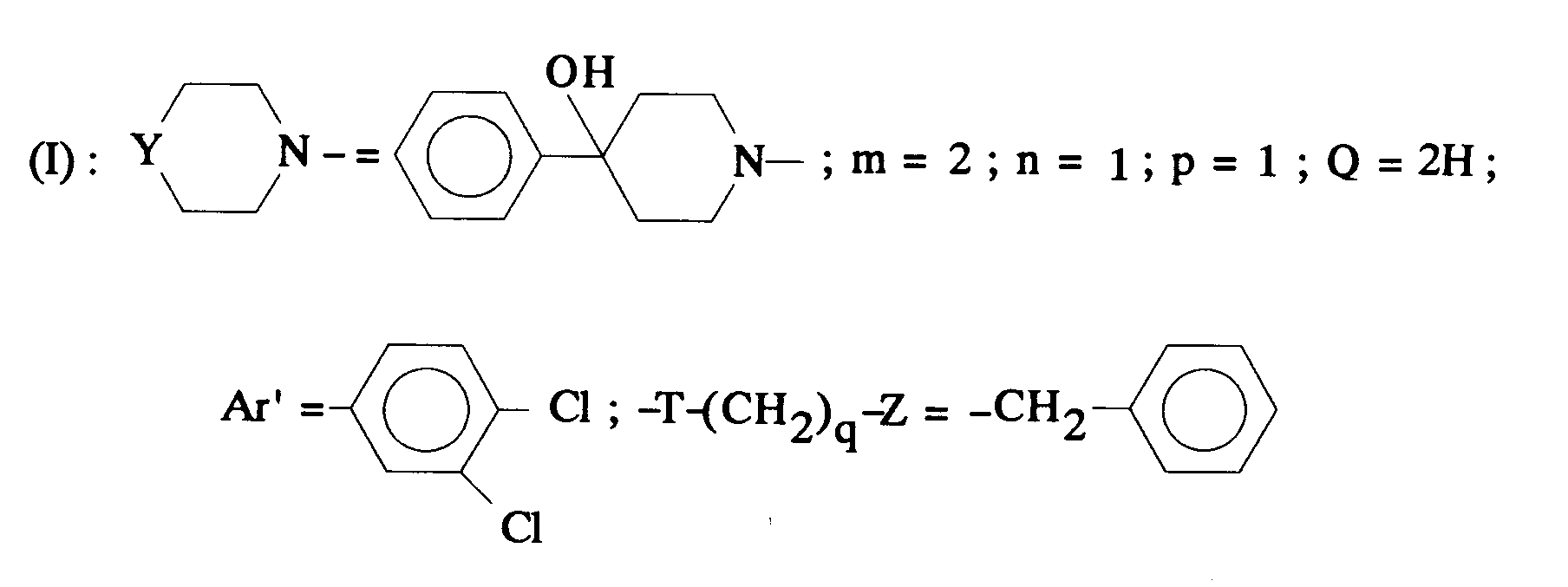
- En procédant selon l'exemple 29 et à partir du produit décrit à l'exemple 5, on obtient le produit attendu.
F = 170°C. -
- En procédant selon l'exemple 29, à partir du produit décrit à l'exemple 17, on obtient le composé ci-dessus.
F = 140°C. -

- A 55 g de 3-tétrahydropyranyloxyéthyl-3-(3,4-dichlorophényl)pipéridine en solution dans 200 ml de méthanol on ajoute de l'éther chlorhydrique jusqu'à pH = 1. On agite une demi-heure à température ambiante, concentre à sec, reprend le résidu à l'eau, basifie avec une solution d'hydroxyde de sodium, extrait au dichlorométhane, lave avec une solution saturée de NaCl, sèche sur Na₂SO₄ et évapore à sec. On obtient une huile.
- On reprend par 200 ml d'un mélange éther isopropylique/éther 50/50 (v/v). On agite, filtre, lave à l'éther et sèche sous vide sur P₂O₅.
m = 45 g
F = 122°C. - A 43 g de produit obtenu précédemment en solution au reflux dans 250 ml d'éthanol 100°, on ajoute 23,54 g d'acide L (+) tartrique en solution dans 750 ml d'éthanol 100°. On chauffe le mélange réactionnel à reflux pendant une demi-heure, laisse revenir à température ambiante, on filtre les cristaux obtenus, lave à l'éthanol 100° et sèche sous vide à 50°C sur P₂O₅.
m = 31 g - On recristallise ensuite dans 540 ml d'éthanol 100°, filtre, lave à l'éther et sèche sous vide sur P₂O₅.
m = 25 g
[α]
- Le tartrate est ensuite repris dans l'eau, on neutralise avec une solution de NaOH, extrait au dichlorométhane, lave à l'eau, sèche sur Na₂SO₄ et évapore à sec. On reprend l'huile dans un mélange éther/éther isopropylique, filtre les cristaux, lave à l'éther et sèche sous vide à 50°C.
m = 13,5 g
F = 138°C
[α]
- En procédant comme précédemment à partir de l'acide D (-) tartrique on obtient, l'énantiomère (-).
F = 139°C
[α]
- A 13 g de 3-(2-hydroxyéthyl)-3-(3,4-dichlorophényl)pipéridine (+) en solution dans 100 ml de dioxane on additionne 12,4 g de di-tert-butyldicarbonate. On agite ensuite pendant 1 heure à 40°C. On évapore à sec, reprend le résidu à l'éther, lave à l'eau puis avec une solution tampon pH = 2 et finalement à l'eau. On sèche sur Na₂SO₄, filtre et évapore à sec. On purifie le résidu par chromatographie sur gel de silice, éluant : CH₂Cl₂/CH₃OH 100/2 (v/v). On obtient ainsi après concentration des fractions pures 16,7 g de produit attendu sous forme d'huile.
- A 16,5 g du produit précédemment préparé en solution dans 100 ml de dichlorométhane en présence de 4,9 g de triéthylamine, on ajoute goutte à goutte, 5,5 g de chlorure de mésyle. On agite une demi-heure à température ambiante, évapore à sec, reprend le résidu à l'éther, lave à l'eau, sèche sur Na₂SO₄ et concentre sous vide. On obtient ainsi 19 g d'une huile.
- 18 g de produit précédent et 14 g de 4-benzylpipéridine en solution dans 40 ml de diméthylformamide sont chauffés à 80°C pendant 3 heures. On évapore ensuite le diméthylformamide, reprend le résidu à l'eau, extrait à l'éther, lave à l'eau, sèche sur Na₂SO₄ et concentre sous vide. On purifie le résidu par chromatographie sur gel de silice, éluant : CH₂Cl₂/CH₃OH 100/3 (v/v). Les fractions pures sont concentrées sous vide.
m = 15 g. - 15 g de produit précédent en solution dans 75 ml de méthanol, 60 ml d'acide chlorhydrique concentré et 15 ml d'eau sont agités à température ambiante pendant 1 heure. On évapore à sec, reprend le résidu par 100 ml de dichlorométhane et précipite sur de l'éther. On filtre le précipité, lave à l'éther et sèche sous vide.
m = 11,5 g
F = 175°C
[α]
- 10,6 g de BOP sont ajoutés à 11 g du produit précédent, 6,09 g de triéthylamine et 4,65 g d'acide 3-isopropoxyphénylacétique en solution dans 100 ml de dichlorométhane. On agite à température ambiante pendant 1 heure, évapore à sec, reprend le résidu à l'acétate d'éthyle, lave à l'eau, sèche sur Na₂SO₄, filtre et concentre sous vide. On purifie le résidu par chromatographie sur gel de silice, éluant : CH₂Cl₂/CH₃OH 100/5 (v/v). Les fractions propres sont concentrées sous vide, on prépare le chlorhydrate dans le CH₂Cl₂ par addition d'éther saturé d'acide chlorhydrique, évapore à sec, cristallise dans l'éther isopropylique, filtre, lave à l'éther et sèche sous vide.
m = 11,4 g
F = 105°C
[α]
-

- En procédant selon l'exemple 32 et en utilisant comme produit de départ l'énantiomère 3-(2-hydroxyéthyl)-3-(3,4-dichlorophényl)-pipéridine (-), on obtient le composé 33 ci-dessus, énantiomère (+).
F = 105°C
[α]
-

-
- 0,9 g de 3-méthanesulfonyloxyéthyl-3-(3,4-dichlorophényl)-1-tert-butylcarbamoyl -pipéridine préparés selon l'exemple 32, étape B), et 0,88 g de 4-hydroxy-4-phénylpipéridine en solution dans 3 ml de diméthylformamide sont chauffés à 80°C pendant 2 heures. On évapore à sec, reprend le résidu à l'eau, extrait à l'AcOEt, lave à l'eau saturée de NACl, sèche sur MgSO₄ et évapore à sec. On purifie le résidu par chromatographie sur gel de silice, éluant : CH₂Cl₂/CH₃OH 100/2 (v/v). On concentre les fractions propres pour obtenir 0,8 d'une huile.
- 0,8 g de produit précédent en solution dans 5 ml de méthanol, 4 ml d'acide chlorhydrique concentré et 1 ml d'eau est agité pendant 1 heure à température ambiante. On évapore ensuite à sec et utilise le résidu tel quel à l'étape suivante.
m = 0,77 g - A 0,77 g de produit précédent et 0,3 g de triéthylamine en solution dans 30 ml de dichlorométhane, on ajoute 0,26 g de chlorure de benzoyle. On agite le mélange réactionnel pendant 1 heure à température ambiante, évapore à sec, reprend le résidu dans l'acétate d'éthyle, lave à l'eau, sèche sur Na₂SO₄ et évapore à sec. On purifie par chromatographie sur gel de silice, éluant : CH₂Cl₂/CH₃OH 100/3 (v/v). On concentre les fractions propres, reprend au CH₂Cl₂ et prépare le chlorhydrate par addition d'éther saturé d'acide chlorhydrique. On évapore à sec, cristallise le résidu dans l'éther, filtre, lave à l'éther et sèche sous vide.
m = 0,2 g
F = 176°C
[α]
-

- En procédant selon l'exemple 34 à partir du 3-(2-hydroxyéthyl)-3-(3,4-dichloro -phényl)pipéridine (-) on obtient l'énantiomère (+) ci-dessus.
F = 176°C
[α]
-

- 1 g du produit décrit à l'exemple 14 en solution dans 10 ml d'iodure de méthyle est agité à température ambiante pendant 24 heures. On concentre ensuite sous vide. Le résidu est chromatographié sur gel de silice, éluant : CH₂Cl₂/CH₃OH 100/3 (v/v). Le premier produit élué coffespond à celui dont le méthyle en position sur l'azote (b) de la 4-benzylpipéridine est en position axiale.
m = 0,35 g
Spectre de RMN ¹³C:
-

- En procédant comme pour l'exemple 36 précédemment décrit et en recueillant la fraction éluée en deuxième lieu, on obtient le produit dont le méthyle sur l'azote (b) de la 4-benzylpipéridine est en position équatoriale.
m = 0,15 g
Spectre de RMN ¹³C:
- En procédant selon les exemples 36 et 37 ci-dessus, on prépare les sels d'ammonium quaternaires décrits dans le Tableau V ci-dessous.

-

- 10 g du produit décrit à l'exemple 32 en solution dans 50 ml d'iodure de méthyle sont agités à température ambiante pendant 2 heures. On évapore à sec et le résidu est chromatographié sur gel de silice, éluant : CH₂Cl₂/CH₃OH 100/3 (v/v). Le conformère qui est élué en premier correspond à celui dont le méthyle est en position axiale sur l'azote (b) de la 4-benzylpipéridine.
- L'ion iodure est ensuite échangé par l'ion chlorure en éluant le produit sur une résine échangeuse d'ion l'Amberlite IRA68.R
- On obtient ainsi 5,6 g du chlorure d'ammonium quaternaire.
F = 103°C
[α]
-

- En procédant de manière identique à l'exemple 44, à partir du produit décrit à l'exemple 33, on obtient 8,9 g du sel d'ammonium quaternaire attendu.
F = 104°C
[α]
-
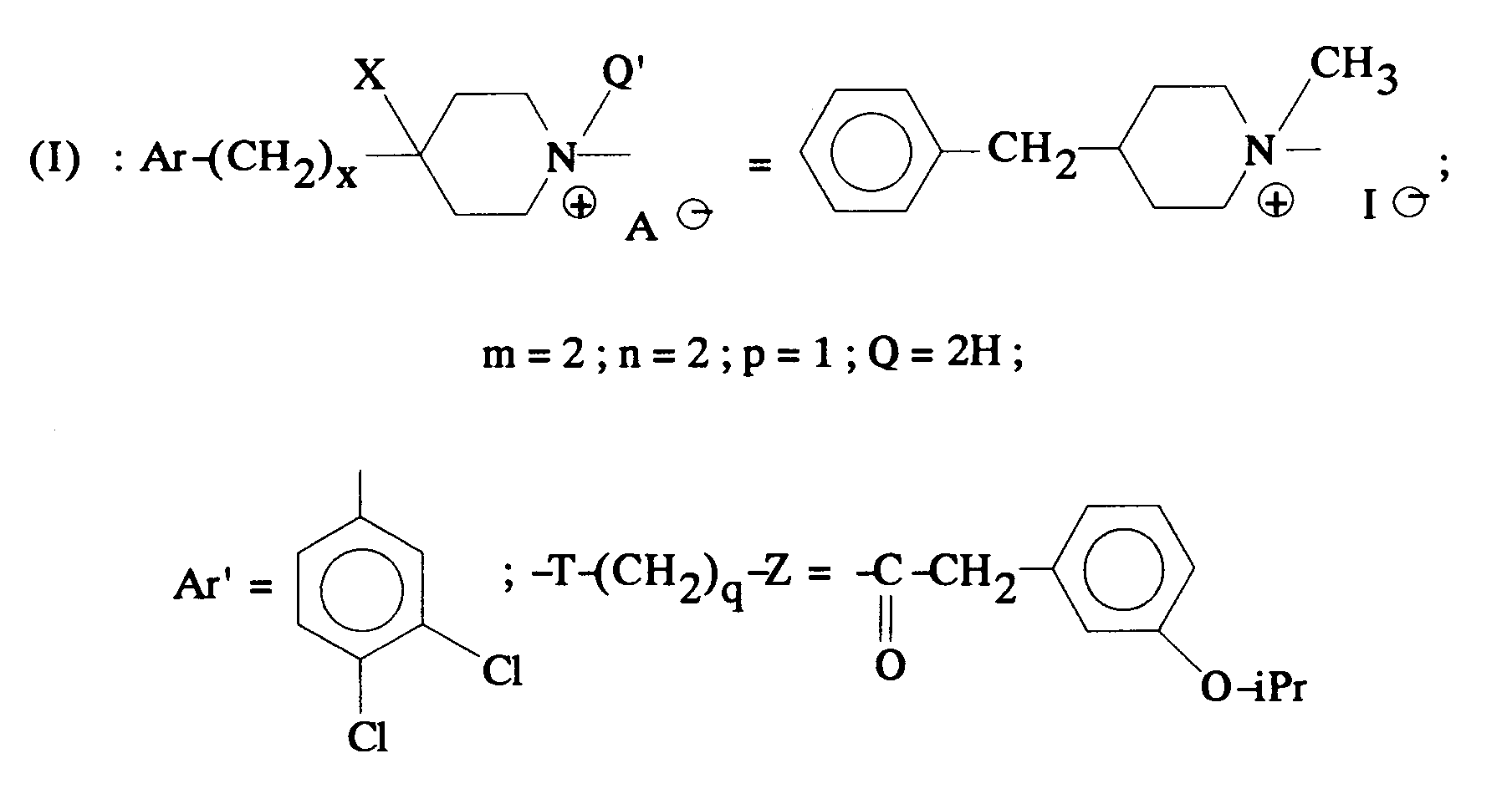
- En procédant selon l'exemple 44 A) et en recueillant la fraction éluée en deuxième lieu, on obtient l'énantiomère dont le méthyle sur l'azote (b) de la 4-benzylpipéridine est en position équatoriale. On obtient ainsi 2,6 g du sel d'ammonium quaternaire.
F = 110°C
[α]
-
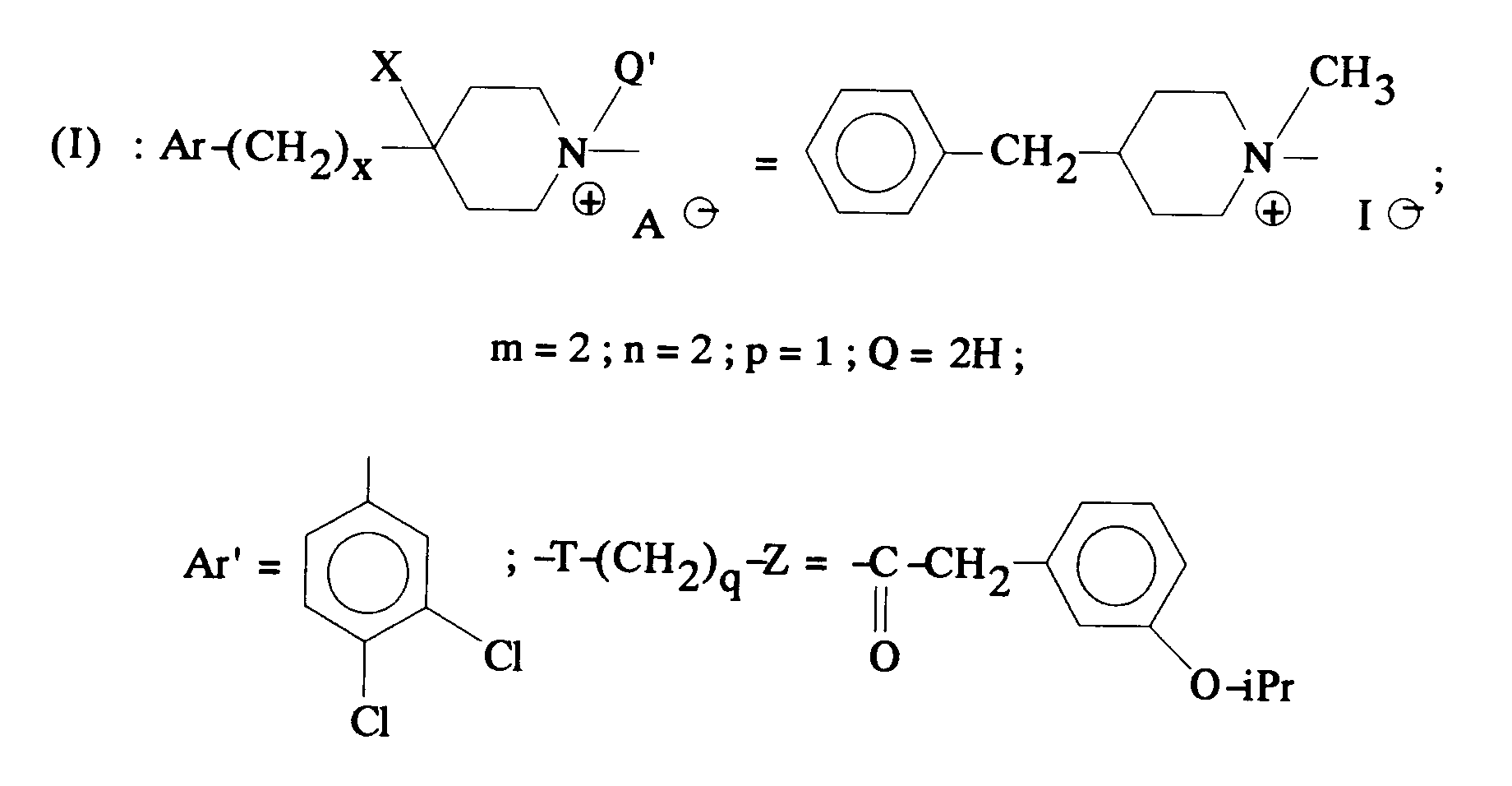
- En procédant selon l'exemple 46 à partir du produit décrit à l'exemple 33, on obtient le produit attendu.
F = 110°C
[α]
-
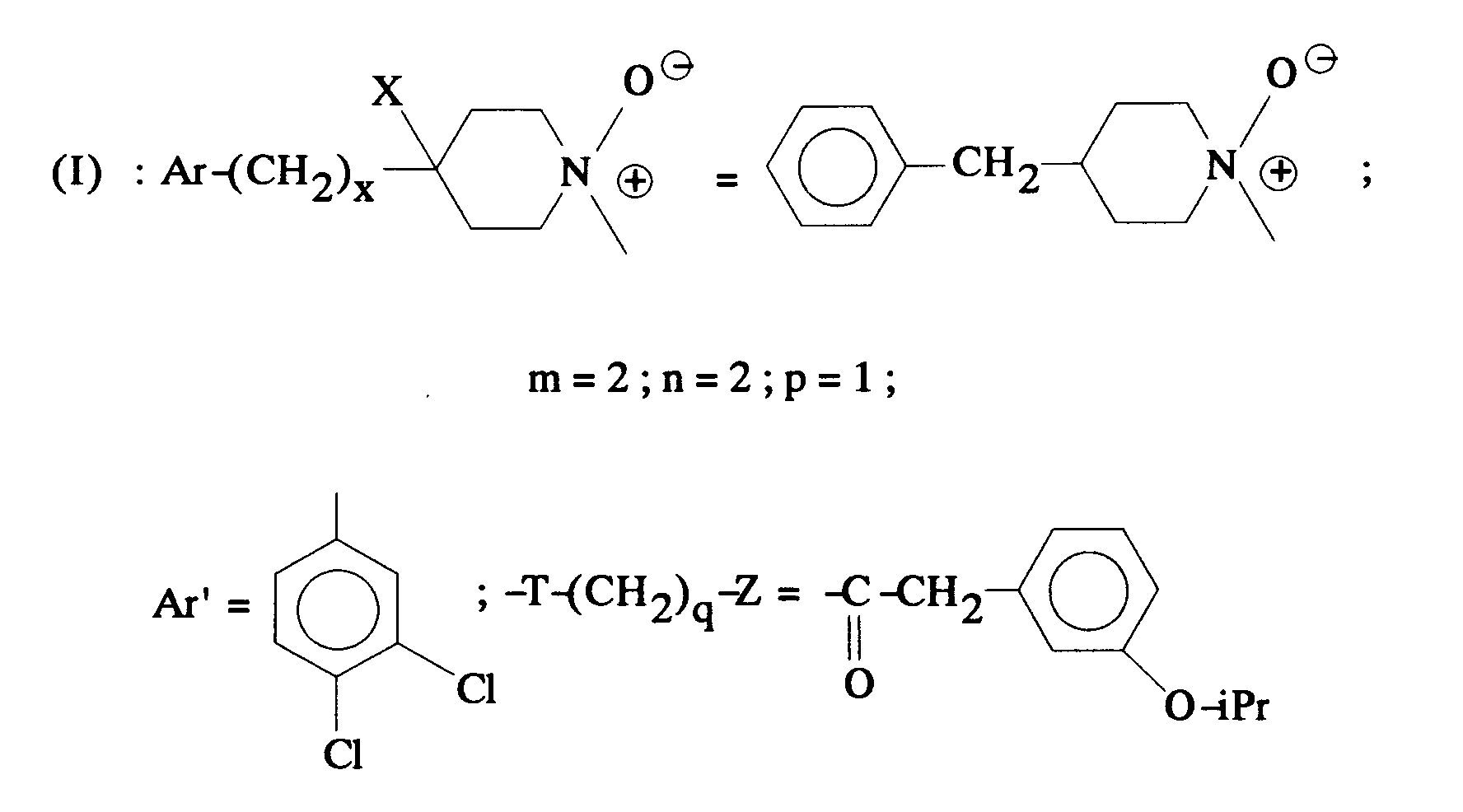
- 2 g de la base libre du composé de l'exemple 14 sont mis en solution dans 20 ml de tétrahydrofurane. On ajoute 1,1 g d'acide métachloroperbenzoïque et agite la mélange réactionnel pendant 2 heures à température ambiante. On concentre sous vide jusqu'à un volume de 5 ml et dilue le résidu dans 10 ml de dichlorométhane. On lave deux fois la solution avec une solution saturée de NaHCO₃, décante, sèche sur MgSO₄ et concentre sous vide. On chromatographie le résidu sur gel de silice, éluant : CH₂Cl₂/CH₃OH 100/5 (v/v). On concentre les fractions de produit pur sous vide et cristallise le résidu dans l'éther isopropylique.
m = 1,47 g
F = 135°C. - Intermédiaire de synthèse de formule (II).

- A 94 g de 3,4-dichlorophénylacétonitrile en solution dans 500 ml d'éther anhydre, on ajoute par petites portions 23,5 g d'amidure de sodium. On agite ensuite pendant 1 heure à température ambiante puis pendant 3 heures à reflux. On refroidit le mélange à 0°C et on ajoute goutte à goutte 129 g de 2-(4-benzyl-1-pipéridinyl)-1-chloroéthane en solution dans 300 ml d'éther. On laisse revenir le mélange réactionnel à température ambiante puis on chauffe pendant 3 heures à reflux. On refroidit, verse sur 600 ml d'eau, décante la phase organique, lave à l'eau et extrait 2 fois avec 500 ml d'une solution d'HCl 15 %. On agite la phase aqueuse et le produit précipite sous forme de chlorhydrate. On filtre, lave à l'eau et sèche sous vide. On recristallise le résidu dans 600 ml d'isopropanol. On obtient ainsi 95 g.
- Le produit est repris dans l'eau et la solution est neutralisé par une solution de NaOH. On extrait à l'éther, lave à l'eau, sèche sur Na₂SO₄ et évapore à sec. On obtient 87 g d'une huile.
- 87 g du produit précédemment décrit, 28 g d'acrylate d'éthyle et 2,5 ml de triton B en solution dans 45 ml de dioxane sont chauffés pendant 24 heures à 80°C. On refroidit, reprend à l'éther, lave à l'eau, sèche sur Na₂SO₄ et évapore à sec. On obtient 109,5 g d'une huile.
-
- 100 g du produit préparé précédemment en solution dans 1,5 litre d'éthanol sont hydrogénés à 60°C et à pression atmosphérique en présence de Ni de Raney. Lorsque le volume d'hydrogène est consommé, on filtre le catalyseur, évapore à sec, reprend au dichlorométhane, lave à l'eau et sèche sur Na₂SO₄. On forme ensuite le chlorhydrate que l'on recristallise dans 220 ml d'isopropanol. On filtre et sèche sous vide. Le produit est repris dans l'eau, on neutralise avec une solution de NaOH, extrait à l'éther et sèche sur Na₂SO₄. On obtient 44 g d'une huile.
- 44 g du produit précédent en solution dans 200 ml de tétrahydrofurane sont ajoutés goutte à goutte à une suspension de 9,4 g d'hydrure de lithium aluminium dans 250 ml de tétrahydrofurane chauffé à 60°C. On continue à chauffer à reflux pendant 3 heures. On refroidit dans la glace et ajoute successivement 10 ml d'eau, 10 ml de NaOH 4N et 30 ml d'eau. On filtre le minéral et évapore le filtrat à sec, on reprend au dichlorométhane et prépare le chlorhydrate. On évapore à sec, triture dans du pentane, filtre et sèche sous vide.
m = 35 g
F = 170°C. - Diastéréoisomère le moins polaire.
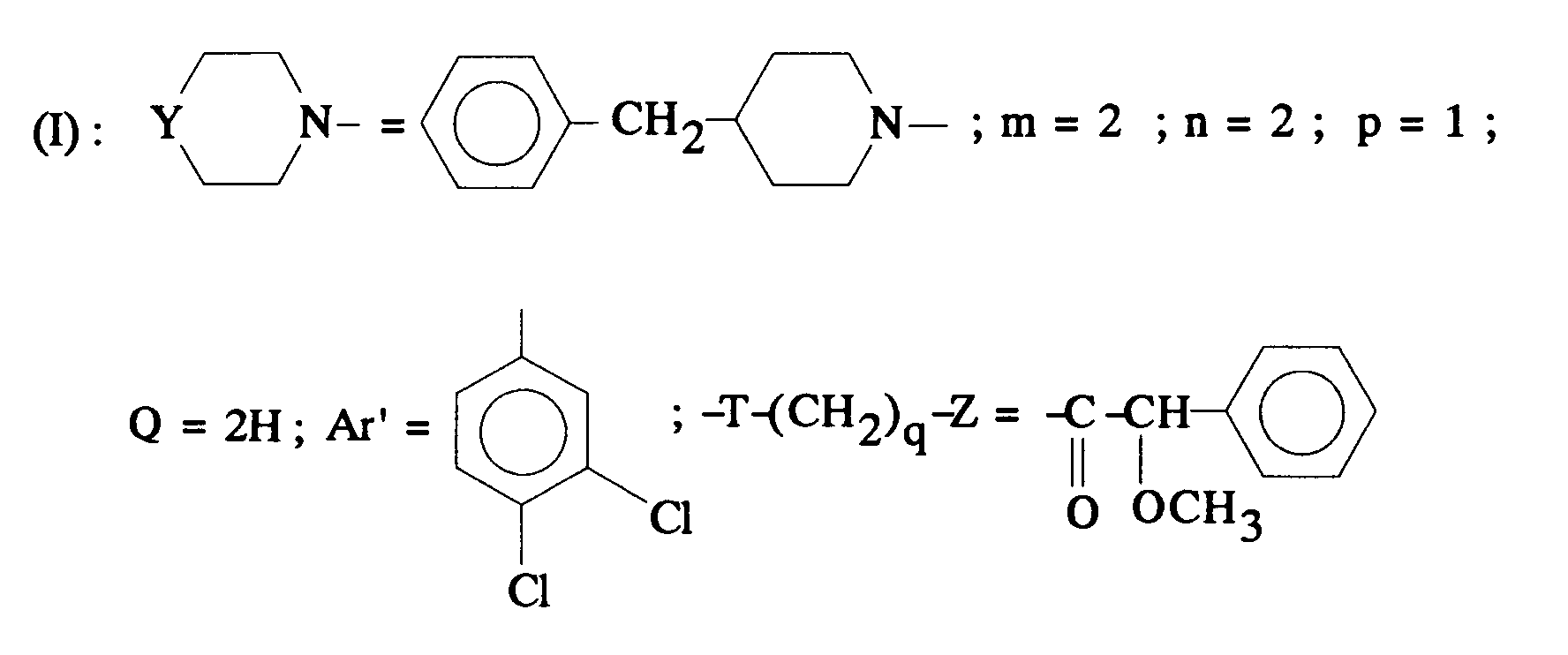
- On agite pendant 2 heures 1,5 g de la diamine préparée à l'exemple 49 ; 1,06 g de triéthylamine ; 0,55 g d'acide (±) α-méthoxyphénylacétique et 1,6 g de BOP dans 25 ml de dichlorométhane. On évapore à sec, reprend le résidu à l'acétate d'éthyle, lave à l'eau, sèche sur Na₂SO₄ et évapore à sec. On purifie le résidu par chromatographie sur gel de silice, éluant : CH₂Cl₂/CH₃OH 100/0,5 (v/v). Le produit qui est élué en premier est le produit attendu. Les fractions sont concentrées sous vide, on reprend au CH₂Cl₂, prépare le chlorhydrate, évapore à sec, triture dans du pentane, filtre et sèche sous vide.
m = 0,50 g
F = 134°C. - Diastéréoisomère le plus polaire.

- En procédant selon l'exemple 50 et en éluant avec un mélange CH₂Cl₂/CH₃OH 100/2 (v/v), on obtient le diastéréoisomère le plus polaire. On prépare le chlorhydrate dans le dichlorométhane, évapore à sec, reprend dans du pentane.
m = 0,50 g
F = 118°C. - En procédant selon les exemples 50 et 51, on prépare les couples de diastéréoisomères 52, 53 ; 54,55 et 56, 57 décrits dans le tableau VI ci-dessous.
- Le réactif acide α-hydroxy-3-isopropoxyphénylacétique utile pour la préparation des composés des exemples 56 et 57 qui est un produit nouveau, peut être préparé comme indiqué ci-dessous.
- A une solution de 50 g de 3-hydroxybenzaldéhyde dans 250 ml de DMF, on ajoute 60 g de K₂CO₃ Puis 60 ml de 2-iodopropane.
- On chauffe le mélange réactionnel à 50°C pendant 18 heures. Le mélange obtenu est versé sur 2,5 l d'eau. On extrait à l'éther, lave avec une solution NaOH diluée, puis à l'eau. On sèche sur MgSO₄, évapore le solvant pour obtenir 53,5 g d'un résidu liquide.
- 53 g de produit obtenu selon l'étape 1 précédente sont ajoutés à une solution de 38 g de bisulfite de sodium dans 120 ml d'eau. On agite pendant 20 heures puis on ajoute à 20°C une solution de 44,2 g de cyanure de potassium dans 90 ml d'eau.
- Après 2 heures, on extrait à l'éther, lave à l'eau, sèche sur MgSO₄ et évapore le solvant sous vide. Le résidu est chromatographié sur gel de silice, éluant : heptane/acétate d'éthyle 100/30 (v/v). On récupère 57 g de produit sous forme d'huile.
- 46 g de produit obtenu selon l'étape 2 précédente sont ajoutés à 50 ml d'eau et 50 ml d'HCl concentré. On chauffe à 110°C pendant 1 heure. Après refroidissement, on extrait à l'éther, lave à l'eau. L'acide est extrait avec une solution de NaOH diluée. On acidifie la phase aqueuse, extrait à l'éther, sèche sur MgSO₄, évapore les solvants. L'acide est cristallisé dans un mélange toluène/pentane 1/2 (v/v).
m = 27,5 g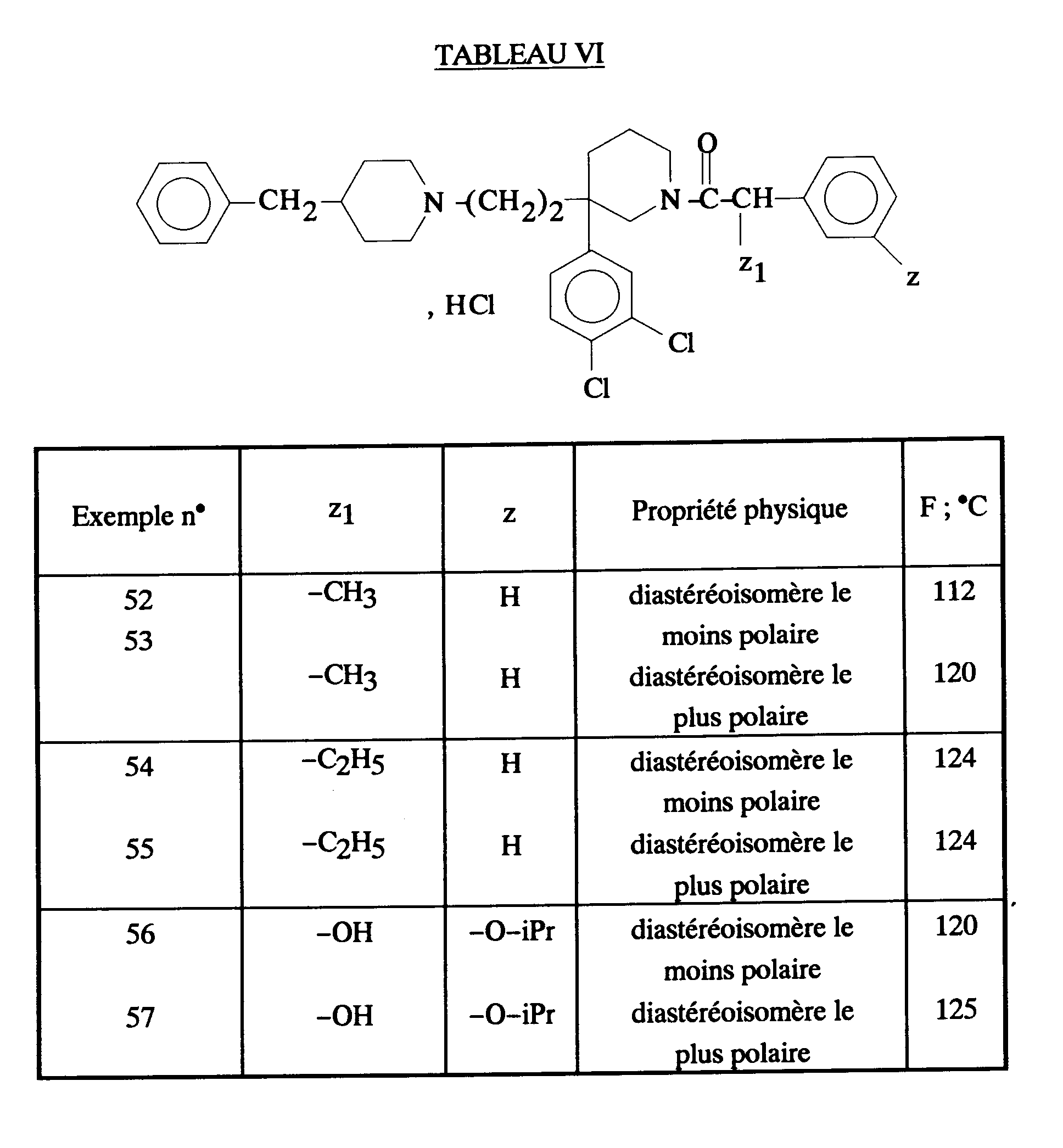
-

- On agite pendant 2 heures, 0,67 g de dichlorhydrate de 3-[2-(4-benzyl-1-pipéridinyl)éthyl]-3-(3,4-dichlorophényl)pipéridine (-) décrit à l'exemple 32 étape D, 0,17 g de triéthylamine, 0,32 g d'acide S (+) α-hydroxy-3-chlorophénylacétique et 0,82 g de BOP en solution dans 10 ml de dichlorométhane. On évapore à sec, reprend le résidu dans l'acétate d'éthyle, lave à l'eau, sèche sur Na₂SO₄, concentre sous vide. On purifie le résidu par chromatographie sur gel de silice, éluant : CH₂Cl₂/CH₃OH 100/1,5 (v/v). On concentre les fractions propres sous vide, reprend dans le dichlorométhane, prépare le chlorhydrate, évapore à sec et reprend au pentane. On filtre, lave à l'éther et sèche sous vide.
m = 0,40 g
F = 122°C
[α]
-

- En procédant selon l'exemple 58 à partir de la 3-[2-(4-benzyl-1-pipéridinyl )éthyl]-3-(3,4-dichlorophényl)pipéridine (+) préparée selon l'exemple 32 étape D à partir du 3-(2-hydroxyéthyl)-3-(3,4-dichlorophényl)pipéridine (-) décrite à l'étape C de la préparation de l'aminoalcool optiquement pur et avec l'acide R (-) α-hydroxy-3-chlorophénylacétique, on obtient le produit attendu.
m = 0,50 g
F = 122°C
[α]
-

- On agite à température ambiante pendant 2 heures 0,67 g de 3-[2-(4-benzyl-1-pipéridinyl)éthyl]-3-(3,4-dichlorophényl)pipéridine (-), 0,32 g d'acide R (-) α-hydroxy-3-chlorophénylacétique, 0,17 g de triéthylamine et 0,82 g de BOP en solution dans 50 ml de dichlorométhane. En procédant ensuite comme pour l'exemple 58, on obtient le produit attendu.
m = 0,40 g
F = 128°C
[α]
-

En procédant selon l'exemple 58, à partir de l'acide S (+) α-hydroxy-3-chlorophénylacétique et de la 3-[2-(4-benzyl-1-pipéridinyl)éthyl]-3-(3,4-dichlorophényl )pipéridine (+), préparée selon l'exemple 32 étape D et à partir de la 3-(2-hydroxyéthyl)-3-(3,4-dichlorophényl)pipéridine (-) décrite à l'étape C de la préparation de l'aminoalcool optiquement pur, on obtient le produit attendu.
m = 0,4 g
F = 127°C
[α]

un de leurs sels d'ammonium quaternaire ou dérivés N-oxyde formés avec l'azote (b) de la pipéridine.
Claims (13)


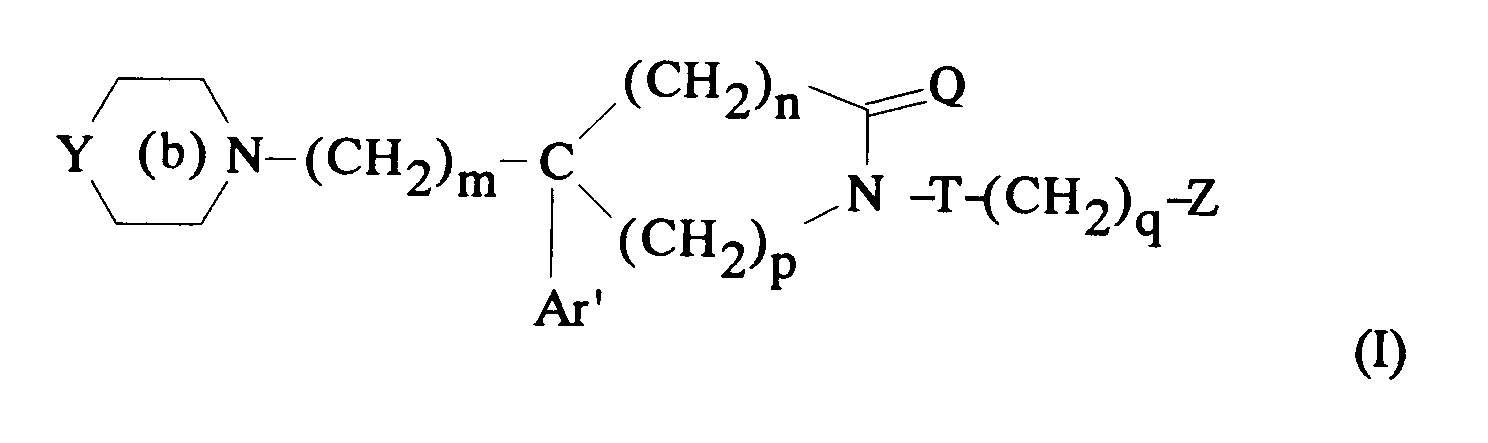
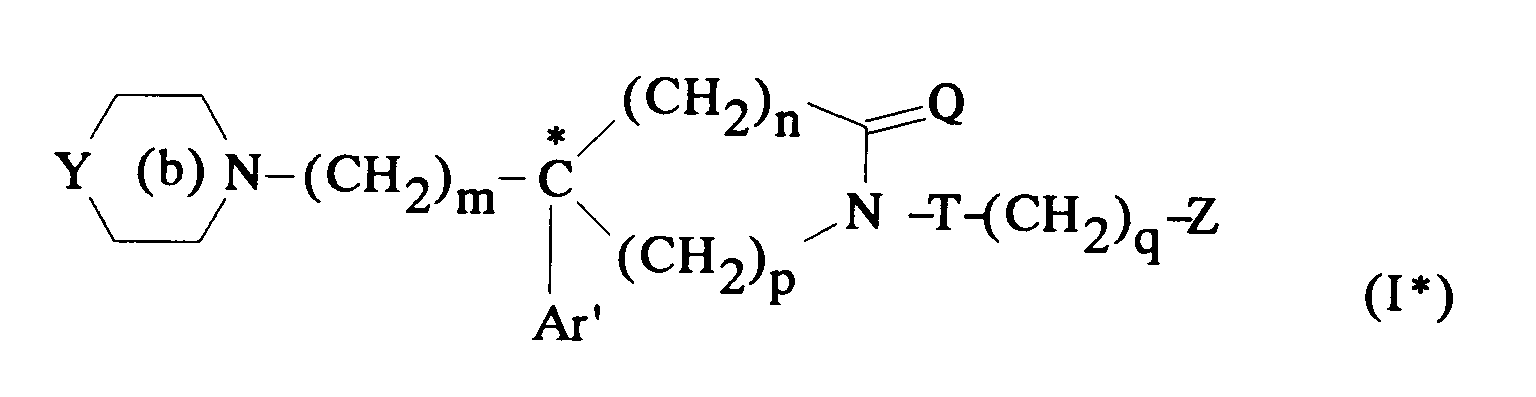
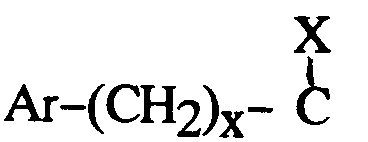


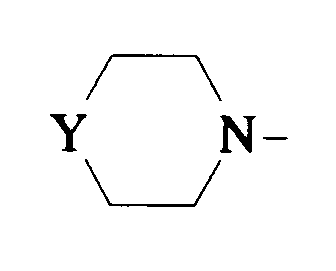


Hal-(CH₂)q+1-Z (IV)
dans laquelle q et Z sont tels que définis précédemment et où Hal représente un halogène et préférentiellement un atome de brome ou de chlore, lorsqu'on doit préparer un composé de formule (I) où T est -CH₂-,


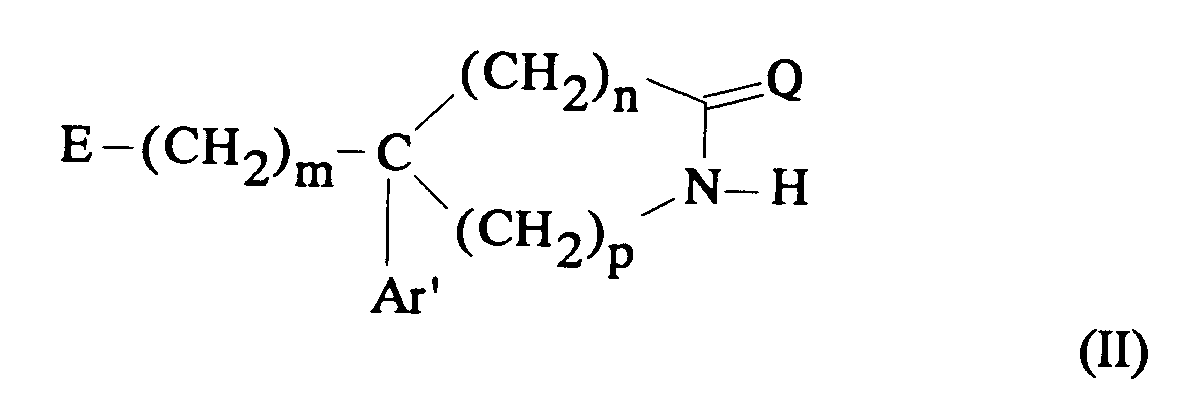
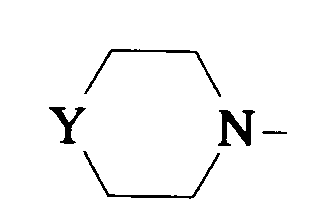


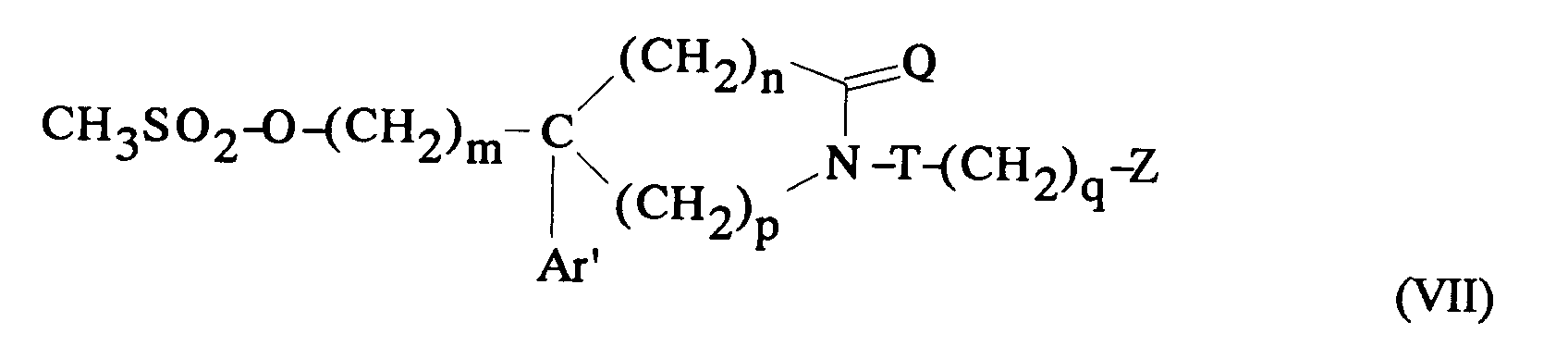


Applications Claiming Priority (2)
| Application Number | Priority Date | Filing Date | Title |
|---|---|---|---|
| FR9105487A FR2676055B1 (fr) | 1991-05-03 | 1991-05-03 | Composes polycycliques amines et leurs enantiomeres, procede pour leur preparation et compositions pharmaceutiques les contenant. |
| FR9105487 | 1991-05-03 |
Publications (2)
| Publication Number | Publication Date |
|---|---|
| EP0512901A1 true EP0512901A1 (fr) | 1992-11-11 |
| EP0512901B1 EP0512901B1 (fr) | 1999-06-23 |
Family
ID=9412520
Family Applications (1)
| Application Number | Title | Priority Date | Filing Date |
|---|---|---|---|
| EP92401235A Expired - Lifetime EP0512901B1 (fr) | 1991-05-03 | 1992-04-30 | Composés polycycliques aminés et leurs énantiomères, procédé pour leur préparation et compositions pharmaceutiques en contenant |
Country Status (26)
| Country | Link |
|---|---|
| US (2) | US5340822A (fr) |
| EP (1) | EP0512901B1 (fr) |
| JP (1) | JP3242980B2 (fr) |
| KR (2) | KR100258373B1 (fr) |
| AT (1) | ATE181550T1 (fr) |
| AU (1) | AU652046B2 (fr) |
| BR (1) | BR9201656A (fr) |
| CA (1) | CA2067877C (fr) |
| CZ (1) | CZ285409B6 (fr) |
| DE (1) | DE69229460T2 (fr) |
| DK (1) | DK0512901T3 (fr) |
| ES (1) | ES2137176T3 (fr) |
| FI (1) | FI101299B (fr) |
| FR (1) | FR2676055B1 (fr) |
| GR (1) | GR3030755T3 (fr) |
| HU (1) | HU220598B1 (fr) |
| IE (1) | IE921364A1 (fr) |
| IL (3) | IL117921A (fr) |
| MX (1) | MX9202027A (fr) |
| MY (1) | MY117274A (fr) |
| NO (1) | NO178573C (fr) |
| NZ (1) | NZ242586A (fr) |
| RU (1) | RU2083574C1 (fr) |
| TW (1) | TW219363B (fr) |
| UA (1) | UA35564C2 (fr) |
| ZA (1) | ZA923178B (fr) |
Cited By (100)
| Publication number | Priority date | Publication date | Assignee | Title |
|---|---|---|---|---|
| EP0559538A1 (fr) | 1992-03-03 | 1993-09-08 | Sanofi | Sels quaternaires de pipéridines 4-substitués, leur préparation et compositions pharmaceutiques les contenant |
| WO1993014084A3 (fr) * | 1992-01-21 | 1993-10-14 | Glaxo Group Ltd | Derives de piperidine |
| WO1994013639A1 (fr) * | 1992-12-14 | 1994-06-23 | Merck Sharp & Dohme Limited | 4-aminomethyl/thiomethyl/sulfonylmethyl-4-phenylpiperidines en tant qu'antagonistes du recepteur de tachykinine |
| WO1994016697A1 (fr) | 1993-01-19 | 1994-08-04 | Rhone-Poulenc Rorer S.A. | Association synergisante ayant un effet antagoniste des recepteurs nk1 et nk2 |
| WO1994026735A1 (fr) * | 1993-05-06 | 1994-11-24 | Merrell Dow Pharmaceuticals Inc. | Pyrrolidin-3-yl-alkyl-piperidines substituees utiles comme antagonistes de la tachykinine |
| WO1995005377A1 (fr) * | 1993-08-17 | 1995-02-23 | Zeneca Limited | Heterocycles aptes a etre utilises comme antagonistes de la neurokinine |
| WO1995012577A1 (fr) * | 1993-11-03 | 1995-05-11 | Zeneca Limited | Nouveaux lactames du type 4-piperidinyle substitues utilises en tant qu'antagonistes du recepteur de neurokinine 2 dans le traitement de l'asthme |
| WO1995015961A1 (fr) * | 1993-12-07 | 1995-06-15 | Zeneca Limited | Heterocycles bicycliques utilises comme antagonistes de la neurokinine a |
| WO1995016682A1 (fr) * | 1993-12-15 | 1995-06-22 | Zeneca Limited | Derives amides cycliques en tant qu'antagonistes de la neurokinine a |
| FR2717477A1 (fr) * | 1994-03-18 | 1995-09-22 | Sanofi Elf | Composés antagonistes sélectifs du récepteur NK3 humain et leur utilisation comme médicaments et outils de diagnostic. |
| FR2717478A1 (fr) * | 1994-03-18 | 1995-09-22 | Sanofi Sa | Composés antagonistes sélectifs du récepteur NK3 humain et leur utilisation comme médicaments et outils de diagnostic. |
| EP0673928A1 (fr) * | 1994-03-18 | 1995-09-27 | Sanofi | Nouveaux dérivés de la N-(3,4-dichlorophényl-propyl)-pipéridine comme antagonistes sélectifs du récepteur NK3 humain |
| FR2717804A1 (fr) * | 1994-03-25 | 1995-09-29 | Sanofi Sa | Sels de composés hétéroaromatiques azotés substitués, procédé pour leur préparation et compositions pharmaceutiques en contenant. |
| WO1995026338A1 (fr) * | 1994-03-29 | 1995-10-05 | Sanofi | Antagonistes des recepteurs des neurokinines |
| WO1996005193A1 (fr) | 1994-08-09 | 1996-02-22 | Pfizer Limited | (azetidin-1-ylalkyl) lactames utilises comme antagonistes de la tachykinine |
| WO1996006094A1 (fr) * | 1994-08-25 | 1996-02-29 | Merrell Pharmaceuticals Inc. | Nouvelles piperidines substituees utiles pour le traitement d'affections allergiques |
| EP0708101A1 (fr) * | 1994-10-21 | 1996-04-24 | Adir Et Compagnie | Nouveaux dérivés de pipéridine utiles comme antagonistes des récepteurs des neurokinines |
| FR2725900A1 (fr) * | 1994-10-21 | 1996-04-26 | Sanofi Sa | Utilisation d'antagonistes des recepteurs nk1 pour la preparation de medicaments a action cardioregulatrice |
| US5521199A (en) * | 1993-05-17 | 1996-05-28 | Zeneca Limited | Piperidinyl compounds as neurokinin receptor antagonists |
| EP0714891A1 (fr) * | 1994-11-22 | 1996-06-05 | Eli Lilly And Company | Antagonistes hétérocycliques de récepteurs de la tachykinine |
| EP0723959A1 (fr) * | 1995-01-30 | 1996-07-31 | Sanofi | Composés hétérocycliques comme antagonistes de récepteurs de la tachykinine, procédé pour leur préparation et compositions pharmaceutiques en contenant |
| FR2729954A1 (fr) * | 1995-01-30 | 1996-08-02 | Sanofi Sa | Composes heterocycliques substitues, procede pour leur preparation et compositions pharmaceutiques les contenant |
| FR2729952A1 (fr) * | 1995-01-30 | 1996-08-02 | Sanofi Sa | Composes heterocycliques substitues, procede pour leur preparation et compositions pharmaceutiques les contenant |
| US5607936A (en) * | 1994-09-30 | 1997-03-04 | Merck & Co., Inc. | Substituted aryl piperazines as neurokinin antagonists |
| FR2738245A1 (fr) * | 1995-08-28 | 1997-03-07 | Sanofi Sa | Nouveaux derives de piperidine, procede pour leur obtention et compositions pharmaceutiques les contenant |
| WO1997010211A1 (fr) * | 1995-09-14 | 1997-03-20 | Sanofi | Nouveaux composes antagonistes selectifs du recepteur nk3 humain, procede pour leur obtention et compositions pharmaceutiques les contenant |
| WO1997016440A1 (fr) * | 1995-10-30 | 1997-05-09 | Janssen Pharmaceutica N.V. | Derives de piperazine a substitution en positions 1-(diperidinyle a disubstitution en positions 1,2)-4 |
| WO1997019074A1 (fr) * | 1995-11-17 | 1997-05-29 | Hoechst Marion Roussel, Inc. | Nouvelles (1h-benzimidazol-2-yl-amino)piperidines a substitution en position 4 utiles pour le traitement de maladies allergiques |
| US5635509A (en) * | 1994-05-03 | 1997-06-03 | Zeneca Limited | Piperidine derivatives useful as neurokinin antagonists |
| US5635510A (en) * | 1993-05-06 | 1997-06-03 | Merrell Pharmaceuticals Inc. | Substituted pyrrolidin-3-yl-alkyl-piperidines |
| WO1997019942A1 (fr) * | 1995-11-25 | 1997-06-05 | Pfizer Limited | 5-azabicyclo(3,1,0)hexylalkyl-2-piperidones et -glutarimides en tant qu'antagonistes du recepteur des neurokinines |
| WO1997022597A1 (fr) * | 1995-12-18 | 1997-06-26 | Fujisawa Pharmaceutical Co., Ltd. | Derives de la piperazine antagonistes de la tachykinine |
| WO1997022604A1 (fr) * | 1995-12-20 | 1997-06-26 | Hoechst Marion Roussel, Inc. | Nouveaux 4-(1h-benzimidazol-2-yl) diazepanes substitues [1,4] utiles pour traiter des maladies allergiques |
| WO1997025322A1 (fr) * | 1996-01-05 | 1997-07-17 | Pfizer Research And Development Company, N.V./S.A. | 3-azetidinylalkylpiperidines ou -pyrrolidines en tant qu'antagonistes des tachykinines |
| WO1997027185A1 (fr) * | 1996-01-22 | 1997-07-31 | Pfizer Research And Development Company, N.V./S.A. | Piperidones, antagonistes de la tachykinine |
| US5654299A (en) * | 1993-05-24 | 1997-08-05 | Zeneca Limited | Aryl substituted heterocycles |
| EP0790248A1 (fr) * | 1996-01-27 | 1997-08-20 | Pfizer Limited | Dérivés de 3-aza-piperidone- (tetrahydropyrimidin-2-one) et 3-oxa-piperidone (1,3-oxazin-2-one), leur préparation et leur utilisation comme antagonistes de tachykinin/neurokinin |
| FR2745811A1 (fr) * | 1996-03-07 | 1997-09-12 | Sanofi Sa | Glutarimide disubstitue procede pour sa preparation, et son utilisation |
| US5672602A (en) * | 1995-04-13 | 1997-09-30 | Hoechst Marion Roussel, Inc. | Substituted piperazine derivatives |
| US5710169A (en) * | 1994-10-25 | 1998-01-20 | Zeneca Limited | Therapeutic heterocycles |
| FR2755133A1 (fr) * | 1996-10-31 | 1998-04-30 | Sanofi Sa | Nouveaux derives d'amides cycliques diversement substitues antagonistes selectifs du recepteur nk3 humain, procede pour leur obtention et compositions pharmaceutiques les contenant |
| WO1998005640A3 (fr) * | 1996-08-05 | 1998-05-22 | Smithkline Beecham Spa | Procede de preparation de piperidines 3,3-bisubstituees |
| WO1998011090A3 (fr) * | 1996-09-16 | 1998-05-22 | Warner Lambert Co | 3-alkyl-3-phenyl-piperidines |
| WO1998027086A1 (fr) * | 1996-12-19 | 1998-06-25 | Hoechst Marion Roussel, Inc. | Nouveaux amides derives de la pyrrolidine, a substituant heterocyclique |
| WO1998035662A1 (fr) * | 1997-02-17 | 1998-08-20 | Sanofi-Synthelabo | Composition pharmaceutique pour l'administration orale de composes heterocycliques sous forme ammonium quaternaire |
| WO1998035663A1 (fr) * | 1997-02-17 | 1998-08-20 | Sanofi-Synthelabo | Formulations pharmaceutiques presentees sous forme seche pour l'administration orale d'un compose ammonium quaternaire cyclique |
| US5807865A (en) * | 1995-10-24 | 1998-09-15 | Merck Sharp & Dohme Limited | 3,3-disubstituted piperidine derivatives and their use as therapeutic agents |
| WO1999001451A1 (fr) * | 1997-07-04 | 1999-01-14 | Pfizer Limited | Derives d'azetidinylpropylpiperidine, leurs intermediaires et leur utilisation en tant qu'antagonistes de tachykinine |
| US5861417A (en) * | 1996-12-19 | 1999-01-19 | Hoechst Marion Roussel, Inc. | Heterocyclic substituted pyrrolidine amide derivatives |
| US5889024A (en) * | 1995-04-29 | 1999-03-30 | Zeneca Limited | Substituted heterocycles |
| EP0667858B1 (fr) * | 1992-11-03 | 1999-08-25 | Zeneca Limited | Derives de la piperidine 4-carboxoamido, produits intermediaires et utilisation comme antagonistes de la neurokinine |
| US5998444A (en) * | 1995-10-24 | 1999-12-07 | Zeneca Ltd. | Piperidinyl compounds as NK1 or NK2 antagonists |
| US6008223A (en) * | 1994-10-27 | 1999-12-28 | Zeneca Limited | Therapeutic compounds |
| US6040316A (en) * | 1996-09-16 | 2000-03-21 | Warner-Lambert Company | 3-alkyl-3-phenyl-piperidines |
| EP0992493A1 (fr) * | 1998-10-08 | 2000-04-12 | Pfizer Inc. | Dérivés substitués du benzoylpiperidine et leur utilisation comme antagonistes des Neurokinins |
| WO2000021931A1 (fr) * | 1998-10-09 | 2000-04-20 | Sanofi-Synthelabo | Derives d'ureidopiperidine comme antagonistes selectifs des recepteurs nk3 humains |
| EP0791592A3 (fr) * | 1996-01-27 | 2000-05-17 | Pfizer Limited | Azétidines |
| US6090824A (en) * | 1995-11-17 | 2000-07-18 | Zeneca Limited | Therapeutic neurokinin receptor antagonist compounds |
| WO2000047572A1 (fr) * | 1999-02-10 | 2000-08-17 | Sanofi-Synthelabo | Derives de (1-phenacy-3-phenyl-3-piperidylethyl)piperidine, procede pour leur obtention et compositions pharmaceutiques les contenant |
| US6369053B1 (en) | 1999-04-26 | 2002-04-09 | Neurogen Corporation | 2-Aminoquinolinecarboxamides: neurokinin receptor ligands |
| US6579885B2 (en) | 1999-11-03 | 2003-06-17 | Albany Molecular Research, Inc. | Aryl and heteroaryl substituted tetrahydroisoquinolines and use thereof |
| WO2005016884A1 (fr) | 2003-08-15 | 2005-02-24 | H. Lundbeck A/S | Derives de cyclopropyle utilises comme antagonistes du recepteur de nk3 |
| WO2006123182A2 (fr) | 2005-05-17 | 2006-11-23 | Merck Sharp & Dohme Limited | Sulfones de cyclohexyle pour le traitement du cancer |
| WO2007011820A2 (fr) | 2005-07-15 | 2007-01-25 | Amr Technology, Inc. | Tetrahydrobenzazepines substituees par aryle et heteroaryle, et leur utilisation pour bloquer la reabsorption de la noradrenaline, de la dopamine, et de la serotonine |
| WO2007093827A1 (fr) | 2006-02-15 | 2007-08-23 | Istituto Di Ricerche Di Biologia Molecolare P. Angeletti Spa | Dérivés de trifluoroéthanone substitués par thiophène et thiazole en tant qu'inhibiteurs d'histone désacétylase (hdac) |
| WO2008090117A1 (fr) | 2007-01-24 | 2008-07-31 | Glaxo Group Limited | Nouvelles compositions pharmaceutiques |
| WO2009002495A1 (fr) | 2007-06-27 | 2008-12-31 | Merck & Co., Inc. | Dérivés de 4-carboxybenzylamino utilisés en tant qu'inhibiteurs de l'histone désacétylase |
| WO2010000073A1 (fr) | 2008-07-03 | 2010-01-07 | Neuraxon, Inc. | Benzoxazines, benzothiazines et composés apparentés ayant une activité d'inhibition de nos |
| WO2010114780A1 (fr) | 2009-04-01 | 2010-10-07 | Merck Sharp & Dohme Corp. | Inhibiteurs de l'activité akt |
| WO2010132487A1 (fr) | 2009-05-12 | 2010-11-18 | Bristol-Myers Squibb Company | Formes cristallines de (s)-7-([1,2,4]triazolo[1,5-a] pyridin -6-yl)-4-(3,4-dichlorophenyl)-1,2,3,4-tetrahydroisoquinoline et leurs utilisations |
| WO2010132442A1 (fr) | 2009-05-12 | 2010-11-18 | Albany Molecular Reserch, Inc. | 7-([1,2, 4,]triazolo[1,5,-a]pyridine-6-yl)-4-(3,4-dichlorophényl)-1,2,3,4- tétrahydroisoquinoline et son utilisation |
| WO2011046771A1 (fr) | 2009-10-14 | 2011-04-21 | Schering Corporation | Pipéridines substituées qui accroissent l'activité de p53, et utilisations de ces composés |
| EP2336120A1 (fr) | 2007-01-10 | 2011-06-22 | Istituto di ricerche di Biologia Molecolare P. Angeletti S.R.L. | Combinaisons contenant indazoles à substitution amide utilisés comme inhibiteurs de la poly(ADP-ribose)polymérase (PARP) |
| WO2012018754A2 (fr) | 2010-08-02 | 2012-02-09 | Merck Sharp & Dohme Corp. | Inhibition à médiation par interférence arn de caténine (protéine associée à cadhérine), expression du gène bêta 1 (ctnnb1) à l'aide de petit acide nucléique interférent (sian) |
| WO2012027236A1 (fr) | 2010-08-23 | 2012-03-01 | Schering Corporation | Nouveaux dérivés de pyrazolo[1,5-a]pyrimidine utilisés comme inhibiteurs de mtor |
| WO2012030685A2 (fr) | 2010-09-01 | 2012-03-08 | Schering Corporation | Dérivés d'indazole utilisables en tant qu'inhibiteurs de la voie erk |
| WO2012036997A1 (fr) | 2010-09-16 | 2012-03-22 | Schering Corporation | Dérivés condensés de pyrazole utilisés comme nouveaux inhibiteurs erk |
| WO2012058210A1 (fr) | 2010-10-29 | 2012-05-03 | Merck Sharp & Dohme Corp. | INHIBITION FACILITÉE PAR L'INTERFÉRENCE D'ARN DE L'EXPRESSION D'UN GÈNE AU MOYEN D'ACIDES NUCLÉIQUES INTERFÉRENTS COURTS (siNA) |
| WO2012087772A1 (fr) | 2010-12-21 | 2012-06-28 | Schering Corporation | Dérivés d'indazole utiles en tant qu'inhibiteurs de erk |
| WO2012145471A1 (fr) | 2011-04-21 | 2012-10-26 | Merck Sharp & Dohme Corp. | Inhibiteurs du récepteur du facteur de croissance 1 analogue à l'insuline |
| WO2013004766A1 (fr) | 2011-07-04 | 2013-01-10 | Ferrari Giulio | Antagonistes des récepteurs nk-1 pour traiter une néovascularisation cornéenne |
| US8420811B2 (en) | 2008-06-04 | 2013-04-16 | Bristol-Myers Squibb Company | Tetrahydroisoquinolines and intermediates therefor |
| WO2013063214A1 (fr) | 2011-10-27 | 2013-05-02 | Merck Sharp & Dohme Corp. | Nouveaux composés qui sont des inhibiteurs d'erk |
| WO2013165816A2 (fr) | 2012-05-02 | 2013-11-07 | Merck Sharp & Dohme Corp. | Compositions de petit acide nucléique interférent (sina) |
| US8604200B2 (en) | 2005-03-08 | 2013-12-10 | Janssen Pharmaceutica N.V. | Diaza-spiro-{4,4}-nonane derivatives as neurokinin (NK1) antagonists |
| WO2014052563A2 (fr) | 2012-09-28 | 2014-04-03 | Merck Sharp & Dohme Corp. | Nouveaux composés inhibiteurs de erk |
| WO2014085216A1 (fr) | 2012-11-28 | 2014-06-05 | Merck Sharp & Dohme Corp. | Compositions et procédés pour traiter le cancer |
| WO2014100065A1 (fr) | 2012-12-20 | 2014-06-26 | Merck Sharp & Dohme Corp. | Imidazopyridines substituées en tant qu'inhibiteurs de hdm2 |
| WO2014120748A1 (fr) | 2013-01-30 | 2014-08-07 | Merck Sharp & Dohme Corp. | Purines 2,6,7,8-substituées utilisées en tant qu'inhibiteurs de hdm2 |
| WO2015034925A1 (fr) | 2013-09-03 | 2015-03-12 | Moderna Therapeutics, Inc. | Polynucléotides circulaires |
| US9156812B2 (en) | 2008-06-04 | 2015-10-13 | Bristol-Myers Squibb Company | Crystalline form of 6-[(4S)-2-methyl-4-(2-naphthyl)-1,2,3,4-tetrahydroisoquinolin-7-yl]pyridazin-3-amine |
| WO2018071283A1 (fr) | 2016-10-12 | 2018-04-19 | Merck Sharp & Dohme Corp. | Inhibiteurs de kdm5 |
| WO2019094311A1 (fr) | 2017-11-08 | 2019-05-16 | Merck Sharp & Dohme Corp. | Inhibiteurs de prmt5 |
| WO2019162519A1 (fr) | 2018-02-26 | 2019-08-29 | Ospedale San Raffaele S.R.L. | Antagonistes nk-1 destinés à être utilisés dans le traitement de la douleur oculaire |
| WO2020033282A1 (fr) | 2018-08-07 | 2020-02-13 | Merck Sharp & Dohme Corp. | Inhibiteurs de prmt5 |
| WO2020033288A1 (fr) | 2018-08-07 | 2020-02-13 | Merck Sharp & Dohme Corp. | Inhibiteurs de prmt5 |
| WO2020033284A1 (fr) | 2018-08-07 | 2020-02-13 | Merck Sharp & Dohme Corp. | Inhibiteurs de prmt5 |
| US11096950B2 (en) | 2006-11-01 | 2021-08-24 | Barbara Brooke Jennings | Compounds, methods, and treatments for abnormal signaling pathways for prenatal and postnatal development |
| WO2021180885A1 (fr) | 2020-03-11 | 2021-09-16 | Ospedale San Raffaele S.R.L. | Traitement d'une déficience en cellules souches |
| EP4079856A1 (fr) | 2010-08-17 | 2022-10-26 | Sirna Therapeutics, Inc. | Inhibition médiée par des arn interférents de l'expression génique du virus de l'hépatite b (vhb) à l'aide de petits acides nucléiques interférents (pani) |
Families Citing this family (35)
| Publication number | Priority date | Publication date | Assignee | Title |
|---|---|---|---|---|
| US5583134A (en) * | 1992-09-30 | 1996-12-10 | Sanofi | 1-azoniabicyclo[2.2.2] octanes and pharmaceutical compositions in which they are present |
| US5824690A (en) * | 1993-05-06 | 1998-10-20 | Hoechst Marion Roussel Inc. | Substituted pyrrolidin-3-yl-alkyl-piperidines |
| AU688072B2 (en) * | 1994-07-12 | 1998-03-05 | Eli Lilly And Company | Heterocyclic tachykinin receptor antagonists |
| GB9421709D0 (en) * | 1994-10-27 | 1994-12-14 | Zeneca Ltd | Therapeutic compounds |
| US5607947A (en) * | 1995-02-21 | 1997-03-04 | Eli Lilly And Company | Pyrrolidinyl tachykinin receptor antagonists |
| US5563133A (en) * | 1995-02-21 | 1996-10-08 | Eli Lilly And Company | Hexamethyleneiminyl tachykinin receptor antagonists |
| HUP9702149A3 (en) * | 1995-03-15 | 1999-07-28 | Aventis Pharmaceuticals Inc Br | Heterocyclic substituted piperazinone derivatives as tachykinin receptor antagonists, intermediates, preparation and use thereof, pharmaceutical compositions containing these compounds |
| US6294537B1 (en) * | 1995-03-17 | 2001-09-25 | Sanofi-Synthelabo | Compounds which are specific antagonists of the human NK3 receptor and their use as medicinal products and diagnostic tools |
| US6211199B1 (en) | 1995-11-17 | 2001-04-03 | Aventis Pharmaceuticals Inc. | Substituted 4-(1H-benzimidazol-2-yl-amino)piperidines useful for the treatment of allergic diseases |
| RU2135494C1 (ru) | 1995-12-01 | 1999-08-27 | Санкио Компани Лимитед | Гетероциклические соединения и композиция на их основе, проявляющая антагонистическое действие в отношении рецепторов тахикинина |
| US6423704B2 (en) | 1995-12-20 | 2002-07-23 | Aventis Pharmaceuticals Inc. | Substituted 4-(1H-benzimidazol-2-yl)[1,4]diazepanes useful for the treatment of allergic diseases |
| US6194406B1 (en) | 1995-12-20 | 2001-02-27 | Aventis Pharmaceuticals Inc. | Substituted 4-(1H-benzimidazol-2-yl)[1,4]diazepanes useful for the treatment of allergic disease |
| US5932571A (en) * | 1996-02-21 | 1999-08-03 | Hoechst Marion Roussel, Inc. | Substituted N-methyl-N-(4-(4-(1H-benzimidazol-2-yl) {1,4}diazepan-1-yl)-2-(aryl) butyl) benzamides useful for the treatment of allergic diseases |
| US5998439A (en) | 1996-02-21 | 1999-12-07 | Hoescht Marion Roussel, Inc. | Substituted N-methyl-N-(4-(piperidin-1-yl)-2-(aryl)butyl)benzamides useful for the treatment of allergic diseases |
| US5922737A (en) * | 1996-02-21 | 1999-07-13 | Hoechst Marion Roussel, Inc. | Substituted N-methyl-N-(4-(4-(1H-Benzimidazol-2-YL-amino) piperidin-1-YL)-2-(arlyl) butyl) benzamides useful for the treatment of allergic diseases |
| US5977139A (en) * | 1996-12-15 | 1999-11-02 | Hoechst Marion Roussel, Inc. | Carboxysubstituted cyclic carboxamide derivatives |
| DE69706564T2 (de) * | 1996-12-19 | 2002-07-11 | Aventis Pharmaceuticals Inc., Bridgewater | Neue carboxy-substituierte cyclische carboxamidderivate |
| AU6133098A (en) * | 1997-01-21 | 1998-08-07 | Merck & Co., Inc. | 3,3-disubstituted piperidines as modulators of chemokine receptor activity |
| US6124319A (en) * | 1997-01-21 | 2000-09-26 | Merck & Co., Inc. | 3,3-disubstituted piperidines as modulators of chemokine receptor activity |
| US6316445B1 (en) | 1998-05-15 | 2001-11-13 | Aventis Pharmaceuticals Inc. | Carboxy substituted acylic carboxamide derivatives |
| US6331545B1 (en) * | 1998-12-18 | 2001-12-18 | Soo S. Ko | Heterocycyclic piperidines as modulators of chemokine receptor activity |
| US7101547B1 (en) | 1999-01-22 | 2006-09-05 | The United States Of America As Represented By The Secretary Of The Department Of Health And Human Services | Method for the prevention and treatment of diseases caused by an inflammatory response mediated by endogenous substance P by using anti-substance P antibodies |
| US7163949B1 (en) | 1999-11-03 | 2007-01-16 | Amr Technology, Inc. | 4-phenyl substituted tetrahydroisoquinolines and use thereof |
| MXPA03000275A (es) | 2000-07-11 | 2004-12-13 | Albany Molecular Res Inc | Nuevas tetrahidroisoquinolinas substituidas con 4-fenilo y su uso terapeutico. |
| MY141736A (en) * | 2002-10-08 | 2010-06-15 | Elanco Animal Health Ireland | Substituted 1,4-di-piperidin-4-yi-piperazine derivatives and their use as neurokinin antagonists |
| CN1744899A (zh) * | 2002-12-13 | 2006-03-08 | 史密丝克莱恩比彻姆公司 | 作为ccr5拮抗剂的哌啶衍生物 |
| GB0326407D0 (en) * | 2003-11-12 | 2003-12-17 | Glaxo Group Ltd | Chemical compounds |
| UA91341C2 (ru) | 2004-07-15 | 2010-07-26 | Амр Текнолоджи, Інк. | Арил- и гетероарилзамещенные тетрагидроизохинолины и их применение для блокирования обратного захвата норэпинефрина, допамина и серотонина |
| ES2446971T3 (es) | 2009-05-12 | 2014-03-11 | Albany Molecular Research, Inc. | Tetrahidroisoquinolinas sustituidas con arilo, heteroarilo, y heterociclo y su uso |
| EP4092013A1 (fr) | 2017-06-20 | 2022-11-23 | Imbria Pharmaceuticals, Inc. | Compositions et procédés pour augmenter l'efficacité du métabolisme cardiaque |
| US12318382B2 (en) | 2018-10-17 | 2025-06-03 | Imbria Pharmaceuticals, Inc. | Methods of treating rheumatic diseases using trimetazidine-based compounds |
| EP3976101A4 (fr) | 2019-05-31 | 2023-06-21 | Imbria Pharmaceuticals, Inc. | Méthodes de traitement de la fibrose faisant appel à des composés favorisant l'oxydation du glucose |
| US11530184B2 (en) | 2020-06-30 | 2022-12-20 | Imbria Pharmaceuticals, Inc. | Crystal forms of 2-[4-[(2,3,4-trimethoxyphenyl)methyl]piperazin-1-yl]ethyl pyridine-3-carboxylate |
| US11780811B2 (en) | 2020-06-30 | 2023-10-10 | Imbria Pharmaceuticals, Inc. | Methods of synthesizing 2-[4-[(2,3,4-trimethoxyphenyl)methyl]piperazin-1-yl]ethyl pyridine-3-carboxylate |
| US11883396B2 (en) | 2021-05-03 | 2024-01-30 | Imbria Pharmaceuticals, Inc. | Methods of treating kidney conditions using modified forms of trimetazidine |
Citations (5)
| Publication number | Priority date | Publication date | Assignee | Title |
|---|---|---|---|---|
| US3718743A (en) * | 1970-11-19 | 1973-02-27 | Merck & Co Inc | 5-phenyl-2-piperidones and 5-phenyl-2-thiopiperidones in compositions and methods for treating pain, fever and inflammation |
| DE2345192A1 (de) * | 1972-09-11 | 1974-03-28 | Sandoz Ag | Verfahren zur herstellung neuer heterocyclischer verbindungen |
| GB2056439A (en) * | 1979-07-18 | 1981-03-18 | Wyeth John & Brother Ltd | Hexahydroazepine Derivatives |
| EP0347802A2 (fr) * | 1988-06-20 | 1989-12-27 | Merrell Dow Pharmaceuticals Inc. | Antagonistes de la neurokinine A |
| EP0412542A2 (fr) * | 1989-08-10 | 1991-02-13 | Merrell Dow Pharmaceuticals Inc. | Antagonistes cycliques de la neurokinine |
Family Cites Families (4)
| Publication number | Priority date | Publication date | Assignee | Title |
|---|---|---|---|---|
| CH518936A (de) * | 1967-01-30 | 1972-02-15 | Ciba Geigy Ag | Verfahren zur Herstellung von neuen basisch substituierten bis-Piperidylalkanen |
| DE2701705A1 (de) * | 1976-01-28 | 1977-08-04 | Sandoz Ag | Neue organische verbindungen, ihre verwendung und herstellung |
| US5583134A (en) * | 1992-09-30 | 1996-12-10 | Sanofi | 1-azoniabicyclo[2.2.2] octanes and pharmaceutical compositions in which they are present |
| US5563133A (en) * | 1995-02-21 | 1996-10-08 | Eli Lilly And Company | Hexamethyleneiminyl tachykinin receptor antagonists |
-
1991
- 1991-05-03 FR FR9105487A patent/FR2676055B1/fr not_active Expired - Fee Related
-
1992
- 1992-04-30 HU HU9201458A patent/HU220598B1/hu not_active IP Right Cessation
- 1992-04-30 MY MYPI92000751A patent/MY117274A/en unknown
- 1992-04-30 CZ CS921329A patent/CZ285409B6/cs not_active IP Right Cessation
- 1992-04-30 FI FI921951A patent/FI101299B/fi active IP Right Grant
- 1992-04-30 DE DE69229460T patent/DE69229460T2/de not_active Expired - Fee Related
- 1992-04-30 EP EP92401235A patent/EP0512901B1/fr not_active Expired - Lifetime
- 1992-04-30 RU SU5011707/04A patent/RU2083574C1/ru active
- 1992-04-30 ES ES92401235T patent/ES2137176T3/es not_active Expired - Lifetime
- 1992-04-30 MX MX9202027A patent/MX9202027A/es unknown
- 1992-04-30 NO NO921734A patent/NO178573C/no unknown
- 1992-04-30 ZA ZA923178A patent/ZA923178B/xx unknown
- 1992-04-30 DK DK92401235T patent/DK0512901T3/da active
- 1992-04-30 AT AT92401235T patent/ATE181550T1/de not_active IP Right Cessation
- 1992-05-01 IL IL11792192A patent/IL117921A/xx not_active IP Right Cessation
- 1992-05-01 IL IL10176092A patent/IL101760A/xx not_active IP Right Cessation
- 1992-05-01 NZ NZ242586A patent/NZ242586A/en not_active IP Right Cessation
- 1992-05-01 CA CA002067877A patent/CA2067877C/fr not_active Expired - Fee Related
- 1992-05-01 AU AU15916/92A patent/AU652046B2/en not_active Ceased
- 1992-05-02 KR KR1019920007544A patent/KR100258373B1/ko not_active Expired - Fee Related
- 1992-05-04 US US07/878,710 patent/US5340822A/en not_active Expired - Lifetime
- 1992-05-04 BR BR929201656A patent/BR9201656A/pt not_active Application Discontinuation
- 1992-05-06 JP JP11382092A patent/JP3242980B2/ja not_active Expired - Fee Related
- 1992-06-02 TW TW081104328A patent/TW219363B/zh active
- 1992-07-01 IE IE136492A patent/IE921364A1/en not_active IP Right Cessation
-
1993
- 1993-06-18 UA UA93003797A patent/UA35564C2/uk unknown
-
1994
- 1994-06-15 US US08/261,269 patent/US5770735A/en not_active Expired - Fee Related
-
1996
- 1996-04-16 IL IL11792196A patent/IL117921A0/xx unknown
-
1999
- 1999-07-14 GR GR990401840T patent/GR3030755T3/el unknown
- 1999-11-02 KR KR1019990048139A patent/KR100364306B1/ko not_active Expired - Fee Related
Patent Citations (5)
| Publication number | Priority date | Publication date | Assignee | Title |
|---|---|---|---|---|
| US3718743A (en) * | 1970-11-19 | 1973-02-27 | Merck & Co Inc | 5-phenyl-2-piperidones and 5-phenyl-2-thiopiperidones in compositions and methods for treating pain, fever and inflammation |
| DE2345192A1 (de) * | 1972-09-11 | 1974-03-28 | Sandoz Ag | Verfahren zur herstellung neuer heterocyclischer verbindungen |
| GB2056439A (en) * | 1979-07-18 | 1981-03-18 | Wyeth John & Brother Ltd | Hexahydroazepine Derivatives |
| EP0347802A2 (fr) * | 1988-06-20 | 1989-12-27 | Merrell Dow Pharmaceuticals Inc. | Antagonistes de la neurokinine A |
| EP0412542A2 (fr) * | 1989-08-10 | 1991-02-13 | Merrell Dow Pharmaceuticals Inc. | Antagonistes cycliques de la neurokinine |
Non-Patent Citations (1)
| Title |
|---|
| CHEMISCHE BERICHTE vol. 108, 1975, pages 3475 - 3482; H. BOCHOW ET AL: '4-Phenyl-2-chinuclidinol' * |
Cited By (186)
| Publication number | Priority date | Publication date | Assignee | Title |
|---|---|---|---|---|
| WO1993014084A3 (fr) * | 1992-01-21 | 1993-10-14 | Glaxo Group Ltd | Derives de piperidine |
| EP0559538A1 (fr) | 1992-03-03 | 1993-09-08 | Sanofi | Sels quaternaires de pipéridines 4-substitués, leur préparation et compositions pharmaceutiques les contenant |
| EP0667858B1 (fr) * | 1992-11-03 | 1999-08-25 | Zeneca Limited | Derives de la piperidine 4-carboxoamido, produits intermediaires et utilisation comme antagonistes de la neurokinine |
| WO1994013639A1 (fr) * | 1992-12-14 | 1994-06-23 | Merck Sharp & Dohme Limited | 4-aminomethyl/thiomethyl/sulfonylmethyl-4-phenylpiperidines en tant qu'antagonistes du recepteur de tachykinine |
| US5661162A (en) * | 1992-12-14 | 1997-08-26 | Merck Sharp & Dohme Limited | 4-aminomethyl/thiomethyl/sulfonylmethyl-4-phenylpiperdines as tachykinin receptor antagonists |
| WO1994016697A1 (fr) | 1993-01-19 | 1994-08-04 | Rhone-Poulenc Rorer S.A. | Association synergisante ayant un effet antagoniste des recepteurs nk1 et nk2 |
| WO1994026735A1 (fr) * | 1993-05-06 | 1994-11-24 | Merrell Dow Pharmaceuticals Inc. | Pyrrolidin-3-yl-alkyl-piperidines substituees utiles comme antagonistes de la tachykinine |
| US5635510A (en) * | 1993-05-06 | 1997-06-03 | Merrell Pharmaceuticals Inc. | Substituted pyrrolidin-3-yl-alkyl-piperidines |
| AU678023B2 (en) * | 1993-05-06 | 1997-05-15 | Aventis Inc. | Substituted pyrrolidin-3-yl-alkyl-piperidines useful as tachykinin antagonists |
| US5521199A (en) * | 1993-05-17 | 1996-05-28 | Zeneca Limited | Piperidinyl compounds as neurokinin receptor antagonists |
| RU2141947C1 (ru) * | 1993-05-24 | 1999-11-27 | Зенека Лимитед | Производные пиперидина или их фармацевтически приемлемые соли, способ их получения, фармацевтическая композиция на их основе и промежуточные соединения |
| US5654299A (en) * | 1993-05-24 | 1997-08-05 | Zeneca Limited | Aryl substituted heterocycles |
| US5567700A (en) * | 1993-08-17 | 1996-10-22 | Zeneca Limited | Therapeutic heterocycles which antagonize neurokinin receptors |
| AU677091B2 (en) * | 1993-08-17 | 1997-04-10 | Astrazeneca Ab | Heterocycles useful as neurokinin antagonists |
| US6444809B1 (en) | 1993-08-17 | 2002-09-03 | Zeneca Limited | Therapeutic heterocycles |
| US5861392A (en) * | 1993-08-17 | 1999-01-19 | Zeneca Limited | Therapeutic heterocycles |
| US7053213B2 (en) | 1993-08-17 | 2006-05-30 | Astrazeneca Ab | Therapeutic heterocycles |
| US5990130A (en) * | 1993-08-17 | 1999-11-23 | Zeneca Limited | Therapeutic heterocycles |
| US6124279A (en) * | 1993-08-17 | 2000-09-26 | Zeneca Limited | Therapeutic heterocycles |
| WO1995005377A1 (fr) * | 1993-08-17 | 1995-02-23 | Zeneca Limited | Heterocycles aptes a etre utilises comme antagonistes de la neurokinine |
| WO1995012577A1 (fr) * | 1993-11-03 | 1995-05-11 | Zeneca Limited | Nouveaux lactames du type 4-piperidinyle substitues utilises en tant qu'antagonistes du recepteur de neurokinine 2 dans le traitement de l'asthme |
| US5677317A (en) * | 1993-11-03 | 1997-10-14 | Zeneca Limited | Lactam compounds which are useful in the treatment of asthma |
| US5534525A (en) * | 1993-11-03 | 1996-07-09 | Zeneca Limited | Lactam derivatives |
| US5977135A (en) * | 1993-12-07 | 1999-11-02 | Zeneca Ltd. | Bicyclic heterocycles |
| US5602138A (en) * | 1993-12-07 | 1997-02-11 | Zeneca Limited | NKA affecting piperidyl heterobicyclic compounds |
| WO1995015961A1 (fr) * | 1993-12-07 | 1995-06-15 | Zeneca Limited | Heterocycles bicycliques utilises comme antagonistes de la neurokinine a |
| WO1995016682A1 (fr) * | 1993-12-15 | 1995-06-22 | Zeneca Limited | Derives amides cycliques en tant qu'antagonistes de la neurokinine a |
| US5705505A (en) * | 1993-12-15 | 1998-01-06 | Zeneca Limited | Cyclic amide derivatives for treating asthma |
| US5589489A (en) * | 1993-12-15 | 1996-12-31 | Zeneca Limited | Cyclic amide derivatives for treating asthma |
| FR2719311A1 (fr) * | 1994-03-18 | 1995-11-03 | Sanofi Sa | Composés antagonistes sélectifs du récepteur NK3 humain et leur utilisation comme médicaments et outils de diagnostic. |
| RU2143425C1 (ru) * | 1994-03-18 | 1999-12-27 | Санофи | Производные пиперидина, их соли, способы их получения, фармацевтическая композиция на их основе и промежуточные вещества |
| EP0673928A1 (fr) * | 1994-03-18 | 1995-09-27 | Sanofi | Nouveaux dérivés de la N-(3,4-dichlorophényl-propyl)-pipéridine comme antagonistes sélectifs du récepteur NK3 humain |
| CN1056605C (zh) * | 1994-03-18 | 2000-09-20 | 萨诺费合成实验室 | 作为人速激肽ⅲ受体的选择性拮抗剂的化合物及其用途 |
| FR2717478A1 (fr) * | 1994-03-18 | 1995-09-22 | Sanofi Sa | Composés antagonistes sélectifs du récepteur NK3 humain et leur utilisation comme médicaments et outils de diagnostic. |
| FR2717477A1 (fr) * | 1994-03-18 | 1995-09-22 | Sanofi Elf | Composés antagonistes sélectifs du récepteur NK3 humain et leur utilisation comme médicaments et outils de diagnostic. |
| WO1995026339A1 (fr) * | 1994-03-25 | 1995-10-05 | Sanofi | Sels de composes heteroaromatiques azotes substitues, procede pour leur preparation et compositions pharmaceutiques en contenant |
| FR2717804A1 (fr) * | 1994-03-25 | 1995-09-29 | Sanofi Sa | Sels de composés hétéroaromatiques azotés substitués, procédé pour leur préparation et compositions pharmaceutiques en contenant. |
| US5665886A (en) * | 1994-03-25 | 1997-09-09 | Sanofi | Salts of substituted nitrogenous heteroaromatic compounds, a process for their preparation and pharmaceutical compositions containing them |
| US5726313A (en) * | 1994-03-29 | 1998-03-10 | Sanofi | Substituted arylaliphatic compounds, method of preparing them and pharmaceutical compositions in which they are present |
| WO1995026338A1 (fr) * | 1994-03-29 | 1995-10-05 | Sanofi | Antagonistes des recepteurs des neurokinines |
| FR2718136A1 (fr) * | 1994-03-29 | 1995-10-06 | Sanofi Sa | Composés aromatiques aminés, procédé pour leur obtention et compositions pharmaceutiques les contenant. |
| US5635509A (en) * | 1994-05-03 | 1997-06-03 | Zeneca Limited | Piperidine derivatives useful as neurokinin antagonists |
| US5739149A (en) * | 1994-05-03 | 1998-04-14 | Zeneca Limited | Substituted piperidinobutyl nitrogen-containing heterocyclic compounds and analogues thereof as neurokinin antagonists |
| EP0680962A3 (fr) * | 1994-05-03 | 1999-06-09 | Zeneca Limited | Composés hétérocycliques |
| US5968923A (en) * | 1994-08-09 | 1999-10-19 | Pfizer Inc. | (Azetidin-1-ylalkyl) lactams as tachykinin antagonists |
| WO1996005193A1 (fr) | 1994-08-09 | 1996-02-22 | Pfizer Limited | (azetidin-1-ylalkyl) lactames utilises comme antagonistes de la tachykinine |
| CN1072666C (zh) * | 1994-08-09 | 2001-10-10 | 辉瑞研究开发公司 | 用作速激肽拮抗剂的(氮杂环丁-1-基烷基)内酰胺 |
| US6329392B1 (en) | 1994-08-25 | 2001-12-11 | Aventis Pharmaceuticals, Inc. | Substituted piperidines useful for the treatment of allergic diseases |
| WO1996006094A1 (fr) * | 1994-08-25 | 1996-02-29 | Merrell Pharmaceuticals Inc. | Nouvelles piperidines substituees utiles pour le traitement d'affections allergiques |
| CN1067385C (zh) * | 1994-08-25 | 2001-06-20 | 默里尔药物公司 | 用于治疗变应性疾病的新的取代的哌啶类化合物 |
| US5607936A (en) * | 1994-09-30 | 1997-03-04 | Merck & Co., Inc. | Substituted aryl piperazines as neurokinin antagonists |
| CN1043639C (zh) * | 1994-10-21 | 1999-06-16 | 阿迪尔公司 | 新的哌啶化合物、其制备方法和含有它们的药用组合物 |
| EP0708101A1 (fr) * | 1994-10-21 | 1996-04-24 | Adir Et Compagnie | Nouveaux dérivés de pipéridine utiles comme antagonistes des récepteurs des neurokinines |
| WO1996012479A1 (fr) * | 1994-10-21 | 1996-05-02 | Sanofi | Utilisation d'antagonistes des recepteurs nk1 pour la preparation de medicaments a action cardioregulatrice |
| FR2725986A1 (fr) * | 1994-10-21 | 1996-04-26 | Adir | Nouveaux derives de piperidine, leur procede de preparation et les compositions pharmaceutiques qui les contiennent |
| FR2725900A1 (fr) * | 1994-10-21 | 1996-04-26 | Sanofi Sa | Utilisation d'antagonistes des recepteurs nk1 pour la preparation de medicaments a action cardioregulatrice |
| US6147083A (en) * | 1994-10-25 | 2000-11-14 | Zeneca Limited | Azospiro compounds as NK1 or NK2 antagonists |
| US5710169A (en) * | 1994-10-25 | 1998-01-20 | Zeneca Limited | Therapeutic heterocycles |
| US6008223A (en) * | 1994-10-27 | 1999-12-28 | Zeneca Limited | Therapeutic compounds |
| EP0714891A1 (fr) * | 1994-11-22 | 1996-06-05 | Eli Lilly And Company | Antagonistes hétérocycliques de récepteurs de la tachykinine |
| CN1295221C (zh) * | 1995-01-30 | 2007-01-17 | 赛诺菲-安万特公司 | 取代的杂环化合物 |
| EP1156049A1 (fr) * | 1995-01-30 | 2001-11-21 | Sanofi-Synthelabo | Composés hétérocycliques substitués, procédé pour leur préparation et compositions pharmaceutiques les contenant |
| EP1688416A1 (fr) * | 1995-01-30 | 2006-08-09 | Sanofi-Aventis | Composés hétérocycliques substitués, procédé pour leur préparation et compositions pharmaceutiques les contenant |
| EP0723959A1 (fr) * | 1995-01-30 | 1996-07-31 | Sanofi | Composés hétérocycliques comme antagonistes de récepteurs de la tachykinine, procédé pour leur préparation et compositions pharmaceutiques en contenant |
| EP1923391A1 (fr) | 1995-01-30 | 2008-05-21 | sanofi-aventis | Composés hétérocycliques substitués, procédé pour leur préparation et compositions pharmaceutiques les contenant |
| RU2157807C2 (ru) * | 1995-01-30 | 2000-10-20 | Санофи | Замещенные гетероциклические соединения, способ их получения и фармацевтическая композиция |
| FR2729951A1 (fr) * | 1995-01-30 | 1996-08-02 | Sanofi Sa | Nouveaux composes heterocycliques, procede pour leur preparation et compositions pharmaceutiques en contenant |
| EP1340754A1 (fr) * | 1995-01-30 | 2003-09-03 | Sanofi-Synthelabo | Composés hétérocycliques substitués, procédé pour leur préparation et compositions pharmaceutiques les contenant |
| FR2729954A1 (fr) * | 1995-01-30 | 1996-08-02 | Sanofi Sa | Composes heterocycliques substitues, procede pour leur preparation et compositions pharmaceutiques les contenant |
| FR2729952A1 (fr) * | 1995-01-30 | 1996-08-02 | Sanofi Sa | Composes heterocycliques substitues, procede pour leur preparation et compositions pharmaceutiques les contenant |
| WO1996023787A1 (fr) * | 1995-01-30 | 1996-08-08 | Sanofi | Composes heterocycliques substitues, procede pour leur preparation et compositions pharmaceutiques les contenant |
| FR2729953A1 (fr) * | 1995-01-30 | 1996-08-02 | Sanofi Sa | Composes heterocycliques substitues, procede pour leur preparation et compositions pharmaceutiques les contenant |
| US5656639A (en) * | 1995-01-30 | 1997-08-12 | Sanofi | Heterocyclic compounds, method of preparing them and pharmaceutical compositions in which they are present |
| EP1101757A1 (fr) * | 1995-01-30 | 2001-05-23 | Sanofi-Synthelabo | Composés hétérocycliques comme antagonistes de récepteurs de la tachykinine |
| US5672602A (en) * | 1995-04-13 | 1997-09-30 | Hoechst Marion Roussel, Inc. | Substituted piperazine derivatives |
| US6235757B1 (en) | 1995-04-29 | 2001-05-22 | Zeneca Limited | Substituted heterocycles |
| US5889024A (en) * | 1995-04-29 | 1999-03-30 | Zeneca Limited | Substituted heterocycles |
| US6355695B1 (en) | 1995-04-29 | 2002-03-12 | Zeneca Limited | Substituted heterocycles |
| US5965580A (en) * | 1995-08-25 | 1999-10-12 | Sanofi | Piperidine derivatives, process for obtaining them and pharmaceutical compositions containing them |
| US5830906A (en) * | 1995-08-28 | 1998-11-03 | Sanofi | Piperidine derivatives, process for obtaining them and pharmaceutical compositions containing them |
| FR2738245A1 (fr) * | 1995-08-28 | 1997-03-07 | Sanofi Sa | Nouveaux derives de piperidine, procede pour leur obtention et compositions pharmaceutiques les contenant |
| GB2304714B (en) * | 1995-08-28 | 1999-09-15 | Sanofi Sa | New piperidine derivatives, process for obtaining them and pharmaceutical compositions containing them |
| GB2304714A (en) * | 1995-08-28 | 1997-03-26 | Sanofi Sa | Piperidine derivatives useful as neurokinin receptor antagonists |
| US6291672B1 (en) | 1995-09-14 | 2001-09-18 | Sanofi-Synthelabo | Human NK3 receptor-selective antagonist compounds, method for obtaining them and pharmaceutical compositions containing them |
| FR2738819A1 (fr) * | 1995-09-14 | 1997-03-21 | Sanofi Sa | Nouveaux composes antagonistes selectifs du recepteur nk3 humain, procede pour leur obtention et compositions pharmaceutiques les contenant |
| WO1997010211A1 (fr) * | 1995-09-14 | 1997-03-20 | Sanofi | Nouveaux composes antagonistes selectifs du recepteur nk3 humain, procede pour leur obtention et compositions pharmaceutiques les contenant |
| US6028082A (en) * | 1995-09-14 | 2000-02-22 | Sanofi-Synthelabo | Human NK3 receptor-selective antagonist compounds, method for obtaining them and pharmaceutical compositions containing them |
| EP1241168A1 (fr) * | 1995-09-14 | 2002-09-18 | Sanofi-Synthelabo | Composés antagonistes sélectifs du récepteur NK3 humain, procédé pour leur obtention et compositions pharmaceutiques les contenant |
| US5807865A (en) * | 1995-10-24 | 1998-09-15 | Merck Sharp & Dohme Limited | 3,3-disubstituted piperidine derivatives and their use as therapeutic agents |
| US5998444A (en) * | 1995-10-24 | 1999-12-07 | Zeneca Ltd. | Piperidinyl compounds as NK1 or NK2 antagonists |
| US6197772B1 (en) | 1995-10-30 | 2001-03-06 | Janssen Pharmaceutica N.V. | 1- (1,2-disubstituted piperidinyl) -4-substituted piperazine derivatives |
| WO1997016440A1 (fr) * | 1995-10-30 | 1997-05-09 | Janssen Pharmaceutica N.V. | Derives de piperazine a substitution en positions 1-(diperidinyle a disubstitution en positions 1,2)-4 |
| USRE37886E1 (en) * | 1995-10-30 | 2002-10-15 | Janssen Pharmaceuticals, N.V. | 1-(1,2-Disubstituted piperidinyl)-4-substituted piperazine derivatives |
| US6521621B1 (en) | 1995-10-30 | 2003-02-18 | Janssen Pharmaceutica N.V. | 1-(1,2-disubstituted piperidinyl)-4-substituted piperazine derivatives |
| WO1997019074A1 (fr) * | 1995-11-17 | 1997-05-29 | Hoechst Marion Roussel, Inc. | Nouvelles (1h-benzimidazol-2-yl-amino)piperidines a substitution en position 4 utiles pour le traitement de maladies allergiques |
| CN1098264C (zh) * | 1995-11-17 | 2003-01-08 | 阿温蒂斯药物公司 | 用于治疗变态反应疾病的取代的4-(1h-苯并咪唑-2-基-氨基)哌啶 |
| US6090824A (en) * | 1995-11-17 | 2000-07-18 | Zeneca Limited | Therapeutic neurokinin receptor antagonist compounds |
| WO1997019942A1 (fr) * | 1995-11-25 | 1997-06-05 | Pfizer Limited | 5-azabicyclo(3,1,0)hexylalkyl-2-piperidones et -glutarimides en tant qu'antagonistes du recepteur des neurokinines |
| US6034082A (en) * | 1995-11-25 | 2000-03-07 | Pfizer Inc. | 5-azabicyclo(3.1.0)hexylalkyl-2-piperiodones and --glutarimides as neurokinin receptor antagonists |
| WO1997022597A1 (fr) * | 1995-12-18 | 1997-06-26 | Fujisawa Pharmaceutical Co., Ltd. | Derives de la piperazine antagonistes de la tachykinine |
| WO1997022604A1 (fr) * | 1995-12-20 | 1997-06-26 | Hoechst Marion Roussel, Inc. | Nouveaux 4-(1h-benzimidazol-2-yl) diazepanes substitues [1,4] utiles pour traiter des maladies allergiques |
| US6242438B1 (en) | 1996-01-05 | 2001-06-05 | Pfizer Inc. | 3-Azetidinylalkylpiperidines or -pyrrolidines as tachykinin antagonists |
| AP709A (en) * | 1996-01-05 | 1998-12-22 | Pfizer Res & Dev | Azetidines. |
| WO1997025322A1 (fr) * | 1996-01-05 | 1997-07-17 | Pfizer Research And Development Company, N.V./S.A. | 3-azetidinylalkylpiperidines ou -pyrrolidines en tant qu'antagonistes des tachykinines |
| AU708282B2 (en) * | 1996-01-05 | 1999-07-29 | Pfizer Research And Development Company, N.V./S.A. | 3-azetidinylalkylpiperidines or -pyrrolidines as tachykinin antagonists |
| US6262075B1 (en) | 1996-01-22 | 2001-07-17 | Pfizer Inc | Piperidone tachykinin antagonists |
| WO1997027185A1 (fr) * | 1996-01-22 | 1997-07-31 | Pfizer Research And Development Company, N.V./S.A. | Piperidones, antagonistes de la tachykinine |
| EP0790248A1 (fr) * | 1996-01-27 | 1997-08-20 | Pfizer Limited | Dérivés de 3-aza-piperidone- (tetrahydropyrimidin-2-one) et 3-oxa-piperidone (1,3-oxazin-2-one), leur préparation et leur utilisation comme antagonistes de tachykinin/neurokinin |
| EP0791592A3 (fr) * | 1996-01-27 | 2000-05-17 | Pfizer Limited | Azétidines |
| US6242607B1 (en) | 1996-03-07 | 2001-06-05 | Sanofi-Synthelabo | Disubstituted glutarimide method for preparing same, and use thereof |
| US6008360A (en) * | 1996-03-07 | 1999-12-28 | Sanofi-Synthelabo | Substituted 3-aryl-3-carboxyalkyl glutaramides, method for preparing same by 4-arylo-4-cyanoheptane dicarboxylic acid cyclisation, and use thereof for preparing 3-aryl-3-hydroxyalkylpiperidines |
| WO1997032852A1 (fr) * | 1996-03-07 | 1997-09-12 | Sanofi | Glutarimides 3-aryl-3-carboxyalkyl substitues, leur preparation par cyclisation d'acides dicarboxyliques de la 4-aryl-4-cyanoheptane et leur utilisation pour la preparation de 3-aryl-3-hydroxyalkylpiperidines |
| FR2745811A1 (fr) * | 1996-03-07 | 1997-09-12 | Sanofi Sa | Glutarimide disubstitue procede pour sa preparation, et son utilisation |
| WO1998005640A3 (fr) * | 1996-08-05 | 1998-05-22 | Smithkline Beecham Spa | Procede de preparation de piperidines 3,3-bisubstituees |
| WO1998011090A3 (fr) * | 1996-09-16 | 1998-05-22 | Warner Lambert Co | 3-alkyl-3-phenyl-piperidines |
| US6040316A (en) * | 1996-09-16 | 2000-03-21 | Warner-Lambert Company | 3-alkyl-3-phenyl-piperidines |
| US6602886B2 (en) | 1996-09-16 | 2003-08-05 | Warner-Lambert Company | 3-alkyl-3-phenyl-piperidines |
| FR2755133A1 (fr) * | 1996-10-31 | 1998-04-30 | Sanofi Sa | Nouveaux derives d'amides cycliques diversement substitues antagonistes selectifs du recepteur nk3 humain, procede pour leur obtention et compositions pharmaceutiques les contenant |
| WO1998018762A1 (fr) * | 1996-10-31 | 1998-05-07 | Sanofi | Nouveaux derives d'amides cycliques diversement substitues antagonistes selectifs du recepteur nk3 humain, procede pour leur obtention et compositions pharmaceutiques les contenant |
| US5861417A (en) * | 1996-12-19 | 1999-01-19 | Hoechst Marion Roussel, Inc. | Heterocyclic substituted pyrrolidine amide derivatives |
| WO1998027086A1 (fr) * | 1996-12-19 | 1998-06-25 | Hoechst Marion Roussel, Inc. | Nouveaux amides derives de la pyrrolidine, a substituant heterocyclique |
| WO1998035662A1 (fr) * | 1997-02-17 | 1998-08-20 | Sanofi-Synthelabo | Composition pharmaceutique pour l'administration orale de composes heterocycliques sous forme ammonium quaternaire |
| WO1998035663A1 (fr) * | 1997-02-17 | 1998-08-20 | Sanofi-Synthelabo | Formulations pharmaceutiques presentees sous forme seche pour l'administration orale d'un compose ammonium quaternaire cyclique |
| US6303626B1 (en) | 1997-02-17 | 2001-10-16 | Sanofi-Synthelabo | Pharmaceutical formulations in dry form for the oral administration of a cyclic quaternary ammonium compound |
| FR2759584A1 (fr) * | 1997-02-17 | 1998-08-21 | Sanofi Sa | Composition pharmaceutique pour l'administration orale de composes heterocycliques sous forme ammonium quaternaire |
| FR2759585A1 (fr) * | 1997-02-17 | 1998-08-21 | Sanofi Sa | Formulations pharmaceutiques presentees sous forme seche pour l'administration orale d'un compose ammonium quaternaire cyclique |
| AP1110A (en) * | 1997-07-04 | 2002-10-10 | Pfizer | Azetidinylpropylpiperidine derivatives and use as tachykinin antagonist. |
| WO1999001451A1 (fr) * | 1997-07-04 | 1999-01-14 | Pfizer Limited | Derives d'azetidinylpropylpiperidine, leurs intermediaires et leur utilisation en tant qu'antagonistes de tachykinine |
| EP0992493A1 (fr) * | 1998-10-08 | 2000-04-12 | Pfizer Inc. | Dérivés substitués du benzoylpiperidine et leur utilisation comme antagonistes des Neurokinins |
| WO2000021931A1 (fr) * | 1998-10-09 | 2000-04-20 | Sanofi-Synthelabo | Derives d'ureidopiperidine comme antagonistes selectifs des recepteurs nk3 humains |
| US6465489B1 (en) | 1998-10-09 | 2002-10-15 | Sanofi-Synthelabo | Ureidopiperidine derivatives as selective human NK3 receptor antagonists |
| RU2220956C2 (ru) * | 1999-02-10 | 2004-01-10 | Санофи-Синтелябо | Производные пиперидина, способы их получения, фармацевтическая композиция на их основе и промежуточные вещества |
| US6951940B2 (en) | 1999-02-10 | 2005-10-04 | Sanofi-Aventis | Piperidine derivatives, process for obtaining them and pharmaceutical compositions containing them |
| WO2000047572A1 (fr) * | 1999-02-10 | 2000-08-17 | Sanofi-Synthelabo | Derives de (1-phenacy-3-phenyl-3-piperidylethyl)piperidine, procede pour leur obtention et compositions pharmaceutiques les contenant |
| US6642233B1 (en) | 1999-02-10 | 2003-11-04 | Sanofi-Synthelabo | 1-Phenacyl-3-phenyl-3-(piperidylethyl)piperidine derivatives, process for the preparation thereof and pharmaceutical compositions containing them |
| US6894044B2 (en) | 1999-04-26 | 2005-05-17 | Neurogen Corporation | 2-aminoquinolinecarboxamides: neurokinin receptor ligands |
| US7041664B2 (en) | 1999-04-26 | 2006-05-09 | Neurogen Corporation | 2-aminoquinolinecarboxamides: neurokinin receptor ligands |
| US6369053B1 (en) | 1999-04-26 | 2002-04-09 | Neurogen Corporation | 2-Aminoquinolinecarboxamides: neurokinin receptor ligands |
| US6579885B2 (en) | 1999-11-03 | 2003-06-17 | Albany Molecular Research, Inc. | Aryl and heteroaryl substituted tetrahydroisoquinolines and use thereof |
| WO2005016884A1 (fr) | 2003-08-15 | 2005-02-24 | H. Lundbeck A/S | Derives de cyclopropyle utilises comme antagonistes du recepteur de nk3 |
| US8604200B2 (en) | 2005-03-08 | 2013-12-10 | Janssen Pharmaceutica N.V. | Diaza-spiro-{4,4}-nonane derivatives as neurokinin (NK1) antagonists |
| WO2006123182A2 (fr) | 2005-05-17 | 2006-11-23 | Merck Sharp & Dohme Limited | Sulfones de cyclohexyle pour le traitement du cancer |
| WO2007011820A2 (fr) | 2005-07-15 | 2007-01-25 | Amr Technology, Inc. | Tetrahydrobenzazepines substituees par aryle et heteroaryle, et leur utilisation pour bloquer la reabsorption de la noradrenaline, de la dopamine, et de la serotonine |
| WO2007093827A1 (fr) | 2006-02-15 | 2007-08-23 | Istituto Di Ricerche Di Biologia Molecolare P. Angeletti Spa | Dérivés de trifluoroéthanone substitués par thiophène et thiazole en tant qu'inhibiteurs d'histone désacétylase (hdac) |
| US11096950B2 (en) | 2006-11-01 | 2021-08-24 | Barbara Brooke Jennings | Compounds, methods, and treatments for abnormal signaling pathways for prenatal and postnatal development |
| EP2805945A1 (fr) | 2007-01-10 | 2014-11-26 | MSD Italia S.r.l. | Indazoles substitués d'amide en tant qu'inhibiteurs PARP de poly(ADP-ribose)polymérase |
| EP2336120A1 (fr) | 2007-01-10 | 2011-06-22 | Istituto di ricerche di Biologia Molecolare P. Angeletti S.R.L. | Combinaisons contenant indazoles à substitution amide utilisés comme inhibiteurs de la poly(ADP-ribose)polymérase (PARP) |
| WO2008090117A1 (fr) | 2007-01-24 | 2008-07-31 | Glaxo Group Limited | Nouvelles compositions pharmaceutiques |
| WO2009002495A1 (fr) | 2007-06-27 | 2008-12-31 | Merck & Co., Inc. | Dérivés de 4-carboxybenzylamino utilisés en tant qu'inhibiteurs de l'histone désacétylase |
| EP3103791A1 (fr) | 2007-06-27 | 2016-12-14 | Merck Sharp & Dohme Corp. | Dérivés de4-carboxybenzylamino utilisés comme inhibiteurs de l'histone désacétylase |
| US9156812B2 (en) | 2008-06-04 | 2015-10-13 | Bristol-Myers Squibb Company | Crystalline form of 6-[(4S)-2-methyl-4-(2-naphthyl)-1,2,3,4-tetrahydroisoquinolin-7-yl]pyridazin-3-amine |
| US8445494B2 (en) | 2008-06-04 | 2013-05-21 | Bristol-Myers Squibb Company | Crystalline form of 6-[(4S)-2-methyl-4-(2-naphthyl)-1,2,3,4-tetrahydroisoquinolin-7-yl]pyridazin-3-amine |
| US8420811B2 (en) | 2008-06-04 | 2013-04-16 | Bristol-Myers Squibb Company | Tetrahydroisoquinolines and intermediates therefor |
| WO2010000073A1 (fr) | 2008-07-03 | 2010-01-07 | Neuraxon, Inc. | Benzoxazines, benzothiazines et composés apparentés ayant une activité d'inhibition de nos |
| WO2010114780A1 (fr) | 2009-04-01 | 2010-10-07 | Merck Sharp & Dohme Corp. | Inhibiteurs de l'activité akt |
| WO2010132487A1 (fr) | 2009-05-12 | 2010-11-18 | Bristol-Myers Squibb Company | Formes cristallines de (s)-7-([1,2,4]triazolo[1,5-a] pyridin -6-yl)-4-(3,4-dichlorophenyl)-1,2,3,4-tetrahydroisoquinoline et leurs utilisations |
| WO2010132442A1 (fr) | 2009-05-12 | 2010-11-18 | Albany Molecular Reserch, Inc. | 7-([1,2, 4,]triazolo[1,5,-a]pyridine-6-yl)-4-(3,4-dichlorophényl)-1,2,3,4- tétrahydroisoquinoline et son utilisation |
| WO2011046771A1 (fr) | 2009-10-14 | 2011-04-21 | Schering Corporation | Pipéridines substituées qui accroissent l'activité de p53, et utilisations de ces composés |
| EP3330377A1 (fr) | 2010-08-02 | 2018-06-06 | Sirna Therapeutics, Inc. | Inhibition à médiation par interférence arn de caténine (protéine associée à cadhérine), expression du gène bêta 1 (ctnnb1) à l'aide de petit acide nucléique interférent (sian) |
| WO2012018754A2 (fr) | 2010-08-02 | 2012-02-09 | Merck Sharp & Dohme Corp. | Inhibition à médiation par interférence arn de caténine (protéine associée à cadhérine), expression du gène bêta 1 (ctnnb1) à l'aide de petit acide nucléique interférent (sian) |
| EP4079856A1 (fr) | 2010-08-17 | 2022-10-26 | Sirna Therapeutics, Inc. | Inhibition médiée par des arn interférents de l'expression génique du virus de l'hépatite b (vhb) à l'aide de petits acides nucléiques interférents (pani) |
| WO2012027236A1 (fr) | 2010-08-23 | 2012-03-01 | Schering Corporation | Nouveaux dérivés de pyrazolo[1,5-a]pyrimidine utilisés comme inhibiteurs de mtor |
| WO2012030685A2 (fr) | 2010-09-01 | 2012-03-08 | Schering Corporation | Dérivés d'indazole utilisables en tant qu'inhibiteurs de la voie erk |
| WO2012036997A1 (fr) | 2010-09-16 | 2012-03-22 | Schering Corporation | Dérivés condensés de pyrazole utilisés comme nouveaux inhibiteurs erk |
| EP3327125A1 (fr) | 2010-10-29 | 2018-05-30 | Sirna Therapeutics, Inc. | Inhibition au moyen d'interférence arn d'une expression de gène utilisant des acides nucléiques à petit interférent (sina) |
| WO2012058210A1 (fr) | 2010-10-29 | 2012-05-03 | Merck Sharp & Dohme Corp. | INHIBITION FACILITÉE PAR L'INTERFÉRENCE D'ARN DE L'EXPRESSION D'UN GÈNE AU MOYEN D'ACIDES NUCLÉIQUES INTERFÉRENTS COURTS (siNA) |
| EP3766975A1 (fr) | 2010-10-29 | 2021-01-20 | Sirna Therapeutics, Inc. | Inhibition au moyen d'interférence arn d'une expression de gène utilisant des acides nucléiques à petit interférent (sina) |
| WO2012087772A1 (fr) | 2010-12-21 | 2012-06-28 | Schering Corporation | Dérivés d'indazole utiles en tant qu'inhibiteurs de erk |
| WO2012145471A1 (fr) | 2011-04-21 | 2012-10-26 | Merck Sharp & Dohme Corp. | Inhibiteurs du récepteur du facteur de croissance 1 analogue à l'insuline |
| WO2013004766A1 (fr) | 2011-07-04 | 2013-01-10 | Ferrari Giulio | Antagonistes des récepteurs nk-1 pour traiter une néovascularisation cornéenne |
| WO2013063214A1 (fr) | 2011-10-27 | 2013-05-02 | Merck Sharp & Dohme Corp. | Nouveaux composés qui sont des inhibiteurs d'erk |
| EP3919620A1 (fr) | 2012-05-02 | 2021-12-08 | Sirna Therapeutics, Inc. | Compositions d'acide nucléique interférent court (sina) |
| WO2013165816A2 (fr) | 2012-05-02 | 2013-11-07 | Merck Sharp & Dohme Corp. | Compositions de petit acide nucléique interférent (sina) |
| WO2014052563A2 (fr) | 2012-09-28 | 2014-04-03 | Merck Sharp & Dohme Corp. | Nouveaux composés inhibiteurs de erk |
| WO2014085216A1 (fr) | 2012-11-28 | 2014-06-05 | Merck Sharp & Dohme Corp. | Compositions et procédés pour traiter le cancer |
| WO2014100065A1 (fr) | 2012-12-20 | 2014-06-26 | Merck Sharp & Dohme Corp. | Imidazopyridines substituées en tant qu'inhibiteurs de hdm2 |
| WO2014120748A1 (fr) | 2013-01-30 | 2014-08-07 | Merck Sharp & Dohme Corp. | Purines 2,6,7,8-substituées utilisées en tant qu'inhibiteurs de hdm2 |
| WO2015034925A1 (fr) | 2013-09-03 | 2015-03-12 | Moderna Therapeutics, Inc. | Polynucléotides circulaires |
| WO2018071283A1 (fr) | 2016-10-12 | 2018-04-19 | Merck Sharp & Dohme Corp. | Inhibiteurs de kdm5 |
| WO2019094311A1 (fr) | 2017-11-08 | 2019-05-16 | Merck Sharp & Dohme Corp. | Inhibiteurs de prmt5 |
| WO2019162519A1 (fr) | 2018-02-26 | 2019-08-29 | Ospedale San Raffaele S.R.L. | Antagonistes nk-1 destinés à être utilisés dans le traitement de la douleur oculaire |
| EP4371613A2 (fr) | 2018-02-26 | 2024-05-22 | Ospedale San Raffaele S.r.l. | Composés destinés à être utilisés dans le traitement de la douleur oculaire |
| WO2020033282A1 (fr) | 2018-08-07 | 2020-02-13 | Merck Sharp & Dohme Corp. | Inhibiteurs de prmt5 |
| WO2020033288A1 (fr) | 2018-08-07 | 2020-02-13 | Merck Sharp & Dohme Corp. | Inhibiteurs de prmt5 |
| WO2020033284A1 (fr) | 2018-08-07 | 2020-02-13 | Merck Sharp & Dohme Corp. | Inhibiteurs de prmt5 |
| WO2021180885A1 (fr) | 2020-03-11 | 2021-09-16 | Ospedale San Raffaele S.R.L. | Traitement d'une déficience en cellules souches |
Also Published As
Similar Documents
| Publication | Publication Date | Title |
|---|---|---|
| EP0512901B1 (fr) | Composés polycycliques aminés et leurs énantiomères, procédé pour leur préparation et compositions pharmaceutiques en contenant | |
| EP0515240B1 (fr) | Composés N-(aminoalkyl)pipéridine et leurs énantiomères comme antagonistes des récepteurs des neurokinines, procédés pour leur préparation et compositions pharmaceutiques les contenant | |
| EP0474561B1 (fr) | Arylalkylamines, procédé pour leur préparation et compositions pharmaceutiques les contenant | |
| EP0591040B1 (fr) | Amides basiques quaternaires comme antagonistes des tachykinines | |
| EP0559538B1 (fr) | Sels quaternaires de pipéridines 4-substitués, leur préparation et compositions pharmaceutiques les contenant | |
| EP0512902A1 (fr) | Nouveaux composés dialkylènepipéridino et leurs énantiomères, procédé pour leur préparation et compositions pharmaceutiques les contenant | |
| EP0576357B1 (fr) | Dérivés du pyrazole, procédé pour leur préparation et compositions pharmaceutiques les contenant | |
| EP0428434A2 (fr) | Composés aromatiques aminés et leurs énantiomères, procédé pour leur préparation et compositions pharmaceutiques les contenant | |
| EP0673928B1 (fr) | Nouveaux dérivés de la N-(3,4-dichlorophényl-propyl)-pipéridine comme antagonistes sélectifs du récepteur NK3 humain | |
| EP0700386A1 (fr) | Antagonistes des recepteurs des neurokinines | |
| EP1688416A1 (fr) | Composés hétérocycliques substitués, procédé pour leur préparation et compositions pharmaceutiques les contenant | |
| EP0723959A1 (fr) | Composés hétérocycliques comme antagonistes de récepteurs de la tachykinine, procédé pour leur préparation et compositions pharmaceutiques en contenant | |
| FR2861074A1 (fr) | Derives de n-[phenyl(piperidin-2-yl)methyl]benzamide, leur preparation et leur application en therapeutique | |
| EP1981873A1 (fr) | Derives de sulfonamides, leur preparation et leur application en tant qu'antagonistes des recepteurs de l'orexine 2 | |
| EP1019373B1 (fr) | Derives de 1-acyl-3-phenyl-3-(3-piperidinopropyl)piperidine comme antagonistes selectifs du recepteur nk3 humain | |
| EP0700382A1 (fr) | Nouveaux amides n-arylaliphatiques-n-alkyl-fonctionnalises, procede pour leur preparation et compositions pharmaceutiques en contenant | |
| EP0700387A1 (fr) | Sels de composes heteroaromatiques azotes substitues, procede pour leur preparation et compositions pharmaceutiques en contenant | |
| FR2676226A1 (fr) | Nouveaux intermediaires pour la synthese de composes dialkylenepiperidino. | |
| FR2688218A1 (fr) | Sels d'ammonium quaternaires de composes aromatiques amines, leur preparation et compositions pharmaceutiques les contenant. | |
| FR2676227A1 (fr) | Nouveaux intermediaires pour la synthese de composes dialkylenepiperidino. | |
| FR2676225A1 (fr) | Nouveaux intermediaires pour la synthese de composes dialkylenepiperidino. | |
| FR2663329A1 (fr) | Composes aromatiques amines, procede pour leur preparation et compositions pharmaceutiques les contenant. | |
| FR2678267A1 (fr) | Arylalkylamines, procede pour leur preparation et compositions pharmaceutiques les contenant. | |
| EP0915882A1 (fr) | Derives de 1-azoniabicyclo[2.2.1]heptane et compositions pharmaceutiques les contenant | |
| FR2666335A1 (fr) | Arylalkylamines, procede pour leur preparation et compositions pharmaceutiques les contenant. |
Legal Events
| Date | Code | Title | Description |
|---|---|---|---|
| PUAI | Public reference made under article 153(3) epc to a published international application that has entered the european phase |
Free format text: ORIGINAL CODE: 0009012 |
|
| AK | Designated contracting states |
Kind code of ref document: A1 Designated state(s): AT BE CH DE DK ES FR GB GR IT LI LU NL PT SE |
|
| 17P | Request for examination filed |
Effective date: 19930506 |
|
| RAP1 | Party data changed (applicant data changed or rights of an application transferred) |
Owner name: SANOFI |
|
| 17Q | First examination report despatched |
Effective date: 19960206 |
|
| GRAG | Despatch of communication of intention to grant |
Free format text: ORIGINAL CODE: EPIDOS AGRA |
|
| GRAG | Despatch of communication of intention to grant |
Free format text: ORIGINAL CODE: EPIDOS AGRA |
|
| GRAH | Despatch of communication of intention to grant a patent |
Free format text: ORIGINAL CODE: EPIDOS IGRA |
|
| RAP1 | Party data changed (applicant data changed or rights of an application transferred) |
Owner name: SANOFI |
|
| GRAH | Despatch of communication of intention to grant a patent |
Free format text: ORIGINAL CODE: EPIDOS IGRA |
|
| GRAA | (expected) grant |
Free format text: ORIGINAL CODE: 0009210 |
|
| AK | Designated contracting states |
Kind code of ref document: B1 Designated state(s): AT BE CH DE DK ES FR GB GR IT LI LU NL PT SE |
|
| REF | Corresponds to: |
Ref document number: 181550 Country of ref document: AT Date of ref document: 19990715 Kind code of ref document: T |
|
| REG | Reference to a national code |
Ref country code: CH Ref legal event code: EP |
|
| REF | Corresponds to: |
Ref document number: 69229460 Country of ref document: DE Date of ref document: 19990729 |
|
| REG | Reference to a national code |
Ref country code: CH Ref legal event code: NV Representative=s name: BOVARD AG PATENTANWAELTE |
|
| ITF | It: translation for a ep patent filed | ||
| RAP2 | Party data changed (patent owner data changed or rights of a patent transferred) |
Owner name: SANOFI-SYNTHELABO |
|
| REG | Reference to a national code |
Ref country code: PT Ref legal event code: SC4A Free format text: AVAILABILITY OF NATIONAL TRANSLATION Effective date: 19990825 |
|
| NLT2 | Nl: modifications (of names), taken from the european patent patent bulletin |
Owner name: SANOFI-SYNTHELABO |
|
| REG | Reference to a national code |
Ref country code: DK Ref legal event code: T3 |
|
| REG | Reference to a national code |
Ref country code: ES Ref legal event code: FG2A Ref document number: 2137176 Country of ref document: ES Kind code of ref document: T3 |
|
| GBT | Gb: translation of ep patent filed (gb section 77(6)(a)/1977) |
Effective date: 20000204 |
|
| PLBE | No opposition filed within time limit |
Free format text: ORIGINAL CODE: 0009261 |
|
| STAA | Information on the status of an ep patent application or granted ep patent |
Free format text: STATUS: NO OPPOSITION FILED WITHIN TIME LIMIT |
|
| 26N | No opposition filed | ||
| NLS | Nl: assignments of ep-patents |
Owner name: SANOFI-SYNTHELABO |
|
| REG | Reference to a national code |
Ref country code: GB Ref legal event code: 732E |
|
| REG | Reference to a national code |
Ref country code: GB Ref legal event code: IF02 |
|
| REG | Reference to a national code |
Ref country code: CH Ref legal event code: PFA Owner name: SANOFI-AVENTIS Free format text: SANOFI-SYNTHELABO#174, AVENUE DE FRANCE#75013 PARIS (FR) -TRANSFER TO- SANOFI-AVENTIS#174, AVENUE DE FRANCE#75013 PARIS (FR) |
|
| REG | Reference to a national code |
Ref country code: PT Ref legal event code: PD4A Free format text: SANOFI-AVENTIS FR Effective date: 20050117 |
|
| NLT1 | Nl: modifications of names registered in virtue of documents presented to the patent office pursuant to art. 16 a, paragraph 1 |
Owner name: SANOFI -AVENTIS |
|
| REG | Reference to a national code |
Ref country code: FR Ref legal event code: CD |
|
| PGFP | Annual fee paid to national office [announced via postgrant information from national office to epo] |
Ref country code: LU Payment date: 20080513 Year of fee payment: 17 Ref country code: FR Payment date: 20080312 Year of fee payment: 17 Ref country code: ES Payment date: 20080520 Year of fee payment: 17 Ref country code: DK Payment date: 20080430 Year of fee payment: 17 Ref country code: DE Payment date: 20080508 Year of fee payment: 17 Ref country code: CH Payment date: 20080502 Year of fee payment: 17 |
|
| PGFP | Annual fee paid to national office [announced via postgrant information from national office to epo] |
Ref country code: AT Payment date: 20080410 Year of fee payment: 17 |
|
| PGFP | Annual fee paid to national office [announced via postgrant information from national office to epo] |
Ref country code: PT Payment date: 20080415 Year of fee payment: 17 Ref country code: BE Payment date: 20080616 Year of fee payment: 17 Ref country code: IT Payment date: 20080429 Year of fee payment: 17 |
|
| PGFP | Annual fee paid to national office [announced via postgrant information from national office to epo] |
Ref country code: SE Payment date: 20080408 Year of fee payment: 17 Ref country code: NL Payment date: 20080403 Year of fee payment: 17 |
|
| PGFP | Annual fee paid to national office [announced via postgrant information from national office to epo] |
Ref country code: GB Payment date: 20080430 Year of fee payment: 17 |
|
| PGFP | Annual fee paid to national office [announced via postgrant information from national office to epo] |
Ref country code: GR Payment date: 20090316 Year of fee payment: 18 |
|
| BERE | Be: lapsed |
Owner name: *SANOFI-SYNTHELABO Effective date: 20090430 |
|
| REG | Reference to a national code |
Ref country code: PT Ref legal event code: MM4A Free format text: LAPSE DUE TO NON-PAYMENT OF FEES Effective date: 20091102 |
|
| REG | Reference to a national code |
Ref country code: CH Ref legal event code: PL |
|
| REG | Reference to a national code |
Ref country code: DK Ref legal event code: EBP |
|
| GBPC | Gb: european patent ceased through non-payment of renewal fee |
Effective date: 20090430 |
|
| NLV4 | Nl: lapsed or anulled due to non-payment of the annual fee |
Effective date: 20091101 |
|
| REG | Reference to a national code |
Ref country code: FR Ref legal event code: ST Effective date: 20091231 |
|
| PG25 | Lapsed in a contracting state [announced via postgrant information from national office to epo] |
Ref country code: LI Free format text: LAPSE BECAUSE OF NON-PAYMENT OF DUE FEES Effective date: 20090430 Ref country code: DE Free format text: LAPSE BECAUSE OF NON-PAYMENT OF DUE FEES Effective date: 20091103 Ref country code: CH Free format text: LAPSE BECAUSE OF NON-PAYMENT OF DUE FEES Effective date: 20090430 Ref country code: AT Free format text: LAPSE BECAUSE OF NON-PAYMENT OF DUE FEES Effective date: 20090430 |
|
| PG25 | Lapsed in a contracting state [announced via postgrant information from national office to epo] |
Ref country code: NL Free format text: LAPSE BECAUSE OF NON-PAYMENT OF DUE FEES Effective date: 20091101 |
|
| PG25 | Lapsed in a contracting state [announced via postgrant information from national office to epo] |
Ref country code: PT Free format text: LAPSE BECAUSE OF NON-PAYMENT OF DUE FEES Effective date: 20091102 |
|
| PG25 | Lapsed in a contracting state [announced via postgrant information from national office to epo] |
Ref country code: GB Free format text: LAPSE BECAUSE OF NON-PAYMENT OF DUE FEES Effective date: 20090430 Ref country code: FR Free format text: LAPSE BECAUSE OF NON-PAYMENT OF DUE FEES Effective date: 20091222 Ref country code: DK Free format text: LAPSE BECAUSE OF NON-PAYMENT OF DUE FEES Effective date: 20090430 |
|
| PG25 | Lapsed in a contracting state [announced via postgrant information from national office to epo] |
Ref country code: BE Free format text: LAPSE BECAUSE OF NON-PAYMENT OF DUE FEES Effective date: 20090430 |
|
| REG | Reference to a national code |
Ref country code: ES Ref legal event code: FD2A Effective date: 20090504 |
|
| PG25 | Lapsed in a contracting state [announced via postgrant information from national office to epo] |
Ref country code: ES Free format text: LAPSE BECAUSE OF NON-PAYMENT OF DUE FEES Effective date: 20090504 |
|
| PG25 | Lapsed in a contracting state [announced via postgrant information from national office to epo] |
Ref country code: GR Free format text: LAPSE BECAUSE OF NON-PAYMENT OF DUE FEES Effective date: 20101103 Ref country code: IT Free format text: LAPSE BECAUSE OF NON-PAYMENT OF DUE FEES Effective date: 20090430 |
|
| PG25 | Lapsed in a contracting state [announced via postgrant information from national office to epo] |
Ref country code: LU Free format text: LAPSE BECAUSE OF NON-PAYMENT OF DUE FEES Effective date: 20090430 |
|
| PG25 | Lapsed in a contracting state [announced via postgrant information from national office to epo] |
Ref country code: SE Free format text: LAPSE BECAUSE OF NON-PAYMENT OF DUE FEES Effective date: 20090501 |