EP0446469A1 - Flammgeschützte, phosphorhaltige Phenolderivate enthaltende Polyacrylnitril-(Co)-polymerisate - Google Patents
Flammgeschützte, phosphorhaltige Phenolderivate enthaltende Polyacrylnitril-(Co)-polymerisate Download PDFInfo
- Publication number
- EP0446469A1 EP0446469A1 EP90124699A EP90124699A EP0446469A1 EP 0446469 A1 EP0446469 A1 EP 0446469A1 EP 90124699 A EP90124699 A EP 90124699A EP 90124699 A EP90124699 A EP 90124699A EP 0446469 A1 EP0446469 A1 EP 0446469A1
- Authority
- EP
- European Patent Office
- Prior art keywords
- acid
- weight
- acrylonitrile
- carbon atoms
- alkyl
- Prior art date
- Legal status (The legal status is an assumption and is not a legal conclusion. Google has not performed a legal analysis and makes no representation as to the accuracy of the status listed.)
- Withdrawn
Links
- 229920001577 copolymer Polymers 0.000 title claims abstract description 62
- 229910052698 phosphorus Inorganic materials 0.000 title claims abstract description 22
- 239000011574 phosphorus Substances 0.000 title claims abstract description 19
- OAICVXFJPJFONN-UHFFFAOYSA-N Phosphorus Chemical compound [P] OAICVXFJPJFONN-UHFFFAOYSA-N 0.000 title claims abstract description 17
- 239000003063 flame retardant Substances 0.000 title claims description 25
- RNFJDJUURJAICM-UHFFFAOYSA-N 2,2,4,4,6,6-hexaphenoxy-1,3,5-triaza-2$l^{5},4$l^{5},6$l^{5}-triphosphacyclohexa-1,3,5-triene Chemical compound N=1P(OC=2C=CC=CC=2)(OC=2C=CC=CC=2)=NP(OC=2C=CC=CC=2)(OC=2C=CC=CC=2)=NP=1(OC=1C=CC=CC=1)OC1=CC=CC=C1 RNFJDJUURJAICM-UHFFFAOYSA-N 0.000 title claims description 23
- 150000002989 phenols Chemical class 0.000 title abstract description 14
- 229920003986 novolac Polymers 0.000 claims abstract description 78
- 235000013824 polyphenols Nutrition 0.000 claims abstract description 62
- 239000000203 mixture Substances 0.000 claims abstract description 58
- 150000008442 polyphenolic compounds Chemical class 0.000 claims abstract description 46
- -1 polyphenol esters Chemical class 0.000 claims abstract description 43
- 239000002253 acid Substances 0.000 claims abstract description 42
- 150000003839 salts Chemical class 0.000 claims abstract description 36
- 239000000654 additive Substances 0.000 claims abstract description 17
- 150000003014 phosphoric acid esters Chemical class 0.000 claims abstract description 13
- ACVYVLVWPXVTIT-UHFFFAOYSA-N phosphinic acid Chemical class O[PH2]=O ACVYVLVWPXVTIT-UHFFFAOYSA-N 0.000 claims abstract description 9
- 150000003008 phosphonic acid esters Chemical class 0.000 claims abstract description 9
- 238000000465 moulding Methods 0.000 claims abstract description 8
- NLHHRLWOUZZQLW-UHFFFAOYSA-N Acrylonitrile Chemical compound C=CC#N NLHHRLWOUZZQLW-UHFFFAOYSA-N 0.000 claims description 49
- WSFSSNUMVMOOMR-UHFFFAOYSA-N Formaldehyde Chemical compound O=C WSFSSNUMVMOOMR-UHFFFAOYSA-N 0.000 claims description 49
- 229920000642 polymer Polymers 0.000 claims description 48
- 239000000835 fiber Substances 0.000 claims description 44
- 125000003178 carboxy group Chemical group [H]OC(*)=O 0.000 claims description 32
- 125000004432 carbon atom Chemical group C* 0.000 claims description 26
- IWDCLRJOBJJRNH-UHFFFAOYSA-N p-cresol Chemical compound CC1=CC=C(O)C=C1 IWDCLRJOBJJRNH-UHFFFAOYSA-N 0.000 claims description 25
- 125000000217 alkyl group Chemical group 0.000 claims description 22
- 125000002496 methyl group Chemical group [H]C([H])([H])* 0.000 claims description 22
- 150000002148 esters Chemical class 0.000 claims description 21
- ISWSIDIOOBJBQZ-UHFFFAOYSA-N Phenol Chemical compound OC1=CC=CC=C1 ISWSIDIOOBJBQZ-UHFFFAOYSA-N 0.000 claims description 15
- 239000000178 monomer Substances 0.000 claims description 15
- 125000001997 phenyl group Chemical group [H]C1=C([H])C([H])=C(*)C([H])=C1[H] 0.000 claims description 15
- 238000009987 spinning Methods 0.000 claims description 14
- UFHFLCQGNIYNRP-UHFFFAOYSA-N Hydrogen Chemical compound [H][H] UFHFLCQGNIYNRP-UHFFFAOYSA-N 0.000 claims description 13
- 150000001768 cations Chemical class 0.000 claims description 12
- 239000001257 hydrogen Substances 0.000 claims description 12
- 229910052739 hydrogen Inorganic materials 0.000 claims description 12
- VPWNQTHUCYMVMZ-UHFFFAOYSA-N 4,4'-sulfonyldiphenol Chemical class C1=CC(O)=CC=C1S(=O)(=O)C1=CC=C(O)C=C1 VPWNQTHUCYMVMZ-UHFFFAOYSA-N 0.000 claims description 11
- 229920002239 polyacrylonitrile Polymers 0.000 claims description 11
- HRPVXLWXLXDGHG-UHFFFAOYSA-N Acrylamide Chemical compound NC(=O)C=C HRPVXLWXLXDGHG-UHFFFAOYSA-N 0.000 claims description 10
- QVGXLLKOCUKJST-UHFFFAOYSA-N atomic oxygen Chemical group [O] QVGXLLKOCUKJST-UHFFFAOYSA-N 0.000 claims description 10
- 229910052760 oxygen Chemical group 0.000 claims description 10
- 239000001301 oxygen Chemical group 0.000 claims description 10
- ABLZXFCXXLZCGV-UHFFFAOYSA-N phosphonic acid group Chemical group P(O)(O)=O ABLZXFCXXLZCGV-UHFFFAOYSA-N 0.000 claims description 10
- 239000007859 condensation product Substances 0.000 claims description 9
- 229930185605 Bisphenol Natural products 0.000 claims description 8
- 150000001875 compounds Chemical class 0.000 claims description 8
- RLSSMJSEOOYNOY-UHFFFAOYSA-N m-cresol Chemical compound CC1=CC=CC(O)=C1 RLSSMJSEOOYNOY-UHFFFAOYSA-N 0.000 claims description 8
- QWVGKYWNOKOFNN-UHFFFAOYSA-N o-cresol Chemical compound CC1=CC=CC=C1O QWVGKYWNOKOFNN-UHFFFAOYSA-N 0.000 claims description 8
- 229940118056 cresol / formaldehyde Drugs 0.000 claims description 7
- 125000004178 (C1-C4) alkyl group Chemical group 0.000 claims description 6
- UHOVQNZJYSORNB-UHFFFAOYSA-N Benzene Chemical group C1=CC=CC=C1 UHOVQNZJYSORNB-UHFFFAOYSA-N 0.000 claims description 6
- LSNNMFCWUKXFEE-UHFFFAOYSA-M Bisulfite Chemical compound OS([O-])=O LSNNMFCWUKXFEE-UHFFFAOYSA-M 0.000 claims description 6
- PPBRXRYQALVLMV-UHFFFAOYSA-N Styrene Chemical compound C=CC1=CC=CC=C1 PPBRXRYQALVLMV-UHFFFAOYSA-N 0.000 claims description 6
- HPUPGAFDTWIMBR-UHFFFAOYSA-N [methyl(phenoxy)phosphoryl]oxybenzene Chemical compound C=1C=CC=CC=1OP(=O)(C)OC1=CC=CC=C1 HPUPGAFDTWIMBR-UHFFFAOYSA-N 0.000 claims description 6
- 125000003118 aryl group Chemical group 0.000 claims description 6
- 150000003009 phosphonic acids Chemical class 0.000 claims description 6
- 230000000996 additive effect Effects 0.000 claims description 5
- 239000007795 chemical reaction product Substances 0.000 claims description 5
- 150000003017 phosphorus Chemical class 0.000 claims description 5
- NIXOWILDQLNWCW-UHFFFAOYSA-M Acrylate Chemical compound [O-]C(=O)C=C NIXOWILDQLNWCW-UHFFFAOYSA-M 0.000 claims description 4
- 125000000041 C6-C10 aryl group Chemical group 0.000 claims description 4
- VQTUBCCKSQIDNK-UHFFFAOYSA-N Isobutene Chemical compound CC(C)=C VQTUBCCKSQIDNK-UHFFFAOYSA-N 0.000 claims description 4
- 125000002915 carbonyl group Chemical group [*:2]C([*:1])=O 0.000 claims description 4
- 150000001732 carboxylic acid derivatives Chemical class 0.000 claims description 4
- 125000004122 cyclic group Chemical group 0.000 claims description 4
- FJKIXWOMBXYWOQ-UHFFFAOYSA-N ethenoxyethane Chemical compound CCOC=C FJKIXWOMBXYWOQ-UHFFFAOYSA-N 0.000 claims description 4
- 125000001495 ethyl group Chemical group [H]C([H])([H])C([H])([H])* 0.000 claims description 4
- 125000004464 hydroxyphenyl group Chemical group 0.000 claims description 4
- 230000007935 neutral effect Effects 0.000 claims description 4
- 125000000472 sulfonyl group Chemical group *S(*)(=O)=O 0.000 claims description 4
- 229910052717 sulfur Chemical group 0.000 claims description 4
- 239000011593 sulfur Chemical group 0.000 claims description 4
- 125000000094 2-phenylethyl group Chemical group [H]C1=C([H])C([H])=C(C([H])=C1[H])C([H])([H])C([H])([H])* 0.000 claims description 3
- WJQOZHYUIDYNHM-UHFFFAOYSA-N 2-tert-Butylphenol Chemical compound CC(C)(C)C1=CC=CC=C1O WJQOZHYUIDYNHM-UHFFFAOYSA-N 0.000 claims description 3
- NTDQQZYCCIDJRK-UHFFFAOYSA-N 4-octylphenol Chemical compound CCCCCCCCC1=CC=C(O)C=C1 NTDQQZYCCIDJRK-UHFFFAOYSA-N 0.000 claims description 3
- 125000003710 aryl alkyl group Chemical group 0.000 claims description 3
- 125000001797 benzyl group Chemical group [H]C1=C([H])C([H])=C(C([H])=C1[H])C([H])([H])* 0.000 claims description 3
- 239000004305 biphenyl Substances 0.000 claims description 3
- 235000010290 biphenyl Nutrition 0.000 claims description 3
- 125000004435 hydrogen atom Chemical group [H]* 0.000 claims description 3
- 125000001570 methylene group Chemical group [H]C([H])([*:1])[*:2] 0.000 claims description 3
- ZUOUZKKEUPVFJK-UHFFFAOYSA-N phenylbenzene Natural products C1=CC=CC=C1C1=CC=CC=C1 ZUOUZKKEUPVFJK-UHFFFAOYSA-N 0.000 claims description 3
- 229920000137 polyphosphoric acid Polymers 0.000 claims description 3
- LYNDWSARZJHIKU-UHFFFAOYSA-N (4-methylphenyl)phosphonic acid Chemical compound CC1=CC=C(P(O)(O)=O)C=C1 LYNDWSARZJHIKU-UHFFFAOYSA-N 0.000 claims description 2
- XYOMMVNZIAGSMW-UHFFFAOYSA-N (prop-2-enoylamino)methyl propane-1-sulfonate Chemical compound CCCS(=O)(=O)OCNC(=O)C=C XYOMMVNZIAGSMW-UHFFFAOYSA-N 0.000 claims description 2
- JWYVGKFDLWWQJX-UHFFFAOYSA-N 1-ethenylazepan-2-one Chemical compound C=CN1CCCCCC1=O JWYVGKFDLWWQJX-UHFFFAOYSA-N 0.000 claims description 2
- OSSNTDFYBPYIEC-UHFFFAOYSA-N 1-ethenylimidazole Chemical compound C=CN1C=CN=C1 OSSNTDFYBPYIEC-UHFFFAOYSA-N 0.000 claims description 2
- YIYBRXKMQFDHSM-UHFFFAOYSA-N 2,2'-Dihydroxybenzophenone Chemical class OC1=CC=CC=C1C(=O)C1=CC=CC=C1O YIYBRXKMQFDHSM-UHFFFAOYSA-N 0.000 claims description 2
- VXHYVVAUHMGCEX-UHFFFAOYSA-N 2-(2-hydroxyphenoxy)phenol Chemical compound OC1=CC=CC=C1OC1=CC=CC=C1O VXHYVVAUHMGCEX-UHFFFAOYSA-N 0.000 claims description 2
- QUWAJPZDCZDTJS-UHFFFAOYSA-N 2-(2-hydroxyphenyl)sulfonylphenol Chemical class OC1=CC=CC=C1S(=O)(=O)C1=CC=CC=C1O QUWAJPZDCZDTJS-UHFFFAOYSA-N 0.000 claims description 2
- AGBXYHCHUYARJY-UHFFFAOYSA-N 2-phenylethenesulfonic acid Chemical compound OS(=O)(=O)C=CC1=CC=CC=C1 AGBXYHCHUYARJY-UHFFFAOYSA-N 0.000 claims description 2
- 125000003903 2-propenyl group Chemical group [H]C([*])([H])C([H])=C([H])[H] 0.000 claims description 2
- MCXLQFOCWZMFHV-UHFFFAOYSA-N 4-ethenyl-2h-triazole Chemical compound C=CC1=CNN=N1 MCXLQFOCWZMFHV-UHFFFAOYSA-N 0.000 claims description 2
- GYCMBHHDWRMZGG-UHFFFAOYSA-N Methylacrylonitrile Chemical compound CC(=C)C#N GYCMBHHDWRMZGG-UHFFFAOYSA-N 0.000 claims description 2
- WHNWPMSKXPGLAX-UHFFFAOYSA-N N-Vinyl-2-pyrrolidone Chemical compound C=CN1CCCC1=O WHNWPMSKXPGLAX-UHFFFAOYSA-N 0.000 claims description 2
- QLZHNIAADXEJJP-UHFFFAOYSA-N Phenylphosphonic acid Chemical compound OP(O)(=O)C1=CC=CC=C1 QLZHNIAADXEJJP-UHFFFAOYSA-N 0.000 claims description 2
- XTXRWKRVRITETP-UHFFFAOYSA-N Vinyl acetate Chemical compound CC(=O)OC=C XTXRWKRVRITETP-UHFFFAOYSA-N 0.000 claims description 2
- 230000002378 acidificating effect Effects 0.000 claims description 2
- 150000001335 aliphatic alkanes Chemical class 0.000 claims description 2
- 125000002947 alkylene group Chemical group 0.000 claims description 2
- KLLICJFQHGANFI-UHFFFAOYSA-N bis(4-methylphenyl)phosphinic acid Chemical compound C1=CC(C)=CC=C1P(O)(=O)C1=CC=C(C)C=C1 KLLICJFQHGANFI-UHFFFAOYSA-N 0.000 claims description 2
- ZPFKRQXYKULZKP-UHFFFAOYSA-N butylidene Chemical group [CH2+]CC[CH-] ZPFKRQXYKULZKP-UHFFFAOYSA-N 0.000 claims description 2
- 239000008139 complexing agent Substances 0.000 claims description 2
- 150000001924 cycloalkanes Chemical class 0.000 claims description 2
- KTLIMPGQZDZPSB-UHFFFAOYSA-N diethylphosphinic acid Chemical compound CCP(O)(=O)CC KTLIMPGQZDZPSB-UHFFFAOYSA-N 0.000 claims description 2
- GOJNABIZVJCYFL-UHFFFAOYSA-N dimethylphosphinic acid Chemical compound CP(C)(O)=O GOJNABIZVJCYFL-UHFFFAOYSA-N 0.000 claims description 2
- BEQVQKJCLJBTKZ-UHFFFAOYSA-N diphenylphosphinic acid Chemical compound C=1C=CC=CC=1P(=O)(O)C1=CC=CC=C1 BEQVQKJCLJBTKZ-UHFFFAOYSA-N 0.000 claims description 2
- ZTWTYVWXUKTLCP-UHFFFAOYSA-L ethenyl-dioxido-oxo-$l^{5}-phosphane Chemical compound [O-]P([O-])(=O)C=C ZTWTYVWXUKTLCP-UHFFFAOYSA-L 0.000 claims description 2
- NXHKQBCTZHECQF-UHFFFAOYSA-N ethyl(methyl)phosphinic acid Chemical compound CCP(C)(O)=O NXHKQBCTZHECQF-UHFFFAOYSA-N 0.000 claims description 2
- WPYVFMKRHQSQSU-UHFFFAOYSA-N ethyl(phenyl)phosphinic acid Chemical compound CCP(O)(=O)C1=CC=CC=C1 WPYVFMKRHQSQSU-UHFFFAOYSA-N 0.000 claims description 2
- GATNOFPXSDHULC-UHFFFAOYSA-N ethylphosphonic acid Chemical compound CCP(O)(O)=O GATNOFPXSDHULC-UHFFFAOYSA-N 0.000 claims description 2
- SLGWESQGEUXWJQ-UHFFFAOYSA-N formaldehyde;phenol Chemical compound O=C.OC1=CC=CC=C1 SLGWESQGEUXWJQ-UHFFFAOYSA-N 0.000 claims description 2
- 150000002431 hydrogen Chemical class 0.000 claims description 2
- 125000000654 isopropylidene group Chemical group C(C)(C)=* 0.000 claims description 2
- RMJCJLHZCBFPDN-UHFFFAOYSA-N methyl(phenyl)phosphinic acid Chemical compound CP(O)(=O)C1=CC=CC=C1 RMJCJLHZCBFPDN-UHFFFAOYSA-N 0.000 claims description 2
- 125000000325 methylidene group Chemical group [H]C([H])=* 0.000 claims description 2
- YACKEPLHDIMKIO-UHFFFAOYSA-N methylphosphonic acid Chemical compound CP(O)(O)=O YACKEPLHDIMKIO-UHFFFAOYSA-N 0.000 claims description 2
- RQAKESSLMFZVMC-UHFFFAOYSA-N n-ethenylacetamide Chemical compound CC(=O)NC=C RQAKESSLMFZVMC-UHFFFAOYSA-N 0.000 claims description 2
- ZQXSMRAEXCEDJD-UHFFFAOYSA-N n-ethenylformamide Chemical compound C=CNC=O ZQXSMRAEXCEDJD-UHFFFAOYSA-N 0.000 claims description 2
- HYXYVQUOQZAMCF-UHFFFAOYSA-N naphthalen-1-yl(phenyl)phosphinic acid Chemical compound C=1C=CC2=CC=CC=C2C=1P(=O)(O)C1=CC=CC=C1 HYXYVQUOQZAMCF-UHFFFAOYSA-N 0.000 claims description 2
- YOOYVODKUBZAPO-UHFFFAOYSA-N naphthalen-1-ylphosphonic acid Chemical compound C1=CC=C2C(P(O)(=O)O)=CC=CC2=C1 YOOYVODKUBZAPO-UHFFFAOYSA-N 0.000 claims description 2
- 229920001568 phenolic resin Polymers 0.000 claims description 2
- KHUXNRRPPZOJPT-UHFFFAOYSA-N phenoxy radical Chemical compound O=C1C=C[CH]C=C1 KHUXNRRPPZOJPT-UHFFFAOYSA-N 0.000 claims description 2
- 125000004437 phosphorous atom Chemical group 0.000 claims description 2
- 239000002798 polar solvent Substances 0.000 claims description 2
- KOZCZZVUFDCZGG-UHFFFAOYSA-N vinyl benzoate Chemical compound C=COC(=O)C1=CC=CC=C1 KOZCZZVUFDCZGG-UHFFFAOYSA-N 0.000 claims description 2
- 125000000391 vinyl group Chemical group [H]C([*])=C([H])[H] 0.000 claims description 2
- 229920002554 vinyl polymer Polymers 0.000 claims description 2
- WRJDHVNAJYSQTI-UHFFFAOYSA-N 1-hydroxy-3,4-dimethyl-1$l^{5}-phosphole 1-oxide Chemical class CC1=CP(O)(=O)C=C1C WRJDHVNAJYSQTI-UHFFFAOYSA-N 0.000 claims 1
- ZMXDDKWLCZADIW-UHFFFAOYSA-N N,N-Dimethylformamide Chemical compound CN(C)C=O ZMXDDKWLCZADIW-UHFFFAOYSA-N 0.000 abstract description 43
- 239000002904 solvent Substances 0.000 abstract description 10
- 150000007513 acids Chemical class 0.000 abstract description 8
- FXHOOIRPVKKKFG-UHFFFAOYSA-N N,N-Dimethylacetamide Chemical compound CN(C)C(C)=O FXHOOIRPVKKKFG-UHFFFAOYSA-N 0.000 abstract description 4
- 150000002576 ketones Chemical class 0.000 abstract description 4
- 150000001735 carboxylic acids Chemical class 0.000 abstract description 2
- 239000000243 solution Substances 0.000 description 48
- 238000000034 method Methods 0.000 description 33
- XLYOFNOQVPJJNP-UHFFFAOYSA-N water Substances O XLYOFNOQVPJJNP-UHFFFAOYSA-N 0.000 description 30
- YMWUJEATGCHHMB-UHFFFAOYSA-N Dichloromethane Chemical compound ClCCl YMWUJEATGCHHMB-UHFFFAOYSA-N 0.000 description 28
- YRKCREAYFQTBPV-UHFFFAOYSA-N acetylacetone Chemical compound CC(=O)CC(C)=O YRKCREAYFQTBPV-UHFFFAOYSA-N 0.000 description 24
- 239000011701 zinc Substances 0.000 description 23
- IJGRMHOSHXDMSA-UHFFFAOYSA-N Atomic nitrogen Chemical compound N#N IJGRMHOSHXDMSA-UHFFFAOYSA-N 0.000 description 20
- ACVYVLVWPXVTIT-UHFFFAOYSA-M phosphinate Chemical compound [O-][PH2]=O ACVYVLVWPXVTIT-UHFFFAOYSA-M 0.000 description 18
- 230000008569 process Effects 0.000 description 18
- IAZDPXIOMUYVGZ-UHFFFAOYSA-N Dimethylsulphoxide Chemical compound CS(C)=O IAZDPXIOMUYVGZ-UHFFFAOYSA-N 0.000 description 16
- 238000006243 chemical reaction Methods 0.000 description 15
- TWRXJAOTZQYOKJ-UHFFFAOYSA-L Magnesium chloride Chemical compound [Mg+2].[Cl-].[Cl-] TWRXJAOTZQYOKJ-UHFFFAOYSA-L 0.000 description 14
- 238000007792 addition Methods 0.000 description 13
- 239000000047 product Substances 0.000 description 13
- NIXOWILDQLNWCW-UHFFFAOYSA-N 2-Propenoic acid Natural products OC(=O)C=C NIXOWILDQLNWCW-UHFFFAOYSA-N 0.000 description 10
- 238000004519 manufacturing process Methods 0.000 description 10
- 229910052757 nitrogen Inorganic materials 0.000 description 10
- OAKJQQAXSVQMHS-UHFFFAOYSA-N Hydrazine Chemical compound NN OAKJQQAXSVQMHS-UHFFFAOYSA-N 0.000 description 8
- BAPJBEWLBFYGME-UHFFFAOYSA-N Methyl acrylate Chemical compound COC(=O)C=C BAPJBEWLBFYGME-UHFFFAOYSA-N 0.000 description 8
- 229910019142 PO4 Inorganic materials 0.000 description 8
- PXKLMJQFEQBVLD-UHFFFAOYSA-N bisphenol F Chemical compound C1=CC(O)=CC=C1CC1=CC=C(O)C=C1 PXKLMJQFEQBVLD-UHFFFAOYSA-N 0.000 description 8
- 229910052736 halogen Inorganic materials 0.000 description 8
- 150000002367 halogens Chemical class 0.000 description 8
- 239000000463 material Substances 0.000 description 8
- VDZOOKBUILJEDG-UHFFFAOYSA-M tetrabutylammonium hydroxide Chemical compound [OH-].CCCC[N+](CCCC)(CCCC)CCCC VDZOOKBUILJEDG-UHFFFAOYSA-M 0.000 description 8
- SMZOUWXMTYCWNB-UHFFFAOYSA-N 2-(2-methoxy-5-methylphenyl)ethanamine Chemical compound COC1=CC=C(C)C=C1CCN SMZOUWXMTYCWNB-UHFFFAOYSA-N 0.000 description 7
- 238000004132 cross linking Methods 0.000 description 7
- 238000007380 fibre production Methods 0.000 description 7
- 235000021317 phosphate Nutrition 0.000 description 7
- 239000000126 substance Substances 0.000 description 7
- 238000005809 transesterification reaction Methods 0.000 description 7
- NBIIXXVUZAFLBC-UHFFFAOYSA-N Phosphoric acid Chemical compound OP(O)(O)=O NBIIXXVUZAFLBC-UHFFFAOYSA-N 0.000 description 6
- 150000001805 chlorine compounds Chemical class 0.000 description 6
- 230000000694 effects Effects 0.000 description 6
- 238000010438 heat treatment Methods 0.000 description 6
- 229910001629 magnesium chloride Inorganic materials 0.000 description 6
- 150000003018 phosphorus compounds Chemical class 0.000 description 6
- 239000000725 suspension Substances 0.000 description 6
- 239000004753 textile Substances 0.000 description 6
- XZZNDPSIHUTMOC-UHFFFAOYSA-N triphenyl phosphate Chemical compound C=1C=CC=CC=1OP(OC=1C=CC=CC=1)(=O)OC1=CC=CC=C1 XZZNDPSIHUTMOC-UHFFFAOYSA-N 0.000 description 6
- 238000005406 washing Methods 0.000 description 6
- QTBSBXVTEAMEQO-UHFFFAOYSA-N Acetic acid Chemical compound CC(O)=O QTBSBXVTEAMEQO-UHFFFAOYSA-N 0.000 description 5
- 239000003054 catalyst Substances 0.000 description 5
- 238000001816 cooling Methods 0.000 description 5
- 238000012545 processing Methods 0.000 description 5
- 238000003756 stirring Methods 0.000 description 5
- NGGOLKYHIKQDQB-UHFFFAOYSA-N 1-chloro-4-methyl-2,3-dihydro-1$l^{5}-phosphole 1-oxide Chemical compound CC1=CP(Cl)(=O)CC1 NGGOLKYHIKQDQB-UHFFFAOYSA-N 0.000 description 4
- VEXZGXHMUGYJMC-UHFFFAOYSA-N Hydrochloric acid Chemical compound Cl VEXZGXHMUGYJMC-UHFFFAOYSA-N 0.000 description 4
- AVXURJPOCDRRFD-UHFFFAOYSA-N Hydroxylamine Chemical compound ON AVXURJPOCDRRFD-UHFFFAOYSA-N 0.000 description 4
- ZOIORXHNWRGPMV-UHFFFAOYSA-N acetic acid;zinc Chemical compound [Zn].CC(O)=O.CC(O)=O ZOIORXHNWRGPMV-UHFFFAOYSA-N 0.000 description 4
- 230000015572 biosynthetic process Effects 0.000 description 4
- YXVFYQXJAXKLAK-UHFFFAOYSA-N biphenyl-4-ol Chemical compound C1=CC(O)=CC=C1C1=CC=CC=C1 YXVFYQXJAXKLAK-UHFFFAOYSA-N 0.000 description 4
- IISBACLAFKSPIT-UHFFFAOYSA-N bisphenol A Chemical compound C=1C=C(O)C=CC=1C(C)(C)C1=CC=C(O)C=C1 IISBACLAFKSPIT-UHFFFAOYSA-N 0.000 description 4
- 238000009835 boiling Methods 0.000 description 4
- ONIOAEVPMYCHKX-UHFFFAOYSA-N carbonic acid;zinc Chemical compound [Zn].OC(O)=O ONIOAEVPMYCHKX-UHFFFAOYSA-N 0.000 description 4
- 238000007334 copolymerization reaction Methods 0.000 description 4
- 238000001035 drying Methods 0.000 description 4
- IXCSERBJSXMMFS-UHFFFAOYSA-N hydrogen chloride Substances Cl.Cl IXCSERBJSXMMFS-UHFFFAOYSA-N 0.000 description 4
- 229910000041 hydrogen chloride Inorganic materials 0.000 description 4
- 238000010348 incorporation Methods 0.000 description 4
- 229920002959 polymer blend Polymers 0.000 description 4
- 238000006116 polymerization reaction Methods 0.000 description 4
- SZHIIIPPJJXYRY-UHFFFAOYSA-M sodium;2-methylprop-2-ene-1-sulfonate Chemical compound [Na+].CC(=C)CS([O-])(=O)=O SZHIIIPPJJXYRY-UHFFFAOYSA-M 0.000 description 4
- 229910052725 zinc Inorganic materials 0.000 description 4
- 239000004246 zinc acetate Substances 0.000 description 4
- 239000011667 zinc carbonate Substances 0.000 description 4
- 235000004416 zinc carbonate Nutrition 0.000 description 4
- 229910000010 zinc carbonate Inorganic materials 0.000 description 4
- JAHNSTQSQJOJLO-UHFFFAOYSA-N 2-(3-fluorophenyl)-1h-imidazole Chemical compound FC1=CC=CC(C=2NC=CN=2)=C1 JAHNSTQSQJOJLO-UHFFFAOYSA-N 0.000 description 3
- VEXZGXHMUGYJMC-UHFFFAOYSA-M Chloride anion Chemical compound [Cl-] VEXZGXHMUGYJMC-UHFFFAOYSA-M 0.000 description 3
- CERQOIWHTDAKMF-UHFFFAOYSA-N Methacrylic acid Chemical compound CC(=C)C(O)=O CERQOIWHTDAKMF-UHFFFAOYSA-N 0.000 description 3
- MUBZPKHOEPUJKR-UHFFFAOYSA-N Oxalic acid Chemical compound OC(=O)C(O)=O MUBZPKHOEPUJKR-UHFFFAOYSA-N 0.000 description 3
- HEMHJVSKTPXQMS-UHFFFAOYSA-M Sodium hydroxide Chemical compound [OH-].[Na+] HEMHJVSKTPXQMS-UHFFFAOYSA-M 0.000 description 3
- 229910000147 aluminium phosphate Inorganic materials 0.000 description 3
- MVPPADPHJFYWMZ-UHFFFAOYSA-N chlorobenzene Chemical compound ClC1=CC=CC=C1 MVPPADPHJFYWMZ-UHFFFAOYSA-N 0.000 description 3
- 239000000975 dye Substances 0.000 description 3
- 230000008030 elimination Effects 0.000 description 3
- 238000003379 elimination reaction Methods 0.000 description 3
- 238000005516 engineering process Methods 0.000 description 3
- 239000000945 filler Substances 0.000 description 3
- 239000007789 gas Substances 0.000 description 3
- 150000002500 ions Chemical class 0.000 description 3
- 239000011777 magnesium Substances 0.000 description 3
- LVHBHZANLOWSRM-UHFFFAOYSA-N methylenebutanedioic acid Natural products OC(=O)CC(=C)C(O)=O LVHBHZANLOWSRM-UHFFFAOYSA-N 0.000 description 3
- 238000002156 mixing Methods 0.000 description 3
- KJFMBFZCATUALV-UHFFFAOYSA-N phenolphthalein Chemical compound C1=CC(O)=CC=C1C1(C=2C=CC(O)=CC=2)C2=CC=CC=C2C(=O)O1 KJFMBFZCATUALV-UHFFFAOYSA-N 0.000 description 3
- 150000003013 phosphoric acid derivatives Chemical class 0.000 description 3
- XHXFXVLFKHQFAL-UHFFFAOYSA-N phosphoryl trichloride Chemical compound ClP(Cl)(Cl)=O XHXFXVLFKHQFAL-UHFFFAOYSA-N 0.000 description 3
- 239000000758 substrate Substances 0.000 description 3
- 238000012360 testing method Methods 0.000 description 3
- 239000002351 wastewater Substances 0.000 description 3
- KJKWGCTWYJCDHP-UHFFFAOYSA-N 1-[chloro(methyl)phosphoryl]ethane Chemical compound CCP(C)(Cl)=O KJKWGCTWYJCDHP-UHFFFAOYSA-N 0.000 description 2
- ZGJGNQAEHFYLGT-UHFFFAOYSA-N 2,4-bis(2-phenylethyl)phenol Chemical compound C1=C(CCC=2C=CC=CC=2)C(O)=CC=C1CCC1=CC=CC=C1 ZGJGNQAEHFYLGT-UHFFFAOYSA-N 0.000 description 2
- WYZIVNCBUWDCOZ-UHFFFAOYSA-N 2-(1-phenylethyl)phenol Chemical compound C=1C=CC=C(O)C=1C(C)C1=CC=CC=C1 WYZIVNCBUWDCOZ-UHFFFAOYSA-N 0.000 description 2
- CJWNFAKWHDOUKL-UHFFFAOYSA-N 2-(2-phenylpropan-2-yl)phenol Chemical compound C=1C=CC=C(O)C=1C(C)(C)C1=CC=CC=C1 CJWNFAKWHDOUKL-UHFFFAOYSA-N 0.000 description 2
- OEPOKWHJYJXUGD-UHFFFAOYSA-N 2-(3-phenylmethoxyphenyl)-1,3-thiazole-4-carbaldehyde Chemical compound O=CC1=CSC(C=2C=C(OCC=3C=CC=CC=3)C=CC=2)=N1 OEPOKWHJYJXUGD-UHFFFAOYSA-N 0.000 description 2
- NGNBDVOYPDDBFK-UHFFFAOYSA-N 2-[2,4-di(pentan-2-yl)phenoxy]acetyl chloride Chemical compound CCCC(C)C1=CC=C(OCC(Cl)=O)C(C(C)CCC)=C1 NGNBDVOYPDDBFK-UHFFFAOYSA-N 0.000 description 2
- CDMGNVWZXRKJNS-UHFFFAOYSA-N 2-benzylphenol Chemical compound OC1=CC=CC=C1CC1=CC=CC=C1 CDMGNVWZXRKJNS-UHFFFAOYSA-N 0.000 description 2
- VLJSLTNSFSOYQR-UHFFFAOYSA-N 3-propan-2-ylphenol Chemical compound CC(C)C1=CC=CC(O)=C1 VLJSLTNSFSOYQR-UHFFFAOYSA-N 0.000 description 2
- RXNYJUSEXLAVNQ-UHFFFAOYSA-N 4,4'-Dihydroxybenzophenone Chemical compound C1=CC(O)=CC=C1C(=O)C1=CC=C(O)C=C1 RXNYJUSEXLAVNQ-UHFFFAOYSA-N 0.000 description 2
- NZGQHKSLKRFZFL-UHFFFAOYSA-N 4-(4-hydroxyphenoxy)phenol Chemical compound C1=CC(O)=CC=C1OC1=CC=C(O)C=C1 NZGQHKSLKRFZFL-UHFFFAOYSA-N 0.000 description 2
- ODJUOZPKKHIEOZ-UHFFFAOYSA-N 4-[2-(4-hydroxy-3,5-dimethylphenyl)propan-2-yl]-2,6-dimethylphenol Chemical compound CC1=C(O)C(C)=CC(C(C)(C)C=2C=C(C)C(O)=C(C)C=2)=C1 ODJUOZPKKHIEOZ-UHFFFAOYSA-N 0.000 description 2
- 229920002972 Acrylic fiber Polymers 0.000 description 2
- 235000001674 Agaricus brunnescens Nutrition 0.000 description 2
- NJLHHACGWKAWKL-UHFFFAOYSA-N ClP(Cl)=O Chemical class ClP(Cl)=O NJLHHACGWKAWKL-UHFFFAOYSA-N 0.000 description 2
- VZCYOOQTPOCHFL-OWOJBTEDSA-N Fumaric acid Chemical compound OC(=O)\C=C\C(O)=O VZCYOOQTPOCHFL-OWOJBTEDSA-N 0.000 description 2
- XYFCBTPGUUZFHI-UHFFFAOYSA-N Phosphine Chemical compound P XYFCBTPGUUZFHI-UHFFFAOYSA-N 0.000 description 2
- VYPSYNLAJGMNEJ-UHFFFAOYSA-N Silicium dioxide Chemical compound O=[Si]=O VYPSYNLAJGMNEJ-UHFFFAOYSA-N 0.000 description 2
- CDBYLPFSWZWCQE-UHFFFAOYSA-L Sodium Carbonate Chemical compound [Na+].[Na+].[O-]C([O-])=O CDBYLPFSWZWCQE-UHFFFAOYSA-L 0.000 description 2
- PMZURENOXWZQFD-UHFFFAOYSA-L Sodium Sulfate Chemical compound [Na+].[Na+].[O-]S([O-])(=O)=O PMZURENOXWZQFD-UHFFFAOYSA-L 0.000 description 2
- QAOWNCQODCNURD-UHFFFAOYSA-N Sulfuric acid Chemical compound OS(O)(=O)=O QAOWNCQODCNURD-UHFFFAOYSA-N 0.000 description 2
- GWEVSGVZZGPLCZ-UHFFFAOYSA-N Titan oxide Chemical compound O=[Ti]=O GWEVSGVZZGPLCZ-UHFFFAOYSA-N 0.000 description 2
- BZHJMEDXRYGGRV-UHFFFAOYSA-N Vinyl chloride Chemical compound ClC=C BZHJMEDXRYGGRV-UHFFFAOYSA-N 0.000 description 2
- 150000001242 acetic acid derivatives Chemical class 0.000 description 2
- 239000003570 air Substances 0.000 description 2
- 150000001299 aldehydes Chemical class 0.000 description 2
- PNEYBMLMFCGWSK-UHFFFAOYSA-N aluminium oxide Inorganic materials [O-2].[O-2].[O-2].[Al+3].[Al+3] PNEYBMLMFCGWSK-UHFFFAOYSA-N 0.000 description 2
- VSCWAEJMTAWNJL-UHFFFAOYSA-K aluminium trichloride Chemical compound Cl[Al](Cl)Cl VSCWAEJMTAWNJL-UHFFFAOYSA-K 0.000 description 2
- 150000001408 amides Chemical class 0.000 description 2
- LJCFOYOSGPHIOO-UHFFFAOYSA-N antimony pentoxide Inorganic materials O=[Sb](=O)O[Sb](=O)=O LJCFOYOSGPHIOO-UHFFFAOYSA-N 0.000 description 2
- GHPGOEFPKIHBNM-UHFFFAOYSA-N antimony(3+);oxygen(2-) Chemical compound [O-2].[O-2].[O-2].[Sb+3].[Sb+3] GHPGOEFPKIHBNM-UHFFFAOYSA-N 0.000 description 2
- 239000007900 aqueous suspension Substances 0.000 description 2
- VCCBEIPGXKNHFW-UHFFFAOYSA-N biphenyl-4,4'-diol Chemical group C1=CC(O)=CC=C1C1=CC=C(O)C=C1 VCCBEIPGXKNHFW-UHFFFAOYSA-N 0.000 description 2
- 150000001642 boronic acid derivatives Chemical class 0.000 description 2
- INLLPKCGLOXCIV-UHFFFAOYSA-N bromoethene Chemical compound BrC=C INLLPKCGLOXCIV-UHFFFAOYSA-N 0.000 description 2
- KKSAZXGYGLKVSV-UHFFFAOYSA-N butan-1-ol;titanium Chemical compound [Ti].CCCCO KKSAZXGYGLKVSV-UHFFFAOYSA-N 0.000 description 2
- 238000004140 cleaning Methods 0.000 description 2
- 238000002485 combustion reaction Methods 0.000 description 2
- 229910052593 corundum Inorganic materials 0.000 description 2
- CUHAKSOPIOTAHO-UHFFFAOYSA-N ethyl(methyl)phosphinic acid hydrochloride Chemical compound Cl.CCP(C)(O)=O CUHAKSOPIOTAHO-UHFFFAOYSA-N 0.000 description 2
- 239000011521 glass Substances 0.000 description 2
- 150000002366 halogen compounds Chemical class 0.000 description 2
- XLYOFNOQVPJJNP-ZSJDYOACSA-N heavy water Substances [2H]O[2H] XLYOFNOQVPJJNP-ZSJDYOACSA-N 0.000 description 2
- 229910000039 hydrogen halide Inorganic materials 0.000 description 2
- 239000012433 hydrogen halide Substances 0.000 description 2
- 230000006872 improvement Effects 0.000 description 2
- 125000001449 isopropyl group Chemical group [H]C([H])([H])C([H])(*)C([H])([H])[H] 0.000 description 2
- 239000000155 melt Substances 0.000 description 2
- 238000002844 melting Methods 0.000 description 2
- 230000008018 melting Effects 0.000 description 2
- 229910052751 metal Inorganic materials 0.000 description 2
- 239000002184 metal Substances 0.000 description 2
- YCWSUKQGVSGXJO-NTUHNPAUSA-N nifuroxazide Chemical group C1=CC(O)=CC=C1C(=O)N\N=C\C1=CC=C([N+]([O-])=O)O1 YCWSUKQGVSGXJO-NTUHNPAUSA-N 0.000 description 2
- 239000010452 phosphate Substances 0.000 description 2
- 239000000049 pigment Substances 0.000 description 2
- 238000001556 precipitation Methods 0.000 description 2
- 238000002360 preparation method Methods 0.000 description 2
- 150000003254 radicals Chemical class 0.000 description 2
- 239000000376 reactant Substances 0.000 description 2
- 239000012429 reaction media Substances 0.000 description 2
- 238000011084 recovery Methods 0.000 description 2
- 230000008929 regeneration Effects 0.000 description 2
- 238000011069 regeneration method Methods 0.000 description 2
- 239000012266 salt solution Substances 0.000 description 2
- 229910052938 sodium sulfate Inorganic materials 0.000 description 2
- 235000011152 sodium sulphate Nutrition 0.000 description 2
- 238000001179 sorption measurement Methods 0.000 description 2
- 239000003381 stabilizer Substances 0.000 description 2
- 239000007858 starting material Substances 0.000 description 2
- 125000001424 substituent group Chemical group 0.000 description 2
- 150000003512 tertiary amines Chemical class 0.000 description 2
- XOLBLPGZBRYERU-UHFFFAOYSA-N tin dioxide Chemical compound O=[Sn]=O XOLBLPGZBRYERU-UHFFFAOYSA-N 0.000 description 2
- ZTWTYVWXUKTLCP-UHFFFAOYSA-N vinylphosphonic acid Chemical class OP(O)(=O)C=C ZTWTYVWXUKTLCP-UHFFFAOYSA-N 0.000 description 2
- 239000010887 waste solvent Substances 0.000 description 2
- 229910001845 yogo sapphire Inorganic materials 0.000 description 2
- 150000003751 zinc Chemical class 0.000 description 2
- MBVSEWGFWDVDCR-UHFFFAOYSA-N (2-ethenylphenyl)phosphonous acid Chemical compound C(=C)C1=C(C=CC=C1)P(O)O MBVSEWGFWDVDCR-UHFFFAOYSA-N 0.000 description 1
- 125000003837 (C1-C20) alkyl group Chemical group 0.000 description 1
- WBYWAXJHAXSJNI-VOTSOKGWSA-M .beta-Phenylacrylic acid Natural products [O-]C(=O)\C=C\C1=CC=CC=C1 WBYWAXJHAXSJNI-VOTSOKGWSA-M 0.000 description 1
- CIMBBEFERGFJOG-UHFFFAOYSA-N 1-diethoxyphosphorylbuta-1,3-diene Chemical compound CCOP(=O)(OCC)C=CC=C CIMBBEFERGFJOG-UHFFFAOYSA-N 0.000 description 1
- CDDGCGLADRPTQZ-UHFFFAOYSA-N 1-hydroxy-2,3-dihydro-1$l^{5}-phosphole 1-oxide Chemical compound OP1(=O)CCC=C1 CDDGCGLADRPTQZ-UHFFFAOYSA-N 0.000 description 1
- MMIOSYPJSGTWEM-UHFFFAOYSA-N 2-(2-ethenylphenyl)acetic acid Chemical compound OC(=O)CC1=CC=CC=C1C=C MMIOSYPJSGTWEM-UHFFFAOYSA-N 0.000 description 1
- UXMGRTNABRSHFO-UHFFFAOYSA-N 2-(2-prop-1-en-2-ylphenyl)acetic acid Chemical compound CC(=C)C1=CC=CC=C1CC(O)=O UXMGRTNABRSHFO-UHFFFAOYSA-N 0.000 description 1
- KJOLAZDWVDOTSF-UHFFFAOYSA-N 2-(prop-2-enoylamino)benzoic acid Chemical compound OC(=O)C1=CC=CC=C1NC(=O)C=C KJOLAZDWVDOTSF-UHFFFAOYSA-N 0.000 description 1
- BNZKJJKMNCBHIQ-UHFFFAOYSA-N 2-[(prop-2-enoylamino)methyl]butanoic acid Chemical compound CCC(C(O)=O)CNC(=O)C=C BNZKJJKMNCBHIQ-UHFFFAOYSA-N 0.000 description 1
- XUDBVJCTLZTSDC-UHFFFAOYSA-N 2-ethenylbenzoic acid Chemical compound OC(=O)C1=CC=CC=C1C=C XUDBVJCTLZTSDC-UHFFFAOYSA-N 0.000 description 1
- KFFWCQASVWGKLX-UHFFFAOYSA-N 2-prop-1-en-2-ylbenzoic acid Chemical compound CC(=C)C1=CC=CC=C1C(O)=O KFFWCQASVWGKLX-UHFFFAOYSA-N 0.000 description 1
- QHPQWRBYOIRBIT-UHFFFAOYSA-N 4-tert-butylphenol Chemical compound CC(C)(C)C1=CC=C(O)C=C1 QHPQWRBYOIRBIT-UHFFFAOYSA-N 0.000 description 1
- 229910018626 Al(OH) Inorganic materials 0.000 description 1
- 241000239290 Araneae Species 0.000 description 1
- BVKZGUZCCUSVTD-UHFFFAOYSA-M Bicarbonate Chemical class OC([O-])=O BVKZGUZCCUSVTD-UHFFFAOYSA-M 0.000 description 1
- OKTJSMMVPCPJKN-UHFFFAOYSA-N Carbon Chemical group [C] OKTJSMMVPCPJKN-UHFFFAOYSA-N 0.000 description 1
- WBYWAXJHAXSJNI-SREVYHEPSA-N Cinnamic acid Chemical compound OC(=O)\C=C/C1=CC=CC=C1 WBYWAXJHAXSJNI-SREVYHEPSA-N 0.000 description 1
- KCXVZYZYPLLWCC-UHFFFAOYSA-N EDTA Chemical compound OC(=O)CN(CC(O)=O)CCN(CC(O)=O)CC(O)=O KCXVZYZYPLLWCC-UHFFFAOYSA-N 0.000 description 1
- 239000004606 Fillers/Extenders Substances 0.000 description 1
- LZCXCXDOGAEFQX-UHFFFAOYSA-N N-Acryloylglycine Chemical compound OC(=O)CNC(=O)C=C LZCXCXDOGAEFQX-UHFFFAOYSA-N 0.000 description 1
- 229910004809 Na2 SO4 Inorganic materials 0.000 description 1
- 229910004879 Na2S2O5 Inorganic materials 0.000 description 1
- 229910004882 Na2S2O8 Inorganic materials 0.000 description 1
- CXOFVDLJLONNDW-UHFFFAOYSA-N Phenytoin Chemical compound N1C(=O)NC(=O)C1(C=1C=CC=CC=1)C1=CC=CC=C1 CXOFVDLJLONNDW-UHFFFAOYSA-N 0.000 description 1
- 229920000388 Polyphosphate Polymers 0.000 description 1
- 229920002125 Sokalan® Polymers 0.000 description 1
- 229910000831 Steel Inorganic materials 0.000 description 1
- XSQUKJJJFZCRTK-UHFFFAOYSA-N Urea Chemical compound NC(N)=O XSQUKJJJFZCRTK-UHFFFAOYSA-N 0.000 description 1
- ZSLGZVNTZYLIAJ-UHFFFAOYSA-N [2-methyl-1-(prop-2-enoylamino)propyl]phosphonic acid Chemical compound CC(C)C(P(O)(O)=O)NC(=O)C=C ZSLGZVNTZYLIAJ-UHFFFAOYSA-N 0.000 description 1
- OLBVUFHMDRJKTK-UHFFFAOYSA-N [N].[O] Chemical compound [N].[O] OLBVUFHMDRJKTK-UHFFFAOYSA-N 0.000 description 1
- 238000010306 acid treatment Methods 0.000 description 1
- 150000001252 acrylic acid derivatives Chemical class 0.000 description 1
- 125000001931 aliphatic group Chemical group 0.000 description 1
- 150000001412 amines Chemical class 0.000 description 1
- 150000001450 anions Chemical class 0.000 description 1
- 239000007864 aqueous solution Substances 0.000 description 1
- 238000012662 bulk polymerization Methods 0.000 description 1
- 239000006227 byproduct Substances 0.000 description 1
- 239000004202 carbamide Substances 0.000 description 1
- 229910052799 carbon Inorganic materials 0.000 description 1
- 239000006229 carbon black Substances 0.000 description 1
- 150000004649 carbonic acid derivatives Chemical class 0.000 description 1
- 238000003763 carbonization Methods 0.000 description 1
- 150000001734 carboxylic acid salts Chemical class 0.000 description 1
- 239000000969 carrier Substances 0.000 description 1
- 239000001913 cellulose Substances 0.000 description 1
- 229920002678 cellulose Polymers 0.000 description 1
- 238000007385 chemical modification Methods 0.000 description 1
- 239000003795 chemical substances by application Substances 0.000 description 1
- 229930016911 cinnamic acid Natural products 0.000 description 1
- 235000013985 cinnamic acid Nutrition 0.000 description 1
- 239000004927 clay Substances 0.000 description 1
- 229910052681 coesite Inorganic materials 0.000 description 1
- 238000004040 coloring Methods 0.000 description 1
- 230000000052 comparative effect Effects 0.000 description 1
- 238000010668 complexation reaction Methods 0.000 description 1
- 238000010411 cooking Methods 0.000 description 1
- 229910052906 cristobalite Inorganic materials 0.000 description 1
- 238000005520 cutting process Methods 0.000 description 1
- 125000000753 cycloalkyl group Chemical group 0.000 description 1
- ASMQGLCHMVWBQR-UHFFFAOYSA-M diphenyl phosphate Chemical compound C=1C=CC=CC=1OP(=O)([O-])OC1=CC=CC=C1 ASMQGLCHMVWBQR-UHFFFAOYSA-M 0.000 description 1
- 238000004821 distillation Methods 0.000 description 1
- 238000000578 dry spinning Methods 0.000 description 1
- 238000004043 dyeing Methods 0.000 description 1
- 238000004945 emulsification Methods 0.000 description 1
- 239000000839 emulsion Substances 0.000 description 1
- 238000007720 emulsion polymerization reaction Methods 0.000 description 1
- 230000007613 environmental effect Effects 0.000 description 1
- 230000032050 esterification Effects 0.000 description 1
- 238000005886 esterification reaction Methods 0.000 description 1
- 150000002170 ethers Chemical class 0.000 description 1
- 238000001704 evaporation Methods 0.000 description 1
- 230000008020 evaporation Effects 0.000 description 1
- 238000000605 extraction Methods 0.000 description 1
- USEUJPGSYMRJHM-UHFFFAOYSA-N formaldehyde;4-methylphenol Chemical compound O=C.CC1=CC=C(O)C=C1 USEUJPGSYMRJHM-UHFFFAOYSA-N 0.000 description 1
- 150000004675 formic acid derivatives Chemical class 0.000 description 1
- 238000010528 free radical solution polymerization reaction Methods 0.000 description 1
- 239000001530 fumaric acid Substances 0.000 description 1
- 150000004679 hydroxides Chemical class 0.000 description 1
- 239000003999 initiator Substances 0.000 description 1
- 229910052809 inorganic oxide Inorganic materials 0.000 description 1
- 229920000592 inorganic polymer Polymers 0.000 description 1
- 238000011835 investigation Methods 0.000 description 1
- 239000012948 isocyanate Substances 0.000 description 1
- 150000002513 isocyanates Chemical class 0.000 description 1
- 230000007774 longterm Effects 0.000 description 1
- 229910052749 magnesium Inorganic materials 0.000 description 1
- 230000007246 mechanism Effects 0.000 description 1
- 150000007974 melamines Chemical class 0.000 description 1
- 238000002074 melt spinning Methods 0.000 description 1
- 239000012528 membrane Substances 0.000 description 1
- 150000002739 metals Chemical class 0.000 description 1
- WBYWAXJHAXSJNI-UHFFFAOYSA-N methyl p-hydroxycinnamate Natural products OC(=O)C=CC1=CC=CC=C1 WBYWAXJHAXSJNI-UHFFFAOYSA-N 0.000 description 1
- MGFYIUFZLHCRTH-UHFFFAOYSA-N nitrilotriacetic acid Chemical compound OC(=O)CN(CC(O)=O)CC(O)=O MGFYIUFZLHCRTH-UHFFFAOYSA-N 0.000 description 1
- 150000007530 organic bases Chemical class 0.000 description 1
- 150000002896 organic halogen compounds Chemical class 0.000 description 1
- 229920000620 organic polymer Polymers 0.000 description 1
- 239000003960 organic solvent Substances 0.000 description 1
- 235000006408 oxalic acid Nutrition 0.000 description 1
- MPQXHAGKBWFSNV-UHFFFAOYSA-N oxidophosphanium Chemical group [PH3]=O MPQXHAGKBWFSNV-UHFFFAOYSA-N 0.000 description 1
- 239000012071 phase Substances 0.000 description 1
- NBIIXXVUZAFLBC-UHFFFAOYSA-K phosphate Chemical compound [O-]P([O-])([O-])=O NBIIXXVUZAFLBC-UHFFFAOYSA-K 0.000 description 1
- 150000003004 phosphinoxides Chemical class 0.000 description 1
- AQSJGOWTSHOLKH-UHFFFAOYSA-N phosphite(3-) Chemical class [O-]P([O-])[O-] AQSJGOWTSHOLKH-UHFFFAOYSA-N 0.000 description 1
- UEZVMMHDMIWARA-UHFFFAOYSA-M phosphonate Chemical compound [O-]P(=O)=O UEZVMMHDMIWARA-UHFFFAOYSA-M 0.000 description 1
- 229910000073 phosphorus hydride Inorganic materials 0.000 description 1
- 229920000151 polyglycol Polymers 0.000 description 1
- 239000010695 polyglycol Substances 0.000 description 1
- 239000001205 polyphosphate Substances 0.000 description 1
- 235000011176 polyphosphates Nutrition 0.000 description 1
- 238000003918 potentiometric titration Methods 0.000 description 1
- 239000000843 powder Substances 0.000 description 1
- 238000012673 precipitation polymerization Methods 0.000 description 1
- 239000002243 precursor Substances 0.000 description 1
- RZKYDQNMAUSEDZ-UHFFFAOYSA-N prop-2-enylphosphonic acid Chemical class OP(O)(=O)CC=C RZKYDQNMAUSEDZ-UHFFFAOYSA-N 0.000 description 1
- 239000011541 reaction mixture Substances 0.000 description 1
- 230000035484 reaction time Effects 0.000 description 1
- 230000009467 reduction Effects 0.000 description 1
- 238000010992 reflux Methods 0.000 description 1
- 238000007363 ring formation reaction Methods 0.000 description 1
- 230000000630 rising effect Effects 0.000 description 1
- 229920006395 saturated elastomer Polymers 0.000 description 1
- 239000010865 sewage Substances 0.000 description 1
- 239000000377 silicon dioxide Substances 0.000 description 1
- 235000012239 silicon dioxide Nutrition 0.000 description 1
- 150000003384 small molecules Chemical class 0.000 description 1
- 239000011734 sodium Substances 0.000 description 1
- 229910052708 sodium Inorganic materials 0.000 description 1
- 235000017550 sodium carbonate Nutrition 0.000 description 1
- 229910000029 sodium carbonate Inorganic materials 0.000 description 1
- HRZFUMHJMZEROT-UHFFFAOYSA-L sodium disulfite Chemical compound [Na+].[Na+].[O-]S(=O)S([O-])(=O)=O HRZFUMHJMZEROT-UHFFFAOYSA-L 0.000 description 1
- 235000010262 sodium metabisulphite Nutrition 0.000 description 1
- CHQMHPLRPQMAMX-UHFFFAOYSA-L sodium persulfate Chemical compound [Na+].[Na+].[O-]S(=O)(=O)OOS([O-])(=O)=O CHQMHPLRPQMAMX-UHFFFAOYSA-L 0.000 description 1
- NESLWCLHZZISNB-UHFFFAOYSA-M sodium phenolate Chemical compound [Na+].[O-]C1=CC=CC=C1 NESLWCLHZZISNB-UHFFFAOYSA-M 0.000 description 1
- 239000007790 solid phase Substances 0.000 description 1
- 238000010025 steaming Methods 0.000 description 1
- 239000010959 steel Substances 0.000 description 1
- 229910052682 stishovite Inorganic materials 0.000 description 1
- 239000011550 stock solution Substances 0.000 description 1
- 125000000542 sulfonic acid group Chemical group 0.000 description 1
- 238000010557 suspension polymerization reaction Methods 0.000 description 1
- 238000003786 synthesis reaction Methods 0.000 description 1
- 239000000454 talc Substances 0.000 description 1
- 229910052623 talc Inorganic materials 0.000 description 1
- 238000010998 test method Methods 0.000 description 1
- 239000003017 thermal stabilizer Substances 0.000 description 1
- 238000004448 titration Methods 0.000 description 1
- VZCYOOQTPOCHFL-UHFFFAOYSA-N trans-butenedioic acid Natural products OC(=O)C=CC(O)=O VZCYOOQTPOCHFL-UHFFFAOYSA-N 0.000 description 1
- 229910052905 tridymite Inorganic materials 0.000 description 1
- 210000001170 unmyelinated nerve fiber Anatomy 0.000 description 1
- 238000005303 weighing Methods 0.000 description 1
- 238000002166 wet spinning Methods 0.000 description 1
- XKMZOFXGLBYJLS-UHFFFAOYSA-L zinc;prop-2-enoate Chemical compound [Zn+2].[O-]C(=O)C=C.[O-]C(=O)C=C XKMZOFXGLBYJLS-UHFFFAOYSA-L 0.000 description 1
Images

Classifications
-
- C—CHEMISTRY; METALLURGY
- C08—ORGANIC MACROMOLECULAR COMPOUNDS; THEIR PREPARATION OR CHEMICAL WORKING-UP; COMPOSITIONS BASED THEREON
- C08K—Use of inorganic or non-macromolecular organic substances as compounding ingredients
- C08K5/00—Use of organic ingredients
- C08K5/49—Phosphorus-containing compounds
- C08K5/51—Phosphorus bound to oxygen
- C08K5/53—Phosphorus bound to oxygen bound to oxygen and to carbon only
- C08K5/5313—Phosphinic compounds, e.g. R2=P(:O)OR'
-
- C—CHEMISTRY; METALLURGY
- C08—ORGANIC MACROMOLECULAR COMPOUNDS; THEIR PREPARATION OR CHEMICAL WORKING-UP; COMPOSITIONS BASED THEREON
- C08K—Use of inorganic or non-macromolecular organic substances as compounding ingredients
- C08K5/00—Use of organic ingredients
- C08K5/04—Oxygen-containing compounds
- C08K5/13—Phenols; Phenolates
-
- C—CHEMISTRY; METALLURGY
- C08—ORGANIC MACROMOLECULAR COMPOUNDS; THEIR PREPARATION OR CHEMICAL WORKING-UP; COMPOSITIONS BASED THEREON
- C08K—Use of inorganic or non-macromolecular organic substances as compounding ingredients
- C08K5/00—Use of organic ingredients
- C08K5/49—Phosphorus-containing compounds
- C08K5/51—Phosphorus bound to oxygen
- C08K5/52—Phosphorus bound to oxygen only
- C08K5/521—Esters of phosphoric acids, e.g. of H3PO4
- C08K5/523—Esters of phosphoric acids, e.g. of H3PO4 with hydroxyaryl compounds
-
- C—CHEMISTRY; METALLURGY
- C08—ORGANIC MACROMOLECULAR COMPOUNDS; THEIR PREPARATION OR CHEMICAL WORKING-UP; COMPOSITIONS BASED THEREON
- C08K—Use of inorganic or non-macromolecular organic substances as compounding ingredients
- C08K5/00—Use of organic ingredients
- C08K5/49—Phosphorus-containing compounds
- C08K5/51—Phosphorus bound to oxygen
- C08K5/53—Phosphorus bound to oxygen bound to oxygen and to carbon only
- C08K5/5317—Phosphonic compounds, e.g. R—P(:O)(OR')2
- C08K5/5333—Esters of phosphonic acids
-
- C—CHEMISTRY; METALLURGY
- C08—ORGANIC MACROMOLECULAR COMPOUNDS; THEIR PREPARATION OR CHEMICAL WORKING-UP; COMPOSITIONS BASED THEREON
- C08L—COMPOSITIONS OF MACROMOLECULAR COMPOUNDS
- C08L33/00—Compositions of homopolymers or copolymers of compounds having one or more unsaturated aliphatic radicals, each having only one carbon-to-carbon double bond, and only one being terminated by only one carboxyl radical, or of salts, anhydrides, esters, amides, imides or nitriles thereof; Compositions of derivatives of such polymers
- C08L33/18—Homopolymers or copolymers of nitriles
- C08L33/20—Homopolymers or copolymers of acrylonitrile
Definitions
- the invention relates to flame-retardant, preferably halogen-free mixtures of acrylonitrile (co) polymers and P-containing polyphenol derivatives, in particular P-containing polyphenol esters based on phenol-aldehyde / ketone condensates (novolaks), and moldings (made therefrom) such as films, fibers and Filaments containing these mixtures.
- P-containing polyphenol esters based on phenol-aldehyde / ketone condensates (novolaks), and moldings (made therefrom) such as films, fibers and Filaments containing these mixtures.
- Mixtures which contain acrylonitrile (co) polymers with unsaturated carboxylic acids as comonomers are particularly preferred, these acids in particular being converted into salts.
- 3 to 25% by weight of phosphinic acid esters, phosphonic acid esters or phosphoric acid esters of polyphenols are used as phosphorus-containing phenol derivatives.
- polyphenols or novolaks are used in addition to the phosphorus-containing polyphenol ester additives.
- the mixtures are spun from solvents, especially dimethylformamide or dimethylacetamide.
- the acrylonitrile is generally copolymerized with halogen-containing comonomers, such as, for example, Vinyl chloride, vinyl bromide, vinylidene chloride, etc., or one mixes acrylonitrile copolymers with halogen-containing organic or inorganic polymers, oligomers or low molecular weight compounds.
- halogen-containing comonomers such as, for example, Vinyl chloride, vinyl bromide, vinylidene chloride, etc.
- Inorganic oxides such as Sb2O3, Sb2O5, Al2O3, SnO4 and others also act as synergists for these halogen carriers, as well as P derivatives, such as low or high molecular weight phosphites, phosphates, borates.
- P derivatives such as low or high molecular weight phosphites, phosphates, borates.
- Such fibers and threads and their methods of production are known to the person skilled in the art. These products are also used commercially on a large scale.
- organic halogen compounds mentioned such as vinyl bromide, vinyl chloride, vinylidene chloride, are of particular environmental relevance, so that their use requires increased effort in order to keep the pollution of process exhaust air, waste water or solvents as low as possible with these substances.
- Adsorption This also applies to the further processing of polymers or polymer mixtures produced in this way or by other methods to give fibers which have halogen-containing products for flame protection if water is used as an extender.
- the regeneration of the halogen-containing monomers not used during the polymerization should also be carried out intensively in addition to that of acrylonitrile in order to keep the process media exhaust air, waste water and solvents free of these substances.
- the flame retardant effect of the polymer compositions described is based on a heat-induced release of fire-retardant hydrogen halide. Furthermore, carbonization is induced in the solid phase of the polymer as a result of crosslinking and catalyzed cyclization, and thus the formation of a shielding carbon skeleton is brought about. In the gas phase, further burning is reduced or prevented by the formation of radicals which break off the combustion mechanism.
- the occurrence of hydrogen halide in the fire gases in connection with moisture from air or with water through formation of the corresponding acid can lead to secondary damage in the nearer or further afield of the fire.
- phosphorus compounds are, for example, olefinically unsaturated tertiary phosphine oxides (DAS 12 41 995), vinylphenylphosphonous acid (US 32 11 782), allylphosphonic acid esters (US 26 36 027), dialkyl-2-cyanopropene-3-phosphonates (US 27 21 876), Vinylphosphonates (DAS 11 30 177, 11 25 658), acrylamido-2-methylpropanephosphonic acid (DE 32 10 775), dialkyl- ( ⁇ -alkoxy) vinylphosphonates (GE 22 22 489), diethylphosphonobutadiene (RA 278 954), phosphonoalkyl (meth) acrylates (International Textile Practice, 1979, Sept., pp. 1100-1113).
- DAS 12 41 995 olefinically unsaturated tertiary phosphine oxides
- VPS 12 41 995 vinylphenylphosphonous acid
- allylphosphonic acid esters
- Phosphin oxides EP-A 10 28 158
- P-containing condensation products of amines US Pat. No. 3,332,889
- addition products of esters and / or amides of acids of phosphorus and isocyanates DE-A 16 18 408
- P are mentioned -containing melamine derivatives (DE-A 20 42 661)
- phosphoric acid esters US Pat. No.
- Another method which leads to the flame retardancy of acrylonitrile polymers or molding compositions prepared therefrom without the use of halogen and / or P compounds is the treatment of acrylonitrile copolymers or molding compositions prepared therefrom Hydroxylamine (DE 26 58 907), hydroxylamine + organic base (DE 27 12 508, 27 22 983), subsequent acid treatment and then complexation with metal salt solutions. This can be done with the polymers in solution or with fibers, threads, textile articles. Instead of the hydroxylamine, hydrazine can also be used (DE 27 19 461).
- DE-A 24 22 642 describes flame-retardant moldings, inter alia. described on acrylonitrile polymer basis, which contain at least 40 mol% COOH groups, some of which have been converted into the salt form. According to the description, such products are obtained by multi-stage treatment of polyacrylonitrile fibers with hydrazine / acid / salt solution.
- the acrylonitrile contents of the polymers are ⁇ 60% by weight, based on the amount of acid given on polymer.
- the object of the invention was to achieve a further, significantly improved flame retardant effect in acrylonitrile (co) polymers, if possible without the presence of halogen compounds (additives or copolymers), without building up the acrylonitrile (co) polymers by one Monomer incorporation of flame retardants.
- the additives should also be well tolerated and not washable. Further tasks and their solutions can be found in the further description.
- the underlying acrylonitrile (co) polymerizates contain carboxyl functions (e.g.
- the amount (3 to 25 wt .-%) of added phosphorus esters B) are set relatively lower in order to achieve a comparable satisfactory to good flame retardancy.
- Such acrylonitrile copolymers containing carboxyl groups, preferably at least partially in salt form, are therefore preferably used for mixing with the phosphorus esters B).
- polyphenol phosphinates (I), phosphonates (VI) and phosphates (IX) mentioned can also be used as a flame retardant when mixed with one another.
- the phosphinic acid esters (I) used according to the invention are alkyl and aryl phosphinic acid esters of bisphenols and polyphenols, which are condensation products of phenols with aldehydes or ketones.
- the acrylonitrile (co) polymers A) should contain at least 60% by weight, preferably at least 75% by weight and particularly preferably at least 85% by weight of acrylonitrile and can contain up to 45% by weight, preferably up to 12% by weight.
- neutral comonomers such as styrene, isobutene, methacrylonitrile, methyl, ethyl (meth) acrylate, vinyl acetate, vinyl benzoate, (meth) acrylamide, N-methyl, N-ethyl, N-dimethyl (meth) acrylamide, N- Hydroxymethyl-, N-methoxymethyl (meth) acrylamide, N-phenyl (meth) acrylamide, N-vinyl acetamide, N-vinyl formamide, N-vinyl pyrrolidone, N-vinyl caprolactam, vinyl methyl, vinyl ethyl ether, vinyl imidazole, vinyl triazole and 0.1 up to 5% by weight, preferably up to 3% by weight of acidic, functional monomers to improve dyeability, for example (meth) allyl, vinyl, styrene sulfonate, (meth) acrylamidomethylpropane sul
- acrylonitrile (co) polymers A) which, in addition to the neutral comonomers, are composed of comonomers containing carboxyl groups (and salts of 1- to 3-valent cations derived therefrom). Based on carboxyl groups, there should be 500 to 2800 meq / kg polymer, preferably 700-2100 meq / kg polymer.
- acids which impart such groups to the polymer (meth) acrylic acid, itaconic acid, maleic fumaric acid, cinnamic acid, vinylbenzoic acid, isopropenylbenzoic acid, (vinylphenyl) acetic acid, (isopropenylphenyl) acetic acid, (meth) acrylamidoacetic acid, (Meth) acrylamidomethylpropane carboxylic acid, (meth) acrylamidobenzoic acid, vinylidene carboxylic acid and others
- acrylic and itaconic acid are preferred.
- the synthesis of the acrylonitrile copolymers is carried out according to known methods of solution, suspension, emulsion or bulk polymerization, usually with the suspension and emulsion method is used in water as the reaction medium.
- the salts of the corresponding acids Calculated on the carboxy function content of the polymers from 500 to 2800 mVal / kg, preferably 700-2100 mVal / kg, 60 to 0.5% of these functions can be used in an equivalent manner as a salt, preferably 1- or 2-valent cations in the polymerization, ie a mixture of free acid and the salt derived therefrom is used.
- a subsequent reaction of the polymer carrying carboxyl structures with salt can also lead to total or partial saturation of the acid.
- the acrylonitrile copolymer which is used for processing in a mixture with the phosphorus derivatives of the polyphenols into fibers / filaments, contains the weaker carboxyl groups and the stronger acid functions of a sulfonic or phosphonic acid, then should, in the case of a partial conversion to salts, already carried out here , this proportion is 60 to 0.5% of the equivalence of the sum of strong and weaker acid, the amount which has been converted into the salt to become ever smaller as the acid content of the polymer increases.
- the molecular weights of the acrylonitrile copolymers used are expressed as a K value (Fikentscher, Cellulose Chemie 13, 58 (1932)) 30 to 130, preferably 70 to 95.
- Phosphorus compounds B) according to the invention as flame-retardant additives are Phosphorus compounds B) according to the invention as flame-retardant additives
- the phosphinic esters used according to the invention are the dialkyl, diaryl and alkyl / aryl-phosphinic esters of bis- and polyphenols (novolaks). Since the phosphinic acids cannot be converted directly into the esters according to the invention, their more reactive derivatives are to be used for the ester production. These are the acid chlorides which are eliminated by splitting off hydrogen chloride and phenyl esters (likewise from the acid chlorides) which are reacted with the polyphenols to form the esters according to the invention by splitting off phenol (transesterification).
- phosphinic acids are dimethylphosphinic acid, methylethylphosphinic acid, diethylphosphinic acid, methylphenylphosphinic acid, ethylphenylphosphinic acid, diphenylphosphinic acid, di-p-tolylphosphinic acid and phenylnaphthylphosphinic acid as well as 1-hydroxy-1-oxo-phospholen, 1-hydroxy-1-hydroxy-1-oxo-oxo-oxo 1-oxo-3,4-dimethyl-phosphole.
- Bisphenols and novolaks are prepared by known processes (see for bisphenols: H. Schnell and H. Krimm, Angew. Chemie 75 (1963), 662 to 668; for Novolake: Methods of Organic Chemistry (Houben-Weyl), Volume XIV / 2, Pages 193 to 292 and Ullmann's Encyclopedia of Technical Chemistry, 4th Edition, Volume 18, Pages 245 to 257.
- Suitable bisphenols are mentioned: Bis (hydroxyphenyl) alkanes, Bis (hydroxyphenyl) cycloalkanes, Bis (hydroxyphenyl) ether, Bis (hydroxyphenyl) ketones, Bis (hydroxyphenyl) sulfones as well as their core alkylated derivatives.
- the most important bisphenols for the purposes of the invention are: 4,4'-dihydroxydiphenyl, 2,2-bis (4-hydroxyphenyl) propane, bis (4-hydroxyphenyl) methane, 4,4'-dihydroxybenzophenone, 4,4 '-Dihydroxydiphenylether, 4,4'-Dihydroxydiphenylsulfid, 4,4'-Dihydroxydiphenylsulfon and their core-substituted derivatives, CH3 preferably being a substituent.
- a nuclear methylated derivative is e.g. 2,2-bis (4-hydroxy-3,5-dimethylphenyl) propane.
- diphenols are 2,2-bis (4-hydroxyphenyl) propane, 4,4'-dihydroxydiphenyl, 4,4'-dihydroxydiphenyl ether, 4,4'-dihydroxydiphenyl sulfone, 4,4'-dihydroxybenzophenone and 2,2- Bis (4-hydroxy-3,5-dimethylphenyl) propane.
- Mixtures of diphenols can also be used.
- Suitable novolaks are, for example, condensation products of formaldehyde and phenols of the general formula wherein
- T2 and T6 denote hydrogen and T3, T4 and T5 can optionally be hydrogen or C1-C20-alkyl, cycloalkyl, C6-C10-aryl groups or where T2 and T4 denote hydrogen atoms and T3, T5 and T6 are the same as above can.
- Typical examples of phenols are, without being restricted, phenol, o-cresol, m-cresol, p-cresol, 2,5-dimethyl-, 3,5-dimethyl-, 2,3,5-trimethyl-, 3 , 4,5-trimethyl, pt-butyl, pn-octyl, p-stearyl, p-phenyl, p- (2-phenylethyl) -, o-isopropyl, p-isopropyl, m-isopropylphenol as well as numerous other phenols.
- Phenol, o-cresol, m-cresol, p-cresol, p-t-butylphenol and o-t-butylphenol and p-octylphenol are preferably used. Mixtures of these phenols can also be used.
- Novolaks used with preference are accordingly, for example Phenol / formaldehyde novolak, o-cresol / formaldehyde novolak, m-cresol / formaldehyde novolak, p-cresol / formaldehyde novolak, t-butylphenol / formaldehyde novolak, p-octylphenol / formaldehyde novolak.
- the p-cresol / formaldehyde novolak is particularly preferred.
- the phosphonic acid esters VI to be used according to the invention are dialkyl and diarylphosphonic acid esters of polyphenols, preferably of novolaks. Since the phosphonic acids cannot be converted directly into the esters according to the invention, the more reactive derivatives such as acid chlorides or phenyl esters are also used for their preparation.
- Examples of phosphonic acids are methylphosphonic acid, ethylphosphonic acid, phenylphosphonic acid, p-tolylphosphonic acid and naphthylphosphonic acid.
- Novolaks are reacted with diaryl esters of phosphonic acids in the so-called transesterification process and mixtures of novolaks and phenols with phosphonic acid dichlorides are reacted in the so-called acid chloride process.
- the transesterification process preferably the diphenyl ester used.
- aryl and aralkylphenols such as 4-phenylphenol, benzylphenol, 1-phenylethylphenol, 1-methyl-1-phenylethylphenol and 2,4-di (phenylethyl) phenol can be used as additional phenols.
- a special feature of the phosphonic acid esters of novolaks is that, due to the multivalence of phosphonic acids as well as that of novolaks, both open and cyclic structures can occur, depending on whether one or two valences of one molecule have reacted with each other. Crosslinking reactions due to the multivalence of the reactants usually do not occur.
- Phosphonic acid esters of the formula (VI) which are particularly suitable according to the invention are, for example, the reaction products of 1 mol of methylphosphonic acid diphenyl ester or phenylphosphone diphenyl ester and 1 to 2 equivalents of novolak.
- phosphorus compounds suitable according to the invention can generally be prepared by known processes (see for novolaks: Houben-Weyl, Methods of Organic Chemistry, Volume XIV / 2, Pages 193 to 292 and Ullmann's Encyclopedia of Industrial Chemistry, 4th Edition, Volume 18, Pages 245 to 257; for phosphates: for example Ullmann's Encyclopedia of Technical Chemie, 4th edition, volume 18, pages 389 to 391, 1979 and Houben-Weyl, Methods of Organic Chemistry, volume 12/1, pages 299 to 374).
- the polyphenols are manufactured and used as already described.
- Particularly suitable novolaks are condensation products of formaldehyde and phenols with the examples and preferences already explained.
- novolaks are reacted with triaryl esters of phosphoric acid in the so-called transesterification process and mixtures of novolaks and phenols with phosphorus oxychloride are reacted in the so-called acid chloride process.
- Triphenyl phosphate is preferably used in the transesterification process.
- the two processes can be used as additional phenols aryl and aralkylphenols such as 4-phenylphenol, benzylphenol, 1-phenylethylphenol, 1-methyl-1-phenylethylphenol and 2,4-di (phenylethyl) phenol.
- a special feature of the phosphoric acid esters of novolaks is that, due to the multivalence of phosphoric acid as well as that of novolaks, both open and cyclic structures can occur, depending on whether one valence or two valences of a molecule have reacted with each other. Crosslinking reactions due to the multivalence of the reactants usually do not occur.
- Polyphenol phosphates suitable according to the invention are, for example, the reaction products of 1 mol of triphenyl phosphate or phosphoric acid trichloride and 1 or 2 equivalents of novolak. Ratios between 1 and 2 equivalents of novolak are also possible.
- the third valence of phosphoric acid is, as shown above, bound to phenol or a substituted phenol.
- the phosphorus derivatives described are soluble in the preferably highly polar solvents known for polyacrylonitrile, such as dimethylformamide or dimethylacetamide, and, with the acrylonitrile (co) polymers, give clear spinning solutions in these solvents.
- Fibers and threads can be produced from the mixtures described by the known processes.
- the melt spinning process in which low molecular weight acrylonitrile copolymers are preferably used with K values from 30 to 70, which contain no or only a few carboxyl functions, and e.g. Phosphinic acid esters of polyphenols, whose softening starts at 90 to 130 ° C.
- the classic wet or dry spinning process for the production of fibers and threads is preferred.
- the solvent-containing spun material is usually washed in hot water and also stretched in hot water. It has been shown that the P derivatives of the polyphenols described here the stages of spinning and drawing are not washed out of the thread, recognizable by the P content of the fibers obtained.
- the P content in the polymer mixture of acrylonitrile copolymer and the P derivatives of the polyphenols is set to 1.5 to 3.5% by weight, while the combination of P-modified polyphenols with acrylonitrile copolymers is characterized by a content of 500 to 2800 mVal / kg, preferably 700-2100 mVal / kg polymer of carboxyl functions also already leads to a reduced suitability for burning if the P content in the mixture is only ⁇ 2.0%.
- the conversion of the acid into the salt form with 1- to 3-valent metals leads to a further improvement in the resistance to burning.
- the phosphinic acid (I), phosphonic acid (VI), phosphoric acid esters (IX) of the polyphenols according to the invention are added during the preparation of the polymer melt or polymer solution of the acrylonitrile copolymer or, shortly before spinning, via a stock solution in addition to this P-carrier, possibly containing a further acrylonitrile copolymer as entraining substance and optionally also fillers, pigments, dyes, stabilizers, fed to the polymer stream flowing to the spinneret. Mixtures of the individual P-containing polyphenol derivatives can also be added.
- non-P-derivatized polyphenols i.e. the non-phosphorus-containing compounds
- polyphosphinates (I), polyphosphonates (VI) or polyphosphates (IX) in combination with the polyphosphinates (I), polyphosphonates (VI) or polyphosphates (IX) according to the invention, bring about, albeit slight, further improvements in flame retardancy which are still greater than those caused by the P-derivative additive B) alone .
- Polyhyroxystyrenes such as e.g. Polypara-hydroxy) styrene can be used.
- the acid functions from the acrylonitrile copolymer can not only be partially converted to the salt form during or after its production, but also during the processing of the mixture of acrylonitrile copolymer and phosphorus novolaks into fibers / threads in the spinning solution, before, during or after stretching , perform this reaction after / before drying or steaming.
- Salts that can be used are, for example, water-soluble salts such as the chlorides, bicarbonates, acetates, formates Na+, Ca2+, Mg2+, Zn2+, Cu2+, Mn2+ or also the slightly water-soluble hydroxides or carbonates of Zn2+, Ca2+, Al3+, Mg2+.
- the salt reaction takes place from an aqueous suspension. If you already want to initiate a reaction in spinning solution, namely in the known organic solvents for polyacrylonitriles, such as dimethylacetamide, dimethylformamide, dimethyl sulfoxide, then acetates of Mg2+, Ca2+, Zn2+ soluble therein can be used, for example.
- the molecular weight of the acrylonitrile copolymer and its concentration, as well as that of the salt, must be used to avoid crosslinking the polymer in the solution.
- complexing agents which both inhibit crosslinking and act as color brighteners or thermal stabilizers has proven useful here.
- Such compounds are, for example, oxalic acid, nitrilotriacetic acid, ethylenediaminetetraacetic acid, acetylacetone.
- the carboxyl groups and possibly other acid functions can be partially or completely saturated not only by one type of cation, but by different cations.
- an acrylonitrile copolymer is used for fiber production, which may already be in the salt form equivalent from 0.5 to 60% of its total acid functions, it can be treated with another type of cation on the way to the fiber.
- the proportion which is converted from the free acid form to that of the salt can thus increase to 100% of the equivalence of all acid functions of the fiber.
- fillers and / or pigments and 0 to 5% of other customary additives such as light, thermal and color stabilizers, brighteners, dyes etc. can also be processed for the fiber production.
- Fillers are e.g. Al (OH) 3, finely divided Mg (OH) 2, (e.g. Siluma® 5e or Siluma 7 from Kyowa, Japan), Al2O3, AlOH (OCOCH3) 2, SiO2, SnO2, TiO2, Sb2O3, Sb2O5, talc, borates , Ca3 (PO4) 2, dyes, carbon black.
- Al (OH) 3 finely divided Mg (OH) 2
- e.g. Siluma® 5e or Siluma 7 from Kyowa, Japan Al2O3, AlOH (OCOCH3) 2, SiO2, SnO2, TiO2, Sb2O3, Sb2O5, talc, borates , Ca3 (PO4) 2, dyes, carbon black.
- mixtures of acrylonitrile polymers containing phosphorus compounds and carboxylic acid functions described here can also be used for the production of precursor fibers / threads, which are then further processed into C-fibers.
- the dried fiber quantity is also taken up in DMSO and titrated with the ion exchanger without pretreatment. Frequently, the sample is no longer soluble in DMSO due to cross-linking by the cations. Only the amount of acid that has not reacted with the cation is titrated in this way and it is compared to the amount that is polymerized.
- the flame retardant effect is determined by the additives and special acrylonitrile copolymers described by determining the oxygen index, also called limited oxygen index (LOI), both on mixtures of the polymers and on threads / fibers.
- LOI limited oxygen index
- tablets are manufactured with a hydraulic press (Paul Weber, Stuttgart-Uhlbach), equipped with a vacuum press tool (model 8), weighing 1.3 g, diameter 26 mm and thickness 2 to 3 mm.
- the burn test is carried out in accordance with ASTM D 2863 in a Stanton-Redcroft FTA flammability test device.
- the tablet is mounted vertically in the combustion chamber of this device, a glass cylinder, and ignited from above with a glow spiral (EZG 3 electrical igniter, E. Raczek) for 5 seconds.
- the burning time is measured at various preselected oxygen concentrations (vol.%) In an oxygen-nitrogen mixture. Interpolation is used to determine the oxygen concentration at which the sample burns for 30 seconds and is referred to as LOI.
- fibers / threads they are carded on a sample card (cut threads beforehand). 1 g of fibers are introduced into a wire mesh cylinder that is open at the top and bottom. The height of the cylinder is 50 mm, the diameter is 35 mm, the distance between the wires in the braid is 6 wires / 10 mm. The bulk of fibers is ignited from above, as indicated, and measured in the same way as the compacts.
- the fibers of the invention have strengths> 2 cN / dtex.
- the chemical modification is resistant to washing at 40 ° C, as demonstrated, for example, by the content of cation and phosphorus before and after repeated washing.
- the start of softening is 136 ° C, the phosphorus content is 12.0% (theoretically 13.2) and the OH number is O.
- Comparative fiber 1 (without acrylic acid-COOH; without phosphinate addition)
- An acrylonitrile copolymer made of 93.9% by weight of AN / 5.7% by weight of methyl acrylate / 0.3% by weight of sodium methallylsulfonate, K value: 82, was spun dry from dimethylformamide, and the spinning material was heated with hot water washed, stretched 1: 3.8, prepared, dried in synchronism in a drum dryer at 130 to 140 ° C, steamed at 115 ° C and cut.
- the DMF-containing spun material was washed with water at 60 to 70 ° C., stretched at 95 ° C. in hot water 1: 4.5, prepared and dried with the approval of 30% shrinkage at 120 ° C.
- the filaments obtained were then steamed in an autoclave at 115 ° C. for 5 minutes and then cut to 100 mm.
- Each of the two fiber types A, B was divided into 3 parts A1 to A3 and B1 to B3.
- the first part was boiled with water for 2 minutes and dried at 50 ° C.
- the second part was boiled for 1 minute in a 5% suspension of Zn (OH) 2 in water and 1 minute in a 5% ZnCO3 suspension (x 2 Zn / OH) 2-, then washed thoroughly with water, to remove superficially adhering Zn (OH) 2 / ZnCO3 and then dried at 50 ° C.
- the third part was boiled for 2 minutes in a 5% suspension of Al (OH) 3 freshly prepared from AlCl3 and NaOH, also washed and dried at 50 ° C.
- said acrylonitrile copolymer alone or with novolakphosphinate f (Example 2) was first dissolved in dimethylformamide, then precipitated or finely ground AlOH (OCOCH3) 2 additionally suspended in this solution and the mixture precipitated in water, washed with water and dried.
- the second solution contained the same components, only the solvent was a mixture of 146.6 g dimethylformamide and 1.6 g acetylacetone.
- the third solution consisted of 50 g copolymer and 3.6 g Zn salt in 146.5 g DMF.
- the 4th solution consisted of the polymer and salt amounts of the 3rd solution, the solvent was 145 g DMF and 3.3 g acetylacetone.
- Figure 1 shows that the addition of acetylacetone leads to lower viscosities.
- Figure 1 shows that the addition of acetylacetone leads to lower viscosities.
- the components specified in VI were spun, washed and drawn 1: 4.5 as described.
- the stretching tape was then passed through a 95 ° C warm, 15% Zn (OCOCH3) 2 solution in water, the residence time being 1 minute, washed with water, dried with 30% shrinkage at 130 ° C and steamed 7 Minutes at 115 ° C in an autoclave.
- the LOI value of the fiber was 26.3.
- the material had an LOI of 26.5.
Landscapes
- Chemical & Material Sciences (AREA)
- Health & Medical Sciences (AREA)
- Chemical Kinetics & Catalysis (AREA)
- Medicinal Chemistry (AREA)
- Polymers & Plastics (AREA)
- Organic Chemistry (AREA)
- Artificial Filaments (AREA)
- Compositions Of Macromolecular Compounds (AREA)
- Fireproofing Substances (AREA)
Abstract
Die Erfindung betrifft flammgeschützte, vorzugsweise halogenfreie Mischungen aus Acrylnitril(co)polymerisaten und P-haltigen Polyphenolderivaten, insbesondere P-haltigen Polyphenolestern auf Basis von Phenol-Aldehyd/Keton-Kondensaten (Novolaken), sowie (daraus hergestellte) Formkörper wie Filme, Fasern und Fäden enthaltend diese Mischungen. Besonders bevorzugt sind Mischungen, welche Acrylnitril(co)polymerisate mit ungesättigten Carbonsäuren als Comonomere enthalten, wobei insbesondere diese Säuren in Salze überführt sind. Als phosphorhaltige Phenolderivate werden 3 bis 25 Gew.-% an Phosphinsäureestern, Phosphonsäureestern oder Phosphorsäureestern von Polyphenolen eingesetzt. In einer besonderen Ausführungsform werden Polyphenole oder Novolake zusätzlich zu den phosphorhaltigen Polyphenol-ester-Zusätzen mitverwendet. Die Mischungen werden aus Lösungsmitteln, insbesondere Dimethylformamid oder Dimethylacetamid versponnen.
Description
- Die Erfindung betrifft flammgeschützte, vorzugsweise halogenfreie Mischungen aus Acrylnitril(co)polymerisaten und P-haltigen Polyphenolderivaten, insbesondere P-haltigen Polyphenolestern auf Basis von Phenol-Aldehyd/Keton-Kondensaten (Novolaken), sowie (daraus hergestellte) Formkörper wie Filme, Fasern und Fäden enthaltend diese Mischungen. Besonders bevorzugt sind Mischungen, welche Acrylnitril(co)polymerisate mit ungesättigten Carbonsäuren als Comonomere enthalten, wobei insbesondere diese Säuren in Salze überführt sind. Als phosphorhaltige Phenolderivate werden 3 bis 25 Gew.-% an Phosphinsäureestern, Phosphonsäureestern oder Phosphorsäureestern von Polyphenolen eingesetzt.
- In einer besonderen Ausführungsform werden Polyphenole oder Novolake zusätzlich zu den phosphorhaltigen Polyphenol-ester-Zusätzen mitverwendet.
- Die Mischungen werden aus Lösungsmitteln, insbesondere Dimethylformamid oder Dimethylacetamid versponnen.
- Um Acrylnitrilpolymerisaten und ihren Formkörpern, wie Filamente, Fasern, Fäden oder Membranen einen gewissen Widerstand gegen Entflammbarkeit und Brennen zu verleihen, copolymerisiert man das Acrylnitril in der Regel mit halogenhaltigen Comonomeren, wie z.B. Vinylchlorid, Vinylbromid, Vinylidenchlorid u.a., oder man mischt Acrylnitrilcopolymerisate mit Halogen enthaltenden organischen oder anorganischen Polymeren, Oligomeren bzw. niedermolekularen Verbindungen. Als Synergisten für diese Halogenträger wirken anorganische Oxide, wie Sb₂O₃, Sb₂O₅, Al₂O₃, SnO₄ u.a., ferner P-Derivate, wie nieder- oder hochmolekulare Phosphite, Phosphate, Borate. Dem Fachmann sind derartige Fasern und Fäden sowie ihre Herstellungsweisen bekannt. Diese Produkte werden auch in großem Umfang kommerziell genutzt.
- Die genannten organischen Halogenverbindungen, wie beispielsweise Vinylbromid, Vinylchlorid, Vinylidenchlorid sind von besonderer Umweltrelevanz, so daß bei ihrer Verwendung erhöhter Aufwand erforderlich ist, um die Belastungen von Prozeßabluft, -abwasser oder -lösungsmitteln mit diesen Stoffen so gering wie möglich zu halten.
- Copolymerisiert man z.B. Acrylnitril, funktionelle Comonomere und die genannten Halogenverbindungen in wäßriger Suspension, so muß man darauf achten, möglichst wenig oder keine wasserlöslichen, halogenhaltigen Nebenprodukte entstehen zu lassen, da ihre biologische Elimination in einer Kläranlage nicht einfach ist. Man muß daher spezielle Verfahren der Reinigung, wie z.B.
- Adsorption, anwenden. Dies gilt auch für die Weiterverarbeitung derart oder nach anderen Methoden erstellter Polymerisate oder Polymermischungen zu Fasern, die halogenhaltige Produkte zum Flammschutz aufweisen, wenn Wasser als Streckmedium benutzt wird.
- Aus ökonomischen und ökologischen Gründen ist auch die Regenerierung der während der Polymerisation nicht ausgenutzten halogenhaltigen Monomeren neben der des Acrylnitrils intensiv zu gestalten, um die Prozeßmedien Abluft, Abwasser und Lösungsmittel von diesen Stoffen frei zu halten.
- Der Flammschutzeffekt der beschriebenen Polymerzusammensetzungen beruht auf einer wärmeinduzierten Abspaltung von brandhemmendem Halogenwasserstoff. Es wird ferner in der Festphase des Polymers infolge einer Vernetzung und katalysierten Cyclisierung eine Carbonisierung induziert und damit der Aufbau eines abschirmenden Kohlenstoffgerüstes bewirkt. In der Gasphase wird zudem durch Bildung von den Brennmechanismus abbrechenden Radikalen das Weiterbrennen verringert bzw. verhindert. Das Auftreten von Halogenwasserstoff in den Brandgasen kann in Verbindung mit Feuchtigkeit aus Luft oder mit Wasser durch Bildung der entsprechenden Säure zu Sekundärschäden in der näheren oder auch weiteren Umgebung des Brandherdes führen.
- Aufgrund der geschilderten Nachteile besteht der Wunsch, Acrylnitrilcopolymerisaten und daraus gebildeten Formkörpern eine gewisse Schwerentflammbarkeit und verringerte Brenneigung zu verleihen, die nicht an das Vorhandensein von Halogenen im polymeren Substrat gekoppelt ist.
- Um dieses Ziel zu erreichen, sind bereits mehrere Wege beschritten worden. Einer besteht darin, Acrylnitril mit P-haltigen Monomeren und anderen halogenfreien Comonomeren zu (co)polymerisieren. Solche Phosphorverbindungen sind beispielsweise olefinisch ungesättigte tertiäre Phosphinoxide (DAS 12 41 995), vinylphenylphosphonige Säure (US 32 11 782), Allylphosphonsäureester (US 26 36 027), Dialkyl-2-cyan-propen-3-phosphonate (US 27 21 876), Vinylphosphonate (DAS 11 30 177, 11 25 658), Acrylamido-2-methylpropanphosphonsäure (DE 32 10 775), Dialkyl-(α-alkoxy)vinylphosphonate (GE 22 22 489), Diethylphosphonobutadien (RA 278 954), Phosphonoalkyl(meth)acrylate (Textilpraxis international, 1979, Sept., S. 1100-1113).
- Die Verwendung solcher Comonomeren bei der Polymerisation wirft verschiedene Probleme auf. Häufig ist die Copolymerisierbarkeit mit Acrylnitril nur mäßig. Man kann bei ungünstigen Copolymerisationsparametern zwischen den P-Monomeren und Acrylnitril zur Erzielung eines vertretbaren Einbaus an P ins Copolymer mit gegenüber der Einbaurate hohem Überschuß an diesen Monomeren in der Vorlage fahren, jedoch verbleibt dann ein Großteil der Verbindungen im Reaktionsgemisch aus Polymer und Fällungs-, Suspensions-, Lösungsmittel. Da die Siedepunkte dieser P-haltigen Monomeren im Vergleich zu Acrylnitril häufig sehr hoch sind, ist ihre Rückgewinnung unter normalen Bedingungen der Acrylnitrildestillation nicht möglich, und man muß daher hohe Temperaturen, starkes Vakuum oder vollkommen andere Methoden der Regenerierung, wie z.B. Extraktion, Adsorption, Fällung o.ä. wählen, der technische Aufwand ist bedeutend. Es ist nicht auszuschließen, daß durch stärkere Temperaturbelastungen des Gemisches aus Polymer, Comonomeren und Reaktionsmedium das Polymer selbst hinsichtlich Farbe und anderer Eigenschaften geschädigt wird. Auch wenn die Copolymerisierbarkeit solcher P-enthaltenden Monomeren gut ist, besteht die Problematik der Rückgewinnung, denn auch geringe Mngen, die z.B. noch wegen des nicht 100 %igen Umsatzes der Polymerisation vorhanden sind, müssen vor der Weiterverarbeitung der Copolymerisate zu Fasern, Filmen oder anderen Formkörpern entfernt werden, um nicht später im Zuge dieser Polymerverformung ökologisch störend aufzutreten.
- Ein anderer Weg, um über Phosphorverbindungen eine Schwerbrennbarkeit von Polyacrylnitril zu erreichen, ist das Zumischen von bestimmten P-haltigen Komponenten, seien es nieder- oder höhermolekulare Stoffe. Genannt werden Phosphinoxide (EP-A 10 28 158), P-haltige Kondensationsprodukte von Aminen (US-PS 33 32 889), Additionsprodukte aus Estern und/oder Amiden von Säuren des Phosphors und Isocyanaten (DE-A 16 18 408), P-haltige Melaminderivate (DE-A 20 42 661), Phosphorsäureester (US-PS 29 49 432), 1,2-Oxiphospholane (DE-A 24 41 998), Kondensationsprodukte aus Harnstoff und Phosphorsäureestern (US-A 35 83 938), Polyphosphorsäureamide (JA 7208773-R), Polyalkylenphenylphosphonate (FR-PS 034 820), andere Polyphosphonate (JA 7039057-R) u.a. Eine der wichtigsten Voraussetzungen für die langfristige Wirksamkeit solcher Substanzen ist ihre Wasserun(schwer)löslichkeit, damit sie nicht bereits auf dem Wege der Herstellung der (Mod)Acrylfasern und Fäden oder anderer Formkörper bzw. bei späteren Färbe- und Reinigungsprozessen verloren gehen. Daher weisen diese Produkte häufig langkettige, aliphatische oder aromatische Substituenten, welche eine Hydrophobie bewirken, auf. Gleichzeitig wird dadurch aber der P-Gehalt des Stoffes reduziert, so daß man seine Menge im Gemisch mit dem Polyacrylnitril relativ hoch bemessen muß, um einen für eine flammhemmende Wirkung ausreichenden P-Anteil zu erhalten.
- Grundsätzlich ist bekannt, daß man, um über P-Derivate allein eine deutliche Verminderung der Brennbarkeit von (Mod)Acrylfasern, entsprechend einem LOI-Wert von ca. 27 zu erreichen, einen P-Gehalt im Substrat von ca. 3 Gew.-% einstellen muß (vgl. Textilpraxis international 1979, September, S. 1103). Dies bedeutet bei Copolymerisation oder Zusätzen hohe incorporierte Comonomeranteile bzw. Zusatzmengen, wodurch besonders im 2. Fall die textiltechnologischen Werte abfallen können.
- Eine andere Methode, die ohne die Verwendung von Halogen- und/oder P-Verbindungen zu einer Schwerbrennbarkeit von Acrylnitrilpolymerisaten oder daraus hergestellten Formmassen führt, ist die Behandlung von Acrylnitrilcopolymerisaten oder daraus hergestellten Formmassen mit Hydroxylamin (DE 26 58 907), Hydroxylamin + organische Base (DE 27 12 508, 27 22 983), anschließende Säurennachbehandlung und dann Komplexierung mit Metallsalzlösungen. Dies kann sowohl mit den Polymeren in Lösung oder mit Fasern, Fäden, Textilartikeln durchgeführt werden. Anstelle des Hydroxylamins ist auch Hydrazin ein setzbar (DE 27 19 461).
- Nachteilig bei diesen Behandlungsverfahren sind die langen Reaktionszeiten des Substrates mit den aktiven Verbindungen Hydroxylamin oder Hydrazin. Bis zu mehrere Stunden werden dabei benötigt, vereinzelt muß sogar unter Druck gearbeitet werden.
- In der DE-A 24 22 642 sind flamhemmende Formkörper, u.a. auf Acrylnitrilpolymerbasis beschrieben, die mindestens 40 Mol-% COOH-Gruppen enthalten, die teilweise in die Salzform überführt worden sind. Man erhält solche Produkte nach der Beschreibung durch mehrstufige Behandlung von Polyacrylnitrilfasern mit Hydrazin/Säure/Salzlösung.
- Will man die Umsetzung mit Hydrazin vermeiden und durch Copolymerisation von Acrylnitril mit Carbonsöurefunktionen tragenden Monomeren, wie z.B. (Meth)acrylsäure oder Itaconsäure, derartige Produkte als Einsatzstoffe herstellen, so sind bei der vorgegebenen Säuremenge die Acrylnitrilgehalte der Polymerisate <60 Gew.-%, bezogen auf Polymer.
- In Textilpraxis International, 1979, September-Ausgabe, S. 1104, wird dargelegt, daß man durch Copolymerisation von Acrylnitril mit Acrylsäure und anschließende Überführung in das Zinksalz Polymerisate erhalten kann, die ein vermindertes Brennverhalten aufweisen. Untersucht wird ein Copolymerisat aus 9 Mol Acrylnitril und 1 Mol Zinkacrylat. Das entspricht einem Ausgangs-Copolymerisat mit 77 Gew.-% Acrylnitril und 23 Gew.-% Acrylsäure. Es werden keine Angaben darüber gemacht, wie das Brennverhalten daraus hergestellter Fasern oder Fäden und die textiltechnologischen Daten ausgefallen sind.
- Es hat sich gezeigt, daß bei der Herstellung solcher Polymerisate aus Acrylnitril und Carboxyleinheiten enthaltenden Monomeren vermehrt wasserlösliche Produkte entstehen, je höher der Anteil der Säure im Acrylnitrilcopolymerisat sein soll. Daher sollte, will man guten Flammschutz auf diesem Wege erzielen, die Menge dieser Säurefunktion im Polymer nicht zu hoch sein, um die Abwasserbelastung bei einer wäßrigen Acrylnitrilcopolymerisation oder durch spätere Verwendung von Wasser als Prozessmedium gering zu halten.
- Aufgabe der Erfindung war, eine weitere, deutlich verbesserte Flammschutzwirkung in Acrylnitril(co)polymerisaten, möglichst ohne Gegenwart von Halogenverbindungen (Zusätze oder Copolymere) zu erzielen, ohne dabei den Aufbau der Acrylnitril(co)polymerisate durch einen Monomereinbau der Flammschutzmittel zu belasten. Dabei sollen die Zusätze auch gut verträglich und nicht auswaschbar sein. Weitere Aufgaben und ihre Lösungen sind der weiteren Beschreibung zu entnehmen.
- Es wurde nun gefunden, daß bestimmte Phosphorester B) auf Basis von Phosphinsäure-, Phosphonsäure- und Phosphorsäureestern von Polyphenolen (der Formeln (I), (VI) und (IX)), vorzugsweise von Polyphenolkondensationsprodukten aus Phenolen mit Aldehyden oder Ketonen, insbesondere vom Novolak-Typ, allein oder in Kombination miteinander, bzw. auch in Mischung mit freien Polyphenolen oder den genannten Kondensationsprodukten, als Zusatz zu Acrylnitril(co)polymerisaten Polymermischungen bzw. daraus hergestellte Formmassen, insbesondere Fasern mit überraschend verbesserten flammhemmenden Eigenschaften ergeben. Wenn die zugrundegelegten Acrylnitril(co)polymerisate Carboxylfunktionen (z.B. durch Einbau von Monomeren, die Carbonsäurereste in die Polymerisate einführen) enthalten, die entweder in freier Säureform oder in ganz oder vorzugsweise teilweise neutralisierter Form als Carbonsäuresalze vorliegen, kann die Menge (3 bis 25 Gew.-%) an zugefügten Phosphorestern B) relativ niedriger eingestellt werden, um einen vergleichbar befriedigenden bis guten Flammschutz zu erreichen. Solche carboxylgruppenhaltigen, vorzugsweise zumindest teilweise in Salzform vorliegende Acrylnitrilcopolymerisate werden daher bevorzugt zur Mischung mit den Phosphorestern B) eingesetzt.
- Gegenstand der Erfindung sind somit flammgeschützte, phosphorhaltige Mischungen und daraus hergestellte Acrylnitril(co)polymerisatformkörper, einschließlich Fasern, auf Acrylnitril(co)polymerisat-Basis, die
- A) 97 bis 75 Gew.-%, vorzugsweise 95 bis 85 Gew.-%, insbesondere 93 bis 88 Gew.-% eines Acrylnitril(co)polymerisats mit mindestens 50 Gew.-% Acrylnitril und
- B) 3 bis 25 Gew.-%, vorzugsweise 5 bis 15 Gew.-%, insbesondere 7 bis 12 Gew.-% Phosphorester B) aus der Reihe
- Phosphinsäureester von Polyphenolen, entsprechend der Formel (I)
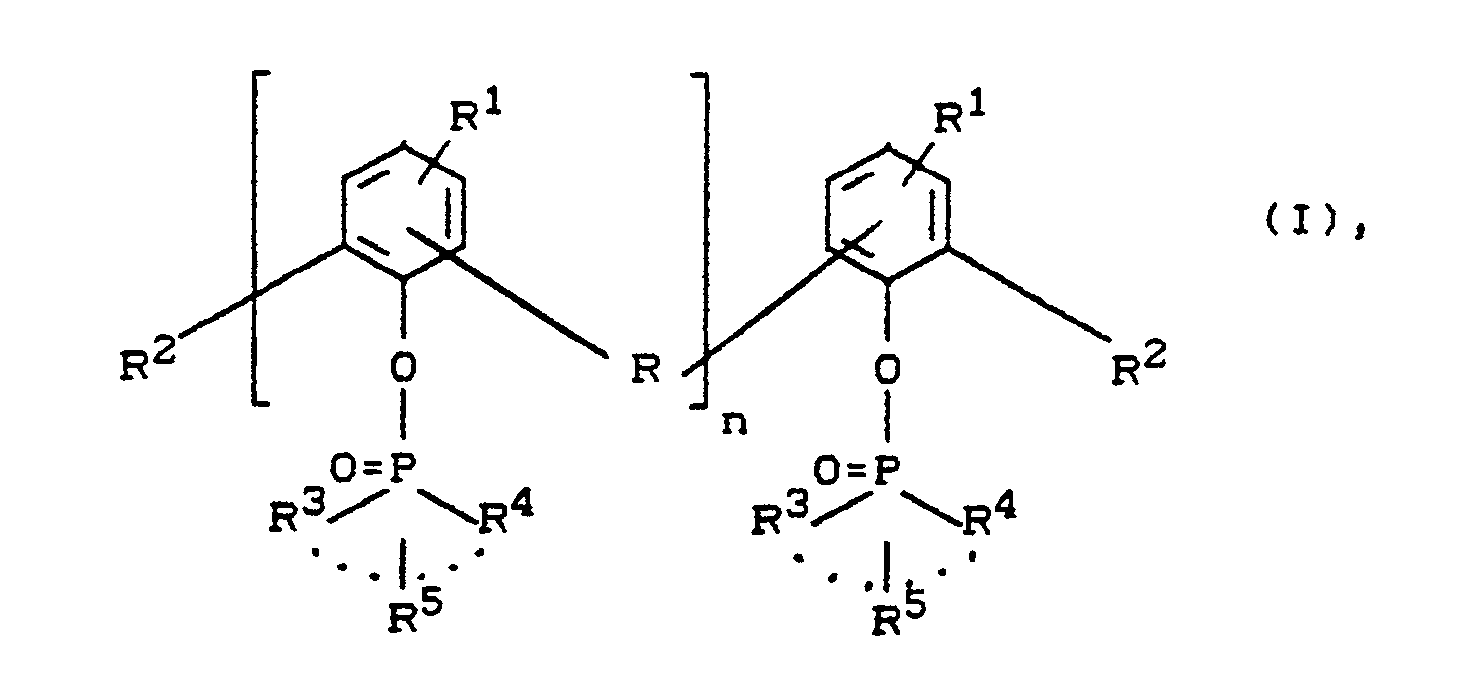
- n
- eine ganze Zahl von 1 bis 20, bevorzugt von 1 bis 10, insbesondere 2 bis 8,
- R
- eine geradkettige oder verzweigte Alkylengruppe mit 1 bis 4 Kohlenstoffatomen, vorzugsweise eine Methylengruppe, eine gegebenenfalls alkylsubstituierte Cycloalkylengruppe mit 5 bis 9 Kohlenstoffatomen, oder, wenn n = 1 ist, auch eine direkte Bindung, eine Sulfonyl- oder Carbonylgruppe bzw. Sauerstoff- oder Schwefelbrücke,
- R¹ und R²
- unabhängig voneinander Wasserstoff, Alkylgruppen mit 1 bis 12, vorzugsweise 1 bis 8 Kohlenstoffatomen, insbesondere Methyl, gegebenenfalls alkylsubstituierte Cycloalkylgruppen mit 5 bis 9 Kohlenstoffatomen, gegebenenfalls alkylsubstituierte Arylgruppen mit 6 bis 10 Kohlenstoffatomen,
- R³ und R⁴
- Alkylgruppen mit 1 bis 4 Kohlenstoffatomen und/oder Arylgruppen mit 6 bis 10 Kohlenstoffatomen sind, wobei R³ und R⁴ im Fall von Alkylgruppen auch durch eine Einfach- oder Doppelbindung zu einem Ring verbunden sein können und der so über das Phosphoratom gebildete Ring Alkylgruppen R⁵ mit 1 bis 4 Kohlenstoffatomen tragen kann, bedeutet;
- Die genannten Polyphenolphosphinate (I), -phosphonate (VI) und -phosphate (IX) können auch miteinander gemischt als Flammschutzmittel verwendet werden.
- Der Vergleich der Wirkung der drei Substanzklassen hat ergeben, daß hinsichtlich des Flammschutzeffektes eine Abstufung zu erkennen ist. Den höchsten Einfluß auf die Flammhemmung haben die Polyphenol-phosphinate (I) vor den -phosphonaten (VI). Daher ist die Verwendung der Polyphenolphosphinate der Formel (I) und ihrer bevorzugten Formeln (II) bis (V) besonders bevorzugt.
- Die erfindungsgemäß eingesetzten Phosphinsäureester (I) sind Alkyl- und Arylphosphinsäureester von Bisphenolen und Polyphenolen, welche Kondensationsprodukte von Phenolen mit Aldehyden oder Ketonen sind.
- Bevorzugt werden dabei Alkyl- und Arylphosphinsäureester (I) von Bisphenolen der Formel (II) und von höhermolekularen Phenol-Formaldehyd-Kondensationsprodukten (insbesondere von Novolaken) der Formel (III).

wobei
die Substituenten der -CH₂-Gruppe in den o- oder p-Stellungen zur phenolischen Gruppe erfolgt (wenn diese Stellung nicht mit R¹ blockiert sind),
und wobei - n
- eine ganze Zahl von 2 bis 15, bevorzugt von 2 bis 10, insbesondere 2 bis 8,
- R
- eine zweiwertige Gruppe wie eine Methylen- oder Isopropylidengruppe, eine Sulfonyl- oder Carbonylgruppe oder eine Sauerstoff- oder Schwefelbrücke,
- R¹
- Wasserstoff oder eine Alkylgruppe mit 1 bis 12, vorzugsweise 1 bis 8 Kohlenstoffatomen, bevorzugt Methyl,
- R²
- Wasserstoff oder eine Alkylgruppe mit 1 bis 4 Kohlenstoffatomen,
- R³ und R⁴
- unabhängig voneinander Methyl-, Ethyl- oder Phenylgruppen,
oder die Reste R³ und R⁴ gemeinsam die gegebenenfalls mit R⁵ substituierte Butyliden- bzw. Alkylbutylidengruppe darstellen. - Ganz besonders bevorzugt sind Verbindungen der Formel (IV) und (V)

worin - n
- eine ganze Zahl von 2 bis 8 ist,
- R
- die oben beschriebene Bedeutung hat,
- R² und R⁵
- Wasserstoff oder Methylgruppen darstellen.
- Die Acrylnitril(co)polymerisate A) sollten mindestens 60 Gew.-%, vorzugsweise mindestens 75 Gew.-% und besonders bevorzugt mindestens 85 Gew.-% Acrylnitril enthalten und können bis 45 Gew.-%, vorzugsweise bis 12 Gew.-% an neutralen Comonomeren, wie z.B. Styrol, Isobuten, Methacrylnitril, Methyl-, Ethyl(meth)acrylat, Vinylacetat, Vinylbenzoat, (Meth)acrylamid, N-Methyl-, N-Ethyl-, N-Dimethyl(meth)acrylamid, N-Hydroxymethyl-, N-Methoxymethyl(meth)acrylamid, N-Phenyl(meth)acrylamid, N-Vinylacetamid, N-Vinylformamid, N-Vinylpyrrolidon, N-Vinylcaprolactam, Vinyl-methyl-, Vinylethylether, Vinylimidazol, Vinyltriazol aufweisen sowie 0,1 bis 5 Gew.-%, bevorzugt bis 3 Gew.-% an sauren, funktionellen Monomeren zu Anfärbbarkeitsverbesserungen, z.B. (Meth)Allyl-, Vinyl-, Styrolsulfonat, (Meth)Acrylamidomethylpropansulfonat, Vinylphosphonat, (Meth)acrylamidoalkylphosphonat oder auch 1 bis 10 Gew.-% an basischen Monomeren wie Dimethylaminoethyl(meth)acrylat, N-Dimethylaminopropyl(meth)acrylamid u.a. Vorzugsweise sind 10 bis 460 mValsäure/kg/Polymer einer Sulfon- oder Phosphonsäure im Polymer eingebaut (mVal = Milliäquivalent).
- Besonders bevorzugt werden Acrylnitril(co)polymerisate A), die neben den neutralen Comonomeren aus Carboxylgruppen (und davon abgeleiteten Salzen 1- bis 3-wertiger Kationen) enthaltenden Comonomeren aufgebaut sind, eingesetzt. Bezogen auf Carboxylgruppen, sollen 500 bis 2800 mVal/kg Polymer vorliegen, bevorzugt 700-2100 mVal/kg-Polymer.
- An Säuren, welche derartige Gruppierungen dem Polymer verleihen, seien aufgeführt: (Meth)Acrylsäure, Itaconsäure, Malein-Fumarsäure, Zimtsäure, Vinylbenzoesäure, Isopropenylbenzoesäure, (Vinyl-phenyl)-essigsäure, (Isopropenyl-phenyl)essigsäure, (Meth)Acrylamidoessigsäure, (Meth)Acrylamidomethylpropancarbonsäure, (Meth)Acrylamidobenzoesäure, Vinylidencarbonsäure u.a. Bevorzugt werden jedoch (Meth)Acryl- und Itaconsäure.
- Die Synthese der Acrylnitrilcopolymerisate erfolgt nach bekannten Methoden der Lösungs-, Suspensions-, Emulsions- oder Massepolymerisation, wobei in der Regel bei der Suspensions- und Emulsionsmethode in Wasser als Reaktionsmedium gearbeitet wird. Bei der Herstellung der carboxylgruppenhaltigen Produkte ist es möglich, bereits (teilweise) die Salze der entsprechenden Säuren zu verwenden. Berechnet auf den Carboxyfunktionengehalt der Polymerisate von 500 bis 2800 mVal/kg, bevorzugt 700-2100 mVal/kg, können 60 bis 0,5 % dieser Funktionen äquivalentmäßig als Salz, vorzugsweise 1- bis 2-wertiger Kationen bei der Polymerisation eingesetzt werden, d.h. man verwendet dabei ein Gemisch aus freier Säure und dem davon abgeleiteten Salz. Auch eine nachträgliche Reaktion des Carboxylstrukturen tragenden Polymers mit Salz kann zur ganzen oder teilweisen Absättigung der Säure führen.
- Enthält das Acrylnitrilcopolymerisat, das für die Verarbeitung im Gemisch mit den Phosphorderivaten der Polyphenole zu Fasern/Fäden verwendet wird, neben den schwächeren Carboxylgruppen noch die stärkeren Säurefunktionen einer Sulfon- oder Phosphonsäure, dann sollte, für den Fall eines bereits hier durchgeführten teilweisen Umsatzes zu Salzen, dieser Anteil 60 bis 0,5 % der Äquivalenz der Summe aus starker und schwächerer Säure betragen, wobei mit zunehmendem Säuregehalt des Polymers die Menge, welche ins Salz überführt wurde, immer geringer werden soll.
- Die Molekulargewichte der eingesetzten Acrylnitrilcopolymerisate betragen, ausgedrückt als K-Wert (Fikentscher, Cellulose Chemie 13, 58 (1932)) 30 bis 130, vorzugsweise 70 bis 95.
- Die erfindungsgemäß eingesetzten Phosphinsäureester sind die Dialkyl-, Diaryl- und Alkyl/aryl-phosphinsäureester von Bis- und Polyphenolen (Novolaken). Da die Phosphinsäuren nicht direkt in die erfindungsgemäßen Ester umgewandelt werden können, sind ihre reaktiveren Derivate zur Esterherstellung zu verwenden. Diese sind die Säurechloride, die durch Abspaltung von Chlorwasserstoff, und Phenylester (ebenfalls aus den Säurechloriden), die durch Abspaltung von Phenol (Umesterung) mit den Polyphenolen zu den erfindungsgemäßen Estern umgesetzt werden.
- Beispiele für Phosphinsäuren sind Dimethylphosphinsäure, Methylethylphosphinsäure, Diethylphosphinsäure, Methylphenylphosphinsäure, Ethylphenylphosphinsäure, Diphenylphosphinsäure, Di-p-Tolylphosphinsäure und Phenylnaphthylphosphinsäure sowie 1-Hydroxy-1-oxo-phospholen, 1-Hydroxy-1-oxo-3-methylphospholen und 1-Hydroxy-1-oxo-3,4-dimethyl-phospholen.
- Herstellungsverfahren für Phosphinsäuren und ihre Derivate wie Chloride und Phenylester sind bekannt und in der Literatur zusammengestellt (Methoden der organischen Chemie (Houben-Weyl), Band XII/1, Seiten 217 bis 266 und Band E2, Seiten 123 bis 221). Die Umsetzung der Phosphinsäurechloride mit Bis- und Polyphenolen erfolgt bei Temperaturen von 180 bis 200°C unter Abspaltung von Chlorwasserstoff recht langsam. Unter Mitverwendung von Katalysatoren wie Magnesiumchlorid gelingt dieses bereits bei niedrigeren Temperaturen und in kürzeren Zeiten. Bei niedrigeren Temperaturen müssen bei der Veresterung von Novolaken aus Gründen der Viskosität inerte, hochsiedende Lösungsmittel mitverwendet werden. Üblicherweise werden als Katalysatoren Magnesiumchlorid oder tertiäre Amine eingesetzt. Bei dem wesentlich schneller ablaufenden Umesterungsverfahren wird als Katalysator ebenfalls Magnesiumchlorid verwendet. Die Temperaturen liegen wieder bei 200°C.
- Die angeführten Polyphenolphosphinsäureester (I) werden auch in der bisher unveröffentlichten deutschen Patentanmeldung DE-P 39 25 791.6, (Le A 27 040) beschrieben.
- Polyphenole, als Ausgangsmaterialien für B) (I, VI und IX)
- Bisphenole und Novolake werden nach bekannten Verfahren hergestellt (siehe für Bisphenole: H. Schnell und H. Krimm, Angew. Chemie 75 (1963), 662 bis 668; für Novolake: Methoden der organischen Chemie (Houben-Weyl), Band XIV/2, Seiten 193 bis 292 und Ullmann's Encyclopädie der Technischen Chemie, 4. Auflage, Band 18, Seiten 245 bis 257.
- Als geeignete Bisphenole seien erwähnt:
Bis-(hydroxyphenyl)-alkane,
Bis-(hydroxyphenyl)-cycloalkane,
Bis-(hydroxyphenyl)-ether,
Bis-(hydroxyphenyl)-ketone,
Bis-(hydroxyphenyl)-sulfone
sowie deren kernalkylierte Derivate. - Die wichtigsten Bisphenole im Sinne der Erfindung sind: 4,4'-Dihydroxydiphenyl, 2,2-Bis-(4-hydroxyphenyl)-propan, Bis-(4-hydroxyphenyl)-methan, 4,4'-Dihydroxybenzophenon, 4,4'-Dihydroxydiphenylether, 4,4'-Dihydroxydiphenylsulfid, 4,4'-Dihydroxydiphenylsulfon sowie deren kernsubstituierte Derivate, wobei als Substituent vorzugsweise CH₃ in Frage kommt. Ein kernmethyliertes Derivat ist z.B. 2,2-Bis-(4-hydroxy-3,5-dimethylphenyl)-propan.
- Besonders bevorzugte Diphenole sind 2,2-Bis-(4-hydroxyphenyl)-propan, 4,4'-Dihydroxydiphenyl, 4,4'-Dihydroxydiphenylether, 4,4'-Dihydroxydiphenylsulfon, 4,4'-Dihydroxybenzophenon und 2,2-Bis-(4-hydroxy-3,5-dimethylphenyl)-propan.
- Es können auch Gemische von Diphenolen eingesetzt werden.
- Geeignete Novolake sind beispielsweise Kondensationsprodukte aus Formaldehyd und Phenolen der allgemeinen Formel

worin - T² und T⁶ Wasserstoff bezeichnen und T³, T⁴ und T⁵ wahlweise gleich Wasserstoff oder C₁-C₂₀-Alkyl-, Cycloalkyl-, C₆-C₁₀-Arylgruppen sein können oder worin T² und T⁴ Wasserstoffatome bezeichnen und T³, T⁵ und T⁶ gleich den obengenannten Resten sein können.
- Charakteristische Beispiele für Phenole sind, ohne damit eine Einschränkung zu treffen Phenol, o-Kresol, m-Kresol, p-Kresol, 2,5-Dimethyl-, 3,5-Dimethyl-, 2,3,5-Trimethyl-, 3,4,5-Trimethyl-, p-t-Butyl-, p-n-Octyl-, p-Stearyl-, p-Phenyl-, p-(2-Phenylethyl)-, o-Isopropyl-, p-Isopropyl-, m-Isopropylphenol sowie zahlreiche andere Phenole.
- Bevorzugt eingesetzt werden Phenol, o-Kresol, m-Kresol, p-Kresol, p-t-Butylphenol und o-t-Butylphenol und p-Octylphenol. Es können aber auch Gemische aus diesen Phenolen eingesetzt werden.
- Bevorzugt eingesetzte Novolake sind demnach beispielsweise
Phenol/Formaldehyd-Novolak,
o-Kresol/Formaldehyd-Novolak,
m-Kresol/Formaldehyd-Novolak,
p-Kresol/Formaldehyd-Novolak,
t-Butylphenol/Formaldehyd-Novolak,
p-Octylphenol/Formaldehyd-Novolak. - Besonders bevorzugt wird der p-Kresol/Formaldehyd-Novolak.
- Die erfindungsgemäß einzusetzenden Phosphonsäureester VI sind Dialkyl- und Diarylphosphonsäureester von Polyphenolen, vorzugsweise von Novolaken. Da die Phosphonsäuren nicht direkt in die erfindungsgemäßen Ester umgewandelt werden können, verwendet man auch zu ihrer Herstellung die reaktiveren Derivate wie Säurechloride oder Phenylester.
- Beispiele für Phosphonsäuren sind Methylphosphonsäure, Ethylphosphonsäure, Phenylphosphonsäure, p-Tolylphosphonsäure und Naphthylphosphonsäure.
- Herstellungsverfahren für Phosphonsäuren und ihre Derivate wie Chloride und Phenylester sind bekannt und in der Literatur zusammengestellt (Ullmann's Ecyclopädie der technischen Chemie, 4. Auflage, Bd. 18, Seiten 385 bis 388, 1979 und Houben-Weyl, Methoden der organischen Chemie, Band XII/1, Seiten 423 bis 525).
- Geeignete Polyphenole/Novolake sind bereits bei (I) beschrieben.
- Die Umsetzung der Phosphonsäurechloride mit Novolaken erfolgt bei Temperaturen von 180 bis 200°C unter Abspaltung von Chlorwasserstoff recht langsam. Unter Mitvrwendung von Katalysatoren gelingt dieses bereits bei niedrigeren Temperaturen und in kürzeren Zeiten. Üblicherweise werden als Katalysatoren Magnesiumchlorid, tertiäre Amine oder Titantetrabutylat verwendet. Bei niedrigeren Temperaturen müssen aus Gründen der Viskosität inerte, hochsiedende Lösungsmittel mitverwendet werden.
- Zur Herstellung der Ester werden im sogenannten Umesterungsverfahren Novolake mit Diarylestern der Phosphonsäuren und im sogenannten Säurechloridverfahren Gemische von Novolaken und Phenolen mit Phosphonsäuredichloriden zur Umsetzung gebracht. Beim Umesterungsverfahren werden bevorzugt die Diphenylester eingesetzt. Bei beiden Verfahren können als zusätzliche Phenole Aryl- und Aralkylphenole wie 4-Phenylphenol, Benzylphenol, 1-Phenylethyl-phenol, 1-Methyl-1-phenylethyl-phenol und 2,4-Di-(phenylethyl)-phenol mitverwendet werden.
- Als Besonderheit bei den Phosphonsäureestern von Novolaken ist festzustellen, daß aufgrund der Mehrwertigkeit der Phosphonsäuren wie auch der von Novolaken sowohl offene als auch cyclische Strukturen auftreten können, je nachdem, ob jeweils eine Valenz oder 2 Valenzen jeweils eines Moleküls miteinander reagiert haben. Vernetzungsreaktionen aufgrund der Mehrwertigkeit der Reaktionspartner treten üblicherweise aber nicht auf.
- Erfindungsgemäß besonders geeignete Phosphonsäureester gemäß Formel (VI) sind beispielsweise die Umsetzungsprodukte aus 1 Mol Methylphosphonsäurediphenylester bzw. Phenylphosphondiphenylester und 1 bis 2 Äquivalent Novolak.
- Diese erfindungsgemäß geeigneten Phosphorverbindungen sind generell nach bekannten Verfahren herstellbar (siehe für Novolake: Houben-Weyl, Methoden der organischen Chemie, Band XIV/2, Seiten 193 bis 292 und Ullmann's Encyclopädie der technischen Chemie, 4. Auflage, Band 18, Seiten 245 bis 257; für Phosphate: beispielsweise Ullmann's Encyclopädie der technischen Chemie, 4. Auflage, Band 18, Seiten 389 bis 391, 1979 und Houben-Weyl, Methoden der organischen Chemie, Band 12/1, Seite 299 bis 374).
- Die Polyphenole werden wie schon geschildert hergestellt und eingesetzt.
- Besonders geeignete Novolake sind Kondensationsprodukte aus Formaldehyd und Phenolen mit den schon erläuterten Beispielen und Bevorzugungen.
- Zur Herstellung der Ester werden im sogenannten Umesterungsverfahren Novolake mit Triarylestern der Phosphorsäure und im sogenannten Säurechloridverfahren Gemische von Novolaken und Phenolen mit Phosphoroxydchlorid zur Umsetzung gebracht. Beim Umesterungsverfahren wird bevorzugt Triphenylphosphat eingesetzt. Die beiden Verfahren können als zusätzliche Phenole Aryl- und Aralkylphenole wie 4-Phenylphenol, Benzylphenol, 1-Phenylethyl-phenol, 1-Methyl-1-phenyl-ethyl-phenol und 2,4-Di-(phenylethyl)-phenol mitverwendet werden.
- Als Besonderheit bei den Phosphorsäureestern von Novolaken ist festzustellen, daß aufgrund der Mehrwertigkeit der Phosphorsäure wie auch der von Novolaken sowohl offene als auch cyclische Strukturen auftreten können, je nachdem, ob jeweils eine Valenz oder 2 Valenzen jeweils eines Moleküls miteinander reagiert haben. Vernetzungsreaktionen aufgrund der Mehrwertigkeit der Reaktionspartner treten üblicherweise nicht auf.
- Erfindungsgemäß geeignete Polyphenolphosphate sind beispielsweise die Umsetzungsprodukte aus 1 Mol Triphenylphosphat bzw. Phosphorsäuretrichlorid und 1 oder 2 Äquivalent Novolak. Mengenverhältnisse zwischen 1 und 2 Äquivalent Novolak sind ebenfalls möglich. Die 3. Valenz der Phosphorsäure ist, wie oben dargestellt, an Phenol oder ein substituiertes Phenol gebunden.
- Die beschriebenen Phosphorderivate sind in den für Polyacrylnitril bekannten, vorzugsweise hochpolaren Lösungsmitteln wie Dimethylformamid oder Dimethylacetamid löslich und ergeben mit den Acrylnitril(co)polymerisaten klare Spinnlösungen in diesen Lösungsmitteln.
- Die Herstellung von Fasern und Fäden aus den beschriebenen Mischungen kann nach den bekannten Verfahren erfolgen. Hier sind in sehr begrenztem Maße zu benennen das Schmelzspinnverfahren, bei welchem vorzugsweise niedermolekulare Acrylnitrilcopolymerisate eingesetzt werden mit K-Werten von 30 bis 70, die keine oder nur wenige Carboxylfunktionen enthalten, und z.B. Phosphinsäureester von Polyphenolen, deren Erweichungsbeginn bei 90 bis 130°C liegt.
- Bevorzugt werden das klassische Naß- oder Trockenspinnverfahren zur Herstellung von Fasern und Fäden. Dabei wird üblicherweise in heißem Wasser eine Wäsche des lösungsmittelhaltigen Spinnguts und auch die Verstreckung in heißem Wasser vorgenommen. Es hat sich gezeigt, daß die hier beschriebenen P-Derivate der Polyphenole bei den Stufen der Spinngutwäsche und Verstreckung nicht aus dem Faden ausgewaschen werden, erkennbar am P-Gehalt der erhaltenen Fasern.
- Anwendbar ist jedoch auch ein Verfahren der Faser- und Fädenherstellung, bei welchem eine Naßwäsche des Spinnguts und eine Naßverstreckung vermieden werden. Dies wird z.B. in EP 98 477 beschrieben.
- Wählt man als Basis Acrylnitril(co)polymerisate, die frei sind von Carboxylgruppen aufweisenden Comonomeren, dann muß man den Zusatz an P-haltigen Verbindungen im höheren Bereich wählen, um guten Flammschutz zu erzielen. Hier ist der P-Anteil im Polymerengemisch aus Acrylnitrilcopolymer und den P-Derivaten der Polyphenole auf 1,5 bis 3,5 Gew.-% einzustellen, während die Kombination von P-modifizierten Polyphenolen mit Acrylnitrilcopolymerisaten, charakterisiert durch einen Gehalt von 500 bis 2800 mVal/kg, bevorzugt 700-2100 mVal/kg Polymer an Carboxylfunktionen auch bereits zu einer verringerten Brenneignung führt, wenn der P-Gehalt im Gemisch nur bei ≦2,0 % liegt. Die Umsetzung der Säure in die Salzform mit 1- bis 3-wertigen Metallen führt dabei zu einer weiteren Verbesserung der Brennresistenz.
- Die Zugabe der erfindungsgemäßen Phosphinsäure- (I), Phosphonsäure- (VI), Phosphorsäureester (IX) der Polyphenole erfolgt bei der Zubereitung der Polymerschmelze bzw. Polymerlösung des Acrylnitrilcopolymerisats oder wird kurz vor dem Verspinnen über eine Stammlösung, die neben diesem P-Träger eventuell ein weiteres Acrylnitrilcopolymerisat als Schleppsubstanz sowie gegebenenfalls noch Füllstoffe, Pigmente, Farbstoffe, Stabilisatoren enthält, dem zur Spinndüse fließenden Polymerstrom zugeführt. Es können auch Mischungen der einzelnen P-haltigen Polyphenolderivate zugegeben werden.
- Es hat sich auch gezeigt, daß weitere Zusätze in Mengenanteilen bis zu 10 Gew.-% von nicht P-derivatisierten Polyphenolen, d.h. der nicht phosphorhaltigen Verbindungen, im Verein mit den erfindungsgemäßen Polyphosphinaten (I), Polyphosphonaten (VI) oder Polyphosphaten (IX) eine, wenn auch geringe, weitere Flammschutzverbesserungen bewirken, die noch über derjenigen, durch den P-Derivatzusatz B) allein verursachten, liegt. Als weitere Polyphenole sind auch Polyhyroxystyrole, wie z.B. Polypara-hydroxy)styrol verwendbar.
- Die Säurefunktionen aus dem Acrylnitrilcopolymerisat können nicht nur während oder nach seiner Herstellung teilweise in die Salzform überführt werden, sondern man kann auch während der Verarbeitung des Gemisches aus Acrylnnitrilcopolymerisat und Phosphor-Novolaken zu Fasern/Fäden in der Spinnlösung, vor, während oder nach der Verstreckung, nach/vor einer Trocknung oder Dämpfung diese Reaktion vornehmen.
- Salze, die verwendet werden können, sind z.B. wasserlösliche Salze wie die Chloride, Hydrogencarbonate, Acetate, Formiate Na⁺, Ca²⁺, Mg²⁺, Zn²⁺, Cu²⁺, Mn²⁺ oder auch die wenig wasserlöslichen Hydroxide oder Carbonate von Zn²⁺, Ca²⁺, Al³⁺, Mg²⁺. Hier erfolgt die Salzreaktion aus wäßriger Suspension. Will man in Spinnlösung bereits eine Reaktion einleiten, und zwar in den bekannten organischen Lösungsmitteln für Polyacrylnitrile, wie z.B. Dimethylacetamid, Dimethylformamid, Dimethylsulfoxid, dann kann man z.B. darin lösliche Acetate des Mg²⁺, Ca²⁺, Zn²⁺ einsetzen. Dabei muß man natürlich über das Molgewicht des Acrylnitrilcopolymerisates und seine Konzentration sowie die des Salzes eine Vernetzung des Polymeren in der Lösung vermeiden. Bewährt hat sich hier der Zusatz von Komplexbildnern, die sowohl die Vernetzung inhibieren als auch als Farbaufheller bzw. Thermostabilisatoren wirken. Solche Verbindungen sind beispielsweise Oxalsäure, Nitrilotriessigsäure, Ethylendiamintetraessigsäure, Acetylaceton.
- Die Carboxylgruppen und eventuell andere Säurefunktionen können nicht nur durch eine Kationenart, sondern durch verschiedene Kationen teilweise oder ganz abgesättigt sein.
- Setzt man beispielsweise ein Acrylnitrilcopolymerisat zur Faserherstellung ein, welches bereits von der Synthese aus 0,5 bis 60 % seiner gesamten Säurefunktionen äquivalentmäßig in der Salzform vorliegen kann, so kann es auf dem Weg zur Faser mit einer anderen Kationenart behandelt werden. Der Anteil, welcher von der freien Säureform in die des Salzes überführt wird, kann damit auf 100 % der Äquivalenz aller Säurefunktionen der Faser ansteigen.
- Mitverarbeitet für die Faserherstellung können 0 bis 5 Gew.-% an Füllstoffen und/oder Pigmenten sowie 0 bis 5 % weiterer üblicher Zusatzmittel wie Licht-, Thermo-, Farbstabilisatoren, Aufheller, Farbstoffe etc.
- Füllstoffe sind z.B. Al(OH)₃, feinteiliges Mg(OH)₂, (z.B. Siluma® 5e oder Siluma 7 der Fa. Kyowa, Japan), Al₂O₃, AlOH(OCOCH₃)₂, SiO₂, SnO₂, TiO₂, Sb₂O₃, Sb₂O₅, Talkum, Borate, Ca₃(PO₄)₂, Farbstoffe, Ruß.
- Die hier beschriebenen Mischungen aus Phosphorverbindungen und Carbonsäurefunktionen enthaltenden Acrylntrilpolymerisaten können auch für die Herstellung von Precursorfasern/fäden eingesetzt werden, die dann zur C-Faser weiterverarbeitet werden.
- Um die Menge der einpolymerisierten starken Säure, (z.B. Sulfonsäure und der incorporierten Carboxylgruppen (den schwächeren Säurefunktionen) im Acrylnitril(co)polymerisat zu bestimmen, werden ca. 1 g getrocknetes Polymerisat in Dimethylsulfoxid (50 ml) gelöst. Diese Lösung läßt man über eine mit einem Mischbettionenaustauscher (Ionenaustauscher V der Fa. Merck, Gemisch aus Kationen- und Anionenaustauscher) gefüllte Säule laufen, spült mit DMSO nach, setzt der Lösung einige Tropfen Phenolphthaleinlösung zu und titriert mit einer 0,1 n-Lösung von Tetrabutylammoniumhydroxid (TBAH) zunächst potentiometrisch bis zur maximalen Potentialänderung. Die bis dahin verbrauchte Menge an TBAH entspricht der Menge an starker Säure. Anschließend wird ohne Berücksichtigung der Potentialänderungen weiter titriert, bis zum Farbumschlag des Phenolphthaleins. Der dabei erreichte Verbrauch an TBAH gibt den Anteil der gesamten einpolymerisierten Säure an. Dieser Wert, verringert um den der starken Säure, ist das Maß für den Gehalt an freien, eingebauten Carboxylgruppen.
- Will man nach einer Salzreaktion den Anteil der umgesetzten Säurefunktionen ermitteln, so wird die getrocknete Fasermenge ebenfalls in DMSO aufgenommen und ohne Vorbehandlung mit dem Ionenaustauscher titriert. Häufig ist die Probe aufgrund einer Vernetzung durch die Kationen nicht mehr in DMSO löslich. Man titriert auf diesem Wege nur noch diejenige Säuremenge, welche nicht mit dem Kation reagiert hat und setzt sie in Relation zu der Menge, die einpolymerisiert ist.
- Natürlich ist auch eine direkte Bestimmung des Kationengehaltes, z.B. atomspektroskopisch, möglich.
- Die Feststellung des flammretardierenden Effektes durch die beschriebenen Zusätze und speziellen Acrylnitrilcopolymerisate wird durch Bestimmung des Sauerstoffindex, auch Limited Oxygen Index (LOI) genannt, vorgenommen, und zwar sowohl an Mischungen der Polymeren als auch an Fäden/Fasern.
- Zur Untersuchung der Polymermischungen werden mit einer hydraulischen Laborpresse (Fa. Paul Weber, Stuttgart-Uhlbach), ausgestattet mit einem Vakuumpreßwerkzeug (Modell 8), Tabletten hergestellt vom Gewicht 1,3 g, Durchmesser 26 mm und Dicke 2 bis 3 mm.
- Der Brenntest erfolgt entsprechend ASTM D 2863 in einem Stanton-Redcroft FTA-Entflammbarkeitstestgerät. Die Tablette wird in der Brennkammer dieses Gerätes, einem Glaszylinder, vertikal stehend montiert und von oben mit einer Glühspirale (elektrisches Zündgerät EZG 3, Fa. E. Raczek) 5 Sekunden lang gezündet. Bei verschiedenen vorgewählten Sauerstoffkonzentrationen (Vol. %) in einem Sauerstoff-Stickstoff-Gemisch wird die Brenndauer gemessen. Durch Interpolation wird die Sauerstoffkonzentration bestimmt, bei der die Probe 30 Sekunden lang brennt und als LOI bezeichnet.
- Untersucht man Fasern/Fäden, so werden sie auf einer Musterkarde gekrempelt (Fäden vorher schneiden). 1 g Fasern werden in einem oben und unten offenen Zylinder aus Drahtgeflecht eingeführt. Die Höhe des Zylinders beträgt 50 mm, der Durchmesser 35 mm, der Abstand der Drähte im Geflecht 6 Drähte/10 mm. Von oben wird der Faserbausch gezündet, wie angegeben, und ebenso wie die Preßlinge vermessen.
- Die erfindungsgemäßen Fasern weisen Festigkeiten >2 cN/dtex auf. Die Waschbeständigkeit der chemischen Modifikation ist bei 40°C gegeben, wie z.B. der Gehalt an Kation und Phosphor vor und nach mehrmaliger Wäsche beweist.
- Die nachfolgenden Acrylnitrilcopolymerisate a bis c wurden durch wäßrige Fällungspolymerisation bei pH = 2,5 in schwefelsaurem Medium hergestellt. Die Produkte hatte man mit Na₂S₂O₈/Na₂S₂O₅, als Initiator erhalten.
- a:
- 93,9 Gew.-% AN/5,7 Gew.-% Methylacrylat/0,4 Gew.-% Natriummethallylsulfonat; K-Wert: 82.
- b:
- 70 Gew.-% AN/30 Gew.-% Methylacrylat; K-Wert: 84.
- c:
- 86,6 Gew.-% AN/13 Gew.-% Acrylsäure/0,4 Gew.-% Natriummethallylsulfonat; K-Wert: 82 (1810 mVal-Carboxlgruppen/kg-Polymer; 55 mVal-Sulfonsäure/kg-Polymer incl. Polymerendgruppen).
-
- d:
- Novolak aus p-Kresol und Formaldehyd (OH-Zahl 468, Kernzahl ca. 5).
- e:
- Novolakphosphinat, hergestellt durch Umsetzung des Novolaks d mit Ethylmethylphosphinsäurechlorid:
- Nach Abkühlen wird der noch warme Ester in 2 1 Methylenchlorid aufgenommen und mit Wasser chloridfrei gewaschen. Nach Trocknen der Methylenchloridlösung mit Na₂ SO₄ wird das Salz abfiltriert und die Lösung eingeengt. Die Ausbeute beträgt 402,4 g = 95,8 % der Theorie. Der Erweichungsbeginn liegt bei 98°C auf der Kofler-Heizbank, der Phosphorgehalt bei 12,4 % (theoretisch 14,7 %) und die OH-Zahl bei O.
-
- f:
- Novolakphosphinat, hergestellt durch Umsetzung von Novolak d mit 1-Chlor-1-oxo-3-methylphospholen (-2/3):
- Die Ausbeute beträgt 437,1 g = 93,3 % der Theorie. Der Erweichungsbeginn liegt bei 136°C, der Phosphorgehalt bei 12,0 % (theoretisch 13,2) und die OH-Zahl bei O.
-
- g:
- Polyphosphonat aus Bis-(4-hydroxyphenyl)-methan und Methylphosphonsäurediphenylester:
-
- h:
- Novolakphosphonat aus Novolak d und Methanphosphonsäurediphenylester:
- Nach Abkühlen wird das Reaktionsprodukt in 4 l Methylenchlorid aufgenommen und mit Wasser chloridfrei gewaschen. Nach Trocknen der Methylenchlorid-Lösung mit Natriumsulfat wird filtriert und die Lösung eingeengt. Die Ausbeute beträgt 1032,7 g = 96,4 % der Theorie. Der Erweichungsbeginn liegt auf der Kofler-Heizbank bei 166°C, der Phosphorgehalt beläuft sich auf 10,1 % (theoretisch 10,0 %) und die OH-Zahl auf 4.
-
- i:
- Novolakphosphat aus Novolak d und Triphenylphosphat:
- Nach Abkühlen wird das Reaktionsprodukt in 2 l Methylenchlorid aufgenommen und mit Wasser chloridfrei gewaschen. Nach Trocknen der Methylenchlorid-Lösung wird das Natriumsulfat abfiltriert und die Lösung eingeengt. Die Ausbeute beträgt 694,9 g = 95,2 % der Theorie. Der Erweichungsbeginn liegt bei 75°C auf der Kofler-Heizbank, der Phosphorgehalt bei 8,4 % (theoretisch 8,5 %) und die OH-Zahl bei 0.
- Zusätze der verschiedenen Phosphor-Verbindungen l) f) g) h) i) zu Acrylnitrilpolymeren a) b) c) und d), sowie zusätzliche Zugabe freier Polyphenole e), werden hinsichtlich des LOI-Wertes in der Tabelle 1 wiedergegeben.
- Ein Acrylnitrilcopolymerisat (siehe Ia) aus 93,9 Gew.-% AN/5,7 Gew.-% Methylacrylat/0,3 Gew.-% Natriummethallylsulfonat, K-Wert: 82, wurde aus Dimethylformamid trockenversponnen, das Spinngut mit heißem Wasser gewaschen, 1:3,8 verstreckt, präpariert, unter Gleichlauf in einem Trommeltrockner bei 130 bis 140°C getrocknet, bei 115°C gedämpft und geschnitten.

- Es wurden a) eine klare 29 gew.-%ige Dimethylformamidlösung eines Polymerisats aus 86,7 Gew.-% AN/13 Gew.-% Acrylsäure/0,4 Gew.-% Natriummethallylsulfonat (AN/13 AS/MAS), K-Wert: 82,0 sowie
- eine klare 32 gew.-%ige Lösung, die 91 Gew.-Teile dieses Copolymerisats und 9 Gew.-Teile eines Novolakphosphinats (NPI), erhalten aus p-Kresol-Formaldehyd-Novolak der Kernzahl 5 und 1-Chlor-1-oxo-3-methylphospholen-(2,3) (vgl. Beispiel 2), enthielt,
unter folgenden Bedingungen versponnen: - Düse:
- 180 Loch mit Durchmesser 0,25 mm
- Spinnabzug:
- 200 m/min
- Lufttemperatur:
- 240°C
- Luftmenge:
- 35 m³ /h
- Spinneinzeltiter:
- 9,5 dtex
- In beiden Fällen wusch man das DMF-haltige Spinngut mit Wasser von 60 bis 70°C, verstreckte bei 95°C in heißem Wasser 1:4,5, präparierte und trocknete unter Zulassung von 30 % Schrumpf bei 120°C. Danach wurden die erhaltenen Filamente 5 Minuten bei 115°C im Autoklaven gedämpft und dann zu 100 mm geschnitten.
- Jede der beiden Fasertypen A, B wurde in 3 Teile A1 bis A3 und B1 bis B3 aufgeteilt.
- Der 1. Teil wurde jeweils 2 Minuten mit Wasser gekocht und bei 50°C getrocknet.
- Der 2. Teil wurde jeweils 1 Minute in einer 5 %igen Suspension von Zn(OH)₂ in Wasser und 1 Minute in einer 5 %igen ZnCO₃-Suspension (x 2 Zn/OH)₂- gekocht, anschließend gründlich mit Wasser gewaschen, um oberflächlich anhaftendes Zn(OH)₂/ZnCO₃ zu entfernen und danach bei 50°C getrocknet.
- Der 3, Teil wurde jeweils 2 Minuten in einer frisch aus AlCl₃ und NaOH hergestellten 5 %igen Suspension des Al(OH)₃ gekocht, ebenfalls gewaschen und bei 50°C getrocknet.
- An den Fasern wurden textiltechnologische Daten ermittelt, ferner durch potentiometrische Titration in DMSO der Anteil der noch verbliebenen freien Säure ermittelt, um eine Aussage über die Reaktion der Carboxylgruppen mit Zn(OH)₂/ZnCO₃ bzw. Al(OH)₃ zu erhalten. Die Bestimmung des erzielten Flammschutzes erfolgte nach der LOI-Methode (Ergebnisse siehe Tabelle 2).
- Um eine Aussage über den Verbleib des Novolakphosphinat-Zusatzes (NPI) in der Faser zu erhalten, bestimmte man den P-Gehalt im getrockneten, vorher nicht mit Wasser gewaschenen Spinngut und der mit Zn(OH)₂/ZnCO₃ behandelten, danach getrockneten Faser. Sowohl im Spinngut als auch in der behandelten Faser betrug der P-Anteil 1 Gew.-% - vgl. Absatz IX.
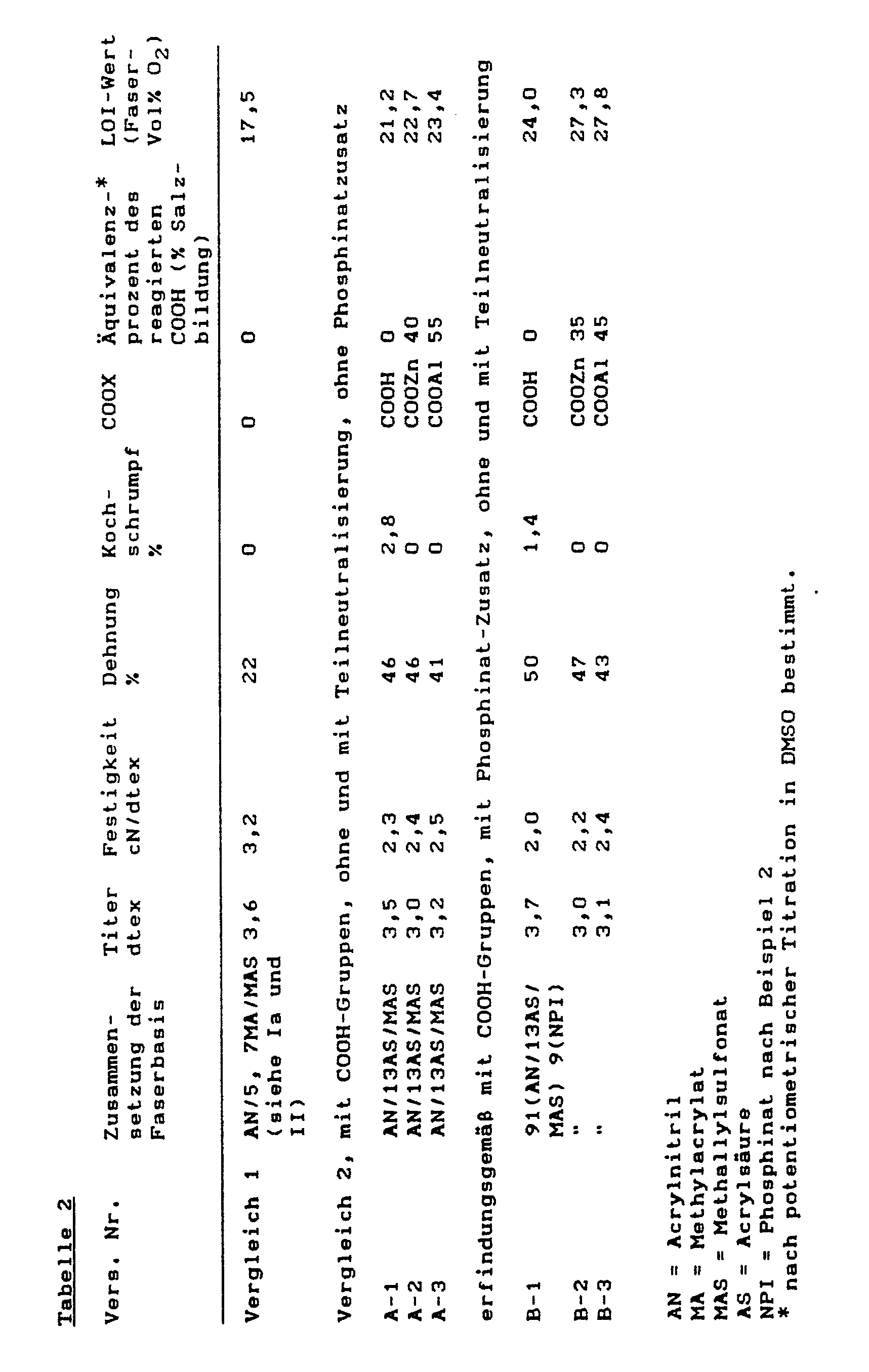
- Dazu wurde das genannte Acrylnitrilcopolymerisat allein oder mit Novolakphosphinat f (Beispiel 2) in Dimethylformamid zunächst gelöst, dann ausgefällt oder fein gemahlenes AlOH(OCOCH₃)₂ zusätzlich in dieser Lösung suspendiert und das Gemisch in Wasser ausgefällt, mit Wasser gewaschen und getrocknet.
- Zur Nachbehandlung mit Salzen gab man zu 500 g einer 20 gew.-%igen Lösung von Mg- bzw. Ca(OCOCH₃)₂ 40 g des ausgefällten Acrylnitrilcopolymerisat-Novolakphosphinat-AlOH(OCOCH₃)₂-Gemisches, ließ 5 Minuten unter Rühren bei 100°C reagieren, saugte ab, wusch gründlich mit Wasser nach und trocknete.
- Von den derart erhaltenen Produktmischungen stellte man, wie beschrieben, Preßlinge her und bestimmte ihren Sauerstoffindex (Ergebnisse siehe Tabelle 3).
- A: Acrylnitril/10 Gew.-% Acrylsäure/0,5 Gew.-% Na-Methallylsulfonatcopolymer; K-Wert: 83. (1390 mVal/kg Carboxylgruppen; 63 mVal/kg-Polymer an Sulfonsäure incl. Polymerendgruppen)
- B: Novolakphosphinat (Beispiel 2)
- C: AlOH(OCOCH₃)₂
- Es wurden 4 Spinnlösungen 1 bis 4 angesetzt und verglichen (vgl. Abb. 1):
- Dazu löste man 50 g eines Acrylnitril/10 Gew.-% Acrylsäure/0,5 Gew.-% Na-Methallylsulfonat-Copolymeren vom K-Wert 83 und 1,8 g Zn(OCOCH₃)₂ x 2H₂O in 148,2 g Dimethylformamid unter Rühren während 1 Stunde bei 80°C (Lösung 1).
- Die 2. Lösung enthielt die gleichen Komponenten, nur das Lösungsmittel war ein Gemisch aus 146,6 g Dimethylformamid und 1,6 g Acetylaceton.
- Die 3. Lösung bestand aus 50 g Copolymer und 3,6 g Zn Salz in 146,5 g DMF.
- Die 4. Lösung bestand aus den Polymer- und Salzmengen der 3. Lösung, das Lösungsmittel waren 145 g DMF und 3,3 g Acetylaceton.
- Die Acetylaceton versetzten Lösungen waren heller. Nach Überführen dieser Lösungen in ein Kugelfallglas wurde die Kugelfallviskosität über die Zeit bei 80°C gemessen. Diese Methode beschreibt K. Jost, Reologica Acta (1958), Bd. 1, Nr. 2 bis 3, S. 303. In einem Rohr von 3,3 cm Durchmesser wird bei 80°C die Zeit gemessen, die eine Stahlkugel von 130 mg bei einer Strecke von 7 cm in der Spinnlösung zum Fallen braucht.

- A
- ist ein AN/10 Gew.-% AS/0,5 Gew.-% Na-MAS-Copolymer, K-Wert 83 mit 1390 mVal/Carboxylgruppen/kg und 63 mVal/Sulfonsäuregruppen/kg-Polymer, incl. Endgruppen
- B
- Phosphinatzusatz (f)/vgl. Beispiel 2
- C
- Al(OH)(OCOCH₃)₂ (essigsaure Tonerde)
- Abbildung 1 zeigt, daß der Zusatz von Acetylaceton zu niedrigeren Viskositäten führt.
- In der Abb. 1 bedeutet
- 1) eine Lösung, bei der 23 Äquivalent-%, bzw. auf Carboxylgruppen Zinkacetat eingesetzt wurde
- 2) wie 1, aber mit Salz/Acetylaceton-Verhältnis 1:2
- 3) eine Lösung, bei der 40 Äquivalent-% der Carboxylgruppen mit Zinkacetat zur Reaktion gebracht sind
- 4) wie 3 aber mit Salz/Acetylaceton-Verhältnis = 1:2.
- Ein Gemisch aus 27 kg des unter III beschriebenen Copolymerisats (AN/10 AS/0,5 MAS) und 3 kg des Novolakphosphinats f wurden in 63, 75 kg DMF 1,2 Stunden unter Rühren bei 80°C gelöst, wie bereits angeführt, versponnen 1:4,0 verstreckt, getrocknet unter Schrumpfzulassung (20 %), im Autoklaven gedämpft und das Filament anschließend 1 Minute mit 100°C heißer 5 %iger Zn(OCOCH₃)₂-Lösung in Wasser behandelt, abgespült, getrcoknet bei 50°C und geschnitten (Fasern 1).
- Abbildung 1 zeigt, daß der Zusatz von Acetylaceton zu niedrigeren Viskositäten führt.
- In der Abb. 1 bedeutet
- 1) eine Lösung, bei der 23 Äquivalent-%, bzw. auf Carboxylgruppen Zinkacetat eingesetzt wurde
- 2) wie 1, aber mit Salz/Acetylaceton-Verhältnis 1:2
- 3) eine Lösung, bei der 40 Äquivalent-% der Carboxylgruppen mit Zinkacetat zur Reaktion gebracht sind
- 4) wie 3 aber mit Salz/Acetylaceton-Verhältnis = 1:2.
- Ein Gemisch aus 27 kg des unter III beschriebenen Copolymerisats (AN/10 AS/0,5 MAS) und 3 kg des Novolakphosphinats f wurden in 63, 75 kg DMF 1,2 Stunden unter Rühren bei 80°C gelöst, wie bereits angeführt, versponnen 1:4,0 verstreckt, getrocknet unter Schrumpfzulassung (20 %), im Autoklaven gedämpft und das Filament anschließend 1 Minute mit 100°C heißer 5 %iger Zn(OCOCH₃)₂-Lösung in Wasser behandelt, abgespült, getrocknet bei 50°C und geschnitten (Fasern 1).
- Anschließend wurden 29,5 kg des Polymeren in 70,5 kg DMF gelöst und unter gleichen Bedingungen zu Fasern verarbeitet (Fasern 2).
- Die Titration der noch vorhandenen freien Säure zeigte, daß bei beiden Fasern 19 % der Carboxylgruppen äquivalentmäßig in Zinksalz überführt worden waren.
- Sonstige Eigenschaften

- 6,75 kg des AN/10 AS/0,5 MAS-Polymeren, 0,75 kg des Novolakphosphinats f wurden zusammen mit 0,269 kg Zn(OCOCH₃)₂ x 2 H₂O in 23,1 kg DMF 1 Stunde bei 80°C unter Rühren gelöst. (Berechnet auf die Säurefunktion des Copolymerisats wurden also ca. 25 % der Äquivalenz an Zn-Salz eingesetzt. Man würde einen Zn-Gehalt der Faser von theoretisch 1,06 % erwarten).
- Nach dem Verspinnen aus einer 180-Lochdüse mit 0,25 mm Lochdurchmesser unter 200 m/min Abzug wusch man das Spinngut mit heißem Wasser, verstreckte 1:4,0 in heißem Wasser, präparierte, trocknete bei 130°C unter Schumpfzulassung von 20 % und dämpfte 5' bei 115°C ein Autoklaven. Für Untersuchungen schnitt man das Filament zu Fasern.
Eigenschaften:
Titer: 3,7 dtex
Festigkeit: 2,2 cN/dtex
Dehnung: 47 %
Kochschrumpf: 1 %
P-Gehalt: 1,1 %
Zn-Gehalt: 1,1 %
LOI: 25 Vol.% O₂ - Die in VI angegebenen Komponenten wurden, wie dort beschrieben, gesponnen, gewaschen, 1:4,5 verstreckt. Das Streckband führte man dann durch eine 95°C warme, 15 %ige Zn(OCOCH₃)₂-Lösung in Wasser, wobei die Verweilzeit 1 Minute betrug, wusch mit Wasser, trocknete unter Zulassung von 30 % Schrumpf bei 130°C und dämpfte 7 Minuten bei 115°C im Autoklaven.
- Die wäßrige Zn(OCOCH₃)₂-Behandlung führte zu einem weiteren 10 %igen Usmatz der Carboxylgruppen in das Zn-Salz, d.h. insgesamt 35 % der Carboxylgruppen lagen als Zn-Salz vor.
- Der LOI-Wert der Faser betrug 26,3.
- 4,5 kg des unter IV beschriebenen Copolymerisats, 0,5 kg des Novolakphosphinats aus Beispiel 2, 0,18 kg Zn(OCOCH₃)₂ x 2H₂O wurden während 1 Stunde bei 80°C in einem Gemisch von 14,7 kg DMF und 0,16 kg Acetylaceton gelöst und analog den unter II A, B angegebenen Bedingungen trocken versponnen. Man wusch und verstreckte 1:4,0, behandelte das Streckgut während 2 Minuten in einer 95°C heißen, 15 %igen Lösung von Mg(OCOCH₃)₂. Nach erneutem Waschen mit Wasser wurde unter Schrumpfzulassung bei 120°C getrocknet, anschließend 5 Minuten bei 115°C im Autoklaven gedämpft und geschnitten.
- Das Material wies einen LOI von 26,5 auf.
- Dazu wurden 100 g einer durch Novolakphosphinat und Zn²⁺ modifizierten Faser (nach Tabelle 2, Beispiel B2) auf der AN/Acrylsäure-Polymerbasis in einem Säckchen eingenäht und in 40 l einer wäßrigen Lösung, welche 0,5 g/l Na₂CO₃ und 1 ml/l Diadawin®EWN 200 % (Bayer AG, nichtionogen, Mischprodukte aus Polyglykolethern) enthielt, während 35 Minuten bei 40°C gewaschen und trocken geschleudert. Diesen Vorgang wiederholte man mit derselben Probe 5 mal. Nach dem Trocknen bestimmte man den Zn²⁺- und P-Gehalt.

- Eine mit 1,2 % Astrazonblau ®FGRL in der Siedehitze gefärbten Probe zeigte danach ebenfalls nach den Zn und P-Gehalt wie im vorligenden Zustand.
und/oder
eines Phosphonsäureesters VI von Polyphenolen, der Phosphonsäuregruppen

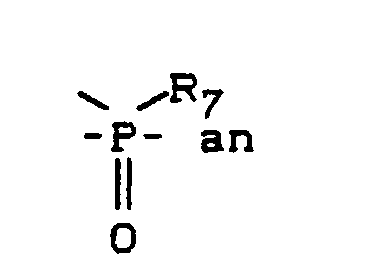
zwei benachbarte phenolische Reste gebunden enthält, charakterisiert durch die Formel (VI)

worin R¹
Wasserstoff oder Alkyl mit 1 bis 12 Kohlenstoffatomen, bevorzugt 1 bis 8 Kohlenstoffatomen, insbesondere Methyl,
R⁸
den folgenden Formeln (VII) oder (VIII)

R⁶
Phenyl, wobei dieses durch C₁-C₄-Alkyl, Aryl und Aralkyl, bevorzugt Methyl, Phenyl, Benzyl oder 2-Phenyl-ethyl, substituiert sein kann, und
R⁷
Alkyl mit 1 bis 8 Kohlenstoffatomen oder bevorzugt mit C₁-C₄-Alkyl substituiertem C₆-C₁₀-Aryl, bevorzugt Methyl bzw. Phenyl, ist,
entspricht und wenn m gleich Null ist, gleich n mindestens 1 sein muß und R⁸ gleich dem Rest (VIII) sein muß
und wenn n gleich Null ist, m mindestens 2 und R⁸ gleich dem Rest (VII) sein muß,
und/oder
eines Polyphosphorsäureesters von Polyphenolen, entsprechend der Formel (IX)

worin
R⁹
der Rest (X) oder (XI) der Formeln

ist, und
R¹ und R⁶ die bereits angegebene Bedeutung haben,
wobei, wenn m gleich Null ist, n mindestens 1 und R⁹ gleich (XI) sein muß, und wenn n gleich Null ist, m mindestens 2 und der Rest R⁹ gleich dem Rest (X) sein muß,
und wobei in (VI) und (IX) m ganze Zahlen bis 12, n ganze Zahlen bis 5 sein können und die Kernzahl des Polyphenolanteils von 3 bis 9 (Zahl der Benzolringe) und nicht höher als 12 liegt,
sowie gegebenenfalls weitere, übliche Zusatzstoffe in üblichen Mengen enthalten.
239,7 g (2 g Äquiv.) eines Novolaks aus p-Kresol und Formaldehyd (OH-Zahl 468, Kernzahl ca. 5) und 5,7 g (0,06 Mol) Magnesiumchlorid werden in einem 2 1-Kolben mit Heizbad, Rührer, Gaseinleitungsrohr für Stickstoff, Tropftrichter und Rückflußkühler unter Stickstoff auf 190 bis 200°C erhitzt. Dann werden in 1 Stunde 253,1 g (2 Mol) Methylethylphosphinsäurechlorid zugetropft. Nach 72 Stunden ist die Chlorwasserstoffentwicklung abgeschlossen.
240,3 g (2 g Äquiv.) eines Novolaks aus p-Kresol und Formaldehyd (OH-Zahl 468, Kernzahl ca. 5) und 301,1 g (2 Mol) 1-Chlor-1-oxo-3-methyl-phospholin werden wie unter 1 zur Umsetzung gebracht. Die Aufarbeitung erfolgt ebenfalls wie unter 1.
400,5 g Bis-(4-hydroxyphenyl)-methan (2,0 Mol), 501,4 g Methylphosphonsäurediphenylester (2,02 Mol) und 0,58 g Natriumphenolat (0,005 Mol) werden unter Stickstoff bei 250°C intensiv in einem Autoklaven vermischt. Innerhalb von 3 h wird unter einem von 250 auf 100 mbar absinkenden Vakuum und bei einer von 250°C auf 265°C ansteigenden Temperatur Phenol über eine auf 100°C beheizte Kolonne abdestilliert. Anschließend wird die Umesterung 5 h unter einem allmählich auf 0,3 mbar absinkenden Druck und einer auf 310°C ansteigenden Temperatur fortgesetzt, wobei die Viskosität der Schmelze ansteigt. Man belüftet mit Stickstoff, läßt das Polymer bei stillstehendem Rührer absitzen und nimmt nach Abkühlen die erstarrte Schmelze in Methylenchlorid auf. Nach gründlichem Auswaschen mit Wasser und Abdampfen des Lösungsmittels erhält man eine Schmelze, die nach Abkühlen in einer Mühle zerkleinert wird. Die Ausbeute beträgt 500,4 g Produkt. Es hat eine relative Viskosität ηrel von 1,10 (gemessen in Methylenchlorid; 0,5 g/100 ml Lösung). P-Gehalt = 11,7 %.
868,8 g (3,5 Mol) Methylphosphonsäurediphenylester, 861,2 g (7 g Äquiv.) eines Novolaks aus p-Kresol und Formaldehyd (OH-Zahl 456, Kernzahl ca. 5) und 2 ml einer 0,5 %igen Titantetrabutylat-Lösung in Chlorbenzol werden in einem 4 1-Kolben, der mit regelbarer Pilzheizhaube, Kapillare und kurzer Vigreux-Kolonne mit absteigendem Kühler versehen ist, nach Aufschmelzen 0,5 Stunden lang bei einem Vakuum von 300 mbar bei 200°C erhitzt. Der über die Kapillare eingeleitete Stickstoffstrom sorgt für gute Durchmischung. Anschließend werden in 4 Stunden bei fallendem Vakuum von 300 bis 3 mbar und Temperaturen von 190 bis 200°C über Kolonne und Kühler 646,9 g Produkt (OH-Zahl 586) abdestilliert (7 Mol Phenol: 658,7 g). Anschließend wird 1 Stunde bei 220°C und einem Vakuum von 3 mbar ausgeheizt.
359,6 g (3 g Äquiv.) eines Novolaks aus p-Kresol und Formaldehyd (OH-Zahl 468, Kernzahl ca. 5), 652,6 g (2 Mol) Triphenylphosphat und 8,6 g Magnesiumchlorid (0,09 Mol) werden in einem 2 1-Kolben, der mit regelbarer Pilzheizhaube, Kapillare und kurzer Vigreux-Kolonne mit absteigendem Kühler versehen ist, nach Aufschmelzen 0,5 Stunden lang bei einem Vakuum von 300 mbar bei 200°C erhitzt. Der über die Kapillare eingeleitete Stickstoffstrom sorgt für gute Durchmischung. Anschließend werden in 1,5 Stunden bei fallendem Vakuum von 20 bis 3 mbar und Temperaturen von 200 bis 210°C über Kolonne und Kühler 282,3 g (3 Mol) Phenol abdestilliert. Anschließend wird 1 Stunde bei 250°C und einem Vakuum von 3 mbar ausgeheizt.
Claims (12)
- Flammgeschützte Polyacrylnitril(co)polymerisat-Mischungen, enthaltend 3 bis 25 Gew.-% an Zusätzen von Phosphorestern B) auf Basis von Phosphinsäure-, Phosphonsäure- und Phosphorsäureestern von Polyphenolen, allein oder in Kombination miteinander, bzw. auch in Mischung mit bis zu 10 Gew.-% freien Polyphenolen, als Zusatz zu Acrylnitril(co)polymerisaten A).
- Flammgeschützte phosphorhaltige Mischungen und daraus hergestellte Acrylnitril(co)polymerisatformkörper, einschließlich Fasern, auf Acrylnitril(co)polymerisat-Basis, dieA) 97 bis 75 Gew.-%, vorzugsweise 95 bis 85 Gew.-%, insbesondere 93 bis 88 Gew.-% eines Acrylnitril(co)polymerisats mit mindestens 60 Gew.-% Acrylnitril undB) 3 bis 25 Gew.-%, vorzugsweise 5 bis 15 Gew.-%, insbesondere 7 bis 12 Gew.-% Phosphorester B) aus der ReihePhosphinsäureester von Polyphenolen, entsprechend der Formel (I)
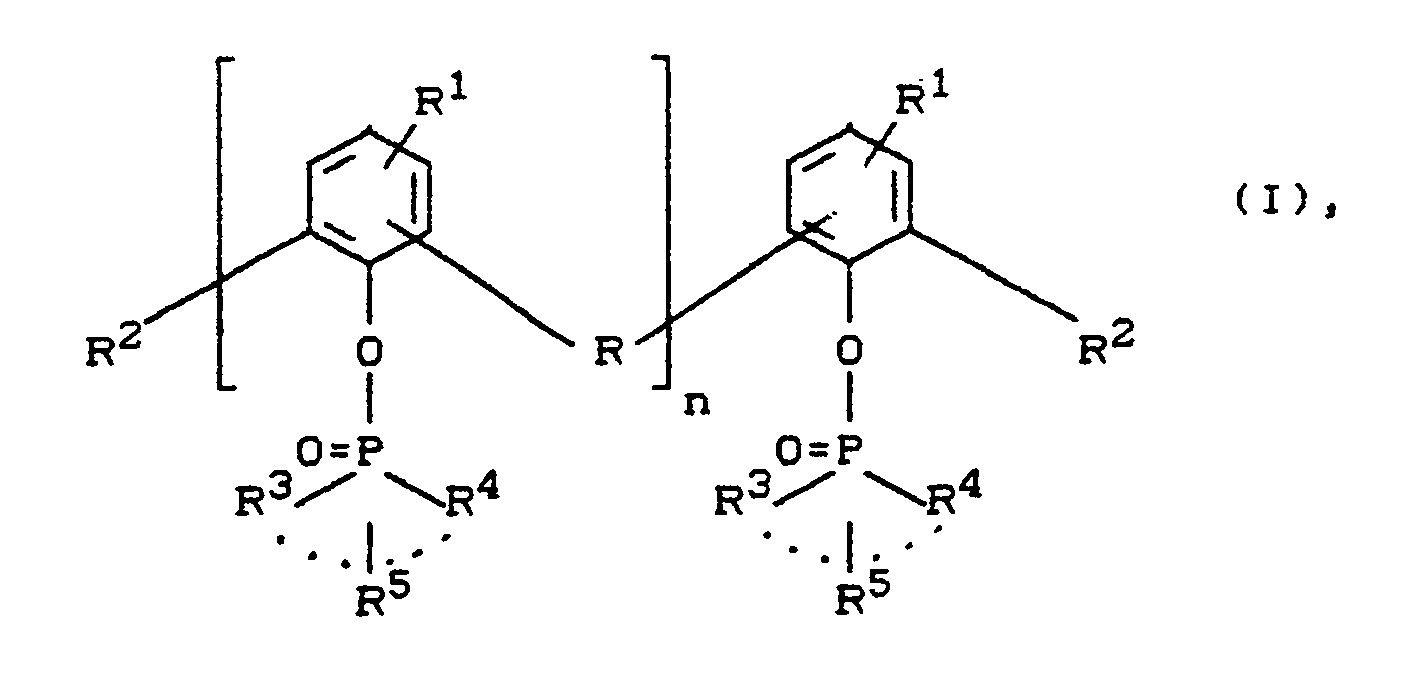 n eine ganze Zahl von 1 bis 20, bevorzugt von 1 bis 10, insbesondere 2 bis 8,R eine geradkettige oder verzweigte Alkylengruppe mit 1 bis 4 Kohlenstoffatomen, vorzugsweise eine Methylengruppe, eine gegebenenfalls alkylsubstituierte Cycloalkylengruppe mit 5 bis 9 Kohlenstoffatomen, oder, wenn n = 1 ist, auch eine direkte Bindung, eine Sulfonyl- oder Carbonylgruppe bzw. Sauerstoff- oder Schwefelbrücke,R¹ und R² unabhängig voneinander Wasserstoff, Alkylgruppen mit 1 bis 12, vorzugsweise 1 bis 8 Kohlenstoffatomen, insbesondere Methyl, gegebenenfalls alkylsubstituierte Cycloalkylgruppen mit 5 bis 9 Kohlenstoffatomen, gegebenenfalls alkylsubstituierte Arylgruppen mit 6 bis 10 Kohlenstoffatomen,R³ und R⁴ Alkylgruppen mit 1 bis 4 Kohlenstoffatomen und/oder Arylgruppen mit 6 bis 10 Kohlenstoffatomen sind, wobei R³ und R⁴ im Fall von Alkylgruppen auch durch eine Einfach- oder Doppelbindung zu einem Ring verbunden sein können und der so über das Phosphoratom gebildete Ring Alkylgruppen R⁵ mit 1 bis 4 Kohlenstoffatomen tragen kann, bedeutet;und/oder
eines Phosphonsäureesters VI von Polyphenolen der Phosphonsäuregruppen


R¹
Wasserstoff oder Alkyl mit 1 bis 12 Kohlenstoffatomen, bevorzugt 1 bis 8 Kohlenstoffatomen, insbesondere Methyl,
R⁸
den folgenden Formeln (VII) oder (VIII)
Phenyl, wobei dieses durch C₁-C₄-Alkyl, Aryl und Aralkyl, bevorzugt Methyl, Phenyl, Benzyl oder 2-Phenyl-ethyl, substituiert sein kann, und
R⁷
Alkyl mit 1 bis 8 Kohlenstoffatomen oder bevorzugt als mit C₁-C₄-Alkyl substituiertem C₆-C₁₀-Aryl, bevorzugt Methyl bzw. Phenyl, ist,
entspricht und wenn m gleich Null ist, gleich n mindestens 1 sein muß und R⁸ gleich dem Rest (VIII) sein muß
und wenn n gleich Null ist, m mindestens 2 und R⁸ gleich dem Rest (VII) sein muß,
und/oder
eines Polyphosphorsäureesters von Polyphenolen, entsprechend der Formel (IX)
R⁹
der Rest (X) oder (XI) der Formeln
R¹ und R⁶ die bereits angegebene Bedeutung haben,
wobei, wenn m gleich Null ist, n mindestens 1 und R⁹ gleich (XI) sein muß, und wenn n gleich Null ist, m mindestens 2 und der Rest R⁹ gleich dem Rest (X) sein muß,
und wobei in (VI) und (IX) m ganze Zahlen bis 12, n ganze Zahlen bis 5 sein können und die Kernzahl des Polyphenolanteils von 3 bis 9 (Zahl der Benzolringe) und nicht höher als 12 liegt,
sowie gegebenenfalls weitere, übliche Zusatzstoffe enthalten. - Flammgeschützte Mischungen nach Anspruch 2, dadurch gekennzeichnet, daß die Alkyl- und Arylphosphinsäureester (II) und (III) auf Basis von Bisphenolen oder von höhermolekularen Phenol-Formaldehyd-Kondensationsprodukten, insbesondere von Novolaken,
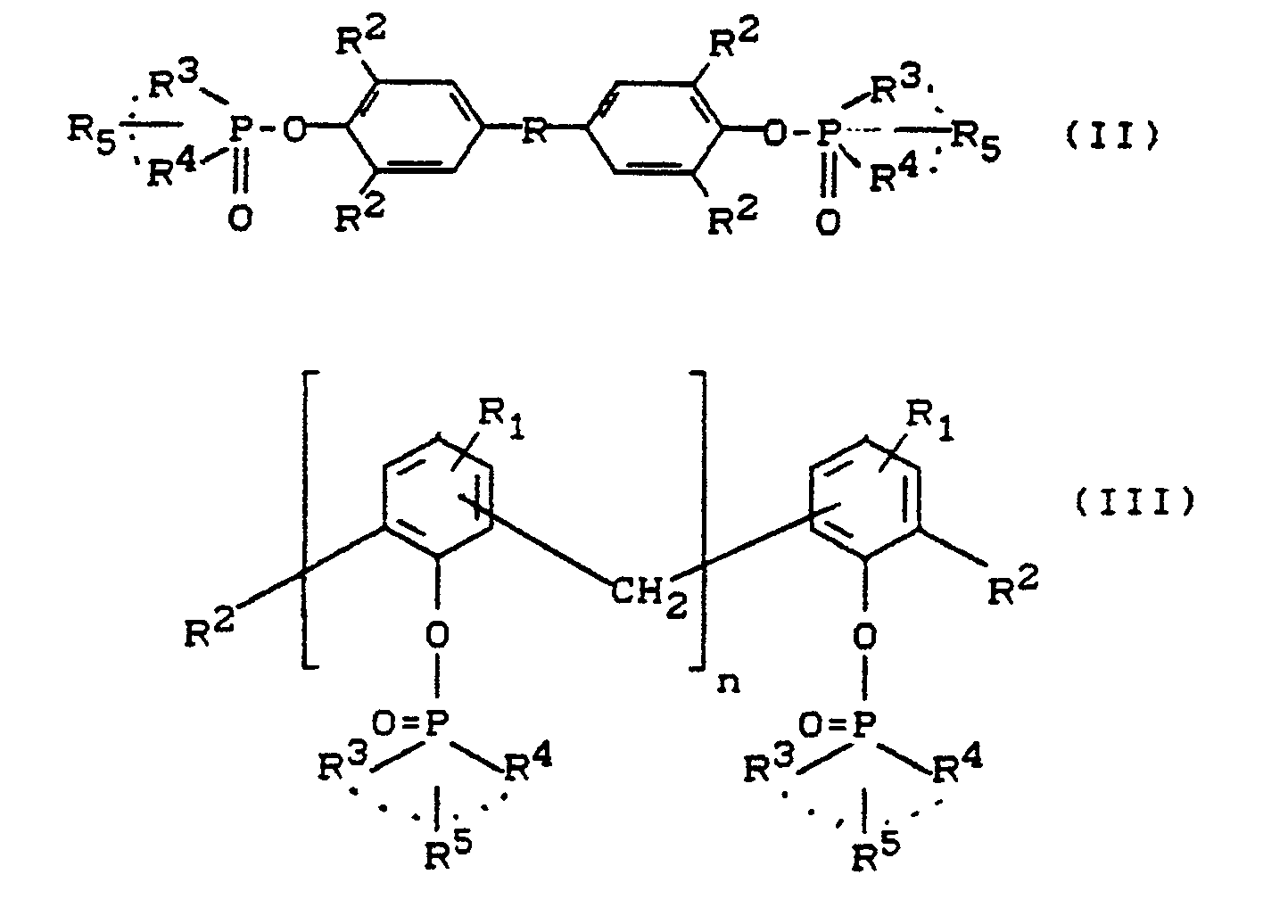 n eine ganze Zahl von 2 bis 15, bevorzugt von 2 bis 10, insbesondere 2 bis 8,R eine zweiwertige Gruppe wie eine Methylen- oder Isopropylidengruppe, eine Sulfonyl- oder Carbonylgruppe oder eine Sauerstoff- oder Schwefelbrücke,R¹ Wasserstoff oder eine Alkylgruppe mit 1 bis 12, vorzugsweise 1 bis 8 Kohlenstoffatomen, bevorzugt Methyl,R² Wasserstoff oder eine Alkylgruppe mit 1 bis 4 Kohlenstoffatomen,R³ und R⁴ unabhängig voneinander Methyl-, Ethyl- oder Phenylgruppen,enthalten.
oder die Reste R³ und R⁴ gemeinsam die gegebenenfalls mit R⁵ substituierte Butyliden- bzw. Alkylbutylidengruppe bedeuten, - Flammgeschützte Mischungen nach Ansprüchen 2 und 3, dadurch gekennzeichnet, daß als Phosphinsäureester (I) Verbindungen der Formel (IV) und (V)
 n eine ganze Zahl von 2 bis 8 ist,R die oben beschriebene Bedeutung hat,R² und R⁵ Wasserstoff oder Methylgruppen bedeuten,enthalten.
 - Flammgeschützte Mischungen nach Ansprüchen 2 bis 4, dadurch gekennzeichnet, daß sie als Phosphinsäureester solche auf Basis von Dimethylphosphinsäure, Methylethylphosphinsäure, Diethylphosphinsäure, Methylphenylphosphinsäure, Ethylphenylphosphinsäure, Diphenylphosphinsäure, Di-p-Tolylphosphinsäure und Phenylnaphthylphosphinsäure sowie 1-Hydroxy-1-oxo-phospholen, 1-Hydroxy-1-oxo-3-methylphospholen und 1-Hydroxy-1-oxo-3,4-dimethylphospholen
und Polyphenolen, insbesondere Bisphenolen der Reihe
Bis-(hydroxyphenyl)-alkane,
Bis-(hydroxyphenyl)-cycloalkane,
Bis-(hydroxyphenyl)-ether,
Bis-(hydroxyphenyl)-ketone,
Bis-(hydroxyphenyl)-sulfone,
sowie deren kernalkylierte Derivate oder Polyphenol-Novolake der Reihe
Phenol/Formaldehyd-Novolak,
o-Kresol/Formaldehyd-Novolak,
m-Kresol/Formaldehyd-Novolak,
p-Kresol/Formaldehyd-Novolak,
t-Butylphenol/Formaldehyd-Novolak,
p-Octylphenol/Formaldehyd-Novolak,
enthalten. - Flammgeschützte Mischungen nach Anspruch 2, dadurch gekennzeichnet, daß sie als Polyphenol-phosphonate (VI) Dialkyl- und Diarylphosphonsäureester von Polyphenolen, insbesondere von Novolaken aus Phosphonsäuren der Reihe Methylphosphonsäure, Ethylphosphonsäure, Phenylphosphonsäure, p-Tolylphosphonsäure und Naphthylphosphonsäsure enthalten.
- Flammgeschützte Mischungen nach Anspruch 2, dadurch gekennzeichnet, daß sie als Phosphonsäureester (VI) die Umsetzungsprodukte von 1 Mol Methylphosphonsäure-diphenylester bzw. Phenylphosphonsäure-diphenylester mit 1 bis 2 Äquivalenten Novolak enthalten.
- Flammgeschützte Mischungen nach Ansprüchen 2 bis 7, dadurch gekennzeichnet, daß sie bis zu 10 Gew.-% an freien Polyphenolen bzw. Novolaken anstelle eines Teils der phosphorhaltigen Ester (I), (VI) und (IX), zusammen mit den phosphorhaltigen Estern, enthalten.
- Flammgeschützte Mischung nach Anspruch 1 und 2, dadurch gekennzeichnet, daß die Acrylnitril(co)polymerisate A) mindestens 75 Gew.-% und bevorzugt mindestens 82 Gew.-% Acrylnitril enthalten und bis 12 Gew.-% an neutralen Comonomeren, wie z.B. Styrol, Isobuten, Methacrylnitril, Methyl-, Ethyl(meth)acrylat, Vinylacetat, Vinylbenzoat, (Meth)acrylamid, N-Methyl-, N-Ethyl-, N-Dimethyl(meth)acrylamid, N-Hydroxymethyl-, N-Methoxymethyl(meth)acrylamid, N-Phenyl(meth)acrylamid, N-Vinylacetamid, N-Vinylformamid, N-Vinylpyrrolidon, N-Vinylcaprolactam, Vinyl-methyl-, Vinylethylether, Vinylimidazol, Vinyltriazol aufweisen sowie 0,1 bis 3 Gew.-% an sauren, funktionellen Monomeren zu Anfärbbarkeitsverbesserungen, wie z.B. (Meth)Allyl-, Vinyl-, Styrolsulfonat, (Meth)Acrylamidomethylpropansulfonat, Vinylphosphonat, (Meth)acrylamidoalkylphosphonat in Mengen von 10 bis 460 mVal/kg einer Sulfon- oder Phosphonsäure im Polymer A) eingebaut oder auch 1 bis 10 Gew.-% an basischen Monomeren wie Dimethylaminoethyl(meth)acrylat, N-Dimethylaminopropyl(meth)acrylamid enthalten und K-Werte von 30 bis 130 aufweisen.
- Flammgeschützte Mischungen nach Anspruch 9, dadurch gekennzeichnet, daß sie Acrylnitril(co)polymerisate A), die neben den neutralen Copolymeren aus Carboxylgruppen und davon abgeleiteten Salzen 1 bis 3-wertige Kationen enthaltenden Monomeren aufgebaut sind, enthalten und, bezogen auf Carboxylgruppen, 500 bis 2800, vorzugsweise 700-2100 mVal/kg Polymer A und/oder davon abgeleitete Salze besitzen.
- Verwendung der Mischungen nach Ansprüchen 1 bis 10 in Form von Lösungen in hochpolaren Lösungsmitteln zur Verspinnung zu Fäden und Faser.
- Verwendung nach Anspruch 11, dadurch gekennzeichnet, daß man bei der Verspinnung von Lösungen der Mischungen, welche Carbonsäure(salz)gruppen enthalten, Komplexbildner mitverwendet.
Applications Claiming Priority (2)
| Application Number | Priority Date | Filing Date | Title |
|---|---|---|---|
| DE19904005376 DE4005376A1 (de) | 1990-02-21 | 1990-02-21 | Flammgeschuetzte, phosphorhaltige phenolderivate enthaltende polyacrylnitril(co)-polymerisate |
| DE4005376 | 1990-02-21 |
Publications (1)
| Publication Number | Publication Date |
|---|---|
| EP0446469A1 true EP0446469A1 (de) | 1991-09-18 |
Family
ID=6400612
Family Applications (1)
| Application Number | Title | Priority Date | Filing Date |
|---|---|---|---|
| EP90124699A Withdrawn EP0446469A1 (de) | 1990-02-21 | 1990-12-19 | Flammgeschützte, phosphorhaltige Phenolderivate enthaltende Polyacrylnitril-(Co)-polymerisate |
Country Status (2)
| Country | Link |
|---|---|
| EP (1) | EP0446469A1 (de) |
| DE (1) | DE4005376A1 (de) |
Cited By (5)
| Publication number | Priority date | Publication date | Assignee | Title |
|---|---|---|---|---|
| KR100364060B1 (ko) * | 2000-07-19 | 2002-12-12 | 제일모직주식회사 | 열가소성 난연성 수지 조성물 |
| US6599273B1 (en) | 1991-12-18 | 2003-07-29 | Icu Medical, Inc. | Fluid transfer device and method of use |
| US7713249B2 (en) | 1991-12-18 | 2010-05-11 | Icu Medical, Inc. | Medical valve and method of use |
| US8002765B2 (en) | 1995-12-15 | 2011-08-23 | Icu Medical, Inc. | Medical valve with fluid escape space |
| CN111088544A (zh) * | 2018-10-23 | 2020-05-01 | 中国石油化工股份有限公司 | 阻燃剂及阻燃腈纶及其制备方法 |
Families Citing this family (1)
| Publication number | Priority date | Publication date | Assignee | Title |
|---|---|---|---|---|
| ES2257284T3 (es) * | 1999-02-19 | 2006-08-01 | Akzo Nobel N.V. | Composicion de poliester termoplastico ignifugo conteniendo fosforo. |
Citations (4)
| Publication number | Priority date | Publication date | Assignee | Title |
|---|---|---|---|---|
| US2878219A (en) * | 1956-05-23 | 1959-03-17 | Chemstrand Corp | Acrylonitrile polymer composition stabilized with tricresyl phosphate and an inorganic acid and method of making same |
| GB1528371A (en) * | 1976-02-12 | 1978-10-11 | Courtaulds Ltd | Filaments containing flame-retardant phosphonates and phosphonates for use therein |
| EP0054518A1 (de) * | 1980-12-17 | 1982-06-23 | Ciba-Geigy Ag | Flammhemmende Polymermassen |
| EP0237135A2 (de) * | 1986-03-14 | 1987-09-16 | Akzo N.V. | Thermisch stabiles Flammschutzmittel vom Diphosphonattyp für Kunststoffe |
-
1990
- 1990-02-21 DE DE19904005376 patent/DE4005376A1/de not_active Withdrawn
- 1990-12-19 EP EP90124699A patent/EP0446469A1/de not_active Withdrawn
Patent Citations (4)
| Publication number | Priority date | Publication date | Assignee | Title |
|---|---|---|---|---|
| US2878219A (en) * | 1956-05-23 | 1959-03-17 | Chemstrand Corp | Acrylonitrile polymer composition stabilized with tricresyl phosphate and an inorganic acid and method of making same |
| GB1528371A (en) * | 1976-02-12 | 1978-10-11 | Courtaulds Ltd | Filaments containing flame-retardant phosphonates and phosphonates for use therein |
| EP0054518A1 (de) * | 1980-12-17 | 1982-06-23 | Ciba-Geigy Ag | Flammhemmende Polymermassen |
| EP0237135A2 (de) * | 1986-03-14 | 1987-09-16 | Akzo N.V. | Thermisch stabiles Flammschutzmittel vom Diphosphonattyp für Kunststoffe |
Cited By (14)
| Publication number | Priority date | Publication date | Assignee | Title |
|---|---|---|---|---|
| US7717883B2 (en) | 1991-12-18 | 2010-05-18 | Icu Medical, Inc. | Medical valve and method of use |
| US7722575B2 (en) | 1991-12-18 | 2010-05-25 | Icu Medical, Inc. | Medical valve and method of use |
| US7713249B2 (en) | 1991-12-18 | 2010-05-11 | Icu Medical, Inc. | Medical valve and method of use |
| US7713248B2 (en) | 1991-12-18 | 2010-05-11 | Icu Medical, Inc. | Medical valve and method of use |
| US7713247B2 (en) | 1991-12-18 | 2010-05-11 | Icu Medical, Inc. | Medical valve and method of use |
| US7717887B2 (en) | 1991-12-18 | 2010-05-18 | Icu Medical, Inc. | Medical valve and method of use |
| US7717886B2 (en) | 1991-12-18 | 2010-05-18 | Icu Medical, Inc. | Medical valve and method of use |
| US7717885B2 (en) | 1991-12-18 | 2010-05-18 | Icu Medical, Inc. | Medical valve and method of use |
| US6599273B1 (en) | 1991-12-18 | 2003-07-29 | Icu Medical, Inc. | Fluid transfer device and method of use |
| US7717884B2 (en) | 1991-12-18 | 2010-05-18 | Icu Medical, Inc. | Medical valve and method of use |
| US7722576B2 (en) | 1991-12-18 | 2010-05-25 | Icu Medical, Inc. | Medical valve and method of use |
| US8002765B2 (en) | 1995-12-15 | 2011-08-23 | Icu Medical, Inc. | Medical valve with fluid escape space |
| KR100364060B1 (ko) * | 2000-07-19 | 2002-12-12 | 제일모직주식회사 | 열가소성 난연성 수지 조성물 |
| CN111088544A (zh) * | 2018-10-23 | 2020-05-01 | 中国石油化工股份有限公司 | 阻燃剂及阻燃腈纶及其制备方法 |
Also Published As
| Publication number | Publication date |
|---|---|
| DE4005376A1 (de) | 1991-08-22 |
Similar Documents
| Publication | Publication Date | Title |
|---|---|---|
| DE2041745C3 (de) | Zusammengesetzte Fasern aus zwei oder mehreren im Kern-Mantel-Verhältnis angeordneten Komponenten | |
| DE2521926C2 (de) | Phosphor und Brom enthaltende Polymere und deren Verwendung zur Herstellung flammfester Massen | |
| DE2236037C3 (de) | Schwer entflammbare Fäden und Fasern aus Polyester | |
| DE931732C (de) | Verfahren zur Herstellung eines fuer die Verarbeitung auf geformte Gegenstaende geeigneten Kopolymeren | |
| DE1693229A1 (de) | Modifizierte polymere Materialien | |
| DE2726786A1 (de) | Flammhemmende polymere zusammensetzungen | |
| US4029634A (en) | Flame retardant polymeric compositions containing halogen substituted hexakis-(substituted phenoxy)cyclotriphosphazene | |
| DE2500428C2 (de) | Aminomethylphosphonsäurederivate, Verfahren zu deren Herstellung und deren Verwendung als Sequestriermittel | |
| WO2014154805A1 (de) | Flammfestes polyamid, ein verfahren zu dessen herstellung sowie dessen verwendung | |
| DE2458967A1 (de) | Flammwidrige polyestermassen | |
| EP0446469A1 (de) | Flammgeschützte, phosphorhaltige Phenolderivate enthaltende Polyacrylnitril-(Co)-polymerisate | |
| US4083893A (en) | Ozone resistant, cationic dyeable nylon containing lithium, magnesium or calcium salts of sulfonated polystyrene | |
| DE2600701A1 (de) | Flammwidrige polyester und ihre verwendung | |
| DE2315212A1 (de) | Phosphor enthaltende, feuerhemmende zusatzstoffe | |
| CH495395A (de) | Verfahren zur Herstellung von synthetischen hochmolekularen Polyestern | |
| DE4026883A1 (de) | Flammgeschuetzte, (poly)organophosphazene enthaltende polyacrylnitril(co)-polymerisate | |
| DE2111202C3 (de) | Flammabweisender thermoplastischer Polyester | |
| DE2162437A1 (de) | ||
| DE2238881C3 (de) | 28.02.72 Japan 20484-τi Verfahren zur Herstellungllammbeständiger Fasern aus modifizierten Phenolharzen | |
| DE1770359A1 (de) | Polymere Zubereitungen | |
| DE3029176C2 (de) | Migrationsfeste, polymere, aromatische Phosphite | |
| DE1694156C3 (de) | Lichtstabilisierte Polyamide | |
| EP0443166A1 (de) | Phosphonsäureester enthaltende Acrylnitril(co)polymerisate | |
| DE3002658C2 (de) | Schwerentflammbare Poly-(butylenterephthalat)-Masse | |
| DE1545009C (de) | Verfahren zur Herstellung von phosphorhakigen Mischpolymerisaten |
Legal Events
| Date | Code | Title | Description |
|---|---|---|---|
| PUAI | Public reference made under article 153(3) epc to a published international application that has entered the european phase |
Free format text: ORIGINAL CODE: 0009012 |
|
| 17P | Request for examination filed |
Effective date: 19901219 |
|
| AK | Designated contracting states |
Kind code of ref document: A1 Designated state(s): DE FR GB IT |
|
| STAA | Information on the status of an ep patent application or granted ep patent |
Free format text: STATUS: THE APPLICATION HAS BEEN WITHDRAWN |
|
| 18W | Application withdrawn |
Withdrawal date: 19921209 |