EP0323427B2 - Compositions photosensibles contenant des résines phénoliques et des dérivés de diazoquinone - Google Patents
Compositions photosensibles contenant des résines phénoliques et des dérivés de diazoquinone Download PDFInfo
- Publication number
- EP0323427B2 EP0323427B2 EP88870188A EP88870188A EP0323427B2 EP 0323427 B2 EP0323427 B2 EP 0323427B2 EP 88870188 A EP88870188 A EP 88870188A EP 88870188 A EP88870188 A EP 88870188A EP 0323427 B2 EP0323427 B2 EP 0323427B2
- Authority
- EP
- European Patent Office
- Prior art keywords
- acid
- diazo
- dihydro
- oxo
- carboxylic acid
- Prior art date
- Legal status (The legal status is an assumption and is not a legal conclusion. Google has not performed a legal analysis and makes no representation as to the accuracy of the status listed.)
- Expired - Lifetime
Links
- 239000000203 mixture Substances 0.000 title claims abstract description 98
- 239000005011 phenolic resin Substances 0.000 title claims abstract description 33
- AZQWKYJCGOJGHM-UHFFFAOYSA-N 1,4-benzoquinone Chemical compound O=C1C=CC(=O)C=C1 AZQWKYJCGOJGHM-UHFFFAOYSA-N 0.000 title 2
- 239000002253 acid Substances 0.000 claims abstract description 35
- 238000000034 method Methods 0.000 claims abstract description 34
- 229920001568 phenolic resin Polymers 0.000 claims abstract description 32
- 230000008569 process Effects 0.000 claims abstract description 23
- 150000001732 carboxylic acid derivatives Chemical class 0.000 claims abstract description 19
- 150000003863 ammonium salts Chemical class 0.000 claims abstract description 18
- 125000003118 aryl group Chemical group 0.000 claims abstract description 18
- 125000003367 polycyclic group Chemical group 0.000 claims abstract description 15
- 239000000758 substrate Substances 0.000 claims abstract description 13
- 230000005855 radiation Effects 0.000 claims abstract description 10
- 150000001768 cations Chemical class 0.000 claims abstract description 6
- 125000004435 hydrogen atom Chemical group [H]* 0.000 claims abstract description 6
- 150000003377 silicon compounds Chemical class 0.000 claims abstract description 6
- BDHFUVZGWQCTTF-UHFFFAOYSA-N sulfonic acid Chemical compound OS(=O)=O BDHFUVZGWQCTTF-UHFFFAOYSA-N 0.000 claims abstract 15
- 229910052760 oxygen Inorganic materials 0.000 claims description 23
- KXGFMDJXCMQABM-UHFFFAOYSA-N 2-methoxy-6-methylphenol Chemical compound [CH]OC1=CC=CC([CH])=C1O KXGFMDJXCMQABM-UHFFFAOYSA-N 0.000 claims description 21
- 229920005989 resin Polymers 0.000 claims description 18
- 239000011347 resin Substances 0.000 claims description 18
- ISWSIDIOOBJBQZ-UHFFFAOYSA-N Phenol Chemical compound OC1=CC=CC=C1 ISWSIDIOOBJBQZ-UHFFFAOYSA-N 0.000 claims description 15
- -1 aromatic amino acid Chemical class 0.000 claims description 15
- 150000002148 esters Chemical class 0.000 claims description 12
- 239000002904 solvent Substances 0.000 claims description 11
- KVBGVZZKJNLNJU-UHFFFAOYSA-N naphthalene-2-sulfonic acid Chemical compound C1=CC=CC2=CC(S(=O)(=O)O)=CC=C21 KVBGVZZKJNLNJU-UHFFFAOYSA-N 0.000 claims description 10
- WSFSSNUMVMOOMR-UHFFFAOYSA-N Formaldehyde Chemical compound O=C WSFSSNUMVMOOMR-UHFFFAOYSA-N 0.000 claims description 9
- QHPQWRBYOIRBIT-UHFFFAOYSA-N 4-tert-butylphenol Chemical compound CC(C)(C)C1=CC=C(O)C=C1 QHPQWRBYOIRBIT-UHFFFAOYSA-N 0.000 claims description 7
- QGZKDVFQNNGYKY-UHFFFAOYSA-O Ammonium Chemical compound [NH4+] QGZKDVFQNNGYKY-UHFFFAOYSA-O 0.000 claims description 7
- 150000001735 carboxylic acids Chemical class 0.000 claims description 7
- 150000001875 compounds Chemical class 0.000 claims description 7
- 229920003986 novolac Polymers 0.000 claims description 7
- 125000000217 alkyl group Chemical group 0.000 claims description 5
- 125000004432 carbon atom Chemical group C* 0.000 claims description 5
- 125000002768 hydroxyalkyl group Chemical group 0.000 claims description 5
- PSZYNBSKGUBXEH-UHFFFAOYSA-N naphthalene-1-sulfonic acid Chemical compound C1=CC=C2C(S(=O)(=O)O)=CC=CC2=C1 PSZYNBSKGUBXEH-UHFFFAOYSA-N 0.000 claims description 5
- HUMNYLRZRPPJDN-UHFFFAOYSA-N benzaldehyde Chemical compound O=CC1=CC=CC=C1 HUMNYLRZRPPJDN-UHFFFAOYSA-N 0.000 claims description 4
- 150000004780 naphthols Chemical class 0.000 claims description 4
- ANAVBFHDELNCGS-UHFFFAOYSA-N (5E)-5-diazo-6-oxonaphthalene-1-sulfonic acid Chemical compound OS(=O)(=O)c1cccc2C(=[N+]=[N-])C(=O)C=Cc12 ANAVBFHDELNCGS-UHFFFAOYSA-N 0.000 claims description 3
- BJHDSHLCKATSBY-UHFFFAOYSA-N (5E)-5-diazo-6-oxonaphthalene-2-sulfonic acid Chemical compound OS(=O)(=O)c1ccc2C(=[N+]=[N-])C(=O)C=Cc2c1 BJHDSHLCKATSBY-UHFFFAOYSA-N 0.000 claims description 3
- WZUNRVOEMRRGCX-UHFFFAOYSA-N (6Z)-6-diazo-5-oxonaphthalene-2-sulfonic acid Chemical compound OS(=O)(=O)c1ccc2C(=O)C(C=Cc2c1)=[N+]=[N-] WZUNRVOEMRRGCX-UHFFFAOYSA-N 0.000 claims description 3
- 150000005207 1,3-dihydroxybenzenes Chemical class 0.000 claims description 3
- OFFSPAZVIVZPHU-UHFFFAOYSA-N 1-benzofuran-2-carboxylic acid Chemical compound C1=CC=C2OC(C(=O)O)=CC2=C1 OFFSPAZVIVZPHU-UHFFFAOYSA-N 0.000 claims description 3
- 150000003232 pyrogallols Chemical class 0.000 claims description 3
- IKHGUXGNUITLKF-XPULMUKRSA-N acetaldehyde Chemical compound [14CH]([14CH3])=O IKHGUXGNUITLKF-XPULMUKRSA-N 0.000 claims description 2
- WSFSSNUMVMOOMR-NJFSPNSNSA-N methanone Chemical compound O=[14CH2] WSFSSNUMVMOOMR-NJFSPNSNSA-N 0.000 claims description 2
- QNGNSVIICDLXHT-UHFFFAOYSA-N para-ethylbenzaldehyde Natural products CCC1=CC=C(C=O)C=C1 QNGNSVIICDLXHT-UHFFFAOYSA-N 0.000 claims description 2
- WQGWDDDVZFFDIG-UHFFFAOYSA-N pyrogallol Chemical compound OC1=CC=CC(O)=C1O WQGWDDDVZFFDIG-UHFFFAOYSA-N 0.000 claims 3
- GHMLBKRAJCXXBS-UHFFFAOYSA-N resorcinol Chemical compound OC1=CC=CC(O)=C1 GHMLBKRAJCXXBS-UHFFFAOYSA-N 0.000 claims 3
- NIFOUHHBVBOUOI-UHFFFAOYSA-N (4Z)-4-diazo-3-oxonaphthalene-1-sulfonic acid Chemical compound OS(=O)(=O)C1=CC(=O)C(=[N+]=[N-])c2ccccc12 NIFOUHHBVBOUOI-UHFFFAOYSA-N 0.000 claims 2
- BNWKXMCELVEAPW-UHFFFAOYSA-N chembl3305990 Chemical compound O=C1C(=[N+]=[N-])C=CC2=C1C=CC=C2S(=O)(=O)O BNWKXMCELVEAPW-UHFFFAOYSA-N 0.000 claims 2
- 229940079877 pyrogallol Drugs 0.000 claims 2
- WUCDFJQVKORCRA-UHFFFAOYSA-N (3E)-3-diazo-4-oxonaphthalene-1-sulfonic acid Chemical compound OS(=O)(=O)C1=CC(=[N+]=[N-])C(=O)c2ccccc12 WUCDFJQVKORCRA-UHFFFAOYSA-N 0.000 claims 1
- 238000011161 development Methods 0.000 abstract description 31
- 229920002120 photoresistant polymer Polymers 0.000 abstract description 14
- 230000015572 biosynthetic process Effects 0.000 abstract description 3
- 238000004519 manufacturing process Methods 0.000 abstract description 3
- 125000004178 (C1-C4) alkyl group Chemical group 0.000 abstract 1
- 125000002853 C1-C4 hydroxyalkyl group Chemical group 0.000 abstract 1
- 150000004820 halides Chemical class 0.000 abstract 1
- 229910052739 hydrogen Inorganic materials 0.000 abstract 1
- 239000001257 hydrogen Substances 0.000 abstract 1
- 239000000243 solution Substances 0.000 description 55
- 230000018109 developmental process Effects 0.000 description 30
- FFUAGWLWBBFQJT-UHFFFAOYSA-N hexamethyldisilazane Chemical compound C[Si](C)(C)N[Si](C)(C)C FFUAGWLWBBFQJT-UHFFFAOYSA-N 0.000 description 26
- 238000006884 silylation reaction Methods 0.000 description 26
- 235000012431 wafers Nutrition 0.000 description 26
- XUIMIQQOPSSXEZ-UHFFFAOYSA-N Silicon Chemical compound [Si] XUIMIQQOPSSXEZ-UHFFFAOYSA-N 0.000 description 25
- 239000010703 silicon Substances 0.000 description 21
- 239000001301 oxygen Substances 0.000 description 20
- 229910052710 silicon Inorganic materials 0.000 description 20
- QVGXLLKOCUKJST-UHFFFAOYSA-N atomic oxygen Chemical compound [O] QVGXLLKOCUKJST-UHFFFAOYSA-N 0.000 description 19
- 239000010410 layer Substances 0.000 description 18
- 239000000975 dye Substances 0.000 description 15
- 238000012360 testing method Methods 0.000 description 12
- VJKZIQFVKMUTID-UHFFFAOYSA-N 2-diazonio-5-sulfonaphthalen-1-olate Chemical compound N#[N+]C1=CC=C2C(S(=O)(=O)O)=CC=CC2=C1[O-] VJKZIQFVKMUTID-UHFFFAOYSA-N 0.000 description 11
- 238000005119 centrifugation Methods 0.000 description 11
- 238000005530 etching Methods 0.000 description 11
- 239000003795 chemical substances by application Substances 0.000 description 9
- 239000007787 solid Substances 0.000 description 9
- VFLDPWHFBUODDF-FCXRPNKRSA-N curcumin Chemical compound C1=C(O)C(OC)=CC(\C=C\C(=O)CC(=O)\C=C\C=2C=C(OC)C(O)=CC=2)=C1 VFLDPWHFBUODDF-FCXRPNKRSA-N 0.000 description 6
- TUXAJHDLJHMOQB-UHFFFAOYSA-N 2-diazonio-4-sulfonaphthalen-1-olate Chemical compound C1=CC=C2C(S(=O)(=O)O)=CC([N+]#N)=C([O-])C2=C1 TUXAJHDLJHMOQB-UHFFFAOYSA-N 0.000 description 5
- 239000000654 additive Substances 0.000 description 5
- 238000001312 dry etching Methods 0.000 description 5
- 150000003839 salts Chemical class 0.000 description 5
- CYSGHNMQYZDMIA-UHFFFAOYSA-N 1,3-Dimethyl-2-imidazolidinon Chemical compound CN1CCN(C)C1=O CYSGHNMQYZDMIA-UHFFFAOYSA-N 0.000 description 4
- LSNNMFCWUKXFEE-UHFFFAOYSA-M Bisulfite Chemical compound OS([O-])=O LSNNMFCWUKXFEE-UHFFFAOYSA-M 0.000 description 4
- RTZKZFJDLAIYFH-UHFFFAOYSA-N Diethyl ether Chemical compound CCOCC RTZKZFJDLAIYFH-UHFFFAOYSA-N 0.000 description 4
- PVNIIMVLHYAWGP-UHFFFAOYSA-N Niacin Chemical compound OC(=O)C1=CC=CN=C1 PVNIIMVLHYAWGP-UHFFFAOYSA-N 0.000 description 4
- 238000010348 incorporation Methods 0.000 description 4
- JESXATFQYMPTNL-UHFFFAOYSA-N 2-ethenylphenol Chemical class OC1=CC=CC=C1C=C JESXATFQYMPTNL-UHFFFAOYSA-N 0.000 description 3
- DZQQBMOSBPOYFX-UHFFFAOYSA-N 5-chlorosulfonyl-2-diazonionaphthalen-1-olate Chemical compound C1=CC=C2C([O-])=C([N+]#N)C=CC2=C1S(Cl)(=O)=O DZQQBMOSBPOYFX-UHFFFAOYSA-N 0.000 description 3
- QTBSBXVTEAMEQO-UHFFFAOYSA-N Acetic acid Chemical compound CC(O)=O QTBSBXVTEAMEQO-UHFFFAOYSA-N 0.000 description 3
- IJGRMHOSHXDMSA-UHFFFAOYSA-N Atomic nitrogen Chemical compound N#N IJGRMHOSHXDMSA-UHFFFAOYSA-N 0.000 description 3
- ROSDSFDQCJNGOL-UHFFFAOYSA-N Dimethylamine Chemical compound CNC ROSDSFDQCJNGOL-UHFFFAOYSA-N 0.000 description 3
- ZMXDDKWLCZADIW-UHFFFAOYSA-N N,N-Dimethylformamide Chemical compound CN(C)C=O ZMXDDKWLCZADIW-UHFFFAOYSA-N 0.000 description 3
- SECXISVLQFMRJM-UHFFFAOYSA-N N-Methylpyrrolidone Chemical compound CN1CCCC1=O SECXISVLQFMRJM-UHFFFAOYSA-N 0.000 description 3
- MUBZPKHOEPUJKR-UHFFFAOYSA-N Oxalic acid Chemical compound OC(=O)C(O)=O MUBZPKHOEPUJKR-UHFFFAOYSA-N 0.000 description 3
- 230000008901 benefit Effects 0.000 description 3
- 230000008859 change Effects 0.000 description 3
- 238000006243 chemical reaction Methods 0.000 description 3
- 230000000052 comparative effect Effects 0.000 description 3
- 229940109262 curcumin Drugs 0.000 description 3
- 235000012754 curcumin Nutrition 0.000 description 3
- 239000004148 curcumin Substances 0.000 description 3
- 239000012954 diazonium Substances 0.000 description 3
- VFLDPWHFBUODDF-UHFFFAOYSA-N diferuloylmethane Natural products C1=C(O)C(OC)=CC(C=CC(=O)CC(=O)C=CC=2C=C(OC)C(O)=CC=2)=C1 VFLDPWHFBUODDF-UHFFFAOYSA-N 0.000 description 3
- LLHKCFNBLRBOGN-UHFFFAOYSA-N propylene glycol methyl ether acetate Chemical compound COCC(C)OC(C)=O LLHKCFNBLRBOGN-UHFFFAOYSA-N 0.000 description 3
- 230000009467 reduction Effects 0.000 description 3
- ARXJGSRGQADJSQ-UHFFFAOYSA-N 1-methoxypropan-2-ol Chemical group COCC(C)O ARXJGSRGQADJSQ-UHFFFAOYSA-N 0.000 description 2
- UIAFKZKHHVMJGS-UHFFFAOYSA-N 2,4-dihydroxybenzoic acid Chemical compound OC(=O)C1=CC=C(O)C=C1O UIAFKZKHHVMJGS-UHFFFAOYSA-N 0.000 description 2
- XNWFRZJHXBZDAG-UHFFFAOYSA-N 2-METHOXYETHANOL Chemical group COCCO XNWFRZJHXBZDAG-UHFFFAOYSA-N 0.000 description 2
- YEJRWHAVMIAJKC-UHFFFAOYSA-N 4-Butyrolactone Chemical compound O=C1CCCO1 YEJRWHAVMIAJKC-UHFFFAOYSA-N 0.000 description 2
- IAZDPXIOMUYVGZ-UHFFFAOYSA-N Dimethylsulphoxide Chemical compound CS(C)=O IAZDPXIOMUYVGZ-UHFFFAOYSA-N 0.000 description 2
- VYPSYNLAJGMNEJ-UHFFFAOYSA-N Silicium dioxide Chemical compound O=[Si]=O VYPSYNLAJGMNEJ-UHFFFAOYSA-N 0.000 description 2
- WYURNTSHIVDZCO-UHFFFAOYSA-N Tetrahydrofuran Chemical compound C1CCOC1 WYURNTSHIVDZCO-UHFFFAOYSA-N 0.000 description 2
- 239000002250 absorbent Substances 0.000 description 2
- 230000002745 absorbent Effects 0.000 description 2
- 238000010521 absorption reaction Methods 0.000 description 2
- KVXNKFYSHAUJIA-UHFFFAOYSA-N acetic acid;ethoxyethane Chemical compound CC(O)=O.CCOCC KVXNKFYSHAUJIA-UHFFFAOYSA-N 0.000 description 2
- 230000004888 barrier function Effects 0.000 description 2
- 239000011248 coating agent Substances 0.000 description 2
- 238000000576 coating method Methods 0.000 description 2
- 238000009833 condensation Methods 0.000 description 2
- 230000005494 condensation Effects 0.000 description 2
- 238000000354 decomposition reaction Methods 0.000 description 2
- IJGRMHOSHXDMSA-UHFFFAOYSA-O diazynium Chemical compound [NH+]#N IJGRMHOSHXDMSA-UHFFFAOYSA-O 0.000 description 2
- 230000032050 esterification Effects 0.000 description 2
- 238000005886 esterification reaction Methods 0.000 description 2
- 238000001704 evaporation Methods 0.000 description 2
- 230000008020 evaporation Effects 0.000 description 2
- 230000002349 favourable effect Effects 0.000 description 2
- 125000002887 hydroxy group Chemical group [H]O* 0.000 description 2
- JVTAAEKCZFNVCJ-UHFFFAOYSA-N lactic acid Chemical compound CC(O)C(O)=O JVTAAEKCZFNVCJ-UHFFFAOYSA-N 0.000 description 2
- RLSSMJSEOOYNOY-UHFFFAOYSA-N m-cresol Chemical compound CC1=CC=CC(O)=C1 RLSSMJSEOOYNOY-UHFFFAOYSA-N 0.000 description 2
- 239000011159 matrix material Substances 0.000 description 2
- 238000001393 microlithography Methods 0.000 description 2
- NRZRRZAVMCAKEP-UHFFFAOYSA-N naphthionic acid Chemical compound C1=CC=C2C(N)=CC=C(S(O)(=O)=O)C2=C1 NRZRRZAVMCAKEP-UHFFFAOYSA-N 0.000 description 2
- 229960003512 nicotinic acid Drugs 0.000 description 2
- 235000001968 nicotinic acid Nutrition 0.000 description 2
- 239000011664 nicotinic acid Substances 0.000 description 2
- QWVGKYWNOKOFNN-UHFFFAOYSA-N o-cresol Chemical compound CC1=CC=CC=C1O QWVGKYWNOKOFNN-UHFFFAOYSA-N 0.000 description 2
- 239000012044 organic layer Substances 0.000 description 2
- IWDCLRJOBJJRNH-UHFFFAOYSA-N p-cresol Chemical compound CC1=CC=C(O)C=C1 IWDCLRJOBJJRNH-UHFFFAOYSA-N 0.000 description 2
- OXNIZHLAWKMVMX-UHFFFAOYSA-N picric acid Chemical compound OC1=C([N+]([O-])=O)C=C([N+]([O-])=O)C=C1[N+]([O-])=O OXNIZHLAWKMVMX-UHFFFAOYSA-N 0.000 description 2
- 238000001020 plasma etching Methods 0.000 description 2
- 238000002360 preparation method Methods 0.000 description 2
- 230000001681 protective effect Effects 0.000 description 2
- 238000010992 reflux Methods 0.000 description 2
- 150000003460 sulfonic acids Chemical class 0.000 description 2
- 238000012876 topography Methods 0.000 description 2
- GETQZCLCWQTVFV-UHFFFAOYSA-N trimethylamine Chemical class CN(C)C GETQZCLCWQTVFV-UHFFFAOYSA-N 0.000 description 2
- XLYOFNOQVPJJNP-UHFFFAOYSA-N water Substances O XLYOFNOQVPJJNP-UHFFFAOYSA-N 0.000 description 2
- MASDFXZJIDNRTR-UHFFFAOYSA-N 1,3-bis(trimethylsilyl)urea Chemical compound C[Si](C)(C)NC(=O)N[Si](C)(C)C MASDFXZJIDNRTR-UHFFFAOYSA-N 0.000 description 1
- OUYBHCPCSNUQHE-UHFFFAOYSA-N 1,3-diphenyl-1-trimethylsilylurea Chemical compound C=1C=CC=CC=1N([Si](C)(C)C)C(=O)NC1=CC=CC=C1 OUYBHCPCSNUQHE-UHFFFAOYSA-N 0.000 description 1
- RYHBNJHYFVUHQT-UHFFFAOYSA-N 1,4-Dioxane Chemical compound C1COCCO1 RYHBNJHYFVUHQT-UHFFFAOYSA-N 0.000 description 1
- HAGVXVSNIARVIZ-UHFFFAOYSA-N 4-chlorosulfonyl-2-diazonionaphthalen-1-olate Chemical compound C1=CC=C2C([O-])=C([N+]#N)C=C(S(Cl)(=O)=O)C2=C1 HAGVXVSNIARVIZ-UHFFFAOYSA-N 0.000 description 1
- QHIBNGIZPPHJAT-UHFFFAOYSA-N 4-diazonio-3-hydroxynaphthalene-1-sulfonate Chemical compound C1=CC=CC2=C([N+]#N)C(O)=CC(S([O-])(=O)=O)=C21 QHIBNGIZPPHJAT-UHFFFAOYSA-N 0.000 description 1
- BPTKLSBRRJFNHJ-UHFFFAOYSA-N 4-phenyldiazenylbenzene-1,3-diol Chemical compound OC1=CC(O)=CC=C1N=NC1=CC=CC=C1 BPTKLSBRRJFNHJ-UHFFFAOYSA-N 0.000 description 1
- QTBSBXVTEAMEQO-UHFFFAOYSA-M Acetate Chemical compound CC([O-])=O QTBSBXVTEAMEQO-UHFFFAOYSA-M 0.000 description 1
- YKGFYMFSYXBWTK-UHFFFAOYSA-N C(C)[Si](CC)(CC)N1C(C1=O)=O Chemical compound C(C)[Si](CC)(CC)N1C(C1=O)=O YKGFYMFSYXBWTK-UHFFFAOYSA-N 0.000 description 1
- CKRFZZIDPMQIRM-UHFFFAOYSA-N C1(=CC=CC=C1)N=NC1=C(C=C(C=C1)O)O.C1(=CC=CC=C1)C1=C(C(=C(O)C=C1)N=NC1=C(O)C=CC=C1O)O Chemical compound C1(=CC=CC=C1)N=NC1=C(C=C(C=C1)O)O.C1(=CC=CC=C1)C1=C(C(=C(O)C=C1)N=NC1=C(O)C=CC=C1O)O CKRFZZIDPMQIRM-UHFFFAOYSA-N 0.000 description 1
- KMTRUDSVKNLOMY-UHFFFAOYSA-N Ethylene carbonate Chemical class O=C1OCCO1 KMTRUDSVKNLOMY-UHFFFAOYSA-N 0.000 description 1
- DGAQECJNVWCQMB-PUAWFVPOSA-M Ilexoside XXIX Chemical compound C[C@@H]1CC[C@@]2(CC[C@@]3(C(=CC[C@H]4[C@]3(CC[C@@H]5[C@@]4(CC[C@@H](C5(C)C)OS(=O)(=O)[O-])C)C)[C@@H]2[C@]1(C)O)C)C(=O)O[C@H]6[C@@H]([C@H]([C@@H]([C@H](O6)CO)O)O)O.[Na+] DGAQECJNVWCQMB-PUAWFVPOSA-M 0.000 description 1
- BAVYZALUXZFZLV-UHFFFAOYSA-O Methylammonium ion Chemical compound [NH3+]C BAVYZALUXZFZLV-UHFFFAOYSA-O 0.000 description 1
- JOOMLFKONHCLCJ-UHFFFAOYSA-N N-(trimethylsilyl)diethylamine Chemical compound CCN(CC)[Si](C)(C)C JOOMLFKONHCLCJ-UHFFFAOYSA-N 0.000 description 1
- YKFRUJSEPGHZFJ-UHFFFAOYSA-N N-trimethylsilylimidazole Chemical compound C[Si](C)(C)N1C=CN=C1 YKFRUJSEPGHZFJ-UHFFFAOYSA-N 0.000 description 1
- 229930040373 Paraformaldehyde Natural products 0.000 description 1
- 206010034972 Photosensitivity reaction Diseases 0.000 description 1
- DNIAPMSPPWPWGF-UHFFFAOYSA-N Propylene glycol Chemical compound CC(O)CO DNIAPMSPPWPWGF-UHFFFAOYSA-N 0.000 description 1
- 229910004298 SiO 2 Inorganic materials 0.000 description 1
- 241001080024 Telles Species 0.000 description 1
- TWSOFXCPBRATKD-UHFFFAOYSA-N [diphenyl-(triphenylsilylamino)silyl]benzene Chemical compound C=1C=CC=CC=1[Si](C=1C=CC=CC=1)(C=1C=CC=CC=1)N[Si](C=1C=CC=CC=1)(C=1C=CC=CC=1)C1=CC=CC=C1 TWSOFXCPBRATKD-UHFFFAOYSA-N 0.000 description 1
- 150000001242 acetic acid derivatives Chemical class 0.000 description 1
- 150000007513 acids Chemical class 0.000 description 1
- 239000002318 adhesion promoter Substances 0.000 description 1
- 125000003545 alkoxy group Chemical group 0.000 description 1
- 229910052782 aluminium Inorganic materials 0.000 description 1
- XAGFODPZIPBFFR-UHFFFAOYSA-N aluminium Chemical compound [Al] XAGFODPZIPBFFR-UHFFFAOYSA-N 0.000 description 1
- 239000007864 aqueous solution Substances 0.000 description 1
- 239000000987 azo dye Substances 0.000 description 1
- 229940114055 beta-resorcylic acid Drugs 0.000 description 1
- 229910052799 carbon Inorganic materials 0.000 description 1
- 239000003729 cation exchange resin Substances 0.000 description 1
- BEYOBVMPDRKTNR-UHFFFAOYSA-N chembl79759 Chemical compound C1=CC(O)=CC=C1N=NC1=CC=CC=C1 BEYOBVMPDRKTNR-UHFFFAOYSA-N 0.000 description 1
- SXSNZRHGAMVNJE-UHFFFAOYSA-N chloro-[[[chloromethyl(dimethyl)silyl]amino]-dimethylsilyl]methane Chemical compound ClC[Si](C)(C)N[Si](C)(C)CCl SXSNZRHGAMVNJE-UHFFFAOYSA-N 0.000 description 1
- 150000004292 cyclic ethers Chemical class 0.000 description 1
- 150000001983 dialkylethers Chemical class 0.000 description 1
- 150000001989 diazonium salts Chemical class 0.000 description 1
- 230000004069 differentiation Effects 0.000 description 1
- 230000003292 diminished effect Effects 0.000 description 1
- 238000004090 dissolution Methods 0.000 description 1
- 230000000694 effects Effects 0.000 description 1
- LYCAIKOWRPUZTN-UHFFFAOYSA-N ethylene glycol Natural products OCCO LYCAIKOWRPUZTN-UHFFFAOYSA-N 0.000 description 1
- 238000002474 experimental method Methods 0.000 description 1
- 238000004880 explosion Methods 0.000 description 1
- 238000013213 extrapolation Methods 0.000 description 1
- 230000009931 harmful effect Effects 0.000 description 1
- 238000010438 heat treatment Methods 0.000 description 1
- 125000000623 heterocyclic group Chemical group 0.000 description 1
- WGCNASOHLSPBMP-UHFFFAOYSA-N hydroxyacetaldehyde Natural products OCC=O WGCNASOHLSPBMP-UHFFFAOYSA-N 0.000 description 1
- 238000003384 imaging method Methods 0.000 description 1
- 238000009776 industrial production Methods 0.000 description 1
- 238000005468 ion implantation Methods 0.000 description 1
- 150000002576 ketones Chemical class 0.000 description 1
- 239000004310 lactic acid Substances 0.000 description 1
- 235000014655 lactic acid Nutrition 0.000 description 1
- 230000031700 light absorption Effects 0.000 description 1
- 239000007788 liquid Substances 0.000 description 1
- 239000007791 liquid phase Substances 0.000 description 1
- 230000007774 longterm Effects 0.000 description 1
- 239000000463 material Substances 0.000 description 1
- 229910052751 metal Inorganic materials 0.000 description 1
- 239000002184 metal Substances 0.000 description 1
- 238000002156 mixing Methods 0.000 description 1
- ZSMNRKGGHXLZEC-UHFFFAOYSA-N n,n-bis(trimethylsilyl)methanamine Chemical compound C[Si](C)(C)N(C)[Si](C)(C)C ZSMNRKGGHXLZEC-UHFFFAOYSA-N 0.000 description 1
- QULMGWCCKILBTO-UHFFFAOYSA-N n-[dimethylamino(dimethyl)silyl]-n-methylmethanamine Chemical compound CN(C)[Si](C)(C)N(C)C QULMGWCCKILBTO-UHFFFAOYSA-N 0.000 description 1
- KAHVZNKZQFSBFW-UHFFFAOYSA-N n-methyl-n-trimethylsilylmethanamine Chemical compound CN(C)[Si](C)(C)C KAHVZNKZQFSBFW-UHFFFAOYSA-N 0.000 description 1
- LWFWUJCJKPUZLV-UHFFFAOYSA-N n-trimethylsilylacetamide Chemical compound CC(=O)N[Si](C)(C)C LWFWUJCJKPUZLV-UHFFFAOYSA-N 0.000 description 1
- 229910052757 nitrogen Inorganic materials 0.000 description 1
- 235000006408 oxalic acid Nutrition 0.000 description 1
- 230000003647 oxidation Effects 0.000 description 1
- 238000007254 oxidation reaction Methods 0.000 description 1
- 229920002866 paraformaldehyde Polymers 0.000 description 1
- 230000035699 permeability Effects 0.000 description 1
- 230000036211 photosensitivity Effects 0.000 description 1
- QQONPFPTGQHPMA-UHFFFAOYSA-N propylene Natural products CC=C QQONPFPTGQHPMA-UHFFFAOYSA-N 0.000 description 1
- 125000004805 propylene group Chemical group [H]C([H])([H])C([H])([*:1])C([H])([H])[*:2] 0.000 description 1
- 239000011541 reaction mixture Substances 0.000 description 1
- 230000007261 regionalization Effects 0.000 description 1
- 238000009877 rendering Methods 0.000 description 1
- 238000011160 research Methods 0.000 description 1
- 239000004065 semiconductor Substances 0.000 description 1
- 235000012239 silicon dioxide Nutrition 0.000 description 1
- 239000000377 silicon dioxide Substances 0.000 description 1
- 229910052814 silicon oxide Inorganic materials 0.000 description 1
- FDNAPBUWERUEDA-UHFFFAOYSA-N silicon tetrachloride Chemical compound Cl[Si](Cl)(Cl)Cl FDNAPBUWERUEDA-UHFFFAOYSA-N 0.000 description 1
- 229910052708 sodium Inorganic materials 0.000 description 1
- 239000011734 sodium Substances 0.000 description 1
- 159000000000 sodium salts Chemical class 0.000 description 1
- 238000000935 solvent evaporation Methods 0.000 description 1
- 238000000992 sputter etching Methods 0.000 description 1
- 238000003860 storage Methods 0.000 description 1
- 239000000126 substance Substances 0.000 description 1
- YLQBMQCUIZJEEH-UHFFFAOYSA-N tetrahydrofuran Natural products C=1C=COC=1 YLQBMQCUIZJEEH-UHFFFAOYSA-N 0.000 description 1
- 238000002211 ultraviolet spectrum Methods 0.000 description 1
- 239000012808 vapor phase Substances 0.000 description 1
- 238000003079 width control Methods 0.000 description 1
- 125000002256 xylenyl group Chemical class C1(C(C=CC=C1)C)(C)* 0.000 description 1
Classifications
-
- G—PHYSICS
- G03—PHOTOGRAPHY; CINEMATOGRAPHY; ANALOGOUS TECHNIQUES USING WAVES OTHER THAN OPTICAL WAVES; ELECTROGRAPHY; HOLOGRAPHY
- G03F—PHOTOMECHANICAL PRODUCTION OF TEXTURED OR PATTERNED SURFACES, e.g. FOR PRINTING, FOR PROCESSING OF SEMICONDUCTOR DEVICES; MATERIALS THEREFOR; ORIGINALS THEREFOR; APPARATUS SPECIALLY ADAPTED THEREFOR
- G03F7/00—Photomechanical, e.g. photolithographic, production of textured or patterned surfaces, e.g. printing surfaces; Materials therefor, e.g. comprising photoresists; Apparatus specially adapted therefor
- G03F7/004—Photosensitive materials
- G03F7/022—Quinonediazides
-
- G—PHYSICS
- G03—PHOTOGRAPHY; CINEMATOGRAPHY; ANALOGOUS TECHNIQUES USING WAVES OTHER THAN OPTICAL WAVES; ELECTROGRAPHY; HOLOGRAPHY
- G03F—PHOTOMECHANICAL PRODUCTION OF TEXTURED OR PATTERNED SURFACES, e.g. FOR PRINTING, FOR PROCESSING OF SEMICONDUCTOR DEVICES; MATERIALS THEREFOR; ORIGINALS THEREFOR; APPARATUS SPECIALLY ADAPTED THEREFOR
- G03F7/00—Photomechanical, e.g. photolithographic, production of textured or patterned surfaces, e.g. printing surfaces; Materials therefor, e.g. comprising photoresists; Apparatus specially adapted therefor
- G03F7/004—Photosensitive materials
- G03F7/022—Quinonediazides
- G03F7/0226—Quinonediazides characterised by the non-macromolecular additives
Definitions
- the present invention relates to photosensitive compositions which can be used as photoresists. in the manufacture of highly integrated semiconductor circuits, as well as a pattern formation in which use is made of these compositions. More specifically, this the invention relates to photosensitive compositions containing phenolic resins and derivatives thereof. diazoquinone which exhibit better contrast and better selectivity by the addition of weak amounts of a condensed polycyclic aromatic sulfonic or carboxylic acid and / or a salt thereof ammonium.
- microlithography The process used in the industrial production of integrated circuits to obtain patterns specific is called "microlithography".
- the photosensitive composition or photoresist
- a substrate for example a silicon wafer
- the remaining parts of the layer of photoresist then act as a protective barrier during later stages like the etching, ion implantation, etc ...
- the development is carried out in a liquid by putting at profit the change in solubility of the photoresist layer induced by radiation.
- a preferred method of development is dry etching using for example an oxygen plasma, seen that this process avoids the use of large amounts of solvent for development and allows the dimensional control desired for the creation of patterns whose dimensions are of the order of micrometer or even lower.
- dry etching it is of the utmost importance that sufficient differentiation is made between the exposed parts and not exposed photoresists. This can be achieved, for example, by rendering certain parts of the material organic photoresist more resistant to plasma etching.
- a very effective method for achieving a reduction in the burning speed is to incorporate inorganic matter in the organic layer of the resist.
- inorganic elements will be oxidized by oxygen plasma to non-volatile oxides, which will form a protective barrier to plasma.
- the incorporation of a sufficient quantity of inorganic elements will produce a dramatic reduction in the etching rate in the oxygen plasma.
- the exposure of the photosensitive composition to ultraviolet radiation produces increased permeability of exposed parts, which allows the agent to silylation to selectively diffuse into these exposed parts. Therefore, during treatment the photoresist by the silylating agent, the latter will selectively penetrate these parts exposed where it will react with the free hydroxyl groups of the phenolic resin.
- the upper layer of the silylated parts of the surface of the resist is transformed in an anisotropic oxygen plasma into a layer of refractory SiO 2 which protects the underlying layers from oxidation. later.
- a layer of refractory SiO 2 which protects the underlying layers from oxidation.
- silylation is carried out by treating the surface of the resist, after exposure to the UV radiation, with a silylating agent, which can be vaporized, liquefied or dissolved in a solvent.
- Suitable silylating agents are hexamethyldisilazane, heptamethyldisilazane, hexaphenyldisilazane, tetrachlorosilane, alkyl- and arylhalosilanes, N-trimethylsilyldimethylamine, N-trimethylsilyldiethylamine, 1,3-bis (chloromethyl) -1,1,3,3-tetramethyldisilazane, N-trimethylsilylimidazole, N-trimethylsilylacetamide, hexamethylsilanediamine, N, O-bis (triethylsilyl) acetimide, N, N'-bis (trimethylsilyl) -urea, N, N'-diphen
- the layer of resist can easily be made very absorbent to avoid light reflections from the substrate since imaging should only occur in a relatively thin layer at the upper part of the resist (unlike wet development resist systems).
- the light absorption of the photosensitive composition can be increased for example by adding specific dyes that absorb light at a wavelength between 350 and 450 nm.
- the photosensitive composition In the manufacture of highly integrated circuits, it is essential that the photosensitive composition has great contrast and selectivity because it leads to a higher quality of image and higher resolution capabilities.
- contrast can be found in the work of LP THOMPSON, CG WILLSON and MJ BOWDEN, "Introduction to Microlithography", American Chemical Society Symposium Series 219, Amer.Chem.Soc., Washington DC, 1983, Chapter 4, p .168-169.
- the contrast is determined experimentally by exposing a resist layer to varying exposure doses and by measuring the residual thickness of the film after development. When graphing the residual film thickness after development as a function of the logarithm of the UV exposure dose, a contrast curve is obtained.
- Contrast and selectivity can not only affect resolution capabilities and profiles, but also the control of the width of the lines. We can expect that the higher the contrast and selectivity are high, less is the loss of line width during development. this is particularly important in a process such as that described in the European patent application mentioned previously where the development is carried out by dry etching in an oxygen plasma. Indeed, in this process, the quantity of silicon which is incorporated in the resist and, consequently, the degree of etching resistance will depend on the exposure dose (if all other factors are kept constant). Due to light diffraction, the exposure dose is between Do and Dm in the areas near the edges of the desired resist patterns.
- this goal can be achieved by adding a small amount of a condensed polycyclic aromatic sulfonic or carboxylic acid and / or of one of its ammonium salts, to a photosensitive composition containing phenolic resins and diazoquinone derivatives in the form of a partial ester of a diazoquinone -sulfonic or carboxylic acid and of the phenolic resin.
- composition based on phenolic resins and diazoquinones in the form of a partial ester of a diazoquinone -sulfonic or -carboxylic acid and of the phenolic resin, to which an acid and / or a salt thereof mentioned above are added in addition to increasing the contrast and selectivity, a substantial decrease in the silylation temperature compared to a composition to which this acid or one of its ammonium salts is not added.
- the present invention provides an improved photosensitive composition
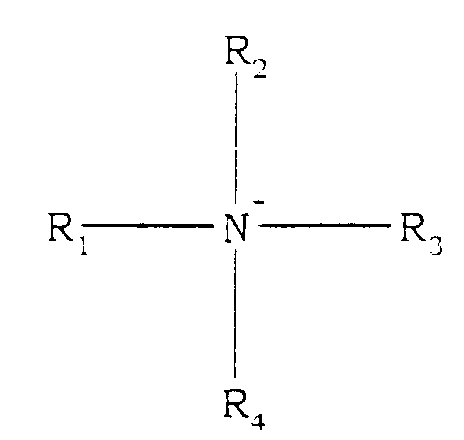
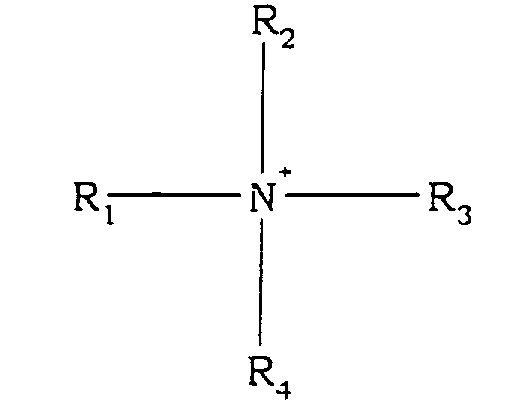
- an improved photosensitive composition comprising at least one phenolic resin, at least one diazoquinone derivative in the form of a partial ester of a diazoquinone -sulfonic or -carboxylic acid and of the phenolic resin and at least a condensed polycyclic aromatic sulfonic or carboxylic acid, in the form of the free acid and / or an ammonium salt, the cation of the ammonium salt having the formula wherein R 1 , R 2 , R 3 and R 4 , which may be the same or different, each represents a hydrogen atom or an alkyl or hydroxyalkyl group containing from 1 to 4 carbon atoms, with the restriction that the acid Aromatic sulfonic or carboxylic is other than an aromatic amino acid and coumarilic acid.
- condensed polycyclic aromatic sulfonic or carboxylic acids used in photosensitive compositions according to the present invention as additives to increase the contrast and the selectivity can be used in the form of the free acid and / or an ammonium salt.
- the particularly preferred condensed polycyclic aromatic sulfonic acids which can be used in the photosensitive compositions in accordance with the present invention are the diazoquinone sulfonic acids represented by the following formula: wherein A represents N 2 or O and B is O when A is N 2 or B is N 2 when A is O and R represents OH, or 0M, where M is an ammonium ion or substituted ammonium.
- diazoquinone sulfonic or -carboxylic acids in the form of these salts diazonium is also part of the present invention.
- the cation of the ammonium salt is preferably chosen from those which correspond to the formula wherein R 1 , R 2 , R 3 and R 4 , which may be the same or different, each represents a hydrogen atom or an alkyl or hydroxyalkyl group containing from 1 to 4 carbon atoms.
- Examples of such compounds are the ammonium, monomethylammonium, dimethylammonium and trimethylammonium salts of 2-naphthalenesulfonic acid, 3-diazo-3,4-dihydro-4-oxo-1-naphthalene- sulfonic or 6-diazo-5,6-dihydro-5-oxo-1-naphthalenesulfonic acid, etc.
- an amount of acid of approximately 0.01 to approximately 24% by weight, calculated relative to the total weight of the photosensitive composition will give a higher contrast and selectivity.
- a preferred amount of acid is between 0.05 and 10% by weight and is more particularly from 0.2 to 2% by weight, calculated relative to the total weight of the photosensitive composition.
- high contrast values for example greater than 10, associated with excellent selectivity values of the order of 22-23 can already be obtained using an amount of acid 0.5% by weight calculated relative to the total weight of the photosensitive composition.
- Phenolic resins which can be used in the photosensitive compositions of the present invention are poly (vinylphenols), novolaks prepared by condensation of phenol, a mono-, di- or trialkylphenol (for example, o-cresol, m-cresol, p-cresol, xylenols, p-tert.-butylphenol, etc.), an arylphenol, an unsubstituted naphthol, substituted naphthols, resorcinols, alkyl-substituted resorcinols, of pyrogallols, of alkyl-substituted pyrogallols or of their mixtures, with formaldehyde, of acetaldehyde, benzaldehyde or mixtures thereof, or alternatively mixtures of two or more of aforementioned resins.
- a mono-, di- or trialkylphenol for example, o-cresol, m-cresol,
- the phenolic resin is a co-condensed novolak obtained by condensation of formaldehyde with a mixture of phenol and p-tert.-butylphenol of which the molar ratio between p-tert.-butylphenol and the phenol is between 1:10 and 10: 1.
- the photosensitive diazoquinone derivatives in the form of a partial ester of a diazoquinone-sulfonic or -carboxylic acid and of the phenolic resin which can be used in the photosensitive compositions of the present invention are well known to those skilled in the art and may include various compounds which have one or more diazoquinone groups such as those described in detail in "Light-Sensitive Systems", by J. KOSAR, John Wiley & Sons, Inc., New-York, 1965, Chapter 7.4, p.339-352.
- Diazoquinone derivatives which are particularly suitable for the present invention include partial esters of diazoquinone sulfonic acid halides or - above mentioned carboxylic and phenolic resins like those described above. AT By way of example, there may be mentioned the partial ester of 6-diazo-5,6-dihydro-5-oxo-1-naphthalenesulfonyl chloride with phenolic resin.
- the photosensitive compositions according to the present invention contain an amount of about 30 to about 95% by weight of phenolic resin and from about 4 to about 60% by weight of derivative of diazoquinone calculated relative to the total weight of the photosensitive composition.
- these photosensitive compositions contain an amount of 48 to 90% by weight of phenolic resin and from 8 to 45% by weight of diazoquinone derivative calculated relative to the total weight of the photosensitive composition.
- Additives such as dyes, dyes, anti-streaking agents, flow, solvent evaporation rate regulators and adhesion promoters can be added to the photosensitive compositions in accordance with the present invention. These additives can general be used in an amount varying between about 20 ppm and about 20% by weight calculated by relative to the total weight of the photosensitive composition.
- dyes which can be used in the photosensitive compositions of the present invention it is possible to mention the azo dyes, such as phenylazoresorcinol (4- (phenylazo) -1,3-benzenediol), 4- (phenylazo) phenol, curcumin and other dyes such as those sold under the names Macrolex 6G (BAYER), Neopen Gelb 075 (BASF), etc.
- azo dyes such as phenylazoresorcinol (4- (phenylazo) -1,3-benzenediol), 4- (phenylazo) phenol, curcumin and other dyes such as those sold under the names Macrolex 6G (BAYER), Neopen Gelb 075 (BASF), etc.
- the photosensitive compositions according to the present invention are dissolved in a suitable solvent capable of dissolving all the components mentioned above, before applying them to a support suitable for forming the photoresist. Special care must be taken when choosing the solvent or mixing of solvents to ensure complete dissolution of the various components of the resist and additives, long-term storage stability and good flow and evaporation rate.
- solvents which can be used there may be mentioned the glycol ethers, such as ethylene glycol methyl or ethyl ether, propylene glycol methyl or ethyl ether, the corresponding acetates such as ethylene glycol methyl or ethyl ether acetate, propylene glycol methyl or ethyl ether acetate, ketones, esters of acetic acid or lactic acid with aliphatic alcohols, ethylene carbonates or propylene, bis (alkoxy) dialkyl ethers, cyclic ethers such as dioxane, tetrahydrofuran or its derivatives, 1,3-dimethyl-2-imidazolidinone, gamma-butyrolactone, N-methyl-pyrrolidone, dimethylformamide, dimethyl sulfoxide, etc.
- these solvents can be used individually or in mixtures.
- an amount of 5 to 75 parts by weight of the photosensitive composition depending on the invention is
- the photosensitive compositions according to the present invention are particularly suitable for use as photoresists in a method of forming patterns as described in European patent application 184.567.
- a layer of a photosensitive composition is applied to a substrate, for example, a wafer of silicon / silicon dioxide or a wafer covered with metal, after a such composition was dissolved in a solvent as mentioned above.
- the coated slice is cooked (from 50 to 150 ° C, preferably from 80 to 120 ° C, for a period varying from a few seconds up to 60 minutes), the layer is exposed through a mask to ultraviolet radiation of length appropriate wave (for example from 100 to 500 nm).
- the exposed layer is then treated with a composed of silicon in liquid or vapor phase (for example any silylating agent mentioned above), at a temperature which can vary between approximately 10 and approximately 190 ° C. for a period ranging from a few seconds up to 60 minutes.
- the silicon compound is selectively incorporated into the irradiated parts of the coating and reacts with the functional hydroxyl groups of the phenolic resin in these irradiated parts.
- the layer thus treated is then developed by dry etching techniques such as oxygen plasma etching, reactive oxygen ion etching, etc.
- the photosensitive compositions according to the present invention produce surprisingly high contrast values (e.g. as high as 11) and at the same time time, high selectivity values (e.g.
- compositions of the present invention After dry development, we achieves excellent quality negative patterns with stiff profiles and excellent width control lines; no residue is present in the stripped areas, where the non-irradiated parts have been eliminated.
- another advantageous feature of the compositions of the present invention is that these high contrast and selectivity values are obtained at lower silylation temperatures in comparison with the compositions of the state prior of the technique based on phenolic resins and diazoquinones. The following examples are given for the purpose of illustrating the invention without limiting it.
- a contrast curve is established which represents the residual thickness of the film after development as a function of the logarithm of the UV exposure dose and the contrast is determined from the slope of the linear part of the curve. contrast.
- the selectivity is determined from the initial thickness of the film and the residual thickness measured after development of the exposed resist. Table 1 shows the values of the contrast and the selectivity for each solution tested.
- the silylation temperature at which these values are obtained is also indicated.
- Example 1 (a) 30 g of the photosensitive resin prepared in Example 1 (a) are dissolved in 70 g of propylene glycol methyl ether acetate and 2-naphthalenesulfonic acid is added to this solution at a rate of 1% by weight of the solid components of the solution.
- This solution is coated by centrifugation on silicon wafers and coated wafers are baked at 90 ° C on a hot plate for 60 seconds.
- the thickness of the dry resist film is 1.8 ⁇ m.
- the slices are then exposed according to the pattern through a mask in UV light with a wavelength of 365 nm.
- the exposed slices are then treated with hexamethyldisilazane vapors, at temperatures between 120 and 160 ° C in the same way as in Example 1. Finally, the slices thus treated are etched in an anisotropic oxygen plasma, applying an overprint of 30%.
- the two solutions thus obtained are coated by centrifugation on silicon wafers and the coated slices are cooked at 90 ° C on a hot plate for 60 seconds.
- the film thickness of dry resist is 2 ⁇ m.
- the slices are then exposed according to the pattern through a mask to the UV light at a wavelength of about 365 nm.
- the exposed slices are then treated with hexamethyldisilazane vapors, at a temperature of 130 ° C for 2 minutes. Finally, the slices are etched in an anisotropic oxygen plasma, applying an over-etching of 30%.
- the first solution that contains no acid produces no picture.
- the resist was completely removed from the substrate.
- the second solution provides a well-defined pattern.
- no appreciable silylation occurs. produced at 130 ° C when using the first solution, which contains no acid additives.
- a silylation temperature of 160 ° C should be used to obtain a reason with such a solution.
- patterns are obtained of excellent quality by the addition of 1% by weight of 6-diazo-5,6-dihydro-5-oxo-1-naphthalenesulfonic acid, even at a silylation temperature of 130 ° C.
- a solution is prepared as described in Example 1 (c) and to this solution, 6-diazo-5,6-dihydro-5-oxo-1-naphthalenesulfonic acid is added in an amount of 0.5%. weight of solid components of the solution.
- This solution is coated by centrifugation on silicon wafers with an aluminum layer having steps of 1 ⁇ m in height. The slices thus coated are baked at 90 ° C on a hot plate for 60 seconds. The thickness of the dry resist film is 2 ⁇ m. The slices are then exposed according to the pattern through a mask to UV light with a wavelength of about 436 nm and to an exposure dose of 150 mJ / cm2.
- the exposed slices are then treated with hexamethyldisilazane vapors at a temperature of 130 ° C for 2 minutes. Finally, the slices are etched in an anisotropic oxygen plasma.
- the width of the lines of the nominal patterns of 1 ⁇ m is measured on the steps and between the steps, so that the minimum and maximum line widths are recorded.
- the difference between the maximum and minimum line widths is the change in line width (delta CD ) caused by the step in the substrate.
- delta CD A value for delta CD of 0.3 ⁇ m is obtained with the solution used above.
- the addition of dyes to the photosensitive compositions of the present invention has a very favorable effect by allowing excellent control of the width of the lines on substrates with surface topography without harmful effect on the profiles of the resist (the angles of the walls remain constant).
- the photosensitive resin used is prepared by esterification of poly (vinylphenol), sold by MARUZEN C °, Japan, with 3-diazo-3,4-dihydro-4-oxo-1-naphthalenesulfonyl chloride in a report by weight from 5 to 1.5.
- 30 g of this resin and 0.3 g of 3-diazo-3,4-dihydro-4-oxo-1-naphthalenesulfonic acid are dissolved in 70 g of propylene glycol methyl ether acetate.
- This solution is coated with centrifugation on several silicon wafers and the coated wafers are baked at 90 ° C on a plate hot for 60 seconds (film thickness: 1.7 ⁇ m).
- the slices are then exposed according to the pattern through a mask to UV light with a wavelength of 248 nm in an exposure matrix varying from 0 to 300 mJ / cm2.
- the exposed slices are then treated with hexamethyldisilazane vapors at temperatures between 120 and 160 ° C. Then the slices are etched in an oxygen plasma anisotropic by applying an overprint of 30%. High resolution patterns are obtained with smooth surfaces and vertical side walls at an exposure dose of 120 mJ / cm2 and at a silylation temperature of 150 ° C.
- Example 1 (a) 30 g of the photosensitive resin prepared in Example 1 (a) are dissolved in 70 g of lactate ethyl. Each of the acids listed in Table III is added to this solution, at a rate of 5% by weight solid components of the solution. The solutions thus obtained are coated by centrifugation on silicon wafers and coated wafers are baked at 90 ° C on a hot plate for 60 seconds.
- the thickness of the dry resist film is 1.7 ⁇ m each time.
- the slices are then exposed according to the pattern through a mask to UV light with a wavelength of 365 nm.
- the exposed slices are then treated with hexamethyldisilazane vapors, at temperatures between 120 and 160 ° C in the same way as in Example 1.
- the slices thus treated are etched in an anisotropic oxygen plasma, applying an overprint of 30%.
- Table III gives for each solution the silylation temperature required to obtain a pattern consisting of lines and equal spaces of 0.5 ⁇ m.
- Acid Silylation temperature (° C) Picric acid (comparative) 160 ° C Nicotinic acid (comparative) 160 ° C 2,4-Dihydroxybenzoic acid (comparison) 160 ° C 4-amino-1-naphthalenesulfonic acid (comparison) 160 ° C 1-Naphthalenesulfonic acid 145 ° C 2-Naphthalenesulfonic acid 130 ° C 6-diazo-5,6-dihydro-5-oxo-1-naphthalenesulfonic acid 130 ° C 3-diazo-3,4-dihydro-4-oxo-1-naphthalenesulfonic acid 130 ° C
- Example 1 (a) 30 g of the photosensitive resin prepared in Example 1 (a) are dissolved in 70 g of 1,3-dimethyl-2-imidazolidinone. Adding the ammonium salt of 6-diazo-5,6-dihydro-5-oxo-1-naphthalenesulfonic acid to this solution in an amount of 0.5% by weight of the solid components of the solution. This solution is coated by centrifugation on silicon wafers and the coated wafers are baked at 90 ° C on a hot plate for 60 seconds. The thickness of the dry resist film is 1.9 ⁇ m. The slices are then exposed according to the pattern through a mask to UV light with a wavelength of 365 nm.
- the exposed slices are then treated with hexamethyldisilazane vapors, at temperatures varying between 120 and 160 ° C in the same way as in Example 1. Finally, the slices thus treated are etched in an anisotropic oxygen plasma, applying an over-etching of 30%.
- Example 1 (a) 30 g of the photosensitive resin prepared in Example 1 (a) are dissolved in 70 g of N-methylpyrrolidone.
- the trimethylammonium salt of 3-diazo-3,4-dihydro-4-oxo-1-naphthalenesulfonic acid is added. to this solution in an amount of 1% by weight of the solid components of the solution.
- This solution is coated by centrifugation on silicon wafers and the coated wafers are fired at 90 ° C on a hot plate for 60 seconds.
- the thickness of the dry resist film is 1.9 ⁇ m.
- the slices are then exposed according to the pattern through a mask to UV light of a length wave length of 365 nm.
- the exposed slices are then treated with hexamethyldisilazane vapors, to temperatures varying between 120 and 160 ° C in the same way as in Example 1. Finally, the slices thus treated are etched in an anisotropic oxygen plasma, by applying an etching of 30%.
- Example 1 (a) 30 g of the photosensitive resin prepared in Example 1 (a) are dissolved in 70 g of 1,3-dimethyl-2-imidazolidinone.
- the ammonium salt of 2-naphthalenesulfonic acid is added to this solution at the right rate 2% by weight of the solid components of the solution.
- This solution is coated by centrifugation on silicon wafers and coated wafers are baked at 90 ° C on a hot plate for 60 seconds.
- the thickness of the dry resist film is 1.9 ⁇ m.
- the slices are then exposed according to the pattern through a mask in UV light with a wavelength of 365 nm.
- the exposed slices are then treated with hexamethyldisilazane vapors, at temperatures between 120 and 160 ° C in the same way as in Example 1.
- the slices thus treated are etched in an anisotropic oxygen plasma, applying an overprint of 30%.
- Example 1 (a) 30 g of the photosensitive resin prepared in Example 1 (a) are dissolved in 70 g of N-methylpyrrolidone.
- the dimethylammonium salt of 2-naphthalenesulfonic acid is added to this solution.
- This solution is coated by centrifugation on silicon wafers and the coated wafers are baked at 90 ° C on a hot plate for 60 seconds.
- the thickness of the dry resist film is 1.9 ⁇ m.
- the slices are then exposed according to the pattern through a mask in UV light with a wavelength of 365 nm.
- the exposed slices are then treated with hexamethyldisilazane vapors, at temperatures between 120 and 160 ° C in the same way as in Example 1.
- the slices thus treated are etched in an anisotropic oxygen plasma, applying an overprint of 30%.
Landscapes
- Physics & Mathematics (AREA)
- General Physics & Mathematics (AREA)
- Spectroscopy & Molecular Physics (AREA)
- Materials For Photolithography (AREA)
- Exposure And Positioning Against Photoresist Photosensitive Materials (AREA)
- Compositions Of Macromolecular Compounds (AREA)
- Photosensitive Polymer And Photoresist Processing (AREA)
Description
et Do est la dose d'exposition limite comme expliqué cidessus.
tx représente l'épaisseur résiduelle du film restant après le développement du résist exposé.


| Essai | Quantité d'acide (en % en poids) | Température de silylation (%C) | Contraste | Sélectivité |
| 1 | 0 | 160 | 2,9 | 15 |
| 2 | 0,1 | 145 | 4,2 | 18 |
| 3 | 0,25 | 135 | 7,5 | 22 |
| 4 | 0,5 | 130 | 10,5 | 23 |
| 5 | 1 | 120 | 11 | 22 |
- la première est utilisée telle quelle,
- à la seconde partie, on ajoute de l'acide 6-diazo-5,6-dihydro-5-oxo-1-naphtalènesulfonique (préparé comme dans l'exemple 1(b)) à raison de 1% en poids des composants solides de la solution.
| Colorant | Quantité de colorant (% en poids) | deltaCD(µm) | Angle des parois latérales (°) |
| - | 0 | 0,3 | 86 |
| 4-(phénylazo)-1,3-benzènediol | 0,4 | 0,22 | 84 |
| Curcumine | 0,5 | 0,15 | 87 |
| Curcumine | 1,5 | 0,03 | 86 |
| Macrolex 6G | 2 | 0,11 | 84 |
| Neopen Gelb | 2 | 0,04 | 85 |
| Neopen Gelb 075 | 6 | 0,03 | 87 |
| Acide | Température de silylation (°C) |
| Acide picrique (comparatif) | 160°C |
| Acide nicotinique (comparatif) | 160°C |
| Acide 2,4-dihydroxybenzoïque (comparatif) | 160°C |
| Acide 4-amino-1-naphtalènesulfonique (comparatif) | 160°C |
| Acide 1-naphtalènesulfonique | 145°C |
| Acide 2-naphtalènesulfonique | 130°C |
| Acide 6-diazo-5,6-dihydro-5-oxo-1-naphtalènesulfonique | 130°C |
| Acide 3-diazo-3,4-dihydro-4-oxo-1-naphtalènesulfonique | 130°C |
Claims (19)
- Composition photosensible comprenant au moins une résine phénolique, au moins un dérivé de diazoquinone sous la forme d'un ester partiel d'un acide diazoquinone-sulfonique ou -carboxylique et de la résine phénolique et au moins un acide sulfonique ou carboxylique aromatique polycyclique condensé, sous la forme de l'acide libre et/ou d'un sel d'ammonium, le cation du sel d'ammonium avant la formuledans laquelle R1, R2, R3 et R4, qui peuvent être identiques ou différents, représentent chacun un atome d'hydrogène ou un groupe alkyle ou hydroxyalkyle contenant de 1 à 4 atomes de carbone, avec la restriction que l'acide sulfonique ou carboxylique aromatique est autre qu'un acide aminé aromatique et que l'acide coumarilique.

- Composition selon la revendication 1, caractérisée en ce que l'acide sulfonique ou carboxylique aromatique polycyclique condensé est choisi dans le groupe consistant enl'acide 1-naphtalènesulfonique,l'acide 2-naphtalènesulfonique,l'acide 3-diazo-3,4-dihydro-4-oxo-1-naphtalènesulfonique,l'acide 6-diazo-5,6-dihydro-5-oxo-1-naphtalènesulfonique,l'acide 6-diazo-5,6-dihydro-5-oxo-2-naphtalènesulfonique,l'acide 4-diazo-3,4-dihydro-3-oxo-1-naphtalènesulfonique,l'acide 5-diazo-5,6-dihydro-6-oxo-1-naphtalènesulfonique,l'acide 5-diazo-5,6-dihydro-6-oxo-2-naphtalènesulfonique,les acides carboxyliques correspondants et les mélanges d'au moins deux de ces composés.
- Composition selon la revendication 1, caractérisée en ce que l'acide sulfonique ou carboxylique aromatique polycyclique condensé est un acide diazoquinone-sulfonique représenté par la formuledans laquelle A représente N2 ou O et B est O lorsque A est N2 ou B est N2 lorsque A est O et R représente OH ou OM, où M est un ion ammonium ou ammonium substitué.

- Composition selon l'une quelconque des revendications 1 à 3, caractérisée en ce que l'acide sulfonique ou carboxylique aromatique polycyclique condensé est présent en une quantité d'environ 0,01 à environ 24% en poids calculée par rapport au poids total de la composition.
- Composition selon l'une quelconque des revendications 1 à 4, caractérisée en ce que l'acide sulfonique ou carboxylique aromatique polycyclique condensé est présent en une quantité d'environ 0,05 à environ 10% en poids calculée par rapport au poids total de la composition.
- Composition selon l'une quelconque des revendications 1 à 5, caractérisée en ce que l'acide sulfonique ou carboxylique aromatique polycyclique condensé est présent en une quantité de 0,2 à 2% en poids calculée par rapport au poids total de la composition.
- Composition selon l'une quelconque des revendications 1 à 6, caractérisée en ce que l'acide sulfonique ou carboxylique aromatique polycyclique condensé est présent sous la forme d'un sel d'ammonium dont le cation est choisi parmi ceux représentés par la formuledans laquelle R1, R2, R3 et R4, qui peuvent être identiques ou différents, représentent chacun un atome d'hydrogène ou un groupe alkyle ou hydroxyalkyle contenant de 1 à 4 atomes de carbone.
- Composition selon l'une quelconque des revendications 1 à 6, caractérisée en ce que l'acide sulfonique ou carboxylique aromatique polycyclique condensé est présent sous la forme de l'acide libre.
- Composition selon l'une quelconque des revendications 1 à 8, caractérisée en ce que la résine phénolique est un poly(vinylphénol), une novolaque obtenue par condensation d'un phénol, d'un mono-, di-, ou trialkylphénol, d'un arylphénol, d'un naphtol non-substitué, d'un naphtol substitué, d'un résorcinol, d'un résorcinol alkyl-substitué, d'un pyrogallol, d'un pyrogallol alkyl-substitué ou d'un mélange de ces composés avec du formaldéhyde, de l'acétaldéhyde, du benzaldéhyde ou leurs mélanges, ou un mélange de deux ou plusieurs de ces résines.
- Composition selon l'une quelconque des revendications 1 à 9, caractérisée en ce que la résine phénolique est une novolaque co-condensée obtenue par condensation de formaldéhyde avec un mélange de phénol et de p-tert.-butylphénol dans lequel le rapport molaire du p-tert.-butylphénol au phénol est de 1:10 à 10:1.
- Composition selon l'une quelconque des revendications 1 à 10, caractérisée en ce que la résine phénolique est présente en une quantité d'environ 30 à environ 95% en poids et le dérivé de diazoquinone est présent en une quantité d'environ 4 à environ 60% en poids calculée par rapport au poids total de la composition.
- Composition selon l'une quelconque des revendications 1 à 11, caractérisée en ce que la résine phénolique est présente en une quantité d'environ 48 à environ 90% en poids et le dérivé de diazoquinone est présent en une quantité d'environ 8 à environ 45% en poids calculée par rapport au poids total de la composition.
- Composition selon l'une quelconque des revendications 1 à 12, caractérisée en ce qu'elle contient en outre un colorant absorbant la lumière à une longueur d'onde de 350 à 500 nm.
- Composition selon l'une quelconque des revendications 1 à 13, caractérisée en ce qu'elle contient en outre un solvant ou un mélange de solvants.
- Procédé de formation de motifs négatifs sur un substrat comprenant les stades suivants:(a) le recouvrement du substrat par une couche de composition photosensible qui comprend au moins une résine phénolique et au moins un dérivé de diazoquinone sous la forme d'un ester partiel d'un acide diazoquinone-sulfonique ou - carboxylique et de la résine phénolique;(b) l'exposition de cette couche à un rayonnement ultraviolet à travers un masque, de façon à ce que seules les parties voulues de la couche soient exposées;(c) le traitement de la couche ainsi exposée par un composé de silicium, de manière à ce que ledit composé de silicium soit sélectivement absorbé dans les parties irradiées de la couche;(d) le développement de la couche ainsi traitée en utilisant les techniques de gravure par voie sèche de manière à enlever sélectivement les parties non irradiées de la couche pour obtenir les motifs négatifs, caractérisé en ce que l'on ajoute à la composition photosensible au moins un acide sulfonique ou carboxylique aromatique polycyclique condensé, sous la forme de l'acide libre et/ou d'un sel d'ammonium, le cation du sel d'ammonium ayant la formuledans laquelle R1, R2, R3 et R4, qui peuvent être identiques ou différents, représentent chacun un atome d'hydrogène ou un groupe alkyle ou hydroxyalkyle contenant de 1 à 4 atomes de carbone, avec la restriction que l'acide sulfonique ou carboxylique aromatique est autre qu'un acide aminé aromatique et que l'acide coumarilique.
- Procédé selon la revendication 15, caractérisé en ce que l'acide sulfonique ou carboxylique aromatique polycyclique condensé est choisi dans le groupe consistant enl'acide 1-naphtalènesulfonique,l'acide 2-naphtalènesulfonique,l'acide 3-diazo-3,4-dihydro-4-oxo-1-naphtalènesulfonique,l'acide 6-diazo-5,6-dihydro-5-oxo-1-naphtalènesulfonique,l'acide 6-diazo-5,6-dihydro-5-oxo-2-naphtalènesulfonique,l'acide 4-diazo-3,4-dihydro-3-oxo-1-naphtalènesulfonique,l'acide 5-diazo-5,6-dihydro-6-oxo-1-naphtalènesulfonique,l'acide 5-diazo-5,6-dihydro-6-oxo-2-naphtalènesulfonique,les acides carboxyliques correspondants et les mélanges d'au moins deux de ces composés.
- Procédé selon la revendication 15, caractérisé en ce que l'acide sulfonique ou carboxylique aromatique polycyclique condensé est un acide diazoquinone-sulfonique représenté par la formule suivante:dans laquelle A représente N2 ou O et B est O lorsque A est N2 ou B est N2 lorsque A est O et R représente OH ou OM, où M est un ion ammonium ou ammonium substitué.

- Procédé selon l'une quelconque des revendications 15 à 17, caractérisé en ce que l'acide sulfonique ou carboxylique aromatique polycyclique condensé est ajouté à la composition photosensible en une quantité de 0,01 à environ 24% en poids calculée par rapport au poids total de la composition.
- Circuit intégré fabriqué au moyen du procédé selon l'une quelconque des revendications 15 à 18.
Priority Applications (1)
| Application Number | Priority Date | Filing Date | Title |
|---|---|---|---|
| AT88870188T ATE93979T1 (de) | 1987-12-18 | 1988-12-15 | Lichtempfindliche zusammensetzungen mit phenolkunststoffen und quinondiariden. |
Applications Claiming Priority (2)
| Application Number | Priority Date | Filing Date | Title |
|---|---|---|---|
| GB878729510A GB8729510D0 (en) | 1987-12-18 | 1987-12-18 | Photosensitive compositions containing phenolic resins & diazoquinone compounds |
| GB8729510 | 1987-12-18 |
Publications (4)
| Publication Number | Publication Date |
|---|---|
| EP0323427A2 EP0323427A2 (fr) | 1989-07-05 |
| EP0323427A3 EP0323427A3 (en) | 1989-07-19 |
| EP0323427B1 EP0323427B1 (fr) | 1993-09-01 |
| EP0323427B2 true EP0323427B2 (fr) | 1999-03-03 |
Family
ID=10628673
Family Applications (1)
| Application Number | Title | Priority Date | Filing Date |
|---|---|---|---|
| EP88870188A Expired - Lifetime EP0323427B2 (fr) | 1987-12-18 | 1988-12-15 | Compositions photosensibles contenant des résines phénoliques et des dérivés de diazoquinone |
Country Status (9)
| Country | Link |
|---|---|
| US (1) | US5116715A (fr) |
| EP (1) | EP0323427B2 (fr) |
| JP (1) | JP2729069B2 (fr) |
| KR (1) | KR960010025B1 (fr) |
| AT (1) | ATE93979T1 (fr) |
| DE (1) | DE3883738T3 (fr) |
| GB (1) | GB8729510D0 (fr) |
| IE (1) | IE63238B1 (fr) |
| IL (1) | IL88671A (fr) |
Families Citing this family (39)
| Publication number | Priority date | Publication date | Assignee | Title |
|---|---|---|---|---|
| JP2712341B2 (ja) * | 1988-08-10 | 1998-02-10 | 日本電気株式会社 | 光露光方法 |
| JP2848625B2 (ja) * | 1989-03-31 | 1999-01-20 | 株式会社東芝 | パターン形成方法 |
| EP0412457A1 (fr) * | 1989-08-08 | 1991-02-13 | Tosoh Corporation | Inhibiteur de solubilisation et composition à réserve positive |
| DE69215383T2 (de) * | 1991-12-18 | 1997-04-30 | Hoechst Celanese Corp | Reduktion des metallionengehaltes in novolakharzen |
| US5580949A (en) * | 1991-12-18 | 1996-12-03 | Hoechst Celanese Corporation | Metal ion reduction in novolak resins and photoresists |
| DE69320468T2 (de) * | 1992-03-06 | 1999-04-22 | Clariant Finance (Bvi) Ltd., Road Town, Tortola | Photoresists mit einem niedrigem grad metallionen |
| US5221592A (en) * | 1992-03-06 | 1993-06-22 | Hoechst Celanese Corporation | Diazo ester of a benzolactone ring compound and positive photoresist composition and element utilizing the diazo ester |
| US5756256A (en) * | 1992-06-05 | 1998-05-26 | Sharp Microelectronics Technology, Inc. | Silylated photo-resist layer and planarizing method |
| US5830990A (en) * | 1992-07-10 | 1998-11-03 | Clariant Finance (Bvi) Limited | Low metals perfluorooctanoic acid and top anti-reflective coatings for photoresists |
| SG52770A1 (en) * | 1992-07-10 | 1998-09-28 | Hoechst Celanese Corp | Metal ion reduction in top anti-reflective coatings for photoresists |
| WO1994012912A1 (fr) * | 1992-11-25 | 1994-06-09 | Hoechst Celanese Corporation | Reduction d'ions metal dans des revetements anti-reflecteurs de fond pour des photoreserves |
| US5476750A (en) * | 1992-12-29 | 1995-12-19 | Hoechst Celanese Corporation | Metal ion reduction in the raw materials and using a Lewis base to control molecular weight of novolak resin to be used in positive photoresists |
| US5550007A (en) * | 1993-05-28 | 1996-08-27 | Lucent Technologies Inc. | Surface-imaging technique for lithographic processes for device fabrication |
| US5429673A (en) * | 1993-10-01 | 1995-07-04 | Silicon Resources, Inc. | Binary vapor adhesion promoters and methods of using the same |
| US5521052A (en) * | 1994-12-30 | 1996-05-28 | Hoechst Celanese Corporation | Metal ion reduction in novolak resin using an ion exchange catalyst in a polar solvent and photoresists compositions therefrom |
| US5837417A (en) * | 1994-12-30 | 1998-11-17 | Clariant Finance (Bvi) Limited | Quinone diazide compositions containing low metals p-cresol oligomers and process of producing the composition |
| US5614352A (en) * | 1994-12-30 | 1997-03-25 | Hoechst Celanese Corporation | Metal ion reduction in novolak resins solution in PGMEA by chelating ion exchange resin |
| EP0949277A3 (fr) * | 1995-06-22 | 2000-12-27 | Yuri Gudimenko | Modification en surface de polymères et de matériaux à base de carbone |
| US5618655A (en) * | 1995-07-17 | 1997-04-08 | Olin Corporation | Process of reducing trace levels of metal impurities from resist components |
| US5623042A (en) * | 1995-07-19 | 1997-04-22 | Olin Corporation | Process for reducing trace levels of metallic impurities in cyclized polyisoprene resin |
| DE19533608A1 (de) * | 1995-09-11 | 1997-03-13 | Basf Ag | Positivarbeitendes strahlungsempfindliches Gemisch und Verfahren zur Herstellung von Reliefstrukturen |
| US5693749A (en) * | 1995-09-20 | 1997-12-02 | Hoechst Celanese Corporation | Fractionation of phenol formaldehyde condensate and photoresist compositions produced therefrom |
| US5750031A (en) * | 1995-09-26 | 1998-05-12 | Clariant Finance (Bvi) Limited | Process for producing surfactant having a low metal ion level and developer produced therefrom |
| US5656413A (en) * | 1995-09-28 | 1997-08-12 | Hoechst Celanese Corporation | Low metal ion containing 4,4'-[1-[4-[1-(4-Hydroxyphenyl)-1-methylethyl]phenyl]ethylidene]bisphe nol and photoresist compositions therefrom |
| US5962183A (en) * | 1995-11-27 | 1999-10-05 | Clariant Finance (Bvi) Limited | Metal ion reduction in photoresist compositions by chelating ion exchange resin |
| US5707783A (en) * | 1995-12-04 | 1998-01-13 | Complex Fluid Systems, Inc. | Mixtures of mono- and DI- or polyfunctional silanes as silylating agents for top surface imaging |
| US5665517A (en) * | 1996-01-11 | 1997-09-09 | Hoechst Celanese Corporation | Acidic ion exchange resin as a catalyst to synthesize a novolak resin and photoresist composition therefrom |
| US5936071A (en) * | 1998-02-02 | 1999-08-10 | Clariant Finance (Bvi) Limited | Process for making a photoactive compound and photoresist therefrom |
| AU5600200A (en) | 1999-06-10 | 2001-01-02 | Allied-Signal Inc. | Spin-on-glass anti-reflective coatings for photolithography |
| US6824879B2 (en) | 1999-06-10 | 2004-11-30 | Honeywell International Inc. | Spin-on-glass anti-reflective coatings for photolithography |
| US6605519B2 (en) * | 2001-05-02 | 2003-08-12 | Unaxis Usa, Inc. | Method for thin film lift-off processes using lateral extended etching masks and device |
| CN1606713B (zh) | 2001-11-15 | 2011-07-06 | 霍尼韦尔国际公司 | 用于照相平版印刷术的旋涂抗反射涂料 |
| US8053159B2 (en) | 2003-11-18 | 2011-11-08 | Honeywell International Inc. | Antireflective coatings for via fill and photolithography applications and methods of preparation thereof |
| JP4933063B2 (ja) * | 2005-06-24 | 2012-05-16 | 東京応化工業株式会社 | パターン形成方法 |
| KR100760110B1 (ko) * | 2005-08-23 | 2007-09-18 | 후지쯔 가부시끼가이샤 | 레지스트 조성물, 레지스트 패턴의 형성 방법, 반도체 장치및 그의 제조 방법 |
| US8642246B2 (en) | 2007-02-26 | 2014-02-04 | Honeywell International Inc. | Compositions, coatings and films for tri-layer patterning applications and methods of preparation thereof |
| US8557877B2 (en) | 2009-06-10 | 2013-10-15 | Honeywell International Inc. | Anti-reflective coatings for optically transparent substrates |
| US8864898B2 (en) | 2011-05-31 | 2014-10-21 | Honeywell International Inc. | Coating formulations for optical elements |
| US10544329B2 (en) | 2015-04-13 | 2020-01-28 | Honeywell International Inc. | Polysiloxane formulations and coatings for optoelectronic applications |
Family Cites Families (23)
| Publication number | Priority date | Publication date | Assignee | Title |
|---|---|---|---|---|
| BE506677A (fr) * | 1950-10-31 | |||
| NL247939A (fr) * | 1959-02-04 | |||
| DE1447015B2 (de) * | 1963-10-03 | 1973-03-15 | Kalle Ag, 6202 Wiesbaden-Biebrich | Lichtempfindliche schichten zur herstellung von druckformen |
| FR2075039A5 (en) * | 1970-01-20 | 1971-10-08 | Ibm | Diazo-sulphonyl halides for photo lacquer |
| BE783962A (fr) * | 1971-05-28 | 1972-11-27 | Polychrome Corp | Produits photosensibles |
| DE2139981A1 (de) * | 1971-08-10 | 1973-02-22 | Helmut Seidl | Steuereinrichtung fuer flugzeuge |
| US3745011A (en) * | 1971-11-26 | 1973-07-10 | Narland Prod Inc | Novel photo resist composition containing cyclic polycarboxylic acids |
| DE2331377C2 (de) * | 1973-06-20 | 1982-10-14 | Hoechst Ag, 6000 Frankfurt | Lichtempfindliches Kopiermaterial |
| JPS538128A (en) * | 1976-07-09 | 1978-01-25 | Fuji Photo Film Co Ltd | Photosolubilizable composition |
| US4148654A (en) * | 1976-07-22 | 1979-04-10 | Oddi Michael J | Positive acting photoresist comprising diazide ester, novolak resin and rosin |
| US4307173A (en) * | 1980-06-23 | 1981-12-22 | American Hoechst Corporation | Light-sensitive composition comprising phthalic anhydride |
| DE3144480A1 (de) * | 1981-11-09 | 1983-05-19 | Hoechst Ag, 6230 Frankfurt | Lichtempfindliches gemisch und daraus hergestelltes lichtempfindliches kopiermaterial |
| EP0161660B1 (fr) * | 1984-05-14 | 1991-10-09 | Kabushiki Kaisha Toshiba | Procédé pour obtenir des images réserves et composition à cet effet |
| GB8427149D0 (en) * | 1984-10-26 | 1984-12-05 | Ucb Sa | Resist materials |
| JPS61219037A (ja) * | 1985-03-26 | 1986-09-29 | Toshiba Corp | パタ−ン形成方法 |
| US4777111A (en) * | 1985-06-03 | 1988-10-11 | Fairmount Chemical Company, Inc. | Photographic element with diazo contrast enhancement layer and method of producing image in underlying photoresist layer of element |
| JPS6225174A (ja) * | 1985-07-26 | 1987-02-03 | Nippon Kagaku Kogyosho:Kk | 螢光増白剤濃厚液状組成物 |
| JPS62262043A (ja) * | 1986-05-08 | 1987-11-14 | Tokyo Ohka Kogyo Co Ltd | ポジ型感光性樹脂組成物 |
| US4816380A (en) * | 1986-06-27 | 1989-03-28 | Texas Instruments Incorporated | Water soluble contrast enhancement layer method of forming resist image on semiconductor chip |
| US4997742A (en) * | 1986-06-27 | 1991-03-05 | Texas Instruments Inc. | Water soluble contrast enhancement composition with 1-oxy-2 diazonaphthalene sulfonamide salt and polyvinyl alcohol |
| JPS6435545A (en) * | 1987-07-31 | 1989-02-06 | Japan Synthetic Rubber Co Ltd | Resist composition used for processing with charged particle beam |
| DE3729035A1 (de) * | 1987-08-31 | 1989-03-09 | Hoechst Ag | Positiv arbeitendes lichtempfindliches gemisch und daraus hergestelltes photolithographisches aufzeichnungsmaterial |
| JPH01101544A (ja) * | 1987-10-14 | 1989-04-19 | Konica Corp | 感光性組成物及び感光性平版印刷版 |
-
1987
- 1987-12-18 GB GB878729510A patent/GB8729510D0/en active Pending
-
1988
- 1988-12-13 IL IL88671A patent/IL88671A/xx unknown
- 1988-12-15 AT AT88870188T patent/ATE93979T1/de not_active IP Right Cessation
- 1988-12-15 IE IE373988A patent/IE63238B1/en not_active IP Right Cessation
- 1988-12-15 DE DE3883738T patent/DE3883738T3/de not_active Expired - Fee Related
- 1988-12-15 EP EP88870188A patent/EP0323427B2/fr not_active Expired - Lifetime
- 1988-12-16 JP JP63318330A patent/JP2729069B2/ja not_active Expired - Fee Related
- 1988-12-17 KR KR1019880016902A patent/KR960010025B1/ko not_active Expired - Fee Related
-
1991
- 1991-03-08 US US07/668,810 patent/US5116715A/en not_active Expired - Lifetime
Also Published As
| Publication number | Publication date |
|---|---|
| ATE93979T1 (de) | 1993-09-15 |
| KR890010614A (ko) | 1989-08-09 |
| IE883739L (en) | 1989-06-18 |
| JP2729069B2 (ja) | 1998-03-18 |
| GB8729510D0 (en) | 1988-02-03 |
| IL88671A0 (en) | 1989-07-31 |
| IL88671A (en) | 1992-08-18 |
| KR960010025B1 (ko) | 1996-07-25 |
| EP0323427B1 (fr) | 1993-09-01 |
| US5116715A (en) | 1992-05-26 |
| EP0323427A2 (fr) | 1989-07-05 |
| DE3883738T2 (de) | 1994-03-10 |
| IE63238B1 (en) | 1995-04-05 |
| DE3883738D1 (de) | 1993-10-07 |
| EP0323427A3 (en) | 1989-07-19 |
| JPH021857A (ja) | 1990-01-08 |
| DE3883738T3 (de) | 1999-09-02 |
Similar Documents
| Publication | Publication Date | Title |
|---|---|---|
| EP0323427B1 (fr) | Compositions photosensibles contenant des résines phénoliques et des dérivés de diazoquinone | |
| EP0184567B1 (fr) | Procédé de formation de motifs négatifs dans une couche de photorésist | |
| EP1743219B1 (fr) | Procédé de fabrication de structures électroniques comprenant une couche antireflet utilisant des agents de réticulation d'éther vinylique | |
| EP3039484B1 (fr) | Composés métalliques stables en tant que masques durs et matériaux de remplissage, leurs compositions et procédés d'utilisation | |
| US8357482B2 (en) | Organic anti-reflective layer composition containing ring-opened phthalic anhydride and method for preparation thereof | |
| EP1090332A1 (fr) | Revetements antireflechissants thermodurcissables, a gravure rapide, obtenus a partir de liants cellulosiques | |
| US5272026A (en) | Negative image process utilizing photosensitive compositions containing aromatic fused polycyclic sulfonic acid and partial ester or phenolic resin with diazoquinone sulfonic acid or diazoquinone carboxylic acid, and associated imaged article | |
| KR20100014377A (ko) | 레지스트 하층막 형성 조성물 | |
| CN109073977B (zh) | 抗蚀剂下层膜形成用组合物 | |
| EP3394675B1 (fr) | Matériaux contenant des oxydes métalliques, procédés de fabrication de ces matériaux, et procédés d'utilisation de ces matériaux | |
| US20060166139A1 (en) | Organic anti-reflective coating composition and method for forming photoresist patterns using the same | |
| FR2798130A1 (fr) | Compose, composition organique pour film anti-reflechissant et procede de formation d'un motif de film anti-reflechissant | |
| EP0248779A1 (fr) | Procédé de formation de motifs positifs dans une couche de photorésist | |
| TWI307826B (fr) | ||
| EP2105949A1 (fr) | Composition pour la formation d'un film anti-réflexion et procédé de formation de modèle utilisant celui-ci | |
| TW201439685A (zh) | 抗蝕底層膜形成用組成物及圖型形成方法 | |
| KR20240004768A (ko) | 스핀 온 금속 유기 제제 | |
| NO891062L (no) | Positiv fotofoelsom sammensetning. | |
| FR2486259A1 (fr) | Procede pour la realisation de configurations en relief de surface, en vue d'applications micro-lithographiques | |
| JP2025032887A (ja) | 金属含有膜形成用化合物、金属含有膜形成用組成物、及びパターン形成方法 | |
| RU2552461C1 (ru) | Способ формирования фоторезистной маски позитивного типа (варианты) | |
| KR102426473B1 (ko) | 반사방지용 고분자 및 하드마스크 조성물 | |
| KR100840784B1 (ko) | 반사 방지막 형성용 폴리머, 이를 포함하는 유기반사방지막 조성물 및 이를 이용한 패턴의 형성 방법 | |
| KR102586107B1 (ko) | 레지스트 하층막용 조성물 및 이를 이용한 패턴형성방법 | |
| KR100909769B1 (ko) | 이머전 리소그라피 공정을 이용한 반도체 소자 제조방법 |
Legal Events
| Date | Code | Title | Description |
|---|---|---|---|
| PUAI | Public reference made under article 153(3) epc to a published international application that has entered the european phase |
Free format text: ORIGINAL CODE: 0009012 |
|
| PUAL | Search report despatched |
Free format text: ORIGINAL CODE: 0009013 |
|
| AK | Designated contracting states |
Kind code of ref document: A2 Designated state(s): AT BE CH DE ES FR GB GR IT LI LU NL SE |
|
| AK | Designated contracting states |
Kind code of ref document: A3 Designated state(s): AT BE CH DE ES FR GB GR IT LI LU NL SE |
|
| 17P | Request for examination filed |
Effective date: 19891230 |
|
| 17Q | First examination report despatched |
Effective date: 19920626 |
|
| GRAA | (expected) grant |
Free format text: ORIGINAL CODE: 0009210 |
|
| AK | Designated contracting states |
Kind code of ref document: B1 Designated state(s): AT BE CH DE ES FR GB GR IT LI LU NL SE |
|
| PG25 | Lapsed in a contracting state [announced via postgrant information from national office to epo] |
Ref country code: GR Free format text: LAPSE BECAUSE OF FAILURE TO SUBMIT A TRANSLATION OF THE DESCRIPTION OR TO PAY THE FEE WITHIN THE PRESCRIBED TIME-LIMIT Effective date: 19930901 Ref country code: ES Free format text: THE PATENT HAS BEEN ANNULLED BY A DECISION OF A NATIONAL AUTHORITY Effective date: 19930901 Ref country code: SE Effective date: 19930901 Ref country code: AT Effective date: 19930901 |
|
| REF | Corresponds to: |
Ref document number: 93979 Country of ref document: AT Date of ref document: 19930915 Kind code of ref document: T |
|
| REF | Corresponds to: |
Ref document number: 3883738 Country of ref document: DE Date of ref document: 19931007 |
|
| GBT | Gb: translation of ep patent filed (gb section 77(6)(a)/1977) |
Effective date: 19931011 |
|
| ITF | It: translation for a ep patent filed | ||
| PG25 | Lapsed in a contracting state [announced via postgrant information from national office to epo] |
Ref country code: LU Free format text: LAPSE BECAUSE OF NON-PAYMENT OF DUE FEES Effective date: 19931231 Ref country code: LI Effective date: 19931231 Ref country code: CH Effective date: 19931231 |
|
| PLBI | Opposition filed |
Free format text: ORIGINAL CODE: 0009260 |
|
| 26 | Opposition filed |
Opponent name: HOECHST AKTIENGESELLSCHAFT WERK KALLE-ALBERT Effective date: 19940531 |
|
| REG | Reference to a national code |
Ref country code: CH Ref legal event code: PL |
|
| NLR1 | Nl: opposition has been filed with the epo |
Opponent name: HOECHST AG |
|
| ITTA | It: last paid annual fee | ||
| PLAW | Interlocutory decision in opposition |
Free format text: ORIGINAL CODE: EPIDOS IDOP |
|
| APAA | Appeal reference recorded |
Free format text: ORIGINAL CODE: EPIDOS REFN |
|
| APAA | Appeal reference recorded |
Free format text: ORIGINAL CODE: EPIDOS REFN |
|
| APAC | Appeal dossier modified |
Free format text: ORIGINAL CODE: EPIDOS NOAPO |
|
| APAC | Appeal dossier modified |
Free format text: ORIGINAL CODE: EPIDOS NOAPO |
|
| APAC | Appeal dossier modified |
Free format text: ORIGINAL CODE: EPIDOS NOAPO |
|
| RAP2 | Party data changed (patent owner data changed or rights of a patent transferred) |
Owner name: U C B, S.A. |
|
| PLAW | Interlocutory decision in opposition |
Free format text: ORIGINAL CODE: EPIDOS IDOP |
|
| NLT2 | Nl: modifications (of names), taken from the european patent patent bulletin |
Owner name: U C B, S.A. |
|
| PUAH | Patent maintained in amended form |
Free format text: ORIGINAL CODE: 0009272 |
|
| STAA | Information on the status of an ep patent application or granted ep patent |
Free format text: STATUS: PATENT MAINTAINED AS AMENDED |
|
| 27A | Patent maintained in amended form |
Effective date: 19990303 |
|
| AK | Designated contracting states |
Kind code of ref document: B2 Designated state(s): AT BE CH DE ES FR GB GR IT LI LU NL SE |
|
| REG | Reference to a national code |
Ref country code: CH Ref legal event code: AEN Free format text: MAINTIEN DU BREVET DONT L'ETENDUE A ETE MODIFIEE |
|
| NLR2 | Nl: decision of opposition | ||
| GBTA | Gb: translation of amended ep patent filed (gb section 77(6)(b)/1977) | ||
| NLR3 | Nl: receipt of modified translations in the netherlands language after an opposition procedure | ||
| REG | Reference to a national code |
Ref country code: GB Ref legal event code: IF02 |
|
| APAH | Appeal reference modified |
Free format text: ORIGINAL CODE: EPIDOSCREFNO |
|
| PGFP | Annual fee paid to national office [announced via postgrant information from national office to epo] |
Ref country code: NL Payment date: 20061203 Year of fee payment: 19 |
|
| PGFP | Annual fee paid to national office [announced via postgrant information from national office to epo] |
Ref country code: DE Payment date: 20061207 Year of fee payment: 19 |
|
| PGFP | Annual fee paid to national office [announced via postgrant information from national office to epo] |
Ref country code: FR Payment date: 20061208 Year of fee payment: 19 |
|
| PGFP | Annual fee paid to national office [announced via postgrant information from national office to epo] |
Ref country code: GB Payment date: 20061213 Year of fee payment: 19 |
|
| PGFP | Annual fee paid to national office [announced via postgrant information from national office to epo] |
Ref country code: IT Payment date: 20061231 Year of fee payment: 19 |
|
| PGFP | Annual fee paid to national office [announced via postgrant information from national office to epo] |
Ref country code: BE Payment date: 20070222 Year of fee payment: 19 |
|
| BERE | Be: lapsed |
Owner name: S.A. *UCB Effective date: 20071231 |
|
| GBPC | Gb: european patent ceased through non-payment of renewal fee |
Effective date: 20071215 |
|
| NLV4 | Nl: lapsed or anulled due to non-payment of the annual fee |
Effective date: 20080701 |
|
| PG25 | Lapsed in a contracting state [announced via postgrant information from national office to epo] |
Ref country code: BE Free format text: LAPSE BECAUSE OF NON-PAYMENT OF DUE FEES Effective date: 20071231 |
|
| PG25 | Lapsed in a contracting state [announced via postgrant information from national office to epo] |
Ref country code: DE Free format text: LAPSE BECAUSE OF NON-PAYMENT OF DUE FEES Effective date: 20080701 |
|
| REG | Reference to a national code |
Ref country code: FR Ref legal event code: ST Effective date: 20081020 |
|
| PG25 | Lapsed in a contracting state [announced via postgrant information from national office to epo] |
Ref country code: NL Free format text: LAPSE BECAUSE OF NON-PAYMENT OF DUE FEES Effective date: 20080701 |
|
| PG25 | Lapsed in a contracting state [announced via postgrant information from national office to epo] |
Ref country code: GB Free format text: LAPSE BECAUSE OF NON-PAYMENT OF DUE FEES Effective date: 20071215 |
|
| PG25 | Lapsed in a contracting state [announced via postgrant information from national office to epo] |
Ref country code: FR Free format text: LAPSE BECAUSE OF NON-PAYMENT OF DUE FEES Effective date: 20071231 |
|
| PG25 | Lapsed in a contracting state [announced via postgrant information from national office to epo] |
Ref country code: IT Free format text: LAPSE BECAUSE OF NON-PAYMENT OF DUE FEES Effective date: 20071215 |