EP0247535A2 - Referenzelektrode für die Ionenaktivitätsmessung, insbesondere für die pH-Wertmessung - Google Patents
Referenzelektrode für die Ionenaktivitätsmessung, insbesondere für die pH-Wertmessung Download PDFInfo
- Publication number
- EP0247535A2 EP0247535A2 EP87107463A EP87107463A EP0247535A2 EP 0247535 A2 EP0247535 A2 EP 0247535A2 EP 87107463 A EP87107463 A EP 87107463A EP 87107463 A EP87107463 A EP 87107463A EP 0247535 A2 EP0247535 A2 EP 0247535A2
- Authority
- EP
- European Patent Office
- Prior art keywords
- measuring
- glass tube
- reference electrode
- electrode
- measurement
- Prior art date
- Legal status (The legal status is an assumption and is not a legal conclusion. Google has not performed a legal analysis and makes no representation as to the accuracy of the status listed.)
- Granted
Links
- 238000005259 measurement Methods 0.000 title claims abstract description 10
- 238000001139 pH measurement Methods 0.000 title claims description 10
- 230000000694 effects Effects 0.000 title claims description 8
- 239000011521 glass Substances 0.000 claims abstract description 29
- WCUXLLCKKVVCTQ-UHFFFAOYSA-M Potassium chloride Chemical compound [Cl-].[K+] WCUXLLCKKVVCTQ-UHFFFAOYSA-M 0.000 claims abstract description 25
- BQCADISMDOOEFD-UHFFFAOYSA-N Silver Chemical class [Ag] BQCADISMDOOEFD-UHFFFAOYSA-N 0.000 claims abstract description 24
- 239000003792 electrolyte Substances 0.000 claims abstract description 14
- 239000001103 potassium chloride Substances 0.000 claims abstract description 12
- 235000011164 potassium chloride Nutrition 0.000 claims abstract description 12
- 239000002482 conductive additive Substances 0.000 claims abstract description 9
- -1 polyethylene Polymers 0.000 claims abstract description 9
- 229920003023 plastic Polymers 0.000 claims abstract description 6
- 239000004033 plastic Substances 0.000 claims abstract description 6
- 239000000919 ceramic Substances 0.000 claims abstract description 4
- 229920006395 saturated elastomer Polymers 0.000 claims abstract description 3
- 239000004698 Polyethylene Substances 0.000 claims abstract 3
- 239000003822 epoxy resin Substances 0.000 claims abstract 3
- 229920000647 polyepoxide Polymers 0.000 claims abstract 3
- 229920000573 polyethylene Polymers 0.000 claims abstract 3
- 229920000915 polyvinyl chloride Polymers 0.000 claims abstract 3
- 239000004800 polyvinyl chloride Substances 0.000 claims abstract 3
- 229910021607 Silver chloride Inorganic materials 0.000 claims description 9
- 229920000642 polymer Polymers 0.000 claims description 9
- HKZLPVFGJNLROG-UHFFFAOYSA-M silver monochloride Chemical compound [Cl-].[Ag+] HKZLPVFGJNLROG-UHFFFAOYSA-M 0.000 claims description 9
- 150000002500 ions Chemical class 0.000 claims description 8
- KWGKDLIKAYFUFQ-UHFFFAOYSA-M lithium chloride Chemical compound [Li+].[Cl-] KWGKDLIKAYFUFQ-UHFFFAOYSA-M 0.000 claims description 6
- FGIUAXJPYTZDNR-UHFFFAOYSA-N potassium nitrate Chemical compound [K+].[O-][N+]([O-])=O FGIUAXJPYTZDNR-UHFFFAOYSA-N 0.000 claims description 6
- 238000000034 method Methods 0.000 claims description 4
- 150000003839 salts Chemical class 0.000 claims description 4
- VWDWKYIASSYTQR-UHFFFAOYSA-N sodium nitrate Chemical compound [Na+].[O-][N+]([O-])=O VWDWKYIASSYTQR-UHFFFAOYSA-N 0.000 claims description 4
- 229920001290 polyvinyl ester Polymers 0.000 claims description 3
- 235000010333 potassium nitrate Nutrition 0.000 claims description 3
- 239000004323 potassium nitrate Substances 0.000 claims description 3
- 239000007864 aqueous solution Substances 0.000 claims description 2
- 239000011248 coating agent Substances 0.000 claims description 2
- 238000000576 coating method Methods 0.000 claims description 2
- 235000010344 sodium nitrate Nutrition 0.000 claims description 2
- 239000004317 sodium nitrate Substances 0.000 claims description 2
- 239000004743 Polypropylene Substances 0.000 claims 2
- 238000006116 polymerization reaction Methods 0.000 claims 2
- 229920001155 polypropylene Polymers 0.000 claims 2
- 239000004020 conductor Substances 0.000 claims 1
- 230000007935 neutral effect Effects 0.000 claims 1
- 239000000243 solution Substances 0.000 abstract description 5
- 239000000463 material Substances 0.000 abstract description 2
- 239000003929 acidic solution Substances 0.000 abstract 1
- 230000002378 acidificating effect Effects 0.000 abstract 1
- 239000012670 alkaline solution Substances 0.000 abstract 1
- 229920001567 vinyl ester resin Polymers 0.000 abstract 1
- GPRLSGONYQIRFK-UHFFFAOYSA-N hydron Chemical compound [H+] GPRLSGONYQIRFK-UHFFFAOYSA-N 0.000 description 3
- VEXZGXHMUGYJMC-UHFFFAOYSA-N Hydrochloric acid Chemical compound Cl VEXZGXHMUGYJMC-UHFFFAOYSA-N 0.000 description 2
- 239000001257 hydrogen Substances 0.000 description 2
- 229910052739 hydrogen Inorganic materials 0.000 description 2
- WKBOTKDWSSQWDR-UHFFFAOYSA-N Bromine atom Chemical compound [Br] WKBOTKDWSSQWDR-UHFFFAOYSA-N 0.000 description 1
- VEXZGXHMUGYJMC-UHFFFAOYSA-M Chloride anion Chemical compound [Cl-] VEXZGXHMUGYJMC-UHFFFAOYSA-M 0.000 description 1
- ZAMOUSCENKQFHK-UHFFFAOYSA-N Chlorine atom Chemical compound [Cl] ZAMOUSCENKQFHK-UHFFFAOYSA-N 0.000 description 1
- ZLMJMSJWJFRBEC-UHFFFAOYSA-N Potassium Chemical compound [K] ZLMJMSJWJFRBEC-UHFFFAOYSA-N 0.000 description 1
- 239000000654 additive Substances 0.000 description 1
- 150000001450 anions Chemical class 0.000 description 1
- GDTBXPJZTBHREO-UHFFFAOYSA-N bromine Substances BrBr GDTBXPJZTBHREO-UHFFFAOYSA-N 0.000 description 1
- 229910052794 bromium Inorganic materials 0.000 description 1
- 150000001768 cations Chemical class 0.000 description 1
- 238000006243 chemical reaction Methods 0.000 description 1
- 239000000460 chlorine Substances 0.000 description 1
- 229910052801 chlorine Inorganic materials 0.000 description 1
- 238000010276 construction Methods 0.000 description 1
- 238000009792 diffusion process Methods 0.000 description 1
- 235000011167 hydrochloric acid Nutrition 0.000 description 1
- PNDPGZBMCMUPRI-UHFFFAOYSA-N iodine Chemical compound II PNDPGZBMCMUPRI-UHFFFAOYSA-N 0.000 description 1
- 239000007788 liquid Substances 0.000 description 1
- 238000004519 manufacturing process Methods 0.000 description 1
- QSHDDOUJBYECFT-UHFFFAOYSA-N mercury Chemical compound [Hg] QSHDDOUJBYECFT-UHFFFAOYSA-N 0.000 description 1
- 229910052753 mercury Inorganic materials 0.000 description 1
- 229910052700 potassium Inorganic materials 0.000 description 1
- 239000011591 potassium Substances 0.000 description 1
- 229910052709 silver Inorganic materials 0.000 description 1
- 239000004332 silver Substances 0.000 description 1
- 239000000126 substance Substances 0.000 description 1
- 238000005406 washing Methods 0.000 description 1
Images

Classifications
-
- G—PHYSICS
- G01—MEASURING; TESTING
- G01N—INVESTIGATING OR ANALYSING MATERIALS BY DETERMINING THEIR CHEMICAL OR PHYSICAL PROPERTIES
- G01N27/00—Investigating or analysing materials by the use of electric, electrochemical, or magnetic means
- G01N27/26—Investigating or analysing materials by the use of electric, electrochemical, or magnetic means by investigating electrochemical variables; by using electrolysis or electrophoresis
- G01N27/28—Electrolytic cell components
- G01N27/30—Electrodes, e.g. test electrodes; Half-cells
- G01N27/301—Reference electrodes
Definitions
- the invention relates to a reference electrode for a measuring chain for measuring the ion activity, such as the pH value.
- a measuring electrode that responds to the ions to be measured and a reference electrode are provided. Both electrodes are immersed in the medium to be measured. The potential difference between the two electrodes is measured by a measuring device (mV meter, pH meter). The measured value display is a measure of the ion concentration.
- a measuring device mV meter, pH meter
- the measured value display is a measure of the ion concentration.
- hydrogen ion activity measurement in which a measuring electrode is used which responds to hydrogen ions, which means that its potential compared to the reference electrode depends on the hydrogen ion concentration, but the potential of the reference electrode is independently constant, as a rule, a pH -Value meter used.
- the pH value measuring device is an mV measuring device that is calibrated in pH values.
- the task of the reference electrode is, regardless of the state and type of the medium to be measured, to be in an ion-conducting contact via the medium to be measured to the measuring electrode and to have a constant intrinsic potential that is independent of the ion concentration.
- a reference electrode is known for example from DE-OS 30 36 354.
- Refe renzelektrode is a chamber open at the bottom with a casing made of glass. The lower open end is closed by a porous stopper, which ensures ion-conducting contact via the medium to be measured to the measuring electrode, the chamber being filled with a saturated, aqueous solution of potassium chloride and silver chloride. Inside the chamber, surrounded by the chloride solution, there is a galvanically chlorinated silver wire or silver plate, which is connected to the measuring device with a connecting cable.
- This known arrangement is only pressure-resistant by means of a complex pressure compensation fitting in order to avoid diffusion of the medium to be measured into the interior of the electrode, which can impair operational reliability.
- the electrolyte supply inside the chamber is reduced by the outflow during the measuring process through the diaphragm. Refilling is essential.
- This known arrangement is only partially temperature-resistant.
- the solution to the problem is characterized in accordance with the invention by a glass tube, the lower end of which is closed by a plug made of porous ceramic and is filled with an electrolyte of potassium chloride and silver chloride, in which there is a galvanically chlorinated silver wire which is connected to a connecting cable Measuring device is connected, and wherein the glass tube is surrounded by a jacket made of electrically conductive plastic.
- a measuring chain with the electrode according to the invention has a further measuring electrode known per se, such as this e.g. is known from DE-AS 23 56 719.
- a measuring device mV meter, pH meter
- the scale of the measuring device is calibrated in mV or pH values.
- a further solution to the problem is characterized according to the invention by a galvanically chlorinated silver wire with a sheath made of a polymer such as polyvinyl ester, to which finely divided silver chloride is mixed.
- the silver wire is chlorinated in a galvanic process using a solution of hydrochloric acid, potassium chloride and potassium nitrate or another suitable substance.
- a special chamber such as a glass tube, is placed in which a liquid is filled avoided. This electrode is therefore completely dry.
- salts can also be added to the coating made of the polymer. This can in particular be finely divided potassium chloride or lithium chloride.
- a measuring chain with the electrode according to the invention has a further separate measuring electrode which is known per se.
- This measuring chain can be designed as a single-rod measuring chain or as a two-rod measuring chain.
- the reference electrode and the measuring electrode are connected to a measuring device (mV measuring device, pH measuring device) whose scale is calibrated in mV or pH values.
- the reference electrode according to the invention is generally suitable for measuring ion activity. It is suitable, as described for the measurement of the hydrogen ion activity (pH value), as well as for any other anions, such as cations, using the suitable measuring electrodes, which will not be described in more detail here.
- the choice of the conductive additive in the polymer is important because washing out by the medium of the conductive additive to be measured in the form of salts cannot be avoided, as a result of which the measurement can be influenced. It is therefore recommended as a conductive additive for the measurement of e.g. Chlorine, bromine, iodine, silver, mercury, potassium and cyano ions as a conductive additive potassium nitrate or sodium nitrate.
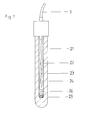
- 2 denotes the reference electrode, 22 a glass tube thereof, and 21 the jacket made of conductive plastic, which concentrically surrounds the glass tube.
- the glass tube 22 is closed at its lower end by a plug 25 made of porous ceramic.
- the glass tube 22 contains an electrolyte 24 and a supply of powdered silver chloride 26 in order to ensure saturation of the aqueous electrolyte 24 consisting of potassium chloride and silver chloride.
- the galvanically chlorinated silver wire 23 is immersed in these electrolytes and makes the electrical contact with the connecting cable 3.
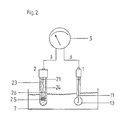
- a measuring electrode 1 is provided in addition to the reference electrode 2, both of which are immersed in the measuring medium 7.
- the measuring electrode 1 has a glass tube 10, the lower spherical part 13 of which consists of electrically conductive glass and which responds to the hydrogen ions to be measured.
- the glass tube 10 is filled with an electrolyte in which there is also a likewise galvanically chlorinated silver wire 11 which, like the galvanically chlorinated silver wire 23, is connected to the measuring device 5 via a connecting cable 3, the scale of which is calibrated in mV / pH values.
- 10 is the glass tube of the measuring electrode
- 13 is its spherical part made of electrically conductive glass
- 11 is the galvanically chlorinated silver wire which is immersed in the electrolyte is filled in the glass tube 10 and is connected to the connecting cable 3 to the measuring device.
- the glass tube 10 is surrounded by a jacket 21 made of conductive plastic.
- the glass tube 22 is arranged inside the jacket 21.
- the chlorinated silver wire 23 is also connected via connecting cable 3 to the measuring device.
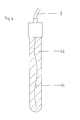
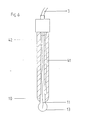
- 41 is the galvanically chlorinated silver wire and 42 is the polymer, by means of additives, an electrically conductive sheath which surrounds the chlorinated silver wire.
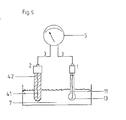
- both the reference electrode 2 and the measuring electrode 1 are immersed in the medium 7 to be measured.
- the electrical contact to the measuring device 5 is established via a connecting cable 3 designed as a coaxial cable.
- the glass tube 10 of the measuring electrode is surrounded concentrically by one of the jackets 42 existing with the above-mentioned polymers with a conductive additive.
- a chlorinated silver wire 41 is arranged inside the sheathing 42 and, like the chlorinated silver wire 11, is connected to the measuring device via a connecting cable 3.
- the chlorinated silver wire 41 forms, together with the sheathing 42, the reference electrode.
Landscapes
- Chemical & Material Sciences (AREA)
- Life Sciences & Earth Sciences (AREA)
- Health & Medical Sciences (AREA)
- Biochemistry (AREA)
- General Physics & Mathematics (AREA)
- Electrochemistry (AREA)
- Physics & Mathematics (AREA)
- Analytical Chemistry (AREA)
- Molecular Biology (AREA)
- General Health & Medical Sciences (AREA)
- Chemical Kinetics & Catalysis (AREA)
- Immunology (AREA)
- Pathology (AREA)
- Investigating Or Analyzing Materials By The Use Of Electric Means (AREA)
- Testing Resistance To Weather, Investigating Materials By Mechanical Methods (AREA)
- Measuring Oxygen Concentration In Cells (AREA)
- Measurement Of The Respiration, Hearing Ability, Form, And Blood Characteristics Of Living Organisms (AREA)
Abstract
Description
- Die Erfindung bezieht sich auf eine Referenzelektrode für eine Messkette zur Messung der Ionenaktivität, wie zum Beispiel des pH-Wertes. Für elektrochemische Potentialmessungen wie zum Beispiel die pH-Wertmessung, wird eine Messelektrode, die auf die zu messenden Ionen anspricht und eine Referenzelektrode vorgesehen. Beide Elektroden tauchen in das zu messende Medium ein. Durch ein Messgerät (mV-Meter,pH-Meter) wird die Potentialdifferenz zwischen den beiden Elektroden gemessen. Die Messwertanzeige ist dabei ein Maß für die Ionenkonzentration. Bei der Wasserstoffionenaktivitätsmessung (pH-Wertmessung), bei der eine Messelektrode verwendet wird, die auf Wasserstoffionen anspricht, was bedeutet, daß deren Potential gegenüber der Referenzelektrode von der Wasserstoffionenkonzentration abhängig, das Potential der Referenzelektrode aber unabhängig konstant ist, wird in der Regel ein pH-Wertmessgerät verwendet. Das pH-Wertmessgerät ist dabei ein mV-Messgerät, das in pH-Werten geeicht ist. Die Aufgabe der Referenzelektrode besteht darin, unabhängig von dem Zustand und der Art des zu messenden Mediums in einem ionenleitenden Kontakt über das zu messende Medium zur Messelektrode zu stehen und ein von der Ionenkonzentration unabhängiges konstantes Eigenpotential aufzuweisen. Eine solche Referenzelektrode ist z.B. aus der DE-OS 30 36 354 bekannt. Bei dieser bekannten Referenzelektrode ist eine unten offenen Kammer mit einer Ummantelung aus Glas vorgesehen. Das untere offene Ende ist durch einen porösen Stopfen verschlossen, welcher einen ionenleitenden Kontakt über das zu messende Medium zur Messelektrode gewährleistet, wobei die Kammer mit einer gesättigten, wässrigen Lösung aus Kaliumchlorid und Silberchlorid gefüllt ist. Innerhalb der Kammer, von der Chloridlösung umgeben, befindet sich ein galvanisch chlorierter Silberdraht oder Silberplatte, der oder die mit einem Verbindungskabel zum Messgerät angeschlossen ist.
- Eine solche Anordnung ist nicht nur aufwendig in der Herstellung, sondern weist auch folgende Nachteile auf:
- Durch den porösen Stopfen (Diaphragma) austretendes Kaliumchlorid und Silberchlorid können chemische Reaktionen mit dem zu messenden Medium auftreten, die das Diaphragma verstopfen und den ionenleitenden Kontakt unterbrechen können.
- Diese bekannte Anordnung ist nur durch eine aufwendige Druckausgleichsarmatur druckbeständig um eine Diffusion des zu messenden Mediums ins Innere der Elektrode zu vermeiden, durch die die Betriebssicherheit beeinträchtigt werden kann.
- Der Elektolytvorrat innerhalb der Kammer verringert sich durch Ausfluß während des Messvorgangs durch das Diaphragma. Ein Nachfüllen ist unerläßlich.
- Diese bekannte Anordnung ist nur bedingt temperaturbeständig.
- Es ist daher die Aufgabe der Erfindung eine Referenzelektrode zu schaffen, die einfach im Aufbau und eine höhere Betriebssicherheit aufweist.
- Die Lösung der gestellten Aufgabe ist erfindungsgemäß gekennzeichnet durch ein Glasrohr, dessen unteres Ende durch einen, aus poröser Keramik bestehenden Stopfen verschlossen und mit einem Elektrolyten aus Kaliumchlorid und Silberchlorid gefüllt ist, in der sich ein galvanisch chlorierter Silberdraht befindet, der über ein Verbindungskabel an ein Meßgerät angeschlossen ist, und wobei das Glasrohr von einem aus elektrisch leitendem Kunststoff bestehendem Mantel umgeben ist.
- Nähere Angaben über den Werkstoff des Mantels sind aus den Unteransprüchen 2 und 3 zu entnehmen.
- Eine Messkette mit der erfindungsgemäßen Elektrode weist eine weitere, für sich bekannte Messelektrode auf, wie diese z.B. aus der DE-AS 23 56 719 bekannt ist. Zwischen der Referenzelektrode und der Meßelektrode ist ein Meßgerät (mV-Meter,pH-Meter) mit hohem Eingangswiderstand angeschlossen. Die Skala des Meßgerätes ist in mV oder pH-Werten geeicht.
- Eine weitere Lösung der gestellten Aufgabe ist erfindungsgemäß gekennzeichnet durch einen galvanisch chlorierten Silberdraht mit einer Umhüllung aus einem Polymer wie z.B. Polyvinylesther, welchem fein verteiltes Silberchlorid beigemischt ist. Die Chlorierung des Silberdrahtes erfolgt in einem galvanischen Verfahen mittels einer Lösung aus Salzsäure, Kaliumchlorid und Kaliumnitrat oder eines anderen geeigneten Stoffes. Bei dieser Referenzelektrode wird eine besondere Kammer, wie z.B. ein Glasrohr, in welche eine Flüssigkeit gefüllt ist, vermieden. Diese Elektrode ist also völlig trocken ausgeführt.
- Der Umhüllung aus dem Polymer können zusätzlich andere Salze beigemischt sein. Dies kann insbesondere fein verteiltes Kaliumchlorid oder auch Lithiumchlorid sein.
- Eine Meßkette mit der erfindungsgemäßen Elektrode weist eine weitere für sich bekannte, getrennte Messelektrode auf. Diese Messkette kann als Einstabmesskette oder als Zweistabmesskette ausgeführt sein. Die Referenzelektrode und die Meßelektrode sind dabei an ein Meßgerät (mV-Meßgerät, pH-Meßgerät) angeschlossen, dessen Skala in mV oder pH-Werten geeicht ist.
- Die erfindungsgemäße Referenzelektrode eignet sich für die Ionenaktivitätsmessung allgemein. Sie ist geeignet, wie beschrieben für die Messung der Wasserstoffionenaktivität (pH-Wert), als auch für beliebig andere Anionen wie Kationen unter Verwendung der dafür geeigneten Meßelektroden, die hier nicht näher beschrieben werden sollen. Außerdem ist dabei die Wahl des leitenden Zusatzes im Polymer von Bedeutung, denn eine Auswaschung durch das zu messende Medium des leitenden Zusatzes in Form von Salzen läßt sich nicht vermeiden, wodurch die Messung beeinflußt werden kann. Es empfiehlt sich deshalb als leitender Zusatz für die Messung von z.B. Chlor-, Brom-, Jod-, Silber-, Quecksilber-, Kalium- und Cyanationen als leitender Zusatz Kaliumnitrat bzw. Natriumnitrat.
- Weitere Details der Erfindung sind den Ansprüchen 11 und 12 sowie den Zeichnungen der Ausführungsbeispiele speziell für die pH-Wertmessung zu entnehmen.
- Es zeigen die
- Fig. 1 eine Referenzelektrode nach der Erfindung in einem Längsschnitt,
- Fig. 2 eine Zweistabmeßkette für die pH-Wertmessung mit der erfindungsgemäßen Referenzelektrode,
- Fig. 3 eine Einstabmeßkette für die pH-Wertmessung mit der erfindungsgemäßen Referenzelektrode,
- Fig. 4 eine Referenzelektrode nach der Erfindung in trockener Ausführung,
- Fig. 5 eine Zweistabmeßkette mit einer Referenzelektrode entsprechend Fig. 4 und
- Fig. 6 eine Einstabmeßkette mit einer Referenzelektrode entsprechend Fig. 5.
- Die Proportionen der einzelnen Bauelemente in den Zeichnungen entsprechen nicht den wirklichen Verhältnissen, um eine gute Erkennbarkeit zu ermöglichen.
- In den Zeichnungen ist mit 2 die Referenzelektrode, mit 22 ein Glasrohr derselben, und mit 21 der aus leitendem Kunststoff bestehende Mantel, der das Glasrohr konzentrisch umgibt, bezeichnet. Das Glasrohr 22 ist an seinem unteren Ende durch einen aus poröser Keramik bestehenden Stopfen 25 verschlossen. Im Glasrohr 22 ist ein Elektrolyt 24 enthalten, sowie ein Vorrat an pulverisiertem Silberchlorid 26, um eine Sättigung des aus Kaliumchlorid und Silberchlorid bestehenden wässrigen Elektrolyten 24 zu gewährleisten. In diesen Elektrolyten taucht der galvanisch chlorierte Silberdraht 23 und stellt den elektrischen Kontakt zum Verbindungskabel 3 her.
- Bei der in Fig. 2 dargestellten Zweistabmeßkette ist außer der Referenzelektrode 2 eine Meßelektrode 1 vorgesehen, die beide in das Meßmedium 7 eintauchen. Die Meßelektrode 1 weist ein Glasrohr 10 auf, dessen unteres kugelförmiges Teil 13 aus elektrisch leitendem Glas besteht und das auf die zu messenden Wasserstoffionen anspricht. Das Glasrohr 10 ist mit einem Elektrolyten gefüllt, in welchem sich ein ebenfalls galvanisch chlorierter Silberdraht 11 befindet, der wie der galvanisch chlorierte Silberdraht 23 über Verbindungskabel 3 an das Meßgerät 5 angeschlossen ist, dessen Skala in mV/pH-Werten geeicht ist.
- Bei der in Fig. 3 dargestellten Einstabmeßkette mit einer Referenzelektrode 2 nach der Erfindung ist wiederum mit 10 das Glasrohr der Meßelektrode, mit 13 sein kugelförmiges Teil aus elektrisch leitendem Glas, und mit 11 der galvanisch chlorierte Silberdraht bezeichnet, der in den Elektrolyten eintaucht, der in das Glasrohr 10 gefüllt ist und mit dem Verbindungskabel 3 zum Meßgerät angeschlossen ist. Das Glasrohr 10 ist von einem aus leitendem Kunststoff bestehenden Mantel 21 umgeben. Innerhalb des Mantels 21 ist das Glasrohr 22 angeordnet. Der chlorierte Silberdraht 23 ist ebenfalls über Verbindungskabel 3 zum Meßgerät angeschlossen.
- Bei der in Fig. 4 dargestellten zweiten Ausführungsform der Erfindung ist mit 41 der galvanisch chlorierte Silberdraht und mit 42 der aus Polymer, durch Zusätze elektrisch leitende Mantel, der den chlorierten Silberdraht umhüllt, dargestellt.
- In dem in Fig. 5 dargestellten Ausführungsbeispiel der Erfindung sind die gleichen Bezugszeichen wie oben angegeben gültig. Sowohl die Referenzelektrode 2 als auch die Meßelektrode 1 tauchen in das zu messende Medium 7 ein. Der elektrische Kontakt zum Meßgerät 5 ist über ein als Koaxialkabel ausgebildetes Verbindungskabel 3 hergestellt.
- Bei der in Fig. 6 dargestellten Einstabmeßkette ist das Glasrohr 10 der Meßelektrode von einem der oben bezeichneten Polymere mit leitendem Zusatz bestehenden Mantel 42 konzentrisch umfaßt. Innerhalb der Umhüllung 42 ist ein chlorierter Silberdraht 41 angeordnet, der wie der chlorierte Silberdraht 11 über Verbindungskabel 3 zum Meßgerät angeschlossen ist. Der chlorierte Silberdraht 41 bildet zusammen mit der Ummantelung 42 die Referenzelektrode.
Claims (12)
Priority Applications (1)
| Application Number | Priority Date | Filing Date | Title |
|---|---|---|---|
| AT87107463T ATE80733T1 (de) | 1986-05-23 | 1987-05-22 | Referenzelektrode fuer die ionenaktivitaetsmessung, insbesondere fuer die ph-wertmessung. |
Applications Claiming Priority (4)
| Application Number | Priority Date | Filing Date | Title |
|---|---|---|---|
| DE3617479 | 1986-05-23 | ||
| DE19863617479 DE3617479A1 (de) | 1986-05-23 | 1986-05-23 | Einstabmesskette, insbesondere fuer die ph-wertmessung und verfahren zu seiner herstellung |
| DE3704714 | 1987-02-14 | ||
| DE19873704714 DE3704714A1 (de) | 1987-02-14 | 1987-02-14 | Referenzelektrode fuer die ionenaktivitaetsmessung, insbesondere fuer die ph-wertmessung |
Publications (3)
| Publication Number | Publication Date |
|---|---|
| EP0247535A2 true EP0247535A2 (de) | 1987-12-02 |
| EP0247535A3 EP0247535A3 (en) | 1989-02-22 |
| EP0247535B1 EP0247535B1 (de) | 1992-09-16 |
Family
ID=25844052
Family Applications (1)
| Application Number | Title | Priority Date | Filing Date |
|---|---|---|---|
| EP87107463A Expired - Lifetime EP0247535B1 (de) | 1986-05-23 | 1987-05-22 | Referenzelektrode für die Ionenaktivitätsmessung, insbesondere für die pH-Wertmessung |
Country Status (3)
| Country | Link |
|---|---|
| EP (1) | EP0247535B1 (de) |
| DE (1) | DE3781718D1 (de) |
| ES (1) | ES2034985T3 (de) |
Cited By (10)
| Publication number | Priority date | Publication date | Assignee | Title |
|---|---|---|---|---|
| WO1993015393A1 (en) * | 1992-01-28 | 1993-08-05 | Amagruss Limited | Reference electrodes |
| EP0609326A4 (de) * | 1991-10-22 | 1995-05-03 | Rosemount Inc | Elektrode mit isoliertem kern für eine ph-sonde. |
| DE19533059A1 (de) * | 1995-09-07 | 1997-03-13 | Juchheim Gmbh & Co M K | Bezugselektrode für elektrochemische Messungen und Verfahren zu deren Herstellung |
| WO2001075430A3 (en) * | 2000-03-31 | 2003-01-30 | Foxboro Co | Sensor for electrochemical measurement |
| DE4329742C2 (de) * | 1993-09-03 | 2003-03-20 | Dieter Haaf | Elektrode zum Messen elektrochemischer Größen einer Probe |
| WO2004015408A1 (de) * | 2002-07-25 | 2004-02-19 | Testo Ag | Verfahren zur herstellung von ph-sonde |
| DE102010050481A1 (de) | 2010-11-04 | 2012-05-10 | Kurt-Schwabe-Institut für Mess- und Sensortechnik e.V. Meinsberg | Referenzelektrode |
| US20120152741A1 (en) * | 2010-12-17 | 2012-06-21 | Horiba, Ltd | Reference electrode |
| DE102012101004A1 (de) * | 2012-02-08 | 2013-08-08 | Endress + Hauser Conducta Gesellschaft für Mess- und Regeltechnik mbH + Co. KG | Elektrode zur Verwendung in elektrochemischen Messsystemen |
| CN106093156A (zh) * | 2016-06-01 | 2016-11-09 | 扬州大学 | 微通道饱和银‑氯化银电极的制备方法 |
Families Citing this family (1)
| Publication number | Priority date | Publication date | Assignee | Title |
|---|---|---|---|---|
| US7373195B2 (en) | 2004-07-30 | 2008-05-13 | Medtronic, Inc. | Ion sensor for long term use in complex medium |
Family Cites Families (5)
| Publication number | Priority date | Publication date | Assignee | Title |
|---|---|---|---|---|
| US3662745A (en) * | 1969-06-30 | 1972-05-16 | Hoffmann La Roche | Metal-metal salt electrode and method for making the same |
| DE3228647A1 (de) * | 1982-07-31 | 1984-02-02 | Dr. W. Ingold KG, 6000 Frankfurt | Bezugselektrode oder einstabmesskette |
| JPS5924242A (ja) * | 1982-08-02 | 1984-02-07 | Terumo Corp | 基準電極 |
| US4589418A (en) * | 1982-12-06 | 1986-05-20 | Cardiac Pacemakers, Inc. | Coating for silver/silver chloride reference electrode |
| HU195000B (en) * | 1984-03-21 | 1988-03-28 | N Proizv Radioelek Med App | Current collectorcell to an electrode of the second kind, as well as method for making current cell collector |
-
1987
- 1987-05-22 ES ES198787107463T patent/ES2034985T3/es not_active Expired - Lifetime
- 1987-05-22 EP EP87107463A patent/EP0247535B1/de not_active Expired - Lifetime
- 1987-05-22 DE DE8787107463T patent/DE3781718D1/de not_active Expired - Fee Related
Cited By (16)
| Publication number | Priority date | Publication date | Assignee | Title |
|---|---|---|---|---|
| EP0609326A4 (de) * | 1991-10-22 | 1995-05-03 | Rosemount Inc | Elektrode mit isoliertem kern für eine ph-sonde. |
| WO1993015393A1 (en) * | 1992-01-28 | 1993-08-05 | Amagruss Limited | Reference electrodes |
| DE4329742C2 (de) * | 1993-09-03 | 2003-03-20 | Dieter Haaf | Elektrode zum Messen elektrochemischer Größen einer Probe |
| DE19533059A1 (de) * | 1995-09-07 | 1997-03-13 | Juchheim Gmbh & Co M K | Bezugselektrode für elektrochemische Messungen und Verfahren zu deren Herstellung |
| DE19533059C2 (de) * | 1995-09-07 | 1999-10-14 | Juchheim Gmbh & Co M K | Bezugselektrode für elektrochemische Messungen und Verfahren zu deren Herstellung |
| WO2001075430A3 (en) * | 2000-03-31 | 2003-01-30 | Foxboro Co | Sensor for electrochemical measurement |
| WO2004015408A1 (de) * | 2002-07-25 | 2004-02-19 | Testo Ag | Verfahren zur herstellung von ph-sonde |
| US7318273B2 (en) | 2002-07-25 | 2008-01-15 | Testo Ag | Method for producing pH probes |
| DE102010050481A1 (de) | 2010-11-04 | 2012-05-10 | Kurt-Schwabe-Institut für Mess- und Sensortechnik e.V. Meinsberg | Referenzelektrode |
| US20120152741A1 (en) * | 2010-12-17 | 2012-06-21 | Horiba, Ltd | Reference electrode |
| CN102539498A (zh) * | 2010-12-17 | 2012-07-04 | 株式会社堀场制作所 | 参比电极 |
| US8758586B2 (en) * | 2010-12-17 | 2014-06-24 | Horiba, Ltd. | Reference electrode |
| DE102012101004A1 (de) * | 2012-02-08 | 2013-08-08 | Endress + Hauser Conducta Gesellschaft für Mess- und Regeltechnik mbH + Co. KG | Elektrode zur Verwendung in elektrochemischen Messsystemen |
| CN103245707A (zh) * | 2012-02-08 | 2013-08-14 | 恩德莱斯和豪瑟尔测量及调节技术分析仪表两合公司 | 用于电化学测量系统中的应用的电极 |
| US20130221971A1 (en) * | 2012-02-08 | 2013-08-29 | Endress + Hauser Conducta Gesellschaft Fur Mess-Und Regeltechnik Mbh + Co. Kg | Electrode for Application in Electrochemical Measuring Systems |
| CN106093156A (zh) * | 2016-06-01 | 2016-11-09 | 扬州大学 | 微通道饱和银‑氯化银电极的制备方法 |
Also Published As
| Publication number | Publication date |
|---|---|
| EP0247535B1 (de) | 1992-09-16 |
| EP0247535A3 (en) | 1989-02-22 |
| DE3781718D1 (de) | 1992-10-22 |
| ES2034985T3 (es) | 1993-04-16 |
Similar Documents
| Publication | Publication Date | Title |
|---|---|---|
| DE3405431C2 (de) | ||
| DE10036039B4 (de) | Messsonde für potentiometrische Messungen, Verfahren zur Überwachung des Altrungszustandes der Messonde und ihre Verwendung | |
| DE2501812C2 (de) | Meßanordnung zur Messung der Leitfähigkeit eines Elektrolyten | |
| WO2010072510A1 (de) | Ionenselektive elektrode | |
| DE1199520B (de) | Coulometrisches Titriergeraet | |
| EP0247535B1 (de) | Referenzelektrode für die Ionenaktivitätsmessung, insbesondere für die pH-Wertmessung | |
| DE2243029A1 (de) | Einrichtung zur messung von elektrodenpotentialen | |
| DE2349579A1 (de) | Potentiometrischer sauerstoff-sensor | |
| DE102011080517A1 (de) | Messaufnehmer zur Bestimmung einer eine Aktivität eines Ziel-Ions in einem Messmedium repräsentierenden Messgröße | |
| EP0060533B1 (de) | Elektroanalytische Messanordnung | |
| EP1480038A1 (de) | Potentiometrische, ionenselektive Elektrode | |
| DE1297893B (de) | Messelektrode zum Messen der Konzentration von Ionen in einer Fluessigkeit | |
| DE19533059A1 (de) | Bezugselektrode für elektrochemische Messungen und Verfahren zu deren Herstellung | |
| DE4029321C2 (de) | ||
| DE3823327C2 (de) | ||
| DE3704714A1 (de) | Referenzelektrode fuer die ionenaktivitaetsmessung, insbesondere fuer die ph-wertmessung | |
| DE102018208482B4 (de) | Potentiometrische Messkette und Verfahren zur pH-Wert-Bestimmung | |
| DE1798446C2 (de) | Verfahren zur kontinuierlichen elektrochemischen Bestimmung der Konzentration von Chlor, Brom, Jod, deren Wasserstoffsäuren, Cyanwasserstoffsäure und gasförmigen Cyanderivaten in einer Atmosphäre. Ausscheidung aus: 1598225 | |
| DE3148440A1 (de) | Bezugselektrodensystem mit austauschbarem bezugsuebergang | |
| DE102023108375A1 (de) | Messsonde | |
| WO2015024787A1 (de) | Coulometrische titrationszelle | |
| DE2400613C2 (de) | Elektrodenanordnung zur potentiometrischen Bestimmung von Ionen in einer Lösung | |
| EP0062250A2 (de) | Fehlerkompensierendes elektroanalytisches Messverfahren, sowie Messgerät zur Durchführung des Messverfahrens | |
| DE102015108496B4 (de) | Vorrichtung und Verfahren zur Ermittlung einer Ozonkonzentration | |
| CH694647A5 (de) | pH-Einstabmesskette mit einer internen Leitfähigkeitsmesszelle. |
Legal Events
| Date | Code | Title | Description |
|---|---|---|---|
| PUAI | Public reference made under article 153(3) epc to a published international application that has entered the european phase |
Free format text: ORIGINAL CODE: 0009012 |
|
| AK | Designated contracting states |
Kind code of ref document: A2 Designated state(s): AT BE CH DE ES FR GB IT LI NL SE |
|
| PUAL | Search report despatched |
Free format text: ORIGINAL CODE: 0009013 |
|
| AK | Designated contracting states |
Kind code of ref document: A3 Designated state(s): AT BE CH DE ES FR GB IT LI NL SE |
|
| 17P | Request for examination filed |
Effective date: 19890522 |
|
| 17Q | First examination report despatched |
Effective date: 19890904 |
|
| DIN1 | Information on inventor provided before grant (deleted) | ||
| RAP1 | Party data changed (applicant data changed or rights of an application transferred) |
Owner name: AMAGRUSS ELECTRODES (IRELAND) LIMITED |
|
| RIN1 | Information on inventor provided before grant (corrected) |
Inventor name: HAAF, DIETER Inventor name: RUSSEL, THIMOTY H. |
|
| RAP1 | Party data changed (applicant data changed or rights of an application transferred) |
Owner name: AMAGRUSS LIMITED |
|
| GRAA | (expected) grant |
Free format text: ORIGINAL CODE: 0009210 |
|
| AK | Designated contracting states |
Kind code of ref document: B1 Designated state(s): AT BE CH DE ES FR GB IT LI NL SE |
|
| REF | Corresponds to: |
Ref document number: 80733 Country of ref document: AT Date of ref document: 19921015 Kind code of ref document: T |
|
| REF | Corresponds to: |
Ref document number: 3781718 Country of ref document: DE Date of ref document: 19921022 |
|
| ITF | It: translation for a ep patent filed | ||
| GBT | Gb: translation of ep patent filed (gb section 77(6)(a)/1977) |
Effective date: 19921215 |
|
| ET | Fr: translation filed | ||
| REG | Reference to a national code |
Ref country code: ES Ref legal event code: FG2A Ref document number: 2034985 Country of ref document: ES Kind code of ref document: T3 |
|
| PLBE | No opposition filed within time limit |
Free format text: ORIGINAL CODE: 0009261 |
|
| STAA | Information on the status of an ep patent application or granted ep patent |
Free format text: STATUS: NO OPPOSITION FILED WITHIN TIME LIMIT |
|
| 26N | No opposition filed | ||
| PGFP | Annual fee paid to national office [announced via postgrant information from national office to epo] |
Ref country code: FR Payment date: 19940520 Year of fee payment: 8 |
|
| PGFP | Annual fee paid to national office [announced via postgrant information from national office to epo] |
Ref country code: ES Payment date: 19940530 Year of fee payment: 8 |
|
| PGFP | Annual fee paid to national office [announced via postgrant information from national office to epo] |
Ref country code: AT Payment date: 19940531 Year of fee payment: 8 |
|
| EAL | Se: european patent in force in sweden |
Ref document number: 87107463.9 |
|
| PG25 | Lapsed in a contracting state [announced via postgrant information from national office to epo] |
Ref country code: AT Effective date: 19950522 |
|
| PG25 | Lapsed in a contracting state [announced via postgrant information from national office to epo] |
Ref country code: ES Free format text: LAPSE BECAUSE OF NON-PAYMENT OF DUE FEES Effective date: 19950523 |
|
| PG25 | Lapsed in a contracting state [announced via postgrant information from national office to epo] |
Ref country code: FR Effective date: 19960229 |
|
| REG | Reference to a national code |
Ref country code: FR Ref legal event code: ST |
|
| REG | Reference to a national code |
Ref country code: FR Ref legal event code: ST |
|
| REG | Reference to a national code |
Ref country code: ES Ref legal event code: FD2A Effective date: 19990201 |
|
| REG | Reference to a national code |
Ref country code: GB Ref legal event code: IF02 |
|
| PGFP | Annual fee paid to national office [announced via postgrant information from national office to epo] |
Ref country code: GB Payment date: 20021122 Year of fee payment: 16 |
|
| PGFP | Annual fee paid to national office [announced via postgrant information from national office to epo] |
Ref country code: SE Payment date: 20021129 Year of fee payment: 16 Ref country code: DE Payment date: 20021129 Year of fee payment: 16 |
|
| PGFP | Annual fee paid to national office [announced via postgrant information from national office to epo] |
Ref country code: NL Payment date: 20021130 Year of fee payment: 16 Ref country code: CH Payment date: 20021130 Year of fee payment: 16 |
|
| PGFP | Annual fee paid to national office [announced via postgrant information from national office to epo] |
Ref country code: BE Payment date: 20021218 Year of fee payment: 16 |
|
| PG25 | Lapsed in a contracting state [announced via postgrant information from national office to epo] |
Ref country code: GB Free format text: LAPSE BECAUSE OF NON-PAYMENT OF DUE FEES Effective date: 20030522 |
|
| PG25 | Lapsed in a contracting state [announced via postgrant information from national office to epo] |
Ref country code: SE Free format text: LAPSE BECAUSE OF NON-PAYMENT OF DUE FEES Effective date: 20030523 |
|
| PG25 | Lapsed in a contracting state [announced via postgrant information from national office to epo] |
Ref country code: LI Free format text: LAPSE BECAUSE OF NON-PAYMENT OF DUE FEES Effective date: 20030531 Ref country code: CH Free format text: LAPSE BECAUSE OF NON-PAYMENT OF DUE FEES Effective date: 20030531 Ref country code: BE Free format text: LAPSE BECAUSE OF NON-PAYMENT OF DUE FEES Effective date: 20030531 |
|
| BERE | Be: lapsed |
Owner name: *AMAGRUSS LTD Effective date: 20030531 |
|
| PG25 | Lapsed in a contracting state [announced via postgrant information from national office to epo] |
Ref country code: NL Free format text: LAPSE BECAUSE OF NON-PAYMENT OF DUE FEES Effective date: 20031201 |
|
| PG25 | Lapsed in a contracting state [announced via postgrant information from national office to epo] |
Ref country code: DE Free format text: LAPSE BECAUSE OF NON-PAYMENT OF DUE FEES Effective date: 20031202 |
|
| EUG | Se: european patent has lapsed | ||
| GBPC | Gb: european patent ceased through non-payment of renewal fee |
Effective date: 20030522 |
|
| REG | Reference to a national code |
Ref country code: CH Ref legal event code: PL |
|
| NLV4 | Nl: lapsed or anulled due to non-payment of the annual fee |
Effective date: 20031201 |
|
| PG25 | Lapsed in a contracting state [announced via postgrant information from national office to epo] |
Ref country code: IT Free format text: LAPSE BECAUSE OF NON-PAYMENT OF DUE FEES Effective date: 20050522 |