EP0240906A2 - Kontinuierliches Verfahren zum Tablettieren - Google Patents
Kontinuierliches Verfahren zum Tablettieren Download PDFInfo
- Publication number
- EP0240906A2 EP0240906A2 EP87104731A EP87104731A EP0240906A2 EP 0240906 A2 EP0240906 A2 EP 0240906A2 EP 87104731 A EP87104731 A EP 87104731A EP 87104731 A EP87104731 A EP 87104731A EP 0240906 A2 EP0240906 A2 EP 0240906A2
- Authority
- EP
- European Patent Office
- Prior art keywords
- extruded
- pressed
- tablets
- nvp
- parts
- Prior art date
- Legal status (The legal status is an assumption and is not a legal conclusion. Google has not performed a legal analysis and makes no representation as to the accuracy of the status listed.)
- Granted
Links
Images

Classifications
-
- A—HUMAN NECESSITIES
- A61—MEDICAL OR VETERINARY SCIENCE; HYGIENE
- A61J—CONTAINERS SPECIALLY ADAPTED FOR MEDICAL OR PHARMACEUTICAL PURPOSES; DEVICES OR METHODS SPECIALLY ADAPTED FOR BRINGING PHARMACEUTICAL PRODUCTS INTO PARTICULAR PHYSICAL OR ADMINISTERING FORMS; DEVICES FOR ADMINISTERING FOOD OR MEDICINES ORALLY; BABY COMFORTERS; DEVICES FOR RECEIVING SPITTLE
- A61J3/00—Devices or methods specially adapted for bringing pharmaceutical products into particular physical or administering forms
- A61J3/06—Devices or methods specially adapted for bringing pharmaceutical products into particular physical or administering forms into the form of pills, lozenges or dragees
-
- A—HUMAN NECESSITIES
- A61—MEDICAL OR VETERINARY SCIENCE; HYGIENE
- A61J—CONTAINERS SPECIALLY ADAPTED FOR MEDICAL OR PHARMACEUTICAL PURPOSES; DEVICES OR METHODS SPECIALLY ADAPTED FOR BRINGING PHARMACEUTICAL PRODUCTS INTO PARTICULAR PHYSICAL OR ADMINISTERING FORMS; DEVICES FOR ADMINISTERING FOOD OR MEDICINES ORALLY; BABY COMFORTERS; DEVICES FOR RECEIVING SPITTLE
- A61J3/00—Devices or methods specially adapted for bringing pharmaceutical products into particular physical or administering forms
- A61J3/10—Devices or methods specially adapted for bringing pharmaceutical products into particular physical or administering forms into the form of compressed tablets
-
- A—HUMAN NECESSITIES
- A61—MEDICAL OR VETERINARY SCIENCE; HYGIENE
- A61K—PREPARATIONS FOR MEDICAL, DENTAL OR TOILETRY PURPOSES
- A61K9/00—Medicinal preparations characterised by special physical form
- A61K9/20—Pills, tablets, discs, rods
- A61K9/2095—Tabletting processes
-
- B—PERFORMING OPERATIONS; TRANSPORTING
- B29—WORKING OF PLASTICS; WORKING OF SUBSTANCES IN A PLASTIC STATE IN GENERAL
- B29B—PREPARATION OR PRETREATMENT OF THE MATERIAL TO BE SHAPED; MAKING GRANULES OR PREFORMS; RECOVERY OF PLASTICS OR OTHER CONSTITUENTS OF WASTE MATERIAL CONTAINING PLASTICS
- B29B9/00—Making granules
- B29B9/02—Making granules by dividing preformed material
- B29B9/06—Making granules by dividing preformed material in the form of filamentary material, e.g. combined with extrusion
-
- B—PERFORMING OPERATIONS; TRANSPORTING
- B30—PRESSES
- B30B—PRESSES IN GENERAL
- B30B11/00—Presses specially adapted for forming shaped articles from material in particulate or plastic state, e.g. briquetting presses, tabletting presses
- B30B11/16—Presses specially adapted for forming shaped articles from material in particulate or plastic state, e.g. briquetting presses, tabletting presses using pocketed rollers, e.g. two co-operating pocketed rollers
-
- B—PERFORMING OPERATIONS; TRANSPORTING
- B30—PRESSES
- B30B—PRESSES IN GENERAL
- B30B15/00—Details of, or accessories for, presses; Auxiliary measures in connection with pressing
- B30B15/30—Feeding material to presses
- B30B15/302—Feeding material in particulate or plastic state to moulding presses
- B30B15/308—Feeding material in particulate or plastic state to moulding presses in a continuous manner, e.g. for roller presses, screw extrusion presses
-
- A—HUMAN NECESSITIES
- A61—MEDICAL OR VETERINARY SCIENCE; HYGIENE
- A61J—CONTAINERS SPECIALLY ADAPTED FOR MEDICAL OR PHARMACEUTICAL PURPOSES; DEVICES OR METHODS SPECIALLY ADAPTED FOR BRINGING PHARMACEUTICAL PRODUCTS INTO PARTICULAR PHYSICAL OR ADMINISTERING FORMS; DEVICES FOR ADMINISTERING FOOD OR MEDICINES ORALLY; BABY COMFORTERS; DEVICES FOR RECEIVING SPITTLE
- A61J2200/00—General characteristics or adaptations
- A61J2200/20—Extrusion means, e.g. for producing pharmaceutical forms
-
- B—PERFORMING OPERATIONS; TRANSPORTING
- B29—WORKING OF PLASTICS; WORKING OF SUBSTANCES IN A PLASTIC STATE IN GENERAL
- B29K—INDEXING SCHEME ASSOCIATED WITH SUBCLASSES B29B, B29C OR B29D, RELATING TO MOULDING MATERIALS OR TO MATERIALS FOR MOULDS, REINFORCEMENTS, FILLERS OR PREFORMED PARTS, e.g. INSERTS
- B29K2503/00—Use of resin-bonded materials as filler
Definitions
- the invention relates to a simple, continuous process for the production of tablets.
- the usual tableting machines work in a cycle with stamp and hatch.
- the process requires intensively pre-mixed tableting and is therefore multi-stage and complex.
- the object of the invention was to develop a simple, continuous method for tableting.
- the solution to this problem consists in a continuous process for tableting extrudable pharmaceutical mixtures, which is characterized in that the mixture is extruded and the still deformable strand is pressed between two counter-rotating rollers with opposing depressions in the roller shell, the design of which determines the tablet shape . If hemispherical or other tablets with a flat side are to be produced, one roller shell is left smooth.
- the mixing extruder (1) can have several filler necks (2), if necessary for the separate addition of solid and liquid components of the mixture, as well as a pipe neck for inert gassing (usually nitrogen) and / or degassing. To increase the throughput, the extruder can have more than one nozzle (3).
- the shape immediately follows the extrusion process.
- the extruded strand which is still plastic, is passed through a pair of rollers (4), if necessary with the aid of a suitable guide trough, the shells of the two rollers having mutually opposite depressions (5) which form the tablet shape in pairs on the line of contact.
- the depressions are connected to one another by an open channel, so that the shaped tibets (6) are connected via a short web (predetermined breaking point) ( 7) stay connected.
- a short web predetermined breaking point
- the beads-like structures can be wound up and packed efficiently using relatively simple machines.
- the rigid structures can be broken to a desired length or in single tablets.
- Elongate depressions are then advantageously arranged parallel to the longitudinal axis of the roll.
- rollers In general, natural air cooling is sufficient for the rollers. In special cases it can be advantageous to additionally cool or heat them. In such cases, the rollers should be appropriately temperature controlled. i.e. have one of the usual constructions for passing a liquid cooling or heating medium.
- each nozzle naturally has a row of shaping depressions (5) running on each circumference of the roller in a plane perpendicular to the axis.
- the polymeric agent in the total mixture of all components must soften or melt in the range from 50 to 180, preferably 60 to 130 ° C., so that the mass can be extruded.
- the glass transition temperature of the mixture must in any case be below 180, preferably below 130 ° C.
- plasticizing ancillary substances such as long chain alcohols, ethylene glycol, propylene glycol, trimethylolpropane, triethylene glycol, butanediols, pentanols, hexanols, polyethylene glycols, silicones, aromatic Carbonklareester (such as dialkyl phthalates, trimellitic esters, benzoic esters, terephthalic esters) or aliphatic dicarboxylic esters (eg, dialkyl adipates, Sebacic acid esters, azelaic acid esters, citric and tartaric acid esters) or fatty acid esters reduced.
- aromatic Carbonklareester such as dialkyl phthalates, trimellitic esters, benzoic esters, terephthalic esters
- aliphatic dicarboxylic esters eg, dialkyl adipates, Sebacic acid esters, azelaic acid esters, citric and tartaric acid esters
- NPV polymers which melt or soften in the desired temperature range in a mixture with the active ingredient and, if appropriate, customary pharmaceutical auxiliaries, with or preferably without plasticizing additives. Melting or softening below a certain temperature may be necessary in view of possible thermal and / or oxidative damage not only to the active ingredient but also to the NVP polymer. This could turn yellow during extrusion, which is why the extrusion of NPV polymers has so far not been common.
- the risk is low at extrusion temperatures below 180 ° C, especially below 130 ° C, if the polymer was not prepared in aqueous solution with hydrogen peroxide as the starter, but in an organic solvent, or in water with an organic Peroxide as a starter, for example according to the method according to German patent application P 36 42 633.4 or according to the method of US 4,520,179 and 4,520,180.
- NVP polymers are used as NVP polymers, only those having a glass transition temperature Tg below 120, preferably below 100 ° C in consideration , or the NVP polymer (including homopolymer) must not have been produced in water with H 2 O 2 as a starter. This would result in polymer end groups which lead to yellowing at a higher temperature.
- the NVP polymer can be of the type and amount of comonomers, depending on the intended use so strong or so weakly hydrophilic be adjusted to dissolve the tablets produced therefrom in the dog (buccal tablet), or recite or H also in the intestine (rapid or delayed) or swell so that they release the active ingredient. They are sufficiently swellable if they absorb more than 10% by weight of water when stored at 90% relative humidity.
- Possible comonomers for the NVP are: unsaturated carboxylic acids, e.g. Methacrylic acid, crotonic acid, halic acid, itaconic acid, and their esters with alcohols having 1 to 12, preferably 1 to 8 carbon atoms, furthermore hydroxyethyl or hydroxypropyl acrylate and methacrylate, (meth) acrylamide, the anhydrides and half esters of maleic acid and itaconic acid (the Half-ester is preferably formed only after the polymerization), N-vinylcaprolactam and vinyl propionate.
- Preferred comonomers are acrylic acid and in particular vinyl acetate.
- NVP polymers which contain either only NVP or vinyl acetate as the only comonomer in copolymerized form are therefore preferred. Vinyl acetate and vinyl propionate can be wholly or partially saponified after the polymerization.
- Customary pharmaceutical auxiliaries are, for example, extenders such as silicates or silica, stearic acid or their salts with, for example, magnesium or calcium, ethylcellulose, sodium carboxymethylcellulose, talc, sucrose, lactose , Corn or corn starch, potato flour, polyvinyl alcohol, also wetting agents, preservatives, disintegrants, adsorbents, colorants, flavorings (see, for example, H. Sucker et al., Pharmaceutical Technology. Thieme-Verlag, Stuttgart 1978).
- extenders such as silicates or silica, stearic acid or their salts with, for example, magnesium or calcium, ethylcellulose, sodium carboxymethylcellulose, talc, sucrose, lactose , Corn or corn starch, potato flour, polyvinyl alcohol, also wetting agents, preservatives, disintegrants, adsorbents, colorants, flavorings (see, for example, H. Sucker et al.,
- the tablet produced according to the invention can also be provided with a customary coating to improve the appearance and / or taste (dragee) or to further delay the release of the active ingredient.
- a customary coating to improve the appearance and / or taste (dragee) or to further delay the release of the active ingredient.
- the tablet is manufactured in a closed-cell porous form according to one of the known techniques, so that it floats in the stomach and thus remains there longer.
- very small tablets can be produced by the process according to the invention, which tablets are advantageously filled into capsules instead of conventional granules.
- tablette in the sense of the invention is not tied to a specific form or to oral use. Rather, it also includes suppositories (not melting at body temperature) for rectal use.
- compositions in the sense of the invention are understood to mean all substances with a pharmaceutical effect and as few side effects as possible, provided that they do not decompose under the processing conditions.
- the amount of active ingredient per dose unit and the concentration can vary within wide limits depending on the effectiveness and rate of release. The only condition is that they are sufficient to achieve the desired effect.
- the active substance concentration can be in the range from 0.1 to 95, preferably from 20 to 80, in particular 30 to 70,% by weight. Combinations of active substances can also be used. Active substances in the sense of the invention are also vitamins.
- Example 1 50 parts of the copolymer from Example 1 and 50 parts of theophylline were mixed and extruded in a twin-screw extruder.
- the temperature of the shots was set at 30, 60, 60, 60, 90 and 1 20 ° C.
- the nozzle also had a temperature of 120 ° C.
- the strand obtained was pressed analogously to Example 1 with the device described in claims 2 and 3 to oblong tablets. These tablets obtained as in Example 1 were also stable against mechanical influences,
- a mixture of 50% by weight of an N-vinylpyrrolidone homopolymer (PVP) of the K value given in the table and 50% by weight of theophylline were melted, extruded and extruded in a single-screw extruder at the temperature given in the table deformed into tablets as in Example 1.
- PVP N-vinylpyrrolidone homopolymer
- Example 2 50 parts of a commercially available polyvinyl acetate saponified to 80% and 50 parts of theophylline were processed analogously to Example 1.
- the temperature of the 5 shots was 100, 100, 110, 120, 130 ° C.
- Example 2 were mixed in a 6-shot twin-screw extruder and shaped into tablets as in Example 1.
- the temperature of the shots was 90, 100, 110, 120, 120, 130 ° C, that of the nozzle 135 ° C.
Landscapes
- Health & Medical Sciences (AREA)
- Engineering & Computer Science (AREA)
- Mechanical Engineering (AREA)
- Chemical & Material Sciences (AREA)
- Medicinal Chemistry (AREA)
- General Health & Medical Sciences (AREA)
- Life Sciences & Earth Sciences (AREA)
- Animal Behavior & Ethology (AREA)
- Pharmacology & Pharmacy (AREA)
- Public Health (AREA)
- Veterinary Medicine (AREA)
- Epidemiology (AREA)
- Medicinal Preparation (AREA)
- Medical Preparation Storing Or Oral Administration Devices (AREA)
- Processing And Handling Of Plastics And Other Materials For Molding In General (AREA)
Abstract
Description
- Die Erfindung betrifft ein einfaches, kontinuierliches Verfahren zur Herstellung von Tabletten.
- Die üblichen Tablettiermaschinen arbeiten im Taktverfahren mit Stempel und Hatrize. Das Verfahren erfordert intensiv vorgemischte Tablettiermasssen und ist daher insgesamt mehrstufig und aufwendig.
- Der Erfindung lag die Aufgabe zugrunde, ein einfaches, kontinuierliches Verfahren zum Tablettieren zu entwickeln. Die Lösung dieser Aufgabe besteht in einem kontinuierlichen Verfahren zum Tablettieren von extrudierbaren pharmazeutischen Hischungen, das dadurch gekennzeichnet ist, daß man die Hischung extrudiert und den noch verformbaren Strang zwischen zwei gegenläufig angetriebenen Walzen mit einander gegenüberliegenden Vertiefungen im Walzenmantel, deren Ausführung die Tablettenform bestimmt, verpreßt. Falls halbkugelförmige oder andere Tabletten mit einer ebenen Seite hergestellt werden sollen, läßt man den einen Walzenmantel glatt.
- Wenn auch Fälle denkbar sind, in denen ein Vormischen zweckmäßig ist, so daß ein einfacher Extruder genügt, so ist es doch in der Regel wesentlich vorteilhafter, wenn der Extruder in üblicher Weise als ein- oder mehrwelliger Mischextruder gestaltet ist, so daß ein Vormischen nicht erforderlich ist. Der Hischextruder (1) kann mehrere Einfüllstutzen (2), gegebenenfalls für die getrennte Zugabe von festen und flüssigen Mischungsbestandteilen, sowie einen Rohrstutzen zur Inertbegasung (in der Regel Stickstoff) und/oder Entgasung besitzen. Zur Erhöhung des Durchsatzes kann der Extruder mehr als eine Düse (3) haben.
- Um einen sicheren Transport des extrudierten Stranges zu gewährleisten und sein Abreißen hinter der Düse zu vermeiden, extrudiert man zweckmäßig schräg nach unten. Der jeweils zweckmäßigste Winkel hängt von den Produkteigenschaften und der Fahrweise (z.B. Extrusionstemperatur und -geschwindigkeit) ab.
- Die Formgebung schließt sich unmittelbar an den Extrusionsvorgang an. Man führt den noch plastischen extrudierten Strang, gegebenenfalls mit Hilfe einer geeigneten Führungsrinne, durch ein Walzenpaar (4), wobei die Mäntel der beiden Walzen einander gegenüberliegende Vertiefungen (5) besitzen, die an der Berührungslinie paarweise die Tablettenform bilden.
- In einer bevorzugten Ausführungsform, insbesondere für klebrige Hassen, die mehr oder weniger stark an der Formwand (Vertiefungen 5) haften, sind die Vertiefungen durch einen offenen Kanal miteinander verbunden, so daß die geformten Tibletten (6) über einen kurzen Steg (Sollbruchstelle) (7) miteinander verbunden bleiben. Es entstehen auf diese Weise je nach Flexibilität des Materials perlenkettenartige oder starre Gebilde, die mehrere Tabletten enthalten.
- Die perlenkettenartigen Gebilde können aufgewickelt und mit Hilfe relativ einfacher Maschinen rationell verpackt werden. Die starren Gebilde können auf eine gewünschte Länge oder in Einzeltabletten zerbrochen werden.
- Wenn die Adhäsion der gebildeten Tabletten an den Formwänden (den Vertiefungen in den Walzenmäntein) gering genug ist, daß auch einzelne (nicht über Stege verbundene) Tabletten nicht kleben bleiben, sondern aus den Vertiefungen frei herausfallen, kann auf die erwähnten Verbindungsstege verzichtet werden. Längliche Vertiefungen (für Oblongtabletten oder Zäpfchen) werden dann vorteilhaft parallel zur Längsachse der Walze angeordnet.
- Im allgemeinen genügt für die Walzen die natürliche Luftkühlung. In besonderen Fällen kann es vorteilhaft sein, sie zusätzlich zu kühlen oder auch zu heizen. Für solche Fälle sollten die Walzen zweckmäßig temperierbar sein. d.h. eine der üblichen Konstruktionen zum Durchleiten eines flüssigen Kühl- oder Heizmediums besitzen.
- Falls der Extruder mehr als eine Düse hat, gehört natürlich zu jeder Düse eine auf jedem Walzenumfang in einer Ebene senkrecht zur Achse umlaufende Reihe von formgebenden Vertiefungen (5).
- Das erfindungsgemäße Verfahren ist das erste kontinuierliche Verfahren zum Tablettieren von pharmazeutischen Hischungen. Es ist nicht nur einfacher, effektiver und damit wirtschaftlicher als die übliche Herstellung über die bekannten Tablettiermaschinen, sondern hat weitere wesentliche Vorteile:
- 1. freiere Gestaltung der Tablettenform (z.B. sphärisch!;
- 2. die Verarbeitung von klebrigem und/oder hochviskosem Material, das sich auf den üblichen Tablettiermaschinen nicht oder nur unter großen Schwierigkeiten verarbeiten läßt, ist möglich, weil das Gewicht der zusammenhängenden Tabletten die Adhäsionskraft zwischen Tablette und Formhälfte zu überwinden vermag.
- Das polymere 8indemittel mu8 in der Gesamtmischung aller Komponenten im Bereich von 50 bis 180, vorzugsweise 60.bis 130°C erweichen oder schmelzen, so daß die Masse extrudierbar ist. Die Glasübergangstemperatur der Mischung muB also auf jeden Fall unter 180, vorzugsweise unter 130°C liegen. Erforderlichenfalls wird sie durch übliche pharmakologisch akzeptable weichmachende Hilfsstoffe wie langkettige Alkohole, Ethylenglykol, Propylenglykol, Trimethylolpropan, Triethylenglykol, Butandiole, Pentanole, Hexanole, Polyethylenglykole, Silicone, aromatische Carbonsäureester (z.B. Dialkylphthalate, Trimellithsäureester, Benzoesäureester, Terephthalsäureester) oder aliphatische Dicarbonsäureester (z.B. Dialkyladipate, Sebacinsäureester, Azelainsäureester, Zitronen- und Weinsäureester) oder Fettsäureester herabgesetzt.
- Bevorzugt werden NPV-Polymerisate, die in Mischung mit dem Wirkstoff und ggf. üblichen galenischen Hilfsstoffen mit oder vorzugsweise ohne weichmachende Zusätze im gewünschten Temperaturbereich schmelzen oder erweichen. Das Schmelzen oder Erweichen unterhalb einer bestimmten Temperatur ist gegebenenfalls erforderlich im Hinblick auf eine mögliche thermische und/oder oxidative Schädigung nicht nur des Wirkstoffs, sondern auch des NVP-Polymerisates. Dieses könnte beim Extrudieren vergilben, weshalb die Extrusion von NPV-Polymerisaten bisher nicht üblich ist. Die Gefahr ist jedoch gering bei Extrusionstemperaturen unter 180°C, vor allem unter 130°C, wenn das Polymerisat nicht in wäßriger Lösung mit Wasserstoffperoxid als Starter hergestellt wurde, sondern in einem organischen Lösungsmittel, oder aber in Wasser mit einem organischen Peroxid als Starter, etwa nach dem Verfahren gemäß der deutschen Patentanmeldung P 36 42 633.4 oder nach dem Verfahren von US 4 520 179 und 4 520 180.
- Falls der K-Wert über 17, insbesondere über 30 oder gar 40 (bis maximal 70) liegt und keine stark weichmachende Komponente zugegen ist, kommen als NVP-Polymerisate nur solche mit einer Glastemperatur Tg unter 120, vorzugsweise unter 100°C in Betracht, oder das NVP-Polymerisat (einschließlich Homopolymer) darf nicht in Wasser mit H2O2 als Starter hergestellt worden sein. Dabei würden nämlich Polymer-Endgruppen entstehen, die bei höherer Temperatur zur Vergilbung führen.
- Das NVP-Polymerisat kann über die Art und Menge an Comonomeren je nach Anwendungszweck so stark oder so schwach hydrophil eingestellt werden, daß sich die daraus hergestellten Tabletten im Hund (Buccaltablette) oder im Hagen oder auch erst im Darm (rasch oder verzögert) auflösen oder so quellen, daß sie den Wirkstoff freigeben. Sie sind dann ausreichend quellbar, wenn sie bei Lagerung bei 90 % relativer luftfeuchtigkeit mehr als 10 Gew.% Wasser aufnehmen. Falls es bei carboxylgruppenhaltigen Bindemitteln erwünscht ist, daß sie erst im alkalischen Milieu des Darms den Wirkstoff freigeben, gilt die obige Angabe der Wasseraufnahme nur für die neutralisierte Form (Salzform) des Polymeren (in der die Protonen der Carboxylgruppen ganz oder teilweise durch Ammonium-, Natrium- oder Kaliumionen ersetzt sind).
- Als Comonomer zum NVP kommen in Betracht: ungesättigte Carbonsäuren, z.B. Methacrylsäure, Crotonsäure, Haleinsäure, Itaconsäure, sowie deren Ester mit Alkoholen mit 1 bis 12, vorzugsweise 1 bis 8 Kohlenstoffatomen, ferner Hydroxyethyl- oder Hydroxypropylacrylat und -methacrylat, (Meth)acrylamid, die Anhydride und Halbester der Maleinsäure- und Itaconsäure (wobei der Halbester vorzugsweise erst nach der Polymerisation gebildet wird), N-Vinylcaprolactam und Vinylpropionat. Bevorzugte Comonomere sind Acrylsäure und insbesondere Vinylacetat. Es werden daher NVP-Polymerisate bevorzugt, die entweder nur NVP oder Vinylacetat als einziges Comonomeres einpolymerisiert enthalten. Vinylacetat und Vinylpropionat können nach der Polymerisation ganz oder teilweise verseift sein.
- Übliche galenische Hilfsstoffe, deren Gesamtmenge bis zu 100 Gew.X, bezogen auf das Polymerisat, betragen kann, sind z.B. Streckmittel wie Silikate oder Kieselerde, Stearinsäure oder deren Salze mit z.B. Hagnesium oder Kalzium, Hethylcellulose, Natrium-Carboxymethylcellulose, Talkum, Saccharose, Lactose, Getreide- oder Maisstärke, Kartoffelmehl, Polyvinylalkohol, ferner Netz-, Konservierungs-, Spreng-, Adsorptionsmittel, Farbstoffe, Geschmacksstoffe (vgl. z.B. H. Sucker et al., Pharmazeutische Technologie. Thieme-Verlag, Stuttgart 1978).
- Falls gewünscht, kann die erfindungsgemäß hergestellte Tablette auch mit einem üblichen Überzug zur Verbesserung des Aussehens und/oder des Geschmacks (Dragee) oder zwecks zusätzlicher Verzögerung der Wirkstofffreigabe versehen werden. Für oral einzunehmende Tabletten mit verzögerter Wirkstofffreisetzung kann es günstig sein, wenn man die Tablette nach einer der bekannten Techniken in geschlossenzellig poröser Form herstellt, damit sie im Magen aufschwimmt und dadurch länger dort verweilt. Ferner können nach dem erfindungsgemäßen Verfahren sehr kleine Tabletten hergestellt werden, die mit Vorteil anstelle herkömmlicher Granulate in Kapseln abgefüllt werden. Der Begriff "Tablette" im Sinne der Erfindung ist weder an eine bestimmte Form noch an die perorale Anwendung gebunden. Er schließt vielmehr auch (nicht bei Körpertemperatur schmelzende) Zäpfchen zur rektalen Anwendung ein.
- Unter pharzmazeutischen Wirkstoffen im Sinne der Erfindung sind alle Stoffe mit einer pharmazeutischen Wirkung und möglichst geringen Nebenwirkungen zu verstehen, sofern sie sich unter den Verarbeitungsbedingungen nicht zersetzen. Die Wirkstoffmenge pro Dosiseinheit und die Konzentration können je nach Wirksamkeit und Freisetzungsgeschwindigkeit in weiten Grenzen variieren. Die einzige Bedingung ist, daß sie zur Erzielung der gewünschten Wirkung ausreichen. So kann die Wirkstoffkonzentration im Bereich von 0,1 bis 95, vorzugsweise von 20 bis 80, insbesondere 30 bis 70 Gew.X liegen. Auch WirkstoffKombinationen können eingesetzt werden. Wirkstoffe im Sinne der Erfindung sind auch Vitamine.
- Die in den Beispielen genannten Teile und Prozente beziehen sich auf das Gewicht.
- 45 Teile eines Copolymerisats vom K-Wert 30 aus 60 Gew.2 N-Vinylpyrrolidon und 40 Gew.X Vinylacetat, 5 Teile Stearylalkohol und 50 Teile Theophyllin wurden in einem Doppelschneckenextruder vermischt und extrudiert. Die Temperatur des sechs Schüsse enthaltenden Extrudermantels betrug 30, 60, 60, 60, 60 und 60°C: die Düse wurde auf 100°C aufgeheizt. Der hierbei erhaltene Strang wurde direkt mit dem in den Ansprüchen 2 und 3 beschriebenen Gerät zu Oblongtabletten verpreBt. Es entstanden starre Tablettenstränge, die sehr leicht in die einzelnen Tabletten zerbrachen. Die so erhaltenen Tabletten waren gegen mechanische Einflüsse stabil und zeigten keinen Abrieb beim Transport und Verpacken.
- 50 Teile des Copolymerisats von Beispiel 1 und 50 Teile Theophyllin wurden in einem Doppelschneckenextruder vermischt und extrudiert. Abweichend von Beispiel 1 wurde die Temperatur der Schüsse auf 30, 60, 60, 60. 90 und 120°C eingestellt. Die Düse hatte ebenfalls eine Temperatur von 120°C. Der erhaltene Strang wurde analog zu Beispiel 1 mit dem in den Ansprüchen 2 und 3 beschriebenen Gerät zu Oblongtebletten verpreßt. Auch diese analog Beispiel 1 erhaltenen Tabletten waren gegen mechanische Einflüsse stabil,
- 47,5 Teile eines Copolymerisats vom K-Wert 30 aus 60 Gew.% N-Vinylpyrrolidon und 40 Gew.% Vinylacetat, 2,5 Teile vernetztes PVP als Tablettensprengmittel und 50 Teile Theophyllin wurden in einem Doppelschneckenextruder vermischt und extrudiert. Die Temperatur der fünf Schüsse betrug jeweils 120°C, die Düse hatte eine Temperatur von 130°C. Der noch plastische Strang wurde wie bei Beispiel 1 zu Oblongtabletten verpreBt. Die Tabletten waren stabil gegen mechanische Einflüsse.
- 50 Teile eines Copolymerisats vom K-Wert 52 aus 30 Gew.% N-Vinylpyrrolidon und 70 Gew.% Vinylacetat und 50 Teile Theophyllin wurden in einem Doppelschneckenextruder gemischt und extrudiert. Die Temperatur der fünf Schüsse betrug 30, 60, 100, 100 und 120°C. Die Düse wurde ebenfalls auf 120°C aufgeheizt. Der noch plastische Strang wurde wie bei Beispiel 1 zu mechanisch stabilen Oblongtabletten verpreßt.
- Eine Hischung von 50 Gew.% eines N-Vinylpyrrolidon-Homopolymeren (PVP) von dem jeweils in der Tabelle angegebenen K-Wert und 50 Gew.X Theophyllin wurden in einem Einwellen-Extruder bei der jeweils in der Tabelle angegebenen Temperatur aufgeschmolzen, extrudiert und wie bei Beispiel 1 zu Tabletten verformt.
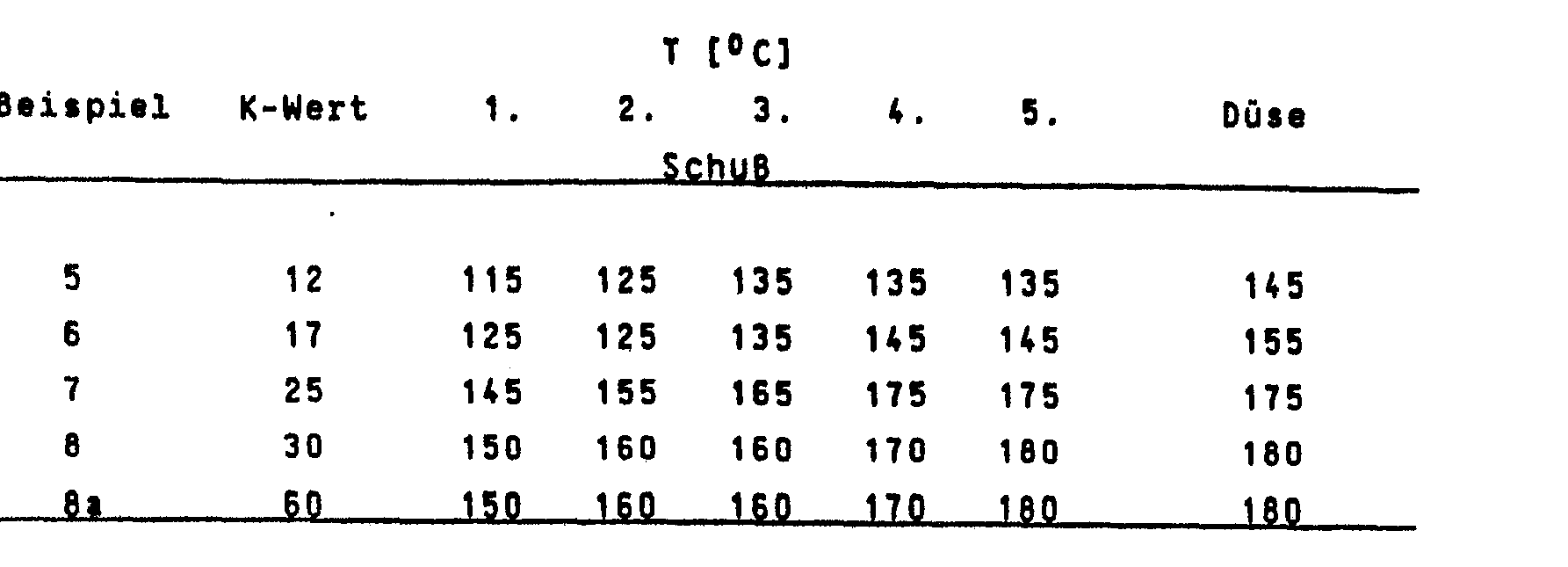
- 40 Teile eines Copolymerisats aus 60 Gew.X N-Vinylpyrrolidon und 40 Gew.X Vinylacetat vom K-Wert 30, 10 Teile Polyhydroxyethylmethacrylat und 50 Teile Theophyllin wurden analog zu Beispiel 1 zu mechanisch stabilen Tabletten verarbeitet. Temperatur der Schüsse: 70, 80, 80, 80, 80°C. Düse: 90°C.
- 50 Teile eines handelsüblichen, zu 80 X verseiften Polyvinylacetats und 50 Teile Theophyllin wurden analog zu Beispiel 1 verarbeitet. Die Temperatur der 5 Schüsse betrug 100, 100, 110, 120, 130°C. Düse: 150°C.
- 50 Teile Polyhydroxyethylmethacrylat vom K-Wert 30 und 50 Teile Theophyllin wurden analog Beispiel 1 verarbeitet. Temperatur der Schüsse: 120, 130, 150, 160, 160°C. Düse: 170°C.
- 36 Teile eines Copolymerisates aus 60 Gew.X N-Vinylpyrrolidon und 40 Gew.X Vinylacetat vom K-Wert 30, 4 Teile Stearylalkohol, 40 Teile Theophyllin und 20 Teile
- wurden in einem 6-schüssigen Dopppelschneckenextruder gemischt und analog Beispiel 1 zu Tabletten verformt. Die Temperatur der Schüsse betrug 90, 100, 110, 120, 120, 130°C, die der Düse 135°C.
- 50 Teile des Copolymerisates der Beispiele 12 bis 14 und 50 Teile Verapamil wurden gemäß den Beispielen 12 bis 14 zu Tabletten geformt.
- Analog den obigen Beispielen wurden die folgenden durchgeführt. Die Bedingungen der Verarbeitung sowie die Freisetzungsgeschwindigkeiten beim half-change-Test (vgl. R. Voigt, Lehrbuch der pharmazeutischen Technologie, 5. Aufl., Verl. Chemie, Weinheim; Deerfield Beach, Florida; Basel, 1984, S. 627, in Verbindung mit der Paddle-Hethode nach USP 21) sind tabellarisch erfaßt.


Claims (6)
Priority Applications (1)
| Application Number | Priority Date | Filing Date | Title |
|---|---|---|---|
| AT87104731T ATE63056T1 (de) | 1986-04-11 | 1987-03-31 | Kontinuierliches verfahren zum tablettieren. |
Applications Claiming Priority (2)
| Application Number | Priority Date | Filing Date | Title |
|---|---|---|---|
| DE19863612211 DE3612211A1 (de) | 1986-04-11 | 1986-04-11 | Kontinuierliches verfahren zum tablettieren |
| DE3612211 | 1986-04-11 |
Publications (3)
| Publication Number | Publication Date |
|---|---|
| EP0240906A2 true EP0240906A2 (de) | 1987-10-14 |
| EP0240906A3 EP0240906A3 (en) | 1988-08-03 |
| EP0240906B1 EP0240906B1 (de) | 1991-05-02 |
Family
ID=6298472
Family Applications (1)
| Application Number | Title | Priority Date | Filing Date |
|---|---|---|---|
| EP87104731A Expired - Lifetime EP0240906B1 (de) | 1986-04-11 | 1987-03-31 | Kontinuierliches Verfahren zum Tablettieren |
Country Status (18)
| Country | Link |
|---|---|
| US (1) | US4880585A (de) |
| EP (1) | EP0240906B1 (de) |
| JP (1) | JPH078293B2 (de) |
| KR (1) | KR940005302B1 (de) |
| CN (1) | CN1056508C (de) |
| AR (1) | AR241630A1 (de) |
| AT (1) | ATE63056T1 (de) |
| AU (1) | AU590697B2 (de) |
| CA (1) | CA1303501C (de) |
| CS (1) | CS270222B2 (de) |
| DE (2) | DE3612211A1 (de) |
| ES (1) | ES2022188B3 (de) |
| FI (1) | FI88577C (de) |
| GR (1) | GR3002559T3 (de) |
| HU (1) | HUT55218A (de) |
| NO (1) | NO173588C (de) |
| PT (1) | PT84660B (de) |
| YU (1) | YU45412B (de) |
Cited By (60)
| Publication number | Priority date | Publication date | Assignee | Title |
|---|---|---|---|---|
| EP0580860A4 (en) * | 1991-04-16 | 1994-06-15 | Nippon Shinyaku Co Ltd | Method of manufacturing solid dispersion |
| EP0820753A2 (de) | 1996-07-23 | 1998-01-28 | Basf Aktiengesellschaft | Verfahren zur Herstellung von festen Arzneiformen |
| WO1998003188A1 (de) * | 1996-07-19 | 1998-01-29 | Basf Aktiengesellschaft | Pflanzenextrakthaltige arzneiformen |
| WO1998009616A1 (de) * | 1996-09-03 | 1998-03-12 | Basf Aktiengesellschaft | Feste geschäumte wirkstoffzubereitungen |
| WO1999005919A1 (de) * | 1997-08-01 | 1999-02-11 | Basf Aktiengesellschaft | Langsam sinkende pellets oder granulate für die fischzucht |
| WO1999034780A1 (de) * | 1998-01-12 | 1999-07-15 | Bühler AG | Verfahren und vorrichtung zum verkapseln von wirkstoffen |
| WO2000013647A1 (de) * | 1998-09-09 | 2000-03-16 | Knoll Ag | Verfahren und vorrichtung zum herstellen von tabletten |
| EP1083196A1 (de) | 1999-09-10 | 2001-03-14 | Basf Aktiengesellschaft | Unterwassergranulation wirkstoffhaltiger Schmelzen |
| WO2001017372A1 (en) * | 1999-09-06 | 2001-03-15 | Firmenich S.A. | Process for the preparation of granules for the controlled release of volatile compounds |
| WO2002011694A3 (en) * | 2000-08-03 | 2002-04-25 | Knoll Gmbh | Compositions and dosage forms for application in the oral cavity in the treatment of mykoses |
| US6743442B2 (en) | 1994-11-04 | 2004-06-01 | Euro-Celtique, S.A. | Melt-extruded orally administrable opioid formulations |
| WO2005115343A2 (de) | 2004-05-28 | 2005-12-08 | Abbott Gmbh & Co. Kg | Dosierungsform, erhältlich aus einer ein anorganisches pigment umfassenden pulvermischung |
| WO2007017249A1 (en) * | 2005-08-08 | 2007-02-15 | Abbott Gmbh & Co. Kg | Dosage forms with improved bioavailability |
| EP2386293A1 (de) | 2006-03-10 | 2011-11-16 | Abbott GmbH & Co. KG | Verfahren zur Herstellung einer festen Dispersion eines aktiven Inhaltstoffes |
| US8114383B2 (en) | 2003-08-06 | 2012-02-14 | Gruenenthal Gmbh | Abuse-proofed dosage form |
| WO2012028319A1 (en) | 2010-09-02 | 2012-03-08 | Grünenthal GmbH | Tamper resistant dosage form comprising inorganic salt |
| WO2012028318A1 (en) | 2010-09-02 | 2012-03-08 | Grünenthal GmbH | Tamper resistant dosage form comprising an anionic polymer |
| WO2012028317A1 (en) | 2010-09-02 | 2012-03-08 | Grünenthal GmbH | Tamper resistant dosage form comprising an anionic polymer |
| US8192722B2 (en) | 2003-08-06 | 2012-06-05 | Grunenthal Gmbh | Abuse-proof dosage form |
| EP2463327A2 (de) | 2010-12-10 | 2012-06-13 | Basf Se | Verfahren zur herstellung von granulaten, enthaltend mindestens eine wasserlösliche komponente |
| WO2012085236A1 (en) | 2010-12-23 | 2012-06-28 | Abbott Gmbh & Co. Kg | Solid retard formulations based on solid dispersions |
| US8268349B2 (en) | 2003-08-28 | 2012-09-18 | Abbott Laboratories | Solid pharmaceutical dosage form |
| US8277212B2 (en) | 2006-11-24 | 2012-10-02 | Abbott Gmbh & Co. Kg | High power rotational cycle moulding method and device |
| US8323889B2 (en) | 2004-07-01 | 2012-12-04 | Gruenenthal Gmbh | Process for the production of an abuse-proofed solid dosage form |
| WO2013017242A1 (en) | 2011-07-29 | 2013-02-07 | Grünenthal GmbH | Tamper-resistant tablet providing immediate drug release |
| WO2013017234A1 (en) | 2011-07-29 | 2013-02-07 | Grünenthal GmbH | Tamper-resistant tablet providing immediate drug release |
| US8377952B2 (en) | 2003-08-28 | 2013-02-19 | Abbott Laboratories | Solid pharmaceutical dosage formulation |
| US8383152B2 (en) | 2008-01-25 | 2013-02-26 | Gruenenthal Gmbh | Pharmaceutical dosage form |
| US8420056B2 (en) | 2003-08-06 | 2013-04-16 | Grunenthal Gmbh | Abuse-proofed dosage form |
| US8486456B2 (en) | 2005-08-08 | 2013-07-16 | Abbott Gmbh & Co., Kg | Itraconazole compositions with improved bioavailability |
| WO2013156453A1 (en) | 2012-04-18 | 2013-10-24 | Grünenthal GmbH | Tamper resistant and dose-dumping resistant pharmaceutical dosage form |
| US8568127B2 (en) | 2006-11-24 | 2013-10-29 | AbbVie Deutschland GmbH & Co. KG | Device and method for forming moulded bodies from a mouldable mass |
| WO2013167735A1 (en) | 2012-05-11 | 2013-11-14 | Grünenthal GmbH | Thermoformed, tamper-resistant pharmaceutical dosage form containing zinc |
| US8722086B2 (en) | 2007-03-07 | 2014-05-13 | Gruenenthal Gmbh | Dosage form with impeded abuse |
| US8727754B2 (en) | 2009-03-26 | 2014-05-20 | Swiss Caps Rechte Und Lizenzen Ag | Method and device for producing soft capsules |
| WO2014127914A1 (de) * | 2013-02-22 | 2014-08-28 | Automatik Plastics Machinery Gmbh | Quetschwalzengranulator und verwendung desselben |
| WO2015091352A1 (en) | 2013-12-16 | 2015-06-25 | Grünenthal GmbH | Tamper resistant dosage form with bimodal release profile manufactured by co-extrusion |
| US9161917B2 (en) | 2008-05-09 | 2015-10-20 | Grünenthal GmbH | Process for the preparation of a solid dosage form, in particular a tablet, for pharmaceutical use and process for the preparation of a precursor for a solid dosage form, in particular a tablet |
| WO2016070994A1 (de) * | 2014-11-05 | 2016-05-12 | Maag Automatik Gmbh | Quetschwalzengranulator, granulieranlage aufweisend einen solchen, und verwendung des quetschwalzengranulators |
| WO2016124530A1 (en) | 2015-02-03 | 2016-08-11 | Grünenthal GmbH | Tamper-resistant dosage form comprising a polyethylene glycol graft copolymer |
| US9655853B2 (en) | 2012-02-28 | 2017-05-23 | Grünenthal GmbH | Tamper-resistant dosage form comprising pharmacologically active compound and anionic polymer |
| US9675610B2 (en) | 2002-06-17 | 2017-06-13 | Grünenthal GmbH | Abuse-proofed dosage form |
| US9737490B2 (en) | 2013-05-29 | 2017-08-22 | Grünenthal GmbH | Tamper resistant dosage form with bimodal release profile |
| US9855263B2 (en) | 2015-04-24 | 2018-01-02 | Grünenthal GmbH | Tamper-resistant dosage form with immediate release and resistance against solvent extraction |
| US9872835B2 (en) | 2014-05-26 | 2018-01-23 | Grünenthal GmbH | Multiparticles safeguarded against ethanolic dose-dumping |
| WO2018024709A1 (en) | 2016-08-01 | 2018-02-08 | Grünenthal GmbH | Tamper resistant dosage form comprising an anionic polysaccharide |
| WO2018029327A1 (en) | 2016-08-12 | 2018-02-15 | Grünenthal GmbH | Tamper resistant formulation of ephedrine and its derivatives |
| US9913814B2 (en) | 2014-05-12 | 2018-03-13 | Grünenthal GmbH | Tamper resistant immediate release capsule formulation comprising tapentadol |
| US9925146B2 (en) | 2009-07-22 | 2018-03-27 | Grünenthal GmbH | Oxidation-stabilized tamper-resistant dosage form |
| US10058548B2 (en) | 2003-08-06 | 2018-08-28 | Grünenthal GmbH | Abuse-proofed dosage form |
| US10064945B2 (en) | 2012-05-11 | 2018-09-04 | Gruenenthal Gmbh | Thermoformed, tamper-resistant pharmaceutical dosage form containing zinc |
| US10080721B2 (en) | 2009-07-22 | 2018-09-25 | Gruenenthal Gmbh | Hot-melt extruded pharmaceutical dosage form |
| US10154966B2 (en) | 2013-05-29 | 2018-12-18 | Grünenthal GmbH | Tamper-resistant dosage form containing one or more particles |
| WO2019154948A1 (en) | 2018-02-09 | 2019-08-15 | Grünenthal GmbH | Tamper resistant formulation of ephedrine and its derivatives comprising a conversion inhibitor |
| US10449547B2 (en) | 2013-11-26 | 2019-10-22 | Grünenthal GmbH | Preparation of a powdery pharmaceutical composition by means of cryo-milling |
| US10624862B2 (en) | 2013-07-12 | 2020-04-21 | Grünenthal GmbH | Tamper-resistant dosage form containing ethylene-vinyl acetate polymer |
| US10729658B2 (en) | 2005-02-04 | 2020-08-04 | Grünenthal GmbH | Process for the production of an abuse-proofed dosage form |
| US10842750B2 (en) | 2015-09-10 | 2020-11-24 | Grünenthal GmbH | Protecting oral overdose with abuse deterrent immediate release formulations |
| US11224576B2 (en) | 2003-12-24 | 2022-01-18 | Grünenthal GmbH | Process for the production of an abuse-proofed dosage form |
| US11844865B2 (en) | 2004-07-01 | 2023-12-19 | Grünenthal GmbH | Abuse-proofed oral dosage form |
Families Citing this family (70)
| Publication number | Priority date | Publication date | Assignee | Title |
|---|---|---|---|---|
| US5051261A (en) * | 1987-11-24 | 1991-09-24 | Fmc Corporation | Method for preparing a solid sustained release form of a functionally active composition |
| DE3812567A1 (de) * | 1988-04-15 | 1989-10-26 | Basf Ag | Verfahren zur herstellung pharmazeutischer mischungen |
| DE3830353A1 (de) * | 1988-09-07 | 1990-03-15 | Basf Ag | Verfahren zur kontinuierlichen herstellung von festen pharmazeutischen formen |
| US5073323A (en) * | 1990-05-30 | 1991-12-17 | Washington Mills Ceramics Corporation | Method and apparatus for producing compacted particulate articles |
| DE4031881C2 (de) * | 1990-10-08 | 1994-02-24 | Sanol Arznei Schwarz Gmbh | Lösungsmittelfreie, oral zu verabreichende pharmazeutische Zubereitung mit verzögerter Wirkstoffreisetzung und Verfahren zu deren Herstellung |
| DE4138513A1 (de) * | 1991-11-23 | 1993-05-27 | Basf Ag | Feste pharmazeutische retardform |
| IL109206A (en) * | 1993-04-08 | 1999-03-12 | Shell Int Research | Solid concentrates containing pyrethroids and crop protection products |
| DE69428707T2 (de) * | 1993-08-20 | 2002-07-11 | Nippon Shinyaku Co., Ltd. | Im magen verbleibende zubereitung, quellender formkörper und herstellungsverfahren |
| AU694490B2 (en) * | 1994-03-09 | 1998-07-23 | Wm. Wrigley Jr. Company | Method and apparatus for forming miniature size confectionery products |
| DE4413350A1 (de) | 1994-04-18 | 1995-10-19 | Basf Ag | Retard-Matrixpellets und Verfahren zu ihrer Herstellung |
| DE19509807A1 (de) * | 1995-03-21 | 1996-09-26 | Basf Ag | Verfahren zur Herstellung von Wirkstoffzubereitungen in Form einer festen Lösung des Wirkstoffs in einer Polymermatrix sowie mit diesem Verfahren hergestellte Wirkstoffzubereitungen |
| GB9422154D0 (en) * | 1994-11-03 | 1994-12-21 | Euro Celtique Sa | Pharmaceutical compositions and method of producing the same |
| DE4446470A1 (de) * | 1994-12-23 | 1996-06-27 | Basf Ag | Verfahren zur Herstellung von teilbaren Tabletten |
| DE4446467A1 (de) * | 1994-12-23 | 1996-06-27 | Basf Ag | Verfahren zur Herstellung von linsenförmigen Tabletten durch Schmelzkalandrierung |
| DE4446468A1 (de) * | 1994-12-23 | 1996-06-27 | Basf Ag | Verfahren zur Herstellung von umhüllten Tabletten |
| DE19504832A1 (de) * | 1995-02-14 | 1996-08-22 | Basf Ag | Feste Wirkstoff-Zubereitungen |
| US5900425A (en) * | 1995-05-02 | 1999-05-04 | Bayer Aktiengesellschaft | Pharmaceutical preparations having controlled release of active compound and processes for their preparation |
| DE19536394A1 (de) | 1995-09-29 | 1997-04-03 | Basf Ag | Feste Arzneiformen, erhältlich durch Extrusion einer Isomalt enthaltenden Polymer-Wirkstoff-Schmelze |
| DE19539361A1 (de) * | 1995-10-23 | 1997-04-24 | Basf Ag | Verfahren zur Herstellung von mehrschichtigen, festen Arzneiformen zur oralen oder rektalen Verabreichung |
| DE19539359A1 (de) * | 1995-10-23 | 1997-04-24 | Knoll Ag | Formbandkalander |
| HRP970485A2 (en) | 1996-09-13 | 1998-08-31 | Joerg Rosenberg | Process for producing solid pharmaceutical forms |
| DE19649565A1 (de) * | 1996-11-29 | 1998-06-04 | Knoll Ag | Verfahren zum Herstellen von Granulaten eines Wasch- oder Reinigungsmittels |
| DE19710213A1 (de) * | 1997-03-12 | 1998-09-17 | Basf Ag | Verfahren zur Herstellung von festen Kombinationsarzneiformen |
| DE19753298A1 (de) | 1997-12-01 | 1999-06-02 | Basf Ag | Verfahren zur Herstellung von festen Dosierungsformen |
| US6787157B1 (en) * | 1998-03-10 | 2004-09-07 | Abbott Laboratories | Multiphase active ingredient-containing formulations |
| DE19812688A1 (de) | 1998-03-23 | 1999-09-30 | Basf Ag | Verfahren zur Herstellung von festen Dosierungsformen |
| BR9910072A (pt) | 1998-04-30 | 2000-12-26 | Basf Ag | Formulação sólida de um produto para proteção de lavoura com liberação retardada do ingrediente ativo e processos para preparar a mesma e para controlar fungos fitopatogênicos, vegetação indesejada, ataque indesejado de insetos ou ácaros e/ou para regulação do crescimento da planta |
| DE19839276A1 (de) | 1998-08-28 | 2000-03-02 | Basf Ag | Verfahren zur Herstellung von festen Dosierungsformen |
| DE19840256A1 (de) | 1998-09-03 | 2000-03-09 | Basf Ag | Verfahren zur Herstellung von beschichteten festen Dosierungsformen |
| DE19842753A1 (de) | 1998-09-18 | 2000-03-23 | Bayer Ag | Agitationsunabhängige pharmazeutische Retardzubereitungen und Verfahren zu ihrer Herstellung |
| DE19843904A1 (de) | 1998-09-24 | 2000-03-30 | Basf Ag | Feste Dosierungsform mit polymerem Bindemittel |
| DE19847618A1 (de) | 1998-10-15 | 2000-04-20 | Basf Ag | Verfahren zur Herstellung von festen Dosierungsformen |
| DE19853985A1 (de) | 1998-11-23 | 2000-05-25 | Basf Ag | Verfahren zur Herstellung von festen Dosierungsformen |
| DE19901383A1 (de) | 1999-01-15 | 2000-07-20 | Knoll Ag | Verfahren zur Herstellung unterschiedlicher fester Dosierungsformen |
| DE19913692A1 (de) | 1999-03-25 | 2000-09-28 | Basf Ag | Mechanisch stabile pharmazeutische Darreichungsformen, enthaltend flüssige oder halbfeste oberflächenaktive Substanzen |
| DE19918325A1 (de) | 1999-04-22 | 2000-10-26 | Euro Celtique Sa | Verfahren zur Herstellung von Arzneiformen mit regulierter Wirkstofffreisetzung mittels Extrusion |
| DE60010919T2 (de) * | 1999-10-13 | 2005-06-09 | Novo Nordisk A/S | Verfahren zum herstellung von medizinische formkörpern |
| EP1175205B1 (de) | 1999-11-12 | 2006-06-14 | Abbott Laboratories | Feste dispersion mit ritonavir, fenofibrat oder griseofulvin |
| US7364752B1 (en) | 1999-11-12 | 2008-04-29 | Abbott Laboratories | Solid dispersion pharamaceutical formulations |
| GB9927682D0 (en) * | 1999-11-23 | 2000-01-19 | Unilever Plc | Process for the manufacture of shaped articles |
| DE10017102A1 (de) | 2000-04-06 | 2001-10-11 | Basf Ag | Verfahren zur Herstellung von festen Kreatin-Dosierungsformen und dadurch erhältliche Dosierungsformen |
| GB0008553D0 (en) * | 2000-04-06 | 2000-05-24 | Unilever Plc | Process and apparatus for the production of a detergent bar |
| DE10026698A1 (de) * | 2000-05-30 | 2001-12-06 | Basf Ag | Selbstemulgierende Wirkstoffformulierung und Verwendung dieser Formulierung |
| DE10046541A1 (de) * | 2000-09-19 | 2002-03-28 | Knoll Ag | Mechanisch stabile darreichungsformen, enthaltend Ubichinone |
| US6767619B2 (en) * | 2001-05-17 | 2004-07-27 | Charles R. Owens | Preform for manufacturing a material having a plurality of voids and method of making the same |
| GB0113841D0 (en) * | 2001-06-07 | 2001-08-01 | Boots Co Plc | Therapeutic agents |
| US20030203027A1 (en) * | 2002-04-26 | 2003-10-30 | Ethicon, Inc. | Coating technique for deposition of drug substance on a substrate |
| DE10247037A1 (de) * | 2002-10-09 | 2004-04-22 | Abbott Gmbh & Co. Kg | Herstellung von festen Dosierungsformen unter Verwendung eines vernetzten nichtthermoplastischen Trägers |
| US6797213B2 (en) * | 2002-10-15 | 2004-09-28 | Frito-Lay North America, Inc | Method and apparatus for producing a curly puff extrudate |
| EP1572190B1 (de) * | 2002-12-17 | 2007-04-18 | Abbott GmbH & Co. KG | Fenofibratsäure enthaltende pharmazeutische zusammensetzung und deren physiologisch verträgliche salze und derivate |
| US20080051411A1 (en) * | 2002-12-17 | 2008-02-28 | Cink Russell D | Salts of Fenofibric Acid and Pharmaceutical Formulations Thereof |
| JP2006518380A (ja) * | 2003-01-31 | 2006-08-10 | スミスクライン・ビーチャム・コーポレイション | 固体分散体組成物 |
| JP5501553B2 (ja) | 2003-04-21 | 2014-05-21 | ユーロ−セルティーク エス.エイ. | 同時押出逆作用剤粒子を含有する改変防止剤形およびその製造工程 |
| EP1691892B1 (de) * | 2003-12-09 | 2007-02-28 | Euro-Celtique S.A. | Coextrudierte sicherheits-dosierform mit einem wirkstoff und einem adversen mittel und herstellungsverfahren dafür |
| US8883204B2 (en) * | 2003-12-09 | 2014-11-11 | Purdue Pharma L.P. | Tamper resistant co-extruded dosage form containing an active agent and an adverse agent and process of making same |
| GB2409204A (en) * | 2003-12-19 | 2005-06-22 | Reckitt Benckiser Nv | Plasticized thermoplastic polymer |
| RU2423997C9 (ru) * | 2005-07-05 | 2011-11-20 | Эббетт ГмбХ унд Ко. КГ | Композиция и лекарственная форма, содержащие твердую или полутвердую матрицу |
| WO2007131019A2 (en) * | 2006-05-04 | 2007-11-15 | Ethicon, Inc. | Tissue holding devices and methods for making the same |
| US8562644B2 (en) * | 2007-08-06 | 2013-10-22 | Ethicon, Inc. | Barbed suture with non-symmetric barbs |
| HRP20191104T1 (hr) | 2007-09-25 | 2019-09-20 | Solubest Ltd. | Pripravci koji sadrže lipofilne aktivne spojeve i postupak za njihovu pripremu |
| EP2346495B2 (de) * | 2008-10-07 | 2023-05-24 | Kudos Pharmaceuticals Limited | Pharmazeutische formulierung 514 |
| US9579285B2 (en) | 2010-02-03 | 2017-02-28 | Gruenenthal Gmbh | Preparation of a powdery pharmaceutical composition by means of an extruder |
| KR101274387B1 (ko) * | 2011-09-03 | 2013-06-17 | 김경란 | 구형물 성형장치 |
| KR101437423B1 (ko) * | 2011-12-21 | 2014-09-11 | 권오익 | 다공판이 구비된 환 제조장치 |
| CN103478878A (zh) * | 2012-06-12 | 2014-01-01 | 昆山市张浦镇合通网络科技服务部 | 简易快捷制块机 |
| WO2014139803A1 (en) * | 2013-03-15 | 2014-09-18 | AbbVie Deutschland GmbH & Co. KG | Process and apparatus for metering a plasticized formulation |
| JP2017137279A (ja) * | 2016-02-04 | 2017-08-10 | 秀介 大友 | 連結状態で一個ずつ又は複数個ずつ自由に分割できる錠剤 |
| CN107714654A (zh) * | 2016-08-11 | 2018-02-23 | 董玲 | 一种冻干制剂及其制备方法 |
| BE1024283B1 (fr) * | 2016-10-10 | 2018-01-12 | Universite De Liege | Appareillage pour la production en continu de formes orales solides |
| CN106827289A (zh) * | 2017-03-28 | 2017-06-13 | 洛阳欧祺精密零件制造有限公司 | 一种造粒机 |
Family Cites Families (23)
| Publication number | Priority date | Publication date | Assignee | Title |
|---|---|---|---|---|
| US99083A (en) * | 1870-01-25 | Improvement in moulding and glazing forms made of plastic material | ||
| FR537444A (fr) * | 1920-11-24 | 1922-05-23 | Machine pour la fabrication des cachets pharmaceutiques | |
| US2988774A (en) * | 1957-07-22 | 1961-06-20 | Lever Brothers Ltd | Method and apparatus for the production of soap tablets |
| DE1766546C3 (de) * | 1968-06-11 | 1974-11-28 | Karl Gunnar Lidingoe Eriksson | Verfahren zum Herstellen von festen dragee- oder tablettenförmigen Arzneimittelzubereitungen |
| US3755527A (en) * | 1969-10-09 | 1973-08-28 | Exxon Research Engineering Co | Process for producing melt blown nonwoven synthetic polymer mat having high tear resistance |
| BE795766A (fr) * | 1972-02-22 | 1973-08-22 | Lilly Co Eli | Particules de napsylate de propoxyphene retard et procede de fabrication de ces particules |
| US3859407A (en) * | 1972-05-15 | 1975-01-07 | Corning Glass Works | Method of manufacturing particles of uniform size and shape |
| DE2241616C3 (de) * | 1972-08-24 | 1978-07-13 | Buss Ag, Basel (Schweiz) | Verfahren und Vorrichtung zur Aufbereitung von Polyadditionsharzzwischenprodukten |
| US3843299A (en) * | 1972-09-01 | 1974-10-22 | V Minchenko | Device for shaping spherical pellets |
| US4028024A (en) * | 1974-10-31 | 1977-06-07 | Moreland Stephen T | Manufacture of filled capsules or the like |
| IT1065137B (it) * | 1976-08-05 | 1985-02-25 | Sir Soc Italiana Resine Spa | Composizioni da stampaggio comprendenti una resina fenolica novolacca e procedimento per la loro preparazione |
| US4130521A (en) * | 1977-04-25 | 1978-12-19 | Chevron Research Company | Densification of polypyrrolidone |
| US4256448A (en) * | 1978-03-09 | 1981-03-17 | Usm Corporation | Roller die |
| AU525847B2 (en) * | 1978-03-09 | 1982-12-02 | Usm Corp. | Roller die 0 |
| US4165978A (en) * | 1978-07-14 | 1979-08-28 | Midrex Corporation | Briquet sheet breaking by cooling and bending |
| JPS56160900A (en) * | 1980-05-16 | 1981-12-10 | Mitsubishi Heavy Ind Ltd | Briquette machine |
| US4340557A (en) * | 1980-12-16 | 1982-07-20 | Ball Corporation | Method of making unfestooned plastic containers from polygonal blanks |
| US4411161A (en) * | 1981-08-10 | 1983-10-25 | International Telephone & Telegraph Corporation | Mass flowmeter or the like |
| US4451260A (en) * | 1982-03-26 | 1984-05-29 | Minnesota Mining And Manufacturing Company | Sustained release oral medicinal delivery device |
| US4520180A (en) * | 1982-09-20 | 1985-05-28 | Gaf Corporation | Polymerization of vinylpyrrolidone to various molecular weights using a single initiator system consisting essentially of t-Butylperoxypivalate |
| US4520179A (en) * | 1982-09-20 | 1985-05-28 | Gaf Corporation | Preparation of vinylpyrrolidone/vinyl acetate copolymers of various molecular weights using a single initiator system consisting essentially of t-Butylperoxypivalate |
| JPS59222406A (ja) * | 1983-06-01 | 1984-12-14 | Teijin Ltd | 歯周疾患治療用製剤及びその製造法 |
| DE3612212A1 (de) * | 1986-04-11 | 1987-10-15 | Basf Ag | Verfahren zur herstellung von festen pharmazeutischen formen |
-
1986
- 1986-04-11 DE DE19863612211 patent/DE3612211A1/de not_active Withdrawn
-
1987
- 1987-03-31 AT AT87104731T patent/ATE63056T1/de not_active IP Right Cessation
- 1987-03-31 DE DE8787104731T patent/DE3769687D1/de not_active Expired - Lifetime
- 1987-03-31 ES ES87104731T patent/ES2022188B3/es not_active Expired - Lifetime
- 1987-03-31 EP EP87104731A patent/EP0240906B1/de not_active Expired - Lifetime
- 1987-04-03 YU YU590/87A patent/YU45412B/xx unknown
- 1987-04-08 CS CS872531A patent/CS270222B2/cs not_active IP Right Cessation
- 1987-04-08 FI FI871538A patent/FI88577C/fi not_active IP Right Cessation
- 1987-04-09 AR AR87307264A patent/AR241630A1/es active
- 1987-04-09 JP JP62085890A patent/JPH078293B2/ja not_active Expired - Fee Related
- 1987-04-10 AU AU71400/87A patent/AU590697B2/en not_active Ceased
- 1987-04-10 CA CA000534439A patent/CA1303501C/en not_active Expired - Lifetime
- 1987-04-10 NO NO871512A patent/NO173588C/no not_active IP Right Cessation
- 1987-04-10 PT PT84660A patent/PT84660B/pt not_active IP Right Cessation
- 1987-04-10 HU HU871623A patent/HUT55218A/hu unknown
- 1987-04-11 CN CN87102755A patent/CN1056508C/zh not_active Expired - Lifetime
- 1987-04-11 KR KR1019870003528A patent/KR940005302B1/ko not_active Expired - Fee Related
-
1988
- 1988-12-22 US US07/289,407 patent/US4880585A/en not_active Expired - Lifetime
-
1991
- 1991-06-03 GR GR91400710T patent/GR3002559T3/el unknown
Cited By (87)
| Publication number | Priority date | Publication date | Assignee | Title |
|---|---|---|---|---|
| EP0580860A4 (en) * | 1991-04-16 | 1994-06-15 | Nippon Shinyaku Co Ltd | Method of manufacturing solid dispersion |
| US6743442B2 (en) | 1994-11-04 | 2004-06-01 | Euro-Celtique, S.A. | Melt-extruded orally administrable opioid formulations |
| US7510727B2 (en) | 1994-11-04 | 2009-03-31 | Purdue Pharma L.P. | Melt-extrusion multiparticulates |
| EP0785775B2 (de) † | 1994-11-04 | 2012-12-05 | Euro-Celtique S.A. | Schmelzextrudierte oral verabreichbare opioidformulierungen |
| WO1998003188A1 (de) * | 1996-07-19 | 1998-01-29 | Basf Aktiengesellschaft | Pflanzenextrakthaltige arzneiformen |
| EP0820753A3 (de) * | 1996-07-23 | 1998-06-10 | Basf Aktiengesellschaft | Verfahren zur Herstellung von festen Arzneiformen |
| EP0820753A2 (de) | 1996-07-23 | 1998-01-28 | Basf Aktiengesellschaft | Verfahren zur Herstellung von festen Arzneiformen |
| WO1998009616A1 (de) * | 1996-09-03 | 1998-03-12 | Basf Aktiengesellschaft | Feste geschäumte wirkstoffzubereitungen |
| WO1999005919A1 (de) * | 1997-08-01 | 1999-02-11 | Basf Aktiengesellschaft | Langsam sinkende pellets oder granulate für die fischzucht |
| WO1999034780A1 (de) * | 1998-01-12 | 1999-07-15 | Bühler AG | Verfahren und vorrichtung zum verkapseln von wirkstoffen |
| WO2000013647A1 (de) * | 1998-09-09 | 2000-03-16 | Knoll Ag | Verfahren und vorrichtung zum herstellen von tabletten |
| WO2001017372A1 (en) * | 1999-09-06 | 2001-03-15 | Firmenich S.A. | Process for the preparation of granules for the controlled release of volatile compounds |
| EP1083196A1 (de) | 1999-09-10 | 2001-03-14 | Basf Aktiengesellschaft | Unterwassergranulation wirkstoffhaltiger Schmelzen |
| WO2002011694A3 (en) * | 2000-08-03 | 2002-04-25 | Knoll Gmbh | Compositions and dosage forms for application in the oral cavity in the treatment of mykoses |
| US10369109B2 (en) | 2002-06-17 | 2019-08-06 | Grünenthal GmbH | Abuse-proofed dosage form |
| US9675610B2 (en) | 2002-06-17 | 2017-06-13 | Grünenthal GmbH | Abuse-proofed dosage form |
| US8114383B2 (en) | 2003-08-06 | 2012-02-14 | Gruenenthal Gmbh | Abuse-proofed dosage form |
| US9629807B2 (en) | 2003-08-06 | 2017-04-25 | Grünenthal GmbH | Abuse-proofed dosage form |
| US10130591B2 (en) | 2003-08-06 | 2018-11-20 | Grünenthal GmbH | Abuse-proofed dosage form |
| US8420056B2 (en) | 2003-08-06 | 2013-04-16 | Grunenthal Gmbh | Abuse-proofed dosage form |
| US8192722B2 (en) | 2003-08-06 | 2012-06-05 | Grunenthal Gmbh | Abuse-proof dosage form |
| US10058548B2 (en) | 2003-08-06 | 2018-08-28 | Grünenthal GmbH | Abuse-proofed dosage form |
| US8309613B2 (en) | 2003-08-28 | 2012-11-13 | Abbvie Inc. | Solid pharmaceutical dosage form |
| US8268349B2 (en) | 2003-08-28 | 2012-09-18 | Abbott Laboratories | Solid pharmaceutical dosage form |
| US8691878B2 (en) | 2003-08-28 | 2014-04-08 | Abbvie Inc. | Solid pharmaceutical dosage form |
| US8333990B2 (en) | 2003-08-28 | 2012-12-18 | Abbott Laboratories | Solid pharmaceutical dosage form |
| US8377952B2 (en) | 2003-08-28 | 2013-02-19 | Abbott Laboratories | Solid pharmaceutical dosage formulation |
| US8399015B2 (en) | 2003-08-28 | 2013-03-19 | Abbvie Inc. | Solid pharmaceutical dosage form |
| US11224576B2 (en) | 2003-12-24 | 2022-01-18 | Grünenthal GmbH | Process for the production of an abuse-proofed dosage form |
| WO2005115343A2 (de) | 2004-05-28 | 2005-12-08 | Abbott Gmbh & Co. Kg | Dosierungsform, erhältlich aus einer ein anorganisches pigment umfassenden pulvermischung |
| US11844865B2 (en) | 2004-07-01 | 2023-12-19 | Grünenthal GmbH | Abuse-proofed oral dosage form |
| US8323889B2 (en) | 2004-07-01 | 2012-12-04 | Gruenenthal Gmbh | Process for the production of an abuse-proofed solid dosage form |
| US10729658B2 (en) | 2005-02-04 | 2020-08-04 | Grünenthal GmbH | Process for the production of an abuse-proofed dosage form |
| US10675278B2 (en) | 2005-02-04 | 2020-06-09 | Grünenthal GmbH | Crush resistant delayed-release dosage forms |
| WO2007017249A1 (en) * | 2005-08-08 | 2007-02-15 | Abbott Gmbh & Co. Kg | Dosage forms with improved bioavailability |
| US9149431B2 (en) | 2005-08-08 | 2015-10-06 | Abbvie Deutschland Gmbh & Co Kg | Itraconazole compositions with improved bioavailability |
| US8486456B2 (en) | 2005-08-08 | 2013-07-16 | Abbott Gmbh & Co., Kg | Itraconazole compositions with improved bioavailability |
| US9060936B2 (en) | 2005-08-08 | 2015-06-23 | AbbVie Deutschland GmbH & Co. KG | Dosage forms with improved bioavailability |
| EP2386293A1 (de) | 2006-03-10 | 2011-11-16 | Abbott GmbH & Co. KG | Verfahren zur Herstellung einer festen Dispersion eines aktiven Inhaltstoffes |
| US9414992B2 (en) | 2006-03-10 | 2016-08-16 | Abbvie Deutschland Gmbh & Co Kg | Process for producing a solid dispersion of an active ingredient |
| EP2959890A1 (de) | 2006-03-10 | 2015-12-30 | Abbvie Deutschland GmbH & Co. KG | Feste dispersion eines biologisch aktiven bestandteils |
| US9205027B2 (en) | 2006-03-10 | 2015-12-08 | Abbvie Deutschland Gmbh & Co Kg | Process for producing a solid dispersion of an active ingredient |
| US8568127B2 (en) | 2006-11-24 | 2013-10-29 | AbbVie Deutschland GmbH & Co. KG | Device and method for forming moulded bodies from a mouldable mass |
| US8277212B2 (en) | 2006-11-24 | 2012-10-02 | Abbott Gmbh & Co. Kg | High power rotational cycle moulding method and device |
| US8722086B2 (en) | 2007-03-07 | 2014-05-13 | Gruenenthal Gmbh | Dosage form with impeded abuse |
| US8383152B2 (en) | 2008-01-25 | 2013-02-26 | Gruenenthal Gmbh | Pharmaceutical dosage form |
| US9750701B2 (en) | 2008-01-25 | 2017-09-05 | Grünenthal GmbH | Pharmaceutical dosage form |
| US9161917B2 (en) | 2008-05-09 | 2015-10-20 | Grünenthal GmbH | Process for the preparation of a solid dosage form, in particular a tablet, for pharmaceutical use and process for the preparation of a precursor for a solid dosage form, in particular a tablet |
| US8727754B2 (en) | 2009-03-26 | 2014-05-20 | Swiss Caps Rechte Und Lizenzen Ag | Method and device for producing soft capsules |
| US10080721B2 (en) | 2009-07-22 | 2018-09-25 | Gruenenthal Gmbh | Hot-melt extruded pharmaceutical dosage form |
| US10493033B2 (en) | 2009-07-22 | 2019-12-03 | Grünenthal GmbH | Oxidation-stabilized tamper-resistant dosage form |
| US9925146B2 (en) | 2009-07-22 | 2018-03-27 | Grünenthal GmbH | Oxidation-stabilized tamper-resistant dosage form |
| US10300141B2 (en) | 2010-09-02 | 2019-05-28 | Grünenthal GmbH | Tamper resistant dosage form comprising inorganic salt |
| WO2012028317A1 (en) | 2010-09-02 | 2012-03-08 | Grünenthal GmbH | Tamper resistant dosage form comprising an anionic polymer |
| WO2012028318A1 (en) | 2010-09-02 | 2012-03-08 | Grünenthal GmbH | Tamper resistant dosage form comprising an anionic polymer |
| WO2012028319A1 (en) | 2010-09-02 | 2012-03-08 | Grünenthal GmbH | Tamper resistant dosage form comprising inorganic salt |
| US9636303B2 (en) | 2010-09-02 | 2017-05-02 | Gruenenthal Gmbh | Tamper resistant dosage form comprising an anionic polymer |
| EP2463327A2 (de) | 2010-12-10 | 2012-06-13 | Basf Se | Verfahren zur herstellung von granulaten, enthaltend mindestens eine wasserlösliche komponente |
| WO2012085236A1 (en) | 2010-12-23 | 2012-06-28 | Abbott Gmbh & Co. Kg | Solid retard formulations based on solid dispersions |
| US10201502B2 (en) | 2011-07-29 | 2019-02-12 | Gruenenthal Gmbh | Tamper-resistant tablet providing immediate drug release |
| WO2013017242A1 (en) | 2011-07-29 | 2013-02-07 | Grünenthal GmbH | Tamper-resistant tablet providing immediate drug release |
| US10864164B2 (en) | 2011-07-29 | 2020-12-15 | Grünenthal GmbH | Tamper-resistant tablet providing immediate drug release |
| WO2013017234A1 (en) | 2011-07-29 | 2013-02-07 | Grünenthal GmbH | Tamper-resistant tablet providing immediate drug release |
| US10695297B2 (en) | 2011-07-29 | 2020-06-30 | Grünenthal GmbH | Tamper-resistant tablet providing immediate drug release |
| US9655853B2 (en) | 2012-02-28 | 2017-05-23 | Grünenthal GmbH | Tamper-resistant dosage form comprising pharmacologically active compound and anionic polymer |
| US10335373B2 (en) | 2012-04-18 | 2019-07-02 | Grunenthal Gmbh | Tamper resistant and dose-dumping resistant pharmaceutical dosage form |
| WO2013156453A1 (en) | 2012-04-18 | 2013-10-24 | Grünenthal GmbH | Tamper resistant and dose-dumping resistant pharmaceutical dosage form |
| US10064945B2 (en) | 2012-05-11 | 2018-09-04 | Gruenenthal Gmbh | Thermoformed, tamper-resistant pharmaceutical dosage form containing zinc |
| WO2013167735A1 (en) | 2012-05-11 | 2013-11-14 | Grünenthal GmbH | Thermoformed, tamper-resistant pharmaceutical dosage form containing zinc |
| WO2014127914A1 (de) * | 2013-02-22 | 2014-08-28 | Automatik Plastics Machinery Gmbh | Quetschwalzengranulator und verwendung desselben |
| US10154966B2 (en) | 2013-05-29 | 2018-12-18 | Grünenthal GmbH | Tamper-resistant dosage form containing one or more particles |
| US9737490B2 (en) | 2013-05-29 | 2017-08-22 | Grünenthal GmbH | Tamper resistant dosage form with bimodal release profile |
| US10624862B2 (en) | 2013-07-12 | 2020-04-21 | Grünenthal GmbH | Tamper-resistant dosage form containing ethylene-vinyl acetate polymer |
| US10449547B2 (en) | 2013-11-26 | 2019-10-22 | Grünenthal GmbH | Preparation of a powdery pharmaceutical composition by means of cryo-milling |
| WO2015091352A1 (en) | 2013-12-16 | 2015-06-25 | Grünenthal GmbH | Tamper resistant dosage form with bimodal release profile manufactured by co-extrusion |
| US9913814B2 (en) | 2014-05-12 | 2018-03-13 | Grünenthal GmbH | Tamper resistant immediate release capsule formulation comprising tapentadol |
| US9872835B2 (en) | 2014-05-26 | 2018-01-23 | Grünenthal GmbH | Multiparticles safeguarded against ethanolic dose-dumping |
| KR20170080667A (ko) * | 2014-11-05 | 2017-07-10 | 마그 아우토매틱 게엠베하 | 스퀴징-롤러 조립기, 스퀴징-롤러를 포함하는 조립 시스템 및 스퀴징-롤러 조립기의 용도 |
| WO2016070994A1 (de) * | 2014-11-05 | 2016-05-12 | Maag Automatik Gmbh | Quetschwalzengranulator, granulieranlage aufweisend einen solchen, und verwendung des quetschwalzengranulators |
| KR102306132B1 (ko) | 2014-11-05 | 2021-09-28 | 마그 아우토매틱 게엠베하 | 스퀴징-롤러 조립기, 스퀴징-롤러를 포함하는 조립 시스템 및 스퀴징-롤러 조립기의 용도 |
| US11925915B2 (en) | 2014-11-05 | 2024-03-12 | Maag Automatik Gmbh | Squeezing-roll granulator, granulating system comprising same, and use of the squeezing-roll granulator |
| WO2016124530A1 (en) | 2015-02-03 | 2016-08-11 | Grünenthal GmbH | Tamper-resistant dosage form comprising a polyethylene glycol graft copolymer |
| US9855263B2 (en) | 2015-04-24 | 2018-01-02 | Grünenthal GmbH | Tamper-resistant dosage form with immediate release and resistance against solvent extraction |
| US10842750B2 (en) | 2015-09-10 | 2020-11-24 | Grünenthal GmbH | Protecting oral overdose with abuse deterrent immediate release formulations |
| WO2018024709A1 (en) | 2016-08-01 | 2018-02-08 | Grünenthal GmbH | Tamper resistant dosage form comprising an anionic polysaccharide |
| WO2018029327A1 (en) | 2016-08-12 | 2018-02-15 | Grünenthal GmbH | Tamper resistant formulation of ephedrine and its derivatives |
| WO2019154948A1 (en) | 2018-02-09 | 2019-08-15 | Grünenthal GmbH | Tamper resistant formulation of ephedrine and its derivatives comprising a conversion inhibitor |
Also Published As
| Publication number | Publication date |
|---|---|
| ATE63056T1 (de) | 1991-05-15 |
| PT84660A (en) | 1987-05-01 |
| YU45412B (en) | 1992-05-28 |
| NO871512L (no) | 1987-10-12 |
| DE3769687D1 (de) | 1991-06-06 |
| NO173588B (no) | 1993-09-27 |
| PT84660B (pt) | 1989-11-30 |
| CS253187A2 (en) | 1989-10-13 |
| FI88577C (fi) | 1993-06-10 |
| CA1303501C (en) | 1992-06-16 |
| GR3002559T3 (en) | 1993-01-25 |
| FI88577B (fi) | 1993-02-26 |
| FI871538A0 (fi) | 1987-04-08 |
| DE3612211A1 (de) | 1987-10-15 |
| KR940005302B1 (ko) | 1994-06-16 |
| NO173588C (no) | 1994-01-05 |
| AU7140087A (en) | 1987-10-15 |
| EP0240906A3 (en) | 1988-08-03 |
| CN1056508C (zh) | 2000-09-20 |
| US4880585A (en) | 1989-11-14 |
| CS270222B2 (en) | 1990-06-13 |
| ES2022188B3 (es) | 1991-12-01 |
| KR870009705A (ko) | 1987-11-30 |
| JPH078293B2 (ja) | 1995-02-01 |
| NO871512D0 (no) | 1987-04-10 |
| AR241630A1 (es) | 1992-10-30 |
| EP0240906B1 (de) | 1991-05-02 |
| JPS62240061A (ja) | 1987-10-20 |
| FI871538L (fi) | 1987-10-12 |
| AU590697B2 (en) | 1989-11-09 |
| CN87102755A (zh) | 1987-10-28 |
| HUT55218A (en) | 1991-05-28 |
| YU59087A (en) | 1989-12-31 |
Similar Documents
| Publication | Publication Date | Title |
|---|---|---|
| EP0240906B1 (de) | Kontinuierliches Verfahren zum Tablettieren | |
| DE3612212A1 (de) | Verfahren zur herstellung von festen pharmazeutischen formen | |
| EP0544144B1 (de) | Feste pharmazeutische Retardform | |
| DE3830353A1 (de) | Verfahren zur kontinuierlichen herstellung von festen pharmazeutischen formen | |
| EP0930875B1 (de) | Verfahren zur herstellung fester pharmazeutischer formen durch extrudierung | |
| EP0704207B1 (de) | Thermoplastischer Kunststoff für darmsaftlösliche Arznei-Umhüllungen | |
| EP1166776B1 (de) | Verfahren zur Herstellung fester oraler Darreichungsformen mit retardierender Wirkstofffreisetzung | |
| EP0993828B1 (de) | Verfahren zur Herstellung von beschichteten festen Dosierungsformen | |
| EP1124541B1 (de) | Verwendung von wasserlöslichen oder wasserdispergierbaren polyether-haltigen pfropfpolymerisaten als überzugsmittel, bindemittel und/oder filmbildender hilfsstoff in pharmazeutischen darreichungsformen | |
| EP0998918B1 (de) | Feste Dosierungsform mit copolymerem Bindemittel | |
| LU82718A1 (de) | Teilbare tablette mit kontrollierter und verzoegerter wirkstoffabgabe | |
| EP0817612B1 (de) | Transparente, schnell freisetzende zubereitungen von nichtsteroidalen analgetica | |
| EP1175207A1 (de) | Spritzgussverfahren für (meth)acrylat-copolymere mit tertiären ammoniumgruppen | |
| EP0998920A1 (de) | Verfahren zur Herstellung von festen Dosierungsformen | |
| EP0358107A2 (de) | Verfahren zur Herstellung von pharmazeutischen Tabletten | |
| EP1142571A1 (de) | Verfahren zur Herstellung von festen Kreatin-Dosierungsformen und dadurch erhältliche Dosierungsformen | |
| EP0876141B1 (de) | Zubereitungen nichtsteroidaler analgetika | |
| EP1926480B1 (de) | Verfahren zur Herstellung von Weichkapselhüllen auf Basis von Polyvinylalkohol-Polyethylenglykol-Pfropfcopolymeren | |
| EP0922462A2 (de) | Verfahren zur Herstellung von festen Dosierungsformen | |
| DE2137213A1 (de) | Kunststoffkapseln und Verfahren zu deren Herstellung | |
| DE3524337A1 (de) | Arzneimittelumhuellung | |
| DE19901040A1 (de) | Arzneiformen mit gesteuerter Freisetzung, enthaltend gut wasserlösliche Wirkstoffe | |
| DE19734011A1 (de) | Verfahren zur Herstellung fester pharmazeutischer Formen | |
| DE19844903A1 (de) | Verwendung von wasserlöslichen oder wasserdispergierbaren Polyether-haltigen Polymerisaten als Überzugsmittel, Bindemittel und/oder filmbildender Hilfsstoff in pharmazeutischen Darreichungsformen | |
| DE19931667A1 (de) | Verwendung von wasserlöslichen oder wasserdispergierbaren Polyether-haltigen Polymerisaten als Üerzugsmittel, Bindemittel und/oder filmbildender Hilfsstoff in pharmazeutischen Darreichungsformen |
Legal Events
| Date | Code | Title | Description |
|---|---|---|---|
| PUAI | Public reference made under article 153(3) epc to a published international application that has entered the european phase |
Free format text: ORIGINAL CODE: 0009012 |
|
| AK | Designated contracting states |
Kind code of ref document: A2 Designated state(s): AT BE CH DE ES FR GB GR IT LI NL SE |
|
| PUAL | Search report despatched |
Free format text: ORIGINAL CODE: 0009013 |
|
| AK | Designated contracting states |
Kind code of ref document: A3 Designated state(s): AT BE CH DE ES FR GB GR IT LI NL SE |
|
| 17P | Request for examination filed |
Effective date: 19880720 |
|
| 17Q | First examination report despatched |
Effective date: 19900115 |
|
| GRAA | (expected) grant |
Free format text: ORIGINAL CODE: 0009210 |
|
| AK | Designated contracting states |
Kind code of ref document: B1 Designated state(s): AT BE CH DE ES FR GB GR IT LI NL SE |
|
| REF | Corresponds to: |
Ref document number: 63056 Country of ref document: AT Date of ref document: 19910515 Kind code of ref document: T |
|
| ITF | It: translation for a ep patent filed | ||
| REF | Corresponds to: |
Ref document number: 3769687 Country of ref document: DE Date of ref document: 19910606 |
|
| GBT | Gb: translation of ep patent filed (gb section 77(6)(a)/1977) | ||
| ET | Fr: translation filed | ||
| PLBE | No opposition filed within time limit |
Free format text: ORIGINAL CODE: 0009261 |
|
| STAA | Information on the status of an ep patent application or granted ep patent |
Free format text: STATUS: NO OPPOSITION FILED WITHIN TIME LIMIT |
|
| 26N | No opposition filed | ||
| K2C3 | Correction of patent specification (complete document) published |
Effective date: 19910502 |
|
| REG | Reference to a national code |
Ref country code: GR Ref legal event code: FG4A Free format text: 3002559 |
|
| EAL | Se: european patent in force in sweden |
Ref document number: 87104731.2 |
|
| REG | Reference to a national code |
Ref country code: GB Ref legal event code: IF02 |
|
| PGFP | Annual fee paid to national office [announced via postgrant information from national office to epo] |
Ref country code: GR Payment date: 20060228 Year of fee payment: 20 |
|
| PGFP | Annual fee paid to national office [announced via postgrant information from national office to epo] |
Ref country code: NL Payment date: 20060305 Year of fee payment: 20 |
|
| PGFP | Annual fee paid to national office [announced via postgrant information from national office to epo] |
Ref country code: FR Payment date: 20060308 Year of fee payment: 20 |
|
| PGFP | Annual fee paid to national office [announced via postgrant information from national office to epo] |
Ref country code: AT Payment date: 20060313 Year of fee payment: 20 |
|
| PGFP | Annual fee paid to national office [announced via postgrant information from national office to epo] |
Ref country code: DE Payment date: 20060323 Year of fee payment: 20 |
|
| PGFP | Annual fee paid to national office [announced via postgrant information from national office to epo] |
Ref country code: CH Payment date: 20060329 Year of fee payment: 20 Ref country code: GB Payment date: 20060329 Year of fee payment: 20 |
|
| PGFP | Annual fee paid to national office [announced via postgrant information from national office to epo] |
Ref country code: IT Payment date: 20060331 Year of fee payment: 20 |
|
| PGFP | Annual fee paid to national office [announced via postgrant information from national office to epo] |
Ref country code: ES Payment date: 20060425 Year of fee payment: 20 |
|
| PGFP | Annual fee paid to national office [announced via postgrant information from national office to epo] |
Ref country code: BE Payment date: 20060509 Year of fee payment: 20 |
|
| PG25 | Lapsed in a contracting state [announced via postgrant information from national office to epo] |
Ref country code: GB Free format text: LAPSE BECAUSE OF EXPIRATION OF PROTECTION Effective date: 20070330 |
|
| PG25 | Lapsed in a contracting state [announced via postgrant information from national office to epo] |
Ref country code: NL Free format text: LAPSE BECAUSE OF EXPIRATION OF PROTECTION Effective date: 20070331 |
|
| PG25 | Lapsed in a contracting state [announced via postgrant information from national office to epo] |
Ref country code: ES Free format text: LAPSE BECAUSE OF EXPIRATION OF PROTECTION Effective date: 20070402 |
|
| REG | Reference to a national code |
Ref country code: GB Ref legal event code: PE20 |
|
| REG | Reference to a national code |
Ref country code: CH Ref legal event code: PL |
|
| NLV7 | Nl: ceased due to reaching the maximum lifetime of a patent |
Effective date: 20070331 |
|
| REG | Reference to a national code |
Ref country code: ES Ref legal event code: FD2A Effective date: 20070402 |
|
| EUG | Se: european patent has lapsed | ||
| BE20 | Be: patent expired |
Owner name: *BASF A.G. Effective date: 20070331 |
|
| PGFP | Annual fee paid to national office [announced via postgrant information from national office to epo] |
Ref country code: SE Payment date: 20060306 Year of fee payment: 20 |
|
| P01 | Opt-out of the competence of the unified patent court (upc) registered |
Effective date: 20230306 |