EP0213490B1 - Farbfotografisches Aufzeichnungsmaterial - Google Patents
Farbfotografisches Aufzeichnungsmaterial Download PDFInfo
- Publication number
- EP0213490B1 EP0213490B1 EP86111202A EP86111202A EP0213490B1 EP 0213490 B1 EP0213490 B1 EP 0213490B1 EP 86111202 A EP86111202 A EP 86111202A EP 86111202 A EP86111202 A EP 86111202A EP 0213490 B1 EP0213490 B1 EP 0213490B1
- Authority
- EP
- European Patent Office
- Prior art keywords
- color
- couplers
- compounds
- denotes
- yellow
- Prior art date
- Legal status (The legal status is an assumption and is not a legal conclusion. Google has not performed a legal analysis and makes no representation as to the accuracy of the status listed.)
- Expired
Links
- 239000000463 material Substances 0.000 title claims description 19
- -1 silver halide Chemical group 0.000 claims description 35
- 239000000975 dye Substances 0.000 claims description 24
- 239000000839 emulsion Substances 0.000 claims description 22
- 229910052709 silver Inorganic materials 0.000 claims description 21
- 239000004332 silver Substances 0.000 claims description 21
- 239000001043 yellow dye Substances 0.000 claims description 16
- AJDUTMFFZHIJEM-UHFFFAOYSA-N n-(9,10-dioxoanthracen-1-yl)-4-[4-[[4-[4-[(9,10-dioxoanthracen-1-yl)carbamoyl]phenyl]phenyl]diazenyl]phenyl]benzamide Chemical compound O=C1C2=CC=CC=C2C(=O)C2=C1C=CC=C2NC(=O)C(C=C1)=CC=C1C(C=C1)=CC=C1N=NC(C=C1)=CC=C1C(C=C1)=CC=C1C(=O)NC1=CC=CC2=C1C(=O)C1=CC=CC=C1C2=O AJDUTMFFZHIJEM-UHFFFAOYSA-N 0.000 claims description 7
- 125000003545 alkoxy group Chemical group 0.000 claims description 6
- 125000003118 aryl group Chemical group 0.000 claims description 4
- 229910052736 halogen Inorganic materials 0.000 claims description 4
- 150000002367 halogens Chemical class 0.000 claims description 4
- 125000002252 acyl group Chemical group 0.000 claims description 3
- 125000001449 isopropyl group Chemical group [H]C([H])([H])C([H])(*)C([H])([H])[H] 0.000 claims description 2
- 125000002914 sec-butyl group Chemical group [H]C([H])([H])C([H])([H])C([H])(*)C([H])([H])[H] 0.000 claims description 2
- 125000001997 phenyl group Chemical group [H]C1=C([H])C([H])=C(*)C([H])=C1[H] 0.000 claims 2
- 125000000962 organic group Chemical group 0.000 claims 1
- 150000001875 compounds Chemical class 0.000 description 44
- 239000010410 layer Substances 0.000 description 43
- 239000006185 dispersion Substances 0.000 description 22
- 239000000243 solution Substances 0.000 description 22
- XEKOWRVHYACXOJ-UHFFFAOYSA-N Ethyl acetate Chemical compound CCOC(C)=O XEKOWRVHYACXOJ-UHFFFAOYSA-N 0.000 description 12
- PAYRUJLWNCNPSJ-UHFFFAOYSA-N Aniline Chemical compound NC1=CC=CC=C1 PAYRUJLWNCNPSJ-UHFFFAOYSA-N 0.000 description 10
- 239000002245 particle Substances 0.000 description 9
- 239000000047 product Substances 0.000 description 9
- 230000003595 spectral effect Effects 0.000 description 9
- VEXZGXHMUGYJMC-UHFFFAOYSA-N Hydrochloric acid Chemical compound Cl VEXZGXHMUGYJMC-UHFFFAOYSA-N 0.000 description 8
- 230000003647 oxidation Effects 0.000 description 8
- 238000007254 oxidation reaction Methods 0.000 description 8
- 239000003960 organic solvent Substances 0.000 description 7
- 239000002904 solvent Substances 0.000 description 7
- OKKJLVBELUTLKV-UHFFFAOYSA-N Methanol Chemical compound OC OKKJLVBELUTLKV-UHFFFAOYSA-N 0.000 description 6
- 230000008878 coupling Effects 0.000 description 6
- 238000010168 coupling process Methods 0.000 description 6
- 238000005859 coupling reaction Methods 0.000 description 6
- 230000002209 hydrophobic effect Effects 0.000 description 6
- 238000000034 method Methods 0.000 description 6
- 230000035945 sensitivity Effects 0.000 description 6
- 108010010803 Gelatin Proteins 0.000 description 5
- 238000011161 development Methods 0.000 description 5
- 229920000159 gelatin Polymers 0.000 description 5
- 239000008273 gelatin Substances 0.000 description 5
- 235000019322 gelatine Nutrition 0.000 description 5
- 235000011852 gelatine desserts Nutrition 0.000 description 5
- 239000000203 mixture Substances 0.000 description 5
- 0 Cc(cc1)cc(C)c1OC(*)*NC Chemical compound Cc(cc1)cc(C)c1OC(*)*NC 0.000 description 4
- JUJWROOIHBZHMG-UHFFFAOYSA-N Pyridine Chemical compound C1=CC=NC=C1 JUJWROOIHBZHMG-UHFFFAOYSA-N 0.000 description 4
- 238000009835 boiling Methods 0.000 description 4
- 238000012937 correction Methods 0.000 description 4
- DOIRQSBPFJWKBE-UHFFFAOYSA-N dibutyl phthalate Chemical compound CCCCOC(=O)C1=CC=CC=C1C(=O)OCCCC DOIRQSBPFJWKBE-UHFFFAOYSA-N 0.000 description 4
- 150000003254 radicals Chemical class 0.000 description 4
- XLYOFNOQVPJJNP-UHFFFAOYSA-N water Substances O XLYOFNOQVPJJNP-UHFFFAOYSA-N 0.000 description 4
- HEMHJVSKTPXQMS-UHFFFAOYSA-M Sodium hydroxide Chemical compound [OH-].[Na+] HEMHJVSKTPXQMS-UHFFFAOYSA-M 0.000 description 3
- YSMRWXYRXBRSND-UHFFFAOYSA-N TOTP Chemical compound CC1=CC=CC=C1OP(=O)(OC=1C(=CC=CC=1)C)OC1=CC=CC=C1C YSMRWXYRXBRSND-UHFFFAOYSA-N 0.000 description 3
- CIUQDSCDWFSTQR-UHFFFAOYSA-N [C]1=CC=CC=C1 Chemical class [C]1=CC=CC=C1 CIUQDSCDWFSTQR-UHFFFAOYSA-N 0.000 description 3
- 238000010521 absorption reaction Methods 0.000 description 3
- 239000011230 binding agent Substances 0.000 description 3
- 238000005266 casting Methods 0.000 description 3
- 230000001808 coupling effect Effects 0.000 description 3
- 239000012954 diazonium Substances 0.000 description 3
- 150000001989 diazonium salts Chemical class 0.000 description 3
- 238000009826 distribution Methods 0.000 description 3
- 239000003112 inhibitor Substances 0.000 description 3
- 238000004519 manufacturing process Methods 0.000 description 3
- 125000001436 propyl group Chemical group [H]C([*])([H])C([H])([H])C([H])([H])[H] 0.000 description 3
- 230000009257 reactivity Effects 0.000 description 3
- 238000003756 stirring Methods 0.000 description 3
- 125000001424 substituent group Chemical group 0.000 description 3
- LFQSCWFLJHTTHZ-UHFFFAOYSA-N Ethanol Chemical compound CCO LFQSCWFLJHTTHZ-UHFFFAOYSA-N 0.000 description 2
- LRHPLDYGYMQRHN-UHFFFAOYSA-N N-Butanol Chemical compound CCCCO LRHPLDYGYMQRHN-UHFFFAOYSA-N 0.000 description 2
- WQDUMFSSJAZKTM-UHFFFAOYSA-N Sodium methoxide Chemical compound [Na+].[O-]C WQDUMFSSJAZKTM-UHFFFAOYSA-N 0.000 description 2
- WYURNTSHIVDZCO-UHFFFAOYSA-N Tetrahydrofuran Chemical compound C1CCOC1 WYURNTSHIVDZCO-UHFFFAOYSA-N 0.000 description 2
- 125000004442 acylamino group Chemical group 0.000 description 2
- 125000000217 alkyl group Chemical group 0.000 description 2
- 230000015572 biosynthetic process Effects 0.000 description 2
- 230000008859 change Effects 0.000 description 2
- 239000003795 chemical substances by application Substances 0.000 description 2
- 239000011362 coarse particle Substances 0.000 description 2
- 230000000052 comparative effect Effects 0.000 description 2
- 238000009792 diffusion process Methods 0.000 description 2
- 238000004945 emulsification Methods 0.000 description 2
- 125000000687 hydroquinonyl group Chemical class C1(O)=C(C=C(O)C=C1)* 0.000 description 2
- 238000010348 incorporation Methods 0.000 description 2
- 230000000873 masking effect Effects 0.000 description 2
- 230000002572 peristaltic effect Effects 0.000 description 2
- ISWSIDIOOBJBQZ-UHFFFAOYSA-N phenol group Chemical group C1(=CC=CC=C1)O ISWSIDIOOBJBQZ-UHFFFAOYSA-N 0.000 description 2
- 230000008569 process Effects 0.000 description 2
- BDERNNFJNOPAEC-UHFFFAOYSA-N propan-1-ol Chemical compound CCCO BDERNNFJNOPAEC-UHFFFAOYSA-N 0.000 description 2
- 239000001047 purple dye Substances 0.000 description 2
- UMJSCPRVCHMLSP-UHFFFAOYSA-N pyridine Natural products COC1=CC=CN=C1 UMJSCPRVCHMLSP-UHFFFAOYSA-N 0.000 description 2
- LPXPTNMVRIOKMN-UHFFFAOYSA-M sodium nitrite Chemical compound [Na+].[O-]N=O LPXPTNMVRIOKMN-UHFFFAOYSA-M 0.000 description 2
- ZRHUHDUEXWHZMA-UHFFFAOYSA-N 1,4-dihydropyrazol-5-one Chemical compound O=C1CC=NN1 ZRHUHDUEXWHZMA-UHFFFAOYSA-N 0.000 description 1
- JNYKOGUXPNAUIB-UHFFFAOYSA-N 2,3-dihydro-1-benzofuran-5-ol Chemical class OC1=CC=C2OCCC2=C1 JNYKOGUXPNAUIB-UHFFFAOYSA-N 0.000 description 1
- AKRBUGQUVKFIJT-UHFFFAOYSA-N 3,4-di(propan-2-yloxy)aniline;hydrochloride Chemical compound Cl.CC(C)OC1=CC=C(N)C=C1OC(C)C AKRBUGQUVKFIJT-UHFFFAOYSA-N 0.000 description 1
- XYVMOLOUBJBNBF-UHFFFAOYSA-N 3h-1,3-oxazol-2-one Chemical class OC1=NC=CO1 XYVMOLOUBJBNBF-UHFFFAOYSA-N 0.000 description 1
- XBTWVJKPQPQTDW-UHFFFAOYSA-N 4-n,4-n-diethyl-2-methylbenzene-1,4-diamine Chemical compound CCN(CC)C1=CC=C(N)C(C)=C1 XBTWVJKPQPQTDW-UHFFFAOYSA-N 0.000 description 1
- QNGVNLMMEQUVQK-UHFFFAOYSA-N 4-n,4-n-diethylbenzene-1,4-diamine Chemical compound CCN(CC)C1=CC=C(N)C=C1 QNGVNLMMEQUVQK-UHFFFAOYSA-N 0.000 description 1
- ACIJABUQDFAJDW-UHFFFAOYSA-N 4-phenyldiazenylpyrazol-3-one Chemical compound O=C1N=NC=C1N=NC1=CC=CC=C1 ACIJABUQDFAJDW-UHFFFAOYSA-N 0.000 description 1
- 241001479434 Agfa Species 0.000 description 1
- 101710134784 Agnoprotein Proteins 0.000 description 1
- 229920002284 Cellulose triacetate Polymers 0.000 description 1
- OIFBSDVPJOWBCH-UHFFFAOYSA-N Diethyl carbonate Chemical compound CCOC(=O)OCC OIFBSDVPJOWBCH-UHFFFAOYSA-N 0.000 description 1
- BZORFPDSXLZWJF-UHFFFAOYSA-N N,N-dimethyl-1,4-phenylenediamine Chemical compound CN(C)C1=CC=C(N)C=C1 BZORFPDSXLZWJF-UHFFFAOYSA-N 0.000 description 1
- LPLRHDYBPFGYTE-UHFFFAOYSA-N N=1C(NC=2C1C=1C(=CC2)N=NC1)=O Chemical class N=1C(NC=2C1C=1C(=CC2)N=NC1)=O LPLRHDYBPFGYTE-UHFFFAOYSA-N 0.000 description 1
- UJZDOMUDGXFPQW-UHFFFAOYSA-N N=1N=NC=2C=1C(NN=2)=O Chemical class N=1N=NC=2C=1C(NN=2)=O UJZDOMUDGXFPQW-UHFFFAOYSA-N 0.000 description 1
- IOVCWXUNBOPUCH-UHFFFAOYSA-M Nitrite anion Chemical compound [O-]N=O IOVCWXUNBOPUCH-UHFFFAOYSA-M 0.000 description 1
- NNLVGZFZQQXQNW-ADJNRHBOSA-N [(2r,3r,4s,5r,6s)-4,5-diacetyloxy-3-[(2s,3r,4s,5r,6r)-3,4,5-triacetyloxy-6-(acetyloxymethyl)oxan-2-yl]oxy-6-[(2r,3r,4s,5r,6s)-4,5,6-triacetyloxy-2-(acetyloxymethyl)oxan-3-yl]oxyoxan-2-yl]methyl acetate Chemical compound O([C@@H]1O[C@@H]([C@H]([C@H](OC(C)=O)[C@H]1OC(C)=O)O[C@H]1[C@@H]([C@@H](OC(C)=O)[C@H](OC(C)=O)[C@@H](COC(C)=O)O1)OC(C)=O)COC(=O)C)[C@@H]1[C@@H](COC(C)=O)O[C@@H](OC(C)=O)[C@H](OC(C)=O)[C@H]1OC(C)=O NNLVGZFZQQXQNW-ADJNRHBOSA-N 0.000 description 1
- 239000006096 absorbing agent Substances 0.000 description 1
- 239000003929 acidic solution Substances 0.000 description 1
- 239000000654 additive Substances 0.000 description 1
- 239000012790 adhesive layer Substances 0.000 description 1
- 230000001476 alcoholic effect Effects 0.000 description 1
- 150000001298 alcohols Chemical class 0.000 description 1
- 150000007933 aliphatic carboxylic acids Chemical class 0.000 description 1
- 239000012670 alkaline solution Substances 0.000 description 1
- 125000004390 alkyl sulfonyl group Chemical group 0.000 description 1
- 125000002490 anilino group Chemical group [H]N(*)C1=C([H])C([H])=C([H])C([H])=C1[H] 0.000 description 1
- 150000001450 anions Chemical class 0.000 description 1
- 239000011260 aqueous acid Substances 0.000 description 1
- 150000005840 aryl radicals Chemical class 0.000 description 1
- 125000004429 atom Chemical group 0.000 description 1
- WPYMKLBDIGXBTP-UHFFFAOYSA-N benzoic acid Chemical compound OC(=O)C1=CC=CC=C1 WPYMKLBDIGXBTP-UHFFFAOYSA-N 0.000 description 1
- OIPQUBBCOVJSNS-UHFFFAOYSA-L bromo(iodo)silver Chemical compound Br[Ag]I OIPQUBBCOVJSNS-UHFFFAOYSA-L 0.000 description 1
- 125000004432 carbon atom Chemical group C* 0.000 description 1
- 150000001727 carbonic acid monoesters Chemical class 0.000 description 1
- 238000006243 chemical reaction Methods 0.000 description 1
- 239000003638 chemical reducing agent Substances 0.000 description 1
- GZCJJOLJSBCUNR-UHFFFAOYSA-N chroman-6-ol Chemical class O1CCCC2=CC(O)=CC=C21 GZCJJOLJSBCUNR-UHFFFAOYSA-N 0.000 description 1
- 230000000295 complement effect Effects 0.000 description 1
- 238000001816 cooling Methods 0.000 description 1
- 239000012043 crude product Substances 0.000 description 1
- 239000013078 crystal Substances 0.000 description 1
- 238000002425 crystallisation Methods 0.000 description 1
- 230000008025 crystallization Effects 0.000 description 1
- 238000010586 diagram Methods 0.000 description 1
- 230000001804 emulsifying effect Effects 0.000 description 1
- 230000002349 favourable effect Effects 0.000 description 1
- 238000001914 filtration Methods 0.000 description 1
- LNTHITQWFMADLM-UHFFFAOYSA-N gallic acid Chemical class OC(=O)C1=CC(O)=C(O)C(O)=C1 LNTHITQWFMADLM-UHFFFAOYSA-N 0.000 description 1
- 238000010438 heat treatment Methods 0.000 description 1
- 125000002887 hydroxy group Chemical group [H]O* 0.000 description 1
- 239000005457 ice water Substances 0.000 description 1
- 230000006872 improvement Effects 0.000 description 1
- PEHSSTUGJUBZBI-UHFFFAOYSA-N indan-5-ol Chemical class OC1=CC=C2CCCC2=C1 PEHSSTUGJUBZBI-UHFFFAOYSA-N 0.000 description 1
- LOCAIGRSOJUCTB-UHFFFAOYSA-N indazol-3-one Chemical compound C1=CC=C2C(=O)N=NC2=C1 LOCAIGRSOJUCTB-UHFFFAOYSA-N 0.000 description 1
- 239000004816 latex Substances 0.000 description 1
- 229920000126 latex Polymers 0.000 description 1
- 125000000956 methoxy group Chemical group [H]C([H])([H])O* 0.000 description 1
- GCZIICCJRIFNMZ-UHFFFAOYSA-N n,n-di(propan-2-yloxy)aniline Chemical compound CC(C)ON(OC(C)C)C1=CC=CC=C1 GCZIICCJRIFNMZ-UHFFFAOYSA-N 0.000 description 1
- 150000004989 p-phenylenediamines Chemical class 0.000 description 1
- 230000000737 periodic effect Effects 0.000 description 1
- 150000002989 phenols Chemical class 0.000 description 1
- 239000011148 porous material Substances 0.000 description 1
- 239000002243 precursor Substances 0.000 description 1
- 238000002360 preparation method Methods 0.000 description 1
- 125000002924 primary amino group Chemical group [H]N([H])* 0.000 description 1
- 238000012545 processing Methods 0.000 description 1
- 239000011241 protective layer Substances 0.000 description 1
- JEXVQSWXXUJEMA-UHFFFAOYSA-N pyrazol-3-one Chemical compound O=C1C=CN=N1 JEXVQSWXXUJEMA-UHFFFAOYSA-N 0.000 description 1
- UGZVCHWAXABBHR-UHFFFAOYSA-O pyridin-1-ium-1-carboxamide Chemical class NC(=O)[N+]1=CC=CC=C1 UGZVCHWAXABBHR-UHFFFAOYSA-O 0.000 description 1
- 150000003232 pyrogallols Chemical class 0.000 description 1
- 238000009877 rendering Methods 0.000 description 1
- 238000011160 research Methods 0.000 description 1
- 239000004576 sand Substances 0.000 description 1
- 239000002002 slurry Substances 0.000 description 1
- 229910052708 sodium Inorganic materials 0.000 description 1
- 239000011734 sodium Substances 0.000 description 1
- 235000010288 sodium nitrite Nutrition 0.000 description 1
- 239000007787 solid Substances 0.000 description 1
- 238000007711 solidification Methods 0.000 description 1
- 230000008023 solidification Effects 0.000 description 1
- 238000004611 spectroscopical analysis Methods 0.000 description 1
- 230000006641 stabilisation Effects 0.000 description 1
- 238000011105 stabilization Methods 0.000 description 1
- 239000003381 stabilizer Substances 0.000 description 1
- 125000003107 substituted aryl group Chemical group 0.000 description 1
- 238000006467 substitution reaction Methods 0.000 description 1
- IIACRCGMVDHOTQ-UHFFFAOYSA-N sulfamic acid Chemical compound NS(O)(=O)=O IIACRCGMVDHOTQ-UHFFFAOYSA-N 0.000 description 1
- 239000000979 synthetic dye Substances 0.000 description 1
- YLQBMQCUIZJEEH-UHFFFAOYSA-N tetrahydrofuran Natural products C=1C=COC=1 YLQBMQCUIZJEEH-UHFFFAOYSA-N 0.000 description 1
- 238000002604 ultrasonography Methods 0.000 description 1
Images

Classifications
-
- G—PHYSICS
- G03—PHOTOGRAPHY; CINEMATOGRAPHY; ANALOGOUS TECHNIQUES USING WAVES OTHER THAN OPTICAL WAVES; ELECTROGRAPHY; HOLOGRAPHY
- G03C—PHOTOSENSITIVE MATERIALS FOR PHOTOGRAPHIC PURPOSES; PHOTOGRAPHIC PROCESSES, e.g. CINE, X-RAY, COLOUR, STEREO-PHOTOGRAPHIC PROCESSES; AUXILIARY PROCESSES IN PHOTOGRAPHY
- G03C7/00—Multicolour photographic processes or agents therefor; Regeneration of such processing agents; Photosensitive materials for multicolour processes
- G03C7/30—Colour processes using colour-coupling substances; Materials therefor; Preparing or processing such materials
- G03C7/32—Colour coupling substances
- G03C7/333—Coloured coupling substances, e.g. for the correction of the coloured image
- G03C7/3335—Coloured coupling substances, e.g. for the correction of the coloured image containing an azo chromophore
-
- C—CHEMISTRY; METALLURGY
- C09—DYES; PAINTS; POLISHES; NATURAL RESINS; ADHESIVES; COMPOSITIONS NOT OTHERWISE PROVIDED FOR; APPLICATIONS OF MATERIALS NOT OTHERWISE PROVIDED FOR
- C09B—ORGANIC DYES OR CLOSELY-RELATED COMPOUNDS FOR PRODUCING DYES, e.g. PIGMENTS; MORDANTS; LAKES
- C09B29/00—Monoazo dyes prepared by diazotising and coupling
- C09B29/34—Monoazo dyes prepared by diazotising and coupling from other coupling components
- C09B29/36—Monoazo dyes prepared by diazotising and coupling from other coupling components from heterocyclic compounds
- C09B29/3604—Monoazo dyes prepared by diazotising and coupling from other coupling components from heterocyclic compounds containing only a nitrogen as heteroatom
- C09B29/3647—Monoazo dyes prepared by diazotising and coupling from other coupling components from heterocyclic compounds containing only a nitrogen as heteroatom containing a five-membered ring with two nitrogen atoms as heteroatoms
- C09B29/3652—Monoazo dyes prepared by diazotising and coupling from other coupling components from heterocyclic compounds containing only a nitrogen as heteroatom containing a five-membered ring with two nitrogen atoms as heteroatoms containing a 1,2-diazoles or hydrogenated 1,2-diazoles
- C09B29/366—Monoazo dyes prepared by diazotising and coupling from other coupling components from heterocyclic compounds containing only a nitrogen as heteroatom containing a five-membered ring with two nitrogen atoms as heteroatoms containing a 1,2-diazoles or hydrogenated 1,2-diazoles containing hydroxy-1,2-diazoles, e.g. pyrazolone
Definitions
- the invention relates to a color photographic recording material with at least one silver halide emulsion layer, which is associated with a magenta coupler.
- the recording material according to the invention further contains at least one yellow 4-bisalkoxyphenylazopyrazolone dye.
- Color photographic recording materials which are processed according to the chromogenic process often contain yellow dyes which serve a wide variety of purposes. Dyes from the class of 4-arylazopyrazolones are of particular importance. With a suitable structure, such dyes are able, for example, to react with the oxidation product of the color developer used and to contribute to the formation of the purple partial color image by forming purple dyes, at the same time the yellow dye being destroyed imagewise. Such yellow dyes are therefore suitable in a known manner as mask couplers for correcting undesirable yellow secondary densities of the image dyes, in particular the purple dyes produced from the colorless or colored purple couplers. This color correction principle is described, for example, in US-A-2 428 054 and US-A-2 449 966.
- Suitable mask couplers not only have a high coupling activity, but also meet the requirements placed on them in spectral terms. This means that the yellow intrinsic color of such mask couplers is matched as well as possible to the yellow secondary density to be masked and that the dye produced during the coupling also absorbs mainly in the green spectral range and as little as possible in the other spectral ranges (blue, red).
- yellow dyes can advantageously be used as correction dyes, namely to improve the sharpness and as so-called Dmin dyes to set a desired yellow density in the processed color photographic recording materials, in order to use them in the subsequent copying process with recording materials to make different origins and compositions compatible without simultaneously causing overmasking.
- Those yellow dyes derived from 3-acylaminopyrazolone are mainly suitable for this purpose.
- a major disadvantage of the compounds is their poor solubility.
- the yellow dyes are normally added to the photographic materials in emulsified form;
- the compounds in an organic solvent for example ethyl acetate or diethyl carbonate, if necessary with the addition of a further high-boiling organic solvent, the oil former, for example tricresyl phosphate, dibutyl phthalate and the like, are necessary. to solve.
- the invention has for its object to provide a color photographic recording material, the silver halide and color coupler and for color correction purposes contains at least one yellow dye with an absorption maximum at about 440 ⁇ 20 nm, the yellow dye being easy to manufacture and in particular by excellent solubility in organic solvents and emulsifiability in hydrophilic binder media.
- Z is an optionally substituted phenyl radical.
- the alkyl radicals represented by R 1 and R 2 are accordingly s-alkyl radicals having 3 to 5 carbon atoms, ie alkyl radicals which are branched on the aC atom.
- R 1 and R 2 can also preferably be represented by the formula represent and in particular it is isopropyl or s-butyl.
- R1 and R 2 do not necessarily have to be identical.
- the organic residue represented by T can serve in particular as an emulsifying residue; as such it can contain straight-chain, optionally unsaturated or branched alkyl radicals and also aromatic rings.
- Compounds of the formula II are generally suitable yellow mask couplers with high coupling reactivity.
- An acyl radical represented by Y in formula is in particular an arcyl radical derived from an aliphatic or aromatic carboxylic acid, or an acyl radical derived from carbonic acid monoesters.
- the compounds in question can be represented by the following formula III in which R 1 , R 2 and Z have the meaning already given and in which A represents optionally substituted aryl, alkyl or alkoxy.
- a phenyl radical represented by Z in the formulas I, II or III can be unsubstituted or contain one or more identical or different substituents, e.g. B. halogen (for example CI or Br), alkyl, alkoxy, alkylsulfonyl, alkoxcarbonyl or acylamino.
- substituents e.g. B. halogen (for example CI or Br), alkyl, alkoxy, alkylsulfonyl, alkoxcarbonyl or acylamino.
- the compounds according to the invention are prepared in a manner known per se: in an aqueous alcoholic solution, the anilino derivative is diazotized with an equimolar amount of sodium nitrite at -5 ⁇ 5 ° C. in acidic solution (2-4 mol of hydrochloric acid).
- the diazonium salt solution thus obtained is added dropwise to an alkaline solution of the 4-equivalent pyrazolone coupler at 10-30 ° C. with stirring.
- a solvent for example, alcohols, e.g. As methanol, can be used in the presence of the corresponding alcoholates, sodium hydroxide solution or pyridine.
- the dye is obtained in solid form by stirring these solutions in aqueous acid solution.
- the yellow dyes according to the invention are equally distinguished by their favorable spectral properties and by their excellent solubility in organic solvents. Their absorption maximum in the range of 440 ⁇ 20 nm makes them equally suitable for color correction purposes, regardless of whether they have a higher or lower coupling activity due to their structure and are therefore more suitable or less suitable as mask couplers for masking the undesirable yellow secondary density.
- the yellow dyes can be incorporated into photographic layers, and their excellent solubility in organic solvents is very useful for the production of appropriate dispersions.
- they can be added either to a layer containing silver halide (preferably compounds of the formula 11) or to a layer free of silver halide (preferably compounds of the formula 111).
- the reactive compounds are preferably added to a green sensitized silver halide emulsion layer
- the less reactive compounds are mainly used in one or more intermediate layers that are closely related to a green sensitized silver halide emulsion layer, e.g. B. in one of the intermediate layers which delimit the green-sensitized silver halide emulsion layer or the green-sensitive layer package, or in an intermediate layer which is arranged between the layer support and the lowermost light-sensitive layer.
- a compound according to the invention with a comparatively high reactivity is expediently used in combination with another colorless purple coupler, the amount of the mask coupler according to the invention being up to 30%, usually between 20 and 30%, based on the amount of the colorless purple coupler.
- the color photographic recording materials according to the invention are preferably multilayer materials which have a plurality of silver halide emulsion layers or emulsion layer units with different spectral sensitivity.
- Emulsion layer units are understood to mean laminates of 2 or more silver halide emulsion layers of the same spectral sensitivity. Layers of the same spectral sensitivity do not necessarily have to be arranged adjacent to one another, but can also be separated from one another by other layers, in particular also by layers of different spectral sensitivity.
- Each of the light-sensitive silver halide emulsion layers or emulsion layer units mentioned is assigned at least one color coupler which can react with color developer oxidation products to form a non-diffusing dye.
- the color couplers are expediently non-diffusing and accommodated in the light-sensitive layer itself or in close proximity to it.
- the color couplers assigned to the two or more partial layers of an emulsion layer unit do not necessarily have to be identical. They are only intended to give the same color in color development, usually a color that is complementary to the color of the light to which the photosensitive silver halide emulsion layers are sensitive.
- the red-sensitive silver halide emulsion layers are consequently associated with at least one non-diffusing color coupler for producing the blue-green partial color image, usually a coupler of the phenol or a-naphthol type.
- a coupler of the phenol or a-naphthol type usually a coupler of the phenol or a-naphthol type.
- the green-sensitive silver halide emulsion layers contain at least one non-diffusing color coupler for producing the purple partial color image, color couplers of the 5-pyrazolone or indazolone type usually being used.
- Cyanacetyl compounds, oxazolones, pyrazolobenzimidazolones and pyrazolotriazolones are also suitable as purple couplers. Particularly noteworthy are, for example, purple couplers, as described in US-A-2,600,788, US-A-4,383,027, DE-A-1,547,803, DE-A-1 810 464, DE-A-2 408 665, DE-A-3 226 163.
- the blue-sensitive silver halide emulsion layers contain at least one non-diffusing color coupler for producing the yellow partial color image, usually a color coupler with an open-chain ketomethylene grouping.
- a color coupler with an open-chain ketomethylene grouping are particularly noteworthy.
- yellow couplers as described in US Pat. No. 3,408,194, DE-A-2,329,587, DE-A-2,456,976.
- Color couplers of these types are known in large numbers and are described in a large number of patents. Examples include the publications “Color Coupler” by W. Pelz, “Messages from the research laboratories of Agfa, Leverkusen / Kunststoff", Volume 111 (1961) p. 111, and by K. Venkataraman in “The Chemistry of Synthetic Dyes” , Vol. 4., 341 to 387, Academic Press (1971).
- the color couplers can be both conventional 4-equivalent couplers and 2-equivalent couplers in which a smaller amount of silver halide is required to produce the color.
- 2-equivalent couplers are derived from the 4-equivalent couplers in that they contain a substituent in the coupling site, which is split off during the coupling.
- the 2-equivalent couplers include both those which are practically colorless and those which, for example the yellow dyes of the present invention, have an intense inherent color which disappears during the color coupling or is replaced by the color of the image dye produced.
- the 2-equivalent couplers are the known DIR couplers, which are couplers that contain a detachable residue in the coupling point, which is released as a diffusible development inhibitor or precursor of a development inhibitor when reacted with color developer oxidation products.
- DIR couplers can also be used in the recording material according to the invention which release development inhibitors on reaction with color developer oxidation products without contributing significantly to the color image by the formation of a dye.
- color coupler mixtures can be used to set a desired color or reactivity.
- water-soluble couplers can be used in combination with hydrophobic water-insoluble couplers.
- the couplers can also be in polymerized form, e.g. B. can be used as a so-called latex coupler.
- the same methods that are also used for the incorporation of the compounds according to the invention are suitable for incorporating the couplers into the layers of the color photographic recording material.
- hydrophobic color couplers one advantageously uses one of the known emulsification methods, in which, for example, the color coupler is optionally dissolved in an organic solvent in the presence of a high-boiling coupler solvent or oil former and then dispersed in a gelatin solution.
- high-boiling coupler solvents are dibutyl phthalate and tricresyl phosphate.
- Other coupler solvents are described, for example, in US-A-2,322,927, US-A-3,689,271, US-A-3,764,336 and US-A-3,765,897.
- aqueous dispersions of the hydrophobic couplers It is also possible to prepare aqueous dispersions of the hydrophobic couplers and to add them to the respective casting solutions.
- aqueous slurries of the couplers are finely ground, for example by intensive stirring with the addition of sharp-edged sand and / or by application before ultrasound.
- the compounds according to the invention are used in combination with magenta couplers, they can be dissolved together with the respective color couplers in an oil former and added to the respective casting solution in the form of such a common solution. However, they can also be added to the casting solution in the form of a separate solution in an oil former.
- the color photographic recording material can additionally contain other known stabilizing agents, for example UV absorbers and agents which prevent or delay the absence of the dyes, in particular when exposed to light, heat or moisture.
- stabilizing agents for example UV absorbers and agents which prevent or delay the absence of the dyes, in particular when exposed to light, heat or moisture.
- UV absorbers for example, phenol derivatives, hydroquinone derivatives, p-alkoxyphenol derivatives, pyrogallol derivatives, gallic acid derivatives, 5-hydroxycoumaran derivatives, 6-hydroxychromane derivatives and 5-hydroxyindane derivatives have been described as being suitable for this purpose.
- the compounds according to the invention are preferably used in combination with purple couplers.
- These are in particular hydrophobic magenta couplers with good solubility in hydrophobic or hydrophilic oil formers.
- the intermediate layers arranged between the light-sensitive silver halide emulsion layers, the binder of which preferably consists of gelatin, may contain compounds which are capable of reacting with color developer oxidation products and which thus prevent undesired diffusion of the color developer oxidation products.
- examples of such compounds include non-diffusing reducing agents, e.g. B. hydroquinone derivatives, which do not result in any dye remaining in the layers when reacting with the color developer oxidation products, or color couplers which give a soluble dye which is washed out of the layers during color photographic processing.
- the recording materials of the invention can with the usual color developer compounds be developed, especially those of the p-phenylenediamine series with a primary amino group, for.
- B 4-amino-N, N-dimethylaniline, 4-amino-N, N-diethylaniline, 4-amino-3-methyl-N, N-diethylaniline, 4-amino-3-methyl-N-methyl-N- (ß-methylsulfonamidoethyl) aniline, 4-amino-N-ethyl-N- (ß-hydroxyethyl) aniline, 4-amino-3-methyl-N-ethyl-N- (ß-hydroxyethyl) aniline, 4- Amino-3-methyl-N-ethyl-N- (ß-methoxyethyl) aniline, 4-amino-3-methyl-N- (ß-methiylsulfonamidoethyl) aniline, 4-amino-N-butyl-
- the solutions produced crystallize at room temperature, e.g. T. after some time, out again.
- the dyes can be brought back into solution in the concentration indicated above by heating again.
- Dispersion 1a was prepared from compound 11-1 according to the invention and dispersion 1b was prepared from the relevant comparison compound V-2 in each case according to the procedure described below.
- 100 g of mask couplers are dissolved in a mixture of 100 g of tricresyl phosphate and 300 g of ethyl acetate at 55 ° C.
- the solution is dissolved in 1 kg of a 7.5% aqueous gelatin is also heated to 55 ° C and was provided with 10 g of alkanol XC, emulsified with a high-speed mixer. The low-boiling solvent was then removed in vacuo and the remaining dispersion solidified at 6 ° C.
- the mean particle size of both dispersions was determined with the help of the Coulter-Nano-Sizer from Coulter Electronics, Hialeah, Florida / USA about the periodic fluctuation of laser light irradiated and scattered in the dispersion (autocorrelation spectroscopy) and, secondly, with the help of the Elzone Counter of the Particle Date Inc. Elmhurst, lllinois / USA determined the particle size distribution by measuring the change in resistance when a particle passes through a narrow capillary. 1 and 2, the histograms for the frequency distribution (step-shaped curves) FD of the volumes in the respective particle size classes D are between 0.3 and 8 ⁇ m for the dispersions 1 a (FIG.
- the dispersion 2a was prepared from the compound 11-5 according to the invention and the dispersion 2b from the comparison compound V-4 in question.
- the comparative compound V-4 had to be heated to 70 ° C. in the hydrophobic dispersion phase in order to go into solution).
- the dispersions obtained were heated again to 40 ° C. and in a closed system using a Masterflex R-7563-00 peristaltic pump with pump head No. 7014 from the Cole Parmer Instrument Company, Chicago / Illinois, through a surface filter of the type HDC H050 with a pore size of 5 94 m from the Pall Corporation New York / USA.
- the delivery rate of the peristaltic pump was set to 60 ml water / min at 20 ° C without a filter.
- the filter area of the surface filter was 10.2 cm 2 .
- the pressure building up in front of the filter was measured as a function of the time in the case of the two dispersions.
Landscapes
- Chemical & Material Sciences (AREA)
- Organic Chemistry (AREA)
- Physics & Mathematics (AREA)
- General Physics & Mathematics (AREA)
- Silver Salt Photography Or Processing Solution Therefor (AREA)
Description
- Die Erfindung betrifft ein farbfotografisches Aufzeichnungsmaterial mit mindestens einer Silberhalogenidemulsionsschicht, der ein Purpurkuppler zugeordnet ist. Das erfindungsgemäße Aufzeichnungsmaterial enthält weiterhin mindestens einen gelben 4-Bisalkoxyphenylazopyrazolon-farbstoff.
- Farbfotografische Aufzeichnungsmaterialen, die nach dem chromogenen Verfahren verarbeitet werden, enthalten häufig gelbe Farbstoffe, die den verschiedensten Zwecken dienen. Von besonderer Bedeutung sind hierbei Farbstoffe aus der Klasse der 4-Arylazopyrazolone. Bei geeigneter Struktur sind solche Farbstoffe beispielsweise in der Lage mit dem Oxidationsprodukt des verwendeten Farbentwicklers zu reagieren und hierbei durch Bildung von Purpurfarbstoffen zum Aufbau des purpurnen Teilfarbenbildes beizutragen, wobei gleichzeitig bildmäßig der gelbe Farbstoff zerstört wird. Derartige gelbe Farbstoffe eignen sich daher in bekannter Weise als Maskenkuppler zur Korrektur unerwünschter gelber Nebendichten der Bildfarbstoffe, insbesondere der aus den farblosen oder farbigen Purpurkupplern erzeugten Purpurfarbstoffe. Dieses Farbkorrekturprinzip ist beispielsweise beschrieben in US-A-2 428 054 und US-A-2 449 966. Geeignete Maskenkuppler haben nicht nur eine hohe Kupplungsaktivität, sondern erfüllen auch in spektraler Hinsicht die an sie gestellten Forderungen. Das bedeutet, daß die gelbe Eigenfarbe solcher Maskenkuppler der zu maskierenden gelben Nebendichte möglichst gut angepaßt ist und daß auch der bei der Kupplung erzeugte Farbstoff hauptsächlich im grünen Spektralbereich und möglichst wenig in den anderen Spektralbereichen (blau, rot) absorbiert.
- Aber auch bei nur geringer Kupplungsaktivität können solche gelben Farbstoffe mit Vorteil als Korrekturfarbstoffe verwendet werden, nämlich zur Verbesserung der Schärfe sowie als sogenannte Dmin-Farbstoffe zur Einstellung einer gewünschten gelben Dichte in den verarbeiteten farbfotograf ischen Aufzeichnungsmaterialien, um diese bei dem sich anschließenden Kopierprozeß mit Aufzeichnungsmaterialien anderer Herkunft und Zusammensetzung kompatibel zu machen, ohne gleichzeitig eine Übermaskierung zu bewirken. Für diesen Zweck eignen sich hauptsächlich solche gelben Farbstoffe, die sich von 3-Acylaminopyrazolon herleiten.
- In US-A-2 983 608, DE-A-2 418 959, DE-A-2 643 965, GB-A-1 044 778 und JP-N-58 172 647 sind von 4-Phenylazopyrazolon abgeleitete gelbe Farbstoffe beschrieben, die im Phenylazoteil Substituenten tragen, die dort die Elektronendichte erhöhen, z. B. Alkoxy- oder Acylaminogruppen oder Gruppen, die im alkalischen Medium Anionen zu bilden vermögen, wie etwa (phenolische) Hydroxylgruppen. Die genannten Farbstof fe weisen Absorptionsmaxima in dem für die angestrebte Verbesserung der Farbwiedergabe geeigneten Spektralbereich bei etwa 440 ± 20 nm auf.
- Ein wesentlicher Nachteil der Verbindungen ist in deren Schwerlöslichkeit begründet. Die gelben Farbstoffe werden normalerweise den fotografischen Aufzeichnungsmaterialien in emulgierter Form zugesetzt; dazu ist es notwendig die Verbindungen in einem organischen Lösungsmittel, beispielsweise Ethylacetat oder Diethylcarbonat gegebenenfalls unter Zusatz eines weiteren hochsiedenden organischen Lösungsmittels, dem Ölbildner, beispielsweise Trikresylphosphat, Dibutylphthalat u.a. zu lösen. Teilweise gelingt es überhaupt nicht die Verbindungen in üblicher, gebräuchlicher Menge (ca. vierfache Menge) eines organischen Lösungsmittels bei 60 - 70°C zu lösen. In anderen Fällen wird zwar eine Lösung erreicht aber bereits geringfügiges Abkühlen der Farbstofflösung führt zur Kristallisation, so daß die weitere Handhabung zum Zwecke des Emulgierens erschwert ist. Darüberhinaus wird häufig beobachtet, daß der einmal auskristallisierte Farbstoff auch mit deutlich größeren Mengen Lösungsmittel selbst bei gesteigerter Temperatur nicht mehr in Lösung zu bringen ist. Diese Eigenschaft der Farbstoffe bringt es auch mit sich, daß dieser Farbstoff auch in emulgierter Form und auch in fotograf ischen Schichten noch stark zur Kristallisation neigt.
- Der Erfindung liegt die Aufgabe zugrunde ein farbfotografisches Aufzeichnungsmaterial anzugeben, das Silberhalogenid und Farbkuppler sowie zu Zwecken der Farbkorrektur mindestens einen gelben Farbstoff mit einem Absorptionsmaximum bei ca. 440 ± 20 nm enthält, wobei der gelbe Farbstoff sich durch leichte Herstellbarkeit sowie insbesondere durch hervorragende Löslichkeit in organischen Lösungsmitteln und Emulgierbarkeit in hydrophilen Bindemittelmedien auszeichnet.
- Gegenstand der Erfindung ist ein farbfotografisches Aufzeichnungsmaterial mit mindestens einer Silberhalogenidemulsionsschicht, der ein Purpurkuppler zugeordnet ist, und mindestens einem gelben 4-Bisalkoxyphenylazopyrazolonfarbstoff, der in einer Silberhalogenidemulsionsschicht oder in einer nicht lichtempfindlichen Bindemittelschicht enthalten ist, dadurch gekennzeichnet, daß der gelbe Farbstoff der folgenden Formel 1 entspricht

- Y Aryl oder Acyl,
- R1, R2 je einen Rest der Formel

- Z einen gegebenenfalls substituierten Phenylrest. Bei den durch R1 und R2 dargestellten Alkylresten handelt es sich demnach um s-Alkylreste mit 3 bis 5 C-Atomen, d.h. um Alkylreste die am a-C-Atom verzweigt sind. Vorzugsweise lassen sich R1 und R2 auch durch die Formel

- Ein durch Y dargestellter Arylrest ist in der Regel ein substituierter Phenylrest. In diesem Fall können die Verbindungen vorzugsweise durch folgende Formel Il dargestellt werden
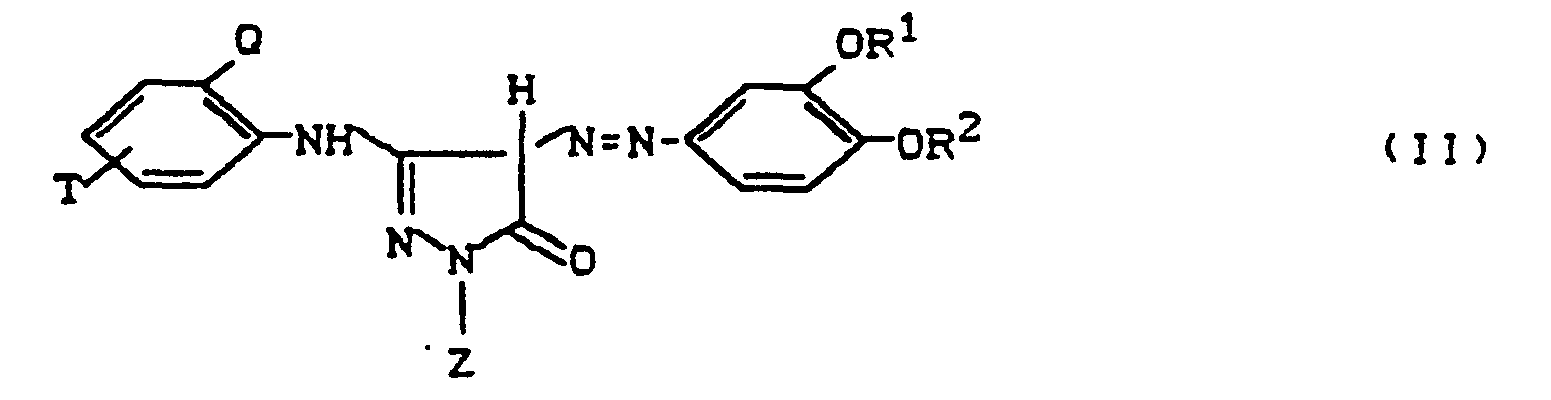
- Q H, Halogen, insbesondere Cl, oder Alkoxy, insbesondere -OCH3;
- T einen gegebenenfalls über ein Bindeglied X angeknüpften organischen Rest, insbesondere einen gegebenenfalls substituierten Alkylrest oder Cycloalkylrest.
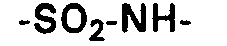
- Als Bindeglied X für den organischen Rest kommen beispielsweise die folgenden in Frage:




- Der durch T dargestellten organische Rest kann insbesondere als Emulgierrest dienen; als solcher kann er gradkettige, gegebenenfalls ungesättigte, oder verzweigte Alkylreste sowie auch aromatische Ringe beinhalten.
- Verbindungen der Formel Il stellen im allgemeinen geeignete gelbe Maskenkuppler mit hoher Kupplungsreaktivität dar.
- Ein in Formel durch Y dargestellten Acylrest ist insbesondere ein von einer aliphatischen oder aromatischen Carbonsäure abgeleitete Arcylrest, oder ein Acylrest der von Kohlensäuremonoester abgeleitet sind. Die betreffenden Verbindungen lassen sich durch folgende Formel III darstellen

- Verbindungen der Formel III eignen sich überwiegend als Dmin-Farbstoffe.
- Ein in den Formeln I, II oder III durch Z dargestellter Phenylrest kann unsubstiutiert sein oder einen oder mehrere gleiche oder verschiedene Substituenten enthalten, z. B. Halogen (beispielsweise CI oder Br), Alkyl, Alkoxy, Alkylsulfonyl, Alkoxcarbonyl oder Acylamino.
-


-


-


-


-


-


-

-


-


-


-


- 13,0 g (0,053 mol) 3,4-Diisopropoxyanilin-Hydrochlorid wurden in 50 ml Ethanol und 10 ml konz. Salzsäure verrührt und bei 0 - 5°C mit einer Lösung aus 45 g (0,058 mol) Natriumnitril in 80 ml Wasser diazotiert. Zur Vernichtung eines eventuellen Nitritüberschusses wurden nach 30 min 0,5 g Amidosulfonsäure zugegeben. Diese Diazoniumsalzlösung wurde langsam in eine Lösung aus 30 g (0,49 mol) 1-(2,4,6-Trichlorphenyl)-3-(2-chlor-5-tetradecanamido)-anilino-pyrazolon 5 in 250 ml Pyridin eingetragen. Es wurde 30 min nachgerührt, mit Eiswasser/Salzsäure ausgerührt, abgesaugt, mit Wasser gewaschen und getrocknet. Das Rohprodukt wurde aus 160 ml n-Propanol umkristallisiert. Ausbeute: 34,5 g = 85 % d.Th.
- 0,11 mol Diisopropoxyanilin wurden wie oben angegeben bei 0 - 5°C diazotiert. Bei Diazoniumsalzlösung wurde in eine Lösung von 70 g 1-(2,4,6-Trichlorphenyl)-3-[3'-a-(2,4-di-tert-amylphenoxy-butyramido-ben- zamido]-pyrazolon-5 und 6 g Natriummethylat in 400 ml Methanol gegeben. In Wasser/Salzsäure wurde ausgefällt, abgesaugt und gewaschen. Der getrocknete Rückstand wurde aus Butanol umgelöst. Ausbeute: 74 g = 83 % d.Th.
- Die erfindungsgemäßen Gelbfarbstoffe zeichnen sich gleichermaßen durch ihre günstigen spektralen Eigenschaften sowie durch ihre hervorragende Löslichkeit in organischen Lösungsmitteln aus. Ihr Absorptionsmaximum im Bereich von 440 ± 20 nm macht sie gleichermaßen geeignet für Farbkorrekturzwecke und zwar unabhängig davon, ob sie aufgrund ihrer Struktur eine höhere oder geringeren Kupplungsaktivität aufweisen und somit als Maskenkuppler zur Maskierung der unerwünschten gelben Nebendichte besser geeignet oder weniger gut geeignet sind.
- Die gelben Farbstoffe können wie üblich in fotografische Schichten eingearbeitet werden, wobei ihnen zur Herstellung entsprechender Dispersionen ihre hervorragende Löslichkeit in organischen Lösungsmitteln sehr zustatten kommt. Und zwar können sie je nach Eignung und Verwendungszweck entweder einer silberhalogenidhaltigen Schicht (vorzugsweise Verbindungen der Formel 11) oder einer silberhalogenidfreien Schicht (vorzugsweise Verbindungen der Formel 111) zugesetzt werden. Während die reaktiven Verbindungen vorzugsweise einer grünsensibilisierten Silberhalogenidemulsionsschicht zugesetzt werden, werden die weniger reaktiven Verbindungen hauptsächlich in einer oder mehreren Zwischenschichten, die sich in enger räumlicher Beziehung zu einer grünsensibilisierten Silberhalogenidemulsionsschicht befinden, verwendet, z. B. in einer der Zwischenschichten, die die grünsensibilisierte Silberhalogenidemulsionsschicht oder das grünempfindliche Schichtpaket begrenzen, oder in einer Zwischenschicht, die zwischen dem Schichtträger und der untersten lichtempfindlichen Schicht angeordnet ist.
- Zu Zwecken der Maskierung wird eine erfindungsgemäße Verbindung mit vergleichsweise hoher Reaktivität zweckmäßigerweise in Kombination mit einen weiteren farblosen Purpurkuppler verwendet, wobei die Menge des erfindungsgemäßen Maskenkupplers bis zu 30 %, üblicherweise zwischen 20 und 30 %, bezogen auf die Menge des farblosen Purpurkupplers betragen kann.
- Bei den erfindungsgemäßen farbfotografischen Aufzeichnungsmaterialien, in denen die Verbindungen der vorliegenden Erfindung mit Vorteil eingesetzt werden können, handelt es sich bevorzugt um mehrschichtige Materalien, die mehrere Silberhalogenidemulsionsschichten oder Emulsionsschichteneinheiten mit unterschiedlicher Spektralempfindlichkeit aufweisen. Als Emulsionsschichteneinheiten werden dabei Laminate von 2 oder mehr Silberhalogenidemulsionsschichten gleicher Spektralempfindlichkeit verstanden. Schichten gleicher Spektralempfindlichkeit müssen aber nicht notwendigerweise benachbart zueinander angeordnet sein, sondern können auch durch andere Schichten, insbesondere auch durch Schichten anderer Spektralempfindlichkeit voneinander getrennt sein.
- Jeder der genannten lichtempfindlichen Silberhalogenidemulsionsschichten bzw. Emulsionsschichteneinheiten ist mindestens ein Farbkuppler zugeordnet, der mit Farbentwickleroxidationsprodukten unter Bildung eines nichtdiffundierenden Farbstoffes zu reagieren vermag. Zweckmäßigerweise sind die Farbkuppler nichtdiffundierend und in der lichtempfindlichen Schicht selbst oder in enger Nachbarschaft hierzu untergebracht. Die den zwei oder mehr Teilschichten einer Emulsionsschichteneinheit zugeordneten Farbkuppler brauchen nicht notwendigerweise identisch zu sein. Sie sollen lediglich bei der Farbentwicklung die gleiche Farbe ergeben, normalerweise eine Farbe, die komplementär ist zu der Farbe des Lichtes, gegen das die lichtempfindlichen Silberhalogenidemulsionsschichten empfindlich sind.
- Den rotempfindlichen Silberhalgenidemulsionsschichten ist folglich mindestens ein nichtdiffundierender Farbkuppler zur Erzeugung des blaugrünen Teilfarbenbildes zugeordnet, in der Regel ein Kuppler vom Phenol-oder a-Naphtholtyp, Besonders hervorzuheben sind beispielsweise Bleugrünkuppler, wie sie beschrieben sind in US-A-2 474 293, US-A-2 367 531, US-A-2 895 826, US-A-3 772 002, EP-A-0 028 099, EP-A-0112 514.
- Die grünempfindlichen Silberhalogenidemulsionsschichten enthalten mindestens einen nichtdiffundierenden Farbkuppler zur Erzeugung des purpurnen Teilfarbbildes, wobei üblicherweise Farbkuppler vom Typ des 5-Pyrazolons oder des Indazolons Verwendung finden. Weiter kommen als Purpurkuppler auch Cyanacetylverbindungen, Oxazolone, Pyrazolobenzimidazolone und Pyrazolotriazolone in Frage. Besonders hervorzuheben sind beispielsweise Purpurkuppler, wie sie beschrieben sind in US-A-2 600 788, US-A-4 383 027, DE-A-1 547 803, DE-A-1 810 464, DE-A-2 408 665, DE-A-3 226 163.
- Die blauempfindlichen Silberhalogenidemulsionschichten schließlich enthalten mindestens einen nichtdiffundierenden Farbkuppler zur Erzeugung des gelben Teilfarbenbildes, in der Regel einen Farbkuppler mit einer offenkettigen Ketomethylengruppierung. Besonders hervorzuheben sind beispielsweise Gelbkuppler, wie sie beschrieben sind in US-A-3 408 194, DE-A-2 329 587, DE-A-2 456 976.
- Farbkuppler dieser Arten sind in großer Zahl bekannt und in einer Vielzahl von Patentschriften beschrieben. Beispielhaft sei hier ferner auf die Veröffentlichungen "Farbkuppler" von W. Pelz, "Mitteilungen aus den Forschungslaboratorien der Agfa, Leverkusen/München", Band 111 (1961) S. 111, und von K. Venkataraman in "The Chemistry of Synthetic Dyes", Vol. 4., 341 bis 387, Academic Press (1971), verwiesen.
- Bei den Farbkupplern kann es sich sowohl um übliche 4-Äquivalentkuppler handeln als auch um 2-Äquivalentkuppler, bei denen zur Farberzeugung eine geringere Menge Silberhalogenid erforderlich ist. 2-Äquivalentkuppler leiten sich bekanntlich von den 4-Äquivalentkupplern dadurch ab, daß sie in der Kupplungsstelle einen Substituenten enthalten, der bei der Kupplung abgespalten wird. Zu den 2-Äquivalentkupplern sind sowohl solche zu rechnen, die praktisch farblos sind, als auch solche, die wie beispielsweise die gelben Farbstoffe der vorliegenden Erfindung eine intensive Eigenfarbe aufweisen, die bei der Farbkupplung verschwindet bzw. durch die Farbe des erzeugten Bildfarbstoffes ersetzt wird. Zu den 2-Äquivalentkupplern sind weiter die bekannten DIR-Kuppler zu rechnen, bei denen es sich um Kuppler handelt, die in der Kupplungsstelle einen abspaltbaren Rest enthalten, der bei Reaktion mit Farbentwickleroxidationsprodukten als diffusionsfähiger Entwicklungsinhibitor oder Vorläufer eines Entwicklungsinhibitors in Freiheit gesetzt wird. In dem erfindungsgemäßen Aufzeichnungsmaterial können auch solche DIR-Kuppler verwendet werden, die bei Reaktion mit Farbentwickleroxidationsprodukten Entwicklungsinhibitoren freisetzen ohne durch Bildung eines Farbstoffes wesentlich zum Farbbild beizutragen.
- Bei Bedarf können Farbkupplermischungen verwendet werden, um einen gewünschten Farbton oder ein gewünschte Reaktivität einzustellen. Beispielsweise können wasserlösliche Kuppler in Kombination mit hydrophoben wasserunlöslichen Kupplern verwendet werden. Die Kuppler können auch in polymerisierter Form, z. B. als sogenannte Latexkuppler verwendet werden.
- Für die Einarbeitung der Kuppler in die Schichten des farbfotografischen Aufzeichnungsmaterials kommen die gleichen Methoden in Betracht, die auch für die Einarbeitung der erf indungsgemäßen Verbindungen verwendet werden. So verwendet man für die Einverleibung hydrophober Farbkuppler zweckmäßigerweise eines der bekannten Emulgierverfahren, bei dem beispielsweise der Farbkuppler gegebenenfalls in Gegenwart eines hochsiedenden Kupplerlösungsmittels oder Ölbildners in einem organischen Lösungsmittel gelöst und dann in einer Gelatinelösung dispergiert wird. Beispiele für hochsiedende Kupplerlösungsmittel sind Dibutylphthalat und Trikresylphosphat. Weitere Kupplerlösungsmittel sind beispielsweise beschrieben in den US-A-2 322 927, US-A-3 689 271, US-A-3 764 336 und US-A-3 765 897.
- Weiterhin ist es möglich, wäßrige Dispersionen der hydrophoben Kuppler herzustellen und den jeweiligen Gießlösungen zuzusetzen. Hierzu werden wäßrige Aufschlämmungen der Kuppler beispielsweise durch intensives Rühren unter Zusatz von scharfkantigem Sand und/oder durch Anwendung vor Ultraschall fein velmahlen. In diesem Zusammenhang sei auch auf die DE-A-2 609 741 verwiesen.
- Wenn die erfindungsgemäßen Verbindungen in Kombination mit Purpurkupplern verwendet werden, können sie gemeinsam mit den jeweiligen Farbkupplern in einem Ölbildner gelöst und in Form einer solchen gemeinsamen Lösung der jeweiligen Gießlösung zugesetzt werden. Sie können aber auch der Gießlösung in Form einer separaten Lösung in einem Ölbildner zugesetzt werden.
- Zur Stabilisierung der aus den Farbkupplern erzeugten Bildfarbstoffe kann das farbfotografische Aufzeichnungsmaterial zusätzlich weitere bekannte Stabilisierungsmittel enthalten, beispielsweise UV-Absorber und Mittel, die das Ausbleiben der Farbstoffe, insbesondere unter der Einwirkung von Licht, Wärme oder Feuchtigkeit verhindern oder verzögern. Als geeignet für diesen Zweck sind beispielsweise beschrieben worden Phenolderivate, Hydrochinonderivate, p-Alkoxyphenolderivate, Pyrogallolderivate, Gallussäurederivate, 5-Hydroxycumaranderivate, 6-Hydroxychromanderivate und 5-Hydroxyindanderivate.
- Wie bereits erwähnt werden die erfindungsgemäßen Verbindungen bevorzugt in Kombination mit Purpurkupplern verwendet. Hierbei handelt es sich insbesondere um hydrophobe Purpurkuppler mit einer guten Löslichkeit in hydrophoben oder hydrophilen Ölbildnern.
- In den zwischen den lichtempfindlichen Silberhalogenidemulsionsschichten angeordneten Zwischenschichten, deren Bindemittel vorzugsweise aus Gelatine besteht, können Verbindungen enthalten sein, die mit Farbentwickleroxidationsprodukten zu reagieren vermögen, und die somit eine unerwünschte Diffusion der Farbentwickleroxidationsprodukte verhindern. Beispiele für derartige Verbindungen sind etwa nichtdiffundierende Reduktionsmittel, z. B. Hydrochinonderivate, die bei Reaktion mit den Farbentwickleroxidationsprodukten keinen in den Schichten verbleibenden Farbstoff ergeben, oder aber Farbkuppler, die einen löslichen Farbstoff ergeben, der während der farbfotografischen Verarbeitung aus den Schichten ausgewaschen wird. Weitere geeignete Verbindungen zur Unterdrückung der unerwünschten Diffusion von Farbentwickleroxidationsprodukten sind beispielsweise beschrieben in der Monographie "Stabilization of Photografic Silver Halide Emulsions" von E.J. Birr, The Focal Press, 1st Edition 1974, Seiten 116 bis 122.
- Bezüglich weiterer geeigneter Zusätze zu den erfindungsgemäßen farbfotografischen Aufzeichnungsmaterialien oder zu einer ihrer Schichten sei verwiesen auf den Artikel in der Zeitschrift "Product Licencing Indes", Band 92, Dezember 1971, Seiten 107 bis 110.
- Die erfindungsgemäßen Aufzeichnungsmaterialien können mit den üblichen Farbentwicklerverbindungen entwickelt werden, insbesondere solchen der p-Phenylendiaminreihe mit einer primären Aminogruppe z. B. 4-Amino-N,N-dimethylanilin, 4-Amino-N,N-diethylanilin, 4-Amino-3-methyl-N,N-diethylanilin, 4-Amino-3-methyl-N-methyl-N-(ß-methylsulfonamidoethyl)-anilin, 4-Amino-N-ethyl-N-(ß-hydroxyethyl)-anilin, 4-Amino-3-methyl-N-ethyl-N-(ß-hydroxyethyl)-anilin,4-Amino-3-methyl-N-ethyl-N-(ß-methoxyethyl)-anilin,4-Amino-3-methyl-N-(ß- methiylsulfonamidoethyl)-anilin,4-Amino-N-butyl-N-(ω-sulfobuktyl)-anilin,4-Amino-3-methyl-N-isopropyl-N-(ω-sulfobutyl)-anilin.
- Weitere geeignete Farbentwickler sind beispielsweise beschrieben in J. Amer. Chem. Soc., 73, 3200 - 3125 (1951).
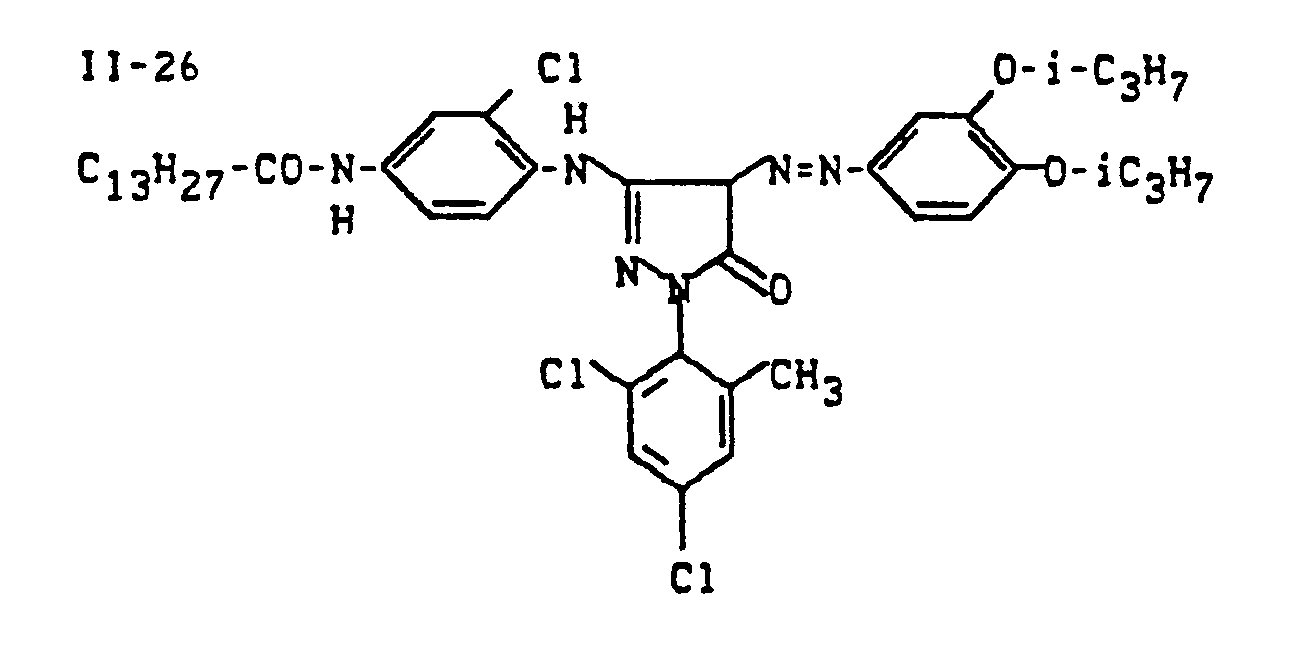
- Von den erfindungsgemäßen Verbindungen 11-1, II-5 und III-1 sowie von den strukturanalogen Vergleichsverbindungen V-1, V-2, V-3, V-4, V-5 und V-6 wurden deren Löslichkeit in Ethylacetat bei 60°C bestimmt. Hierzu wurde ermittelt, wieviele Gewichtsteile Lösungsmittel zum Lösen eines Gewichtsteils Gelbfarbstoff erforderlich sind. Die miteinander zu vergleichenden Farbstoffe unterschieden sich jeweils ausschließlich in der Substitution des Phenylazorestes
- V-1 Struktur wie 11-1, jedoch Rl, R2 = -CH3 (statt -i-C3H7)
- V-2 Struktur wie 11-1, jedoch Rl, R2 = -C2H5 entspricht JP-N 58-172647, Verb. CM-1
- V-3 Struktur wie 11-1, jedoch R1, R2 = -n-C3H7 gemäß JP-N 58-172647
- V-4 Struktur wie II-5, jedoch Rl, R2 = -CH3 (statt -i-C3H7)
- V-5 Struktur wie III-1, jedoch Rl, R2 = -CH3 (statt -i-C3H7) gemäß JP-N 58-172647 vgl. Verb. CM-4
- V-6 Struktur wie III-1, jedoch mit folgenden Phenylazorest

- Die Ergebnisse sind aus folgender Tabelle 1 ersichtlich.

- Die hergestellten Lösungen kristallisieren bei Raumtemperatur, z. T. nach einiger Zeit, wieder aus. Durch erneutes Erwärmen können die Farbstoffe in der oben angegebenen Konzentration wieder in Lösung gebracht werden.
- Von der erfindungsgemäßen Verbindung 11-1 wurde die Dispersion 1a und von der betreffenden Vergleichsverbindung V-2 wurde die Dispersion 1b jeweils nach der nachfolgend beschriebenen Vorschrift hergestellt. 100 g Maskenkuppler werden in einer Abmischung aus 100 g Trikresylphosphat und 300 g Ethylacetat bei 55°C gelöst. (Für die Vergleichsverbindung V-2 mußte neben Ethylacetat noch soviel Tetrahydrofuran zugesetzt werden, daß sie bei 55°C in Lösung ging). Die Lösung wird in 1 kg einer 7.5-%-igen wäßrigen Gelatine, die ebenfalls auf 55°C erhitzt ist und mit 10 g Alkanol XC versehen war, mit einem hochtourigen Mischer einemulgiert. Anschließend wurde das niedrig siedende Lösungsmittel im Vakuum entfernt und die zurückbleibende Dispersion bei 6°C erstarrt.
- Von beiden Dispersionen wurden erstens mit Hilfe des Coulter-Nano-Sizers der Coulter Electronics, Hialeah, Florida/USA über die periodische Schwankung von in die Dispersion eingestrahltem und gestreutem Laserlicht (Autokorrelationsspektroskopie) die mittlere Teilchengröße und zweitens mit Hilfe des Elzone Counters der Particle Date Inc. Elmhurst, lllinois/USA über die Messung der Widerstandsänderung bei Durchgang eines Teilchens durch eine enge Kapillare die Teilchengrößenverteilung ermittelt. In Fig. 1 und Fig. 2 sind die Histogramme für die Häufigkeitsverteilung (treppenförmige Kurven) FD der Volumina in den jeweiligen Teilchengrößen-Klassen D zwischen 0,3 und 8 µm für die Dispersionen 1 a (Fig. 1) und 1 b (Fig. 2) zu ersehen. Die 2. Kurve stellt jeweils nie auf 100 % normierte Summenkurve der gleichen Volumenverteilung dar. Im Falle der Dispersion 1a (erfindungsgemäße Verbindung) endet die Kurve bei 2,5 µm. Dies besagt, daß oberhalb dieser Teilchengröße keine weiteren Teilchen in der Dispersion vorhanden sind. Bei dieser Volumendarstellung werden die unerwünschten groben Teilchen und Kristalle im Untersuchungsbereich besonders hoch gewichtet und mit großer Genauigkeit neben den in hoher Überzahl vorhandenen Dispersionströpfchen im Soll-Teilchengrößenbereich von 0,3 µm erfaßt. Letztere sind in der unverdünnten Dispersion mit ca. 200 Milliarden Teilchen pro Milliliter vertreten, während die groben Teilchen wie folgt für die beiden Dispersionen vorliegen:

- Aus den Daten ist also leicht zu ersehen, welche Vorzüge der erfindungsgemäße Maskenkuppler bei vergleichbarer Dispergierung hat.
- Gemäß der im Beispiel 2 beschriebenen allgemeinen Vorschrift wurde aus der erfindungsgemäßen Verbindung 11-5 die Dispersion 2a und aus der betreffenden Vergleichsverbindung V-4 die Dispersion 2b hergestellt. (Die Vergleichsverbindung V-4 mußte, damit sie in Lösung ging, in der hydrophoben Dispersionsphase auf 70° C erhitzt werden).
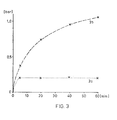
- Die erhaltenen Dispersionen wurden nach der Erstarrung wieder auf 40°C erhitzt und in einem geschlossenen System mit einer Schlauchpumpe des Typs Masterflex R-7563-00 mit Pumpenkopf No. 7014 der Cole Parmer Instrument Company, Chicago/Illinois über ein Oberflächenfilter des Typs HDC H050 mit einer Porenweite von 5 94m der Pall Corporation New York/USA filtriert. Die Fördergeschwindigkeit der Schlauchpumpe war auf 60 ml Wasser/min bei 20°C ohne Filter eingestellt. Die Filterfläche des Oberflächenfilters betrug 10,2 cm2. Bei der Filtration wurde nun der sich vor dem Filter aufbauende Druck in Abhängigkeit von der Zeit bei den beiden Dispersionen gemessen. Das Ergebnis für beide Dispersionen ist aus den Diagrammen 2a und 2b der Fig. 3 zu ersehen. Die Dispersion 2a der erfindungsgemäßen Verbindung 11-5 zeigte nach 5 min einen Druckanstieg von 0,2 bar, der noch nach 1 Stunde konstant ist. Dagegen stieg der Druck für die Vergleichsdispersion 2b kontinuierlich an. Solche Druckanstiege führen zu beträchtlichen Produktionsproblemen, da ein häufiger Filterwechsel stattfinden muß und die Dosierung während des Begusses nur sehr ungleichmäßig erfolgen kann.
- Auf einen Cellulosetriacetatschichttrager mit Haftschicht wurde eine niederempfindliche Schicht aus einer grünsensibilisierten Silberbromidiodid-Emulsion (6 mol-% Agl) enthaltend 3,0 g AgNO3/m2, 3,2 g Gelatine/m2, 0,6 g darin dispergierten Farbkuppler A sowie 0,2 mmol der in der Tabelle 3 angegebenen Maskenkuppler, aufgetragen. Über diese Schicht wurde eine Schutzschicht bestehend aus 1,0 g Gelatine/m2 aufgebracht. Beide Schichten wurden mit einem Carbamoylpyridiniumsalz als Härtungsmittel verarbeitbar gemacht. Nach Belichtung hinter einem graduierten Graukeil und Entwicklung nach E. Ch. Gehret, Brit. J. of Photography 1974, S. 597 wurden Dmax, Empfindlichkeit und Dmin-pp ermittelt.
-


- Aus der Tabelle 3 kann entnommen werden, daß der erfindungsgemäße Maskenkupplertyp bei gleicher Empfindlichkeit wie bei den Vergleichskupplern einen deutlich niederen pp-Schleier bei gleichem Dmax ergibt.
Claims (3)


Applications Claiming Priority (2)
| Application Number | Priority Date | Filing Date | Title |
|---|---|---|---|
| DE3530357 | 1985-08-24 | ||
| DE19853530357 DE3530357A1 (de) | 1985-08-24 | 1985-08-24 | Farbfotografisches aufzeichnungsmaterial |
Publications (3)
| Publication Number | Publication Date |
|---|---|
| EP0213490A2 EP0213490A2 (de) | 1987-03-11 |
| EP0213490A3 EP0213490A3 (en) | 1988-11-23 |
| EP0213490B1 true EP0213490B1 (de) | 1989-10-25 |
Family
ID=6279320
Family Applications (1)
| Application Number | Title | Priority Date | Filing Date |
|---|---|---|---|
| EP86111202A Expired EP0213490B1 (de) | 1985-08-24 | 1986-08-13 | Farbfotografisches Aufzeichnungsmaterial |
Country Status (3)
| Country | Link |
|---|---|
| EP (1) | EP0213490B1 (de) |
| JP (1) | JPH06100801B2 (de) |
| DE (2) | DE3530357A1 (de) |
Families Citing this family (15)
| Publication number | Priority date | Publication date | Assignee | Title |
|---|---|---|---|---|
| US5385815A (en) | 1992-07-01 | 1995-01-31 | Eastman Kodak Company | Photographic elements containing loaded ultraviolet absorbing polymer latex |
| DE69323852T2 (de) * | 1992-12-23 | 1999-10-07 | Eastman Kodak Co., Rochester | Azopyrazolonmaskenkuppler |
| EP0684511B1 (de) | 1994-05-20 | 2001-02-28 | Eastman Kodak Company | Niedrigkontrastfilm |
| EP0686873B1 (de) | 1994-06-08 | 2000-04-19 | Eastman Kodak Company | Farbphotographisches Element, das neue Epoxy-Abfänger für restlichen Purpurrot-Kuppler enthält |
| EP0695968A3 (de) | 1994-08-01 | 1996-07-10 | Eastman Kodak Co | Viskositätsverminderung in einer photographischen Schmelze |
| US5585228A (en) | 1994-11-30 | 1996-12-17 | Eastman Kodak Company | Benzotriazole based UV absorbing compounds and photographic elements containing them |
| EP0762198B1 (de) | 1995-08-02 | 2000-10-04 | Eastman Kodak Company | Filterfarbstoffe enthaltende photographische Elemente |
| US5723280A (en) | 1995-11-13 | 1998-03-03 | Eastman Kodak Company | Photographic element comprising a red sensitive silver halide emulsion layer |
| US6183944B1 (en) | 1995-11-30 | 2001-02-06 | Eastman Kodak Company | Aggregated dyes for radiation-sensitive elements |
| US5747235A (en) | 1996-01-26 | 1998-05-05 | Eastman Kodak Company | Silver halide light sensitive emulsion layer having enhanced photographic sensitivity |
| US5747236A (en) | 1996-01-26 | 1998-05-05 | Eastman Kodak Company | Silver halide light sensitive emulsion layer having enhanced photographic sensitivity |
| DE69731568T2 (de) | 1996-01-26 | 2005-12-22 | Eastman Kodak Co. | Lichtempfindliche Silberhalogenidemulsionschicht mit gesteigerter photographischer Empfindlichkeit |
| DE19652956A1 (de) * | 1996-12-19 | 1998-06-25 | Agfa Gevaert Ag | Farbfotografisches Aufzeichnungsmaterial mit verbesserten mechanischen Eigenschaften und verbesserter Tropenstabilität |
| JP4862429B2 (ja) * | 2006-02-28 | 2012-01-25 | Jfeスチール株式会社 | 鋼管内面印字方法 |
| US20130052594A1 (en) | 2011-08-31 | 2013-02-28 | Diane M. Carroll-Yacoby | Motion picture films to provide archival images |
Family Cites Families (2)
| Publication number | Priority date | Publication date | Assignee | Title |
|---|---|---|---|---|
| US2983608A (en) * | 1958-10-06 | 1961-05-09 | Eastman Kodak Co | Yellow-colored magenta-forming couplers |
| JPH0234372B2 (ja) * | 1982-04-02 | 1990-08-02 | Konishiroku Photo Ind | Harogenkaginkaraashashinkankozairyo |
-
1985
- 1985-08-24 DE DE19853530357 patent/DE3530357A1/de not_active Withdrawn
-
1986
- 1986-08-13 EP EP86111202A patent/EP0213490B1/de not_active Expired
- 1986-08-13 DE DE8686111202T patent/DE3666637D1/de not_active Expired
- 1986-08-22 JP JP61195703A patent/JPH06100801B2/ja not_active Expired - Lifetime
Also Published As
| Publication number | Publication date |
|---|---|
| EP0213490A2 (de) | 1987-03-11 |
| EP0213490A3 (en) | 1988-11-23 |
| JPS6250830A (ja) | 1987-03-05 |
| DE3666637D1 (en) | 1989-11-30 |
| JPH06100801B2 (ja) | 1994-12-12 |
| DE3530357A1 (de) | 1987-02-26 |
Similar Documents
| Publication | Publication Date | Title |
|---|---|---|
| EP0176845B1 (de) | Fotografisches Aufzeichnungsmaterial | |
| EP0169458B1 (de) | Farbfotografisches Aufzeichnungsmaterial mit einem Gelb-DIR-Kuppler | |
| DE2042581C3 (de) | Farbphotographisches Aufzeichnungsmaterial | |
| DE2504844A1 (de) | Verfahren zur herstellung von cyanbildern | |
| EP0213490A2 (de) | Farbfotografisches Aufzeichnungsmaterial | |
| DE2706117C2 (de) | ||
| DE3135938C2 (de) | Photographisches Aufzeichnungsmaterial | |
| DE2734148C3 (de) | Farbphotographisches Aufzeichnungsmaterial | |
| DE2704826A1 (de) | Farbphotographisches aufzeichnungsmaterial | |
| EP0415056B1 (de) | Farbfotografisches Aufzeichnungsmaterial mit einem Kuppler, der eine fotografisch wirksame Verbindung freisetzt | |
| DE3628318A1 (de) | Farbfotografisches aufzeichnungsmaterial | |
| DE2636347A1 (de) | Lichtempfindliches photographisches silberhalogenid-aufzeichnungsmaterial | |
| DE2634694A1 (de) | Photographischer kuppler und dessen verwendung zur erzeugung von photographischen bildern | |
| EP0421221B1 (de) | Farbfotografisches Aufzeichnungsmaterial mit einem DIR-Kuppler | |
| DE3878368T2 (de) | Photographisches eintragungsmaterial mit einer ein purpurrotes farbbild bildenden kupplerverbindung. | |
| DE3624544A1 (de) | Farbfotografisches aufzeichnungsmaterial mit einem farbkuppler vom pyrazoloazol-typ | |
| DE2149789B2 (de) | Farbfotografisches Aufzeichnungsmaterial | |
| DE69426666T2 (de) | Fotografische Elemente, die Aryloxypyrazolon-Kuppler und Schwefel-enthaltende Stabilisatoren enthalten | |
| DE3541858A1 (de) | Farbfotografisches farbkupplerhaltiges aufzeichnungsmaterial | |
| DE2509408C3 (de) | Farbphotographisches Aufzeichnungsmaterial | |
| DE2122570A1 (de) | Verbessertes farbphotographisches Material | |
| DE3706202C2 (de) | Farbfotografisches Aufzeichnungsmaterial | |
| DE2326590C3 (de) | Farbphotographisches Aufzeichnungsmaterial mit mindestens einer einen Farbkuppler enthaftenden Silberhalogenidemulsionsschicht | |
| DE69324109T2 (de) | Gelbkuppler mit ionisierbare und/oder auflösbare Aryloxy freisetzbare Gruppen | |
| DE19632428A1 (de) | Farbfotografisches Aufzeichnungsmaterial |
Legal Events
| Date | Code | Title | Description |
|---|---|---|---|
| PUAI | Public reference made under article 153(3) epc to a published international application that has entered the european phase |
Free format text: ORIGINAL CODE: 0009012 |
|
| 17P | Request for examination filed |
Effective date: 19860813 |
|
| AK | Designated contracting states |
Kind code of ref document: A2 Designated state(s): BE DE FR GB |
|
| RAP1 | Party data changed (applicant data changed or rights of an application transferred) |
Owner name: AGFA-GEVAERT AG |
|
| PUAL | Search report despatched |
Free format text: ORIGINAL CODE: 0009013 |
|
| AK | Designated contracting states |
Kind code of ref document: A3 Designated state(s): BE DE FR GB |
|
| 17Q | First examination report despatched |
Effective date: 19890329 |
|
| GRAA | (expected) grant |
Free format text: ORIGINAL CODE: 0009210 |
|
| AK | Designated contracting states |
Kind code of ref document: B1 Designated state(s): BE DE FR GB |
|
| REF | Corresponds to: |
Ref document number: 3666637 Country of ref document: DE Date of ref document: 19891130 |
|
| ET | Fr: translation filed | ||
| GBT | Gb: translation of ep patent filed (gb section 77(6)(a)/1977) | ||
| PLBE | No opposition filed within time limit |
Free format text: ORIGINAL CODE: 0009261 |
|
| STAA | Information on the status of an ep patent application or granted ep patent |
Free format text: STATUS: NO OPPOSITION FILED WITHIN TIME LIMIT |
|
| 26N | No opposition filed | ||
| PGFP | Annual fee paid to national office [announced via postgrant information from national office to epo] |
Ref country code: BE Payment date: 19970827 Year of fee payment: 12 |
|
| REG | Reference to a national code |
Ref country code: GB Ref legal event code: 746 Effective date: 19980106 |
|
| PG25 | Lapsed in a contracting state [announced via postgrant information from national office to epo] |
Ref country code: BE Free format text: LAPSE BECAUSE OF NON-PAYMENT OF DUE FEES Effective date: 19980831 |
|
| BERE | Be: lapsed |
Owner name: AGFA-GEVAERT A.G. Effective date: 19980831 |
|
| PGFP | Annual fee paid to national office [announced via postgrant information from national office to epo] |
Ref country code: FR Payment date: 20010628 Year of fee payment: 16 |
|
| PGFP | Annual fee paid to national office [announced via postgrant information from national office to epo] |
Ref country code: GB Payment date: 20010629 Year of fee payment: 16 Ref country code: DE Payment date: 20010629 Year of fee payment: 16 |
|
| REG | Reference to a national code |
Ref country code: GB Ref legal event code: IF02 |
|
| PG25 | Lapsed in a contracting state [announced via postgrant information from national office to epo] |
Ref country code: GB Free format text: LAPSE BECAUSE OF NON-PAYMENT OF DUE FEES Effective date: 20020813 |
|
| PG25 | Lapsed in a contracting state [announced via postgrant information from national office to epo] |
Ref country code: DE Free format text: LAPSE BECAUSE OF NON-PAYMENT OF DUE FEES Effective date: 20030301 |
|
| GBPC | Gb: european patent ceased through non-payment of renewal fee |
Effective date: 20020813 |
|
| PG25 | Lapsed in a contracting state [announced via postgrant information from national office to epo] |
Ref country code: FR Free format text: LAPSE BECAUSE OF NON-PAYMENT OF DUE FEES Effective date: 20030430 |
|
| REG | Reference to a national code |
Ref country code: FR Ref legal event code: ST |