EP0200107B1 - Verfahren zur Immobilisierung gelöster Eiweissstoffe - Google Patents
Verfahren zur Immobilisierung gelöster Eiweissstoffe Download PDFInfo
- Publication number
- EP0200107B1 EP0200107B1 EP86105330A EP86105330A EP0200107B1 EP 0200107 B1 EP0200107 B1 EP 0200107B1 EP 86105330 A EP86105330 A EP 86105330A EP 86105330 A EP86105330 A EP 86105330A EP 0200107 B1 EP0200107 B1 EP 0200107B1
- Authority
- EP
- European Patent Office
- Prior art keywords
- carrier
- protein
- electrolyte
- solution
- enzyme
- Prior art date
- Legal status (The legal status is an assumption and is not a legal conclusion. Google has not performed a legal analysis and makes no representation as to the accuracy of the status listed.)
- Expired - Lifetime
Links
Classifications
-
- A—HUMAN NECESSITIES
- A23—FOODS OR FOODSTUFFS; TREATMENT THEREOF, NOT COVERED BY OTHER CLASSES
- A23C—DAIRY PRODUCTS, e.g. MILK, BUTTER OR CHEESE; MILK OR CHEESE SUBSTITUTES; PREPARATION THEREOF
- A23C9/00—Milk preparations; Milk powder or milk powder preparations
- A23C9/12—Fermented milk preparations; Treatment using microorganisms or enzymes
- A23C9/1203—Addition of, or treatment with, enzymes or microorganisms other than lactobacteriaceae
- A23C9/1206—Lactose hydrolysing enzymes, e.g. lactase, beta-galactosidase
-
- B—PERFORMING OPERATIONS; TRANSPORTING
- B01—PHYSICAL OR CHEMICAL PROCESSES OR APPARATUS IN GENERAL
- B01J—CHEMICAL OR PHYSICAL PROCESSES, e.g. CATALYSIS OR COLLOID CHEMISTRY; THEIR RELEVANT APPARATUS
- B01J20/00—Solid sorbent compositions or filter aid compositions; Sorbents for chromatography; Processes for preparing, regenerating or reactivating thereof
- B01J20/30—Processes for preparing, regenerating, or reactivating
- B01J20/32—Impregnating or coating ; Solid sorbent compositions obtained from processes involving impregnating or coating
- B01J20/3231—Impregnating or coating ; Solid sorbent compositions obtained from processes involving impregnating or coating characterised by the coating or impregnating layer
- B01J20/3242—Layers with a functional group, e.g. an affinity material, a ligand, a reactant or a complexing group
- B01J20/3268—Macromolecular compounds
- B01J20/3272—Polymers obtained by reactions otherwise than involving only carbon to carbon unsaturated bonds
- B01J20/3274—Proteins, nucleic acids, polysaccharides, antibodies or antigens
-
- B—PERFORMING OPERATIONS; TRANSPORTING
- B01—PHYSICAL OR CHEMICAL PROCESSES OR APPARATUS IN GENERAL
- B01J—CHEMICAL OR PHYSICAL PROCESSES, e.g. CATALYSIS OR COLLOID CHEMISTRY; THEIR RELEVANT APPARATUS
- B01J20/00—Solid sorbent compositions or filter aid compositions; Sorbents for chromatography; Processes for preparing, regenerating or reactivating thereof
- B01J20/30—Processes for preparing, regenerating, or reactivating
- B01J20/32—Impregnating or coating ; Solid sorbent compositions obtained from processes involving impregnating or coating
- B01J20/3231—Impregnating or coating ; Solid sorbent compositions obtained from processes involving impregnating or coating characterised by the coating or impregnating layer
- B01J20/3242—Layers with a functional group, e.g. an affinity material, a ligand, a reactant or a complexing group
- B01J20/3268—Macromolecular compounds
- B01J20/328—Polymers on the carrier being further modified
- B01J20/3282—Crosslinked polymers
-
- C—CHEMISTRY; METALLURGY
- C12—BIOCHEMISTRY; BEER; SPIRITS; WINE; VINEGAR; MICROBIOLOGY; ENZYMOLOGY; MUTATION OR GENETIC ENGINEERING
- C12N—MICROORGANISMS OR ENZYMES; COMPOSITIONS THEREOF; PROPAGATING, PRESERVING, OR MAINTAINING MICROORGANISMS; MUTATION OR GENETIC ENGINEERING; CULTURE MEDIA
- C12N11/00—Carrier-bound or immobilised enzymes; Carrier-bound or immobilised microbial cells; Preparation thereof
-
- C—CHEMISTRY; METALLURGY
- C12—BIOCHEMISTRY; BEER; SPIRITS; WINE; VINEGAR; MICROBIOLOGY; ENZYMOLOGY; MUTATION OR GENETIC ENGINEERING
- C12P—FERMENTATION OR ENZYME-USING PROCESSES TO SYNTHESISE A DESIRED CHEMICAL COMPOUND OR COMPOSITION OR TO SEPARATE OPTICAL ISOMERS FROM A RACEMIC MIXTURE
- C12P13/00—Preparation of nitrogen-containing organic compounds
- C12P13/04—Alpha- or beta- amino acids
-
- C—CHEMISTRY; METALLURGY
- C12—BIOCHEMISTRY; BEER; SPIRITS; WINE; VINEGAR; MICROBIOLOGY; ENZYMOLOGY; MUTATION OR GENETIC ENGINEERING
- C12P—FERMENTATION OR ENZYME-USING PROCESSES TO SYNTHESISE A DESIRED CHEMICAL COMPOUND OR COMPOSITION OR TO SEPARATE OPTICAL ISOMERS FROM A RACEMIC MIXTURE
- C12P19/00—Preparation of compounds containing saccharide radicals
- C12P19/24—Preparation of compounds containing saccharide radicals produced by the action of an isomerase, e.g. fructose
-
- A—HUMAN NECESSITIES
- A23—FOODS OR FOODSTUFFS; TREATMENT THEREOF, NOT COVERED BY OTHER CLASSES
- A23C—DAIRY PRODUCTS, e.g. MILK, BUTTER OR CHEESE; MILK OR CHEESE SUBSTITUTES; PREPARATION THEREOF
- A23C2220/00—Biochemical treatment
- A23C2220/10—Enzymatic treatment
- A23C2220/104—Enzymatic treatment with immobilised enzymes
Definitions
- the invention relates to a method for immobilizing proteins, in particular enzymes, dissolved in water on solid support bodies in the presence of electrolytes.
- Immobilized enzymes have already been obtained by crosslinking dissolved enzymes with glutardialdehyde. It was observed that increasing ionic strength promotes crosslinking, which was explained by the falling effect of electrolytes; see. K. Ogata et.al. Biochim. Biophys. Acta, Volume 159 (1968), pages 405-407.
- Glutaraldehyde has also been used to bind dissolved enzymes to insoluble carriers; see. A. Habeeb, Archives of Biochemistry and Biophysics, Volume 119, (1967), pages 264-268. In contrast to carrier-free precipitation and crosslinking with glutardialdehyde, binding to solid carriers was always carried out at low electrolyte concentrations.
- EP 37667 describes the binding of a fungal lactase to a carrier body made of macroporous cationic ion exchange resins and in EP 26672 to a carrier body made of macroporous amphoteric ion exchange resins by means of glutardialdehyde.
- electrolytes are used as buffer substances at most before or after the reaction with glutardialdehyde, but only in small concentrations during the reaction, which in no case exceed 0.05 mol / l, so that the ionic adsorption is not eliminated.
- high ion concentrations are mentioned as a means of detaching enzyme amounts that may have remained uncrosslinked from the support.
- Amphoteric or cationic carrier resins can lead to a variety of interfering interactions with dissolved constituents of the substrate liquids and are therefore often not usable.
- the present invention achieves the object of immobilizing dissolved protein substances on macroporous support bodies to achieve with high activity yield in a simple manner in a one-step process.
- the immobilization of dissolved proteins on a solid, macroporous, water-insoluble and at most weakly swellable carrier can be achieved in a one-step process if an aqueous solution of the protein has an ionic strength of the electrolyte of at least 0.15 mol / l has to act on the carrier washed around by the aqueous solution until adsorption of the protein has occurred on the carrier. If the purely adsorptive immobilization is sufficient, the loaded carrier can simply be separated off. As a rule, the immobilization is stabilized by a crosslinking agent. According to the invention, this crosslinking is carried out directly in the electrolyte-containing solution without first separating the protein-laden carrier. A supernatant of the electrolyte-containing solution is used both during the adsorption and during the mostly subsequent fixation by a crosslinking agent, so that the suspended carrier particles or those arranged in a column bed are completely washed around.
- the table below shows the increasing activity yield when binding penicillin amidase to phenylsepharose using glutardialdehyde with increasing ionic strength.
- the binding process corresponded to the procedure given in Example 5.
- sulfuric acid is bound from an aqueous solution with 111 g of the enzyme preparation per liter at 23 ° C to a pearl-shaped, macroporous, neutral carrier resin based on cross-linked acrylamide with oxirane groups as coupling-active groups, the following activity yields result depending on the electrolyte concentration used:
- the method according to the invention makes it easy to achieve high absolute activities and excellent activity yields on very different, non-specific carrier bodies, which otherwise could only be achieved after a complex activation of the carrier.
- the protein After crosslinking, the protein remains bound to the carrier even at low ionic strength and can be reused many times - for example in the case of enzymes - without any significant loss of activity.
- the process is suitable for the production of solid macroporous bodies of all kinds, which naturally contain soluble proteins in immobilized form.
- the most important area of application is the production of carrier-bound enzymes.
- the production of fillers for affinity chromatography and the production of diagnostic test specimens is also important.
- the invention is not restricted to certain proteins of this type and encompasses any biogenic, water-soluble protein-containing material. Although cases of complete failure of the method according to the invention have not been observed to date, it cannot be ruled out that individual proteins cannot be bound to carriers, or only with poorer results, than by other methods. It can be advantageous to stabilize the protein by adding ions or, in the case of enzymes, by adding substrates.
- Enzymes are preferred. Examples include amylases, proteases, amidases, pectinases, cellulases, hemicellulases, acylases, lactases, isomerases, invertases and oxidases. Examples of non-enzyme-like proteins are antibodies, hormones with protein structure and enzyme inhibitors.
- Suitable solids with a macroporous structure contain pores of at least 10 nm pore diameter and have a pore volume above 0.1 cm3 / g, preferably above 0.5 cm3 / g.
- Preferred supports have pore sizes of 10 to 100 nm, a specific surface area of 10 to 500 m2 / g and a pore volume of 1 to 3 cm3 / g.
- Suitable carrier bodies include the inner surfaces or coatings of vessels or pipes or of fixed internals in vessels or pipelines, films which can be washed or flowed through, membranes, papers, fabrics, non-woven fabrics or fiber packs or other packs or layers of solid bodies. If there are sufficiently large flow-through spaces between these bodies, the supports or at least the support layers near the surface can swell considerably without impairing the flow-through capability.
- Small-particle carriers are preferably used, which means carrier bodies with a particle size of less than 10 mm, preferably in the range between 0.1 and 5 mm. Pearls, ie spherical carrier bodies, are particularly preferred. It is advantageous if the small-particle carriers in the aqueous medium in which they are used, even do not swell or swell only slightly, preferably not more than twice the bulk volume of the dry substance. A prerequisite for the suitability of small-part carriers is that they can be suspended in the electrolyte-containing solution by stirring or flowed through in a column filling.
- Carrier solids which are not cationically charged are preferred. Solids are understood to be those which have no or at least no more than 0.1 m eq / g of covalently bound cationic groups or basic groups in their matrix or at least on their accessible surface, which can convert into cationic groups by protonation, that is to say ammonium or amino groups , contain. Uncharged or weakly anionically charged macroporous solids are particularly preferred. Solids are considered to be uncharged if they contain no or no more than 0.1 milliequivalents of covalently bonded carbonyl, carboxylate, sulfonate, amino or ammonium groups per gram of dry carrier resin.
- Weakly anionic carrier resins can contain anionic groups, such as covalently bonded carboxyl or carboxylate groups, in a concentration of up to 5 m equiv. included per gram. In any case, these values apply to the resin substance on the active surface of the carrier particles.
- the binding of the protein substances is carried out by hydrophobic groups, e.g. saturated or preferably unsaturated aliphatic side groups with 2 or more carbon atoms or aromatic radicals, strongly promoted, the size of these groups being less important than their surface density on the surface of the support.
- hydrophobic groups e.g. saturated or preferably unsaturated aliphatic side groups with 2 or more carbon atoms or aromatic radicals, strongly promoted, the size of these groups being less important than their surface density on the surface of the support.
- Preferred supports consist on the surface of the pore wall or continuously from a polymer material with at least 1% by weight of side groups of the type mentioned.
- macroporous inorganic supports such as glass beads or glass fibers (e.g. "Controlled Pore Glass"), silica, aluminum oxide or activated carbon are also suitable.
- Organic materials, in particular plastics have the advantage that they form carriers in a defined form, e.g. Pearls, fibers, foils and coatings, easier to manufacture.
- the chemical structure of the organic carrier body is not critical, although it must be carefully checked in individual cases which carrier can be used to achieve the most favorable result.
- Suitable water-insoluble, macroporous synthetic resins can be, for example, non-polar in nature and uncrosslinked or crosslinked, such as, for example, polymethyl methacrylate and other acrylic ester polymers, polystyrene, cellulose esters, phenol-formaldehyde resins, epoxy resins or polyolefins. They can also be polar and more or less hydrophilic, but can be water-insoluble due to crosslinking. These include crosslinked cellulose and starch derivatives, crosslinked polyacrylamide or polymethacrylamide, crosslinked polyhydroxyalkyl esters of acrylic or methacrylic acid, crosslinked polyvinylpyrrolidone or non-basic aminoplast resins.
- inorganic supports such as silicon dioxide, bentonite or porous glasses
- phenyl groups on the surface by reaction with phenyl-functional silanes.
- macroporous organic carriers such as Sepharose
- phenyl radicals all straight-chain or branched alkyl radicals having 1 to 18 carbon atoms generally have an adsorption-promoting effect.
- a particularly suitable group of carrier resins in the form of beads or hollow beads is accessible according to DE-B 22 37 316, 23 43 633 or DE-A 27 22 751.
- They are crosslinked polymers with little or no swellability with a hydrophilic matrix, which are preferably largely composed of acrylamide, methacrylamide and crosslinking methylene-bis-acrylamide or methacrylamide.
- They contain groups which are active against proteins, in particular epoxy groups, because these do not form any ionic groups due to hydrolysis or during the reaction with the protein. They also contain about 2 to 5% by weight of free methacryloyl or isopropanyl groups which result from crosslinking agent molecules which are only reacted on one side. If these carriers are used, there is no need to use an additional crosslinking agent.
- S represents the solubility of the protein in the presence and S o in the absence of the electrolyte.
- Polyvalent metal cations often have a precipitating or inactivating effect, so monovalent cations, in particular alkali ions, are preferable are.
- the anions have a clearer influence on the effect of the electrolyte addition.
- Sulfates, phosphates and polyphosphates are the most suitable.
- Carbonates, chromates, acetates, citrates and tartrates also have a strong salting-out effect, but are not always applicable to sensitive proteins.
- Monovalent anions, such as chlorides or acetates must be used in higher concentrations than polyvalent anions in order to achieve the required ionic strength.
- the pH value of the electrolyte-containing protein solution depends on the sensitivity of the protein substance and is preferably in the range from 4 to 9.
- the concentrations of the preferred electrolytes are in the ionic strength range between 0.15 and 2 mol / l.
- the ionic strength is preferably at least 0.3 mol / l.
- adsorption step basically starts with an adsorption step. Even if a crosslinking agent is used, the crosslinking reaction is preceded by the adsorption step. You can do both steps in sequence, i.e. first adsorb the protein in the presence of the electrolyte on the support and only then add the cross-linking coupling component. This order is preferred. However, one can also summarize both steps in terms of the process and allow the coupling component to act simultaneously with the electrolyte during the adsorption. Finally, it is also possible in some cases to first implement the carrier with the coupling component alone and only then to add the protein and the electrolyte.
- the adsorption of the protein takes place in the system from a supernatant of the aqueous solution of the protein and from the carrier material within 0.1 to 100 hours, preferably 1 to 10 hours. It is essential that the carrier particles are completely washed around by the electrolyte solution in both reaction phases. Immobilization is accelerated with increasing temperature. It is preferred to work at the highest temperature that the protein can tolerate without loss of effectiveness. Although you can still work at 0 ° C, temperatures above 40 ° C, in some cases above 50 ° C, are particularly advantageous.
- the proteins to be immobilized can be used in a wide concentration range of, for example, 0.01 to 30%, based on the weight of the solution, and in a wide range of the quantitative ratio to the carrier material. Enzymes are aimed at high binding yield and product activity.
- the load is in the Usually over 20 mg protein per gram (dry) carrier material, ie 2% by weight or more. In contrast, low loading densities are more advantageous for immobilized ligands for the isolation of biomacromolecules.
- the immobilization can be carried out in such a way that the carrier is suspended in the protein solution and, after the addition of the electrolyte, is stirred moderately until the process has ended. You can also let the electrolyte-containing protein solution flow through a bed of the support into a column reactor and pump the solution around for a long time.
- the immobilization initially consists only in the adsorption of the protein substance on the carrier. If the loaded carrier is then brought into a low-electrolyte environment, the desorption of the protein substance can be expected in many cases. This is prevented by the subsequent covalent binding of the protein molecules to one another or to the carrier.
- a coupling or crosslinking component is added in the second reaction phase, which can already be carried out during the adsorption stage.
- the coupling component must be soluble in the aqueous electrolyte solution at least in an amount sufficient to immobilize the protein. It is essential that this component is used in a supernatant of the electrolyte solution; ie the solution must not be completely absorbed by the carrier material. Per milliliter moist At least about 0.2 ml, preferably up to 10 ml, of electrolyte solution are used for the carrier material. Furthermore, the coupling component must act in the presence of the electrolyte so that its precipitating effect is maintained until the protein is irreversibly immobilized.
- Suitable coupling components are at least limited water-soluble compounds with two or more functional groups with which they are able to react with corresponding functional groups of the protein substance and optionally also of the carrier.
- the irreversible immobilization can occur through a cross-linking of the protein substance in itself or through its cross-linking with the carrier.
- Suitable functional groups that are reactive towards proteins are e.g. Aldehyde, epoxy, diazo, isocyanate and chloro ant ester groups.
- carboxylic acid anhydride or ester groups are less advantageous because they strongly change the electrochemical nature of the support through the formation of anionic carboxylate groups.
- Examples of coupling components which can be used are diazobenzidine, hexamethylene diisocyanate, ethyl chloroformate and, as the most important compound, glutardialdehyde. It is also possible to use lower water-soluble polymers with molecular weights below 100,000, such as polyacrolein, mixed polymers of acrylic or methacrylamide with glycidyl acrylate or methacrylate or with acrolein or N-allyl methacrylamide.
- the amount of the coupling component required for irreversible immobilization depends on its reactivity with the protein and possibly the carrier and can be, for example, in the range from 1 to 100% by weight, based on the weight of the protein.
- the reaction conditions of the coupling generally do not differ from those of the adsorption, so that both processes can take place simultaneously under the same conditions.
- 0.1 to 100 hours, preferably 2 hours, at temperatures between 0 and 80 ° C. are generally sufficient.
- the electrolyte solution which may contain unbound residues of the protein substance and the coupling component, is generally separated from the loaded carrier. This is washed with a suitable buffer solution and is then available for technical use.
- Träer Macroporous , highly cross-linked styrene / divinylbenzene beads with an inner surface of approx. 200 m2 / g and an average pore diameter of 40 nm.
- Enzyme glucose isomerase, liquid concentrate from a culture of Streptomyces albus.
- the enzyme is first adsorbed on the macroporous support.
- 10 g of carrier with 10 g of enzyme in 50 ml of salt solution, containing 12% sodium sulfate and 5% magnesium sulfate, and 0.02% cobalt sulfate are rolled on a roller bench at room temperature (23 ° C.).
- the ionic strength of the aqueous solution is 4.18 mol / l.
- the pH was adjusted to 7.0. After 20 hours, 0.5% glutaraldehyde is added and the rolling continues. As a result, the adsorbed enzyme is "cross-linked" and retained in the pores.
- Carrier Cross-linked polyacrylic acid ester, average pore diameter of 25 nm, inner surface 140 m2 / g; Beads from 0.3 - 1 mm in diameter.
- the adsorbed enzyme is coupled covalently by the epoxy groups, at the same time as its adsorption under the influence of the high salt concentration.
- Enzyme Yeast lactase from Saccharomyces (Kluyveromyces) lactis, liquid preparation, 5000 neutral lactase units (NLU).
- the activity yield of 55% is very high with this sensitive enzyme.
- the coupled yeast lactase is filled into a column reactor. Skimmed milk (0.3% fat) is passed through at a temperature of 7 ° C. for 20 days at a flow rate of 55 fixed bed volumes per hour.
- the lactose contained in milk is initially hydrolyzed to 65% to glucose and galactose, and after 20 days to 50%.
- Coupling 10 g of carrier are shaken with 20 g of enzyme preparation at 35 ° C in 80 ml of saline.
- the enzymatic activity against penicillin-G K (crude) as a substrate was determined by alkalimetric titration at pH 7.5.
- 20 ml of the 2% substrate solution in 0.05 M Na phosphate solution pH 7.5 were used and titrated automatically at 37 ° C. with 0.5 M sodium hydroxide solution.
- the results are shown in Table I.
Landscapes
- Chemical & Material Sciences (AREA)
- Organic Chemistry (AREA)
- Life Sciences & Earth Sciences (AREA)
- Engineering & Computer Science (AREA)
- Zoology (AREA)
- Wood Science & Technology (AREA)
- Health & Medical Sciences (AREA)
- Genetics & Genomics (AREA)
- General Health & Medical Sciences (AREA)
- Microbiology (AREA)
- Chemical Kinetics & Catalysis (AREA)
- Biochemistry (AREA)
- Bioinformatics & Cheminformatics (AREA)
- General Engineering & Computer Science (AREA)
- Biotechnology (AREA)
- General Chemical & Material Sciences (AREA)
- Analytical Chemistry (AREA)
- Biomedical Technology (AREA)
- Food Science & Technology (AREA)
- Polymers & Plastics (AREA)
- Molecular Biology (AREA)
- Immobilizing And Processing Of Enzymes And Microorganisms (AREA)
- Peptides Or Proteins (AREA)
Description
- Die Erfindung betrifft ein Verfahren zur Immobilisierung von in Wasser gelösten Eiweißstoffen, insbesondere Enzymen, an festen Trägerkörpern in Gegenwart von Elektrolyten.
- Immobilisierte Enzyme sind schon durch die Vernetzung von gelösten Enzymen mit Glutardialdehyd erhalten worden. Dabei wurde beobachtet, daß steigende Ionenstärke die Vernetzung fördert, was mit der fällenden Wirkung von Elektrolyten erklärt wurde; vgl. K. Ogata et.al. Biochim. Biophys. Acta, Band 159 (1968), Seite 405 - 407.
- Man hat auch Glutaraldehyd verwendet, um gelöste Enzyme an unlösliche Träger zu binden; vgl. A. Habeeb, Archives of Biochemistry and Biophysics, Band 119, (1967), Seite 264 - 268. Im Gegensatz zur trägerfreien Fällung und Vernetzung mit Glutardialdehyd wurde die Bindung an feste Träger stets bei niedrigen Elektrolytkonzentrationen durchgeführt.
- Beim Verfahren gemäß DE-OS 33 36 257 werden dauerhaft immobilisierte Enzyme hergestellt, indem man einen porösen Träger, beispielsweise Diatomeenerde, mit einer Enzymlösung tränkt oder einen Träger mit einer Schicht des festen Enzyms überzieht und diese Zubereitungen aus einem Träger und einem gelösten oder festen Enzym in eine wäßrige Salzlösung einbringt und ein Vernetzungsmittel einwirken läßt. Die Salzlösung hat die Wirkung, daß von der Enzymzubereitung kein Enzym abgelöst wird und für die Immobilisierung verloren geht. Dieses Verfahren erfordert demnach grundsätzlich zwei getrennte Arbeitsschritte, nämlich die Herstellung einer Enzymzubereitung, die einen Träger und ein gelöstes oder lösliches Enzym enthält, und die Einbringung der Enzymzubereitung in ein Vernetzungsbad.
- In EP 37667 ist die Bindung einer Pilzlactase an einen Trägerkörper aus makroporösen kationischen Ionenaustauscherharzen und in EP 26672 an Trägerkörper aus makroporösen amphoteren Ionenaustauscherharzen mittels Glutardialdehyd beschrieben. Bei beiden Verfahren werden Elektrolyte als Puffersubstanzen höchstens vor oder nach der Umsetzung mit Glutardialdehyd eingesetzt,während der Umsetzung selbst jedoch nur in geringen Konzentrationen, die 0,05 Mol/l in keinem Falle übersteigen, damit die ionische Adsorption nicht aufgehoben wird. Dagegen werden hohe Ionenkonzentrationen als Mittel erwähnt, um eventuell unvernetzt gebliebene Enzymmengen vom Träger abzulösen. Amphotere oder kationische Trägerharze können zu vielfältigen störenden Wechselwirkungen mit gelösten Bestandteilen der Substratflüssigkeiten führen und sind deshalb häufig nicht einsetzbar.
- Die vorliegende Erfindung löst die Aufgabe, die Immobilisierung von gelösten Eiweißstoffen an makroporösen Trägerkörpern mit hoher Aktivitätsausbeute auf einfache Weise in einem einstufigen Verfahren zu bewirken.
- Es wurde gefunden, daß die Immobilisierung gelöster Eiweißstoffe an einem festen, makroporösen in Wasser nicht löslichen und höchstens schwach quellbaren Träger in einem einstufigen Verfahren gelingt, wenn man eine wäßrige Lösung des Eiweißstoffes, die eine Ionenstärke des Elektrolyten von mindestens 0,15 Mol/l aufweist, auf den von der wäßrigen Lösung umspülten Träger einwirken läßt, bis Adsorption des Eiweißstoffes an dem Träger erfolgt ist. Wenn die rein adsorptive Immobilisierung ausreichend ist, kann der beladene Träger einfach abgetrennt werden. In der Regel wird die Immobilisierung durch ein Vernetzungsmittel stabilisiert. Diese Vernetzung wird erfindungsgemäß unmittelbar in der elektrolythaltigen Lösung durchgeführt, ohne den eiweißbeladenen Träger vorher abzutrennen. Sowohl während der Adsorption als auch bei der meistens nachfolgenden Fixierung durch ein Vernetzungsmittel wird mit einem Überstand der elektrolythaltigen Lösung gearbeitet, so daß die suspendierten oder in einer Säulenschüttung angeordneten Trägerteilchen vollständig umspült sind.
- Es ist überraschend, daß hohe Ionenstärken in dem hier beanspruchten Bereich die Immobilisierung des Eiweißstoffes auf dem makroporösen Trägerkörper fördern, obwohl hohe Ionenstärken sonst als ein Mittel gelten, um nicht kovalent verknüpfte Eiweißmoleküle von einem Träger abzulösen und in Gegenwart von Vernetzungsmitteln trägerfreie unlösliche Präzipitate zu bilden.
- Die nachfolgende Tabelle zeigt die zunehmende Aktivitätsausbeute bei der Bindung von Penicillinamidase an Phenylsepharose mittels Glutardialdehyd bei steigender Ionenstärke. Das Bindungsverfahren entsprach der im Beispiel 5 angegebenen Arbeitsweise.

- Ohne Anwendung von Glutardialdehyd wird unter sonst gleichen Bindungsbedingungen überhaupt keine gebundene Aktivität festgestellt.
- Die vorteilhafte Wirkung der erfindungsgemäß bevorzugten Arbeitsweise gegenüber der Immobilisierung an einem amphoteren Träger läßt sich am Beispiel der Immobilisierung von Hefelactase veranschaulichen. Nach dem Vergleichsversuch 1 der EP-A 26672 wird Hefelactase durch Glutardialdehyd bei pH 6,65 und 20 bis 22°C in einer Mengenausbeute von 64 % auf einem amphoteren Ionenaustauscher auf Basis eines Phenol-Formaldehyd-Harzes immobilisiert, jedoch ist die Aktivität so niedrig, daß praktisch gar keine Aktivitätsausbeute erreicht wurde.
- Wird dagegen Hefelactase aus einer wäßrigen Lösung mit 111 g des Enzympräparats je Liter bei 23°C an ein perlförmiges, makroporöses, neutrales Trägerharz auf Basis von vernetztem Acrylamid mit Oxirangruppen als kupplungsaktiven Gruppen gebunden, so ergeben sich in Abhängigkeit von der angewandten Elektrolytkonzentration folgende Aktivitätsausbeuten:

- Vor allem ist es überraschend, daß durch das erfindungsgemäße Verfahren auch an sehr unterschiedlichen, unspezifischen Trägerkörpern mit Leichtigkeit hohe absolute Aktivitäten und hervorragende Aktivitätsausbeuten erzielt werden, die sonst erst nach einer aufwendigen Aktivierung des Trägers erreichbar waren. Nach erfolgter Vernetzung bleibt der Eiweißstoff auch bei niedriger Ionenstärke an den Träger gebunden und kann - beispielsweise im Falle von Enzymen - ohne nennenswerte Aktivitätsverluste viele Male wiederverwendet werden.
- Das Verfahren eignet sich zur Herstellung von festen makroporösen Körpern aller Art, die von Natur aus lösliche Eiweißstoffe in immobilisierter Form enthalten. Das wichtigste Anwendungsgebiet ist die Herstellung trägergebundener Enzyme. Daneben hat die Herstellung von Füllstoffen für die Affinitätschromatographie und die Herstellung von diagnostischen Testkörpern Bedeutung.
- die erfindungsgemäß gebunden werden können, sind solche, die bei einer Temperatur zwischen 0 und 60°C ausreichend wasserlöslich sind, um sie in gelöster Form mit dem Träger in Berührung bringen zu können. Die Erfindung ist nicht auf bestimmte Eiweißstoffe dieser Art beschränkt und umfaßt jedes biogene, wasserlösliche proteinhaltige Material. Obwohl Fälle des völligen Versagens des erfindungsgemäßen Verfahrens bisher nicht beobachtet wurden, kann es nicht ausgeschlossen werden, daß sich einzelne Eiweißstoffe nicht oder nur mit schlechterem Ergebnis als nach anderen Verfahren an Träger binden lassen. Es kann vorteilhaft sein, den Eiweißstoff durch Ionenzusätze oder, im Falle von Enzymen, durch Substratzusätze zu stabilisieren.
- Bevorzugt sind Enzyme. Als Beispiel seien Amylasen, Proteasen, Amidasen, Pectinasen, Cellulasen, Hemi-cellulasen, Acylasen, Lactasen, Isomerasen, Invertasen und Oxidasen genannt. Beispiele für nicht enzymartige Eiweißstoffe sind Antikörper, Hormone mit Proteinstruktur und Enzyminhibitoren.
- kann aus jedem in Wasser bzw. Elektrolytlösungen nicht löslichen Feststoff mit makroporöser Struktur bestehen. Geeignete Feststoffe mit makroporöser Struktur enthalten Poren von mindestens 10 nm Porendurchmesser und haben ein Porenvolumen über 0,1 cm³/g, vorzugsweise über 0,5 cm³/g. Bevorzugte Träger haben Porenweiten von 10 bis 100 nm, eine spezifische Oberfläche von 10 bis 500 m²/g und ein Porenvolumen von 1 bis 3 cm³/g.
- Die äußere Gestalt des Trägers ist für seine Wirkung nicht kritisch, wenn auch oberflächenreiche Systeme mit einer spezifischen Oberfläche von mindestens 1 m²/g vielfach bevorzugt sind, weil sie es gestatten, eine hohe Aktivitätsmenge des immobilisierten Eiweißstoffes auf kleinem Raum zu binden. Zu geeigneten Trägerkörpern gehören die inneren Oberflächen bzw. Beschichtungen von Gefäßen oder Rohren oder von festen Einbauten in Gefäßen oder Rohrleitungen, umspülbare oder durchströmbare Folien, Membranen, Papiere, Gewebe, Faservliese oder Faserpackungen oder andere Packungen oder Schichtungen von festen Körpern. Wenn zwischen diesen Körpern hinreichend große durchströmbare Räume liegen, können die Träger oder wenigstens die oberflächennahen Trägerschichten erheblich anquellen, ohne die Durchströmbarkeit zu beeinträchtigen. Bevorzugt werden kleinteilige Träger eingesetzt, worunter Trägerkörper mit einer Teilchengröße unter 10 mm, vorzugsweise im Bereich zwischen 0,1 und 5 mm verstanden werden. Besonders bevorzugt sind Perlen, d.h. kugelförmige Trägerkörper. Es ist vorteilhaft, wenn die kleinteiligen Träger in dem wäßrigen Medium, in dem sie angewendet werden, gar nicht oder nur wenig quellen, vorzugsweise auf nicht mehr als das doppelte Schüttvolumen der Trockensubstanz. Voraussetzung für die Eignung kleinteiliger Träger ist, daß sie sich in der elektrolythaltigen Lösung durch Rühren suspendieren oder in einer Säulenfüllung durchströmen lassen.
- Bevorzugt sind Träger-Feststoffe, die nicht kationisch geladen sind. Darunter werden Feststoffe verstanden, die in ihrer Matrix oder wenigstens an ihrer zugänglichen Oberfläche keine oder jedenfalls nicht mehr als 0,1 m Äq/g kovalent gebundenen kationischen Gruppen oder basischen Gruppen, die durch Protonierung in kationische Gruppen übergehen können, also Ammonium- oder Aminogruppen, enthalten. Besonders bevorzugt sind ungeladene oder schwach anionisch geladene makroporöse Feststoffe. Als ungeladen werden Feststoffe angesehen, die keine oder nicht mehr als 0,1 Milli-äquivalent kovalent gebundene Carbonyl-, Carboxylat-, Sulfonat-, Amino- oder Ammoniumgruppen je Gramm trockenes Trägerharz enthalten. Schwach anionische Trägerharze können anionische Gruppen, wie kovalent gebundene Carboxyl- oder Carboxylatgruppen, in einer Konzentration bis zu 5m Äquiv. pro Gramm enthalten. Diese Werte gelten jedenfalls für die Harzsubstanz an der aktiven Oberfläche der Trägerteilchen.
- Es hat sich aber herausgestellt, daß die oberflächliche Aussalzung des Proteins unter dem Einfluß der erhöhten Salzkonzentration auch an sehr hydrophilen Oberflächen, ja sogar an stark anionisch geladener Feststoffen stattfinden kann. Es sind daher auch solche Träger verwendbar.
- Die Bindung der Eiweißstoffe wird durch hydrophobe Gruppen, z.B. gesättigte oder bevorzugt ungesättigte aliphatische Seitengruppen mit 2 oder mehr C-Atomen oder aromatische Reste, stark gefördert, wobei es weniger auf die Größe dieser Gruppen als auf ihre Flächendichte an der Oberfläche des Trägers ankommt. Bevorzugte Träger bestehen an der Oberfläche der Porenwandung oder durchgehend aus einem Polymermaterial mit mindestens 1 Gew.-% an Seitengruppen der genannten Art.
- Grundsätzlich sind auch makroporöse anorganische Träger, wie Glasperlen oder Glasfasern (z.B. "Controlled Pore Glass"), Kieselsäure, Aluminiumoxid oder Aktivkohle geeignet. Organische Materialien, insbesondere Kunststoffe, haben den Vorteil, daß sich daraus Träger in definierter Form, z.B. Perlen, Fasern, Folien und Überzüge, leichter herstellen lassen. Der chemische Aufbau des organischen Trägerkörpers ist nicht kritisch, wenn auch im Einzelfall sorgfältig zu prüfen ist, mit welchem Träger sich das günstigste Ergebnis erreichen läßt.
- Geeignete wasserunlösliche, makroporöse Kunstharze können z.B. von unpolarer Natur und unvernetzt oder vernetzt sein, wie z.B. Polymethylmethacrylat und andere Acrylesterpolymere, Polystyrol, Celluloseester, Phenol-Formaldehyd-Harze, Epoxidharze oder Polyolefine. Sie können auch polar und mehr oder weniger hydrophil, aber infolge von Vernetzung wasserunlöslich sein. Dazu gehören vernetzte Cellulose- und Stärkederivate, vernetztes Polyacrylamid oder Polymethacrylamid, vernetzte Polyhydroxyalkylester der Acryl- oder Methacrylsäure, vernetztes Polyvinylpyrrolidon oder nicht-basische Aminoplastharze.
- Zur Verbesserung der Adsorptionseigenschaften ist es häufig von Vorteil, den Träger wenigstens oberflächlich etwas zu hydrophobieren. Man kann z.B. anorganische Träger, wie Siliciumdioxid, Bentonit oder poröse Gläser durch Umsetzung mit phenylfunktionellen Silanen oberflächlich mit Phenylgruppen ausrüsten. In entsprechender Weise können makroporöse organische Träger, wie Sepharose, mit Phenylglycidyläther phenyliert oder mit Alkylglycidyläther alkyliert werden. Außer Phenylresten haben im allgemeinen alle geradkettigen oder verzweigten Alkylreste mit 1 bis 18 C-Atomen eine adsorptionsfördernde Wirkung.
- Eine besonders geeignete Gruppe von Trägerharzen in Form von Perlen oder Hohlperlen ist nach DE-B 22 37 316, 23 43 633 oder DE-A 27 22 751 zugänglich. Es handelt sich um vernetzte, wenig oder nicht quellfähige Polymerisate mit einer hydrophilen Matrix, die vorzugsweise zu einem wesentlichen Teil aus Acrylamid, Methacrylamid und vernetzend wirkendem Methylen-bis-acrylamid oder -methacrylamid aufgebaut sind. Sie enthalten gegenüber Eiweißstoffen bindungsaktive Gruppen, insbesondere Epoxidgruppen, weil diese durch Hydrolyse oder bei der Reaktion mit dem Eiweißstoff keine ionischen Gruppen bilden. Außerdem enthalten sie etwa 2 bis 5 Gew.-% freie Methacryloyl- bzw. Isopropanylgruppen, die von nur einseitig umgesetzten Vernetzungsmittelmolekülen herrühren. Bei Verwendung dieser Träger kann auf die Mitverwendung eines zusätzlichen Vernetzungsmittels verzichtet werden.
- hat beim Verfahren der Erfindung vermutlich die Wirkung, daß er durch Strukturbildung von Wassermolekülen zu einer Art Übersättigung mit dem Eiweißstoff, jedenfalls zur Verminderung seiner Löslichkeit führt. Es ist häufig von Vorteil, den Elektrolyten erst nach der Auflösung des Eiweißstoffes zuzusetzen, da sich dieser sonst manchmal nur noch zögernd oder gar nicht auflöst.
- Die Frage, welcher Elektrolyt in welcher Konzentration fällend wirkt, hängt von der Natur des Eiweißstoffes, seiner Konzentration und den Begleitstoffen ab und ist von Fall zu Fall auszuprobieren. Allgemein sind alle Elektrolyte von aussalzender Wirkung brauchbar, z.B. nach der Hofmeisterschen Reihe alle aussalzenden Anionen einschließlich Chlorid. Beispiele für die unterschiedliche Wirksamkeit von Elektrolyten gibt H.M. Rauen im "Biochemischen Taschenbuch", Teil 2, 2. Aufl., Seiten 56-57. Geeignet sind Elektrolyte mit einem positiven Wert von Ks gemäß der Gleichung:

bzw. mit log So = β

wobei S die Löslichkeit des Eiweißstoffes in Gegenwart und So in Abwesenheit des Elektrolyten darstellt. Mehrwertige Metallkationen wirken häufig fällend oder inaktivierend, so daß einwertige Kationen, also vor allem Alkaliionen, vorzuziehen sind. Die Anionen haben einen deutlicheren Einfluß auf die Wirkung des Elektrolytzusatzes. Am besten sind Sulfate, Phosphate und Polyphosphate geeignet. Auch Carbonate, Chromate, Acetate, Citrate und Tartrate entfalten eine stark aussalzende Wirkung, sind aber bei empfindlichen Eiweißstoffen nicht immer anwendbar. Einwertige Anionen, wie Chloride oder Acetate, müssen in höherer Konzentration als mehrwertige Anionen eingesetzt werden, um die erforderliche Ionenstärke zu erreichen. Jene müssen, damit sie ihre aussalzende Wirkung entfalten können, in hoher Konzentration eingesetzt werden. Strukturbildende Neutralsalze, wie Ammonium-, Natrium- oder Kaliumsulfat, Ammonium-, Natrium- oder Kaliumhydrogenphosphat, sind wegen ihrer hohen Wirksamkeit, ihres geringen Preises und ihrer Unschädlichkeit für die meisten Eiweißstoffe am besten geeignet. Der pH-Wert der elektrolythaltigen Eiweißlösung richtet sich nach der Empfindlichkeit des Eiweißstoffes und liegt vorzugsweise im Bereich von 4 bis 9. - Für die Wirksamkeit des Elektrolytzusatzes ist dessen Ionenstärke J maßgebend. Sie berechnet sich für eine wäßrige Lösung mit i Ionenarten nach der Formel

worin Ci die Konzentration und Zi die Wertigkeit einer Ionenart darstellt. Beispielsweise ergibt sich für eine 1 m K₂HPO₄-Lösung aus
die Ionenstärke J = 3. In der Praxis lieger die Konzentrationen der bevorzugten Elektrolyte im Ionenstärken-Bereich zwischen 0,15 und 2 Mol/l. Vorzugsweise beträgt die Ionenstärke mindestens 0,3 Mol/l. - beginnt grundsätzlich mit einem Adsorptionsschritt. Auch wenn ein Vernetzungsmittel angewendet wird, geht der Vernetzungsreaktion der Adsorptionsschritt voraus. Man kann beide Schritte nacheinander in dieser Reihenfolge durchführen, d.h. zunächst den Eiweißstoff in Gegenwart des Elektrolyten an dem Träger adsorbieren und erst dann die vernetzende Kupplungskomponente hinzugeben. Diese Reihenfolge ist bevorzugt. Man kann aber auch beide Schritte verfahrensmäßig zusammenfassen und die Kupplungskomponente gleichzeitig mit dem Elektrolyten schon während der Adsorption einwirken lassen. Schließlich ist es auch in manchen Fällen möglich, zunächst den Träger mit der Kupplungskomponente allein umzusetzen und erst danach den Eiweißstoff und den Elektrolyten hinzuzufügen.
- Die Adsorption des Eiweißstoffes findet in dem System aus einem Überstand der wäßrigen Lösung des Eiweißstoffes und aus dem Trägermaterial innerhalb von 0,1 bis 100Stunden, vorzugsweise 1 bis 10 Stunden, statt. Wesentlich ist, daß die Trägerteilchen in beiden Reaktionsphasen vollständig von der Elektrolytlösung umspült werden. Mit steigender Temperatur wird die Immobilisierung beschleunigt. Man arbeitet vorzugsweise bei der höchsten Temperatur, die der Eiweißstoff ohne Wirksamkeitsverlust verträgt. Obwohl man auch noch bei 0°C arbeiten kann, sind Temperaturen oberhalb 40°C, in manchen Fällen oberhalb 50°C besonders vorteilhaft.
- Die zu immobilisierenden Eiweißstoffe können in einem breiten Konzentrationsbereich von beispielsweise 0,01 bis 30 %, bezogen auf das Gewicht der Lösung, und in einem breiten Bereich des Mengenverhältnisses zum Trägermaterial eingesetzt werden. Bei Enzymen werden hohe Bindungsausbeute und Produktaktivität angestrebt. Die Beladung liegt in der Regel über 20 mg Eiweißstoff je Gramm (trockenes) Trägermaterial, d.h. 2 Gew.-% oder mehr. Dagegen sind für immobilisierte Liganden zur Isolierung von Biomakromolekülen geringe Beladungsdichten vorteilhafter.
- Die Immobilisierung kann in der Weise durchgeführt werden, daß der Träger in der Eiweißlösung aufgeschlämmt und nach Zusatz des Elektrolyten bis zum Abschluß des Verfahrens mäßig gerührt wird. Man kann auch die elektrolythaltige Eiweißlösung durch eine Schüttung des Trägers in einen Säulenreaktor strömen lassen und die Lösung längere Zeit umpumpen.
- Die Immobilisierung besteht zunächst nur in der Adsorption des Eiweißstoffes am Träger. Bringt man den beladenen Träger anschließend in ein elektrolytärmeres Milieu, ist in vielen Fällen mit der Desorption des Eiweißstoffes zu rechnen. Das wird durch die nachfolgende kovalente Bindung der Eiweißmoleküle untereinander oder mit dem Träger unterbunden. Zu diesem Zweck wird in der zweiten Reaktionsphase eine Kupplungs- bzw. Vernetzungskomponente hinzugegeben, was verfahrensmäßig schon während der Adsorptionsstufe durchgeführt werden kann.
- Die Kupplungskomponente muß wenigstens in einer zur Immobilisierung des Eiweißstoffes ausreichenden Menge in der wäßrigen Elektrolytlösung löslich sein. Wesentlich ist, daß diese Komponente in einem Überstand der Elektrolytlösung angewandt wird; d.h. die Lösung darf nicht von dem Trägermaterial vollständig aufgesaugt werden. Je Milliliter feuchten Trägermaterials werden mindestens etwa 0,2 ml, vorzugsweise bis 10 ml Elektrolytlösung eingesetzt. Weiterhin muß die Kupplungskomponente in Gegenwart des Elektrolyten zur Einwirkung kommen, so daß dessen fällende Wirkung solange erhalten bleibt, bis der Eiweißstoff irreversibel immobilisiert ist.
- Als Kupplungskomponente eignen sich wenigstens begrenzt wasserlösliche Verbindungen mit zwei oder mehr funktionellen Gruppen, mit denen sie mit korrespondierenden funktionellen Gruppen des Eiweißstoffes und gegebenenfalls auch des Trägers zu reagieren vermögen. Die irreversible Immobilisierung kann durch eine Vernetzung des Eiweißstoffes in sich selbst oder durch seine Vernetzung mit dem Träger zustandekommen. Geeignete, gegenüber Eiweißstoffen reaktive funktionelle Gruppen sind z.B. Aldehyd-, Epoxy-, Diazo-, Isocyanat- und Chlorameisenestergruppen. Weniger vorteilhaft sind in vielen Fällen Carbonsäureanhydrid- oder estergruppen, weil sie durch Bildung anionischer Carboxylatgruppen die elektrochemische Natur des Trägers stark verändern. Beispiele verwendbarer Kupplungskomponenten sind Diazobenzidin, Hexamethylendiisocyanat, Chlorameisensäureäthylester und als wichtigste Verbindung Glutardialdehyd. Man kann auch niedere wasserlösliche Polymere mit Molekulargewichten unter 100.000 einsetzen, wie Polyacrolein, Mischpolymere des Acryl- oder Methacrylamids mit Glycidylacrylat oder -methacrylat oder mit Acrolein oder N-Allylmethacrylamid.
- Nicht unerwähnt sollen solche Kupplungskomponenten bleiben, die erst unter der Einwirkung von UV-Strahlung oder von Radikalbildnern (Redoxinitiatoren) kupplungsaktiv werden, z.B. Diallyläther oder Mischpolymerisate von Acryl- oder Methacrylamid mit p-Toluyl-hydroxyäthylmethacrylat.
- Die zur irreversiblen Immobilisierung erforderliche Menge der Kupplungskomponente richtet sich nach ihrer Reaktionsfähigkeit gegenüber dem Eiweißstoff und gegebenenfalls dem Träger und kann beispielsweise im Bereich von 1 bis 100 Gew.-%, bezogen auf das Gewicht des Eiweißstoffes liegen. Die Reaktionsbedingungen der Kupplung unterscheiden sich im allgemeinen nicht von denen der Adsorption, so daß beide Vorgänge gleichzeitig unter den gleichen Bedingungen ablaufen können. Bei der Kupplung mit Glutardialdehyd sind in der Regel 0,1 bis 100 Std., vorzugsweise 2 Std. Reaktionsdauer bei Temperaturen zwischen 0 und 80°C ausreichend.
- Nach der Immobilisierungsreaktion wird in der Regel die Elektrolytlösung, die eventuell nicht gebundene Reste des Eiweißstoffes und der Kupplungskomponente enthält, von dem beladenen Träger abgetrennt. Dieser wird mit einer geeigneten Pufferlösung nachgewaschen und steht dann zur technischen Anwendung zur Verfügung.
- Träer: Makroporöse, hochvernetzte Styrol/Divinylbenzol-Perlen mit einer inneren Oberfläche von ca. 200 m²/g und einem mittleren Porendurchmesser von 40 nm.
- Enzym: Glucose-Isomerase, flüssiges Konzentrat aus einer Kultur von Streptomyces albus.
Aktivität: 1 g Enzym entickelt aus einer 0,1 molaren D-Glucose-Lösung bei pH = 7 und einer Temperatur von 70°C in 60 Minuten 5 g D-Fructose. - Kupplung: Zuerst erfolgt die Adsorption des Enzyms an den makroporösen Träger. Dazu werden 10 g Träger mit 10 g Enzym in 50ml Salzlösung, enthaltend 12 % Natriumsulfat und 5 % Magnesiumsulfat, sowie 0,02 % Kobaltsulfat bei Raumtemperatur (23°C) auf einer Rollbank gerollt. Die Ionenstärke der wäßrigen Lösung beträgt 4,18 Mol/l. Der pH-Wert wurde auf 7,0 eingestellt. Nach 20 Stunden werden 0,5 % Glutardialdehyd zugesetzt und weiter gerollt. Das adsorbierte Enzym wird dadurch "quervernetzt" und in den Poren festgehalten.
- 2 Std. später wird abgesaugt und gewaschen. Eine vergleichende Aktivitätsbestimmung ergibt eine Restaktivität im Filtrat von 45 %; im Träger werden 37 % wiedergefunden (= 37 % Aktivitätsausbeute ).
- Anwendung: Die immobilisierte Glucose-Isomerase wird in einen Säulenreaktor gefüllt. Bei einer Temperatur von 60°C wird bei einer Durchflußrate vom 7-fachen des Festbettvolumens pro Stunde eine 40 %ige Glucose-Lösung von pH = 7,5 zu 45 % zu Fructose isomerisiert.
- Träger: Vernetzter Polyacrylsäureester, mittlerer Porendurchmesser von 25 nm, innere Oberfläche 140m²/g; Perlen von 0,3 - 1 mm Durchmesser.
- Enzym: Aspergillus oryzae-Lactase, pulverförmiges Konzentrat. Aktivität = 30.000 U/g.
- Kupplung: 10 g Träger werden mit 1 g Enzympräparat in 40 ml Salzlösung bei 35°C δ Stunden geschüttelt. Die Salzlösung enthält 24 % Kalium-Chlorid und wurde auf pH = 5,0 eingestellt. Die wäßrige Lösung hat eine Ionenstärke von 3,21 Mol/l. Außerdem wurden zur Enzymstabilisierung 0,1 % Lactose zugesetzt. Anschließend wird abgekühlt und bei Raumtemperatur weitere 2 Stunden unter Zusatz von 0,5 % Glutardialdehyd geschüttelt. Dann wird abgesaugt und gewaschen. Die Lactase-Aktivitäten des Trägers und des Filtrats werden verglichen. Im Träger werden 34 % der eingesetzten Aktivität wiedergefunden, im Filtrat 11 %. Aktivitätsausbeute = 34%.
- Anwendung: Die immobilisierte Aspergillus-Lactase wird in einen Säulenreaktor gefüllt. Bei einer Temperatur von 35°C wird eine 5 %ige Lactose-Lösung von pH = 4,5 bei einem Durchsatz von 40 Festbettvolumen pro Stunde zu über 90 % hydrolysiert. Nach 60 Tagen ist noch keine erkennbare Aktivitätsabnahme feststellbar.
- Träger: Makroporöses, hochvernetztes Peripolymerisat auf Basis Methacrylamid/Methylen-bis-methacrylamid mit freien Epoxidgruppen (1,2 % Oxiran-Sauerstoff) und 2,2 % anhängenden Isopropenylgruppen, die auf die Poreninnenflächen konzentriert sind. Porenvolumen = 3,4 ml/g, mittlerer Porendurchmesser = 20 nm. Die Herstellung dieses Trägers ist im Beispiel 2 der DE-A 27 22 751 beschrieben.
- Die Kupplung des adsorbierten Enzyms erfolgt hier kovalent durch die Epoxidgruppen, zugleich mit seiner Adsorption unter dem Einfluß der hohen Salzkonzentration.
- Enzym: Hefelactase von Saccharomyces (Kluyveromyces) lactis, Flüssigpräparat, 5000 neutrale Lactase-Einheiten (NLU).
- Kupplung: 10 g Träger wird mit 10 g Enzym bei Raumtemperatur (23°C) in 80 g Salzlösung geschüttelt. Die Salzlösung enthält 16 % Dikaliumhydrogenphosphat, 7,9 % Kaliumdihydrogenphosphat und zur Stabilisierung des Enzyms 20 ppm Mn(II)-Chlorid 4 H₂O. Sie hat eine lonenstärke von 3,34 Mol/l. Nach 72 Std. wird abgesaugt, gewaschen und die Lactase-Aktivität des Filtrats mit der des Trägers verglichen. 55 % der eingesetzten Aktivität werden am Träger wiedergefunden, 14 % im Filtrat.
- Die Aktivitätsausbeute ist also mit 55 % bei diesem empfindlichen Enzym sehr hoch.
- Anwendung: Die gekuppelte Hefelactase wird in einen Säulenreaktor gefüllt. Bei einer Temperatur von 7°C wird 20 Tage lang Magermilch (0,3 % Fett) bei einer Durchflußrate von 55 Festbettvolumen pro Stunde durchgeleitet. Die in der Milch enthaltende Lactose wird anfänglich zu 65 % zu Glucose und Galaktose hydrolysiert, nach 20 Tagen noch zu 50 %.
- Träper: Makroporöses, hochvernetztes Perlpolymerisat auf Basis Methacrylamid/Methylen-bis-methacrylamid mit freien Epoxidgruppen (1,2 % Oxiran-Sauerstoff) und 2,2 % anhängenden Isoprepenylgruppen, die auf die Poreninnenflächen konzentriert sind. Porenvolumen = 3,4 ml/g, mittlerer Porendurchmesser = 20 nm. Die Herstellung dieses Träger ist im Beispiel 2 der DE-A 27 22 751 beschrieben.
- Enzym: Pulverförmiges Aminosäure-Acylase-Konzentrat aus einem Aspergillus-Stamm.
Aktivität: 23.000 u/g, Substrat = Acetyl-D,L-Methionin. - Kupplung: 10 g Träger werden mit 20 g Enzympräparat bei 35°C in 80 ml Salzlösung geschüttelt. Die Salzlösung enthält 14,2 % Natriumsulfat sowie 24 ppm Kobalt(II)-chlorid · 6 H₂O und ist auf pH = 7,0 eingestellt. Ihre Ionenstärke beträgt 3 Mol/l ohne Berücksichtigung des Salzgehalts des Enzympräparats.
- Nach 8 Stunden wird der Träger abgesaugt und gewaschen. 61 % der eingesetzten Aktivität werden im Träger wiedergefunden, im Filtrat 1 %. Es wurde somit eine Aktivitätsausbeute von 61 % erzielt.
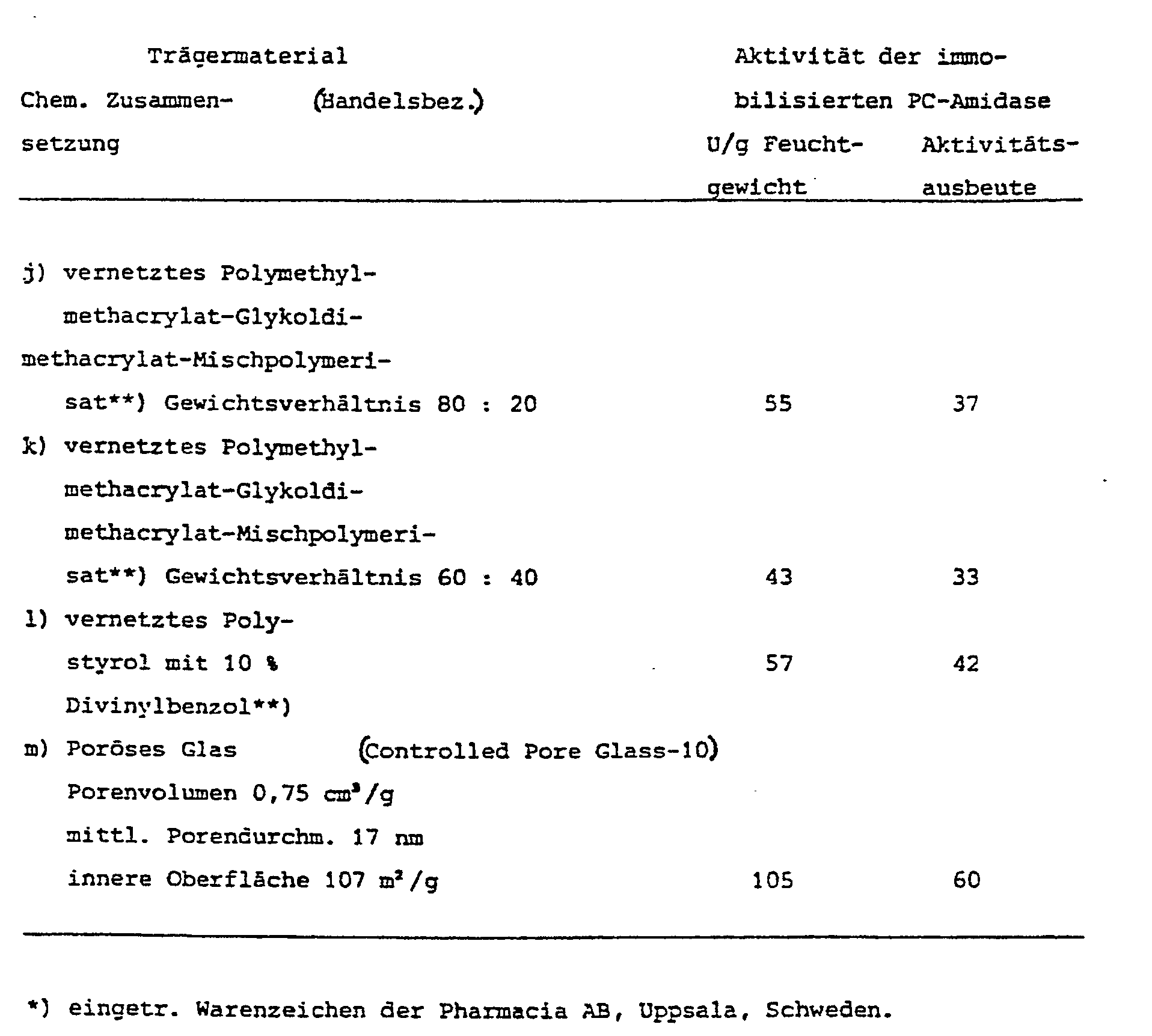
- Jeweils 3,5 g feuchtes Trägermaterial gemäß Tabelle I werden 5 mal mit dem jeweils fünffachen Volumen entsalzten Wassers gewaschen und auf einer Glasfritte abgesaugt. Dann wird das Trägermaterial mit 6,8 ml einer Enzymlösung, enthaltend 676 Internat. Units Penicillin-Amidase aus E.coli in 0,5 M K-Phosphatpuffer (pH 7,5, mit 0,1 % NaN₃) zwei Stunden bei etwa 21°C geschüttelt. Die Ionenstärke der Pufferlösung beträgt 1,5 Mol/l. Nach Zugabe von 0,136 ml einer 25 %igen wäßrigen Glutardialdehyd-Lösung, die über Ionenaustauscherharz (Amberlite A 21) stabilisiert war, wird zwei Stunden weiter geschüttelt. Dann wird das beladene Trägermaterial mit Wasser auf eine Glasfritte gebracht und dreimal mit 1 M NaOH und zweimal mit 0,05 M Na-Phosphatpuffer (pH 7,5, mit 0,1 % NaN₃) nachgewaschen.
- Die enzymatische Aktivität wurde gegen Penicillin-G K (crude) als Substrat durch alkalimetrische Titration bei pH 7,5 bestimmt. Dazu wurden jeweils 20 ml der 2 %igen Substratlösung in 0,05 M Na-Phosphatlösung pH 7,5 eingesetzt und bei 37°C mit 0,5 M Natronlauge automatisch titriert. Die Ergebnisse sind in Tabelle I angegeben.

- 3,5 g Phenyl-Sepharose (Feuchtgewicht) werden wie im Beispiel 1 vorbehandelt. Dann werden 150 mg Trypsin gelöst in 6,8 ml 0,5 M Kaliumphosphatpufferlösung (pH 7,5, mit 0,1 % NaN₃) zugegeben und 2 Stunden lang bei 23°C geschüttelt. Die Ionenstärke beträgt 1,5 Mol/l. Die Fixierung des adsorbierten Enzyms und die Nachbehandlung werden wie im Beispiel 1 durchgeführt.
Die enzymatische Aktivität wurde gegen Kasein und gegen N-Benzoyl-l-argininäthylester- hydrochlorid (BAEE) als Substrate bestimmt.
- Ergebnisse:
- gegen Kasein 8,3 U/g Feuchtgewicht gegen BAEE 311 U/g Feuchtgewicht.
- Jeweils 1 g einer Aspergillus oryzae-Lactase (Handelsbezeichnung "Lactase-Präparat 2214 C Konz.", Röhm GmbH) mit 30.000 U/g wird in 40 ml einer 0,7 M Na₂SO₄-Lösung der Ionenstärke 2,1 Mol/l, pH 5,5, gelöst und die Lösung mit jeweils 10g der in der Tabelle angegebenen Trägerharze versetzt und 20 Std.1 bei Raumtemperatur geschüttelt. Dann werden 0,8 ml 25 %ige wäßrige Glutardialdehydlösung zugegeben und 2 Std. bei Raumtemperatur geschüttelt. Die Präparate werden abfiltriert, gewaschen und die Aktivität des immobilisierten und des im Filtrat zurückgebliebenen Enzyms bestimmt und in Prozent auf die eingesetzte Aktivität ausgedrückt. Ergebnisse in Tabelle II:

Claims (6)
- Verfahren zur Immobilisierung eines gelösten Eiweißstoffes an einen festen, makroporösen, in Wasser nicht löslichen Träger in Gegenwart eines Elektrolyten,
dadurch gekennzeichnet,
daß man mindestens 0,2 ml einer wäßrigen Lösung des Eiweißstoffes, die eine Ionenstärke des Elektrolyten von mindestens 0,3 Mol/l aufweist, auf einen Milliliter des von einem Überstand der wäßrigen Lösung umspülten feuchten Trägers einwirken läßt, bis Adsorption des Eiweißstoffes an den Träger erfolgt ist, und daß man während oder nach der Adsorption des Eiweißstoffes an den Träger eine wasserlösliche, die Vernetzung des an den Träger adsorbierten Eiweißstoffes bewirkende Kupplungskomponente zu der elektrolythaltigen Lösung zusetzt. - Verfahren nach Anspruch 1, dadurch gekennzeichnet, daß ein Träger ohne oder mit nicht mehr als 0,1 mÄq/g (mMol/g) kovalent gebundenen kationischen Gruppen eingesetzt wird.
- Verfahren nach Anspruch 2, dadurch gekennzeichnet, daß ein Träger mit höchstens 5 mÄquiv. (mMol) kovalent gebundenen anionischen Gruppen je Gramm Trockensubstanz eingesetzt wird.
- Verfahren nach Anspruch 3, dadurch gekennzeichnet, daß ein Träger mit höchstens 0,1 mÄquiv. (mMol) kovalent gebundenen ionischen Gruppe je Gramm Trockensubstanz eingesetzt wird.
- Verfahren nach den Ansprüchen 1 bis 4, dadurch gekennzeichnet, daß ein Träger verwendet wird, der in wäßrigen Medien höchstens auf das doppelte Volumen quillt.
- Verfahren nach Anspruch 5, dadurch gekennzeichnet, daß ein Träger in Form kleiner Teilchen, insbesondere in Form von Perlen verwendet wird.
Priority Applications (1)
| Application Number | Priority Date | Filing Date | Title |
|---|---|---|---|
| AT86105330T ATE68525T1 (de) | 1985-04-27 | 1986-04-17 | Verfahren zur immobilisierung geloester eiweissstoffe. |
Applications Claiming Priority (2)
| Application Number | Priority Date | Filing Date | Title |
|---|---|---|---|
| DE3515252 | 1985-04-27 | ||
| DE3515252A DE3515252C2 (de) | 1985-04-27 | 1985-04-27 | Verfahren zur Immobilisierung gelöster Eiweißstoffe |
Publications (3)
| Publication Number | Publication Date |
|---|---|
| EP0200107A2 EP0200107A2 (de) | 1986-11-05 |
| EP0200107A3 EP0200107A3 (en) | 1987-08-05 |
| EP0200107B1 true EP0200107B1 (de) | 1991-10-16 |
Family
ID=6269271
Family Applications (1)
| Application Number | Title | Priority Date | Filing Date |
|---|---|---|---|
| EP86105330A Expired - Lifetime EP0200107B1 (de) | 1985-04-27 | 1986-04-17 | Verfahren zur Immobilisierung gelöster Eiweissstoffe |
Country Status (7)
| Country | Link |
|---|---|
| US (1) | US4839419A (de) |
| EP (1) | EP0200107B1 (de) |
| JP (1) | JPH084505B2 (de) |
| AT (1) | ATE68525T1 (de) |
| DE (2) | DE3515252C2 (de) |
| DK (1) | DK189286A (de) |
| FI (1) | FI93124C (de) |
Cited By (1)
| Publication number | Priority date | Publication date | Assignee | Title |
|---|---|---|---|---|
| CN102858437A (zh) * | 2010-02-19 | 2013-01-02 | 淡马锡理工学院 | 用于固定功能性物质的底物及其制备方法 |
Families Citing this family (23)
| Publication number | Priority date | Publication date | Assignee | Title |
|---|---|---|---|---|
| GB8508340D0 (en) * | 1985-03-29 | 1985-05-09 | Creighton T E | Production of protein |
| US5179199A (en) * | 1986-10-20 | 1993-01-12 | Genzyme Corporation | Protein purification |
| US5449759A (en) * | 1987-05-16 | 1995-09-12 | Somatogen, Inc. | Hemoglobins with intersubunit desulfide bonds |
| GB2208649A (en) * | 1987-08-17 | 1989-04-12 | Vnii Biotekhnologii | Immobilization of fungal beta -galactosidase on an inorganic carrier |
| DK427987A (da) * | 1987-08-17 | 1989-02-18 | Vnii Biotekhnologii | Fremgangsmaade til immobilisering af fungal beta-galactosidase |
| US5545727A (en) * | 1989-05-10 | 1996-08-13 | Somatogen, Inc. | DNA encoding fused di-alpha globins and production of pseudotetrameric hemoglobin |
| US5092992A (en) * | 1989-06-07 | 1992-03-03 | J. T. Baker Inc. | Polyethyleneimine matrixes for affinity chromatography |
| US5085779A (en) * | 1989-06-07 | 1992-02-04 | J. T. Baker, Inc. | Polyethyleneimine matrixes for affinity chromatography |
| DE3932521C1 (en) * | 1989-09-29 | 1991-04-25 | Nitra Gesellschaft Fuer Biotechnik Mbh, 2100 Hamburg, De | Removing nitric oxide from enclosed atmos. - comprises culturing nitrifying bacteria in aq. suspension on membrane |
| DE4029374A1 (de) * | 1990-09-15 | 1992-03-19 | Roehm Gmbh | Immobilisierte enzyme |
| US5200471A (en) * | 1990-11-05 | 1993-04-06 | Minnesota Mining And Manufacturing Company | Biomolecules covalently immobilized with a high bound specific biological activity and method of preparing same |
| US5679777A (en) * | 1991-11-08 | 1997-10-21 | Somatogen, Inc. | Hemoglobins as drug delivery agents |
| US5512169A (en) * | 1992-12-30 | 1996-04-30 | Dow Corning Corporation | Liquid column packing materials |
| WO1994022918A1 (en) * | 1993-03-29 | 1994-10-13 | Minnesota Mining And Manufacturing Company | Method of coupling ligands within porous supports (p.e. azlactone) and uses thereof |
| DE69404848T2 (de) * | 1993-08-13 | 1998-03-19 | Minnesota Mining & Mfg | Filterpatrone mit darauf angeordneten unlöslichen enzympartikeln |
| US5468847A (en) * | 1994-03-10 | 1995-11-21 | Minnesota Mining And Manufacturing Company | Method of isolating and purifying a biomacromolecule |
| US6833260B1 (en) | 1999-10-08 | 2004-12-21 | Protein Scientific, Inc. | Lactose hydrolysis |
| US7060478B2 (en) * | 2004-03-12 | 2006-06-13 | Min-Hsiung Lee | Process for preparing lysozyme |
| GB0425102D0 (en) * | 2004-11-15 | 2004-12-15 | Ciba Spec Chem Water Treat Ltd | Polymeric compositions and methods of employing them in papermaking processes |
| US20070055013A1 (en) * | 2005-02-21 | 2007-03-08 | Noriho Kamiya | Substrate and method of immobilizing protein |
| JP2009125006A (ja) * | 2007-11-24 | 2009-06-11 | National Institute Of Advanced Industrial & Technology | シリカ系メソ多孔体−セルロース、ヘミセルロースの加水分解酵素複合体 |
| CA2725043A1 (en) * | 2008-05-21 | 2009-11-26 | Daedalus Innovations Llc | Solubilization of proteins in reverse micelles by extraction from a solid support |
| US8263751B2 (en) | 2010-11-19 | 2012-09-11 | Daedalus Innovations Llc | Method for removing a protein from a metal chelate resin |
Family Cites Families (14)
| Publication number | Priority date | Publication date | Assignee | Title |
|---|---|---|---|---|
| US2129809A (en) * | 1936-06-19 | 1938-09-13 | Goodman Mfg Co | Shaker conveyer |
| US3767531A (en) * | 1972-02-14 | 1973-10-23 | Us Agriculture | Preparation of insolubilized enzymes |
| GB1514707A (en) * | 1974-06-25 | 1978-06-21 | Atomic Energy Authority Uk | Immobilization of biologically active substances |
| US3983000A (en) * | 1976-04-01 | 1976-09-28 | Corning Glass Works | Bonding proteins to inorganic supports |
| CA1093991A (en) * | 1977-02-17 | 1981-01-20 | Hideo Hirohara | Enzyme immobilization with pullulan gel |
| GB1557944A (en) * | 1978-01-30 | 1979-12-19 | Sumitomo Chemical Co | Enzyme immobilization carrier and preparation thereof |
| JPS5548392A (en) * | 1978-02-17 | 1980-04-07 | Toyo Jozo Co Ltd | Novel immobilizing material combined with biologically active substance, its preparation, device comprising it, method, and preparation of support |
| US4440903A (en) * | 1978-06-30 | 1984-04-03 | Ramot University Authority For Applied Research And Industrial Development Ltd. | Dihaloisocyanide derivatives of polymers for coupling nucleophiles |
| JPS5651984A (en) * | 1979-10-02 | 1981-05-09 | Sumitomo Chem Co Ltd | Fixed lactase and its preparation |
| JPS56140890A (en) * | 1980-04-04 | 1981-11-04 | Sumitomo Chem Co Ltd | Immobilized lactase and its preparation |
| JPS5736986A (en) * | 1980-08-13 | 1982-02-27 | Tanabe Seiyaku Co Ltd | Immobilized aminoacylase agent and its preparation |
| IT1163947B (it) * | 1982-10-06 | 1987-04-08 | Novo Industri As | Metodo per la produzione di un preparato di enzima immobilizzato per mezzo di un agente di reticolazione |
| GB2128620B (en) * | 1982-10-06 | 1986-04-16 | Novo Industri As | Method for production of an immobilized enzyme preparation |
| JPS59216586A (ja) * | 1983-05-24 | 1984-12-06 | Mitsubishi Petrochem Co Ltd | 固定化酵素およびその製造法 |
-
1985
- 1985-04-27 DE DE3515252A patent/DE3515252C2/de not_active Expired - Fee Related
-
1986
- 1986-04-17 AT AT86105330T patent/ATE68525T1/de not_active IP Right Cessation
- 1986-04-17 EP EP86105330A patent/EP0200107B1/de not_active Expired - Lifetime
- 1986-04-17 DE DE8686105330T patent/DE3681953D1/de not_active Expired - Lifetime
- 1986-04-21 FI FI861662A patent/FI93124C/fi not_active IP Right Cessation
- 1986-04-24 DK DK189286A patent/DK189286A/da not_active Application Discontinuation
- 1986-04-25 JP JP61094942A patent/JPH084505B2/ja not_active Expired - Lifetime
-
1988
- 1988-02-16 US US07/161,204 patent/US4839419A/en not_active Expired - Fee Related
Non-Patent Citations (1)
| Title |
|---|
| Römpps Chemie Lexikon, Bd1, S. 78 (1979) * |
Cited By (2)
| Publication number | Priority date | Publication date | Assignee | Title |
|---|---|---|---|---|
| CN102858437A (zh) * | 2010-02-19 | 2013-01-02 | 淡马锡理工学院 | 用于固定功能性物质的底物及其制备方法 |
| CN102858437B (zh) * | 2010-02-19 | 2016-02-10 | 淡马锡理工学院 | 用于固定功能性物质的底物及其制备方法 |
Also Published As
| Publication number | Publication date |
|---|---|
| EP0200107A3 (en) | 1987-08-05 |
| US4839419A (en) | 1989-06-13 |
| DE3515252C2 (de) | 1994-02-24 |
| FI93124C (fi) | 1995-02-27 |
| JPS61249390A (ja) | 1986-11-06 |
| DE3515252A1 (de) | 1986-11-06 |
| FI861662L (fi) | 1986-10-28 |
| DE3681953D1 (de) | 1991-11-21 |
| ATE68525T1 (de) | 1991-11-15 |
| FI861662A0 (fi) | 1986-04-21 |
| FI93124B (fi) | 1994-11-15 |
| DK189286A (da) | 1986-10-28 |
| EP0200107A2 (de) | 1986-11-05 |
| DK189286D0 (da) | 1986-04-24 |
| JPH084505B2 (ja) | 1996-01-24 |
Similar Documents
| Publication | Publication Date | Title |
|---|---|---|
| DE3515252C2 (de) | Verfahren zur Immobilisierung gelöster Eiweißstoffe | |
| DE2639234C2 (de) | Unlösliches zusammengesetztes System aus einem mikroporösen Körper, enthaltend ein Polymerisat-Bindemittel und eine proteinartige Substanz, ein Verfahren zu dessen Herstellung und dessen Verwendung für enzymatische Umsetzungen | |
| DE2905671C2 (de) | Immobilisiertes Enzympräparat und Verfahren zu seiner Herstellung | |
| EP0008100B1 (de) | Verfahren zur Herstellung eines makroporösen polymeren Trägermaterials zur kovalenten Bindung von Proteinen | |
| DE69420390T2 (de) | Hydrolyse von Kaffee mit immobilisierter Beta-Mannanase | |
| DE2523793C2 (de) | ||
| EP0804494B1 (de) | Polymerisationsfähige derivate von polyamiden | |
| EP2274080B1 (de) | Hydrophobe cellulose-membran, verfahren zu ihrer herstellung und ihre verwendung in der hydrophoben interaktionschromatography | |
| EP0071704B1 (de) | Oberflächenreiche Systeme zur Fixierung von nucleophile Gruppen enthaltenden Substraten | |
| CH624431A5 (de) | ||
| DE2717965A1 (de) | Poroese zelluloseperlen | |
| EP0538315B1 (de) | Poröse, nichtpartikuläre und konvektiv permeable matrix | |
| EP0000028A1 (de) | Verfahren zur Herstellung eines wasserunlöslichen Enzympräparats | |
| DE2805950C2 (de) | Trägermaterial für das Unbeweglichmachen von Enzymen | |
| CH618466A5 (de) | ||
| DE2605797C3 (de) | Verfahren zur Herstellung von immobilisierten Enzymen | |
| DE2413694A1 (de) | Fixiertes enzympraeparat | |
| DE3909018A1 (de) | Protein-reinigungsverfahren | |
| DE2818086C2 (de) | Trägermaterial zum Unbeweglichmachen von Enzymen und Verfahren zu dessen Herstellung | |
| DE2615349B2 (de) | Verfahren zum Immobilisieren von Antigenen, Enzymen und Enzyminhibitoren | |
| AT365644B (de) | Verfahren zur herstellung von 6-aminopenicillan- saeure aus benzylpenicillin | |
| DE3005633C2 (de) | Verfahren zur Herstellung von perlförmigen Biokatalysatoren mit extrem empfindlicher enzymatisch aktiver Substanz | |
| DE2644249C2 (de) | ||
| DE3037198A1 (de) | Perlpolymerisat und dessen verwendung zur immobilisierung von enzymen | |
| DE2839737A1 (de) | Verfahren zur enzymatischen umsetzung mittels traegergebundener enzyme |
Legal Events
| Date | Code | Title | Description |
|---|---|---|---|
| PUAI | Public reference made under article 153(3) epc to a published international application that has entered the european phase |
Free format text: ORIGINAL CODE: 0009012 |
|
| AK | Designated contracting states |
Kind code of ref document: A2 Designated state(s): AT CH DE FR GB IT LI NL SE |
|
| PUAL | Search report despatched |
Free format text: ORIGINAL CODE: 0009013 |
|
| AK | Designated contracting states |
Kind code of ref document: A3 Designated state(s): AT CH DE FR GB IT LI NL SE |
|
| 17P | Request for examination filed |
Effective date: 19871014 |
|
| 17Q | First examination report despatched |
Effective date: 19890328 |
|
| GRAA | (expected) grant |
Free format text: ORIGINAL CODE: 0009210 |
|
| AK | Designated contracting states |
Kind code of ref document: B1 Designated state(s): AT CH DE FR GB IT LI NL SE |
|
| REF | Corresponds to: |
Ref document number: 68525 Country of ref document: AT Date of ref document: 19911115 Kind code of ref document: T |
|
| ITF | It: translation for a ep patent filed | ||
| GBT | Gb: translation of ep patent filed (gb section 77(6)(a)/1977) | ||
| REF | Corresponds to: |
Ref document number: 3681953 Country of ref document: DE Date of ref document: 19911121 |
|
| ET | Fr: translation filed | ||
| PLBE | No opposition filed within time limit |
Free format text: ORIGINAL CODE: 0009261 |
|
| STAA | Information on the status of an ep patent application or granted ep patent |
Free format text: STATUS: NO OPPOSITION FILED WITHIN TIME LIMIT |
|
| 26N | No opposition filed | ||
| EAL | Se: european patent in force in sweden |
Ref document number: 86105330.4 |
|
| PGFP | Annual fee paid to national office [announced via postgrant information from national office to epo] |
Ref country code: GB Payment date: 19970409 Year of fee payment: 12 Ref country code: CH Payment date: 19970409 Year of fee payment: 12 |
|
| PGFP | Annual fee paid to national office [announced via postgrant information from national office to epo] |
Ref country code: FR Payment date: 19970418 Year of fee payment: 12 |
|
| PGFP | Annual fee paid to national office [announced via postgrant information from national office to epo] |
Ref country code: SE Payment date: 19970421 Year of fee payment: 12 |
|
| PGFP | Annual fee paid to national office [announced via postgrant information from national office to epo] |
Ref country code: DE Payment date: 19970424 Year of fee payment: 12 |
|
| PGFP | Annual fee paid to national office [announced via postgrant information from national office to epo] |
Ref country code: NL Payment date: 19970430 Year of fee payment: 12 Ref country code: AT Payment date: 19970430 Year of fee payment: 12 |
|
| PG25 | Lapsed in a contracting state [announced via postgrant information from national office to epo] |
Ref country code: GB Free format text: LAPSE BECAUSE OF NON-PAYMENT OF DUE FEES Effective date: 19980417 Ref country code: AT Free format text: LAPSE BECAUSE OF NON-PAYMENT OF DUE FEES Effective date: 19980417 |
|
| PG25 | Lapsed in a contracting state [announced via postgrant information from national office to epo] |
Ref country code: SE Free format text: LAPSE BECAUSE OF NON-PAYMENT OF DUE FEES Effective date: 19980418 |
|
| PG25 | Lapsed in a contracting state [announced via postgrant information from national office to epo] |
Ref country code: LI Free format text: LAPSE BECAUSE OF NON-PAYMENT OF DUE FEES Effective date: 19980430 Ref country code: FR Free format text: THE PATENT HAS BEEN ANNULLED BY A DECISION OF A NATIONAL AUTHORITY Effective date: 19980430 Ref country code: CH Free format text: LAPSE BECAUSE OF NON-PAYMENT OF DUE FEES Effective date: 19980430 |
|
| PG25 | Lapsed in a contracting state [announced via postgrant information from national office to epo] |
Ref country code: NL Free format text: LAPSE BECAUSE OF NON-PAYMENT OF DUE FEES Effective date: 19981101 |
|
| GBPC | Gb: european patent ceased through non-payment of renewal fee |
Effective date: 19980417 |
|
| REG | Reference to a national code |
Ref country code: CH Ref legal event code: PL |
|
| NLV4 | Nl: lapsed or anulled due to non-payment of the annual fee |
Effective date: 19981101 |
|
| EUG | Se: european patent has lapsed |
Ref document number: 86105330.4 |
|
| PG25 | Lapsed in a contracting state [announced via postgrant information from national office to epo] |
Ref country code: DE Free format text: LAPSE BECAUSE OF NON-PAYMENT OF DUE FEES Effective date: 19990202 |
|
| REG | Reference to a national code |
Ref country code: FR Ref legal event code: ST |
|
| PG25 | Lapsed in a contracting state [announced via postgrant information from national office to epo] |
Ref country code: IT Free format text: LAPSE BECAUSE OF NON-PAYMENT OF DUE FEES;WARNING: LAPSES OF ITALIAN PATENTS WITH EFFECTIVE DATE BEFORE 2007 MAY HAVE OCCURRED AT ANY TIME BEFORE 2007. THE CORRECT EFFECTIVE DATE MAY BE DIFFERENT FROM THE ONE RECORDED. Effective date: 20050417 |