EP0133971B1 - Antibiotikum, dessen Herstellung sowie dessen Verwendung - Google Patents
Antibiotikum, dessen Herstellung sowie dessen Verwendung Download PDFInfo
- Publication number
- EP0133971B1 EP0133971B1 EP84108945A EP84108945A EP0133971B1 EP 0133971 B1 EP0133971 B1 EP 0133971B1 EP 84108945 A EP84108945 A EP 84108945A EP 84108945 A EP84108945 A EP 84108945A EP 0133971 B1 EP0133971 B1 EP 0133971B1
- Authority
- EP
- European Patent Office
- Prior art keywords
- antibiotic
- formula
- feed
- salt
- compound
- Prior art date
- Legal status (The legal status is an assumption and is not a legal conclusion. Google has not performed a legal analysis and makes no representation as to the accuracy of the status listed.)
- Expired
Links
- 0 C*[C@@]1C(C)=*C(*)C1 Chemical compound C*[C@@]1C(C)=*C(*)C1 0.000 description 3
- LNSLYKYKZUGDMO-GARJFASQSA-N CC[C@@H](CC1)O[C@H](C(C)C)[C@H]1OC Chemical compound CC[C@@H](CC1)O[C@H](C(C)C)[C@H]1OC LNSLYKYKZUGDMO-GARJFASQSA-N 0.000 description 1
Classifications
-
- C—CHEMISTRY; METALLURGY
- C12—BIOCHEMISTRY; BEER; SPIRITS; WINE; VINEGAR; MICROBIOLOGY; ENZYMOLOGY; MUTATION OR GENETIC ENGINEERING
- C12P—FERMENTATION OR ENZYME-USING PROCESSES TO SYNTHESISE A DESIRED CHEMICAL COMPOUND OR COMPOSITION OR TO SEPARATE OPTICAL ISOMERS FROM A RACEMIC MIXTURE
- C12P19/00—Preparation of compounds containing saccharide radicals
- C12P19/44—Preparation of O-glycosides, e.g. glucosides
- C12P19/46—Preparation of O-glycosides, e.g. glucosides having an oxygen atom of the saccharide radical bound to a cyclohexyl radical, e.g. kasugamycin
- C12P19/54—Preparation of O-glycosides, e.g. glucosides having an oxygen atom of the saccharide radical bound to a cyclohexyl radical, e.g. kasugamycin the cyclohexyl radical being bound directly to a nitrogen atom of two or more radicals, e.g. streptomycin
-
- C—CHEMISTRY; METALLURGY
- C07—ORGANIC CHEMISTRY
- C07H—SUGARS; DERIVATIVES THEREOF; NUCLEOSIDES; NUCLEOTIDES; NUCLEIC ACIDS
- C07H19/00—Compounds containing a hetero ring sharing one ring hetero atom with a saccharide radical; Nucleosides; Mononucleotides; Anhydro-derivatives thereof
- C07H19/01—Compounds containing a hetero ring sharing one ring hetero atom with a saccharide radical; Nucleosides; Mononucleotides; Anhydro-derivatives thereof sharing oxygen
-
- A—HUMAN NECESSITIES
- A61—MEDICAL OR VETERINARY SCIENCE; HYGIENE
- A61P—SPECIFIC THERAPEUTIC ACTIVITY OF CHEMICAL COMPOUNDS OR MEDICINAL PREPARATIONS
- A61P33/00—Antiparasitic agents
- A61P33/02—Antiprotozoals, e.g. for leishmaniasis, trichomoniasis, toxoplasmosis
-
- C—CHEMISTRY; METALLURGY
- C12—BIOCHEMISTRY; BEER; SPIRITS; WINE; VINEGAR; MICROBIOLOGY; ENZYMOLOGY; MUTATION OR GENETIC ENGINEERING
- C12N—MICROORGANISMS OR ENZYMES; COMPOSITIONS THEREOF; PROPAGATING, PRESERVING, OR MAINTAINING MICROORGANISMS; MUTATION OR GENETIC ENGINEERING; CULTURE MEDIA
- C12N1/00—Microorganisms; Compositions thereof; Processes of propagating, maintaining or preserving microorganisms or compositions thereof; Processes of preparing or isolating a composition containing a microorganism; Culture media therefor
- C12N1/20—Bacteria; Culture media therefor
- C12N1/205—Bacterial isolates
-
- C—CHEMISTRY; METALLURGY
- C12—BIOCHEMISTRY; BEER; SPIRITS; WINE; VINEGAR; MICROBIOLOGY; ENZYMOLOGY; MUTATION OR GENETIC ENGINEERING
- C12P—FERMENTATION OR ENZYME-USING PROCESSES TO SYNTHESISE A DESIRED CHEMICAL COMPOUND OR COMPOSITION OR TO SEPARATE OPTICAL ISOMERS FROM A RACEMIC MIXTURE
- C12P19/00—Preparation of compounds containing saccharide radicals
- C12P19/44—Preparation of O-glycosides, e.g. glucosides
- C12P19/445—The saccharide radical is condensed with a heterocyclic radical, e.g. everninomycin, papulacandin
-
- C—CHEMISTRY; METALLURGY
- C12—BIOCHEMISTRY; BEER; SPIRITS; WINE; VINEGAR; MICROBIOLOGY; ENZYMOLOGY; MUTATION OR GENETIC ENGINEERING
- C12P—FERMENTATION OR ENZYME-USING PROCESSES TO SYNTHESISE A DESIRED CHEMICAL COMPOUND OR COMPOSITION OR TO SEPARATE OPTICAL ISOMERS FROM A RACEMIC MIXTURE
- C12P19/00—Preparation of compounds containing saccharide radicals
- C12P19/44—Preparation of O-glycosides, e.g. glucosides
- C12P19/60—Preparation of O-glycosides, e.g. glucosides having an oxygen of the saccharide radical directly bound to a non-saccharide heterocyclic ring or a condensed ring system containing a non-saccharide heterocyclic ring, e.g. coumermycin, novobiocin
-
- C—CHEMISTRY; METALLURGY
- C12—BIOCHEMISTRY; BEER; SPIRITS; WINE; VINEGAR; MICROBIOLOGY; ENZYMOLOGY; MUTATION OR GENETIC ENGINEERING
- C12R—INDEXING SCHEME ASSOCIATED WITH SUBCLASSES C12C - C12Q, RELATING TO MICROORGANISMS
- C12R2001/00—Microorganisms ; Processes using microorganisms
- C12R2001/01—Bacteria or Actinomycetales ; using bacteria or Actinomycetales
- C12R2001/465—Streptomyces
- C12R2001/55—Streptomyces hygroscopicus
Definitions
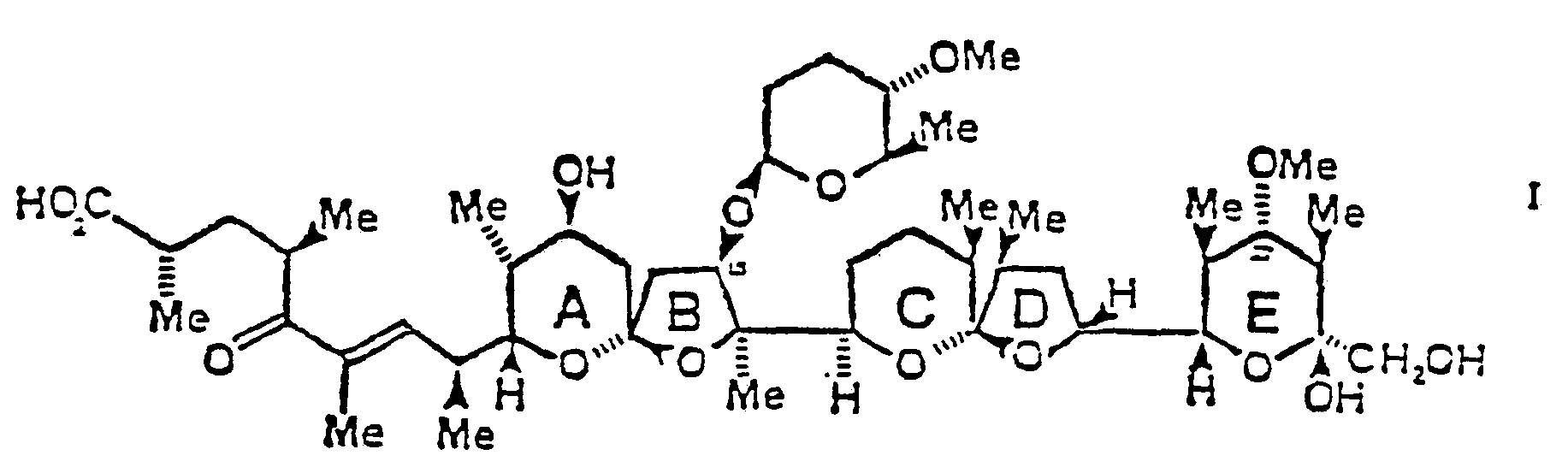
- the present invention relates to a new polyether ionophore antibiotic of the formula where Me means methyl, and its salts.
- the compound of formula I and its salts show activity as antibacterial and as anticoccidiostatic agents.
- Antibiotic X-14934A is the name of a crystalline antibiotic that is produced by a Streptomyces organism; lyophilized samples of this organism were obtained from the U.S. Department of Agriculture, Agriculture Research Service, Northern Regional Research Laboratories (NRRL), Peoria, lllinois. The culture has received the identification number NRRL 15518 from NRRL.
- Antibiotic X-14934A is a polyether antibiotic and forms a variety of salts. These salts are formed from the free acid of the antibiotic according to well known methods for polyether antibiotics; e.g. B. by washing the free acid in solution with a suitable base or a salt.
- suitable base or a salt examples include alkali metal bases such as sodium hydroxide, potassium hydroxide, lithium hydroxide and the like; Alkaline earth metal bases such as calcium hydroxide, barium hydroxide and the like; and ammonium hydroxide.
- Alkali or alkaline earth metal salts capable of salt formation can include anions such as carbonates, bicarbonates and sulfates.
- a representative strain of Streptomyces X-14934A has the following characteristics:
- the culture X-14934 grows in agar media of various compositions and provides a submerged mycelium that enters the agar and does not fragment with age, and an aerial mycelium that partially differentiates into spore chains. These chains are spiral and have more than 10 spores each. The spores cannot be seen individually because the entire chain is covered and folded after the hydrogenation. The spores are smooth and average 0.6 ⁇ m to 1.1 ⁇ m.
- the X-14934 strain uses glucose, L-arabinose, sucrose, i-inositol, mannitol, fructose, rhamnose and raffinose and less effectively, xylose as the only carbon source for growth.
- the use of cellulose is negative.
- H 2 S indicated by darkening in peptone yeast extract iron agar (ISP 6), is positive and a black color (melanin) develops in medium containing tyrosis (ISP 7). Nitrate reduction is negative. Gelatin, starch and casein hydrolysis are positive. No growth is observed at a sodium chloride concentration of 3.5% or higher.
- strain X-14934 of the species Streptomyces hygroscopicus can be assigned.
- the Streptomyces X-14934 as described herein includes all strains of Streptomyces which form a compound as claimed in the present application and which cannot be definitively distinguished from this NRRL strain, its subcultures, including mutants and variants.
- the claimed compound is described herein and, after its identification is known, it is easy to distinguish strains that make this connection from other strains.
- Streptomyces X-14934 When Streptomyces X-14934 grows under suitable conditions, it produces the antibiotic X-14934A.
- a fermentation broth containing Streptomyces X-14934 is prepared by inoculating spore mycelium of the organism producing the antibiotic into a suitable medium and then by culturing under aerobic conditions. Cultivation on a solid medium is possible for the production of the antibiotic, but cultivation in a liquid medium is preferred for the production of larger quantities.
- the temperature of the cultivation can vary over a wide range, the organism can grow at a temperature of 20-35 °, but a temperature of 26-30 ° C and a practically neutral pH is preferred.
- the medium as a carbon source can be a commercially available glyceride oil or a hydrocarbon such as glycerin, glucose, maltose, lactose, dextrin, starch etc. in pure or crude form, and as a source .
- a source for nitrogen, an organic material such as soybean meal, stillage, peanut meal, cotton meal, meat extract, peptone, fish meal, yeast extract, corn liquor liquid, etc. and, if desired, inorganic sources of nitrogen such as nitrates and ammonium salts, and mineral salts such as ammonium sulfate, magnesium sulfate, and the like.
- the medium may also contain sodium chloride, potassium chloride, potassium phosphate and the like and buffer substances such as sodium citrate, calcium carbonate or phosphate, as well as traces of heavy metals.
- Anti-foaming agents such as liquid paraffin, fatty acids or silicone compounds are used in aerated submergenic culture processes. More than one type of carbon nitrogen source or anti-foaming agent can be used in the manufacture of the antibiotic X-14934A.
- the antibiotic X-14934A has a toxicity (LD 50 ) in mice of 25 mg / kg (po) and 7.75 mg / kg (ip) as a monohydrate sodium supplement.
- the antibiotic X-14934A described here differs from the previously known polyether antibiotic TM-531 essentially in that the tetrahydrapyranyl residue in the antibiotic X-14934A is located on the tetrahydrofuranyl ring B, while it is in the previously known polyether antibiotic TM-531 on the tetrahydrofuranyl ring C. Furthermore, the new antibiotic X- 14934A on the tetrapyranyl ring E has a different substitution pattern than the antibiotic TM-531.
- the new polyether antibiotic X-14934A in contrast to the previously known polyether antibiotic TM-531, is also active against yeasts, in particular against Candida albicans.
- the following examples show a method of making the antibiotic X-14934A.
- Streptomyces X-14934 is grown on a starch casein agar culture of the following composition (g / l distilled water). pH is adjusted with sodium hydroxide before Autoclaving set to 7.4.
- a slant culture is inoculated with a culture of X-14934 and incubated at 28 ° C for 7-14 days.
- a lump of agar containing spores and mycelium from the incubated slant culture is used to prepare a vegetative inoculum by inoculation in a 500 ml Erlenmeyer flask containing 100 ml medium of the following composition (g / l tap water). the pH is brought to 6.0 before sterilization set.
- the inoculated medium is incubated for 4 days on a rotary shaker working at 250 rpm at 28 ° C.
- Two 30 ml portions of the culture obtained are used to inoculate two 6 l Erlenmeyer flasks, each containing 2 l of the medium mentioned above.
- These inoculated 6 1 Erlenmeyer flasks are incubated for 4 days at 28 ° C. on a rotary shaker that works at 250 rpm.
- the 4 liters of vegetative growth obtained are used to inoculate a 100 gallon fermentor containing 60 gallons of production medium of the following composition (g / l tap water).
- SAG 4130 anti-foaming agent if required added during fermentation).
- the inoculated tank is at 3 cubic feet / min. aerated and stirred with a stirrer at 280 rpm.
- the fermentation is carried out at 28 ° C for 97 days.
- Stage A After 139 hours of growth, an equal volume of ethyl acetate is added to the entire broth of the 60 gallons (227.1 liters) fermentation, as described in Example 1. After stirring for one hour, the solvent phase is separated and the aqueous phase is extracted again with an equal volume of ethyl acetate. The two solvent phases are combined and concentrated to a volume of 2.6 l under reduced pressure.
- Stage B The ethyl acetate extract is still concentrated to an oil.
- the oil is dissolved in n-hexane and extracted five times with an equal volume of acetonitrile followed by extraction with acetonitrile / methanol (9: 1).
- the acetonitrile and acetonitrile / methanol (9: 1) extracts are combined and the solvent is removed under reduced pressure.
- the residue thus obtained is dissolved in ethyl acetate and in turn washed with 1 N hydrochloric acid, Na 2 CO 3 (saturated at room temperature) and water.
- the solvent phase is dried over sodium sulfate and concentrated under reduced pressure to an oil (38 g).
- Stage C The oil obtained in stage B is dissolved in methylene chloride and chromatographed on a 500 g silica gel column coated with methylene chloride (Davison grade 62). The column is eluted with 2 l of methylene chloride, 4 l of ethyl acetate / hexane (7: 3), 2 l of ethyl acetate / methanol (95: 5) and 2 l of ethyl acetate / methanol (9: 1).
- Stage D Fractions numbers 60-100 of the 250 g silica gel column according to Stage C are combined and the solvent is removed under reduced pressure. Crystallization from acetonitrile / water gives crystalline antibiotic X-14934A as sodium salt dihydrate with a melting point of 156-158 ° C. Microanalysis calculated for C 48 H 79 O 15 Na.2H 2 O (955.18): Calculated: C 60.36, H 8.76, Na 2.41, H 2 0 3.77. Found: C 60.62, 60.90; H 8.96, 9.11; Na 2.34, H 2 0 4.52.
- the antimicrobial activity of the antibiotic X-14934A is shown in the table below:
- the antibiotic X-14934A and its salts have the property of negatively affecting the growth of certain Gram positive bacteria.
- the antibiotic X-14934A is valuable in Wash solutions for sanitary purposes, such as. B. in solutions for washing hands, solutions for cleaning devices, corridors or facilities in contaminated rooms or laboratories. It is also valuable to suppress the growth of sensitive organisms in plate processes and in other microbiological media.
- Antibiotic X-14934A also shows activity against Treponema hyodysenteriae, an agent causing swine dysentery. Significant activity for the antibiotic was found at concentrations below one mcg / ml.
- Antibiotic X-14934A also shows activity as a coccidiostatic agent.
- This test uses 10 chicks per drug group. 10 chicks are used as a weight control and 10 chicks as an infected control. The active substance is given 48 hours before infection. 1 g of the test ingredient is mixed in a mechanical mixer with a sufficient amount of chick food to obtain the desired dose. The infection consists of approximately 200,000 oocytes, which are given orally with a pipette. The test takes eleven days. The surviving birds are autopsied and examined for rough lesions in the caecum. The test birds are calculated according to the number of surviving and the number of caecal lesions. The results are expressed as the average extent of infection (ADL). An average level of infection less than 2.5 is considered significant.
- ADL average extent of infection
- the coccidiostatic compositions according to the present invention contain crystalline antibiotic X-14934A or a salt thereof or the dried unfiltered culture broth as an active ingredient and are prepared by mixing the active ingredient with an inert ingredient.
- the inert ingredient can comprise a feed, stretch material or the like.
- inert component is understood to mean a material which does not act as an anti-parasitic agent, e.g. B. a coccidiostat which is inactive with respect to the active ingredient and which can be safely entered into the animals to be treated and which is thus inactive for the purposes of the present invention.
- the active ingredient When administered orally as a component of suspect domestic poultry, especially turkeys and chicks, the active ingredient effectively controls the disease either by preventing the disease or by curing the disease after it has broken out. In addition, the treated domestic poultry either keeps the weight or even gains weight when compared to controls.
- the compositions according to the invention not only control coccidiosis, but also improve the efficiency of the use of feed for weight gain.
- the current concentration of the active ingredient in animal feed can be adjusted according to individual requirements and can vary over a wide range.
- the limiting factor of concentration is that a concentration is administered at which a sufficient amount of active ingredient is administered to achieve the desired control of coccidiosis, and the maximum concentration is that at which the amount of composition has no adverse or undesirable side effects causes.
- a feed premix or a complete feed contains enough active ingredient to achieve an intake of approximately 1 ppm to approximately 20 ppm (weight) with the daily feed intake.
- Preferably 10 ppm to 15 ppm are used.
- about 1 to about 15 ppm of active ingredient is sufficient for the purpose of controlling and controlling coccidiosis. Amounts greater than 20 ppm, although effective against coccidiosis, generally do not show improved results over the preferred ppm ranges and in some cases adversely affect growth, feed intake and mortality.
- the optimal dose will of course vary depending on the size of the animal.
- the antibiotic X-14934A of the present invention can first be processed or mixed with a feed ingredient or feed carrier to form a feed additive premix, feed concentrate or feed additive supplement.
- a feed additive, concentrate or premix is an ingredient which is suitable for being diluted to a complete feed, i.e. a component that is suitable for the administration of a single ration.
- a feed supplement is an item that is suitable for direct animal consumption, or that can be further diluted to complete feed, or that can be taken and used as a supplement to other rations.
- Feed supplements, concentrates and premixes contain relatively large percentages of coccidiostat, i.e.
- Suitable carriers are those which are inert with respect to the active ingredient and which can be safely taken by the animal to be treated. Typical of these carriers are commercially available poultry feed, basic cereal grains, grain by-products, vegetable protein concentrates (soya, peanuts etc.), fermentation by-products, salt, limestone, inorganic compounds and the like, and mixtures thereof. Liquid dispersions can be obtained using water, vegetable oils, preferably using a surfactant, an emulsifying agent or the like such as ethylenediaminetetraacetic acid etc. and solubilizers. Any suitable carrier or filler can serve as an inert ingredient in the solid form of the antiparasitic agent provided it is inert to the active ingredient and is non-toxic to the animal to which it is administered.
- the active ingredient can be mixed into a slurry, pill or any desired form with the inert carrier or filler according to conventional techniques.
- compositions can be formed by finely grinding or pulverizing the active ingredient and the inert ingredients using commercially available grinders or pulverizers in the absence or presence of the feed material. If the feed material is not present during comminution or pulverization, the material obtained can be distributed according to the present invention into any conventionally available feed.
- Typical poultry feed which can be mixed with the active ingredient according to the present invention, can contain various components, e.g. B.
- high-energy grain products such as cereals, wheat, wheat flour "red dog", Milo, oatmeal or the like: medium and low-energy grain products, such as oatmeal, barley, wheat flour, medium flour, standard medium flour or the like: stabilized fats, vegetable proteins such as soybean flour, wheat gluten flour, peanut flour or the like; animal proteins such as fish meal, soluble fish components, chunks of meat or the like; UPF (undefined growth factor) sources and other B-vitamin carriers such as dried milk products, dried brewing yeast, dried stillage, fermentation liquids or the like; dehydrated AlfaAlfa flour, and various special additives such as additional riboflavin, vitamin B 12 , calcium pantothenate, niacin, choline, vitamin K and vitamin E or the like, as well as stabilized vitamin A, vitamin D 3 (D-activated animal steroids); Calcium and phosphorus supplements such as dicalcium phosphate, steamed bone meal, de-fluorinated phosphate, limestone or the like; iodized salt, manganese
- the coccidiostatic compositions are intended for oral use. They can be buried in the normal feed requirements of the treated animal or can be administered in other ways, such as e.g. B. by forcibly administering the same in the form of a tablet, pill or bolus.
- the active ingredient must be administered taking into account the specific animal and the animal breeding practices.
- a suitable active ingredient-containing poultry feed which is suitable as starter feed for breeders is, by mixing of 10-15 ppm (by weight) of the antibiotic X-14934A in a base poultry ration the following composition ha t obtained.
- Antibiotic X-14934A also shows an increase in feed conversion in ruminants.
- the compound is active, shifting the volatile fatty acid levels to elevated propionate levels, at doses of approximately 50 ppm.
Landscapes
- Chemical & Material Sciences (AREA)
- Organic Chemistry (AREA)
- Life Sciences & Earth Sciences (AREA)
- Engineering & Computer Science (AREA)
- Health & Medical Sciences (AREA)
- Zoology (AREA)
- Wood Science & Technology (AREA)
- Biotechnology (AREA)
- Genetics & Genomics (AREA)
- General Health & Medical Sciences (AREA)
- Bioinformatics & Cheminformatics (AREA)
- Biochemistry (AREA)
- General Engineering & Computer Science (AREA)
- Microbiology (AREA)
- General Chemical & Material Sciences (AREA)
- Chemical Kinetics & Catalysis (AREA)
- Tropical Medicine & Parasitology (AREA)
- Medicinal Chemistry (AREA)
- Virology (AREA)
- Veterinary Medicine (AREA)
- Molecular Biology (AREA)
- Biomedical Technology (AREA)
- Pharmacology & Pharmacy (AREA)
- Animal Behavior & Ethology (AREA)
- Nuclear Medicine, Radiotherapy & Molecular Imaging (AREA)
- Public Health (AREA)
- Pharmaceuticals Containing Other Organic And Inorganic Compounds (AREA)
- Preparation Of Compounds By Using Micro-Organisms (AREA)
- Medicines Containing Material From Animals Or Micro-Organisms (AREA)
- Saccharide Compounds (AREA)
- Compounds Of Unknown Constitution (AREA)
- Fodder In General (AREA)
- Measurement Of Velocity Or Position Using Acoustic Or Ultrasonic Waves (AREA)
- Medicines Containing Plant Substances (AREA)
- Medicinal Preparation (AREA)
- Polysaccharides And Polysaccharide Derivatives (AREA)
- Addition Polymer Or Copolymer, Post-Treatments, Or Chemical Modifications (AREA)
- Micro-Organisms Or Cultivation Processes Thereof (AREA)
Description
- Die vorliegende Erfindung betrifft ein neues Polyätherionophorantibiotikum der Formel
- Die Verbindung der Formel I sowie deren Salze zeigen Aktivität als antibakterielle und als antikokzidiostatische Mittel.
- Antibiotikum X-14934A ist die Bezeichnung eines kristallinen Antibiotikums, welches durch einen Streptomycesorganismus gebildet wird; lyophilisierte Proben dieses Organismus wurden beim U.S. Department of Agriculture, Agriculture Research Service, Northern Regional Research Laboratories (NRRL), Peoria, lllinois hinterlegt. Die Kultur hat von NRRL die Identifikationsnummer NRRL 15518 erhalten.
- Antibiotikum X-14934A ist ein Polyätherantibiotikum und bildet eine vielzahl von Salzen. Diese Salze werden aus der freien Säure des Antibiotikums nach bestens bekannten Methoden für Polyätherantibiotika gebildet; z. B. durch Waschen der freien Säure in Lösung mit einer geeigneten Base oder einem Salz. Beispiele von basischen Substanzen welche fähig sind, Salze zu bilden, umfassen Alkalimetallbasen, wie Natriumhydroxid, Kaliumhydroxid, Lithiumhydroxid und dergleichen; Erdalkalimetallbasen, wie Calciumhydroxid, Bariumhydroxid und dergleichen; und Ammoniumhydroxid. Alkali- oder Erdalkalimetallsalze, welche zur Salzbildung fähig sind, können Anionen wie Carbonate, Bicarbonate und Sulfate umfassen.
- Beispiele von organischen Basen, welche mit dem Polyätherantibiotikum Salze bilden können, umfassen niedrige primäre, sekundäre und tertiäre Alkylamine, und Hydroxyalkylamine, wie Äthylamin, Isopropylamin, Diäthylamin, Methyl-n-butylamin, Äthanolamin und Diäthanolamin.
- Morphologische Charakteristiken
- Ein repräsentativer Stamm von Streptomyces X-14934A hat die folgenden Charakteristiken:
- 1. Mikroskopische Charakteristiken. Die Kultur X-14934 wächst in Agarmedien verschiedener Zusammensetzung und liefert ein submerges Mycel, welches in den Agar eintritt und mit dem Alter nicht fragmentiert, sowie ein Luftmycel, welches teilweise in Sporenketten differenziert. Diese Ketten sind spiralförmig und haben mehr als je 10 Sporen. Die Sporen können einzeln nicht gesehen werden, da die gesamte Kette umhüllt ist und nach der Hydrierung gefaltet wird. Die Sporen sind glatt und messen im Durchschnitt 0,6 um bis 1,1 um.
- Papierchromatographische Analyse des gesamten Zellhydrolysats zeigt die Anwesenheit von L,L-Diaminopimelinsäure, welches die Identifikation dieses Organismus als Stamm des Genus Streptomyces bestätigt.
- 2. Macroskopische charakteristiken. In der nachfolgenden Tabelle sind die Charakteristiken des Wachstums, des Ausmasses der Sporulation der Farbe der Luftmasse und des reversen Mycels in verschiedenen Medien angegeben. Die Daten wurden nach 14-tägiger Inkubation bei 28° C aufgezeichnet.

- 3. Physiologische Charakteristiken. Der Stamm X-14934 verwendet Glukose, L-Arabinose, Sucrose, i-Inositol, Mannit, Fruktose, Rhamnose und Raffinose und weniger effektiv, Xylose als einzige Kohlenstoffquellen für das Wachstum. Die Verwendung von Cellulose ist negativ.
- Die Bildung von H2S, angezeigt durch Dunkelwerden in Peptonhefeextrakteisenagar (ISP 6), ist positiv, und eine schwarze Farbe (Melanin) entwickelt sich in Tyrose enthaltendem Medium (ISP 7). Nitratreduktiom ist negativ. Gelatin, Stärke und Caseinhydrolyse sind positiv. Bei einer Natriumchloridkonzentration von 3.5 % oder höher ist kein Wachstum zu beobachten.
- 4. Vergleich mit bekannten Streptomyces Spezies. Auf Basis der Farbe der Sporenmasse, der Form der Sporenkette, der Sporenoberfläche und der Bildung vom Melanoidpigmenten, sowie des hygroskopischen Charakters der Kolonien auf gewissen Medien sowie des Kohlenstoffverbrauchstests kann Stamm X-14934 der Spezies Streptomyces hygroscopicus zugeordnet werden.
- Der Streptomyces X-14934 wie er hierin beschrieben wird, umfasst alle Stämme von Streptomyces, welche eine Verbindung, wie sie in der vorliegenden Anmeldung beansprucht werden, bildet und welcher nicht endgültig von diesem NRRL-Stamm seinen Subkulturen einschliesslich Mutanten und Varianten unterschieden werden kann. Die beanspruchte Verbindung wird hierin beschrieben und - nachdem deren Identifikation bekannt ist - ist es einfach, Stämme, die diese Verbindung herstellen, von andern Stämmen zu unterscheiden.
- Wenn Streptomyces X-14934 unter geeigneten Bedingungen wächst, produziert er das Antibiotikum X-14934A. Eine Fermentationsbrühe enthaltend Streptomyces X-14934 wird hergestellt durch Inokulieren von Sporenmycel des Organismus, welcher das Antibiotikum herstellt, in ein geeignetes Medium und dann durch Kultivation unter aeroben Bedingungen. Für die Herstellung des Antibiotikums ist eine Kultivation auf einem Festmedium möglich, doch ist für die Herstellung grösserer Mengen die Kultivation in einem flüssigen Medium bevorzugt. Die Temperatur der Kultivation kann über einen weiten Bereich variieren, der Organismus kann wachsen bei einer Temperatur won 20-35°, doch ist eine Temperatur von 26-30° C und ein praktisch neutraler pH bevorzugt. Bei der submergen aeroben Fermentation des Organismus zur Bildung des Antibiotikums X-14934A kann das Medium als Kohlenstoffquelle ein käuflich erhältliches Glyceridöl oder einen Kohlenwasserstoff, wie Glycerin, Glukose, Maltose, Lactose, Dextrin, Stärke etc. in reiner oder roher Form, und als Quelle. für Stickstoff ein organisches Material wie Sojabohnenmehl, Schlempe, Erdnussmehl, Baumwollmehl, Fleischextrakt, Pepton, Fischmehl, Hefeextrakt, Kornlaugenflüssigkeit etc. und falls erwünscht anorganische Quellen für Stickstoff, wie Nitrate und Ammoniumsalze, und Mineralsalze, wie Ammoniumsulfat, Magnesiumsulfat, und dergleichen enthalten. Das Medium kann weiterhin Natriumchlorid, Kaliumchlorid, Kaliumphosphat und dergleichen und Puffersubstanzen, wie Natriumcitrat, Kalziumcarbonat oder Phosphat, sowie Spuren von Schwermetallen enthalten. In belüfteten submergen Kulturverfahren wird ein Antischaummittel, wie flüssiges Paraffin, Fettsäuren oder Silikonverbindungen, verwendet. Bei der Herstellung des Antibiotikums X-14934A kann mehr als eine Art von Kohlenstoff-Stickstoffquelle oder Antischaummittel verwendet werden.
- Das Antibiotikum X-14934A hat eine Toxizität (LD50) bei Mäusen von 25 mg/kg (p.o.) und 7,75 mg/kg (i.p.) als Monohydratnatriumsatz.
- Aus den Dokumenten EP-A-0 048 585, EP-A-0 024 189, CH-A-637 963, GB-A-2 113 671, US-A-4 269 971 sowie Adv. Appl. Microbiol. 22, 177-223 (1977) sind verschiedene polyzyklische Polyätherantibiotika bekannt, wobei das in der US-A-4 269 971 beschriebene Polyätherantibiotikum TM-531 dem hier beschriebenen Antibiotikum X-14934A strukturell am nächsten kommt. Das hier beschriebene Antibiotikum X-14934A unterscheidet sich vom vorbekannten Polyätherantibiotikum TM-531 im wesentlichen dadurch, dass der Tetrahydrapyranylrest sich beim Antibiotikum X-14934A am Tetrahydrofuranylring B befindet, während er sich beim vorbekannten Polyätherantibiotikum TM-531 am Tetrahydrofuranylring C befindet. Weiterhin zeigt das neue Antibiotikum X-14934A am Tetrapyranylring E ein anderes Substitutionsmuster als das Antibiotikum TM-531.
- Im weiteren hat sich gezeigt, dass das neue Polyätherantibiotikum X-14934A im Gegensatz zum vorbekannten Polyätherantibiotikum TM-531 auch gegen Hefen, insbesondere gegen Candida albicans wirksam ist.
- Die folgenden Beispiele zeigen eine Methode zur Herstellung des Antibiotikums X-14934A.
- Streptomyces X-14934 wird an einer Stärkecaseinagarschrägkultur der folgenden Zusammensetzung (g/I destilliertes Wasser) wachsen gelassen.

Autoklavieren auf 7,4 eingestellt. - Eine Schrägkultur wird mit einer Kultur von X-14934 beimpft und während 7-14 Tagen bei 28°C inkubiert. Ein Klumpen Agar enthaltend Sporen und Mycel der inkubierten Schrägkultur wird zur Herstellung eines vegetativen Inoculums durch Impfen in einem 500 ml Erlenmeyer-Kolben enthaltend 100 ml Medium der folgenden Zusammensetzung (g/l Leitungswasser) verwendet.

eingestellt. - Das beimpfte Medium wird während 4 Tagen auf einem Rotationsschüttler, der bei 250 UPM arbeitet, bei 28°C inkubiert. Zwei 30 ml-Portionen der erhaltenen Kultur werden zur Beimpfung von zwei 6 I Erlenmeyer-Kolben verwendet, welche je 2 I des oben erwähnten Mediums enthalten. Diese beimpften 6 1 Erlenmeyer-Kolben werden während 4 Tagen bei 28°C an einem Rotationsschüttler, der bei 250 UPM arbeitet, inkubiert. Die erhaltenen 4 Liter vegetatives Wachstum werden zur Beimpfung eines 100-Gallonenfermentors enthaltend 60 Gallonen Produktionsmedium der folgenden Zusammensetzung (g/I Leitungswasser) verwendet.

während der Fermentation zugegeben). - Der beimpfte Tank wird mit 3 Kubik Fuss/min. belüftet und mit einem Rührer mit 280 UPM gerührt. Die Fermentation wird während 97 Tagen bei 28° C durchgeführt.
- Stufe A: Zur gesamten Brühe der 60 Gallonen (227,1 Liter) Fermentation, wie sie in Beispiel 1 beschrieben ist, wird nach 139 Stunden Wachstum ein gleiches Volumen Essigester hinzugegeben. Nach Rühren während einer Stunde wird die Lösungsmittelphase abgetrennt, und die wässrige Phase wird erneut mit einem gleichen Volumen Essigester extrahiert. Die zwei Lösungsmittelphasen werden vereinigt und unter vermindertem Druck auf ein Volumen von 2,6 I eingeengt.
- Stufe B: Der Essigesterextrakt wird weiterhin zu einem Oel konzentriert. Das Oel wird in n-Hexan gelöst und fünfmal mit einem gleichen Volumen von Acetonitril extrahiert gefolgt von einer Extraktion mit Acetonitril/Methanol (9 : 1). Die Acetonitril und Acetonitril/Methanol (9 : 1) Extrakte werden vereinigt, worauf das Lösungsmittel unter vermindertem Druck entfernt wird. Der so erhaltene Rückstand wird in Essigester gelöst und seinerseits mit 1 N Salzsäure, Na2C03 (gesättigt bei Raumtemperatur) und Wasser gewaschen. Die Lösungsmittelphase wird über Natriumsulfat getrocknet und unter vermindertem Druck zu einem Oel (38 g) konzentriert.
- Stufe C: Das gemäss Stufe B erhaltene Oel wird in Methylenchlorid gelöst und an einer mit Methylenchlorid beschichteten 500 g Silicagelsäule (Davison grade 62) chromatographiert. Die Kolonne wird mit 2 1 Methylenchlorid, 4 1 Essigester/Hexan (7 : 3), 2 I Essigester/Methanol (95 : 5) und 2 1 Essigester/Methanol (9:1) eluiert.
- Es werden 20 ml Fraktionen gesammelt, und die Fraktionen Nummern 490-512 werden vereinigt. Das Lösungsmittel wird unter vermindertem Druck entfernt, und der Rückstand (8 g) wird erneut chromatographiert an einer Methylenchlorid beschichteten 250 g Silicagelkalonne. Die Kolonne wird mit 2 I Diäthyläther, 2 I Diäthyläther/Aethanol (20 : 0,5) eluiert. Es werden 20 ml Fraktionen gesammelt.
- Stufe D: Die Fraktionen Nummern 60-100 der 250 g Siliagelkolonne gemäss Stufe C werden vereinigt, und das Lösungsmittel wird unter vermindertem Druck entfernt. Durch Kristallisation aus Acetonitril/Wasser erhält man kristallines Antibiotikum X-14934A als Natriumsalzdihydrat vom Schmelzpunkt 156-158°C. Mikroanalyse berechnet für C48H79O15Na.2H2O (955.18): Berechnet: C 60,36, H 8,76, Na 2,41, H20 3,77. Gefunden: C 60,62, 60,90; H 8,96, 9,11; Na 2,34, H20 4,52.
- Herstellung des Rubidiumsalzes von X-14934A
- Eine Lösung von 100 mg Antibiotikum X-14934A Natriumsalz in Methylenchlorid wird erst mit IN HCI dann mit Wasser und dann viermal mit einer wässrigem Lösung von Rubidiumhydroxid gewaschen. Die Lösungsmittelphase wird durch Filtrieren durch Celit getrocknet. unter vermindertem Druck konzentriert und dann aus Acetonitril durch Zugabe von Wasser kristallisiert. Durch Rekristallisation erhält man Kristalle die für Röntgenstrahlanalyse geeignet sind. Analyse berechnet für (C48H79O15) 2Rb (H20)2: C 60,25, H 8,53, Rb 4,47, H20 1,88. Gefunden: C 59,73, H 8,41, Rb 4,63, H20 1,74.
- Die antimikrobielle Aktivität des Antibiotikums X-14934A wird in der nachfolgenden Tabelle gezeigt:

- Wie oben gezeigt besitzen das Antibiotikum X-14934A und seine Salze die Eigenschaft, das Wachstum gewisser Grampositiver Bakterien negativ zu beeinflussen. Das Antibiotikum X-14934A ist wertvoll in Waschlösungen für sanitäre Zwecke, wie z. B. in Lösungen zum Händewaschen, Lösungen zur Reinigung von Geräten, Gängen oder von Einrichtungen kontaminierter Räume oder Laboratorien. Es ist ebenfalls wertvoll, das Wachstum sensitiver Organismen in Plattenverfahren und in anderen mikrobiologischen Medien zu unterdrücken.
- Das Antibiotikum X-14934A zeigt auch Wirksamkeit gegen Treponema hyodysenteriae, einen die Schweinedysenterie verursachendem Mittel. Es wurde eime erhebliche Aktivität für das Antibiotikum bei Konzentrationen unterhalb einem mcg/ml gefunden.
- Antibiotikum X-14934A zeigt auch Aktivität als kokzidiostatisches Mittel.
- Diese anti-Kokzidiosewirkung wird an Laborkücken wie folgt gezeigt:
- Dieser Test verwendet 10 Kücken pro Wirkstoffgruppe. 10 Kücken werden als Gewichtskontrolle und 10 Kücken als infizierte Kontrolle verwendet. Der Wirkstoff wird 48 Stunden vor der Infektion gegeben. 1 g des Testwirkstoffes wird in einem mechanischem Mischer mit einer genügenden Menge Kückenfutter gemischt um die gewünschte Dosis zu erhalten. Die Infektion besteht aus ungefähr 200,000 Oocyten, welche oral mit einer Pipette gegeben werden. Der Test dauert elf Tage. Die überlebenden Vögel werden autopsiert und auf grobe Lesionen im Caecum untersucht. Die Testvögel werden berechnet nach der Anzahl der überlebenden und der Anzahl der caecalen Lesionen. Die Resultate sind als Durchschnittsausmass der Infektion ausgedrückt (A.D.L). Ein Durchschnittsausmass von Infektion von weniger als 2,5 wird als signifikant betrachtet.


- Die kokzidiostatischen Zusammensetzungen gemäss vorliegender Erfindung enthalten als aktiven Bestandteil kristallines Antibiotikum X-14934A oder ein Salz davon oder die getrocknete unfiltrierte Kulturbrühe und werden durch Mischen des Wirkstoffes mit einem inerten Bestandteil hergestellt. Der inerte Bestandteil kann ein Futtermittel, Streckmaterial oder dergleichen umfassen. Beim Ausdruck "inerter Bestandteil" wird ein Material verstanden, welches nicht als antiparasitisches Mittel wirkt, z. B. ein Kokzidiostatikum, welches bezüglich des Wirkstoffes inaktiv ist und welches gefahrlos den zu behandelnden Tieren eingegeben werden kann und welches somit inaktiv für die Zwecke der vorliegenden Erfindung ist.
- Wenn der Wirkstoff oral als eine Komponente des Futters Kokzidiose verdächtigem Hausgeflügel, im speziellen Truthühnern und Kücken, verabreicht wird, kontrolliert er die Krankheit effektiv entweder durch Verhütung der Krankheit oder durch Heilung der Krankheit nach dem sie ausgebrochen ist. Im weiteren behält das behandelte Hausgeflügel entweder das Gewicht oder es gewinnt sogar noch an Gewicht, wenn man es mit Kontrollen vergleicht. So also kontrollieren die erfindungsgemässen Zusammensetzungen nicht nur Kokzidiose, sondern bewirken eine Verbesserung der Effizienz der Verwertung von Futter zur Gewichtszunahme.
- Die aktuelle Konzentration des Wirkstoffes im tierischen Futter kann nach einzelnen Wünschen eingestellt werden und kann über einen weiten Bereich variieren. Der limitierende Faktor der Konzentration ist, dass eine Konzentration verabreicht wird, bei der eine genügende Menge an Wirkstoff verabreicht wird, um die gewünschte Kontrolle der Kokzidiose zu erreichen, und die maximale Konzentration ist die, bei der die Menge an Zusammensetzung keine ungünstigen oder unerwünschten Nebeneffekte bewirkt.
- So zum Beispiel enthält eine Futtervormischung oder ein vollständiges Futter genügend Wirkstoff, um eine Aufnahme von ungefähr 1 ppm bis ungefähr 20 ppm (Gewicht) mit der täglichen Futteraufnahme zu erreichen. Vorzugsweise werden 10 ppm bis 15 ppm verwendet. Im allgemeinen ist ungefähr 1 bis ungefähr 15 ppm Wirkstoff genügend für den Zweck die Kokzidiose zu kontrollieren und zu bekämpfen. Mengen grösser als 20 ppm, obwohl sie gegen Kokzidiose wirksam sind, zeigen in der Regel keine verbesserten Resultate gegenüber den bevorzugten ppm-Bereichen und beeinträchtigen in einigen Fällen das Wachstum, die Futteraufnahme und die Mortalität negativ.
- Die optimale Dosis wird natürlich je nach Grösse des Tieres variieren. Wenn das Antibiotikum X-14934A gemäss vorliegender Erfindung zur Behandlung oder Verhütung von Kokzidiose verwendet wird, kann es zuerst mit einem Futterbestandteil oder einem Futterträger zu einer Futterzusatzvormischung, einem Futterkonzentrat oder einem Futterzusatzsupplement verarbeitet oder gemischt werden. Ein Futterzusatz, Konzentrat oder Vormischung ist ein Bestandteil welcher geeignet ist, um zu einem vollständigen Futter verdünnt zu werden, d.h. also ein Bestandteil, welcher zur Verabreichung einer einzigen Ration geeignet ist. Eine Futterzusatzergänzung ist ein Gegenstand, der für die Direktkonsumation durch das Tier geeignet ist, oder der zu einem vollständigen Futter weiter verdünnt werden kann oder der als eine Ergänzung zu anderen Rationen eingenommen und werwendet werden kann. Futterzusatzergänzungen, Konzentrate und Vormischungen enthalten relativ grosse Prozentsätze von Kokzidiostatikum, d.h. also von Wirkstoff, und werden im herkömmlicher Weise hergestellt durch Hinzufügen des Wirkstoffes zu einem geeigneten Träger und durch Mischen in einer Weise, die eine einheitliche Verteilung des Kokzidiostatikums im Träger liefert. Geeignete Träger sind solche, welche bezüglich des Wirkstoffs inert sind und welche von den zu behandelnden Tier sicher eingenommen werden können. Typische dieser Träger sind käuflich erhältliches Geflügelfutter, Grundgetreidekörner, Körnerbeiprodukte, Pflanzenproteinkonzentrate (Soya, Erdnüsse etc.) Fermentationsbeiprodukte, Salz, Kalkstein, anorganische Verbindungen und dergleichen sowie Mischungen davon. Flüssige Dispersionen können erhalten werden unter Verwendung von Wasser, pflanzlichen Oelen, vorzugsweise unter Verwendung eines oberflächenaktiven Mittels, eines Emulgiermittels oder dergleichen wie Äthylendiamintetraessigsäure etc. und Lösungsvermittlern. Jeder geeigneter Träger oder Füllstoff kann als inerter Bestandteil in der festen Form des Antiparasitenmittels dienen, sofern er bezüglich des Wirkstoffs inert ist und bezüglich des Tieres, welchem er verabreicht wird, nicht toxisch ist.
- Der Wirkstoff kann zu einem Brei, zu einer Pille oder zu jeder gewünschten Form mit dem inerten Träger oder Füllstoff nach herkömmlichen Techniken gemischt werden. Beispielsweise können Zusammensetzungen durch feines Verreiben oder Pulverisieren des Wirkstoffes und der inerten Bestandteile unter Verwendung kommerziell erhältlicher Zerkleinerer oder Pulverisierer in Ab- oder Anwesenheit des Futtermaterials geformt werden. Sofern das Futtermaterial beim Zerkleinern oder Pulverisieren nicht anwesend ist, kann das erhaltene Material gemäss vorliegender Erfindung in jedes herkömmlich erhältliche Futtermittel verteilt werden. Typisches Geflügelfutter, welches mit dem Wirkstoff gemäss vorliegender Erfindung vermischt werden kann, kann verschiedene Bestandteile enthalten, z. B. Hochenergiekornprodukte wie Getreide, Weizen, Weizenmehl "red dog", Milo, Hafermehl oder dergleichen: Mittel und Niedrigenergiekornprodukte, wie Hafermehl, Gerste, Weizenmehl, Mittelmehl, Standardmittelmehl oder dergleichen: stabilisierte Fette, pflanzliche Proteine, wie Soyabohnenmehl, Weizenklebermehl, Erdnussmehl oder dergleichen; tierische Proteine wie Fischmehl, lösliche Fischbestandteile, Fleischbrocken oder dergleichen; UPF-(undefinierter Wachstumsfaktor) Quellen und andere B-Vitaminträger, wie Trockenmilchprodukte, getrocknete Brauhefe, getrocknete Schlempe, Fermentationsflüssigkeiten oder dergleichen; dehydriertes AlfaAlfa-Mehl, und verschiedene Spezialzusätze wie zusätzliches Riboflavin, Vitamin B12, Calciumpantothenat, Niacin, Cholin, Vitamin K und Vitamin E oder dergleichen, sowie stabilisiertes Vitamin A, Vitamin D3 (D-aktivierte tierische Steroide); Calcium und Phosphorergänzungen, wie Dicalciumphosphat, mit Dampf behandeltes Knochenmehl, entfluorinisiertes Phosphat, Kalkstein oder dergleichen; jodiertes Salz, Mangansulfat, Zinkcarbonat, ein antibiotisches Futterergänzungsmittel; Methionin oder dessen Hydroxyanaloga und ein Antioxidant.
- Wie aus obigem ersichtlich wird, sind die kokzidiostatischen Zusammensetzungen für die orale Einnahme beabsichtigt. Sie können dem normalen Futterbedarf des behandelten Tieres beigesetzt werden oder können auf andere Weise verabreicht werden, wie z. B. durch zwangsweise Verabreichen derselben in Form einer Tablette, Pille oder eines Bolus. Die Verabreichung des Wirkstoffes muss unter Berücksichtigung des spezifischen Tieres sowie unter Berücksichtigung der Tierzuchtpraktiken erfolgen.
- Ein geeignetes, Wirkstoff enthaltendes Geflügelfutter, welches als Anfangsfutter für Brüter geeignet ist, wird durch Mischen von 10-15 ppm (Gewicht) des Antibiotikums X-14934A in eine Basis Geflügelration die die nachfolgende Zusammensetzung hat, erhalten.
-

- Aehnliche Futtermittel können hergestellt werden mit anderen Konzentrationen des Antibiotikums, und zwar sowohl unter Verwendung des reinen Antibiotikums wie von getrockneter unfiltrierter Kulturbrühe, und zwar in einer Menge, die dieselbe Konzentration an aktivem Antibiotikum ergibt.
- Antibiotikum X-14934A zeigt auch eine Erhöhung der Futterverwertung bei Wiederkäuern. Die Verbindung ist aktiv, und zwar verschiebt sie die flüchtigen Fettsäuremengen zu erhöhten Propionatspiegeln, und zwar bei Dosen von ungefähr 50 ppm.
Claims (4)

Priority Applications (1)
| Application Number | Priority Date | Filing Date | Title |
|---|---|---|---|
| AT84108945T ATE33390T1 (de) | 1983-07-28 | 1984-07-27 | Antibiotikum, dessen herstellung sowie dessen verwendung. |
Applications Claiming Priority (2)
| Application Number | Priority Date | Filing Date | Title |
|---|---|---|---|
| US518233 | 1983-07-28 | ||
| US06/518,233 US4510317A (en) | 1983-07-28 | 1983-07-28 | Antibiotic X-14934A |
Publications (2)
| Publication Number | Publication Date |
|---|---|
| EP0133971A1 EP0133971A1 (de) | 1985-03-13 |
| EP0133971B1 true EP0133971B1 (de) | 1988-04-06 |
Family
ID=24063126
Family Applications (1)
| Application Number | Title | Priority Date | Filing Date |
|---|---|---|---|
| EP84108945A Expired EP0133971B1 (de) | 1983-07-28 | 1984-07-27 | Antibiotikum, dessen Herstellung sowie dessen Verwendung |
Country Status (21)
| Country | Link |
|---|---|
| US (1) | US4510317A (de) |
| EP (1) | EP0133971B1 (de) |
| JP (1) | JPS6051198A (de) |
| KR (1) | KR910005629B1 (de) |
| AT (1) | ATE33390T1 (de) |
| AU (1) | AU575574B2 (de) |
| CA (1) | CA1253097A (de) |
| DE (1) | DE3470313D1 (de) |
| DK (1) | DK159452C (de) |
| ES (1) | ES8600640A1 (de) |
| FI (1) | FI76836C (de) |
| GR (1) | GR82437B (de) |
| HU (1) | HU193017B (de) |
| IE (1) | IE57274B1 (de) |
| IL (1) | IL72517A (de) |
| MC (1) | MC1615A1 (de) |
| NO (1) | NO158881C (de) |
| NZ (1) | NZ209022A (de) |
| PH (1) | PH20120A (de) |
| PT (1) | PT78991B (de) |
| ZA (1) | ZA845601B (de) |
Families Citing this family (8)
| Publication number | Priority date | Publication date | Assignee | Title |
|---|---|---|---|---|
| US4707493A (en) * | 1983-02-15 | 1987-11-17 | Pfizer Inc. | 19-epi-dianemycin as an anticoccidial and antibacterial agent |
| US4591559A (en) * | 1983-07-28 | 1986-05-27 | Hoffmann-La Roche Inc. | Antibiotic X-14934A and a method for its preparation |
| US4625041A (en) * | 1984-02-17 | 1986-11-25 | Pfizer Inc. | Acidic polycyclic ether antibiotic |
| US4894366A (en) * | 1984-12-03 | 1990-01-16 | Fujisawa Pharmaceutical Company, Ltd. | Tricyclo compounds, a process for their production and a pharmaceutical composition containing the same |
| EP0209971B1 (de) * | 1985-05-28 | 1991-03-06 | Eli Lilly And Company | Polyether-Antibiotikum und Verfahren zu seiner Herstellung |
| US5888788A (en) * | 1994-05-18 | 1999-03-30 | Union Nationale Des Groupements De Distillateurs D'alcool (Ungda) | Use of ionophoretic polyether antibiotics for controlling bacterial growth in alcoholic fermentation |
| TW393413B (en) * | 1996-01-19 | 2000-06-11 | Shimano Kk | Clipless bicycle pedal with large shoe-contacting area |
| JP2015518464A (ja) * | 2012-03-16 | 2015-07-02 | ユニバーシティ オブ ジョージア リサーチ ファンデーション,インコーポレーテッド | 病原体−宿主相互作用を阻害する糖模倣体 |
Citations (1)
| Publication number | Priority date | Publication date | Assignee | Title |
|---|---|---|---|---|
| US4269971A (en) * | 1978-12-29 | 1981-05-26 | Taisho Pharmaceutical Co., Ltd. | Antibiotic TM-531 |
Family Cites Families (9)
| Publication number | Priority date | Publication date | Assignee | Title |
|---|---|---|---|---|
| US3953474A (en) * | 1974-11-15 | 1976-04-27 | Eli Lilly And Company | Antibiotic A204I derivatives |
| GB2024806B (en) * | 1978-03-16 | 1982-05-06 | Taisho Pharmaceutical Co Ltd | Onomycin derivatives |
| US4431665A (en) * | 1979-08-13 | 1984-02-14 | Syntex (U.S.A.) Inc. | Acylated laidlomycin derivatives |
| FR2463144A1 (fr) * | 1979-08-13 | 1981-02-20 | Syntex Inc | Nouveaux diesters de laidlomycine, leur procede de production, compositions a usage veterinaire les contenant et leur utilisation pour accroitre le rendement d'assimilation des aliments chez un ruminant |
| EP0048585A1 (de) * | 1980-09-16 | 1982-03-31 | Taisho Pharmaceutical Co. Ltd | Antibiotika TM-531B und TM-531C |
| US4361649A (en) * | 1981-07-20 | 1982-11-30 | Pfizer Inc. | Polycyclic ether antibiotic |
| GB2113671A (en) * | 1982-01-19 | 1983-08-10 | Pfizer Ltd | Polycyclic ether antibiotics |
| GT198400008A (es) * | 1983-02-15 | 1985-07-12 | 19-epi-dianemicina y procedimiento para el mismo | |
| US4552843A (en) * | 1984-02-17 | 1985-11-12 | Pfizer Inc. | Process for producing an acidic polycyclic ether antibiotic by cultivation of a novel strain of Streptomyces endus subspecies aureus |
-
1983
- 1983-07-28 US US06/518,233 patent/US4510317A/en not_active Expired - Fee Related
-
1984
- 1984-04-27 IE IE1949/84A patent/IE57274B1/en unknown
- 1984-07-19 ZA ZA845601A patent/ZA845601B/xx unknown
- 1984-07-25 KR KR1019840004421A patent/KR910005629B1/ko not_active Expired
- 1984-07-26 NZ NZ209022A patent/NZ209022A/en unknown
- 1984-07-26 DK DK366084A patent/DK159452C/da not_active IP Right Cessation
- 1984-07-26 IL IL72517A patent/IL72517A/xx not_active IP Right Cessation
- 1984-07-26 PH PH31037A patent/PH20120A/en unknown
- 1984-07-26 GR GR75421A patent/GR82437B/el unknown
- 1984-07-26 CA CA000459712A patent/CA1253097A/en not_active Expired
- 1984-07-27 HU HU842884A patent/HU193017B/hu not_active IP Right Cessation
- 1984-07-27 ES ES534644A patent/ES8600640A1/es not_active Expired
- 1984-07-27 EP EP84108945A patent/EP0133971B1/de not_active Expired
- 1984-07-27 MC MC841714A patent/MC1615A1/fr unknown
- 1984-07-27 FI FI843009A patent/FI76836C/fi not_active IP Right Cessation
- 1984-07-27 AU AU31246/84A patent/AU575574B2/en not_active Ceased
- 1984-07-27 NO NO843054A patent/NO158881C/no unknown
- 1984-07-27 JP JP59157082A patent/JPS6051198A/ja active Pending
- 1984-07-27 AT AT84108945T patent/ATE33390T1/de active
- 1984-07-27 PT PT78991A patent/PT78991B/pt not_active IP Right Cessation
- 1984-07-27 DE DE8484108945T patent/DE3470313D1/de not_active Expired
Patent Citations (1)
| Publication number | Priority date | Publication date | Assignee | Title |
|---|---|---|---|---|
| US4269971A (en) * | 1978-12-29 | 1981-05-26 | Taisho Pharmaceutical Co., Ltd. | Antibiotic TM-531 |
Non-Patent Citations (1)
| Title |
|---|
| Adv. Appl. Microbiol. 22, 177-223 (1977) * |
Also Published As
| Publication number | Publication date |
|---|---|
| ATE33390T1 (de) | 1988-04-15 |
| DK366084D0 (da) | 1984-07-26 |
| DK159452C (da) | 1991-03-18 |
| IE57274B1 (en) | 1992-07-01 |
| ES534644A0 (es) | 1985-10-16 |
| NO158881B (no) | 1988-08-01 |
| DK159452B (da) | 1990-10-15 |
| ES8600640A1 (es) | 1985-10-16 |
| DK366084A (da) | 1985-01-29 |
| HUT36178A (en) | 1985-08-28 |
| DE3470313D1 (en) | 1988-05-11 |
| IL72517A (en) | 1988-03-31 |
| NZ209022A (en) | 1987-08-31 |
| GR82437B (de) | 1984-12-13 |
| IE841949L (en) | 1985-01-28 |
| US4510317A (en) | 1985-04-09 |
| NO843054L (no) | 1985-01-29 |
| CA1253097A (en) | 1989-04-25 |
| MC1615A1 (fr) | 1985-07-18 |
| AU575574B2 (en) | 1988-08-04 |
| ZA845601B (en) | 1985-03-27 |
| FI843009L (fi) | 1985-01-29 |
| PT78991A (en) | 1984-08-01 |
| FI76836B (fi) | 1988-08-31 |
| FI843009A0 (fi) | 1984-07-27 |
| HU193017B (en) | 1987-08-28 |
| IL72517A0 (en) | 1984-11-30 |
| AU3124684A (en) | 1985-01-31 |
| FI76836C (fi) | 1988-12-12 |
| PT78991B (en) | 1986-10-23 |
| JPS6051198A (ja) | 1985-03-22 |
| NO158881C (no) | 1988-11-09 |
| PH20120A (en) | 1986-10-02 |
| KR910005629B1 (ko) | 1991-08-01 |
| EP0133971A1 (de) | 1985-03-13 |
| KR850001291A (ko) | 1985-03-18 |
Similar Documents
| Publication | Publication Date | Title |
|---|---|---|
| EP0035119B1 (de) | Polyätherverbindungen und ihre Herstellung, entsprechende Präparate und die Verwendung dieser Produkte als Heilmittel oder wachstumsfördernde Mittel bei Wiederkäuern | |
| EP0133971B1 (de) | Antibiotikum, dessen Herstellung sowie dessen Verwendung | |
| DE2843702A1 (de) | Neue antibiotische substanz und ihre herstellung durch zuechtung eines streptomyces | |
| DD139520A5 (de) | Verfahren zur herstellung eines deoxynarasinkomplexes | |
| DE2035814B2 (de) | Pleuromutilin-Derivate, Verfahren zu ihrer Herstellung und Verwendung | |
| CA1051800A (en) | Homologs of antibiotic lasalocid a from streptomyces | |
| US4591559A (en) | Antibiotic X-14934A and a method for its preparation | |
| DE3026408C2 (de) | ||
| US4582853A (en) | Treatment of coccidiosis with antibiotic X-14934A | |
| DD148178A5 (de) | Nicht-toxische,fuer wiederkaeuende haustiere aufnehmbare zusammensetzung | |
| EP0197360B1 (de) | Verwendung von Efomycinen als Leistungsförderer bei Tieren, Efomycine und ihre Herstellung | |
| EP0236894B1 (de) | Efomycin G, seine Herstellung und seine Verwendung als Leistungsförderer bei Tieren | |
| DE3509949C2 (de) | Verbindungen und deren Verwendung zur Behandlung von Protozoeninfektionen | |
| EP0011859B1 (de) | Urethan-Derivate und deren Salze, die Herstellung dieser Verbindungen, sowie entsprechende Präparate | |
| DE2404958C2 (de) | Metabolit A-27106 und Verfahren zu seiner Herstellung | |
| EP0183214A2 (de) | Organisch-chemische Verbindung, mikrobiologische Verfahren zu ihrer Herstellung sowie ihre Verwendung | |
| DE2525095C2 (de) | Polyetherantibiotika A-28086 A, B und D, Verfahren zu deren Herstellung und diese Verbindungen enthaltende Futtermittel | |
| DE2413720A1 (de) | Verwendung von aminozuckerderivaten in der tierernaehrung | |
| EP0088446A2 (de) | Neue Streptomyces-Antibiotika, Verfahren zu deren Herstellung sowie deren Verwendung | |
| DE2140674C3 (de) | Mocimycin (Antibiotikum MYC 8003), seine Salze, Verfahren zu seiner Herstellung und seine Verwendung als Futtermittelzusatz | |
| DE2534342A1 (de) | Als verbindung 38 295 bezeichnetes antibiotikum, verfahren zu seiner herstellung und seine verwendung | |
| DE2900688A1 (de) | Deoxynarasin-antibiotika, verfahren zu ihrer herstellung und ihre verwendung | |
| DE3500135A1 (de) | Organisch-chemische verbindung, mikrobiologische verfahren zu ihrer herstellung sowie ihre verwendung | |
| DE3005696A1 (de) | Wirkstoffgemisch, ein verfahren zu seiner herstellung sowie seine verwendung als futterzusatzstoff | |
| DE3728702A1 (de) | Organisch-chemische verbindung, mikrobiologische verfahren zu ihrer herstellung sowie ihre verwendung |
Legal Events
| Date | Code | Title | Description |
|---|---|---|---|
| PUAI | Public reference made under article 153(3) epc to a published international application that has entered the european phase |
Free format text: ORIGINAL CODE: 0009012 |
|
| 17P | Request for examination filed |
Effective date: 19840727 |
|
| AK | Designated contracting states |
Designated state(s): AT BE CH DE FR GB IT LI LU NL SE |
|
| 17Q | First examination report despatched |
Effective date: 19860915 |
|
| GRAA | (expected) grant |
Free format text: ORIGINAL CODE: 0009210 |
|
| AK | Designated contracting states |
Kind code of ref document: B1 Designated state(s): AT BE CH DE FR GB IT LI LU NL SE |
|
| REF | Corresponds to: |
Ref document number: 33390 Country of ref document: AT Date of ref document: 19880415 Kind code of ref document: T |
|
| ITF | It: translation for a ep patent filed | ||
| REF | Corresponds to: |
Ref document number: 3470313 Country of ref document: DE Date of ref document: 19880511 |
|
| ET | Fr: translation filed | ||
| GBT | Gb: translation of ep patent filed (gb section 77(6)(a)/1977) | ||
| PLBE | No opposition filed within time limit |
Free format text: ORIGINAL CODE: 0009261 |
|
| STAA | Information on the status of an ep patent application or granted ep patent |
Free format text: STATUS: NO OPPOSITION FILED WITHIN TIME LIMIT |
|
| 26N | No opposition filed | ||
| ITPR | It: changes in ownership of a european patent |
Owner name: CESSIONE;F. HOFFMANN - LA ROCHE AG |
|
| NLS | Nl: assignments of ep-patents |
Owner name: F. HOFFMANN-LA ROCHE AG TE BAZEL, ZWITSERLAND. |
|
| REG | Reference to a national code |
Ref country code: FR Ref legal event code: TP |
|
| REG | Reference to a national code |
Ref country code: CH Ref legal event code: PUE Owner name: F. HOFFMANN-LA ROCHE AG |
|
| PGFP | Annual fee paid to national office [announced via postgrant information from national office to epo] |
Ref country code: DE Payment date: 19900720 Year of fee payment: 7 |
|
| PGFP | Annual fee paid to national office [announced via postgrant information from national office to epo] |
Ref country code: CH Payment date: 19900727 Year of fee payment: 7 |
|
| REG | Reference to a national code |
Ref country code: GB Ref legal event code: 732 |
|
| PGFP | Annual fee paid to national office [announced via postgrant information from national office to epo] |
Ref country code: LU Payment date: 19910508 Year of fee payment: 8 |
|
| PGFP | Annual fee paid to national office [announced via postgrant information from national office to epo] |
Ref country code: BE Payment date: 19910524 Year of fee payment: 8 |
|
| PGFP | Annual fee paid to national office [announced via postgrant information from national office to epo] |
Ref country code: GB Payment date: 19910619 Year of fee payment: 8 |
|
| PGFP | Annual fee paid to national office [announced via postgrant information from national office to epo] |
Ref country code: FR Payment date: 19910703 Year of fee payment: 8 |
|
| PGFP | Annual fee paid to national office [announced via postgrant information from national office to epo] |
Ref country code: SE Payment date: 19910708 Year of fee payment: 8 |
|
| ITTA | It: last paid annual fee | ||
| PG25 | Lapsed in a contracting state [announced via postgrant information from national office to epo] |
Ref country code: LI Effective date: 19910731 Ref country code: CH Effective date: 19910731 |
|
| PGFP | Annual fee paid to national office [announced via postgrant information from national office to epo] |
Ref country code: NL Payment date: 19910731 Year of fee payment: 8 Ref country code: AT Payment date: 19910731 Year of fee payment: 8 |
|
| EPTA | Lu: last paid annual fee | ||
| REG | Reference to a national code |
Ref country code: CH Ref legal event code: PL |
|
| PG25 | Lapsed in a contracting state [announced via postgrant information from national office to epo] |
Ref country code: DE Effective date: 19920401 |
|
| PG25 | Lapsed in a contracting state [announced via postgrant information from national office to epo] |
Ref country code: LU Free format text: LAPSE BECAUSE OF NON-PAYMENT OF DUE FEES Effective date: 19920727 Ref country code: GB Effective date: 19920727 Ref country code: AT Effective date: 19920727 |
|
| PG25 | Lapsed in a contracting state [announced via postgrant information from national office to epo] |
Ref country code: SE Effective date: 19920728 |
|
| PG25 | Lapsed in a contracting state [announced via postgrant information from national office to epo] |
Ref country code: BE Effective date: 19920731 |
|
| BERE | Be: lapsed |
Owner name: F. HOFFMANN-LA ROCHE A.G. Effective date: 19920731 |
|
| PG25 | Lapsed in a contracting state [announced via postgrant information from national office to epo] |
Ref country code: NL Effective date: 19930201 |
|
| NLV4 | Nl: lapsed or anulled due to non-payment of the annual fee | ||
| GBPC | Gb: european patent ceased through non-payment of renewal fee |
Effective date: 19920727 |
|
| PG25 | Lapsed in a contracting state [announced via postgrant information from national office to epo] |
Ref country code: FR Effective date: 19930331 |
|
| REG | Reference to a national code |
Ref country code: FR Ref legal event code: ST |
|
| EUG | Se: european patent has lapsed |
Ref document number: 84108945.1 Effective date: 19930204 |