EP0082447B1 - Verfahren zur Abtrennung von Methanol aus den bei der Verätherung von C4 bis C7-Isoolefinen mit Methanol anfallenden Reaktionsprodukten - Google Patents
Verfahren zur Abtrennung von Methanol aus den bei der Verätherung von C4 bis C7-Isoolefinen mit Methanol anfallenden Reaktionsprodukten Download PDFInfo
- Publication number
- EP0082447B1 EP0082447B1 EP82111500A EP82111500A EP0082447B1 EP 0082447 B1 EP0082447 B1 EP 0082447B1 EP 82111500 A EP82111500 A EP 82111500A EP 82111500 A EP82111500 A EP 82111500A EP 0082447 B1 EP0082447 B1 EP 0082447B1
- Authority
- EP
- European Patent Office
- Prior art keywords
- methanol
- water
- parts
- column
- tba
- Prior art date
- Legal status (The legal status is an assumption and is not a legal conclusion. Google has not performed a legal analysis and makes no representation as to the accuracy of the status listed.)
- Expired
Links
- OKKJLVBELUTLKV-UHFFFAOYSA-N Methanol Chemical compound OC OKKJLVBELUTLKV-UHFFFAOYSA-N 0.000 title claims abstract description 303
- 239000007795 chemical reaction product Substances 0.000 title claims abstract description 9
- 238000006266 etherification reaction Methods 0.000 title claims abstract description 6
- 238000000034 method Methods 0.000 title claims description 26
- 238000000926 separation method Methods 0.000 title claims description 17
- XLYOFNOQVPJJNP-UHFFFAOYSA-N water Substances O XLYOFNOQVPJJNP-UHFFFAOYSA-N 0.000 claims abstract description 87
- 238000004821 distillation Methods 0.000 claims abstract description 37
- 229930195733 hydrocarbon Natural products 0.000 claims abstract description 27
- 238000005406 washing Methods 0.000 claims abstract description 24
- 150000003509 tertiary alcohols Chemical class 0.000 claims abstract description 21
- 150000002430 hydrocarbons Chemical class 0.000 claims abstract description 19
- 239000006286 aqueous extract Substances 0.000 claims abstract description 11
- 239000000047 product Substances 0.000 claims description 22
- RTZKZFJDLAIYFH-UHFFFAOYSA-N Diethyl ether Chemical compound CCOCC RTZKZFJDLAIYFH-UHFFFAOYSA-N 0.000 claims description 16
- LFQSCWFLJHTTHZ-UHFFFAOYSA-N Ethanol Chemical compound CCO LFQSCWFLJHTTHZ-UHFFFAOYSA-N 0.000 claims description 13
- 238000004064 recycling Methods 0.000 claims description 4
- 230000002378 acidificating effect Effects 0.000 abstract description 3
- 239000003054 catalyst Substances 0.000 abstract description 3
- DKGAVHZHDRPRBM-UHFFFAOYSA-N Tert-Butanol Chemical compound CC(C)(C)O DKGAVHZHDRPRBM-UHFFFAOYSA-N 0.000 description 148
- BZLVMXJERCGZMT-UHFFFAOYSA-N Methyl tert-butyl ether Chemical compound COC(C)(C)C BZLVMXJERCGZMT-UHFFFAOYSA-N 0.000 description 49
- VQTUBCCKSQIDNK-UHFFFAOYSA-N Isobutene Chemical compound CC(C)=C VQTUBCCKSQIDNK-UHFFFAOYSA-N 0.000 description 46
- 238000000605 extraction Methods 0.000 description 35
- 239000000203 mixture Substances 0.000 description 27
- 238000006243 chemical reaction Methods 0.000 description 17
- 239000012071 phase Substances 0.000 description 17
- 239000004215 Carbon black (E152) Substances 0.000 description 14
- 239000011541 reaction mixture Substances 0.000 description 12
- 239000000284 extract Substances 0.000 description 11
- -1 B. MTBE Chemical compound 0.000 description 10
- 230000015572 biosynthetic process Effects 0.000 description 7
- 238000003786 synthesis reaction Methods 0.000 description 6
- FXCXOKOKILDXCL-UHFFFAOYSA-N 1-but-2-enoxybut-2-ene Chemical compound CC=CCOCC=CC FXCXOKOKILDXCL-UHFFFAOYSA-N 0.000 description 3
- 150000001298 alcohols Chemical class 0.000 description 3
- 239000008346 aqueous phase Substances 0.000 description 3
- 239000006227 byproduct Substances 0.000 description 3
- 238000009826 distribution Methods 0.000 description 3
- 238000004519 manufacturing process Methods 0.000 description 3
- 239000012074 organic phase Substances 0.000 description 3
- 238000002360 preparation method Methods 0.000 description 3
- 150000002170 ethers Chemical class 0.000 description 2
- VNWKTOKETHGBQD-UHFFFAOYSA-N methane Chemical compound C VNWKTOKETHGBQD-UHFFFAOYSA-N 0.000 description 2
- NWUYHJFMYQTDRP-UHFFFAOYSA-N 1,2-bis(ethenyl)benzene;1-ethenyl-2-ethylbenzene;styrene Chemical compound C=CC1=CC=CC=C1.CCC1=CC=CC=C1C=C.C=CC1=CC=CC=C1C=C NWUYHJFMYQTDRP-UHFFFAOYSA-N 0.000 description 1
- YZUPZGFPHUVJKC-UHFFFAOYSA-N 1-bromo-2-methoxyethane Chemical compound COCCBr YZUPZGFPHUVJKC-UHFFFAOYSA-N 0.000 description 1
- YHQXBTXEYZIYOV-UHFFFAOYSA-N 3-methylbut-1-ene Chemical compound CC(C)C=C YHQXBTXEYZIYOV-UHFFFAOYSA-N 0.000 description 1
- 235000019013 Viburnum opulus Nutrition 0.000 description 1
- 238000009825 accumulation Methods 0.000 description 1
- 239000000654 additive Substances 0.000 description 1
- 150000005215 alkyl ethers Chemical class 0.000 description 1
- 238000010533 azeotropic distillation Methods 0.000 description 1
- 238000004523 catalytic cracking Methods 0.000 description 1
- 239000003729 cation exchange resin Substances 0.000 description 1
- 230000007423 decrease Effects 0.000 description 1
- 230000006866 deterioration Effects 0.000 description 1
- 230000000694 effects Effects 0.000 description 1
- 238000010702 ether synthesis reaction Methods 0.000 description 1
- 239000000446 fuel Substances 0.000 description 1
- 239000007788 liquid Substances 0.000 description 1
- 239000000463 material Substances 0.000 description 1
- 238000003808 methanol extraction Methods 0.000 description 1
- 125000001570 methylene group Chemical group [H]C([H])([*:1])[*:2] 0.000 description 1
- 238000000197 pyrolysis Methods 0.000 description 1
- 238000011084 recovery Methods 0.000 description 1
- HVZJRWJGKQPSFL-UHFFFAOYSA-N tert-Amyl methyl ether Chemical compound CCC(C)(C)OC HVZJRWJGKQPSFL-UHFFFAOYSA-N 0.000 description 1
- 230000007704 transition Effects 0.000 description 1
Images


Classifications
-
- C—CHEMISTRY; METALLURGY
- C07—ORGANIC CHEMISTRY
- C07C—ACYCLIC OR CARBOCYCLIC COMPOUNDS
- C07C29/00—Preparation of compounds having hydroxy or O-metal groups bound to a carbon atom not belonging to a six-membered aromatic ring
- C07C29/74—Separation; Purification; Use of additives, e.g. for stabilisation
- C07C29/76—Separation; Purification; Use of additives, e.g. for stabilisation by physical treatment
- C07C29/80—Separation; Purification; Use of additives, e.g. for stabilisation by physical treatment by distillation
-
- C—CHEMISTRY; METALLURGY
- C07—ORGANIC CHEMISTRY
- C07C—ACYCLIC OR CARBOCYCLIC COMPOUNDS
- C07C29/00—Preparation of compounds having hydroxy or O-metal groups bound to a carbon atom not belonging to a six-membered aromatic ring
- C07C29/74—Separation; Purification; Use of additives, e.g. for stabilisation
- C07C29/76—Separation; Purification; Use of additives, e.g. for stabilisation by physical treatment
- C07C29/86—Separation; Purification; Use of additives, e.g. for stabilisation by physical treatment by liquid-liquid treatment
-
- C—CHEMISTRY; METALLURGY
- C07—ORGANIC CHEMISTRY
- C07C—ACYCLIC OR CARBOCYCLIC COMPOUNDS
- C07C31/00—Saturated compounds having hydroxy or O-metal groups bound to acyclic carbon atoms
- C07C31/02—Monohydroxylic acyclic alcohols
- C07C31/04—Methanol
-
- C—CHEMISTRY; METALLURGY
- C07—ORGANIC CHEMISTRY
- C07C—ACYCLIC OR CARBOCYCLIC COMPOUNDS
- C07C41/00—Preparation of ethers; Preparation of compounds having groups, groups or groups
- C07C41/01—Preparation of ethers
- C07C41/05—Preparation of ethers by addition of compounds to unsaturated compounds
- C07C41/06—Preparation of ethers by addition of compounds to unsaturated compounds by addition of organic compounds only
-
- C—CHEMISTRY; METALLURGY
- C07—ORGANIC CHEMISTRY
- C07C—ACYCLIC OR CARBOCYCLIC COMPOUNDS
- C07C41/00—Preparation of ethers; Preparation of compounds having groups, groups or groups
- C07C41/01—Preparation of ethers
- C07C41/34—Separation; Purification; Stabilisation; Use of additives
- C07C41/38—Separation; Purification; Stabilisation; Use of additives by liquid-liquid treatment
-
- Y—GENERAL TAGGING OF NEW TECHNOLOGICAL DEVELOPMENTS; GENERAL TAGGING OF CROSS-SECTIONAL TECHNOLOGIES SPANNING OVER SEVERAL SECTIONS OF THE IPC; TECHNICAL SUBJECTS COVERED BY FORMER USPC CROSS-REFERENCE ART COLLECTIONS [XRACs] AND DIGESTS
- Y10—TECHNICAL SUBJECTS COVERED BY FORMER USPC
- Y10S—TECHNICAL SUBJECTS COVERED BY FORMER USPC CROSS-REFERENCE ART COLLECTIONS [XRACs] AND DIGESTS
- Y10S203/00—Distillation: processes, separatory
- Y10S203/06—Reactor-distillation
-
- Y—GENERAL TAGGING OF NEW TECHNOLOGICAL DEVELOPMENTS; GENERAL TAGGING OF CROSS-SECTIONAL TECHNOLOGIES SPANNING OVER SEVERAL SECTIONS OF THE IPC; TECHNICAL SUBJECTS COVERED BY FORMER USPC CROSS-REFERENCE ART COLLECTIONS [XRACs] AND DIGESTS
- Y10—TECHNICAL SUBJECTS COVERED BY FORMER USPC
- Y10S—TECHNICAL SUBJECTS COVERED BY FORMER USPC CROSS-REFERENCE ART COLLECTIONS [XRACs] AND DIGESTS
- Y10S203/00—Distillation: processes, separatory
- Y10S203/20—Power plant
Definitions
- the invention relates to a process for the separation of the known per se preparation of unsymmetrical ethers by the reaction of C 4 to C r lsoolefinen with methanol in the presence of an acidic catalyst, preferably an acidic cation exchange resin obtained reaction mixture and separating the unreacted methanol by a water wash with subsequent separation of the organic and aqueous phases.
- the isoolefin-containing feed of the reaction comes from a light hydrocarbon (KW) cut originating from pyrolysis or the catalytic cracking plant.
- the reacting components are in particular isobutene and isopentene, the alcohol used is methanol, the ethers formed are in particular methyl t-butyl ether (MTBE) and methyl t-amyl ether (TAME), important additives to motor fuels.
- MTBE methyl t-butyl ether
- TAME methyl t-amyl ether
- washing column for example a conventional extraction column with 5 theoretical extraction stages, methanol / water ratio of about 1:10 to 1:20, all alcohols, i.e. in addition to the methanol, the tertiary alcohols formed as a by-product, in particular t-butanol (TBA), extracted from the reaction mixture.
- TSA t-butanol
- the aqueous extract obtained from the bottom of the washing column contains, in addition to water, about 5 to 10% methanol, 0.5 to 1% MTBE and 0.3 to 0.5% TBA. This mixture is subjected to atmospheric distillation to recover the methanol for reuse.
- This water which is introduced into the reactor with the recycle stream, in turn causes the reaction course of the isobutene reaction to be shifted in the direction of the TBA formation.
- An enrichment cycle with an additional snowball effect would be closed by repeated extraction of the TBA in the water wash and subsequent return to the reactor, since there is no discharge via the washed organic phase.
- Such an enrichment of the TBA in the methanol circuit suppresses the MTBE synthesis in the reactor after only a short operating time.
- the invention has for its object to provide an improved method for the separation of tert in the synthesis.
- This object is achieved by a process for the separation of methanol from the reaction products obtained in the etherification of C 4 to C r isoolefins with methanol in a reactor by water washing directly downstream of the reactor in the presence of inert hydrocarbons, one containing methanol and tertiary alcohols Alcohol portion is extracted with water, the aqueous extract solution collects in the bottom of the washing column and from there is transferred to a distillation column in which the alcohols and water are separated by distillation, and with water at a methanoIN water ratio of 1: 1.5 to 1:10 at a temperature of 20 ° C to 60 ° C, preferably with a methanol / water ratio of 1: 2 to 1: 8, in particular 1: 2 to 1: 5 and a temperature of 40 ° C to 50 ° C, the alcohol portion extracted, the resulting aqueous extract then distilled to separate the alcohol portion and methane from the distillation column ol is withdrawn overhead and withdrawn from a tray with a high concentration
- the tertiary alcohols are thus removed from the methano / water column by means of a side draw.
- a control device controls the amount of side draw so that essentially no tertiary alcohol escapes at the top of the column.
- This side draw which is taken from the water / alcohol separation column from a tray with a high concentration of tertiary alcohols, contains not only the tertiary alcohols, in particular TBA, but also considerable amounts of methanol (for example composition: 40% TBA, 50% methanol and 10 % Water). This amount of methanol can be up to 20% of the total methanol recovered from the reaction mixture in the wash.
- the methanol is quantified from the ether synthesis reaction mixture using a suitably designed washing column, in particular an unpulsed sieve plate extraction column and a methanol / water ratio of down to 1: 2, but the TBA only in accordance with its concentration in the reaction mixture and the distribution factor specified by the extraction temperature partially extracted from the reaction mixture.
- the non-extracted TBA remains in the MTBE / KW phase and leaves the process as a component of the MTBE product.
- the concentration of tertiary alcohols in the MTBE / KW mixture leaving the wash column increases. This process of increasing the concentration is repeated until the amount of tertiary alcohols contained in the MTBE / KW mixture at the top of the washing column is equal to the amount which has formed as a by-product in the etherification reaction and is introduced into the washing column with the other reaction products .
- a constant amount of tertiary alcohols and a constant amount of water a constant cycle of tertiary alcohols is established between the extractor and the methanol column. If the TBA accumulation increases or decreases during the synthesis or if the amount of wash water changes, the TBA distribution and thus the TBA cycle will change accordingly.
- a high water supply in relation to the raffinate limits the application of the method of the present invention, because more TBA is extracted with more water and the discharge through the raffinate phase is therefore increasingly uneconomical and ultimately no longer viable.
- a limitation to a minimum ratio of raffinate to water of 2: 1 is realistic for TBA and is physically justified regardless of the conditions of the methanol extraction.
- the maximum ratio of raffinate to water is not limited for the practical applicability of the present process, because little TBA is extracted with little water.
- the key question here is the isobutene content with which a C4 cut can still be used and processed economically in an MTBE synthesis. This results in the conversion of a C 4 cut with an isobutene content of 12% or 7% at a conversion of 95% and a methanol excess of 20 mol% and a methanol / water ratio of 1: 1.5.
- the upper limit for the raffinate / water ratio can therefore be set at 80: 1, preferably 60: 1.
- the process according to the invention for separating the reaction mixture can also be used in a further embodiment in a two-step MTBE process, as is known, for example, from DE-AS 27 06 465.
- the mixture leaving the first reactor is fed to a distillation column in which unreacted hydrocarbon mixtures are drawn off at the top, so that the residual amount of isoolefin still present in the hydrocarbon stream is reacted in a second reactor with feed of fresh methanol.
- this hydrocarbon drawn off at the top of the distillation column contains small (2 to 3%) azeotropic amounts of methanol.
- a mixture of MTBE, tertiary alcohols and the remaining amount of the unreacted methanol is obtained in the bottom of the column.
- This mixture is fed to the water-operated extraction column for the purpose of alcohol / ether separation after it has previously been combined with the hydrocarbon-rich product stream from the second reactor.
- the presence of hydrocarbons in the washing process is known to reduce the transition from MTBE to the aqueous phase and ensures the recovery of an absolutely methanol-free ether product, regardless of the amount of methanol added to the reactor stages.
- the aqueous phase is separated by distillation with the deduction of a side stream which is returned to the washing zone.
- the measures according to the invention ensure that the unconverted methanol is completely returned to the synthesis process.
- An isobutene-containing C 4 hydrocarbon stream from line 1, fresh methanol from line 2 and an MTBE-containing methanol recycle stream from line 9 are fed into the reactor 4 together via line 3.
- the reaction mixture leaving the reactor 4 via line 5 is fed together with the side stream containing TBA from line 13 to the extraction column 6 operating under pressure. In this extraction column, the methanol is washed out quantitatively from the reaction product with water in countercurrent.
- the wash water collects, which in addition to all of the methanol in a concentration of approximately 20% also contains approximately 1% MTBE and the TBA components which are soluble under the extraction conditions.
- This wash water is fed via line 7 into the methanol / water distillation column 8.
- the methanol with the MTBE contained in the washing water is distilled off at the top at normal pressure, condensed and returned via line 9 as a methanol recycle stream to the reactor.
- TBA When methanol / water is separated, the TBA accumulates in the distillation column 8, so that a TBA stream with a high TBA concentration can be withdrawn in a controlled manner as a side stream on a suitable column tray, which side stream flows via line 13 together with the reaction product from line 5 is used again in the extraction column 6.
- the typical composition of such a TBA side stream is about 40% TBA, 50% methanol and 10% water.
- the alcohol-free and MTBE-free wash water is fed directly from the bottom of the distillation column 8 to the extraction column 6 via line 17. Water can be drawn off via line 16. Line 19 is used to add water when additional water is required.
- An isobutene-containing C 4 hydrocarbon stream from line 21, fresh methanol from line 22 and an MTBE-containing methanol recycle stream from line 35 are fed together into the reactor 24 via line 23.
- the reaction mixture leaving the reactor 24 via the line 25 is fed to the distillation column 26.
- the top product of the distillation column 26, a C 4 -hydrocarbon mixture with a residual content of unreacted isobutene, is drawn off via line 27 and introduced together with fresh methanol from line 28 into the reactor 29, where the remaining isobutene is reacted.
- the extraction column 31 the methanol is washed out quantitatively with water in countercurrent.
- the wash water which in addition to water contains about 20% by weight of methanol, about 1% by weight of MTBE and the TBA components which are soluble under the extraction conditions, collects in the bottom of the extraction column 31.
- This wash water is fed via line 33 into the distillation column 34, where the methanol goes off overhead and is fed as a methanol recycle stream via line 35 and line 23 to the reactor 24 in order to participate in the reaction again.
- MTBE leaves the extraction column 31 at the top via line 36 and flows through this line into the distillation column 37, where the MTBE is separated off in the bottom and discharged through line 38.
- a TBA-containing side stream is withdrawn via line 39 from a suitable column bottom of the distillation column 34 with a high TBA concentration, some trays above the entry of line 33 into the column, and together with the reaction products from lines 30 and 32 back into the extraction column 31 headed.
- the typical composition of the side stream is about 40% by weight of TBA, about 50% by weight of MeOH and about 10% by weight of H 2 O.
- the water obtained in the bottom of the distillation column 34 is discharged through line 42 or via line 43 into the washing column 31 transferred.
- the vapor mixture leaving the top of column 37 only contains the proportion of the unreactable components of the C 4 -hydrocarbon mixture and leaves the system via line 44.
- 37 methanol-free MTBE is discharged from the bottom of the column together with TBA via line 38.
- the reaction in the reactor was carried out at 70 ° C and 12 bar.
- the isobutene conversion was 96%.
- the unreacted C 4 hydrocarbons left the reactor unchanged.
- the excess of methanol was 20 mol%.
- the reaction mixture leaving reactor 4 had the following composition:
- this product stream was washed together with the product stream from line 13 (15 parts of TBA, 21 parts of methanol and 4 parts of water) with 4,728 parts of water in countercurrent at 40 ° C.
- the ratio of methanol: water in the wash column was about 1: 4.
- the C 4 hydrocarbons were kept in liquid form by means of an excess pressure of 12 bar.
- the methanol dissolved quantitatively in the extract phase. Due to its inherent solubility in the presence of hydrocarbons, MTBE dissolved approximately 1% in the extract phase.
- TBA dissolved only to a limited extent in the extract phase, so that 74 parts of a total of 89 parts of TBA which were introduced into the extraction column were discharged with the raffinate stream.
- the raffinate consisted of: and was separated in the distillation column 11. At the top 20 of the distillation column were distillate deducted from which the insoluble water was separated 25 and separated.
- the extract phase was with used in the Methanoi / water separation column 8.
- the dissolved organic components were expelled from the water by distillation, so that 1133 parts of methanol and 60 parts of MTBE could be drawn off at the top of the column and returned to the reactor.
- tray 28 On a tray with the highest TBA concentration, tray 28, the TBA introduced with the extract phase into the separation column 8 and enriched with methanol and water was taken off as a side stream and returned to the extraction column 6.
- the reaction in the reactor was carried out at 70 ° C and 12 bar.
- the isobutene conversion was 97.3%.
- the excess of methanol was 80 mol%.
- the reactor starting product had the following composition:
- the methanol: water ratio was 1: 4.
- the methanol was washed out quantitatively.
- MTBE dissolved 1% in the extract phase.
- TBA dissolved to a limited extent in accordance with the extraction conditions, so that out of 205 parts of TBA which were introduced into the extraction column, 82 parts of TBA were discharged with the raffinate stream.
- composition of the raffinate phase Composition of the raffinate phase:
- a TBA side stream with 123 parts of TBA, 176 parts of methanol and 33 parts of water was drawn off from the bottom 28 of the column 8 and returned to the extraction column 6.
- the reaction in the reactor was carried out at 70 ° C and 12 bar.
- the isobutene conversion was 97%.
- the excess of methanol was 80%.
- the reactor starting product had the following composition:
- the methanol: water ratio was 1: 4.
- the methanol was washed out quantitatively.
- MTBE dissolved 1% in the extract phase.
- TBA dissolved to a limited extent in accordance with the extraction conditions, so that of 382 parts of TBA that were introduced into the extraction column, 255 parts of TBA were discharged with the raffinate stream.
- a TBA side stream with 127 parts of TBA, 182 parts of methanol and 34 parts of water was drawn off from the bottom 28 of the column 8 and returned to the extraction column 6.
- the reaction in the reactor was carried out at 70 ° C and 12 bar.
- the isobutene conversion was 97.3%.
- the excess of methanol was 80 mol%.
- the reactor starting product had the following composition:
- the methanol: water ratio was 1: 2.
- the methanol was washed out quantitatively.
- MTBE dissolved 1% in the extract phase.
- TBA dissolved to a limited extent, in accordance with the extraction conditions, of 82 parts of 120 parts of TBA which were introduced into the extraction column being discharged with the raffinate stream.
- composition of the raffinate phase Composition of the raffinate phase:
- a TBA side stream with 38 parts of TBA, 54 parts of methanol and 10 parts of water was drawn off from the bottom 28 of the column 8 and returned to the extraction column 6.
Landscapes
- Chemical & Material Sciences (AREA)
- Organic Chemistry (AREA)
- Organic Low-Molecular-Weight Compounds And Preparation Thereof (AREA)
- Steroid Compounds (AREA)
Description
- Die Erfindung bezieht sich auf ein Verfahren zur Auftrennung des bei der an sich bekannten Herstellung von unsymmetrischen Äthern durch Umsetzung von C4 bis Crlsoolefinen mit Methanol in Gegenwart eines sauren Katalysators, vorzugsweise eines sauren Kationenaustauscherharzes, erhalten Reaktionsgemischs und Abtrennung des nicht umgesetzten Methanols mittels einer Wasserwäsche mit anschließender Abtrennung der organischen und wässrigen Phasen.
- Vorzugsweise stammt das isoolefinhaltige Einsatzmaterial der Umsetzung von einem aus der Pyrolyse oder der katalytischen Krackanlage stammenden leichten Kohlenwasserstoff (KW)-Schnitt. Die reagierenden Komponenten sind insbesondere Isobuten und Isopenten, der angewendete Alkohol Methanol, die gebildeten Äther insbesondere Methyl-t-butyl-äther (MTBE) und Methyl-t-amyl-äther (TAME), wichtige Zusatzmittel zu Motortreibstoffen.
- Das Verfahren zur Herstellung der Äther und die Auftrennung des ätherhaltigen Reaktionsgemischs mittels einer der Reaktorstufe direkt folgenden Waschstufe ist Gegenstand der DE-OS-2 547 380. Diese Sequenz der Aufbereitungsschritte, nämlich Wäsche vor der destillativen Auftrennung, hat den wesentlichen Vorteil, daß man bei der Methanoldosierung nicht festgelegt ist und die vollständige Heausnahme des Alkohols in jedem Falle in einem Verfahrensschritt vornimmt, ohne daß man dies mit der Kombination umständlicher Azeotropdestillationen bewerkstelligen muß, wozu gegebenenfalls noch weitere Kolonnen erforderlich sind.
- Mit einer geeignet ausgelegten Waschkolonne, etwa einer konventionellen Extraktionskolonne mit 5 theoretischen Extraktionsstufen, Methanol/Wasser-Verhältnis etwa 1 : 10 bis 1 : 20, werden dabei alle Alkohole, also neben dem Methanol auch die als Nebenprodukt gebildeten tertiären Alkohole, insbesondere t-Butanol (TBA), aus dem Reaktionsgemisch extrahiert. Die Äther, z. B. MTBE, verbleiben dabei praktisch vollständig in der organischen Phase, da die Anwesenheit der im Einsatzmaterial enthaltenen, nicht umgesetzten Kohlenwasserstoffe die Ätherverteilung in diesem Sinne begünstigt.
- Der hierbei erhaltene wässrige Extrakt aus dem Sumpf der Waschkolonne enthält außer Wasser etwa 5 bis 10% Methanol, 0,5 bis 1 % MTBE und 0,3 bis 0,5 % TBA. Dieses Gemisch wird einer atmosphärischen Destillation unterworfen, um das Methanol zwecks Wiederverwendung zurückzugewinnen.
- MTBE geht bei dieser Destillation als Azeotrop mit Methanol über Kopf, wird in den Reaktor zurückgeführt und bereitet in diesem Zusammenhang keine weiteren Schwierigkeiten.
- Anders bei den tertiären Alkoholen und insbesondere TBA: Bei der Destillation des wässrigen Extraktes destilliert dieser Alkohol als Wasser-Azeotrop über und erhöht damit zunächst den Wassergehalt im Methanol-Rückführstrom.
- Dieses mit dem Rückführstrom in den Reaktor eingeführte Wasser bewirkt seinerseits eine Verschiebung des Reaktionsablaufs der Isobuten-Umsetzung in Richtung der TBA-Bildung. Ein Anreicherungskreislauf mit zusätzlichem « Schneeballeffekt wäre durch wiederholte Extraktion des TBA in der Wasserwäsche und anschließende Rückführung zum Reaktor geschlossen, da keine Ausschleusung über die gewaschene organische Phase stattfindet. Eine solche Anreicherung des TBA in dem Methanolkreislauf unterdrückt bereits nach kurzer Betriebszeit die MTBE-Synthese im Reaktor.
- Der Erfindung liegt die Aufgabe zugrunde, ein verbessertes Verfahren zur Auftrennung des bei der Synthese von tert. Alkyläthern anfallenden Produktgemischs zu schaffen unter Anwendung einer dem Reaktor direkt nachgeschalteten Wasserwäsche, deren wässriger Extrakt dann destillativ aufgearbeitet wird. Die im wässrigen Extrakt der Waschkolonne anfallende Methanolmenge soll möglichst vollständig von den tertiären Alkoholen abgetrennt und wiederverwendet werden.
- Diese Aufgabe wird gelöst durch ein Verfahren zur Abtrennung von Methanol aus den bei der Verätherung von C4 bis Crlsoolefinen mit Methanol in einem Reaktor anfallenden Reaktionsprodukten durch eine dem Reaktor direkt nachgeschaltete Wasserwäsche in Gegenwart von inerten Kohlenwasserstoffen, wobei ein Methanol und tertiäre Alkohole enthaltender Alkoholanteil mit Wasser extrahiert wird, die wässrige Extraktlösung sich im Sumpf der Waschkolonne sammelt und von da aus in eine Destillationskolonne übergeleitet wird, in der die Alkohole und Wasser destillativ getrennt werden, und wobei mit Wasser bei einem MethanoINVasser-Verhältnis von 1 : 1,5 bis 1 : 10 bei einer Temperatur von 20 °C bis 60 °C, vorgugsweise bei einem Methanol/Wasser-Verhältnis von 1 : 2 bis 1 : 8, insbesondere 1 : 2 bis 1 : 5 und einer Temperatur von 40 °C bis 50 °C, der Alkoholanteil extrahiert, der anfallende wässrige Extrakt sodann zur Abtrennung des Alkoholanteils destilliert und aus der Destillationskolonne Methanol über Kopf abgezogen wird und von einem Boden mit hoher Konzentration an tertiären Alkoholen diese als Seitenstrom abgezogen und in die Waschkolonne zurückgeführt werden.
- Hierbei werden somit bei der Destillation des aus der Waschkolonne abgezogenen wässrigen Extrakts die tertiären Alkohole mittels Seitenabzugs aus der Methanoi/Wasser-Kolonne entfernt. Eine Kontrollvorrichtung steuert die Menge des Seitenabzugs so, daß am Kopf der Kolonne im wesentlichen kein tertiärer Alkohol mehr austritt. Dieser Seitenabzug, der der Wasser/Alkohol-Trennkolonne von einem Boden mit hoher Anreicherung an tertiären Alkoholen entnommen wird, enthält außer den tertiären Alkoholen, insbesondere TBA, auch noch beträchtliche Mengen an Methanol (beispielsweise Zusammensetzung : 40 % TBA, 50 % Methanol and 10 % Wasser). Diese Methanolmenge kann bis zu 20 % des gesamten aus dem Reaktionsgemisch in der Wäsche zurückgewonnenen Methanols betragen.
- Solche Methanolmengen können in einer wirtschaftlich betriebenen Produktionsanlage nicht in Form eines Nebenproduktes verlorengehen. Man kann dieses zwar entweder als Slop verfeuern oder dem MTBE-Produkt beimischen, doch ist dieses unwirtschaftlich bzw. mit einer unerwünschten Verschlechterung der MTBE-Fertigproduktqualität verbunden. Dieser Abzugsstrom aus der Methanol/Wasser-Kolonne wird erfindungsgemäß in die Waschkolonne zurückgeführt.
- Aus dem Reaktionsgemisch der Äthersynthese werden erfindungsgemäß mit einer geeignet ausgelegten Waschkolonne, insbesondere einer unpulsierten Siebbodenextraktionskolonne, und einem MethanoIIWasser-Verhältnis von bis herab zu 1 : 2 das Methanol quantitativ, der TBA jedoch entsprechend seiner Konzentration im Reaktionsgemisch und dem durch die Extraktionstemperatur vorgegebenen Verteilungsfaktor nur teilweise aus dem Reaktionsgemisch extrahiert. Der nicht extrahierte TBA verbleibt in der MTBE/KW-Phase und verläßt den Prozeß als eine Komponente des MTBE-Produktes.
- Hierbei ist es nicht erforderlich, daß der aus der Methanol/Wasser-Trennkolonne abzuziehende, Methanol und Wasser sowie die tertiären Alkohole enthaltende Seitenstrom in einer zweiten Destillationskolonne aufgearbeitet wird. Dieser Seitenstrom kann vielmehr überraschenderweise wieder in die Waschkolonne zurückgeführt werden. In der Regel wird er einfach dem Reaktorausgangsgemisch zugemischt.
- Durch die Rückführung des Seitenstroms erhöht sich die Konzentration an tertiären Alkoholen in dem die Waschkolonne verlassenden MTBE/KW-Gemisch. Dieser Vorgang der Konzentrationserhöhung wiederholt sich so lange, bis die in dem MTBE/KW-Gemisch am Kopf der Waschkolonne enthaltene Menge an tertiären Alkoholen gleich der Menge ist, die bei der Verätherungsreaktion als Nebenprodukt entstanden ist und mit den anderen Reaktionsprodukten in die Waschkolonne eingebracht wird. Bei einer konstanten Menge an tertiären Alkoholen und gleichbleibender Wassermenge stellt sich demnach ein konstanter Kreislauf an tertiären Alkoholen zwischen Extraktor und Methanolkolonne ein. Steigt oder fällt der TBA-Anfall bei der Synthese bzw. ändert sich die Waschwassermenge, so wird sich die TBA-Verteilung und damit der TBA-Kreislauf in entsprechendem Maße verändern.
- Ein hohes Wasserangebot im Verhältnis zum Raffinat begrenzt die Anwendung des Verfahrens der vorliegenden Erfindung, weil mit mehr Wasser mehr TBA extrahiert wird und somit der Austrag über die Raffinatphase zunehmend unwirtschaftlicher und letzlich nicht mehr tragbar ist. Eine Begrenzung auf ein Mindestverhältnis von Raffinat zu Wasser von 2 : 1 ist für TBA realistisch und unabhängig von den Bedingungen der Methanolextraktion physikalisch begründet. Das maximale Verhältnis von Raffinat zu Wasser ist für die praktische Anwendbarkeit des vorliegenden Verfahrens nicht begrenzt, weil mit wenig Wasser nur wenig TBA extrahiert wird. Für eine obere Begrenzung des Verhältnisses lassen sich beim MTBE-Verfahren lediglich Gründe anführen, die vor der TBA-Extraktion liegen. Wesentlich ist hierbei die Frage, mit welchem Isobutengehalt ein C4-Schnitt noch wirtschaftlich in eine MTBE-Synthese eingesetzt und aufgearbeitet werden kann. So ergibt die Umsetzung eines C4-Schnitts mit einem Isobutengehalt von 12 % oder 7 % bei 95 % igem Umsatz und einem Methanolüberschuß von 20 Mol % und einem Methanol/Wasser-Verhältnis von 1 : 1,5 ein.
- Verhältnis Raffinat zu Wasser von 55 : 1 oder 87 : 1, d. h. nur ein unrealistisch geringer Isobutengehalt vermag das Verhältnis von Raffinat zu Wasser noch weiter zu erhöhen. Als obere Grenze für das Raffinat/Wasser-Verhältnis kann somit aus praktischen Erwägungen 80 : 1, vorzugsweise 60 : 1 angesetzt werden.
- Ebenso wie bei dem beschriebene einstufigen Verfahren zur Herstellung von MTBE ist das erfindungsgemäße Verfahren zur Auftrennung des Reaktionsgemischs in einer weiteren Ausführungsform auch bei einem zweistufigen MTBE-Verfahren anwendbar, wie es beispielsweise aus DE-AS 27 06 465 bekannt ist.
- Bei einem zweistufigen Verfahren wird das den ersten Reaktor verlassende Gemisch einer Destillationskolonne zugeleitet, in der nicht-reagierte Kohlenwasserstoftgemische am Kopf abgezogen werden, damit in einem zweiten Reaktor unter Zuleitung von Frischmethanol die Umsetzung der noch im Kohlenwasserstoffstrom enthaltenen Isoolefinrestmenge erfolgt. Entsprechend seiner Zusammensetzung enthält dieser am Kopf der Destillationskolonne abgezogene Kohlenwasserstof geringe (2 bis 3 %) azeotrope Methanolmengen. Im Sumpf der Kolonne fällt ein Gemisch aus MTBE, tertiären Alkoholen und die Restmenge des nicht umgesetzten Methanols an. Dieses Gemisch wird zum Zweck der Alkohol/Äther-Trennung der mit Wasser arbeitenden Extraktionskolonne zugeführt, nachdem es vorher mit dem kohlenwasserstoffreichen Produktstrom aus dem zweiten Reaktor vereinigt wurde. Die Anwesenheit von Kohlenwasserstoffen bei dem Waschvorgang verringert bekannterweise den Übergang von MTBE in die wässrige Phase und sorgt für die Gewinnung eines absolut methanolfreien Ätherprodukts, unabhängig davon, welche Methanolmengen den Reaktorstufen zugesetzt wurden. Wie bei den einstufigen MTBE-Herstellungsverfahren erfolgt erfindungsgemäß die destillative Auftrennung der wässrigen Phase unter Abzug eines Seitenstrom, der in die Waschzone zurückgeführt wird.
- Auch in diesem Fall der zweistufigen MTBE-Synthese wird mit den erfindungsgemäßen Maßnahmen eine restlose Rückführung des nicht umgesetzten Methanols in den Syntheseprozeß erreicht.
- Im folgenden wird das erfindungsgemäße Verfahren, bezogen auf die Herstellung von MTBE, anhand der Figuren 1 und 2 beschrieben :
- Figur 1 erläutert das einstufige Verfahren,
- Figur 2 erläutert das zweistufige Verfahren.
- Einstufen-Verfahren entsprechend Figur 1.
- Ein Isobuten enthaltender C4-Kohlenwasserstoffstrom aus Leitung 1, Frischmethanol aus Leitung 2 und ein MTBE-haltiger Methanolrückführstrom aus Leitung 9 werden gemeinsam über Leitung 3 in den Reaktor 4 gegeben. Das über die Leitung 5 den Reaktor 4 verlassende Reaktionsgemisch wird gemeinsam mit dem TBA-haltigen Seitenstrom aus Leitung 13 der unter Druck arbeitenden Extraktionskolonne 6 zugeführt. In dieser Extraktionskolonne wird das Methanol aus dem Reaktionsprodukt mit Wasser im Gegenstrom quantitativ ausgewaschen.
- Im Sumpf der Extraktionskolonne 6 sammelt sich das Waschwasser, das neben dem gesamten Methanol in einer Konzentration von ca. 20% außerdem noch ca. 1 % MTBE und die unter den Extraktionsbedingungen löslichen TBA-Anteile enthält. Über Leitung 7 wird dieses Waschwasser in die Methanoi/Wasser-Destillationskolonne 8 geführt. In dieser Kolonne werden bei Normaldruck das Methanol mit dem im Wachwasser enthaltenen MTBE über Kopf abdestilliert, kondensiert und über die Leitung 9 als Methanolrückführstrom in den Reaktor zurückgeführt. Bei der Trennung Methanol/Wasser reichert sich der TBA in der Destillationskolonne 8 an, so daß an einem geeigneten Kolonnenboden ein TBA-Strom mit hoher TBA-Konzentration als Seitenstrom kontrolliert abgezogen werden kann, der über die Leitung 13 gemeinsam mit dem Reaktionsprodukt aus Leitung 5 wieder in die Extraktionskolonne 6 eingesetzt wird. Die typische Zusammensetzung eines solchen TBA-Seitenstromes beträgt etwa 40 % TBA, 50 % Methanol und 10 % Wasser. Das alkoholfreie und MTBE-freie Waschwasser wird von Sumpf der Destillationskolonne 8 über die Leitung 17 direkt wieder der Extraktionskolonne 6 zugeführt. Über Leitung 16 kann Wasser abgezogen werden. Leitung 19 dient der Zugabe von Wasser, wenn zusätzliches Wasser erforderlich ist.
- Durch die Rückführung des TBA-Seitenstroms aus der Methanol/Wasser-Trennkolonne 8 in die Extraktionskolonne 6 wird der gesamte, durch die Umsetzung von Wasser mit Isobuten im Reaktor gebildete TBA mit dem dort ebenfalls gebildeten MTBE und den nicht umgesetzten bzw. inerten Kohlenwasserstoffen als Raffinatphase aus der Extraktionskolonne über Leitung 10 in die Destillationskolonne 11 gegeben. In der Destillationskolonne 11 werden die Kohlenwasserstoffe und MTBE getrennt. Am Kopf dieser Destillationskolonne wird ein methanol-, TBA-, und MTBE-freier C4-Schnitt abgezogen und über Leitung 18 seiner Verwendung zugeführt. Im Sumpf der Kolonne 11 fällt methanolfreies MTBE gemeinsam mit dem gebildeten TBA an. Diese werden über die Leitung 12 ausgetragen.
- Zweistufen-Verfahren entsprechend Figur 2.
- Ein Isobuten enthaltender C4-Kohlenwasserstoffstrom aus Leitung 21, Frischmethanol aus Leitung 22 und ein MTBE-haltiger Methanolrückführstrom aus Leitung 35 werden gemeinsam über Leitung 23 in den Reaktor 24 gegeben. Das über die Leitung 25 den Reaktor 24 verlassende Reaktionsgemisch wird der Destillationskolonne 26 zugeführt. Das Kopfprodukt der Destillationskolonne 26, ein C4-Kohlenwasserstoffgemisch mit einem Restgehalt an nicht umgesetztem Isobuten, wird mit Leitung 27 abgezogen und zusammen mit Frischmethanol aus Leitung 28 in den Reaktor 29 eingeleitet, wo die Umsetzung des restlichen Isobutens erfolgt. Das über Leitung 30 den Reaktor 29 verlassende Reaktionsgemisch, bestehend aus nicht umsetzbaren C4-Kohlenwasserstoffen, Äther und Alkohol, wird gemeinsam mit dem TBA-haltigen Seitenstrom aus Leitung 39 und dem über Leitung 32 abgezogenen Bodenprodukt der Destillationskolonne 26 der unter Druck arbeitenden Extraktionskolonne 31 in deren unteren Teil zugeführt. In der Extraktionskolonne 31 wird das Methanol mit Wasser im Gegenstrom quantitativ ausgewaschen.
- Im Sumpf der Extraktionskolonne 31 sammelt sich das Waschwasser, das außer Wasser etwa 20 Gew.% Methanol, etwa 1 Gew.% MTBE und die unter den Extraktionsbedingungen löslichen TBA-Anteile enthält. Dieses Waschwasser wird über Leitung 33 in die Destillationskolonne 34 geleitet, wo das Methanol über Kopf abgeht und als Methanolrückführstrom über Leitung 35 und Leitung 23 dem Reaktor 24 zugeleitet wird, um wieder an der Reaktion teilzunehmen. MTBE verläßt gemeinsam mit den Kohlenwasserstoff-Komponenten die Extraktionskolonne 31 am Kopf über Leitung 36. und strömt durch diese Leitung in die Destillationskolonne 37, wo der MTBE im Sumpf abgeschieden und durch Leitung 38 ausgetragen wird. An einem geeigneten Kolonnenboden der Destillationskolonne 34 mit hoher TBA-Konzentration, einige Böden oberhalb des Eintritts von Leitung 33 in die Kolonne, wird über Leitung 39 ein TBA-haltiger Seitenstrom abgezogen und zusammen mit den Reaktionsprodukten aus den Leitungen 30 und 32 wieder in die Extraktionskolonne 31 geleitet.
- Die typische Zusammensetzung des Seitenstroms beträgt etwa 40 Gew.% TBA, etwa 50 Gew.% MeOH und etwa 10 Gew.% H20. Das im Sumpf der Destillationskolonne 34 anfallende Wasser wird durch Leitung 42 ausgetragen bzw. über Leitung 43 in die Waschkolonne 31 überführt.
- Das den Kopf der Kolonne 37 verlassende Dampfgemisch enthält nur noch den Anteil der nicht umsetzbaren Komponenten des C4-Kohlenwasserstoffgemisches und verläßt über Leitung 44 die Anlage. Über Leitung 38 wird aus dem Sumpf der Kolonne 37 methanolfreier MTBE gemeinsam mit TBA ausgetragen.
- Die folgenden Beispiele erläutern die Erfindung :
- 34618 Teile eines C4-Kohlenwasserstoffstromes aus Leitung 1 mit folgender Zusammensetzung

- Die Umsetzung im Reaktor erfolgte bei 70 °C und 12 bar. Der Isobutenumsatz betrug 96 %. Die nicht umgesetzten C4-Kohlenwasserstoffe verließen den Reaktor unverändert. Der Methanolüberschuß betrug 20 Mol.%. Aus 18 Teilen des im Reaktoreinsatzprodukt enthaltenen Wassers (ca. 0,05 %) bildete sich im Reaktor durch Umsatz mit 56 Teilen Isobuten, entsprechend 0,6 % des eingesetzten Isobutens, 74 Teile TBA.
- Das den Reaktor 4 verlassende Reaktionsgemisch hatte folgende Zusammensetzung :

- In der Extraktionskolonne 6 wurde dieser Produktstrom gemeinsam mit dem Produkstrom aus Leitung 13 (15 Teile TBA, 21 Teile Methanol und 4 Teile Wasser) mit 4 728 Teilen Wasser im Gegenstrom bei 40 °C gewaschen.
- Das Verhältnis Methanol : Wasser betrug in der Waschkolonne etwa 1 : 4. Durch einen Überdruck von 12 bar wurden die C4-Kohlenwasserstoffe in flüssiger Form gehalten. Das Methanol löste sich quantitativ in der Extraktphase. MTBE löste sich durch seine Eigenlöslichkeit in Gegenwart von Kohlenwasserstoffen zu etwa 1 % in der Extraktphase. TBA löste sich unter diesen Extraktionsbedingungen nur begrenzt in der Extraktphase, so daß von insgesamt 89 Teilen TBA, die in die Extraktionskolonne eingebracht wurden, 74 Teile TBA mit dem Raffinatstrom ausgetragen wurden. Das Raffinat bestand aus :


- Am Sumpf der Kolonne 11 wurden 15571 Teile MTBE mit 74 Teilen TBA und 48 Teilen Crotyläther abgezogen.
- Die Extraktphase wurde mit

- An einem Boden mit höchster TBA-Konzentration, dem Boden 28, wurde der mit der Extraktphase in die Trennkolonne 8 eingebrachte und gegenüber Methanol und Wasser angereicherte TBA als Seitenstrom abgezogen und wieder in die Extraktionskolonne 6 zurückgeführt.
- Die Menge des Seitenstromes betrug :
- 15 Teile TBA
- 21 Teile Methanol
- 4 Teile Wasser
- Somit wurden von insgesamt 89 Teilen TBA 15 Teile = 17 % extrahiert, abgezogen und in die Extraktionskolonne 6 zurückgeführt.
- 34 620 Teile eines C4-Kohlenwasserstoffstromes aus Leitung 1 mit folgender Zusammensetzung

- Die Umsetzung im Reaktor erfolgte bei 70 °C und 12 bar. Der Isobutenumsatz betrug 97,3 %. Der Methanolüberschuß betrug 80 Mol.-%.
- Aus 20 Teilen des im Reaktoreinsatzprodukt enthaltenen Wassers (ca. 0,05 %) bildeten sich mit 62 Teilen Isobuten, entsprechend 0,6 % des eingesetzten Isobutens, 82 Teile TBA.
- Das Reaktorausgangsprodukt hatte folgende Zusammensetzung :

- Dieser Strom wurde gemeinsam mit dem TBA-Seitenstrom aus Leitung 13 (123 Teile TBA, 176 Teile Methanol und 33 Teile Wasser) mit 18 387 Teilen Wasser bei 40 °C im Gegenstrom gewaschen.
- Das Verhältnis Methanol : Wasser betrug 1 : 4. Das Methanol wurde quantitativ ausgewaschen. MTBE löste sich zu 1 % in der Extraktphase. TBA löste sich begrenzt, den Extraktionsbedingungen entsprechend, so daß von 205 Teilen TBA, die in die Extraktionskolonne eingebracht wurden, 82 Teile TBA mit dem Raffinatstrom ausgetragen wurden.
- Zusammensetzung der Raffinatphase :

- In der Destillationskolonne 11 wurden am Kopf

- Am Sumpf wurden 15779 Teile MTBE, 82 Teile TBA und 78 Teile Crotyläther abgezogen.
- Als Extraktphase wurden
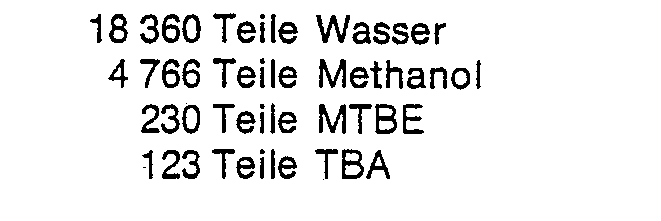
- Vom Boden 28 der Kolonne 8 wurde ein TBA-Seitenstrom mit 123 Teilen TBA, 176 Teilen Methanol und 33 Teilen Wasser abgezogen und in die Extraktionskolonne 6 zurückgeführt.
- Von insgesamt 205 Teilen TBA wurden somit 123 Teile = 60% extrahiert, abgezogen und zurückgeführt.
- 123 948 Teile eines C4-Kohlenwasserstoffstromes aus Leitung 1 mit folgender Zusammensetzung

- Die Umsetzung im Reaktor erfolgte bei 70 °C und 12 bar. Der Isobutenumsatz betrug 97 %. Der Methanolüberschuß betrug 80 %.
- Aus 62 Teilen des im Reaktoreinsatzprodukt enthaltenen Wassers (ca. 0,05 %) bildeten sich mit 193 Teilen Isobuten, entsprechend 1,1 % des eingesetzten Isobutens, 255 Teile TBA.
- Das Reaktorausgangsprodukt hatte folgende Zusammensetzung :

- Dieser Strom wurde gemeinsam mit dem TBA-Seitenstrom aus Leitung 13 (127 Teile TBA, 182 Teile Methanol und 34 Teile Wasser) mit 33 652 Teilen Wasser bei 40 °C im Gegenstrom gewaschen.
- Das Verhältnis Methanol : Wasser betrug 1 : 4. Das Methanol wurde quantitativ ausgewaschen. MTBE löste sich zu 1 % in der Extraktphase. TBA löste sich begrenzt, den Extraktionsbedingungen entsprechend, so daß von 382 Teilen TBA, die in die Extraktionskolonne eingebracht wurden, 255 Teile TBA mit dem Raffinatstrom ausgetragen wurden.
- Zusammensetzung der Raffinatphase
-

- In der Destillationskolonne 11 wurden am Kopf

- Am Sumpf wurden 27139 Teile MTBE, 255 Teile TBA, 1 338 Teile TAME und 146 Teile CS-Kohlenwasserstoffe erhalten.
- Als Extraktphase wurden

- Vom Boden 28 der Kolonne 8 wurde ein TBA-Seitenstrom mit 127 Teilen TBA, 182 Teilen Methanol und 34 Teilen Wasser abgezogen und in die Extraktionskolonne 6 zurückgeführt.
- Von insgesamt 382 Teilen TBA wurden somit 127 Teile = 33 % extrahiert, abgezogen und zurückgeführt.
- 34 620 Teile eines C4-Kohlenwasserstoffstromes aus Leitung 1 mit folgender Zusammensetzung

- Die Umsetzung im Reaktor erfolgte bei 70 °C und 12 bar. Der Isobutenumsatz betrug 97,3 %. Der Methanolüberschuß betrug 80 Mol.-%.
- Aus 20 Teilen des im Reaktoreinsatzprodukt enthaltenen Wassers (ca. 0,05 %) bildeten sich mit 62 Teilen Isobuten, entsprechend 0,6 % des eingesetzten Isobutens, 82 Teile TBA.
- Das Reaktorausgangsprodukt hatte folgende Zusammensetzung :

- Dieser Strom wurde gemeinsam mit dem TBA-Seitenstrom aus Leitung 13 (38 Teile TBA, 54 Teile Methanol und 10 Teile Wasser) mit 9300 Teilen Wasser bei 40 °C im Gegenstrom gewaschen.
- Das Verhältnis Methanol : Wasser betrug 1 : 2. Das Methanol wurde quantitativ ausgewaschen. MTBE löste sich zu 1 % in der Extraktphase. TBA löste sich begrenzt, den Extraktionsbedingungen entsprechend, daß von 120 Teilen TBA, die in die Extraktionskolonne eingebracht wurden, 82 Teile TBA mit dem Raffinatstrom ausgetragen wurden.
- Zusammensetzung der Raffinatphase :

- In der Destillationskolonne 11 wurden am Kopf
- 24 220 Teile inerte Kohlenwasserstoffe

- Als Extraktphase wurden

- Vom Boden 28 der Kolonne 8 wurde ein TBA-Seitenstrom mit 38 Teilen TBA, 54 Teilen Methanol und 10 Teilen Wasser abgezogen und in die Extraktionskolonne 6 zurückgeführt.
- Somit wurden von insgesamt 120 Teilen TBA 38 Teile = 32 % extrahiert, abgezogen und zurückgeführt.
Claims (4)
Priority Applications (1)
| Application Number | Priority Date | Filing Date | Title |
|---|---|---|---|
| AT82111500T ATE15179T1 (de) | 1981-12-22 | 1982-12-11 | Verfahren zur abtrennung von methanol aus den bei der veraetherung von c4 bis c7-isoolefinen mit methanol anfallenden reaktionsprodukten. |
Applications Claiming Priority (2)
| Application Number | Priority Date | Filing Date | Title |
|---|---|---|---|
| DE3150755 | 1981-12-22 | ||
| DE19813150755 DE3150755A1 (de) | 1981-12-22 | 1981-12-22 | "verfahren zur abtrennung von methanol aus den bei der veraetherung von c(pfeil abwaerts)4(pfeil abwaerts) bis c(pfeil abwaerts)7(pfeil abwaerts)-isoolefinen mit methanol anfallenden reaktionsprodukten" |
Publications (2)
| Publication Number | Publication Date |
|---|---|
| EP0082447A1 EP0082447A1 (de) | 1983-06-29 |
| EP0082447B1 true EP0082447B1 (de) | 1985-08-28 |
Family
ID=6149397
Family Applications (1)
| Application Number | Title | Priority Date | Filing Date |
|---|---|---|---|
| EP82111500A Expired EP0082447B1 (de) | 1981-12-22 | 1982-12-11 | Verfahren zur Abtrennung von Methanol aus den bei der Verätherung von C4 bis C7-Isoolefinen mit Methanol anfallenden Reaktionsprodukten |
Country Status (8)
| Country | Link |
|---|---|
| US (1) | US4544776A (de) |
| EP (1) | EP0082447B1 (de) |
| JP (1) | JPS58110529A (de) |
| AT (1) | ATE15179T1 (de) |
| CA (1) | CA1230614A (de) |
| DE (2) | DE3150755A1 (de) |
| ES (1) | ES8308297A1 (de) |
| NO (1) | NO157615C (de) |
Cited By (1)
| Publication number | Priority date | Publication date | Assignee | Title |
|---|---|---|---|---|
| CN102260138A (zh) * | 2011-06-09 | 2011-11-30 | 凯瑞化工股份有限公司 | 一种减小mtbe生产装置中设备腐蚀的方法 |
Families Citing this family (43)
| Publication number | Priority date | Publication date | Assignee | Title |
|---|---|---|---|---|
| DE3336644A1 (de) * | 1983-10-08 | 1985-05-23 | Deutsche Texaco Ag, 2000 Hamburg | Verfahren zur kontinuierlichen herstellung von alkoholen |
| FR2565991B1 (fr) * | 1984-06-18 | 1986-10-03 | Inst Francais Du Petrole | Procede de valorisation d'essences olefiniques par etherification |
| DE3435936A1 (de) * | 1984-09-29 | 1986-04-10 | Linde Ag, 6200 Wiesbaden | Verfahren und vorrichtung zur herstellung von aether |
| JPS61280443A (ja) | 1985-06-05 | 1986-12-11 | Sumitomo Chem Co Ltd | メチルタ−シヤリ−ブチルエ−テルの製造方法 |
| DE3606121A1 (de) * | 1986-02-26 | 1987-08-27 | Texaco Ag | Verfahren zur kontinuierlichen abtrennung von wasser aus gemischen mit organischen substanzen |
| US4740632A (en) * | 1987-01-16 | 1988-04-26 | Conoco Inc. | Process for removing methanol from alkylation unit feed stream |
| US4831195A (en) * | 1987-04-29 | 1989-05-16 | Mobil Oil Corporation | Production of ethers from methanol |
| AU613611B2 (en) * | 1987-04-29 | 1991-08-08 | Mobil Oil Corporation | Feedstock dewatering and etherification of crude methanol |
| US4774365A (en) * | 1987-11-25 | 1988-09-27 | Air Products And Chemicals, Inc. | Pervaporation process for separating alcohols from ethers |
| US4885421A (en) * | 1987-12-08 | 1989-12-05 | Harandi Mohsen N | Multistage reactor system for production of fuels |
| US4835329A (en) * | 1987-12-08 | 1989-05-30 | Mobil Oil Corporation | Process for producing high octane gasoline |
| US4830635A (en) * | 1987-12-08 | 1989-05-16 | Mobil Oil Corporation | Production of liquid hydrocarbon and ether mixtures |
| US4854939A (en) * | 1987-12-08 | 1989-08-08 | Mobil Oil Corporation | Aromatization and etherification process integration |
| US4826507A (en) * | 1987-12-08 | 1989-05-02 | Mobil Oil Corporation | Integrated etherification and oxygenates to gasoline process |
| US4788365A (en) * | 1987-12-08 | 1988-11-29 | Mobil Oil Corporation | High octane gasoline and distillates from oxygenates |
| US4820877A (en) * | 1987-12-28 | 1989-04-11 | Mobil Oil Corporation | Etherification process improvement |
| US4957709A (en) * | 1988-05-02 | 1990-09-18 | Mobil Oil Corporation | Reactor system for olefin conversion and etherification |
| US4886925A (en) * | 1988-05-02 | 1989-12-12 | Mobil Oil Corp | Olefins interconversion and etherification process |
| JPH03504731A (ja) * | 1989-03-23 | 1991-10-17 | モービル・オイル・コーポレイション | ジイソプロピルエーテルおよびメチル3級アルキルエーテルプロセスのための新規な複合分離法 |
| US5011506A (en) * | 1989-09-29 | 1991-04-30 | Mobil Oil Corporation | Integrated etherification and alkene hydration process |
| US5102428A (en) * | 1989-10-20 | 1992-04-07 | Mobil Oil Corporation | Integrated process for the production of diisopropyl ether and gasoline |
| US5078751A (en) * | 1990-04-04 | 1992-01-07 | Mobil Oil Corporation | Process for upgrading olefinic gasoline by etherification wherein asymmetrical dialkyl ethers are produced |
| US5154801A (en) * | 1990-05-24 | 1992-10-13 | Mobil Oil Corporation | Advances in product separation in dipe process |
| US5132467A (en) * | 1991-03-06 | 1992-07-21 | Mobil Oil Corporation | Process for the conversion of normal alkenes to tertiary alkyl ethers |
| US5243090A (en) * | 1991-03-06 | 1993-09-07 | Mobil Oil Corporation | Conversion of normal alkenes to tertiary alkyl ethers |
| IT1245397B (it) * | 1991-03-22 | 1994-09-20 | Snam Progetti | Procedimento per la decomposizione catalitica selettiva di eteri alchilici ed alcooli in una carica proveniente dalla sintesi del metil ter amil etere |
| US5240568A (en) * | 1991-08-29 | 1993-08-31 | Allied-Signal Inc. | Removal of acetophenone from phenol purification residues |
| JP2655023B2 (ja) * | 1991-10-18 | 1997-09-17 | 宇部興産株式会社 | エーテル化合物の製造法 |
| US5260493A (en) * | 1992-07-02 | 1993-11-09 | Mobil Oil Corporation | Effluent treatment for ether production |
| IT1256062B (it) * | 1992-11-20 | 1995-11-23 | Snam Progetti | Procedimento per l'ottenimento di correnti di metanolo, etanolo, n-propanolo,isobutanolo,utilizzabili soprattutto nella preparazione diprodotti alto ottanici, da miscele contenenti detti alcoli con acqua ed altri composti bassobollenti e altobollenti |
| US5329051A (en) * | 1992-12-30 | 1994-07-12 | Phillips Petroleum Company | Ether recovery |
| EP0669306A1 (de) * | 1994-02-28 | 1995-08-30 | Texaco Development Corporation | Erhaltung der Energie während mehrstufiger Destillation |
| WO1995033704A1 (en) * | 1994-06-06 | 1995-12-14 | Chemical Research & Licensing Company | Etherification process |
| DE19625284A1 (de) * | 1996-06-25 | 1998-01-02 | Hoechst Ag | Verfahren zur Trennung von Gemischen aus Dimethylether und Chlormethan |
| DE19625283A1 (de) * | 1996-06-25 | 1998-01-02 | Hoechst Ag | Verfahren zur Herstellung und Auftrennung eines Gemischs aus Dimethylether und Chlormethan mit Wasser als Extraktionsmittel |
| US5811597A (en) * | 1996-08-26 | 1998-09-22 | Huntsman Specialty Chemicals Corp. | Method for the manufacture of methyl tertiary butyl ether from tertiary butyl alcohol and methanol |
| JP4649782B2 (ja) * | 2001-06-21 | 2011-03-16 | 住友化学株式会社 | イソブチレン及びメタノールの製造方法 |
| JP4649783B2 (ja) | 2001-06-21 | 2011-03-16 | 住友化学株式会社 | イソブチレン及びメタノールの製造方法 |
| EP3497184A4 (de) * | 2016-08-09 | 2020-02-19 | Reliance Industries Limited | Verfahren zur reduzierung des oxygenatgehalts von kohlenwasserstoffeinsätzen |
| JP6444555B1 (ja) * | 2018-03-30 | 2018-12-26 | 住友化学株式会社 | 分離方法、及び、これを用いたイソブチレンの製造方法 |
| US11053183B1 (en) | 2020-02-28 | 2021-07-06 | Uop Llc | Process and apparatus for separating methanol from other oxygenates |
| CN117654083A (zh) * | 2022-08-31 | 2024-03-08 | 中国石油化工股份有限公司 | 应用于醚类生产及醚类分解的醇回收装置及工艺 |
| WO2026080292A1 (en) * | 2024-10-07 | 2026-04-16 | Kellogg Brown & Root Llc | Systems for purifying acetone |
Family Cites Families (5)
| Publication number | Priority date | Publication date | Assignee | Title |
|---|---|---|---|---|
| JPS5168512A (de) * | 1974-12-02 | 1976-06-14 | Texaco Development Corp | |
| US4144138A (en) * | 1978-01-18 | 1979-03-13 | Texaco Inc. | Recovery of ethers |
| FR2449666A1 (fr) * | 1979-02-22 | 1980-09-19 | Inst Francais Du Petrole | Procede d'isolement du methyltertiobutylether a partir des produits de la reaction du methanol avec une coupe d'hydrocarbures c4 renfermant de l'isobutene |
| FR2455019A1 (fr) * | 1979-04-24 | 1980-11-21 | Inst Francais Du Petrole | Procede de production de methyltertiobutyl ether a partir de methanol et d'isobutene |
| DE3024147C2 (de) * | 1980-06-27 | 1983-05-05 | Edeleanu Gmbh, 6000 Frankfurt | Verfahren zur Auftrennung der bei der Verätherung von niederen i-Olefinen mit Methanol anfallenden Reaktionsprodukte |
-
1981
- 1981-12-22 DE DE19813150755 patent/DE3150755A1/de not_active Withdrawn
-
1982
- 1982-12-07 ES ES518007A patent/ES8308297A1/es not_active Expired
- 1982-12-11 EP EP82111500A patent/EP0082447B1/de not_active Expired
- 1982-12-11 AT AT82111500T patent/ATE15179T1/de not_active IP Right Cessation
- 1982-12-11 DE DE8282111500T patent/DE3265908D1/de not_active Expired
- 1982-12-20 US US06/451,707 patent/US4544776A/en not_active Expired - Lifetime
- 1982-12-21 CA CA000418198A patent/CA1230614A/en not_active Expired
- 1982-12-21 NO NO824310A patent/NO157615C/no unknown
- 1982-12-22 JP JP57224057A patent/JPS58110529A/ja active Granted
Cited By (1)
| Publication number | Priority date | Publication date | Assignee | Title |
|---|---|---|---|---|
| CN102260138A (zh) * | 2011-06-09 | 2011-11-30 | 凯瑞化工股份有限公司 | 一种减小mtbe生产装置中设备腐蚀的方法 |
Also Published As
| Publication number | Publication date |
|---|---|
| EP0082447A1 (de) | 1983-06-29 |
| ES518007A0 (es) | 1983-09-01 |
| DE3150755A1 (de) | 1983-06-30 |
| ES8308297A1 (es) | 1983-09-01 |
| NO824310L (no) | 1983-06-23 |
| JPS58110529A (ja) | 1983-07-01 |
| NO157615C (no) | 1988-04-20 |
| DE3265908D1 (en) | 1985-10-03 |
| NO157615B (no) | 1988-01-11 |
| CA1230614A (en) | 1987-12-22 |
| JPH0345053B2 (de) | 1991-07-09 |
| ATE15179T1 (de) | 1985-09-15 |
| US4544776A (en) | 1985-10-01 |
Similar Documents
| Publication | Publication Date | Title |
|---|---|---|
| EP0082447A1 (de) | Verfahren zur Abtrennung von Methanol aus den bei der Verätherung von C4 bis C7-Isoolefinen mit Methanol anfallenden Reaktionsprodukten | |
| DE69804630T2 (de) | Reindarstellung von propylenoxid | |
| EP0234508B1 (de) | Verfahren zur kontinuierlichen Abtrennung von Wasser aus Gemischen mit organischen Substanzen | |
| DE2629769C3 (de) | Verfahren zur Herstellung von reinem Methyl-tertiär-butyläther | |
| DE3026900C2 (de) | ||
| DE69301579T2 (de) | Verbessertes Verfahren zur Gleichzeitigen Herstellung von Propylenoxid und Styrolmonomer | |
| DE3024147C2 (de) | Verfahren zur Auftrennung der bei der Verätherung von niederen i-Olefinen mit Methanol anfallenden Reaktionsprodukte | |
| DE69405138T2 (de) | Verfahren zur Herstellung von Acryl- und Methacrylsäureestern | |
| DE69010046T2 (de) | Reinigungs- und Herstellungsverfahren von Methylmethacrylat. | |
| EP0082316A1 (de) | Verfahren zur Herstellung von Methyl-Tert.-butylether (MTBE) und weitgehend von i-Buten und von Methanol befreiten Kohlenwasserstoff-Raffinaten und Vorrichtung hierfür | |
| WO2006061231A1 (de) | Verfahren zur herstellung von acetalen | |
| DE69201047T2 (de) | Reinigung von Propylenoxid durch Extraktivdestillation. | |
| DE69800446T2 (de) | Verfahren zur Herstellung von tertiären Olefinen durch Spaltung von tertiären Alkylethern in dem die erste Reinigungsstufe eine Wäsche mit Wasser ist | |
| EP1198446B1 (de) | Verfahren zur trennung und reinigung eines wässrigen gemisches aus den hauptkomponenten essigsäure und ameisensäure | |
| DE69324728T2 (de) | Verfahren zur Reinigung von Phenol | |
| DE1057086B (de) | Verfahren zur Herstellung von wasserfreiem Formaldehyd | |
| DE69012491T2 (de) | Rückgewinnung von Tertiärbutylhydroperoxid und Tertiärbutylalkohol. | |
| DE2641134A1 (de) | Verfahren zur reinigung von aethylenglycol oder propylenglycol | |
| DE3811150C2 (de) | ||
| DE60303877T2 (de) | Verfahren zur Rückgewinnung von Phenol und Biphenolen | |
| EP0257511B1 (de) | Verfahren zur Herstellung von Isopropylakohol und tertiären C4-bis C5-Alkoholen | |
| DE69501120T2 (de) | Verfahren zur Gewinnung von Dipropylenglykol-Tert-Butylethern | |
| DE3203440A1 (de) | Verfahren zur trennung von gemischen aus paraffin bzw. paraffinen mit 6 bis 14 c-atomen und alkohol bzw. alkoholen mit 4 bis 8 c-atomen | |
| DE19605078B4 (de) | Verfahren zur Herstellung eines dimerisierten Aldehyds | |
| DE2628778A1 (de) | Verfahren zur herstellung von mono- oder polyglykolaethern |
Legal Events
| Date | Code | Title | Description |
|---|---|---|---|
| PUAI | Public reference made under article 153(3) epc to a published international application that has entered the european phase |
Free format text: ORIGINAL CODE: 0009012 |
|
| AK | Designated contracting states |
Designated state(s): AT BE CH DE FR GB IT LI NL SE |
|
| 17P | Request for examination filed |
Effective date: 19831005 |
|
| ITF | It: translation for a ep patent filed | ||
| GRAA | (expected) grant |
Free format text: ORIGINAL CODE: 0009210 |
|
| AK | Designated contracting states |
Designated state(s): AT BE CH DE FR GB IT LI NL SE |
|
| REF | Corresponds to: |
Ref document number: 15179 Country of ref document: AT Date of ref document: 19850915 Kind code of ref document: T |
|
| REF | Corresponds to: |
Ref document number: 3265908 Country of ref document: DE Date of ref document: 19851003 |
|
| ET | Fr: translation filed | ||
| PLBE | No opposition filed within time limit |
Free format text: ORIGINAL CODE: 0009261 |
|
| STAA | Information on the status of an ep patent application or granted ep patent |
Free format text: STATUS: NO OPPOSITION FILED WITHIN TIME LIMIT |
|
| 26N | No opposition filed | ||
| REG | Reference to a national code |
Ref country code: CH Ref legal event code: PFA Free format text: RWE-DEA AKTIENGESELLSCHAFT FUER MINERALOEL UND CHEMIE |
|
| ITPR | It: changes in ownership of a european patent |
Owner name: CAMBIO RAGIONE SOCIALE;RWE - DEA AKTIENGESELLSCHAF |
|
| NLT1 | Nl: modifications of names registered in virtue of documents presented to the patent office pursuant to art. 16 a, paragraph 1 |
Owner name: RWE-DEA AKTIENGESELLSCHAFT FUER MINERALOEL UND CHE |
|
| REG | Reference to a national code |
Ref country code: FR Ref legal event code: CD |
|
| ITTA | It: last paid annual fee | ||
| EAL | Se: european patent in force in sweden |
Ref document number: 82111500.3 |
|
| PGFP | Annual fee paid to national office [announced via postgrant information from national office to epo] |
Ref country code: GB Payment date: 19981125 Year of fee payment: 17 |
|
| PGFP | Annual fee paid to national office [announced via postgrant information from national office to epo] |
Ref country code: SE Payment date: 19981127 Year of fee payment: 17 |
|
| PGFP | Annual fee paid to national office [announced via postgrant information from national office to epo] |
Ref country code: AT Payment date: 19981221 Year of fee payment: 17 |
|
| PGFP | Annual fee paid to national office [announced via postgrant information from national office to epo] |
Ref country code: CH Payment date: 19981223 Year of fee payment: 17 |
|
| PGFP | Annual fee paid to national office [announced via postgrant information from national office to epo] |
Ref country code: FR Payment date: 19981230 Year of fee payment: 17 |
|
| PGFP | Annual fee paid to national office [announced via postgrant information from national office to epo] |
Ref country code: NL Payment date: 19981231 Year of fee payment: 17 |
|
| PGFP | Annual fee paid to national office [announced via postgrant information from national office to epo] |
Ref country code: BE Payment date: 19990111 Year of fee payment: 17 |
|
| PGFP | Annual fee paid to national office [announced via postgrant information from national office to epo] |
Ref country code: DE Payment date: 19990223 Year of fee payment: 17 |
|
| PG25 | Lapsed in a contracting state [announced via postgrant information from national office to epo] |
Ref country code: GB Free format text: LAPSE BECAUSE OF NON-PAYMENT OF DUE FEES Effective date: 19991211 Ref country code: AT Free format text: LAPSE BECAUSE OF NON-PAYMENT OF DUE FEES Effective date: 19991211 |
|
| PG25 | Lapsed in a contracting state [announced via postgrant information from national office to epo] |
Ref country code: SE Free format text: LAPSE BECAUSE OF NON-PAYMENT OF DUE FEES Effective date: 19991212 |
|
| PG25 | Lapsed in a contracting state [announced via postgrant information from national office to epo] |
Ref country code: LI Free format text: LAPSE BECAUSE OF NON-PAYMENT OF DUE FEES Effective date: 19991231 Ref country code: CH Free format text: LAPSE BECAUSE OF NON-PAYMENT OF DUE FEES Effective date: 19991231 Ref country code: BE Free format text: LAPSE BECAUSE OF NON-PAYMENT OF DUE FEES Effective date: 19991231 |
|
| BERE | Be: lapsed |
Owner name: RWE-DEA A.G. FUR MINERALOEL UND CHEMIE Effective date: 19991231 |
|
| PG25 | Lapsed in a contracting state [announced via postgrant information from national office to epo] |
Ref country code: NL Free format text: LAPSE BECAUSE OF NON-PAYMENT OF DUE FEES Effective date: 20000701 |
|
| GBPC | Gb: european patent ceased through non-payment of renewal fee |
Effective date: 19991211 |
|
| EUG | Se: european patent has lapsed |
Ref document number: 82111500.3 |
|
| PG25 | Lapsed in a contracting state [announced via postgrant information from national office to epo] |
Ref country code: FR Free format text: LAPSE BECAUSE OF NON-PAYMENT OF DUE FEES Effective date: 20000831 |
|
| NLV4 | Nl: lapsed or anulled due to non-payment of the annual fee |
Effective date: 20000701 |
|
| PG25 | Lapsed in a contracting state [announced via postgrant information from national office to epo] |
Ref country code: DE Free format text: LAPSE BECAUSE OF NON-PAYMENT OF DUE FEES Effective date: 20001003 |
|
| REG | Reference to a national code |
Ref country code: FR Ref legal event code: ST |