EP0032062B2 - Novolak-substituierte Phenolharze mit hohem Molekulargewicht und ihre Herstellung - Google Patents
Novolak-substituierte Phenolharze mit hohem Molekulargewicht und ihre Herstellung Download PDFInfo
- Publication number
- EP0032062B2 EP0032062B2 EP80304746A EP80304746A EP0032062B2 EP 0032062 B2 EP0032062 B2 EP 0032062B2 EP 80304746 A EP80304746 A EP 80304746A EP 80304746 A EP80304746 A EP 80304746A EP 0032062 B2 EP0032062 B2 EP 0032062B2
- Authority
- EP
- European Patent Office
- Prior art keywords
- phenol
- resin
- phenolic resin
- group
- novolak
- Prior art date
- Legal status (The legal status is an assumption and is not a legal conclusion. Google has not performed a legal analysis and makes no representation as to the accuracy of the status listed.)
- Expired
Links
- 0 Cc(c(*)c1C)c(*)c(*)c1O Chemical compound Cc(c(*)c1C)c(*)c(*)c1O 0.000 description 4
Classifications
-
- C—CHEMISTRY; METALLURGY
- C08—ORGANIC MACROMOLECULAR COMPOUNDS; THEIR PREPARATION OR CHEMICAL WORKING-UP; COMPOSITIONS BASED THEREON
- C08L—COMPOSITIONS OF MACROMOLECULAR COMPOUNDS
- C08L61/00—Compositions of condensation polymers of aldehydes or ketones; Compositions of derivatives of such polymers
- C08L61/04—Condensation polymers of aldehydes or ketones with phenols only
- C08L61/06—Condensation polymers of aldehydes or ketones with phenols only of aldehydes with phenols
-
- C—CHEMISTRY; METALLURGY
- C08—ORGANIC MACROMOLECULAR COMPOUNDS; THEIR PREPARATION OR CHEMICAL WORKING-UP; COMPOSITIONS BASED THEREON
- C08G—MACROMOLECULAR COMPOUNDS OBTAINED OTHERWISE THAN BY REACTIONS ONLY INVOLVING UNSATURATED CARBON-TO-CARBON BONDS
- C08G8/00—Condensation polymers of aldehydes or ketones with phenols only
- C08G8/04—Condensation polymers of aldehydes or ketones with phenols only of aldehydes
-
- C—CHEMISTRY; METALLURGY
- C08—ORGANIC MACROMOLECULAR COMPOUNDS; THEIR PREPARATION OR CHEMICAL WORKING-UP; COMPOSITIONS BASED THEREON
- C08G—MACROMOLECULAR COMPOUNDS OBTAINED OTHERWISE THAN BY REACTIONS ONLY INVOLVING UNSATURATED CARBON-TO-CARBON BONDS
- C08G8/00—Condensation polymers of aldehydes or ketones with phenols only
- C08G8/04—Condensation polymers of aldehydes or ketones with phenols only of aldehydes
- C08G8/08—Condensation polymers of aldehydes or ketones with phenols only of aldehydes of formaldehyde, e.g. of formaldehyde formed in situ
- C08G8/24—Condensation polymers of aldehydes or ketones with phenols only of aldehydes of formaldehyde, e.g. of formaldehyde formed in situ with mixtures of two or more phenols which are not covered by only one of the groups C08G8/10 - C08G8/20
-
- C—CHEMISTRY; METALLURGY
- C08—ORGANIC MACROMOLECULAR COMPOUNDS; THEIR PREPARATION OR CHEMICAL WORKING-UP; COMPOSITIONS BASED THEREON
- C08L—COMPOSITIONS OF MACROMOLECULAR COMPOUNDS
- C08L101/00—Compositions of unspecified macromolecular compounds
-
- C—CHEMISTRY; METALLURGY
- C08—ORGANIC MACROMOLECULAR COMPOUNDS; THEIR PREPARATION OR CHEMICAL WORKING-UP; COMPOSITIONS BASED THEREON
- C08L—COMPOSITIONS OF MACROMOLECULAR COMPOUNDS
- C08L63/00—Compositions of epoxy resins; Compositions of derivatives of epoxy resins
Definitions
- the present invention relates to a process for the preparation of a high-molecular-weight novolak substituted phenolic resin and to such a resin.
- novolak phenolic resins are prepared by condensing a phenol with an aldehyde in the presence of an acid catalyst, and it is known that the obtained resins have a structure in which phenol units are connected through methylene groups bonded at the 2,6- or 2,4-positions thereof and in which methylol groups are not present or, if present, the amounts of methylol groups are very small.
- Novolak phenolic resins prepared according to this known process ordinarily have a number average molecular weight of 250 to 800. The number average molecular weight is about 1000 at the highest. The melting point of these novolak phenolic resins is low.
- a novolak substituted phenolic resin having a structure similar to that above is obtained by condensing a substituted phenol having an alkyl group or halogen atom at the para- or ortho- position of the phenol nucleus with an aldehyde in the presence of an acid catalyst.
- the number average molecular weight of this phenolic resin is similarly low and ordinarily in the range of from 250 to 800, and is 1200 at highest. Accordingly, the melting point of this phenolic resin is low too. Therefore, even if this novolak resin is combined with other setting resins, optionally also with a filler or additive, and the resulting compositions are cured, there cannot be obtained cured resin compositions possessing excellent heat resistance and mechanical properties.
- the number average molecular weight of novolak phenol-formaldehyde resins prepared according to conventional processes is very low and is ordinarily in the range of from 250 to 800 and is 1200 at highest. It was reported that when such a novolak phenol-formaldehyde resin is fractionated, a novolak phenol-formaldehyde resin having a molecular weight of about 3000 to about 10000 is obtained though the yield is very low [see Lectures on Plastic Materials, Volume 15, Phenolic Resins, pages 14-24, written by Shinichi Murayama and published by Nikkan Kogye Shinbunsha and J. J. Gardikes and F. M. Konrad, Am. Chem.
- the number average molecular weight of the obtained novolakalkyl-substituted phenolic resin is only up to 1200.
- a novolak alkyl-substituted phenolic resin having a sufficiently high number average molecularweight has not been obtained [see, for example, F. S. Granger, Industrial and Engineering Chemistry, 29, 860-866 (1937), J. B. Nierden and I. W.
- Novolak alkyl-substituted phenolic resins have a low number average molecularweight and a low melting point, though they have a chain-like or linear structure.
- the acetylation product is a low-molecularweight novolak chlorophenol resin having a number average molecular weight lower than 1250 [Minoru Imoto and Keikichi Uno, Lectures on Polymerization Reactions, Volume 8, Polyaddition and Addition Condensation (published by Kagaku Dojin) and Minoru Imoto and Shinichi Nakade, Bulletin of Chemical Society of Japan, 36, pages 580-585 (1963)].
- novolak chlorophenol resins disclosed in these prior art references have a low number average molecular weight and a low melting point though they have a chain-like or linear molecular structure. Even if these novolak chlorophenol resins are incorporated in setting resins to form resin compositions, it is impossible to sufficiently improve the heat resistance and mechanical properties.
- Japanese Patent Application Laid-Open Specification No. 116081/79 teaches that when a phenol and an aldehyde are subjected to addition condensation in the presence of an acid catalyst and a Lewis acid is added to effect removal of the phenol at an appropriate time during a period of from the point before completion of the reaction to the point after removal of condensed water, a linear novolak phenolic resin free of a three-dimensional cross-linked structure (gelation product) is obtained.
- the only phenol used is phenol itself.
- alkyl phenols such as cresol and p-tert-butylphenyl
- each of the novolak phenol-formaldehyde resins obtained contains a considerable amount of a three-dimensional crosslinked structure (gelation product) and that the number average molecular weight of the residue left after removal of the gelation product is in the range of from about 500 to about 1100.
- This residue is a low-molecular-weight novolak phenolic resin (see Comparative Example 4 given hereinafter).
- a phenol component mainly comprising a bifunctional phenol is reacted with a resol phenolic resin derived from a phenol component mainly comprising a bifunctional phenol and an aldehyde in the presence of an acid catalyst, or if a novolak phenolic resin derived from a phenol component mainly comprising a bifunctional phenol and an aldehyde, is reacted with a chain extender such as a dimethylolated product of a phenol, a resol phenolic resin, an aldehyde, a ketone, a diol or a dihalide in the presence of an acid catalyst, a substantially linear, high-molecular-weight novolak phenolic resin having a number average molecular weight of from 1700 to 15000 is obtained.
- the present invention provides a process for the preparation of a high-molecular-weight novolak phenolic resin
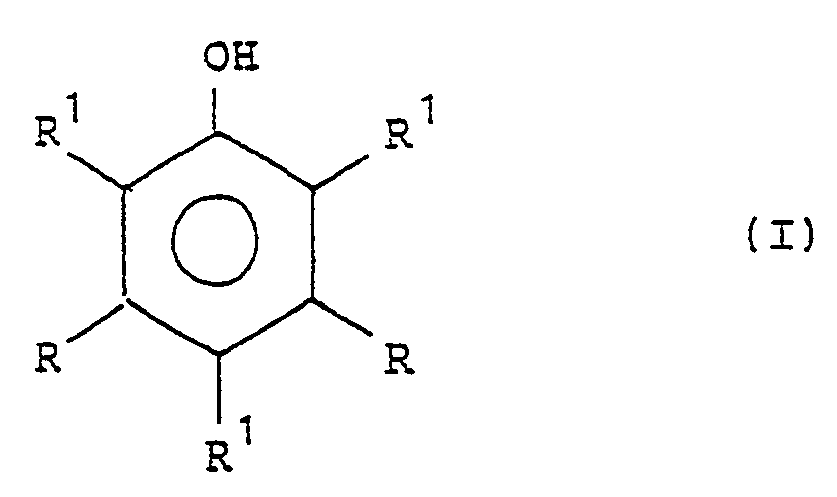
- (A) (i) a phenol component mainly comprising at least one bifunctional phenol represented by the general formula p]: wherein two of the three R 1 's are hydrogen atoms and the remaining R I is an alkyl group having 1 to 8 carbon atoms, an aryl group having 6 to 10 carbon atoms, a halogen atom or a hydroxyl group, and the two R's, which may be the same or different, represent a hydrogen atom, an alkyl group having 1 to 8 carbon atoms, a halogen atom or a hydroxyl group, wherein the R I group which is not a hydrogen atom is in the para position with respect to the hydroxy group, or (ii) a novolak phenolic resin derived from a phenol component mainly comprising said bifunctional phenol of general formula [I] and an aldehyde represented by the general formula
- the present invention also provides a substantially linear, high-molecular-weight novolak phenolic resin which comprises substantially linear novolak recurring units (a) formed by condensation of a phenol component comprising at least 70 mole % of at least one bifunctional phenol represented by the general formula [I] as defined above with at least one aldehyde represented by the general formula [II] as defined above, said resin having a number average molecular weight of from 1700 to 15000 as measured by vapour pressure osmometry in N,N-dimethylacetamide as solvent the ratio Mw/Mn of the weight average molecular weight to the number average molecular weight is from 1.8 to 20 and the melting point of said resin is higher than 160°C.
- This resin may contain intervening groups (b) consisting of a divalent hydrocarbon group, which appear between blocks of the novolak recurring units having a number average molecular weight of 250 to 1200, in an amount of 0.5 to 1 mole per mole of said blocks.
- intervening groups (b) consisting of a divalent hydrocarbon group, which appear between blocks of the novolak recurring units having a number average molecular weight of 250 to 1200, in an amount of 0.5 to 1 mole per mole of said blocks.
- the high-molecular-weight novolak phenolic resin (hereinafter referred to as a "high-molecular-weight novolak resin”) according to the present invention may comprise novolak recurring units, all of which are substantially linear. Alternatively it may contain intervening or bridging groups consisting of a divalent hydrocarbon group, which appear alternately in between blocks of the novolak recurring units having a number average molecular weight of 250 to 1200, in an amount of 0.5 to 1 mole per mole of said blocks. What is important is that the high-molecular-weight novolak resin is substantially linear and has a number average molecularweight of from 1700 to 15000.
- substantially linear is meant that the molecular structure of the polymer is a linear structure including straight or branched chains but is substantially free of crosslinkages (gelled portions).
- the number average molecular weight of the substantially linear high-molecular-weight novolak resin is determined according to vapour pressure osmometry in N,N-dimethylacetamide as solvent. The number average molecularweight must be from 1,700 to 15,000 and when the resin is used as an additive to a setting resin, the heat resistance and mechanical properties are improved. These effects are especially enhanced if the number average molecular weight of the high-molecular-weight novolak resin is in the range of from 2,000 to 10,000.
- the high-molecular-weight novolak resin must have a number average molecular weight of from 1700 to 15000. In general, a higher number average molecular weight is preferred, because the heat resistance and mechanical properties of the composition formed by incorporating this resin into a setting resin are improved as the number average molecular weight of the resin is increased.
- the molecular weight distribution of the high-molecular-weight novolak resin is such that the content of resin components having a number average molecular weight of at least 2,000 is ordinarily at least 50% by weight, preferably at least 60% by weight and especially preferably at least 70% by weight.
- the molecular weight distribution expressed as the ratio Mw/Mn is in the range of from 1.8 to 20 and preferably in the range of from 2 to 10.
- the melting point of the high-molecular-weight novolak resin is higher than 160°C.
- the R 1 which is not a hydrogen atom is preferably an alkyl group having 1 to 8 carbon atoms, and is especially a methyl, ethyl, isopropyl, sec-butyl, tert-butyl or octyl group. A methyl group is most preferred.
- one of two R groups is preferably a hydrogen atom and the other R group is preferably a hydrogen atom or an alkyl group having 1 to 8 carbon atoms, and it is especially preferred that each R group is a hydrogen atom.
- the phenol forming the novolak recurring units comprises 70 to 100 mole %, preferably 80 to 100 mole %, especially preferably 90 to 100 mole %, of at least one bifunctional phenol represented by the general formula [I] and up to 30 mole %, preferably up to 20 mole %, especially preferably up to 10 mole %, of a trifunctional phenol.
- the total amount of both the phenols is 100 mole %.
- the group R 2 is preferably a hydrogen atom or a methyl group and is especially preferably a hydrogen atom.
- the bifunctional phenol represented by the general formula 0] is present in the polymer chain in the form of hydroxyarylene units represented by the general formula [IV]: wherein R 1 and R are as defined above.
- the bifunctional phenol is present at the terminals of the polymer chain in the form of hydroxyaryl units represented by the general formula [V]: wherein R 1 and R are as defined above.
- the trifunctional phenol of the resin is present in the polymer molecule chain in the form of hydroxyarylene units similar to those represented by the general formula [IV] and is present at the terminals of the resin molecule in the form of hydroxyaryl units similar to those represented by the general formula [V].
- the aldehyde represented by the general formula 01] is present in the novolak recurring units in the form of alkylidene units represented by the general formula [VI]: wherein R 2 is as defined above.
- the novolak recurring units (a) constituting the high-molecular-weight novolak resin of the present invention form a substantially linear chain structure in which the above-mentioned hydroxyarylene units and alkylidene units are alternately arranged and connected with one another. More specifically, the structure of the novolak recurring units (a) constituting the high-molecular-weight novolak resin of the present invention is such that when the phenol is comprised solely of the bifunctional phenol represented by the general formula [I], the resin is linear and if the content of the trifunctional phenol is increased, the resin sometimes has a branched structure.
- the ratio of the aldehyde component to the total phenol component in the novolak recurring units is such that the amount of the aldehyde component is ordinarily in the range of from 0.90 to 1.0 mole, preferably from 0.93 to 1.0 mole, per mole of the total phenol component.
- the novolak recurring units (a) are free of methylol groups, but they may comprise such group in a minute amount, for example up to 0.01 mole per mole of the total phenol component.
- the bifunctional phenol represented by the general formula [I] has on the benzene nucleus two hydrogen atoms active to the substitution reaction. In other words the two ortho-positions with respect to the phenolic hydroxyl group are occupied by hydrogen atoms.
- the bifunctional phenol of the general formula [I] has an alkyl group having 1 to 8 carbon atoms, an aryl group having 6 to 10 carbon atoms, a halogen atom or a hydroxyl group at one of the ortho- or para-positions to the hydroxyl group.
- ortho-and para-isomers of alkylphenols such as cresol, ethylphenol, n-propylphenol, isopropylphenol, n-butylphenol, sec-butylphenol, tert-butylphenol, sec-amylphenol, tert-amylphenol, hexylphenol, heptylphenol and octylphenol, halogenated phenols such as fluorophenol, chlorophenol and bromophenol, and arylphenols such as phenylphenol and tolylphenol.
- alkylphenols such as cresol, ethylphenol, n-propylphenol, isopropylphenol, n-butylphenol, sec-butylphenol, tert-butylphenol, sec-amylphenol, tert-amylphenol, hexylphenol, heptylphenol and octylphenol, halogenated phenols such as fluorophenol
- the bifunctional phenol represented by the general formula [I] can be 2,3-xylenol, 3,4-xylenol, 2,5-xylenol, 2,3-diethylphenol, 3,4-diethylphenol, 2,5-diethylphenol, 2,3-diisopropylphenol, 3,4-diisopropylphenol, 2,5-diisopropylphenol, 2,3-dichlorophenol, 3,4-dichlorophenol, 2,5-dichlorophenol, 2-methyl-3-phenylphenol, 3-methyl-4-phenylphenol and 2-methyl-5-phenylphenol.
- the bifunctional phenol component in the novolak recurring units (a) is derived from at least one phenol of general formula [I] and it may be a mixture of two or more of the foregoing phenols.
- the optional trifunctional phenol is a phenol having on the benzene nucleus three hydrogen atoms active to the substitution reaction. In other words, the two ortho- positions and one para- position with respect to the phenolic hydroxyl group are all occupied by hydrogen atoms.
- Such trifunctional phenol can be phenol, meta-substituted phenols and 3,5-di-substituted phenols.
- substituents which such trifunctional phenol can have at the meta- or 3,5-positions there can be mentioned alkyl groups, halogen atoms and hydroxyl groups.
- Trifunctional phenols represented by the general formula [III] are preferred: wherein R, which may be the same or different, stands for a hydrogen atom, an alkyl group having 1 to 8 carbon atoms, a halogen atom or a hydroxyl group.
- phenol meta-substituted phenols such as m-cresol, m-ethylphenol, m-n-propylphenol, m-isopropylphenol, m-n-butylphenol, m-sec-butylphenol, m-tert-butylphenol, m-n-amylphenol, m-sec-amylphenol, m-tert-amylphenol, m-hexylphenol, m-heptylphenol, m-octylphenol, m-fluorophenol, m-chlorophenol, m-bromophenol and resorcinol, and 3,5-di-substituted phenols such as 3,5-xylenol, 3,5-diethylphenol, 3,5-diisopropylphenol, 3,5-di-sec-butylphenol, 3,5-di-tert-butylphenol, 3,5-di-sec-
- trifunctional phenols those represented by the general formula [III] in which one of the two R groups is a hydrogen atom and the other R group is selected from a hydrogen atom, an alkyl group having 1 to 8 carbon atoms and a chlorine atom are especially preferred.
- Phenols in which one of the two R groups is a hydrogen atom and the other R group is a hydrogen atom, a methyl group, an isopropyl group, a sec-butyl group, a tert-butyl group or an octyl group are particularly especially preferred.
- the aldehyde represented by the general formula [11] can be formaldehyde, acetaldehyde, mono- chloroacetaldehyde, dichloroacetaldehyde or trichloroacetaldehyde. Among these aldehydes, formaldehyde and acetaldehyde, especially formaldehyde, are preferred.
- the aldehyde is present in the novolak recurring unit block (a) in the form of an alkylidene group represented by the general formula [VI].
- the novolak recurring units (a) may be separated by intervening or bridging groups (also called “chain extender component units” hereinafter) consisting of a divalent hydrocarbon group. These chain extender component units appear alternately in between blocks of the novolak recurring units (a) having a number average molecular weight of 250 to 1,200.
- the resin of this type is characterized in that the novolak recurring unit blocks (a) and the chain extender component units (b) are alternately arranged and connected to one another, whereby the molecularweight of the resin is increased, and thatthe novolak recurring unit blocks (a) are bonded to terminals of the molecule of the resin.
- the simplest structure of a resin of this type comprises two molecules of the novolak recurring unit blocks (a) connected to each other through one molecule of the chain extender component unit (b).
- the next simplest structure comprises 3 molecules of the novolak recurring unit blocks (a) and two molecules of the chain extender component units (b) which are alternately arranged and connected to one another.
- a structure comprising 4 molecules of the novolak recurring unit blocks (a) and 3 molecules of the chain extender component units (b) which are simi- lady alternately arranged and connected to one another, and a structure comprising n molecules of the novolak recurring unit blocks (a) and (n-1) molecules of the chain extender component units (b) which are alternately arranged and connected to one another.
- the ratio of the units (a) and (b) constituting a resin of this type is such that the amount of the chain extender component units (b) is preferably 0.5 to 1 mole, especially preferably 0.66 to 1.0 mole, per mole of the novolak recurring unit blocks (b).
- the high-molecular-weight novolak resin of the present invention has a polymer chain diagrammatically represented substantially by the following formula [VII]: wherein Z stands for a substantially linear novolak recurring unit block formed by condensation of the above-mentioned phenol and aldehyde components, Y stands for an intervening group consisting of a divalent hydrocarbon group, p is 0 or 1, and n is zero or an integer of at least 1.
- Group Y can be selected from hydrocarbon groups having 1 to 16 carbon atoms, such as alkylidene groups, alkylene groups, cycloalkylene groups, cycloalkylidene groups, arylalkylidene groups, arylalkylene groups and arylene-bis-alkylene groups [ ⁇ R3 ⁇ Ar ⁇ R4 ⁇ wherein Ar represents an arylene group and R 3 and R 4 , which may be the same or different, represent alkylene groups].
- the alkylidene group can be a methylene, ethylidene, propylidene or butylidene group.
- the alkylene group can be a ethylene, propylene, isopropylene, butylene, pentylene or hexylene group.
- the cycloalkylene can be a cyclopentylene, cyclohexylene or methylcyclohexylene group.
- the cycloalkylidene group can be a cyclopentylidene, cyclohexylidene or methylcyclohexylidene group.
- the arylalkylidene group can be a benzylidene, o-xylidene, m-xylidene or p-xylidene group.
- the arylalkylene group can be a styrene, a-methylstyrene or p-methylstyrene group.
- the arylene-bis-alkylene group can be a o-xylylene, m-xylylene or p-xylylene group.
- chain extender component units (b) alkylidene, alkylene, cycloalkylidene, cycloalkylene, arylalkylidene, arylalkylene and arylene-bis-alkylene groups are preferred.
- Alkylidene groups having 1 to 4 carbon atoms, alkylene groups having 2 to 5 carbon atoms, arylalkylidene groups having 7 to 9 carbon atoms, arylalkylene groups having 8 to 10 carbon atoms and arylene-bis-alkylene group having 8 to 10 carbon atoms are especially preferred.
- the molecular weight of these chain extender component units (b) is 14 to 200, and especially 14 to 170.
- the structure of the substantially linear high-molecular-weight novolak resin may be determined according to the following methods.
- the content of units derived from the bifunctional and trifunctional phenols is determined by i H nuclear magnetic resonance spectroscopy, 13 C nuclear magnetic resonance spectroscopy and pyrolysis gas chromatography.
- 1H nuclear magnetic resonance spectroscopy and 13 C nuclear magnetic resonance spectroscopy the content of the total phenol component can be obtained from the intensity of the signal based on the hydrogen atom of the phenolic hydroxyl group of the phenol component in the resin, and the ratio of the bifunctional phenol to the trifunctional phenol can be determined from the relation of the intensity of the signal based on the hydrogen atom of the phenolic hydroxyl group to the intensities of the signals of the hydrogen atoms bonded to the benzene nucleus at the ortho-, meta- and para-positions with respect to said phenolic hydroxyl group.
- the contents of the total phenol component and the aldehyde component in the resin are determined by I H nuclear magnetic resonance spectroscopy.
- the ratio of the bifunctional phenol to the trifunctional phenol can also be determined from the results of pyrolysis gas chromatography. This ratio is calculated on the basis of the results of the determination of phenols formed by pyrolysis.
- the ratio of methylol groups to methylene groups contained in the resin can be determined from the results of the 1 H nuclear magnetic resonance analysis.
- the number average molecular weight (Mn) of the high-molecular-weight novolak resin of the present invention is measured by vapour pressure osmometry in N,N-dimethyl-acetamide as solvent
- the molecular weight distribution (Mw/Mn) expressed as the ratio of the weight average molecular weight (Mw) to the number average molecular weight (Mn) in the resin of the present invention is determined by gel permeation chromatography using tetrahydrofuran as solvent
- the molecular weight distribution expressed as the content of the resin components having a number average molecular weight (Mn) of at least 2,000 is determined from a distribution curve of the number average molecular weights determined according to the above-mentioned method.
- the melting point of the high-molecular-weight novolak resin is measured by the microscopic method. The temperature at which melt flow is initiated is befined as the melting point.
- the process for the preparation of a substantially linear high-molecular-weight novolak resin according to the present invention includes the following four embodiments.
- a low-molecular-weight novolak phenolic resin (c) is reacted with a dimethylolated phenol (d) as a chain extender in the presence of an acid catalyst
- the dimethylolated phenol (d) as the chain extender cannot be distinguished from the novolak recurring unit after it has been included in the molecular chain. Accordingly, in the general formula [VII] representing the product resin, p is zero.
- the low-molecular-weight novolak phenolic resin (c) used as the starting substance in this embodiment is characterized by the following three features:
- the bifunctional phenol of the phenol component of the novolak phenolic resin (c) is present in the form of hydroxyarylene units represented by the general formula [IV] and in the form of hydroxyaryl units represented by the general formula [V] at terminals of the resin molecule.
- the trifunctional phenol is similarly present in the form of hydroxyarylene units of the general formula [IV] and in the form of hydroxyaryl units of the general formula [V] at terminals of the resin molecule.
- the aldehyde of general formula [II] of the starting novolak phenolic resin is present in the form of methylene units represented by the general formula [VI].
- This starting novolak phenolic resin (c) has a chain structure in which the hydroxyarylene and methylene units are alternately arranged. More specifically, the phenol component is comprised solely of a bifunctional phenol represented by the general formula [II], the novolak substituted phenolic resin is linear. If the content of the trifunctional phenol is increased, the phenolic resin sometimes has a branched chain structure.
- the ratio of the aldehyde component to the total phenol component in this starting novolak phenolic resin (c) is such that the amount of the aldehyde component is 0.95 to 1.0 mole, preferably 0.97 to 1.0 mole, per mole of the total phenol component.
- the novolak phenolic resin (c) is free of methylol groups or substituted methylol groups. However, it may contain methylol or substituted methylol groups in a minute amount of up to 0.01 mole per mole of the total phenol component.
- the melting point of this starting novolak phenolic resin (c) is ordinarily 50 to 120°C. and preferably 60 to 90°C.
- bifunctional phenol trifunctional phenol and aldehyde constituting the novolak phenolic resin (c), those mentioned before can be used.
- This starting novolak type phenolic resin (c) can easily be obtained by polycondensing the phenol and aldehyde in the presence of an acid catalyst by known procedures.
- the content of the trifunctional phenol in the total phenol component should be no higher than 30 mole %. If the content exceeds 30 mole %, when a high-molecular-weight novolak resin is prepared by the chain-extending reaction, crosslinking occurs and the resin gels with the result that an intended high-molecular-weight resin having a chain structure cannot be obtained. In order to obtain a high-molecular-weight resin having a chain structure, especially a linear high-molecular- weight resin, it is preferred that the content of trifunctional phenol in the phenol component of the starting novolak phenolic resin be low.
- the dimethylolated phenol (d) used as the other starting substance is a dimethylolation product of the above-mentioned bifunctional phenol and/or the above-mentioned trifunctional phenol. More specifically, the dimethylolated phenol (d) is a dimethylolated phenol represented by the general formula [VIII]: wherein two of the three R 3 groups are the remaining R 3 group is a hydrogen atom, an alkyl group having 1 to 8 carbon atoms, an aryl group having 6 to 10 carbon atoms, a halogen atom or a hydroxyl group, R 2 represents a hydrogen atom, a methyl group or a halogenated methyl group, and R represents a hydrogen atom, an alkyl group having 1 to 8 carbon atoms, a halogen atom or a hydroxyl group.
- a mixture of two or more of dimethylolated phenols of the general formula [VIII] may be used as the dimethylolated phenol (d).
- the dimethylolated phenol (d) be a dimethylolation product of a bifunctional phenol represented by the general formula [I].
- the dimethylolated phenol (d) When a mixture of two or more of dimethylolated phenols of the general formula [VIII] is used as the dimethylolated phenol (d), it is preferred that the content of a dimethylolation product of a bifunctional phenol of the general formula [I] in the mixture be at least 80 mole % and the content of a dimethyiotation product of a trifunctional phenol of the general formula [III] in the mixture be up to 20 mole %. It is especially preferred to use a mixture comprising at least 90 mole % of a dimethylolation product of a bifunctional phenol of the general formula [I] and up to 10 mole % of a dimethylolation product of a trifunctional phenol of the general formula [III].
- the dimethylolated phenol represented by formula [VIII] can be selected from dihydroxymethyl phenols such as 2,6-dihydroxymethylphenol and 2,4-dihydroxymethylphenol; dihydroxymethylcresols such as 4,6-dihydroxymethyl-2-cresol, 2,6-dihydroxymethyl-3-cresol, 4,6-dihydroxymethyl-3-cresol, 2,6-dihydroxymethyl-4-cresol and mixtures of two or more of these dihydroxymethylcresols; dihydroxymethyl-n-propylphenols such as 4,6-dihydroxymethyl-3-n-propyl phenol, 2,6-dihydroxymethyl-3-n-propylphenol, 4,6-dihydroxymethyl-3-n-propylphenol, 2,6-dihydroxymethyl-4-n-propylphenol and mixtures
- a dimethylolation product of o-cresol and/or p-cresol is particularly especially preferred as the dimethylolated phenol (d).
- the acid catalyst can be selected from protonic acids such as nitric acid, sulfuric acid, hydrochloric acid, perchloric acid, phosphoric acid, toluenesulfonic acid and methane-sulfonic acid, boron trifluoride, boron trifluoride complexes such as boron-trifluoride-ether complex, and Lewis acids such as aluminum trichloride, fin tetrachloride, zinc chloride, ferric chloride and titanium tetrachloride.
- protonic acids such as nitric acid, sulfuric acid, hydrochloric acid, perchloric acid, phosphoric acid, toluenesulfonic acid and methane-sulfonic acid
- boron trifluoride boron trifluoride complexes such as boron-trifluoride-ether complex
- Lewis acids such as aluminum trichloride, fin tetrachloride, zinc chloride, ferric chloride and titanium tetrach
- Preferably protonic acids, boron trifluoride, boron trifluoride complexes and aluminum trichloride are used.
- the use of nitric acid, sulfuric acid, boron trifluoride or a boron trifluoride complex is especially preferred.
- the acid catalyst is generally used in an amount of 0.01 to 10 parts by weight, preferably 0.1 to 5 parts by weight, per 100 parts by weight of the starting novolak phenolic resin.
- the starting novolak phenolic resin contains an acid catalyst added at the step of forming this phenolic resin, since this catalyst exerts a catalytic activity, a fresh acid catalyst need not be added for the polycondensation.
- the ratio between the starting novolak phenolic resin (c) and the dimethylolated phenol (d) is changed according to the desired number average molecular weight of the resulting high-molecular weight novolak resin.
- the molar ratio of the dimethylolated phenol (d) to the starting novolak substituted phenolic resin (c) is close to 1, a high-molecular-weight novolak resin having a higher number average molecular weight is obtained.
- the mixing ratio between the starting novolak phenolic resin (c) and the dimethylolated phenol (d) is such that the amount of the methylol groups in the dimethylolated phenol (d) is 0.5 to 1.5 equivalents, preferably 0.8 to 1.2 equivalents, especially preferably 0.9 to 1.1 equivalents, per equivalent of the hydroxyaryl units of the general formula [V] present at terminals of the molecule of the starting novolak type phenolic resin (c).
- the polycondensing reaction is readily advanced by heating and stirring the starting novolak phenolic resin (c) and the dimethylolated phenol (d) represented by-the above general formula [VIII] in the presence of an acid catalyst while removing water formed by the reaction from the reaction system.
- the polycondensation reaction is carried out in the presence of a solvent.
- the solvent that is used can be toluene, o-dichlorobenzene, diphenyl ether or decatin.
- the solvent is used in an amount of 50 to 300 parts by weight, preferably 100 to 200 parts by weight, per 100 parts by weight of the starting novolak phenolic resin.
- the polycondensation temperature is ordinarily from 100 to 250°C. and preferably from 150 to 200°C.
- the time required for the polycondensation reaction is changed according to the reaction temperature and other conditions.
- the reaction time is not particularly critical. However, a reaction time of from 1 to 10 hours, preferably from 2 to 5 hours, is ordinarily used.
- the reaction mixture is added to a liquid such as methanol, acetone or water which is not a solvent for the high-molecular-weight novolak resin to precipitate the high-molecular-weight novolak resin, or the solvent is removed from the reaction mixture by distillation under heating to recover the high-molecular-weight novolak resin.
- the reaction of both the starting substances is easily advanced and a high-molecular-weight novolak resin is formed most readily.
- a low-molecular-weight novolak phenolic resin (c) is reacted with a low-molecular-weight resol phenolic resin (e) as a chain extender in the presence of an acid catalyst.
- the resol phenolic resin (e) cannot be distinguished from the novolak recurring units when the resol phenolic resin (e) is included in the polymer chain of the resulting high-molecular-weight novolak resin. Accordingly, in the general formula [VII] representing the product resin, p is zero.
- the resol phenolic resin (e) that is used as the other starting substance is a resol phenolic resin characterized by the following three features:
- the bifunctional phenol constituting this resol phenolic resin is present in the form of hydroxyarylene units represented by the general formula [IV] in the resin molecule and is present in the form of substituted hyd- roxymethylaryl units represented by the general formula [IX]: wherein R 1 , R 2 and R are as defined above, at the terminals of the resin molecule.
- the trifunctional phenol is similarly present in the form of hydroxyarylene units as represented by the general formula [IV] in the resin molecule and is present in the form of methylol group-containing hydroxyarylene units as represented by the general formula OX] at terminals of the resin molecule [in case of a trifunctional phenol, R I in the general formulae [IV] and [IX] stands for a hydrogen atom].
- the aldehyde of general formula [II] constituting the starting resol phenolic resin is present in the form of methylene units represented by the general formula [VI] in the resin molecule and is present in the form of methylol group units represented by the general formula [X]: wherein R 2 is as defined above, at the terminals of the resin molecule.
- This starting resol phenolic resin (e) has a chain structure in which the hydroxyarylene units and methylene units are alternately arranged. More specifically, when the phenol component is comprised solely of a bifunctional phenol represented by general formula [I], the resol phenolic resin (e) has a linear chain structure. If the content of the trifunctional group is increased, the resol phenolic resin (e) has sometimes a branched chain structure.
- the ratio of the aldehyde component to the total phenol component in the resol phenolic resin (e) is such that the amount of the aldehyde is 0.90 to 1.0 mole, preferably 0.93 to 1.0 mole, per mole of the total phenol component
- the melting point of this starting resol phenolic resin is ordinarily higher than 120°C. and preferably higher than 150°C.
- the bifunctional phenol, trifunctional phenol and aldehyde constituting the starting resol phenolic resin there can be used those described hereinbefore.
- This starting resol phenolic resin (e) can easily be obtained by polycondensing the phenol component with the aldehyde.
- the content of trifunctional phenol in the total phenol component resin must be no more than 30 mole %. If this content exceeds 30 mole %, cross-linking occurs in the resin at the polycondensation step and the resin is gelled. A high-molecular-weight having a chain structure cannot therefore be obtained.
- the content of trifunctional phenol in the total phenol component of the starting resol phenolic resin be low.
- the ratio between the starting novolak phenolic resin (c) and resol phenolic resin (e) used for the polycondensation reaction depends on the intended number average molecular weight of the resulting high-molecular-weight novolak resin. As the molar ratio of the starting resol phenolic resin (e) to the starting novolak phenolic resin (c) is close to 1, a high-molecular-weight novolak phenolic resin having a higher number average molecular weight is obtained.
- the ratio between the starting novolak phenolic resin (c) and resol substituted phenolic resin (e) is such that the amount of methylol groups of the resol phenolic resin (e) is 0.5 to 1.5 equivalents, preferably 0.8 to 1.2 equivalents, especially preferably 0.9 to 1.1 equivalents, per equivalent of the hydroxyaryl units of general formula [V] present at the terminals of the molecule of the starting novolak phenolic resin (c).
- the polycondensation reaction can readily be advanced by heating and stirring the starting novolak phenolic resin (c) and resol phenolic resin (e) in the presence of an acid catalyst to effect the reaction while removing water formed by the reaction from the reaction system.
- Any acid catalyst mentioned before with reference to the embodiment I can be used also in this embodiment in the amount described before.
- the other reaction conditions may be the same as those described before with reference to the embodiment I.
- the process of this embodiment is advantageous in that a substantially linear high-molecular- weight novolak resin can be prepared in a high yield.
- a low-molecular-weight novolak phenolic resin (c) is reacted and polycondensed with a chain extender (f) selected from an aldehyde, a ketone, a diol and a dihalide in the presence of an acid catalyst.
- a chain extender (f) selected from an aldehyde, a ketone, a diol and a dihalide in the presence of an acid catalyst.
- divalent hydrocarbon groups derived from the chain extender are included in the polymer chain in such a manner that novolak recurring unit blocks are connected with one another through these divalent hydrocarbon groups as intervening groups. Accordingly, p in the general formula [VII] representing the resulting high-molecular-weight novolak resin is 1.
- chain extender (f) there are used aldehydes, ketones, diols or dihalides capable of introducing into the phenol ring a divalent hydrocarbon group Y in the general formula [VII], especially an alkylidene group, an alkylene group, a cycloalkylene group, a cycloalkylidene group, an arylalkylidene group, an arylalkylene group or an arylene-bis-alkylene group, by the reaction with the novolak type substituted phenolic resin (c).
- Appropriate aldehydes and ketones are represented by the general formula [XI]: wherein R 4 stands for a hydrogen atom or an alkyl group having 1 to 8 carbon atoms, R 5 stands for a hydrogen atom, an alkyl group having 1 to 8 carbon atoms or an aryl group having 6 to 10 carbon atoms, and R 4 and R 5 may be bonded together through the intervening carbonyl carbon atom to form a cycloalkane.
- Appropriate diols and dihalides are represented by the general formula [XII]: wherein Y is as defined above and X stands for a hydroxyl group or a halogen atom.
- chain extender (f) examples include aliphatic aldehydes of the general formula [11] exemplified before; aliphatic aldehydes such as formaldehyde (including formalin), acetaldehyde, propionaldehyde, butylaldehyde, isobutylaldehyde, valeraldehyde, isovaleraldehyde; aliphatic ketones such as acetone, methylethylketone, diethylketone, methylisopropylketone, methylisobutylketone, alkylene glycols such as ethylene glycol, propylene glycol, butylene glycol, pentylene glycol and hexylene glycol; alkylene dihalides such as ethylene fluoride, ethylene chloride, ethylene bromide, ethylene iodide, propylene fluoride, propylene chloride, propylene bromide, butylene chloride, butylene
- the molar ratio of the chain extender (f) to the starting novolak phenolic resin (c) is close to 1, a high-molecular-weight novolak resin having a higher number average molecular weight is obtained.
- the ratio between the starting novolak phenolic resin (c) and chain extender (f) used for the polycondensation reaction is such that the amount of the reactive functional group of the chain extender (f) is 0.5 to 1.5 equivalents, preferably 0.8 to 1.2 equivalents, especially preferably 0.9 to 1.1 equivalents, per equivalent of the hydroxyaryl units of the general formula [V] which are present at the terminals of the molecule of the starting novolak phenolic resin (c).
- the polycondensation reaction is readily advanced by heating and stirring the starting novolak phenolic resin (c) and chain extender (f) in the presence of an acid catalyst while removing water formed by the reaction from the reaction system.
- units of the chain extender (f), which are different from the novolak recurring units, are included between the novolak recurring units.
- the process of this embodiment is especially advantageous in that the polycondensation reaction can be accomplished very easily.
- a phenol (g) comprised mainly of a bifunctional phenol is reacted with a low-molecular-weightresol phenolic resin (e) in the presence of an acid catalyst to effect polycondensation.
- the resol phenolic resin (e) cannot be distinguished from the novolak recurring units when included in the molecule chain. Accordingly, in the general formula [VII] representing the resulting high-molecular-weight novolak resin, p is zero.
- the starting phenol (g) comprises 70 to 100 mole %, preferably 80 to 100 mole %, especially preferably 90 to 100 mole %, of at least one bifunctional phenol represented by general formula p] and up to 30 mole %, preferably up to 20 mole %, especially preferably up to 10 mole %, of a trifunctional phenol represented by general formula [III].
- the bifunctional and trifunctional phenols exemplified before may be used.
- the ratio between the starting phenol (g) and resol phenolic resin (e) used for the polycondensation reaction depends on the intended number average molecular weight of the resulting high-molecular-weight novolak resin. As the molar ratio of the starting resol phenolic resin (e) to the starting phenol (g) is close to 1, a high-molecular-weight novolak resin having a higher number average molecular weight is obtained.
- the ratio between the starting phenol (g) and resol phenolic resin (e) used for the polycondensation reaction is such that the amount of the methylol group of the resol phenolic resin (e) is 1 to 3 equivalents, preferably 1.6 to 2.4 equivalents, especially preferably 1.8 to 2.2 equivalents, per mole of the starting phenol (g).
- the polycondensation reaction can easily be advanced by heating and stirring the starting phenol (g) and resol phenolic resin (e) in the presence of an acid catalyst while removing water formed by the reaction from the reaction system.
- Acid catalysts described before with reference to the embodiment I may similarly be used in the same amounts as described before with reference to the embodiment I except that the amounts are determined based on the resol type phenolic resin.
- Other reaction conditions are the same as those described before with reference to the embodiment I.
- the substantially linear high-molecular-weight novolak resin of the present invention can be used for a viscosity increaserfor a rubber, a tackifier for an adhesive and for a printing ink, a paint and an ink for a pressure-sensitive copying paper.
- reaction vessel was charged with 108 g p-cresol (1 mole), 77 g (0.95 mole as HCHO) of 37% formalin and 0.1 ml of 35% hydrochloric acid, and reaction was carried out for 1 hour at 90°C. and for another 1 hour at 120°C. under reflux. Then, dehydration and concentration were conducted under a reduced pressure of 100 mmHg and when the temperature of the reaction mixture was 150°C., the reaction mixture was taken out from the reaction vessel, cooled and solidified to obtain 108 g of a resin.
- the number average molecular weight Mn of this resin was 510 as measured according to the vapor pressure osmometry in dimethylacetamide at 90°C., and the ratio of M w /M n determined from the results of gel permeation chromatography was 1.4.
- the melting point of the resin was 83°C. as measured according to the microscopic method.
- the resin was dissolved in pyridine-d s and the 1 H nuclear magnetic resonance spectrum was determined to obtain results shown in Table 1.
- the novolak p-cresollformaldehyde resin obtained according to the above-mentioned method hardly contains a methylol group at the molecule terminal and was a linear structure in which p-cresol units and methylene units are alternately arranged. Furthermore, since this novolak p-cresollformaldehyde resin was completely dissolved in dimethylacetamide, pyridine, tetrahydrofuran and the like, it was confirmed that no three-dimensional cross-linked structure (gelled portion) is formed.
- p-Cresol was mixed with m-cresol as shown in Table 4, and the mixture, 77 g (0.95 mole as HCHO) of 37% formalin and 0.1 ml of 35% hydrochloric acid were charged in a reaction vessel. Reaction was carried out for 1 hour at 90°C, and for another 1 hour at 120°C. under reflux. Dehydration and concentration were then conducted under a reduced pressure of 100 mmHg, and when the temperature of the reaction product was 150°C., the reaction product was taken out from the reaction vessel, cooled and solidified to obtain 108 g of a resin.
- the number average molecularweight (Mn), molecular weight distribution and melting point of the obtained resin were determined according to the vapor pressure osmometry (at 90°C. in dimethylacetamide), gel permeation chromatography and microscopic method, respectively.
- the ratio between the p-cresol and m-cresol units constituting the resin was determined from data of I H nuclear magnetic resonance spectrum determined in pyridine-d 5 . The obtained results are shown in Table 3.
- the resin obtained in Referential Example 7 was found to have a structure in which the p-phenol and m-phenol units are contained as the phenol units, and these phenol units and the methylene units are alternately arranged. However, since the resin contained a portion insoluble in dimethylacetamide, it was confirmed that a gelled portion, that is, a three-dimensional crosslinked structure, is partially contained in the resin. Properties of these novolak phenol/formaldehyde resins are shown in Table 3.
- the reaction mixture was thrown into 1 I of methanol, and after removal of the unreacted substances, the reaction product was dried to obtain 120 g (the yield being 97%) of a resin.
- the number average molecular weight Mn was 5550 as measured according to the vapor pressure osmometry (in dimethylacetamide at 90°C.).
- the molecular weight distribution (Mw/Mn) of the resin as determined according to gel permeation chromatography was 6.2 and the melting point of the resin as measured by the microscopic method was higher than 300°C.
- a reaction vessel was charged with 108 g (1 mole) of p-cresol, 168 g (1 mole) of 2,6-dimethylol-p-cresol, 540 ml of o-dichlorobenzene and 0.4 ml of 60% nitric acid, and reaction was carried out at 175°C. for 4 hours under stirring.
- the obtained resin was thrown into 51 of methanol to remove the unreacted substances and the product was dried to obtain 87 g (the yield being 41 %) of a resin.
- the number average molecular weight Mn of the resin as measured according to the vapor pressure osmometry was 1080, and the molecular weight distribution Mw/Mn as determined by gel permeation chromatography was 1.4.
- the melting point of the resin as determined according to the microscopic method was 230°C.
- the structure of the resin was examined in the same manner as described in Example 1, it was found that the resin is a novolak p-cresollformaldehyde resin having a linear structure in which the p-cresol units and the methylene units are alternately arranged and a three-dimensional crosslinked structure (gelled portion) is not present.
- Example 1 Procedures of Example 1 were repeated in the same manner except that a novolak o-cresol/formaldehyde, p-tert-butylphenollformaldehyde or p-chlorophenol/formaldehyde resin shown in Table 6 was used instead of the novolak p-cresollformaldehyde resin used in Example 1.
- the number average molecular weight Mn and structure of each of the obtained resins were determined according to the same methods as described in Example 1. It was found that each of the obtained resins is a novolak phenol/formaldehyde resin having a linear structure in which the phenol units and the methylene units are alternately arranged, as in the product of Example 1. Since each of these resins was completely dissolved in dimethylacetamide, it was confirmed that a three-dimensional crosslinked structure (gelled portion) is not present in any of the obtained resins. Properties of these resins are shown in Table 6.
- the number average molecular weights M n, molecular weight distributions M w/ M n and structures of the obtained resins were determined in the same manner as described in Example 1. Since each of these resins was completely dissolved in dimethylacetamide, it was confirmed that a three-dimensional crosslinked structure (gelled portion) is not present in any of the obtained resins. Basic properties of the obtained resins are shown in Table 8.
- reaction vessel was charged with 108 g (1 mole) of p-cresol, 162 g (2 moles as HCHO) of 37% formalin and 4 g (0.1 mole) of sodium hydroxide, and reaction was carried out at 80°C. for4 hours.
- the reaction mixture was cooled to room temperature, neutralized with 2N hydrochloric acid and washed with water to obtain 98 g of a resol p-cresol/formaldehyde resin.
- the number average molecular weight Mn of the obtained resin was 330 as determined according to the vapor pressure osmometry in dimethylacetamide at 90°C.
- a reaction vessel was charged with 18 g of the so obtained resol p-cresol/formaldehyde resin, 40 g of the the novolak p-cresol/formaldehyde resin obtained in Comparative Example 1, 40 ml of o-dichlorobenzene and 0.03 ml of 60% nitric acid, and reaction was carried out at 175°C. for 4 hours.
- the reaction mixture was thrown into 500 ml of methanol to precipitate the resin and the recovered product was dried to obtain 54 g of a resin.
- the number average molecularweight Mn of the obtained resin was 2800 as determined according to the vapor pressure osmometry in dimethylacetamide at 90°C., and the molecular weight distribution Mw/Mn of the resin as determined according to gel permeation chromatography was 3.4.
- the melting point of the resin as determined according to the microscopic method was higher than 300°C. Since the resin was completely dissolved in dimethylacetamide, it was confirmed that a three-dimensional crosslinked structure (gelled portion) is not present
- Example 10 Procedures of Example 10 were repeated in the same manner except that the reaction temperature was changed as indicated in Table 9.
- the number average molecular weight Mn, the molecular weight distribution Mw/Mn and melting point of each of the obtained resins were determined in the same manner as described in Example 10 to obtain results shown in Table 9.
- a reaction vessel was charged with 31 g of the resol p-cresollformaldehyde resin obtained according to the method described in Example 10, 10.8 g (0.1 mole) of p-cresol, 40 ml of o-dichlorobenzene and 0.15 ml of 60% nitric acid, and reaction was carried out at 175°C. for 4 hours.
- the reaction mixture was thrown into 500 ml of methanol to precipitate a resin, and the recovered product was dried to obtain 36 g of a resin.
- the number average molecular weight Mn of the obtained resin was 2800 as determined according to the vapor pressure osmometry in dimethylacetamide at 90°C., and the molecular weight distribution Mw/Mn of the resin as determined according gel permeation chromatography was 3.2.
- the melting point of the resin was higher than 300°C. as determined according to the microscopic method.
- the structure of the obtained resin was examined in the same manner as described in Example 1. It was found that the obtained resin has a linear structure in which the p-cresol units and the methylene units are alternately arranged. Since the resin was completely dissolved in dimethylacetamide and the like, it was confirmed that a three-dimensional crosslinked structure (gelled por- fion) is not present.
- a reaction vessel equipped with a thermometer, a stirrer and a reflux cooler was charged with 94 g (1 mole) of phenol, 70 g (0.86 mole) of 37% formalin and 1 ml (0.274 millimole) of 1 % by weight hydrochloric acid, and the mixture was heated and stirred and reaction was conducted for 4 hours from the point of initiation of refluxing. Then, 1 g (5.3 millimoles) of p-toluenesulfonic acid was added to the reaction mixture and a device for dehydration under reduced pressure was attached to the reaction vessel. Removal of water and phenol was conducted under heating under a reduced pressure of 10 mmHg until the temperature of the reaction product was 180°C.
- a reaction vessel equipped with a thermometer, a stirrer and a reflux cooler was charged with 94 g (1 mole) of phenol, 70 g (0.86 mole) of 37% formalin and 1 ml (0.274 millimole) of 1 % by weight hydrochloric acid, and the mixture was heated and stirred and reaction was conducted for 4 hours from initiation of refluxing. Then, 1 g (5.3 millimoles) of p-toluene-sulfonic acid was added to the reaction mixture and a device for dehydration under reduced pressure was attached to the reaction vessel. Removal of water and phenol was conducted under heating under a reduced pressure of 10 mmHg until the temperature of the reaction product was 180°C.
- a reaction vessel equipped with a thermometer, a stirrer and a reflux cooler was charged with 108 g (1 mole) of p-cresol, 70 g (0.86 mole) of 37% formalin and 1 ml (0.274 millimole) of 1 % by weight hydrochloric acid, and the mixture was heated and stirred and reaction was conducted for 4 hours from initiation of refluxing. Then, 1 g (5.3 millimoles) of p-toluene-sulfonic acid was added to the reaction mixture and a device for dehydration under reduced pressure was attached to the reaction vessel. Removal of water and p-cresol was conducted under heating under a reduced pressure of 10 mmHg until the temperature of the reaction product was 180°C.
- the number average molecular weight Mn of the obtained resin was 2000 as determined according to the vapor pressure osmometry in dimethylacetamide at 90°C., and the molecular weight distribution Mw/Mn of the resin was 2.5 as determined according to gel permeation chromatography.
- the melting point of the resin was higher than 300°C. as determined according to the microscopic method.
- the structure of the resin was examined in the same manner as described in Referential Example 1. It was found that the resin has a novolak p-cresollformaldehyde resin skeleton.
- Example 15 Procedures of Example 15 were repeated in the same manner except that a chain extender shown in Table 10 was used instead of p-xylylene glycol used in Example 15.
- the number average molecular weights Mn and structures of the obtained resins were determined according to the methods described in Example 15. In each of the obtained resins, it was confirmed that the molecule terminals of the starting novolak p-cresollformaldehyde resins were reacted with the chain extender shown in Table 10 and the molecular weight was increased by alternate arrangement and connection of the novolak p-cresollformaldehyde resin units and the units of the chain extender shown in Table 10.
- Example 15 Procedures of Example 15 were repeated in the same manner except that the novolak o-cresol/formaldehyde resin obtained in Referential Example 2 (Example 24), the novolak p-tert-butylphenollformaldehyde resin obtained in Referential Example 3 (Example 25) and the novolak p-chlorophenollformaldehyde resin obtained in Referential Example 4 (Example 26) were used as shown in Table 11 instead of the novolak p-cresol/formaldehyde resin used in Example 15. The number average molecular weights Mn and molecular weight distributions Mw/Mn of the obtained resins were determined in the same manner as described in Example 15.
- the structure of the formed resins were examined in the same manner as described in Example 15 and it was confirmed that in each of the obtained resins, the molecule terminals of the starting novolak phenollformaldehyde resin were reacted with p-xylylene glycol and the molecularweight was increased by alternate arrangement and connection of the novolak substituted phenol/formaldehyde resin units and the p-xylylene units, and that the novolak phenol/formaldehyde resin units were connected to the molecule terminals of the formed resin.
- each of the formed resins is free of a three-dimensional crosslinked structure (gelled portion) and is substantially linear. Properties of the so obtained resins are shown in Table 11.
- Example 15 Procedures of Example 15 were repeated in the same manner except that 100 g of the novolak m-cresol/p-cresol/formaldehyde copolycondensed resin obtained Referential Example 5 or 6 was used. The structures of the obtained resins were examined in the same manner as described in Example 15.
- the number average molecular weight Mn of the resin was 2020 as determined according to the vapor pressure osmometry, and the molecular weight distribution Mw/Mn as determined according to gel permeation chromatography was 21.
- the melting point of the resin was higher than 300°C. as determined according to the microscopic method.
- Example 29 Procedures of Example 29 were repeated in the same manner except that a compound shown in Table 14 was used as the chain extender.
- the number average molecular weights Mn and structures of the obtained resins were determined in the same manner as described in Example 29. It was confirmed that each of the obtained resins is a novolak substituted phenol/formaldehyde resin having a linear structure in which the phenol units and methylene units are alternately arranged, as in the product obtained in Example 29. Since these resins were completely dissolved in dimethylacetamide, it was confirmed that a three-dimensional crosslinked structure (gelled portion) is not included in any of the obtained results. Properties of these resins are shown in Table 14.
- the high-molecular-weight novolak substituted phenolic resins obtained in Examples 1 through 32 and novolak phenolic resins obtained in Referential Examples 1 through 7 were incorporated in setting type resins, and properties of the resulting setting resin compositions were examined and evaluated.
- the setting resin compositions used for evaluation of the properties were prepared according to any of the following methods [see Table 15].
- a mixture comprising 15 g of the novolak phenolic resin shown in Table 15, 25 g of a bisphenol A type epoxy resin (EPOMIK R-301 manufactured and supplied by Mitsui Petrochemical-Epoxy Co.), 150 g of fused silica, 0.25 g of a BF 3 - 2-methylimidazole complex and 0.75 g of a montanic acid wax was kneaded on a roll maintained at 80°C. for 7 minutes. After cooling, the kneaded mixture was pulverized to particles having a size of 7 to 100 mesh, and the pulverization product was press-molded in a mold maintained at 250°C. for20 minutes under 100 Kg/cm 2 (actual pressure). The molded composition was post-cured at 250°C. for 30 minutes. The physical properties of the molded product were measured to obtain results shown in Table 15.
- a mixture comprising 15 g of the novolak phenolic resin shown in Table 15, 25 g of a bisphenol A type epoxy resin (EPOMIK R-301 manufactured and supplied by Mitsui Petrochemical-Epoxy Co.), 95 g of fused silica, 0.25 g of a BF 3 - 2-methylimidazole complex and 0.75 g of a montanic acid wax was kneaded on a roll maintained at 80°C. for 7 minutes. After cooling, the kneaded mixture was pulverized to particles having a size of 7 to 100 mesh, and the pulverized composition was press-molded in a mold maintained at 250°C. for 20 minutes under 100 Kg/cm 2 (actual pressure). The molded composition was post-cured for 30 minutes, and the physical properties of the molded product were determined to obtain results shown in Table 15.
- a mixture comprising 37 g of the high-molecular-weight p-cresollformaldehyde resin shown in Table 15, 63 g of a bisphenol A type epoxy resin (EPOMIK R-140 manufactured and supplied by Mitsui Petrochemical-Epoxy Co.) and 0.1 g of 2-methylimidazole was dissolved in a mixed solvent comprising 25 g of methylethyl ketone and 5 g of methanol, and a glass cloth (Glass Cloth WE-18K-BZ2 manufactured and supplied by Nittobo Co.) was impregnated with the so formed varnish and press-molded at 170°C. for 1 hour. The press-molded product was post-cured at 180°C. for 8 hours to obtain a laminate sheet. The flexural strength of the laminate sheet was measured at 21, 150 and 180°C. to obtain results shown in Table 15.
- a novolak phenol-epoxy resin Epoxylated Phenol Novolak EPPN-201 manufactured and supplied by
- a mixture comprising 15 g of the novolak phenolic resin shown in Table 15, 25 g of a bisphenol A type epoxy resin (EPOMIK R-301 manufactured and supplied by Mitsui Petrochemical-Epoxy Co.), 27 g of an inorganic filler shown in Table 15, 0.25 g of a BF 3 - 2-methylimidazole complex and 0.75 g of a montanic acid wax was kneaded on a roll maintained at 80°C. for 7 minutes. After cooling, the kneaded composition was pulverized to particles having a size of 7 to 100 mesh, and the pulverized composition was press-molded in a mold maintained at 80°C. for 20 minutes under 100 Kg/cm 2 (actual pressure). The press-molded product was post-cured at 250°C. for 30 minutes, and the physical properties of the molded product were determined to obtain results shown in Table 15.
- a bisphenol A type epoxy resin EPOMIK R-301 manufactured and supplied by Mitsui Petrochemical-Epoxy Co
- a mixture comprising 100 g of the novolak phenolic resin shown in Table 15, 63 g of a bisphenol A type epoxy resin (EPOMIK R-140 manufactured and supplied by Mitsui Petrochemical-Epoxy Co.) and 1 g of a BF 3 .
- 2-methylimidazole complex was kneaded and press-molded in a mold maintained at200°C. under 100 Kg/cm 2 (actual pressure) for 20 minutes.
- the press-molded composition was post-cured at 200°C. for 5 hours and reacted at 250°C. for 0.5 hour to form a cured molded product having physical properties shown in Table 15.
- a molding material composition was prepared by blending 70 g of the novolak phenolic resin shown in Table 15, 30 g of solid resol phenol-formaldehyde resin prepared in Referenfial Example 8 illustrated hereinafter, 67 g of wood flour as a filler and 1 g of stearic acid bisamide as an additive.
- the composition was sufficiently pulverized and blended and roll-kneaded at 120°C. for 15 minutes.
- the obtained sheet was pulverized and blended, and the resulting molding material was molded at 180°C. under 300 Kg/cm 2 for 5 minutes to obtain a molded product having physical properties shown in Table 15.
- reaction vessel was charged with 100 g (1.1 moles) of phenol, 90 g (1.1 moles as HCHO) of 37% formalin and 0.5 g of 25% aqueous ammonia, and reaction was carried out under reflux at 90 to 100°C. for 1.5 hours. The temperature was lowered at room temperature, and the separated water layer was removed. The obtained precondensate emulsion was heated again at 90 to 110°C. and water was removed under reduced pressure. When the temperature of the reaction product was 110°C., the reaction product was taken out from the reaction vessel and cooled and solidified to obtain 100 g of a resin.
- the obtained resin had a number average molecular weight Mn of 440, a weight average molecular weight Mw of 740 and a molecular weight distribution Mw/Mn of 1.69.
- the melting point of the resin was 105°C. as determined according to the microscopic method.
Landscapes
- Chemical & Material Sciences (AREA)
- Health & Medical Sciences (AREA)
- Chemical Kinetics & Catalysis (AREA)
- Medicinal Chemistry (AREA)
- Polymers & Plastics (AREA)
- Organic Chemistry (AREA)
- Phenolic Resins Or Amino Resins (AREA)
- Compositions Of Macromolecular Compounds (AREA)
Claims (43)


Applications Claiming Priority (10)
| Application Number | Priority Date | Filing Date | Title |
|---|---|---|---|
| JP16914079A JPS5692908A (en) | 1979-12-27 | 1979-12-27 | High-molecular novolak type substituted phenolic resin, its preparation and application |
| JP169140/79 | 1979-12-27 | ||
| JP73755/80 | 1980-06-03 | ||
| JP73757/80 | 1980-06-03 | ||
| JP7375580A JPS57113A (en) | 1980-06-03 | 1980-06-03 | Production of high-molecular novolak type substituted phenol resin |
| JP7375480A JPS5714615A (en) | 1980-06-03 | 1980-06-03 | High-molecular-weight novolak-type substituted phenolic resin and its use |
| JP7375680A JPS5710644A (en) | 1980-06-03 | 1980-06-03 | Curable resin composition |
| JP73756/80 | 1980-06-03 | ||
| JP73754/80 | 1980-06-03 | ||
| JP7375780A JPS5710645A (en) | 1980-06-03 | 1980-06-03 | Curable resin composition |
Publications (4)
| Publication Number | Publication Date |
|---|---|
| EP0032062A2 EP0032062A2 (de) | 1981-07-15 |
| EP0032062A3 EP0032062A3 (en) | 1981-12-23 |
| EP0032062B1 EP0032062B1 (de) | 1985-04-03 |
| EP0032062B2 true EP0032062B2 (de) | 1991-10-16 |
Family
ID=27524466
Family Applications (2)
| Application Number | Title | Priority Date | Filing Date |
|---|---|---|---|
| EP80304746A Expired EP0032062B2 (de) | 1979-12-27 | 1980-12-29 | Novolak-substituierte Phenolharze mit hohem Molekulargewicht und ihre Herstellung |
| EP80304743A Expired EP0032060B1 (de) | 1979-12-27 | 1980-12-29 | Novolakharz enthaltende Zusammensetzung und daraus gebildete Gegenstände |
Family Applications After (1)
| Application Number | Title | Priority Date | Filing Date |
|---|---|---|---|
| EP80304743A Expired EP0032060B1 (de) | 1979-12-27 | 1980-12-29 | Novolakharz enthaltende Zusammensetzung und daraus gebildete Gegenstände |
Country Status (3)
| Country | Link |
|---|---|
| US (2) | US4342852A (de) |
| EP (2) | EP0032062B2 (de) |
| DE (2) | DE3070435D1 (de) |
Families Citing this family (35)
| Publication number | Priority date | Publication date | Assignee | Title |
|---|---|---|---|---|
| US4400492A (en) * | 1980-04-04 | 1983-08-23 | Mitsui Toatsu Chemicals, Inc. | Color-developer for pressure-sensitive recording sheets |
| JPS5770150A (en) | 1980-10-21 | 1982-04-30 | Sumitomo Deyurezu Kk | Cure promoting method for resol type phenolic resin |
| US4433120A (en) * | 1981-09-30 | 1984-02-21 | The Borden Chemical Company (Canada) Limited | Liquid phenolic resin composition and method for waferboard manufacture |
| JPS5936123A (ja) * | 1982-08-20 | 1984-02-28 | Sumitomo Chem Co Ltd | 新規なノボラツク型置換フエノ−ル樹脂のグリシジルエ−テル、その製造法およびこれを主成分とする封止剤 |
| US4529790A (en) * | 1983-08-12 | 1985-07-16 | Sumitomo Chemical Company, Limited | Epoxy resin composition |
| US4474929A (en) * | 1983-09-30 | 1984-10-02 | The Dow Chemical Company | Polyglycidyl ethers of branched novolacs |
| US4468507A (en) * | 1983-11-21 | 1984-08-28 | The Dow Chemical Company | Method of limiting rate of heat evolution during acid-catalyzed phenol/polymethylolphenol condensations |
| JPS60260611A (ja) * | 1984-06-08 | 1985-12-23 | Mitsubishi Petrochem Co Ltd | 高分子量クレゾ−ルノボラツク樹脂の製造方法 |
| CA1279430C (en) * | 1985-12-06 | 1991-01-22 | Takashi Kubota | High-molecular-weight soluble novolak resin and process for preparation thereof |
| FR2598427B1 (fr) * | 1986-05-09 | 1988-06-03 | Holden Europ Sa | Composition a base d'une resine phenolique et d'une resine epoxydique pour revetements, notamment metallises |
| US5239122A (en) * | 1988-05-31 | 1993-08-24 | Ocg Microelectronic Materials, Inc. | Selected methylol-substituted trihydroxybenzophenones and their use in phenolic resin compositions |
| US5254440A (en) * | 1988-05-31 | 1993-10-19 | Ocg Microelectronic Materials, Inc. | Selected methylol-substituted trihydroxybenzophenones and their use in phenolic resin compositions and processes of forming resist images |
| US5177172A (en) * | 1988-05-31 | 1993-01-05 | Ocg Microelectronic Materials, Inc. | Selected methylol-substituted trihydroxybenzophenones and their use in phenolic resin compositions |
| KR920007525B1 (ko) * | 1988-06-24 | 1992-09-05 | 미쓰이 도오아쓰 가가꾸 가부시끼가이샤 | 페놀수지 성형재료 |
| US5001040A (en) * | 1988-07-11 | 1991-03-19 | Olin Hunt Specialty Products Inc. | Process of forming resist image in positive photoresist with thermally stable phenolic resin |
| US4959292A (en) * | 1988-07-11 | 1990-09-25 | Olin Hunt Specialty Products Inc. | Light-sensitive o-quinone diazide composition and product with phenolic novolak prepared by condensation with haloacetoaldehyde |
| DE3838091A1 (de) * | 1988-11-10 | 1990-05-17 | Hoechst Ag | Kationisch modifizierte novolake, verfahren zu ihrer herstellung und ihre verwendung |
| US5134204A (en) * | 1989-05-12 | 1992-07-28 | Mitsui Toatsu Chemicals, Inc. | Resin composition for sealing semiconductors |
| US5232819A (en) * | 1989-09-07 | 1993-08-03 | Ocg Microelectronic Materials, Inc. | Selected block phenolic oligomers and their use in phenolic resin compositions and in radiation-sensitive resist compositions |
| US5196289A (en) * | 1989-09-07 | 1993-03-23 | Ocg Microelectronic Materials, Inc. | Selected block phenolic oligomers and their use in radiation-sensitive resist compositions |
| AU6140790A (en) * | 1989-09-07 | 1991-04-08 | Ocg Microelectronic Materials, Inc. | Selected block phenolic oligomers and their use in phenolic resin compositions and in radiation-sensitive resist compositions |
| JPH03205420A (ja) * | 1990-01-08 | 1991-09-06 | Mitsubishi Kasei Corp | 繊維強化プラスチック用エポキシ樹脂組成物 |
| JP3447015B2 (ja) * | 1993-04-23 | 2003-09-16 | 三井化学株式会社 | エポキシ樹脂組成物 |
| DE19530630A1 (de) * | 1995-08-21 | 1997-02-27 | Hoechst Ag | Verfahren zur Herstellung von methylsubstituierten Polyalkylidenpolyphenolen |
| US5928836A (en) * | 1997-09-29 | 1999-07-27 | Clariant Finance (Bvi) Limited | Fractionated novolak resin copolymer and photoresist composition therefrom |
| US6467520B2 (en) | 2000-12-19 | 2002-10-22 | The Goodyear Tire & Rubber Company | Tire with apex rubber containing in-situ resin |
| KR100708249B1 (ko) * | 2002-08-30 | 2007-04-16 | 아사히 유키자이 고교 가부시키가이샤 | 노볼락형 페놀 수지의 제조방법 |
| KR101241996B1 (ko) * | 2004-09-24 | 2013-03-13 | 인드스펙 케미칼 코포레이션 | 변성 페놀계 노볼락 수지 및 그의 응용 |
| PL1842864T3 (pl) * | 2005-01-25 | 2013-12-31 | Hodogaya Chemical Co Ltd | Żywica rezorcynowo-formaldehydowa modyfikowana ketonem |
| CA2559869A1 (en) * | 2005-09-29 | 2007-03-29 | Ineos Melamines Gmbh | Modified aminoplast resin solutions |
| JP5831388B2 (ja) | 2011-10-25 | 2015-12-09 | 信越化学工業株式会社 | 変性ノボラック型フェノール樹脂の製造方法 |
| FR3031977B1 (fr) | 2015-01-22 | 2018-04-20 | Centre National De La Recherche Scientifique | Procede de fabrication d'une resine ablative |
| FR3031978B1 (fr) * | 2015-01-22 | 2018-04-20 | Centre National De La Recherche Scientifique | Procede de fabrication d'une resine ablative |
| CN106997801B (zh) * | 2016-01-25 | 2020-10-20 | 美蓓亚株式会社 | 稀土类粘结磁体 |
| SE543346C2 (en) * | 2018-04-20 | 2020-12-08 | Stora Enso Oyj | Process for preparing a bonding resin comprising lignin, phenol and formaldehyde |
Family Cites Families (10)
| Publication number | Priority date | Publication date | Assignee | Title |
|---|---|---|---|---|
| DE18481C (de) * | ROBERT R. SCHMIDT in Berlin W., Potsdamerstr. 141 | Neuerungen an Apparaten zur Messung des Drucks und der Feuchtigkeit der Luft | ||
| US3005797A (en) * | 1958-01-13 | 1961-10-24 | Koppers Co Inc | Resins of controlled properties |
| NL254508A (de) * | 1960-08-03 | |||
| GB1031909A (en) * | 1962-11-30 | 1966-06-02 | Gen Electric | Modified novolac resins |
| USRE26881E (en) | 1969-07-10 | 1970-05-19 | Method of producing an ortho-directed phenolic resin by condensing phenol and hcho in the presence of a bivalent metal ion and then adding resorcinol, and the resultant product | |
| FR2279782A1 (fr) * | 1974-07-22 | 1976-02-20 | Isovolta | Melange de matieres plastiques thermodurcissable et son procede de preparation |
| DE2616992C3 (de) * | 1976-04-17 | 1987-10-22 | Agfa-Gevaert Ag, 5090 Leverkusen | Lichtempfindliches Kopiermaterial zur Herstellung von Reliefs |
| US4076692A (en) * | 1976-07-15 | 1978-02-28 | American Kynol, Inc. | Process for manufacturing novaloid fiber |
| DE2746138A1 (de) * | 1977-10-13 | 1979-04-19 | Bayer Ag | Harze auf basis von novolaken, deren herstellung und verwendung als klebrigmachungsmittel |
| US4239869A (en) * | 1979-04-13 | 1980-12-16 | Hooker Chemicals & Plastics Corp. | Phenolic resins with improved low temperature processing stability |
-
1980
- 1980-12-29 EP EP80304746A patent/EP0032062B2/de not_active Expired
- 1980-12-29 DE DE8080304746T patent/DE3070435D1/de not_active Expired
- 1980-12-29 DE DE8080304743T patent/DE3069534D1/de not_active Expired
- 1980-12-29 EP EP80304743A patent/EP0032060B1/de not_active Expired
- 1980-12-29 US US06/221,354 patent/US4342852A/en not_active Expired - Fee Related
- 1980-12-29 US US06/221,333 patent/US4345054A/en not_active Expired - Fee Related
Also Published As
| Publication number | Publication date |
|---|---|
| EP0032060A2 (de) | 1981-07-15 |
| EP0032062A2 (de) | 1981-07-15 |
| EP0032062B1 (de) | 1985-04-03 |
| EP0032060B1 (de) | 1984-10-24 |
| DE3070435D1 (en) | 1985-05-09 |
| EP0032062A3 (en) | 1981-12-23 |
| US4342852A (en) | 1982-08-03 |
| US4345054A (en) | 1982-08-17 |
| DE3069534D1 (en) | 1984-11-29 |
| EP0032060A3 (en) | 1981-12-16 |
Similar Documents
| Publication | Publication Date | Title |
|---|---|---|
| EP0032062B2 (de) | Novolak-substituierte Phenolharze mit hohem Molekulargewicht und ihre Herstellung | |
| CN101208368B (zh) | 亚联苯基交联线型酚醛树脂及其用途 | |
| JP5259117B2 (ja) | 熱硬化性樹脂組成物およびその硬化物 | |
| JPS5936123A (ja) | 新規なノボラツク型置換フエノ−ル樹脂のグリシジルエ−テル、その製造法およびこれを主成分とする封止剤 | |
| US3481901A (en) | Thermoplastic soluble polymer of (1) an ortho-ortho alkylidene bridged novolak and (2) a difunctional halogen material | |
| JPH0873570A (ja) | フェノールアラルキル型樹脂の製造方法および硬化性エポキシ樹脂組成物 | |
| JP2008156553A (ja) | 低溶融粘度フェノールノボラック樹脂、その製造方法ならびにその用途 | |
| US5349111A (en) | Benzocyclobutene novolac resin compositions | |
| JPS6148528B2 (de) | ||
| US2859204A (en) | Methylolated compositions and products derived therefrom | |
| US3787350A (en) | Phenol-aralkyl ether resins | |
| JPS58210955A (ja) | 硬化型樹脂組成物 | |
| JPS621655B2 (de) | ||
| US3290271A (en) | Naphthyl condensed novolak | |
| JP4618037B2 (ja) | 硬化性に優れたフェノール樹脂組成物及びこれらの硬化物 | |
| JPS6198717A (ja) | 高分子量ノボラツク型置換フエノ−ル樹脂の製法 | |
| JP4487625B2 (ja) | フェノールノボラック樹脂の製造方法 | |
| JP2899100B2 (ja) | フェノール重合体の製造方法 | |
| JPH11158255A (ja) | 新規多価ヒドロキシ化合物、新規エポキシ樹脂、それらの製造方法、それらを用いたエポキシ樹脂組成物及びその硬化物 | |
| JP3806217B2 (ja) | 新規多価ヒドロキシ化合物、新規エポキシ樹脂、それらの製造方法、それらを用いたエポキシ樹脂組成物及びその硬化物 | |
| US2972599A (en) | Production of resins from unsaturated acetals with trisphenols and tetrakisphenols | |
| JPS6342665B2 (de) | ||
| JP2001089636A (ja) | エポキシ樹脂組成物及び半導体装置 | |
| JPS621627B2 (de) | ||
| JP2981266B2 (ja) | フェノール重合体の製造方法 |
Legal Events
| Date | Code | Title | Description |
|---|---|---|---|
| PUAI | Public reference made under article 153(3) epc to a published international application that has entered the european phase |
Free format text: ORIGINAL CODE: 0009012 |
|
| AK | Designated contracting states |
Designated state(s): DE FR GB IT |
|
| PUAL | Search report despatched |
Free format text: ORIGINAL CODE: 0009013 |
|
| AK | Designated contracting states |
Designated state(s): DE FR GB IT |
|
| 17P | Request for examination filed |
Effective date: 19820118 |
|
| ITF | It: translation for a ep patent filed | ||
| GRAA | (expected) grant |
Free format text: ORIGINAL CODE: 0009210 |
|
| AK | Designated contracting states |
Designated state(s): DE FR GB IT |
|
| REF | Corresponds to: |
Ref document number: 3070435 Country of ref document: DE Date of ref document: 19850509 |
|
| ET | Fr: translation filed | ||
| PLBI | Opposition filed |
Free format text: ORIGINAL CODE: 0009260 |
|
| 26 | Opposition filed |
Opponent name: HOECHST AKTIENGESELLSCHAFT,FRANKFURT(MAIN) Effective date: 19851228 |
|
| ITTA | It: last paid annual fee | ||
| PUAH | Patent maintained in amended form |
Free format text: ORIGINAL CODE: 0009272 |
|
| STAA | Information on the status of an ep patent application or granted ep patent |
Free format text: STATUS: PATENT MAINTAINED AS AMENDED |
|
| 27A | Patent maintained in amended form |
Effective date: 19911016 |
|
| AK | Designated contracting states |
Kind code of ref document: B2 Designated state(s): DE FR GB IT |
|
| ITF | It: translation for a ep patent filed | ||
| ET3 | Fr: translation filed ** decision concerning opposition | ||
| PGFP | Annual fee paid to national office [announced via postgrant information from national office to epo] |
Ref country code: FR Payment date: 19921209 Year of fee payment: 13 |
|
| PGFP | Annual fee paid to national office [announced via postgrant information from national office to epo] |
Ref country code: GB Payment date: 19921221 Year of fee payment: 13 |
|
| PGFP | Annual fee paid to national office [announced via postgrant information from national office to epo] |
Ref country code: DE Payment date: 19930115 Year of fee payment: 13 |
|
| PG25 | Lapsed in a contracting state [announced via postgrant information from national office to epo] |
Ref country code: GB Effective date: 19931229 |
|
| GBPC | Gb: european patent ceased through non-payment of renewal fee |
Effective date: 19931229 |
|
| PG25 | Lapsed in a contracting state [announced via postgrant information from national office to epo] |
Ref country code: FR Effective date: 19940831 |
|
| PG25 | Lapsed in a contracting state [announced via postgrant information from national office to epo] |
Ref country code: DE Effective date: 19940901 |
|
| REG | Reference to a national code |
Ref country code: FR Ref legal event code: ST |
|
| APAH | Appeal reference modified |
Free format text: ORIGINAL CODE: EPIDOSCREFNO |