EP0029168A1 - Neue Polymere, Verfahren zu ihrer Herstellung und ihre Verwendung zur Herstellung fotografischer Emulsionen sowie fotografische Materialien - Google Patents
Neue Polymere, Verfahren zu ihrer Herstellung und ihre Verwendung zur Herstellung fotografischer Emulsionen sowie fotografische Materialien Download PDFInfo
- Publication number
- EP0029168A1 EP0029168A1 EP80106794A EP80106794A EP0029168A1 EP 0029168 A1 EP0029168 A1 EP 0029168A1 EP 80106794 A EP80106794 A EP 80106794A EP 80106794 A EP80106794 A EP 80106794A EP 0029168 A1 EP0029168 A1 EP 0029168A1
- Authority
- EP
- European Patent Office
- Prior art keywords
- mol
- alkyl
- copolymer
- optionally substituted
- hydrogen
- Prior art date
- Legal status (The legal status is an assumption and is not a legal conclusion. Google has not performed a legal analysis and makes no representation as to the accuracy of the status listed.)
- Withdrawn
Links
- 239000000839 emulsion Substances 0.000 title claims abstract description 57
- 229920000642 polymer Polymers 0.000 title claims abstract description 39
- 238000000034 method Methods 0.000 title claims abstract description 23
- 239000000463 material Substances 0.000 title claims abstract description 14
- 238000002360 preparation method Methods 0.000 title claims abstract description 12
- -1 allyl ammonium salt Chemical class 0.000 claims abstract description 64
- 229920001577 copolymer Polymers 0.000 claims abstract description 54
- 239000000178 monomer Substances 0.000 claims abstract description 32
- HRPVXLWXLXDGHG-UHFFFAOYSA-N Acrylamide Chemical compound NC(=O)C=C HRPVXLWXLXDGHG-UHFFFAOYSA-N 0.000 claims abstract description 16
- FQPSGWSUVKBHSU-UHFFFAOYSA-N methacrylamide Chemical compound CC(=C)C(N)=O FQPSGWSUVKBHSU-UHFFFAOYSA-N 0.000 claims abstract description 7
- 125000000129 anionic group Chemical group 0.000 claims abstract description 4
- 229910052709 silver Inorganic materials 0.000 claims description 41
- 239000004332 silver Substances 0.000 claims description 41
- 125000004432 carbon atom Chemical group C* 0.000 claims description 27
- 125000000217 alkyl group Chemical group 0.000 claims description 26
- 150000001875 compounds Chemical class 0.000 claims description 25
- VVJKKWFAADXIJK-UHFFFAOYSA-N Allylamine Chemical compound NCC=C VVJKKWFAADXIJK-UHFFFAOYSA-N 0.000 claims description 17
- 150000003839 salts Chemical class 0.000 claims description 13
- 229910052739 hydrogen Inorganic materials 0.000 claims description 12
- 238000006116 polymerization reaction Methods 0.000 claims description 11
- UFHFLCQGNIYNRP-UHFFFAOYSA-N Hydrogen Chemical compound [H][H] UFHFLCQGNIYNRP-UHFFFAOYSA-N 0.000 claims description 9
- 239000001257 hydrogen Substances 0.000 claims description 9
- 238000001556 precipitation Methods 0.000 claims description 9
- SMZOUWXMTYCWNB-UHFFFAOYSA-N 2-(2-methoxy-5-methylphenyl)ethanamine Chemical compound COC1=CC=C(C)C=C1CCN SMZOUWXMTYCWNB-UHFFFAOYSA-N 0.000 claims description 8
- NIXOWILDQLNWCW-UHFFFAOYSA-N 2-Propenoic acid Natural products OC(=O)C=C NIXOWILDQLNWCW-UHFFFAOYSA-N 0.000 claims description 8
- 125000003545 alkoxy group Chemical group 0.000 claims description 8
- 125000002496 methyl group Chemical group [H]C([H])([H])* 0.000 claims description 8
- CQEYYJKEWSMYFG-UHFFFAOYSA-N butyl acrylate Chemical compound CCCCOC(=O)C=C CQEYYJKEWSMYFG-UHFFFAOYSA-N 0.000 claims description 7
- 125000003178 carboxy group Chemical group [H]OC(*)=O 0.000 claims description 7
- VEXZGXHMUGYJMC-UHFFFAOYSA-M Chloride anion Chemical compound [Cl-] VEXZGXHMUGYJMC-UHFFFAOYSA-M 0.000 claims description 6
- DTQVDTLACAAQTR-UHFFFAOYSA-M Trifluoroacetate Chemical compound [O-]C(=O)C(F)(F)F DTQVDTLACAAQTR-UHFFFAOYSA-M 0.000 claims description 6
- CERQOIWHTDAKMF-UHFFFAOYSA-N Methacrylic acid Chemical compound CC(=C)C(O)=O CERQOIWHTDAKMF-UHFFFAOYSA-N 0.000 claims description 5
- 125000004453 alkoxycarbonyl group Chemical group 0.000 claims description 5
- 150000001450 anions Chemical class 0.000 claims description 5
- 125000003917 carbamoyl group Chemical group [H]N([H])C(*)=O 0.000 claims description 5
- AFVFQIVMOAPDHO-UHFFFAOYSA-N Methanesulfonic acid Chemical compound CS(O)(=O)=O AFVFQIVMOAPDHO-UHFFFAOYSA-N 0.000 claims description 4
- MXBDBLBKBBAYGD-UHFFFAOYSA-N P(O)(O)=O.C Chemical compound P(O)(O)=O.C MXBDBLBKBBAYGD-UHFFFAOYSA-N 0.000 claims description 4
- 125000003710 aryl alkyl group Chemical group 0.000 claims description 4
- 125000003903 2-propenyl group Chemical group [H]C([*])([H])C([H])=C([H])[H] 0.000 claims description 3
- CERQOIWHTDAKMF-UHFFFAOYSA-M Methacrylate Chemical compound CC(=C)C([O-])=O CERQOIWHTDAKMF-UHFFFAOYSA-M 0.000 claims description 3
- NINIDFKCEFEMDL-UHFFFAOYSA-N Sulfur Chemical compound [S] NINIDFKCEFEMDL-UHFFFAOYSA-N 0.000 claims description 3
- 125000001931 aliphatic group Chemical group 0.000 claims description 3
- 125000003118 aryl group Chemical group 0.000 claims description 3
- 229940077388 benzenesulfonate Drugs 0.000 claims description 3
- SRSXLGNVWSONIS-UHFFFAOYSA-M benzenesulfonate Chemical compound [O-]S(=O)(=O)C1=CC=CC=C1 SRSXLGNVWSONIS-UHFFFAOYSA-M 0.000 claims description 3
- 125000000547 substituted alkyl group Chemical group 0.000 claims description 3
- 229910052717 sulfur Inorganic materials 0.000 claims description 3
- 239000011593 sulfur Substances 0.000 claims description 3
- 239000013589 supplement Substances 0.000 claims description 3
- JOXIMZWYDAKGHI-UHFFFAOYSA-N toluene-4-sulfonic acid Chemical compound CC1=CC=C(S(O)(=O)=O)C=C1 JOXIMZWYDAKGHI-UHFFFAOYSA-N 0.000 claims description 3
- 125000001731 2-cyanoethyl group Chemical group [H]C([H])(*)C([H])([H])C#N 0.000 claims description 2
- QAOWNCQODCNURD-UHFFFAOYSA-L Sulfate Chemical compound [O-]S([O-])(=O)=O QAOWNCQODCNURD-UHFFFAOYSA-L 0.000 claims description 2
- 125000005250 alkyl acrylate group Chemical group 0.000 claims description 2
- 150000002431 hydrogen Chemical class 0.000 claims description 2
- 125000004430 oxygen atom Chemical group O* 0.000 claims description 2
- LVTJOONKWUXEFR-FZRMHRINSA-N protoneodioscin Natural products O(C[C@@H](CC[C@]1(O)[C@H](C)[C@@H]2[C@]3(C)[C@H]([C@H]4[C@@H]([C@]5(C)C(=CC4)C[C@@H](O[C@@H]4[C@H](O[C@H]6[C@@H](O)[C@@H](O)[C@@H](O)[C@H](C)O6)[C@@H](O)[C@H](O[C@H]6[C@@H](O)[C@@H](O)[C@@H](O)[C@H](C)O6)[C@H](CO)O4)CC5)CC3)C[C@@H]2O1)C)[C@H]1[C@H](O)[C@H](O)[C@H](O)[C@@H](CO)O1 LVTJOONKWUXEFR-FZRMHRINSA-N 0.000 claims description 2
- 230000003381 solubilizing effect Effects 0.000 claims description 2
- 125000003282 alkyl amino group Chemical group 0.000 claims 1
- 238000004519 manufacturing process Methods 0.000 abstract description 8
- 239000000243 solution Substances 0.000 description 60
- DKGAVHZHDRPRBM-UHFFFAOYSA-N Tert-Butanol Chemical compound CC(C)(C)O DKGAVHZHDRPRBM-UHFFFAOYSA-N 0.000 description 31
- MVPPADPHJFYWMZ-UHFFFAOYSA-N chlorobenzene Chemical compound ClC1=CC=CC=C1 MVPPADPHJFYWMZ-UHFFFAOYSA-N 0.000 description 30
- 108010010803 Gelatin Proteins 0.000 description 25
- 239000008273 gelatin Substances 0.000 description 25
- 229920000159 gelatin Polymers 0.000 description 25
- 235000019322 gelatine Nutrition 0.000 description 25
- 235000011852 gelatine desserts Nutrition 0.000 description 25
- XEKOWRVHYACXOJ-UHFFFAOYSA-N Ethyl acetate Chemical compound CCOC(C)=O XEKOWRVHYACXOJ-UHFFFAOYSA-N 0.000 description 18
- 239000000203 mixture Substances 0.000 description 16
- HEMHJVSKTPXQMS-UHFFFAOYSA-M Sodium hydroxide Chemical compound [OH-].[Na+] HEMHJVSKTPXQMS-UHFFFAOYSA-M 0.000 description 15
- 235000013339 cereals Nutrition 0.000 description 15
- LXCYSACZTOKNNS-UHFFFAOYSA-N diethoxy(oxo)phosphanium Chemical compound CCO[P+](=O)OCC LXCYSACZTOKNNS-UHFFFAOYSA-N 0.000 description 12
- KFZMGEQAYNKOFK-UHFFFAOYSA-N Isopropanol Chemical compound CC(C)O KFZMGEQAYNKOFK-UHFFFAOYSA-N 0.000 description 11
- 230000035945 sensitivity Effects 0.000 description 9
- YNAVUWVOSKDBBP-UHFFFAOYSA-N Morpholine Chemical class C1COCCN1 YNAVUWVOSKDBBP-UHFFFAOYSA-N 0.000 description 8
- 239000003795 chemical substances by application Substances 0.000 description 8
- 150000003018 phosphorus compounds Chemical class 0.000 description 8
- 239000007864 aqueous solution Substances 0.000 description 7
- 150000004820 halides Chemical class 0.000 description 7
- 239000003999 initiator Substances 0.000 description 7
- 230000001681 protective effect Effects 0.000 description 7
- 238000010992 reflux Methods 0.000 description 7
- 239000002904 solvent Substances 0.000 description 7
- XLYOFNOQVPJJNP-UHFFFAOYSA-N water Substances O XLYOFNOQVPJJNP-UHFFFAOYSA-N 0.000 description 7
- QTBSBXVTEAMEQO-UHFFFAOYSA-N Acetic acid Chemical compound CC(O)=O QTBSBXVTEAMEQO-UHFFFAOYSA-N 0.000 description 6
- WSFSSNUMVMOOMR-UHFFFAOYSA-N Formaldehyde Chemical compound O=C WSFSSNUMVMOOMR-UHFFFAOYSA-N 0.000 description 6
- VEXZGXHMUGYJMC-UHFFFAOYSA-N Hydrochloric acid Chemical compound Cl VEXZGXHMUGYJMC-UHFFFAOYSA-N 0.000 description 6
- OKKJLVBELUTLKV-UHFFFAOYSA-N Methanol Chemical compound OC OKKJLVBELUTLKV-UHFFFAOYSA-N 0.000 description 6
- 239000000084 colloidal system Substances 0.000 description 6
- 239000004848 polyfunctional curative Substances 0.000 description 6
- 229920000536 2-Acrylamido-2-methylpropane sulfonic acid Polymers 0.000 description 5
- XHZPRMZZQOIPDS-UHFFFAOYSA-N 2-Methyl-2-[(1-oxo-2-propenyl)amino]-1-propanesulfonic acid Chemical compound OS(=O)(=O)CC(C)(C)NC(=O)C=C XHZPRMZZQOIPDS-UHFFFAOYSA-N 0.000 description 5
- NQRYJNQNLNOLGT-UHFFFAOYSA-N Piperidine Chemical compound C1CCNCC1 NQRYJNQNLNOLGT-UHFFFAOYSA-N 0.000 description 5
- 125000002947 alkylene group Chemical group 0.000 description 5
- 238000009826 distribution Methods 0.000 description 5
- 150000002148 esters Chemical class 0.000 description 5
- 229910052698 phosphorus Inorganic materials 0.000 description 5
- 239000011574 phosphorus Substances 0.000 description 5
- 229920000172 poly(styrenesulfonic acid) Polymers 0.000 description 5
- 229940005642 polystyrene sulfonic acid Drugs 0.000 description 5
- 150000003254 radicals Chemical class 0.000 description 5
- 239000000126 substance Substances 0.000 description 5
- 125000000999 tert-butyl group Chemical group [H]C([H])([H])C(*)(C([H])([H])[H])C([H])([H])[H] 0.000 description 5
- OZAIFHULBGXAKX-UHFFFAOYSA-N 2-(2-cyanopropan-2-yldiazenyl)-2-methylpropanenitrile Chemical compound N#CC(C)(C)N=NC(C)(C)C#N OZAIFHULBGXAKX-UHFFFAOYSA-N 0.000 description 4
- JAHNSTQSQJOJLO-UHFFFAOYSA-N 2-(3-fluorophenyl)-1h-imidazole Chemical compound FC1=CC=CC(C=2NC=CN=2)=C1 JAHNSTQSQJOJLO-UHFFFAOYSA-N 0.000 description 4
- IJGRMHOSHXDMSA-UHFFFAOYSA-N Atomic nitrogen Chemical compound N#N IJGRMHOSHXDMSA-UHFFFAOYSA-N 0.000 description 4
- RWRDLPDLKQPQOW-UHFFFAOYSA-N Pyrrolidine Chemical compound C1CCNC1 RWRDLPDLKQPQOW-UHFFFAOYSA-N 0.000 description 4
- QAOWNCQODCNURD-UHFFFAOYSA-N Sulfuric acid Chemical compound OS(O)(=O)=O QAOWNCQODCNURD-UHFFFAOYSA-N 0.000 description 4
- YXFVVABEGXRONW-UHFFFAOYSA-N Toluene Chemical compound CC1=CC=CC=C1 YXFVVABEGXRONW-UHFFFAOYSA-N 0.000 description 4
- 125000002252 acyl group Chemical group 0.000 description 4
- 150000001408 amides Chemical class 0.000 description 4
- 239000013078 crystal Substances 0.000 description 4
- 230000000694 effects Effects 0.000 description 4
- LVHBHZANLOWSRM-UHFFFAOYSA-N methylenebutanedioic acid Natural products OC(=O)CC(=C)C(O)=O LVHBHZANLOWSRM-UHFFFAOYSA-N 0.000 description 4
- 239000002245 particle Substances 0.000 description 4
- 239000002243 precursor Substances 0.000 description 4
- GGCZERPQGJTIQP-UHFFFAOYSA-N sodium;9,10-dioxoanthracene-2-sulfonic acid Chemical compound [Na+].C1=CC=C2C(=O)C3=CC(S(=O)(=O)O)=CC=C3C(=O)C2=C1 GGCZERPQGJTIQP-UHFFFAOYSA-N 0.000 description 4
- OSSNTDFYBPYIEC-UHFFFAOYSA-N 1-ethenylimidazole Chemical compound C=CN1C=CN=C1 OSSNTDFYBPYIEC-UHFFFAOYSA-N 0.000 description 3
- WEVYAHXRMPXWCK-UHFFFAOYSA-N Acetonitrile Chemical compound CC#N WEVYAHXRMPXWCK-UHFFFAOYSA-N 0.000 description 3
- LFQSCWFLJHTTHZ-UHFFFAOYSA-N Ethanol Chemical compound CCO LFQSCWFLJHTTHZ-UHFFFAOYSA-N 0.000 description 3
- VZCYOOQTPOCHFL-OWOJBTEDSA-N Fumaric acid Chemical compound OC(=O)\C=C\C(O)=O VZCYOOQTPOCHFL-OWOJBTEDSA-N 0.000 description 3
- BQCADISMDOOEFD-UHFFFAOYSA-N Silver Chemical compound [Ag] BQCADISMDOOEFD-UHFFFAOYSA-N 0.000 description 3
- 230000002378 acidificating effect Effects 0.000 description 3
- 150000001412 amines Chemical group 0.000 description 3
- 125000000732 arylene group Chemical group 0.000 description 3
- 125000001797 benzyl group Chemical group [H]C1=C([H])C([H])=C(C([H])=C1[H])C([H])([H])* 0.000 description 3
- 230000015572 biosynthetic process Effects 0.000 description 3
- OIPQUBBCOVJSNS-UHFFFAOYSA-L bromo(iodo)silver Chemical compound Br[Ag]I OIPQUBBCOVJSNS-UHFFFAOYSA-L 0.000 description 3
- 238000006243 chemical reaction Methods 0.000 description 3
- 238000007334 copolymerization reaction Methods 0.000 description 3
- 239000000975 dye Substances 0.000 description 3
- 125000001495 ethyl group Chemical group [H]C([H])([H])C([H])([H])* 0.000 description 3
- 229910052757 nitrogen Inorganic materials 0.000 description 3
- 125000001997 phenyl group Chemical group [H]C1=C([H])C([H])=C(*)C([H])=C1[H] 0.000 description 3
- 239000003505 polymerization initiator Substances 0.000 description 3
- 230000005070 ripening Effects 0.000 description 3
- 239000003381 stabilizer Substances 0.000 description 3
- 125000000101 thioether group Chemical group 0.000 description 3
- RFFLAFLAYFXFSW-UHFFFAOYSA-N 1,2-dichlorobenzene Chemical compound ClC1=CC=CC=C1Cl RFFLAFLAYFXFSW-UHFFFAOYSA-N 0.000 description 2
- DDFZXEVRGBYWSN-UHFFFAOYSA-N 1-(2-methylprop-2-enoyloxy)ethanesulfonic acid Chemical compound OS(=O)(=O)C(C)OC(=O)C(C)=C DDFZXEVRGBYWSN-UHFFFAOYSA-N 0.000 description 2
- BDHGFCVQWMDIQX-UHFFFAOYSA-N 1-ethenyl-2-methylimidazole Chemical compound CC1=NC=CN1C=C BDHGFCVQWMDIQX-UHFFFAOYSA-N 0.000 description 2
- YQTCQNIPQMJNTI-UHFFFAOYSA-N 2,2-dimethylpropan-1-one Chemical group CC(C)(C)[C]=O YQTCQNIPQMJNTI-UHFFFAOYSA-N 0.000 description 2
- XNWFRZJHXBZDAG-UHFFFAOYSA-N 2-METHOXYETHANOL Chemical compound COCCO XNWFRZJHXBZDAG-UHFFFAOYSA-N 0.000 description 2
- KFDVPJUYSDEJTH-UHFFFAOYSA-N 4-ethenylpyridine Chemical compound C=CC1=CC=NC=C1 KFDVPJUYSDEJTH-UHFFFAOYSA-N 0.000 description 2
- VJOWMORERYNYON-UHFFFAOYSA-N 5-ethenyl-2-methylpyridine Chemical compound CC1=CC=C(C=C)C=N1 VJOWMORERYNYON-UHFFFAOYSA-N 0.000 description 2
- NIXOWILDQLNWCW-UHFFFAOYSA-M Acrylate Chemical compound [O-]C(=O)C=C NIXOWILDQLNWCW-UHFFFAOYSA-M 0.000 description 2
- 101710134784 Agnoprotein Proteins 0.000 description 2
- QGZKDVFQNNGYKY-UHFFFAOYSA-N Ammonia Chemical compound N QGZKDVFQNNGYKY-UHFFFAOYSA-N 0.000 description 2
- DKPFZGUDAPQIHT-UHFFFAOYSA-N Butyl acetate Natural products CCCCOC(C)=O DKPFZGUDAPQIHT-UHFFFAOYSA-N 0.000 description 2
- 239000004215 Carbon black (E152) Substances 0.000 description 2
- 229940126062 Compound A Drugs 0.000 description 2
- XTHFKEDIFFGKHM-UHFFFAOYSA-N Dimethoxyethane Chemical compound COCCOC XTHFKEDIFFGKHM-UHFFFAOYSA-N 0.000 description 2
- IAZDPXIOMUYVGZ-UHFFFAOYSA-N Dimethylsulphoxide Chemical compound CS(C)=O IAZDPXIOMUYVGZ-UHFFFAOYSA-N 0.000 description 2
- KIWBPDUYBMNFTB-UHFFFAOYSA-N Ethyl hydrogen sulfate Chemical compound CCOS(O)(=O)=O KIWBPDUYBMNFTB-UHFFFAOYSA-N 0.000 description 2
- QUSNBJAOOMFDIB-UHFFFAOYSA-N Ethylamine Chemical compound CCN QUSNBJAOOMFDIB-UHFFFAOYSA-N 0.000 description 2
- NLDMNSXOCDLTTB-UHFFFAOYSA-N Heterophylliin A Natural products O1C2COC(=O)C3=CC(O)=C(O)C(O)=C3C3=C(O)C(O)=C(O)C=C3C(=O)OC2C(OC(=O)C=2C=C(O)C(O)=C(O)C=2)C(O)C1OC(=O)C1=CC(O)=C(O)C(O)=C1 NLDMNSXOCDLTTB-UHFFFAOYSA-N 0.000 description 2
- MHAJPDPJQMAIIY-UHFFFAOYSA-N Hydrogen peroxide Chemical compound OO MHAJPDPJQMAIIY-UHFFFAOYSA-N 0.000 description 2
- GYCMBHHDWRMZGG-UHFFFAOYSA-N Methylacrylonitrile Chemical compound CC(=C)C#N GYCMBHHDWRMZGG-UHFFFAOYSA-N 0.000 description 2
- LRHPLDYGYMQRHN-UHFFFAOYSA-N N-Butanol Chemical compound CCCCO LRHPLDYGYMQRHN-UHFFFAOYSA-N 0.000 description 2
- KDLHZDBZIXYQEI-UHFFFAOYSA-N Palladium Chemical compound [Pd] KDLHZDBZIXYQEI-UHFFFAOYSA-N 0.000 description 2
- KFSLWBXXFJQRDL-UHFFFAOYSA-N Peracetic acid Chemical compound CC(=O)OO KFSLWBXXFJQRDL-UHFFFAOYSA-N 0.000 description 2
- NBIIXXVUZAFLBC-UHFFFAOYSA-N Phosphoric acid Chemical compound OP(O)(O)=O NBIIXXVUZAFLBC-UHFFFAOYSA-N 0.000 description 2
- OAICVXFJPJFONN-UHFFFAOYSA-N Phosphorus Chemical compound [P] OAICVXFJPJFONN-UHFFFAOYSA-N 0.000 description 2
- 125000002777 acetyl group Chemical group [H]C([H])([H])C(*)=O 0.000 description 2
- 239000002253 acid Substances 0.000 description 2
- 150000007933 aliphatic carboxylic acids Chemical class 0.000 description 2
- 125000004183 alkoxy alkyl group Chemical group 0.000 description 2
- 125000005907 alkyl ester group Chemical group 0.000 description 2
- ZOJBYZNEUISWFT-UHFFFAOYSA-N allyl isothiocyanate Chemical compound C=CCN=C=S ZOJBYZNEUISWFT-UHFFFAOYSA-N 0.000 description 2
- 125000003277 amino group Chemical group 0.000 description 2
- ZSIQJIWKELUFRJ-UHFFFAOYSA-N azepane Chemical class C1CCCNCC1 ZSIQJIWKELUFRJ-UHFFFAOYSA-N 0.000 description 2
- 125000003236 benzoyl group Chemical group [H]C1=C([H])C([H])=C(C([H])=C1[H])C(*)=O 0.000 description 2
- 239000011230 binding agent Substances 0.000 description 2
- 125000004063 butyryl group Chemical group O=C([*])C([H])([H])C([H])([H])C([H])([H])[H] 0.000 description 2
- 239000008139 complexing agent Substances 0.000 description 2
- 125000004663 dialkyl amino group Chemical group 0.000 description 2
- 150000004891 diazines Chemical class 0.000 description 2
- 238000001035 drying Methods 0.000 description 2
- 238000002474 experimental method Methods 0.000 description 2
- 230000002349 favourable effect Effects 0.000 description 2
- 125000005842 heteroatom Chemical group 0.000 description 2
- 125000000623 heterocyclic group Chemical group 0.000 description 2
- FUZZWVXGSFPDMH-UHFFFAOYSA-N hexanoic acid Chemical compound CCCCCC(O)=O FUZZWVXGSFPDMH-UHFFFAOYSA-N 0.000 description 2
- 229930195733 hydrocarbon Natural products 0.000 description 2
- 125000002887 hydroxy group Chemical group [H]O* 0.000 description 2
- ZXEKIIBDNHEJCQ-UHFFFAOYSA-N isobutanol Chemical compound CC(C)CO ZXEKIIBDNHEJCQ-UHFFFAOYSA-N 0.000 description 2
- NATZRGWAJMUMGI-UHFFFAOYSA-N n,n'-diethyl-2-methylidenepropane-1,3-diamine Chemical compound CCNCC(=C)CNCC NATZRGWAJMUMGI-UHFFFAOYSA-N 0.000 description 2
- 239000012299 nitrogen atmosphere Substances 0.000 description 2
- 239000003921 oil Substances 0.000 description 2
- 238000005191 phase separation Methods 0.000 description 2
- BASFCYQUMIYNBI-UHFFFAOYSA-N platinum Chemical compound [Pt] BASFCYQUMIYNBI-UHFFFAOYSA-N 0.000 description 2
- BWHMMNNQKKPAPP-UHFFFAOYSA-L potassium carbonate Chemical compound [K+].[K+].[O-]C([O-])=O BWHMMNNQKKPAPP-UHFFFAOYSA-L 0.000 description 2
- BDERNNFJNOPAEC-UHFFFAOYSA-N propan-1-ol Chemical compound CCCO BDERNNFJNOPAEC-UHFFFAOYSA-N 0.000 description 2
- 238000003303 reheating Methods 0.000 description 2
- 230000002441 reversible effect Effects 0.000 description 2
- 239000012266 salt solution Substances 0.000 description 2
- ADZWSOLPGZMUMY-UHFFFAOYSA-M silver bromide Chemical compound [Ag]Br ADZWSOLPGZMUMY-UHFFFAOYSA-M 0.000 description 2
- SQGYOTSLMSWVJD-UHFFFAOYSA-N silver(1+) nitrate Chemical compound [Ag+].[O-]N(=O)=O SQGYOTSLMSWVJD-UHFFFAOYSA-N 0.000 description 2
- 238000003756 stirring Methods 0.000 description 2
- 125000000472 sulfonyl group Chemical group *S(*)(=O)=O 0.000 description 2
- ISIJQEHRDSCQIU-UHFFFAOYSA-N tert-butyl 2,7-diazaspiro[4.5]decane-7-carboxylate Chemical compound C1N(C(=O)OC(C)(C)C)CCCC11CNCC1 ISIJQEHRDSCQIU-UHFFFAOYSA-N 0.000 description 2
- 125000001302 tertiary amino group Chemical group 0.000 description 2
- BRNULMACUQOKMR-UHFFFAOYSA-N thiomorpholine Chemical class C1CSCCN1 BRNULMACUQOKMR-UHFFFAOYSA-N 0.000 description 2
- VZCYOOQTPOCHFL-UHFFFAOYSA-N trans-butenedioic acid Natural products OC(=O)C=CC(O)=O VZCYOOQTPOCHFL-UHFFFAOYSA-N 0.000 description 2
- 229920001567 vinyl ester resin Polymers 0.000 description 2
- KDGNCLDCOVTOCS-UHFFFAOYSA-N (2-methylpropan-2-yl)oxy propan-2-yl carbonate Chemical compound CC(C)OC(=O)OOC(C)(C)C KDGNCLDCOVTOCS-UHFFFAOYSA-N 0.000 description 1
- NCNYEGJDGNOYJX-NSCUHMNNSA-N (e)-2,3-dibromo-4-oxobut-2-enoic acid Chemical compound OC(=O)C(\Br)=C(/Br)C=O NCNYEGJDGNOYJX-NSCUHMNNSA-N 0.000 description 1
- DZKRDHLYQRTDBU-UPHRSURJSA-N (z)-but-2-enediperoxoic acid Chemical compound OOC(=O)\C=C/C(=O)OO DZKRDHLYQRTDBU-UPHRSURJSA-N 0.000 description 1
- OYWRDHBGMCXGFY-UHFFFAOYSA-N 1,2,3-triazinane Chemical compound C1CNNNC1 OYWRDHBGMCXGFY-UHFFFAOYSA-N 0.000 description 1
- JYEUMXHLPRZUAT-UHFFFAOYSA-N 1,2,3-triazine Chemical compound C1=CN=NN=C1 JYEUMXHLPRZUAT-UHFFFAOYSA-N 0.000 description 1
- IRFSXVIRXMYULF-UHFFFAOYSA-N 1,2-dihydroquinoline Chemical class C1=CC=C2C=CCNC2=C1 IRFSXVIRXMYULF-UHFFFAOYSA-N 0.000 description 1
- RYHBNJHYFVUHQT-UHFFFAOYSA-N 1,4-Dioxane Chemical compound C1COCCO1 RYHBNJHYFVUHQT-UHFFFAOYSA-N 0.000 description 1
- GGZHVNZHFYCSEV-UHFFFAOYSA-N 1-Phenyl-5-mercaptotetrazole Chemical compound SC1=NN=NN1C1=CC=CC=C1 GGZHVNZHFYCSEV-UHFFFAOYSA-N 0.000 description 1
- XSHPANSJCYJKLE-UHFFFAOYSA-N 1-azaniumylbutane-1-sulfonate Chemical compound CCCC(N)S(O)(=O)=O XSHPANSJCYJKLE-UHFFFAOYSA-N 0.000 description 1
- VMZUNDQTCLHTQD-UHFFFAOYSA-N 1-diethoxyphosphoryl-2-methylprop-2-en-1-one Chemical compound CCOP(=O)(OCC)C(=O)C(C)=C VMZUNDQTCLHTQD-UHFFFAOYSA-N 0.000 description 1
- FIUXTSCOSDLSOR-UHFFFAOYSA-N 1-ethenyl-2-propan-2-ylimidazole Chemical compound CC(C)C1=NC=CN1C=C FIUXTSCOSDLSOR-UHFFFAOYSA-N 0.000 description 1
- PWHCXMAJNAYEOR-UHFFFAOYSA-N 1-ethenyl-3,5-dimethylpyrazole Chemical compound CC=1C=C(C)N(C=C)N=1 PWHCXMAJNAYEOR-UHFFFAOYSA-N 0.000 description 1
- JWYVGKFDLWWQJX-UHFFFAOYSA-N 1-ethenylazepan-2-one Chemical compound C=CN1CCCCCC1=O JWYVGKFDLWWQJX-UHFFFAOYSA-N 0.000 description 1
- NWHSSMRWECHZEP-UHFFFAOYSA-N 1-ethenylpyrazole Chemical class C=CN1C=CC=N1 NWHSSMRWECHZEP-UHFFFAOYSA-N 0.000 description 1
- IWAGGDFROAISJT-UHFFFAOYSA-N 1h-isoquinoline-2-carboxylic acid Chemical class C1=CC=C2C=CN(C(=O)O)CC2=C1 IWAGGDFROAISJT-UHFFFAOYSA-N 0.000 description 1
- LLCOQBODWBFTDD-UHFFFAOYSA-N 1h-triazol-1-ium-4-thiolate Chemical group SC1=CNN=N1 LLCOQBODWBFTDD-UHFFFAOYSA-N 0.000 description 1
- XMNIXWIUMCBBBL-UHFFFAOYSA-N 2-(2-phenylpropan-2-ylperoxy)propan-2-ylbenzene Chemical compound C=1C=CC=CC=1C(C)(C)OOC(C)(C)C1=CC=CC=C1 XMNIXWIUMCBBBL-UHFFFAOYSA-N 0.000 description 1
- QTLHLXYADXCVCF-UHFFFAOYSA-N 2-(4-amino-n-ethyl-3-methylanilino)ethanol Chemical compound OCCN(CC)C1=CC=C(N)C(C)=C1 QTLHLXYADXCVCF-UHFFFAOYSA-N 0.000 description 1
- SJIXRGNQPBQWMK-UHFFFAOYSA-N 2-(diethylamino)ethyl 2-methylprop-2-enoate Chemical compound CCN(CC)CCOC(=O)C(C)=C SJIXRGNQPBQWMK-UHFFFAOYSA-N 0.000 description 1
- JKNCOURZONDCGV-UHFFFAOYSA-N 2-(dimethylamino)ethyl 2-methylprop-2-enoate Chemical compound CN(C)CCOC(=O)C(C)=C JKNCOURZONDCGV-UHFFFAOYSA-N 0.000 description 1
- WYGWHHGCAGTUCH-UHFFFAOYSA-N 2-[(2-cyano-4-methylpentan-2-yl)diazenyl]-2,4-dimethylpentanenitrile Chemical compound CC(C)CC(C)(C#N)N=NC(C)(C#N)CC(C)C WYGWHHGCAGTUCH-UHFFFAOYSA-N 0.000 description 1
- OXYLCGKBXXRQCN-UHFFFAOYSA-N 2-[butyl(prop-2-enoyl)amino]ethanesulfonic acid Chemical compound CCCCN(C(=O)C=C)CCS(O)(=O)=O OXYLCGKBXXRQCN-UHFFFAOYSA-N 0.000 description 1
- LOYNLLWKJPTFHZ-UHFFFAOYSA-N 2-[methyl(prop-2-enoyl)amino]ethanesulfonic acid Chemical compound C=CC(=O)N(C)CCS(O)(=O)=O LOYNLLWKJPTFHZ-UHFFFAOYSA-N 0.000 description 1
- JKFYKCYQEWQPTM-UHFFFAOYSA-N 2-azaniumyl-2-(4-fluorophenyl)acetate Chemical compound OC(=O)C(N)C1=CC=C(F)C=C1 JKFYKCYQEWQPTM-UHFFFAOYSA-N 0.000 description 1
- GLVYLTSKTCWWJR-UHFFFAOYSA-N 2-carbonoperoxoylbenzoic acid Chemical compound OOC(=O)C1=CC=CC=C1C(O)=O GLVYLTSKTCWWJR-UHFFFAOYSA-N 0.000 description 1
- OLSFRDLMFAOSIA-UHFFFAOYSA-N 2-chloro-1,3,2-dioxaphospholane Chemical compound ClP1OCCO1 OLSFRDLMFAOSIA-UHFFFAOYSA-N 0.000 description 1
- HTXYFCOQLUYCMD-UHFFFAOYSA-N 2-cyanoethyl(ethyl)azanium;chloride Chemical compound [Cl-].CC[NH2+]CCC#N HTXYFCOQLUYCMD-UHFFFAOYSA-N 0.000 description 1
- WAVYAFBQOXCGSZ-UHFFFAOYSA-N 2-fluoropyrimidine Chemical compound FC1=NC=CC=N1 WAVYAFBQOXCGSZ-UHFFFAOYSA-N 0.000 description 1
- XNIBRRFAGZSROB-UHFFFAOYSA-N 2-methyl-n-methylsulfonylprop-2-enamide Chemical compound CC(=C)C(=O)NS(C)(=O)=O XNIBRRFAGZSROB-UHFFFAOYSA-N 0.000 description 1
- JPQKGKTZGIDGBZ-UHFFFAOYSA-N 2-methyl-n-morpholin-4-ylprop-2-enamide Chemical group CC(=C)C(=O)NN1CCOCC1 JPQKGKTZGIDGBZ-UHFFFAOYSA-N 0.000 description 1
- KGIGUEBEKRSTEW-UHFFFAOYSA-N 2-vinylpyridine Chemical compound C=CC1=CC=CC=N1 KGIGUEBEKRSTEW-UHFFFAOYSA-N 0.000 description 1
- CBHTTYDJRXOHHL-UHFFFAOYSA-N 2h-triazolo[4,5-c]pyridazine Chemical class N1=NC=CC2=C1N=NN2 CBHTTYDJRXOHHL-UHFFFAOYSA-N 0.000 description 1
- XJFZOSUFGSANIF-UHFFFAOYSA-N 3-chloro-2-(chloromethyl)prop-1-ene Chemical compound ClCC(=C)CCl XJFZOSUFGSANIF-UHFFFAOYSA-N 0.000 description 1
- NYUTUWAFOUJLKI-UHFFFAOYSA-N 3-prop-2-enoyloxypropane-1-sulfonic acid Chemical compound OS(=O)(=O)CCCOC(=O)C=C NYUTUWAFOUJLKI-UHFFFAOYSA-N 0.000 description 1
- XBTWVJKPQPQTDW-UHFFFAOYSA-N 4-n,4-n-diethyl-2-methylbenzene-1,4-diamine Chemical compound CCN(CC)C1=CC=C(N)C(C)=C1 XBTWVJKPQPQTDW-UHFFFAOYSA-N 0.000 description 1
- FFAJEKUNEVVYCW-UHFFFAOYSA-N 4-n-ethyl-4-n-(2-methoxyethyl)-2-methylbenzene-1,4-diamine Chemical compound COCCN(CC)C1=CC=C(N)C(C)=C1 FFAJEKUNEVVYCW-UHFFFAOYSA-N 0.000 description 1
- OPRCENGOKJIGQF-UHFFFAOYSA-N 4-prop-2-enoyloxybutane-1-sulfonic acid Chemical compound OS(=O)(=O)CCCCOC(=O)C=C OPRCENGOKJIGQF-UHFFFAOYSA-N 0.000 description 1
- LZMUKCGZVLVORJ-UHFFFAOYSA-N 4-prop-2-enylmorpholin-4-ium;chloride Chemical compound Cl.C=CCN1CCOCC1 LZMUKCGZVLVORJ-UHFFFAOYSA-N 0.000 description 1
- SUSANAYXICMXBL-UHFFFAOYSA-N 4-prop-2-enylmorpholine Chemical compound C=CCN1CCOCC1 SUSANAYXICMXBL-UHFFFAOYSA-N 0.000 description 1
- QTBSBXVTEAMEQO-UHFFFAOYSA-M Acetate Chemical compound CC([O-])=O QTBSBXVTEAMEQO-UHFFFAOYSA-M 0.000 description 1
- NLHHRLWOUZZQLW-UHFFFAOYSA-N Acrylonitrile Chemical compound C=CC#N NLHHRLWOUZZQLW-UHFFFAOYSA-N 0.000 description 1
- 241001479434 Agfa Species 0.000 description 1
- QGZKDVFQNNGYKY-UHFFFAOYSA-O Ammonium Chemical compound [NH4+] QGZKDVFQNNGYKY-UHFFFAOYSA-O 0.000 description 1
- NOWKCMXCCJGMRR-UHFFFAOYSA-N Aziridine Chemical compound C1CN1 NOWKCMXCCJGMRR-UHFFFAOYSA-N 0.000 description 1
- OMPJBNCRMGITSC-UHFFFAOYSA-N Benzoylperoxide Chemical compound C=1C=CC=CC=1C(=O)OOC(=O)C1=CC=CC=C1 OMPJBNCRMGITSC-UHFFFAOYSA-N 0.000 description 1
- CPELXLSAUQHCOX-UHFFFAOYSA-M Bromide Chemical compound [Br-] CPELXLSAUQHCOX-UHFFFAOYSA-M 0.000 description 1
- GFMYEVPBEJFZHH-UHFFFAOYSA-N CP(O)(O)O Chemical compound CP(O)(O)O GFMYEVPBEJFZHH-UHFFFAOYSA-N 0.000 description 1
- RZXLPPRPEOUENN-UHFFFAOYSA-N Chlorfenson Chemical compound C1=CC(Cl)=CC=C1OS(=O)(=O)C1=CC=C(Cl)C=C1 RZXLPPRPEOUENN-UHFFFAOYSA-N 0.000 description 1
- RYGMFSIKBFXOCR-UHFFFAOYSA-N Copper Chemical compound [Cu] RYGMFSIKBFXOCR-UHFFFAOYSA-N 0.000 description 1
- RPNUMPOLZDHAAY-UHFFFAOYSA-N Diethylenetriamine Chemical compound NCCNCCN RPNUMPOLZDHAAY-UHFFFAOYSA-N 0.000 description 1
- 102000004190 Enzymes Human genes 0.000 description 1
- 108090000790 Enzymes Proteins 0.000 description 1
- 239000004593 Epoxy Substances 0.000 description 1
- JIGUQPWFLRLWPJ-UHFFFAOYSA-N Ethyl acrylate Chemical compound CCOC(=O)C=C JIGUQPWFLRLWPJ-UHFFFAOYSA-N 0.000 description 1
- YIVJZNGAASQVEM-UHFFFAOYSA-N Lauroyl peroxide Chemical compound CCCCCCCCCCCC(=O)OOC(=O)CCCCCCCCCCC YIVJZNGAASQVEM-UHFFFAOYSA-N 0.000 description 1
- AFVFQIVMOAPDHO-UHFFFAOYSA-M Methanesulfonate Chemical compound CS([O-])(=O)=O AFVFQIVMOAPDHO-UHFFFAOYSA-M 0.000 description 1
- BZORFPDSXLZWJF-UHFFFAOYSA-N N,N-dimethyl-1,4-phenylenediamine Chemical compound CN(C)C1=CC=C(N)C=C1 BZORFPDSXLZWJF-UHFFFAOYSA-N 0.000 description 1
- SECXISVLQFMRJM-UHFFFAOYSA-N N-Methylpyrrolidone Chemical compound CN1CCCC1=O SECXISVLQFMRJM-UHFFFAOYSA-N 0.000 description 1
- WHNWPMSKXPGLAX-UHFFFAOYSA-N N-Vinyl-2-pyrrolidone Chemical compound C=CN1CCCC1=O WHNWPMSKXPGLAX-UHFFFAOYSA-N 0.000 description 1
- DILJSNXGQARQSW-UHFFFAOYSA-N OP(O)(O)C1=CC=CC=C1 Chemical compound OP(O)(O)C1=CC=CC=C1 DILJSNXGQARQSW-UHFFFAOYSA-N 0.000 description 1
- 229920003171 Poly (ethylene oxide) Polymers 0.000 description 1
- 239000004372 Polyvinyl alcohol Substances 0.000 description 1
- OFOBLEOULBTSOW-UHFFFAOYSA-N Propanedioic acid Natural products OC(=O)CC(O)=O OFOBLEOULBTSOW-UHFFFAOYSA-N 0.000 description 1
- KJTLSVCANCCWHF-UHFFFAOYSA-N Ruthenium Chemical compound [Ru] KJTLSVCANCCWHF-UHFFFAOYSA-N 0.000 description 1
- 229910021607 Silver chloride Inorganic materials 0.000 description 1
- 229910021612 Silver iodide Inorganic materials 0.000 description 1
- BGNXCDMCOKJUMV-UHFFFAOYSA-N Tert-Butylhydroquinone Chemical compound CC(C)(C)C1=CC(O)=CC=C1O BGNXCDMCOKJUMV-UHFFFAOYSA-N 0.000 description 1
- IEIREBQISNYNTN-UHFFFAOYSA-K [Ag](I)(Br)Cl Chemical compound [Ag](I)(Br)Cl IEIREBQISNYNTN-UHFFFAOYSA-K 0.000 description 1
- 150000007513 acids Chemical class 0.000 description 1
- 125000003647 acryloyl group Chemical group O=C([*])C([H])=C([H])[H] 0.000 description 1
- 125000004442 acylamino group Chemical group 0.000 description 1
- 125000004423 acyloxy group Chemical group 0.000 description 1
- 150000001298 alcohols Chemical class 0.000 description 1
- 150000001299 aldehydes Chemical class 0.000 description 1
- 150000001447 alkali salts Chemical class 0.000 description 1
- BHELZAPQIKSEDF-UHFFFAOYSA-N allyl bromide Chemical compound BrCC=C BHELZAPQIKSEDF-UHFFFAOYSA-N 0.000 description 1
- 235000016720 allyl isothiocyanate Nutrition 0.000 description 1
- HTKFORQRBXIQHD-UHFFFAOYSA-N allylthiourea Chemical compound NC(=S)NCC=C HTKFORQRBXIQHD-UHFFFAOYSA-N 0.000 description 1
- 229960001748 allylthiourea Drugs 0.000 description 1
- 229910000147 aluminium phosphate Inorganic materials 0.000 description 1
- ISLGHAYMGURDSU-UHFFFAOYSA-N aminomethanesulfinic acid Chemical class NCS(O)=O ISLGHAYMGURDSU-UHFFFAOYSA-N 0.000 description 1
- 229910021529 ammonia Inorganic materials 0.000 description 1
- SWLVFNYSXGMGBS-UHFFFAOYSA-N ammonium bromide Chemical compound [NH4+].[Br-] SWLVFNYSXGMGBS-UHFFFAOYSA-N 0.000 description 1
- 125000005228 aryl sulfonate group Chemical group 0.000 description 1
- 125000004391 aryl sulfonyl group Chemical group 0.000 description 1
- 125000004104 aryloxy group Chemical group 0.000 description 1
- WPYMKLBDIGXBTP-UHFFFAOYSA-N benzoic acid Chemical compound OC(=O)C1=CC=CC=C1 WPYMKLBDIGXBTP-UHFFFAOYSA-N 0.000 description 1
- IOJUPLGTWVMSFF-UHFFFAOYSA-N benzothiazole Chemical group C1=CC=C2SC=NC2=C1 IOJUPLGTWVMSFF-UHFFFAOYSA-N 0.000 description 1
- QRUDEWIWKLJBPS-UHFFFAOYSA-N benzotriazole Chemical group C1=CC=C2N[N][N]C2=C1 QRUDEWIWKLJBPS-UHFFFAOYSA-N 0.000 description 1
- 239000012964 benzotriazole Chemical group 0.000 description 1
- 235000019400 benzoyl peroxide Nutrition 0.000 description 1
- 238000009835 boiling Methods 0.000 description 1
- ZEUDGVUWMXAXEF-UHFFFAOYSA-L bromo(chloro)silver Chemical compound Cl[Ag]Br ZEUDGVUWMXAXEF-UHFFFAOYSA-L 0.000 description 1
- 239000000298 carbocyanine Substances 0.000 description 1
- 150000001718 carbodiimides Chemical class 0.000 description 1
- 150000001735 carboxylic acids Chemical class 0.000 description 1
- 238000005266 casting Methods 0.000 description 1
- 230000015556 catabolic process Effects 0.000 description 1
- 229920002301 cellulose acetate Polymers 0.000 description 1
- ZUIVNYGZFPOXFW-UHFFFAOYSA-N chembl1717603 Chemical compound N1=C(C)C=C(O)N2N=CN=C21 ZUIVNYGZFPOXFW-UHFFFAOYSA-N 0.000 description 1
- 239000003638 chemical reducing agent Substances 0.000 description 1
- 150000001805 chlorine compounds Chemical class 0.000 description 1
- TXHWYSOQHNMOOU-UHFFFAOYSA-N chloro(diethoxy)phosphane Chemical compound CCOP(Cl)OCC TXHWYSOQHNMOOU-UHFFFAOYSA-N 0.000 description 1
- PKCHODKZKBAVIJ-UHFFFAOYSA-L chloro(iodo)silver Chemical compound Cl[Ag]I PKCHODKZKBAVIJ-UHFFFAOYSA-L 0.000 description 1
- XGRJZXREYAXTGV-UHFFFAOYSA-N chlorodiphenylphosphine Chemical compound C=1C=CC=CC=1P(Cl)C1=CC=CC=C1 XGRJZXREYAXTGV-UHFFFAOYSA-N 0.000 description 1
- HRYZWHHZPQKTII-UHFFFAOYSA-N chloroethane Chemical group CCCl HRYZWHHZPQKTII-UHFFFAOYSA-N 0.000 description 1
- 125000002603 chloroethyl group Chemical group [H]C([*])([H])C([H])([H])Cl 0.000 description 1
- HNEGQIOMVPPMNR-IHWYPQMZSA-N citraconic acid Chemical compound OC(=O)C(/C)=C\C(O)=O HNEGQIOMVPPMNR-IHWYPQMZSA-N 0.000 description 1
- 229940018557 citraconic acid Drugs 0.000 description 1
- 239000000701 coagulant Substances 0.000 description 1
- 230000000052 comparative effect Effects 0.000 description 1
- 239000007859 condensation product Substances 0.000 description 1
- 238000001816 cooling Methods 0.000 description 1
- 229910052802 copper Inorganic materials 0.000 description 1
- 239000010949 copper Substances 0.000 description 1
- LDHQCZJRKDOVOX-NSCUHMNNSA-N crotonic acid Chemical compound C\C=C\C(O)=O LDHQCZJRKDOVOX-NSCUHMNNSA-N 0.000 description 1
- BLCKNMAZFRMCJJ-UHFFFAOYSA-N cyclohexyl cyclohexyloxycarbonyloxy carbonate Chemical compound C1CCCCC1OC(=O)OOC(=O)OC1CCCCC1 BLCKNMAZFRMCJJ-UHFFFAOYSA-N 0.000 description 1
- 238000000354 decomposition reaction Methods 0.000 description 1
- 238000006731 degradation reaction Methods 0.000 description 1
- 238000011161 development Methods 0.000 description 1
- LSXWFXONGKSEMY-UHFFFAOYSA-N di-tert-butyl peroxide Chemical compound CC(C)(C)OOC(C)(C)C LSXWFXONGKSEMY-UHFFFAOYSA-N 0.000 description 1
- 125000005265 dialkylamine group Chemical group 0.000 description 1
- IMDXZWRLUZPMDH-UHFFFAOYSA-N dichlorophenylphosphine Chemical compound ClP(Cl)C1=CC=CC=C1 IMDXZWRLUZPMDH-UHFFFAOYSA-N 0.000 description 1
- 150000005690 diesters Chemical class 0.000 description 1
- RDXABLXNTVBVML-UHFFFAOYSA-N diethoxyphosphanyl diethyl phosphite Chemical compound CCOP(OCC)OP(OCC)OCC RDXABLXNTVBVML-UHFFFAOYSA-N 0.000 description 1
- 125000005594 diketone group Chemical group 0.000 description 1
- 125000000118 dimethyl group Chemical group [H]C([H])([H])* 0.000 description 1
- 239000006185 dispersion Substances 0.000 description 1
- 239000001530 fumaric acid Substances 0.000 description 1
- 239000000499 gel Substances 0.000 description 1
- 150000002343 gold Chemical class 0.000 description 1
- PCHJSUWPFVWCPO-UHFFFAOYSA-N gold Chemical compound [Au] PCHJSUWPFVWCPO-UHFFFAOYSA-N 0.000 description 1
- 229910052737 gold Inorganic materials 0.000 description 1
- 239000010931 gold Substances 0.000 description 1
- 229910052736 halogen Inorganic materials 0.000 description 1
- 150000002367 halogens Chemical class 0.000 description 1
- 238000010438 heat treatment Methods 0.000 description 1
- GNOIPBMMFNIUFM-UHFFFAOYSA-N hexamethylphosphoric triamide Chemical compound CN(C)P(=O)(N(C)C)N(C)C GNOIPBMMFNIUFM-UHFFFAOYSA-N 0.000 description 1
- XMBWDFGMSWQBCA-UHFFFAOYSA-N hydrogen iodide Chemical compound I XMBWDFGMSWQBCA-UHFFFAOYSA-N 0.000 description 1
- 230000003301 hydrolyzing effect Effects 0.000 description 1
- ILVUABTVETXVMV-UHFFFAOYSA-N hydron;bromide;iodide Chemical compound Br.I ILVUABTVETXVMV-UHFFFAOYSA-N 0.000 description 1
- 230000002209 hydrophobic effect Effects 0.000 description 1
- 238000011065 in-situ storage Methods 0.000 description 1
- 238000010348 incorporation Methods 0.000 description 1
- 229910052741 iridium Inorganic materials 0.000 description 1
- GKOZUEZYRPOHIO-UHFFFAOYSA-N iridium atom Chemical compound [Ir] GKOZUEZYRPOHIO-UHFFFAOYSA-N 0.000 description 1
- 230000001788 irregular Effects 0.000 description 1
- JMMWKPVZQRWMSS-UHFFFAOYSA-N isopropanol acetate Natural products CC(C)OC(C)=O JMMWKPVZQRWMSS-UHFFFAOYSA-N 0.000 description 1
- VZCYOOQTPOCHFL-UPHRSURJSA-N maleic acid Chemical compound OC(=O)\C=C/C(O)=O VZCYOOQTPOCHFL-UPHRSURJSA-N 0.000 description 1
- 239000011976 maleic acid Substances 0.000 description 1
- 238000005259 measurement Methods 0.000 description 1
- 150000002730 mercury Chemical class 0.000 description 1
- QSHDDOUJBYECFT-UHFFFAOYSA-N mercury Chemical compound [Hg] QSHDDOUJBYECFT-UHFFFAOYSA-N 0.000 description 1
- 229910052753 mercury Inorganic materials 0.000 description 1
- 150000002731 mercury compounds Chemical class 0.000 description 1
- XCGQJCSSCTYHDV-UHFFFAOYSA-N mercury(1+);sulfane Chemical compound S.[Hg+] XCGQJCSSCTYHDV-UHFFFAOYSA-N 0.000 description 1
- 150000002734 metacrylic acid derivatives Chemical class 0.000 description 1
- 150000002736 metal compounds Chemical class 0.000 description 1
- YACKEPLHDIMKIO-UHFFFAOYSA-N methylphosphonic acid Chemical compound CP(O)(O)=O YACKEPLHDIMKIO-UHFFFAOYSA-N 0.000 description 1
- 150000007522 mineralic acids Chemical class 0.000 description 1
- PKDBSOOYVOEUQR-UHFFFAOYSA-N mucobromic acid Natural products OC1OC(=O)C(Br)=C1Br PKDBSOOYVOEUQR-UHFFFAOYSA-N 0.000 description 1
- 125000004108 n-butyl group Chemical group [H]C([H])([H])C([H])([H])C([H])([H])C([H])([H])* 0.000 description 1
- GORGQKRVQGXVEB-UHFFFAOYSA-N n-ethenyl-n-ethylacetamide Chemical compound CCN(C=C)C(C)=O GORGQKRVQGXVEB-UHFFFAOYSA-N 0.000 description 1
- DFMIMUDDPBAKFS-UHFFFAOYSA-N n-ethenyl-n-ethylformamide Chemical compound CCN(C=C)C=O DFMIMUDDPBAKFS-UHFFFAOYSA-N 0.000 description 1
- 229930014626 natural product Natural products 0.000 description 1
- 230000007935 neutral effect Effects 0.000 description 1
- QJGQUHMNIGDVPM-UHFFFAOYSA-N nitrogen group Chemical group [N] QJGQUHMNIGDVPM-UHFFFAOYSA-N 0.000 description 1
- 229910000510 noble metal Inorganic materials 0.000 description 1
- SRSFOMHQIATOFV-UHFFFAOYSA-N octanoyl octaneperoxoate Chemical compound CCCCCCCC(=O)OOC(=O)CCCCCCC SRSFOMHQIATOFV-UHFFFAOYSA-N 0.000 description 1
- 150000007524 organic acids Chemical class 0.000 description 1
- 230000003647 oxidation Effects 0.000 description 1
- 238000007254 oxidation reaction Methods 0.000 description 1
- MPQXHAGKBWFSNV-UHFFFAOYSA-N oxidophosphanium Chemical class [PH3]=O MPQXHAGKBWFSNV-UHFFFAOYSA-N 0.000 description 1
- 229910052763 palladium Inorganic materials 0.000 description 1
- 235000015927 pasta Nutrition 0.000 description 1
- PNJWIWWMYCMZRO-UHFFFAOYSA-N pent‐4‐en‐2‐one Natural products CC(=O)CC=C PNJWIWWMYCMZRO-UHFFFAOYSA-N 0.000 description 1
- 125000005010 perfluoroalkyl group Chemical group 0.000 description 1
- NFBAXHOPROOJAW-UHFFFAOYSA-N phenindione Chemical class O=C1C2=CC=CC=C2C(=O)C1C1=CC=CC=C1 NFBAXHOPROOJAW-UHFFFAOYSA-N 0.000 description 1
- CMPQUABWPXYYSH-UHFFFAOYSA-N phenyl phosphate Chemical compound OP(O)(=O)OC1=CC=CC=C1 CMPQUABWPXYYSH-UHFFFAOYSA-N 0.000 description 1
- 125000000843 phenylene group Chemical group C1(=C(C=CC=C1)*)* 0.000 description 1
- 150000003003 phosphines Chemical group 0.000 description 1
- ACVYVLVWPXVTIT-UHFFFAOYSA-N phosphinic acid Chemical compound O[PH2]=O ACVYVLVWPXVTIT-UHFFFAOYSA-N 0.000 description 1
- OJMIONKXNSYLSR-UHFFFAOYSA-N phosphorous acid Chemical class OP(O)O OJMIONKXNSYLSR-UHFFFAOYSA-N 0.000 description 1
- QWYZFXLSWMXLDM-UHFFFAOYSA-M pinacyanol iodide Chemical class [I-].C1=CC2=CC=CC=C2N(CC)C1=CC=CC1=CC=C(C=CC=C2)C2=[N+]1CC QWYZFXLSWMXLDM-UHFFFAOYSA-M 0.000 description 1
- 229910052697 platinum Inorganic materials 0.000 description 1
- 229920000233 poly(alkylene oxides) Polymers 0.000 description 1
- 229920002401 polyacrylamide Polymers 0.000 description 1
- 229920000768 polyamine Polymers 0.000 description 1
- 229920000151 polyglycol Polymers 0.000 description 1
- 239000010695 polyglycol Substances 0.000 description 1
- 229920002451 polyvinyl alcohol Polymers 0.000 description 1
- 229920000036 polyvinylpyrrolidone Polymers 0.000 description 1
- 239000001267 polyvinylpyrrolidone Substances 0.000 description 1
- 235000013855 polyvinylpyrrolidone Nutrition 0.000 description 1
- 229910000027 potassium carbonate Inorganic materials 0.000 description 1
- 239000010970 precious metal Substances 0.000 description 1
- 239000002244 precipitate Substances 0.000 description 1
- 238000012673 precipitation polymerization Methods 0.000 description 1
- 238000012545 processing Methods 0.000 description 1
- 230000000750 progressive effect Effects 0.000 description 1
- MLGWTHRHHANFCC-UHFFFAOYSA-N prop-2-en-1-amine;hydrochloride Chemical compound Cl.NCC=C MLGWTHRHHANFCC-UHFFFAOYSA-N 0.000 description 1
- BWJUFXUULUEGMA-UHFFFAOYSA-N propan-2-yl propan-2-yloxycarbonyloxy carbonate Chemical compound CC(C)OC(=O)OOC(=O)OC(C)C BWJUFXUULUEGMA-UHFFFAOYSA-N 0.000 description 1
- KGMXPXPXPAAUMD-UHFFFAOYSA-N propane;dihydrochloride Chemical compound Cl.Cl.CCC KGMXPXPXPAAUMD-UHFFFAOYSA-N 0.000 description 1
- KOPQZJAYZFAPBC-UHFFFAOYSA-N propanoyl propaneperoxoate Chemical compound CCC(=O)OOC(=O)CC KOPQZJAYZFAPBC-UHFFFAOYSA-N 0.000 description 1
- FVSKHRXBFJPNKK-UHFFFAOYSA-N propionitrile Chemical compound CCC#N FVSKHRXBFJPNKK-UHFFFAOYSA-N 0.000 description 1
- 150000004040 pyrrolidinones Chemical class 0.000 description 1
- 239000001397 quillaja saponaria molina bark Substances 0.000 description 1
- MCJGNVYPOGVAJF-UHFFFAOYSA-N quinolin-8-ol Chemical group C1=CN=C2C(O)=CC=CC2=C1 MCJGNVYPOGVAJF-UHFFFAOYSA-N 0.000 description 1
- 238000010526 radical polymerization reaction Methods 0.000 description 1
- 238000011160 research Methods 0.000 description 1
- 229910052703 rhodium Inorganic materials 0.000 description 1
- 239000010948 rhodium Substances 0.000 description 1
- MHOVAHRLVXNVSD-UHFFFAOYSA-N rhodium atom Chemical compound [Rh] MHOVAHRLVXNVSD-UHFFFAOYSA-N 0.000 description 1
- 229910052707 ruthenium Inorganic materials 0.000 description 1
- 229930182490 saponin Natural products 0.000 description 1
- 150000007949 saponins Chemical class 0.000 description 1
- 229920006395 saturated elastomer Polymers 0.000 description 1
- 229940045105 silver iodide Drugs 0.000 description 1
- HKZLPVFGJNLROG-UHFFFAOYSA-M silver monochloride Chemical compound [Cl-].[Ag+] HKZLPVFGJNLROG-UHFFFAOYSA-M 0.000 description 1
- 229910001961 silver nitrate Inorganic materials 0.000 description 1
- 239000002002 slurry Substances 0.000 description 1
- AKHNMLFCWUSKQB-UHFFFAOYSA-L sodium thiosulfate Chemical compound [Na+].[Na+].[O-]S([O-])(=O)=S AKHNMLFCWUSKQB-UHFFFAOYSA-L 0.000 description 1
- 235000019345 sodium thiosulphate Nutrition 0.000 description 1
- 238000003797 solvolysis reaction Methods 0.000 description 1
- 238000003860 storage Methods 0.000 description 1
- 125000005504 styryl group Chemical group 0.000 description 1
- 125000001424 substituent group Chemical group 0.000 description 1
- 125000003107 substituted aryl group Chemical group 0.000 description 1
- SEEPANYCNGTZFQ-UHFFFAOYSA-N sulfadiazine Chemical compound C1=CC(N)=CC=C1S(=O)(=O)NC1=NC=CC=N1 SEEPANYCNGTZFQ-UHFFFAOYSA-N 0.000 description 1
- 125000000020 sulfo group Chemical group O=S(=O)([*])O[H] 0.000 description 1
- HXJUTPCZVOIRIF-UHFFFAOYSA-N sulfolane Chemical compound O=S1(=O)CCCC1 HXJUTPCZVOIRIF-UHFFFAOYSA-N 0.000 description 1
- 125000001273 sulfonato group Chemical group [O-]S(*)(=O)=O 0.000 description 1
- 239000010414 supernatant solution Substances 0.000 description 1
- 210000004243 sweat Anatomy 0.000 description 1
- 239000000979 synthetic dye Substances 0.000 description 1
- OPQYOFWUFGEMRZ-UHFFFAOYSA-N tert-butyl 2,2-dimethylpropaneperoxoate Chemical compound CC(C)(C)OOC(=O)C(C)(C)C OPQYOFWUFGEMRZ-UHFFFAOYSA-N 0.000 description 1
- GJBRNHKUVLOCEB-UHFFFAOYSA-N tert-butyl benzenecarboperoxoate Chemical compound CC(C)(C)OOC(=O)C1=CC=CC=C1 GJBRNHKUVLOCEB-UHFFFAOYSA-N 0.000 description 1
- SWAXTRYEYUTSAP-UHFFFAOYSA-N tert-butyl ethaneperoxoate Chemical compound CC(=O)OOC(C)(C)C SWAXTRYEYUTSAP-UHFFFAOYSA-N 0.000 description 1
- BWSZXUOMATYHHI-UHFFFAOYSA-N tert-butyl octaneperoxoate Chemical compound CCCCCCCC(=O)OOC(C)(C)C BWSZXUOMATYHHI-UHFFFAOYSA-N 0.000 description 1
- 238000012360 testing method Methods 0.000 description 1
- ANRHNWWPFJCPAZ-UHFFFAOYSA-M thionine Chemical compound [Cl-].C1=CC(N)=CC2=[S+]C3=CC(N)=CC=C3N=C21 ANRHNWWPFJCPAZ-UHFFFAOYSA-M 0.000 description 1
- 150000003606 tin compounds Chemical class 0.000 description 1
- 238000012876 topography Methods 0.000 description 1
- LDHQCZJRKDOVOX-UHFFFAOYSA-N trans-crotonic acid Natural products CC=CC(O)=O LDHQCZJRKDOVOX-UHFFFAOYSA-N 0.000 description 1
- 150000003918 triazines Chemical class 0.000 description 1
- BDZBKCUKTQZUTL-UHFFFAOYSA-N triethyl phosphite Chemical compound CCOP(OCC)OCC BDZBKCUKTQZUTL-UHFFFAOYSA-N 0.000 description 1
- 125000000391 vinyl group Chemical group [H]C([*])=C([H])[H] 0.000 description 1
- 229920002554 vinyl polymer Polymers 0.000 description 1
- ZTWTYVWXUKTLCP-UHFFFAOYSA-N vinylphosphonic acid Chemical class OP(O)(=O)C=C ZTWTYVWXUKTLCP-UHFFFAOYSA-N 0.000 description 1
- NLVXSWCKKBEXTG-UHFFFAOYSA-N vinylsulfonic acid Chemical compound OS(=O)(=O)C=C NLVXSWCKKBEXTG-UHFFFAOYSA-N 0.000 description 1
Classifications
-
- G—PHYSICS
- G03—PHOTOGRAPHY; CINEMATOGRAPHY; ANALOGOUS TECHNIQUES USING WAVES OTHER THAN OPTICAL WAVES; ELECTROGRAPHY; HOLOGRAPHY
- G03C—PHOTOSENSITIVE MATERIALS FOR PHOTOGRAPHIC PURPOSES; PHOTOGRAPHIC PROCESSES, e.g. CINE, X-RAY, COLOUR, STEREO-PHOTOGRAPHIC PROCESSES; AUXILIARY PROCESSES IN PHOTOGRAPHY
- G03C1/00—Photosensitive materials
- G03C1/005—Silver halide emulsions; Preparation thereof; Physical treatment thereof; Incorporation of additives therein
- G03C1/04—Silver halide emulsions; Preparation thereof; Physical treatment thereof; Incorporation of additives therein with macromolecular additives; with layer-forming substances
- G03C1/053—Polymers obtained by reactions involving only carbon-to-carbon unsaturated bonds, e.g. vinyl polymers
-
- C—CHEMISTRY; METALLURGY
- C08—ORGANIC MACROMOLECULAR COMPOUNDS; THEIR PREPARATION OR CHEMICAL WORKING-UP; COMPOSITIONS BASED THEREON
- C08F—MACROMOLECULAR COMPOUNDS OBTAINED BY REACTIONS ONLY INVOLVING CARBON-TO-CARBON UNSATURATED BONDS
- C08F226/00—Copolymers of compounds having one or more unsaturated aliphatic radicals, each having only one carbon-to-carbon double bond, and at least one being terminated by a single or double bond to nitrogen or by a heterocyclic ring containing nitrogen
- C08F226/02—Copolymers of compounds having one or more unsaturated aliphatic radicals, each having only one carbon-to-carbon double bond, and at least one being terminated by a single or double bond to nitrogen or by a heterocyclic ring containing nitrogen by a single or double bond to nitrogen
Definitions
- the present invention relates to new polymers, a process for their preparation, their use in the production of photographic emulsions and photographic materials containing the polymers according to the invention.
- the precipitation of silver halide photographic emulsions is generally carried out using gelatin as a peptizer.
- Gelatin has excellent protective colloid properties, is capable of reversible gel formation and acts as a halogen acceptor in the elementary photographic process.
- gelatin is also associated with disadvantages.
- gelatin is difficult to produce with constant quality with regard to the photographically important properties and is sensitive to attacks by microbes and enzymes.
- gelatin is subject to dimensional changes when exposed to varying temperature and humidity conditions.
- the use of gelatin places restrictions on the achievable crystallographic and photographic properties of the silver halide crystals, for example with regard to the crystal shape, the crystal growth and the grain size distribution.
- copolymers containing thioether groups as peptizers for light-sensitive photographic silver halide emulsions is known from German Offenlegungsschrift 1 904 147 and from U.S. Patent 3,860,42 is known.
- gelatin contains only very small amounts of thioether groups and owes its good protective colloidal action against silver halide essentially to the presence of nitrogen-containing basic groups.
- German Offenlegungsschrift 2 506 405 describes copolymers which contain aminomethyloxyalkyl acrylate or methacrylate units as silver-bearing monomers.
- the amino groups contained therein are derived from dialkylamines and saturated amine heterocycles and are therefore tertiary.
- Copolymers of dimethylaminoethyl methacrylate or diethylaminoethyl methacrylate are described in US Pat. No. 3,084,132. In this copolymer too, there are only tertiary amino groups.
- Copolymers of vinyl amine are known, but are difficult to make in a form that allows photographic use.
- An object of the invention is to find new polymers which avoid the disadvantages of the known polymers.
- the invention is based on the object of finding synthetic peptizing agents for photographic silver halide emulsions which are able to replace the gelatin, in particular in the precipitation of the silver halide, in whole or in part and whose use leads to improved photographic properties of the silver halide emulsions.
- the developability, the storage stability, the insensitivity to pressure fog and the sensitivity / fog ratio of the emulsion are to be improved compared to an emulsion produced with gelatin.
- the polymerized compounds A and B are present in the following molar ratios: Compound A: 5 to 30%, preferably 10 to 20% Compound B: 10 to 40%, preferably 15 to 30%.
- polymerized units of an alkyl acrylate and / or methacrylate are present in the copolymer in an amount of 5 to 25 mol%, based on the polymer, with 2 to 8 carbon atoms in the alkyl radical.
- Butyl acrylate and ethyl acrylate are preferred.
- the copolymers can additionally contain further polymerized units from monomers, which preferably do not make up more than 20 mol%. Any ethylenically unsaturated monomers can be used to prepare this radical, which is not specified in detail. However, the following are preferred:
- Particularly preferred compounds of the formula A are:
- Allylamine hydrochloride allylammonium methanesulfonate, allylammonium trifluoroacetate, allylammonium benzenesulfonate, 3-allylammoniopropanesulfonate, 4-allyl ammoniobutanesulfonate, the allylammonium salt of 2-acrylamido-2-methylpropanesulfonic acid, the allylammonium salt of methacryloyloxyethanesulfonic acid, allylammonium methylphosphonate;
- Particularly preferred compounds B are:
- the polymers according to the invention as peptizing agents in the production of silver halide emulsions, the polymers being able to replace the gelatin which is usually used in whole or in part.
- a silver salt and a halide are reacted in the presence of the polymer according to the invention to form a silver halide.
- the preparation can be carried out by precipitation of a silver halide by reacting a water-soluble silver salt, preferably AgN0 3 , and a water-soluble halide.
- the emulsions are optionally washed, redispersed and chemically ripened after the precipitation.
- the preparation can also be carried out by redissolving to form sparingly soluble silver halide grains from readily soluble silver halide grains in the presence of the polymers according to the invention.
- a light-sensitive photographic material composed of a support and at least one light-sensitive silver halide emulsion layer and optionally further layers, characterized by the content of at least one polymer according to the invention. This is preferably contained in a silver halide emulsion layer.
- Recurring units of the polymerized compound A are present in the polymers according to the invention, which may be present either in salt form (formula A 1 )) or in the amine form (formula A 2) ), depending on the pH:
- Typical initiators suitable for the purposes of the invention are: azoisobuyronitrile, 2,2'-azobis (2,4-dimethylvaleronitrile), symmetrical azo-bismercapto compounds according to German Offenlegungsschrift 25 18 622, di-tert-butyl peroxide, tert.
- the optimal initiator can easily be determined by comparative tests.
- the constitution of the phosphorus compound generally has no influence on the choice of initiator.
- the polymerization is carried out as a precipitation polymerization, preferably in a solvent which refluxes all monomers.
- the polymerization temperature can be varied to a certain extent, in most cases it is in the range between 80 and 120 ° C. Low-water or anhydrous solvents and mixtures are suitable as polymerization media.
- the following solvents are preferred: methanol (mixed with higher boiling solvents), ethanol, n-propanol, isopropanol, n-butanol, isobutanol, tert-butanol, acetonitrile, propionitrile, ethyl acetate, butyl acetate, 1,2-dimethoxyethane, dioxane, 2-methoxyethanol, Dimethyl sulfoxide, N-methylpyrrolidone, sulfolane, acetic acid, toluene, chlorobenzene, o-dichlorobenzene.
- the weak chain-transferring properties of some of these solvents have a favorable effect in many cases, so that the formation of insoluble or swellable polymers is prevented.
- the average molecular weight of the copolymers according to the invention is generally in the range from about 10,000 to 200,000. Copolymers with an average molecular weight of 20,000 to 50,000 are particularly suitable as peptizers.
- sulfur-containing compounds can also be added with incorporation into the polymer structure.
- the phosphorus is in the + 3 oxidation state.
- hypophosphorous acid phosphorous acid, phenylphosphorous acid, methylphosphorous acid; the alkyl esters, aralkyl or alkylene esters of phosphorous acid, in particular in the form of the diesters; the alkyl esters of phosphorous acids, e.g. phenylphosphoric acid, and finally the phosphine oxides of secondary phosphines.
- the phosphorus compounds mentioned can also be generated in situ from precursors by solvolysis reactions, e.g. from chlorides, ester chlorides, from phosphoric acid trialkyl esters or from the amides of the corresponding acids of phosphorus.
- the phosphorus compound is added during the polymerization in proportions of 0.2 to 5 mol%, based on the monomer content of the batch, or is formed from the precursor.
- Typical precursors for phosphorus compounds are: phenyldichlorophosphine, diphenylchlorophosphine, triethylphosphite, tetraethylpyrophosphite, hexamethylphosphoric acid triamide, diethylchlorophosphite or ethylene chlorophosphite, further acylphosphonic acid dialkyl ester, e.g. the methacryloylphosphonic acid diethyl ester (see Kabachnik, Rossijskaja Jzv.Akad.SSSR 1965, p. 597).
- the monomer solution is added dropwise under an N 2 atmosphere to the receiver, which is stirred at reflux, within 2 hours.
- a total of 0.4 ml of t-butyl peroctoate and 0.4 ml of diethyl phosphite are added during the 4-hour reheating time. It is suctioned off as soon as the temperature has dropped to 35 ° C. on cooling, washed with ethyl acetate and dried in vacuo.
- the solutions also contain 450 ml of t-butanol and 50 ml of chlorobenzene.
- Copolymer 17 89 g (93% of theory).
- Copolymer 18 80 g (84% of theory).
- Copolymer 17 is soluble in 10% aqueous sodium hydroxide solution with no amine odor, so it does not contain any free allyl amine; In contrast, copolymer 18 dissolves in 10% aqueous sodium hydroxide solution with the release of allylamine (1.4 milliequivalents of allylamine per 1 g of polymer) and is unusable for photographic purposes.
- the experiment shows the superiority of the copolymers prepared using phosphorus compounds of the formula III, in which the allylammonium monomer units are fully incorporated.
- allyl bromide 60 g are added dropwise to the solution of 2.00 g of morpholine in 400 ml of isopropanol. The mixture is refluxed for a further 4 hours, concentrated on a rotary evaporator and taken up in 100 ml of 20% NaOH. The phase separation is completed with 20 g of potassium carbonate, separated and, after drying over KOH, distilled.
- a monomer solution prepared from half of the allylmorpholinium chloride solution ( 0.2 mol) prepared under a) and 14.4 g acrylic acid and 42.6 g acrylamide in 500 ml t-butanol are added dropwise at the same time as the solution of 0, 5 ml of t-butyl peroctoate and 1.4 g of diethyl phosphite are added to a receiver of 200 ml of t-butanol and 100 ml of chlorobenzene, which is kept under reflux under nitrogen. After 5 hours of polymerization, the mixture is cooled to room temperature, filtered off, washed with ethyl acetate and dried in vacuo.
- the polymers according to the invention are preferably used as a protective colloid during the precipitation.
- the amount used depends on the desired effect and can be determined in the usual way with a few simple experiments.
- the compounds according to the invention can be used in amounts which increase the sensitivity.
- the peptizing agent used as a protective colloid in the precipitation of the silver halide can consist, for example, of 10 to 100% by weight of the polymer according to the invention, gelatin being preferred as the remaining peptizing agent.
- the polymer according to the invention generally uses 5 to 200 g, preferably 8 to 40 g, per mole of silver halide to be precipitated.
- the polymer can be present in the finished material in an amount of preferably 500 mg - 500 g per mole of silver halide.
- the polymers according to the invention can be used in the form of their aqueous solution.
- concentration in this solution is not critical and can vary within wide limits.
- the polymers are preferably sufficiently water-soluble to enable the preparation of a sufficiently concentrated aqueous solution. For example, it is sufficient to use a 1 to 5% aqueous solution. Of course, the solution can also be more concentrated in the case of particularly readily soluble substances.
- the solutions are prepared at a pH of about 7.
- H value p it is also possible to keep the solution weakly acidic, for example at pH values between 5 and 7; in the case of so-called ammonia emulsions, the pH values of the solution can also be between 7 and 9.
- the emulsions can be prepared in a variety of ways using peptizers according to the invention.
- the peptizer is usually added to the halide solution. If carboxylate-free peptizers or silver salt solutions with additional complexing agents are used, part of the peptizer can also be added to the silver salt solution without having to accept the risk of the formation of fog nuclei.
- the silver halide emulsions can be prepared both by single entry and by double entry. Suitable methods of this type are described, for example, in British Patent 1,027,146 and in the publication by E. Moisar and S. Wagner in "Reports of the Bunsen Society for Physical Chemistry", 67 (1963), pages 356 to 359. It is also possible to produce coarser-grained emulsions by redissolving fine-grain starting emulsions in the presence of silver complexing agents and in the presence of the peptizing agents according to the invention. Such methods are known, for example, from US Pat. Nos. 2 146 938, 3 206 313, 3 317 322 and German Patent Application 1 207 791.
- emulsions can in principle be produced for a wide variety of photographic materials, such as negative working emulsions with high surface sensitivity, negative working emulsions with high internal sensitivity, direct positive working emulsions which can be superficially veiled or superficially unveiled, e.g. the emulsions with layered grain structure known from German Offenlegungsschriften 2 224 837, 2 308 239 and 2 332 802, such as those e.g. are known from the publication by E. Moisar and S.
- the silver halide emulsions according to the invention can consist of pure silver halides and of mixtures of different silver halides.
- the silver halide grains of the emulsions can consist of silver chloride, silver bromide, silver iodide, silver chloride bromide, silver chloride iodide, silver bromide iodide and silver chloride bromide iodide.
- both emulsions with a narrow and a relatively broad particle size distribution can be precipitated.
- both homodisperse and heterodisperse silver halide emulsions can be prepared according to the invention.
- Homodisperse emulsions are understood to mean those with a narrow particle size distribution; preferably at least 95% of the silver halide grains have a diameter which does not deviate from the mean grain diameter by more than 40%, or preferably not more than 30%.
- the silver halide grains can be any of the known forms, e.g. cubic, octahedral or a tetradecahedral mixed form.
- Heterodisperse emulsions are to be understood in particular as meaning those in which at least 10%, but preferably at least 20%, of the silver halide grains have a diameter which deviates from the mean grain diameter by at least 40%.
- the silver halide grains of such emulsions generally have an irregular shape.
- the silver halide emulsions can either be solidified, pasta-coated and soaked in a known manner after the addition of gelatin, or they can also be coagulated with a coagulating agent and then washed, as is known, for example, from German Offenlegungsschrift 2,614,862.
- the photographic materials can be developed with common color developing agents, e.g. N, N-dimethyl-p-phenylenediamine, 4-amino-3-methyl-N-ethyl-N-methoxyethylaniline, 2-amino-5-diethylaminotoluene, N-butyl-N- ⁇ -sulfobutyl-p-phenylenediamine, 2- Amino-5- (n-ethyl-N-ß-methanesulfonamidethyl-amino) -toluene, N-ethyl-N-ß-hydroxyethyl-p-phenylenediamine, N, N-bis (B-hydroxyethyl) -p-phenylenediamine, 2-amino-5- (N-ethyl-N- ⁇ -hydroxyethylamino) toluene.
- color developing agents e.g. N, N-dimethyl-p-pheny
- the photographic material can contain the usual color couplers, which can be incorporated into the silver halide layers themselves.
- color couplers that can be used are the publication "Color Coupler” by W. Pelz in “Messages from the Research Laboratories of Agfa, Leverkusen / Kunststoff", Volume III (1961) and K. Venkataraman in “The Chemistry of Synthetic Dyes", Vol. 4 , 341 to 387 Academic Press _ 1971.
- 2-equivalent couplers for example the known DIR couplers, can be used.
- the color couplers can be added to the light-sensitive silver halide emulsions or other casting solutions by customary known methods.
- color couplers are water- or alkali-insoluble compounds, they can be emulsified in a known manner. If necessary, so-called coupler solvents or oil formers are additionally used to emulsify such hydrophobic compounds; See, for example, U.S. Patents 2,322,027, 2,533,514, 3,689,271, 3,764,336, and 3,765,897.
- Gelatin is preferably used as a binder for the photographic layers. However, this can be replaced in whole or in part by other natural or synthetic binders.
- the emulsions can also be chemically sensitized, for example by adding sulfur-containing compounds during chemical ripening, for example allyl isothiocyanate, allyl thiourea and sodium thiosulfate.
- Reducing agents for example the tin compounds described in the Belgian patent specifications 493 464 or 568 687, and also polyamines such as diethylenetriamine or aminomethylsulfinic acid derivatives, for example in accordance with the Belgian patent specification 547 323, can also be used as chemical sensitizers.
- Precious metals or noble metal compounds such as gold, platinum, palladium, iridium, ruthenium or rhodium are also suitable as chemical sensitizers.
- polyalkylene oxide derivatives for example with polyethylene oxide with a molecular weight between 1,000 and 20,000, and also with condensation products.
- alkylene oxides and alcohols aliphatic carboxylic acids, aliphatic amines, aliphatic diamines and amides.
- the emulsions can also be optically sensitized, e.g. with the usual polymethine dyes, such as neutrocyanines, basic or acidic carbocyanines, rhodacyanines, hemicyanines, styryl dyes, oxonols and the like.
- polymethine dyes such as neutrocyanines, basic or acidic carbocyanines, rhodacyanines, hemicyanines, styryl dyes, oxonols and the like.
- sensitizers are in the work of F.M. Hamer "The Cyanine Dyes and related Compounds", (1964).
- the emulsions can contain the usual stabilizers, e.g. homeopolar or salt-like compounds of mercury with aromatic or heterocyclic rings such as mercaptotriazoles, simple mercury salts, sulfonium mercury double salts and other mercury compounds.
- stabilizers e.g. homeopolar or salt-like compounds of mercury with aromatic or heterocyclic rings such as mercaptotriazoles, simple mercury salts, sulfonium mercury double salts and other mercury compounds.
- azaindenes preferably tetra- or penta-azaindenes, in particular those which are substituted by hydroxyl or amino groups. Such connections are e.g. in the article by Birr, Z.Wiss.Phot. 47 (1952), 2 to 58.
- Other suitable stabilizers include heterocyclic mercapto compounds, e.g. Phenyl mercaptotetrazole, quaternary benzothiazole derivatives and benzotriazole.
- the layers of the photographic material can be hardened in the usual way. be, for example, with formaldehyde or halogen-substituted aldehydes containing a carboxyl group, such as mucobromic acid, diketones, methanesulfonic acid esters, dialdehydes and the like. Furthermore, the photographic layers can be hardened with hardeners of the epoxy type, the heterocyclic ethylene imine or the acryloyl type. Furthermore, it is also possible to harden the layers in accordance with the process of German Offenlegungsschrift 2 218 009 in order to obtain color photographic materials which are suitable for high-temperature processing.
- hardeners of the diazine, triazine or 1,2-dihydroquinoline series are diazine derivatives containing alkyl or arylsulfonyl groups, derivatives of hydrogenated diazines or triazines; such as 1,3,5-hexahydrotriazine, fluorine-substituted diazine derivatives, such as fluoropyrimidine, esters of 2-substituted 1,2-dihydroquinoline or 1,2-dihydroisoquinoline-N-carboxylic acids.
- vinylsulfonic acid hardeners carbodiimide or carbamoyl hardeners, as described, for example, in German Offenlegungsschriften 2 263 602, 2 225 230 and 1 808 685, French Patent 1,491,807, German Patent 872 153 and GDR Patent 7218.
- Other useful hardeners are described, for example, in British Patent 1,268,550.
- the AgN0 3 solution which is in each case heated to 25 ° C., is tilted to the halide solution, which is heated to 25 ° C. You wait 1 minute. A smooth dispersion is formed.
- the flocculates redisperse perfectly and without residual agglomerate.
- the average grain size is approx. 0.1 ⁇ .
- the flocculates redisperse perfectly.
- a third of solution B is poured evenly into solution A within one minute, digested for 10 minutes at 65 ° C. and the rest of solution B is then run in at 65 ° C. within 30 minutes.
- the mixture is then cooled to 20 ° C., 40 ml of a 10% strength aqueous polystyrene sulfonic acid solution are added and the pH is lowered to 3.0 with sulfuric acid (25%), which causes the emulsion to flocculate.
- the flocculate is dissolved in 22,000 ml of a 10% aqueous gelatin solution (pH 7.5) at 40 ° C.
- the emulsion is per kg with 100 ml of a 5% aqueous solution of saponin, 100 ml of a 10% aqueous solution of formaldehyde and 220 ml of a 1% methanolic solution of 4-hydroxy-6-methyl-1,3,3a , 7-tetrazainden added and poured onto a cellulose acetate layer support.
- a conventional sensitometer behind a step wedge and development (7 and 16 minutes at 20 ° C) in a developer of the following composition: is evaluated sensitometrically.
- All emulsions produced with the polymers according to the invention show, when stored in the heating cabinet (72 hours at 60 ° C. and 40% relative atmospheric humidity), consistently less increase in fog (0,0 0.05) than the gelatin type.
Landscapes
- Chemical & Material Sciences (AREA)
- Chemical Kinetics & Catalysis (AREA)
- Physics & Mathematics (AREA)
- Spectroscopy & Molecular Physics (AREA)
- Engineering & Computer Science (AREA)
- Materials Engineering (AREA)
- General Physics & Mathematics (AREA)
- Health & Medical Sciences (AREA)
- Medicinal Chemistry (AREA)
- Polymers & Plastics (AREA)
- Organic Chemistry (AREA)
- Addition Polymer Or Copolymer, Post-Treatments, Or Chemical Modifications (AREA)
Abstract
Die Erfindung betrifft neue Polymere, Verfahren zu ihrer Herstellung und ihre Verwendung zur Herstellung fotografischer Emulsionen sowie fotografische Materialien. Die Polymeren enthalten ein Copolymerisat aus einem Allylammoniumsalz, einem Monomeren mit wenigstens einer anionischen Gruppe und aus Acrylamid und/oder Methacrylamid.
Description
- Die vorliegende Erfindung betrifft neue Polymere, ein Verfahren für ihre Herstellung, ihre Verwendung bei der Herstellung fotografischer Emulsionen sowie fotografische Materialien mit einem Gehalt an den erfindungsgemäßen Polymeren.
- Die Fällung fotografischer Silberhalogenidemulsionen wird im allgemeinen unter Verwendung von Gelatine als Peptisationsmittel durchgeführt. Gelatine weist ausgezeichnete Schutzkolloideigenschaften auf, ist zur reversiblen Gelbildung befähigt und wirkt beim fotografischen Elementarprozeß als Halogenakzeptor.
- Bekanntlich ist die Verwendung von Gelatine aber auch mit Nachteilen verbunden. Gelatine ist als Naturprodukt nur schwer mit konstanter Qualität bezüglich der fotografisch wichtigen Eigenschaften herzustellen und ist gegen Angriffe durch Mikroben und Enzyme empfindlich. Bei höheren Temperaturen und vom Neutralpunkt stark abweichenden pH-Werten unterliegt sie außerdem einem rasch fortschreitenden. hydrolytischen Abbau. Somit sind bei der Verwendung. von Gelatine Einschränkungen bei den Fällungsbedingungen. von Emulsionen in Kauf zu nehmen. Darüber hinaus unterliegt Gelatine Dimensionsänderungen, wenn sie variierenden Temperatur- und Feuchtigkeitsverhältnissen ausgesetzt ist. Schließlich bedingt die Verwendung von Gelatine Einschränkungen in Bezug auf die erzielbaren kristallografischen und fotografischen Eigenschaften der Silberhalogenidkristalle, z.B. bezüglich der Kristallform, des Kristallwachstums und der Korngrößenverteilung.
- Diese Nachteile haben vielfach zu Versuchen geführt, Gelatine ganz oder teilweise durch synthetische Peptisationsmittel zu ersetzen. So ist bekannt, daß Polyvinylpyrrolidon und Polyvinylalkohol als Schutzkolloid geeignet sind, sie aber in erheblichem Maße das Kornwachstum von Silberhalogenidkristallen hemmen. Copolymere von Acrylamid und dessen Derivaten sind in der US-PS 2 811 494 als Peptisationsmittel vorgeschlagen worden. Polyacrylamid selbst besitzt eine zu geringe Schutzkolloidwirkung. Zur Verbesserung der Schutzkolloidwirkung können entsprechende Copolyacrylamide mit Silberhalogenid-affinen Gruppen verwendet werden, die über spezielle Comonomere bei der Copolymerisation eingebaut werden.
- Die Verwendung von thioethergruppenhaltigen Copolymerisaten als Peptisationsmittel für lichtempfindliche fotografische Silberhalogenidemulsionen ist aus der deutschen Offenlegungsschrift 1 904 147 und aus der US-Patentschrift 3 860 42 bekannt.
- Gelatine enthält demgegenüber nur sehr geringe Anteile an Thioethergruppen und verdankt ihre gute Schutzkolloidwirkung gegenüber Silberhalogenid im wesentlichen der Anwesenheit stickstoffhaltiger basischer Gruppen.
- In der deutschen Offenlegungsschrift 2 506 405 werden Copolymere beschrieben, die Aminomethyloxy-alkylacrylat- bzw. -methacrylateinheiten als silbertragfähigkeitsvermittelnde Monomere enthalten. Die darin enthaltenen Aminogruppen sind von Dialkylaminen sowie gesättigten Aminheterocyklen abgeleitet und damit tertiär.
- In der US-Patentschrift 3 084 132 werden Copolymere von Dimethylaminoethylmethacrylat oder Diethylaminoethylmethacrylat beschrieben. Auch in diesem Copolymerisat liegen ausschließlich tertiäre Aminogruppen vor.
- In der US-Patentschrift 3 813 251 werden zwitterionische Copolymere von 1-Vinylimidazol und/oder 1-Vinyl-2-methylimidazol beschrieben, die sich durch einen Überschuß an sauren Monomereinheiten gegenüber den basischen Einheiten auszeichnen. In der deutschen Offenlegungsschrift werden Copolymere mit einem Gehalt an N-Acrylamidoalkyl-morpholin- oder N-Methacrylamidomorpholineinheiten beschrieben. Auch in diesen Copolymeren liegt ein Gerüst vor, das ausschließlich tertiäre Aminogruppen als basische Funktionen enthält.
- Copolymere von Vinylamin sind zwar bekannt, aber nur schwierig in einer Form herzustellen, die eine fotografische Verwendung-zuläßt. In diesem Zusammenhang kann auf den Artikel von Bloys van Treslong und Morra in Rec.Trav.Chim.Pays Bas 94, 5, Seite 101 ff (1975) verwiesen werden, ebenso auf R. Hart, Makro- mol.Chem. 32, 51 (1959).
- Ein Herstellungsverfahren für Copolymere mit Allylamineinheiten wird in der US-PS 2 949 442 beschrieben. Dieses Verfahren ist aber technisch unbefriedigend.
- Eine Aufgabe der Erfindung liegt darin, neue Polymere aufzufinden, die die Nachteile der bekannten Polymeren vermeiden. Insbesondere liegt der Erfindung die Aufgabe zugrunde, synthetische Peptisationsmittel für fotografische Silberhalogenidemulsionen aufzufinden, die die Gelatine, insbesondere bei der Fällung des Silberhalogenids, ganz oder teilweise zu ersetzen vermögen und deren Verwendung zu verbesserten fotografischen Eigenschaften der Silberhalogenidemulsionen führt. Insbesondere sollen die Entwickelbarkeit, die Lagerstabilität, die Unempfindlichkeit gegen Druckschleier und das Empfindlichkeits/Schleierverhältnis der Emulsion gegenüber einer mit Gelatine hergestellten Emulsion verbessert werden.
- Es wurde nun gefunden:
- 1) Neue Copolymere, gekennzeichnet durch den Gehalt an einem Copolymerisat aus wenigstens folgenden Verbindungen:
- 1) aus einem Allylammoniumsalz der Formel A

- R 1, R2 gleich oder verschieden,
- H; einen aliphatischen, araliphatischen oder cycloaliphatischen Rest mit vorzugsweise bis zu 20 C-Atomen, der gegebenenfalls substituiert sein kann insbesondere mit: OH, Alkoxyl mit 1 bis 12 C-Atomen, Aryloxygruppen mit 6 bis 10 C-Atomen, Acyloxygruppen mit 1 bis 12 C-Atomen, Acylaminogruppen mit 1 bis 12 C-Atomen, Alkyl- oder Arylureidogruppen mit 1 bis 12 C-Atomen, -COOH, -CONH2-COO-Alkyl (mit 1 bis 12 C-Atomen), -CN, -Cl, -Br, -SO3-,

- R und R2 zusammen die Ringglieder zur Ergänzung eines 5-7 gliedrigen Ringes, insbesondere eines gegebenenfalls substituierten Pyrrolidons, Piperidins, Perhydroazepins, Morpholins oder Thiomorpholins
- H; einen aliphatischen, araliphatischen oder cycloaliphatischen Rest mit vorzugsweise bis zu 20 C-Atomen, der gegebenenfalls substituiert sein kann insbesondere mit: OH, Alkoxyl mit 1 bis 12 C-Atomen, Aryloxygruppen mit 6 bis 10 C-Atomen, Acyloxygruppen mit 1 bis 12 C-Atomen, Acylaminogruppen mit 1 bis 12 C-Atomen, Alkyl- oder Arylureidogruppen mit 1 bis 12 C-Atomen, -COOH, -CONH2-COO-Alkyl (mit 1 bis 12 C-Atomen), -CN, -Cl, -Br, -SO3-,
- R 3, R 4, R 5 gleich oder verschieden; Wasserstoff, gegebenenfalls substituiertes Alkyl, insbesondere C1-C4 speziell Methyl
- An Anion, insbesondere das Anion einer starken anorganischen oder organischen Säure, insbesondere C1-, Alkansulfonat, Arylsulfonat, Trifluoracetat, Perfluoralkanoat, Perfluoralkansulfonat oder die Sulfonatgruppe eines in copolymerisierter bzw. copolymerisierbarer Form vorliegenden Monomeren;
und/oder - R3 der Rest [-CR5R4-NR1R2H]+ An
- R 1, R2 gleich oder verschieden,
- 2) aus einem Monomeren B mit mindestens einer anionischen Gruppe, vorzugsweise einem Monomeren der Formel:

- R10 H; Alkyl, insbesondere C1-C4; gegebenenfalls mit einer Carboxyl-, Alkyloxycarbonyl oder gegebenenfalls einer substituierten Carbamoylgruppe substituierter Alkylrest, insbesondere: CH3, -C2H5, -CH2-COOH, -CH2-COO-R11 oder

- R 11 Alkyl mit 1 bis 12 C-Atomen, Alkoxyalkyl mit 1 bis 15 C-Atomen oder Rest eines Alkylpolyglykols mit der Formel
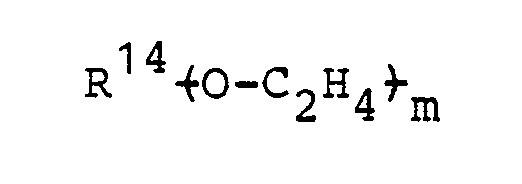
- R12,R13 gleich oder ungleich H, Alkyl mit 1 bis 12 C-Atomen oder gemeinsam die zur Ergänzung eines Pyrrolidin-, Piperidin-, Morpholin-, Thiamorpholin-, 1-Alkylpiperazin-oder Perhydroazepinrestes erforderlichen Gruppen,
- R 14 primäres Alkyl mit 1 bis 4 C-Atomen,
- Y OH; gegebenenfalls mit einer löslichmachenden Gruppe, insbesondere einer COOH- oder S03H-Gruppe substituierter Alkoxy- oder Alkylaminorest, speziell mit 2 bis 8 C-Atomen im Alkylrest, speziell








- R15 H, Alkyl mit 1 bis 4 C-Atomen,
- R 16 H, Methyl, Ethyl, Chlorethyl,
- m ganze Zahl, insbesondere 2 bis 10;
- R10 H; Alkyl, insbesondere C1-C4; gegebenenfalls mit einer Carboxyl-, Alkyloxycarbonyl oder gegebenenfalls einer substituierten Carbamoylgruppe substituierter Alkylrest, insbesondere: CH3, -C2H5, -CH2-COOH, -CH2-COO-R11 oder
- 3) aus mindestens 40 Mol-%, vorzugsweise 40 bis 65 Mol-%, einer Verbindung C, welche Acrylamid und/oder Methacrylamid ist.
- In einer bevorzugten Ausführungsform bedeuten:
- R 1 H; Alkyl mit 1 bis 12 C-Atomen, gegebenenfalls durch eine Phenyl-, Alkoxy- oder anionische Gruppen, insbesondere durch eine Sulfogruppe substituiert; Allyl; Cyanethyl;
- R 2, R 3, R 4, R5 : Wasserstoff
- R10 H; Methyl;
- Y OH;
- An Chlorid, Sulfat, Methansulfonat, Benzolsulfonat, p-Toluolsulfonat, Methanphosphonat, Monoalkylmethanphosphonat, Trifluoracetat.
- In einer bevorzugten Ausführungsform liegen, bezogen auf das gesamte Polymer, die polymerisierten Verbindungen A und B in folgenden molaren Verhältnissen vor: Verbindung A: 5 bis 30 %, vorzugsweise 10 bis 20 % Verbindung B: 10 bis 40 %, vorzugsweise 15 bis 30 %.
- In einer besonders bevorzugten Ausführungsform sind in dem Copolymerisat polymerisierte Einheiten eines Alkylacrylates und/oder Methacrylates in einer Menge von 5 bis 25 Mol-%, bezogen auf das Polymer, mit 2 bis 8 C-Atomen im Alkylrest enthalten. Bevorzugt sind Butylacrylat und Ethylacrylat.
- Die Copolymeren können zusätzlich weiter polymerisierte Einheiten aus Momomeren enthalten, die vorzugsweise nicht mehr als 20 Mol-% ausmachen. Für die Herstellung dieses nicht im einzelnen festgelegten Restes kommen beliebige ethylenisch ungesättigte Monomere in Frage. Bevorzugt werden jedoch:
- N-Vinylimidazole, N-Vinylpyrazole, N-Vinyllactame, insbesondere 1-Vinylimidazol, 1-Vinyl-2-methylimidazol, 1-Vinyl-2-isopropylimidazol, 1-Vinyl-3,5-dimethylpyrazol, N-Vinylpyrrolidon, N-Vinylcaprolactam, N-Vinyl-N-ethylformamid, N-Vinyl-N-ethylacetamid sowie N-Vinyl-N-alkylamide einfacher aliphatischer Monocarbonsäuren in einem molaren Anteil von nicht mehr als 15 Mol-%, vorzugsweise weniger als 10 Mol-%, bezogen auf das Gesamtmonomer, Hydroxyalkylacrylate oder -methacrylate im Anteil von nicht mehr als 15 Mol-%,
- - Acrylnitril oder Methacrylnitril im Anteil von nicht mehr als 5 Mol-%,
- - Monomere mit 8-Oxychinolingruppen im Ausmaß von nicht mehr als 5 Mol-%, insbesondere


- - N-(Perfluoralkyl)methylacrylamide oder -methacrylamide im Ausmaß von nicht mehr als 5 Mol-%,
- - die N-(3,6-Dithiaalkyl)amide folgender ungesättigter Carbonsäuren:
- Acrylsäure, Methacrylsäure, Itaconsäure, Crotonsäure in Anteilen von nicht mehr als 5 Mol-%,
- - 2-Vinylpyridin, 4-Vinylpyridin, 2-Methyl-5-vinylpyridin in Anteilen von nicht mehr als 5 Mol-%,
- - Vinylphosphonsäureester in Anteilen von nicht mehr als 10 Mol-%, bezogen auf Gesamtmonomer,
- - die Vinylester einfacher aliphatischer Monocarbonsäuren,
- - schließlich Dialkylester von Maleinsäure, Itaconsäure, Fumarsäure, Citraconsäure.
- Besonders bevorzugte Verbindungen der Formel A sind:
- Allylaminhydrochlorid, Allylammoniummethansulfonat, Allylammoniumtrifluoracetat, Allylammonium-benzolsulfonat, 3-Allylammoniopropansulfonat, 4-Allylammoniobutansulfonat, das Allylammoniumsalz der 2-Acrylamido-2-methylpropansulfonsäure, das Allylammoniumsalz der Methacryloyloxyethansulfonsäure, Allylammonium-methylphosphonat;
- N-Ethylallylammonium-ethylsulfat, Cyanethyl-ethylammoniumchlorid, N-Hydroxyethylallylammoniumchlorid, N-Allylmorpholiniumchlorid, Methallylammoniumchlorid, 2-Methylen-1,3-bis-alkylammoniumpropandichloride.
- Besonders bevorzugte Verbindungen B sind:
- Acrylsäure, Methacrylsäure, Itaconsäure, dimere Acrylsäure, Methacryloyloxy-ethansulfonsäure in Form eines Allylammonium oder eines Ammonium- oder Alkalisalzes, vorzugsweise in Form des Li-Salzes, 3-Acryloyloxypropansulfonsäure, bevorzugt als Li-Salz, 4-Acryloyloxybutansulfonsäure, bevorzugt als Li-Salz; N-Acryloyl-N-methyltaurin, N-Acryloyl-N-butyltaurin, bevorzugt in Form des Li-Salzes, schließlich 2-Acrylamido-2-methylpropansulfonsäure, bevorzugt als Allylammoniumsalz.
- Weiterhin wurde gefunden:
- 2) Ein Verfahren zur Herstellung der erfindungsgemäßen Polymeren, bei dem man in Gegenwart von Polymerisationsinitiatoren und gegebenenfalls in Anwesenheit von Lösungsmitteln Verbindungen der Formeln A, B und C unter Polymerisation aufeinander einwirken läßt.
- 3) Die Verwendung der erfindungsgemäßen Polymeren als Peptisationsmittel bei der Herstellung von Silberhalogenidemulslonen, wobei die Polymeren die üblicherweise verwendete Gelatine ganz oder teilweise ersetzen können. Hierbei wird ein Silbersalz und ein Halogenid in Gegenwart des erfindungsgemäßen Polymeren unter Bildung eines Silberhalogenids umgesetzt. Die Herstellung kann erfolgen durch Fällung eines Silberhalogenids durch Umsetzung eines wasserlöslichen Silbersalzes, vorzugsweise AgN03, und eines wasserlöslichen Halogenids. Hierbei werden die Emulsionen anschließend an die Fällung gegebenenfalls gewaschen, redispergiert und chemisch gereift. Die Herstellung kann aber auch erfolgen durch Umlösung unter Bildung schwerer löslicher Silberhalogenidkörner aus leichter löslichen Silberhalogenidkörnern in Gegenwart der erfindungsgemäßen Polymeren.
- 4) Ein lichtempfindliches fotografisches Material aus einem Schichtträger und wenigstens einer lichtempfindlichen Silberhalogenidemulsionsschicht sowie gegebenenfalls weiteren Schichten, gekennzeichnet durch den Gehalt an wenigstens einem erfindungsgemäßen Polymeren. Vorzugsweise ist dieses in einer Silberhalogenidemulsionsschicht enthalten.
- In den erfindungsgemäßen Polymeren sind wiederkehrende Einheiten der polymerisierten Verbindung A vorhanden, welche entweder in Salzform (Formel A1)) oder in der Aminform (Formel A2)) - in Abhängigkeit vom pH-Wert - vorliegen können:


- Hierbei kann der Substituent R3 gegebenenfalls in der Salzform (R 3= CR4R5NR1R2H) oder in der Aminform (R3= -CR4R5-NR1R2) auftreten.
- Die radikalische Polymerisation der Monomeren erfolgt nach grundsätzlich bekannten Verfahren in Gegenwart von Polymerisationsinitiatoren. In diesem Zusammenhang ist zu verweisen auf Ian M.G. Cowie "Chemie und Physik der Polymeren", Seite 52, Verlag Chemie, Weinheim 1976; weiterhin auf das Kapitel "Auslösung der Polymerisation" in Houben-Weyl, Methoden der Organischen Chemie, Band XIV/1, Seite 209 bis 297.
- Typische, für die Zwecke der Erfindung geeignete Inititatoren sind: Azoisobuyronitril, 2,2'-Azobis(2,4-dimethylvaleronitril), symmetrische Azo-bismercapto-Verbindungen gemäß der deutschen Offenlegungsschrift 25 18 622, Di-tert.-butylperoxid, tert.-Butylcumylper- oxid, Dicumylperoxid, 4,4'-Di-tert.-butylperoxyvalerian- säure-n-butylester, tert.-Butylperacetat, ter.-Butylperpivalat, tert.-Butylperbenzoat, tert.-Butylper- oxyisopropylcarbonat, tert.-Butylperoxy-2-ethylhexa- noat, Diisopropylperoxydicarbonat, Dipropionylperoxid, Dioctanoylperoxid, Dilauroylperoxid, Dibenzoylperoxid, Dicyclohexylperoxydicarbonat, Wasserstoffperoxid, Peressigsäure, Monoperphthalsäure, Permaleinsäure. Die Art des verwendeten Initiators ist im wesentlichen von den gewählten Polymerisationsbedingungen und der Natur der verwendeten Monomeren abhängig.
- Der optimale Initiator kann durch Vergleichsversuche leicht ermittelt werden. Die Konstitution der Phosphorverbindung hat auf die Auswahl des Initiators im allgemeinen keinen Einfluß.
- Die Polymerisation wird als Fällungspolymerisation, vorzugsweise in einem alle Monomeren lösenden unter Rückfluß stehenden Lösungsmittel, durchgeführt. Die Polymerisationstemperatur kann in gewissem Umfang variiert werden, sie liegt in den meisten Fällen im Bereich zwischen 80 und 120°C. Als Polymerisationsmedien eignen sich wasserarme oder wasserfreie Lösungsmittel und Gemische. Folgende Lösungsmittel sind bevorzugt: Methanol (in Abmischung mit höhersiedenden Lösungsmitteln), Ethanol, n-Propanol, Isopropanol, n-Butanol, Isobutanol, tert.-Butanol, Acetonitril, Propionitril, Ethylacetat, Butylacetat, 1,2-Dimethoxyethan, Dioxan, 2-Methoxyethanol, Dimethylsulfoxid, N-Methylpyrrolidon, Sulfolan, Essigsäure, Toluol, Chlorbenzol, o-Dichlorbenzol. Die schwach kettenübertragenden Eigenschaften einiger dieser Lösungsmittel wirken sich in vielen Fällen günstig aus, so daß die Bildung unlöslicher oder quellkörperhaltiger Polymerisate unterbunden wird.
- Das mittlere Molekulargewicht der erfindungsgemäßen Copolymerisate liegt im allgemeinen im Bereich von etwa 10 000 bis 200 000. Als Peptisationsmittel sind insbesondere Copolymerisate mit einem mittleren Molekulargewicht von 20 000 bis 50 000 geeignet.
- Bei der Herstellung der erfindungsgemäß als Peptisationsmittel für Silberhalogenid geeigneten Copolymeren können auch schwefelhaltige Verbindungen unter Einbau in das Polymergerüst zugesetzt werden.
- Bevorzugt sind hierbei cyclische Disulfide der Formel I

- W 2-wertiger Kohlenwasserstoffrest, insbesondere Alkylen, speziell mit 1 bis 9 C-Atomen oder Arylen, speziell Phenylen oder ein Kohlenwasserstoffrest mit wenigstens einer Alkylen-Arylen-Gruppierung, wobei die Alkylen-, Arylen- oder Alkylen/Arylen-Gruppe gegebenenfalls unterbrochen sein kann durch wenigstens ein Heteroatom, insbesondere -O-, -S-, -NRI-,
- RI Alkyl, insbesondere mit 1 bis 8 C-Atomen; Acyl; Alkoxycarbonyl, insbesondere mit 1 bis 4 C-Atomen; Aminocarbonyl; Sulfonyl,
sowie Bisthiole der Formel II
- RII ein zweiwertiger aliphatischer oder cycloaliphati- - scher Rest ist, der bevorzugt wenigstens 2 Thioethergruppen enthält.
- In einer ganz besonders bevorzugten Ausführungsform erfolgt die Herstellung der Polymeren in Gegenwart einer Phosphorverbindung der Formel III
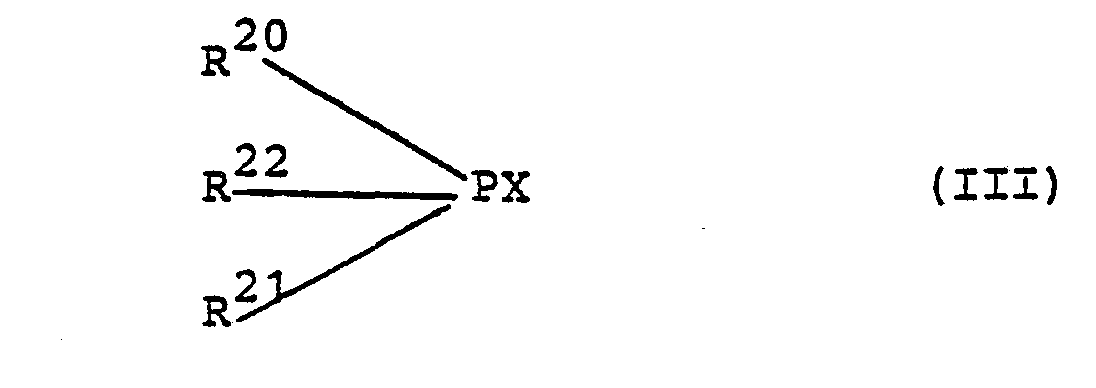
- R 20,R 21 gleich oder verschieden; H; gegebenenfalls substituiertes Alkyl, insbesondere mit 1 bis 12, vorzugsweise mit 1 bis 4 C-Atomen; gegebenenfalls substituiertes Aryl, insbesondere Phenyl; Hydroxygruppe; Alkoxy, insbesondere mit 1 bis 12 C-Atomen; Aralkyl, insbesondere Benzyl; eine Aralkoxygruppe, insbesondere eine Benzyl- oxygruppe; oder R 20 und R 21 gemeinsam eine Gruppe -O-R23-O-, worin R23 ein gegebenenfalls substituierter Alkylenrest mit nicht mehr als 6 C-Atomen ist; Dialkylaminogruppe, wobei Alkyl insbesondere 1-4 C-Atome umfaßt; Cl
- R 22 H; gegebenenfalls substituiertes Acyl, insbesondere von einer aliphatischen Carbonsäure mit 1 bis 20 C-Atomen oder von einer aromatischen Carbonsäure, speziell Acetyl, Pivaloyl, Butyryl, Benzoyl; Alkyl, insbesondere mit 1 bis 12 C-Atomen, Dialkylaminogruppe, wobei Alkyl insbesondere 1-4 C-Atome umfaßt; Cl
- X einsames Elektronenpaar oder ein Sauerstoffatom, wobei X ein Elektronenpaar ist, wenn keiner der Reste R20-R22 = H ist.
- In einer bevorzugten Ausführungsform liegt der Phosphor in der Oxidationsstufe + 3 vor.
- Besonders bevorzugte Phosphorverbindungen sind, gegebenenfalls in Form der Salze:
- Unterphosphorige Säure, phosphorige Säure, Phenylphosphorigsäure, Methylphosphorigsäure; die Alkylester, Aralkyl- oder Alkylenester der phosphorigen Säure, insbesondere in Form der Diester; die Alkylester der Phosphorigsäuren, z.B. der Phenylphosphorigsäure, schließlich die Phosphinoxide von sekundären Phosphinen. Die genannten Phosphorverbindungen können darüber hinaus auch in situ durch Solvolysereaktionen aus Vorstufen erzeugt werden, z.B. aus Chloriden, Esterchloriden, aus Phosphorigsäuretrialkylestern oder aus den Amiden der entsprechenden Säuren des Phosphors.
- Die Rolle, die die Phosphorverbindungen der Formel III im Ablauf der Polymerisation spielen ist im einzelnen nicht bekannt. Es kann vermutet werden, daß die Phosphorverbindungen durch Reaktion mit dem Primärradikal, welches aus dem Zerfall des Initiators resultiert, in das Reaktionsgeschehen einbezogen werden und die eigentlichen Polymerisationsauslöser darstellen.
- Außerdem wird durch die Gegenwart der Phosphorverbindungen gemäß Formel III oder ihrer Vorläufer, aus denen die eigentlich wirksamen Verbindungen III während der Polymerisation gebildet werden, die Wirkung von üblichen Polymerisationsreglern, z.B. von Isopropanol, nicht beeinträchtigt. Die Phosphorverbindung wird bei der Polymerisation in Mengenanteilen von 0,2 bis 5 Mol-%, bezogen auf den Monomeranteil des Ansatzes, zugesetzt oder aus dem Vorläufer gebildet.
- Typische Vorläufer für Phosphorverbindungen sind: Phenyldichlorphosphin, Diphenylchlorphosphin, Triethylphosphit, Tetraethylpyrophosphit, Hexamethylphosphorigsäuretriamid, Diethylchlorphosphit oder Ethylenchlorphosphit, weiter Acylphosphonsäuredialkylester, z..B. der Methacryloylphosphonsäurediethylester (s. Kabachnik, Rossijskaja Jzv.Akad.SSSR 1965, S. 597).
- Im folgenden wird das Verfahren zur Herstellung der erfindungsgemäßen Copolymeren anhand von Beispielen erläutert. Die Auswahl der Beispiele stellt keine Einschränkung dar.
- Zu einer Lösung von 0,2 ml tert.-Butylperoctoat in 90 ml tert.-Butanol und 10 ml Chlorbenzol tropft man bei Rückflußtemperatur über 60 Minuten in einer N2-Atmosphäre unter intensivem Rühren die Lösung von 42,6 g (0,6 Mol) Acrylamid, 12,8 g (0,1 Mol) Butylacrylat, 10,8 g (0,15 Mol) Acrylsäure, stabilisiert mit 0,1 % t-Butylhydrochinon, 14 g (0,15 Mol) Allylamin . HC1, 1,0 g Diethylphosphit in 400 ml t-Butanol und 40 ml Chlorbenzol.
- Anschließend gibt man 0,2 ml t-Butylperoctoat nach und hält weitere 5 Stunden unter Rückfluß. Man läßt erkalten, saugt ab, wäscht mit Isopropanol und Ethylacetat nach und trocknet bei 60°C im Vakuum.
- Ausbeute: 71 g (88 % der Theorie)
- Analyse: Cl berechnet: 6,63 % Cl gefunden: 6,0 %.
- Man verfährt wie in Beispiel 1, jedoch mit dem Unterschied, daß die Monomerlösung wie folgt zusammengesetzt ist:
- 39 g Acrylamid (0,55 Mol), 12,8 g Butylacrylat (0,1 Mol), 17,2 g Methacrylsäure (0,2 Mol, frisch über KupferII-acetat destilliert, 14,0 g Allylammoniumchlorid, 1,5 g Diethylphosphit, 400 ml tert.-Butanol, 40 ml Chlorbenzol.
- Ausbeute: 70 g (84 % der Theorie)
- Analyse: Cl berechnet: 6,32 %
- Cl gefunden: 5,5 %.
- Man verfährt wie in Beispiel 2, jedoch mit dem Unterschied, daß anstelle von Diethylphosphit folgende Phosphorverbindungen eingesetzt werden:

- Monomerzusammensetzung wie bei Copolymer 1; Herstellungsverfahren wie in Copolymer 1, jedoch mit dem Unterschied, daß als Initiatoren folgende Verbindungen.verwendet wurden:

- Man verfährt wie in Beispiel 1, jedoch mit dem Unterschied, daß die Monomerlösung wie folgt zusammengesetzt ist:
- 53,3 g (75 Mol-%) Acrylamid, 7,2 g (10 Mol-%) Acrylsäure, 14,0 g (15 Mol-%) C3H5NH2 . HCl, 2,8 g Diethylphosphit, 600 ml tert.-Butanol, 60 ml Chlorbenzol. Ausbeute: 75 g (100 % der Theorie)
- Cl berechnet: 7,17 %
- Cl gefunden: 7,05 %.
- Man.verfährt wie in Beispiel 1, jedoch mit dem Unterschied, daß die Monomerlösung wie folgt zusammengesetzt ist:
- 46,1 g Acrylamid (65 Mol-%), 15,8 g Itaconsäuredimethylester (10 Mol-%), 13,4 g Itaconsäure (10 Mol-%), 14,0 g C3H5NH2 . HC1 (15 Mol-%, 1,5 g Diethylphosphit, 500 g tert.-Butanol, 50 g Chlorbenzol.
- Ausbeute: 80 g (90 % der Theorie)
- Cl berechnet: 5,97 %
- Cl gefunden: 6,05 %.
- Man verfährt wie in Beispiel 1, jedoch mit dem Unterschied, daß die Monomerlösung wie folgt zusammengesetzt ist:
- 39 g Acrylamid (55 Mol-%), 12,8 g Butylacrylat (10 Mol-%), 12,9 g Methacrylsäure (15 Mol-%), 8,15 g N-Methansulfonylmethacrylamid (5 Mol-%), 14,0 g C3H5-NH2 . HC1 (15 Mol-%), 2,8 g Diethylphosphit, 400 ml tert.-Butanol, 40 ml Chlorbenzol.
- Ausbeute: 79 g (91 % der Theorie)
- Analyse: S berechnet: 1,84 %
- S gefunden: 1,5 %.
- Man.verfährt wie in Beispiel 1, jedoch mit dem Unterschied, daß die Monomerlösung wie folgt zusammengesetzt ist:
- 35,5 g Acrylamid (50 Mol-%), 25,6 g Butylacrylat (20 Mol-%), 31,1 g (2-Acrylamido-2-methylpropan- sulfonsäure (15 Mol-%), 8,5 g Allylamin (15 Mol-%), 1,5 g Diethylphosphit, 400 ml tert.-Butanol, 80 ml Chlorbenzol.
- Ausbeute: 81 g /80 % der Theorie)
- Analyse: S berechnet: 4,77 %
- S gefunden: 5,0 %.
- Man. verfährt wie in Beispiel 14, jedoch mit dem Unterschied, daß Monomerlösung und Vorlage wie folgt zusammengesetzt sind:
- Monomerlösung:
- 31,9 g (45 Mol-%) Acrylamid, 32,1 g (25 Mol-%) Butylacrylat, 31,1 g (15 Mol-%) 2-Acrylamido-2-methylpro- pansulfonsäure, 8,5 g (15 Mol-%) Allylamin, 400 ml Isopropanol, 250 ml Butylacetat, 2,8 g Diethylphosphit, Vorlage:
- 200 ml Isopropanol, 1 g Azobisisobutyronitril.
- Während der 5-stündigen Nachrührzeit werden stündlich je 0,2 g Azobisisobutyronitril nachgegeben.
- Ausbeute: 72 g (70 % der Theorie).
- Monomerlösung:
- 42,6 g (60 Mol-%) Acrylamid, 14,4 g (20 Mol-%) Acrylsäure, 42,4 g (20 Mol-%) N-Ethylallylammonium-ethylsulfat, 1,5 ml Diethylphosphit, 400 ml t-Butanol, 150 ml Chlorbenzol.
- Volage:
- 0,4 ml t-Butylperoctoat in 150 ml Chlorbenzol.
- Man tropft die Monomerlösung unter N2-Atmosphäre der bei Rückfluß gerührten Vorlage innerhalb 2 Stunden zu. Während der 4-stündigen Nachheizzeit gibt man insgesamt je 0,4 ml t-Butylperoctoat und 0,4 ml Diethylphosphit nach. Man saugt ab, sobald die Temperatur beim Abkühlen auf 35°C gefallen ist, wäscht mit Ethylacetat nach und trocknet im Vakuum.
- Ausbeute: 84 g (85 % der Theorie).
- Copolymer 17 und Copolymer 18
- Man verfährt wie in Beispiel 1, jedoch mit dem Unterschied, daß die Monomerlösungen wie folgt zusammengesetzt sind:
-

-

- Abweichend von Beispiel 1 wird als Initiator die Lösung von 0,8 g Azoisobutyronitril in 50 ml Chlorbenzol verwendet. Von dieser Lösung wird 1/3 vorgelegt, ein weiteres Drittel mit der Monomerlösung gleichzeitig und das letzte Drittel während der 5-stündigen Nachheizzeit zugetropft. Man erhält:
- Copolymer 17 89 g (93 % der Theorie).
- Copolymer 18 80 g (84 % der Theorie).
- Copolymer 17 ist in 10 %iger wäßriger Natronlauge ohne Amingeruch löslich, enthält also kein freies Allylamin; Copolymer 18 geht dagegen in 10 %iger wäßriger Natronlauge unter Freisetzung von Allylamin (1,4 Milliäquivalent Allylamin pro 1 g Polymer) in Lösung und ist für fotografische Zwecke unbrauchbar.
- Der Versuch zeigt die Überlegenheit der unter Verwendung von Phosphorverbindungen der Formel III hergestellten Copolymeren, in denen der Einbau der Allylammonium-Monomereinheiten vollständig erfolgt.
- Man verfährt wie in Beispiel 15, jedoch mit dem Unterschied, daß die Monomerlösung wie folgt zusammengesetzt ist:
- 42,6 g (60 Mol-%) Acrylamid, 11,3 g (20 Mol-%) Allylamin, 41,5 g (20 Mol-%) 2-Acrylamido-2-methylpropan- sulfonsäure.
- Ausbeute: quantitativ.
- Zu 1000 ml 40 %iger Ethylaminlösung und 500 ml Methanol tropft man unter Rückfluß 125 g 2-Chlormethyl-3-chlorpropen. Man hält noch 2 Stunden unter Rückfluß, dampft bis auf ein Volumen von 500 ml ein, stellt mit 80 g NaOH alkalisch und gibt zur Vervollständigung der Phasentrennung 300 ml gesättigte K2CO3-Lösung zu. Man trennt die ölphase ab, trocknet mit K2C03 und fraktioniert im Vakuum. Ausbeute: 100 g (70 % der Theorie) Kp14mb: 73-77°C
- b) Zur Herstellung des Hydrochlorids leitet man in eine auf 15° gekühlte Lösung von 14,2 g 1,3-Bisethylamino-2-methylenpropan in 100 ml t-Butanol HCl ein. Sobald die berechnete..Menge aufgenommen ist, fällt man mit 300 ml Ethylacetat, kühlt auf 0°C ab und saugt ab.
- Ausbeute: 22 g folgender Verbindung:

- c) Zur Copolymerisation nimmt man 22 g (0,1 Mol) des Hydrochlorids, 20 g (0,1 Mol) Li-4-sulfobutylacrylat und 57 g (0,8 Mol) Acrylamid in 500 ml 2-Methoxyethanol auf. Die Monomerlösung wird gleichzeitig mit einer Lösung von 1,4 g Diethylphosphit und 0,5 ml t-Butylperoctoat in 100 ml Chlorbenzol innerhalb 1 Stunde einer unter Stickstoff auf Rückfluß gehaltenen Vorlage von 200 ml t-Butanol zudosiert. Die Rückflußtemperatur steigt allmählich auf 85°C an, während das Polymer als weißer Brei ausfällt. Man hält 4 Stunden auf Rückfluß, kühlt ab, saugt das Polymer ab, wäscht mit Ethylacetat nach und trocknet im Vakuum.
- Ausbeute: 90 g Cl: gefunden < 0,2 %
- Bei Annahme einer zwitterionischen Struktur ist die Ausbeute quantitativ.
- Zur Lösung von 2.00 g Morpholin in 400 ml Isopropanol tropft man unter Rückfluß 60 g Allylbromid. Man hält noch 4 Stunden unter Rückfluß, engt am Rotationsverdampfer ein und nimmt mit 100 ml 20 %iger NaOH auf. Man vervollständigt die Phasentrennung mit 20 g Kaliumcarbonat, trennt ab und destilliert nach Trocknung über KOH.
- Ausbeute: 50 g
- Zur Überführung ins Hydrochlorid löst man in 200 ml t-Butanol und leitet HC1 bis zur Gewichtszunahme von 20 g ein. Man fällt das Hydrochlorid mit Chlorbenzol und nimmt es ohne Trocknung in t-Butanol auf.
- b) Zur Copolymerisation tropft man eine aus der Hälfte der unter a) hergestellten Allylmorpholiniumchloridlösung (= 0,2 Mol) sowie 14,4 g Acrylsäure und 42,6 g Acrylamid in 500 ml t-Butanol hergestellte Monomerlösung gleichzeitig mit der Lösung von 0,5 ml t-Butylperoctoat und 1,4 g Diethylphosphit einer unter Stickstoff auf Rückfluß gehaltenen Vorlage von 200 ml t-Butanol und 100 ml Chlorbenzol zu. Nach 5 Stunden Polymerisationsdauer kühlt man auf Raumtemperatur ab, saugt ab, wäscht mit Ethylacetat nach und trocknet im Vakuum.
- Ausbeute: 60 g (67 % d. Theorie).
- Bei der Herstellung von fotografischen Silberhalogenidemulsionen werden die erfindungsgemäßen Polymeren vorzugsweise als Schutzkolloid bei der Fällung eingesetzt. Die eingesetzte Menge hängt von dem gewünschten Effekt ab und kann mit wenigen einfachen Versuchen in üblicher Weise ermittelt werden.
- Die erfindungsgemäßen Verbindungen können in Mengen eingesetzt werden, die eine Steigerung der Empfindlichkeit bewirken. Das als Schutzkolloid bei der Fällung des Silberhalogenids verwendete Peptisationsmittel kann beispielsweise zu 10 bis 100 Gew.-% aus dem erfindungsgemäßen Polymer bestehen, wobei als restliches Peptisationsmittel Gelatine bevorzugt ist. Pro Mol zu fällendes Silberhalogenid werden von dem erfindungsgemäßen Polymeren im allgemeinen 5 bis 200 g, vorzugsweise 8 bis 40 g, verwendet. Im fertigen Material kann das Polymer in einer Menge von vorzugsweise 500 mg - 500 g pro Mol Silberhalogenid vorliegen.
- Die erfindungsgemäßen Polymeren können in Form ihrer wäßrigen Lösung eingesetzt werden. Die Konzentration in dieser Lösung ist nicht kritisch und kann innerhalb weiter Grenzen schwanken. Vorzugsweise sind die Polymeren ausreichend wasserlöslich, um die Herstellung einer ausreichend konzentrierten wäßrigen Lösung zu ermöglichen. Es genügt beispielsweise bereits, eine 1 bis 5 %ige wäßrige Lösung einzusetzen. Selbstverständlich kann bei besonders gut löslichen Substanzen die Lösung auch konzentrierter sein.
- Im allgemeinen werden die Lösungen mit einem pH von etwa 7 hergestellt. Es ist jedoch auch möglich, den pH-Wert der Lösung schwach sauer zu halten, z.B. bei pH-Werten zwischen 5 und 7; bei sogenannten Ammoniakemulsionen können die pH-Werte der Lösung auch zwischen 7 und 9 liegen."
- Die Herstellung der Emulsionen kann unter Verwendung von Peptisationsmitteln gemäß der Erfindung auf vielfache Weise erfolgen. Das Peptisationsmittel wird üblicherweise der Halogenidlösung zugegeben. Sofern carboxylatgruppenfreie Peptisationsmittel oder Silbersalzlösungen mit zusätzlichen Komplexbildnern verwendet werden, kann ein Teil des Peptisationsmittels auch der Silbersalzlösung zugegeben werden, ohne daß die Gefahr der Bildung von Schleierkeimen in Kauf genommen werden muß.
- Die Silberhalogenidemulsionen können sowohl durch einfachen Einlauf als auch durch Doppeleinlauf hergestellt werden. Geeignete Verfahren dieser Art sind beispielsweise in der britischen Patentschrift 1 027 146 und in der Veröffentlichung von E. Moisar und S. Wagner in "Berichte der Bunsengesellschaft für physikalische Chemie", 67 (1963), Seiten 356 bis 359, beschrieben. Ebenso ist es möglich, durch Umlösung feinkörniger Ausgangsemulsionen in Gegenwart von Silberkomplexbildnern und in Gegenwart der erfindungsgemäßen Peptisationsmittel grobkörnigere Emulsionen herzustellen. Derartige Verfahren sind beispielsweise bekannt aus den US-Patentschriften 2 146 938, 3 206 313, 3 317 322 und der deutschen Auslegeschrift 1 207 791.
- Erfindungsgemäß können grundsätzlich Emulsionen für die verschiedensten fotografischen Materialien hergestellt werden, wie z.B. negativ arbeitende Emulsionen mit hoher Oberflächenempfindlichkeit, negativ arbeitende Emulsionen mit hoher Innenempfindlichkeit, direkt positiv arbeitende Emulsionen, die oberflächlich verschleiert oder oberflächlich unverschleiert sein können, z.B. die aus den deutschen Offenlegungsschriften 2 224 837, 2 308 239 und 2 332 802 bekannten Emulsionen mit geschichtetem Kornaufbau, wie sie z.B. bekannt sind aus der Veröffentlichung von E. Moisar und S. Wagner in "Berichte der Bunsengesellschaft für physikalische Chemie", 67 (1963), 356-359, print-out Emulsionen, Umkehremulsionen, Emulsionen für Schwarzweiß- und für Colormaterialien sowie Emulsionen mit definierter Kornverteilung und Halogenidtopographie, insbesondere mit definiertem Halogenid, insbesondere Jodidgradienten. Auch Konvertemulsionen, die beispielsweise aus der US-PS 2 592 250 bekannt sind, können erfindungsgemäß hergestellt werden.
- Die erfindungsgemäßen Silberhalogenidemulsionen können aus reinen Silberhalogeniden sowie aus Gemischen verschiedener Silberhalogenide bestehen. Beispielsweise können die Silberhalogenidkörner der Emulsionen aus Silberchlorid, Silberbromid, Silberjodid, Silberchloridbromid, Silberchloridjodid, Silberbromidjodid und Silberchloridbromidjodid bestehen.
- Erfindungsgemäß können sowohl Emulsionen mit enger als auch mit relativ breiter Korngrößenverteilung ausgefällt werden. Insbesondere können erfindungsgemäß sowohl homodisperse als auch heterodisperse Silberhalogenidemulsionen hergestellt werden.
- Unter homodispersen Emulsionen versteht man dabei solche mit enger Korngrößenverteilung; vorzugsweise haben dabei wenigstens 95 % der Silberhalogenidkörner einen Durchmesser, der nicht mehr als 40 %, oder vorzugsweise nicht mehr als 30 %, vom mittleren Korndurchmesser abweicht. Die Silberhalogenidkörner können eine beliebige der bekannten Formen, z.B. kubisch, oktaedrisch oder auch eine tetradekaedrische Mischform aufweisen.
- Unter heterodispersen Emulsionen sind insbesondere solche zu verstehen, bei denen mindestens 10 %, vorzugsweise aber mindestens 20 %, der Silberhalogenidkörner einen Durchmesser haben, der zumindest um 40 % vom mittleren Korndurchmesser abweicht. Die Silberhalogenidkörner derartiger Emulsionen haben im allgemeinen eine irreguläre Form.
- Die Silberhalogenidemulsionen können zur Entfernung der wasserlöslichen Salze entweder nach Zugabe von Gelatine in bekannter Weise erstarrt, genudelt und gewässert werden oder auch mit einem Koagulierungsmittel koaguliert und anschließend gewaschen werden, wie es beispielsweise aus der deutschen Offenlegungsschrift 2 614 862 bekannt ist.
- Die fotografischen Materialien können mit üblichen Farbentwicklersubstanzen entwickelt werden, z.B. N,N-Dimethyl-p-phenylendiamin, 4-Amino-3-methyl-N-ethyl-N-methoxyethylanilin, 2-Amino-5-diethylaminotoluol, N-Butyl-N-ω -sulfobutyl-p-phenylendiamin, 2-Amino-5-(n-ethyl-N-ß-methansulfonamidethyl-amino)-toluol, N-Ethyl-N-ß-hydroxyethyl-p-phenylendiamin, N,N-Bis-(B-hydroxyethyl)-p-phenylendiamin, 2-Amino-5-(N-ethyl-N-ß-hydroxyethylamino)-toluol. Weitere brauchbare Farbentwickler sind beispielsweise beschrieben in J.Amer.Chem.Soc. 73, 3100 (1951).
- Das fotografische Material kann die üblichen Farbkuppler enthalten, die den Silberhalogenidschichten selbst einverleibt sein können. Beispielhaft für verwendbare Farbkuppler sei auf die Veröffentlichung "Farbkuppler" von W. Pelz in "Mitteilungen aus den Forschungslaboratorien der Agfa, Leverkusen/München", Band III (1961) und K. Venkataraman in "The Chemistry of Synthetic Dyes", Vol. 4, 341 bis 387 Academic Press _ 1971, hingewiesen.
- Weiterhin können 2-Äquivalentkuppler, beispielsweise die bekannten DIR-Kuppler, verwendet werden. Die Farbkuppler können den lichtempfindlichen Silberhalogenidemulsionen oder sonstigen Gießlösungen nach üblichen bekannten Methoden zugesetzt werden.
- Soweit es- sich bei den Farbkupplern um wasser- bzw. alkaliunlösliche Verbindungen handelt, können sie in bekannter Weise emulgiert werden. Gegebenenfalls verwendet man zur Einemulgierung derartiger hydrophober Verbindungen zusätzlich noch sogenannte Kupplerlösungsmittel oder Ölformer; verwiesen sei beispielsweise auf die US-Patentschriften 2 322 027, 2 533 514, 3 689 271, 3 764 336 und 3 765 897.
- Als Bindemittel für die fotografischen Schichten wird vorzugsweise Gelatine verwendet. Diese kann jedoch ganz oder teilweise durch andere natürliche oder synthetische Bindemittel ersetzt werden.
- Die Emulsionen können auch chemisch sensibilisiert werden, z.B. durch Zusatz schwefelhaltiger Verbindungen bei der chemischen Reifung, beispielsweise Allylisothiocyanat, Allylthioharnstoff und Natriumthiosulfat. Als chemische Sensibilisatoren können ferner auch Reduktionsmittel, z.B. die in den belgischen Patentschriften 493 464 oder 568 687,' beschriebenen Zinnverbindungen, ferner Polyamine wie Diethylentriamin oder Aminomethylsulfinsäurederivate, z.B. gemäß der belgischen Patentschrift 547 323, verwendet werden. Geeignet als chemische Sensibilisatoren sind auch Edelmetalle bzw. Edelmetallverbindungen wie Gold, Platin, Palladium, Iridium, Ruthenium oder Rhodium. Es ist ferner möglich, die Emulsionen mit Polyalkylenoxidderivaten zu sensibilisieren, z.B. mit Polyethylenoxid eines Molekulargewichtes zwischen 1 000 und 20 000, ferner mit Kondensationsprodukten. von Alkylenoxiden und Alkoholen, aliphatischen Carbonsäuren, aliphatischen Aminen, aliphatischen Diaminen und Amiden.
- Die Emulsionen können auch optisch sensibilisiert sein, z.B. mit den üblichen Polymethinfarbstoffen, wie Neutrocyaninen, basischen oder sauren Carbocyaninen, Rhodacyaninen, Hemicyaninen, Styrylfarbstoffen, Oxonolen und ähnlichen. Derartige Sensibilisatoren sind in dem Werk von F.M. Hamer "The Cyanine Dyes and related Compounds", (1964), beschrieben.
- Die Emulsionen können die üblichen Stabilisatoren enthalten, wie z.B. homöopolare oder salzartige Verbindungen des Quecksilbers mit aromatischen oder heterocyclischen Ringen wie Mercaptotriazole, einfache Quecksilbersalze, Sulfoniumquecksilberdoppelsalze und andere Quecksilberverbindungen. Als Stabilisatoren sind ferner geeignet Azaindene, vorzugsweise Tetra- oder Pentaazaindene, insbesondere solche, die mit Hydroxyl-oder Aminogruppen substituiert sind. Derartige Verbindungen sind z.B. in dem Artikel von Birr, Z.Wiss.Phot. 47 (1952), 2 bis 58, beschrieben. Weitere geeignete Stabilisatoren sind u.a. heterocyclische Mercaptoverbindungen, z.B. Phenylmercaptotetrazol, quaternäre Benzthiazolderivate und Benzotriazol.
- Die Schichten des fotografischen Materials können in der üblichen Weise gehärtet. sein, beispielsweise mit Formaldehyd oder halogensubstituierten Aldehyden, die eine Carboxylgruppe enthalten, wie Mucobromsäure, Diketonen, Methansulfonsäureester, Dialdehyden und dergleichen. Weiterhin können die fotografischen Schichten mit Härtern des Epoxidtyps, des heterocyclischen Ethylenimins oder des.Acryloyltyps gehärtet werden. Weiterhin ist es auch möglich, die Schichten gemäß dem Verfahren der deutschen Offenlegungsschrift 2 218 009 zu härten, um farbfotografische Materialien zu erzielen, die für eine Hochtemperaturverarbeitung geeignet sind. Es ist ferner möglich, die fotografischen Schichten bzw. die farbfotografischen Mehrschichtenmaterialien mit Härtern der Diazin-, Triazin- oder 1,2-Dihydrochinolin-Reihe zu härten. Beispiele derartiger Härter sind Alkyl- oder Arylsulfonylgruppenhaltige Diazinderivate, Derivate von hydrierten Diazinen oder Triazinen; wie z.B. 1,3,5-Hexahydrotriazin, Fluor-substituierte Diazinderivate, wie z.B. Fluorpyrimidin, Ester von 2-substituierten 1,2-Dihydrochinolin- oder 1,2-Dihydroisochinolin-N-carbonsäuren. Brauchbar sind weiterhin Vinylsulfonsäurehärter, Carbodiimid- oder Carbamoylhärter, wie z.B. in den deutschen Offenlegungsschriften 2 263 602, 2 225 230 und 1 808 685, der französischen Patentschrift 1 491 807, der deutschen Patentschrift 872 153 und der DDR-Patentschrift 7218, beschrieben. Weitere brauchbare Härter sind beispielsweise in der britischen Patentschrift 1 268 550 beschrieben.
- Herstellung einer Silberhalogenidemulsion vom Mikrat-Typ.
- Folgende Lösungen werden hergestellt:
-

-

- Die jeweils auf 25°C temperierte AgN03-Lösung wird zur auf 25°C temperierten Halogenidlösung gekippt. Man wartet 1 Minute. Es bildet sich eine glatte Dispersion.
- Man gibt 4 ml 5 %ige Inertgelatine und 4 ml 1 %ige Polystyrolsulfonsäure zu, stellt mit 10 %iger H2SO4 auf pH = 2, läßt 2 Minuten absitzen, dekantiert, wäscht 2 x mit je 100 ml Wasser nach. Man nimmt bei pH = 6 in 50 ml Wasser auf. Die Emulsion weist nach Ergebnissen einer Trübungsmessung die in folgender Tabelle 1 angegebenen Teilchengrößen auf:

- Herstellung von Silberbromid-jodid-emulsionen mit breiter Kornverteilung:
- Von den Verbindungen 1 bis 18 werden 5 %ige Lösungen hergestellt und auf pH = 6,5 eingestellt.
- Je 3,2 ml 5 %ige Polymerlösung werden je einer Lösung von 1,56 g NH4Br, 0,12 g KJ in Wasser auf 10 ml zugegeben. Man erwärmt auf 65°C und tropft 20 ml 0,72-molarer AgN03-Lösung wie folgt zu:

- Man rührt bei 65°C 10 Minuten nach, gibt 5 ml 1 %ige Gelatinelösung und 1 ml 1 %ige Polystyrolsulfosäurelösung zu, stellt mit 10 %iger H2S04 auf pH = 2,5, läßt das Flockulat absitzen, dekantiert, wäscht mit 20 ml Wasser, nimmt mit 25 ml Wasser auf und stellt auf pH = 6,5. Die Flockulate redispergieren einwandfrei und ohne Restagglomerat.
- Herstellung feinkörniger AgBr-Emulsionen durch inverse Fällung
- Jeweils 4 ml einer 5 %igen wäßrigen Lösung der Copolymeren 1, 2, 8, 14-16 werden mit 10 %iger Essigsäure auf pH = 2 gestellt. Man temperiert auf 50°C, gibt jeweils 20 ml 0,72 molare AgN03-Lösung zu und läßt innerhalb 5 Sekunden 10 ml 1,5-molare Ammoniumbromidlösung einlaufen (4 % Bromidüberschuß).
- Die mittlere Korngröße beträgt ca. 0,1µ.
- Nach Zugabe von 2 ml einer Bromid-Jodidlösung (0,31 g NH4Br und 0,024 g KJ in 10 ml) digeriert man jeweils 30 Minuten bei 60°C, wobei die mittlere Korngröße bis auf 0,4µ ansteigt. Man stellt mit NaOH auf pH 7,5, gibt 1 ml 10 %ige Gelatine und 2 ml 1 %ige Polystyrolsulfonsäure zu und flockt die Emulsion durch Einstellung des pH-Wertes mit 10 %iger H2S04 auf pH = 2 aus.
- Man wäscht das Flockulat 2 x mit Wasser von pH 2,0, gibt 10 ml 6 %iger Gelatine zu und redispergiert bei pH = 6,5. Die Flockulate redispergieren einwandfrei.
- Probe 4.1 (Vergleich)
- Zur Herstellung einer Silberbromidjodidgelatineemulsion werden folgende Lösungen bereitet:
-

-

- Man läßt absitzen und gießt die überstehende Lösung ab. Zur chemischen Reifung wird das Flockulat in 22 000 ml einer 10 %igen wäßrigen Gelatinelösung (pH 7,5) bei 40°C gelöst.
- Nach Auflösen des Flockulates wird auf pH 6,5 eingestellt und eine entsprechende Menge an üblichen Schwefelreifungsmitteln und Goldsalzen hinzugefügt und bei 55°C bis auf volle Empfindlichkeit gereift. Die Emulsion wird pro kg mit 100 ml einer 5 %igen wäßrigen Lösung von Saponin, 100 ml einer 10 %igen wäßrigen Lösung von Formaldehyd und 220 ml einer 1 %igen methanolischen Lösung von 4-Hydroxy-6-methyl-1,3,3a,7-Tetraazainden versetzt und auf einen Celluloseacetatschichtträger vergossen. Nach Belichtung in einem üblichen Sensitometer hinter einem Stufenkeil und Entwicklung (7 und 16 Minuten bei 20°C) in einem Entwickler folgender Zusammensetzung:

- Bei diesen Emulsionsansätzen wird wie in Probe 4.1 verfahren, wobei jedoch die gesamte Gelatinemenge der Lösung A der Reihe nach durch jeweils 32 g der in Tabelle 2 angegebenen Polymeren ersetzt wird. Nach dem Fällen des Silberhalogenids werden 100 g Gelatine als 10 %ige wäßrige Lösung zugefügt, worauf die Emulsion mit Polystyrolsulfonsäure und durch Herabsetzen des pH mit Schwefelsäure auf 3,0 geflockt wird. Die weitere Behandlung erfolgt wie in Probe 4.1 beschrieben.

- In Tabelle 2 bedeuten:
- E: die relative Empfindlichkeit, bezogen auf den Typ mit 100 Einheiten; eine Verdoppelung von E entspricht einer Verdoppelung der Empfindlichkeit;
- S: den Schleierwert;
- D=1: die Körnigkeit, gemessen nach Altmann, Applied Optics 3,35 (1964) hinter einer Lochblende von 29g Durchmesser (der dimensionslose Wert ist mit 10-2 zu multiplizieren).
- Aus den Ergebnissen geht hervor, daß die mit den erfindungsgemäßen Polymeren hergestellten Emulsionen, verglichen mit der Probe 4.1, eine günstigere Körnigkeit aufweisen; bei gegenüber dem Gelatinetyp geringerer Empfindlichkeit sind die Körnigkeitsvorteile besonders deutlich.
- Alle mit den erfindungsgemäßen Polymeren hergestellten Emulsionen zeigen bei Heizschranklagerung (72 Stunden bei 60°C und 40 % rel. Luftfeuchte) durchwegs geringeren Schleieranstieg (≤ 0,05) als der Gelatinetyp.
- Auch die Empfindlichkeitsänderungen Δ E liegen im Absolutbetrag niedriger.
Claims (10)
1) Copolymere, gekennzeichnet durch den Gehalt an einem Copolymerisat aus wenigstens folgenden Verbindungen:
1. aus einem Allylammoniumsalz der Formel A

worin bedeuten
R1, R 2 gleich oder verschieden; Wasserstoff; einen aliphatischen, araliphatischen oder cycloaliphatischen Rest, der gegebenenfalls substituiert sein kann oder R und R2 zusammen den Rest zur Ergänzung eines 5-7 _ gliedrigen Ringes
R 3, R 4, R 5 gleich oder verschieden; Wasserstoff; gegebenenfalls substituierter Alkylrest,
An Anion
und/oder
und/oder
R 3 den Rest (-CR5R4-VR1R2H)+ An
2. aus einem Monomeren B mit wenigstens einer anionischen Gruppe;
3. aus wenigstens 40 Mol-% einer Verbindung C, welche Acrylamid und/oder Methacrylamid ist.
2) Copolymer nach Anspruch 1, dadurch gekennzeichnet, daß, bezogen auf das gesamte Polymer, der Anteil des Allylammoniumsalzes und der Anteil der Verbindung B jeweils.5 bis 30 Mol-% ausmacht und daß die Verbindung B folgender Formel entspricht:

worin bedeuten
R10 Wasserstoff; Alkyl; gegebenenfalls mit einer Carboxyl-, Alkyloxycarbonyl- oder einer gegebenenfalls substituierten Carbamoylgruppe substituierter Alkylrest,
Y OH; gegebenenfalls mit einer löslichmachenden Gruppe substituierter Alkoxy oder Alkylaminorest.
3) Polymer nach Anspruch 1, dadurch gekennzeichnet, daß bedeuten:
R 1 Wasserstoff; Alkyl mit 1 bis 12 C-Atomen; Allyl, Cyanethyl;
R2 bis R5 Wasserstoff,
R 10 Wasserstoff; Methyl,
Y OH,
An: Chlorid, Sulfat, Methansulfonat, Benzolsulfonat, p-Toluolsulfonat, Methanphosphonat, Monoalkylmethanphosphonat, Trifluoracetat.
4) Polymer nach Anspruch 1, dadurch gekennzeichnet, daß zusätzlich polymerisierte Einheiten eines Alkylacrylates und/oder Methacrylates in einer Menge von 5 bis 25 Mol-% enthalten sind.
5) Verfahren zur Herstellung eines Copolymeren gemäß Anspruch 1, dadurch gekennzeichnet, daß man die Verbindungen A, B und C unter Polymerisation in Gegenwart der folgenden Verbindung aufeinander einwirken läßt:

worin bedeuten:
R20,R21 gleich oder verschieden; Wasserstoff; gegebenenfalls substituiertes Alkyl oder Aryl; OH; Alkoxy; Aralkyl; oder R 20 und R 21 gemeinsam eine Gruppe -O-R23-O-, worin R 23 ein gegebenenfalls substituierter Alkylenrest mit nicht mehr als 6 C-Atomen ist;
R 22 H; gegebenenfalls substituierter Acylrest; Alkyl,
X einsames Elektronenpaar oder ein Sauerstoffatom, wobei X ein Elektronenpaar ist, wenn keiner der Reste R20-R22=H
6) Verwendung der Copolymeren gemäß Anspruch 1 als Peptisationsmittel bei der Fällung einer fotografischen Silberhalogenidemulsion.
7) Fotografisches Material aus einem Träger und wenigstens einer lichtempfindlichen Silberhalogenidemulsionsschicht, gekennzeichnet durch den Gehalt an wenigstens einem Copolymeren gemäß Anspruch 1.
8) Fotografisches Material nach. Anspruch 7, dadurch gekennzeichnet, daß das Copolymer ein Molekulargewicht von 10 000 bis 200 000 hat und das Polymerisat in einer Menge von 500 mg bis 500 g pro Mol Silberhalogenid enthalten ist.
9) Polymer nach Anspruch 1, dadurch gekennzeichnet, daß zusätzlich schwefelhaltige Verbindungen in dem Copolymer enthalten sind.
10) Copolymer nach Anspruch 1, dadurch gekennzeichnet, daß darin bedeuten:
Acrylsäure und/oder Methacrylsäure und daß, bezogen auf das Polymer, 5 bis 25 Mol-% Butylacrylat in polymerisierter Form enthalten sind.
Verbindung A:
Allylaminhydrochlorid;
Allylaminhydrochlorid;
Verbindung B:
Acrylsäure und/oder Methacrylsäure und daß, bezogen auf das Polymer, 5 bis 25 Mol-% Butylacrylat in polymerisierter Form enthalten sind.
Applications Claiming Priority (2)
| Application Number | Priority Date | Filing Date | Title |
|---|---|---|---|
| DE19792946465 DE2946465A1 (de) | 1979-11-17 | 1979-11-17 | Neue polymere, verfahren zu ihrer herstellung und ihre verwendung zur herstellung fotografischer emulsionen sowie fotografische materialien |
| DE2946465 | 1979-11-17 |
Publications (1)
| Publication Number | Publication Date |
|---|---|
| EP0029168A1 true EP0029168A1 (de) | 1981-05-27 |
Family
ID=6086247
Family Applications (1)
| Application Number | Title | Priority Date | Filing Date |
|---|---|---|---|
| EP80106794A Withdrawn EP0029168A1 (de) | 1979-11-17 | 1980-11-05 | Neue Polymere, Verfahren zu ihrer Herstellung und ihre Verwendung zur Herstellung fotografischer Emulsionen sowie fotografische Materialien |
Country Status (5)
| Country | Link |
|---|---|
| US (1) | US4334013A (de) |
| EP (1) | EP0029168A1 (de) |
| JP (1) | JPS5682809A (de) |
| CA (1) | CA1165497A (de) |
| DE (1) | DE2946465A1 (de) |
Cited By (4)
| Publication number | Priority date | Publication date | Assignee | Title |
|---|---|---|---|---|
| EP0294104A1 (de) * | 1987-06-01 | 1988-12-07 | EASTMAN KODAK COMPANY (a New Jersey corporation) | Einen farbbildenden Cyankuppler enthaltendes photographisches Element |
| EP0264847A3 (en) * | 1986-10-17 | 1989-07-19 | Fuji Photo Film Co., Ltd. | Silver halide photographic material |
| WO2015173146A1 (de) * | 2014-05-13 | 2015-11-19 | Bayer Cropscience Ag | Verfahren zur herstellung von phosphorhaltigen cyanhydrinen |
| EP3392237A1 (de) | 2017-04-21 | 2018-10-24 | Evonik Degussa GmbH | Verfahren zur herstellung von acroleincyanhydrinen |
Families Citing this family (12)
| Publication number | Priority date | Publication date | Assignee | Title |
|---|---|---|---|---|
| US4477564A (en) * | 1982-04-01 | 1984-10-16 | Minnesota Mining And Manufacturing Company | Photographic silver halide emulsions, process for preparing the same and their use in color reversal films |
| DE3232062A1 (de) * | 1982-08-28 | 1984-03-01 | Agfa-Gevaert Ag, 5090 Leverkusen | Elektrostatographischer suspensionsentwickler und verfahren zu dessen herstellung |
| JPS62178949A (ja) * | 1986-02-03 | 1987-08-06 | Konishiroku Photo Ind Co Ltd | ハロゲン化銀写真感光材料 |
| JP2640236B2 (ja) * | 1987-12-11 | 1997-08-13 | 富士写真フイルム株式会社 | ハロゲン化銀カラー写真感光材料 |
| JPH0778601B2 (ja) * | 1988-09-29 | 1995-08-23 | 富士写真フイルム株式会社 | ハロゲン化銀写真感光材料の製造方法 |
| GB9203350D0 (en) * | 1992-02-17 | 1992-04-01 | Ici Plc | Polymeric film |
| US5698329A (en) * | 1992-02-17 | 1997-12-16 | Imperial Chemical Industries Plc | Polymeric film |
| US5350652A (en) * | 1993-09-24 | 1994-09-27 | Eastman Kodak Company | Method for optimizing tabular grain population of silver halide photographic emulsions |
| US5804363A (en) * | 1997-04-28 | 1998-09-08 | Eastman Kodak Company | High bromide (111) tabular grain emulsions containing a cationic peptizer having diallylammonium derived repeating units |
| US6541590B1 (en) * | 1999-12-14 | 2003-04-01 | Rohm And Haas Company | Polymeric binders from copolymers of unsaturated carboxylic acids and surfactant monomers |
| JP4013188B2 (ja) * | 2002-02-22 | 2007-11-28 | 星光Pmc株式会社 | (メタ)アクリルアミド系ポリマー、その製造方法、製紙用薬品、及びそれを含有する紙 |
| JP4492031B2 (ja) * | 2003-03-06 | 2010-06-30 | 星光Pmc株式会社 | 凝結剤及びサイズ助剤 |
Citations (2)
| Publication number | Priority date | Publication date | Assignee | Title |
|---|---|---|---|---|
| DE1814597A1 (de) * | 1967-12-15 | 1969-07-24 | Calgon Corp P O | Mischpolymere aus N-Fettalkyl-diallyl-ammoniumchlorid |
| DE2506405A1 (de) * | 1975-02-15 | 1976-08-26 | Agfa Gevaert Ag | Photographische silberhalogenidemulsion |
Family Cites Families (5)
| Publication number | Priority date | Publication date | Assignee | Title |
|---|---|---|---|---|
| US2949442A (en) * | 1955-05-04 | 1960-08-16 | Eastman Kodak Co | Process for preparing amphoteric copolymers and the resulting products |
| US3084132A (en) * | 1958-06-25 | 1963-04-02 | Du Pont | Process for forming a stable distribution of silver halide |
| NL290893A (de) * | 1962-03-29 | |||
| US3813257A (en) * | 1969-06-30 | 1974-05-28 | Goodyear Tire & Rubber | Composite structure and method of preparing the composite structure |
| US3860428A (en) * | 1973-12-20 | 1975-01-14 | Eastman Kodak Co | Silver halide peptizers containing bis(thioether) linkages |
-
1979
- 1979-11-17 DE DE19792946465 patent/DE2946465A1/de active Granted
-
1980
- 1980-11-05 EP EP80106794A patent/EP0029168A1/de not_active Withdrawn
- 1980-11-12 US US06/206,155 patent/US4334013A/en not_active Expired - Lifetime
- 1980-11-14 CA CA000364749A patent/CA1165497A/en not_active Expired
- 1980-11-14 JP JP15966380A patent/JPS5682809A/ja active Granted
Patent Citations (2)
| Publication number | Priority date | Publication date | Assignee | Title |
|---|---|---|---|---|
| DE1814597A1 (de) * | 1967-12-15 | 1969-07-24 | Calgon Corp P O | Mischpolymere aus N-Fettalkyl-diallyl-ammoniumchlorid |
| DE2506405A1 (de) * | 1975-02-15 | 1976-08-26 | Agfa Gevaert Ag | Photographische silberhalogenidemulsion |
Cited By (9)
| Publication number | Priority date | Publication date | Assignee | Title |
|---|---|---|---|---|
| EP0264847A3 (en) * | 1986-10-17 | 1989-07-19 | Fuji Photo Film Co., Ltd. | Silver halide photographic material |
| EP0294104A1 (de) * | 1987-06-01 | 1988-12-07 | EASTMAN KODAK COMPANY (a New Jersey corporation) | Einen farbbildenden Cyankuppler enthaltendes photographisches Element |
| WO2015173146A1 (de) * | 2014-05-13 | 2015-11-19 | Bayer Cropscience Ag | Verfahren zur herstellung von phosphorhaltigen cyanhydrinen |
| US9850263B2 (en) | 2014-05-13 | 2017-12-26 | Bayer Cropscience Aktiengesellschaft | Process for preparing phosphorus containing cyanohydrins |
| EA036169B1 (ru) * | 2014-05-13 | 2020-10-09 | Басф Се | Способ получения фосфорсодержащих циангидринов |
| US10961265B2 (en) | 2014-05-13 | 2021-03-30 | Basf Se | Process for preparing phosphorus containing cyanohydrins |
| CN113264958A (zh) * | 2014-05-13 | 2021-08-17 | 拜耳作物科学股份公司 | 制备含磷羟腈的方法 |
| EP3392237A1 (de) | 2017-04-21 | 2018-10-24 | Evonik Degussa GmbH | Verfahren zur herstellung von acroleincyanhydrinen |
| US10214484B2 (en) | 2017-04-21 | 2019-02-26 | Evonik Degussa Gmbh | Method for preparing acrolein cyanohydrins |
Also Published As
| Publication number | Publication date |
|---|---|
| JPS5682809A (en) | 1981-07-06 |
| DE2946465A1 (de) | 1981-06-11 |
| CA1165497A (en) | 1984-04-10 |
| US4334013A (en) | 1982-06-08 |
| DE2946465C2 (de) | 1989-07-06 |
| JPS6322291B2 (de) | 1988-05-11 |
Similar Documents
| Publication | Publication Date | Title |
|---|---|---|
| DE2946465C2 (de) | ||
| DE3205871C2 (de) | ||
| EP0213569A2 (de) | Fotografisches Aufzeichnungsmaterial mit einem UV-Absorber und neue UV-Absorber | |
| DE2952587A1 (de) | Photographisches, lichtempfindliches silberhalogenidmaterial | |
| DE3644159C2 (de) | Verfahren zur Herstellung einer lichtempfindlichen Silberjodidbromidemulsion | |
| DE68918267T2 (de) | Verfahren zur Herstellung von lichtempfindlichen Silberhalogenid Emulsionen. | |
| DE3736410A1 (de) | Farbfotografisches silberhalogenidmaterial | |
| DE1547744A1 (de) | Photographisches Material | |
| EP0464409A1 (de) | Farbfotografisches Aufzeichnungsmaterial | |
| EP0193826B1 (de) | Farbfotografisches Aufzeichnungsmaterial mit einer Silberhalogenidemulsion und Verfahren zu deren Herstellung | |
| EP0537545B1 (de) | Fotografisches Silberhalogenidmaterial | |
| EP0585672A2 (de) | Fotografisches Aufzeichnungsmaterial | |
| DE3536608C2 (de) | Polymere Kuppler und lichtempfindliches fotografisches Silberhalogenidaufzeichnungsmaterial mit derartigen Kupplern | |
| EP0317885B1 (de) | Gradationsvariables SW-Papier | |
| EP0627656B1 (de) | Fotografisches Aufzeichnungsmaterial | |
| DE69318438T2 (de) | Photographisches Silberhalogenidröntgenmaterial mit passenden Bildton und Oberflächenglanz | |
| DE1547678A1 (de) | Verwendung von hydrophilen Polymeren bei der Herstellung photographischer Silberhalogenidemulsionen | |
| DE3340571A1 (de) | Photographisches lichtempfindliches silberhalogenidmaterial enthaltend silberhalogenidkoerner und verfahren zur herstellung der silberhalogenidkoerner | |
| DE3803664A1 (de) | Farbfotografisches aufzeichnungsmaterial zur herstellung farbiger aufsichtsbilder | |
| EP0315833A2 (de) | Farbfotografisches Material | |
| EP0464435B1 (de) | Farbfotografisches Aufzeichnungsmaterial | |
| EP0616256B1 (de) | Farbfotografisches Aufzeichnungsmaterial | |
| DE2541754C2 (de) | Photographische Silberhalogenidemulsion | |
| DE2015525A1 (de) | Photographische Silberhalogenidemulsion | |
| DE1547744C (de) | Photographisches Aufzeichnungsma tenal |
Legal Events
| Date | Code | Title | Description |
|---|---|---|---|
| PUAI | Public reference made under article 153(3) epc to a published international application that has entered the european phase |
Free format text: ORIGINAL CODE: 0009012 |
|
| 17P | Request for examination filed |
Effective date: 19801105 |
|
| AK | Designated contracting states |
Designated state(s): BE CH DE FR GB |
|
| STAA | Information on the status of an ep patent application or granted ep patent |
Free format text: STATUS: THE APPLICATION HAS BEEN WITHDRAWN |
|
| 18W | Application withdrawn |
Withdrawal date: 19840728 |
|
| RIN1 | Information on inventor provided before grant (corrected) |
Inventor name: SOMMER, HELMUT, DR. Inventor name: BERGTHALLER, PETER, DR. |