EP0017699B1 - Derivate des 2-Hydroxy-naphthalins und Diazotypiematerial, das diese als Kupplungskomponente enthält - Google Patents
Derivate des 2-Hydroxy-naphthalins und Diazotypiematerial, das diese als Kupplungskomponente enthält Download PDFInfo
- Publication number
- EP0017699B1 EP0017699B1 EP80100287A EP80100287A EP0017699B1 EP 0017699 B1 EP0017699 B1 EP 0017699B1 EP 80100287 A EP80100287 A EP 80100287A EP 80100287 A EP80100287 A EP 80100287A EP 0017699 B1 EP0017699 B1 EP 0017699B1
- Authority
- EP
- European Patent Office
- Prior art keywords
- substituted
- hydroxynaphthalene
- diazo
- halogen
- carbon atoms
- Prior art date
- Legal status (The legal status is an assumption and is not a legal conclusion. Google has not performed a legal analysis and makes no representation as to the accuracy of the status listed.)
- Expired
Links
Images
Classifications
-
- C—CHEMISTRY; METALLURGY
- C07—ORGANIC CHEMISTRY
- C07D—HETEROCYCLIC COMPOUNDS
- C07D295/00—Heterocyclic compounds containing polymethylene-imine rings with at least five ring members, 3-azabicyclo [3.2.2] nonane, piperazine, morpholine or thiomorpholine rings, having only hydrogen atoms directly attached to the ring carbon atoms
- C07D295/22—Heterocyclic compounds containing polymethylene-imine rings with at least five ring members, 3-azabicyclo [3.2.2] nonane, piperazine, morpholine or thiomorpholine rings, having only hydrogen atoms directly attached to the ring carbon atoms with hetero atoms directly attached to ring nitrogen atoms
- C07D295/26—Sulfur atoms
-
- G—PHYSICS
- G03—PHOTOGRAPHY; CINEMATOGRAPHY; ANALOGOUS TECHNIQUES USING WAVES OTHER THAN OPTICAL WAVES; ELECTROGRAPHY; HOLOGRAPHY
- G03C—PHOTOSENSITIVE MATERIALS FOR PHOTOGRAPHIC PURPOSES; PHOTOGRAPHIC PROCESSES, e.g. CINE, X-RAY, COLOUR, STEREO-PHOTOGRAPHIC PROCESSES; AUXILIARY PROCESSES IN PHOTOGRAPHY
- G03C1/00—Photosensitive materials
- G03C1/52—Compositions containing diazo compounds as photosensitive substances
- G03C1/58—Coupling substances therefor
Definitions
- the invention relates to derivatives of 2-hydroxynaphthalene, their preparation and their use as coupling components in diazotype materials.
- a disadvantage of 2,3-dihydroxynaphthalene is its high coupling activity, which leads to undesired pre-coupling in unexposed diazotype materials and thus to a short shelf life and shelf life. It is also disadvantageous that from a template with different optical densities, a so-called halftone template, the diazocopy to be obtained develops to different colored density values.
- the salts of 2,3-dihydroxynaphthalene-6-sulfonic acid, 2-hydroxynaphthalene-3,6-disulfonic acid and 2-hydroxynaphthalene-3,7-disulfonic acid, of which the sodium salts have become particularly important usually too slow with the p-phenylenediamine type diazo compounds common in the diazo type.
- This disadvantage is particularly serious when a diazotype material containing the slow-coupling components is to be developed at normal temperature with dry ammonia gas under pressure. With the pressure gas development favored because of its environmental friendliness, such diazo materials only develop into very fluffy, greenish gray shades.
- Diazomicrofilm copies are subject to particularly high demands on the lightfastness of diazotype azo dyes.
- such copies are exposed to a particularly strong radiation exposure - visible and ultraviolet light, heat radiation - due to the light sources built into these devices. It often happens that diazomicrofilm copies, which are exposed for a long time to the emission of the incandescent lamps built into readers, fade so much that their stored information is difficult to read.
- diazotype materials primarily for making negative copies, with water-insoluble diazoimino compounds in which the photosensitive layer is made alkaline and in which 2,3-dihydroxynaphthalene-6-sulfanilide is used as a blue coupler (US Pat. No. 4055425). If this method is used to produce positive copies, it proves to be cumbersome because of the additional adjustment of the layer to an acidic pH range. In addition, this material does not couple sufficiently quickly with conventional and especially with pressure gas development.
- Derivatives of 2-hydroxynaphthalene in which R 2 and R 4 are identical or different and cycloalkyl having up to 7 carbon atoms, aralkyl having up to 10 carbon atoms or by alkyl, alkoxyl, haloalkyl or dialkylamino groups having up to 4 are particularly suitable Represent carbon atoms or aryl substituted by halogen with up to 10 carbon atoms, or R 1 and R z or R 3 and R 4 together with the nitrogen atom to which they are attached mean pyrrolidine, piperidine, piperazine, morpholine, thiomorpholine or hexamethyleneimine.
- 2-hydroxynaphthalene derivatives in which X is a hydroxyl group are particularly suitable. Because of their increased coupling rate, compounds of this type are particularly suitable in combination with slower coupling diazo compounds, as are usually used in two-component diazo materials.
- R 1 and R 3 are hydrogen and R 2 and R 4 are the same or different and represent at least one lower alkyl, lower alkoxyl, haloalkyl or dialkylamino group or phenyl substituted by halogen, preferably by at least one methyl or trifluoromethyl group or by Chlorine substituted phenyl.
- the new compounds are particularly advantageously used in the diazo type where sensitizing formulations based on solvents are used.
- the salt formation on the basic residue can be carried out in a known manner with any acid which forms stable amine salts.
- the hydrochlorides are preferred.
- the zinc chloride complex salts are preferred as complex heavy metal amine salts.
- the fourth organic radical is preferably a lower alkyl group.
- the basic radical can optionally also be an alkyl-substituted heterocyclic radical.
- Basic heterocycles with 5-8 ring members, such as pyrrolidine, piperidine, piperazine, morpholine, thiomorpholine or hexamethyleneimine, are preferred.
- Examples of the derivatives of 2-hydroxynaphthalene according to the invention, which are preferably used as coupling components in diazotype materials, can be found together with their melting or decomposition temperatures in the attached formula collection.
- 2,3-Dihydroxynaphthalene-6-sulfonic acid (Na salt), technically known as dinole salt, is converted to 2,3-di-benzenesulfonyloxynaphthalene with benzene sulfochloride according to Schotten-Baumann at 60-70 ° C and a pH of 7-8 -6-sulfonic acid (Na salt) implemented. After isolation and drying, this is converted into the corresponding sulfochloride with excess phosphorus oxychloride.
- the reaction mixture is stirred into ice water and the 2,3-dibenzenesulfonyloxynaphthalene-6-sulfochloride is isolated as a colorless crystalline substance (mp: 151-152 ° C).
- the sulfochloride with the amine bases substituted by the radicals R 1 and R 2 in toluene at 100-115 ° C., the corresponding 2,3-di-benzenesulfonyloxynaphthalene-6-sulfonamides are obtained, which are initially oily, but then by treatment with dilute hydrochloric acid solidify very quickly to colorless crystalline compounds.
- the Ab The benzenesulfonyl protective group is subsequently cleaved by briefly heating in an aqueous alkaline solution at 80-90 ° C (steam bath temperature). Acidification of the alkaline solution precipitates the 2,3-dihydroxynaphthalene-6-sulfonamides, which are initially oily, but become solid after a short time by seeding or rubbing against the inside of the vessel. (Yield: 70-80% of theory, based on dinole salt).
- the 2-hydroxynaphthalene-3,6-and 3,7-disulfonamides are prepared in an analogous manner, only 2-hydroxynaphthalene-3,6-bwz is used in the synthesis of these compounds. 3,7-disulfonic acid (Na salt) used as the starting material.
- the 2-benzenesulfonyloxynaphthalene-3,6-disulfochloride obtained as an intermediate in this synthetic route melts at 188-190 ° C, the isomeric 2-benzenesulfonyloxynaphthalene-3,7-disulfochloride at 177-181 ° C.
- any conventional base is suitable as a support for the diazo type layer, for example coated or uncoated, opaque, transparent or colored papers, textiles or plastic films.
- plastic films are those made from cellulose esters, such as cellulose 2 1/2 or triacetate, from polypropylene, from polyester, such as polyethylene terephthalate, or from vinyl polymers, such as polyvinyl acetate or polystyrene.
- the diazo compounds used with the coupling components according to the invention to produce blue shades are known. They are predominantly derivatives of unilaterally diazotized p-phenylenediamine with at least one substituent, for example optionally substituted alkyl, cycloalkyl, aralkyl or aryl, on the amine group. Preferred are those diazo compounds of the unilaterally diazotized p-phenylenediamine type which are substituted in the 2- and 5-positions relative to the diazonium group by an alkoxy radical and in which the substituents on the amino nitrogen atom to which they are attached form a heterocyclic ring system, for example a morpholine ring, are linked.
- the derivatives of 2-hydroxynaphthalene according to the invention couple with the diazo compounds known in the diazo type to form strong blue azo dyes.
- the new ones are characterized in part by considerably better light fastness.
- the best results are achieved when the molar ratio of diazo compound and coupling component is between (1-1.2): 1, preferably 1.1: 1.
- Such a ratio is surprising in that an excess of coupling component is usually used. However, if these usual ratios are used, less good light fastness is achieved.
- fastness to fastness as a function of the diazo component ratio has not hitherto been known.
- the advantage of the increased coupling speed is of the greatest importance from an application point of view if the development of diazotype materials is to be carried out at low temperatures with dry ammonia gas under pressure or with moist ammonia gas in conventional duplicating devices.
- the shelf life of the unexposed diazo material is not negatively influenced by the increased coupling speed.
- the derivatives of 2-hydroxynaphthalene according to the invention can be used both alone and in a mixture with one another as coupling components in diazotype materials. To achieve other desirable shades, for example black, they can also be used in a mixture with differently colored coupling components.
- the present invention is also directed to a diazo material with at least one diazo compound in the light-sensitive layer, which contains at least one 2-hydroxynaphthalene of the general formula as coupling component.
- the coupling components according to the invention which are preferably used for two-component diazotype materials, are applied together with the diazo component in a known manner from an aqueous, aqueous alcoholic or purely organic solution to the suitable carrier.
- the diazo components are preferably applied to the layer carrier from an organic medium which contains a film-forming binder in the form of a lacquer solution.
- concentration of the dye-forming components in the binder can vary between 15 and 30 parts by weight / 100 parts by weight of binder.
- suitable binders are a wide variety of polymeric substances, e.g. B.
- cellulose ethers such as ethyl cellulose, and cellulose esters, such as cellulose 2 1/2 acetate, triacetate, acetopropionate, acetobutyrate, butyrate
- vinyl polymers such as polyvinyl acetate, polyvinylidene chloride, vinyl chloride / vinyl acetate copolymers, poly (methyl methacrylate) copolymers of alkyl acrylates, and acrylic acid and acrylic acid further polymers, e.g. B. polyphenylene oxide, polyolefins, such as polyethylene or polypropylene and ethylene glycol / isophthalic acid / terephthalic acid terpolymers
- the light-sensitive layer can additionally contain acidic stabilizers, such as hydrochloric acid, boric acid, citric acid, tartaric acid, formic acid, and 5-sulfosalicylic acid.
- acidic stabilizers such as hydrochloric acid, boric acid, citric acid, tartaric acid, formic acid, and 5-sulfosalicylic acid.
- the auxiliaries customary in the diazo type can also be contained in the light-sensitive layer, e.g. B.
- inorganic salts such as zinc chloride or ammonium sulfate to increase contrast, urea, dimethyl urea, ethyl glycol, ethyl glycol monomethyl ether, glycerol, glycerol di- and triacetate as coupling accelerators, thiourea and thiourea derivatives as anti-yellowing agents and dyes in small concentrations to discolour the diazo-coated areas.
- the basecoat used to make the diazo materials in Examples 1-5 and 7-8 contains 7.5 percent by weight cellulose acetopropionate dissolved in a mixed solvent of acetone, methanol, n-butanol, and glycol monomethyl ether.
- a commercial reader (Saul, LG 16F4) was used to test and assess the light-fastness of the diazotype dyes of Examples 1, 7 and 8 resulting from the full-tone development, which was equipped with a halogen incandescent lamp of 15 V / 150 W, a cooling unit and a lens for 24x magnification is equipped.
- Example 6 The exposure and development of the diazo material of Example 6 is carried out in a commercially available blueprint device.
- Example 5 The development of the diazo films of Example 5 is carried out in a commercially available film punch card duplicator with dry ammonia gas under pressure.
- the diazo films developed into full tone are then exposed to diffuse daylight for 12 hours.
- a strip of 0.5 cm ⁇ 5 cm in area is cut off from each of the solid tone samples treated in this way and this is marked on the side bearing the dye by a circular measuring area of approximately 0.3 cm 2 .
- the optical visual density (D vis. ) In the green spectral range (Kodak, Wratten filter No. 93) is determined in each measurement area.
- the marked film strips developed into full tone are then simultaneously exposed to the spectral emission of the light source of a commercially available reading device (Saul, LG 16F4). After every 4 hours of exposure time, the optical visual density (D vis., END ) is determined again in the measuring areas of the full tone pattern and compared with the initial density (D vis., ANF ).
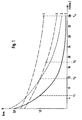
- Fig. 1 the measured optical densities (ordinate) and the half-lives ( ⁇ ) of the full tone pattern 1 -4 are shown graphically as a function of the irradiation time (t) of the reader used.
- a diazo film pattern is produced from each solution as described in Example 1. A strip of each diazo film pattern is then developed into a full tone. Another strip of each diazo film pattern is fully exposed and then also developed. From the developed film samples thus obtained, the optical densities in the visual (D vis. ) And ultraviolet (D uv ) spectral range are determined. The measured density values are summarized in Table 2.
- Patterns 5 and 7 develop into greenish blue hues, patterns 6, 9 and 10 to neutral blue hues and pattern 8 to a reddish blue hue.
- the measured density values show that the UV densities of the image background of the film samples 8, 9 and 10 are significantly lower than those of the comparison samples 5 and 7.
- the blue couplers according to the invention used for the samples 8, 9 and 10 are therefore used as actuating components Production of intermediate original materials more suitable than that of samples 5, 6 and 7.
- Example 1 As described in Example 1, a diazofilm pattern is produced from each solution according to the solutions used, numbered consecutively from 11-13 and a strip of each film pattern of approx. 5 cm x 6 cm area was developed once in the developer part of a commercially available sheet film duplicating device.
- the UV density (D UV, ANF ) of the full-tone pattern obtained is measured.
- the portion of the diazo compound that was not coupled to the azo dye is photolytically destroyed by the measuring light and the UV density is thus reduced.
- a polyethylene terephthalate film provided with an adhesive layer is coated on one side on the substrate surface with a solution of the following composition:
- the sensitized film After drying, the sensitized film is exposed under a transparent silver image template and developed in a commercially available sheet film duplicator (Kalle, Ozafiche). A high-contrast film copy of the original is obtained with reddish blue lines on a clear, transparent background.
- the unexposed diazo film material has a good shelf life.
- a diazo film pattern with the consecutive numbering 14-15 is produced from each solution, as described in Example 1. Then each of these two film samples is cut off 2 small sections of approx. 3 cm x 5 cm area. The sections are designated 14a and 14b or 15a and 15b. 14a and 15a are developed with moist ammonia gas at approx. 60-70 ° C, 14b and 15b with dry ammonia gas at approx. 20-25 ° C under pressure. The optical visual densities and hues achieved under the different development conditions are summarized in Table 4.
- the film pattern 15 develops to significantly different optical visual densities and colors under different development conditions.
- the film pattern 14 with the compounds according to the invention shows these differences to a significantly lesser extent.
- a polyethylene terephthalate film provided on both sides with an adhesive layer is coated on one side with a solution of
- the sensitized film thus produced is exposed and wrapped under a transparent silver image template.
- a very high-contrast, two-color copy of the original is obtained, with a blue azo dye image on one side and a yellow image background on the other side of the film.
- a greenish black color image on a yellow background can be seen through a film projector or in a microfilm reader.
- the legibility of the film copy is very good.
- the equivalent amount of the known blue coupler 2-hydroxy-3-naphthoic acid N (2-methylphenyl) amide is used in the light-sensitive layer, a two-color film copy is also obtained after the imagewise exposure. When viewed in a film projector or in a microfilm reader, one sees a greenish blue color image on a yellow background, the contrast and legibility of which, however, is lower than when using the blue coupler according to the invention.
- the film copy with the blue coupler according to the invention bleaches considerably less after a 12-hour standstill and is therefore also much easier to read than the comparison copy.
- a film sample which contains the blue coupler according to the invention
- a film sample which contains the blue coupler used for comparison purposes
- a section of these two full tone patterns is then simultaneously exposed to the spectral emission of the light sources in a microfilm reader for 12 hours.
- the following table 5 summarizes the optical density values at the beginning and at the end of the irradiation time.
- a polyethylene terephthalate film provided with an adhesive layer is coated on one side on the substrate surface with a solution of the following composition:
- the coated film After drying, the coated film is exposed and developed under a transparent silver image template. A very high-contrast film copy of the original with black lines on a clear, transparent background is obtained. The film copy shows excellent light stability in commercially available microfilm readers.
- a film sample which contains the blue coupler according to the invention according to formula 11 and a film sample (sample 20) which contains the blue coupler for comparison purposes are developed to a full tone. Sections of these two full tone patterns are then irradiated simultaneously in a reader for 12 hours.
- the following table 6 summarizes the optical density values of the full tone patterns 19 and 20 at the beginning and at the end of the irradiation time.
- the solid tone pattern 19 still has 80% of its original optical density after 12 hours in the reader, but the solid tone pattern 20 after the same time only 18%.
- the full-tone pattern 19 is therefore more stable to light by a factor of 4.5 than the comparison sample 20 after a standing time of 12 hours in the reader.
Landscapes
- Chemical & Material Sciences (AREA)
- Organic Chemistry (AREA)
- Engineering & Computer Science (AREA)
- Materials Engineering (AREA)
- Physics & Mathematics (AREA)
- General Physics & Mathematics (AREA)
- Non-Silver Salt Photosensitive Materials And Non-Silver Salt Photography (AREA)
- Organic Low-Molecular-Weight Compounds And Preparation Thereof (AREA)
- Compositions Of Macromolecular Compounds (AREA)
- Pharmaceuticals Containing Other Organic And Inorganic Compounds (AREA)
- Noodles (AREA)
- Cereal-Derived Products (AREA)
- Detergent Compositions (AREA)
Priority Applications (1)
| Application Number | Priority Date | Filing Date | Title |
|---|---|---|---|
| AT80100287T ATE1191T1 (de) | 1979-01-29 | 1980-01-21 | Derivate des 2-hydroxy-naphthalins und diazotypiematerial, das diese als kupplungskomponente enthaelt. |
Applications Claiming Priority (2)
| Application Number | Priority Date | Filing Date | Title |
|---|---|---|---|
| DE19792903342 DE2903342A1 (de) | 1979-01-29 | 1979-01-29 | Derivate des 2-hydroxy-naphthalins |
| DE2903342 | 1979-01-29 |
Publications (2)
| Publication Number | Publication Date |
|---|---|
| EP0017699A1 EP0017699A1 (de) | 1980-10-29 |
| EP0017699B1 true EP0017699B1 (de) | 1982-06-16 |
Family
ID=6061649
Family Applications (1)
| Application Number | Title | Priority Date | Filing Date |
|---|---|---|---|
| EP80100287A Expired EP0017699B1 (de) | 1979-01-29 | 1980-01-21 | Derivate des 2-Hydroxy-naphthalins und Diazotypiematerial, das diese als Kupplungskomponente enthält |
Country Status (12)
| Country | Link |
|---|---|
| US (1) | US4492749A (enExample) |
| EP (1) | EP0017699B1 (enExample) |
| JP (1) | JPS55102556A (enExample) |
| AT (1) | ATE1191T1 (enExample) |
| BR (1) | BR8000511A (enExample) |
| CA (1) | CA1146172A (enExample) |
| DE (2) | DE2903342A1 (enExample) |
| DK (1) | DK33680A (enExample) |
| ES (1) | ES488370A0 (enExample) |
| FI (1) | FI75151C (enExample) |
| PT (1) | PT70740B (enExample) |
| ZA (1) | ZA80446B (enExample) |
Families Citing this family (10)
| Publication number | Priority date | Publication date | Assignee | Title |
|---|---|---|---|---|
| US2815228A (en) * | 1952-02-01 | 1957-12-03 | Press Seal Gasket Corp | Gasket and pipe end construction for bell and spigot pipe |
| US3352341A (en) * | 1965-10-20 | 1967-11-14 | Eva N Schertz | Fast-action nut assembly |
| DE3633906A1 (de) * | 1986-10-04 | 1988-04-07 | Bayer Ag | Verfahren zur herstellung von hydroxynaphthalin-sulfonsaeureamiden |
| US7179261B2 (en) | 2003-12-16 | 2007-02-20 | Depuy Spine, Inc. | Percutaneous access devices and bone anchor assemblies |
| US11419642B2 (en) | 2003-12-16 | 2022-08-23 | Medos International Sarl | Percutaneous access devices and bone anchor assemblies |
| US20050228380A1 (en) * | 2004-04-09 | 2005-10-13 | Depuy Spine Inc. | Instruments and methods for minimally invasive spine surgery |
| US7918858B2 (en) | 2006-09-26 | 2011-04-05 | Depuy Spine, Inc. | Minimally invasive bone anchor extensions |
| US8414588B2 (en) | 2007-10-04 | 2013-04-09 | Depuy Spine, Inc. | Methods and devices for minimally invasive spinal connection element delivery |
| US20100198271A1 (en) * | 2009-02-02 | 2010-08-05 | Vincent Leone | Screw Sheath for Minimally Invasive Spinal Surgery and Method Relating Thereto |
| WO2013052943A2 (en) * | 2011-10-06 | 2013-04-11 | The Regents Of The University Of Michgian | Small molecule inhibitors of mcl-1 and uses thereof |
Family Cites Families (15)
| Publication number | Priority date | Publication date | Assignee | Title |
|---|---|---|---|---|
| US2298444A (en) * | 1940-10-15 | 1942-10-13 | Eastman Kodak Co | Light sensitive diazotype material |
| CH223303A (de) * | 1940-12-13 | 1942-09-15 | Geigy Ag J R | Verfahren zur Darstellung einer Sulfonsäure mit höhermolekularen Gruppen. |
| DE859027C (de) * | 1942-07-23 | 1952-12-11 | Basf Ag | Verfahren zur Herstellung von Oxyarylsulfonamiden |
| US2537098A (en) * | 1946-04-12 | 1951-01-09 | Gen Aniline & Film Corp | Sulfonamide azo coupling components used in diazo types |
| US2551570A (en) * | 1946-10-24 | 1951-05-01 | Gen Aniline & Film Corp | Azo dye components of the amino naphthol series for diazotypes |
| DE1068555B (enExample) * | 1957-02-04 | 1959-11-05 | ||
| DE1077670B (de) * | 1958-09-18 | 1960-03-17 | Bayer Ag | Verfahren zur Herstellung von 2-Oxynaphthalin-3-sulfonsaeure bzw. deren Alkalisalzenund Amiden |
| NL277400A (enExample) * | 1961-05-05 | |||
| NL136527C (enExample) * | 1966-11-07 | |||
| GB1217294A (en) * | 1968-04-17 | 1970-12-31 | Ricoh Kk | Improvements in and relating to photosensitised materials |
| GB1278640A (en) * | 1969-01-09 | 1972-06-21 | Ricoh Kk | Improvements in and relating to photosensitive materials |
| US3875216A (en) * | 1972-10-06 | 1975-04-01 | American Cyanamid Co | Process for isolating R-salt and intermediate product |
| US4055425A (en) * | 1975-03-10 | 1977-10-25 | Gaf Corporation | Diazotype material and graphic reproduction processes employing the same |
| DE2811981A1 (de) * | 1978-03-18 | 1979-09-27 | Hoechst Ag | 2-hydroxy-3-naphthoesaeureamide |
| DE2907446A1 (de) * | 1979-02-26 | 1980-09-04 | Hoechst Ag | Zweikomponenten-diazotypiematerial |
-
1979
- 1979-01-29 DE DE19792903342 patent/DE2903342A1/de not_active Withdrawn
- 1979-12-28 CA CA000342764A patent/CA1146172A/en not_active Expired
-
1980
- 1980-01-21 AT AT80100287T patent/ATE1191T1/de active
- 1980-01-21 EP EP80100287A patent/EP0017699B1/de not_active Expired
- 1980-01-21 DE DE8080100287T patent/DE3060530D1/de not_active Expired
- 1980-01-25 ZA ZA00800446A patent/ZA80446B/xx unknown
- 1980-01-25 FI FI800224A patent/FI75151C/fi not_active IP Right Cessation
- 1980-01-28 PT PT70740A patent/PT70740B/pt not_active IP Right Cessation
- 1980-01-28 BR BR8000511A patent/BR8000511A/pt unknown
- 1980-01-28 DK DK33680A patent/DK33680A/da not_active Application Discontinuation
- 1980-01-29 JP JP840380A patent/JPS55102556A/ja active Granted
- 1980-01-29 ES ES488370A patent/ES488370A0/es active Granted
-
1983
- 1983-09-15 US US06/532,302 patent/US4492749A/en not_active Expired - Lifetime
Also Published As
| Publication number | Publication date |
|---|---|
| DE2903342A1 (de) | 1980-07-31 |
| EP0017699A1 (de) | 1980-10-29 |
| ZA80446B (en) | 1981-01-28 |
| PT70740A (de) | 1980-02-01 |
| US4492749A (en) | 1985-01-08 |
| DK33680A (da) | 1980-07-30 |
| FI75151C (fi) | 1988-05-09 |
| JPS6365660B2 (enExample) | 1988-12-16 |
| JPS55102556A (en) | 1980-08-05 |
| CA1146172A (en) | 1983-05-10 |
| ATE1191T1 (de) | 1982-07-15 |
| FI800224A7 (fi) | 1980-07-30 |
| FI75151B (fi) | 1988-01-29 |
| BR8000511A (pt) | 1980-10-14 |
| PT70740B (pt) | 1982-06-08 |
| ES8103007A1 (es) | 1981-02-16 |
| DE3060530D1 (en) | 1982-08-05 |
| ES488370A0 (es) | 1981-02-16 |
Similar Documents
| Publication | Publication Date | Title |
|---|---|---|
| EP0118086A2 (de) | Zweikomponenten-Diazotypiematerial | |
| EP0017699A1 (de) | Derivate des 2-Hydroxy-naphthalins und Diazotypiematerial, das diese als Kupplungskomponente enthält | |
| EP0004574B1 (de) | 2-Hydroxy-3-naphthoesäureamide und deren Verwendung als Kupplungskomponenten in Diazotypiematerialien | |
| EP0118846B1 (de) | Zweikomponenten-Diazotypiematerial | |
| EP0161655B1 (de) | Lichtempfindliches Gemisch und hiermit hergestelltes Zweikomponenten-Diazotypiematerial | |
| DE3938763C1 (enExample) | ||
| DE3634820C2 (de) | Diazotypiematerial | |
| EP0001617B1 (de) | Diazotypiematerial | |
| DE2123554A1 (de) | Diazotypie-Filmmaterial | |
| DE2226532C2 (de) | Benzoldiazoniumverbindungen und ein mit diesen Verbindungen hergestelltes Diazotypiematerial | |
| DE2553136B2 (de) | Zweikomponenten-Diazotypiematerial | |
| EP0008472B1 (de) | Lichtempfindliche Benzoldiazoniumsalze und Diazotypiematerial unter Verwendung derselben | |
| DE1255486B (de) | Zweikomponenten-Diazotypiematerial | |
| DE1472805C (de) | Diazotypiematerial | |
| DE2012687A1 (de) | Photochrome Verbindungen, Massen und Materialien | |
| DE1572084C3 (de) | Verfahren zur Herstellung von Diazotypiekopien mit roten Linien | |
| DE1793419A1 (de) | Diazotypiematerial | |
| DE2320173A1 (de) | Photographische diazomaterialien, die neue kuppler enthalten, und entwicklungsverfahren hierfuer | |
| DE3004491A1 (de) | Ein- oder zweikomponenten-diazotypiematerial | |
| DE1597477A1 (de) | Photographisches Verfahren zur Herstellung fahrrichtiger Bilder | |
| DE2035392A1 (de) | Photographisches Diazotypieauf zeichnungsmatenal | |
| DE1930344A1 (de) | Neue Diazoniumsalze und ihre Verwendung bei Diazoreproduktionsverfahren | |
| DE2314199A1 (de) | Lichtempfindliche diazoniumsalze | |
| CH453890A (de) | Einkomponentendiazotypiematerial | |
| DE1915968A1 (de) | Sensibilisierungsmittel fuer die Diazotypie-Reproduktion |
Legal Events
| Date | Code | Title | Description |
|---|---|---|---|
| PUAI | Public reference made under article 153(3) epc to a published international application that has entered the european phase |
Free format text: ORIGINAL CODE: 0009012 |
|
| AK | Designated contracting states |
Designated state(s): AT BE CH DE FR GB IT NL SE |
|
| 17P | Request for examination filed |
Effective date: 19810319 |
|
| ITF | It: translation for a ep patent filed | ||
| GRAA | (expected) grant |
Free format text: ORIGINAL CODE: 0009210 |
|
| AK | Designated contracting states |
Designated state(s): AT BE CH DE FR GB IT NL SE |
|
| REF | Corresponds to: |
Ref document number: 1191 Country of ref document: AT Date of ref document: 19820715 Kind code of ref document: T |
|
| REF | Corresponds to: |
Ref document number: 3060530 Country of ref document: DE Date of ref document: 19820805 |
|
| ITTA | It: last paid annual fee | ||
| PGFP | Annual fee paid to national office [announced via postgrant information from national office to epo] |
Ref country code: CH Payment date: 19941219 Year of fee payment: 16 |
|
| PGFP | Annual fee paid to national office [announced via postgrant information from national office to epo] |
Ref country code: SE Payment date: 19941223 Year of fee payment: 16 |
|
| PGFP | Annual fee paid to national office [announced via postgrant information from national office to epo] |
Ref country code: AT Payment date: 19950104 Year of fee payment: 16 |
|
| PGFP | Annual fee paid to national office [announced via postgrant information from national office to epo] |
Ref country code: BE Payment date: 19950118 Year of fee payment: 16 |
|
| EAL | Se: european patent in force in sweden |
Ref document number: 80100287.4 |
|
| PGFP | Annual fee paid to national office [announced via postgrant information from national office to epo] |
Ref country code: NL Payment date: 19950131 Year of fee payment: 16 |
|
| PG25 | Lapsed in a contracting state [announced via postgrant information from national office to epo] |
Ref country code: AT Effective date: 19960121 |
|
| PG25 | Lapsed in a contracting state [announced via postgrant information from national office to epo] |
Ref country code: SE Effective date: 19960122 |
|
| PG25 | Lapsed in a contracting state [announced via postgrant information from national office to epo] |
Ref country code: BE Effective date: 19960131 Ref country code: CH Effective date: 19960131 |
|
| BERE | Be: lapsed |
Owner name: HOECHST A.G. Effective date: 19960131 |
|
| PG25 | Lapsed in a contracting state [announced via postgrant information from national office to epo] |
Ref country code: NL Effective date: 19960801 |
|
| REG | Reference to a national code |
Ref country code: CH Ref legal event code: PL |
|
| NLV4 | Nl: lapsed or anulled due to non-payment of the annual fee |
Effective date: 19960801 |
|
| EUG | Se: european patent has lapsed |
Ref document number: 80100287.4 |
|
| PGFP | Annual fee paid to national office [announced via postgrant information from national office to epo] |
Ref country code: FR Payment date: 19961216 Year of fee payment: 18 |
|
| PGFP | Annual fee paid to national office [announced via postgrant information from national office to epo] |
Ref country code: GB Payment date: 19970107 Year of fee payment: 18 |
|
| PGFP | Annual fee paid to national office [announced via postgrant information from national office to epo] |
Ref country code: DE Payment date: 19970314 Year of fee payment: 18 |
|
| PG25 | Lapsed in a contracting state [announced via postgrant information from national office to epo] |
Ref country code: GB Free format text: LAPSE BECAUSE OF NON-PAYMENT OF DUE FEES Effective date: 19980121 |
|
| PG25 | Lapsed in a contracting state [announced via postgrant information from national office to epo] |
Ref country code: FR Free format text: THE PATENT HAS BEEN ANNULLED BY A DECISION OF A NATIONAL AUTHORITY Effective date: 19980131 |
|
| GBPC | Gb: european patent ceased through non-payment of renewal fee |
Effective date: 19980121 |
|
| PG25 | Lapsed in a contracting state [announced via postgrant information from national office to epo] |
Ref country code: DE Free format text: LAPSE BECAUSE OF NON-PAYMENT OF DUE FEES Effective date: 19981001 |
|
| REG | Reference to a national code |
Ref country code: FR Ref legal event code: ST |
|
| PLBE | No opposition filed within time limit |
Free format text: ORIGINAL CODE: 0009261 |
|
| STAA | Information on the status of an ep patent application or granted ep patent |
Free format text: STATUS: NO OPPOSITION FILED WITHIN TIME LIMIT |