EP0013576B1 - Verwendung oxalkylierter Novolakharze als Präparationsmittel für Dispersionsfarbstoffe und damit hergestellte Zubereitungen - Google Patents
Verwendung oxalkylierter Novolakharze als Präparationsmittel für Dispersionsfarbstoffe und damit hergestellte Zubereitungen Download PDFInfo
- Publication number
- EP0013576B1 EP0013576B1 EP80100157A EP80100157A EP0013576B1 EP 0013576 B1 EP0013576 B1 EP 0013576B1 EP 80100157 A EP80100157 A EP 80100157A EP 80100157 A EP80100157 A EP 80100157A EP 0013576 B1 EP0013576 B1 EP 0013576B1
- Authority
- EP
- European Patent Office
- Prior art keywords
- preparations
- water
- parts
- disperse
- dye
- Prior art date
- Legal status (The legal status is an assumption and is not a legal conclusion. Google has not performed a legal analysis and makes no representation as to the accuracy of the status listed.)
- Expired
Links
- 238000002360 preparation method Methods 0.000 title claims description 52
- 239000000975 dye Substances 0.000 title claims description 27
- 239000003795 chemical substances by application Substances 0.000 title claims description 6
- 239000006185 dispersion Substances 0.000 title description 7
- 229920003986 novolac Polymers 0.000 title description 5
- 238000013329 compounding Methods 0.000 title 1
- 239000002270 dispersing agent Substances 0.000 claims description 33
- 125000000129 anionic group Chemical group 0.000 claims description 16
- XLYOFNOQVPJJNP-UHFFFAOYSA-N water Substances O XLYOFNOQVPJJNP-UHFFFAOYSA-N 0.000 claims description 15
- VGGSQFUCUMXWEO-UHFFFAOYSA-N Ethene Chemical compound C=C VGGSQFUCUMXWEO-UHFFFAOYSA-N 0.000 claims description 6
- 239000005977 Ethylene Substances 0.000 claims description 6
- 125000004432 carbon atom Chemical group C* 0.000 claims description 4
- 125000004435 hydrogen atom Chemical group [H]* 0.000 claims description 3
- 239000002671 adjuvant Substances 0.000 claims 2
- 125000000217 alkyl group Chemical group 0.000 claims 2
- 125000004805 propylene group Chemical group [H]C([H])([H])C([H])([*:1])C([H])([H])[*:2] 0.000 claims 2
- 239000000986 disperse dye Substances 0.000 description 21
- IAYPIBMASNFSPL-UHFFFAOYSA-N Ethylene oxide Chemical compound C1CO1 IAYPIBMASNFSPL-UHFFFAOYSA-N 0.000 description 14
- VYPSYNLAJGMNEJ-UHFFFAOYSA-N Silicium dioxide Chemical compound O=[Si]=O VYPSYNLAJGMNEJ-UHFFFAOYSA-N 0.000 description 13
- 238000007639 printing Methods 0.000 description 12
- LYCAIKOWRPUZTN-UHFFFAOYSA-N Ethylene glycol Chemical compound OCCO LYCAIKOWRPUZTN-UHFFFAOYSA-N 0.000 description 11
- 239000011324 bead Substances 0.000 description 11
- 239000000047 product Substances 0.000 description 10
- 238000004043 dyeing Methods 0.000 description 9
- 239000000203 mixture Substances 0.000 description 8
- 239000000843 powder Substances 0.000 description 8
- WSFSSNUMVMOOMR-UHFFFAOYSA-N Formaldehyde Chemical compound O=C WSFSSNUMVMOOMR-UHFFFAOYSA-N 0.000 description 6
- GOOHAUXETOMSMM-UHFFFAOYSA-N Propylene oxide Chemical compound CC1CO1 GOOHAUXETOMSMM-UHFFFAOYSA-N 0.000 description 6
- SNQQPOLDUKLAAF-UHFFFAOYSA-N nonylphenol Chemical group CCCCCCCCCC1=CC=CC=C1O SNQQPOLDUKLAAF-UHFFFAOYSA-N 0.000 description 6
- 239000002245 particle Substances 0.000 description 6
- 229920000728 polyester Polymers 0.000 description 6
- 229920005989 resin Polymers 0.000 description 6
- 239000011347 resin Substances 0.000 description 6
- 239000002562 thickening agent Substances 0.000 description 6
- 239000007859 condensation product Substances 0.000 description 5
- 230000009969 flowable effect Effects 0.000 description 5
- 239000013543 active substance Substances 0.000 description 4
- 239000000654 additive Substances 0.000 description 4
- 238000009826 distribution Methods 0.000 description 4
- 230000000694 effects Effects 0.000 description 4
- 238000000034 method Methods 0.000 description 4
- 239000000049 pigment Substances 0.000 description 4
- 239000010453 quartz Substances 0.000 description 4
- 239000000377 silicon dioxide Substances 0.000 description 4
- GEHJYWRUCIMESM-UHFFFAOYSA-L sodium sulfite Chemical compound [Na+].[Na+].[O-]S([O-])=O GEHJYWRUCIMESM-UHFFFAOYSA-L 0.000 description 4
- 239000003086 colorant Substances 0.000 description 3
- 238000001816 cooling Methods 0.000 description 3
- 238000009472 formulation Methods 0.000 description 3
- 238000000227 grinding Methods 0.000 description 3
- 239000000976 ink Substances 0.000 description 3
- 239000007788 liquid Substances 0.000 description 3
- 239000000463 material Substances 0.000 description 3
- WSFSSNUMVMOOMR-NJFSPNSNSA-N methanone Chemical compound O=[14CH2] WSFSSNUMVMOOMR-NJFSPNSNSA-N 0.000 description 3
- 239000003755 preservative agent Substances 0.000 description 3
- 238000003860 storage Methods 0.000 description 3
- 239000000758 substrate Substances 0.000 description 3
- WODGMMJHSAKKNF-UHFFFAOYSA-N 2-methylnaphthalene-1-sulfonic acid Chemical class C1=CC=CC2=C(S(O)(=O)=O)C(C)=CC=C21 WODGMMJHSAKKNF-UHFFFAOYSA-N 0.000 description 2
- QWGLNWHWBCINBS-UHFFFAOYSA-N 3-nonylphenol Chemical group CCCCCCCCCC1=CC=CC(O)=C1 QWGLNWHWBCINBS-UHFFFAOYSA-N 0.000 description 2
- 239000002253 acid Substances 0.000 description 2
- 150000007513 acids Chemical class 0.000 description 2
- -1 aromatic sulfonic acids Chemical class 0.000 description 2
- NEEHYRZPVYRGPP-IYEMJOQQSA-L calcium gluconate Chemical compound [Ca+2].OC[C@@H](O)[C@@H](O)[C@H](O)[C@@H](O)C([O-])=O.OC[C@@H](O)[C@@H](O)[C@H](O)[C@@H](O)C([O-])=O NEEHYRZPVYRGPP-IYEMJOQQSA-L 0.000 description 2
- VXIVSQZSERGHQP-UHFFFAOYSA-N chloroacetamide Chemical compound NC(=O)CCl VXIVSQZSERGHQP-UHFFFAOYSA-N 0.000 description 2
- 238000010017 direct printing Methods 0.000 description 2
- 239000000428 dust Substances 0.000 description 2
- 239000006260 foam Substances 0.000 description 2
- 230000007774 longterm Effects 0.000 description 2
- 229920000058 polyacrylate Polymers 0.000 description 2
- 229920000642 polymer Polymers 0.000 description 2
- QQONPFPTGQHPMA-UHFFFAOYSA-N propylene Natural products CC=C QQONPFPTGQHPMA-UHFFFAOYSA-N 0.000 description 2
- 230000002829 reductive effect Effects 0.000 description 2
- 235000010265 sodium sulphite Nutrition 0.000 description 2
- 239000007787 solid Substances 0.000 description 2
- 238000001694 spray drying Methods 0.000 description 2
- 230000008719 thickening Effects 0.000 description 2
- 210000002268 wool Anatomy 0.000 description 2
- VVZRKVYGKNFTRR-UHFFFAOYSA-N 12h-benzo[a]xanthene Chemical compound C1=CC=CC2=C3CC4=CC=CC=C4OC3=CC=C21 VVZRKVYGKNFTRR-UHFFFAOYSA-N 0.000 description 1
- CYEJMVLDXAUOPN-UHFFFAOYSA-N 2-dodecylphenol Chemical group CCCCCCCCCCCCC1=CC=CC=C1O CYEJMVLDXAUOPN-UHFFFAOYSA-N 0.000 description 1
- ABMULKFGWTYIIK-UHFFFAOYSA-N 2-hexylphenol Chemical group CCCCCCC1=CC=CC=C1O ABMULKFGWTYIIK-UHFFFAOYSA-N 0.000 description 1
- QTWJRLJHJPIABL-UHFFFAOYSA-N 2-methylphenol;3-methylphenol;4-methylphenol Chemical compound CC1=CC=C(O)C=C1.CC1=CC=CC(O)=C1.CC1=CC=CC=C1O QTWJRLJHJPIABL-UHFFFAOYSA-N 0.000 description 1
- 0 CC(*c(c(*=Nc(c(Cl)c1)c(*)cc1[N+]([O-])=O)c1)cc(N(*)*)c1OC)=O Chemical compound CC(*c(c(*=Nc(c(Cl)c1)c(*)cc1[N+]([O-])=O)c1)cc(N(*)*)c1OC)=O 0.000 description 1
- 229920000742 Cotton Polymers 0.000 description 1
- UFHFLCQGNIYNRP-UHFFFAOYSA-N Hydrogen Chemical compound [H][H] UFHFLCQGNIYNRP-UHFFFAOYSA-N 0.000 description 1
- 229920001732 Lignosulfonate Polymers 0.000 description 1
- 230000002411 adverse Effects 0.000 description 1
- 229910052783 alkali metal Inorganic materials 0.000 description 1
- 125000002947 alkylene group Chemical group 0.000 description 1
- PYKYMHQGRFAEBM-UHFFFAOYSA-N anthraquinone Natural products CCC(=O)c1c(O)c2C(=O)C3C(C=CC=C3O)C(=O)c2cc1CC(=O)OC PYKYMHQGRFAEBM-UHFFFAOYSA-N 0.000 description 1
- 150000004056 anthraquinones Chemical class 0.000 description 1
- 239000011230 binding agent Substances 0.000 description 1
- 230000033228 biological regulation Effects 0.000 description 1
- 230000015572 biosynthetic process Effects 0.000 description 1
- 239000000969 carrier Substances 0.000 description 1
- 239000000470 constituent Substances 0.000 description 1
- 229930003836 cresol Natural products 0.000 description 1
- 239000003599 detergent Substances 0.000 description 1
- 230000006866 deterioration Effects 0.000 description 1
- 125000000664 diazo group Chemical group [N-]=[N+]=[*] 0.000 description 1
- 239000003995 emulsifying agent Substances 0.000 description 1
- 239000000839 emulsion Substances 0.000 description 1
- 239000004744 fabric Substances 0.000 description 1
- 229910052739 hydrogen Inorganic materials 0.000 description 1
- 239000001257 hydrogen Substances 0.000 description 1
- WGCNASOHLSPBMP-UHFFFAOYSA-N hydroxyacetaldehyde Natural products OCC=O WGCNASOHLSPBMP-UHFFFAOYSA-N 0.000 description 1
- 239000003230 hygroscopic agent Substances 0.000 description 1
- 238000009981 jet dyeing Methods 0.000 description 1
- 238000004898 kneading Methods 0.000 description 1
- 239000004922 lacquer Substances 0.000 description 1
- 239000010985 leather Substances 0.000 description 1
- 239000012669 liquid formulation Substances 0.000 description 1
- 230000014759 maintenance of location Effects 0.000 description 1
- 238000004519 manufacturing process Methods 0.000 description 1
- MZYHMUONCNKCHE-UHFFFAOYSA-N naphthalene-1,2,3,4-tetracarboxylic acid Chemical compound C1=CC=CC2=C(C(O)=O)C(C(=O)O)=C(C(O)=O)C(C(O)=O)=C21 MZYHMUONCNKCHE-UHFFFAOYSA-N 0.000 description 1
- 125000000449 nitro group Chemical group [O-][N+](*)=O 0.000 description 1
- 125000000486 o-cresyl group Chemical group [H]C1=C([H])C(O*)=C(C([H])=C1[H])C([H])([H])[H] 0.000 description 1
- 150000002989 phenols Chemical class 0.000 description 1
- 239000004033 plastic Substances 0.000 description 1
- 230000002335 preservative effect Effects 0.000 description 1
- IZMJMCDDWKSTTK-UHFFFAOYSA-N quinoline yellow Chemical compound C1=CC=CC2=NC(C3C(C4=CC=CC=C4C3=O)=O)=CC=C21 IZMJMCDDWKSTTK-UHFFFAOYSA-N 0.000 description 1
- 230000000979 retarding effect Effects 0.000 description 1
- 150000003839 salts Chemical class 0.000 description 1
- 239000004576 sand Substances 0.000 description 1
- HCJLVWUMMKIQIM-UHFFFAOYSA-M sodium;2,3,4,5,6-pentachlorophenolate Chemical compound [Na+].[O-]C1=C(Cl)C(Cl)=C(Cl)C(Cl)=C1Cl HCJLVWUMMKIQIM-UHFFFAOYSA-M 0.000 description 1
- 239000007921 spray Substances 0.000 description 1
- 238000010186 staining Methods 0.000 description 1
- 239000007858 starting material Substances 0.000 description 1
- 230000003068 static effect Effects 0.000 description 1
- 238000003756 stirring Methods 0.000 description 1
- 238000000859 sublimation Methods 0.000 description 1
- 230000008022 sublimation Effects 0.000 description 1
- 239000000126 substance Substances 0.000 description 1
- 239000004753 textile Substances 0.000 description 1
- 238000007651 thermal printing Methods 0.000 description 1
- 238000010023 transfer printing Methods 0.000 description 1
- 238000005406 washing Methods 0.000 description 1
- 239000002351 wastewater Substances 0.000 description 1
- 238000003911 water pollution Methods 0.000 description 1
Classifications
-
- D—TEXTILES; PAPER
- D06—TREATMENT OF TEXTILES OR THE LIKE; LAUNDERING; FLEXIBLE MATERIALS NOT OTHERWISE PROVIDED FOR
- D06P—DYEING OR PRINTING TEXTILES; DYEING LEATHER, FURS OR SOLID MACROMOLECULAR SUBSTANCES IN ANY FORM
- D06P1/00—General processes of dyeing or printing textiles, or general processes of dyeing leather, furs, or solid macromolecular substances in any form, classified according to the dyes, pigments, or auxiliary substances employed
- D06P1/44—General processes of dyeing or printing textiles, or general processes of dyeing leather, furs, or solid macromolecular substances in any form, classified according to the dyes, pigments, or auxiliary substances employed using insoluble pigments or auxiliary substances, e.g. binders
- D06P1/52—General processes of dyeing or printing textiles, or general processes of dyeing leather, furs, or solid macromolecular substances in any form, classified according to the dyes, pigments, or auxiliary substances employed using insoluble pigments or auxiliary substances, e.g. binders using compositions containing synthetic macromolecular substances
- D06P1/56—Condensation products or precondensation products prepared with aldehydes
-
- C—CHEMISTRY; METALLURGY
- C09—DYES; PAINTS; POLISHES; NATURAL RESINS; ADHESIVES; COMPOSITIONS NOT OTHERWISE PROVIDED FOR; APPLICATIONS OF MATERIALS NOT OTHERWISE PROVIDED FOR
- C09B—ORGANIC DYES OR CLOSELY-RELATED COMPOUNDS FOR PRODUCING DYES, e.g. PIGMENTS; MORDANTS; LAKES
- C09B67/00—Influencing the physical, e.g. the dyeing or printing properties of dyestuffs without chemical reactions, e.g. by treating with solvents grinding or grinding assistants, coating of pigments or dyes; Process features in the making of dyestuff preparations; Dyestuff preparations of a special physical nature, e.g. tablets, films
- C09B67/0071—Process features in the making of dyestuff preparations; Dehydrating agents; Dispersing agents; Dustfree compositions
- C09B67/008—Preparations of disperse dyes or solvent dyes
-
- C—CHEMISTRY; METALLURGY
- C09—DYES; PAINTS; POLISHES; NATURAL RESINS; ADHESIVES; COMPOSITIONS NOT OTHERWISE PROVIDED FOR; APPLICATIONS OF MATERIALS NOT OTHERWISE PROVIDED FOR
- C09B—ORGANIC DYES OR CLOSELY-RELATED COMPOUNDS FOR PRODUCING DYES, e.g. PIGMENTS; MORDANTS; LAKES
- C09B67/00—Influencing the physical, e.g. the dyeing or printing properties of dyestuffs without chemical reactions, e.g. by treating with solvents grinding or grinding assistants, coating of pigments or dyes; Process features in the making of dyestuff preparations; Dyestuff preparations of a special physical nature, e.g. tablets, films
- C09B67/0071—Process features in the making of dyestuff preparations; Dehydrating agents; Dispersing agents; Dustfree compositions
- C09B67/0084—Dispersions of dyes
-
- D—TEXTILES; PAPER
- D06—TREATMENT OF TEXTILES OR THE LIKE; LAUNDERING; FLEXIBLE MATERIALS NOT OTHERWISE PROVIDED FOR
- D06P—DYEING OR PRINTING TEXTILES; DYEING LEATHER, FURS OR SOLID MACROMOLECULAR SUBSTANCES IN ANY FORM
- D06P1/00—General processes of dyeing or printing textiles, or general processes of dyeing leather, furs, or solid macromolecular substances in any form, classified according to the dyes, pigments, or auxiliary substances employed
- D06P1/44—General processes of dyeing or printing textiles, or general processes of dyeing leather, furs, or solid macromolecular substances in any form, classified according to the dyes, pigments, or auxiliary substances employed using insoluble pigments or auxiliary substances, e.g. binders
- D06P1/60—General processes of dyeing or printing textiles, or general processes of dyeing leather, furs, or solid macromolecular substances in any form, classified according to the dyes, pigments, or auxiliary substances employed using insoluble pigments or auxiliary substances, e.g. binders using compositions containing polyethers
- D06P1/613—Polyethers without nitrogen
- D06P1/6131—Addition products of hydroxyl groups-containing compounds with oxiranes
- D06P1/6135—Addition products of hydroxyl groups-containing compounds with oxiranes from aromatic alcohols or from phenols, naphthols
Definitions
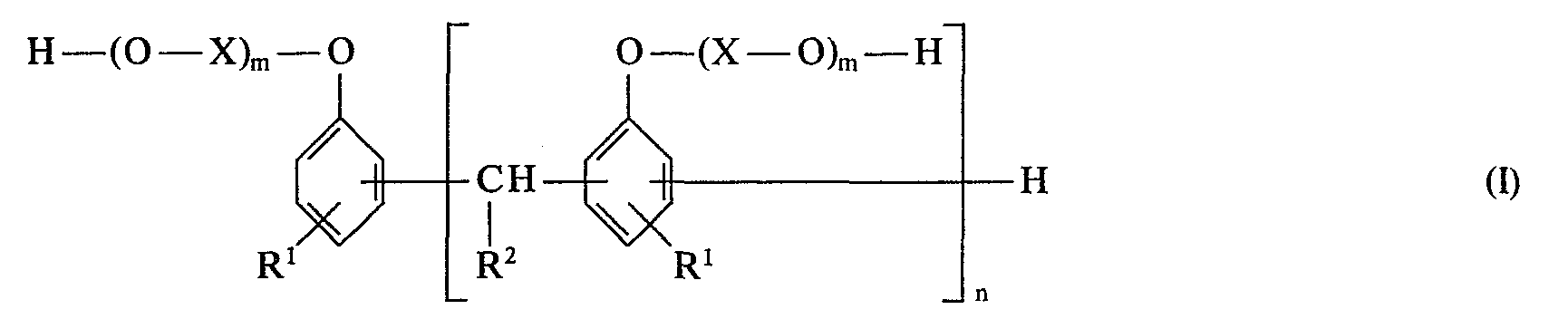
- the invention relates to the use of water-soluble products of the general formula (I) obtained by addition of ethylene oxide and / or propylene oxide onto polynuclear novolak resins, in which R t is a straight-chain or branched alkyl radical having 1 to 18 carbon atoms, R 2 is hydrogen or R 1 , X is an ethylene and / or propylene radical, m is a number from 6 to 100 and n is a number from 1 to 12, as a preparation for disperse dyes and disperse dye preparations which are characterized by a content of such an adduct (I).
- adducts of ethylene oxide and / or propylene oxide with multinuclear novocal resins as capillary and surface-active substances, such as, for example, as an emulsion splitter and emulsifier, as a detergent for textile articles made of wool or cotton and as an aid in the processing of leather, in the dispersion of pigments and for dyeing is described in US-A-2454541, from which the preparation of such add-on products is also known.
- pigments are colorants insoluble in the substrate, so that very special requirements are placed on a pigment dispersant for the fine distribution of a pigment in the substrate, for example in a plastic or lacquer.
- disperse dyes have a number of disadvantages which the preparations according to the invention do not show.
- Conventional formulations of disperse dyes which contain high proportions of anionic dispersants (0.5 part by weight or more in liquid settings and 1 part by weight or more per 1 part by weight of disperse dye in powder settings), cause synthetic paste to be mixed with printing pastes Thickeners an undesirable drop in viscosity.
- the viscosity of the preparation increases sharply with increasing content of dispersant in the grinding or kneading dough, so that in unfavorable cases, especially at somewhat higher temperatures, the settings become viscous or even solid.
- the proportion of the anionic dispersant cannot be reduced arbitrarily, since otherwise unstable or insufficiently finely dispersed dispersions are obtained.
- the dyeing baths in the dyeing baths are becoming ever shorter. For this, highly concentrated dye settings are preferred.
- the high proportions of anionic dispersants in conventional disperse dye preparations can lead to undesirable foam formation in modern dyeing processes, such as in jet dyeing. Strong dye retention, particularly in the case of block staining, is also often criticized.
- the high proportion of dispersant in customary disperse dye preparations in addition to the above-mentioned adverse influence on the viscosity of the printing pastes, also means that the prints have to be washed again.
- aqueous disperse dye preparations obtained according to the invention can be dried to powders without any loss of quality. Both the powder and the liquid settings are ideal for dyeing and printing a wide variety of materials.
- Preferred preparations contain 5 to 90, in particular 30 to 80%, disperse dye, 2 to 40%, in particular 2 to 20% of one or more addition products (1), up to 30% anionic dispersants and up to 70% water and / or conventional auxiliaries.
- the preparations according to the invention can contain other nonionic dispersants and additives customary in such preparations, for example hygroscopic agents known as water retention agents, foam suppressants, dustproofing agents or preservatives.
- Particularly preferred preparations contain 30 to 80% disperse dye, 3 to 12% adduct (I), up to 4% anionic dispersants and 4-67% water and / or auxiliaries, in particular up to 20% water retention agents, for example glycol and about 25 to about 65% water.
- Preferred powder formulations contain about 65 to about 80% disperse dye, about 5 to about 18% adduct (I) and about 7 to about 30% anionic dispersants.
- the total content of adduct (I) and anionic dispersant is from about 3 to about 13%, in particular up to about 10%. In preferred powder settings, this total content is about 20 to about 35%, in particular about 20 to about 30%.
- this total content is about 20 to about 35%, in particular about 20 to about 30%.
- foreign substances such as inorganic salts. If the preparations also contain the named or other customary additives, these additives can be added before, during or after the fine distribution of the disperse dyes.
- adducts (I) which contain ethylene and propylene oxide units X
- their arrangement within the alkylene oxide chains can be static or in the form of “blocks”, depending on whether a mixture of ethylene and propylene oxide was used in the preparation or whether these oxides were added individually one after the other.
- the dispersants usually used for this are used.
- condensation products from aromatic sulfonic acids and formaldehyde in particular condensation products from alkylnaphthalenesulfonic acids, especially methylnaphthalenesulfonic acids and formaldehyde, as are known from DE-C-2442514.
- Condensation products of optionally substituted phenol with formaldehyde and sodium sulfite and alkali metal salts of lignosulfonic acids are also suitable.
- the preparations according to the invention are distinguished by a very low content of surface-active substances.
- the water-soluble addition products (I) to be used according to the invention are also notable for good biodegradability, so that there is minimal waste water pollution.
- preparations according to the invention are obtained which, with a very high colorant content, are readily flowable and stable in storage.
- the preparations can be used in printing inks for Rouleaux printing with very "shallow" engravings, resulting in high-color prints. Use in rotary film printing is also possible.
- the preparations according to the invention can be produced by all known methods.
- a disperse dye or a mixture of disperse dyes can be mixed with one or more adducts (I), optionally an anionic dispersant and optionally other additives and subjected to mechanical comminution.
- the order in which the components are added can also be changed.
- Mechanical comminution is preferably carried out in kneaders, ball mills, dispersants, bead mills, sand mills or attritors.
- the desired fine distribution of generally about 3 ⁇ m, preferably 1 ⁇ m, particle size can be determined by a filter test or with a microscope.
- the preparations thus obtained contain the colorants in a stable, finely divided form.
- the fine distribution remains even after several weeks of storage, both at room temperature and at 50 ° C and is not affected by the effects of cold.
- aqueous preparations can be dried in a conventional manner, for example by means of spray drying.
- the powdered preparations thus obtained are well redispersed by simply stirring them into water or in binder solutions.
- the disperse dye preparations according to the invention are used in dye baths or printing pastes, a low content of surface-active substances has no retarding effect and brilliant shades are obtained.
- the required rewashing can be shortened considerably or even eliminated when using low-body thickenings without there being a noticeable deterioration in the grip of the printed goods or without impairing the brilliance and color tone.
- the preparations are advantageously adjusted to a pH of about 6 to 8.
- disperse dyes are used which are at least 60% undecomposed at atmospheric pressure between 150 and 220 ° C sublimate, in particular disperse dyes from the series of mono- or disazo, anthraquinone, quinophthalone, nitro, azomethine, naphthalenetetracarboxylic acid or benzoxanthene dyes or mixtures of such dyes.
- the preparations thus obtained are suitable for the production of printing inks for printing transfer papers for thermal printing.
- 350 parts of the dye of formula (1) are in one Solution of 87 parts of a novolak resin reacted with 105 moles of ethylene oxide, which on average consists of 7 nonylphenol residues linked via -CH 2 bridges (hereinafter "add-on product A"), in 300 parts of water and 150 parts of ethylene glycol in a bead mill with silica quartz beads (1 mm 0) milled with cooling for 3 hours. After this time, a readily flowable dispersion is obtained, the particles of which are more than 90% smaller than 3 ⁇ m.
- the dough setting is made up to 1000 parts with water and filtered off from the beads. The preparation is easy to flow, long-term stable at room temperature as well as at 50 ° C and insensitive to the effects of cold.
- 400 parts of the dye of the formula (1) are in 300 parts in a solution of 100 parts of a novocal resin reacted with 45 mol of ethylene oxide, which on average consists of 3 nonylphenol residues linked via -CH 2 bridges (hereinafter "adduct B")
- ethylene oxide which on average consists of 3 nonylphenol residues linked via -CH 2 bridges
- adduct B Water and 150 parts of ethylene glycol were milled in a bead mill with silica quartz beads (0.1 mm) for 3 hours with cooling. After this time, a readily flowable dispersion is obtained, the particles of which are more than 90% smaller than 3 ⁇ m.
- the dough setting is made up to 1000 parts with water and filtered off from the beads. The preparation is easy to flow, long-term stable at room temperature as well as at 50 ° C and insensitive to the effects of cold.
- 400 parts of the dry dye of formula (2) are in a solution of 40 parts of the adduct A, 20 parts of a condensation product of methylnaphthalenesulfonic acid and formaldehyde, as described in Example D of DE-C-2442514 (hereinafter "anionic dispersant MNF"), 150 parts of ethylene glycol, 300 parts of water and 2 parts of chloroacetamide as a preservative in a bead mill with siliquarzitperlen (0 1 mm) with cooling. After 4 hours of grinding, a dispersion is obtained, the particles of which are more than 90% smaller than 3 ⁇ m. The grinding dough is made up to 1000 parts with water and filtered off from the beads. A readily flowable preparation is obtained which is stable in storage for several weeks both at room temperature and at 50 ° C. and is insensitive to the effects of cold.
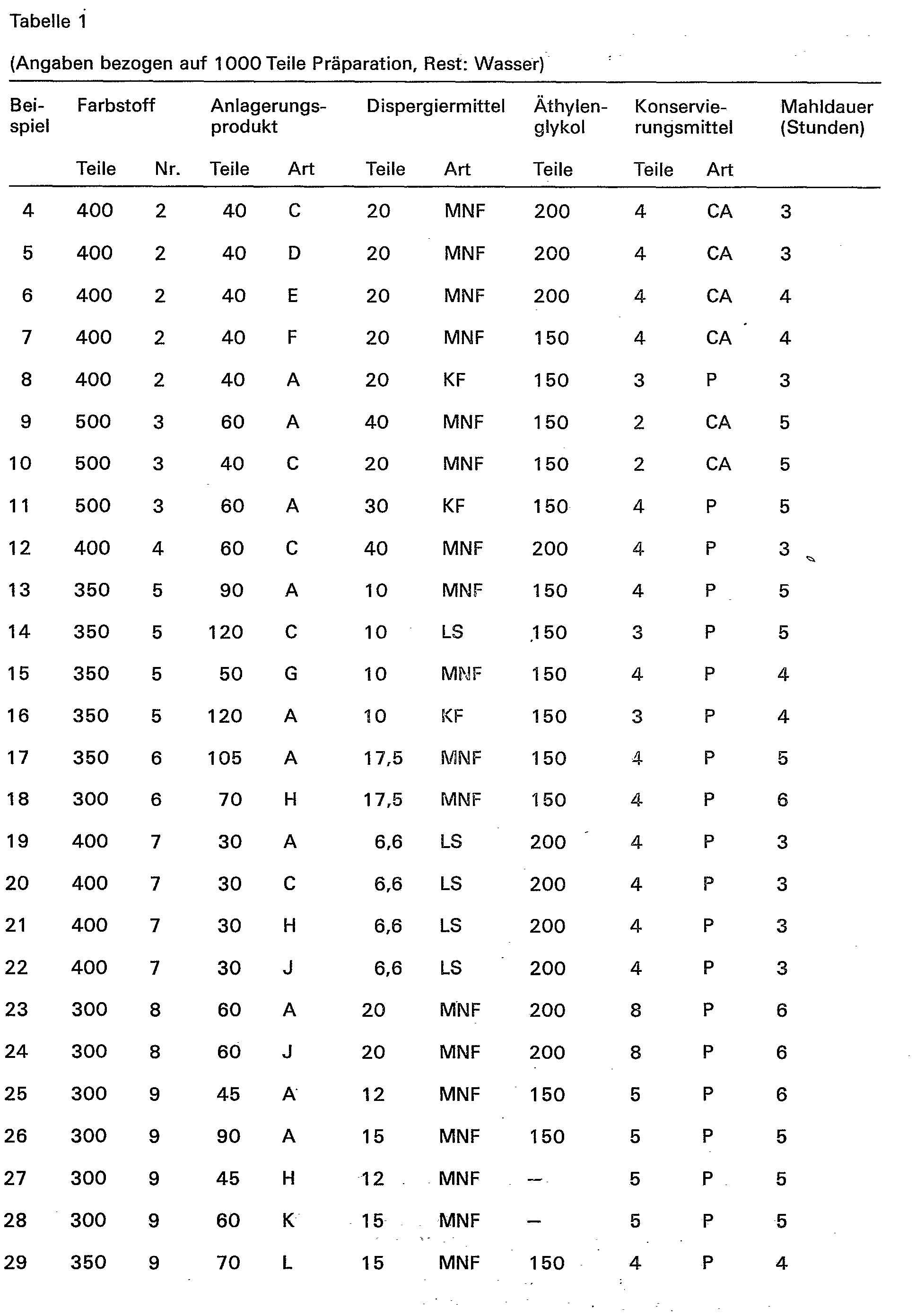
- Example 3 If, instead of the components mentioned in Example 3, the dyes, dispersants and other constituents given in Table 1 below are used, and the procedure is otherwise analogous to Example 3, free-flowing, aqueous, storage-stable dough settings likewise result.
- the dry dye of the formula (1) 400 parts are ground in a solution of 30 parts of dispersant MNF, 30 parts of adduct A and about 300 parts of water in a bead mill with silica quartz balls (0.1 mm). After 3 hours, a readily flowable dispersion is obtained, the predominant number of particles of which is less than 3 ⁇ m. A further 135 parts of MNF dispersant and, if necessary, water are added, and the aqueous dough is then dried by spray drying. The inlet temperature is 160-180 ° C and the outlet temperature is 70 ⁇ 80 ° C. A low-dust powder with a dye content of 67% is obtained, which can be dispersed well when stirred into a stock thickener or into an aqueous dyebath.
- Example 31 If, instead of the components mentioned in Example 31, the dyes, addition products and anionic dispersants given in Table 2 below are used, and the procedure is otherwise analogous to Example 31, powdery preparations with the indicated dye contents and equally good properties result.
- 150 parts of the preparation prepared according to one of Examples 3, 4 or 9 are stirred with a stirrer directly into 850 parts of an aqueous synthetic polyacrylate thickener.
- the viscosity of the thickening is 1.5-2 Pas (measured with the Haake viscometer VT02) and changes only very slightly when the low-dispersant preparation is stirred in.
- the printing paste printed in rotary film on paper or other usual intermediate carriers, results in calm, sharp, level prints after sublimation under usual conditions in transfer printing on polyester materials.
- a cross-wound bobbin made of 300 g of a polyester / wool yarn is dyed with changing liquor circulation for 1 hour at 106 ° C. and at a pH of 5 using conventional dyeing aids in a bath containing 3.4 g of the preparations from Example in liters of water 1 or 13 contains. After rinsing the packages, level, deep dyeings with good rub fastness are obtained.
Landscapes
- Chemical & Material Sciences (AREA)
- Engineering & Computer Science (AREA)
- Textile Engineering (AREA)
- Chemical Kinetics & Catalysis (AREA)
- Organic Chemistry (AREA)
- Dispersion Chemistry (AREA)
- Coloring (AREA)
- Inks, Pencil-Leads, Or Crayons (AREA)
- Emulsifying, Dispersing, Foam-Producing Or Wetting Agents (AREA)
Description
- Die Erfindung betrifft die Verwendung von wasserlöslichen, durch Anlagerung von Äthylenoxid und/oder Propylenoxid an mehrkernige Novolakharze erhaltene Produkte der allgemeinen Formel (I),
- Die Verwendung von Anlagerungsprodukten von Äthylenoxid und/oder Propylenoxid an mehrkernige Novokalharze als kapillar- und oberflächenaktive Substanzen, wie beispielsweise als Emulsionsspalter und Emulgatoren, als Waschmittel für textile Gegenstände aus Wolle oder Baumwolle und als Hilfsmittel bei der Bearbeitung von Leder, beim Dispergieren von Pigmenten und beim Färben wird in der US-A-2454541 beschrieben, aus der auch die Herstellung solcher Anlagerungsprodukte bekannt ist. Pigmente sind gemäß DIN 55 944 und 55 945 im Substrat unlösliche Farbmittel, so daß also für die Feinverteilung eines Pigments im Substrat, beispielsweise in einem Kunststoff oder Lack, ganz spezielle Anforderungen an ein Pigmentdispergiermittel gestellt werden.
- Weiterhin ist die Verwendung von Anlagerungsprodukten der Formel (I) aus der DE-C-2132405 als Ausgangsmaterial zur Herstellung anionischer Dispergiermittel bekannt.
- Die bisher bekannten Eigenschaften dieser Anlagerungsprodukte der Formel (I) ergaben somit keinen Anhaltspunkt dafür, daß sie ausgezeichnete Präparationsmittel für Dispersionsfarbstoffe darstellen, die - als Farbstoffe entsprechend den genannten DIN-Vorschriften - im Substrat, üblicherweise Polyester, löslich sind und somit an ein Dispergiermittel andere Anforderungen stellen. Überraschenderweise erlauben diese Anlagerungsprodukte die Herstellung kochkonzentrierter, dispergiermittelarmer Präparationen von Dispersionsfarbstoffen, wobei sich diese Präparationen durch eine Vielzahl vorteilhafter Eigenschaften auszeichnen.
- Die bisher bekannten Zubereitungen von Dispersionsfarbstoffen weisen eine Reihe von Nachteilen auf, die die erfindungsgemäßen Zubereitungen nicht zeigen. So verursachen herkömmliche Zubereitungen von Dispersionsfarbstoffen, die hohe Anteile anionischer Dispergiermittel (in Flüssigeinstellungen 0,5 Gew.-Teile oder mehr und in Pulvereinstellungen 1 Gew.-Teil oder mehr auf 1 Gew.-Teil Dispersionsfarbstoff) enthalten, beim Anrühren von Druckpasten mit synthetischen Verdickungsmitteln einen unerwünschten Abfall der Viskosität. Normalerweise steigt mit zunehmendem Gehalt an Dispergiermittel im Mahl- oder Knetteig auch die Viskosität der Zubereitung stark an, so daß in ungünstigen Fällen, vor allem bei etwas höheren Temperaturen, die Einstellungen dickflüssig oder sogar fest werden. Andererseits kann der Anteil des anionischen Dispergiermittels nicht beliebig verringert werden, da sonst instabile oder von vornherein ungenügend feinverteilte Dispersionen erhalten werden.
- In den Färbereien werden aus Rationalisierungsgründen immer kürzere Flottenverhältnisse der Färbebäder angestrebt. Dafür werden möglichst hochkonzentrierte Farbstoffeinstellungen bevorzugt. Die hohen Anteile anionischer Dispergiermittel in herkömmlichen Dispersionsfarbstoffpräparationen können bei modernen Färbeverfahren, wie in der Jet-Färberei, zu unerwünschter Schaumbildung führen. Oft wird auch ein starkes Farbstoffrückhaltevermögen, vor allem bei Klotzfärbungen, beanstandet. In Druckereien bedingt der hohe Dispergiermittelanteil in üblichen Dispersionsfarbstoffpräparationen außer dem schon genannten ungünstigen Einfluß auf die Viskosität der Druckpasten auch ein aufwendiges Nachwaschen der Drucke.
- Die vorliegende Erfindung erlaubt es nun, Dispersionsfarbstoffzubereitungen herzustellen, die den genannten Einschränkungen nicht unterworfen sind und sich besonders für eine Reihe von Spezialaufgaben eignen. So können erfindungsgemäß erhaltene wäßrige Dispersionsfarbstoffzubereitungen ohne Qualitätseinbuße zu Pulvern getrocknet werden. Sowohl die Pulver als auch die Flüssigeinstellungen eignen sich hervorragend zum Färben und Bedrucken der verschiedensten Materialien.
- Im folgenden werden bevorzugte Ausgestaltungen der Erfindung näher erläutert, wobei sich Prozentangaben auf das Gewicht beziehen:
- Bevorzugt werden solche Anlagerungsprodukte der Formel (I), bei denen Rt einen geradkettigen oder verzweigten Alkylrest mit 6 bis 14 C-Atomen, R2 ein Wasserstoffatom, X einen Äthylen- und/oder Propylenrest, m eine Zahl von 10 bis 30 und n eine Zahl von 2 bis 9 bedeuten.
- Bevorzugte Zubereitungen enthalten 5 bis 90, insbesondere 30 bis 80% Dispersionsfarbstoff, 2 bis 40%, insbesondere 2 bis 20% eines oder mehrerer Anlagerungsprodukte (1), bis zu 30% anionische Dispergiermittel und bis zu 70% Wasser und/oder übliche Hilfsmittel. Darüber hinaus können die erfindungsgemäßen Zubereitungen andere nichtionogene Dispergiermittel und in solchen Präparationen übliche Zusätze enthalten, beispielsweise als Wasserrückhaltemittel bekannte hygroskopische Mittel, Schaumdämpfer, Entstaubungsmittel oder Konservierungsmittel.
- Besonders bevorzugte Präparationen enthalten 30 bis 80% Dispersionsfarbstoff, 3 bis 12% Anlagerungsprodukt (I), bis zu 4% anionische Dispergiermittel und 4―67% Wasser und/oder Hilfsmittel, insbesondere bis zu 20% Wasserrückhaltemittel, beispielsweise Glykol und etwa 25 bis etwa 65% Wasser.
- Bevorzugte Pulvereinstellungen enthalten etwa 65 bis etwa 80% Dispersionsfarbstoff, etwa 5 bis etwa 18% Anlagerungsprodukt (I) und etwa 7 bis etwa 30% anionische Dispergiermittel.
- Von besonderem Interesse sind hochkonzentrierte Flüssig- und Pulvereinstellungen, die möglichst dispergiermittelarm sind. Bei bevorzugten Flüssigeinstellungen liegt der Gesamtgehalt an Anlagerungsprodukt (I) und anionischem Dispergiermittel bei etwa 3 bis etwa 13%, insbesondere bis etwa 10%. Bei bevorzugten Pulvereinstellungen liegt dieser Gesamtgehalt bei etwa 20 bis etwa 35%, insbesondere etwa 20 bis etwa 30%. Neben dem Farbstoff und den Dispergiermitteln sind somit keine wesentlichen Anteile fremder Stoffe, wie anorganische Salze, zugegen. Sofern die Präparationen noch die genannten oder andere übliche Zusätze enthalten, können diese Additive vor, während oder nach der Feinverteilung der Dispersionsfarbstoffe zugesetzt werden.
- Bei den Anlagerungsprodukten (I), die Äthylen- und Propylenoxid-Einheiten X enthalten, kann deren Anordnung innerhalb der Alkylenoxidketten statisch oder in Form von »Blocks« gegeben sein, je nachdem, ob bei der Herstellung ein Gemisch von Äthylen- und Propylenoxid eingesetzt wurde oder ob diese Oxide einzeln nacheinander angelagert wurden.
- Sofern die erfindungsgemäßen Präparationen anionische Dispergiermittel enthalten, werden die hierfür üblicherweise verwendeten Dispergiermittel eingesetzt. Bevorzugt sind Kondensationsprodukte aus aromatischen Sulfonsäuren und Formaldehyd, insbesondere Kondensationsprodukte aus Alkylnaphthalinsulfonsäuren, vor allem Methylnaphthalinsulfonsäuren und Formaldehyd, wie sie aus der DE-C-2442514 bekannt sind. Geeignet sind auch Kondensationsprodukte aus gegebenenfalls substituiertem Phenol mit Formaldehyd und Natriumsulfit sowie Alkalisalze von Ligninsulfonsäuren.
- Im Vergleich zu üblichen Dispersionsfarbstoffzubereitungen zeichnen sich die erfindungsgemäßen Präparationen durch einen sehr geringen Gehalt an oberflächenaktiven Substanzen aus. Die erfindungsgemäß zu verwendenden wasserlöslichen Anlagerungsprodukte (I) zeichnen sich darüber hinaus durch eine gute biologische Abbaubarkeit aus, so daß es zu einer minimalen Abwasserbelastung kommt.
- Trotz des geringen Einsatzes an oberflächenaktiven Substanzen erhält man erfindungsgemäße Präparationen, die bei sehr hohem Farbmittelgehalt gut fließfähig und lagerstabil sind.
- Wegen der guten Verträglichkeit mit synthetischen Verdickungsmitteln können die Präparationen in Drucktinten für den Rouleauxdruck mit sehr »seichten« Gravuren eingesetzt werden, wobei farbstarke Drucke erhalten werden. Ebenso ist der Einsatz im Rotationsfilmdruck möglich.
- Die Herstellung der erfindungsgemäßen Präparationen kann nach allen bekannten Verfahren erfolgen. Zum Beispiel kann ein Dispersionsfarbstoff oder eine Mischung von Dispersionsfarbstoffen mit einem oder mehreren Anlagerungsprodukten (I), gegebenenfalls einem anionischen Dispergiermittel sowie gegebenenfalls anderen Zusätzen vermischt und einer mechanischen Zerkleinerung unterworfen werden. Hierbei kann die Reihenfolge der Zugabe der Komponenten auch verändert werden. Die mechanische Zerkleinerung erfolgt bevorzugt in Knetern, Kugelmühlen, Dispergatoren, Perlmühlen, Sandmühlen oder Attritoren. Das Erreichen der gewünschten Feinverteilung von im allgemeinen etwa 3 µm, bevorzugt 1 µm Teilchengröße kann durch einen Filtertest oder mit dem Mikroskop festgestellt werden. Die so erhaltenen Präparationen enthalten die Farbmittel in stabiler feinverteilter Form.
- Die Feinverteilung bleibt auch bei mehrwöchiger Lagerung sowohl bei Raumtemperatur als auch bei 50° C erhalten und wird auch durch Kälteeinwirkung nicht beeinträchtigt.
- Zur Herstellung einer pulverförmigen Präparation können wäßrige Präparationen in üblicher Weise, beispielsweise mittels Zerstäubungstrocknung, getrocknet werden. Die so erhaltenen pulverförmigen Präparationen werden durch einfaches Einrühren in Wasser oder in Bindemittellösungen gut redispergiert.
- Durch den . geringen Gehalt an oberflächenaktiven Substanzen tritt beim Einsatz der erfindungsgemäßen Dispersionsfarbstoffpräparationen in Färbebädern oder Druckpasten keine retardierende Wirkung auf und es werden brillante Farbtöne erhalten. Außerdem kann im Falle des Direktdrucks die erforderliche Nachwäsche wesentlich verkürzt werden oder bei Verwendung körperarmer Verdickungen sogar ganz entfallen, ohne daß es zu einer merklichen Griffverschlechterung der bedruckten Ware käme oder Brillanz und Farbton beeinträchtigt würden. In diesem Falle werden die Präparationen vorteilhaft auf einen pH-Wert von etwa 6 bis 8 eingestellt.
- In einer besonders bevorzugten Ausgestaltung der Erfindung werden Dispersionsfarbstoffe eingesetzt, die bei atmosphärischem Druck zwischen 150 und 220°C zu mindestens 60% unzersetzt sublimieren, insbesondere Dispersionsfarbstoffe aus der Reihe der Mono- oder Disazo-, Anthrachinon-, Chinophthalon-, Nitro-, Azomethin-, Naphthalintetracarbonsäure- oder Benzoxanthenfarbstoffe oder Mischungen solcher Farbstoffe. Die so erhaltenen Präparationen eignen sich zur Herstellung von Druckfarben für das Bedrucken von Transferpapieren für den Thermodruck.
- In den folgenden Beispielen beziehen sich Prozentangaben und Teile auf das Gewicht, sofern nichts anderes angegeben ist.
- 350 Teile des Farbstoffs der Formel (1) werden in einer

- 400 Teile des Farbstoffs der Formel (1) werden in einer Lösung von 100 Teilen eines mit 45 Mol Äthylenoxid umgesetzten Novokalharzes, das im Mittel aus 3 über -CH2-Brücken verknüpften Nonylphenolresten besteht (im folgenden »Anlagerungsprodukt B«), in 300 Teilen Wasser und 150 Teilen Äthylenglykol in einer Perlmühle mit Siliquarzitperlen (0 1 mm) während 3 Stunden unter Kühlung gemahlen. Nach dieser Zeit erhält man eine gut fließfähige Dispersion, deren Teilchen zu über 90% kleiner als 3 µm sind. Die Teigeinstellung wird mit Wasser auf 1000 Teile aufgefüllt und von den Perlen abfiltriert. Die Präparation ist gut fließfähig, über längere Zeit sowohl bei Raumtemperatur als auch bei 50° C lagerstabil und unempfindlich gegen Kälteeinwirkung.
- 400 Teile des trockenen Farbstoffs der Formel (2)

- Verwendet man anstelle der in Beispiel 3 genannten Komponenten die in der folgenden Tabelle 1 angegebenen Farbstoffe, Dispergiermittel und übrigen Bestandteile, und verfährt im übrigen analog Beispiel 3, so resultieren ebenfalls freifließende, wäßrige, lagerstabile Teigeinstellungen.
-
- a) Die Farbstoffe 3 bis 9 haben folgende Formeln:





- b) Die Anlagerungsprodukte C-L haben folgende Zusammensetzung:
- C: ist ein mit 224 Mol Äthylenoxid umgesetztes Novolakharz, das im Mittel aus 9 über -CH2-Brücken verknüpften Nonylphenolresten besteht.
Entsprechend setzen sich zusammen: - D: 211 Mol Äthylenoxid, 7 Nonylphenolreste
- E: 140 Mol Äthylenoxid, Dodecylphenolreste
- F: 108 Mol Äthylenoxid, 9 Hexylphenolreste
- G: Blockpolymerisat aus 18 Mol Äthylenoxid + 18 Mol Propylenoxid + 18 Mol Äthylenoxid, 9 Nonylphenolreste
- H: Blockpolymerisat aus 80 Mol Äthylenoxid + 25 Mol Propylenoxid, 7 Nonylphenolreste
- J: 91 Mol Äthylenoxid, 7 Nonylphenolreste
- K: 90 Mol Äthylenoxid, 3 Nonylphenolreste
- L: ist ein mit 37,5 Mol Äthylenoxid umgesetztes Novolakharz, das im Mittel aus 3 über Isooctylmethylen-Brücken verknüpften o-Kresolresten besteht.
- C: ist ein mit 224 Mol Äthylenoxid umgesetztes Novolakharz, das im Mittel aus 9 über -CH2-Brücken verknüpften Nonylphenolresten besteht.
- c) Bei den anionischen Dispergiermitteln bedeutet:
- KF: Kondensationsprodukt aus Kresol, Formaldehyd und Natriumsulfit (DE-PS 2 032 926)
- LS: Ligninsulfonat
- d) Konservierungsmittel:
- CA: Chloracetamid
- P: Pentachlorphenolnatrium
- 400 Teile des trockenen Farbstoffes der Formel (1) werden in einer Lösung aus 30 Teilen Dispergiermittel MNF, 30 Teilen Anlagerungsprodukt A und ca. 300 Teilen Wasser in einer Perlmühle mit Siliquarzitkugeln (0 1 mm) gemahlen. Nach 3 Stunden erhält man eine gut fließfähige Dispersion, deren überwiegende Anzahl der Teilchen kleiner als 3 µm ist. Es werden weitere 135 Teile Dispergiermittel MNF und erforderlichenfalls Wasser zugegeben und anschließend der wäßrige Teig durch Zerstäubungstrocknung getrocknet. Die Eingangstemperatur beträgt 160-180°C und die Ausgangstemperatur 70―80°C. Es fällt ein staubarmes Pulver mit einem Farbstoffgehalt von 67% an, welches sich beim Einrühren in eine Stammverdickung oder in ein wäßriges Färbebad gut dispergieren läßt.
- 882 Teile eines feuchten Preßkuchens des Farbstoffes der Formel (3) mit 34% Feststoffgehalt werden mit 60 Teilen Anlagerungsprodukt A und 40 Teilen Dispergiermitteln MNF in einer Perlmühle mit Siliquarzitkugeln (0 1 mm) gemahlen. Nach 4 Stunden ist der Farbstoff so fein verteilt, daß die überwiegende Anzahl der Teilchen kleiner als 3 µm ist. Der wäßrige Teig wird in einem Zerstäubungstrockner getrocknet, wobei die Eingangstemperatur 160-1800C und die Ausgangstemperatur 70―80°C beträgt. Es resultiert ein staubarmes, rieselfähiges Pulver mit einem Farbstoffgehalt von 75%, welches sich beim Einrühren in eine Stammverdickung oder in ein wäßriges Färbebad gut dispergieren läßt.
- Verwendet man anstelle der in Beispiel 31 genannten Komponenten die in der folgenden Tabelle 2 angegebenen Farbstoffe, Anlagerungsprodukte und anionischen Dispergiermittel und verfährt im übrigen analog Beispiel 31, so resultieren pulverförmige Präparationen mit den angegebenen Farbstoffgehalten und ebenso guten Eigenschaften.

- 150 Teile der gemäß einem der Beispiele 3, 4 oder 9 hergestellten Präparation werden mit einem Rührer direkt in 850 Teile einer wäßrigen synthetischen Polyacrylat-Stammverdickung eingerührt. Die Viskosität der Verdickung liegt bei 1,5-2 Pas (gemessen mit dem Haake-Viskosimeter VT02) und ändert sich beim Einrühren der dispergiermittelarmen Präparation nur sehr geringügig.
- Die Druckpaste im Rotationsfilmdruck auf Papier oder andere übliche Zwischenträger verdruckt, ergibt nach Übersublimieren bei im Transferdruck üblichen Bedingungen auf Polyestermaterialien ruhige, scharfstehende, egale Drucke.
- Verwendet man anstelle der erfindungsgemäßen eine herkömmliche Farbstoffpräparation mit einem höheren Anteil anionischer Dispergiermittel, dann wird die Viskosität der Druckpaste so stark herabgesetzt, daß sie unbrachbar ist.
- Je 150 Teile der gemäß einem der Beispiele 1, 13 oder 26 hergestellten Präparationen werden mit einem Schnellrührer direkt in 850 Teile einer wäßrigen synthetischen Polyacrylatstammverdickung eingerührt. Die vorher eingestellte Viskosität von ca. 1,5 Pas (Haake Viskosimeter) ändert sich durch die dispergiermittelarme Präparation nur sehr geringfügig. Die Drucktinten eignen sich zum direkten Bedrucken von Polyestermaterialien, wobei die sonst notwendige Nachwäsche wegen des geringen Dispergiermittelanteils entfallen kann. Es resultieren kräftige, echte Drucke guter Egalität.
- Eine Kreuzspule aus 300 g eines Polyester/Wolle-Garns wird unter wechselnder Flottenzirkulation 1 Stunde bei 106°C und bei einem pH-Wert von 5 unter Verwendung üblicher Färbehilfsmittel in einem Bad gefärbt, welches im Liter Wasser 3,4 g der Präparationen aus Beispiel 1 oder 13 enthält. Nach dem Spülen der Wickelkörper erhält man egale, tiefe Färbungen mit guter Reibechtheit.
- Mit Färbebädern, die die unter Beispiel 1 oder 13 beschriebenen Präparationen enthalten, erhält man beim HT-Färben mit in der Praxis üblichen Flottenverhältnissen (1 : 10 -1 : 30) und Färbebadtemperaturen (125-135°C) egale farbstarke Färbungen auf Polyester bzw. Polyestermischgeweben mit gutem Aufbau.
Claims (7)

Applications Claiming Priority (2)
| Application Number | Priority Date | Filing Date | Title |
|---|---|---|---|
| DE19792901461 DE2901461A1 (de) | 1979-01-16 | 1979-01-16 | Verwendung oxalkylierter novolakharze als praeparationsmittel fuer dispersionsfarbstoffe und damit hergestellte zubereitungen |
| DE2901461 | 1979-01-16 |
Publications (2)
| Publication Number | Publication Date |
|---|---|
| EP0013576A1 EP0013576A1 (de) | 1980-07-23 |
| EP0013576B1 true EP0013576B1 (de) | 1982-05-12 |
Family
ID=6060650
Family Applications (1)
| Application Number | Title | Priority Date | Filing Date |
|---|---|---|---|
| EP80100157A Expired EP0013576B1 (de) | 1979-01-16 | 1980-01-14 | Verwendung oxalkylierter Novolakharze als Präparationsmittel für Dispersionsfarbstoffe und damit hergestellte Zubereitungen |
Country Status (8)
| Country | Link |
|---|---|
| US (1) | US4420310A (de) |
| EP (1) | EP0013576B1 (de) |
| JP (1) | JPS5594966A (de) |
| BR (1) | BR8000254A (de) |
| CA (1) | CA1136807A (de) |
| DE (2) | DE2901461A1 (de) |
| IN (1) | IN152341B (de) |
| MX (1) | MX153239A (de) |
Families Citing this family (9)
| Publication number | Priority date | Publication date | Assignee | Title |
|---|---|---|---|---|
| EP0055694B1 (de) * | 1980-12-30 | 1986-06-04 | Ciba-Geigy Ag | Verfahren zum Färben oder Bedrucken von Cellulosematerialien bzw. von Cellulose/Polyester-Mischgewebe |
| CH653068A5 (de) * | 1982-01-02 | 1985-12-13 | Sandoz Ag | Hilfsmittel fuer das faerben mit dispersionsfarbstoffen. |
| DE3312799A1 (de) * | 1983-04-09 | 1984-10-25 | Hoechst Ag, 6230 Frankfurt | Verfahren zum gleichmaessigen faerben von synthesefasern |
| JPS61194279A (ja) * | 1985-02-20 | 1986-08-28 | 花王株式会社 | 顔料又は染料用粉砕助剤及びそれを含有する顔料又は染料組成物 |
| DE3641677A1 (de) * | 1986-12-05 | 1988-06-09 | Bayer Ag | Waessrige pigmentpraeparationen und ihre verwendung |
| DE3823826A1 (de) * | 1988-07-14 | 1990-01-18 | Hoechst Ag | Verfahren zur badpigmentierung von leder |
| DE3927471A1 (de) * | 1989-08-19 | 1991-02-21 | Hoechst Ag | Verfahren zur badpigmentierung von leder |
| DE19752333A1 (de) * | 1997-11-26 | 1999-05-27 | Basf Ag | Farbstoffzubereitungen |
| DE10244683A1 (de) | 2002-09-24 | 2004-04-01 | Basf Ag | Feste Pigmentzubereitungen, enthaltend oberflächenaktive Additive auf Basis von alkoxylierten Bisphenolen |
Family Cites Families (18)
| Publication number | Priority date | Publication date | Assignee | Title |
|---|---|---|---|---|
| US2454541A (en) * | 1944-09-09 | 1948-11-23 | Rohm & Haas | Polymeric detergents |
| US2454545A (en) * | 1944-09-09 | 1948-11-23 | Rohm & Haas | Hydrocarbon-substituted phenolformaldehyde condensates modified in the phenolic hydroxyl |
| DE1064075B (de) | 1957-04-18 | 1959-08-27 | Bayer Ag | Dispergier- und Demulgiermittel |
| US3320212A (en) * | 1962-05-03 | 1967-05-16 | Petrolite Corp | alpha-sulfocarboxylic esters of oxyalkylated polyphenols |
| FR1406286A (fr) | 1964-09-01 | 1965-07-16 | Bayer Ag | Nouveaux agents d'égalisation utiles pour la teinture des textiles |
| US3993439A (en) * | 1970-07-03 | 1976-11-23 | Hoechst Aktiengesellschaft | Dispersing and stabilizing agents for dyestuffs |
| US4009142A (en) * | 1971-06-30 | 1977-02-22 | Hoechst Aktiengesellschaft | Sulfonsuccinic acid semi-esters, process for their preparation and their use in pigment preparations for aqueous flexo printing pastes |
| BE785705A (fr) | 1971-06-30 | 1973-01-02 | Hoechst Ag | Semi-esters de l'acide sulfo-succinique utilisables dans des preparations pigmentaires |
| BE785711A (fr) * | 1971-06-30 | 1973-01-02 | Hoechst Ag | Dispersants et mouillants pour des agents biocides organiques |
| BE785703A (fr) | 1971-06-30 | 1973-01-02 | Hoechst Ag | Dispersions de colorants |
| CH569681A5 (de) * | 1972-06-19 | 1975-11-28 | Hoechst Ag | |
| BE795961A (fr) * | 1972-02-25 | 1973-08-27 | Hoechst Ag | Application d'hemi-esters sulfuriques a la dispersion de colorants |
| DE2250017C3 (de) * | 1972-10-12 | 1978-09-14 | Hoechst Ag, 6000 Frankfurt | Hilfsmittelgemische zum Fixieren von Dispersionsfarbstoffen und Verfahren zum Bedrucken oder Klotzfärben mit Dispersionsfarbstoffen |
| AR208313A1 (es) | 1974-05-09 | 1976-12-20 | Ciba Geigy Ag | Preparados acuosos pobres en agentes de dispersion de colorantes y blanqueadores opticos insolubles o dificilmento solubles en agua |
| NL7406377A (nl) | 1974-05-13 | 1975-11-17 | Philips Nv | Cassette ten behoeve van een apparaat voor het registreren en/of weergeven van informatie en apparaat voor het registreren en/of weergeven van informatie met behulp van een dergelijk cassette. |
| DE2634495C3 (de) | 1976-07-31 | 1980-03-20 | Bayer Ag, 5090 Leverkusen | Farbstoffpräparation |
| US4060501A (en) * | 1976-08-30 | 1977-11-29 | Texaco Development Corporation | Novolak derivatives as defoamers |
| DE2730223A1 (de) | 1977-07-05 | 1979-01-25 | Basf Ag | Waessrige pigmentdispersionen |
-
1979
- 1979-01-16 DE DE19792901461 patent/DE2901461A1/de not_active Withdrawn
-
1980
- 1980-01-10 IN IN37/CAL/80A patent/IN152341B/en unknown
- 1980-01-14 DE DE8080100157T patent/DE3060378D1/de not_active Expired
- 1980-01-14 EP EP80100157A patent/EP0013576B1/de not_active Expired
- 1980-01-14 JP JP219480A patent/JPS5594966A/ja active Granted
- 1980-01-14 US US06/111,793 patent/US4420310A/en not_active Expired - Lifetime
- 1980-01-15 MX MX180815A patent/MX153239A/es unknown
- 1980-01-15 BR BR8000254A patent/BR8000254A/pt unknown
- 1980-01-15 CA CA000343709A patent/CA1136807A/en not_active Expired
Also Published As
| Publication number | Publication date |
|---|---|
| MX153239A (es) | 1986-09-02 |
| DE3060378D1 (en) | 1982-07-01 |
| JPS6411669B2 (de) | 1989-02-27 |
| BR8000254A (pt) | 1980-10-21 |
| JPS5594966A (en) | 1980-07-18 |
| IN152341B (de) | 1983-12-24 |
| US4420310A (en) | 1983-12-13 |
| EP0013576A1 (de) | 1980-07-23 |
| DE2901461A1 (de) | 1980-07-24 |
| CA1136807A (en) | 1982-12-07 |
Similar Documents
| Publication | Publication Date | Title |
|---|---|---|
| DE2850482C3 (de) | Wässrige Farbstoffpräparate von in Wasser unlöslichen bis schwerlöslichen Farbstoffen, Verfahren zu ihrer Herstellung und ihre Verwendung | |
| DE1771813C3 (de) | Neue, als Drucktinten verwendbare Farbstoffzusammensetzungen | |
| DE2856222C3 (de) | Wäßrige Farbstoffpräparate von in Wasser schwerlöslichen Farbstoffen, deren Herstellung und Verwendung | |
| EP0013576B1 (de) | Verwendung oxalkylierter Novolakharze als Präparationsmittel für Dispersionsfarbstoffe und damit hergestellte Zubereitungen | |
| DE2820717A1 (de) | Farbstoffzubereitungen | |
| EP0028342B1 (de) | Verwendung von veresterten Oxalkylaten als Präparationsmittel für Farbstoffe und entsprechende Farbstoffzubereitungen | |
| EP0064225B1 (de) | Verwendung von veresterten Oxalkylaten als Präparationsmittel für Farbstoffe und entsprechende Farbstoffzubereitungen | |
| DE2649551B2 (de) | Stabile Farbstofflösung | |
| DE3029475A1 (de) | Transferdrucktraeger, verfahren zu seiner herstellung und seine verwendung | |
| DE1619357C3 (de) | Verwendung von hochkonzentrierten, stabilen, mit Wasser in jedem Verhältnis mischbaren, sulfonsäuregruppenfreie 1:2-Chrom- oder Kobaltkomplexe von Azofarbstoffen enthaltenden Stammlösungen zur Bereitung von Färbebädern oder Druckpasten | |
| DE102004060968B4 (de) | Marineblau- und Schwarzmischungen, Verfahren zu ihrer Herstellung und ihre Verwendung zum Färben von Hydroxygruppen-haltigen Material | |
| EP0041688B1 (de) | Verwendung von veresterten Oxalkylaten aromatischer Hydroxyverbindungen zum Präparieren von Farbmitteln und entsprechende Farbmittelzubereitungen | |
| EP0022489A1 (de) | Pulverförmige Farbstoffzubereitung | |
| EP0020812B1 (de) | Verwendung wasserlöslicher, durch Anlagerung von Aethylenoxid und/oder Propylenoxid an modifizierte Naturharzsäuren gebildeter Produkte als Präparationsmittel für Farbstoffe | |
| EP0056991B1 (de) | Flüssige Farbstoffpräparate | |
| EP0336163A1 (de) | Mischungen von Monoazofarbstoffen | |
| DE2301638B2 (de) | Verfahren zur Herstellung von sulfongruppenhaltigen Phenol-Formaldehyd-Kondensationsprodukten | |
| EP0475089A1 (de) | Mischungen von Monoazofarbstoffen | |
| DE3221580A1 (de) | Hochkonzentrierte, staubarme feste zubereitungen von dispersionsfarbstoffen undderen verwendung | |
| DE2824815B2 (de) | Transferfarbstoff | |
| CH638239A5 (en) | Aqueous preparations of dyes that are insoluble to sparingly soluble in water | |
| CH650489A5 (de) | Ligninaddukt und verfahren zu dessen herstellung. | |
| DE2156603C3 (de) | Wäßrige'Pigmentdispersionen und ihre Verwendung | |
| DE2528063C2 (de) | Stabile, flüssige, wasserhaltige Färbezubereitungen, die Dispersionsund Reaktivfarbstoffe enthalten | |
| DE3229920A1 (de) | Pulverfoermige, dispersionsstabile, bei der applikation nicht schaeumende farbstoffzubereitungen und verfahren zu deren herstellung |
Legal Events
| Date | Code | Title | Description |
|---|---|---|---|
| PUAI | Public reference made under article 153(3) epc to a published international application that has entered the european phase |
Free format text: ORIGINAL CODE: 0009012 |
|
| AK | Designated contracting states |
Designated state(s): BE CH DE FR GB IT NL |
|
| 17P | Request for examination filed |
Effective date: 19801205 |
|
| ITF | It: translation for a ep patent filed | ||
| GRAA | (expected) grant |
Free format text: ORIGINAL CODE: 0009210 |
|
| AK | Designated contracting states |
Designated state(s): BE CH DE FR GB IT NL |
|
| REF | Corresponds to: |
Ref document number: 3060378 Country of ref document: DE Date of ref document: 19820701 |
|
| ITTA | It: last paid annual fee | ||
| PGFP | Annual fee paid to national office [announced via postgrant information from national office to epo] |
Ref country code: FR Payment date: 19911213 Year of fee payment: 13 |
|
| PGFP | Annual fee paid to national office [announced via postgrant information from national office to epo] |
Ref country code: CH Payment date: 19911216 Year of fee payment: 13 |
|
| PGFP | Annual fee paid to national office [announced via postgrant information from national office to epo] |
Ref country code: GB Payment date: 19911219 Year of fee payment: 13 |
|
| PGFP | Annual fee paid to national office [announced via postgrant information from national office to epo] |
Ref country code: BE Payment date: 19920107 Year of fee payment: 13 |
|
| PGFP | Annual fee paid to national office [announced via postgrant information from national office to epo] |
Ref country code: NL Payment date: 19920131 Year of fee payment: 13 |
|
| PGFP | Annual fee paid to national office [announced via postgrant information from national office to epo] |
Ref country code: DE Payment date: 19920310 Year of fee payment: 13 |
|
| PG25 | Lapsed in a contracting state [announced via postgrant information from national office to epo] |
Ref country code: GB Effective date: 19930114 |
|
| PG25 | Lapsed in a contracting state [announced via postgrant information from national office to epo] |
Ref country code: BE Effective date: 19930131 Ref country code: CH Effective date: 19930131 |
|
| BERE | Be: lapsed |
Owner name: HOECHST A.G. Effective date: 19930131 |
|
| PG25 | Lapsed in a contracting state [announced via postgrant information from national office to epo] |
Ref country code: NL Effective date: 19930801 |
|
| GBPC | Gb: european patent ceased through non-payment of renewal fee |
Effective date: 19930114 |
|
| NLV4 | Nl: lapsed or anulled due to non-payment of the annual fee | ||
| PG25 | Lapsed in a contracting state [announced via postgrant information from national office to epo] |
Ref country code: FR Effective date: 19930930 |
|
| REG | Reference to a national code |
Ref country code: CH Ref legal event code: PL |
|
| PG25 | Lapsed in a contracting state [announced via postgrant information from national office to epo] |
Ref country code: DE Effective date: 19931001 |
|
| REG | Reference to a national code |
Ref country code: FR Ref legal event code: ST |
|
| PLBE | No opposition filed within time limit |
Free format text: ORIGINAL CODE: 0009261 |
|
| STAA | Information on the status of an ep patent application or granted ep patent |
Free format text: STATUS: NO OPPOSITION FILED WITHIN TIME LIMIT |