EP0010643A1 - Verfahren zur Herstellung einer wässrigen Suspension von Carbonaten des Calciums oder/und Magnesiums aus Dolomit - Google Patents
Verfahren zur Herstellung einer wässrigen Suspension von Carbonaten des Calciums oder/und Magnesiums aus Dolomit Download PDFInfo
- Publication number
- EP0010643A1 EP0010643A1 EP79103811A EP79103811A EP0010643A1 EP 0010643 A1 EP0010643 A1 EP 0010643A1 EP 79103811 A EP79103811 A EP 79103811A EP 79103811 A EP79103811 A EP 79103811A EP 0010643 A1 EP0010643 A1 EP 0010643A1
- Authority
- EP
- European Patent Office
- Prior art keywords
- suspension
- carbonates
- magnesium
- calcium
- hydrothermal treatment
- Prior art date
- Legal status (The legal status is an assumption and is not a legal conclusion. Google has not performed a legal analysis and makes no representation as to the accuracy of the status listed.)
- Granted
Links
- 239000000725 suspension Substances 0.000 title claims abstract description 18
- 238000000034 method Methods 0.000 title claims abstract description 16
- ZLNQQNXFFQJAID-UHFFFAOYSA-L magnesium carbonate Chemical class [Mg+2].[O-]C([O-])=O ZLNQQNXFFQJAID-UHFFFAOYSA-L 0.000 title claims abstract description 14
- 239000001095 magnesium carbonate Substances 0.000 title claims abstract description 12
- 235000011160 magnesium carbonates Nutrition 0.000 title claims abstract description 10
- 229910000514 dolomite Inorganic materials 0.000 title claims abstract description 5
- 239000010459 dolomite Substances 0.000 title claims abstract description 5
- OYPRJOBELJOOCE-UHFFFAOYSA-N Calcium Chemical compound [Ca] OYPRJOBELJOOCE-UHFFFAOYSA-N 0.000 title claims abstract description 4
- 229910052791 calcium Inorganic materials 0.000 title claims abstract description 4
- VTYYLEPIZMXCLO-UHFFFAOYSA-L calcium carbonate Substances [Ca+2].[O-]C([O-])=O VTYYLEPIZMXCLO-UHFFFAOYSA-L 0.000 title description 3
- 235000010216 calcium carbonate Nutrition 0.000 title 1
- 239000000203 mixture Substances 0.000 claims abstract description 8
- CURLTUGMZLYLDI-UHFFFAOYSA-N Carbon dioxide Chemical compound O=C=O CURLTUGMZLYLDI-UHFFFAOYSA-N 0.000 claims abstract description 6
- XLYOFNOQVPJJNP-UHFFFAOYSA-N water Substances O XLYOFNOQVPJJNP-UHFFFAOYSA-N 0.000 claims abstract description 6
- 150000004649 carbonic acid derivatives Chemical class 0.000 claims abstract description 5
- FYYHWMGAXLPEAU-UHFFFAOYSA-N Magnesium Chemical compound [Mg] FYYHWMGAXLPEAU-UHFFFAOYSA-N 0.000 claims abstract description 3
- 239000011575 calcium Substances 0.000 claims abstract description 3
- BRPQOXSCLDDYGP-UHFFFAOYSA-N calcium oxide Chemical compound [O-2].[Ca+2] BRPQOXSCLDDYGP-UHFFFAOYSA-N 0.000 claims abstract description 3
- 239000000292 calcium oxide Substances 0.000 claims abstract description 3
- ODINCKMPIJJUCX-UHFFFAOYSA-N calcium oxide Inorganic materials [Ca]=O ODINCKMPIJJUCX-UHFFFAOYSA-N 0.000 claims abstract description 3
- 239000001569 carbon dioxide Substances 0.000 claims abstract description 3
- 229910002092 carbon dioxide Inorganic materials 0.000 claims abstract description 3
- 238000010438 heat treatment Methods 0.000 claims abstract description 3
- 229910052749 magnesium Inorganic materials 0.000 claims abstract description 3
- 239000011777 magnesium Substances 0.000 claims abstract description 3
- 239000000395 magnesium oxide Substances 0.000 claims abstract description 3
- CPLXHLVBOLITMK-UHFFFAOYSA-N magnesium oxide Inorganic materials [Mg]=O CPLXHLVBOLITMK-UHFFFAOYSA-N 0.000 claims abstract description 3
- AXZKOIWUVFPNLO-UHFFFAOYSA-N magnesium;oxygen(2-) Chemical compound [O-2].[Mg+2] AXZKOIWUVFPNLO-UHFFFAOYSA-N 0.000 claims abstract description 3
- 238000010335 hydrothermal treatment Methods 0.000 claims abstract 6
- 150000004679 hydroxides Chemical class 0.000 claims abstract 2
- 239000002270 dispersing agent Substances 0.000 claims description 9
- 238000001035 drying Methods 0.000 claims description 2
- 238000002360 preparation method Methods 0.000 claims description 2
- BVKZGUZCCUSVTD-UHFFFAOYSA-L Carbonate Chemical compound [O-]C([O-])=O BVKZGUZCCUSVTD-UHFFFAOYSA-L 0.000 abstract 1
- 239000007900 aqueous suspension Substances 0.000 abstract 1
- HHSPVTKDOHQBKF-UHFFFAOYSA-J calcium;magnesium;dicarbonate Chemical compound [Mg+2].[Ca+2].[O-]C([O-])=O.[O-]C([O-])=O HHSPVTKDOHQBKF-UHFFFAOYSA-J 0.000 description 5
- 239000007787 solid Substances 0.000 description 3
- 239000011248 coating agent Substances 0.000 description 2
- 238000000576 coating method Methods 0.000 description 2
- 229910000021 magnesium carbonate Inorganic materials 0.000 description 2
- 229960001708 magnesium carbonate Drugs 0.000 description 2
- 239000000049 pigment Substances 0.000 description 2
- 239000000126 substance Substances 0.000 description 2
- 229910000019 calcium carbonate Inorganic materials 0.000 description 1
- 239000013078 crystal Substances 0.000 description 1
- 239000012065 filter cake Substances 0.000 description 1
- 238000004519 manufacturing process Methods 0.000 description 1
- 239000002245 particle Substances 0.000 description 1
- 238000003825 pressing Methods 0.000 description 1
- 239000000047 product Substances 0.000 description 1
Images
Classifications
-
- C—CHEMISTRY; METALLURGY
- C01—INORGANIC CHEMISTRY
- C01F—COMPOUNDS OF THE METALS BERYLLIUM, MAGNESIUM, ALUMINIUM, CALCIUM, STRONTIUM, BARIUM, RADIUM, THORIUM, OR OF THE RARE-EARTH METALS
- C01F11/00—Compounds of calcium, strontium, or barium
- C01F11/18—Carbonates
- C01F11/185—After-treatment, e.g. grinding, purification, conversion of crystal morphology
-
- C—CHEMISTRY; METALLURGY
- C01—INORGANIC CHEMISTRY
- C01F—COMPOUNDS OF THE METALS BERYLLIUM, MAGNESIUM, ALUMINIUM, CALCIUM, STRONTIUM, BARIUM, RADIUM, THORIUM, OR OF THE RARE-EARTH METALS
- C01F11/00—Compounds of calcium, strontium, or barium
- C01F11/18—Carbonates
-
- C—CHEMISTRY; METALLURGY
- C01—INORGANIC CHEMISTRY
- C01F—COMPOUNDS OF THE METALS BERYLLIUM, MAGNESIUM, ALUMINIUM, CALCIUM, STRONTIUM, BARIUM, RADIUM, THORIUM, OR OF THE RARE-EARTH METALS
- C01F5/00—Compounds of magnesium
- C01F5/24—Magnesium carbonates
-
- C—CHEMISTRY; METALLURGY
- C01—INORGANIC CHEMISTRY
- C01P—INDEXING SCHEME RELATING TO STRUCTURAL AND PHYSICAL ASPECTS OF SOLID INORGANIC COMPOUNDS
- C01P2004/00—Particle morphology
- C01P2004/20—Particle morphology extending in two dimensions, e.g. plate-like
-
- C—CHEMISTRY; METALLURGY
- C01—INORGANIC CHEMISTRY
- C01P—INDEXING SCHEME RELATING TO STRUCTURAL AND PHYSICAL ASPECTS OF SOLID INORGANIC COMPOUNDS
- C01P2004/00—Particle morphology
- C01P2004/60—Particles characterised by their size
Definitions
- the invention relates to a process for the preparation of carbonates of calcium and / or magnesium, in particular of basic magnesium carbonate or basic calcium-magnesium carbonate.
- a method of this kind has already been described in DE-OS 26 00 485. Then, after heating to about 1000 to 1100 ° C., dolomite is converted into a mixture of calcium oxide and magnesium oxide, the oxide mixture is suspended in water and carbon dioxide is introduced into the suspension. The suspension is concentrated using centrifuges or filter presses and a stable suspension with a high solids content is produced by adding a dispersant.
- the stable suspension usually contains 32% by weight of dry matter, with 2.2% of dispersant having to be added. After the basic calcium magnesium carbonate has been dried again, the dry substance content can be increased to 54% by weight. In order to produce a stable suspension, however, more than 6% of the dispersing agent is required.
- the solids are predominantly in the form of thin, platelet-shaped magnesium carbonates with a high shape factor of at least 1:80.
- the shape factor indicates the ratio of thickness to average diameter of a flat crystal.
- a high shape factor therefore means a small thickness of the platelet-shaped magnesium carbonates in relation to the average diameter.
- the object of the present invention is to increase the proportion of dry substance in a stable suspension of basic, predominantly platelet-shaped calcium magnesium carbonates and water while at the same time reducing the amount of dispersant.
- This is achieved according to the invention by the features specified in the patent claims.
- the suspension After the filter pressing, the suspension has a dry matter content of 44% by weight, and 0.9% by weight of dispersant is required to produce a stable suspension.
- the dry matter content can be increased to 63% by weight, for which 1.3% of the dispersing agent is then required. All dispersant quantities are based on the solids content of the suspension; the dry matter content was determined in the filter cake.
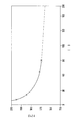
- the hydrothermal aftertreatment according to the present invention is carried out in a defined temperature-residence time ratio. More detailed information can be found in the attached graphic representation.
- the parabolic curve branch determines the dwell time t necessary at a predetermined temperature T in order to obtain the basic, platelet-shaped magnesium carbonates sought according to the invention.
- Anhydrous magnesium carbonate with a cube-like structure is obtained above the parabolic curve branch.
- Thin platelet-shaped magnesium carbonates are present below the curve branch.
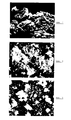
- Fig. 1 is presented to demonstrate the basic, platelet-shaped calcium-magnesium-carbonate mixture obtained by the process according to the invention. This figure shows the thick platelet-shaped magnesium carbonates that are surrounded by the smaller calcium carbonate particles.
- Fig. 2 shows the calcium-magnesium-carbonate mixture produced according to the previous process according to P 26 00 485. The platelet-shaped magnesium carbonate is much thinner and frayed like a leaf.
- Fig. 3 shows an anhydrous magnesium carbonate with a cube-like structure. As stated above, this forms during the hydrothermal aftertreatment outside the temperature-residence time ratio according to the invention.
- a coating pigment for the production of glossy paper is produced from the basic, platelet-shaped magnesium carbonates with a shape factor of 1:25 with the addition of 1% dispersant. This coating pigment can be processed excellently and provides a surface quality which is again increased compared to the known method.
Landscapes
- Chemical & Material Sciences (AREA)
- Organic Chemistry (AREA)
- Life Sciences & Earth Sciences (AREA)
- Geology (AREA)
- Inorganic Chemistry (AREA)
- Compounds Of Alkaline-Earth Elements, Aluminum Or Rare-Earth Metals (AREA)
- Paper (AREA)
- Solid-Sorbent Or Filter-Aiding Compositions (AREA)
- Pharmaceuticals Containing Other Organic And Inorganic Compounds (AREA)
Abstract
Description
- Die Erfindung betrifft ein Verfahren zur Herstellung von Carbonaten des Calciums oder/und Magnesiums, insbesondere von basischem Magnesiumcarbonat oder basischem Calcium-MagnesiumCarbonat.
- Ein Verfahren dieser Art ist bereits in der DE-OS 26 00 485 beschrieben. Danach wird Dolomit nach Erhitzen auf etwa 1000 bis 1100°C in ein Gemisch von Calciumoxid und Magnesiumoxid umgewandelt, das Oxidgemisch in Wasser suspendiert und in die Suspension Kohlendioxid eingeleitet. Die Suspension wird über Zentrifugen oder Filterpressen eingeengt und durch Zugabe eines Dispergiermittels eine stabile Suspension mit hohem Feststoffgehalt hergestellt. Die stabile Suspension enthält üblicherweise 32 Gew.-% Trockenstoff, wobei 2,2 % Dispergiermittel zugesetzt werden müssen. Nach einer nochmaligen Trocknung des basischen Calcium-Magnesium-Carbonats kann der Trockenstoffgehalt auf 54 Gew.-% gesteigert werden. Zur Herstellung einer stabilen Suspension werden dann allerdings schon mehr als 6 % Dispergiermittel benötigt.
- Bei dem bekannten Verfahren liegen die Feststoffe überwiegend als dünne, plättchenförmige Magnesiumcarbonate mit einem hohen Shape-Faktor von mindestens 1:80 vor. Der Shape-Faktor gibt dabei das Verhältnis von Dicke zu mittlerem Durchmesser eines flächigen Kristalls an. Ein hoher Shape-Faktor bedeutet demnach eine im Verhältnis zum mittleren Durchmesser geringe Dicke der plättchenförmigen Magnesiumcarbonate.
- Aufgabe der vorliegenden Erfindung ist es, in einer stabilen Suspension aus basischen, überwiegend plättchenförmigen Calcium-Magnesium-Carbonaten und Wasser den Trockenstoffanteil bei gleichzeitig verringerter Dispergiermittelmenge zu erhöhen. Dieses wird erfindungsgemäß durch die in den Patentansprüchen angegebenen Merkmale erreicht. Die Suspension weist nach dem Filterpressen einen Trockenstoffanteil von 44 Gew.-% auf, und es werden zur Herstellung einer stabilen Suspension 0,9 Gew.-% Dispergiermittel benötigt. Nach einer weiteren Trocknung kann der Trockenstoffanteil auf 63 Gew.-% gesteigert werden, wozu dann 1,3 % Dispergiermittel erforderlich sind. Alle Dispergiermittelmengenangaben beziehen sich auf den Feststoffgehalt der Suspension; der Trockenstoffgehalt wurde im Filterkuchen ermittelt.
- Die hydrothermale Nachbehandlung gemäß der vorliegenden Erfindung wird in einem definierten Temperatur-Verweilzeit-Verhältnis durchgeführt. Nähere Angaben sind der beiliegenden grafischen Darstellung zu entnehmen. Der parabelförmige Kurvenast bestimmt die bei vorgegebener Temperatur T notwendige Verweilzeit t, um die erfindungsgemäß angestrebten basischen, plättchenförmigen Magnesiumcarbonate zu erhalten. Oberhalb des parabelförmigen Kurvenastes wird wasserfreies Magnesiumcarbonat mit würfelähnlicher Struktur erhalten. Unterhalb des Kurvenastes liegen dünne plättchenförmige Magnesiumcarbonate vor.
- Während nach dem bisherigen Verfahren verhältnismäßig dünne Plättchen mit einem Shape-Faktor von 1:80 erhalten wurden, liegen bei dem erfindungsgemäßen Verfahren-dickere Plättchen mit einem Shape-Faktor von ca. 1:25 vor. Dieses Produkt ist daher sehr günstig in der Papierindustrie einsetzbar.
- Zur Demonstration des mit dem erfindungsgemäßen Verfahren erhaltenen basischen, plättchenförmigen Calcium-Magnesium-Carbonatgemisches wird die Abb.1 vorgelegt. Aus dieser Abbildung sind die dicken plättchenförmigen Magnesiumcarbonate zu erkennen, die von den kleineren Calciumcarbonatteilchen umgeben sind. Zum Vergleich dazu ist in Abb.2 das nach dem bisherigen Verfahren gemäß P 26 00 485 hergestellte Calcium-Magnesium-Carbonatgemisch dargestellt. Das plättchenförmige Magnesiumcarbonat ist hier sehr viel dünner und blattförmig ausgefranst.
- In Abb.3 ist ein wasserfreies Magnesiumcarbonat mit würfelähnlicher Struktur zu erkennen. Dieses bildet sich, wie oben dargelegt, bei der hydrothermalen Nachbehandlung außerhalb des erfindungsgemäßen Temperatur-Verweilzeit-Verhältnisses.
- Die in den Abbildungen 1 bis 3 erkennbaren Magnesiumcarbonate weisen im Durchschnitt folgende Shape-Faktoren auf:
- Abb.1: Shape-Faktor 1 : 25
- Abb.2: Shape-Faktor 1 : 80
- Abb.3: Würfelstruktur mit Shape-Faktoren von etwa 1 : 1.
- Aus den erfindungsgemäß hergestellten basischen, plättchenförmigen Magnesiumcarbonaten mit einem Shape-Faktor von 1:25 wird unter Zusatz von 1 % Dispergiermittel ein Streichpigment zur Herstellung von glänzendem Papier produziert. Dieses Streichpigment läßt sich hervorragend verarbeiten und liefert eine gegenüber dem bekannten Verfahren nochmals gesteigerte Oberflächengüte.
Claims (6)
Priority Applications (1)
| Application Number | Priority Date | Filing Date | Title |
|---|---|---|---|
| AT79103811T ATE422T1 (de) | 1978-10-30 | 1979-10-05 | Verfahren zur herstellung einer waessrigen suspension von carbonaten des calciums oder/und magnesiums aus dolomit. |
Applications Claiming Priority (2)
| Application Number | Priority Date | Filing Date | Title |
|---|---|---|---|
| DE2847205A DE2847205C2 (de) | 1978-10-30 | 1978-10-30 | Verfahren zur Herstellung eines Papierfüllstoffs und/oder Streichpigments |
| DE2847205 | 1978-10-30 |
Publications (2)
| Publication Number | Publication Date |
|---|---|
| EP0010643A1 true EP0010643A1 (de) | 1980-05-14 |
| EP0010643B1 EP0010643B1 (de) | 1981-11-25 |
Family
ID=6053490
Family Applications (1)
| Application Number | Title | Priority Date | Filing Date |
|---|---|---|---|
| EP79103811A Expired EP0010643B1 (de) | 1978-10-30 | 1979-10-05 | Verfahren zur Herstellung einer wässrigen Suspension von Carbonaten des Calciums oder/und Magnesiums aus Dolomit |
Country Status (8)
| Country | Link |
|---|---|
| EP (1) | EP0010643B1 (de) |
| JP (1) | JPS5560023A (de) |
| AT (1) | ATE422T1 (de) |
| DE (1) | DE2847205C2 (de) |
| ES (1) | ES485481A2 (de) |
| FI (1) | FI64119C (de) |
| NO (1) | NO153170C (de) |
| PT (1) | PT70207A (de) |
Cited By (7)
| Publication number | Priority date | Publication date | Assignee | Title |
|---|---|---|---|---|
| DE3245103A1 (de) * | 1982-12-07 | 1984-06-07 | Rheinische Kalksteinwerke GmbH, 5603 Wülfrath | Verfahren zur herstellung eines gemisches von calcium- und magnesiumkarbonaten mit vorwiegend plaettchenfoermiger kristallform |
| EP0140644A3 (en) * | 1983-10-18 | 1987-01-21 | Okutama Kogyo Kabushiki Kaisha | Calcium carbonate in a platelet-like particulate form and a method for the preparation thereof |
| EP0302514A3 (de) * | 1987-08-06 | 1990-05-09 | Ustav Pro Vyzkum Rud | Verfahren zur Gewinnung von wasserfreiem Magnesiumcarbonat |
| EP0447094A1 (de) * | 1990-03-13 | 1991-09-18 | Minerals Technologies Inc. | Rhombohedrisches Calciumcarbonat und beschleunigtes Alternverfahren in Wärme zur Herstellung davon |
| EP0732304A1 (de) * | 1995-03-10 | 1996-09-18 | SOCIETA GENERALE PER L'INDUSTRIA DELLA MAGNESIA, S.p.A. | Verfahren zur Herstellung von Magnesiumverbindungen |
| RU2374176C2 (ru) * | 2006-04-04 | 2009-11-27 | Алексей Павлович Смирнов | Способ получения ультрадисперсных порошков карбонатов |
| EP2418241A1 (de) | 2010-08-12 | 2012-02-15 | Bene_fit Systems GmbH & Co. KG | Magnesiumcarbonathaltiges Füllmaterial für Verbundmaterialien, dessen Herstellung und Verwendung |
Families Citing this family (1)
| Publication number | Priority date | Publication date | Assignee | Title |
|---|---|---|---|---|
| JP5194944B2 (ja) * | 2008-03-28 | 2013-05-08 | 東京電力株式会社 | 二酸化炭素の鉱物固定システム |
Citations (6)
| Publication number | Priority date | Publication date | Assignee | Title |
|---|---|---|---|---|
| DE267543C (de) * | ||||
| DE259627C (de) * | ||||
| AT145809B (de) * | 1934-05-19 | 1936-05-25 | Ig Farbenindustrie Ag | Verfahren zur Gewinnung von wasserfreiem Magnesiumkarbonat (Magnesit) aus Dolomit bzw. Kalkstein. |
| CH188612A (de) * | 1934-05-19 | 1937-01-15 | Ig Farbenindustrie Ag | Verfahren zur Gewinnung von wasserfreiem, neutralem Magnesiumkarbonat aus Magnesiumhydroxyd. |
| DE715256C (de) * | 1932-07-12 | 1941-12-17 | American Zinc Lead & Smelting | Verfahren zur Herstellung von Magnesiumcarbonat |
| DE2600485A1 (de) * | 1976-01-08 | 1977-07-21 | Vaw Ver Aluminium Werke Ag | Verfahren zur herstellung von carbonaten des calciums oder/und magnesiums |
-
1978
- 1978-10-30 DE DE2847205A patent/DE2847205C2/de not_active Expired
-
1979
- 1979-09-17 FI FI792881A patent/FI64119C/fi not_active IP Right Cessation
- 1979-09-21 PT PT70207A patent/PT70207A/pt unknown
- 1979-10-05 AT AT79103811T patent/ATE422T1/de not_active IP Right Cessation
- 1979-10-05 EP EP79103811A patent/EP0010643B1/de not_active Expired
- 1979-10-12 NO NO793298A patent/NO153170C/no unknown
- 1979-10-16 JP JP13350379A patent/JPS5560023A/ja active Pending
- 1979-10-29 ES ES485481A patent/ES485481A2/es not_active Expired
Patent Citations (6)
| Publication number | Priority date | Publication date | Assignee | Title |
|---|---|---|---|---|
| DE267543C (de) * | ||||
| DE259627C (de) * | ||||
| DE715256C (de) * | 1932-07-12 | 1941-12-17 | American Zinc Lead & Smelting | Verfahren zur Herstellung von Magnesiumcarbonat |
| AT145809B (de) * | 1934-05-19 | 1936-05-25 | Ig Farbenindustrie Ag | Verfahren zur Gewinnung von wasserfreiem Magnesiumkarbonat (Magnesit) aus Dolomit bzw. Kalkstein. |
| CH188612A (de) * | 1934-05-19 | 1937-01-15 | Ig Farbenindustrie Ag | Verfahren zur Gewinnung von wasserfreiem, neutralem Magnesiumkarbonat aus Magnesiumhydroxyd. |
| DE2600485A1 (de) * | 1976-01-08 | 1977-07-21 | Vaw Ver Aluminium Werke Ag | Verfahren zur herstellung von carbonaten des calciums oder/und magnesiums |
Cited By (9)
| Publication number | Priority date | Publication date | Assignee | Title |
|---|---|---|---|---|
| DE3245103A1 (de) * | 1982-12-07 | 1984-06-07 | Rheinische Kalksteinwerke GmbH, 5603 Wülfrath | Verfahren zur herstellung eines gemisches von calcium- und magnesiumkarbonaten mit vorwiegend plaettchenfoermiger kristallform |
| EP0140644A3 (en) * | 1983-10-18 | 1987-01-21 | Okutama Kogyo Kabushiki Kaisha | Calcium carbonate in a platelet-like particulate form and a method for the preparation thereof |
| EP0302514A3 (de) * | 1987-08-06 | 1990-05-09 | Ustav Pro Vyzkum Rud | Verfahren zur Gewinnung von wasserfreiem Magnesiumcarbonat |
| EP0447094A1 (de) * | 1990-03-13 | 1991-09-18 | Minerals Technologies Inc. | Rhombohedrisches Calciumcarbonat und beschleunigtes Alternverfahren in Wärme zur Herstellung davon |
| EP0703193A3 (de) * | 1990-03-13 | 1996-06-05 | Minerals Tech Inc | Rhombohedrisches Calciumcarbonat |
| EP0703315A3 (de) * | 1990-03-13 | 1996-06-26 | Minerals Tech Inc | Verfahren zur Verbesserung der optischen Eigenschaften von Papier |
| EP0732304A1 (de) * | 1995-03-10 | 1996-09-18 | SOCIETA GENERALE PER L'INDUSTRIA DELLA MAGNESIA, S.p.A. | Verfahren zur Herstellung von Magnesiumverbindungen |
| RU2374176C2 (ru) * | 2006-04-04 | 2009-11-27 | Алексей Павлович Смирнов | Способ получения ультрадисперсных порошков карбонатов |
| EP2418241A1 (de) | 2010-08-12 | 2012-02-15 | Bene_fit Systems GmbH & Co. KG | Magnesiumcarbonathaltiges Füllmaterial für Verbundmaterialien, dessen Herstellung und Verwendung |
Also Published As
| Publication number | Publication date |
|---|---|
| NO153170B (no) | 1985-10-21 |
| EP0010643B1 (de) | 1981-11-25 |
| FI64119B (fi) | 1983-06-30 |
| DE2847205C2 (de) | 1984-11-08 |
| NO793298L (no) | 1980-05-02 |
| FI792881A7 (fi) | 1980-05-01 |
| JPS5560023A (en) | 1980-05-06 |
| NO153170C (no) | 1986-01-29 |
| ES485481A2 (es) | 1980-05-16 |
| ATE422T1 (de) | 1981-12-15 |
| FI64119C (fi) | 1983-10-10 |
| DE2847205A1 (de) | 1980-05-14 |
| PT70207A (fr) | 1979-10-01 |
Similar Documents
| Publication | Publication Date | Title |
|---|---|---|
| EP0010643B1 (de) | Verfahren zur Herstellung einer wässrigen Suspension von Carbonaten des Calciums oder/und Magnesiums aus Dolomit | |
| DE69313373T2 (de) | Verfahren zur Herstellung von Calciumsulfat | |
| DE2309150A1 (de) | Verfahren zum aufpfropfen organischer polymerer auf kolloidale anorganische substanzen | |
| DE2633570B2 (de) | Verfahren zur Aufarbeitung von Abfällen der Chromsäureanhydrid-Herstellung | |
| DE3912554C1 (de) | ||
| DE69115322T2 (de) | Teilchen aus wasserhaltigem, dreiwertigen Chromoxyd und Kohlenstoff | |
| DE2829382A1 (de) | Verfahren zur herstellung von calciumsulfat | |
| DE3222482A1 (de) | Verfahren zur herstellung von calciumhydrogenphosphatdihydratmassen | |
| DE2745023A1 (de) | Moertelstoffe aus eisen-ii-sulfat und verfahren zu ihrer herstellung | |
| DE1963846C3 (de) | Verfahren zur Gewinnung von Kaliumhydrogentartrat | |
| DE3843846C1 (de) | ||
| DE2620096C3 (de) | Verfahren zur kontinuierlichen Herstellung von wasserfreiem Natriumdithionit | |
| DE3206355C2 (de) | ||
| DE2708861B2 (de) | Verfahren zum Herstellen eines Carbonates von Aluminium und einem Alkali- oder Erdalkalimetall | |
| DE1907373A1 (de) | Pigment und Verfahren zu dessen Herstellung | |
| DE1095101B (de) | Verfahren zur Herstellung eines Leimstoffes fuer Papier | |
| DE2505713C2 (de) | Verbesserung der Filtration von Titandioxid-Hydrolysatschlämmen | |
| DE2457357B2 (de) | Verfahren zur herstellung von einkristallen aus beta-bleidioxid | |
| DE2738825A1 (de) | Verfahren zur herstellung eines wasserloeslichen carboxymethyloxybernsteinsaeuresalzes | |
| DE3213517A1 (de) | Verfahren zur herstellung von bariumsulfat | |
| DE607395C (de) | Verfahren zur Herstellung von Titansaeure bzw. Titanpigmenten | |
| DE163628C (de) | ||
| DE495786C (de) | Verfahren zur UEberfuehrung von Bleisulfat in Bleicarbonat | |
| DE2344829C2 (de) | In Wasser dispergierbare Al↓2↓ 0↓3↓-Zubereitung und Verfahren zu ihrer Herstellung | |
| DE1113817B (de) | Verfahren zur Herstellung von Polyaethylenpolysulfid durch Umsetzen anorganischer Polysulfide mit AEthylenchlorid in Gegenwart von Schutzkolloiden |
Legal Events
| Date | Code | Title | Description |
|---|---|---|---|
| PUAI | Public reference made under article 153(3) epc to a published international application that has entered the european phase |
Free format text: ORIGINAL CODE: 0009012 |
|
| AK | Designated contracting states |
Designated state(s): AT BE CH FR GB IT NL SE |
|
| 17P | Request for examination filed | ||
| ITF | It: translation for a ep patent filed | ||
| GRAA | (expected) grant |
Free format text: ORIGINAL CODE: 0009210 |
|
| AK | Designated contracting states |
Designated state(s): AT BE CH FR GB IT NL SE |
|
| REF | Corresponds to: |
Ref document number: 422 Country of ref document: AT Date of ref document: 19811215 Kind code of ref document: T |
|
| ITTA | It: last paid annual fee | ||
| PGFP | Annual fee paid to national office [announced via postgrant information from national office to epo] |
Ref country code: GB Payment date: 19930927 Year of fee payment: 15 |
|
| PGFP | Annual fee paid to national office [announced via postgrant information from national office to epo] |
Ref country code: FR Payment date: 19931014 Year of fee payment: 15 |
|
| PGFP | Annual fee paid to national office [announced via postgrant information from national office to epo] |
Ref country code: SE Payment date: 19931022 Year of fee payment: 15 Ref country code: AT Payment date: 19931022 Year of fee payment: 15 |
|
| PGFP | Annual fee paid to national office [announced via postgrant information from national office to epo] |
Ref country code: NL Payment date: 19931031 Year of fee payment: 15 |
|
| PGFP | Annual fee paid to national office [announced via postgrant information from national office to epo] |
Ref country code: BE Payment date: 19931105 Year of fee payment: 15 |
|
| PGFP | Annual fee paid to national office [announced via postgrant information from national office to epo] |
Ref country code: CH Payment date: 19931119 Year of fee payment: 15 |
|
| PG25 | Lapsed in a contracting state [announced via postgrant information from national office to epo] |
Ref country code: GB Effective date: 19941005 Ref country code: AT Effective date: 19941005 |
|
| PG25 | Lapsed in a contracting state [announced via postgrant information from national office to epo] |
Ref country code: SE Effective date: 19941006 |
|
| PG25 | Lapsed in a contracting state [announced via postgrant information from national office to epo] |
Ref country code: CH Effective date: 19941031 Ref country code: BE Effective date: 19941031 |
|
| EAL | Se: european patent in force in sweden |
Ref document number: 79103811.0 |
|
| BERE | Be: lapsed |
Owner name: VEREINIGTE ALUMINIUM-WERKE A.G. Effective date: 19941031 |
|
| PG25 | Lapsed in a contracting state [announced via postgrant information from national office to epo] |
Ref country code: NL Effective date: 19950501 |
|
| GBPC | Gb: european patent ceased through non-payment of renewal fee |
Effective date: 19941005 |
|
| NLV4 | Nl: lapsed or anulled due to non-payment of the annual fee | ||
| PG25 | Lapsed in a contracting state [announced via postgrant information from national office to epo] |
Ref country code: FR Effective date: 19950630 |
|
| REG | Reference to a national code |
Ref country code: CH Ref legal event code: PL |
|
| EUG | Se: european patent has lapsed |
Ref document number: 79103811.0 |
|
| REG | Reference to a national code |
Ref country code: FR Ref legal event code: ST |
|
| PLBE | No opposition filed within time limit |
Free format text: ORIGINAL CODE: 0009261 |
|
| STAA | Information on the status of an ep patent application or granted ep patent |
Free format text: STATUS: NO OPPOSITION FILED WITHIN TIME LIMIT |