WO2024004962A1 - 化合物、屈折率向上剤及び重合体 - Google Patents
化合物、屈折率向上剤及び重合体 Download PDFInfo
- Publication number
- WO2024004962A1 WO2024004962A1 PCT/JP2023/023674 JP2023023674W WO2024004962A1 WO 2024004962 A1 WO2024004962 A1 WO 2024004962A1 JP 2023023674 W JP2023023674 W JP 2023023674W WO 2024004962 A1 WO2024004962 A1 WO 2024004962A1
- Authority
- WO
- WIPO (PCT)
- Prior art keywords
- group
- compound
- chemical formula
- salt
- refractive index
- Prior art date
- Legal status (The legal status is an assumption and is not a legal conclusion. Google has not performed a legal analysis and makes no representation as to the accuracy of the status listed.)
- Ceased
Links
Images





Classifications
-
- C—CHEMISTRY; METALLURGY
- C07—ORGANIC CHEMISTRY
- C07C—ACYCLIC OR CARBOCYCLIC COMPOUNDS
- C07C43/00—Ethers; Compounds having groups, groups or groups
- C07C43/02—Ethers
- C07C43/20—Ethers having an ether-oxygen atom bound to a carbon atom of a six-membered aromatic ring
- C07C43/215—Ethers having an ether-oxygen atom bound to a carbon atom of a six-membered aromatic ring having unsaturation outside the six-membered aromatic rings
-
- C—CHEMISTRY; METALLURGY
- C07—ORGANIC CHEMISTRY
- C07C—ACYCLIC OR CARBOCYCLIC COMPOUNDS
- C07C43/00—Ethers; Compounds having groups, groups or groups
- C07C43/02—Ethers
- C07C43/20—Ethers having an ether-oxygen atom bound to a carbon atom of a six-membered aromatic ring
- C07C43/23—Ethers having an ether-oxygen atom bound to a carbon atom of a six-membered aromatic ring containing hydroxy or O-metal groups
-
- C—CHEMISTRY; METALLURGY
- C07—ORGANIC CHEMISTRY
- C07C—ACYCLIC OR CARBOCYCLIC COMPOUNDS
- C07C69/00—Esters of carboxylic acids; Esters of carbonic or haloformic acids
- C07C69/52—Esters of acyclic unsaturated carboxylic acids having the esterified carboxyl group bound to an acyclic carbon atom
- C07C69/533—Monocarboxylic acid esters having only one carbon-to-carbon double bond
- C07C69/54—Acrylic acid esters; Methacrylic acid esters
-
- C—CHEMISTRY; METALLURGY
- C07—ORGANIC CHEMISTRY
- C07D—HETEROCYCLIC COMPOUNDS
- C07D303/00—Compounds containing three-membered rings having one oxygen atom as the only ring hetero atom
- C07D303/02—Compounds containing oxirane rings
- C07D303/12—Compounds containing oxirane rings with hydrocarbon radicals, substituted by singly or doubly bound oxygen atoms
- C07D303/18—Compounds containing oxirane rings with hydrocarbon radicals, substituted by singly or doubly bound oxygen atoms by etherified hydroxyl radicals
- C07D303/20—Ethers with hydroxy compounds containing no oxirane rings
- C07D303/24—Ethers with hydroxy compounds containing no oxirane rings with polyhydroxy compounds
- C07D303/27—Ethers with hydroxy compounds containing no oxirane rings with polyhydroxy compounds having all hydroxyl radicals etherified with oxirane containing compounds
Definitions
- the present invention relates to compounds, refractive index improvers, and polymers.
- Patent Document 1 Various compounds of biphenols and bisphenols are being studied. Furthermore, in Patent Document 1, a polymerizable functional group is introduced into the biphenols or bisphenols to produce epoxy resins, polyester resins, polyurethane resins, polybutyral resins, liquid crystal display panels, color filters, eyeglass lenses, Fresnel lenses, etc. It has been proposed to be used as a high refractive index resin material for optical articles such as lenticular lenses, prism lens sheets for TFTs, optical fibers, and optical disks.
- Patent Document 1 has a high refractive index for optical articles such as liquid crystal display panels, color filters, eyeglass lenses, Fresnel lenses, lenticular lenses, TFT prism lens sheets, optical fibers, and optical disks.
- This is a new polymerizable monomer that is useful as a resin material.
- an object of the present invention is to provide a compound, a refractive index improver, and a polymer that can provide a resin material with a high refractive index.
- the compound of the present invention is a compound represented by the following chemical formula (1), a tautomer or stereoisomer thereof, or a salt thereof.
- A is a single bond, a divalent hydrocarbon group, or a sulfonyl group, and one or more hydrogen atoms in the divalent hydrocarbon group are each independently substituted with a methyl group or a phenyl group.
- X 1 and X 2 are each a polymerizable functional group, and may be the same or different from each other.
- the refractive index improver of the present invention is a refractive index improver containing the compound of the present invention, its tautomer or stereoisomer, or a salt thereof.
- the polymer of the present invention is a polymer of monomer components containing the compound of the present invention, its tautomer or stereoisomer, or a salt thereof.
- the present invention it is possible to provide a compound, a refractive index improver, and a polymer that can provide a resin material with a high refractive index.
- FIG. 1 is a diagram showing the IR analysis results of the compound obtained in Synthesis Example 1.
- FIG. 2 is a diagram showing the IR analysis results of the compound obtained in Synthesis Example 2.
- FIG. 3 is a diagram showing the IR analysis results of the compound obtained in Example 1.
- FIG. 4 is a diagram showing the IR analysis results of the compound obtained in Example 2.
- FIG. 5 is a diagram showing the IR analysis results of the compound obtained in Example 3.
- FIG. 6 is a diagram showing the IR analysis results of the compound obtained in Example 4.
- FIG. 7 is a diagram showing the IR analysis results of the compound obtained in Example 5.
- FIG. 8 is a diagram showing the IR analysis results of the compound obtained in Example 6.
- FIG. 9 is a diagram showing the IR analysis results of the compound obtained in Example 7.
- FIG. 1 is a diagram showing the IR analysis results of the compound obtained in Synthesis Example 1.
- FIG. 2 is a diagram showing the IR analysis results of the compound obtained in Synthesis Example 2.
- FIG. 3 is
- FIG. 10 is a diagram showing the IR analysis results of the compound obtained in Example 8.
- FIG. 11 is a diagram showing the IR analysis results of the compound obtained in Example 9.
- FIG. 12 is a diagram showing the IR analysis results of the compound obtained in Example 10.
- FIG. 13 is a diagram showing the IR analysis results of the compound obtained in Example 11.
- isomers such as tautomers or stereoisomers (e.g. geometric isomers, conformational isomers, and optical isomers) are present in the compound (for example, the compound represented by the chemical formula (1), etc.). If present, either isomer can be used in the present invention, unless otherwise specified. Furthermore, if the compound is capable of forming a salt, the salt can also be used in the present invention, unless otherwise specified.
- the salt may be an acid addition salt or a base addition salt. Further, the acid forming the acid addition salt may be an inorganic acid or an organic acid, and the base forming the base addition salt may be an inorganic base or an organic base.
- the inorganic acids are not particularly limited, but include, for example, sulfuric acid, phosphoric acid, hydrofluoric acid, hydrochloric acid, hydrobromic acid, hydroiodic acid, hypofluorous acid, hypochlorous acid, hypobromous acid, Hypoiodic acid, fluorous acid, chlorous acid, bromite acid, iodic acid, fluoric acid, chloric acid, bromic acid, iodic acid, perfluoric acid, perchloric acid, perbromic acid, periodic acid, etc. can be mentioned.
- the organic acid is not particularly limited, and examples include p-toluenesulfonic acid, methanesulfonic acid, oxalic acid, p-bromobenzenesulfonic acid, carbonic acid, succinic acid, citric acid, benzoic acid, and acetic acid.
- the inorganic base include, but are not limited to, ammonium hydroxide, alkali metal hydroxides, alkaline earth metal hydroxides, carbonates, and hydrogen carbonates, and more specifically, for example, Examples include sodium hydroxide, potassium hydroxide, potassium carbonate, sodium carbonate, sodium hydrogen carbonate, potassium hydrogen carbonate, calcium hydroxide, and calcium carbonate.
- the organic base is not particularly limited, and examples thereof include ethanolamine, triethylamine, and tris(hydroxymethyl)aminomethane.
- the method for producing these salts is not particularly limited, and, for example, they can be produced by appropriately adding the above-mentioned acid or base to the above-mentioned compound by a known method.
- a chain substituent for example, a hydrocarbon group such as an alkyl group, an alkylene group, or an unsaturated aliphatic hydrocarbon group
- a chain substituent may be linear or branched, unless otherwise specified.
- the number of carbon atoms is not particularly limited, but for example, 1-40, 1-32, 1-24, 1-18, 1-12, 1-6, 1-4, or 1-2 (unsaturated hydrocarbon group). 2 or more).
- the number of ring members (number of atoms constituting the ring) of the cyclic group for example, aryl group, heteroaryl group, etc.
- any isomer may be used unless otherwise specified.
- naphthyl group it may be a 1-naphthyl group or a 2-naphthyl group.
- the compound of the present invention is a compound having a 2,6-diphenylphenol skeleton represented by the chemical formula (general formula) (1), a tautomer or stereoisomer thereof, or a salt thereof.
- the compound of the present invention contains X 1 and X 2 which are polymerizable functional groups, and therefore can be polymerized to form a polymer.
- the compound of the present invention itself has a high refractive index, and therefore, it is possible to provide a resin material with a high refractive index by polymerizing it.
- a compound in which A is a single bond in the general formula (1) can be synthesized (manufactured) using, for example, a compound represented by the following chemical formula (6) (hereinafter also referred to as "Bis-DPP") as a raw material. Can be done.
- “Bis-DPP” can be synthesized, for example, by the method described in Bul. Korean Chem. Soc. 1999, Vol. 20, No. 4, pp. 469-472, but is not limited to this method and can be synthesized by any other It may be synthesized by the following method.
- the compound in which A is a methylene group can be synthesized (manufactured) using, for example, a compound represented by the following chemical formula (7) (hereinafter also referred to as "Bis-DPP-F") as a raw material. can do.
- a compound represented by the following chemical formula (7) hereinafter also referred to as "Bis-DPP-F"
- Bis-DPP-F can be synthesized, for example, by the method described in European Polymer Journal, 1970, Vol. 6, pp. 1339-1346, but is not limited to this method, and can be synthesized by any other method. It's okay.
- A is a single bond, a divalent hydrocarbon group, or a sulfonyl group, as described above, and one or more hydrogen atoms in the divalent hydrocarbon group are each independently It may also be substituted with a methyl group or a phenyl group.
- the divalent hydrocarbon group may be a divalent chain hydrocarbon group or a divalent alicyclic hydrocarbon group.
- the divalent chain hydrocarbon group may be linear or branched, saturated or unsaturated. Examples of the divalent chain hydrocarbon group include a straight chain or branched alkylene group, a straight chain or branched alkenylene group, a straight chain or branched alkynylene group, and the like.
- the divalent chain hydrocarbon group is, for example, a divalent hydrocarbon group having 1 to 4 carbon atoms (e.g., methylene group, ethylene group, propylene group, etc.), or a divalent hydrocarbon group having 2 to 4 carbon atoms to which one methyl is added.
- 5 divalent hydrocarbon groups for example, methylmethylene group, etc.
- divalent hydrocarbon groups having 3 to 6 carbon atoms to which two methyls are added dimethylmethylene group, etc.
- one or more of the hydrogen atoms in the divalent hydrocarbon group may be independently substituted with a methyl group or a phenyl group, as described above. Furthermore, in A in the general formula (1), one or more hydrogen atoms in the divalent chain hydrocarbon group are each independently substituted with a methyl group or a phenyl group, as described above. It's okay.
- the above A may be, for example, a divalent hydrocarbon group having 7 to 10 carbon atoms to which one phenyl group is added (that is, one hydrogen atom is substituted with a phenyl group).
- Examples of the divalent hydrocarbon group having 7 to 10 carbon atoms to which one phenyl group is attached include a phenylmethylene group.
- the above A may be, for example, a divalent hydrocarbon group having 13 to 16 carbon atoms to which two phenyl groups are added (that is, two hydrogen atoms are substituted with phenyl groups).
- Examples of the divalent hydrocarbon group having 13 to 16 carbon atoms to which the two phenyl groups are attached include diphenylmethylene group.
- the above A is, for example, a divalent carbon atom to which a methyl group and a phenyl group are added (that is, one or more hydrogen atoms are substituted with a methyl group, and one or more hydrogen atoms are substituted with a phenyl group). It may be a hydrocarbon group having 8 to 11 carbon atoms. Examples of the divalent hydrocarbon group having 8 to 11 carbon atoms to which the methyl group and phenyl group are attached include a methylphenylmethylene group.
- the group in which one or more of the hydrogen atoms in the divalent chain hydrocarbon group is substituted with a methyl group or a phenyl group is particularly preferably a phenylmethylene group or a diphenylmethylene group.
- a in the general formula (1) may be a divalent alicyclic hydrocarbon group, such as a cycloalkylene group.
- the cycloalkylene group include a cyclopentylene group, a cyclopentylidene group, a cyclohexylene group, and a cyclohexylidene group.
- the cyclopentylene group include a 1,2-cyclopentylene group and a 1,3-cyclopentylene group.
- Examples of the cyclohexylene group include a 1,2-cyclohexylene group, a 1,3-cyclohexylene group, and a 1,4-cyclohexylene group.
- a in the general formula (1) is preferably a single bond or a methylene group. Further, as A in the general formula (1), a sulfonyl group can be selected as described above.
- the polymerizable functional groups X 1 and X 2 in the general formula (1) may be the same or different, but are preferably the same.
- the polymerizable functional group include a functional group containing a hydroxyl group, a functional group containing an amino group, a functional group containing a carbonyl group, a functional group containing an epoxy group, a functional group containing an alkenyl group, and an unsaturated carboxylic acid residue. , a functional group containing an isocyanate group (-NCO group), and the like.
- the compound represented by the general formula (1) is, for example, the following scheme 1 or the following It can be synthesized by the method shown in Scheme 2.
- the method shown in Scheme 1 or Scheme 2 below is a method in which "Bis-DPP" (compound (6)) or “Bis-DPP-F” (compound (7)) is reacted with halobinyl or haloallyl.
- the reaction conditions are not particularly limited, and for example, the reaction may be performed without a solvent, in an organic solvent, with a catalyst, or without a catalyst.
- halobinyl or haloallyl is not particularly limited, but examples thereof include vinyl chloride, vinyl bromide, allyl chloride, allyl bromide, and the like.
- the total amount of halobinyl or haloallyl used is also not particularly limited, but it is preferably 1 to 6 times the molar amount of "Bis-DPP" or “Bis-DPP-F", and 2 to 4 times the molar amount of "Bis-DPP” or “Bis-DPP-F". It is more preferable that there be.
- the compound represented by the general formula (1) is, for example, the following scheme 3 or the following It can be synthesized by the method shown in Scheme 4.
- the method shown in Scheme 3 or Scheme 4 below is a method of reacting "Bis-DPP" (compound (6)) or “Bis-DPP-F” (compound (7)) with epihalohydrin.
- the reaction conditions are not particularly limited, and for example, the reaction may be performed without a solvent, in an organic solvent, with a catalyst, or without a catalyst.
- * is a bond to the O atom in the chemical formula (1).
- the epihalohydrin is not particularly limited, and examples thereof include epichlorohydrin, epibromohydrin, and the like.
- the total amount of epihalohydrin used is also not particularly limited, but it is preferably 1 to 12 times the molar amount, particularly 2 to 10 times the molar amount of "Bis-DPP" or "Bis-DPP-F". It is more preferable that there be.
- the reaction temperature is not particularly limited, but is preferably -10°C to 150°C. If the reaction temperature is too high, by-products may be produced, and if the reaction temperature is too low, the reaction time will be too long.
- the reaction temperature is more preferably 20°C to 130°C. Further, the reaction time of the above step is not particularly limited and can be adjusted depending on the reaction temperature, but is preferably 1 to 15 hours.
- the compound represented by the general formula (1) is, for example, the following scheme 5 or the following It can be synthesized by the method shown in Scheme 6.
- the method shown in Scheme 5 below or Scheme 6 below involves combining "Bis-DPP" (compound (6)) or “Bis-DPP-F” (compound (7)) with ethylene oxide, ethylene carbonate, propylene oxide, and carbonic acid. This is a method of reacting with one or more types selected from the group consisting of propylene.
- the reaction conditions are not particularly limited, and for example, the reaction may be performed without a solvent, in an organic solvent, with a catalyst, or without a catalyst.
- * is a bond to the O atom in the chemical formula (1)
- D is an ethylene group or an isopropylene group
- m is an integer from 1 to 3
- D is an integer of 1 to 3.
- each D may be the same or different from each other. Further, D may be, for example, an isopropylene group.
- the total amount of ethylene oxide, ethylene carbonate, propylene oxide, and propylene carbonate used is not particularly limited, but for example, when m is 1, it is 1 to 3 times the amount of "Bis-DPP" or "Bis-DPP-F". When m is 2, it is preferably 3 to 5 times the molar amount, and when m is 3, it is preferably 5 to 6 times the molar amount.
- the reaction temperature is not particularly limited, but is preferably -20°C to 200°C. If the reaction temperature is too high, by-products may be produced, and if the reaction temperature is too low, the reaction time will be too long.
- the reaction temperature is more preferably 0°C to 180°C. Further, the reaction time of the above step is not particularly limited, and is preferably adjusted depending on the reaction temperature, but is preferably 1 to 18 hours.
- the compound can be synthesized, for example, by the method shown in Scheme 7 or Scheme 8 below.
- the method shown in the following Scheme 7 or the following Scheme 8 involves the use of "Bis-DPP" (compound (6)) or “Bis-DPP-F” (compound (7)), (meth)acrylic acid, (meth)acrylic acid This is a method of reacting with one or more types selected from the group consisting of chloride or di(meth)acrylic anhydride.
- reaction conditions are not particularly limited, and for example, the reaction may be performed without a solvent, in an organic solvent, with a catalyst, or without a catalyst.
- “(meth)acrylic” represents “at least one of acrylic and methacryl.”
- (meth)acrylic acid represents “at least one of acrylic acid and methacrylic acid.”
- (Meth)acrylic acid chloride represents “at least one of acrylic acid chloride and methacrylic acid chloride.”
- di(meth)acrylicanhydride represents "at least one of diacrylic anhydride and dimethacrylic anhydride.”
- E is an ethylene group or an isopropylene group
- F is a hydrogen atom or a methyl group
- l is a , an integer from 0 to 3
- each E may be the same or different from each other.
- the total amount of the (meth)acrylic acid, (meth)acrylic acid chloride or di(meth)acrylic anhydride used is not particularly limited, but for "Bis-DPP" or “Bis-DPP-F", 1 It is preferably 6 to 6 times the molar amount, more preferably 2 to 4 times the molar amount.
- the reaction temperature is not particularly limited, but is preferably -20°C to 100°C. If the reaction temperature is too high, by-products may be produced, and if the reaction temperature is too low, the reaction time will be too long.
- the reaction temperature is more preferably -10°C to 40°C. Further, the reaction time of the above step is not particularly limited, and is preferably adjusted depending on the reaction temperature, but is preferably 1 to 8 hours.
- the general formula (1) The compound represented by can be synthesized, for example, by the method shown in Scheme 9 or Scheme 10 below.
- the method shown in the following Scheme 9 or the following Scheme 10 is to synthesize the compound (6)-3 according to the scheme 5, or synthesize the compound (7)-3 according to the scheme 6, and then synthesize the compound (6)-3 according to the scheme 6.
- 3 or the compound (7)-3 is reacted with one or more selected from the group consisting of (meth)acrylic acid, (meth)acrylic acid chloride, or di(meth)acrylic anhydride.
- the reaction conditions are not particularly limited, and for example, the reaction may be performed without a solvent, in an organic solvent, with a catalyst, or without a catalyst.
- the total amount of (meth)acrylic acid, (meth)acrylic chloride, or di(meth)acrylic anhydride used is not particularly limited, but may be "Bis-DPP" or "Bis- It is preferably 1 to 6 times the molar amount, more preferably 2 to 4 times the molar amount of "DPP-F".
- the compound (6)-3 or the compound (7)-3 is composed of (meth)acrylic acid, (meth)acrylic acid chloride, or di(meth)acrylic anhydride.
- the reaction temperature in the step of reacting with one or more selected from the group is not particularly limited, but is preferably -20°C to 200°C. If the reaction temperature is too high, by-products may be produced, and if the reaction temperature is too low, the reaction time will be too long.
- the reaction temperature is more preferably -10°C to 140°C. Further, the reaction time of the above step is not particularly limited, and is preferably adjusted depending on the reaction temperature, but is preferably 1 to 20 hours.
- examples of the solvent include, but are not limited to, esters such as methyl acetate, ethyl acetate, phenyl acetate, and benzyl acetate; halogenated hydrocarbons such as dichloromethane and trichloromethane; acetone.
- the organic solvents may be used alone or in combination of two or more.
- the catalyst is not particularly limited, but may be a metal hydroxide such as sodium hydroxide or potassium hydroxide, or a basic compound such as tetramethylammonium chloride or benzyltriethylammonium chloride.
- inorganic acids such as hydrochloric acid and sulfuric acid
- organic acids such as acetic acid, para-toluenesulfonic acid, and methanesulfonic acid
- inorganic bases such as carbonates or hydrogen carbonates such as sodium carbonate, sodium hydrogen carbonate, potassium carbonate, and potassium hydrogen carbonate
- Examples include amines such as monoethylamine, diethylamine, and triethylamine.
- the catalysts may be used alone or in combination of two or more.
- post-treatment may be carried out as necessary by a known method, taking into account the physical properties of each compound, the type and amount of the raw materials and organic solvents used, etc. All you have to do is perform the treatment and extract each compound. Specifically, for example, as appropriate, post-treatment operations such as filtration, washing, extraction, pH adjustment, dehydration, and concentration may be carried out singly or in combination of two or more, and concentration, crystallization, and re-treatment may be carried out. Each compound may be extracted by precipitation, column chromatography, or the like.
- each extracted compound is further subjected to operations such as crystallization, reprecipitation, column chromatography, extraction, stirring and washing of crystals with a solvent, etc., either alone or in combination of two or more. Purification may be performed by performing the above steps.
- the compound of the present invention has a polymerizable functional group, it is possible to produce a resin material formed from the polymer by polymerizing it into a polymer.
- the polymer may be a polymer of the compound of the present invention alone, or a copolymer with other monomer components.
- the conditions for the polymerization reaction are also not particularly limited, and may be set as appropriate with reference to known polymerization reaction conditions, for example, depending on the type of polymerizable functional group that the compound of the present invention has. Good too.
- the polymerization reaction may be carried out, for example, by using the compound of the present invention alone or in the presence of other compounds (such as the other monomer components), optionally adding a solvent, a catalyst, etc.
- the melting point was measured using a DSC-50 (trade name) device manufactured by Shimadzu Corporation.
- the average molecular weight was measured using an LC-20AD (trade name) device manufactured by Shimadzu Corporation, and was determined as a standard polystyrene equivalent value by gel permeation chromatography (GPC).
- Infrared absorption measurement was carried out by the ATR method using an infrared spectrophotometer IRAffinity-1S (trade name) device manufactured by Shimadzu Corporation.
- the refractive index was measured as follows. First, a compound whose refractive index was to be measured was dissolved in 1-bromonaphthalene or N-methyl-2-pyrrolidone (hereinafter also referred to as "NMP") to prepare a 5% or 10% solution by weight. Next, the refractive index of each adjustment solution and the solvent 1-bromonaphthalene or NMP as a control was measured using a DR-2M (trade name) device manufactured by Atago Co., Ltd. An approximate straight line was derived from the measured values at the three points obtained through the measurement. From the approximate straight line, the value of 100% by weight of each compound, which is the substance to be measured for refractive index, was read and used as the refractive index value.
- NMP N-methyl-2-pyrrolidone
- the white crystals were dissolved in 430.2 g of xylene, washed with water, azeotropically dehydrated, and then filtered. While cooling the filtrate, seed crystals were added to perform crystallization, followed by solid-liquid separation to obtain 140.8 g of white crystals (yield 62.0%, calculated as paraformaldehyde).
- Yield 62.0%, calculated as paraformaldehyde By measuring the white crystal by 1 H-NMR, it was confirmed that it was a compound (Bis-DPP-F) represented by the chemical formula (7).
- Compound (7) (Bis-DPP-F) had a melting point of 204 to 207°C and a refractive index of 1.689.
- Example 1 Synthesis of compound (6)-1a
- compound (6) (Bis-DPP) 14.7 g (0.030 mol)
- acetone 147.0 g 48% sodium hydroxide 5.3 g (0.063 mol)
- benzyltrimethylammonium chloride 0 .28 g was charged, and the temperature was raised to 55°C while stirring under a nitrogen flow.
- 9.2 g (0.12 mol) of allyl chloride was added dropwise over 2 hours. Further, the reaction was carried out for 5 hours while stirring was continued.
- Example 2 Synthesis of compound (6)-2
- a 200 mL four-necked flask was charged with 19.6 g (0.040 mol) of compound (6) (Bis-DPP), 29.6 g (0.64 mol) of epichlorohydrin, and 0.37 g of benzyltrimethylammonium chloride, and then heated with nitrogen. The temperature was raised to 100° C. while stirring under flow, and stirring was continued at that temperature for an additional 3 hours. Thereafter, after distilling off excess epichlorohydrin, 40.0 g of toluene was added, and 14.2 g (0.17 mol) of 48% sodium hydroxide was added dropwise at a pot temperature of 100° C., followed by stirring for 9 hours.
- Example 3 Synthesis of compound (6)-3a
- a 200 mL four-neck flask was charged with 40.2 g (0.082 mol) of compound (6) (Bis-DPP), 15.9 g (0.090 mol) of ethylene carbonate, 2.0 g of sodium carbonate, and 40.2 g of dimethylacetamide. While stirring under nitrogen flow, the temperature was raised to 155° C. and stirred for 16 hours. Thereafter, the pot temperature was cooled to 100° C., and filtration was performed. 120.0 g of methanol was added to the filtrate to precipitate crystals. The precipitated crystals were subjected to solid-liquid separation to obtain 43.5 g of white crude crystals.
- the obtained crude crystals and 87.0 g of toluene were charged, and the temperature was raised to 115° C. while stirring under a nitrogen flow to dissolve the crystals. Thereafter, while cooling the pot temperature, seed crystals were added to perform crystallization, and solid-liquid separation was performed to obtain 41.0 g of white crystals (yield: 86.3%).
- the obtained white crystals were analyzed by 1 H-NMR and IR, it was confirmed that the crystals were a compound represented by the following chemical formula (6)-3a.
- the obtained compound (6)-3a had a melting point of 200 to 202°C and a refractive index of 1.671.
- the obtained crude crystals and 48.0 g of dimethylacetamide were charged, and the temperature was raised to 85° C. while stirring under a nitrogen flow to dissolve the crystals. After filtration, seed crystals were added to the filtrate while cooling to perform crystallization, followed by solid-liquid separation to obtain 6.6 g of white crystals (yield: 68.8%).
- the obtained white crystals were analyzed by 1 H-NMR and IR, it was confirmed that the crystals were a compound represented by the following chemical formula (6)-4a.
- the obtained compound (6)-4a had a melting point of 218 to 220°C and a refractive index of 1.663.
- Example 7 Synthesis of compound (7)-2
- a 200 mL four-necked flask was charged with 10.1 g (0.020 mol) of compound (7) (Bis-DPP-F), 14.8 g (0.16 mol) of epichlorohydrin, and 0.19 g of benzyltrimethylammonium chloride.
- the temperature was raised to 100° C. while stirring under a nitrogen flow, and stirring was further continued for 4 hours. Thereafter, after distilling off excess epichlorohydrin, 50.0 g of xylene was added, and 8.4 g (0.10 mol) of 48% sodium hydroxide was added dropwise at a pot temperature of 100°C, followed by stirring for 9 hours. .
- Example 8 Synthesis of compound (7)-3a
- compound (7) (Bis-DPP-F)
- 4.1 g (0.023 mol) of ethylene carbonate, 0.5 g of sodium carbonate, and 20.2 g of dimethylacetamide. was charged, the temperature was raised to 150° C. while stirring under a nitrogen flow, and stirring was further continued for 9 hours. Thereafter, the pot temperature was cooled to 60° C., and filtration was performed. 300.0 g of purified water was added to the filtrate to precipitate crystals. The precipitated crystals were subjected to solid-liquid separation to obtain 11.2 g of white crude crystals.
- the obtained crude crystals and 44.8 g of xylene were charged, and the temperature was raised to 100° C. while stirring under a nitrogen flow to dissolve the crystals. After filtration, seed crystals were added to the filtrate while cooling to perform crystallization, followed by solid-liquid separation to obtain 8.6 g of white crystals (yield: 72.3%).
- the obtained white crystals were analyzed by 1 H-NMR and IR, it was confirmed that the crystals were a compound represented by the following chemical formula (7)-3a.
- the obtained compound (7)-3a had a melting point of 178 to 179°C and a refractive index of 1.653.
- Example 9 Synthesis of compound (7)-4a
- compound (7) (Bis-DPP-F)
- 004 g was charged and dissolved, the mixture was cooled to 5° C., and 4.8 g (0.053 mol) of acrylic acid chloride was added dropwise over 1 hour. Thereafter, the mixture was stirred for 4 hours.
- Example 10 Synthesis of compound (6)-5a and its polymer
- 58.0 g of toluene, 0.6 g of methanesulfonic acid, 0.004 g of p-methoxyphenol, and 2.0 g (0.028 mol) of acrylic acid were charged and stirred.
- the temperature was raised to 80° C., the pressure inside the flask was reduced to approximately 0.033 MPa, and stirring was performed for 7 hours while refluxing toluene. 20.0 g of toluene was added to the reaction solution, followed by water washing, azeotropic dehydration, and filtration.
- the toluene in the filtrate was distilled off and concentrated to obtain 6.0 g (yield: 87.4%) of a pale yellow liquid.
- the liquid was allowed to stand and crystallize.
- the average molecular weight of the compound thus obtained was 810, and from the average molecular weight and the IR analysis results, a composition of the compound represented by the following chemical formula (6)-5a and its polymer (polymer) (mixture).
- the resulting composition (mixture) had a melting point of 88 to 93°C and a refractive index of 1.630.
- the IR analysis results of the composition (mixture) obtained in Example 10 are shown in FIG. 12, and the IR analysis results of Compound (6)-3a of Example 3 used as the raw material of Example 10 are shown in FIG.
- Example 11 Synthesis of compound (7)-5a and its polymer
- a 200 mL four-necked flask 5.9 g (0.010 mol) of compound (7)-3a synthesized in Example 8, 60.0 g of toluene, 0.6 g of methanesulfonic acid, 0.004 g of p-methoxyphenol, and 2.0 g (0.028 mol) of acrylic acid was charged and stirred. Thereafter, the temperature was raised to 80° C., the pressure inside the flask was reduced to about 0.033 MPa, and the mixture was stirred for 13 hours while refluxing toluene.
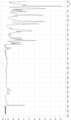
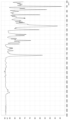
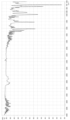
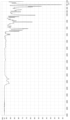
- FIGS. 1 to 13 The IR spectra (IR analysis results) of the compounds synthesized (manufactured) in Examples (including synthesis examples) are collectively shown in FIGS. 1 to 13.
- FIG. 1 is a diagram showing the IR analysis results of the compound obtained in Synthesis Example 1.
- FIG. 2 is a diagram showing the IR analysis results of the compound obtained in Synthesis Example 2.
- FIG. 3 is a diagram showing the IR analysis results of the compound obtained in Example 1.
- FIG. 4 is a diagram showing the IR analysis results of the compound obtained in Example 2.
- FIG. 5 is a diagram showing the IR analysis results of the compound obtained in Example 3, as described above.
- FIG. 6 is a diagram showing the IR analysis results of the compound obtained in Example 4.
- FIG. 7 is a diagram showing the IR analysis results of the compound obtained in Example 5.
- FIG. 8 is a diagram showing the IR analysis results of the compound obtained in Example 6.
- FIG. 9 is a diagram showing the IR analysis results of the compound obtained in Example 7.
- FIG. 10 is a diagram showing the IR analysis results of the compound obtained in Example 8, as described above.
- FIG. 11 is a diagram showing the IR analysis results of the compound obtained in Example 9.
- FIG. 12 is a diagram showing the IR analysis results of the compound (composition, mixture) obtained in Example 10, as described above.
- FIG. 13 is a diagram showing the IR analysis results of the compound (composition, mixture) obtained in Example 11, as described above. Note that in FIGS. 1 to 13, the horizontal axis is the wave number (cm ⁇ 1 ), and the vertical axis is the transmittance.
- the obtained crude crystals and 150.0 g of 4-methyl-2-pentanone were charged, and the temperature was raised to 100° C. while stirring under a nitrogen flow to dissolve the crystals. After filtration, seed crystals were added to the filtrate while cooling it to perform crystallization, followed by solid-liquid separation to obtain 30.6 g of white crystals (yield 70.7%) of the compound represented by the following chemical formula (10). Obtained.
- the obtained compound (10) had a melting point of 109 to 111°C and a refractive index of 1.579.
- the compounds of the present invention synthesized (manufactured) in Examples were all compounds having a polymerizable functional group. Furthermore, all of the compounds of the present invention synthesized (manufactured) in the examples showed a high refractive index of 1.636 to 1.671, as shown in Table 1, and optical resins for which a high refractive index is desired. It was confirmed that the material was suitable.
- A is a single bond, a divalent hydrocarbon group, or a sulfonyl group, and one or more hydrogen atoms in the divalent hydrocarbon group are each independently substituted with a methyl group or a phenyl group.
- X 1 and X 2 are each a polymerizable functional group, and may be the same or different from each other.
- the divalent hydrocarbon group is a divalent chain hydrocarbon group or a divalent alicyclic hydrocarbon group
- One or more hydrogen atoms in the divalent chain hydrocarbon group or the divalent alicyclic hydrocarbon group may be each independently substituted with a methyl group or a phenyl group
- A is a single bond, a methylene group, or a cyclohexylene group, and the hydrogen atom in the methylene group may or may not be substituted with a methyl group or a phenyl group, respectively.
- X 1 and X 2 are each independently a substituent represented by any of the groups of the following chemical formulas (2) to (5).
- * is a bond to the O atom in the chemical formula (1)
- n is an integer of 0 or 1.
- * is a bond to the O atom in the chemical formula (1).
- * is a bond to the O atom in the chemical formula (1)
- D is an ethylene group or an isopropylene group
- m is an integer from 1 to 3
- each D may be the same or different from each other.
- * is a bond to the O atom in the chemical formula (1)
- E is an ethylene group or an isopropylene group
- F is a hydrogen atom or a methyl group
- l is an integer from 0 to 3
- each E may be the same or different from each other.
- D is an isopropylene group
- the compound according to supplementary note 4 its tautomer or stereoisomer, or a salt thereof.
- A is a single bond, a methylene group, or a cyclohexylene group, and one or more hydrogen atoms of the methylene group may be each independently substituted with a methyl group or a phenyl group, The compound according to appendix 4 or 5, its tautomer or stereoisomer, or a salt thereof.
- (Appendix 7) A refractive index improver comprising a compound according to any one of Supplementary Notes 1 to 6, a tautomer or stereoisomer thereof, or a salt thereof.
- (Appendix 8) A polymer of monomer components containing the compound according to any one of Supplementary Notes 1 to 6, its tautomer or stereoisomer, or a salt thereof.
- the present invention it is possible to provide a compound, a refractive index improver, and a polymer that can provide a resin material with a high refractive index.
- the use of the compound, refractive index improver, and polymer of the present invention is not particularly limited, and they can be used in a wide range of applications including general high refractive index resin materials, and have great industrial utility value. be.
Landscapes
- Chemical & Material Sciences (AREA)
- Organic Chemistry (AREA)
- Addition Polymer Or Copolymer, Post-Treatments, Or Chemical Modifications (AREA)
- Organic Low-Molecular-Weight Compounds And Preparation Thereof (AREA)
- Epoxy Resins (AREA)
Priority Applications (1)
| Application Number | Priority Date | Filing Date | Title |
|---|---|---|---|
| JP2023571960A JP7557909B2 (ja) | 2022-06-28 | 2023-06-26 | 化合物、屈折率向上剤及び重合体 |
Applications Claiming Priority (2)
| Application Number | Priority Date | Filing Date | Title |
|---|---|---|---|
| JP2022104012 | 2022-06-28 | ||
| JP2022-104012 | 2022-06-28 |
Publications (1)
| Publication Number | Publication Date |
|---|---|
| WO2024004962A1 true WO2024004962A1 (ja) | 2024-01-04 |
Family
ID=89383107
Family Applications (1)
| Application Number | Title | Priority Date | Filing Date |
|---|---|---|---|
| PCT/JP2023/023674 Ceased WO2024004962A1 (ja) | 2022-06-28 | 2023-06-26 | 化合物、屈折率向上剤及び重合体 |
Country Status (2)
| Country | Link |
|---|---|
| JP (1) | JP7557909B2 (https=) |
| WO (1) | WO2024004962A1 (https=) |
Citations (6)
| Publication number | Priority date | Publication date | Assignee | Title |
|---|---|---|---|---|
| JPS58170774A (ja) * | 1982-03-31 | 1983-10-07 | Kanegafuchi Chem Ind Co Ltd | 新規エポキシ樹脂およびその製造方法 |
| JPH02111743A (ja) * | 1988-10-19 | 1990-04-24 | Idemitsu Kosan Co Ltd | アクリル酸誘導体 |
| JPH08188625A (ja) * | 1995-01-11 | 1996-07-23 | Sekisui Chem Co Ltd | 硬化性樹脂 |
| JP2008247755A (ja) * | 2007-03-29 | 2008-10-16 | Nippon Kayaku Co Ltd | (メタ)アクリレート化合物及びそれを含有する樹脂組成物並びにその硬化物 |
| JP2018012828A (ja) * | 2016-07-07 | 2018-01-25 | Jsr株式会社 | 硬化性組成物、凹凸パターンの形成方法及び化合物 |
| WO2023036868A1 (en) * | 2021-09-10 | 2023-03-16 | Reuter Chemische Apparatebau E.K. | (het)aryl substituted bisphenol compounds and thermoplastic resins |
-
2023
- 2023-06-26 JP JP2023571960A patent/JP7557909B2/ja active Active
- 2023-06-26 WO PCT/JP2023/023674 patent/WO2024004962A1/ja not_active Ceased
Patent Citations (6)
| Publication number | Priority date | Publication date | Assignee | Title |
|---|---|---|---|---|
| JPS58170774A (ja) * | 1982-03-31 | 1983-10-07 | Kanegafuchi Chem Ind Co Ltd | 新規エポキシ樹脂およびその製造方法 |
| JPH02111743A (ja) * | 1988-10-19 | 1990-04-24 | Idemitsu Kosan Co Ltd | アクリル酸誘導体 |
| JPH08188625A (ja) * | 1995-01-11 | 1996-07-23 | Sekisui Chem Co Ltd | 硬化性樹脂 |
| JP2008247755A (ja) * | 2007-03-29 | 2008-10-16 | Nippon Kayaku Co Ltd | (メタ)アクリレート化合物及びそれを含有する樹脂組成物並びにその硬化物 |
| JP2018012828A (ja) * | 2016-07-07 | 2018-01-25 | Jsr株式会社 | 硬化性組成物、凹凸パターンの形成方法及び化合物 |
| WO2023036868A1 (en) * | 2021-09-10 | 2023-03-16 | Reuter Chemische Apparatebau E.K. | (het)aryl substituted bisphenol compounds and thermoplastic resins |
Non-Patent Citations (5)
| Title |
|---|
| ANDO, SHINJI: "Control of Refractive Indices of Optical Polymers: Theoretical Prediction and Molecular Design Method", KOGAKU - JAPANESE JOURNAL OF OPTICS, OYO BUTSURI GAKKAI. KOGAKU KONWAKAI, TOKYO, JP, vol. 44, no. 8, 1 August 2015 (2015-08-01), JP , pages 298 - 303, XP009551957, ISSN: 0389-6625 * |
| GOTO KOHEI, AKIIKE TOSHIYUKI, INOUE YASUTAKE, MATSUBARA MINORU: "Polymer design for thermally stable polyimides with low dielectric constant", MACROMOLECULAR SYMPOSIA, WILEY VCH VERLAG WEINHEIM, DE, vol. 199, no. 1, 1 October 2003 (2003-10-01), DE , pages 321 - 332, XP093121566, ISSN: 1022-1360, DOI: 10.1002/masy.200350927 * |
| HAY A. S., BOLON D. A., LEIMER K. R., CLARK R. F.: "Photosensitive polyacetylenes", JOURNAL OF POLYMER SCIENCE PART B: POLYMER LETTERS, INTERSCIENCE PUBLISHERS, JP, vol. 8, no. 2, 1 February 1970 (1970-02-01), JP , pages 97 - 99, XP093121564, ISSN: 0449-2986, DOI: 10.1002/pol.1970.110080207 * |
| KATO MARIKO, HIROSHI ITO: "Processability and Optical Properties of Fluorene Based Polyester Resin ", JOURNAL OF THE JAPAN SOCIETY OF POLYMER PROCESSING, vol. 24, no. 2, 20 January 2012 (2012-01-20), pages 46 - 50, XP093121572, DOI: 10.4325/seikeikakou.24.46 * |
| KIM WHAN GI, HAY ALLAN S.: "Synthesis of soluble poly(ether imides) from bis(ether anhydrides) containing bulky substituents", MACROMOLECULES, AMERICAN CHEMICAL SOCIETY, US, vol. 26, no. 20, 27 September 1993 (1993-09-27), US , pages 5275 - 5280, XP093121562, ISSN: 0024-9297, DOI: 10.1021/ma00072a001 * |
Also Published As
| Publication number | Publication date |
|---|---|
| JPWO2024004962A1 (https=) | 2024-01-04 |
| JP7557909B2 (ja) | 2024-09-30 |
Similar Documents
| Publication | Publication Date | Title |
|---|---|---|
| JP6562091B2 (ja) | 樹脂組成物、延伸フィルム、円偏光板及び画像表示装置 | |
| JP5466927B2 (ja) | フルオレンポリエステルオリゴマー及びその製造方法 | |
| TWI876163B (zh) | 樹脂及其製備方法 | |
| KR20240063141A (ko) | (헤트)아릴 치환된 비스페놀 화합물 및 열가소성 수지 | |
| WO2023195504A1 (ja) | 熱可塑性樹脂及びそれを含む光学レンズ | |
| CN113330051B (zh) | 热塑性树脂和光学构件 | |
| JP7200668B2 (ja) | オリゴアザフルオレンモノマー | |
| WO2024004962A1 (ja) | 化合物、屈折率向上剤及び重合体 | |
| CN114702655B (zh) | 聚碳酸酯及其制备方法和应用 | |
| KR20220023967A (ko) | 열가소성 수지, 그것으로 이루어지는 광학 필름, 디올 화합물, 디에스테르 화합물 | |
| JPS6322540A (ja) | 4−ハイドロキシフエニル4−ハイドロキシベンゾエ−トの製法 | |
| JP2636042B2 (ja) | 4,4▲′′′▼―ジヒドロキシクォーターフェニル誘導体およびその製造方法 | |
| JP7849238B2 (ja) | 熱可塑性樹脂および光学部材 | |
| US20160023978A1 (en) | 6-hydroxy-2-naphthalenyl fluorene derivatives and lens and camera module using the same | |
| JP7625333B2 (ja) | 樹脂およびその製造方法 | |
| JP7823904B2 (ja) | 化合物、屈折率向上剤及び重合体 | |
| CN115087648B (zh) | 化合物、热塑性树脂、光学构件、光学透镜 | |
| JPH0570582A (ja) | 変性ポリカーボネート | |
| JP2024532785A (ja) | 樹脂及びその製造方法 | |
| JP4243822B2 (ja) | イソシアヌレート化合物とその製造方法 | |
| KR20240011699A (ko) | 폴리카보네이트의 제조 방법 | |
| JP6318787B2 (ja) | オリゴフルオレンジアリールエステルの製造方法 | |
| JPH01275631A (ja) | 液晶性ビス‐クロロ蟻酸エステル、その製造方法、及びそれから製造された液晶性n‐アルキルポリウレタン及びポリカーボネート | |
| JPH04332716A (ja) | 高分子液晶ポリウレタン | |
| JP3136696B2 (ja) | 変性ポリカーボネートの製造方法 |
Legal Events
| Date | Code | Title | Description |
|---|---|---|---|
| ENP | Entry into the national phase |
Ref document number: 2023571960 Country of ref document: JP Kind code of ref document: A |
|
| 121 | Ep: the epo has been informed by wipo that ep was designated in this application |
Ref document number: 23831402 Country of ref document: EP Kind code of ref document: A1 |
|
| NENP | Non-entry into the national phase |
Ref country code: DE |
|
| 122 | Ep: pct application non-entry in european phase |
Ref document number: 23831402 Country of ref document: EP Kind code of ref document: A1 |