WO2022075101A1 - フィルム、積層体および樹脂組成物膜の製造方法 - Google Patents
フィルム、積層体および樹脂組成物膜の製造方法 Download PDFInfo
- Publication number
- WO2022075101A1 WO2022075101A1 PCT/JP2021/035275 JP2021035275W WO2022075101A1 WO 2022075101 A1 WO2022075101 A1 WO 2022075101A1 JP 2021035275 W JP2021035275 W JP 2021035275W WO 2022075101 A1 WO2022075101 A1 WO 2022075101A1
- Authority
- WO
- WIPO (PCT)
- Prior art keywords
- film
- resin
- resin composition
- less
- mass
- Prior art date
- Legal status (The legal status is an assumption and is not a legal conclusion. Google has not performed a legal analysis and makes no representation as to the accuracy of the status listed.)
- Ceased
Links
Images
Classifications
-
- B—PERFORMING OPERATIONS; TRANSPORTING
- B32—LAYERED PRODUCTS
- B32B—LAYERED PRODUCTS, i.e. PRODUCTS BUILT-UP OF STRATA OF FLAT OR NON-FLAT, e.g. CELLULAR OR HONEYCOMB, FORM
- B32B27/00—Layered products comprising a layer of synthetic resin
- B32B27/32—Layered products comprising a layer of synthetic resin comprising polyolefins
-
- C—CHEMISTRY; METALLURGY
- C08—ORGANIC MACROMOLECULAR COMPOUNDS; THEIR PREPARATION OR CHEMICAL WORKING-UP; COMPOSITIONS BASED THEREON
- C08J—WORKING-UP; GENERAL PROCESSES OF COMPOUNDING; AFTER-TREATMENT NOT COVERED BY SUBCLASSES C08B, C08C, C08F, C08G or C08H
- C08J5/00—Manufacture of articles or shaped materials containing macromolecular substances
- C08J5/18—Manufacture of films or sheets
-
- C—CHEMISTRY; METALLURGY
- C08—ORGANIC MACROMOLECULAR COMPOUNDS; THEIR PREPARATION OR CHEMICAL WORKING-UP; COMPOSITIONS BASED THEREON
- C08L—COMPOSITIONS OF MACROMOLECULAR COMPOUNDS
- C08L23/00—Compositions of homopolymers or copolymers of unsaturated aliphatic hydrocarbons having only one carbon-to-carbon double bond; Compositions of derivatives of such polymers
-
- C—CHEMISTRY; METALLURGY
- C08—ORGANIC MACROMOLECULAR COMPOUNDS; THEIR PREPARATION OR CHEMICAL WORKING-UP; COMPOSITIONS BASED THEREON
- C08L—COMPOSITIONS OF MACROMOLECULAR COMPOUNDS
- C08L53/00—Compositions of block copolymers containing at least one sequence of a polymer obtained by reactions only involving carbon-to-carbon unsaturated bonds; Compositions of derivatives of such polymers
Definitions
- the present invention relates to a method for producing a film, a laminate and a resin composition film having excellent releasability, rigidity and heat resistance.
- Films are used in various applications such as packaging, surface protection, support in the manufacturing process of other materials, hygiene products, agricultural products, construction products, medical products, and capacitors.
- films used for surface protection and support applications (hereinafter, may be referred to as surface protection films and support films) are called process films because they are used in the manufacturing process of optical members and electronic materials. ..
- process films because they are used in the manufacturing process of optical members and electronic materials. ..
- the characteristics of optical members and electronic materials have become more sophisticated and the demand for higher quality has increased, the required characteristics and required quality of such process films have also increased.
- Patent Document 1 describes an example in which a phase-separated structure is formed on the surface of a support film and transferred to improve the antiglare property of the optical film and suppress glare.
- the support film is required to have surface smoothness from the viewpoint of suppressing dent transfer, but if the surface smoothness is too high, the slipperiness of the resin composition film formed on the support film becomes low, and the surface surface becomes low.
- the quality may be inferior due to the generation of foreign matter or wrinkles due to scraping.
- PET polyethylene terephthalate
- Patent Document 3 by controlling the casting process after melt extrusion of the polymer to specific equipment and conditions, the depth of the valley portion of the film surface and the volume of the valley side void are suppressed to be low, and the high temperature withstand voltage characteristic is obtained. An example of increasing is described.
- an object of the present invention is to solve the above-mentioned problems. That is, it is an object of the present invention to provide a film capable of achieving both improvement in optical properties and quality of the obtained resin composition film and handleability when used as a process film in the process of manufacturing the resin composition film.
- the film of the present invention has the following constitution. That is, When the surface where the skewness Sk is -5 or more and 0 or less, the load area ratio Smr2 is 70% or more and 98% or less, and the protrusion mountain height Spk is 1 nm or more and 100 nm or less is defined as the A surface, at least one surface is A film that is side A.
- the laminated body of the present invention has the following constitution. That is, A laminate having a resin composition layer on the A surface of the film.
- the method for producing a resin composition film of the present invention has the following constitution. That is, A method for producing a resin composition film, which comprises at least the following steps 1 to 3 in this order.
- Step 1 Applying a coating material containing a resin composition to the A surface of the film
- Step 2 Solidifying the coating material containing the resin composition to form a resin composition layer to form a laminate.
- Step 3 A step of peeling the resin composition layer from the laminate to obtain a resin composition film.
- the film of the present invention preferably has a maximum valley depth Sv of the A surface of 20 nm or more and 400 nm or less.
- the film of the present invention preferably has a dynamic friction coefficient ⁇ d between one surface and the other surface of 0.20 or more and 0.80 or less.
- the film of the present invention preferably has a Young's modulus in the film MD direction at 130 ° C. of 100 MPa or more and 200 MPa or less.
- the film of the present invention preferably has a melting peak at 160 ° C. or higher when the temperature is raised from 30 ° C. to 260 ° C. with a differential scanning calorimeter DSC.
- the film of the present invention preferably has an internal haze of 0.01% or more and 1.5% or less after heating at 130 ° C. for 10 minutes.
- the film of the present invention preferably has a surface free energy of surface A of 15 mN / m or more and 35 mN / m or less.
- the surface layer having the A surface contains an olefin resin as a main component.
- the film of the present invention preferably contains at least one of an olefin elastomer resin and a polypropylene block copolymer.
- the film of the present invention is preferably used as a process film.
- the film of the present invention it is possible to provide a film capable of achieving both improvement in optical properties and quality of the obtained resin composition film and handleability when used as a process film in the process of manufacturing the resin composition film. ..
- the film of the present invention is excellent in heat resistance and mold releasability, the film of the present invention can be widely and suitably used as a film for industrial materials, particularly a process film such as a protective film and a support film.
- the surface having a skewness Sk of -5 or more and 0 or less, a load area ratio Smr2 of 70% or more and 98% or less, and a protrusion mountain height Spk of 1 nm or more and 100 nm or less is defined as the A surface.
- At least one side is the A side. Since the film has the A side on at least one side, the coating film containing the resin composition is applied on the A side, and the resin composition film obtained by solidifying and peeling the coating film is improved in smoothness and handleability. Can be done.
- the skewness Sk, the load area ratio Smr2, and the protrusion mountain height Spk may be simply referred to as Ssk, Smr2, and Spk, respectively.
- Sk is a parameter defined in ISO25178-2: 2012 and is also called skewness. The details of the measurement conditions are shown in Examples. Normally, it is said that there are many fine peaks when Sk> 0 and many fine valleys when Sk ⁇ 0.
- the majority of industrial films have a protrusion structure on the film surface in order to ensure slipperiness, and a film having a recessed structure between the protrusion structures is extremely rare. It is important that the film of the present invention has a large number of recessed structures (valleys) with respect to a protruding structure (peaks), and corresponds to a Sk of 0 or less.
- the raw material composition of the film is in the range described later and the film forming condition is in the range described later can be mentioned.
- the olefin-based elastomer resin and the polypropylene block co-weight formed in the resin which is the main component by containing at least one of the olefin-based elastomer resin and the polypropylene block copolymer in the film separately from the resin which is the main component.
- Skk can be reduced by initial longitudinal stretching at a temperature equal to or higher than the softening temperature of the coalescence and then by vertical two-step stretching at a temperature equal to or higher than the softening temperature of the resin which is the main component of the film.
- the skewness Sk on the A side is defined as the skewness Sk on the A side from the viewpoint of applying a coating material containing the resin composition on the A surface and solidifying and peeling the coating film to form protrusions on the resin composition film obtained by solidifying and peeling the coating. It is preferably ⁇ 0.001 or less, more preferably ⁇ 0.01 or less. Further, from the viewpoint of increasing the protrusion height of the resin composition film obtained by the above method and improving the handleability, the Sk on the A surface is preferably -3 or more, more preferably -1.5 or more, still more preferably. -0.5 or more.
- Smr2 is a parameter defined in ISO25178-2: 2012, and detailed measurement conditions thereof are shown in Examples.
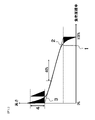
- FIG. 1 which is a diagram conceptually showing the load area ratio Smr2 and the protrusion mountain height Spk
- Smr2 (reference numeral 1) is a load area ratio Smr in the central portion of the load curve for the roughness curve (reference numeral 2).
- the straight line with the gentlest slope is the equivalent straight line (reference numeral 3), and the equivalent straight line intersects the vertical axis at the positions of 0% and 100% of the load area ratio.
- the load area ratio at the point where the load curve intersects the boundary line between the protruding valley portion and the core portion represents the existence ratio of the protruding valley portion.
- the load curve is a load curve for a surface, and is expressed as a function for the load area ratio of the cutting level.
- Smr2 is larger than 98%, the dent depth on the film surface becomes insufficient. Therefore, for example, when used as a support film, the height of the protrusions transferred to the resin composition film obtained by applying a coating agent containing a resin composition on the film and solidifying and peeling the coating film is lowered. The slipperiness of the obtained resin composition film may be insufficient, resulting in poor handleability.
- the core valley portion is extremely large, the flat core portion is few, and the film has a undulating shape. Therefore, for example, when used as a support film as described above, the transparency of the obtained resin composition film may be impaired.
- a coating agent containing a resin composition is applied on the A surface, and the resin composition film obtained by solidifying and peeling the coating film is formed with protrusions having an appropriate height by transfer formation to improve handleability.
- the Smr2 on the A surface is preferably 95% or less, more preferably 92% or less.
- the Smr2 on the A surface is preferably 80% or more, more preferably 85% or more.
- Spk is a parameter defined in ISO25178-2: 2012, and detailed measurement conditions are shown in Examples.
- FIG. 1 which is a diagram conceptually showing the load area ratio Smr2 and the protrusion mountain height Spk
- Spk (reference numeral 4) is the load area ratio in the central portion of the load curve for the roughness curve (reference numeral 2).
- the secant line of the load curve drawn with the difference ⁇ Smr of Smr set to 40% has the gentlest slope as the equivalent straight line (reference numeral 3), and the equivalent straight line intersects the vertical axis at the positions of 0% and 100% load area ratio. It is the average height of the protruding portion mountain portion above the core portion when the core portion is located between the two height positions.
- the raw material composition of the film is in the range described later and the film forming conditions are in the range described later.
- the inclusion of branched chain polypropylene resin reduces the size of spherulites formed during casting, lowers the extrusion temperature and the temperature of the cast drum to increase cooling during casting, and preheats during longitudinal / transverse stretching.
- the Spk value can be lowered by increasing the temperature and stretching at a low temperature at a high magnification and uniformly at a high magnification.
- Spk on the A side is preferable from the viewpoint of improving the smoothness of the resin composition film obtained by applying a coating agent containing a resin composition on the A surface and solidifying and peeling the coating. It is 70 nm or less, more preferably 50 nm or less, still more preferably 30 nm or less. Further, the lower the Spk of the A surface, the more preferable, but from the viewpoint of feasibility, the lower limit is 1 nm.
- the film of the present invention has a maximum valley depth Sv of the A surface (hereinafter, may be simply referred to as Sv) of 20 nm from the viewpoint of achieving both smoothness and handleability of the resin composition film obtained when used as a support film. It is preferably 400 nm or more and preferably 400 nm or less. From the viewpoint of the smoothness of the resin composition film, the Sv of the A surface is more preferably 300 nm or less, still more preferably 250 nm or less. Further, from the viewpoint of handleability of the resin composition film, the Sv of the A surface is more preferably 30 nm or more, further preferably 40 nm or more, and particularly preferably 50 nm or more. Sv is a parameter defined in ISO25178-2: 2012 and indicates the depth of the deepest pit from the average surface of the surface (the surface whose height is the average value, corresponding to the baseline). The detailed measurement conditions are shown in Examples.
- the raw material composition of the film is in the range described later and the film forming conditions are in the range described later.
- the viscosity of the olefin-based elastomer resin and the polypropylene block copolymer is lowered, and the olefin-based elastomer resin and the polypropylene block copolymer are pre-compounded with the resin which is the main component of each layer raw material to finely disperse the rubber domain. Therefore, Sv can be reduced.
- the film of the present invention preferably has a dynamic friction coefficient ⁇ d (hereinafter, may be simply referred to as ⁇ d) between one surface and the other surface of 0.20 or more and 0.80 or less.
- ⁇ d dynamic friction coefficient
- the ⁇ d between one surface and the other surface is more preferably 0.70 or less, still more preferably 0.60 or less.
- the ⁇ d between one surface and the other surface is lower, and the lower limit is not particularly limited, but it is about 0.20 from the viewpoint of feasibility.
- a method is used in which the raw material composition of the film is in the range described later and the film forming conditions are in the range described later. be able to.
- it is effective to form fine protrusions on the film surface after stretching by containing a branched chain polypropylene resin and reducing the spherulites formed at the time of casting.
- the ⁇ d between one surface and the other surface can be lowered.
- the film of the present invention may be dried in a high-temperature oven at about 130 ° C. by applying a coating agent containing a resin composition on the film.
- the Young's modulus in the film MD direction at 130 ° C. (hereinafter, may be simply referred to as the Young's modulus in the MD direction) is 100 MPa or more and 200 MPa or less. preferable.
- the Young's modulus in the MD direction is more preferably 120 MPa or more, still more preferably 140 MPa or more. The higher the Young's modulus in the film MD direction at 130 ° C.
- the film MD direction refers to a direction parallel to the film forming direction, and is also referred to as a film forming direction or a longitudinal direction in another expression.
- the film TD direction refers to a direction orthogonal to the film MD direction in the film plane, and is also referred to as a width direction in another expression.
- the Young's modulus can be measured by heating the film at 130 ° C. for 1 minute and then performing a tensile test on the film at a tensile speed of 300 mm / min, and detailed measurement conditions will be described later.
- the direction orthogonal to the main orientation direction of the film is the MD direction.
- the main orientation direction is a direction in which an angle of 0 ° to 175 ° is formed in 5 ° increments with respect to the arbitrary direction when the arbitrary direction is 0 ° in the film plane.
- the direction showing the highest value when Young's modulus is measured.
- the Young's modulus in the film MD direction is 100 MPa or more, for example, when a coating agent containing a resin composition is applied when used as a support film and solidified in a high temperature process, the elongation of the film is suppressed. , The occurrence of wrinkles associated with it is also reduced.
- a method can be used in which the raw material composition of the film is in the range described later and the film forming conditions are in the range described later.
- it is effective to use a raw material having a high degree of crystallinity, increase the preheating temperature at the time of longitudinal / transverse stretching, and perform stretching at a low temperature at a high magnification and uniformly at a high magnification.
- the film of the present invention preferably has a melting peak at 160 ° C. or higher and a melting peak at 165 ° C. or higher when the temperature is raised from 30 ° C. to 260 ° C. by a differential scanning calorimeter DSC. It is more preferable to have a melting peak at 168 ° C. or higher. The higher the melting peak temperature is, the more preferable the upper limit is, but the upper limit is substantially 220 ° C.
- “having a melting peak at 160 ° C. or higher” means that there is one melting peak and the melting peak is 160 ° C. or higher, and there are a plurality of melting peaks, and at least one of them is 160 ° C. or higher. It shall also include the case where it is included in the range of.
- the film When it has a melting peak at 160 ° C or higher, for example, when it is used as a support film, when it is solidified in a high temperature process after applying a coating film containing a resin composition, the film breaks or the flatness deteriorates. Can be mitigated.
- a method can be used in which the raw material composition of the film is in the range described later and the film forming conditions are in the range described later. In particular, it is effective to use a high melting point resin for the inner layer of the film to improve the heat resistance of the inner layer.
- the film of the present invention preferably has an internal haze (hereinafter, may be simply referred to as haze) of 0.01% or more and 1.5% or less after heating at 130 ° C. for 10 minutes.
- the haze after heating at 130 ° C. for 10 minutes is more preferably 1.0% or less, still more preferably 0.7% or less.
- the lower the haze after heating at 130 ° C. for 10 minutes, the more preferable, and the haze is not particularly limited, but is 0.01% from the viewpoint of feasibility.
- the haze can be measured with a known haze meter, and detailed measurement conditions thereof are shown in Examples.
- the film of the present invention may contain various additives such as antioxidants, and such films in particular contain additives such as antioxidants when exposed to high temperature heat of, for example, 130 ° C. or higher. Bleed out to the surface and the transparency is easily impaired. Therefore, in such a film, there is a great advantage that the haze is in the above range.
- a method in which the raw material composition of the film is in the range described later and the film forming conditions are in the range described later.
- it contains a branched chain polypropylene resin to reduce the size of spherulites formed during casting, lower the extrusion temperature and the temperature of the cast drum to increase cooling during casting, and preheat temperature during longitudinal / transverse stretching. It is effective to stretch uniformly by increasing the temperature and stretching at a low temperature. Further, it is also effective to enhance the crystallinity by using a raw material having high stereoregularity and a low cold xylene soluble portion (CXS), and to perform heat treatment and relaxation after longitudinal and transverse stretching.
- CXS cold xylene soluble portion
- the film of the present invention has a surface free energy of 15 mN / m or more and 35 mN / m or less from the viewpoint of facilitating peeling of the resin composition film formed on the surface of the A layer when used as a support film.
- the surface free energy of the A surface is more preferably 32 mN / m or less, still more preferably 29 mN / m or less.
- the surface free energy is 35 mN / m or less, for example, when it is used as a support film, a coating film containing a resin composition is applied on the A surface, and after solidification, it is peeled off to obtain a resin composition film. At that time, the resin composition film is smoothly peeled off, and the occurrence of film breakage and peeling marks at the time of peeling is reduced.
- the surface free energy can be measured with a known contact angle meter using four types of liquids, water, ethylene glycol, formamide, and methylene iodide, as the measuring liquid, and the detailed measurement conditions thereof are Examples. Shown in.
- the raw material composition of the film is in the range described later and the film forming conditions are in the range described later.
- it is also effective to use a polyolefin resin as the main component of the film surface layer corresponding to the A side (in the case of a single layer configuration, the film itself, the same applies hereinafter), or to provide a coating layer having releasability on the A side.
- the main component of the film surface layer corresponding to the A surface is a polyolefin resin.
- the thickness of the film of the present invention is appropriately adjusted depending on the intended use and is not particularly limited, but it is preferably 0.5 ⁇ m or more and 100 ⁇ m or less from the viewpoint of handleability.
- the upper limit of the thickness when used as a release film is more preferably 60 ⁇ m or less, further preferably 50 ⁇ m or less, and most preferably 40 ⁇ m or less.
- the lower limit is more preferably 4 ⁇ m or more, further preferably 8 ⁇ m or more, and most preferably 11 ⁇ m or more.
- the thickness can be adjusted by adjusting the screw rotation speed of the extruder, the width of the unstretched sheet, the film forming speed, the stretching ratio, and the like within a range that does not deteriorate other physical properties.
- the components constituting the film of the present invention are not particularly limited, but it is preferable that the main component is a thermoplastic resin.
- the thermoplastic resin include polystyrene (PS) resin, styrene-based elastomer resin, polymethylpentene (PMP) resin, cyclic olefin (COP) resin, and cyclic olefin copolymer (COC) resin, in addition to the polypropylene resin described later.
- Polyetherketone resin polyethylene terephthalate (PET) resin, polybutylene terephthalate (PBT) resin, and polyester resin such as polyethylene nareftalate (PEN) resin, polysalphon (PSU) resin, polyethersalphon (PES) resin, and poly.
- PET polyethylene terephthalate
- PBT polybutylene terephthalate
- polyester resin such as polyethylene nareftalate (PEN) resin, polysalphon (PSU) resin, polyethersalphon (PES) resin, and poly.
- Polysulfone resin such as phenylsulfone (PPSU) resin, polyphenylene sulfide (PPS) resin, polyphenylene sulfide ketone resin, polyphenylene sulfide sulfone resin, polyetherylene sulfide resin such as polyphenylene sulfide ketone sulfone resin, polyetherketone (PEK) resin, poly Polyetheretherketone (PEEK) resin, polyetherketoneketone (PEKK) resin, polyetheretherketoneketone (PEEKK) resin, polyetherketone etherketoneketone (PEKEKK) resin and other polyaryletherketone resins, polytetrafluoroethylene (polytetrafluoroethylene) PTFE) resin (also called tetrafluoroethylene resin), polytetrafluoroethylene-perfluoroalkyl vinyl ether copolymer (PFA) resin (also called tetrafluoroethylene-perfluor
- modified products, derivatives, and copolymers with other compounds can also be used. Further, these raw materials may be used alone or in combination of two or more. From the viewpoint of adjusting Sk to 0 or less, it is preferable to use a polyolefin resin or polyester resin that can be easily biaxially stretched, and at least one set so as to form a microphase-separated structure having an average domain diameter of 5 ⁇ m or less before stretching. It is preferable to contain components that are incompatible with each other.
- the film of the present invention contains various additives such as weather resistant agents, clearing agents, crystal nucleating agents, antioxidants, heat stabilizers, slip agents, antistatic agents, as long as the object of the present invention is not impaired. It can also contain anti-blocking agents, fillers, viscosity modifiers, anti-coloring agents, leveling agents, surfactants, mold release agents and the like.
- the surface layer having the A surface contains an olefin resin as a main component.
- PET film or the like may be coated with a resin having releasability such as silicone resin, but when the resin component such as silicone resin is adhered to the adherend and peeled off, the resin component such as silicone resin is adhered. It can be transferred to the body and contaminated.
- the olefin resin has a relatively low releasability, it is extremely low in transfer to the adherend, and is therefore preferably used for the surface layer having the A surface.
- the "surface layer having the A side” means the outermost surface layer on the A side when the film has a laminated structure, and refers to the film itself when the film has a single layer structure.
- the surface layer having the A surface contains an olefin resin as a main component means that the ratio of the olefin resin to all the components constituting the surface layer having the A surface exceeds 50% by mass and 100% by mass or less. It means that there is (hereinafter, "main component” can be interpreted in the same way).
- the surface layer having A-sides contains an olefin resin as a main component.
- the content of the olefin resin in the surface layer having the A surface is more preferably 90% by mass or more and 100% by mass or less, further preferably 95% by mass or more and 100% by mass or less, and further preferably 96% by mass or more and 100% by mass or less. Particularly preferably, it is 97% by mass or more and 100% by mass or less, and most preferably 98% by mass or more and 100% by mass or less.
- the olefin-based resin means a resin containing 100 mol% or less of olefin units exceeding 50 mol% when all the constituent units constituting the resin are 100 mol%.
- Specific examples of the olefin resin include polyethylene, polypropylene, polybutene, polymethylpentene, and copolymers thereof.
- the content of the olefin resins shall be calculated by adding up all the olefin resins.
- olefin resin in addition to the case where one type of olefin resin is contained in an amount of more than 50% by mass, even if the individual olefin resins are less than 50% by mass, the total of all the olefin resins may exceed 50% by mass. It can be regarded as "mainly composed of an olefin resin".
- the film of the present invention preferably contains an olefin resin as a main component from the viewpoint of releasability, flexibility, and cost not only for the surface layer having the A surface but also for the entire film.
- the amount of the olefin resin in all the components constituting the film is more preferably 90% by mass or more and 100% by mass or less, further preferably 95% by mass or more and 100% by mass or less, and further preferably 96% by mass or more and 100% by mass or less. Particularly preferably, it is 97% by mass or more and 100% by mass or less, and most preferably 98% by mass or more and 100% by mass or less.
- Specific examples of the olefin resin include polyethylene resin, polypropylene resin, polybutene resin, polymethylpentene resin, and copolymers thereof.
- the film of the present invention preferably contains a polypropylene resin contained in the resin constituting the film in an amount of 95% by mass or more and 100% by mass or less. From the above viewpoint, it is more preferably 96% by mass or more, further preferably 97% by mass or more, and particularly preferably 98% by mass or more.
- the polypropylene resin means a resin in which the propylene unit is more than 50 mol% and 100 mol% or less when all the constituent units constituting the resin are 100 mol%.
- the surface layer having the A side in the film of the present invention contains polypropylene resin as a main component and the content of polyethylene resin is 3% by mass or less in the whole layer.
- the content of the polyethylene resin in the surface layer having the A surface is more preferably 2% by mass or less, further preferably 1% by mass or less, and most preferably 0.5% by mass or less.
- a polypropylene film having a matte rough surface often forms a rough surface by blending a polypropylene resin and a polyethylene resin.
- the quality may deteriorate, such as the increase in fish eyes caused by polyethylene resin and the increase in foreign matter due to the scraping of the film surface. It is preferable to suppress the content of the polyethylene resin in the surface layer.
- the film of the present invention is a polypropylene resin, a branched chain polypropylene resin, a low crystalline polyolefin resin, and polymethylpentene from the viewpoint of suppressing the formation of coarse protrusions on the surface of the A surface and forming a recessed structure having a predetermined depth.
- the resin and the rubber domain-containing resin it is preferable to contain at least two or more kinds of resins.
- the polypropylene resin (hereinafter, may be referred to as polypropylene resin A) in the film of the present invention preferably has a melting point of 155 ° C. or higher, more preferably 160 ° C. or higher, still more preferably 163 ° C. or higher, and most preferably 165 ° C. or higher. That is all.
- the melting point of the polypropylene resin is 155 ° C. or higher, the heat resistance of the film is enhanced. Therefore, for example, when used as a release film, the softening of the film and the accompanying elongation in the tension direction are reduced when the film is attached to the adherend and then passed through a heat-applied process, so that the adherend is used. Deformation is suppressed.
- polypropylene resin A a linear polypropylene resin is preferable.
- the melt flow rate (MFR) at 230 ° C. under a load of 21.18 N is 1 to 10 g / 10 minutes, more preferably 1 to 8 g / 10 minutes, and particularly preferably. It is 2 to 5 g / 10 minutes.
- the melt flow rate (MFR) is 1 to 10 g / 10 minutes or the above-mentioned preferable value.
- the method for adjusting the hydrogen gas concentration at the time of polymerization, the selection of the catalyst and / or the co-catalyst, and the selection of the composition are appropriately selected. The method of performing is preferably adopted.
- the polypropylene resin A may contain a copolymerization component (copolymerization unit) due to other unsaturated hydrocarbons as long as the object of the present invention is not impaired.
- copolymerization components include ethylene, 1-butene, 1-pentene, 3-methylpentene-1, 3-methylbutene-1, 1-hexene, 4-methylpentene-1, 5-ethylhexene-1, and the like.
- Examples thereof include 1-octene, 1-decene, 1-dodecene, vinylcyclohexene, styrene, allylbenzene, cyclopentene, norbornene, 5-methyl-2-norbornene and the like.
- the copolymerization amount is 1 mol% or less from the viewpoint of dimensional stability.
- the polypropylene resin A can be blended with a resin containing a propylene component, the above-mentioned copolymerization component, and the like as long as the effects of the present invention are not impaired.
- branched polypropylene resin B in the film of the present invention is known to exhibit a nucleating agent action on a linear polypropylene resin, and after melt extrusion.
- the content of the branched polypropylene resin B in the layer is the upper limit of the content of the branched polypropylene resin B when all the constituents of the layer are 100% by mass. Is more preferably 50% by mass or less, further preferably 40% by mass or less, further preferably 30% by mass or less, and most preferably 25% by mass or less. Further, the lower limit of the content of the branched chain polypropylene resin B is more preferably 0.1% by mass or more, further preferably 1% by mass or more, further preferably 4% by mass or more, and most preferably 10% by mass or more.
- the MFR of the branched chain polypropylene resin B measured under a load of 230 ° C. and 21.18 N is preferably 0.5 g / 10 minutes or more and 9 g / 10 minutes or less from the viewpoint of extrusion stability.
- the lower limit of the MFR of the branched chain polypropylene resin B measured under the same conditions is more preferably in the range of 2 g / 10 minutes, further preferably 6 g / 10 minutes or more.
- a method for adjusting the hydrogen gas concentration at the time of polymerization, a catalyst and / or a co-catalyst , And the method of appropriately selecting the composition, etc. are preferably adopted.
- the melt tension of the branched chain polypropylene resin B is preferably 3 gf or more and 40 gf or less from the viewpoint of stretching uniformity.
- the lower limit of the melt tension is more preferably 4 gf, and even more preferably 6 gf.
- the upper limit is more preferably 30 gf and even more preferably 25 gf.
- a method of controlling the average molecular weight, the molecular weight distribution, the degree of branching in the polypropylene resin, or the like is adopted. In particular, when it has a long chain branch, the melt tension can be dramatically increased, and it can be adjusted to a preferable value by adjusting the molecular chain of the long chain branch and the degree of branching.
- branched chain polypropylene resins B such as Ziegler-Natta catalyst system and metallocene catalyst system are commercially available, a metallocene catalyst system having few low molecular weight components and high molecular weight components and a narrow molecular weight distribution is more preferable.
- the film of the present invention can reduce the crystallinity of the cast film after melt extrusion, and as a result, the coarseness of the film after stretching can be reduced. The formation of protrusions can be suppressed. It is preferable that the low crystallinity polyolefin resin C has a lower stereoregularity of the molecular structure of the polymer and / or a lower crystallinity than the polypropylene resin A. Examples of means for lowering the crystallinity include copolymerization with a comonomer.
- the low crystalline polyolefin resin also includes a resin having no melting point, but in the case of a resin having a melting point, the melting point of the low crystalline polyolefin resin C is preferably lower than that of the polypropylene resin A, and is 50 ° C. or higher and 135 ° C. or lower. Is more preferably 60 ° C. or higher and 130 ° C. or lower, still more preferably 60 ° C. or higher and 120 ° C. or lower, and most preferably 60 ° C. or higher and 100 ° C. or lower. Further, it is also preferable to use a laminated film containing a low crystalline polyolefin resin having a melting point of 50 ° C. or higher and 135 ° C. or lower or the above-mentioned preferable range in at least one surface layer.
- the melting point of the low crystalline polyolefin resin C is preferably 50 ° C. or higher from the viewpoint of preventing the film surface from melting and adhering to the roll when the preheated / stretched roll is conveyed. Further, from the viewpoint of partially melting the film surface during stretching to roughen the surface, the melting point of the low crystalline polyolefin resin C is preferably 135 ° C. or lower.
- the content of the low crystalline polyolefin resin C in the surface layer containing the low crystalline polyolefin resin C is 100 for all the constituents of the layer.
- the upper limit of the content of the low crystalline polyolefin resin C is more preferably 80% by mass or less, further preferably 70% by mass or less, further preferably 40% by mass or less, and most preferably 25% by mass or less. .. Further, the lower limit of the content of the low crystalline polyolefin resin C is more preferably 5% by mass or more, further preferably 15% by mass or more, and most preferably 20% by mass or more.
- a low crystallinity polypropylene resin compatible with polypropylene resin A is preferable, and examples thereof include a copolymer of propylene and ⁇ -olefin and a polypropylene resin having low stereoregularity.
- commercial products such as "Wintech” (registered trademark) manufactured by Japan Polypropylene Corporation, which is a polypropylene random copolymer, and "El Modu” (registered trademark) manufactured by Idemitsu Kosan Co., Ltd., which is a low stereoregular polypropylene resin. Can be used after appropriately selecting.
- the film of the present invention preferably contains a rubber domain-forming resin (hereinafter, may be referred to as rubber domain-forming resin D).
- the rubber domain forming resin refers to a resin capable of forming a rubber domain in a film by blending with polypropylene resin A.
- a resin containing a rubber domain such as a polypropylene block copolymer, a thermoplastic elastomer that forms a rubber domain in a matrix of polypropylene resin A without being completely compatible with polypropylene resin A, and the like.
- the rubber domain is stretched larger than the matrix resin during longitudinal stretching, so that a recessed structure can be formed on the film surface.
- the rubber domain-forming resin D is not particularly limited as long as it is a resin capable of forming a rubber domain in the film, but is preferably at least one of a thermoplastic elastomer and a polypropylene block copolymer, but has an affinity with polypropylene resin A.
- Polyolefin-based thermoplastic elastomers are particularly preferable because of their high properties.
- the thermoplastic elastomer refers to an elastomer that softens when heated and exhibits fluidity, and returns to a rubbery state when cooled.
- the upper limit of the preferable Vicat softening temperature of the rubber domain forming resin D is preferably 130 ° C. or lower, more preferably 122 ° C.
- the lower limit of the Vicat softening temperature is preferably 50 ° C. or higher, more preferably 65 ° C. or higher, further preferably 80 ° C. or higher, and most preferably 90 ° C. or higher.
- the content of the rubber domain-forming resin D in the layer containing the rubber domain-forming resin is the content of the rubber domain-forming resin D when all the constituents of the layer are 100% by mass.
- the upper limit of the amount is more preferably 35% by mass or less, further preferably 25% by mass or less, further preferably 17% by mass or less, and most preferably 12% by mass or less.
- the lower limit of the content of the rubber domain forming resin D is more preferably 1% by mass or more, further preferably 4% by mass or more, further preferably 6% by mass or more, and most preferably 8% by mass or more.
- the polypropylene resin A, the branched chain polypropylene resin B, the low crystalline polyolefin resin C, and the rubber domain-forming resin D used in the film of the present invention may contain various additives such as a crystal nucleating agent as long as the object of the present invention is not impaired. , Antioxidants, heat stabilizers, slip agents, antistatic agents, antiblocking agents, fillers, viscosity modifiers, anticoloring agents and the like can also be contained.
- the selection of the type and amount of the antioxidant is important from the viewpoint of bleeding out of the antioxidant. That is, the antioxidant is preferably a phenolic agent having steric hindrance, and at least one of them is a high molecular weight type having a molecular weight of 500 or more. Specific examples thereof include various examples, such as 1,3,5-trimethyl-2,4,6-with 2,6-di-t-butyl-p-cresol (BHT: molecular weight 220.4).
- Tris (3,5-di-t-butyl-4-hydroxybenzyl) benzene eg, BASF's "Irganox”® 1330: molecular weight 775.2
- tetrakis [methylene-3 (3,5-di) -T-Butyl-4-hydroxyphenyl) propionate] methane for example, "Irganox” (registered trademark) 1010: molecular weight 1,177.7) manufactured by BASF, etc. is preferably used in combination.
- a crystal nucleating agent can be added to the polypropylene resin A used in the film of the present invention within a range not contrary to the object of the present invention.
- Specific examples include ⁇ -crystal nucleating agents (dibenzylidene sorbitols, sodium benzoate, etc.) and ⁇ -crystal nucleating agents (potassium 1,2-hydroxystearate, magnesium benzoate, N, N'-dicyclohexyl-2,6- Amide compounds such as naphthalenedicarboxamide, quinacridone compounds, etc.) are exemplified.
- the addition amount is usually 100 parts by mass of the polypropylene resin A. It is preferably 0.5 parts by mass or less, preferably 0.1 parts by mass or less, and more preferably 0.05 parts by mass or less.
- the surface layer having the A surface (in the case of a single layer structure, the film itself) in the film of the present invention does not contain organic particles and inorganic particles. Since polypropylene resin has a low affinity with organic particles and inorganic particles, the particles may fall off and contaminate the process or product, and the high hardness particles form coarse protrusions on the optical member. Concavo-convex transfer may occur to the resin layer, which may be a barrier when used as a protective film or support film for products that require high quality such as display members.
- the film of the present invention is preferably biaxially stretched after using the above-mentioned resin.
- a method of biaxial stretching any of the inflation simultaneous biaxial stretching method, the stenter simultaneous biaxial stretching method, and the stenter sequential biaxial stretching method can be obtained.
- the film forming stability, the thickness uniformity, and the film It is preferable to adopt the stenter sequential biaxial stretching method in terms of controlling high rigidity and dimensional stability.
- the polypropylene resin A is 50 parts by mass
- the branched chain polypropylene resin B is 20 parts by mass
- the low crystalline polyolefin resin C is 20 parts by mass
- the rubber domain forming resin D is 10 parts by mass. It was supplied to an extruder, melt-kneaded at 260 ° C., and discharged from the die in a strand shape. The discharged resin composition was cooled and solidified in a water tank at 25 ° C. and cut into chips to obtain a resin composition for the surface layer (I).
- the resin composition for the surface layer (I) is supplied to the single-screw extruder, and A1 and B1 are dry-blended at a ratio of 95: 5 (mass ratio) to the single-screw melt extruder for the inner layer (II). It is supplied and melt-extruded at 200 to 280 ° C., more preferably 220 to 280 ° C., and even more preferably 240 to 270 ° C., respectively. Then, after removing foreign substances and modified polymers with a filter installed in the middle of the polymer tube, they are laminated with a multi-manifold type composite T-die so as to have a two-kind three-layer structure of I layer / II layer / I layer.
- the laminated thickness ratio is preferably in the range of 1/8/1 to 1/60/1.
- the surface temperature of the casting drum is preferably 10 to 45 ° C, more preferably 15 to 35 ° C, and even more preferably 15 to 25 ° C. Further, a two-type two-layer laminated structure of I layer / II layer may be used, but in that case, the I layer side is brought into close contact with the casting drum.
- the adhesion method to the casting drum any of the electrostatic application method, the adhesion method using the surface tension of water, the air knife method, the press roll method, the underwater casting method, etc. may be used, but the flatness is good. Moreover, the air knife method capable of controlling the surface roughness is preferable.
- the air temperature of the air knife is preferably 10 ° C to 30 ° C, and the blown air speed is preferably 130 m / s to 150 m / s. It is also preferable to appropriately adjust the position of the air knife so that air flows to the downstream side of the film formation so as not to cause vibration of the film.
- the obtained unstretched sheet is introduced into the longitudinal stretching step.
- a recessed structure can be efficiently formed on the surface of the I layer by performing two-stage stretching in which the initial longitudinal stretching is performed at a low temperature and a low magnification and then the longitudinal stretching is performed at a high temperature and a high magnification. ..
- the rubber domain can be effectively stretched larger than the matrix resin by preheating at a temperature higher than the softening temperature of the rubber domain forming resin D and stretching it at a low magnification, and the film surface has a recessed structure. Can be formed.
- an unstretched sheet is brought into contact with a plurality of metal rolls kept at 80 ° C.
- a longitudinal uniaxially stretched film by longitudinally stretching at a high magnification at a temperature higher than the initial longitudinally stretched temperature in order to stabilize the transverse stretching and reduce the haze. More specifically, it is brought into contact with a metal roll which is higher than the preheating temperature of the initial longitudinal stretching and is kept at 110 ° C. or higher and 150 ° C. or lower, preferably 115 ° C. or higher and 140 ° C. or lower, and more preferably 120 ° C. or higher and 140 ° C. or lower. It is preferable to preheat the sheet and stretch the sheet between rolls provided with a peripheral speed difference.
- the total stretching ratio of the two-stage stretching is preferably 3.5 to 7 times, more preferably 4.5 times to 5.5 times, still more preferably 4.5 times to 5.0 times. If the total draw ratio is less than 3 times, the orientation of the obtained film may be weakened and the strength may be lowered.
- the longitudinally uniaxially stretched film is guided to the tenter, the end of the film is gripped with a clip, preheated, and then laterally stretched 7 to 13 times in the width direction. It is important that the vertically uniaxially stretched film is preheated at a low temperature and then stretched laterally so as not to break the recessed structure formed on the film surface.
- the preheating and stretching temperatures are 120 ° C. to 175 ° C., preferably 120 ° C. to 165 ° C., and more preferably 140 ° C. to 160 ° C. Further, it is particularly preferable that the stretching temperature is lower than the preheating temperature, preferably 3 ° C. or higher with respect to the preheating temperature, more preferably 5 ° C. or higher, still more preferably 10 ° C. or higher.
- the relaxation is applied at a relaxation rate of 2% to 20%, more preferably 5% to 18%, still more preferably 8% to 15% in the width direction. , 140 ° C. or higher and 175 ° C. or lower, preferably 140 ° C. or higher and lower than 170 ° C., more preferably 150 ° C. or higher and lower than 170 ° C., and further preferably 160 ° C. or higher and lower than 170 ° C.
- the film is guided to the outside of the tenter through a cooling process at 80 ° C. to 100 ° C.
- the clips at both ends in the film width direction are released, and the film edge portion is slit in the winder process. Wind up the film product roll.
- the films obtained as described above can be used in various industrial applications such as packaging films, surface protective films, support films, sanitary products, agricultural products, construction products, medical products, and condenser films.
- it does not have coarse protrusions, has a predetermined recessed structure, and is excellent in mold releasability, rigidity, heat resistance, and slipperiness, so that it can be preferably used for process film applications.
- the process film is a protective film that protects the film during transportation, a support film used as a support when manufacturing a resin composition film, and a resin composition film when forming a resin composition film on the support film. Includes a cover film that covers the non-supporting side of the film.
- the laminate of the present invention has a resin composition layer on the A side of the film of the present invention. Since the film of the present invention does not have coarse protrusions, has a predetermined recessed structure, and is excellent in mold releasability, rigidity, and heat resistance, the film should be a laminate in which a resin composition layer is formed on the A surface thereof. Therefore, it is possible to facilitate the production of the resin composition film obtained by peeling off the resin composition layer. Further, the method for producing a resin composition film of the present invention has at least the following steps 1 to 3 in this order.
- Step 1 A step of applying a coating agent containing a resin composition to the A side of the film according to any one of claims 1 to 10.
- Step 2 A step of solidifying the coating material containing the resin composition to form a resin composition layer to form a laminate.
- Step 3 A step of peeling the resin composition layer from the laminate to obtain a resin composition film.
- the film obtained by the above-mentioned method was wound into a roll and introduced into a bar coater, and a commercially available urethane acrylate (viscosity at 25 ° C., 600,000 mPa ⁇ s, weight average molecular weight Mw 1,600, glass transition temperature 10) was introduced.
- a coating film consisting of a resin composition obtained by mixing 50 parts by mass of a commercially available methyl ethyl ketone and 3 parts by mass of a commercially available 1-hydroxycyclohexylphenyl ketone has a thickness of 1 ⁇ m or more and 100 ⁇ m or less. It is applied to the A side of the film so as to be. This is introduced into a hot air dryer and heated at 50 ° C.
- a coating agent obtained by mixing 171 (manufactured by Ciba Japan Co., Ltd.) with 0.5 parts by mass is applied to the A side of the film so as to have a film thickness of 1 ⁇ m or more and 100 ⁇ m or less.
- This is introduced into a hot air dryer, heated at 10 ° C. or higher and 50 ° C. or lower to remove the solvent, and the coating material on the film is cured.
- the laminate is wound up to obtain a roll obtained by winding the laminate having the resin composition layer on the A surface of the film. By unwinding the laminate from the laminate roll and peeling the resin composition layer from the film, a resin composition film made of cellulose acetate propionate can be obtained.
- Yet another example is a resin composition membrane made of polyetherimide.
- 15 parts by mass of a commercially available polyetherimide resin manufactured by SABIC, trade name "ULTEM” (registered trademark) 1010, Vicat softening point temperature 215 ° C.) and 85 parts by mass of N-methyl-2-pyrrolidone were mixed.
- the coating agent is applied to the A side of the film so that the film thickness is 1 ⁇ m or more and 100 ⁇ m or less. This is introduced into a hot air dryer, heated at 50 ° C. or higher and 150 ° C. or lower to remove the solvent, and the coating material on the film is cured to obtain a laminate composed of a resin composition layer made of polyetherimide and a film. ..
- the laminate is wound up to obtain a roll obtained by winding the laminate having the resin composition layer on the A surface of the film.
- a resin composition film made of polyetherimide can be obtained.
- the measurement was performed on both sides of a 5 cm ⁇ 5 cm square cut film.
- the intersection of the diagonal lines is set as the first measurement point (point 1), and the positions 1 cm away from each of the four corners from the starting point are set clockwise as points 2, points 3, points 4, and points 5, respectively.
- the midpoint of the line segment connecting 2 and point 3 is point 6
- the midpoint of the line segment connecting point 3 and point 4 is point 7
- the midpoint of the line segment connecting point 4 and point 5 is point 8.
- the midpoint of the line segment connecting the points 5 and 2 was set as the point 9, and a total of 9 measurement points from the points 1 to 9 were determined, and the measurement was performed at each measurement point.
- Ssk, Smr2, Spk, and Sv at each measurement position were obtained according to the above procedure, and the 9th and 2nd largest values and the 8th and 9th largest values obtained for each parameter were obtained.
- the average value of the five values excluding the above was adopted as Ssk, Smr2, Spk, and Sv of the film.
- Table 2 shows the values of Ssk, Smr2, Spk, and Sv on the A side of the film. When both sides of the film are A side, the value for the side with low Spk is described. For the film having no A side, the value for the side having a low Spk is described. Further, for a film having no A side and having the same Spk on both sides, the value for the side having a small Sk value is described.
- ⁇ Measurement conditions and device configuration> Objective lens: 10x Lens barrel: 1x Zoom lens: 1x Wavelength filter: 530nm white Measurement mode: Wave Measurement software: VS-Measure 10.0.4.0 Analysis software: VS-Viewer 10.0.3.0 Measurement area: 561.1 ⁇ m ⁇ 561.5 ⁇ m Number of pixels: 1,024 x 1,024.
- Young's modulus at 130 ° C. Young's modulus at 130 ° C. is chucked into an oven heated to 130 ° C. using a film strength elongation measuring device (AMF / RTA-100) manufactured by Orientec Co., Ltd. After charging for 1 minute, the film was subjected to a tensile test at a tensile speed of 300 mm / min. The film is cut into a rectangular size with a measurement direction (orthogonal direction of the main orientation axis): 25 cm and a direction perpendicular to the measurement direction: 1 cm, stretched at an original length of 100 mm and a tensile speed of 300 mm / min, and specified in JIS Z 1702 (1994). Measured according to the method used.
- the coating agent was applied to a surface having a small Sk value to obtain a resin composition film by the same procedure. This was repeated 5 times to obtain 5 resin composition films.
- a slip tester manufactured by Toyo Seiki Kogyo Co., Ltd. the surfaces that were in contact with the film of the resin composition obtained at a load of 200 g, 25 ° C., and 65% RH were in contact with each other according to JIS K 7125 (1999).
- the dynamic friction coefficient ⁇ d when the resin composition films were rubbed against each other in the longitudinal direction was measured by the method described in (3).
- the sample was a rectangle with a width of 80 mm and a length of 200 mm, and 5 sets (10 sheets) were cut out. When cutting out the sample, one set was cut out from one resin composition membrane, and the region 2 cm from the end of the resin composition membrane was not used. The measurement was performed 5 times, and the average value was adopted as the value of the dynamic friction coefficient ⁇ d of the resin composition film. Based on the value of the dynamic friction coefficient ⁇ d of the resin composition film, the slipperiness of the resin composition film (effect of imparting slipperiness of the film) was evaluated according to the following criteria. Excellent: ⁇ d is 0.50 or less. Good: ⁇ d is greater than 0.50 and 0.55 or less. Possible: ⁇ d is larger than 0.55 and 0.60 or less. Impossible: ⁇ d is greater than 0.60.
- Vicut softening temperature Prepare a test sample by press-molding each raw material to a thickness of 3 mm, and use a heat distortion tester (“148-6 series type” manufactured by Yasuda Seiki Seisakusho Co., Ltd.) in accordance with ASTM D1525. The Vicat softening temperature of each raw material was evaluated.
- A1 Polypropylene resin (manufactured by Prime Polymer Co., Ltd., MFR: 3.0 g / 10 minutes, melting point: 164 ° C)
- A2 Polypropylene resin (manufactured by Sumitomo Chemical Co., Ltd., MFR: 7.5 g / 10 minutes, melting point: 163 ° C)
- A3 Polypropylene resin (manufactured by Prime Polymer Co., Ltd., MFR: 3.0 g / 10 minutes, melting point 161 ° C.)
- A4 Polypropylene resin (manufactured by Prime Polymer Co., Ltd., MFR: 4.0 g / 10 minutes, melting point 166 ° C)
- B1 Branched chain polypropylene resin ("WAYMAX” (registered trademark) MFX6, MFR: 3.0 g / 10 minutes manufactured by Japan Polypropylene Corporation)
- B2 Branched chain polypropylene resin ("WAYMAX" (registered
- Polyester B Polyester resin having an ultimate viscosity of 0.67 obtained by the following procedure Procedure: In the method for producing polyester A, 0.04 parts by mass of ethyl phosphate was added and then dispersed in ethylene glycol. Except that 0.3 parts by mass of synthetic calcium carbonate particles having a particle size distribution value of 1.70 and 0.3 parts by mass of antimony trioxide were added to stop the polycondensation reaction at a time corresponding to the ultimate viscosity of 0.66. Used the same method as the method for producing polyester A.
- Polyester C Polyester resin with an ultimate viscosity of 0.67 obtained by the following procedure Procedure: In the method for producing polyester B, the particles to be added are amorphous silica particles having an average particle size of 1.4 ⁇ m and a particle size distribution value of 2.5. The same method as that for producing polyester B was used except that the addition amount was 0.1 part.
- A1 is 50 parts by mass
- B1 is 20 parts by mass
- C1 which is a low crystalline polyolefin resin is 20 parts by mass
- D1 which is a rubber domain forming resin is 10 parts by mass. It was melt-kneaded at 260 ° C. and discharged from the die in a strand shape. The discharged resin composition was cooled and solidified in a water tank at 25 ° C. and cut into chips to obtain a resin composition for the surface layer (I).
- the resin composition for the surface layer (I) is supplied to the single-screw extruder, and A1 and B1 are dry-blended at a ratio of 95: 5 (mass ratio) to the single-screw melt extruder for the inner layer (II). They were fed and melt-extruded at 260 ° C., respectively. Subsequently, after removing foreign matter from each resin composition melted by a 20 ⁇ m-cut sintered filter, the surface layer (I) / inner layer (II) / surface layer (I) is 1/24/1 with a feed block type composite T-die.
- the layers were laminated at the thickness ratio of the above, discharged to a casting drum whose surface temperature was controlled at 20 ° C., and brought into close contact with the casting drum by an air knife. Then, compressed air was injected onto the surface of the sheet on the casting drum opposite to the casting drum surface to cool the sheet, and an unstretched sheet was obtained. Subsequently, the unstretched sheet was preheated to 90 ° C. with a ceramic roll, and initial stretching was performed 1.3 times in the longitudinal direction between the 90 ° C. rolls provided with a peripheral speed difference (note that stretching in the longitudinal direction). Is sometimes referred to as longitudinal stretching.).
- the film after the initial stretching was preheated to 140 ° C., and the second-stage longitudinal stretching was performed at a magnification of 3.5 times.
- both ends of the film after longitudinal stretching were gripped with clips and introduced into a tenter type stretching machine, preheated at 160 ° C for 3 seconds, stretched 9.8 times in the width direction at 150 ° C, and stretched 9.8 times in the width direction.
- the film was guided to the outside of the tenter through a cooling step of 100 ° C., the clips at both ends in the film width direction were released, and the film was wound around the core to obtain a biaxially oriented polypropylene film having a thickness of 12 ⁇ m.
- Table 1 shows the physical characteristics and evaluation results of the obtained biaxially oriented polypropylene film.
- Examples 2 to 4, 6 to 7, Comparative Examples 1, 2, 4, 6) A film having the thickness shown in Table 1 was obtained in the same manner as in Example 1 except that the composition, layer composition, stacking ratio, and film forming conditions of each layer were as shown in Table 1. Table 1 also shows the physical characteristics of the obtained film and the evaluation results. The film thickness was adjusted by adjusting the discharge amount at the time of extrusion.
- Example 5 As raw materials, 65 parts by mass of the polypropylene raw material A1, 20 parts by mass of the low crystalline polyolefin raw material C1, and 15 parts by mass of the rubber domain-containing raw material D1 are dry-blended and uniaxial melt extrusion for a single layer. It was supplied to the machine, melt-extruded at 260 ° C., foreign matter was removed with a 20 ⁇ m-cut sintered filter, discharged to a casting drum whose surface temperature was controlled at 20 ° C., and brought into close contact with the casting drum with an air knife. Then, compressed air was injected onto the uncooled drum surface of the sheet on the casting drum to cool the sheet, and an unstretched sheet was obtained.
- the sheet was preheated to 125 ° C. with a ceramic roll, and initial stretching was performed 1.2 times in the longitudinal direction of the film between the 125 ° C. rolls provided with a peripheral speed difference.
- the temperature was preheated to 138 ° C., and the second-stage longitudinal stretching was performed at a magnification of 3.4 times.
- it was introduced by gripping the end with a clip in a tenter type stretching machine, preheated at 168 ° C for 3 seconds, stretched 7.5 times at 163 ° C, and at 173 ° C while giving 16% relaxation in the width direction. Heat treatment was performed.
- Table 1 also shows the physical characteristics of the obtained film and the evaluation results.
- a coating liquid X was prepared by dissolving 25 parts by mass of methyl ethyl ketone (MEK) and 12.15 parts by mass of 1-butanol in a mixed solvent of 0.53 parts by mass of a photoinitiator. Then, the coating liquid X was coated on one side of the biaxially stretched PET film which had been easily adhered and surface-treated by the Mayer bar coating method, and dried at a temperature of 95 ° C.
- MEK methyl ethyl ketone
- a film was obtained by irradiating with ultraviolet rays from a high-pressure mercury lamp (manufactured by Eye Graphics Co., Ltd.) for about 10 seconds (integrated light amount of about 400 mJ / cm 2 irradiation) and UV curing treatment.
- Table 1 also shows the physical characteristics of the obtained film and the evaluation results.
- a mixed raw material pellet was prepared by dry blending 70 parts by mass of A3 and 30 parts by mass of D1.
- the mixed raw material pellets were put into the single-screw extruder A from the hopper, melted, and extruded from the single-layer die as a single-layer resin layer.
- the extruded resin layer was cooled and solidified while being pressed against a cooling drum controlled at 35 ° C. with the air pressure of an air knife to obtain a 900 ⁇ m-thick unstretched film.
- the obtained unstretched film was simultaneously biaxially stretched using a batch type biaxial stretching machine "KAROIV" manufactured by Bruckner.
- Table 1 also shows the physical characteristics of the obtained film and the evaluation results.
- Device setting Preheating temperature 165 ° C., preheating time 2 minutes, stretching temperature (longitudinal stretching temperature and transverse stretching temperature) 165 ° C., stretching speed 100% / sec.
- Propylene polymerization was carried out using the above titanium catalyst, triethylaluminum as a co-catalyst, and hydrogen as a chain transfer agent.
- the obtained product was deactivated and then thoroughly washed with a propylene monomer to obtain a polypropylene resin.
- the polypropylene resin had an MFR of 2.5 g / 10 min and a mesopentad fraction (mm mm) of 0.980.
- 100% by mass of the polypropylene resin composition was supplied to a single-screw melt extruder, melt-extruded at 250 ° C., and foreign matter was removed with a 25 ⁇ m-cut sintered filter.
- the shear rate applied by the T-die during extrusion was 300 sec -1 .
- the molten polypropylene resin composition discharged from the T-die was brought into close contact with four consecutive cast drums to obtain a molten sheet. At this time, the diameters of the continuous cast drums were the same, and CD1, CD2, CD3, and CD4 were used from the upstream of the device, and the film paths were set so that each surface of the cast sheet alternately contacted each cast drum.
- the surface temperature of CD1 and CD2 was 30 ° C., and the surface temperature of CD3 and CD4 was 90 ° C.
- the time during which the cast drums of CD1, CD2, CD3, and CD4 were in close contact with the molten sheet was 0.4 seconds, respectively.
- An air knife and end spot air were used to bring the sheet into close contact on the first cast drum, CD1.
- the temperature of the air of the air knife was adjusted to 30 ° C.
- the atmospheric temperature in the casting process was also adjusted to 30 ° C.
- the cast sheet was preheated using a heated roll, heated to a film temperature of 145 ° C., and then stretched 5.5 times in the longitudinal direction.
- the stretching speed in the longitudinal direction was 2,000,000% / min, and the neck down rate was 98%.
- the end portion was gripped with a clip and stretched 10 times at a stretching speed of 30,000% / min in the width direction at 155 ° C. Further, heat treatment was performed at 158 ° C. for 7 seconds, and relaxation was performed by 12% in the width direction. Then, after cooling to room temperature, one side of the film was subjected to a corona discharge treatment with a processing strength of 25 W ⁇ min / m 2 , and the selvage portion of the film gripped with a clip was cut and removed.
- the surface in contact with the CD1 and the surface treated with the corona discharge was defined as the surface A
- the surface in contact with the other CD2 was defined as the surface B
- the film from which the end was removed was wound with a winder to obtain a biaxially oriented polypropylene film having a thickness of 2.5 ⁇ m.
- Examples 5 and Comparative Examples 5 and 7 have a single layer structure, there is no distinction between the surface layer (I) and the inner layer (II), but in Table 1, the film composition of Comparative Examples 5 and 7 is the surface layer. Described in the column (I).
- the film of the present invention can be used in various industrial applications such as packaging films, surface protective films, support films, sanitary products, agricultural products, building products, medical products, and condenser films, but has particularly coarse protrusions. However, since it has a predetermined recessed structure and is excellent in releasability, rigidity, and heat resistance, it can be preferably used as a support film (particularly a process film in the process of manufacturing a resin composition film).
Landscapes
- Chemical & Material Sciences (AREA)
- Health & Medical Sciences (AREA)
- Chemical Kinetics & Catalysis (AREA)
- Medicinal Chemistry (AREA)
- Polymers & Plastics (AREA)
- Organic Chemistry (AREA)
- Engineering & Computer Science (AREA)
- Manufacturing & Machinery (AREA)
- Materials Engineering (AREA)
- Laminated Bodies (AREA)
- Manufacture Of Macromolecular Shaped Articles (AREA)
- Reinforced Plastic Materials (AREA)
Priority Applications (3)
| Application Number | Priority Date | Filing Date | Title |
|---|---|---|---|
| CN202180063462.6A CN116194518A (zh) | 2020-10-05 | 2021-09-27 | 膜、叠层体及树脂组合物膜的制造方法 |
| JP2021559355A JP7841246B2 (ja) | 2020-10-05 | 2021-09-27 | フィルム、積層体および樹脂組成物膜の製造方法 |
| KR1020227045802A KR20230078591A (ko) | 2020-10-05 | 2021-09-27 | 필름, 적층체 및 수지 조성물막의 제조 방법 |
Applications Claiming Priority (2)
| Application Number | Priority Date | Filing Date | Title |
|---|---|---|---|
| JP2020-168233 | 2020-10-05 | ||
| JP2020168233 | 2020-10-05 |
Publications (1)
| Publication Number | Publication Date |
|---|---|
| WO2022075101A1 true WO2022075101A1 (ja) | 2022-04-14 |
Family
ID=81126757
Family Applications (1)
| Application Number | Title | Priority Date | Filing Date |
|---|---|---|---|
| PCT/JP2021/035275 Ceased WO2022075101A1 (ja) | 2020-10-05 | 2021-09-27 | フィルム、積層体および樹脂組成物膜の製造方法 |
Country Status (5)
| Country | Link |
|---|---|
| JP (1) | JP7841246B2 (https=) |
| KR (1) | KR20230078591A (https=) |
| CN (1) | CN116194518A (https=) |
| TW (1) | TWI883270B (https=) |
| WO (1) | WO2022075101A1 (https=) |
Cited By (4)
| Publication number | Priority date | Publication date | Assignee | Title |
|---|---|---|---|---|
| JP2022061012A (ja) * | 2020-10-05 | 2022-04-15 | 東レ株式会社 | 工程フィルム、樹脂組成物膜の積層体、樹脂組成物膜、樹脂粗製物膜の製造方法 |
| JP2023161418A (ja) * | 2022-04-25 | 2023-11-07 | 日東電工株式会社 | 積層シート、積層シートロール、剥離フィルムおよび積層シートの加工方法 |
| WO2024202887A1 (ja) * | 2023-03-28 | 2024-10-03 | 東レ株式会社 | 二軸延伸ポリプロピレンフィルム |
| WO2025069899A1 (ja) * | 2023-09-27 | 2025-04-03 | 富士フイルム株式会社 | 剥離フィルム |
Citations (9)
| Publication number | Priority date | Publication date | Assignee | Title |
|---|---|---|---|---|
| JP2003191324A (ja) * | 2001-09-28 | 2003-07-08 | Toray Ind Inc | 二軸延伸ポリプロピレンフィルムおよびそれを用いた包装材料、包装体ならびにその製造方法 |
| JP2004161799A (ja) * | 2002-11-08 | 2004-06-10 | Toray Ind Inc | 二軸延伸ポリプロピレンフィルム |
| WO2005103127A1 (ja) * | 2004-04-22 | 2005-11-03 | Toray Industries, Inc. | 微孔性ポリプロピレンフィルムおよびその製造方法 |
| JP2011140633A (ja) * | 2009-12-07 | 2011-07-21 | Toray Ind Inc | 多孔性ポリプロピレンフィルムロール |
| JP2014101445A (ja) * | 2012-11-20 | 2014-06-05 | Mitsubishi Plastics Inc | 微多孔性フィルムとその製造方法、及びそれを用いた包装体用蓋材 |
| JP2014233897A (ja) * | 2013-05-31 | 2014-12-15 | 三菱樹脂株式会社 | 複合フィルム |
| US20150368415A1 (en) * | 2012-12-18 | 2015-12-24 | Exxonmobil Chemical Patents Inc. | Polyethylene Films and Method of Making Same |
| JP2016203594A (ja) * | 2015-04-28 | 2016-12-08 | 三菱樹脂株式会社 | 複合シート及びその製造方法 |
| WO2020090628A1 (ja) * | 2018-11-01 | 2020-05-07 | 東レ株式会社 | ポリプロピレンフィルム、および離型フィルム |
Family Cites Families (14)
| Publication number | Priority date | Publication date | Assignee | Title |
|---|---|---|---|---|
| JPS6115687U (ja) | 1984-07-03 | 1986-01-29 | マエダ工業株式会社 | 自転車用ハンガセツトの構造 |
| JP3462303B2 (ja) * | 1995-06-19 | 2003-11-05 | 花王株式会社 | 多孔性シート及びそれを用いた吸収性物品 |
| JP4610224B2 (ja) | 2004-04-22 | 2011-01-12 | 三菱樹脂株式会社 | キャスト法によるプラスチックフィルム製造用支持体フィルム |
| JP5024757B2 (ja) * | 2007-04-09 | 2012-09-12 | 東レフィルム加工株式会社 | ポリプロピレン系フィルムおよびその積層体 |
| JP2009143074A (ja) * | 2007-12-13 | 2009-07-02 | Toray Ind Inc | 表面保護用ポリオレフインフイルム |
| JP5292819B2 (ja) * | 2008-01-15 | 2013-09-18 | 東レ株式会社 | 表面保護用ポリオレフインフイルムの製造方法 |
| JP2015077783A (ja) * | 2013-09-10 | 2015-04-23 | 東レ株式会社 | 離型用二軸配向ポリエステルフィルム |
| WO2017221701A1 (ja) * | 2016-06-24 | 2017-12-28 | 東レ株式会社 | 二軸配向熱可塑性樹脂フィルム |
| JP7003920B2 (ja) * | 2017-02-07 | 2022-01-21 | 東レ株式会社 | 二軸配向ポリプロピレンフィルム |
| JP6957900B2 (ja) * | 2017-03-01 | 2021-11-02 | 東レ株式会社 | 熱可塑性樹脂フィルム |
| JP2018173546A (ja) | 2017-03-31 | 2018-11-08 | 株式会社ダイセル | 転写用シート及び成形体の製造方法 |
| JP2019172921A (ja) * | 2018-03-29 | 2019-10-10 | 東レ株式会社 | ポリプロピレンフィルム、金属膜積層フィルムおよびフィルムコンデンサ |
| JP7400263B2 (ja) * | 2018-08-23 | 2023-12-19 | 東レ株式会社 | フィルム、及びフィルムの製造方法 |
| KR102829668B1 (ko) * | 2018-10-05 | 2025-07-07 | 도레이 카부시키가이샤 | 폴리올레핀 필름 및 이형용 필름 |
-
2021
- 2021-09-27 WO PCT/JP2021/035275 patent/WO2022075101A1/ja not_active Ceased
- 2021-09-27 JP JP2021559355A patent/JP7841246B2/ja active Active
- 2021-09-27 KR KR1020227045802A patent/KR20230078591A/ko active Pending
- 2021-09-27 CN CN202180063462.6A patent/CN116194518A/zh active Pending
- 2021-09-29 TW TW110136179A patent/TWI883270B/zh active
Patent Citations (9)
| Publication number | Priority date | Publication date | Assignee | Title |
|---|---|---|---|---|
| JP2003191324A (ja) * | 2001-09-28 | 2003-07-08 | Toray Ind Inc | 二軸延伸ポリプロピレンフィルムおよびそれを用いた包装材料、包装体ならびにその製造方法 |
| JP2004161799A (ja) * | 2002-11-08 | 2004-06-10 | Toray Ind Inc | 二軸延伸ポリプロピレンフィルム |
| WO2005103127A1 (ja) * | 2004-04-22 | 2005-11-03 | Toray Industries, Inc. | 微孔性ポリプロピレンフィルムおよびその製造方法 |
| JP2011140633A (ja) * | 2009-12-07 | 2011-07-21 | Toray Ind Inc | 多孔性ポリプロピレンフィルムロール |
| JP2014101445A (ja) * | 2012-11-20 | 2014-06-05 | Mitsubishi Plastics Inc | 微多孔性フィルムとその製造方法、及びそれを用いた包装体用蓋材 |
| US20150368415A1 (en) * | 2012-12-18 | 2015-12-24 | Exxonmobil Chemical Patents Inc. | Polyethylene Films and Method of Making Same |
| JP2014233897A (ja) * | 2013-05-31 | 2014-12-15 | 三菱樹脂株式会社 | 複合フィルム |
| JP2016203594A (ja) * | 2015-04-28 | 2016-12-08 | 三菱樹脂株式会社 | 複合シート及びその製造方法 |
| WO2020090628A1 (ja) * | 2018-11-01 | 2020-05-07 | 東レ株式会社 | ポリプロピレンフィルム、および離型フィルム |
Cited By (8)
| Publication number | Priority date | Publication date | Assignee | Title |
|---|---|---|---|---|
| JP2022061012A (ja) * | 2020-10-05 | 2022-04-15 | 東レ株式会社 | 工程フィルム、樹脂組成物膜の積層体、樹脂組成物膜、樹脂粗製物膜の製造方法 |
| JP7753751B2 (ja) | 2020-10-05 | 2025-10-15 | 東レ株式会社 | 工程フィルム、樹脂組成物層を有する積層体、積層体ロール、樹脂組成物膜の製造方法 |
| JP2023161418A (ja) * | 2022-04-25 | 2023-11-07 | 日東電工株式会社 | 積層シート、積層シートロール、剥離フィルムおよび積層シートの加工方法 |
| JP7784348B2 (ja) | 2022-04-25 | 2025-12-11 | 日東電工株式会社 | 積層シート、積層シートロール、剥離フィルムおよび積層シートの加工方法 |
| WO2024202887A1 (ja) * | 2023-03-28 | 2024-10-03 | 東レ株式会社 | 二軸延伸ポリプロピレンフィルム |
| JPWO2024202887A1 (https=) * | 2023-03-28 | 2024-10-03 | ||
| JP7658513B2 (ja) | 2023-03-28 | 2025-04-08 | 東レ株式会社 | 二軸延伸ポリプロピレンフィルム |
| WO2025069899A1 (ja) * | 2023-09-27 | 2025-04-03 | 富士フイルム株式会社 | 剥離フィルム |
Also Published As
| Publication number | Publication date |
|---|---|
| JP7841246B2 (ja) | 2026-04-07 |
| TWI883270B (zh) | 2025-05-11 |
| CN116194518A (zh) | 2023-05-30 |
| TW202222547A (zh) | 2022-06-16 |
| JPWO2022075101A1 (https=) | 2022-04-14 |
| KR20230078591A (ko) | 2023-06-02 |
Similar Documents
| Publication | Publication Date | Title |
|---|---|---|
| JP7841246B2 (ja) | フィルム、積層体および樹脂組成物膜の製造方法 | |
| JP7070426B2 (ja) | 積層ポリプロピレンフィルム | |
| JP7235151B2 (ja) | 二軸配向ポリプロピレンフィルム | |
| CN108884246A (zh) | 双轴取向聚丙烯薄膜 | |
| CN112888729B (zh) | 聚丙烯膜及脱模膜 | |
| JP5424169B2 (ja) | ポリオレフィン系樹脂多層フィルム | |
| CN110248990A (zh) | 双轴取向聚丙烯膜 | |
| US12570815B2 (en) | Polypropylene film | |
| WO2023047997A1 (ja) | ポリエチレンフィルム | |
| JP7753751B2 (ja) | 工程フィルム、樹脂組成物層を有する積層体、積層体ロール、樹脂組成物膜の製造方法 | |
| JP6962426B2 (ja) | ポリオレフィンフィルム、および離型用フィルム | |
| JP7355173B2 (ja) | ポリオレフィンフィルム | |
| WO2024070916A1 (ja) | 二軸配向ポリオレフィンフィルム | |
| WO2014024968A1 (ja) | インモールドラベル用ポリプロピレンフィルム | |
| JP7658513B2 (ja) | 二軸延伸ポリプロピレンフィルム | |
| KR101502330B1 (ko) | 드라이필름 포토레지스트용 보호필름 | |
| JP2025073536A (ja) | ポリプロピレン系樹脂フィルム | |
| JP2024109074A (ja) | 積層体、包装材、及び梱包体 | |
| JP2024144095A (ja) | 二軸延伸ポリプロピレンフィルム |
Legal Events
| Date | Code | Title | Description |
|---|---|---|---|
| ENP | Entry into the national phase |
Ref document number: 2021559355 Country of ref document: JP Kind code of ref document: A |
|
| 121 | Ep: the epo has been informed by wipo that ep was designated in this application |
Ref document number: 21877402 Country of ref document: EP Kind code of ref document: A1 |
|
| NENP | Non-entry into the national phase |
Ref country code: DE |
|
| 122 | Ep: pct application non-entry in european phase |
Ref document number: 21877402 Country of ref document: EP Kind code of ref document: A1 |