WO2021225071A1 - 圧電素子および圧電スピーカー - Google Patents
圧電素子および圧電スピーカー Download PDFInfo
- Publication number
- WO2021225071A1 WO2021225071A1 PCT/JP2021/015843 JP2021015843W WO2021225071A1 WO 2021225071 A1 WO2021225071 A1 WO 2021225071A1 JP 2021015843 W JP2021015843 W JP 2021015843W WO 2021225071 A1 WO2021225071 A1 WO 2021225071A1
- Authority
- WO
- WIPO (PCT)
- Prior art keywords
- piezoelectric
- piezoelectric element
- layer
- film
- piezoelectric film
- Prior art date
- Legal status (The legal status is an assumption and is not a legal conclusion. Google has not performed a legal analysis and makes no representation as to the accuracy of the status listed.)
- Ceased
Links
Images





















Classifications
-
- H—ELECTRICITY
- H10—SEMICONDUCTOR DEVICES; ELECTRIC SOLID-STATE DEVICES NOT OTHERWISE PROVIDED FOR
- H10N—ELECTRIC SOLID-STATE DEVICES NOT OTHERWISE PROVIDED FOR
- H10N30/00—Piezoelectric or electrostrictive devices
- H10N30/20—Piezoelectric or electrostrictive devices with electrical input and mechanical output, e.g. functioning as actuators or vibrators
- H10N30/202—Piezoelectric or electrostrictive devices with electrical input and mechanical output, e.g. functioning as actuators or vibrators using longitudinal or thickness displacement combined with bending, shear or torsion displacement
- H10N30/2023—Piezoelectric or electrostrictive devices with electrical input and mechanical output, e.g. functioning as actuators or vibrators using longitudinal or thickness displacement combined with bending, shear or torsion displacement having polygonal or rectangular shape
-
- H—ELECTRICITY
- H04—ELECTRIC COMMUNICATION TECHNIQUE
- H04R—LOUDSPEAKERS, MICROPHONES, GRAMOPHONE PICK-UPS OR LIKE ACOUSTIC ELECTROMECHANICAL TRANSDUCERS; ELECTRIC HEARING AIDS; PUBLIC ADDRESS SYSTEMS
- H04R17/00—Piezoelectric transducers; Electrostrictive transducers
- H04R17/005—Piezoelectric transducers; Electrostrictive transducers using a piezoelectric polymer
-
- H—ELECTRICITY
- H04—ELECTRIC COMMUNICATION TECHNIQUE
- H04R—LOUDSPEAKERS, MICROPHONES, GRAMOPHONE PICK-UPS OR LIKE ACOUSTIC ELECTROMECHANICAL TRANSDUCERS; ELECTRIC HEARING AIDS; PUBLIC ADDRESS SYSTEMS
- H04R17/00—Piezoelectric transducers; Electrostrictive transducers
-
- H—ELECTRICITY
- H10—SEMICONDUCTOR DEVICES; ELECTRIC SOLID-STATE DEVICES NOT OTHERWISE PROVIDED FOR
- H10N—ELECTRIC SOLID-STATE DEVICES NOT OTHERWISE PROVIDED FOR
- H10N30/00—Piezoelectric or electrostrictive devices
- H10N30/01—Manufacture or treatment
- H10N30/07—Forming of piezoelectric or electrostrictive parts or bodies on an electrical element or another base
- H10N30/074—Forming of piezoelectric or electrostrictive parts or bodies on an electrical element or another base by depositing piezoelectric or electrostrictive layers, e.g. aerosol or screen printing
- H10N30/076—Forming of piezoelectric or electrostrictive parts or bodies on an electrical element or another base by depositing piezoelectric or electrostrictive layers, e.g. aerosol or screen printing by vapour phase deposition
-
- H—ELECTRICITY
- H10—SEMICONDUCTOR DEVICES; ELECTRIC SOLID-STATE DEVICES NOT OTHERWISE PROVIDED FOR
- H10N—ELECTRIC SOLID-STATE DEVICES NOT OTHERWISE PROVIDED FOR
- H10N30/00—Piezoelectric or electrostrictive devices
- H10N30/101—Piezoelectric or electrostrictive devices with electrical and mechanical input and output, e.g. having combined actuator and sensor parts
-
- H—ELECTRICITY
- H10—SEMICONDUCTOR DEVICES; ELECTRIC SOLID-STATE DEVICES NOT OTHERWISE PROVIDED FOR
- H10N—ELECTRIC SOLID-STATE DEVICES NOT OTHERWISE PROVIDED FOR
- H10N30/00—Piezoelectric or electrostrictive devices
- H10N30/50—Piezoelectric or electrostrictive devices having a stacked or multilayer structure
-
- H—ELECTRICITY
- H10—SEMICONDUCTOR DEVICES; ELECTRIC SOLID-STATE DEVICES NOT OTHERWISE PROVIDED FOR
- H10N—ELECTRIC SOLID-STATE DEVICES NOT OTHERWISE PROVIDED FOR
- H10N30/00—Piezoelectric or electrostrictive devices
- H10N30/50—Piezoelectric or electrostrictive devices having a stacked or multilayer structure
- H10N30/501—Piezoelectric or electrostrictive devices having a stacked or multilayer structure having a non-rectangular cross-section in a plane parallel to the stacking direction, e.g. polygonal or trapezoidal in side view
-
- H—ELECTRICITY
- H10—SEMICONDUCTOR DEVICES; ELECTRIC SOLID-STATE DEVICES NOT OTHERWISE PROVIDED FOR
- H10N—ELECTRIC SOLID-STATE DEVICES NOT OTHERWISE PROVIDED FOR
- H10N30/00—Piezoelectric or electrostrictive devices
- H10N30/50—Piezoelectric or electrostrictive devices having a stacked or multilayer structure
- H10N30/503—Piezoelectric or electrostrictive devices having a stacked or multilayer structure having a non-rectangular cross-section in a plane orthogonal to the stacking direction, e.g. polygonal or circular in top view
-
- H—ELECTRICITY
- H10—SEMICONDUCTOR DEVICES; ELECTRIC SOLID-STATE DEVICES NOT OTHERWISE PROVIDED FOR
- H10N—ELECTRIC SOLID-STATE DEVICES NOT OTHERWISE PROVIDED FOR
- H10N30/00—Piezoelectric or electrostrictive devices
- H10N30/50—Piezoelectric or electrostrictive devices having a stacked or multilayer structure
- H10N30/508—Piezoelectric or electrostrictive devices having a stacked or multilayer structure adapted for alleviating internal stress, e.g. cracking control layers
-
- H—ELECTRICITY
- H10—SEMICONDUCTOR DEVICES; ELECTRIC SOLID-STATE DEVICES NOT OTHERWISE PROVIDED FOR
- H10N—ELECTRIC SOLID-STATE DEVICES NOT OTHERWISE PROVIDED FOR
- H10N30/00—Piezoelectric or electrostrictive devices
- H10N30/80—Constructional details
- H10N30/85—Piezoelectric or electrostrictive active materials
- H10N30/852—Composite materials, e.g. having 1-3 or 2-2 type connectivity
-
- H—ELECTRICITY
- H10—SEMICONDUCTOR DEVICES; ELECTRIC SOLID-STATE DEVICES NOT OTHERWISE PROVIDED FOR
- H10N—ELECTRIC SOLID-STATE DEVICES NOT OTHERWISE PROVIDED FOR
- H10N30/00—Piezoelectric or electrostrictive devices
- H10N30/80—Constructional details
- H10N30/87—Electrodes or interconnections, e.g. leads or terminals
- H10N30/871—Single-layered electrodes of multilayer piezoelectric or electrostrictive devices, e.g. internal electrodes
-
- H—ELECTRICITY
- H10—SEMICONDUCTOR DEVICES; ELECTRIC SOLID-STATE DEVICES NOT OTHERWISE PROVIDED FOR
- H10N—ELECTRIC SOLID-STATE DEVICES NOT OTHERWISE PROVIDED FOR
- H10N30/00—Piezoelectric or electrostrictive devices
- H10N30/80—Constructional details
- H10N30/87—Electrodes or interconnections, e.g. leads or terminals
- H10N30/875—Further connection or lead arrangements, e.g. flexible wiring boards, terminal pins
-
- H—ELECTRICITY
- H04—ELECTRIC COMMUNICATION TECHNIQUE
- H04R—LOUDSPEAKERS, MICROPHONES, GRAMOPHONE PICK-UPS OR LIKE ACOUSTIC ELECTROMECHANICAL TRANSDUCERS; ELECTRIC HEARING AIDS; PUBLIC ADDRESS SYSTEMS
- H04R7/00—Diaphragms for electromechanical transducers; Cones
- H04R7/02—Diaphragms for electromechanical transducers; Cones characterised by the construction
- H04R7/04—Plane diaphragms
- H04R7/045—Plane diaphragms using the distributed mode principle, i.e. whereby the acoustic radiation is emanated from uniformly distributed free bending wave vibration induced in a stiff panel and not from pistonic motion
-
- H—ELECTRICITY
- H10—SEMICONDUCTOR DEVICES; ELECTRIC SOLID-STATE DEVICES NOT OTHERWISE PROVIDED FOR
- H10N—ELECTRIC SOLID-STATE DEVICES NOT OTHERWISE PROVIDED FOR
- H10N30/00—Piezoelectric or electrostrictive devices
- H10N30/01—Manufacture or treatment
- H10N30/05—Manufacture of multilayered piezoelectric or electrostrictive devices, or parts thereof, e.g. by stacking piezoelectric bodies and electrodes
-
- H—ELECTRICITY
- H10—SEMICONDUCTOR DEVICES; ELECTRIC SOLID-STATE DEVICES NOT OTHERWISE PROVIDED FOR
- H10N—ELECTRIC SOLID-STATE DEVICES NOT OTHERWISE PROVIDED FOR
- H10N30/00—Piezoelectric or electrostrictive devices
- H10N30/80—Constructional details
- H10N30/88—Mounts; Supports; Enclosures; Casings
- H10N30/883—Additional insulation means preventing electrical, physical or chemical damage, e.g. protective coatings
Definitions
- the present invention relates to a piezoelectric element and a piezoelectric speaker.
- a so-called exciter which vibrates an article as a diaphragm and produces a sound when it is attached in contact with various articles, is used for various purposes.
- an exciter in an office, by attaching an exciter to a conference table, a whiteboard, a screen, or the like during a presentation or a conference call, sound can be produced instead of a speaker.
- a guide sound, a warning sound, music, and the like can be sounded by attaching an exciter to the console, the A pillar, the ceiling, and the like.
- a vehicle approach notification sound can be emitted from the bumper or the like by attaching an exciter to the bumper or the like.
- variable element that generates vibration in such an exciter a combination of a coil and a magnet, a vibration motor such as an eccentric motor and a linear resonance motor, and the like are known. It is difficult to reduce the thickness of these variable elements.
- the vibration motor has drawbacks such as a mass body needs to be increased in order to increase the vibration force, frequency modulation for adjusting the degree of vibration is difficult, and a response speed is slow.
- a piezoelectric element in which a piezoelectric film having a piezoelectric layer sandwiched between electrode layers is used and a plurality of layers of the piezoelectric film are laminated can be considered.
- a suitable piezoelectric film for example, the piezoelectric film (electro-acoustic conversion film) described in Patent Document 1 is exemplified.
- This piezoelectric film comprises a piezoelectric layer (polypolymer composite piezoelectric body) in which piezoelectric particles are dispersed in a matrix made of a polymer material, electrode layers formed on both sides of the piezoelectric layer, and the electrode layer. It has a protective layer formed on the surface of the.
- the piezoelectric element in which such a piezoelectric film is laminated, the piezoelectric element is attached to a diaphragm, and the piezoelectric film is expanded and contracted to bend the diaphragm. As a result, the diaphragm can be vibrated and sound can be output.
- the piezoelectric film itself has low rigidity. However, by laminating a plurality of piezoelectric films, the rigidity of the entire device can be increased. Moreover, the laminated body of the piezoelectric film is very suitable because a high electric field strength can be secured without increasing the driving voltage.
- the piezoelectric film described in Patent Document 1 is thin, has good flexibility, and has excellent piezoelectric properties. Therefore, by using the piezoelectric element in which the piezoelectric film is laminated as an exciter, for example, a flexible speaker that can be rolled up and carried by using a flexible article as a diaphragm can be realized.
- piezoelectric film using a piezoelectric film having a piezoelectric layer formed by dispersing piezoelectric particles in a matrix containing a polymer material as described in Patent Document 1, in particular.
- the impedance becomes high and a sufficient current cannot flow through the piezoelectric layer.
- An object of the present invention is to solve such a problem of the prior art, and to obtain an impedance in a piezoelectric element using a piezoelectric film having a piezoelectric layer in which piezoelectric particles are dispersed in a matrix containing a polymer material. It is an object of the present invention to provide a piezoelectric element capable of improving sound pressure particularly in a high frequency band when the size is reduced and used as, for example, an electroacoustic converter, and a piezoelectric speaker using a piezoelectric film.
- the present invention has the following configurations.
- [1] A configuration in which a plurality of layers of piezoelectric films in which a piezoelectric layer containing piezoelectric particles is sandwiched between electrode layers in a matrix containing a polymer material is laminated, and adjacent piezoelectric films are attached by a bonding layer.
- Have and The plane shape is polygonal
- the impedance in a piezoelectric element and a piezoelectric speaker using a piezoelectric film having a piezoelectric layer formed by dispersing piezoelectric particles in a matrix containing a polymer material, the impedance can be reduced, for example, an electroacoustic converter or the like.
- the sound pressure can be improved especially in a high frequency band.
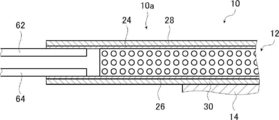
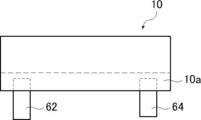
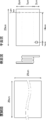
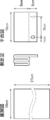
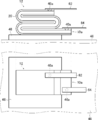
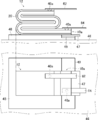
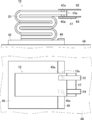
- FIG. 1 is a diagram conceptually showing an example of the first aspect of the piezoelectric element of the present invention.
- FIG. 2 is a schematic perspective view of the piezoelectric element shown in FIG.
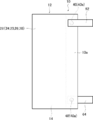
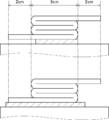
- FIG. 3 is a schematic plan view of the piezoelectric element shown in FIG.
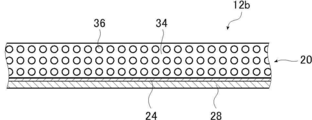
- FIG. 4 is a diagram conceptually showing an example of a piezoelectric film constituting the piezoelectric element shown in FIG.
- FIG. 5 is a conceptual diagram for explaining an example of a method for producing a piezoelectric film.
- FIG. 6 is a conceptual diagram for explaining an example of a method for producing a piezoelectric film.
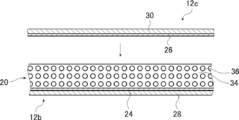
- FIG. 7 is a conceptual diagram for explaining an example of a method for producing a piezoelectric film.
- FIG. 1 is a diagram conceptually showing an example of the first aspect of the piezoelectric element of the present invention.
- FIG. 2 is a schematic perspective view of the piezoelectric element shown in FIG.
- FIG. 3 is a schematic plan view of
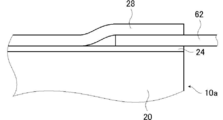
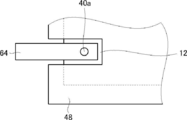
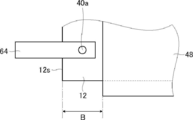
- FIG. 8 is a diagram conceptually showing an example of the connection portion of the piezoelectric element of the present invention.
- FIG. 9 is a diagram conceptually showing another example of the connection portion of the piezoelectric element of the present invention.
- FIG. 10 is a diagram conceptually showing another example of the piezoelectric element of the present invention.
- FIG. 11 is a perspective view conceptually showing another example of the piezoelectric element of the present invention.
- FIG. 12 is a perspective view conceptually showing another example of the piezoelectric element of the present invention.
- FIG. 13 is a diagram conceptually showing an example of the second aspect of the piezoelectric element of the present invention.
- FIG. 14 is a perspective view conceptually showing another example of the second aspect of the piezoelectric element of the present invention.
- FIG. 14 is a perspective view conceptually showing another example of the second aspect of the piezoelectric element of the present invention.
- FIG. 15 is a conceptual diagram of an example of an electroacoustic transducer using the piezoelectric element of the present invention.
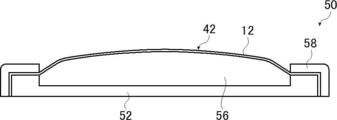
- FIG. 16 is a conceptual diagram of an example of a piezoelectric speaker using the second aspect of the piezoelectric element of the present invention.
- FIG. 17 is a partially enlarged view for explaining another example of the piezoelectric element of the present invention.
- FIG. 18 is a conceptual diagram for explaining an embodiment of the present invention.
- FIG. 19 is a conceptual diagram for explaining a comparative example of the present invention.
- FIG. 20 is a conceptual diagram for explaining a comparative example of the present invention.
- FIG. 21 is a conceptual diagram for explaining an embodiment of the present invention.
- FIG. 22 is a conceptual diagram for explaining an embodiment of the present invention.
- FIG. 23 is a conceptual diagram for explaining the lead-out wiring in the piezoelectric element of the present invention.
- FIG. 24 is a diagram conceptually showing another example of the connection portion of the piezoelectric element of the present invention.
- FIG. 25 is a diagram conceptually showing another example of the connection portion of the piezoelectric element of the present invention.
- FIG. 26 is a diagram conceptually showing another example of the connection portion of the piezoelectric element of the present invention.
- FIG. 27 is a diagram conceptually showing another example of the connection portion of the piezoelectric element of the present invention.
- FIG. 28 is a diagram conceptually showing another example of the connection portion of the piezoelectric element of the present invention.
- FIG. 24 is a diagram conceptually showing another example of the connection portion of the piezoelectric element of the present invention.
- FIG. 25 is a diagram conceptually showing another example of the connection portion of the piezoelectric element of the present invention.
- FIG. 26 is a diagram conceptually showing another example of the connection
- FIG. 29 is a diagram conceptually showing another example of the connection portion of the piezoelectric element of the present invention.
- FIG. 30 is a diagram conceptually showing another example of the connection portion of the piezoelectric element of the present invention.
- FIG. 31 is a diagram conceptually showing an example of the piezoelectric speaker of the present invention.
- FIG. 32 is a conceptual diagram for explaining an embodiment of the present invention.
- FIG. 33 is a conceptual diagram for explaining an embodiment of the present invention.
- FIG. 34 is a conceptual diagram for explaining a comparative example of the present invention.
- FIG. 35 is a conceptual diagram for explaining an embodiment of the present invention.
- FIG. 36 is a conceptual diagram for explaining a comparative example of the present invention.
- FIG. 37 is a conceptual diagram for explaining an embodiment of the present invention.
- FIG. 38 is a conceptual diagram for explaining a comparative example of the present invention.
- FIG. 39 is a conceptual diagram for explaining another example of the piezoelectric element.
- FIG. 40 is a conceptual diagram for explaining another example of the piezoelectric element.
- FIG. 41 is a conceptual diagram for explaining another example of the piezoelectric element.
- FIG. 42 is a conceptual diagram for explaining another example of the piezoelectric element.
- FIG. 43 is a conceptual diagram for explaining another example of the piezoelectric element.
- FIG. 44 is a conceptual diagram for explaining another example of an electroacoustic transducer using a piezoelectric element.
- FIG. 45 is a conceptual diagram for explaining another example of an electroacoustic transducer using a piezoelectric element.
- FIG. 45 is a conceptual diagram for explaining another example of an electroacoustic transducer using a piezoelectric element.
- FIG. 46 is a conceptual diagram for explaining another example of an electroacoustic transducer using a piezoelectric element.
- FIG. 47 is a conceptual diagram for explaining another example of an electroacoustic transducer using a piezoelectric element.
- FIG. 48 is a conceptual diagram for explaining another example of an electroacoustic transducer using a piezoelectric element.
- FIG. 49 is a conceptual diagram for explaining another example of an electroacoustic transducer using a piezoelectric element.
- FIG. 50 is a conceptual diagram for explaining an example of a sticking layer in an electroacoustic converter using a piezoelectric element.
- FIG. 51 is a conceptual diagram for explaining another example of the sticking layer in the electroacoustic transducer using the piezoelectric element.
- FIG. 52 is a conceptual diagram for explaining another example of an electroacoustic transducer using a piezoelectric element.
- FIG. 53 is a conceptual diagram for explaining another example of an electroacoustic transducer using a piezoelectric element.
- FIG. 54 is a conceptual diagram for explaining another example of an electroacoustic transducer using a piezoelectric element.
- FIG. 55 is a conceptual diagram for explaining an embodiment of the present invention.
- the description of the constituent elements described below may be based on a typical embodiment of the present invention, but the present invention is not limited to such an embodiment.
- the numerical range represented by using "-" means a range including the numerical values before and after "-" as the lower limit value and the upper limit value.
- the figures shown below are conceptual diagrams for explaining the present invention. Therefore, the size, thickness, positional relationship, etc. of each component are different from the actual ones.
- FIG. 1 conceptually shows an example of the first aspect of the piezoelectric element of the present invention.
- FIG. 2 conceptually shows a perspective view of the piezoelectric element shown in FIG. 1
- FIG. 3 conceptually shows a plan view of the piezoelectric element shown in FIG. 1.
- the piezoelectric element 10 shown in FIGS. 1 to 3 is formed by laminating five layers of piezoelectric films 12 by folding one piezoelectric film 12 four times. That is, the piezoelectric element 10 is a laminated piezoelectric element in which five layers of piezoelectric films 12 are laminated.
- the piezoelectric film 12 has electrode layers on both sides of the piezoelectric layer 20 and covers both electrode layers. It has a protective layer.
- the piezoelectric element of the present invention has a polygonal planar shape.
- the planar shape means that, like the piezoelectric elements shown in FIGS. 1 to 3, in the case of a piezoelectric element in which a plurality of layers of the piezoelectric film 12 are laminated, the piezoelectric element is viewed from the stacking direction of the piezoelectric film 12.
- the state viewed from this direction is also referred to as "planar view”. Therefore, in the case of the piezoelectric element 10 shown in FIGS. 1 to 3, the planar shape of the piezoelectric element 10 is the shape when viewed from above (or below) in the drawing of FIG.
- the planar shape of the piezoelectric element 10 In the case of a piezoelectric element having a protrusion for connecting an external power source and an electrode layer like the piezoelectric element 10 of the first aspect of the present invention, the planar shape is a shape excluding the protrusion. ..
- the shape of the main surface of the piezoelectric film is the planar shape of the piezoelectric element. It becomes. Further, even when a plurality of piezoelectric films 12 are laminated as shown in FIG.
- the shape of the main surface of each piezoelectric film is regarded as a planar shape.
- the main surface is the maximum surface of a sheet-like material (film, plate-like material, layer).
- the piezoelectric element 10 shown in FIGS. 1 to 3 has a rectangular (rectangular) planar shape.
- the planar shape of the piezoelectric element is not limited to a rectangle, and various shapes such as a triangle, a pentagon, and a hexagon can be used as long as it is a polygon.
- a polygon having a planar shape has a protruding portion protruding from a side other than the shortest side. Since the piezoelectric element 10 has a rectangular planar shape, it has two long sides having the same length and two short sides having the same length.
- the piezoelectric element 10 has a protruding portion 10a so as to protrude from the long side of the rectangle.
- the piezoelectric element 10 projects from the long side of the rectangle to provide a protruding portion 10a, and the protruding portion 10a is provided with a connecting portion for connecting to an external power source to reduce the impedance and is used for, for example, an electroacoustic converter.
- the sound pressure can be improved especially in the high frequency band. This point will be described in detail later.
- the piezoelectric element 10 shown in FIGS. 1 to 3 has five layers of the piezoelectric film 12 laminated by folding the piezoelectric film 12 four times, but the present invention is not limited to this. That is, the piezoelectric element of the present invention may be one in which the piezoelectric film 12 is folded three times or less to laminate two to four layers of the piezoelectric film 12. Alternatively, the piezoelectric element of the present invention may be one in which 6 or more layers of the piezoelectric film 12 are laminated by folding back the piezoelectric film 5 times or more. The piezoelectric element of the present invention is preferably one in which three or more layers of the piezoelectric film 12 are laminated by folding back the piezoelectric film 12 twice or more. Further, the piezoelectric element of the present invention may be a stack of a plurality of piezoelectric elements obtained by folding the piezoelectric film 12 once or more.
- the configuration in which a plurality of layers of the piezoelectric film 12 are laminated is not limited to the configuration in which the piezoelectric film 12 is folded back and laminated. That is, the piezoelectric element of the present invention has a configuration in which a plurality of layers of the piezoelectric film 12 are laminated by laminating a plurality of cut sheet-shaped piezoelectric films in both the first aspect and the second aspect. May be good. Further, the piezoelectric element according to the second aspect of the present invention, which will be described later and does not have a protruding portion for providing a connection portion with an external power source, may be composed of a single piezoelectric film that is not laminated. This point will be described in detail later.
- FIG. 4 conceptually shows the piezoelectric film 12 by a cross-sectional view.
- the piezoelectric film 12 includes a piezoelectric layer 20 which is a sheet-like material having piezoelectricity, a first thin film electrode 24 laminated on one surface of the piezoelectric layer 20, and a first thin film electrode. It has a first protective layer 28 laminated on 24, a second thin film electrode 26 laminated on the other surface of the piezoelectric layer 20, and a second protective layer 30 laminated on the second thin film electrode 26. ..
- the piezoelectric film 12 is polarized in the thickness direction.
- the piezoelectric layer 20 the first thin film electrode 24 and the second thin film electrode 26, and the first protective layer 28 and the first protective layer 28 are shown.
- the 2 protective layers 30 are not shown separately.
- the piezoelectric layer 20 is made of a polymer composite piezoelectric body in which piezoelectric particles 36 are dispersed in a matrix 34 containing a polymer material. ..
- the matrix 34 preferably contains a polymer material having viscoelasticity at room temperature, and more preferably made of a polymer material having viscoelasticity at room temperature. That is, the matrix 34 is preferably a viscoelastic matrix having viscoelasticity at room temperature.
- "normal temperature” refers to a temperature range of about 0 to 50 ° C.
- the polymer composite piezoelectric body (piezoelectric layer 20) preferably has the following requirements.
- (I) Flexibility For example, when gripping in a state of being loosely bent like a document like a newspaper or a magazine for carrying, it is constantly subjected to a relatively slow and large bending deformation of several Hz or less from the outside. become. At this time, if the polymer composite piezoelectric body is hard, a correspondingly large bending stress is generated, cracks are generated at the interface between the polymer matrix and the piezoelectric particle, and there is a possibility that it will eventually lead to fracture. Therefore, the polymer composite piezoelectric body is required to have appropriate softness. Further, if the strain energy can be diffused to the outside as heat, the stress can be relaxed. Therefore, it is required that the loss tangent of the polymer composite piezoelectric body is appropriately large.
- the flexible polymer composite piezoelectric material used as an exciter and an electroacoustic conversion film is required to behave hard against vibrations of 20 Hz to 20 kHz and soft against vibrations of several Hz or less. Further, the loss tangent of the polymer composite piezoelectric body is required to be appropriately large for vibrations of all frequencies of 20 kHz or less. Further, it is preferable that the spring constant can be easily adjusted by laminating according to the rigidity of the mating material (diaphragm) to be attached. At that time, the thinner the attachment layer 14 is, the higher the energy efficiency is. be able to. Rigidity is, in other words, hardness, stiffness, spring constant, and the like.
- a polymer solid has a viscoelastic relaxation mechanism, and a large-scale molecular motion causes a decrease in storage elastic modulus (Young's modulus) (relaxation) or a maximum loss elastic modulus (absorption) as the temperature rises or the frequency decreases.
- Young's modulus storage elastic modulus
- laxation maximum loss elastic modulus
- absorption maximum loss elastic modulus
- main dispersion the relaxation caused by the micro-Brownian motion of the molecular chain in the amorphous region
- the temperature at which this main dispersion occurs is the glass transition point (Tg), and the viscoelastic relaxation mechanism appears most prominently.
- the polymer composite piezoelectric body (piezoelectric layer 20), by using a polymer material having a glass transition point at room temperature as a matrix, it is hard against vibrations of 20 Hz to 20 kHz and is resistant to slow vibrations of several Hz or less. Is realized by a polymer composite piezoelectric material that behaves softly. In particular, in terms of preferably expressing this behavior, it is preferable to use a polymer material having a glass transition point at a frequency of 1 Hz at room temperature, that is, at 0 to 50 ° C. for the matrix of the polymer composite piezoelectric material.
- the polymer material having a glass transition point at room temperature is, in other words, a polymer material having viscoelasticity at room temperature.
- the polymer material having viscoelasticity at room temperature various known materials can be used.
- a polymer material having a maximum value of tangent Tan ⁇ at a frequency of 1 Hz by a dynamic viscoelasticity test of 0.5 or more is used at room temperature, that is, at 0 to 50 ° C.
- the polymer material having viscoelasticity at room temperature preferably has a storage elastic modulus (E') at a frequency of 1 Hz as measured by dynamic viscoelasticity measurement of 100 MPa or more at 0 ° C. and 10 MPa or less at 50 ° C.
- E' storage elastic modulus
- the polymer material having viscoelasticity at room temperature has a relative permittivity of 10 or more at 25 ° C.
- a voltage is applied to the polymer composite piezoelectric body, a higher electric field is applied to the piezoelectric particles in the polymer matrix, so that a large amount of deformation can be expected.
- the polymer material has a relative permittivity of 10 or less at 25 ° C.
- polymer material having viscoelasticity at room temperature satisfying such conditions examples include cyanoethylated polyvinyl alcohol (cyanoethylated PVA), polyvinyl acetate, polyvinylidene chloride core acrylonitrile, polystyrene-vinyl polyisoprene block copolymer, and polyvinylmethyl. Examples thereof include ketones and polybutyl methacrylate. Further, as these polymer materials, commercially available products such as Hybler 5127 (manufactured by Kuraray Co., Ltd.) can also be preferably used.
- Hybler 5127 manufactured by Kuraray Co., Ltd.
- the polymer material it is preferable to use a material having a cyanoethyl group, and it is particularly preferable to use cyanoethylated PVA.
- these polymer materials may use only 1 type, and may use a plurality of types in combination (mixing).
- a plurality of polymer materials may be used in combination, if necessary. That is, in the matrix 34, in addition to a polymer material having viscoelasticity at room temperature such as cyanoethylated PVA for the purpose of adjusting dielectric properties and mechanical properties, other dielectric polymer materials are added as needed. It may be added.
- dielectric polymer material examples include polyvinylidene fluoride, vinylidene fluoride-tetrafluoroethylene copolymer, vinylidene fluoride-trifluoroethylene copolymer, and vinylidene fluoride-trifluoroethylene copolymer.
- fluoropolymers such as polyvinylidene fluoride-tetrafluoroethylene copolymer, vinylidene cyanide-vinyl acetate copolymer, cyanoethyl cellulose, cyanoethyl hydroxysaccharose, cyanoethyl hydroxycellulose, cyanoethyl hydroxypurrane, cyanoethyl methacrylate, cyanoethyl acrylate, cyanoethyl.
- Cyano groups such as hydroxyethyl cellulose, cyanoethyl amylose, cyanoethyl hydroxypropyl cellulose, cyanoethyl dihydroxypropyl cellulose, cyanoethyl hydroxypropyl amylose, cyanoethyl polyacrylamide, cyanoethyl polyacrylate, cyanoethyl pullulan, cyanoethyl polyhydroxymethylene, cyanoethyl glycidolpulrane, cyanoethyl saccharose and cyanoethyl sorbitol.
- a polymer having a cyanoethyl group a synthetic rubber such as a nitrile rubber or a chloroprene rubber, and the like are exemplified.
- a polymer material having a cyanoethyl group is preferably used.
- the dielectric polymer added in addition to the material having viscoelasticity at room temperature such as cyanoethylated PVA is not limited to one type, and a plurality of types may be added. ..
- the matrix 34 contains a vinyl chloride resin, a thermoplastic resin such as polyethylene, polystyrene, methacrylic resin, polybutene and isobutylene, and a phenol resin for the purpose of adjusting the glass transition point Tg.
- a thermoplastic resin such as polyethylene, polystyrene, methacrylic resin, polybutene and isobutylene
- a phenol resin for the purpose of adjusting the glass transition point Tg.
- Urea resin, melamine resin, alkyd resin, thermosetting resin such as mica and the like
- a tackifier such as rosin ester, rosin, terpene, terpene phenol, and petroleum resin may be added.
- the amount added when a material other than the polymer material having viscoelasticity at room temperature such as cyanoethylated PVA is added is not particularly limited, but is 30 mass in proportion to the matrix 34. It is preferably% or less.
- the characteristics of the polymer material to be added can be exhibited without impairing the viscoelastic relaxation mechanism in the matrix 34, so that the dielectric constant can be increased, the heat resistance can be improved, and the adhesion to the piezoelectric particles 36 and the electrode layer can be improved. In this respect, favorable results can be obtained.
- the piezoelectric particles 36 can be used, but preferably, the piezoelectric particles 36 are made of ceramic particles having a perovskite-type or wurtzite-type crystal structure.
- the ceramic particles constituting the piezoelectric particles 36 include lead zirconate titanate (PZT), lead zirconate titanate (PLZT), barium titanate (BaTIO 3 ), zinc oxide (ZnO), and the like.
- Examples thereof include a solid solution (BFBT) of barium titanate and bismuth ferrite (BiFe 3).
- the particle size of the piezoelectric particles 36 is not limited, and may be appropriately selected depending on the size of the piezoelectric film 12 and the application of the piezoelectric element 10.
- the particle size of the piezoelectric particles 36 is preferably 1 to 10 ⁇ m. By setting the particle size of the piezoelectric particles 36 in this range, favorable results can be obtained in that the piezoelectric film 12 can achieve both high piezoelectric characteristics and flexibility.
- the piezoelectric particles 36 in the piezoelectric layer 20 are uniformly and regularly dispersed in the matrix 34, but the present invention is not limited to this. That is, the piezoelectric particles 36 in the piezoelectric layer 20 may be irregularly dispersed in the matrix 34 as long as they are preferably uniformly dispersed. Further, the piezoelectric particles 36 may or may not have the same particle size.
- the amount ratio of the matrix 34 to the piezoelectric particles 36 in the piezoelectric layer 20 is not limited, and the size and thickness of the piezoelectric film 12 in the plane direction, the use of the piezoelectric element 10, and the use of the piezoelectric element 10 are not limited. It may be appropriately set according to the characteristics required for the piezoelectric film 12.
- the volume fraction of the piezoelectric particles 36 in the piezoelectric layer 20 is preferably 30 to 80%, more preferably 50% or more, still more preferably 50 to 80%.
- the thickness of the piezoelectric layer 20 is not particularly limited, and is appropriately determined according to the application of the piezoelectric element 10, the number of laminated piezoelectric films in the piezoelectric element 10, the characteristics required for the piezoelectric film 12, and the like. , Just set it.
- the thickness of the piezoelectric layer 20 is preferably 8 to 300 ⁇ m, more preferably 8 to 200 ⁇ m, further preferably 10 to 150 ⁇ m, and particularly preferably 15 to 100 ⁇ m.
- the piezoelectric layer 20 is preferably polarized (polled) in the thickness direction.
- the polarization treatment will be described in detail later.
- the piezoelectric film 12 of the illustrated example has a first thin film electrode 24 on one surface of such a piezoelectric layer 20, a first protective layer 28 on the surface thereof, and a piezoelectric layer.
- the second thin film electrode 26 is provided on the other surface of the 20 and the second protective layer 30 is provided on the surface thereof.
- the first thin film electrode 24 and the second thin film electrode 26 form an electrode pair.
- the piezoelectric film 12 may have an insulating layer or the like that covers the exposed region of the piezoelectric layer 20 to prevent short circuits or the like.
- both sides of the piezoelectric layer 20 are sandwiched between electrode pairs, that is, the first thin film electrode 24 and the second thin film electrode 26, and the laminated body is sandwiched between the first protective layer 28 and the second protective layer 30. It has a structure that is sandwiched between.
- the region held by the first thin film electrode 24 and the second thin film electrode 26 is expanded and contracted according to the applied voltage.
- the first thin film electrode 24 and the first protective layer 28, and the first and second in the second thin film electrode 26 and the second protective layer 30 are for convenience in order to explain the piezoelectric film 12. The name is given according to the drawing. Therefore, the first and second piezoelectric films 12 have no technical meaning and are irrelevant to the actual usage state.
- the first protective layer 28 and the second protective layer 30 have a role of covering the first thin film electrode 24 and the second thin film electrode 26 and imparting appropriate rigidity and mechanical strength to the piezoelectric layer 20. Is responsible for. That is, in the piezoelectric film 12, the piezoelectric layer 20 composed of the matrix 34 and the piezoelectric particles 36 exhibits extremely excellent flexibility with respect to slow bending deformation, but is rigid depending on the application. And mechanical strength may be insufficient.
- the piezoelectric film 12 is provided with a first protective layer 28 and a second protective layer 30 to supplement the piezoelectric film 12.
- the piezoelectric film 12 may have only one of the first protective layer 28 and the second protective layer 30, or may not have the protective layer.
- the piezoelectric film 12 preferably has at least one protective layer, and the first protective layer 28 and the second protective layer 28. It is preferable to have both layers 30.
- the first protective layer 28 and the second protective layer 30 are not limited, and various sheet-like materials can be used.
- various resin films are preferably exemplified.
- PET polyethylene terephthalate
- PP polypropylene
- PS polystyrene
- PC polycarbonate
- PPS polyphenylene sulfide
- PMMA polymethylmethacrylate
- PEI Polyetherimide
- PEI polyimide
- PEN polyethylene naphthalate
- TAC triacetyl cellulose
- a resin film made of a cyclic olefin resin or the like are preferably used.
- the thickness of the first protective layer 28 and the second protective layer 30 there is no limitation on the thickness of the first protective layer 28 and the second protective layer 30. Further, the thicknesses of the first protective layer 28 and the second protective layer 30 are basically the same, but may be different. Here, if the rigidity of the first protective layer 28 and the second protective layer 30 is too high, not only the expansion and contraction of the piezoelectric layer 20 is restrained, but also the flexibility is impaired. Therefore, the thinner the first protective layer 28 and the second protective layer 30, the more advantageous it is, except when mechanical strength and good handleability as a sheet-like material are required.
- the thickness of the first protective layer 28 and the second protective layer 30 is twice or less the thickness of the piezoelectric layer 20, it is possible to ensure both rigidity and appropriate flexibility. A favorable result can be obtained in terms of points.
- the thickness of the first protective layer 28 and the second protective layer 30 is preferably 100 ⁇ m or less. 50 ⁇ m or less is more preferable, and 25 ⁇ m or less is further preferable.
- a first thin film electrode 24 is provided between the piezoelectric layer 20 and the first protective layer 28, and a second thin film electrode 26 is provided between the piezoelectric layer 20 and the second protective layer 30. It is formed.
- the first thin film electrode 24 is also referred to as a first electrode 24, and the second thin film electrode 26 is also referred to as a second electrode 26.
- the first electrode 24 and the second electrode 26 are provided to apply a voltage to the piezoelectric layer 20 (piezoelectric film 12).
- the materials for forming the first electrode 24 and the second electrode 26 are not limited, and various conductors can be used. Specifically, metals such as carbon, palladium, iron, tin, aluminum, nickel, platinum, gold, silver, copper, titanium, chromium and molybdenum, alloys thereof, laminates and composites of these metals and alloys, In addition, indium tin oxide and the like are exemplified. Among them, copper, aluminum, gold, silver, platinum, and indium tin oxide are preferably exemplified as the first electrode 24 and the second electrode 26.
- the method of forming the first electrode 24 and the second electrode 26 can be used for film formation by vapor deposition method (vacuum film deposition method) such as vacuum deposition and sputtering, film formation by plating, and the above materials.
- vapor deposition method vacuum film deposition method
- sputtering film formation by plating
- Various known methods such as a method of attaching the formed foil can be used.
- thin films such as copper and aluminum formed by vacuum deposition are preferably used as the first electrode 24 and the second electrode 26 because the flexibility of the piezoelectric film 12 can be ensured.
- a copper thin film produced by vacuum deposition is preferably used.
- the thickness of the first electrode 24 and the second electrode 26 There is no limitation on the thickness of the first electrode 24 and the second electrode 26. Further, the thicknesses of the first electrode 24 and the second electrode 26 are basically the same, but may be different.
- the product of the thickness of the first electrode 24 and the second electrode 26 and the Young's modulus is less than the product of the thickness of the first protective layer 28 and the second protective layer 30 and the Young's modulus. It is suitable because it does not significantly impair the flexibility.
- the first protective layer 28 and the second protective layer 30 are PET
- the first electrode 24 and the second electrode 26 are made of copper.
- PET has a Young's modulus of about 6.2 GPa
- copper has a Young's modulus of about 130 GPa.
- the thickness of the first protective layer 28 and the second protective layer 30 is 25 ⁇ m
- the thickness of the first electrode 24 and the second electrode 26 is preferably 1.2 ⁇ m or less, more preferably 0.3 ⁇ m or less. It is preferable, and 0.1 ⁇ m or less is more preferable.
- the piezoelectric layer 20 formed by dispersing the piezoelectric particles 36 in a matrix 34 containing a polymer material having viscoelasticity at room temperature is formed by the first electrode 24 and the second electrode 26. It has a structure in which the laminated body is sandwiched between the first protective layer 28 and the second protective layer 30.
- the maximum value of the loss tangent (Tan ⁇ ) at a frequency of 1 Hz by dynamic viscoelasticity measurement exists at room temperature, and the maximum value of 0.1 or more exists at room temperature. More preferred.
- the piezoelectric film 12 is subjected to a relatively slow and large bending deformation of several Hz or less from the outside, the strain energy can be effectively diffused to the outside as heat. It is possible to prevent cracks from occurring at the interface of.
- the piezoelectric film 12 preferably has a storage elastic modulus (E') at a frequency of 1 Hz as measured by dynamic viscoelasticity measurement of 10 to 30 GPa at 0 ° C. and 1 to 10 GPa at 50 ° C.
- E' storage elastic modulus
- the piezoelectric film 12 can have a large frequency dispersion in the storage elastic modulus (E') at room temperature. That is, it can behave hard for vibrations of 20 Hz to 20 kHz and soft for vibrations of several Hz or less.
- the product of the thickness and the storage elastic modulus (E') at a frequency of 1 Hz measured by dynamic viscoelasticity is 1.0 ⁇ 10 6 to 2.0 ⁇ 10 6 N / m at 0 ° C. , It is preferably 1.0 ⁇ 10 5 to 1.0 ⁇ 10 6 N / m at 50 ° C.
- the piezoelectric film 12 can be provided with appropriate rigidity and mechanical strength as long as the flexibility and acoustic characteristics are not impaired.
- the piezoelectric film 12 preferably has a loss tangent (Tan ⁇ ) of 0.05 or more at 25 ° C. and a frequency of 1 kHz in the master curve obtained from the dynamic viscoelasticity measurement.
- Ton ⁇ loss tangent
- the frequency characteristics of the speaker using the piezoelectric film 12 become smooth, and the amount of change in sound quality when the minimum resonance frequency f 0 changes with the change in the curvature of the speaker can be reduced.
- a sheet-like object 12a in which the first electrode 24 is formed on the first protective layer 28 is prepared.
- the sheet-like material 12a may be produced by forming a copper thin film or the like as the first electrode 24 on the surface of the first protective layer 28 by vacuum vapor deposition, sputtering, plating or the like.
- the first protective layer 28 with a separator temporary support
- PET or the like having a thickness of 25 to 100 ⁇ m can be used.
- the separator may be removed after the second electrode 26 and the second protective layer 30 are thermocompression bonded, and before any member is laminated on the first protective layer 28.
- a polymer material having viscoelasticity at room temperature such as cyanoethylated PVA is dissolved in an organic solvent, and piezoelectric particles 36 such as PZT particles are added and stirred to prepare a dispersed coating material. ..
- a polymer material having viscoelasticity at room temperature such as cyanoethylated PVA
- the organic solvent is not limited, and various organic solvents such as dimethylformamide (DMF), methylethylketone, and cyclohexanone can be used.
- the paint is cast (applied) to the sheet-like material 12a to evaporate the organic solvent and dry it.
- a laminated body 12b having the first electrode 24 on the first protective layer 28 and forming the piezoelectric layer 20 on the first electrode 24 is produced.
- the first electrode 24 is an electrode on the base material side when the piezoelectric layer 20 is applied, and does not indicate the vertical positional relationship in the laminated body.
- the casting method of this paint is not particularly limited, and all known coating methods (coating devices) such as a slide coater and a doctor knife can be used.
- the viscoelastic material is a material that can be melted by heating, such as cyanoethylated PVA
- the laminate 12b may be produced by the method shown below. First, the viscoelastic material is heated and melted, and the piezoelectric particles 36 are added / dispersed thereto to prepare a melt. This melt is extruded into a sheet shape on the sheet-like material 12a shown in FIG. 5 by extrusion molding or the like, and cooled. As a result, as shown in FIG. 6, a laminated body 12b having the first electrode 24 on the first protective layer 28 and forming the piezoelectric layer 20 on the first electrode 24 can be produced.
- a polymer piezoelectric material such as PVDF may be added to the matrix 34 in addition to the viscoelastic material such as cyanoethylated PVA.
- the polymer piezoelectric materials to be added to the paint described above may be dissolved.
- the polymer piezoelectric material to be added may be added to the above-mentioned heat-melted viscoelastic material and heat-melted.
- the method for polarization treatment of the piezoelectric layer 20 is not limited, and known methods can be used.
- electric field polling in which a DC electric field is directly applied to an object to be polarized is exemplified.
- the first electrode 24 may be formed before the polarization treatment, and the electric field polling treatment may be performed using the first electrode 24 and the second electrode 26.
- the polarization treatment is performed in the thickness direction of the piezoelectric layer 20 rather than in the plane direction.
- a calendar treatment may be performed in which the surface of the piezoelectric layer 20 is smoothed by using a heating roller or the like. By performing this calendar processing, the thermocompression bonding process described later can be smoothly performed.
- a sheet-like material 12c in which the second electrode 26 is formed on the second protective layer 30 is prepared.
- the sheet-like material 12c may be produced by forming a copper thin film or the like as the second electrode 26 on the surface of the second protective layer 30 by vacuum vapor deposition, sputtering, plating or the like.
- the second electrode 26 is directed toward the piezoelectric layer 20, and the sheet-like material 12c is laminated on the laminated body 12b that has undergone the polarization treatment of the piezoelectric layer 20.
- the laminate of the laminate 12b and the sheet-like material 12c is thermocompression-bonded with a heating press device or a heating roller or the like so as to sandwich the second protective layer 30 and the first protective layer 28, and piezoelectric.
- a film 12 is produced.
- the piezoelectric element 10 of the present invention is formed by laminating a plurality of layers of piezoelectric films 12 by folding back.
- the piezoelectric element 10 has a structure in which adjacent piezoelectric films 12 laminated by folding back are attached with an adhesive layer 14 (adhesive agent).
- the adhesive layer 14 may be a layer made of an adhesive, a layer made of a pressure-sensitive adhesive, or a layer made of a material having the characteristics of both an adhesive and a pressure-sensitive adhesive.
- An adhesive is an adhesive that has fluidity when bonded and then becomes solid.
- the pressure-sensitive adhesive is a gel-like (rubber-like) soft solid that does not change in the gel-like state even after that.
- the piezoelectric element 10 of the present invention vibrates the diaphragm 46 by expanding and contracting a plurality of laminated piezoelectric films 12, for example, as described later, to generate sound.
- the adhesive layer 14 is preferably an adhesive layer made of an adhesive, which can obtain a solid and hard adhesive layer 14 rather than the adhesive layer made of an adhesive.
- an adhesive layer made of a thermoplastic type adhesive such as a polyester adhesive and a styrene-butadiene rubber (SBR) adhesive is preferably exemplified.
- Adhesion unlike adhesion, is useful when seeking high adhesion temperatures.
- the thermoplastic type adhesive has "relatively low temperature, short time, and strong adhesion" and is suitable.
- the thickness of the sticking layer 14 is not limited, and a thickness capable of exhibiting sufficient sticking force (adhesive force, adhesive force) is determined according to the material for forming the sticking layer 14. It may be set as appropriate.
- a thickness capable of exhibiting sufficient sticking force adheresive force, adhesive force
- the adhesive layer 14 when the adhesive layer 14 is thin, the effect of transmitting the expansion / contraction energy (vibration energy) of the piezoelectric layer 20 can be increased, and the energy efficiency can be increased.
- the sticking layer 14 is thick and has high rigidity, the expansion and contraction of the piezoelectric film 12 may be restricted.
- the piezoelectric element 10 of the present invention can make the sticking layer 14 thin.
- the sticking layer 14 is preferably thinner than the piezoelectric layer 20. That is, in the piezoelectric element 10 of the present invention, the sticking layer 14 is preferably hard and thin.
- the thickness of the sticking layer 14 is preferably 0.1 to 50 ⁇ m, more preferably 0.1 to 30 ⁇ m, and even more preferably 0.1 to 10 ⁇ m after sticking.
- the spring constant of the adhesive layer 14 is high, the expansion and contraction of the piezoelectric film 12 may be restricted. Therefore, it is preferable that the spring constant of the sticking layer 14 is equal to or less than the spring constant of the piezoelectric film 12.
- the spring constant is "thickness x Young's modulus". Specifically, the product of the thickness of the adhesive layer 14 and the storage elastic modulus (E') at a frequency of 1 Hz by dynamic viscoelasticity measurement is 2.0 ⁇ 10 6 N / m or less at 0 ° C., 50. It is preferably 1.0 ⁇ 10 6 N / m or less at ° C.
- the internal loss at a frequency of 1 Hz by the dynamic viscoelasticity measurement of the adhesive layer is 1.0 or less at 25 ° C. in the case of the adhesive layer 14 made of an adhesive, and in the case of the adhesive layer 14 made of an adhesive. It is preferably 0.1 or less at 25 ° C.
- the piezoelectric element of the first aspect of the present invention has a polygonal planar shape, and has a protruding portion provided so as to project from a side other than the shortest side of the polygon.
- the protruding portion has a connecting portion for connecting to an external power source.
- the protruding portion is a portion protruding from a polygonal planar shape such as a triangle or a quadrangle.
- the piezoelectric element according to the first aspect of the present invention is laminated, and the adjacent piezoelectric film 12 is basically adhered to the entire surface by the adhesive layer 14. That is, the protruding portion is a region that is not attached by the attachment layer 14 of the piezoelectric film 12.
- the piezoelectric element 10 of the illustrated example is formed by folding and stacking rectangular piezoelectric films 12 so as to overlap each other, and has a rectangular planar shape. Therefore, the planar shape has two long sides and two short sides. Therefore, in the piezoelectric element 10, the protruding portion 10a is provided so as to protrude from the long side of the rectangle.
- the piezoelectric element 10 is laminated by folding back the piezoelectric film 12 so that the folded portion has a long side of a rectangular shape having a flat shape. In other words, in the piezoelectric element 10, the piezoelectric film 12 is folded and laminated so that the folded ridge line becomes the long side of a rectangular shape having a flat shape.
- the piezoelectric film 12 extends to the outside of the rectangle so as to protrude from the rectangular shape of the piezoelectric element 10, that is, the sticking layer 14. ,
- the protruding portion 10a protruding from the long side.
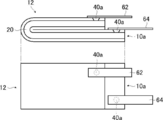
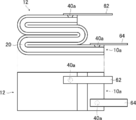
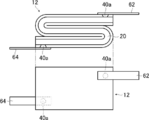
- the piezoelectric element 10 is provided with a connecting portion 40 for connecting the lead wiring 62 and the lead wiring 64 to be connected to the external electrode on the protruding portion 10a.
- a through hole 28a is formed in the first protective layer 28 of the protruding portion 10a as conceptually shown by exemplifying the first electrode 24 side in FIG.
- the through hole 28a is filled with the conductive material 40a to form a connecting portion 40 for connecting the external power source and the first electrode 24.
- the conductive material 40a is not limited, and various known conductive materials can be used.
- Examples thereof include conductive metal pastes such as silver paste, conductive carbon pastes, and conductive nanoinks.
- the lead-out wiring 64 connected to the external power supply is fixed so as to come into contact with the conductive material 40a of the connection portion 40, and the external power supply and the first electrode 24 are connected.
- a lead-out wiring 62 for connecting to an external electrode and a connecting portion 40 for connecting to the lead-out wiring 64 are provided on the protruding portion 10a so as to protrude from the long side of the rectangle.
- the piezoelectric element of the present invention has such a configuration, so that the piezoelectric element using the piezoelectric film 12 having the piezoelectric layer 20 in which the piezoelectric particles 36 are dispersed in the matrix 34 containing the polymer material has a small impedance. Therefore, for example, when used as an electroacoustic converter or the like, a piezoelectric element capable of improving the sound pressure particularly in a high frequency band has been realized.
- a protruding portion 10a is provided so as to project from the long side, and the protruding portion 10a is for connecting to an external power source.
- a connection portion 40 is provided. That is, in the piezoelectric element 10, in the piezoelectric element having a rectangular planar shape, electricity for driving is supplied from the long side (side other than the shortest side) of the piezoelectric film 12. As described above, the electricity supplied in the piezoelectric element 10 is transmitted to the entire surface of the piezoelectric film 12 from the connection portion 40 between the first electrode 24 and the second electrode 26 and the external power source.
- the area of the forming position of the protruding portion 10a on which the connecting portion 40 is provided that is, the frontage at the position where electricity is supplied. Is wide. Therefore, electricity can be transmitted so as to spread widely in the surface direction of the piezoelectric film 12, so that electricity is easily transmitted to the entire surface of the piezoelectric film 12, and the impedance is lowered.
- the piezoelectric element 10 of the present invention when used as an exciter, for example, the sound pressure is improved especially in a high frequency band, and the sound pressure is high over a wide frequency band, and the sound quality is high. Can be output.
- the second aspect of the piezoelectric element of the present invention which will be described later, and the piezoelectric film of the piezoelectric speaker of the present invention.
- the piezoelectric element 10 of the present invention preferably has a low impedance. Specifically, when the capacitance of the piezoelectric film 12 is C [F], the impedance [ ⁇ ] at the frequency F [Hz] is [1 / (6.28 ⁇ F ⁇ C)] + 1. It is preferably as follows.
- the impedance of the piezoelectric element 10 of the present invention is [1 / (6.28 ⁇ F ⁇ C)] It is more preferable that it is as follows.
- the impedance of the piezoelectric element preferably satisfies this condition in the frequency range of 2 to 20 kHz, and further preferably satisfies this condition in the range of 2 to 10 kHz.
- the piezoelectric element 10 of the present invention lowers the impedance, and when used as an exciter, an electroacoustic converter, or the like, for example, produces high sound pressure in a wide frequency band, particularly in a high frequency band. It can be obtained and can output high-quality sound.
- this impedance the same applies to the piezoelectric element according to the second aspect of the present invention, which will be described later, and the piezoelectric film in the piezoelectric speaker of the present invention.
- FIG. 9 illustrates a method in which the 24th side of the first electrode is illustrated and conceptually shown. That is, in the protruding portion 10a, the end portion of the first protective layer 28 is partially peeled off, and the lead wire 62 is inserted and fixed between the first electrode 24 and the first protective layer 28 to fix the outside. It may be a connection portion with an electrode. Further, as a method for constructing and forming the connecting portion, those described in JP-A-2016-015354 can also be preferably used.
- the connecting portion 40 of the first electrode 24 and the connecting portion 40 of the second electrode 26 may be close to each other, separated from each other, or overlap each other as long as they are formed on the protruding portions. ..
- the plane direction is the plane direction in the planar shape of the piezoelectric element 10.
- the connecting portion 40 may be located at the end portion, at the center, or between the end portion and the center in the long side direction of the rectangle having the planar shape of the piezoelectric element 10.
- one of the connecting portion 40 of the first electrode 24 and the connecting portion 40 of the second electrode 26 is provided in the vicinity of one end in the long side direction of the rectangle which is the planar shape of the piezoelectric element 10, and the other. May be provided near the other end.
- one of the two connecting portions 40 may be provided near the end portion and the other may be provided at the central portion.
- both of the two connecting portions 40 may be provided near one end in the longitudinal direction of the rectangle.
- both of the two connecting portions 40 may be provided in the central portion in the longitudinal direction of the rectangle.
- the connecting portion 40 of the first electrode 24 and the connecting portion 40 of the second electrode 26 are provided on one protruding portion 10a, but the present invention is not limited thereto. That is, in the piezoelectric element 10 of the present invention, a plurality of protruding portions may be provided as long as they project from the long side of the rectangular shape having a planar shape. For example, as conceptually shown in FIG. 10, two protrusions, a first protrusion 10a-1 and a second protrusion 10a-2, may be provided so as to protrude from the long side of the rectangle.
- the first protruding portion 10a-1 is provided with the connecting portion 40 with the first electrode 24 (leading wiring 62), and the second protruding portion 10a-2 is provided with the second electrode 26 (leading wiring 64).
- the connection portion 40 with and may be provided.
- the vertical direction in the figure is the long side direction of the rectangle having the planar shape of the piezoelectric element, and the horizontal direction in the figure is the short side direction. Regardless of whether one protruding portion is provided on one side or a plurality of protruding portions are provided on one side, it is preferable that the length of the side on which the protruding portion is provided is long in the extending direction.
- the length of the protruding portion in the extending direction of the side on which the protruding portion is provided is also referred to as "width of the protruding portion".
- the width La of the protrusion is preferably 10% or more, preferably 50% or more of the length L of the side. It is more preferably 70% or more, particularly preferably 90% or more, and most preferably the same as or longer than the side length L.
- a protruding portion 10a is provided so as to protrude from the long side of the rectangle at one end of the piezoelectric film 12 in the folding direction.
- the present invention is not limited to this, and protrusions are provided so as to protrude from the long side of the rectangular shape having a planar shape at both ends of the piezoelectric film 12 to be folded and laminated in the folding direction. May be good. That is, in this case, in the piezoelectric film 12 that is folded back and laminated, protrusions are provided on the uppermost piezoelectric film 12 in the drawing and the lowermost piezoelectric film 12 in the drawing.
- a connecting portion 40 with the first electrode 24 (leading wiring 62) is provided on the uppermost protruding portion, and a connecting portion with the second electrode 26 (leading wiring 64) is provided on the lowermost protruding portion. 40 may be provided.
- the number of laminated piezoelectric films 12 is an even number
- a configuration other than providing the first electrode and the connection portion between the second electrode and the external device on the protruding portion 10a can be used. That is, when the number of laminated piezoelectric films 12 is an even number, a configuration other than the configuration in which both the lead wiring 62 and the lead wiring 64 are provided on the protruding portion 10a can be used.
- the lead-out wiring 62 is provided without providing the protrusion 10a on the uppermost layer. It may be connected and the lead-out wiring 64 may be connected by providing the protruding portion 10a on the lowermost layer.
- a configuration other than providing the first electrode and the connection portion between the second electrode and the external device on the protruding portion 10a can be used. That is, even when the number of laminated piezoelectric films 12 is an odd number, it is possible to use a configuration other than the configuration in which both the lead wiring 62 and the lead wiring 64 are provided on the protruding portion 10a.
- the drawer wiring 62 is connected without providing the protrusion 10a on the uppermost layer, and the protrusion 10a is provided on the lowermost layer to provide the drawer wiring 64. You may connect.
- the number of laminated piezoelectric films 12 is an odd number, as shown in FIG. 41, if the lead-out wiring is provided in the uppermost layer and the lowermost layer, the pull-out direction of the lead-out wiring is opposite.
- the protruding portion 10a is provided in the uppermost layer in the drawing, but the present invention is not limited to this.
- the protruding portion 10a is provided in the lowermost layer in the drawing, and the connecting portion between the first electrode and the second electrode and the external device, that is, the drawer wiring 62 and the drawer wiring 64 are provided here. May be good. That is, in the piezoelectric element in which the piezoelectric film 12 is laminated, there is no limitation on the position of the protruding portion 10a with respect to the top-bottom direction and the left-right direction during use. This point is the same regardless of whether the number of laminated piezoelectric films 12 is odd or even.
- the connecting portions between the first electrode and the second electrode and the external device that is, the drawer wiring 62 and It is possible to provide the lead wiring 64.
- the configuration having no protrusion can be suitably used when the number of laminated piezoelectric films 12 is an odd number.
- the lead wiring 62 is provided on the uppermost layer and the lead wiring 64 is provided on the lowermost layer.
- the configuration to be provided is exemplified.
- the piezoelectric element 10 shown in FIGS. 1 to 3 is provided with a protruding portion 10a protruding from the long side of a rectangular shape having a planar shape by extending the piezoelectric film 12 in the folding direction.
- a protruding portion 10a protruding from the long side of a rectangular shape having a planar shape by extending the piezoelectric film 12 in the folding direction.
- the piezoelectric film 12 is laminated by folding back so that the folded portion becomes a short side of a rectangular shape having a planar shape.
- the configuration is also conceivable. That is, in this case, the piezoelectric element 10A is laminated by folding back the piezoelectric film 12 so that the folded ridge line becomes the short side of the rectangular shape having a flat shape.
- a protruding portion 10Aa in which the piezoelectric film 12 protrudes from the long side of the rectangle is provided so as to be orthogonal to the folding direction of the piezoelectric film 12, and the protruding portion 10Aa is provided.
- a connection portion 40 with the first electrode 24 (leading wire 62) and a connecting portion 40 with the second electrode 26 (leading wiring 64) may be provided.
- the protrusion 10Aa is not limited to the configuration provided on the piezoelectric film 12 which is the end portion in the stacking direction. That is, as shown in FIG. 11, in the configuration in which the projecting portion 10Aa is provided so as to be orthogonal to the folding direction of the piezoelectric film 12, the piezoelectric film 12 in the intermediate layer such as the second layer and the third layer in the stacking direction is formed. A protruding portion 10Aa may be provided.
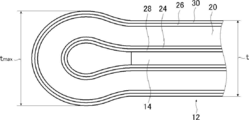
- a piezoelectric element in which a plurality of layers of piezoelectric films 12 are laminated by folding back one piezoelectric film 12 like the piezoelectric element 10, as conceptually shown in FIG. 17, two adjacent layers of piezoelectric films 12
- the thickness of the folded portion of the piezoelectric film 12 may be thicker than the thickness of the laminated body.
- the thickness of the laminated body of the two adjacent piezoelectric films 12 includes the thickness of the sticking layer 14. At this time, there is no limitation on the thickness of the folded portion of the piezoelectric film 12.
- t max is t. It is preferably 5 ⁇ 10 5 times or less of. That is, in the range of "t max ⁇ t ⁇ (5 ⁇ 10 5) " is preferable.
- the maximum thickness of the folded portion t max is preferably at 2.5mm or less.
- the folded-back portion of the piezoelectric film 12 may be a gap, may be filled with a sticking layer 14 (sticking agent), or may be a sticking layer 14. It may be filled with a material having a lower elastic modulus than the dressing agent.
- the above-mentioned piezoelectric element has a structure in which a plurality of layers of piezoelectric films are laminated by folding back one piezoelectric film 12.
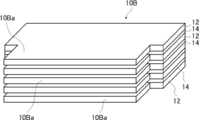
- the first aspect of the piezoelectric element of the present invention is not limited to this configuration. That is, as in the piezoelectric element 10B conceptually shown in FIG. 12, in the first aspect of the present invention, a plurality of cut sheet-shaped piezoelectric films 12 are laminated to form the piezoelectric films 12 adjacent to each other in the lamination direction.
- the configuration may be such that the sticking layer 14 is used for sticking.
- each piezoelectric film 12 when a plurality of cut sheet-shaped piezoelectric films 12 are laminated, each piezoelectric film 12 is individually supplied with electricity to drive. Therefore, in the configuration in which the cut sheet-shaped piezoelectric films 12 are laminated, the shape of the main surface of each piezoelectric film 12 is regarded as the planar shape of the piezoelectric element. That is, in the case of a configuration in which rectangular piezoelectric films 12 are laminated as in the piezoelectric element 10B shown in FIG. 12, the shape of the main surface of the piezoelectric film 12 is regarded as the planar shape of the piezoelectric element 10B, and the length of the piezoelectric film 12 is long.
- the protruding portion 10Ba may be provided so as to protrude from the side.
- the piezoelectric element of the present invention described above has a rectangular planar shape. Therefore, in the planar shape, there are only two long sides and two short sides, and a protruding portion is provided that protrudes from the long side and forms a connecting portion for connecting to an external power source.
- the planar shape is not limited to a rectangle, and a triangle and a polygon of a pentagon or more can be used, and a quadrangle other than a rectangle such as a trapezoid can also be used.
- the side lengths are three or more.
- the lengths of the three sides of the triangle may all be different.
- the protruding portion may be provided so as to protrude from the side other than the shortest side. Therefore, a protrusion is provided from a certain side other than the shortest side of the polygon to form a connecting portion 40 with the first electrode 24, and a protrusion is provided from another side other than the shortest side of the polygon.
- the connecting portion 40 with the second electrode 26 may be formed.
- the plane shape is a triangle having all three sides having different lengths, it protrudes from the longest side to form a connecting portion 40 with the first electrode 24 (leading wire 62) and is the second longest.
- a connecting portion 40 with the second electrode 26 (leading wiring 64) may be formed by providing a protruding portion from the side.
- the piezoelectric element of the first aspect of the present invention when a plurality of protrusions are provided, it is preferable to provide them on the same side of the polygon, and it is preferable to provide all the protrusions on the longest side.
- By providing a plurality of protrusions on the same side it is possible to easily connect to an external power supply, it is possible to easily route wiring for connecting to an external power supply, it is easy to manufacture a piezoelectric element, and the plane size of the piezoelectric element. Is preferable in that the size can be reduced.
- connection portion in the piezoelectric element of the second aspect of the present invention which will be described later
- the protruding portion and the connection portion in the piezoelectric film of the piezoelectric speaker of the present invention which will be described later. That is, in the piezoelectric element of the second aspect of the present invention, similarly to the connecting portion of the protruding portion in the piezoelectric element of the first aspect, the end is set on a side other than the shortest side of the polygon, as will be described later.
- the connecting portion may be provided at a position within the upper limit separation distance from the portion.
- a protruding portion may be provided on a side other than the shortest side of the polygon of the piezoelectric film, and a connecting portion may be provided on the protruding portion, according to the piezoelectric element of the first aspect.
- the first aspect of the piezoelectric element of the present invention described above is that the piezoelectric film 12 is laminated in a plurality of layers and bonded by the bonding layer 14, except for the shortest side of the polygonal planar shape. It has a protruding portion protruding from the side of the above, and the protruding portion is provided with a connecting portion for connecting to an external power source.
- the second aspect of the piezoelectric element of the present invention is the piezoelectric element having the same piezoelectric film 12, which has a polygonal planar shape and has a piezoelectric film 12 other than the shortest side of the polygon.
- a connection portion for connecting the external power supply and the electrode layer is provided at a position within the upper limit separation distance from the end portion.
- the upper limit separation distance is 1 / 2.1 (1 / 2.1) of the length of the shortest side of the polygon having a planar shape.
- the upper limit separation distance is preferably two-fifths (2/5) of the length of the shortest side of the polygon having a planar shape, and one-fifth (1/5). 5) is more preferable.
- the second aspect of such a piezoelectric element of the present invention may have only one piezoelectric film 12 which is not laminated.
- the second aspect of the piezoelectric element of the present invention may be one in which one piezoelectric film 12 is folded back and a plurality of layers are laminated, as in the piezoelectric element 10 shown in FIGS. 1 to 3.
- the second aspect of the piezoelectric element of the present invention may be one in which a plurality of cut sheet-shaped piezoelectric films 12 are laminated, as in the piezoelectric element 10B shown in FIG.
- the adhesive layer 14 to which the adjacent piezoelectric films 12 are attached in the thickness direction is an indispensable constituent requirement. is not it. Therefore, when the second aspect of the piezoelectric element of the present invention is a configuration in which a plurality of layers of piezoelectric films 12 are laminated, known fastening of bolts and nuts, a frame body, a holding member of a sheet-like object, or the like. It may be fixed in a laminated state by means. However, if the adhesive layer 14 is not provided, the piezoelectric film 12 of each layer expands and contracts independently.
- the second aspect of the piezoelectric element of the present invention also has a polygonal planar shape.
- the planar shape of the piezoelectric element is the shape when the piezoelectric element is viewed in the stacking direction of the piezoelectric film 12 in the configuration in which the piezoelectric films 12 of a plurality of layers are laminated as described above. Further, when the piezoelectric element is composed of one piezoelectric film 12 which is not laminated, or when a plurality of cut sheet-shaped piezoelectric films 12 are laminated, the shape of the main surface of each piezoelectric film is changed. , Considered as the planar shape of the piezoelectric element.
- the external power supply and the electrode layer are connected to a position within the upper limit separation distance from the end portion of the piezoelectric film 12 other than the shortest side of the polygon having a planar shape. It has a connection part of.
- the upper limit separation distance is 1 / 2.1 of the length of the shortest side of the polygon.
- the position of the connecting portion closest to the end of the side of the polygon having a planar shape may be located within the upper limit separation distance.
- FIG. 13 describes a second aspect of the piezoelectric element of the present invention by taking a piezoelectric element 42 having one rectangular piezoelectric film 12 which is not laminated is taken as an example.
- the upper part is a plan view
- the lower part is a cross-sectional view in the thickness direction.
- hatching is omitted in order to clearly show the configuration.
- the piezoelectric element 42 shown in FIG. 13 uses the same members as the piezoelectric element 10 and the like described above, the same members are designated by the same reference numerals, and the following description mainly describes different points.
- the piezoelectric element 42 shown in FIG. 13 has one rectangular piezoelectric film 12 that is not laminated.
- a connecting portion for connecting the external power supply and the electrode layer is provided at a position within the upper limit separation distance Ld from the end of the long side.
- the through hole 28a and the through hole 30a are filled with a conductive material 40a such as silver paste, and the external power supply is connected to the connection portion 40 for connecting the external power supply to the first electrode 24 and the second electrode 26.
- the connection portion 40 is used for this purpose.
- the lead wiring 62 and the lead wiring 64 for connecting to the external electrode are connected to both connecting portions 40, for example.
- the second aspect of the piezoelectric element of the present invention has such a configuration, and similarly to the first aspect of the piezoelectric element described above, in the piezoelectric element 42 having a rectangular planar shape, from the long side side of the rectangle. By supplying power, the impedance is lowered. As a result, even in this second aspect, when used as an electroacoustic converter, an exciter, or the like, the sound pressure is particularly improved in a high frequency band, and the sound pressure is high and high over a wide frequency band. Sound quality can be output.
- connection portion for connecting to the external power supply is not limited to the connection portion 40 shown in FIG. 8, and the configuration shown in FIG. 9 is the same as in the first aspect described above. Connections of various known configurations such as are available. In the configuration shown in FIG. 9, the contact portion with the lead wiring in the electrode layer is the connection portion. Similar to the first aspect of the piezoelectric element of the present invention described above, in the second aspect of the piezoelectric element of the present invention, the piezoelectric of the connecting portion 40 of the first electrode 24 and the connecting portion 40 of the second electrode 26 There is no limitation on the positional relationship of the film in the plane direction. Further, in the piezoelectric element 42 shown in FIG.
- the connecting portion 40 of the first electrode 24 and the connecting portion 40 of the second electrode 26 are located within the upper limit separation distance from the ends of the long sides of the rectangle, which are different from each other. It may be provided. Further, also in the second aspect of the piezoelectric element of the present invention, the planar shape is not limited to a rectangle, and various shapes can be used.
- the connecting portion 40 may be provided at a position within the upper limit separation distance from the portion. At this time, the connecting portion 40 is preferably provided on the same side of the polygon, and more preferably provided on the longest side, as in the case of the protruding portion in the first aspect.
- the connecting portion 40 corresponds to each piezoelectric film 12 as described above. Should be provided.
- the piezoelectric film 12 when the plurality of layers of the piezoelectric film 12 are laminated, the piezoelectric film 12 having the protruding portion corresponding to the first aspect and the protruding portion corresponding to the second aspect are provided.
- the piezoelectric film 12 which does not exist may be mixed.
- the piezoelectric element of the present invention when a plurality of layers of piezoelectric films 12 are laminated, at least one layer may have a protrusion in the first aspect, and at least one in the second aspect.
- the connection portion may be provided at a position within the upper limit separation distance from the end of the side other than the side having the shortest layer.
- the piezoelectric film 12 in which one sheet is folded back and the plurality of layers are laminated and the cut sheet-shaped piezoelectric film 12 are laminated. Therefore, the piezoelectric film may be laminated in a plurality of layers.
- the figure is shown as an example.
- the connecting portion 40 may be provided. As described above, this configuration is suitable when the number of laminated piezoelectric films is an odd number.
- product information may be partially displayed on the piezoelectric element of the present invention and the piezoelectric speaker of the present invention described later.
- the display position of the product information any position can be used as long as it is a visible position on the outer surface of the piezoelectric element.
- the information display position include the main surface of the piezoelectric element, the main surface of the piezoelectric film 12, the side surface of the laminate of the piezoelectric film 12, and the protruding portion in the first aspect of the piezoelectric element of the present invention.
- the side surface of the laminated body is a surface orthogonal to the laminating direction.
- the main surface may be any of the two surfaces.
- the product information may be displayed on the lead wire connected to the connection portion of the piezoelectric element, and may be displayed on the cover material when the lead wire is provided with a covering material or the like that protects the lead wiring from corrosion.
- a protective film such as a moisture-proof film, a protective plate, a housing, or the like
- information may be displayed on these members. A plurality of display positions of these information may be used in combination.
- the information display means a known method can be used.
- drawing (printing) by printing means such as inkjet, engraving by laser processing and mechanical grinding, sticking of sheet-like objects such as stickers, printing by general printing methods such as intaglio printing and letterpress printing, and printing by general printing methods, and Examples of these combinations and the like.
- the two-dimensional bar code includes a QR (Quick Response) code (registered trademark), a micro QR code (registered trademark), an SP code, a Veri Code, a Maxi Code, and a CP (Computer Purpose) code.
- QR Quick Response
- micro QR code registered trademark
- SP code Veri Code
- Maxi Code a Maxi Code
- CP Computer Purpose
- Various known two-dimensional barcodes such as Date Matrix, Date Matrix ECC200, Code 1, Aztec code, interactor code, card e, chameleon code, and Semacode are available.
- a storage means readable by radio waves or the like such as an RFID tag using the UHF band and the HF band, or an RFID tag with a memory function, may be attached to the piezoelectric element.
- an identification number identification code
- Inspection history / inspection data such as information, material information, production condition information, raw material unit and production / processing day unit information, usage information, customer information, inspection date and time, inspection type such as energization inspection, etc.
- Company information of the manufacturer such as company name and company logo, product brand name, production control information, production environment information, test history information, and the like are exemplified.
- the product brand name includes the product logo.
- the piezoelectric element of the present invention and the piezoelectric speaker of the present invention described later may be provided with various means for preventing falsification.
- various means for preventing falsification for example, in the case of a piezoelectric element in which a plurality of layers of piezoelectric films 12 are laminated, it is preferable to peel off the adjacent piezoelectric films 12 so that it can be found that the performance has deteriorated.
- tamper-proof means it is provided between adjacent piezoelectric films 12, and when the adjacent piezoelectric films 12 are peeled off, it is also peeled off, and characters and symbols such as "peeling", "invalid" and "VOID" are used.
- a tamper-proof sticker that remains on the main surface of the piezoelectric film 12 and / or the main surface of the sticking layer 14, and a strip-shaped sticker that is stuck over a plurality of layers of piezoelectric films and breaks when the piezoelectric film 12 is peeled off.
- various known tamper-proof seals such as the tamper-proof seal described in JP-A-7-199813 and JP-A-2006-23348 can be used.
- the piezoelectric element having a structure in which a plurality of layers of piezoelectric films 12 are laminated is used as an exciter for vibrating the diaphragm and generating sound from the diaphragm.
- the piezoelectric element of the present invention is adhered to the diaphragm 46 by the sticking layer 48, and the sound is heard from the diaphragm 46. It is used as an exciter to generate. That is, FIG. 15 shows an example of an electroacoustic converter using the piezoelectric element 10 of the present invention.
- the piezoelectric layer 20 constituting the piezoelectric film 12 in which a plurality of layers are laminated is formed by dispersing the piezoelectric particles 36 in the matrix 34. Further, the first electrode 24 and the second electrode 26 are provided so as to sandwich the piezoelectric layer 20 in the thickness direction.
- the piezoelectric particles 36 expand and contract in the polarization direction according to the applied voltage.
- the piezoelectric film 12 shrinks in the thickness direction.
- the piezoelectric film 12 expands and contracts in the plane direction due to the pore ratio. This expansion and contraction is about 0.01 to 0.1%.
- the thickness of the piezoelectric layer 20 is preferably about 8 to 300 ⁇ m. Therefore, the expansion and contraction in the thickness direction is very small, about 0.3 ⁇ m at the maximum.
- the piezoelectric film 12 that is, the piezoelectric layer 20
- the piezoelectric film 12 has a size much larger than the thickness in the plane direction. Therefore, for example, if the length of the piezoelectric film 12 is 20 cm, the piezoelectric film 12 expands and contracts by a maximum of about 0.2 mm when a voltage is applied.
- the diaphragm 46 is attached to the piezoelectric element 10 by the attachment layer 48. Therefore, the expansion and contraction of the piezoelectric film 12 causes the diaphragm 46 to bend, and as a result, the diaphragm 46 vibrates in the thickness direction.
- the diaphragm 46 emits a sound due to the vibration in the thickness direction. That is, the diaphragm 46 vibrates according to the magnitude of the voltage (driving voltage) applied to the piezoelectric film 12, and generates a sound corresponding to the driving voltage applied to the piezoelectric film 12.
- a general piezoelectric film made of a polymer material such as PVDF the molecular chains are oriented with respect to the stretching direction by stretching in the uniaxial direction after the polarization treatment, and as a result, a large piezoelectric property is exhibited in the stretching direction. It is known to be obtained. Therefore, a general piezoelectric film has in-plane anisotropy in the piezoelectric characteristics, and has anisotropy in the amount of expansion and contraction in the plane direction when a voltage is applied.
- the piezoelectric film 12 having the piezoelectric layer 20 made of a polymer composite piezoelectric body in which the piezoelectric particles 36 are dispersed in the matrix 34 is stretched after the polarization treatment. Large piezoelectric characteristics can be obtained without this. Therefore, the piezoelectric film 12 has no in-plane anisotropy in the piezoelectric characteristics, and expands and contracts isotropically in all directions in the plane direction. That is, in the piezoelectric element 10 of the present invention, the piezoelectric film 12 expands and contracts isotropically and two-dimensionally.
- the piezoelectric element 10 of the present invention in which such a piezoelectric film 12 that expands and contracts isotropically two-dimensionally is laminated, compared with the case where a general piezoelectric film such as PVDF that expands and contracts significantly in only one direction is laminated.
- the diaphragm 46 can be vibrated with a large force, and a louder and more beautiful sound can be generated.
- the piezoelectric element 10 is formed by stacking a plurality of layers by folding back such a piezoelectric film 12.
- the adjacent piezoelectric films 12 are further attached to each other by the attachment layer 14. Therefore, even if the rigidity of each piezoelectric film 12 is low and the stretching force is small, the rigidity is increased by laminating the piezoelectric films 12, and the stretching force of the piezoelectric element 10 is increased.
- the piezoelectric element 10 of the present invention even if the diaphragm 46 has a certain degree of rigidity, the diaphragm 46 is sufficiently flexed with a large force to sufficiently vibrate the diaphragm 46 in the thickness direction. It is possible to generate a sound in the diaphragm 46. Further, the thicker the piezoelectric layer 20, the larger the expansion / contraction force of the piezoelectric film 12, but the larger the driving voltage required for expansion / contraction by the same amount.
- the preferable thickness of the piezoelectric layer 20 is about 300 ⁇ m at the maximum, so that even if the voltage applied to each piezoelectric film 12 is small, it is sufficient. , The piezoelectric film 12 can be expanded and contracted.
- the adhesive layer 48 for attaching the piezoelectric element 10 and the diaphragm 46 is not limited, and various known adhesives and adhesives can be used. It is possible. As an example, the same as the above-mentioned adhesive layer 14 is exemplified.
- the preferred sticking layer 48 (sticking agent) is also the same as the sticking layer 14.
- the diaphragm 46 is not limited, and various articles can be used.
- the vibrating plate 46 include plate materials such as resin plates and glass plates, advertising / announcement media such as signs, office equipment and furniture such as tables, whiteboards and projection screens, and organic electroluminescence (OLED (OLED).
- OLED organic electroluminescence
- Display devices such as displays and liquid crystal displays, vehicle components such as consoles, A-pillars, ceilings and bumpers, and building materials such as walls of houses are exemplified.
- the diaphragm 46 to which the piezoelectric element 10 is attached preferably has flexibility, and more preferably windable.
- various flexible sheet-like materials such as a resin film (plastic film) can be used.
- a flexible panel-shaped display device such as a flexible display panel is particularly preferably exemplified. Further, it is more preferable that the display device can also be wound up.
- the vibrating plate 46 and the piezoelectric element, that is, the exciter are attached by drawing out wiring. It is preferable to avoid it.
- the piezoelectric element in which the piezoelectric film 12 is laminated is used as an exciter, it is preferable that the sticking layer 48 for sticking the piezoelectric element (exciter) and the diaphragm 46 is provided avoiding the lead wiring. That is, it is preferable not to attach the sticking layer 48 to the lead-out wiring.
- the piezoelectric element on which the piezoelectric film 12 is laminated has a protruding portion 10a for connecting the lead-out wiring and the electrode layer, not only the lead-out wiring but also the protruding portion 10a is not attached to the diaphragm 46. Is preferable. That is, when the piezoelectric element on which the piezoelectric film 12 is laminated has a protruding portion 10a for connecting the lead-out wiring and the electrode layer, it is preferable not to provide the sticking layer 48 on the protruding portion either.
- the piezoelectric element When the piezoelectric element is used as an exciter, it may be necessary to separate the piezoelectric element and the diaphragm 46 for the purpose of various adjustments, repairs, reattachment, and the like.
- the lead-out wiring for example, as in the examples described later, copper foil tape or the like is used, and in many cases, the mechanical strength is not high. Therefore, if the lead-out wiring is attached to the diaphragm 46, there is a high possibility that the lead-out wiring will be damaged when the diaphragm 46 and the piezoelectric element are separated from each other. Further, it is very difficult to separate the diaphragm 46 and the piezoelectric element without damaging the lead-out wiring.
- the piezoelectric element it is mainly the laminated portion in which the piezoelectric film 12 is laminated that vibrates the diaphragm 46.
- the lead-out wiring is attached to the diaphragm 46, the frequency of this portion is different from that of other regions due to the presence of the lead-out wiring, which may adversely affect the sound output.
- the piezoelectric element has the protruding portion 10a, the piezoelectric film 12 is not laminated on the protruding portion 10a.
- the protruding portion 10a is attached to the diaphragm 46, similarly, the frequency differs between the protruding portion 10a and the laminated portion of the piezoelectric film 12, which may adversely affect the sound output. It is also conceivable to attach the entire surface of the piezoelectric element to the diaphragm 46 to control the vibration of the diaphragm 46 as a whole. However, in this case, the problem that occurs when the diaphragm 46 and the piezoelectric element are separated from each other is unavoidable.
- connection portion between the connection line with the external device and the lead wiring and the connection portion between the lead wiring and the electrode layer are positions where the electric flow, that is, the electric resistance changes significantly. Easy to generate heat. If such a place, that is, the lead-out wiring is attached to the diaphragm 46, heat cannot be dissipated efficiently, and heat may be generated at a high temperature.
- the lead-out wiring and the diaphragm 46 are not attached.
- the protruding portion 10a is provided, the protruding portion 10a and the diaphragm 46 are more preferably not attached. This makes it possible to easily separate the piezoelectric element and the diaphragm 46 without damaging the lead-out wiring, enable suitable audio output in which adverse effects due to regions having different frequencies are prevented, and further, lead-out wiring. And the heat generation around the lead wiring can be suppressed. Regarding this point, the same applies to the configuration in which the protrusion 10a is provided on either the long side or the short side, or the configuration without the protrusion, which will be described later.
- FIGS. 44 to 49 and 52 to 54 an example is shown as a conceptual diagram in FIGS. 44 to 49 and 52 to 54.
- the electrode and the protective layer are shown integrally, and the sticking layer 14 to which the adjacent piezoelectric film 12 is stuck is omitted. ing.
- the sticking layer 14 since the sticking layer 14 is omitted, the portion protruding from the folded end portion of the piezoelectric film 12 is shown as the protruding portion 10a for convenience.
- the diaphragm 16 and the piezoelectric element are formed without providing the sticking layer 48 on the protruding portion 10a. It is preferable to attach and.
- the sticking layer 48 is provided so as to include the entire planar shape of the piezoelectric element in a plan view, and the sticking property is provided between the protruding portion 10a and the sticking layer 48.
- a non-sticking layer 49 that does not exist may be provided.
- having no adhesiveness means having neither adhesiveness nor adhesiveness.
- the non-sticking layer 49 is shown to be embedded in the sticking layer 48.
- the configuration having the non-sticking layer 49 is not limited to this, and the sticking layer 48 may have a step and / or an inclined portion due to the non-sticking layer 49.
- the case where the protruding portion 10a is on the side close to the diaphragm 16 is, in other words, a case where the protruding portion 10a is provided in the layer of the piezoelectric film 12 to be attached to the diaphragm 16.
- the sticking layer 48 is formed in a planar shape, that is, in a region that does not overlap with the protruding portion 10a when viewed in a plan view. Is provided, and the diaphragm 16 and the piezoelectric element (piezoelectric film 12) are preferably attached.
- the sticking layer 48 is provided so as to include the entire planar shape of the piezoelectric element in a plan view, and the sticking property is formed in the region where the protrusion 10a and the sticking layer 48 overlap.
- the non-sticking layer 49 may be provided.
- the protruding portion 10a is on the side far from the diaphragm 16, in other words, the protruding portion 10a is provided in the layer most distant from the layer of the piezoelectric film 12 to be attached to the diaphragm 16 in the stacking direction. This is the case.
- the sticking layer 48 is not provided only on the lead-out wiring, and the sticking layer 48 is provided on the region other than the lead-out wiring of the protrusion 10a to vibrate. It may be attached to the plate 16.
- the protruding portion 10a is a single layer, and as described above, when the driving power is supplied, the frequency of the protruding portion 10a is different from that of the laminated portion. Therefore, when the piezoelectric element has the protruding portion 10a, it is preferable that the protruding portion 10a is not attached to the diaphragm 46 either.
- the sticking layer 48 on the lead-out wiring.
- a region without the sticking layer 48 is provided in a band shape corresponding to the region where the lead wiring 64 exists, and the vibrating plate 16 and the piezoelectric element (piezoelectric film 12) are provided by the sticking layer 48.
- the attachment layer 48 is provided so as to include the entire planar shape of the piezoelectric element in a plan view, and is attached to the region where the lead wiring 64 and the attachment layer 48 overlap.
- the non-sticking layer 49 having no property may be provided in a band shape.
- the vibrating plate 46 is attached by the attachment layer 48 in a strip shape with respect to the region where the lead wiring is provided, as shown in FIGS. 48 and 49.
- the sticking layer 48 is not provided in the region.
- the sticking layer 48 may not be provided only in the region where the piezoelectric element (piezoelectric film 12) does not have the lead wiring 64.
- the sticking layer 48 may be provided so as to stick the entire surface of the piezoelectric element, and the non-sticking layer 49 may be provided only in the region of the lead wiring 64 of the piezoelectric element (piezoelectric film 12).
- the lead wiring 64 corresponds to the protruding side 12s and is parallel to the side 12s and is drawn out.
- the sticking layer 48 may not be provided in the band-shaped region B in which the wiring 64 exists.
- a sticking layer 48 is provided so as to stick the entire surface of the piezoelectric element, and the lead-out wiring 64 covers the sticking layer 48 on the side protruding from the piezoelectric element (piezoelectric film 12) including this region B.
- the non-sticking layer 49 may be provided in a strip shape.
- connection portion between the connection line with the external device and the leader wiring and the connection portion between the leader wiring and the electrode layer are positions where the electrical resistance changes significantly, and heat is likely to be generated.
- a heat radiating plate 47 may be provided at the arrangement portion of the lead wiring such as the protruding portion 10a.
- the sticking layer 48 is provided on the lower surface of the piezoelectric element shown in FIG. 42, that is, on the protruding portion 10a side to attach the diaphragm 46, as shown in FIG. 52, the protruding portion 10a and the sticking layer are attached.
- a non-sticking layer 49 may be provided between the non-sticking layer 49 and the heat radiating plate 47 may be provided between the non-sticking layer 49 and the lead-out wiring 64.
- the protrusion 10a shown in FIG. 45 is located on the side closer to the diaphragm 46, as shown in FIG. 53, the non-sticking layer 49 and the protrusion 10a provided corresponding to the protrusion 10a are formed. A heat sink 47 may be provided between them. Further, if the protruding portion 10a shown in FIG. 47 is located on the side far from the diaphragm 46, the heat radiating plate 47 may be provided on the protruding portion 10a so as to cover the drawer wiring 64 as shown in FIG. 54.
- the heat radiating plate 47 is not limited, and if it is a plate-shaped member having heat radiating property, that is, high thermal conductivity, a heat radiating plate (heat radiating sheet) such as a graphite sheet and a heat radiating sheet containing a heat radiating filler having high thermal conductivity. ), Various known plate materials (sheet-like materials) can be used. Alumina and the like are exemplified as the heat radiating filler having high thermal conductivity. Further, the heat sink 47 preferably has flexibility.
- the piezoelectric speaker of the present invention has the above-mentioned piezoelectric film and diaphragm, and the piezoelectric film and the diaphragm are attached by the above-mentioned bonding layer.
- FIG. 31 conceptually shows an example of the piezoelectric speaker of the present invention. Since the piezoelectric speaker shown in FIG. 31 is composed of the same members as the electroacoustic converter using the piezoelectric element 10 of the present invention shown in FIG. 15 as an exciter, the same members are designated by the same reference numerals and the following description will be given. Mainly does different things.
- the piezoelectric element of the present invention used as the exciter described above is a laminate of a plurality of piezoelectric films 12.
- a single piezoelectric film 12 which is not laminated, a diaphragm 46, and a bonding layer 48 for bonding the piezoelectric film 12 and the diaphragm 46 are attached.
- the piezoelectric film 12, the diaphragm 46, and the bonding layer 48 are all the same as those described above.
- the piezoelectric film 12 has a polygonal planar shape and has a side other than the shortest side of the polygon, similarly to the piezoelectric element of the first aspect of the present invention described above. It has a protruding portion 70a provided so as to protrude from the.
- the piezoelectric speaker 70 of the present invention has a connecting portion for connecting to an external power source at the protruding portion 70a, similarly to the piezoelectric element of the first aspect of the present invention.
- a projecting portion 70a is formed so as to project from the long side of the rectangle, and a connecting portion is provided on the projecting portion 70a.
- the protruding portion is a portion that protrudes from a polygonal planar shape such as a triangle or a quadrangle.
- the portion acting as an exciter is basically entirely attached by the attachment layer 48. That is, in the piezoelectric speaker 70 of the present invention, the protruding portion is a region that is not attached by the attachment layer 48 of the piezoelectric film 12.
- the piezoelectric speaker 70 of the present invention has only one layer of the piezoelectric film 12. In this case, the planar shape of the piezoelectric film 12 is the shape of the main surface of the piezoelectric film 12 as described above.
- a connecting portion for connecting the external power supply and the electrode layer is provided on the protruding portion 70a of the piezoelectric film 12.
- a through hole is provided in the protective layer of the protrusion 70a, and the through hole is filled with a conductive material to connect the lead wiring 62 and the lead wiring 64.
- the protective layer of the protrusion 70a is peeled off, and the drawer wiring 62 and the drawer wiring 64 are inserted between the protective layer and the electrode.
- the piezoelectric film 12 is thin and has good flexibility, but depending on the rigidity of the piezoelectric film 12 and the rigidity of the vibrating plate 46, even one piezoelectric film 12 is sufficient.
- the vibration plate 46 can be vibrated to appropriately output sound.
- connection portion for connecting to the external power supply is not limited to the connection portions shown in FIGS. 8 and 9, and like the piezoelectric element of the present invention described above, connections having various known configurations are used. The department is available. Similar to the piezoelectric element of the present invention described above, also in the piezoelectric speaker of the present invention, the positional relationship between the connection portion 40 of the first electrode 24 and the connection portion 40 of the second electrode 26 in the plane direction of the piezoelectric film is also determined. There is no limit. Further, in the piezoelectric film 12 of the piezoelectric speaker of the present invention, the planar shape is not limited to a rectangle, and various shapes can be used. And a connection part may be provided. At this time, the protrusions are preferably provided on the same side of the polygon, and more preferably on the longest side, as described above, as in the protrusions in the first aspect of the piezoelectric element of the present invention. Is.
- the piezoelectric element having only one non-stacked piezoelectric film can be used as an electroacoustic conversion film such as a piezoelectric speaker that outputs sound by vibrating itself.
- FIG. 16 conceptually shows an example of a flat plate type piezoelectric speaker using the piezoelectric element 42 having only one non-stacked piezoelectric film 12 described above.
- the piezoelectric speaker 50 is a flat plate type piezoelectric speaker that uses the piezoelectric element 42 (piezoelectric film 12) as a diaphragm that converts an electric signal into vibration energy.
- the piezoelectric speaker 50 can also be used as a microphone, a sensor, or the like. Furthermore, this piezoelectric speaker can also be used as a vibration sensor.
- the piezoelectric speaker 50 includes a piezoelectric element 42, a case 52, a viscoelastic support 56, and a frame body 58.
- the case 52 is a thin housing made of plastic or the like and having one side open. Examples of the shape of the housing include a rectangular parallelepiped shape, a cubic shape, and a cylindrical shape.
- the frame body 58 is a frame material having a through hole having the same shape as the open surface of the case 52 in the center and engaging with the open surface side of the case 52.
- the viscoelastic support 56 has appropriate viscosity and elasticity, supports the piezoelectric element 42, and applies a constant mechanical bias to any part of the piezoelectric film to move the piezoelectric element 42 back and forth without waste.
- a non-woven fabric such as wool felt and wool felt containing PET and the like, glass wool and the like are exemplified.
- the back-and-forth movement of the film is a movement in a direction perpendicular to the surface of the film.
- the piezoelectric speaker 50 accommodates the viscoelastic support 56 in the case 52, and covers the case 52 and the viscoelastic support 56 with the piezoelectric element 42. Then, the frame body 58 is fixed to the case 52 in a state where the periphery of the piezoelectric element 42 is pressed against the upper end surface of the case 52 by the frame body 58.
- the height (thickness) of the viscoelastic support 56 is thicker than the height of the inner surface of the case 52. Therefore, in the piezoelectric speaker 50, the viscoelastic support 56 is held in a state of being thinned by being pressed downward by the piezoelectric element 42 at the peripheral portion of the viscoelastic support 56. Similarly, in the peripheral portion of the viscoelastic support 56, the curvature of the piezoelectric element 42 suddenly fluctuates, and the piezoelectric element 42 is formed with a rising portion that becomes lower toward the periphery of the viscoelastic support 56. Further, the central region of the piezoelectric element 42 is pressed by the viscoelastic support 56 having a square columnar shape to be (omitted) flat.
- the piezoelectric speaker 50 absorbs this extension by the action of the viscoelastic support 56.
- the rising portion of the piezoelectric element 42 changes its angle in the rising direction.
- the piezoelectric element 42 having the flat portion moves upward.
- the piezoelectric element 42 contracts in the plane direction due to the application of the driving voltage to the second electrode 26 and the first electrode 24, the rising portion of the piezoelectric element 42 falls in the direction in which the rising portion of the piezoelectric element 42 collapses in order to absorb the contracted portion.
- the angle of the piezoelectric element 42 is changed so as to be closer to a flat surface. As a result, the piezoelectric element 42 having the flat portion moves downward.
- the piezoelectric speaker 50 generates sound by the vibration of the piezoelectric element 42.
- the piezoelectric element 42 of the present invention the conversion from the expansion / contraction motion to the vibration can also be achieved by holding the piezoelectric element 42 in a curved state. Therefore, the piezoelectric element 42 of the present invention is not a flat plate-shaped piezoelectric speaker 50 having rigidity as shown in FIG. 16, but a piezoelectric speaker having flexibility even if it is simply held in a curved state, a vibration sensor, and the like. Can function as.
- a piezoelectric speaker using such a piezoelectric element 42 can be housed in a bag or the like by, for example, being rolled or folded, taking advantage of its good flexibility. Therefore, according to the piezoelectric element 42, it is possible to realize a piezoelectric speaker that can be easily carried even if it has a certain size. Further, as described above, the piezoelectric element 42 is excellent in flexibility and flexibility, and has no in-plane anisotropy of piezoelectric characteristics. Therefore, the piezoelectric element 42 has little change in sound quality regardless of which direction it is bent, and moreover, there is little change in sound quality with respect to a change in curvature.
- the piezoelectric speaker using the piezoelectric element 42 has a high degree of freedom in the installation location, and can be attached to various articles as described above.
- a so-called wearable speaker can be realized by attaching the piezoelectric element 42 to clothing such as clothes and portable items such as a bag in a curved state.
- the piezoelectric element of the present invention has a structure in which a plurality of layers of piezoelectric films are laminated and a structure in which only one piezoelectric film is not laminated, both of which vibrate or expand and contract to output electricity. It can be used for various purposes such as sensors.
- the piezoelectric element of the present invention can be suitably used as, for example, various sensors, acoustic devices, ultrasonic transducers, actuators, vibration damping materials, and vibration power generation devices.
- the sensor include an ultrasonic sensor, a pressure sensor, a tactile sensor, a strain sensor, a vibration sensor, and the like.
- acoustic devices include microphones, pickups, speakers, exciters, and the like. More specific applications include noise cancellers, artificial vocal cords, buzzers for preventing the invasion of pests and vermin, furniture, wallpaper, signage, and the like.
- the ultrasonic transducer include an ultrasonic probe and a hydrophone.
- Examples of the actuator include actuators used for preventing water droplets from adhering, transporting, stirring, polishing, haptics, and the like.
- Examples of haptics include automobiles, smartphones, games, and the like.
- Examples of the damping material include vibration damping materials (dampers) used for containers, vehicles, buildings, and sports equipment such as skis and rackets.
- the vibration power generation device for example, a vibration power generation device used by being applied to a road, a floor, a mattress, a chair, shoes, a tire, a wheel, a personal computer keyboard, or the like is exemplified.
- the configuration of the connecting portion is not limited to the examples shown in FIGS. 8 and 9.
- the first electrode 24 and the first electrode 24 and the first electrode 24 and the first electrode 24 and the piezoelectric film 12 are not provided with the piezoelectric layer 20 at the end portion of the piezoelectric film 12 at the forming position of the connecting portion such as the protruding portion 10a.
- the second electrode 26 may be exposed and this portion may be used as a connecting portion. That is, the electrode layer may be exposed, and the lead wire 62 may be connected to the exposed first electrode 24, and the lead wire 64 may be connected to the exposed second electrode 26. Similar to the example shown in FIG.
- the contact portion between the electrode layer and the lead wire is the connection portion in the present invention.
- the lead wiring 62 and the exposed second electrode 26 are exposed. It is preferable to provide an insulating layer between the 1 electrode 24 and the lead wire 64 and the exposed second electrode 26.
- connection portion between the lead-out wiring 62 and the lead-out wiring 64 and the first electrode 24 and the second electrode 26 of the piezoelectric element 10 is a portion where the current density rapidly increases, and heat is likely to be generated. .. Therefore, it is preferable that the contact portion where the leader wiring and the connection portion come into contact with each other has a large area. That is, if the lead-out wiring and the electrode layer shown in FIGS. 9 and 24 and 25 are directly in contact with each other, it is preferable that the contact area between the electrode layer and the lead-out wire is large. Further, in the case of the connection portion 40 for connecting the lead wire and the electrode layer via the conductive material 40a shown in FIGS.
- the conductive material 40a that is, the through hole and the lead wire are in contact with each other.
- a large area is preferable.
- the area of the contact portion where the leader wiring and the connection portion come into contact is simply referred to as "the contact area between the drawer wiring and the connection portion".
- the contact area between the lead wiring and the connection portion is preferably large, but there is no limitation.
- the contact area between the lead-out wiring and the connecting portion is preferably set according to the area of the piezoelectric film 12.
- the preferable contact area between the lead wiring and the connection portion is also affected by the drive voltage, the thickness of the electrode layer, the resistance of the conductive material 40a, etc., but as an example, the contact area between the lead wiring and the connection portion is , 0.03% or more of the area of the piezoelectric film 12 is preferable.
- the contact area between the lead wiring and the connecting portion is more preferably 0.2% or more, and further preferably 0.6% or more of the area of the piezoelectric film 12.
- the area of the piezoelectric film 12 is specifically the area of the main surface (maximum surface) of either the front surface or the back surface of the piezoelectric film 12. Further, it is preferable that the contact area between the lead wiring and the connecting portion is widened so as to be proportional to the area of the piezoelectric film 12 according to the area of the piezoelectric film 12.
- the area of the piezoelectric film 12 means that in the case of the piezoelectric element 10 in which the piezoelectric film 12 is folded and laminated, the piezoelectric film 12 is not folded back, that is, the piezoelectric film 12 is expanded. It is the area of the piezoelectric film 12 in the state. Further, in the case of a piezoelectric element in which a plurality of cut sheet-shaped piezoelectric films 12 are laminated as shown in FIG. 12, and a piezoelectric element having only one piezoelectric film 12 as shown in FIG. 13, and the present invention. In the case of a piezoelectric speaker, it is the area of each piezoelectric film.
- the contact area between the lead wiring and the connection portion is the contact area between the electrode layer and the lead wiring.
- the connecting portion 40 for connecting the lead wiring and the electrode layer via the conductive material 40a shown in FIGS. 3, 8 and 13 the contact area between the lead wiring and the connecting portion 40 penetrates. This is the contact area between the hole and the lead-out wiring.
- the total contact area between all the through holes and the drawer wiring is taken as the contact area between the drawer wiring and the connecting portion.
- the width of the lead wiring 62 and the lead wiring 64 is wide, the contact area between the connection portion and the lead wiring, that is, the contact area between the electrode layer and the lead wiring also increases. Become wider.
- the protrusions 10a-1 and the protrusions 10a-1 and the protrusions are similar to those in FIG.
- the width of the lead-out wiring is limited by the width of the protruding portion.
- the width of the lead-out wiring 62 and the lead-out wiring 64 is wide, the contact area between the electrode layer and the lead-out wiring is also wide. That is, when the protruding portion is provided, the connecting portion is formed on the protruding portion, and the lead-out wiring is connected, the width of the protruding portion is also important. As described above, the width of the protruding portion is the length of the side on which the protruding portion is formed in the extending direction.
- the width La of the protrusion is 10 of the side length L. % Or more, more preferably 50% or more, further preferably 70% or more, particularly preferably 90% or more, equal to or greater than the side length L. Is most preferable.
- the piezoelectric layer 20 of the piezoelectric film 12 has a preferable thickness of 10 to 300 ⁇ m and is very thin. Therefore, in order to prevent a short circuit, it is preferable that the lead-out wiring is provided at different positions in the surface direction of the piezoelectric film 12. That is, it is preferable that the drawer wiring 62 and the drawer wiring 64 are provided so as to be offset in the surface direction of the piezoelectric film 12. In addition, in the laminated piezoelectric element in which the piezoelectric films are folded and laminated, it is preferable that the lead wires serving as heat generating portions are separated from each other as much as possible in the width direction of the lead wires. That is, as conceptually shown in FIG.
- the distance b between the leader wiring 62 and the drawer wiring 64 in the width direction is wide.
- the width of the lead-out wiring is the length in the extending direction of the side on which the lead-out wiring is provided, similar to the width of the protruding portion described above.
- the piezoelectric element and the piezoelectric speaker (piezoelectric film) of the present invention are provided with connecting portions corresponding to sides other than the narrowest side of the polygon in the planar shape.
- a connecting portion is provided corresponding to the long side so that a current flows from the long side, and the lead wiring is connected. Therefore, in the piezoelectric element of the present invention, the width of the lead-out wiring and the interval in the width direction can be widened, and heat generation can be suitably suppressed.
- the width of the lead-out wiring is not limited, but a wide width is preferable in that the contact area between the lead-out wiring and the connection portion can be easily widened.
- the current linear density of the lead wiring is preferably 1 A / cm or less in order to suppress heat generation in the lead wiring.
- the current line density of the lead wiring is a value obtained by dividing the current value [A] of the current flowing into the lead wiring by the width [cm] of the lead wiring.
- the width of the lead-out wiring is 10% or more (1/10) of the length of the side corresponding to the connection portion provided in the piezoelectric element, that is, the length of the side in which the lead-out wiring is provided.
- the above) is preferable, 20% or more is more preferable, and 30% or more is further preferable.
- the width a of the lead-out wiring 62 and the lead-out wiring 64 is 2 cm or more.
- the capacitance of the piezoelectric film 12 becomes larger (impedance becomes smaller), so that the amount of current flowing through the piezoelectric film 12 with respect to the same applied voltage increases.
- the width of the lead-out wiring is set to 10% or more of the side on which the lead-out wiring is provided, the current linear density of the lead-out wiring can be stably reduced to 1 A / cm or less.
- the thickness of the electrode layer is set than 0.1 [mu] m, preferably since the current density divided by the cross-sectional area of the current amount of lead wirings flowing through the lead wire can be made 1 ⁇ 10 5 A / cm 2 or less.
- the interval in the width direction of the lead wiring is preferably 25% or more (1/4 or more), more preferably 30% or more, and even more preferably 40% or more of the length of the side on which the leader wiring is provided. That is, in the example shown in FIG. 23, in the piezoelectric element, the length of the side on which the lead wiring is provided is 20 cm, so that the distance b in the width direction between the lead wiring 62 and the lead wiring 64 is set to 5 cm or more. Is preferable.
- FIG. 23 exemplifies the connection portions shown in FIGS. 9, 24 and 25, but with respect to the above points, the through holes shown in FIGS. 3, 8 and 13 are made of a conductive material.
- the connecting portion 40 filled with 40a the conductive material 40a includes not only the metal paste such as the silver paste described above, but also a non-conductive paste-like material containing the conductive material as a filler such as flakes and particles. include.
- the connecting portion 40 having a through hole provided in the protective layer and ending the conductive material 40a in the through hole may be provided with a plurality of connecting portions for one lead-out wiring.
- five connection portions 40 may be provided for each of the lead wiring 62 and the lead wiring 64.
- the contact area between the connection portion 40 (through hole) and the lead-out wiring is large.
- the lead wiring has a wide width.
- the five connection portions in FIG. 28 are conceptually shown in FIG.
- the width of the leader wiring is widened as much as possible so that the lead wiring 62 and the lead wiring 64 do not overlap in the surface direction of the piezoelectric film 12, and the lead wiring and the piezoelectric element ( It is more preferable to provide as many connecting portions 40 as possible in the overlapping portion with the protruding portion 10a).
- FIGS. 27 to 30 are examples in which the piezoelectric element 10 has a protruding portion 10a, but with respect to the above points, unlike the piezoelectric element shown in FIG. 13, the piezoelectric element 10 is connected without having a protruding portion. The same applies to the configuration for forming the portion 40.
- a piezoelectric film as shown in FIG. 4 was produced by the method shown in FIGS. 5 to 7 described above.
- cyanoethylated PVA (CR-V, manufactured by Shin-Etsu Chemical Co., Ltd.) was dissolved in methyl ethyl ketone (MEK) at the following composition ratio.
- PZT particles were added to this solution at the following composition ratio and dispersed by a propeller mixer (rotation speed: 2000 rpm) to prepare a coating material for forming a piezoelectric layer.
- PZT particles ⁇ ⁇ ⁇ ⁇ ⁇ ⁇ ⁇ ⁇ ⁇ ⁇ ⁇ 1000 parts by mass ⁇ Cyanoethylated PVA ⁇ ⁇ ⁇ ⁇ ⁇ 100 parts by mass ⁇ MEK ⁇ ⁇ ⁇ ⁇ ⁇ ⁇ ⁇ ⁇ ⁇ ⁇ 600 parts by mass
- PZT particles commercially available PZT raw material powder was sintered at 1000 to 1200 ° C., and then crushed and classified so as to have an average particle size of 3.5 ⁇ m.
- a sheet-like material as shown in FIG. 5 was prepared by vacuum-depositing a copper thin film having a thickness of 0.1 ⁇ m on a long PET film having a width of 23 cm and a thickness of 4 ⁇ m. That is, in this example, the second electrode and the first electrode are copper-deposited thin films having a thickness of 0.1 m, and the second protective layer and the first protective layer are PET films having a thickness of 4 ⁇ m.
- a PET film having a thickness of 50 ⁇ m with a separator temporary support PET
- the separator of each protective layer is used. Removed.
- a paint for forming the previously prepared piezoelectric layer was applied onto the first electrode (copper-deposited thin film) of the sheet-like material using a slide coater. The paint was applied so that the film thickness of the coating film after drying was 40 ⁇ m. Next, the material coated with the paint on the sheet-like material was heated and dried in an oven at 120 ° C. to evaporate the MEK. As a result, as shown in FIG. 6, a laminate having a copper first electrode on the PET first protective layer and forming a piezoelectric layer having a thickness of 40 ⁇ m on the first electrode is produced. bottom.
- the piezoelectric layer of this laminated body was subjected to polarization treatment by a known method.
- the polarization treatment was performed so that the polarization direction was the thickness direction of the piezoelectric layer.
- the same sheet-like material obtained by vacuum-depositing a copper thin film on a PET film was laminated on the polarized body.
- the laminate of the laminate and the sheet-like material is thermocompression-bonded at 120 ° C. using a laminator device to bond the piezoelectric layer to the second electrode and the first electrode to form the piezoelectric layer.
- a piezoelectric film as shown in FIG. 4 was produced by sandwiching the laminate between the two electrodes and the first electrode and sandwiching the laminate between the second protective layer and the first protective layer.
- Example 1 The produced piezoelectric film was cut out to a size of 20 ⁇ 27 cm. This piezoelectric film was folded back four times in the direction of 27 cm at 5 cm intervals. Further, in the region where the piezoelectric films were laminated, adjacent piezoelectric films were attached with an adhesive layer.
- an adhesive sheet having a thickness of 25 ⁇ m LIOELM TSU0041SI manufactured by Toyochem Co., Ltd.
- the same adhesive layer was used for other examples.
- the center of the circle was 9 cm from the longitudinal end of the rectangle and 1 cm from the lateral end of the connection. Therefore, the distance between the connecting portions in the longitudinal direction of the rectangle is 2 cm.
- the shape (developed view) of the cut-out piezoelectric film, the plan view and the side view of the produced piezoelectric element are conceptually shown in FIG.
- a copper foil tape was attached to the connection portion as a lead-out wiring.
- a piezoelectric element was produced by forming connecting portions for connecting the first electrode and the second electrode to an external power source on both sides of the protective layer of the protruding portion of the produced laminate, as in Example 1.
- the center of the circle was set at a position 1 cm from the end in the lateral direction and 1 cm from the end in the longitudinal direction of the rectangle.
- the shape (developed view) of the cut-out piezoelectric film, the plan view and the front view of the produced piezoelectric element are conceptually shown in FIG.
- a copper foil tape was attached to the connection portion as a lead-out wiring.
- the produced piezoelectric film was cut out into a shape having a rectangular shape (main body) of 25 ⁇ 20 cm and having a rectangular protrusion of 2 ⁇ 5 cm at one end in the longitudinal direction of one long side. The long and short sides of the protrusion were matched to the body. This piezoelectric film was folded back four times in the direction of 25 cm at intervals of 5 cm. In the region where the piezoelectric films were laminated, adjacent piezoelectric films were attached with an adhesive layer.
- FIG. 20 conceptually shows the shape (developed view) of the cut-out piezoelectric film, the plan view, the side view, and the front view of the produced piezoelectric element.
- a copper foil tape was attached to the connection portion as a lead-out wiring.
- Example 2 The produced piezoelectric film was cut into a shape having a rectangular shape (main body) of 5 ⁇ 100 cm and having a rectangular protrusion of 2 ⁇ 20 cm at one end in the longitudinal direction of one long side. The long and short sides of the protrusion were matched to the body. This piezoelectric film was folded back four times in the direction of 100 cm at intervals of 20 cm. In the region where the piezoelectric films were laminated, adjacent piezoelectric films were attached with an adhesive layer.
- FIG. 21 conceptually shows the shape (developed view) of the cut-out piezoelectric film, the plan view, the side view, and the front view of the produced piezoelectric element.
- a copper foil tape was attached to the connection portion as a lead-out wiring.
- Example 3 In the first embodiment, a piezoelectric element is produced and the connecting portion is formed on the protruding portion in the same manner as in the first embodiment, except that the position of the connecting portion formed on the protruding portion is changed to a position 1 cm from the end portion in the longitudinal direction. It was formed, and a copper foil tape was attached to the connection portion as a lead wire. Therefore, the distance between the connecting portions in the longitudinal direction of the rectangle is 18 cm.
- FIG. 22 conceptually shows the shape (developed view) of the cut-out piezoelectric film, the side view and the front view of the produced piezoelectric element.
- the piezoelectric element of the present invention having a projecting portion protruding from the long side of a rectangular shape having a planar shape and having a connecting portion with an external power supply at the projecting portion protrudes from the short side of the rectangle.
- the impedance can be suppressed to be lower than that of the piezoelectric element of the comparative example having the protruding portion. Further, as shown in Examples 1 and 3, in the present invention, the impedance does not change even if the distance between the connecting portions is changed.
- a PET film having a thickness of 300 ⁇ m and a thickness of 30 ⁇ 70 cm was prepared.
- the produced piezoelectric element was attached to the center of the diaphragm by matching the longitudinal direction and the lateral direction.
- the diaphragm and the piezoelectric element were attached using a double-sided tape having a thickness of 30 ⁇ m (Nitto Denko KK, No. 5603).
- the diaphragm was erected by supporting the short side of the diaphragm of 30 x 70 cm.
- a microphone is installed at a position 1 m from the center of the piezoelectric element in the normal direction (direction perpendicular to the PET film), and the laminated piezoelectric element is driven to drive the frequency 2 kHz, 5 kHz, 10 kHz. , 15 kHz, and 20 kHz were measured.
- the input signal to the laminated piezoelectric element was a sweep sine wave (50 Vrms) of 20 to 20 kHz. The results are shown in Table 2 below.
- the piezoelectric element of the present invention having a projecting portion protruding from the long side of a rectangular shape having a planar shape and having a connecting portion with an external power source at the protruding portion protrudes from the short side of the rectangle.
- the vibrating plate can be vibrated more preferably in a high frequency region of 15 kHz or more to obtain a high sound pressure.
- the sound pressure does not change even if the distance between the connecting portions is changed.
- the piezoelectric element of the present invention having a protruding portion protruding from the long side of a rectangular rectangle having a planar shape and having a connecting portion with an external power source at the protruding portion has a frequency F [Hz]. Since the impedance [ ⁇ ] satisfies "[1 / (6.28 x F x C)] + 1" or less, a high sound pressure can be obtained.
- Table 4 taking Example 3 as a representative example, the measured impedance value [ ⁇ ] at a frequency of 2 to 20 kHz, and the impedance threshold value [ ⁇ ] at “[1 / (6.28 ⁇ F ⁇ C)] + 1”.
- Example 3 the capacitance of the piezoelectric element is 1.07 ⁇ F (see Table 3).
- Table 4 also shows the measurement results of sound pressure. If the value obtained by subtracting the measured value from the impedance threshold value is positive, the measured value is "[1 / (6.28 ⁇ F ⁇ C)] + 1" or less.
- the piezoelectric element of Example 3 has an impedance of "[1 / (6.28 ⁇ F ⁇ C)] + 1" or less in the entire frequency range of 2 to 20 kHz. As a result, the piezoelectric element of Example 3 outputs a high sound pressure in the entire frequency range of 2 to 20 kHz.
- the piezoelectric film of the piezoelectric element and the piezoelectric speaker of the present invention has the same impedance [ ⁇ ] at a frequency of 2 to 20 kHz in all other examples including the following Examples 4 and later. .28 ⁇ F ⁇ C)] +1 ”or less.
- Example 4 In Example 3, a piezoelectric element was produced and connected to the protrusions in the same manner as in Example 3, except that the piezoelectric film was cut into a size of 20 ⁇ 29 cm and 2 cm protrusions were formed on the uppermost and lowermost stages of the folding. A portion was formed, and a copper foil tape was attached to the connection portion as a lead wire. That is, this piezoelectric element is a rectangle having a planar shape of 20 ⁇ 5 cm, and has a protruding portion of 2 cm protruding from both long sides.
- the shape (developed view) of the cut-out piezoelectric film, the side view and the plan view of the produced piezoelectric element are conceptually shown in FIG. 32.
- the sound pressure of the produced piezoelectric element was measured in the same manner as before. The results are shown in Table 5 below. For reference, Table 5 also shows the sound pressure measurement results of Example 3.
- the piezoelectric element capable of outputting a high sound pressure can be obtained by providing the protruding portion on the long side.
- Example 5 In Example 3, a piezoelectric element was produced in the same manner as in Example 3 except that the piezoelectric film was cut out to a size of 10 ⁇ 27 cm by halving the 20 cm side and folded back at intervals of 5 cm in the direction of 27 cm. Was formed, and a copper foil tape was attached to the connection portion as a lead-out wiring. Therefore, the planar shape of this piezoelectric element is a rectangle of 10 ⁇ 5 cm, and has a protruding portion of 2 cm protruding from the long side.
- the shape (developed view) of the cut-out piezoelectric film, the side view and the plan view of the produced piezoelectric element are conceptually shown in FIG. 33.
- Comparative Example 5 In Comparative Example 1, a piezoelectric element was produced in the same manner as in Comparative Example 1 except that the piezoelectric film was cut into a size of 52 ⁇ 5 cm and folded back in the direction of 52 cm at half intervals of 10 cm. A copper foil tape was attached to the connection part as a lead wire. Therefore, the planar shape of this piezoelectric element is a rectangle of 10 ⁇ 5 cm, and has a protruding portion of 2 cm protruding from the short side. The shape (developed view) of the cut-out piezoelectric film, the plan view and the front view of the produced piezoelectric element are conceptually shown in FIG. 34.
- Example 5 The sound pressure of the piezoelectric elements produced in Example 5 and Comparative Example 5 was measured in the same manner as before. The results are shown in Table 6 below. As shown in Table 6, the piezoelectric element of the present invention having a protruding portion protruding from the long side and having a connecting portion with an external device has a protruding portion on the short side to connect with the external device. Higher sound pressure is obtained than the piezoelectric element of the example.
- Example 6 The piezoelectric film was cut out to a size of 20 ⁇ 7 cm. A 20 ⁇ 5 cm adhesive layer was attached to the cut-out piezoelectric film. The sticking layer was stuck so that the side of 20 cm was put together and the piezoelectric film protruded by 2 cm from the side of 7 cm. As the sticking layer, a double-sided tape having a thickness of 30 ⁇ m (Nitto Denko KK, No. 5603) was used. That is, the planar shape of this piezoelectric film is a rectangle of 20 ⁇ 5 cm, and has a protruding portion of 2 cm protruding from the long side.
- a connecting portion was formed on the protruding portion in the same manner as in the third embodiment, and a copper foil tape was attached to the connecting portion as a lead-out wiring.
- a plan view and a side view of the laminate of the piezoelectric film and the bonding layer are conceptually shown in FIG. 35.
- a diaphragm a PET film having a thickness of 300 ⁇ m and a thickness of 30 ⁇ 70 cm was prepared.
- a piezoelectric speaker was manufactured by attaching a bonding layer to the center of the diaphragm by matching the longitudinal direction and the lateral direction (see FIG. 31). [Comparative Example 6] The piezoelectric film was cut out to 22 x 5 cm.
- a 20 ⁇ 5 cm adhesive layer was attached to the cut-out piezoelectric film.
- the sticking layer was stuck so that the side of 5 cm was put together and the piezoelectric film protruded by 2 cm from the side of 22 cm.
- the same double-sided tape as before was used as the sticking layer. That is, the planar shape of this piezoelectric film is a rectangle of 20 ⁇ 5 cm, and has a protruding portion of 2 cm protruding from the short side.
- a connecting portion was formed on the protruding portion, and a copper foil tape was attached to the connecting portion as a lead-out wiring.
- FIG. 36 A plan view and a side view of the laminate of the piezoelectric film and the adhesive layer are conceptually shown in FIG. 36.
- a diaphragm was attached in the same manner as in Example 6 to produce a piezoelectric speaker.
- Example 7 The piezoelectric film was cut out to a size of 10 ⁇ 7 cm. A 10 ⁇ 5 cm adhesive layer was attached to the cut-out piezoelectric film. The sticking layer was stuck so that the side of 10 cm was put together and the piezoelectric film protruded by 2 cm from the side of 7 cm. The same double-sided tape as before was used as the sticking layer. That is, the planar shape of this piezoelectric film is a rectangle of 10 ⁇ 5 cm, and has a protruding portion of 2 cm protruding from the long side. A connecting portion was formed on the protruding portion in the same manner as in the third embodiment, and a copper foil tape was attached to the connecting portion as a lead-out wiring.
- FIG. 37 A plan view and a side view of the laminate of the piezoelectric film and the adhesive layer are conceptually shown in FIG. 37.
- a diaphragm was attached in the same manner as in Example 6 to produce a piezoelectric speaker.
- the piezoelectric film was cut out to a size of 12 x 5 cm.
- a 10 ⁇ 5 cm adhesive layer was attached to the cut-out piezoelectric film.
- the sticking layer was stuck so that the side of 5 cm was put together and the piezoelectric film protruded by 2 cm from the side of 12 cm.
- the same double-sided tape as before was used as the sticking layer.
- the planar shape of this piezoelectric film is a rectangle of 10 ⁇ 5 cm, and has a protruding portion of 2 cm protruding from the short side. Similar to Comparative Example 1, a connecting portion was formed on the protruding portion, and a copper foil tape was attached to the connecting portion as a lead-out wiring.
- a plan view and a front view of the laminate of the piezoelectric film and the bonding layer are conceptually shown in FIG. 38.
- a diaphragm was attached in the same manner as in Example 6 to produce a piezoelectric speaker.
- Example 7 The sound pressure of the piezoelectric speakers produced in Example 7 and Comparative Example 7 was measured under the same conditions as above. The results are shown in Table 8 below. As shown in Tables 7 and 8, even a piezoelectric speaker using a single-layer piezoelectric film as an exciter has a protruding portion protruding from the long side, and the protruding portion is provided with a connection portion with an external device. Compared to the piezoelectric speaker of the comparative example in which the piezoelectric speaker of the present invention is provided with a protruding portion on the short side and is connected to an external device, a high sound pressure is obtained particularly in a high frequency region of 10 kHz or more.
- Example 8 and Example 9 A piezoelectric element was produced in the same manner as in Example 4, a connecting portion was formed at the protruding portion, and a copper foil tape was attached to the connecting portion as a lead-out wiring. That is, this piezoelectric element is a rectangle having a planar shape of 20 ⁇ 5 cm, and has a 2 cm protruding portion protruding from both long sides (see FIG. 32). A diaphragm was attached to the produced piezoelectric element in the same manner as before, and the sound pressure was measured. However, in Example 8, as conceptually shown in the upper part of FIG. 55, a sticking layer (hatched portion) was provided so as not to stick the protruding portion, and the diaphragm was stuck.
- a sticking layer hatchched portion
- Example 9 As shown in the lower part of FIG. 55, a sticking layer (shaded portion) was provided on the entire surface of the piezoelectric element including the protruding portion, and the diaphragm was stuck. In FIG. 55, the sticking layer to which the adjacent piezoelectric film is stuck is omitted. The results are shown in Table 9 below.
- Example 8 in which the protruding portion is not attached to the diaphragm is compared with Example 9 in which the protruding portion is attached to the diaphragm.
- Example 9 Expresses good acoustic characteristics.
- It can be suitably used as an exciter, an electroacoustic converter, a vibration sensor, etc. that abuts on various members to generate sound, and as a speaker.
Landscapes
- Engineering & Computer Science (AREA)
- Physics & Mathematics (AREA)
- Acoustics & Sound (AREA)
- Signal Processing (AREA)
- Chemical & Material Sciences (AREA)
- Composite Materials (AREA)
- Materials Engineering (AREA)
- Manufacturing & Machinery (AREA)
- Piezo-Electric Transducers For Audible Bands (AREA)
Priority Applications (5)
| Application Number | Priority Date | Filing Date | Title |
|---|---|---|---|
| JP2022519924A JP7449373B2 (ja) | 2020-05-07 | 2021-04-19 | 圧電素子および圧電スピーカー |
| EP21799530.7A EP4149118A4 (en) | 2020-05-07 | 2021-04-19 | PIEZOELECTRIC ELEMENT AND PIEZOELECTRIC SPEAKER |
| KR1020227038273A KR20220164538A (ko) | 2020-05-07 | 2021-04-19 | 압전 소자 및 압전 스피커 |
| CN202180032597.6A CN115486095A (zh) | 2020-05-07 | 2021-04-19 | 压电元件及压电扬声器 |
| US18/052,464 US20230096425A1 (en) | 2020-05-07 | 2022-11-03 | Piezoelectric element and piezoelectric speaker |
Applications Claiming Priority (4)
| Application Number | Priority Date | Filing Date | Title |
|---|---|---|---|
| JP2020-082135 | 2020-05-07 | ||
| JP2020082135 | 2020-05-07 | ||
| JP2021-067879 | 2021-04-13 | ||
| JP2021067879 | 2021-04-13 |
Related Child Applications (1)
| Application Number | Title | Priority Date | Filing Date |
|---|---|---|---|
| US18/052,464 Continuation US20230096425A1 (en) | 2020-05-07 | 2022-11-03 | Piezoelectric element and piezoelectric speaker |
Publications (1)
| Publication Number | Publication Date |
|---|---|
| WO2021225071A1 true WO2021225071A1 (ja) | 2021-11-11 |
Family
ID=78467954
Family Applications (1)
| Application Number | Title | Priority Date | Filing Date |
|---|---|---|---|
| PCT/JP2021/015843 Ceased WO2021225071A1 (ja) | 2020-05-07 | 2021-04-19 | 圧電素子および圧電スピーカー |
Country Status (7)
| Country | Link |
|---|---|
| US (1) | US20230096425A1 (https=) |
| EP (1) | EP4149118A4 (https=) |
| JP (1) | JP7449373B2 (https=) |
| KR (1) | KR20220164538A (https=) |
| CN (1) | CN115486095A (https=) |
| TW (1) | TW202143515A (https=) |
| WO (1) | WO2021225071A1 (https=) |
Cited By (9)
| Publication number | Priority date | Publication date | Assignee | Title |
|---|---|---|---|---|
| US20200154213A1 (en) * | 2017-07-26 | 2020-05-14 | Yamaha Corporation | Transducer |
| WO2023042542A1 (ja) * | 2021-09-16 | 2023-03-23 | 富士フイルム株式会社 | 圧電素子および電気音響変換器 |
| WO2023053750A1 (ja) * | 2021-09-28 | 2023-04-06 | 富士フイルム株式会社 | 圧電素子および電気音響変換器 |
| CN116201835A (zh) * | 2022-12-15 | 2023-06-02 | 中国航空工业集团公司西安航空计算技术研究所 | 一种航空电子设备减振结构 |
| CN116477849A (zh) * | 2023-04-10 | 2023-07-25 | 之江实验室 | 一种铁酸铋纳米柱阵列及其制备方法 |
| WO2023188966A1 (ja) * | 2022-03-30 | 2023-10-05 | 富士フイルム株式会社 | 圧電フィルム、圧電素子、および、電気音響変換器 |
| WO2023188929A1 (ja) * | 2022-03-30 | 2023-10-05 | 富士フイルム株式会社 | 圧電フィルム、圧電素子、および、電気音響変換器 |
| WO2024009774A1 (ja) * | 2022-07-08 | 2024-01-11 | 富士フイルム株式会社 | 画像表示装置 |
| WO2024180931A1 (ja) * | 2023-02-28 | 2024-09-06 | 富士フイルム株式会社 | 積層圧電素子および電気音響変換器 |
Families Citing this family (4)
| Publication number | Priority date | Publication date | Assignee | Title |
|---|---|---|---|---|
| KR102799989B1 (ko) * | 2020-11-27 | 2025-04-23 | 엘지디스플레이 주식회사 | 진동 장치와, 이를 포함하는 장치 및 차량 |
| KR20250160194A (ko) * | 2023-03-28 | 2025-11-11 | 엔지케이 인슐레이터 엘티디 | 접합체의 제조 방법 |
| CN116636873A (zh) * | 2023-04-21 | 2023-08-25 | 清华大学 | 一种全纤维的柔性心音传感器及其制备方法 |
| CN117606651B (zh) * | 2023-11-23 | 2024-05-24 | 哈尔滨工业大学 | 一种触觉传感器及接触位点的识别方法 |
Citations (10)
| Publication number | Priority date | Publication date | Assignee | Title |
|---|---|---|---|---|
| JPS6054486A (ja) * | 1983-09-05 | 1985-03-28 | Toshiba Corp | 高分子素子のリ−ド線接続部 |
| JPS6181000A (ja) * | 1984-09-28 | 1986-04-24 | Toshiba Corp | 積層高分子圧電型超音波探触子 |
| JPH07199813A (ja) | 1993-12-28 | 1995-08-04 | Dainippon Printing Co Ltd | 改ざん防止シール及び改ざん防止通帳 |
| JP2004343453A (ja) * | 2003-05-15 | 2004-12-02 | Sony Corp | 車両用オーディオ装置 |
| JP2006023348A (ja) | 2004-07-06 | 2006-01-26 | Santen Pharmaceut Co Ltd | 改ざん防止シール |
| JP2014014063A (ja) | 2011-09-30 | 2014-01-23 | Fujifilm Corp | 電気音響変換フィルム、フレキシブルディスプレイ、声帯マイクロフォンおよび楽器用センサー |
| JP2014209724A (ja) * | 2013-03-29 | 2014-11-06 | 富士フイルム株式会社 | 電気音響変換フィルム |
| JP2015070110A (ja) * | 2013-09-30 | 2015-04-13 | 株式会社村田製作所 | 圧電デバイスおよび圧電デバイスの製造方法 |
| JP2016015354A (ja) | 2014-06-30 | 2016-01-28 | 富士フイルム株式会社 | 電気音響変換フィルムおよび電気音響変換フィルムの導通方法 |
| WO2018020887A1 (ja) * | 2016-07-27 | 2018-02-01 | 富士フイルム株式会社 | ピックアップセンサおよび生体センサ |
Family Cites Families (3)
| Publication number | Priority date | Publication date | Assignee | Title |
|---|---|---|---|---|
| CN102044625B (zh) * | 2009-10-10 | 2013-07-10 | 精量电子(深圳)有限公司 | 一种压电薄膜超声波传感器的电极 |
| EP3879590A4 (en) * | 2018-11-08 | 2021-12-29 | FUJIFILM Corporation | Laminated piezoelectric element and electro-acoustic transducer |
| JPWO2021199800A1 (https=) * | 2020-03-30 | 2021-10-07 |
-
2021
- 2021-04-19 EP EP21799530.7A patent/EP4149118A4/en not_active Withdrawn
- 2021-04-19 WO PCT/JP2021/015843 patent/WO2021225071A1/ja not_active Ceased
- 2021-04-19 CN CN202180032597.6A patent/CN115486095A/zh active Pending
- 2021-04-19 JP JP2022519924A patent/JP7449373B2/ja active Active
- 2021-04-19 KR KR1020227038273A patent/KR20220164538A/ko not_active Withdrawn
- 2021-04-23 TW TW110114630A patent/TW202143515A/zh unknown
-
2022
- 2022-11-03 US US18/052,464 patent/US20230096425A1/en not_active Abandoned
Patent Citations (10)
| Publication number | Priority date | Publication date | Assignee | Title |
|---|---|---|---|---|
| JPS6054486A (ja) * | 1983-09-05 | 1985-03-28 | Toshiba Corp | 高分子素子のリ−ド線接続部 |
| JPS6181000A (ja) * | 1984-09-28 | 1986-04-24 | Toshiba Corp | 積層高分子圧電型超音波探触子 |
| JPH07199813A (ja) | 1993-12-28 | 1995-08-04 | Dainippon Printing Co Ltd | 改ざん防止シール及び改ざん防止通帳 |
| JP2004343453A (ja) * | 2003-05-15 | 2004-12-02 | Sony Corp | 車両用オーディオ装置 |
| JP2006023348A (ja) | 2004-07-06 | 2006-01-26 | Santen Pharmaceut Co Ltd | 改ざん防止シール |
| JP2014014063A (ja) | 2011-09-30 | 2014-01-23 | Fujifilm Corp | 電気音響変換フィルム、フレキシブルディスプレイ、声帯マイクロフォンおよび楽器用センサー |
| JP2014209724A (ja) * | 2013-03-29 | 2014-11-06 | 富士フイルム株式会社 | 電気音響変換フィルム |
| JP2015070110A (ja) * | 2013-09-30 | 2015-04-13 | 株式会社村田製作所 | 圧電デバイスおよび圧電デバイスの製造方法 |
| JP2016015354A (ja) | 2014-06-30 | 2016-01-28 | 富士フイルム株式会社 | 電気音響変換フィルムおよび電気音響変換フィルムの導通方法 |
| WO2018020887A1 (ja) * | 2016-07-27 | 2018-02-01 | 富士フイルム株式会社 | ピックアップセンサおよび生体センサ |
Cited By (10)
| Publication number | Priority date | Publication date | Assignee | Title |
|---|---|---|---|---|
| US20200154213A1 (en) * | 2017-07-26 | 2020-05-14 | Yamaha Corporation | Transducer |
| WO2023042542A1 (ja) * | 2021-09-16 | 2023-03-23 | 富士フイルム株式会社 | 圧電素子および電気音響変換器 |
| WO2023053750A1 (ja) * | 2021-09-28 | 2023-04-06 | 富士フイルム株式会社 | 圧電素子および電気音響変換器 |
| WO2023188966A1 (ja) * | 2022-03-30 | 2023-10-05 | 富士フイルム株式会社 | 圧電フィルム、圧電素子、および、電気音響変換器 |
| WO2023188929A1 (ja) * | 2022-03-30 | 2023-10-05 | 富士フイルム株式会社 | 圧電フィルム、圧電素子、および、電気音響変換器 |
| WO2024009774A1 (ja) * | 2022-07-08 | 2024-01-11 | 富士フイルム株式会社 | 画像表示装置 |
| CN116201835A (zh) * | 2022-12-15 | 2023-06-02 | 中国航空工业集团公司西安航空计算技术研究所 | 一种航空电子设备减振结构 |
| WO2024180931A1 (ja) * | 2023-02-28 | 2024-09-06 | 富士フイルム株式会社 | 積層圧電素子および電気音響変換器 |
| CN116477849A (zh) * | 2023-04-10 | 2023-07-25 | 之江实验室 | 一种铁酸铋纳米柱阵列及其制备方法 |
| CN116477849B (zh) * | 2023-04-10 | 2024-04-26 | 之江实验室 | 一种铁酸铋纳米柱阵列及其制备方法 |
Also Published As
| Publication number | Publication date |
|---|---|
| JP7449373B2 (ja) | 2024-03-13 |
| EP4149118A4 (en) | 2023-10-18 |
| EP4149118A1 (en) | 2023-03-15 |
| US20230096425A1 (en) | 2023-03-30 |
| CN115486095A (zh) | 2022-12-16 |
| JPWO2021225071A1 (https=) | 2021-11-11 |
| KR20220164538A (ko) | 2022-12-13 |
| TW202143515A (zh) | 2021-11-16 |
Similar Documents
| Publication | Publication Date | Title |
|---|---|---|
| JP7449373B2 (ja) | 圧電素子および圧電スピーカー | |
| JP7206294B2 (ja) | 積層圧電素子および電気音響変換器 | |
| JP7137690B2 (ja) | 圧電フィルム、積層圧電素子および電気音響変換器 | |
| JP7470765B2 (ja) | 電気音響変換器 | |
| JP7390390B2 (ja) | 圧電フィルムおよび圧電フィルムの製造方法 | |
| WO2021199800A1 (ja) | 積層圧電素子 | |
| WO2021187086A1 (ja) | 積層圧電素子および電気音響変換器 | |
| JP7137689B2 (ja) | 圧電フィルム、積層圧電素子および電気音響変換器 | |
| WO2021100428A1 (ja) | 電気音響変換器 | |
| JP7386324B2 (ja) | 積層圧電素子および電気音響変換器 | |
| WO2023047958A1 (ja) | 積層圧電素子および電気音響変換器 | |
| JP7333410B2 (ja) | 積層圧電素子 | |
| WO2023053931A1 (ja) | 圧電素子および圧電スピーカー | |
| WO2023021944A1 (ja) | 圧電素子および圧電スピーカー | |
| WO2023153280A1 (ja) | 圧電フィルムおよび積層圧電素子 | |
| WO2023048022A1 (ja) | 圧電素子および圧電スピーカー | |
| WO2023181699A1 (ja) | 電気音響変換器 | |
| WO2023157532A1 (ja) | 圧電素子および電気音響変換器 | |
| WO2023248696A1 (ja) | 圧電フィルム、圧電素子および電気音響変換器、ならびに、圧電フィルムの製造方法 | |
| WO2024180931A1 (ja) | 積層圧電素子および電気音響変換器 | |
| WO2023157636A1 (ja) | 圧電フィルムおよび積層圧電素子 | |
| WO2023153126A1 (ja) | 圧電素子および電気音響変換器 | |
| WO2023149233A1 (ja) | 圧電フィルムおよび積層圧電素子 |
Legal Events
| Date | Code | Title | Description |
|---|---|---|---|
| 121 | Ep: the epo has been informed by wipo that ep was designated in this application |
Ref document number: 21799530 Country of ref document: EP Kind code of ref document: A1 |
|
| ENP | Entry into the national phase |
Ref document number: 2022519924 Country of ref document: JP Kind code of ref document: A |
|
| ENP | Entry into the national phase |
Ref document number: 20227038273 Country of ref document: KR Kind code of ref document: A |
|
| NENP | Non-entry into the national phase |
Ref country code: DE |
|
| ENP | Entry into the national phase |
Ref document number: 2021799530 Country of ref document: EP Effective date: 20221207 |