WO2021085136A1 - 粘着剤組成物、粘着シートおよび光学部材 - Google Patents
粘着剤組成物、粘着シートおよび光学部材 Download PDFInfo
- Publication number
- WO2021085136A1 WO2021085136A1 PCT/JP2020/038756 JP2020038756W WO2021085136A1 WO 2021085136 A1 WO2021085136 A1 WO 2021085136A1 JP 2020038756 W JP2020038756 W JP 2020038756W WO 2021085136 A1 WO2021085136 A1 WO 2021085136A1
- Authority
- WO
- WIPO (PCT)
- Prior art keywords
- meth
- sensitive adhesive
- pressure
- mass
- copolymer
- Prior art date
- Legal status (The legal status is an assumption and is not a legal conclusion. Google has not performed a legal analysis and makes no representation as to the accuracy of the status listed.)
- Ceased
Links
Classifications
-
- C—CHEMISTRY; METALLURGY
- C09—DYES; PAINTS; POLISHES; NATURAL RESINS; ADHESIVES; COMPOSITIONS NOT OTHERWISE PROVIDED FOR; APPLICATIONS OF MATERIALS NOT OTHERWISE PROVIDED FOR
- C09J—ADHESIVES; NON-MECHANICAL ASPECTS OF ADHESIVE PROCESSES IN GENERAL; ADHESIVE PROCESSES NOT PROVIDED FOR ELSEWHERE; USE OF MATERIALS AS ADHESIVES
- C09J133/00—Adhesives based on homopolymers or copolymers of compounds having one or more unsaturated aliphatic radicals, each having only one carbon-to-carbon double bond, and at least one being terminated by only one carboxyl radical, or of salts, anhydrides, esters, amides, imides, or nitriles thereof; Adhesives based on derivatives of such polymers
- C09J133/04—Homopolymers or copolymers of esters
- C09J133/14—Homopolymers or copolymers of esters of esters containing halogen, nitrogen, sulfur or oxygen atoms in addition to the carboxy oxygen
-
- B—PERFORMING OPERATIONS; TRANSPORTING
- B32—LAYERED PRODUCTS
- B32B—LAYERED PRODUCTS, i.e. PRODUCTS BUILT-UP OF STRATA OF FLAT OR NON-FLAT, e.g. CELLULAR OR HONEYCOMB, FORM
- B32B27/00—Layered products comprising a layer of synthetic resin
-
- B—PERFORMING OPERATIONS; TRANSPORTING
- B32—LAYERED PRODUCTS
- B32B—LAYERED PRODUCTS, i.e. PRODUCTS BUILT-UP OF STRATA OF FLAT OR NON-FLAT, e.g. CELLULAR OR HONEYCOMB, FORM
- B32B27/00—Layered products comprising a layer of synthetic resin
- B32B27/30—Layered products comprising a layer of synthetic resin comprising vinyl (co)polymers; comprising acrylic (co)polymers
-
- C—CHEMISTRY; METALLURGY
- C08—ORGANIC MACROMOLECULAR COMPOUNDS; THEIR PREPARATION OR CHEMICAL WORKING-UP; COMPOSITIONS BASED THEREON
- C08K—Use of inorganic or non-macromolecular organic substances as compounding ingredients
- C08K5/00—Use of organic ingredients
- C08K5/0008—Organic ingredients according to more than one of the "one dot" groups of C08K5/01 - C08K5/59
- C08K5/0025—Crosslinking or vulcanising agents; including accelerators
-
- C—CHEMISTRY; METALLURGY
- C08—ORGANIC MACROMOLECULAR COMPOUNDS; THEIR PREPARATION OR CHEMICAL WORKING-UP; COMPOSITIONS BASED THEREON
- C08K—Use of inorganic or non-macromolecular organic substances as compounding ingredients
- C08K5/00—Use of organic ingredients
- C08K5/04—Oxygen-containing compounds
- C08K5/15—Heterocyclic compounds having oxygen in the ring
- C08K5/151—Heterocyclic compounds having oxygen in the ring having one oxygen atom in the ring
- C08K5/1515—Three-membered rings
-
- C—CHEMISTRY; METALLURGY
- C09—DYES; PAINTS; POLISHES; NATURAL RESINS; ADHESIVES; COMPOSITIONS NOT OTHERWISE PROVIDED FOR; APPLICATIONS OF MATERIALS NOT OTHERWISE PROVIDED FOR
- C09J—ADHESIVES; NON-MECHANICAL ASPECTS OF ADHESIVE PROCESSES IN GENERAL; ADHESIVE PROCESSES NOT PROVIDED FOR ELSEWHERE; USE OF MATERIALS AS ADHESIVES
- C09J11/00—Features of adhesives not provided for in group C09J9/00, e.g. additives
- C09J11/02—Non-macromolecular additives
- C09J11/06—Non-macromolecular additives organic
-
- C—CHEMISTRY; METALLURGY
- C09—DYES; PAINTS; POLISHES; NATURAL RESINS; ADHESIVES; COMPOSITIONS NOT OTHERWISE PROVIDED FOR; APPLICATIONS OF MATERIALS NOT OTHERWISE PROVIDED FOR
- C09J—ADHESIVES; NON-MECHANICAL ASPECTS OF ADHESIVE PROCESSES IN GENERAL; ADHESIVE PROCESSES NOT PROVIDED FOR ELSEWHERE; USE OF MATERIALS AS ADHESIVES
- C09J11/00—Features of adhesives not provided for in group C09J9/00, e.g. additives
- C09J11/08—Macromolecular additives
-
- C—CHEMISTRY; METALLURGY
- C09—DYES; PAINTS; POLISHES; NATURAL RESINS; ADHESIVES; COMPOSITIONS NOT OTHERWISE PROVIDED FOR; APPLICATIONS OF MATERIALS NOT OTHERWISE PROVIDED FOR
- C09J—ADHESIVES; NON-MECHANICAL ASPECTS OF ADHESIVE PROCESSES IN GENERAL; ADHESIVE PROCESSES NOT PROVIDED FOR ELSEWHERE; USE OF MATERIALS AS ADHESIVES
- C09J7/00—Adhesives in the form of films or foils
- C09J7/30—Adhesives in the form of films or foils characterised by the adhesive composition
- C09J7/38—Pressure-sensitive adhesives [PSA]
-
- G—PHYSICS
- G02—OPTICS
- G02B—OPTICAL ELEMENTS, SYSTEMS OR APPARATUS
- G02B5/00—Optical elements other than lenses
- G02B5/30—Polarising elements
Definitions
- One embodiment of the present invention relates to an adhesive composition, an adhesive sheet or an optical member.
- the touch panel is a laminate of various materials, and an adhesive composition is used for bonding the various materials.
- the development of touch panels for in-vehicle devices is also expanding, and because the touch panel is placed in a high-temperature and high-humidity environment in the summer, the adhesive composition for that application is required to have more humidity and heat resistance than general applications. Be done.
- Various adhesive compositions have been conventionally studied (see, for example, Patent Documents 1 and 2).
- an adhesive composition having excellent various performances such as blister resistance, whitening resistance and adhesiveness is required.
- One embodiment of the present invention provides a pressure-sensitive adhesive composition capable of forming a pressure-sensitive adhesive layer having excellent various performances such as blister resistance, whitening resistance, and adhesive strength in a high-temperature and high-humidity environment.
- the present inventors have conducted diligent studies to solve the above problems. As a result, they have found that a pressure-sensitive adhesive composition having the following constitution can solve the above-mentioned problems, and have completed the present invention.
- the present invention relates to, for example, the following [1] to [5].
- an adhesive layer having excellent various performances such as blister resistance and whitening resistance in a high temperature and high humidity environment such as 85 ° C./85% RH (relative humidity), and adhesive strength.
- a suitable pressure-sensitive adhesive composition can be provided.
- acrylic and methacrylic are collectively referred to as “(meth) acrylic", and acrylate and methacrylate are also collectively referred to as “(meth) acrylate”.
- the pressure-sensitive adhesive composition includes a (meth) acrylic copolymer (A) (also simply referred to as “copolymer (A)”) and a (meth) acrylic copolymer, which will be described below. It contains a copolymer (B) (also simply referred to as “copolymer (B)”) and a cross-linking agent (C).
- A acrylic copolymer
- B copolymer
- C cross-linking agent
- the total content of the copolymer (A), the copolymer (B), and the cross-linking agent (C) in the pressure-sensitive adhesive composition is usually 60% by mass or more in 100% by mass of the solid content of the pressure-sensitive adhesive composition. , It is preferably 65% by mass or more, and more preferably 70% by mass or more.
- the solid content is a component excluding the organic solvent.
- the (meth) acrylic copolymer (A) contains 50 to 97% by mass of the alkoxyalkyl (meth) acrylate (a1) and 3 to 10% by mass of the carboxy group or acid anhydride group-containing monomer (a2). It is a copolymer of a monomer component, and is obtained by copolymerizing the monomer component.
- the monomer component usually consists of a polymerizable double bond-containing monomer.
- the copolymer (A) one kind or two or more kinds can be used.
- Alkoxyalkyl (meth) acrylate (a1) By using the copolymer (A) having a structural unit derived from alkoxyalkyl (meth) acrylate (a1) as a main component, the water absorption of the obtained pressure-sensitive adhesive layer is improved, and the pressure-sensitive adhesive layer is used in a high humidity environment. The water absorbed therein is dispersed in the pressure-sensitive adhesive layer, and the whitening phenomenon caused by the water can be suppressed, and the blister phenomenon can also be suppressed. When the pressure-sensitive adhesive layer according to the embodiment of the present invention is formed on a highly breathable adherend such as a polycarbonate substrate, the moisture brought from the adherend can be dissolved and trapped by the pressure-sensitive adhesive layer. Therefore, the effect tends to be more prominent.
- a highly breathable adherend such as a polycarbonate substrate
- the copolymer (A) having a structural unit derived from alkoxyalkyl (meth) acrylate (a1) as a main component the wettability of the obtained pressure-sensitive adhesive layer to the adherend surface is lowered. Since the adhesive strength immediately after application is suppressed to a low level, the reworkability of the adhesive sheet tends to be improved.
- the number of carbon atoms of the alkoxyalkyl group in the alkoxyalkyl (meth) acrylate (a1) is usually 2 to 18, preferably 2 to 12, and more preferably 2 to 10.
- Examples of the alkoxyalkyl (meth) acrylate (a1) include methoxymethyl (meth) acrylate, 2-methoxyethyl (meth) acrylate, 2-ethoxyethyl (meth) acrylate, 3-methoxypropyl (meth) acrylate, and 3-. Examples thereof include ethoxypropyl (meth) acrylate, 4-methoxybutyl (meth) acrylate, and 4-ethoxybutyl (meth) acrylate.
- the copolymer (A) can have one or more structural units derived from the alkoxyalkyl (meth) acrylate (a1).
- the amount of alkoxyalkyl (meth) acrylate (a1) in all the monomer components used to obtain the copolymer (A) is 50 to 97% by mass, preferably 55 to 96% by mass, and more preferably 60 to 60. It is 95% by mass.
- the amount of the alkoxyalkyl (meth) acrylate (a1) is at least the above lower limit value, the moisture that has penetrated into the pressure-sensitive adhesive layer can be efficiently dispersed, and the whitening resistance and the blister resistance are increased, and below the above upper limit value. If it is, it is advantageous for increasing the adhesive strength.
- the copolymer (A) contains a structural unit derived from the alkoxyalkyl (meth) acrylate (a1), preferably 50 to 97% by mass, more preferably 55 to 96% by mass, and further preferably 60 to 95% by mass. Have%.
- the amount of the structural unit can be grasped from, for example, the amount of the monomer component charged. The same applies to other structural unit quantities.
- Examples of the carboxy group or acid anhydride group-containing monomer (a2) include carboxy group-containing monomers such as (meth) acrylic acid, itaconic acid, crotonic acid, fumaric acid, and maleic acid; phthalic anhydride, maleic anhydride, and the like. Acid anhydride group-containing monomer; ⁇ -carboxyethyl (meth) acrylate, 5-carboxypentyl (meth) acrylate, mono (meth) acryloyloxyethyl ester of succinate, ⁇ -carboxypolycaprolactone mono (meth) acrylate, etc. Examples include carboxy group-containing (meth) acrylates.
- the copolymer (A) can have a structural unit derived from one or more carboxy groups or acid anhydride group-containing monomers (a2).
- the amount of the carboxy group or acid anhydride group-containing monomer (a2) in all the monomer components used to obtain the copolymer (A) is 3 to 10% by mass, preferably 4 to 8% by mass, and more preferably. Is 5 to 8% by mass.
- the copolymer (A) contains a structural unit derived from the carboxy group or acid anhydride group-containing monomer (a2), preferably 3 to 10% by mass, more preferably 4 to 8% by mass, and further preferably 5. Has ⁇ 8% by mass.
- the copolymer (A) obtained by copolymerizing the carboxy group or acid anhydride group-containing monomer (a2) in the above amount the wettability of the obtained pressure-sensitive adhesive layer to the adherend surface is lowered. Since the adhesive strength immediately after sticking is suppressed to a low level, the reworkability of the adhesive sheet tends to be improved.
- the obtained pressure-sensitive adhesive layer is formed after a certain period of time has passed from the attachment to the adherend. Adhesive strength increases and tends to develop high adhesive strength.
- the copolymer (A) may have a structural unit derived from a monomer other than the above-mentioned (a1) to (a2).
- examples of other monomers include alkyl (meth) acrylates, alicyclic hydrocarbon groups or aromatic hydrocarbon group-containing (meth) acrylates, alkoxypolyalkylene glycol mono (meth) acrylates, styrene-based monomers, and hydroxyl group-containing monomers.
- examples thereof include an amino group-containing monomer, an amide group-containing monomer, a nitrogen-based heterocyclic ring-containing monomer, a cyano group-containing monomer, vinyl acetate, and a polymerizable macromonomer.
- the number of carbon atoms of the alkyl group in the alkyl (meth) acrylate is preferably 1 to 20.
- the alkyl (meth) acrylate include methyl (meth) acrylate, ethyl (meth) acrylate, n-propyl (meth) acrylate, iso-propyl (meth) acrylate, n-butyl (meth) acrylate, and iso-butyl (iso-butyl).
- Examples of the alicyclic hydrocarbon group or aromatic hydrocarbon group-containing (meth) acrylate include cyclohexyl (meth) acrylate, benzyl (meth) acrylate, and phenyl (meth) acrylate.
- alkoxypolyalkylene glycol mono (meth) acrylate examples include methoxydiethylene glycol mono (meth) acrylate, methoxydipropylene glycol mono (meth) acrylate, ethoxytriethylene glycol mono (meth) acrylate, and ethoxydiethylene glycol mono (meth) acrylate. Examples thereof include methoxytriethylene glycol mono (meth) acrylate.
- styrene-based monomer examples include styrene; alkyl styrene such as methyl styrene, dimethyl styrene, trimethyl styrene, propyl styrene, butyl styrene, hexyl styrene, heptyl styrene, and octyl styrene; fluorostyrene, chloro styrene, bromo styrene, and dibromo styrene.
- halogenated styrene such as halogenated styrene
- functionalized styrene such as nitrostyrene, acetylstyrene, and methoxystyrene.
- hydroxyl group-containing monomer examples include 2-hydroxyethyl (meth) acrylate, 2-hydroxypropyl (meth) acrylate, 4-hydroshikibutyl (meth) acrylate, 6-hydroxyhexyl (meth) acrylate, and 8-hydroxyoctyl ( Examples thereof include hydroxyl group-containing (meth) acrylates such as hydroxyalkyl (meth) acrylates such as meta) acrylates.
- Examples of the amino group-containing monomer include N, N-dialkylaminoalkyl (meth) acrylates such as N, N-dimethylaminoethyl (meth) acrylate and N, N-diethylaminoethyl (meth) acrylate.
- Examples of the amide group-containing monomer include N-alkyl such as (meth) acrylamide, N-methyl (meth) acrylamide, N-ethyl (meth) acrylamide, N-propyl (meth) acrylamide, and N-hexyl (meth) acrylamide.
- N, N-dialkyl (meth) acrylamide such as N, N-dimethyl (meth) acrylamide and N, N-diethyl (meth) acrylamide can be mentioned.
- nitrogen-based heterocyclic-containing monomer include N-vinylpyrrolidone, N-vinylcaprolactam, and (meth) acryloylmorpholine.
- cyano group-containing monomer include cyano (meth) acrylate, acrylonitrile, and methacrylonitrile.
- Examples of the monomer of the polymer chain (main chain) portion constituting the polymerizable macromonomer include methyl (meth) acrylate, ethyl (meth) acrylate, n-butyl (meth) acrylate, iso-butyl (meth) acrylate and Examples thereof include alkyl (meth) acrylates such as tert-butyl (meth) acrylates, and the alkyl group preferably has 1 to 20 carbon atoms, and (meth) acrylonitrile; styrene, ⁇ -methylstyrene and the like. A styrene-based monomer can also be mentioned.
- the macromonomer for example, (meth) acrylic macromonomer, (meth) acrylonitrile-based macromonomer, and styrene-based macromonomer are preferable.
- alkyl (meth) acrylates alicyclic hydrocarbon groups or aromatic hydrocarbon group-containing (meth) acrylates, and styrene-based monomers are preferable, and alkyl (meth) acrylates are more preferable.
- the copolymer (A) can have a structural unit derived from one or more other monomers.
- the amount of other monomers in the total monomer components used to obtain the copolymer (A) is preferably 47% by mass or less, more preferably 41% by mass or less, still more preferably 35% by mass or less. Further, in the copolymer (A), the amount of structural units derived from other monomers is preferably 47% by mass or less, more preferably 41% by mass or less, and further preferably 35% by mass or less.
- the weight average molecular weight (Mw) of the copolymer (A) measured by the gel permeation chromatography (GPC) method is usually 200,000 to 2 million, preferably 400,000 to 1.5 million, and more preferably 500,000 to 500,000. It is one million. In such an embodiment, there is a tendency to obtain a pressure-sensitive adhesive composition having excellent high-temperature durability.
- the molecular weight distribution (Mw / Mn) of the copolymer (A), which is the ratio of Mw to the number average molecular weight (Mn), is usually 2 to 15, preferably 2.5 to 10, and more preferably 3 to 8. Is. In such an embodiment, there is a tendency to obtain a pressure-sensitive adhesive composition having excellent high-temperature durability. Mw and Mw / Mn can be measured, for example, by the method described in Examples.
- the glass transition temperature (Tg) of the copolymer (A) is usually ⁇ 70 ° C. or higher and lower than 0 ° C., preferably ⁇ 70 to ⁇ 30 ° C. In such an embodiment, there is a tendency to obtain a pressure-sensitive adhesive composition having excellent adhesive strength at room temperature.
- the glass transition temperature can be calculated by the so-called Fox formula. The same applies to the (meth) acrylic copolymer (B) described later.
- Tg is the glass transition temperature (K) of the (meth) acrylic copolymer (A)
- Tg 1 , Tg 2 , ..., Tg m are the glass transition temperatures of the homopolymer formed from each monomer.
- K glass transition temperature
- W 1 , W 2 , ..., W m are the mass fractions of the structural units derived from each monomer in the copolymer (A).
- the charging ratio of each monomer to all the monomers at the time of copolymer synthesis can be used.
- the glass transition temperature (Tg) of the homopolymer formed from each monomer for example, the value described in Polymer Handbook Fourth Edition (Wiley-Interscience 2003) can be adopted.
- the copolymer (A) can be produced by a known method, and is preferably produced by solution polymerization. Specifically, a monomer component and a polymerization solvent are charged in a reaction vessel, a polymerization initiator is added, and the mixture is heated to a reaction temperature of about 50 to 90 ° C. and reacted for 2 to 20 hours. For example, the polymerization is carried out in an atmosphere of an inert gas such as nitrogen gas. Further, a polymerization initiator, a chain transfer agent, a monomer component, and a polymerization solvent may be additionally added as appropriate during the polymerization reaction.
- Examples of the polymerization solvent include organic solvents described later.
- Examples of the polymerization initiator include organic polymerization initiators, specifically, peroxides such as benzoyl peroxide and lauroyl peroxide, and azo compounds such as 2,2'-azobisisobutyronitrile. Can be mentioned. Among these, the azo compound is preferable. One kind or two or more kinds of polymerization initiators can be used.
- the amount of the polymerization initiator used is usually 0.01 to 5 parts by mass with respect to 100 parts by mass of the monomer component.
- the Mw of the copolymer (A) can be adjusted within an appropriate range.
- the (meth) acrylic copolymer (B) is a copolymer of a monomer component containing an amino group-containing monomer (b1) in an amount of 1 to 10% by mass, and is obtained by copolymerizing the monomer component and having a glass transition temperature. Is 0 ° C. or higher.
- the copolymer (B) is a copolymer other than the copolymer (A).
- a pressure-sensitive adhesive layer having excellent various performances such as blister resistance, whitening resistance, adhesive strength and reworkability can be easily formed. Can be formed.
- the amino group in the amino group-containing monomer (b1) includes, for example, a group represented by -NHR and a group represented by -NR 2 in addition to the group represented by -NH 2.
- R is, for example, an alkyl group.
- Examples of the amino group-containing monomer (b1) include N, N-dialkylaminoalkyl (meth) acrylates such as N, N-dimethylaminoethyl (meth) acrylate and N, N-diethylaminoethyl (meth) acrylate. ..
- the number of carbon atoms of the dialkylaminoalkyl group in the N, N-dialkylaminoalkyl (meth) acrylate is preferably 3 to 20, more preferably 3 to 10.
- the amount of the amino group-containing monomer (b1) in all the monomer components used to obtain the copolymer (B) is 1 to 10% by mass, preferably 3 to 10% by mass, and more preferably 5 to 10% by mass. %. Further, the copolymer (B) has a structural unit derived from the amino group-containing monomer (b1), preferably 1 to 10% by mass, more preferably 3 to 10% by mass, and further preferably 5 to 10% by mass. ..
- Copolymerization by adding a copolymer (B) having a high (0 ° C. or higher) glass transition temperature, which is obtained by copolymerizing an amino group-containing monomer (b1) in the above amount, to the copolymer (A).
- the blister resistance can be improved by compensating for the decrease in the cohesive force derived from the structural unit derived from the alkoxyalkyl (meth) acrylate (a1) which is the main component of the coalescence (A).
- the copolymer (B) preferably further has a structural unit derived from the (meth) acrylic acid ester (b2) (excluding the (meth) acrylic acid ester corresponding to the amino group-containing monomer (b1)). ..
- Examples of the (meth) acrylic acid ester (b2) include alkyl (meth) acrylates, alicyclic hydrocarbon groups or aromatic hydrocarbon group-containing (meth) acrylates, and alkoxypolyalkylene glycol mono (meth) acrylates. .. Specific examples of these include the monomers described in the ⁇ Other Monomers >> column of the (meth) acrylic copolymer (A).
- the amount of (meth) acrylic acid ester (b2) in all the monomer components used to obtain the copolymer (B) is preferably 50 to 99% by mass, more preferably 60 to 97% by mass, still more preferably. Is 70 to 95% by mass. Further, the copolymer (B) contains a structural unit derived from the (meth) acrylic acid ester (b2), preferably 50 to 99% by mass, more preferably 60 to 97% by mass, and further preferably 70 to 95% by mass. Have%.
- the copolymer (B) may further have a structural unit derived from a monomer other than the amino group-containing monomer (b1) and the (meth) acrylic acid ester (b2) described above.
- Examples of other monomers include styrene-based monomers, amide group-containing monomers, nitrogen-based heterocyclic ring-containing monomers, cyano group-containing monomers, and vinyl acetate. However, the monomer corresponding to the (meth) acrylic acid ester (b2) is excluded.
- the weight average molecular weight (Mw) of the copolymer (B) measured by the GPC method is usually 10,000 to 50,000, preferably 10,000 to 40,000, more preferably 15,000 to 30, It is 000.
- Mw weight average molecular weight
- the copolymer (B) is less likely to be unevenly distributed in the pressure-sensitive adhesive layer, and a good compatible state tends to be obtained.
- the molecular weight distribution (Mw / Mn) of the copolymer (B) is usually 2 to 15, preferably 2.5 to 10, and more preferably 3 to 8. In such an embodiment, a good compatibility state tends to be obtained. Mw and Mw / Mn can be measured, for example, by the method described in Examples.
- the glass transition temperature (Tg) of the copolymer (B) is 0 ° C. or higher, preferably 50 to 200 ° C., and more preferably 80 to 150 ° C. In such an embodiment, there is a tendency to obtain a pressure-sensitive adhesive composition having excellent blister resistance and adhesive strength.
- the glass transition temperature can be calculated by the so-called Fox formula.
- the copolymer (B) one kind or two or more kinds can be used.
- the content of the copolymer (B) is 2 to 19 parts by mass, preferably 3 to 19 parts by mass with respect to 100 parts by mass of the copolymer (A). It is 17 parts by mass, more preferably 3 to 15 parts by mass.
- the content of the copolymer (B) is at least the above lower limit value, a pressure-sensitive adhesive layer having excellent blister resistance tends to be obtained, and when the content of the copolymer (B) is at least the above upper limit value. , There is a tendency to obtain an adhesive layer having excellent adhesive strength.
- the copolymer (B) can be produced by a known method, and is preferably produced by solution polymerization.
- specific production conditions for example, the production conditions described in the copolymer (A) column can be referred to.
- the cross-linking agent (C) is not particularly limited as long as it is a component capable of causing a cross-linking reaction with the copolymer (A).
- an epoxy-based cross-linking agent (C1), a metal chelate-based cross-linking agent (C2), and an isocyanate-based cross-linking agent (C3) can be mentioned.
- the cross-linking agent (C) one kind or two or more kinds can be used.
- the content of the cross-linking agent (C) is preferably 0.01 to 5% by mass with respect to 100 parts by mass of the (meth) acrylic copolymer (A). Parts, more preferably 0.01 to 3 parts by mass, still more preferably 0.01 to 1 part by mass.
- Epoxy cross-linking agent (C1) examples include epoxy compounds having two or more epoxy groups in one molecule, and specific examples thereof include ethylene glycol diglycidyl ether, polyethylene glycol diglycidyl ether, and glycerin diglycidyl ether.
- Glycerin triglycidyl ether 1,3-bis (N, N-diglycidylaminomethyl) cyclohexane, N, N, N', N'-tetraglycidyl-m-xylylene diamine, N, N, N', N' -Tetraglycidyl aminophenyl methane, triglycidyl isocyanurate, mn, N-diglycidyl aminophenyl glycidyl ether, N, N-diglycidyl toluidine, N, N-diglycidyl aniline.
- the number of epoxy groups in one molecule of the epoxy compound is, for example, 2 to 10.
- the epoxy-based cross-linking agent (C1) one type or two or more types can be used.
- Metal chelate cross-linking agent (C2) examples include polyvalent metals such as aluminum, iron, copper, zinc, tin, titanium, nickel, antimony, magnesium, vanadium, chromium, and zirconium, as well as alkoxide, acetylacetone, and ethyl acetoacetate. Examples thereof include compounds in which such components are coordinated. Among these, an aluminum chelate compound is preferable.
- metal chelate-based cross-linking agent (C2) one kind or two or more kinds can be used.
- Isocyanate-based cross-linking agent (C3) Examples of the isocyanate-based cross-linking agent (C3) include isocyanate compounds having two or more isocyanate groups in one molecule.
- Examples of the diisocyanate compound having 2 isocyanate groups in one molecule include aliphatic diisocyanates, alicyclic diisocyanates, and aromatic diisocyanates.
- Examples of the isocyanate compound having 3 or more isocyanate groups in one molecule include aromatic polyisocyanates, aliphatic polyisocyanates, and alicyclic polyisocyanates.
- Examples of the isocyanate compound include multimers (for example, dimer or trimer, biuret, isocyanurate) and derivatives (for example, polyhydric alcohol) of the isocyanate compound having 2 or 3 or more isocyanate groups. Addition reaction products with two or more molecules of diisocyanate compounds) and polymers.
- As the isocyanate-based cross-linking agent (C3) one type or two or more types can be used.
- the pressure-sensitive adhesive composition according to one embodiment of the present invention includes, for example, an antistatic agent, a silane coupling agent, an ultraviolet absorber, an antioxidant, and a pressure-sensitive adhesive, as long as the effects of the present invention are not impaired. It may contain at least one selected from resins, plasticizers, defoamers, fillers, stabilizers, softeners, and wettability modifiers.
- the pressure-sensitive adhesive composition according to one embodiment of the present invention preferably contains an organic solvent.
- the organic solvent include aromatic hydrocarbons such as benzene, toluene and xylene; aliphatic hydrocarbons such as n-pentane, n-hexane, n-heptane and n-octane; cyclopentane, cyclohexane, cycloheptane and cyclo.
- Alicyclic hydrocarbons such as octane; ethers such as diethyl ether, diisopropyl ether, 1,2-dimethoxyethane, dibutyl ether, tetrahydrofuran, dioxane, anisole, phenylethyl ether, diphenyl ether; chloroform, carbon tetrachloride, 1,2- Halogenized hydrocarbons such as dichloroethane and chlorobenzene; esters such as ethyl acetate, propyl acetate, butyl acetate and methyl propionate; ketones such as acetone, methyl ethyl ketone, diethyl ketone, methyl isobutyl ketone and cyclohexanone; N, N-dimethylformamide, N , N-dimethylacetamide, amides such as N-methylpyrrolidone; nitriles such as acetonitrile and
- the content ratio of the organic solvent is usually 0 to 90% by mass, preferably 10 to 80% by mass.
- the pressure-sensitive adhesive sheet according to an embodiment of the present invention has a pressure-sensitive adhesive layer obtained from the above-mentioned pressure-sensitive adhesive composition.
- the pressure-sensitive adhesive layer can be obtained by cross-linking the above-mentioned pressure-sensitive adhesive composition, specifically, by cross-linking at least the (meth) acrylic copolymer (A) with the cross-linking agent (C).
- the pressure-sensitive adhesive sheet for example, one of a double-sided pressure-sensitive adhesive sheet having only the pressure-sensitive adhesive layer, a base material, and a double-sided pressure-sensitive adhesive sheet having the pressure-sensitive adhesive layers formed on both sides of the base material, the base material, and the base material.
- Examples thereof include a single-sided pressure-sensitive adhesive sheet having the pressure-sensitive adhesive layer formed on a surface, and a pressure-sensitive adhesive sheet in which a peel-treated separator is attached to a surface of these pressure-sensitive adhesive sheets that is not in contact with another layer.
- the conditions for forming the pressure-sensitive adhesive layer are as follows, for example.
- the composition is applied onto a separator or substrate and dried at usually 60 to 120 ° C., preferably 70 to 110 ° C., usually 1 to 10 minutes, preferably 2 to 5 minutes to form a coating film.
- the base material or the separator is attached to the coating film on the side without the separator, and when applied on the base material, the separator is attached onto the coating film.
- it is usually cured for 1 day or more, preferably for 2 to 10 days, usually in an environment of 5 to 60 ° C., preferably 15 to 50 ° C., usually 30 to 70% RH, preferably 40 to 70% RH. (Aging).
- a cross-linked product (network polymer) can be efficiently formed.
- one of the separators may be peeled off after aging and the base material may be attached to the exposed pressure-sensitive adhesive layer.
- the base material and the separator include plastic films such as polyester (eg, polyethylene terephthalate), polyethylene, polypropylene, and ethylene-vinyl acetate copolymer; non-woven fabric; and paper separators.
- plastic films such as polyester (eg, polyethylene terephthalate), polyethylene, polypropylene, and ethylene-vinyl acetate copolymer; non-woven fabric; and paper separators.
- the surfaces of the base material and the separator may be peeled off.
- the thickness of the pressure-sensitive adhesive layer is usually 3 to 1000 ⁇ m, preferably 5 to 500 ⁇ m.
- the thickness of the base material and the separator is usually 10 to 1000 ⁇ m.
- Examples of the method for applying the pressure-sensitive adhesive composition include a known method, for example, a spin coating method, a knife coating method, a roll coating method, a bar coating method, a blade coating method, a die coating method, and a gravure coating method.
- the pressure-sensitive adhesive layer can be formed by applying and drying in such a manner.
- the pressure-sensitive adhesive sheet according to the embodiment of the present invention has a pressure-sensitive adhesive layer having high moisture and heat resistance as described above.
- the pressure-sensitive adhesive layer exhibits excellent blister resistance and whitening resistance.
- the adhesive sheet according to the embodiment of the present invention has excellent reworkability and high adhesive strength after a lapse of a certain period of time after being attached to the adherend.
- the adhesive sheet according to the embodiment of the present invention can be used as an industrial adhesive sheet or for laminating various resin films, and is particularly contained in a product placed in a high temperature and high humidity environment. It is preferably used to form a pressure-sensitive adhesive layer.
- Examples of the adherend of the pressure-sensitive adhesive sheet according to the embodiment of the present invention include a transparent resin film such as polycarbonate (PC), polyethylene terephthalate (PET), and polymethylmethacrylate (PMMA); and a transparent plate such as glass. ..
- a transparent resin film such as polycarbonate (PC), polyethylene terephthalate (PET), and polymethylmethacrylate (PMMA)
- a transparent plate such as glass. ..
- the optical member according to the embodiment of the present invention has a pressure-sensitive adhesive layer obtained from the above-mentioned pressure-sensitive adhesive composition.
- the optical member include optical films such as a polarizing film, a retardation film, an elliptical polarizing film, an antireflection film, a brightness improving film, a light diffusing film, and a hard coat film, and having the pressure-sensitive adhesive layer. Be done.
- the pressure-sensitive adhesive sheet according to the embodiment of the present invention can be attached to various members, and is particularly suitable for attaching a touch panel member for attaching different types of members.
- the touch panel is mounted on, for example, a smartphone, a tablet computer, and an in-vehicle device such as a car navigation device.
- the touch panel includes a touch panel unit, which is transparent, for example, composed of a transparent member, a pressure-sensitive adhesive layer obtained from the pressure-sensitive adhesive composition according to an embodiment of the present invention, and a metal or a metal oxide. It has a conductive film, or a transparent conductive film made of a metal with a support or a metal oxide with a support.
- the transparent member examples include a transparent resin film such as polycarbonate (PC), polyethylene terephthalate (PET), and polymethylmethacrylate (PMMA); and a transparent plate such as glass.
- a transparent resin film such as polycarbonate (PC), polyethylene terephthalate (PET), and polymethylmethacrylate (PMMA)
- metals and metal oxides include indium tin oxide (ITO), antimonthine oxide (ATO), and tin oxide.
- Examples of the touch panel unit include a resistive touch panel unit and a capacitance type touch panel unit. These are laminates of various materials, and the bonding of the various materials relates to an embodiment of the present invention.
- a pressure-sensitive adhesive composition can be used. Applications of the pressure-sensitive adhesive layer formed from the pressure-sensitive adhesive composition include, for example, a pressure-sensitive adhesive layer for bonding transparent members to each other, a pressure-sensitive adhesive layer for bonding a transparent member and a transparent conductive film, and a touch panel. An adhesive layer for bonding the unit and the polarizing plate can be mentioned.
- the adhesive layer used is required to have high transparency, and further, characteristics such as high humidity and heat resistance are required.
- the pressure-sensitive adhesive layer formed from the pressure-sensitive adhesive composition according to one embodiment of the present invention has high wet heat resistance as described above. Therefore, the pressure-sensitive adhesive layer can be suitably used for the touch panel unit.
- the glass transition temperature (Tg) of the (meth) acrylic copolymer was calculated from the Fox formula.
- Weight average molecular weight (Mw) and molecular weight distribution (Mw / Mn) For the (meth) acrylic copolymer, the weight average molecular weight (Mw) and the molecular weight distribution (Mw / Mn) in terms of standard polystyrene were determined by the gel permeation chromatography (GPC) method under the following conditions.
- -Measuring device HLC-8120GPC (manufactured by Tosoh) -GPC column configuration: The following 5-column column (all manufactured by Tosoh) (1) TSK-GEL HXL-H (guard column) (2) TSK-GEL G7000HXL (3) TSK-GEL GMHXL (4) TSK-GEL GMHXL (5) TSK-GEL G2500HXL ⁇ Dilute with tetrahydrofuran so that the sample concentration is 1.0 mg / cm 3. ⁇ Mobile phase solvent: tetrahydrofuran ⁇ Flow rate: 1.0 cm 3 / min -Column temperature: 40 ° C
- Polymerization was carried out in the same manner as in Polymerization Example 1 except that the monomer composition was changed as described in Table 1 (the unit of composition is parts by mass), and the (meth) acrylic copolymers (A2) to (A3), (CA1) to (cA3) were obtained.
- the obtained (meth) acrylic copolymer (B1) had a Mw of 21000 and a Mw / Mn of 4.5.
- Example 1 The polymer solution of the (meth) acrylic copolymer (A1) obtained in Polymerization Example 1, the polymer solution of the (meth) acrylic copolymer (B1) obtained in Polymerization Example 2, and the epoxy compound ""E-AX" (tetrafunctional epoxy compound; manufactured by Soken Kagaku Co., Ltd., solid content 5%) was added to obtain a pressure-sensitive adhesive composition.
- the blending amount of each was 100 parts of the (meth) acrylic copolymer (A1), 10 parts of the (meth) acrylic copolymer (B1), and the solid content of the epoxy compound "E-AX" was 0. It is an amount of 045 parts.
- Examples 2 to 5 Comparative Examples 1 to 12
- a pressure-sensitive adhesive composition was obtained in the same manner as in Example 1 except that the compounding composition was changed as described in Table 3.
- the amount of each component is the amount (parts by mass) with respect to 100 parts of the (meth) acrylic copolymer (A) or the comparative copolymer (cA1) to (cA3).
- PET polyethylene terephthalate
- PC polycarbonate
- ⁇ Blister resistance> The adhesive layer of the aged sheet sample was transferred to a PET film having a thickness of 100 ⁇ m, cut into a size of 60 mm ⁇ 50 mm, attached to one side of a polycarbonate plate, and then adjusted to 50 ° C. and 5 atm.
- a test plate was prepared by holding it in an autoclave for 20 minutes. Then, the test plate was left to stand for 72 hours under the conditions of a temperature of 85 ° C. and a humidity of 85% RH, and the generation of floats (blisters) from the foam / substrate was visually confirmed and evaluated according to the following criteria. Criteria AA: No appearance defects such as foaming / floating were observed.
- BB Poor appearance such as foaming / floating is observed very slightly, but it is within the range where there is no problem in actual use.
- CC Poor appearance such as foaming / floating was observed.
- DD Poor appearance such as foaming / floating was observed over a wide area.
- the adhesive layer of the aged sheet sample was transferred to a PET film having a thickness of 100 ⁇ m, cut into a size of 60 mm ⁇ 50 mm, attached to one side of a polycarbonate plate, and then adjusted to 50 ° C. and 5 atm.
- a test plate was prepared by holding in an autoclave for 20 minutes, and the initial haze value was measured. Then, the test plate was left to stand for 72 hours under the conditions of a temperature of 85 ° C. and a humidity of 85% RH, and the haze value after moist heat treatment (durability) was measured with a haze meter.
- BB The haze value after wet heat treatment (durability) was 1.5 or more and less than 2.0.
- CC The haze value after wet heat treatment (durability) was 2.0 or more.
- the adhesive layer of the aged sheet sample was transferred to a PET film having a thickness of 100 ⁇ m, cut into a size of 25 mm ⁇ 100 mm, attached to one side of a polycarbonate plate, and pressure-bonded three times with a 2 kg roller. .. After leaving for 20 minutes, the PET film was peeled off at a peeling angle of 180 degrees and a tensile speed of 300 mm / min, and the initial adhesive strength was measured. Criteria AA: The initial adhesive strength was less than 0.5 N / 25 mm. BB: The initial adhesive strength was 0.5 N / 25 mm or more and less than 1.0 N / 25 mm. CC: The initial adhesive strength was 1.0 N / 25 mm or more.
- ⁇ Adhesive strength> The adhesive layer of the aged sheet sample is transferred to a PET film having a thickness of 100 ⁇ m, cut into a size of 25 mm ⁇ 100 mm, attached to one side of a polycarbonate plate or a glass plate, and then heated to 50 ° C. and 5 atm.
- the PET film was held in an adjusted autoclave for 20 minutes, left in a room temperature environment for 60 minutes, and then the PET film was peeled off at a peeling angle of 180 degrees and a tensile speed of 300 mm / min, and the adhesive strength was measured.
- BB The adhesive strength was 10 N / 25 mm or more and less than 20 N / 25 mm.
- CC Adhesive strength was less than 10 N / 25 mm.
- ZIPPING Secure-Slip phenomenon
- Y-75 Isocyanate-based compound (isocyanate-based cross-linking agent; manufactured by Soken Chemical Co., Ltd., isocyanurate of hexamethylene diisocyanate: solid content 75%, ethyl acetate solution)
- E-AX Epoxy compound (epoxy cross-linking agent; manufactured by Soken Chemical, tetrafunctional epoxy compound: solid content 5%, toluene / isopropyl alcohol solution)
- the amount of the cross-linking agent in Table 3 is the amount of solid content.
- Example 1 From the comparison between Example 1 and Comparative Example 3, by using the copolymer (A) containing the structural unit derived from the carboxy group or acid anhydride group-containing monomer (a2), the structural unit derived from the hydroxyl group-containing monomer can be obtained. It can be seen that the reworkability and adhesive strength are improved with respect to the copolymer containing the copolymer.
- Example 1 From the comparison of Example 1 and Comparative Examples 4 to 6, the copolymer (B) containing a specific amount of the structural unit derived from the amino group-containing monomer (b1) and the copolymer (A) are used in combination to withstand resistance. It can be seen that the blister property and the whitening resistance are improved.
- Example 1 From the comparison between Example 1 and Comparative Example 7, the blister resistance and adhesive strength can be improved by using the copolymer (B) having a glass transition temperature of 0 ° C. or higher and the copolymer (A) in combination. Understand. From the comparison between Examples 4 to 5 and Comparative Examples 8 to 10, it can be seen that the blister resistance and the adhesive strength are improved by using a specific amount of the copolymer (B) with respect to the copolymer (A).
Landscapes
- Chemical & Material Sciences (AREA)
- Organic Chemistry (AREA)
- Physics & Mathematics (AREA)
- Health & Medical Sciences (AREA)
- Chemical Kinetics & Catalysis (AREA)
- Medicinal Chemistry (AREA)
- Polymers & Plastics (AREA)
- General Physics & Mathematics (AREA)
- Optics & Photonics (AREA)
- Adhesive Tapes (AREA)
- Adhesives Or Adhesive Processes (AREA)
Abstract
Description
本発明は、例えば以下の[1]~[5]に関する。
アミノ基含有モノマー(b1)を1~10質量%含むモノマー成分の共重合体であり、ガラス転移温度が0℃以上である(メタ)アクリル系共重合体(B)と、
架橋剤(C)と
を含有する粘着剤組成物であり、
前記(メタ)アクリル系共重合体(A)100質量部に対して、前記(メタ)アクリル系共重合体(B)を2~19質量部含有する粘着剤組成物。
[3]前記架橋剤(C)がエポキシ系架橋剤(C1)である前記[1]または[2]に記載の粘着剤組成物。
[5]前記[1]~[3]のいずれかに記載の粘着剤組成物から得られた粘着剤層を有する光学部材。
本発明の一実施形態に係る粘着剤組成物は、以下に説明する、(メタ)アクリル系共重合体(A)(単に「共重合体(A)」ともいう)と、(メタ)アクリル系共重合体(B)(単に「共重合体(B)」ともいう)と、架橋剤(C)とを含有する。
(メタ)アクリル系共重合体(A)は、アルコキシアルキル(メタ)アクリレート(a1)を50~97質量%、および、カルボキシ基または酸無水物基含有モノマー(a2)を3~10質量%含むモノマー成分の共重合体であり、前記モノマー成分を共重合して得られる。
モノマー成分は、通常は、重合性二重結合含有モノマーからなる。
共重合体(A)は1種または2種以上を用いることができる。
アルコキシアルキル(メタ)アクリレート(a1)に由来する構造単位を主成分として有する共重合体(A)を用いることにより、得られる粘着剤層の吸水性が向上し、高湿環境下で粘着剤層中に吸収された水分が粘着剤層内で分散し、水分に由来する白化現象を抑制でき、且つブリスター現象も抑制することができる。ポリカーボネート製基板のような透湿性の高い被着体に本発明の一実施形態に係る粘着剤層を形成する場合、当該被着体からもたらされる水分を粘着剤層で溶解・トラップすることができるので、前記効果はより顕著に発揮される傾向にある。
共重合体(A)を得るために用いられる全モノマー成分中のアルコキシアルキル(メタ)アクリレート(a1)量は、50~97質量%であり、好ましくは55~96質量%、より好ましくは60~95質量%である。アルコキシアルキル(メタ)アクリレート(a1)量が前記下限値以上であると、粘着剤層に侵入した水分を効率よく分散させることができ、耐白化性および耐ブリスター性が高くなり、前記上限値以下であると、高粘着力化に有利である。
カルボキシ基または酸無水物基含有モノマー(a2)としては、例えば、(メタ)アクリル酸、イタコン酸、クロトン酸、フマル酸、マレイン酸等のカルボキシ基含有モノマー;無水フタル酸、無水マレイン酸等の酸無水物基含有モノマー;(メタ)アクリル酸β-カルボキシエチル、(メタ)アクリル酸5-カルボキシペンチル、コハク酸モノ(メタ)アクリロイルオキシエチルエステル、ω-カルボキシポリカプロラクトンモノ(メタ)アクリレート等のカルボキシ基含有(メタ)アクリレートが挙げられる。
共重合体(A)を得るために用いられる全モノマー成分中のカルボキシ基または酸無水物基含有モノマー(a2)量は、3~10質量%であり、好ましくは4~8質量%、より好ましくは5~8質量%である。また、共重合体(A)は、カルボキシ基または酸無水物基含有モノマー(a2)に由来する構造単位を、好ましくは3~10質量%、より好ましくは4~8質量%、さらに好ましくは5~8質量%有する。
共重合体(A)は、前述した(a1)~(a2)以外の他のモノマーに由来する構造単位を有してもよい。他のモノマーとしては、例えば、アルキル(メタ)アクリレート、脂環式炭化水素基または芳香族炭化水素基含有(メタ)アクリレート、アルコキシポリアルキレングリコールモノ(メタ)アクリレート、スチレン系モノマー、水酸基含有モノマー、アミノ基含有モノマー、アミド基含有モノマー、窒素系複素環含有モノマー、シアノ基含有モノマー、酢酸ビニル、重合性マクロモノマーが挙げられる。
アミド基含有モノマーとしては、例えば、(メタ)アクリルアミド、N-メチル(メタ)アクリルアミド、N-エチル(メタ)アクリルアミド、N-プロピル(メタ)アクリルアミド、N-ヘキシル(メタ)アクリルアミド等のN-アルキル(メタ)アクリルアミド;N,N-ジメチル(メタ)アクリルアミド、N,N-ジエチル(メタ)アクリルアミド等のN,N-ジアルキル(メタ)アクリルアミドが挙げられる。
窒素系複素環含有モノマーとしては、例えば、N-ビニルピロリドン、N-ビニルカプロラクタム、(メタ)アクリロイルモルホリンが挙げられる。
シアノ基含有モノマーとしては、例えば、シアノ(メタ)アクリレート、アクリロニトリル、メタクリロニトリルが挙げられる。
前記マクロモノマーは、例えば、(メタ)アクリル系マクロモノマー、(メタ)アクリロニトリル系マクロモノマー、およびスチレン系マクロモノマーが好ましい。
共重合体(A)を得るために用いられる全モノマー成分中の他のモノマー量は、好ましくは47質量%以下、より好ましくは41質量%以下、さらに好ましくは35質量%以下である。また、共重合体(A)において、他のモノマーに由来する構造単位量は、好ましくは47質量%以下、より好ましくは41質量%以下、さらに好ましくは35質量%以下である。
共重合体(A)のゲルパーミエーションクロマトグラフィー(GPC)法により測定される重量平均分子量(Mw)は、通常は20万~200万、好ましくは40万~150万、より好ましくは50万~100万である。このような態様であると、高温耐久性に優れる粘着剤組成物が得られる傾向にある。
MwおよびMw/Mnは、例えば、実施例に記載の方法で測定することができる。
W1+W2+…+Wm=1
前記式中、Tgは(メタ)アクリル系共重合体(A)のガラス転移温度(K)であり、Tg1,Tg2,…,Tgmは各モノマーから形成されたホモポリマーのガラス転移温度(K)であり、W1,W2,…,Wmは各モノマーに由来する構造単位の前記共重合体(A)における質量分率である。各モノマーに由来する構造単位の質量分率としては、共重合体合成時の各モノマーの全モノマーに対する仕込み割合を用いることができる。
重合開始剤としては、例えば、有機系重合開始剤が挙げられ、具体的には、過酸化ベンゾイル、過酸化ラウロイル等の過酸化物、2,2'-アゾビスイソブチロニトリル等のアゾ化合物が挙げられる。これらの中でも、アゾ化合物が好ましい。重合開始剤は1種または2種以上を用いることができる。
(メタ)アクリル系共重合体(B)は、アミノ基含有モノマー(b1)を1~10質量%含むモノマー成分の共重合体であり、前記モノマー成分を共重合して得られ、ガラス転移温度が0℃以上である。
共重合体(B)は、共重合体(A)以外の共重合体である。
アミノ基含有モノマー(b1)におけるアミノ基には、-NH2で表される基の他、例えば、-NHRで表される基、-NR2で表される基が包含される。ここでRは、例えばアルキル基である。
共重合体(B)を得るために用いられる全モノマー成分中のアミノ基含有モノマー(b1)量が10質量%を超えると、粘着剤層の耐白化性が低下する傾向にある。
共重合体(B)は、(メタ)アクリル酸エステル(b2)(ただし、アミノ基含有モノマー(b1)に該当する(メタ)アクリル酸エステルを除く)に由来する構造単位をさらに有することが好ましい。
共重合体(B)は、前述したアミノ基含有モノマー(b1)および(メタ)アクリル酸エステル(b2)以外の他のモノマーに由来する構造単位をさらに有してもよい。
共重合体(B)のGPC法により測定される重量平均分子量(Mw)は、通常は10,000~50,000、好ましくは10,000~40,000、より好ましくは15,000~30,000である。このような態様であると、共重合体(B)が粘着剤層中で偏在しづらくなり、良好な相容状態が得られる傾向にある。
MwおよびMw/Mnは、例えば、実施例に記載の方法で測定することができる。
本発明の一実施形態に係る粘着剤組成物において、共重合体(B)の含有量は、共重合体(A)100質量部に対して、2~19質量部であり、好ましくは3~17質量部、より好ましくは3~15質量部である。共重合体(B)の含有量が前記下限値以上であると、耐ブリスター性に優れる粘着剤層が得られる傾向にあり、共重合体(B)の含有量が前記上限値以下であると、粘着力に優れる粘着剤層が得られる傾向にある。
架橋剤(C)は、共重合体(A)と架橋反応を起こすことができる成分であれば特に限定されない。例えば、エポキシ系架橋剤(C1)、金属キレート系架橋剤(C2)、イソシアネート系架橋剤(C3)が挙げられる。
本発明の一実施形態に係る粘着剤組成物において、架橋剤(C)の含有量は、(メタ)アクリル系共重合体(A)100質量部に対して、好ましくは0.01~5質量部、より好ましくは0.01~3質量部、さらに好ましくは0.01~1質量部である。このような態様であると、架橋構造が充分かつ適度に形成され、凝集力が高く、また粘着物性のバランスに優れ、耐久性に優れる粘着剤組成物を容易に得ることができる。
エポキシ系架橋剤(C1)としては、例えば、1分子中のエポキシ基数が2以上のエポキシ化合物が挙げられ、具体的には、エチレングリコールジグリシジルエーテル、ポリエチレングリコールジグリシジルエーテル、グリセリンジグリシジルエーテル、グリセリントリグリシジルエーテル、1,3-ビス(N,N-ジグリシジルアミノメチル)シクロヘキサン、N,N,N’,N’-テトラグリシジル-m-キシリレンジアミン、N,N,N’,N’-テトラグリシジルアミノフェニルメタン、トリグリシジルイソシアヌレート、m-N,N-ジグリシジルアミノフェニルグリシジルエーテル、N,N-ジグリシジルトルイジン、N,N-ジグリシジルアニリンが挙げられる。前記エポキシ化合物における1分子中のエポキシ基数は、例えば2~10である。
エポキシ系架橋剤(C1)は1種または2種以上を用いることができる。
金属キレート系架橋剤(C2)としては、例えば、アルミニウム、鉄、銅、亜鉛、スズ、チタン、ニッケル、アンチモン、マグネシウム、バナジウム、クロム、ジルコニウム等の多価金属に、アルコキシド、アセチルアセトン、アセト酢酸エチル等の成分が配位した化合物が挙げられる。これらの中でも、アルミキレート化合物が好ましい。具体的には、アルミニウムイソプロピレート、アルミニウムセカンダリーブチレート、アルミニウムエチルアセトアセテート・ジイソプロピレート、アルミニウムトリスエチルアセトアセテート、アルミニウムトリスアセチルアセトネートが挙げられる。
金属キレート系架橋剤(C2)は1種または2種以上を用いることができる。
イソシアネート系架橋剤(C3)としては、例えば、1分子中のイソシアネート基数が2以上のイソシアネート化合物が挙げられる。
イソシアネート系架橋剤(C3)は1種または2種以上を用いることができる。
本発明の一実施形態に係る粘着剤組成物は、前記成分のほか、本発明の効果を損なわない範囲で、例えば、帯電防止剤、シランカップリング剤、紫外線吸収剤、酸化防止剤、粘着付与樹脂、可塑剤、消泡剤、充填剤、安定剤、軟化剤、および濡れ性調整剤から選択される少なくとも1種を含有してもよい。
本発明の一実施形態に係る粘着剤組成物は、有機溶媒を含有することが好ましい。
有機溶媒としては、例えば、ベンゼン、トルエン、キシレン等の芳香族炭化水素;n-ペンタン、n-ヘキサン、n-ヘプタン、n-オクタン等の脂肪族炭化水素;シクロペンタン、シクロヘキサン、シクロヘプタン、シクロオクタン等の脂環式炭化水素;ジエチルエーテル、ジイソプロピルエーテル、1,2-ジメトキシエタン、ジブチルエーテル、テトラヒドロフラン、ジオキサン、アニソール、フェニルエチルエーテル、ジフェニルエーテル等のエーテル;クロロホルム、四塩化炭素、1,2-ジクロロエタン、クロロベンゼン等のハロゲン化炭化水素;酢酸エチル、酢酸プロピル、酢酸ブチル、プロピオン酸メチル等のエステル;アセトン、メチルエチルケトン、ジエチルケトン、メチルイソブチルケトン、シクロヘキサノン等のケトン;N,N-ジメチルホルムアミド、N,N-ジメチルアセトアミド、N-メチルピロリドン等のアミド;アセトニトリル、ベンゾニトリル等のニトリル;ジメチルスルホキシド、スルホラン等のスルホキシドが挙げられる。
本発明の一実施形態に係る粘着剤組成物において、有機溶媒の含有割合は、通常は0~90質量%であり、好ましくは10~80質量%である。
本発明の一実施形態に係る粘着シートは、前述の粘着剤組成物から得られた粘着剤層を有する。粘着剤層は、前述の粘着剤組成物を架橋することにより、具体的には、少なくとも(メタ)アクリル系共重合体(A)を架橋剤(C)で架橋することにより得ることができる。
粘着剤組成物の塗布方法としては、公知の方法、例えばスピンコート法、ナイフコート法、ロールコート法、バーコート法、ブレードコート法、ダイコート法、グラビアコート法が挙げられ、所定の厚さになるように塗布・乾燥することで、粘着剤層を形成することができる。
本発明の一実施形態に係る光学部材は、前述の粘着剤組成物から得られた粘着剤層を有する。光学部材としては、例えば、偏光フィルム、位相差フィルム、楕円偏光フィルム、反射防止フィルム、輝度向上フィルム、光拡散フィルム、ハードコートフィルムなどの光学フィルムであって、前記粘着剤層を有するフィルムが挙げられる。
本発明の一実施形態に係る粘着シートは、各種部材に対して貼着することができるが、特に異種部材を貼り合わせるタッチパネル用部材の貼着に好適である。タッチパネルは、例えば、スマートフォン、タブレット型コンピュータの他、カーナビゲーション装置等の車載機器に搭載される。
金属および金属酸化物としては、例えば、酸化インジウムスズ(ITO)、酸化アンチモンスズ(ATO)、酸化スズが挙げられる。
[ガラス転移温度(Tg)]
(メタ)アクリル系共重合体のガラス転移温度(Tg)は、前記Foxの式より算出した。
(メタ)アクリル系共重合体について、ゲルパーミエーションクロマトグラフィー(GPC)法により、下記条件で標準ポリスチレン換算による重量平均分子量(Mw)および分子量分布(Mw/Mn)を求めた。
・測定装置:HLC-8120GPC(東ソー製)
・GPCカラム構成:以下の5連カラム(すべて東ソー製)
(1)TSK-GEL HXL-H (ガードカラム)
(2)TSK-GEL G7000HXL
(3)TSK-GEL GMHXL
(4)TSK-GEL GMHXL
(5)TSK-GEL G2500HXL
・サンプル濃度:1.0mg/cm3となるように、テトラヒドロフランで希釈
・移動相溶媒:テトラヒドロフラン
・流量:1.0cm3/min
・カラム温度:40℃
撹拌機、還流冷却器、温度計および窒素導入管を備えた反応装置に、2-メトキシエチルアクリレート(MEA)92部、アクリル酸(AA)8部、および酢酸エチル200部を仕込み、窒素ガスを導入しながら75℃に昇温した。次いで、2,2’-アゾビスイソブチロニトリル0.1部を加え、窒素雰囲気下、75~76℃で4時間重合反応を行った。反応終了後、反応液を酢酸エチルにて希釈し、固形分濃度39質量%のポリマー溶液を調製した。得られた(メタ)アクリル系共重合体(A1)のMwは70万、Mw/Mnは7.5であった。
撹拌機、還流冷却器、温度計および窒素導入管を備えた反応装置に、メタクリル酸メチル(MMA)90部、N,N-ジメチルアミノエチルメタクリレート(DM)10部、連鎖移動剤としてN-ドデシルメルカプタン1部、および酢酸エチル100部を仕込み、窒素ガスを導入しながら75℃に昇温した。次いで、2,2’-アゾビスイソブチロニトリル0.1部を加え、窒素雰囲気下、75~76℃で4時間重合反応を行った。反応終了後、反応液を酢酸エチルにて希釈し、固形分濃度45質量%のポリマー溶液を調製した。得られた(メタ)アクリル系共重合体(B1)のMwは21000、Mw/Mnは4.5であった。

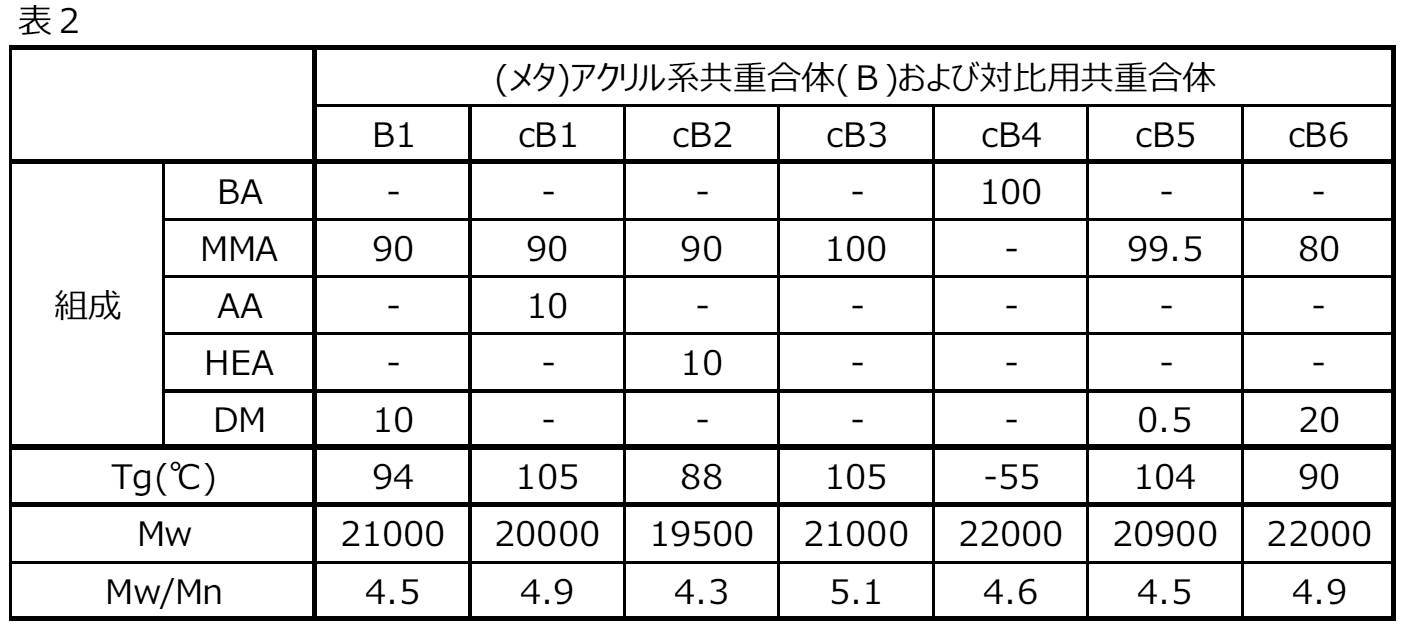
MEA :2-メトキシエチルアクリレート
HEA :2-ヒドロキシエチルアクリレート
AA :アクリル酸
MMA :メチルメタクリレート
DM :N,N-ジメチルアミノエチルメタクリレート
重合例1で得られた(メタ)アクリル系共重合体(A1)のポリマー溶液に、重合例2で得られた(メタ)アクリル系共重合体(B1)のポリマー溶液、およびエポキシ系化合物「E-AX」(4官能エポキシ化合物;綜研化学製、固形分5%)を添加して、粘着剤組成物を得た。それぞれの配合量は、(メタ)アクリル系共重合体(A1)100部に対して、(メタ)アクリル系共重合体(B1)10部、エポキシ系化合物「E-AX」の固形分0.045部となる量である。
表3に記載したとおりに配合組成を変更したこと以外は実施例1と同様に行い、粘着剤組成物を得た。表3において、各成分の量は、(メタ)アクリル系共重合体(A)または対比用共重合体(cA1)~(cA3)100部に対する量(質量部)である。
実施例および比較例で得られた粘着剤組成物を、乾燥厚さが50μmとなるように重剥離力のセパレーター上に塗布し、90℃で4分間乾燥させた。乾燥後、軽剥離力のセパレーターと貼り合せ、40℃で3日間熟成させてシートサンプルを作製した。
熟成させたシートサンプルの粘着剤層を厚さ100μmのPETフィルムに転写した後に、60mm×50mmの大きさに裁断し、ポリカーボネート板の片面に貼着し、次いで、50℃、5気圧に調整されたオートクレーブに20分間保持して試験板を作成した。その後、温度85℃、湿度85%RHの条件下に前記試験版を72時間放置し、発泡/基材からのウキ(ブリスター)の発生等を目視で確認し、下記基準で評価した。
基準
AA:発泡/ウキ等の外観不良は全く観察されなかった。
BB:発泡/ウキ等の外観不良がごく僅かに観察されるが、実使用上問題ない範囲である。
CC:発泡/ウキ等の外観不良が観察された。
DD:発泡/ウキ等の外観不良が広範囲にわたって観察された。
熟成させたシートサンプルの粘着剤層を厚さ100μmのPETフィルムに転写した後に、60mm×50mmの大きさに裁断し、ポリカーボネート板の片面に貼着し、次いで50℃、5気圧に調整されたオートクレーブに20分間保持して試験板を作成し、初期ヘイズ値を測定した。その後、温度85℃、湿度85%RHの条件下に前記試験版を72時間放置し、ヘイズメーターにより湿熱処理(耐久)後のヘイズ値を測定した。
基準
AA:湿熱処理(耐久)後のヘイズ値が1.5未満であった。
BB:湿熱処理(耐久)後のヘイズ値が1.5以上2.0未満であった。
CC:湿熱処理(耐久)後のヘイズ値が2.0以上であった。
熟成させたシートサンプルの粘着剤層を厚さ100μmのPETフィルムに転写した後に、25mm×100mmの大きさに裁断し、ポリカーボネート板の片面に貼着し、2kgローラーにて3往復して圧着した。20分放置後、剥離角180度、引張速度300mm/minにてPETフィルムを剥離し、初期粘着力を測定した。
基準
AA:初期粘着力が0.5N/25mm未満であった。
BB:初期粘着力が0.5N/25mm以上1.0N/25mm未満であった。
CC:初期粘着力が1.0N/25mm以上であった。
熟成させたシートサンプルの粘着剤層を厚さ100μmのPETフィルムに転写した後に、25mm×100mmの大きさに裁断し、ポリカーボネート板またはガラス板の片面に貼着し、次いで50℃、5気圧に調整されたオートクレーブに20分間保持し、室温環境下に60分放置後、剥離角180度、引張速度300mm/minにてPETフィルムを剥離し、粘着力を測定した。
基準
AA:粘着力が20N/25mm以上であった。
BB:粘着力が10N/25mm以上20N/25mm未満であった。
CC:粘着力が10N/25mm未満であった。あるいはZIPPING(Stick-Slip現象)が発生した。

E-AX :エポキシ系化合物(エポキシ架橋剤;綜研化学製、4官能エポキシ化合物:固形分5%、トルエン・イソプロピルアルコール溶液)
表3中の架橋剤の量は固形分量である。
実施例4~5および比較例8~10の対比から、共重合体(A)に対して共重合体(B)を特定量用いることで、耐ブリスター性および粘着力が向上することがわかる。
Claims (5)
- アルコキシアルキル(メタ)アクリレート(a1)を50~97質量%、および、カルボキシ基または酸無水物基含有モノマー(a2)を3~10質量%含むモノマー成分の共重合体である(メタ)アクリル系共重合体(A)と、
アミノ基含有モノマー(b1)を1~10質量%含むモノマー成分の共重合体であり、ガラス転移温度が0℃以上である(メタ)アクリル系共重合体(B)と、
架橋剤(C)と
を含有する粘着剤組成物であり、
前記(メタ)アクリル系共重合体(A)100質量部に対して、前記(メタ)アクリル系共重合体(B)を2~19質量部含有する粘着剤組成物。 - 前記(メタ)アクリル系共重合体(B)の重量平均分子量が10,000~50,000である請求項1に記載の粘着剤組成物。
- 前記架橋剤(C)がエポキシ系架橋剤(C1)である請求項1または2に記載の粘着剤組成物。
- 請求項1~3のいずれか1項に記載の粘着剤組成物から得られた粘着剤層を有する粘着シート。
- 請求項1~3のいずれか1項に記載の粘着剤組成物から得られた粘着剤層を有する光学部材。
Priority Applications (3)
| Application Number | Priority Date | Filing Date | Title |
|---|---|---|---|
| JP2021554323A JPWO2021085136A1 (ja) | 2019-10-28 | 2020-10-14 | |
| KR1020227012308A KR20220062091A (ko) | 2019-10-28 | 2020-10-14 | 점착제 조성물, 점착 시트 및 광학 부재 |
| CN202080073345.3A CN114599756A (zh) | 2019-10-28 | 2020-10-14 | 粘合剂组合物、粘合片以及光学构件 |
Applications Claiming Priority (2)
| Application Number | Priority Date | Filing Date | Title |
|---|---|---|---|
| JP2019195109 | 2019-10-28 | ||
| JP2019-195109 | 2019-10-28 |
Publications (1)
| Publication Number | Publication Date |
|---|---|
| WO2021085136A1 true WO2021085136A1 (ja) | 2021-05-06 |
Family
ID=75715148
Family Applications (1)
| Application Number | Title | Priority Date | Filing Date |
|---|---|---|---|
| PCT/JP2020/038756 Ceased WO2021085136A1 (ja) | 2019-10-28 | 2020-10-14 | 粘着剤組成物、粘着シートおよび光学部材 |
Country Status (5)
| Country | Link |
|---|---|
| JP (1) | JPWO2021085136A1 (ja) |
| KR (1) | KR20220062091A (ja) |
| CN (1) | CN114599756A (ja) |
| TW (1) | TW202122543A (ja) |
| WO (1) | WO2021085136A1 (ja) |
Cited By (4)
| Publication number | Priority date | Publication date | Assignee | Title |
|---|---|---|---|---|
| WO2023053800A1 (ja) * | 2021-09-29 | 2023-04-06 | 綜研化学株式会社 | 粘着剤組成物及びそれを含む積層体 |
| WO2023085083A1 (ja) * | 2021-11-15 | 2023-05-19 | 日東電工株式会社 | 光学積層体、画像表示パネル及び画像表示装置 |
| WO2023085084A1 (ja) * | 2021-11-15 | 2023-05-19 | 日東電工株式会社 | タッチセンシング機能を内蔵する画像表示パネル及び画像表示装置 |
| EP4219123A4 (en) * | 2020-09-23 | 2024-10-16 | Soken Chemical & Engineering Co., Ltd. | ADHESIVE COMPOSITION FOR USE AS DECORATIVE FILM AND RELATED APPLICATION |
Families Citing this family (1)
| Publication number | Priority date | Publication date | Assignee | Title |
|---|---|---|---|---|
| CN116004157B (zh) * | 2022-08-15 | 2025-11-28 | 苏州柯燚半导体材料科技有限公司 | 一种丙烯酸酯分散液及其在压敏胶上的应用 |
Citations (8)
| Publication number | Priority date | Publication date | Assignee | Title |
|---|---|---|---|---|
| JP2013107971A (ja) * | 2011-11-21 | 2013-06-06 | Toyo Ink Sc Holdings Co Ltd | 光学用粘着剤およびそれを用いてなる光学積層体 |
| JP2014005387A (ja) * | 2012-06-26 | 2014-01-16 | Toagosei Co Ltd | 粘着付与剤及び粘着剤組成物、並びにその用途 |
| JP2017095598A (ja) * | 2015-11-25 | 2017-06-01 | 東洋インキScホールディングス株式会社 | 粘着剤および粘着テープ |
| JP2018001615A (ja) * | 2016-07-01 | 2018-01-11 | 東亞合成株式会社 | 粘着剤組成物及び粘着剤層を備える積層体 |
| JP2018159018A (ja) * | 2017-03-23 | 2018-10-11 | 綜研化学株式会社 | 粘着剤組成物および粘着シート |
| JP2018159019A (ja) * | 2017-03-23 | 2018-10-11 | 綜研化学株式会社 | 粘着シート |
| JP2018177919A (ja) * | 2017-04-10 | 2018-11-15 | 綜研化学株式会社 | 粘着剤組成物および粘着シート |
| WO2019031064A1 (ja) * | 2017-08-10 | 2019-02-14 | 綜研化学株式会社 | 積層体およびタッチパネル |
Family Cites Families (4)
| Publication number | Priority date | Publication date | Assignee | Title |
|---|---|---|---|---|
| JP4788937B2 (ja) * | 2001-05-07 | 2011-10-05 | 綜研化学株式会社 | 粘着剤組成物及び該組成物を用いたディスプレイ用粘着シート |
| JP2013018163A (ja) * | 2011-07-08 | 2013-01-31 | Nitto Denko Corp | 接合体および接合体の製造方法 |
| JP6574109B2 (ja) * | 2015-06-23 | 2019-09-11 | スリーエム イノベイティブ プロパティズ カンパニー | 装飾フィルム |
| JP7089346B2 (ja) * | 2017-06-08 | 2022-06-22 | 綜研化学株式会社 | 画像表示装置 |
-
2020
- 2020-10-14 CN CN202080073345.3A patent/CN114599756A/zh active Pending
- 2020-10-14 KR KR1020227012308A patent/KR20220062091A/ko not_active Ceased
- 2020-10-14 JP JP2021554323A patent/JPWO2021085136A1/ja active Pending
- 2020-10-14 WO PCT/JP2020/038756 patent/WO2021085136A1/ja not_active Ceased
- 2020-10-21 TW TW109136476A patent/TW202122543A/zh unknown
Patent Citations (8)
| Publication number | Priority date | Publication date | Assignee | Title |
|---|---|---|---|---|
| JP2013107971A (ja) * | 2011-11-21 | 2013-06-06 | Toyo Ink Sc Holdings Co Ltd | 光学用粘着剤およびそれを用いてなる光学積層体 |
| JP2014005387A (ja) * | 2012-06-26 | 2014-01-16 | Toagosei Co Ltd | 粘着付与剤及び粘着剤組成物、並びにその用途 |
| JP2017095598A (ja) * | 2015-11-25 | 2017-06-01 | 東洋インキScホールディングス株式会社 | 粘着剤および粘着テープ |
| JP2018001615A (ja) * | 2016-07-01 | 2018-01-11 | 東亞合成株式会社 | 粘着剤組成物及び粘着剤層を備える積層体 |
| JP2018159018A (ja) * | 2017-03-23 | 2018-10-11 | 綜研化学株式会社 | 粘着剤組成物および粘着シート |
| JP2018159019A (ja) * | 2017-03-23 | 2018-10-11 | 綜研化学株式会社 | 粘着シート |
| JP2018177919A (ja) * | 2017-04-10 | 2018-11-15 | 綜研化学株式会社 | 粘着剤組成物および粘着シート |
| WO2019031064A1 (ja) * | 2017-08-10 | 2019-02-14 | 綜研化学株式会社 | 積層体およびタッチパネル |
Cited By (6)
| Publication number | Priority date | Publication date | Assignee | Title |
|---|---|---|---|---|
| EP4219123A4 (en) * | 2020-09-23 | 2024-10-16 | Soken Chemical & Engineering Co., Ltd. | ADHESIVE COMPOSITION FOR USE AS DECORATIVE FILM AND RELATED APPLICATION |
| WO2023053800A1 (ja) * | 2021-09-29 | 2023-04-06 | 綜研化学株式会社 | 粘着剤組成物及びそれを含む積層体 |
| WO2023085083A1 (ja) * | 2021-11-15 | 2023-05-19 | 日東電工株式会社 | 光学積層体、画像表示パネル及び画像表示装置 |
| WO2023085084A1 (ja) * | 2021-11-15 | 2023-05-19 | 日東電工株式会社 | タッチセンシング機能を内蔵する画像表示パネル及び画像表示装置 |
| JP2023073163A (ja) * | 2021-11-15 | 2023-05-25 | 日東電工株式会社 | タッチセンシング機能を内蔵する画像表示パネル及び画像表示装置 |
| JP2023073162A (ja) * | 2021-11-15 | 2023-05-25 | 日東電工株式会社 | 光学積層体、画像表示パネル及び画像表示装置 |
Also Published As
| Publication number | Publication date |
|---|---|
| CN114599756A (zh) | 2022-06-07 |
| KR20220062091A (ko) | 2022-05-13 |
| JPWO2021085136A1 (ja) | 2021-05-06 |
| TW202122543A (zh) | 2021-06-16 |
Similar Documents
| Publication | Publication Date | Title |
|---|---|---|
| WO2021085136A1 (ja) | 粘着剤組成物、粘着シートおよび光学部材 | |
| CN106987212B (zh) | 光学用粘合片 | |
| TWI565775B (zh) | 黏著劑及黏著片 | |
| CN102812100B (zh) | 光学用丙烯酸类粘合剂组合物及光学用丙烯酸类粘合带 | |
| CN103102820B (zh) | 压敏胶粘片 | |
| JP5800469B2 (ja) | 光学部材用粘着剤組成物および粘着シート | |
| JP6921572B2 (ja) | 粘着シート | |
| CN103314068A (zh) | 粘合剂以及粘合薄片 | |
| CN103242748B (zh) | 丙烯酸类压敏胶粘带 | |
| CN103562333A (zh) | 粘着剂以及粘着片 | |
| CN102838941A (zh) | 光学双面压敏胶粘片 | |
| TW201534683A (zh) | 黏著劑組成物、黏著劑層及黏著片 | |
| JP6921571B2 (ja) | 粘着剤組成物および粘着シート | |
| CN105820763A (zh) | 光学用粘合片 | |
| CN106104329A (zh) | 偏振片用粘合剂组合物、粘合剂层、粘合片以及带粘合剂层的偏振片 | |
| JP7029456B2 (ja) | 積層体およびタッチパネル | |
| JP2017149980A (ja) | 両面粘着シート及び携帯電子機器 | |
| JP6013092B2 (ja) | 両面粘着シート | |
| TW201619333A (zh) | 觸控面板用黏著劑組成物、黏著片,以及積層體 | |
| TW202528504A (zh) | 柔性顯示器用黏著片、柔性顯示器用積層體及柔性顯示器 | |
| WO2017098870A1 (ja) | 粘着剤組成物およびその製造方法、粘着シート、粘着剤層付き偏光板ならびに積層体 | |
| WO2021075188A1 (ja) | 粘着剤組成物および粘着シート | |
| JP3997268B2 (ja) | 接着剤組成物およびこれを利用した透明粘着フィルム | |
| JPWO2005111167A1 (ja) | 粘着剤組成物 | |
| JP7175891B2 (ja) | 粘着剤組成物および粘着シート |
Legal Events
| Date | Code | Title | Description |
|---|---|---|---|
| 121 | Ep: the epo has been informed by wipo that ep was designated in this application |
Ref document number: 20881811 Country of ref document: EP Kind code of ref document: A1 |
|
| ENP | Entry into the national phase |
Ref document number: 2021554323 Country of ref document: JP Kind code of ref document: A |
|
| ENP | Entry into the national phase |
Ref document number: 20227012308 Country of ref document: KR Kind code of ref document: A |
|
| NENP | Non-entry into the national phase |
Ref country code: DE |
|
| 122 | Ep: pct application non-entry in european phase |
Ref document number: 20881811 Country of ref document: EP Kind code of ref document: A1 |