WO2020217752A1 - ポリアセタール樹脂組成物の製造方法 - Google Patents
ポリアセタール樹脂組成物の製造方法 Download PDFInfo
- Publication number
- WO2020217752A1 WO2020217752A1 PCT/JP2020/010201 JP2020010201W WO2020217752A1 WO 2020217752 A1 WO2020217752 A1 WO 2020217752A1 JP 2020010201 W JP2020010201 W JP 2020010201W WO 2020217752 A1 WO2020217752 A1 WO 2020217752A1
- Authority
- WO
- WIPO (PCT)
- Prior art keywords
- mass
- polyacetal
- parts
- resin composition
- aliphatic carboxylic
- Prior art date
- Legal status (The legal status is an assumption and is not a legal conclusion. Google has not performed a legal analysis and makes no representation as to the accuracy of the status listed.)
- Ceased
Links
Classifications
-
- C—CHEMISTRY; METALLURGY
- C08—ORGANIC MACROMOLECULAR COMPOUNDS; THEIR PREPARATION OR CHEMICAL WORKING-UP; COMPOSITIONS BASED THEREON
- C08L—COMPOSITIONS OF MACROMOLECULAR COMPOUNDS
- C08L59/00—Compositions of polyacetals; Compositions of derivatives of polyacetals
-
- C—CHEMISTRY; METALLURGY
- C08—ORGANIC MACROMOLECULAR COMPOUNDS; THEIR PREPARATION OR CHEMICAL WORKING-UP; COMPOSITIONS BASED THEREON
- C08K—Use of inorganic or non-macromolecular organic substances as compounding ingredients
- C08K5/00—Use of organic ingredients
- C08K5/04—Oxygen-containing compounds
- C08K5/09—Carboxylic acids; Metal salts thereof; Anhydrides thereof
- C08K5/098—Metal salts of carboxylic acids
-
- C—CHEMISTRY; METALLURGY
- C08—ORGANIC MACROMOLECULAR COMPOUNDS; THEIR PREPARATION OR CHEMICAL WORKING-UP; COMPOSITIONS BASED THEREON
- C08K—Use of inorganic or non-macromolecular organic substances as compounding ingredients
- C08K5/00—Use of organic ingredients
- C08K5/16—Nitrogen-containing compounds
- C08K5/22—Compounds containing nitrogen bound to another nitrogen atom
- C08K5/24—Derivatives of hydrazine
- C08K5/25—Carboxylic acid hydrazides
-
- C—CHEMISTRY; METALLURGY
- C08—ORGANIC MACROMOLECULAR COMPOUNDS; THEIR PREPARATION OR CHEMICAL WORKING-UP; COMPOSITIONS BASED THEREON
- C08K—Use of inorganic or non-macromolecular organic substances as compounding ingredients
- C08K5/00—Use of organic ingredients
- C08K5/16—Nitrogen-containing compounds
- C08K5/34—Heterocyclic compounds having nitrogen in the ring
- C08K5/3442—Heterocyclic compounds having nitrogen in the ring having two nitrogen atoms in the ring
- C08K5/3445—Five-membered rings
-
- C—CHEMISTRY; METALLURGY
- C08—ORGANIC MACROMOLECULAR COMPOUNDS; THEIR PREPARATION OR CHEMICAL WORKING-UP; COMPOSITIONS BASED THEREON
- C08L—COMPOSITIONS OF MACROMOLECULAR COMPOUNDS
- C08L2201/00—Properties
- C08L2201/08—Stabilised against heat, light or radiation or oxydation
-
- C—CHEMISTRY; METALLURGY
- C08—ORGANIC MACROMOLECULAR COMPOUNDS; THEIR PREPARATION OR CHEMICAL WORKING-UP; COMPOSITIONS BASED THEREON
- C08L—COMPOSITIONS OF MACROMOLECULAR COMPOUNDS
- C08L2203/00—Applications
- C08L2203/30—Applications used for thermoforming
Definitions
- the present invention relates to a method for producing a polyacetal resin composition, which has excellent processability and stability, significantly suppresses the amount of formaldehyde generated from the molded product, and stably suppresses the mold deposit during molding. ..
- Polyacetal resins have excellent properties, and their molded products are used in a wide range of fields. However, due to their chemical structural characteristics, they are easily decomposed in a heated oxidation atmosphere or under acidic or alkaline conditions. Has. Therefore, the problem of the polyacetal resin is to improve the thermal stability and suppress the generation of formaldehyde in the molding process or the molded product. If the thermal stability is low, the polymer is decomposed by heating in a processing process such as extrusion or molding, and deposits (mold deposits) on the mold are generated, and moldability and mechanical properties are deteriorated.
- antioxidants and other stabilizers are added.
- Known antioxidants added to the polyacetal resin include phenol compounds with steric disorders (hindered phenols) and amine compounds with steric disorders (hindardamines), and other stabilizers include melamine, polyamide, and the like. Alkaline metal hydroxides and alkaline earth metal hydroxides are used. Also, antioxidants are usually used in combination with other stabilizers.
- Patent Document 1 a technique for using a polyacetal resin having a specific terminal group, a hindered phenolic antioxidant, a hydrazide compound, and an isocyanate compound in combination is disclosed (Patent Document 1). Further, a technique for coexisting a hindered phenolic antioxidant, a hydrazide compound and an alkaline earth metal salt of a specific carboxylic acid is also disclosed (Patent Document 2).
- An object of the present invention is to provide a method for producing a polyacetal resin composition, which can suppress the generation of formaldehyde from a molded product to an extremely low level and stably suppress the mold deposit at the time of molding.
- the object of the present invention has been achieved by the following.
- trioxane is used as the main monomer (a), and one or more selected from cyclic ether having at least one carbon-carbon bond and cyclic formal is used as the copolymer (b), and the polymerization catalyst (c) is used.
- the reaction product copolymerized using the heteropolyacid represented by the following general formula (1) carbonate, hydrogen carbonate, carboxylate or hydration thereof of alkali metal element or alkaline earth metal element.
- M 1 represents a central element composed of one or two elements selected from P and Si.
- M 2 represents one or more coordination elements selected from W, Mo and V.
- x indicates an integer of 1 or more and 10 or less
- y indicates an integer of 6 or more and 40 or less
- z indicates an integer of 10 or more and 100 or less
- m indicates an integer of 1 or more
- n indicates an integer of 0 or more and 50 or less. Is shown.
- a method for producing a polyacetal resin composition in which the amount of formaldehyde generated is remarkably reduced and the mold deposit at the time of molding is stably suppressed.
- the polyacetal polymer (A) used in the present invention is a type selected from cyclic ethers and cyclic formal having at least one carbon-carbon bond, with trioxane, which is a cyclic trimeric of formaldehyde, as the main monomer (a).
- the above is used as the comonomer (b), and the predetermined component (d) is added to the reaction product obtained by copolymerizing the polymerization catalyst (c) with the predetermined heteropolyacid, and the polymerization catalyst is melt-kneaded.
- (C) is inactivated to form a polyacetal polymer.
- the main monomer (a), trioxane is generally obtained by reacting an aqueous formaldehyde solution in the presence of an acidic catalyst, and is purified and used by a method such as distillation.
- the trioxane used for the polymerization preferably contains as little impurities as possible, such as water, methanol, and formic acid, for example, each of these is preferably 10 ppm or less.
- Comonomer (b) As the comonomer (b), one or more compounds selected from cyclic ethers and cyclic formal having at least one carbon-carbon bond are used. Typical examples of the compound used as the comonomer (b) include 1,3-dioxolane, diethylene glycol formal, 1,4-butanediol formal, 1,3-dioxane, ethylene oxide, propylene oxide, epichlorohydrin and the like. Be done.
- 1,3-dioxolane, diethylene glycol formal, 1,4-butanediol formal, 1,3-dioxane, and ethylene oxide are preferable in consideration of polymerization stability.
- a monofunctional cyclic ether having a substituent unit such as butyl glycidyl ether and 2-ethylhexyl glycidyl ether or cyclic formal can also be used.
- compounds having two polymerizable cyclic ether groups or cyclic formal groups such as diglycidyl ether and diformal of alkylene glycol, for example, butanediol dimethyridene glyceryl ether, butanediol diglycidyl ether and the like, and glycerin tri
- compounds having three or more polymerizable cyclic ether groups or cyclic formal groups such as glycidyl ether, trimethylpropan triglycidyl ether, pentaerythritol tetraglycidyl ether and the like can also be used.
- a polyacetal copolymer in which a branched structure or a crosslinked structure is formed as a result is also an object of the present invention.
- the amount of one or more compounds selected from the cyclic ether and cyclic formal used as the comonomer (b) is 0.1 to 20% by mass as a ratio in the total monomer (total amount of main monomer and comonomer). It is preferably 0.2 to 10% by mass, and more preferably 0.2 to 10% by mass. If the amount of comonomer is too small, the unstable end portion of the crude polyacetal polymer produced by the polymerization increases and the stability deteriorates. If the amount of comonomer is excessive, the produced polymer becomes soft and the melting point is lowered, which is not preferable.
- Polymerization catalyst (c) One of the features of the present invention is that a heteropolyacid is used as the polymerization catalyst (c) in the production of the polyacetal copolymer as described above.
- the heteropolyacid used as the polymerization catalyst (c) is a general term for polyacids produced by dehydration condensation of different kinds of oxygen acids, and a specific different kinds of elements are present in the center and share an oxygen atom. It has a mononuclear or dinuclear complex ion formed by condensing condensed acid groups.
- Such a heteronuclear condensed acid can be represented by the following general formula (1).
- M 1 represents a central element composed of one or two elements selected from P and Si.
- M 2 represents one or more coordination elements selected from W, Mo and V.
- x indicates an integer of 1 or more and 10 or less
- y indicates an integer of 6 or more and 40 or less
- z indicates an integer of 10 or more and 100 or less
- m indicates an integer of 1 or more
- n indicates an integer of 0 or more and 50 or less. Is shown.
- heteropolyacids include phosphomolybdic acid, phosphotungstic acid, phosphomolybd tungstic acid, phosphomolybdovanadic acid, phosphoribd tongue tungstic acid, phosphotungstic acid, silicate tungstic acid, silicate molybdic acid, and kei.
- examples thereof include molybdate tungstic acid and molybdate tungstic acid tovanadic acid.
- the heteropolyacid is preferably any one or more of silicate molybdic acid, silicate tungstic acid, phosphomolybdic acid and phosphotungstic acid.
- the amount of the heteropolyacid used varies depending on the type thereof, and the polymerization reaction can be adjusted by appropriately changing the amount, but generally, the amount is 0.05 to 0.05 based on the total amount of the monomers to be polymerized. It is in the range of 100 ppm (hereinafter referred to as mass / mass ppm), preferably 0.1 to 50 ppm.
- a usage amount of 0.1 to 10 ppm is sufficient.
- Hemiformal terminal group (-O-CH 2- OH) and the like are effective in suppressing the formation, and are also economically advantageous.
- the polymerization catalyst (c) is diluted with an inert solvent that does not adversely affect the polymerization and added to the main monomer and / or the comonomer for use.
- an inert solvent low molecular weight carboxylic acids having 1 to 10 carbon atoms such as formic acid, acetic acid, propionic acid and butyric acid, methanol, ethanol, 1-propanol, 2-propanol, 1-butanol, 2-butanol, 2
- An ester obtained by condensing low-molecular-weight alcohols having 1 to 10 carbon atoms such as -methyl-1-propanol, 2-methyl-2-propanol, 1-pentanol, 3-methyl-1-butanol, and 1-hexanol.
- ketones having 1 to 10 carbon atoms such as acetone, 2-butanone, 2-pentanone, 3-pentanone, 2-hexanone, 3-hexanone, methylisobutylketone and methyl-t-butylketone are preferable. However, it is not limited to these.
- the polymerization catalyst is preferably dissolved in the above-mentioned inert solvent at a concentration of 1 to 30% by mass / mass%, but is not limited thereto. Further, a predetermined amount of the above-mentioned polymerization catalyst is mixed in advance with a part or all of any one or more of the above-mentioned main monomer, comonomer, molecular weight modifier, etc., and this solution is added to the polymerization system for polymerization. The method used is also preferable. ⁇ Polymerization method ⁇
- the polyacetal polymer by polymerization can be prepared by the same equipment and method as the conventionally known copolymerization of trioxane. That is, any of a batch type, a continuous type, and a semi-continuous type is possible, and a method of using a liquid monomer and obtaining a solid powdery polymer as the polymerization progresses is common.
- a reaction tank with a stirrer which is generally used in the batch type, can be used, and as a continuous type, a conider, a twin-screw type continuous extrusion mixer, and a twin-screw paddle type continuous type.
- a mixer and other continuous polymerization devices such as trioxane proposed so far can be used, and two or more types of polymerization machines can be used in combination.
- the polymerization method is not particularly limited, but as previously proposed, a trioxane, a comonomer, and a heteropolyacid as a polymerization catalyst are sufficiently mixed while maintaining a liquid phase state in advance, and the obtained reaction raw material is obtained. If the mixed solution is supplied to the polymerization apparatus and the copolymerization reaction is carried out, the required amount of catalyst can be reduced, and as a result, it is advantageous to obtain a polyacetal copolymer having a smaller amount of formaldehyde emission, which is a more preferable polymerization method. Is.
- the polymerization temperature is in the temperature range of 60 to 120 ° C.
- a chain transfer agent known for adjusting the degree of polymerization for example, a low molecular weight line such as methylal, is used. It is also possible to add a state acetate or the like.
- the polymerization reaction is carried out in a state in which impurities having active hydrogen, for example, water, methanol, formic acid, etc. are substantially absent, for example, in a state where each of these is 10 ppm or less. It is desirable to use trioxane, cyclic ether and / or cyclic formal prepared to contain as little as possible as the main monomer or comonomer. ⁇ Stabilization treatment of crude polyacetal polymer: Including deactivation treatment of polymerization catalyst (c) >>
- an alkali metal element or alkaline earth is added to a polyacetal polymer (crude polyacetal polymer) that contains a polymerization catalyst obtained by polymerization as described above and has an unstable portion at the end thereof.
- a carbonate of a metal element, a hydrogen carbonate, a carboxylate or a hydrate thereof, or a hydroxide (d) of an alkali metal element or an alkaline earth metal element is added and melt-kneaded to deactivate the polymerization catalyst.
- the unstable terminal groups of the polyacetal polymer (crude polyacetal polymer) are reduced and stabilized.
- a stabilization treatment including a deactivation treatment of the polymerization catalyst (c).
- carbonates, bicarbonates, carboxylates or hydrates thereof of alkali metal elements or alkaline earth metal elements, or hydroxides of alkali metal elements or alkaline earth metal elements will be referred to as (d). Also called an ingredient.
- Such stabilization treatment is performed more easily and efficiently by treating the crude polyacetal copolymer obtained by the copolymerization reaction by adding the above component (d) as it is without washing or the like. be able to.
- the component (d) is a carbonate, a hydrogen carbonate, a carboxylate or a hydrate thereof (hereinafter, also referred to as a component (d-1)) of an alkali metal element or an alkaline earth metal element
- the component (d) is , Alkali metal element or alkaline earth metal element carbonate, hydrogen carbonate, aliphatic carboxylate, unsaturated aliphatic carboxylic acid salt, aromatic carboxylic acid salt or hydrate thereof is preferable. ..
- lithium carbonate anhydrous sodium carbonate, sodium carbonate monohydrate, sodium carbonate decahydrate, potassium carbonate, rubidium carbonate, cesium carbonate, magnesium carbonate, calcium carbonate, barium carbonate, lithium hydrogen carbonate, hydrogen carbonate.
- the component (d-1) is lithium carbonate, anhydrous sodium carbonate, sodium carbonate monohydrate, sodium carbonate decahydrate, potassium carbonate, magnesium carbonate, calcium carbonate, etc.
- the components (d-1) are sodium formate, sodium acetate, anhydrous sodium carbonate, sodium carbonate monohydrate, and carbonate. More preferably, it is sodium decahydrate, sodium hydrogen carbonate, disodium succinate hexahydrate, sodium laurate, sodium stearate.
- the component (d) is a carbonate, a hydrogen carbonate, a carboxylate or a hydrate thereof (d-1) component of an alkali metal element or an alkaline earth metal element
- the component (d-1) is one kind. It may be used in combination, or a mixture thereof, a compound salt, or the like may be used.
- An example of a double salt is sodium sesquicarbonate, which is composed of sodium carbonate and sodium hydrogen carbonate.
- the content of the component (d-1) is Although not particularly limited, (a) the amount of catalyst remaining in the polymer, (b) the type and amount of unstable terminal groups generated by various conditions of polymerization, (c) the degree of activity of the components, and the like. It is preferable to change appropriately according to the treatment conditions (temperature, time, contact speed, etc.).
- the content of the component (d-1) is preferably very small, and is 0.002 to 1.0 mm equivalent with respect to 1 kg of the crude polyacetal polymer obtained by the copolymerization reaction. It is preferably 0.006 to 0.34 mm equivalent, more preferably 0.009 to 0.17 mm equivalent, and even more preferably 0.009 to 0.10 mm equivalent.
- the b value of the polyacetal polymer after deactivation of the polymerization catalyst (c) is reduced to 2.0 or less. can do. Further, by setting the content of the component (d-1) to 0.34 mm equivalent or less with respect to 1 kg of the crude polyacetal polymer, the b value of the polyacetal copolymer pellet after deactivation of the polymerization catalyst (c) was reduced to 0. It can be 4 or less.
- the component (d) is a hydroxide of an alkali metal element or an alkaline earth metal element (hereinafter, also referred to as (d-2) component)
- the component (d-2) is lithium hydroxide, sodium hydroxide, or water.
- Potassium oxide, magnesium hydroxide, calcium hydroxide, barium hydroxide and the like are most preferable, but the present invention is not limited thereto.
- the component (d-2) is preferably an alkali metal hydroxide, and is preferably lithium hydroxide or sodium hydroxide. More preferably.
- the component (d-2) may be one kind, a plurality of components may be used in combination, or a mixture thereof may be used.
- the content of the component (d-2) is not particularly limited, but (a) Amount of catalyst remaining in the polymer, (a) type and amount of unstable terminal groups generated by various conditions of polymerization, (c) degree of activity of components (d), treatment conditions (temperature, time, contact rate, etc.), etc. It is preferable to change as appropriate according to the above.
- the content of the component (d-2) is preferably a very small amount, and is 0.001 to 0.25 mm equivalent with respect to 1 kg of the crude polyacetal copolymer obtained by the copolymerization reaction. Is more preferable, 0.002 to 0.10 mm equivalent is more preferable, and 0.002 to 0.025 mm equivalent is even more preferable.
- the upper limit of the content of the component (d-2) affects the hue (b value) in the pellet, and the content of the component (d) is reduced to 0.25 mm equivalent or less with respect to 1 kg of the crude polyacetal polymer to polymerize.
- the b value of the polyacetal polymer after deactivation of the catalyst (c) can be set to 2.0 or less.
- the b value of the polyacetal polymer after deactivation of the polymerization catalyst (c) is 1.0 or less. Can be.
- the content of the component (d) used for the deactivation treatment of the catalyst is preferably very small, but it is possible to uniformly disperse the very small amount of the component (d) over the entire crude polyacetal polymer. Extremely difficult. Therefore, it is preferable that the component (d) is added by any of the following (a) to (c).
- the components (a) and (d) are added directly to the crude polyacetal polymer obtained by the copolymerization reaction as a solution.
- A) The solution of the component (d) is contained in the powder of the stabilized polyacetal polymer and dispersed uniformly, and then the dispersed powder is added to the crude polyacetal polymer.
- C) The components (d) are uniformly dispersed in the powder of the stabilized polyacetal polymer in a solid state, and then the dispersed powder is added to the crude polyacetal polymer.
- a general mixer such as a horizontal cylinder type, a V type, a ribbon type, a paddle type, and a high-speed flow type can be used for mixing.
- the mixture may be melt-treated as it is, or the solvent may be distilled off by heating, depressurization or the like, and then the melt treatment may be performed.
- the deactivating / stabilizing agent solution may be supplied by injection or the like from the feed port and / or in the middle of the extruder. At this time, the deactivating / stabilizing agent solution may be supplied in multiple stages.
- the component (d) by adding the component (d), a very small amount of the component (d) can be uniformly dispersed throughout, and as a result, the polyacetal weight of the polymerization catalyst (c) after deactivation as measured using a color difference meter.
- the b value of the coalescence can be 2.0 or less.
- the amount of unreacted monomers is small, and the amount of unreacted monomers (indicating the total of the main monomer and the comonomer) is 10% by mass or less in the crude polymer, and further. It is 5% by mass or less, particularly preferably 3% by mass or less.
- the amount of the catalyst used and the polymerization time are appropriately adjusted. Since a heteropolyacid catalyst that is easily achieved and has high activity is used, even a small amount of catalyst can be achieved in a relatively short time.
- a part of the residual monomer may be evaporated, vaporized and removed to reach a predetermined amount of the residual monomer.
- the unreacted trioxane and comonomer recovered as a gas during or after the copolymerization can be liquefied and reused as they are as a part of the raw material monomer, which is more economical in this case. is there.
- a conventionally known catalyst deactivating agent or an unstable terminal decomposition treatment agent can be used in combination with the above component (d).
- the component (d) that functions as a deactivating agent for the polymerization catalyst (c) may be added at any stage before or after melting the crude polyacetal polymer, or at both stages. You may go. Further, as a method of adding the component (d), it may be divided and supplied in multiple stages.
- the crude polymer is preferably a fine powder or granular material, and for this purpose, the reactor has a function of sufficiently pulverizing the bulk polymer.
- the reaction product after the polymerization may be separately pulverized using a pulverizer.
- the particle size of the crude polymer in the stabilization treatment is at least 90% by mass or more and 10 mm or less, preferably 4 mm or less, and more preferably 2 mm or less.
- the molecular weight of the (A) polyacetal polymer used in the present invention is not particularly limited, but the weight average molecular weight equivalent to PMMA (polymethylmethacrylate) determined by the SEC (size exclusion chromatography) method is 10,000 to 400, About 000 is preferable.
- the melt index (measured at 190 ° C. and a load of 2.16 kg according to ASTM-D1238), which is an index of resin fluidity, is preferably 0.1 to 100 g / 10 minutes, more preferably 0.5. ⁇ 80g / 10 minutes.
- the (A) polyacetal polymer used in the present invention has specific terminal properties. Specifically, the amount of hemiformal terminal groups is 1.0 mmol / kg or less, the amount of formyl terminal groups is 0.5 mmol / kg or less, and the amount of unstable terminal groups is 0.5% by mass or less.
- the hemiformal terminal group is represented by -OCH 2- OH, and is also referred to as a hydroxymethoxy group or a hemiacetal terminal group.
- the amounts of such hemiformal terminal groups and formyl terminal groups can be determined by 1 H-NMR measurement, and the specific measurement method thereof can be referred to the method described in JP-A-2001-11143.
- the amount of unstable terminal indicates the amount of the portion that is present at the terminal portion of the polyacetal polymer and is unstable to heat or base and easily decomposed.
- 1 g of a polyacetal polymer is placed in a pressure-resistant airtight container together with 100 ml of a 50% (volume%) methanol aqueous solution containing 0.5% (volume%) ammonium hydroxide, and heat-treated at 180 ° C. for 45 minutes.
- the amount of formaldehyde decomposed and eluted in the solution obtained by cooling and opening the package was quantified and expressed in% by volume with respect to the polyacetal polymer.
- the polyacetal polymer (A) used in the present invention preferably has a hemiformal terminal group amount of 1.0 mmol / kg or less, more preferably 0.6 mmol / kg or less.
- the amount of formyl terminal groups is preferably 0.5 mmol / kg or less, more preferably 0.1 mmol / kg or less.
- the amount of unstable terminal is preferably 0.5% by mass or less, and more preferably 0.3% by mass or less.
- the lower limits of the hemiformal terminal group amount, the formyl terminal group amount, and the unstable terminal amount are not particularly limited.
- the polyacetal polymer (A) having specific terminal characteristics can be produced by reducing impurities contained in the monomer and comonomer, selecting a production process, optimizing the production conditions thereof, and the like.
- a polyacetal resin having a branched or crosslinked structure may be added to the (A) polyacetal polymer and used, in which case the blending amount is 0.01 to 100 parts by mass of the (A) polyacetal polymer. It is 20 parts by mass, particularly preferably 0.03 to 5 parts by mass.
- (B) Aliphatic carboxylic acid hydrazide examples include adipic acid dihydrazide, sebacic acid dihydrazide, dodecanedioic acid dihydrazide, stearic acid hydrazide and the like.
- sebacic acid dihydrazide which captures formaldehyde and can be used in combination with a hydantoin compound having two hydradinocarbonylalkyl groups to significantly suppress mold deposits generated from the aliphatic carboxylic acid hydrazide.
- the amount of (B) added is 0.01 to 0.50 parts by mass, preferably 0.02 to 0.30 parts by mass, based on 100 parts by mass of the polyacetal polymer (A).
- hydantoin compound having two hydradinocarbonylalkyl groups
- examples of the (C) hydantoin compound having two hydradinocarbonylalkyl groups (hereinafter, may be abbreviated as hydantoin compound) of the present invention include 1,3-bis (hydrazinocarbonoethyl) hydantoin and 1,3-bis.
- the (C) hydantoin compound of the present invention suppresses mold deposit when used in combination with the (B) aliphatic carboxylic acid hydrazide of the present invention. In particular, the effect is great when used in combination with sebacic acid dihydrazide.
- the amount of the (C) hydantoin compound added is 0.001 to 0.50 parts by mass, preferably 0.01 to 0.30 parts by mass, based on 100 parts by mass of the (A) polyacetal polymer. ..
- the effect of the present invention can be obtained if both (B) an aliphatic carboxylic acid hydrazide and (C) a hydantoin compound are contained, but the total amount is based on 100 parts by mass of the (A) polyacetal polymer. It is preferably 0.03 to 0.55 parts by mass.
- the aliphatic carboxylic acid constituting the alkaline earth metal salt of the (D) aliphatic carboxylic acid of the present invention may be a saturated aliphatic carboxylic acid or an unsaturated aliphatic carboxylic acid.
- Examples of such an aliphatic carboxylic acid include a monovalent or divalent aliphatic carboxylic acid having 10 or more carbon atoms, for example, a monovalent saturated aliphatic carboxylic acid having 10 or more carbon atoms [capric acid, lauric acid, myristic acid].
- the above monovalent unsaturated aliphatic carboxylic acid [Oleic acid, linoleic acid, linolenic acid, arachidonic acid, erucic acid and other unsaturated aliphatic carboxylic acids having 10 to 34 carbon atoms (preferably 10 to 30 unsaturated fatty acids) Group carboxylic acid), etc.] divalent aliphatic carboxylic acid with 10 or more carbon atoms (dibasic aliphatic carboxylic acid) [divalent 10-30 carbon atoms such as sebacic acid, dodecanoic acid, tetradecanoic acid, tapsiaic acid, etc.
- Saturated aliphatic carboxylic acid (preferably divalent 10 to 20 saturated aliphatic carboxylic acid), etc.], divalent unsaturated aliphatic carboxylic acid having 10 or more carbon atoms [decenodic acid, dodecenedioic acid, etc. 2
- An example thereof is an unsaturated aliphatic carboxylic acid having a valence of 10 to 30 carbon atoms (preferably a divalent 10 to 20 unsaturated aliphatic carboxylic acid having a carbon number).
- aliphatic carboxylic acid a part of the hydrogen atom is substituted with a substituent such as a hydroxyl group, and the aliphatic carboxylic acid having one or a plurality of hydroxyl groups in the molecule (for example, 12-hydroxy). It also contains hydroxysaturated aliphatic carboxylic acids such as stearic acid (with 10 to 26 aliphatic carboxylic acids), and also contains aliphatic carboxylic acids having slightly different carbon numbers depending on the accuracy of purification.
- alkaline earth metal calcium and magnesium are preferable, and calcium is particularly preferable.
- Alkaline earth metal salts of aliphatic carboxylic acids that are particularly preferable in the present invention are calcium stearate and calcium 12-hydroxystearate.
- the amount of the alkaline earth metal salt of the aliphatic carboxylic acid added to the polyacetal resin composition is 0.001 to 0.30 parts by mass, preferably 0.% by mass, based on 100 parts by mass of the (A) polyacetal polymer. It is 01 to 0.25 parts by mass.
- the (E) hindered phenolic antioxidant can be used as a normal antioxidant.
- examples thereof include commonly used monocyclic hindered phenol compounds, polycyclic hindered phenol compounds linked by a group containing a hydrocarbon group or a sulfur atom, hindered phenol compounds having an ester group or an amide group, and the like.
- Commercially available compounds such as the above product names (manufactured by BASF Japan) can be used.
- hindered phenolic antioxidants can be used alone or in combination of two or more.
- the amount of the hindered phenol-based antioxidant added is 0.01 to 3 parts by mass with respect to 100 parts by mass of the (A) polyacetal polymer.
- a compound selected from a metal oxide and a metal hydroxide can be further added to the polyacetal resin composition of the present invention in order to further improve thermal stability, long-term thermal stability and the like.
- the amount added is preferably 0.01 to 1 part by mass with respect to 100 parts by mass of the (A) polyacetal polymer.
- metal oxide and metal hydroxide calcium oxide, magnesium oxide, zinc oxide, calcium hydroxide, magnesium hydroxide and the like are preferable.
- the polyacetal resin composition of the present invention further has at least one mold release selected from an aliphatic carboxylic acid ester, an aliphatic carboxylic acid amide, a polyoxyalkylene glycol, and a silicone compound in order to further improve molding processability and the like. It is possible and preferable to add an agent.
- the amount added is preferably 0.01 to 1 part by mass with respect to 100 parts by mass of the (A) polyacetal polymer.
- the polyacetal resin composition of the present invention may further contain a weather (light) stabilizer, an impact resistance improving agent, a gloss control agent, a slidability improving agent, and a filler as long as the present invention is not impaired.
- a weather (light) stabilizer an impact resistance improving agent
- a gloss control agent a gloss control agent
- a slidability improving agent a filler
- the method for producing a polyacetal resin composition of the present invention can be prepared by various methods conventionally known as a method for preparing a resin composition. For example, (1) a method of mixing all the components constituting the composition, supplying the mixture to an extruder and melt-kneading the mixture to obtain a pellet-shaped composition, and (2) a part of the components constituting the composition. Residual components are supplied from the main feed port of the extruder from the side feed port and melt-kneaded to obtain a pellet-shaped composition. (3) Pellets having different compositions are once prepared by extrusion or the like, and the pellets are mixed. A method of adjusting the composition to a predetermined composition can be adopted.
- an extruder having one or more devolatilization vent ports, and further, water or a low boiling point is used at any place from the main feed port to the devolatilization vent port. It is preferable to supply about 0.1 to 10 parts by mass of alcohols to 100 parts by mass of the polyacetal polymer, and to remove formaldehyde and the like generated in the extrusion step together with water and low boiling alcohols from the devolatilization vent port. .. Thereby, the amount of formaldehyde generated from the polyacetal resin composition and the molded product thereof can be further reduced.
- the polyacetal resin composition of the present invention prepared in this manner can be molded by various conventionally known molding methods such as injection molding, extrusion molding, compression molding, vacuum molding, blow molding, foam molding and the like. ..
- the present invention also includes recycling of the molded product composed of the polyacetal resin composition and the colored polyacetal resin composition according to the above. Specifically, a recycled resin composition obtained by melt-kneading and extruding a molded product made of these resin compositions or a crushed product thereof alone or together with a resin material or molded product having the same or different composition, and these. This is a recycled molded product obtained by melt-kneading a molded product made of the above resin composition or a crushed product thereof alone or together with a resin material or a molded product having the same or different composition.
- the recycled resin composition and the recycled molded product prepared by repeating the heat of fusion history also have an extremely low level of formaldehyde generation, like the polyacetal resin composition on which they are based. Is.
- the component (d) is uniformly dispersed in the powder of the polyacetal polymer which has been stabilized in the solid state, and then the powder after dispersion is used. It was added to the above reaction product.
- the column of “Addition method” in Table 1 is "Aqueous solution”
- the polyacetal weight is prepared to be a 10% by mass aqueous solution containing the component (d), and the aqueous solution is stabilized so as to have a predetermined addition amount. It was added to the coalesced powder and added to the reaction product.
- the “amount” in Table 1 is the mass ratio (unit: ppm) of the component (d) to the crude polyacetal polymer.
- VOC formaldehyde generation
- reaction product of DNPH and formaldehyde was extracted with acetonitrile from the DNPH collection tube, and the amount of formaldehyde generated was determined by a calibration curve method using a standard substance of the reaction product of DNPH and formaldehyde with a high-speed liquid chromatograph. , The amount of formaldehyde generated per unit mass of the test piece ( ⁇ g / g) was calculated.
- Molding machine FANUC ROBOSHOT ⁇ -S100ia (FANUC Co., Ltd.) * Molding conditions: Cylinder temperature (° C) Nozzle-C1-C2-C3 190 190 180 160 ° C Injection pressure 60 (MPa) Injection speed 1.0 (m / min) Mold temperature 80 (° C)
- Molding machine FANUC ROBOSHOT S-2000i 50B (FANUC Co., Ltd.) * Molding conditions: Cylinder temperature (° C) Nozzle-C1-C2-C3 205 215 205 185 ° C Injection pressure 40 (MPa) Injection speed 1.5 (m / min) Mold temperature 80 (° C)
Landscapes
- Chemical & Material Sciences (AREA)
- Health & Medical Sciences (AREA)
- Chemical Kinetics & Catalysis (AREA)
- Medicinal Chemistry (AREA)
- Polymers & Plastics (AREA)
- Organic Chemistry (AREA)
- Compositions Of Macromolecular Compounds (AREA)
- Polyoxymethylene Polymers And Polymers With Carbon-To-Carbon Bonds (AREA)
Abstract
本発明の目的は、成形品からのホルムアルデヒドの発生を極めて低レベルに抑制でき、かつ、安定的に成形時のモールドデポジットが抑制されたポリアセタール樹脂組成物の製造方法を提供することにある。 (A)ポリアセタール重合体100質量部、 (B)脂肪族カルボン酸ヒドラジド0.01~0.50質量部、 (C)2つのヒドラジノカルボニルアルキル基を有するヒダントイン化合物0.001~0.50質量部、 (D)脂肪族カルボン酸のアルカリ土類金属塩0.001~0.30質量部、 とを含有してなり、 前記(B)と(C)の合計量が、(A)ポリアセタール重合体100質量部に対して0.03~0.55質量部であるポリアセタール樹脂組成物の製造方法であって、 該(A)ポリアセタール重合体が、トリオキサンを主モノマー(a)とし、少なくとも一つの炭素-炭素結合を有する環状エーテル等をコモノマー(b)とし、重合触媒(c)に下記一般式(1)で示されるヘテロポリ酸を使用して共重合し、その後アルカリ金属元素若しくはアルカリ土類金属元素の炭酸塩等(d)を添加して、該重合触媒(c)を失活させて得られたポリアセタール共重合体である、ポリアセタール樹脂組成物の製造方法。
Description
本発明は、優れた加工性及び安定性を有し、その成形品からのホルムアルデヒド発生量が著しく抑制され、かつ、安定的に成形時のモールドデポジットが抑制されたポリアセタール樹脂組成物の製造方法に関する。
ポリアセタール樹脂は優れた諸特性を有し、その成形品は広汎な分野に利用されているが、その化学構造上の特徴から、加熱酸化雰囲気下や、酸性或いはアルカリ性条件下では分解されやすいという性質を有する。その為、ポリアセタール樹脂の課題として、熱安定性を高くし、成形加工過程又は成形品からのホルムアルデヒドの発生を抑制することが挙げられる。熱安定性が低いと、押出又は成形などの加工工程において加熱によりポリマーが分解し、金型への付着物(モールドデポジット)が発生したり、成形性や機械的物性などが低下したりする。
また、通常の使用条件下においてポリアセタール樹脂成形品から発生するホルムアルデヒドは極めて微量であるが、発生したホルムアルデヒドは化学的に活性であり、酸化により蟻酸となってポリアセタール樹脂の耐熱性に悪影響を及ぼしたり、電気・電子機器の部品などに用いると、ホルムアルデヒド或いはその酸化物である蟻酸により金属製接点部品が腐蝕したり、有機化合物の付着により変色や接点不良を生じる要因になる場合がある。
そこで、ポリアセタール樹脂を安定化させるため、酸化防止剤やその他の安定剤が配合されている。ポリアセタール樹脂に添加される酸化防止剤としては、立体障害を有するフェノール化合物(ヒンダードフェノール)、立体障害を有するアミン化合物(ヒンダードアミン)などが知られており、その他の安定剤として、メラミン、ポリアミド、アルカリ金属水酸化物やアルカリ土類金属水酸化物などが使用されている。また、通常、酸化防止剤は他の安定剤と組み合わせて用いられる。
しかしながら、このような汎用的な安定剤を通常のホルムアルデヒド品質を有するポリアセタール樹脂に配合しただけでは、発生するホルムアルデヒド、特に、成形品から発生するホルムアルデヒドを大幅に低減させることは困難である。さらに、上記のような問題を解決しホルムアルデヒドの発生量を低減させるため、種々の化合物を配合したポリアセタール樹脂組成物が開示されている。
例えば、特定末端基のポリアセタール樹脂、ヒンダードフェノール系酸化防止剤、ヒドラジド化合物およびイソシアネート化合物を併用する技術が開示されている(特許文献1)。また、ヒンダードフェノール系酸化防止剤、ヒドラジド化合物および特定カルボン酸のアルカリ土類金属塩を共存させる技術も開示されている(特許文献2)。
これらの文献1に開示された技術によれば、ポリアセタール樹脂成形時のモールドデポジットをかなりのレベルで低減することが可能である。しかしながら、モールドデポジットを低減するためには有効ではあるが、ホルムアルデヒドの発生を十分に抑制できていないのが実情であった。
また、文献2に開示された技術によれば、ホルムアルデヒド発生の抑制効果は発現されるものの、モールドデポジット抑制効果が不十分であり、安定的な成形技術ではなかった。
また、文献2に開示された技術によれば、ホルムアルデヒド発生の抑制効果は発現されるものの、モールドデポジット抑制効果が不十分であり、安定的な成形技術ではなかった。
本発明の目的は、成形品からのホルムアルデヒドの発生を極めて低レベルに抑制でき、かつ、安定的に成形時のモールドデポジットが抑制されたポリアセタール樹脂組成物の製造方法を提供することにある。
本発明の目的は、下記によって達成された。
1. 少なくとも
(A)ポリアセタール重合体100質量部、
(B)脂肪族カルボン酸ヒドラジド0.01~0.50質量部、
(C)2つのヒドラジノカルボニルアルキル基を有するヒダントイン化合物0.001~0.50質量部、
(D)脂肪族カルボン酸のアルカリ土類金属塩0.001~0.30質量部、
とを含有してなり、
前記(B)と(C)の合計量が、(A)ポリアセタール重合体100質量部に対して0.03~0.55質量部であるポリアセタール樹脂組成物の製造方法であって、
該(A)ポリアセタール重合体が、トリオキサンを主モノマー(a)とし、少なくとも一つの炭素-炭素結合を有する環状エーテルおよび環状ホルマールから選択される一種以上をコモノマー(b)とし、重合触媒(c)に下記一般式(1)で示されるヘテロポリ酸を使用して共重合を行った反応生成物に、アルカリ金属元素若しくはアルカリ土類金属元素の炭酸塩、炭酸水素塩、カルボン酸塩若しくはその水和物、又はアルカリ金属元素若しくはアルカリ土類金属元素の水酸化物(d)を添加し、溶融混練処理して、該重合触媒(c)を失活させて得られたポリアセタール共重合体である、
ポリアセタール樹脂組成物の製造方法。
Hm[M1 x・M2 yOZ]・nH2O ・・・・・・(1)
〔式(1)中、M1はP及びSiより選ばれた一種又は二種の元素から成る中心元素を示す。M2はW、Mo及びVより選ばれた一種以上の配位元素を示す。xは1以上10以下の整数を示し、yは6以上40以下の整数を示し、zは10以上100以下の整数を示し、mは1以上の整数を示し、nは0以上50以下の整数を示す。〕
(A)ポリアセタール重合体100質量部、
(B)脂肪族カルボン酸ヒドラジド0.01~0.50質量部、
(C)2つのヒドラジノカルボニルアルキル基を有するヒダントイン化合物0.001~0.50質量部、
(D)脂肪族カルボン酸のアルカリ土類金属塩0.001~0.30質量部、
とを含有してなり、
前記(B)と(C)の合計量が、(A)ポリアセタール重合体100質量部に対して0.03~0.55質量部であるポリアセタール樹脂組成物の製造方法であって、
該(A)ポリアセタール重合体が、トリオキサンを主モノマー(a)とし、少なくとも一つの炭素-炭素結合を有する環状エーテルおよび環状ホルマールから選択される一種以上をコモノマー(b)とし、重合触媒(c)に下記一般式(1)で示されるヘテロポリ酸を使用して共重合を行った反応生成物に、アルカリ金属元素若しくはアルカリ土類金属元素の炭酸塩、炭酸水素塩、カルボン酸塩若しくはその水和物、又はアルカリ金属元素若しくはアルカリ土類金属元素の水酸化物(d)を添加し、溶融混練処理して、該重合触媒(c)を失活させて得られたポリアセタール共重合体である、
ポリアセタール樹脂組成物の製造方法。
Hm[M1 x・M2 yOZ]・nH2O ・・・・・・(1)
〔式(1)中、M1はP及びSiより選ばれた一種又は二種の元素から成る中心元素を示す。M2はW、Mo及びVより選ばれた一種以上の配位元素を示す。xは1以上10以下の整数を示し、yは6以上40以下の整数を示し、zは10以上100以下の整数を示し、mは1以上の整数を示し、nは0以上50以下の整数を示す。〕
2. 前記(B)脂肪族カルボン酸ヒドラジドが、セバシン酸ジヒドラジドである前記1に記載のポリアセタール樹脂組成物の製造方法。
3. 前記(D)脂肪族カルボン酸のアルカリ土類金属塩が、ステアリン酸カルシウムおよび12-ヒドロキシステアリン酸カルシウムから選択される少なくとも1種である前記1または2に記載のポリアセタール樹脂組成物の製造方法。
4. 前記(C)2つのヒドラジノカルボニルアルキル基を有するヒダントイン化合物が、1,3-ビス(ヒドラジノカルボノエチル)-5-イソプロピルヒダントインである前記1~3いずれかに記載のポリアセタール樹脂組成物の製造方法。
3. 前記(D)脂肪族カルボン酸のアルカリ土類金属塩が、ステアリン酸カルシウムおよび12-ヒドロキシステアリン酸カルシウムから選択される少なくとも1種である前記1または2に記載のポリアセタール樹脂組成物の製造方法。
4. 前記(C)2つのヒドラジノカルボニルアルキル基を有するヒダントイン化合物が、1,3-ビス(ヒドラジノカルボノエチル)-5-イソプロピルヒダントインである前記1~3いずれかに記載のポリアセタール樹脂組成物の製造方法。
本発明によれば、ホルムアルデヒドの発生量が著しく低減され、かつ、安定的に成形時のモールドデポジットが抑制されたポリアセタール樹脂組成物の製造方法が提供される。
以下、本発明を詳しく説明する。
<(A)ポリアセタール重合体>
本発明に使用される(A)ポリアセタール重合体は、ホルムアルデヒドの環状三量体であるトリオキサンを主モノマー(a)とし、少なくとも一つの炭素-炭素結合を有する環状エーテルおよび環状ホルマールから選択される一種以上をコモノマー(b)とし、重合触媒(c)に所定のヘテロポリ酸を使用して共重合を行った反応生成物に、所定の(d)成分を添加し、溶融混練処理して、重合触媒(c)を失活させてポリアセタール重合体としたものである。
<(A)ポリアセタール重合体>
本発明に使用される(A)ポリアセタール重合体は、ホルムアルデヒドの環状三量体であるトリオキサンを主モノマー(a)とし、少なくとも一つの炭素-炭素結合を有する環状エーテルおよび環状ホルマールから選択される一種以上をコモノマー(b)とし、重合触媒(c)に所定のヘテロポリ酸を使用して共重合を行った反応生成物に、所定の(d)成分を添加し、溶融混練処理して、重合触媒(c)を失活させてポリアセタール重合体としたものである。
≪主モノマー(a)≫
主モノマー(a)であるトリオキサンは、一般的には酸性触媒の存在下でホルムアルデヒド水溶液を反応させることにより得られ、これを蒸留などの方法で精製して使用される。重合に用いるトリオキサンは、水、メタノール、ギ酸などの不純物の含有量が極力少ないもの、例えばこれらがそれぞれ10ppm以下が好ましい。
主モノマー(a)であるトリオキサンは、一般的には酸性触媒の存在下でホルムアルデヒド水溶液を反応させることにより得られ、これを蒸留などの方法で精製して使用される。重合に用いるトリオキサンは、水、メタノール、ギ酸などの不純物の含有量が極力少ないもの、例えばこれらがそれぞれ10ppm以下が好ましい。
≪コモノマー(b)≫
コモノマー(b)としては、少なくとも一つの炭素-炭素結合を有する環状エーテルおよび環状ホルマールから選ばれる一種以上の化合物が使用される。コモノマー(b)として使用する化合物の代表的な例としては、例えば、1,3-ジオキソラン、ジエチレングリコールホルマール、1,4-ブタンジオールホルマール、1,3-ジオキサン、エチレンオキシド、プロピレンオキシド、エピクロルヒドリン等が挙げられる。
コモノマー(b)としては、少なくとも一つの炭素-炭素結合を有する環状エーテルおよび環状ホルマールから選ばれる一種以上の化合物が使用される。コモノマー(b)として使用する化合物の代表的な例としては、例えば、1,3-ジオキソラン、ジエチレングリコールホルマール、1,4-ブタンジオールホルマール、1,3-ジオキサン、エチレンオキシド、プロピレンオキシド、エピクロルヒドリン等が挙げられる。
中でも、重合の安定性から考慮して、1,3-ジオキソラン、ジエチレングリコールホルマール、1,4-ブタンジオールホルマール、1,3-ジオキサン、エチレンオキシドが好ましい。
また、コモノマーとして、ブチルグリシジルエーテル、2-エチルヘキシルグリシジルエーテルの如き、置換基単位を有する単官能の環状エーテルや環状ホルマールを用いることも可能である。さらに、コモノマーとして、アルキレングリコールのジグリシジルエーテルやジホルマールの如き2個の重合性環状エーテル基又は環状ホルマール基を有する化合物、例えば、ブタンジオールジメチリデングリセリルエーテル、ブタンジオールジグリシジルエーテル等や、グリセリントリグリシジルエーテル、トリメチロールプロパントリグリシジルエーテル、ペンタエリスリトールテトラグリシジルエーテル等の如き3個以上の重合性環状エーテル基又は環状ホルマール基を有する化合物を用いることもできる。これによって分岐構造や架橋構造が形成されたポリアセタール共重合体も本発明の対象である。
本発明において、コモノマー(b)として用いる環状エーテルおよび環状ホルマールから選ばれる一種以上の化合物の量は、全モノマー(主モノマーとコモノマーの合計量)中の割合として0.1~20質量%であることが好ましく、0.2~10質量%であることがより好ましい。コモノマー量が過小であると、重合によって生成する粗ポリアセタール重合体の不安定末端部が増加して安定性が悪くなる。コモノマー量が過大になると、生成重合体が軟質となり融点の低下を生じて好ましくない。
≪重合触媒(c)≫
本発明は、上記のようなポリアセタール共重合体の製造において、重合触媒(c)としてヘテロポリ酸を使用することを特徴の1つとする。
本発明は、上記のようなポリアセタール共重合体の製造において、重合触媒(c)としてヘテロポリ酸を使用することを特徴の1つとする。
本発明において、重合触媒(c)として使用するヘテロポリ酸とは、異種の酸素酸が脱水縮合して生成するポリ酸の総称をいい、中心に特定の異種元素が存在し、酸素原子を共有して縮合酸基が縮合してできる単核又は複核の錯イオンを有している。このような異核縮合酸は、下記一般式(1)で表すことができる。
Hm[M1 x・M2 yOZ]・nH2O ・・・・・・(1)
Hm[M1 x・M2 yOZ]・nH2O ・・・・・・(1)
式(1)中、M1はP及びSiより選ばれた一種又は二種の元素から成る中心元素を示す。M2はW、Mo及びVより選ばれた一種以上の配位元素を示す。xは1以上10以下の整数を示し、yは6以上40以下の整数を示し、zは10以上100以下の整数を示し、mは1以上の整数を示し、nは0以上50以下の整数を示す。
上記へテロポリ酸の具体例として、リンモリブデン酸、リンタングステン酸、リンモリブドタングステン酸、リンモリブドバナジン酸、リンモリブドタングストバナジン酸、リンタングストバナジン酸、ケイタングステン酸、ケイモリブデン酸、ケイモリブドタングステン酸、ケイモリブドタングステントバナジン酸等が挙げられる。中でも、重合の安定性、ヘテロポリ酸自体の安定性から考慮して、へテロポリ酸は、ケイモリブデン酸、ケイタングステン酸、リンモリブデン酸又はリンタングステン酸のいずれか一種以上であることが好ましい。
本発明において、上記へテロポリ酸の使用量は、その種類によっても異なり、また、適当に変えて重合反応を調節することができるが、一般には重合されるべきモノマーの総量に対し0.05~100ppm(以下、質量/質量ppmを示す。)の範囲であり、好ましくは0.1~50ppmである。
また、リンモリブデン酸、リンタングステン酸等の如き非常に強く作用するヘテロポリ酸は、0.1~10ppmの使用量で十分である。この様な少量の触媒でも共重合が可能なことは、触媒による重合体の主鎖分解、解重合等の好ましくない反応を僅少に留め、不安定なホルミル末端基(-O-CH=O)、ヘミホルマール末端基(-O-CH2-OH)等の生成を抑制するのに効果的であり、また、経済的にも有利である。
反応を均一に行うために、重合触媒(c)は、重合に悪影響のない不活性な溶媒で希釈して、主モノマー及び/又はコモノマーに添加して使用することが望ましい。上記不活性な溶媒として、ギ酸、酢酸、プロピオン酸、酪酸等の炭素数1~10の低分子カルボン酸と、メタノール、エタノール、1-プロバノール、2-プロパノール、1-ブタノール、2-ブタノール、2-メチル-1-プロパノール、2-メチル-2-プロパノール、1-ペンタノール、3-メチル-1-ブタノール、1-へキサノール等の炭素数1~10の低分子アルコールが縮合して得られるエステル;アセトン、2-ブタノン、2-ペンタノン、3-ペンタノン、2-ヘキサノン、3-へキサノン、メチルイソブチルケトン、メチル-t-ブチルケトン等の炭素数1~10の低分子のケトン類が好ましく挙げられるが、これらに限定されるものではない。
工業的な入手しやすさ等も勘案すると、ギ酸メチル、ギ酸エチル、酢酸メチル、酢酸エチル、酢酸ブチル、アセトン、2-ブタノン、メチルイソブチルケトンが最も好適である。重合触媒は、上記不活性な溶媒に、好適には濃度1~30質量/質量%で溶解されるが、これに限定されるものではない。また、前述した主モノマー、コモノマー、分子量調節剤等の何れか一種又は複数種の一部量又は全量に、上記重合触媒の所定量を予め混合し、この溶液を重合系に添加して重合を行う方法も好ましい。
≪重合方法≫
≪重合方法≫
本発明において、重合によるポリアセタール重合体の調製は、従来から公知のトリオキサンの共重合と同様の設備と方法で行うことができる。即ち、バッチ式、連続式、半連続式の何れも可能であり、液体モノマーを用い、重合の進行とともに固体粉塊状のポリマーを得る方法が一般的である。
本発明に用いられる重合装置としては、バッチ式では一般に用いられる撹拌機付きの反応槽が使用でき、また、連続式としては、コニーダー、2軸スクリュー式連続押出混合機、2軸パドルタイプの連続混合機、その他、これまでに提案されているトリオキサン等の連続重合装置が使用可能であり、また2種以上のタイプの重合機を組み合わせて使用することもできる。
重合方法は特に限定されるものではないが、先に提案されているように、トリオキサン、コモノマー及び重合触媒としてのヘテロポリ酸を、あらかじめ液相状態を保ちつつ十分に混合し、得られた反応原料混合液を重合装置に供給して共重合反応を行えば、必要触媒量の低減が可能となり、結果としてホルムアルデヒド放出量のより少ないポリアセタール共重合体を得るのに有利であり、より好適な重合方法である。重合温度は、60~120℃の温度範囲で行なわれる。
本発明において、上記の主モノマー(a)とコモノマー(b)とを重合してポリアセタール共重合体を調製するにあたり、重合度を調節するため公知の連鎖移動剤、例えばメチラールの如き低分子量の線状アセタール等を添加することも可能である。
また、重合反応は活性水素を有する不純物、例えば水、メタノール、ギ酸等が実質的に存在しない状態、例えばこれらがそれぞれ10ppm以下の状態で行うのが望ましく、このためには、これらの不純物成分を極力含まないように調製されたトリオキサン、環状エーテル及び/又は環状ホルマールを、主モノマーやコモノマーとして使用するのが望ましい。
≪粗ポリアセタール重合体の安定化処理:重合触媒(c)の失活処理を含む≫
≪粗ポリアセタール重合体の安定化処理:重合触媒(c)の失活処理を含む≫
本発明においては、上記のように重合して得られた、重合触媒を含有すると共に、その末端に不安定な部分を有するポリアセタール重合体(粗ポリアセタール重合体)に、アルカリ金属元素若しくはアルカリ土類金属元素の炭酸塩、炭酸水素塩、カルボン酸塩若しくはその水和物、又はアルカリ金属元素若しくはアルカリ土類金属元素の水酸化物(d)を添加し、溶融混練して、重合触媒の失活を行うと共にポリアセタール重合体(粗ポリアセタール重合体)が有する不安定末端基を低減して安定化する。以下重合触媒(c)の失活処理も含め安定化処理ともいう。
以下、「アルカリ金属元素若しくはアルカリ土類金属元素の炭酸塩、炭酸水素塩、カルボン酸塩若しくはその水和物、又はアルカリ金属元素若しくはアルカリ土類金属元素の水酸化物」のことを(d)成分ともいう。
かかる安定化処理は、共重合反応によって得られた粗ポリアセタール共重合体を、洗浄等を行うことなく、上記(d)成分をそのままを添加して処理することにより、より簡便かつ効率的に行うことができる。
[アルカリ金属元素若しくはアルカリ土類金属元素の炭酸塩、炭酸水素塩、カルボン酸塩若しくはその水和物:(d-1)成分]
かかる安定化処理は、共重合反応によって得られた粗ポリアセタール共重合体を、洗浄等を行うことなく、上記(d)成分をそのままを添加して処理することにより、より簡便かつ効率的に行うことができる。
[アルカリ金属元素若しくはアルカリ土類金属元素の炭酸塩、炭酸水素塩、カルボン酸塩若しくはその水和物:(d-1)成分]
(d)成分がアルカリ金属元素若しくはアルカリ土類金属元素の炭酸塩、炭酸水素塩、カルボン酸塩若しくはその水和物(以下(d-1)成分ともいう)である場合、(d)成分は、アルカリ金属元素若しくはアルカリ土類金属元素の炭酸塩、炭酸水素塩、脂肪族カルボン酸塩、不飽和脂肪族カルボン酸塩、芳香族カルボン酸塩若しくはその水和物のいずれかであることが好ましい。
具体的には、炭酸リチウム、無水炭酸ナトリウム、炭酸ナトリウム一水和物、炭酸ナトリウム十水和物、炭酸カリウム、炭酸ルビジウム、炭酸セシウム、炭酸マグネシウム、炭酸カルシウム、炭酸バリウム、炭酸水素リチウム、炭酸水素ナトリウム、炭酸水素カリウム、炭酸水素セシウム、ギ酸リチウム一水和物、ギ酸ナトリウム、ギ酸カリウム、ギ酸ルビジウム、ギ酸セシウム、ギ酸マグネシウム、ギ酸カルシウム、ギ酸バリウム、酢酸リチウム、酢酸ナトリウム、酢酸ナトリウム三水和物、酢酸カリウム、酢酸ルビジウム、酢酸セシウム、酢酸マグネシウム、酢酸カルシウム一水和物、酢酸マグネシウム四水和物、酢酸バリウム、ラウリン酸ナトリウム、ラウリン酸カリウム、ステアリン酸リチウム、ステアリン酸ナトリウム、ステアリン酸カリウム、ステアリン酸マグネシウム、ステアリ酸カルシウム、グルコン酸ナトリウム、グルコン酸カリウム、乳酸リチウム、乳酸ナトリウム、乳酸カリウム、シュウ酸リチウム、シュウ酸ナトリウム、シュウ酸カリウム一水和物、コハク酸リチウム、コハク酸一ナトリウム、コハク酸ニナトリウム、コハク酸ニナトリウム六水和物、コハク酸ニカリウム、アジピン酸ニナトリウム、アジピン酸ニカリウム、グルコン酸ナトリウム、グルコン酸カリウム、乳酸リチウム、乳酸ナトリウム、乳酸カリウム、リンゴ酸ニナトリウム1/2水和物、リンゴ酸ニナトリウム三水和物、酒石酸ニリチウム一水和物、酒石酸ニナトリウムニ水和物、酒石酸水素カリウム、酒石酸ニカリウム、酒石酸カリウムナトリウム四水和物、酒石酸ナトリウムルビジウム、クエン酸リチウム四水和物、クエン酸一ナトリウム、クエン酸ニナトリウム、クエン酸三ナトリウム、クエン酸三ナトリウムニ水和物、アスパラギン酸ナトリウム一水和物、グルタミン酸ニナトリウム一水和物、アクリル酸ナトリウム、アクリル酸カリウム、ソルビン酸ナトリウム、ソルビン酸カリウム、フマル酸一ナトリウム、安息香酸リチウム、安息香酸ナトリウム、安息香酸カリウム、安息香酸セシウム、フタル酸水素カリウム、サリチル酸リチウム一水和物、サリチル酸ナトリウム、サリチル酸カリウム等が挙げられるが、これらに限定されるものではない。
工業的な入手しやすさ等も勘案すると、(d-1)成分は、炭酸リチウム、無水炭酸ナトリウム、炭酸ナトリウム一水和物、炭酸ナトリウム十水和物、炭酸カリウム、炭酸マグネシウム、炭酸カルシウム、炭酸バリウム、炭酸水素リチウム、炭酸水素ナトリウム、炭酸水素カリウム、ギ酸リチウム一水和物、ギ酸ナトリウム、ギ酸カリウム、ギ酸マグネシウム、ギ酸カルシウム、ギ酸バリウム、酢酸リチウム、酢酸ナトリウム、酢酸ナトリウム三水和物、酢酸カリウム、酢酸カルシウム一水和物、酢酸マグネシウム四水和物、酢酸バリウム、ラウリン酸ナトリウム、ラウリン酸カリウム、ステアリン酸リチウム、ステアリン酸ナトリウム、ステアリン酸カリウム、ステアリン酸マグネシウム、ステアリ酸カルシウム、コハク酸一ナトリウム、コハク酸ニナトリウム、コハク酸ニナトリウム六水和物、コハク酸ニカリウム、クエン酸リチウム四水和物、クエン酸一ナトリウム、クエン酸三ナトリウム、クエン酸三ナトリウムニ水和物、アスパラギン酸ナトリウム一水和物、グルタミン酸ニナトリウム、アクリル酸ナトリウム、アクリル酸カリウム、ソルビン酸ナトリウム、ソルビン酸カリウム、フマル酸一ナトリウム、安息香酸リチウム、安息香酸ナトリウム、安息香酸カリウム、フタル酸水素カリウム、サリチル酸リチウム一水和物、サリチル酸ナトリウム、サリチル酸カリウムであることが好ましい。
さらに、重合触媒(c)を失活させた後のポリアセタール共重合体の色相を考慮すると、(d-1)成分は、ギ酸ナトリウム、酢酸ナトリウム、無水炭酸ナトリウム、炭酸ナトリウム一水和物、炭酸ナトリウム十水和物、炭酸水素ナトリウム、コハク酸ニナトリウム六水和物、ラウリン酸ナトリウム、ステアリン酸ナトリウムであることがより好ましい。
(d)成分がアルカリ金属元素若しくはアルカリ土類金属元素の炭酸塩、炭酸水素塩、カルボン酸塩若しくはその水和物(d-1)成分である場合、(d-1)成分は、一種類であってもよいし、複数を組み合わせて使用してもよく、それらの混合物や複塩等の状態であっても構わない。複塩の例としては、炭酸ナトリウムと炭酸水素ナトリウムとから成るセスキ炭酸ナトリウムを挙げることができる。
(d)成分がアルカリ金属元素若しくはアルカリ土類金属元素の炭酸塩、炭酸水素塩、カルボン酸塩若しくはその水和物(d-1)成分である場合、(d-1)成分の含有量は特に制限されるものではないが、(ア)ポリマー中に残存する触媒量、(イ)重合の諸条件によって生じる不安定末端基の種類や量、(ウ)(d)成分の活性の程度や処理条件(温度、時間、接触速度等)等に応じて適宜変えることが好ましい。
具体的に、(d-1)成分の含有量は、ごく少量であることが好ましく、共重合反応によって得られる粗ポリアセタール重合体1kgに対し、0.002~1.0ミリ当量であることが好ましく、0.006~0.34ミリ当量であることがより好ましく、0.009~0.17ミリ当量であることがより好ましく、0.009~0.10ミリ当量であることがさらに好ましい。
(d-1)成分の含有量を粗ポリアセタール共重合体1kgに対し1.0ミリ当量以下にすることで、重合触媒(c)失活後のポリアセタール重合体のb値を2.0以下にすることができる。また、(d-1)成分の含有量を粗ポリアセタール重合体1kgに対し0.34ミリ当量以下にすることで、重合触媒(c)失活後のポリアセタール共重合体ペレットのb値を0.4以下にすることができる。
なお、本明細書におけるb値は、色差計SE-2000(日本電色工業社製)を用いて、ペレット測定用のセル(丸セル)にペレットを所定量入れ、試料台に置き、カバーを被せ、測定したときに表示される値である。
(d-1)成分の量が過剰であると、重合触媒(c)を失活させた後のポリアセタール共重合体の色相が劣る可能性があり、過少であると、失活の効率若しくは不安定末端部の安定化を十分に達成できない可能性がある点で好ましくない。
[アルカリ金属元素若しくはアルカリ土類金属元素の水酸化物:(d-2成分)]
[アルカリ金属元素若しくはアルカリ土類金属元素の水酸化物:(d-2成分)]
(d)成分がアルカリ金属元素若しくはアルカリ土類金属元素の水酸化物(以下(d-2)成分ともいう)である場合、(d-2)成分は、水酸化リチウム、水酸化ナトリウム、水酸化カリウム、水酸化マグネシウム、水酸化カルシウム、水酸化バリウム等が最も好適であるが、これらに限定されるものではない。
特に、重合触媒(c)を失活させた後のポリアセタール重合体の色相を考慮すると、(d-2)成分はアルカリ金属の水酸化物であることが好ましく、水酸化リチウム又は水酸化ナトリウムであることがより好ましい。(d-2)成分は、一種類であってもよいし、複数を組み合わせて使用してもよく、それらの混合物であっても構わない。
(d)成分がアルカリ金属元素若しくはアルカリ土類金属元素の水酸化物(d-2)成分である場合、(d-2)成分の含有量は特に制限されるものではないが、(ア)ポリマー中に残存する触媒量、(イ)重合の諸条件によって生じる不安定末端基の種類や量、(ウ)(d)成分の活性の程度や処理条件(温度、時間、接触速度等)等に応じて適宜変えることが好ましい。
具体的に、(d-2)成分の含有量は、ごく少量であることが好ましく、共重合反応によって得られる粗ポリアセタール共重合体1kgに対し、0.001~0.25ミリ当量であることが好ましく、0.002~0.10ミリ当量であることがより好ましく、0.002~0.025ミリ当量であることがさらに好ましい。
(d-2)成分の含有量の上限はペレットにおける色相(b値)に影響し、(d)成分の含有量を粗ポリアセタール重合体1kgに対し0.25ミリ当量以下にすることで、重合触媒(c)失活後のポリアセタール重合体のb値を2.0以下にすることができる。
また、(d-2)成分の含有量を粗ポリアセタール重合体1kgに対し0.10ミリ当量以下にすることで、重合触媒(c)失活後のポリアセタール重合体のb値を1.0以下にすることができる。
(d-2)成分の量が過剰であると、重合触媒(c)を失活させた後のポリアセタール共重合体の色相が劣る可能性があり、過少であると、失活の効率又は不安定末端部の安定化を十分に達成できない可能性がある点で好ましくない。
[触媒(c)の失活方法]
[触媒(c)の失活方法]
本発明においては、触媒の失活処理に使用する(d)成分の含有量はごく少量であることが好ましいが、ごく少量の(d)成分を粗ポリアセタール重合体全体に均一に分散することは極めて難しい。そのため、(d)成分の添加は、次の(ア)~(ウ)のいずれかによって行われることが好ましい。
(ア)(d)成分を溶液として、共重合反応によって得られる粗ポリアセタール重合体に対して直接添加する。
(イ)(d)成分の溶液を安定化処理済みのポリアセタール重合体のパウダーに含ませ、均一に分散させた後、分散後のパウダーを粗ポリアセタール重合体に添加する。
(ウ)(d)成分を固体の状態のまま安定化処理済みのポリアセタール重合体のパウダーに均一に分散させた後、分散後のパウダーを前記粗ポリアセタール重合体に添加する。
(イ)(d)成分の溶液を安定化処理済みのポリアセタール重合体のパウダーに含ませ、均一に分散させた後、分散後のパウダーを粗ポリアセタール重合体に添加する。
(ウ)(d)成分を固体の状態のまま安定化処理済みのポリアセタール重合体のパウダーに均一に分散させた後、分散後のパウダーを前記粗ポリアセタール重合体に添加する。
ポリアセタール重合体のパウダーに含ませる場合、混合には、水平円筒型、V型、リボン型、パドル型、高速流動型等の一般的な混合機を用いることができる。なお、混合物はそのまま溶融処理しても、加熱、減圧等により溶媒を留去した後溶融処理してもよい。また、失活・安定化剤溶液を、押出機のフィード口及び/又は途中からインジェクション等により供給したりしてもよい。この際、失活・安定化剤溶液を、多段で分割供給してもよい。
上記のとおり(d)成分を添加することでごく少量の(d)成分を全体に均一に分散でき、その結果、色差計を使用して測定した、重合触媒(c)失活後のポリアセタール重合体のb値を2.0以下にすることができる。
本発明においては、重合後、触媒の失活処理を行うにあたり、未反応モノマーが少ない程好ましく、未反応モノマー(主モノマーとコモノマーとの合計を示す)は粗重合体中に10質量%以下、更に5質量%以下、特に好ましくは3質量%以下である。これにより、重合によって生成した粗ポリアセタール重合体を、洗浄を行うことなく処理するという、本発明の特に望ましい態様を達成することができる。
未反応モノマーを低減するには、一般には重合率を一定以上に上げればよく、これは本発明の場合、使用する触媒の量と重合時間(連続式においては滞留時間)を適宜調節することにより容易に達成され、活性が高いヘテロポリ酸触媒を使用するので少量の触媒でも比較的短時間に達成することができる。
また、共重合反応後、一部の残存モノマーを蒸発、気化させて除去し、所定の残存モノマー量になるようにしてもよい。なお、共重合中又は共重合後、気体として回収された未反応トリオキサン及びコモノマーは液化したりして、そのまま原料モノマーの一部として再使用することも可能であり、この場合はより経済的である。
また、必要に応じて、従来公知の触媒失活剤や不安定末端の分解処理剤を上記(d)成分と併用することができる。
本発明において、重合触媒(c)の失活処理剤として機能する(d)成分の添加は、粗ポリアセタール重合体の溶融前又は溶融後のいずれの段階で行ってもよく、その両方の段階で行ってもよい。また、(d)成分の添加方法としては分割し、多段で供給してもよい。
また、失活処理剤として(d)成分を添加する場合に、粗重合体が細かな粉粒体であることが好ましく、このためには反応機が塊状重合物を十分粉砕する機能を有するものが好ましいが、重合後の反応物を別に粉砕機を用いて粉砕してもよい。安定化処理における粗重合体の粒度は、少なくとも90質量%以上が10mm以下、好ましくは4mm以下、更に好ましくは2mm以下である。
≪(A)ポリアセタール重合体の特性≫
≪(A)ポリアセタール重合体の特性≫
本発明で使用する(A)ポリアセタール重合体の分子量は特に限定されないが、SEC(サイズ排除クロマトグラフィー)法にて決定したPMMA(ポリメタクリル酸メチル)相当の重量平均分子量が10,000~400,000程度のものが好ましい。また、樹脂の流動性の指標となるメルトインデックス(ASTM-D1238に準じ、190℃、荷重2.16kgで測定)が0.1~100g/10分であるものが好ましく、さらに好ましくは0.5~80g/10分である。
本発明において使用する(A)ポリアセタール重合体は、特定の末端特性を有していることが特に好ましい。具体的には、ヘミホルマール末端基量が1.0mmol/kg以下、ホルミル末端基量が0.5mmol/kg以下、不安定末端量が0.5質量%以下である。
ここでヘミホルマール末端基は-OCH2-OHで示されるものであり、ヒドロキシメトキシ基あるいはヘミアセタール末端基とも称される。また、ホルミル末端基は-O-CH=Oで示される。このようなヘミホルマール末端基およびホルミル末端基の量は1H-NMR測定により求めることができ、その具体的な測定方法は、特開2001-11143号公報に記載された方法を参照できる。
また、不安定末端量とは、ポリアセタール重合体の末端部分に存在し、熱や塩基に対して不安定で分解し易い部分の量を示す。かかる不安定末端量は、ポリアセタール重合体1gを、0.5%(体積%)の水酸化アンモニウムを含む50%(体積%)メタノール水溶液100mlとともに耐圧密閉容器に入れ、180℃で45分間加熱処理した後、冷却し、開封して得られる溶液中に分解溶出したホルムアルデヒド量を定量し、ポリアセタール重合体に対する質量%で表したものである。
本発明において用いる(A)ポリアセタール重合体は、ヘミホルマール末端基量が1.0mmol/kg以下のものが好ましく、さらに好ましくは0.6mmol/kg以下である。またホルミル末端基量は0.5mmol/kg以下のものが好ましく、さらに好ましくは0.1mmol/kg以下である。
また不安定末端量は0.5質量%以下のものが好ましく、さらに好ましくは0.3質量%以下である。ヘミホルマール末端基量、ホルミル末端基量、不安定末端量の下限は特に限定されるものではない。
前記の如く特定の末端特性を有する(A)ポリアセタール重合体は、モノマー及びコモノマーに含まれる不純物の低減、製造プロセスの選択およびその製造条件の最適化などを行うことにより製造できる。
以下に本件の発明の要件を満たす特定の末端特性を有する(A)ポリアセタール重合体を製造する方法は、例えば特開2009-286874号公報記載の方法を使用することができる。ただし、この方法に限定されるものではない。
本発明において、(A)ポリアセタール重合体に分岐又は架橋構造を有するポリアセタール樹脂を添加して使用してもよく、その場合配合量は、(A)ポリアセタール重合体100質量部に対し0.01~20質量部であり、特に好ましくは0.03~5質量部である。
<(B)脂肪族カルボン酸ヒドラジド>
本発明において使用する(B)脂肪族カルボン酸ヒドラジドとしては、アジピン酸ジヒドラジド、セバシン酸ジヒドラジド、ドデカン二酸ジヒドラジド、ステアリン酸ヒドラジド等が挙げられる。好ましくは、セバシン酸ジヒドラジドが挙げられ、ホルムアルデヒドを捕捉し、更に2つのヒドラジノカルボニルアルキル基を有するヒダントイン化合物と併用することで脂肪族カルボン酸ヒドラジドから発生するモールドデポジットを著しく抑えることができる。
本発明において使用する(B)脂肪族カルボン酸ヒドラジドとしては、アジピン酸ジヒドラジド、セバシン酸ジヒドラジド、ドデカン二酸ジヒドラジド、ステアリン酸ヒドラジド等が挙げられる。好ましくは、セバシン酸ジヒドラジドが挙げられ、ホルムアルデヒドを捕捉し、更に2つのヒドラジノカルボニルアルキル基を有するヒダントイン化合物と併用することで脂肪族カルボン酸ヒドラジドから発生するモールドデポジットを著しく抑えることができる。
本発明において、(B)の添加量は、(A)ポリアセタール重合体100質量部に対して0.01~0.50質量部であり、好ましくは0.02~0.30質量部である。
<(C)2つのヒドラジノカルボニルアルキル基を有するヒダントイン化合物>
本発明の(C)2つのヒドラジノカルボニルアルキル基を有するヒダントイン化合物(以下、ヒダントイン化合物と略すこともある)としては、1,3-ビス(ヒドラジノカルボノエチル)ヒダントイン、1,3-ビス(ヒドラジノカルボノエチル)-5-メチルヒダントイン、1,3-ビス(ヒドラジノカルボノエチル)-5、5-ジメチルヒダントイン、1,3-ビス(ヒドラジノカルボノエチル)-5-イソプロピルヒダントイン等が挙げられ、ヒダントインの5位には1又は2つの置換基(メチル基などの直鎖又は分岐鎖状炭素数1~6のアルキル基、フェニル基などの炭素数6~10のアリール基など)を有していてもよく、5位の2つの置換基は5位の炭素原子とともに環を形成してもよい。好ましくは、1,3-ビス(ヒドラジノカルボノエチル)-5-イソプロピルヒダントインが用いられる。
本発明の(C)2つのヒドラジノカルボニルアルキル基を有するヒダントイン化合物(以下、ヒダントイン化合物と略すこともある)としては、1,3-ビス(ヒドラジノカルボノエチル)ヒダントイン、1,3-ビス(ヒドラジノカルボノエチル)-5-メチルヒダントイン、1,3-ビス(ヒドラジノカルボノエチル)-5、5-ジメチルヒダントイン、1,3-ビス(ヒドラジノカルボノエチル)-5-イソプロピルヒダントイン等が挙げられ、ヒダントインの5位には1又は2つの置換基(メチル基などの直鎖又は分岐鎖状炭素数1~6のアルキル基、フェニル基などの炭素数6~10のアリール基など)を有していてもよく、5位の2つの置換基は5位の炭素原子とともに環を形成してもよい。好ましくは、1,3-ビス(ヒドラジノカルボノエチル)-5-イソプロピルヒダントインが用いられる。
この本発明の(C)ヒダントイン化合物は、本発明の(B)脂肪族カルボン酸ヒドラジドと併用することによって、モールドデポジットを抑制する。とくに、セバシン酸ジヒドラジドとの併用で効果が大きい。
本発明において(C)ヒダントイン化合物の添加量は、(A)ポリアセタール重合体100質量部に対して0.001~0.50質量部であり、好ましくは0.01~0.30質量部である。
また本発明において(B)脂肪族カルボン酸ヒドラジドと(C)ヒダントイン化合物の両方が含有されていれば本発明の効果が得られるが、合計量として、(A)ポリアセタール重合体100質量部に対して、0.03~0.55質量部であることが好ましい。そして(B)と(C)の含有質量比は(B):(C)=10:90~99:1であることが好ましい。
<(D)脂肪族カルボン酸のアルカリ土類金属塩>
本発明の(D)脂肪族カルボン酸のアルカリ土類金属塩を構成する脂肪族カルボン酸は、飽和脂肪族カルボン酸であってもよく、不飽和脂肪族カルボン酸であってもよい。このような脂肪族カルボン酸としては、炭素数10以上の1価又は2価の脂肪族カルボン酸、例えば、炭素数10以上の1価の飽和脂肪族カルボン酸[カプリン酸、ラウリン酸、ミリスチン酸、ペンタデシル酸、パルミチン酸、ステアリン酸、アラキン酸、ベヘン酸、モンタン酸等の炭素数10~34飽和脂肪族カルボン酸(好ましくは炭素数10~30飽和脂肪族カルボン酸)等]、炭素数10以上の1価の不飽和脂肪族カルボン酸[オレイン酸、リノール酸、リノレン酸、アラキドン酸、エルカ酸等の炭素数10~34不飽和脂肪族カルボン酸(好ましくは炭素数10~30不飽和脂肪族カルボン酸)等]、炭素数10以上の2価の脂肪族カルボン酸(二塩基性脂肪族カルボン酸)[セバシン酸、ドデカン酸、テトラデカン酸、タプシア酸等の2価の炭素数10-30飽和脂肪族カルボン酸(好ましくは2価の炭素数10~20飽和脂肪族カルボン酸)等]、炭素数10以上の2価の不飽和脂肪族カルボン酸[デセン二酸、ドデセン二酸等の2価の炭素数10~30不飽和脂肪族カルボン酸(好ましくは2価の炭素数10~20不飽和脂肪族カルボン酸)等]が例示できる。
本発明の(D)脂肪族カルボン酸のアルカリ土類金属塩を構成する脂肪族カルボン酸は、飽和脂肪族カルボン酸であってもよく、不飽和脂肪族カルボン酸であってもよい。このような脂肪族カルボン酸としては、炭素数10以上の1価又は2価の脂肪族カルボン酸、例えば、炭素数10以上の1価の飽和脂肪族カルボン酸[カプリン酸、ラウリン酸、ミリスチン酸、ペンタデシル酸、パルミチン酸、ステアリン酸、アラキン酸、ベヘン酸、モンタン酸等の炭素数10~34飽和脂肪族カルボン酸(好ましくは炭素数10~30飽和脂肪族カルボン酸)等]、炭素数10以上の1価の不飽和脂肪族カルボン酸[オレイン酸、リノール酸、リノレン酸、アラキドン酸、エルカ酸等の炭素数10~34不飽和脂肪族カルボン酸(好ましくは炭素数10~30不飽和脂肪族カルボン酸)等]、炭素数10以上の2価の脂肪族カルボン酸(二塩基性脂肪族カルボン酸)[セバシン酸、ドデカン酸、テトラデカン酸、タプシア酸等の2価の炭素数10-30飽和脂肪族カルボン酸(好ましくは2価の炭素数10~20飽和脂肪族カルボン酸)等]、炭素数10以上の2価の不飽和脂肪族カルボン酸[デセン二酸、ドデセン二酸等の2価の炭素数10~30不飽和脂肪族カルボン酸(好ましくは2価の炭素数10~20不飽和脂肪族カルボン酸)等]が例示できる。
また、上記の脂肪族カルボン酸には、その一部の水素原子がヒドロキシル基等の置換基で置換され、分子内に1又は複数のヒドロキシル基等を有する脂肪族カルボン酸(例えば、12-ヒドロキシステアリン酸等のヒドロキシ飽和炭素数10~26脂肪族カルボン酸等)も含まれ、また精製の精度により炭素数が若干相違する脂肪族カルボン酸も含まれるものである。
本発明においてアルカリ土類金属としては、カルシウム、マグネシウムが好ましく、特にカルシウムが好ましい。
本発明において、特に好ましい脂肪族カルボン酸のアルカリ土類金属塩は、ステアリン酸カルシウム、12-ヒドロキシステアリン酸カルシウムである。
本発明において、特に好ましい脂肪族カルボン酸のアルカリ土類金属塩は、ステアリン酸カルシウム、12-ヒドロキシステアリン酸カルシウムである。
ポリアセタール樹脂組成物中の脂肪族カルボン酸のアルカリ土類金属塩の添加量は、(A)ポリアセタール重合体100質量部に対して、0.001~0.30質量部であり、好ましくは0.01~0.25質量部である。
<(E)ヒンダードフェノール系酸化防止剤>
本発明においては、(E)ヒンダードフェノール系酸化防止剤を通常の酸化防止剤として使用することができる。一般的に使用される単環式ヒンダードフェノール化合物、炭化水素基又はイオウ原子を含む基で連結された多環式ヒンダードフェノール化合物、エステル基又はアミド基を有するヒンダードフェノール化合物などが挙げられ、具体的には、特開2009-286874号公報記載の化合物、IRGANOX1010、同1035、同1076、同1098、同1135、同1330、同1425、同245、同259、同565、同3114等(以上製品名、BASFジャパン社製)等、市販の化合物を使用することができる。
本発明においては、(E)ヒンダードフェノール系酸化防止剤を通常の酸化防止剤として使用することができる。一般的に使用される単環式ヒンダードフェノール化合物、炭化水素基又はイオウ原子を含む基で連結された多環式ヒンダードフェノール化合物、エステル基又はアミド基を有するヒンダードフェノール化合物などが挙げられ、具体的には、特開2009-286874号公報記載の化合物、IRGANOX1010、同1035、同1076、同1098、同1135、同1330、同1425、同245、同259、同565、同3114等(以上製品名、BASFジャパン社製)等、市販の化合物を使用することができる。
これらのヒンダードフェノール系酸化防止剤は、単独で又は二種以上組み合わせて使用できる。ヒンダードフェノール系酸化防止剤の添加量は、(A)ポリアセタール重合体100質量部に対して0.01~3質量部である。
<その他の添加剤>
本発明のポリアセタール樹脂組成物には、さらに、熱安定性、長期熱安定性等を向上させるために、金属酸化物、金属水酸化物から選ばれた化合物を添加することが可能である。その添加量は、(A)ポリアセタール重合体100質量部に対し、0.01~1質量部が好ましい。
本発明のポリアセタール樹脂組成物には、さらに、熱安定性、長期熱安定性等を向上させるために、金属酸化物、金属水酸化物から選ばれた化合物を添加することが可能である。その添加量は、(A)ポリアセタール重合体100質量部に対し、0.01~1質量部が好ましい。
金属酸化物、金属水酸化物としては、酸化カルシウム、酸化マグネシウム、酸化亜鉛、水酸化カルシウム、水酸化マグネシウムなどが好ましい。
本発明のポリアセタール樹脂組成物には、さらに、成形加工性等を向上させるために、脂肪族カルボン酸エステル、脂肪族カルボン酸アミド、ポリオキシアルキレングリコール、シリコーン化合物から選ばれた少なくとも一種の離型剤を添加することが可能であり好ましい。その添加量は、(A)ポリアセタール重合体100質量部に対し、0.01~1質量部が好ましい。
本発明のポリアセタール樹脂組成物には、本発明を阻害しない限り、必要に応じて、さらに、耐侯(光)安定剤、耐衝撃性改良剤、光沢性制御剤、摺動性改良剤、充填剤、着色剤、核剤、帯電防止剤、界面活性剤、抗菌剤、抗カビ剤、芳香剤、発泡剤、相溶化剤、物性改良剤(ホウ酸又はその誘導体など)、香料などを一種または二種以上配合することができる。
<ポリアセタール樹脂組成物の製造方法>
本発明のポリアセタール樹脂組成物の製造方法は、樹脂組成物の調製法として従来から知られた各種の方法により調製することができる。例えば、(1)組成物を構成する全成分を混合し、これを押出機に供給して溶融混練し、ペレット状の組成物を得る方法、(2)組成物を構成する成分の一部を押出機の主フィード口から、残余成分をサイドフィード口から供給して溶融混練し、ペレット状の組成物を得る方法、(3)押出し等により一旦組成の異なるペレットを調製し、そのペレットを混合して所定の組成に調整する方法などが採用できる。
本発明のポリアセタール樹脂組成物の製造方法は、樹脂組成物の調製法として従来から知られた各種の方法により調製することができる。例えば、(1)組成物を構成する全成分を混合し、これを押出機に供給して溶融混練し、ペレット状の組成物を得る方法、(2)組成物を構成する成分の一部を押出機の主フィード口から、残余成分をサイドフィード口から供給して溶融混練し、ペレット状の組成物を得る方法、(3)押出し等により一旦組成の異なるペレットを調製し、そのペレットを混合して所定の組成に調整する方法などが採用できる。
押出機を用いた組成物の調製においては、一カ所以上の脱揮ベント口を有する押出機を用いるのが好ましく、さらに、主フィード口から脱揮ベント口までの任意の場所に水や低沸点アルコール類をポリアセタール重合体100質量部に対して0.1~10質量部程度供給し、押出工程で発生するホルムアルデヒド等を水や低沸点アルコール類と共に脱揮ベント口から脱揮除去するのが好ましい。これにより、ポリアセタール樹脂組成物およびその成形品から発生するホルムアルデヒド量をさらに低減することができる。
このようにして調製された本発明のポリアセタール樹脂組成物は、射出成形、押出成形、圧縮成形、真空成形、吹き込み成形、発泡成形等、従来から知られた各種の成形方法によって成形することができる。
本発明には、前記ポリアセタール樹脂組成物及び上記による着色されたポリアセタール樹脂組成物からなる成形品のリサイクルも含まれる。具体的には、これらの樹脂組成物からなる成形品又はその粉砕物を、単独で、或いは同一又は異なる組成の樹脂材料又は成形品と共に、溶融混練し押出してなるリサイクル樹脂組成物、及び、これらの樹脂組成物からなる成形品又はその粉砕物を、単独で、或いは同一又は異なる組成の樹脂材料又は成形品と共に、溶融混練し成形してなるリサイクル成形品である。
このように、溶融熱履歴の繰返しを受けて調製されたリサイクル樹脂組成物及びリサイクル成形品も、それらの基になるポリアセタール樹脂組成物と同様に、ホルムアルデヒド発生量が極めて低レベルに保持されたものである。
以下、実施例によって本発明を具体的に説明するが、本発明はこれらに限定されるものではない。なお、実施例及び比較例中の「部」はすべて質量部を表す。表に記載の数値の単位は、質量部である。
<(A)ポリアセタール重合体の調製>
〔主モノマー(a)であるトリオキサンと、コモノマー(b)である環状エーテル又は環状ホルマールとの共重合〕
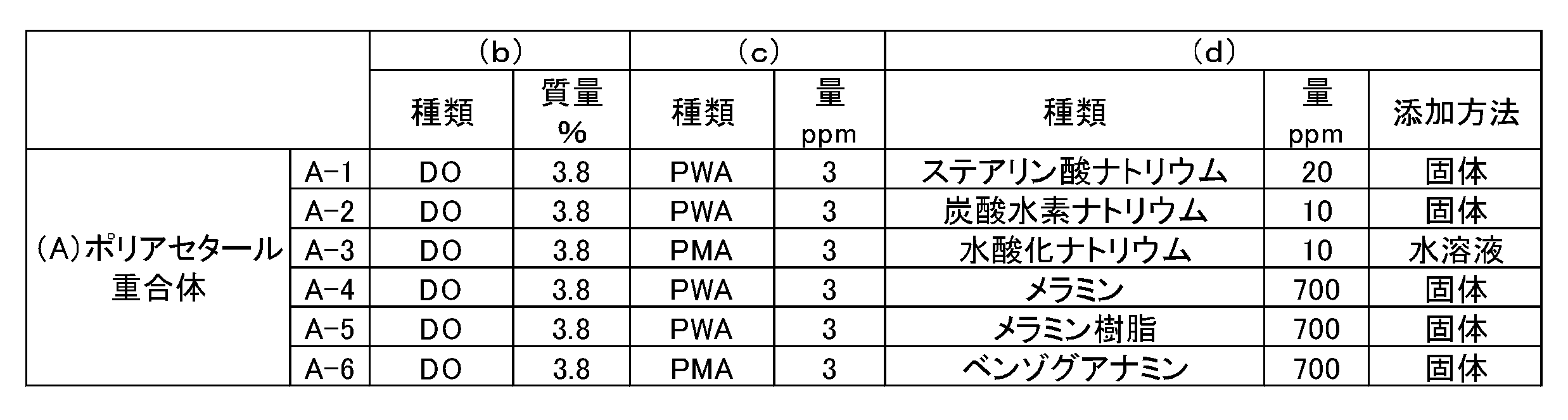
重合反応装置として連続式二軸重合機を用いた。この重合機は、外側に加熱用又は冷却用の媒体を通すためのジャケットが付いており、その内部には撹拌、推進用の多数のバドルを付した2本の回転軸が長手方向に設けられている。この二軸重合機のジャケットに80℃の温水を通し、2本の回転軸を一定の速度で回転させながら、その一端に、連鎖移動剤としてのメチラールを1000ppm含有する、主モノマー(a)としてのトリオキサン96.2質量%と、コモノマー(b)としての1,3-ジオキソラン3.8質量%とを含有する混合液を連続的に供給するとともに、上記混合液に、重合触媒(c)として、リンタングステン酸またはリンモリブデン酸を、全モノマーに対して3ppmの量で連続添加して共重合を行った。表1において、重合触媒の添加量は全モノマーの合計に対する質量比率(単位:ppm)である。
〔主モノマー(a)であるトリオキサンと、コモノマー(b)である環状エーテル又は環状ホルマールとの共重合〕
重合反応装置として連続式二軸重合機を用いた。この重合機は、外側に加熱用又は冷却用の媒体を通すためのジャケットが付いており、その内部には撹拌、推進用の多数のバドルを付した2本の回転軸が長手方向に設けられている。この二軸重合機のジャケットに80℃の温水を通し、2本の回転軸を一定の速度で回転させながら、その一端に、連鎖移動剤としてのメチラールを1000ppm含有する、主モノマー(a)としてのトリオキサン96.2質量%と、コモノマー(b)としての1,3-ジオキソラン3.8質量%とを含有する混合液を連続的に供給するとともに、上記混合液に、重合触媒(c)として、リンタングステン酸またはリンモリブデン酸を、全モノマーに対して3ppmの量で連続添加して共重合を行った。表1において、重合触媒の添加量は全モノマーの合計に対する質量比率(単位:ppm)である。
〔粗ポリアセタール重合体の触媒失活処理〕
共重合による反応生成物(粗ポリアセタール重合体)を、重合機の他端に設けられた吐出口より排出するとともに、粗重合体の触媒失活のため、表に示した(d)成分としてステアリン酸ナトリウム20ppmを添加し、目的とする(A-1)ポリアセタール重合体を調製した。(A-1)、その他の実施例、比較例となる(A-2)~(A-6)ポリアセタール重合体への(d)成分の添加は次のようにして行った。
共重合による反応生成物(粗ポリアセタール重合体)を、重合機の他端に設けられた吐出口より排出するとともに、粗重合体の触媒失活のため、表に示した(d)成分としてステアリン酸ナトリウム20ppmを添加し、目的とする(A-1)ポリアセタール重合体を調製した。(A-1)、その他の実施例、比較例となる(A-2)~(A-6)ポリアセタール重合体への(d)成分の添加は次のようにして行った。
表1の「添加方法」の欄が「固体」である場合、(d)成分を固体の状態のまま安定化処理済みのポリアセタール重合体のパウダーに均一に分散させた後、分散後のパウダーを上記反応生成物に添加した。表1の「添加方法」の欄が「水溶液」である場合、(d)成分を含む10質量%の水溶液に調製し、その水溶液を所定の添加量となるように安定化処理済みのポリアセタール重合体のパウダーに添加し、上記反応生成物に添加した。表1の「量」は、(d)成分の粗ポリアセタール重合体に対する質量比(単位はppm)である。
<ポリアセタール樹脂組成物の調製>
〔(B)、(C)および(D)成分の溶融混練〕
上記の通り調製した(A)ポリアセタール重合体に、表に示す(B)脂肪族カルボン酸ヒドラジド、(C)ヒダントイン化合物および(D)脂肪族カルボン酸のアルカリ土類金属塩を、表に示す量で添加し、ベント付き2軸押出機を用いて温度220℃、ベント部の真空度5mmHgで溶融混練して押し出し、実施例及び比較例に係るポリアセタール重合体のペレット状の樹脂組成物を調製した。
なお、全ての試料において、溶融混錬の際に(A)ポリアセタール重合体成分100質量部に対して(E)ヒンダードフェノール系酸化防止剤 エチレンビス(オキシエチレン)ビス[3-(5-tert―ブチル-4-ヒドロキシ-m-トリル)プロピオネート](BASFジャパン社製 IRGANOX245)0.35質量部を添加した。
〔(B)、(C)および(D)成分の溶融混練〕
上記の通り調製した(A)ポリアセタール重合体に、表に示す(B)脂肪族カルボン酸ヒドラジド、(C)ヒダントイン化合物および(D)脂肪族カルボン酸のアルカリ土類金属塩を、表に示す量で添加し、ベント付き2軸押出機を用いて温度220℃、ベント部の真空度5mmHgで溶融混練して押し出し、実施例及び比較例に係るポリアセタール重合体のペレット状の樹脂組成物を調製した。
なお、全ての試料において、溶融混錬の際に(A)ポリアセタール重合体成分100質量部に対して(E)ヒンダードフェノール系酸化防止剤 エチレンビス(オキシエチレン)ビス[3-(5-tert―ブチル-4-ヒドロキシ-m-トリル)プロピオネート](BASFジャパン社製 IRGANOX245)0.35質量部を添加した。
≪各成分≫
実施例及び比較例で使用した表に記載の各成分は以下のものである。
・(A)ポリアセタール重合体
表1に記載
・(b)コモノマー
DO:1,3-ジオキソラン
・(c)重合触媒
PWA:リンタングステン酸
PMA:リンモリブデン酸
・(B)脂肪族カルボン酸ヒドラジド
B-1:セバシン酸ジヒドラジド
B-2:アジピン酸ジヒドラジド
B-3:ドデカン二酸ジヒドラジド
・(C)ヒダントイン化合物
C-1:1,3-ビス(ヒドラジノカルボノエチル)-5-イソプロピルヒダントイン(味の素ファインテクノ社製 「アミキュア」VDH)
・(D)脂肪族カルボン酸のアルカリ土類金属塩
D-1:ステアリン酸カルシウム
D-2:12-ヒドロキシステアリン酸カルシウム
実施例及び比較例で使用した表に記載の各成分は以下のものである。
・(A)ポリアセタール重合体
表1に記載
・(b)コモノマー
DO:1,3-ジオキソラン
・(c)重合触媒
PWA:リンタングステン酸
PMA:リンモリブデン酸
・(B)脂肪族カルボン酸ヒドラジド
B-1:セバシン酸ジヒドラジド
B-2:アジピン酸ジヒドラジド
B-3:ドデカン二酸ジヒドラジド
・(C)ヒダントイン化合物
C-1:1,3-ビス(ヒドラジノカルボノエチル)-5-イソプロピルヒダントイン(味の素ファインテクノ社製 「アミキュア」VDH)
・(D)脂肪族カルボン酸のアルカリ土類金属塩
D-1:ステアリン酸カルシウム
D-2:12-ヒドロキシステアリン酸カルシウム
<評価>
実施例及び比較例における特性評価項目及び評価方法は以下の通りである。
実施例及び比較例における特性評価項目及び評価方法は以下の通りである。
<成形品からのホルムアルデヒド発生量(VOC)評価>
実施例及び比較例で調製したポリアセタール樹脂組成物を用い、下記条件で平板状試験片(100mm×40mm×2mmt)を成形した。この平板状試験片2枚を、10Lのポリフッ化ビニル製サンプリングバッグに封入し脱気して、4Lの窒素を入れ、65℃で2時間加熱した後、サンプリングバッグ内の窒素を0.5ml/minで3L抜き取り、発生したホルムアルデヒドをDNPH(2,4-ジニトロフェニルヒドラジン)捕集管(Waters社製 Sep―Pak DNPH―Silica)に吸着させた。
実施例及び比較例で調製したポリアセタール樹脂組成物を用い、下記条件で平板状試験片(100mm×40mm×2mmt)を成形した。この平板状試験片2枚を、10Lのポリフッ化ビニル製サンプリングバッグに封入し脱気して、4Lの窒素を入れ、65℃で2時間加熱した後、サンプリングバッグ内の窒素を0.5ml/minで3L抜き取り、発生したホルムアルデヒドをDNPH(2,4-ジニトロフェニルヒドラジン)捕集管(Waters社製 Sep―Pak DNPH―Silica)に吸着させた。
その後、DNPH捕集管からDNPHとホルムアルデヒドとの反応物をアセトニトリルで溶媒抽出し、高速液体クロマトグラフでDNPHとホルムアルデヒドとの反応物の標準物質を用いた検量線法により、発生したホルムアルデヒド量を求め、試験片単位質量あたりのホルムアルデヒド発生量(μg/g)を算出した。
*成形機:FANUC ROBOSHOT α―S100ia(ファナック(株))
*成形条件:シリンダー温度(℃) ノズル-C1- C2- C3
190 190 180 160℃
射出圧力 60(MPa)
射出速度 1.0(m/min)
金型温度 80(℃)
*成形条件:シリンダー温度(℃) ノズル-C1- C2- C3
190 190 180 160℃
射出圧力 60(MPa)
射出速度 1.0(m/min)
金型温度 80(℃)
<モールドデポジット(MD)の評価>
実施例及び比較例で調製したポリアセタール樹脂組成物を用い、下記条件でモールドデポジット試験片(33mm×23mm×1mmt)を成形した。
[評価方法]
5000shot連続成形した後、金型内のキャビティ部表面を目視にて観察し、以下の基準に従って付着物量を目視で判定した。
◎:付着物は全く確認されない
○:付着物はほとんど確認されない
△:一部付着物が確認される
×:全体に付着物が確認される
××:全体に多量の付着物が確認される
実施例及び比較例で調製したポリアセタール樹脂組成物を用い、下記条件でモールドデポジット試験片(33mm×23mm×1mmt)を成形した。
[評価方法]
5000shot連続成形した後、金型内のキャビティ部表面を目視にて観察し、以下の基準に従って付着物量を目視で判定した。
◎:付着物は全く確認されない
○:付着物はほとんど確認されない
△:一部付着物が確認される
×:全体に付着物が確認される
××:全体に多量の付着物が確認される
*成形機:FANUC ROBOSHOT S-2000i 50B(ファナック(株))
*成形条件:シリンダー温度(℃) ノズル-C1-C2- C3
205 215 205 185℃
射出圧力 40(MPa)
射出速度 1.5(m/min)
金型温度 80(℃)
*成形条件:シリンダー温度(℃) ノズル-C1-C2- C3
205 215 205 185℃
射出圧力 40(MPa)
射出速度 1.5(m/min)
金型温度 80(℃)


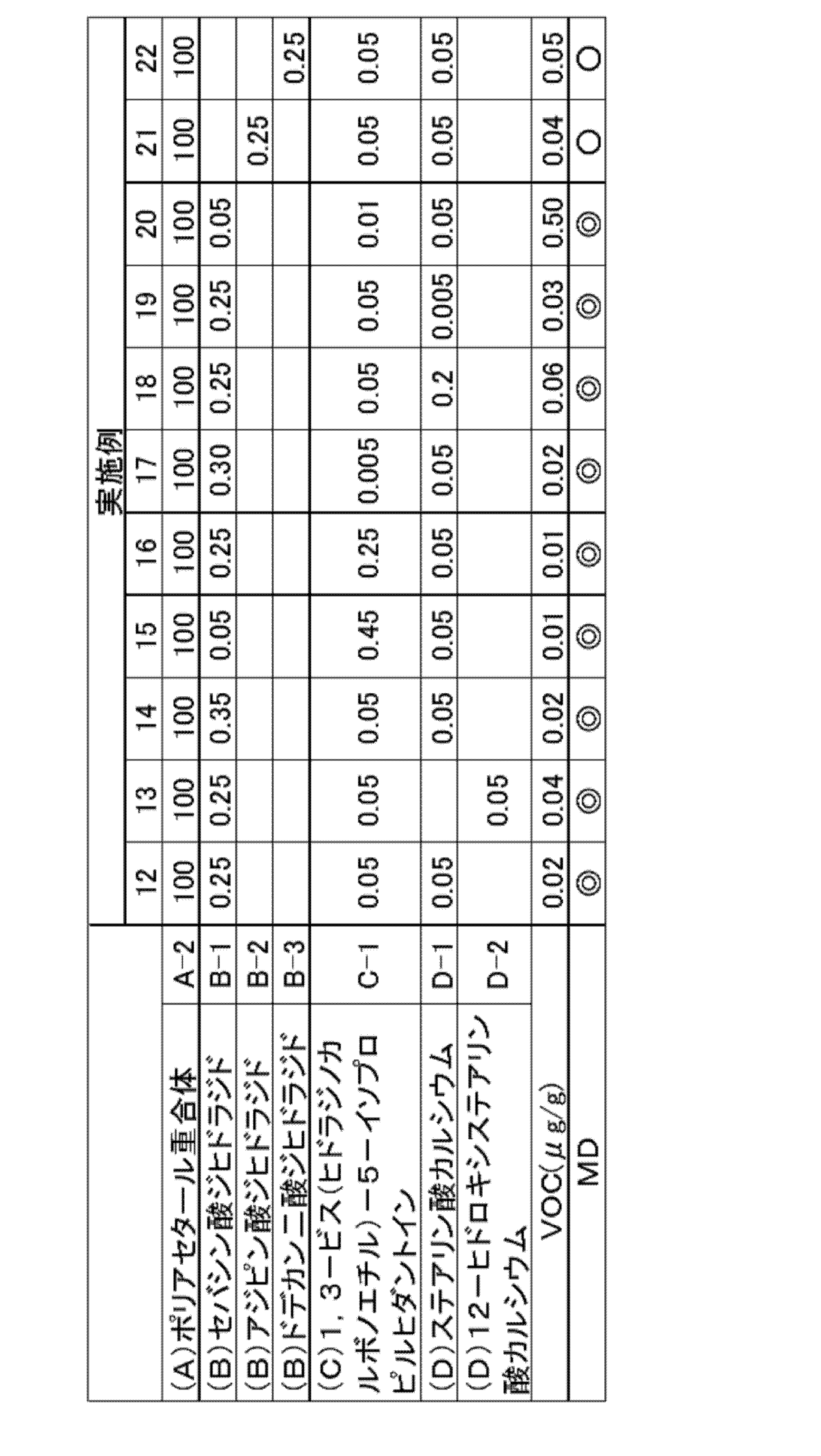


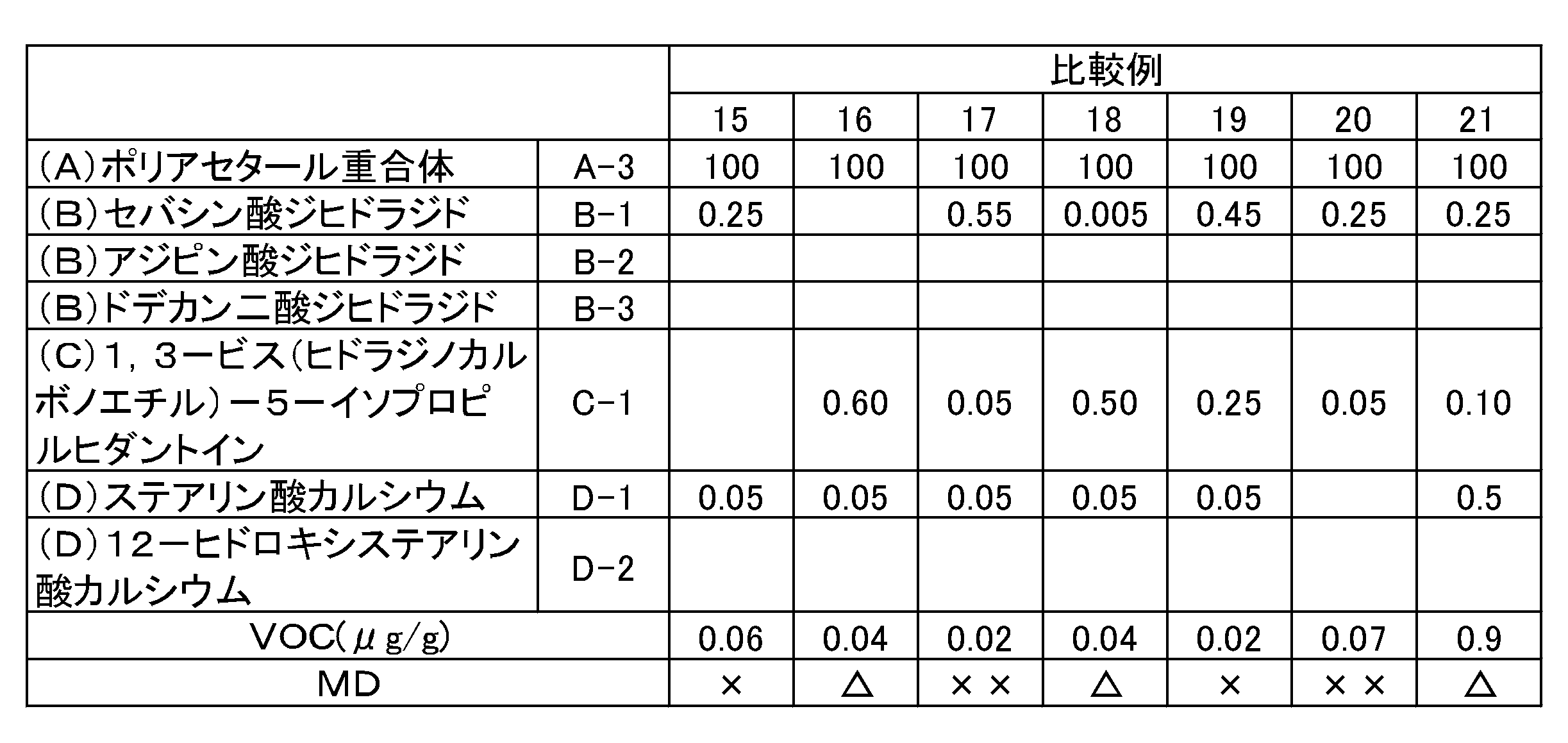

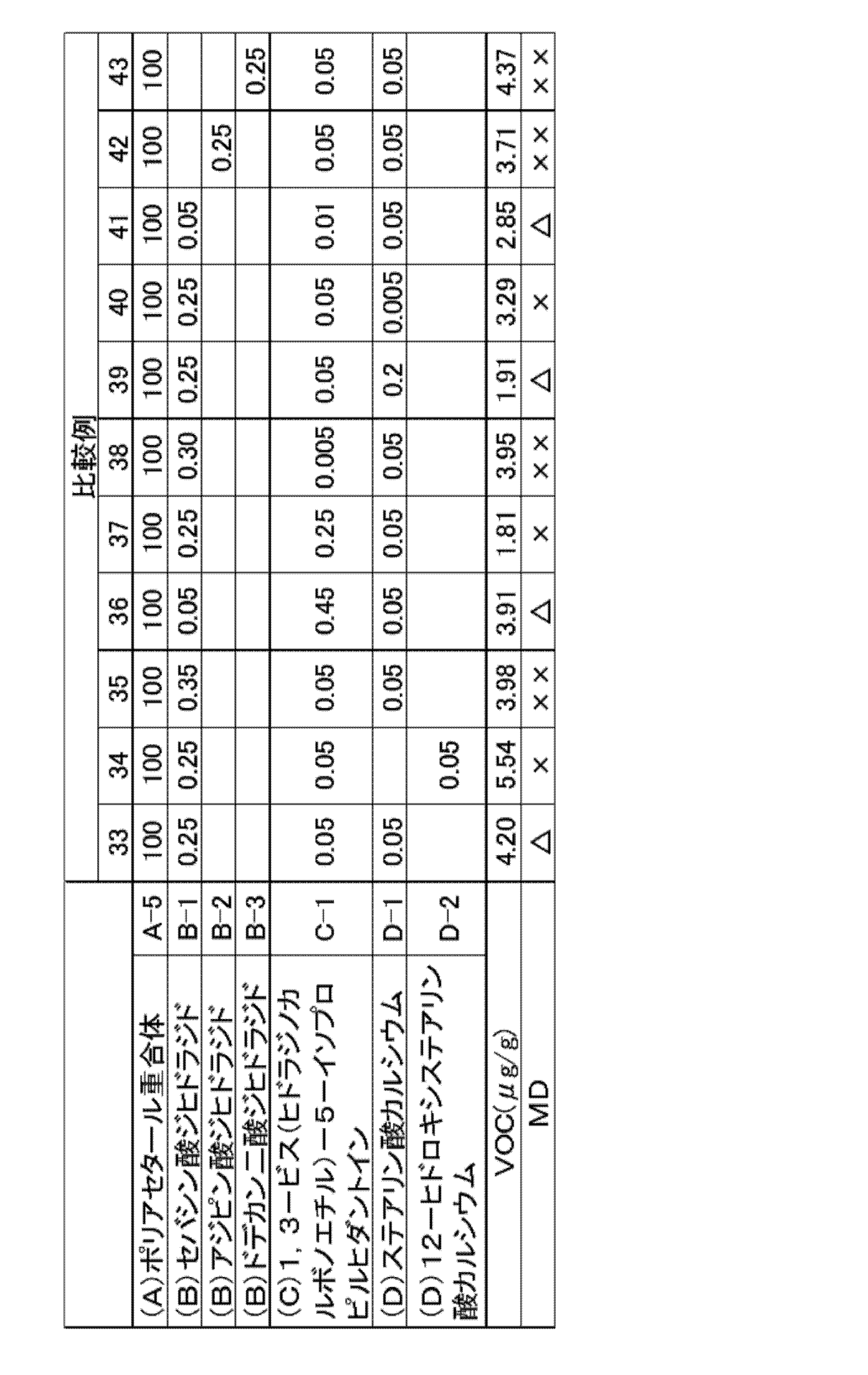
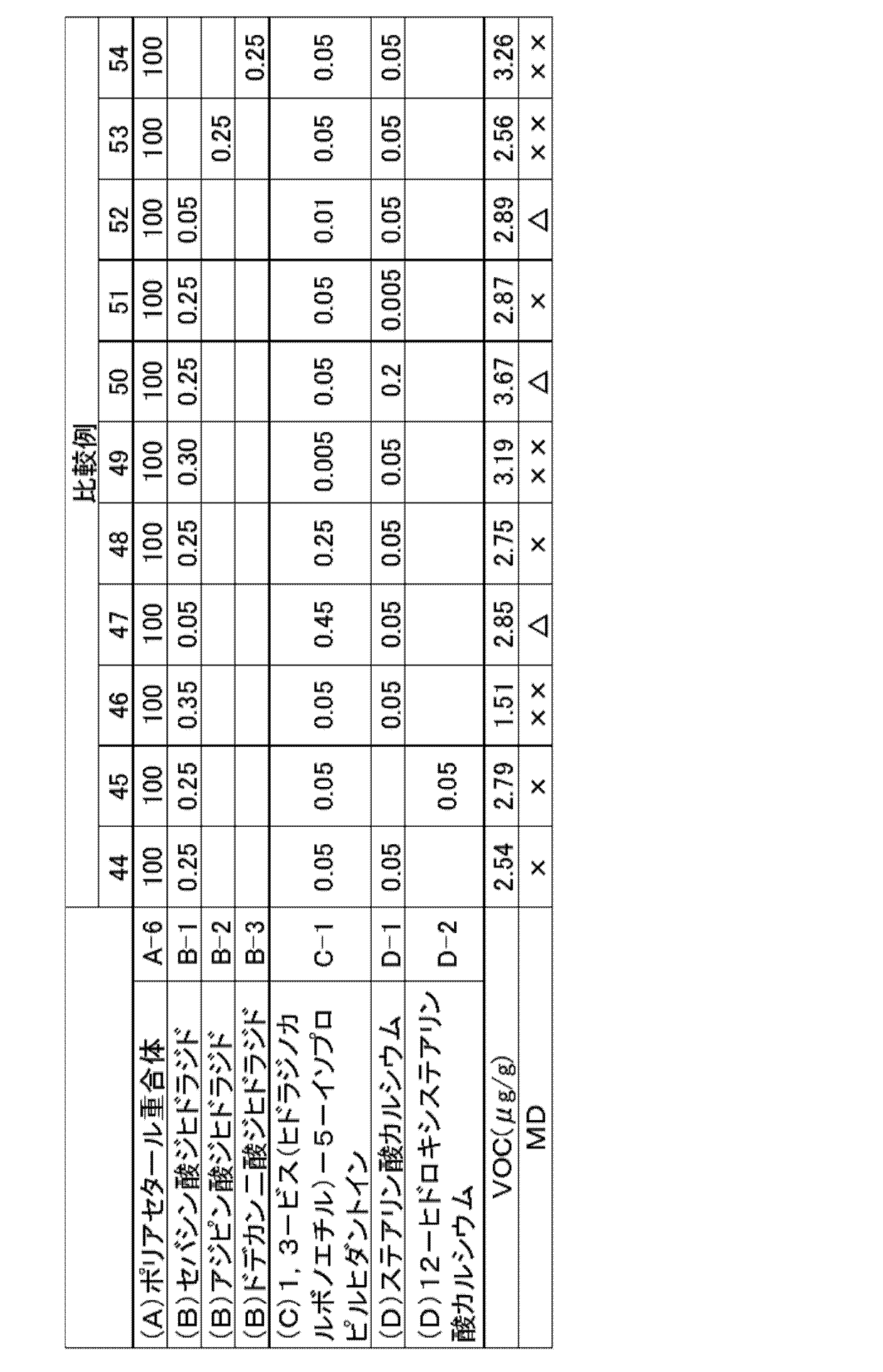
上記の通り、本発明の樹脂組成物の製造方法の範囲では、ホルムアルデヒド発生量およびモールドデポジットの発生量が安定的に抑制されることが明らかである。
Claims (4)
- 少なくとも
(A)ポリアセタール重合体100質量部、
(B)脂肪族カルボン酸ヒドラジド0.01~0.50質量部、
(C)2つのヒドラジノカルボニルアルキル基を有するヒダントイン化合物0.001~0.50質量部、
(D)脂肪族カルボン酸のアルカリ土類金属塩0.001~0.30質量部、
とを含有してなり、
前記(B)と(C)の合計量が、(A)ポリアセタール重合体100質量部に対して0.03~0.55質量部であるポリアセタール樹脂組成物の製造方法であって、
該(A)ポリアセタール重合体が、トリオキサンを主モノマー(a)とし、少なくとも一つの炭素-炭素結合を有する環状エーテルおよび環状ホルマールから選択される一種以上をコモノマー(b)とし、重合触媒(c)に下記一般式(1)で示されるヘテロポリ酸を使用して共重合を行った反応生成物に、アルカリ金属元素若しくはアルカリ土類金属元素の炭酸塩、炭酸水素塩、カルボン酸塩若しくはその水和物、又はアルカリ金属元素若しくはアルカリ土類金属元素の水酸化物(d)を添加し、溶融混練処理して、該重合触媒(c)を失活させて得られたポリアセタール共重合体である、
ポリアセタール樹脂組成物の製造方法。
Hm[M1 x・M2 yOZ]・nH2O ・・・・・・(1)
〔式(1)中、M1はP及びSiより選ばれた一種又は二種の元素から成る中心元素を示す。M2はW、Mo及びVより選ばれた一種以上の配位元素を示す。xは1以上10以下の整数を示し、yは6以上40以下の整数を示し、zは10以上100以下の整数を示し、mは1以上の整数を示し、nは0以上50以下の整数を示す。〕 - 前記(B)脂肪族カルボン酸ヒドラジドが、セバシン酸ジヒドラジドである請求項1に記載のポリアセタール樹脂組成物の製造方法。
- 前記(D)脂肪族カルボン酸のアルカリ土類金属塩が、ステアリン酸カルシウムおよび12-ヒドロキシステアリン酸カルシウムから選択される少なくとも1種である請求項1または2に記載のポリアセタール樹脂組成物の製造方法。
- 前記(C)2つのヒドラジノカルボニルアルキル基を有するヒダントイン化合物が、1,3-ビス(ヒドラジノカルボノエチル)-5-イソプロピルヒダントインである請求項1~3いずれかに記載のポリアセタール樹脂組成物の製造方法。
Priority Applications (3)
| Application Number | Priority Date | Filing Date | Title |
|---|---|---|---|
| CN202080009065.6A CN113302239B (zh) | 2019-04-26 | 2020-03-10 | 聚缩醛树脂组合物的制造方法 |
| US17/593,231 US11661511B2 (en) | 2019-04-26 | 2020-03-10 | Production method of polyacetal resin composition |
| MYPI2021005420A MY204126A (en) | 2019-04-26 | 2020-03-10 | Production method of polyacetal resin composition |
Applications Claiming Priority (2)
| Application Number | Priority Date | Filing Date | Title |
|---|---|---|---|
| JP2019085375A JP6802317B2 (ja) | 2019-04-26 | 2019-04-26 | ポリアセタール樹脂組成物の製造方法 |
| JP2019-085375 | 2019-04-26 |
Publications (1)
| Publication Number | Publication Date |
|---|---|
| WO2020217752A1 true WO2020217752A1 (ja) | 2020-10-29 |
Family
ID=72941998
Family Applications (1)
| Application Number | Title | Priority Date | Filing Date |
|---|---|---|---|
| PCT/JP2020/010201 Ceased WO2020217752A1 (ja) | 2019-04-26 | 2020-03-10 | ポリアセタール樹脂組成物の製造方法 |
Country Status (5)
| Country | Link |
|---|---|
| US (1) | US11661511B2 (ja) |
| JP (1) | JP6802317B2 (ja) |
| CN (1) | CN113302239B (ja) |
| MY (1) | MY204126A (ja) |
| WO (1) | WO2020217752A1 (ja) |
Citations (7)
| Publication number | Priority date | Publication date | Assignee | Title |
|---|---|---|---|---|
| WO2001005888A1 (en) * | 1999-07-16 | 2001-01-25 | Polyplastics Co., Ltd. | Polyacetal resin composition and process for the production thereof |
| JP2005162913A (ja) * | 2003-12-03 | 2005-06-23 | Polyplastics Co | レーザーマーキング用樹脂組成物 |
| JP2006257166A (ja) * | 2005-03-15 | 2006-09-28 | Polyplastics Co | 不安定末端基分解処理剤、それを用いた安定化ポリアセタール樹脂、製造方法、組成物及び成形体 |
| JP2009286874A (ja) * | 2008-05-28 | 2009-12-10 | Polyplastics Co | ポリアセタール樹脂組成物及びその成形品 |
| JP2013237742A (ja) * | 2012-05-14 | 2013-11-28 | Asahi Kasei Chemicals Corp | ポリアセタール樹脂組成物、及びその成形体 |
| JP2015514840A (ja) * | 2012-04-17 | 2015-05-21 | ティコナ ゲゼルシャフト ミット ベシュレンクテル ハフツング | 耐候性ポリメチレン組成物 |
| JP2019065233A (ja) * | 2017-10-04 | 2019-04-25 | 旭化成株式会社 | ポリアセタール樹脂組成物 |
Family Cites Families (18)
| Publication number | Priority date | Publication date | Assignee | Title |
|---|---|---|---|---|
| JP2003192812A (ja) | 2001-12-25 | 2003-07-09 | Mitsubishi Rayon Co Ltd | 可塑剤含有樹脂成形体 |
| JP5317312B2 (ja) * | 2003-10-24 | 2013-10-16 | 旭化成ケミカルズ株式会社 | ポリアセタール樹脂組成物及びその成形品 |
| KR20060130034A (ko) | 2003-11-07 | 2006-12-18 | 폴리플라스틱스 가부시키가이샤 | 폴리아세탈 수지 조성물 및 그의 성형품 |
| JP4982043B2 (ja) * | 2003-11-10 | 2012-07-25 | ポリプラスチックス株式会社 | ポリアセタール樹脂組成物 |
| US7638565B2 (en) * | 2003-11-10 | 2009-12-29 | Polyplastics Co., Ltd. | Polyacetal resin composition |
| JP2005264102A (ja) | 2004-03-22 | 2005-09-29 | Asahi Kasei Chemicals Corp | ポリアセタール樹脂 |
| JP4982947B2 (ja) | 2004-06-30 | 2012-07-25 | 東レ株式会社 | ポリオキシメチレン樹脂組成物の製造方法 |
| JP5393945B2 (ja) * | 2006-07-31 | 2014-01-22 | ポリプラスチックス株式会社 | 安定化ポリアセタール樹脂の製造方法、安定化ポリアセタール樹脂、組成物及び成形体 |
| JP5281240B2 (ja) | 2006-12-25 | 2013-09-04 | ポリプラスチックス株式会社 | ポリアセタール樹脂組成物及びその成形品 |
| JP4904191B2 (ja) | 2007-04-13 | 2012-03-28 | 旭化成ケミカルズ株式会社 | ポリアセタール樹脂組成物 |
| JP5234752B2 (ja) | 2008-06-25 | 2013-07-10 | 旭化成ケミカルズ株式会社 | ポリアセタール樹脂組成物 |
| JP5860388B2 (ja) * | 2012-11-27 | 2016-02-16 | ポリプラスチックス株式会社 | ポリアセタール共重合体の製造方法 |
| JP2016089069A (ja) | 2014-11-06 | 2016-05-23 | 旭化成ケミカルズ株式会社 | ポリアセタール樹脂ペレット及び成形体 |
| JP2015078387A (ja) | 2015-01-23 | 2015-04-23 | 旭化成ケミカルズ株式会社 | ポリアセタールホモポリマー樹脂組成物からなる自動車用部品 |
| JP6473067B2 (ja) | 2015-10-28 | 2019-02-20 | 旭化成株式会社 | 複合部品、ポリオキシメチレン製樹脂部品、及び樹脂組成物 |
| JP2018080305A (ja) * | 2016-11-18 | 2018-05-24 | 旭化成株式会社 | ポリアセタール樹脂組成物 |
| JP7037960B2 (ja) | 2018-02-28 | 2022-03-17 | ポリプラスチックス株式会社 | ポリアセタール樹脂組成物 |
| JP7204474B2 (ja) | 2018-12-21 | 2023-01-16 | ポリプラスチックス株式会社 | ポリアセタール樹脂組成物 |
-
2019
- 2019-04-26 JP JP2019085375A patent/JP6802317B2/ja active Active
-
2020
- 2020-03-10 CN CN202080009065.6A patent/CN113302239B/zh active Active
- 2020-03-10 US US17/593,231 patent/US11661511B2/en active Active
- 2020-03-10 MY MYPI2021005420A patent/MY204126A/en unknown
- 2020-03-10 WO PCT/JP2020/010201 patent/WO2020217752A1/ja not_active Ceased
Patent Citations (7)
| Publication number | Priority date | Publication date | Assignee | Title |
|---|---|---|---|---|
| WO2001005888A1 (en) * | 1999-07-16 | 2001-01-25 | Polyplastics Co., Ltd. | Polyacetal resin composition and process for the production thereof |
| JP2005162913A (ja) * | 2003-12-03 | 2005-06-23 | Polyplastics Co | レーザーマーキング用樹脂組成物 |
| JP2006257166A (ja) * | 2005-03-15 | 2006-09-28 | Polyplastics Co | 不安定末端基分解処理剤、それを用いた安定化ポリアセタール樹脂、製造方法、組成物及び成形体 |
| JP2009286874A (ja) * | 2008-05-28 | 2009-12-10 | Polyplastics Co | ポリアセタール樹脂組成物及びその成形品 |
| JP2015514840A (ja) * | 2012-04-17 | 2015-05-21 | ティコナ ゲゼルシャフト ミット ベシュレンクテル ハフツング | 耐候性ポリメチレン組成物 |
| JP2013237742A (ja) * | 2012-05-14 | 2013-11-28 | Asahi Kasei Chemicals Corp | ポリアセタール樹脂組成物、及びその成形体 |
| JP2019065233A (ja) * | 2017-10-04 | 2019-04-25 | 旭化成株式会社 | ポリアセタール樹脂組成物 |
Also Published As
| Publication number | Publication date |
|---|---|
| CN113302239B (zh) | 2021-11-30 |
| JP2020180246A (ja) | 2020-11-05 |
| US20220089858A1 (en) | 2022-03-24 |
| US11661511B2 (en) | 2023-05-30 |
| JP6802317B2 (ja) | 2020-12-16 |
| CN113302239A (zh) | 2021-08-24 |
| MY204126A (en) | 2024-08-09 |
Similar Documents
| Publication | Publication Date | Title |
|---|---|---|
| JP4980986B2 (ja) | ポリアセタール樹脂組成物及びその成形品 | |
| KR101934996B1 (ko) | 폴리아세탈 공중합체의 제조방법 | |
| WO2008078572A1 (ja) | ポリアセタール樹脂組成物及びその成形品 | |
| WO2008001557A1 (en) | Polyacetal resin composition | |
| TWI615423B (zh) | 聚縮醛共聚合物的製造方法 | |
| WO2008078570A1 (ja) | ポリアセタール樹脂組成物 | |
| CN108350248B (zh) | 聚缩醛树脂组合物的制造方法 | |
| JP2010037445A (ja) | ポリアセタール樹脂組成物及びその成形品 | |
| JPWO2013172270A1 (ja) | オキシメチレン共重合体の製造方法 | |
| WO2019167463A1 (ja) | ポリアセタール樹脂組成物 | |
| WO2020129663A1 (ja) | ポリアセタール樹脂組成物 | |
| JP6978906B2 (ja) | ポリアセタール樹脂組成物 | |
| JP6802317B2 (ja) | ポリアセタール樹脂組成物の製造方法 | |
| CN112143164B (zh) | 聚缩醛树脂组合物和其制造方法 | |
| JP6784805B1 (ja) | ポリアセタ−ル樹脂組成物及びその製造方法 | |
| TW201627339A (zh) | 甲醛共聚物之製造方法 |
Legal Events
| Date | Code | Title | Description |
|---|---|---|---|
| 121 | Ep: the epo has been informed by wipo that ep was designated in this application |
Ref document number: 20795532 Country of ref document: EP Kind code of ref document: A1 |
|
| NENP | Non-entry into the national phase |
Ref country code: DE |
|
| 122 | Ep: pct application non-entry in european phase |
Ref document number: 20795532 Country of ref document: EP Kind code of ref document: A1 |