WO2020183917A1 - 硬化性組成物、蓄熱材、及び物品 - Google Patents
硬化性組成物、蓄熱材、及び物品 Download PDFInfo
- Publication number
- WO2020183917A1 WO2020183917A1 PCT/JP2020/002002 JP2020002002W WO2020183917A1 WO 2020183917 A1 WO2020183917 A1 WO 2020183917A1 JP 2020002002 W JP2020002002 W JP 2020002002W WO 2020183917 A1 WO2020183917 A1 WO 2020183917A1
- Authority
- WO
- WIPO (PCT)
- Prior art keywords
- curable composition
- heat storage
- formula
- mass
- compound represented
- Prior art date
- Legal status (The legal status is an assumption and is not a legal conclusion. Google has not performed a legal analysis and makes no representation as to the accuracy of the status listed.)
- Ceased
Links
Images


Classifications
-
- C—CHEMISTRY; METALLURGY
- C08—ORGANIC MACROMOLECULAR COMPOUNDS; THEIR PREPARATION OR CHEMICAL WORKING-UP; COMPOSITIONS BASED THEREON
- C08F—MACROMOLECULAR COMPOUNDS OBTAINED BY REACTIONS ONLY INVOLVING CARBON-TO-CARBON UNSATURATED BONDS
- C08F290/00—Macromolecular compounds obtained by polymerising monomers on to polymers modified by introduction of aliphatic unsaturated end or side groups
- C08F290/02—Macromolecular compounds obtained by polymerising monomers on to polymers modified by introduction of aliphatic unsaturated end or side groups on to polymers modified by introduction of unsaturated end groups
- C08F290/06—Polymers provided for in subclass C08G
- C08F290/062—Polyethers
-
- C—CHEMISTRY; METALLURGY
- C08—ORGANIC MACROMOLECULAR COMPOUNDS; THEIR PREPARATION OR CHEMICAL WORKING-UP; COMPOSITIONS BASED THEREON
- C08F—MACROMOLECULAR COMPOUNDS OBTAINED BY REACTIONS ONLY INVOLVING CARBON-TO-CARBON UNSATURATED BONDS
- C08F220/00—Copolymers of compounds having one or more unsaturated aliphatic radicals, each having only one carbon-to-carbon double bond, and only one being terminated by only one carboxyl radical or a salt, anhydride ester, amide, imide or nitrile thereof
- C08F220/02—Monocarboxylic acids having less than ten carbon atoms; Derivatives thereof
- C08F220/10—Esters
- C08F220/12—Esters of monohydric alcohols or phenols
- C08F220/14—Methyl esters, e.g. methyl (meth)acrylate
-
- C—CHEMISTRY; METALLURGY
- C08—ORGANIC MACROMOLECULAR COMPOUNDS; THEIR PREPARATION OR CHEMICAL WORKING-UP; COMPOSITIONS BASED THEREON
- C08F—MACROMOLECULAR COMPOUNDS OBTAINED BY REACTIONS ONLY INVOLVING CARBON-TO-CARBON UNSATURATED BONDS
- C08F220/00—Copolymers of compounds having one or more unsaturated aliphatic radicals, each having only one carbon-to-carbon double bond, and only one being terminated by only one carboxyl radical or a salt, anhydride ester, amide, imide or nitrile thereof
- C08F220/02—Monocarboxylic acids having less than ten carbon atoms; Derivatives thereof
- C08F220/10—Esters
- C08F220/26—Esters containing oxygen in addition to the carboxy oxygen
- C08F220/28—Esters containing oxygen in addition to the carboxy oxygen containing no aromatic rings in the alcohol moiety
- C08F220/285—Esters containing oxygen in addition to the carboxy oxygen containing no aromatic rings in the alcohol moiety and containing a polyether chain in the alcohol moiety
- C08F220/286—Esters containing oxygen in addition to the carboxy oxygen containing no aromatic rings in the alcohol moiety and containing a polyether chain in the alcohol moiety and containing polyethylene oxide in the alcohol moiety, e.g. methoxy polyethylene glycol (meth)acrylate
-
- C—CHEMISTRY; METALLURGY
- C08—ORGANIC MACROMOLECULAR COMPOUNDS; THEIR PREPARATION OR CHEMICAL WORKING-UP; COMPOSITIONS BASED THEREON
- C08F—MACROMOLECULAR COMPOUNDS OBTAINED BY REACTIONS ONLY INVOLVING CARBON-TO-CARBON UNSATURATED BONDS
- C08F290/00—Macromolecular compounds obtained by polymerising monomers on to polymers modified by introduction of aliphatic unsaturated end or side groups
- C08F290/02—Macromolecular compounds obtained by polymerising monomers on to polymers modified by introduction of aliphatic unsaturated end or side groups on to polymers modified by introduction of unsaturated end groups
- C08F290/06—Polymers provided for in subclass C08G
-
- C—CHEMISTRY; METALLURGY
- C08—ORGANIC MACROMOLECULAR COMPOUNDS; THEIR PREPARATION OR CHEMICAL WORKING-UP; COMPOSITIONS BASED THEREON
- C08L—COMPOSITIONS OF MACROMOLECULAR COMPOUNDS
- C08L35/00—Compositions of homopolymers or copolymers of compounds having one or more unsaturated aliphatic radicals, each having only one carbon-to-carbon double bond, and at least one being terminated by a carboxyl radical, and containing at least one other carboxyl radical in the molecule, or of salts, anhydrides, esters, amides, imides or nitriles thereof; Compositions of derivatives of such polymers
- C08L35/02—Homopolymers or copolymers of esters
-
- C—CHEMISTRY; METALLURGY
- C09—DYES; PAINTS; POLISHES; NATURAL RESINS; ADHESIVES; COMPOSITIONS NOT OTHERWISE PROVIDED FOR; APPLICATIONS OF MATERIALS NOT OTHERWISE PROVIDED FOR
- C09D—COATING COMPOSITIONS, e.g. PAINTS, VARNISHES OR LACQUERS; FILLING PASTES; CHEMICAL PAINT OR INK REMOVERS; INKS; CORRECTING FLUIDS; WOODSTAINS; PASTES OR SOLIDS FOR COLOURING OR PRINTING; USE OF MATERIALS THEREFOR
- C09D4/00—Coating compositions, e.g. paints, varnishes or lacquers, based on organic non-macromolecular compounds having at least one polymerisable carbon-to-carbon unsaturated bond ; Coating compositions, based on monomers of macromolecular compounds of groups C09D183/00 - C09D183/16
- C09D4/06—Organic non-macromolecular compounds having at least one polymerisable carbon-to-carbon unsaturated bond in combination with a macromolecular compound other than an unsaturated polymer of groups C09D159/00 - C09D187/00
-
- C—CHEMISTRY; METALLURGY
- C09—DYES; PAINTS; POLISHES; NATURAL RESINS; ADHESIVES; COMPOSITIONS NOT OTHERWISE PROVIDED FOR; APPLICATIONS OF MATERIALS NOT OTHERWISE PROVIDED FOR
- C09K—MATERIALS FOR MISCELLANEOUS APPLICATIONS, NOT PROVIDED FOR ELSEWHERE
- C09K5/00—Heat-transfer, heat-exchange or heat-storage materials, e.g. refrigerants; Materials for the production of heat or cold by chemical reactions other than by combustion
- C09K5/02—Materials undergoing a change of physical state when used
- C09K5/06—Materials undergoing a change of physical state when used the change of state being from liquid to solid or vice versa
-
- C—CHEMISTRY; METALLURGY
- C09—DYES; PAINTS; POLISHES; NATURAL RESINS; ADHESIVES; COMPOSITIONS NOT OTHERWISE PROVIDED FOR; APPLICATIONS OF MATERIALS NOT OTHERWISE PROVIDED FOR
- C09K—MATERIALS FOR MISCELLANEOUS APPLICATIONS, NOT PROVIDED FOR ELSEWHERE
- C09K5/00—Heat-transfer, heat-exchange or heat-storage materials, e.g. refrigerants; Materials for the production of heat or cold by chemical reactions other than by combustion
- C09K5/02—Materials undergoing a change of physical state when used
- C09K5/06—Materials undergoing a change of physical state when used the change of state being from liquid to solid or vice versa
- C09K5/063—Materials absorbing or liberating heat during crystallisation; Heat storage materials
Definitions
- the present invention relates to a curable composition, a heat storage material, and an article.
- the heat storage material is a material that can take out the stored energy as heat as needed.
- This heat storage material is used in applications such as air conditioning equipment, floor heating equipment, refrigerators, electronic parts such as IC chips, automobile interior / exterior materials, automobile parts such as canisters, and heat insulating containers.
- paraffin is used as a latent heat storage substance having a phase change temperature higher than 0 ° C. and 100 ° C. or lower.
- paraffin becomes liquid when it undergoes a phase change due to heating, and there is a risk of ignition and ignition. Therefore, in order to use paraffin as a heat storage material, paraffin is stored in a closed container such as a bag. It is necessary to prevent the leakage of paraffin wax, which limits the fields of application.
- Patent Document 1 discloses a method using a gelling agent. The gel produced by this method can maintain a gel-like molded product even after the phase change of paraffin.
- An object of the present invention is to provide a curable composition capable of forming a heat storage material having an excellent heat storage amount in one aspect.
- the present inventors have found that a cured product of a curable composition containing a specific compound having a polyoxyalkylene chain and two (meth) acryloyl groups has an excellent heat storage amount. That is, they have found that the curable composition can form a heat storage material having an excellent heat storage amount, and have completed the present invention.
- the present invention provides the following [1] to [14] in some aspects.
- R 11 and R 12 each independently represent a hydrogen atom or a methyl group, and R 13 represents a divalent group having a polyoxyalkylene chain.
- R 11 and R 12 each independently represent a hydrogen atom or a methyl group
- R 13 represents a divalent group having a polyoxyalkylene chain.
- the curable composition according to [1] which contains the compound represented by the formula (1) having a weight average molecular weight of 2000 or more as the compound represented by the formula (1).
- the curable composition according to [1] wherein the compound represented by the formula (1) is a compound represented by the following formula (1-2).
- R 11 and R 12 have the same meanings as R 11 and R 12 in the formula (1)
- R 14 represents an alkylene group
- m represents an integer of 2 or more.
- [4] The curable composition according to [3], wherein m is an integer such that the molecular weight of the compound represented by the formula (1-2) is 2000 or more.
- [5] The curable composition according to any one of [1] to [4], wherein the content of the compound represented by the formula (1) is 10% by mass or more based on the total amount of the curable composition.
- R 21 represents a hydrogen atom or a methyl group
- R 22 represents a monovalent group having a polyoxyalkylene chain.
- [7] The curable composition according to any one of [1] to [6], which further contains a heat storage component.
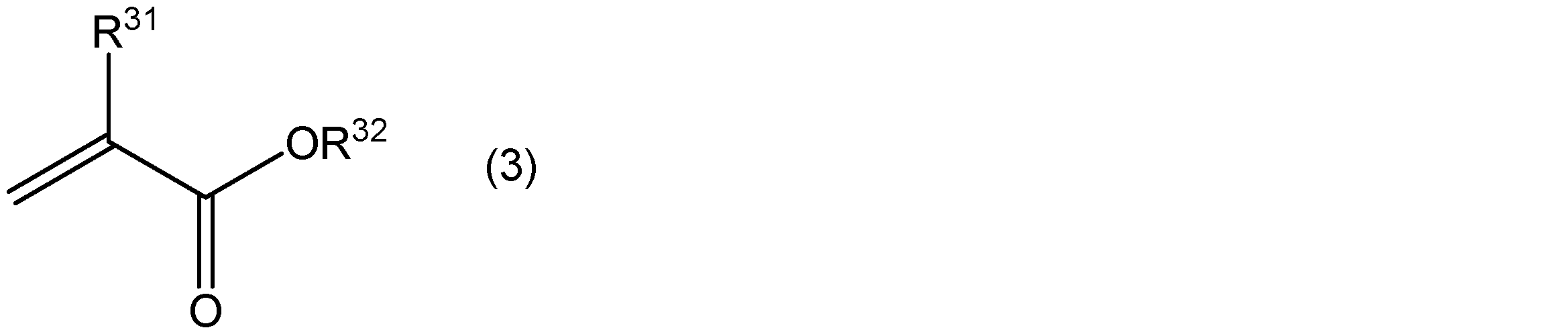
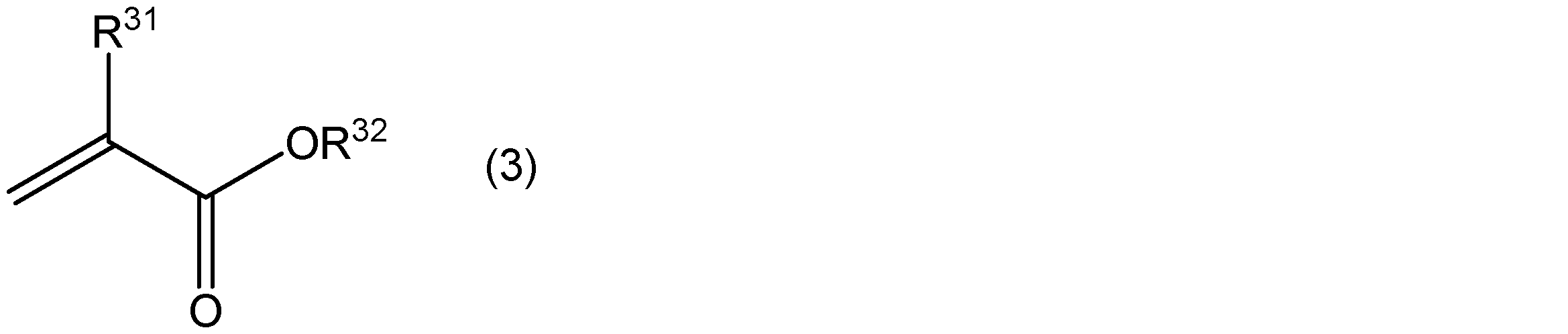
- [9] The curable composition according to any one of [1] to [8], which further contains a compound represented by the following formula (3).
- R 31 represents a hydrogen atom or a methyl group
- R 32 represents an alkyl group.
- FIG. 5 is a schematic cross-sectional view showing another embodiment of the article. It is a schematic cross-sectional view which shows the other embodiment of the manufacturing method of an article.
- (meth) acryloyl means “acryloyl” and the corresponding “methacryloyl”, and the same applies to similar expressions such as “(meth) acrylate” and “(meth) acrylic”. ..
- the weight average molecular weight (Mw) in the present specification means a value determined by using gel permeation chromatography (GPC) under the following conditions and using polystyrene as a standard substance.
- GPC gel permeation chromatography
- -Analytical column TSKgel SuperMultipore HZ-H (3 connected) (Product name, manufactured by Tosoh Corporation) -Guard column: TSKguardvolume SuperMP (HZ) -H (product name, manufactured by Tosoh Corporation) -Eluent: THF ⁇ Measurement temperature: 25 ° C
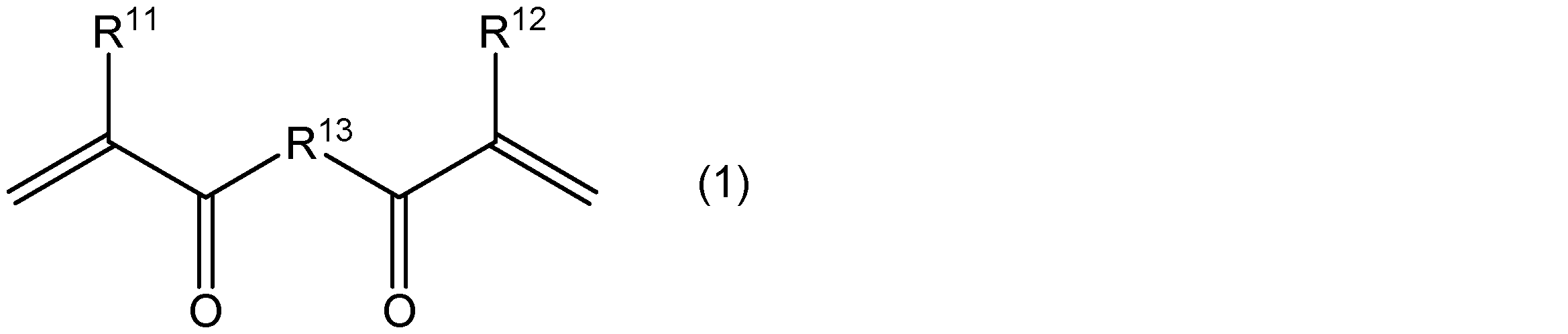
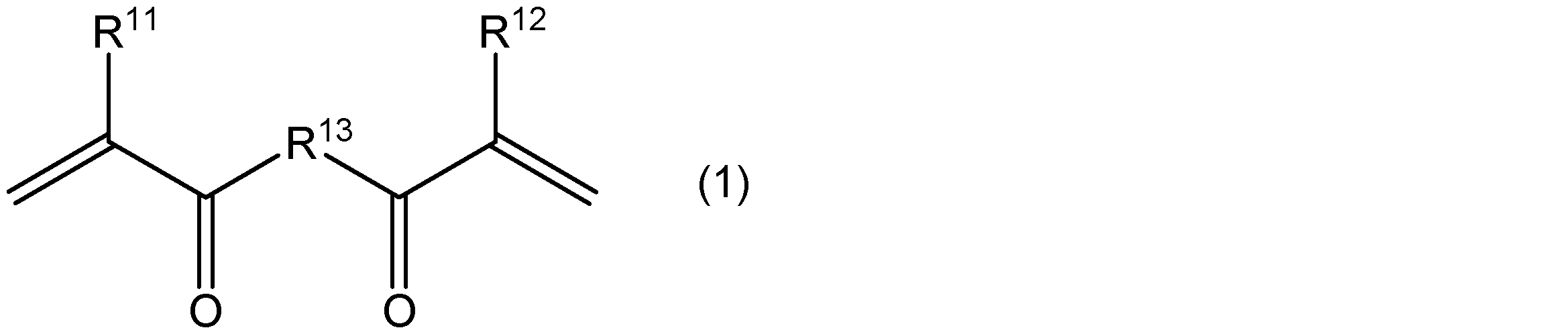
- the curable composition contains a compound represented by the following formula (1) and a polymerization initiator.
- R 11 and R 12 each independently represent a hydrogen atom or a methyl group
- R 13 represents a divalent group having a polyoxyalkylene chain.
- R 11 and R 12 may be a hydrogen atom and the other may be a methyl group, and in another embodiment, both R 11 and R 12 may be hydrogen atoms. In another embodiment, both R 11 and R 12 may be methyl groups.
- the polyoxyalkylene chain is represented by, for example, the following formula (1-1).
- R 14 represents an alkylene group
- m represents an integer of 2 or more
- * represents a bond.
- the alkylene group represented by R 14 may be linear or branched.
- R 14 may be, for example, an alkylene group having 2 to 4 carbon atoms.
- a plurality of R 14s present in the polyoxyalkylene chain may be the same as each other or may be different from each other.
- a plurality of R 14s present in the polyoxyalkylene chain are one or more selected from the group consisting of an ethylene group, a propylene group and a butylene group, and more preferably selected from the group consisting of an ethylene group and a propylene group. It is one or two kinds, more preferably all ethylene groups.
- M may be, for example, an integer of 10 or more or 20 or more, and may be an integer of 300 or less, 250 or less, or 200 or less.
- m may be an integer such that the molecular weight of the compound represented by the formula (1) is, for example, 1000 or more, and from the viewpoint of obtaining a heat storage material having a further excellent heat storage amount, the formula (1) is preferable.
- the molecular weight of the represented compound is an integer such that it is 2000 or more, 3000 or more, 4000 or more, 5000 or more, 6000 or more, or 7000 or more.
- m may be an integer such that the molecular weight of the compound represented by the formula (1) is 12000 or less, 11000 or less, or 10000 or less.
- R 13 may be a divalent group having other organic groups in addition to the polyoxyalkylene chain.
- Other organic groups may be polyoxyalkylene chain non-chain groups, for example, methylene chain (-CH 2 - chain to the structural units), containing polyester chain (-COO- into the structural unit Chain), polyurethane chain (chain containing —OCON— in the structural unit) and the like.
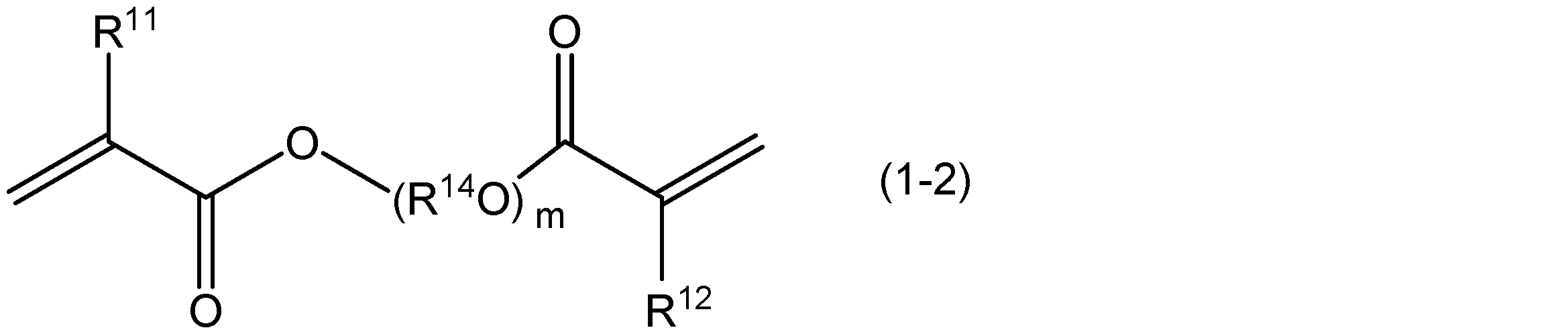
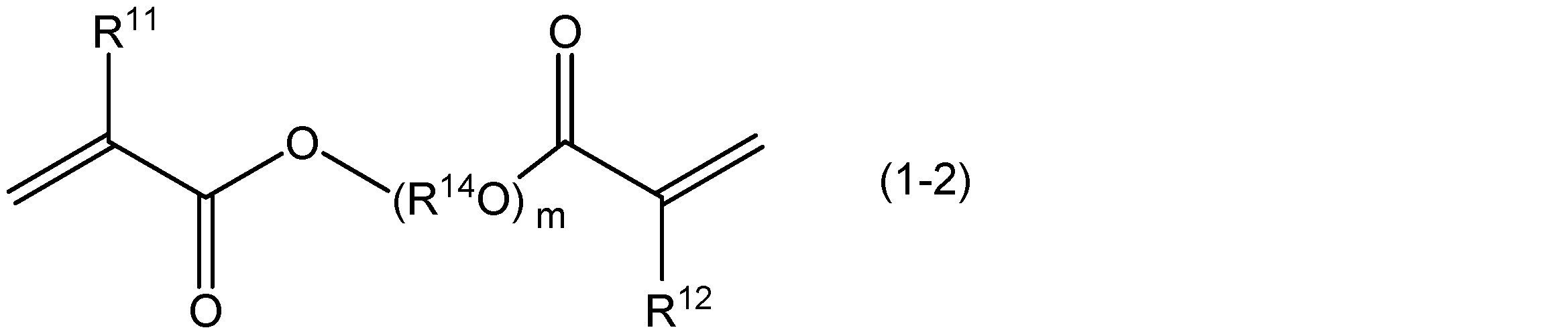
- the compound represented by the formula (1) is preferably a compound represented by the following formula (1-2).
- R 11 and R 12 have the same meanings respectively as R 11 and R 12 in the formula (1)
- R 14 and m are respectively and R 14 and m synonymous in the formula (1-1) is there.
- the weight average molecular weight (Mw) of the compound represented by the formula (1) may be, for example, 1000 or more, and is preferably 2000 or more, 3000 or more, 4000 or more from the viewpoint of obtaining a heat storage material having a further excellent heat storage amount. More than 5000, more than 6000, or more than 7000.
- the weight average molecular weight (Mw) of the compound represented by the formula (1) may be 12000 or less, 11000 or less, or 10000 or less.
- the curable composition may contain one compound represented by the above formula (1) having Mw, or may contain two or more compounds represented by the formula (1) having different Mw. .. In the latter case, when the Mw of the compound represented by the formula (1) is measured by the method described above, the obtained molecular weight distribution corresponds to the Mw of each of two or more compounds represented by the formula (1). One or more peaks are observed.
- the curable composition preferably contains at least one compound (referred to as compound (1A)) having Mw of 2000 or more from the viewpoint of obtaining a heat storage material having a further excellent heat storage amount.
- compound (1A) at least one compound having Mw of 2000 or more from the viewpoint of obtaining a heat storage material having a further excellent heat storage amount.
- compound (1B) at least one of the compound represented by the formula (1) having a Mw of less than 2000 (referred to as compound (1B)) may be contained.
- the Mw of compound (1A) is more preferably 3000 or more and 4000 or more, 5000 or more, 6000 or more, or 7000 or more, and may be, for example, 12000 or less, 11000 or less, or 10000 or less.
- the Mw of compound (1B) may be, for example, 1000 or more, and may be 1500 or less.
- the content of the compound represented by the formula (1) may be, for example, 1% by mass or more, 2% by mass or more, or 5% by mass or more based on the total amount of the curable composition, and the curable composition. From the viewpoint of obtaining a heat storage material having excellent flexibility of the cured product and a further excellent heat storage amount, it is preferably 10% by mass or more, 15% by mass or more, or 20% by mass or more, and more preferably 25% by mass. As mentioned above, it is 30% by mass or more, 35% by mass or more, or 40% by mass or more.
- the cured product of the curable composition has excellent flexibility, for example, the cured product can be bent and used, so that the cured product is more suitable as a heat storage material that can be applied to a wider range of applications.
- the content of the compound represented by the formula (1) is, for example, 99% by mass or less, 90% by mass or less, 80% by mass or less, 70% by mass or less, 60% by mass or less, based on the total amount of the curable composition. Alternatively, it may be 50% by mass or less.
- the curable composition contains two or more compounds represented by the formula (1), the total amount thereof may be in the above range.
- the curable composition contains the above compound (1A) and / or the above compound (1B)
- the total amount of the compound (1A) and the compound (1B) may be in the above range
- the compound (1A) and the compound The content of each of (1B) may be in the above range.
- the curable composition When the curable composition further contains a compound copolymerizable with the compound represented by the formula (1) in addition to the compound represented by the formula (1) (details will be described later), the curable composition is represented by the formula (1).
- the content of the compound is the sum of the content of the compound represented by the formula (1) and the content of the compound copolymerizable with the compound represented by the formula (1) (hereinafter, "containing of a polymerizable component"). 1 part by mass or more, 2 parts by mass or more, or 5 parts by mass or more with respect to 100 parts by mass (referred to as "total amount"), and the cured product of the curable composition has excellent flexibility and a further excellent heat storage amount.
- the heat storage material having the above is preferably 10 parts by mass or more or 15 parts by mass or more, and more preferably 20 parts by mass or more, 25 parts by mass or more, 30 parts by mass or more, or 35 parts by mass or more. Yes, more preferably 40 parts by mass or more.
- the content of the compound represented by the formula (1) is, for example, 99 parts by mass or less, 90 parts by mass or less, 80 parts by mass or less, 70 parts by mass or less with respect to the total content of the polymerizable component of 100 parts by mass. , 60 parts by mass or less, or 50 parts by mass or less.
- the polymerization initiator is a compound that can initiate polymerization of a compound represented by the formula (1) and a compound represented by the formula (1) used as necessary (details will be described later). There are no particular restrictions.
- the polymerization initiator may be, for example, a thermal polymerization initiator that generates radicals by heat, a photopolymerization initiator that generates radicals by light, or the like.
- the curable composition contains a thermal polymerization initiator
- a cured product of the curable composition can be obtained by applying heat to the curable composition.
- the curable composition may be a curable composition that is cured by heating at preferably 105 ° C. or higher, more preferably 110 ° C. or higher, still more preferably 115 ° C. or higher, and for example, 200 ° C. or lower. It may be a curable composition that is cured by heating at 190 ° C. or lower, or 180 ° C. or lower.
- the heating time for heating the curable composition may be appropriately selected according to the composition of the curable composition so that the curable composition is suitably cured.
- thermal polymerization initiator examples include azo compounds such as azobisisobutyronitrile, azobis-4-methoxy-2,4-dimethylvaleronitrile, azobiscyclohexanone-1-carbonitrile, and azodibenzoyl, benzoyl peroxide, and excess. Lauroyl oxide, di-t-butylperoxyhexahydroterephthalate, t-butylperoxy-2-ethylhexanoate, 1,1-t-butylperoxy-3,3,5-trimethylcyclohexane, t-butylperoxy Examples thereof include organic peroxides such as isopropyl carbonate.
- the thermal polymerization initiator may be used alone or in combination of two or more.
- the curable composition contains a photopolymerization initiator
- the curable composition is formed by irradiating the curable composition with light (for example, light containing at least a part of wavelengths of 200 to 400 nm (ultraviolet light)).
- light for example, light containing at least a part of wavelengths of 200 to 400 nm (ultraviolet light)
- a cured product of the product can be obtained.
- the light irradiation conditions may be appropriately set depending on the type of photopolymerization initiator.
- the photopolymerization initiator examples include a benzoin ether-based photopolymerization initiator, an acetophenone-based photopolymerization initiator, an ⁇ -ketol-based photopolymerization initiator, an aromatic sulfonyl chloride-based photopolymerization initiator, and a photoactive oxime-based photopolymerization initiator.
- Benzoin-based photopolymerization initiator Benzyl-based photopolymerization initiator, benzophenone-based photopolymerization initiator, Ketal-based photopolymerization initiator, thioxanthone-based photopolymerization initiator, acylphosphine oxide-based photopolymerization initiator, and the like. ..
- benzoin ether-based photopolymerization initiator examples include benzoin methyl ether, benzoin ethyl ether, benzoin propyl ether, benzoin isopropyl ether, benzoin isobutyl ether, and 2,2-dimethoxy-1,2-diphenylethane-1-one (trade name:). Irgacure 651, manufactured by BASF), anisole methyl ether and the like.
- acetophenone-based photopolymerization initiator examples include 1-hydroxycyclohexylphenyl ketone (trade name: Irgacure 184, manufactured by BASF), 4-phenoxydichloroacetophenone, 4-t-butyl-dichloroacetophenone, 1- [4- (2- (2-). Hydroxyethoxy) -phenyl] -2-hydroxy-2-methyl-1-propane-1-one (trade name: Irgacure 2959, manufactured by BASF), 2-hydroxy-2-methyl-1-phenyl-propane-1-one On (trade name: Irgacure 1173, manufactured by BASF), methoxyacetophenone and the like can be mentioned.
- Examples of the ⁇ -ketol-based photopolymerization initiator include 2-methyl-2-hydroxypropiophenone, 1- [4- (2-hydroxyethyl) -phenyl] -2-hydroxy-2-methylpropan-1-one, etc. Can be mentioned.
- Examples of the aromatic sulfonyl chloride-based photopolymerization initiator include 2-naphthalene sulfonyl chloride and the like.
- Examples of the photoactive oxime-based photopolymerization initiator include 1-phenyl-1,1-propanedione-2- (o-ethoxycarbonyl) -oxime.
- Examples of the benzoin-based photopolymerization initiator include benzoin and the like.
- Examples of the benzyl-based photopolymerization initiator include benzyl and the like.
- Examples of the benzophenone-based photopolymerization initiator include benzophenone, benzoylbenzoic acid, 3,3'-dimethyl-4-methoxybenzophenone, polyvinylbenzophenone, ⁇ -hydroxycyclohexylphenyl ketone and the like.
- Examples of the ketal-based photopolymerization initiator include benzyldimethyl ketal and the like.
- Examples of the thioxanthone-based photopolymerization initiator include thioxanthone, 2-chlorothioxanthone, 2-methylthioxanthone, 2,4-dimethylthioxanthone, isopropylthioxanthone, 2,4-dichlorothioxanthone, 2,4-diethylthioxanthone, isopropylthioxanthone, 2, Examples thereof include 4-diisopropylthioxanthone and dodecylthioxanthone.
- acylphosphine-based photopolymerization initiator examples include bis (2,6-dimethoxybenzoyl) phenylphosphine oxide, bis (2,6-dimethoxybenzoyl) (2,4,4-trimethylpentyl) phosphine oxide, and bis (2,).
- 6-Dimethoxybenzoyl) -n-butylphosphinoxide bis (2,6-dimethoxybenzoyl)-(2-methylpropan-1-yl) phosphine oxide, bis (2,6-dimethoxybenzoyl)-(1-methylpropane -1-yl) phosphine oxide, bis (2,6-dimethoxybenzoyl) -t-butylphosphine oxide, bis (2,6-dimethoxybenzoyl) cyclohexylphosphine oxide, bis (2,6-dimethoxybenzoyl) octylphosphine oxide, Bis (2-methoxybenzoyl) (2-methylpropan-1-yl) phosphine oxide, bis (2-methoxybenzoyl) (1-methylpropan-1-yl) phosphine oxide, bis (2,6-diethoxybenzoyl) (2-Methylpropan-1-yl) phos
- the above-mentioned photopolymerization initiator may be used alone or in combination of two or more.
- the content of the polymerization initiator is preferably 0.01 part by mass or more, more preferably 0.02 part by mass or more, based on 100 parts by mass of the total content of the polymerizable component from the viewpoint of suitably advancing the polymerization. , More preferably 0.05 parts by mass or more.
- the content of the polymerization initiator is such that the molecular weight of the polymer in the cured product of the curable composition is in a suitable range, the decomposition products are suppressed, and suitable adhesive strength can be obtained when used as a heat storage material.
- it is preferably 10 parts by mass or less, more preferably 5 parts by mass or less, still more preferably 3 parts by mass or less, and particularly preferably 1 part by mass or less, based on 100 parts by mass of the total content of the polymerizable component.
- the curable composition may further contain a compound copolymerizable with the compound represented by the formula (1).
- the copolymerizable compound has, for example, a group having an ethylenically unsaturated bond (ethylenically unsaturated group). Examples of the ethylenically unsaturated group include a (meth) acryloyl group, a vinyl group, an allyl group and the like.
- the copolymerizable compound is preferably a compound having a (meth) acryloyl group.
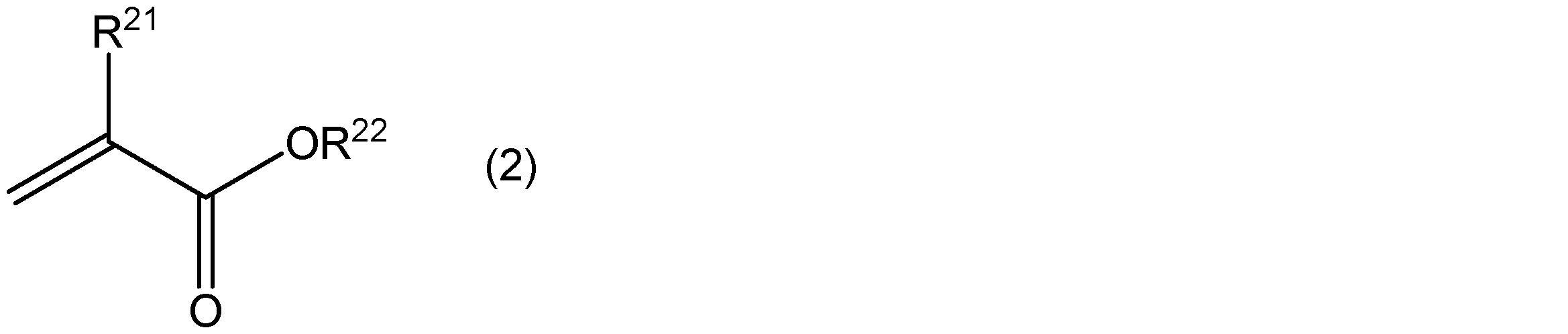
- the curable composition further contains a compound represented by the following formula (2) as the copolymerizable compound from the viewpoint of obtaining a heat storage material having a further excellent heat storage amount.
- R 21 represents a hydrogen atom or a methyl group
- R 22 represents a monovalent group having a polyoxyalkylene chain.
- R 22 may be, for example, a group represented by the following formula (2-1).
- R 23 represents an alkylene group
- R 24 represents a hydrogen atom or an alkyl group
- n represents an integer of 2 or more
- * represents a bond.
- the alkyl group represented by R 23 may be linear or branched.
- R 23 may be, for example, an alkylene group having 2 to 4 carbon atoms.
- R 23 is more present in the polyoxyalkylene chain may be identical to each other, may be different from each other.
- the polyoxyalkylene chain preferably has one or more selected from the group consisting of an oxyethylene group, an oxypropylene group and an oxybutylene group, and more preferably from an oxyethylene group and an oxypropylene group. It has one or two kinds selected from the above group, and more preferably has only an oxyethylene group.
- the alkyl group represented by R 24 may be linear or branched.
- the alkyl group preferably has 1 to 15, more preferably 1 to 10, and even more preferably 1 to 5.
- R 24 is particularly preferably a hydrogen atom or a methyl group.
- N may be, for example, an integer of 10 or more or 20 or more, and may be an integer of 80 or less, 70 or less, or 60 or less.
- n is an integer such that the molecular weight of the compound represented by the formula (2) is preferably 800 or more, 900 or more, or 1000 or more from the viewpoint of obtaining a heat storage material having a further excellent heat storage amount. More preferably, it is an integer such that it is 1200 or more, 1400 or more, 1600 or more, 1800 or more, or 2000 or more.
- n may be an integer such that the molecular weight of the compound represented by the formula (2) is 5000 or less, 4000 or less, 3000 or less, or 2500 or less.
- the weight average molecular weight (Mw) of the compound represented by the formula (2) is preferably 800 or more, 900 or more, or 1000 or more, more preferably 1000 or more, from the viewpoint of obtaining a heat storage material having a further excellent heat storage amount. 1200 or more, 1400 or more, 1600 or more, 1800 or more, or 2000 or more.
- the weight average molecular weight (Mw) of the compound represented by the formula (2) may be 5000 or less, 4000 or less, 3000 or less, or 2500 or less.
- the content of the compound represented by the formula (2) may be, for example, 10 parts by mass or more, 20 parts by mass or more, or 30 parts by mass or more with respect to the total content of 100 parts by mass of the polymerizable component. From the viewpoint of obtaining a heat storage material having a further excellent heat storage amount, the amount is preferably 40 parts by mass or more, more preferably 50 parts by mass or more, still more preferably 60 parts by mass or more, and particularly preferably 70 parts by mass or more.
- the content of the compound represented by the formula (2) may be, for example, 98 parts by mass or less, 90 parts by mass or less, or 80 parts by mass or less with respect to the total content of the polymerizable component of 100 parts by mass. ..
- the curable composition is a formula from the viewpoint of adjusting the hardness of the cured product of the curable composition and from the viewpoint of easily dissolving the polymerization initiator in the curable composition when the polymerization initiator is a solid.
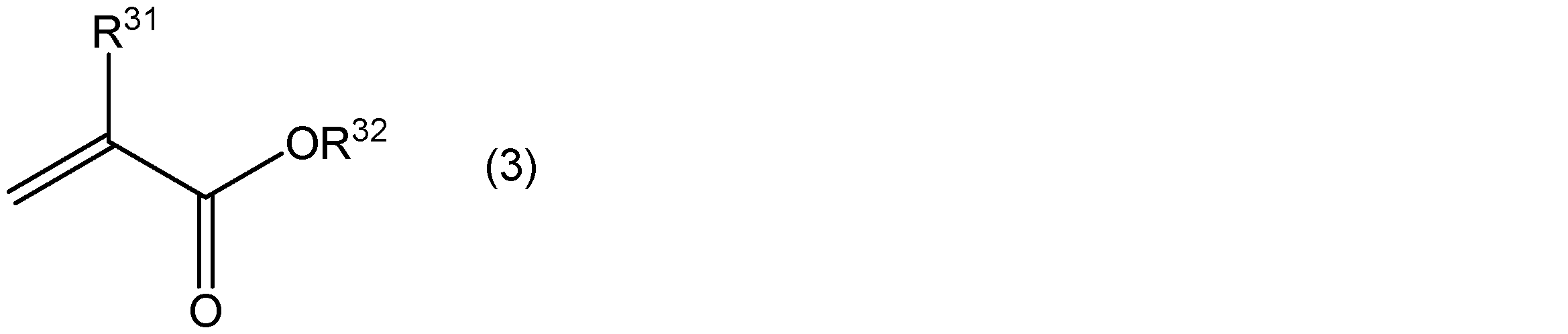
- a compound that can be copolymerized with the compound represented by (1) a compound represented by the following formula (3) may be further contained.
- R 31 represents a hydrogen atom or a methyl group
- R 32 represents an alkyl group.
- the alkyl group represented by R 32 may be linear or branched.
- the number of carbon atoms of the alkyl group may be, for example, 1 to 30.
- the alkyl group may have 1 to 11, 1 to 8, 1 to 6, or 1 to 4, and may have 12 to 30, 12 to 28, 12 to 24, 12 to 22, 12 to 18, or 12 carbon atoms. It may be up to 14.
- the content of the compound represented by the formula (3) is, for example, 0.5 parts by mass or more, 1 part by mass or more, or 1.5 parts by mass or more with respect to 100 parts by mass of the total content of the polymerizable component. It may be 10 parts by mass or less, 8 parts by mass or less, or 6 parts by mass or less.
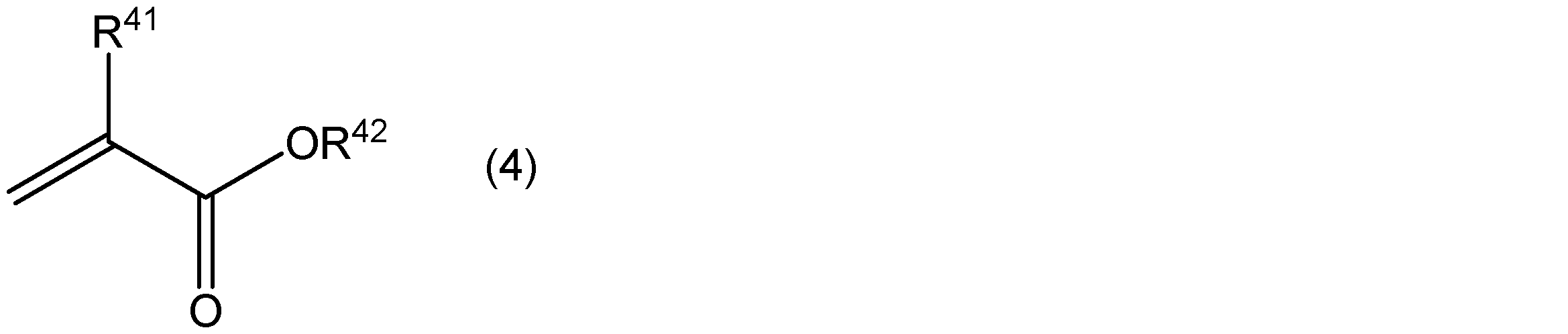
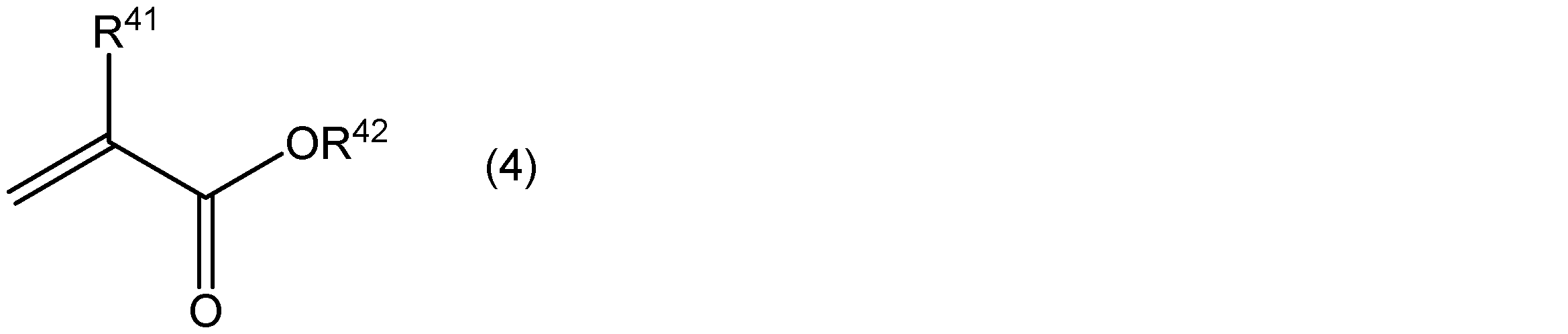
- the curable composition may further contain a compound represented by the following formula (4) as a compound copolymerizable with the compound represented by the formula (1).
- R 41 represents a hydrogen atom or a methyl group
- R 42 represents a monovalent group having a reactive group.
- the curable composition further contains the compound represented by the formula (4), the compound represented by the formula (1) and the compound represented by the formula (4) (further represented by the formula (1)).
- the reactive group contained in the compound represented by the formula (4) is reacted with a curing agent described later to further cure the curable composition. Can be made to.
- the reactive group represented by R 42 is a group capable of reacting with a curing agent described later, and is, for example, at least one group selected from the group consisting of a carboxyl group, a hydroxyl group, an isocyanate group, an amino group and an epoxy group.
- the compound represented by the formula (4) is, for example, a carboxyl group-containing compound, a hydroxyl group-containing compound, an isocyanate group-containing compound, an amino group-containing compound, or an epoxy group-containing compound.
- carboxyl group-containing compound examples include (meth) acrylic acid, carboxyethyl (meth) acrylate, carboxypentyl (meth) acrylate, itaconic acid, maleic acid, fumaric acid, crotonic acid, and isocrotonic acid.
- hydroxyl group-containing compound examples include 2-hydroxyethyl (meth) acrylate, 3-hydroxypropyl (meth) acrylate, 4-hydroxybutyl (meth) acrylate, 6-hydroxyhexyl (meth) acrylate, and 8-hydroxyoctyl ( Hydroxyalkyl (meth) acrylates such as meta) acrylates, 10-hydroxydecyl (meth) acrylates, 12-hydroxylauryl (meth) acrylates; hydroxyalkylcycloalkanes such as (4-hydroxymethylcyclohexyl) methyl (meth) acrylates Examples include (meth) acrylate.
- the hydroxyl group-containing compound may be hydroxyethyl (meth) acrylamide, allyl alcohol, 2-hydroxyethyl vinyl ether, 4-hydroxybutyl vinyl ether, diethylene glycol monovinyl ether and the like.
- Examples of the isocyanate group-containing compound include 2-methacryloyloxyethyl isocyanate and 2-acryloyloxyethyl isocyanate.
- the isocyanate group in the isocyanate group-containing compound may be blocked (protected) by a blocking agent (protecting group) that can be desorbed by heat. That is, the isocyanate group-containing compound may be a compound having a blocked isocyanate group represented by the following formula (4-1). In the formula, B represents a protecting group and * represents a bond.
- the protecting group in the blocked isocyanate group may be a protecting group that can be desorbed (deprotected) by heating (for example, heating at 80 to 160 ° C.).
- a substitution reaction between the blocking agent (protecting group) and the curing agent described later can occur under deprotection conditions (for example, heating conditions of 80 to 160 ° C.).
- an isocyanate group is generated by deprotection, and the isocyanate group can react with a curing agent described later.
- Examples of the blocking agent in the blocked isocyanate group include oxime compounds such as formaldehyde, acetoaldoxime, acetooxime, methylethylketooxime and cyclohexanone oxime; pyrazole compounds such as pyrazole, 3-methylpyrazole and 3,5-dimethylpyrazole; ⁇ - Lactam compounds such as caprolactam, ⁇ -valerolactam, ⁇ -butyrolactam and ⁇ -propiolactam; mercaptan compounds such as thiophenol, methylthiophenol and ethylthiophenol; acid amide compounds such as acetate and benzamide; imide succinate and malein Examples thereof include imide compounds such as acid imide.
- oxime compounds such as formaldehyde, acetoaldoxime, acetooxime, methylethylketooxime and cyclohexanone oxime
- pyrazole compounds such as pyrazole, 3-methyl
- Examples of the compound having a blocked isocyanate group include 2-[(3,5-dimethylpyrazolyl) carbonylamino] ethyl methacrylate and 2- (0- [1'-methylpropylideneamino] carboxyamino) methacrylate.
- amino group-containing compound examples include N, N-dimethylaminoethyl (meth) acrylate, N, N-diethylaminoethyl (meth) acrylate, N, N-dimethylaminopropyl (meth) acrylate, and N, N-diethylaminopropyl.
- examples include (meth) acrylate.
- Examples of the epoxy group-containing compound include glycidyl (meth) acrylate, glycidyl ⁇ -ethyl (meth) acrylate, glycidyl ⁇ -n-propyl (meth) acrylate, and glycidyl ⁇ -n-butyl (meth) acrylate.
- the content of the compound represented by the formula (4) is, for example, 0.5 parts by mass or more, 1 part by mass or more, or 1.5 parts by mass or more with respect to 100 parts by mass of the total content of the polymerizable component. It may be 10 parts by mass or less, 8 parts by mass or less, or 5 parts by mass or less.
- the total content of the polymerizable component is 30% by mass or more, 40% by mass or more, 50% by mass or more, 60% by mass or more, 70% by mass or more, 80% by mass or more, or 90% based on the total amount of the curable composition. It may be 99.9% by mass or less, and may be 99.9% by mass or less.
- the curable composition when the curable composition contains a compound represented by the formula (4), the curable composition preferably further contains a curing agent.
- the curing agent is a compound capable of reacting with a reactive group contained in the compound represented by the formula (4).
- the curing agent examples include isocyanate-based curing agents, phenol-based curing agents, amine-based curing agents, imidazole-based curing agents, acid anhydride-based curing agents, and carboxylic acid-based curing agents. These curing agents are appropriately selected as one type alone or as a combination of two or more types, depending on the type of the reactive group contained in the compound represented by the formula (4). For example, when the reactive group is an epoxy group, the curing agent is preferably a phenolic curing agent or an imidazole-based curing agent.
- isocyanate-based curing agent examples include tolylene diisocyanate (2,4- or 2,6-tolylene diisocyanate or a mixture thereof) (TDI), phenylenediocyanate (m- or p-phenylenediocyanate, or a mixture thereof).
- TDI tolylene diisocyanate (2,4- or 2,6-tolylene diisocyanate or a mixture thereof)
- phenylenediocyanate m- or p-phenylenediocyanate, or a mixture thereof.
- 4,4'-diphenyldiisocyanis 1,5-naphthalenediis diisocyanis (NDI), diphenylmethane diisocyanate (4,4'-, 2,4'-or 2,2'-diphenylmethane diisocyanate, or a mixture thereof) (MDI), 4 , 4'-toluidine diisocyanis (TODI), 4,4'-diphenyl ether diisocyanate, xylylene diisocyanate (1,3- or 1,4-xylylene diisocyanate or a mixture thereof) (XDI), tetramethylxylylene diisocyanate (1) , 3- Or 1,4-tetramethylxylylene diisocyanate, or a mixture thereof) (TMXDI), ⁇ , ⁇ '-diisocyanate-1,4-diisocyanate, and other aromatic diisocyanates.
- NDI 1,5-naphthalenediis diisocyanis
- isocyanate-based curing agent examples include trimethylene diisocyanate, 1,2-propylene diisocyanate, butylene diisocyanate (tetramethylene diisocyanate, 1,2-butylene diisocyanate, 2,3-butylene diisocyanate, 1,3-butylene diisocyanate), 1,5.
- An aliphatic diisocyanate such as -pentamethylene diisocyanate (PDI), 1,6-hexamethylene diisocyanate (HDI), 2,4,4- or 2,2,4-trimethylhexamethylene diisocyanate, 2,6-diisocyanate methylcapate.
- phenolic curing agent examples include bisphenol A, bisphenol F, bisphenol S, 4,4'-biphenylphenol, tetramethylbisphenol A, dimethylbisphenol A, tetramethylbisphenol F, dimethylbisphenol F, tetramethylbisphenol S, and dimethyl.
- Bisphenol S tetramethyl-4,4'-biphenol, dimethyl-4,4'-biphenylphenol, 1- (4-hydroxyphenyl) -2- [4- (1,1-bis- (4-hydroxyphenyl)) Ethyl) phenyl] propane, 2,2'-methylene-bis (4-methyl-6-tert-butylphenol), 4,4'-butylidene-bis (3-methyl-6-tert-butylphenol), trishydroxyphenylmethane , Resolsinol, hydroquinone, pyrogallol, phenol compound having diisopropyridene skeleton; phenol compound having fluorene skeleton such as 1,1-di-4-hydroxyphenylfluorene; cresol compound; ethylphenol compound; butylphenol compound; octylphenol compound; bisphenol Novolac resin made from various phenols such as A, bisphenol F, bisphenol S, naphthol compound, xylylene
- amine-based curing agent examples include aromatics such as diaminodiphenylmethane, diaminodiphenylsulphon, diaminodiphenyl ether, p-phenylenediamine, m-phenylenediamine, o-phenylenediamine, 1,5-diaminonaphthalene, and m-xylylene diamine.
- aromatics such as diaminodiphenylmethane, diaminodiphenylsulphon, diaminodiphenyl ether, p-phenylenediamine, m-phenylenediamine, o-phenylenediamine, 1,5-diaminonaphthalene, and m-xylylene diamine.
- Aliphatic amines such as amines, ethylenediamines, diethylenediamines, hexamethylenediamines, isophoronediamines, bis (4-amino-3-methyldicyclohe
- imidazole-based curing agent examples include 2-methylimidazole, 2-ethyl-4-methylimidazole, 2-phenylimidazole, 2-undecylimidazole, 2-heptadecylimidazole, 2-phenyl-4-methylimidazole, 1 -Benzyl-2-phenylimidazole, 1-benzyl-2-methylimidazole, 1-cyanoethyl-2-methylimidazole, 1-cyanoethyl-2-phenylimidazole, 1-cyanoethyl-2-undecylimidazole, 2,3-dihydro -1H-pyrrolo- [1,2-a] benzimidazole, 2,4-diamino-6 (2'-methylimidazole (1')) ethyl-s-triazine, 2,4-diamino-6 (2'- Undecylimidazole (1')) ethyl-s-triazine
- acid anhydride-based curing agent examples include phthalic anhydride, trimellitic anhydride, pyromellitic anhydride, benzophenone tetracarboxylic acid anhydride, ethylene glycol trimellitic anhydride, biphenyltetracarboxylic acid anhydride and the like.
- Aromatic carboxylic acid anhydrides include anhydrides of aliphatic carboxylic acids such as azelaic acid, sebacic acid, dodecanedic acid, tetrahydrophthalic anhydride, hexahydrophthalic anhydride, nadic acid anhydride, het acid anhydride, Examples thereof include alicyclic carboxylic acid anhydrides such as hymic acid anhydrides.
- carboxylic acid-based curing agent examples include succinic acid, glutaric acid, adipic acid, sebacic acid, phthalic acid, isophthalic acid, and terephthalic acid.
- the content of the curing agent may be 0.01% by mass or more, 10% by mass or less, 5% by mass or less, or 1% by mass or less based on the total amount of the curable composition.
- the curable composition preferably further contains a heat storage component from the viewpoint of obtaining a heat storage material having a further excellent heat storage amount.
- the heat storage component is less likely to exude from the cured product of the curable composition when used in combination with the compound represented by the formula (1), and is preferably poly from the viewpoint of obtaining a heat storage material having a particularly excellent heat storage amount.
- the polyalkylene glycol may be, for example, polyethylene glycol, polypropylene glycol, polybutylene glycol, etc., and is preferably polyethylene glycol.
- the weight average molecular weight (Mw) of the polyalkylene glycol may be 800 or more, 900 or more, or 1000 or more, and may be 2000 or less, 1900 or less, or 1800 or less.
- the melting point of the polyalkylene glycol is determined from the viewpoint that the cured product of the curable composition can be suitably used as a heat storage material. It is preferable that it is close to the melting point of the compound represented by 2).
- the absolute value of the difference between the melting point of the polyalkylene glycol and the melting point of the compound represented by the formula (2) is preferably 20 ° C. or lower, more preferably 15 ° C. or lower, still more preferably 10 ° C. or lower.
- the melting point of the compound represented by the formula (2) and the melting point of the polyalkylene glycol are measured as follows. Using a differential scanning calorimeter (for example, PerkinElmer, model number DSC8500), the temperature is raised to 100 ° C at 20 ° C / min, held at 100 ° C for 3 minutes, and then -30 at a rate of 10 ° C / min. The temperature is lowered to ° C., then held at ⁇ 30 ° C. for 3 minutes, and then raised again to 100 ° C. at a rate of 10 ° C./min. The thermal behavior is measured by this, and the melting peak is calculated as the melting point.
- a differential scanning calorimeter for example, PerkinElmer, model number DSC8500
- the content of the polyalkylene glycol may be 10 parts by mass or more, 20 parts by mass or more, or 30 parts by mass or more with respect to 100 parts by mass in total of the content of the polymerizable component, and has a further excellent heat storage amount. From the viewpoint of obtaining the material, it is preferably 40 parts by mass or more, more preferably 50 parts by mass or more, still more preferably 60 parts by mass or more, 70 parts by mass or more, 80 parts by mass or more, 90 parts by mass or more, 100 parts by mass. It may be 10 parts or more, 150 parts by mass or more, 200 parts by mass or more, or 300 parts by mass or more.
- the content of polyalkylene glycol is 500 parts by mass or less, 400 parts by mass or less, 300 parts by mass or less, 200 parts by mass or less, 150 parts by mass or less, 120 parts by mass with respect to 100 parts by mass of the total content of the polymerizable component.
- it may be 110 parts by mass or less, or 100 parts by mass or less, and from the viewpoint of excellent flexibility of the cured product of the curable composition, it is preferably 90 parts by mass or less, more preferably 80 parts by mass or less, still more preferably.
- the heat storage component may be contained in the curable composition as a heat storage capsule contained in the capsule.
- the heat storage capsule has a heat storage component and an outer shell (shell) containing the heat storage component.
- the heat storage component in the heat storage capsule may be the polyalkylene glycol described above, or may be another heat storage component.
- the other heat storage component for example, one having a phase transition temperature suitable for the target temperature according to the purpose of use is appropriately selected.
- the other heat storage component has a solid phase / liquid phase transition point (melting point) showing a solid phase / liquid phase transition at, for example, ⁇ 30 to 120 ° C. from the viewpoint of obtaining a heat storage effect in a practical range.
- the other heat-storing component may be, for example, a chain-shaped (linear or branched (branched chain)) saturated hydrocarbon compound (paraffin-based hydrocarbon compound), natural wax, petroleum wax, sugar alcohol, or the like. ..
- the other heat storage component is preferably a chain saturated hydrocarbon compound (paraffin-based hydrocarbon compound) from the viewpoint of being inexpensive, having low toxicity, and easily selecting a compound having a desired phase transition temperature.
- the chain saturated hydrocarbon compound includes n-decane (C10 (carbon number, the same applies hereinafter), -29 ° C (transition point (melting point), the same applies hereinafter)), n-undecane (C11, -25).
- n-dodecane C12, -9 ° C
- n-tridecane C13, -5 ° C
- n-tetradecane C14, 6 ° C
- n-pentadecane C15, 9 ° C
- n-hexadecane C16
- n-heptadecane C17, 21 ° C
- n-octadecane C18, 28 ° C
- n-nanodecane C19, 32 ° C
- n-eicosane C20, 37 ° C
- n-henicosan C21) , 41 ° C
- n-docosane C22, 46 ° C
- n-tricosane C23, 47 ° C
- n-tetracosane C24, 50 ° C
- n-pentacosane C25, 54 ° C
- the outer shell (shell) containing the heat storage component is preferably formed of a material having a heat resistant temperature sufficiently higher than the transition point (melting point) of the heat storage component.
- the material forming the outer shell has a heat resistant temperature of, for example, 30 ° C. or higher, preferably 50 ° C. or higher, with respect to the transition point (melting point) of the heat storage component.
- the heat-resistant temperature is defined as the temperature at which the weight loss of the capsule is measured by 1% when the weight loss of the capsule is measured using a differential thermogravimetric simultaneous measuring device (for example, TG-DTA6300 (manufactured by Hitachi High-Tech Science Co., Ltd.)). Will be done.
- the outer shell is preferably made of melamine resin, acrylic resin, urethane resin, silica or the like.
- microcapsules having an outer shell containing melamine resin include BA410xxP, 6C, BA410xxP, 18C, BA410xxP, 37C manufactured by Outlast Technology, and ThermoMemory FP-16, FP-25, and FP manufactured by Mitsubishi Paper Mills Limited. -31, FP-39, Riken Resin PMCD-15SP, 25SP, 32SP, etc. manufactured by Miki Riken Kogyo Co., Ltd. are exemplified.
- microcapsules having an outer shell containing an acrylic resin include Micronal DS5001X and 5040X manufactured by BASF.
- microcapsules having an outer shell containing silica include Liken Resins LA-15, LA-25, LA-32 and the like manufactured by Miki Riken Kogyo Co., Ltd.
- the content of the heat storage component in the heat storage capsule is preferably 20% by mass or more, more preferably 60% by mass or more, based on the total amount of the heat storage capsule, from the viewpoint of further enhancing the heat storage effect. From the viewpoint of suppressing the breakage of the capsule due to the volume change, it is preferably 80% by mass or less.
- the heat storage capsule may further contain graphite, metal powder, alcohol, etc. in the outer shell for the purpose of adjusting the thermal conductivity, specific gravity, etc. of the capsule.
- the particle size (average particle size) of the heat storage capsule is preferably 0.1 ⁇ m or more, more preferably 0.2 ⁇ m or more, still more preferably 0.5 ⁇ m or more, preferably 100 ⁇ m or less, and more preferably 50 ⁇ m or less. ..
- the particle size (average particle size) of the heat-storing capsule is measured using a laser diffraction type particle size distribution measuring device (for example, SALD-2300 (manufactured by Shimadzu Corporation)).
- the content of the heat storage capsule is preferably 20% by mass or more, more preferably 30% by mass or more, still more preferably 40% by mass or more, based on the total amount of the curable composition, from the viewpoint of further enhancing the heat storage effect.
- the content of the heat storage capsule is preferably 90% by mass or less, more preferably 85% by mass or less, based on the total amount of the curable composition, from the viewpoint of suppressing the heat storage capsule from falling off from the cured product of the curable composition. More preferably, it is 80% by mass or less.
- the curable composition preferably further contains an antioxidant from the viewpoint of improving the thermal reliability of the cured product (heat storage material) of the curable composition.
- the antioxidant may be, for example, a phenol-based antioxidant, a benzophenone-based antioxidant, a benzoate-based antioxidant, a hindered amine-based antioxidant, a benzotriazole-based antioxidant, or the like.
- the content of the antioxidant may be 0.1% by mass or more, 0.5% by mass or more, 0.8% by mass or more, or 1% by mass or more based on the total amount of the curable composition, and is 10% by mass. It may be less than or equal to 5% by mass or less, and from the viewpoint of excellent flexibility of the cured product of the curable composition, it is preferably 4% by mass or less, more preferably 3% by mass or less, still more preferably 2.5% by mass or less. , Particularly preferably 2% by mass or less.
- the curable composition can further contain other additives, if necessary.
- Other additives include, for example, surface treatment agents, curing accelerators, colorants, fillers, crystal nucleating agents, heat stabilizers, heat conductive materials, plasticizers, foaming agents, flame retardants, vibration damping agents, dehydrating agents, etc. Flame retardant aids (eg, metal oxides) and the like can be mentioned.
- Flame retardant aids eg, metal oxides
- Other additives may be used alone or in combination of two or more.
- the content of the other additives may be 0.1% by mass or more and 30% by mass or less based on the total amount of the curable composition.
- the curable composition may be liquid at 50 ° C.
- the curable composition can be easily provided by a method such as filling even between members having a complicated shape.
- the viscosity of the curable composition at 50 ° C. is preferably 100 Pa ⁇ s or less, more preferably 50 Pa ⁇ s or less, still more preferably 20 Pa ⁇ s or less, particularly preferably 20 Pa ⁇ s or less, from the viewpoint of excellent fluidity and handleability. It may be 10 Pa ⁇ s or less, for example 0.5 Pa ⁇ s or more.
- the viscosity of the curable composition means a value measured based on JIS Z8803, and specifically, it was measured by an E-type viscometer (for example, PE-80L manufactured by Toki Sangyo Co., Ltd.). Means a value.
- the calibration of the viscometer can be performed based on JIS Z 8809-JS14000.
- the compound represented by the formula (1) contained in the curable composition described above is a compound having a polyoxyalkylene chain and a (meth) acryloyl group, it is represented by the formula (1).
- the curable composition containing the compound and the polymerization initiator can be cured, and the obtained cured product can have an excellent amount of heat storage due to the polyoxyalkylene chain. Therefore, this curable composition is suitable as a curable composition for a heat storage material, and the cured product of the curable composition is preferably used as a heat storage material.
- the compound represented by the formula (1) has two (meth) acryloyl groups, a crosslinked structure is formed in the obtained cured product. Therefore, when the curable composition contains the heat storage component (particularly polyalkylene glycol) as described above, the crosslinked structure can suppress the exudation of the heat storage component from the cured product. Therefore, the degree of freedom of the heat storage component that can be used is increased, and as a result, the amount of heat storage can be further improved.
- the heat storage material according to one embodiment contains a cured product of the above-mentioned curable composition.
- FIG. 1 is a schematic cross-sectional view showing an embodiment of a heat storage material. As shown in FIG. 1A, the heat storage material 1A according to the embodiment is a sheet-like (or film-like) heat storage material provided with the heat storage layer 2 which is a cured product of the above-mentioned curable composition.
- the heat storage material 1B As shown in FIG. 1 (b), the heat storage material 1B according to the other embodiment has a heat storage layer 2 which is a cured product of the above-mentioned curable composition and an adhesive provided on one surface of the heat storage layer 2. It is a sheet-shaped (or film-shaped) heat storage material including the layer 3. In this case, the heat storage material 1B can be suitably adhered to the application target of the heat storage material 1B.
- the thickness of the heat storage layer 2 may be, for example, 0.01 mm or more, 0.05 mm or more, or 0.1 mm or more, and may be 20 mm or less, 10 mm or less, or 5 mm or less. ..
- the heat storage layer 2 may be a cured product in which the curable composition is completely cured, or may be a cured product in which the curable composition is B-staged (semi-cured). ..
- the heat storage layer 2 is preferably made of a curable composition from the viewpoint that the heat storage material 1A can be suitably adhered to the application target of the heat storage material 1A. It is a cured product that has been B-staged (semi-cured).
- the adhesive layer 3 may be composed of a known adhesive.
- the thickness of the adhesive layer 3 may be, for example, 0.001 mm or more, 0.003 mm or more, or 0.005 mm or more, and may be 0.03 mm or less, 0.02 mm or less, or 0.015 mm or less.
- the heat storage materials 1A and 1B can be used in various fields.
- the heat storage material 1 includes, for example, air conditioning equipment (improvement of efficiency of air conditioning equipment) in automobiles, buildings, public facilities, underground streets, etc., piping in factories (heat storage of piping), automobile engine (heat retention around the engine), and electronics. Used for parts (preventing temperature rise of electronic parts), fibers of underwear, etc.
- the heat storage layer 2 in the heat storage material 1A described above, or the heat storage layer 2 and the adhesive layer 3 in the heat storage material 1B may be provided on the support film. That is, the heat storage material according to the other embodiment may include a support film and a heat storage layer 2 provided on the support film.
- the heat storage material according to the other embodiment may include a support film, a heat storage layer 2 provided on the support film, and an adhesive layer 3 provided on the opposite side of the heat storage layer 2 from the support film.
- the heat storage material according to these embodiments may be, for example, in a state of being formed in a long shape and wound around a winding core along the longitudinal direction thereof (roll-shaped heat storage material).
- Supporting films include, for example, polyethylene terephthalate, polyethylene, polyvinylidene chloride, polyester, polypropylene, polyvinyl chloride, polycarbonate, polyacrylonitrile, polyether ether ketone, polyvinyl alcohol, ethylene-vinyl alcohol copolymer, polyimide, polyamideimide and the like. It may be made of a polymer.
- the thickness of the support film may be, for example, 1 ⁇ m or more, 2 ⁇ m or more, or 3 ⁇ m or more, and may be 15 ⁇ m or less, 10 ⁇ m or less, or 7 ⁇ m or less.
- FIG. 2 is a schematic cross-sectional view showing an embodiment of an article and a method for manufacturing the article.
- an electronic component 11A is prepared as an article to which a heat storage material is provided.
- the electronic component 11A includes, for example, a substrate 12 and a semiconductor chip (heat source) 13 provided on the substrate 12.
- the sheet-shaped heat storage material 1 is arranged on the substrate 12 and the semiconductor chip 13 so as to be in thermal contact with each of the substrate 12 and the semiconductor chip 13.
- the heat storage material 1 may be, for example, the heat storage material 1A shown in FIG. 1 (a) described above, or may be the heat storage material 1B shown in FIG. 1 (b) described above.
- the heat storage material 1B shown in FIG. 1B is used, the heat storage material 1B is arranged so that the adhesive layer 3 is in contact with the substrate 12 and the semiconductor chip 13.
- the heat storage layer in the heat storage material 1 is a cured product in which the curable composition is B-staged (semi-cured)
- the heat storage layer is cured after the heat storage material 1 is arranged. That is, the method for manufacturing an article of the present embodiment may further include a step of curing the heat storage layer of the heat storage material 1 arranged on the substrate 12 and the semiconductor chip 13.
- the article 14A including the substrate 12, the semiconductor chip 13, and the heat storage material 1 (cured product of the curable composition) provided on the substrate 12 and the semiconductor chip 13 can be obtained.
- the heat storage material 1 is arranged so as to cover the entire exposed surface of the heat source 13, but in the other embodiment, the heat storage material is arranged so as to cover a part of the exposed surface of the heat source. May be good.
- FIG. 3A is a schematic cross-sectional view showing another embodiment of the article.
- the heat storage material 1 comes into contact with (covers a part of) a part of the exposed surface of the semiconductor chip (heat source) 13, for example. It may be arranged.
- the place where the heat storage material 1 is arranged is a side surface portion of the semiconductor chip 13 in FIG. 3A, but is on any surface of the semiconductor chip 13. May be good.
- FIG. 3B is a schematic cross-sectional view showing another embodiment of the article.
- the heat storage material 1 is arranged on the surface of the substrate 12 opposite to the surface on which the semiconductor chip 13 is provided.
- the heat storage material 1 is not in direct contact with the semiconductor chip 13, but is in thermal contact with the semiconductor chip 13 via the substrate 12.
- the location where the heat storage material 1 is arranged may be on any surface of the substrate 12 as long as it is in thermal contact with the semiconductor chip 13. Even in this case, the heat generated by the heat source (semiconductor chip) 13 is efficiently conducted to the heat storage material 1 via the substrate 12 and is suitably stored in the heat storage material 1.
- the heat storage material 1 is in the form of a sheet, but in the production method according to the other embodiment, an article is produced using a liquid curable composition (the heat storage material is formed). ) Can also be done.
- FIG. 4 is a schematic cross-sectional view showing another embodiment of the method for manufacturing an article.
- the electronic component 11B is prepared as an article to which the heat storage material is provided.
- the electronic component 11B includes, for example, a substrate (for example, a circuit board) 12, a semiconductor chip (heat source) 13 provided on the substrate 12, and a plurality of connecting portions (for example, solder) 15 for connecting the semiconductor chip 13 to the substrate 12. It has.
- the plurality of connecting portions 15 are provided between the substrate 12 and the semiconductor chip 13 so as to be separated from each other. That is, there is a gap between the substrate 12 and the semiconductor chip 13 that separates the plurality of connecting portions 15.
- a syringe 16 is used to fill the curable composition 21 between the substrate 12 and the semiconductor chip 13.
- the curable composition 21 is a curable composition according to the above-described embodiment.
- the curable composition 21 may be in a completely uncured state, or may be in a partially cured state.
- the curable composition 21 When the curable composition 21 is in a liquid state at room temperature (for example, 25 ° C.), the curable composition 21 can be filled at room temperature. When the curable composition 21 is in a solid state at room temperature, the curable composition 21 can be heated (for example, 50 ° C. or higher) into a liquid state and then filled.
- the curable composition 21 fills the above-mentioned gap existing between the substrate 12 and the semiconductor chip 13 with the substrate. 12. Arranged so as to be in thermal contact with each of the semiconductor chip 13 and the connecting portion 15.
- the cured product (heat storage) of the curable composition is formed in the above gap existing between the substrate 12 and the semiconductor chip 13.
- a layer or a heat storage material) 22 is formed.
- An article 14D comprising a cured product (heat storage layer or heat storage material) 22 of a curable composition provided so as to fill the gaps formed by the plurality of connecting portions 15 is obtained.
- the curing method of the curable composition 21 is a method of curing the curable composition 21 by heating the arranged curable composition 21 when the curable composition 21 contains a thermal polymerization initiator. Good.
- the curing method of the curable composition 21 is such that when the curable composition 21 contains a photopolymerization initiator, the curable composition 21 contains light (for example, light containing at least a part of wavelengths of 200 to 400 nm (ultraviolet light)).
- the curing method may be any one of these methods or a combination of two or more of these methods.
- the heat storage material 1 (cured product 22 of the curable composition) is arranged so as to be in direct contact with the semiconductor chip 13 which is the heat source, but the heat storage material and the cured product of the curable composition are , It suffices to be in thermal contact with the heat source, and in another embodiment, for example, it may be arranged so as to be in thermal contact with the heat source via a heat conductive member (heat radiating member or the like).
- Examples 33 to 34 Each component was heated and mixed at 50 ° C. at the compounding ratio shown in Table 3 to obtain a curable composition.
- the release PET film was placed on the blue plate glass so that the release surface was on the top (opposite side to the blue plate glass), and the four sides were bonded together with tape cut out to a thickness of 200 ⁇ m as a spacer, and a recess was formed in the center. Formed a (dam).
- a curable composition was placed in the center thereof, and a release PET film was placed on the curable composition so that the release surface was in contact with the curable composition to obtain a laminate.
- a metal halide lamp is used for the laminate, and the illuminance: 100 mW / cm 2 and the irradiation amount: UV irradiation was performed under the condition of 3000 mJ / cm 2 to obtain a heat storage material (cured product of curable composition).
- Each heat storage material (cured product) produced in the examples was measured using a differential scanning calorimetry meter (manufactured by PerkinElmer, model number DSC8500), and the melting point and heat storage amount were calculated. Specifically, the temperature is raised to 100 ° C. at 20 ° C./min, held at 100 ° C. for 3 minutes, then lowered to -30 ° C. at a rate of 10 ° C./min, and then held at -30 ° C. for 3 minutes. The temperature was raised again to 100 ° C. at a rate of 10 ° C./min and the thermal behavior was measured. The melting peak was defined as the melting point of the heat storage material, and the area was defined as the amount of heat storage. The results are shown in Tables 1 to 3.
- each curable composition can form a heat storage material having an excellent heat storage amount.
Landscapes
- Chemical & Material Sciences (AREA)
- Organic Chemistry (AREA)
- Engineering & Computer Science (AREA)
- Chemical Kinetics & Catalysis (AREA)
- Materials Engineering (AREA)
- Health & Medical Sciences (AREA)
- Polymers & Plastics (AREA)
- Medicinal Chemistry (AREA)
- Combustion & Propulsion (AREA)
- Thermal Sciences (AREA)
- Physics & Mathematics (AREA)
- Wood Science & Technology (AREA)
- Life Sciences & Earth Sciences (AREA)
- Macromonomer-Based Addition Polymer (AREA)
- Adhesives Or Adhesive Processes (AREA)
- Addition Polymer Or Copolymer, Post-Treatments, Or Chemical Modifications (AREA)
- Compositions Of Macromolecular Compounds (AREA)
Abstract
Description
[2] 式(1)で表される化合物として、2000以上の重量平均分子量を有する式(1)で表される化合物を含有する、[1]に記載の硬化性組成物。
[3] 式(1)で表される化合物が下記式(1-2)で表される化合物である、[1]に記載の硬化性組成物。
[4] mは、式(1-2)で表される化合物の分子量が2000以上となるような整数である、[3]に記載の硬化性組成物。
[5] 式(1)で表される化合物の含有量が、硬化性組成物全量を基準として10質量%以上である、[1]~[4]のいずれかに記載の硬化性組成物。
[6] 下記式(2)で表される化合物を更に含有する、[1]~[5]のいずれかに記載の硬化性組成物。

[7] 蓄熱性成分を更に含有する、[1]~[6]のいずれかに記載の硬化性組成物。
[8] 蓄熱性成分がポリアルキレングリコールを含む、[7]に記載の硬化性組成物。
[9] 下記式(3)で表される化合物を更に含有する、[1]~[8]のいずれかに記載の硬化性組成物。
[10] 下記式(4)で表される化合物を更に含有する、[1]~[9]のいずれかに記載の硬化性組成物。
[11] 反応性基と反応し得る硬化剤を更に含有する、[10]に記載の硬化性組成物。
[12] 蓄熱材の形成に用いられる、[1]~[11]のいずれかに記載の硬化性組成物。
[13] [1]~[12]のいずれかに記載の硬化性組成物の硬化物を含む、蓄熱材。
[14] 熱源と、熱源と熱的に接触するように設けられた、[1]~[12]のいずれかに記載の硬化性組成物の硬化物と、を備える、物品。
・測定機器:HLC-8320GPC(製品名、東ソー(株)製)
・分析カラム:TSKgel SuperMultipore HZ-H(3本連結)(製品名、東ソー(株)製)
・ガードカラム:TSKguardcolumn SuperMP(HZ)-H(製品名、東ソー(株)製)
・溶離液:THF
・測定温度:25℃
一実施形態に係る硬化性組成物は、下記式(1)で表される化合物と、重合開始剤と、を含有する。



一実施形態に係る蓄熱材は、上述した硬化性組成物の硬化物を含んでいる。図1は、蓄熱材の一実施形態を示す模式断面図である。図1(a)に示すように、一実施形態に係る蓄熱材1Aは、上述した硬化性組成物の硬化物である蓄熱層2を備えるシート状(又はフィルム状)の蓄熱材である。
次に、蓄熱材1(硬化性組成物の硬化物)を備える物品及びその製造方法について、蓄熱材1を設ける対象として電子部品を例に挙げて説明する。
撹拌機、温度計、窒素ガス導入管、排出管及び加熱ジャケットから構成された500mLフラスコを反応器とし、ポリエチレングリコール#8000(重量平均分子量:8000、三洋化成工業(株)製)120g、トルエン300.0gを反応器に加え、45℃、撹拌回転数250回/分で撹拌し、窒素を100mL/分で流し、30分撹拌した。その後、25℃に降温し、降温完了後、塩化アクリロイル2.9gを反応器に滴下し、30分撹拌した。その後、トリエチルアミン3.8gを滴下し、2時間撹拌した。その後、45℃に昇温し、2時間反応させた。反応液を濾過し、濾液を脱溶することにより、下記式(1-3)で表され、かつ重量平均分子量が8000である化合物(A-1)を得た。
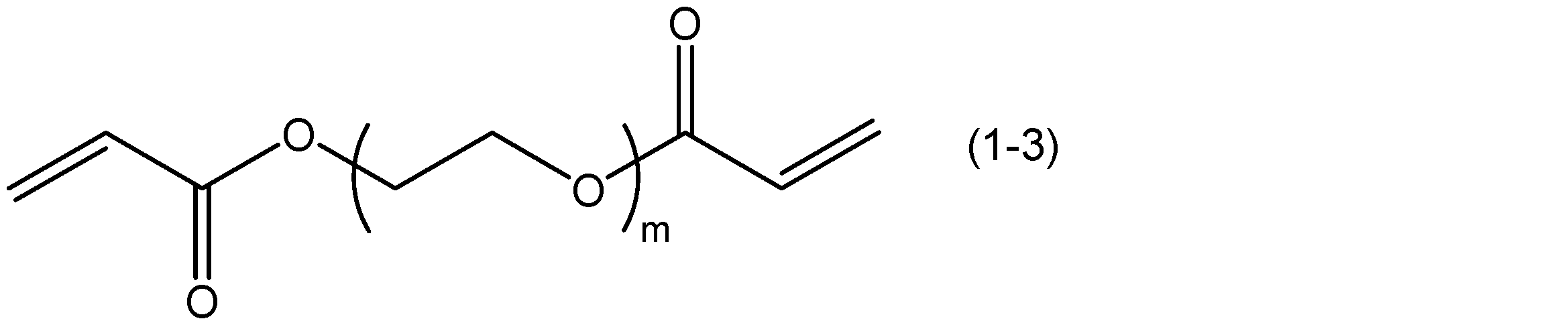
ポリエチレングリコール#8000 120gに代えて、ポリエチレングリコール#6000(重量平均分子量:6000、Alfa Aesar社製)90gを用いた以外は、化合物(A-1)と同様にして、上記式(1-3)で表され、かつ重量平均分子量が6000である化合物(A-2)を得た。
ポリエチレングリコール#8000 120gに代えて、ポリエチレングリコール#4000(重量平均分子量:4000、三洋化成工業(株)製)60gを用いた以外は、化合物(A-1)と同様にして、上記式(1-3)で表され、かつ重量平均分子量が4000である化合物(A-3)を得た。
ポリエチレングリコール#8000 120gに代えて、ポリエチレングリコール#2000(重量平均分子量:2000、三洋化成工業(株)製)30gを用いた以外は、化合物(A-1)と同様にして、上記式(1-3)で表され、かつ重量平均分子量が2000である化合物(A-4)を得た。
ポリエチレングリコール#8000 120gに代えて、ポリエチレングリコール#1000(重量平均分子量:1000、三洋化成工業(株)製)15gを用いた以外は、化合物(A-1)と同様にして、上記式(1-3)で表され、かつ重量平均分子量が2000である化合物(A-5)を得た。
(B-1)過酸化ラウロイル(熱重合開始剤)
(B-2)2-ヒドロキシ-2-メチル-1-フェニル-プロパン-1-オン(光重合開始剤、BASF社製「イルガキュア1173」)
(C-1)メトキシポリエチレングリコールアクリレート(重量平均分子量:1000、新中村化学工業(株)製)
(C-2)メトキシポリエチレングリコールアクリレート(重量平均分子量:1500、新中村化学工業(株)製)
(C-3)メトキシポリエチレングリコールアクリレート(重量平均分子量:2000、新中村化学工業(株)製)
(C-4)メチルメタクリレート
(D-1)ポリエチレングリコール(重量平均分子量:1500、三洋化成工業(株)製)
(D-2)ポリエチレングリコール(重量平均分子量:1300、三洋化成工業(株)製)
(D-3)ポリエチレングリコール(重量平均分子量:1200、三洋化成工業(株)製)
(D-4)蓄熱性カプセル(アウトラストテクノロジー社製、BA410xxP,C37)
(E)フェノール系酸化防止剤((株)ADEKA製「アデカスタブ AO-80」)
(実施例1~32)
表1~3に示す配合比で各成分を50℃で加熱混合し、硬化性組成物を得た。次に、50℃の条件下で、バーコーターを用いて、硬化後の厚さが200μmとなるように硬化性組成物をPETフィルム上に塗布し、窒素置換したイナートガスオーブンを用いて120℃で2時間加熱し、蓄熱材(硬化性組成物の硬化物)を得た。
表3に示す配合比で各成分を50℃で加熱混合し、硬化性組成物を得た。次に、青板ガラス上に離型PETフィルムを離型面が上(青板ガラスと反対側)になるように設置し、スペーサーとして200μm厚に切り出したテープで4辺を貼り合わせ、中心部に凹部(ダム)を形成した。その中心部に硬化性組成物を配置し、その上に離型PETフィルムを離型面が硬化性組成物と接するように被せて積層体を得た。続いて、離型PETフィルムの表面が青板ガラスに対して平行となるように積層体をスキージでならした後、積層体に対して、メタルハライドランプを用い、照度:100mW/cm2及び照射量:3000mJ/cm2の条件でUV照射を行い、蓄熱材(硬化性組成物の硬化物)を得た。
実施例で作製した各蓄熱材(硬化物)を、示差走査熱量測定計(パーキンエルマー社製、型番DSC8500)を用いて測定し、融点と蓄熱量を算出した。具体的には、20℃/分で100℃まで昇温し、100℃で3分間保持した後、10℃/分の速度で-30℃まで降温し、次いで-30℃で3分間保持した後、10℃/分の速度で100℃まで再び昇温して熱挙動を測定した。融解ピークを蓄熱材の融点とし、面積を蓄熱量とした。結果を表1~3に示す。
厚さ200μmの蓄熱材(硬化性組成物の硬化物)を折り曲げ、折り曲げ可能な場合をA、折り曲げ時に割れてしまう場合をBとして評価した。結果を表1~3に示す。


Claims (14)
- 下記式(1)で表される化合物と、重合開始剤と、を含有する硬化性組成物。

- 前記式(1)で表される化合物として、2000以上の重量平均分子量を有する式(1)で表される化合物を含有する、請求項1に記載の硬化性組成物。
- 前記式(1)で表される化合物が下記式(1-2)で表される化合物である、請求項1に記載の硬化性組成物。

- 前記mは、前記式(1-2)で表される化合物の分子量が2000以上となるような整数である、請求項3に記載の硬化性組成物。
- 前記式(1)で表される化合物の含有量が、硬化性組成物全量を基準として10質量%以上である、請求項1~4のいずれか一項に記載の硬化性組成物。
- 下記式(2)で表される化合物を更に含有する、請求項1~5のいずれか一項に記載の硬化性組成物。

- 蓄熱性成分を更に含有する、請求項1~6のいずれか一項に記載の硬化性組成物。
- 前記蓄熱性成分がポリアルキレングリコールを含む、請求項7に記載の硬化性組成物。
- 下記式(3)で表される化合物を更に含有する、請求項1~8のいずれか一項に記載の硬化性組成物。
- 下記式(4)で表される化合物を更に含有する、請求項1~9のいずれか一項に記載の硬化性組成物。

- 前記反応性基と反応し得る硬化剤を更に含有する、請求項10に記載の硬化性組成物。
- 蓄熱材の形成に用いられる、請求項1~11のいずれか一項に記載の硬化性組成物。
- 請求項1~12のいずれか一項に記載の硬化性組成物の硬化物を含む、蓄熱材。
- 熱源と、
前記熱源と熱的に接触するように設けられた、請求項1~12のいずれか一項に記載の硬化性組成物の硬化物と、を備える、物品。
Priority Applications (5)
| Application Number | Priority Date | Filing Date | Title |
|---|---|---|---|
| US17/437,412 US20220162491A1 (en) | 2019-03-14 | 2020-01-21 | Curable composition, heat storage material, and article |
| JP2021505558A JP7487731B2 (ja) | 2019-03-14 | 2020-01-21 | 硬化性組成物、蓄熱材、及び物品 |
| KR1020257035240A KR20250159066A (ko) | 2019-03-14 | 2020-01-21 | 경화성 조성물, 축열재, 및 물품 |
| KR1020217032177A KR102876614B1 (ko) | 2019-03-14 | 2020-01-21 | 경화성 조성물, 축열재, 및 물품 |
| CN202080019869.4A CN113557252A (zh) | 2019-03-14 | 2020-01-21 | 硬化性组合物、蓄热材及物品 |
Applications Claiming Priority (2)
| Application Number | Priority Date | Filing Date | Title |
|---|---|---|---|
| JPPCT/JP2019/010596 | 2019-03-14 | ||
| PCT/JP2019/010596 WO2020183712A1 (ja) | 2019-03-14 | 2019-03-14 | 硬化性組成物、蓄熱材、及び物品 |
Publications (1)
| Publication Number | Publication Date |
|---|---|
| WO2020183917A1 true WO2020183917A1 (ja) | 2020-09-17 |
Family
ID=72426099
Family Applications (2)
| Application Number | Title | Priority Date | Filing Date |
|---|---|---|---|
| PCT/JP2019/010596 Ceased WO2020183712A1 (ja) | 2019-03-14 | 2019-03-14 | 硬化性組成物、蓄熱材、及び物品 |
| PCT/JP2020/002002 Ceased WO2020183917A1 (ja) | 2019-03-14 | 2020-01-21 | 硬化性組成物、蓄熱材、及び物品 |
Family Applications Before (1)
| Application Number | Title | Priority Date | Filing Date |
|---|---|---|---|
| PCT/JP2019/010596 Ceased WO2020183712A1 (ja) | 2019-03-14 | 2019-03-14 | 硬化性組成物、蓄熱材、及び物品 |
Country Status (6)
| Country | Link |
|---|---|
| US (1) | US20220162491A1 (ja) |
| JP (1) | JP7487731B2 (ja) |
| KR (2) | KR20250159066A (ja) |
| CN (1) | CN113557252A (ja) |
| TW (1) | TWI905093B (ja) |
| WO (2) | WO2020183712A1 (ja) |
Cited By (1)
| Publication number | Priority date | Publication date | Assignee | Title |
|---|---|---|---|---|
| CN116685620A (zh) * | 2020-12-22 | 2023-09-01 | 株式会社力森诺科 | 组合物及包含其固化物的片材 |
Citations (7)
| Publication number | Priority date | Publication date | Assignee | Title |
|---|---|---|---|---|
| JP2004026971A (ja) * | 2002-06-25 | 2004-01-29 | Idemitsu Kosan Co Ltd | 架橋蓄熱材料 |
| JP2008063547A (ja) * | 2006-08-11 | 2008-03-21 | Sk Kaken Co Ltd | 蓄熱材組成物、蓄熱体及び蓄熱積層体 |
| JP2008163286A (ja) * | 2006-12-08 | 2008-07-17 | Sk Kaken Co Ltd | 蓄熱組成物 |
| WO2009128476A1 (ja) * | 2008-04-16 | 2009-10-22 | 森下仁丹株式会社 | 蓄熱シームレスカプセルおよびその製造方法 |
| CN102351965A (zh) * | 2011-07-14 | 2012-02-15 | 天津工业大学 | 一种(甲基)丙烯酸长链烷基酯聚合物相变材料的制备方法 |
| JP2016141764A (ja) * | 2015-02-04 | 2016-08-08 | Jsr株式会社 | 蓄熱材用組成物および蓄熱材 |
| JP2017078123A (ja) * | 2015-10-21 | 2017-04-27 | Kjケミカルズ株式会社 | サポート材用活性エネルギー線硬化性樹脂組成物 |
Family Cites Families (9)
| Publication number | Priority date | Publication date | Assignee | Title |
|---|---|---|---|---|
| JPH0795168B2 (ja) * | 1987-05-14 | 1995-10-11 | 株式会社トクヤマ | 電解質組成物 |
| JP2000109787A (ja) | 1998-10-06 | 2000-04-18 | Hope Seiyaku Kk | パラフィン類用のゲル化剤及びゲル化方法 |
| CN100471926C (zh) * | 2002-03-12 | 2009-03-25 | 出光兴产株式会社 | 蓄热材料及其组合物以及其用途 |
| JP2005042040A (ja) * | 2003-07-24 | 2005-02-17 | Harima Chem Inc | エマルション型蓄熱材の製造方法 |
| JP6060215B2 (ja) * | 2010-11-01 | 2017-01-11 | 株式会社キーエンス | インクジェット光造形装置を用いた三次元造形方法 |
| EP3037447B1 (en) | 2013-08-20 | 2018-11-07 | Mitsubishi Chemical Corporation | Dispersion-type acrylic copolymer |
| KR20180075490A (ko) * | 2015-10-28 | 2018-07-04 | 유엠지 에이비에스 가부시키가이샤 | 그래프트 공중합체, 가교 입자, 그래프트 가교 입자, 고무질 중합체, 및 그것을 사용한 열 가소성 수지 조성물 |
| TWI629564B (zh) * | 2016-06-17 | 2018-07-11 | 長興材料工業股份有限公司 | 可聚合組合物及其應用 |
| JP7232474B2 (ja) * | 2017-09-26 | 2023-03-03 | 国立大学法人北海道大学 | 高靭性繊維複合エラストマー |
-
2019
- 2019-03-14 WO PCT/JP2019/010596 patent/WO2020183712A1/ja not_active Ceased
-
2020
- 2020-01-21 US US17/437,412 patent/US20220162491A1/en active Pending
- 2020-01-21 JP JP2021505558A patent/JP7487731B2/ja active Active
- 2020-01-21 KR KR1020257035240A patent/KR20250159066A/ko active Pending
- 2020-01-21 WO PCT/JP2020/002002 patent/WO2020183917A1/ja not_active Ceased
- 2020-01-21 CN CN202080019869.4A patent/CN113557252A/zh active Pending
- 2020-01-21 KR KR1020217032177A patent/KR102876614B1/ko active Active
- 2020-01-31 TW TW109103093A patent/TWI905093B/zh active
Patent Citations (7)
| Publication number | Priority date | Publication date | Assignee | Title |
|---|---|---|---|---|
| JP2004026971A (ja) * | 2002-06-25 | 2004-01-29 | Idemitsu Kosan Co Ltd | 架橋蓄熱材料 |
| JP2008063547A (ja) * | 2006-08-11 | 2008-03-21 | Sk Kaken Co Ltd | 蓄熱材組成物、蓄熱体及び蓄熱積層体 |
| JP2008163286A (ja) * | 2006-12-08 | 2008-07-17 | Sk Kaken Co Ltd | 蓄熱組成物 |
| WO2009128476A1 (ja) * | 2008-04-16 | 2009-10-22 | 森下仁丹株式会社 | 蓄熱シームレスカプセルおよびその製造方法 |
| CN102351965A (zh) * | 2011-07-14 | 2012-02-15 | 天津工业大学 | 一种(甲基)丙烯酸长链烷基酯聚合物相变材料的制备方法 |
| JP2016141764A (ja) * | 2015-02-04 | 2016-08-08 | Jsr株式会社 | 蓄熱材用組成物および蓄熱材 |
| JP2017078123A (ja) * | 2015-10-21 | 2017-04-27 | Kjケミカルズ株式会社 | サポート材用活性エネルギー線硬化性樹脂組成物 |
Cited By (1)
| Publication number | Priority date | Publication date | Assignee | Title |
|---|---|---|---|---|
| CN116685620A (zh) * | 2020-12-22 | 2023-09-01 | 株式会社力森诺科 | 组合物及包含其固化物的片材 |
Also Published As
| Publication number | Publication date |
|---|---|
| JPWO2020183917A1 (ja) | 2020-09-17 |
| KR20210141962A (ko) | 2021-11-23 |
| WO2020183712A1 (ja) | 2020-09-17 |
| KR102876614B1 (ko) | 2025-10-24 |
| KR20250159066A (ko) | 2025-11-07 |
| TWI905093B (zh) | 2025-11-21 |
| US20220162491A1 (en) | 2022-05-26 |
| TW202045570A (zh) | 2020-12-16 |
| CN113557252A (zh) | 2021-10-26 |
| JP7487731B2 (ja) | 2024-05-21 |
Similar Documents
| Publication | Publication Date | Title |
|---|---|---|
| JP7322701B2 (ja) | 樹脂組成物、蓄熱材、及び物品 | |
| JP7375750B2 (ja) | 樹脂組成物、蓄熱材、及び物品 | |
| JP2021172698A (ja) | 硬化性組成物、蓄熱材、及び物品 | |
| JP7487731B2 (ja) | 硬化性組成物、蓄熱材、及び物品 | |
| JP7375819B2 (ja) | 樹脂組成物、蓄熱材、及び物品 | |
| CN116096768B (zh) | 固化性组合物、蓄热材料及物品 | |
| KR102702704B1 (ko) | 축열 시트의 제조 방법 | |
| JP7235048B2 (ja) | 硬化性組成物、硬化性組成物セット、蓄熱材、及び物品 | |
| TW202608983A (zh) | 硬化性組成物、蓄熱材及物品 |
Legal Events
| Date | Code | Title | Description |
|---|---|---|---|
| 121 | Ep: the epo has been informed by wipo that ep was designated in this application |
Ref document number: 20769175 Country of ref document: EP Kind code of ref document: A1 |
|
| ENP | Entry into the national phase |
Ref document number: 2021505558 Country of ref document: JP Kind code of ref document: A |
|
| NENP | Non-entry into the national phase |
Ref country code: DE |
|
| ENP | Entry into the national phase |
Ref document number: 20217032177 Country of ref document: KR Kind code of ref document: A |
|
| 32PN | Ep: public notification in the ep bulletin as address of the adressee cannot be established |
Free format text: NOTING OF LOSS OF RIGHTS PURSUANT TO RULE 112(1) EPC (EPO FORM 1205A DATED 05/01/2022) |
|
| 122 | Ep: pct application non-entry in european phase |
Ref document number: 20769175 Country of ref document: EP Kind code of ref document: A1 |