WO2020145239A1 - 接着性樹脂組成物および積層体 - Google Patents
接着性樹脂組成物および積層体 Download PDFInfo
- Publication number
- WO2020145239A1 WO2020145239A1 PCT/JP2020/000060 JP2020000060W WO2020145239A1 WO 2020145239 A1 WO2020145239 A1 WO 2020145239A1 JP 2020000060 W JP2020000060 W JP 2020000060W WO 2020145239 A1 WO2020145239 A1 WO 2020145239A1
- Authority
- WO
- WIPO (PCT)
- Prior art keywords
- layer
- resin
- mol
- adhesive
- pentene
- Prior art date
- Legal status (The legal status is an assumption and is not a legal conclusion. Google has not performed a legal analysis and makes no representation as to the accuracy of the status listed.)
- Ceased
Links
Classifications
-
- B—PERFORMING OPERATIONS; TRANSPORTING
- B32—LAYERED PRODUCTS
- B32B—LAYERED PRODUCTS, i.e. PRODUCTS BUILT-UP OF STRATA OF FLAT OR NON-FLAT, e.g. CELLULAR OR HONEYCOMB, FORM
- B32B7/00—Layered products characterised by the relation between layers; Layered products characterised by the relative orientation of features between layers, or by the relative values of a measurable parameter between layers, i.e. products comprising layers having different physical, chemical or physicochemical properties; Layered products characterised by the interconnection of layers
- B32B7/04—Interconnection of layers
- B32B7/12—Interconnection of layers using interposed adhesives or interposed materials with bonding properties
-
- C—CHEMISTRY; METALLURGY
- C09—DYES; PAINTS; POLISHES; NATURAL RESINS; ADHESIVES; COMPOSITIONS NOT OTHERWISE PROVIDED FOR; APPLICATIONS OF MATERIALS NOT OTHERWISE PROVIDED FOR
- C09J—ADHESIVES; NON-MECHANICAL ASPECTS OF ADHESIVE PROCESSES IN GENERAL; ADHESIVE PROCESSES NOT PROVIDED FOR ELSEWHERE; USE OF MATERIALS AS ADHESIVES
- C09J123/00—Adhesives based on homopolymers or copolymers of unsaturated aliphatic hydrocarbons having only one carbon-to-carbon double bond; Adhesives based on derivatives of such polymers
- C09J123/02—Adhesives based on homopolymers or copolymers of unsaturated aliphatic hydrocarbons having only one carbon-to-carbon double bond; Adhesives based on derivatives of such polymers not modified by chemical after-treatment
- C09J123/10—Homopolymers or copolymers of propene
- C09J123/12—Polypropene
-
- B—PERFORMING OPERATIONS; TRANSPORTING
- B32—LAYERED PRODUCTS
- B32B—LAYERED PRODUCTS, i.e. PRODUCTS BUILT-UP OF STRATA OF FLAT OR NON-FLAT, e.g. CELLULAR OR HONEYCOMB, FORM
- B32B27/00—Layered products comprising a layer of synthetic resin
- B32B27/06—Layered products comprising a layer of synthetic resin as the main or only constituent of a layer, which is next to another layer of the same or of a different material
- B32B27/08—Layered products comprising a layer of synthetic resin as the main or only constituent of a layer, which is next to another layer of the same or of a different material of synthetic resin
-
- B—PERFORMING OPERATIONS; TRANSPORTING
- B32—LAYERED PRODUCTS
- B32B—LAYERED PRODUCTS, i.e. PRODUCTS BUILT-UP OF STRATA OF FLAT OR NON-FLAT, e.g. CELLULAR OR HONEYCOMB, FORM
- B32B27/00—Layered products comprising a layer of synthetic resin
- B32B27/28—Layered products comprising a layer of synthetic resin comprising synthetic resins not wholly covered by any one of the sub-groups B32B27/30 - B32B27/42
- B32B27/288—Layered products comprising a layer of synthetic resin comprising synthetic resins not wholly covered by any one of the sub-groups B32B27/30 - B32B27/42 comprising polyketones
-
- B—PERFORMING OPERATIONS; TRANSPORTING
- B32—LAYERED PRODUCTS
- B32B—LAYERED PRODUCTS, i.e. PRODUCTS BUILT-UP OF STRATA OF FLAT OR NON-FLAT, e.g. CELLULAR OR HONEYCOMB, FORM
- B32B27/00—Layered products comprising a layer of synthetic resin
- B32B27/30—Layered products comprising a layer of synthetic resin comprising vinyl (co)polymers; comprising acrylic (co)polymers
- B32B27/306—Layered products comprising a layer of synthetic resin comprising vinyl (co)polymers; comprising acrylic (co)polymers comprising vinyl acetate or vinyl alcohol (co)polymers
-
- B—PERFORMING OPERATIONS; TRANSPORTING
- B32—LAYERED PRODUCTS
- B32B—LAYERED PRODUCTS, i.e. PRODUCTS BUILT-UP OF STRATA OF FLAT OR NON-FLAT, e.g. CELLULAR OR HONEYCOMB, FORM
- B32B27/00—Layered products comprising a layer of synthetic resin
- B32B27/32—Layered products comprising a layer of synthetic resin comprising polyolefins
-
- B—PERFORMING OPERATIONS; TRANSPORTING
- B32—LAYERED PRODUCTS
- B32B—LAYERED PRODUCTS, i.e. PRODUCTS BUILT-UP OF STRATA OF FLAT OR NON-FLAT, e.g. CELLULAR OR HONEYCOMB, FORM
- B32B27/00—Layered products comprising a layer of synthetic resin
- B32B27/34—Layered products comprising a layer of synthetic resin comprising polyamides
-
- B—PERFORMING OPERATIONS; TRANSPORTING
- B32—LAYERED PRODUCTS
- B32B—LAYERED PRODUCTS, i.e. PRODUCTS BUILT-UP OF STRATA OF FLAT OR NON-FLAT, e.g. CELLULAR OR HONEYCOMB, FORM
- B32B27/00—Layered products comprising a layer of synthetic resin
- B32B27/36—Layered products comprising a layer of synthetic resin comprising polyesters
- B32B27/365—Layered products comprising a layer of synthetic resin comprising polyesters comprising polycarbonates
-
- B—PERFORMING OPERATIONS; TRANSPORTING
- B65—CONVEYING; PACKING; STORING; HANDLING THIN OR FILAMENTARY MATERIAL
- B65D—CONTAINERS FOR STORAGE OR TRANSPORT OF ARTICLES OR MATERIALS, e.g. BAGS, BARRELS, BOTTLES, BOXES, CANS, CARTONS, CRATES, DRUMS, JARS, TANKS, HOPPERS, FORWARDING CONTAINERS; ACCESSORIES, CLOSURES, OR FITTINGS THEREFOR; PACKAGING ELEMENTS; PACKAGES
- B65D65/00—Wrappers or flexible covers; Packaging materials of special type or form
- B65D65/38—Packaging materials of special type or form
- B65D65/40—Applications of laminates for particular packaging purposes
-
- C—CHEMISTRY; METALLURGY
- C08—ORGANIC MACROMOLECULAR COMPOUNDS; THEIR PREPARATION OR CHEMICAL WORKING-UP; COMPOSITIONS BASED THEREON
- C08L—COMPOSITIONS OF MACROMOLECULAR COMPOUNDS
- C08L23/00—Compositions of homopolymers or copolymers of unsaturated aliphatic hydrocarbons having only one carbon-to-carbon double bond; Compositions of derivatives of such polymers
- C08L23/02—Compositions of homopolymers or copolymers of unsaturated aliphatic hydrocarbons having only one carbon-to-carbon double bond; Compositions of derivatives of such polymers not modified by chemical after-treatment
- C08L23/10—Homopolymers or copolymers of propene
-
- C—CHEMISTRY; METALLURGY
- C09—DYES; PAINTS; POLISHES; NATURAL RESINS; ADHESIVES; COMPOSITIONS NOT OTHERWISE PROVIDED FOR; APPLICATIONS OF MATERIALS NOT OTHERWISE PROVIDED FOR
- C09J—ADHESIVES; NON-MECHANICAL ASPECTS OF ADHESIVE PROCESSES IN GENERAL; ADHESIVE PROCESSES NOT PROVIDED FOR ELSEWHERE; USE OF MATERIALS AS ADHESIVES
- C09J123/00—Adhesives based on homopolymers or copolymers of unsaturated aliphatic hydrocarbons having only one carbon-to-carbon double bond; Adhesives based on derivatives of such polymers
- C09J123/02—Adhesives based on homopolymers or copolymers of unsaturated aliphatic hydrocarbons having only one carbon-to-carbon double bond; Adhesives based on derivatives of such polymers not modified by chemical after-treatment
- C09J123/04—Homopolymers or copolymers of ethene
- C09J123/06—Polyethylene
-
- C—CHEMISTRY; METALLURGY
- C09—DYES; PAINTS; POLISHES; NATURAL RESINS; ADHESIVES; COMPOSITIONS NOT OTHERWISE PROVIDED FOR; APPLICATIONS OF MATERIALS NOT OTHERWISE PROVIDED FOR
- C09J—ADHESIVES; NON-MECHANICAL ASPECTS OF ADHESIVE PROCESSES IN GENERAL; ADHESIVE PROCESSES NOT PROVIDED FOR ELSEWHERE; USE OF MATERIALS AS ADHESIVES
- C09J123/00—Adhesives based on homopolymers or copolymers of unsaturated aliphatic hydrocarbons having only one carbon-to-carbon double bond; Adhesives based on derivatives of such polymers
- C09J123/02—Adhesives based on homopolymers or copolymers of unsaturated aliphatic hydrocarbons having only one carbon-to-carbon double bond; Adhesives based on derivatives of such polymers not modified by chemical after-treatment
- C09J123/10—Homopolymers or copolymers of propene
-
- C—CHEMISTRY; METALLURGY
- C09—DYES; PAINTS; POLISHES; NATURAL RESINS; ADHESIVES; COMPOSITIONS NOT OTHERWISE PROVIDED FOR; APPLICATIONS OF MATERIALS NOT OTHERWISE PROVIDED FOR
- C09J—ADHESIVES; NON-MECHANICAL ASPECTS OF ADHESIVE PROCESSES IN GENERAL; ADHESIVE PROCESSES NOT PROVIDED FOR ELSEWHERE; USE OF MATERIALS AS ADHESIVES
- C09J123/00—Adhesives based on homopolymers or copolymers of unsaturated aliphatic hydrocarbons having only one carbon-to-carbon double bond; Adhesives based on derivatives of such polymers
- C09J123/02—Adhesives based on homopolymers or copolymers of unsaturated aliphatic hydrocarbons having only one carbon-to-carbon double bond; Adhesives based on derivatives of such polymers not modified by chemical after-treatment
- C09J123/10—Homopolymers or copolymers of propene
- C09J123/14—Copolymers of propene
-
- C—CHEMISTRY; METALLURGY
- C09—DYES; PAINTS; POLISHES; NATURAL RESINS; ADHESIVES; COMPOSITIONS NOT OTHERWISE PROVIDED FOR; APPLICATIONS OF MATERIALS NOT OTHERWISE PROVIDED FOR
- C09J—ADHESIVES; NON-MECHANICAL ASPECTS OF ADHESIVE PROCESSES IN GENERAL; ADHESIVE PROCESSES NOT PROVIDED FOR ELSEWHERE; USE OF MATERIALS AS ADHESIVES
- C09J123/00—Adhesives based on homopolymers or copolymers of unsaturated aliphatic hydrocarbons having only one carbon-to-carbon double bond; Adhesives based on derivatives of such polymers
- C09J123/02—Adhesives based on homopolymers or copolymers of unsaturated aliphatic hydrocarbons having only one carbon-to-carbon double bond; Adhesives based on derivatives of such polymers not modified by chemical after-treatment
- C09J123/18—Homopolymers or copolymers of hydrocarbons having four or more carbon atoms
-
- C—CHEMISTRY; METALLURGY
- C09—DYES; PAINTS; POLISHES; NATURAL RESINS; ADHESIVES; COMPOSITIONS NOT OTHERWISE PROVIDED FOR; APPLICATIONS OF MATERIALS NOT OTHERWISE PROVIDED FOR
- C09J—ADHESIVES; NON-MECHANICAL ASPECTS OF ADHESIVE PROCESSES IN GENERAL; ADHESIVE PROCESSES NOT PROVIDED FOR ELSEWHERE; USE OF MATERIALS AS ADHESIVES
- C09J151/00—Adhesives based on graft polymers in which the grafted component is obtained by reactions only involving carbon-to-carbon unsaturated bonds; Adhesives based on derivatives of such polymers
- C09J151/06—Adhesives based on graft polymers in which the grafted component is obtained by reactions only involving carbon-to-carbon unsaturated bonds; Adhesives based on derivatives of such polymers grafted on to homopolymers or copolymers of aliphatic hydrocarbons containing only one carbon-to-carbon double bond
-
- B—PERFORMING OPERATIONS; TRANSPORTING
- B32—LAYERED PRODUCTS
- B32B—LAYERED PRODUCTS, i.e. PRODUCTS BUILT-UP OF STRATA OF FLAT OR NON-FLAT, e.g. CELLULAR OR HONEYCOMB, FORM
- B32B2250/00—Layers arrangement
- B32B2250/05—5 or more layers
-
- B—PERFORMING OPERATIONS; TRANSPORTING
- B32—LAYERED PRODUCTS
- B32B—LAYERED PRODUCTS, i.e. PRODUCTS BUILT-UP OF STRATA OF FLAT OR NON-FLAT, e.g. CELLULAR OR HONEYCOMB, FORM
- B32B2250/00—Layers arrangement
- B32B2250/24—All layers being polymeric
-
- B—PERFORMING OPERATIONS; TRANSPORTING
- B32—LAYERED PRODUCTS
- B32B—LAYERED PRODUCTS, i.e. PRODUCTS BUILT-UP OF STRATA OF FLAT OR NON-FLAT, e.g. CELLULAR OR HONEYCOMB, FORM
- B32B2270/00—Resin or rubber layer containing a blend of at least two different polymers
-
- B—PERFORMING OPERATIONS; TRANSPORTING
- B32—LAYERED PRODUCTS
- B32B—LAYERED PRODUCTS, i.e. PRODUCTS BUILT-UP OF STRATA OF FLAT OR NON-FLAT, e.g. CELLULAR OR HONEYCOMB, FORM
- B32B2307/00—Properties of the layers or laminate
- B32B2307/30—Properties of the layers or laminate having particular thermal properties
- B32B2307/306—Resistant to heat
-
- B—PERFORMING OPERATIONS; TRANSPORTING
- B32—LAYERED PRODUCTS
- B32B—LAYERED PRODUCTS, i.e. PRODUCTS BUILT-UP OF STRATA OF FLAT OR NON-FLAT, e.g. CELLULAR OR HONEYCOMB, FORM
- B32B2307/00—Properties of the layers or laminate
- B32B2307/50—Properties of the layers or laminate having particular mechanical properties
- B32B2307/514—Oriented
- B32B2307/518—Oriented bi-axially
-
- B—PERFORMING OPERATIONS; TRANSPORTING
- B32—LAYERED PRODUCTS
- B32B—LAYERED PRODUCTS, i.e. PRODUCTS BUILT-UP OF STRATA OF FLAT OR NON-FLAT, e.g. CELLULAR OR HONEYCOMB, FORM
- B32B2307/00—Properties of the layers or laminate
- B32B2307/70—Other properties
- B32B2307/724—Permeability to gases, adsorption
- B32B2307/7242—Non-permeable
-
- B—PERFORMING OPERATIONS; TRANSPORTING
- B32—LAYERED PRODUCTS
- B32B—LAYERED PRODUCTS, i.e. PRODUCTS BUILT-UP OF STRATA OF FLAT OR NON-FLAT, e.g. CELLULAR OR HONEYCOMB, FORM
- B32B2439/00—Containers; Receptacles
- B32B2439/40—Closed containers
- B32B2439/46—Bags
-
- B—PERFORMING OPERATIONS; TRANSPORTING
- B32—LAYERED PRODUCTS
- B32B—LAYERED PRODUCTS, i.e. PRODUCTS BUILT-UP OF STRATA OF FLAT OR NON-FLAT, e.g. CELLULAR OR HONEYCOMB, FORM
- B32B2439/00—Containers; Receptacles
- B32B2439/70—Food packaging
-
- C—CHEMISTRY; METALLURGY
- C08—ORGANIC MACROMOLECULAR COMPOUNDS; THEIR PREPARATION OR CHEMICAL WORKING-UP; COMPOSITIONS BASED THEREON
- C08L—COMPOSITIONS OF MACROMOLECULAR COMPOUNDS
- C08L2205/00—Polymer mixtures characterised by other features
- C08L2205/03—Polymer mixtures characterised by other features containing three or more polymers in a blend
- C08L2205/035—Polymer mixtures characterised by other features containing three or more polymers in a blend containing four or more polymers in a blend
Definitions
- the present invention relates to an adhesive resin composition and a laminate, and more specifically, to an adhesive resin composition capable of favorably adhering a polymethylpentene resin to a polar resin and a polyolefin resin such as a polypropylene resin, and the adhesive resin. It relates to a laminate having an adhesive layer containing the composition.
- Containers used for cooked foods and the like are often cooked as they are in a microwave oven or the like, and thus are required to have high heat resistance. Further, containers used for cooked foods and the like are required to have high oxygen barrier properties in order to reduce food loss.
- polycarbonate resin is used for automobile headlight covers, etc. because of its transparency and good appearance. In such applications, in order to reduce the weight, it is required to combine a polycarbonate resin with a transparent and light material.
- Patent Document 1 discloses a 4-methyl-1-pentene polymer and an unsaturated carboxylic acid-modified ⁇ -olefin whose ⁇ -olefin is selected from the group consisting of propylene, butene-1 and 4-methyl-1-pentene.
- a 4-methyl-1-pentene-based polymer composition comprising a system-based polymer and a modified polyolefin-based resin comprising a mixture of an unsaturated carboxylic acid-modified ethylene/ ⁇ -olefin copolymer (B-2), and nylon. It is described that the adhesiveness to
- Patent Document 2 discloses a battery member film including a layer formed of a resin composition (X) containing a 4-methyl-1-pentene-based polymer and polypropylene, and has heat resistance and flexibility equal to or higher than conventional products. It is described that a film for a battery member such as a tab lead film, which can be produced without a crosslinking step, can be obtained while maintaining the adhesiveness, adhesion to electrodes, and adhesion between layers.
- X resin composition
- Patent Document 3 discloses a thermoplastic resin composition containing one or more kinds selected from the group consisting of a polyolefin-based polymer, an unsaturated carboxylic acid and an unsaturated carboxylic acid derivative, and an organic peroxide. Excellent adhesion to polar resins such as vinyl alcohol copolymer, nylon and polyester, and non-polar resins such as polyethylene, polypropylene, poly 1-butene and poly 4-methyl-1-pentene Have been described.
- polar resins such as vinyl alcohol copolymer, nylon and polyester
- non-polar resins such as polyethylene, polypropylene, poly 1-butene and poly 4-methyl-1-pentene
- Patent Documents 4 to 7 describe a laminate including an adhesive layer containing carbodiimide-modified polypropylene and a layer containing polyketone, polycarbonate and fluororesin as an adherend to the adhesive layer.
- an object of the present invention is to make it possible to favorably bond a polymethylpentene resin and a polar resin such as an ethylene/vinyl alcohol copolymer resin or a polyamide resin and a polyolefin resin such as a polypropylene resin, and perform stretching or the like.
- An object of the present invention is to provide an adhesive composition capable of maintaining good adhesion between the both afterward.
- the subject of the present invention includes a polymethylpentene resin layer, a polar resin layer such as an ethylene/vinyl alcohol copolymer resin layer or a polyamide resin layer, and a polyolefin resin layer such as a polypropylene resin layer, and subjected to stretching or the like. It is to provide a laminate in which both layers are well adhered afterwards.
- an object of the present invention is to include an adhesive capable of favorably adhering a resin such as polymethylpentene resin and polyketone and polycarbonate, and a polymethylpentene resin layer, and a resin layer such as polyketone and polycarbonate, It is to provide a laminate in which these layers are well adhered.
- the present invention relates to the following aspects [1] to [21], for example.
- [1] Propylene-based polymer (A), 60 mol% or more and 99 mol% or less of constituent units derived from the ethylene polymer (B) and 4-methyl-1-pentene, and ⁇ - having 2 to 20 carbon atoms other than 4-methyl-1-pentene Containing 1 mol% or more and 40 mol% or less of constituent units derived from olefins, and having 2 to 20 or less carbon atoms other than the constituent units derived from the 4-methyl-1-pentene and the 4-methyl-1-pentene.
- the copolymer has a total of 100 mol% of constituent units derived from ⁇ -olefin, and has a melting point Tm measured by a differential scanning calorimeter (DSC) of 199° C. or less, or substantially Thermoplastic resin not observed (C)
- An adhesive resin composition wherein the ratio is 5 to 20 parts by mass and the content ratio of the component (C) is 15 to 45 parts by mass.
- thermoplastic resin layer (X) 90% by mole to 100% by mole of structural units derived from 4-methyl-1-pentene, and all structural units derived from ⁇ -olefins other than 4-methyl-1-pentene
- a thermoplastic resin layer (Y) containing a polymer having 0 mol% or more and 10 mol% or less with respect to a unit, and having a melting point Tm of 200° C. or more measured by a differential scanning calorimeter (DSC),
- DSC differential scanning calorimeter
- a carbodiimide-modified polyolefin (D) is further contained, and the content ratio of the component (A) is 10 to 65 parts by mass in the total 100 parts by mass of the components (A), (B), (C) and (D).
- the content ratio of the component (B) is 5 to 20 parts by mass, the content ratio of the component (C) is 15 to 45 parts by mass, and the content ratio of the component (D) is 5 to 30 parts by mass.
- the laminate according to [14], wherein the resin having no active hydrogen in the main molecular skeleton is polyketone.
- the polyketone has a linear structure in which a carbonyl group and a divalent organic group derived from an ethylenically unsaturated compound or a divalent organic group formed by connecting two or more of the organic groups are alternately bonded.
- the laminate according to [15] which is a polymer.
- the ratio of structural units derived from 4-methyl-1-pentene to all structural units is 90 mol% or more and 100 mol% or less, and the total structure of structural units derived from ⁇ -olefins other than 4-methyl-1-pentene
- a thermoplastic resin layer (Y) containing a polymer whose ratio to units is 0 mol% or more and 10 mol% or less, and having a melting point Tm of 200° C.
- the adhesive resin composition of the present invention can favorably bond a polymethylpentene resin and a polar resin such as an ethylene/vinyl alcohol copolymer resin or a polyamide resin and a polyolefin resin such as a polypropylene resin, and can be stretched or the like. Good adhesion between the two can be maintained even after the operation.
- the laminate of the present invention includes, for example, a polymethylpentene resin layer, a polar resin layer such as an ethylene/vinyl alcohol copolymer resin or a polyamide resin, and a polyolefin resin layer such as a polypropylene resin layer, and these layers are well formed. Since they are adhered, good adhesion is maintained even after stretching.
- the adhesive resin composition of the present invention can satisfactorily adhere polymethylpentene resin to resins such as polyketone and polycarbonate.
- the laminate of the present invention includes, for example, a polymethylpentene resin layer and a resin layer such as polyketone and polycarbonate, and these layers are well bonded.
- the adhesive resin composition of the present invention Propylene polymer (A), 60 mol% or more and 99 mol% or less of constituent units derived from the ethylene polymer (B) and 4-methyl-1-pentene, and ⁇ - having 2 to 20 carbon atoms other than 4-methyl-1-pentene Containing 1 mol% or more and 40 mol% or less of constituent units derived from olefins, and having 2 to 20 or less carbon atoms other than the constituent units derived from the 4-methyl-1-pentene and the 4-methyl-1-pentene.
- the copolymer has a total of 100 mol% of constituent units derived from ⁇ -olefin, and has a melting point Tm of 199° C. or less measured by a differential scanning calorimeter (DSC), or substantially It contains a thermoplastic resin (C) which is not observed.
- the adhesive resin composition of the present invention may further contain a carbodiimide-modified polyolefin (D).
- Propylene polymer (A) The propylene polymer (A) may be isotactic polypropylene or syndiotactic polypropylene.
- the propylene-based polymer (A) is a block copolymer, whether it is homopolypropylene or a random copolymer of propylene and an ⁇ -olefin having 2 to 20 carbon atoms (excluding propylene). May be.
- Specific examples of the ⁇ -olefin include ethylene, 1-butene, 1-pentene, 1-hexene, 1-octene, 1-decene, 4-methyl-1-pentene, and the like. It may be a combination of two or more.
- the propylene-based polymer (A) preferably contains a constituent unit derived from propylene in an amount of 75 to 100 mol %, more preferably 85 to 100 mol %, and further preferably 90 to 100 mol %.
- the propylene-based polymer (A) one type of the above polymers may be used alone, or a plurality of types may be used in combination.
- the density of the propylene-based polymer (A) is preferably 0.860 to 0.910 g/cm 3 , more preferably 0.875 to 0.910 g/cm 3 , and still more preferably 0.885 to 0.910 g/cm 3 . It is in the range of 3 .
- the propylene-based polymer (A) has a melt flow rate (MFR) measured at a temperature of 230° C. and a load of 2.16 kg of preferably 0.1 to 100 g/10 minutes, more preferably 0.2, measured according to ASTM D1238. It is in the range of up to 50 g/10 minutes, more preferably 0.3 to 30 g/10 minutes.
- MFR melt flow rate
- the Ethylene polymer (B) is a homopolymer of ethylene or a copolymer of ethylene and ⁇ -olefin.
- the ⁇ -olefins include ⁇ -olefins having 3 or more carbon atoms, preferably 3 to 10 carbon atoms.
- propylene, 1-butene, 1-pentene, 1-hexene, 1-octene, 1-decene, 4-methyl-1-pentene and the like can be mentioned, and a combination of two or more thereof may be used.
- the copolymerization amount of ⁇ -olefin is usually 10 mol% or less.
- the ethylene polymer (B) has a density of preferably 0.855 to 0.970 g/cm 3 , more preferably 0.860 to 0.940 g/cm 3 , and still more preferably 0.865 to 0.930 g/cm 3 . It is in the range of 3 .
- the ethylene-based polymer (B) has a melt flow rate (MFR) measured at a temperature of 190° C. and a load of 2.16 kg, which is preferably 0.1 to 20 g/10 minutes, more preferably 0.3, measured according to ASTM D1238. ⁇ 16 g/10 min, more preferably 0.5 to 10 g/10 min.
- MFR melt flow rate
- Thermoplastic resin (C) has a structural unit derived from 4-methyl-1-pentene and a structural unit derived from an ⁇ -olefin having 2 to 20 carbon atoms other than 4-methyl-1-pentene, and 4 -Copolymer in which the constituent unit derived from methyl-1-pentene and the constituent unit derived from an ⁇ -olefin having 2 to 20 carbon atoms other than 4-methyl-1-pentene are 100 mol% in total including.
- Examples of the ⁇ -olefin having 2 to 20 carbon atoms other than 4-methyl-1-pentene include ethylene, propylene, 1-butene, 1-hexene, 1-octene, 1-decene, 1-tetradecene, 1-octadecene. Etc. can be mentioned.
- the ⁇ -olefin is preferably ethylene, propylene, 1-butene, 1-hexene, 1-octene or 1-decene, and more preferably ethylene, propylene, 1-butene, 1-hexene or 1-octene. And more preferably ethylene, propylene, 1-butene and 1-hexene.
- the ⁇ -olefin may be used alone or in combination of two or more thereof.
- the constitutional unit derived from 4-methyl-1-pentene is 60 mol% or more and 99 mol% or less, preferably 63 mol% or more and 98 mol% or less, and more preferably 65 mol% or more. It is 95 mol% or less, more preferably 65 mol% or more and 90 mol% or less, and particularly preferably 65 mol% or more and 87 mol% or less.
- the constitutional unit derived from the ⁇ -olefin having 2 to 20 carbon atoms other than 4-methyl-1-pentene is 1 mol% to 40 mol%, preferably 2 mol% to 37 mol%.
- the resulting composition has excellent heat resistance and adhesive strength.
- the copolymer preferably has a melt flow rate (MFR) at a temperature of 230° C. and a load of 2.16 kg in the range of 0.5 to 50/10 minutes in accordance with ASTM D1238, and 0.5 to 50/10. More preferably, it is in the range of 30 g/10 minutes.
- MFR melt flow rate
- the thermoplastic resin (C) has a density of preferably 0.825 to 0.870 g/cm 3 , more preferably 0.827 to 0.860 g/cm 3 , and still more preferably 0.830 to 0.850 g/cm 3. Is in the range.
- the melting point Tm of the thermoplastic resin (C) measured by a differential scanning calorimeter (DSC) is 199° C. or lower, or substantially not observed.
- Carbodiimide modified polyolefin (D) The carbodiimide-modified polyolefin (D) is a reaction product of a polyolefin (a) having a group that reacts with a carbodiimide group and a carbodiimide group-containing compound (b).
- the adhesive resin composition of the present invention contains the carbodiimide-modified polyolefin (D)
- the adhesive resin composition of the present invention contains a carbodiimide group.
- the carbodiimide-modified polyolefin (D) preferably has 5 or more carbodiimide groups in one molecule, and more preferably 10 or more.
- the upper limit of the number of carbodiimide groups is not particularly limited as long as the effects of the present invention are exhibited, but is usually 30.
- polyolefin (a) The polyolefin (a) having a group reactive with a carbodiimide group can be obtained by introducing a compound (m) having a group reactive with a carbodiimide group into the polyolefin.
- the polyolefin (a) may be used alone or in combination of two or more.
- Examples of the compound (m) include compounds having a group having active hydrogen that is reactive with a carbodiimide group.
- Specific examples include compounds having a group derived from carboxylic acid, amine, alcohol, thiol and the like. Among these, compounds having a group derived from carboxylic acid are preferably used, and among them, unsaturated carboxylic acid and/or its derivative are particularly preferable.
- a compound having a group easily converted to a group having active hydrogen by water or the like can be preferably used.
- Specific examples include compounds having an epoxy group and compounds having a glycidyl group.
- the compound (m) may be used alone or in combination of two or more.
- an unsaturated carboxylic acid and/or a derivative thereof is used as the compound (m)
- an unsaturated compound having one or more carboxylic acid group and its derivative preferably an unsaturated compound having one or more carboxylic acid anhydride group and its Examples include derivatives.
- the unsaturated group include a vinyl group, a vinylene group, and an unsaturated cyclic hydrocarbon group.
- Specific compounds include (meth)acrylic acid, maleic acid, fumaric acid, tetrahydrophthalic acid, itaconic acid, citraconic acid, crotonic acid, isocrotonic acid, norbornene dicarboxylic acid, bicyclo[2.2.1]hept-2.
- Unsaturated carboxylic acids such as -ene-5,6-dicarboxylic acid, their anhydrides, and their derivatives (eg acid halides, amides, imides, esters, etc.).
- Specific acid anhydrides and derivatives include, for example, maleic anhydride, itaconic anhydride, citraconic anhydride, tetrahydrophthalic anhydride, bicyclo[2.2.1]hept-2-ene-5,6-dicarboxylic acid.
- an unsaturated carboxylic acid and/or its derivative When an unsaturated carboxylic acid and/or its derivative is used as the compound (m), they may be used alone or in combination of two or more.
- maleic anhydride, itaconic anhydride, citraconic anhydride, tetrahydrophthalic anhydride, bicyclo[2.2.1]hept-2-ene-5,6-dicarboxylic anhydride, (meth)acrylic acid , Hydroxyethyl (meth)acrylate, glycidyl methacrylate and aminopropyl methacrylate are preferred.
- dicarboxylic acid anhydrides such as maleic acid anhydride, itaconic acid anhydride, citraconic acid anhydride, tetrahydrophthalic acid anhydride, and bicyclo[2.2.1]hept-2-ene-5,6-dicarboxylic acid anhydride are particularly preferable. preferable.
- a method for introducing the compound (m) into the polyolefin a well-known method can be adopted.
- a method in which the compound (m) is graft-copolymerized on the polyolefin main chain, or an olefin and a compound (m) are used.
- the case of graft copolymerization and the case of radical copolymerization will be described in detail.
- the polyolefin (a) having a group that reacts with a carbodiimide group is a radical initiator containing a compound (m) having a group that reacts with a carbodiimide group in the polyolefin main chain, and optionally other ethylenically unsaturated monomers. It can be obtained by graft copolymerization in the presence of
- the polyolefin used as the polyolefin main chain is a polymer containing an aliphatic ⁇ -olefin having 2 to 20 carbon atoms, a cyclic olefin and a non-conjugated diene as a main component, and preferably an aliphatic ⁇ -olefin having 2 to 10 carbon atoms. And more preferably a polymer containing an aliphatic ⁇ -olefin having 2 to 8 carbon atoms as a main component. These olefins may be used alone or in combination of two or more.
- the content of the olefin as a comonomer is not particularly limited as long as the effects of the present invention are exhibited, but is usually 50 mol% or less, preferably 40 mol% or less, more preferably 30 mol% or less. is there.
- polyolefins in such a range polyethylene, polypropylene, polybutene-1, poly-4-methyl-1-pentene, and ⁇ of ethylene, propylene, butene-1 or 4-methyl-1-pentene and a comonomer are used.
- -Crystalline polyolefins such as olefin copolymers are preferred, and polyethylene, polypropylene or propylene-ethylene copolymers are more preferred. Further, these can be used in both the isotactic structure and the syndiotactic structure, and there is no particular limitation on stereoregularity.
- the density of the polyolefin used for the graft modification is not particularly limited as long as the effects of the present invention are exhibited, but is usually 0.8 to 1.1 g/cm 3 , preferably 0.8 to 1 .05g / cm 3, more preferably from 0.8 ⁇ 1.0g / cm 3.
- the melt flow rate (MFR) at 230° C. under a load of 2.16 kg according to ASTM D1238 is not particularly limited as long as the effects of the present invention are exhibited, but is usually 0.01 to 500 g/10 minutes, preferably 0.05 to 200 g/10. Min, more preferably 0.1 to 100 g/10 min. If the density and MFR are within this range, the density and MFR of the modified graft copolymer will be about the same, and thus handling will be easy.
- the crystallinity of the polyolefin used for the graft modification is not particularly limited as long as the effects of the present invention are exhibited, but is usually 2% or more, preferably 5% or more, more preferably 10% or more. When the crystallinity is within this range, handling of the modified graft copolymer is excellent.
- the number average molecular weight (Mn) of the polyolefin used for graft modification measured by gel permeation chromatography (GPC) is preferably 5,000 to 500,000, more preferably 10,000 to 100,000. When the number average molecular weight (Mn) is in this range, handling is excellent.
- the number average molecular weight of ethylene-based polyolefins can be calculated in terms of polyethylene when the amount of comonomer is 10 mol% or less and in terms of ethylene-propylene (when the ethylene content is 70 mol%) when it is 10 mol% or more. It is possible.
- the polyolefin used for graft modification can be produced by any conventionally known method, for example, an olefin can be polymerized using a titanium-based catalyst, a vanadium-based catalyst, a metallocene catalyst, or the like.
- the polyolefin used for the graft modification may be in the form of either a resin or an elastomer, both isotactic structure and syndiotactic structure can be used, and there is no particular limitation on stereoregularity. It is also possible to use a commercially available resin as it is.
- the method of grafting the compound (m) onto the polyolefin main chain is not particularly limited, and a conventionally known graft polymerization method such as a solution method or a melt kneading method can be adopted.
- the amount of the compound (m) grafted is usually 0.05 to 20% by weight, preferably 0.05 to 10% by weight, more preferably 0.05 to 5% by weight, based on 100% by weight of the polyolefin (a). %, and more preferably 0.05 to 3% by weight.
- the graft amount of the compound (m) is a net graft amount measured after removing the free compound (m) from the polyolefin (a).
- the grafting amount can be determined by known means such as 13 C-NMR and 1 H-NMR measurement.
- the amount of the functional group introduced into the polyolefin (a) is a standard amount, For example, it is possible to use the acid value.
- the amount of grafting is determined based on the absorption spectrum of the carbonyl group of maleic anhydride, which is usually detected around 1780 to 1790 cm-1 using an infrared spectrophotometer. You can also ask.
- the polyolefin (a) having a group that reacts with a carbodiimide group can also be obtained by radically copolymerizing an olefin and a compound (m) having a group that reacts with a carbodiimide group.
- the olefin it is possible to employ the same olefin as that used in forming the above-mentioned polyolefin used as the polyolefin main chain.
- the method of copolymerizing the olefin and the compound (m) is not particularly limited, and a conventionally known radical copolymerization method can be adopted.
- the amount of structural units derived from the compound (m) having a group that reacts with a carbodiimide group in the polyolefin (a) having a group that reacts with a carbodiimide group is usually 0.05 to It is 20% by weight, preferably 0.05 to 5% by weight, more preferably 0.05 to 3% by weight.
- the polyolefin (a) and the carbodiimide group-containing compound (b) are preferably cross-linked to produce an adhesive. Therefore, it is preferable. If it is less than the above range, the adhesive strength may be insufficient.
- the density (measured according to JIS K7112) of the polyolefin (a) having a group that reacts with a carbodiimide group is usually 0.870 to 0.940 g/cm 3 , preferably 0.875 to 0.940 g/cm 3 . 3 and more preferably 0.880 to 0.940 g/cm 3 .
- the carbodiimide group-containing compound (b) is, for example, a polycarbodiimide having a repeating unit represented by the general formula (2).
- the carbodiimide group-containing compound (b) may be used alone or in combination of two or more.
- R 1 represents a divalent organic group having 2 to 40 carbon atoms.
- Polycarbodiimide can be produced by carrying out a decarboxylation condensation reaction of an organic diisocyanate such as an aliphatic diisocyanate, an aromatic diisocyanate or an alicyclic diisocyanate in the presence of a condensation catalyst in a solvent-free or inert solvent.
- an organic diisocyanate such as an aliphatic diisocyanate, an aromatic diisocyanate or an alicyclic diisocyanate
- the degree of polymerization of polycarbodiimide can be adjusted by selecting a catalyst, a reaction temperature, a terminal blocking agent and the like.
- the degree of polymerization is usually 2 to 40, preferably 4 to 20.
- terminal blocking agent examples include monoisocyanates such as phenyl isocyanate, tolyl isocyanate, and naphthyl isocyanate, and active hydrogen-containing compounds such as methanol, ethanol, diethylamine, cyclohexylamine, succinic acid, benzoic acid, and ethyl mercaptan.
- active hydrogen-containing compounds such as methanol, ethanol, diethylamine, cyclohexylamine, succinic acid, benzoic acid, and ethyl mercaptan.
- condensation catalyst examples include alcoholates such as titanium, hafnium, zirconium, sodium and calcium, and organic phosphorus compounds such as phospholene oxide.
- the polystyrene-reduced number average molecular weight (Mn) of the carbodiimide group-containing compound (b) determined by gel permeation chromatography (GPC) is not particularly limited as long as the effects of the present invention are exhibited, but is usually 400 to 500,000, preferably Is 700 to 10,000, more preferably 1,000 to 8,000, and still more preferably 1,000 to 4,000. When the number average molecular weight (Mn) is in this range, the adhesive strength of the adhesive is excellent, which is preferable.
- the carbodiimide group-containing compound (b) may contain monocarbodiimide in polycarbodiimide, and it is also possible to use a single compound or a mixture of a plurality of compounds.
- a commercially available carbodiimide group-containing compound can be used as it is.
- the commercially available carbodiimide group-containing compound include Carbodilite (registered trademark) HMV-8CA, HMV-15CA and Carbodilite (registered trademark) LA1 manufactured by Nisshinbo Chemical Co., Ltd.
- the layer made of the adhesive of the present invention can be more firmly adhered. From this, it is preferable to use the carbodiimide group-containing compound (b) having 5 or more carbodiimide groups in one molecule, and more preferable to use the carbodiimide group-containing compound (b) having 10 or more carbodiimide groups.
- the upper limit of the number of carbodiimide groups in one molecule is not particularly limited as long as the effects of the present invention are exhibited, but when the number of carbodiimide groups in one molecule increases, a crosslinked structure easily forms via the carbodiimide group-containing compound (b). Therefore, 30 may be preferable since the moldability may be deteriorated.
- the content of the carbodiimide group in the carbodiimide group-containing compound (b) can be measured by 13 C-NMR, IR, titration method or the like, and can be grasped as the carbodiimide group equivalent. It is possible to observe peaks at 130 to 142 ppm in 13 C-NMR and 2130 to 2140 cm ⁇ 1 in IR.
- the 13 C-NMR measurement is performed, for example, as follows. That is, 0.35 g of the sample is heated and dissolved in 2.0 ml of hexachlorobutadiene. After filtering this solution through a glass filter (G2), 0.5 ml of deuterated benzene is added and charged into an NMR tube having an inner diameter of 10 mm. Then, 13 C-NMR measurement is performed at 120° C. using a GX-500 type NMR measurement device manufactured by JEOL Ltd. The number of times of integration is 10,000 or more.
- the carbodiimide-modified polyolefin (D) is obtained by reacting the polyolefin (a) having a group that reacts with a carbodiimide group and the carbodiimide group-containing compound (b), preferably at 230°C or higher.
- the adhesive containing the polyolefin can be specifically obtained by melt-kneading such as melt modification, but is not limited to this method.
- melt-kneading An example of melt-kneading is shown below.
- the reaction method is not particularly limited, but after the polyolefin (a) and the carbodiimide group-containing compound (b) are charged into, for example, a Henschel mixer, a V-type blender, a tumbler blender, a ribbon blender, and the like, and then kneaded, Examples of the method include melt kneading with an extruder, a multi-screw extruder, a kneader, a Banbury mixer, or the like.
- a device having excellent kneading performance such as a multi-screw extruder, a kneader, or a Banbury mixer, because an adhesive material in which the components are dispersed and reacted more uniformly can be obtained.
- the polyolefin (a) and the carbodiimide group-containing compound (b) are pre-mixed and then fed from a hopper, and some components are fed from the hopper and placed at any portion between the vicinity of the hopper and the tip of the extruder. Any method of supplying other components from the supply port can be used.
- the temperature at the time of melt-kneading the above components can be such that the reaction is carried out at the highest melting point or higher of the melting points of the components to be mixed, but specifically, it is usually 180 to 320° C., preferably 230 to 300° C. And more preferably in the range of 235 to 280°C.
- the copolymers contained in the propylene polymer (A), the ethylene polymer (B) and the thermoplastic resin (C) are unsaturated carvone. It may be graft-modified with an acid and/or a derivative thereof. That is, any one or two of the components (A), (B) and (C) may be graft-modified, or all three components may be graft-modified. Further, each of the component (A), the component (B), and the component (C) may be partially graft-modified or the whole may be graft-modified.
- Graft modification can generally be carried out by graft-reacting an unsaturated carboxylic acid and/or its derivative on a base polymer.
- unsaturated carboxylic acid include maleic acid, fumaric acid, tetrahydrophthalic acid, itaconic acid, citraconic acid, crotonic acid, isocrotonic acid, nadic acid (endocis-bicyclo "2,2,1" hept-5-ene-2 , Registered trademark of 3-dicarboxylic acid), acrylic acid, methacrylic acid and the like.
- Examples of the unsaturated carboxylic acid derivative include acid anhydrides, imides, amides and esters of the above unsaturated carboxylic acids, and specific examples thereof include maleimide, maleic anhydride, citraconic acid anhydride and monomethyl maleate. , Glycidyl malate and the like can be exemplified. Of these, unsaturated carboxylic acids or acid anhydrides thereof are preferable, and maleic acid, nadic acid and acid anhydrides thereof are particularly preferable. When using an unsaturated carboxylic acid and/or a derivative thereof, one kind may be used alone, or two or more kinds may be used.
- a conventionally known method can be used for the graft reaction.
- a propylene-based polymer is used as the base polymer
- the propylene-based polymer is dissolved in an organic solvent, and then the resulting solution contains an unsaturated carboxylic acid or its derivative and, if necessary, an organic peroxide.
- a radical initiator is added to the base polymer
- reacting at a temperature of usually 60 to 350° C., preferably 80 to 190° C. for 0.5 to 15 hours, preferably 1 to 10 hours.
- a propylene-based polymer, an unsaturated carboxylic acid or a derivative thereof, and a radical initiator such as an organic peroxide, if necessary, are added, and the propylene-based polymer is usually used.
- the reaction can be carried out at a temperature not lower than the melting point of, preferably 120 to 350° C. for 0.5 to 10 minutes.
- Radical initiators include dicumyl peroxide, di-tert-butyl peroxide, 2,5-dimethyl-2,5-di(tert-butylperoxy)hexyne-3,2,5-dimethyl-2,5 Organic peroxides such as -di(tert-butylperoxy)hexane and 1,4-bis(tert-butylperoxyisopropyl)benzene are preferable.
- the amount of modification by the graft modification is preferably 0.
- the amount is 01 to 10% by weight, more preferably 0.1 to 5% by weight, and further preferably 1 to 5% by weight.
- the graft modification amount is within the above range, the resulting laminate has good interlayer adhesion.
- the ratio of the component (A) is 45 to 75 parts by mass and the ratio of the component (B) is 100 parts by mass in total of the above components (A), (B) and (C). 5 to 20 parts by mass, the ratio of component (C) is 15 to 45 parts by mass, preferably the ratio of component (A) is 47 to 72 parts by mass, the ratio of component (B) is 7 to 20 parts by mass, and the component is The proportion of (C) is 17 to 42 parts by mass, more preferably the proportion of component (A) is 50 to 70 parts by mass, the proportion of component (B) is 10 to 20 parts by mass, and the proportion of component (C) is 20 to 40 parts by mass.
- the ratio of the component (A) in the total 100 parts by mass of the components (A), (B), (C) and (D). Is 10 to 65 parts by mass, the ratio of the component (B) is 5 to 20 parts by mass, the ratio of the component (C) is 15 to 45 parts by mass, and the ratio of the component (D) is 5 to 30 parts by mass, preferably The proportion of component (A) is 20-65 parts by mass, the proportion of component (B) is 5-17 parts by mass, the proportion of component (C) is 17-42 parts by mass, the proportion of component (D) is 10-30 parts by mass.
- the proportion of the component (A) is 20 to 60 parts by mass
- the proportion of the component (B) is 7 to 17 parts by mass
- the proportion of the component (C) is 20 to 40 parts by mass
- the component (D) Is 10 to 25 parts by mass.
- the adhesive resin composition of the present invention preferably has a melt flow rate (MFR) according to ASTM D1238 at a temperature of 230° C. and a load of 2.16 kg in the range of 0.3 to 20 g/10 minutes, More preferably, it is in the range of 0.5 to 15 g/10 minutes.
- MFR melt flow rate
- the density of the adhesive resin composition of the present invention measured according to JIS K7112 is preferably 0.860 to 0.900 g/cm 3 , and more preferably 0.865 to 0.890 g/cm 3 . is there.
- the content of the carbodiimide group in the adhesive is preferably 0.1 to 50 mmol, more preferably 0.2 to 40 mmol, still more preferably 0.5 to 30 mmol, per 100 g of the adhesive.
- the content of the carbodiimide group in the adhesive is within this range, the adhesiveness is excellent and the crosslinking of the polyolefin (a) via the carbodiimide group-containing compound (b) can be suppressed, which is preferable.
- the content of the carbodiimide group in the adhesive can be calculated from the charged amount of the carbodiimide group-containing compound (b), and can also be measured by 13 C-NMR, IR, titration method, etc. It is possible to grasp as. It is possible to observe peaks at 130 to 142 ppm by 13 C-NMR and at 2130 to 2140 cm ⁇ 1 by IR.
- the 13 C-NMR measurement is carried out, for example, by the measuring method described in the measuring method of the carbodiimide group content in the carbodiimide group-containing compound (b).
- the carbodiimide-modified polyolefin (D) is produced by reacting the carbodiimide group (NCN) of the carbodiimide group-containing compound (b) with a group that reacts with the carbodiimide group of the polyolefin (a) as described above. Some carbodiimide groups are consumed in the process. The residue of the carbodiimide group, which is linked to the polyolefin group in the same molecular chain, contributes to the adhesiveness with polyketone or polar resin.
- the reaction rate between the polyolefin (a) and the carbodiimide group-containing compound (b) can be evaluated by the following method. Infrared absorption of the polyolefin (a) (reference) having a group that reacts with the carbodiimide group (reference) and the adhesive of the present invention was measured using an infrared absorption analyzer after each hot press sheet was prepared. To do.
- the absorbance derived from the group that reacts with the carbodiimide group in the polyolefin (a), the absorbance derived from the group that reacts with the carbodiimide group in the polyolefin (a), and the carbodiimide group in the adhesive react
- the reaction rate can be calculated using the following formula ( ⁇ 1) by comparing the difference with the absorbance derived from the group.
- a group derived from maleic anhydride is used as the group that reacts with the carbodiimide group
- the absorbance around 1790 cm -1 can be used.
- Reaction rate (%) ⁇ P/Q ⁇ 100...
- the reaction rate of the adhesive obtained by the above method is usually in the range of 40 to 100%, preferably 60 to 100%, more preferably 80 to 100%.
- the adhesive may contain a polyolefin in which a carbodiimide group is converted into a urea group by, for example, water in the atmosphere, which is one of the preferred embodiments of the present invention.
- the adhesive resin composition of the present invention can be prepared by various known methods, for example, by dry blending the above components with a Henschel mixer, a tumbler blender, a V-blender, or the like, after dry blending, a single-screw extruder, multi-screw extrusion It can be prepared by a method of melt-kneading with a machine, a Banbury mixer or the like, or a method of stirring and mixing in the presence of a solvent.
- the adhesive resin composition of the present invention is a commonly used antioxidant, weathering stabilizer, antistatic agent, antifogging agent, antiblocking agent, lubricant, nucleating agent, pigment, etc. within a range that does not impair the object of the present invention.
- the above additives or other polymers, rubbers, etc. can be contained if necessary.
- Laminate By laminating a resin layer and the like using the adhesive resin composition, a laminate including an adhesive layer made of the adhesive resin composition can be obtained.
- the number of layers included in the laminate can be two layers, three layers, four layers, five layers or more, and is not particularly limited.
- thermoplastic resin layer/adhesive layer/thermoplastic resin layer For example, by laminating two thermoplastic resin layers using the adhesive resin composition, the number of layers of three or more layers including the layer structure of thermoplastic resin layer/adhesive layer/thermoplastic resin layer is obtained. It is possible to obtain a laminate having the above.
- Such a laminate having three or more layers includes, for example, a thermoplastic resin layer (X) and a constitutional unit derived from 4-methyl-1-pentene in an amount of 90 mol% or more based on 100 or more.
- a differential scanning calorimeter containing a polymer having a mol% or less and a constituent unit derived from an ⁇ -olefin other than 4-methyl-1-pentene in an amount of 0 mol% or more and 10 mol% or less based on all the constituent units.
- the thermoplastic resin layer (Y) having a melting point Tm of 200° C. or higher measured by (DSC), and the adhesiveness provided between the thermoplastic resin layer (X) and the thermoplastic resin layer (Y).
- a laminate having an adhesive layer containing a resin composition can be mentioned. In this laminate, the thermoplastic resin layer (X) and the thermoplastic resin layer (Y) are adhered to each other with a high adhesive force by the adhesive layer containing the adhesive resin composition.
- the thermoplastic resin layer (X) is a layer containing a thermoplastic resin and is not particularly limited as long as it is a layer different from the thermoplastic resin layer (Y).
- the thermoplastic resin layer (X) may contain polypropylene.
- the polypropylene may be homopolypropylene, a random copolymer of propylene and an ⁇ -olefin having 2 to 20 carbon atoms (excluding propylene), or a block copolymer.
- Specific examples of the ⁇ -olefin include ethylene, 1-butene, 1-pentene, 1-hexene, 1-octene, 1-decene, 4-methyl-1-pentene, and the like. It may be a combination of two or more.
- the thermoplastic resin layer (X) preferably contains a resin having a polar group in order to impart gas barrier properties.
- the thermoplastic resin layer (X) can include both polypropylene and a resin having a polar group.
- the resin having the polar group is not particularly limited, but a resin having an OH group or an NH group in the repeating unit is suitable.
- a hydroxy group is mentioned as a group containing an OH group.
- Examples of the group containing an NH group include an amide group, an amine group, a urethane group and a urea group.
- polyvinyl alcohol polyvinyl alcohol
- ethylene/vinyl alcohol copolymer a homopolymer or copolymer of a hydroxy group-containing 1-olefin, poly(hydroxystyrene), poly(hydroxyalkyl vinyl ether) And the like.
- ethylene/vinyl alcohol copolymer is particularly preferable.
- the ethylene/vinyl alcohol copolymer for example, an ethylene/vinyl acetate copolymer having an ethylene content of 20 to 60 mol %, particularly 24 to 50 mol %, a saponification degree of 96 mol% or more, particularly 99 mol% or more, It is possible to use a saponified copolymer obtained by saponification so as to have a mol% or more.
- the saponified ethylene/vinyl alcohol copolymer preferably has a molecular weight sufficient to form a film, and generally has an MFR measured at 190° C. under a load of 2.16 kg of 0.1 to 50 g/10 minutes, particularly It is preferably 0.5 to 20 g/10 minutes.
- Examples of the resin containing an amide group include polyamide (nylon) and polyacrylamide.
- Examples of the resin containing an amine group include polyacrylamine.
- Examples of the resin containing a urethane group include polyurethane.
- Polyurea etc. are mentioned as resin containing a urea group.
- polyamide is particularly preferable.
- polyamides specifically preferred polyamides are nylon 6, nylon 66, nylon 610, nylon 11, nylon 612, nylon 12, nylon 46, nylon MXD6, polyhexamethylene terephthalamide, polyhexamethylene (terephthalamide-isophthale). Amide) (copolymer), polyhexamethylene (terephthalamide-adipamide) (copolymer), polymetaphenylene isophthalamide (meta aramid), polyparaphenylene terephthalamide (para aramid) and the like. Aliphatic polyamides such as nylon 6, nylon 66, nylon 610, nylon 11, nylon 612 and nylon 12 are particularly preferable.
- These polyamides also preferably have a molecular weight sufficient to form a film, and have an intrinsic relative viscosity [ ⁇ ] measured in concentrated sulfuric acid at a temperature of 30° C. of 0.5 dl/g or more, preferably 0.8 dl/g or more, Particularly, it is desirable that it is 1.0 dl/g or more.
- the thermoplastic resin layer (Y) has a structural unit derived from 4-methyl-1-pentene of 90 mol% or more and 100 mol% or less, preferably 92 mol% or more and 100 mol% or less, relative to all the structural units. More preferably, it is 95 mol% or more and 100 mol% or less.
- the thermoplastic resin layer (Y) contains a structural unit derived from an ⁇ -olefin having 2 to 20 carbon atoms other than 4-methyl-1-pentene, in an amount of 0 to 10 mol% based on all the structural units. However, it is preferably 0 mol% or more and 8 mol% or less, more preferably 0 mol% or more and 5 mol% or less.
- Examples of the ⁇ -olefin having 2 to 20 carbon atoms other than 4-methyl-1-pentene include ethylene, propylene, 1-butene, 1-hexene, 1-octene, 1-decene, 1-tetradecene and 1-octadecene. Can be mentioned.
- the thermoplastic resin layer (Y) has a melting point Tm measured by a differential scanning calorimeter (DSC) of 200° C. or higher, preferably 210 to 240° C., more preferably 220 to 235° C.
- the adhesive resin composition of the present invention can favorably bond a polymethylpentene resin and a polar resin such as an ethylene/vinyl alcohol copolymer resin or a polyamide resin and a polyolefin resin such as a polypropylene resin, and can be stretched or the like. Good adhesion between the two can be maintained even after the operation.
- thermoplastic resin layer (X), the thermoplastic resin layer (Y), and the adhesive layer containing the adhesive resin composition has a thermoplastic resin layer (X) and a thermoplastic resin layer. Good adhesion with (Y), and good adhesion between both layers is maintained even after stretching and the like.
- a three-layer structure including a resin layer/adhesive layer/resin layer is formed.
- a laminate having more layers can be obtained.
- a layer (E) containing a resin having no active hydrogen in the main molecular skeleton and a structure derived from 4-methyl-1-pentene The ratio of the units to all the structural units is 90 mol% or more and 100 mol% or less, and the ratio of the structural units derived from the ⁇ -olefin other than 4-methyl-1-pentene is 0 mol% or more and 10 mol% or more.
- a thermoplastic resin layer (Y) containing the following polymer and having a melting point Tm of 200° C. or higher measured by a differential scanning calorimeter (DSC), the layer (E) and the thermoplastic resin layer (Y ) And an adhesive layer containing the adhesive provided between the layered product and the adhesive layer.
- Layer (E) contains a resin that does not have active hydrogen in the main molecular skeleton.
- the main molecular skeleton in the resin means a molecular portion excluding molecular ends.
- Examples of the resin having no active hydrogen in the main molecular skeleton include polyketone and polar resins other than polyketone.
- polyketone for example, a carbonyl group (CO) and a divalent organic group derived from an ethylenically unsaturated compound or a divalent organic group in which two or more of the organic groups are linked are alternately bonded.
- CO carbonyl group
- divalent organic group derived from an ethylenically unsaturated compound or a divalent organic group in which two or more of the organic groups are linked are alternately bonded.
- linear polymers include those represented by general formula (1).
- A is a divalent organic group derived from an ethylenically unsaturated compound
- m is 1 to 6
- n is an integer of 2 or more, preferably an integer of 2 to 6000.
- Such polyketones are known, and are usually polymers obtained by polymerizing carbon monoxide and an ethylenically unsaturated compound.
- Examples of the ethylenically unsaturated compound include, for example, ethylene, propylene, 1-butene, isobutylene, 1-pentene, and other ⁇ -olefins having 2 to 12 carbon atoms, preferably linear ⁇ -olefins having 2 to 6 carbon atoms. , More preferably ethylene alone or ethylene and propylene; dienes such as butadiene, isoprene and 2-chlorobutadiene-1,3 or halides thereof; vinylidene such as vinylidene chloride or halides thereof; vinyl acetate, chlorovinyl acetate.
- Vinyl esters such as dimethyl vinyl acetate and trimethyl vinyl acetate, or halides thereof; vinyl halides such as tetrafluoroethylene and chloroethylene; vinyl acetals such as ketene methyl (vinyl) acetal; vinyl methyl ketone and vinyl ethyl ketone Vinyl ketones; styrenes such as styrene, chlorostyrene and ⁇ -methylstyrene or derivatives thereof; acrylic acid and methacrylic acid, and their esterified products, amidated products, nitrile compounds and acid halides; vinyl hexenoate and vinyl crotonic acid, etc. And unsaturated vinyl esters of unsaturated carboxylic acids.
- the ethylenically unsaturated compound is preferably a linear ⁇ -olefin having 2 to 6 carbon atoms, particularly preferably ethylene alone or ethylene and propylene. Therefore, as the polyketone, ethylene/carbon monoxide copolymer and ethylene/propylene/carbon monoxide copolymer are preferable.
- the ethylenically unsaturated compound may be used alone or in combination of two or more. In the latter case, it is preferable to use ethylene in combination with a linear ⁇ -olefin having 3 to 6 carbon atoms, particularly propylene. In this case, the molar ratio of ethylene/linear ⁇ -olefin having 3 to 6 carbon atoms is preferably larger than 1, and more preferably 2 to 30.
- the polyketone has a melting point of usually 175 to 300° C., preferably 210 to 270° C., and an intrinsic viscosity (IV) measured by a standard capillary viscometer in m-cresol is usually 0.5 to 10 dl/g, It is preferably 0.8 to 4 dl/g.
- Polyketones are known, for example US Pat. No. 4,880,903 describes linear alternating polyketone terpolymers of carbon monoxide, ethylene and other ethylenically unsaturated compounds (eg propylene).
- the polyketone can be produced by polymerizing carbon monoxide and the ethylenically unsaturated compound by a known method. Details of the manufacturing method are described in JP-A-47-32100, JP-B-5-87527, JP-B-6-13608 and the like.
- a commercially available product can be used as the polyketone.
- the product name AKROTEK:PK-HM manufactured by AKRO-PLASTIC and the product name Carilon manufactured by Shell Co. may be mentioned.
- the polyketone may be used alone or in combination of two or more.
- the content of polyketone is preferably 50% by mass or more, more preferably 70% by mass or more, and further preferably 80% by mass or more.
- the polar resin is preferably a polymer having active hydrogen having reactivity with a carbodiimide group present in the adhesive, for example, a polymer having a group derived from carboxylic acid, amine, alcohol, thiol and the like.
- a polymer having a group derived from carboxylic acid, amine, alcohol, thiol and the like include polyesters, polycarbonates, polyphenylene sulfides (PPS), polyphenylene oxides, polyether sulfones (PES), polyethers such as polyacetals, and polyolefins having active hydrogen.
- polyester, polycarbonate, PPS, polyphenylene oxide, polyether sulfone, polyacetal, and the like are examples of polar resins that do not have active hydrogen other than at the molecular terminals and do not have active hydrogen in the main molecular skeleton.
- the polar resin may be used alone or in combination of two or more.
- polyesters examples include polyethylene terephthalate (PET), waste PET for recycling, glycol-modified PET, acid-modified PET, polyethylene naphthalate, polytrimethylene terephthalate, amorphous polyesters such as polybutylene terephthalate, polybutylene terephthalate adipate and polyethylene terephthalate.
- Aromatic polyesters containing biodegradable polyesters such as succinate; lactic acid resins such as polycaprolactone, polyhydroxybutyrate, polyglycolic acid, polylactic acid; and biodegradable polyesters other than these.
- liquid crystal polyesters and polyarylates composed of wholly aromatic or semi-aromatic polyesters can be mentioned.
- polyethylene terephthalate, polybutylene terephthalate, polylactic acid, and liquid crystal polyester are preferable.
- polycarbonate examples include aromatic bisphenol type polycarbonates such as bisphenol A polycarbonate and bisphenol F polycarbonate; and aliphatic carbonates such as polyethylene carbonate and polytrimethylene carbonate.
- aromatic bisphenol type polycarbonates such as bisphenol A polycarbonate and bisphenol F polycarbonate
- aliphatic carbonates such as polyethylene carbonate and polytrimethylene carbonate.
- commercially available polycarbonates include LEXANTM 141R manufactured by SABIC.
- the polyphenylene sulfide is, for example, a polymer in which aromatic rings are linked by a sulfide bond, and examples thereof include branched or linear polyphenylene sulfide and copolymers thereof. Specific examples thereof include poly(paraphenylene sulfide) and poly(metaphenylene sulfide).
- PPS may be a copolymer, for example, together with a unit consisting of an aromatic ring and a sulfide bond, an ether unit, a sulfone unit, a biphenyl unit, a naphthyl unit, a substituted phenyl sulfide unit, a trifunctional phenyl sulfide unit, etc. And a copolymer having the unit of (4) in the molecule. Specific examples include polythio-1,4-phenylene. Further, in the present invention, it is possible to use commercially available PPS. Examples of commercially available PPS include Fortron (registered trademark) FX4382T1 manufactured by Ticona and Torrelina (registered trademark) A900 manufactured by Toray.
- polyphenylene oxide examples include poly-1,4-phenylene oxide and poly-2,6-dimethyl-1,4-phenylene oxide.
- the polyether sulfone is not particularly limited as long as it is generally used for molding and film.
- polyacetal examples include polyformaldehyde (polyoxymethylene), polyacetaldehyde, polypropionaldehyde, and polybutyraldehyde. Of these, polyformaldehyde is particularly preferable.
- the use of PPS as the polar resin has excellent interlayer adhesiveness not only at room temperature but also in a higher temperature atmosphere as compared with conventional adhesives for PPS (epoxy group-containing adhesives) and the like. It is preferable because a laminated body can be obtained. It is also preferable to use polycarbonate as the polar resin.
- the content of the polar resin is preferably 50% by mass or more, more preferably 70% by mass or more, still more preferably 80% by mass or more.
- the adhesive comprising the adhesive resin composition containing the component (D) of the present invention can favorably adhere the polymethylpentene resin and the resins such as polyketone and polycarbonate. Therefore, in the laminate having the layer (E), the layer (Y), and the adhesive layer containing the adhesive, the layer (E) and the layer (Y) are favorably adhered.
- thermoplastic resin layer containing a polymer having a ratio of units to all structural units of 0 mol% or more and 10 mol% or less and having a melting point Tm of 200° C. or more measured by a differential scanning calorimeter (DSC).
- DSC differential scanning calorimeter
- Examples of the resin having active hydrogen in the main molecular skeleton contained in the layer (G) include polyamide, modified fluororesin, acrylic resin, ethylene-vinyl alcohol copolymer, acrylonitrile-butadiene-styrene copolymer (ABS).
- Examples include polar resins such as modified polyolefins, ethylene-acrylic acid copolymers, and ethylene-methacrylic acid copolymers.
- modified fluororesin is particularly preferable.
- the resin having active hydrogen in the main molecular skeleton may be used alone or in combination of two or more.
- the modified fluororesin is a polymer or copolymer having a fluorine atom, and specific examples thereof include a ternary fluorocopolymer in which tetrafluoroethylene, vinylidene fluoride and hexafluoropropylene are copolymerized, Examples thereof include a homopolymer of tetrafluoroethylene (PTFE) and a copolymer of tetrafluoroethylene and ethylene (ETFE). Further, these polymers were grafted by a method such as copolymerizing a compound having a reactive or polar group such as a carbonyl group, an epoxy group, an amine group or a carboxyl group, or using a radical generator.
- PTFE tetrafluoroethylene
- ETFE tetrafluoroethylene and ethylene
- fluororesins examples thereof include fluororesins and fluororesins having the above groups at the ends.
- Typical examples of such a fluororesin include Fluon LM-ETFE AH (trade name, manufactured by AGC), NEOFLON EFEP (trade name, manufactured by Daikin Industries, Ltd.) and the like.
- acrylic resins include acrylic polymers mainly composed of structural units derived from (meth)acrylic acid ester. In that case, the proportion of the structural unit derived from the (meth)acrylic acid ester in the acrylic resin is preferably 50% by weight or more, and more preferably 80% by weight or more.
- (meth)acrylic acid esters include methyl (meth)acrylate, ethyl (meth)acrylate, propyl (meth)acrylate, butyl (meth)acrylate, and 2-ethylhexyl (meth)acrylate. Examples thereof include (meth)acrylic acid alkyl esters.
- the (meth)acrylic resin can have one type or two or more types of structural units derived from a (meth)acrylic acid ester.
- the acrylic resin may have one or more structural units derived from unsaturated monomers other than (meth)acrylic acid ester, if necessary.
- the acrylic resin may have a structural unit derived from a nitrile group-containing vinyl monomer such as (meth)acrylonitrile in a proportion of preferably 50% by weight or less, and styrene, o-methylstyrene, m Even if it has a structural unit derived from an aromatic vinyl monomer such as -methylstyrene, p-methylstyrene, o-chlorostyrene, m-chlorostyrene, p-chlorostyrene, preferably in an amount of 10% by weight or less. Good.
- a nitrile group-containing vinyl monomer such as (meth)acrylonitrile in a proportion of preferably 50% by weight or less
- styrene, o-methylstyrene, m Even if it has a structural unit derived from an aromatic vinyl monomer such as -methylstyrene, p-methylstyrene, o-chlorostyrene,
- the adhesive comprising the adhesive resin composition containing the component (D) of the present invention can favorably adhere the polymethylpentene resin and the resin such as the modified fluororesin. Therefore, in the laminate having the layer (G), the layer (Y), and the adhesive layer containing the adhesive, the layer (G) and the layer (Y) are favorably adhered.
- a layer containing the adhesive resin composition is an "adhesive layer", a layer containing an ethylene/vinyl alcohol copolymer is “EVOH”, and a layer containing a polyamide.
- a layer containing "Ny” and the 4-methyl-1-pentene polymer is represented as "MP” and the polypropylene resin is represented as "PP”, the following constitutions can be mentioned, for example.
- Two-layer structure adhesive layer/EVOH, adhesive layer/Ny, adhesive layer/layer (E), adhesive layer/layer (G), adhesive layer/MP
- Three-layer structure adhesive layer/EVOH/adhesive layer, adhesive layer/Ny/adhesive layer, MP/adhesive layer/EVOH, MP/adhesive layer/Ny, MP/adhesive layer/PP, adhesive Material layer/layer (E)/adhesive layer, adhesive layer/layer (G)/adhesive layer, adhesive layer/MP/adhesive layer, layer (E)/adhesive layer/MP, layer (E) /Adhesive layer/layer (G), MP/adhesive layer/layer (G)
- MP/adhesive layer/layer (G) Four-layer structure: MP/adhesive layer/EVOH/adhesive layer, MP/adhesive layer/Ny/adhesive layer, MP/adhesive layer
- the thickness of the layer containing the adhesive resin composition is not particularly limited. When used for a film or sheet, it is usually in the range of 1 to 800 ⁇ m, preferably 5 to 600 ⁇ m. When it is used in a bottle or the like, it may have a different thickness.
- the laminate can be manufactured by a known molding method such as co-extrusion cast film molding, co-extrusion inflation film molding, sheet molding, coating, blowing and extrusion laminating.
- the laminate can be preferably formed by a coextrusion cast film molding method or a coextrusion inflation film molding method.
- the laminate of the present invention can favorably bond the polymethylpentene resin and the polar resin such as the ethylene/vinyl alcohol copolymer resin or the polyamide resin and the polyolefin resin such as the polypropylene resin, and the stretching or the like. Since it has a characteristic that good adhesion between both can be maintained even after performing, it can be used for various purposes.
- a film containing the laminate can be produced from the laminate of the present invention, and a bag can be obtained from the film.
- a container containing the laminate can be produced from the laminate of the present invention, and a packaging container containing the laminate can be produced.
- the laminate of the present invention can be particularly suitably used for a food packaging container, a food packaging bag or the like because of the above properties.
- melt flow rate (MFR) of adhesive resin composition The melt flow rate of the adhesive resin composition was measured under the following conditions according to ASTM D1238. Polyethylene polymer: 190° C., under 2.16 kg load Polypropylene polymer: 230° C., under 2.16 kg load 4-Methyl-1-pentene polymer: 260° C., under 5 kg load. [density] The density was measured according to JIS K7112.
- [Content of carbodiimide group] The content of the carbodiimide group in Examples and Comparative Examples was calculated from the charged amount of the carbodiimide group-containing compound.
- [Graft amount of maleic anhydride] The grafted amount of maleic anhydride was measured by the following method using FT-IR. The sample was hot-pressed at 250° C. for 3 minutes to prepare a sheet, and then an infrared spectrophotometer (FT-IR410, manufactured by JASCO Corporation) was used to measure infrared at around 1790 cm ⁇ 1 by a transmission method. The absorption spectrum was measured. The measurement conditions were a resolution of 2 cm ⁇ 1 and an integration count of 32 times.
- PP-1 Random polypropylene (melt flow rate (230° C., 2.16 kg load): 7.0 g/10 minutes, density: 0.900 g/cm 3 , ethylene content: 5 mol %)
- PP-2 Maleic anhydride-modified homopolypropylene (melt flow rate (230° C., 2.16 kg load): 100 g/10 minutes, density: 0.900 g/cm 3 , maleic anhydride graft amount: 3.0% by mass)
- PP-3 Polypropylene: (Melt flow rate (230° C., 2.16 kg load): 5 g/10 minutes, density: 0.900 g/cm 3 ).
- PE-1 Polyethylene polymer (melt flow rate (190° C., 2.16 kg load): 0.8 g/10 minutes, density: 0.870 g/cm 3 , propylene content: 19 mol %)
- PMP-1 Propylene-4-methyl-1-pentene copolymer (MFR: 10 g/10 min (230° C., 2.16 kg load), density: 0.838 g/cm 3 , propylene content: 15 mol%, 4 -Methyl-1-pentene content: 85 mol%, melting point measured by DSC: 130°C)
- PMP-2 Propylene-4-methyl-1-pentene copolymer (MFR: 10 g/10 min (230° C., 2.16 kg load), density: 0.840 g/cm 3 , propylene content: 28 mol%, 4 -Methyl-1-pentene content: 72 mol%, melting point not observed by DSC)
- MP-1 poly-4-methyl-1-pentene (MFR: 26
- ⁇ Production of 5-layer laminate> The layers having the configurations shown below were coextruded under the following conditions to form a 5-layer laminate.
- a 4-type 5-layer T-die cast sheet molding machine (manufactured by EDI) was used to prepare a laminate of MP-1/adhesive 1/polyamide/adhesive 1/MP-1 by coextrusion.
- Zytel 45HSB manufactured by Dupont was used as the polyamide.
- the die temperature was 275° C., and the dies were taken at a speed of 4 m/min while being cooled by a chill roll.
- ⁇ Production of stretched film> The 5-layer laminate obtained above was biaxially stretched with a batch-type stretching machine (manufactured by Bruckner) to produce a stretched film. The draw ratio was 2 ⁇ 2 and the
- Examples 2 to 9 Adhesives, laminates and stretched films were produced in the same manner as in Example 1 according to the formulation shown in Table 1. The interlayer adhesive strength of the obtained laminate and the stretched film was measured in the same manner as in Example 1. The results are shown in Table 1.
- Example 11 to 16 According to the formulation shown in Table 1, an adhesive material was produced by the same method as in Example 1, and a laminate was produced by the same method as in Example 10. The interlayer adhesion of the obtained laminate was measured in the same manner as in Example 10. The results are shown in Table 1.
- MAH-PP-1 maleic anhydride-modified polypropylene
- a polyolefin
- the obtained MAH-PP-1 was dissolved in xylene, and then the obtained xylene solution was poured into acetone to reprecipitate MAH-PP-1 for purification.
- the grafted amount of maleic anhydride was measured by FT-IR and found to be 0.7% by weight.
- the obtained CDI-PP1 had an MFR (230° C., 2.16 kg load) of 130 g/10 minutes and a density of 0.905 g/cm 3 , and the carbodiimide group content calculated from the charged amount of the carbodiimide group-containing compound was It was 31 mmol/100 g. According to FT-IR analysis, the peak of maleic anhydride (1790 cm ⁇ 1 ) disappeared from CDI-PP1.
- Example 17 Manufacture of adhesive material> 20 parts of CDI-PP1 produced above, 50 parts of PP-3, 10 parts of PE-1 and 20 parts of PMP-1 were mixed, and the temperature of the cylinder was 250° C., the screw rotation speed was 200 rpm, and the discharge was carried out using a twin-screw extruder.
- the adhesive material 13 was obtained by extrusion at an amount of 80 g/min.
- the MP-1 layer extruder is 50 mm ⁇ and the temperature is 275° C.
- the adhesive 13 extruder is 40 mm ⁇ and the temperature is 270° C.
- the polyketone layer extruder is 30 mm ⁇ and the temperature is 270° C.
- the polycarbonate layer extruder is Was 30 mm ⁇
- the extruder for the modified fluororesin layer was 30 mm ⁇
- the temperature was 270° C.
- the die temperature was 275° C.
- the chill roll was cooled at 4 m/min.
Landscapes
- Chemical & Material Sciences (AREA)
- Organic Chemistry (AREA)
- Chemical Kinetics & Catalysis (AREA)
- Health & Medical Sciences (AREA)
- Medicinal Chemistry (AREA)
- Polymers & Plastics (AREA)
- Engineering & Computer Science (AREA)
- Mechanical Engineering (AREA)
- Laminated Bodies (AREA)
Abstract
本発明は、プロピレン系重合体(A)、エチレン系重合体(B)、および4-メチル-1-ペンテンに由来する構成単位を60モル%以上99モル%以下、及び4-メチル-1-ペンテン以外の炭素数2以上20以下のα-オレフィンに由来する構成単位を1モル%以上40モル%以下有し、前記4-メチル-1-ペンテンに由来する構成単位と、前記4-メチル-1-ペンテン以外の炭素数2以上20以下のα-オレフィンに由来する構成単位とが合計で100モル%である共重合体を含み、かつ、示差走査熱量計(DSC)により測定される融点Tmが199℃以下であるか、又は実質的に観測されない熱可塑性樹脂(C)を含有する樹脂組成物であって、前記成分(A)、(B)及び(C)の合計100質量部中、成分(A)の含有比率が45~75質量部、成分(B)の含有比率が5~20質量部、成分(C)の含有比率が15~45質量部である接着性樹脂組成物である。本発明の接着性樹脂組成物は、ポリメチルペンテン樹脂と、エチレン・ビニルアルコール共重合樹脂やポリアミド樹脂などの極性樹脂およびポリプロピレン樹脂などのポリオレフィン樹脂とを良好に接着させることができ、延伸等を行った後においても両者の良好な接着が維持することができる。本発明の積層体は、ポリメチルペンテン樹脂層と、エチレン・ビニルアルコール共重合樹脂やポリアミド樹脂などの極性樹脂層およびポリプロピレン樹脂層などのポリオレフィン樹脂層とを含み、両層が良好に接着されており、延伸等を行った後においても両層の良好な接着が維持される。
Description
本発明は、接着性樹脂組成物および積層体に関し、詳しくは、ポリメチルペンテン樹脂と極性樹脂およびポリプロピレン樹脂などのポリオレフィン樹脂とを良好に接着させることができる接着性樹脂組成物および該接着性樹脂組成物を含む接着層を有する積層体に関する。
昨今の調理時間短縮の傾向から、電子レンジ等で加熱するだけで食べることのできる調理済み食品および半調理済み食品が多く流通するようになってきている。調理済み食品等に使用される容器は、そのまま電子レンジ等で調理されることが多いので、高い耐熱性を有することが要求される。また、調理済み食品等に使用される容器は、食品ロス低減のため、高い酸素バリア性を有することが要求される。
このような要求に応えるため、耐熱性の高いポリメチルペンテン樹脂と酸素バリア性の高いエチレン・ビニルアルコール共重合(EVOH)樹脂やポリアミド樹脂などのバリア性樹脂とを積層することにより得られる、耐熱性と酸素バリア性を兼ね備えた容器の開発が進められている。
また、オイルパイプ、ガスパイプではポリケトン樹脂を含む多層構成を有する材料の利用が検討されている。このような用途においては、ポリケトン樹脂と、耐熱性が高く、軽量である材料との複合化が求められている。
また、自動車ヘッドライトカバーなどには透明性や外観の良さからポリカーボネート樹脂が使用されている。このような用途においては、軽量化のため、ポリカーボネート樹脂と、透明でありかつ軽い材料との複合化が求められている。
以上の背景より、耐熱性が高く、透明で軽量であるポリメチルペンテン樹脂と他の樹脂との複合化が着目されている。
特許文献1には、4-メチル-1-ペンテン系重合体と、α-オレフィンがプロピレン、ブテン-1および4-メチル-1-ペンテンからなる群より選ばれた不飽和カルボン酸変性α-オレフィン系重合体ならびに不飽和カルボン酸変性エチレン・α - オレフィン共重合体(B-2)の混合物からなる変性ポリオレフィン系樹脂とからなる4-メチル-1-ペンテン系重合体組成物が開示され、ナイロンに対する接着性が良好であることが記載されている。
特許文献1には、4-メチル-1-ペンテン系重合体と、α-オレフィンがプロピレン、ブテン-1および4-メチル-1-ペンテンからなる群より選ばれた不飽和カルボン酸変性α-オレフィン系重合体ならびに不飽和カルボン酸変性エチレン・α - オレフィン共重合体(B-2)の混合物からなる変性ポリオレフィン系樹脂とからなる4-メチル-1-ペンテン系重合体組成物が開示され、ナイロンに対する接着性が良好であることが記載されている。
特許文献2には、4-メチル-1-ペンテン系重合体とポリプロピレンとを含む樹脂組成物(X)からなる層を含む電池部材用フィルムが開示され、従来品と同等以上の耐熱性、柔軟性、電極への接着力、層間接着力を維持しつつ、架橋工程なしで製造可能であるタブリードフィルム等の電池部材用フィルムが得られることが記載されている。
特許文献3には、ポリオレフィン系重合体、不飽和カルボン酸及び不飽和カルボン酸誘導体からなる群から選択される1種以上、ならびに有機過酸化物を含む熱可塑性樹脂組成物が開示され、エチレン-ビニルアルコール共重合体、ナイロン、及びポリエステル等からなる極性樹脂、ならびにポリエチレン、ポリプロピレン、ポリ1-ブテン、及びポリ4-メチル-1-ペンテン等からなる非極性樹脂などとの接着性に優れることが記載されている。
特許文献4~7には、カルボジイミド変性ポリプロピレンを含む接着層と、前記接着層との被着体として、ポリケトン、ポリカーボネートおよびフッ素樹脂をそれぞれ含む層との積層体の記載がある。
しかし、無極性で濡れ性の低いポリメチルペンテン樹脂と、エチレン・ビニルアルコール共重合樹脂やポリアミド樹脂などの極性樹脂とを接着させることは著しく困難であり、さらに熱成形後には延伸が行われるので、両層間の接着力が大幅に低下する問題があった。また、レトルト処理した後にも両層間の接着力が大幅に低下する問題があった。
さらに、無極性で濡れ性の低いポリメチルペンテン樹脂とポリケトン、ポリカーボネートなどの樹脂とを接着させることは著しく困難であった。
すなわち、本発明の課題は、ポリメチルペンテン樹脂と、エチレン・ビニルアルコール共重合樹脂やポリアミド樹脂などの極性樹脂およびポリプロピレン樹脂などのポリオレフィン樹脂とを良好に接着させることができ、延伸等を行った後においても両者の良好な接着が維持することのできる接着性組成物を提供することである。また、本発明の課題は、ポリメチルペンテン樹脂層と、エチレン・ビニルアルコール共重合樹脂層やポリアミド樹脂層などの極性樹脂層およびポリプロピレン樹脂層などのポリオレフィン樹脂層とを含み、延伸等を行った後においても両層が良好に接着されている積層体を提供することである。
すなわち、本発明の課題は、ポリメチルペンテン樹脂と、エチレン・ビニルアルコール共重合樹脂やポリアミド樹脂などの極性樹脂およびポリプロピレン樹脂などのポリオレフィン樹脂とを良好に接着させることができ、延伸等を行った後においても両者の良好な接着が維持することのできる接着性組成物を提供することである。また、本発明の課題は、ポリメチルペンテン樹脂層と、エチレン・ビニルアルコール共重合樹脂層やポリアミド樹脂層などの極性樹脂層およびポリプロピレン樹脂層などのポリオレフィン樹脂層とを含み、延伸等を行った後においても両層が良好に接着されている積層体を提供することである。
さらに、本発明の課題は、ポリメチルペンテン樹脂とポリケトンおよびポリカーボネートなどの樹脂とを良好に接着させることができる接着材、およびポリメチルペンテン樹脂層と、ポリケトンおよびポリカーボネートなどの樹脂層とを含み、これらの層が良好に接着されている積層体を提供することである。
本発明は、例えば以下の[1]~[21]の態様に関する。
[1] プロピレン系重合体(A)、
エチレン系重合体(B)、および
4-メチル-1-ペンテンに由来する構成単位を60モル%以上99モル%以下、及び4-メチル-1-ペンテン以外の炭素数2以上20以下のα-オレフィンに由来する構成単位を1モル%以上40モル%以下有し、前記4-メチル-1-ペンテンに由来する構成単位と、前記4-メチル-1-ペンテン以外の炭素数2以上20以下のα-オレフィンに由来する構成単位とが合計で100モル%である共重合体を含み、かつ、示差走査熱量計(DSC)により測定される融点Tmが199℃以下であるか、又は実質的に観測されない熱可塑性樹脂(C)
を含有する樹脂組成物であって、前記成分(A)、(B)及び(C)の合計100質量部中、成分(A)の含有比率が45~75質量部、成分(B)の含有比率が5~20質量部、成分(C)の含有比率が15~45質量部であることを特徴とする接着性樹脂組成物。
[2] 前記プロピレン系重合体(A)は、プロピレンに由来する構成単位を75~100モル%含有する[1]に記載の接着性樹脂組成物。
[3] 前記プロピレン系重合体(A)、エチレン系重合体(B)および熱可塑性樹脂(C)に含まれる共重合体の一部またはすべてが不飽和カルボン酸及び/又はその誘導体によってグラフト変性された[1]または[2]に記載の接着性樹脂組成物。
[4] 熱可塑性樹脂層(X)と、
4-メチル-1-ペンテンに由来する構成単位を全構成単位に対して90モル%以上100モル%以下有し、4-メチル-1-ペンテン以外のα―オレフィンに由来する構成単位を全構成単位に対して0モル%以上10モル%以下有する重合体を含み、かつ、示差走査熱量計(DSC)により測定される融点Tmが200℃以上である熱可塑性樹脂層(Y)と、
前記熱可塑性樹脂層(X)と熱可塑性樹脂層(Y)との間に設けられた、[1]~[3]のいずれかに記載の接着性樹脂組成物を含む接着材層とを有する積層体。
[5] 前記層(X)がポリプロピレンを含む層である、[4]に記載の積層体。
[6] 前記層(X)がOH基又はNH基を含有する樹脂を含む層である、[4]に記載の積層体。
[7] 前記層(X)がエチレン・ビニルアルコール共重合体を含む層である、[4]に記載の積層体。
[8] 前記層(X)がポリアミドを含有する樹脂を含む層である、[4]に記載の積層体。
[9] 共押出キャストフィルム成形法によって成形された[4]~[8]のいずれかに記載の積層体。
[10] 共押出インフレーションフィルム成形法によって成形された[4]~[8]のいずれかに記載の積層体。
[11] [4]~[10]のいずれかに記載の積層体を用いて製造された食品包装容器または食品包装袋。
[12] さらにカルボジイミド変性ポリオレフィン(D)を含み、前記成分(A)、(B)、(C)及び(D)の合計100質量部中、成分(A)の含有比率が10~65質量部、成分(B)の含有比率が5~20質量部、成分(C)の含有比率が15~45質量部、成分(D)の含有比率が5~30質量部であることを特徴とする、[1]または[2]に記載の接着性樹脂組成物。
[13] 100g当たり、カルボジイミド基を0.1~50mmolの量で含む[12]に記載の接着性樹脂組成物。
[14] 主要分子骨格に活性水素を持たない樹脂を含む層(E)と、
4-メチル-1-ペンテンに由来する構造単位の全構造単位に対する割合が90モル%以上100モル%以下であり、4-メチル-1-ペンテン以外のα-オレフィンに由来する構造単位の全構造単位に対する割合が0モル%以上10モル%以下である重合体を含み、かつ、示差走査熱量計(DSC)により測定される融点Tmが200℃以上である熱可塑性樹脂層(Y)と、
前記層(E)と熱可塑性樹脂層(Y)との間に設けられた、[12]または[13]に記載の接着性樹脂組成物を含む接着材層とを有する積層体。
[15] 前記主要分子骨格に活性水素を持たない樹脂はポリケトンである、[14]に記載の積層体。
[16] 前記ポリケトンが、カルボニル基と、エチレン性不飽和化合物から導かれる2価の有機基または当該有機基が2以上連結してなる2価の有機基とが交互に結合している線状重合体である、[15]に記載の積層体。
[17] 前記ポリケトンが、エチレン・一酸化炭素共重合体またはエチレン・プロピレン・一酸化炭素共重合体である、[15]または[16]に記載の積層体。
[18] 前記主要分子骨格に活性水素を持たない樹脂は極性樹脂である、[14]に記載の積層体。
[19] 前記極性樹脂はポリカーボネートである[18]に記載の積層体。
[20] 主要分子骨格に活性水素を持つ樹脂を含み、主要分子骨格に活性水素を持たない樹脂を含まない層(G)と、
4-メチル-1-ペンテンに由来する構造単位の全構造単位に対する割合が90モル%以上100モル%以下であり、4-メチル-1-ペンテン以外のα-オレフィンに由来する構造単位の全構造単位に対する割合が0モル%以上10モル%以下である重合体を含み、かつ、示差走査熱量計(DSC)により測定される融点Tmが200℃以上である熱可塑性樹脂層(Y)と、
前記層(G)と熱可塑性樹脂層(Y)との間に設けられた、[12]または[13]に記載の接着性樹脂組成物を含む接着材層とを有する積層体。
[21] 前記主要分子骨格に活性水素を持つ樹脂は変性フッ素樹脂である[20]に記載の積層体。
[1] プロピレン系重合体(A)、
エチレン系重合体(B)、および
4-メチル-1-ペンテンに由来する構成単位を60モル%以上99モル%以下、及び4-メチル-1-ペンテン以外の炭素数2以上20以下のα-オレフィンに由来する構成単位を1モル%以上40モル%以下有し、前記4-メチル-1-ペンテンに由来する構成単位と、前記4-メチル-1-ペンテン以外の炭素数2以上20以下のα-オレフィンに由来する構成単位とが合計で100モル%である共重合体を含み、かつ、示差走査熱量計(DSC)により測定される融点Tmが199℃以下であるか、又は実質的に観測されない熱可塑性樹脂(C)
を含有する樹脂組成物であって、前記成分(A)、(B)及び(C)の合計100質量部中、成分(A)の含有比率が45~75質量部、成分(B)の含有比率が5~20質量部、成分(C)の含有比率が15~45質量部であることを特徴とする接着性樹脂組成物。
[2] 前記プロピレン系重合体(A)は、プロピレンに由来する構成単位を75~100モル%含有する[1]に記載の接着性樹脂組成物。
[3] 前記プロピレン系重合体(A)、エチレン系重合体(B)および熱可塑性樹脂(C)に含まれる共重合体の一部またはすべてが不飽和カルボン酸及び/又はその誘導体によってグラフト変性された[1]または[2]に記載の接着性樹脂組成物。
[4] 熱可塑性樹脂層(X)と、
4-メチル-1-ペンテンに由来する構成単位を全構成単位に対して90モル%以上100モル%以下有し、4-メチル-1-ペンテン以外のα―オレフィンに由来する構成単位を全構成単位に対して0モル%以上10モル%以下有する重合体を含み、かつ、示差走査熱量計(DSC)により測定される融点Tmが200℃以上である熱可塑性樹脂層(Y)と、
前記熱可塑性樹脂層(X)と熱可塑性樹脂層(Y)との間に設けられた、[1]~[3]のいずれかに記載の接着性樹脂組成物を含む接着材層とを有する積層体。
[5] 前記層(X)がポリプロピレンを含む層である、[4]に記載の積層体。
[6] 前記層(X)がOH基又はNH基を含有する樹脂を含む層である、[4]に記載の積層体。
[7] 前記層(X)がエチレン・ビニルアルコール共重合体を含む層である、[4]に記載の積層体。
[8] 前記層(X)がポリアミドを含有する樹脂を含む層である、[4]に記載の積層体。
[9] 共押出キャストフィルム成形法によって成形された[4]~[8]のいずれかに記載の積層体。
[10] 共押出インフレーションフィルム成形法によって成形された[4]~[8]のいずれかに記載の積層体。
[11] [4]~[10]のいずれかに記載の積層体を用いて製造された食品包装容器または食品包装袋。
[12] さらにカルボジイミド変性ポリオレフィン(D)を含み、前記成分(A)、(B)、(C)及び(D)の合計100質量部中、成分(A)の含有比率が10~65質量部、成分(B)の含有比率が5~20質量部、成分(C)の含有比率が15~45質量部、成分(D)の含有比率が5~30質量部であることを特徴とする、[1]または[2]に記載の接着性樹脂組成物。
[13] 100g当たり、カルボジイミド基を0.1~50mmolの量で含む[12]に記載の接着性樹脂組成物。
[14] 主要分子骨格に活性水素を持たない樹脂を含む層(E)と、
4-メチル-1-ペンテンに由来する構造単位の全構造単位に対する割合が90モル%以上100モル%以下であり、4-メチル-1-ペンテン以外のα-オレフィンに由来する構造単位の全構造単位に対する割合が0モル%以上10モル%以下である重合体を含み、かつ、示差走査熱量計(DSC)により測定される融点Tmが200℃以上である熱可塑性樹脂層(Y)と、
前記層(E)と熱可塑性樹脂層(Y)との間に設けられた、[12]または[13]に記載の接着性樹脂組成物を含む接着材層とを有する積層体。
[15] 前記主要分子骨格に活性水素を持たない樹脂はポリケトンである、[14]に記載の積層体。
[16] 前記ポリケトンが、カルボニル基と、エチレン性不飽和化合物から導かれる2価の有機基または当該有機基が2以上連結してなる2価の有機基とが交互に結合している線状重合体である、[15]に記載の積層体。
[17] 前記ポリケトンが、エチレン・一酸化炭素共重合体またはエチレン・プロピレン・一酸化炭素共重合体である、[15]または[16]に記載の積層体。
[18] 前記主要分子骨格に活性水素を持たない樹脂は極性樹脂である、[14]に記載の積層体。
[19] 前記極性樹脂はポリカーボネートである[18]に記載の積層体。
[20] 主要分子骨格に活性水素を持つ樹脂を含み、主要分子骨格に活性水素を持たない樹脂を含まない層(G)と、
4-メチル-1-ペンテンに由来する構造単位の全構造単位に対する割合が90モル%以上100モル%以下であり、4-メチル-1-ペンテン以外のα-オレフィンに由来する構造単位の全構造単位に対する割合が0モル%以上10モル%以下である重合体を含み、かつ、示差走査熱量計(DSC)により測定される融点Tmが200℃以上である熱可塑性樹脂層(Y)と、
前記層(G)と熱可塑性樹脂層(Y)との間に設けられた、[12]または[13]に記載の接着性樹脂組成物を含む接着材層とを有する積層体。
[21] 前記主要分子骨格に活性水素を持つ樹脂は変性フッ素樹脂である[20]に記載の積層体。
本発明の接着性樹脂組成物は、ポリメチルペンテン樹脂と、エチレン・ビニルアルコール共重合樹脂やポリアミド樹脂などの極性樹脂およびポリプロピレン樹脂などのポリオレフィン樹脂とを良好に接着させることができ、延伸等を行った後においても両者の良好な接着が維持することができる。本発明の積層体は、例えば、ポリメチルペンテン樹脂層と、エチレン・ビニルアルコール共重合樹脂やポリアミド樹脂などの極性樹脂層およびポリプロピレン樹脂層などのポリオレフィン樹脂層とを含み、これらの層が良好に接着されており、延伸等を行った後においても良好な接着が維持される。
さらに本発明の接着性樹脂組成物は、ポリメチルペンテン樹脂とポリケトンおよびポリカーボネートなどの樹脂とを良好に接着させることができる。本発明の積層体は、例えば、ポリメチルペンテン樹脂層と、ポリケトンおよびポリカーボネートなどの樹脂層とを含み、これらの層が良好に接着されている。
[接着性樹脂組成物]
本発明の接着性樹脂組成物は、
プロピレン系重合体(A)、
エチレン系重合体(B)、および
4-メチル-1-ペンテンに由来する構成単位を60モル%以上99モル%以下、及び4-メチル-1-ペンテン以外の炭素数2以上20以下のα-オレフィンに由来する構成単位を1モル%以上40モル%以下有し、前記4-メチル-1-ペンテンに由来する構成単位と、前記4-メチル-1-ペンテン以外の炭素数2以上20以下のα-オレフィンに由来する構成単位とが合計で100モル%である共重合体を含み、かつ、示差走査熱量計(DSC)により測定される融点Tmが199℃以下であるか、又は実質的に観測されない熱可塑性樹脂(C)を含有する。
本発明の接着性樹脂組成物は、
プロピレン系重合体(A)、
エチレン系重合体(B)、および
4-メチル-1-ペンテンに由来する構成単位を60モル%以上99モル%以下、及び4-メチル-1-ペンテン以外の炭素数2以上20以下のα-オレフィンに由来する構成単位を1モル%以上40モル%以下有し、前記4-メチル-1-ペンテンに由来する構成単位と、前記4-メチル-1-ペンテン以外の炭素数2以上20以下のα-オレフィンに由来する構成単位とが合計で100モル%である共重合体を含み、かつ、示差走査熱量計(DSC)により測定される融点Tmが199℃以下であるか、又は実質的に観測されない熱可塑性樹脂(C)を含有する。
本発明の接着性樹脂組成物は、さらにカルボジイミド変性ポリオレフィン(D)を含むことができる。
プロピレン系重合体(A)
プロピレン系重合体(A)は、アイソタクティックポリプロピレンであってもシンジオタクティックポリプロピレンであってもよい。プロピレン系重合体(A)は、ホモポリプロピレンであっても、プロピレンと炭素数2~20のα-オレフィン(ただしプロピレンを除く)とのランダム共重合体であっても、ブロック共重合体であってもよい。前記α-オレフィンとしては、具体的には、エチレン、1-ブテン、1-ペンテン、1-ヘキセン、1-オクテン、1-デセン、4-メチル-1-ペンテン等を挙げることができ、これらの2つ以上の組み合わせであってもよい。
プロピレン系重合体(A)
プロピレン系重合体(A)は、アイソタクティックポリプロピレンであってもシンジオタクティックポリプロピレンであってもよい。プロピレン系重合体(A)は、ホモポリプロピレンであっても、プロピレンと炭素数2~20のα-オレフィン(ただしプロピレンを除く)とのランダム共重合体であっても、ブロック共重合体であってもよい。前記α-オレフィンとしては、具体的には、エチレン、1-ブテン、1-ペンテン、1-ヘキセン、1-オクテン、1-デセン、4-メチル-1-ペンテン等を挙げることができ、これらの2つ以上の組み合わせであってもよい。
プロピレン系重合体(A)は、プロピレンに由来する構成単位を、好ましくは75~100モル%含み、より好ましくは85~100モル%、さらに好ましくは90~100モル%含む。
プロピレン系重合体(A)は、上記重合体を1種単独で用いてもよいし、複数種を組み合わせて用いてもよい。
プロピレン系重合体(A)は、密度が好ましくは0.860~0.910g/cm3、より好ましくは0.875~0.910g/cm3、さらに好ましくは0.885~0.910g/cm3の範囲にある。
プロピレン系重合体(A)は、密度が好ましくは0.860~0.910g/cm3、より好ましくは0.875~0.910g/cm3、さらに好ましくは0.885~0.910g/cm3の範囲にある。
プロピレン系重合体(A)は、ASTM D 1238に基づき測定した、温度230℃、2.16kg荷重におけるメルトフローレート(MFR)が好ましくは0.1~100g/10分、より好ましくは0.2~50g/10分、さらに好ましくは0.3~30g/10分の範囲にある。
エチレン系重合体(B)
エチレン系重合体(B)は、エチレンの単独重合体またはエチレンとα-オレフィンとの共重合体である。前記α-オレフィンとしては、炭素数3以上、好ましくは3~10のα-オレフィンを挙げることができ、具体的には、プロピレン、1-ブテン、1-ペンテン、1-ヘキセン、1-オクテン、1-デセン、4-メチル-1-ペンテン等を挙げることができ、これらの2つ以上の組み合わせであってもよい。α-オレフィンの共重合量は、通常10モル%以下である。
エチレン系重合体(B)は、エチレンの単独重合体またはエチレンとα-オレフィンとの共重合体である。前記α-オレフィンとしては、炭素数3以上、好ましくは3~10のα-オレフィンを挙げることができ、具体的には、プロピレン、1-ブテン、1-ペンテン、1-ヘキセン、1-オクテン、1-デセン、4-メチル-1-ペンテン等を挙げることができ、これらの2つ以上の組み合わせであってもよい。α-オレフィンの共重合量は、通常10モル%以下である。
エチレン系重合体(B)は、密度が好ましくは0.855~0.970g/cm3、より好ましくは0.860~0.940g/cm3、さらに好ましくは0.865~0.930g/cm3の範囲にある。
エチレン系重合体(B)は、ASTM D 1238に基づき測定した、温度190℃、2.16kg荷重におけるメルトフローレート(MFR)が好ましくは0.1~20g/10分、より好ましくは0.3~16g/10分、さらに好ましくは0.5~10g/10分の範囲にある。
熱可塑性樹脂(C)
熱可塑性樹脂(C)は、4-メチル-1-ペンテンに由来する構成単位および4-メチル-1-ペンテン以外の炭素数2以上20以下のα-オレフィンに由来する構成単位を有し、4-メチル-1-ペンテンに由来する構成単位と、前記4-メチル-1-ペンテン以外の炭素数2以上20以下のα-オレフィンに由来する構成単位とが合計で100モル%である共重合体を含む。
熱可塑性樹脂(C)は、4-メチル-1-ペンテンに由来する構成単位および4-メチル-1-ペンテン以外の炭素数2以上20以下のα-オレフィンに由来する構成単位を有し、4-メチル-1-ペンテンに由来する構成単位と、前記4-メチル-1-ペンテン以外の炭素数2以上20以下のα-オレフィンに由来する構成単位とが合計で100モル%である共重合体を含む。
前記4-メチル-1-ペンテン以外の炭素数2以上20以下のα-オレフィンとしては、エチレン、プロピレン、1-ブテン、1-ヘキセン、1-オクテン、1-デセン、1-テトラデセン、1-オクタデセン等を挙げることができる。前記α-オレフィンとして、好ましくはエチレン、プロピレン、1-ブテン、1-ヘキセン、1-オクテン、1-デセンであり、より好ましくは、エチレン、プロピレン、1-ブテン、1-ヘキセン、1-オクテンであり、さらに好ましくは、エチレン、プロピレン、1-ブテン、1-ヘキセンである。前記α-オレフィンは、1種で用いてもよいし、これらの2つ以上の組み合わせで用いてもよい。
前記共重合体において、4-メチル-1-ペンテンに由来する構成単位は60モル%以上99モル%以下であり、好ましくは63モル%以上98モル%以下であり、より好ましくは65モル%以上95モル%以下であり、さらに好ましくは65モル%以上90モル%以下であり、特に好ましくは65モル%以上87モル%以下である。4-メチル-1-ペンテン以外の炭素数2以上20以下のα-オレフィンに由来する構成単位は、1モル%以上40モル%以下であり、好ましくは2モル%以上37モル%以下であり、より好ましくは5モル%以上35モル%以下であり、さらに好ましくは10モル%以上35モル%以下であり、特に好ましくは13モル%以上35モル%以下である。前記構成単位の量が前記の範囲内にあるとき、得られる組成物は耐熱性および接着強度に優れる。
前記共重合体は、ASTM D 1238に準じた、温度230℃ 、2.16kg荷重におけるメルトフローレート(MFR)が、0.5~50/10分の範囲にあることが好ましく、0.5~30g/10分の範囲にあることがさらに好ましい。
熱可塑性樹脂(C)は、密度が好ましくは0.825~0.870g/cm3、より好ましくは0.827~0.860g/cm3、さらに好ましくは0.830~0.850g/cm3の範囲にある。
熱可塑性樹脂(C)は、示差走査熱量計(DSC)により測定される融点Tmが199℃以下であるか、又は実質的に観測されない。
カルボジイミド変性ポリオレフィン(D)
カルボジイミド変性ポリオレフィン(D)は、カルボジイミド基と反応する基を有するポリオレフィン(a)とカルボジイミド基含有化合物(b)との反応物である。
カルボジイミド変性ポリオレフィン(D)
カルボジイミド変性ポリオレフィン(D)は、カルボジイミド基と反応する基を有するポリオレフィン(a)とカルボジイミド基含有化合物(b)との反応物である。
本発明の接着性樹脂組成物がカルボジイミド変性ポリオレフィン(D)を含むことにより、本発明の接着性樹脂組成物はカルボジイミド基を含むことになる。
カルボジイミド変性ポリオレフィン(D)は、1分子中のカルボジイミド基数が5個以上であることが好ましく、10個以上であることがより好ましい。なお、カルボジイミド基数の上限は、本発明の効果を奏する限り特に限定されないが、通常で30個である。
カルボジイミド変性ポリオレフィン(D)は、1分子中のカルボジイミド基数が5個以上であることが好ましく、10個以上であることがより好ましい。なお、カルボジイミド基数の上限は、本発明の効果を奏する限り特に限定されないが、通常で30個である。
(ポリオレフィン(a))
カルボジイミド基と反応する基を有するポリオレフィン(a)は、ポリオレフィンに、カルボジイミド基と反応する基を有する化合物(m)を導入することにより得ることができる。ポリオレフィン(a)は、1種単独で用いても2種以上を用いてもよい。
カルボジイミド基と反応する基を有するポリオレフィン(a)は、ポリオレフィンに、カルボジイミド基と反応する基を有する化合物(m)を導入することにより得ることができる。ポリオレフィン(a)は、1種単独で用いても2種以上を用いてもよい。
化合物(m)としては、例えば、カルボジイミド基との反応性を有する活性水素を持つ基を有する化合物が挙げられる。具体的には、カルボン酸、アミン、アルコール、チオール等に由来する基を持つ化合物が挙げられる。これらの中では、カルボン酸に由来する基を有する化合物が好適に用いられ、中でも不飽和カルボン酸および/またはその誘導体が特に好ましい。また、活性水素を持つ基を有する化合物以外でも、水などにより容易に活性水素を持つ基に変換される基を有する化合物も好ましく使用することができる。具体的には、エポキシ基を有する化合物、グリシジル基を有する化合物が挙げられる。化合物(m)は、1種単独で用いても2種以上を用いてもよい。
化合物(m)として不飽和カルボン酸および/またはその誘導体を用いる場合、カルボン酸基を1つ以上有する不飽和化合物およびその誘導体、好ましくは、無水カルボン酸基を1つ以上有する不飽和化合物およびその誘導体が挙げられる。不飽和基としては、例えば、ビニル基、ビニレン基、不飽和環状炭化水素基が挙げられる。具体的な化合物としては、(メタ)アクリル酸、マレイン酸、フマル酸、テトラヒドロフタル酸、イタコン酸、シトラコン酸、クロトン酸、イソクロトン酸、ノルボルネンジカルボン酸、ビシクロ[2.2.1]ヘプト-2-エン-5,6-ジカルボン酸等の不飽和カルボン酸、これらの酸無水物、およびこれらの誘導体(例えば酸ハライド、アミド、イミド、エステルなど)が挙げられる。具体的な酸無水物および誘導体としては、例えば、無水マレイン酸、無水イタコン酸、無水シトラコン酸、テトラヒドロ無水フタル酸、ビシクロ[2.2.1]ヘプト-2-エン-5,6-ジカルボン酸無水物;塩化マレニル;マレニルイミド;マレイン酸ジメチル、マレイン酸モノメチル、マレイン酸ジエチル、フマル酸ジエチル、イタコン酸ジメチル、シトラコン酸ジエチル、テトラヒドロフタル酸ジメチル、ビシクロ[2.2.1]ヘプト-2-エン-5,6-ジカルボン酸ジメチル、ヒドロキシエチル(メタ)アクリレート、ヒドロキシプロピル(メタ)アクリレート、グリシジル(メタ)アクリレート、アミノエチル(メタ)アクリレートおよびアミノプロピル(メタ)アクリレートが挙げられる。
化合物(m)として不飽和カルボン酸および/またはその誘導体を使用する場合、1種単独で用いても2種以上を用いてもよい。これらの中では、無水マレイン酸、無水イタコン酸、無水シトラコン酸、テトラヒドロ無水フタル酸、ビシクロ[2.2.1]ヘプト-2-エン-5,6-ジカルボン酸無水物、(メタ)アクリル酸、ヒドロキシエチル(メタ)アクリレート、グリシジルメタクリレート、アミノプロピルメタクリレートが好ましい。更には、無水マレイン酸、無水イタコン酸、無水シトラコン酸、テトラヒドロ無水フタル酸、ビシクロ[2.2.1]ヘプト-2-エン-5,6-ジカルボン酸無水物等のジカルボン酸無水物が特に好ましい。
化合物(m)をポリオレフィンに導入する方法としては、周知の方法を採用することが可能であるが、例えば、ポリオレフィン主鎖に化合物(m)をグラフト共重合する方法や、オレフィンと化合物(m)とをラジカル共重合する方法が挙げられる。以下に、グラフト共重合する場合とラジカル共重合する場合に分けて、具体的に説明する。
<グラフト共重合>
カルボジイミド基と反応する基を有するポリオレフィン(a)は、ポリオレフィン主鎖にカルボジイミド基と反応する基を有する化合物(m)、必要に応じてその他のエチレン性不飽和単量体等を、ラジカル開始剤の存在下でグラフト共重合することによって得ることが可能である。
カルボジイミド基と反応する基を有するポリオレフィン(a)は、ポリオレフィン主鎖にカルボジイミド基と反応する基を有する化合物(m)、必要に応じてその他のエチレン性不飽和単量体等を、ラジカル開始剤の存在下でグラフト共重合することによって得ることが可能である。
《ポリオレフィン主鎖》
ポリオレフィン主鎖として用いられるポリオレフィンは、炭素数2~20の脂肪族α-オレフィン、環状オレフィン、非共役ジエンを主成分とする重合体であり、好ましくは炭素数2~10の脂肪族α-オレフィン、更に好ましくは炭素数2~8の脂肪族α-オレフィンを主成分とする重合体である。これらのオレフィンは、1種単独で用いても2種以上を用いてもよい。共重合体の場合、コモノマーとなるオレフィンの含有量は、本発明の効果を奏する限り特に限定されないが、通常50モル%以下であり、好ましくは40モル%以下、更に好ましくは30モル%以下である。このような範囲にあるポリオレフィンの中では、ポリエチレン、ポリプロピレン、ポリブテン-1、ポリ-4-メチル-1-ペンテン、およびエチレン、プロピレン、ブテン-1または4-メチル-1-ペンテンとコモノマーとのα-オレフィン共重合体等の結晶性ポリオレフィンが好ましく、ポリエチレン、ポリプロピレンまたはプロピレン-エチレン共重合体がより好ましい。また、これらはアイソタクチック構造、シンジオタクチック構造の両者ともに使用可能であり、立体規則性についても特段の制限はない。
ポリオレフィン主鎖として用いられるポリオレフィンは、炭素数2~20の脂肪族α-オレフィン、環状オレフィン、非共役ジエンを主成分とする重合体であり、好ましくは炭素数2~10の脂肪族α-オレフィン、更に好ましくは炭素数2~8の脂肪族α-オレフィンを主成分とする重合体である。これらのオレフィンは、1種単独で用いても2種以上を用いてもよい。共重合体の場合、コモノマーとなるオレフィンの含有量は、本発明の効果を奏する限り特に限定されないが、通常50モル%以下であり、好ましくは40モル%以下、更に好ましくは30モル%以下である。このような範囲にあるポリオレフィンの中では、ポリエチレン、ポリプロピレン、ポリブテン-1、ポリ-4-メチル-1-ペンテン、およびエチレン、プロピレン、ブテン-1または4-メチル-1-ペンテンとコモノマーとのα-オレフィン共重合体等の結晶性ポリオレフィンが好ましく、ポリエチレン、ポリプロピレンまたはプロピレン-エチレン共重合体がより好ましい。また、これらはアイソタクチック構造、シンジオタクチック構造の両者ともに使用可能であり、立体規則性についても特段の制限はない。
グラフト変性に用いられるポリオレフィンの密度(JIS K7112に準拠して測定)は、本発明の効果を奏する限り特に限定されないが、通常0.8~1.1g/cm3、好ましくは0.8~1.05g/cm3、更に好ましくは0.8~1.0g/cm3である。ASTM D1238による230℃、2.16kg荷重におけるメルトフローレート(MFR)は、本発明の効果を奏する限り特に限定されないが、通常0.01~500g/10分、好ましくは0.05~200g/10分、さらに好ましくは0.1~100g/10分である。密度およびMFRがこの範囲にあれば、変性後のグラフト共重合体の密度、MFRも同程度となることからハンドリングしやすい。
また、グラフト変性に用いられるポリオレフィンの結晶化度は、本発明の効果を奏する限り特に限定されないが、通常2%以上、好ましくは5%以上、さらに好ましくは10%以上である。結晶化度がこの範囲にあれば、変性後のグラフト共重合体のハンドリングに優れる。
グラフト変性に用いられるポリオレフィンのゲルパーミエーションクロマトグラフィー(GPC)で測定した数平均分子量(Mn)は、好ましくは5000~50万、さらに好ましくは1万~10万である。数平均分子量(Mn)がこの範囲にあれば、ハンドリングに優れる。尚、数平均分子量は、エチレン系ポリオレフィンにおいては、コモノマー量が10モル%以下であればポリエチレン換算、10モル%以上であればエチレン-プロピレン換算(エチレン含量70モル%を基準)で求めることが可能である。
グラフト変性に用いられるポリオレフィンの製造は、従来から公知のいずれの方法によっても行うことができ、例えば、チタン系触媒、バナジウム系触媒、メタロセン触媒などを用いてオレフィンを重合することができる。また、グラフト変性に用いられるポリオレフィンは、樹脂およびエラストマーのいずれの形態でもよく、アイソタクチック構造、シンジオタクチック構造の両者ともに使用可能であり、立体規則性についても特段の制限はない。市販の樹脂をそのまま利用することも可能である。
《グラフト重合方法》
化合物(m)をポリオレフィン主鎖にグラフトさせる方法については特に限定されず、溶液法、溶融混練法等の従来公知のグラフト重合法を採用することができる。
化合物(m)をポリオレフィン主鎖にグラフトさせる方法については特に限定されず、溶液法、溶融混練法等の従来公知のグラフト重合法を採用することができる。
化合物(m)のグラフト量は、ポリオレフィン(a)を100重量%とした場合に、通常0.05~20重量%、好ましくは0.05~10重量%、より好ましくは0.05~5重量%、さらに好ましくは0.05~3重量%である。なお、化合物(m)のグラフト量は、ポリオレフィン(a)から遊離の化合物(m)を除いた後に測定される、正味のグラフト量である。また、グラフト量は、13C-NMR、1H-NMR測定等の公知の手段で行うことが出来る。また、化合物(m)として、不飽和カルボン酸およびその酸無水物等の酸性官能基を有する単量体を用いる場合、ポリオレフィン(a)に導入された官能基の量の目安となる量として、例えば、酸価を用いることも可能である。また、化合物(m)として、無水マレイン酸を用いる場合、赤外分光光度計を用いて、通常1780~1790cm-1付近に検出される無水マレイン酸のカルボニル基の吸収スペクトルに基づいて、グラフト量を求めることもできる。
<ラジカル共重合>
カルボジイミド基と反応する基を有するポリオレフィン(a)は、オレフィンと、カルボジイミド基と反応する基を有する化合物(m)とをラジカル共重合することによって得ることも可能である。オレフィンとしては、上述のポリオレフィン主鎖として用いられるポリオレフィンを形成する場合のオレフィンと同一のものを採用することが可能である。オレフィンと化合物(m)とを共重合させる方法については特に限定されず、従来公知のラジカル共重合法を採用することができる。
カルボジイミド基と反応する基を有するポリオレフィン(a)は、オレフィンと、カルボジイミド基と反応する基を有する化合物(m)とをラジカル共重合することによって得ることも可能である。オレフィンとしては、上述のポリオレフィン主鎖として用いられるポリオレフィンを形成する場合のオレフィンと同一のものを採用することが可能である。オレフィンと化合物(m)とを共重合させる方法については特に限定されず、従来公知のラジカル共重合法を採用することができる。
(ポリオレフィン(a)の構成)
カルボジイミド基と反応する基を有するポリオレフィン(a)中におけるカルボジイミド基と反応する基を有する化合物(m)由来の構造単位の量(例:構造単位量、グラフト量)は、通常は0.05~20重量%、好ましくは0.05~5重量%、さらに好ましくは0.05~3重量%である。カルボジイミド基と反応する基を有する化合物(m)由来の構造単位の量が、上記範囲であれば、ポリオレフィン(a)とカルボジイミド基含有化合物(b)とが好適に架橋して、接着材を製造することが可能となるため、好ましい。上記範囲を下回ると、接着力が不足する場合がある。
カルボジイミド基と反応する基を有するポリオレフィン(a)中におけるカルボジイミド基と反応する基を有する化合物(m)由来の構造単位の量(例:構造単位量、グラフト量)は、通常は0.05~20重量%、好ましくは0.05~5重量%、さらに好ましくは0.05~3重量%である。カルボジイミド基と反応する基を有する化合物(m)由来の構造単位の量が、上記範囲であれば、ポリオレフィン(a)とカルボジイミド基含有化合物(b)とが好適に架橋して、接着材を製造することが可能となるため、好ましい。上記範囲を下回ると、接着力が不足する場合がある。
また、カルボジイミド基と反応する基を有するポリオレフィン(a)の密度(JIS K7112に準拠して測定)は、通常0.870~0.940g/cm3、好ましくは0.875~0.940g/cm3、更に好ましくは0.880~0.940g/cm3である。
(カルボジイミド基含有化合物(b))
カルボジイミド基含有化合物(b)は、例えば、一般式(2)で示される繰り返し単位を有するポリカルボジイミドである。カルボジイミド基含有化合物(b)は、1種単独で用いても2種以上を用いてもよい。
カルボジイミド基含有化合物(b)は、例えば、一般式(2)で示される繰り返し単位を有するポリカルボジイミドである。カルボジイミド基含有化合物(b)は、1種単独で用いても2種以上を用いてもよい。

ポリカルボジイミドは、脂肪族ジイソシアネート、芳香族ジイソシアネート、脂環族ジイソシアネート等の有機ジイソシアネートを縮合触媒の存在下、無溶媒又は不活性溶媒中で、脱炭酸縮合反応を行なうことにより製造することができる。例えば、ヘキサメチレンジイソシアネート、4,4-ジフェニルメタンジイソシアネート、1,4-フェニレンジイソシアネート、2,4-トリレンジイソシアネート、キシリレンジイソシアネート、シクロヘキサン-1,4-ジイソシアネート、ジシクロヘキシルメタン-4,4'-ジイソシアネート、イソホロンジイソシアネート等のジイソシアネート等が、単独又は複数混合して用いられる。脱炭酸縮合反応において、触媒、反応温度、末端封止剤等を選択することによってポリカルボジイミドの重合度を調節することができる。重合度としては、通常2~40、好ましくは4~20のものが用いられる。末端封止剤としては、例えば、フェニルイソシアネート、トリルイソシアネート、ナフチルイソシアネート等のモノイソシアネート、メタノール、エタノール、ジエチルアミン、シクロヘキシルアミン、コハク酸、安息香酸、エチルメルカプタン等の活性水素含有化合物が使用できる。縮合触媒としては、例えば、チタン、ハフニウム、ジルコニウム、ナトリウム、カルシウム等のアルコラート、フォスホレンオキシド等の有機リン化合物が使用できる。
カルボジイミド基含有化合物(b)のゲルパーミエーションクロマトグラフィー(GPC)により求めたポリスチレン換算の数平均分子量(Mn)は、本発明の効果を奏する限り特に限定されないが、通常400~500,000、好ましくは700~10,000、より好ましくは1,000~8,000、更に好ましくは1,000~4,000である。数平均分子量(Mn)がこの範囲にあると、接着材の接着力が優れるため好ましい。
カルボジイミド基含有化合物(b)は、ポリカルボジイミド中にモノカルボジイミドを含んでもよく、単独又は複数の化合物を混合して使用することも可能である。
本発明では、市販のカルボジイミド基含有化合物をそのまま使用することも可能である。市販のカルボジイミド基含有化合物としては、例えば、日清紡ケミカル株式会社製カルボジライト(登録商標)HMV-8CA、HMV-15CAやカルボジライト(登録商標)LA1が挙げられる。
本発明では、市販のカルボジイミド基含有化合物をそのまま使用することも可能である。市販のカルボジイミド基含有化合物としては、例えば、日清紡ケミカル株式会社製カルボジライト(登録商標)HMV-8CA、HMV-15CAやカルボジライト(登録商標)LA1が挙げられる。
また、本発明において、カルボジイミド基含有化合物(b)1分子におけるカルボジイミド基数が多くなるほど、極性樹脂およびポリケトン等の樹脂との反応点が増えるので、極性樹脂を含む層およびポリケトン等の樹脂を含む層と本発明の接着材からなる層とをより強固に接着することができる。このことから、1分子中のカルボジイミド基数が5個以上のカルボジイミド基含有化合物(b)を用いることが好ましく、10個以上のカルボジイミド基含有化合物(b)を用いることがより好ましい。なお、1分子中のカルボジイミド基数の上限は、本発明の効果を奏する限り特に限定されないが、1分子中のカルボジイミド基数が増えると、カルボジイミド基含有化合物(b)を介した架橋構造が形成されやすくなり、成形性が悪化することがあるため、30が好ましい。
カルボジイミド基含有化合物(b)におけるカルボジイミド基の含有量は、13C-NMR、IR、滴定法等により測定でき、カルボジイミド基当量として把握することが可能である。13C-NMRでは130~142ppm、IRでは2130~2140cm-1にピークを観察することが可能である。
13C-NMR測定は、例えば次のようにして行われる。すなわち、試料0.35gをヘキサクロロブタジエン2.0mlに加熱溶解させる。この溶液をグラスフィルター(G2)で濾過した後、重水素化ベンゼン0.5mlを加え、内径10mmのNMRチューブに装入する。そして日本電子(株)社製GX-500型NMR測定装置を用い、120℃で13C-NMR測定を行う。積算回数は、10,000回以上とする。
(ポリオレフィンの調製方法)
カルボジイミド変性ポリオレフィン(D)は、カルボジイミド基と反応する基を有するポリオレフィン(a)と、カルボジイミド基含有化合物(b)とを、好ましくは230℃以上にて反応させることにより得られる。前記ポリオレフィンを含む接着材は、具体的には、溶融変性等のように溶融混練することにより得ることが可能であるが、この方法に限定されるものではない。
カルボジイミド変性ポリオレフィン(D)は、カルボジイミド基と反応する基を有するポリオレフィン(a)と、カルボジイミド基含有化合物(b)とを、好ましくは230℃以上にて反応させることにより得られる。前記ポリオレフィンを含む接着材は、具体的には、溶融変性等のように溶融混練することにより得ることが可能であるが、この方法に限定されるものではない。
以下に、溶融混練する場合の例を示す。前記反応方法は、特に限定はされないが、ポリオレフィン(a)とカルボジイミド基含有化合物(b)を、例えばヘンシェルミキサー、V型ブレンダー、タンブラーブレンダー、リボンブレンダー等に装入して混練した後、単軸押出機、多軸押出機、ニーダー、バンバリーミキサー等で溶融混練する方法が挙げられる。これらのうちでも、多軸押出機、ニーダー、バンバリーミキサー等の混練性能に優れた装置を使用すると、各成分がより均一に分散・反応された接着材を得ることができるため好ましい。
ポリオレフィン(a)とカルボジイミド基含有化合物(b)は、予め混合した後にホッパーから供給する方法、一部の成分をホッパーから供給し、ホッパー部付近から押出機先端の間の任意の部分に設置した供給口よりその他の成分を供給する方法のいずれの方法を取ることも可能である。
上記各成分を溶融混練する際の温度は、混合する各成分の融点の内、最も高い融点以上で反応させることができるが、具体的には通常は180~320℃、好ましくは230~300℃、更に好ましくは235~280℃の範囲である。
組成物
本発明の接着性樹脂組成物において、前記プロピレン系重合体(A)、エチレン系重合体(B)および熱可塑性樹脂(C)に含まれる共重合体の一部またはすべては不飽和カルボン酸及び/又はその誘導体によってグラフト変性されていてもよい。すなわち、前記成分(A)、成分(B)および成分(C)のいずれか1つまたは2つの成分がグラフト変性されていてもよいし、3つの成分すべてがグラフト変性されていてもよい。また、前記成分(A)、成分(B)および成分(C)のそれぞれは、一部のみがグラフト変性されていてもよいし、全体がグラフト変性されていてもよい。
本発明の接着性樹脂組成物において、前記プロピレン系重合体(A)、エチレン系重合体(B)および熱可塑性樹脂(C)に含まれる共重合体の一部またはすべては不飽和カルボン酸及び/又はその誘導体によってグラフト変性されていてもよい。すなわち、前記成分(A)、成分(B)および成分(C)のいずれか1つまたは2つの成分がグラフト変性されていてもよいし、3つの成分すべてがグラフト変性されていてもよい。また、前記成分(A)、成分(B)および成分(C)のそれぞれは、一部のみがグラフト変性されていてもよいし、全体がグラフト変性されていてもよい。
グラフト変性は、一般に、不飽和カルボン酸及び/又はその誘導体をベースポリマーにグラフト反応させることによって行うことができる。不飽和カルボン酸としては、例えばマレイン酸、フマル酸、テトラヒドロフタル酸、イタコン酸、シトラコン酸、クロトン酸、イソクロトン酸、ナジック酸(エンドシス-ビシクロ「2,2,1」ヘプト-5-エン-2,3-ジカルボン酸の登録商標) 、アクリル酸、メタクリル酸等を挙げることができる。不飽和カルボン酸の誘導体としては、例えば前記不飽和カルボン酸の酸無水物、イミド、アミド、エステル等を挙げることができ、具体的には、マレイミド、無水マレイン酸、無水シトラコン酸、マレイン酸モノメチル、グリシジルマレート等を例示することができる。これらの中では、不飽和カルボン酸またはその酸無水物が好適であり、特に、マレイン酸、ナジック酸、それらの酸無水物が好適である。不飽和カルボン酸および/またはその誘導体を使用する場合、1種単独で用いても2種以上を用いてもよい。
グラフト反応には、従来公知の方法を用いることができる。例えば、ベースポリマーとしてプロピレン系重合体を用いる場合、例えば、プロピレン系重合体を有機溶媒に溶解し、次いで得られた溶液に不飽和カルボン酸またはその誘導体及び必要に応じて有機過酸化物などのラジカル開始剤を加え、通常、60~350℃、好ましくは80~190℃の温度で、0.5~15時間、好ましくは1~10時間反応させる方法がある。あるいは、押出機などを使用して、無溶媒で、プロピレン系重合体と、不飽和カルボン酸もしくはその誘導体及び必要に応じて有機過酸化物などのラジカル開始剤を加え、通常、プロピレン系重合体の融点以上、好ましくは120~350℃、0.5~10分間反応させる方法を採り得る。
ラジカル開始剤としては、ジクミルパーオキサイド、ジ-tert-ブチルパーオキサイド、2,5-ジメチル-2,5-ジ(tert-ブチルパーオキシ)ヘキシン-3,2,5-ジメチル-2,5-ジ(tert-ブチルパーオキシ)ヘキサン、1,4-ビス(tert-ブチルパーオキシイソプロピル)ベンゼン等の有機パーオキサイドが好ましい。
前記グラフト変性による変性量は、グラフトモノマー重量として好ましくは0 .01~10質量% 、より好ましくは0.1~5重量% 、さらに好ましくは1~5 重量%である。グラフト変性量が前記範囲内であると、得られる積層体において層間接着性が良好となる。
本発明の接着性樹脂組成物において、前記成分(A)、(B)及び(C)の合計100質量部中、成分(A)の割合が45~75質量部、成分(B)の割合が5~20質量部、成分(C)の割合が15~45質量部であり、好ましくは成分(A)の割合が47~72質量部、成分(B)の割合が7~20質量部、成分(C)の割合が17~42質量部であり、より好ましくは成分(A)の割合が50~70質量部、成分(B)の割合が10~20質量部、成分(C)の割合が20~40質量部である。
本発明の接着性樹脂組成物において、前記成分(D)を含む場合は、前記成分(A)、(B)、(C)及び(D)の合計100質量部中、成分(A)の割合が10~65質量部、成分(B)の割合が5~20質量部、成分(C)の割合が15~45質量部、成分(D)の割合が5~30質量部であり、好ましくは成分(A)の割合が20~65質量部、成分(B)の割合が5~17質量部、成分(C)の割合が17~42質量部、成分(D)の割合が10~30質量部であり、より好ましくは成分(A)の割合が20~60質量部、成分(B)の割合が7~17質量部、成分(C)の割合が20~40質量部、成分(D)の割合が10~25質量部である。
本発明の接着性樹脂組成物は、ASTM D 1238に準じた、温度230℃ 、2.16kg荷重におけるメルトフローレート(MFR)が、0.3~20g/10分の範囲にあることが好ましく、0.5~15g/10分の範囲にあることがさらに好ましい。
本発明の接着性樹脂組成物のJIS K7112に準拠して測定された密度は、好ましくは0.860~0.900g/cm3、より好ましくは0.865~0.890g/cm3の範囲にある。
接着材中のカルボジイミド基の含有量は、接着材100g当たり、好ましくは0.1~50mmolであり、より好ましくは0.2~40mmol、更に好ましくは0.5~30mmolである。接着材中のカルボジイミド基の含有量がこの範囲にあると、接着性に優れるとともに、カルボジイミド基含有化合物(b)を介したポリオレフィン(a)の架橋を抑制することができるので好ましい。
接着材中のカルボジイミド基の含有量は、カルボジイミド基含有化合物(b)の仕込み量から算出することができ、また、13C-NMR、IR、滴定法等により測定することもでき、カルボジイミド基当量として把握することが可能である。13C-NMRでは130~142ppm、IRでは2130~2140cm-1にピークを観察することが可能である。なお、13C-NMR測定は、例えば、前述のカルボジイミド基含有化合物(b)におけるカルボジイミド基含有量の測定方法に記載の測定方法で行われる。
カルボジイミド変性ポリオレフィン(D)は、上記のようにカルボジイミド基含有化合物(b)のカルボジイミド基(NCN)が、ポリオレフィン(a)が有するカルボジイミド基と反応する基と反応することで製造され、この反応の過程である程度のカルボジイミド基が消費される。ポリオレフィン基と同一分子鎖としてつながっているカルボジイミド基の残基はポリケトンまたは極性樹脂等との接着性に寄与する。接着材中のカルボジイミド基の含有量が上述の範囲を超えると、カルボジイミド変性ポリオレフィン(D)に対して、接着材中に過剰の遊離カルボジイミド基が存在することになり、接着性能や成形加工性が低下する。
下記の方法により、ポリオレフィン(a)とカルボジイミド基含有化合物(b)との反応率を評価することができる。
上記のカルボジイミド基と反応する基を有するポリオレフィン(a)(リファレンス)と、本発明の接着材とに対し、各々の熱プレスシートを作成した後に、赤外吸収分析装置を用いて赤外線吸収を測定する。得られたチャートから、ポリオレフィン(a)中のカルボジイミド基と反応する基に由来する吸光度と、ポリオレフィン(a)中のカルボジイミド基と反応する基に由来する吸光度と接着材中のカルボジイミド基と反応する基に由来する吸光度との差とを比較して、下記式(α1)を用いて反応率を計算できる。なお、カルボジイミド基と反応する基として無水マレイン酸に由来する基を用いた場合は、1790cm-1付近の吸光度を用いることができる。
上記のカルボジイミド基と反応する基を有するポリオレフィン(a)(リファレンス)と、本発明の接着材とに対し、各々の熱プレスシートを作成した後に、赤外吸収分析装置を用いて赤外線吸収を測定する。得られたチャートから、ポリオレフィン(a)中のカルボジイミド基と反応する基に由来する吸光度と、ポリオレフィン(a)中のカルボジイミド基と反応する基に由来する吸光度と接着材中のカルボジイミド基と反応する基に由来する吸光度との差とを比較して、下記式(α1)を用いて反応率を計算できる。なお、カルボジイミド基と反応する基として無水マレイン酸に由来する基を用いた場合は、1790cm-1付近の吸光度を用いることができる。
反応率(%)={P/Q}×100・・・式(α1)
P:ポリオレフィン(a)中のカルボジイミド基と反応する基に由来する吸光度と、接着材中のカルボジイミド基と反応する基に由来する吸光度との差
Q:ポリオレフィン(a)中のカルボジイミド基と反応する基に由来する吸光度
接着材について上記方法で求めた反応率は、通常40~100%、好ましくは60~100%、更に好ましくは80~100%の範囲にある。
P:ポリオレフィン(a)中のカルボジイミド基と反応する基に由来する吸光度と、接着材中のカルボジイミド基と反応する基に由来する吸光度との差
Q:ポリオレフィン(a)中のカルボジイミド基と反応する基に由来する吸光度
接着材について上記方法で求めた反応率は、通常40~100%、好ましくは60~100%、更に好ましくは80~100%の範囲にある。
なお、カルボジイミド基は吸水によってウレア基へ変わるが、ウレア基でもポリケトンまたは極性樹脂等との高い反応性を発揮する。したがって、接着材中には、カルボジイミド基が、例えば、大気中の水などによりウレア基へ変換されているポリオレフィンが含まれていても構わず、本発明の好適態様の一つである。
本発明の接着性樹脂組成物は、種々公知の方法、例えば、上記成分を、ヘンシェルミキサー、タンブラーブレンダー、V-ブレンダー等によりドライブレンドする方法、ドライブレンドした後、単軸押出機、多軸押出機、バンバリーミキサー等により溶融混練する方法、および溶媒の存在下で、攪拌混合する方法等によって調製することができる。
本発明の接着性樹脂組成物は、本発明の目的を損なわない範囲で、通常用いられる酸化防止剤、耐候安定剤、帯電防止剤、防曇剤、ブロッキング防止剤、滑剤、核剤、顔料等の添加剤或いは他の重合体、ゴムなどを必要に応じて含有することができる。
[積層体]
前記接着性樹脂組成物を用いて樹脂層等を積層することにより、前記接着性樹脂組成物からなる接着材層を含む積層体を得ることができる。積層体に含まれる層の数は、二層、三層、四層、五層あるいはそれ以上の層数とすることができ、特に制限はない。
[積層体]
前記接着性樹脂組成物を用いて樹脂層等を積層することにより、前記接着性樹脂組成物からなる接着材層を含む積層体を得ることができる。積層体に含まれる層の数は、二層、三層、四層、五層あるいはそれ以上の層数とすることができ、特に制限はない。
例えば、二層の熱可塑性樹脂層を、前記接着性樹脂組成物を用いて積層することにより、熱可塑性樹脂層/接着材層/熱可塑性樹脂層の層構造を含む三層以上の層数を有する積層体を得ることができる。
そのような三層以上の層数を有する積層体として、例えば、熱可塑性樹脂層(X)と、4-メチル-1-ペンテンに由来する構成単位を全構成単位に対して90モル%以上100モル%以下有し、4-メチル-1-ペンテン以外のα―オレフィンに由来する構成単位を全構成単位に対して0モル%以上10モル%以下有する重合体を含み、かつ、示差走査熱量計(DSC)により測定される融点Tmが200℃以上である熱可塑性樹脂層(Y)と、前記熱可塑性樹脂層(X)と熱可塑性樹脂層(Y)との間に設けられた前記接着性樹脂組成物を含む接着材層とを有する積層体を挙げることができる。この積層体では、熱可塑性樹脂層(X)と熱可塑性樹脂層(Y)とが、前記接着性樹脂組成物を含む接着材層により高い接着力で接着される。
熱可塑性樹脂層(X)は、熱可塑性樹脂を含む層であり、熱可塑性樹脂層(Y)と異なる層であれば特に制限はない。熱可塑性樹脂層(X)は、ポリプロピレンを含むことができる。前記ポリプロピレンとしては、ホモポリプロピレンであっても、プロピレンと炭素数2~20のα-オレフィン(ただしプロピレンを除く)とのランダム共重合体であっても、ブロック共重合体であってもよい。前記α-オレフィンとしては、具体的には、エチレン、1-ブテン、1-ペンテン、1-ヘキセン、1-オクテン、1-デセン、4-メチル-1-ペンテン等を挙げることができ、これらの2つ以上の組み合わせであってもよい。
熱可塑性樹脂層(X)は、ガスバリアー性を付与するため、極性基を有する樹脂を含むことが好ましい。熱可塑性樹脂層(X)は、ポリプロピレンおよび極性基を有する樹脂の両方を含むことができる。
前記極性基を有する樹脂としては、特に制限を受けないが、繰り返し単位中にOH基やNH基を含む樹脂が適している。OH 基を含む基として、ヒドロキシ基が挙げられる。NH基を含む基として、アミド基、アミン基、ウレタン基、ウレア基などが挙げられる。
ヒドロキシ基を含有する樹脂としては、ポリビニルアルコール、エチレン・ビニルアルコール共重合体(EVOH)、ヒドロキシ基含有1-オレフィンの単独重合体または共重合体、ポリ(ヒドロキシスチレン)、ポリ(ヒドロキシアルキルビニルエーテル)などが挙げられ、これらの中でもエチレン・ビニルアルコール共重合体が特に好ましい。
エチレン・ビニルアルコール共重合体としては、例えば、エチレン含有量が20~60モル% 、特に24~50モル%であるエチレン・酢酸ビニル共重合体を、ケン化度が96 モル% 以上、特に99モル%以上となるようにケン化して得られる共重合体ケン化物を使用することができる。このエチレン・ビニルアルコール共重合体ケン化物は、フィルムを形成し得るに足る分子量を有することが好ましく、一般に、190℃、2.16kg荷重で測定したMFRが0.1~50g/10分、特に0.5~20g/10分であることが好ましい。
アミド基を含有する樹脂としては、ポリアミド(ナイロン)、ポリアクリルアミドなどが挙げられる。アミン基を含有する樹脂としてはポリアクリルアミンなどが挙げられる。ウレタン基を含有する樹脂としては、ポリウレタンなどが挙げられる。ウレア基を含有する樹脂としては、ポリウレアなどが挙げられる。NH基を含む樹脂の中でもポリアミドが特に好ましい。
ポリアミドのうち、具体的に好ましいポリアミドとしては、ナイロン6、ナイロン66、ナイロン610、ナイロン11、ナイロン612、ナイロン12、ナイロン46、ナイロンMXD6、ポリヘキサメチレンテレフタルアミド、ポリヘキサメチレン(テレフタルアミド-イソフタルアミド)(共重合体)、ポリヘキサメチレン(テレフタルアミド-アジパミド)(共重合体)、ポリメタフェニレンイソフタルアミド(メタ系アラミド)、ポリパラフェニレンテレフタルアミド(パラ系アラミド)等が挙げられる。特にナイロン6、ナイロン66、ナイロン610、ナイロン11、ナイロン612、ナイロン12などの脂肪族ポリアミドが好ましい。
これらのポリアミドもフィルムを形成するに足る分子量を有することが好ましく、濃硫酸中30℃の温度で測定した極限相対粘度[η]が0.5dl/g以上、好ましくは0.8dl/g以上、特に1.0dl/g以上であることが望ましい。
熱可塑性樹脂層(Y)は、4-メチル-1-ペンテンに由来する構成単位を全構成単位に対して90モル%以上100モル%以下有し、好ましくは92モル%以上100モル%以下、より好ましくは95モル%以上100モル%以下有する。
熱可塑性樹脂層(Y)は、4-メチル-1-ペンテン以外の炭素数2以上20以下のα-オレフィンに由来する構成単位を、全構成単位に対して0モル%以上10モル%以下有し、好ましくは0モル%以上8モル%以下、より好ましくは0モル%以上5モル%以下有する。4-メチル-1-ペンテン以外の炭素数2以上20以下のα-オレフィンとしては、エチレン、プロピレン、1-ブテン、1-ヘキセン、1-オクテン、1-デセン、1-テトラデセン、1-オクタデセン等を挙げることができる。
熱可塑性樹脂層(Y)は、示差走査熱量計(DSC)により測定される融点Tmが200℃以上であり、好ましくは210~240℃、より好ましくは220~235℃である。
本発明の接着性樹脂組成物は、ポリメチルペンテン樹脂と、エチレン・ビニルアルコール共重合樹脂やポリアミド樹脂などの極性樹脂およびポリプロピレン樹脂などのポリオレフィン樹脂とを良好に接着させることができ、延伸等を行った後においても両者の良好な接着が維持することができる。このため、前記の熱可塑性樹脂層(X)、熱可塑性樹脂層(Y)および前記接着性樹脂組成物を含む接着材層を有する積層体は、熱可塑性樹脂層(X)と熱可塑性樹脂層(Y)とが良好に接着され、延伸等を行った後においても両層の良好な接着が維持される。
本発明の接着性樹脂組成物は、ポリメチルペンテン樹脂と、エチレン・ビニルアルコール共重合樹脂やポリアミド樹脂などの極性樹脂およびポリプロピレン樹脂などのポリオレフィン樹脂とを良好に接着させることができ、延伸等を行った後においても両者の良好な接着が維持することができる。このため、前記の熱可塑性樹脂層(X)、熱可塑性樹脂層(Y)および前記接着性樹脂組成物を含む接着材層を有する積層体は、熱可塑性樹脂層(X)と熱可塑性樹脂層(Y)とが良好に接着され、延伸等を行った後においても両層の良好な接着が維持される。
また、例えば、二層の樹脂層を、前記成分(D)を含む接着性樹脂組成物からなる接着材を用いて積層することにより、樹脂層/接着材層/樹脂層の層構造を含む三層以上の層数を有する積層体を得ることができる。
前記樹脂層/接着材層/樹脂層の層構造を含む積層体として、例えば、主要分子骨格に活性水素を持たない樹脂を含む層(E)と、4-メチル-1-ペンテンに由来する構造単位の全構造単位に対する割合が90モル%以上100モル%以下であり、4-メチル-1-ペンテン以外のα-オレフィンに由来する構造単位の全構造単位に対する割合が0モル%以上10モル%以下である重合体を含み、かつ、示差走査熱量計(DSC)により測定される融点Tmが200℃以上である熱可塑性樹脂層(Y)と、前記層(E)と熱可塑性樹脂層(Y)との間に設けられた前記接着材を含む接着材層とを有する積層体を挙げることができる。
層(E)は、主要分子骨格に活性水素を持たない樹脂を含む。前記樹脂における主要分子骨格とは、分子末端を除く分子部分を意味する。前記主要分子骨格に活性水素を持たない樹脂としては、例えば、ポリケトン、およびポリケトン以外の極性樹脂が挙げられる。
前記ポリケトンとしては、例えば、カルボニル基(CO)と、エチレン性不飽和化合物から導かれる2価の有機基または当該有機基が2以上連結してなる2価の有機基とが交互に結合している線状重合体が挙げられ、通常、一般式(1)で表される。
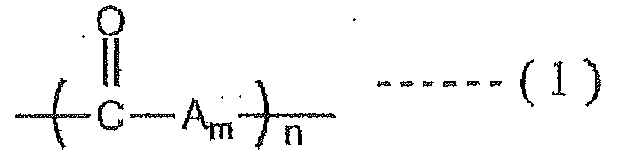
エチレン性不飽和化合物としては、例えば、エチレン、プロピレン、1-ブテン、イソブチレンおよび1-ペンテン等の炭素数2~12のα-オレフィン、好ましくは炭素数2~6の直鎖状のα-オレフィン、より好ましくはエチレンのみ、またはエチレンおよびプロピレン;ブタジエン、イソプレンおよび2-クロロブタジエン-1,3等のジエン類またはそのハロゲン化物;ビニリデンクロリド等のビニリデン類またはそのハロゲン化物;酢酸ビニル、クロロ酢酸ビニル、ジメチル酢酸ビニルおよびトリメチル酢酸ビニル等のビニルエステル類またはそのハロゲン化物;テトラフルオロエチレン、クロロエチレン等のハロゲン化ビニル類;ケテンメチル(ビニル)アセタール等のビニルアセタール類;ビニルメチルケトンおよびビニルエチルケトン等のビニルケトン類;スチレン、クロロスチレンおよびα-メチルスチレン等のスチレンまたはその誘導体;アクリル酸およびメタクリル酸、ならびにこれらのエステル化物、アミド化物、ニトリル化物および酸ハロゲン化物;ヘキセン酸ビニルおよびクロトン酸ビニル等の不飽和カルボン酸のビニルエステル類が挙げられる。
エチレン性不飽和化合物としては、これらの中では、炭素数2~6の直鎖状のα-オレフィンが好ましく、特にエチレンのみ、またはエチレンおよびプロピレンを含むことが好ましい。したがって、ポリケトンとしては、エチレン・一酸化炭素共重合体およびエチレン・プロピレン・一酸化炭素共重合体が好ましい。
エチレン性不飽和化合物は、1種単独で用いても2種以上を用いてもよい。後者の場合、エチレンと炭素数3~6の直鎖状のα-オレフィン、特にプロピレンとを組み合わせて使用することが好ましい。この場合、モル比であるエチレン/炭素数3~6の直鎖状のα-オレフィンが、1より大きいことが好ましく、2~30であることがより好ましい。
ポリケトンとしては、融点が通常175~300℃、好ましくは210~270℃であり、m-クレゾール中で標準キャピラリー粘度測定装置により測定した極限粘度数(IV)が通常0.5~10dl/g、好ましくは0.8~4dl/gである。
ポリケトンは公知であり、例えば米国特許第4880903号には、一酸化炭素、エチレンおよび他のエチレン性不飽和化合物(例えばプロピレン)の線状交互ポリケトンターポリマーが記載されている。ポリケトンは、一酸化炭素と前記エチレン性不飽和化合物とを公知の方法により重合することにより製造することができる。製造方法の詳細は、特開昭47-32100号公報、特公平5-87527号公報、特公平6-13608号公報などに記載されている。
ポリケトンとしては、市販品を使用することができる。例えば、AKRO-PLASTIC社製の製品名AKROTEK:PK-HM、シェル社製の製品名Carilonが挙げられる。
ポリケトンは、1種単独で用いても2種以上を用いてもよい。
層(E)において、ポリケトンの含有量は、好ましくは50質量%以上、より好ましくは70質量%以上、さらに好ましくは80質量%以上である。
層(E)において、ポリケトンの含有量は、好ましくは50質量%以上、より好ましくは70質量%以上、さらに好ましくは80質量%以上である。
前記極性樹脂は、好ましくは、接着材に存在するカルボジイミド基との反応性を有する活性水素を持つポリマーであり、例えば、カルボン酸、アミン、アルコール、チオール等に由来する基を持つポリマーである。具体的には、ポリエステル、ポリカーボネート、ポリフェニレンスルフィド(PPS)、ポリフェニレンオキサイド、ポリエーテルスルフォン(PES)、ポリアセタール等のポリエーテル、等の活性水素を持つポリオレフィンが挙げられる。なお、ポリエステル、ポリカーボネート、PPS、ポリフェニレンオキサイド、ポリエーテルスルフォン、ポリアセタールなどは分子末端以外に活性水素を有しておらず、主要分子骨格に活性水素を持たない極性樹脂の一例である。極性樹脂は、1種単独で用いても2種以上を用いてもよい。
ポリエステルとしては、例えば、ポリエチレンテレフタレート(PET)、リサイクル用廃PET、グリコール変性PET、酸変性PET、ポリエチレンナフタレート、ポリトリメチレンテレフタレート、ポリブチレンテレフタレート等の非晶ポリエステル、ポリブチレンテレフタレートアジペートやポリエチレンテレフタレートサクシネート等の生分解性ポリエステルを含む芳香族系ポリエステル;ポリカプロラクトン、ポリヒドロキシブチレート、ポリグリコール酸、ポリ乳酸等の乳酸系樹脂;これら以外の生分解性ポリエステルが挙げられる。更には、全芳香族や半芳香族ポリエステルから構成される液晶ポリエステル、ポリアリレートを挙げることができる。これらの中では、ポリエチレンテレフタレート、ポリブチレンテレフタレート、ポリ乳酸、液晶ポリエステルが好ましい。
ポリカーボネートとしては、例えば、ビスフェノールAポリカーボネート、ビスフェノールFポリカーボネート等の芳香族ビスフェノール型ポリカーボネート;ポリエチレンカーボネート、ポリトリメチレンカーボネート等の脂肪族カーボネートが挙げられる。市販のポリカーボネートとしては、例えば、SABIC社製LEXANTM141Rが挙げられる。
ポリフェニレンスルフィド(PPS)としては、例えば、芳香族環をスルフィド結合で連結して重合体としたものであり、分岐型または直鎖型のポリフェニレンスルフィドおよびその共重合体が挙げられる。具体的には、ポリ(パラフェニレンスルフィド)、ポリ(メタフェニレンスルフィド)が挙げられる。また、PPSは共重合体であってもよく、例えば、芳香族環とスルフィド結合とからなるユニットとともに、エーテルユニット、スルホンユニット、ビフェニルユニット、ナフチルユニット、置換フェニルスルフィドユニット、三官能フェニルスルフィドユニット等のユニットを分子中に有する共重合体が挙げられる。具体的には、ポリチオ-1,4-フェニレンが挙げられる。また、本発明では、市販のPPSを使用することも可能である。市販のPPSとしては、例えば、Ticona社製フォートロン(登録商標)FX4382T1、東レ社製トレリナ(登録商標)A900が挙げられる。
ポリフェニレンオキサイドとしては、例えば、ポリ-1,4-フェニレンオキサイドおよびポリ-2,6-ジメチル-1,4-フェニレンオキサイドが挙げられる。
ポリエーテルスルフォンとしては、一般に、成型用、フィルム用に使用されるもので有れば特に限定されない。
ポリエーテルスルフォンとしては、一般に、成型用、フィルム用に使用されるもので有れば特に限定されない。
ポリアセタールとしては、例えば、ポリホルムアルデヒド(ポリオキシメチレン)、ポリアセトアルデヒド、ポリプロピオンアルデヒド、ポリブチルアルデヒドが挙げられる。これらの中では、ポリホルムアルデヒドが特に好ましい。
本発明では、極性樹脂としてPPSを用いることが、常温だけでなく、従来のPPS用接着剤(エポキシ基含有接着剤)などと比較しても、より高温雰囲気下においても層間接着力に優れた積層体を得ることができるため、好ましい。また、極性樹脂としてポリカーボネートを用いることも好ましい。
層(E)が極性樹脂を含む場合、極性樹脂の含有量は、好ましくは50質量%以上、より好ましくは70質量%以上、さらに好ましくは80質量%以上である。
本発明の成分(D)を含む接着性樹脂組成物からなる接着材は、ポリメチルペンテン樹脂とポリケトンおよびポリカーボネートなどの樹脂とを良好に接着させることができる。このため、前記の層(E)、層(Y)および前記接着材を含む接着材層を有する積層体においては、層(E)と層(Y)とが良好に接着される。
本発明の成分(D)を含む接着性樹脂組成物からなる接着材は、ポリメチルペンテン樹脂とポリケトンおよびポリカーボネートなどの樹脂とを良好に接着させることができる。このため、前記の層(E)、層(Y)および前記接着材を含む接着材層を有する積層体においては、層(E)と層(Y)とが良好に接着される。
前記樹脂層/接着材層/樹脂層の層構造を含む他の積層体として、例えば、主要分子骨格に活性水素を持つ樹脂を含み、主要分子骨格に活性水素を持たない樹脂を含まない層(G)と、4-メチル-1-ペンテンに由来する構造単位の全構造単位に対する割合が90モル%以上100モル%以下であり、4-メチル-1-ペンテン以外のα-オレフィンに由来する構造単位の全構造単位に対する割合が0モル%以上10モル%以下である重合体を含み、かつ、示差走査熱量計(DSC)により測定される融点Tmが200℃以上である熱可塑性樹脂層(Y)と、前記層(G)と熱可塑性樹脂層(Y)との間に設けられた前記接着材を含む接着材層とを有する積層体を挙げることができる。
層(G)に含まれる、主要分子骨格に活性水素を持つ樹脂としては、例えば、ポリアミド、変性フッ素樹脂、アクリル樹脂、エチレン-ビニルアルコール共重合体、アクリロニトリル-ブタジエン-スチレン共重合体(ABS)、ポリオレフィンの変性物、エチレン-アクリル酸共重合体、エチレン-メタクリル酸共重合体等の極性樹脂を挙げることができる。これらの中でも、変性フッ素樹脂が特に好ましい。主要分子骨格に活性水素を持つ樹脂は、1種単独で用いても2種以上を用いてもよい。
変性フッ素樹脂は、フッ素原子を有する重合体または共重合体であり、具体的なものとしては、テトラフルオロエチレン、ビニリデンフルオライド、ヘキサフルオロプロピレンを共重合した3元系のフッ素系共重合体、テトラフルオロエチレンの単独重合体(PTFE)、テトラフルオロエチレンとエチレンとの共重合体(ETFE)などが挙げられる。また、これらの重合体にカルボニル基、エポキシ基、アミン基、カルボキシル基などの反応性や極性を有する基を含む化合物を共重合させたり、ラジカル発生剤を用いたりするなどの方法でグラフトさせたフッ素樹脂や、前記の基を末端に有するフッ素樹脂が挙げられる。このようなフッ素樹脂の代表例として、Fluon LM―ETFE AH(商品名、AGC社製)、ネオフロンEFEP(商品名、ダイキン工業株式会社製)などがある。
アクリル樹脂としては、例えば、(メタ)アクリル酸エステルから誘導される構造単位から主としてなるアクリル系重合体が挙げられる。その場合に、アクリル樹脂における(メタ)アクリル酸エステルから誘導される構造単位の割合が50重量%以上であることが好ましく、80重量%以上であることがより好ましい。(メタ)アクリル酸エステルとしては、例えば、(メタ)アクリル酸メチル、(メタ)アクリル酸エチル、(メタ)アクリル酸プロピル、(メタ)アクリル酸ブチル、(メタ)アクリル酸2-エチルヘキシル等の(メタ)アクリル酸アルキルエステルが挙げられる。(メタ)アクリル樹脂は、(メタ)アクリル酸エステルから誘導される構造単位の1種または2種以上を有していることができる。また、アクリル樹脂は、必要に応じて、(メタ)アクリル酸エステル以外の不飽和モノマーから誘導される構造単位の1種または2種以上を有していてもよい。例えば、アクリル樹脂は、(メタ)アクリロニトリル等のニトリル基含有ビニル系モノマーから誘導される構造単位を好ましくは50重量%以下の割合で有していてもよく、またスチレン、o-メチルスチレン、m-メチルスチレン、p-メチルスチレン、o-クロロスチレン、m-クロロスチレン、p-クロロスチレン等の芳香族ビニルモノマーから誘導される構造単位を好ましくは10重量%以下の割合で有していてもよい。
本発明の成分(D)を含む接着性樹脂組成物からなる接着材は、ポリメチルペンテン樹脂と変性フッ素樹脂などの樹脂とを良好に接着させることができる。このため、前記の層(G)、層(Y)および前記接着材を含む接着材層を有する積層体においては、層(G)と層(Y)とが良好に接着される。
積層体の具体的層構成としては、上記以外に、前記接着性樹脂組成物を含む層を「接着材層」、エチレン・ビニルアルコール共重合体を含む層を「EVOH」、ポリアミドを含む層を「Ny」、4-メチル-1-ペンテン系重合体を含む層を「MP」、ポリプロピレン樹脂を「PP」として表した場合、例えば下記の構成を挙げることができる。
二層構成: 接着材層/EVOH 、接着材層/Ny、接着材層/層(E)、接着材層/層(G)、接着材層/MP
三層構成: 接着材層/EVOH/接着材層、接着材層/Ny/接着材層、MP/接着材層/EVOH 、MP/接着材層/Ny、、MP/接着剤層/PP、接着材層/層(E)/接着材層、接着材層/層(G)/接着材層、接着材層/MP/接着材層、層(E)/接着材層/MP、層(E)/接着材層/層(G)、MP/接着材層/層(G)
四層構成: MP/接着材層/EVOH/接着材層、MP/接着材層/Ny/接着材層、MP/接着材層/PP/接着材層、接着材層/EVOH/接着材層/Ny、接着材層/EVOH/接着材層/MP、層(E)/接着材層/MP/接着材層、層(E)/接着材層/層(G)/接着材層、MP/接着材層/層(G)/接着材層
五層構成: MP/接着材層/EVOH/接着材層/MP、MP/接着材層/Ny/接着材層/MP、MP/接着材層/PP/接着材層/MP、MP/接着材層/EVOH/接着材層/Ny、MP/接着材層/EVOH/接着材層/PP、MP/接着材層/Ny/接着材層/PP
六層構成: MP/接着材層/EVOH/接着材層/Ny/接着材層、MP/接着材層/Ny/EVOH/接着材層/MP、、MP/接着材層/PP/接着材層/EVOH/接着材層、MP/接着材層/層(E)/接着材層/MP、MP/接着材層/層(G)/接着材層/MP、MP/接着材層/層(E)/接着材層/層(G)、MP/接着材層/層(G)/接着材層/層(E)、層(E)/接着材層/MP/接着材層/層(E)、層(G)/接着材層/MP/接着材層/層(G)、層(G)/接着材層/MP/接着材層/層(E)
七層構成: MP/接着材層/EVOH/接着材層/Ny/接着材層/MP、MP/接着材層/Ny/EVOH/Ny/接着材層/MP、、MP/接着材層/EVOH/接着材層/PP/接着材層/MP、MP/接着材層/層(E)/接着材層/層(G)/接着材層/MP、MP/接着材層/層(E)/接着材層/MP/接着材層/層(E)、MP/接着材層/層(G)/接着材層/MP/接着材層/層(G)、MP/接着材層/層(G)/接着材層/MP/接着材層/層(E)、MP/接着材層/層(E)/接着材層/MP/接着材層/層(G)
前記積層体をフィルムやシートに用いる場合には、その厚みは通常5~1000μm、好ましくは10~900μmであり、特に好ましくは10~800μmである。
二層構成: 接着材層/EVOH 、接着材層/Ny、接着材層/層(E)、接着材層/層(G)、接着材層/MP
三層構成: 接着材層/EVOH/接着材層、接着材層/Ny/接着材層、MP/接着材層/EVOH 、MP/接着材層/Ny、、MP/接着剤層/PP、接着材層/層(E)/接着材層、接着材層/層(G)/接着材層、接着材層/MP/接着材層、層(E)/接着材層/MP、層(E)/接着材層/層(G)、MP/接着材層/層(G)
四層構成: MP/接着材層/EVOH/接着材層、MP/接着材層/Ny/接着材層、MP/接着材層/PP/接着材層、接着材層/EVOH/接着材層/Ny、接着材層/EVOH/接着材層/MP、層(E)/接着材層/MP/接着材層、層(E)/接着材層/層(G)/接着材層、MP/接着材層/層(G)/接着材層
五層構成: MP/接着材層/EVOH/接着材層/MP、MP/接着材層/Ny/接着材層/MP、MP/接着材層/PP/接着材層/MP、MP/接着材層/EVOH/接着材層/Ny、MP/接着材層/EVOH/接着材層/PP、MP/接着材層/Ny/接着材層/PP
六層構成: MP/接着材層/EVOH/接着材層/Ny/接着材層、MP/接着材層/Ny/EVOH/接着材層/MP、、MP/接着材層/PP/接着材層/EVOH/接着材層、MP/接着材層/層(E)/接着材層/MP、MP/接着材層/層(G)/接着材層/MP、MP/接着材層/層(E)/接着材層/層(G)、MP/接着材層/層(G)/接着材層/層(E)、層(E)/接着材層/MP/接着材層/層(E)、層(G)/接着材層/MP/接着材層/層(G)、層(G)/接着材層/MP/接着材層/層(E)
七層構成: MP/接着材層/EVOH/接着材層/Ny/接着材層/MP、MP/接着材層/Ny/EVOH/Ny/接着材層/MP、、MP/接着材層/EVOH/接着材層/PP/接着材層/MP、MP/接着材層/層(E)/接着材層/層(G)/接着材層/MP、MP/接着材層/層(E)/接着材層/MP/接着材層/層(E)、MP/接着材層/層(G)/接着材層/MP/接着材層/層(G)、MP/接着材層/層(G)/接着材層/MP/接着材層/層(E)、MP/接着材層/層(E)/接着材層/MP/接着材層/層(G)
前記積層体をフィルムやシートに用いる場合には、その厚みは通常5~1000μm、好ましくは10~900μmであり、特に好ましくは10~800μmである。
また、前記接着性樹脂組成物を含む層の厚みは、特に制限はない。フィルムやシートに用いる場合には、通常1~800μm、好ましくは5~600μmの範囲である。ボトルなどに用いる場合には、これとは異なる厚みであってもよい。
前記積層体は、例えば、共押出キャストフィルム成形、共押出インフレーションフィルム成形、シート成型、コーティング、ブロー、押出ラミネート等の公知の成形法で製造することができる。特に、共押出キャストフィルム成形法、共押出インフレーションフィルム成形法により好適に積層体を成形することができる。
本発明の積層体は、前述のとおり、ポリメチルペンテン樹脂と、エチレン・ビニルアルコール共重合樹脂やポリアミド樹脂などの極性樹脂およびポリプロピレン樹脂などのポリオレフィン樹脂とを良好に接着させることができ、延伸等を行った後においても両者の良好な接着が維持することができるという特性を有することから、様々な用途に利用することができる。例えば、本発明の積層体から、該積層体を含むフィルムを製造することができ、さらに該フィルムから袋を得ることができる。また、本発明の積層体から、該積層体を含む容器を製造することができ、該積層体を含む包装容器を製造することができる。本発明の積層体は、前記の特性より、食品包装容器または食品包装袋等に特に好適に用いることができる。
以下、実施例および比較例を挙げて本発明を更に具体的に説明するが、本発明はその要旨を越えない限りこれらの実施例になんら制約されるものではない。特に言及しない限り、「質量部」は「部」で表す。
(各種測定方法)
本実施例等においては、以下の方法に従って測定を実施した。
[接着性樹脂組成物のメルトフローレート(MFR)]
接着性樹脂組成物のメルトフローレートについては、ASTM D1238に従い下記条件のもと測定を実施した。
ポリエチレン系重合体:190℃、2.16kg荷重下
ポリプロピレン系重合体:230℃、2.16kg荷重下
4-メチル-1-ペンテン系重合体:260℃、5kg荷重下。
[密度]
密度は、JIS K7112に準拠して測定した。
(各種測定方法)
本実施例等においては、以下の方法に従って測定を実施した。
[接着性樹脂組成物のメルトフローレート(MFR)]
接着性樹脂組成物のメルトフローレートについては、ASTM D1238に従い下記条件のもと測定を実施した。
ポリエチレン系重合体:190℃、2.16kg荷重下
ポリプロピレン系重合体:230℃、2.16kg荷重下
4-メチル-1-ペンテン系重合体:260℃、5kg荷重下。
[密度]
密度は、JIS K7112に準拠して測定した。
〔カルボジイミド基含有化合物の数平均分子量〕
数平均分子量は、ゲルパーミエーションクロマトグラフィー(GPC)を用い、テトラヒドロフラン溶媒(移動相)とし、カラム温度40℃で測定した(ポリスチレン換算、Mw:重量平均分子量、Mn:数平均分子量)。標準ポリスチレンは、分子量が580≦Mw≦7×10⁶については、アジレント・テクノロジー(株)(旧ポリマーラボラトリーズリミテッド)社製ポリスチレンPS-1を用いた。
数平均分子量は、ゲルパーミエーションクロマトグラフィー(GPC)を用い、テトラヒドロフラン溶媒(移動相)とし、カラム温度40℃で測定した(ポリスチレン換算、Mw:重量平均分子量、Mn:数平均分子量)。標準ポリスチレンは、分子量が580≦Mw≦7×10⁶については、アジレント・テクノロジー(株)(旧ポリマーラボラトリーズリミテッド)社製ポリスチレンPS-1を用いた。
〔カルボジイミド基の含有量〕
実施例および比較例のカルボジイミド基の含有量は、カルボジイミド基含有化合物の仕込み量から算出した。
[無水マレイン酸のグラフト量]
無水マレイン酸のグラフト量は、FT-IRを用いて次の方法にて測定した。試料を250℃で、3分間熱プレスしてシートを作製した後に、赤外分光光度計(日本分光(株)社製、FT-IR410型)を用いて透過法で1790cm-1付近の赤外吸収スペクトルを測定した。測定条件は、分解能を2cm-1、積算回数を32回とした。
実施例および比較例のカルボジイミド基の含有量は、カルボジイミド基含有化合物の仕込み量から算出した。
[無水マレイン酸のグラフト量]
無水マレイン酸のグラフト量は、FT-IRを用いて次の方法にて測定した。試料を250℃で、3分間熱プレスしてシートを作製した後に、赤外分光光度計(日本分光(株)社製、FT-IR410型)を用いて透過法で1790cm-1付近の赤外吸収スペクトルを測定した。測定条件は、分解能を2cm-1、積算回数を32回とした。
[層間接着力]
得られた積層体および延伸フィルムを15mm幅に切り取り、引張試験機((株)インテスコ社製IM-20ST型)を使用してTピール法にて、接着材層に対し、ポリアミド層、EVOH層、PP層、ポリケトン層、ポリカーボネート層、変性フッ素樹脂層またはポリ4-メチル-1-ペンテン層とのそれぞれの界面における層間接着力を、室温23℃で測定した。
得られた積層体および延伸フィルムを15mm幅に切り取り、引張試験機((株)インテスコ社製IM-20ST型)を使用してTピール法にて、接着材層に対し、ポリアミド層、EVOH層、PP層、ポリケトン層、ポリカーボネート層、変性フッ素樹脂層またはポリ4-メチル-1-ペンテン層とのそれぞれの界面における層間接着力を、室温23℃で測定した。
クロスヘッドスピードは、300mm/minとした。
層間接着力の単位はN/15mmである。
実施例及び比較例において使用したポリオレフィンを以下に示す。なお、いずれも常法に従い重合を行い、調製した。
PP-1: ランダムポリプロピレン
(メルトフローレート(230℃、2.16kg荷重):7.0g/10分、密度:0.900g/cm3、エチレン含量:5モル%)
PP-2: 無水マレイン酸変性ホモポリプロピレン
(メルトフローレート(230℃、2.16kg荷重):100g/10分、密度:0.900g/cm3、無水マレイン酸グラフト量:3.0質量%)
PP-3:ポリプロピレン:
(メルトフローレート(230℃、2.16kg荷重):5g/10分、密度:0.900g/cm3)
PE-1: ポリエチレン系重合体
(メルトフローレート(190℃、2.16kg荷重):0.8g/10分、密度:0.870g/cm3、プロピレン含量:19モル%、)
PMP-1: プロピレン-4-メチル-1-ペンテン共重合体(MFR:10g/10分(230℃、2.16kg荷重)、密度:0.838g/cm3、プロピレン含量:15モル%、4-メチル-1-ペンテン含量:85モル%、DSCにより測定される融点:130℃)
PMP-2: プロピレン-4-メチル-1-ペンテン共重合体(MFR:10g/10分(230℃、2.16kg荷重)、密度:0.840g/cm3、プロピレン含量:28モル%、4-メチル-1-ペンテン含量:72モル%、DSCにより融点が観測されない)
MP-1: ポリ4-メチル-1-ペンテン(MFR:26g/10分(260℃、5kg荷重)、密度:0.833g/cm3、4-メチル-1-ペンテン含量:100モル%、DSCにより測定される融点:220℃)
HMV-15CA:カルボジイミド基含有化合物
(日清紡ケミカル(株)社製、商品名カルボジライト(登録商標)HMV-15CA、カルボジイミド基当量:262、数平均分子量:3050、1分子中のカルボジイミド基数:12個)
〔実施例1〕
<接着性樹脂組成物の製造>
上記PP-1 65部と、PP-2 5部と、PE-1 10部と、PMP-1 20部とを混合し、二軸混練機(日本製鋼所製、TEX-30)を用いて230℃で溶融混練し、接着材1(接着性樹脂組成物)を得た。得られた組成物のメルトフローレートは8.1g/10分であり、密度は0.885g/cm3であった。
層間接着力の単位はN/15mmである。
実施例及び比較例において使用したポリオレフィンを以下に示す。なお、いずれも常法に従い重合を行い、調製した。
PP-1: ランダムポリプロピレン
(メルトフローレート(230℃、2.16kg荷重):7.0g/10分、密度:0.900g/cm3、エチレン含量:5モル%)
PP-2: 無水マレイン酸変性ホモポリプロピレン
(メルトフローレート(230℃、2.16kg荷重):100g/10分、密度:0.900g/cm3、無水マレイン酸グラフト量:3.0質量%)
PP-3:ポリプロピレン:
(メルトフローレート(230℃、2.16kg荷重):5g/10分、密度:0.900g/cm3)
PE-1: ポリエチレン系重合体
(メルトフローレート(190℃、2.16kg荷重):0.8g/10分、密度:0.870g/cm3、プロピレン含量:19モル%、)
PMP-1: プロピレン-4-メチル-1-ペンテン共重合体(MFR:10g/10分(230℃、2.16kg荷重)、密度:0.838g/cm3、プロピレン含量:15モル%、4-メチル-1-ペンテン含量:85モル%、DSCにより測定される融点:130℃)
PMP-2: プロピレン-4-メチル-1-ペンテン共重合体(MFR:10g/10分(230℃、2.16kg荷重)、密度:0.840g/cm3、プロピレン含量:28モル%、4-メチル-1-ペンテン含量:72モル%、DSCにより融点が観測されない)
MP-1: ポリ4-メチル-1-ペンテン(MFR:26g/10分(260℃、5kg荷重)、密度:0.833g/cm3、4-メチル-1-ペンテン含量:100モル%、DSCにより測定される融点:220℃)
HMV-15CA:カルボジイミド基含有化合物
(日清紡ケミカル(株)社製、商品名カルボジライト(登録商標)HMV-15CA、カルボジイミド基当量:262、数平均分子量:3050、1分子中のカルボジイミド基数:12個)
〔実施例1〕
<接着性樹脂組成物の製造>
上記PP-1 65部と、PP-2 5部と、PE-1 10部と、PMP-1 20部とを混合し、二軸混練機(日本製鋼所製、TEX-30)を用いて230℃で溶融混練し、接着材1(接着性樹脂組成物)を得た。得られた組成物のメルトフローレートは8.1g/10分であり、密度は0.885g/cm3であった。
<5層積層体の製造>
以下に示した構成から成る層を、下記の条件で共押出して、5層積層体を成形した。
4種5層Tダイキャストシート成形機(EDI社製)を使用し、共押出成形によってMP-1/接着材1/ポリアミド/接着材1/MP-1の積層体を作成した。ポリアミドとしてはDupont製Zytel 45HSBを使用した。ダイス温度は275℃であり、チルロールで冷却を受けつつ、4m/分の速さで引き取った。各層の厚みはMP-1/接着材1/ポリアミド/接着材1/MP-1=100/20/50/20/100μmとした。
<延伸フィルムの製造>
上記で得られた5層積層体に対して、バッチ式延伸機(Bruckner社製)にて二軸延伸加工を実施し、延伸フィルムを製造した。延伸倍率は2×2倍、温度は175℃とした。
以下に示した構成から成る層を、下記の条件で共押出して、5層積層体を成形した。
4種5層Tダイキャストシート成形機(EDI社製)を使用し、共押出成形によってMP-1/接着材1/ポリアミド/接着材1/MP-1の積層体を作成した。ポリアミドとしてはDupont製Zytel 45HSBを使用した。ダイス温度は275℃であり、チルロールで冷却を受けつつ、4m/分の速さで引き取った。各層の厚みはMP-1/接着材1/ポリアミド/接着材1/MP-1=100/20/50/20/100μmとした。
<延伸フィルムの製造>
上記で得られた5層積層体に対して、バッチ式延伸機(Bruckner社製)にて二軸延伸加工を実施し、延伸フィルムを製造した。延伸倍率は2×2倍、温度は175℃とした。
<積層体および延伸フィルムの層間接着力評価>
上記で製造した積層体および延伸フィルムにおける、MP-1層と接着材層との界面における層間接着力(MP-1層間接着力)およびポリアミド層と接着材層との界面における層間接着力(ポリアミド層間接着力)を前記の測定方法により測定した。結果を表1に示す。
上記で製造した積層体および延伸フィルムにおける、MP-1層と接着材層との界面における層間接着力(MP-1層間接着力)およびポリアミド層と接着材層との界面における層間接着力(ポリアミド層間接着力)を前記の測定方法により測定した。結果を表1に示す。
〔実施例2~9〕
表1に示した配合処方に従い実施例1と同様の方法で接着材、積層体および延伸フィルムを製造した。得られた積層体および延伸フィルムの層間接着力を実施例1と同様に測定した。結果を表1に示す。
表1に示した配合処方に従い実施例1と同様の方法で接着材、積層体および延伸フィルムを製造した。得られた積層体および延伸フィルムの層間接着力を実施例1と同様に測定した。結果を表1に示す。
〔比較例1~3〕
表1に示した配合処方に従い実施例1と同様の方法で接着材、積層体および延伸フィルムを製造した。得られた積層体および延伸フィルムの層間接着力を実施例1と同様に測定した。結果を表1に示す。
〔実施例10〕
上記実施例1で得られた接着材1を使用して、以下に示した5層からなる層を、下記の条件で共押出して、5層積層体を成形した。
表1に示した配合処方に従い実施例1と同様の方法で接着材、積層体および延伸フィルムを製造した。得られた積層体および延伸フィルムの層間接着力を実施例1と同様に測定した。結果を表1に示す。
〔実施例10〕
上記実施例1で得られた接着材1を使用して、以下に示した5層からなる層を、下記の条件で共押出して、5層積層体を成形した。
<5層積層体の製造>
4種5層Tダイキャストシート成形機(EDI社製)を使用し、共押出成形によってMP-1/接着材1/エチレン・ビニルアルコール共重合体(EVOH)/接着材1/PP-1の積層体を作成した。EVOHとしては株式会社クラレ製エバール F101Bを使用した。ダイス温度は230℃であり、チルロールで冷却を受けつつ、1m/分の速さで引き取った。各層の厚みはMP-1/接着材1/EVOH/接着材1/PP-1=350/50/50/50/350μmとした。
4種5層Tダイキャストシート成形機(EDI社製)を使用し、共押出成形によってMP-1/接着材1/エチレン・ビニルアルコール共重合体(EVOH)/接着材1/PP-1の積層体を作成した。EVOHとしては株式会社クラレ製エバール F101Bを使用した。ダイス温度は230℃であり、チルロールで冷却を受けつつ、1m/分の速さで引き取った。各層の厚みはMP-1/接着材1/EVOH/接着材1/PP-1=350/50/50/50/350μmとした。
<積層体の層間接着力評価>
上記で製造した積層体における、MP-1層と接着材層との界面における層間接着力(MP-1層間接着力)、EVOH層と接着材層との界面における層間接着力(EVOH層間接着力)、およびPP層と接着剤層との界面における層間接着力(PP層間接着力)を前記の測定方法により測定した。結果を表1に示す。
上記で製造した積層体における、MP-1層と接着材層との界面における層間接着力(MP-1層間接着力)、EVOH層と接着材層との界面における層間接着力(EVOH層間接着力)、およびPP層と接着剤層との界面における層間接着力(PP層間接着力)を前記の測定方法により測定した。結果を表1に示す。
〔実施例11~16〕
表1に示した配合処方に従い、実施例1と同様の方法で接着材を製造し、実施例10と同様の方法で積層体を製造した。得られた積層体の層間接着力を実施例10と同様に測定した。結果を表1に示す。
表1に示した配合処方に従い、実施例1と同様の方法で接着材を製造し、実施例10と同様の方法で積層体を製造した。得られた積層体の層間接着力を実施例10と同様に測定した。結果を表1に示す。
〔比較例4~6〕
表1に示した配合処方に従い実施例1と同様の方法で接着材を製造し、実施例10と同様の方法で積層体を製造した。得られた積層体の層間接着力を実施例10と同様に測定した。結果を表1に示す。
表1に示した配合処方に従い実施例1と同様の方法で接着材を製造し、実施例10と同様の方法で積層体を製造した。得られた積層体の層間接着力を実施例10と同様に測定した。結果を表1に示す。
〔製造例1〕
<カルボジイミド基と反応する基を有するポリオレフィン(a)の製造>
PP-1 100部に、無水マレイン酸(和光純薬工業(株)社製、以下、MAHと略記)1部、2,5-ジメチル-2,5-ビス(tert-ブチルパーオキシ)ヘキシン-3(日油(株)社製、商品名パーヘキシン(登録商標)25B)0.25部を混合し、二軸混練機を用いてシリンダー温度220℃、スクリュー回転数200rpm、吐出量80g/分にて押し出し、ポリオレフィン(a)である無水マレイン酸変性ポリプロピレン(以下、MAH-PP-1と略記)を得た。MAH-PP-1の密度は0.905g/cm3であった。
<カルボジイミド基と反応する基を有するポリオレフィン(a)の製造>
PP-1 100部に、無水マレイン酸(和光純薬工業(株)社製、以下、MAHと略記)1部、2,5-ジメチル-2,5-ビス(tert-ブチルパーオキシ)ヘキシン-3(日油(株)社製、商品名パーヘキシン(登録商標)25B)0.25部を混合し、二軸混練機を用いてシリンダー温度220℃、スクリュー回転数200rpm、吐出量80g/分にて押し出し、ポリオレフィン(a)である無水マレイン酸変性ポリプロピレン(以下、MAH-PP-1と略記)を得た。MAH-PP-1の密度は0.905g/cm3であった。
得られたMAH-PP-1をキシレンに溶解し、次いで得られたキシレン溶液をアセトンに注ぐことで、MAH-PP-1を再沈させて精製した。無水マレイン酸のグラフト量をFT-IRにて測定したところ0.7重量%であった。
<カルボジイミド変性ポリオレフィン(D)の製造>
上記で製造したMAH-PP-1 100部と、カルボジイミド基含有化合物HMV-15CA 8.8部とを混合し、二軸混練機を用いてシリンダー温度250℃、スクリュー回転数200rpm、吐出量80g/分にて押し出し、カルボジイミド変性ポリオレフィン(D)であるカルボジイミド変性PPのペレット(以下、CDI-PP1と略記)を製造した。
上記で製造したMAH-PP-1 100部と、カルボジイミド基含有化合物HMV-15CA 8.8部とを混合し、二軸混練機を用いてシリンダー温度250℃、スクリュー回転数200rpm、吐出量80g/分にて押し出し、カルボジイミド変性ポリオレフィン(D)であるカルボジイミド変性PPのペレット(以下、CDI-PP1と略記)を製造した。
得られたCDI-PP1は、MFR(230℃、2.16kg荷重)は130g/10分、密度は0.905g/cm3であり、カルボジイミド基含有化合物の仕込み量から算出したカルボジイミド基含有量は31mmol/100gであった。尚、FT-IR分析によれば、CDI-PP1からは無水マレイン酸のピーク(1790cm-1)が消失していたことから、ポリオレフィン(a)中のカルボジイミド基と反応する基に由来する吸光度およびCDI-PP1中のカルボジイミド基と反応する基に由来する吸光度の差(P)と、ポリオレフィン(a)中のカルボジイミド基と反応する基に由来する吸光度(Q)との比が1であるため、反応率は100%であった。
〔実施例17〕
<接着材の製造>
上記で製造したCDI-PP1 20部、PP-3 50部、PE-1 10部、およびPMP-1 20部を混合し、二軸押出機を用いてシリンダー温度250℃、スクリュー回転数200rpm、吐出量80g/分にて押し出し、接着材13を得た。
<接着材の製造>
上記で製造したCDI-PP1 20部、PP-3 50部、PE-1 10部、およびPMP-1 20部を混合し、二軸押出機を用いてシリンダー温度250℃、スクリュー回転数200rpm、吐出量80g/分にて押し出し、接着材13を得た。
<積層体の製造>
4種5層Tダイキャストシート成形機(EDI社製)を使用し、共押出成形によってMP-1/接着材13/ポリケトン/接着材13/MP-1、およびMP-1/接着材13/ポリカーボネート/接着材13/MP-1、およびMP-1/接着材13/変性フッ素樹脂/接着材13/MP-1の積層体を作成した。ポリケトンとしてはAKRO-PLASTIC社製、製品名AKROTEK:PK-HM)を用いた。ポリカーボネートとしてはSABIC社製LEXAN 141Rを用いた。変性フッ素樹脂としては旭硝子社製LH-8000を用いた。
4種5層Tダイキャストシート成形機(EDI社製)を使用し、共押出成形によってMP-1/接着材13/ポリケトン/接着材13/MP-1、およびMP-1/接着材13/ポリカーボネート/接着材13/MP-1、およびMP-1/接着材13/変性フッ素樹脂/接着材13/MP-1の積層体を作成した。ポリケトンとしてはAKRO-PLASTIC社製、製品名AKROTEK:PK-HM)を用いた。ポリカーボネートとしてはSABIC社製LEXAN 141Rを用いた。変性フッ素樹脂としては旭硝子社製LH-8000を用いた。
MP-1層の押出機は50mmφで温度を275℃とし、接着材13の押出機は40mmφで温度を270℃とし、ポリケトン層の押出機は30mmφで温度を270℃とし、ポリカーボネート層の押出機は30mmφで温度を280℃とし、変性フッ素樹脂層の押出機は30mmφで温度を270℃とし、ダイス部分の温度を275℃とし、チルロールで冷却を受けつつ、4m/minで引き取った。各層の厚さは、MP-1/接着材13/ポリケトンまたはポリカーボネートまたは変性フッ素樹脂/接着材13/MP-1=100/20/50/20/100μmとした。
<積層体の層間接着力評価>
上記で製造した積層体の層間接着力を測定した。結果を表2に示す。
〔実施例18~23〕
表2に示した配合処方に従い実施例17と同様の方法で接着材、および積層体を製造した。得られた積層体の層間接着力の測定結果を表2に示す。
上記で製造した積層体の層間接着力を測定した。結果を表2に示す。
〔実施例18~23〕
表2に示した配合処方に従い実施例17と同様の方法で接着材、および積層体を製造した。得られた積層体の層間接着力の測定結果を表2に示す。
〔比較例7~9〕
表2に示した配合処方に従い実施例17と同様の方法で接着材、および積層体を製造した。得られた積層体の層間接着力の測定結果を表2に示す。
表2に示した配合処方に従い実施例17と同様の方法で接着材、および積層体を製造した。得られた積層体の層間接着力の測定結果を表2に示す。
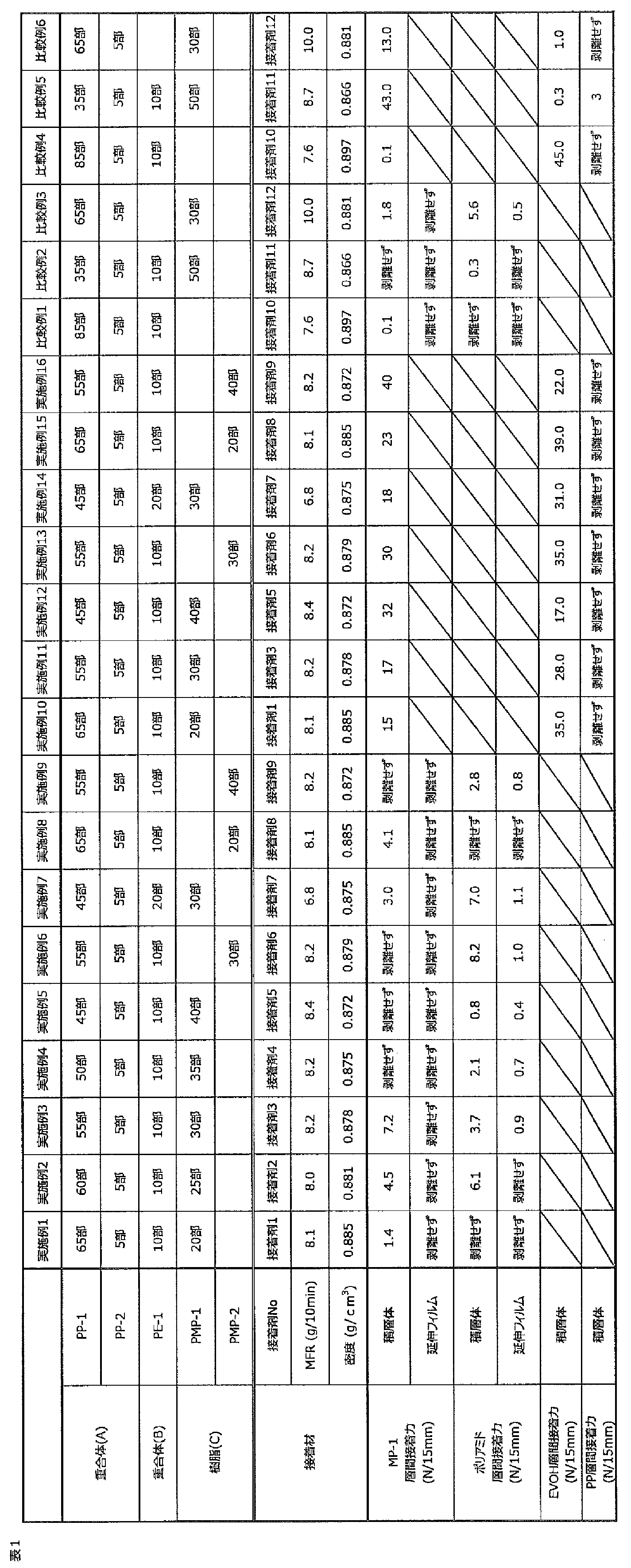

Claims (21)
- プロピレン系重合体(A)、
エチレン系重合体(B)、および
4-メチル-1-ペンテンに由来する構成単位を60モル%以上99モル%以下、及び4-メチル-1-ペンテン以外の炭素数2以上20以下のα-オレフィンに由来する構成単位を1モル%以上40モル%以下有し、前記4-メチル-1-ペンテンに由来する構成単位と、前記4-メチル-1-ペンテン以外の炭素数2以上20以下のα-オレフィンに由来する構成単位とが合計で100モル%である共重合体を含み、かつ、示差走査熱量計(DSC)により測定される融点Tmが199℃以下であるか、又は実質的に観測されない熱可塑性樹脂(C)
を含有する樹脂組成物であって、前記成分(A)、(B)及び(C)の合計100質量部中、成分(A)の含有比率が45~75質量部、成分(B)の含有比率が5~20質量部、成分(C)の含有比率が15~45質量部であることを特徴とする接着性樹脂組成物。 - 前記プロピレン系重合体(A)は、プロピレンに由来する構成単位を75~100モル%含有する請求項1に記載の接着性樹脂組成物。
- 前記プロピレン系重合体(A)、エチレン系重合体(B)および熱可塑性樹脂(C)に含まれる共重合体の一部またはすべてが不飽和カルボン酸及び/又はその誘導体によってグラフト変性された請求項1または2に記載の接着性樹脂組成物。
- 熱可塑性樹脂層(X)と、
4-メチル-1-ペンテンに由来する構成単位を全構成単位に対して90モル%以上100モル%以下有し、4-メチル-1-ペンテン以外のα―オレフィンに由来する構成単位を全構成単位に対して0モル%以上10モル%以下有する重合体を含み、かつ、示差走査熱量計(DSC)により測定される融点Tmが200℃以上である熱可塑性樹脂層(Y)と、
前記熱可塑性樹脂層(X)と熱可塑性樹脂層(Y)との間に設けられた、請求項1~3のいずれか1項に記載の接着性樹脂組成物を含む接着材層とを有する積層体。 - 前記層(X)がポリプロピレンを含む層である、請求項4に記載の積層体。
- 前記層(X)がOH基又はNH基を含有する樹脂を含む層である、請求項4に記載の積層体。
- 前記層(X)がエチレン・ビニルアルコール共重合体を含む層である、請求項4に記載の積層体。
- 前記層(X)がポリアミドを含有する樹脂を含む層である、請求項4に記載の積層体。
- 共押出キャストフィルム成形法によって成形された請求項4~8のいずれか1項に記載の積層体。
- 共押出インフレーションフィルム成形法によって成形された請求項4~8のいずれか1項に記載の積層体。
- 請求項4~10のいずれか1項に記載の積層体を用いて製造された食品包装容器または食品包装袋。
- さらにカルボジイミド変性ポリオレフィン(D)を含み、前記成分(A)、(B)、(C)及び(D)の合計100質量部中、成分(A)の含有比率が10~65質量部、成分(B)の含有比率が5~20質量部、成分(C)の含有比率が15~45質量部、成分(D)の含有比率が5~30質量部であることを特徴とする、請求項1または2に記載の接着性樹脂組成物。
- 100g当たり、カルボジイミド基を0.1~50mmolの量で含む請求項12に記載の接着性樹脂組成物。
- 主要分子骨格に活性水素を持たない樹脂を含む層(E)と、
4-メチル-1-ペンテンに由来する構造単位の全構造単位に対する割合が90モル%以上100モル%以下であり、4-メチル-1-ペンテン以外のα-オレフィンに由来する構造単位の全構造単位に対する割合が0モル%以上10モル%以下である重合体を含み、かつ、示差走査熱量計(DSC)により測定される融点Tmが200℃以上である熱可塑性樹脂層(Y)と、
前記層(E)と熱可塑性樹脂層(Y)との間に設けられた、請求項12または13に記載の接着性樹脂組成物を含む接着材層とを有する積層体。 - 前記主要分子骨格に活性水素を持たない樹脂はポリケトンである、請求項14に記載の積層体。
- 前記ポリケトンが、カルボニル基と、エチレン性不飽和化合物から導かれる2価の有機基または当該有機基が2以上連結してなる2価の有機基とが交互に結合している線状重合体である、請求項15に記載の積層体。
- 前記ポリケトンが、エチレン・一酸化炭素共重合体またはエチレン・プロピレン・一酸化炭素共重合体である、請求項15または16に記載の積層体。
- 前記主要分子骨格に活性水素を持たない樹脂は極性樹脂である、請求項14に記載の積層体。
- 前記極性樹脂はポリカーボネートである請求項18に記載の積層体。
- 主要分子骨格に活性水素を持つ樹脂を含み、主要分子骨格に活性水素を持たない樹脂を含まない層(G)と、
4-メチル-1-ペンテンに由来する構造単位の全構造単位に対する割合が90モル%以上100モル%以下であり、4-メチル-1-ペンテン以外のα-オレフィンに由来する構造単位の全構造単位に対する割合が0モル%以上10モル%以下である重合体を含み、かつ、示差走査熱量計(DSC)により測定される融点Tmが200℃以上である熱可塑性樹脂層(Y)と、
前記層(G)と熱可塑性樹脂層(Y)との間に設けられた、請求項12または13に記載の接着性樹脂組成物を含む接着材層とを有する積層体。 - 前記主要分子骨格に活性水素を持つ樹脂は変性フッ素樹脂である請求項20に記載の積層体。
Priority Applications (3)
| Application Number | Priority Date | Filing Date | Title |
|---|---|---|---|
| CN202080006836.6A CN113165363B (zh) | 2019-01-07 | 2020-01-06 | 粘接性树脂组合物和叠层体 |
| US17/419,640 US12168738B2 (en) | 2019-01-07 | 2020-01-06 | Adhesive resin compositions and laminates |
| EP20738893.5A EP3909765B1 (en) | 2019-01-07 | 2020-01-06 | Adhesive resin composition and layered body |
Applications Claiming Priority (6)
| Application Number | Priority Date | Filing Date | Title |
|---|---|---|---|
| JP2019000636 | 2019-01-07 | ||
| JP2019-000636 | 2019-01-07 | ||
| JP2019018512A JP7186630B2 (ja) | 2019-02-05 | 2019-02-05 | 接着材および積層体 |
| JP2019-018512 | 2019-02-05 | ||
| JP2019-234236 | 2019-12-25 | ||
| JP2019234236A JP7370244B2 (ja) | 2019-01-07 | 2019-12-25 | 接着性樹脂組成物および積層体 |
Publications (1)
| Publication Number | Publication Date |
|---|---|
| WO2020145239A1 true WO2020145239A1 (ja) | 2020-07-16 |
Family
ID=71521636
Family Applications (1)
| Application Number | Title | Priority Date | Filing Date |
|---|---|---|---|
| PCT/JP2020/000060 Ceased WO2020145239A1 (ja) | 2019-01-07 | 2020-01-06 | 接着性樹脂組成物および積層体 |
Country Status (2)
| Country | Link |
|---|---|
| US (1) | US12168738B2 (ja) |
| WO (1) | WO2020145239A1 (ja) |
Cited By (6)
| Publication number | Priority date | Publication date | Assignee | Title |
|---|---|---|---|---|
| WO2021215313A1 (ja) * | 2020-04-24 | 2021-10-28 | 株式会社クラレ | 多層構造体、その製造方法、有害物質拡散防止用シート、ランドフィルジオメンブレン及び多層パイプ |
| WO2022054887A1 (ja) * | 2020-09-10 | 2022-03-17 | 株式会社クラレ | 多層構造体、およびそれからなる包装容器 |
| WO2022118836A1 (ja) * | 2020-12-04 | 2022-06-09 | 三井化学株式会社 | グラフト変性体、接着剤、オレフィン系樹脂組成物および積層体 |
| WO2022137867A1 (ja) * | 2020-12-24 | 2022-06-30 | 東洋紡株式会社 | 熱融着性積層配向フィルム |
| WO2023229012A1 (ja) | 2022-05-26 | 2023-11-30 | 三井化学株式会社 | 積層体および積層体の製造方法 |
| CN117203055A (zh) * | 2021-07-12 | 2023-12-08 | 东洋纺株式会社 | 热熔接性层叠薄膜 |
Citations (16)
| Publication number | Priority date | Publication date | Assignee | Title |
|---|---|---|---|---|
| JPS4732100U (ja) | 1971-04-28 | 1972-12-11 | ||
| US4880903A (en) | 1985-08-29 | 1989-11-14 | Shell Oil Company | Polyketone from carbon monoxide and mixture of olefins |
| JPH0587527B2 (ja) | 1983-04-06 | 1993-12-17 | Sheru Intern Risaachi Maachatsupii Bv | |
| JPH0613608B2 (ja) | 1984-10-05 | 1994-02-23 | シエル・インターナシヨネイル・リサーチ・マーチヤツピイ・ベー・ウイ | ポリケトンの製造方法 |
| JPH09268243A (ja) * | 1996-02-01 | 1997-10-14 | Mitsui Petrochem Ind Ltd | 4−メチル−1−ペンテン樹脂組成物、及び該組成物を用いて成る積層体 |
| JPH10101868A (ja) * | 1996-09-30 | 1998-04-21 | Mitsui Petrochem Ind Ltd | 基材との接着強度に優れた4−メチル−1−ペンテン系樹脂組成物及び該樹脂組成物層を有する積層体 |
| JP3721265B2 (ja) | 1997-08-08 | 2005-11-30 | 三井化学株式会社 | 4−メチル−1−ペンテン系重合体組成物及びこれを用いた積層体並びに接着剤 |
| WO2007086434A1 (ja) | 2006-01-26 | 2007-08-02 | Mitsui Chemicals, Inc. | 積層体 |
| WO2010023906A1 (ja) * | 2008-09-01 | 2010-03-04 | 三井化学株式会社 | シンジオタクティック構造を有する4-メチルペンテン-1系重合体 |
| WO2011055803A1 (ja) * | 2009-11-06 | 2011-05-12 | 三井化学株式会社 | 4-メチル-1-ペンテン・α-オレフィン共重合体、該共重合体を含む組成物および4-メチル-1-ペンテン共重合体組成物 |
| JP2015218182A (ja) | 2014-05-14 | 2015-12-07 | リケンテクノス株式会社 | 接着性熱可塑性樹脂組成物、及びその製造方法、並びに該組成物を使用した積層体 |
| JP2016026380A (ja) | 2015-11-06 | 2016-02-12 | 三井化学株式会社 | 電池部材用フィルム |
| WO2017104731A1 (ja) | 2015-12-15 | 2017-06-22 | 三井化学株式会社 | 積層体およびその製造方法、ならびに接着用組成物 |
| WO2018155448A1 (ja) | 2017-02-27 | 2018-08-30 | 三井化学株式会社 | 積層体の製造方法および共押出シート |
| JP2019098620A (ja) * | 2017-12-01 | 2019-06-24 | 三井化学株式会社 | 積層体の製造方法及び積層体 |
| JP2019137853A (ja) | 2018-02-05 | 2019-08-22 | 藤森工業株式会社 | ホットメルト接着性樹脂積層体及び積層体 |
Family Cites Families (1)
| Publication number | Priority date | Publication date | Assignee | Title |
|---|---|---|---|---|
| CA2175877A1 (en) * | 1995-05-26 | 1996-11-27 | Mitsui Chemicals, Inc. | 4-methyl-1-pentene polymer compositions |
-
2020
- 2020-01-06 US US17/419,640 patent/US12168738B2/en active Active
- 2020-01-06 WO PCT/JP2020/000060 patent/WO2020145239A1/ja not_active Ceased
Patent Citations (16)
| Publication number | Priority date | Publication date | Assignee | Title |
|---|---|---|---|---|
| JPS4732100U (ja) | 1971-04-28 | 1972-12-11 | ||
| JPH0587527B2 (ja) | 1983-04-06 | 1993-12-17 | Sheru Intern Risaachi Maachatsupii Bv | |
| JPH0613608B2 (ja) | 1984-10-05 | 1994-02-23 | シエル・インターナシヨネイル・リサーチ・マーチヤツピイ・ベー・ウイ | ポリケトンの製造方法 |
| US4880903A (en) | 1985-08-29 | 1989-11-14 | Shell Oil Company | Polyketone from carbon monoxide and mixture of olefins |
| JPH09268243A (ja) * | 1996-02-01 | 1997-10-14 | Mitsui Petrochem Ind Ltd | 4−メチル−1−ペンテン樹脂組成物、及び該組成物を用いて成る積層体 |
| JPH10101868A (ja) * | 1996-09-30 | 1998-04-21 | Mitsui Petrochem Ind Ltd | 基材との接着強度に優れた4−メチル−1−ペンテン系樹脂組成物及び該樹脂組成物層を有する積層体 |
| JP3721265B2 (ja) | 1997-08-08 | 2005-11-30 | 三井化学株式会社 | 4−メチル−1−ペンテン系重合体組成物及びこれを用いた積層体並びに接着剤 |
| WO2007086434A1 (ja) | 2006-01-26 | 2007-08-02 | Mitsui Chemicals, Inc. | 積層体 |
| WO2010023906A1 (ja) * | 2008-09-01 | 2010-03-04 | 三井化学株式会社 | シンジオタクティック構造を有する4-メチルペンテン-1系重合体 |
| WO2011055803A1 (ja) * | 2009-11-06 | 2011-05-12 | 三井化学株式会社 | 4-メチル-1-ペンテン・α-オレフィン共重合体、該共重合体を含む組成物および4-メチル-1-ペンテン共重合体組成物 |
| JP2015218182A (ja) | 2014-05-14 | 2015-12-07 | リケンテクノス株式会社 | 接着性熱可塑性樹脂組成物、及びその製造方法、並びに該組成物を使用した積層体 |
| JP2016026380A (ja) | 2015-11-06 | 2016-02-12 | 三井化学株式会社 | 電池部材用フィルム |
| WO2017104731A1 (ja) | 2015-12-15 | 2017-06-22 | 三井化学株式会社 | 積層体およびその製造方法、ならびに接着用組成物 |
| WO2018155448A1 (ja) | 2017-02-27 | 2018-08-30 | 三井化学株式会社 | 積層体の製造方法および共押出シート |
| JP2019098620A (ja) * | 2017-12-01 | 2019-06-24 | 三井化学株式会社 | 積層体の製造方法及び積層体 |
| JP2019137853A (ja) | 2018-02-05 | 2019-08-22 | 藤森工業株式会社 | ホットメルト接着性樹脂積層体及び積層体 |
Cited By (14)
| Publication number | Priority date | Publication date | Assignee | Title |
|---|---|---|---|---|
| WO2021215313A1 (ja) * | 2020-04-24 | 2021-10-28 | 株式会社クラレ | 多層構造体、その製造方法、有害物質拡散防止用シート、ランドフィルジオメンブレン及び多層パイプ |
| US12017434B2 (en) | 2020-04-24 | 2024-06-25 | Kuraray Co., Ltd. | Multilayer structure, method for producing same, sheet for preventing diffusion of hazardous substances, landfill geomembrane, and multilayer pipe |
| WO2022054887A1 (ja) * | 2020-09-10 | 2022-03-17 | 株式会社クラレ | 多層構造体、およびそれからなる包装容器 |
| JPWO2022054887A1 (ja) * | 2020-09-10 | 2022-03-17 | ||
| CN116406325A (zh) * | 2020-09-10 | 2023-07-07 | 株式会社可乐丽 | 多层构造体以及由多层构造体构成的包装容器 |
| WO2022118836A1 (ja) * | 2020-12-04 | 2022-06-09 | 三井化学株式会社 | グラフト変性体、接着剤、オレフィン系樹脂組成物および積層体 |
| TWI796003B (zh) * | 2020-12-24 | 2023-03-11 | 日商東洋紡股份有限公司 | 熱熔合性積層配向膜 |
| JP7174336B1 (ja) * | 2020-12-24 | 2022-11-17 | 東洋紡株式会社 | 熱融着性積層配向フィルム |
| WO2022137867A1 (ja) * | 2020-12-24 | 2022-06-30 | 東洋紡株式会社 | 熱融着性積層配向フィルム |
| US12473464B2 (en) | 2020-12-24 | 2025-11-18 | Toyobo Co., Ltd. | Thermal adhesive laminated oriented film |
| CN117203055A (zh) * | 2021-07-12 | 2023-12-08 | 东洋纺株式会社 | 热熔接性层叠薄膜 |
| CN117203055B (zh) * | 2021-07-12 | 2026-03-17 | 东洋纺株式会社 | 热熔接性层叠薄膜 |
| WO2023229012A1 (ja) | 2022-05-26 | 2023-11-30 | 三井化学株式会社 | 積層体および積層体の製造方法 |
| KR20240164793A (ko) | 2022-05-26 | 2024-11-20 | 미쯔이가가꾸가부시끼가이샤 | 적층체 및 적층체의 제조 방법 |
Also Published As
| Publication number | Publication date |
|---|---|
| US12168738B2 (en) | 2024-12-17 |
| US20220081598A1 (en) | 2022-03-17 |
Similar Documents
| Publication | Publication Date | Title |
|---|---|---|
| JP6581668B2 (ja) | 積層体およびその製造方法 | |
| WO2020145239A1 (ja) | 接着性樹脂組成物および積層体 | |
| JP5348712B2 (ja) | 接着剤およびそれを用いた積層体 | |
| JP2018534375A (ja) | 接着剤組成物および官能化ポリプロピレンを含む多層構造物 | |
| JP2018529002A (ja) | 接着剤組成物および官能化ポリプロピレンを含む多層構造物 | |
| JP2020111731A (ja) | 接着性樹脂組成物および積層体 | |
| JP4837680B2 (ja) | 積層体 | |
| US8383727B2 (en) | Adhesive and laminate using the same | |
| JP7186630B2 (ja) | 接着材および積層体 | |
| JP2019171662A (ja) | 積層体の製造方法及び積層体 | |
| JP7674112B2 (ja) | 複合体 | |
| WO2018155448A1 (ja) | 積層体の製造方法および共押出シート | |
| WO2022211081A1 (ja) | 多層シート及びその製造方法 | |
| EP3909765B1 (en) | Adhesive resin composition and layered body | |
| KR102952302B1 (ko) | 수지 조성물, 해당 수지 조성물을 포함하는 필름 및 그 용도 | |
| EP4691761A1 (en) | Metal resin composite body and method for producing same | |
| JP2006290983A (ja) | カルボジイミド変性芳香族系接着剤およびそれを用いた積層体 |
Legal Events
| Date | Code | Title | Description |
|---|---|---|---|
| 121 | Ep: the epo has been informed by wipo that ep was designated in this application |
Ref document number: 20738893 Country of ref document: EP Kind code of ref document: A1 |
|
| NENP | Non-entry into the national phase |
Ref country code: DE |
|
| ENP | Entry into the national phase |
Ref document number: 2020738893 Country of ref document: EP Effective date: 20210809 |