WO2020032007A1 - セラミックグリーンシート製造用離型フィルム - Google Patents
セラミックグリーンシート製造用離型フィルム Download PDFInfo
- Publication number
- WO2020032007A1 WO2020032007A1 PCT/JP2019/030846 JP2019030846W WO2020032007A1 WO 2020032007 A1 WO2020032007 A1 WO 2020032007A1 JP 2019030846 W JP2019030846 W JP 2019030846W WO 2020032007 A1 WO2020032007 A1 WO 2020032007A1
- Authority
- WO
- WIPO (PCT)
- Prior art keywords
- release
- ceramic green
- green sheet
- layer
- film
- Prior art date
- Legal status (The legal status is an assumption and is not a legal conclusion. Google has not performed a legal analysis and makes no representation as to the accuracy of the status listed.)
- Ceased
Links
Classifications
-
- C—CHEMISTRY; METALLURGY
- C08—ORGANIC MACROMOLECULAR COMPOUNDS; THEIR PREPARATION OR CHEMICAL WORKING-UP; COMPOSITIONS BASED THEREON
- C08J—WORKING-UP; GENERAL PROCESSES OF COMPOUNDING; AFTER-TREATMENT NOT COVERED BY SUBCLASSES C08B, C08C, C08F, C08G or C08H
- C08J7/00—Chemical treatment or coating of shaped articles made of macromolecular substances
- C08J7/04—Coating
- C08J7/042—Coating with two or more layers, where at least one layer of a composition contains a polymer binder
-
- B—PERFORMING OPERATIONS; TRANSPORTING
- B28—WORKING CEMENT, CLAY, OR STONE
- B28B—SHAPING CLAY OR OTHER CERAMIC COMPOSITIONS; SHAPING SLAG; SHAPING MIXTURES CONTAINING CEMENTITIOUS MATERIAL, e.g. PLASTER
- B28B1/00—Producing shaped prefabricated articles from the material
- B28B1/30—Producing shaped prefabricated articles from the material by applying the material on to a core or other moulding surface to form a layer thereon
-
- B—PERFORMING OPERATIONS; TRANSPORTING
- B28—WORKING CEMENT, CLAY, OR STONE
- B28B—SHAPING CLAY OR OTHER CERAMIC COMPOSITIONS; SHAPING SLAG; SHAPING MIXTURES CONTAINING CEMENTITIOUS MATERIAL, e.g. PLASTER
- B28B7/00—Moulds; Cores; Mandrels
- B28B7/36—Linings or coatings, e.g. removable, absorbent linings, permanent anti-stick coatings; Linings becoming a non-permanent layer of the moulded article
- B28B7/364—Linings or coatings, e.g. removable, absorbent linings, permanent anti-stick coatings; Linings becoming a non-permanent layer of the moulded article of plastic material or rubber
-
- B—PERFORMING OPERATIONS; TRANSPORTING
- B32—LAYERED PRODUCTS
- B32B—LAYERED PRODUCTS, i.e. PRODUCTS BUILT-UP OF STRATA OF FLAT OR NON-FLAT, e.g. CELLULAR OR HONEYCOMB, FORM
- B32B27/00—Layered products comprising a layer of synthetic resin
-
- B—PERFORMING OPERATIONS; TRANSPORTING
- B32—LAYERED PRODUCTS
- B32B—LAYERED PRODUCTS, i.e. PRODUCTS BUILT-UP OF STRATA OF FLAT OR NON-FLAT, e.g. CELLULAR OR HONEYCOMB, FORM
- B32B27/00—Layered products comprising a layer of synthetic resin
- B32B27/06—Layered products comprising a layer of synthetic resin as the main or only constituent of a layer, which is next to another layer of the same or of a different material
- B32B27/08—Layered products comprising a layer of synthetic resin as the main or only constituent of a layer, which is next to another layer of the same or of a different material of synthetic resin
-
- B—PERFORMING OPERATIONS; TRANSPORTING
- B32—LAYERED PRODUCTS
- B32B—LAYERED PRODUCTS, i.e. PRODUCTS BUILT-UP OF STRATA OF FLAT OR NON-FLAT, e.g. CELLULAR OR HONEYCOMB, FORM
- B32B27/00—Layered products comprising a layer of synthetic resin
- B32B27/36—Layered products comprising a layer of synthetic resin comprising polyesters
-
- B—PERFORMING OPERATIONS; TRANSPORTING
- B32—LAYERED PRODUCTS
- B32B—LAYERED PRODUCTS, i.e. PRODUCTS BUILT-UP OF STRATA OF FLAT OR NON-FLAT, e.g. CELLULAR OR HONEYCOMB, FORM
- B32B27/00—Layered products comprising a layer of synthetic resin
- B32B27/42—Layered products comprising a layer of synthetic resin comprising condensation resins of aldehydes, e.g. with phenols, ureas or melamines
-
- B—PERFORMING OPERATIONS; TRANSPORTING
- B32—LAYERED PRODUCTS
- B32B—LAYERED PRODUCTS, i.e. PRODUCTS BUILT-UP OF STRATA OF FLAT OR NON-FLAT, e.g. CELLULAR OR HONEYCOMB, FORM
- B32B33/00—Layered products characterised by particular properties or particular surface features, e.g. particular surface coatings; Layered products designed for particular purposes not covered by another single class
-
- C—CHEMISTRY; METALLURGY
- C08—ORGANIC MACROMOLECULAR COMPOUNDS; THEIR PREPARATION OR CHEMICAL WORKING-UP; COMPOSITIONS BASED THEREON
- C08J—WORKING-UP; GENERAL PROCESSES OF COMPOUNDING; AFTER-TREATMENT NOT COVERED BY SUBCLASSES C08B, C08C, C08F, C08G or C08H
- C08J7/00—Chemical treatment or coating of shaped articles made of macromolecular substances
- C08J7/04—Coating
-
- C—CHEMISTRY; METALLURGY
- C08—ORGANIC MACROMOLECULAR COMPOUNDS; THEIR PREPARATION OR CHEMICAL WORKING-UP; COMPOSITIONS BASED THEREON
- C08J—WORKING-UP; GENERAL PROCESSES OF COMPOUNDING; AFTER-TREATMENT NOT COVERED BY SUBCLASSES C08B, C08C, C08F, C08G or C08H
- C08J7/00—Chemical treatment or coating of shaped articles made of macromolecular substances
- C08J7/04—Coating
- C08J7/0427—Coating with only one layer of a composition containing a polymer binder
-
- C—CHEMISTRY; METALLURGY
- C08—ORGANIC MACROMOLECULAR COMPOUNDS; THEIR PREPARATION OR CHEMICAL WORKING-UP; COMPOSITIONS BASED THEREON
- C08K—Use of inorganic or non-macromolecular organic substances as compounding ingredients
- C08K3/00—Use of inorganic substances as compounding ingredients
- C08K3/18—Oxygen-containing compounds, e.g. metal carbonyls
- C08K3/24—Acids; Salts thereof
- C08K3/26—Carbonates; Bicarbonates
-
- C—CHEMISTRY; METALLURGY
- C08—ORGANIC MACROMOLECULAR COMPOUNDS; THEIR PREPARATION OR CHEMICAL WORKING-UP; COMPOSITIONS BASED THEREON
- C08K—Use of inorganic or non-macromolecular organic substances as compounding ingredients
- C08K3/00—Use of inorganic substances as compounding ingredients
- C08K3/34—Silicon-containing compounds
- C08K3/36—Silica
-
- C—CHEMISTRY; METALLURGY
- C08—ORGANIC MACROMOLECULAR COMPOUNDS; THEIR PREPARATION OR CHEMICAL WORKING-UP; COMPOSITIONS BASED THEREON
- C08K—Use of inorganic or non-macromolecular organic substances as compounding ingredients
- C08K5/00—Use of organic ingredients
- C08K5/16—Nitrogen-containing compounds
- C08K5/34—Heterocyclic compounds having nitrogen in the ring
- C08K5/3467—Heterocyclic compounds having nitrogen in the ring having more than two nitrogen atoms in the ring
- C08K5/3477—Six-membered rings
- C08K5/3492—Triazines
- C08K5/34922—Melamine; Derivatives thereof
-
- C—CHEMISTRY; METALLURGY
- C09—DYES; PAINTS; POLISHES; NATURAL RESINS; ADHESIVES; COMPOSITIONS NOT OTHERWISE PROVIDED FOR; APPLICATIONS OF MATERIALS NOT OTHERWISE PROVIDED FOR
- C09D—COATING COMPOSITIONS, e.g. PAINTS, VARNISHES OR LACQUERS; FILLING PASTES; CHEMICAL PAINT OR INK REMOVERS; INKS; CORRECTING FLUIDS; WOODSTAINS; PASTES OR SOLIDS FOR COLOURING OR PRINTING; USE OF MATERIALS THEREFOR
- C09D183/00—Coating compositions based on macromolecular compounds obtained by reactions forming in the main chain of the macromolecule a linkage containing silicon, with or without sulfur, nitrogen, oxygen, or carbon only; Coating compositions based on derivatives of such polymers
- C09D183/04—Polysiloxanes
-
- C—CHEMISTRY; METALLURGY
- C09—DYES; PAINTS; POLISHES; NATURAL RESINS; ADHESIVES; COMPOSITIONS NOT OTHERWISE PROVIDED FOR; APPLICATIONS OF MATERIALS NOT OTHERWISE PROVIDED FOR
- C09D—COATING COMPOSITIONS, e.g. PAINTS, VARNISHES OR LACQUERS; FILLING PASTES; CHEMICAL PAINT OR INK REMOVERS; INKS; CORRECTING FLUIDS; WOODSTAINS; PASTES OR SOLIDS FOR COLOURING OR PRINTING; USE OF MATERIALS THEREFOR
- C09D7/00—Features of coating compositions, not provided for in group C09D5/00; Processes for incorporating ingredients in coating compositions
- C09D7/40—Additives
- C09D7/60—Additives non-macromolecular
- C09D7/61—Additives non-macromolecular inorganic
-
- C—CHEMISTRY; METALLURGY
- C09—DYES; PAINTS; POLISHES; NATURAL RESINS; ADHESIVES; COMPOSITIONS NOT OTHERWISE PROVIDED FOR; APPLICATIONS OF MATERIALS NOT OTHERWISE PROVIDED FOR
- C09D—COATING COMPOSITIONS, e.g. PAINTS, VARNISHES OR LACQUERS; FILLING PASTES; CHEMICAL PAINT OR INK REMOVERS; INKS; CORRECTING FLUIDS; WOODSTAINS; PASTES OR SOLIDS FOR COLOURING OR PRINTING; USE OF MATERIALS THEREFOR
- C09D7/00—Features of coating compositions, not provided for in group C09D5/00; Processes for incorporating ingredients in coating compositions
- C09D7/40—Additives
- C09D7/60—Additives non-macromolecular
- C09D7/63—Additives non-macromolecular organic
-
- H—ELECTRICITY
- H01—ELECTRIC ELEMENTS
- H01G—CAPACITORS; CAPACITORS, RECTIFIERS, DETECTORS, SWITCHING DEVICES, LIGHT-SENSITIVE OR TEMPERATURE-SENSITIVE DEVICES OF THE ELECTROLYTIC TYPE
- H01G4/00—Fixed capacitors; Processes of their manufacture
- H01G4/30—Stacked capacitors
-
- B—PERFORMING OPERATIONS; TRANSPORTING
- B32—LAYERED PRODUCTS
- B32B—LAYERED PRODUCTS, i.e. PRODUCTS BUILT-UP OF STRATA OF FLAT OR NON-FLAT, e.g. CELLULAR OR HONEYCOMB, FORM
- B32B2255/00—Coating on the layer surface
- B32B2255/10—Coating on the layer surface on synthetic resin layer or on natural or synthetic rubber layer
-
- B—PERFORMING OPERATIONS; TRANSPORTING
- B32—LAYERED PRODUCTS
- B32B—LAYERED PRODUCTS, i.e. PRODUCTS BUILT-UP OF STRATA OF FLAT OR NON-FLAT, e.g. CELLULAR OR HONEYCOMB, FORM
- B32B2255/00—Coating on the layer surface
- B32B2255/26—Polymeric coating
-
- C—CHEMISTRY; METALLURGY
- C08—ORGANIC MACROMOLECULAR COMPOUNDS; THEIR PREPARATION OR CHEMICAL WORKING-UP; COMPOSITIONS BASED THEREON
- C08J—WORKING-UP; GENERAL PROCESSES OF COMPOUNDING; AFTER-TREATMENT NOT COVERED BY SUBCLASSES C08B, C08C, C08F, C08G or C08H
- C08J2367/00—Characterised by the use of polyesters obtained by reactions forming a carboxylic ester link in the main chain; Derivatives of such polymers
- C08J2367/02—Polyesters derived from dicarboxylic acids and dihydroxy compounds
-
- C—CHEMISTRY; METALLURGY
- C08—ORGANIC MACROMOLECULAR COMPOUNDS; THEIR PREPARATION OR CHEMICAL WORKING-UP; COMPOSITIONS BASED THEREON
- C08J—WORKING-UP; GENERAL PROCESSES OF COMPOUNDING; AFTER-TREATMENT NOT COVERED BY SUBCLASSES C08B, C08C, C08F, C08G or C08H
- C08J2483/00—Characterised by the use of macromolecular compounds obtained by reactions forming in the main chain of the macromolecule a linkage containing silicon with or without sulfur, nitrogen, oxygen, or carbon only; Derivatives of such polymers
- C08J2483/04—Polysiloxanes
Definitions
- the present invention relates to a release film for producing a ceramic green sheet, and more particularly, to the production of an ultra-thin ceramic green sheet, it is possible to suppress the occurrence of process defects due to pinholes and uneven thickness, and the silicone component in the release layer
- the present invention relates to an ultra-thin ceramic green sheet-releasing release film that can suppress transfer to ceramic green sheets to be produced.
- a release film comprising a polyester film as a base material and a release layer laminated thereon has been used for forming ceramic green sheets such as multilayer ceramic capacitors and ceramic substrates.
- the ceramic green sheet is formed by applying a slurry containing a ceramic component such as barium titanate and a binder resin to a release film and drying the slurry. After printing an electrode on the molded ceramic green sheet and peeling it off from the release film, the ceramic green sheet is laminated, pressed, fired, and coated with an external electrode to produce a multilayer ceramic capacitor.
- ceramic green sheets have been further reduced in thickness, and ceramic green sheets having a thickness of 1.0 ⁇ m or less, particularly 0.2 ⁇ m to 1.0 ⁇ m, have been required.
- the thickness of the ceramic green sheet decreases as the thickness of the ceramic green sheet decreases, not only the surface of the release layer must be smoothed, but also the peeling force when the ceramic green sheet is released from the release film must be low and uniform. It has become. In other words, it has become more important to minimize the force applied to the ceramic green sheet when peeling the ceramic green sheet from the release film so as not to damage the ceramic green sheet.
- the silicone component in the release layer may be easily transferred to the surface of the manufactured ceramic green sheet in contact with the release layer.
- the surface to which the silicone has been transferred becomes slippery and the adhesion is reduced.
- a release film having a small amount of silicone transfer has been proposed by using a polyorganosiloxane having at least one hydroxyl group in one molecule and a melamine-based resin that reacts with the hydroxyl group (for example, Patent Document 3).
- a polyorganosiloxane having at least one hydroxyl group in one molecule and a melamine-based resin that reacts with the hydroxyl group for example, Patent Document 3
- the transfer amount is small, the hydroxyl group of the polyorganosiloxane shows a strong interaction with the melamine resin in the drying step, so that it is difficult for silicone to come out on the surface of the final release layer, so that the ceramic green sheet In some cases, the peeling force was increased and the ceramic green sheet was damaged.
- the present invention has been made on the background of the problems of the related art. That is, since the release layer surface of the release film maintains high smoothness, and the release force is low and uniform, the ceramic green sheet can be molded with few defects even in an ultra-thin layer product having a thickness of 1 ⁇ m or less, and the ceramic green sheet can be formed.
- An object of the present invention is to provide a release film for producing a ceramic green sheet, in which migration of a silicone component to a silicone green sheet is suppressed.
- the present inventors have conducted intensive studies in order to solve the above problems, and as a result, using a polyester film, providing a release layer on at least one side, the release layer contains at least a melamine compound and a polyorganosiloxane containing a carboxyl group It has been found that, by adopting a configuration in which the composition to be cured is used, transfer of the silicone component to the ceramic green sheet can be suppressed, and a release film for producing a ceramic green sheet having excellent releasability can be provided.
- the present invention has the following configurations. 1. Using a biaxially oriented polyester film as a base material, the base material has a surface layer A substantially free of inorganic particles on at least one surface, and directly or another layer on at least one surface of the surface layer A. A release layer is laminated on the substrate, and the release layer is obtained by curing a composition containing at least a release agent and a melamine compound, and the release agent is a polyorganosiloxane containing a carboxyl group. A release film for producing a ceramic green sheet, wherein the content of the melamine-based compound is 80% by mass or more based on the solid content of the composition for forming a release layer. 2.
- One surface of the base material has a surface layer A substantially free of inorganic particles, the base material has a surface layer B on the side opposite to the surface layer A, and the surface layer B contains particles, 2.
- 3. The production of the ceramic green sheet according to the first or second above, wherein the area average surface roughness (Sa) of the release layer of the release film is 7 nm or less and the maximum projection height (P) is 100 nm or less. Release film. 4.
- the release film for producing an ultra-thin ceramic green sheet of the present invention has a smooth surface of the release layer, and has a pinhole and a thickness during the production of the ceramic green sheet as compared with the conventional release film for producing a ceramic green sheet. It is possible to suppress the occurrence of process defects due to unevenness, to reduce the migration of the silicone component in the release layer to the ceramic green sheet, and to suitably manufacture an ultra-thin 0.2 to 1.0 ⁇ m ceramic green sheet. You can do it.
- the release film for producing an ultra-thin ceramic green sheet of the present invention has a surface layer A substantially free of inorganic particles on at least one surface of the biaxially oriented polyester film, and directly on the surface layer A, Alternatively, a release layer formed by curing a composition containing at least a melamine compound and a polyorganosiloxane containing a carboxyl group via another layer is preferably laminated.
- the polyester constituting the biaxially oriented polyester film used as the base material in the present invention is not particularly limited, and those obtained by film-forming a polyester generally used as a base material for a release film can be used.
- it is a crystalline linear saturated polyester composed of an aromatic dibasic acid component and a diol component.
- examples thereof include polyethylene terephthalate, polyethylene-2,6-naphthalate, polybutylene terephthalate, polytrimethylene terephthalate, and these.
- the copolymer containing the resin component as a main component is more preferable, and a polyester film formed from polyethylene terephthalate is particularly preferable.
- the repeating unit of ethylene terephthalate is preferably at least 90 mol%, more preferably at least 95 mol%, and other dicarboxylic acid components and diol components may be copolymerized in small amounts, but from the viewpoint of cost. And those produced only from terephthalic acid and ethylene glycol.
- Known additives such as an antioxidant, a light stabilizer, an ultraviolet absorber, and a crystallization agent may be added as long as the effects of the film of the present invention are not impaired.
- the polyester film is preferably a biaxially oriented polyester film for reasons such as high bidirectional elastic modulus.
- the intrinsic viscosity of the polyethylene terephthalate film is preferably 0.50 to 0.70 dl / g, more preferably 0.52 to 0.62 dl / g.
- the intrinsic viscosity is 0.50 dl / g or more, it is preferable because many breaks do not occur in the stretching step.
- it is 0.70 dl / g or less it is preferable because the cutability when cutting into a predetermined product width is good and dimensional defects do not occur. Further, it is preferable that the raw material pellets are sufficiently dried in vacuum.
- the method for producing the biaxially oriented polyester film in the present invention is not particularly limited, and a method generally used conventionally can be used. For example, it can be obtained by melting the polyester with an extruder, extruding it into a film, cooling it with a rotary cooling drum to obtain an unstretched film, and biaxially stretching the unstretched film.
- the biaxially stretched film can be obtained by a method of sequentially biaxially stretching a uniaxially stretched film in a machine direction or a transverse direction in a transverse direction or a machine direction, or a method of simultaneously biaxially stretching an unstretched film in a machine direction and a transverse direction. I can do it.
- the stretching temperature at the time of stretching the polyester film is preferably equal to or higher than the secondary transition point (Tg) of the polyester. It is preferable to stretch 1 to 8 times, especially 2 to 6 times in each of the longitudinal and transverse directions.
- the polyester film preferably has a thickness of 12 to 50 ⁇ m, more preferably 15 to 38 ⁇ m, and still more preferably 19 to 33 ⁇ m.
- the thickness of the film is 12 ⁇ m or more, there is no possibility of being deformed by heat at the time of film production, a processing step of a release layer, and a molding of a ceramic green sheet or the like, which is preferable.
- the thickness of the film is 50 ⁇ m or less, the amount of the film to be discarded after use is not extremely increased, which is preferable in reducing the environmental load.
- the biaxially oriented polyester film substrate may be a single layer or a multilayer of two or more layers, but preferably has a surface layer A substantially free of inorganic particles on at least one surface.
- a surface layer B capable of containing particles and the like on the surface opposite to the surface layer A substantially containing no inorganic particles.
- the layer configuration in the thickness direction is the release layer / A / B or a laminated structure such as a release layer / A / C / B.
- the layer C may have a multilayer structure.
- the surface layer B may not contain particles. In that case, it is preferable to provide a coat layer containing particles and a binder on the surface layer B in order to impart slipperiness for winding the film into a roll.
- the surface layer A forming the surface on which the release layer is applied preferably contains substantially no inorganic particles.
- the average surface roughness (Sa) of the surface layer A is preferably 7 nm or less.
- Sa is 7 nm or less, pinholes and the like do not easily occur during molding of the laminated ultra-thin ceramic green sheets, which is preferable. It can be said that the smaller the area surface average roughness (Sa) of the surface layer A is, the more preferable it is, but it may be 0.1 nm or more.
- the coat layer does not substantially contain inorganic particles, and the area average surface roughness (Sa) after the coat layer is laminated is within the above range. It is preferable to enter.
- substantially free of inorganic particles means a content of 50 ppm or less, preferably 10 ppm or less, and most preferably a detection limit or less when an inorganic element is quantified by fluorescent X-ray analysis. I do.
- the surface layer B forming the surface opposite to the surface to which the release layer is applied may contain particles from the viewpoint of the slipperiness of the film and the ease of air release. It is preferable to use silica particles and / or calcium carbonate particles.
- the content of the particles contained in the surface layer B is preferably 5000 to 15000 ppm in total of the particles.
- the surface average roughness (Sa) of the film of the surface layer B is preferably in the range of 1 to 40 nm. More preferably, it is in the range of 5 to 35 nm.
- the total of the silica particles and / or calcium carbonate particles is 5000 ppm or more and Sa is 1 nm or more, when the film is rolled up, air can be uniformly released, and the rolled shape is good and the flatness is good. This is suitable for producing ultra-thin ceramic green sheets. Further, when the total of silica particles and / or calcium carbonate particles is 15000 ppm or less and Sa is 40 nm or less, the quality of the lubricant is stable during the production of an ultra-thin ceramic green sheet because the aggregation of the lubricant hardly occurs and coarse projections cannot be formed. And preferred.
- inert inorganic particles and / or heat-resistant organic particles other than silica and / or calcium carbonate can be used. From the viewpoint of transparency and cost, it is more preferable to use silica particles and / or calcium carbonate particles, but other inorganic particles that can be used include alumina-silica composite oxide particles, hydroxyapatite particles, and the like.
- the heat-resistant organic particles include crosslinked polyacrylic particles, crosslinked polystyrene particles, and benzoguanamine particles.
- porous colloidal silica is preferable, and when using calcium carbonate particles, light calcium carbonate surface-treated with a polyacrylic acid-based polymer compound is preferable from the viewpoint of preventing the lubricant from falling off. .
- the average particle diameter of the particles added to the surface layer B is preferably 0.1 ⁇ m or more and 2.0 ⁇ m or less, particularly preferably 0.5 ⁇ m or more and 1.0 ⁇ m or less.
- the average particle diameter of the particles is 0.1 ⁇ m or more, the slipperiness of the release film is good, which is preferable.
- the average particle size is 2.0 ⁇ m or less, there is no possibility that pinholes are generated in the ceramic green sheet due to the coarse particles on the surface of the release layer, which is preferable.
- the surface layer B may contain two or more kinds of particles made of different materials. Further, particles of the same kind but having different average particle diameters may be contained.
- the coat layer containing the particles on the surface layer B has lubricity.
- the present coat layer is not particularly limited, but is preferably provided as an in-line coat applied during the formation of a polyester film.
- the surface of the coat layer has a surface area for the same reason as the above-mentioned surface average roughness (Sa) of the surface layer B.
- the average surface roughness (Sa) is preferably in the range of 1 to 40 nm. More preferably, it is in the range of 5 to 35 nm.
- the surface layer A which is the layer on which the release layer is provided, in order to prevent particles such as a lubricant from being mixed.
- the thickness ratio of the surface layer A on the side where the release layer is provided is preferably 20% or more and 50% or less of the total thickness of the base film. If it is 20% or more, the influence of the particles contained in the surface layer B and the like is hardly affected from the inside of the film, and it is easy to satisfy the above-mentioned range of the area average surface roughness Sa, which is preferable.
- the thickness is 50% or less of the thickness of all the layers of the base material film, the usage ratio of the recycled material in the surface layer B can be increased, and the environmental load is reduced, which is preferable.
- the layers other than the surface layer A can use 50 to 90% by mass of film waste or recycled materials for PET bottles. Even in this case, it is preferable that the type, amount, particle size, and area average surface roughness (Sa) of the lubricant contained in the surface layer B satisfy the above ranges.
- a film before or after uniaxial stretching in the film forming process is applied to the surface of the surface layer A and / or the surface layer B in order to improve the adhesion of a release layer or the like to be applied later or to prevent electrification. May be provided with a coat layer, or a corona treatment or the like may be performed.
- the release layer in the present invention is preferably formed by curing a composition containing at least a melamine compound and a polyorganosiloxane containing a carboxyl group.
- Other components can be added in addition to the resin and the additives as long as the effects of the present invention are not impaired.
- the melamine-based compound used in the release layer in the present invention a general compound can be used and is not particularly limited.
- the melamine-based compound is obtained by condensing melamine and formaldehyde. It is preferable that each has at least one methyl group.
- a compound obtained by subjecting a methylol melamine derivative obtained by condensing melamine and formaldehyde to a lower alcohol, such as methyl alcohol, ethyl alcohol, isopropyl alcohol, butyl alcohol, or the like, to undergo a dehydration condensation reaction and to be etherified is preferred.
- methylolated melamine derivative examples include monomethylol melamine, dimethylol melamine, trimethylol melamine, tetramethylol melamine, pentamethylol melamine, and hexamethylol melamine.
- One type or two or more types may be used.
- the release layer in the present invention preferably has a high crosslink density and a high elastic modulus in order to suppress deformation of the release layer generated at the time of peeling and to make the peeling force low and uniform. Therefore, it is preferable to use hexamethylol melamine or hexaalkoxymethyl melamine having more crosslinking points in one molecule, but it is more preferable to use hexaalkoxymethyl melamine which is more excellent in reactivity, and it is particularly preferable to use hexamethoxymethyl melamine.
- hexamethylolmelamine is a compound in which X in the following formula (a) is a methylol group (—CH 2 —OH).
- Hexaalkoxymethylmelamine is obtained by subjecting a methylol melamine derivative to a dehydration condensation reaction using an alcohol, wherein X is (—CH 2 —OR, R is an alkyl group having 1 to 4 carbon atoms). Hexamethoxymethylmelamine is a compound in which X is (—CH 2 —OMe).
- XX in the above (a) may be the same or different.
- the above R may be the same or different.
- X may be (-H).
- the weight average molecular weight is preferably 250 or more and 1000 or less. More preferably, the weight average molecular weight is 250 or more and 900 or less, and further preferably 300 or more and 800 or less. A weight average molecular weight of 1,000 or less is preferable because the crosslinking reaction can easily proceed, a film having a higher crosslinking density can be formed, and the peeling force can be reduced. A weight average molecular weight of 250 or more is preferable because the crosslink density does not become excessively high and curl does not deteriorate.
- the weight average molecular weight in the present specification is a value in terms of standard polystyrene measured by a gel permeation chromatography (GPC) method.
- the weight average molecular weight of the melamine compound is from 250 to 1,000 means that the melamine compound used in the present invention contains a large amount of mononuclear substances.
- the mononuclear body has more crosslinking points and higher reactivity than a polynuclear body formed by condensation of two or more melamine derivatives, and thus can be used as a release layer having a high crosslinking density and excellent releasability.
- Weight average molecular weight can also be represented by weight average degree of polymerization.
- the weight-average degree of polymerization of the melamine-based compound used is preferably 2.0 or less, more preferably 1.5 or less, and the smaller the more, the more suitable it can be used.
- the weight-average degree of polymerization is 2.0 or less, the content of the mononuclear compound contained in the melamine-based compound increases, and a release layer having excellent reactivity and excellent releasability can be obtained, which is preferable.
- the weight average polymerization degree in this specification is a value calculated based on the weight average molecular weight obtained by gel permeation chromatography in terms of standard polystyrene.
- the melamine-based compound may contain an imino group (—NH 2 —) or a polynuclear compound during the synthesis process. Even if these melamine derivatives are mixed, as long as the weight-average degree of polymerization of the melamine-based compound is in the above range, the reactivity is excellent and each can be suitably used.
- the release layer in the invention preferably contains the melamine-based compound in an amount of 80% by mass or more and 99.9% by mass or less, more preferably 90% by mass or more, based on the solid content of the composition for forming a release layer. It is 99.9% by mass or less, more preferably 95% by mass or more and 99.9% by mass or less.
- the release layer can obtain a high crosslinking density by self-crosslinking of the melamine-based compound, and can suppress deformation of the release layer at the time of peeling.
- the solid content of the composition for forming a release layer is substantially the sum of the solid content of the melamine-based compound and the solid content of the release agent because the solvent and the acid catalyst are substantially evaporated during the drying process. It can be regarded as a value that has been set.
- an acid catalyst in order to promote a cross-linking reaction of the melamine-based compound.
- the acid catalyst to be used is not particularly limited, and an existing acid catalyst can be used, but it is preferable to use a sulfonic acid catalyst.
- sulfonic acid-based catalyst for example, p-toluenesulfonic acid, xylenesulfonic acid, cumenesulfonic acid, dodecylbenzenesulfonic acid, dinonylnaphthalenesulfonic acid, trifluoromethanesulfonic acid and the like can be suitably used. From the viewpoint of properties, p-toluenesulfonic acid can be particularly preferably used.
- a commercially available sulfonic acid catalyst can be used in the present invention.
- Examples of commercially available products include Dryer (registered trademark) 900 (p-toluenesulfonic acid, manufactured by Hitachi Chemical Co., Ltd.), NACURE (registered trademark) @DNNDSA series (dinonylnaphthalenedisulfonic acid, manufactured by Kusumoto Kasei Co., Ltd.), and DNNSA series ( Dinonylnaphthalene (mono) sulfonic acid, manufactured by Kusumoto Kasei Co., Ltd .; DDBSA series (dodecylbenzenesulfonic acid, manufactured by Kusumoto Kasei Co., Ltd.); and p-TSA series (p-toluenesulfonic acid, manufactured by Kusumoto Kasei Co., Ltd.).
- Dryer (registered trademark) 900 p-toluenesulfonic acid, manufactured by Hitachi Chemical Co.,
- the sulfonic acid-based catalyst has higher acidity and higher reactivity than other acid catalysts such as carboxylic acid-based catalysts, so that the release layer can be processed at a lower temperature. Therefore, it is preferable because it is possible to suppress a decrease in the flatness of the film due to heat during processing and a deterioration in the appearance of the roll.
- the amount of the acid catalyst is preferably 0.1 to 10% by mass based on the melamine compound contained in the release layer. More preferably, it is 0.5 to 8% by mass. More preferably, it is 0.5 to 5% by mass.
- the content is 0.1% by mass or more, the curing reaction easily proceeds, which is preferable.
- the content is 10% by mass or less, there is no possibility that the acid catalyst is transferred to the ceramic green sheet to be formed, and there is no possibility that the acid catalyst has an adverse effect.
- a polyorganosiloxane containing a carboxyl group may be used from the viewpoint of compatibility between the release property and the control of the transfer amount.
- a carboxyl-containing polyorganosiloxane having a polydimethylsiloxane structure (abbreviation: PDMS) can be preferably used.
- the release agent Since the polyorganosiloxane, which is a release agent, contains a carboxyl group, the release agent does not show strong interaction with the melamine compound in the drying step, and is easily oriented on the surface of the release layer. can get. Therefore, the use of a polyorganosiloxane containing a carboxyl group is preferable because the releasability can be satisfied even with a small amount of the release agent.
- the polyorganosiloxane as the release agent contains a carboxyl group, it exhibits a weak interaction with the melamine compound, and therefore it is difficult to transfer to the ceramic green sheet.
- the carboxyl group may be introduced at one end of the polyorganosiloxane, may be at both ends, or may be at a side chain, but the one introduced at one end is preferable because of excellent releasability. In addition, one or a plurality of positions may be introduced.
- the carboxyl group-modified polyorganosiloxane may be one in which a carboxyl group is directly bonded to a silicon atom of the polyorganosiloxane, or one in which a carboxyl group is bonded to the polyorganosiloxane via an alkyl group or an aryl group. There may be. However, those in which a carboxyl group is bonded to a polyorganosiloxane via an organic group having a repeating structure such as polyether, polyester, and polyurethane are less preferred.
- one molecule may have another functional group other than a carboxyl group, but only a carboxyl group is preferable.
- a functional group other than a carboxyl group is contained, the intermolecular interaction with the melamine compound is unnecessarily increased, and there is a possibility that it is difficult to orient on the surface of the release layer.
- Polyorganosiloxane modified with a hydroxyl group that shows strong interaction with melamine-based compounds reacts quickly with melamine-based compounds in the drying process, so it is difficult to orient on the surface of the release layer and exhibit releasability. There is. Therefore, it is necessary to increase the addition amount in order to have sufficient releasability, but in that case, the elastic modulus of the release layer is reduced, the release layer is likely to be deformed at the time of peeling, and the peeling force may be increased. is there. Further, when the addition amount of the polyorganosiloxane is increased, the transfer amount to the ceramic green sheet tends to increase, which is not preferable.
- the carboxyl group-containing polyorganosiloxane used in the present invention preferably has a molecular weight of 40,000 or less. More preferably, it is 30,000 or less, more preferably 10,000 or less, and the smaller the molecular weight, the more suitably it can be used. When the molecular weight is 40,000 or less, the polyorganosiloxane containing a carboxyl group is easily segregated on the surface of the release layer and has good releasability, which is preferable.
- the carboxyl group-containing polyorganosiloxane is more preferably a carboxyl group-containing polydimethylsiloxane.
- the carboxyl group-containing polydimethylsiloxane include X22-3701E (side-chain carboxyl-modified polydimethylsiloxane, manufactured by Shin-Etsu Chemical Co., Ltd.), X22-3710 (one-terminal carboxyl-modified polydimethylsiloxane, manufactured by Shin-Etsu Chemical Co., Ltd.), X22 -162C (both terminal carboxyl-modified polydimethylsiloxane, manufactured by Shin-Etsu Chemical Co., Ltd.), BY16-750 (both terminal carboxyl-modified polydimethylsiloxane, manufactured by Dow Corning Toray), BY16-880 (side-chain carboxyl-modified polydimethylsiloxane, Toray Dow Corning), Magnasoft # 800L (
- the carboxyl group-containing polydimethylsiloxane in the present invention may be an acrylic resin having a carboxyl group-containing acrylic main chain and polydimethylsiloxane introduced into a side chain.
- acrylic resin in which polydimethylsiloxane is introduced into a side chain of a carboxyl group-containing acrylic main chain include Cymac (registered trademark) US-350, US-352, and US-380 (all manufactured by Toagosei Co., Ltd.). Can be used.
- an acrylic resin in which polydimethylsiloxane is introduced into a side chain of an acrylic main chain containing a carboxyl group and a hydroxyl group in one molecule may be used.
- Acrylic resins in which polydimethylsiloxane is introduced into a side chain of an acrylic main chain containing a carboxyl group and a hydroxyl group in one molecule include Cymac (registered trademark) US-450 and US-480 (all manufactured by Toagosei Co., Ltd.) ) Etc. can be used
- the release layer in the present invention preferably contains a release agent in an amount of 0.1% by mass or more and 20% by mass or less based on the solid content of the composition for forming a release layer. More preferably, it is 0.1% by mass or more and 10% by mass or less, and further preferably 0.1% by mass or more and 5% by mass or less.
- the content is 0.1% by mass or more, the releasability is improved and the releasability of the ceramic green sheet is improved, which is preferable.
- the content is 20% by mass or less, the elastic modulus of the release layer is not excessively decreased, and the deformation of the release layer at the time of peeling the ceramic green sheet can be suppressed from being increased, which is preferable.
- the solid content of the composition for forming a release layer is substantially the sum of the solid content of the melamine-based compound and the release agent because the solvent and the acid catalyst are substantially evaporated during the drying process. You can consider it.
- the release layer according to the invention may contain particles having a particle size of 1 ⁇ m or less, but it is preferable not to contain particles that form projections such as particles from the viewpoint of pinhole generation.
- an additive such as an adhesion improver or an antistatic agent may be added to the release layer in the present invention as long as the effect of the present invention is not impaired. Further, in order to improve the adhesion to the base material, it is also preferable to perform a pretreatment such as an anchor coat, a corona treatment, a plasma treatment, or an atmospheric pressure plasma treatment on the polyester film surface before providing the release coating layer.
- the thickness of the release layer may be set according to the purpose of use, and is not particularly limited.
- the thickness is more preferably from 0.01 to 1.0 ⁇ m, further preferably from 0.01 to 0.8 ⁇ m, further preferably from 0.02 to 0.5 ⁇ m, and more preferably from 0.02 to 0.5 ⁇ m. Most preferably, it is 3 ⁇ m.
- the thickness of the release layer is 0.01 ⁇ m or more, it is preferable because the release performance is obtained.
- the thickness is 2.0 ⁇ m or less, the curing time can be shortened, the flatness of the release film can be maintained, and the thickness unevenness of the ceramic green sheet can be suppressed, which is preferable.
- the release layer surface of the release film of the present invention is desirably flat so as not to cause defects in the ceramic green sheet applied and molded thereon, and the area average surface roughness (Sa) is 7 nm or less and maximum. It is preferable that the protrusion height (P) is 100 nm or less. More preferably, the average surface roughness of the region is 5 nm or less and the maximum projection height is 80 nm or less. When the surface roughness of the region is 7 nm or less and the maximum projection height is 100 nm or less, defects such as pinholes do not occur at the time of forming the ceramic green sheet, and the yield is favorable and preferable. It can be said that the smaller the area surface average roughness (Sa) is, the better. However, it may be 0.1 nm or more, or 0.3 nm or more. It can be said that the maximum protrusion height (P) is preferably as small as possible, but it may be 1 nm or more, or 3 nm or more.
- the release film of the present invention uses a highly planarized base film, the thickness of the release layer is thinner than 0.5 ⁇ m, and even when the release layer thickness is thinner than 0.2 ⁇ m, the release layer surface can be reduced. Can be smoothed. Therefore, even in a release layer using a highly reactive melamine-based compound, the occurrence of curling can be suppressed. Further, the amount of the solvent and the amount of the resin to be used can be reduced, so that a release film for molding an ultra-thin ceramic green sheet can be produced inexpensively at low cost.
- Surface free energy of the release layer surface of the release layer film of the present invention is preferably 18 mJ / m 2 or more 35 mJ / m 2 or less. More preferably, 23 mJ / m 2 or more 35 mJ / m 2 or less, further preferably 23 mJ / m 2 or more 30 mJ / m 2 or less.
- repelling is less likely to occur when the ceramic slurry is applied, which is preferable.
- it is 35 mJ / m 2 or less, there is no possibility that the releasability of the ceramic green sheet is reduced, which is preferable.
- the release film of the present invention preferably has a peel force of 0.5 mN / mm 2 or more and 2.5 mN / mm 2 or less when peeling the ceramic green sheet. More preferably, it is 0.8 mN / mm 2 or more and 2.0 mN / mm 2 or less.
- the peeling force is 0.5 mN / mm 2 or more, the peeling force is not too light, and there is no possibility that the ceramic green sheet will be lifted during transportation.
- the peeling force is 2.5 mN / mm 2 or less, the ceramic green sheet is not likely to be damaged at the time of peeling, which is preferable.
- the release film of the present invention preferably has a curl of 3 mm or less, more preferably 1 mm or less, after heating at 100 ° C for 15 minutes without applying tension. Of course, it is also preferable that no curling occurs. When the thickness is 3 mm or less, curling is small when a ceramic green sheet is formed and electrodes are printed, and printing accuracy can be improved, which is preferable.
- the release film of the present invention is preferably as small as possible in transferring the silicone component to the ceramic green sheet after peeling.
- the amount of transfer of the silicone component was determined by measuring the Si intensity of the release layer before and after the pseudo-application and molding of PVB, which is one of the binder components contained in the ceramic green sheet, on the release film by X-ray fluorescence. It can be evaluated by measuring. More specifically, assuming that the Si strength of the release layer surface is Si (front) and the Si strength of the release surface of the release film after applying and peeling the PVB sheet is Si (rear), The value of (before) -Si (after) was defined as the transfer amount.
- the amount of transition at this time is preferably 0.10 kcps or less, and more preferably 0.04 kcps or less.
- the transfer amount is 0.10 kcps or less, the occurrence of process defects such as lamination misalignment and poor adhesion is suppressed, and there is no possibility that the reliability of the ceramic capacitor is reduced, which is preferable.
- the method for forming the release layer is not particularly limited, and a coating liquid in which a release resin is dissolved or dispersed is spread on one surface of a polyester film of a base material by coating or the like, and a solvent or the like is developed.
- a coating liquid in which a release resin is dissolved or dispersed is spread on one surface of a polyester film of a base material by coating or the like, and a solvent or the like is developed.
- heat drying and heat curing are used.
- the drying temperature during solvent drying and heat curing is preferably 100 ° C or higher and 180 ° C or lower, more preferably 100 ° C or higher and 160 ° C or lower, and is 100 ° C or higher and 140 ° C or lower. Is most preferred.
- the heating time is preferably 30 seconds or less, more preferably 20 seconds or less. When the temperature is 180 ° C.
- the flatness of the film is maintained, and the possibility of causing thickness unevenness of the ceramic green sheet is small, which is preferable.
- the temperature is 140 ° C. or lower, processing can be performed without impairing the flatness of the film, and the possibility of causing unevenness in the thickness of the ceramic green sheet is further reduced. If the temperature is lower than 100 ° C., the curing reaction of melamine does not proceed sufficiently and the elastic modulus of the release layer is undesirably reduced.
- the surface tension of the coating liquid when applying the release layer is not particularly limited, but is preferably 30 mN / m or less.
- the coating liquid for coating the release coating layer is not particularly limited, but it is preferable to add a solvent having a boiling point of 90 ° C. or higher.
- a solvent having a boiling point of 90 ° C. or higher bumping during drying can be prevented, the coating can be leveled, and the smoothness of the coating surface after drying can be improved.
- the addition amount is preferably about 10 to 80% by mass based on the whole coating liquid.
- any known coating method can be applied, for example, a roll coating method such as a gravure coating method or a reverse coating method, a bar coating method such as a wire bar, a die coating method, a spray coating method, and an air knife.
- a roll coating method such as a gravure coating method or a reverse coating method
- a bar coating method such as a wire bar
- a die coating method such as a die coating method
- a spray coating method such as a spray coating method
- an air knife a coating method
- a conventionally known method such as a coating method can be used.
- a multilayer ceramic capacitor has a rectangular parallelepiped ceramic body. Inside the ceramic body, first internal electrodes and second internal electrodes are alternately provided along the thickness direction. The first internal electrode is exposed on a first end face of the ceramic body. A first external electrode is provided on the first end surface. The first internal electrode is electrically connected to a first external electrode at a first end face. The second internal electrode is exposed on the second end face of the ceramic body. A second external electrode is provided on the second end surface. The second internal electrode is electrically connected to a second external electrode at a second end face.
- the release film for producing a ceramic green sheet of the present invention is used for producing such a multilayer ceramic capacitor.
- it is manufactured as follows. First, using the release film of the present invention as a carrier film, a ceramic slurry for forming a ceramic body is applied and dried. Ultra-thin ceramic green sheets having a thickness of 0.2 to 1.0 ⁇ m have been demanded. A conductive layer for forming the first or second internal electrode is printed on the applied and dried ceramic green sheet. The ceramic green sheet, the ceramic green sheet on which the conductive layer for forming the first internal electrode is printed, and the ceramic green sheet on which the conductive layer for forming the second internal electrode is printed are appropriately laminated and pressed. Thereby, a mother laminate is obtained. The mother laminate is divided into a plurality of pieces to produce a raw ceramic body. A ceramic body is obtained by firing the raw ceramic body. Thereafter, the first and second external electrodes are formed to complete the multilayer ceramic capacitor.
- the contact angle data of water, diiodomethane, and ethylene glycol obtained by the above method were calculated from the "Kitasaki-Hata" theory to determine the dispersion component ⁇ sd, polar component ⁇ sp, and hydrogen bond component ⁇ sh of the surface free energy of the release film, The sum of the components was defined as surface free energy ⁇ s. This calculation was performed using calculation software in the contact angle meter software (FAMAS).
- the composition comprising the following materials was mixed under stirring and dispersed with zirconia beads having a diameter of 0.5 mm for 30 minutes using a bead mill to obtain a ceramic slurry. 76.3 parts by mass of toluene 76.3 parts by mass of ethanol 76.3 parts by mass of barium titanate (HPBT-1 manufactured by Fuji Titanium) 35.0 parts by mass of polyvinyl butyral (ESREC BM-S manufactured by Sekisui Chemical Co., Ltd.) 3.5 parts by mass DOP (dioctyl phthalate) 1.8 parts by mass Then, the release surface of the obtained release film sample was applied using an applicator so that the slurry after drying became 1 ⁇ m, and was dried at 90 ° C.
- a ceramic green sheet was formed on a release film.
- the obtained release film with ceramic green sheet was subjected to static elimination using a static eliminator (manufactured by Keyence Corporation, SJ-F020), and then peeled at a peel angle of 90 °, a peel angle of 90 ° and a peel speed of 10 m / min.
- the stress applied during peeling was measured and used as the peeling force.
- Judgment was made based on the following criteria from the obtained values of the peeling force. ⁇ : 0.5mN / mm 2 or more, 2.0 mN / mm 2 or less ⁇ : greater than 2.0mN / mm 2, 2.5mN / mm 2 or less ⁇ : larger than 2.5 mN / mm 2
- the composition composed of the following materials was stirred and mixed to obtain a polyvinyl butyral (PVB) solution. 45.0 parts by mass of toluene 45.0 parts by mass of ethanol Polyvinyl butyral (ESREC BM-S manufactured by Sekisui Chemical Co., Ltd.) 10.0 parts by mass Next, a polyvinyl butyral (PVB) sheet after drying is applied to the release surface of the obtained release film sample using an applicator so as to have a thickness of 10 ⁇ m, dried at 90 ° C. for 1 minute, and then released.
- PVB polyvinyl butyral
- the surface of the peeled PVB sheet with which the release film was in contact (release layer) and the release layer of the release film before coating the PVB sheet were separated with a fluorescent X-ray apparatus (Rigaku ZSX). Primus 2) was used to measure the Si strength, and the transfer amount of the silicone component was quantified.
- the measurement conditions of the fluorescent X-ray apparatus were as follows.
- the transfer amount of the silicone component is as follows: the Si strength of the release surface of the release film before coating the PVB sheet is Si (before), and the release after coating and peeling the PVB sheet.
- the Si strength of the release surface of the film was defined as Si (rear), and the value obtained by subtracting Si (rear) from Si (front) was defined as the transfer amount of the silicone component.
- Judgment was made based on the following criteria from the numerical value of the transfer amount of the obtained silicone component. :: not more than 0.04 kcps ⁇ : larger than 0.04 kcps and smaller than 0.10 kcps. ⁇ : 0.10 kcps or more
- the release film sample was cut into a size of 10 cm ⁇ 10 cm, and heat-treated at 100 ° C. for 15 minutes in a hot-air oven so that tension was not applied to the release film. Thereafter, the sample was taken out of the oven and cooled to room temperature, and then a release film sample was placed on a glass plate so that the release surface faced upward, and the heights of the portions floating from the glass plate at the four corners were measured. The average value of the floating amounts of the four corners measured at this time was defined as the curl amount.
- the curl properties were evaluated according to the following criteria. ⁇ : The curl is 1 mm or less, and almost no curl. :: The curl is larger than 1 mm and 3 mm or less, and a little curl was observed. ⁇ : The curl was larger than 3 mm and 10 mm or less, and the curl was observed. X: The curl was larger than 10 mm.
- PET (I) Preparation of polyethylene terephthalate pellet (PET (I))
- a continuous esterification reactor consisting of a three-stage complete mixing tank having a stirrer, a decomposer, a raw material inlet, and a product outlet was used.
- TPA terephthalic acid
- EG ethylene glycol
- antimony trioxide was used in such an amount that Sb atoms became 160 ppm with respect to generated PET, and these slurries were esterified.
- the mixture was continuously supplied to the first esterification reactor of the conversion reaction apparatus, and reacted at 255 ° C.
- the reaction product in the first esterification reactor is continuously taken out of the system and supplied to the second esterification reactor, and is distilled from the first esterification reactor into the second esterification reactor.
- An EG solution containing the following amount of TMPA (trimethyl phosphate) was added and reacted at 260 ° C. for 1 hour at an average residence time at normal pressure.
- the reaction product of the second esterification reactor was continuously taken out of the system and supplied to the third esterification reactor, and 39 MPa (400 kg / cm 2 ) using a high-pressure disperser (manufactured by Nippon Seiki Co., Ltd.).
- the esterification reaction product generated in the third esterification reaction vessel was continuously supplied to a three-stage continuous polycondensation reaction apparatus to perform polycondensation, and sintered a stainless steel fiber having a 95% cut diameter of 20 ⁇ m. After filtration with a filter, ultrafiltration was performed and the mixture was extruded into water. After cooling, the mixture was cut into chips to obtain a PET chip having an intrinsic viscosity of 0.60 dl / g (hereinafter abbreviated as PET (I)). .
- PET (I) intrinsic viscosity of 0.60 dl / g
- PET (II) Preparation of polyethylene terephthalate pellet (PET (II))
- PET (II) a PET chip having an intrinsic viscosity of 0.62 dl / g containing no particles such as calcium carbonate and silica was obtained (hereinafter abbreviated as PET (II)).
- PET (III) Preparation of polyethylene terephthalate pellet (PET (III)) Except that the type and content of the particles of PET (I) were changed to 0.75% by mass of synthetic calcium carbonate having an average particle size of 0.9 ⁇ m obtained by adhering ammonium salt of polyacrylic acid at 1% by mass per calcium carbonate.
- a PET chip was obtained in the same manner as PET (I) (hereinafter abbreviated as PET (III)).
- the lubricant content in the PET chip was 0.75% by mass.
- PET (I) is applied to the surface layer B (anti-release surface side layer), and PET (II) is applied to the surface.
- the layer A release side layer
- extruded casted
- a speed of 45 m / min into a sheet
- electrostatically adhered and cooled on a casting drum at 30 ° C.
- An unstretched polyethylene terephthalate sheet having an intrinsic viscosity of 0.59 dl / g was obtained.
- the unstretched sheet was heated by an infrared heater, and then stretched 3.5 times in the longitudinal direction at a roll temperature of 80 ° C. due to a speed difference between the rolls.
- A4100 (Cosmoshine (registered trademark), manufactured by Toyobo Co., Ltd.) having a thickness of 25 ⁇ m was used as the laminated film X3.
- A4100 has a structure in which particles are not substantially contained in the film, and a coating layer containing particles is provided on the surface layer B side by in-line coating. Sa of the surface layer A of the laminated film X3 was 1 nm, and Sa of the surface layer B was 2 nm.
- E5101 Toyobo Ester (registered trademark) film, manufactured by Toyobo Co., Ltd.) having a thickness of 25 ⁇ m was used.
- E5101 has a structure in which particles are contained in a film. Sa of the surface layer A of the laminated film X4 was 24 nm, and Sa of the surface layer B was 24 nm.
- Example 1 The coating liquid having the following composition is applied on the surface layer A of the laminated film X1 using reverse gravure so that the thickness of the release layer after drying is 50 nm, and dried at 140 ° C. for 15 seconds to be ultrathin. A release film for producing a multilayer ceramic green sheet was obtained. The obtained release film was coated with a ceramic slurry and evaluated for coatability, peelability, transfer amount of silicone components, pinholes, curls, and the like. Good evaluation results were obtained.
- acid catalyst p-toluenesulfonic acid, manufactured by Hitachi Chemical Co., Ltd., trade name Dryer (registered trademark) 900, solid content 50%
- Example 2 Except that the content of the full ether type methylated melamine in the coating solution of Example 1 was 0.98 part by mass, and the amount of the release agent (X22-3710) added was changed to 0.02 part by mass. In the same manner as in Example 1, a release film for producing an ultra-thin ceramic green sheet was obtained.
- Example 3 Except that the content of the full ether type methylated melamine in the coating solution of Example 1 was 0.9 part by mass, and the amount of the release agent (X22-3710) was changed to 0.1 part by mass, except that the coating solution was changed to 0.1 part by mass. In the same manner as in Example 1, a release film for producing an ultra-thin ceramic green sheet was obtained.
- Example 4 Except that the content of the full ether type methylated melamine in the coating solution of Example 1 was 0.8 parts by mass, and the amount of the release agent (X22-3710) was changed to 0.2 parts by mass, except that the coating solution was changed to 0.2 parts by mass. In the same manner as in Example 1, a release film for producing an ultra-thin ceramic green sheet was obtained.
- Example 5 A release film for producing an ultra-thin ceramic green sheet was obtained in the same manner as in Example 1, except that the thickness of the release layer in Example 1 was changed to the thickness shown in Table 1.
- Example 9 A release film for producing an ultra-thin ceramic green sheet was obtained in the same manner as in Example 1, except that the base film of Example 1 was changed to a laminated film X2 having a film thickness of 25 ⁇ m.
- Example 10 A release film for producing an ultra-thin ceramic green sheet was obtained in the same manner as in Example 1 except that the laminated film of Example 1 was changed to the laminated film X3.
- Example 11 A release film for producing an ultra-thin ceramic green sheet was obtained in the same manner as in Example 1, except that the drying conditions in Example 1 were changed to 90 ° C. for 15 seconds.
- Example 12 A release film for producing an ultra-thin ceramic green sheet was obtained in the same manner as in Example 1, except that the drying conditions in Example 1 were changed to 110 ° C. for 15 seconds.
- Example 13 Ultra-thin ceramic green sheet in the same manner as in Example 1 except that the coating solution of Example 1 was changed to X22-3701E (side chain type carboxyl-modified polydimethylsiloxane, manufactured by Shin-Etsu Chemical Co., Ltd.). A release film for production was obtained.
- X22-3701E side chain type carboxyl-modified polydimethylsiloxane, manufactured by Shin-Etsu Chemical Co., Ltd.
- Example 14 Ultra-thin ceramic green sheet in the same manner as in Example 1 except that a coating solution in which the release agent of Example 1 was changed to X22-162C (both terminal type carboxyl-modified polydimethylsiloxane, manufactured by Shin-Etsu Chemical Co., Ltd.) was used. A release film for production was obtained.
- Example 15 Example 1 was the same as Example 1 except that the coating liquid in Example 1 was changed to MW-30 (full ether type methylated melamine, manufactured by Sanwa Chemical Co., weight average polymerization degree: 1.5). Similarly, a release film for producing an ultra-thin ceramic green sheet was obtained.
- MW-30 full ether type methylated melamine, manufactured by Sanwa Chemical Co., weight average polymerization degree: 1.5
- Example 16 Example 1 was the same as Example 1 except that the coating liquid obtained by changing the full ether type methylated melamine of Example 1 to MS-21 (full ether type methylated melamine, manufactured by Sanwa Chemical Co., Ltd., weight average polymerization degree: 1.8) was used. Similarly, a release film for producing an ultra-thin ceramic green sheet was obtained.
- Example 17 Except that the coating liquid obtained by changing the full ether type methylated melamine of Example 1 to MX-730 (imino type methylated melamine, solid content: 80%, manufactured by Sanwa Chemical Co., weight average degree of polymerization: 2.4) was used. In the same manner as in Example 1, a release film for producing an ultra-thin ceramic green sheet was obtained.
- Example 1 A release film for producing an ultra-thin ceramic sheet was obtained in the same manner as in Example 1, except that a coating solution containing no release agent was used for the coating layer of Example 1. Since no release agent was contained, the peeling force was increased.
- Example 2 A release film for producing an ultra-thin ceramic sheet was obtained in the same manner as in Example 1, except that the laminated film X1 was changed to the laminated film X4 (E5101-25 ⁇ m, manufactured by Toyobo) instead of the laminated film X1.
- E5101 contained particles in both the surface layer A and the surface layer B, and both the surface layer A and the surface layer B had a Sa of 24 nm. Due to the large surface roughness, pinholes occurred in the ceramic green sheet.
- Comparative Example 3 A release film for producing an ultra-thin ceramic sheet was obtained in the same manner as in Example 1 except that the coating solution was changed to a coating solution having the following composition.
- the amount of PDMS transferred to the ceramic green sheet was large.
- Methyl ethyl ketone 49.45 parts by mass Toluene 49.45 parts by mass Melamine-based compound 0.70 parts by mass (full ether type methylated melamine, solid content 100%, manufactured by Sanwa Chemical Co., trade name MW-30M, weight average polymerization degree 1) .3) Release agent 0.30 parts by mass (one-terminal carboxyl-modified polydimethylsiloxane, X22-3710, solid content 100%, manufactured by Shin-Etsu Chemical Co., Ltd.) 0.10 parts by mass of acid catalyst (p-toluenesulfonic acid, manufactured by Hitachi Chemical Co., Ltd., trade name Dryer (registered trademark) 900, solid content 50%)
- acid catalyst p-toluenesulfonic acid, manufactured by Hitachi Chemical Co., Ltd., trade name Dryer (registered trademark) 900, solid content 50%
- Example 4 A release film for producing an ultra-thin ceramic sheet was obtained in the same manner as in Example 1 except that the coating solution was changed to a coating solution having the following composition.
- BYK-370 is polydimethylsiloxane having two kinds of functional groups (ester group and hydroxyl group) in one molecule. Although the transfer amount of PDMS was low and good, the interaction between the hydroxyl group and the melamine-based compound was strong, and the peeling force was heavy probably because PDMS did not appear on the surface.
- Example 5 Ultra-thin ceramic green sheet in the same manner as in Example 1 except that a coating solution was used in which the release agent of Example 1 was changed to epoxy modified polydimethylsiloxane with one terminal (X22-173DX, manufactured by Shin-Etsu Chemical Co., Ltd.). A release film for production was obtained. Perhaps because the interaction between the melamine compound and the epoxy group was weak, the transfer amount of PDMS increased.
- Example 6 Ultra-thin ceramic green sheet in the same manner as in Example 1 except that a coating solution in which the release agent of Example 1 was changed to hydroxy-modified polydimethylsiloxane at one end (X22-170DX, manufactured by Shin-Etsu Chemical Co., Ltd.) was used. A release film for production was obtained. Although the transfer amount of PDMS was low and good, the interaction between the carbinol group and the melamine-based compound was strong, and the peeling force was heavy probably because PDMS did not appear on the surface.
- Example 7 A release film for producing an ultra-thin ceramic sheet was obtained in the same manner as in Example 1 except that the coating solution was changed to a coating solution having the following composition. Although the transfer amount of PDMS was low and good, the interaction between the hydroxyl group and the melamine-based compound was strong, and the peeling force was heavy probably because PDMS did not appear on the surface.
- Methyl ethyl ketone 49.32 parts by mass Toluene 49.32 parts by mass Melamine-based compound 1.25 parts by mass (imino-type methylated melamine, solid content 80%, manufactured by Sanwa Chemical Co., Ltd., trade name MX-730, weight average polymerization degree 2.
- Example 8 A release film for producing an ultra-thin ceramic sheet was obtained in the same manner as in Example 1 except that the coating solution was changed to a coating solution having the following composition. Although the transfer amount of PDMS was low and good, the interaction between the hydroxyl group and the melamine-based compound was strong, and the peeling force was heavy probably because PDMS did not appear on the surface.
- Methyl ethyl ketone 49.26 parts by mass Toluene 49.26 parts by mass Melamine-based compound 1.18 parts by mass (imino-type methylated melamine, solid content 80%, manufactured by Sanwa Chemical Co., Ltd., trade name MX-730, weight average polymerization degree 2.
- release agent polydimethylsiloxane, BYK-370, solid content 25%, manufactured by BYK Japan KK
- acid catalyst p-toluenesulfonic acid, manufactured by Hitachi Chemical Co., Ltd., trade name Dryer (registered trademark) 900, solid content 50%
- the surface of a release layer is smooth, compared with the conventional release film for ceramic green sheet manufacturing, and a defect, such as a pinhole, does not substantially arise in a ceramic green sheet, and polyorgano It is possible to manufacture a ceramic green sheet having an ultrathin layer of 0.2 to 1.0 ⁇ m in which migration of siloxane is small.
Landscapes
- Chemical & Material Sciences (AREA)
- Engineering & Computer Science (AREA)
- Organic Chemistry (AREA)
- Chemical Kinetics & Catalysis (AREA)
- Health & Medical Sciences (AREA)
- Medicinal Chemistry (AREA)
- Polymers & Plastics (AREA)
- Power Engineering (AREA)
- Wood Science & Technology (AREA)
- Life Sciences & Earth Sciences (AREA)
- Materials Engineering (AREA)
- Manufacturing & Machinery (AREA)
- Mechanical Engineering (AREA)
- Ceramic Engineering (AREA)
- Microelectronics & Electronic Packaging (AREA)
- Inorganic Chemistry (AREA)
- Laminated Bodies (AREA)
- Producing Shaped Articles From Materials (AREA)
- Fixed Capacitors And Capacitor Manufacturing Machines (AREA)
- Coating Of Shaped Articles Made Of Macromolecular Substances (AREA)
- Ceramic Capacitors (AREA)
Abstract
Description
1. 二軸配向ポリエステルフィルムを基材とし、前記基材が少なくとも片面に無機粒子を実質的に含有していない表面層Aを有し、少なくとも片面の表面層Aの表面上に直接又は他の層を介して離型層が積層されており、前記離型層が少なくとも離型剤とメラミン系化合物を含む組成物が硬化されてなるものであり、離型剤がカルボキシル基を含有したポリオルガノシロキサンであり、かつメラミン系化合物の含有率が前記離型層形成用組成物の固形分に対し80質量%以上であるセラミックグリーンシート製造用離型フィルム。
2. 基材の片面に無機粒子を実質的に含有していない表面層Aを有し、基材の前記表面層Aとは反対側に表面層Bを有し、表面層Bが粒子を含有し、前記粒子の少なくとも一部がシリカ粒子及び/又は炭酸カルシウム粒子であり、表面層Bの質量に対する粒子の合計含有率が5000~15000ppmである上記第1に記載のセラミックグリーンシート製造用離型フィルム。
3. 前記離型フィルムの離型層の領域表面平均粗さ(Sa)が7nm以下であり、かつ、最大突起高さ(P)が100nm以下である上記第1または第2に記載のセラミックグリーンシート製造用離型フィルム。
4. 上記第1~第3のいずれかに記載のセラミックグリーンシート製造用離型フィルムを用いてセラミックグリーンシートを成型するセラミックグリーンシートの製造方法であって、成型されたセラミックグリーンシートが0.2μm~1.0μmの厚みを有するセラミックグリーンシートの製造方法。
5. 上記第4に記載のセラミックグリーンシートの製造方法を採用するセラミックコンデンサの製造方法。
本発明において基材として用いる二軸配向ポリエステルフィルムを構成するポリエステルは、特に限定されず、離型フィルム用基材として通常一般に使用されているポリエステルをフィルム成形したものを使用することが出来るが、好ましくは、芳香族二塩基酸成分とジオール成分からなる結晶性の線状飽和ポリエステルであるのが良く、例えば、ポリエチレンテレフタレート、ポリエチレン-2,6-ナフタレート、ポリブチレンテレフタレート、ポリトリメチレンテレフタレート又はこれらの樹脂の構成成分を主成分とする共重合体がさらに好適であり、とりわけポリエチレンテレフタレートから形成されたポリエステルフィルムが特に好適である。ポリエチレンテレフタレートは、エチレンテレフタレートの繰り返し単位が好ましくは90モル%以上、より好ましくは95モル%以上であり、他のジカルボン酸成分、ジオール成分が少量共重合されていてもよいが、コストの点から、テレフタル酸とエチレングリコールのみから製造されたものが好ましい。また、本発明のフィルムの効果を阻害しない範囲内で、公知の添加剤、例えば、酸化防止剤、光安定剤、紫外線吸収剤、結晶化剤などを添加してもよい。ポリエステルフィルムは双方向の弾性率の高さ等の理由から二軸配向ポリエステルフィルムであることが好ましい。
本発明における離型層には、少なくともメラミン系化合物とカルボキシル基を含有したポリオルガノシロキサンを含む組成物が硬化されてなることが好ましい。本発明の効果を損なわない範囲で、前記樹脂や添加剤以外にも他の成分を添加することができる。

本発明において、離型層の厚みは、その使用目的に応じて設定すれば良く、特に限定されないが、好ましくは、硬化後の離型塗布層重量が0.01~2.0μmとなる範囲がよく、0.01~1.0μmであることがより好ましく、0.01~0.8μmであることが更に好ましく、0.02~0.5μmであることが更に好ましく、0.02~0.3μmであることが最も好ましい。離型層の厚みが0.01μm以上であると剥離性能が得られ好ましい。また、2.0μm以下であると、硬化時間を短くでき、離型フィルムの平面性が保たれてセラミックグリーンシートの厚みムラを抑制できて好ましい。
一般に、積層セラミックコンデンサは、直方体状のセラミック素体を有する。セラミック素体の内部には、第1の内部電極と第2の内部電極とが厚み方向に沿って交互に設けられている。第1の内部電極は、セラミック素体の第1の端面に露出している。第1の端面の上には第1の外部電極が設けられている。第1の内部電極は、第1の端面において第1の外部電極と電気的に接続されている。第2の内部電極は、セラミック素体の第2の端面に露出している。第2の端面の上には第2の外部電極が設けられている。第2の内部電極は、第2の端面において第2の外部電極と電気的に接続されている。
非接触表面形状計測システム(VertScan R550H-M100)を用いて、下記の条件で測定した値である。領域表面平均粗さ(Sa)は、5回測定の平均値を採用し、最大突起高さ(P)は7回測定し最大値と最小値を除いた5回の最大値を使用した。
(測定条件)
・測定モード:WAVEモード
・対物レンズ:10倍
・0.5×Tubeレンズ
・測定面積 936μm×702μm
(解析条件)
・面補正: 4次補正
・補間処理: 完全補間
25℃、50%RHの条件下で接触角計(協和界面科学株式会社製: 全自動接触角計
DM-701)を用いて離型フィルムの離型面に水(液滴量1.8μL)、ジヨードメタン(液適量0.9μL)、エチレングリコール(液適量0.9μL)の液滴を作成しその接触角を測定した。接触角は、各液を離型フィルムに滴下後10秒後の接触角を採用した。前記方法で得られた、水、ジヨードメタン、エチレングリコールの接触角データを「北崎-畑」理論より計算し離型フィルムの表面自由エネルギーの分散成分γsd、極性成分γsp、水素結合成分γshを求め、各成分を合計したものを表面自由エネルギーγsとした。本計算には、本接触角計ソフトウェア(FAMAS)内の計算ソフトを用いて行った。
下記、材料からなる組成物を攪拌混合し、ビーズミルを用いて直径0.5mmのジルコニアビーズで30分間分散し、セラミックスラリーを得た。
トルエン 76.3質量部
エタノール 76.3質量部
チタン酸バリウム(富士チタン社製 HPBT-1) 35.0質量部
ポリビニルブチラール(積水化学社製 エスレックBM-S)
3.5質量部
DOP(フタル酸ジオクチル) 1.8質量部
次いで得られた離型フィルムサンプルの離型面にアプリケーターを用いて乾燥後のスラリーが1μmになるように塗工し90℃で1分乾燥後、以下の基準で塗工性を評価した。
○:ハジキなどがなく全面に塗工できている。
△:塗工端部でややハジキがあるが、ほぼ全面に塗工できている。
×:ハジキが多く、塗工できていない。
前記セラミックスラリーの塗工性評価と同様にして離型フィルムの離型面に厚さ1μmのセラミックグリーンシートを成型した。次いで、成型したセラミックグリーンシート付き離型フィルムから離型フィルムを剥離し、セラミックグリーンシートを得た。得られたセラミックグリーンシートのフィルム幅方向の中央領域において25cm2の範囲でセラミックスラリーの塗布面の反対面から光を当て、光が透過して見えるピンホールの発生状況を観察し、下記基準で目視判定した。
○:ピンホールの発生なし
△:ピンホールの発生がほぼなし
×:ピンホールの発生が多数あり
下記、材料からなる組成物を攪拌混合し、ビーズミルを用いて直径0.5mmのジルコニアビーズで60分間分散し、セラミックスラリーを得た。
トルエン 38.3質量部
エタノール 38.3質量部
チタン酸バリウム(富士チタン社製 HPBT-1) 64.8質量部
ポリビニルブチラール(積水化学社製 エスレックBM-S)
6.5質量部
DOP(フタル酸ジオクチル) 3.3質量部
次いで得られた離型フィルムサンプルの離型面にアプリケーターを用いて乾燥後のスラリーが10μmの厚みになるように塗布し90℃で1分乾燥しセラミックグリーンシートを離型フィルム上に成型した。得られたセラミックグリーンシート付き離型フィルムを除電機(キーエンス社製、SJ-F020)を用いて除電した後に30mmの幅で剥離角度90度、剥離速度10m/minで剥離した。剥離時にかかる応力を測定し剥離力とした。得られた剥離力の数値から下記の基準で判定した。
○:0.5mN/mm2以上、2.0mN/mm2以下
△:2.0mN/mm2より大きく、2.5mN/mm2以下
×:2.5mN/mm2より大きい
下記、材料からなる組成物を攪拌混合し、ポリビニルブチラール(PVB)溶解液を得た。
トルエン 45.0質量部
エタノール 45.0質量部
ポリビニルブチラール(積水化学社製 エスレックBM-S)
10.0質量部
次いで得られた離型フィルムサンプルの離型面にアプリケーターを用いて乾燥後のポリビニルブチラール(PVB)シートが10μmになるように塗工し90℃で1分乾燥後、離型フィルムを剥離し、剥離したPVBシートの離型フィルムが接触していた面(離型層)および、PVBシートを塗工する前の離型フィルムの離型層を蛍光X線装置(Rigaku製ZSX Primus2)にてSi強度を測定し、シリコーン成分の移行量を定量した。蛍光X線装置の測定条件は下記の通りとした。
分析線:Si-KA、 ターゲット:Rh4.0kW
管電圧:50kV、 管電流:60mA
フィルタ:OUT、 アッテネータ:1/1、 スリット:S4、 分光結晶:PET
検出器:PC、 PHA条件:100(下限)-300(上限)
測定径:30mm、雰囲気:真空
シリコーン成分の移行量は、PVBシートを塗工する前の離型フィルムの離型面のSi強度をSi(前)、PVBシートを塗工・剥離後の離型フィルムの離型面のSi強度をSi(後)として、Si(前)からSi(後)を引いた値をシリコーン成分の移行量とした。得られたシリコーン成分の移行量の数値から下記の基準で判断した。
○:0.04kcps以下
△:0.04kcpsより大きく、0.10kcpsより小さい。
×:0.10kcps以上
離型フィルムサンプルを10cm×10cmサイズにカットし、離型フィルムに張力がかからないようにして熱風オーブンで100℃15分間熱処理を行った。その後、オーブンから取り出し室温まで冷却したのち、離型面が上になるようにガラス板の上に離型フィルムサンプルを置いて、4隅のガラス板から浮いている部分の高さを測定した。この時測定した4隅の浮き量の平均値をカール量とした。以下の基準でカール性の評価を行った。◎:カールが1mm以下であり、ほとんどカールしていない
○:カールが1mmよりも大きく、3mm以下であり、少しカールが見られた。
△:カールが3mmよりも大きく、10mm以下であり、カールが見られた。
×:カールが10mmよりも大きくカールしていた。
分析条件
試料16mgを秤量し、クロロホルム8mlに溶解させた。0.2μmのメンブランフィルターで濾過し、得られた試料溶液のゲルパーミエーションクロマトグラフィー(GPC)分析を
以下の条件で実施した。
装置:TOSOH HLC-8320GPC
カラム:K-G+ K-802(排除限界分子量5×10³)+ K-801(排除限界分子量1.5×10³)(Shodex)、
溶媒:クロロホルム100%
流速:1.0ml/min
濃度:0.2%
注入量:50μL
温度:40℃
検出器:RI
重量平均分子量をポリスチレン換算で算出し、その値を基に重量平均重合度を算出した。ポリスチレンは、PStQuickシリーズのPStQuick C(TOSOH)を使用した。PStQuick C(TOSOH)に添加されているポリスチレンのうち、カラムの排除限界分子量を大きく超えているポリスチレンMw2110000、427000、37900については、検量線作成から外した。
エステル化反応装置として、攪拌装置、分縮器、原料仕込口及び生成物取出口を有する3段の完全混合槽よりなる連続エステル化反応装置を用いた。TPA(テレフタル酸)を2トン/時とし、EG(エチレングリコール)をTPA1モルに対して2モルとし、三酸化アンチモンを生成PETに対してSb原子が160ppmとなる量とし、これらのスラリーをエステル化反応装置の第1エステル化反応缶に連続供給し、常圧にて平均滞留時間4時間、255℃で反応させた。次いで、第1エステル化反応缶内の反応生成物を連続的に系外に取り出して第2エステル化反応缶に供給し、第2エステル化反応缶内に第1エステル化反応缶から留去されるEGを生成PETに対して8質量%供給し、さらに、生成PETに対してMg原子が65ppmとなる量の酢酸マグネシウム四水塩を含むEG溶液と、生成PETに対してP原子が40ppmのとなる量のTMPA(リン酸トリメチル)を含むEG溶液を添加し、常圧にて平均滞留時間1時間、260℃で反応させた。次いで、第2エステル化反応缶の反応生成物を連続的に系外に取り出して第3エステル化反応缶に供給し、高圧分散機(日本精機社製)を用いて39MPa(400kg/cm2)の圧力で平均処理回数5パスの分散処理をした平均粒径が0.9μmの多孔質コロイダルシリカ0.2質量%と、ポリアクリル酸のアンモニウム塩を炭酸カルシウムあたり1質量%付着させた平均粒径が0.6μmの合成炭酸カルシウム0.4質量%とを、それぞれ10%のEGスラリーとして添加しながら、常圧にて平均滞留時間0.5時間、260℃で反応させた。第3エステル化反応缶内で生成したエステル化反応生成物を3段の連続重縮合反応装置に連続的に供給して重縮合を行い、95%カット径が20μmのステンレススチール繊維を焼結したフィルターで濾過を行ってから、限外濾過を行って水中に押出し、冷却後にチップ状にカットして、固有粘度0.60dl/gのPETチップを得た(以後、PET(I)と略す)。PETチップ中の滑剤含有量は0.6質量%であった。
一方、上記PET(I)チップの製造において、炭酸カルシウム、シリカ等の粒子を全く含有しない固有粘度0.62dl/gのPETチップを得た(以後、PET(II)と略す。)。
PET(I)の粒子の種類、含有量をポリアクリル酸のアンモニウム塩を炭酸カルシウムあたり1質量%付着させた平均粒径が0.9μmの合成炭酸カルシウム0.75質量%に変更した以外は、PET(I)と同様にしてPETチップを得た(以後、PET(III)と略す)。PETチップ中の滑剤含有量は0.75質量%であった。
これらのPETチップを乾燥後、285℃で溶融し、別個の溶融押出し機押出機により290℃で溶融し、95%カット径が15μmのステンレススチール繊維を焼結したフィルターと、95%カット径が15μmのステンレススチール粒子を焼結したフィルターの2段の濾過を行って、フィードブロック内で合流して、PET(I)を表面層B(反離型面側層)、PET(II)を表面層A(離型面側層)となるように積層し、シート状に45m/分のスピードで押出(キャスティング)し、静電密着法により30℃のキャスティングドラム上に静電密着・冷却させ、固有粘度が0.59dl/gの未延伸ポリエチレンテレフタレートシートを得た。層比率は各押出機の吐出量計算でPET(I)/(II)=60質量%/40質量%となるように調整した。次いで、この未延伸シートを赤外線ヒーターで加熱した後、ロール温度80℃でロール間のスピード差により縦方向に3.5倍延伸した。その後、テンターに導き、140℃で横方向に4.2倍の延伸を行なった。次いで、熱固定ゾーンにおいて、210℃で熱処理した。その後、横方向に170℃で2.3%の緩和処理をして、厚さ31μmの二軸延伸ポリエチレンテレフタレートフィルムX1を得た。得られたフィルムX1の表面層AのSaは2nm、表面層BのSaは28nmであった。
積層フィルムX1と同様の層構成、延伸条件は変更せずに、キャスティング時の速度を変更することで厚みを調整し、25μmの厚みの二軸延伸ポリエチレンテレフタレートフィルムX2を得た。得られたフィルムX2の表面層AのSaは3nm、表面層BのSaは29nmであった。
積層フィルムX3としては、厚み25μmのA4100(コスモシャイン(登録商標)、東洋紡社製)を使用した。A4100は、フィルム中に粒子を実質的に含有せず、表面層B側にインラインコートで粒子を含んだコート層を設けた構成をしている。積層フィルムX3の表面層AのSaは1nm、表面層BのSaは2nmであった。
積層フィルムX4としては、厚み25μmのE5101(東洋紡エステル(登録商標)フィルム、東洋紡社製)を使用した。E5101は、フィルム中に粒子を含有した構成になっている。積層フィルムX4の表面層AのSaは24nm、表面層BのSaは24nmであった。
積層フィルムX1の表面層A上に以下の組成の塗布液をリバースグラビアを用いて乾燥後の離型層膜厚が50nmになるように塗工し、140℃で15秒乾燥することで超薄層セラミックグリーンシート製造用離型フィルムを得た。得られた離型フィルムにセラミックスラリーを塗工し塗工性、剥離性、シリコーン成分の移行量、ピンホール、カールなどを評価したところ、良好な評価結果が得られた。
メチルエチルケトン 49.45質量部
トルエン 49.45質量部
メラミン系化合物 0.95質量部
(フルエーテル型メチル化メラミン、固形分100%、三和ケミカル社製、商品名MW-30M、重量平均重合度1.3)
離型剤 0.05質量部
(片末端カルボキシル変性ポリジメチルシロキサン、X22-3710、固形分100%、信越化学工業社製、ジメチルシロキサンとカルボキシル基の間にアルキル基が介在)
酸触媒 0.10質量部
(p-トルエンスルホン酸、日立化成社製、商品名 ドライヤー(登録商標)900、固形分50%)
実施例1の塗布液のフルエーテル型メチル化メラミンの含有量を0.98質量部とし、離型剤(X22-3710)の添加量を0.02質量部に変更した塗布液を用いた以外は実施例1と同様にして超薄層セラミックグリーンシート製造用離型フィルムを得た。
実施例1の塗布液のフルエーテル型メチル化メラミンの含有量を0.9質量部とし、離型剤(X22-3710)の添加量を0.1質量部に変更した塗布液を用いた以外は実施例1と同様にして超薄層セラミックグリーンシート製造用離型フィルムを得た。
実施例1の塗布液のフルエーテル型メチル化メラミンの含有量を0.8質量部とし、離型剤(X22-3710)の添加量を0.2質量部に変更した塗布液を用いた以外は実施例1と同様にして超薄層セラミックグリーンシート製造用離型フィルムを得た。
実施例1の離型層の膜厚を表1に記載の膜厚に変更した以外は実施例1と同様にして超薄層セラミックグリーンシート製造用離型フィルムを得た。
実施例1の基材フィルムを、フィルム厚みが25μmの積層フィルムX2に変更した以外は実施例1と同様にして超薄層セラミックグリーンシート製造用離型フィルムを得た。
実施例1の積層フィルムを、積層フィルムX3に変更した以外は実施例1と同様にして超薄層セラミックグリーンシート製造用離型フィルムを得た。
実施例1の乾燥条件を、90℃15秒に変更した以外は実施例1と同様にして超薄層セラミックグリーンシート製造用離型フィルムを得た。
実施例1の乾燥条件を、110℃15秒に変更した以外は実施例1と同様にして超薄層セラミックグリーンシート製造用離型フィルムを得た。
実施例1の離型剤をX22-3701E(側鎖型カルボキシル変性ポリジメチルシロキサン、信越化学工業社製)に変更した塗布液を用いた以外は実施例1と同様にして超薄層セラミックグリーンシート製造用離型フィルムを得た。
実施例1の離型剤をX22-162C(両末端型カルボキシル変性ポリジメチルシロキサン、信越化学工業社製)に変更した塗布液を用いた以外は実施例1と同様にして超薄層セラミックグリーンシート製造用離型フィルムを得た。
実施例1のフルエーテル型メチル化メラミンをMW-30(フルエーテル型メチル化メラミン、三和ケミカル社製、重量平均重合度1.5)に変更した塗布液を用いた以外は実施例1と同様にして超薄層セラミックグリーンシート製造用離型フィルムを得た。
実施例1のフルエーテル型メチル化メラミンをMS-21(フルエーテル型メチル化メラミン、三和ケミカル社製、重量平均重合度1.8)に変更した塗布液を用いた以外は実施例1と同様にして超薄層セラミックグリーンシート製造用離型フィルムを得た。
実施例1のフルエーテル型メチル化メラミンをMX-730(イミノ型メチル化メラミン、固形分80%、三和ケミカル社製、重量平均重合度2.4)に変更した塗布液を用いた以外は実施例1と同様にして超薄層セラミックグリーンシート製造用離型フィルムを得た。
実施例1の塗布層に対して離型剤を入れない塗布液を用いた以外は実施例1と同様の方法で超薄層セラミックシート製造用離型フィルムを得た。離型剤が入っていないため、剥離力が重くなった。
積層フィルムX1の代わりに、積層フィルムX4(E5101-25μm、東洋紡製)に変更した以外は、実施例1と同様の方法で超薄層セラミックシート製造用離型フィルムを得た。E5101は、表面層A、表面層Bともに粒子を含有しており、表面層A、表面層Bの両層のSaがともに24nmであった。表面粗さが大きいため、セラミックグリーンシートにピンホールが発生した。
塗布液を以下の組成の塗布液に変更した以外は、実施例1と同様にして超薄層セラミックシート製造用離型フィルムを得た。離型剤を多く添加し、メラミン系化合物が離型層の70質量%しかない比較例3ではセラミックグリーンシートへのPDMS移行量が大きくなった。
メチルエチルケトン 49.45質量部
トルエン 49.45質量部
メラミン系化合物 0.70質量部
(フルエーテル型メチル化メラミン、固形分100%、三和ケミカル社製、商品名MW-30M、重量平均重合度1.3)
離型剤 0.30質量部
(片末端カルボキシル変性ポリジメチルシロキサン、X22-3710、固形分100%、信越化学工業社製)
酸触媒 0.10質量部
(p-トルエンスルホン酸、日立化成社製、商品名 ドライヤー(登録商標)900、固形分50%)
塗布液を以下の組成の塗布液に変更した以外は、実施例1と同様にして超薄層セラミックシート製造用離型フィルムを得た。BYK-370は、1分子中に2種類の官能基(エステル基およびヒドロキシル基)を有するポリジメチルシロキサンである。PDMS移行量は低く良好であるが、ヒドロキシル基とメラミン系化合物の相互作用が強く、PDMSが表面に出ていないためか、剥離力が重くなった。
メチルエチルケトン 48.38質量部
トルエン 48.37質量部
メラミン 0.95質量部
(フルエーテル型メチル化メラミン、固形分100%、三和ケミカル社製、商品名MW-30M、重量平均重合度1.3)
離型剤 0.20質量部
(ポリエステル変性OH基含有ポリジメチルシロキサン、BYK-370、固形分25%、ビックケミージャパン社製)
酸触媒 0.10質量部
(p-トルエンスルホン酸、日立化成社製、商品名 ドライヤー(登録商標)900、固形分50%)
実施例1の離型剤を、片末端エポキシ変性ポリジメチルシロキサン(X22-173DX、信越化学工業社製)に変更した塗布液を用いた以外は実施例1と同様にして超薄層セラミックグリーンシート製造用離型フィルムを得た。メラミン系化合物とエポキシ基の相互作用が弱いためかPDMSの移行量が多くなった。
実施例1の離型剤を、片末端ヒドロキシ変性ポリジメチルシロキサン(X22-170DX、信越化学工業社製)に変更した塗布液を用いた以外は実施例1と同様にして超薄層セラミックグリーンシート製造用離型フィルムを得た。PDMS移行量は低く良好であるが、カルビノール基とメラミン系化合物の相互作用が強く、PDMSが表面に出ていないためか、剥離力が重くなった。
塗布液を以下の組成の塗布液に変更した以外は、実施例1と同様にして超薄層セラミックシート製造用離型フィルムを得た。PDMS移行量は低く良好であるが、ヒドロキシル基とメラミン系化合物の相互作用が強く、PDMSが表面に出ていないためか、剥離力が重くなった。
メチルエチルケトン 49.32質量部
トルエン 49.32質量部
メラミン系化合物 1.25質量部
(イミノ型メチル化メラミン、固形分80%、三和ケミカル社製、商品名 MX-730、重量平均重合度2.4)
離型剤 0.005質量部
(ポリエーテル変性OH基含有ポリジメチルシロキサン、BYK-377、固形分100%、ビックケミージャパン社製)
酸触媒 0.10質量部
(p-トルエンスルホン酸、日立化成社製、商品名 ドライヤー(登録商標)900、固形分50%)
塗布液を以下の組成の塗布液に変更した以外は、実施例1と同様にして超薄層セラミックシート製造用離型フィルムを得た。PDMS移行量は低く良好であるが、ヒドロキシル基とメラミン系化合物の相互作用が強く、PDMSが表面に出ていないためか、剥離力が重くなった。
メチルエチルケトン 49.26質量部
トルエン 49.26質量部
メラミン系化合物 1.18質量部
(イミノ型メチル化メラミン、固形分80%、三和ケミカル社製、商品名 MX-730、重量平均重合度2.4)
離型剤 0.20質量部
(ポリエステル変性OH基含有ポリジメチルシロキサン、BYK-370、固形分25%、ビックケミージャパン社製)
酸触媒 0.10質量部
(p-トルエンスルホン酸、日立化成社製、商品名 ドライヤー(登録商標)900、固形分50%)

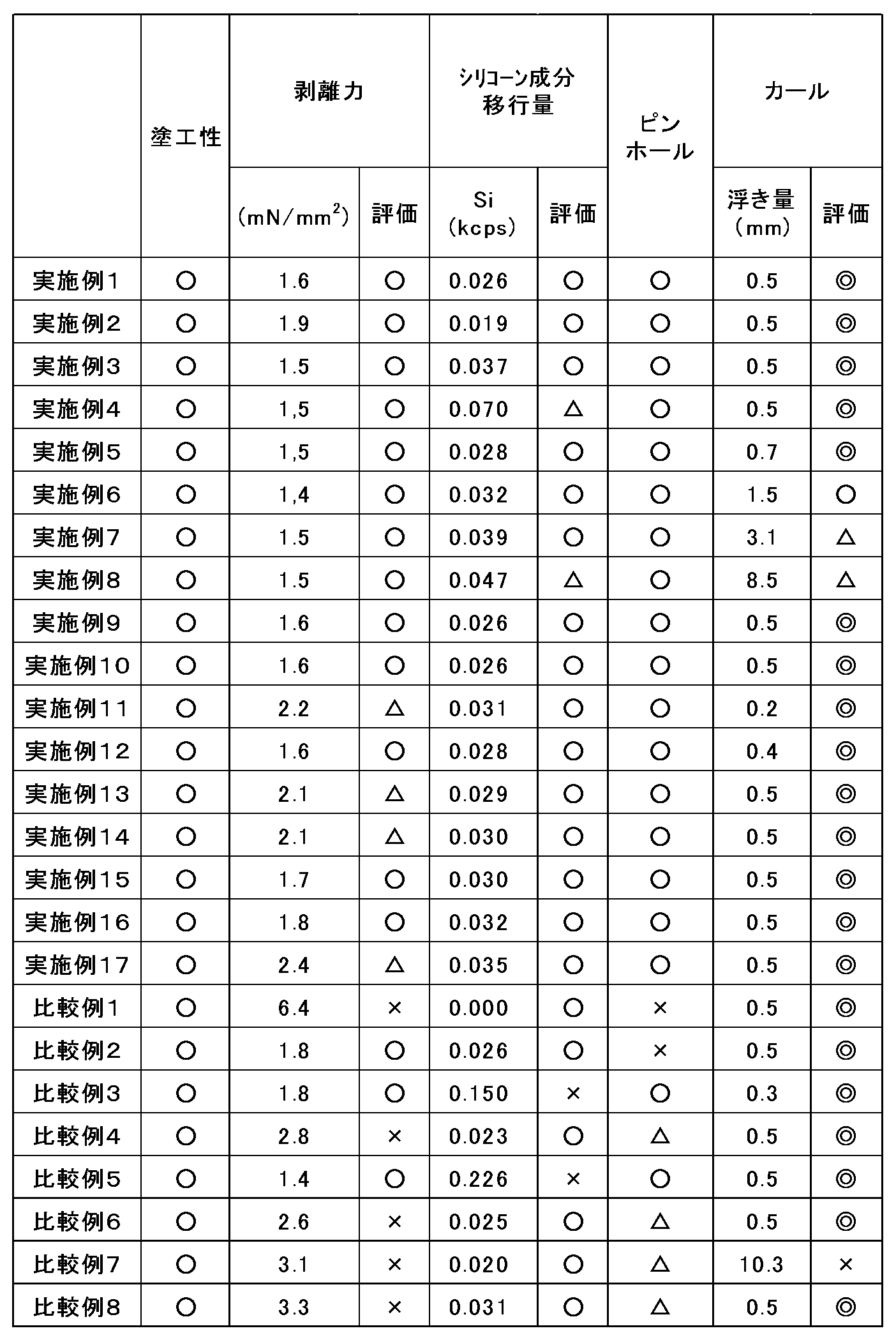
Claims (5)
- 二軸配向ポリエステルフィルムを基材とし、前記基材が少なくとも片面に無機粒子を実質的に含有していない表面層Aを有し、少なくとも片面の表面層Aの表面上に直接又は他の層を介して離型層が積層されており、前記離型層が少なくとも離型剤とメラミン系化合物を含む組成物が硬化されてなるものであり、離型剤がカルボキシル基を含有したポリオルガノシロキサンであり、かつメラミン系化合物の含有率が前記離型層形成用組成物の固形分に対し80質量%以上であるセラミックグリーンシート製造用離型フィルム。
- 基材の片面に無機粒子を実質的に含有していない表面層Aを有し、基材の前記表面層Aとは反対側に表面層Bを有し、表面層Bが粒子を含有し、前記粒子の少なくとも一部がシリカ粒子及び/又は炭酸カルシウム粒子であり、表面層Bの質量に対する粒子の合計含有率が5000~15000ppmである請求項1に記載のセラミックグリーンシート製造用離型フィルム。
- 前記離型フィルムの離型層の領域表面平均粗さ(Sa)が7nm以下であり、かつ、最大突起高さ(P)が100nm以下である請求項1または2に記載のセラミックグリーンシート製造用離型フィルム。
- 請求項1~3のいずれかに記載のセラミックグリーンシート製造用離型フィルムを用いてセラミックグリーンシートを成型するセラミックグリーンシートの製造方法であって、成型されたセラミックグリーンシートが0.2μm~1.0μmの厚みを有するセラミックグリーンシートの製造方法。
- 請求項4に記載のセラミックグリーンシートの製造方法を採用するセラミックコンデンサの製造方法。
Priority Applications (10)
| Application Number | Priority Date | Filing Date | Title |
|---|---|---|---|
| CN202211019641.2A CN115401975A (zh) | 2018-08-10 | 2019-08-06 | 陶瓷坯片制造用脱模薄膜 |
| KR1020217003320A KR102335164B1 (ko) | 2018-08-10 | 2019-08-06 | 세라믹 그린시트 제조용 이형 필름 |
| JP2019552291A JP6683295B1 (ja) | 2018-08-10 | 2019-08-06 | セラミックグリーンシート製造用離型フィルム |
| MYPI2021000692A MY196707A (en) | 2018-08-10 | 2019-08-06 | Release film for production of ceramic green sheet |
| KR1020217005194A KR102335930B1 (ko) | 2018-08-10 | 2019-08-06 | 세라믹 그린시트 제조용 이형 필름 |
| CN202211019624.9A CN115401974A (zh) | 2018-08-10 | 2019-08-06 | 陶瓷坯片制造用脱模薄膜 |
| SG11202100938WA SG11202100938WA (en) | 2018-08-10 | 2019-08-06 | Release film for production of ceramic green sheet |
| CN201980043670.2A CN112334305A (zh) | 2018-08-10 | 2019-08-06 | 陶瓷坯片制造用脱模薄膜 |
| PH12021550196A PH12021550196A1 (en) | 2018-08-10 | 2021-01-26 | Release film for production of ceramic green sheet |
| PH12021550317A PH12021550317A1 (en) | 2018-08-10 | 2021-02-12 | Release film for manufacturing ceramic green sheet |
Applications Claiming Priority (2)
| Application Number | Priority Date | Filing Date | Title |
|---|---|---|---|
| JP2018151655 | 2018-08-10 | ||
| JP2018-151655 | 2018-08-10 |
Publications (1)
| Publication Number | Publication Date |
|---|---|
| WO2020032007A1 true WO2020032007A1 (ja) | 2020-02-13 |
Family
ID=69414769
Family Applications (1)
| Application Number | Title | Priority Date | Filing Date |
|---|---|---|---|
| PCT/JP2019/030846 Ceased WO2020032007A1 (ja) | 2018-08-10 | 2019-08-06 | セラミックグリーンシート製造用離型フィルム |
Country Status (7)
| Country | Link |
|---|---|
| JP (5) | JP6683295B1 (ja) |
| KR (2) | KR102335930B1 (ja) |
| CN (4) | CN115401975A (ja) |
| MY (2) | MY196708A (ja) |
| PH (2) | PH12021550196A1 (ja) |
| SG (2) | SG10202101747TA (ja) |
| WO (1) | WO2020032007A1 (ja) |
Cited By (6)
| Publication number | Priority date | Publication date | Assignee | Title |
|---|---|---|---|---|
| JPWO2021186939A1 (ja) * | 2020-03-17 | 2021-09-23 | ||
| WO2021192896A1 (ja) * | 2020-03-27 | 2021-09-30 | 東洋紡株式会社 | 離型フィルム及びその製造方法 |
| JP2022142259A (ja) * | 2021-03-16 | 2022-09-30 | 東洋紡株式会社 | 全固体電池材料製造用の離型フィルム |
| JPWO2024117152A1 (ja) * | 2022-11-30 | 2024-06-06 | ||
| JPWO2025197723A1 (ja) * | 2024-03-21 | 2025-09-25 | ||
| WO2025204853A1 (ja) * | 2024-03-28 | 2025-10-02 | 東洋紡株式会社 | ポリエステルフィルム及びポリエステルフィルムのリサイクル方法 |
Families Citing this family (5)
| Publication number | Priority date | Publication date | Assignee | Title |
|---|---|---|---|---|
| JP7753702B2 (ja) * | 2020-09-23 | 2025-10-15 | 東レ株式会社 | 二軸配向積層ポリエステルフィルム、離型フィルム、および二軸配向積層ポリエステルフィルムの製造方法 |
| JP2023012427A (ja) * | 2021-07-13 | 2023-01-25 | 富士フイルム株式会社 | 剥離フィルム |
| JPWO2023153180A1 (ja) * | 2022-02-09 | 2023-08-17 | ||
| JP2024007155A (ja) * | 2022-07-05 | 2024-01-18 | 三菱ケミカル株式会社 | ポリエステルフィルム |
| KR102521827B1 (ko) * | 2022-07-06 | 2023-04-17 | 도레이첨단소재 주식회사 | 이형 필름 |
Citations (3)
| Publication number | Priority date | Publication date | Assignee | Title |
|---|---|---|---|---|
| WO2015129779A1 (ja) * | 2014-02-28 | 2015-09-03 | リンテック株式会社 | グリーンシート製造用剥離フィルム、グリーンシート製造用剥離フィルムの製造方法、グリーンシートの製造方法、およびグリーンシート |
| WO2017098956A1 (ja) * | 2015-12-10 | 2017-06-15 | リンテック株式会社 | セラミックグリーンシート製造工程用剥離フィルム |
| WO2019065214A1 (ja) * | 2017-09-29 | 2019-04-04 | 東洋紡株式会社 | セラミックグリーンシート製造用離型フィルム |
Family Cites Families (16)
| Publication number | Priority date | Publication date | Assignee | Title |
|---|---|---|---|---|
| JPH11156825A (ja) * | 1997-11-25 | 1999-06-15 | Toyo Metallizing Co Ltd | セラミックグリーンシート製造用離型フィルム |
| JP2000117899A (ja) | 1998-10-15 | 2000-04-25 | Teijin Ltd | 離形フィルム |
| JP4151370B2 (ja) * | 2002-10-07 | 2008-09-17 | 東レ株式会社 | 離型フィルム |
| JP4604753B2 (ja) * | 2004-03-30 | 2011-01-05 | 東レ株式会社 | 離型フィルム |
| KR100718848B1 (ko) * | 2005-11-30 | 2007-05-17 | 도레이새한 주식회사 | 대전방지 폴리에스테르 필름 |
| US20080315459A1 (en) * | 2007-06-21 | 2008-12-25 | 3M Innovative Properties Company | Articles and methods for replication of microstructures and nanofeatures |
| JP5251315B2 (ja) * | 2008-07-10 | 2013-07-31 | 東洋紡株式会社 | 離型フィルムの製造方法 |
| JP5485605B2 (ja) * | 2008-08-21 | 2014-05-07 | 帝人デュポンフィルム株式会社 | グリーンシート成形用キャリヤーフィルム |
| JP5492353B2 (ja) * | 2012-03-28 | 2014-05-14 | リンテック株式会社 | セラミックグリーンシート製造工程用剥離フィルム |
| CN104220221B (zh) | 2012-03-28 | 2016-10-12 | 琳得科株式会社 | 陶瓷胚片制造工序用剥离膜 |
| JP2014141394A (ja) * | 2012-12-26 | 2014-08-07 | Murata Mfg Co Ltd | セラミックグリーンシートおよびその製造方法 |
| JP6414424B2 (ja) * | 2014-09-19 | 2018-10-31 | 東洋紡株式会社 | セラミックシート製造用離型フィルム |
| JP6802785B2 (ja) * | 2015-03-27 | 2020-12-23 | リンテック株式会社 | セラミックグリーンシート製造工程用剥離フィルム |
| JP2017007227A (ja) * | 2015-06-23 | 2017-01-12 | リンテック株式会社 | セラミックグリーンシート製造工程用剥離フィルム |
| WO2017082130A1 (ja) * | 2015-11-13 | 2017-05-18 | 東洋紡株式会社 | 積層ポリエステルフィルム |
| JP6586376B2 (ja) * | 2016-02-17 | 2019-10-02 | リンテック株式会社 | セラミックグリーンシート製造工程用剥離フィルムおよびその製造方法 |
-
2019
- 2019-08-06 MY MYPI2021001427A patent/MY196708A/en unknown
- 2019-08-06 KR KR1020217005194A patent/KR102335930B1/ko active Active
- 2019-08-06 CN CN202211019641.2A patent/CN115401975A/zh active Pending
- 2019-08-06 CN CN202211019624.9A patent/CN115401974A/zh active Pending
- 2019-08-06 MY MYPI2021000692A patent/MY196707A/en unknown
- 2019-08-06 WO PCT/JP2019/030846 patent/WO2020032007A1/ja not_active Ceased
- 2019-08-06 SG SG10202101747TA patent/SG10202101747TA/en unknown
- 2019-08-06 CN CN201980043670.2A patent/CN112334305A/zh active Pending
- 2019-08-06 JP JP2019552291A patent/JP6683295B1/ja active Active
- 2019-08-06 SG SG11202100938WA patent/SG11202100938WA/en unknown
- 2019-08-06 KR KR1020217003320A patent/KR102335164B1/ko active Active
- 2019-08-06 CN CN202110198069.XA patent/CN112918057A/zh active Pending
-
2020
- 2020-03-04 JP JP2020036750A patent/JP6699816B1/ja active Active
- 2020-03-04 JP JP2020036748A patent/JP6699814B1/ja active Active
- 2020-03-04 JP JP2020036749A patent/JP6699815B1/ja active Active
- 2020-03-04 JP JP2020036747A patent/JP6699813B1/ja active Active
-
2021
- 2021-01-26 PH PH12021550196A patent/PH12021550196A1/en unknown
- 2021-02-12 PH PH12021550317A patent/PH12021550317A1/en unknown
Patent Citations (3)
| Publication number | Priority date | Publication date | Assignee | Title |
|---|---|---|---|---|
| WO2015129779A1 (ja) * | 2014-02-28 | 2015-09-03 | リンテック株式会社 | グリーンシート製造用剥離フィルム、グリーンシート製造用剥離フィルムの製造方法、グリーンシートの製造方法、およびグリーンシート |
| WO2017098956A1 (ja) * | 2015-12-10 | 2017-06-15 | リンテック株式会社 | セラミックグリーンシート製造工程用剥離フィルム |
| WO2019065214A1 (ja) * | 2017-09-29 | 2019-04-04 | 東洋紡株式会社 | セラミックグリーンシート製造用離型フィルム |
Cited By (12)
| Publication number | Priority date | Publication date | Assignee | Title |
|---|---|---|---|---|
| JPWO2021186939A1 (ja) * | 2020-03-17 | 2021-09-23 | ||
| WO2021186939A1 (ja) * | 2020-03-17 | 2021-09-23 | リンテック株式会社 | セラミックグリーンシート製造工程用剥離フィルム |
| JP7617080B2 (ja) | 2020-03-17 | 2025-01-17 | リンテック株式会社 | セラミックグリーンシート製造工程用剥離フィルム |
| WO2021192896A1 (ja) * | 2020-03-27 | 2021-09-30 | 東洋紡株式会社 | 離型フィルム及びその製造方法 |
| JPWO2021192896A1 (ja) * | 2020-03-27 | 2021-09-30 | ||
| JP2022142259A (ja) * | 2021-03-16 | 2022-09-30 | 東洋紡株式会社 | 全固体電池材料製造用の離型フィルム |
| JP7757618B2 (ja) | 2021-03-16 | 2025-10-22 | 東洋紡株式会社 | 全固体電池材料製造用の離型フィルム |
| JPWO2024117152A1 (ja) * | 2022-11-30 | 2024-06-06 | ||
| WO2024117152A1 (ja) * | 2022-11-30 | 2024-06-06 | 三井化学東セロ株式会社 | セラミックグリーンシートの製造方法 |
| JPWO2025197723A1 (ja) * | 2024-03-21 | 2025-09-25 | ||
| WO2025197723A1 (ja) * | 2024-03-21 | 2025-09-25 | 東洋紡株式会社 | 樹脂シート成型用離型フィルム |
| WO2025204853A1 (ja) * | 2024-03-28 | 2025-10-02 | 東洋紡株式会社 | ポリエステルフィルム及びポリエステルフィルムのリサイクル方法 |
Also Published As
| Publication number | Publication date |
|---|---|
| KR20210018512A (ko) | 2021-02-17 |
| JP6699814B1 (ja) | 2020-05-27 |
| CN112918057A (zh) | 2021-06-08 |
| CN115401974A (zh) | 2022-11-29 |
| CN115401975A (zh) | 2022-11-29 |
| KR102335164B1 (ko) | 2021-12-03 |
| KR102335930B1 (ko) | 2021-12-06 |
| MY196708A (en) | 2023-05-02 |
| JP2020114669A (ja) | 2020-07-30 |
| JP6699813B1 (ja) | 2020-05-27 |
| SG10202101747TA (en) | 2021-03-30 |
| PH12021550196A1 (en) | 2021-10-18 |
| KR20210022163A (ko) | 2021-03-02 |
| JP6699816B1 (ja) | 2020-05-27 |
| JP2020114670A (ja) | 2020-07-30 |
| MY196707A (en) | 2023-05-02 |
| JP2020114672A (ja) | 2020-07-30 |
| CN112334305A (zh) | 2021-02-05 |
| JP6699815B1 (ja) | 2020-05-27 |
| JPWO2020032007A1 (ja) | 2020-08-20 |
| PH12021550317A1 (en) | 2022-02-21 |
| JP6683295B1 (ja) | 2020-04-15 |
| SG11202100938WA (en) | 2021-03-30 |
| JP2020114671A (ja) | 2020-07-30 |
Similar Documents
| Publication | Publication Date | Title |
|---|---|---|
| JP6699816B1 (ja) | セラミックグリーンシート製造用離型フィルム | |
| JP7385817B2 (ja) | セラミックグリーンシート製造用離型フィルム | |
| JP6409997B1 (ja) | セラミックグリーンシート製造用離型フィルムおよびその製造方法 | |
| JP7092221B2 (ja) | セラミックグリーンシート製造用離型フィルム | |
| JP6593371B2 (ja) | セラミックグリーンシート製造用離型フィルムの製造方法 | |
| JP6977748B2 (ja) | セラミックグリーンシート製造用離型フィルム | |
| JP2023151062A (ja) | 樹脂シート成型用離型フィルム | |
| JP7106912B2 (ja) | セラミックグリーンシート製造用離型フィルム | |
| JP7327554B2 (ja) | セラミックグリーンシート製造用離型フィルム | |
| JP7306515B2 (ja) | セラミックグリーンシート製造用離型フィルム |
Legal Events
| Date | Code | Title | Description |
|---|---|---|---|
| ENP | Entry into the national phase |
Ref document number: 2019552291 Country of ref document: JP Kind code of ref document: A |
|
| 121 | Ep: the epo has been informed by wipo that ep was designated in this application |
Ref document number: 19848177 Country of ref document: EP Kind code of ref document: A1 |
|
| ENP | Entry into the national phase |
Ref document number: 20217003320 Country of ref document: KR Kind code of ref document: A |
|
| NENP | Non-entry into the national phase |
Ref country code: DE |
|
| 122 | Ep: pct application non-entry in european phase |
Ref document number: 19848177 Country of ref document: EP Kind code of ref document: A1 |