WO2020003863A1 - インプリント用光硬化性組成物 - Google Patents
インプリント用光硬化性組成物 Download PDFInfo
- Publication number
- WO2020003863A1 WO2020003863A1 PCT/JP2019/021103 JP2019021103W WO2020003863A1 WO 2020003863 A1 WO2020003863 A1 WO 2020003863A1 JP 2019021103 W JP2019021103 W JP 2019021103W WO 2020003863 A1 WO2020003863 A1 WO 2020003863A1
- Authority
- WO
- WIPO (PCT)
- Prior art keywords
- mass
- component
- parts
- meth
- photocurable composition
- Prior art date
- Legal status (The legal status is an assumption and is not a legal conclusion. Google has not performed a legal analysis and makes no representation as to the accuracy of the status listed.)
- Ceased
Links
Classifications
-
- C—CHEMISTRY; METALLURGY
- C08—ORGANIC MACROMOLECULAR COMPOUNDS; THEIR PREPARATION OR CHEMICAL WORKING-UP; COMPOSITIONS BASED THEREON
- C08F—MACROMOLECULAR COMPOUNDS OBTAINED BY REACTIONS ONLY INVOLVING CARBON-TO-CARBON UNSATURATED BONDS
- C08F2/00—Processes of polymerisation
- C08F2/44—Polymerisation in the presence of compounding ingredients, e.g. plasticisers, dyestuffs, fillers
-
- C—CHEMISTRY; METALLURGY
- C08—ORGANIC MACROMOLECULAR COMPOUNDS; THEIR PREPARATION OR CHEMICAL WORKING-UP; COMPOSITIONS BASED THEREON
- C08F—MACROMOLECULAR COMPOUNDS OBTAINED BY REACTIONS ONLY INVOLVING CARBON-TO-CARBON UNSATURATED BONDS
- C08F2/00—Processes of polymerisation
- C08F2/46—Polymerisation initiated by wave energy or particle radiation
- C08F2/48—Polymerisation initiated by wave energy or particle radiation by ultraviolet or visible light
- C08F2/50—Polymerisation initiated by wave energy or particle radiation by ultraviolet or visible light with sensitising agents
-
- C—CHEMISTRY; METALLURGY
- C08—ORGANIC MACROMOLECULAR COMPOUNDS; THEIR PREPARATION OR CHEMICAL WORKING-UP; COMPOSITIONS BASED THEREON
- C08F—MACROMOLECULAR COMPOUNDS OBTAINED BY REACTIONS ONLY INVOLVING CARBON-TO-CARBON UNSATURATED BONDS
- C08F290/00—Macromolecular compounds obtained by polymerising monomers on to polymers modified by introduction of aliphatic unsaturated end or side groups
- C08F290/08—Macromolecular compounds obtained by polymerising monomers on to polymers modified by introduction of aliphatic unsaturated end or side groups on to polymers modified by introduction of unsaturated side groups
- C08F290/10—Polymers provided for in subclass C08B
-
- C—CHEMISTRY; METALLURGY
- C08—ORGANIC MACROMOLECULAR COMPOUNDS; THEIR PREPARATION OR CHEMICAL WORKING-UP; COMPOSITIONS BASED THEREON
- C08K—Use of inorganic or non-macromolecular organic substances as compounding ingredients
- C08K3/00—Use of inorganic substances as compounding ingredients
- C08K3/01—Use of inorganic substances as compounding ingredients characterized by their specific function
- C08K3/014—Stabilisers against oxidation, heat, light or ozone
-
- C—CHEMISTRY; METALLURGY
- C08—ORGANIC MACROMOLECULAR COMPOUNDS; THEIR PREPARATION OR CHEMICAL WORKING-UP; COMPOSITIONS BASED THEREON
- C08K—Use of inorganic or non-macromolecular organic substances as compounding ingredients
- C08K3/00—Use of inorganic substances as compounding ingredients
- C08K3/01—Use of inorganic substances as compounding ingredients characterized by their specific function
- C08K3/016—Flame-proofing or flame-retarding additives
-
- C—CHEMISTRY; METALLURGY
- C08—ORGANIC MACROMOLECULAR COMPOUNDS; THEIR PREPARATION OR CHEMICAL WORKING-UP; COMPOSITIONS BASED THEREON
- C08K—Use of inorganic or non-macromolecular organic substances as compounding ingredients
- C08K3/00—Use of inorganic substances as compounding ingredients
- C08K3/30—Sulfur-, selenium- or tellurium-containing compounds
-
- C—CHEMISTRY; METALLURGY
- C08—ORGANIC MACROMOLECULAR COMPOUNDS; THEIR PREPARATION OR CHEMICAL WORKING-UP; COMPOSITIONS BASED THEREON
- C08K—Use of inorganic or non-macromolecular organic substances as compounding ingredients
- C08K3/00—Use of inorganic substances as compounding ingredients
- C08K3/34—Silicon-containing compounds
- C08K3/36—Silica
-
- C—CHEMISTRY; METALLURGY
- C08—ORGANIC MACROMOLECULAR COMPOUNDS; THEIR PREPARATION OR CHEMICAL WORKING-UP; COMPOSITIONS BASED THEREON
- C08K—Use of inorganic or non-macromolecular organic substances as compounding ingredients
- C08K5/00—Use of organic ingredients
- C08K5/0008—Organic ingredients according to more than one of the "one dot" groups of C08K5/01 - C08K5/59
- C08K5/005—Stabilisers against oxidation, heat, light, ozone
-
- C—CHEMISTRY; METALLURGY
- C08—ORGANIC MACROMOLECULAR COMPOUNDS; THEIR PREPARATION OR CHEMICAL WORKING-UP; COMPOSITIONS BASED THEREON
- C08K—Use of inorganic or non-macromolecular organic substances as compounding ingredients
- C08K5/00—Use of organic ingredients
- C08K5/04—Oxygen-containing compounds
- C08K5/13—Phenols; Phenolates
-
- C—CHEMISTRY; METALLURGY
- C08—ORGANIC MACROMOLECULAR COMPOUNDS; THEIR PREPARATION OR CHEMICAL WORKING-UP; COMPOSITIONS BASED THEREON
- C08K—Use of inorganic or non-macromolecular organic substances as compounding ingredients
- C08K9/00—Use of pretreated ingredients
- C08K9/04—Ingredients treated with organic substances
-
- C—CHEMISTRY; METALLURGY
- C08—ORGANIC MACROMOLECULAR COMPOUNDS; THEIR PREPARATION OR CHEMICAL WORKING-UP; COMPOSITIONS BASED THEREON
- C08L—COMPOSITIONS OF MACROMOLECULAR COMPOUNDS
- C08L5/00—Compositions of polysaccharides or of their derivatives not provided for in groups C08L1/00 or C08L3/00
- C08L5/16—Cyclodextrin; Derivatives thereof
-
- G—PHYSICS
- G02—OPTICS
- G02B—OPTICAL ELEMENTS, SYSTEMS OR APPARATUS
- G02B3/00—Simple or compound lenses
-
- H—ELECTRICITY
- H10—SEMICONDUCTOR DEVICES; ELECTRIC SOLID-STATE DEVICES NOT OTHERWISE PROVIDED FOR
- H10P—GENERIC PROCESSES OR APPARATUS FOR THE MANUFACTURE OR TREATMENT OF DEVICES COVERED BY CLASS H10
- H10P76/00—Manufacture or treatment of masks on semiconductor bodies, e.g. by lithography or photolithography
Definitions
- the present invention relates to a silica particle surface-modified with a functional group having an ethylenically unsaturated group, a monofunctional (meth) acrylate compound having an ethylenically unsaturated group, a polyrotaxane having an ethylenically unsaturated group, and a photoradical initiator.
- a photocurable composition for imprints comprising:
- the optical characteristics high refractive index, high Abbe number, low birefringence
- AR layer anti-reflection layer
- the present invention relates to a photocurable composition which does not generate cracks and does not generate cracks in a cured product even after washing or development with an organic solvent.
- Resin lenses are used in electronic devices such as mobile phones, digital cameras, and in-vehicle cameras, and are required to have excellent optical characteristics according to the purpose of the electronic devices. In addition, high durability, for example, heat resistance and weather resistance, and high productivity that can be molded with a high yield are required in accordance with the usage mode.
- a thermoplastic transparent resin such as a polycarbonate resin, a cycloolefin polymer, and a methacrylic resin has been used.
- a high-resolution camera module uses a plurality of lenses.
- a lens having low wavelength dispersion that is, a lens having a high Abbe number is mainly used, and an optical material for forming the lens is required.
- injection molding of thermoplastic resin to pressing molding using liquid curable resin at room temperature The shift to wafer-level molding due to the above has been actively studied.
- a hybrid lens system in which a lens is formed on a support such as a glass substrate is generally used.
- a radical curable resin composition has been used as a photocurable resin capable of being formed at a wafer level from the viewpoints of high transparency, heat-resistant yellow discoloration and mold release properties (Patent Document 1). ).
- the molded product is a lens
- an antireflection layer made of an inorganic substance such as silicon oxide or titanium oxide is formed on the lens. Therefore, there is a problem that cracks occur in the antireflection layer when the lens covered with the antireflection layer is heat-treated.
- a curable composition capable of obtaining a cured product having a high Abbe number by containing surface-modified oxide particles such as silica particles surface-modified with a silane compound and zirconium oxide particles surface-modified with a dispersant. Things are known (for example, Patent Document 2 and Patent Document 3).
- the curable composition containing such oxide particles is used in a developing step of cleaning an uncured portion such as an outer peripheral portion of a wafer-shaped molded body on which a plurality of lens patterns are formed after imprinting with an organic solvent.
- an uncured portion such as an outer peripheral portion of a wafer-shaped molded body on which a plurality of lens patterns are formed after imprinting with an organic solvent.
- erosion of the wafer-shaped molded body becomes remarkable, and cracks occur in the wafer-shaped molded body.
- a cured product molded from a general radical-curable resin composition stress due to curing shrinkage accumulates in the cured product, causing birefringence. If a cured product having a high birefringence is used as a lens for a high pixel camera module, the resulting image will be distorted. Therefore, a low birefringence material is required as a curable resin composition for a lens.
- a cyclic molecule having an opening, a linear molecule, and a blocking group (stopper), and the opening of the cyclic molecule is attached to both ends of a pseudo-polyrotaxane that is skewingly included by the linear molecule.
- a polyrotaxane in which a blocking group is disposed and the cyclic molecule has a (meth) acryl group is known (for example, Patent Document 4).
- the linear molecule penetrates the opening of the cyclic molecule, and the blocking group is provided so that the cyclic molecule does not separate from the linear molecule.
- inclusion means taking in another molecule into the space of the opening of the cyclic molecule
- pseudopolyrotaxane means polyrotaxane having no blocking group.
- the photocurable composition containing the polyrotaxane can produce a photocured product having high strength, high elastic modulus, and excellent toughness.
- Patent No. 5281710 (WO 2011/105473) JP 2014-234458 A International Publication No. 2016/104039 International Publication No. WO 2016/072356
- a molded article having a high Abbe number (for example, 53 or more) and low birefringence and usable as a lens for a high-resolution camera module is obtained, and the antireflection layer formed on the molded article is subjected to a subsequent heat treatment.
- the developing step of cleaning an uncured portion such as an outer peripheral portion of the wafer-shaped molded body with an organic solvent no crack is generated in the wafer-shaped molded body. Instead, its development was desired.
- the present invention has been made in view of such circumstances, and it is possible to form a molded article having a high Abbe number, a high refractive index, and low birefringence, and to reflect the upper layer by heat-treating the molded article. It is an object of the present invention to provide a photocurable composition capable of forming a molded article having high crack resistance, in which no crack is generated in the prevention layer and no crack is generated even when exposed to a developing step.
- a first aspect of the present invention is a photocurable composition for imprints comprising the following component (a), the following component (b), the following component (c), and the following component (d).
- the component (a) is 10 to 40 parts by mass
- the component (b) is 10 to 50 parts by mass
- the component (c) is 100 parts by mass based on 100 parts by mass of the compound having an ethylenically unsaturated group contained therein.
- a photocurable composition for imprints comprising 1 to 10 parts by mass of a component and 0.1 to 5 parts by mass of the component (d).
- A Silica particles having a primary particle diameter of 1 nm to 100 nm and surface-modified with a functional group having an ethylenically unsaturated group
- b Monofunctional (meth) acrylate compound having an ethylenically unsaturated group
- c Polyrotaxane having an ethylenically unsaturated group
- d Photo-radical initiator
- the photocurable composition for imprints of the present invention further comprises 5 parts by mass to 50 parts by mass of the following component (e) based on 100 parts by mass of the compound having an ethylenically unsaturated group contained in the composition. And / or may contain the following component (f).
- the photocurable composition for imprints of the present invention further comprises 0.05 to 3 parts by mass of the following component (g) based on 100 parts by mass of the total of the compound having an ethylenically unsaturated group contained in the composition. And / or 0.1 to 3 parts by mass of the following component (h) with respect to 100 parts by mass of the total of the compound having an ethylenically unsaturated group contained in the composition.
- h) sulfide antioxidant
- the silica particles surface-modified with the functional group having an ethylenically unsaturated group of the component (a) are, for example, silica particles surface-modified with a (meth) acryloyloxy group bonded to a silicon atom via a divalent linking group.
- the divalent linking group is, for example, an alkylene group having 1 to 5 carbon atoms, preferably an alkylene group having 2 or 3 carbon atoms.
- the polyfunctional (meth) acrylate compound containing no aromatic ring of the component (e) may be composed of two or more compounds. In that case, at least one of the two or more compounds has an alicyclic hydrocarbon group.
- the imprint photocurable composition has a refractive index n D at a wavelength of 589nm of the cured product is not less 1.49 or more and is the Abbe number [nu D of the cured product is 53 or more.
- a second aspect of the present invention is a cured product of the photocurable composition for imprints.
- a third aspect of the present invention is a method for producing a resin lens, comprising a step of imprint molding the photocurable composition for imprint.
- a fourth aspect of the present invention is a method for producing a molded article of the photocurable composition for imprints, wherein the photocurable composition for imprints is a space between a support and a mold that are in contact with each other, or A method for producing a molded article, comprising a step of filling a space inside a dividable mold and a step of exposing the photocurable composition for imprints filled in the space to photocuring.
- the mold is also called a mold.
- the method may further include a step of heating later.
- the method may further include a developing step using an organic solvent.
- the molded article is, for example, a lens for a camera module.
- the photocurable composition for imprints of the present invention contains the components (a) to (d), and optionally, the component (e) and / or the component (f), and the component (g). And / or component (h). Therefore, a cured product and a molded article obtained from the photocurable composition exhibit desirable optical properties for an optical device, for example, a lens for a high-resolution camera module, that is, a high Abbe number, a high refractive index, and a low birefringence. Further, in the cured product and the molded product obtained from the photocurable composition of the present invention, the cured antireflection layer on the cured product and the molded product does not crack or wrinkle by heat treatment at 175 ° C. No crack is generated in the developing step using an organic solvent.
- an ethylenically unsaturated group is a group having a double bond between two carbon atoms, for example, a (CH 2 CH) — group and a [CH 2 CC (CH 3 )] — group Is mentioned.
- the compound having an ethylenically unsaturated group contained in the photocurable composition for imprints of the present invention is a component (a) to a component (c), and the composition is the component (e) and the component (f). When at least one of these components is contained, these components also apply.
- the silica particles surface-modified with a functional group having an ethylenically unsaturated group which can be used as the component (a) of the photocurable composition for imprints of the present invention, have a primary particle diameter of 1 nm to 100 nm.
- the primary particles are particles constituting a powder, and the particles obtained by aggregating the primary particles are referred to as secondary particles.
- the primary particle diameter calculated from the relational expression is an average particle diameter and is a diameter of the primary particles.
- the silica particles surface-modified with a functional group having an ethylenically unsaturated group are surface-modified with, for example, a (meth) acryloyloxy group bonded to a silicon atom via a divalent linking group.
- the surface-modified silica particles When using the silica particles surface-modified with the functional group having an ethylenically unsaturated group, the surface-modified silica particles may be used as they are, and the surface-modified silica particles may be used as an organic solvent as a dispersion medium.
- a colloidal state (sol in which colloidal particles are dispersed in a dispersion medium) which has been dispersed in a solvent in advance may be used.
- a sol containing the surface-modified silica particles When a sol containing the surface-modified silica particles is used, a sol having a solid content in the range of 10% by mass to 60% by mass can be used.
- sol containing silica particles surface-modified with a functional group having an ethylenically unsaturated group examples include, for example, MEK-AC-2140Z, MEK-AC-4130Y, MEK-AC-5140Z, PGM-AC-2140Y, PGM- AC-4130Y, MIBK-AC-2140Z, MIBK-SD-L (manufactured by Nissan Chemical Industry Co., Ltd.), and ELCOM (registered trademark) V-8802, V-8804 (manufactured by Nikki Shokubai Kasei Co., Ltd.) Manufactured).
- the content of the component (a) of the photocurable composition for imprints of the present invention is from 10 parts by mass to 40 parts by mass based on 100 parts by mass of the compound having an ethylenically unsaturated group contained in the composition. Parts, preferably 15 parts by mass to 35 parts by mass. If the content of the component (a) is less than 10 parts by mass, cracks in the cured product obtained from the photocurable composition for imprints and the antireflection layer formed on the molded product may not be suppressed. When the amount is more than 40 parts by mass, haze is generated in the cured product and the molded article, and the transmittance may be reduced.
- the silica particles surface-modified with a functional group having an ethylenically unsaturated group of the component (a) can be used alone or in combination of two or more.
- the monofunctional (meth) acrylate compound having an ethylenically unsaturated group which can be used as the component (b) of the photocurable composition for imprints of the present invention, has a (meth) acryloyloxy group in one molecule of the compound. It is a compound having one.
- Examples of the monofunctional (meth) acrylate compound include methyl (meth) acrylate, ethyl (meth) acrylate, n-butyl (meth) acrylate, tert-butyl (meth) acrylate, n-hexyl (meth) acrylate, 2- Ethylhexyl (meth) acrylate, stearyl (meth) acrylate, isostearyl (meth) acrylate, cyclopentyl (meth) acrylate, cyclohexyl (meth) acrylate, 3,3,5-trimethylcyclohexyl (meth) acrylate, 4-tert-butylcyclohexyl (Meth) acrylate, menthyl (meth) acrylate, isobornyl (meth) acrylate, norbornyl (meth) acrylate, 1-adamantyl (meth) acrylate, 2-adamantyl (meth)
- the monofunctional (meth) acrylate compound having an ethylenically unsaturated group commercially available products may be used.
- commercially available products may be used.
- the content of the component (b) of the photocurable composition for imprints of the present invention is from 10 parts by mass to 50 parts by mass with respect to 100 parts by mass of the compound having an ethylenically unsaturated group contained in the composition. Parts, preferably 20 to 45 parts by weight. If the content of the component (b) is less than 10 parts by mass, the effect of reducing the birefringence of the cured product and the molded product obtained from the photocurable composition for imprints may be insufficient. If the amount is more than the mass part, the crosslinked density of the cured product and the molded product may be reduced, and the shape of the cured product and the molded product may be deformed during the heat treatment.
- the monofunctional (meth) acrylate compound having an ethylenically unsaturated group of the component (b) can be used alone or in combination of two or more.
- the polyrotaxane having an ethylenically unsaturated group which can be used as the component (c) of the photocurable composition for imprints of the present invention, is a pseudopolyrotaxane in which the opening of a cyclic molecule is skewingly included by a linear molecule.
- a blocking group is arranged at both ends of the polymer so that the cyclic molecule is not removed, and the cyclic molecule has an ethylenically unsaturated group.
- the cyclic molecule, the linear molecule, and the blocking group, which are components of the polyrotaxane having an ethylenically unsaturated group, will be described.
- Cyclic molecule The cyclic molecule of the polyrotaxane having an ethylenically unsaturated group as the component (c) is not particularly limited as long as it is cyclic, has an opening, and is included in a skewered manner by a linear molecule.
- the constituent element of the polyrotaxane having an ethylenically unsaturated group is preferably a cyclic molecule, and the ethylenically unsaturated group may be directly bound to the cyclic molecule or bound via a spacer.
- the spacer examples include, but are not particularly limited to, an alkylene group, an alkylene oxide group, a hydroxyalkylene group, a carbamoyl group, an acrylate chain, a polyalkylene ether chain, and a polyalkylene carbonate chain.
- the cyclic molecule for example, it is preferable to select from the group consisting of ⁇ -cyclodextrin, ⁇ -cyclodextrin and ⁇ -cyclodextrin.
- linear molecule The linear molecule of the polyrotaxane having an ethylenically unsaturated group as the component (c) is not particularly limited as long as it can be included in a skewered manner at the opening of the cyclic molecule to be used.
- linear molecule examples include compounds (polymers) exemplified in Patent Document 4, and among them, polyethylene glycol, polyisoprene, polyisobutylene, polybutadiene, polypropylene glycol, polytetrahydrofuran, polydimethylsiloxane, A polymer selected from the group consisting of polyethylene, polypropylene, polyvinyl alcohol and polyvinyl methyl ether is preferred, and polyethylene glycol is particularly preferred.
- the linear molecule has a weight average molecular weight of 1,000 or more, preferably 3,000 to 100,000, more preferably 6,000 to 50,000.
- the combination of (cyclic molecule, linear molecule) is preferably ( ⁇ -cyclodextrin-derived or polyethylene glycol-derived).
- the blocking group of the polyrotaxane having an ethylenically unsaturated group as the component (c) is not particularly limited as long as it is a group disposed at both ends of the pseudopolyrotaxane and acts so as to prevent the used cyclic molecule from being eliminated.
- examples of the blocking group include blocking groups exemplified in Patent Document 4, among which dinitrophenyl groups, cyclodextrins, adamantyl groups, trityl groups, fluoresceins, silsesquioxanes, And a blocking group selected from the group consisting of pyrenes, and more preferably adamantyl groups or cyclodextrins.
- a commercially available product may be used as the polyrotaxane having an ethylenically unsaturated group. (Manufactured by Co., Ltd.).
- the content of the component (c) of the photocurable composition for imprints of the present invention is from 1 part by mass to 10 parts by mass based on 100 parts by mass of the compound having an ethylenically unsaturated group contained in the composition. Parts, preferably 3 to 7 parts by mass.
- the content of the component (c) is less than 1 part by mass, the effect of suppressing the occurrence of cracks in the cured product in the developing step using an organic solvent may be insufficient, and the amount is more than 10 parts by mass. Then, the change in shape of the cured product and the molded product during heating may increase due to the low elastic modulus.
- the polyrotaxane having an ethylenically unsaturated group as the component (c) can be used alone or in combination of two or more.
- Photoradical initiator examples include alkylphenones, benzophenones, Michler's ketones, acylphosphine oxides, and benzoylbenzoate. , Oxime esters, tetramethylthiuram monosulfides, and thioxanthones, and a photo-cleavable photo-radical polymerization initiator is particularly preferable.
- photo-radical initiators such as IRGACURE (registered trademark) 184, 369, 651, 500, 819, 907, 784, 2959, CGI 1700, CGI 1750, CGI 1850, and CG 24 -61, TPO, 1116, 1173 (all manufactured by BASF Japan K.K.) and ESACURE KIP150, KIP65LT, KIP100F, KT37, KT55, KTO46, and KIP75 (all manufactured by Lamberti) Can be adopted.
- IRGACURE registered trademark
- 184 369, 651, 500, 819, 907, 784, 2959, CGI 1700, CGI 1750, CGI 1850, and CG 24 -61, TPO, 1116, 1173 (all manufactured by BASF Japan K.K.)
- ESACURE KIP150, KIP65LT, KIP100F, KT37, KT55, KTO46, and KIP75 all manufactured by Lamberti
- the content of the component (d) of the photocurable composition for imprints of the present invention is from 0.1 part by mass to 5 parts by mass based on 100 parts by mass of the compound having an ethylenically unsaturated group contained in the composition. Parts, preferably 0.5 to 3 parts by mass.
- the content of the component (d) is less than 0.1 part by mass, the strength of a cured product and a molded product obtained from the photocurable composition for imprints may be reduced, and when the content is more than 5 parts by mass. There is a possibility that the heat-resistant yellowing of the cured product and the molded article may be deteriorated.
- the photo radical initiator of the component (d) can be used alone or in combination of two or more.
- Component (e) polyfunctional (meth) acrylate compound having an ethylenically unsaturated group and not containing an aromatic ring
- the polyfunctional (meth) acrylate compound containing no aromatic ring which can be used as the component (e) of the photocurable composition for imprints of the present invention has at least two (meth) acryloyloxy groups in one molecule of the compound. And a compound containing no aromatic ring, except for the polyrotaxane of the component (c) and the urethane (meth) acrylate compound or the epoxy (meth) acrylate compound of the component (f) described later.
- the aromatic ring is a carbocyclic or heterocyclic ring satisfying the Huckel rule, for example, benzene, naphthalene, azulene, anthracene, tetracene, pentacene, phenanthrene, pyrene, furan, thiophene, pyrrole, pyrazole, imidazole, oxazole, thiazole, pyridine. , Pyridazine, pyrimidine, pyrazine and triazine. Therefore, not including an aromatic ring means not including a carbon ring or a hetero ring satisfying the Huckel rule.
- the Huckel rule for example, benzene, naphthalene, azulene, anthracene, tetracene, pentacene, phenanthrene, pyrene, furan, thiophene, pyrrole, pyrazole, imidazole, oxazole, thiazole
- polyfunctional (meth) acrylate compound containing no aromatic ring examples include ethylene glycol di (meth) acrylate, polyethylene glycol di (meth) acrylate, ethoxylated trimethylolpropane tri (meth) acrylate, and ethoxylated glycerin tri (meth) acrylate.
- a commercially available product may be used as the polyfunctional (meth) acrylate compound containing no aromatic ring.
- a commercially available product may be used.
- the content is 5 parts by mass with respect to 100 parts by mass of the total of the compound having an ethylenically unsaturated group contained in the composition. Parts to 50 parts by mass, preferably 5 parts to 30 parts by mass.
- the content of the component (e) is less than 5 parts by mass, the crosslinked density of the cured product and the molded product obtained from the photocurable composition for imprints decreases, and the shape of the cured product and the molded product during heat treatment is reduced.
- the amount is more than 50 parts by mass, the effect of reducing the birefringence of the cured product and the molded article may be insufficient.
- the polyfunctional (meth) acrylate compound containing no aromatic ring of the component (e) can be used alone or in combination of two or more.
- urethane (meth) acrylate compound examples include, for example, EBECRYL (registered trademark) 230, 270, 280 / 15IB, 284, 4491, 4683, 4858, 8307, 8402, 8411, 8804, 8807, 9270, 8800, 294 / 25HD, 4100, 4220, 4513, 4738, 4740, 4820, 8311, 8465, 9260, 8701, KRM7735, 8667, 8296 (all manufactured by Daicel Ornex), UV-2000B, UV-2750B, UV-3000B, UV-3200B, UV-3210EA, UV-3300B, UV-3310B, UV-3500B, UV-3520EA, UV -3700B, UV-6640B, V-6630B, UV-7000B, UV-7510B, UV-7461TE (all made by Nippon Synthetic Chemical Co., Ltd.), UA-306H, UA-306T, UA-306I
- the epoxy (meth) acrylate compound usable as the component (f) of the photocurable composition for imprints of the present invention is obtained by reacting a compound having at least two epoxy rings in one molecule with (meth) acrylic acid. Ester.
- the epoxy (meth) acrylate compound include EBECRYL (registered trademark) 645, 648, 860, 3500, 3608, 3702, and 3708 (all manufactured by Daicel Ornex Co., Ltd.), DA-911M , DA-920, DA-931, DA-314, DA-212 (both manufactured by Nagase ChemteX Corporation), HPEA-100 (manufactured by KSEM Corporation), and Unidick (registered trademark) V-5500, V-5502 and V-5508 (both manufactured by DIC Corporation).
- urethane (meth) acrylate compound or the epoxy (meth) acrylate compound of the component (f) a compound having two or three (meth) acryloyloxy groups in one molecule of the compound is preferably used.
- the content is 5 parts by mass relative to 100 parts by mass of the total of the compound having an ethylenically unsaturated group contained in the composition. Parts to 50 parts by mass, preferably 5 parts to 30 parts by mass.
- the content of the component (f) is less than 5 parts by mass, the cured product and the molded product obtained from the photocurable composition for imprints become brittle, so that the cured product and the molded product have high resistance during heating. Cracking properties may be reduced, and if it is more than 50 parts by mass, a change in shape of the cured product and the molded product during heating may be increased due to a decrease in crosslinking density.
- the urethane (meth) acrylate compound or the epoxy (meth) acrylate compound of the component (f) can be used alone or in combination of two or more.
- phenolic antioxidant examples include, for example, IRGANOX (registered trademark) 245, 1010, 1035, 1076, and 1135 (both described above). BASF Japan, Ltd.), SUMILIZER (registered trademark) GA-80, GP, MDP-S, BBM-S, WX-R (all manufactured by Sumitomo Chemical Co., Ltd.), and ADK STAB (registered trademark) AO-20, AO-30, AO-40, AO-50, AO-60, AO-80, and AO-330 (all manufactured by ADEKA Corporation).
- the content is preferably 0.05 parts by mass to 3 parts by mass based on 100 parts by mass of the compound having an ethylenically unsaturated group. Parts, preferably 0.1 to 1 part by mass.
- the phenolic antioxidant of the component (g) can be used alone or in combination of two or more.
- sulfide antioxidant examples include, for example, ADK STAB (registered trademark) AO-412S and AO-503 (all manufactured by ADEKA Corporation) ), IRGANOX (registered trademark) PS802 and PS800 (all manufactured by BASF), and SUMILIZER (registered trademark) TP-D (manufactured by Sumitomo Chemical Co., Ltd.).
- the content is 0.1 parts by mass with respect to 100 parts by mass of the total of the compound having an ethylenically unsaturated group contained in the composition. It is from 3 parts by mass to 3 parts by mass, preferably from 0.1 part by mass to 1 part by mass.
- the sulfide-based antioxidant of the component (h) can be used alone or in combination of two or more.
- the photocurable composition for imprints of the present invention may contain a chain transfer agent, an antioxidant, an ultraviolet absorber, a light stabilizer, a leveling agent, a rheology, if necessary, as long as the effects of the present invention are not impaired. It may contain a regulator, an adhesion auxiliary agent such as a silane coupling agent, a pigment, a dye, an antifoaming agent, and the like.
- the method for preparing the photocurable composition for imprints of the present invention is not particularly limited.
- the preparation method for example, the component (a), the component (b), the component (c) and the component (d), and if desired, the component (e) and / or the component (f), the component (g) and / or ( h) A method of mixing the components at a predetermined ratio to obtain a uniform solution.
- the photocurable composition for imprints of the present invention prepared in a solution is preferably used after being filtered using a filter having a pore size of 0.1 ⁇ m to 5 ⁇ m.
- the photocurable composition for imprints of the present invention can be exposed (photocured) to obtain a cured product, and the present invention is also directed to the cured product.
- Light rays to be exposed include, for example, ultraviolet rays, electron beams and X-rays.
- a light source used for ultraviolet irradiation for example, a solar ray, a chemical lamp, a low-pressure mercury lamp, a high-pressure mercury lamp, a metal halide lamp, a xenon lamp, and a UV-LED can be used.
- post-baking may be performed to stabilize the physical properties of the cured product.
- the post-baking method is not particularly limited, but is usually performed using a hot plate, an oven or the like at 50 ° C. to 260 ° C. for 1 minute to 24 hours.
- Cured product obtained by photocuring the imprint photocurable composition of the present invention has an Abbe number [nu D is 53 or more and high refractive index n D at a wavelength of 589 nm (D line) 1. 49 or more. Therefore, the photocurable composition for imprints of the present invention can be suitably used for forming a resin lens.
- the photocurable composition for imprints of the present invention can easily produce various molded articles in parallel with the formation of a cured product, for example, by using an imprint molding method.
- a method for producing a molded article for example, a step of filling the photocurable composition for imprinting of the present invention into a space between a contacting support and a mold, or a space inside a dividable mold, Exposing the photocurable composition for imprinting filled in and photocuring, removing the photocured product obtained by the photocuring process and releasing the mold, and the photocured product, A method including a heating step before, during, or after the releasing step is exemplified.
- the method may further include a developing step of washing and removing an uncured portion with an organic solvent before the heating step.
- the method for producing the uncured portion is not particularly limited, but a portion that is not exposed, that is, an uncured portion can be produced by exposing only a predetermined position by mask exposure, projection exposure, or the like. Further, if necessary, the photocured product after the development step may be exposed again to be photocured.
- the step of light curing by exposure can be performed by applying the conditions for obtaining the above-mentioned cured product.
- the condition of the step of heating the photocured product is not particularly limited, but is usually appropriately selected from the range of 50 ° C. to 260 ° C. for 1 minute to 24 hours.
- the heating means is not particularly limited, and includes, for example, a hot plate and an oven.
- the molded article manufactured by such a method can be suitably used as a lens for a camera module.
- Light source High-pressure mercury lamp, i-line bandpass filter HB0365 (manufactured by Asahi Spectroscopy) Molding condition: Pressing pressure 100N, 20mW / cm 2 ⁇ 300 seconds (9) Lens height measuring device: Non-contact surface texture measuring device PF-60 manufactured by Mitaka Optical Co., Ltd.
- MEK was distilled off using an evaporator under the conditions of 50 ° C. and a reduced pressure of 133.3 Pa or less, and an A-DCP dispersion of silica particles surface-modified with the functional group having an ethylenically unsaturated group (the said A surface-modified silica particle content of 50% by mass) was obtained.
- a UA-4200 dispersion of silica particles surface-modified with the functional group having an ethylenically unsaturated group (the UA-4200 dispersion liquid) was used.
- Example 1 (A) The solid content of the A-DCP dispersion obtained in Production Example 1 as silica particles surface-modified with a functional group having an ethylenically unsaturated group, and the FA-513AS dispersion obtained in Production Example 2. Solid content, (b) FA-513AS as a monofunctional (meth) acrylate compound having an ethylenically unsaturated group, and (c) a polyrotaxane having an ethylenically unsaturated group as the polyrotaxane obtained in Production Example 4.
- Solid content (d) I184 as a photoradical initiator, (e) A-DCP as an aromatic ring-free polyfunctional (meth) acrylate compound having an ethylenically unsaturated group, and (f) ethylenically unsaturated group.
- UA-4200 as a urethane (meth) acrylate compound
- I245 as a phenolic antioxidant
- AO- as a sulfide antioxidant 03 were compounded in a ratio according to each following Table 1.
- the ratio of A-DCP shown in Table 1 below is the A-DCP component contained in the A-DCP dispersion and the A-DCP solution, and the ratio of FA-513AS is FA contained in the FA-513AS dispersion. -513AS.
- the composition was shaken at 50 ° C. for 16 hours, and the mixture was stirred and defoamed for 10 minutes using the stirring defoaming machine to prepare a photocurable composition 1 for imprint.
- “parts” represents “parts by mass”.
- Comparative Example 1 In the same procedure as in Example 1, the components (a) to (h) were mixed in the proportions shown in Table 1 below to prepare photocurable compositions 2 to 6 for imprint. However, Comparative Example 1 does not use the components (b) and (c).
- the 4-inch glass wafer is prepared by diluting an adhesion aid (product name: KBM-5103) manufactured by Shin-Etsu Chemical Co., Ltd. to 30% by mass with propylene glycol monomethyl ether acetate (hereinafter abbreviated as PGMEA in the present specification).
- PGMEA propylene glycol monomethyl ether acetate
- the solution thus obtained was applied and dried to perform a close contact treatment.
- the sandwiched photocurable composition was exposed to UV light at 115 mW / cm 2 for 2.2 seconds using the UV-LED irradiation device. After the cured product obtained after the exposure is peeled from the photomask substrate subjected to the release treatment, the cured product is immersed (developed) in stirred PGMEA, and further rinsed with PGMEA to remove an unexposed portion.
- a 1-cm square, 0.5-mm-thick cured film was formed on the 4-inch glass wafer subjected to the adhesion treatment.
- the obtained cured film was observed on the side surface of the cured film with a digital microscope manufactured by Hi-Lox Co., Ltd., and the case where cracks were confirmed was evaluated as x, and the case where cracks were not observed was evaluated as ⁇ .
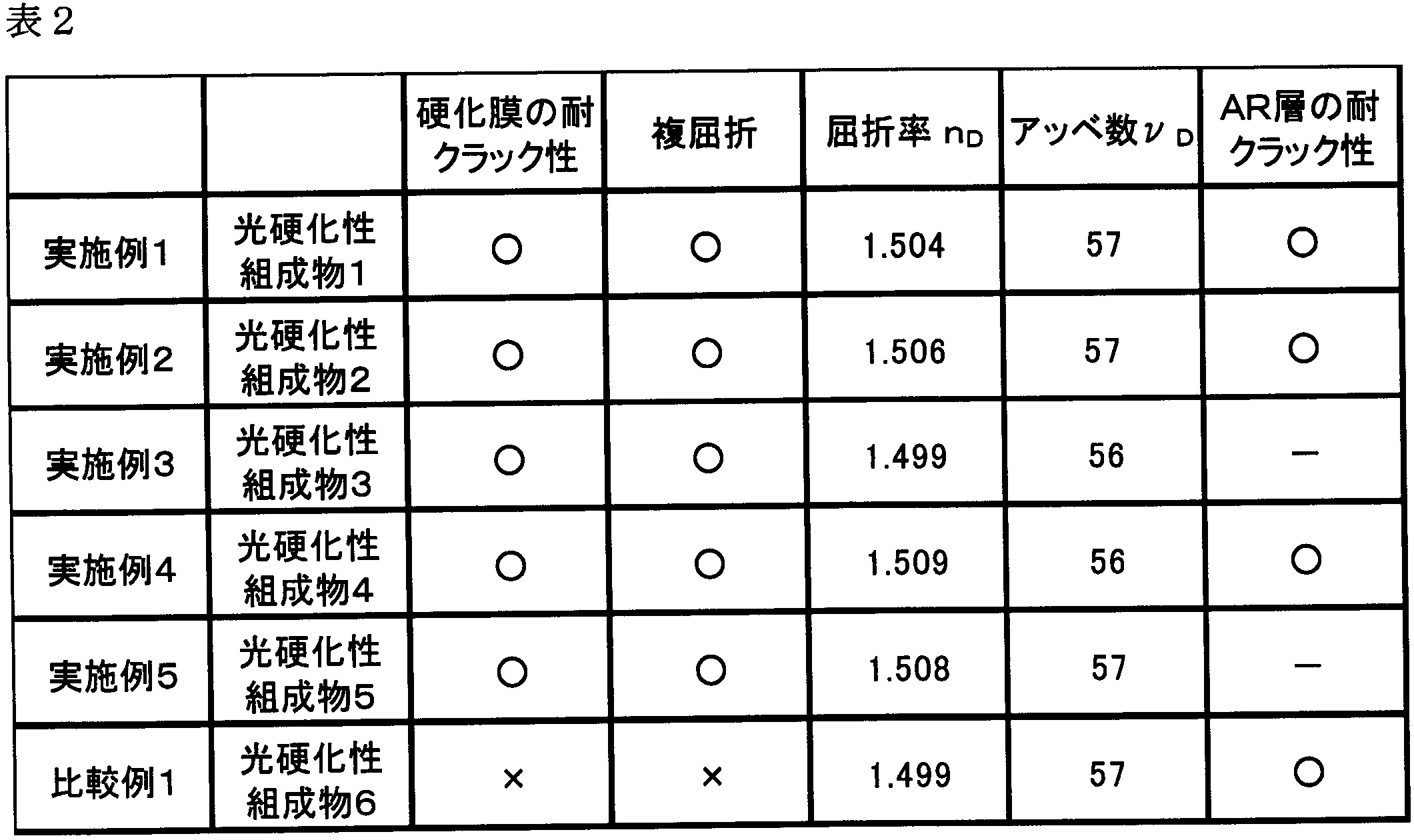
- the results are shown in Table 2 below.
- the quartz substrate is obtained by applying a solution prepared by diluting an adhesion auxiliary agent (product name: KBM-5103) manufactured by Shin-Etsu Chemical Co., Ltd. to 30% by mass with PGMEA, followed by drying, followed by adhesion treatment.
- the sandwiched photocurable composition was exposed to UV light at 30 mW / cm 2 for 200 seconds using the UV-LED irradiation device.
- the cured product obtained after the exposure was peeled from the glass substrate subjected to the release treatment, and then heated on a hot plate at 100 ° C. for 10 minutes. A cured film having a thickness of 5 mm and a mass of 0.030 g was produced.
- the phase difference in the cured film of the obtained cured film was measured by the phase difference measuring device manufactured by Photonic Lattice Co., Ltd.
- the phase difference that is the largest in the cured film (however, a portion approximately 1 mm from the outer peripheral portion is excluded from the analysis because a phase difference due to the cross-sectional structure occurs and is excluded from the analysis) is 0.5 mm in thickness of the cured product.
- the birefringence of each cured product was calculated. When the birefringence was 2.5 ⁇ 10 ⁇ 5 or less, it was judged as ⁇ , and when it was higher than 2.5 ⁇ 10 ⁇ 5 , it was judged as ⁇ .
- Table 2 The results are shown in Table 2 below.
- the quartz substrate is obtained by applying a solution prepared by diluting an adhesion auxiliary agent (product name: KBM-5103) manufactured by Shin-Etsu Chemical Co., Ltd. to 30% by mass with PGMEA, followed by drying, followed by adhesion treatment.
- the sandwiched photocurable composition was exposed to UV light at 30 mW / cm 2 for 200 seconds using the UV-LED irradiation device.
- the cured product obtained after the exposure was peeled off from the glass substrate subjected to the release treatment, it was heated on a hot plate at 100 ° C. for 10 minutes, so that a diameter of 1 cm, a thickness of 0.3 mm, and a mass were formed on the quartz substrate.
- a 0.017 g cured film was produced.
- a silicon oxide layer having a thickness of 200 nm was formed as an antireflection layer using the RF sputtering apparatus under the above-described film forming conditions.
- the quartz substrate is heated on a hot plate at 175 ° C. for 2 minutes and 30 seconds to provide heat resistance. A sex test was performed. Also for the quartz substrate after the heat resistance test, the presence or absence of cracks in the antireflection layer on the cured film was observed using the optical microscope manufactured by Keyence Corporation, and the crack resistance of the antireflection layer was determined.
- the birefringence of the cured product was also high. From the above results, the cured film obtained from the photocurable composition for imprints of the present invention exhibited a high Abbe number, a high refractive index, and a low birefringence, and the antireflection layer as the upper layer of the cured film was 175. No cracks or wrinkles were generated by the heat treatment at ° C, and no cracks were generated in the cured film even when exposed to an organic solvent, indicating that the lens has desirable characteristics as a lens for a high-resolution camera module.
- Each of the photocurable compositions for imprinting prepared in Examples 1, 2 and 4 was used as a nickel mold (a lens mold having a diameter of 2 mm ⁇ 300 ⁇ m and a total of 15 lenses of 3 rows ⁇ 5 rows).
- a nanoimprinter and a nanoimprinter a lens was formed on a quartz substrate as a support in accordance with the above-described method for manufacturing a formed body.
- the mold used was previously subjected to a release treatment with NOVEC (registered trademark) 1720 (manufactured by 3M Japan Ltd.).
- the glass substrate used was subjected to close contact treatment by applying a solution prepared by diluting an adhesion auxiliary agent (product name: KBM-5103) manufactured by Shin-Etsu Chemical Co., Ltd. to 30% by mass with PGMEA, followed by drying. After removing the cured product from the mold, the cured product was heated on a hot plate at 100 ° C. for 10 minutes to produce a convex lens on the glass substrate subjected to the close contact treatment.
- an adhesion auxiliary agent product name: KBM-5103
- PGMEA PGMEA
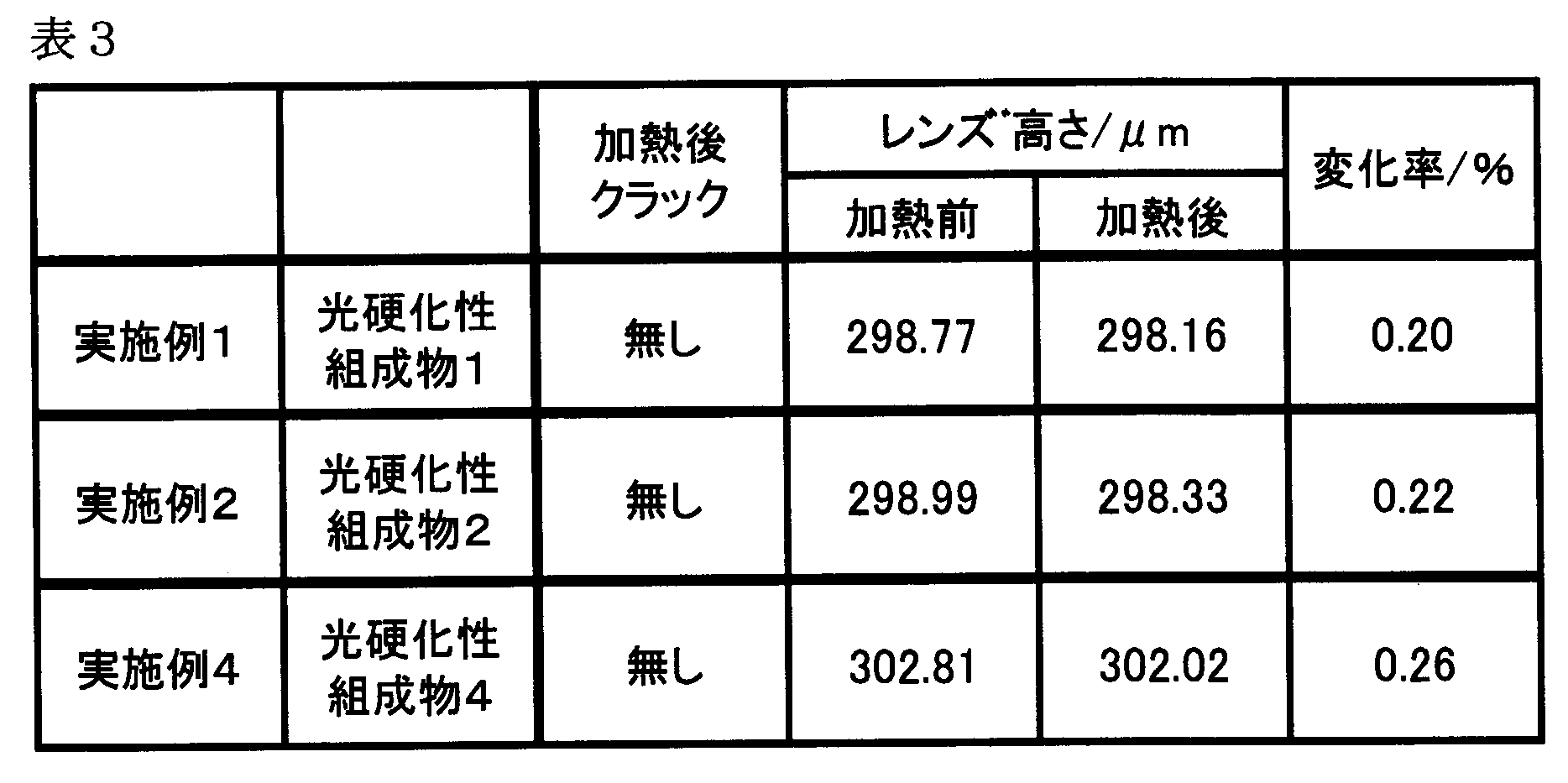
- the lens height (thickness) before and after the heating test is measured by the non-contact surface texture measuring device, and the rate of change is expressed by the following formula “[(lens height before heating ⁇ heating) Height after heating / lens height before heating] ⁇ 100 ′′, and dimensional stability due to heating was evaluated. Further, the presence or absence of cracks in the convex lens after the heating test was observed with a microscope attached to the non-contact surface texture measuring device.
- the heating test is a test in which a convex lens obtained on a glass substrate is heated on a hot plate at 175 ° C. for 2 minutes and 30 seconds, and then allowed to cool to room temperature (about 23 ° C.). The results are shown in Table 3 below.
- the convex lens obtained from the photocurable composition for imprints of the present invention showed a small change in the lens height even after a heat history of 175 ° C. for 2 minutes and 30 seconds (rate of change of 0.1 mm). (Less than 30%), resulting in high dimensional stability.
Landscapes
- Chemical & Material Sciences (AREA)
- Health & Medical Sciences (AREA)
- Chemical Kinetics & Catalysis (AREA)
- Medicinal Chemistry (AREA)
- Polymers & Plastics (AREA)
- Organic Chemistry (AREA)
- Physics & Mathematics (AREA)
- Optics & Photonics (AREA)
- General Physics & Mathematics (AREA)
- Macromonomer-Based Addition Polymer (AREA)
- Addition Polymer Or Copolymer, Post-Treatments, Or Chemical Modifications (AREA)
- Exposure Of Semiconductors, Excluding Electron Or Ion Beam Exposure (AREA)
- Shaping Of Tube Ends By Bending Or Straightening (AREA)
- Casting Or Compression Moulding Of Plastics Or The Like (AREA)
- Polymerisation Methods In General (AREA)
- Inks, Pencil-Leads, Or Crayons (AREA)
- Steroid Compounds (AREA)
Abstract
Description
(a):一次粒子径が1nm乃至100nmの、エチレン性不飽和基を有する官能基で表面修飾されたシリカ粒子
(b):エチレン性不飽和基を有する単官能(メタ)アクリレート化合物
(c):エチレン性不飽和基を有するポリロタキサン
(d):光ラジカル開始剤
(e):エチレン性不飽和基を有する、芳香環を含まない多官能(メタ)アクリレート化合物(ただし、前記(c)成分のポリロタキサン及び(f)成分のウレタン(メタ)アクリレート化合物又はエポキシ(メタ)アクリレート化合物を除く。)
(f):エチレン性不飽和基を有する、ウレタン(メタ)アクリレート化合物又はエポキシ(メタ)アクリレート化合物(ただし、前記(c)成分のポリロタキサンを除く。)
(g):フェノール系酸化防止剤
(h):スルフィド系酸化防止剤
本発明のインプリント用光硬化性組成物の(a)成分として使用可能な、エチレン性不飽和基を有する官能基で表面修飾されたシリカ粒子は、一次粒子径が1nm乃至100nmである。ここで、一次粒子とは、紛体を構成する粒子であり、この一次粒子が凝集した粒子を二次粒子という。前記一次粒子径は、ガス吸着法(BET法)により測定される前記エチレン性不飽和基を有する官能基で表面修飾されたシリカ粒子の比表面積(単位質量あたりの表面積)S、該表面修飾されたシリカ粒子の密度ρ、及び一次粒子径Dとの間に成り立つ関係式:D=6/(ρS)から算出することができる。該関係式から算出される一次粒子径は、平均粒子径であり、一次粒子の直径である。また、前記エチレン性不飽和基を有する官能基で表面修飾されたシリカ粒子は、例えば、二価の連結基を介してケイ素原子と結合した(メタ)アクリロイルオキシ基で表面修飾されている。上記エチレン性不飽和基を有する官能基で表面修飾されたシリカ粒子を用いる際には、該表面修飾されたシリカ粒子をそのまま用いてもよく、該表面修飾されたシリカ粒子を分散媒である有機溶剤に予め分散させたコロイド状態のもの(コロイド粒子が分散媒に分散したゾル)を用いてもよい。該表面修飾されたシリカ粒子を含むゾルを用いる場合、固形分の濃度が10質量%乃至60質量%の範囲のゾルを用いることができる。
本発明のインプリント用光硬化性組成物の(b)成分として使用可能な、エチレン性不飽和基を有する単官能(メタ)アクリレート化合物は、該化合物1分子中に(メタ)アクリロイルオキシ基を1つ有する化合物である。該単官能(メタ)アクリレート化合物として、例えば、メチル(メタ)アクリレート、エチル(メタ)アクリレート、n-ブチル(メタ)アクリレート、tert-ブチル(メタ)アクリレート、n-ヘキシル(メタ)アクリレート、2-エチルヘキシル(メタ)アクリレート、ステアリル(メタ)アクリレート、イソステアリル(メタ)アクリレート、シクロペンチル(メタ)アクリレート、シクロヘキシル(メタ)アクリレート、3,3,5-トリメチルシクロヘキシル(メタ)アクリレート、4-tert-ブチルシクロヘキシル(メタ)アクリレート、メンチル(メタ)アクリレート、イソボルニル(メタ)アクリレート、ノルボルニル(メタ)アクリレート、1-アダマンチル(メタ)アクリレート、2-アダマンチル(メタ)アクリレート、2-メチルアダマンタン-2-イル(メタ)アクリレート、2-エチルアダマンタン-2-イル(メタ)アクリレート、トリシクロ[5.2.1.0(2,6)]デカニル(メタ)アクリレート、トリシクロ[5.2.1.0(2,6)]デカニルオキシエチル(メタ)アクリレートが挙げられる。その中でも、屈折率の観点から、脂環構造を有する脂環式(メタ)アクリレート化合物を用いることが好ましい。
本発明のインプリント用光硬化性組成物の(c)成分として使用可能なエチレン性不飽和基を有するポリロタキサンは、環状分子の開口部が直鎖状分子によって串刺し状に包接された擬ポリロタキサンの両端に前記環状分子が脱離しないように封鎖基を配置され、該環状分子がエチレン性不飽和基を有する。該環状分子がエチレン性不飽和基を有するポリロタキサンの構成要素である、環状分子、直鎖状分子及び封鎖基について、説明する。
(c)成分のエチレン性不飽和基を有するポリロタキサンの環状分子は、環状であり且つ開口部を有し、直鎖状分子によって串刺し状に包接されるものであれば、特に限定されない。該エチレン性不飽和基を有するポリロタキサンの構成要素は、環状分子が好ましく、該エチレン性不飽和基は該環状分子に直接結合していても、スペーサーを介して結合していてもよい。該スペーサーとしては、特に限定されないが、例えば、アルキレン基、アルキレンオキシド基、ヒドロキシアルキレン基、カルバモイル基、アクリル酸エステル鎖、ポリアルキレンエーテル鎖、及びポリアルキレンカーボネート鎖が挙げられる。前記環状分子として、例えば、α-シクロデキストリン、β-シクロデキストリン及びγ-シクロデキストリンからなる群から選択するのが好ましい。
(c)成分のエチレン性不飽和基を有するポリロタキサンの直鎖状分子は、用いる環状分子の開口部に串刺し状に包接され得るものであれば、特に限定されない。例えば、該直鎖状分子として、特許文献4に例示された化合物(ポリマー)が挙げられ、それらの中で、ポリエチレングリコール、ポリイソプレン、ポリイソブチレン、ポリブタジエン、ポリプロピレングリコール、ポリテトラヒドロフラン、ポリジメチルシロキサン、ポリエチレン、ポリプロピレン、ポリビニルアルコール及びポリビニルメチルエーテルからなる群から選ばれるポリマーが好ましく、特にポリエチレングリコールが好ましい。
(c)成分のエチレン性不飽和基を有するポリロタキサンの封鎖基は、擬ポリロタキサンの両端に配置され、用いる環状分子が脱離しないように作用する基であれば、特に限定されない。例えば、封鎖基として、特許文献4に例示された封鎖基が挙げられ、それらの中で、ジニトロフェニル基類、シクロデキストリン類、アダマンチル基類、トリチル基類、フルオレセイン類、シルセスキオキサン類、及びピレン類からなる群から選ばれる封鎖基が好ましく、より好ましくはアダマンチル基類又はシクロデキストリン類である。該封鎖基は、例えば-NH-C(=O)-基を介して、前記直鎖状分子と結合している。
本発明のインプリント用光硬化性組成物の(d)成分として使用可能な光ラジカル開始剤として、例えば、アルキルフェノン類、ベンゾフェノン類、ミヒラー(Michler)のケトン類、アシルホスフィンオキシド類、ベンゾイルベンゾエート類、オキシムエステル類、テトラメチルチウラムモノスルフィド類及びチオキサントン類が挙げられ、特に、光開裂型の光ラジカル重合開始剤が好ましい。前記光ラジカル開始剤として市販品、例えば、IRGACURE(登録商標)184、同369、同651、同500、同819、同907、同784、同2959、同CGI1700、同CGI1750、同CGI1850、同CG24-61、同TPO、同1116、同1173(以上、BASFジャパン(株)製)、及びESACURE KIP150、同KIP65LT、同KIP100F、同KT37、同KT55、同KTO46、同KIP75(以上、Lamberti社製)を採用することができる。
本発明のインプリント用光硬化性組成物の(e)成分として使用可能な、芳香環を含まない多官能(メタ)アクリレート化合物は、該化合物1分子中に(メタ)アクリロイルオキシ基を少なくとも2つ有し、前記(c)成分のポリロタキサン及び後述する(f)成分のウレタン(メタ)アクリレート化合物又はエポキシ(メタ)アクリレート化合物を除く、芳香環を含まない化合物である。ここで芳香環とは、ヒュッケル則を満たす炭素環又は複素環、例えば、ベンゼン、ナフタレン、アズレン、アントラセン、テトラセン、ペンタセン、フェナントレン、ピレン、フラン、チオフェン、ピロール、ピラゾール、イミダゾール、オキサゾール、チアゾール、ピリジン、ピリダジン、ピリミジン、ピラジン及びトリアジンが挙げられる。したがって、芳香環を含まないとは、ヒュッケル則を満たす炭素環又は複素環を含まないことを意味する。該芳香環を含まない多官能(メタ)アクリレート化合物として、例えば、エチレングリコールジ(メタ)アクリレート、ポリエチレングリコールジ(メタ)アクリレート、エトキシ化トリメチロールプロパントリ(メタ)アクリレート、エトキシ化グリセリントリ(メタ)アクリレート、エトキシ化ペンタエリスリトールテトラ(メタ)アクリレート、エトキシ化ジペンタエリスリトールヘキサ(メタ)アクリレート、ポリグリセリンモノエチレンオキサイドポリ(メタ)アクリレート、ジペンタエリスリトールヘキサ(メタ)アクリレート、ネオペンチルグリコールジ(メタ)アクリレート、ペンタエリスリトールトリ(メタ)アクリレート、トリメチロールプロパントリ(メタ)アクリレート、トリシクロデカンジメタノールジ(メタ)アクリレート、1,3-アダマンタンジオールジ(メタ)アクリレート、1,4-シクロヘキサンジメタノールジ(メタ)アクリレート、1,4-ブタンジオールジ(メタ)アクリレート、1,6-ヘキサンジオールジ(メタ)アクリレート、1,9-ノナンジオールジ(メタ)アクリレート、及びイソシアヌル酸トリス(2-アクリロイルオキシエチル)が挙げられる。
本発明のインプリント用光硬化性組成物の(f)成分として使用可能なウレタン(メタ)アクリレート化合物は、1分子中に(メタ)アクリロイルオキシ基を少なくとも2つ及び“-NH-C(=O)O-”で表されるウレタン構造を少なくとも2つ有する化合物である。該ウレタン(メタ)アクリレート化合物として、例えば、EBECRYL(登録商標)230、同270、同280/15IB、同284、同4491、同4683、同4858、同8307、同8402、同8411、同8804、同8807、同9270、同8800、同294/25HD、同4100、同4220、同4513、同4738、同4740、同4820、同8311、同8465、同9260、同8701、KRM7735、同8667、同8296(以上、ダイセル・オルネクス(株)製)、UV-2000B、UV-2750B、UV-3000B、UV-3200B、UV-3210EA、UV-3300B、UV-3310B、UV-3500B、UV-3520EA、UV-3700B、UV-6640B、UV-6630B、UV-7000B、UV-7510B、UV-7461TE(以上、日本合成化学(株)製)、UA-306H、UA-306T、UA-306I、UA-510H、UF-8001G(以上、共栄社化学(株)製)、M-1100、M-1200(以上、東亞合成(株)製)、及びNKオリゴU-2PPA、同U-6LPA、同U-200PA、U-200PA、同U-160TM、同U-290TM、同UA-4200、同UA-4400、同UA-122P、同UA-7100、同UA-W2A(以上、新中村化学工業(株)製)が挙げられる。
本発明のインプリント用光硬化性組成物の(g)成分として使用可能なフェノール系酸化防止剤として、例えば、IRGANOX(登録商標)245、同1010、同1035、同1076、同1135(以上、BASFジャパン(株)製)、SUMILIZER(登録商標)GA-80、同GP、同MDP-S、同BBM-S、同WX-R(以上、住友化学(株)製)、及びアデカスタブ(登録商標)AO-20、同AO-30、同AO-40、同AO-50、同AO-60、同AO-80、同AO-330(以上、(株)ADEKA製)が挙げられる。
本発明のインプリント用光硬化性組成物の(h)成分として使用可能なスルフィド系酸化防止剤として、例えば、アデカスタブ(登録商標)AO-412S、同AO-503(以上、(株)ADEKA製)、IRGANOX(登録商標)PS802、同PS800(以上、BASF社製)、及びSUMILIZER(登録商標)TP-D(住友化学(株)製)が挙げられる。
さらに本発明のインプリント用光硬化性組成物は、本発明の効果を損なわない限りにおいて、必要に応じて、連鎖移動剤、酸化防止剤、紫外線吸収剤、光安定化剤、レベリング剤、レオロジー調整剤、シランカップリング剤等の接着補助剤、顔料、染料、消泡剤などを含有することができる。
本発明のインプリント用光硬化性組成物の調製方法は、特に限定されない。調製法としては、例えば、(a)成分、(b)成分、(c)成分及び(d)成分、並びに所望により(e)成分及び/又は(f)成分、(g)成分及び/又は(h)成分を所定の割合で混合し、均一な溶液とする方法が挙げられる。
本発明のインプリント用光硬化性組成物を、露光(光硬化)して、硬化物を得ることができ、本発明は該硬化物も対象とする。露光する光線としては、例えば、紫外線、電子線及びX線が挙げられる。紫外線照射に用いる光源としては、例えば、太陽光線、ケミカルランプ、低圧水銀灯、高圧水銀灯、メタルハライドランプ、キセノンランプ、及びUV-LEDが使用できる。また、露光後、硬化物の物性を安定化させるためにポストベークを施してもよい。ポストベークの方法としては、特に限定されないが、通常、ホットプレート、オーブン等を使用して、50℃乃至260℃、1分乃至24時間の範囲で行われる。
本発明のインプリント用光硬化性組成物は、例えばインプリント成形法を使用することによって、硬化物の形成と並行して各種成形体を容易に製造することができる。成形体を製造する方法としては、例えば接し合う支持体と鋳型との間の空間、又は分割可能な鋳型の内部の空間に本発明のインプリント用光硬化性組成物を充填する工程、該空間に充填されたインプリント用光硬化性組成物を露光して光硬化する工程、該光硬化する工程により得られた光硬化物を取り出して離型する工程、並びに、該光硬化物を、該離型する工程の前、中途又は後において加熱する工程を含む方法が挙げられる。その際、前記光硬化する工程により得られた光硬化物を取り出して離型する工程の後、前記加熱する工程の前に有機溶媒にて未硬化部を洗浄・除去する現像工程をさらに含んでもよい。前記未硬化部を作製する手法としては、特に制限はないが、マスク露光、投影露光等により所定の位置のみを露光することで、露光されない部分すなわち未硬化部を作製することができる。さらに、必要に応じて、前記現像工程後の光硬化物を、再度露光して光硬化してもよい。
装置:(株)シンキー製 自転・公転ミキサー あわとり練太郎(登録商標)ARE-310
(2)UV露光
装置:シーシーエス(株)製 バッチ式UV-LED照射装置(波長365nm)
(3)屈折率nD、アッベ数νD
装置:アントンパール社製 多波長屈折計Abbemat MW
測定温度:23℃
(4)複屈折測定
装置:(株)フォトニックラティス製、WPA-100
条件:波長=543nm、温度=室温
(5)デジタルマイクロスコープ(有機溶媒を用いた現像工程における耐クラック性の評価)
装置:(株)ハイロックス製 KH-7700、MXG-2500REZ
条件:反射(暗視野)、Low-Range、100倍
(6)反射防止層の成膜
装置:神港精機(株)製 SRV4300シリーズ
方式:RFスパッタ・マグネトロン方式
条件:ターゲット材=SiO2、ターゲット・基板間の垂直距離=100mm、
温度=室温、スパッタ時間=29分
(7)光学顕微鏡(反射防止膜の観察)
装置:(株)キーエンス製 VHX-1000、VH-Z1000R
条件:反射(明視野)、対物500倍
(8)レンズ成型
装置:明昌機工(株)製 6インチ対応ナノインプリンター
光源:高圧水銀灯、i線バンドパスフィルターHB0365(朝日分光(株)製)を介して露光
成型条件:押し付け圧100N、20mW/cm2×300秒
(9)レンズ高さ測定
装置:三鷹光器(株)製 非接触表面性状測定装置PF-60
A-DCP:新中村化学工業(株)製 商品名:NKエステル A-DCP
MEK-AC-2140Z:日産化学工業(株)製 商品名:オルガノシリカゾル MEK-AC-2140Z
FA-513AS:日立化成(株)製 商品名:ファンクリル(登録商標)FA-513AS
FA-512AS:日立化成(株)製 商品名:ファンクリル(登録商標)FA-512AS
SA1303P:アドバンスト・ソフトマテリアルズ(株)製 商品名:セルム(登録商標)スーパーポリマーSA1303P
IBA:大阪有機化学工業(株)製 商品名:IBXA
UA-4200:新中村化学工業(株)製 商品名:NKオリゴ UA-4200
I184:BASF社製 商品名:Irgacure(登録商標)184
I245:BASF社製 商品名:Irganox(登録商標)245
AO-503:(株)ADEKA製 商品名:アデカスタブ(登録商標)AO-503
500mLナスフラスコに、(e)前記芳香環を含まない多官能(メタ)アクリレート化合物としてA-DCP 200gを秤量し、メチルエチルケトン(以下、本明細書ではMEKと略称する。)200gにて溶解させた。その後、(a)前記エチレン性不飽和基を有する官能基で表面修飾されたシリカ粒子として、MEK-AC-2140Z((メタ)アクリロイルオキシ基で表面修飾された一次粒子径10nm~15nmのシリカ粒子、固形分45質量%のMEK分散液)441gを加え、撹拌して均一化した。その後、エバポレーターを用いて、50℃、減圧度133.3Pa以下の条件でMEKを留去し、前記エチレン性不飽和基を有する官能基で表面修飾されたシリカ粒子のA-DCP分散液(該表面修飾されたシリカ粒子含有量50質量%)を得た。
500mLナスフラスコに、(b)単官能(メタ)アクリレート化合物としてFA-513AS 100gを秤量し、MEK 100gにて溶解させた。その後、(a)前記エチレン性不飽和基を有する官能基で表面修飾されたシリカ粒子として、MEK-AC-2140Z((メタ)アクリロイルオキシ基で表面修飾された一次粒子径10nm~15nmのシリカ粒子、固形分45質量%のMEK分散液)222gを加え、撹拌して均一化した。その後、エバポレーターを用いて、50℃、減圧度133.3Pa以下の条件でMEKを留去し、前記エチレン性不飽和基を有する官能基で表面修飾されたシリカ粒子のFA-513AS分散液(該表面修飾されたシリカ粒子含有量50質量%)を得た。
500mLナスフラスコに、(f)ウレタン(メタ)アクリレート化合物としてUA-4200 50.0gを秤量し、MEK 50.0gにて溶解させた。その後、(a)前記エチレン性不飽和基を有する官能基で表面修飾されたシリカ粒子として、MEK-AC-2140Z((メタ)アクリロイルオキシ基で表面修飾された一次粒子径10nm~15nmのシリカ粒子、固形分45質量%のMEK分散液)111gを加え、撹拌して均一化した。その後、エバポレーターを用いて、60℃、減圧度133.3Pa以下の条件でMEKを留去し、前記エチレン性不飽和基を有する官能基で表面修飾されたシリカ粒子のUA-4200分散液(該表面修飾されたシリカ粒子含有量50質量%)を得た。
500mLナスフラスコに、(e)前記エチレン性不飽和基を有する、芳香環を含まない多官能(メタ)アクリレート化合物としてA-DCP 20.0gを秤量した。その後、(c)前記エチレン性不飽和基を有するポリロタキサンとして、SA1303P(シクロデキストリンからなる環状分子の側鎖にアクリル基を有するポリロタキサン、固形分50質量%のMEK分散液)40.0gを加え、撹拌して均一化した。その後、エバポレーターを用いて、50℃、減圧度133.3Pa以下の条件でMEKを留去し、前記エチレン性不飽和基を有するポリロタキサンのA-DCP溶液(該エチレン性不飽和基を有するポリロタキサン含有量50質量%)を得た。
(a)エチレン性不飽和基を有する官能基で表面修飾されたシリカ粒子として製造例1で得た前記A-DCP分散液の固形分、及び製造例2で得た前記FA-513AS分散液の固形分、(b)エチレン性不飽和基を有する単官能(メタ)アクリレート化合物としてFA-513AS、(c)エチレン性不飽和基を有するポリロタキサンとして、製造例4で得た前記A-DCP溶液の固形分、(d)光ラジカル開始剤としてI184、(e)エチレン性不飽和基を有する、芳香環を含まない多官能(メタ)アクリレート化合物としてA-DCP、(f)エチレン性不飽和基を有するウレタン(メタ)アクリレート化合物としてUA-4200、(g)フェノール系酸化防止剤としてI245、及び(h)スルフィド系酸化防止剤としてAO-503を、それぞれ下記表1に記載の割合で配合した。なお、下記表1に示すA-DCPの割合は前記A-DCP分散液及び前記A-DCP溶液に含まれるA-DCP成分を、FA-513ASの割合は前記FA-513AS分散液に含まれるFA-513ASを含む。その後、配合物を50℃で16時間振とうさせ、前記撹拌脱泡機を用いて10分間撹拌脱泡することで、インプリント用光硬化性組成物1を調製した。なお、下記表1中、「部」は「質量部」を表す。
前記実施例1と同様の手順にて、(a)成分乃至(h)成分を下記表1に示す割合で混合することで、インプリント用光硬化性組成物2乃至6を調製した。ただし、比較例1は(b)成分及び(c)成分を使用しない。

実施例1乃至実施例5及び比較例1で調製した各インプリント用光硬化性組成物を、500μm厚のシリコーンゴム製スペーサーとともに、NOVEC(登録商標)1720(スリーエムジャパン(株)製)を塗布し乾燥することで離型処理したガラス基板2枚で挟み込んだ。この挟み込んだインプリント用光硬化性組成物を、前記UV-LED照射装置を用いて30mW/cm2で200秒間UV露光した。露光後得られた硬化物を、前記離型処理したガラス基板から剥離した後、100℃のホットプレートで10分間加熱することで、直径1cm、厚さ0.5mmの硬化膜を作製した。
前記の方法で作製した硬化膜の波長589nmにおける屈折率nD、及びアッベ数νDを、前記多波長屈折計を用いて測定した。結果を下記表2に合わせて示す。
実施例1乃至実施例5及び比較例1で調製した各インプリント用光硬化性組成物を適量、NOVEC(登録商標)1720(スリーエムジャパン(株)製)を塗布し乾燥することで離型処理したフォトマスク基板(開口部1cm角)上に滴下した。その後、500μm厚のシリコーンゴム製スペーサーを介して、4インチガラスウェハ(0.7mm厚)で、前記離型処理したフォトマスク基板上のインプリント用光硬化性組成物を挟み込んだ。前記4インチガラスウェハは、信越化学工業(株)製接着補助剤(製品名:KBM-5103)をプロピレングリコールモノメチルエーテルアセテート(以下、本明細書ではPGMEAと略称する。)で30質量%に希釈した溶液を塗布し乾燥することで密着処理したものである。この挟み込んだ光硬化性組成物を、前記UV-LED照射装置を用いて115mW/cm2で2.2秒間UV露光した。露光後得られた硬化物を、前記離型処理したフォトマスク基板から剥離した後、撹拌されたPGMEA中に浸漬(現像)し、さらにPGMEAでリンスして未露光部を除去することで、前記密着処理した4インチガラスウェハ上に、1cm角、厚さ0.5mmの硬化膜を作製した。得られた硬化膜を、前記(株)ハイロックス製デジタルマイクロスコープにて硬化膜の側面を観察し、クラックが確認されるものを×、クラックが観測されないものを○と判定した。結果を下記表2に合わせて示す。
実施例1乃至実施例5及び比較例1で調製した各インプリント用光硬化性組成物0.030gを、NOVEC(登録商標)1720(スリーエムジャパン(株)製)を塗布し乾燥することで離型処理したガラス基板上に秤量した。その後、500μm厚のシリコーンゴム製スペーサーを介して、石英基板(4cm角、1mm厚)で、前記離型処理したガラス基板上のインプリント用光硬化性組成物を挟み込んだ。前記石英基板は、信越化学工業(株)製接着補助剤(製品名:KBM-5103)をPGMEAで30質量%に希釈した溶液を塗布し乾燥することで密着処理したものである。この挟み込んだ光硬化性組成物を、前記UV-LED照射装置を用いて30mW/cm2で200秒間UV露光した。露光後得られた硬化物を、前記離型処理したガラス基板から剥離した後、100℃のホットプレートで10分間加熱することで、前記密着処理した石英基板上に、直径1cm、厚さ0.5mm及び質量0.030gの硬化膜を作製した。得られた硬化膜を、前記(株)フォトニックラティス製位相差測定装置にて、硬化膜内の位相差を測定した。硬化膜内で最大となる位相差(但し、外周部からおよそ1mmの部分は、断面構造に起因した位相差が発生する為、解析からは除外する。)を、硬化物の膜厚0.5mmで除することで、各硬化物の複屈折を算出した。複屈折が2.5×10-5以下となる場合を○、2.5×10-5より高い場合を×と判定した。それぞれの結果を下記表2に合わせて示す。
実施例1、2及び4並びに比較例1で調製した各インプリント用光硬化性組成物0.017gを、NOVEC(登録商標)1720(スリーエムジャパン(株)製)を塗布し乾燥することで離型処理したガラス基板上に秤量した。その後、300μm厚のシリコーンゴム製スペーサーを介して、石英基板(6cm角、1mm厚)で、前記離型処理したガラス基板上のインプリント用光硬化性組成物を挟み込んだ。前記石英基板は、信越化学工業(株)製接着補助剤(製品名:KBM-5103)をPGMEAで30質量%に希釈した溶液を塗布し乾燥することで密着処理したものである。この挟み込んだ光硬化性組成物を、前記UV-LED照射装置を用いて30mW/cm2で200秒間UV露光した。露光後得られた硬化物を、前記離型処理したガラス基板から剥離した後、100℃のホットプレートで10分間加熱することで、前記石英基板上に、直径1cm、厚さ0.3mm及び質量0.017gの硬化膜を作製した。
実施例1、2及び4で調製した各インプリント用光硬化性組成物を、それぞれ、ニッケル製の鋳型(2mm径×300μm深さのレンズ型を、縦3列×横5列の計15個配置)及びナノインプリンターを用い、前述の成形体の製造方法に従って、支持体である石英基板上でレンズ形状に成形した。なお、使用した鋳型は、予めNOVEC(登録商標)1720(スリーエムジャパン(株)製)で離型処理した。また、使用したガラス基板は、予め信越化学工業(株)製接着補助剤(製品名:KBM-5103)をPGMEAで30質量%に希釈した溶液を塗布し乾燥することで密着処理した。前記鋳型から硬化物を外した後、該硬化物を100℃のホットプレートで10分間加熱することで、前記密着処理したガラス基板上に凸レンズを作製した。
Claims (12)
- 下記(a)成分、下記(b)成分、下記(c)成分、及び下記(d)成分を含むインプリント用光硬化性組成物であって、該組成物に含まれるエチレン性不飽和基を有する化合物の和100質量部に対し、該(a)成分が10質量部乃至40質量部、該(b)成分が10質量部乃至50質量部、該(c)成分が1質量部乃至10質量部、該(d)成分が0.1質量部乃至5質量部である、インプリント用光硬化性組成物。
(a):一次粒子径が1nm乃至100nmの、エチレン性不飽和基を有する官能基で表面修飾されたシリカ粒子
(b):エチレン性不飽和基を有する単官能(メタ)アクリレート化合物
(c):エチレン性不飽和基を有するポリロタキサン
(d):光ラジカル開始剤 - さらに、前記組成物に含まれるエチレン性不飽和基を有する化合物の和100質量部に対し、5質量部乃至50質量部の下記(e)成分及び/又は下記(f)成分を含む、請求項1に記載のインプリント用光硬化性組成物。
(e):エチレン性不飽和基を有する、芳香環を含まない多官能(メタ)アクリレート化合物(ただし、前記(c)成分のポリロタキサン及び(f)成分のウレタン(メタ)アクリレート化合物又はエポキシ(メタ)アクリレート化合物を除く。)
(f):エチレン性不飽和基を有する、ウレタン(メタ)アクリレート化合物又はエポキシ(メタ)アクリレート化合物(ただし、前記(c)成分のポリロタキサンを除く。) - さらに、前記組成物に含まれるエチレン性不飽和基を有する化合物の和100質量部に対し0.05質量部乃至3質量部の下記(g)成分及び/又は前記組成物に含まれるエチレン性不飽和基を有する化合物の和100質量部に対し0.1質量部乃至3質量部の下記(h)成分を含む、請求項1又は請求項2に記載のインプリント用光硬化性組成物。
(g):フェノール系酸化防止剤
(h):スルフィド系酸化防止剤 - 前記(a)成分が、二価の連結基を介してケイ素原子と結合した(メタ)アクリロイルオキシ基で表面修飾されたシリカ粒子である、請求項1乃至請求項3のいずれか一項に記載のインプリント用光硬化性組成物。
- 前記(e)成分の芳香環を含まない多官能(メタ)アクリレート化合物が2種以上の化合物から構成され、該2種以上の化合物のうち少なくとも1種の化合物は脂環式炭化水素基を有する、請求項2に記載のインプリント用光硬化性組成物。
- 前記インプリント用光硬化性組成物は、その硬化物の波長589nmにおける屈折率nDが1.49以上であり、かつ該硬化物のアッベ数νDが53以上である、請求項1乃至請求項5のいずれか一項に記載のインプリント用光硬化性組成物。
- 請求項6に記載のインプリント用光硬化性組成物の硬化物。
- 請求項1乃至請求項6のいずれか一項に記載のインプリント用光硬化性組成物をインプリント成形する工程を含む、樹脂レンズの製造方法。
- インプリント用光硬化性組成物の成形体の製造方法であって、請求項1乃至請求項6のいずれか一項に記載のインプリント用光硬化性組成物を、接し合う支持体と鋳型との間の空間、又は分割可能な鋳型の内部の空間に充填する工程、及び該空間に充填されたインプリント用光硬化性組成物を露光して光硬化する工程を含む、成形体の製造方法。
- 前記光硬化する工程の後、得られた光硬化物を取り出して離型する工程、並びに、該光硬化物を、該離型する工程の前、中途又は後において加熱する工程をさらに含む、請求項9に記載の成形体の製造方法。
- 前記離型する工程後、前記加熱する工程の前に有機溶媒を用いた現像工程をさらに含む、請求項10に記載の成形体の製造方法。
- 前記成形体がカメラモジュール用レンズである、請求項9乃至請求項11のいずれか一項に記載の成形体の製造方法。
Priority Applications (3)
| Application Number | Priority Date | Filing Date | Title |
|---|---|---|---|
| CN201980042208.0A CN112292749B (zh) | 2018-06-27 | 2019-05-28 | 压印用光固化性组合物 |
| JP2020527304A JP7060849B2 (ja) | 2018-06-27 | 2019-05-28 | インプリント用光硬化性組成物 |
| KR1020207033547A KR102422539B1 (ko) | 2018-06-27 | 2019-05-28 | 임프린트용 광경화성 조성물 |
Applications Claiming Priority (2)
| Application Number | Priority Date | Filing Date | Title |
|---|---|---|---|
| JP2018-122509 | 2018-06-27 | ||
| JP2018122509 | 2018-06-27 |
Publications (1)
| Publication Number | Publication Date |
|---|---|
| WO2020003863A1 true WO2020003863A1 (ja) | 2020-01-02 |
Family
ID=68985574
Family Applications (1)
| Application Number | Title | Priority Date | Filing Date |
|---|---|---|---|
| PCT/JP2019/021103 Ceased WO2020003863A1 (ja) | 2018-06-27 | 2019-05-28 | インプリント用光硬化性組成物 |
Country Status (5)
| Country | Link |
|---|---|
| JP (1) | JP7060849B2 (ja) |
| KR (1) | KR102422539B1 (ja) |
| CN (1) | CN112292749B (ja) |
| TW (1) | TWI778269B (ja) |
| WO (1) | WO2020003863A1 (ja) |
Cited By (4)
| Publication number | Priority date | Publication date | Assignee | Title |
|---|---|---|---|---|
| JP2020015827A (ja) * | 2018-07-26 | 2020-01-30 | 株式会社ネオス | 硬化性樹脂組成物及び自己修復性材料 |
| JP2020132857A (ja) * | 2019-02-15 | 2020-08-31 | Agc株式会社 | 硬化性組成物、硬化物及び積層体 |
| WO2022085006A1 (en) * | 2020-10-21 | 2022-04-28 | Stratasys Ltd. | Additive manufacturing of three-dimensional objects containing a transparent material |
| JPWO2022202005A1 (ja) * | 2021-03-26 | 2022-09-29 |
Families Citing this family (2)
| Publication number | Priority date | Publication date | Assignee | Title |
|---|---|---|---|---|
| JPWO2022210664A1 (ja) * | 2021-03-30 | 2022-10-06 | ||
| CN119668031B (zh) * | 2025-02-21 | 2025-08-26 | 西安思摩威新材料有限公司 | 光电子元器件封装用感光树脂组合物及其使用方法 |
Citations (5)
| Publication number | Priority date | Publication date | Assignee | Title |
|---|---|---|---|---|
| JP2011046917A (ja) * | 2010-02-26 | 2011-03-10 | Advanced Softmaterials Inc | 光架橋性ポリロタキサン、該光架橋性ポリロタキサンを有する組成物、及び該組成物由来の架橋体、並びにこれらの製造方法 |
| WO2016072356A1 (ja) * | 2014-11-04 | 2016-05-12 | アドバンスト・ソフトマテリアルズ株式会社 | 光硬化性組成物、光硬化性組成物から形成される硬化体、及び該硬化体の製造方法 |
| WO2016171187A1 (ja) * | 2015-04-21 | 2016-10-27 | 住友化学株式会社 | 光硬化性樹脂組成物、これを用いる硬化膜の製造方法及び該硬化膜を含む積層体 |
| WO2016194988A1 (ja) * | 2015-06-02 | 2016-12-08 | 富士フイルム株式会社 | ハードコートフィルム、画像表示素子の前面板、抵抗膜式タッチパネル、静電容量式タッチパネルおよび画像表示装置 |
| JP2017048288A (ja) * | 2015-09-01 | 2017-03-09 | Kjケミカルズ株式会社 | モデル材用活性エネルギー線硬化性樹脂組成物 |
Family Cites Families (8)
| Publication number | Priority date | Publication date | Assignee | Title |
|---|---|---|---|---|
| CN102822217B (zh) | 2010-02-26 | 2014-04-02 | 新日铁住金化学株式会社 | 固化性树脂组合物、其固化物以及光学材料 |
| KR101443845B1 (ko) * | 2012-09-03 | 2014-09-23 | 주식회사 엘지화학 | 하드코팅 필름을 포함하는 편광판 |
| BR112015005008B1 (pt) * | 2012-09-12 | 2022-04-19 | Novaliq Gmbh | Composições de alcano semifluorado |
| JP6139173B2 (ja) * | 2013-02-25 | 2017-05-31 | リンテック株式会社 | 粘着性組成物、粘着剤および粘着シート |
| JP2014234458A (ja) | 2013-06-03 | 2014-12-15 | 昭和電工株式会社 | 硬化性組成物およびその硬化物 |
| JP6501214B2 (ja) * | 2014-11-04 | 2019-04-17 | 国立大学法人 東京医科歯科大学 | 歯科用硬化性組成物 |
| JP2016121277A (ja) | 2014-12-25 | 2016-07-07 | 日東電工株式会社 | 光硬化性樹脂組成物およびそれを用いた光学材料 |
| JP6552877B2 (ja) * | 2015-06-05 | 2019-07-31 | Ntn株式会社 | 動力伝達ローラ |
-
2019
- 2019-05-28 WO PCT/JP2019/021103 patent/WO2020003863A1/ja not_active Ceased
- 2019-05-28 KR KR1020207033547A patent/KR102422539B1/ko active Active
- 2019-05-28 JP JP2020527304A patent/JP7060849B2/ja active Active
- 2019-05-28 CN CN201980042208.0A patent/CN112292749B/zh active Active
- 2019-06-11 TW TW108120043A patent/TWI778269B/zh active
Patent Citations (5)
| Publication number | Priority date | Publication date | Assignee | Title |
|---|---|---|---|---|
| JP2011046917A (ja) * | 2010-02-26 | 2011-03-10 | Advanced Softmaterials Inc | 光架橋性ポリロタキサン、該光架橋性ポリロタキサンを有する組成物、及び該組成物由来の架橋体、並びにこれらの製造方法 |
| WO2016072356A1 (ja) * | 2014-11-04 | 2016-05-12 | アドバンスト・ソフトマテリアルズ株式会社 | 光硬化性組成物、光硬化性組成物から形成される硬化体、及び該硬化体の製造方法 |
| WO2016171187A1 (ja) * | 2015-04-21 | 2016-10-27 | 住友化学株式会社 | 光硬化性樹脂組成物、これを用いる硬化膜の製造方法及び該硬化膜を含む積層体 |
| WO2016194988A1 (ja) * | 2015-06-02 | 2016-12-08 | 富士フイルム株式会社 | ハードコートフィルム、画像表示素子の前面板、抵抗膜式タッチパネル、静電容量式タッチパネルおよび画像表示装置 |
| JP2017048288A (ja) * | 2015-09-01 | 2017-03-09 | Kjケミカルズ株式会社 | モデル材用活性エネルギー線硬化性樹脂組成物 |
Cited By (10)
| Publication number | Priority date | Publication date | Assignee | Title |
|---|---|---|---|---|
| JP2020015827A (ja) * | 2018-07-26 | 2020-01-30 | 株式会社ネオス | 硬化性樹脂組成物及び自己修復性材料 |
| JP7061531B2 (ja) | 2018-07-26 | 2022-04-28 | 株式会社ネオス | 硬化性樹脂組成物及び自己修復性材料 |
| JP2020132857A (ja) * | 2019-02-15 | 2020-08-31 | Agc株式会社 | 硬化性組成物、硬化物及び積層体 |
| JP7396019B2 (ja) | 2019-02-15 | 2023-12-12 | Agc株式会社 | 硬化性組成物、硬化物及び積層体 |
| WO2022085006A1 (en) * | 2020-10-21 | 2022-04-28 | Stratasys Ltd. | Additive manufacturing of three-dimensional objects containing a transparent material |
| CN116600969A (zh) * | 2020-10-21 | 2023-08-15 | 斯特拉塔西斯公司 | 含有透明材料的三维物体的增材制造 |
| JP2023547400A (ja) * | 2020-10-21 | 2023-11-10 | ストラタシス リミテッド | 透明材料を含む三次元物体の積層造形 |
| JPWO2022202005A1 (ja) * | 2021-03-26 | 2022-09-29 | ||
| WO2022202005A1 (ja) * | 2021-03-26 | 2022-09-29 | 日産化学株式会社 | 薄膜形成用光硬化性組成物 |
| JP7791509B2 (ja) | 2021-03-26 | 2025-12-24 | 日産化学株式会社 | 薄膜形成用光硬化性組成物 |
Also Published As
| Publication number | Publication date |
|---|---|
| CN112292749A (zh) | 2021-01-29 |
| KR102422539B1 (ko) | 2022-07-20 |
| TWI778269B (zh) | 2022-09-21 |
| JPWO2020003863A1 (ja) | 2021-08-05 |
| TW202016192A (zh) | 2020-05-01 |
| CN112292749B (zh) | 2024-12-31 |
| KR20210023821A (ko) | 2021-03-04 |
| JP7060849B2 (ja) | 2022-04-27 |
Similar Documents
| Publication | Publication Date | Title |
|---|---|---|
| JP7060849B2 (ja) | インプリント用光硬化性組成物 | |
| JP7121350B2 (ja) | インプリント用光硬化性組成物 | |
| KR101790646B1 (ko) | 가용성 다관능 (메타)아크릴산에스테르 공중합체 및 그 제조방법, 경화성 수지 조성물 및 경화물 | |
| CN106103497B (zh) | 固化性组合物、光学部件及化合物 | |
| JPWO2019167461A1 (ja) | ポリマーを含むインプリント用光硬化性組成物 | |
| WO2013146346A1 (ja) | 半硬化物、硬化物およびそれらの製造方法、光学部品、硬化樹脂組成物 | |
| KR102496908B1 (ko) | 임프린트용 광경화성 조성물 | |
| WO2012114986A1 (ja) | 硬化性組成物及びその硬化物 | |
| CN103154053A (zh) | 感光性树脂组合物及其制造方法 | |
| JP6974803B2 (ja) | インプリント用光硬化性組成物 | |
| WO2020213373A1 (ja) | インプリント用光硬化性組成物 | |
| TW202206466A (zh) | 光硬化性組成物 | |
| JP7549299B2 (ja) | インプリント用光硬化性組成物 | |
| TW202307036A (zh) | 薄膜形成用光硬化性組成物 |
Legal Events
| Date | Code | Title | Description |
|---|---|---|---|
| 121 | Ep: the epo has been informed by wipo that ep was designated in this application |
Ref document number: 19825151 Country of ref document: EP Kind code of ref document: A1 |
|
| ENP | Entry into the national phase |
Ref document number: 2020527304 Country of ref document: JP Kind code of ref document: A |
|
| ENP | Entry into the national phase |
Ref document number: 20207033547 Country of ref document: KR Kind code of ref document: A |
|
| NENP | Non-entry into the national phase |
Ref country code: DE |
|
| 122 | Ep: pct application non-entry in european phase |
Ref document number: 19825151 Country of ref document: EP Kind code of ref document: A1 |
|
| WWG | Wipo information: grant in national office |
Ref document number: 201980042208.0 Country of ref document: CN |