WO2019130799A1 - エチレン-ビニルアルコール共重合体含有樹脂組成物、成形体及び包装材料 - Google Patents
エチレン-ビニルアルコール共重合体含有樹脂組成物、成形体及び包装材料 Download PDFInfo
- Publication number
- WO2019130799A1 WO2019130799A1 PCT/JP2018/040466 JP2018040466W WO2019130799A1 WO 2019130799 A1 WO2019130799 A1 WO 2019130799A1 JP 2018040466 W JP2018040466 W JP 2018040466W WO 2019130799 A1 WO2019130799 A1 WO 2019130799A1
- Authority
- WO
- WIPO (PCT)
- Prior art keywords
- resin composition
- evoh
- compound
- ethylene
- acid
- Prior art date
- Legal status (The legal status is an assumption and is not a legal conclusion. Google has not performed a legal analysis and makes no representation as to the accuracy of the status listed.)
- Ceased
Links
Classifications
-
- B—PERFORMING OPERATIONS; TRANSPORTING
- B65—CONVEYING; PACKING; STORING; HANDLING THIN OR FILAMENTARY MATERIAL
- B65D—CONTAINERS FOR STORAGE OR TRANSPORT OF ARTICLES OR MATERIALS, e.g. BAGS, BARRELS, BOTTLES, BOXES, CANS, CARTONS, CRATES, DRUMS, JARS, TANKS, HOPPERS, FORWARDING CONTAINERS; ACCESSORIES, CLOSURES, OR FITTINGS THEREFOR; PACKAGING ELEMENTS; PACKAGES
- B65D65/00—Wrappers or flexible covers; Packaging materials of special type or form
- B65D65/38—Packaging materials of special type or form
- B65D65/40—Applications of laminates for particular packaging purposes
-
- C—CHEMISTRY; METALLURGY
- C08—ORGANIC MACROMOLECULAR COMPOUNDS; THEIR PREPARATION OR CHEMICAL WORKING-UP; COMPOSITIONS BASED THEREON
- C08K—Use of inorganic or non-macromolecular organic substances as compounding ingredients
- C08K5/00—Use of organic ingredients
- C08K5/04—Oxygen-containing compounds
- C08K5/09—Carboxylic acids; Metal salts thereof; Anhydrides thereof
-
- C—CHEMISTRY; METALLURGY
- C08—ORGANIC MACROMOLECULAR COMPOUNDS; THEIR PREPARATION OR CHEMICAL WORKING-UP; COMPOSITIONS BASED THEREON
- C08K—Use of inorganic or non-macromolecular organic substances as compounding ingredients
- C08K5/00—Use of organic ingredients
- C08K5/16—Nitrogen-containing compounds
- C08K5/315—Compounds containing carbon-to-nitrogen triple bonds
-
- C—CHEMISTRY; METALLURGY
- C08—ORGANIC MACROMOLECULAR COMPOUNDS; THEIR PREPARATION OR CHEMICAL WORKING-UP; COMPOSITIONS BASED THEREON
- C08L—COMPOSITIONS OF MACROMOLECULAR COMPOUNDS
- C08L29/00—Compositions of homopolymers or copolymers of compounds having one or more unsaturated aliphatic radicals, each having only one carbon-to-carbon double bond, and at least one being terminated by an alcohol, ether, aldehydo, ketonic, acetal or ketal radical; Compositions of hydrolysed polymers of esters of unsaturated alcohols with saturated carboxylic acids; Compositions of derivatives of such polymers
- C08L29/02—Homopolymers or copolymers of unsaturated alcohols
- C08L29/04—Polyvinyl alcohol; Partially hydrolysed homopolymers or copolymers of esters of unsaturated alcohols with saturated carboxylic acids
Definitions
- the present invention relates to a resin composition containing an ethylene-vinyl alcohol copolymer as a main component, and a molded article and a packaging material using the resin composition.
- Ethylene-vinyl alcohol copolymer (hereinafter referred to as "EVOH”) has excellent gas barrier properties and melt moldability, so it can be molded into films, sheets, pipes, tubes, bottles, etc. by various melt molding methods. It is widely used as a packaging material etc. in the food field and the industrial field where the gas barrier property is required. However, when melt molding of EVOH is carried out continuously for a long time, the occurrence of kogation in the extruder cylinder, screw and die may become a problem.
- Patent Document 1 describes a resin composition containing EVOH, a boron compound, sodium acetate and magnesium acetate. And according to the said resin composition, it is described that the long run property at the time of melt molding is improved.
- Patent Document 2 describes a resin composition containing EVOH and a conjugated polyene compound. And according to the said resin composition, it is described that generation
- Patent Document 3 describes a resin composition containing EVOH, a specific metal salt of carboxylic acid and a hindered phenolic antioxidant.
- Patent Document 4 describes a resin composition containing EVOH and a specific unsaturated aldehyde. And according to the said resin composition, it is described that generation
- the present invention has been made based on the above-mentioned circumstances, and an object thereof is to obtain EVOH which is suppressed in occurrence of kogation even in repeated melt molding processes and which is also excellent in coloring resistance under basic conditions. It is.
- a resin composition containing EVOH as a main component contains a compound having a specific structure, which makes it possible to form koge even in repeated melt molding processes. It has been found that the occurrence can be suppressed. In addition, it has been found that controlling the content of the compound in an appropriate range suppresses the occurrence of kogation and improves the color resistance under basic conditions, resulting in the present invention.
- the above-mentioned subject is solved by the following invention.
- a resin composition comprising an ethylene-vinyl alcohol copolymer (A) and a compound (B) represented by the following formula (X), wherein the ethylene unit content of the ethylene-vinyl alcohol copolymer (A) A resin composition having a content of 15 to 60 mol%, a degree of saponification of 85 mol% or more, and a content of the compound (B) of 5 to 100 ppm.
- Z 1 and Z 2 are each independently a hydrogen atom or a methyl group.
- the content of the carboxylic acid (D) can be determined by extracting 10 g of the resin composition with 50 ml of pure water at 95 ° C. for 8 hours, and then measuring the extract obtained by titration.
- a molded article comprising the resin composition according to any one of (1) to (4).
- the molded object as described in (5) which is a multilayer structure containing the layer which consists of said resin composition.
- the packaging material which has a molded object as described in (7) (5) or (6).
- the occurrence of kogation is suppressed even in the repeated melt molding process, and the coloring resistance under basic conditions is also excellent.
- the resin composition of the present invention since the resin composition of the present invention is provided economically, it can be applied to various packaging materials.
- the illustrated material may be used individually by 1 type, and may use 2 or more types together.
- the resin composition of the present invention contains EVOH (A) and a compound (B) represented by the following formula (X), and may contain other additives as required.
- Z 1 and Z 2 are each independently a hydrogen atom or a methyl group.
- the pH at 20 ° C. of the extract obtained by extracting 10 g of the resin composition of the present invention in 50 ml of pure water at 95 ° C. for 8 hours is preferably in the range of 4.0 to 5.5.
- the pH buffering capacity of the resin composition is enhanced, and melt moldability, and coloring by an acidic substance or a basic substance can be further improved.
- the pH of the extract can be controlled by changing the type and content of metal ions (C) and carboxylic acids (D) described later. Each component will be described below.
- EVOH (A) is a main component of the resin composition of the present invention.
- EVOH (A) is a copolymer having an ethylene unit and a vinyl alcohol unit as main structural units.
- EVOH (A) is usually obtained by polymerizing ethylene and a vinyl ester, and saponifying the resulting ethylene-vinyl ester copolymer.
- the ethylene unit content of EVOH (A) (ie, the ratio of the number of ethylene units to the total number of monomer units in EVOH (A)) needs to be in the range of 15 to 60 mol%. 20 mol% is preferable and, as for the minimum of ethylene unit content of EVOH (A), 23 mol% is more preferable. On the other hand, 55 mol% is preferable and, as for the upper limit of ethylene unit content of EVOH (A), 50 mol% is more preferable. When the ethylene unit content of EVOH (A) is less than 15 mol%, the gas barrier properties under high humidity may be lowered, and the melt moldability may also be deteriorated. Conversely, if the ethylene unit content of EVOH (A) exceeds 60 mol%, sufficient gas barrier properties may not be obtained.
- the degree of saponification of EVOH (A) (that is, the ratio of the number of vinyl alcohol units to the total number of vinyl alcohol units and vinyl ester units in EVOH (A)) needs to be 85 mol% or more. 95 mol% is preferable and, as for the minimum of the degree of saponification of EVOH (A), 99 mol% is more preferable.
- the upper limit of the degree of saponification of EVOH (A) is preferably 100 mol%, more preferably 99.99 mol%.
- EVOH (A) When EVOH (A) consists of a mixture of two or more types of EVOH in which ethylene unit content differs, let an average value computed from mixed mass ratio be ethylene unit content.
- the difference in ethylene unit content between EVOHs having the ethylene unit content farthest apart is preferably 30 mol% or less, more preferably 20 mol% or less, and still more preferably 15 mol% or less.
- the average value calculated from the mixed mass ratio is taken as the degree of saponification of the mixture.
- the difference between the degree of saponification between the most distant EVOHs is preferably 7% or less, more preferably 5% or less.
- the ethylene unit content and the degree of saponification of EVOH (A) can be determined by nuclear magnetic resonance (NMR) method.
- melt flow rate according to JIS K 7210: 2014 of EVOH (A) (hereinafter simply referred to as “MFR”; temperature 210 ° C., load 2160 g) is usually 0.1 g / 10 min, and the upper limit is usually 50 g / 10 min.
- EVOH (A) can contain, as copolymerized units, monomer units other than ethylene units, vinyl alcohol units and vinyl ester units, as long as the object of the present invention is not inhibited.
- the monomer include ⁇ -olefins such as propylene, 1-butene, isobutene, 4-methyl-1-pentene, 1-hexene and 1-octene; itaconic acid, methacrylic acid, acrylic acid, and maleic acid Etc., unsaturated carboxylic acids thereof, their salts, their partial or complete esters, their nitriles, their amides, their anhydrides; vinyltrimethoxysilane, vinyltriethoxysilane, vinyltri ( ⁇ -methoxyethoxy) silane, ⁇ -methacryloxypropyl Vinylsilane compounds such as trimethoxysilane; unsaturated sulfonic acids or salts thereof; unsaturated thiols; vinylpyrrolidones.
- the content of EVOH (A) in the resin composition of the present invention is usually 70% by mass or more, preferably 80% by mass or more, and more preferably 90% by mass or more.
- the resin composition of the present invention contains a compound (B) represented by the following formula (X).
- a compound (B) represented by the following formula (X) By containing a predetermined amount of the compound (B) in the resin composition of the present invention, the occurrence of kogation is suppressed also in the repeated melt molding process.
- the compound (B) behaves like a lubricant, and the friction between the resin composition and the screw or die surface is reduced during melt molding of the resin composition of the present invention. It can be considered that the adhesion of Sr and local shear heat can be reduced.
- the resin composition of the present invention is also improved in color fastness under basic conditions. The reason for the improvement in the color resistance is also unclear, but it is considered that the adjacent nitrile group in the compound (B) interacts with the base component.
- Z 1 and Z 2 are each independently a hydrogen atom or a methyl group.
- the content of the compound (B) in the resin composition needs to be in the range of 5 to 100 ppm.
- the lower limit of the content of the compound (B) is preferably 10 ppm.
- the upper limit of the content of the compound (B) is preferably 60 ppm.
- the content of the compound (B) is less than 5 ppm, the occurrence of kogation is not sufficiently suppressed in the repeated melt molding process, and the long run property becomes insufficient.
- the content of the compound (B) exceeds 100 ppm, coloring resistance under basic conditions may be insufficient, which may cause a problem.
- the content of the compound (B) in the resin composition can be determined by nuclear magnetic resonance (NMR) method.
- the resin composition of the present invention preferably further contains a metal ion (C).
- a metal ion (C) By containing the metal ion (C), the resin composition of the present invention becomes excellent in interlayer adhesion when formed into a multilayer body. The reason why the metal ion (C) improves the interlayer adhesion is not clear, but when the layer adjacent to the EVOH (A) has a molecule having a functional group capable of reacting with the hydroxyl group of the EVOH (A), It is believed that this bond formation reaction is accelerated by the metal ion (C). Further, by controlling the content ratio of the metal ion (C) to the carboxylic acid (D) described later, the melt moldability and the color resistance of the obtained resin composition can be further improved.
- 100 ppm is preferable and, as for the minimum of content of the metal ion (C) in the said resin composition, 150 ppm is more preferable.
- 400 ppm is preferable and, as for the upper limit of content of the metal ion (C) in the said resin composition, 350 ppm is more preferable. If the content of the metal ion (C) in the resin composition is less than 100 ppm, the interlayer adhesion of the resulting multilayer structure may be insufficient. On the other hand, when content of the metal ion (C) in the said resin composition exceeds 400 ppm, coloring tolerance may become inadequate.
- the metal ion (C) examples include alkali metal ions, alkaline earth metal ions, other transition metal ions, etc. These may be used alone or in combination of two or more. . Among them, the metal ion (C) preferably contains an alkali metal ion, and more preferably consists only of an alkali metal ion. Not only simplification of a manufacturing method is possible but the interlayer adhesiveness of a multilayer structure can further be improved because a metal ion (C) consists only of alkali metal ions.
- alkali metal ion examples include lithium, sodium, potassium, rubidium and cesium ions, but from the viewpoint of industrial availability, sodium or potassium ions are preferable.
- alkali metal salt which gives an alkali metal ion
- alkali metal salt for example, aliphatic carboxylates of alkali metals such as lithium, sodium and potassium, aromatic carboxylates, carbonates, hydrochlorides, nitrates, sulfates, phosphates, metals And complexes.
- sodium acetate, potassium acetate, sodium phosphate and potassium phosphate are more preferable in terms of easy availability.
- the metal ion (C) comprises an alkaline earth metal ion.
- the metal ion (C) contains an alkaline earth metal ion, the thermal deterioration of the EVOH (A) when the trim is reused may be suppressed, and the generation of gel and bumps of the molded body may be suppressed.
- alkaline earth metal ion examples include ions of beryllium, magnesium, calcium, strontium and barium, but in terms of industrial availability, it is preferable to be ions of magnesium or calcium.
- alkaline earth metal salts that give alkaline earth metal ions include aliphatic carboxylates of alkaline earth metals such as magnesium and calcium, aromatic carboxylates, carbonates, hydrochlorides, nitrates, sulfates, and phosphorus. And acid salts and metal complexes.
- the resin composition of the present invention preferably further contains a carboxylic acid (D) having a pKa in the range of 3.5 to 5.5.
- a carboxylic acid (D) having a pKa in the range of 3.5 to 5.5 By containing the carboxylic acid (D), the resin composition of the present invention can further improve the melt moldability of the resin composition and the color resistance at high temperatures.
- the pKa of the carboxylic acid (D) is in the range of 3.5 to 5.5, the pH buffering capacity of the obtained resin composition is enhanced, and the coloring by the acidic substance or the basic substance is further improved. There is a possibility.
- the lower limit of the content of the carboxylic acid (D) in the resin composition is preferably 50 ppm, and more preferably 100 ppm.
- 400 ppm is preferable and, as for the upper limit of content of the carboxylic acid (D) in the said resin composition, 350 ppm is more preferable.
- the content of the carboxylic acid (D) in the resin composition is less than 50 ppm, the color resistance at high temperatures may be insufficient.
- content of the carboxylic acid (D) in the said resin composition exceeds 400 ppm, melt moldability may become inadequate or an odor may become a problem.
- the content of the carboxylic acid (D) can be determined by extracting 10 g of the resin composition with 50 ml of pure water at 95 ° C. for 8 hours, and then measuring the extract obtained by titration.
- the carboxylic acid present as a salt in the extract is not considered.
- carboxylic acid (D) monovalent carboxylic acid and polyvalent carboxylic acid can be mentioned, and these may be used individually by 1 type, and may use 2 or more types together.
- the resin composition contains both a monovalent carboxylic acid and a polyvalent carboxylic acid as the carboxylic acid (D)
- the polyvalent carboxylic acid may have three or more carboxyl groups. In this case, the coloring resistance of the resin composition of the present invention may be more effectively improved.
- a monovalent carboxylic acid is a compound having one carboxyl group in the molecule.
- the monovalent carboxylic acid having a pKa in the range of 3.5 to 5.5 is not particularly limited.
- methacrylic acid 4.65
- carboxylic acids may further have a substituent such as a hydroxyl group, an amino group or a halogen atom as long as the pKa is in the range of 3.5 to 5.5.
- acetic acid is preferable because it is highly safe and easy to handle.
- the polyvalent carboxylic acid is a compound having two or more carboxyl groups in the molecule.
- the resin composition of the present invention may contain other components as long as the effects of the present invention are not impaired.
- Other components include, for example, phosphoric acid compounds, boron compounds, thermoplastic resins other than EVOH (A), crosslinking agents, drying agents, oxidation accelerators, antioxidants, oxygen absorbers, plasticizers, lubricants, thermal stabilizers (Melting stabilizer), processing aids, surfactants, deodorizing agents, antistatic agents, UV absorbers, antifogging agents, flame retardants, pigments, dyes, fillers, fillers, reinforcing agents such as various fibers, etc.
- the lower limit of the content thereof in the resin composition is preferably 1 ppm, more preferably 10 ppm in terms of phosphoric acid.
- the upper limit of the content of the phosphoric acid compound in the resin composition is preferably 200 ppm, more preferably 100 ppm, in terms of phosphoric acid.
- the phosphate may be any of primary phosphate, secondary phosphate and tertiary phosphate.
- the cationic species of the phosphate is also not particularly limited, but the cationic species is preferably an alkali metal or an alkaline earth metal. Among them, sodium dihydrogen phosphate, potassium dihydrogen phosphate, disodium hydrogen phosphate and dipotassium hydrogen phosphate are preferable as the phosphoric acid compound.
- the lower limit of the content thereof in the resin composition is preferably 5 ppm in terms of boron element, and more preferably 10 ppm.
- the upper limit of the content in the resin composition is preferably 1000 ppm in terms of boron element, and more preferably 500 ppm.
- boric acid includes, for example, orthoboric acid (H 3 BO 3 ), metaboric acid, and tetraboric acid
- boric acid esters include, for example, trimethyl borate and triethyl borate
- boric acid salt examples include alkali metal salts or alkaline earth metal salts of boric acid, and borax. Among these, orthoboric acid is preferred.
- thermoplastic resins other than EVOH (A) for example, various polyolefins (polyethylene, polypropylene, poly 1-butene, poly 4-methyl-1-pentene, ethylene-propylene copolymer, ethylene and ⁇ -containing 4 or more carbon atoms can be used.
- the content of the thermoplastic resin in the resin composition is usually less than 30% by mass, preferably less than 20% by mass, and more preferably less than 10% by mass.
- ⁇ Method for Producing Resin Composition> As a method for producing the resin composition of the present invention, a method in which the compound (B) can be uniformly mixed in EVOH (A), and 5 to 100 ppm of the compound (B) can be contained in the resin composition finally obtained.
- a copolymerization step (I) for copolymerizing ethylene and a vinyl ester to obtain an ethylene-vinyl ester copolymer saponification for obtaining an EVOH (A) by saponifying the ethylene-vinyl ester copolymer Step (II), Granulating step (III) to obtain a water-containing pellet of EVOH (A) by granulation operation, and drying step (IV) to dry the water-containing pellet to obtain a resin composition containing EVOH (A)
- the content of the compound (B) in the finally obtained resin composition can be easily controlled by adjusting the amount of the compound (B) added in the mixing step. Furthermore, if necessary, a washing operation may be performed to remove the compound (B).
- the adjustment of the content of the compound (B) by the washing operation may be carried out by adjusting the paste concentration and temperature when depositing the paste of EVOH (A) in the granulation step (III), the composition and temperature of the coagulation bath, or In the process, the type, temperature, immersion time and number of times of immersion of the water-containing pellet of EVOH (A) can be adjusted appropriately.
- the poor solvent is added little by little to a solution in which the resin composition after drying is dissolved in a good solvent, and the resin composition is precipitated and precipitated to recover, thereby containing the compound (B) in the resin composition. Reducing the amount to the required amount is also effective as a method of adjusting the content of the compound (B).
- a mixing step of adding the compound (B) to the EVOH (A) after the copolymerization step (I) for example, a method of adding the compound (B) during or after the saponification reaction, a paste of EVOH (A) is precipitated
- the compound (B) is impregnated into the strand precipitated in the step, the compound (B) is impregnated after the precipitated strand is cut, and the compound of the dried EVOH (A) chip is redissolved.
- the compound (B) is added after the saponification reaction as a mixing step of adding the compound (B) to EVOH (A).
- the method of adding to EVOH (A) is preferred. Specifically, compound (B) is added to a solution in which EVOH (A) obtained in the saponification step is dissolved in a good solvent such as a water / methanol mixed solvent, and the mixed solution is added to a poor solvent from a nozzle or the like.
- each component other than the compound (B) into the resin composition of the present invention
- pellets of the above resin composition in which the compound (B) is mixed with EVOH (A) are mixed together with each component
- both water-containing pellets and dry pellets can be used as the pellets of the resin composition.
- ⁇ Copolymerization step (I)> in addition to the step of copolymerization of ethylene and vinyl ester, a polymerization inhibitor is optionally added, and then unreacted ethylene and unreacted vinyl ester are removed to give ethylene-vinyl ester co-weight Including the step of obtaining a combined solution.
- the copolymerization method of ethylene and vinyl ester include known methods such as solution polymerization, suspension polymerization, emulsion polymerization and bulk polymerization.
- Typical vinyl esters used for polymerization include vinyl acetate, but other aliphatic vinyl esters such as vinyl propionate and vinyl pivalate can also be used.
- the polymerization temperature is preferably 20 to 90 ° C., and more preferably 40 to 70 ° C.
- the polymerization time is preferably 2 to 15 hours, more preferably 3 to 11 hours.
- the polymerization rate is preferably 10 to 90%, more preferably 30 to 80%, with respect to the charged vinyl ester.
- the resin content in the solution after polymerization is preferably 5 to 85% by mass, and more preferably 20 to 70% by mass.
- the initiator used in the copolymerization step (I) is not particularly limited, it is preferable to use an azonitrile type polymerization initiator.
- the radical formation rate and the solubility in a solvent can be controlled by the molecular skeleton of the azonitrile type polymerization initiator.
- the azonitrile-based polymerization initiator is less likely to cause decomposition induced by metal contact or the like, and is less susceptible to the influence of the solvent at the time of decomposition. From such a thing, a polymerization process can be safely and stably performed by using an azonitrile type polymerization initiator.
- azonitrile type polymerization initiators examples include 4,4′-azobis (4-cyanovaleric acid), 1,1′-azobis (cyclohexane-1-carbonitrile), and 2,2′-azobis (2-methylbutyl). , 2,2′-azobis (isobutyronitrile), 2,2′-azobis (2,4-dimethylvaleronitrile), 2,2′-azobis (4-methoxy-2,4-dimethylvalero) Nitrile) can be mentioned.
- 2,2'-azobis (2,4-dimethylvaleronitrile) and 2,2'-azobis (4-methoxy-2 , 4-Dimethylvaleronitrile) can be preferably used.
- an alkali catalyst is added to the ethylene-vinyl ester copolymer solution to saponify the copolymer in the solution to obtain EVOH (A).
- the alkali catalyst include sodium hydroxide, potassium hydroxide and alkali metal alcoholates.
- it is generally carried out to add an acid such as acetic acid to neutralize the remaining alkali catalyst.
- ⁇ Granulation process (III)> As the operation of granulation, for example, (1) a method of extruding or extruding a solution of EVOH (A) into a low temperature poor solvent and immediately or after cooling or solidifying after that, (2) EVOH (A) The aqueous solution of EVOH (A) is obtained in advance by bringing the solution of solution (1) into contact with water vapor, and then the aqueous resin composition is cut.
- the water content in the water-containing pellet of EVOH (A) obtained by these methods is preferably 50 to 200 parts by mass, and 70 to 150 parts by mass with respect to 100 parts by mass of EVOH (A). Is more preferred.
- ⁇ Drying process (IV)> It is preferable to make the dry pellet of EVOH (A) by drying the water-containing pellet of EVOH (A) obtained at the granulation process.
- the amount of water in the dried pellets is preferably 1.0 part by mass or less, and more preferably 0.5 parts by mass or less, with respect to 100 parts by mass of EVOH (A), for the purpose of preventing troubles during molding such as generation of voids. Is more preferably 0.3 parts by mass or less.
- a method of drying the water-containing pellet for example, stationary drying or fluid drying can be mentioned. These drying methods may be used alone or in combination of two or more.
- the drying process may be performed by either a continuous system or a batch system.
- continuous and batch methods can be freely selected for each drying method. It is also preferable to carry out the drying at a low oxygen concentration or in the absence of oxygen from the viewpoint of reducing the deterioration of the resin composition due to the oxygen during the drying.
- a molded article containing the resin composition of the present invention is a preferred embodiment of the present invention.
- the resin composition of the present invention may be a molded body having a single layer structure, or may be a molded body having a multilayer structure having a layer made of the resin composition and another layer, that is, a multilayer structure. it can.
- a molding method for example, extrusion molding, thermoforming, profile forming, hollow molding, rotational molding, and injection molding are exemplified.
- the applications of the molded body of the present invention are various, and films, sheets, containers, bottles, tanks, pipes, hoses and the like are exemplified as preferable ones.
- Films, sheets, pipes, hoses and the like can be obtained by extrusion molding. If it is a container shape, it will be obtained by injection molding.
- a hollow container such as a bottle or a tank can be obtained by hollow molding or rotational molding.
- hollow molding include extrusion hollow molding in which a parison is obtained by extrusion molding and then blow molding the parison, and injection hollow molding in which a preform is molded by injection molding and blow molding thereof. .
- a method of forming a flexible packaging material or a container a method of obtaining a packaging material such as a multilayer film by extrusion molding, a method of thermoforming a multilayer sheet obtained by extrusion molding into a container-like packaging material are suitably used. .
- a multilayer structure comprising a layer comprising the resin composition of the present invention is a more preferred embodiment of the present invention.
- the multilayer structure is obtained by laminating a layer made of the resin composition of the present invention and another layer.
- the layer which consists of resin other than EVOH (A) is preferable.
- the multilayer structure may further have a layer made of an adhesive resin.
- the layer structure of the multilayer structure is, for example, x / y, where x is a layer made of a resin other than EVOH (A), y is a resin composition layer of the present invention, and z is an adhesive resin layer.
- each layer of the multilayer structure are not particularly limited, but the thickness ratio of the y layer to the total layer thickness is usually 2 to 20% from the viewpoint of formability and cost.
- thermoplastic resin As a resin used for the said x layer, a thermoplastic resin is preferable from a viewpoint of processability etc.
- the thermoplastic resin for example, various polyolefins (polyethylene, polypropylene, poly 1-butene, poly 4-methyl-1-pentene, ethylene-propylene copolymer, copolymer of ethylene and ⁇ -olefin having 4 or more carbon atoms) , Copolymers of polyolefin and maleic anhydride, ethylene-vinyl ester copolymers, ethylene-acrylic acid ester copolymers, or modified polyolefins obtained by graft-modifying these with unsaturated carboxylic acids or derivatives thereof), various polyamides (Nylon 6, nylon 6, 6 nylon 6/66 copolymer, nylon 11, nylon 12, polymethaxylylene adipamide etc), various polyesters (polyethylene terephthalate, polybutylene terephthalate, polyethylene naphthalate etc), polychlor
- the thermoplastic resin layer may be unstretched, or may be uniaxially or biaxially stretched or rolled.
- thermoplastic resins polyolefin is preferable in terms of moisture resistance, mechanical properties, economy, heat sealability and the like, and polyamide and polyester are preferred in terms of mechanical properties, heat resistance and the like.
- the adhesive resin used for the z layer is not particularly limited as long as it can bond each layer, and a polyurethane or polyester one-component or two-component curable adhesive, a carboxylic acid-modified polyolefin, etc. It is preferably used.
- the carboxylic acid-modified polyolefin is a polyolefin copolymer containing unsaturated carboxylic acid or its anhydride (maleic anhydride etc.) as a copolymer component; or graft obtained by grafting unsaturated carboxylic acid or its anhydride onto polyolefin It is a copolymer.
- Examples of the method for obtaining the multilayer structure of the present invention include coextrusion molding, coextrusion hollow molding, coinjection molding, extrusion lamination, coextrusion lamination, dry lamination, solution coating and the like.
- the multilayer structure obtained by such a method is further reheated within the range of the melting point of EVOH (A) or less by a method such as vacuum or pressure deep drawing, blow molding, press molding or the like. It may be processed and formed into a target molded body.
- the multilayer structure is uniaxially or biaxially stretched after reheating in the range of the melting point of EVOH (A) or less by a method such as roll stretching method, pantograph stretching method, inflation stretching method, etc. It is also possible to obtain a structure.
- the resin composition of the present invention In the resin composition of the present invention, the occurrence of kogation is suppressed even in the repeated melt molding process, and the coloring resistance under basic conditions is also excellent. Also, the resin composition of the present invention can be provided economically. Therefore, the resin composition of the present invention is formed into a film, a sheet, a container, etc., and is suitably used as various packaging materials.
- the packaging material which has a molded object containing the resin composition of this invention is a preferable embodiment of this invention.
- Ethylene unit content and degree of saponification of EVOH (A) In dry dimethylsulfoxide (DMSO-d 6 ) containing tetramethylsilane (TMS) as an internal standard substance and trifluoroacetic acid (TFA) as an additive It melts and it measures at 80 ° C using 1 H-NMR (made by Nippon Denshi Co., Ltd .: "GX-500") of 500 MHz, ethylene unit content from the peak intensity ratio of an ethylene unit, a vinyl alcohol unit, and a vinyl ester unit And the degree of saponification was determined.
- DMSO-d 6 dry dimethylsulfoxide
- TMS tetramethylsilane
- TSA trifluoroacetic acid
- Coloring resistance 100 g of the dried pellet was immersed in 1000 g of a 0.1 mol / L aqueous sodium hydroxide solution, and the container containing the pellet was covered and allowed to stand at 80 ° C. for 1 week.
- the YI (yellow index) value of the pellet before and after immersion was measured using “LabScan XE Sensor” manufactured by HunterLab, and the amount of increase in YI due to immersion was determined and evaluated based on the criteria of A to D below. The evaluation result is used as an indicator of the coloration resistance of the resin composition under basic conditions.
- the YI value is an index showing the yellowness (yellowness) of the object, and the higher the YI value, the stronger the yellowness, while the lower the YI value, the weaker the yellowness and the less coloring.
- LLDPE linear low density polyethylene
- Ad adhesive resin
- LLDPE Single screw extruder (Plastic Engineering Research Institute Ltd.
- Die Coat hanger die for 300 mm width 3 types and 5 layers (Plastic Engineering Research Institute Co., Ltd.)
- the multilayer film obtained 15 minutes after the start of the film formation is conditioned at a temperature of 23 ° C. and a relative humidity of 50% RH, and then 150 mm long and 15 mm wide along the extrusion direction
- the sample was cut out.
- the peel strength of the sample was measured using an autograph DCS-50M tensile tester manufactured by Shimadzu Corporation (at an atmosphere of 23 ° C. and 50% RH, a tensile speed of 250 mm / min, T-peel mode), and the following It evaluated on the criteria of AC.
- the evaluation result is used as an index of interlayer adhesion.
- Synthesis Example 2 A crude dry product of EVOH having an ethylene unit content of 32 mol% and a degree of saponification of 99.9 mol% by the same operation as in Synthesis Example 1 except that the conditions for polymerization of the ethylene-vinyl acetate copolymer were changed to the following I got ⁇ Vinyl acetate: 83.0 kg ⁇ Methanol: 26.6 kg Initiator: 2,2′-azobis (4-methoxy-2,4-dimethylvaleronitrile) (2.5 g / L in methanol), initial feeding amount: 362 mL, continuous feeding amount: 1120 mL / hr Polymerization temperature: 60 ° C. -Polymerization tank ethylene pressure: 3.6MPa
- Synthesis Example 3 A crude dry product of EVOH having an ethylene unit content of 44 mol% and a degree of saponification of 99.9 mol% by the same operation as in Synthesis Example 1 except that the conditions for polymerization of the ethylene-vinyl acetate copolymer were changed to the following I got ⁇ Vinyl acetate: 76.7 kg ⁇ Methanol: 11.0 kg Initiator: 2,2′-azobis (4-methoxy-2,4-dimethylvaleronitrile) (2.5 g / L in methanol), initial feeding amount: 510 mL, continuous feeding amount: 1570 mL / hr Polymerization temperature: 60 ° C. -Polymerization tank ethylene pressure: 5.5MPa
- the strand was introduced into a pelletizer to obtain porous water-containing pellets.
- the water-containing pellet was washed with an aqueous solution of acetic acid and ion-exchanged water, and then immersed in an aqueous solution containing sodium acetate and acetic acid.
- the aqueous solution and the water-containing pellet were separated and drained, and then placed in a hot air drier and dried at 80 ° C. for 3 hours and then at 110 ° C. for 35 hours to obtain a dry pellet.
- the analysis and evaluation described above were performed using this dried pellet.
- the resin composition of the composition described in Table 1 was manufactured by adjusting the addition amount of a compound (B), and the density
- Example 10 A dry pellet was produced and analyzed and evaluated in the same manner as in Example 1 except that potassium acetate was used instead of sodium acetate.
- Example 11 A dry pellet was produced for analysis and evaluation in the same manner as in Example 1 except that sodium lactate was used instead of sodium acetate, and lactic acid was used instead of acetic acid.
- Example 12 A dry pellet was produced for analysis and evaluation in the same manner as in Example 1 except that sodium trifluoroacetate was used instead of sodium acetate and trifluoroacetic acid was used instead of acetic acid.
- Example 13 A dry pellet was produced by the same operation as in Example 1 except that the crude dried product of EVOH obtained in the above Synthesis Example 2 was used, and analysis and evaluation were performed.
- Table 1 shows the compositions and evaluation results of the resin compositions of Examples and Comparative Examples.
Landscapes
- Chemical & Material Sciences (AREA)
- Health & Medical Sciences (AREA)
- Chemical Kinetics & Catalysis (AREA)
- Medicinal Chemistry (AREA)
- Polymers & Plastics (AREA)
- Organic Chemistry (AREA)
- Engineering & Computer Science (AREA)
- Mechanical Engineering (AREA)
- Compositions Of Macromolecular Compounds (AREA)
- Wrappers (AREA)
- Processes Of Treating Macromolecular Substances (AREA)
- Laminated Bodies (AREA)
Abstract
エチレン-ビニルアルコール共重合体(A)及び下記の式(X)で示される化合物(B)を含む樹脂組成物であって、エチレン-ビニルアルコール共重合体(A)がエチレン単位含有量15~60モル%、けん化度85モル%以上であり、化合物(B)の含有量が5~100ppmである、樹脂組成物とする。当該樹脂組成物は、繰り返しの溶融成形プロセスにおいてもコゲの発生が抑制され、かつ塩基性条件下における着色耐性にも優れる。(式(X)中、Z1及びZ2は、それぞれ独立して水素原子又はメチル基である。)
Description
本発明は、エチレン-ビニルアルコール共重合体を主成分とする樹脂組成物、並びに前記樹脂組成物を用いた成形体及び包装材料に関する。
エチレン-ビニルアルコール共重合体(以下、「EVOH」という。)は、優れたガスバリア性及び溶融成形性を有することから、各種の溶融成形法により、フィルム、シート、パイプ、チューブ、ボトル等に成形され、ガスバリア性の要求される食品分野及び産業分野で包装材料等として広く使用されている。しかしながら、長時間連続してEVOHの溶融成形を行う場合には、押出機シリンダー、スクリュー及びダイス内におけるコゲの発生が問題となることがあった。このようなコゲの発生は、溶融成形プロセスを不安定化させるだけでなく、得られる成形体の外観、機械物性といった品質の低下にもつながるため、定期的に運転を停止して押出機の分解と掃除を実施する必要があった。そのため、製造コストの上昇や押出機の運転の停止及び再立ち上げに起因する材料ロスの発生も生じていた。このようなことからコゲの問題の改善が求められている。
上記問題を改善するために、様々なEVOH含有樹脂組成物が開発されている。例えば、特許文献1には、EVOH、ホウ素化合物、酢酸ナトリウム及び酢酸マグネシウムを含有する樹脂組成物が記載されている。そして、当該樹脂組成物によれば、溶融成形時のロングラン性が改善されると記載されている。特許文献2には、EVOH及び共役ポリエン化合物を含有する樹脂組成物が記載されている。そして、当該樹脂組成物によれば、溶融成形によるゲルやブツの発生が抑制されると記載されている。特許文献3には、EVOH、特定のカルボン酸金属塩及びヒンダードフェノール系酸化防止剤を含有する樹脂組成物が記載されている。そして、当該樹脂組成物は熱安定性に優れ、高温における酸化性ゲルの形成が抑制されると記載されている。特許文献4には、EVOH及び特定の不飽和アルデヒドを含有する樹脂組成物が記載されている。そして、当該樹脂組成物によれば、溶融成形によるフィッシュアイやゲル等の欠陥の発生が抑制され、溶融成形時のロングラン性が改善されると記載されている。
一方、溶融成形体の製造時に発生するトリムやバリを回収し、再度、粉砕・溶融して用いることが広く行われているが、本発明者らは、上述したEVOH含有樹脂組成物は、何度も熱履歴を受けた場合にコゲが発生するという問題があることを見出した。また、近年、包装材料を用いて包装される内容物はますます多様化しており、包装材料には、特に酸性物質や塩基性物質に対する安定性が要求されるようになってきた。しかし、上述したEVOH含有樹脂組成物は、塩基性条件下、特に高温条件下においては着色しやすいという問題があることを本発明者らは見出した。
本発明は上記のような事情に基づいてなされたものであり、その目的は、繰り返しの溶融成形プロセスにおいてもコゲの発生が抑制され、かつ塩基性条件下における着色耐性にも優れたEVOHを得ることにある。
本発明者らは、上記の問題を解決するために鋭意検討した結果、EVOHを主成分とする樹脂組成物に特定の構造を有する化合物を含有させることで、繰り返しの溶融成形プロセスにおいてもコゲの発生を抑制できることを見出した。また、当該化合物の含有量を適切な範囲に制御することで、コゲの発生が抑制され、かつ塩基性条件下における着色耐性も改善されることを見出し、本発明に至った。上記課題は以下の発明によって解決される。
(1)エチレン-ビニルアルコール共重合体(A)及び下記式(X)で示される化合物(B)を含む樹脂組成物であって、エチレン-ビニルアルコール共重合体(A)のエチレン単位含有量が15~60モル%、けん化度が85モル%以上であり、化合物(B)の含有量が5~100ppmである、樹脂組成物。

(式(X)中、Z1及びZ2は、それぞれ独立して水素原子又はメチル基である。)
(2)前記樹脂組成物10gを純水50mlで95℃、8時間抽出して得られる抽出液の20℃におけるpHが4.0~5.5の範囲にある、(1)に記載の樹脂組成物。
(3)さらに、金属イオン(C)を100~400ppm含有する、(1)または(2)に記載の樹脂組成物。
(4)さらに、pKaが3.5~5.5の範囲にあるカルボン酸(D)を50~400ppm含有する、(1)~(3)のいずれかに記載の樹脂組成物。
ただし、カルボン酸(D)の含有量は、前記樹脂組成物10gを純水50mlで95℃、8時間抽出した後、得られる抽出液を滴定によって測定することにより求められる。
(5)(1)~(4)のいずれかに記載の樹脂組成物を含む成形体。
(6)前記樹脂組成物からなる層を含む多層構造体である、(5)に記載の成形体。
(7)(5)または(6)に記載の成形体を有する包装材料。
(2)前記樹脂組成物10gを純水50mlで95℃、8時間抽出して得られる抽出液の20℃におけるpHが4.0~5.5の範囲にある、(1)に記載の樹脂組成物。
(3)さらに、金属イオン(C)を100~400ppm含有する、(1)または(2)に記載の樹脂組成物。
(4)さらに、pKaが3.5~5.5の範囲にあるカルボン酸(D)を50~400ppm含有する、(1)~(3)のいずれかに記載の樹脂組成物。
ただし、カルボン酸(D)の含有量は、前記樹脂組成物10gを純水50mlで95℃、8時間抽出した後、得られる抽出液を滴定によって測定することにより求められる。
(5)(1)~(4)のいずれかに記載の樹脂組成物を含む成形体。
(6)前記樹脂組成物からなる層を含む多層構造体である、(5)に記載の成形体。
(7)(5)または(6)に記載の成形体を有する包装材料。
本発明の樹脂組成物は、繰り返しの溶融成形プロセスにおいてもコゲの発生が抑制され、かつ塩基性条件下における着色耐性にも優れる。また、本発明の樹脂組成物は経済的に提供されるため、多様な包装材料に応用され得る。
以下、本発明の実施の形態について説明するが、本発明はこれらに限定されない。また、例示される材料は、1種を単独で用いてもよく、2種以上を併用してもよい。
<樹脂組成物>
本発明の樹脂組成物は、EVOH(A)及び下記の式(X)で示される化合物(B)を含有し、必要に応じてその他の添加物を含有してもよい。
本発明の樹脂組成物は、EVOH(A)及び下記の式(X)で示される化合物(B)を含有し、必要に応じてその他の添加物を含有してもよい。

(式(X)中、Z1及びZ2は、それぞれ独立して水素原子又はメチル基である。)
本発明の樹脂組成物10gを純水50mlで95℃、8時間抽出して得られる抽出液の20℃におけるpHは、4.0~5.5の範囲にあることが好ましい。抽出液のpHがこの範囲にあることで、樹脂組成物のpH緩衝能力が高まり、溶融成形性や、酸性物質や塩基性物質による着色をさらに改善できる。抽出液のpHは、後述する金属イオン(C)やカルボン酸(D)等の種類や含有量を変更することで制御できる。以下、各成分について説明する。
<EVOH(A)>
EVOH(A)は、本発明の樹脂組成物の主成分である。EVOH(A)は、主構造単位として、エチレン単位及びビニルアルコール単位を有する共重合体である。EVOH(A)は、通常、エチレンとビニルエステルとを重合し、得られるエチレン-ビニルエステル共重合体をけん化して得られる。
EVOH(A)は、本発明の樹脂組成物の主成分である。EVOH(A)は、主構造単位として、エチレン単位及びビニルアルコール単位を有する共重合体である。EVOH(A)は、通常、エチレンとビニルエステルとを重合し、得られるエチレン-ビニルエステル共重合体をけん化して得られる。
EVOH(A)のエチレン単位含有量(すなわち、EVOH(A)中の単量体単位の総数に対するエチレン単位の数の割合)は15~60モル%の範囲にある必要がある。EVOH(A)のエチレン単位含有量の下限は20モル%が好ましく、23モル%がより好ましい。一方、EVOH(A)のエチレン単位含有量の上限は55モル%が好ましく、50モル%がより好ましい。EVOH(A)のエチレン単位含有量が15モル%未満の場合、高湿度下でのガスバリア性が低下し、溶融成形性も悪化することがある。逆に、EVOH(A)のエチレン単位含有量が60モル%を超えると充分なガスバリア性が得られないことがある。
EVOH(A)のけん化度(すなわち、EVOH(A)中のビニルアルコール単位及びビニルエステル単位の総数に対するビニルアルコール単位の数の割合)は85モル%以上である必要がある。EVOH(A)のけん化度の下限は95モル%が好ましく、99モル%がより好ましい。一方、EVOH(A)のけん化度の上限は100モル%が好ましく、99.99モル%がより好ましい。EVOH(A)のけん化度が85モル%未満の場合、充分なガスバリア性が得られないことがあり、さらに熱安定性が不十分となるおそれもある。
EVOH(A)が、エチレン単位含有量の異なる2種類以上のEVOHの混合物からなる場合には、混合質量比から算出される平均値をエチレン単位含有量とする。この場合、エチレン単位含有量が最も離れたEVOH同士のエチレン単位含有量の差が30モル%以下であることが好ましく、20モル%以下がより好ましく、15モル%以下がさらに好ましい。同様に、EVOH(A)が、けん化度の異なる2種類以上のEVOHの混合物からなる場合には、混合質量比から算出される平均値を混合物のけん化度とする。この場合、最も離れたEVOH同士のけん化度の差は7%以下が好ましく、5%以下がより好ましい。熱成形性及びガスバリア性が、より高いレベルでバランスがとれた樹脂組成物を所望する場合は、エチレン単位含有量が24モル%以上34モル%未満であり、けん化度が99モル%以上のEVOH(A-1)と、エチレン単位含有量が34モル%以上50モル%未満であり、けん化度が99モル%以上のEVOH(A-2)とを、配合質量比(A-1/A-2)が60/40~90/10となるように混合し、EVOH(A)として使用することが好ましい。EVOH(A)のエチレン単位含有量及びけん化度は、核磁気共鳴(NMR)法により求めることができる。
EVOH(A)のJIS K 7210:2014に準拠したメルトフローレート(以下、単に「MFR」ともいう。;温度210℃、荷重2160g)の下限は通常0.1g/10分であり、上限は通常50g/10分である。
EVOH(A)は、本発明の目的が阻害されない範囲で、エチレン単位、ビニルアルコール単位及びビニルエステル単位以外の単量体単位を共重合単位として含有できる。前記単量体の例としては、例えばプロピレン、1-ブテン、イソブテン、4-メチル-1-ペンテン、1-ヘキセン、1-オクテン等のα-オレフィン;イタコン酸、メタクリル酸、アクリル酸、マレイン酸等の不飽和カルボン酸、その塩、その部分又は完全エステル、そのニトリル、そのアミド、その無水物;ビニルトリメトキシシラン、ビニルトリエトキシシラン、ビニルトリ(β-メトキシエトキシ)シラン、γ-メタクリルオキシプロピルトリメトキシシラン等のビニルシラン系化合物;不飽和スルホン酸又はその塩;不飽和チオール類;ビニルピロリドン類が挙げられる。EVOH(A)中のエチレン単位、ビニルアルコール単位及びビニルエステル単位以外の単量体単位の含有量は、通常5モル%以下であり、2モル%以下が好ましく、1モル%以下がより好ましい。
本発明の樹脂組成物中におけるEVOH(A)の含有量は、通常70質量%以上であり、80質量%以上であることが好ましく、90質量%以上であることがより好ましい。EVOH(A)の含有量をこの範囲とすることで、得られる樹脂組成物の溶融成形性が向上し、それから得られる成形体のガスバリア性や耐油性等も優れたものとなる。
<化合物(B)>
本発明の樹脂組成物は、下記式(X)で示される化合物(B)を含有する。本発明の樹脂組成物は、所定量の化合物(B)を含有することで、繰り返しの溶融成形プロセスにおいてもコゲの発生が抑制される。コゲ発生抑制の理由は定かではないが、化合物(B)が滑剤のようにふるまい、本発明の樹脂組成物の溶融成形時に、樹脂組成物とスクリューやダイス表面との摩擦が軽減され、劣化樹脂の付着及び局所的な剪断発熱を低減できるためと考えられる。また、本発明の樹脂組成物は、塩基性条件下における着色耐性も改善される。着色耐性が改善される理由も定かではないが、化合物(B)中の隣接したニトリル基が塩基成分と相互作用するためと考えられる。
本発明の樹脂組成物は、下記式(X)で示される化合物(B)を含有する。本発明の樹脂組成物は、所定量の化合物(B)を含有することで、繰り返しの溶融成形プロセスにおいてもコゲの発生が抑制される。コゲ発生抑制の理由は定かではないが、化合物(B)が滑剤のようにふるまい、本発明の樹脂組成物の溶融成形時に、樹脂組成物とスクリューやダイス表面との摩擦が軽減され、劣化樹脂の付着及び局所的な剪断発熱を低減できるためと考えられる。また、本発明の樹脂組成物は、塩基性条件下における着色耐性も改善される。着色耐性が改善される理由も定かではないが、化合物(B)中の隣接したニトリル基が塩基成分と相互作用するためと考えられる。

(式(X)中、Z1及びZ2は、それぞれ独立して水素原子又はメチル基である。)
前記樹脂組成物中の化合物(B)の含有量は、5~100ppmの範囲にある必要がある。化合物(B)の含有量の下限は10ppmが好ましい。一方、化合物(B)の含有量の上限は、60ppmが好ましい。化合物(B)の含有量が5ppm未満の場合、繰り返しの溶融成形プロセスにおいてコゲの発生が十分に抑制されず、ロングラン性が不十分となる。一方、化合物(B)の含有量が100ppmを超える場合、塩基性条件下における着色耐性が不十分となり、問題となるおそれがある。樹脂組成物中の化合物(B)の含有量は、核磁気共鳴(NMR)法により求めることができる。
<金属イオン(C)>
本発明の樹脂組成物はさらに金属イオン(C)を含有することが好ましい。本発明の樹脂組成物は金属イオン(C)を含有することで、多層構造の成形体とした時の層間接着性が優れたものとなる。金属イオン(C)によって層間接着性が向上する理由は明らかではないが、EVOH(A)と隣接する層がEVOH(A)のヒドロキシ基と反応し得る官能基を有する分子を有する場合には、この結合生成反応が金属イオン(C)によって加速されることが一因であると考えられる。また、金属イオン(C)と、後述するカルボン酸(D)との含有比率を制御することで、得られる樹脂組成物の溶融成形性や着色耐性をさらに改善することができる。
本発明の樹脂組成物はさらに金属イオン(C)を含有することが好ましい。本発明の樹脂組成物は金属イオン(C)を含有することで、多層構造の成形体とした時の層間接着性が優れたものとなる。金属イオン(C)によって層間接着性が向上する理由は明らかではないが、EVOH(A)と隣接する層がEVOH(A)のヒドロキシ基と反応し得る官能基を有する分子を有する場合には、この結合生成反応が金属イオン(C)によって加速されることが一因であると考えられる。また、金属イオン(C)と、後述するカルボン酸(D)との含有比率を制御することで、得られる樹脂組成物の溶融成形性や着色耐性をさらに改善することができる。
前記樹脂組成物中の金属イオン(C)の含有量の下限は100ppmが好ましく、150ppmがより好ましい。一方、前記樹脂組成物中の金属イオン(C)の含有量の上限は400ppmが好ましく、350ppmがより好ましい。前記樹脂組成物中の金属イオン(C)の含有量が100ppm未満の場合、得られる多層構造体の層間接着性が不十分となる場合がある。一方、前記樹脂組成物中の金属イオン(C)の含有量が400ppmを超える場合、着色耐性が不十分となる場合がある。
金属イオン(C)としては、アルカリ金属イオン、アルカリ土類金属イオン、その他遷移金属イオン等を挙げることができ、これらは1種を単独で用いてもよく、2種以上を併用してもよい。中でも、金属イオン(C)がアルカリ金属イオンを含むことが好ましく、アルカリ金属イオンのみからなることがより好ましい。金属イオン(C)がアルカリ金属イオンのみからなることで、製造方法の簡易化が可能なだけでなく、多層構造体の層間接着性をさらに向上できる。
アルカリ金属イオンとしては、例えばリチウム、ナトリウム、カリウム、ルビジウム、セシウムのイオンが挙げられるが、工業的入手の点からはナトリウム又はカリウムのイオンが好ましい。
アルカリ金属イオンを与えるアルカリ金属塩としては、例えばリチウム、ナトリウム、カリウム等のアルカリ金属の脂肪族カルボン酸塩、芳香族カルボン酸塩、炭酸塩、塩酸塩、硝酸塩、硫酸塩、リン酸塩、金属錯体が挙げられる。中でも、酢酸ナトリウム、酢酸カリウム、リン酸ナトリウム、リン酸カリウムが、入手容易である点からより好ましい。
金属イオン(C)はアルカリ土類金属イオンを含むことが好ましい場合がある。金属イオン(C)がアルカリ土類金属イオンを含むことで、トリムを再利用した際のEVOH(A)の熱劣化が抑制され、成形体のゲル及びブツの発生が抑制される場合がある。
アルカリ土類金属イオンとしては、例えばベリリウム、マグネシウム、カルシウム、ストロンチウム、バリウムのイオンが挙げられるが、工業的に入手し易い点からはマグネシウム又はカルシウムのイオンであることが好ましい。
アルカリ土類金属イオンを与えるアルカリ土類金属塩としては、例えばマグネシウムやカルシウム等のアルカリ土類金属の脂肪族カルボン酸塩、芳香族カルボン酸塩、炭酸塩、塩酸塩、硝酸塩、硫酸塩、リン酸塩、金属錯体が挙げられる。
<カルボン酸(D)>
本発明の樹脂組成物が、さらに、pKaが3.5~5.5の範囲にあるカルボン酸(D)を含有することが好ましい。本発明の樹脂組成物がカルボン酸(D)を含有することにより、当該樹脂組成物の溶融成形性や高温下での着色耐性をさらに改善することができる。特に、カルボン酸(D)のpKaが3.5~5.5の範囲にあることで、得られる樹脂組成物のpH緩衝能力が高まり、酸性物質や塩基性物質による着色をさらに改善することができる場合がある。
本発明の樹脂組成物が、さらに、pKaが3.5~5.5の範囲にあるカルボン酸(D)を含有することが好ましい。本発明の樹脂組成物がカルボン酸(D)を含有することにより、当該樹脂組成物の溶融成形性や高温下での着色耐性をさらに改善することができる。特に、カルボン酸(D)のpKaが3.5~5.5の範囲にあることで、得られる樹脂組成物のpH緩衝能力が高まり、酸性物質や塩基性物質による着色をさらに改善することができる場合がある。
前記樹脂組成物中のカルボン酸(D)の含有量の下限は50ppmが好ましく、100ppmがより好ましい。一方、前記樹脂組成物中のカルボン酸(D)の含有量の上限は400ppmが好ましく、350ppmがより好ましい。樹脂組成物中のカルボン酸(D)の含有量が50ppm未満の場合、高温下での着色耐性が不十分となる場合がある。一方、前記樹脂組成物中のカルボン酸(D)の含有量が400ppmを超える場合、溶融成形性が不十分となったり、臭気が問題になったりする場合がある。カルボン酸(D)の含有量は、前記樹脂組成物10gを純水50mlで95℃、8時間抽出した後、得られる抽出液を滴定によって測定することにより求められる。ここで、前記樹脂組成物中のカルボン酸(D)の含有量として、前記抽出液中に塩として存在するカルボン酸は考慮しない。
カルボン酸(D)としては、1価カルボン酸及び多価カルボン酸を挙げることができ、これらは1種を単独で用いてもよく、2種以上を併用してもよい。前記樹脂組成物が、カルボン酸(D)として1価カルボン酸と多価カルボン酸の両方を含む場合には、溶融成形性や高温下での着色耐性を大幅に改善できる場合がある。また、多価カルボン酸は、3個以上のカルボキシル基を有してもよい。この場合、本発明の樹脂組成物の着色耐性をより効果的に向上できる場合がある。
1価カルボン酸とは、分子内に1つのカルボキシル基を有する化合物である。pKaが3.5~5.5の範囲にある1価カルボン酸としては、特に限定されず、例えばギ酸(pKa=3.77)、酢酸(pKa=4.76)、プロピオン酸(pKa=4.85)、酪酸(pKa=4.82)、カプロン酸(pKa=4.88)、カプリン酸(pKa=4.90)、乳酸(pKa=3.86)、アクリル酸(pKa=4.25)、メタクリル酸(pKa=4.65)、安息香酸(pKa=4.20)、2-ナフトエ酸(pKa=4.17)等が挙げられる。これらのカルボン酸は、pKaが3.5~5.5の範囲にある限り、水酸基、アミノ基、ハロゲン原子といった置換基をさらに有していてもよい。これらの中でも、安全性が高く、取扱いが容易であることから酢酸が好ましい。
多価カルボン酸とは、分子内に2つ以上のカルボキシル基を有する化合物である。この場合、少なくとも1つのカルボキシル基のpKaが3.5~5.5の範囲にあればよく、例えば、シュウ酸(pKa2=4.27)、コハク酸(pKa1=4.20)、フマル酸(pKa2=4.44)、リンゴ酸(pKa2=5.13)、グルタル酸(pKa1=4.30、pKa2=5.40)、アジピン酸(pKa1=4.43、pKa2=5.41)、ピメリン酸(pKa1=4.71)、フタル酸(pKa2=5.41)、イソフタル酸(pKa2=4.46)、テレフタル酸(pKa1=3.51、pKa2=4.82)、クエン酸(pKa2=4.75)、酒石酸(pKa2=4.40)、グルタミン酸(pKa2=4.07)、アスパラギン酸(pKa=3.90)等を挙げることができる。
<その他の成分>
本発明の樹脂組成物は本発明の効果を損なわない範囲でその他の成分を含有していてもよい。その他の成分としては、例えばリン酸化合物、ホウ素化合物、EVOH(A)以外の熱可塑性樹脂、架橋剤、乾燥剤、酸化促進剤、酸化防止剤、酸素吸収剤、可塑剤、滑剤、熱安定剤(溶融安定剤)、加工助剤、界面活性剤、脱臭剤、帯電防止剤、紫外線吸収剤、防曇剤、難燃剤、顔料、染料、フィラー、充填剤、各種繊維等の補強剤等が挙げられる。
本発明の樹脂組成物は本発明の効果を損なわない範囲でその他の成分を含有していてもよい。その他の成分としては、例えばリン酸化合物、ホウ素化合物、EVOH(A)以外の熱可塑性樹脂、架橋剤、乾燥剤、酸化促進剤、酸化防止剤、酸素吸収剤、可塑剤、滑剤、熱安定剤(溶融安定剤)、加工助剤、界面活性剤、脱臭剤、帯電防止剤、紫外線吸収剤、防曇剤、難燃剤、顔料、染料、フィラー、充填剤、各種繊維等の補強剤等が挙げられる。
<リン酸化合物>
リン酸化合物を含有する場合、前記樹脂組成物中のその含有量の下限は、リン酸根換算で1ppmが好ましく、10ppmがより好ましい。一方、前記樹脂組成物中のリン酸化合物の含有量の上限は、リン酸根換算で200ppmが好ましく、100ppmがより好ましい。この範囲でリン酸化合物を含有することにより、前記樹脂組成物の熱安定性を改善できる。特に、長時間にわたって溶融成形を行う際のゲル状ブツの発生や着色を抑制できる場合がある。
リン酸化合物を含有する場合、前記樹脂組成物中のその含有量の下限は、リン酸根換算で1ppmが好ましく、10ppmがより好ましい。一方、前記樹脂組成物中のリン酸化合物の含有量の上限は、リン酸根換算で200ppmが好ましく、100ppmがより好ましい。この範囲でリン酸化合物を含有することにより、前記樹脂組成物の熱安定性を改善できる。特に、長時間にわたって溶融成形を行う際のゲル状ブツの発生や着色を抑制できる場合がある。
前記リン酸化合物としては、例えばリン酸、亜リン酸等の各種の酸やその塩等を用いることができる。リン酸塩は第1リン酸塩、第2リン酸塩、第3リン酸塩のいずれであってもよい。リン酸塩のカチオン種も特に限定されないが、カチオン種がアルカリ金属、アルカリ土類金属であることが好ましい。中でも、前記リン酸化合物として、リン酸二水素ナトリウム、リン酸二水素カリウム、リン酸水素二ナトリウム、及びリン酸水素二カリウムが好ましい。
<ホウ素化合物>
ホウ素化合物を含有する場合、前記樹脂組成物中のその含有量の下限は、ホウ素元素換算で5ppmが好ましく、10ppmがより好ましい。一方、前記樹脂組成物中の含有量の上限はホウ素元素換算で1000ppmが好ましく、500ppmがより好ましい。この範囲でホウ素化合物を含有することにより、前記樹脂組成物の溶融成形時の熱安定性が向上して、ゲル状ブツの発生が抑制される場合がある。また、得られる成形体の機械的性質が向上する場合もある。これらの効果は、EVOH(A)とホウ素化合物との間にキレート相互作用が発生することに起因すると推測される。
ホウ素化合物を含有する場合、前記樹脂組成物中のその含有量の下限は、ホウ素元素換算で5ppmが好ましく、10ppmがより好ましい。一方、前記樹脂組成物中の含有量の上限はホウ素元素換算で1000ppmが好ましく、500ppmがより好ましい。この範囲でホウ素化合物を含有することにより、前記樹脂組成物の溶融成形時の熱安定性が向上して、ゲル状ブツの発生が抑制される場合がある。また、得られる成形体の機械的性質が向上する場合もある。これらの効果は、EVOH(A)とホウ素化合物との間にキレート相互作用が発生することに起因すると推測される。
前記ホウ素化合物としては、例えばホウ酸、ホウ酸エステル、ホウ酸塩、水素化ホウ素が挙げられる。具体的には、ホウ酸としては、例えばオルトホウ酸(H3BO3)、メタホウ酸、四ホウ酸が挙げられ、ホウ酸エステルとしては、例えばホウ酸トリメチル、ホウ酸トリエチルが挙げられ、ホウ酸塩としては、例えば前記ホウ酸のアルカリ金属塩又はアルカリ土類金属塩、ホウ砂などが挙げられる。これらの中でもオルトホウ酸が好ましい。
EVOH(A)以外の熱可塑性樹脂としては、例えば各種ポリオレフィン(ポリエチレン、ポリプロピレン、ポリ1-ブテン、ポリ4-メチル-1-ペンテン、エチレン-プロピレン共重合体、エチレンと炭素数4以上のα-オレフィンとの共重合体、ポリオレフィンと無水マレイン酸との共重合体、エチレン-ビニルエステル共重合体、エチレン-アクリル酸エステル共重合体、又はこれらを不飽和カルボン酸もしくはその誘導体でグラフト変性した変性ポリオレフィン等)、各種ポリアミド(ナイロン6、ナイロン6・6、ナイロン6/66共重合体、ナイロン11、ナイロン12、ポリメタキシリレンアジパミド等)、各種ポリエステル(ポリエチレンテレフタレート、ポリブチレンテレフタレート、ポリエチレンナフタレート等)、ポリ塩化ビニル、ポリ塩化ビニリデン、ポリスチレン、ポリアクリロニトリル、ポリウレタン、ポリカーボネート、ポリアセタール、ポリアクリレート及び変性ポリビニルアルコール樹脂等が挙げられる。前記樹脂組成物中の前記熱可塑性樹脂の含有量は通常30質量%未満であり、20質量%未満であることが好ましく、10質量%未満であることがより好ましい。
<樹脂組成物の製造方法>
本発明の樹脂組成物の製造方法としては、EVOH(A)中に化合物(B)を均一に混合でき、最終的に得られる樹脂組成物に5~100ppmの化合物(B)を含有させられる方法であれば特に限定されない。好ましい製造方法としては、エチレンとビニルエステルとを共重合してエチレン-ビニルエステル共重合体を得る共重合工程(I)、エチレン-ビニルエステル共重合体をけん化してEVOH(A)を得るけん化工程(II)、造粒操作によりEVOH(A)の含水ペレットを得る造粒工程(III)、及び含水ペレットを乾燥してEVOH(A)を含む樹脂組成物を得る乾燥工程(IV)を含み、共重合工程(I)より後に、エチレン-ビニルエステル共重合体又はEVOH(A)と化合物(B)とを混合する混合工程を含む方法が挙げられる。この場合、前記混合工程において添加する化合物(B)の量を調節することで、最終的に得られる樹脂組成物中の化合物(B)の含有量を容易に制御できる。さらに、必要に応じて化合物(B)を除去する洗浄操作を行ってもよい。洗浄操作による化合物(B)の含有量の調節は、造粒工程(III)においてEVOH(A)のペーストを析出させる際のペースト濃度及び温度、凝固浴の組成及び温度を調整したり、その後の工程においてEVOH(A)の含水ペレットを浸漬する溶液の種類、温度、浸漬時間及び回数を適宜調節すること等によりなし得る。また、乾燥後の樹脂組成物を良溶媒に溶解させた溶液に貧溶媒を少量ずつ添加し、樹脂組成物を析出・沈殿させて回収することで、樹脂組成物中の化合物(B)の含有量を必要量まで低減させることも化合物(B)の含有量を調整する方法として有効である。
本発明の樹脂組成物の製造方法としては、EVOH(A)中に化合物(B)を均一に混合でき、最終的に得られる樹脂組成物に5~100ppmの化合物(B)を含有させられる方法であれば特に限定されない。好ましい製造方法としては、エチレンとビニルエステルとを共重合してエチレン-ビニルエステル共重合体を得る共重合工程(I)、エチレン-ビニルエステル共重合体をけん化してEVOH(A)を得るけん化工程(II)、造粒操作によりEVOH(A)の含水ペレットを得る造粒工程(III)、及び含水ペレットを乾燥してEVOH(A)を含む樹脂組成物を得る乾燥工程(IV)を含み、共重合工程(I)より後に、エチレン-ビニルエステル共重合体又はEVOH(A)と化合物(B)とを混合する混合工程を含む方法が挙げられる。この場合、前記混合工程において添加する化合物(B)の量を調節することで、最終的に得られる樹脂組成物中の化合物(B)の含有量を容易に制御できる。さらに、必要に応じて化合物(B)を除去する洗浄操作を行ってもよい。洗浄操作による化合物(B)の含有量の調節は、造粒工程(III)においてEVOH(A)のペーストを析出させる際のペースト濃度及び温度、凝固浴の組成及び温度を調整したり、その後の工程においてEVOH(A)の含水ペレットを浸漬する溶液の種類、温度、浸漬時間及び回数を適宜調節すること等によりなし得る。また、乾燥後の樹脂組成物を良溶媒に溶解させた溶液に貧溶媒を少量ずつ添加し、樹脂組成物を析出・沈殿させて回収することで、樹脂組成物中の化合物(B)の含有量を必要量まで低減させることも化合物(B)の含有量を調整する方法として有効である。
共重合工程(I)より後にEVOH(A)に化合物(B)を添加する混合工程としては、例えば、けん化反応中またはその後に化合物(B)を添加する方法、EVOH(A)のペーストを析出させる工程で析出させたストランドに化合物(B)を含浸させる方法、析出させたストランドをカットした後に化合物(B)を含浸させる方法、乾燥したEVOH(A)のチップを再溶解したものに化合物(B)を添加する方法、EVOH(A)及び化合物(B)の2成分をブレンドしたものを溶融混練する方法、押出機の途中からEVOH(A)の溶融物に化合物(B)を粉体、溶液又は分散液としてフィードして溶融混練する方法、化合物(B)をEVOH(A)の一部に高濃度で配合して造粒したマスターバッチを作成し、当該マスターバッチとEVOH(A)とをドライブレンドした後に溶融混練する方法等が挙げられる。
これらのうち、EVOH(A)中に微量の化合物(B)を均一に分散できる観点から、EVOH(A)に化合物(B)を添加する混合工程としては、けん化反応の後に化合物(B)をEVOH(A)に添加する方法が好ましい。具体的には、けん化工程で得られたEVOH(A)を水/メタノール混合溶媒等の良溶媒に溶解させた溶液に化合物(B)を添加し、その混合溶液をノズル等から貧溶媒中に押出して析出させたストランドをカットして含水ペレットを得た後、それを必要に応じて洗浄してから乾燥することにより、EVOH(A)に化合物(B)が均一に混合された樹脂組成物のペレットを得ることができる。
本発明の樹脂組成物に化合物(B)以外の各成分を含有させる方法としては、例えば、EVOH(A)に化合物(B)が混合された上記樹脂組成物のペレットを各成分と共に混合して溶融混練する方法、上記樹脂組成物のペレットを調製する際に、EVOH(A)及び化合物(B)と同時に各成分も混合する方法、上記樹脂組成物のペレットを各成分が含まれる溶液に浸漬させる方法等が挙げられる。この際、上記樹脂組成物のペレットとしては含水ペレット、乾燥ペレットともに使用することができる。
<共重合工程(I)>
共重合工程は、エチレンとビニルエステルとの共重合の工程に加え、必要に応じて重合禁止剤を添加し、それに続いて未反応エチレン、未反応ビニルエステルを除去してエチレン-ビニルエステル共重合体溶液を得る工程を含む。エチレンとビニルエステルとの共重合方法としては、例えば溶液重合、懸濁重合、乳化重合、バルク重合などの公知の方法が挙げられる。重合に用いられる代表的なビニルエステルとして酢酸ビニルが挙げられるが、その他の脂肪族ビニルエステル、例えばプロピオン酸ビニルやピバリン酸ビニルも使用できる。他にも、共重合し得る単量体を少量共重合させることができる。重合温度は20~90℃が好ましく、40~70℃がより好ましい。重合時間は2~15時間が好ましく、3~11時間がより好ましい。重合率は、仕込みのビニルエステルに対して10~90%が好ましく、30~80%がより好ましい。重合後の溶液中の樹脂含有量は5~85質量%が好ましく、20~70質量%がより好ましい。
共重合工程は、エチレンとビニルエステルとの共重合の工程に加え、必要に応じて重合禁止剤を添加し、それに続いて未反応エチレン、未反応ビニルエステルを除去してエチレン-ビニルエステル共重合体溶液を得る工程を含む。エチレンとビニルエステルとの共重合方法としては、例えば溶液重合、懸濁重合、乳化重合、バルク重合などの公知の方法が挙げられる。重合に用いられる代表的なビニルエステルとして酢酸ビニルが挙げられるが、その他の脂肪族ビニルエステル、例えばプロピオン酸ビニルやピバリン酸ビニルも使用できる。他にも、共重合し得る単量体を少量共重合させることができる。重合温度は20~90℃が好ましく、40~70℃がより好ましい。重合時間は2~15時間が好ましく、3~11時間がより好ましい。重合率は、仕込みのビニルエステルに対して10~90%が好ましく、30~80%がより好ましい。重合後の溶液中の樹脂含有量は5~85質量%が好ましく、20~70質量%がより好ましい。
共重合工程(I)で使用される開始剤は特に限定されないが、アゾニトリル系重合開始剤を使用することが好ましい。アゾニトリル系重合開始剤の分子骨格によってラジカル生成速度や溶剤への溶解性を制御できる。また、アゾニトリル系重合開始剤は、金属接触等により誘発される分解を起こしにくく、分解時に溶媒の影響も受けにくい。このようなことから、アゾニトリル系重合開始剤を用いることにより、安全かつ安定に重合工程を行うことができる。アゾニトリル系重合開始剤としては、例えば、4,4’-アゾビス(4-シアノ吉草酸)、1,1’-アゾビス(シクロヘキサン-1-カルボニトリル)、2,2’-アゾビス(2-メチルブチロニトリル)、2,2’-アゾビス(イソブチロニトリル)、2,2’-アゾビス(2,4-ジメチルバレロニトリル)、2,2’-アゾビス(4-メトキシ-2,4-ジメチルバレロニトリル)を挙げることができる。これらの中でも、比較的低温で重合を速やかに進行させることが可能であることから、2,2’-アゾビス(2,4-ジメチルバレロニトリル)及び2,2’-アゾビス(4-メトキシ-2,4-ジメチルバレロニトリル)を好ましく使用できる。
<けん化工程(II)>
次に、エチレン-ビニルエステル共重合体溶液にアルカリ触媒を添加し、溶液中の共重合体をけん化してEVOH(A)を得る。けん化方法として、連続式、回分式のいずれも採用可能である。アルカリ触媒としては、例えば水酸化ナトリウム、水酸化カリウム、アルカリ金属アルコラートが挙げられる。また、けん化工程の後に、酢酸等の酸を添加して残存するアルカリ触媒を中和することも一般に行われる。
次に、エチレン-ビニルエステル共重合体溶液にアルカリ触媒を添加し、溶液中の共重合体をけん化してEVOH(A)を得る。けん化方法として、連続式、回分式のいずれも採用可能である。アルカリ触媒としては、例えば水酸化ナトリウム、水酸化カリウム、アルカリ金属アルコラートが挙げられる。また、けん化工程の後に、酢酸等の酸を添加して残存するアルカリ触媒を中和することも一般に行われる。
<造粒工程(III)>
造粒の操作としては、例えば、(1)EVOH(A)の溶液を低温の貧溶媒中に押出して析出又は凝固させその直後又はさらに冷却固化させた後にカットする方法、(2)EVOH(A)の溶液を水蒸気と接触させて予めEVOH(A)の含水樹脂組成物を得た後、当該含水樹脂組成物をカットする方法が挙げられる。これらの方法により得られたEVOH(A)の含水ペレット中の含水量は、EVOH(A)100質量部に対して、50~200質量部であることが好ましく、70~150質量部であることがより好ましい。
造粒の操作としては、例えば、(1)EVOH(A)の溶液を低温の貧溶媒中に押出して析出又は凝固させその直後又はさらに冷却固化させた後にカットする方法、(2)EVOH(A)の溶液を水蒸気と接触させて予めEVOH(A)の含水樹脂組成物を得た後、当該含水樹脂組成物をカットする方法が挙げられる。これらの方法により得られたEVOH(A)の含水ペレット中の含水量は、EVOH(A)100質量部に対して、50~200質量部であることが好ましく、70~150質量部であることがより好ましい。
<乾燥工程(IV)>
造粒工程で得られたEVOH(A)の含水ペレットを乾燥することにより、EVOH(A)の乾燥ペレットとすることが好ましい。乾燥ペレット中の水分量は、ボイドの発生といった成形時のトラブルを防ぐ目的から、EVOH(A)100質量部に対して、1.0質量部以下であることが好ましく、0.5質量部以下であることがより好ましく、0.3質量部以下であることがさらに好ましい。含水ペレットの乾燥方法としては、例えば静置乾燥や流動乾燥が挙げられる。これらの乾燥方法は単独で用いてもよいし、複数を組み合わせて用いてもよい。乾燥処理は連続式、バッチ式いずれの方法で行っても良い。複数の乾燥方法を組み合わせて行う場合は、各乾燥方法について連続式、バッチ式を自由に選択できる。乾燥を低酸素濃度或いは無酸素状態で行うことも、乾燥中の酸素による樹脂組成物の劣化を低減できる点で好ましい。
造粒工程で得られたEVOH(A)の含水ペレットを乾燥することにより、EVOH(A)の乾燥ペレットとすることが好ましい。乾燥ペレット中の水分量は、ボイドの発生といった成形時のトラブルを防ぐ目的から、EVOH(A)100質量部に対して、1.0質量部以下であることが好ましく、0.5質量部以下であることがより好ましく、0.3質量部以下であることがさらに好ましい。含水ペレットの乾燥方法としては、例えば静置乾燥や流動乾燥が挙げられる。これらの乾燥方法は単独で用いてもよいし、複数を組み合わせて用いてもよい。乾燥処理は連続式、バッチ式いずれの方法で行っても良い。複数の乾燥方法を組み合わせて行う場合は、各乾燥方法について連続式、バッチ式を自由に選択できる。乾燥を低酸素濃度或いは無酸素状態で行うことも、乾燥中の酸素による樹脂組成物の劣化を低減できる点で好ましい。
<成形体>
本発明の樹脂組成物を含む成形体が本発明の好適な実施態様である。本発明の樹脂組成物は、単層構造の成形体とすることもできるし、当該樹脂組成物からなる層と、他の層とを有する多層構造の成形体、すなわち多層構造体とすることもできる。成形方法としては、例えば押出成形、熱成形、異形成形、中空成形、回転成形、射出成形が例示される。本発明の成形体の用途は多岐にわたり、フィルム、シート、容器、ボトル、タンク、パイプ、ホース等が好適なものとして例示される。
本発明の樹脂組成物を含む成形体が本発明の好適な実施態様である。本発明の樹脂組成物は、単層構造の成形体とすることもできるし、当該樹脂組成物からなる層と、他の層とを有する多層構造の成形体、すなわち多層構造体とすることもできる。成形方法としては、例えば押出成形、熱成形、異形成形、中空成形、回転成形、射出成形が例示される。本発明の成形体の用途は多岐にわたり、フィルム、シート、容器、ボトル、タンク、パイプ、ホース等が好適なものとして例示される。
具体的な成形方法として以下の方法が例示される。フィルム、シート、パイプ、ホース等であれば押出成形により得られる。容器形状であれば射出成形により得られる。ボトルやタンク等の中空容器であれば中空成形や回転成形により得られる。中空成形としては、押出成形によりパリソンを得た後、これをブローして成形を行う押出中空成形と、射出成形によりプリフォームを成形し、これをブローして成形を行う射出中空成形が挙げられる。フレキシブル包装材や容器の成形方法としては、押出成形によって多層フィルム等の包装材を得る方法、押出成形によって得られた多層シートを熱成形して容器状の包装材にする方法が好適に用いられる。
<多層構造体>
本発明の樹脂組成物からなる層を含む多層構造体が本発明のより好適な実施態様である。当該多層構造体は、本発明の樹脂組成物からなる層と他の層とが積層されてなる。前記樹脂組成物層以外の他の層として、EVOH(A)以外の樹脂からなる層が好ましい。また、前記多層構造体がさらに接着性樹脂からなる層を有していてもよい。当該多層構造体の層構成としては、EVOH(A)以外の樹脂からなる層をx層、本発明の樹脂組成物層をy層、接着性樹脂層をz層とすると、例えばx/y、x/y/x、x/z/y、x/z/y/z/x、x/y/x/y/x、x/z/y/z/x/z/y/z/x等が挙げられる。複数のx層、y層、z層を設ける場合は、その種類は同じであっても異なっていてもよい。また、成形時に発生するトリム等のスクラップからなる回収樹脂を用いた層を別途設けてもよいし、回収樹脂をEVOH(A)以外の他の樹脂からなる層にブレンドしてもよい。当該多層構造体の各層の厚さや構成は、特に限定されるものではないが、成形性及びコスト等の観点から、全層厚さに対するy層の厚さ比は通常2~20%である。
本発明の樹脂組成物からなる層を含む多層構造体が本発明のより好適な実施態様である。当該多層構造体は、本発明の樹脂組成物からなる層と他の層とが積層されてなる。前記樹脂組成物層以外の他の層として、EVOH(A)以外の樹脂からなる層が好ましい。また、前記多層構造体がさらに接着性樹脂からなる層を有していてもよい。当該多層構造体の層構成としては、EVOH(A)以外の樹脂からなる層をx層、本発明の樹脂組成物層をy層、接着性樹脂層をz層とすると、例えばx/y、x/y/x、x/z/y、x/z/y/z/x、x/y/x/y/x、x/z/y/z/x/z/y/z/x等が挙げられる。複数のx層、y層、z層を設ける場合は、その種類は同じであっても異なっていてもよい。また、成形時に発生するトリム等のスクラップからなる回収樹脂を用いた層を別途設けてもよいし、回収樹脂をEVOH(A)以外の他の樹脂からなる層にブレンドしてもよい。当該多層構造体の各層の厚さや構成は、特に限定されるものではないが、成形性及びコスト等の観点から、全層厚さに対するy層の厚さ比は通常2~20%である。
前記x層に使用される樹脂としては、加工性等の観点から熱可塑性樹脂が好ましい。熱可塑性樹脂としては、例えば各種ポリオレフィン(ポリエチレン、ポリプロピレン、ポリ1-ブテン、ポリ4-メチル-1-ペンテン、エチレン-プロピレン共重合体、エチレンと炭素数4以上のα-オレフィンとの共重合体、ポリオレフィンと無水マレイン酸との共重合体、エチレン-ビニルエステル共重合体、エチレン-アクリル酸エステル共重合体、又はこれらを不飽和カルボン酸もしくはその誘導体でグラフト変性した変性ポリオレフィン等)、各種ポリアミド(ナイロン6、ナイロン6・6、ナイロン6/66共重合体、ナイロン11、ナイロン12、ポリメタキシリレンアジパミド等)、各種ポリエステル(ポリエチレンテレフタレート、ポリブチレンテレフタレート、ポリエチレンナフタレート等)、ポリ塩化ビニル、ポリ塩化ビニリデン、ポリスチレン、ポリアクリロニトリル、ポリウレタン、ポリカーボネート、ポリアセタール、ポリアクリレート及び変性ポリビニルアルコール樹脂が挙げられる。かかる熱可塑性樹脂層は無延伸のものであってもよいし、一軸もしくは二軸に延伸又は圧延されているものであっても構わない。これらの熱可塑性樹脂のうち、ポリオレフィンは耐湿性、機械的特性、経済性、ヒートシール性等の点で、また、ポリアミドやポリエステルは機械的特性、耐熱性等の点で好ましい。
前記z層に使用される接着性樹脂としては、各層を接着できるものであれば特に限定されず、ポリウレタン系又はポリエステル系の一液型又は二液型硬化性接着剤、カルボン酸変性ポリオレフィン等が好適に用いられる。カルボン酸変性ポリオレフィンは、不飽和カルボン酸又はその無水物(無水マレイン酸等)を共重合成分として含むポリオレフィン系共重合体;又は不飽和カルボン酸又はその無水物をポリオレフィンにグラフトさせて得られるグラフト共重合体である。
本発明の多層構造体を得る方法としては、例えば共押出成形、共押出中空成形、共射出成形、押出ラミネート、共押出ラミネート、ドライラミネート、溶液コート等が挙げられる。なお、このような方法で得られた多層構造体に対して、さらに真空又は圧空深絞成形、ブロー成形、プレス成形等の方法により、EVOH(A)の融点以下の範囲で再加熱後に二次加工成形を行い、目的とする成形体にしてもよい。また、多層構造体に対して、ロール延伸法、パンタグラフ延伸法、インフレーション延伸法等の方法により、EVOH(A)の融点以下の範囲で再加熱後に一軸又は二軸延伸して、延伸された多層構造体を得ることもできる。
本発明の樹脂組成物は、繰り返しの溶融成形プロセスにおいてもコゲの発生が抑制され、かつ塩基性条件下における着色耐性にも優れる。また、本発明の樹脂組成物は経済的に提供することができる。そのため、本発明の樹脂組成物は、フィルム、シート、容器等に成形され、各種包装材料として好適に用いられる。本発明の樹脂組成物を含む成形体を有する包装材料が本発明の好適な実施態様である。
以下、実施例により本発明を具体的に説明するが、本発明はこれらの実施例によって何ら限定されない。なお、本実施例における各分析及び評価は以下の方法で行った。
(1)EVOH(A)のエチレン単位含有量及びけん化度
乾燥ペレットを内部標準物質としてテトラメチルシラン(TMS)、添加剤としてトリフルオロ酢酸(TFA)を含む重ジメチルスルホキシド(DMSO-d6)に溶解し、500MHzの1H-NMR(日本電子株式会社製:「GX-500」)を用いて80℃で測定し、エチレン単位、ビニルアルコール単位、ビニルエステル単位のピーク強度比よりエチレン単位含有量及びけん化度を求めた。
乾燥ペレットを内部標準物質としてテトラメチルシラン(TMS)、添加剤としてトリフルオロ酢酸(TFA)を含む重ジメチルスルホキシド(DMSO-d6)に溶解し、500MHzの1H-NMR(日本電子株式会社製:「GX-500」)を用いて80℃で測定し、エチレン単位、ビニルアルコール単位、ビニルエステル単位のピーク強度比よりエチレン単位含有量及びけん化度を求めた。
(2)化合物(B)の含有量
乾燥ペレットを内部標準物質としてTMSを含むDMSO-d6に溶解し、500MHzの1H-NMR(日本電子株式会社製:「GX-500」)を用いて45℃で測定し、エチレン単位、ビニルアルコール単位、ビニルエステル単位のピーク強度と、化合物(B)が有するメトキシ基のメチル水素またはエトキシ基のメチレン水素のピーク強度の比より化合物(B)の含有量を求めた。なお、化合物(B)が有するメトキシ基のメチル水素またはエトキシ基のメチレン水素のピークは、3.13ppm付近に検出された。
乾燥ペレットを内部標準物質としてTMSを含むDMSO-d6に溶解し、500MHzの1H-NMR(日本電子株式会社製:「GX-500」)を用いて45℃で測定し、エチレン単位、ビニルアルコール単位、ビニルエステル単位のピーク強度と、化合物(B)が有するメトキシ基のメチル水素またはエトキシ基のメチレン水素のピーク強度の比より化合物(B)の含有量を求めた。なお、化合物(B)が有するメトキシ基のメチル水素またはエトキシ基のメチレン水素のピークは、3.13ppm付近に検出された。
(3)金属イオン(C)の含有量
乾燥ペレット0.5gをテフロン(登録商標)製圧力容器に入れ、ここに濃硝酸5mLを加えて室温で30分間分解させた。分解後に、前記容器に蓋をしてから、湿式分解装置により150℃で10分間、次いで180℃で5分間加熱することでさらに分解を行い、その後室温まで冷却した。この処理液を50mLのメスフラスコに移し純水でメスアップした。この溶液をICP発光分光分析装置により測定することで、乾燥ペレット中の各金属イオンの含有量を定量した。なお、リン酸化合物、ホウ素化合物の含有量も同様の方法で定量することができる。
乾燥ペレット0.5gをテフロン(登録商標)製圧力容器に入れ、ここに濃硝酸5mLを加えて室温で30分間分解させた。分解後に、前記容器に蓋をしてから、湿式分解装置により150℃で10分間、次いで180℃で5分間加熱することでさらに分解を行い、その後室温まで冷却した。この処理液を50mLのメスフラスコに移し純水でメスアップした。この溶液をICP発光分光分析装置により測定することで、乾燥ペレット中の各金属イオンの含有量を定量した。なお、リン酸化合物、ホウ素化合物の含有量も同様の方法で定量することができる。
(4)カルボン酸(D)の含有量
乾燥ペレット10gと純水50mLを共栓付き100mL三角フラスコに投入し、冷却コンデンサーを付け、95℃で8時間撹拌した。得られた抽出液を20℃まで冷却した後、フェノールフタレインを指示薬として、0.02モル/Lの水酸化ナトリウム水溶液で滴定することにより、カルボン酸(D)の含有量を定量した。
乾燥ペレット10gと純水50mLを共栓付き100mL三角フラスコに投入し、冷却コンデンサーを付け、95℃で8時間撹拌した。得られた抽出液を20℃まで冷却した後、フェノールフタレインを指示薬として、0.02モル/Lの水酸化ナトリウム水溶液で滴定することにより、カルボン酸(D)の含有量を定量した。
(5)抽出液のpH
乾燥ペレット10gと純水50mLを共栓付き100mL三角フラスコに投入し、冷却コンデンサーを付け、95℃で8時間撹拌した。得られた抽出液を20℃まで冷却し、pHを測定した。
乾燥ペレット10gと純水50mLを共栓付き100mL三角フラスコに投入し、冷却コンデンサーを付け、95℃で8時間撹拌した。得られた抽出液を20℃まで冷却し、pHを測定した。
(6)コゲの評価
乾燥ペレット2kgを用いて、単軸押出機(東洋精機株式会社D2020、口径20mmφ、L/D20、フルフライトスクリュー)でペレタイズを行い、1回溶融成形されたペレットを得た。温度条件は、供給部/圧縮部/計量部/ダイ=175/215/225/220℃、スクリュー回転数は50rpmとした。得られた溶融成形ペレットを再度同条件にてペレタイズを行い、2回溶融成形されたペレットを得た。同様にして合計5回ペレタイズを繰り返した後、500gの高密度ポリエチレンで単軸押出機内でパージ(洗浄)した。次に、スクリューを抜き出してスクリュー上のコゲの付着状況を目視で確認した後に採取して秤量し、下記のA~Dの基準で評価することでコゲの評価の指標とした。
A :コゲの色は淡黄色で、その量は0.1g未満であった
B :コゲの色は黄色または褐色で、その量は0.1g未満であった
C :コゲの色は黄色または褐色で、その量は0.1g以上0.3g未満であった
D :コゲの色は黄色または褐色で、その量は0.3g以上であった
乾燥ペレット2kgを用いて、単軸押出機(東洋精機株式会社D2020、口径20mmφ、L/D20、フルフライトスクリュー)でペレタイズを行い、1回溶融成形されたペレットを得た。温度条件は、供給部/圧縮部/計量部/ダイ=175/215/225/220℃、スクリュー回転数は50rpmとした。得られた溶融成形ペレットを再度同条件にてペレタイズを行い、2回溶融成形されたペレットを得た。同様にして合計5回ペレタイズを繰り返した後、500gの高密度ポリエチレンで単軸押出機内でパージ(洗浄)した。次に、スクリューを抜き出してスクリュー上のコゲの付着状況を目視で確認した後に採取して秤量し、下記のA~Dの基準で評価することでコゲの評価の指標とした。
A :コゲの色は淡黄色で、その量は0.1g未満であった
B :コゲの色は黄色または褐色で、その量は0.1g未満であった
C :コゲの色は黄色または褐色で、その量は0.1g以上0.3g未満であった
D :コゲの色は黄色または褐色で、その量は0.3g以上であった
(7)着色耐性
乾燥ペレット100gを0.1モル/Lの水酸化ナトリウム水溶液1000gに浸漬し、前記ペレットが入った容器の蓋をして80℃で1週間静置した。HunterLab社製「LabScan XE Sensor」を用い、浸漬前後のペレットのYI(イエローインデックス)値を測定し、浸漬によるYIの増加量を求め、下記のA~Dの基準で評価した。この評価結果を塩基性条件下における樹脂組成物の着色耐性の指標とした。なお、YI値は対象物の黄色度(黄色み)を表す指標であり、YI値が高いほど黄色度が強く、一方、YI値が低いほど黄色度が弱く、着色が少ないことを表している。
A :YIの増加量が2未満
B :YIの増加量が2以上4未満
C :YIの増加量が4以上6未満
D :YIの増加量が6以上
乾燥ペレット100gを0.1モル/Lの水酸化ナトリウム水溶液1000gに浸漬し、前記ペレットが入った容器の蓋をして80℃で1週間静置した。HunterLab社製「LabScan XE Sensor」を用い、浸漬前後のペレットのYI(イエローインデックス)値を測定し、浸漬によるYIの増加量を求め、下記のA~Dの基準で評価した。この評価結果を塩基性条件下における樹脂組成物の着色耐性の指標とした。なお、YI値は対象物の黄色度(黄色み)を表す指標であり、YI値が高いほど黄色度が強く、一方、YI値が低いほど黄色度が弱く、着色が少ないことを表している。
A :YIの増加量が2未満
B :YIの増加量が2以上4未満
C :YIの増加量が4以上6未満
D :YIの増加量が6以上
(8)溶融成形後の外観特性
乾燥ペレット10gを用いて、加熱圧縮プレス装置にて220℃で6分間加熱溶融させて、厚み3mmの円盤状サンプルを作製した。HunterLab社製「LabScan XE Sensor」を用い、得られた円盤状サンプルのYI値を測定し、下記のA~Dの基準で評価した。この評価結果を溶融成形後の外観特性の指標とした。
A :YIが8未満
B :YIが8以上13未満
C :YIが13以上20未満
D :YIが20以上
乾燥ペレット10gを用いて、加熱圧縮プレス装置にて220℃で6分間加熱溶融させて、厚み3mmの円盤状サンプルを作製した。HunterLab社製「LabScan XE Sensor」を用い、得られた円盤状サンプルのYI値を測定し、下記のA~Dの基準で評価した。この評価結果を溶融成形後の外観特性の指標とした。
A :YIが8未満
B :YIが8以上13未満
C :YIが13以上20未満
D :YIが20以上
(9)層間接着性
乾燥ペレット、直鎖状低密度ポリエチレン(日本ポリエチレン社製ノバテックLL-UF943、以下LLDPEと略記する)及び接着性樹脂(デュポン社製バイネルCXA417E10を上記LLDPEで7%に希釈したもの、以下Adと略記する)を用い、3種5層の多層フィルム(LLDPE/Ad/EVOH/Ad/LLDPE=50μm/10μm/10μm/10μm/50μm)を製膜した。押出機及び押出条件、使用したダイは下記の通りとした。
押出機:
EVOH:単軸押出機(東洋精機株式会社 ラボ機ME型CO-EXT)
口径20mmφ、L/D20、フルフライトスクリュー
供給部/圧縮部/計量部/ダイ=175/210/220/220℃
LLDPE:単軸押出機(株式会社プラスチック工学研究所 GT-32-A)
口径32mmφ、L/D28、フルフライトスクリュー
供給部/圧縮部/計量部/ダイ=150/200/210/220℃
Ad:単軸押出機(株式会社テクノベル SZW20GT-20MG-STD)
口径20mmφ、L/D20、フルフライトスクリュー
供給部/圧縮部/計量部/ダイ=150/200/220/220℃
ダイ:300mm幅3種5層用コートハンガーダイ(プラスチック工学研究所社製)
乾燥ペレット、直鎖状低密度ポリエチレン(日本ポリエチレン社製ノバテックLL-UF943、以下LLDPEと略記する)及び接着性樹脂(デュポン社製バイネルCXA417E10を上記LLDPEで7%に希釈したもの、以下Adと略記する)を用い、3種5層の多層フィルム(LLDPE/Ad/EVOH/Ad/LLDPE=50μm/10μm/10μm/10μm/50μm)を製膜した。押出機及び押出条件、使用したダイは下記の通りとした。
押出機:
EVOH:単軸押出機(東洋精機株式会社 ラボ機ME型CO-EXT)
口径20mmφ、L/D20、フルフライトスクリュー
供給部/圧縮部/計量部/ダイ=175/210/220/220℃
LLDPE:単軸押出機(株式会社プラスチック工学研究所 GT-32-A)
口径32mmφ、L/D28、フルフライトスクリュー
供給部/圧縮部/計量部/ダイ=150/200/210/220℃
Ad:単軸押出機(株式会社テクノベル SZW20GT-20MG-STD)
口径20mmφ、L/D20、フルフライトスクリュー
供給部/圧縮部/計量部/ダイ=150/200/220/220℃
ダイ:300mm幅3種5層用コートハンガーダイ(プラスチック工学研究所社製)
上記製膜を開始してから15分を経過したときに得られた多層フィルムを、温度23℃、相対湿度50%RHにて調湿した後、押出方向に沿って長さ150mm、幅15mmの試料を切り取った。株式会社島津製作所製オートグラフDCS-50M型引張試験機を用いて前記試料の剥離強度を測定(23℃、50%RHの雰囲気下、引張速度250mm/分、T型剥離モード)し、下記のA~Cの基準で評価した。この評価結果を層間接着力の指標とした。
A :500g/15mm以上
B :300g/15mm以上500g/15mm未満
C :300g/15mm未満
A :500g/15mm以上
B :300g/15mm以上500g/15mm未満
C :300g/15mm未満
[合成例1]
250Lの加圧反応槽を用いて以下の原料及び条件でエチレン-酢酸ビニル共重合体の重合を実施した。
・酢酸ビニル:105.0kg
・メタノール:38.3kg
・開始剤:2,2’-アゾビス(2,4-ジメチルバレロニトリル)(10.0g/Lメタノール溶液)、初期供給量:2440mL、連続供給量:なし
・重合温度:60℃
・重合槽エチレン圧力:3.7MPa
250Lの加圧反応槽を用いて以下の原料及び条件でエチレン-酢酸ビニル共重合体の重合を実施した。
・酢酸ビニル:105.0kg
・メタノール:38.3kg
・開始剤:2,2’-アゾビス(2,4-ジメチルバレロニトリル)(10.0g/Lメタノール溶液)、初期供給量:2440mL、連続供給量:なし
・重合温度:60℃
・重合槽エチレン圧力:3.7MPa
酢酸ビニルの重合率が約40%となったところでソルビン酸を添加して冷却して重合を停止した。次いで、反応槽を開放して脱エチレンした後に追出塔に供給し、塔下部からのメタノール蒸気の導入により未反応酢酸ビニルを塔頂より除去して、エチレン-酢酸ビニル共重合体のメタノール溶液を得た。この溶液をケン化反応器に仕込み、水酸化ナトリウム/メタノール溶液(80g/L)を、共重合体中のビニルエステル単位に対する水酸化ナトリウムのモル比が0.7となるように添加し、メタノールを加えて共重合体濃度が15%になるように調整した。この溶液を60℃に昇温し、反応器内に窒素ガスを吹き込みながら約4時間けん化反応させた。その後、反応液に酢酸と水を添加してけん化反応を停止させ、EVOH懸濁液を得た後、遠心脱液機により脱液した。得られたEVOHに、EVOH中の全単量体単位に対するアセトニトリルのモル比が2となるように、アセトニトリルを加えた後、脱液する操作を2回繰り返した。さらに前記EVOHに大量の水を加え脱液する操作を繰り返した。次いで60℃で24時間乾燥させることでエチレン単位含有量32モル%、けん化度99.9モル%のEVOHの粗乾燥物を得た。
[合成例2]
前記エチレン-酢酸ビニル共重合体の重合時における条件を下記に変更した以外は合成例1と同様の操作により、エチレン単位含有量32モル%、けん化度99.9モル%のEVOHの粗乾燥物を得た。
・酢酸ビニル:83.0kg
・メタノール:26.6kg
・開始剤:2,2′-アゾビス(4-メトキシ-2,4-ジメチルバレロニトリル)(2.5g/Lメタノール溶液)、初期供給量:362mL、連続供給量:1120mL/hr
・重合温度:60℃
・重合槽エチレン圧力:3.6MPa
前記エチレン-酢酸ビニル共重合体の重合時における条件を下記に変更した以外は合成例1と同様の操作により、エチレン単位含有量32モル%、けん化度99.9モル%のEVOHの粗乾燥物を得た。
・酢酸ビニル:83.0kg
・メタノール:26.6kg
・開始剤:2,2′-アゾビス(4-メトキシ-2,4-ジメチルバレロニトリル)(2.5g/Lメタノール溶液)、初期供給量:362mL、連続供給量:1120mL/hr
・重合温度:60℃
・重合槽エチレン圧力:3.6MPa
[合成例3]
前記エチレン-酢酸ビニル共重合体の重合時における条件を下記に変更した以外は合成例1と同様の操作により、エチレン単位含有量44モル%、けん化度99.9モル%のEVOHの粗乾燥物を得た。
・酢酸ビニル:76.7kg
・メタノール:11.0kg
・開始剤:2,2′-アゾビス(4-メトキシ-2,4-ジメチルバレロニトリル)(2.5g/Lメタノール溶液)、初期供給量:510mL、連続供給量:1570mL/hr
・重合温度:60℃
・重合槽エチレン圧力:5.5MPa
前記エチレン-酢酸ビニル共重合体の重合時における条件を下記に変更した以外は合成例1と同様の操作により、エチレン単位含有量44モル%、けん化度99.9モル%のEVOHの粗乾燥物を得た。
・酢酸ビニル:76.7kg
・メタノール:11.0kg
・開始剤:2,2′-アゾビス(4-メトキシ-2,4-ジメチルバレロニトリル)(2.5g/Lメタノール溶液)、初期供給量:510mL、連続供給量:1570mL/hr
・重合温度:60℃
・重合槽エチレン圧力:5.5MPa
[実施例1~9及び比較例1~5]
上記合成例1で得られたEVOHの粗乾燥物を、固形分40%となるように水/メタノール=40/60(質量比)の混合溶媒に入れ、60℃で6時間攪拌して溶解させた。得られた溶液に上記式(X)におけるZ1とZ2が水素原子である化合物(B)を添加してさらに1時間攪拌した後、直径4mmのノズルより、0℃に調整した水/メタノール=90/10(質量比)の析出浴中に連続的に押出してストランド状に析出させた。このストランドをペレタイザーに導入して多孔質の含水ペレットを得た。この含水ペレットを酢酸水溶液及びイオン交換水を用いて洗浄した後、酢酸ナトリウム及び酢酸を含む水溶液で浸漬処理を行った。この水溶液と含水ペレットを分離して脱液した後、熱風乾燥機に入れて80℃で3時間、次いで110℃で35時間乾燥を行って乾燥ペレットを得た。この乾燥ペレットを用いて、上記した分析及び評価を行った。なお、化合物(B)の添加量、浸漬処理用水溶液の各成分の濃度を調節することにより、表1に記載された組成の樹脂組成物を製造した。
上記合成例1で得られたEVOHの粗乾燥物を、固形分40%となるように水/メタノール=40/60(質量比)の混合溶媒に入れ、60℃で6時間攪拌して溶解させた。得られた溶液に上記式(X)におけるZ1とZ2が水素原子である化合物(B)を添加してさらに1時間攪拌した後、直径4mmのノズルより、0℃に調整した水/メタノール=90/10(質量比)の析出浴中に連続的に押出してストランド状に析出させた。このストランドをペレタイザーに導入して多孔質の含水ペレットを得た。この含水ペレットを酢酸水溶液及びイオン交換水を用いて洗浄した後、酢酸ナトリウム及び酢酸を含む水溶液で浸漬処理を行った。この水溶液と含水ペレットを分離して脱液した後、熱風乾燥機に入れて80℃で3時間、次いで110℃で35時間乾燥を行って乾燥ペレットを得た。この乾燥ペレットを用いて、上記した分析及び評価を行った。なお、化合物(B)の添加量、浸漬処理用水溶液の各成分の濃度を調節することにより、表1に記載された組成の樹脂組成物を製造した。
[実施例10]
酢酸ナトリウムの代わりに酢酸カリウムを使用した以外は実施例1と同様の操作により、乾燥ペレットを製造して分析及び評価を行った。
酢酸ナトリウムの代わりに酢酸カリウムを使用した以外は実施例1と同様の操作により、乾燥ペレットを製造して分析及び評価を行った。
[実施例11]
酢酸ナトリウムの代わりに乳酸ナトリウムを、酢酸の代わりに乳酸を使用した以外は実施例1と同様の操作により、乾燥ペレットを製造して分析及び評価を行った。
酢酸ナトリウムの代わりに乳酸ナトリウムを、酢酸の代わりに乳酸を使用した以外は実施例1と同様の操作により、乾燥ペレットを製造して分析及び評価を行った。
[実施例12]
酢酸ナトリウムの代わりにトリフルオロ酢酸ナトリウムを、酢酸の代わりにトリフルオロ酢酸を使用した以外は実施例1と同様の操作により、乾燥ペレットを製造して分析及び評価を行った。
酢酸ナトリウムの代わりにトリフルオロ酢酸ナトリウムを、酢酸の代わりにトリフルオロ酢酸を使用した以外は実施例1と同様の操作により、乾燥ペレットを製造して分析及び評価を行った。
[実施例13]
上記合成例2で得られたEVOHの粗乾燥物を使用した以外は実施例1と同様の操作により、乾燥ペレットを製造して分析及び評価を行った。
上記合成例2で得られたEVOHの粗乾燥物を使用した以外は実施例1と同様の操作により、乾燥ペレットを製造して分析及び評価を行った。
[実施例14]
上記合成例3で得られたEVOHの粗乾燥物を使用し、溶解に水/メタノール=25/75(質量比)の混合溶媒を用いた以外は実施例1と同様の操作により、乾燥ペレットを製造して分析及び評価を行った。
上記合成例3で得られたEVOHの粗乾燥物を使用し、溶解に水/メタノール=25/75(質量比)の混合溶媒を用いた以外は実施例1と同様の操作により、乾燥ペレットを製造して分析及び評価を行った。
実施例及び比較例の各樹脂組成物の組成及び評価結果を表1に示す。
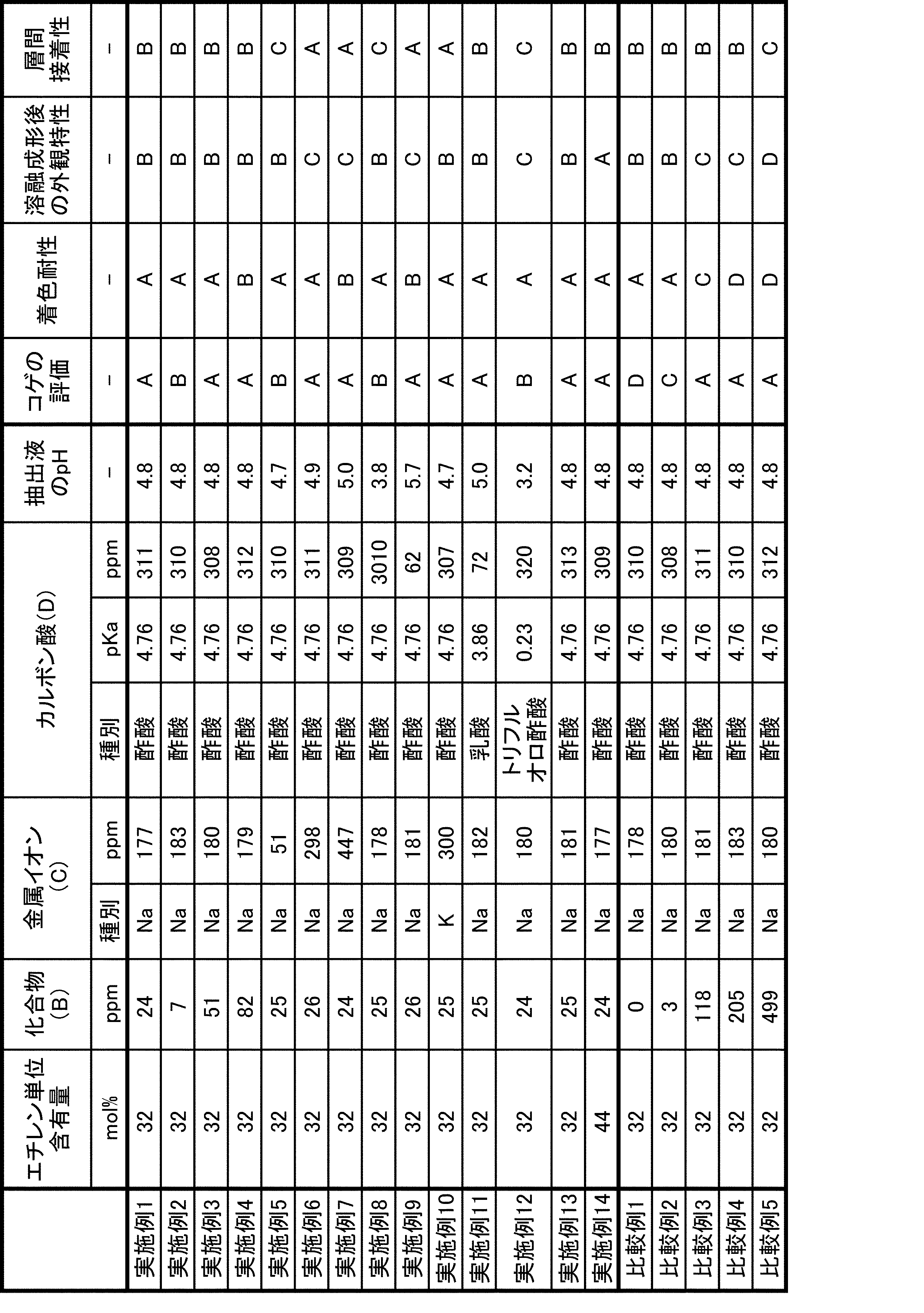
Claims (7)
- エチレン-ビニルアルコール共重合体(A)及び下記式(X)で示される化合物(B)を含む樹脂組成物であって、エチレン-ビニルアルコール共重合体(A)のエチレン単位含有量が15~60モル%、けん化度が85モル%以上であり、化合物(B)の含有量が5~100ppmである、樹脂組成物。

- 前記樹脂組成物10gを純水50mlで95℃、8時間抽出して得られる抽出液の20℃におけるpHが4.0~5.5の範囲にある、請求項1に記載の樹脂組成物。
- さらに、金属イオン(C)を100~400ppm含有する、請求項1または2に記載の樹脂組成物。
- さらに、pKaが3.5~5.5の範囲にあるカルボン酸(D)を50~400ppm含有する、請求項1~3のいずれかに記載の樹脂組成物。
- 請求項1~4のいずれかに記載の樹脂組成物を含む成形体。
- 前記樹脂組成物からなる層を含む多層構造体である、請求項5に記載の成形体。
- 請求項5または6に記載の成形体を有する包装材料。
Priority Applications (1)
| Application Number | Priority Date | Filing Date | Title |
|---|---|---|---|
| JP2019562799A JP7079270B2 (ja) | 2017-12-27 | 2018-10-31 | エチレン-ビニルアルコール共重合体含有樹脂組成物の製造方法 |
Applications Claiming Priority (2)
| Application Number | Priority Date | Filing Date | Title |
|---|---|---|---|
| JP2017-250574 | 2017-12-27 | ||
| JP2017250574 | 2017-12-27 |
Publications (1)
| Publication Number | Publication Date |
|---|---|
| WO2019130799A1 true WO2019130799A1 (ja) | 2019-07-04 |
Family
ID=67066938
Family Applications (1)
| Application Number | Title | Priority Date | Filing Date |
|---|---|---|---|
| PCT/JP2018/040466 Ceased WO2019130799A1 (ja) | 2017-12-27 | 2018-10-31 | エチレン-ビニルアルコール共重合体含有樹脂組成物、成形体及び包装材料 |
Country Status (3)
| Country | Link |
|---|---|
| JP (1) | JP7079270B2 (ja) |
| TW (1) | TWI798322B (ja) |
| WO (1) | WO2019130799A1 (ja) |
Cited By (2)
| Publication number | Priority date | Publication date | Assignee | Title |
|---|---|---|---|---|
| JP2021028356A (ja) * | 2019-08-09 | 2021-02-25 | 株式会社クラレ | ペレット及びそれからなる溶融成形体、並びにその製造方法 |
| JP2021181548A (ja) * | 2020-05-20 | 2021-11-25 | 株式会社クラレ | 樹脂組成物、成形体及び多層パイプ |
Citations (14)
| Publication number | Priority date | Publication date | Assignee | Title |
|---|---|---|---|---|
| JPS58198509A (ja) * | 1982-05-17 | 1983-11-18 | Kuraray Co Ltd | エチレン−酢酸ビニル連続共重合法 |
| JPS58206606A (ja) * | 1982-05-25 | 1983-12-01 | Kuraray Co Ltd | エチレン−酢酸ビニル系共重合体ケン化物の成形物の製造法 |
| JPS58222102A (ja) * | 1982-06-16 | 1983-12-23 | Kuraray Co Ltd | エチレン−酢酸ビニル共重合体ケン化物成形物の製造方法 |
| JPH02258809A (ja) * | 1989-03-30 | 1990-10-19 | Kuraray Co Ltd | エチレン―ビニルアルコールランダム共重合体、成形体および積層体 |
| JPH1067898A (ja) * | 1996-06-19 | 1998-03-10 | Kuraray Co Ltd | エチレン−ビニルエステル共重合体ケン化物組成物およびそれを用いた共押出多層成形体 |
| JP2002148221A (ja) * | 2000-11-10 | 2002-05-22 | Nippon Synthetic Chem Ind Co Ltd:The | エチレン−ビニルアルコール共重合体の評価方法、およびその評価方法による特定の特性を満足するエチレン−ビニルアルコール共重合体 |
| JP2002194009A (ja) * | 2000-10-18 | 2002-07-10 | Kuraray Co Ltd | エチレン−酢酸ビニル共重合体の製造方法と、この方法により得た共重合体のけん化物およびこれを含む成形物 |
| JP2003089739A (ja) * | 2001-09-19 | 2003-03-28 | Nippon Synthetic Chem Ind Co Ltd:The | 酢酸ビニル系重合体及びそのケン化物の製造法 |
| JP2007046063A (ja) * | 2001-03-16 | 2007-02-22 | Kuraray Co Ltd | エチレン−酢酸ビニル共重合体の製造方法および製造装置 |
| WO2011125739A1 (ja) * | 2010-03-31 | 2011-10-13 | 株式会社クラレ | 多層構造体、積層体及びその製造方法 |
| JP2012211317A (ja) * | 2011-03-30 | 2012-11-01 | Kuraray Co Ltd | エチレン−ビニルアルコール共重合体樹脂の製造方法、エチレン−ビニルアルコール共重合体樹脂及び多層構造体 |
| JP2012250356A (ja) * | 2011-05-31 | 2012-12-20 | Kuraray Co Ltd | 多層構造体及びその製造方法 |
| WO2013005807A1 (ja) * | 2011-07-07 | 2013-01-10 | 株式会社クラレ | エチレン-ビニルアルコール共重合体樹脂組成物及びその製造方法 |
| WO2017047806A1 (ja) * | 2015-09-18 | 2017-03-23 | 株式会社クラレ | 樹脂組成物、その製造方法及び多層構造体 |
Family Cites Families (2)
| Publication number | Priority date | Publication date | Assignee | Title |
|---|---|---|---|---|
| JPH0649787B2 (ja) * | 1990-01-23 | 1994-06-29 | 工業技術院長 | 成形品の表面処理及び塗装方法 |
| JP2012214672A (ja) | 2011-04-01 | 2012-11-08 | Daiso Co Ltd | ジアリルフタレート樹脂成形材料 |
-
2018
- 2018-10-31 WO PCT/JP2018/040466 patent/WO2019130799A1/ja not_active Ceased
- 2018-10-31 JP JP2019562799A patent/JP7079270B2/ja active Active
- 2018-12-25 TW TW107146899A patent/TWI798322B/zh active
Patent Citations (14)
| Publication number | Priority date | Publication date | Assignee | Title |
|---|---|---|---|---|
| JPS58198509A (ja) * | 1982-05-17 | 1983-11-18 | Kuraray Co Ltd | エチレン−酢酸ビニル連続共重合法 |
| JPS58206606A (ja) * | 1982-05-25 | 1983-12-01 | Kuraray Co Ltd | エチレン−酢酸ビニル系共重合体ケン化物の成形物の製造法 |
| JPS58222102A (ja) * | 1982-06-16 | 1983-12-23 | Kuraray Co Ltd | エチレン−酢酸ビニル共重合体ケン化物成形物の製造方法 |
| JPH02258809A (ja) * | 1989-03-30 | 1990-10-19 | Kuraray Co Ltd | エチレン―ビニルアルコールランダム共重合体、成形体および積層体 |
| JPH1067898A (ja) * | 1996-06-19 | 1998-03-10 | Kuraray Co Ltd | エチレン−ビニルエステル共重合体ケン化物組成物およびそれを用いた共押出多層成形体 |
| JP2002194009A (ja) * | 2000-10-18 | 2002-07-10 | Kuraray Co Ltd | エチレン−酢酸ビニル共重合体の製造方法と、この方法により得た共重合体のけん化物およびこれを含む成形物 |
| JP2002148221A (ja) * | 2000-11-10 | 2002-05-22 | Nippon Synthetic Chem Ind Co Ltd:The | エチレン−ビニルアルコール共重合体の評価方法、およびその評価方法による特定の特性を満足するエチレン−ビニルアルコール共重合体 |
| JP2007046063A (ja) * | 2001-03-16 | 2007-02-22 | Kuraray Co Ltd | エチレン−酢酸ビニル共重合体の製造方法および製造装置 |
| JP2003089739A (ja) * | 2001-09-19 | 2003-03-28 | Nippon Synthetic Chem Ind Co Ltd:The | 酢酸ビニル系重合体及びそのケン化物の製造法 |
| WO2011125739A1 (ja) * | 2010-03-31 | 2011-10-13 | 株式会社クラレ | 多層構造体、積層体及びその製造方法 |
| JP2012211317A (ja) * | 2011-03-30 | 2012-11-01 | Kuraray Co Ltd | エチレン−ビニルアルコール共重合体樹脂の製造方法、エチレン−ビニルアルコール共重合体樹脂及び多層構造体 |
| JP2012250356A (ja) * | 2011-05-31 | 2012-12-20 | Kuraray Co Ltd | 多層構造体及びその製造方法 |
| WO2013005807A1 (ja) * | 2011-07-07 | 2013-01-10 | 株式会社クラレ | エチレン-ビニルアルコール共重合体樹脂組成物及びその製造方法 |
| WO2017047806A1 (ja) * | 2015-09-18 | 2017-03-23 | 株式会社クラレ | 樹脂組成物、その製造方法及び多層構造体 |
Non-Patent Citations (1)
| Title |
|---|
| HARFI EL JAOUAD ET AL.: "Dielectric Properties of Free Radical Initiators-Investigation of Thermal Decomposition Products", INDUSTRIAL & ENGINEERING CHEMISTRY RESEARCH, vol. 51, no. 49, 2012, pages 15811 - 15820, XP055623489 * |
Cited By (4)
| Publication number | Priority date | Publication date | Assignee | Title |
|---|---|---|---|---|
| JP2021028356A (ja) * | 2019-08-09 | 2021-02-25 | 株式会社クラレ | ペレット及びそれからなる溶融成形体、並びにその製造方法 |
| JP7337593B2 (ja) | 2019-08-09 | 2023-09-04 | 株式会社クラレ | ペレット及びそれからなる溶融成形体、並びにその製造方法 |
| JP2021181548A (ja) * | 2020-05-20 | 2021-11-25 | 株式会社クラレ | 樹脂組成物、成形体及び多層パイプ |
| JP7569629B2 (ja) | 2020-05-20 | 2024-10-18 | 株式会社クラレ | 樹脂組成物、成形体及び多層パイプ |
Also Published As
| Publication number | Publication date |
|---|---|
| JP7079270B2 (ja) | 2022-06-01 |
| TWI798322B (zh) | 2023-04-11 |
| JPWO2019130799A1 (ja) | 2021-01-07 |
| TW201934641A (zh) | 2019-09-01 |
Similar Documents
| Publication | Publication Date | Title |
|---|---|---|
| KR101795094B1 (ko) | 수지 조성물, 그 제조 방법 및 다층 구조체 | |
| US6232382B1 (en) | Saponified ethylene-vinyl acetate copolymer resin composition and laminate having a layer of said resin composition | |
| JP7337593B2 (ja) | ペレット及びそれからなる溶融成形体、並びにその製造方法 | |
| JPWO2000020211A1 (ja) | 多層構造体およびその製法 | |
| TW201402682A (zh) | 乙烯-乙烯醇樹脂組成物、多層構造體、多層薄片、容器及包裝材料 | |
| JP6733059B1 (ja) | エチレン−ビニルアルコール共重合体及びその製造方法 | |
| WO2015050224A1 (ja) | エチレン-ビニルアルコール樹脂組成物、多層構造体、多層シート、容器及び包装材 | |
| JP6724019B2 (ja) | 樹脂組成物、その製造方法及び多層構造体 | |
| JP7084944B2 (ja) | エチレン-ビニルアルコール共重合体含有樹脂組成物、並びにそれからなる成形体及び包装材料 | |
| JP7079270B2 (ja) | エチレン-ビニルアルコール共重合体含有樹脂組成物の製造方法 | |
| JP7569629B2 (ja) | 樹脂組成物、成形体及び多層パイプ | |
| JP4684589B2 (ja) | 樹脂組成物及びその製造方法 | |
| JP7738576B2 (ja) | 樹脂ペレット群およびそれを用いた層構造体 | |
| JP7399759B2 (ja) | 樹脂組成物及び積層フィルム並びに包装材料 | |
| JP3841943B2 (ja) | 樹脂組成物の製造法 | |
| JP7504628B2 (ja) | エチレン-ビニルアルコール共重合体含有樹脂組成物及び成形体 | |
| JP3841941B2 (ja) | 樹脂組成物の製造法 | |
| JPWO2001096464A1 (ja) | エチレン−ビニルアルコール共重合体樹脂組成物 | |
| TWI900711B (zh) | 樹脂粒群及使用其之層結構體,以及層結構體之製造方法 |
Legal Events
| Date | Code | Title | Description |
|---|---|---|---|
| 121 | Ep: the epo has been informed by wipo that ep was designated in this application |
Ref document number: 18895413 Country of ref document: EP Kind code of ref document: A1 |
|
| ENP | Entry into the national phase |
Ref document number: 2019562799 Country of ref document: JP Kind code of ref document: A |
|
| NENP | Non-entry into the national phase |
Ref country code: DE |
|
| 122 | Ep: pct application non-entry in european phase |
Ref document number: 18895413 Country of ref document: EP Kind code of ref document: A1 |