WO2019035271A1 - 撥水部材及び撥水部材の製造方法 - Google Patents
撥水部材及び撥水部材の製造方法 Download PDFInfo
- Publication number
- WO2019035271A1 WO2019035271A1 PCT/JP2018/022414 JP2018022414W WO2019035271A1 WO 2019035271 A1 WO2019035271 A1 WO 2019035271A1 JP 2018022414 W JP2018022414 W JP 2018022414W WO 2019035271 A1 WO2019035271 A1 WO 2019035271A1
- Authority
- WO
- WIPO (PCT)
- Prior art keywords
- group
- fluorine
- integer
- water
- solvent
- Prior art date
- Legal status (The legal status is an assumption and is not a legal conclusion. Google has not performed a legal analysis and makes no representation as to the accuracy of the status listed.)
- Ceased
Links
- MELHSMGNHAQIDE-POHAHGRESA-N CC(C)(C(C)(C)/[N+](/[O-])=C/C)N Chemical compound CC(C)(C(C)(C)/[N+](/[O-])=C/C)N MELHSMGNHAQIDE-POHAHGRESA-N 0.000 description 1
- SHLJHRVVLASFPV-WDZFZDKYSA-N CC(C)(C(C)(C)/[N+](/[O-])=C/C)NN Chemical compound CC(C)(C(C)(C)/[N+](/[O-])=C/C)NN SHLJHRVVLASFPV-WDZFZDKYSA-N 0.000 description 1
- 0 CC(N)[Mn]*C(C)(C)* Chemical compound CC(N)[Mn]*C(C)(C)* 0.000 description 1
Classifications
-
- C—CHEMISTRY; METALLURGY
- C01—INORGANIC CHEMISTRY
- C01B—NON-METALLIC ELEMENTS; COMPOUNDS THEREOF; METALLOIDS OR COMPOUNDS THEREOF NOT COVERED BY SUBCLASS C01C
- C01B33/00—Silicon; Compounds thereof
- C01B33/113—Silicon oxides; Hydrates thereof
- C01B33/12—Silica; Hydrates thereof, e.g. lepidoic silicic acid
-
- C—CHEMISTRY; METALLURGY
- C09—DYES; PAINTS; POLISHES; NATURAL RESINS; ADHESIVES; COMPOSITIONS NOT OTHERWISE PROVIDED FOR; APPLICATIONS OF MATERIALS NOT OTHERWISE PROVIDED FOR
- C09D—COATING COMPOSITIONS, e.g. PAINTS, VARNISHES OR LACQUERS; FILLING PASTES; CHEMICAL PAINT OR INK REMOVERS; INKS; CORRECTING FLUIDS; WOODSTAINS; PASTES OR SOLIDS FOR COLOURING OR PRINTING; USE OF MATERIALS THEREFOR
- C09D1/00—Coating compositions, e.g. paints, varnishes or lacquers, based on inorganic substances
-
- B—PERFORMING OPERATIONS; TRANSPORTING
- B05—SPRAYING OR ATOMISING IN GENERAL; APPLYING FLUENT MATERIALS TO SURFACES, IN GENERAL
- B05D—PROCESSES FOR APPLYING FLUENT MATERIALS TO SURFACES, IN GENERAL
- B05D1/00—Processes for applying liquids or other fluent materials
- B05D1/36—Successively applying liquids or other fluent materials, e.g. without intermediate treatment
-
- B—PERFORMING OPERATIONS; TRANSPORTING
- B05—SPRAYING OR ATOMISING IN GENERAL; APPLYING FLUENT MATERIALS TO SURFACES, IN GENERAL
- B05D—PROCESSES FOR APPLYING FLUENT MATERIALS TO SURFACES, IN GENERAL
- B05D7/00—Processes, other than flocking, specially adapted for applying liquids or other fluent materials to particular surfaces or for applying particular liquids or other fluent materials
- B05D7/24—Processes, other than flocking, specially adapted for applying liquids or other fluent materials to particular surfaces or for applying particular liquids or other fluent materials for applying particular liquids or other fluent materials
-
- B—PERFORMING OPERATIONS; TRANSPORTING
- B05—SPRAYING OR ATOMISING IN GENERAL; APPLYING FLUENT MATERIALS TO SURFACES, IN GENERAL
- B05D—PROCESSES FOR APPLYING FLUENT MATERIALS TO SURFACES, IN GENERAL
- B05D7/00—Processes, other than flocking, specially adapted for applying liquids or other fluent materials to particular surfaces or for applying particular liquids or other fluent materials
- B05D7/50—Multilayers
- B05D7/52—Two layers
-
- B—PERFORMING OPERATIONS; TRANSPORTING
- B32—LAYERED PRODUCTS
- B32B—LAYERED PRODUCTS, i.e. PRODUCTS BUILT-UP OF STRATA OF FLAT OR NON-FLAT, e.g. CELLULAR OR HONEYCOMB, FORM
- B32B27/00—Layered products comprising a layer of synthetic resin
-
- B—PERFORMING OPERATIONS; TRANSPORTING
- B32—LAYERED PRODUCTS
- B32B—LAYERED PRODUCTS, i.e. PRODUCTS BUILT-UP OF STRATA OF FLAT OR NON-FLAT, e.g. CELLULAR OR HONEYCOMB, FORM
- B32B9/00—Layered products comprising a layer of a particular substance not covered by groups B32B11/00 - B32B29/00
-
- C—CHEMISTRY; METALLURGY
- C08—ORGANIC MACROMOLECULAR COMPOUNDS; THEIR PREPARATION OR CHEMICAL WORKING-UP; COMPOSITIONS BASED THEREON
- C08G—MACROMOLECULAR COMPOUNDS OBTAINED OTHERWISE THAN BY REACTIONS ONLY INVOLVING UNSATURATED CARBON-TO-CARBON BONDS
- C08G65/00—Macromolecular compounds obtained by reactions forming an ether link in the main chain of the macromolecule
- C08G65/002—Macromolecular compounds obtained by reactions forming an ether link in the main chain of the macromolecule from unsaturated compounds
- C08G65/005—Macromolecular compounds obtained by reactions forming an ether link in the main chain of the macromolecule from unsaturated compounds containing halogens
- C08G65/007—Macromolecular compounds obtained by reactions forming an ether link in the main chain of the macromolecule from unsaturated compounds containing halogens containing fluorine
-
- C—CHEMISTRY; METALLURGY
- C08—ORGANIC MACROMOLECULAR COMPOUNDS; THEIR PREPARATION OR CHEMICAL WORKING-UP; COMPOSITIONS BASED THEREON
- C08G—MACROMOLECULAR COMPOUNDS OBTAINED OTHERWISE THAN BY REACTIONS ONLY INVOLVING UNSATURATED CARBON-TO-CARBON BONDS
- C08G65/00—Macromolecular compounds obtained by reactions forming an ether link in the main chain of the macromolecule
- C08G65/02—Macromolecular compounds obtained by reactions forming an ether link in the main chain of the macromolecule from cyclic ethers by opening of the heterocyclic ring
- C08G65/32—Polymers modified by chemical after-treatment
- C08G65/329—Polymers modified by chemical after-treatment with organic compounds
- C08G65/336—Polymers modified by chemical after-treatment with organic compounds containing silicon
-
- C—CHEMISTRY; METALLURGY
- C08—ORGANIC MACROMOLECULAR COMPOUNDS; THEIR PREPARATION OR CHEMICAL WORKING-UP; COMPOSITIONS BASED THEREON
- C08K—Use of inorganic or non-macromolecular organic substances as compounding ingredients
- C08K3/00—Use of inorganic substances as compounding ingredients
- C08K3/02—Elements
- C08K3/08—Metals
-
- C—CHEMISTRY; METALLURGY
- C08—ORGANIC MACROMOLECULAR COMPOUNDS; THEIR PREPARATION OR CHEMICAL WORKING-UP; COMPOSITIONS BASED THEREON
- C08K—Use of inorganic or non-macromolecular organic substances as compounding ingredients
- C08K5/00—Use of organic ingredients
- C08K5/02—Halogenated hydrocarbons
-
- C—CHEMISTRY; METALLURGY
- C08—ORGANIC MACROMOLECULAR COMPOUNDS; THEIR PREPARATION OR CHEMICAL WORKING-UP; COMPOSITIONS BASED THEREON
- C08K—Use of inorganic or non-macromolecular organic substances as compounding ingredients
- C08K5/00—Use of organic ingredients
- C08K5/54—Silicon-containing compounds
-
- C—CHEMISTRY; METALLURGY
- C09—DYES; PAINTS; POLISHES; NATURAL RESINS; ADHESIVES; COMPOSITIONS NOT OTHERWISE PROVIDED FOR; APPLICATIONS OF MATERIALS NOT OTHERWISE PROVIDED FOR
- C09D—COATING COMPOSITIONS, e.g. PAINTS, VARNISHES OR LACQUERS; FILLING PASTES; CHEMICAL PAINT OR INK REMOVERS; INKS; CORRECTING FLUIDS; WOODSTAINS; PASTES OR SOLIDS FOR COLOURING OR PRINTING; USE OF MATERIALS THEREFOR
- C09D171/00—Coating compositions based on polyethers obtained by reactions forming an ether link in the main chain; Coating compositions based on derivatives of such polymers
-
- C—CHEMISTRY; METALLURGY
- C09—DYES; PAINTS; POLISHES; NATURAL RESINS; ADHESIVES; COMPOSITIONS NOT OTHERWISE PROVIDED FOR; APPLICATIONS OF MATERIALS NOT OTHERWISE PROVIDED FOR
- C09D—COATING COMPOSITIONS, e.g. PAINTS, VARNISHES OR LACQUERS; FILLING PASTES; CHEMICAL PAINT OR INK REMOVERS; INKS; CORRECTING FLUIDS; WOODSTAINS; PASTES OR SOLIDS FOR COLOURING OR PRINTING; USE OF MATERIALS THEREFOR
- C09D5/00—Coating compositions, e.g. paints, varnishes or lacquers, characterised by their physical nature or the effects produced; Filling pastes
-
- C—CHEMISTRY; METALLURGY
- C09—DYES; PAINTS; POLISHES; NATURAL RESINS; ADHESIVES; COMPOSITIONS NOT OTHERWISE PROVIDED FOR; APPLICATIONS OF MATERIALS NOT OTHERWISE PROVIDED FOR
- C09D—COATING COMPOSITIONS, e.g. PAINTS, VARNISHES OR LACQUERS; FILLING PASTES; CHEMICAL PAINT OR INK REMOVERS; INKS; CORRECTING FLUIDS; WOODSTAINS; PASTES OR SOLIDS FOR COLOURING OR PRINTING; USE OF MATERIALS THEREFOR
- C09D5/00—Coating compositions, e.g. paints, varnishes or lacquers, characterised by their physical nature or the effects produced; Filling pastes
- C09D5/002—Priming paints
-
- C—CHEMISTRY; METALLURGY
- C09—DYES; PAINTS; POLISHES; NATURAL RESINS; ADHESIVES; COMPOSITIONS NOT OTHERWISE PROVIDED FOR; APPLICATIONS OF MATERIALS NOT OTHERWISE PROVIDED FOR
- C09D—COATING COMPOSITIONS, e.g. PAINTS, VARNISHES OR LACQUERS; FILLING PASTES; CHEMICAL PAINT OR INK REMOVERS; INKS; CORRECTING FLUIDS; WOODSTAINS; PASTES OR SOLIDS FOR COLOURING OR PRINTING; USE OF MATERIALS THEREFOR
- C09D5/00—Coating compositions, e.g. paints, varnishes or lacquers, characterised by their physical nature or the effects produced; Filling pastes
- C09D5/16—Antifouling paints; Underwater paints
-
- C—CHEMISTRY; METALLURGY
- C09—DYES; PAINTS; POLISHES; NATURAL RESINS; ADHESIVES; COMPOSITIONS NOT OTHERWISE PROVIDED FOR; APPLICATIONS OF MATERIALS NOT OTHERWISE PROVIDED FOR
- C09D—COATING COMPOSITIONS, e.g. PAINTS, VARNISHES OR LACQUERS; FILLING PASTES; CHEMICAL PAINT OR INK REMOVERS; INKS; CORRECTING FLUIDS; WOODSTAINS; PASTES OR SOLIDS FOR COLOURING OR PRINTING; USE OF MATERIALS THEREFOR
- C09D5/00—Coating compositions, e.g. paints, varnishes or lacquers, characterised by their physical nature or the effects produced; Filling pastes
- C09D5/16—Antifouling paints; Underwater paints
- C09D5/1656—Antifouling paints; Underwater paints characterised by the film-forming substance
- C09D5/1662—Synthetic film-forming substance
-
- C—CHEMISTRY; METALLURGY
- C09—DYES; PAINTS; POLISHES; NATURAL RESINS; ADHESIVES; COMPOSITIONS NOT OTHERWISE PROVIDED FOR; APPLICATIONS OF MATERIALS NOT OTHERWISE PROVIDED FOR
- C09D—COATING COMPOSITIONS, e.g. PAINTS, VARNISHES OR LACQUERS; FILLING PASTES; CHEMICAL PAINT OR INK REMOVERS; INKS; CORRECTING FLUIDS; WOODSTAINS; PASTES OR SOLIDS FOR COLOURING OR PRINTING; USE OF MATERIALS THEREFOR
- C09D5/00—Coating compositions, e.g. paints, varnishes or lacquers, characterised by their physical nature or the effects produced; Filling pastes
- C09D5/16—Antifouling paints; Underwater paints
- C09D5/1656—Antifouling paints; Underwater paints characterised by the film-forming substance
- C09D5/1662—Synthetic film-forming substance
- C09D5/1675—Polyorganosiloxane-containing compositions
-
- C—CHEMISTRY; METALLURGY
- C09—DYES; PAINTS; POLISHES; NATURAL RESINS; ADHESIVES; COMPOSITIONS NOT OTHERWISE PROVIDED FOR; APPLICATIONS OF MATERIALS NOT OTHERWISE PROVIDED FOR
- C09D—COATING COMPOSITIONS, e.g. PAINTS, VARNISHES OR LACQUERS; FILLING PASTES; CHEMICAL PAINT OR INK REMOVERS; INKS; CORRECTING FLUIDS; WOODSTAINS; PASTES OR SOLIDS FOR COLOURING OR PRINTING; USE OF MATERIALS THEREFOR
- C09D5/00—Coating compositions, e.g. paints, varnishes or lacquers, characterised by their physical nature or the effects produced; Filling pastes
- C09D5/16—Antifouling paints; Underwater paints
- C09D5/1693—Antifouling paints; Underwater paints as part of a multilayer system
-
- C—CHEMISTRY; METALLURGY
- C09—DYES; PAINTS; POLISHES; NATURAL RESINS; ADHESIVES; COMPOSITIONS NOT OTHERWISE PROVIDED FOR; APPLICATIONS OF MATERIALS NOT OTHERWISE PROVIDED FOR
- C09D—COATING COMPOSITIONS, e.g. PAINTS, VARNISHES OR LACQUERS; FILLING PASTES; CHEMICAL PAINT OR INK REMOVERS; INKS; CORRECTING FLUIDS; WOODSTAINS; PASTES OR SOLIDS FOR COLOURING OR PRINTING; USE OF MATERIALS THEREFOR
- C09D7/00—Features of coating compositions, not provided for in group C09D5/00; Processes for incorporating ingredients in coating compositions
- C09D7/40—Additives
- C09D7/60—Additives non-macromolecular
- C09D7/61—Additives non-macromolecular inorganic
-
- C—CHEMISTRY; METALLURGY
- C09—DYES; PAINTS; POLISHES; NATURAL RESINS; ADHESIVES; COMPOSITIONS NOT OTHERWISE PROVIDED FOR; APPLICATIONS OF MATERIALS NOT OTHERWISE PROVIDED FOR
- C09D—COATING COMPOSITIONS, e.g. PAINTS, VARNISHES OR LACQUERS; FILLING PASTES; CHEMICAL PAINT OR INK REMOVERS; INKS; CORRECTING FLUIDS; WOODSTAINS; PASTES OR SOLIDS FOR COLOURING OR PRINTING; USE OF MATERIALS THEREFOR
- C09D7/00—Features of coating compositions, not provided for in group C09D5/00; Processes for incorporating ingredients in coating compositions
- C09D7/40—Additives
- C09D7/60—Additives non-macromolecular
- C09D7/63—Additives non-macromolecular organic
-
- C—CHEMISTRY; METALLURGY
- C09—DYES; PAINTS; POLISHES; NATURAL RESINS; ADHESIVES; COMPOSITIONS NOT OTHERWISE PROVIDED FOR; APPLICATIONS OF MATERIALS NOT OTHERWISE PROVIDED FOR
- C09D—COATING COMPOSITIONS, e.g. PAINTS, VARNISHES OR LACQUERS; FILLING PASTES; CHEMICAL PAINT OR INK REMOVERS; INKS; CORRECTING FLUIDS; WOODSTAINS; PASTES OR SOLIDS FOR COLOURING OR PRINTING; USE OF MATERIALS THEREFOR
- C09D7/00—Features of coating compositions, not provided for in group C09D5/00; Processes for incorporating ingredients in coating compositions
- C09D7/80—Processes for incorporating ingredients
-
- C—CHEMISTRY; METALLURGY
- C01—INORGANIC CHEMISTRY
- C01P—INDEXING SCHEME RELATING TO STRUCTURAL AND PHYSICAL ASPECTS OF SOLID INORGANIC COMPOUNDS
- C01P2004/00—Particle morphology
- C01P2004/60—Particles characterised by their size
- C01P2004/64—Nanometer sized, i.e. from 1-100 nanometer
-
- C—CHEMISTRY; METALLURGY
- C08—ORGANIC MACROMOLECULAR COMPOUNDS; THEIR PREPARATION OR CHEMICAL WORKING-UP; COMPOSITIONS BASED THEREON
- C08K—Use of inorganic or non-macromolecular organic substances as compounding ingredients
- C08K3/00—Use of inorganic substances as compounding ingredients
- C08K3/18—Oxygen-containing compounds, e.g. metal carbonyls
- C08K3/20—Oxides; Hydroxides
- C08K3/22—Oxides; Hydroxides of metals
- C08K2003/2231—Oxides; Hydroxides of metals of tin
-
- C—CHEMISTRY; METALLURGY
- C08—ORGANIC MACROMOLECULAR COMPOUNDS; THEIR PREPARATION OR CHEMICAL WORKING-UP; COMPOSITIONS BASED THEREON
- C08K—Use of inorganic or non-macromolecular organic substances as compounding ingredients
- C08K3/00—Use of inorganic substances as compounding ingredients
- C08K3/18—Oxygen-containing compounds, e.g. metal carbonyls
- C08K3/20—Oxides; Hydroxides
- C08K3/22—Oxides; Hydroxides of metals
- C08K2003/2237—Oxides; Hydroxides of metals of titanium
- C08K2003/2241—Titanium dioxide
-
- C—CHEMISTRY; METALLURGY
- C09—DYES; PAINTS; POLISHES; NATURAL RESINS; ADHESIVES; COMPOSITIONS NOT OTHERWISE PROVIDED FOR; APPLICATIONS OF MATERIALS NOT OTHERWISE PROVIDED FOR
- C09K—MATERIALS FOR MISCELLANEOUS APPLICATIONS, NOT PROVIDED FOR ELSEWHERE
- C09K3/00—Materials not provided for elsewhere
- C09K3/18—Materials not provided for elsewhere for application to surfaces to minimize adherence of ice, mist or water thereto; Thawing or antifreeze materials for application to surfaces
Definitions
- the present invention relates to a water repellent member and a method of manufacturing the water repellent member, and more specifically, a water repellent member provided with a silica layer mainly composed of silica nanoparticles between a substrate and a water and oil repellent layer, and the water repellent
- the present invention relates to a method of manufacturing a member.
- a fluorooxyalkylene group-containing polymer composition is disclosed.
- Rf 1 is —C d F 2 d O— (d is an integer of 1 to 6 and may be different for each repeating unit).
- Alkylene groups, A and B, independently of one another, R f 2 groups or Rf 2 is a monovalent fluorine-containing group whose end is a —CF 3 group or a —CF 2 H group, and Q is a divalent organic group.
- Z is a divalent to heptavalent organopolysiloxane residue having a siloxane bond
- R is an alkyl group having 1 to 4 carbon atoms or a phenyl group
- X is a hydrolysable group
- a is 2 or 3
- B is an integer of 1 to 6
- c is an integer of 1 to 5
- ⁇ is an integer of 0 or 1)
- Patent Document 1 exhibits relatively excellent durability on the surface of a substrate having a large amount of silanol groups (hydroxyl groups bonded to silicon atoms) represented by glass etc. However, it is difficult to obtain excellent adhesion to surfaces such as metals, metal oxides and resins.
- a method of improving the adhesiveness a method of providing a SiO 2 layer as a primer layer by a dry method (a vapor deposition method or a sputtering method) is disclosed (WO 2014/097388: Patent Document 2).
- a dry method a vapor deposition method or a sputtering method
- Patent Document 2 Using this method has been shown to be able to form a water- and oil-repellent layer with excellent durability, but it is necessary to perform treatment in vacuum, and a large-scale device is required to coat a large substrate. Therefore, the scope of application is limited in terms of productivity and production cost.
- a polysilazane solution that can be provided with a primer layer by a wet method is disclosed (WO 2010/038648: Patent Document 3). After the polysilazane solution is applied to the surface of the substrate, the reaction of the polysilazane solution with moisture to convert it into silica glass is utilized.
- This method is superior to the dry method in that it does not use a vacuum process, but in order to stabilize the adhesion of the water- and oil-repellent layer, long-time high-temperature heating and humidification are required. There is a problem in that the base material that can be applied is also limited.
- the following documents are mentioned as a prior art relevant to this invention with the literature mentioned above.
- the present invention has been made in view of the above circumstances, and is a water repellent member having excellent abrasion resistance, and a water repellent agent having a water and oil repellent layer having excellent abrasion resistance formed on the outer surfaces of various substrates by a wet method. It is an object of the present invention to provide a method of manufacturing a member.
- the present inventors wetly apply a dispersion containing silica nanoparticles and a solvent on the outer surface of a substrate, and dry the solvent from the dispersion.
- the step of removing, the step of wet-coating a solution containing a fluorine-containing organosilicon compound and a solvent on the outer surface of the silica layer formed by removing the solvent by drying, and the step of drying-removing the solvent from the solution After providing a silica layer having a specific thickness mainly composed of silica nanoparticles on the outer surface of various substrates obtained by a method comprising the step of curing an organosilicon compound, etc., the outer surface of the silica layer is obtained.
- a water repellent member provided with a water and oil repellent layer having a specific thickness mainly composed of a cured product of a fluorine-containing organic silicon compound stably and easily provides a water and oil repellent coating excellent in abrasion resistance. Found that it can be applied to various Leading to the completion of the.
- the present invention provides the following water repellent member and a method of manufacturing the water repellent member.
- a silica layer having a thickness of 1 nm to 5 ⁇ m containing 50% by mass or more of silica nanoparticles is provided on the outer surface of the substrate, and a cured product of a fluorine-containing organosilicon compound as a main component is further provided on the outer surface of the silica layer.
- the fluorine-containing organic silicon compound is at least one selected from fluorine-containing hydrolysable organic silicon compounds represented by the following general formulas (1), (2), (3), (4) and (5) [ The water repellent member as described in 1] or [2].
- R f is — (CF 2 ) d —O— (CF 2 O) p (CF 2 CF 2 O) q (CF 2 CF 2 CF 2 O) r (CF 2 CF 2 CF 2 CF 2 O) s (CF (CF 3) CF 2 O) t - (CF 2)
- A is a fluorine atom, a hydrogen atom, or a monovalent fluorine-containing group in which the end is —CF 3 group, —CF 2 H group or —CH 2 F group, and Z and Z ′ are independently a single bond or nitrogen
- R 2 is a divalent to octavalent organic group which may contain an atom, an oxygen atom, a silicon atom, a phosphorus atom or a sulfur atom
- W is a monovalent group having a hydrolyzable group at its terminal It is an organic group.
- ⁇ and ⁇ are each independently an integer of 1 to 7, and ⁇ + ⁇ is 2 to 8.
- ⁇ is an integer of 2 to 8.
- the silica layer containing 50% by mass or more of silica nanoparticles contains 0.1 to 50% by mass of one or more selected from titanium oxide nanoparticles, platinum nanoparticles, and tin oxide nanoparticles having an average particle diameter of 30 nm or less
- the present invention it is possible to form a water repellent member in which the surface of the antifouling layer excellent in water and oil repellency is firmly adhered.
- the method for manufacturing the water repellent member can be formed by a wet (spray, dipping, brushing, spin) process without requiring a vacuum process or a high temperature heating process, and it can be applied to various applications. it can.
- it is useful for an article having an antifouling property on the surface, in particular, a housing of an electronic device, a wearable terminal, a kitchen article and a sanitary article, a body of a transport device, a touch panel display, and the like.
- a dispersion (a silica dispersion agent) containing silica nanoparticles and a solvent is wet-coated on the outer surface of various substrates, and then the solvent is removed by drying from the dispersion to obtain outer surfaces of various substrates.
- a silica layer on the outer surface of the silica layer, and after wet-coating a solution containing a fluorine-containing organosilicon compound and a solvent (antifouling coating agent), the solvent is removed by drying from the solution and An organic silicon compound is cured to form a water- and oil-repellent layer on the outer surface of the silica layer, etc., containing 50% by mass or more of silica nanoparticles on the outer surface of various substrates
- a water repellent member having a silica layer and further having a water and oil repellent layer with a film thickness of 0.5 to 30 nm mainly composed of a cured product of a fluorine-containing organosilicon compound on the outer surface of the silica layer. is there.
- the substrate to which the present invention is applied is not particularly limited, but metal oxides, metals, resins, ceramics, quartz, glass, sapphire and diamond are particularly preferable.
- metal oxide SiO, SiO 2, Al 2 O 3, ITO, In 2 O 3, SnO 2, ZrO 2, TiO 2, Ti 2 O 3, Ti 4 O 7, Ti 3 O 5, Nb 2 O 5 , Ta 2 O 5 , Y 2 O 3 , WO 3 , HfO 2 , La 2 Ti 2 O 7 and the like can be mentioned.
- metal magnesium, magnesium alloy, titanium, titanium alloy, chromium, iron, nickel, cobalt, copper, zinc, yttrium, zirconium, niobium, molybdenum, ruthenium, rhodium, palladium, silver, tungsten, platinum, gold
- metal examples thereof include stainless steel, aluminum, aluminum alloy, duralumin, hastelloy and the like.
- resin a thermoplastic resin or a thermosetting resin may be mentioned, and specifically, the following ones are preferable.
- aliphatic polyamide such as 6-nylon, 6,6-nylon, 12-nylon, aromatic polyamide, ABS, AS resin, polystyrene, polyethylene (low density or high Density), polyolefin such as polypropylene, polyvinyl chloride, polyvinylidene chloride, ethylene-vinyl acetate copolymer, polyvinyl alcohol, polyacetal, polycarbonate, saturated polyester such as polyethylene terephthalate, polybutylene terephthalate, aromatic polyester, polyether ketone, Polyether ether ketone, polysulfone, polyether sulfone, polyether imide, polyarylate, polymethylpentene, ionomer, liquid crystal polymer, polyi Thermoplastic resins such as polyamide imide, fluorocarbon resin, polyphenylene sulfide, (modified) polyphenylene oxide, thermoplastic polyurethane,
- the silica layer formed on the outer surface of the substrate is one having a thickness of 1 nm to 5 ⁇ m containing 50% by mass or more of silica nanoparticles.
- the silica layer can be formed by wet-coating a dispersion containing silica nanoparticles and a solvent (nanosilica dispersant) on the surface of various substrates, and then removing the solvent from the dispersion by drying.
- the average particle diameter (diameter) of the silica nanoparticles is preferably 30 nm or less, more preferably 20 nm or less, still more preferably 10 nm or less, particularly preferably 5 nm or less.
- the lower limit of the average particle size is usually 0.1 nm or more, preferably 0.5 nm or more.
- the average particle diameter can be determined, for example, as the cumulative mass average diameter D50 (or median diameter) or the like in the particle size distribution measurement by the laser light diffraction method.
- the silica nanoparticles have a content of 50 to 100% by mass, preferably 60 to 100% by mass, in the silica layer between the substrate and the fluorine-containing layer (water and oil repellent layer). If the content is less than 50% by mass, the contact between the silica nanoparticles is reduced, resulting in poor durability. On the other hand, although 100 mass% may be sufficient as a silica nanoparticle, since a silica nanoparticle alone will produce a void, you may raise a density by mixing other particle
- examples include magnesium, manganese oxide, nickel oxide, zirconium oxide, and nanoparticles of multicomponent oxides.
- titanium oxide nanoparticles, platinum nanoparticles and tin oxide nanoparticles are preferable. These may be used singly or in combination of two or more. When these particles are used, they are preferably contained in an amount of 0.1 to 50% by mass, in particular 1 to 20% by mass, in the particles (the total of silica nanoparticles and other particles) constituting the silica layer.
- the nano silica dispersant may be, if necessary, a surfactant such as an ultraviolet light absorber, a light stabilizer, an antioxidant, a leveling agent, an antifoamer, a pigment, a dye, a dispersant, an antistatic agent and an antifogging agent. Agents may be used.
- a surfactant such as an ultraviolet light absorber, a light stabilizer, an antioxidant, a leveling agent, an antifoamer, a pigment, a dye, a dispersant, an antistatic agent and an antifogging agent. Agents may be used.
- the solvent in which the silica nanoparticles are dispersed is preferably pure water, methanol or ethanol, but is not particularly limited, and may be appropriately selected from the wettability with the substrate and the boiling point.
- the concentration of the silica nanoparticles in the dispersion containing the silica nanoparticles and the solvent is preferably 0.01 to 10% by mass, and more preferably 0.1 to 1% by mass. When the concentration is too low, the uncoated part increases, and when the concentration is too high, secondary aggregation of the silica nanoparticles may occur.
- the nano silica dispersant (dispersion liquid) obtained by dispersing the above silica nanoparticles in a solvent is applied to the substrate surface by wet coating, in particular, by a method such as immersion, brush coating, spin coating, spray coating, flow coating,
- the silica layer can be formed by drying the solvent. If it is desired to increase the density of the silica layer, it may be heated at 50 to 500 ° C. for 10 minutes to 24 hours in a temperature range which does not affect the substrate.
- the film thickness of the silica layer formed on the surface of the substrate is appropriately selected depending on the type of the substrate, but is usually 1 nm to 5 ⁇ m, preferably 2 nm to 0.5 ⁇ m, and particularly 2 nm to 30 nm. In the present invention, the film thickness can be measured by the X-ray reflectance method.
- an antifouling coating agent (a solution containing a fluorine-containing organic silicon compound and a solvent) is applied on the outer surface of the formed silica layer, and then the solvent is removed by drying from the solution to cure the antifouling coating agent. Form an antifouling surface layer.
- the antifouling coating agent is mainly composed of a fluorine-containing organic silicon compound. Examples of the fluorine-containing organic silicon compound include: JP-A-2007-197425, JP-A-2007-297589, JP-A-2007-297543, JP-A-2008-088412, JP-A-2008-144144, and the like.
- the fluorine-containing organic silicon compounds described in -253228, JP-A-2014-218639, and WO 2013/121984 can be used.
- the fluorine-containing organic silicon compound will be described more specifically.
- the fluorine-containing organic silicon compound (or fluorine-containing organic silicon compound) according to the present invention is preferably a fluorine-containing organic silicon compound having at least one hydrolysable group, and the compound has one carbon atom in one molecule. It is more preferable to be an organosilicon compound having a hydrolyzable group such as an alkoxy group and an alkoxyalkoxy group of to 12, and having a fluorine atom.
- the fluorine-containing organic silicon compound is preferably a compound having a fluorooxyalkylene group.
- the fluorooxyalkylene group is a compound having a (poly) fluorooxyalkylene structure in which a plurality of repeating units represented by -C j F 2j O- are bonded (in the structure, j is 1 or more, preferably 1 to 6). And more preferably an integer of 1 to 4). In particular, it is preferable to have 3 to 500, preferably 15 to 200, more preferably 20 to 100, and more preferably 25 to 80 of the repeating units.
- the repeating unit -C j F 2j O- may be linear or branched.
- the following units may be mentioned, and two or more of these repeating units may be bonded.
- -CF 2 O- -CF 2 CF 2 O- -CF 2 CF 2 CF 2 O- -CF (CF 3) CF 2 O- -CF 2 CF 2 CF 2 O- -CF 2 CF 2 CF 2 CF 2 O- -C (CF 3 ) 2 O-
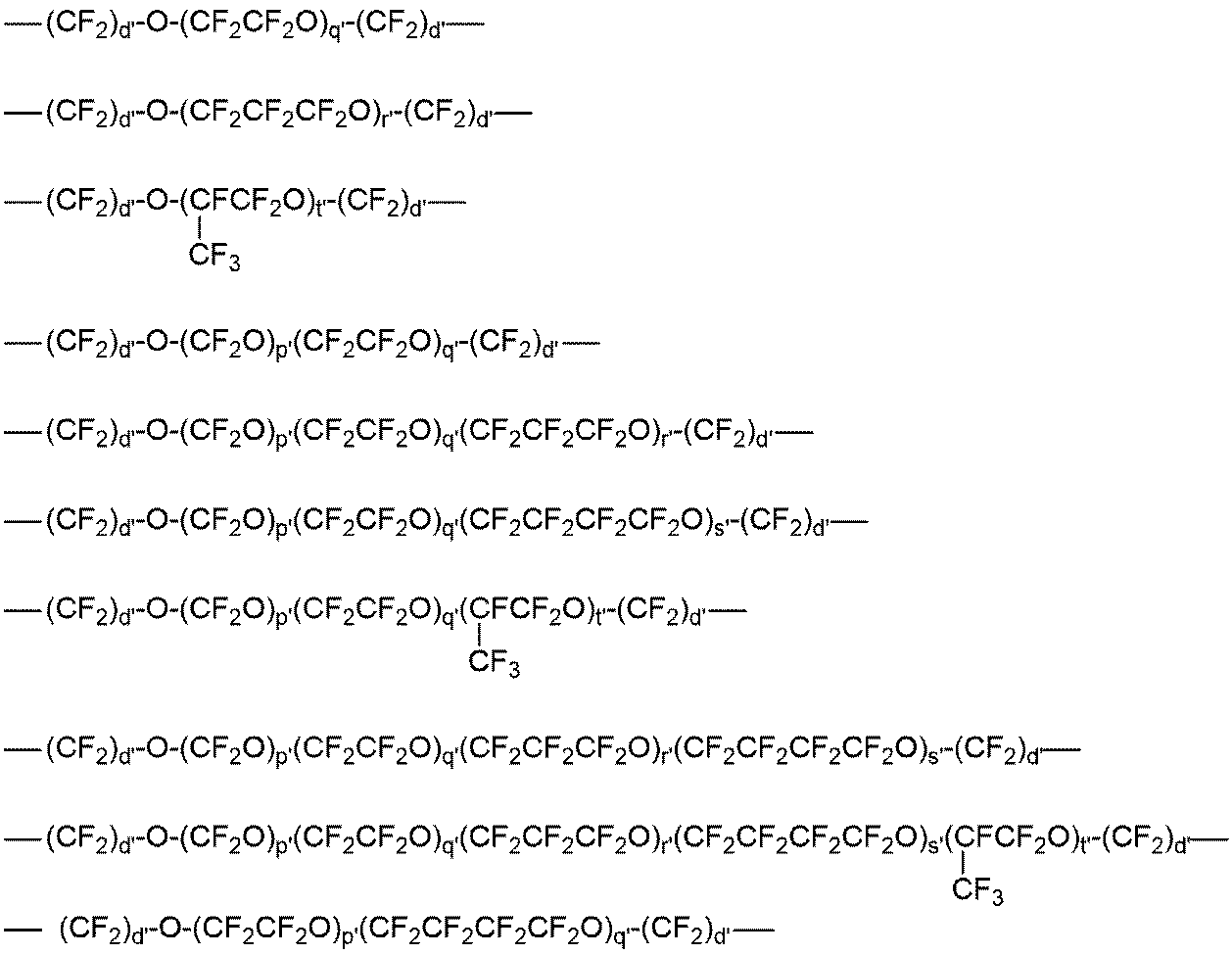
- the above (poly) fluorooxyalkylene structure is particularly preferably — (CF 2 ) d —O— (CF 2 O) p (CF 2 CF 2 O) q (CF 2 CF 2 CF 2 O) r (CF 2 CF) 2 CF 2 CF 2 O) s (CF (CF 3 ) CF 2 O) t- (CF 2 ) d-
- each unit shown in these parentheses may be combined randomly.
- d is independently an integer of 0 to 8, preferably an integer of 0 to 5, and more preferably an integer of 0 to 2, and the unit may be linear or branched.
- p ′, q ′, r ′, s ′, t ′ are each independently an integer of 1 to 200, and the sum of p ′, q ′, r ′, s ′, t ′ is 3
- Each unit shown in these parentheses may be randomly bonded d 'is independently an integer of 0 to 5, and the unit may be linear or branched. May
- the fluorine-containing organosilicon compound according to the present invention is more preferably a fluorine-containing hydrolyzable organosilicon compound (or a fluorine-containing hydrolyzable organosilicon compound) represented by any one of the following general formulas (1) to (5) It is. One of these may be used alone, or two or more may be used in combination.
- A is a fluorine atom, a hydrogen atom, or a monovalent fluorine-containing group in which the end is —CF 3 group, —CF 2 H group or —CH 2 F group, and Z and Z ′ are independently a single bond or nitrogen
- R 2 is a divalent to octavalent organic group which may contain an atom, an oxygen atom, a silicon atom, a phosphorus atom or a sulfur atom
- W is a monovalent group having a hydrolyzable group at its terminal It is an organic group.
- ⁇ and ⁇ are each independently an integer of 1 to 7, preferably ⁇ is an integer of 1 to 3, more preferably 1 and ⁇ is an integer of 1 to 3, and ⁇ + ⁇ is an integer of 2 to 8, preferably Is an integer of 2 to 4.
- ⁇ is an integer of 2 to 8, preferably 2.
- Q is a single bond or a divalent organic group, ⁇ is each independently an integer of 1 to 10, Y is a divalent organic group having a hydrolysable group, B is a hydrogen atom, carbon It is an alkyl group of the number 1 to 4 or a halogen atom.
- Rf is a described above (poly) fluoro polyoxyalkylene structure - (CF 2) d -O- ( CF 2 O) p (CF 2 CF 2 O) q (CF 2 It is CF 2 CF 2 O) r (CF 2 CF 2 CF 2 O) s (CF (CF 3 ) CF 2 O) t- (CF 2 ) d- , and the same as described above can be exemplified.
- A is a fluorine atom, a hydrogen atom, or a monovalent fluorine-containing group whose terminal is a —CF 3 group, a —CF 2 H group or a —CH 2 F group.
- -CF 3 group, -CF 2 CF 3 group and -CF 2 CF 2 CF 3 group are preferable.
- Z and Z ′ may independently contain a single bond, or a nitrogen atom, an oxygen atom, a silicon atom, a phosphorus atom or a sulfur atom, and may be fluorine-substituted It is a good divalent to octavalent organic group.
- the organic group can be represented by (L) e -M (e is an integer of 1 to 7, preferably an integer of 1 to 3).
- L is a single bond, or an oxygen atom, a sulfur atom, or a divalent organic group
- each L for Z is an Rf group and an M group (or a W group)
- L in Z ′ is a linking group between M (or Rf group) and Rf group.
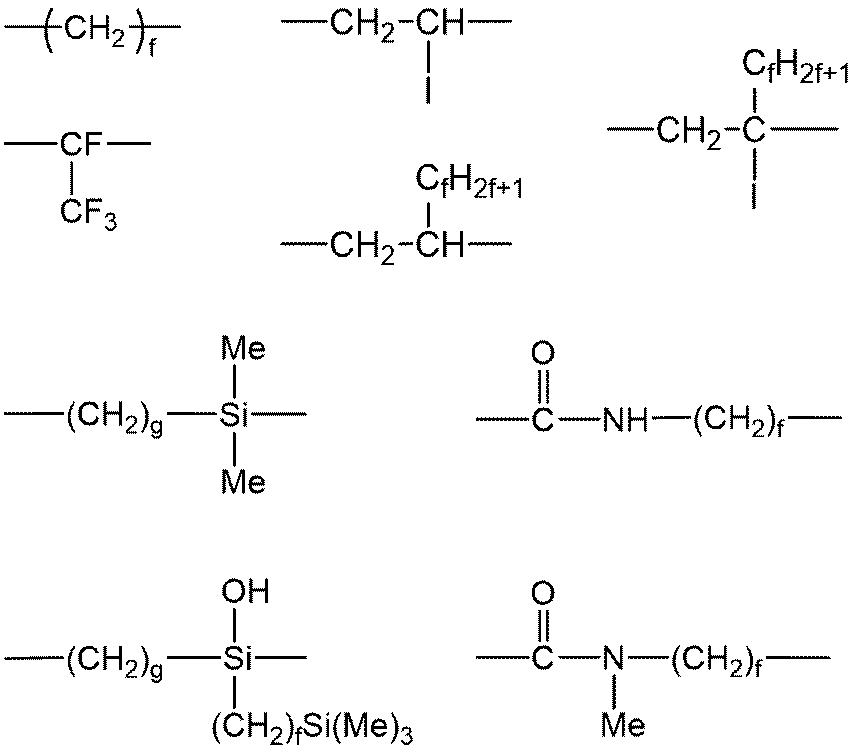
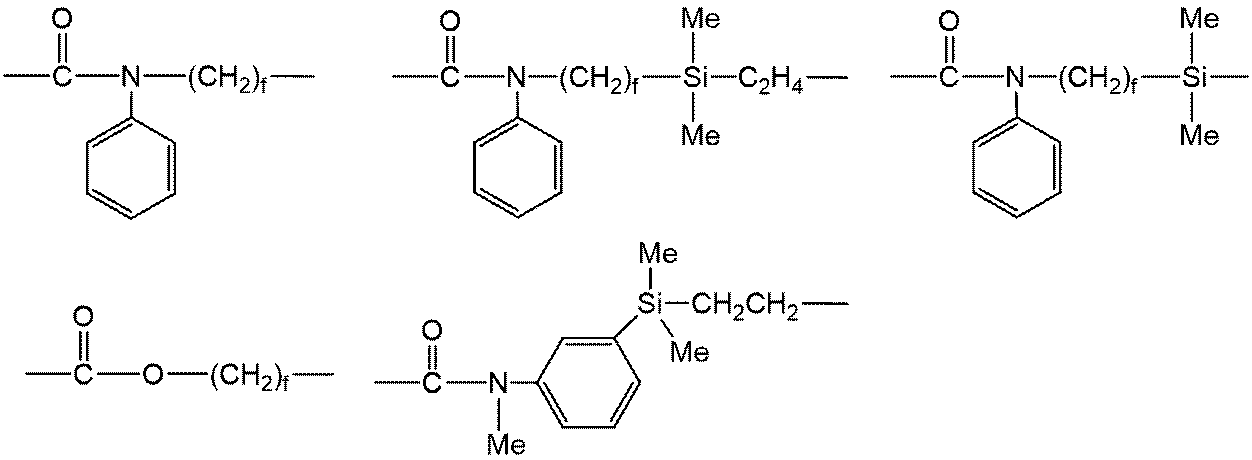
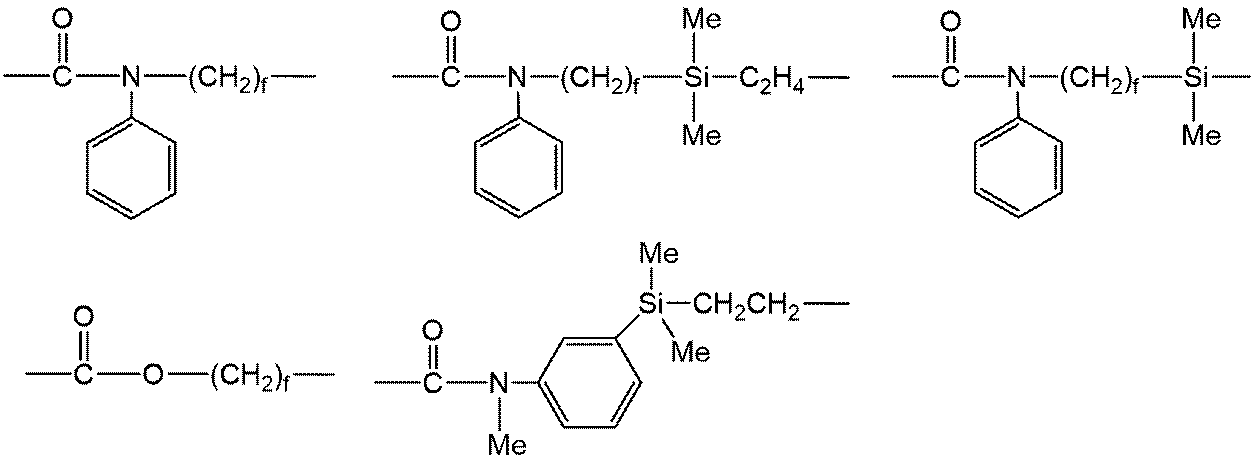
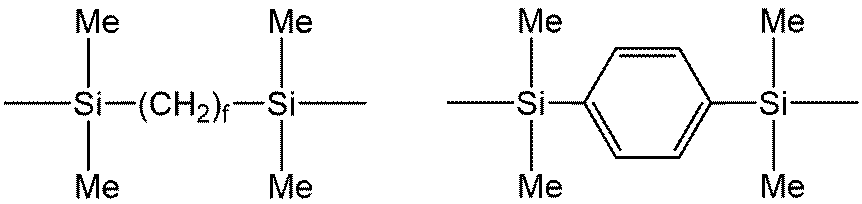
- the divalent organic group preferably, an amide bond, an ether bond, an ester bond, or a diorganosilylene group such as dimethylsilylene group, -Si [OH] [(CH 2 ) f Si (CH 3 ) 3 ]-( f is an unsubstituted or substituted divalent organic group having 2 to 12 carbon atoms which may contain one or more selected from the group consisting of a group represented by an integer of 2 to 4, and more preferably It is an unsubstituted or substituted divalent hydrocarbon group having 2 to 12 carbon atoms which may have a structure.
- Examples of the unsubstituted or substituted divalent hydrocarbon group having 2 to 12 carbon atoms include ethylene group, propylene group (trimethylene group, methylethylene group), butylene group (tetramethylene group, methylpropylene group), and hexamethylene group.
- an unsubstituted or substituted alkylene group having 2 to 4 carbon atoms or a phenylene group is preferable.
- a bivalent organic group of L the group shown by the following structure or the group which 2 or more types of these couple
- f and g are integers of 2 to 4;
- b is an integer of 2 to 6, preferably 2 to 4;
- u and v are integers of 1 to 4;
- Me is a methyl group Is
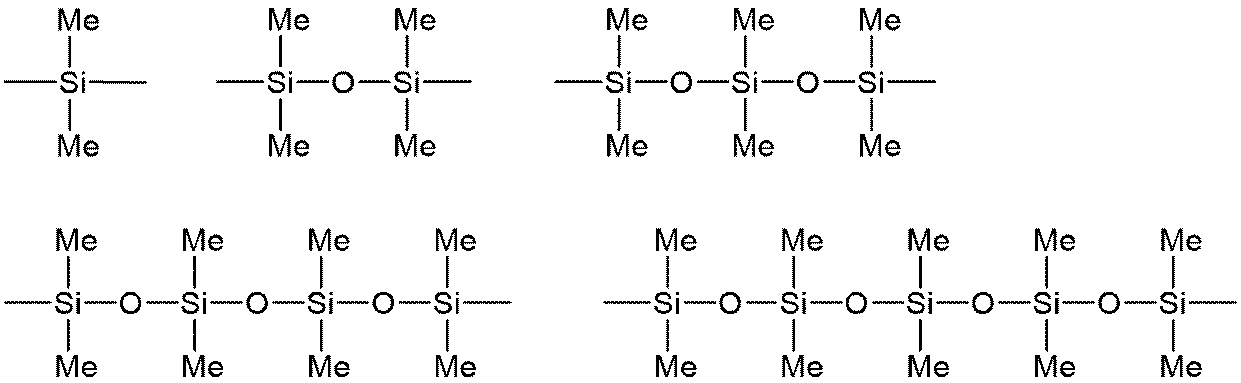
- M is a single bond or a nitrogen atom, a silicon atom, a carbon atom, a phosphorus atom, or a di- to octa-valent organic group.
- R 1 preferably has, independently of one another, an alkyl group having 1 to 3 carbon atoms, a hydroxyl group, or a linear, branched or cyclic organopolysiloxane structure having 2 to 51 silicon atoms.
- R 3 is a group having a repeating unit of an oxyalkylene group having 1 to 3 carbon atoms, or a silyl ether group represented by R 2 3 SiO—, wherein R 2 is independently of each other a hydrogen atom, preferably having 1 to 3 carbon atoms It is an alkyl group, an aryl group having 6 to 10 carbon atoms such as a phenyl group, or an alkoxy group having 1 to 3 carbon atoms.
- R 3 s independently of each other are preferably an alkyl group having 1 to 3 carbon atoms, an alkenyl group having 2 or 3 carbon atoms, an alkoxy group having 1 to 3 carbon atoms, or a chlor group.
- R 4 is an aryl group having 6 to 10 carbon atoms such as an alkyl group having 1 to 3 carbon atoms and a phenyl group.
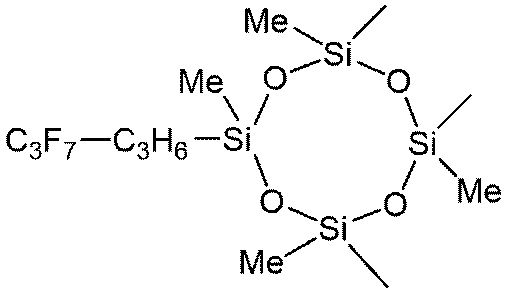
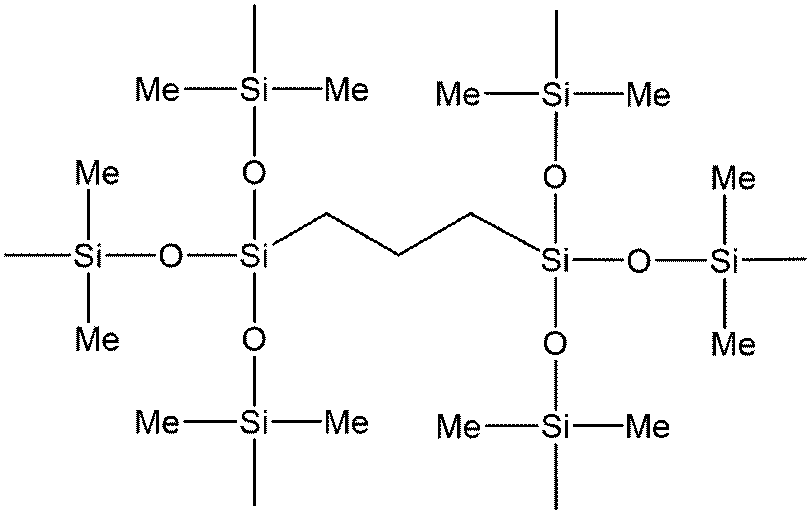
- M is a siloxane residue, it has 2 to 51 silicon atoms, preferably 2 to 13 silicon atoms, more preferably 2 to 11 silicon atoms, and still more preferably 2 to 5 silicon atoms. It is preferred to have a linear, branched or cyclic organopolysiloxane structure.
- the organopolysiloxane preferably has an alkyl group having 1 to 8 carbon atoms, more preferably 1 to 4 carbon atoms, such as methyl, ethyl, propyl and butyl, or a phenyl group. Also, it may contain a silalkylene structure in which two silicon atoms are linked by an alkylene group, that is, Si- (CH 2 ) n -Si. In the above formula, n is an integer of 2 to 6, preferably 2 to 4.
- i is an integer of 1 to 20, preferably an integer of 1 to 10
- c is an integer of 1 to 50, preferably an integer of 1 to 12, more preferably an integer of 1 to 10, still more preferably It is an integer of 1 to 4 and Me is a methyl group.
- W is a monovalent organic group having a hydrolyzable group at its terminal, and is preferably represented by the following formula. (Wherein R is an alkyl group having 1 to 4 carbon atoms or a phenyl group, X is a hydrolyzable group, a is 2 or 3, and m is an integer of 0 to 10.)
- the hydrolyzable group for X is an alkoxy group having 1 to 12 carbon atoms such as methoxy, ethoxy, propoxy, butoxy, etc., particularly 1 to 10 carbons, methoxymethoxy, methoxyethoxy, etc.
- C 2-12 especially C 2-10 alkoxyalkoxy, C 1-10 acyloxy such as acetoxy, C 2-10 alkenyloxy such as isopropenoxy, chloro, bromo And halogen groups such as iodo group and amino groups.
- methoxy and ethoxy are preferable.
- R is an alkyl group such as a methyl group having 1 to 4 carbon atoms, an ethyl group or the like, or a phenyl group, and among them, a methyl group is preferable.
- a is 2 or 3, and 3 is preferable from the viewpoint of reactivity and adhesion to a substrate.
- m is an integer of 0 to 10, preferably an integer of 2 to 8, and more preferably 2 or 3.
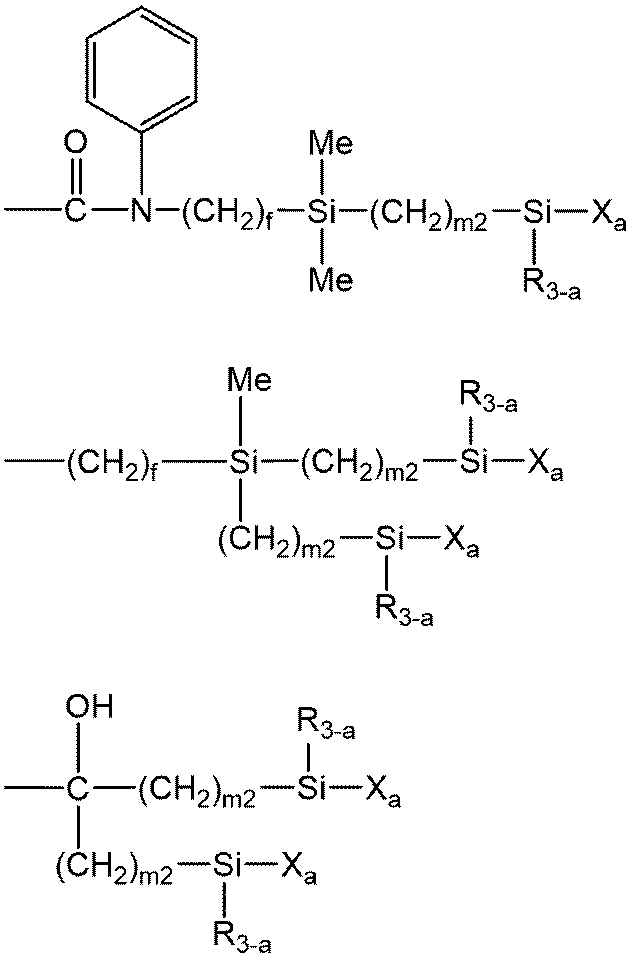
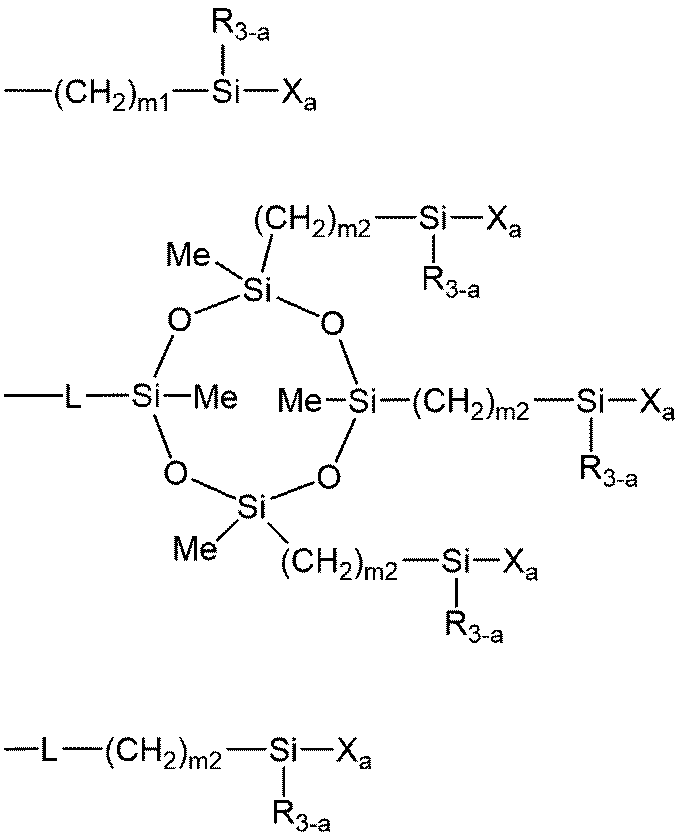
- Examples of the structures represented by ( ⁇ ) ⁇ ZW ⁇ and —ZW ⁇ in the formulas (1) to (3) include the following structures.
- L, R, X, f, c and a are as described above, m1 is an integer of 0 to 10, preferably an integer of 2 to 8, and m2 is an integer of 1 to 10, preferably It is an integer of 2 to 8, and Me is a methyl group.
- Q is a single bond or a divalent organic group, and is a linking group between the Rf group and the Y group.
- the divalent organic group for Q preferably, an amide bond, an ether bond, an ester bond, or a diorganosilylene group such as dimethylsilylene group, -Si [OH] [(CH 2 ) f Si (CH 3 ) 3
- a substituted or unsubstituted divalent organic group having 2 to 12 carbon atoms which may contain one or more selected from the group consisting of a group represented by the formula-(wherein f is an integer of 2 to 4);
- it is an unsubstituted or substituted divalent hydrocarbon group having 2 to 12 carbon atoms which may contain the above-mentioned structure.
- Examples of the unsubstituted or substituted divalent hydrocarbon group having 2 to 12 carbon atoms include the same as the unsubstituted or substituted divalent hydrocarbon group having 2 to 12 carbon atoms exemplified for L above. it can.
- a bivalent organic group of Q the group shown by the following structure is mentioned, for example. (Wherein, f and g are integers of 2 to 4, u and v are integers of 1 to 4 and Me is a methyl group)
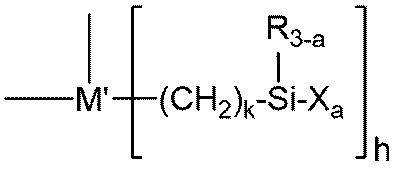
- Y is a divalent group having a hydrolyzable group independently of each other, and is preferably a structure represented by the following formula.
- K is an integer of 0 to 10, preferably an integer of 1 to 10, more preferably an integer of 2 to 8, further preferably an integer of 3 to 8)
- H is an integer of 1 to 6, preferably 1 or 2
- M ′ is an unsubstituted or substituted trivalent to octavalent, preferably trivalent or tetravalent hydrocarbon group, in the hydrocarbon group
- Some or all of the carbon atoms may be replaced by silicon atoms, and some or all of the hydrogen atoms bonded to the carbon atoms may be replaced by halogen atoms such as fluorine atoms.
- M ′ a group represented by the following structure is preferable.
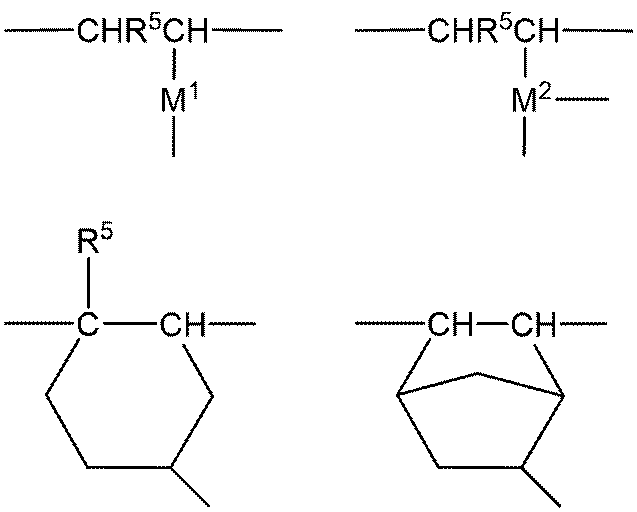
- M 1 is a single bond, an unsubstituted or substituted divalent hydrocarbon group having 1 to 6 carbon atoms, or a diorganosilylene group such as dimethylsilylene group
- M 1 examples include a single bond, a phenylene group, a dimethylsilylene group, and a tetrafluoroethylene group.
- M 2 examples include the following may be mentioned. (Wherein, Me is a methyl group)
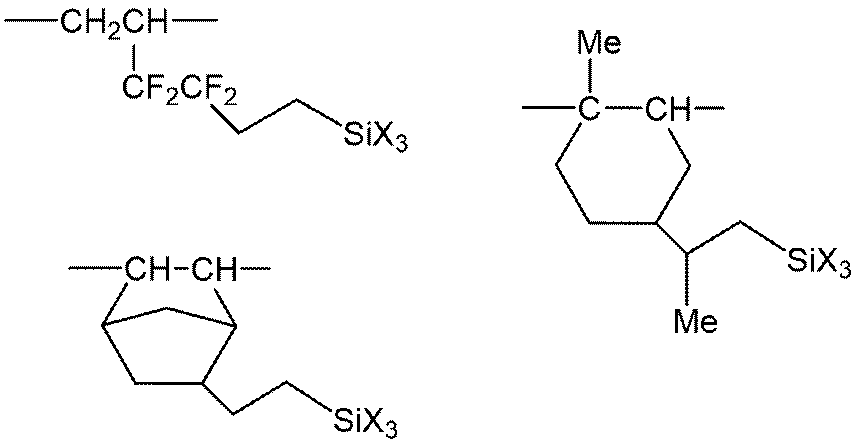
- Examples of such Y include the following groups.
- k1 is an integer of 0 to 10, preferably an integer of 1 to 8
- k2 is an integer of 2 to 10, preferably an integer of 2 to 8
- Me is Methyl group
- ⁇ is an integer of 1 to 10, preferably an integer of 1 to 4.
- B is, independently of each other, a hydrogen atom, an alkyl group such as methyl group having 1 to 4 carbon atoms, ethyl group, propyl group and butyl group, or a halogen atom such as fluorine atom, chlorine atom, bromine atom and iodine atom is there.
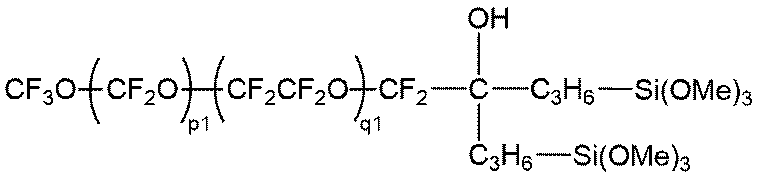
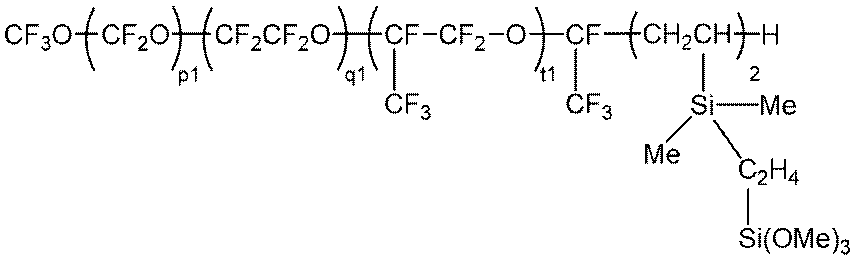
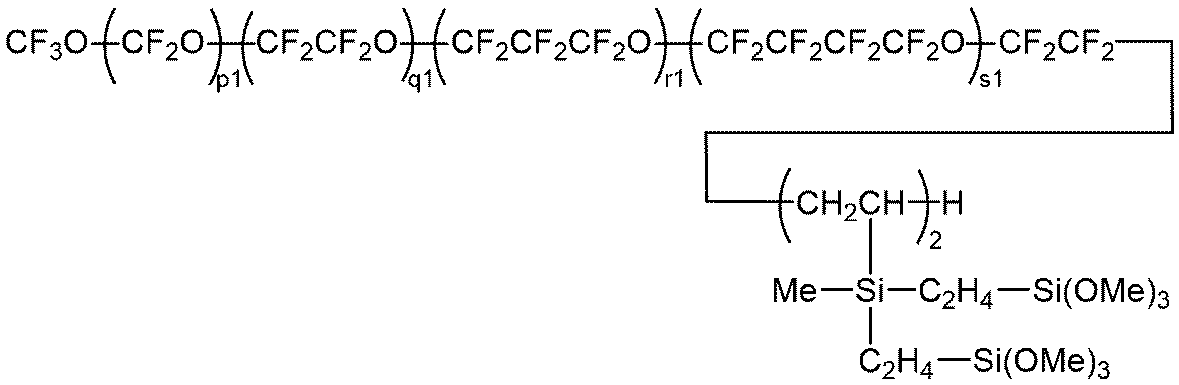
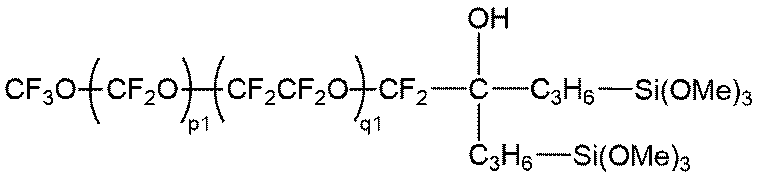
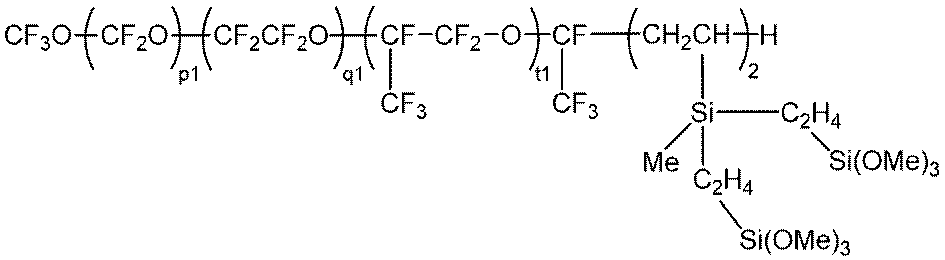
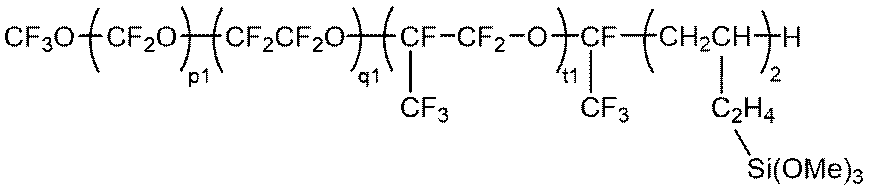
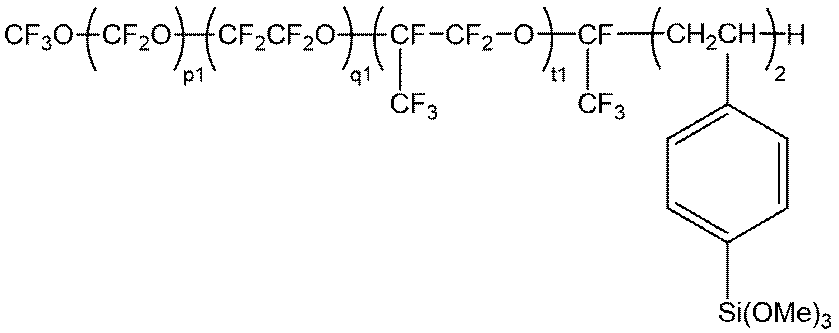
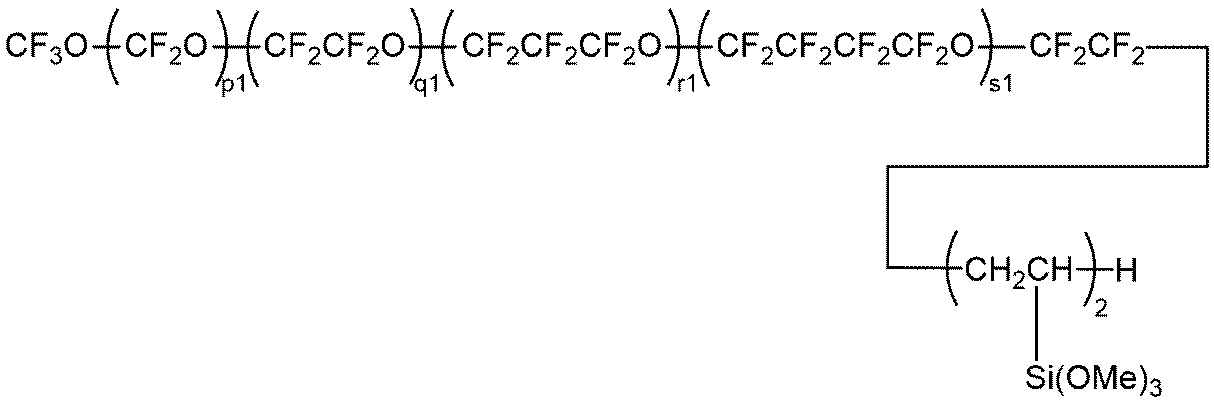
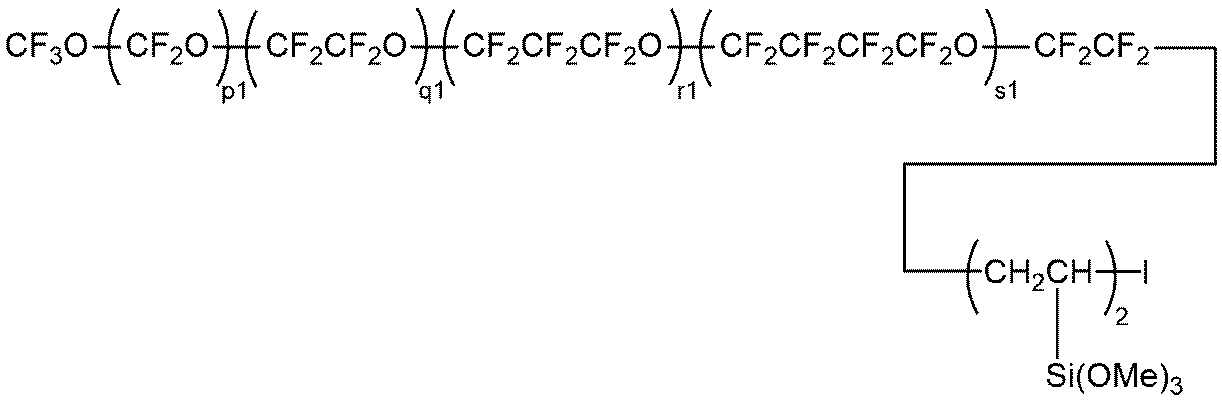
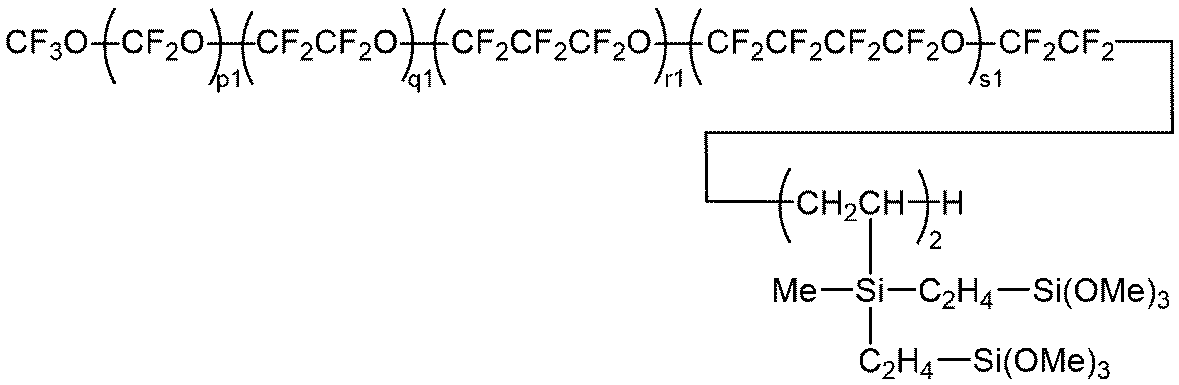
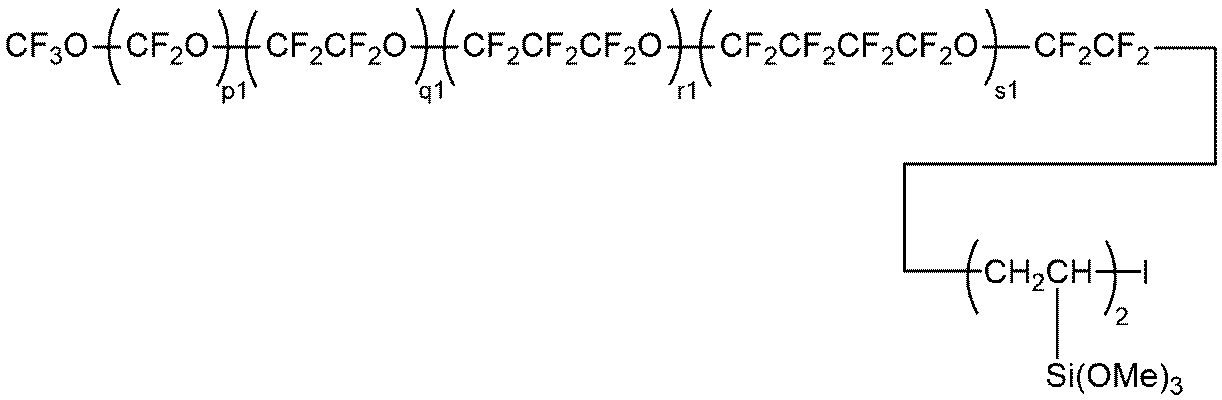
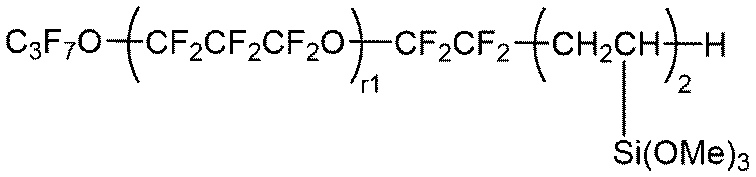
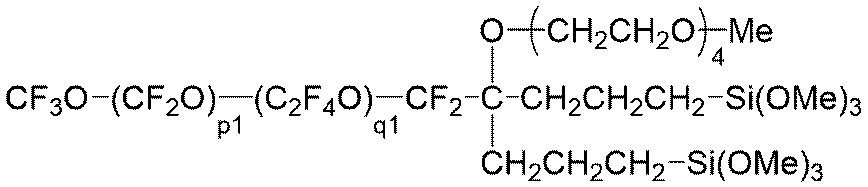
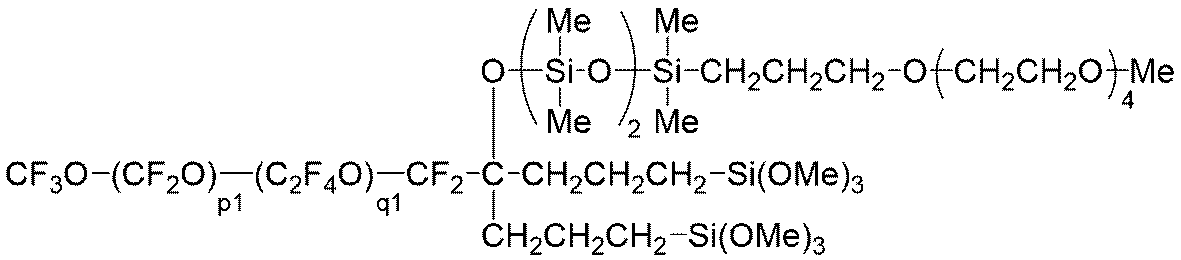
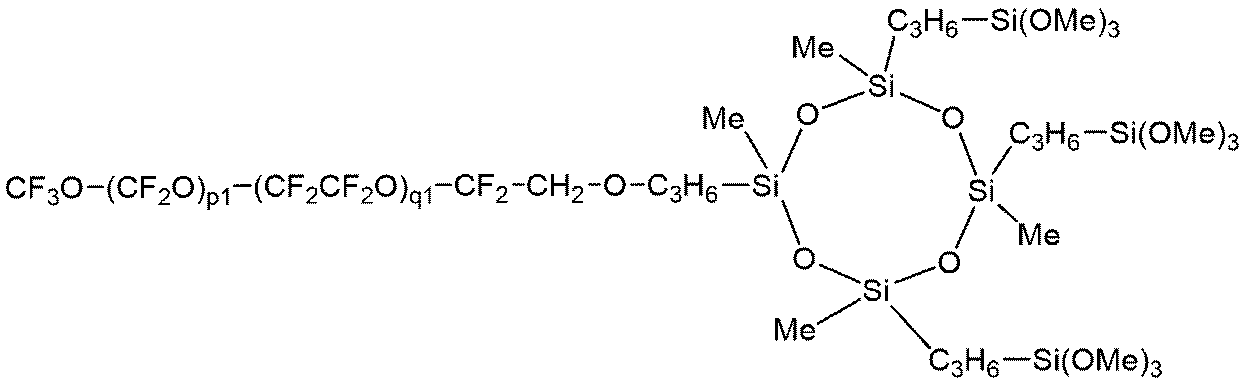
- fluorine-containing hydrolyzable organosilicon compound fluorine-containing hydrolyzable organosilicon compound represented by the above formulas (1) to (5) include the following structures. (Wherein, Me is a methyl group, p1, q1, r1, s1, and t1 are each independently an integer of 1 to 200, and the total of p1, q1, r1, s1, and t1 is 3 to 500) And each unit shown in these parentheses may be randomly combined.)
- the fluorine-containing hydrolyzable organosilicon compound (fluorine-containing hydrolyzable organosilicon compound) represented by the general formulas (1) to (5) according to the present invention is a part of the hydrolyzable group (X). Alternatively, it may contain a compound in which the whole is hydrolyzed (a compound in which X is an OH group), and may contain a compound in which part or all of these OH groups are condensed.
- the fluorine-containing organic silicon compound is preferably diluted in advance with a solvent, and such a solvent is not particularly limited as long as it can uniformly dissolve the fluorine-containing organic silicon compound.
- a solvent is not particularly limited as long as it can uniformly dissolve the fluorine-containing organic silicon compound.
- fluorine-modified aliphatic hydrocarbon solvents perfluoroheptane, perfluorooctane, etc.
- fluorine-modified aromatic hydrocarbon solvents (1, 3-trifluoromethylbenzene, etc.
- fluorine-modified ether solvents methylperfluoro) Butyl ether, ethyl perfluorobutyl ether, perfluoro (2-butyl tetrahydrofuran), etc.
- fluorine-modified alkylamine solvents perfluorotributylamine, perfluorotripentylamine, etc.
- hydrocarbon solvents petroleum benzene, toluen
- a fluorine-modified solvent is preferable, and in particular, a fluorine-modified ether solvent and a fluorine-modified aromatic hydrocarbon solvent are preferable.
- the above solvents may be used alone or in combination of two or more.
- the mass percentage of the fluorine-containing organic silicon compound in the antifouling coating agent is 0.01 to 50 mass%, preferably 0.03 to 10 mass%, and more preferably Is preferably contained in an amount of 0.05 to 1% by mass.
- the antifouling coating agent containing a fluorine-containing organic silicon compound can be applied to a substrate by a known method such as a wet coating method (brush coating, dipping, spray, ink jet), or a vapor deposition method.
- the coating conditions and the like may be in accordance with conventionally known methods, but since the silica layer is coated by the wet coating method, it is more efficient to coat the fluorine-containing organic silicon compound by the wet coating method.
- the fluorine-containing organic silicon compound can be cured at room temperature (20 ° C. ⁇ 10 ° C.) in 1 to 24 hours, but for further curing in a short time, heating at 35 to 200 ° C. for 10 minutes to 1 hour It is also good. Curing is preferably performed under humidification (50 to 90% RH) in order to accelerate hydrolysis.
- the surface of the silica layer on the substrate is subjected to a treatment such as plasma treatment, UV treatment, ozone treatment or the like to activate the surface.
- the film thickness of the fluorine layer (water and oil repellent layer) of the water repellent member of the present invention is 0.5 to 30 nm, preferably 1 to 20 nm.
- the treatment agent may be aggregated to deteriorate the visibility, and when it is too thin, the surface properties and the abrasion resistance may not be sufficient.
- the water repellent member of the present invention includes housings for car navigation systems, tablet PCs, smart phones, mobile phones, digital cameras, digital video cameras, PDAs, portable audio players, car audio systems, game machines, etc.
- Display spectacle lens, camera lens, sunglasses, medical equipment such as stomach camera, copier, PC, liquid crystal display, organic EL display, plasma display, touch panel display, protective film, optical film such as anti-reflection film; Sanitary supplies such as cabinets; Kitchen supplies such as kitchen stands; window glass for automobiles, trains, and aircraft, headlamp covers etc .; construction materials for outer walls; construction materials for kitchens; waiting rooms; art works etc; compact discs, DVDs etc; Other, transportation Body or the like of the equipment and the like.
- Example 1 [Examples 1 to 5 and Comparative Example 1]
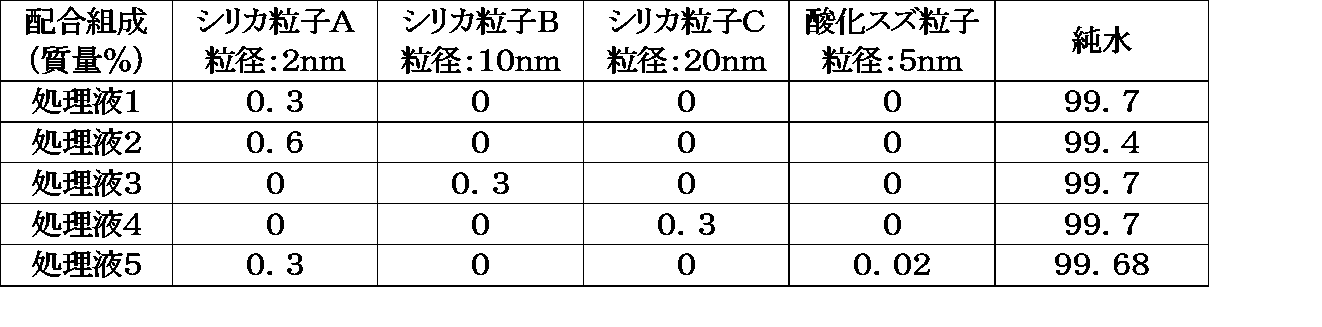
- [Formation of silica layer] Dip coating of the silica treatment liquid (nano silica dispersant) of the composition shown in Table 1 on the outer surface of duralmin test piece (Standard test piece A 7075P, thickness 2 mm, width 50 mm, length 100 mm test piece substrate) After soaking (30 seconds immersion, pulling at 2.5 mm / sec), it is dried at 150 ° C. for 1 hour, the solvent (pure water) is removed, and the outer surface of each duralumin test piece (substrate) is removed on Example 1 Five silica layers were formed respectively.
- Table 2 shows the average film thicknesses of the silica layers of Examples 1 to 5 estimated by X-ray fluorescence.
- the particle size is an average particle size.
- a water and oil repellent layer was formed on the outer surface of each substrate on which the silica layer of the above Examples 1 to 5 was formed according to the following method.
- a water and oil repellent layer was directly formed on the outer surface of the above-mentioned duralmin test piece (base material) without applying the silica treatment liquid.
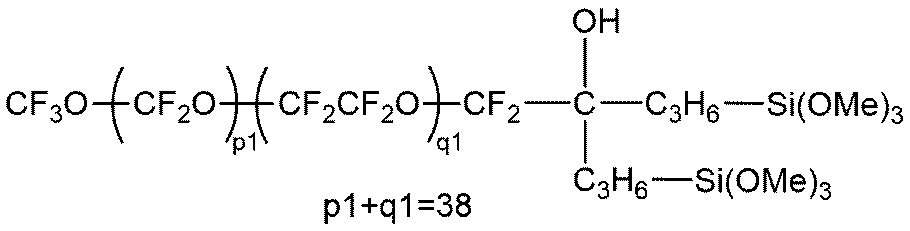
- Compound 1 shown below is diluted with a fluorine-based solvent (Novec 7200 (manufactured by 3M)) to a solid content of 0.1% by mass, and then diluted with a spray coating apparatus (NST-51 manufactured by T & K Corporation) It spray-coated on the outer surface of the silica layer of each said board
- the average film thickness of the water- and oil-repellent layer calculated from the detected amount of F by a fluorescent X-ray apparatus (ZSX mini 2 manufactured by Rigaku Corporation) was about 15 nm.
- the abrasion resistance test of the cured film was performed under the following conditions using a reciprocating abrasion tester (HEIDON 30S, manufactured by Shinto Scientific Co., Ltd.).
- the contact angle to water of the cured film after the abrasion resistance test was measured using a contact angle meter (DropMaster, manufactured by Kyowa Interface Science Co., Ltd.).
- Evaluation environmental conditions 25 ° C, humidity 40%
- Abrasive material Eight non-woven fabrics were overlapped and wrapped around the tip portion (10 mm ⁇ 10 mm) of the tester in contact with the sample, and fixed with a rubber band. Load: 1 kg Rubbing distance (one way): 30 mm Rubbing speed: 3,600 mm / min Number of round trips: 5,000 round trips
- Examples 1 to 5 exhibited excellent water repellency of 100 ° or more before and after the abrasion test, but the comparative example having no silica layer showed significant water repellency after the abrasion test. It dropped to In addition, when silica particles having an average particle size of 20 nm are used (Example 4), the water repellency after the abrasion test is significantly reduced compared to Examples 1 to 3 and 5 having an average particle size of 10 nm or less The It is suggested that the smaller the nanoparticles, the better the adhesion to the substrate. Furthermore, even if tin oxide nanoparticles are added, various nanoparticles can be mixed because the surface properties and the abrasion resistance were not significantly affected.
- a water repellent member having a cured film excellent in water and oil repellency can be obtained.
- the water repellent member of the present invention is very effective especially for applications where adhesion of fats and oils is expected, and it is frequently used and touched regularly, such as casings of electronic devices and around kitchens.
- a good antifouling surface can be maintained over a long period of time.
Landscapes
- Chemical & Material Sciences (AREA)
- Organic Chemistry (AREA)
- Life Sciences & Earth Sciences (AREA)
- Engineering & Computer Science (AREA)
- Wood Science & Technology (AREA)
- Materials Engineering (AREA)
- Chemical Kinetics & Catalysis (AREA)
- Health & Medical Sciences (AREA)
- Medicinal Chemistry (AREA)
- Polymers & Plastics (AREA)
- Inorganic Chemistry (AREA)
- General Chemical & Material Sciences (AREA)
- Materials Applied To Surfaces To Minimize Adherence Of Mist Or Water (AREA)
- Laminated Bodies (AREA)
- Surface Treatment Of Glass (AREA)
- Application Of Or Painting With Fluid Materials (AREA)
- Paints Or Removers (AREA)
- Absorbent Articles And Supports Therefor (AREA)
- Diaphragms For Electromechanical Transducers (AREA)
Abstract
Description

なお、本発明に関連する従来技術として、上述した文献と共に下記文献が挙げられる。
〔1〕
基材の外表面上に、シリカナノ粒子を50質量%以上含有する膜厚1nm~5μmのシリカ層を有し、さらに該シリカ層の外表面上に含フッ素有機ケイ素化合物の硬化物を主成分とする膜厚0.5~30nmの撥水撥油層を有する撥水部材。
〔2〕
含フッ素有機ケイ素化合物が、加水分解性基を少なくとも1つ有するフルオロオキシアルキレン基含有有機ケイ素化合物である〔1〕に記載の撥水部材。
〔3〕
含フッ素有機ケイ素化合物が、下記一般式(1)、(2)、(3)、(4)及び(5)で表されるフッ素含有加水分解性有機ケイ素化合物から選ばれる少なくとも1種である〔1〕又は〔2〕に記載の撥水部材。
(A-Rf)α-ZWβ (1)
Rf-(ZWβ)2 (2)
Z’-(Rf-ZWβ)γ (3)
〔式中、Rfは-(CF2)d-O-(CF2O)p(CF2CF2O)q(CF2CF2CF2O)r(CF2CF2CF2CF2O)s(CF(CF3)CF2O)t-(CF2)d-であり、p、q、r、s、tはそれぞれ独立に0~200の整数であり、かつ、p+q+r+s+t=3~500であり、これらの括弧内に示される各単位はランダムに結合されていてよく、dは独立に0~8の整数であり、該単位は直鎖状であっても分岐状であってもよい。Aはフッ素原子、水素原子、又は末端が-CF3基、-CF2H基もしくは-CH2F基である1価のフッ素含有基であり、Z、Z’は独立に単結合、又は窒素原子、酸素原子、ケイ素原子、リン原子もしくは硫黄原子を含んでいてもよく、フッ素置換されていてもよい2~8価の有機基であり、Wは末端に加水分解性基を有する1価の有機基である。α、βはそれぞれ独立に1~7の整数であり、かつ、α+β=2~8である。γは2~8の整数である。〕
A-Rf-Q-(Y)δ-B (4)
Rf-(Q-(Y)δ-B)2 (5)
(式中、Rf、A基は前記と同じであり、Qは単結合又は2価の有機基であり、δは1~10の整数であり、Yは加水分解性基を有する2価の有機基であり、Bは水素原子、炭素数1~4のアルキル基、又はハロゲン原子である。)
〔4〕
式(1)~(5)で表されるフッ素含有加水分解性有機ケイ素化合物が、下記に示すものである〔3〕に記載の撥水部材。
















〔5〕
シリカナノ粒子の平均粒径が30nm以下である〔1〕~〔4〕のいずれかに記載の撥水部材。
〔6〕
シリカナノ粒子を50質量%以上含有するシリカ層に、平均粒径が30nm以下の酸化チタンナノ粒子、白金ナノ粒子及び酸化スズナノ粒子から選ばれる1種又は2種以上を0.1~50質量%含むものである〔1〕~〔5〕のいずれかに記載の撥水部材。
〔7〕
基材が、金属酸化物、金属、樹脂、セラミック、石英、ガラス、サファイヤ又はダイヤモンドである〔1〕~〔6〕のいずれかに記載の撥水部材。
〔8〕
基材の外表面上にシリカナノ粒子と溶剤を含む分散液を湿式塗布する工程と、該分散液から該溶剤を乾燥除去する工程と、該溶剤を乾燥除去して形成したシリカ層の外表面上に含フッ素有機ケイ素化合物と溶剤を含む溶液を湿式塗布する工程と、該溶液から該溶剤を乾燥除去して含フッ素有機ケイ素化合物を硬化する工程とを含む〔1〕~〔7〕のいずれかに記載の撥水撥油層を有する撥水部材の製造方法。
本発明は、各種基材の外表面上に、シリカナノ粒子と溶剤を含む分散液(ナノシリカ分散剤)を湿式塗布した後、該分散液から該溶剤を乾燥除去して各種基材の外表面上にシリカ層を形成し、該シリカ層の外表面上にさらに含フッ素有機ケイ素化合物と溶剤を含む溶液(防汚コーティング剤)を湿式塗布した後に、該溶液から該溶剤を乾燥除去すると共に含フッ素有機ケイ素化合物を硬化して該シリカ層の外表面上に撥水撥油層を形成する方法等によって、各種基材の外表面上に、シリカナノ粒子を50質量%以上含有する膜厚1nm~5μmのシリカ層を有し、さらに該シリカ層の外表面上に含フッ素有機ケイ素化合物の硬化物を主成分とする膜厚0.5~30nmの撥水撥油層を有する撥水部材を提供するものである。
また、金属としては、マグネシウム、マグネシウム合金、チタン、チタン合金、クロム、鉄、ニッケル、コバルト、銅、亜鉛、イットリウム、ジルコニウム、ニオブ、モリブデン、ルテニウム、ロジウム、パラジウム、銀、タングステン、白金、金、ステンレス、アルミニウム、アルミニウム合金、ジュラルミン、ハステロイ等が挙げられる。
さらに、樹脂としては、熱可塑性樹脂又は熱硬化性樹脂が挙げられ、具体的には次のものがよい。セルロイド、セルロースアセテート、セルロースプロピオネート、セルロースブチレート、6-ナイロン、6,6-ナイロン、12-ナイロンなどの脂肪族ポリアミド、芳香族ポリアミド、ABS、AS樹脂、ポリスチレン、ポリエチレン(低密度又は高密度)、ポリプロピレンなどのポリオレフィン、ポリ塩化ビニル、ポリ塩化ビニリデン、エチレン-酢酸ビニル共重合体、ポリビニルアルコール、ポリアセタール、ポリカーボネート、ポリエチレンテレフタレート、ポリブチレンテレフタレートなどの飽和ポリエステル、芳香族ポリエステル、ポリエーテルケトン、ポリエーテルエーテルケトン、ポリサルホン、ポリエーテルサルホン、ポリエーテルイミド、ポリアリレート、ポリメチルペンテン、アイオノマー、液晶ポリマー、ポリイミド、ポリアミドイミド、フッ素樹脂、ポリフェニレンサルファイド、(変性)ポリフェニレンオキサイド、熱可塑性ポリウレタン等の熱可塑性樹脂、あるいは、エポキシ樹脂、不飽和ポリエステル、熱硬化性ポリウレタン、ポリイミド、ジエチレングリコールビスアリルカーボネート(通称CR-39)の重合物、(ハロゲン化)ビスフェノールAのジ(メタ)アクリレートの(共)重合物、(ハロゲン化)ビスフェノールAのウレタン変性ジ(メタ)アクリレートの(共)重合物、ジアクリレート化合物やビニルベンジルアルコールと不飽和チオール化合物等との共重合物などの熱硬化性樹脂が挙げられる。
-CF2O-
-CF2CF2O-
-CF2CF2CF2O-
-CF(CF3)CF2O-
-CF2CF2CF2CF2O-
-CF2CF2CF2CF2CF2O-
-C(CF3)2O-
(A-Rf)α-ZWβ (1)
Rf-(ZWβ)2 (2)
Z’-(Rf-ZWβ)γ (3)
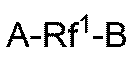
A-Rf-Q-(Y)δ-B (4)
Rf-(Q-(Y)δ-B)2 (5)
また、Qは単結合又は2価の有機基であり、δはそれぞれ独立に1~10の整数であり、Yは加水分解性基を有する2価の有機基であり、Bは水素原子、炭素数1~4のアルキル基、又はハロゲン原子である。


上記において、R1は互いに独立に、好ましくは炭素数1~3のアルキル基、ヒドロキシル基、ケイ素原子数2~51個の直鎖状、分岐状又は環状オルガノポリシロキサン構造を有していてもよい炭素数1~3のオキシアルキレン基の繰返し単位を有する基、又はR2 3SiO-で示されるシリルエーテル基であり、R2は互いに独立に、水素原子、好ましくは炭素数1~3のアルキル基、フェニル基等の炭素数6~10のアリール基、又は炭素数1~3のアルコキシ基である。R3は互いに独立に、好ましくは炭素数1~3のアルキル基、炭素数2又は3のアルケニル基、炭素数1~3のアルコキシ基、又はクロル基である。R4は炭素数1~3のアルキル基、フェニル基等の炭素数6~10のアリール基である。Mがシロキサン残基の場合には、ケイ素原子数2~51個、好ましくはケイ素原子数2~13個、より好ましくはケイ素原子数2~11個、さらに好ましくはケイ素原子数2~5個の直鎖状、分岐状又は環状オルガノポリシロキサン構造を有することが好ましい。該オルガノポリシロキサンは、炭素数1~8、より好ましくは1~4のメチル基、エチル基、プロピル基及びブチル基等のアルキル基又はフェニル基を有するものがよい。また、2つのケイ素原子がアルキレン基で結合されたシルアルキレン構造、即ちSi-(CH2)n-Siを含んでいてもよい。前記式においてnは2~6の整数であり、好ましくは2~4の整数である。



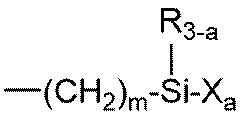
また、Rは、炭素数1~4のメチル基、エチル基等のアルキル基、又はフェニル基であり、中でもメチル基が好適である。
aは2又は3であり、反応性、基材に対する密着性の観点から、3が好ましい。mは0~10の整数であり、好ましくは2~8の整数であり、より好ましくは2又は3である。





また、Bは互いに独立に、水素原子、炭素数1~4のメチル基、エチル基、プロピル基及びブチル基等のアルキル基、又はフッ素原子、塩素原子、臭素原子及びヨウ素原子等のハロゲン原子である。










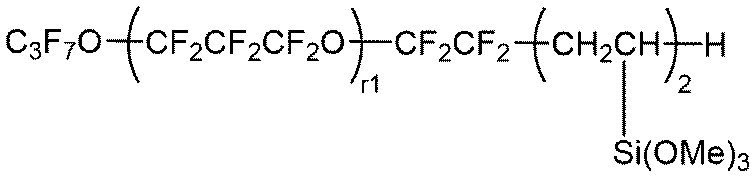



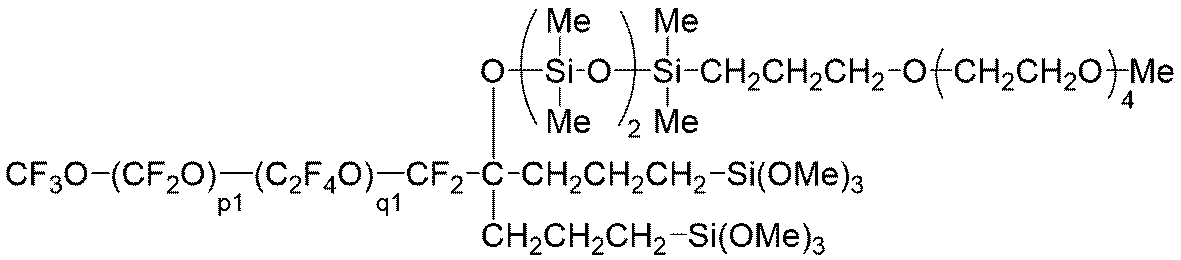



上記溶剤は1種を単独で使用しても2種以上を混合して使用してもよい。
溶剤は防汚コーティング剤(含フッ素有機ケイ素化合物と溶剤とを含む溶液)中における含フッ素有機ケイ素化合物の質量%が0.01~50質量%、好ましくは0.03~10質量%、さらに好ましくは0.05~1質量%になるように含有することが好ましい。
含フッ素有機ケイ素化合物は、室温(20℃±10℃)で1~24時間にて硬化させることができるが、さらに短時間で硬化させるために35~200℃で10分~1時間加熱してもよい。硬化は加湿下(50~90%RH)で行うことが加水分解を促進する上で好ましい。
〔シリカ層の形成〕
表1に示す組成のシリカ処理液(ナノシリカ分散剤)をジュラルミンテストピース(株式会社スタンダードテストピース製A7075P、厚さ2mm、幅50mm、長さ100mmの試験片基板)の外表面上にDip塗工(30秒浸漬、2.5mm/秒で引上げ)した後、150℃で1時間乾燥し、溶剤(純水)を除去して、各ジュラルミンテストピース(基板)の外表面上に実施例1~5のシリカ層をそれぞれ形成した。表2には、蛍光X線により推定した実施例1~5のシリカ層の平均膜厚を示した。

下記に示す化合物1を固形分で0.1質量%になるようにフッ素系溶剤(Novec7200(3M社製))で希釈した後、スプレー塗工装置(株式会社ティーアンドケー製NST-51)で上記各基板のシリカ層の外表面上にスプレー塗工した。その後、80℃で30分の条件で、フッ素系溶剤を乾燥除去すると共に該撥水撥油層(化合物1)を硬化させて硬化被膜を形成し、実施例1~5及び比較例1の試験体を作製した。蛍光X線装置(株式会社リガク製ZSXmini2)によるF検出量から算出した撥水撥油層の平均の膜厚は約15nmであった。
接触角計(DropMaster、協和界面科学社製)を用いて、硬化被膜の水に対する接触角及びオレイン酸に対する接触角を測定した。
硬化被膜のベンコット(旭化成社製)に対する動摩擦係数を、新東科学社製の表面性試験機を用いて、下記条件で測定した。
接触面積:10mm×30mm
荷重:100g
7人のパネラーにより、額の皮脂を指で硬化被膜の表面に転写し、ベンコット(旭化成社製)で拭取りした際の拭取り性を、下記評価基準により評価した。
A:汚れを簡単に拭取れる。
B:汚れを拭取れる。
C:汚れを拭取り後に少し油が残る。
D:汚れを拭取れない。
往復摩耗試験機(HEIDON 30S、新東科学社製)を用いて、以下の条件で硬化被膜の耐摩耗試験を実施した。耐摩耗試験後の硬化被膜の水に対する接触角を、接触角計(DropMaster、協和界面科学社製)を用いて測定した。
評価環境条件:25℃、湿度40%
擦り材:試料と接触するテスターの先端部(10mm×10mm)に不織布を8枚重ねて包み、輪ゴムで固定した。
荷重:1kg
擦り距離(片道):30mm
擦り速度:3,600mm/min
往復回数:5,000往復

Claims (8)
- 基材の外表面上に、シリカナノ粒子を50質量%以上含有する膜厚1nm~5μmのシリカ層を有し、さらに該シリカ層の外表面上に含フッ素有機ケイ素化合物の硬化物を主成分とする膜厚0.5~30nmの撥水撥油層を有する撥水部材。
- 含フッ素有機ケイ素化合物が、加水分解性基を少なくとも1つ有するフルオロオキシアルキレン基含有有機ケイ素化合物である請求項1に記載の撥水部材。
- 含フッ素有機ケイ素化合物が、下記一般式(1)、(2)、(3)、(4)及び(5)で表されるフッ素含有加水分解性有機ケイ素化合物から選ばれる少なくとも1種である請求項1又は2に記載の撥水部材。
(A-Rf)α-ZWβ (1)
Rf-(ZWβ)2 (2)
Z’-(Rf-ZWβ)γ (3)
〔式中、Rfは-(CF2)d-O-(CF2O)p(CF2CF2O)q(CF2CF2CF2O)r(CF2CF2CF2CF2O)s(CF(CF3)CF2O)t-(CF2)d-であり、p、q、r、s、tはそれぞれ独立に0~200の整数であり、かつ、p+q+r+s+t=3~500であり、これらの括弧内に示される各単位はランダムに結合されていてよく、dは独立に0~8の整数であり、該単位は直鎖状であっても分岐状であってもよい。Aはフッ素原子、水素原子、又は末端が-CF3基、-CF2H基もしくは-CH2F基である1価のフッ素含有基であり、Z、Z’は独立に単結合、又は窒素原子、酸素原子、ケイ素原子、リン原子もしくは硫黄原子を含んでいてもよく、フッ素置換されていてもよい2~8価の有機基であり、Wは末端に加水分解性基を有する1価の有機基である。α、βはそれぞれ独立に1~7の整数であり、かつ、α+β=2~8である。γは2~8の整数である。〕
A-Rf-Q-(Y)δ-B (4)
Rf-(Q-(Y)δ-B)2 (5)
(式中、Rf、A基は前記と同じであり、Qは単結合又は2価の有機基であり、δは1~10の整数であり、Yは加水分解性基を有する2価の有機基であり、Bは水素原子、炭素数1~4のアルキル基、又はハロゲン原子である。) - 式(1)~(5)で表されるフッ素含有加水分解性有機ケイ素化合物が、下記に示すものである請求項3に記載の撥水部材。

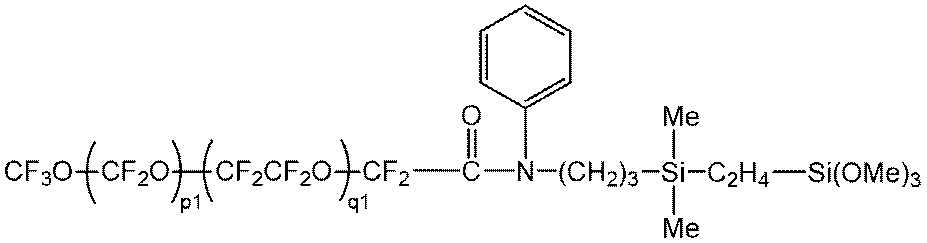

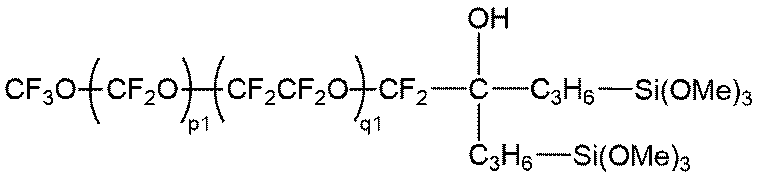





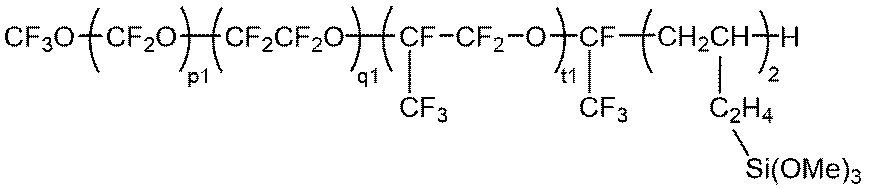

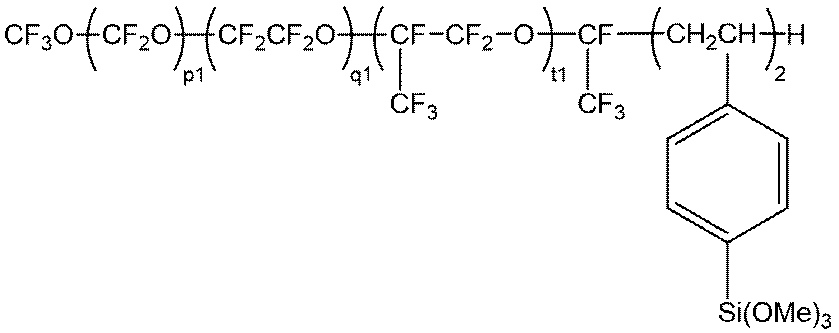






- シリカナノ粒子の平均粒径が30nm以下である請求項1~4のいずれか1項に記載の撥水部材。
- シリカナノ粒子を50質量%以上含有するシリカ層に、平均粒径が30nm以下の酸化チタンナノ粒子、白金ナノ粒子及び酸化スズナノ粒子から選ばれる1種又は2種以上を0.1~50質量%含むものである請求項1~5のいずれか1項に記載の撥水部材。
- 基材が、金属酸化物、金属、樹脂、セラミック、石英、ガラス、サファイヤ又はダイヤモンドである請求項1~6のいずれか1項に記載の撥水部材。
- 基材の外表面上にシリカナノ粒子と溶剤を含む分散液を湿式塗布する工程と、該分散液から該溶剤を乾燥除去する工程と、該溶剤を乾燥除去して形成したシリカ層の外表面上に含フッ素有機ケイ素化合物と溶剤を含む溶液を湿式塗布する工程と、該溶液から該溶剤を乾燥除去して含フッ素有機ケイ素化合物を硬化する工程とを含む請求項1~7のいずれか1項に記載の撥水撥油層を有する撥水部材の製造方法。
Priority Applications (5)
| Application Number | Priority Date | Filing Date | Title |
|---|---|---|---|
| KR1020207005935A KR102707308B1 (ko) | 2017-08-17 | 2018-06-12 | 발수 부재 및 발수 부재의 제조 방법 |
| JP2019536433A JP6965930B2 (ja) | 2017-08-17 | 2018-06-12 | 撥水部材及び撥水部材の製造方法 |
| CN201880052758.6A CN111032337B (zh) | 2017-08-17 | 2018-06-12 | 拒水构件和拒水构件的制造方法 |
| US16/633,495 US11905368B2 (en) | 2017-08-17 | 2018-06-12 | Water-repellent member and method for manufacturing water-repellent member |
| US18/412,232 US20240150522A1 (en) | 2017-08-17 | 2024-01-12 | Surface treatment method for glass and resin substrates |
Applications Claiming Priority (2)
| Application Number | Priority Date | Filing Date | Title |
|---|---|---|---|
| JP2017-157533 | 2017-08-17 | ||
| JP2017157533 | 2017-08-17 |
Related Child Applications (2)
| Application Number | Title | Priority Date | Filing Date |
|---|---|---|---|
| US16/633,495 A-371-Of-International US11905368B2 (en) | 2017-08-17 | 2018-06-12 | Water-repellent member and method for manufacturing water-repellent member |
| US18/412,232 Division US20240150522A1 (en) | 2017-08-17 | 2024-01-12 | Surface treatment method for glass and resin substrates |
Publications (1)
| Publication Number | Publication Date |
|---|---|
| WO2019035271A1 true WO2019035271A1 (ja) | 2019-02-21 |
Family
ID=65362299
Family Applications (1)
| Application Number | Title | Priority Date | Filing Date |
|---|---|---|---|
| PCT/JP2018/022414 Ceased WO2019035271A1 (ja) | 2017-08-17 | 2018-06-12 | 撥水部材及び撥水部材の製造方法 |
Country Status (6)
| Country | Link |
|---|---|
| US (2) | US11905368B2 (ja) |
| JP (1) | JP6965930B2 (ja) |
| KR (1) | KR102707308B1 (ja) |
| CN (1) | CN111032337B (ja) |
| TW (1) | TWI767023B (ja) |
| WO (1) | WO2019035271A1 (ja) |
Cited By (6)
| Publication number | Priority date | Publication date | Assignee | Title |
|---|---|---|---|---|
| JPWO2021085149A1 (ja) * | 2019-10-31 | 2021-05-06 | ||
| JPWO2022255158A1 (ja) * | 2021-05-31 | 2022-12-08 | ||
| JPWO2023013476A1 (ja) * | 2021-08-05 | 2023-02-09 | ||
| JPWO2023013477A1 (ja) * | 2021-08-05 | 2023-02-09 | ||
| WO2024029537A1 (ja) * | 2022-08-03 | 2024-02-08 | Agc株式会社 | シリカ膜付き基板 |
| KR20250002281A (ko) | 2022-04-19 | 2025-01-07 | 신에쓰 가가꾸 고교 가부시끼가이샤 | 발수발유 물품의 제조 방법 및 발수발유 물품에 있어서의 물 및 기름의 제거성 개선 방법 |
Families Citing this family (1)
| Publication number | Priority date | Publication date | Assignee | Title |
|---|---|---|---|---|
| JP7701175B2 (ja) * | 2021-03-30 | 2025-07-01 | ホヤ レンズ タイランド リミテッド | 眼鏡レンズ、眼鏡レンズの製造方法及び眼鏡 |
Citations (7)
| Publication number | Priority date | Publication date | Assignee | Title |
|---|---|---|---|---|
| WO2006051828A1 (ja) * | 2004-11-11 | 2006-05-18 | Mitsubishi Kagaku Media Co., Ltd. | 光記録媒体及びその製造方法 |
| JP2009519149A (ja) * | 2005-12-15 | 2009-05-14 | エシロール アテルナジオナール カンパニー ジェネラーレ デ オプティック | 超高疎水性膜で被覆された物品およびその取得方法 |
| JP2013189007A (ja) * | 2012-02-13 | 2013-09-26 | Central Glass Co Ltd | 耐指紋性透明基材 |
| JP2014503380A (ja) * | 2010-11-10 | 2014-02-13 | スリーエム イノベイティブ プロパティズ カンパニー | 疎水性フッ素化コーティング |
| JP2015024637A (ja) * | 2013-07-29 | 2015-02-05 | フジコピアン株式会社 | 防汚易滑性積層ハードコートフィルム |
| JP2015222364A (ja) * | 2014-05-23 | 2015-12-10 | 大日本印刷株式会社 | ハードコートフィルムおよびその製造方法 |
| JP2017515649A (ja) * | 2014-03-19 | 2017-06-15 | ローデンシュトック ゲーエムベーハー | 疎水化ハードペイント表面 |
Family Cites Families (39)
| Publication number | Priority date | Publication date | Assignee | Title |
|---|---|---|---|---|
| US4048000A (en) * | 1974-07-29 | 1977-09-13 | The Dow Chemical Company | Process for providing improved head points in concrete block construction with latex-epoxy-cement adhesive |
| US5250578A (en) * | 1991-07-05 | 1993-10-05 | Cornwell Charles E | Foamed cementitious composition and method of making |
| US20060029808A1 (en) * | 2004-08-06 | 2006-02-09 | Lei Zhai | Superhydrophobic coatings |
| JP5064012B2 (ja) | 2005-12-26 | 2012-10-31 | 信越化学工業株式会社 | フッ素含有オルガノポリシロキサン及びこれを含む表面処理剤並びに該表面処理剤で表面処理された物品 |
| JP5126869B2 (ja) | 2006-01-25 | 2013-01-23 | 信越化学工業株式会社 | フッ素含有オルガノポリシロキサン、これを含む表面処理剤及び該表面処理剤で処理された物品 |
| JP4761057B2 (ja) | 2006-05-01 | 2011-08-31 | 信越化学工業株式会社 | 防汚コーティング剤がハードコート層に固着された複合ハードコート層を有する基材及びその形成方法 |
| JP5008192B2 (ja) | 2006-09-08 | 2012-08-22 | 信越化学工業株式会社 | パーフルオロポリエーテル−ポリオルガノシロキサン共重合体及びそれを含む表面処理剤 |
| US7847015B2 (en) | 2006-11-15 | 2010-12-07 | Shin-Etsu Chemical Co., Ltd. | Coating composition |
| JP2008144144A (ja) | 2006-11-15 | 2008-06-26 | Shin Etsu Chem Co Ltd | コーティング剤組成物 |
| FR2909187B1 (fr) * | 2006-11-23 | 2009-01-02 | Essilor Int | Article d'optique comportant un revetement anti-abrasion et anti-rayures bicouche, et procede de fabrication |
| JP5045149B2 (ja) * | 2007-03-02 | 2012-10-10 | 日立電線株式会社 | 高撥水・高しゅう動性コーティング部材及びその製造方法並びにこれを用いた高撥水・高しゅう動性製品 |
| JP4709256B2 (ja) | 2008-07-30 | 2011-06-22 | 信越化学工業株式会社 | パーフルオロエーテル部含有ポリマー及び該ポリマーを含む面処理剤 |
| JP4666667B2 (ja) | 2008-08-21 | 2011-04-06 | 信越化学工業株式会社 | 含フッ素表面処理剤及び該表面処理剤で処理された物品 |
| JP5655215B2 (ja) | 2008-10-01 | 2015-01-21 | 株式会社カツラヤマテクノロジー | コーティング用組成物、防汚処理方法および防汚性基材 |
| JP5669257B2 (ja) | 2009-10-27 | 2015-02-12 | 信越化学工業株式会社 | フルオロオキシアルキレン基含有ポリマー組成物および該組成物を含む表面処理剤並びに該表面処理剤で表面処理された物品 |
| JP5375668B2 (ja) | 2010-02-26 | 2013-12-25 | 信越化学工業株式会社 | パーフルオロエーテル基含有オルガノポリシロキサン及び表面処理剤組成物並びに物品及び光学部品 |
| US20120107558A1 (en) * | 2010-11-01 | 2012-05-03 | Shari Elizabeth Koval | Transparent substrate having durable hydrophobic/oleophobic surface |
| US8070876B1 (en) * | 2011-05-05 | 2011-12-06 | Haihong Jiang | Fireproof insulating cementitious foam comprising phase change materials |
| WO2012173596A1 (en) * | 2011-06-13 | 2012-12-20 | Essilor Internation (Compagnie General D'optique) | Method for obtaining optical articles having superior abrasion resistant properties, and coated articles prepared according to such method |
| CN103596701B (zh) * | 2011-06-15 | 2016-08-24 | 3M创新有限公司 | 疏水性烃涂层 |
| KR102016195B1 (ko) | 2012-02-17 | 2019-08-29 | 에이지씨 가부시키가이샤 | 함불소 에테르 화합물, 함불소 에테르 조성물 및 코팅액, 그리고 표면 처리층을 갖는 기재 및 그 제조 방법 |
| JP2015519442A (ja) * | 2012-05-09 | 2015-07-09 | アクゾ ノーベル ケミカルズ インターナショナル ベスローテン フエンノートシャップAkzo Nobel Chemicals International B.V. | 塗料分散体 |
| WO2013168514A1 (ja) | 2012-05-10 | 2013-11-14 | ダイキン工業株式会社 | フルオロポリエーテル基含有シリコーン化合物 |
| JP5814209B2 (ja) | 2012-10-24 | 2015-11-17 | 信越化学工業株式会社 | コーティング剤組成物、該組成物を含む表面処理剤及び該表面処理剤で表面処理された物品 |
| KR101743851B1 (ko) | 2012-11-05 | 2017-06-05 | 다이킨 고교 가부시키가이샤 | 퍼플루오로(폴리)에테르기 함유 실란 화합물 |
| JP5768805B2 (ja) | 2012-11-26 | 2015-08-26 | 信越化学工業株式会社 | パーフルオロポリエーテル変性ポリシラザン及びその製造方法、表面処理剤並びに該表面処理剤で処理された物品 |
| CN104870683B (zh) | 2012-12-18 | 2018-08-31 | 株式会社爱发科 | 成膜方法和成膜装置 |
| WO2014126064A1 (ja) * | 2013-02-15 | 2014-08-21 | 旭硝子株式会社 | 撥水膜形成用組成物及びその使用 |
| KR20150135415A (ko) * | 2013-03-25 | 2015-12-02 | 코닝 인코포레이티드 | 저-tg 클래드 층을 사용하는 텍스처링된 유리 라미네이트 |
| JP6451279B2 (ja) * | 2014-03-31 | 2019-01-16 | 信越化学工業株式会社 | フルオロポリエーテル基含有ポリマー変性シラン、表面処理剤及び物品 |
| DE102014013550A1 (de) * | 2014-09-12 | 2016-03-31 | Schott Ag | Beschichtetes chemisch vorgespanntes flexibles dünnes Glas |
| US20180304287A1 (en) * | 2014-10-28 | 2018-10-25 | 3M Innovative Properties Company | Spray application system components comprising a repellent surface & methods |
| WO2016069674A1 (en) * | 2014-10-28 | 2016-05-06 | 3M Innovative Properties Company | Spray application system components comprising a repellent surface & methods |
| WO2016069239A2 (en) * | 2014-10-28 | 2016-05-06 | 3M Innovative Properties Company | Repellent coatings comprising sintered particles and lubricant, articles & method |
| CN107109128B (zh) * | 2014-11-12 | 2021-05-25 | 住友化学株式会社 | 疏水疏油涂敷组合物及透明被膜 |
| EP3464451A4 (en) * | 2016-05-30 | 2020-03-11 | Rhodia Operations | ARTICLE HAVING AMPHIPHOBIC COATING FILM AND METHOD FOR PREPARING THE SAME |
| KR102443756B1 (ko) * | 2016-08-19 | 2022-09-15 | 에이지씨 가부시키가이샤 | 발수막 형성용 조성물, 발수막, 발수막 부착 기체 (基體) 및 물품 |
| US10377907B2 (en) * | 2017-11-08 | 2019-08-13 | King Fahd University Of Petroleum And Minerals | Substrate with a superhydrophobic coating and a method of fabricating thereof |
| US20190169460A1 (en) * | 2017-12-06 | 2019-06-06 | Eric Loth | Hydrophobic coatings that include nanoparticles |
-
2018
- 2018-06-12 CN CN201880052758.6A patent/CN111032337B/zh active Active
- 2018-06-12 KR KR1020207005935A patent/KR102707308B1/ko active Active
- 2018-06-12 US US16/633,495 patent/US11905368B2/en active Active
- 2018-06-12 JP JP2019536433A patent/JP6965930B2/ja active Active
- 2018-06-12 WO PCT/JP2018/022414 patent/WO2019035271A1/ja not_active Ceased
- 2018-07-03 TW TW107122899A patent/TWI767023B/zh active
-
2024
- 2024-01-12 US US18/412,232 patent/US20240150522A1/en active Pending
Patent Citations (7)
| Publication number | Priority date | Publication date | Assignee | Title |
|---|---|---|---|---|
| WO2006051828A1 (ja) * | 2004-11-11 | 2006-05-18 | Mitsubishi Kagaku Media Co., Ltd. | 光記録媒体及びその製造方法 |
| JP2009519149A (ja) * | 2005-12-15 | 2009-05-14 | エシロール アテルナジオナール カンパニー ジェネラーレ デ オプティック | 超高疎水性膜で被覆された物品およびその取得方法 |
| JP2014503380A (ja) * | 2010-11-10 | 2014-02-13 | スリーエム イノベイティブ プロパティズ カンパニー | 疎水性フッ素化コーティング |
| JP2013189007A (ja) * | 2012-02-13 | 2013-09-26 | Central Glass Co Ltd | 耐指紋性透明基材 |
| JP2015024637A (ja) * | 2013-07-29 | 2015-02-05 | フジコピアン株式会社 | 防汚易滑性積層ハードコートフィルム |
| JP2017515649A (ja) * | 2014-03-19 | 2017-06-15 | ローデンシュトック ゲーエムベーハー | 疎水化ハードペイント表面 |
| JP2015222364A (ja) * | 2014-05-23 | 2015-12-10 | 大日本印刷株式会社 | ハードコートフィルムおよびその製造方法 |
Cited By (20)
| Publication number | Priority date | Publication date | Assignee | Title |
|---|---|---|---|---|
| CN114630871B (zh) * | 2019-10-31 | 2023-11-21 | 信越化学工业株式会社 | 耐碱性拒水构件和该拒水构件的制造方法以及拒水构件的耐碱性和耐磨损性的提高方法 |
| WO2021085149A1 (ja) * | 2019-10-31 | 2021-05-06 | 信越化学工業株式会社 | 耐アルカリ性撥水部材及び該撥水部材の製造方法並びに撥水部材の耐アルカリ性と耐摩耗性の向上方法 |
| CN114630871A (zh) * | 2019-10-31 | 2022-06-14 | 信越化学工业株式会社 | 耐碱性拒水构件和该拒水构件的制造方法以及拒水构件的耐碱性和耐磨损性的提高方法 |
| US12497538B2 (en) | 2019-10-31 | 2025-12-16 | Shin-Etsu Chemical Co., Ltd. | Alkali-resistant water repellent member, method for producing said water repellent member, and method for improving alkali resistance and wear resistance of water repellent member |
| JPWO2021085149A1 (ja) * | 2019-10-31 | 2021-05-06 | ||
| EP4052805A4 (en) * | 2019-10-31 | 2023-11-22 | Shin-Etsu Chemical Co., Ltd. | ALKALINE RESISTANT WATER REPELLENT ELEMENT, METHOD FOR PRODUCING SUCH WATER REPELLENT ELEMENT AND METHOD FOR IMPROVED ALKALINE RESISTANCE AND WEAR RESISTANCE OF A WATER REPELLENT ELEMENT |
| JP7287488B2 (ja) | 2019-10-31 | 2023-06-06 | 信越化学工業株式会社 | 耐アルカリ性撥水部材及び該撥水部材の製造方法並びに撥水部材の耐アルカリ性と耐摩耗性の向上方法 |
| JPWO2022255158A1 (ja) * | 2021-05-31 | 2022-12-08 | ||
| JP7711751B2 (ja) | 2021-05-31 | 2025-07-23 | 信越化学工業株式会社 | 抗菌・抗カビ・抗ウイルス性を有する撥水撥油部材及び撥水撥油部材の製造方法並びに物品 |
| JPWO2023013477A1 (ja) * | 2021-08-05 | 2023-02-09 | ||
| WO2023013477A1 (ja) | 2021-08-05 | 2023-02-09 | 信越化学工業株式会社 | 撥水撥油表面層を有する物品 |
| KR20240042469A (ko) | 2021-08-05 | 2024-04-02 | 신에쓰 가가꾸 고교 가부시끼가이샤 | 발수발유 표면층을 갖는 물품 |
| KR20240044454A (ko) | 2021-08-05 | 2024-04-04 | 신에쓰 가가꾸 고교 가부시끼가이샤 | 발수발유 표면층을 갖는 물품 |
| US20240343919A1 (en) * | 2021-08-05 | 2024-10-17 | Shin-Etsu Chemical Co., Ltd. | Article having water- and oil-repellent surface layer |
| WO2023013476A1 (ja) | 2021-08-05 | 2023-02-09 | 信越化学工業株式会社 | 撥水撥油表面層を有する物品 |
| JP7750291B2 (ja) | 2021-08-05 | 2025-10-07 | 信越化学工業株式会社 | 撥水撥油表面層を有する物品 |
| JPWO2023013476A1 (ja) * | 2021-08-05 | 2023-02-09 | ||
| JP7838582B2 (ja) | 2021-08-05 | 2026-04-01 | 信越化学工業株式会社 | 撥水撥油表面層を有する物品 |
| KR20250002281A (ko) | 2022-04-19 | 2025-01-07 | 신에쓰 가가꾸 고교 가부시끼가이샤 | 발수발유 물품의 제조 방법 및 발수발유 물품에 있어서의 물 및 기름의 제거성 개선 방법 |
| WO2024029537A1 (ja) * | 2022-08-03 | 2024-02-08 | Agc株式会社 | シリカ膜付き基板 |
Also Published As
| Publication number | Publication date |
|---|---|
| CN111032337B (zh) | 2023-02-10 |
| US11905368B2 (en) | 2024-02-20 |
| US20240150522A1 (en) | 2024-05-09 |
| CN111032337A (zh) | 2020-04-17 |
| US20210130545A1 (en) | 2021-05-06 |
| KR102707308B1 (ko) | 2024-09-20 |
| JP6965930B2 (ja) | 2021-11-10 |
| TWI767023B (zh) | 2022-06-11 |
| JPWO2019035271A1 (ja) | 2020-08-06 |
| KR20200040786A (ko) | 2020-04-20 |
| TW201920507A (zh) | 2019-06-01 |
Similar Documents
| Publication | Publication Date | Title |
|---|---|---|
| CN111163936B (zh) | 防水防油构件和防水防油构件的制造方法 | |
| WO2019035271A1 (ja) | 撥水部材及び撥水部材の製造方法 | |
| JP4709256B2 (ja) | パーフルオロエーテル部含有ポリマー及び該ポリマーを含む面処理剤 | |
| CN112566783B (zh) | 拒水拒油构件和拒水拒油构件的制造方法 | |
| CN113825634B (zh) | 拒水拒油构件和拒水拒油构件的制造方法 | |
| CN108137798A (zh) | 含有氟代氧化亚烷基的聚合物改性膦酸衍生物和含有该衍生物的表面处理剂以及使用该表面处理剂的表面处理方法 | |
| CN114630871B (zh) | 耐碱性拒水构件和该拒水构件的制造方法以及拒水构件的耐碱性和耐磨损性的提高方法 | |
| US12163044B2 (en) | Water- and oil-repelling member and water- and oil-repelling member production method |
Legal Events
| Date | Code | Title | Description |
|---|---|---|---|
| 121 | Ep: the epo has been informed by wipo that ep was designated in this application |
Ref document number: 18845770 Country of ref document: EP Kind code of ref document: A1 |
|
| ENP | Entry into the national phase |
Ref document number: 2019536433 Country of ref document: JP Kind code of ref document: A |
|
| NENP | Non-entry into the national phase |
Ref country code: DE |
|
| ENP | Entry into the national phase |
Ref document number: 20207005935 Country of ref document: KR Kind code of ref document: A |
|
| 122 | Ep: pct application non-entry in european phase |
Ref document number: 18845770 Country of ref document: EP Kind code of ref document: A1 |