WO2019017133A1 - 反応性ホットメルト樹脂用剥離剤 - Google Patents
反応性ホットメルト樹脂用剥離剤 Download PDFInfo
- Publication number
- WO2019017133A1 WO2019017133A1 PCT/JP2018/023233 JP2018023233W WO2019017133A1 WO 2019017133 A1 WO2019017133 A1 WO 2019017133A1 JP 2018023233 W JP2018023233 W JP 2018023233W WO 2019017133 A1 WO2019017133 A1 WO 2019017133A1
- Authority
- WO
- WIPO (PCT)
- Prior art keywords
- hot melt
- reactive hot
- melt resin
- range
- release agent
- Prior art date
- Legal status (The legal status is an assumption and is not a legal conclusion. Google has not performed a legal analysis and makes no representation as to the accuracy of the status listed.)
- Ceased
Links
Classifications
-
- C—CHEMISTRY; METALLURGY
- C08—ORGANIC MACROMOLECULAR COMPOUNDS; THEIR PREPARATION OR CHEMICAL WORKING-UP; COMPOSITIONS BASED THEREON
- C08G—MACROMOLECULAR COMPOUNDS OBTAINED OTHERWISE THAN BY REACTIONS ONLY INVOLVING UNSATURATED CARBON-TO-CARBON BONDS
- C08G18/00—Polymeric products of isocyanates or isothiocyanates
- C08G18/06—Polymeric products of isocyanates or isothiocyanates with compounds having active hydrogen
- C08G18/70—Polymeric products of isocyanates or isothiocyanates with compounds having active hydrogen characterised by the isocyanates or isothiocyanates used
- C08G18/72—Polyisocyanates or polyisothiocyanates
- C08G18/74—Polyisocyanates or polyisothiocyanates cyclic
- C08G18/76—Polyisocyanates or polyisothiocyanates cyclic aromatic
- C08G18/7657—Polyisocyanates or polyisothiocyanates cyclic aromatic containing two or more aromatic rings
- C08G18/7664—Polyisocyanates or polyisothiocyanates cyclic aromatic containing two or more aromatic rings containing alkylene polyphenyl groups
- C08G18/7671—Polyisocyanates or polyisothiocyanates cyclic aromatic containing two or more aromatic rings containing alkylene polyphenyl groups containing only one alkylene bisphenyl group
-
- C—CHEMISTRY; METALLURGY
- C08—ORGANIC MACROMOLECULAR COMPOUNDS; THEIR PREPARATION OR CHEMICAL WORKING-UP; COMPOSITIONS BASED THEREON
- C08G—MACROMOLECULAR COMPOUNDS OBTAINED OTHERWISE THAN BY REACTIONS ONLY INVOLVING UNSATURATED CARBON-TO-CARBON BONDS
- C08G18/00—Polymeric products of isocyanates or isothiocyanates
- C08G18/06—Polymeric products of isocyanates or isothiocyanates with compounds having active hydrogen
- C08G18/08—Processes
- C08G18/0838—Manufacture of polymers in the presence of non-reactive compounds
- C08G18/0842—Manufacture of polymers in the presence of non-reactive compounds in the presence of liquid diluents
- C08G18/0847—Manufacture of polymers in the presence of non-reactive compounds in the presence of liquid diluents in the presence of solvents for the polymers
- C08G18/0852—Manufacture of polymers in the presence of non-reactive compounds in the presence of liquid diluents in the presence of solvents for the polymers the solvents being organic
- C08G18/0857—Manufacture of polymers in the presence of non-reactive compounds in the presence of liquid diluents in the presence of solvents for the polymers the solvents being organic the solvent being a polyol
-
- C—CHEMISTRY; METALLURGY
- C08—ORGANIC MACROMOLECULAR COMPOUNDS; THEIR PREPARATION OR CHEMICAL WORKING-UP; COMPOSITIONS BASED THEREON
- C08G—MACROMOLECULAR COMPOUNDS OBTAINED OTHERWISE THAN BY REACTIONS ONLY INVOLVING UNSATURATED CARBON-TO-CARBON BONDS
- C08G18/00—Polymeric products of isocyanates or isothiocyanates
- C08G18/06—Polymeric products of isocyanates or isothiocyanates with compounds having active hydrogen
- C08G18/08—Processes
- C08G18/0838—Manufacture of polymers in the presence of non-reactive compounds
- C08G18/0842—Manufacture of polymers in the presence of non-reactive compounds in the presence of liquid diluents
- C08G18/0847—Manufacture of polymers in the presence of non-reactive compounds in the presence of liquid diluents in the presence of solvents for the polymers
- C08G18/0852—Manufacture of polymers in the presence of non-reactive compounds in the presence of liquid diluents in the presence of solvents for the polymers the solvents being organic
-
- C—CHEMISTRY; METALLURGY
- C08—ORGANIC MACROMOLECULAR COMPOUNDS; THEIR PREPARATION OR CHEMICAL WORKING-UP; COMPOSITIONS BASED THEREON
- C08G—MACROMOLECULAR COMPOUNDS OBTAINED OTHERWISE THAN BY REACTIONS ONLY INVOLVING UNSATURATED CARBON-TO-CARBON BONDS
- C08G18/00—Polymeric products of isocyanates or isothiocyanates
- C08G18/06—Polymeric products of isocyanates or isothiocyanates with compounds having active hydrogen
- C08G18/08—Processes
- C08G18/10—Prepolymer processes involving reaction of isocyanates or isothiocyanates with compounds having active hydrogen in a first reaction step
- C08G18/12—Prepolymer processes involving reaction of isocyanates or isothiocyanates with compounds having active hydrogen in a first reaction step using two or more compounds having active hydrogen in the first polymerisation step
-
- C—CHEMISTRY; METALLURGY
- C08—ORGANIC MACROMOLECULAR COMPOUNDS; THEIR PREPARATION OR CHEMICAL WORKING-UP; COMPOSITIONS BASED THEREON
- C08G—MACROMOLECULAR COMPOUNDS OBTAINED OTHERWISE THAN BY REACTIONS ONLY INVOLVING UNSATURATED CARBON-TO-CARBON BONDS
- C08G18/00—Polymeric products of isocyanates or isothiocyanates
- C08G18/06—Polymeric products of isocyanates or isothiocyanates with compounds having active hydrogen
- C08G18/28—Polymeric products of isocyanates or isothiocyanates with compounds having active hydrogen characterised by the compounds used containing active hydrogen
- C08G18/40—High-molecular-weight compounds
- C08G18/4009—Two or more macromolecular compounds not provided for in one single group of groups C08G18/42 - C08G18/64
- C08G18/4018—Mixtures of compounds of group C08G18/42 with compounds of group C08G18/48
-
- C—CHEMISTRY; METALLURGY
- C08—ORGANIC MACROMOLECULAR COMPOUNDS; THEIR PREPARATION OR CHEMICAL WORKING-UP; COMPOSITIONS BASED THEREON
- C08G—MACROMOLECULAR COMPOUNDS OBTAINED OTHERWISE THAN BY REACTIONS ONLY INVOLVING UNSATURATED CARBON-TO-CARBON BONDS
- C08G18/00—Polymeric products of isocyanates or isothiocyanates
- C08G18/06—Polymeric products of isocyanates or isothiocyanates with compounds having active hydrogen
- C08G18/28—Polymeric products of isocyanates or isothiocyanates with compounds having active hydrogen characterised by the compounds used containing active hydrogen
- C08G18/40—High-molecular-weight compounds
- C08G18/4009—Two or more macromolecular compounds not provided for in one single group of groups C08G18/42 - C08G18/64
- C08G18/4063—Mixtures of compounds of group C08G18/62 with other macromolecular compounds
-
- C—CHEMISTRY; METALLURGY
- C08—ORGANIC MACROMOLECULAR COMPOUNDS; THEIR PREPARATION OR CHEMICAL WORKING-UP; COMPOSITIONS BASED THEREON
- C08G—MACROMOLECULAR COMPOUNDS OBTAINED OTHERWISE THAN BY REACTIONS ONLY INVOLVING UNSATURATED CARBON-TO-CARBON BONDS
- C08G18/00—Polymeric products of isocyanates or isothiocyanates
- C08G18/06—Polymeric products of isocyanates or isothiocyanates with compounds having active hydrogen
- C08G18/28—Polymeric products of isocyanates or isothiocyanates with compounds having active hydrogen characterised by the compounds used containing active hydrogen
- C08G18/40—High-molecular-weight compounds
- C08G18/42—Polycondensates having carboxylic or carbonic ester groups in the main chain
- C08G18/4202—Two or more polyesters of different physical or chemical nature
-
- C—CHEMISTRY; METALLURGY
- C08—ORGANIC MACROMOLECULAR COMPOUNDS; THEIR PREPARATION OR CHEMICAL WORKING-UP; COMPOSITIONS BASED THEREON
- C08G—MACROMOLECULAR COMPOUNDS OBTAINED OTHERWISE THAN BY REACTIONS ONLY INVOLVING UNSATURATED CARBON-TO-CARBON BONDS
- C08G18/00—Polymeric products of isocyanates or isothiocyanates
- C08G18/06—Polymeric products of isocyanates or isothiocyanates with compounds having active hydrogen
- C08G18/28—Polymeric products of isocyanates or isothiocyanates with compounds having active hydrogen characterised by the compounds used containing active hydrogen
- C08G18/40—High-molecular-weight compounds
- C08G18/42—Polycondensates having carboxylic or carbonic ester groups in the main chain
- C08G18/4205—Polycondensates having carboxylic or carbonic ester groups in the main chain containing cyclic groups
- C08G18/4208—Polycondensates having carboxylic or carbonic ester groups in the main chain containing cyclic groups containing aromatic groups
- C08G18/4211—Polycondensates having carboxylic or carbonic ester groups in the main chain containing cyclic groups containing aromatic groups derived from aromatic dicarboxylic acids and dialcohols
- C08G18/4216—Polycondensates having carboxylic or carbonic ester groups in the main chain containing cyclic groups containing aromatic groups derived from aromatic dicarboxylic acids and dialcohols from mixtures or combinations of aromatic dicarboxylic acids and aliphatic dicarboxylic acids and dialcohols
-
- C—CHEMISTRY; METALLURGY
- C08—ORGANIC MACROMOLECULAR COMPOUNDS; THEIR PREPARATION OR CHEMICAL WORKING-UP; COMPOSITIONS BASED THEREON
- C08G—MACROMOLECULAR COMPOUNDS OBTAINED OTHERWISE THAN BY REACTIONS ONLY INVOLVING UNSATURATED CARBON-TO-CARBON BONDS
- C08G18/00—Polymeric products of isocyanates or isothiocyanates
- C08G18/06—Polymeric products of isocyanates or isothiocyanates with compounds having active hydrogen
- C08G18/28—Polymeric products of isocyanates or isothiocyanates with compounds having active hydrogen characterised by the compounds used containing active hydrogen
- C08G18/40—High-molecular-weight compounds
- C08G18/42—Polycondensates having carboxylic or carbonic ester groups in the main chain
- C08G18/4205—Polycondensates having carboxylic or carbonic ester groups in the main chain containing cyclic groups
- C08G18/4208—Polycondensates having carboxylic or carbonic ester groups in the main chain containing cyclic groups containing aromatic groups
- C08G18/4222—Polycondensates having carboxylic or carbonic ester groups in the main chain containing cyclic groups containing aromatic groups derived from aromatic polyhydroxy compounds and polycarboxylic acids
-
- C—CHEMISTRY; METALLURGY
- C08—ORGANIC MACROMOLECULAR COMPOUNDS; THEIR PREPARATION OR CHEMICAL WORKING-UP; COMPOSITIONS BASED THEREON
- C08G—MACROMOLECULAR COMPOUNDS OBTAINED OTHERWISE THAN BY REACTIONS ONLY INVOLVING UNSATURATED CARBON-TO-CARBON BONDS
- C08G18/00—Polymeric products of isocyanates or isothiocyanates
- C08G18/06—Polymeric products of isocyanates or isothiocyanates with compounds having active hydrogen
- C08G18/28—Polymeric products of isocyanates or isothiocyanates with compounds having active hydrogen characterised by the compounds used containing active hydrogen
- C08G18/40—High-molecular-weight compounds
- C08G18/42—Polycondensates having carboxylic or carbonic ester groups in the main chain
- C08G18/4236—Polycondensates having carboxylic or carbonic ester groups in the main chain containing only aliphatic groups
- C08G18/4238—Polycondensates having carboxylic or carbonic ester groups in the main chain containing only aliphatic groups derived from dicarboxylic acids and dialcohols
-
- C—CHEMISTRY; METALLURGY
- C08—ORGANIC MACROMOLECULAR COMPOUNDS; THEIR PREPARATION OR CHEMICAL WORKING-UP; COMPOSITIONS BASED THEREON
- C08G—MACROMOLECULAR COMPOUNDS OBTAINED OTHERWISE THAN BY REACTIONS ONLY INVOLVING UNSATURATED CARBON-TO-CARBON BONDS
- C08G18/00—Polymeric products of isocyanates or isothiocyanates
- C08G18/06—Polymeric products of isocyanates or isothiocyanates with compounds having active hydrogen
- C08G18/28—Polymeric products of isocyanates or isothiocyanates with compounds having active hydrogen characterised by the compounds used containing active hydrogen
- C08G18/40—High-molecular-weight compounds
- C08G18/42—Polycondensates having carboxylic or carbonic ester groups in the main chain
- C08G18/4244—Polycondensates having carboxylic or carbonic ester groups in the main chain containing oxygen in the form of ether groups
- C08G18/4247—Polycondensates having carboxylic or carbonic ester groups in the main chain containing oxygen in the form of ether groups derived from polyols containing at least one ether group and polycarboxylic acids
- C08G18/4255—Polycondensates having carboxylic or carbonic ester groups in the main chain containing oxygen in the form of ether groups derived from polyols containing at least one ether group and polycarboxylic acids derived from polyols containing oxyalkylated carbocyclic groups and polycarboxylic acids
-
- C—CHEMISTRY; METALLURGY
- C08—ORGANIC MACROMOLECULAR COMPOUNDS; THEIR PREPARATION OR CHEMICAL WORKING-UP; COMPOSITIONS BASED THEREON
- C08G—MACROMOLECULAR COMPOUNDS OBTAINED OTHERWISE THAN BY REACTIONS ONLY INVOLVING UNSATURATED CARBON-TO-CARBON BONDS
- C08G18/00—Polymeric products of isocyanates or isothiocyanates
- C08G18/06—Polymeric products of isocyanates or isothiocyanates with compounds having active hydrogen
- C08G18/28—Polymeric products of isocyanates or isothiocyanates with compounds having active hydrogen characterised by the compounds used containing active hydrogen
- C08G18/40—High-molecular-weight compounds
- C08G18/48—Polyethers
- C08G18/4804—Two or more polyethers of different physical or chemical nature
- C08G18/4808—Mixtures of two or more polyetherdiols
-
- C—CHEMISTRY; METALLURGY
- C08—ORGANIC MACROMOLECULAR COMPOUNDS; THEIR PREPARATION OR CHEMICAL WORKING-UP; COMPOSITIONS BASED THEREON
- C08G—MACROMOLECULAR COMPOUNDS OBTAINED OTHERWISE THAN BY REACTIONS ONLY INVOLVING UNSATURATED CARBON-TO-CARBON BONDS
- C08G18/00—Polymeric products of isocyanates or isothiocyanates
- C08G18/06—Polymeric products of isocyanates or isothiocyanates with compounds having active hydrogen
- C08G18/28—Polymeric products of isocyanates or isothiocyanates with compounds having active hydrogen characterised by the compounds used containing active hydrogen
- C08G18/40—High-molecular-weight compounds
- C08G18/48—Polyethers
- C08G18/4825—Polyethers containing two hydroxy groups
-
- C—CHEMISTRY; METALLURGY
- C08—ORGANIC MACROMOLECULAR COMPOUNDS; THEIR PREPARATION OR CHEMICAL WORKING-UP; COMPOSITIONS BASED THEREON
- C08G—MACROMOLECULAR COMPOUNDS OBTAINED OTHERWISE THAN BY REACTIONS ONLY INVOLVING UNSATURATED CARBON-TO-CARBON BONDS
- C08G18/00—Polymeric products of isocyanates or isothiocyanates
- C08G18/06—Polymeric products of isocyanates or isothiocyanates with compounds having active hydrogen
- C08G18/28—Polymeric products of isocyanates or isothiocyanates with compounds having active hydrogen characterised by the compounds used containing active hydrogen
- C08G18/40—High-molecular-weight compounds
- C08G18/62—Polymers of compounds having carbon-to-carbon double bonds
- C08G18/6216—Polymers of alpha-beta ethylenically unsaturated carboxylic acids or of derivatives thereof
- C08G18/625—Polymers of alpha-beta ethylenically unsaturated carboxylic acids; hydrolyzed polymers of esters of these acids
- C08G18/6254—Polymers of alpha-beta ethylenically unsaturated carboxylic acids and of esters of these acids containing hydroxy groups
-
- C—CHEMISTRY; METALLURGY
- C09—DYES; PAINTS; POLISHES; NATURAL RESINS; ADHESIVES; COMPOSITIONS NOT OTHERWISE PROVIDED FOR; APPLICATIONS OF MATERIALS NOT OTHERWISE PROVIDED FOR
- C09D—COATING COMPOSITIONS, e.g. PAINTS, VARNISHES OR LACQUERS; FILLING PASTES; CHEMICAL PAINT OR INK REMOVERS; INKS; CORRECTING FLUIDS; WOODSTAINS; PASTES OR SOLIDS FOR COLOURING OR PRINTING; USE OF MATERIALS THEREFOR
- C09D9/00—Chemical paint or ink removers
-
- C—CHEMISTRY; METALLURGY
- C09—DYES; PAINTS; POLISHES; NATURAL RESINS; ADHESIVES; COMPOSITIONS NOT OTHERWISE PROVIDED FOR; APPLICATIONS OF MATERIALS NOT OTHERWISE PROVIDED FOR
- C09J—ADHESIVES; NON-MECHANICAL ASPECTS OF ADHESIVE PROCESSES IN GENERAL; ADHESIVE PROCESSES NOT PROVIDED FOR ELSEWHERE; USE OF MATERIALS AS ADHESIVES
- C09J175/00—Adhesives based on polyureas or polyurethanes; Adhesives based on derivatives of such polymers
- C09J175/04—Polyurethanes
-
- C—CHEMISTRY; METALLURGY
- C09—DYES; PAINTS; POLISHES; NATURAL RESINS; ADHESIVES; COMPOSITIONS NOT OTHERWISE PROVIDED FOR; APPLICATIONS OF MATERIALS NOT OTHERWISE PROVIDED FOR
- C09J—ADHESIVES; NON-MECHANICAL ASPECTS OF ADHESIVE PROCESSES IN GENERAL; ADHESIVE PROCESSES NOT PROVIDED FOR ELSEWHERE; USE OF MATERIALS AS ADHESIVES
- C09J5/00—Adhesive processes in general; Adhesive processes not provided for elsewhere, e.g. relating to primers
-
- C—CHEMISTRY; METALLURGY
- C09—DYES; PAINTS; POLISHES; NATURAL RESINS; ADHESIVES; COMPOSITIONS NOT OTHERWISE PROVIDED FOR; APPLICATIONS OF MATERIALS NOT OTHERWISE PROVIDED FOR
- C09J—ADHESIVES; NON-MECHANICAL ASPECTS OF ADHESIVE PROCESSES IN GENERAL; ADHESIVE PROCESSES NOT PROVIDED FOR ELSEWHERE; USE OF MATERIALS AS ADHESIVES
- C09J7/00—Adhesives in the form of films or foils
- C09J7/30—Adhesives in the form of films or foils characterised by the adhesive composition
- C09J7/35—Heat-activated
-
- C—CHEMISTRY; METALLURGY
- C09—DYES; PAINTS; POLISHES; NATURAL RESINS; ADHESIVES; COMPOSITIONS NOT OTHERWISE PROVIDED FOR; APPLICATIONS OF MATERIALS NOT OTHERWISE PROVIDED FOR
- C09J—ADHESIVES; NON-MECHANICAL ASPECTS OF ADHESIVE PROCESSES IN GENERAL; ADHESIVE PROCESSES NOT PROVIDED FOR ELSEWHERE; USE OF MATERIALS AS ADHESIVES
- C09J7/00—Adhesives in the form of films or foils
- C09J7/40—Adhesives in the form of films or foils characterised by release liners
- C09J7/401—Adhesives in the form of films or foils characterised by release liners characterised by the release coating composition
-
- C—CHEMISTRY; METALLURGY
- C09—DYES; PAINTS; POLISHES; NATURAL RESINS; ADHESIVES; COMPOSITIONS NOT OTHERWISE PROVIDED FOR; APPLICATIONS OF MATERIALS NOT OTHERWISE PROVIDED FOR
- C09K—MATERIALS FOR MISCELLANEOUS APPLICATIONS, NOT PROVIDED FOR ELSEWHERE
- C09K3/00—Materials not provided for elsewhere
-
- C—CHEMISTRY; METALLURGY
- C08—ORGANIC MACROMOLECULAR COMPOUNDS; THEIR PREPARATION OR CHEMICAL WORKING-UP; COMPOSITIONS BASED THEREON
- C08G—MACROMOLECULAR COMPOUNDS OBTAINED OTHERWISE THAN BY REACTIONS ONLY INVOLVING UNSATURATED CARBON-TO-CARBON BONDS
- C08G2170/00—Compositions for adhesives
- C08G2170/20—Compositions for hot melt adhesives
-
- C—CHEMISTRY; METALLURGY
- C09—DYES; PAINTS; POLISHES; NATURAL RESINS; ADHESIVES; COMPOSITIONS NOT OTHERWISE PROVIDED FOR; APPLICATIONS OF MATERIALS NOT OTHERWISE PROVIDED FOR
- C09J—ADHESIVES; NON-MECHANICAL ASPECTS OF ADHESIVE PROCESSES IN GENERAL; ADHESIVE PROCESSES NOT PROVIDED FOR ELSEWHERE; USE OF MATERIALS AS ADHESIVES
- C09J2301/00—Additional features of adhesives in the form of films or foils
- C09J2301/30—Additional features of adhesives in the form of films or foils characterized by the chemical, physicochemical or physical properties of the adhesive or the carrier
- C09J2301/304—Additional features of adhesives in the form of films or foils characterized by the chemical, physicochemical or physical properties of the adhesive or the carrier the adhesive being heat-activatable, i.e. not tacky at temperatures inferior to 30°C
-
- C—CHEMISTRY; METALLURGY
- C09—DYES; PAINTS; POLISHES; NATURAL RESINS; ADHESIVES; COMPOSITIONS NOT OTHERWISE PROVIDED FOR; APPLICATIONS OF MATERIALS NOT OTHERWISE PROVIDED FOR
- C09J—ADHESIVES; NON-MECHANICAL ASPECTS OF ADHESIVE PROCESSES IN GENERAL; ADHESIVE PROCESSES NOT PROVIDED FOR ELSEWHERE; USE OF MATERIALS AS ADHESIVES
- C09J2301/00—Additional features of adhesives in the form of films or foils
- C09J2301/30—Additional features of adhesives in the form of films or foils characterized by the chemical, physicochemical or physical properties of the adhesive or the carrier
- C09J2301/312—Additional features of adhesives in the form of films or foils characterized by the chemical, physicochemical or physical properties of the adhesive or the carrier parameters being the characterizing feature
-
- C—CHEMISTRY; METALLURGY
- C09—DYES; PAINTS; POLISHES; NATURAL RESINS; ADHESIVES; COMPOSITIONS NOT OTHERWISE PROVIDED FOR; APPLICATIONS OF MATERIALS NOT OTHERWISE PROVIDED FOR
- C09J—ADHESIVES; NON-MECHANICAL ASPECTS OF ADHESIVE PROCESSES IN GENERAL; ADHESIVE PROCESSES NOT PROVIDED FOR ELSEWHERE; USE OF MATERIALS AS ADHESIVES
- C09J2475/00—Presence of polyurethane
Definitions
- the present invention relates to release agents used in reactive hot melt resins.
- Adhesives made of reactive hot melt resin are solventless, so various researches on fiber bonding and building material lamination have been done to date as environmentally friendly adhesives, and are widely used in the industrial world .
- the adhesive for example, (a) a saturated polyester resin having a Tg of 0 ° C. to 110 ° C. and a molecular weight of 10000 to 25000 per 100 parts by weight of a polyurethane resin having a flow start temperature of 55 ° C. to 110 ° C. 5 to 150 parts by weight, (c) 10 to 150 parts by weight of an epoxy resin having a softening point of 60 ° C. to 140 ° C., and a molecular weight of 700 to 3000, and (d) 10 to 200 parts by weight of an inorganic filler surface-treated with a coupling agent
- An adhesive using a moist heat-resistant hot melt adhesive composition characterized in that is formulated is disclosed (see, for example, Patent Document 1).
- the laminate obtained using the adhesive has strong adhesive strength, and thus has an advantageous effect in terms of adhesiveness.
- the substrate can not be reworked because the substrate can not be peeled off.
- reactive hot melt resins are increasingly used to bond optical components, and in these days, display units such as liquid crystal panels and expensive adherends (substrates) such as casings are used.
- display units such as liquid crystal panels and expensive adherends (substrates) such as casings are used.
- adherends substrate due to peeling of the adhesive.
- the problem to be solved by the present invention is to provide a release agent for reactive hot melt resin which is excellent in the releasability between the reactive hot melt resin and the adherend.
- the dispersion term ( ⁇ D) in the Hansen solubility parameter is in the range of 14.0 to 21.0 MPa 0.5
- the polarization term ( ⁇ P) is in the range of 0 to 10.5 MPa 0.5
- the release agent for reactive hot melt resin of the present invention can impart excellent releasability between an adhesive layer obtained using the reactive hot melt resin and an adherend. Moreover, since the base material currently adhere
- the release agent for reactive hot melt resin of the present invention has a dispersion term ( ⁇ D) in the Hansen solubility parameter in the range of 14.0 to 21.0 MPa 0.5 , and a polarization term ( ⁇ P) of 0 to 10.5 MPa 0 in the range of .5, it is essential that the hydrogen bond (delta] H) is in the range of 0 ⁇ 13.5 MPa 0.5.
- the reactive hot melt resin to be peeled is a solid at room temperature and is characterized by melting by heating, and the value of the dispersion term in the Hansen solubility parameter is usually 14.0 for the dispersion term ( ⁇ D).
- the release agent for reactive hot melt resin of the present invention can easily release the reactive hot melt resin from the substrate without any treatment such as heating, and the substrate is dissolved or eroded. Since it does not generate
- this Hansen solubility parameter divides the solubility parameter introduced by Hildebrand into three components of a dispersion term ( ⁇ D), a polarization term ( ⁇ P), and a hydrogen bonding term ( ⁇ H), and a three-dimensional space Is represented in
- the dispersion term ( ⁇ D) shows the effect of the dispersion force
- the polarization term ( ⁇ P) shows the effect of the dipolar force
- the hydrogen bond term ( ⁇ H) shows the effect of the hydrogen bond force.
- Hansen solubility parameter The definition and calculation of the Hansen solubility parameter are described in Charles M. Hansen “Hansen Solubility Parameters; A Users Handbook (CRC Press, 2007)".
- HSPiP Haansen Solubility Parameters in Practice
- one type of solvent can be used, and two or more types of solvents can be used in combination.
- the value which weighted-averaged three parameters of the Hansen solubility parameter of each solvent can be used in the combination which becomes in said range.
- the dispersion term ( ⁇ D) in the Hansen solubility parameter is more preferably in the range of 16.5 to 19.0 MPa 0.5 , from the viewpoint that a more excellent releasability can be obtained due to the compatibility.
- the polarization term ( ⁇ P) is more preferably in the range of 4.5 to 9.0 MPa 0.5 from the viewpoint that the peelability more excellent due to the wettability is obtained.
- the hydrogen bond term ( ⁇ H) is more preferably in the range of 3 to 13.0 MPa 0.5 , from the viewpoint that a more excellent peelability can be obtained due to the solubility.
- release agent for the reactive hot melt resin examples include methyl benzoate (dispersion term ( ⁇ D): 18.9, polarization term ( ⁇ P): 8.2, hydrogen bonding term ( ⁇ H): 4.7 Ethyl benzoate (dispersion term ( ⁇ D): 17.9, polarization term ( ⁇ P): 6.2, hydrogen bonding term ( ⁇ H): 6.0), butyl benzoate (dispersion term ( ⁇ D): 18.
- Benzoate esters such as 0, hydrogen bond term ( ⁇ H): 4.0) tetrahydrofurfuryl alcohol (dispersion term ( ⁇ D): 17.8, polarization term ( ⁇ P) 8.2, hydrogen bond term ( ⁇ H): 12.9), tetrahydrofurfuryl acrylate (dispersion term ( ⁇ D): 16.9, polarization term ( ⁇ P): 5.9, hydrogen bonding term ( ⁇ H): 6.5) tetrahydro methacrylate (dispersion term ( ⁇ D): 16.8, polarization term ( ⁇ P): 5.2, hydrogen bonding term ( ⁇ H): 5.7)
- release agents for reactive hot melt resin among the above-mentioned ones, since the release is further facilitated by compatibilizing while maintaining the strength of the reactive hot melt resin film, benzoic acid ester, tetrahydrofulf It is preferable to use one or more solvents selected from the group consisting of furyl alcohol and tetrahydrofurfuryl (meth) acrylate.
- the reactive hot melt resin for example, a polyester resin, a modified olefin resin, a moisture-curable hot melt resin containing a urethane prepolymer having an isocyanate group, and the like can be used.
- the release agent of the present invention can impart good releasability to these reactive hot melt resins.
- the urethane prepolymer having an isocyanate group used for the moisture-curable hot melt resin for example, one obtained by reacting a polyol and a polyisocyanate can be used. Moreover, the compound which has a (meth) acryloyl group may be made to react with these, and active energy ray curability may be provided.
- polyether polyol As the polyol, polyether polyol, polyester polyol, acrylic polyol, polycarbonate polyol, polybutadiene polyol, dimer diol and the like can be used.
- the number average molecular weight of the polyol is preferably in the range of 500 to 50,000, and more preferably in the range of 700 to 10,000, from the viewpoint of obtaining good adhesion and mechanical strength.
- the number average molecular weight of the polyether polyol is a value measured by gel permeation chromatography (GPC).
- polyisocyanate examples include polymethylene polyphenyl polyisocyanate, diphenylmethane diisocyanate, carbodiimide-modified diphenylmethane diisocyanate, phenylene diisocyanate, aromatic diisocyanates such as tolylene diisocyanate and naphthalene diisocyanate, hexamethylene diisocyanate, lysine diisocyanate, cyclohexane diisocyanate and isophorone.
- Aliphatic or alicyclic polyisocyanates such as diisocyanate, dicyclohexylmethane diisocyanate, xylylene diisocyanate, tetramethyl xylylene diisocyanate can be used.
- diisocyanate dicyclohexylmethane diisocyanate
- xylylene diisocyanate tetramethyl xylylene diisocyanate
- diphenylmethane diisocyanate from the viewpoint of reactivity and adhesiveness.
- the urethane prepolymer is obtained by reacting the polyol and the polyisocyanate, and reacts with moisture present in the air or in a case or an adherend to which the urethane prepolymer is applied to form a crosslinked structure.
- These have isocyanate groups at the polymer end or in the molecule which can form
- the urethane prepolymer for example, after a mixture of the polyol is dropped into a reaction container containing the polyisocyanate, heating is performed, and the isocyanate group of the polyisocyanate is the hydroxyl group of the polyol. It is possible to use a method of producing by reacting under an excess condition.
- the ratio of equivalents of the isocyanate group of the polyisocyanate to the hydroxyl group of the polyol is in the range of 1.1 to 5; From the viewpoint of mechanical strength, the range of 1.5 to 3 is preferable.
- a urethanization catalyst When producing the said urethane prepolymer, a urethanization catalyst can be used as needed.
- the urethanization catalyst can be added as appropriate at any stage of the reaction.
- urethanization catalyst examples include nitrogen-containing compounds such as triethylamine, triethylenediamine and N-methylmorpholine; metal salts such as potassium acetate, zinc stearate and tin octylate; and organic metal compounds such as dibutyltin dilaurate.
- nitrogen-containing compounds such as triethylamine, triethylenediamine and N-methylmorpholine
- metal salts such as potassium acetate, zinc stearate and tin octylate
- organic metal compounds such as dibutyltin dilaurate.
- the amount of urethane bond of the urethane prepolymer obtained by the above method has a good affinity to the release agent of the present invention, and from the viewpoint of further excellent adhesion and releasability, 0.1 It is preferably in the range of -3 mol / kg, and more preferably in the range of 0.2-2 mol / kg.
- the amount of urethane bonds of the said urethane prepolymer shows the value calculated from the usage-amount of the raw material of the said urethane prepolymer.
- the isocyanate group content (hereinafter abbreviated as “NCO%”) of the urethane prepolymer is 1.5 to 8% by mass from the viewpoint that much better adhesion and releasability can be obtained.
- the range is preferable, the range of 1.7 to 5% by mass is more preferable, and the range of 1.8 to 3% by mass is particularly preferable.
- the NCO% of the urethane prepolymer is a value measured by potentiometric titration according to JIS K 1603-1: 2007.
- the viscosity of the urethane prepolymer is preferably in the range of 1,000 to 50,000 mPa ⁇ s at 110 ° C., and more preferably in the range of 2,000 to 10,000 mPa ⁇ s.
- the melt viscosity at 110 ° C. is a value measured with an ICI cone-plate viscometer.
- the moisture-curable hot melt resin containing a urethane prepolymer having an isocyanate group may be composed of only the urethane prepolymer, but may contain other additives as needed.
- a curing catalyst for example, a curing catalyst, an antioxidant, a tackifier, a plasticizer, a stabilizer, a filler, a dye, a pigment, a fluorescent whitening agent, a silane coupling agent, a wax, etc. may be used. it can.
- Examples of applications in which the reactive hot melt resin is used include fiber bonding, building material lamination, and bonding of optical components.
- sealing agents such as an electrically-driven reel of a mobile telephone, a personal computer, a game machine, a television, a car navigation system, a camera speaker, a fishing tackle, are mentioned, for example.
- the reactive hot melt resin is heated and melted at a temperature range of 50 to 130 ° C., the composition is applied on one of the substrates, and then on the resin layer.
- the method of bonding another base material and obtaining a laminated body is mentioned.
- the substrate examples include glass plates, metal plates such as stainless steel (SUS), magnesium, and aluminum, cycloolefin resins such as norbornene, acrylic resins, urethane resins, silicon resins, epoxy resins, fluorine resins, and polystyrene resins.
- SUS stainless steel
- cycloolefin resins such as norbornene, acrylic resins, urethane resins, silicon resins, epoxy resins, fluorine resins, and polystyrene resins.
- Polyester resin polysulfone resin, polyarylate resin, polyvinyl chloride resin, polyvinylidene chloride, polyolefin resin, polyimide resin, alicyclic polyimide resin, polyamide resin, cellulose resin, polycarbonate (PC), polybutylene terephthalate (PBT) , Polyphenylene ether (modified PPE), polyethylene naphthalate (PEN), polyethylene terephthalate (PET), lactic acid polymer, acrylonitrile-butadiene-styrene copolymer (ABS), acrylic resin Nitrile - it can be used those derived from styrene copolymer (AS) and the like.
- the substrate may be subjected to corona treatment, plasma treatment, primer treatment and the like, as necessary.
- the reactive hot melt resin As a method for applying the reactive hot melt resin to the substrate, for example, a roll coater, a spray coater, a T-tie coater, a knife coater, a comma coater or the like can be used. Further, since the reactive hot melt resin has low viscosity and shape retention after application, the application can also be performed by a method such as dispenser, inkjet printing, screen printing, offset printing and the like. According to these coating methods, since the reactive hot melt resin can be applied to the portion on the member to be applied, it is preferable because loss such as punching is not generated. In addition, according to these coating methods, the reactive hot melt resin is continuously or discontinuous on the base material in various shapes such as point, linear, triangular, square, round, and curve. Can be formed.
- the thickness of the cured product layer of the reactive hot melt resin can be set according to the application to be used, but can be set preferably in the range of 10 ⁇ m to 5 mm, for example.
- the ripening conditions after the above-mentioned lamination can be appropriately determined, for example, between a temperature of 20 to 80 ° C. and a relative humidity of 50 to 90% RH for 0.5 to 5 days.
- a laminate having at least two layers of the substrate and the reactive hot melt adhesive layer which are firmly adhered to each other can be obtained.
- a method of peeling the reactive hot melt adhesive layer from the laminate and recovering the substrate a method of immersing the laminate in the release agent for reactive hot melt resin of the present invention; reactive hot of the laminate
- the melt adhesive layer may be coated or wiped using a cotton swab, paper, cloth or the like.
- the release agent for reactive hot melt resin of this invention can provide the outstanding peelability between the adhesive bond layer obtained by using reactive hot melt resin, and a to-be-adhered body. Moreover, since the base material currently adhere
- Synthesis Example 1 ⁇ Synthesis of Urethane Prepolymer (1)> 15 parts by mass of polypropylene glycol (number average molecular weight; 1,000), polypropylene glycol (number average molecular weight: 2,000) 15 in a four-necked flask equipped with a thermometer, a stirrer, an inert gas inlet and a reflux condenser 10 parts by mass, crystalline polyester polyol (reaction of 1,6-hexanediol and adipic acid, number average molecular weight; 2,000), crystalline polyester polyol (1,6-hexanediol and 1,12 -Reaction of dodecanedicarboxylic acid, number average molecular weight; 3,500, 10 parts by mass, non-crystalline polyester polyol (reaction of propylene oxide 6 mol adduct of bisphenol A, sebacic acid and isophthalic acid, Number average molecular weight; 2,000) 15 parts by mass, acrylic polyol (
- a urethane prepolymer (1) having an isocyanate group was obtained.
- the dispersion term ( ⁇ D) of the obtained urethane prepolymer (1) was 17.7
- the polarization term ( ⁇ P) was 5.6
- the hydrogen bonding term ( ⁇ H) was 5.3.
- the urethane bond content of the urethane prepolymer (1) was 0.90 mol / kg.
- the number average molecular weight of the polyol used by the synthesis example shows the value measured on condition of the following by gel permeation chromatography (GPC) method.
- Measuring device High-speed GPC device ("HLC-8220GPC” manufactured by Tosoh Corporation) Column: The following columns manufactured by Tosoh Corporation were used in series connection. "TSKgel G5000" (7.8 mm ID ⁇ 30 cm) ⁇ 1 "TSK gel G 4000” (7.8 mm ID ⁇ 30 cm) ⁇ 1 "TSK gel G 3000" (7.8 mm ID ⁇ 30 cm) ⁇ 1 This "TSKgel G2000" (7.8 mm ID ⁇ 30 cm) ⁇ 1 detector: RI (differential refractometer) Column temperature: 40 ° C Eluent: Tetrahydrofuran (THF) Flow rate: 1.0 mL / min Injection volume: 100 ⁇ L (tetrahydrofuran solution with a sample concentration of 0.4% by mass) Standard sample: A calibration curve was prepared using the following standard polystyrene.
- the urethane prepolymer (1) was heated to 110 ° C. and melted, and then heated to 110 ° C. using a dispenser needle having an inner diameter of 0.4 mm (a dispenser “VAVE MASTER ME-5000 VT” manufactured by Musashi Engineering Co., Ltd.) Dispensing pressure: 0.3 MPa, processing speed 50 mm / sec, on a PET (polyethylene terephthalate) film (13 cm ⁇ 15 cm, thickness 50 ⁇ m), apply a straight line of 10 cm per side 0.2 mm thick Then, the laminate was obtained by leaving it for 3 days in a constant temperature and humidity chamber with a temperature of 23 ° C. and a relative humidity of 65%.
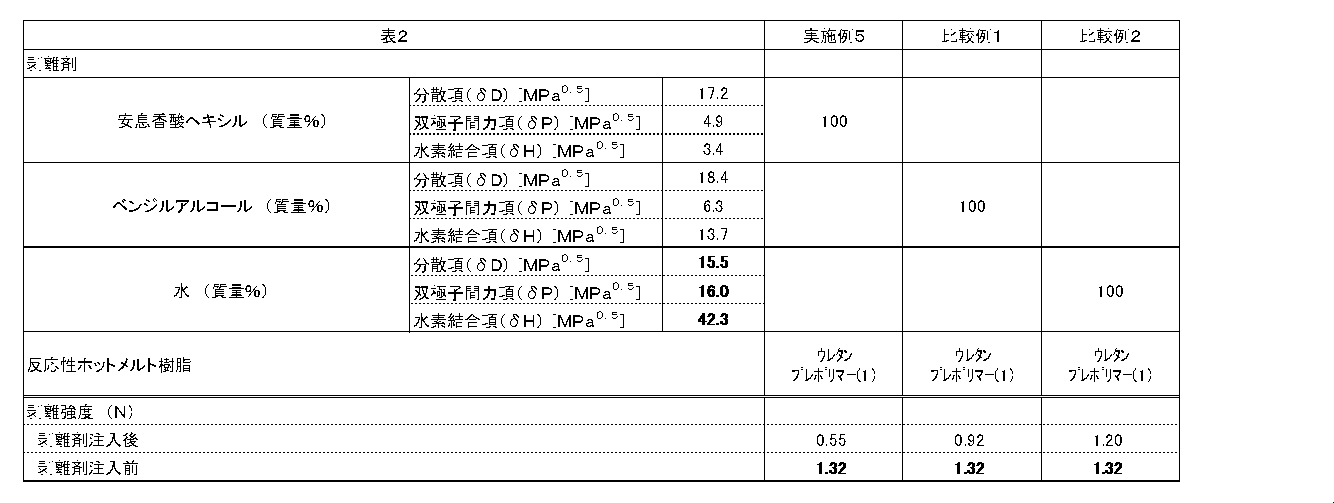
- Example 1 A release agent of 100% by mass of tetrahydrofurfuryl alcohol is applied to the PET film / adhesive layer side of the obtained laminate using a cotton swab, allowed to stand for 5 minutes under an atmosphere of 23 ° C. After peeling, it was fixed to a diffusion type digital force gauge (“DS2-200N” manufactured by Imada Co., Ltd.), and the peelability test was performed by measuring the peel strength (N). In addition, the peelability test of the laminated body before apply
- DS2-200N diffusion type digital force gauge
- the release agent for reactive hot melt resin of the present invention is excellent in the releasability between the reactive hot melt adhesive layer and the substrate.
- Comparative Example 1 is a germ using a release agent in which the hydrogen bonding term ( ⁇ H) in the Hansen solubility parameter exceeds the range specified in the present invention, but the decrease in peel strength is small and the peelability is insufficient. there were.
- the comparative example 2 is a germ layer using the exfoliation agent in which the dipolar force term ( ⁇ P) and the hydrogen bonding term ( ⁇ H) in the Hansen solubility parameter exceed the range specified in the present invention, the peel strength decreases. And peelability was insufficient.
Landscapes
- Chemical & Material Sciences (AREA)
- Organic Chemistry (AREA)
- Chemical Kinetics & Catalysis (AREA)
- Polymers & Plastics (AREA)
- Medicinal Chemistry (AREA)
- Health & Medical Sciences (AREA)
- Engineering & Computer Science (AREA)
- Materials Engineering (AREA)
- Manufacturing & Machinery (AREA)
- Wood Science & Technology (AREA)
- Life Sciences & Earth Sciences (AREA)
- General Chemical & Material Sciences (AREA)
- Adhesives Or Adhesive Processes (AREA)
- Laminated Bodies (AREA)
- Detergent Compositions (AREA)
- Paints Or Removers (AREA)
Abstract
Description
<ウレタンプレポリマー(1)の合成>
温度計、撹拌機、不活性ガス導入口および還流冷却器を備えた四口フラスコに、ポリプロピレングリコール(数平均分子量;1,000)15質量部、ポリプロピレングリコール(数平均分子量;2,000)15質量部、結晶性ポリエステルポリオール(1,6-ヘキサンジオールとアジピン酸を反応させたもの、数平均分子量;2,000)10質量部、結晶性ポリエステルポリオール(1,6-ヘキサンジオールと1,12-ドデカンジカルボン酸とを反応させたもの、数平均分子量;3,500)10質量部、非晶性ポリエステルポリオール(ビスフェノールAのプロピレンオキサイド6モル付加物、セバシン酸及びイソフタル酸を反応させたもの、数平均分子量;2,000)15質量部、アクリルポリオール(アクリル酸ブチル/メタクリル酸メチル/アクリル酸エチル/メタクリル酸2-ヒドロキシエチル=69.65/25/5/0.35(質量比)で反応させたもの、数平均分子量;13,000、ガラス転移温度;-30.3℃)2.5質量部を仕込み、減圧条件下で水分含有率が0.05質量%以下となるまで脱水した。
次いで、容器内温度70℃に冷却後、4,4’-ジフェニルメタンジイソシアネート16.5質量部を加え、100℃まで昇温して、イソシアネート基含有率が一定となるまで約3時間反応させて、イソシアネート基を有するウレタンプレポリマー(1)を得た。なお、得られたウレタンプレポリマー(1)の分散項(δD):17.7、分極項(δP):5.6、水素結合項(δH):5.3であった。また、ウレタンプレポリマー(1)のウレタン結合の含有量は0.90mol/kgであった。
カラム:東ソー株式会社製の下記のカラムを直列に接続して使用した。
「TSKgel G5000」(7.8mmI.D.×30cm)×1本
「TSKgel G4000」(7.8mmI.D.×30cm)×1本
「TSKgel G3000」(7.8mmI.D.×30cm)×1本
「TSKgel G2000」(7.8mmI.D.×30cm)×1本
検出器:RI(示差屈折計)
カラム温度:40℃
溶離液:テトラヒドロフラン(THF)
流速:1.0mL/分
注入量:100μL(試料濃度0.4質量%のテトラヒドロフラン溶液)
標準試料:下記の標準ポリスチレンを用いて検量線を作成した。
東ソー株式会社製「TSKgel 標準ポリスチレン A-500」
東ソー株式会社製「TSKgel 標準ポリスチレン A-1000」
東ソー株式会社製「TSKgel 標準ポリスチレン A-2500」
東ソー株式会社製「TSKgel 標準ポリスチレン A-5000」
東ソー株式会社製「TSKgel 標準ポリスチレン F-1」
東ソー株式会社製「TSKgel 標準ポリスチレン F-2」
東ソー株式会社製「TSKgel 標準ポリスチレン F-4」
東ソー株式会社製「TSKgel 標準ポリスチレン F-10」
東ソー株式会社製「TSKgel 標準ポリスチレン F-20」
東ソー株式会社製「TSKgel 標準ポリスチレン F-40」
東ソー株式会社製「TSKgel 標準ポリスチレン F-80」
東ソー株式会社製「TSKgel 標準ポリスチレン F-128」
東ソー株式会社製「TSKgel 標準ポリスチレン F-288」
東ソー株式会社製「TSKgel 標準ポリスチレン F-550」
前記ウレタンプレポリマー(1)を110℃に加熱溶融させて、110℃に加熱された直径0.4mmの内径を有するディスペンサーニードル(武蔵エンジニアリング株式会社製ディスペンサー「VAVE MASTER ME-5000VT」)を用いて、吐出圧力:0.3MPa、加工速度50mm/秒にて、PET(ポリエチレンテレフタレート)フィルム(13cm×15cm、厚さ50μm)上に、1辺10cmの直線を0.2mm厚さになるように塗布して、温度23℃、相対湿度65%の恒温恒湿槽中に3日間放置することにより、積層体を得た。
得られた積層体のPETフィルム/接着剤層面に対し、テトラヒドロフルフリルアルコール100質量%の剥離剤を、綿棒を用いて塗布、23℃の雰囲気下で5分間放置し、直線の先端をピンセットで剥離した後、普及型デジタルフォースゲージ(株式会社イマダ製「DS2-200N」)に固定し、剥離強度(N)を測定することで剥離性試験を行った。なお、剥離剤を塗布する前の積層体の剥離性試験も併せて行った。
剥離剤の種類を表1~2に示す通りに変更した以外は、実施例1と同様にして剥離性試験を行った。

Claims (4)
- ハンセン溶解度パラメーターにおける分散項(δD)が14.0~21.0MPa0.5の範囲であり、双極子間力項(δP)が0~10.5MPa0.5の範囲であり、水素結合項(δH)が0~13.5MPa0.5の範囲であることを特徴とする反応性ホットメルト樹脂用剥離剤。
- 安息香酸エステル、テトラヒドロフルフリルアルコール、及び、テトラヒドロフルフリル(メタ)アクリレートから成る群より選ばれる1種以上の溶剤である請求項1記載の反応性ホットメルト樹脂用剥離剤。
- 前記反応性ホットメルト樹脂が、イソシアネート基を有するウレタンプレポリマーを含有する湿気硬化型ホットメルト樹脂である請求項1又は2記載の反応性ホットメルト樹脂用剥離剤。
- 前記ウレタンプレポリマーにおけるウレタン結合の含有量が0.1~3mol/kgの範囲である請求項3記載の反応性ホットメルト樹脂用剥離剤。
Priority Applications (4)
| Application Number | Priority Date | Filing Date | Title |
|---|---|---|---|
| US16/631,757 US20200172651A1 (en) | 2017-07-20 | 2018-06-19 | Release agent for reactive hot melt resin |
| CN201880040733.4A CN110770313B (zh) | 2017-07-20 | 2018-06-19 | 反应性热熔树脂用剥离剂 |
| JP2018565073A JP6536757B2 (ja) | 2017-07-20 | 2018-06-19 | 反応性ホットメルト樹脂用剥離剤 |
| KR1020207001163A KR102317626B1 (ko) | 2017-07-20 | 2018-06-19 | 반응성 핫멜트 수지용 박리제 |
Applications Claiming Priority (2)
| Application Number | Priority Date | Filing Date | Title |
|---|---|---|---|
| JP2017-140842 | 2017-07-20 | ||
| JP2017140842 | 2017-07-20 |
Publications (1)
| Publication Number | Publication Date |
|---|---|
| WO2019017133A1 true WO2019017133A1 (ja) | 2019-01-24 |
Family
ID=65016628
Family Applications (1)
| Application Number | Title | Priority Date | Filing Date |
|---|---|---|---|
| PCT/JP2018/023233 Ceased WO2019017133A1 (ja) | 2017-07-20 | 2018-06-19 | 反応性ホットメルト樹脂用剥離剤 |
Country Status (6)
| Country | Link |
|---|---|
| US (1) | US20200172651A1 (ja) |
| JP (1) | JP6536757B2 (ja) |
| KR (1) | KR102317626B1 (ja) |
| CN (1) | CN110770313B (ja) |
| TW (1) | TWI695851B (ja) |
| WO (1) | WO2019017133A1 (ja) |
Cited By (2)
| Publication number | Priority date | Publication date | Assignee | Title |
|---|---|---|---|---|
| WO2020059516A1 (ja) * | 2018-09-19 | 2020-03-26 | Dic株式会社 | 積層フィルムの分離回収方法 |
| WO2020066652A1 (ja) * | 2018-09-25 | 2020-04-02 | Dic株式会社 | 積層フィルムの分離回収方法 |
Citations (4)
| Publication number | Priority date | Publication date | Assignee | Title |
|---|---|---|---|---|
| JPH08283668A (ja) * | 1995-02-17 | 1996-10-29 | Matsushita Electric Ind Co Ltd | 部品の剥離方法 |
| JPH1053736A (ja) * | 1996-08-09 | 1998-02-24 | Seiko Precision Kk | 接着剤及びインク等の液状剥離剤 |
| JP2002348558A (ja) * | 2001-05-25 | 2002-12-04 | Sekisui Chem Co Ltd | 接着物の剥離方法 |
| JP2015000911A (ja) * | 2013-06-14 | 2015-01-05 | Dic株式会社 | 反応性ホットメルト樹脂用剥離剤、剥離方法及び基材 |
Family Cites Families (14)
| Publication number | Priority date | Publication date | Assignee | Title |
|---|---|---|---|---|
| US4830772A (en) * | 1988-06-10 | 1989-05-16 | Hoechst Celanese Corporation | Stripper composition for removal of protective coatings |
| JPH0782595A (ja) * | 1993-09-17 | 1995-03-28 | Hachiyou Gijutsu Kenkyusho:Kk | 洗浄用組成物と精密加工部品の洗浄方法 |
| CN1098373C (zh) * | 1995-02-17 | 2003-01-08 | 松下电器产业株式会社 | 零件的洗净方法 |
| JP4865157B2 (ja) | 2001-07-19 | 2012-02-01 | 日東シンコー株式会社 | 耐湿熱性ホットメルト接着剤組成物 |
| US6919405B2 (en) * | 2002-12-31 | 2005-07-19 | 3M Innovative Properties Company | Release compositions and articles made therefrom |
| JP2005133053A (ja) * | 2003-10-29 | 2005-05-26 | Hitachi Kasei Polymer Co Ltd | グラビアロール上の湿気硬化型反応性ホットメルト接着剤の除去方法 |
| JP2008081687A (ja) | 2006-09-29 | 2008-04-10 | Konishi Co Ltd | 反応性ホットメルト接着剤用洗浄剤 |
| US7977294B2 (en) * | 2006-12-14 | 2011-07-12 | The Boeing Company | Gelled adhesive remover composition and method of use |
| JP5309453B2 (ja) * | 2007-03-13 | 2013-10-09 | Dic株式会社 | 洗浄剤、及び該洗浄剤を用いた洗浄方法 |
| EP2330140A1 (de) * | 2009-12-02 | 2011-06-08 | Sika Technology AG | Aldimin - Reinigungszusammensetzung für reaktive Polyurethanzusammensetzungen |
| CN102719325B (zh) * | 2012-06-26 | 2014-05-14 | 中国科学院理化技术研究所嘉兴工程中心 | 一种新型的反应型聚氨酯热熔胶清洗剂 |
| JP6403611B2 (ja) * | 2015-03-03 | 2018-10-10 | 株式会社クラレ | ホットメルト粘接着剤の洗浄方法及び洗浄剤 |
| US20180162983A1 (en) * | 2015-05-25 | 2018-06-14 | Dic Corporation | Aqueous urethane resin composition and articles |
| JP2017008173A (ja) * | 2015-06-19 | 2017-01-12 | 日東電工株式会社 | 表面保護フィルム |
-
2018
- 2018-06-19 JP JP2018565073A patent/JP6536757B2/ja active Active
- 2018-06-19 US US16/631,757 patent/US20200172651A1/en not_active Abandoned
- 2018-06-19 WO PCT/JP2018/023233 patent/WO2019017133A1/ja not_active Ceased
- 2018-06-19 KR KR1020207001163A patent/KR102317626B1/ko active Active
- 2018-06-19 CN CN201880040733.4A patent/CN110770313B/zh active Active
- 2018-07-12 TW TW107124031A patent/TWI695851B/zh active
Patent Citations (4)
| Publication number | Priority date | Publication date | Assignee | Title |
|---|---|---|---|---|
| JPH08283668A (ja) * | 1995-02-17 | 1996-10-29 | Matsushita Electric Ind Co Ltd | 部品の剥離方法 |
| JPH1053736A (ja) * | 1996-08-09 | 1998-02-24 | Seiko Precision Kk | 接着剤及びインク等の液状剥離剤 |
| JP2002348558A (ja) * | 2001-05-25 | 2002-12-04 | Sekisui Chem Co Ltd | 接着物の剥離方法 |
| JP2015000911A (ja) * | 2013-06-14 | 2015-01-05 | Dic株式会社 | 反応性ホットメルト樹脂用剥離剤、剥離方法及び基材 |
Cited By (5)
| Publication number | Priority date | Publication date | Assignee | Title |
|---|---|---|---|---|
| WO2020059516A1 (ja) * | 2018-09-19 | 2020-03-26 | Dic株式会社 | 積層フィルムの分離回収方法 |
| JP6690806B1 (ja) * | 2018-09-19 | 2020-04-28 | Dic株式会社 | 積層フィルムの分離回収方法 |
| WO2020066652A1 (ja) * | 2018-09-25 | 2020-04-02 | Dic株式会社 | 積層フィルムの分離回収方法 |
| JPWO2020066652A1 (ja) * | 2018-09-25 | 2021-01-07 | Dic株式会社 | 積層フィルムの分離回収方法 |
| US11987036B2 (en) | 2018-09-25 | 2024-05-21 | Dic Corporation | Separation/recovery method for laminated film |
Also Published As
| Publication number | Publication date |
|---|---|
| TW201908357A (zh) | 2019-03-01 |
| TWI695851B (zh) | 2020-06-11 |
| KR20200019200A (ko) | 2020-02-21 |
| US20200172651A1 (en) | 2020-06-04 |
| CN110770313A (zh) | 2020-02-07 |
| JP6536757B2 (ja) | 2019-07-03 |
| JPWO2019017133A1 (ja) | 2019-08-08 |
| CN110770313B (zh) | 2022-03-01 |
| KR102317626B1 (ko) | 2021-10-26 |
Similar Documents
| Publication | Publication Date | Title |
|---|---|---|
| JP5360516B1 (ja) | 湿気硬化型ポリウレタンホットメルト樹脂組成物、接着剤及び物品 | |
| JP5321931B1 (ja) | 湿気硬化型ポリウレタンホットメルト樹脂組成物、接着剤及び物品 | |
| JP6660545B2 (ja) | 湿気硬化型ホットメルトウレタン組成物及び接着剤 | |
| TW201936819A (zh) | 黏著片及其製造方法、以及圖像顯示裝置之製造方法 | |
| JP6256743B2 (ja) | 湿気硬化型ポリウレタンホットメルト樹脂組成物、接着剤及び積層体 | |
| WO2015056478A1 (ja) | 樹脂組成物 | |
| WO2015016029A1 (ja) | 湿気硬化型ホットメルトウレタン組成物及び接着剤 | |
| KR20190092249A (ko) | 점착 시트 및 그의 제조 방법, 그리고 화상 표시 장치 | |
| JP6365000B2 (ja) | 湿気硬化型ポリウレタンホットメルト樹脂組成物、接着剤及び積層体 | |
| JP7409068B2 (ja) | 湿気硬化型ポリウレタンホットメルト樹脂組成物、及び、積層体 | |
| JP6536757B2 (ja) | 反応性ホットメルト樹脂用剥離剤 | |
| JP7447475B2 (ja) | 基材の回収方法 | |
| CN111491970B (zh) | 湿气固化型聚氨酯热熔树脂组合物和使用了该组合物的物品 | |
| JP2015000911A (ja) | 反応性ホットメルト樹脂用剥離剤、剥離方法及び基材 | |
| JP7409067B2 (ja) | 湿気硬化型ポリウレタンホットメルト樹脂組成物、及び、積層体 | |
| JP2015078326A (ja) | ウレタン樹脂、それを用いたコーティング剤及び物品 | |
| CN112368312A (zh) | 湿固化型聚氨酯热熔树脂组合物 |
Legal Events
| Date | Code | Title | Description |
|---|---|---|---|
| ENP | Entry into the national phase |
Ref document number: 2018565073 Country of ref document: JP Kind code of ref document: A |
|
| 121 | Ep: the epo has been informed by wipo that ep was designated in this application |
Ref document number: 18834658 Country of ref document: EP Kind code of ref document: A1 |
|
| ENP | Entry into the national phase |
Ref document number: 20207001163 Country of ref document: KR Kind code of ref document: A |
|
| NENP | Non-entry into the national phase |
Ref country code: DE |
|
| 122 | Ep: pct application non-entry in european phase |
Ref document number: 18834658 Country of ref document: EP Kind code of ref document: A1 |