WO2018097667A1 - 반도체 소자 및 이를 포함하는 표시 장치 - Google Patents
반도체 소자 및 이를 포함하는 표시 장치 Download PDFInfo
- Publication number
- WO2018097667A1 WO2018097667A1 PCT/KR2017/013560 KR2017013560W WO2018097667A1 WO 2018097667 A1 WO2018097667 A1 WO 2018097667A1 KR 2017013560 W KR2017013560 W KR 2017013560W WO 2018097667 A1 WO2018097667 A1 WO 2018097667A1
- Authority
- WO
- WIPO (PCT)
- Prior art keywords
- light emitting
- layer
- wavelength conversion
- electrode
- layers
- Prior art date
- Legal status (The legal status is an assumption and is not a legal conclusion. Google has not performed a legal analysis and makes no representation as to the accuracy of the status listed.)
- Ceased
Links
Images




Classifications
-
- H—ELECTRICITY
- H10—SEMICONDUCTOR DEVICES; ELECTRIC SOLID-STATE DEVICES NOT OTHERWISE PROVIDED FOR
- H10H—INORGANIC LIGHT-EMITTING SEMICONDUCTOR DEVICES HAVING POTENTIAL BARRIERS
- H10H20/00—Individual inorganic light-emitting semiconductor devices having potential barriers, e.g. light-emitting diodes [LED]
- H10H20/80—Constructional details
- H10H20/81—Bodies
- H10H20/813—Bodies having a plurality of light-emitting regions, e.g. multi-junction LEDs or light-emitting devices having photoluminescent regions within the bodies
-
- H—ELECTRICITY
- H10—SEMICONDUCTOR DEVICES; ELECTRIC SOLID-STATE DEVICES NOT OTHERWISE PROVIDED FOR
- H10H—INORGANIC LIGHT-EMITTING SEMICONDUCTOR DEVICES HAVING POTENTIAL BARRIERS
- H10H29/00—Integrated devices, or assemblies of multiple devices, comprising at least one light-emitting semiconductor element covered by group H10H20/00
- H10H29/10—Integrated devices comprising at least one light-emitting semiconductor component covered by group H10H20/00
-
- H—ELECTRICITY
- H10—SEMICONDUCTOR DEVICES; ELECTRIC SOLID-STATE DEVICES NOT OTHERWISE PROVIDED FOR
- H10H—INORGANIC LIGHT-EMITTING SEMICONDUCTOR DEVICES HAVING POTENTIAL BARRIERS
- H10H20/00—Individual inorganic light-emitting semiconductor devices having potential barriers, e.g. light-emitting diodes [LED]
- H10H20/80—Constructional details
- H10H20/81—Bodies
- H10H20/819—Bodies characterised by their shape, e.g. curved or truncated substrates
-
- H—ELECTRICITY
- H10—SEMICONDUCTOR DEVICES; ELECTRIC SOLID-STATE DEVICES NOT OTHERWISE PROVIDED FOR
- H10H—INORGANIC LIGHT-EMITTING SEMICONDUCTOR DEVICES HAVING POTENTIAL BARRIERS
- H10H20/00—Individual inorganic light-emitting semiconductor devices having potential barriers, e.g. light-emitting diodes [LED]
- H10H20/80—Constructional details
- H10H20/85—Packages
- H10H20/851—Wavelength conversion means
-
- H—ELECTRICITY
- H10—SEMICONDUCTOR DEVICES; ELECTRIC SOLID-STATE DEVICES NOT OTHERWISE PROVIDED FOR
- H10H—INORGANIC LIGHT-EMITTING SEMICONDUCTOR DEVICES HAVING POTENTIAL BARRIERS
- H10H20/00—Individual inorganic light-emitting semiconductor devices having potential barriers, e.g. light-emitting diodes [LED]
- H10H20/80—Constructional details
- H10H20/85—Packages
- H10H20/851—Wavelength conversion means
- H10H20/8514—Wavelength conversion means characterised by their shape, e.g. plate or foil
-
- H—ELECTRICITY
- H10—SEMICONDUCTOR DEVICES; ELECTRIC SOLID-STATE DEVICES NOT OTHERWISE PROVIDED FOR
- H10H—INORGANIC LIGHT-EMITTING SEMICONDUCTOR DEVICES HAVING POTENTIAL BARRIERS
- H10H20/00—Individual inorganic light-emitting semiconductor devices having potential barriers, e.g. light-emitting diodes [LED]
- H10H20/80—Constructional details
- H10H20/85—Packages
- H10H20/855—Optical field-shaping means, e.g. lenses
-
- H—ELECTRICITY
- H10—SEMICONDUCTOR DEVICES; ELECTRIC SOLID-STATE DEVICES NOT OTHERWISE PROVIDED FOR
- H10H—INORGANIC LIGHT-EMITTING SEMICONDUCTOR DEVICES HAVING POTENTIAL BARRIERS
- H10H20/00—Individual inorganic light-emitting semiconductor devices having potential barriers, e.g. light-emitting diodes [LED]
- H10H20/80—Constructional details
- H10H20/85—Packages
- H10H20/857—Interconnections, e.g. lead-frames, bond wires or solder balls
-
- H—ELECTRICITY
- H10—SEMICONDUCTOR DEVICES; ELECTRIC SOLID-STATE DEVICES NOT OTHERWISE PROVIDED FOR
- H10W—GENERIC PACKAGES, INTERCONNECTIONS, CONNECTORS OR OTHER CONSTRUCTIONAL DETAILS OF DEVICES COVERED BY CLASS H10
- H10W90/00—Package configurations
-
- H—ELECTRICITY
- H10—SEMICONDUCTOR DEVICES; ELECTRIC SOLID-STATE DEVICES NOT OTHERWISE PROVIDED FOR
- H10H—INORGANIC LIGHT-EMITTING SEMICONDUCTOR DEVICES HAVING POTENTIAL BARRIERS
- H10H20/00—Individual inorganic light-emitting semiconductor devices having potential barriers, e.g. light-emitting diodes [LED]
- H10H20/80—Constructional details
- H10H20/83—Electrodes
- H10H20/831—Electrodes characterised by their shape
-
- H—ELECTRICITY
- H10—SEMICONDUCTOR DEVICES; ELECTRIC SOLID-STATE DEVICES NOT OTHERWISE PROVIDED FOR
- H10H—INORGANIC LIGHT-EMITTING SEMICONDUCTOR DEVICES HAVING POTENTIAL BARRIERS
- H10H20/00—Individual inorganic light-emitting semiconductor devices having potential barriers, e.g. light-emitting diodes [LED]
- H10H20/80—Constructional details
- H10H20/85—Packages
- H10H20/855—Optical field-shaping means, e.g. lenses
- H10H20/856—Reflecting means
Definitions
- Embodiments relate to a semiconductor device and a display device including the same.
- a light emitting diode is one of light emitting devices that emit light when a current is applied.
- Light emitting diodes can emit high-efficiency light at low voltage, resulting in excellent energy savings.
- the luminance problem of the light emitting diode has been greatly improved, and has been applied to various devices such as a backlight unit, a display board, a display, and a home appliance of a liquid crystal display.
- a general liquid crystal display device displays an image or an image with light passing through a color filter by controlling the transmittance of light emitted from a light emitting diode and a liquid crystal.
- a display device having a high definition and a large screen or higher than HD has been required.
- a liquid crystal display and an organic field display having a complicated configuration, which are generally used, are difficult to realize a high quality large display due to yield and cost. have.
- the embodiment provides a semiconductor device having improved color purity.
- the embodiment provides a semiconductor device having improved brightness.
- a chip level light emitting device including first to third light emitting units driven individually may be provided as a pixel of a display device.
- the first to third light emitting units may function as respective sub-pixels of the pixel to implement a high resolution large display device.
- a semiconductor device includes a plurality of light emitting units; A plurality of wavelength conversion layers respectively disposed on the plurality of light emitting units; Barrier ribs disposed between the plurality of light emitting parts and the plurality of wavelength conversion layers and a plurality of color filters respectively disposed on the plurality of wavelength conversion layers; And a black matrix disposed between the plurality of color filters.
- the width between the plurality of wavelength conversion layers may be greater than the maximum width between the plurality of light emitting parts.
- Each of the light emitting units may include a first conductive semiconductor layer, a second conductive semiconductor layer, and an active layer disposed between the first conductive semiconductor layer and the second conductive semiconductor layer.
- Widths of the first conductivity-type semiconductor layers of the plurality of light emitting parts may become narrower as they approach the wavelength conversion layer.
- Widths of the second conductivity-type semiconductor layers of the plurality of light emitting parts may increase as they approach the wavelength conversion layer.
- First bump electrodes commonly connected to the plurality of light emitting units; A plurality of second bump electrodes electrically connected to the plurality of light emitting units, respectively; And a second electrode electrically connecting the first conductivity-type semiconductor layers of the plurality of light emitting units.
- the display device may further include a first insulating layer covering lower portions of the light emitting parts.
- the first electrode may be electrically connected to the first conductive semiconductor layer through the first insulating layer.
- the first electrode may be electrically connected to the first bump electrode.
- the second electrode may be electrically connected to the second bump electrode.
- the display device may further include a first insulating layer covering lower portions of the light emitting parts.
- the display device may further include a plurality of reflective electrodes penetrating the first insulating layer and disposed under the second conductive semiconductor layers of the plurality of light emitting units, and the second electrodes may electrically connect the plurality of reflective electrodes. .
- the width between the adjacent wavelength converting layers may be 30 ⁇ m to 50 ⁇ m.
- the partition wall may include reflective particles.
- the color filter layer may include the plurality of color filters and the black matrix.
- the display device may include the semiconductor device.
- a panel including a plurality of pixel areas defined by crossing a plurality of common wires and a plurality of driving wires, wherein the semiconductor element is disposed in each of the pixel areas so that the first, second, and third light emitting parts are green, It may be a first, second and third sub-pixel emitting light of the red and blue wavelength band.
- color purity may be improved.
- relative brightness may be improved.
- a chip level light emitting device including first to third light emitting parts driven individually may be provided as a pixel of the display device.
- the first to third light emitting units may function as respective sub-pixels of the pixel to implement a high resolution large display device.
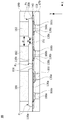
- FIG. 1 is a plan view of a semiconductor device according to a first embodiment of the present invention
- FIG. 2 is a cross-sectional view along the direction A-A of FIG.
- FIG. 3 is a cross-sectional view of a semiconductor device according to a second embodiment of the present invention.
- 4A and 4B are graphs illustrating changes in luminous flux and color purity according to widths of barrier ribs of a semiconductor device according to an embodiment
- FIG. 5 is a cross-sectional view of a semiconductor device according to a third exemplary embodiment of the present invention.
- FIG. 6 is a modification of FIG. 5,
- FIG. 7A to 7F are views illustrating a method of manufacturing a semiconductor device according to the third embodiment
- FIG. 8 is a cross-sectional view of a semiconductor device according to a fourth embodiment of the present invention.
- FIGS. 9A to 9D are views illustrating a method of manufacturing a semiconductor device according to the fourth embodiment.
- FIG. 10 is a cross-sectional view of a modification of the semiconductor device according to the fourth embodiment shown in FIG. 8.
- FIG. 11 is a cross-sectional view of a semiconductor device according to a fifth embodiment of the present invention.
- FIG. 12 is a sectional view of a semiconductor device according to a sixth embodiment of the present invention.
- FIG. 13 is a sectional view of a semiconductor device according to a seventh embodiment of the present invention.
- FIG. 14 is a plan view of a display device according to an exemplary embodiment.
- 15 is a diagram illustrating a state in which a semiconductor device and a circuit board are electrically connected.
- the semiconductor device may include various electronic devices such as a light emitting device and a light receiving device, and the light emitting device and the light receiving device may all include the first conductive semiconductor layers 110a, 110b, and 110c, the active layers 120a, 120b, and 120c, and the second devices. It may include a conductive semiconductor layer (130a, 130b, 130c).
- the semiconductor device according to the present embodiment may be a light emitting device.
- the light emitting device emits light by recombination of electrons and holes, and the wavelength of the light is determined by the energy band gap inherent in the material. Thus, the light emitted may vary depending on the composition of the material.
- FIG. 1 is a plan view of a semiconductor device according to a first exemplary embodiment of the present invention
- FIG. 2 is a cross-sectional view taken along the direction A-A of FIG. 1.
- the semiconductor device may include a plurality of light emitting parts P1, P2, and P3.
- the plurality of light emitting parts P1, P2, and P3 may emit light having the same or different wavelengths, respectively.
- the plurality of light emitting parts P1, P2, and P3 may be defined as areas that can be independently controlled. For example, only one of the first to third light emitting parts P1, P2, and P3 may be independently turned on by applying a current selectively among the plurality of light emitting parts P1, P2, and P3.
- the plurality of light emitting parts P1, P2, and P3 includes a first light emitting part P1 for emitting light of a first wavelength band, a second light emitting part P2 for emitting light of a second wavelength band, and a light of a third wavelength band. It may include a third light emitting unit (P3) for emitting.
- the first light emitting unit P1 may emit green light
- the second light emitting unit P2 and the third light emitting unit P3 may emit blue light, but are not limited thereto.
- the first light emitter P1 may emit blue light
- the second light emitter P2 and the third light emitter P3 may emit green light.
- all of the first to third light emitting parts P1, P2, and P3 may emit blue light.
- the first to third light emitting parts P1, P2, and P3 may emit light of different wavelength bands according to the injected current.
- the semiconductor device 1A may include a first electrode electrically connecting the first to third light emitting parts P1, P2, and P3 and the separated first conductive semiconductor layers 110a, 110b, and 110c. 151, a first bump electrode 150 connected to the first electrode 151, and a plurality of second bump electrodes 160a electrically connected to the second conductive semiconductors 130a, 130b, and 130c, respectively. 160b, 160c).
- the first bump electrode 150 and the second bump electrodes 160a, 160b, and 160c of the semiconductor device may be disposed under the plurality of light emitting parts P1, P2, and P3.
- the first bump electrodes 150 and the second bump electrodes 160a, 160b, and 160c are disposed below the second conductive semiconductor layers 130a, 130b, and 130c, but the present invention is not limited thereto.
- the first bump electrodes 150 and the second bump electrodes 160a, 160b, and 160c may be disposed on the first conductive semiconductor layers 110a, 110b, and 110c.
- the first to third light emitting units P1, P2, and P3 may include the first conductive semiconductor layers 110a, 110b, and 110c, the active layers 120a, 120b, and 120c, and the second conductive semiconductor layers 130a, 130b, and 130c).
- the first light emitting unit P1 may include a first conductive semiconductor layer 110a, an active layer 120a, and a second conductive semiconductor layer 130a
- the second light emitting unit P2 may include a first conductive layer.
- the third light emitting part P3 includes the first conductivity-type semiconductor layer 110c, the active layer 120c, and the second.
- the conductive semiconductor layer 130c may be included.
- the first conductive semiconductor layers 110a, 110b, and 110c of the first to third light emitting units P1, P2, and P3 may be disposed to have a narrower width toward the upper side, and the first to third light emitting units P1.
- the second conductivity-type semiconductor layers 130a, 130b, and 130c of the P2 and P3 may be disposed to have a smaller width as they go downward. That is, the first conductive semiconductor layers 110a, 110b and 110c and the second conductive semiconductor layers 130a, 130b and 130c may be made narrower in the opposite directions.
- the first conductive semiconductor layers 110a, 110b, and 110c may be formed of compound semiconductors such as group III-V and group II-VI, and may be doped with n-type dopants.
- a first conductive type semiconductor layer (110a, 110b, 110c) is having a compositional formula of In x Al y Ga 1 -x- y N (0 ⁇ x ⁇ 1, 0 ⁇ y ⁇ 1, 0 ⁇ x + y ⁇ 1) having a composition formula of a semiconductor material, or in x Al y Ga 1 -x- y P (0 ⁇ x ⁇ 1, 0 ⁇ y ⁇ 1, 0 ⁇ x + y ⁇ 1) can be formed of a semiconductor material.
- the n-type dopant may be selected from Si, Ge, Sn, Se, Te, and the like, but is not limited thereto.
- the active layers 120a, 120b, and 120c may have any one of a single well structure, a multi well structure, a single quantum well structure, a multi quantum well (MQW) structure, a quantum dot structure, or a quantum line structure.
- the structures of the active layers 120a, 120b, and 120c are not limited thereto.
- An active layer (120a, 120b, 120c) when formed into a quantum well structure for example, In x Al y Ga 1 -x- y N (0 ⁇ x ⁇ 1, 0 ⁇ y ⁇ 1, 0 ⁇ x + y ⁇ 1)
- a well layer having a compositional formula and a barrier layer having a compositional formula of In a Al b Ga 1 -a- b N (0 ⁇ a ⁇ 1, 0 ⁇ b ⁇ 1, 0 ⁇ a + b ⁇ 1) It may have a well structure.
- the active layers 120a, 120b, and 120c may have (Al p Ga 1 -p ) q In 1 - q P layers (where 0 ⁇ p ⁇ 1 and 0 ⁇ q ⁇ 1), respectively.
- the composition of the barrier layer (Al Ga 1 -p1 p1) q1 in 1 - q1 be a P layer (where, 0 ⁇ p1 ⁇ 1, 0 ⁇ q1 ⁇ 1), but the embodiment is not limited thereto.
- the active layers 120a, 120b, and 120c may be formed of one or more pair structures of InGaN / GaN, InGaN / InGaN, GaN / AlGaN, InAlGaN / GaN, GaAs (InGaAs) / AlGaAs, GaP (InGaP) / AlGaP.
- the well layer may be formed of a material having a band gap smaller than the band gap of the barrier layer.
- the active layers 120a, 120b, and 120c are electrons (or holes) injected through the first conductivity type semiconductor layers 110a, 110b, and 110c, and holes injected through the second conductivity type semiconductor layers 130a, 130b, and 130c. (Or electron) is the layer where it meets.
- the active layers 120a, 120b, and 120c may transition to low energy levels as electrons and holes recombine, and may generate light having a corresponding wavelength.
- the active layers 120a, 120b, and 120c of the first, second, and third light emitting parts P1, P2, and P3 may generate light in a blue wavelength band.
- the second conductive semiconductor layers 130a, 130b, and 130c may be implemented with compound semiconductors such as group III-V and group II-VI, and may be doped with p-type dopants.
- the second conductivity type semiconductor layer (130a, 130b, 130c) is having a compositional formula of In x Al y Ga 1 -x- y N (0 ⁇ x ⁇ 1, 0 ⁇ y ⁇ 1, 0 ⁇ x + y ⁇ 1) having a composition formula of a semiconductor material, or in x Al y Ga 1 -x- y P (0 ⁇ x ⁇ 1, 0 ⁇ y ⁇ 1, 0 ⁇ x + y ⁇ 1) can be formed of a semiconductor material.
- the second conductive semiconductor layers 130a, 130b, and 130c may be formed of a material selected from AlInN, AlGaAs, GaP, GaAs, GaAsP, and AlGaInP, but is not limited thereto.
- the p-type dopant may be selected from Mg, Zn, Ca, Sr, Ba, and the like, but is not limited thereto.
- the first to third light emitting parts P1, P2, and P3 may emit light in the blue wavelength band through the first conductivity type semiconductor layers 110a, 110b, and 110c.
- the first insulating layer 140 may be disposed under the first to third light emitting parts P1, P2, and P3.
- the first insulating layer 140 may be formed by selecting at least one selected from the group consisting of SiO 2 , Si x O y , Si 3 N 4 , SixNy, SiOxNy, Al 2 O 3 , TiO 2 , AlN, and the like. It is not limited.
- the first insulating layer 140 may electrically insulate the first electrode 151 from the second conductive semiconductor layers 130a, 130b and 130c and the active layers 120a, 120b and 120c.
- the first insulating layer 140 may be a distributed Bragg reflector (DBR) having a multilayer structure including a Si oxide or a Ti compound.
- DBR distributed Bragg reflector
- the present invention is not limited thereto, and the first insulating layer 140 may include various reflective structures.
- the first electrode 151 may be disposed between the separated first conductivity type semiconductor layers 110a, 110b, and 110c.
- the first electrode 151 may electrically connect the separated first conductive semiconductor layers 110a, 110b, and 110c.
- the first electrode 151 may be electrically connected to the first conductivity type semiconductor layers 110a, 110b, and 110c by passing through the first insulating layer 140.
- the first electrode 151 may be spaced apart from the second bump electrodes 160a, 160b and 160c.
- the first electrode 151 may electrically connect the first conductivity-type semiconductor layers 110a, 110b, and 110c of each light emitting structure.
- the first electrode 151 may be partially overlapped with the first conductivity type semiconductor layers 110a, 110b, and 110c to be electrically connected thereto.
- the first electrode 151 may be an ohmic electrode, but is not limited thereto.
- the first bump electrode 150 may be electrically connected to the first electrode 151. Accordingly, the first conductivity type semiconductor layers 110a, 110b, and 110c disposed to be spaced apart from each other may have a first shape. The bump electrode 150 may be electrically connected to the bump electrode 150. The first bump electrode 150 and the first electrode 151 may function as a common electrode, but are not limited thereto.
- the plurality of second bump electrodes 160a, 160b and 160c may be electrically connected to the second conductive semiconductor layers 130a, 130b and 130c.
- the 2-1 bump electrode 160a may be electrically connected to the 2-1 conductive semiconductor layer 130a
- the 2-2 bump electrode 160b may be the 2-2 conductive semiconductor layer 130b.
- the 2-3 bump electrode 160c may be electrically connected to the 2-3 conductive semiconductor layer 130c.
- the first bump electrodes 150 and the second bump electrodes 160a, 160b, and 160c are formed of metals such as Ag, Ni, Al, Rh, Pd, Ir, Ru, Mg, Zn, Pt, Au, Hf, Cu, and the like. Can be.
- the first bump electrode 150 and the second bump electrodes 160a, 160b, and 160c may be formed of one or a plurality of layers in which the conductive oxide film and the metal are mixed, but are not limited thereto.
- a reflective layer may be further disposed under the second conductive semiconductor layers 130a, 130b, and 130c, but embodiments are not limited thereto.
- Second electrodes 161a, 161b and 161c may be disposed between the plurality of second bump electrodes 160a, 160b and 160c and the second conductive semiconductor layers 130a, 130b and 130c.
- the present invention is not limited thereto, and the second bump electrodes 160a, 160b, and 160c may include a material in ohmic contact with the second conductive semiconductor layers 130a, 130b, and 130c.
- the support layer 170 includes the insulating layer 140, the first electrode 151, the first conductive semiconductor layers 110a, 110b, and 110c, the active layers 120a, 120b, and 120c, and the second conductive semiconductor layer 130a, It may be disposed under the semiconductor device to support the 130b, 130c.
- the support layer 170 may have low light transmittance and may serve as a light reflection layer and / or a light absorption layer.
- the support layer 170 may have a structure in which reflective particles are dispersed on a substrate.
- the substrate may be any one or more of epoxy resins, silicone resins, polyimide resins, urea resins, and acrylic resins.
- the polymer resin may be a silicone resin.
- the reflective particles may include inorganic particles such as TiO 2 or SiO 2 .
- the support layer may be an epoxy molding compound (EMC) or silicone molding compound (SMC) resin.
- the support layer 170 may include 10 to 50 wt%, or 15 to 30 wt% of inorganic particles. If the content of the particles is less than 10wt%, it is difficult to control the permeability to 20% or less, and if the content is more than 50wt%, the content of inorganic particles may be high and cracks may occur.
- the support layer 170 may have a thermal expansion coefficient (CTE) of 50 ppm / ° C or less.
- CTE thermal expansion coefficient
- the transmittance of the support layer 170 may be 20% or less.
- the semiconductor device may provide improved light emission efficiency.
- FIGS. 4A and 4B are graphs of changes in luminous flux and color purity according to widths of partition walls of semiconductor devices according to an exemplary embodiment.
- the semiconductor device 1B may include wavelength conversion layers 181, 182, and 183 and barrier ribs disposed on the first to third light emitting parts P1, P2, and P3. 190) may be further included.
- the wavelength conversion layers 181, 182, and 183 may convert wavelengths of light emitted from the first to third light emitting parts P1, P2, and P3.
- the first wavelength conversion layer 181 may convert light emitted from the first light emitting part P1 into green light
- the second wavelength conversion layer 182 may be emitted from the second light emitting part P2.
- the light may be converted into red light
- the third wavelength conversion layer 183 may convert light emitted from the third light emitting part P3 into blue light.
- the third wavelength conversion layer 183 may not change the wavelength or may not be disposed.
- the present disclosure is not limited thereto, and the first to third wavelength conversion layers 181, 182, and 183 may emit light of the blue (B) wavelength band emitted from the first to third light emitting parts P1, P2, and P3. It can also be absorbed and converted to light in the white (W) wavelength band.
- B blue
- W white
- the wavelength conversion layers 181, 182, and 183 may have a structure in which wavelength conversion particles are dispersed in a polymer resin selected from an epoxy resin, a silicone resin, a polyimide resin, a urea resin, an acrylic resin, and the like, but is not limited thereto.
- the wavelength conversion particle may include any one or more of a phosphor and a quantum dot (QD).
- QD quantum dot
- the phosphor may include a fluorescent material of any one of YAG-based, TAG-based, Silicate-based, Sulfide-based, or Nitride-based, but the embodiment is not limited to the type of phosphor.
- YAG and TAG-based fluorescent materials may be selected from (Y, Tb, Lu, Sc, La, Gd, Sm) 3 (Al, Ga, In, Si, Fe) 5 (O, S) 12 : Ce.
- Silicate-based fluorescent material may be selected from (Sr, Ba, Ca, Mg) 2 SiO 4 : (Eu, F, Cl).
- the sulfide-based fluorescent material can be selected from (Ca, Sr) S: Eu, (Sr, Ca, Ba) (Al, Ga) 2 S 4 : Eu, and the Nitride-based fluorescent material is (Sr, Ca, Si, Al , O) N: Eu (eg, CaAlSiN 4 : Eu ⁇ -SiAlON: Eu) or Ca- ⁇ SiAlON: Eu-based (Cax, My) (Si, Al) 12 (O, N) 16 .
- M is at least one of Eu, Tb, Yb or Er and may be selected from phosphor components satisfying 0.05 ⁇ (x + y) ⁇ 0.3, 0.02 ⁇ x ⁇ 0.27 and 0.03 ⁇ y ⁇ 0.3.
- the wavelength conversion layers 181, 182, and 183 may be separated by the partition wall 190 for each region overlapping the first to third light emitting parts P1, P2, and P3 in the vertical direction.
- the partition wall 190 may be disposed between the wavelength conversion layers 181, 182, and 183 and between the light emitting parts P1, P2, and P3.
- the partition wall 190 may include a light absorbing material, such as carbon black and graphite, or may include a reflecting material that reflects light.
- the partition wall 190 may have a structure in which reflective particles are dispersed on a substrate.
- the substrate may be any one or more of epoxy resins, silicone resins, polyimide resins, urea resins, and acrylic resins.
- the polymer resin may be a silicone resin.
- the reflective particles may include inorganic particles such as TiO 2 or SiO 2 , but are not limited thereto.
- the partition wall 190 may include 20 wt% or more of inorganic particles.
- the inorganic particles of the partition wall may be 20 wt% to 70 wt%.
- the reflectivity of the partition wall 190 is lowered, thereby lowering the color purity.
- the partition wall 190 may have cracks because the content of the polymer resin decreases when the inorganic particles exceed 70 wt%.
- the partition wall 190 may include a first region disposed between the wavelength conversion layers 181, 182, and 183, and a second region disposed between the first to third light emitting parts P1, P2, and P3. .
- the width d1 of the first region may be greater than the width d2 of the second region.
- the present invention is not limited thereto, and the width d1 of the first region and the width d2 of the second region may be the same.
- the widths d1 and d2 of the first area and the second area may be distances in a direction perpendicular to the thickness direction of the light emitting parts P1, P2, and P3 (the X-axis direction).
- the width d1 of the first region of the barrier rib 190 may be 10 ⁇ m or more.
- the width d1 of the first region may be 10 ⁇ m to 50 ⁇ m.
- the partition wall 190 may block color light emitted from the first to third light emitting parts P1, P2, and P3 to improve color purity.
- the partition wall 190 blocks the light emitted from the first to third light emitting parts P1, P2, and P3 to overlap and mix the light. You can prevent it.
- the width between the first to third light emitting parts P1, P2, and P3 may be widened, thereby increasing the size of the semiconductor device.
- the formation method of the partition 190 is not specifically limited.
- the partition wall 190 may be formed using photolithography, imprinting, roll-to-roll printing, inkjet printing, or the like.
- the width d1 of the first region may be greater than the maximum width d2 of the second region. Accordingly, the width in the X-axis direction of each of the first to third wavelength conversion layers 181, 182, and 183 may be smaller than the width of the first to third light emitting parts P1, P2, and P3. According to such a structure, the width
- the X-axis width of each of the first to third wavelength conversion layers 181, 182, and 183 may be 80% to 90% of the width of the first to third light emitting parts P1, P2, and P3. have.
- the luminous flux of the plurality of light emitting parts decreases slightly as the width of the first region increases, it may be confirmed that color purity is greatly improved. That is, when the width of the first region is 20 ⁇ m, the color purity is improved by 102%, when the width of the first region is 30 ⁇ m, by 105%, and when the width of the first region is 50 ⁇ m by 106%.
- FIG. 5 is a cross-sectional view of a semiconductor device according to a third exemplary embodiment of the present invention
- FIG. 6 is a modification of FIG. 5.
- the semiconductor device 1C may include the wavelength conversion layers 181, 182, and 183 and the color filter layer 220 disposed on the barrier rib 190.
- the color filter layer 220 may include a plurality of color filters 221, 222, and 223 and a black matrix 224.
- the first to third color filters 221, 222, and 223 may be disposed on the color filter layer 220.
- the first color filter 221 may be a green filter
- the second color filter 222 may be a red filter
- the third color filter 223 may be a blue filter.
- the plurality of color filters 221, 222, and 223 may be manufactured by mixing green / red / blue pigment with acrylic resin such as Methylmethacrylate-Butadiene-Styrene (MBS).
- acrylic resin such as Methylmethacrylate-Butadiene-Styrene (MBS).
- MBS Methylmethacrylate-Butadiene-Styrene
- the color filter layer 220 may be formed by coating, exposing, developing, and curing (firing) the pigment composition dispersed in the photoresist.
- the color filter layer 220 may improve color purity of the light converted by the wavelength conversion layers 181, 182, and 183.
- the first color filter 221 may block light other than the green light converted by the first wavelength conversion layer 181 to improve the color purity of the green light.
- the color filter layer 220 may emit light in the white (W) wavelength band.
- the light may be separated into light of the blue (B), green (G), and red (R) wavelength bands.
- the color filter layer 220 may include a black matrix 224 disposed between the first to third color filters 221, 222, and 223.
- the present invention is not necessarily limited thereto, and the structure is not particularly limited as long as the structure is arranged between the first to third color filters 221, 222, and 223 to be partitioned.
- the thickness of the black matrix 224 may be 5 ⁇ m to 55 ⁇ m. If the thickness is smaller than 5 ⁇ m, it may be too thin to partition the first to third color filters 221, 222, and 223. If the thickness is larger than 55 ⁇ m, the overall filter may have a thick thickness. However, the thickness of the black matrix 224 is not necessarily limited thereto.
- the width of the black matrix 224 may have a range of ⁇ 5 ⁇ m of the width d1 of the first region of the partition 190 disposed below the black matrix 224.
- the width of the black matrix 224 may be 5 ⁇ m to 55 ⁇ m.
- the first intermediate layer 210 may be disposed between the color filter layer 220 and the wavelength conversion layers 181, 182, and 183 to bond them.
- the color filters 221, 222, and 223 may use acrylic resin as the main raw material
- the partition walls and the wavelength conversion layers 181, 182, and 183 may use silicone resin as the main raw material.
- the acrylic resin and the silicone resin have poor adhesion due to the difference in physical properties, it may not be easy to fabricate the color filters 221, 222, and 223 directly on the wavelength conversion layers 181, 182, and 183.
- the first intermediate layer 210 may include an oxide or nitride as an inorganic material.
- the first intermediate layer 210 may be formed of indium tin oxide (ITO), indium zinc oxide (IZO), indium zinc tin oxide (IZTO), indium aluminum zinc oxide (IAZO), indium gallium zinc oxide (IGZO), or IGTO.
- the present invention is not limited thereto, and the first intermediate layer 210 may be selected without limitation as long as the material has excellent adhesion to both the acrylic resin and the silicone resin.
- the thickness of the first intermediate layer 210 may be 5 nm to 1,000 nm, or 40 nm to 200 nm. When the thickness is smaller than 5 nm, it is difficult to prevent the acrylic resin from diffusing into the phosphor, and when the thickness is larger than 1000 nm, the transmittance is smaller than 70%, resulting in a decrease in the luminous flux.
- the total thickness L 1 of the barrier rib 190, the first intermediate layer 210, the color filter layer 220, and the encapsulation layer 230 may be 30 ⁇ m to 100 ⁇ m.
- the wavelength conversion layers 181, 182, and 183 may be formed in the wavelength conversion layers 181, 182, and 183.
- the small number of particles can result in less color conversion and can be difficult to process.
- the thickness means the distance in the Y-axis direction.
- a second intermediate layer 240 may be disposed between the first intermediate layer 210 and the wavelength conversion layers 181, 182, and 183.
- the wavelength conversion layers 181, 182, and 183 may not have a flat surface because phosphor particles are dispersed by a process or in a resin. Therefore, when the color filter layer is formed on the surfaces of the wavelength conversion layers 181, 182, and 183, there is a problem that reliability is lowered.
- the first intermediate layer 210 may be disposed on the second intermediate layer 240 to provide a flat surface.
- the configuration of the second intermediate layer 240 is not necessarily limited thereto and may be omitted.
- the second intermediate layer 240 may be omitted.
- the surface roughness of the first intermediate layer 210 may be determined by the surface roughness of the wavelength conversion layers 181, 182, and 183 and the partition wall 190.
- a leveling or polishing process may be performed to control the surface roughness of the wavelength conversion layers 181, 182, and 183 and the partition wall 190.
- the second intermediate layer 240 may include the same material for adhesion to the wavelength conversion layers 181, 182, and 183.
- the second intermediate layer 240 and the wavelength conversion layers 181, 182, and 183 may all include a silicone resin.
- the thickness of the second intermediate layer 240 may be 3,000 nm to 20,000 nm. If the thickness of the second intermediate layer 240 is smaller than 3,000 nm, the planarization of the surface may be poor. If the thickness of the second intermediate layer 240 is greater than 20,000 nm, the light transmittance may be reduced. Therefore, the thickness ratio of the first intermediate layer 210 and the second intermediate layer 240 may be 1: 4000 to 1: 3.
- the encapsulation layer 230 may be disposed on the color filter layer 220.
- the encapsulation layer 230 is disposed on the color filter layer 220 to cover the pixel and the semiconductor element, and includes a plurality of light emitting parts P1, P2, and P3, the wavelength conversion layers 181, 182, and 183, and the partition wall 190. Can protect.
- the encapsulation layer 230 is made of heat and / or photocurable resin and coated on the color filter layer 220 in a liquid state, and may be cured by a curing process using heat and / or light. In this case, the encapsulation layer 230 may also serve to buffer external pressing.
- FIG. 7A to 7F are views illustrating a method of manufacturing a semiconductor device according to the third embodiment.
- the first conductive semiconductor layer 110, the active layer 120, and the second conductive semiconductor layer 130 may be sequentially formed on the substrate 1.
- the substrate 1 may be formed of a material selected from sapphire (Al 2 O 3 ), SiC, GaAs, GaN, ZnO, Si, GaP, InP, and Ge, but is not limited thereto.
- a buffer layer (not shown) may be further provided between the first conductivity-type semiconductor layer 110 and the substrate 1.
- the buffer layer may mitigate lattice mismatch between the first conductive semiconductor layer 110, the active layers 120 and 120, and the second conductive semiconductor layer 130 and the substrate 1.
- the buffer layer may have a form in which Group III and Group V elements are combined or include any one of GaN, InN, AlN, InGaN, AlGaN, InAlGaN, and AlInN.
- the dopant may be doped in the buffer layer, but is not limited thereto.
- the first conductive semiconductor layer 110, the active layer 120, and the second conductive semiconductor layer 130 may be formed of metal organic chemical vapor deposition (MOCVD), chemical vapor deposition (CVD), and plasma.
- MOCVD metal organic chemical vapor deposition
- CVD chemical vapor deposition
- plasma Plasma-Enhanced Chemical Vapor Deposition
- MBE Molecular Beam Epitaxy
- HVPE Hydride Vapor Phase Epitaxy
- Sputtering It is possible to, but not limited to.
- the first insulating layer 140, the first electrode 151, and the second electrodes 161a, 161b, and 161c may be formed on the second conductive semiconductor layer 130. Subsequently, after the support layer 170 is formed, the first bump electrodes 150 and the second bump electrodes 160a, 160b, and 160c may be penetrated.
- the present invention is not limited thereto, and the first bump electrode 150 and the second bump electrodes 160a, 160b, and 160c may be formed, and then the support layer 170 may be formed.
- the second conductive semiconductor layers 130a, 160b, and 160c and the active layers 120a, 120b, and 120c may be mesa-etched to be separated from each other. Therefore, the second conductivity-type semiconductor layers 130a, 160b and 160c and the active layers 120a, 120b and 120c may be formed to be narrow in a direction away from the substrate 1.
- the substrate 1 may be removed.
- the substrate 1 may use a laser lift off (LLO) method, but is not limited thereto.
- LLO laser lift off
- the first conductivity type semiconductor layer 110 may be separated in units of the light emitting units P1, P2, and P3. Therefore, the first conductivity type semiconductor layer 110 may be formed to have a narrow width in the opposite direction to the second conductivity type semiconductor layer 130 during the mesa etching process.
- the wavelength conversion layers 181, 182, and 183 and the partition wall 190 may be formed on the first conductivity type semiconductor layer 110.
- the wavelength conversion layers 181, 182, and 183 may be formed first, and then the barrier rib 190 may be formed, but the present invention is not limited thereto.
- the barrier rib 190 is formed first, and then the through-hole is formed to form a wavelength therein.
- the conversion layers 181, 182, and 183 may be formed.
- the first intermediate layer 210 may be formed on the wavelength conversion layers 181, 182, and 183, and the first to third color filters 221, 222, and 223 may be formed thereon.
- the black matrix may be formed first to be aligned with the wavelength conversion layers 181, 182, and 183, and then the first to third color filters 221, 222, and 223 may be formed, but is not limited thereto.
- the green pigment is coated on the entire surface by a spin coating method or a bar coating method, and the mask process is performed to apply a green pigment to a region corresponding to the first wavelength conversion layer 181.
- One color filter 221 may be formed.
- the red pigment is coated on the entire surface by a spin coating method or a bar coating method, and a mask process is performed to form a second pigment in a region corresponding to the second wavelength conversion layer 182.
- the color filter 222 may be formed.
- the blue pigment is coated on the entire surface by a spin coating method or a bar coating method, and a mask process is performed to form a third pigment in a region corresponding to the third wavelength conversion layer 183.
- the color filter 223 may be formed. Thereafter, as shown in FIG. 7F, the encapsulation layer 230 may be formed on the color filter layer 220.
- FIG. 8 is a cross-sectional view of a semiconductor device according to a fourth exemplary embodiment of the present invention.
- the semiconductor device 1D may include a blocking layer 200 disposed between the wavelength conversion layers 181, 182, and 183, and between the first to third light emitting parts P1, P2, and P3. It may further include.
- the blocking layer 200 may also be disposed on the first insulating layer 140.
- the blocking layer 200 may block light emitted from the first to third light emitting parts P1, P2, and P3 to be adjacent to the wavelength conversion layers 181, 182, and 183.
- the blocking layer 200 may prevent the light emitted from the first light emitting part P1 from entering the second wavelength conversion layer 182.
- the blocking layer 200 may prevent overlapping and mixing of light.
- the blocking layer 200 may include a metal.
- the blocking layer 200 may include light reflecting metal to reflect light moving to adjacent wavelength converting layers 181, 182, and 183.
- the metal may include Ag, Ni, Ti, Al, but is not limited thereto.
- the width d3 of the blocking layer 200 may be 20 nm or more. Preferably, the width d3 of the blocking layer 200 may be 100 nm to 1000 nm. When the width d3 of the blocking layer 200 is smaller than 100 nm, fixing of the blocking layer 200 may be difficult, and thus surface roughness may increase. In addition, when the width d3 of the blocking layer 200 is greater than 1000 nm, peeling may occur due to stress due to weight.
- the blocking layer 200 may be formed by deposition of metal, but is not limited thereto.
- the color filter layer 220 may include a plurality of color filters 221, 222, and 223 and a black matrix 224.
- the first to third color filters 221, 222, and 223 may be disposed on the color filter layer 220.
- the first color filter 221 may be a green filter
- the second color filter 222 may be a red filter
- the third color filter 223 may be a blue filter.
- the first intermediate layer 210 may be disposed between the color filter layer 220 and the wavelength conversion layers 181, 182, and 183 to bond them.
- the features described with reference to FIG. 5 may be applied to the color filter layer 220 and the first intermediate layer 210 as they are.
- the second intermediate layer of FIG. 6 may be further disposed.
- 9A to 9D are views illustrating a method of manufacturing a semiconductor device according to the fourth embodiment.
- the manufacturing process described with reference to FIGS. 7A to 7C may be applied as it is. That is, after the substrate is removed, the first conductivity-type semiconductor layer 110 may be separated into units of the light emitting units P1, P2, and P3. Therefore, the first conductivity type semiconductor layer 110 may be formed to have a narrow width in the opposite direction to the second conductivity type semiconductor layer 130 during the mesa etching process.
- the wavelength conversion layers 181, 182, and 183 and the photosensitive layer S may be formed on the first conductive semiconductor layer 110.
- the wavelength conversion layers 181, 182, and 183 may be formed first, and then the photosensitive layer S may be formed.
- the present invention is not limited thereto, and the photosensitive layer S is first formed, and then a through hole is formed.
- the wavelength conversion layers 181, 182, and 183 may be formed therein.
- the blocking layer 200 is disposed between the wavelength conversion layers 181, 182, and 183, the first to third light emitting parts P1, P2, and P3, and the first electrode 151 and the partition wall 190. This can be formed.
- the blocking layer 200 may be deposited after removing the photosensitive layer S.
- the blocking layer 200 may be formed using a method such as metal organic chemical vapor deposition (MOCVD), chemical vapor deposition (CVD), sputtering, or the like, but is not limited thereto.
- MOCVD metal organic chemical vapor deposition
- CVD chemical vapor deposition
- sputtering or the like, but is not limited thereto.
- the blocking layer 200 may be formed, and the partition wall 190 may be formed on the blocking layer 200.
- the wavelength conversion layers 181, 182, and 183, the barrier ribs 190, and the barrier layer 200 may be exposed to the top surface of the wavelength conversion layers 181, 182, and 183 and the barrier ribs 190, respectively. And a part of the blocking layer 200 may be removed.
- the removal method may apply a leveling and polishing process, but is not necessarily limited thereto.
- FIG. 10 is a cross-sectional view of a modified example of the semiconductor device according to the fourth embodiment shown in FIG. 8.
- the blocking layer 200 of the semiconductor device 1D ′ may be formed between the wavelength conversion layers 181, 182, and 183, and the first to third light emitting parts P1, P2, and P3 and the partition wall 190. Can be placed in. In this case, the first insulating layer 140 may be exposed between the blocking layers 200.
- the blocking layer 200 may block light emitted from the first to third light emitting parts P1, P2, and P3 to be adjacent to the wavelength conversion layers 181, 182, and 183. By such a configuration, the blocking layer 200 can provide overlapping and mixing of light.
- the blocking layer 200 may be equally applicable to the above description.
- FIG. 11 is a sectional view of a semiconductor device according to a fifth embodiment of the present invention.
- the semiconductor device 1E may be electrically connected to the first to third light emitting parts P1, P2, and P3 and the first conductive semiconductor layers 110a, 110b, and 110c spaced apart from each other.
- the first bump electrodes 150a, 150b and 150c, the second electrode 162 electrically connecting the separated second conductive semiconductor layers 130a, 130b and 130c, and the second electrode 162 are electrically connected to each other. It may include two bump electrodes 160.
- the first bump electrodes 150a, 150b, and 150c are electrically connected to the first conductive semiconductor layers 110a, 110b, and 110c, respectively, and the second bump electrodes 160 may be The second conductive semiconductor layers 130a, 130b, and 130c may be electrically connected to each other through the second electrode 162.
- the second electrode 162 may be disposed between the second conductive semiconductor layers 130a, 130b, and 130c spaced apart from the first to third light emitting parts P1, P2, and P3.
- the second electrode 162 may electrically connect the second conductive semiconductor layers 130a, 130b, and 130c spaced apart from each other.
- first insulating layer 140 may be disposed under the first to third light emitting parts P1, P2, and P3.
- the reflective electrode 161 may be disposed under the second conductive semiconductor layers 130a, 130b, and 130c.
- the first conductive semiconductor layers 110a, 110b, 110c and the first bump electrodes 150a, 150b, and 150c of the first to third light emitting parts P1, P2, and P3 may respectively be provided. Electrodes 151a, 151b, and 151c may be disposed.
- the reflective electrode 161 is formed of a material having high reflectivity, such as Ag, Ni, Al, Rh, Pd, Ir, Ru, Mg, Zn, Pt, Au, and Hf, or the material having high reflectance and IZO, IZTO, IAZO Conductive materials such as IGZO, IGTO, AZO, ATO, etc. may be mixed and formed in a single layer or multiple layers, without being limited thereto.
- the second electrode 162 may be disposed between the reflective electrodes 161 to electrically connect the second conductive semiconductor layers 130a, 130b, and 130c to the second bump electrode 160.
- the second electrode 162 may serve as a common electrode for applying power to the first to third light emitting parts P1, P2, and P3.
- the first insulating layer 140 may be disposed to cover lower portions of the first to third light emitting parts P1, P2, and P3.
- the second insulating layer 141 may cover a portion of the first electrodes 151a, 151b, and 151c, a portion of the reflective electrode 161, and an entirety of the second electrode 162.
- At least one of the first insulating layer 140 and the second insulating layer 141 may be formed of SiO 2 , Si x O y , Si 3 N 4 , SixNy, SiOxNy, Al 2 O 3 , TiO 2 , AlN, or the like. It may be selected and formed, but is not limited thereto.
- the first insulating layer 140 may be a distributed Bragg reflector (DBR) having a multilayer structure including a Si oxide or a Ti compound.
- DBR distributed Bragg reflector
- the present invention is not limited thereto, and the first insulating layer 140 may include various reflective structures.
- the support layer 170 may be disposed under the plurality of light emitting parts P1, P2, and P3 to support the plurality of light emitting parts P1, P2, and P3 and the second electrode 162.
- the support layer 170 may have low light transmittance and may serve as a light reflection layer and / or a light absorption layer.
- the support layer 170 may have a structure in which reflective particles are dispersed on a substrate.
- the substrate may be any one or more of a light transmissive epoxy resin, a silicone resin, a polyimide resin, a urea resin, and an acrylic resin.
- the polymer resin may be a silicone resin.
- the reflective particles may include inorganic particles such as TiO 2 or SiO 2 .
- the support layer may be an epoxy molding compound (EMC) or silicone molding compound (SMC) resin.
- the support layer 170 may include 10 to 50 wt%, or 15 to 30 wt% of inorganic particles. If the content of the particles is less than 10wt%, it is difficult to control the permeability to 20% or less, and if the content is more than 50wt%, the content of inorganic particles may be high and cracks may occur.
- the support layer 170 may have a thermal expansion coefficient (CTE) of 50 ppm / ° C or less.
- CTE thermal expansion coefficient
- the transmittance of the support layer 170 may be 20% or less.
- the semiconductor device may provide improved light emission efficiency.
- the first bump electrodes 150a, 150b and 150c may be electrically connected to the first electrodes 151a, 151b and 151c through the support layer 170.
- the second bump electrode 160 may be electrically connected to the reflective electrode 161 through the support layer 170.
- the reflective electrodes 161 may be electrically connected to each other by the second electrode 162.
- the present invention is not limited thereto.
- the second bump electrode 160 may include the second conductive semiconductor layers 130a, 130b, and 130c of the first to third light emitting parts P1, P2, and P3 through the reflective electrode 161 and the second electrode 162. ) Can be electrically connected.
- FIG. 12 is a cross-sectional view of a semiconductor device according to a sixth embodiment of the present invention
- FIG. 13 is a cross-sectional view of a semiconductor device according to a seventh embodiment of the present invention.
- the semiconductor device 1F may include wavelength conversion layers 181, 182, and 183 and barrier ribs 190 disposed on the first to third light emitting parts P1, P2, and P3. It may further include.
- the wavelength conversion layers 181, 182, and 183 may convert wavelengths of light emitted from the first to third light emitting parts P1, P2, and P3.
- the first wavelength conversion layer 181 may convert light emitted from the first light emitting part P1 into green light
- the second wavelength conversion layer 182 may be emitted from the second light emitting part P2.
- the light may be converted into red light
- the third wavelength conversion layer 183 may convert light emitted from the third light emitting part P3 into blue light.
- the third wavelength conversion layer 183 may not change the wavelength.
- the present disclosure is not limited thereto, and the first to third wavelength conversion layers 181, 182, and 183 may emit light of the blue (B) wavelength band emitted from the first to third light emitting parts P1, P2, and P3. It can also be absorbed and converted to light in the white (W) wavelength band.
- B blue
- W white
- the wavelength conversion layers 181, 182, and 183 may have a structure in which wavelength conversion particles are dispersed in a polymer resin selected from a transparent epoxy resin, a silicone resin, a polyimide resin, a urea resin, an acrylic resin, and the like, but is not limited thereto.
- the wavelength conversion particle may include any one or more of a phosphor and a quantum dot (QD).
- QD quantum dot
- the phosphor may include a fluorescent material of any one of YAG-based, TAG-based, Silicate-based, Sulfide-based, or Nitride-based, but the embodiment is not limited to the type of phosphor.
- YAG and TAG-based fluorescent materials may be selected from (Y, Tb, Lu, Sc, La, Gd, Sm) 3 (Al, Ga, In, Si, Fe) 5 (O, S) 12 : Ce.
- Silicate-based fluorescent material may be selected from (Sr, Ba, Ca, Mg) 2 SiO 4 : (Eu, F, Cl).
- the sulfide-based fluorescent material can be selected from (Ca, Sr) S: Eu, (Sr, Ca, Ba) (Al, Ga) 2 S 4 : Eu, and the Nitride-based fluorescent material is (Sr, Ca, Si, Al , O) N: Eu (eg, CaAlSiN 4 : Eu ⁇ -SiAlON: Eu) or Ca- ⁇ SiAlON: Eu-based (Cax, My) (Si, Al) 12 (O, N) 16 .
- M is at least one of Eu, Tb, Yb or Er and may be selected from phosphor components satisfying 0.05 ⁇ (x + y) ⁇ 0.3, 0.02 ⁇ x ⁇ 0.27 and 0.03 ⁇ y ⁇ 0.3.
- the wavelength conversion layers 181, 182, and 183 may be separated by the partition wall 190 for each region overlapping the first to third light emitting parts P1, P2, and P3 in the vertical direction.
- the partition wall 190 may be disposed between the wavelength conversion layers 181, 182, and 183 and between the light emitting parts P1, P2, and P3.
- the partition wall 190 may include a light absorbing material, such as carbon black and graphite, or may include a reflecting material that reflects light.
- the partition wall 190 may have a structure in which reflective particles are dispersed on a substrate.
- the substrate may be any one or more of epoxy resins, silicone resins, polyimide resins, urea resins, and acrylic resins.
- the polymer resin may be a silicone resin.
- the reflective particles may include inorganic particles such as TiO 2 or SiO 2 , but are not limited thereto.
- the partition wall 190 may include 20 wt% or more of inorganic particles.
- the inorganic particles of the partition wall may be 20 wt% to 70 wt%.
- the reflectivity of the partition wall 190 is lowered, thereby lowering the color purity.
- the partition 190 may generate cracks when the inorganic particles exceed 70 wt%.
- the partition wall 190 may include a first region disposed between the wavelength conversion layers 181, 182, and 183, and a second region disposed between the first to third light emitting parts P1, P2, and P3. .
- the description of the partition wall 190 may be applied in the same manner to the above.
- the semiconductor device 1G may include the wavelength conversion layers 181, 182, and 183 and the color filter layer 220 disposed on the partition wall 190.
- first to third color filters 221, 222, and 223 may be disposed.
- the first color filter 221 may be a green filter
- the second color filter 222 may be a red filter
- the third color filter 223 may be a blue filter.
- the color filter layer 220 may be manufactured by mixing green / red / blue pigments with an acrylic resin such as Methylmethacrylate-Butadiene-Styrene (MBS).
- MBS Methylmethacrylate-Butadiene-Styrene
- the color filter layer 220 may be formed by coating, exposing, developing, and curing (firing) the pigment composition dispersed in the photoresist.
- the color filter layer 220 may improve color purity of the light converted by the wavelength conversion layers 181, 182, and 183.
- the first color filter 221 may block light other than the green light converted by the first wavelength conversion layer 181 to improve the color purity of the green light.
- the color filter layer 220 may emit light in the white (W) wavelength band.
- the light may be separated into light of the blue (B), green (G), and red (R) wavelength bands.
- the color filter layer 220 may include a black matrix 224 disposed between the first to third color filters 221, 222, and 223.
- the first intermediate layer 210 may be disposed between the color filter layer 220 and the wavelength conversion layers 181, 182, and 183.
- the color filter layer 220 may use acrylic resin as the main raw material, and the partition walls and the wavelength conversion layers 181, 182, and 183 may use silicone resin as the main raw material.
- the adhesion between the acrylic resin and the silicone resin is poor, it may not be easy to fabricate the color filter layer 220 directly on the wavelength conversion layers 181, 182, and 183.
- the first intermediate layer 210 may include an oxide or nitride as an inorganic material.
- the first intermediate layer 210 may include ITO, ZnO, AZO, and SiO 2 .
- the material of the first intermediate layer 210 is not necessarily limited thereto, and a material having excellent adhesion to both the acrylic resin and the silicone resin may be selected.
- the thickness of the first intermediate layer 210 may be 5 nm to 1000 nm, or 40 nm to 200 nm. When the thickness is smaller than 5 nm, it is difficult to prevent the acrylic resin from diffusing into the phosphor, and when the thickness is larger than 1000 nm, the transmittance is smaller than 70%, resulting in a decrease in the luminous flux.
- a second intermediate layer may be disposed between the first intermediate layer 210 and the wavelength conversion layers 181, 182, and 183.
- the encapsulation layer 230 may be disposed on the color filter layer 220.
- the encapsulation layer 230 is disposed on the color filter layer 220 to cover the pixel and the semiconductor element, and includes a plurality of light emitting parts P1, P2, and P3, the wavelength conversion layers 181, 182, and 183, and the partition wall 190. Can protect.
- the encapsulation layer 230 is made of heat and / or photocurable resin and coated on the color filter layer 220 in a liquid state, and may be cured by a curing process using heat and / or light. At this time, the encapsulation layer 230 also serves to buffer the external pressing.
- FIG. 14 is a plan view of a display device according to an exemplary embodiment
- FIG. 15 is a view illustrating a state in which a semiconductor device and a circuit board are electrically connected.
- the display device includes a panel 40 including a plurality of pixel regions defined as regions in which the common wiring 41 and the driving wiring 42 cross each other, and semiconductor devices disposed in each pixel region.
- the first driver 30 applies the drive signal to the common wire 41
- the second driver 20 applies the drive signal to the drive wire 42
- the first driver 30 and the second driver 20 may include a controller 50 for controlling).
- the second partition wall 46 disposed on the panel 40 may be disposed between the semiconductor elements disposed in each pixel region to support the semiconductor element, the common wiring 41, the driving wiring 42, and the like. Therefore, even if the panel 44 becomes large in area, disconnection of the common wiring 41 and the driving wiring 42 can be prevented.
- the second partition wall 46 may include a material such as carbon black, graphite, or the like, and may prevent light leakage between adjacent pixel areas, but is not limited thereto.
- the common wire 41 may be electrically connected to the first electrode 150 of the semiconductor device.
- the first, second, and third driving wirings 43, 44, and 45 are respectively connected to the second electrodes 160a, 160b, and 160c of the first, second, and third light emitting parts P1, P2, and P3. Can be electrically connected.
- the common wiring 41 and the driving wiring 42 may have a structure separated by at least one insulating layer therebetween, but are not limited thereto.
- the first and second insulating films 1a and 1b are illustrated.
- the semiconductor device may be disposed for each pixel area of the panel 40.
- One semiconductor element may function as a pixel of the display device.
- the first to third light emitting parts P1, P2, and P3 of the semiconductor device may function as first, second, and third subpixels.
- the first light emitting unit P1 may function as a blue subpixel
- the second light emitting unit P2 may function as a green subpixel
- the third light emitting unit P3 may be a red subpixel.
- Can function. Therefore, white light may be realized by mixing light of the blue, green, and red wavelength bands emitted from one semiconductor device as described above.
- the semiconductor device may be disposed in a chip scale package (CSP) on a substrate.
- CSP chip scale package
- the controller 50 may output control signals to the first and second drivers 30 and 20 to selectively apply power to the common wire 41 and the driving wire 42. Accordingly, the first to third light emitting parts P1, P2, and P3 of the semiconductor device may be individually controlled.
- a display device includes a semiconductor device including two or more light emitting devices packaged through an additional packaging process such as die-bonding and wire bonding. Can be placed. Therefore, the general display device needs to consider the packaging area, and thus the light emitting efficiency is low because the area of the panel that actually emits light is narrow.
- a chip level semiconductor device is disposed in a pixel area, and the first, second, and third light emitting parts P1, P2, and P3 of the semiconductor device may include the first, second, and third R, G, and B regions. It can function as a third sub-pixel. Therefore, it is not necessary to package the first to third light emitting parts P1, P2, and P3 serving as the first to third subpixels by additional processes such as die-bonding and wire bonding. As a result, an area for performing wire bonding or the like may be removed, thereby reducing the width between the first to third light emitting parts P1, P2, and P3 of the semiconductor device. That is, the pitch widths of the subpixels and the pixel areas may be reduced, thereby improving pixel density and resolution of the display device.
- the semiconductor device of the embodiment may secure the pad area described above. no need. Therefore, the light emitting efficiency is high, and as described above, the width between the first to third light emitting parts P1, P2, and P3 may be reduced, thereby reducing the size of the semiconductor device.
- SD Standard Definition
- HD High definition
- FHD Full HD
- UH Ultra HD
- the display device of the embodiment can be applied to an electronic display board or a TV having a diagonal size of 100 inches or more. This is because the semiconductor device according to the embodiment functions as each pixel as described above, so that power consumption is low and long life can be achieved at low maintenance costs.
Landscapes
- Led Devices (AREA)
- Led Device Packages (AREA)
Priority Applications (5)
| Application Number | Priority Date | Filing Date | Title |
|---|---|---|---|
| JP2019527891A JP7171568B2 (ja) | 2016-11-24 | 2017-11-24 | 半導体素子およびこれを含む表示装置 |
| EP17872964.6A EP3547376B1 (en) | 2016-11-24 | 2017-11-24 | Semiconductor device and display device comprising same |
| EP23165030.0A EP4224526A1 (en) | 2016-11-24 | 2017-11-24 | Semiconductor device and display device comprising same |
| CN201780072900.9A CN110024142B (zh) | 2016-11-24 | 2017-11-24 | 半导体器件和包括半导体器件的显示装置 |
| US16/463,730 US10790330B2 (en) | 2016-11-24 | 2017-11-24 | Semiconductor device and display device comprising same |
Applications Claiming Priority (4)
| Application Number | Priority Date | Filing Date | Title |
|---|---|---|---|
| KR10-2016-0157703 | 2016-11-24 | ||
| KR1020160157703A KR102639100B1 (ko) | 2016-11-24 | 2016-11-24 | 반도체 소자 및 이를 포함하는 표시 장치 |
| KR10-2016-0160753 | 2016-11-29 | ||
| KR1020160160753A KR102739437B1 (ko) | 2016-11-29 | 2016-11-29 | 반도체 소자 및 이를 포함하는 표시 장치 |
Publications (1)
| Publication Number | Publication Date |
|---|---|
| WO2018097667A1 true WO2018097667A1 (ko) | 2018-05-31 |
Family
ID=62196218
Family Applications (1)
| Application Number | Title | Priority Date | Filing Date |
|---|---|---|---|
| PCT/KR2017/013560 Ceased WO2018097667A1 (ko) | 2016-11-24 | 2017-11-24 | 반도체 소자 및 이를 포함하는 표시 장치 |
Country Status (5)
| Country | Link |
|---|---|
| US (1) | US10790330B2 (enExample) |
| EP (2) | EP3547376B1 (enExample) |
| JP (1) | JP7171568B2 (enExample) |
| CN (1) | CN110024142B (enExample) |
| WO (1) | WO2018097667A1 (enExample) |
Cited By (1)
| Publication number | Priority date | Publication date | Assignee | Title |
|---|---|---|---|---|
| JP2021082627A (ja) * | 2019-11-14 | 2021-05-27 | アオイ電子株式会社 | 発光装置 |
Families Citing this family (33)
| Publication number | Priority date | Publication date | Assignee | Title |
|---|---|---|---|---|
| JP6824501B2 (ja) * | 2017-02-08 | 2021-02-03 | ウシオ電機株式会社 | 半導体発光素子 |
| TWI707491B (zh) * | 2019-12-04 | 2020-10-11 | 錼創顯示科技股份有限公司 | 微型發光二極體顯示面板 |
| KR102523976B1 (ko) | 2017-11-21 | 2023-04-20 | 삼성전자주식회사 | 디스플레이 장치 |
| CN110071134B (zh) * | 2018-01-23 | 2023-09-12 | 晶元光电股份有限公司 | 发光元件、其制造方法及显示模块 |
| KR102551354B1 (ko) * | 2018-04-20 | 2023-07-04 | 삼성전자 주식회사 | 반도체 발광 소자 및 그 제조 방법 |
| US11985881B2 (en) * | 2018-06-29 | 2024-05-14 | Semiconductor Energy Laboratory Co., Ltd. | Display panel, display device, input/output device, data processing device |
| KR102701627B1 (ko) * | 2018-07-03 | 2024-09-02 | 삼성디스플레이 주식회사 | 표시 장치 및 이의 제조방법 |
| TWI683445B (zh) * | 2018-07-20 | 2020-01-21 | 英屬開曼群島商錼創科技股份有限公司 | 顯示面板 |
| US11289463B2 (en) * | 2018-07-20 | 2022-03-29 | PlayNitride Inc. | Display panel |
| KR102663635B1 (ko) | 2018-09-19 | 2024-05-14 | 삼성디스플레이 주식회사 | 발광 장치 및 이를 구비하는 표시 장치 |
| KR102671368B1 (ko) * | 2018-12-12 | 2024-06-04 | 삼성디스플레이 주식회사 | 유기 발광 표시 장치 및 그 제조방법 |
| TWI748924B (zh) * | 2019-05-24 | 2021-12-01 | 晶元光電股份有限公司 | 封裝與顯示模組 |
| CN110649181B (zh) * | 2019-10-08 | 2022-04-26 | 京东方科技集团股份有限公司 | 显示基板、显示装置以及显示基板的制备方法 |
| CN110752242B (zh) * | 2019-10-31 | 2021-09-21 | 武汉天马微电子有限公司 | 一种显示面板及显示装置 |
| US12463077B2 (en) | 2019-10-31 | 2025-11-04 | Lextar Electronics Corporation | Method of manufacturing display device |
| TW202119652A (zh) * | 2019-10-31 | 2021-05-16 | 隆達電子股份有限公司 | 顯示裝置及其製造方法 |
| JP2021071645A (ja) * | 2019-10-31 | 2021-05-06 | シャープ福山セミコンダクター株式会社 | 表示デバイス、および表示デバイスの製造方法 |
| CN211555890U (zh) * | 2019-12-02 | 2020-09-22 | 深圳市绎立锐光科技开发有限公司 | Led显示装置 |
| US11476394B2 (en) * | 2020-01-09 | 2022-10-18 | Samsung Electronics Co., Ltd. | Light emitting device and display apparatus |
| DE102020101470A1 (de) * | 2020-01-22 | 2021-07-22 | OSRAM Opto Semiconductors Gesellschaft mit beschränkter Haftung | Bauelement mit konverterschicht und verfahren zur herstellung eines bauelements |
| JP2021125616A (ja) * | 2020-02-07 | 2021-08-30 | ソニーセミコンダクタソリューションズ株式会社 | 表示装置 |
| CN113707037A (zh) * | 2020-05-22 | 2021-11-26 | 北京芯海视界三维科技有限公司 | 发光模组、显示模组、显示屏及显示器 |
| CN113851502A (zh) * | 2020-06-10 | 2021-12-28 | 华为机器有限公司 | 显示面板、显示装置及显示面板的制备方法 |
| CN111863884A (zh) * | 2020-07-01 | 2020-10-30 | 深圳市华星光电半导体显示技术有限公司 | 量子点彩膜基板及其制备方法、显示面板 |
| KR102979770B1 (ko) | 2020-08-07 | 2026-06-19 | 삼성디스플레이 주식회사 | 표시 장치 |
| KR102912395B1 (ko) * | 2020-09-29 | 2026-01-14 | 삼성디스플레이 주식회사 | 표시 장치 및 이의 제조 방법 |
| US12136610B2 (en) | 2020-11-30 | 2024-11-05 | Seoul Viosys Co., Ltd. | Unit pixel and displaying apparatus including the unit pixel |
| KR102906395B1 (ko) * | 2021-02-02 | 2026-01-05 | 삼성전자주식회사 | 디스플레이 모듈 및 그 제조 방법 |
| US12532591B2 (en) * | 2021-04-30 | 2026-01-20 | Samsung Display Co., Ltd. | Display device having partition wall structure that finely divides wavelength conversion portions |
| KR102973021B1 (ko) | 2021-05-17 | 2026-06-05 | 삼성전자주식회사 | 디스플레이 모듈 및 이를 포함하는 전자 장치 |
| US12095012B2 (en) * | 2021-07-16 | 2024-09-17 | Epistar Corporation | Light-emitting device |
| KR102847517B1 (ko) * | 2021-07-27 | 2025-08-19 | 삼성디스플레이 주식회사 | 표시 장치 |
| EP4203030A1 (en) | 2021-12-27 | 2023-06-28 | LG Display Co., Ltd. | Led-based display device |
Citations (5)
| Publication number | Priority date | Publication date | Assignee | Title |
|---|---|---|---|---|
| KR20090024191A (ko) * | 2006-06-29 | 2009-03-06 | 이데미쓰 고산 가부시키가이샤 | 색 변환 기판 및 컬러 표시 장치 |
| KR20130007037A (ko) * | 2011-06-28 | 2013-01-18 | (주)세미머티리얼즈 | 발광소자 패키지 및 그 제조 방법 |
| KR20140039606A (ko) * | 2012-09-24 | 2014-04-02 | 삼성디스플레이 주식회사 | 백색 발광 소자, 이를 포함하는 백색 발광 패널, 백색 발광 패널의 제조 방법, 및 백색 발광 소자를 포함하는 표시 장치 |
| WO2016028227A1 (en) * | 2014-08-19 | 2016-02-25 | Heptagon Micro Optics Pte. Ltd. | Optoelectronic modules having a silicon substrate, and fabrication methods for such modules |
| WO2016079505A1 (en) * | 2014-11-18 | 2016-05-26 | Mled Limited | Integrated colour led micro-display |
Family Cites Families (16)
| Publication number | Priority date | Publication date | Assignee | Title |
|---|---|---|---|---|
| JP3306130B2 (ja) * | 1992-11-17 | 2002-07-24 | 三洋電機株式会社 | 発光ダイオードアレイ装置 |
| JPH11251059A (ja) * | 1998-02-27 | 1999-09-17 | Sanyo Electric Co Ltd | カラー表示装置 |
| JP4979020B2 (ja) * | 2008-06-30 | 2012-07-18 | シャープ株式会社 | 画像表示装置 |
| EP2460191A2 (en) | 2009-07-30 | 2012-06-06 | 3M Innovative Properties Company | Pixelated led |
| JP2011108588A (ja) * | 2009-11-20 | 2011-06-02 | Koito Mfg Co Ltd | 発光モジュールおよび車両用灯具 |
| TW201216512A (en) * | 2010-10-12 | 2012-04-16 | Ubilux Optoelectronics Corp | LED capable of laterally emitting light |
| JP2014199267A (ja) * | 2011-08-05 | 2014-10-23 | シャープ株式会社 | 蛍光体基板、表示装置および電子機器 |
| JP2013196854A (ja) * | 2012-03-16 | 2013-09-30 | Sharp Corp | 蛍光体基板およびこれを備えた表示装置 |
| KR101422037B1 (ko) * | 2012-09-04 | 2014-07-23 | 엘지전자 주식회사 | 반도체 발광 소자를 이용한 디스플레이 장치 |
| JP2015056650A (ja) | 2013-09-13 | 2015-03-23 | 株式会社東芝 | 発光装置 |
| JP2015156431A (ja) * | 2014-02-20 | 2015-08-27 | スタンレー電気株式会社 | 半導体発光素子及び半導体発光装置 |
| US9831387B2 (en) * | 2014-06-14 | 2017-11-28 | Hiphoton Co., Ltd. | Light engine array |
| KR101688163B1 (ko) * | 2015-03-30 | 2016-12-20 | 엘지전자 주식회사 | 반도체 발광 소자를 이용한 디스플레이 장치 및 이의 제조방법 |
| WO2016171207A1 (ja) * | 2015-04-24 | 2016-10-27 | シャープ株式会社 | 波長変換基板、発光装置並びにこれを備えた表示装置、照明装置および電子機器 |
| WO2017209437A1 (en) * | 2016-05-31 | 2017-12-07 | Lg Electronics Inc. | Display device using semiconductor light emitting device and fabrication method thereof |
| EP3518626B1 (en) * | 2016-09-22 | 2022-03-16 | LG Electronics Inc. | Display apparatus using semiconductor light emitting device and manufacturing method therefor |
-
2017
- 2017-11-24 EP EP17872964.6A patent/EP3547376B1/en active Active
- 2017-11-24 WO PCT/KR2017/013560 patent/WO2018097667A1/ko not_active Ceased
- 2017-11-24 JP JP2019527891A patent/JP7171568B2/ja active Active
- 2017-11-24 EP EP23165030.0A patent/EP4224526A1/en active Pending
- 2017-11-24 CN CN201780072900.9A patent/CN110024142B/zh active Active
- 2017-11-24 US US16/463,730 patent/US10790330B2/en active Active
Patent Citations (5)
| Publication number | Priority date | Publication date | Assignee | Title |
|---|---|---|---|---|
| KR20090024191A (ko) * | 2006-06-29 | 2009-03-06 | 이데미쓰 고산 가부시키가이샤 | 색 변환 기판 및 컬러 표시 장치 |
| KR20130007037A (ko) * | 2011-06-28 | 2013-01-18 | (주)세미머티리얼즈 | 발광소자 패키지 및 그 제조 방법 |
| KR20140039606A (ko) * | 2012-09-24 | 2014-04-02 | 삼성디스플레이 주식회사 | 백색 발광 소자, 이를 포함하는 백색 발광 패널, 백색 발광 패널의 제조 방법, 및 백색 발광 소자를 포함하는 표시 장치 |
| WO2016028227A1 (en) * | 2014-08-19 | 2016-02-25 | Heptagon Micro Optics Pte. Ltd. | Optoelectronic modules having a silicon substrate, and fabrication methods for such modules |
| WO2016079505A1 (en) * | 2014-11-18 | 2016-05-26 | Mled Limited | Integrated colour led micro-display |
Non-Patent Citations (1)
| Title |
|---|
| See also references of EP3547376A4 * |
Cited By (2)
| Publication number | Priority date | Publication date | Assignee | Title |
|---|---|---|---|---|
| JP2021082627A (ja) * | 2019-11-14 | 2021-05-27 | アオイ電子株式会社 | 発光装置 |
| JP7239451B2 (ja) | 2019-11-14 | 2023-03-14 | アオイ電子株式会社 | 発光装置および発光装置の製造方法 |
Also Published As
| Publication number | Publication date |
|---|---|
| EP4224526A1 (en) | 2023-08-09 |
| US20190378873A1 (en) | 2019-12-12 |
| US10790330B2 (en) | 2020-09-29 |
| CN110024142B (zh) | 2023-02-17 |
| JP2019536292A (ja) | 2019-12-12 |
| EP3547376B1 (en) | 2023-05-17 |
| JP7171568B2 (ja) | 2022-11-15 |
| EP3547376A4 (en) | 2020-07-01 |
| CN110024142A (zh) | 2019-07-16 |
| EP3547376A1 (en) | 2019-10-02 |
Similar Documents
| Publication | Publication Date | Title |
|---|---|---|
| JP7171568B2 (ja) | 半導体素子およびこれを含む表示装置 | |
| WO2015026033A1 (en) | Display device using semiconductor light emitting device | |
| WO2017150910A1 (ko) | 발광 모듈 및 표시장치 | |
| WO2017179944A1 (ko) | 발광소자, 발광소자 패키지 및 발광모듈 | |
| WO2017030396A1 (ko) | 발광 소자, 이 소자를 포함하는 발광 소자 패키지 및 이 패키지를 포함하는 발광 장치 | |
| WO2011145794A1 (ko) | 파장변환층을 갖는 발광 다이오드 칩과 그 제조 방법, 및 그것을 포함하는 패키지 및 그 제조 방법 | |
| EP3036970A1 (en) | Display device using semiconductor light emitting device | |
| WO2016190664A1 (ko) | 발광소자 | |
| WO2021118139A1 (ko) | 디스플레이용 발광 소자 및 그것을 가지는 디스플레이 장치 | |
| WO2017191966A1 (ko) | 반도체 소자 패키지 | |
| WO2016204482A1 (ko) | 복수의 파장변환부를 포함하는 발광 소자 및 그 제조 방법 | |
| WO2019088763A1 (ko) | 반도체 소자 | |
| WO2017135763A1 (ko) | 발광소자 및 이를 포함하는 발광소자 패키지 | |
| WO2015156588A1 (ko) | 발광소자 및 조명시스템 | |
| WO2013183888A1 (ko) | 발광소자 | |
| WO2016148539A1 (ko) | 발광 소자 및 이를 구비한 카메라 모듈 | |
| WO2016209015A1 (ko) | 자외선 발광소자, 발광소자 패키지 및 조명장치 | |
| WO2016190665A1 (ko) | 발광소자 | |
| WO2017010705A1 (ko) | 발광 다이오드, 그것을 제조하는 방법 및 그것을 갖는 발광 소자 모듈 | |
| WO2017074035A1 (ko) | 발광소자 패키지, 및 이를 포함하는 조명시스템 | |
| WO2022065557A1 (ko) | 반도체 발광소자 및 이를 포함하는 디스플레이 장치 | |
| WO2016117905A1 (ko) | 광원 모듈 및 조명 장치 | |
| WO2022149863A1 (ko) | 발광 소자 및 이를 포함하는 발광 모듈 | |
| WO2018088851A1 (ko) | 반도체 소자 | |
| KR102639100B1 (ko) | 반도체 소자 및 이를 포함하는 표시 장치 |
Legal Events
| Date | Code | Title | Description |
|---|---|---|---|
| 121 | Ep: the epo has been informed by wipo that ep was designated in this application |
Ref document number: 17872964 Country of ref document: EP Kind code of ref document: A1 |
|
| ENP | Entry into the national phase |
Ref document number: 2019527891 Country of ref document: JP Kind code of ref document: A |
|
| NENP | Non-entry into the national phase |
Ref country code: DE |
|
| ENP | Entry into the national phase |
Ref document number: 2017872964 Country of ref document: EP Effective date: 20190624 |