WO2018092666A1 - 積層不織布シート - Google Patents
積層不織布シート Download PDFInfo
- Publication number
- WO2018092666A1 WO2018092666A1 PCT/JP2017/040368 JP2017040368W WO2018092666A1 WO 2018092666 A1 WO2018092666 A1 WO 2018092666A1 JP 2017040368 W JP2017040368 W JP 2017040368W WO 2018092666 A1 WO2018092666 A1 WO 2018092666A1
- Authority
- WO
- WIPO (PCT)
- Prior art keywords
- fiber layer
- nonwoven fabric
- fabric sheet
- laminated nonwoven
- laminated
- Prior art date
- Legal status (The legal status is an assumption and is not a legal conclusion. Google has not performed a legal analysis and makes no representation as to the accuracy of the status listed.)
- Ceased
Links
Images
Classifications
-
- D—TEXTILES; PAPER
- D04—BRAIDING; LACE-MAKING; KNITTING; TRIMMINGS; NON-WOVEN FABRICS
- D04H—MAKING TEXTILE FABRICS, e.g. FROM FIBRES OR FILAMENTARY MATERIAL; FABRICS MADE BY SUCH PROCESSES OR APPARATUS, e.g. FELTS, NON-WOVEN FABRICS; COTTON-WOOL; WADDING ; NON-WOVEN FABRICS FROM STAPLE FIBRES, FILAMENTS OR YARNS, BONDED WITH AT LEAST ONE WEB-LIKE MATERIAL DURING THEIR CONSOLIDATION
- D04H1/00—Non-woven fabrics formed wholly or mainly of staple fibres or like relatively short fibres
- D04H1/40—Non-woven fabrics formed wholly or mainly of staple fibres or like relatively short fibres from fleeces or layers composed of fibres without existing or potential cohesive properties
- D04H1/42—Non-woven fabrics formed wholly or mainly of staple fibres or like relatively short fibres from fleeces or layers composed of fibres without existing or potential cohesive properties characterised by the use of certain kinds of fibres insofar as this use has no preponderant influence on the consolidation of the fleece
- D04H1/4374—Non-woven fabrics formed wholly or mainly of staple fibres or like relatively short fibres from fleeces or layers composed of fibres without existing or potential cohesive properties characterised by the use of certain kinds of fibres insofar as this use has no preponderant influence on the consolidation of the fleece using different kinds of webs, e.g. by layering webs
-
- D—TEXTILES; PAPER
- D04—BRAIDING; LACE-MAKING; KNITTING; TRIMMINGS; NON-WOVEN FABRICS
- D04H—MAKING TEXTILE FABRICS, e.g. FROM FIBRES OR FILAMENTARY MATERIAL; FABRICS MADE BY SUCH PROCESSES OR APPARATUS, e.g. FELTS, NON-WOVEN FABRICS; COTTON-WOOL; WADDING ; NON-WOVEN FABRICS FROM STAPLE FIBRES, FILAMENTS OR YARNS, BONDED WITH AT LEAST ONE WEB-LIKE MATERIAL DURING THEIR CONSOLIDATION
- D04H1/00—Non-woven fabrics formed wholly or mainly of staple fibres or like relatively short fibres
- D04H1/70—Non-woven fabrics formed wholly or mainly of staple fibres or like relatively short fibres characterised by the method of forming fleeces or layers, e.g. reorientation of fibres
- D04H1/72—Non-woven fabrics formed wholly or mainly of staple fibres or like relatively short fibres characterised by the method of forming fleeces or layers, e.g. reorientation of fibres the fibres being randomly arranged
- D04H1/732—Non-woven fabrics formed wholly or mainly of staple fibres or like relatively short fibres characterised by the method of forming fleeces or layers, e.g. reorientation of fibres the fibres being randomly arranged by fluid current, e.g. air-lay
-
- A—HUMAN NECESSITIES
- A41—WEARING APPAREL
- A41D—OUTERWEAR; PROTECTIVE GARMENTS; ACCESSORIES
- A41D13/00—Professional, industrial or sporting protective garments, e.g. surgeons' gowns or garments protecting against blows or punches
- A41D13/05—Professional, industrial or sporting protective garments, e.g. surgeons' gowns or garments protecting against blows or punches protecting only a particular body part
- A41D13/11—Protective face masks, e.g. for surgical use, or for use in foul atmospheres
-
- A—HUMAN NECESSITIES
- A62—LIFE-SAVING; FIRE-FIGHTING
- A62B—DEVICES, APPARATUS OR METHODS FOR LIFE-SAVING
- A62B18/00—Breathing masks or helmets, e.g. affording protection against chemical agents or for use at high altitudes or incorporating a pump or compressor for reducing the inhalation effort
- A62B18/02—Masks
-
- B—PERFORMING OPERATIONS; TRANSPORTING
- B01—PHYSICAL OR CHEMICAL PROCESSES OR APPARATUS IN GENERAL
- B01D—SEPARATION
- B01D39/00—Filtering material for liquid or gaseous fluids
- B01D39/14—Other self-supporting filtering material ; Other filtering material
- B01D39/16—Other self-supporting filtering material ; Other filtering material of organic material, e.g. synthetic fibres
- B01D39/1607—Other self-supporting filtering material ; Other filtering material of organic material, e.g. synthetic fibres the material being fibrous
- B01D39/1615—Other self-supporting filtering material ; Other filtering material of organic material, e.g. synthetic fibres the material being fibrous of natural origin
-
- B—PERFORMING OPERATIONS; TRANSPORTING
- B01—PHYSICAL OR CHEMICAL PROCESSES OR APPARATUS IN GENERAL
- B01D—SEPARATION
- B01D39/00—Filtering material for liquid or gaseous fluids
- B01D39/14—Other self-supporting filtering material ; Other filtering material
- B01D39/16—Other self-supporting filtering material ; Other filtering material of organic material, e.g. synthetic fibres
- B01D39/1607—Other self-supporting filtering material ; Other filtering material of organic material, e.g. synthetic fibres the material being fibrous
- B01D39/1623—Other self-supporting filtering material ; Other filtering material of organic material, e.g. synthetic fibres the material being fibrous of synthetic origin
-
- B—PERFORMING OPERATIONS; TRANSPORTING
- B01—PHYSICAL OR CHEMICAL PROCESSES OR APPARATUS IN GENERAL
- B01D—SEPARATION
- B01D39/00—Filtering material for liquid or gaseous fluids
- B01D39/14—Other self-supporting filtering material ; Other filtering material
- B01D39/16—Other self-supporting filtering material ; Other filtering material of organic material, e.g. synthetic fibres
- B01D39/18—Other self-supporting filtering material ; Other filtering material of organic material, e.g. synthetic fibres the material being cellulose or derivatives thereof
-
- B—PERFORMING OPERATIONS; TRANSPORTING
- B32—LAYERED PRODUCTS
- B32B—LAYERED PRODUCTS, i.e. PRODUCTS BUILT-UP OF STRATA OF FLAT OR NON-FLAT, e.g. CELLULAR OR HONEYCOMB, FORM
- B32B5/00—Layered products characterised by the non- homogeneity or physical structure, i.e. comprising a fibrous, filamentary, particulate or foam layer; Layered products characterised by having a layer differing constitutionally or physically in different parts
- B32B5/02—Layered products characterised by the non- homogeneity or physical structure, i.e. comprising a fibrous, filamentary, particulate or foam layer; Layered products characterised by having a layer differing constitutionally or physically in different parts characterised by structural features of a fibrous or filamentary layer
- B32B5/022—Non-woven fabric
-
- B—PERFORMING OPERATIONS; TRANSPORTING
- B32—LAYERED PRODUCTS
- B32B—LAYERED PRODUCTS, i.e. PRODUCTS BUILT-UP OF STRATA OF FLAT OR NON-FLAT, e.g. CELLULAR OR HONEYCOMB, FORM
- B32B5/00—Layered products characterised by the non- homogeneity or physical structure, i.e. comprising a fibrous, filamentary, particulate or foam layer; Layered products characterised by having a layer differing constitutionally or physically in different parts
- B32B5/02—Layered products characterised by the non- homogeneity or physical structure, i.e. comprising a fibrous, filamentary, particulate or foam layer; Layered products characterised by having a layer differing constitutionally or physically in different parts characterised by structural features of a fibrous or filamentary layer
- B32B5/06—Layered products characterised by the non- homogeneity or physical structure, i.e. comprising a fibrous, filamentary, particulate or foam layer; Layered products characterised by having a layer differing constitutionally or physically in different parts characterised by structural features of a fibrous or filamentary layer characterised by a fibrous or filamentary layer mechanically connected, e.g. by needling to another layer, e.g. of fibres, of paper
-
- B—PERFORMING OPERATIONS; TRANSPORTING
- B32—LAYERED PRODUCTS
- B32B—LAYERED PRODUCTS, i.e. PRODUCTS BUILT-UP OF STRATA OF FLAT OR NON-FLAT, e.g. CELLULAR OR HONEYCOMB, FORM
- B32B5/00—Layered products characterised by the non- homogeneity or physical structure, i.e. comprising a fibrous, filamentary, particulate or foam layer; Layered products characterised by having a layer differing constitutionally or physically in different parts
- B32B5/02—Layered products characterised by the non- homogeneity or physical structure, i.e. comprising a fibrous, filamentary, particulate or foam layer; Layered products characterised by having a layer differing constitutionally or physically in different parts characterised by structural features of a fibrous or filamentary layer
- B32B5/08—Layered products characterised by the non- homogeneity or physical structure, i.e. comprising a fibrous, filamentary, particulate or foam layer; Layered products characterised by having a layer differing constitutionally or physically in different parts characterised by structural features of a fibrous or filamentary layer the fibres or filaments of a layer being of different substances, e.g. conjugate fibres, mixture of different fibres
-
- B—PERFORMING OPERATIONS; TRANSPORTING
- B32—LAYERED PRODUCTS
- B32B—LAYERED PRODUCTS, i.e. PRODUCTS BUILT-UP OF STRATA OF FLAT OR NON-FLAT, e.g. CELLULAR OR HONEYCOMB, FORM
- B32B5/00—Layered products characterised by the non- homogeneity or physical structure, i.e. comprising a fibrous, filamentary, particulate or foam layer; Layered products characterised by having a layer differing constitutionally or physically in different parts
- B32B5/22—Layered products characterised by the non- homogeneity or physical structure, i.e. comprising a fibrous, filamentary, particulate or foam layer; Layered products characterised by having a layer differing constitutionally or physically in different parts characterised by the presence of two or more layers which are next to each other and are fibrous, filamentary, formed of particles or foamed
- B32B5/24—Layered products characterised by the non- homogeneity or physical structure, i.e. comprising a fibrous, filamentary, particulate or foam layer; Layered products characterised by having a layer differing constitutionally or physically in different parts characterised by the presence of two or more layers which are next to each other and are fibrous, filamentary, formed of particles or foamed one layer being a fibrous or filamentary layer
- B32B5/26—Layered products characterised by the non- homogeneity or physical structure, i.e. comprising a fibrous, filamentary, particulate or foam layer; Layered products characterised by having a layer differing constitutionally or physically in different parts characterised by the presence of two or more layers which are next to each other and are fibrous, filamentary, formed of particles or foamed one layer being a fibrous or filamentary layer another layer next to it also being fibrous or filamentary
-
- B—PERFORMING OPERATIONS; TRANSPORTING
- B32—LAYERED PRODUCTS
- B32B—LAYERED PRODUCTS, i.e. PRODUCTS BUILT-UP OF STRATA OF FLAT OR NON-FLAT, e.g. CELLULAR OR HONEYCOMB, FORM
- B32B7/00—Layered products characterised by the relation between layers; Layered products characterised by the relative orientation of features between layers, or by the relative values of a measurable parameter between layers, i.e. products comprising layers having different physical, chemical or physicochemical properties; Layered products characterised by the interconnection of layers
- B32B7/04—Interconnection of layers
- B32B7/12—Interconnection of layers using interposed adhesives or interposed materials with bonding properties
-
- D—TEXTILES; PAPER
- D04—BRAIDING; LACE-MAKING; KNITTING; TRIMMINGS; NON-WOVEN FABRICS
- D04H—MAKING TEXTILE FABRICS, e.g. FROM FIBRES OR FILAMENTARY MATERIAL; FABRICS MADE BY SUCH PROCESSES OR APPARATUS, e.g. FELTS, NON-WOVEN FABRICS; COTTON-WOOL; WADDING ; NON-WOVEN FABRICS FROM STAPLE FIBRES, FILAMENTS OR YARNS, BONDED WITH AT LEAST ONE WEB-LIKE MATERIAL DURING THEIR CONSOLIDATION
- D04H1/00—Non-woven fabrics formed wholly or mainly of staple fibres or like relatively short fibres
- D04H1/40—Non-woven fabrics formed wholly or mainly of staple fibres or like relatively short fibres from fleeces or layers composed of fibres without existing or potential cohesive properties
- D04H1/42—Non-woven fabrics formed wholly or mainly of staple fibres or like relatively short fibres from fleeces or layers composed of fibres without existing or potential cohesive properties characterised by the use of certain kinds of fibres insofar as this use has no preponderant influence on the consolidation of the fleece
- D04H1/425—Cellulose series
-
- D—TEXTILES; PAPER
- D04—BRAIDING; LACE-MAKING; KNITTING; TRIMMINGS; NON-WOVEN FABRICS
- D04H—MAKING TEXTILE FABRICS, e.g. FROM FIBRES OR FILAMENTARY MATERIAL; FABRICS MADE BY SUCH PROCESSES OR APPARATUS, e.g. FELTS, NON-WOVEN FABRICS; COTTON-WOOL; WADDING ; NON-WOVEN FABRICS FROM STAPLE FIBRES, FILAMENTS OR YARNS, BONDED WITH AT LEAST ONE WEB-LIKE MATERIAL DURING THEIR CONSOLIDATION
- D04H1/00—Non-woven fabrics formed wholly or mainly of staple fibres or like relatively short fibres
- D04H1/40—Non-woven fabrics formed wholly or mainly of staple fibres or like relatively short fibres from fleeces or layers composed of fibres without existing or potential cohesive properties
- D04H1/44—Non-woven fabrics formed wholly or mainly of staple fibres or like relatively short fibres from fleeces or layers composed of fibres without existing or potential cohesive properties the fleeces or layers being consolidated by mechanical means, e.g. by rolling
- D04H1/46—Non-woven fabrics formed wholly or mainly of staple fibres or like relatively short fibres from fleeces or layers composed of fibres without existing or potential cohesive properties the fleeces or layers being consolidated by mechanical means, e.g. by rolling by needling or like operations to cause entanglement of fibres
- D04H1/492—Non-woven fabrics formed wholly or mainly of staple fibres or like relatively short fibres from fleeces or layers composed of fibres without existing or potential cohesive properties the fleeces or layers being consolidated by mechanical means, e.g. by rolling by needling or like operations to cause entanglement of fibres by fluid jet
-
- D—TEXTILES; PAPER
- D04—BRAIDING; LACE-MAKING; KNITTING; TRIMMINGS; NON-WOVEN FABRICS
- D04H—MAKING TEXTILE FABRICS, e.g. FROM FIBRES OR FILAMENTARY MATERIAL; FABRICS MADE BY SUCH PROCESSES OR APPARATUS, e.g. FELTS, NON-WOVEN FABRICS; COTTON-WOOL; WADDING ; NON-WOVEN FABRICS FROM STAPLE FIBRES, FILAMENTS OR YARNS, BONDED WITH AT LEAST ONE WEB-LIKE MATERIAL DURING THEIR CONSOLIDATION
- D04H1/00—Non-woven fabrics formed wholly or mainly of staple fibres or like relatively short fibres
- D04H1/40—Non-woven fabrics formed wholly or mainly of staple fibres or like relatively short fibres from fleeces or layers composed of fibres without existing or potential cohesive properties
- D04H1/54—Non-woven fabrics formed wholly or mainly of staple fibres or like relatively short fibres from fleeces or layers composed of fibres without existing or potential cohesive properties by welding together the fibres, e.g. by partially melting or dissolving
- D04H1/559—Non-woven fabrics formed wholly or mainly of staple fibres or like relatively short fibres from fleeces or layers composed of fibres without existing or potential cohesive properties by welding together the fibres, e.g. by partially melting or dissolving the fibres being within layered webs
-
- D—TEXTILES; PAPER
- D04—BRAIDING; LACE-MAKING; KNITTING; TRIMMINGS; NON-WOVEN FABRICS
- D04H—MAKING TEXTILE FABRICS, e.g. FROM FIBRES OR FILAMENTARY MATERIAL; FABRICS MADE BY SUCH PROCESSES OR APPARATUS, e.g. FELTS, NON-WOVEN FABRICS; COTTON-WOOL; WADDING ; NON-WOVEN FABRICS FROM STAPLE FIBRES, FILAMENTS OR YARNS, BONDED WITH AT LEAST ONE WEB-LIKE MATERIAL DURING THEIR CONSOLIDATION
- D04H1/00—Non-woven fabrics formed wholly or mainly of staple fibres or like relatively short fibres
- D04H1/40—Non-woven fabrics formed wholly or mainly of staple fibres or like relatively short fibres from fleeces or layers composed of fibres without existing or potential cohesive properties
- D04H1/54—Non-woven fabrics formed wholly or mainly of staple fibres or like relatively short fibres from fleeces or layers composed of fibres without existing or potential cohesive properties by welding together the fibres, e.g. by partially melting or dissolving
- D04H1/56—Non-woven fabrics formed wholly or mainly of staple fibres or like relatively short fibres from fleeces or layers composed of fibres without existing or potential cohesive properties by welding together the fibres, e.g. by partially melting or dissolving in association with fibre formation, e.g. immediately following extrusion of staple fibres
-
- D—TEXTILES; PAPER
- D04—BRAIDING; LACE-MAKING; KNITTING; TRIMMINGS; NON-WOVEN FABRICS
- D04H—MAKING TEXTILE FABRICS, e.g. FROM FIBRES OR FILAMENTARY MATERIAL; FABRICS MADE BY SUCH PROCESSES OR APPARATUS, e.g. FELTS, NON-WOVEN FABRICS; COTTON-WOOL; WADDING ; NON-WOVEN FABRICS FROM STAPLE FIBRES, FILAMENTS OR YARNS, BONDED WITH AT LEAST ONE WEB-LIKE MATERIAL DURING THEIR CONSOLIDATION
- D04H3/00—Non-woven fabrics formed wholly or mainly of yarns or like filamentary material of substantial length
- D04H3/08—Non-woven fabrics formed wholly or mainly of yarns or like filamentary material of substantial length characterised by the method of strengthening or consolidating
- D04H3/14—Non-woven fabrics formed wholly or mainly of yarns or like filamentary material of substantial length characterised by the method of strengthening or consolidating with bonds between thermoplastic yarns or filaments produced by welding
-
- D—TEXTILES; PAPER
- D04—BRAIDING; LACE-MAKING; KNITTING; TRIMMINGS; NON-WOVEN FABRICS
- D04H—MAKING TEXTILE FABRICS, e.g. FROM FIBRES OR FILAMENTARY MATERIAL; FABRICS MADE BY SUCH PROCESSES OR APPARATUS, e.g. FELTS, NON-WOVEN FABRICS; COTTON-WOOL; WADDING ; NON-WOVEN FABRICS FROM STAPLE FIBRES, FILAMENTS OR YARNS, BONDED WITH AT LEAST ONE WEB-LIKE MATERIAL DURING THEIR CONSOLIDATION
- D04H3/00—Non-woven fabrics formed wholly or mainly of yarns or like filamentary material of substantial length
- D04H3/08—Non-woven fabrics formed wholly or mainly of yarns or like filamentary material of substantial length characterised by the method of strengthening or consolidating
- D04H3/16—Non-woven fabrics formed wholly or mainly of yarns or like filamentary material of substantial length characterised by the method of strengthening or consolidating with bonds between thermoplastic filaments produced in association with filament formation, e.g. immediately following extrusion
-
- D—TEXTILES; PAPER
- D04—BRAIDING; LACE-MAKING; KNITTING; TRIMMINGS; NON-WOVEN FABRICS
- D04H—MAKING TEXTILE FABRICS, e.g. FROM FIBRES OR FILAMENTARY MATERIAL; FABRICS MADE BY SUCH PROCESSES OR APPARATUS, e.g. FELTS, NON-WOVEN FABRICS; COTTON-WOOL; WADDING ; NON-WOVEN FABRICS FROM STAPLE FIBRES, FILAMENTS OR YARNS, BONDED WITH AT LEAST ONE WEB-LIKE MATERIAL DURING THEIR CONSOLIDATION
- D04H5/00—Non woven fabrics formed of mixtures of relatively short fibres and yarns or like filamentary material of substantial length
- D04H5/06—Non woven fabrics formed of mixtures of relatively short fibres and yarns or like filamentary material of substantial length strengthened or consolidated by welding-together thermoplastic fibres, filaments, or yarns
-
- B—PERFORMING OPERATIONS; TRANSPORTING
- B01—PHYSICAL OR CHEMICAL PROCESSES OR APPARATUS IN GENERAL
- B01D—SEPARATION
- B01D2239/00—Aspects relating to filtering material for liquid or gaseous fluids
- B01D2239/02—Types of fibres, filaments or particles, self-supporting or supported materials
- B01D2239/025—Types of fibres, filaments or particles, self-supporting or supported materials comprising nanofibres
-
- B—PERFORMING OPERATIONS; TRANSPORTING
- B01—PHYSICAL OR CHEMICAL PROCESSES OR APPARATUS IN GENERAL
- B01D—SEPARATION
- B01D2239/00—Aspects relating to filtering material for liquid or gaseous fluids
- B01D2239/04—Additives and treatments of the filtering material
- B01D2239/0414—Surface modifiers, e.g. comprising ion exchange groups
- B01D2239/0421—Rendering the filter material hydrophilic
-
- B—PERFORMING OPERATIONS; TRANSPORTING
- B01—PHYSICAL OR CHEMICAL PROCESSES OR APPARATUS IN GENERAL
- B01D—SEPARATION
- B01D2239/00—Aspects relating to filtering material for liquid or gaseous fluids
- B01D2239/04—Additives and treatments of the filtering material
- B01D2239/0435—Electret
-
- B—PERFORMING OPERATIONS; TRANSPORTING
- B01—PHYSICAL OR CHEMICAL PROCESSES OR APPARATUS IN GENERAL
- B01D—SEPARATION
- B01D2239/00—Aspects relating to filtering material for liquid or gaseous fluids
- B01D2239/04—Additives and treatments of the filtering material
- B01D2239/0442—Antimicrobial, antibacterial, antifungal additives
-
- B—PERFORMING OPERATIONS; TRANSPORTING
- B01—PHYSICAL OR CHEMICAL PROCESSES OR APPARATUS IN GENERAL
- B01D—SEPARATION
- B01D2239/00—Aspects relating to filtering material for liquid or gaseous fluids
- B01D2239/06—Filter cloth, e.g. knitted, woven non-woven; self-supported material
- B01D2239/0604—Arrangement of the fibres in the filtering material
- B01D2239/0622—Melt-blown
-
- B—PERFORMING OPERATIONS; TRANSPORTING
- B01—PHYSICAL OR CHEMICAL PROCESSES OR APPARATUS IN GENERAL
- B01D—SEPARATION
- B01D2239/00—Aspects relating to filtering material for liquid or gaseous fluids
- B01D2239/06—Filter cloth, e.g. knitted, woven non-woven; self-supported material
- B01D2239/065—More than one layer present in the filtering material
- B01D2239/0668—The layers being joined by heat or melt-bonding
-
- B—PERFORMING OPERATIONS; TRANSPORTING
- B01—PHYSICAL OR CHEMICAL PROCESSES OR APPARATUS IN GENERAL
- B01D—SEPARATION
- B01D2239/00—Aspects relating to filtering material for liquid or gaseous fluids
- B01D2239/12—Special parameters characterising the filtering material
- B01D2239/1233—Fibre diameter
-
- B—PERFORMING OPERATIONS; TRANSPORTING
- B32—LAYERED PRODUCTS
- B32B—LAYERED PRODUCTS, i.e. PRODUCTS BUILT-UP OF STRATA OF FLAT OR NON-FLAT, e.g. CELLULAR OR HONEYCOMB, FORM
- B32B2250/00—Layers arrangement
- B32B2250/20—All layers being fibrous or filamentary
-
- B—PERFORMING OPERATIONS; TRANSPORTING
- B32—LAYERED PRODUCTS
- B32B—LAYERED PRODUCTS, i.e. PRODUCTS BUILT-UP OF STRATA OF FLAT OR NON-FLAT, e.g. CELLULAR OR HONEYCOMB, FORM
- B32B2262/00—Composition or structural features of fibres which form a fibrous or filamentary layer or are present as additives
- B32B2262/02—Synthetic macromolecular fibres
- B32B2262/0207—Elastomeric fibres
-
- B—PERFORMING OPERATIONS; TRANSPORTING
- B32—LAYERED PRODUCTS
- B32B—LAYERED PRODUCTS, i.e. PRODUCTS BUILT-UP OF STRATA OF FLAT OR NON-FLAT, e.g. CELLULAR OR HONEYCOMB, FORM
- B32B2262/00—Composition or structural features of fibres which form a fibrous or filamentary layer or are present as additives
- B32B2262/02—Synthetic macromolecular fibres
- B32B2262/0253—Polyolefin fibres
-
- B—PERFORMING OPERATIONS; TRANSPORTING
- B32—LAYERED PRODUCTS
- B32B—LAYERED PRODUCTS, i.e. PRODUCTS BUILT-UP OF STRATA OF FLAT OR NON-FLAT, e.g. CELLULAR OR HONEYCOMB, FORM
- B32B2262/00—Composition or structural features of fibres which form a fibrous or filamentary layer or are present as additives
- B32B2262/02—Synthetic macromolecular fibres
- B32B2262/0261—Polyamide fibres
-
- B—PERFORMING OPERATIONS; TRANSPORTING
- B32—LAYERED PRODUCTS
- B32B—LAYERED PRODUCTS, i.e. PRODUCTS BUILT-UP OF STRATA OF FLAT OR NON-FLAT, e.g. CELLULAR OR HONEYCOMB, FORM
- B32B2262/00—Composition or structural features of fibres which form a fibrous or filamentary layer or are present as additives
- B32B2262/02—Synthetic macromolecular fibres
- B32B2262/0276—Polyester fibres
- B32B2262/0284—Polyethylene terephthalate [PET] or polybutylene terephthalate [PBT]
-
- B—PERFORMING OPERATIONS; TRANSPORTING
- B32—LAYERED PRODUCTS
- B32B—LAYERED PRODUCTS, i.e. PRODUCTS BUILT-UP OF STRATA OF FLAT OR NON-FLAT, e.g. CELLULAR OR HONEYCOMB, FORM
- B32B2262/00—Composition or structural features of fibres which form a fibrous or filamentary layer or are present as additives
- B32B2262/04—Cellulosic plastic fibres, e.g. rayon
-
- B—PERFORMING OPERATIONS; TRANSPORTING
- B32—LAYERED PRODUCTS
- B32B—LAYERED PRODUCTS, i.e. PRODUCTS BUILT-UP OF STRATA OF FLAT OR NON-FLAT, e.g. CELLULAR OR HONEYCOMB, FORM
- B32B2262/00—Composition or structural features of fibres which form a fibrous or filamentary layer or are present as additives
- B32B2262/06—Vegetal fibres
- B32B2262/062—Cellulose fibres, e.g. cotton
-
- B—PERFORMING OPERATIONS; TRANSPORTING
- B32—LAYERED PRODUCTS
- B32B—LAYERED PRODUCTS, i.e. PRODUCTS BUILT-UP OF STRATA OF FLAT OR NON-FLAT, e.g. CELLULAR OR HONEYCOMB, FORM
- B32B2262/00—Composition or structural features of fibres which form a fibrous or filamentary layer or are present as additives
- B32B2262/06—Vegetal fibres
- B32B2262/062—Cellulose fibres, e.g. cotton
- B32B2262/065—Lignocellulosic fibres, e.g. jute, sisal, hemp, flax, bamboo
-
- B—PERFORMING OPERATIONS; TRANSPORTING
- B32—LAYERED PRODUCTS
- B32B—LAYERED PRODUCTS, i.e. PRODUCTS BUILT-UP OF STRATA OF FLAT OR NON-FLAT, e.g. CELLULAR OR HONEYCOMB, FORM
- B32B2262/00—Composition or structural features of fibres which form a fibrous or filamentary layer or are present as additives
- B32B2262/06—Vegetal fibres
- B32B2262/062—Cellulose fibres, e.g. cotton
- B32B2262/067—Wood fibres
-
- B—PERFORMING OPERATIONS; TRANSPORTING
- B32—LAYERED PRODUCTS
- B32B—LAYERED PRODUCTS, i.e. PRODUCTS BUILT-UP OF STRATA OF FLAT OR NON-FLAT, e.g. CELLULAR OR HONEYCOMB, FORM
- B32B2262/00—Composition or structural features of fibres which form a fibrous or filamentary layer or are present as additives
- B32B2262/08—Animal fibres, e.g. hair, wool, silk
-
- B—PERFORMING OPERATIONS; TRANSPORTING
- B32—LAYERED PRODUCTS
- B32B—LAYERED PRODUCTS, i.e. PRODUCTS BUILT-UP OF STRATA OF FLAT OR NON-FLAT, e.g. CELLULAR OR HONEYCOMB, FORM
- B32B2262/00—Composition or structural features of fibres which form a fibrous or filamentary layer or are present as additives
- B32B2262/12—Conjugate fibres, e.g. core/sheath or side-by-side
-
- B—PERFORMING OPERATIONS; TRANSPORTING
- B32—LAYERED PRODUCTS
- B32B—LAYERED PRODUCTS, i.e. PRODUCTS BUILT-UP OF STRATA OF FLAT OR NON-FLAT, e.g. CELLULAR OR HONEYCOMB, FORM
- B32B2262/00—Composition or structural features of fibres which form a fibrous or filamentary layer or are present as additives
- B32B2262/14—Mixture of at least two fibres made of different materials
-
- B—PERFORMING OPERATIONS; TRANSPORTING
- B32—LAYERED PRODUCTS
- B32B—LAYERED PRODUCTS, i.e. PRODUCTS BUILT-UP OF STRATA OF FLAT OR NON-FLAT, e.g. CELLULAR OR HONEYCOMB, FORM
- B32B2307/00—Properties of the layers or laminate
- B32B2307/30—Properties of the layers or laminate having particular thermal properties
- B32B2307/306—Resistant to heat
- B32B2307/3065—Flame resistant or retardant, fire resistant or retardant
-
- B—PERFORMING OPERATIONS; TRANSPORTING
- B32—LAYERED PRODUCTS
- B32B—LAYERED PRODUCTS, i.e. PRODUCTS BUILT-UP OF STRATA OF FLAT OR NON-FLAT, e.g. CELLULAR OR HONEYCOMB, FORM
- B32B2307/00—Properties of the layers or laminate
- B32B2307/50—Properties of the layers or laminate having particular mechanical properties
- B32B2307/546—Flexural strength; Flexion stiffness
-
- B—PERFORMING OPERATIONS; TRANSPORTING
- B32—LAYERED PRODUCTS
- B32B—LAYERED PRODUCTS, i.e. PRODUCTS BUILT-UP OF STRATA OF FLAT OR NON-FLAT, e.g. CELLULAR OR HONEYCOMB, FORM
- B32B2307/00—Properties of the layers or laminate
- B32B2307/70—Other properties
- B32B2307/71—Resistive to light or to UV
-
- B—PERFORMING OPERATIONS; TRANSPORTING
- B32—LAYERED PRODUCTS
- B32B—LAYERED PRODUCTS, i.e. PRODUCTS BUILT-UP OF STRATA OF FLAT OR NON-FLAT, e.g. CELLULAR OR HONEYCOMB, FORM
- B32B2307/00—Properties of the layers or laminate
- B32B2307/70—Other properties
- B32B2307/714—Inert, i.e. inert to chemical degradation, corrosion
- B32B2307/7145—Rot proof, resistant to bacteria, mildew, mould, fungi
-
- B—PERFORMING OPERATIONS; TRANSPORTING
- B32—LAYERED PRODUCTS
- B32B—LAYERED PRODUCTS, i.e. PRODUCTS BUILT-UP OF STRATA OF FLAT OR NON-FLAT, e.g. CELLULAR OR HONEYCOMB, FORM
- B32B2307/00—Properties of the layers or laminate
- B32B2307/70—Other properties
- B32B2307/718—Weight, e.g. weight per square meter
-
- B—PERFORMING OPERATIONS; TRANSPORTING
- B32—LAYERED PRODUCTS
- B32B—LAYERED PRODUCTS, i.e. PRODUCTS BUILT-UP OF STRATA OF FLAT OR NON-FLAT, e.g. CELLULAR OR HONEYCOMB, FORM
- B32B2307/00—Properties of the layers or laminate
- B32B2307/70—Other properties
- B32B2307/728—Hydrophilic
-
- B—PERFORMING OPERATIONS; TRANSPORTING
- B32—LAYERED PRODUCTS
- B32B—LAYERED PRODUCTS, i.e. PRODUCTS BUILT-UP OF STRATA OF FLAT OR NON-FLAT, e.g. CELLULAR OR HONEYCOMB, FORM
- B32B2509/00—Household appliances
-
- B—PERFORMING OPERATIONS; TRANSPORTING
- B32—LAYERED PRODUCTS
- B32B—LAYERED PRODUCTS, i.e. PRODUCTS BUILT-UP OF STRATA OF FLAT OR NON-FLAT, e.g. CELLULAR OR HONEYCOMB, FORM
- B32B2535/00—Medical equipment, e.g. bandage, prostheses or catheter
-
- B—PERFORMING OPERATIONS; TRANSPORTING
- B32—LAYERED PRODUCTS
- B32B—LAYERED PRODUCTS, i.e. PRODUCTS BUILT-UP OF STRATA OF FLAT OR NON-FLAT, e.g. CELLULAR OR HONEYCOMB, FORM
- B32B2571/00—Protective equipment
-
- D—TEXTILES; PAPER
- D10—INDEXING SCHEME ASSOCIATED WITH SUBLASSES OF SECTION D, RELATING TO TEXTILES
- D10B—INDEXING SCHEME ASSOCIATED WITH SUBLASSES OF SECTION D, RELATING TO TEXTILES
- D10B2501/00—Wearing apparel
- D10B2501/04—Outerwear; Protective garments
- D10B2501/042—Headwear
-
- D—TEXTILES; PAPER
- D10—INDEXING SCHEME ASSOCIATED WITH SUBLASSES OF SECTION D, RELATING TO TEXTILES
- D10B—INDEXING SCHEME ASSOCIATED WITH SUBLASSES OF SECTION D, RELATING TO TEXTILES
- D10B2505/00—Industrial
- D10B2505/04—Filters
Definitions
- the present invention relates to a laminated nonwoven fabric sheet in which a plurality of nonwoven fabrics are laminated and integrated.
- a non-woven sheet has been used as a mask for removing fine dust such as pollen and dust.
- the mask is required to collect fine dust with high efficiency and to have a low intake resistance when the gas passes so that the wearer does not feel breathless.
- Patent Document 1 discloses a pleated sanitary mask having at least three layers of an innermost layer / filter layer / outermost layer, in which a sealant is placed on a portion of the innermost layer that touches a person's cheek. It is disclosed that at least one of the inner layer and the outermost layer has a specific range of bending resistance, and the filter layer has a specific range of pressure loss.
- the mask of patent document 1 is improving the mask defense by eliminating the clearance gap between a mask and a face with the sealing material of a mask peripheral part.
- the shape retention of the mask is enhanced by increasing the rigidity of the innermost or outermost nonwoven fabric.
- Patent Document 2 discloses that an elastic nonwoven fabric containing a specific olefin copolymer component and a specific thermoplastic elastomer component is used as an elastic member of a nonwoven fabric disposable mask.
- the invention of Patent Document 2 improves the fit by using a non-woven fabric containing an elastomer component, and is pre-blended with an olefin copolymer component and an elastomer component and melt-kneaded at a temperature above the softening point. Is extruded from a spinneret to produce a nonwoven fabric.
- Patent Document 3 discloses a non-woven fabric A which is a laminated non-woven fabric which is a filter material for medical masks and industrial masks and has an average fiber diameter of 0.1 to 15 ⁇ m obtained by mixing two types of fibers having different melting points.
- One layer or a plurality of layers of the nonwoven fabric B made of fibers having an average fiber diameter of 10 ⁇ m to 100 ⁇ m and an average fiber diameter larger than the average fiber diameter of the fibers constituting the nonwoven fabric A were laminated on at least one side of the fabric and subjected to electret processing A laminated electret nonwoven fabric is disclosed.
- by mixing fibers having a relatively low melting point in the nonwoven fabric A lamination can be performed without using an adhesive component, and a filter material with reduced pressure loss can be obtained.
- the sealing material is installed so as to fill the gap between the mask and the face.
- the mask is not arranged properly, and a part of the skin is burdened. In some cases, a sufficient sealing effect may not be obtained.
- the mask of Patent Document 2 is a type of mask in which the mouth covering portion and the ear hook portion are integrally formed from a single nonwoven fabric, and since the nonwoven fabric is required to have a certain strength and shape retention, In addition, it is difficult to collect fine dust with high accuracy.
- the filter material of Patent Document 3 also uses a spunbond nonwoven fabric mainly composed of polyester with good shape retention, it may lack flexibility when molded as a mask, and the touch and fit are not necessarily sufficient. It could't be said.
- the present invention is a non-woven sheet that can be used as a filter material for a mask, which has both high dust collection performance and low pressure loss, is flexible, and has excellent followability to the skin. It is an issue to provide.
- the present inventor has repeatedly studied to solve the above problems, and found that the followability to the movement of the skin is improved by giving the nonwoven fabric some extensibility. And, as a nonwoven fabric, a nonwoven fabric sheet in which a hydrophilic short fiber layer having extensibility superior in at least one direction and an ultrafine fiber layer containing a thermoplastic resin and an elastomer resin are laminated and integrated, and electret processing is performed. It was found that the applied product has high dust collection performance, low pressure loss, and excellent followability and touch to the skin, thus completing the present invention.
- the hydrophilic short fiber layer is laminated on one side or both sides of the ultrafine fiber layer,
- the ultrafine fiber layer is a mixture of 20 to 80% by mass of thermoplastic resin fiber (A) and 80 to 20% by mass of elastomer resin fiber (B) that melts or softens at a lower temperature than the thermoplastic resin (A).
- the ultrafine fiber layer contains a hindered amine compound,
- the laminated nonwoven fabric sheet is electret processed, 10% stretch strength in one direction is different from 10% stretch strength in a direction perpendicular to the one direction, Laminated nonwoven sheet.
- the ultrafine fiber layer and the hydrophilic short fiber layer are integrated by partial thermocompression bonding, and the 10% stretch strength in one direction is 3 N / 25 mm or less and the 50% stretch strength is 10 N / 25 mm or less.
- Discontinuous and regular recesses are formed on the surface of the laminated nonwoven fabric sheet, and the total area of the recesses on the surface is in the range of 3 to 40%.
- the elastomer resin fiber (B) in the ultrafine fiber layer and the fibers constituting the hydrophilic short fiber layer are joined, and the hydrophilic short fiber layer and the previous ultrafine fiber layer Is a laminated nonwoven fabric sheet according to [1] or [2].
- the hydrophilic short fiber layer is a layer containing at least 30% by mass of cotton, rayon, cupra, pulp, or two or more kinds of these short fibers.
- the laminated nonwoven fabric sheet of the present invention has both high dust collection and low pressure loss, is flexible and has excellent followability to the skin, and can be suitably used as a filter material for a mask. Moreover, since the laminated nonwoven fabric sheet of this invention is excellent in a softness
- the laminated nonwoven fabric sheet of the present invention is formed by laminating and integrating at least two types of layers, an ultrafine fiber layer and a hydrophilic short fiber layer.
- a hydrophilic short fiber layer is laminated on one side or both sides of the ultrafine fiber layer, and different layers may be further laminated according to the purpose.
- the ultrafine fiber layer and the hydrophilic short fiber layer are preferably adjacent to each other. However, when different layers are provided, a different layer exists between the ultrafine fiber layer and the hydrophilic short fiber layer. The form which a layer and a hydrophilic short fiber layer do not adjoin may be sufficient.
- the ultrafine fiber layer mainly functions as a collecting layer
- the hydrophilic short fiber layer is a flexible cover material and also functions as a reinforcing layer.
- either the ultrafine fiber layer or the hydrophilic short fiber layer may be disposed on the side in contact with the wearer's skin, and can be appropriately disposed depending on the purpose.
- the method for laminating and integrating the ultrafine fiber layer and the hydrophilic short fiber layer is not particularly limited, but in order to maintain air permeability, it is preferable to integrate by thermocompression bonding, and it is preferable not to use an adhesive such as latex. Since thermocompression bonding is a processing method using heat and pressure, there is an advantage that processing can be performed at a temperature lower than the melting point of the elastomer resin to be welded. That is, since fibers other than the thermocompression bonding portion are not fused by heat, they are preferably used.
- the area per point adhesion portion to be thermocompression bonded is not particularly limited, but may be, for example, 0.04 to 10 mm 2 .
- thermocompression bonding the entire surface can be thermocompression bonded, but it is preferable that only a part is partially thermocompression bonded.
- the ratio of the portion to be thermocompression-bonded can be 3 to 40% of the surface of the laminated nonwoven fabric sheet, and more preferably 4 to 25%. If the area ratio of the thermocompression bonding part is less than 3%, there is a concern about insufficient peel strength of the laminated nonwoven fabric, and if it greatly exceeds 40%, the texture may be hindered.
- thermocompression bonding part Although the specific shape and arrangement
- the thermocompression bonding part appears as a recess on the surface of the nonwoven fabric sheet, and in the recess, the elastomer resin fibers contained in the ultrafine fiber layer and the fibers of the hydrophilic short fiber layer are welded and joined in the thickness direction of the sheet. ing.
- the laminated nonwoven fabric sheet of the present invention is characterized by having extensibility, and particularly preferably has extensibility superior in a specific direction. Specifically, it is preferable that the 10% stretch strength in one direction of the laminated nonwoven fabric sheet and the 10% stretch strength in the direction perpendicular to the one direction are different from each other.
- the 10% elongation strength is the stress when the laminated nonwoven fabric sheet is elongated by 10% from the natural length.
- 50% elongation strength is the stress when a laminated nonwoven fabric sheet is elongated 50% from its natural length. A specific method for measuring the tensile strength will be described later.
- the elongation strength of the laminated nonwoven fabric sheet can be appropriately set according to the purpose.
- the 10% elongation strength in one direction is 3 N / 25 mm or less and the 50% elongation strength is 10 N / 25 mm or less.
- the 10% elongation strength in the vertical direction is preferably 15 N / 25 mm or more. That is, a material having a relatively low elongation strength (high extensibility) in one direction and a high elongation strength (low extensibility) in the vertical direction is preferable.
- the 10% stretch strength in one direction is 3N / 25mm or less and the 50% stretch strength is 10N / 25mm or less, for example, it is possible to give a gentle and comfortable wearing feeling to sensitive and delicate skin wearing parts. It becomes.
- the 10% elongation strength in the vertical direction is 15 N / 25 mm or more, the nonwoven fabric hardly stretches, so the influence of the change in the width of the nonwoven fabric during production on the product processing line, for example, when pulled out from a roll shape, is affected. Since it can be produced without receiving, it can be produced at high speed, which is preferable.
- the lower limits of the 10% elongation strength and 50% elongation strength in one direction are not particularly limited, but from the point that flexibility can be maintained while curving and wrinkling are suppressed during running during production. / 25 mm or more is preferable.
- the upper limit of the 10% elongation strength in the vertical direction relative to the one direction is not particularly limited, but it is preferably 30 N / 25 mm or less in view of a reasonable embodiment.
- one direction and “perpendicular to one direction” mean any one direction in the plane of the nonwoven fabric sheet and a direction perpendicular thereto, and any one in the nonwoven fabric sheet surface.
- the direction may be a direction, typically, the CD direction of the nonwoven fabric sheet can be “one direction”, and the MD direction can be “a direction perpendicular to one direction”.
- the basis weight of the laminated nonwoven fabric sheet may be selected according to the purpose and is not particularly limited, but when used for a mask, it is preferably about 20 to 150 g / m 2, for example. More preferably, it is 30 to 120 g / m 2 . When used for a mask, the above range is preferred from the required degree of dust collection and air permeability.
- the ultrafine fiber layer contained in the laminated nonwoven fabric sheet of the present invention comprises 20 to 80% by mass of the thermoplastic resin fiber (A) and an elastomer resin fiber (B) that melts or softens at a lower temperature than the thermoplastic resin (A). 80 to 20% by mass is mixed.
- “mixed fiber” refers to a state in which at least two types of fibers are uniformly mixed to form a nonwoven fabric.
- thermoplastic resin fiber (A) When the melting point of the thermoplastic resin fiber (A) is a (° C.) and the melting point of the elastomer resin fiber (B) is b (° C.), ab is preferably 20 to 150 ° C., preferably 30 to 120 ° C. More preferably. When ab is 20 ° C. or more, when the ultrafine fiber layer and the hydrophilic short fiber layer are laminated, the thermoplastic resin fibers (A) having a high melting point can be integrated without melting. Thereby, a thermoplastic resin fiber (A) can maintain a fiber form, and can maintain sufficient air permeability. In order to mix uniformly, it is preferable to spin the thermoplastic resin (A) and the elastomer resin (B) from the same spinneret. In this case, if the melting points of the resins are extremely different from each other, the spinnability Tends to be difficult to secure. If ab is 150 ° C. or less, sufficient spinnability is secured.
- the production method of the ultrafine fiber layer is not limited as long as the thermoplastic resin fiber (A) and the elastomer resin fiber (B) that melts or softens at a lower temperature than the thermoplastic resin (A) are mixed. Further, fibers other than the thermoplastic resin (A) and the elastomer resin fiber (B) may be mixed in the ultrafine fiber layer as long as the effects of the present invention are not hindered.
- the ultrafine fiber layer is preferably a non-woven fabric layer obtained by a melt blow method in which long fibers are randomly collected.
- a thermoplastic resin (A) and an elastomer resin (B) having a difference in melting point of 20 ° C. to 150 ° C. are melt-extruded independently and spun from a mixed fiber melt blow spinneret. It is obtained as a mixed fiber nonwoven fabric by blow spinning as an ultrafine fiber stream with a high-temperature, high-speed gas and collecting it with a collecting device.
- the mixed fiber melt blow spinneret for example, there is a melt blow spinneret in which a plurality of different fiber component spinning holes are alternately provided in a line.
- the thermoplastic resin (A) is not particularly limited as long as it has a higher melting point than the elastomer resin (B) and can be spun.
- thermoplastic resin (A) having a melting point of 80 to 270 ° C. can be used.
- the elastomer resin (B) that melts or softens at a lower temperature than the thermoplastic resin (A) include polyolefin elastomers, polystyrene elastomers, polyester elastomers, polyamide elastomers, polyurethane elastomers, and the like.
- a polyolefin elastomer that is easy to spin thin fibers is preferable, and other components may be copolymerized within a range not impairing the properties of the polymer.
- the melting point of the elastomer resin (B) is, for example, 60 to 120 ° C., and the melting point is lower than that of the thermoplastic resin (A).
- polyolefin elastomer examples include a random copolymer of olefin monomers.
- the random copolymer is preferably, for example, a copolymer of ethylene and an olefin having 3 to 10 carbon atoms or a copolymer of propylene and an olefin having 4 to 10 carbon atoms. Further, a copolymer composed of ethylene and an olefin having 3 to 10 carbon atoms is preferable.
- the olefin having 3 to 10 carbon atoms include propylene, 1-butene, 3-methyl-1-butene, 4-methyl-1-butene, 1-pentene, 1-hexene, 4-methyl-1-pentene, 1 -Heptene, 1-octene, 1-nonene, 1-decene and the like.
- olefins 1-butene, 1-pentene, 1-hexene and 1-octene are particularly preferable.
- these olefins can be used singly or in combination of two or more.
- Ethylene-olefin copolymers such as ethylene-octene copolymers and ethylene-butene copolymers in combination of these are preferred.
- the molecular weight distribution (Mw / Mn) of a copolymer of ethylene and an olefin having 3 to 10 carbon atoms or a copolymer of propylene and an olefin having 4 to 10 carbon atoms used in the present invention is from the viewpoint of spinnability. It is preferably 1.5 to 4.
- polyolefin copolymer elastomers examples include “engage” (trade name, manufactured by The Dow Chemical Company) and “Vista Max” (trade name, manufactured by ExxonMobil Corporation).
- the polyolefin copolymer used in the present invention may be a copolymer produced by a metallocene catalyst.
- the polyolefin elastomer also includes a terpolymer obtained by adding a crosslinking diene monomer to an olefin, and specific examples include ethylene-propylene-diene rubber and ethylene-butene-diene rubber.
- the mass ratio of the thermoplastic resin fiber (A) and the elastomer resin fiber (B) is in the range of 20 to 80% by mass of the thermoplastic resin fiber (A) and 80 to 20% by mass of the elastomer resin fiber (B). More preferably, the range is 30 to 70% by mass of the thermoplastic resin fiber (A) and 70 to 30% by mass of the elastomer resin fiber (B).
- the elastomer resin fiber (B) is melted by heating and functions as an adhesive component for bonding with other components, and also functions as an extensible component for imparting extensibility of the nonwoven fabric sheet.
- the ratio of the resin fiber (B) is 20% by mass or more, the adhesion between the ultrafine fiber layer and the hydrophilic short fiber layer is sufficiently strong, and peeling of these layers occurs during mask molding or pleating. In addition, extensibility can be expressed in the laminated nonwoven fabric sheet. Moreover, if the mass ratio of the elastomer resin fiber (B) in the ultrafine fiber layer is 80% by mass or less, the melt amount of the elastomer resin fiber (B) as an adhesive component is maintained in an appropriate range, so that pressure loss is reduced. There is no increase.
- the elastomer resin fiber (B) is preferably in the range of 30 to 70% by mass in the ultrafine fiber layer from the viewpoint of the balance between the strength of the laminated nonwoven fabric sheet and the filter performance.
- the fiber diameters of the thermoplastic resin fibers (A) and the elastomer resin fibers (B) constituting the ultrafine fiber layer may be the same or different from each other, but the average fiber diameter of the thermoplastic resin fibers (A) is
- the average fiber diameter of the elastomer resin fibers (B) is 2 to 20 ⁇ m, preferably 4 to 18 ⁇ m, preferably 0.5 to 10 ⁇ m, preferably 1 to 5 ⁇ m.
- the term “extra fine fiber” refers to a fiber having an average fiber diameter of 15 ⁇ m or less.
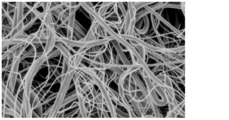
- thermoplastic resin fibers (A) thin fibers
- elastomer resin fibers (B) thin fibers
- the scale bar in the photograph indicates 100 ⁇ m.
- the ultrafine fiber layer contains at least one selected from the group consisting of hindered amine compounds for the purpose of improving weather resistance and improving electret performance.
- hindered amine compounds include poly [(6- (1,1,3,3-tetramethylbutyl) imino-1,3,5-triazine-2,4-diyl) ((2,2,6,6- Tetramethyl-4-piperidyl) imino) hexamethylene ((2,2,6,6-tetramethyl-4-piperidyl) imino)] (BASF Japan, “Kimasoap 944FDL”), dimethyl succinate-1- ( 2-hydroxyethyl) -4-hydroxy-2,2,6,6-tetramethylpiperidine polycondensate (manufactured by BASF Japan, “Tinuvine 622FS”), 2- (3,5-di-t-butyl-4 -Hydroxybenzyl) -2-n-butylmalonate bis (1,2,2,6,6-p
- the content of the hindered amine compound is not particularly limited, but is preferably in the range of 0.1 to 10% by mass, more preferably 0.5 to 5% by mass with respect to the resin of the ultrafine fiber layer. If the addition amount is 0.1% by mass or more, the effect of improving the electret performance can be obtained. Further, if the addition amount is 10% by mass or less, good spinnability can be obtained and the cost is advantageous.
- the hindered amine compound can be contained in the ultrafine fiber layer by blending in advance in either the thermoplastic resin (A) or the elastomer resin (B) and spinning.
- thermoplastic resin constituting the thermoplastic resin fiber (A) and the elastomer resin fiber (B) includes an antioxidant, a light stabilizer, an ultraviolet absorber, and a neutralizer within a range not impeding the effects of the present invention.
- An agent, a nucleating agent, an epoxy stabilizer, a lubricant, an antibacterial agent, a flame retardant, a pigment, a plasticizer, and other thermoplastic resins can be added.
- a cycloolefin copolymer can be added for the purpose of improving heat resistance and improving electret performance.
- the length of the short fibers constituting the hydrophilic short fiber layer is not particularly limited, but is preferably 2 to 100 mm.
- a fiber constituting the hydrophilic short fiber layer a short fiber having a length usually used according to a specific method for preparing the fiber layer, for example, a card web, an air lay web, a wet papermaking web, etc. Can be used.
- the hydrophilic fiber layer is composed of long fibers or continuous fibers, it is difficult to have extensibility that can follow the extensibility caused by the elastomer fibers in the integrated ultrafine fiber layer. Then, the extensibility of an ultrafine fiber layer can be reflected in the whole laminated nonwoven fabric sheet by comprising a hydrophilic fiber layer with a short fiber.
- cellulose fibers such as cotton and hemp, wool, silk, rayon, cupra, pulp, semi-synthetic fibers obtained using cellulose, and synthetic fibers are hydrophilized. These may be used, and two or more of these may be used. From the viewpoint of hydrophilicity, cotton, rayon, cupra and pulp are preferred.
- the hydrophilic short fiber layer contains, for example, 30% by mass or more of the above-mentioned hydrophilic short fibers in order to absorb moisture around the mouth due to exhaled air when used as a mask and reduce discomfort for the wearer. It is preferable that it contains 50% by mass or more. Moreover, you may mix fibers other than the said hydrophilic short fiber in the hydrophilic short fiber layer in the range which does not exceed 70 mass%. In particular, when the hydrophilic short fiber layer contains fibers other than hydrophilic short fibers in the range of 0 to 50% by mass, the mechanical strength and elongation of the hydrophilic short fiber layer are maintained at an appropriate level. However, it is more preferable because flexibility can be maintained. Examples of the fibers to be mixed include water-repellent synthetic fibers such as fibers obtained using polyester, polyolefin, polyamide, or a composite fiber obtained by combining two or more of these.
- the cross-sectional shape of the fiber contained in the hydrophilic short fiber layer is not particularly limited, and examples thereof include a round cross section, a flat cross section, an atypical cross section, and a hollow cross section.
- the fiber diameter is preferably in the range of 15 ⁇ m to 50 ⁇ m.
- the basis weight of the hydrophilic short fiber layer is preferably 10 to 100 g / m 2 when a laminated nonwoven fabric sheet is used as a mask. More preferably, it is 20 to 80 g / m 2 .
- the basis weight of the hydrophilic short fiber layer is 10 g / m 2 or more, it is preferable in terms of obtaining extensibility and flexibility, and if it is 100 g / m 2 or less, the product cost is suppressed and a compact laminated nonwoven fabric sheet is obtained. This is preferable.
- the hydrophilic short fiber layer preferably has extensibility in at least one direction.
- fiber layers include card webs in which short fibers are arranged in one direction, air-lay webs and wet papermaking webs in which short fibers are randomly collected, and needle punches or spunlaces of these fibers.
- Nonwoven fabrics obtained by three-dimensional entanglement by (water flow entanglement) or the like can be mentioned. Preference is given to wet papermaking webs or spunlace nonwovens.
- the spunlace nonwoven fabric obtained by performing hydroentanglement treatment on a card web in which short fibers are arranged in one direction and three-dimensionally interlacing the fibers has a balance between mechanical strength and flexibility. It is preferable because it is good.
- a laminated nonwoven fabric sheet having high extensibility in one direction can be obtained by employing a non-woven fabric having extensibility superior in a specific direction as the hydrophilic short fiber layer.
- the laminated nonwoven fabric sheet of the present invention is electret processed.
- Electret processing is a method of electrifying the laminated nonwoven fabric sheet by performing electret processing such as a thermal electret method in which a charge is applied in a heated atmosphere at which the low melting point component of the fiber does not melt or a corona discharge method in which a charge is applied by corona discharge. This is a process of charging.
- electret processing the collection performance of the nonwoven fabric sheet can be improved.
- the electret processing method is not limited to these.
- the nonwoven fabric sheet is electret-processed by performing the static elimination process of a laminated nonwoven fabric sheet and confirming the difference of the collection rate of the nonwoven fabric sheet before and behind static elimination process.
- the static elimination treatment for example, an IPA liquid immersion method or an IPA saturated vapor exposure method can be used.
- the nonwoven fabric sheet is immersed in an isopropyl alcohol (IPA) solution for 2 minutes, taken out, and then dried in the air for 24 hours.
- the IPA saturated vapor exposure method is performed by exposing a nonwoven fabric sheet to an IPA saturated vapor atmosphere at a temperature of 15 to 30 ° C. for 24 hours or more.
- the ultrafine fiber layer can be typically produced by a melt blow method in which long fibers are randomly collected.
- the thermoplastic resin fibers (A) and the elastomer resin fibers (B) constituting the ultrafine fiber layer may be mixed after being manufactured individually, but a nozzle having one spinning hole for discharging different kinds of fibers.
- a method in which these fibers are simultaneously spun by a melt blow method using so-called mixed fiber nozzles alternately arranged therein is preferred.
- thermoplastic resin fibers (A) and the elastomer resin fibers (B) are accumulated extremely uniformly and randomly. It is preferable that the elastomer resin fibers (B) are uniformly or randomly accumulated or mixed in the ultrafine fiber layer because high flexibility and extensibility can be obtained.
- the structure of the mixed fiber nozzle is not limited as long as different types of fibers can be spun simultaneously and can be collected uniformly and randomly.
- the fiber mixing nozzle for example, a nozzle in which spinning holes from which different kinds of resins flow out are alternately arranged in a row can be suitably used.
- a device in which a plurality of nozzles each having only a spinning hole through which one resin flows is arranged in the moving direction of the stacking conveyor is used to spin different resins from each nozzle.
- a method of mixing fibers by entanglement treatment of the obtained web laminate with a needle punch or the like can also be exemplified. From the viewpoint that no post-treatment is involved, the former nozzle in which the spinning holes from which different kinds of resins flow out are alternately arranged in a line in one nozzle is preferably used.
- the basis weight of the ultrafine fiber layer can be arbitrarily controlled by adjusting the speed of the accumulation conveyor. Further, an inert gas such as nitrogen gas or air is usually used as the gas for blow spinning.
- the temperature of the gas is about 200 to 500 ° C., preferably about 250 to 450 ° C., and the pressure is about 0.1 to 6.0 kgf / cm 2 (98 to 588 KPa), preferably about 0.2 to 5.5 kgf / cm. 2 (196 to 539 KPa).
- the spinning conditions are appropriately set depending on the physical properties and combination of the resins used, the target fiber diameter, the spinneret and other devices.
- the hydrophilic short fiber layer contained in the laminated nonwoven fabric sheet of the present invention is preferably a spunlace nonwoven fabric or a wet papermaking web, and the spunlace nonwoven fabric, for example, produces a fiber web containing the above-mentioned hydrophilic short fibers, and fibers After the web is subjected to fiber entanglement treatment such as hydroentanglement treatment, the fiber web is dried, and if necessary, it can be produced by thermally bonding the fibers with a low melting point component contained in the fiber.
- the fiber web is prepared by mixing the constituent fibers.
- the form of the fiber web may be any form selected from a card web such as a parallel web, a cross web, a semi-random web and a random web, an air lay web, a wet papermaking web, and a spunbond web.
- Hydroentanglement treatment is carried out by placing a fibrous web on a support and jetting a columnar water stream.
- the ultrafine fiber layer and the hydrophilic short fiber layer can be produced separately, and in the step of creating the ultrafine fiber layer by the melt blow method, a spunlace nonwoven fabric produced in advance is inserted, It is also preferable to laminate a melt blown nonwoven fabric directly thereon.
- the ultrafine fiber layer and the hydrophilic short fiber layer are integrated.
- a laminating means there are a heating oven method, a needle punch method, a spunlace method (hydroentanglement method), a method using ultrasonic waves, a method using an adhesive, and the like in addition to a method using a heating roll.
- the means for compositing in the production of the laminated nonwoven fabric sheet of the present invention is not particularly limited, but it is preferably used by using a heating roll whose surface is engraved in a concavo-convex shape (hereinafter sometimes referred to as “heated embossing roll”). It can be carried out.
- the partial thermocompression bonding using the embossing roll is preferably performed by pressure-bonding the heated embossing roll to the surface on the hydrophilic short fiber layer side.
- the other surface of the laminated nonwoven fabric is performed in contact with a roll having a surface engraved in a smooth shape or an uneven shape. It is also preferred that the roll is heated.
- Discontinuous and regular recesses due to this partial thermocompression bonding are formed on the surface of the laminated nonwoven fabric sheet of the present invention. Such recesses may be formed on both sides of the laminated nonwoven fabric sheet, or may be formed only on one side.
- the elastomer fibers in the ultrafine fibers are joined to the fibers constituting the hydrophilic short fiber layer by softening thereof, thereby the hydrophilic short fiber layer and The ultrafine fiber layer is integrated.
- the pressure and temperature for thermocompression bonding can be appropriately selected under the condition that the hydrophilic short fiber layer and the ultrafine fiber layer are integrated by softening of the elastomer fibers in the ultrafine fiber, but the linear pressure for partial thermocompression bonding is 5
- the temperature in the range of ⁇ 100 N / mm and the thermocompression bonding temperature are preferably higher than the melting point or softening point of the elastomer resin (B) and lower than the softening point of the thermoplastic resin (A).
- the above-described bonding is formed between the short fiber layers and the interlayer strength can be obtained.
- the electret processing can be performed with a known apparatus or conditions, and a specific method is not particularly limited, but for example, a thermal electret method, a corona discharge method, or the like can be used.
- the laminated nonwoven fabric sheet of the present invention When the laminated nonwoven fabric sheet of the present invention is used as a mask, the laminated nonwoven fabric sheet produced by the above method is cut into a predetermined size after various post-treatments, washing, drying and the like as necessary. Moreover, you may perform a pleating process and shaping
- the laminated nonwoven fabric sheet of the present invention can be suitably used for a mask such as a medical mask, an industrial mask, or a general mask. Further, depending on the required performance, the HEPA filter can be used for an air conditioner or air conditioning equipment. For these applications, it is also preferable to use the laminated nonwoven fabric sheet of the present invention after pleating.
- ⁇ Filter performance (collection performance, pressure loss)> The mask collection efficiency and pressure loss were measured using a TSI 8130 filter tester. Air containing NaCl aerosol (average particle size of 0.3 ⁇ m) generated by the testing machine was passed through the test sheet, and the collection efficiency of the sheet was measured. Moreover, the pressure loss at that time was measured. The air flow rate at this time was 85 L / min (measurement area 100 cm 2 ).
- ⁇ Average fiber diameter> Using a scanning electron microscope (SEM), an enlarged photograph of the nonwoven fabric surface was taken, the diameter of 100 fibers was measured, and the arithmetic average value was taken as the average fiber diameter.
- ⁇ Crimping area ratio> An enlarged photograph of the nonwoven fabric surface was taken using a scanning electron microscope (SEM), and the ratio of the crimping points to the area per unit crimping point pitch was defined as the crimping area ratio.
- Crimping area ratio (%) (crimping point area occupying unit pitch / unit pitch area) ⁇ 100 ⁇ Extension strength of laminated sheet> Measured according to JIS L1906 “General long fiber nonwoven fabric test method”. A test piece having a width of 25 mm and a length of 200 mm was prepared.
- the test piece is prepared by cutting the laminated sheet so that the length direction of the test piece coincides with the CD direction of the spunlace nonwoven fabric of the hydrophilic short fiber layer (direction orthogonal to the arrangement of the fibers in the nonwoven fabric). And those prepared so that the length direction of the test piece coincides with the MD direction of the spunlace nonwoven fabric of the hydrophilic short fiber layer (the direction in which the fibers in the nonwoven fabric are aligned in the same direction).
- Two types of test pieces were prepared. Using a tensile tester Autograph AG-G (trade name, manufactured by Shimadzu Corporation), the distance between chucks was set to 100 mm, and the test piece was fixed. The film was stretched at a pulling speed of 300 mm / min.
- the strength at 10% / 50% elongation was defined as the elongation modulus (stress) strength.
- elongation modulus (stress) strength elongation modulus (stress) strength.
- thermoplastic resin (A) is a blend of polypropylene (99.5% by mass) and hindered amine compound Kimasoap 944FDL (0.5% by mass).
- a polyethylene elastomer was used.
- a melt blown nonwoven fabric was produced using a nonwoven fabric production apparatus comprising a compressed air generator, an air heater, a collection conveyor equipped with a polyester net, and a winder.
- thermoplastic resin (A) is melted at 230 ° C. and thermoplastic resin (B) is melted at 230 ° C.
- the gear pump is thermoplastic resin (A) / thermoplastic resin (B).
- the mass ratio is set to 50/50%, molten resin is discharged from the spinneret at a rate of 0.3 g / min per single hole, and the discharged fiber is heated to 400 ° C. and compressed air of 98 kPa (gauge pressure).
- the basis weight was arbitrarily set by spraying onto a polyester conveyor set at a distance of 30 cm from the spinneret and adjusting the speed of the collecting conveyor.
- the hydrophilic short fiber layer is a rayon having a fiber length of 51 mm, a polyester having a fiber length of 51 mm, and extends in a direction perpendicular to the direction in which the fibers are arranged in one direction.
- a spunlace nonwoven fabric made of rayon / polyester having a weight per unit area of 38 g / m 2 (mixed cotton having a mass ratio of 60/40%) was inserted, and a melt blown nonwoven fabric of 30 g / m 2 was laminated thereon.
- the embossing roll is a point bond processing machine having an embossing (engraving) roll and a flat (smooth) roll engraved with a concavo-convex pattern on the surface of this nonwoven fabric laminate, at a temperature of 80/120 ° C. and a linear pressure of 40 N / mm.
- a laminated sheet was obtained by passing between an embossing roll having a pressure-bonding area ratio of the embossed convex part of 4.0% and the flat roll so as to be in contact with the spunlace nonwoven fabric.
- the obtained laminated sheet was electret processed using a thermal electret method.
- the laminated sheet is cut into A4 size, placed on a charge receiving table heated to 100 ° C., the charged electrode plate is placed 1 cm above the laminated sheet, and left for 10 minutes, then charged at ⁇ 10 kV, charged It was performed by applying a voltage for 5 seconds.
- Example 1 A laminated nonwoven fabric sheet was produced in the same manner as in Example 1 except that electret processing was not performed.
- Example 2 A laminated nonwoven fabric sheet was produced in the same manner as in Example 1 except that it did not contain a hindered amine compound.
- Example 3 A laminated nonwoven fabric sheet was produced in the same manner as in Example 1 except that the ultrafine fiber layer was composed only of the polyethylene-based elastomer resin (B) and no electret processing was performed.
- Example 4 A laminated nonwoven fabric sheet was produced in the same manner as in Example 1 except that the ultrafine fiber layer was composed only of the polyethylene-based elastomer resin (B).
- Example 5 A laminated nonwoven fabric sheet was prepared in the same manner as in Example 1 except that the ultrafine fiber layer was composed only of the thermoplastic resin (A) containing polypropylene (99.5% by mass) and Kima soap 944FDL (0.5% by mass). Produced.
- Table 1 shows the evaluation results of the laminated nonwoven fabric sheets of Example 1 and Comparative Examples 1 to 5.
- the laminated nonwoven sheet of Example 1 had high collection efficiency and low pressure loss. Moreover, the extension strength in the CD direction was low and the extension strength in the MD direction was high, that is, it had high extensibility in the CD direction. On the other hand, the comparative example 1 which does not perform electret processing had inadequate collection efficiency. In Comparative Example 2 containing no hindered amine, the collection efficiency was insufficient even when electret processing was performed, and the heat resistance stability was lacking. In Comparative Examples 3 and 4 in which the ultrafine fiber layer was composed only of an elastomer, the collection efficiency was insufficient regardless of the presence or absence of hindered amine and electret processing. Further, Comparative Example 5 in which the ultrafine fiber layer was composed only of PP had sufficient collection efficiency but had high elongation strength in both the CD direction and the MD direction, and had a hard tactile feel and insufficient fit.
- the laminated nonwoven fabric sheet of the present invention can be suitably used as a filter material for medical masks, industrial masks, general masks and the like. It can also be used as a high-performance air filter used in clean rooms, air purifiers, home appliances, and the like.
Landscapes
- Engineering & Computer Science (AREA)
- Textile Engineering (AREA)
- Health & Medical Sciences (AREA)
- Chemical Kinetics & Catalysis (AREA)
- Chemical & Material Sciences (AREA)
- General Health & Medical Sciences (AREA)
- Zoology (AREA)
- Pulmonology (AREA)
- Business, Economics & Management (AREA)
- Emergency Management (AREA)
- Life Sciences & Earth Sciences (AREA)
- Mechanical Engineering (AREA)
- Physical Education & Sports Medicine (AREA)
- Nonwoven Fabrics (AREA)
- Respiratory Apparatuses And Protective Means (AREA)
- Laminated Bodies (AREA)
Abstract
マスクのフィルター材として使用されうる不織布シートであって、高いダスト捕集性能と低い圧力損失を両立し、さらに、肌へのフィット性と柔軟性に優れたものを提供することを課題とする。 本発明は、極細繊維層と、親水性短繊維層とが一体化されてなる積層不織布シートであって、前記極細繊維層の片面又は両面に前記親水性短繊維層が積層され、前記極細繊維層は、熱可塑性樹脂繊維(A)20~80質量%と、当該熱可塑性樹脂(A)よりも低い温度で溶融又は軟化するエラストマー樹脂繊維(B)80~20質量%とが混繊されてなり、また、前記極細繊維層はヒンダードアミン系化合物を含有し、前記積層不織布シートは、エレクトレット加工されており、一方向の10%伸長強度と、当該一方向に対する垂直方向の10%伸長強度とが異なる、積層不織布シートを提供する。
Description
本発明は、複数の不織布が積層一体化された、積層不織布シートに関する。
従来、花粉や粉塵などの微細なダストを除去するためのマスクに、不織布シートが用いられている。マスクには、微細なダストを高効率で捕集するとともに、着用者に息苦しさを感じさせないように、気体が通過する際の吸気抵抗が少ないことが求められる。
例えば特許文献1には、最内層/フィルター層/最外層の少なくとも3層を有するプリーツ型衛生マスクであって、最内層の周縁部の人の頬に当たる部分にシール材を設置し、また、最内層と最外層の少なくとも一方が特定範囲の剛軟度を有し、フィルター層は特定範囲の圧力損失を有するものが開示されている。特許文献1のマスクは、マスク周縁部のシール材によってマスクと顔面との間の隙間を解消することによって、マスクの防御性を高めている。また、最内層又は最外層の不織布の剛性を高めることによって、マスクの保形性を高めている。
特許文献2には、不織布製の使い捨てマスクの弾性部材として、特定のオレフィン系共重合体成分と特定の熱可塑性エラストマー成分とを含む弾性不織布を用いるものが開示されている。特許文献2の発明は、エラストマー成分を含む不織布を用いることでフィット性を向上させるもので、オレフィン系共重合体成分とエラストマー成分とを予め配合し、軟化点以上の温度で溶融混錬したものを紡糸口金から押し出して不織布を作成することが開示されている。
また一方で、ダストの捕集性を高めるために、エレクトレット加工を施した不織布が公知である。特許文献3には、医療用マスクや産業用マスクのフィルター材である積層不織布であって、2種類の融点の異なる繊維を混繊して得られる平均繊維径が0.1~15μmの不織布Aの少なくとも片面に、平均繊維径が10μm~100μmで前記不織布Aを構成する繊維の平均繊維径よりも大きい平均繊維径の繊維からなる不織布Bを1層又は複数層積層し、エレクトレット加工を施した積層エレクトレット不織布が開示されている。
特許文献3の発明では、不織布A中に相対的に低融点の繊維を混繊することで、接着成分を使用することなく積層が可能となり、圧力損失を抑えたフィルター材が得られる。
特許文献3の発明では、不織布A中に相対的に低融点の繊維を混繊することで、接着成分を使用することなく積層が可能となり、圧力損失を抑えたフィルター材が得られる。
しかしながら、特許文献1のマスクでは、マスクと顔との隙間を埋めるようにシール材を設置しているところ、使用者の顔の形によっては具合よく配置されず、肌の一部分に負担がかかることや充分なシール効果が得られないことがあった。また、特許文献2のマスクは、一枚の不織布から口元被覆部と耳掛け部とが一体的に成形されるタイプのマスクであり、不織布に一定の強度と保形性が求められるため、肌へのフィット性は必ずしも十分でないうえに、微細なダストを高精度に捕集することは困難であった。さらに、特許文献3のフィルター材も、形状保持性が良好なポリエステルを主成分とするスパンボンド不織布を用いることから、マスクとして成形すると柔軟性に欠けることがあり、触感やフィット性は必ずしも十分とはいえないものだった。
前記のとおり、ダスト捕集性と通気性(低圧力損失)とを両立し、かつ、フィット性と柔軟性に優れたマスクとしてさらに優れたものが求められている。この実情に鑑み、本発明は、マスクのフィルター材として使用されうる不織布シートであって、高いダスト捕集性能と低い圧力損失を両立し、さらに、柔軟で、肌への追随性に優れたものを提供することを課題とする。
本発明者は前記の課題を解決するために検討を重ね、不織布に若干の伸長性を付与することによって、肌の動きに対する追随性が向上することを見出した。そして、不織布として、少なくとも一方向に優位な伸長性を有する親水性短繊維層と、熱可塑性樹脂とエラストマー樹脂とを含む極細繊維層とが積層一体化された不織布シートであって、エレクトレット加工を施したものは、ダスト捕集性能が高く、圧力損失が少なく、肌に対する追随性と触感に優れたものとなることを見出し、本発明を完成した。
すなわち、本発明は以下の構成を有する。
[1]極細繊維層と、親水性短繊維層とが一体化されてなる積層不織布シートであって、
前記極細繊維層の片面又は両面に前記親水性短繊維層が積層され、
前記極細繊維層は、熱可塑性樹脂繊維(A)20~80質量%と、当該熱可塑性樹脂(A)よりも低い温度で溶融又は軟化するエラストマー樹脂繊維(B)80~20質量%とが混繊されてなり、また、前記極細繊維層はヒンダードアミン系化合物を含有し、
前記積層不織布シートは、エレクトレット加工されており、
一方向の10%伸長強度と、当該一方向に対する垂直方向の10%伸長強度とが異なる、
積層不織布シート。
[2]前記極細繊維層と前記親水性短繊維層とが部分的熱圧着によって一体化されており、一方向の10%伸長強度が3N/25mm以下かつ50%伸長強度が10N/25mm以下であり、当該一方向に対して垂直方向の10%伸長強度が15N/25mm以上である、[1]に記載の積層不織布シート。
[3]前記積層不織布シートの表面に、不連続で規則的な凹部が形成され、前記表面に占める前記凹部の総面積が3~40%の範囲であり、
前記凹部のシート厚み方向において、前記極細繊維層中の前記エラストマー樹脂繊維(B)と、前記親水性短繊維層を構成する繊維とが接合し、前記親水性短繊維層と前期極細繊維層とが一体化されている、[1]または[2]に記載の積層不織布シート。
[4]前記親水性短繊維層が、コットン、レーヨン、キュプラ、もしくは、パルプ、又はこれらの2種以上の短繊維を少なくとも30質量%含む層である、[1]~[3]のいずれか1項に記載の積層不織布シート。
[5]前記親水性短繊維層が、スパンレース不織布または湿式抄紙ウェブである、[1]~[4]のいずれか1項に記載の積層不織布シート。
[6]前記極細繊維層が、長繊維をランダムに集積してなるメルトブロー不織布である、[1]~[5]のいずれか1項に記載の積層不織布シート。
[7][1]~[6]のいずれか1項に記載の積層不織布シートを含む、マスク。
[1]極細繊維層と、親水性短繊維層とが一体化されてなる積層不織布シートであって、
前記極細繊維層の片面又は両面に前記親水性短繊維層が積層され、
前記極細繊維層は、熱可塑性樹脂繊維(A)20~80質量%と、当該熱可塑性樹脂(A)よりも低い温度で溶融又は軟化するエラストマー樹脂繊維(B)80~20質量%とが混繊されてなり、また、前記極細繊維層はヒンダードアミン系化合物を含有し、
前記積層不織布シートは、エレクトレット加工されており、
一方向の10%伸長強度と、当該一方向に対する垂直方向の10%伸長強度とが異なる、
積層不織布シート。
[2]前記極細繊維層と前記親水性短繊維層とが部分的熱圧着によって一体化されており、一方向の10%伸長強度が3N/25mm以下かつ50%伸長強度が10N/25mm以下であり、当該一方向に対して垂直方向の10%伸長強度が15N/25mm以上である、[1]に記載の積層不織布シート。
[3]前記積層不織布シートの表面に、不連続で規則的な凹部が形成され、前記表面に占める前記凹部の総面積が3~40%の範囲であり、
前記凹部のシート厚み方向において、前記極細繊維層中の前記エラストマー樹脂繊維(B)と、前記親水性短繊維層を構成する繊維とが接合し、前記親水性短繊維層と前期極細繊維層とが一体化されている、[1]または[2]に記載の積層不織布シート。
[4]前記親水性短繊維層が、コットン、レーヨン、キュプラ、もしくは、パルプ、又はこれらの2種以上の短繊維を少なくとも30質量%含む層である、[1]~[3]のいずれか1項に記載の積層不織布シート。
[5]前記親水性短繊維層が、スパンレース不織布または湿式抄紙ウェブである、[1]~[4]のいずれか1項に記載の積層不織布シート。
[6]前記極細繊維層が、長繊維をランダムに集積してなるメルトブロー不織布である、[1]~[5]のいずれか1項に記載の積層不織布シート。
[7][1]~[6]のいずれか1項に記載の積層不織布シートを含む、マスク。
本発明の積層不織布シートは、高いダスト捕集性と低圧力損失とを両立し、柔軟で肌への追随性にも優れており、マスクのフィルター材として好適に用いることができる。また、本発明の積層不織布シートは、柔軟性に優れており、触感が良く肌当たりがソフトであるため、マスクに用いると着用感に優れる。
以下、本発明を詳細に説明する。
(積層不織布シート)
本発明の積層不織布シートは、極細繊維層及び親水性短繊維層の少なくとも2種類の層が、積層一体化されてなる。極細繊維層の片面又は両面に親水性短繊維層が積層されており、目的に応じてさらに異なる層が積層されていてもよい。極細繊維層と親水性短繊維層は互いに隣接していることが好ましいが、さらに異なる層を有する場合には、極細繊維層と親水性短繊維層との間に異なる層が存在し、極細繊維層と親水性短繊維層とが隣接しない形態であってもよい。極細繊維層は主に捕集層として機能し、親水性短繊維層は柔軟なカバー材であり補強層としても機能する。マスクとして成形される際には、極細繊維層と親水性短繊維層のどちらが着用者の肌に接する側に配置されてもよく、目的に応じて適宜配置することができる。
本発明の積層不織布シートは、極細繊維層及び親水性短繊維層の少なくとも2種類の層が、積層一体化されてなる。極細繊維層の片面又は両面に親水性短繊維層が積層されており、目的に応じてさらに異なる層が積層されていてもよい。極細繊維層と親水性短繊維層は互いに隣接していることが好ましいが、さらに異なる層を有する場合には、極細繊維層と親水性短繊維層との間に異なる層が存在し、極細繊維層と親水性短繊維層とが隣接しない形態であってもよい。極細繊維層は主に捕集層として機能し、親水性短繊維層は柔軟なカバー材であり補強層としても機能する。マスクとして成形される際には、極細繊維層と親水性短繊維層のどちらが着用者の肌に接する側に配置されてもよく、目的に応じて適宜配置することができる。
極細繊維層と親水性短繊維層を積層一体化する方法は特に限定されないが、通気性を保つために、熱圧着により一体化することが好ましく、ラテックス等の接着剤を使用しない事が好ましい。熱圧着は、熱と圧による加工方法であるため、溶着するエラストマー樹脂の融点より低い温度で加工できる利点がある。すなわち、熱圧着部分以外の繊維が熱により融着しないため、好適に用いられる。熱圧着する点接着部の一つあたりの面積は、特に制限されないが、例えば0.04~10mm2とすることができる。熱圧着する場合、全面を熱圧着することもできるが、一部分のみを部分的に熱圧着することが好ましい。熱圧着する部分の割合は、積層不織布シートの表面の3~40%とすることができ、4~25%であればより好ましい。熱圧着部の面積率が3%未満では積層不織布の剥離強度不足が懸念され、40%を大幅に超えると風合いを阻害する可能性がある。熱圧着部の具体的な形状や配置は、特に制限されるものではないが、例えば、丸や四角等の形状が不連続的に規則的に配置された形態とすることができる。熱圧着部は不織布シートの表面に凹部となって表れ、当該凹部においては、シートの厚み方向において、極細繊維層に含まれるエラストマー樹脂繊維と親水性短繊維層の繊維とが溶着し、接合している。
本発明の積層不織布シートは伸長性を有することが特徴であり、特に、特定方向に優位な伸長性を有することが好ましい。具体的には、積層不織布シートの一方向の10%伸長強度と、当該一方向に対する垂直方向の10%伸長強度とが互いに異なることが好ましい。10%伸長強度とは、積層不織布シートを自然長から10%伸長したときの応力である。同様に、50%伸長強度とは、積層不織布シートを自然長から50%伸長したときの応力である。
伸長強度の具体的な測定方法は後述される。
伸長強度の具体的な測定方法は後述される。
積層不織布シートの伸長強度は、目的に応じて適宜設定することができるが、例えば、一方向の10%伸長強度が3N/25mm以下かつ50%伸長強度が10N/25mm以下であり、当該一方向に対して垂直方向の10%伸長強度が15N/25mm以上であることが好ましい。すなわち、一方向には相対的に伸長強度が低く(伸長性が高く)、その垂直方向には伸長強度が高い(伸長性が低い)ものが好ましい。一方向の10%伸長強度が3N/25mm以下、50%伸長強度が10N/25mm以下であれば、例えば、敏感・繊細な皮膚の装着部位に、優しい極めて心地良い装着感を付与することが可能となる。また、垂直方向の10%伸長強度が15N/25mm以上であれば、殆ど不織布が伸長しないため、製品の加工ラインでの生産時、例えばロール状から引き出す際など、不織布の幅の変化の影響を受けずに生産できるため、高速での生産が可能となるため好ましい。積層不織布シートをマスクに用いる場合、伸長性が高い方向をマスクの上下方向に用いることによって、着用者が静止している際のフィット性に優れるだけでなく、口を動かす等の動作の際にもマスクが肌に追随しやすくなるため、好ましい。
前記の一方向における10%伸長強度及び50%伸長強度の下限は特に制限されるものではないが、製造時の走行中に湾曲やシワ入り等を抑制しながら柔軟性を保持できる点から、1N/25mm以上であることが好ましい。また前記の一方向に対する垂直方向の10%伸長強度の上限も、特に制限されないが、合理的な実施態様を考慮すると、30N/25mm以下であることが好ましい。
なお、本明細書において、「一方向」及び「一方向に対する垂直方向」とは、不織布シートの面内におけるいずれか一方向及びそれに直交する方向を意味しており、不織布シート面内のいずれの方向であってもよいが、典型的には、不織布シートのCD方向を「一方向」、同じくMD方向を「一方向に対する垂直方向」とすることができる。
積層不織布シートの目付は目的に応じて選択すればよく、特に制限されないが、マスクに用いる場合は例えば20~150g/m2程度であることが好ましい。より好ましくは30~120g/m2である。マスクに用いる場合には、要求されるダスト捕集性と通気性の程度から、前記の範囲が好ましい。
(極細繊維層)
本発明の積層不織布シートに含まれる極細繊維層は、熱可塑性樹脂繊維(A)20~80質量%と、当該熱可塑性樹脂(A)よりも低い温度で溶融又は軟化するエラストマー樹脂繊維(B)80~20質量%とが混繊されてなる。なお、本明細書において「混繊」とは、少なくとも2種類の繊維が均一に混合されて不織布を構成している状態をいう。
本発明の積層不織布シートに含まれる極細繊維層は、熱可塑性樹脂繊維(A)20~80質量%と、当該熱可塑性樹脂(A)よりも低い温度で溶融又は軟化するエラストマー樹脂繊維(B)80~20質量%とが混繊されてなる。なお、本明細書において「混繊」とは、少なくとも2種類の繊維が均一に混合されて不織布を構成している状態をいう。
熱可塑性樹脂繊維(A)の融点をa(℃)、エラストマー樹脂繊維(B)の融点をb(℃)とすると、a-bは、20~150℃であることが好ましく、30~120℃であればさらに好ましい。a-bが20℃以上の場合、極細繊維層と親水性短繊維層とを積層した時に、融点の高い熱可塑性樹脂繊維(A)を溶融させることなく一体化が可能である。これにより熱可塑性樹脂繊維(A)は繊維形態を保持し、充分な通気性を維持する事ができる。また、均一に混繊するためには熱可塑性樹脂(A)とエラストマー樹脂(B)を同一の紡糸口金から紡糸することが好ましいが、その場合に、樹脂の融点が互いに極端に異なると紡糸性が確保できにくくなる傾向となる。a-bが150℃以下であれば、充分な紡糸性が確保される。
極細繊維層は、熱可塑性樹脂繊維(A)と、当該熱可塑性樹脂(A)よりも低い温度で溶融又は軟化するエラストマー樹脂繊維(B)が混繊されていれば、その製法は限定されない。また、本発明の効果を妨げない範囲で極細繊維層中に熱可塑性樹脂(A)及びエラストマー樹脂繊維(B)以外の繊維が混繊されていてもよい。
極細繊維層は、長繊維をランダムに集積してなるメルトブロー法によって得られる不織布の層であるのが好ましい。典型的には、極細繊維層は、融点に20℃~150℃の差がある熱可塑性樹脂(A)及びエラストマー樹脂(B)を、それぞれ独立に溶融押出し、混繊メルトブロー紡糸口金から紡糸して得られ、さらに高温、高速の気体によって極細繊維流としてブロー紡糸し、捕集装置で捕集することによって、混繊不織布として得られる。混繊メルトブロー紡糸口金としては例えば、異なる複数の繊維成分紡糸用ホールが、交互に多数個一列に設けられているメルトブロー紡糸口金がある。
熱可塑性樹脂(A)としては、エラストマー樹脂(B)より融点が高く、紡糸可能な熱可塑性樹脂であれば特別な制限はない。例えばポリプロピレン、高密度ポリエチレン、低密度ポリエチレン、線状低密度ポリエチレン、プロピレンと他のオレフィンとの2または3元共重合体等のポリオレフィン類、ポリアミド類、ポリエチレンテレフタレート、ポリブチレンテレフタレート、ジオールとテレフタル酸/イソフタル酸等を共重合した低融点ポリエステル、ポリエステルエラストマー等のポリエステル類、フッ素樹脂、上記樹脂の混合物等が使用できる。これらの中でも、ポリオレフィンを主体とするものはエレクトレット性能を特に発揮する点から好ましく、さらにポリオレフィンの中では、耐熱性に優れ、細い繊維が紡糸し易いポリプロピレン系樹脂が好ましい。またポリマーの性質を損なわない範囲で他の成分が共重合されていてもよい。熱可塑性樹脂(A)の融点は、例えば80~270℃のものを用いることができる。
熱可塑性樹脂(A)よりも低い温度で溶融又は軟化するエラストマー樹脂(B)としては、例えば、ポリオレフィンエラストマー、ポリスチレンエラストマー、ポリエステルエラストマー、ポリアミドエラストマー、ポリウレタンエラストマー等を挙げることができる。特に細い繊維が紡糸し易いポリオレフィンエラストマーが好ましく、ポリマーの性質を損なわない範囲で他の成分が共重合されていてもよい。エラストマー樹脂(B)の融点は、例えば60~120℃であり、熱可塑性樹脂(A)の融点よりも低いものを用いる。
前記ポリオレフィンエラストマーとしては、オレフィンモノマーのランダム共重合体がある。ポリオレフィンエラストマーのランダム共重合体とは、2重結合を持つ炭化水素で、CnH2n(nは2以上の整数、上限は特に制限はないがn=10以下が好ましい。)で示されるエチレン、プロピレン、ブテン等のモノマーと、これら以外の少なくとも1種の他のモノマーとの共重合体であり、特にモノマーがランダムに配列したランダム共重合体である。
前記ランダム共重合体は、例えば、エチレンと炭素数3~10のオレフィンとの共重合体またはプロピレンと炭素数4~10のオレフィンとの共重合体が好ましい。更に、エチレンと炭素数3~10のオレフィンとからなる共重合体が好ましい。炭素数3~10のオレフィンとしては、例えばプロピレン、1-ブテン、3-メチル-1-ブテン、4-メチル-1-ブテン、1-ペンテン、1-ヘキセン、4-メチル-1-ペンテン、1-ヘプテン、1-オクテン、1-ノネン、1-デセン等が挙げられる。前記オレフィンの中では、特に1-ブテン、1-ペンテン、1-ヘキセン、1-オクテンが好ましい。特にこれらのオレフィンは、1種単独または2種以上を組み合わせて用いることができる。これらを組み合わせたエチレン-オクテン共重合体、エチレン-ブテン共重合体等のエチレン-オレフィン共重合体が好ましい。また本発明に用いられるエチレンと炭素数3~10のオレフィンとの共重合体またはプロピレンと炭素数4~10のオレフィンとの共重合体の分子量分布(Mw/Mn)は、紡糸性の点から1.5~4であることが好ましい。かかるポリオレフィン共重合体エラストマーの市販品としては、例えば“エンゲージ”(商品名、ザ・ダウケミカルカンパニー社製)、“ビスタマックス”(商品名、エクソンモービルコーポレーション社製)が例示される。また本発明で用いられるポリオレフィン共重合体はメタロセン触媒によって製造された共重合体であっても良い。なお、前記ポリオレフィンエラストマーには、オレフィンに架橋用ジエンモノマーを加えた三元共重合体も含まれ、具体的には、エチレン-プロピレン-ジエンゴム、エチレン-ブテン-ジエンゴムが例示される。
熱可塑性樹脂繊維(A)とエラストマー樹脂繊維(B)の質量比は、熱可塑性樹脂繊維(A)20~80質量%、エラストマー樹脂繊維(B)80~20質量%の範囲である。より好ましくは熱可塑性樹脂繊維(A)30~70質量%、エラストマー樹脂繊維(B)70~30質量%の範囲である。エラストマー樹脂繊維(B)は加熱によって溶融し、他の成分と接合するための接着成分として機能し、また、不織布シートの伸長性を与えるための伸長性成分として機能するところ、極細繊維層におけるエラストマー樹脂繊維(B)の割合が20質量%以上であれば、極細繊維層と親水性短繊維層の層間の接着力は十分強く、マスク成形時やプリーツ加工時等にこれらの層の剥離が発生することがなく、かつ、積層不織布シートに伸長性を発現させることができる。また極細繊維層中のエラストマー樹脂繊維(B)の質量比が80質量%以下であれば、接着成分であるエラストマー樹脂繊維(B)の溶融量が適度な範囲に保たれるので、圧力損失が増大することがない。エラストマー樹脂繊維(B)は、極細繊維層において、30~70質量%の範囲であることが、積層不織布シートの強度とフィルター性能のバランスの点で好ましい。
極細繊維層を構成する熱可塑性樹脂繊維(A)とエラストマー樹脂繊維(B)の繊維径は、互いに同じであっても異なっていてもよいが、熱可塑性樹脂繊維(A)の平均繊維径が0.5~10μm、好ましくは1~5μmであり、エラストマー樹脂繊維(B)の平均繊維径が2~20μm、好ましくは4~18μmであることが好ましい。なお、本明細書において「極細繊維」とは、平均繊維径が15μm以下の繊維を称しているが、かかる範囲の極細繊維の不織布層とすることによって、フィルター性能と柔軟性を兼ね備えた不織布を得ることができる。図1は、極細繊維層の一例を示す電子顕微鏡写真であり、熱可塑性樹脂繊維(A)(細い繊維)と、エラストマー樹脂繊維(B)(太い繊維)とが混繊されてなることがわかる。写真中のスケールバーは100μmを示す。
また、極細繊維層は、耐候性を向上させ、エレクトレット性能を向上させる目的から、ヒンダードアミン系化合物からなる群から選ばれる少なくとも一種を含有している。ヒンダードアミン系化合物としては、ポリ[(6-(1,1,3,3-テトラメチルブチル)イミノ-1,3,5-トリアジン-2,4-ジイル)((2,2,6,6-テトラメチル-4-ピペリジル)イミノ)ヘキサメチレン((2,2,6,6-テトラメチル-4-ピペリジル)イミノ)](BASFジャパン社製、“キマソープ944FDL”)、コハク酸ジメチル-1-(2-ヒドロキシエチル)-4-ヒドロキシ-2,2,6,6-テトラメチルピペリジン重縮合物(BASFジャパン社製、“チヌビン622FS”)、2-(3,5-ジ-t-ブチル-4-ヒドロキシベンジル)-2-n-ブチルマロン酸ビス(1,2,2,6,6-ペンタメチル-4-ピペリジル)(BASFジャパン社製、“チヌビン144”)などが挙げられる。
前記ヒンダードアミン系化合物の含有量は、特に限定されないが好ましくは極細繊維層の樹脂に対して0.1~10質量%、さらに好ましくは0.5~5質量%の範囲である。添加量が0.1質量%以上であれば、エレクトレット性能の向上効果が得られる。また、添加量が10質量%以下であれば、良好な紡糸性が得られ、かつコスト的にも有利である。ヒンダードアミン系化合物は、熱可塑性樹脂(A)及びエラストマー樹脂(B)のいずれかに予め配合しておき、紡糸することで、極細繊維層中に含有させることができる。
また、熱可塑性樹脂繊維(A)及びエラストマー樹脂繊維(B)を構成する熱可塑性樹脂には、本発明の効果を妨げない範囲内で、酸化防止剤、光安定剤、紫外線吸収剤、中和剤、造核剤、エポキシ安定剤、滑剤、抗菌剤、難燃剤、顔料、可塑剤及び他の熱可塑性樹脂等を添加することができる。また、耐熱性を向上させ、エレクトレット性能を向上させる目的からシクロオレフィンコポリマーを添加することができる。
(親水性短繊維層)
本発明の積層不織布シートに含まれる親水性短繊維層において、親水性短繊維層を構成する短繊維の長さは特に限定されないが、2~100mmであるのが好ましい。親水性短繊維層を構成する繊維として、繊維層を調製する際の具体的な手法、例えばカードウェブ、エアレイウェブ及び湿式抄紙ウェブ等の態様に応じて、通常使用される長さの短繊維を使用できる。親水性繊維層が長繊維や連続繊維で構成されている場合、一体化される極細繊維層中のエラストマー繊維に起因する伸長性に追随可能な程度の伸長性を有し難くなるところ、本発明では、親水性繊維層を短繊維で構成することによって、極細繊維層の伸長性を積層不織布シート全体に反映させることができる。
本発明の積層不織布シートに含まれる親水性短繊維層において、親水性短繊維層を構成する短繊維の長さは特に限定されないが、2~100mmであるのが好ましい。親水性短繊維層を構成する繊維として、繊維層を調製する際の具体的な手法、例えばカードウェブ、エアレイウェブ及び湿式抄紙ウェブ等の態様に応じて、通常使用される長さの短繊維を使用できる。親水性繊維層が長繊維や連続繊維で構成されている場合、一体化される極細繊維層中のエラストマー繊維に起因する伸長性に追随可能な程度の伸長性を有し難くなるところ、本発明では、親水性繊維層を短繊維で構成することによって、極細繊維層の伸長性を積層不織布シート全体に反映させることができる。
親水性短繊維層を構成する短繊維としては、コットン、麻等のセルロース繊維、ウール、シルク、レーヨン、キュプラ、パルプ及び、セルロースを用いて得られる半合成繊維、ならびに、合成繊維に親水化処理を施したものなどを用いることができ、これらの2種以上を用いてもよい。親水性の点で好ましいのは、コットン、レーヨン、キュプラ、パルプである。
親水性短繊維層には、例えば、マスクとして使用した際、呼気などによる口周りの湿気を吸収し、装着者の不快感を軽減するために、前記の親水性短繊維を30質量%以上含むことが好ましく、50質量%以上含むことがより好ましい。また、親水性短繊維層には、70質量%を超えない範囲で前記親水性短繊維以外の繊維を混合してもよい。特に、親水性短繊維層に、親水性短繊維以外の繊維が0~50質量%の範囲で含まれる場合には、親水性短繊維層の機械的強度や伸度を相応のレベルに保持しながら、柔軟性を維持できるためより好ましい。混合する繊維としては、ポリエステル、ポリオレフィン、もしくは、ポリアミドなどを用いて得られた繊維、または、これらを2種類以上組み合わせた複合繊維などの、撥水性の合成繊維を例示することができる。
親水性短繊維層に含まれる繊維の断面形状は、特に限定されるものではないが、丸断面、扁平断面、異型断面、中空断面等を挙げることができる。親水性繊維層に含まれる繊維の断面形状が丸断面の場合、その繊維径は、15μmより大きく50μm以下の範囲であることが好ましい。また、親水性短繊維層の目付は、積層不織布シートをマスクに用いる場合、10~100g/m2であることが好ましい。より好ましくは20~80g/m2である。親水性短繊維層の目付が10g/m2以上であれば伸長性や柔軟性が得られる点で好ましく、100g/m2以下であれば製品コストが抑制され、コンパクトな積層不織布シートが得られる点で好ましい。
また親水性短繊維層は、少なくとも一方向に伸長性を有することが好ましい。このような繊維層としては、短繊維が一方向に配列してなるカードウェブや、短繊維がランダムに集積しているエアレイウェブや湿式抄紙ウェブ、及び、これらの繊維をニードルパンチやスパンレース(水流交絡)等によって三次元交絡させて得られる不織布などを挙げることができる。好ましいのは、湿式抄紙ウェブまたはスパンレース不織布である。本発明では、特に、短繊維が一方向に配列してなるカードウェブに水流交絡処理を行って当該繊維を三次元交絡させて得られたスパンレース不織布が、機械的強度と柔軟性のバランスが良好であるため、好ましい。本発明では、親水性短繊維層として特定方向に優位な伸長性を有する不織布を採用することによって、一方向への伸長性が高い積層不織布シートを得ることができる。
(エレクトレット加工)
本発明の積層不織布シートは、エレクトレット加工されている。エレクトレット加工とは、繊維の低融点成分が溶融しない温度の加熱雰囲気下で電荷を与える熱エレクトレット法や、コロナ放電によって電荷を与えるコロナ放電法等のエレクトレット加工を行うことで積層不織布シートに電荷を帯電させる加工である。エレクトレット加工によって、特に不織布シートの捕集性能を向上させることができる。但し、エレクトレット加工法についてはこれらに限定されるものではない。なお、不織布シートがエレクトレット加工されているかどうかについては例えば、積層不織布シートの除電処理を行い、除電処理前後の不織布シートの捕集率の差を確認することによって、確認することができる。除電処理としては例えば、IPA液浸漬法又はIPA飽和蒸気暴露法によることができる。IPA液浸漬法は、不織布シートをイソプロピルアルコール(IPA)の液中に2分間浸漬し、取り出した後、24時間大気中で乾燥することによる。IPA飽和蒸気暴露法は、不織布シートを15~30℃の温度下でIPA飽和蒸気雰囲気に24時間以上曝露することによって行う。
本発明の積層不織布シートは、エレクトレット加工されている。エレクトレット加工とは、繊維の低融点成分が溶融しない温度の加熱雰囲気下で電荷を与える熱エレクトレット法や、コロナ放電によって電荷を与えるコロナ放電法等のエレクトレット加工を行うことで積層不織布シートに電荷を帯電させる加工である。エレクトレット加工によって、特に不織布シートの捕集性能を向上させることができる。但し、エレクトレット加工法についてはこれらに限定されるものではない。なお、不織布シートがエレクトレット加工されているかどうかについては例えば、積層不織布シートの除電処理を行い、除電処理前後の不織布シートの捕集率の差を確認することによって、確認することができる。除電処理としては例えば、IPA液浸漬法又はIPA飽和蒸気暴露法によることができる。IPA液浸漬法は、不織布シートをイソプロピルアルコール(IPA)の液中に2分間浸漬し、取り出した後、24時間大気中で乾燥することによる。IPA飽和蒸気暴露法は、不織布シートを15~30℃の温度下でIPA飽和蒸気雰囲気に24時間以上曝露することによって行う。
(積層不織布シートの製造方法)
本発明の積層不織布シートを製造する方法は特に制限されないが、例えば次の方法に従って製造することができる。
極細繊維層は、典型的には長繊維をランダムに集積させるメルトブロー法によって製造できる。極細繊維層を構成する熱可塑性樹脂繊維(A)及びエラストマー樹脂繊維(B)は、それぞれを個別に製造した後に混合しても良いが、異種の繊維を吐出する為の紡糸孔が1つのノズル中に交互に配列したいわゆる混繊用ノズルを用いてこれらの繊維を同時にメルトブロー法で紡糸する方法が好ましい。この方法によれば、熱可塑性樹脂繊維(A)及びエラストマー樹脂繊維(B)が極めて均一にランダムに集積した極細繊維層を得ることができる。エラストマー樹脂繊維(B)が極細繊維層中で均一にランダムに集積ないし混合されていると、高度な柔軟性や伸長性が得られるため、好ましい。
本発明の積層不織布シートを製造する方法は特に制限されないが、例えば次の方法に従って製造することができる。
極細繊維層は、典型的には長繊維をランダムに集積させるメルトブロー法によって製造できる。極細繊維層を構成する熱可塑性樹脂繊維(A)及びエラストマー樹脂繊維(B)は、それぞれを個別に製造した後に混合しても良いが、異種の繊維を吐出する為の紡糸孔が1つのノズル中に交互に配列したいわゆる混繊用ノズルを用いてこれらの繊維を同時にメルトブロー法で紡糸する方法が好ましい。この方法によれば、熱可塑性樹脂繊維(A)及びエラストマー樹脂繊維(B)が極めて均一にランダムに集積した極細繊維層を得ることができる。エラストマー樹脂繊維(B)が極細繊維層中で均一にランダムに集積ないし混合されていると、高度な柔軟性や伸長性が得られるため、好ましい。
混繊ノズルは、異種の繊維を同時に紡糸し、それらを均一にランダムに集積させることができるようなものである限り、その構造は限定されない。混繊ノズルとして、例えば、異種の樹脂が流れ出す紡糸孔が、一つのノズル内に、交互に一列に配列したノズルなどを好適に用いることができる。また別の態様として、一つの樹脂が流れだす紡糸孔のみを一つのノズル内に有する複数のノズルが、集積コンベアーの移動方向に複数配列した装置を用い、個々のノズルから互いに異なる樹脂を紡糸し、得られるウェブの積層物をニードルパンチ等で交絡処理をすることで、繊維同士の混繊を行う方法も例示することができる。後処理を伴わないという点において、前者の、異種の樹脂が流れ出す紡糸孔が一つのノズル内で交互に一列に配列したノズルが好適に用いられる。
極細繊維層の目付は、集積コンベアーの速度を調整することによって任意にコントロール可能である。また、ブロー紡糸する際の気体は通常、窒素ガス等の不活性気体や、空気が使用される。該気体の温度は約200~500℃、好ましくは約250~450℃、圧力は約0.1~6.0kgf/cm2(98~588KPa)、好ましくは約0.2~5.5kgf/cm2(196~539KPa)である。この紡糸条件は、使用する樹脂の物性や組合せ、目的とする繊維径、紡糸口金等の装置等により、適宜設定される。
本発明の積層不織布シートに含まれる親水性短繊維層は、スパンレース不織布又は湿式抄紙ウェブあることが好ましく、スパンレース不織布は、例えば、上述の親水性短繊維を含む繊維ウェブを作製し、繊維ウェブを水流交絡処理などの繊維交絡処理に付した後、繊維ウェブを乾燥し、必要があれば、かかる繊維に含まれる低融点成分により繊維同士を熱接着させることにより製造され得る。
繊維ウェブは、構成繊維を混合して作製する。繊維ウェブの形態は、パラレルウェブ、クロスウェブ、セミランダムウェブおよびランダムウェブ等のカードウェブ、エアレイウェブ、湿式抄紙ウェブ、ならびにスパンボンドウェブ等から選択されるいずれの形態であってもよい。水流交絡処理は、支持体に繊維ウェブを載せて、柱状水流を噴射することにより実施する。
極細繊維層と親水性短繊維層とは、別々に製造することも可能であり、また、メルトブロー法で極細繊維層を作成する工程において、予め製造したスパンレース不織布を挿入し、スパンレース不織布の上に直接メルトブロー不織布を積層させることも好ましい。
次いで、極細繊維層と親水性短繊維層とを一体化させる。積層手段としては、加熱ロールを用いる方法のほか、加熱オーブン方式、ニードルパンチ方式、スパンレース方式(水流交絡方式)、超音波による方法や、接着剤を用いる方法などがある。本発明の積層不織布シートの製造における複合化の手段は、特に限定されないが、ロール表面が凹凸形状に彫刻された加熱ロール(以降、「加熱エンボスロール」という場合がある。)を用いて好適に行うことができる。エンボスロールを用いた部分的熱圧着は、その加熱エンボスロールを、親水性短繊維層側の表面に圧着することによって行うことが好ましい。このとき、積層された不織布の他方の面は、平滑形状または凹凸形状に彫刻された表面を有するロール等に接して行われる。当該ロールも加熱されていることも好ましい。
本発明の積層不織布シートの表面には、この部分的熱圧着に起因する不連続で規則的な凹部が形成される。かかる凹部は、積層不織布シートの両面に形成されていてもよいし、片面のみに形成されていてもよい。
積層不織布シートは、前述の凹部が存する部位のシート厚み方向において、少なくとも極細繊維中のエラストマー繊維がその軟化によって親水性短繊維層を構成する繊維と接合し、これによって、親水性短繊維層と極細繊維層とが一体化される。熱圧着の圧力及び温度は、親水性短繊維層と極細繊維層とが、極細繊維中のエラストマー繊維の軟化によって一体化するような条件において適宜選択できるが、部分的熱圧着の線圧が5~100N/mmの範囲、熱圧着の温度は、エラストマー樹脂(B)の融点又は軟化点以上、かつ熱可塑性樹脂(A)の軟化点以下の温度であるのが好ましく、極細繊維層と親水性短繊維層との間に上記接合が形成されて層間強度が得られる範囲であれば特に限定はない。
エレクトレット加工は公知の装置ないし条件で行うことができ、具体的な方法は特に制限されないが、例えば、熱エレクトレット法や、コロナ放電法等を用いることができる。
本発明の積層不織布シートをマスクに用いる場合には、前記の方法で製造した積層不織布シートについて必要に応じて各種の後処理加工、洗浄、乾燥等の上、所定の大きさに裁断する。また、プリーツ加工や成形を行ってもよい。プリーツ加工においては、折り畳んだ不織布シートの折り目部分や裁断部の端等を熱プレスし、熱圧着させてもよい。また、同時に又は別工程として、耳掛け部やその他別のパーツを熱圧着し、一体化させることができる。
本発明の積層不織布シートは、医療用マスクや産業用マスク、一般用マスク等のマスクに好適に用いることができる。また、要求される性能との適合によっては、エアコンや空調設備に用いられるHEPAフィルターにすることができる。これらの用途に対しては、本発明の積層不織布シートをプリーツ加工して用いることも好ましい。
下記の実施例は、例示を目的としたものに過ぎない。本発明の範囲は、本実施例に限定されない。なお、実施例中に示した物性値の測定方法または定義を以下に示す。
<フィルター性能(捕集性能・圧力損失)>
TSI8130型フィルター試験機を用いて、マスクの捕集効率及び圧力損失を測定した。同試験機にて発生させたNaClエアロゾル(平均粒子径0.3μm)を含むエアを、試験シートに通過させ、シートの捕集効率を測定した。また、その際の圧力損失を測定した。このときのエアの流量は、85L/min(測定面積100cm2)とした。
<平均繊維径>
走査型電子顕微鏡(SEM)を用いて、不織布表面の拡大写真を撮影し、100本の繊維の直径を測定し、その算術平均値を平均繊維径とした。
<圧着面積率>
走査型電子顕微鏡(SEM)を用いて、不織布表面の拡大写真を撮影し、圧着点が単位圧着点ピッチあたりの面積を占める割合を圧着面積率とした。
圧着面積率(%)=(単位ピッチを占める圧着点面積/単位ピッチの面積)×100
<積層シートの伸長強度>
JIS L1906「一般長繊維不織布 試験方法」に準拠して測定した。幅25mm、長さ200mmの試験片を作成した。試験片は、積層シートから、その試験片の長さ方向と親水性短繊維層のスパンレース不織布のCD方向(不織布中の繊維の配列と直交する方向)とが一致するように裁断して作成したもの、および、試験片の長さ方向と親水性短繊維層のスパンレース不織布のMD方向(不織布中の繊維が同じ方向に配列している方向)とが一致するように作成したもの、の2種類の試験片を準備した。
引張試験機オートグラフAG-G(商品名、(株)島津製作所製)を用いて、チャック間を100mmに設定し試験片を固定した。引張速度300mm/分で伸長させた。また、10%・50%伸長時の強度を伸長モジュラス(応力)強度とした。
<耐熱安定性(100℃熱処理)>
コンベンションオーブン(型式:MOV-112F・SANYO製)を用いて、エレクトレット加工後のシートを100℃雰囲気下で10分間放置、シートを取り出し10分間冷却後にフィルター性能を測定した。
TSI8130型フィルター試験機を用いて、マスクの捕集効率及び圧力損失を測定した。同試験機にて発生させたNaClエアロゾル(平均粒子径0.3μm)を含むエアを、試験シートに通過させ、シートの捕集効率を測定した。また、その際の圧力損失を測定した。このときのエアの流量は、85L/min(測定面積100cm2)とした。
<平均繊維径>
走査型電子顕微鏡(SEM)を用いて、不織布表面の拡大写真を撮影し、100本の繊維の直径を測定し、その算術平均値を平均繊維径とした。
<圧着面積率>
走査型電子顕微鏡(SEM)を用いて、不織布表面の拡大写真を撮影し、圧着点が単位圧着点ピッチあたりの面積を占める割合を圧着面積率とした。
圧着面積率(%)=(単位ピッチを占める圧着点面積/単位ピッチの面積)×100
<積層シートの伸長強度>
JIS L1906「一般長繊維不織布 試験方法」に準拠して測定した。幅25mm、長さ200mmの試験片を作成した。試験片は、積層シートから、その試験片の長さ方向と親水性短繊維層のスパンレース不織布のCD方向(不織布中の繊維の配列と直交する方向)とが一致するように裁断して作成したもの、および、試験片の長さ方向と親水性短繊維層のスパンレース不織布のMD方向(不織布中の繊維が同じ方向に配列している方向)とが一致するように作成したもの、の2種類の試験片を準備した。
引張試験機オートグラフAG-G(商品名、(株)島津製作所製)を用いて、チャック間を100mmに設定し試験片を固定した。引張速度300mm/分で伸長させた。また、10%・50%伸長時の強度を伸長モジュラス(応力)強度とした。
<耐熱安定性(100℃熱処理)>
コンベンションオーブン(型式:MOV-112F・SANYO製)を用いて、エレクトレット加工後のシートを100℃雰囲気下で10分間放置、シートを取り出し10分間冷却後にフィルター性能を測定した。
実施例及び比較例には、以下の材料を用いた。
<極細繊維層>
・ポリプロピレン樹脂(融点166℃、ポリプロピレンホモポリマー、MFR=82(JIS K-7210(1999)230℃/10分)
・エラストマー樹脂(融点100℃、ポリエチレン系エラストマー、ダウケミカル社製「ENGAGE8402」、MFR=30(JIS K-7210(1999)190℃/10分)
・ヒンダードアミン系化合物(BASFジャパン社製「キマソープ944FDL」)
<親水性短繊維層>
・レーヨン/PET(質量比60/40%)スパンレース不織布(目付38g/m2、繊維長51mm、瑞光社製)
<極細繊維層>
・ポリプロピレン樹脂(融点166℃、ポリプロピレンホモポリマー、MFR=82(JIS K-7210(1999)230℃/10分)
・エラストマー樹脂(融点100℃、ポリエチレン系エラストマー、ダウケミカル社製「ENGAGE8402」、MFR=30(JIS K-7210(1999)190℃/10分)
・ヒンダードアミン系化合物(BASFジャパン社製「キマソープ944FDL」)
<親水性短繊維層>
・レーヨン/PET(質量比60/40%)スパンレース不織布(目付38g/m2、繊維長51mm、瑞光社製)
[実施例1]
極細繊維層の原料としては、熱可塑性樹脂(A)としてポリプロピレン(99.5質量%)とヒンダードアミン系化合物であるキマソープ944FDL(0.5質量%)のブレンド品を用い、熱可塑性樹脂(B)としてポリエチレン系エラストマーを用いた。スクリュー(50mm径)、加熱体及びギアポンプを有する2機の押出機、混繊用紡糸口金(孔径0.3mm、孔数501ホールが一列、異成分繊維が交互に一列に並んだ、有効幅500mm)、圧縮空気発生装置及び空気加熱機、ポリエステル製ネットを備えた捕集コンベアー、及び巻取り機からなる不織布製造装置を用いてメルトブロー不織布の製造を行った。
それぞれの押出機に原料樹脂を投入し、熱可塑性樹脂(A)を230℃、熱可塑性樹脂(B)を230℃で加熱溶融させ、ギアポンプを熱可塑性樹脂(A)/熱可塑性樹脂(B)の質量比が50/50%になる様に設定し、紡糸口金から単孔あたり0.3g/minで溶融樹脂を吐出させ、吐出した繊維を400℃に加熱した98kPa(ゲージ圧)の圧縮空気によって紡糸口金から30cmの距離に設定したポリエステル製コンベアー上に吹き付け、捕集コンベアーの速度を調整する事によって、任意に目付を設定した。
前記方法のメルトブロー不織布を製造する過程において、親水性短繊維層として、繊維長が51mmのレーヨン、繊維長が51mmのポリエステルで、繊維が一方向に配列している方向とは直角する方向に伸長性を有する、目付38g/m2のレーヨン/ポリエステル(質量比60/40%の混綿)からなる、スパンレース不織布を挿入し、その上に30g/m2のメルトブローン不織布を積層させた。さらにこの不織布の積層物に表面に凹凸模様が彫刻されたエンボス(彫刻)ロールとフラット(平滑)ロールを持つポイントボンド加工機で、温度80/120℃、線圧40N/mmで、エンボスロールがスパンレース不織布に接するようにして、エンボス凸部の圧着面積率が4.0%のエンボスロールと上記フラットロールの間を通過させることにより積層シートを得た。
得られた積層シートを、熱エレクトレット法を用いてエレクトレット加工した。エレクトレット加工は、積層シートをA4サイズに切り出し、100℃に加温された電荷受台上に設置し、帯電電極板を積層シートの1cm上方に設置し、10分間放置後、電圧-10kV、帯電時間5秒で電圧を印加することで行った。
極細繊維層の原料としては、熱可塑性樹脂(A)としてポリプロピレン(99.5質量%)とヒンダードアミン系化合物であるキマソープ944FDL(0.5質量%)のブレンド品を用い、熱可塑性樹脂(B)としてポリエチレン系エラストマーを用いた。スクリュー(50mm径)、加熱体及びギアポンプを有する2機の押出機、混繊用紡糸口金(孔径0.3mm、孔数501ホールが一列、異成分繊維が交互に一列に並んだ、有効幅500mm)、圧縮空気発生装置及び空気加熱機、ポリエステル製ネットを備えた捕集コンベアー、及び巻取り機からなる不織布製造装置を用いてメルトブロー不織布の製造を行った。
それぞれの押出機に原料樹脂を投入し、熱可塑性樹脂(A)を230℃、熱可塑性樹脂(B)を230℃で加熱溶融させ、ギアポンプを熱可塑性樹脂(A)/熱可塑性樹脂(B)の質量比が50/50%になる様に設定し、紡糸口金から単孔あたり0.3g/minで溶融樹脂を吐出させ、吐出した繊維を400℃に加熱した98kPa(ゲージ圧)の圧縮空気によって紡糸口金から30cmの距離に設定したポリエステル製コンベアー上に吹き付け、捕集コンベアーの速度を調整する事によって、任意に目付を設定した。
前記方法のメルトブロー不織布を製造する過程において、親水性短繊維層として、繊維長が51mmのレーヨン、繊維長が51mmのポリエステルで、繊維が一方向に配列している方向とは直角する方向に伸長性を有する、目付38g/m2のレーヨン/ポリエステル(質量比60/40%の混綿)からなる、スパンレース不織布を挿入し、その上に30g/m2のメルトブローン不織布を積層させた。さらにこの不織布の積層物に表面に凹凸模様が彫刻されたエンボス(彫刻)ロールとフラット(平滑)ロールを持つポイントボンド加工機で、温度80/120℃、線圧40N/mmで、エンボスロールがスパンレース不織布に接するようにして、エンボス凸部の圧着面積率が4.0%のエンボスロールと上記フラットロールの間を通過させることにより積層シートを得た。
得られた積層シートを、熱エレクトレット法を用いてエレクトレット加工した。エレクトレット加工は、積層シートをA4サイズに切り出し、100℃に加温された電荷受台上に設置し、帯電電極板を積層シートの1cm上方に設置し、10分間放置後、電圧-10kV、帯電時間5秒で電圧を印加することで行った。
[比較例1]
エレクトレット加工を行わないこと以外は実施例1と同様にして、積層不織布シートを作製した。
エレクトレット加工を行わないこと以外は実施例1と同様にして、積層不織布シートを作製した。
[比較例2]
ヒンダードアミン系化合物を含まないこと以外は実施例1と同様にして、積層不織布シートを作製した。
ヒンダードアミン系化合物を含まないこと以外は実施例1と同様にして、積層不織布シートを作製した。
[比較例3]
極細繊維層を、ポリエチレン系エラストマー樹脂(B)のみで構成し、エレクトレット加工を行わないこと以外は実施例1と同様にして、積層不織布シートを作製した。
極細繊維層を、ポリエチレン系エラストマー樹脂(B)のみで構成し、エレクトレット加工を行わないこと以外は実施例1と同様にして、積層不織布シートを作製した。
[比較例4]
極細繊維層を、ポリエチレン系エラストマー樹脂(B)のみで構成すること以外は実施例1と同様にして、積層不織布シートを作製した。
極細繊維層を、ポリエチレン系エラストマー樹脂(B)のみで構成すること以外は実施例1と同様にして、積層不織布シートを作製した。
[比較例5]
極細繊維層を、ポリプロピレン(99.5質量%)とキマソープ944FDL(0.5質量%)を含む熱可塑性樹脂(A)のみで構成すること以外は実施例1と同様にして、積層不織布シートを作製した。
極細繊維層を、ポリプロピレン(99.5質量%)とキマソープ944FDL(0.5質量%)を含む熱可塑性樹脂(A)のみで構成すること以外は実施例1と同様にして、積層不織布シートを作製した。
実施例1及び比較例1~5の積層不織布シートの評価結果を表1に示す。

表1に示されるとおり、実施例1の積層不織布シートは、捕集効率が高く、かつ、圧力損失が低かった。また、CD方向への伸長強度が低く、MD方向への伸長強度が高く、すなわち、CD方向に高い伸長性を有するものであった。一方、エレクトレット加工を行わない比較例1は捕集効率が不十分であった。ヒンダードアミンを含まない比較例2は、エレクトレット加工を行っても捕集効率が不足し、耐熱安定性に欠けた。極細繊維層をエラストマーのみで構成した比較例3,4は、ヒンダードアミン及びエレクトレット加工の有無に関わらず、捕集効率が不十分であった。また、極細繊維層をPPのみで構成した比較例5は、捕集効率は充分であるがCD方向、MD方向ともに伸長強度が高く、硬い触感でフィット性が不十分であった。
本発明の積層不織布シートは、医療用マスクや産業用マスク、一般用マスク等のフィルター素材として好適に用いることができる。また、クリーンルームや空気清浄機、家電製品等に用いられる高性能のエアーフィルターとして用いることも可能である。
Claims (7)
- 極細繊維層と、親水性短繊維層とが一体化されてなる積層不織布シートであって、
前記極細繊維層の片面又は両面に前記親水性短繊維層が積層され、
前記極細繊維層は、熱可塑性樹脂繊維(A)20~80質量%と、当該熱可塑性樹脂(A)よりも低い温度で溶融又は軟化するエラストマー樹脂繊維(B)80~20質量%とが混繊されてなり、また、前記極細繊維層はヒンダードアミン系化合物を含有し、
前記積層不織布シートは、エレクトレット加工されており、
一方向の10%伸長強度と、当該一方向に対する垂直方向の10%伸長強度とが異なる、
積層不織布シート。 - 前記極細繊維層と前記親水性短繊維層とが部分的熱圧着によって一体化されており、一方向の10%伸長強度が3N/25mm以下かつ50%伸長強度が10N/25mm以下であり、当該一方向に対して垂直方向の10%伸長強度が15N/25mm以上である、
請求項1に記載の積層不織布シート。 - 前記積層不織布シートの表面に、不連続で規則的な凹部が形成され、前記表面に占める前記凹部の総面積が3~40%の範囲であり、
前記凹部のシート厚み方向において、前記極細繊維層中の前記エラストマー樹脂繊維(B)と、前記親水性短繊維層を構成する繊維とが接合し、前記親水性短繊維層と前期極細繊維層とが一体化されている、請求項1又は2に記載の積層不織布シート。 - 前記親水性短繊維層が、コットン、レーヨン、キュプラ、もしくは、パルプ、又はこれらの2種以上の短繊維を少なくとも30質量%含む層である、請求項1~3のいずれか1項に記載の積層不織布シート。
- 前記親水性短繊維層が、スパンレース不織布または湿式抄紙ウェブである、請求項1~4のいずれか1項に記載の積層不織布シート。
- 前記極細繊維層が、長繊維をランダムに集積してなるメルトブロー不織布である、請求項1~5のいずれか1項に記載の積層不織布シート。
- 請求項1~6のいずれか1項に記載の積層不織布シートを含む、マスク。
Priority Applications (3)
| Application Number | Priority Date | Filing Date | Title |
|---|---|---|---|
| KR1020197016778A KR20190085026A (ko) | 2016-11-21 | 2017-11-09 | 적층 부직포 시트 |
| CN201780071149.0A CN110036147A (zh) | 2016-11-21 | 2017-11-09 | 层叠不织布片 |
| US16/462,245 US20200018001A1 (en) | 2016-11-21 | 2017-11-09 | Laminated nonwoven fabric sheet |
Applications Claiming Priority (2)
| Application Number | Priority Date | Filing Date | Title |
|---|---|---|---|
| JP2016-226101 | 2016-11-21 | ||
| JP2016226101A JP6730677B2 (ja) | 2016-11-21 | 2016-11-21 | 積層不織布シート |
Publications (1)
| Publication Number | Publication Date |
|---|---|
| WO2018092666A1 true WO2018092666A1 (ja) | 2018-05-24 |
Family
ID=62145893
Family Applications (1)
| Application Number | Title | Priority Date | Filing Date |
|---|---|---|---|
| PCT/JP2017/040368 Ceased WO2018092666A1 (ja) | 2016-11-21 | 2017-11-09 | 積層不織布シート |
Country Status (6)
| Country | Link |
|---|---|
| US (1) | US20200018001A1 (ja) |
| JP (1) | JP6730677B2 (ja) |
| KR (1) | KR20190085026A (ja) |
| CN (1) | CN110036147A (ja) |
| TW (1) | TW201818999A (ja) |
| WO (1) | WO2018092666A1 (ja) |
Cited By (3)
| Publication number | Priority date | Publication date | Assignee | Title |
|---|---|---|---|---|
| CN115813064A (zh) * | 2022-12-05 | 2023-03-21 | 广煜医药科技(宁夏)有限公司 | 一种抗菌阻燃口罩及其制备方法 |
| JP2023551364A (ja) * | 2020-10-30 | 2023-12-08 | ナイキ イノベイト シーブイ | 非対称面複合不織テキスタイル及びその製造方法 |
| TWI853871B (zh) * | 2018-12-28 | 2024-09-01 | 日商可樂麗可樂富麗世股份有限公司 | 纖維構造物、使用其之過濾片及口罩 |
Families Citing this family (11)
| Publication number | Priority date | Publication date | Assignee | Title |
|---|---|---|---|---|
| DE102018103682A1 (de) * | 2018-02-19 | 2019-08-22 | Twe Gmbh & Co. Kg | Filtermedium |
| JP7032963B2 (ja) * | 2018-03-12 | 2022-03-09 | 呉羽テック株式会社 | フィルター補強材及びこれを含む脱臭フィルター用濾材 |
| EP3960025B1 (en) * | 2019-04-26 | 2024-02-21 | Kuraray Kuraflex Co., Ltd. | Fiber layered body and production method therefor |
| CN110629401B (zh) * | 2019-09-23 | 2020-07-24 | 晋江市达亿经编织造有限公司 | 一种抗菌纺织材料及其制备方法 |
| CN110983628B (zh) * | 2019-11-25 | 2021-12-21 | 山东恒鹏卫生用品有限公司 | 一种亲肤柔软无纺布 |
| CN115279960B (zh) * | 2020-03-13 | 2024-06-18 | 尤妮佳股份有限公司 | 伸缩性无纺布以及其制造方法和使用该伸缩性无纺布的口罩以及吸收性物品 |
| KR102681870B1 (ko) * | 2020-04-09 | 2024-07-05 | 도레이첨단소재 주식회사 | 복합 부직포 및 이를 포함하는 물품 |
| WO2021206313A1 (ko) * | 2020-04-09 | 2021-10-14 | 도레이첨단소재 주식회사 | 복합 부직포 및 이를 포함하는 물품 |
| WO2021234659A1 (en) * | 2020-05-22 | 2021-11-25 | North Carolina State University | Electrostatically-charged elastomeric nonwoven material and mask made therewith |
| ES1268660Y (es) * | 2021-03-24 | 2021-09-16 | Airnatech Antiviral S L | Mascarilla higienica reutilizable |
| KR102586161B1 (ko) * | 2022-05-10 | 2023-10-06 | 동조산업 주식회사 | 군용 화생방 방독면 |
Citations (3)
| Publication number | Priority date | Publication date | Assignee | Title |
|---|---|---|---|---|
| JP2009256856A (ja) * | 2008-03-19 | 2009-11-05 | Chisso Corp | 伸縮性積層シート |
| JP2010242255A (ja) * | 2009-04-06 | 2010-10-28 | Kurashiki Seni Kako Kk | 衛生マスク用複合不織布及びその製造方法 |
| WO2011004696A1 (ja) * | 2009-07-08 | 2011-01-13 | チッソ株式会社 | 積層エレクトレット不織布を用いたエアーフィルター材 |
Family Cites Families (5)
| Publication number | Priority date | Publication date | Assignee | Title |
|---|---|---|---|---|
| JP2003180852A (ja) | 2001-12-18 | 2003-07-02 | Chisso Corp | 使い捨てマスク |
| KR20110004152A (ko) | 2009-07-07 | 2011-01-13 | 엘지전자 주식회사 | 공기조화기 |
| WO2011019022A1 (ja) * | 2009-08-10 | 2011-02-17 | 旭化成せんい株式会社 | 集じん機用ろ過布 |
| JP2014223227A (ja) | 2013-05-17 | 2014-12-04 | 株式会社白鳩 | プリーツ型衛生マスク |
| MY158150A (en) * | 2013-09-06 | 2016-09-15 | Mitsui Chemicals Inc | Multilayer nonwoven fabric for foam molding, method of producing multilayer nonwoven fabric for foam molding, urethane-foam molded complex using multilayer nonwoven fabric, vehicle seat, and chair |
-
2016
- 2016-11-21 JP JP2016226101A patent/JP6730677B2/ja not_active Expired - Fee Related
-
2017
- 2017-11-09 CN CN201780071149.0A patent/CN110036147A/zh active Pending
- 2017-11-09 KR KR1020197016778A patent/KR20190085026A/ko not_active Ceased
- 2017-11-09 WO PCT/JP2017/040368 patent/WO2018092666A1/ja not_active Ceased
- 2017-11-09 US US16/462,245 patent/US20200018001A1/en not_active Abandoned
- 2017-11-10 TW TW106139048A patent/TW201818999A/zh unknown
Patent Citations (3)
| Publication number | Priority date | Publication date | Assignee | Title |
|---|---|---|---|---|
| JP2009256856A (ja) * | 2008-03-19 | 2009-11-05 | Chisso Corp | 伸縮性積層シート |
| JP2010242255A (ja) * | 2009-04-06 | 2010-10-28 | Kurashiki Seni Kako Kk | 衛生マスク用複合不織布及びその製造方法 |
| WO2011004696A1 (ja) * | 2009-07-08 | 2011-01-13 | チッソ株式会社 | 積層エレクトレット不織布を用いたエアーフィルター材 |
Cited By (6)
| Publication number | Priority date | Publication date | Assignee | Title |
|---|---|---|---|---|
| TWI853871B (zh) * | 2018-12-28 | 2024-09-01 | 日商可樂麗可樂富麗世股份有限公司 | 纖維構造物、使用其之過濾片及口罩 |
| JP2023551364A (ja) * | 2020-10-30 | 2023-12-08 | ナイキ イノベイト シーブイ | 非対称面複合不織テキスタイル及びその製造方法 |
| JP7750552B2 (ja) | 2020-10-30 | 2025-10-07 | ナイキ イノベイト シーブイ | 非対称面複合不織テキスタイル及びその製造方法 |
| US12434453B2 (en) | 2020-10-30 | 2025-10-07 | Nike, Inc. | Recyclable, asymmetrical-faced composite nonwoven textile |
| US12502867B2 (en) | 2020-10-30 | 2025-12-23 | Nike, Inc. | Recyclable, asymmetrical-faced composite nonwoven textile having silicone-coated fibers |
| CN115813064A (zh) * | 2022-12-05 | 2023-03-21 | 广煜医药科技(宁夏)有限公司 | 一种抗菌阻燃口罩及其制备方法 |
Also Published As
| Publication number | Publication date |
|---|---|
| US20200018001A1 (en) | 2020-01-16 |
| JP2018083990A (ja) | 2018-05-31 |
| KR20190085026A (ko) | 2019-07-17 |
| TW201818999A (zh) | 2018-06-01 |
| JP6730677B2 (ja) | 2020-07-29 |
| CN110036147A (zh) | 2019-07-19 |
Similar Documents
| Publication | Publication Date | Title |
|---|---|---|
| JP6730677B2 (ja) | 積層不織布シート | |
| JP5573840B2 (ja) | 積層エレクトレット不織布を用いたエアーフィルター材 | |
| JP5717769B2 (ja) | スパンボンド不織布 | |
| JP5796320B2 (ja) | 伸張性不織布を用いた複合体 | |
| JP2011047098A (ja) | 改善された特性を有する複合スパンボンド長繊維多層不織布及びその製造方法 | |
| JP5205650B2 (ja) | 積層体およびその製造方法 | |
| JP7247884B2 (ja) | スパンボンド不織布 | |
| TW201710575A (zh) | 紡絲黏合不織布及衛生材料 | |
| US20160207279A1 (en) | Multilayer nonwoven fabric for foam molding, method of producing multilayer nonwoven fabric for foam molding, urethane-foam molded complex using multilayer nonwoven fabric, vehicle seat, and chair | |
| CN101713123B (zh) | 复合纺粘无纺布 | |
| JP6579742B2 (ja) | 防護服用素材および防護服 | |
| JPWO1999028544A1 (ja) | 柔軟性不織布積層体 | |
| TW202146730A (zh) | 積層駐極體不織布以及使用其而成之空氣過濾器單元、空氣清淨機 | |
| CN113677516A (zh) | 无纺布层叠体及卫生用品 | |
| WO2008038536A1 (fr) | Longue fibre composite du type fendu, tissu non tissé fait de longues fibres composites du type fendu, et tissu non tissé à fibres fendues | |
| JP6101012B2 (ja) | 分割性凹凸複合繊維及びそれを用いてなる不織布 | |
| KR20210035864A (ko) | 폴리프로필렌 스펀본드를 위한 개선된 연성 | |
| JP5503768B2 (ja) | 混繊長繊維不織布 | |
| JP3816269B2 (ja) | 伸縮性弾性ネットおよびそれを用いた複合弾性不織布 | |
| JP4352575B2 (ja) | 熱可塑性複合化不織布及びこれを用いた繊維製品 | |
| JP6842340B2 (ja) | スパンボンド不織布および衛生材料 | |
| JP2004036047A (ja) | 機能性複合繊維不織布およびそれを用いた複合組成物 | |
| JP4774900B2 (ja) | 伸縮性不織布及びこれを用いた物品 | |
| JP2019007112A (ja) | 伸縮性不織布およびその製造方法 | |
| HK40103080A (zh) | 适用於医疗应用的非织造织物 |
Legal Events
| Date | Code | Title | Description |
|---|---|---|---|
| 121 | Ep: the epo has been informed by wipo that ep was designated in this application |
Ref document number: 17871517 Country of ref document: EP Kind code of ref document: A1 |
|
| NENP | Non-entry into the national phase |
Ref country code: DE |
|
| ENP | Entry into the national phase |
Ref document number: 20197016778 Country of ref document: KR Kind code of ref document: A |
|
| 122 | Ep: pct application non-entry in european phase |
Ref document number: 17871517 Country of ref document: EP Kind code of ref document: A1 |