WO2018083838A1 - 分離体、機械要素、運動ガイド装置および産業用機械 - Google Patents
分離体、機械要素、運動ガイド装置および産業用機械 Download PDFInfo
- Publication number
- WO2018083838A1 WO2018083838A1 PCT/JP2017/023801 JP2017023801W WO2018083838A1 WO 2018083838 A1 WO2018083838 A1 WO 2018083838A1 JP 2017023801 W JP2017023801 W JP 2017023801W WO 2018083838 A1 WO2018083838 A1 WO 2018083838A1
- Authority
- WO
- WIPO (PCT)
- Prior art keywords
- fluororesin
- elastomer
- separator
- guide device
- mass
- Prior art date
- Legal status (The legal status is an assumption and is not a legal conclusion. Google has not performed a legal analysis and makes no representation as to the accuracy of the status listed.)
- Ceased
Links
Images
Classifications
-
- F—MECHANICAL ENGINEERING; LIGHTING; HEATING; WEAPONS; BLASTING
- F16—ENGINEERING ELEMENTS AND UNITS; GENERAL MEASURES FOR PRODUCING AND MAINTAINING EFFECTIVE FUNCTIONING OF MACHINES OR INSTALLATIONS; THERMAL INSULATION IN GENERAL
- F16H—GEARING
- F16H25/00—Gearings comprising primarily only cams, cam-followers and screw-and-nut mechanisms
- F16H25/18—Gearings comprising primarily only cams, cam-followers and screw-and-nut mechanisms for conveying or interconverting oscillating or reciprocating motions
- F16H25/20—Screw mechanisms
- F16H25/22—Screw mechanisms with balls, rollers, or similar members between the co-operating parts; Elements essential to the use of such members
- F16H25/2204—Screw mechanisms with balls, rollers, or similar members between the co-operating parts; Elements essential to the use of such members with balls
- F16H25/2233—Screw mechanisms with balls, rollers, or similar members between the co-operating parts; Elements essential to the use of such members with balls with cages or means to hold the balls in position
-
- F—MECHANICAL ENGINEERING; LIGHTING; HEATING; WEAPONS; BLASTING
- F16—ENGINEERING ELEMENTS AND UNITS; GENERAL MEASURES FOR PRODUCING AND MAINTAINING EFFECTIVE FUNCTIONING OF MACHINES OR INSTALLATIONS; THERMAL INSULATION IN GENERAL
- F16C—SHAFTS; FLEXIBLE SHAFTS; ELEMENTS OR CRANKSHAFT MECHANISMS; ROTARY BODIES OTHER THAN GEARING ELEMENTS; BEARINGS
- F16C29/00—Bearings for parts moving only linearly
- F16C29/04—Ball or roller bearings
- F16C29/06—Ball or roller bearings in which the rolling bodies circulate partly without carrying load
- F16C29/0614—Ball or roller bearings in which the rolling bodies circulate partly without carrying load with a shoe type bearing body, e.g. a body facing one side of the guide rail or track only
- F16C29/0621—Ball or roller bearings in which the rolling bodies circulate partly without carrying load with a shoe type bearing body, e.g. a body facing one side of the guide rail or track only for supporting load in essentially two directions, e.g. by multiple points of contact or two rows of rolling elements
- F16C29/0623—Ball or roller bearings in which the rolling bodies circulate partly without carrying load with a shoe type bearing body, e.g. a body facing one side of the guide rail or track only for supporting load in essentially two directions, e.g. by multiple points of contact or two rows of rolling elements with balls
-
- F—MECHANICAL ENGINEERING; LIGHTING; HEATING; WEAPONS; BLASTING
- F16—ENGINEERING ELEMENTS AND UNITS; GENERAL MEASURES FOR PRODUCING AND MAINTAINING EFFECTIVE FUNCTIONING OF MACHINES OR INSTALLATIONS; THERMAL INSULATION IN GENERAL
- F16C—SHAFTS; FLEXIBLE SHAFTS; ELEMENTS OR CRANKSHAFT MECHANISMS; ROTARY BODIES OTHER THAN GEARING ELEMENTS; BEARINGS
- F16C33/00—Parts of bearings; Special methods for making bearings or parts thereof
- F16C33/30—Parts of ball or roller bearings
- F16C33/37—Loose spacing bodies
- F16C33/372—Loose spacing bodies rigid
-
- F—MECHANICAL ENGINEERING; LIGHTING; HEATING; WEAPONS; BLASTING
- F16—ENGINEERING ELEMENTS AND UNITS; GENERAL MEASURES FOR PRODUCING AND MAINTAINING EFFECTIVE FUNCTIONING OF MACHINES OR INSTALLATIONS; THERMAL INSULATION IN GENERAL
- F16H—GEARING
- F16H25/00—Gearings comprising primarily only cams, cam-followers and screw-and-nut mechanisms
- F16H25/18—Gearings comprising primarily only cams, cam-followers and screw-and-nut mechanisms for conveying or interconverting oscillating or reciprocating motions
- F16H25/20—Screw mechanisms
- F16H25/22—Screw mechanisms with balls, rollers, or similar members between the co-operating parts; Elements essential to the use of such members
- F16H25/2204—Screw mechanisms with balls, rollers, or similar members between the co-operating parts; Elements essential to the use of such members with balls
-
- B—PERFORMING OPERATIONS; TRANSPORTING
- B29—WORKING OF PLASTICS; WORKING OF SUBSTANCES IN A PLASTIC STATE IN GENERAL
- B29C—SHAPING OR JOINING OF PLASTICS; SHAPING OF MATERIAL IN A PLASTIC STATE, NOT OTHERWISE PROVIDED FOR; AFTER-TREATMENT OF THE SHAPED PRODUCTS, e.g. REPAIRING
- B29C45/00—Injection moulding, i.e. forcing the required volume of moulding material through a nozzle into a closed mould; Apparatus therefor
- B29C45/17—Component parts, details or accessories; Auxiliary operations
- B29C45/26—Moulds
- B29C45/36—Moulds having means for locating or centering cores
- B29C2045/363—Moulds having means for locating or centering cores using a movable core or core part
-
- F—MECHANICAL ENGINEERING; LIGHTING; HEATING; WEAPONS; BLASTING
- F16—ENGINEERING ELEMENTS AND UNITS; GENERAL MEASURES FOR PRODUCING AND MAINTAINING EFFECTIVE FUNCTIONING OF MACHINES OR INSTALLATIONS; THERMAL INSULATION IN GENERAL
- F16C—SHAFTS; FLEXIBLE SHAFTS; ELEMENTS OR CRANKSHAFT MECHANISMS; ROTARY BODIES OTHER THAN GEARING ELEMENTS; BEARINGS
- F16C2208/00—Plastics; Synthetic resins, e.g. rubbers
- F16C2208/20—Thermoplastic resins
-
- F—MECHANICAL ENGINEERING; LIGHTING; HEATING; WEAPONS; BLASTING
- F16—ENGINEERING ELEMENTS AND UNITS; GENERAL MEASURES FOR PRODUCING AND MAINTAINING EFFECTIVE FUNCTIONING OF MACHINES OR INSTALLATIONS; THERMAL INSULATION IN GENERAL
- F16C—SHAFTS; FLEXIBLE SHAFTS; ELEMENTS OR CRANKSHAFT MECHANISMS; ROTARY BODIES OTHER THAN GEARING ELEMENTS; BEARINGS
- F16C29/00—Bearings for parts moving only linearly
- F16C29/005—Guide rails or tracks for a linear bearing, i.e. adapted for movement of a carriage or bearing body there along
-
- F—MECHANICAL ENGINEERING; LIGHTING; HEATING; WEAPONS; BLASTING
- F16—ENGINEERING ELEMENTS AND UNITS; GENERAL MEASURES FOR PRODUCING AND MAINTAINING EFFECTIVE FUNCTIONING OF MACHINES OR INSTALLATIONS; THERMAL INSULATION IN GENERAL
- F16H—GEARING
- F16H25/00—Gearings comprising primarily only cams, cam-followers and screw-and-nut mechanisms
- F16H25/18—Gearings comprising primarily only cams, cam-followers and screw-and-nut mechanisms for conveying or interconverting oscillating or reciprocating motions
- F16H25/20—Screw mechanisms
- F16H25/24—Elements essential to such mechanisms, e.g. screws, nuts
Definitions
- the present invention relates to a separator, a machine element, a motion guide device, and an industrial machine. More specifically, the present invention relates to a separator used for a machine element, a machine element using the separator, a motion guide device including the machine element, and an industrial machine including the motion guide device.
- the ball screw is a mechanical part that converts linear motion into rotational motion, or converts rotational motion into linear motion.
- the ball screw includes a screw shaft, a nut that receives the screw shaft, and a plurality of balls that roll and circulate to move the screw shaft, which are incorporated in a thread groove formed on the inner periphery of the nut. Yes.
- the presence of the bearing cage between the balls can eliminate noise caused by contact between the balls.
- torque fluctuation is reduced and smooth motion is realized.
- grease can be held in the bearing cage, maintenance for a long period of time becomes unnecessary.
- a resin composition containing a resin such as nylon is used for the bearing cage.
- this resin composition is blended with an inorganic filler having a reinforcing action such as glass fiber and carbon fiber.
- nylon has a high water absorption rate, and its dimensions change depending on the water absorption state, which may cause problems in the operation of the ball screw.
- Patent Document 1 describes the use of a fluororesin separator (bearing cage) such as a tetrafluoroethylene-ethylene copolymer (ETFE) that hardly changes in dimensions in a linear motion device. .
- a fluororesin separator such as a tetrafluoroethylene-ethylene copolymer (ETFE) that hardly changes in dimensions in a linear motion device.
- ETFE tetrafluoroethylene-ethylene copolymer
- nylon bearing cages have the problem of low oil resistance in addition to the above-mentioned water absorption problem. Specifically, since the bearing retainer made of nylon has low oil resistance, there is a problem that the lubrication oil introduced to reduce friction between the nut or screw shaft and the ball causes the bearing retainer to melt. obtain. Therefore, the strength of the bearing holder made of nylon is lowered depending on the use environment, and there is a problem that the bearing holder is cleaved during the operation of the ball screw.
- nylon bearing cages contain an inorganic filler in order to improve impact resistance and compression resistance. However, a resin containing an inorganic filler has a high friction and has a resin joint. There is a problem that the strength of the portion (weld) becomes weak.
- Patent Document 1 describes a bearing cage made of ETFE.
- ETFE generally has a molding temperature and a thermal decomposition temperature close to each other, and has a problem in molding processability.
- ETFE has a problem that it is relatively expensive, and the use of other materials is desired.
- an object of the present invention is to provide a separator excellent in oil resistance and at least impact resistance.
- the separator according to the present invention is a separator for holding each of the plurality of spheres apart from each other, and the plurality of spheres include the first member and the first member.
- a movement guide device including a second member that moves relative to the first member and the second member so that both the first member and the second member are in contact with each other, and the relative movement is caused by rolling of each sphere.
- the separator is formed of a resin composition containing a fluororesin mainly composed of vinylidene fluoride and an elastomer component.
- a separator excellent in oil resistance and impact resistance can be provided.
- the separator of the present invention can be used as a member of a machine element or a member of a motion guide device. Since the separator of the present invention can be suitably used particularly as a bearing retainer that is a member of a ball screw, the bearing retainer used for the ball screw will be described below as an example. Is not limited to this.
- a ball screw (motion guide device) is a mechanical component that converts linear motion into rotational motion or converts rotational motion into linear motion.
- the ball screw is composed of a nut (machine element, first member), a screw shaft (machine element, second member) that moves relative to the nut, and a plurality of balls (spheres) arranged on the nut.
- the bearing holder (separator) is disposed between each of the balls so as to hold the plurality of balls separately from each other.
- the ball is disposed in the thread groove of the nut so as to contact both the nut and the screw shaft.
- one of the screw shaft and the nut rotates, so that each ball rolls and circulates in the screw groove, thereby causing the other of the screw shaft and the nut to linearly move.
- Other configurations except for the bearing cage may be the same as those of a conventionally known ball screw.
- the bearing cage in this embodiment is formed from a resin composition containing a fluororesin mainly composed of vinylidene fluoride and an elastomer component.
- the bearing cage can have the same shape as a conventionally known bearing cage used for a conventionally known ball screw.
- the bearing retainer only needs to have a shape that allows the balls to be separated from each other while being in contact with the balls and that does not contact any of the nut and the screw shaft.
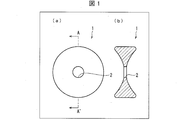
- FIG. 1A is a front view of the bearing retainer 1
- FIG. 1B is a cross-sectional view taken along the line AA 'in FIG.
- the bearing retainer 1 has a mortar structure in which both ends of a laid cylinder are recessed inward, and a ball fits into the mortar. Further, a through hole 2 is provided in the central portion of the bearing cage 1.
- the fluororesin in this embodiment is a fluororesin mainly composed of vinylidene fluoride.
- the main component means to occupy 50% or more of the whole. That is, the fluororesin mainly composed of vinylidene fluoride is a resin including 50 mol% or more of a structural unit corresponding to vinylidene fluoride (hereinafter, vinylidene fluoride monomer unit).
- the fluororesin mainly composed of vinylidene fluoride preferably contains 80 mol% or more of vinylidene fluoride monomer units, more preferably contains 85 mol% or more, further preferably contains 90 mol% or more, and more preferably contains vinylidene fluoride.
- a homopolymer is particularly preferred.
- Polyvinylidene fluoride has a molding temperature and a thermal decomposition temperature apart from other fluororesins such as tetrafluoroethylene-ethylene copolymer. Therefore, a fluororesin mainly composed of vinylidene fluoride has an advantage that it is excellent in workability as compared with other fluororesins. Therefore, it is preferable that the content of the vinylidene fluoride monomer unit is within this range from the viewpoint of processability to the bearing cage. Furthermore, a fluororesin mainly composed of vinylidene fluoride is superior in oil resistance compared to nylon.
- the fluororesin containing vinylidene fluoride as a main component only needs to contain at least 50 mol% of vinylidene fluoride monomer units, so that only a copolymer of vinylidene fluoride and other monomers or vinylidene fluoride is used. It can be a homopolymer formed from
- examples of other monomers copolymerized with vinylidene fluoride include fluorine-containing alkyl vinyl compounds such as hexafluoropropylene, trifluoroethylene, tetrafluoroethylene and chlorotrifluoroethylene; oxalic acid Ethylene (ie, 1,4-dioxane-2,3-dione), lactides, lactones (eg, ⁇ -propiolactone, ⁇ -butyrolactone, ⁇ -pivalolactone, ⁇ -butyrolactone, ⁇ -valerolactone, ⁇ - Cyclic monomers such as methyl- ⁇ -valerolactone and ⁇ -caprolactone), carbonates such as trimethylin carbonate, ethers such as 1,3-dioxane, ether esters such as dioxanone, and amides such as ⁇ -caprolactam Lactic acid, 3-hydride Hydroxycar
- the inherent viscosity of the fluororesin of this embodiment is preferably in the range of 0.50 dL / g to 1.30 dL / g, and in the range of 0.60 dL / g to 1.20 dL / g. More preferably, it is most preferably in the range of 0.70 dL / g or more and 1.10 dL / g or less.
- the inherent viscosity is a logarithmic viscosity. Use of a fluororesin having an inherent viscosity in the range of 0.50 dL / g or more and 1.30 dL / g or less is preferable in that the molding becomes easy and the bearing cage is molded.
- the inherent viscosity of a fluororesin is calculated as a logarithmic viscosity at 30 ° C. of a solution in which 4 g of the fluororesin is dissolved in 1 liter of N, N-dimethylformamide. Specifically, it is obtained by the following equation.
- elastomer component (1 / C) ⁇ ln ( ⁇ / ⁇ 0 ) (Where ⁇ is the viscosity of the polymer solution, ⁇ 0 is the viscosity of the solvent N, N-dimethylformamide alone, and C is 0.4 g / dl.)
- the elastomer component is not limited as long as it contains an elastomer, and styrene, olefin, ester, urethane, amide, PVC, and acrylic elastomers can be used as the elastomer. Moreover, the elastomer containing a fluorine atom can also be used in these elastomers.
- an elastomer containing a fluorine atom is referred to as a fluorine-based elastomer.
- elastomers include, for example, natural rubber, styrene / butadiene rubber, isoprene rubber, butadiene rubber, chloroprene rubber, acrylonitrile / butadiene rubber, acrylic rubber, butyl rubber such as isobutylene / isoprene rubber, ethylene / propylene rubber, ethylene -Rubbers such as propylene / diene rubber, urethane rubber, and silicone rubber, and rubbers in which some hydrogen atoms are fluorine atoms in these rubbers.
- an elastomer that is compatible with the fluororesin is used as the elastomer component, or a compound that is highly compatible with the fluororesin is used in combination with the above-described elastomer. ing.
- elastomers compatible with fluororesins include fluoroelastomers and acrylic elastomers.
- acrylic elastomers and fluorine-based elastomers are preferable, and acrylic elastomers having a structural unit of methyl methacrylate (MMA) and fluorine-based elastomers having a structural unit of vinylidene fluoride (VDF) are more preferable.
- MMA methyl methacrylate
- VDF vinylidene fluoride
- An example of the acrylic elastomer includes a block copolymer or graft copolymer of MMA and butyl acrylate (BA). By having MMA, compatibility with the fluororesin is increased, dispersion into the fluororesin is increased, and impact resistance is improved.
- Examples of the compound having high compatibility with the fluororesin include acrylic resin and fluororesin. Among them, an acrylic resin having a MMA structural unit and a fluororesin having a VDF structural unit are preferable.
- the acrylic resin and the fluororesin may be an acrylic elastomer and a fluoroelastomer, respectively.
- the means for combining the compound and the elastomer is not particularly limited.
- a method of bonding the compound to the elastomer, and the elastomer to the compound And a method in which an elastomer and a compound are bonded so as to form a core-shell structure.
- the core-shell structure is a structure formed by an inner core phase and a shell phase that covers the outer side of the core phase and has different components from the core phase.
- the core phase is an elastomer component
- the shell phase is a compound that is highly compatible with the fluororesin.
- the core-shell structure in the present embodiment includes, for example, a configuration in which the core phase is BA and the shell phase is an MMA polymer, and a configuration in which the core phase is a fluoroelastomer and the shell phase is an MMA polymer or VDF polymer.
- a configuration in which the core phase is BA and the shell phase is an MMA polymer and a configuration in which the core phase is a fluoroelastomer and the shell phase is an MMA polymer or VDF polymer.
- a commercially available elastomer component having the core-shell structure as described above may be used.
- Examples of commercially available products include Paraloid EXL-2315 (manufactured by Dow Chemical Co.) and Methbrene S-2006 (manufactured by Mitsubishi Rayon Co., Ltd.).
- the elastomer component in the present embodiment has a core-shell structure, so that the elastomer component can be dispersed in the fluororesin even when an elastomer having low compatibility with the fluororesin is used.
- an elastomer component having a core-shell structure impact resistance is further improved and compression resistance is improved.
- the kneadability in a resin composition is favorable, and the variation between samples becomes smaller.
- the elastomer of the core phase may be an elastomer having high compatibility with the fluororesin.
- the shape of the elastomer component is not particularly limited, but is preferably spherical in the present embodiment. Due to the spherical shape of the elastomer component, the elastomer component can be evenly dispersed in the fluororesin. Further, since the anisotropy does not occur due to the spherical shape, the uneven distribution of stress concentration hardly occurs and the impact resistance is improved. Furthermore, even when thermally expanded, distortion is less likely to occur than other shapes of elastomer components. Further, the size of the elastomer component is not particularly limited.
- the content of the elastomer component in the resin composition containing the fluororesin mainly composed of vinylidene fluoride and the elastomer component is based on 100 parts by mass of the fluororesin when the elastomer component has a core-shell structure.
- the amount is preferably 1 part by mass or more, more preferably 3 parts by mass or more, still more preferably 5 parts by mass or more, and particularly preferably 10 parts by mass or more.
- the amount is preferably 5 parts by mass or more, more preferably 7 parts by mass or more, further preferably 10 parts by mass with respect to 100 parts by mass of the fluororesin. More than part by mass.
- the content of the elastomer component is preferably 20 parts by mass or less, more preferably 17 parts by mass or less, and further preferably 100 parts by mass of the fluororesin. Is 15 parts by mass or less. Therefore, by setting the elastomer component to 1 part by mass or more and 20 parts by mass or less, a bearing cage having excellent oil resistance and high impact strength can be obtained. In addition, by making content of an elastomer component into 10 mass parts or more, while being excellent in impact strength, the variation between samples becomes smaller.
- the elastomer component an elastomer having a core-shell structure and an elastomer not having a core-shell structure may be used in combination.
- the resin composition in the present embodiment may contain other components such as a filler and a solid lubricant as long as the effects of the resin composition of the present embodiment are not impaired.
- fillers include reinforcing inorganic fillers such as glass fibers and carbon fibers. By blending such an inorganic filler, the impact resistance of the bearing cage can be improved. When injection molding is performed using a resin composition containing such an inorganic filler, the strength of the seam portion (weld) tends to be weakened. Therefore, when molding a bearing cage by injection molding, it is preferable not to contain an inorganic filler.
- the solid lubricant examples include MoS 2 , WS 2 , graphite, and polytetrafluoroethylene.
- the strength of the seam portion (weld) tends to be weakened. Therefore, when molding a bearing cage by injection molding, it is preferable not to include a solid lubricant.
- the bearing cage of this embodiment can be manufactured by a conventional manufacturing method.
- the bearing cage can be formed by injection molding.
- a general mold can be manufactured based on a commercially available ball screw bearing retainer, and injection molding can be performed using the mold.
- a general metal mold has a structure in which a joint portion (weld) is generated somewhere in a bearing cage to be molded.
- the separator according to the present invention is not limited to this.
- the separator according to the present invention in addition to the above-mentioned mortar structure, it may be a ring structure and a cylindrical structure.
- the ring structure separator include a configuration in which a plurality of balls are spaced from each other and fitted into the ring such that a part of each ball is exposed on both the inner and outer peripheral sides of the ring. .
- the cylindrical separation band has, for example, a plurality of through holes provided on the side surface of the cylinder, and a ball is fitted in each through hole.
- the form which the part has exposed is mentioned.
- the ring structure separator as described above is used, for example, for a ball bearing of a bicycle.
- the above-described separated body having a cylindrical structure is used for a ball guide of a press die. Therefore, a ball bearing, a ball guide, and the like are included in the category of the machine element according to the present invention. From the above, the separator according to the present invention can be used for parts that require oil resistance and impact resistance, or parts that require oil resistance, impact resistance, and compression resistance, in addition to the bearing cage. is there.
- the said industrial machine can be utilized suitably also in the environment where the load to a ball screw is high. Therefore, the industrial machine provided with the motion guide device included in the present invention such as the above-described ball screw is also included in the scope of the present invention.
- an industrial machine provided with a ball screw an injection molding apparatus, a machine tool, etc. are mentioned.
- the motion guide device such as a ball screw may be in a mode in which one member is relatively moved with respect to the other member, and the other member guides the movement of one member. Therefore, one member of the motion guide device can be expressed as a moving body, and the other member as a guide member.
- the separator according to the present invention can be used for parts that require oil resistance and impact resistance, or for parts that require oil resistance, impact resistance, and compression resistance.
- the separation body according to the present invention is a separation body for holding each of a plurality of spheres spaced apart from each other, and the plurality of spheres move relative to the first member and the first member.
- a motion guide device comprising a member, disposed on one side so as to contact both the first member and the second member, and enabling the relative movement by rolling of each sphere,
- the separator is formed from a resin composition containing a fluororesin mainly composed of vinylidene fluoride and an elastomer component.
- the elastomer component is preferably an elastomer combined with a compound having compatibility with the fluororesin.
- the elastomer combined with the compound having compatibility with the fluororesin is preferably an elastomer having a core-shell structure.
- the compound having compatibility with the fluororesin is preferably a fluororesin or an acrylic resin.
- the resin composition preferably contains 1 part by mass or more of the elastomer component when the fluororesin mainly composed of vinylidene fluoride is 100 parts by mass.
- the elastomer component is preferably an elastomer compatible with the fluororesin.
- the elastomer compatible with the fluororesin is preferably an acrylic elastomer or a fluoroelastomer.
- the resin composition preferably contains 5 parts by mass or more of the elastomer component when the fluororesin is 100 parts by mass.
- the fluororesin is preferably polyvinylidene fluoride.
- the mechanical element according to the present invention includes the above-described separated body and a plurality of spheres, and the separated body holds the plurality of spheres separated from each other.
- the motion guide device includes a first member that is the above-described mechanical element, and a second member that is another mechanical element that moves relative to the first member. Are combined with the first member in contact with the plurality of spheres.
- one aspect of the motion guide device according to the present invention is a ball screw.
- the industrial machine according to the present invention includes the motion guide device.
- Example 1 To 100 parts by mass of polyvinylidene fluoride (PVDF) (KF polymer W # 1000, manufactured by Kureha Co., Ltd.) as a fluororesin, 5 parts by mass of paraloid EXL-2315 (manufactured by Dow Chemical Co., Ltd.) is added as an elastomer component.
- a resin composition was prepared by kneading with an extruder. The prepared resin composition was injection-molded to produce a bearing cage having a through-hole and a multipurpose test piece (JISK 7139 type A1) as shown in FIG. The bearing cage was used for a drop test and a compression test described later, and the multipurpose test piece was used for a Charpy impact test.
- PVDF polyvinylidene fluoride
- EXL-2315 manufactured by Dow Chemical Co., Ltd.
- Example 2 A bearing cage and a test piece were produced in the same manner as in Example 1 except that the elastomer component was 10 parts by mass.
- Example 3 A bearing cage and a test piece were prepared in the same manner as in Example 1 except that the elastomer component was 15 parts by mass.
- Example 4 A bearing retainer and a test piece were prepared in the same manner as in Example 1 except that the elastomer component was Metabrene S-2006 (manufactured by Mitsubishi Rayon Co., Ltd.).
- Example 5 A bearing cage and a test piece were prepared in the same manner as in Example 1 except that the elastomer component was Clarity LA2250 (manufactured by Kuraray Co., Ltd.), which is a block copolymer of MMA and BA.
- Example 6 A bearing cage and a test piece were prepared in the same manner as in Example 1 except that the elastomer component was 1 part by mass.
- Comparative Example 1 A bearing cage and a test piece were prepared in the same manner as in Example 1 except that the elastomer component was not added.
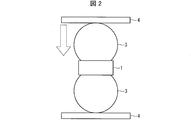
- FIG. 2 a compression test apparatus 4 that can be installed in a universal testing machine (manufactured by Toyo Seiki Co., Ltd.) by holding the bearing holder 1 with spheres 3 arranged above and below the bearing holder 1 in FIG.
- the bearing cage 1 was compressed in the direction of the arrow at a test speed of 5 mm / min, and it was confirmed whether or not the bearing cage 1 was cleaved, and qualitative evaluation was performed on the compression resistance.
- FIG. 2 only a part of the compression test apparatus 4 is illustrated. The results are shown in [Compression resistance] in Table 1.
- test was carried out 5 times, and those that were never cleaved were evaluated as “ ⁇ ”, those that were cleaved 1 to 3 times were evaluated as “ ⁇ ”, those that were cleaved 4 times, or those that were cleaved all as “x”.
- Table 1 shows the compositions of the resin compositions and the test results in Examples 1 to 6 and Comparative Example 1 described above.
- the present invention can be suitably used for a ball cage bearing retainer.
Landscapes
- Engineering & Computer Science (AREA)
- General Engineering & Computer Science (AREA)
- Mechanical Engineering (AREA)
- Rolling Contact Bearings (AREA)
- Transmission Devices (AREA)
- Compositions Of Macromolecular Compounds (AREA)
Priority Applications (3)
| Application Number | Priority Date | Filing Date | Title |
|---|---|---|---|
| US16/342,579 US10837490B2 (en) | 2016-11-04 | 2017-06-28 | Separator, machine element, motion guide device and industrial machine |
| CN201780066459.3A CN110402342B (zh) | 2016-11-04 | 2017-06-28 | 分离体、机械元件、运动引导装置以及工业用机械 |
| DE112017005571.7T DE112017005571T5 (de) | 2016-11-04 | 2017-06-28 | Separator, Maschinenelement, Bewegungsführungsvorrichtung und Industriemaschine |
Applications Claiming Priority (2)
| Application Number | Priority Date | Filing Date | Title |
|---|---|---|---|
| JP2016-216678 | 2016-11-04 | ||
| JP2016216678A JP6758156B2 (ja) | 2016-11-04 | 2016-11-04 | 分離体、機械要素、運動ガイド装置および産業用機械 |
Publications (1)
| Publication Number | Publication Date |
|---|---|
| WO2018083838A1 true WO2018083838A1 (ja) | 2018-05-11 |
Family
ID=62075986
Family Applications (1)
| Application Number | Title | Priority Date | Filing Date |
|---|---|---|---|
| PCT/JP2017/023801 Ceased WO2018083838A1 (ja) | 2016-11-04 | 2017-06-28 | 分離体、機械要素、運動ガイド装置および産業用機械 |
Country Status (5)
| Country | Link |
|---|---|
| US (1) | US10837490B2 (enExample) |
| JP (1) | JP6758156B2 (enExample) |
| CN (1) | CN110402342B (enExample) |
| DE (1) | DE112017005571T5 (enExample) |
| WO (1) | WO2018083838A1 (enExample) |
Families Citing this family (2)
| Publication number | Priority date | Publication date | Assignee | Title |
|---|---|---|---|---|
| JP6641414B2 (ja) | 2018-04-27 | 2020-02-05 | クレハ合繊株式会社 | 分離体、機械要素、運動ガイド装置および産業用機械 |
| CN115875359A (zh) * | 2022-11-28 | 2023-03-31 | 上海天安轴承有限公司 | 碳分离器及反应堆用轴承 |
Citations (2)
| Publication number | Priority date | Publication date | Assignee | Title |
|---|---|---|---|---|
| WO2003080306A1 (en) * | 2002-03-26 | 2003-10-02 | Kureha Gosen Co., Ltd. | Tape-shaped molding and belt for ball chain |
| JP2007285346A (ja) * | 2006-04-13 | 2007-11-01 | Ntn Corp | 転がり軸受 |
Family Cites Families (20)
| Publication number | Priority date | Publication date | Assignee | Title |
|---|---|---|---|---|
| JPH069859A (ja) * | 1992-04-07 | 1994-01-18 | Toyobo Co Ltd | 複合樹脂組成物 |
| EP0589063B1 (en) * | 1992-04-10 | 1997-07-09 | Idemitsu Kosan Company Limited | Fluoroelastomer-containing resin composition |
| JP3134511B2 (ja) * | 1992-07-09 | 2001-02-13 | ダイキン工業株式会社 | 新規なフッ素ゴム組成物 |
| JP3090834B2 (ja) * | 1994-01-21 | 2000-09-25 | ポリプラスチックス株式会社 | 高耐衝撃性ポリアセタール樹脂組成物及びその成形品 |
| JP4256003B2 (ja) * | 1999-01-29 | 2009-04-22 | Thk株式会社 | 転動体保持スペーサー及びこれを用いた直線運動装置 |
| JP4454192B2 (ja) * | 2001-08-07 | 2010-04-21 | Thk株式会社 | 案内装置の転動体干渉防止具 |
| JP2003148467A (ja) | 2001-11-14 | 2003-05-21 | Nsk Ltd | 直動装置 |
| JP2003327845A (ja) * | 2002-05-14 | 2003-11-19 | Japan U-Pica Co Ltd | 耐衝撃性成形材料組成物 |
| US7910198B2 (en) * | 2004-04-23 | 2011-03-22 | Ntn Corporation | Resinous porous article and method for production thereof |
| US7771125B2 (en) * | 2004-06-07 | 2010-08-10 | Ntn Corporation | Retainer for rolling bearing, and rolling bearing |
| JP4541765B2 (ja) * | 2004-06-07 | 2010-09-08 | Ntn株式会社 | 転がり軸受用保持器および転がり軸受 |
| WO2005121288A1 (ja) * | 2004-06-10 | 2005-12-22 | Ntn Corporation | 摺動材料およびすべり軸受 |
| DE102004037123A1 (de) * | 2004-07-30 | 2006-03-23 | Ina-Schaeffler Kg | Kugelgewindetrieb |
| CN101065442A (zh) * | 2004-11-26 | 2007-10-31 | 大金工业株式会社 | 热塑性聚合物组合物及热塑性聚合物组合物的制造方法 |
| DE102006059161B4 (de) * | 2005-12-15 | 2023-01-12 | Nsk Ltd. | Lineare Führungsvorrichtung |
| WO2009020182A1 (ja) * | 2007-08-08 | 2009-02-12 | Daikin Industries, Ltd. | 含フッ素樹脂および架橋フッ素ゴムを含む熱可塑性樹脂組成物 |
| KR101397843B1 (ko) * | 2009-07-03 | 2014-05-20 | 다이킨 고교 가부시키가이샤 | 가교성 불소 고무 조성물, 불소 고무 성형품 및 그의 제법 |
| US8511897B2 (en) * | 2010-07-08 | 2013-08-20 | Hiwin Technologies Corp. | Linear motion transmission apparatus with a chain |
| US10137731B2 (en) * | 2010-11-03 | 2018-11-27 | Douglas G. Willis | Wheel pad |
| JP5957395B2 (ja) * | 2013-02-28 | 2016-07-27 | 日本ベアリング株式会社 | 転動体収容具 |
-
2016
- 2016-11-04 JP JP2016216678A patent/JP6758156B2/ja active Active
-
2017
- 2017-06-28 WO PCT/JP2017/023801 patent/WO2018083838A1/ja not_active Ceased
- 2017-06-28 DE DE112017005571.7T patent/DE112017005571T5/de active Pending
- 2017-06-28 US US16/342,579 patent/US10837490B2/en active Active
- 2017-06-28 CN CN201780066459.3A patent/CN110402342B/zh active Active
Patent Citations (2)
| Publication number | Priority date | Publication date | Assignee | Title |
|---|---|---|---|---|
| WO2003080306A1 (en) * | 2002-03-26 | 2003-10-02 | Kureha Gosen Co., Ltd. | Tape-shaped molding and belt for ball chain |
| JP2007285346A (ja) * | 2006-04-13 | 2007-11-01 | Ntn Corp | 転がり軸受 |
Also Published As
| Publication number | Publication date |
|---|---|
| US10837490B2 (en) | 2020-11-17 |
| CN110402342A (zh) | 2019-11-01 |
| CN110402342B (zh) | 2023-09-26 |
| US20200056657A1 (en) | 2020-02-20 |
| DE112017005571T5 (de) | 2019-09-12 |
| JP6758156B2 (ja) | 2020-09-23 |
| JP2018071773A (ja) | 2018-05-10 |
Similar Documents
| Publication | Publication Date | Title |
|---|---|---|
| JP6758156B2 (ja) | 分離体、機械要素、運動ガイド装置および産業用機械 | |
| JP4848121B2 (ja) | 摺動材料 | |
| JP2002098189A (ja) | すべり免震装置 | |
| US6624252B2 (en) | Sealing device | |
| CN112154188B (zh) | 树脂组合物 | |
| JP2013064495A (ja) | スラスト軸受 | |
| JP7415163B2 (ja) | 樹脂製歯車用組成物及びその射出成形物である樹脂製歯車 | |
| JP2005344906A (ja) | 転がり軸受用保持器および転がり軸受 | |
| JPWO2014175079A1 (ja) | フッ素ゴム組成物 | |
| JP6641414B2 (ja) | 分離体、機械要素、運動ガイド装置および産業用機械 | |
| JP2008101711A (ja) | ボールねじと転がり軸受との組合せ方法およびボールねじ装置 | |
| JP2015166608A (ja) | 可撓管 | |
| JP4851695B2 (ja) | 摺動材料 | |
| JP3059465B2 (ja) | 潤滑性ゴム組成物 | |
| JP2009107428A (ja) | 車両ステアリング用伸縮軸 | |
| JP2006125482A (ja) | シール部材および該シール部材を用いた軸受 | |
| JP2018071773A5 (enExample) | ||
| JPH0476030A (ja) | 潤滑性ゴム組成物 | |
| JP5033311B2 (ja) | 樹脂製保油体およびその製造方法 | |
| JP2006123058A (ja) | 工作機械用摺動部材 | |
| JP2002181045A (ja) | 潤滑剤供給体 | |
| JP2006009834A (ja) | すべり軸受 | |
| JP4541769B2 (ja) | 転がり軸受用保持器および転がり軸受 | |
| JP3059466B2 (ja) | 潤滑性ゴム組成物 | |
| JP2011241308A (ja) | 変性ポリテトラフルオロエチレン組成物 |
Legal Events
| Date | Code | Title | Description |
|---|---|---|---|
| 121 | Ep: the epo has been informed by wipo that ep was designated in this application |
Ref document number: 17866483 Country of ref document: EP Kind code of ref document: A1 |
|
| 122 | Ep: pct application non-entry in european phase |
Ref document number: 17866483 Country of ref document: EP Kind code of ref document: A1 |