WO2018074535A1 - 処理剤及び基板の処理方法 - Google Patents
処理剤及び基板の処理方法 Download PDFInfo
- Publication number
- WO2018074535A1 WO2018074535A1 PCT/JP2017/037767 JP2017037767W WO2018074535A1 WO 2018074535 A1 WO2018074535 A1 WO 2018074535A1 JP 2017037767 W JP2017037767 W JP 2017037767W WO 2018074535 A1 WO2018074535 A1 WO 2018074535A1
- Authority
- WO
- WIPO (PCT)
- Prior art keywords
- group
- substrate
- resin
- compound
- pattern
- Prior art date
- Legal status (The legal status is an assumption and is not a legal conclusion. Google has not performed a legal analysis and makes no representation as to the accuracy of the status listed.)
- Ceased
Links
- 0 *C(C1)**(C=O)=CC1S* Chemical compound *C(C1)**(C=O)=CC1S* 0.000 description 5
Classifications
-
- H—ELECTRICITY
- H10—SEMICONDUCTOR DEVICES; ELECTRIC SOLID-STATE DEVICES NOT OTHERWISE PROVIDED FOR
- H10P—GENERIC PROCESSES OR APPARATUS FOR THE MANUFACTURE OR TREATMENT OF DEVICES COVERED BY CLASS H10
- H10P70/00—Cleaning of wafers, substrates or parts of devices
- H10P70/20—Cleaning during device manufacture
-
- C—CHEMISTRY; METALLURGY
- C09—DYES; PAINTS; POLISHES; NATURAL RESINS; ADHESIVES; COMPOSITIONS NOT OTHERWISE PROVIDED FOR; APPLICATIONS OF MATERIALS NOT OTHERWISE PROVIDED FOR
- C09D—COATING COMPOSITIONS, e.g. PAINTS, VARNISHES OR LACQUERS; FILLING PASTES; CHEMICAL PAINT OR INK REMOVERS; INKS; CORRECTING FLUIDS; WOODSTAINS; PASTES OR SOLIDS FOR COLOURING OR PRINTING; USE OF MATERIALS THEREFOR
- C09D5/00—Coating compositions, e.g. paints, varnishes or lacquers, characterised by their physical nature or the effects produced; Filling pastes
- C09D5/008—Temporary coatings
-
- C—CHEMISTRY; METALLURGY
- C09—DYES; PAINTS; POLISHES; NATURAL RESINS; ADHESIVES; COMPOSITIONS NOT OTHERWISE PROVIDED FOR; APPLICATIONS OF MATERIALS NOT OTHERWISE PROVIDED FOR
- C09D—COATING COMPOSITIONS, e.g. PAINTS, VARNISHES OR LACQUERS; FILLING PASTES; CHEMICAL PAINT OR INK REMOVERS; INKS; CORRECTING FLUIDS; WOODSTAINS; PASTES OR SOLIDS FOR COLOURING OR PRINTING; USE OF MATERIALS THEREFOR
- C09D201/00—Coating compositions based on unspecified macromolecular compounds
- C09D201/02—Coating compositions based on unspecified macromolecular compounds characterised by the presence of specified groups, e.g. terminal or pendant functional groups
- C09D201/06—Coating compositions based on unspecified macromolecular compounds characterised by the presence of specified groups, e.g. terminal or pendant functional groups containing oxygen atoms
- C09D201/08—Carboxyl groups
-
- C—CHEMISTRY; METALLURGY
- C09—DYES; PAINTS; POLISHES; NATURAL RESINS; ADHESIVES; COMPOSITIONS NOT OTHERWISE PROVIDED FOR; APPLICATIONS OF MATERIALS NOT OTHERWISE PROVIDED FOR
- C09D—COATING COMPOSITIONS, e.g. PAINTS, VARNISHES OR LACQUERS; FILLING PASTES; CHEMICAL PAINT OR INK REMOVERS; INKS; CORRECTING FLUIDS; WOODSTAINS; PASTES OR SOLIDS FOR COLOURING OR PRINTING; USE OF MATERIALS THEREFOR
- C09D125/00—Coating compositions based on homopolymers or copolymers of compounds having one or more unsaturated aliphatic radicals, each having only one carbon-to-carbon double bond, and at least one being terminated by an aromatic carbocyclic ring; Coating compositions based on derivatives of such polymers
- C09D125/02—Homopolymers or copolymers of hydrocarbons
- C09D125/04—Homopolymers or copolymers of styrene
- C09D125/06—Polystyrene
-
- C—CHEMISTRY; METALLURGY
- C09—DYES; PAINTS; POLISHES; NATURAL RESINS; ADHESIVES; COMPOSITIONS NOT OTHERWISE PROVIDED FOR; APPLICATIONS OF MATERIALS NOT OTHERWISE PROVIDED FOR
- C09D—COATING COMPOSITIONS, e.g. PAINTS, VARNISHES OR LACQUERS; FILLING PASTES; CHEMICAL PAINT OR INK REMOVERS; INKS; CORRECTING FLUIDS; WOODSTAINS; PASTES OR SOLIDS FOR COLOURING OR PRINTING; USE OF MATERIALS THEREFOR
- C09D125/00—Coating compositions based on homopolymers or copolymers of compounds having one or more unsaturated aliphatic radicals, each having only one carbon-to-carbon double bond, and at least one being terminated by an aromatic carbocyclic ring; Coating compositions based on derivatives of such polymers
- C09D125/18—Homopolymers or copolymers of aromatic monomers containing elements other than carbon and hydrogen
-
- C—CHEMISTRY; METALLURGY
- C09—DYES; PAINTS; POLISHES; NATURAL RESINS; ADHESIVES; COMPOSITIONS NOT OTHERWISE PROVIDED FOR; APPLICATIONS OF MATERIALS NOT OTHERWISE PROVIDED FOR
- C09D—COATING COMPOSITIONS, e.g. PAINTS, VARNISHES OR LACQUERS; FILLING PASTES; CHEMICAL PAINT OR INK REMOVERS; INKS; CORRECTING FLUIDS; WOODSTAINS; PASTES OR SOLIDS FOR COLOURING OR PRINTING; USE OF MATERIALS THEREFOR
- C09D161/00—Coating compositions based on condensation polymers of aldehydes or ketones; Coating compositions based on derivatives of such polymers
- C09D161/04—Condensation polymers of aldehydes or ketones with phenols only
- C09D161/06—Condensation polymers of aldehydes or ketones with phenols only of aldehydes with phenols
-
- C—CHEMISTRY; METALLURGY
- C09—DYES; PAINTS; POLISHES; NATURAL RESINS; ADHESIVES; COMPOSITIONS NOT OTHERWISE PROVIDED FOR; APPLICATIONS OF MATERIALS NOT OTHERWISE PROVIDED FOR
- C09D—COATING COMPOSITIONS, e.g. PAINTS, VARNISHES OR LACQUERS; FILLING PASTES; CHEMICAL PAINT OR INK REMOVERS; INKS; CORRECTING FLUIDS; WOODSTAINS; PASTES OR SOLIDS FOR COLOURING OR PRINTING; USE OF MATERIALS THEREFOR
- C09D161/00—Coating compositions based on condensation polymers of aldehydes or ketones; Coating compositions based on derivatives of such polymers
- C09D161/04—Condensation polymers of aldehydes or ketones with phenols only
- C09D161/06—Condensation polymers of aldehydes or ketones with phenols only of aldehydes with phenols
- C09D161/12—Condensation polymers of aldehydes or ketones with phenols only of aldehydes with phenols with polyhydric phenols
-
- C—CHEMISTRY; METALLURGY
- C09—DYES; PAINTS; POLISHES; NATURAL RESINS; ADHESIVES; COMPOSITIONS NOT OTHERWISE PROVIDED FOR; APPLICATIONS OF MATERIALS NOT OTHERWISE PROVIDED FOR
- C09D—COATING COMPOSITIONS, e.g. PAINTS, VARNISHES OR LACQUERS; FILLING PASTES; CHEMICAL PAINT OR INK REMOVERS; INKS; CORRECTING FLUIDS; WOODSTAINS; PASTES OR SOLIDS FOR COLOURING OR PRINTING; USE OF MATERIALS THEREFOR
- C09D161/00—Coating compositions based on condensation polymers of aldehydes or ketones; Coating compositions based on derivatives of such polymers
- C09D161/18—Condensation polymers of aldehydes or ketones with aromatic hydrocarbons or their halogen derivatives only
-
- C—CHEMISTRY; METALLURGY
- C09—DYES; PAINTS; POLISHES; NATURAL RESINS; ADHESIVES; COMPOSITIONS NOT OTHERWISE PROVIDED FOR; APPLICATIONS OF MATERIALS NOT OTHERWISE PROVIDED FOR
- C09D—COATING COMPOSITIONS, e.g. PAINTS, VARNISHES OR LACQUERS; FILLING PASTES; CHEMICAL PAINT OR INK REMOVERS; INKS; CORRECTING FLUIDS; WOODSTAINS; PASTES OR SOLIDS FOR COLOURING OR PRINTING; USE OF MATERIALS THEREFOR
- C09D161/00—Coating compositions based on condensation polymers of aldehydes or ketones; Coating compositions based on derivatives of such polymers
- C09D161/34—Condensation polymers of aldehydes or ketones with monomers covered by at least two of the groups C09D161/04, C09D161/18 and C09D161/20
-
- C—CHEMISTRY; METALLURGY
- C09—DYES; PAINTS; POLISHES; NATURAL RESINS; ADHESIVES; COMPOSITIONS NOT OTHERWISE PROVIDED FOR; APPLICATIONS OF MATERIALS NOT OTHERWISE PROVIDED FOR
- C09D—COATING COMPOSITIONS, e.g. PAINTS, VARNISHES OR LACQUERS; FILLING PASTES; CHEMICAL PAINT OR INK REMOVERS; INKS; CORRECTING FLUIDS; WOODSTAINS; PASTES OR SOLIDS FOR COLOURING OR PRINTING; USE OF MATERIALS THEREFOR
- C09D201/00—Coating compositions based on unspecified macromolecular compounds
- C09D201/02—Coating compositions based on unspecified macromolecular compounds characterised by the presence of specified groups, e.g. terminal or pendant functional groups
-
- C—CHEMISTRY; METALLURGY
- C09—DYES; PAINTS; POLISHES; NATURAL RESINS; ADHESIVES; COMPOSITIONS NOT OTHERWISE PROVIDED FOR; APPLICATIONS OF MATERIALS NOT OTHERWISE PROVIDED FOR
- C09D—COATING COMPOSITIONS, e.g. PAINTS, VARNISHES OR LACQUERS; FILLING PASTES; CHEMICAL PAINT OR INK REMOVERS; INKS; CORRECTING FLUIDS; WOODSTAINS; PASTES OR SOLIDS FOR COLOURING OR PRINTING; USE OF MATERIALS THEREFOR
- C09D201/00—Coating compositions based on unspecified macromolecular compounds
- C09D201/02—Coating compositions based on unspecified macromolecular compounds characterised by the presence of specified groups, e.g. terminal or pendant functional groups
- C09D201/025—Coating compositions based on unspecified macromolecular compounds characterised by the presence of specified groups, e.g. terminal or pendant functional groups containing nitrogen atoms
-
- C—CHEMISTRY; METALLURGY
- C09—DYES; PAINTS; POLISHES; NATURAL RESINS; ADHESIVES; COMPOSITIONS NOT OTHERWISE PROVIDED FOR; APPLICATIONS OF MATERIALS NOT OTHERWISE PROVIDED FOR
- C09D—COATING COMPOSITIONS, e.g. PAINTS, VARNISHES OR LACQUERS; FILLING PASTES; CHEMICAL PAINT OR INK REMOVERS; INKS; CORRECTING FLUIDS; WOODSTAINS; PASTES OR SOLIDS FOR COLOURING OR PRINTING; USE OF MATERIALS THEREFOR
- C09D201/00—Coating compositions based on unspecified macromolecular compounds
- C09D201/02—Coating compositions based on unspecified macromolecular compounds characterised by the presence of specified groups, e.g. terminal or pendant functional groups
- C09D201/04—Coating compositions based on unspecified macromolecular compounds characterised by the presence of specified groups, e.g. terminal or pendant functional groups containing halogen atoms
-
- C—CHEMISTRY; METALLURGY
- C09—DYES; PAINTS; POLISHES; NATURAL RESINS; ADHESIVES; COMPOSITIONS NOT OTHERWISE PROVIDED FOR; APPLICATIONS OF MATERIALS NOT OTHERWISE PROVIDED FOR
- C09D—COATING COMPOSITIONS, e.g. PAINTS, VARNISHES OR LACQUERS; FILLING PASTES; CHEMICAL PAINT OR INK REMOVERS; INKS; CORRECTING FLUIDS; WOODSTAINS; PASTES OR SOLIDS FOR COLOURING OR PRINTING; USE OF MATERIALS THEREFOR
- C09D201/00—Coating compositions based on unspecified macromolecular compounds
- C09D201/02—Coating compositions based on unspecified macromolecular compounds characterised by the presence of specified groups, e.g. terminal or pendant functional groups
- C09D201/06—Coating compositions based on unspecified macromolecular compounds characterised by the presence of specified groups, e.g. terminal or pendant functional groups containing oxygen atoms
-
- C—CHEMISTRY; METALLURGY
- C09—DYES; PAINTS; POLISHES; NATURAL RESINS; ADHESIVES; COMPOSITIONS NOT OTHERWISE PROVIDED FOR; APPLICATIONS OF MATERIALS NOT OTHERWISE PROVIDED FOR
- C09D—COATING COMPOSITIONS, e.g. PAINTS, VARNISHES OR LACQUERS; FILLING PASTES; CHEMICAL PAINT OR INK REMOVERS; INKS; CORRECTING FLUIDS; WOODSTAINS; PASTES OR SOLIDS FOR COLOURING OR PRINTING; USE OF MATERIALS THEREFOR
- C09D5/00—Coating compositions, e.g. paints, varnishes or lacquers, characterised by their physical nature or the effects produced; Filling pastes
- C09D5/34—Filling pastes
-
- C—CHEMISTRY; METALLURGY
- C09—DYES; PAINTS; POLISHES; NATURAL RESINS; ADHESIVES; COMPOSITIONS NOT OTHERWISE PROVIDED FOR; APPLICATIONS OF MATERIALS NOT OTHERWISE PROVIDED FOR
- C09D—COATING COMPOSITIONS, e.g. PAINTS, VARNISHES OR LACQUERS; FILLING PASTES; CHEMICAL PAINT OR INK REMOVERS; INKS; CORRECTING FLUIDS; WOODSTAINS; PASTES OR SOLIDS FOR COLOURING OR PRINTING; USE OF MATERIALS THEREFOR
- C09D7/00—Features of coating compositions, not provided for in group C09D5/00; Processes for incorporating ingredients in coating compositions
- C09D7/20—Diluents or solvents
-
- H—ELECTRICITY
- H10—SEMICONDUCTOR DEVICES; ELECTRIC SOLID-STATE DEVICES NOT OTHERWISE PROVIDED FOR
- H10P—GENERIC PROCESSES OR APPARATUS FOR THE MANUFACTURE OR TREATMENT OF DEVICES COVERED BY CLASS H10
- H10P14/00—Formation of materials, e.g. in the shape of layers or pillars
- H10P14/60—Formation of materials, e.g. in the shape of layers or pillars of insulating materials
- H10P14/63—Formation of materials, e.g. in the shape of layers or pillars of insulating materials characterised by the formation processes
- H10P14/6326—Deposition processes
- H10P14/6342—Liquid deposition, e.g. spin-coating, sol-gel techniques or spray coating
-
- H—ELECTRICITY
- H10—SEMICONDUCTOR DEVICES; ELECTRIC SOLID-STATE DEVICES NOT OTHERWISE PROVIDED FOR
- H10P—GENERIC PROCESSES OR APPARATUS FOR THE MANUFACTURE OR TREATMENT OF DEVICES COVERED BY CLASS H10
- H10P14/00—Formation of materials, e.g. in the shape of layers or pillars
- H10P14/60—Formation of materials, e.g. in the shape of layers or pillars of insulating materials
- H10P14/68—Organic materials, e.g. photoresists
- H10P14/683—Organic materials, e.g. photoresists carbon-based polymeric organic materials, e.g. polyimides, poly cyclobutene or PVC
-
- H—ELECTRICITY
- H10—SEMICONDUCTOR DEVICES; ELECTRIC SOLID-STATE DEVICES NOT OTHERWISE PROVIDED FOR
- H10P—GENERIC PROCESSES OR APPARATUS FOR THE MANUFACTURE OR TREATMENT OF DEVICES COVERED BY CLASS H10
- H10P50/00—Etching of wafers, substrates or parts of devices
- H10P50/20—Dry etching; Plasma etching; Reactive-ion etching
- H10P50/28—Dry etching; Plasma etching; Reactive-ion etching of insulating materials
- H10P50/286—Dry etching; Plasma etching; Reactive-ion etching of insulating materials of organic materials
- H10P50/287—Dry etching; Plasma etching; Reactive-ion etching of insulating materials of organic materials by chemical means
-
- H—ELECTRICITY
- H10—SEMICONDUCTOR DEVICES; ELECTRIC SOLID-STATE DEVICES NOT OTHERWISE PROVIDED FOR
- H10P—GENERIC PROCESSES OR APPARATUS FOR THE MANUFACTURE OR TREATMENT OF DEVICES COVERED BY CLASS H10
- H10P52/00—Grinding, lapping or polishing of wafers, substrates or parts of devices
-
- C—CHEMISTRY; METALLURGY
- C08—ORGANIC MACROMOLECULAR COMPOUNDS; THEIR PREPARATION OR CHEMICAL WORKING-UP; COMPOSITIONS BASED THEREON
- C08F—MACROMOLECULAR COMPOUNDS OBTAINED BY REACTIONS ONLY INVOLVING CARBON-TO-CARBON UNSATURATED BONDS
- C08F212/00—Copolymers of compounds having one or more unsaturated aliphatic radicals, each having only one carbon-to-carbon double bond, and at least one being terminated by an aromatic carbocyclic ring
- C08F212/02—Monomers containing only one unsaturated aliphatic radical
- C08F212/04—Monomers containing only one unsaturated aliphatic radical containing one ring
- C08F212/14—Monomers containing only one unsaturated aliphatic radical containing one ring substituted by heteroatoms or groups containing heteroatoms
- C08F212/16—Halogens
- C08F212/18—Chlorine
-
- C—CHEMISTRY; METALLURGY
- C08—ORGANIC MACROMOLECULAR COMPOUNDS; THEIR PREPARATION OR CHEMICAL WORKING-UP; COMPOSITIONS BASED THEREON
- C08F—MACROMOLECULAR COMPOUNDS OBTAINED BY REACTIONS ONLY INVOLVING CARBON-TO-CARBON UNSATURATED BONDS
- C08F212/00—Copolymers of compounds having one or more unsaturated aliphatic radicals, each having only one carbon-to-carbon double bond, and at least one being terminated by an aromatic carbocyclic ring
- C08F212/02—Monomers containing only one unsaturated aliphatic radical
- C08F212/04—Monomers containing only one unsaturated aliphatic radical containing one ring
- C08F212/14—Monomers containing only one unsaturated aliphatic radical containing one ring substituted by heteroatoms or groups containing heteroatoms
- C08F212/22—Oxygen
-
- C—CHEMISTRY; METALLURGY
- C09—DYES; PAINTS; POLISHES; NATURAL RESINS; ADHESIVES; COMPOSITIONS NOT OTHERWISE PROVIDED FOR; APPLICATIONS OF MATERIALS NOT OTHERWISE PROVIDED FOR
- C09D—COATING COMPOSITIONS, e.g. PAINTS, VARNISHES OR LACQUERS; FILLING PASTES; CHEMICAL PAINT OR INK REMOVERS; INKS; CORRECTING FLUIDS; WOODSTAINS; PASTES OR SOLIDS FOR COLOURING OR PRINTING; USE OF MATERIALS THEREFOR
- C09D7/00—Features of coating compositions, not provided for in group C09D5/00; Processes for incorporating ingredients in coating compositions
- C09D7/40—Additives
- C09D7/65—Additives macromolecular
Definitions
- the present invention relates to a processing agent and a substrate processing method.
- a substrate processed material
- a liquid for example, a substrate, a laminated film, a resist film, or the like is patterned by liquid processing or the like, and a fine structure is formed on the substrate. Further, impurities, residues, and the like remaining on the substrate are removed by cleaning with a liquid. Further, these steps are performed in combination. Then, after the liquid treatment, when the liquid is removed, the fine structure formed on the substrate may collapse due to the surface tension of the liquid.
- the pattern formed on the surface of the substrate (hereinafter also referred to as “substrate pattern”) becomes finer.
- the aspect ratio becomes higher as the substrate pattern becomes finer, there is a disadvantage that the substrate pattern is likely to collapse when the gas-liquid interface passes through the pattern when the wafer is dried after cleaning or rinsing. Since there is no effective countermeasure against this inconvenience, it is necessary to design a pattern so that the pattern does not collapse when the semiconductor device or micromachine is downsized, highly integrated, or increased in speed. The degree of freedom in pattern design is significantly hindered.
- Patent Document 1 discloses a technique for substituting the cleaning liquid from water to 2-propanol before the gas-liquid interface passes through the pattern as a technique for suppressing the collapse of the substrate pattern.
- the aspect ratio of the pattern that can be handled is 5 or less.
- Patent Document 2 discloses that a wafer surface on which a concavo-convex pattern is formed by a film containing silicon is surface-modified by oxidation or the like, and a water-repellent protective film is formed on the surface using a water-soluble surfactant or silane coupling agent.
- a cleaning method is disclosed in which the capillary force is reduced by forming, thereby preventing the pattern from collapsing.
- Patent Documents 3 and 4 disclose a technique for preventing the collapse of a substrate pattern by performing a hydrophobic treatment using a treatment liquid containing a silylating agent such as N, N-dimethylaminotrimethylsilane and a solvent. It is disclosed.
- a silylating agent such as N, N-dimethylaminotrimethylsilane and a solvent. It is disclosed.
- JP 2008-198958 A Japanese Patent No. 4403202 JP 2010-129932 A International Publication No. 10/47196 Pamphlet
- the conventional method has a problem that the collapse of the substrate pattern cannot be sufficiently suppressed in the field of fine structures such as semiconductor devices and microelectromechanical elements.
- the present invention has been made based on the above circumstances, and an object of the present invention is to provide a processing agent having excellent substrate pattern collapse-inhibiting property and a substrate processing method using the same.
- the invention made in order to solve the above problems is a treatment agent that suppresses the collapse of a pattern formed on the surface of a substrate, and has an aromatic ring and a compound having a heteroatom-containing group bonded to the aromatic ring (hereinafter referred to as “a compound”). , [A] compound) and a solvent (hereinafter also referred to as “[B] solvent”).
- Another invention made in order to solve the above-described problems includes a step of forming a substrate pattern collapse-inhibiting film on the pattern-side surface of the substrate having a pattern formed on one surface thereof by applying the above-described treatment agent. It is the processing method of the board
- the “pattern formed on the surface of the substrate” or “substrate pattern” means a pattern other than the resist pattern formed on the substrate.
- “Heteroatom” refers to an atom other than a carbon atom and a hydrogen atom.
- the “heteroatom-containing group” may be a group formed only by a heteroatom, or a group formed by a combination of at least one of a carbon atom and a hydrogen atom and a heteroatom.
- the treatment agent and the substrate treatment method of the present invention are excellent in the ability to suppress the collapse of the substrate pattern.
- a residue of the substrate pattern collapse suppression film occurs in the step of removing the substrate pattern collapse suppression film (removal step), it causes a defect in the substrate pattern.
- the treating agent of the present invention contains an [A] compound having an aromatic ring and a heteroatom-containing group bonded to the aromatic ring, and a [B] solvent.
- the processing agent is suitably used in a substrate processing method including a step of forming a substrate pattern collapse-suppressing film by applying a processing agent on the pattern-side surface of a substrate having a pattern formed on one surface.
- the treatment agent is preferably used for embedding in the gap of the substrate pattern. Specifically, after the substrate having the pattern formed on one surface is washed, the treatment agent is applied to the pattern side surface of the substrate. As a result, a liquid such as a cleaning liquid or a rinsing liquid on the substrate is replaced with the processing agent, and a coating film (substrate pattern collapse suppression film) that fills the gaps in the substrate pattern is formed. According to this method, since the liquid can be removed without using an operation of drying the liquid, pattern collapse due to the gas-liquid interface passing through the side surface of the substrate pattern is suppressed.
- the substrate pattern collapse suppression film can be removed from the substrate by dry etching or the like as necessary.
- the treatment agent contains the [A] compound and the [B] solvent, and thus is excellent in substrate pattern collapse suppression and defect suppression.
- a substrate on which a pattern to be treated with the treating agent is formed generally has a relatively high surface hydrophilicity because it contains silicon atoms, metal elements, and the like.
- the said processing agent can improve affinity with the said substrate surface because [A] compound has moderate hydrophilicity.
- the treatment agent can improve the coating property and the performance (embedding property) of reliably embedding the formed substrate pattern collapse inhibiting film in the gap between the substrate patterns, thereby providing excellent substrate pattern collapse inhibiting property.
- defect suppression can be exhibited.
- the said processing agent can improve the said defect suppression property more because a [A] compound has an aromatic ring.
- a compound has an aromatic ring and a hetero atom containing group couple
- a compound may have only 1 type of aromatic ring and hetero atom containing group, respectively, and may have 2 or more types. In addition, the [A] compound may further have an aromatic ring to which a hetero atom-containing group is not bonded.
- a compound can be used individually by 1 type or in combination of 2 or more types.
- the aromatic ring is not particularly limited, and may be a monocyclic ring or a condensed ring, and may be a hydrocarbon aromatic ring or a heteroaromatic ring, such as a benzene ring, a naphthalene ring, an anthracene ring, a pyrene ring, an acenaphthylene ring, A fluorene ring, a phenanthrene ring, an indene ring, a triazine ring and the like can be mentioned.
- the heteroatom-containing group may be a substituent bonded to only one aromatic ring or a linking group bonded to a plurality of aromatic rings.
- the valence of the hetero atom-containing group is, for example, from 1 to 10 valences, preferably from 1 to 5 valences, and more preferably from 1 to 2 valences.
- the number of carbon atoms of the heteroatom-containing group is, for example, 0 or more and 20 or less, preferably 0 or more and 10 or less, and more preferably 0 or more and 3 or less.
- hetero atom contained in the hetero atom-containing group examples include halogen atoms such as chlorine atom, bromine atom and iodine atom, oxygen atom, nitrogen atom, sulfur atom and phosphorus atom.
- the hetero atom-containing group may have only one hetero atom or two or more hetero atoms.
- heteroatom-containing group examples include monovalent heteroatom-containing groups ( ⁇ ) such as a hydroxy group, a carboxy group, a cyano group, an amino group, a sulfo group, a halogen atom, a sulfanyl group, and a nitro group.
- monovalent heteroatom-containing groups such as a hydroxy group, a carboxy group, a cyano group, an amino group, a sulfo group, a halogen atom, a sulfanyl group, and a nitro group.
- a divalent heteroatom-containing group ( ⁇ ) such as a carbonyl group, an oxy group, a sulfonyl group, —CS—, —NR′—, —S—,
- a divalent heteroatom-containing group at the terminal between the carbon-carbon side of the chain hydrocarbon group and the alicyclic hydrocarbon group such as methanediyloxy group, ethanediyloxy group, cyclohexanediyloxy group, or the bond side.
- a chain hydrocarbon group such as a hydroxymethyl group, a hydroxyethyl group, a cyanomethyl group, a cyanoethyl group, an alicyclic hydrocarbon group, and a group ( ⁇ ) is substituted with the monovalent hetero group.
- R ′ is a monovalent hydrocarbon group having 1 to 10 carbon atoms.
- an oxygen atom, a nitrogen atom, a sulfur atom, a halogen atom or a group containing a combination thereof is preferable, a hydroxy group, a carboxy group, a cyano group, an amino group, a sulfo group, a halogen atom, a carbonyl group, A group containing an oxy group or a combination thereof is more preferable, and a group containing a hydroxy group, a sulfo group, a fluorine atom, a bromine atom, an oxy group or a combination thereof is more preferable.
- a carbon hydrogen group having 1 to 20 carbon atoms may be bonded to the aromatic ring.
- the hydrocarbon group include a chain hydrocarbon group having 1 to 20 carbon atoms, an alicyclic hydrocarbon group having 3 to 20 carbon atoms, and an aromatic hydrocarbon group having 6 to 20 carbon atoms.
- the “hydrocarbon group” includes a chain hydrocarbon group, an alicyclic hydrocarbon group, and an aromatic hydrocarbon group.
- the “hydrocarbon group” may be a saturated hydrocarbon group or an unsaturated hydrocarbon group.
- the “chain hydrocarbon group” refers to a hydrocarbon group that does not include a cyclic structure but includes only a chain structure, and includes both a linear hydrocarbon group and a branched hydrocarbon group.
- alicyclic hydrocarbon group refers to a hydrocarbon group that includes only an alicyclic structure as a ring structure and does not include an aromatic ring structure, and includes a monocyclic alicyclic hydrocarbon group and a polycyclic alicyclic group. Includes both hydrocarbon groups.
- “Aromatic hydrocarbon group” refers to a hydrocarbon group containing an aromatic ring structure as a ring structure. However, it is not necessary to be composed only of an aromatic ring structure, and a part thereof may include a chain structure or an alicyclic structure.
- chain hydrocarbon group examples include a monovalent chain hydrocarbon group and a (q1 + 1) -valent chain hydrocarbon group obtained by removing q1 hydrogen atoms from the monovalent chain hydrocarbon group.
- q1 is an integer of 1 to 10, for example.
- Examples of the monovalent chain hydrocarbon group include alkyl groups such as a methyl group, an ethyl group, a propyl group, and a butyl group, Alkenyl group such as ethenyl group, propenyl group, butenyl group, pentenyl group, Examples thereof include alkynyl groups such as ethynyl group, propynyl group, butynyl group, and pentynyl group.
- Examples of the alicyclic hydrocarbon group include a monovalent alicyclic hydrocarbon group and a (q2 + 1) -valent alicyclic carbon group obtained by removing q2 hydrogen atoms from the monovalent alicyclic hydrocarbon group.
- a hydrogen group etc. are mentioned.
- q2 is an integer of 1 to 10, for example.
- Examples of the monovalent alicyclic hydrocarbon group include a cycloalkyl group such as a cyclopropyl group, a cyclobutyl group, a cyclopentyl group, a cyclohexyl group, a cyclooctyl group, and a cyclodecyl group, A cycloalkenyl group such as a cyclopropenyl group, a cyclobutenyl group, a cyclopentenyl group, a cyclohexenyl group, a cyclooctenyl group, And monovalent bridged cyclic hydrocarbon groups such as a norbornyl group and an adamantyl group.
- a cycloalkyl group such as a cyclopropyl group, a cyclobutyl group, a cyclopentyl group, a cyclohexyl group, a cyclooctyl group, and
- aromatic hydrocarbon group examples include a monovalent aromatic hydrocarbon group and a (q3 + 1) -valent aromatic hydrocarbon group obtained by removing q3 hydrogen atoms from the monovalent aromatic hydrocarbon group. Can be mentioned. q3 is an integer of 1 to 10, for example.
- Examples of the monovalent aromatic hydrocarbon group include aryl groups such as a phenyl group, a naphthyl group, an anthracenyl group, a pyrenyl group, a tolyl group, and a xylyl group, Examples include aralkyl groups such as benzyl group and phenethyl group.
- the compound preferably has a partial structure represented by the following formula (I) (hereinafter also referred to as “partial structure (i)”).
- partial structure (i) X and W are the heteroatom-containing group, and Ar is the aromatic ring.
- Ar is a (l + n + m) -valent group obtained by removing (l + n + m) hydrogen atoms on an aromatic ring from an arene having 6 to 20 carbon atoms.
- X is a monovalent heteroatom-containing group.
- W is a divalent heteroatom-containing group. * Represents a binding site with a moiety other than the partial structure represented by the formula (I) in the [A] compound.
- l, n, and m are each independently 0 or an integer of 1 or more. However, (l + m) ⁇ 1 and (l + n) ⁇ 1.
- the plurality of Ws may be the same or different.
- m is 2 or more, the plurality of Xs may be the same or different.
- Examples of the arenes having 6 to 20 carbon atoms that give Ar include unsubstituted arenes such as benzene, naphthalene, anthracene, pyrene, acenaphthylene, fluorene, phenanthrene, indene, and triazine, and hydrogen atoms of these unsubstituted arenes.
- An arene substituted with one or more alkyl groups is exemplified.
- alkyl group examples include an alkyl group having 1 to 20 carbon atoms, an alkyl group having 1 to 10 carbon atoms is preferable, an alkyl group having 1 to 5 carbon atoms is more preferable, and a methyl group is further preferable.
- the number of alkyl groups in the arene substituted with the alkyl group is, for example, 1 or more and 10 or less, preferably 1 or more and 5 or less, and more preferably 1 or more and 3 or less.
- Preferred arenes having 6 to 20 carbon atoms to give Ar are benzene, benzene substituted with an alkyl group, naphthalene, naphthalene substituted with an alkyl group, pyrene, and pyrene substituted with an alkyl group, and benzene, xylene, Naphthalene and pyrene are more preferred.
- the monovalent heteroatom-containing group represented by X for example, among the above-mentioned monovalent heteroatom-containing group ( ⁇ ) and group ( ⁇ ), those having a valence of 1 and group ( ⁇ ) Those having a valence of 1; those having a valence of 1 among the groups ( ⁇ ); those having a valence of 1 among the groups ( ⁇ ); A sulfo group, a fluorine atom, a bromine atom and an o-, m- or p-vinylbenzyloxy group are preferred.
- Examples of the divalent heteroatom-containing group represented by W include, among the above-described divalent heteroatom-containing groups ( ⁇ ) and groups ( ⁇ ), those having a valence of 2 and groups ( ⁇ ) Those having a valence of 2; those having a valence of 2 among groups ( ⁇ ); those having a valence of 2 among groups ( ⁇ ); , An oxy group, or a group containing a combination thereof is preferable, and an oxy group is more preferable.
- L can be an integer from 0 to 10, for example, preferably an integer from 0 to 5, more preferably an integer from 0 to 3.
- N can be, for example, an integer from 0 to 10, preferably from 1 to 5, and more preferably from 1 to 3.
- M can be, for example, an integer of 0 to 10, preferably an integer of 0 to 5, and more preferably an integer of 1 to 3.
- Examples of the compound [A] include a polymer (hereinafter also referred to as “[a1] polymer”) and a compound that is not a polymer and has a molecular weight of 300 to 3,000 (hereinafter, “ [A2] Aromatic ring-containing compound ”) and the like.
- the polymer is a polymer having an aromatic ring and a heteroatom-containing group bonded to the aromatic ring.
- the polymer preferably has a structural unit containing the aromatic ring and a heteroatom-containing group (hereinafter also referred to as “structural unit (I)”).
- structural unit (I) a structural unit containing the aromatic ring and a heteroatom-containing group
- the polymer may have one type of structural unit (I) or two or more types of structural units (I).
- Examples of the structural unit (I) include a structural unit (I-1) represented by the following formula (I-1), a structural unit (I-2) represented by the following formula (I-2), And a structural unit (I-3) represented by the formula (I-3).
- a structural unit (I-1) represented by the following formula (I-1) a structural unit represented by the following formula (I-2)
- a structural unit (I-3) represented by the formula (I-3)
- each structural unit will be described.
- the structural unit (I-1) is a structural unit represented by the following formula (I-1).
- Ar 1 is a (m + 2) -valent group obtained by removing (m + 2) hydrogen atoms on an aromatic ring from an arene having 6 to 20 carbon atoms.
- R 1 represents a single bond, an oxy group, a carbonyl group, a carbonyloxy group, a sulfoxide group, a sulfonyl group, a substituted or unsubstituted alkanediyl group having 1 to 20 carbon atoms, or a substituted or unsubstituted arylene having 6 to 20 carbon atoms.
- R 1 is a single bond or an unsubstituted alkanediyl group having 1 to 20 carbon atoms or an unsubstituted arylene group having 6 to 20 carbon atoms, m ⁇ 1.
- Examples of the arenes having 6 to 20 carbon atoms that give Ar 1 include those similar to those exemplified as the arenes that give Ar in the above formula (I). Among these, unsubstituted arenes are preferable, and benzene Xylene, naphthalene and pyrene are more preferable.
- Examples of the alkanediyl group represented by R 1 include a methanediyl group, an ethanediyl group, an n-propanediyl group, an i-propanediyl group, an n-butanediyl group, and a tert-butanediyl group.
- Examples of the arylene group represented by R 1 include a phenylene group, a methylphenylene group, a phenylenemethylene group, a phenylmethylene group, and a phenylethylene group.
- Examples of the oxyalkanediyl group represented by R 1 include a group containing an oxy group at the terminal of the above-mentioned alkanediyl group on the bond side.
- examples of the substituent include the monovalent heteroatom-containing group described above.
- the number of the substituents contained in R 1 is, for example, 0 or more and 10 or less, preferably 0 or more and 5 or less, and more preferably 0 or more and 2 or less.
- the number of carbon atoms of the substituted or unsubstituted alkanediyl group, the substituted or unsubstituted arylene group and the substituted or unsubstituted oxyalkanediyl group represented by R 1 is preferably 1 or more and 10 or less.
- R 1 is preferably a single bond, an oxy group, a substituted or unsubstituted alkylene group having 1 to 20 carbon atoms, and a substituted or unsubstituted arylene group having 6 to 20 carbon atoms.
- An unsubstituted methylene group and a substituted or unsubstituted phenylmethylene group are more preferable, and a single bond, an oxy group, a methylene group, and a hydroxyphenylmethylene group are more preferable.
- the structural unit (I-2) is a structural unit represented by the following formula (I-2).
- X and m are as defined in the above formula (I).
- Ar 2 is a group obtained by removing (m + 1) hydrogen atoms on an aromatic ring from an arene having 6 to 20 carbon atoms.
- L is a single bond, —O—, —COO— or —CONH—.
- Z is a hydrogen atom, a fluorine atom, a methyl group or a trifluoromethyl group.
- L is a single bond, m ⁇ 1.
- Examples of the arenes having 6 to 20 carbon atoms that give Ar 2 include the same arenes exemplified as the arenes that give Ar in the above formula (I). Among these, unsubstituted arenes are preferable, and benzene Xylene, naphthalene and pyrene are more preferable.
- L is preferably a single bond or —COO—.
- Z is preferably a hydrogen atom or a methyl group from the viewpoint of polymerizability of the monomer giving the structural unit (I-2).
- the structural unit (I-3) is a structural unit represented by the following formula (I-3) and has a cardo skeleton.
- Y 1 to Y 4 are each independently a monovalent heteroatom-containing group.
- R 2 and R 3 each independently represents a single bond, an oxy group, a carboxy group, a sulfonium group, a substituted or unsubstituted alkanediyl group having 1 to 20 carbon atoms, a substituted or unsubstituted carbon group having 6 to 20 carbon atoms.
- Ar 3 is a (p1 + 2) -valent group obtained by removing (p1 + 2) hydrogen atoms on an aromatic ring from an arene having 6 to 20 carbon atoms.
- Ar 4 is a (p2 + 2) -valent group obtained by removing (p2 + 2) hydrogen atoms on an aromatic ring from an arene having 6 to 20 carbon atoms.
- Ar 5 is a (p3 + 2) -valent group obtained by removing (p3 + 2) hydrogen atoms on the aromatic ring from an arene having 6 to 20 carbon atoms.
- Ar 6 is a (p4 + 2) -valent group obtained by removing (p4 + 2) hydrogen atoms on the aromatic ring from an arene having 6 to 20 carbon atoms.
- p1 to p4 are each independently 0 or an integer of 1 or more. Provided that when both R 2 and R 3 are a single bond, an unsubstituted alkanediyl group having 1 to 20 carbon atoms or an unsubstituted arylene group having 6 to 20 carbon atoms, at least one of p1 to p4 is It is an integer of 1 or more.
- the plurality of Y 1 may be the same or different.
- p2 is 2 or more
- the plurality of Y 2 may be the same or different.
- p3 is 2 or more
- the plurality of Y 3 may be the same or different.
- p4 is 2 or more, the plurality of Y 4 may be the same or different.
- alkanediyl group examples include arylene group, oxyalkanediyl group represented by R 2 and R 3 , and substituents of these groups are the same as those exemplified for R 1 in the above formula (I-1). Etc.
- the number of carbon atoms of the substituted or unsubstituted alkanediyl group, substituted or unsubstituted arylene group, and substituted or unsubstituted oxyalkanediyl group represented by R 2 and R 3 is preferably 1 or more and 10 or less. .
- R 2 is preferably a single bond.
- R 3 is preferably a substituted or unsubstituted alkanediyl group, more preferably an unsubstituted alkanediyl group, and even more preferably a methanediyl group.
- the monovalent heteroatom-containing group represented by Y 1 to Y 4 can be the same as the monovalent group represented by X in the above formula (I), and among these, A hydroxy group is preferred.
- the total of p1 to p4 can be, for example, an integer of 1 to 10, preferably an integer of 1 to 5, and an integer of 1 to 3.
- an integer of 0 to 10 can be used, and an integer of 0 to 3 is preferable.
- the polymer may have a combination of two or more of the structural units (I-1) to (I-3), but the structural units (I-1) to (I-3) It is preferred to have only one of them.
- a minimum of a content rate 1 mol% is preferred, 20 mol% is more preferred, 50 mol% is still more preferred, and 80 mol% is especially preferred.
- Examples of the [a1] polymer include phenol resin, naphthol resin, fluorene resin, styrene resin, acenaphthylene resin, indene resin, arylene resin, aromatic polyether resin, pyrene resin, calixarene resin and the like.
- the phenol resin is a polymer having a structural unit derived from a phenol compound.
- the structural unit include a structure in which, in the above formula (I-1), the arene that provides Ar 1 is benzene that is unsubstituted or substituted with an alkyl group, and R 1 is a substituted or unsubstituted alkanediyl group. Examples thereof include unit (I-1).
- the novolak resin obtained by making a phenol compound and an aldehyde compound react using an acidic catalyst or an alkaline catalyst, its derivative (s), etc. can be used, for example.
- phenol compound examples include phenol, benzenediol, benzenetriol, cresol, xylenol, resorcinol, bisphenol A, p-tert-butylphenol, p-octylphenol, and one or more hydrogen atoms on the aromatic ring of these compounds.
- the halogen atom examples include a bromine atom, a chlorine atom, and a fluorine atom.
- aldehyde compound examples include aldehydes such as formaldehyde and aldehyde sources such as paraformaldehyde and trioxane.
- the naphthol resin is a polymer having a structural unit derived from a naphthol compound.
- the naphthol resin for example, a polymer obtained by reacting the naphthol compound and the aldehyde compound with an acidic catalyst or an alkaline catalyst, a derivative thereof, or the like can be used.
- Examples of the naphthol compound include ⁇ -naphthol, ⁇ -naphthol, 1,5-dihydroxynaphthalene, 2,7-dihydroxynaphthalene, etc., and one or more hydrogen atoms on the aromatic ring of these compounds are halogen atoms, sulfo groups And the like.
- Examples of the halogen atom include a bromine atom, a chlorine atom, and a fluorine atom.
- the fluorene resin is a polymer having a structural unit derived from a fluorene compound.
- the structural unit include the structural unit (I-3) in which R 2 is a single bond and R 3 is a substituted or unsubstituted alkanediyl group in the above formula (I-3).
- the polymer obtained by making a fluorene compound and the said aldehyde compound react with an acidic catalyst or an alkaline catalyst, its derivative (s), etc. can be used, for example.
- fluorene compound examples include 9,9-bis (4-hydroxyphenyl) fluorene, 9,9-bis (4-hydroxyphenyl) fluorene, 9,9-bis (6-hydroxynaphthyl) fluorene, and the like.
- the styrene resin is a polymer having a structural unit derived from a compound having an aromatic ring and an ethylenic carbon-carbon double bond.
- the structural unit include a structural unit (I-2) in which L is a single bond in the above formula (I-2).
- the styrene resin for example, a polymer obtained by reacting a compound having an aromatic ring having a phenolic hydroxy group and an ethylenic carbon-carbon double bond, or a derivative thereof can be used.
- the “phenolic hydroxy group” refers to a hydroxy group bonded to an aromatic ring.
- the acenaphthylene resin is a polymer having a structural unit derived from an acenaphthylene compound.
- a polymer having a structural unit derived from an acenaphthylene compound having a phenolic hydroxy group, a derivative thereof, or the like can be used.
- the indene resin is a polymer having a structural unit derived from an indene compound.
- the indene resin for example, a polymer having a structural unit derived from an indene compound having a phenolic hydroxy group, a derivative thereof, or the like can be used.
- the arylene resin is a polymer having a structural unit having an arylene skeleton.
- the structural unit include the structural unit (I-1) in which R 1 is a single bond in the formula (I-1).
- the polymer which has an arylene skeleton which has a phenolic hydroxyl group, its derivative (s), etc. can be used, for example.
- the arylene skeleton include a phenylene skeleton, a naphthylene skeleton, and a biphenylene skeleton.
- the aromatic polyether resin is a polymer having an aromatic ring and a structural unit containing an oxy group bonded to the aromatic ring.
- the structural unit include a structural unit (I-1) in which R 1 is an oxy group in the above formula (I-1), and R 2 in the above formula (I-3) is a single bond and R 3 is an oxy group. And a structural unit (I-3) as a group.
- aromatic polyether resin examples include aromatic polyether (polyarylene ether), poly (oxyfluoroarylene), aromatic polyether nitrile, aromatic polyether ketone, and aromatic polyether sulfone.
- aromatic polyether nitrile, aromatic polyether ketone and aromatic polyether sulfone are aromatic polyether ether nitrile, aromatic polyether ether ether nitrile, aromatic polyether ether ketone, aromatic polyether ether ether. It is a concept including ketone, aromatic polyetherethersulfone, aromatic polyetheretherethersulfone and the like.
- the aromatic polyether-based resin is preferably an aromatic polyether and poly (oxyfluoroarylene), more preferably an aromatic polyether and poly (oxytetrafluorophenylene).
- the pyrene resin is a polymer having a structural unit having a pyrene skeleton.
- a polymer having a pyrene skeleton containing a phenolic hydroxy group or a derivative thereof can be used.
- the structural unit include the structural unit (I-1) in which, in the above formula (I-1), the arene providing Ar 1 is pyrene and R 1 is a substituted or unsubstituted alkanediyl group. It is done.
- the polymer having a pyrene skeleton containing a phenolic hydroxy group is obtained, for example, by reacting a pyrene compound having a phenolic hydroxy group with the aldehyde compound using an acidic catalyst.
- the polymer is a phenol resin, a naphthol resin, a fluorene resin, a styrene resin, an acenaphthylene resin, an indene resin, an arylene resin, an aromatic polyether resin, or a pyrene resin
- the lower limit of the Mw of the polymer Is preferably 500, more preferably 1,000.
- an upper limit of said Mw 50,000 are preferable, 20,000 are more preferable, 12,000 is further more preferable, 3,500 is especially preferable.
- the “weight average molecular weight” can be determined, for example, as a polystyrene equivalent value by gel permeation chromatography (GPC).
- the calixarene resin is a cyclic oligomer in which a plurality of aromatic rings to which a phenolic hydroxy group is bonded are bonded cyclically via a hydrocarbon group.
- the calixarene resin may introduce a heteroatom-containing group other than a phenolic hydroxy group using, for example, a phenol structure.
- the lower limit of the molecular weight is preferably 500, more preferably 700, and even more preferably 1,000.
- the upper limit of the molecular weight is preferably 5,000, more preferably 3,000, and further preferably 1,500.
- the aromatic ring-containing compound is a compound that is not a polymer and has a molecular weight of 300 to 3,000.
- the molecular weight of the aromatic ring-containing compound is determined, for example, as a polystyrene-reduced weight average molecular weight (Mw) by gel permeation chromatography (GPC).
- Mw polystyrene-reduced weight average molecular weight
- GPC gel permeation chromatography
- Examples of the aromatic ring-containing compound include tannic acid and the like.
- Tannic acid is a general term for aromatic compounds contained in various plants and having a large number of phenolic hydroxy groups. Tannic acid is a condensed tannic acid formed by polymerization of a compound having a flavanol skeleton, and a hydrolyzable tannic acid formed by an ester bond between an aromatic compound such as gallic acid or ellagic acid and a sugar such as glucose. Any of these may be used in the present invention.
- the tannic acid is not particularly limited, and examples thereof include hamamelitannin, oyster tannin, chatannin, pentaploid tannin, gallic tannin, mylobalantannin, dibibitannin, algarobilatannin, valonia tannin, catechin tannin and the like.
- Specific examples of the hydrolyzable tannic acid include compounds represented by the following formula, for example. Tannic acid may be a single compound or a mixture of two or more compounds.
- tannic acid extract A examples include “tannic acid extract A”, “B tannic acid”, “N tannic acid”, “industrial tannic acid”, “purified tannic acid”, “Hi tannic acid”, “F tannin” Acid “,” general tannic acid “(manufactured by Nippon Pharmaceutical Co., Ltd.),” tannic acid: AL “(manufactured by Fuji Chemical Industry Co., Ltd.),” G tannic acid “,” F tannic acid “,” Hi tannic acid “ (Above, DSP Gokyo Food & Chemical Co., Ltd.).
- the lower limit of the molecular weight of the aromatic ring-containing compound is preferably 400, more preferably 500, and even more preferably 600.
- the upper limit of the molecular weight is preferably 2,500, more preferably 2,000, and further preferably 1,800.
- the compound [A] includes an aromatic ring-containing compound having a molecular weight of 300 to 3,000, phenol resin, naphthol resin, fluorene resin, styrene resin, acenaphthylene resin, indene resin, arylene resin, aromatic polyether resin, pyrene. Resins, calixarene resins and combinations thereof are preferred, and phenol resins, naphthol resins, fluorene resins, styrene resins, aromatic polyether resins, pyrene resins and combinations thereof are more preferred.
- the lower limit of the heteroatom content in the [A] compound is preferably 1% by mass, more preferably 3% by mass, and even more preferably 5% by mass.
- the upper limit of the content is preferably 90% by mass, more preferably 80% by mass, and even more preferably 70% by mass.
- the lower limit of the content of the [A] compound in the treatment agent is preferably 0.1% by mass, more preferably 5% by mass, and further preferably 15% by mass.
- the upper limit of the content is preferably 50% by mass, more preferably 40% by mass, and even more preferably 30% by mass.
- the solvent used in the treatment agent is not particularly limited, and for example, a polar solvent such as water or a polar organic solvent can be used.
- a solvent can be used individually by 1 type or in combination of 2 or more types.
- the polar organic solvent is not particularly limited, but from the viewpoint of embedding in a substrate pattern, alcohols, esters, alkyl ethers of polyhydric alcohols, hydroxy ketones, carboxylic acids, ethers, ketones, nitriles , Amides, amines and the like.
- Examples of the alcohols include monoalcohols such as methanol, ethanol, propanol, n-butanol, n-pentanol, n-hexanol, and isopropanol, ethylene glycol, propylene glycol, diethylene glycol, dipropylene glycol, triethylene glycol, and tripropanol.
- Examples include polyhydric alcohols such as propylene glycol. Among these, methanol and isopropanol are preferable, and isopropanol is more preferable.
- esters examples include hydroxycarboxylic acid esters such as n-butyl acetate, ethyl lactate, methyl glycolate, ethyl glycolate, methyl hydroxypropionate, ethyl hydroxypropionate, methyl hydroxybutyrate, ethyl hydroxybutyrate, and propylene acetate.
- Polyhydric alcohol carboxylates such as glycol, polyhydric alcohol partial ether carboxylates such as propylene glycol monomethyl ether acetate, polycarboxylic acid diesters such as diethyl oxalate, and carbonates such as dimethyl carbonate and diethyl carbonate It is done.
- alkyl ethers of the polyhydric alcohol examples include ethylene glycol monomethyl ether, propylene glycol monomethyl ether, ethylene glycol monoethyl ether, propylene glycol monoethyl ether, ethylene glycol monopropyl ether, propylene glycol monopropyl ether, and ethylene glycol monobutyl ether.
- Monoalkyl ethers of polyhydric alcohols such as propylene glycol monobutyl ether, ethylene glycol dimethyl ether, propylene glycol dimethyl ether, ethylene glycol diethyl ether, propylene glycol diethyl ether, ethylene glycol dipropyl ether, propylene glycol dipropyl ether, ethylene glycol dibutyl Ether, such as polyalkyl ethers of polyhydric alcohols such as propylene glycol dibutyl ether.
- hydroxy ketones examples include ⁇ -hydroxy ketones such as hydroxy acetone, 1-hydroxy-2-butanone, 1-hydroxy-2-pentanone, 3-hydroxy-2-butanone, and 3-hydroxy-3-pentanone.
- ⁇ -hydroxy ketones such as 4-hydroxy-2-butanone, 3-methyl-4-hydroxy-2-butanone, diacetone alcohol, 4-hydroxy-5,5-dimethyl-2-hexanone, 5-hydroxy-2 -Pentanone, 5-hydroxy-2-hexanone and the like.
- carboxylic acids examples include formic acid and acetic acid.
- ethers examples include tetrahydrofuran, 1,4-dioxane, dimethoxyethane, polyethylene oxide and the like.
- ketones examples include acetone and methyl ethyl ketone.
- nitriles examples include acetonitrile.
- amides examples include N, N-dimethylformamide and N, N-dimethylacetamide.
- Examples of the amines include triethylamine and pyridine.
- the solvent is preferably a polar solvent, more preferably a polar organic solvent, more preferably an ester or an alkyl ether of a polyhydric alcohol, from the viewpoints of coatability and embedding in a substrate pattern, and a hydroxycarboxylic acid ester.
- a polar solvent more preferably a polar organic solvent, more preferably an ester or an alkyl ether of a polyhydric alcohol, from the viewpoints of coatability and embedding in a substrate pattern, and a hydroxycarboxylic acid ester.
- Polyhydric alcohol partial ether carboxylates and monoalkyl ethers of polyhydric alcohols are particularly preferred, with ethyl lactate, propylene glycol monomethyl ether acetate, and propylene glycol monoethyl ether being even more particularly preferred.
- the polar organic solvent is preferably one that can form an aqueous solution of 1% by mass or more at 20 ° C. from the viewpoint of embedding in a substrate pattern.
- the lower limit of the dielectric constant of the solvent is preferably 6.0 from the viewpoint of embedding in the substrate pattern.
- the dielectric constant of [B] solvent refers to a value measured using a liquid dielectric constant meter.
- the acid generator is a component that generates an acid by the action of heat or light and promotes crosslinking of the [A] compound.
- the processing agent contains a [C] acid generator, the crosslinking reaction of a [A] compound is accelerated
- An acid generator can be used individually by 1 type or in combination of 2 or more types.
- Examples of the [C] acid generator include onium salt compounds and N-sulfonyloxyimide compounds.
- onium salt compounds examples include sulfonium salts, tetrahydrothiophenium salts, iodonium salts, ammonium salts, and the like.
- sulfonium salt examples include triphenylsulfonium trifluoromethanesulfonate, triphenylsulfonium nonafluoro-n-butanesulfonate, triphenylsulfonium perfluoro-n-octanesulfonate, triphenylsulfonium 2-bicyclo [2.2.1] hept.
- tetrahydrothiophenium salt examples include 1- (4-n-butoxynaphthalen-1-yl) tetrahydrothiophenium trifluoromethanesulfonate, 1- (4-n-butoxynaphthalen-1-yl) tetrahydrothiophenium.
- Nonafluoro-n-butanesulfonate 1- (4-n-butoxynaphthalen-1-yl) tetrahydrothiophenium perfluoro-n-octanesulfonate, 1- (4-n-butoxynaphthalen-1-yl) tetrahydrothio Phenium 2-bicyclo [2.2.1] hept-2-yl-1,1,2,2-tetrafluoroethanesulfonate, 1- (6-n-butoxynaphthalen-2-yl) tetrahydrothiophenium trifluoro Lomethanesulfonate, 1- (6-n-butoxynaphthalene -2-yl) tetrahydrothiophenium nonafluoro-n-butanesulfonate, 1- (6-n-butoxynaphthalen-2-yl) tetrahydrothiophenium perfluoro-n-octanesulfonate, 1- (6-n- Butoxy
- iodonium salt examples include diphenyliodonium trifluoromethanesulfonate, diphenyliodonium nonafluoro-n-butanesulfonate, diphenyliodonium perfluoro-n-octanesulfonate, diphenyliodonium 2-bicyclo [2.2.1] hept-2-yl.
- ammonium salt examples include triethylammonium trifluoromethanesulfonate, triethylammonium nonafluoro-n-butanesulfonate, trimethylammonium nonafluoro-n-butanesulfonate, tetraethylammonium nonafluoro-n-butanesulfonate, triethylammonium perfluoro-n- Examples include octane sulfonate and triethylammonium 2-bicyclo [2.2.1] hept-2-yl-1,1,2,2-tetrafluoroethane sulfonate.
- N-sulfonyloxyimide compound examples include N- (trifluoromethanesulfonyloxy) bicyclo [2.2.1] hept-5-ene-2,3-dicarboximide, N- (nonafluoro-n-butanesulfonyl).
- the [C] acid generator is preferably an onium salt compound, more preferably an iodonium salt or an ammonium salt, diphenyliodonium nonafluoro-n-butanesulfonate, bis (4-t-butylphenyl) iodonium nona. More preferred are fluoro-n-butanesulfonate and triethylammonium nonafluoro-n-butanesulfonate.
- the said processing agent contains a [C] thermal acid generator
- a [C] thermal acid generator as a minimum of content of a [C] thermal acid generator, 0.01 mass part is preferable with respect to 100 mass parts of [A] compounds, 0.1 mass part is more preferable, and 0.2 mass part is further more preferable.
- an upper limit of the said content 20 mass parts is preferable with respect to 100 mass parts of [A] compounds, 5 mass parts is more preferable, and 1 mass part is further more preferable.
- [C] By making content of a thermal acid generator into the said range, the collapse inhibitory property and defect inhibitory property of a substrate pattern can be improved more.
- the said processing agent may further contain the additive which is an arbitrary component as needed in the range which does not impair the objective of this invention.
- the said additive can be used individually by 1 type or in combination of 2 or more types.
- [D] surfactant is preferable.
- the said processing agent further contains [D] surfactant, applicability
- the surfactant include nonionic surfactants, cationic surfactants, and anionic surfactants.
- nonionic surfactant examples include ether type nonionic surfactants such as polyoxyethylene alkyl ether, ether ester type nonionic surfactants such as glycerin ester polyoxyethylene ether, polyethylene glycol fatty acid ester, glycerin ester, and sorbitan ester. And ester type nonionic surfactants.
- nonionic surfactants examples include “Newcol 2320”, “Newcol 714-F”, “Newcol 723”, “Newcol 2307”, “Newcol 2303” (above, manufactured by Nippon Emulsifier Co., Ltd.), “ “Pionin D-1107-S”, “Pionin D-1007”, “Pionin D-1106-DIR”, “New Calgen TG310” (above, manufactured by Takemoto Yushi Co., Ltd.), “Dynaflow” (above, manufactured by JSR) Is mentioned.
- Examples of the cationic surfactant include aliphatic amine salts and aliphatic ammonium salts.
- anionic surfactant examples include fatty acid soaps, carboxylates such as alkyl ether carboxylates, alkylbenzene sulfonates, alkyl naphthalene sulfonates, sulfonates such as ⁇ -olefin sulfonates, and higher alcohol sulfates.
- carboxylates such as alkyl ether carboxylates, alkylbenzene sulfonates, alkyl naphthalene sulfonates, sulfonates such as ⁇ -olefin sulfonates, and higher alcohol sulfates.
- examples thereof include a salt, a sulfate ester salt such as an alkyl ether sulfate, and a phosphate ester salt such as an alkyl phosphate ester.
- a nonionic surfactant is preferable from the viewpoint of the coating property of the treatment agent and the embedding property to the substrate.
- the said processing agent contains a [D] surfactant
- 0.0001 mass% is preferable, 0.001 mass% is more preferable, 0.01% by mass is more preferable, and 0.05% by mass is particularly preferable.
- the upper limit of the content is preferably 1% by mass, more preferably 0.5% by mass, and still more preferably 0.2% by mass.
- the treatment agent preferably contains as little metal as possible from the viewpoint of reducing contamination of the substrate pattern.
- the metal include sodium, potassium, magnesium, calcium, copper, aluminum, iron, manganese, tin, chromium, nickel, zinc, lead, titanium, zirconium, silver, and platinum.
- a metal cation, a metal complex, a metal metal, an ionic compound etc. are mentioned.
- the upper limit of the total content of metals in the treatment agent is preferably 30 mass ppb, more preferably 20 mass ppb, and even more preferably 10 mass ppb.
- the lower limit of the total content of the metals is not particularly limited and is preferably smaller, but is, for example, 1 mass ppb.
- the type and content of the metal in the treatment agent can be measured by an ICP-MS method (Inductively Coupled Plasma-Mass Spectrometry) or the like.
- the water contact angle (25 ° C., 50% RH) on the surface of the substrate pattern collapse inhibiting film formed by the treatment agent is preferably less than 90 °, more preferably 70 ° or less.
- the embeddability in the substrate pattern may be lowered.
- the substrate pattern collapse suppression film used for the measurement of the water contact angle is formed on a silicon substrate under the air at 120 ° C. for 1 minute.
- the treatment agent is produced by mixing the [A] compound, the [B] solvent, and optional components blended as necessary, and then filtering the obtained solution through a filter having a pore size of about 0.02 ⁇ m, for example. Can do.
- a filter having a pore size of about 0.02 ⁇ m for example.
- 0.1 mass% is preferred, 1 mass% is more preferred, 3 mass% is still more preferred, and 10 mass% is especially preferred.
- 50 mass% is preferable, 40 mass% is more preferable, and 30 mass% is further more preferable.
- the “solid content” in the treatment agent refers to components other than [B] solvent.
- the obtained treatment agent is preferably further filtered with a nylon filter (for example, a filter using a nylon 66 membrane as a filtration medium), an ion exchange filter, or a filter utilizing an adsorption action by a zeta potential.
- a nylon filter for example, a filter using a nylon 66 membrane as a filtration medium
- an ion exchange filter or a filter utilizing an adsorption action by a zeta potential.
- the treatment agent may be purified by known methods such as chemical purification methods such as washing with water and liquid extraction, or a combination of chemical purification methods and physical purification methods such as ultrafiltration and centrifugation. The metal content can be reduced.
- the substrate processing method is a step of forming a substrate pattern collapse suppression film on the pattern side surface of the substrate having a pattern formed on one surface thereof by applying the processing agent (substrate pattern collapse suppression film forming step). Is provided. Since the said processing agent of the said board
- the substrate to be processed by the substrate processing method is not particularly limited as long as a substrate pattern is formed on at least one surface, but a substrate containing silicon atoms or metal atoms is preferable, and metal, metal nitride, metal oxide More preferably, the substrate is mainly composed of silicon oxide, silicon or a mixture thereof.
- the “main component” is a component having the largest content, for example, a component having a content of 50% by mass or more.
- Examples of the material constituting the substrate pattern include the same materials as those exemplified as the material of the substrate.
- the shape of the substrate pattern is not particularly limited, and examples thereof include a line and space pattern, a hole pattern, and a pillar pattern.
- the upper limit of the average interval of the line and space pattern is preferably 300 nm, more preferably 150 nm, further preferably 100 nm, and particularly preferably 50 nm.
- the average interval between the hole pattern and the pillar pattern is preferably 300 nm, more preferably 150 nm, and even more preferably 100 nm.
- the lower limit of the average height of the substrate pattern is preferably 100 nm, more preferably 200 nm, and even more preferably 300 nm.
- the upper limit of the average width of the substrate pattern (for example, the height direction center portion reference) is preferably 50 nm, more preferably 40 nm, and even more preferably 30 nm.
- the lower limit of the aspect ratio of the substrate pattern (average pattern height / average pattern width) is preferably 3, more preferably 5, and even more preferably 10.
- a substrate pattern collapse suppression film is formed on the pattern-side surface of the substrate having a pattern formed on one surface by applying the treatment agent.
- liquids such as a washing
- the substrate pattern is adjacent because at least part of the substrate pattern is buried in the substrate pattern collapse suppression film and each pattern is supported by the substrate pattern collapse suppression film. Pattern collapse such as contact between patterns is suppressed.
- a liquid such as a cleaning liquid or a rinsing liquid is usually held on the substrate. Therefore, in this step, the treatment agent is applied while replacing the cleaning liquid or the rinsing liquid.
- the coating method of the treatment agent is not particularly limited, and for example, an appropriate method such as spin coating, cast coating, roll coating or the like can be adopted. After the coating, the treatment agent may be dried as necessary.
- the drying method is not particularly limited, and examples thereof include a method of heating in an air atmosphere.
- the lower limit of the heating temperature is not particularly limited, but is preferably 40 ° C, more preferably 50 ° C, and further preferably 60 ° C.
- an upper limit of heating temperature 200 degreeC is preferable and 150 degreeC is more preferable.
- 15 seconds are preferred, 30 seconds are more preferred, and 45 seconds are still more preferred.
- the upper limit of the heating time is preferably 1,200 seconds, more preferably 600 seconds, and even more preferably 300 seconds.
- the average thickness of the substrate pattern collapse suppression film to be formed may be made larger than the maximum height of the substrate pattern, and the substrate pattern may be completely buried with the substrate pattern collapse suppression film.
- the lower limit of the difference between the average thickness of the substrate pattern collapse inhibiting film and the maximum height of the substrate pattern is preferably 0.01 ⁇ m, 0 0.02 ⁇ m is more preferable, and 0.05 ⁇ m is even more preferable.
- the upper limit of the difference is preferably 5 ⁇ m, more preferably 3 ⁇ m, still more preferably 2 ⁇ m, and particularly preferably 0.5 ⁇ m.
- the average thickness of the substrate pattern collapse suppression film to be formed may be the same as or smaller than the maximum height of the substrate pattern, and a part of the substrate pattern may be exposed from the substrate pattern collapse suppression film. . Even in this case, since the vicinity of the bottom of the substrate pattern is buried in the substrate pattern collapse suppression film, the collapse of the substrate pattern is sufficiently suppressed.
- the substrate processing method usually further includes a step (removal step) of removing the substrate pattern collapse suppression film after the substrate pattern collapse suppression film formation step.
- a step (removal step) of removing the substrate pattern collapse suppression film after the substrate pattern collapse suppression film formation step for example, heat treatment, plasma treatment, dry etching (ashing), ultraviolet irradiation, electron beam irradiation, or the like can be used to remove the substrate pattern collapse suppression film.
- heat treatment plasma treatment, dry etching (ashing), ultraviolet irradiation, electron beam irradiation, or the like can be used to remove the substrate pattern collapse suppression film.
- the substrate pattern collapse suppression film can be changed directly from the solid phase to the gas phase, pattern collapse due to the gas-liquid interface passing through the side surface of the substrate pattern can be suppressed.
- Dry etching can be performed using a known dry etching apparatus.
- the etching gas used in the dry etching can be appropriately selected depending on the elemental composition of the substrate pattern collapse suppression film to be etched.
- An inert gas such as Ar can be used. In addition, these gases can also be mixed and used.
- the lower limit of the substrate temperature in dry etching is not particularly limited, but is preferably ⁇ 120 ° C., more preferably ⁇ 50 ° C., further preferably 20 ° C., particularly preferably 80 ° C., and most preferably 180 ° C.
- the upper limit of the substrate temperature is preferably 800 ° C., more preferably 400 ° C., further preferably 300 ° C., and particularly preferably 270 ° C.
- the substrate processing method can be suitably used for the above-described processing step of the substrate cleaning method including a step of cleaning the substrate (cleaning step) and a step of processing the substrate after cleaning (processing step).
- This cleaning method can be suitably used for cleaning a substrate after wet etching or dry etching.
- the cleaning step at least one of cleaning the substrate using a cleaning liquid and rinsing the substrate using a rinsing liquid is performed.
- the cleaning liquid include sulfate ion-containing stripping liquid, chlorine ion-containing cleaning liquid, fluorine ion-containing cleaning liquid, nitrogen compound-containing alkaline cleaning liquid, and phosphoric acid-containing cleaning liquid.
- cleaning with two or more cleaning liquids may be continuously performed.
- the cleaning solution preferably contains hydrogen peroxide.
- sulfuric acid ion-containing cleaning liquid sulfuric acid / hydrogen peroxide (SPM) in which hydrogen peroxide and sulfuric acid are mixed is preferable, whereby organic substances such as resist can be suitably removed.
- a mixed aqueous solution of hydrogen peroxide and hydrochloric acid (SC-2) is preferable, and thus the metal can be suitably removed.
- the fluorine ion-containing cleaning liquid include a mixed aqueous solution of hydrofluoric acid and ammonium fluoride.
- the nitrogen compound-containing alkaline cleaning liquid a mixed aqueous solution of hydrogen peroxide and ammonia (SC-1) is preferable, whereby particles can be suitably removed.
- the rinsing liquid include ultrapure water.
- This reaction solution was added to 5,000 g of methanol, and the precipitated solid was recovered by removing the methanol solution by filtration. Next, the collected solid is washed by pouring with a mixed solution of methanol and water (each 300 g), and dried under reduced pressure at 60 ° C. overnight, whereby the structure represented by the following formula (A-2) A compound (A-2) which is a phenol resin having units was obtained. Mw of the obtained compound (A-2) was 10,000.
- This reaction solution was added to a mixed solution of methanol and water (2,500 g each), and the precipitated solid was recovered by removing the mixed solution of methanol and water by filtration. Next, the recovered solid is washed by pouring with a mixed solution of methanol and water (each 300 g), and dried under reduced pressure at 60 ° C. overnight, whereby the structure represented by the following formula (A-3) Compound (A-3), which is a naphthol resin having units, was obtained. Mw of the obtained compound (A-3) was 3,000.
- This reaction solution was added to 5,000 g of hexane, and the precipitated solid was recovered by removing hexane by filtration. Next, the recovered solid is washed by pouring with 600 g of hexane, and dried under reduced pressure at 60 ° C. overnight, whereby a compound which is a phenol resin having a structural unit represented by the following formula (A-4) (A-4) was obtained. Mw of the obtained compound (A-4) was 10,000.
- This reaction solution was added to a mixed solution of methanol and water (2,500 g each), and the precipitated solid was recovered by removing the mixed solution of methanol and water by filtration. Next, the recovered solid content is washed by pouring with a mixed solution of methanol and water (each 300 g), and dried under reduced pressure at 60 ° C. overnight, whereby the structure represented by the following formula (A-7) Compound (A-7), which is a phenol resin having units, was obtained. Mw of the obtained compound (A-7) was 10,000.
- This reaction solution was added to a mixed solution of methanol and water (2,500 g each), and the precipitated solid was recovered by removing the mixed solution of methanol and water by filtration.
- the collected solid material is washed by pouring with a mixed solution of methanol and water (each 300 g), and dried under reduced pressure at 60 ° C. overnight to obtain a structure represented by the following formula (A-9).
- a compound (A-9) which is a pyrene resin having a unit was obtained.
- Mw of the obtained compound (A-9) was 3,000.
- This reaction solution was added to a mixed solution of methanol and water (2,500 g each), and the precipitated solid was recovered by removing the mixed solution of methanol and water by filtration. Next, the recovered solid is washed by pouring with a mixed solution of methanol and water (each 300 g), and dried under reduced pressure at 60 ° C. overnight, whereby the structure represented by the following formula (A-11) Compound (A-11), which is a phenol resin having a unit, was obtained. Mw of the obtained compound (A-11) was 10,000.
- This reaction solution was added to a mixed solution of methanol and water (2,500 g each), and the precipitated solid was recovered by removing the mixed solution of methanol and water by filtration.
- the collected solid material is washed by pouring with a mixed solution of methanol and water (each 300 g), and dried under reduced pressure at 60 ° C. overnight, whereby the structure represented by the following formula (A-12) Compound (A-12), which is a phenol resin having units, was obtained. Mw of the obtained compound (A-12) was 10,000.
- reaction solution was filtered and then added to 5,000 g of methanol, and the precipitated solid was recovered by removing the methanol by filtration.
- the collected solid material is washed by pouring with a mixed solution of methanol and water (each 300 g), and dried under reduced pressure at 60 ° C. overnight, whereby the structure represented by the following formula (A-13)
- a compound (A-13) which is a polyarylene ether having a unit was obtained.
- Mw of the obtained compound (A-13) was 10,000.
- reaction solution was filtered and then added to 5,000 g of methanol, and the precipitated solid was recovered by removing the methanol by filtration.
- a structural unit represented by the following formula (A-14) which is a polymer As a result, a compound (A-14) which is a polyarylene ether having the formula: Mw of the obtained compound (A-14) was 10,000.
- A-1 Phenolic resin (A-1) (Mw 1,500, heteroatom content ratio 15.1% by mass)
- A-2 Phenolic resin (A-2) (Mw 10,000, heteroatom content ratio 15.1% by mass)
- A-3 Naphthol resin (A-3) (Mw 3,000, hetero atom content ratio 18.6% by mass)
- A-4 Phenol resin (A-4) (Mw 10,000, hetero atom content ratio 34.8% by mass)
- A-5 Phenolic resin (A-5) (Mw 10,000, hetero atom content ratio 51.6% by mass)
- A-6 Naphthol resin (A-6) (Mw 2,500, heteroatom content 33.9% by mass)
- A-7 Phenolic resin (A-7) (Mw 10,000, heteroatom content ratio 16.1% by mass)
- A-8 Phenolic resin (A-8) (Mw 10,000, heteroatom content ratio 40.
- the following polymers were used in place of the [A] compound.
- the hetero atom content ratio of the following polymers is a value calculated from the structural formula.
- a-1 Polystyrene (Mw 10,000, hetero atom content ratio 0 mass%)
- a-2 Polyvinyl alcohol (degree of polymerization: 500, heteroatom content: 36.3% by mass) (Wako Pure Chemical Industries, Ltd.)
- B-1 Water
- B-2 Isopropanol (IPA)
- B-3 Propylene glycol monomethyl ether acetate
- B-4 Propylene glycol monomethyl ether
- B-5 Methyl lactate
- C-1 Diphenyliodonium nonafluoro-n-butanesulfonate represented by the following formula (C-1).
- Example 1 [A] 25 parts by mass of (A-1) as a compound was dissolved in 100 parts by mass of (B-3) as a [B] solvent. The treatment solution of Example 1 was prepared by filtering the obtained solution through a membrane filter having a pore size of 0.1 ⁇ m.
- Examples 2 to 25 and Comparative Examples 1 to 4 Each treatment agent was prepared in the same manner as in Example 1 except that the type and content of each component were as shown in Table 1. In Table 1, “-” indicates that the corresponding component was not used.
- This pillar pattern has an average pillar height of 380 nm, an average width of the top surface (top) of the pillar of 35 nm, an average cross-sectional width of 20 nm in the center of the pillar height direction, and an average pitch between the pillars of 100 nm (pillar width).
- Direction center part reference Thereafter, the coated silicon wafer was baked on a hot plate at 120 ° C. for 60 seconds to obtain a substrate on which a pattern collapse prevention treatment film was formed.
- the treatment agents of the examples were all good or extremely good in coating property, embedding property, and substrate pattern collapse inhibiting property and defect inhibiting property.
- the treatment agent and the substrate treatment method of the present invention are excellent in the ability to suppress the collapse of the substrate pattern. Moreover, the processing agent and the substrate processing method of the present invention are excellent in defect suppression of the substrate pattern during processing. Accordingly, these can be suitably used for manufacturing semiconductor devices that are expected to be further miniaturized in the future.
Landscapes
- Chemical & Material Sciences (AREA)
- Life Sciences & Earth Sciences (AREA)
- Engineering & Computer Science (AREA)
- Materials Engineering (AREA)
- Wood Science & Technology (AREA)
- Organic Chemistry (AREA)
- Materials For Photolithography (AREA)
- Paints Or Removers (AREA)
- Cleaning Or Drying Semiconductors (AREA)
Abstract
Description
本発明の処理剤は、芳香環、及びこの芳香環に結合するヘテロ原子含有基を有する[A]化合物と、[B]溶媒とを含有する。当該処理剤は、一方の面にパターンが形成された基板の上記パターン側の面に、処理剤の塗工により基板パターン倒壊抑制膜を形成する工程を備える基板の処理方法に好適に用いられる。
[A]化合物は、芳香環、及びこの芳香環に結合するヘテロ原子含有基を有する。[A]化合物は、芳香環及びヘテロ原子含有基をそれぞれ1種のみ有してもよく2種以上有してもよい。なお、[A]化合物は、ヘテロ原子含有基が結合していない芳香環をさらに有していてもよい。[A]化合物は1種単独で又は2種以上を組み合わせて用いることができる。
ヒドロキシ基、カルボキシ基、シアノ基、アミノ基、スルホ基、ハロゲン原子、スルファニル基、ニトロ基等の1価のヘテロ原子含有基(α)、
カルボニル基、オキシ基、スルホニル基、-CS-、-NR’-、-S-等の2価のヘテロ原子含有基(β)、
メタンジイルオキシ基、エタンジイルオキシ基、シクロヘキサンジイルオキシ等の鎖状炭化水素基及び脂環式炭化水素基のいずれかの炭素-炭素間又は結合手側の末端に上記2価のヘテロ原子含有基(β)を含む基(γ)、
ヒドロキシメチル基、ヒドロキシエチル基、シアノメチル基、シアノエチル基等の鎖状炭化水素基、脂環式炭化水素基及び基(γ)のいずれかの有する水素原子の一部又は全部を上記1価のヘテロ原子含有基(α)で置換した基(ω)、
フェノキシ基、ベンジルオキシ基、o-、m-又はp-ビニルベンジルオキシ基、o-、m-又はp-メトキシフェニル基等の芳香族炭化水素基のいずれかの炭素-炭素間又は結合手側の末端に上記2価のヘテロ原子含有基(β)を含む基(δ)、
ヒドロキシフェニル基、ヒドロキシナフチル基、(ヒドロキシフェニル)メチル基等の芳香族炭化水素基及び基(δ)のいずれかの有する水素原子の一部又は全部を上記1価のヘテロ原子含有基(α)で置換した基(ε)などが挙げられる。R’は、炭素数1~10の1価の炭化水素基である。
メチル基、エチル基、プロピル基、ブチル基等のアルキル基、
エテニル基、プロペニル基、ブテニル基、ペンテニル基等のアルケニル基、
エチニル基、プロピニル基、ブチニル基、ペンチニル基等のアルキニル基などが挙げられる。
シクロプロピル基、シクロブチル基、シクロペンチル基、シクロヘキシル基、シクロオクチル基、シクロデシル基等のシクロアルキル基、
シクロプロペニル基、シクロブテニル基、シクロペンテニル基、シクロヘキセニル基、シクロオクテニル基等のシクロアルケニル基、
ノルボルニル基、アダマンチル基等の1価の橋かけ環式炭化水素基などが挙げられる。
フェニル基、ナフチル基、アントラセニル基、ピレニル基、トリル基、キシリル基等のアリール基や、
ベンジル基、フェネチル基等のアラルキル基などが挙げられる。

[a1]重合体は、芳香環、及びこの芳香環に結合するヘテロ原子含有基を有する重合体である。[a1]重合体としては、上記芳香環及びヘテロ原子含有基を含む構造単位(以下、「構造単位(I)」ともいう)を有することが好ましい。[a1]重合体は、1種の構造単位(I)を有しても2種以上の構造単位(I)を有してもよい。
構造単位(I-1)は、下記式(I-1)で表される構造単位である。

構造単位(I-2)は、下記式(I-2)で表される構造単位である。
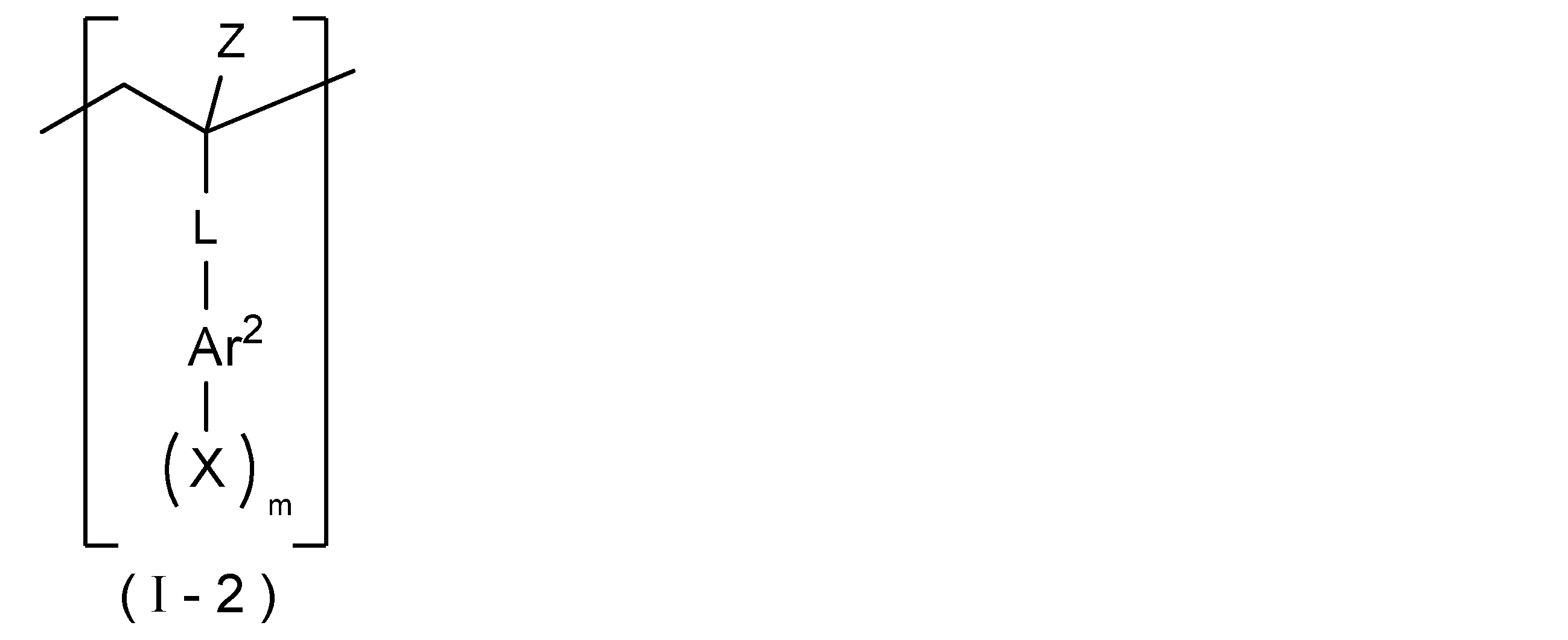
構造単位(I-3)は、下記式(I-3)で表される構造単位であり、カルド骨格を有する。
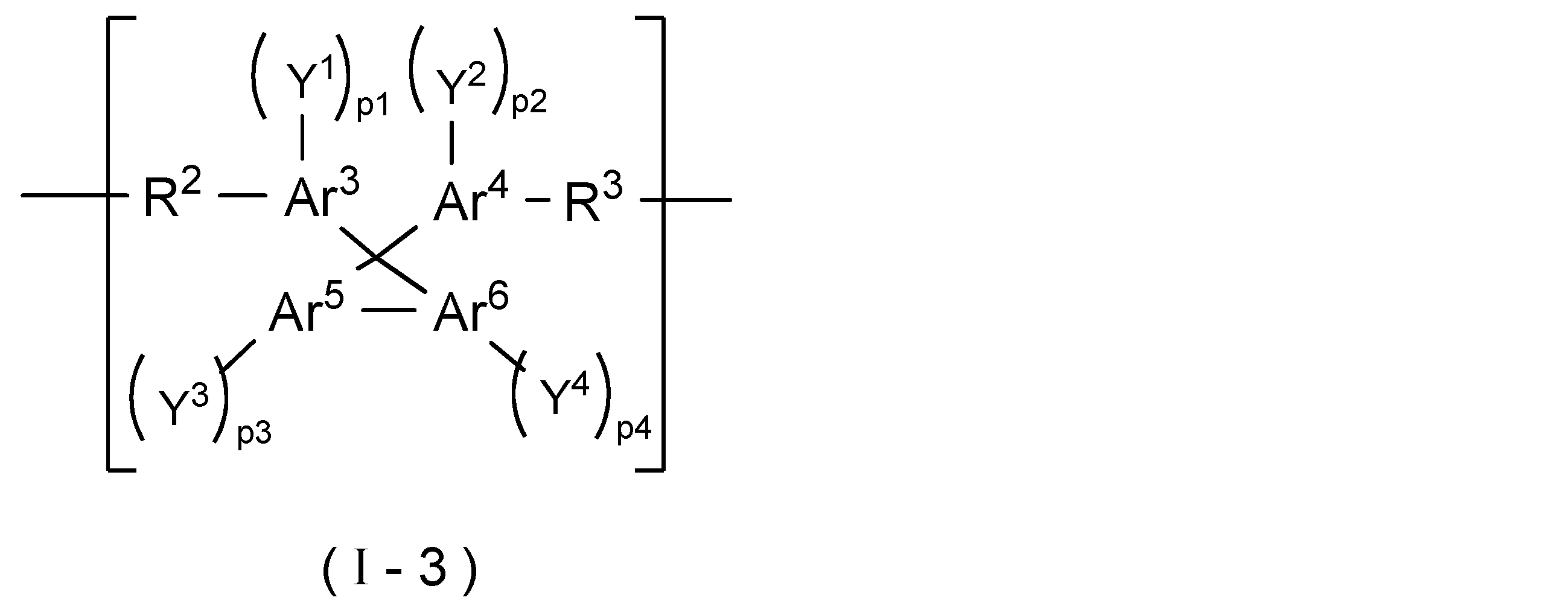
上記フェノール樹脂は、フェノール化合物に由来する構造単位を有する重合体である。上記構造単位としては、例えば上記式(I-1)において、Ar1を与えるアレーンが非置換又はアルキル基で置換されたベンゼンであり、かつR1が置換又は非置換のアルカンジイル基である構造単位(I-1)等が挙げられる。上記フェノール樹脂としては、例えばフェノール化合物と、アルデヒド化合物とを酸性触媒又はアルカリ性触媒を用いて反応させることで得られるノボラック樹脂やその誘導体等を用いることができる。
上記ナフトール樹脂は、ナフトール化合物に由来する構造単位を有する重合体である。上記構造単位としては、例えば上記式(I-1)において、Ar1を与えるアレーンが非置換又はアルキル基で置換されたナフタレンであり、かつR1が置換又は非置換のアルカンジイル基である構造単位(I-1)等が挙げられる。ナフトール樹脂としては、例えば上記ナフトール化合物と、上記アルデヒド化合物とを酸性触媒又はアルカリ性触媒を用いて反応させて得られる重合体やその誘導体等を用いることができる。
上記フルオレン樹脂は、フルオレン化合物に由来する構造単位を有する重合体である。上記構造単位としては、例えば上記式(I-3)において、R2が単結合、かつR3が置換又は非置換のアルカンジイル基である構造単位(I-3)等が挙げられる。上記フルオレン樹脂としては、例えばフルオレン化合物と、上記アルデヒド化合物とを酸性触媒又はアルカリ性触媒とを用いて反応させることで得られる重合体やその誘導体等を用いることができる。
上記スチレン樹脂は、芳香環及びエチレン性炭素-炭素二重結合を有する化合物に由来する構造単位を有する重合体である。上記構造単位としては、例えば上記式(I-2)においてLが単結合である構造単位(I-2)等が挙げられる。上記スチレン樹脂としては、例えばフェノール性ヒドロキシ基が結合した芳香環及びエチレン性炭素-炭素二重結合を有する化合物を反応させることで得られる重合体や、その誘導体等を用いることができる。ここで「フェノール性ヒドロキシ基」とは、芳香環に結合したヒドロキシ基をいう。
上記アセナフチレン樹脂は、アセナフチレン化合物に由来する構造単位を有する重合体である。アセナフチレン樹脂としては、例えばフェノール性ヒドロキシ基を有するアセナフチレン化合物に由来する構造単位を有する重合体や、その誘導体等を用いることができる。
上記インデン樹脂は、インデン化合物に由来する構造単位を有する重合体である。上記インデン樹脂としては、例えばフェノール性ヒドロキシ基を有するインデン化合物に由来する構造単位を有する重合体やその誘導体等を用いることができる。
上記アリーレン樹脂は、アリーレン骨格を有する構造単位を有する重合体である。上記構造単位としては、例えば上記式(I-1)においてR1が単結合である構造単位(I-1)等が挙げられる。上記アリーレン樹脂としては、例えばフェノール性ヒドロキシ基を有するアリーレン骨格を有する重合体やその誘導体等を用いることができる。アリーレン骨格としては、例えばフェニレン骨格、ナフチレン骨格、ビフェニレン骨格等が挙げられる。
上記芳香族ポリエーテル系樹脂は、芳香環及びこの芳香環に結合するオキシ基を含む構造単位を有する重合体である。上記構造単位としては、例えば上記式(I-1)においてR1がオキシ基である構造単位(I-1)や、上記式(I-3)においてR2が単結合、かつR3がオキシ基である構造単位(I-3)等が挙げられる。
上記ピレン樹脂は、ピレン骨格を有する構造単位を有する重合体である。上記ピレン樹脂としては、例えばフェノール性ヒドロキシ基を含むピレン骨格を有する重合体やその誘導体等を用いることができる。上記構造単位としては、例えば上記式(I-1)において、Ar1を与えるアレーンがピレンであり、かつR1が置換又は非置換のアルカンジイル基である構造単位(I-1)等が挙げられる。上記フェノール性ヒドロキシ基を含むピレン骨格を有する重合体は、例えばフェノール性ヒドロキシ基を有するピレン化合物と、上記アルデヒド化合物とを酸性触媒を用いて反応させて得られる。
上記カリックスアレーン樹脂は、フェノール性ヒドロキシ基が結合する芳香環が炭化水素基を介して複数個環状に結合した環状オリゴマーである。上記カリックスアレーン樹脂は、例えばフェノール構造を用いてフェノール性ヒドロキシ基以外のヘテロ原子含有基を導入してもよい。
[a2]芳香環含有化合物は、重合体でない化合物であって分子量が300以上3,000以下の芳香環含有化合物である。[a2]芳香環含有化合物の分子量は、例えばゲルパーミエーションクロマトグラフィー(GPC)によるポリスチレン換算重量平均分子量(Mw)として求められる。[a2]芳香環含有化合物としては、タンニン酸等が挙げられる。
タンニン酸とは、各種植物に含まれ、多数のフェノール性ヒドロキシ基を有する芳香族化合物の総称である。タンニン酸は、フラバノール骨格を持つ化合物の重合により形成される縮合型タンニン酸と、没食子酸やエラグ酸等の芳香族化合物とグルコース等の糖とのエステル結合により形成される加水分解性タンニン酸とに大別できるが、本発明ではいずれを用いてもよい。タンニン酸としては、特に限定されないが、例えばハマメリタンニン、カキタンニン、チャタンニン、五倍子タンニン、没食子タンニン、ミロバランタンニン、ジビジビタンニン、アルガロビラタンニン、バロニアタンニン、カテキンタンニン等が挙げられる。加水分解性タンニン酸の具体例としては、例えば下記式で表される化合物等が挙げられる。タンニン酸は、一種の化合物でも、二種以上の化合物の混合物でもよい。
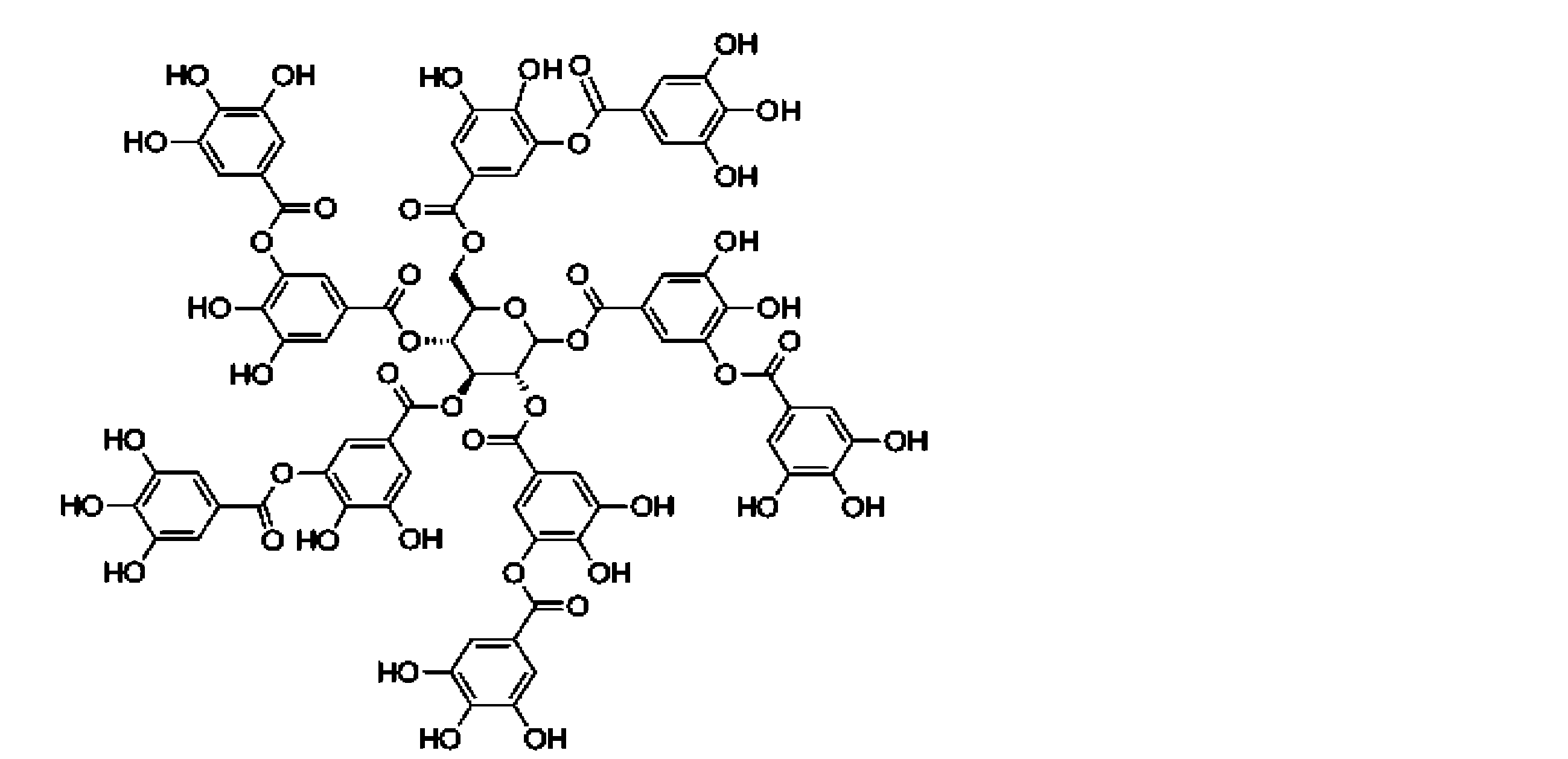
当該処理剤に用いる[B]溶媒としては、特に限定されないが、例えば水、極性有機溶媒等の極性溶媒を用いることができる。[B]溶媒は、1種単独で又は2種以上を組み合わせて用いることができる。
[C]酸発生剤は、熱や光の作用により酸を発生し、[A]化合物の架橋を促進する成分である。当該処理剤が[C]酸発生剤を含有することで[A]化合物の架橋反応が促進され、形成される膜の硬度をより高めることができる。[C]酸発生剤は、1種単独で又は2種以上を組み合わせて用いることができる。
当該処理剤は、本発明の目的を損なわない範囲で、必要に応じて任意成分である添加剤をさらに含有してもよい。上記添加剤は、1種単独で又は2種以上を組み合わせて用いることができる。
当該処理剤は、基板パターンの汚染を低減する観点から、金属をなるべく含有しないことが好ましい。上記金属としては、例えばナトリウム、カリウム、マグネシウム、カルシウム、銅、アルミニウム、鉄、マンガン、スズ、クロム、ニッケル、亜鉛、鉛、チタン、ジルコニウム、銀、白金等が挙げられる。上記金属の形態としては、特に限定されないが、例えば金属カチオン、金属錯体、金属メタル、イオン性化合物等が挙げられる。
当該処理剤は、[A]化合物、[B]溶媒及び必要に応じて配合される任意成分を混合した後、得られた溶液を例えば孔径0.02μm程度のフィルターで濾過することにより製造することができる。当該処理剤の固形分濃度の下限としては、0.1質量%が好ましく、1質量%がより好ましく、3質量%がさらに好ましく、10質量%が特に好ましい。上記固形分濃度の上限としては、50質量%が好ましく、40質量%がより好ましく、30質量%がさらに好ましい。ここで当該処理剤における「固形分」とは、[B]溶媒以外の成分をいう。
当該基板の処理方法は、一方の面にパターンが形成された基板の上記パターン側の面に、当該処理剤の塗工により基板パターン倒壊抑制膜を形成する工程(基板パターン倒壊抑制膜形成工程)を備える。当該基板の処理方法は、上述の当該処理剤を用いるため、基板パターンの倒壊抑制性及び欠陥抑制性に優れる。
本工程では、一方の面にパターンが形成された基板の上記パターン側の面に、当該処理剤の塗工により基板パターン倒壊抑制膜を形成する。これにより、基板上に洗浄液やリンス液等の液体が保持されていたとしても、これらの液体を乾燥させることなく除去できる。本工程後、後述する除去工程までの間、上記基板パターンは、その少なくとも一部が基板パターン倒壊抑制膜に埋没し、各パターンが基板パターン倒壊抑制膜に支持された状態となるため、隣接するパターン同士の接触等のパターン倒壊が抑制される。
当該基板の処理方法は、通常、基板パターン倒壊抑制膜形成工程後に上記基板パターン倒壊抑制膜を除去する工程(除去工程)をさらに備える。上記基板パターン倒壊抑制膜の除去には、例えば加熱処理、プラズマ処理、ドライエッチング(アッシング)、紫外線照射、電子線照射等を用いることができる。これらの方法によれば、上記基板パターン倒壊抑制膜を固相から直接気相にすることができるため、上記基板パターンの側面を気液界面が通過することによるパターン倒壊を抑制できる。
実施例の各重合体の重量平均分子量(Mw)及び数平均分子量(Mn)は、東ソー社のGPCカラム(「G2000HXL」1本、「G3000HXL」1本、及び「G4000HHR」)を用い、流量:1.00mL/分、溶出溶媒:テトラヒドロフラン、カラム温度:40℃の分析条件で、ポリスチレン標準試料(アジレント・テクノロジー社の「EasicalPS-1」)を標準とするゲルパーミエーションクロマトグラフ(東ソー社の「HLC-8220」)を用いて測定した。
[合成例1](化合物(A-1)の合成)
温度計、コンデンサー及びマグネチックスターラーを備えた1,000mLの3口フラスコに、窒素雰囲気下、フェノール500g、86%パラホルムアルデヒド106g及び37%ホルムアルデヒド13gを仕込み、酢酸亜鉛1.46gを加えて4時間還流反応を行った。次に、反応溶液を静置して有機相及び水層に分離させた後、上層の水層を除いた。その後、残る下層の有機層を150℃で2mmHgまで減圧し、水分及び未反応モノマーを除くことにより、下記式(A-1)で表される構造単位を有するフェノール樹脂である化合物(A-1)を得た。得られた化合物(A-1)のMwは1,500であった。
温度計、コンデンサー及びマグネチックスターラーを備えた1,000mLの3口フラスコに、窒素雰囲気下、フェノール150g、37%ホルムアルデヒド129.36g及びメチルイソブチルケトン450gを仕込み、室温にて溶解させた。得られた溶液に、溶液温度40℃にてパラトルエンスルホン酸2.74gを加え、次に溶液温度を80℃にして7時間熟成させた。熟成後、溶液温度が室温になるまでフラスコを冷却した。この反応溶液をメタノール5,000gに加え、析出した固形物を、濾過にてメタノール溶液を除去することにより回収した。次いで、回収した固形物について、メタノール及び水の混合溶液(各300g)を用いて掛け流し洗浄を行い、60℃で一晩減圧乾燥することにより、下記式(A-2)で表される構造単位を有するフェノール樹脂である化合物(A-2)を得た。得られた化合物(A-2)のMwは10,000であった。
温度計、コンデンサー及びマグネチックスターラーを備えた1,000mLの3口フラスコに、窒素雰囲気下、2,7-ジヒドロキシナフタレン150g、37%ホルムアルデヒド76.01g及びメチルイソブチルケトン450gを仕込み、室温にて溶解させた。得られた溶液に、溶液温度40℃にてパラトルエンスルホン酸1.61gを加え、次に溶液温度を80℃にして7時間熟成させた。熟成後、溶液温度が室温になるまでフラスコを冷却した。この反応溶液をメタノール及び水の混合溶液(各2,500g)に加え、析出した固形物を、濾過にてメタノール及び水の混合溶液を除去することにより回収した。次いで、回収した固形物について、メタノール及び水の混合溶液(各300g)を用いて掛け流し洗浄を行い、60℃で一晩減圧乾燥することにより、下記式(A-3)で表される構造単位を有するナフトール樹脂である化合物(A-3)を得た。得られた化合物(A-3)のMwは3,000であった。
温度計、コンデンサー及びマグネチックスターラーを備えた1,000mLの3口フラスコに、窒素雰囲気下、ピロガロール150g、37%ホルムアルデヒド96.54g及びメチルイソブチルケトン450gを仕込み、室温にて溶解させた。得られた溶液に、溶液温度40℃にてパラトルエンスルホン酸2.05gを加え、次に溶液温度を80℃にして7時間熟成させた。熟成後、溶液温度が室温になるまでフラスコを冷却した。この反応溶液をヘキサン5,000gに加え、析出した固形物を、濾過にてヘキサンを除去することにより回収した。次いで、回収した固形物について、ヘキサン600gを用いて掛け流し洗浄を行い、60℃で一晩減圧乾燥することにより、下記式(A-4)で表される構造単位を有するフェノール樹脂である化合物(A-4)を得た。得られた化合物(A-4)のMwは10,000であった。
温度計、コンデンサー及びマグネチックスターラーを備えた1,000mLの3口フラスコに、窒素雰囲気下、パラフェノールスルホン酸150g、37%ホルムアルデヒド69.90g及びメタノール450gを仕込み、室温にて溶解させた。得られた溶液に、溶液温度40℃にてパラトルエンスルホン酸1.48gを加え、次に溶液温度を60℃にして7時間熟成させた。熟成後、溶液温度が室温になるまでフラスコを冷却することで下記式(A-5)で表される構造単位を有するフェノール樹脂である化合物(A-5)を得た。得られた化合物(A-5)のMwは10,000であった。
温度計、コンデンサー及びマグネチックスターラーを備えた1,000mLの3口フラスコに、窒素雰囲気下、2-ナフトール-6-スルホン酸150g、37%ホルムアルデヒド54.29g及びメタノール450gを仕込み、室温にて溶解させた。得られた溶液に、溶液温度40℃にてパラトルエンスルホン酸1.15gを加え、次に溶液温度を60℃にして7時間熟成させた。熟成後、溶液温度が室温になるまでフラスコをすることで下記式(A-6)で表される構造単位を有するナフトール樹脂である化合物(A-6)を得た。得られた化合物(A-6)のMwは2,500であった。
温度計、コンデンサー及びマグネチックスターラーを備えた1,000mLの3口フラスコに、窒素雰囲気下、フェノール150g、4-ヒドロキシベンズアルデヒド194.64g及びメチルイソブチルケトン450gを仕込み、室温にて溶解させた。得られた溶液に、溶液温度40℃にてパラトルエンスルホン酸2.74gを加え、次に溶液温度を80℃にして7時間熟成させた。熟成後、溶液温度が室温になるまでフラスコを冷却した。この反応溶液をメタノール及び水の混合溶液(各2,500g)に加え、析出した固形物を、濾過にてメタノール及び水の混合溶液を除去することにより回収した。次いで、回収した固形分について、メタノール及び水の混合溶液(各300g)を用いて掛け流し洗浄を行い、60℃で一晩減圧乾燥することにより、下記式(A-7)で表される構造単位を有するフェノール樹脂である化合物(A-7)を得た。得られた化合物(A-7)のMwは10,000であった。
温度計、コンデンサー及びマグネチックスターラーを備えた1,000mLの3口フラスコに、窒素雰囲気下、パラフェノールスルホン酸150g、4-ヒドロキシベンズアルデヒド105.17g及びメタノール450gを仕込み、室温にて溶解させた。得られた溶液に、溶液温度40℃にてパラトルエンスルホン酸1.48gを加え、次に、溶液温度を60℃にして7時間熟成させた。熟成後、溶液温度が室温になるまでフラスコをすることで下記式(A-8)で表される構造単位を有するフェノール樹脂である化合物(A-8)を得た。得られた化合物(A-8)のMwは10,000であった。
温度計、コンデンサー及びマグネチックスターラーを備えた1,000mLの3口フラスコに、窒素雰囲気下、1-ヒドロキシピレン150g、37%ホルムアルデヒド55.78g及びメチルイソブチルケトン450gを仕込み、室温にて溶解させた。得られた溶液に、溶液温度40℃にてパラトルエンスルホン酸1.18gを加え、次に、溶液温度を80℃にして7時間熟成させた。熟成後、溶液温度が室温になるまでフラスコを冷却した。この反応溶液をメタノール及び水の混合溶液(各2,500g)に加え、析出した固形物を、濾過にてメタノール及び水の混合溶液を除去することにより回収した。次いで、回収した固形物について、メタノール及び水の混合溶液(各300g)を用いて掛け流し洗浄を行い、60℃で一晩減圧乾燥することにより、下記式(A-9)で表される構造単位を有するピレン樹脂である化合物(A-9)を得た。得られた化合物(A-9)のMwは3,000であった。
温度計、コンデンサー及びマグネチックスターラーを備えた1,000mLの3口フラスコに、窒素雰囲気下、4,4’-(9H-フルオレン-9-イリデン)ビスフェノール150g、37%ホルムアルデヒド34.74g及びメチルイソブチルケトン450gを仕込み、室温にて溶解させた。得られた溶液に、溶液温度40℃にてパラトルエンスルホン酸0.74gを加え、次に溶液温度を80℃にして7時間熟成させた。熟成後、溶液温度が室温になるまでフラスコを冷却した。この反応溶液をメタノール及び水の混合溶液(各2,500g)に加え、析出した固形物を、濾過にてメタノール及び水の混合溶液を除去することにより回収した。次いで、回収した固形物をメタノール及び水の混合溶液(各300g)を用いて掛け流し洗浄を行い、60℃で一晩減圧乾燥することにより、下記式(A-10)で表される構造単位を有するフルオレン樹脂である化合物(A-10)を得た。得られた化合物(A-10)のMwは10,000であった。
温度計、コンデンサー及びマグネチックスターラーを備えた1,000mLの3口フラスコに、窒素雰囲気下、3,5-ジフルオロフェノール150g、37%ホルムアルデヒド93.58g及びメチルイソブチルケトン450gを仕込み、室温にて溶解させた。得られた溶液に、溶液温度40℃にてパラトルエンスルホン酸1.99gを加え、次に溶液温度を80℃にして7時間熟成させた。熟成後、溶液温度が室温になるまでフラスコを冷却した。この反応溶液をメタノール及び水の混合溶液(各2,500g)に加え、析出した固形物を、濾過にてメタノール及び水の混合溶液を除去することにより回収した。次いで、回収した固形物について、メタノール及び水の混合溶液(各300g)を用いて掛け流し洗浄を行い、60℃で一晩減圧乾燥することにより、下記式(A-11)で表される構造単位を有するフェノール樹脂である化合物(A-11)を得た。得られた化合物(A-11)のMwは10,000であった。
温度計、コンデンサー及びマグネチックスターラーを備えた1,000mLの3口フラスコに、窒素雰囲気下、3,5―ジブロモフェノール150g、37%ホルムアルデヒド48.33g及びメチルイソブチルケトン450gを仕込み、室温にて溶解させた。得られた溶液に、溶液温度40℃にてパラトルエンスルホン酸1.03gを加え、次に溶液温度を80℃にして7時間熟成させた。熟成後、溶液温度が室温になるまでフラスコを冷却した。この反応溶液をメタノール及び水の混合溶液(各2,500g)に加え、析出した固形物を、濾過にてメタノール及び水の混合溶液を除去することにより回収した。次いで、回収した固形物について、メタノール及び水の混合溶液(各300g)を用いて掛け流し洗浄を行い、60℃で一晩減圧乾燥することにより、下記式(A-12)で表される構造単位を有するフェノール樹脂である化合物(A-12)を得た。得られた化合物(A-12)のMwは10,000であった。
温度計、コンデンサー及びマグネチックスターラーを備えた1,000mLの3口フラスコに、窒素雰囲気下、1,4―ジヒドロキシベンゼン80g、1,4―ジフルオロベンゼン69.08g、アルカリ金属化合物としての炭酸カリウム100.41g、ジメチルアセトアミド450g、及びトルエン90gを仕込んだ。得られた混合物を、撹拌しながら溶液温度140℃にて8時間熟成させた。熟成後、溶液温度が室温になるまでフラスコを冷却した。この反応溶液を濾過後、メタノール5,000gに加え、析出した固形物を、濾過にてメタノールを除去することにより回収した。次いで、回収した固形物について、メタノール及び水の混合溶液(各300g)を用いて掛け流し洗浄を行い、60℃で一晩減圧乾燥することにより、下記式(A-13)で表される構造単位を有するポリアリーレンエーテルである化合物(A-13)を得た。得られた化合物(A-13)のMwは10,000であった。
温度計、コンデンサー及びマグネチックスターラーを備えた1,000mLの3口フラスコに、窒素雰囲気下、1,2,4,5―テトラフルオロ-3,6-ジヒドロキシベンゼン80g、ヘキサフルオロベンゼン68.13g、アルカリ金属化合物としての炭酸カリウム60.72g、ジメチルアセトアミド450g、トルエン90gを仕込んだ。混合物を撹拌しながら、溶液温度140℃にて8時間熟成させた。熟成後、溶液温度が室温になるまでフラスコを冷却した。この反応溶液を濾過後、メタノール5,000gに加え、析出した固形物を、濾過にてメタノールを除去することにより回収した。次いで、メタノール及び水の混合溶液(各300g)を用いて、掛け流し洗浄を行い、60℃で一晩減圧乾燥することにより、重合体である下記式(A-14)で表される構造単位を有するポリアリーレンエーテルである化合物(A-14)を得た。得られた化合物(A-14)のMwは10,000であった。
温度計、コンデンサー及びマグネチックスターラーを備えた1,000mLの3口フラスコに、窒素雰囲気下、スチレン270g、アゾビスイソブチロニトリル21.29g及びプロピレングリコールモノメチルエーテル630gを仕込み、室温にて溶解させた。次に、溶液温度を70℃にして10時間重合させた。重合後、溶液温度が室温になるまでフラスコを冷却した。得られた重合体に酢酸エチルを加え、水洗を5回繰り返した後に酢酸エチル相を分取し、溶剤を除去することで下記式(a-1)で表される構造単位を有するポリスチレンである化合物(a-1)を得た。得られた化合物(a-1)のMwは10,000であった。

反応容器に窒素雰囲気下、レゾルシノール15.0g、アセトアルデヒド6g及びエタノール105gを仕込み、室温にて溶解させた。得られた溶液に濃塩酸40.1gを1時間かけて滴下し、その後溶液温度を80℃にして7時間熟成させた。熟成後、溶液温度が室温になるまで冷却した。その後、析出してきた赤茶色の固形物を、濾過にてエタノール溶液を除去することにより回収し、前駆体となる固形物を得た。次に反応容器に窒素雰囲気下、上記得られた前駆体15.0g、4-メチル-2-ペンタノン30.0g、メタノール15.0g及び25質量%テトラメチルアンモニウムヒドロキシド水溶液81.7gを仕込み、室温にて溶解させた。その後50℃に昇温し、2-クロロメチルスチレン34.2gを30分かけて滴下し、そのまま80℃で6時間熟成させることで、上記樹脂(A-17)を得た。得られた化合物(A-17)のMwは1,300であった。
温度計、コンデンサー及びマグネチックスターラーを備えた1,000mLの3口フラスコに、窒素雰囲気下、スチレン135g、p-t-ブトキシスチレン228g、アゾビスイソブチロニトリル21.29g及びプロピレングリコールモノメチルエーテル846gを仕込み、室温にて溶解させた。次に、溶液温度を70℃にして10時間重合させた。重合後、溶液温度が室温になるまでフラスコを冷却した。反応溶液に硫酸を加えて、90℃で10時間反応させた。得られた重合体に酢酸エチルを加え、水洗を5回繰り返した後に酢酸エチル相を分取し、溶剤を除去することで下記式(A-18)で表される構造単位を有するビニル樹脂である化合物(A-18)を得た。得られた化合物(A-18)のMwは10,000であった。
温度計、コンデンサー及びマグネチックスターラーを備えた1,000mLの3口フラスコに、窒素雰囲気下、2-ビニルナフタレン160g、p-t-ブトキシスチレン274g、アゾビスイソブチロニトリル21.29g及びプロピレングリコールモノメチルエーテル1011gを仕込み、室温にて溶解させた。次に、溶液温度を70℃にして10時間重合させた。重合後、溶液温度が室温になるまでフラスコを冷却した。反応溶液に硫酸を加えて、90℃で10時間反応させた。得られた重合体に酢酸エチルを加え、水洗を5回繰り返した後に酢酸エチル相を分取し、溶剤を除去することで下記式(A-19)で表される構造単位を有するビニル樹脂である化合物(A-19)を得た。得られた化合物(A-19)のMwは10,000であった。
温度計、コンデンサー及びマグネチックスターラーを備えた1,000mLの3口フラスコに、窒素雰囲気下、2-ビニルナフタレン160g、p-t-ブトキシスチレン228g、アクリル酸ブチル33g、アゾビスイソブチロニトリル21.29g及びプロピレングリコールモノメチルエーテル980gを仕込み、室温にて溶解させた。次に、溶液温度を70℃にして10時間重合させた。重合後、溶液温度が室温になるまでフラスコを冷却した。反応溶液に硫酸を加えて、90℃で10時間反応させた。得られた重合体に酢酸エチルを加え、水洗を5回繰り返した後に酢酸エチル相を分取し、溶剤を除去することで下記式(A-20)で表される構造単位を有するビニル樹脂である化合物(A-20)を得た。得られた化合物(A-20)のMwは8,000であった。
温度計、コンデンサー及びマグネチックスターラーを備えた1,000mLの3口フラスコに、窒素雰囲気下、2-ビニルナフタレン160g、ビニルベンジルアルコール174g、アクリル酸ブチル33g、アゾビスイソブチロニトリル21.29g及びプロピレングリコールモノメチルエーテル855gを仕込み、室温にて溶解させた。次に、溶液温度を70℃にして10時間重合させた。重合後、溶液温度が室温になるまでフラスコを冷却した。得られた重合体に酢酸エチルを加え、水洗を5回繰り返した後に酢酸エチル相を分取し、溶剤を除去することで下記式(A-21)で表される構造単位を有するビニル樹脂である化合物(A-21)を得た。得られた化合物(A-21)のMwは6,000であった。
処理剤の調製に用いた各成分を以下に示す。
各[A]化合物を以下に示す。なお、各[A]化合物のヘテロ原子含有割合は、構造式から算出した値である。
A-1:フェノール樹脂(A-1)(Mw1,500、ヘテロ原子含有割合15.1質量%)
A-2:フェノール樹脂(A-2)(Mw10,000、ヘテロ原子含有割合15.1質量%)
A-3:ナフトール樹脂(A-3)(Mw3,000、ヘテロ原子含有割合18.6質量%)
A-4:フェノール樹脂(A-4)(Mw10,000、ヘテロ原子含有割合34.8質量%)
A-5:フェノール樹脂(A-5)(Mw10,000、ヘテロ原子含有割合51.6質量%)
A-6:ナフトール樹脂(A-6)(Mw2,500、ヘテロ原子含有割合33.9質量%)
A-7:フェノール樹脂(A-7)(Mw10,000、ヘテロ原子含有割合16.1質量%)
A-8:フェノール樹脂(A-8)(Mw10,000、ヘテロ原子含有割合40.3質量%)
A-9:ピレン樹脂(A-9)(Mw3,000、ヘテロ原子含有割合6.1質量%)
A-10:フルオレン樹脂(A-10)(Mw10,000、ヘテロ原子含有割合8.1質量%)
A-11:フェノール樹脂(A-11)(Mw10,000、ヘテロ原子含有割合38質量%)
A-12:フェノール樹脂(A-12)(Mw10,000、ヘテロ原子含有割合66.6質量%)
A-13:ポリアリーレンエーテル(A-13)(Mw10,000、ヘテロ原子含有割合17.4質量%)
A-14:ポリアリーレンエーテル(A-14)(Mw10,000、ヘテロ原子含有割合56.1質量%)
A-15:パラヒドロキシスチレン樹脂(A-15)(Mw10,000、ヘテロ原子含有割合13.3質量%)(Aldrich社製)
A-16:下記式(A-16)で表される化合物(タンニン酸)(Mw1,701.2、ヘテロ原子含有割合43.3質量%)
A-17:カリックスアレーン樹脂(A-17)(Mw1,300、ヘテロ原子含有割合10.3質量%)
A-18:スチレン樹脂(A-18)で表される化合物(Mw10,000、ヘテロ原子含有割合7.1質量%)
A-19:スチレン樹脂(A-19)(Mw10,000、ヘテロ原子含有割合7.2質量%)
A-20:スチレン樹脂(A-20)(Mw8,000、ヘテロ原子含有割合8.3質量%)
A-21:スチレン樹脂(A-21)(Mw6,000、ヘテロ原子含有割合7.9質量%)
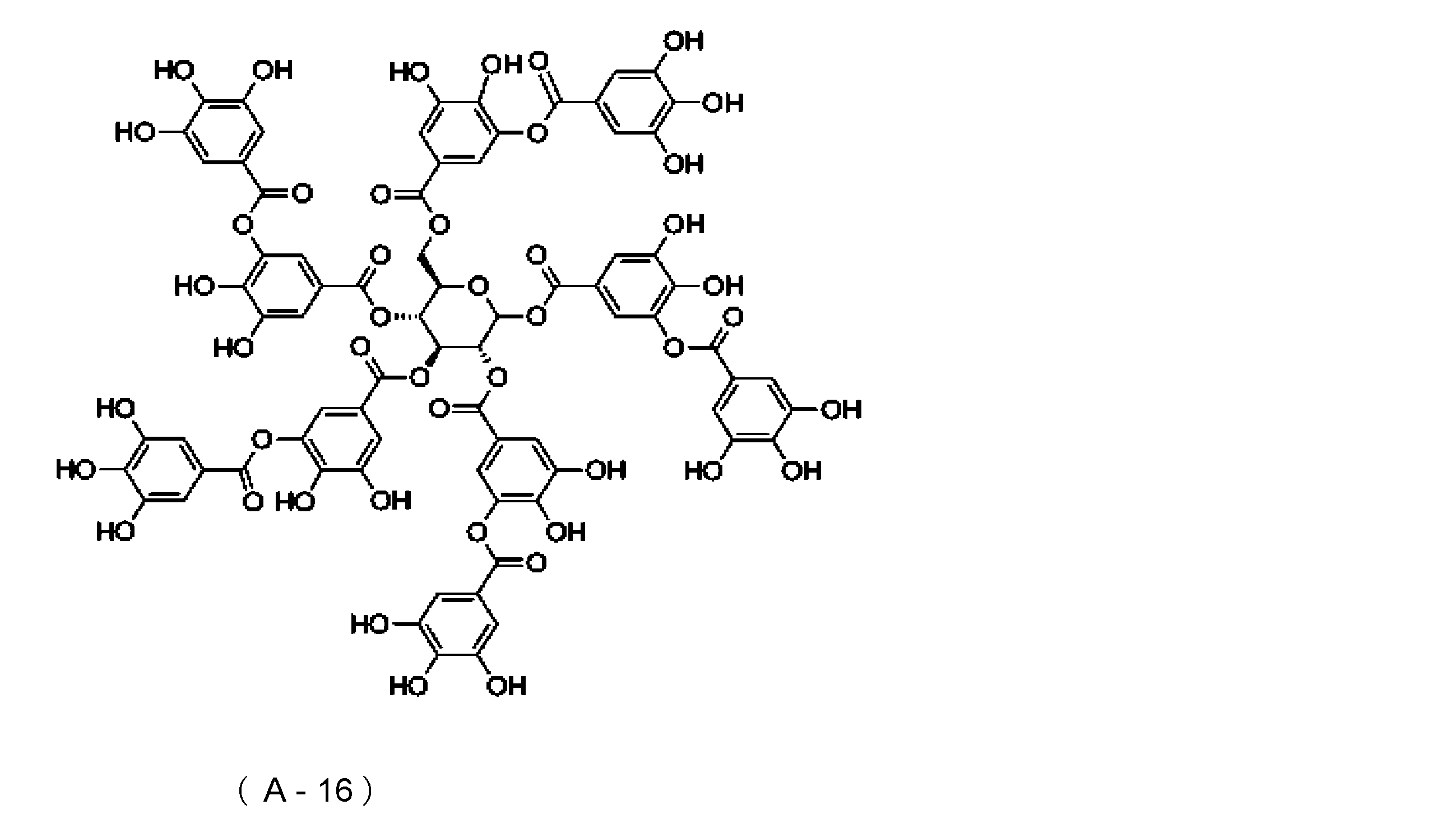
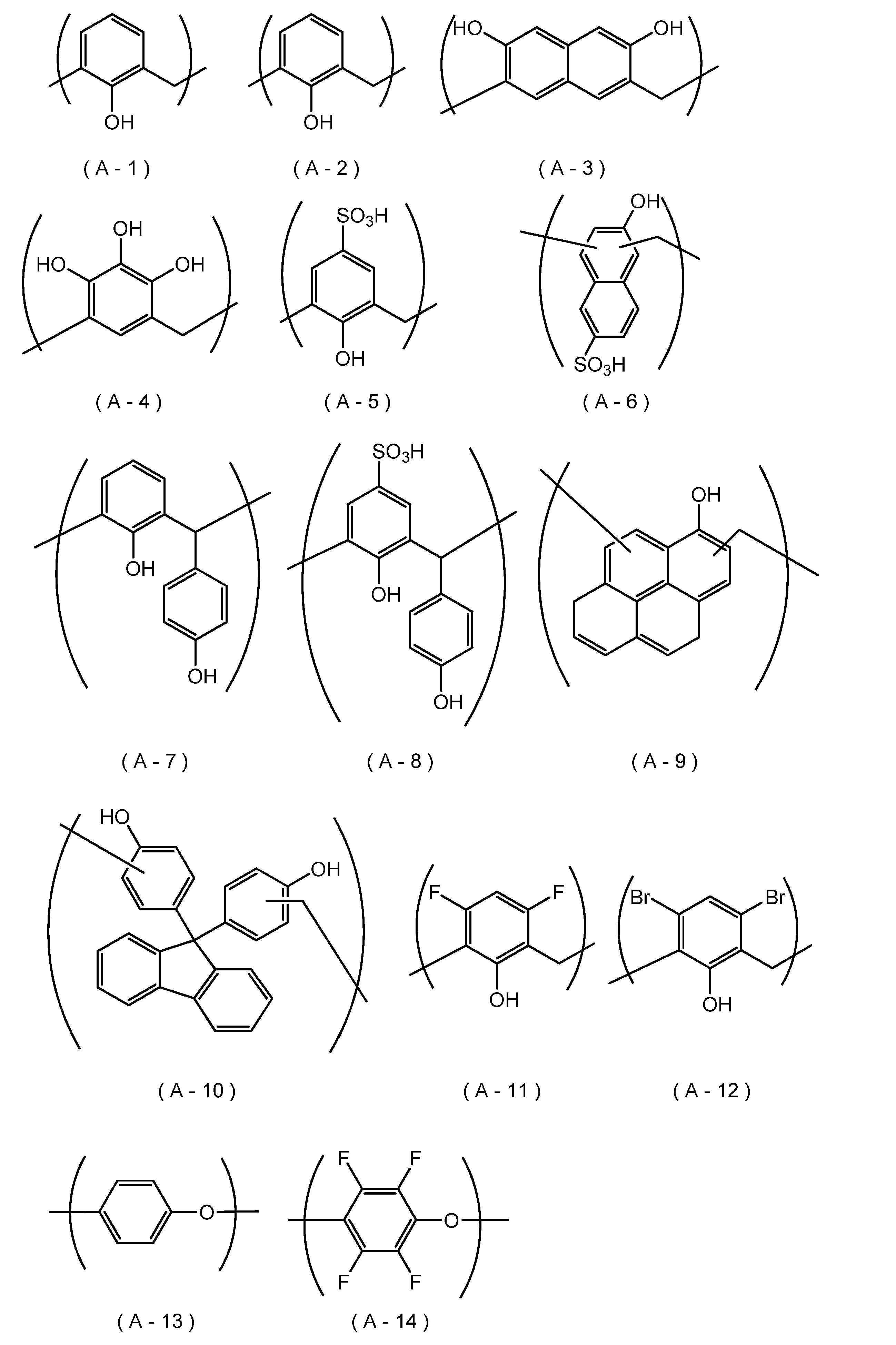
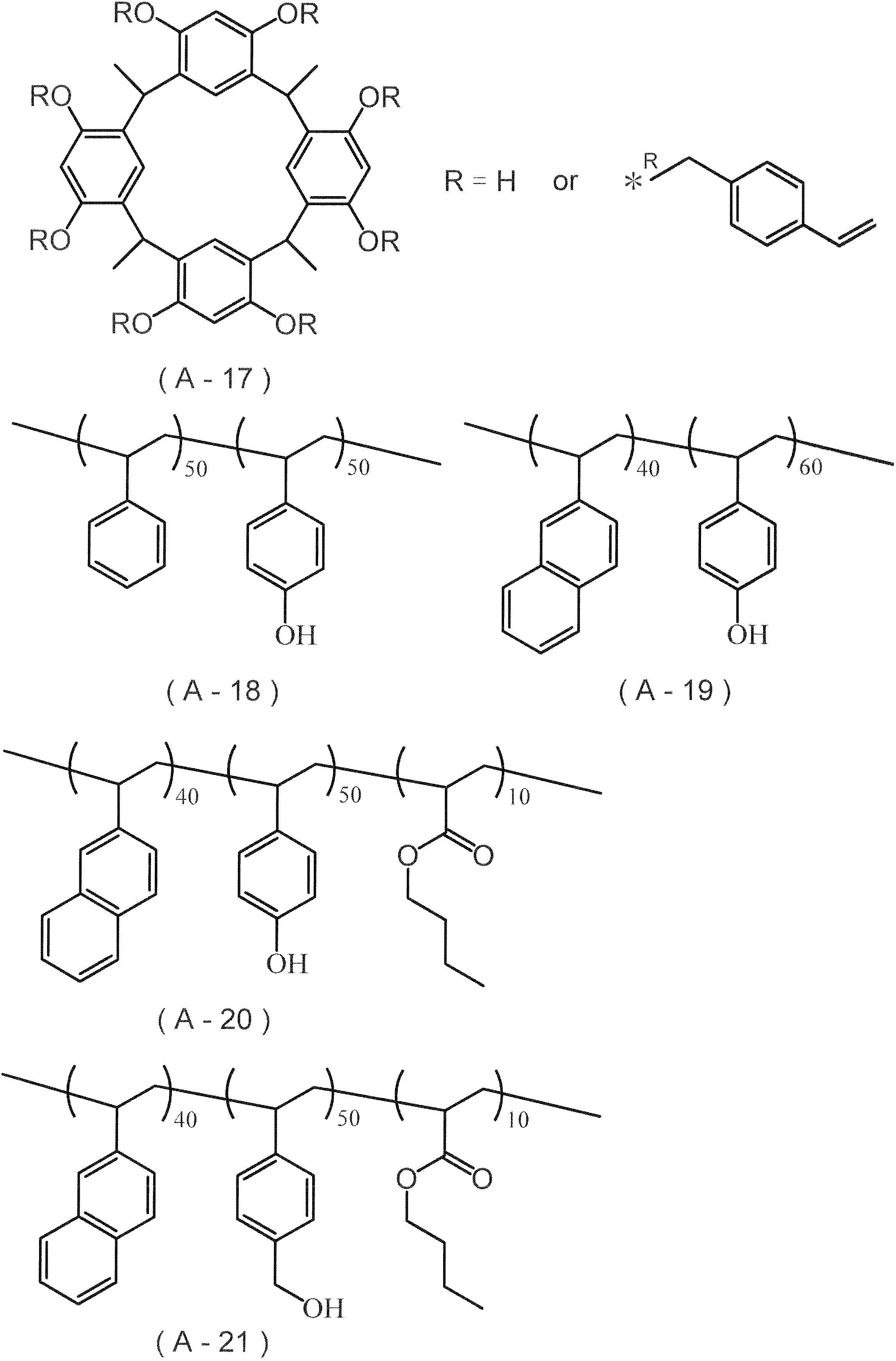
a-1:ポリスチレン(Mw10,000、ヘテロ原子含有割合0質量%)
a-2:ポリビニルアルコール(重合度500、ヘテロ原子含有割合36.3質量%)(和光純薬工業社製)
B-1:水
B-2:イソプロパノール(IPA)
B-3:プロピレングリコールモノメチルエーテルアセテート
B-4:プロピレングリコールモノメチルエーテル
B-5:乳酸メチル
C-1:下記式(C-1)で表されるジフェニルヨードニウムノナフルオロ-n-ブタンスルホネート。

D-1:ノニオン界面活性剤(JSR社の「ダイナフロー」)
[A]化合物としての(A-1)25質量部を[B]溶媒としての(B-3)100質量部に溶解させた。得られた溶液を孔径0.1μmのメンブランフィルターで濾過することで実施例1の処理剤を調製した。
各成分の種類及び含有量を表1に示す通りとした以外は実施例1と同様に操作し、各処理剤を調製した。なお、表1中、「-」は該当する成分を使用しなかったことを示す。
[塗布膜の形成]
一方の面にパターンが形成された基板の上記パターン側の面に、実施例1~25及び比較例1~4で調製した各処理剤に簡易スピンコーター(ミカサ社の「1H-DX2」)で塗工した。塗工条件は、大気下、回転数500rpmの条件とした。上記基板としては、密なピラーパターンが形成されたシリコンウエハを用いた。このピラーパターンは、ピラーの平均高さが380nm、ピラーの上面(頂部)の平均幅が35nm、ピラーの高さ方向中央部における平均断面幅が20nm、各ピラー間の平均ピッチが100nm(ピラー幅方向中央部基準)である。その後、上記塗工後のシリコンウエハをホットプレートにて120℃で60秒間ベークすることで、パターン倒壊防止抑制用処理膜が形成された基板を得た。
実施例1~25及び比較例1~4の各処理剤について、以下の方法により塗布性、埋め込み性、並びに基板パターンの倒壊抑制性及び欠陥抑制性を評価した。評価結果を表1に示す。
上記パターン倒壊防止抑制膜が形成された各シリコンウエハ基板について、中心から円周方向に向かう筋状の欠陥(ストリエーション)の有無を目視にて観察した。塗布性は、筋状の欠陥(ストリエーション)がない場合には「A」(極めて良好)、欠陥が部分的にあった場合には「B」(良好)、欠陥が全面にあった場合には「C」(不良)と評価した。比較例1~2においては、パターン倒壊防止抑制膜が形成されなかったため、塗布性の評価は行わなかった。
上記基板パターン倒壊防止抑制膜が形成された各シリコンウエハ基板の断面を切出し、FE-SEM(日立ハイテクノロジーズ社の「S4800」)を用いて各パターン倒壊抑制膜の埋め込み性を評価した。埋め込み性は、パターン倒壊抑制膜がパターン底部まで埋め込まれ、かつパターン頂部の露出が無い場合を「A」(極めて良好)、パターン倒壊抑制膜がパターン底部まで埋め込まれているが、ボイド等が観察される場合を「B」(良好)、パターン倒壊抑制膜がパターン底部まで埋め込まれておらず、頂部の露出がある場合を「C」(不良)と評価した。比較例1~2においては、パターン倒壊防止抑制膜が形成されなかったため、埋め込み性の評価を行わなかった。
上記パターン倒壊抑制膜が形成された各シリコンウエハ基板に対し、アッシング装置(ULVAC社の「Luminous NA-1300」)を用いてN2/H2(=97/3(体積%))混合ガスにてドライエッチング(アッシング)処理し、パターン倒壊抑制膜を除去した。ドライエッチング時の基板温度は250℃とした。除去後の各基板における倒壊せずに残存しているピラー数を上記FE-SEMの観察画面上で求めた。基板パターンの倒壊抑制性は、倒壊せずに残存しているピラーの割合が90%超の場合を「A」(極めて良好)、倒壊せずに残存しているピラーの割合が70%超90%以下の場合を「B」(良好)、倒壊せずに残存しているピラーの割合が70%以下の場合を「C」(不良)と評価した。
上記基板パターン倒壊抑制膜を除去した基板を上記FE-SEMで観察し、観察画面の視野(2,500nm×2,500nm)中のピラー上面(頂部)に付着する残渣の有無を測定した。基板パターンの欠陥抑制性は、残渣が残っていなかった場合を「A」(良好)、残渣が1箇所以上に残っていた場合を「B」(不良)と評価した。
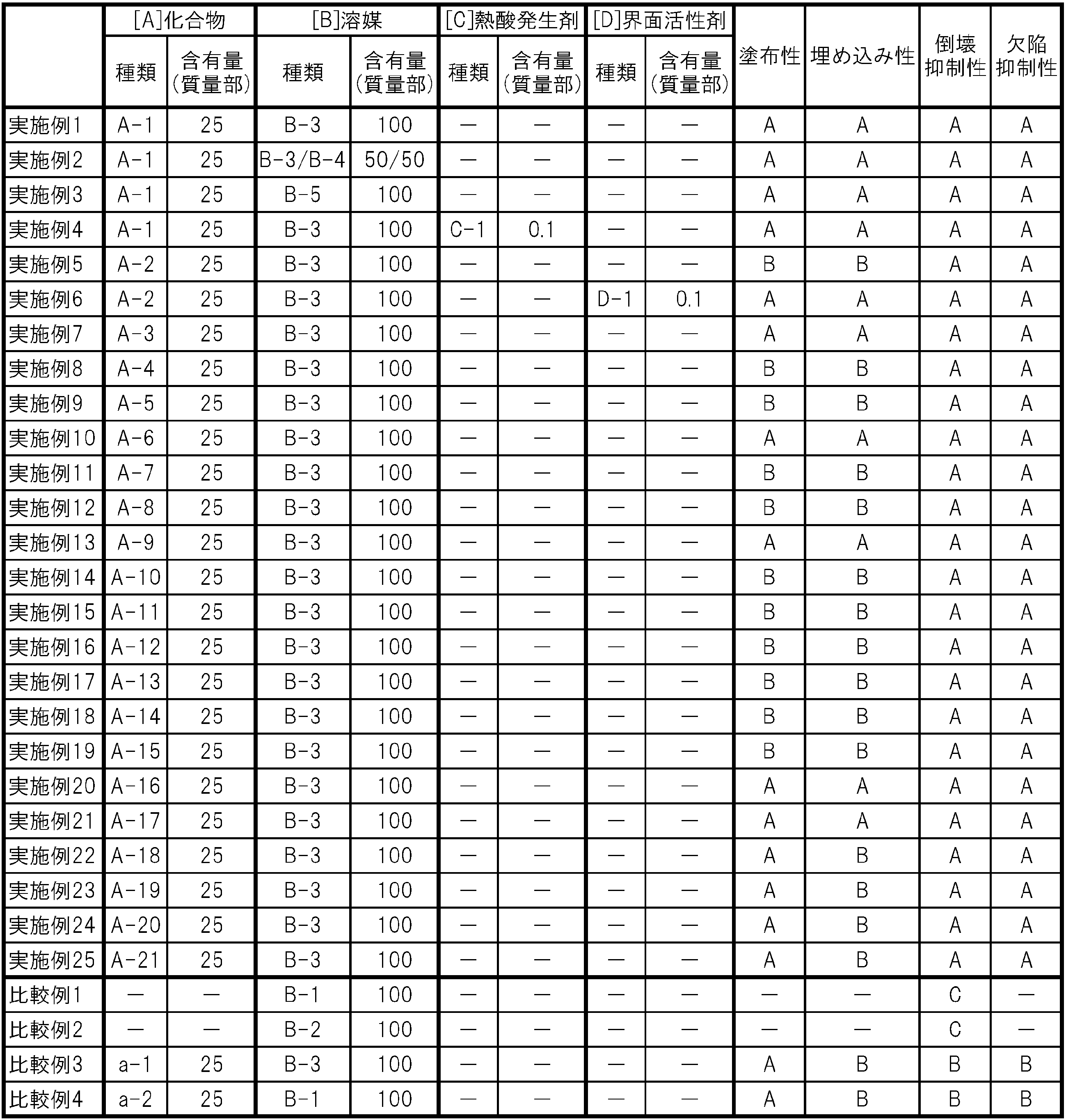
Claims (10)
- 基板の表面に形成されたパターンの倒壊を抑制する処理剤であって、
芳香環、及びこの芳香環に結合するヘテロ原子含有基を有する化合物と、
溶媒と
を含有することを特徴とする処理剤。 - 上記ヘテロ原子含有基が、ヒドロキシ基、カルボキシ基、シアノ基、アミノ基、スルホ基、カルボニル基、オキシ基、ハロゲン原子又はこれらの組み合わせを含む請求項1に記載の処理剤。
- 上記化合物が、分子量が300以上3,000以下の芳香環含有化合物、フェノール樹脂、ナフトール樹脂、フルオレン樹脂、スチレン樹脂、アセナフチレン樹脂、インデン樹脂、アリーレン樹脂、芳香族ポリエーテル系樹脂、ピレン樹脂、カリックスアレーン樹脂又はこれらの組み合わせである請求項1又は請求項2に記載の処理剤。
- 上記溶媒が、極性溶媒である請求項1、請求項2又は請求項3に記載の処理剤。
- 上記極性溶媒が、エステル類、多価アルコールのアルキルエーテル類又はこれらの組み合わせである請求項4に記載の処理剤。
- 上記化合物の含有割合が0.1質量%以上50質量%以下である請求項1から請求項5のいずれか1項に記載の処理剤。
- 界面活性剤をさらに含有する請求項1から請求項6のいずれか1項に記載の処理剤。
- 基板パターンの間隙への埋め込み用である請求項1から請求項7のいずれか1項に記載の処理剤。
- 一方の面にパターンが形成された基板の上記パターン側の面に、請求項1から請求項8のいずれか1項に記載の処理剤の塗工により基板パターン倒壊抑制膜を形成する工程
を備える基板の処理方法。 - 上記基板が、ケイ素原子又は金属原子を含む請求項9に記載の基板の処理方法。
Priority Applications (3)
| Application Number | Priority Date | Filing Date | Title |
|---|---|---|---|
| KR1020197010844A KR20190072532A (ko) | 2016-10-21 | 2017-10-18 | 처리제 및 기판의 처리 방법 |
| JP2018546393A JP7021438B2 (ja) | 2016-10-21 | 2017-10-18 | 処理剤及び基板の処理方法 |
| US16/388,267 US20190264035A1 (en) | 2016-10-21 | 2019-04-18 | Semiconductor substrate treatment agent and substrate-treating method |
Applications Claiming Priority (2)
| Application Number | Priority Date | Filing Date | Title |
|---|---|---|---|
| JP2016-207389 | 2016-10-21 | ||
| JP2016207389 | 2016-10-21 |
Related Child Applications (1)
| Application Number | Title | Priority Date | Filing Date |
|---|---|---|---|
| US16/388,267 Continuation US20190264035A1 (en) | 2016-10-21 | 2019-04-18 | Semiconductor substrate treatment agent and substrate-treating method |
Publications (1)
| Publication Number | Publication Date |
|---|---|
| WO2018074535A1 true WO2018074535A1 (ja) | 2018-04-26 |
Family
ID=62018504
Family Applications (1)
| Application Number | Title | Priority Date | Filing Date |
|---|---|---|---|
| PCT/JP2017/037767 Ceased WO2018074535A1 (ja) | 2016-10-21 | 2017-10-18 | 処理剤及び基板の処理方法 |
Country Status (4)
| Country | Link |
|---|---|
| US (1) | US20190264035A1 (ja) |
| JP (1) | JP7021438B2 (ja) |
| KR (1) | KR20190072532A (ja) |
| WO (1) | WO2018074535A1 (ja) |
Cited By (4)
| Publication number | Priority date | Publication date | Assignee | Title |
|---|---|---|---|---|
| WO2020130094A1 (ja) * | 2018-12-19 | 2020-06-25 | Jsr株式会社 | 基板処理膜形成用組成物及び半導体基板の洗浄方法 |
| KR20210054593A (ko) * | 2018-10-03 | 2021-05-13 | 램 리서치 아게 | 고 종횡비 구조들의 마찰 방지 및/또는 보수를 위한 수소 플루오라이드, 알코올 및 첨가제를 포함하는 가스 혼합물 |
| EP4177932A1 (en) | 2021-11-09 | 2023-05-10 | Shin-Etsu Chemical Co., Ltd. | Material for forming filling film for inhibiting semiconductor substrate pattern collapse, and method for treating semiconductor substrate |
| US12568781B2 (en) | 2021-01-25 | 2026-03-03 | Lam Research Corporation | Selective silicon trim by thermal etching |
Families Citing this family (3)
| Publication number | Priority date | Publication date | Assignee | Title |
|---|---|---|---|---|
| KR102730917B1 (ko) * | 2020-01-08 | 2024-11-18 | 동우 화인켐 주식회사 | 고분자 화합물 및 이를 포함하는 반도체 기판 세정용 조성물 |
| CN117402540A (zh) * | 2022-07-08 | 2024-01-16 | 新应材股份有限公司 | 树脂组合物以及硬化膜 |
| JP2025170460A (ja) * | 2022-12-19 | 2025-11-19 | メルク パテント ゲゼルシャフト ミット ベシュレンクテル ハフツング | 基板洗浄組成物、これを用いる洗浄された基板の製造方法およびデバイスの製造方法 |
Citations (2)
| Publication number | Priority date | Publication date | Assignee | Title |
|---|---|---|---|---|
| JP2015106645A (ja) * | 2013-11-29 | 2015-06-08 | 株式会社東芝 | 半導体装置の製造方法 |
| JP2015149410A (ja) * | 2014-02-06 | 2015-08-20 | 東京エレクトロン株式会社 | 基板処理方法、前処理装置、後処理装置、基板処理システムおよび記憶媒体 |
Family Cites Families (5)
| Publication number | Priority date | Publication date | Assignee | Title |
|---|---|---|---|---|
| JP2008198958A (ja) | 2007-02-16 | 2008-08-28 | Dainippon Screen Mfg Co Ltd | 基板処理装置および基板処理方法 |
| US7838425B2 (en) | 2008-06-16 | 2010-11-23 | Kabushiki Kaisha Toshiba | Method of treating surface of semiconductor substrate |
| WO2010047196A1 (ja) | 2008-10-21 | 2010-04-29 | 東京応化工業株式会社 | 表面処理液及び表面処理方法、並びに疎水化処理方法及び疎水化された基板 |
| JP2010129932A (ja) | 2008-11-28 | 2010-06-10 | Tokyo Ohka Kogyo Co Ltd | 表面処理方法及び表面処理液 |
| JP6371253B2 (ja) * | 2014-07-31 | 2018-08-08 | 東京エレクトロン株式会社 | 基板洗浄システム、基板洗浄方法および記憶媒体 |
-
2017
- 2017-10-18 JP JP2018546393A patent/JP7021438B2/ja active Active
- 2017-10-18 WO PCT/JP2017/037767 patent/WO2018074535A1/ja not_active Ceased
- 2017-10-18 KR KR1020197010844A patent/KR20190072532A/ko not_active Withdrawn
-
2019
- 2019-04-18 US US16/388,267 patent/US20190264035A1/en not_active Abandoned
Patent Citations (2)
| Publication number | Priority date | Publication date | Assignee | Title |
|---|---|---|---|---|
| JP2015106645A (ja) * | 2013-11-29 | 2015-06-08 | 株式会社東芝 | 半導体装置の製造方法 |
| JP2015149410A (ja) * | 2014-02-06 | 2015-08-20 | 東京エレクトロン株式会社 | 基板処理方法、前処理装置、後処理装置、基板処理システムおよび記憶媒体 |
Cited By (7)
| Publication number | Priority date | Publication date | Assignee | Title |
|---|---|---|---|---|
| KR20210054593A (ko) * | 2018-10-03 | 2021-05-13 | 램 리서치 아게 | 고 종횡비 구조들의 마찰 방지 및/또는 보수를 위한 수소 플루오라이드, 알코올 및 첨가제를 포함하는 가스 혼합물 |
| TWI873102B (zh) * | 2018-10-03 | 2025-02-21 | 奧地利商蘭姆研究股份公司 | 用以預防高深寬比結構之黏滯作用及/或修補高深寬比結構的包含氟化氫、醇類及添加劑之氣體混合物 |
| KR102830705B1 (ko) * | 2018-10-03 | 2025-07-04 | 램 리서치 아게 | 고 종횡비 구조들의 마찰 방지 및/또는 보수를 위한 수소 플루오라이드, 알코올 및 첨가제를 포함하는 가스 혼합물 |
| WO2020130094A1 (ja) * | 2018-12-19 | 2020-06-25 | Jsr株式会社 | 基板処理膜形成用組成物及び半導体基板の洗浄方法 |
| US12568781B2 (en) | 2021-01-25 | 2026-03-03 | Lam Research Corporation | Selective silicon trim by thermal etching |
| EP4177932A1 (en) | 2021-11-09 | 2023-05-10 | Shin-Etsu Chemical Co., Ltd. | Material for forming filling film for inhibiting semiconductor substrate pattern collapse, and method for treating semiconductor substrate |
| KR20230067528A (ko) | 2021-11-09 | 2023-05-16 | 신에쓰 가가꾸 고교 가부시끼가이샤 | 반도체 기판 패턴 도괴 억제용 충전막 형성 재료 및 반도체 기판의 처리 방법 |
Also Published As
| Publication number | Publication date |
|---|---|
| JPWO2018074535A1 (ja) | 2019-09-26 |
| JP7021438B2 (ja) | 2022-02-17 |
| KR20190072532A (ko) | 2019-06-25 |
| US20190264035A1 (en) | 2019-08-29 |
Similar Documents
| Publication | Publication Date | Title |
|---|---|---|
| JP7021438B2 (ja) | 処理剤及び基板の処理方法 | |
| JP6426936B2 (ja) | 基板洗浄方法および記憶媒体 | |
| JP6502885B2 (ja) | レジスト下層膜材料及びパターン形成方法 | |
| WO2017056746A1 (ja) | 半導体基板洗浄用膜形成組成物及び半導体基板の洗浄方法 | |
| JP6371253B2 (ja) | 基板洗浄システム、基板洗浄方法および記憶媒体 | |
| WO2020008965A1 (ja) | 基板処理膜形成用組成物及び基板の処理方法 | |
| JP5800370B2 (ja) | 背面処理中に前面側電気回路を保護するための耐傷性コーティング | |
| KR102498810B1 (ko) | 반도체 기판 세정용 조성물 | |
| KR101824285B1 (ko) | 패턴 형성 방법, 레지스트 하층막 및 레지스트 하층막 형성용 조성물 | |
| KR102143283B1 (ko) | 유기막 형성용 조성물, 반도체 장치 제조용 기판, 유기막의 형성 방법, 및 패턴 형성 방법 | |
| JP6882689B2 (ja) | 基材表面の選択的修飾方法及び組成物 | |
| CN106432711B (zh) | 用于制备抗蚀剂下层膜的聚合物,含有其的组合物及使用该组合物制造半导体装置的方法 | |
| KR20180018359A (ko) | 반도체용 레지스트 하층막 형성 조성물, 레지스트 하층막, 레지스트 하층막의 형성 방법 및 패터닝 기판의 제조 방법 | |
| KR20160117269A (ko) | 패턴 형성용 조성물, 패턴 형성 방법 및 블록 공중합체 | |
| KR20150095578A (ko) | 패턴 형성용 조성물 및 패턴 형성 방법 | |
| US20180068863A1 (en) | Treatment agent for inhibiting substrate pattern collapse and treatment method of substrate | |
| EP3605225A1 (en) | Compound, resist composition containing said compound, and pattern forming method using said resist composition | |
| KR102253729B1 (ko) | 미세 패턴 형성용 조성물 및 이를 사용한 미세 패턴의 형성 방법 | |
| TW202216837A (zh) | 膜形成用組成物、阻劑組成物、感放射線性組成物、非晶膜之製造方法、阻劑圖型形成方法、微影用下層膜形成用組成物、微影用下層膜之製造方法及電路圖型形成方法、光學構件形成用組成物、膜形成用樹脂、阻劑樹脂、感放射線性樹脂、微影用下層膜形成用樹脂 | |
| US20230296982A1 (en) | Polymer, composition, method for producing polymer, composition, composition for film formation, resist composition, radiation-sensitive composition, composition for underlayer film formation for lithography, resist pattern formation method, method for producing underlayer film for lithography, circuit pattern formation method, and composition for optical member formation | |
| KR20190028418A (ko) | 패턴 형성용 조성물 및 패턴 형성 방법 | |
| WO2006056298A1 (en) | Resist stripper and residue remover for cleaning copper surfaces in semiconductor processing | |
| JP2018067696A (ja) | 基板パターン倒壊抑制用処理材及び基板の処理方法 | |
| JPWO2020130094A1 (ja) | 基板処理膜形成用組成物及び半導体基板の洗浄方法 | |
| JP6613983B2 (ja) | 基板処理方法 |
Legal Events
| Date | Code | Title | Description |
|---|---|---|---|
| 121 | Ep: the epo has been informed by wipo that ep was designated in this application |
Ref document number: 17861469 Country of ref document: EP Kind code of ref document: A1 |
|
| ENP | Entry into the national phase |
Ref document number: 20197010844 Country of ref document: KR Kind code of ref document: A |
|
| ENP | Entry into the national phase |
Ref document number: 2018546393 Country of ref document: JP Kind code of ref document: A |
|
| NENP | Non-entry into the national phase |
Ref country code: DE |
|
| 122 | Ep: pct application non-entry in european phase |
Ref document number: 17861469 Country of ref document: EP Kind code of ref document: A1 |