WO2018029907A1 - リチウムイオン二次電池 - Google Patents
リチウムイオン二次電池 Download PDFInfo
- Publication number
- WO2018029907A1 WO2018029907A1 PCT/JP2017/015219 JP2017015219W WO2018029907A1 WO 2018029907 A1 WO2018029907 A1 WO 2018029907A1 JP 2017015219 W JP2017015219 W JP 2017015219W WO 2018029907 A1 WO2018029907 A1 WO 2018029907A1
- Authority
- WO
- WIPO (PCT)
- Prior art keywords
- substituent
- substituted
- group
- lithium salt
- general formula
- Prior art date
- Legal status (The legal status is an assumption and is not a legal conclusion. Google has not performed a legal analysis and makes no representation as to the accuracy of the status listed.)
- Ceased
Links
Images

Classifications
-
- H—ELECTRICITY
- H01—ELECTRIC ELEMENTS
- H01M—PROCESSES OR MEANS, e.g. BATTERIES, FOR THE DIRECT CONVERSION OF CHEMICAL ENERGY INTO ELECTRICAL ENERGY
- H01M4/00—Electrodes
- H01M4/02—Electrodes composed of, or comprising, active material
- H01M4/13—Electrodes for accumulators with non-aqueous electrolyte, e.g. for lithium-accumulators; Processes of manufacture thereof
-
- H—ELECTRICITY
- H01—ELECTRIC ELEMENTS
- H01M—PROCESSES OR MEANS, e.g. BATTERIES, FOR THE DIRECT CONVERSION OF CHEMICAL ENERGY INTO ELECTRICAL ENERGY
- H01M10/00—Secondary cells; Manufacture thereof
- H01M10/05—Accumulators with non-aqueous electrolyte
- H01M10/052—Li-accumulators
-
- H—ELECTRICITY
- H01—ELECTRIC ELEMENTS
- H01M—PROCESSES OR MEANS, e.g. BATTERIES, FOR THE DIRECT CONVERSION OF CHEMICAL ENERGY INTO ELECTRICAL ENERGY
- H01M10/00—Secondary cells; Manufacture thereof
- H01M10/05—Accumulators with non-aqueous electrolyte
- H01M10/056—Accumulators with non-aqueous electrolyte characterised by the materials used as electrolytes, e.g. mixed inorganic/organic electrolytes
- H01M10/0564—Accumulators with non-aqueous electrolyte characterised by the materials used as electrolytes, e.g. mixed inorganic/organic electrolytes the electrolyte being constituted of organic materials only
- H01M10/0566—Liquid materials
- H01M10/0568—Liquid materials characterised by the solutes
-
- H—ELECTRICITY
- H01—ELECTRIC ELEMENTS
- H01M—PROCESSES OR MEANS, e.g. BATTERIES, FOR THE DIRECT CONVERSION OF CHEMICAL ENERGY INTO ELECTRICAL ENERGY
- H01M10/00—Secondary cells; Manufacture thereof
- H01M10/05—Accumulators with non-aqueous electrolyte
- H01M10/056—Accumulators with non-aqueous electrolyte characterised by the materials used as electrolytes, e.g. mixed inorganic/organic electrolytes
- H01M10/0564—Accumulators with non-aqueous electrolyte characterised by the materials used as electrolytes, e.g. mixed inorganic/organic electrolytes the electrolyte being constituted of organic materials only
- H01M10/0566—Liquid materials
- H01M10/0569—Liquid materials characterised by the solvents
-
- H—ELECTRICITY
- H01—ELECTRIC ELEMENTS
- H01M—PROCESSES OR MEANS, e.g. BATTERIES, FOR THE DIRECT CONVERSION OF CHEMICAL ENERGY INTO ELECTRICAL ENERGY
- H01M4/00—Electrodes
- H01M4/02—Electrodes composed of, or comprising, active material
- H01M4/13—Electrodes for accumulators with non-aqueous electrolyte, e.g. for lithium-accumulators; Processes of manufacture thereof
- H01M4/134—Electrodes based on metals, Si or alloys
-
- H—ELECTRICITY
- H01—ELECTRIC ELEMENTS
- H01M—PROCESSES OR MEANS, e.g. BATTERIES, FOR THE DIRECT CONVERSION OF CHEMICAL ENERGY INTO ELECTRICAL ENERGY
- H01M4/00—Electrodes
- H01M4/02—Electrodes composed of, or comprising, active material
- H01M4/36—Selection of substances as active materials, active masses, active liquids
-
- H—ELECTRICITY
- H01—ELECTRIC ELEMENTS
- H01M—PROCESSES OR MEANS, e.g. BATTERIES, FOR THE DIRECT CONVERSION OF CHEMICAL ENERGY INTO ELECTRICAL ENERGY
- H01M4/00—Electrodes
- H01M4/02—Electrodes composed of, or comprising, active material
- H01M4/36—Selection of substances as active materials, active masses, active liquids
- H01M4/38—Selection of substances as active materials, active masses, active liquids of elements or alloys
-
- H—ELECTRICITY
- H01—ELECTRIC ELEMENTS
- H01M—PROCESSES OR MEANS, e.g. BATTERIES, FOR THE DIRECT CONVERSION OF CHEMICAL ENERGY INTO ELECTRICAL ENERGY
- H01M4/00—Electrodes
- H01M4/02—Electrodes composed of, or comprising, active material
- H01M4/36—Selection of substances as active materials, active masses, active liquids
- H01M4/48—Selection of substances as active materials, active masses, active liquids of inorganic oxides or hydroxides
- H01M4/50—Selection of substances as active materials, active masses, active liquids of inorganic oxides or hydroxides of manganese
- H01M4/505—Selection of substances as active materials, active masses, active liquids of inorganic oxides or hydroxides of manganese of mixed oxides or hydroxides containing manganese for inserting or intercalating light metals, e.g. LiMn2O4 or LiMn2OxFy
-
- H—ELECTRICITY
- H01—ELECTRIC ELEMENTS
- H01M—PROCESSES OR MEANS, e.g. BATTERIES, FOR THE DIRECT CONVERSION OF CHEMICAL ENERGY INTO ELECTRICAL ENERGY
- H01M4/00—Electrodes
- H01M4/02—Electrodes composed of, or comprising, active material
- H01M4/36—Selection of substances as active materials, active masses, active liquids
- H01M4/48—Selection of substances as active materials, active masses, active liquids of inorganic oxides or hydroxides
- H01M4/52—Selection of substances as active materials, active masses, active liquids of inorganic oxides or hydroxides of nickel, cobalt or iron
- H01M4/525—Selection of substances as active materials, active masses, active liquids of inorganic oxides or hydroxides of nickel, cobalt or iron of mixed oxides or hydroxides containing iron, cobalt or nickel for inserting or intercalating light metals, e.g. LiNiO2, LiCoO2 or LiCoOxFy
-
- H—ELECTRICITY
- H01—ELECTRIC ELEMENTS
- H01M—PROCESSES OR MEANS, e.g. BATTERIES, FOR THE DIRECT CONVERSION OF CHEMICAL ENERGY INTO ELECTRICAL ENERGY
- H01M4/00—Electrodes
- H01M4/02—Electrodes composed of, or comprising, active material
- H01M4/36—Selection of substances as active materials, active masses, active liquids
- H01M4/58—Selection of substances as active materials, active masses, active liquids of inorganic compounds other than oxides or hydroxides, e.g. sulfides, selenides, tellurides, halogenides or LiCoFy; of polyanionic structures, e.g. phosphates, silicates or borates
-
- H—ELECTRICITY
- H01—ELECTRIC ELEMENTS
- H01M—PROCESSES OR MEANS, e.g. BATTERIES, FOR THE DIRECT CONVERSION OF CHEMICAL ENERGY INTO ELECTRICAL ENERGY
- H01M4/00—Electrodes
- H01M4/02—Electrodes composed of, or comprising, active material
- H01M4/62—Selection of inactive substances as ingredients for active masses, e.g. binders, fillers
-
- H—ELECTRICITY
- H01—ELECTRIC ELEMENTS
- H01M—PROCESSES OR MEANS, e.g. BATTERIES, FOR THE DIRECT CONVERSION OF CHEMICAL ENERGY INTO ELECTRICAL ENERGY
- H01M4/00—Electrodes
- H01M4/02—Electrodes composed of, or comprising, active material
- H01M4/64—Carriers or collectors
- H01M4/66—Selection of materials
-
- Y—GENERAL TAGGING OF NEW TECHNOLOGICAL DEVELOPMENTS; GENERAL TAGGING OF CROSS-SECTIONAL TECHNOLOGIES SPANNING OVER SEVERAL SECTIONS OF THE IPC; TECHNICAL SUBJECTS COVERED BY FORMER USPC CROSS-REFERENCE ART COLLECTIONS [XRACs] AND DIGESTS
- Y02—TECHNOLOGIES OR APPLICATIONS FOR MITIGATION OR ADAPTATION AGAINST CLIMATE CHANGE
- Y02E—REDUCTION OF GREENHOUSE GAS [GHG] EMISSIONS, RELATED TO ENERGY GENERATION, TRANSMISSION OR DISTRIBUTION
- Y02E60/00—Enabling technologies; Technologies with a potential or indirect contribution to GHG emissions mitigation
- Y02E60/10—Energy storage using batteries
Definitions
- the present invention relates to a lithium ion secondary battery.
- a lithium ion secondary battery includes a positive electrode, a negative electrode, and an electrolytic solution as main components.
- An appropriate electrolyte is added to the electrolytic solution in an appropriate concentration range.
- a lithium salt such as LiClO 4 , LiAsF 6 , LiPF 6 , LiBF 4 , CF 3 SO 3 Li, or (CF 3 SO 2 ) 2 NLi is added as an electrolyte to the electrolyte solution of a lithium ion secondary battery.
- the concentration of the lithium salt in the electrolytic solution is generally about 1 mol / L.
- an organic solvent having a high relative dielectric constant and dipole moment such as ethylene carbonate and propylene carbonate, is mixed and used at about 30% by volume or more for the organic solvent used in the electrolytic solution. It is common.
- Patent Document 1 discloses a lithium ion secondary battery using a mixed organic solvent containing 33% by volume of ethylene carbonate and using an electrolytic solution containing LiPF 6 at a concentration of 1 mol / L.
- Patent Literature 2 and Patent Literature 3 reported an electrolytic solution containing a metal salt as an electrolyte at a high concentration and a lithium ion secondary battery including the electrolytic solution.
- Patent Document 2 discloses an electrolytic solution containing (FSO 2 ) 2 NLi as a metal salt and dimethyl carbonate as an organic solvent at a molar ratio of dimethyl carbonate to (FSO 2 ) 2 NLi of 2 or 3, and a negative electrode active material.
- (FSO 2 ) 2 NLi as a metal salt and dimethyl carbonate as an organic solvent at a molar ratio of dimethyl carbonate to (FSO 2 ) 2 NLi of 2 or 3, and a negative electrode active material.
- lithium ion secondary batteries having graphite are described (see Example P and Example Q), and the lithium ion secondary batteries are excellent in capacity retention. (See Table 19 etc.).
- Patent Document 3 describes that an electrolyte solution having a specific organic solvent to specific metal salt molar ratio of 3 to 5 having excellent physical properties, and further comprising the electrolyte solution and graphite as a negative electrode active material.
- the lithium ion secondary battery provided is specifically described (see Example I, Example II, etc.). And in the same literature, it is described that the said lithium ion secondary battery is excellent in a capacity
- a negative electrode active material other than graphite a negative electrode active material containing Si having a high lithium ion storage capacity is known.
- Patent Literature 4 and Patent Literature 5 describe lithium ion secondary batteries in which the negative electrode active material is silicon.
- Patent Documents 6 and 7 describe lithium ion secondary batteries in which the negative electrode active material is SiO.
- Patent Document 8 CaSi 2 was reacted with an acid to synthesize a layered silicon compound containing polysilane as a main component, and the layered silicon compound was heated at 300 ° C. or higher to produce a silicon material from which hydrogen was released. And a lithium ion secondary battery including the silicon material as a negative electrode active material.
- JP 2013-149477 A International Publication No. 2015/045389 International Publication No. 2016/063468 JP 2014-203595 A Japanese Patent Laid-Open No. 2015-57767 JP 2015-185509 A JP2015-179625A International Publication No. 2014/080608
- the present inventor includes a positive electrode including an aluminum current collector, a negative electrode including a Si-containing negative electrode active material, and an electrolytic solution having a chain carbonate molar ratio of 4 to (FSO 2 ) 2 NLi.
- a lithium ion secondary battery was actually manufactured and a charge / discharge test was performed, it was found that the secondary battery had room for improvement in terms of capacity retention rate.
- the present invention has been made in view of such circumstances, and includes a positive electrode having an aluminum current collector, a negative electrode having a Si-containing negative electrode active material, and an electrolyte, and is excellent in durability.
- An object is to provide an ion secondary battery.
- the lithium ion secondary battery of the present invention is a lithium ion secondary battery comprising a positive electrode comprising an aluminum current collector, a negative electrode comprising a Si-containing negative electrode active material, and an electrolyte solution
- the electrolyte is A lithium carbonate and a linear carbonate represented by the following general formula (1), wherein the molar ratio of the linear carbonate to the lithium salt is in the range of 2 to 6;
- the electrolyte is A lithium salt and a chain carbonate represented by the following general formula (1) are contained, the concentration of the lithium salt is 1.5 to 3.5 mol / L, and the lithium salt is represented by the following general formula (A A primary lithium salt selected from general formula (D), It is characterized by that.
- R 10 OCOOR 11 general formula (1) (R 10 and R 11 are each independently C n H a F b Cl c Br d I e which is a chain alkyl, or C m H f F g Cl h Br i I containing a cyclic alkyl in the chemical structure.
- n is an integer of 1 or more
- m is an integer of 3 or more
- LiPF 6-y (X) y (where y is an integer of 0 to 5)
- A LiBF 4-y (X) y (where y is an integer of 0 to 3)
- D (In the general formulas (A) to (D), X is independently selected from Cl, Br, I, CN, (OCOCOO) 1/2
- the lithium ion secondary battery of the present invention includes a positive electrode including an aluminum current collector, a negative electrode including a Si-containing negative electrode active material, and an electrolyte, and is excellent in durability.
- Example 4 is a chart obtained by analyzing the negative electrode surface of the lithium ion secondary battery of Example 1, Example 2, and Comparative Example 1 by X-ray photoelectron spectroscopy.
- the numerical range “a to b” described in this specification includes the lower limit “a” and the upper limit “b”.
- the numerical range can be configured by arbitrarily combining these upper limit value and lower limit value and the numerical values listed in the examples. Furthermore, numerical values arbitrarily selected from these numerical ranges can be used as new upper and lower numerical values.
- the lithium ion secondary battery of the present invention is a lithium ion secondary battery comprising a positive electrode comprising an aluminum current collector, a negative electrode comprising a Si-containing negative electrode active material, and an electrolyte solution
- the electrolyte is A lithium carbonate and a linear carbonate represented by the following general formula (1), wherein the molar ratio of the linear carbonate to the lithium salt is in the range of 2 to 6;
- the electrolyte is A lithium salt and a chain carbonate represented by the following general formula (1) are contained, the concentration of the lithium salt is 1.5 to 3.5 mol / L, and the lithium salt is represented by the following general formula (A A primary lithium salt selected from general formula (D), It is characterized by that.
- R 10 OCOOR 11 general formula (1) (R 10 and R 11 are each independently C n H a F b Cl c Br d I e which is a chain alkyl, or C m H f F g Cl h Br i I containing a cyclic alkyl in the chemical structure.
- n is an integer of 1 or more
- m is an integer of 3 or more
- LiPF 6-y (X) y (where y is an integer of 0 to 5)
- A LiBF 4-y (X) y (where y is an integer of 0 to 3)
- D (In the general formulas (A) to (D), X is independently selected from Cl, Br, I, CN, (OCOCOO) 1/2
- the electrolytic solution used in the lithium ion secondary battery of the present invention is referred to as the electrolytic solution of the present invention.
- One aspect of the electrolytic solution of the present invention contains a lithium salt and a chain carbonate represented by the above general formula (1), and the molar ratio of the chain carbonate to the lithium salt is in the range of 2 to 6.
- the lithium salt is an electrolytic solution containing a first lithium salt selected from the above general formulas (A) to (D).
- it contains a lithium salt and a chain carbonate represented by the general formula (1), and the concentration of the lithium salt is 1.5 to 3.5 mol / L.
- the lithium salt includes a first lithium salt selected from the above general formulas (A) to (D).
- the first lithium salt are both F - having F which as can be eliminated.
- F - reacts with aluminum, to produce a stable Al-F bond. Therefore, in the lithium ion secondary battery of the present invention, it is considered that the surface of the aluminum current collector is protected with a passive film containing an Al—F bond.
- the presence of the passive film containing an Al—F bond is one factor that suppresses the elution of aluminum from the current collector, and because the aluminum elution is suppressed, the lithium ion secondary battery of the present invention is It is considered excellent in durability.
- first lithium salts include LiPF 6 , LiPF 2 (OCOCOO) 2 , LiBF 4 , LiAsF 6 and Li 2 SiF 6 .
- first lithium salt in the electrolytic solution of the present invention one kind included in the general formulas (A) to (D) may be adopted, or a plurality of kinds may be used in combination.
- the lithium ion secondary battery of the present invention has effects such as a reduction in resistance, an improvement in capacity retention rate, and an improvement in output.
- the reason is considered to be that a part of the second lithium salt is decomposed by charge and discharge, and an S and O-containing film capable of assisting the movement of lithium ions is formed on the electrode surface.
- R 21 is hydrogen, halogen, an alkyl group which may be substituted with a substituent, a cycloalkyl group which may be substituted with a substituent, an unsaturated alkyl group which may be substituted with a substituent, or a substituent.
- An unsaturated alkoxy group that may be substituted with a substituent, a thioalkoxy group that may be substituted with a substituent, an unsaturated thioalkoxy group that may be substituted with a substituent, CN, SCN, or OCN Is done.
- R 22 represents hydrogen, halogen, an alkyl group which may be substituted with a substituent, a cycloalkyl group which may be substituted with a substituent, an unsaturated alkyl group which may be substituted with a substituent, or a substituent.
- the R 21 and R 22 may combine with each other to form a ring.
- R a and R b are each independently hydrogen, halogen, an alkyl group that may be substituted with a substituent, a cycloalkyl group that may be substituted with a substituent, or a group that may be substituted with a substituent.
- R a and R b may combine with R 21 or R 22 to form a ring.
- an alkyl group which may be substituted with a substituent means an alkyl group in which one or more of the hydrogens of the alkyl group are substituted with a substituent, or an alkyl group having no substituent To do.
- substituents in the phrase “may be substituted with a substituent” include an alkyl group, an alkenyl group, an alkynyl group, a cycloalkyl group, an unsaturated cycloalkyl group, an aromatic group, a heterocyclic group, a halogen, and OH.
- the secondary lithium salt is preferably represented by the following general formula (2-1).
- R 23 and R 24 are each independently C n H a F b Cl c Br d I e (CN) f (SCN) g (OCN) h ).
- X 2 is, SO 2
- C O
- C S
- R c P O
- R d P S
- S O
- Si O
- R c and R d are each independently hydrogen, halogen, an alkyl group that may be substituted with a substituent, a cycloalkyl group that may be substituted with a substituent, or a group that may be substituted with a substituent.
- R c and R d may combine with R 23 or R 24 to form a ring.
- n is preferably an integer of 0 to 6, more preferably an integer of 0 to 4, and particularly preferably an integer of 0 to 2.
- n is preferably an integer of 1 to 8, and 1 to 7
- An integer of 1 is more preferable, and an integer of 1 to 3 is particularly preferable.
- the second lithium salt is represented by the following general formula (2-2).
- R 25 and R 26 are each independently C n H a F b Cl c Br d I e .
- n is preferably an integer of 0 to 6, more preferably an integer of 0 to 4, and particularly preferably an integer of 0 to 2.
- n is preferably an integer of 1 to 8, preferably 1 to 7.
- An integer of 1 is more preferable, and an integer of 1 to 3 is particularly preferable.
- the secondary lithium salt is (CF 3 SO 2 ) 2 NLi, (FSO 2 ) 2 NLi, (C 2 F 5 SO 2 ) 2 NLi, FSO 2 (CF 3 SO 2 ) NLi, (SO 2 CF 2 CF 2 SO 2) NLi, (SO 2 CF 2 CF 2 SO 2) NLi, FSO 2 (CH 3 SO 2) NLi, FSO 2 (C 2 F 5 SO 2) NLi, or FSO 2 (C 2 H 5 SO 2 Especially preferred are those selected from NLi.
- one type of the second lithium salt represented by the general formula (2) may be adopted, or a plurality of types may be used in combination.
- the molar ratio of the first lithium salt to the second lithium salt is 10: 1 to 1:10, 10: 2 to 2:10, 10: 3 to 3:10, 10: 4 to 4:10, 10: A range of 5 to 5:10 can be exemplified. From the viewpoint of suppressing aluminum elution, a higher proportion of the first lithium salt is preferable.
- the ratio P of the moles of the first lithium salt to the total moles of the first lithium salt and the second lithium salt is preferably in the range of 0.5 ⁇ P ⁇ 1, and 0.6 ⁇
- a range of P ⁇ 1 is more preferable, a range of 0.7 ⁇ P ⁇ 1 is further preferable, a range of 0.8 ⁇ P ⁇ 1 is particularly preferable, and a range of 0.9 ⁇ P ⁇ 1 is most preferable.
- the total amount of the first lithium salt and the second lithium salt relative to the entire lithium salt is preferably 80% by mass or more or 80% by mol or more, and is 90% by mass or more or 90% by mol or more. It is more preferable that it is 95 mass% or more or 95 mol% or more.
- the lithium salt in the electrolytic solution of the present invention may all be a first lithium salt and a second lithium salt.
- the amount of the first lithium salt relative to the entire lithium salt is preferably 80% by mass or more or 80% by mol or more, and 90% by mass or more. Or it is more preferable that it is 90 mol% or more, and it is still more preferable that it is 95 mass% or more or 95 mol% or more.
- the lithium salt in the electrolyte solution of the present invention when it does not contain the second lithium salt may be all the first lithium salt.
- the electrolytic solution of the present invention contains a chain carbonate represented by the general formula (1).
- n is preferably an integer of 1 to 6, more preferably an integer of 1 to 4, and particularly preferably an integer of 1 to 2.
- m is preferably an integer of 3 to 8, more preferably an integer of 4 to 7, and particularly preferably an integer of 5 to 6.
- chain carbonates represented by the general formula (1) those represented by the following general formula (1-1) are particularly preferred.
- n is preferably an integer of 1 to 6, more preferably an integer of 1 to 4, and particularly preferably an integer of 1 to 2.
- m is preferably an integer of 3 to 8, more preferably an integer of 4 to 7, and particularly preferably an integer of 5 to 6.
- dimethyl carbonate hereinafter sometimes referred to as “DMC”
- DEC diethyl carbonate
- EMC ethyl methyl Carbonate
- fluoromethyl methyl carbonate difluoromethyl methyl carbonate
- trifluoromethyl methyl carbonate bis (fluoromethyl) carbonate, bis (difluoromethyl) carbonate, bis (trifluoromethyl) Carbonate, fluoromethyldifluoromethyl carbonate, 2,2,2-trifluoroethyl methyl carbonate, pentafluoroethyl methyl carbonate, ethyl trifluoromethyl carbonate, bis (2,2,2-trifluoroethyl) Le) carbonate is particularly preferred.
- One type of chain carbonate may be used for the electrolytic solution, or a plurality of types may be used in combination. By using a plurality of chain carbonates in combination, it is possible to suitably ensure the low temperature fluidity of the electrolyte and the lithium ion transportability at low temperatures.
- the chain carbonate represented by the general formula (1) has a lower polarity than cyclic carbonates such as ethylene carbonate that have been used in conventional electrolytes. Therefore, it is considered that the affinity between the chain carbonate and the metal ion is inferior to the affinity between the cyclic carbonate and the metal ion. Then, when the electrolytic solution of the present invention is used as an electrolytic solution of a lithium ion secondary battery, the aluminum and transition metal constituting the electrode of the lithium ion secondary battery are dissolved as ions in the electrolytic solution of the present invention. It can be said that it is difficult.
- aluminum and transition metal constituting the positive electrode are in a highly oxidized state, particularly under a high voltage charging environment, as metal ions that are cations. Dissolved in the electrolyte solution (anode elution), and the metal ions eluted in the electrolyte solution are attracted to the electron-rich negative electrode due to electrostatic attraction, and are reduced by combining with electrons on the negative electrode, and deposited as metal. It is known that there may be. It is known that when such a reaction occurs, the capacity of the positive electrode may be reduced or the electrolytic solution may be decomposed on the negative electrode.
- the electrolytic solution of the present invention has the characteristics described in the previous paragraph, in the lithium ion secondary battery using the electrolytic solution of the present invention, elution of metal ions from the positive electrode and metal deposition on the negative electrode are suppressed.
- the presence of the chain carbonate represented by the general formula (1) is also considered to be a factor for suppressing the elution of aluminum from the current collector.
- the chain carbonate represented by the general formula (1) is contained in a molar ratio of 2 to 6 with respect to the lithium salt.
- a more preferable molar ratio in the electrolytic solution of the present invention there can be exemplified the range of 3 to 5, the range of 3.2 to 4.8, and the range of 3.5 to 4.5.
- the conventional electrolyte solution has a molar ratio of the organic solvent to the lithium salt of about 10.
- the lithium salt concentration is 1.5 to 3.5 mol / L.
- preferable concentration of the lithium salt include 2.0 to 3.0 mol / L and 2.3 to 2.5 mol / L. From the viewpoint of suppressing aluminum elution, a higher concentration of the first lithium salt is preferable.
- the preferred concentration of the first lithium salt is 1 mol / L or more, 1.3 mol / L or more, 1.5 to 3 mol / L, 2.0 to 2.5 mol / L, 2.2 to 2.4 mol / L. Can be illustrated.
- the concentration of the lithium salt is higher than that of the conventional electrolytic solution.
- the chain carbonate represented by the general formula (1) is excellent in stability against oxidation and reduction.
- the chain carbonate represented by the general formula (1) has many free-rotatable bonds and has a flexible chemical structure. Therefore, the electrolytic solution of the present invention using the chain carbonate has a high content. Even when a lithium salt at a concentration is contained, a significant increase in the viscosity is suppressed, and high ionic conductivity can be obtained.
- the electrolytic solution of the present invention is different from the conventional electrolytic solution in the presence environment of the lithium salt and the organic solvent. Therefore, in the lithium ion secondary battery having the electrolytic solution of the present invention, the lithium ion transport rate in the electrolytic solution is improved, the reaction rate at the interface between the electrode and the electrolytic solution is improved, and the high rate charge / discharge of the lithium ion secondary battery is performed. It can be expected to alleviate the uneven distribution of the lithium salt concentration of the electrolytic solution, to improve the liquid retention of the electrolytic solution at the electrode interface, and to suppress the so-called liquid withdrawn state where the electrolytic solution is insufficient at the electrode interface. Furthermore, in the electrolytic solution of the present invention, the vapor pressure of the organic solvent contained in the electrolytic solution is lowered. As a result, volatilization of the organic solvent from the electrolytic solution of the present invention can be reduced.
- the distance between adjacent lithium ions is extremely close.
- the lithium ions closest to the destination electrode are first supplied to the electrode.
- another lithium ion adjacent to the lithium ion moves to the place where the supplied lithium ion was present. That is, in the electrolyte solution of the present invention, it is expected that a domino-like phenomenon occurs in which adjacent lithium ions change their positions one by one toward the electrode to be supplied. For this reason, it is thought that the movement distance of the lithium ion at the time of charging / discharging is short, and the movement speed of the lithium ion is high correspondingly. Due to this, the reaction rate of the lithium ion secondary battery having the electrolytic solution of the present invention is considered to be high.
- an electrolytic solution containing a fluorine-containing cyclic carbonate is preferable.
- the fluorine-containing cyclic carbonate means a cyclic carbonate having fluorine in the molecule.
- the amount of the fluorine-containing cyclic carbonate with respect to the entire electrolytic solution of the present invention is preferably in the range of 0.1 to 30% by mass, more preferably in the range of 0.5 to 20% by mass, and in the range of 1 to 10% by mass.
- the inside is more preferable, and the range of 2 to 5% by mass is particularly preferable.
- the amount of fluorine-containing cyclic carbonate with respect to the total organic solvent contained in the electrolytic solution of the present invention is preferably 0.1 to 20% by volume, 0.1 to 35% by mass, or 0.1 to 20% by mol, 0.5 to 15% by volume, 0.5 to 25% by weight, or 0.5 to 15% by mole is more preferable, 1 to 8% by volume, 1 to 15% by weight, or 1 to 10% by mole is further preferable, and 2 to 4% by volume, 2-7% by mass or 2-10% by mole is particularly preferred.
- fluorine-containing cyclic carbonate examples include compounds represented by the following general formula (3).
- R 1 and R 2 are each independently hydrogen, an alkyl group, a halogen-substituted alkyl group or halogen. However, at least one of each R 1 and each R 2 includes F.
- fluorine-containing cyclic carbonate represented by the general formula (3) include fluoroethylene carbonate, 4- (trifluoromethyl) -1,3-dioxolan-2-one, and 4,4-difluoro. -1,3-dioxolan-2-one, 4-fluoro-4-methyl-1,3-dioxolan-2-one, 4- (fluoromethyl) -1,3-dioxolan-2-one, 4,5- Difluoro-1,3-dioxolane-2-one, 4-fluoro-5-methyl-1,3-dioxolane-2-one, 4,5-difluoro-4,5-dimethyl-1,3-dioxolane-2- ON is mentioned, among which fluoroethylene carbonate is preferable.
- a lithium ion secondary battery that does not include a fluorine-containing cyclic carbonate but includes an electrolytic solution that includes a second lithium salt and a chain carbonate, and an Si-containing negative electrode active material
- the dilithium salt is decomposed to form a film on the surface of the Si-containing negative electrode active material.
- the coating is presumed to contain SO 2 structures derived from the chemical structure of the second lithium salt. Therefore, the Si-containing negative electrode active material and the SO 2 structure are in direct contact with each other.
- the SO 2 structure has an oxidizing ability, the oxidation of Si proceeds with time, and as a result, the Si-containing negative electrode active material deteriorates.
- the preferred electrolyte of the present invention comprises a fluorine-containing cyclic carbonate.
- Fluorine-containing cyclic carbonate is excellent in oxidation resistance, but easily decomposes under reducing conditions. Accordingly, the fluorine-containing cyclic carbonate is preferentially decomposed at the interface between the negative electrode and the electrolytic solution under the charge / discharge conditions of the lithium ion secondary battery of the present invention. As a result, a film derived from the decomposition product of the fluorine-containing cyclic carbonate is formed on the surface of the Si-containing negative electrode active material.
- the fluorine-containing cyclic carbonate is an organic solvent having a relatively high polarity, it is considered that the fluorine-containing cyclic carbonate is excellent in affinity with lithium ions and lithium ion conductivity. Then, it is estimated that the suitable electrolyte solution of this invention containing a fluorine-containing cyclic carbonate can perform smoothly the exchange of the lithium ion produced between electrolyte solution and a positive electrode active material and / or a negative electrode active material. In addition, it is assumed that lithium fluoride and lithium carbonate exist in the coating derived from the decomposition product of the fluorine-containing cyclic carbonate formed on the surface of the negative electrode active material. That is, there are many lithium ions in the vicinity of the negative electrode. Then, it is estimated that the suitable electrolyte solution of this invention containing a fluorine-containing cyclic carbonate can perform smoothly especially the transfer of the lithium ion which arises between electrolyte solution and a negative electrode active material.
- organic solvents that can be used in an electrolytic solution such as a lithium ion secondary battery (hereinafter simply referred to as “other organic solvents”). May be included).
- the chain carbonate is contained in 70% by volume, 70% by mass or more, or 70% by mol or more with respect to the total organic solvent contained in the electrolytic solution of the present invention other than the fluorine-containing cyclic carbonate. More preferably, it is contained at 80% by volume, 80% by mass or more, or 80% by mol or more, more preferably 90% by volume, 90% by mass or more, or 90% by mol or more, 95% by volume, It is particularly preferable that it is contained at 95% by mass or more or 95% by mol or more. All the organic solvents contained in the electrolytic solution of the present invention other than the fluorine-containing cyclic carbonate may be the above-mentioned chain carbonate.
- the electrolytic solution of the present invention containing another organic solvent may have a higher viscosity or lower ionic conductivity than the electrolytic solution of the present invention that does not contain another organic solvent. Furthermore, the reaction resistance of the secondary battery using the electrolytic solution of the present invention containing another organic solvent may increase.
- organic solvents include nitriles such as acetonitrile, propionitrile, acrylonitrile, malononitrile, 1,2-dimethoxyethane, 1,2-diethoxyethane, tetrahydrofuran, 1,2-dioxane, 1, Ethers such as 3-dioxane, 1,4-dioxane, 2,2-dimethyl-1,3-dioxolane, 2-methyltetrahydropyran, 2-methyltetrahydrofuran and crown ether, and fluorine-free such as ethylene carbonate and propylene carbonate Cyclic carbonates, amides such as formamide, N, N-dimethylformamide, N, N-dimethylacetamide, N-methylpyrrolidone, isocyanines such as isopropyl isocyanate, n-propyl isocyanate, chloromethyl isocyanate Methyl esters, methyl acetate, ethyl
- Epoxys oxazoles such as oxazole, 2-ethyloxazole, oxazoline, 2-methyl-2-oxazoline, ketones such as acetone, methyl ethyl ketone, methyl isobutyl ketone, acid anhydrides such as acetic anhydride and propionic anhydride, dimethyl Sulfones such as sulfone and sulfolane, sulfoxides such as dimethyl sulfoxide, nitros such as 1-nitropropane and 2-nitropropane, furans such as furan and furfural, ⁇ -butyrolactone, ⁇ -valerolactone, ⁇ - Cyclic esters such as rerolactone, aromatic heterocycles such as thiophene and pyridine, heterocycles such as tetrahydro-4-pyrone, 1-methylpyrrolidine and N-methylmorpholine, phosphorus such as trimethyl phosphate and triethyl phosphate There may
- the electrolyte solution of the present invention when the electrolyte solution of the present invention is mixed with a polymer or an inorganic filler to form a mixture, the mixture contains the electrolyte solution and becomes a quasi-solid electrolyte.
- the pseudo-solid electrolyte as the battery electrolyte, leakage of the electrolyte in the battery can be suppressed.
- a polymer used for a battery such as a lithium ion secondary battery or a general chemically crosslinked polymer can be employed.
- a polymer that can absorb an electrolyte such as polyvinylidene fluoride and polyhexafluoropropylene and gel can be used, and a polymer such as polyethylene oxide in which an ion conductive group is introduced.
- polymers include polymethyl acrylate, polymethyl methacrylate, polyethylene oxide, polypropylene oxide, polyacrylonitrile, polyvinylidene fluoride, polyethylene glycol dimethacrylate, polyethylene glycol acrylate, polyglycidol, polytetrafluoroethylene, polyhexafluoropropylene, Polycarboxylic acid such as polysiloxane, polyvinyl acetate, polyvinyl alcohol, polyacrylic acid, polymethacrylic acid, polyitaconic acid, polyfumaric acid, polycrotonic acid, polyangelic acid, carboxymethylcellulose, styrene-butadiene rubber, nitrile-butadiene rubber, polystyrene , Polycarbonate, unsaturated polyester copolymerized with maleic anhydride and glycols, Polyethylene oxide derivative having a group, a copolymer of vinylidene fluoride and hexafluoropropylene can be exempl
- Polysaccharides are also suitable as the polymer.
- Specific examples of the polysaccharide include glycogen, cellulose, chitin, agarose, carrageenan, heparin, hyaluronic acid, pectin, amylopectin, xyloglucan, and amylose.
- adopt the material containing these polysaccharides as said polymer The agar containing polysaccharides, such as agarose, can be illustrated as the said material.
- the inorganic filler is preferably an inorganic ceramic such as oxide or nitride.
- Inorganic ceramics have hydrophilic and hydrophobic functional groups on the surface. Therefore, when the functional group attracts the electrolytic solution, a conductive path can be formed in the inorganic ceramic. Furthermore, the inorganic ceramics dispersed in the electrolytic solution can form a network between the inorganic ceramics by the functional groups and serve to contain the electrolytic solution. With such a function of the inorganic ceramics, it is possible to more suitably suppress the leakage of the electrolytic solution in the battery. In order to suitably exhibit the above functions of the inorganic ceramics, the inorganic ceramics preferably have a particle shape, and particularly preferably have a particle size of nano level.
- the inorganic ceramics include general alumina, silica, titania, zirconia, and lithium phosphate. Further, the inorganic ceramic itself may be lithium conductive, and specifically, Li 3 N, LiI, LiI—Li 3 N—LiOH, LiI—Li 2 S—P 2 O 5 , LiI—Li 2 S —P 2 S 5 , LiI—Li 2 S—B 2 S 3 , Li 2 O—B 2 S 3 , Li 2 O—V 2 O 3 —SiO 2 , Li 2 O—B 2 O 3 —P 2 O 5 , Li 2 O—B 2 O 3 —ZnO, Li 2 O—Al 2 O 3 —TiO 2 —SiO 2 —P 2 O 5 , LiTi 2 (PO 4 ) 3 , Li— ⁇ Al 2 O 3 , LiTaO 3 Can be illustrated.
- Li 3 N LiI, LiI—Li 3 N—LiOH, LiI—Li 2 S—
- Glass ceramics may be employed as the inorganic filler. Since glass ceramics can contain an ionic liquid, the same effect can be expected for the electrolytic solution of the present invention. Glass ceramics include xLi 2 S- (1-x) P 2 S 5 (where 0 ⁇ x ⁇ 1), and part of S in the compound substituted with other elements And what substituted a part of P of the said compound by germanium can be illustrated.
- a known additive may be added to the electrolytic solution of the present invention without departing from the spirit of the present invention.
- known additives include cyclic carbonates having unsaturated bonds typified by vinylene carbonate (VC), vinyl ethylene carbonate (VEC), methyl vinylene carbonate (MVC), and ethyl vinylene carbonate (EVC); Carbonate compounds typified by erythritan carbonate; succinic anhydride, glutaric anhydride, maleic anhydride, citraconic anhydride, glutaconic anhydride, itaconic anhydride, diglycolic anhydride, cyclohexanedicarboxylic anhydride, cyclopentanetetracarboxylic acid Carboxylic anhydrides typified by dianhydrides and phenylsuccinic anhydrides; instead of ⁇ -butyrolactone, ⁇ -valerolactone, ⁇ -caprolactone, ⁇ -valerolactone, ⁇
- the lithium ion secondary battery of the present invention including the electrolytic solution of the present invention will be described.
- the lithium ion secondary battery of this invention is equipped with the positive electrode which comprises the electrical power collector made from aluminum, and the negative electrode which comprises Si containing negative electrode active material.
- the negative electrode active material in the negative electrode only a Si-containing negative electrode active material may be used, or a known negative electrode active material such as graphite and a Si-containing negative electrode active material may be used in combination.
- any material that contains Si and functions as a negative electrode active material may be used.
- Specific examples of the Si-containing negative electrode active material include silicon alone, SiOx (0.3 ⁇ x ⁇ 1.6), an alloy of Si and another metal, and the silicon material described in Patent Document 8.
- the Si-containing negative electrode active material may be coated with carbon.
- the Si-containing negative electrode active material coated with carbon is excellent in conductivity.
- the average particle diameter (D50) of the Si-containing negative electrode active material is preferably in the range of 0.6 to 30 ⁇ m, more preferably in the range of 1 to 20 ⁇ m, when measured with a general laser diffraction particle size distribution analyzer.
- the range of 2 to 10 ⁇ m is more preferable, and the range of 3 to 8 ⁇ m is particularly preferable.
- silicon material described in Patent Document 8 (hereinafter sometimes simply referred to as “silicon material”) will be described in detail.
- the silicon material is subjected to a process of synthesizing a layered silicon compound containing polysilane as a main component by reacting CaSi 2 with an acid, and further a process of heating the layered silicon compound at 300 ° C. or higher to desorb hydrogen. It is manufactured.
- Patent Document 8 The production method of the silicon material described in Patent Document 8 is represented by the following ideal reaction formula when hydrogen chloride is used as the acid. 3CaSi 2 + 6HCl ⁇ Si 6 H 6 + 3CaCl 2 Si 6 H 6 ⁇ 6Si + 3H 2 ⁇
- Si 6 H 6 which is polysilane
- a silicon material obtained by heating the layered silicon compound also contains an element derived from an anion of oxygen or acid.
- the silicon material has a structure in which a plurality of plate-like silicon bodies are laminated in the thickness direction.
- the plate-like silicon body preferably has a thickness in the range of 10 nm to 100 nm, more preferably in the range of 20 nm to 50 nm.
- the length in the longitudinal direction of the plate-like silicon body is preferably within the range of 0.1 ⁇ m to 50 ⁇ m.
- the plate-like silicon body preferably has (length in the longitudinal direction) / (thickness) in the range of 2 to 1000.
- the laminated structure of the plate-like silicon body can be confirmed by observation with a scanning electron microscope or the like. This laminated structure is considered to be a remnant of the Si layer in the raw material CaSi 2 .
- the silicon material preferably contains amorphous silicon and / or silicon crystallites.
- the above plate-like silicon body is preferably in a state where amorphous silicon is used as a matrix and silicon crystallites are scattered in the matrix.
- the size of the silicon crystallite is preferably in the range of 0.5 nm to 300 nm, more preferably in the range of 1 nm to 100 nm, still more preferably in the range of 1 nm to 50 nm, and particularly preferably in the range of 1 nm to 10 nm.
- the size of the silicon crystallite is calculated from the Scherrer equation using X-ray diffraction measurement on the silicon material and using the half-value width of the diffraction peak of the Si (111) plane of the obtained X-ray diffraction chart. .
- the amount and size of the plate-like silicon body, amorphous silicon and silicon crystallites contained in the silicon material mainly depend on the heating temperature and the heating time.
- the heating temperature is preferably in the range of 350 ° C. to 950 ° C., more preferably in the range of 400 ° C. to 900 ° C.
- the negative electrode has a current collector for the negative electrode and a negative electrode active material layer formed on the surface of the current collector.
- the above-mentioned current collector refers to a chemically inert electronic conductor that keeps a current flowing through an electrode during discharge or charging of a lithium ion secondary battery.
- the current collector at least one selected from silver, copper, gold, aluminum, tungsten, cobalt, zinc, nickel, iron, platinum, tin, indium, titanium, ruthenium, tantalum, chromium, molybdenum, and stainless steel, etc. Metal materials can be exemplified.
- the current collector may be covered with a known protective layer. What collected the surface of the electrical power collector by the well-known method may be used as an electrical power collector.
- the current collector can take the form of a foil, a sheet, a film, a linear shape, a rod shape, a mesh, or the like. Therefore, for example, a metal foil such as a copper foil, a nickel foil, an aluminum foil, and a stainless steel foil can be suitably used as the current collector.
- a metal foil such as a copper foil, a nickel foil, an aluminum foil, and a stainless steel foil can be suitably used as the current collector.
- the thickness is preferably in the range of 1 ⁇ m to 100 ⁇ m.
- the negative electrode active material layer contains a negative electrode active material and, if necessary, a binder and / or a conductive aid.
- the binder plays a role of binding an active material, a conductive auxiliary agent or the like to the surface of the current collector.
- Binders include fluorine-containing resins such as polyvinylidene fluoride, polytetrafluoroethylene, and fluororubber, thermoplastic resins such as polypropylene and polyethylene, imide resins such as polyimide and polyamideimide, alkoxysilyl group-containing resins, and styrene butadiene. What is necessary is just to employ
- a polymer having a hydrophilic group may be employed as the binder.
- the lithium ion secondary battery of the present invention comprising a polymer having a hydrophilic group as a binder can maintain the capacity more suitably.
- the hydrophilic group of the polymer having a hydrophilic group include a phosphate group such as a carboxyl group, a sulfo group, a silanol group, an amino group, a hydroxyl group, and a phosphate group.
- a polymer containing a carboxyl group in a molecule such as polyacrylic acid, carboxymethylcellulose, or polymethacrylic acid, or a polymer containing a sulfo group such as poly (p-styrenesulfonic acid) is preferable.
- Polymers containing a large amount of carboxyl groups and / or sulfo groups such as polyacrylic acid or a copolymer of acrylic acid and vinyl sulfonic acid, are water-soluble.
- the polymer having a hydrophilic group is preferably a water-soluble polymer, and in terms of chemical structure, a polymer containing a plurality of carboxyl groups and / or sulfo groups in one molecule is preferable.
- the polymer containing a carboxyl group in the molecule can be produced by, for example, a method of polymerizing an acid monomer or a method of imparting a carboxyl group to the polymer.
- Acid monomers include acrylic acid, methacrylic acid, vinyl benzoic acid, crotonic acid, pentenoic acid, angelic acid, tiglic acid, etc., acid monomers having one carboxyl group in the molecule, itaconic acid, mesaconic acid, citraconic acid, fumaric acid
- Examples include maleic acid, 2-pentenedioic acid, methylene succinic acid, allyl malonic acid, isopropylidene succinic acid, 2,4-hexadiene diacid, acetylenedicarboxylic acid, and other acid monomers having two or more carboxyl groups in the molecule. Is done.
- a copolymer obtained by polymerizing two or more acid monomers selected from the above acid monomers may be used as a binder.
- a polymer containing an acid anhydride group formed by condensation of carboxyl groups of a copolymer of acrylic acid and itaconic acid, as described in JP 2013-065493 A, in the molecule It is also preferable to use as a binder.
- the binder has a structure derived from a highly acidic monomer having two or more carboxyl groups in one molecule, it becomes easier for the binder to trap lithium ions etc. before the electrolyte decomposition reaction occurs during charging. It is considered.
- a secondary battery having a negative electrode using the polymer as a binder has improved initial efficiency and improved input / output characteristics.
- a crosslinked polymer obtained by crosslinking a carboxyl group-containing polymer such as polyacrylic acid and polymethacrylic acid disclosed in International Publication No. 2016/063882 with diamine may be used as a binder.
- Diamines used in the crosslinked polymer include alkylene diamines such as ethylene diamine, propylene diamine, and hexamethylene diamine, 1,4-diaminocyclohexane, 1,3-diaminocyclohexane, isophorone diamine, bis (4-aminocyclohexyl) methane, and the like.
- a mixture or a reaction product of a carboxyl group-containing polymer such as polyacrylic acid or polymethacrylic acid and polyamideimide may be used as a binder.
- Polyamideimide means a compound having two or more amide bonds and imide bonds in the molecule.
- Polyamideimide is produced by reacting an acid component that becomes a carbonyl moiety in an amide bond and an imide bond with a diamine component or diisocyanate component that becomes a nitrogen moiety in the amide bond and imide bond.
- a polyamideimide it may be produced by the method, or a commercially available polyamideimide may be purchased.
- Acid components used for the production of polyamideimide include trimellitic acid, pyromellitic acid, biphenyltetracarboxylic acid, diphenylsulfonetetracarboxylic acid, benzophenonetetracarboxylic acid, diphenylethertetracarboxylic acid, oxalic acid, adipic acid, malonic acid, Sebacic acid, azelaic acid, dodecanedicarboxylic acid, dicarboxypolybutadiene, dicarboxypoly (acrylonitrile-butadiene), dicarboxypoly (styrene-butadiene), cyclohexane-1,4-dicarboxylic acid, cyclohexane-1,3-dicarboxylic acid, Dicyclohexylmethane-4,4′-dicarboxylic acid, terephthalic acid, isophthalic acid, bis (carboxyphenyl) sulfone,
- the above compounds may be employed singly or in combination, but from the point of forming an imide bond, an acid component in which a carboxyl group is present on the carbon adjacent to the carbon to which the carboxyl group is bonded or Its equivalent is essential.
- an acid component in which a carboxyl group is present on the carbon adjacent to the carbon to which the carboxyl group is bonded or Its equivalent is essential.
- trimellitic anhydride is preferable from the viewpoints of reactivity and heat resistance.
- trimellitic acid anhydride In addition to trimellitic acid anhydride, pyromellitic acid anhydride, benzophenonetetracarboxylic acid anhydride, biphenyltetra, as part of the acid component in addition to trimellitic acid anhydride, from the viewpoint of tensile strength, tensile modulus, and electrolyte resistance of polyamideimide It is preferable to employ a carboxylic acid anhydride.
- the diamine component used in the production of polyamideimide the diamine used in the above-mentioned crosslinked polymer may be employed.
- the diamine used in the above-mentioned crosslinked polymer may be employed.
- 4,4'-diaminodiphenylmethane, 2,4-tolylenediamine, o-tolidine, naphthalenediamine, and isophoronediamine are preferable.
- o-tolidine and naphthalenediamine are preferable.
- Examples of the diisocyanate component used in the production of polyamideimide include those obtained by replacing the amine of the diamine component with an isocyanate.
- Conductive aid is added to increase the conductivity of the electrode. Therefore, the conductive auxiliary agent may be added arbitrarily when the electrode conductivity is insufficient, and may not be added when the electrode conductivity is sufficiently excellent.
- the conductive auxiliary agent may be any chemically inert electronic high conductor, such as carbon black, graphite, vapor grown carbon fiber (Vapor Grown Carbon Fiber), and various metal particles.
- carbon black include acetylene black, ketjen black (registered trademark), furnace black, and channel black.
- the positive electrode used in the lithium ion secondary battery of the present invention has an aluminum current collector and a positive electrode active material layer formed on the surface of the current collector.
- the positive electrode active material layer includes a positive electrode active material and, if necessary, a binder and / or a conductive aid.
- Aluminum collector is made of aluminum or aluminum alloy.
- aluminum refers to pure aluminum, and aluminum having a purity of 99.0% or more is referred to as pure aluminum.
- An alloy obtained by adding various elements to pure aluminum is referred to as an aluminum alloy. Examples of the aluminum alloy include Al—Cu, Al—Mn, Al—Fe, Al—Si, Al—Mg, Al—Mg—Si, and Al—Zn—Mg.
- aluminum or aluminum alloy examples include A1000 series alloys (pure aluminum series) such as JIS A1085 and A1N30, A3000 series alloys (Al-Mn series) such as JIS A3003 and A3004, JIS A8079, A8021, etc. A8000-based alloy (Al-Fe-based).
- the current collector may be covered with a known protective layer. What collected the surface of the electrical power collector by the well-known method may be used as an electrical power collector.
- the current collector can take the form of a foil, a sheet, a film, a linear shape, a rod shape, a mesh, or the like.
- the thickness is preferably in the range of 1 ⁇ m to 100 ⁇ m.
- a spinel structure metal oxide such as LiMn 2 O 4
- a solid solution composed of a mixture of a spinel structure metal oxide and a layered compound LiMPO 4 , LiMVO 4 or Li 2 MSiO 4 (wherein M is selected from at least one of Co, Ni, Mn, and Fe).
- tavorite compound (the M a transition metal) LiMPO 4 F such as LiFePO 4 F represented by, Limbo 3 such LiFeBO 3 (M is a transition metal
- LiMPO 4 F such as LiFePO 4 F represented by, Limbo 3 such LiFeBO 3 (M is a transition metal
- any metal oxide used as the positive electrode active material may have the above composition formula as a basic composition, and a metal element contained in the basic composition may be substituted with another metal element.
- a charge carrier for example, lithium ion which contributes to charging / discharging.
- sulfur alone, compounds in which sulfur and carbon are compounded, metal sulfides such as TiS 2 , oxides such as V 2 O 5 and MnO 2 , compounds containing polyaniline and anthraquinone, and aromatics in their chemical structures, conjugated two Conjugated materials such as acetic acid organic materials and other known materials can also be used.
- a compound having a stable radical such as nitroxide, nitronyl nitroxide, galvinoxyl, phenoxyl, etc. may be adopted as the positive electrode active material.
- a positive electrode active material that does not contain a charge carrier such as lithium it is necessary to add a charge carrier to the positive electrode and / or the negative electrode in advance by a known method.
- the charge carrier may be added in an ionic state or in a non-ionic state such as a metal.
- the charge carrier when the charge carrier is lithium, it may be integrated by attaching a lithium foil to the positive electrode and / or the negative electrode.
- the values of b, c, and d are not particularly limited as long as the above conditions are satisfied, but those in which 0 ⁇ b ⁇ 1, 0 ⁇ c ⁇ 1, 0 ⁇ d ⁇ 1 are satisfied. And at least one of b, c, and d is in the range of 10/100 ⁇ b ⁇ 90/100, 10/100 ⁇ c ⁇ 90/100, 5/100 ⁇ d ⁇ 70/100.
- the ranges are 20/100 ⁇ b ⁇ 80/100, 12/100 ⁇ c ⁇ 70/100, 10/100 ⁇ d ⁇ 60/100, 30/100 ⁇ b ⁇ 70/100, More preferably, the ranges are 15/100 ⁇ c ⁇ 50/100 and 12/100 ⁇ d ⁇ 50/100.
- Li x A y Mn 2- y O 4 (A spinel structure, Ca, Mg, S, Si , Na, K, Al, P, Ga, at least one selected from Ge Examples include at least one metal element selected from an element and a transition metal element, 0 ⁇ x ⁇ 2.2, 0 ⁇ y ⁇ 1). More specifically, LiMn 2 O 4 and LiNi 0.5 Mn 1.5 O 4 can be exemplified.
- the positive electrode active material examples include LiFePO 4 , Li 2 FeSiO 4 , LiCoPO 4 , Li 2 CoPO 4 , Li 2 MnPO 4 , Li 2 MnSiO 4 , and Li 2 CoPO 4 F.
- Li 2 MnO 3 —LiCoO 2 can be exemplified.
- One type of positive electrode active material may be used, or a plurality of types may be used in combination.
- the range of is more preferable.
- the positive electrode active material may be coated with carbon.
- a current collecting method such as a roll coating method, a die coating method, a dip coating method, a doctor blade method, a spray coating method, or a curtain coating method can be used.
- An active material may be applied to the surface of the body. Specifically, an active material, a solvent, and if necessary, a binder and a conductive additive are mixed to form a slurry, and the slurry is applied to the surface of the current collector and then dried.
- the solvent include N-methyl-2-pyrrolidone, methanol, methyl isobutyl ketone, and water. In order to increase the electrode density, the dried product may be compressed.
- a separator is used as necessary.
- the separator separates the positive electrode and the negative electrode and allows lithium ions to pass while preventing a short circuit due to contact between the two electrodes.
- a known separator may be employed, such as polytetrafluoroethylene, polypropylene, polyethylene, polyimide, polyamide, polyaramid (Aromatic polymer), polyester, polyacrylonitrile and other synthetic resins, cellulose, amylose and other polysaccharides, fibroin. And porous materials, nonwoven fabrics, woven fabrics, and the like using one or more electrical insulating materials such as natural polymers such as keratin, lignin, and suberin, and ceramics.
- the separator may have a multilayer structure.
- a specific method for producing the lithium ion secondary battery of the present invention will be described.
- a separator is sandwiched between the positive electrode and the negative electrode to form an electrode body.
- the electrode body may be any of a stacked type in which a positive electrode, a separator and a negative electrode are stacked, or a wound type in which a positive electrode, a separator and a negative electrode are stacked.
- the electrolyte solution of the present invention is added to the electrode body and the lithium ion secondary Use batteries.
- the lithium ion secondary battery of this invention can perform charging / discharging in the voltage range suitable for the kind of active material contained in an electrode.
- the shape of the lithium ion secondary battery of the present invention is not particularly limited, and various shapes such as a cylindrical shape, a square shape, a coin shape, and a laminate shape can be adopted.
- the lithium ion secondary battery of the present invention may be mounted on a vehicle.
- the vehicle may be a vehicle that uses electric energy generated by a lithium ion secondary battery for all or a part of its power source.
- the vehicle may be an electric vehicle or a hybrid vehicle.
- a lithium ion secondary battery is mounted on a vehicle, a plurality of lithium ion secondary batteries may be connected in series to form an assembled battery.
- devices equipped with lithium ion secondary batteries include various home appliances driven by batteries such as personal computers and portable communication devices, office devices, and industrial devices in addition to vehicles.
- the lithium ion secondary battery of the present invention includes wind power generation, solar power generation, hydroelectric power generation and other power system power storage devices and power smoothing devices, power supplies for ships and / or auxiliary power supply sources, aircraft, Power supply for spacecraft and / or auxiliary equipment, auxiliary power supply for vehicles that do not use electricity as a power source, power supply for mobile home robots, power supply for system backup, power supply for uninterruptible power supply, You may use for the electrical storage apparatus which stores temporarily the electric power required for charge in the charging station for electric vehicles.
- Example 1 LiPF 6 as the first lithium salt and (FSO 2 ) 2 NLi as the second lithium salt are dissolved in a mixed solvent in which dimethyl carbonate and ethyl methyl carbonate, which are chain carbonates, are mixed at a molar ratio of 9: 1. Further, fluoroethylene carbonate which is a fluorine-containing cyclic carbonate is added, the concentration of LiPF 6 is 1.2 mol / L, the concentration of (FSO 2 ) 2 NLi is 1.2 mol / L, The electrolytic solution of Example 1 containing 3% by mass was produced. In the electrolytic solution of Example 1, the concentration of the lithium salt is 2.4 mol / L, and chain carbonate is included at a molar ratio of 4 with respect to the lithium salt.
- Example 1 Using the electrolytic solution of Example 1, a lithium ion secondary battery of Example 1 was manufactured as follows.
- the obtained joined product was heated and dried with a vacuum dryer to produce a negative electrode made of a copper foil on which a negative electrode active material layer was formed.
- the mixture of polyacrylic acid used as the binder and 4,4′-diaminodiphenylmethane undergoes a dehydration reaction by the above-mentioned heat drying, and crosslinks polyacrylic acid with 4,4′-diaminodiphenylmethane. Change to cross-linked polymer.
- a separator As a separator, a polyethylene porous film having a thickness of 20 ⁇ m and having a ceramic layer on one side was prepared. A separator was sandwiched between the positive electrode and the negative electrode to form an electrode plate group. The electrode plate group was covered with a set of two laminated films, and the three sides were sealed. Then, the electrolyte solution of Example 1 was injected into the bag-like laminated film. Thereafter, the remaining one side was sealed, whereby the four sides were hermetically sealed, and the lithium ion secondary battery of Example 1 in which the electrode plate group and the electrolyte solution were sealed was manufactured.
- Example 2 (FSO 2 ) 2 NLi is not used and LiPF 6 is increased in the same manner as in Example 1 except that the concentration of LiPF 6 is 2.4 mol / L and contains 3% by mass of fluoroethylene carbonate.
- the electrolyte solution of Example 2 was manufactured.
- a chain carbonate is included at a molar ratio of 4 with respect to the lithium salt.
- a lithium ion secondary battery of Example 2 was produced in the same manner as in Example 1 except that the electrolytic solution of Example 2 was used.
- Comparative Example 1 The concentration of (FSO 2 ) 2 NLi was 2.4 mol / L in the same manner as in Example 1 except that (FSO 2 ) 2 NLi was increased without using LiPF 6.
- the electrolytic solution of Comparative Example 1 containing at% by mass was produced.
- a chain carbonate is included at a molar ratio of 4 with respect to the lithium salt.
- a lithium ion secondary battery of Comparative Example 1 was produced in the same manner as in Example 1 except that the electrolytic solution of Comparative Example 1 was used.
- Comparative Example 2 Fluoroethylene carbonate, which is a fluorine-containing cyclic carbonate, ethylene carbonate, which is a cyclic carbonate, ethyl methyl carbonate, which is a chain carbonate, and dimethyl carbonate, mixed in a volume ratio of 15: 15: 30: 40, LiPF 6 is added to a mixed solvent. In addition, it was made to melt
- Table 1 shows a list of electrolyte solutions of Example 1, Example 2, Comparative Example 1 and Comparative Example 2.
- Example 1 Example 2, and Comparative Example 1 after the test of Evaluation Example 2.
- Each lithium ion secondary battery was disassembled, the negative electrode was taken out, and the operation of immersing the negative electrode in dimethyl carbonate for 10 minutes was repeated and washed, and then dried to obtain a negative electrode to be analyzed.
- all the processes from the disassembly of the lithium ion secondary battery to the conveyance of the negative electrode as the analysis object to the analyzer were performed in an Ar gas atmosphere.
- the negative electrode surface to be analyzed was analyzed under the following conditions using X-ray photoelectron spectroscopy.
- ULVAC-PHI PHI5000 VersaProbeII X-ray source Monochromatic AlK ⁇ ray, voltage 15 kV, current 10 mA
- FIG. 1 shows a chart of the results of analyzing aluminum on the negative electrode surfaces of the lithium ion secondary batteries of Example 1, Example 2, and Comparative Example 1.
- the lithium ion secondary battery of the present invention showed a remarkably excellent capacity retention rate as a result of suppressing the elution of aluminum from the positive electrode.
- the reason why the capacity retention rate of the lithium ion secondary battery of Comparative Example 1 was remarkably low was presumed to be that the constituent components of the electrolytic solution were decomposed because aluminum eluted from the positive electrode was deposited on the negative electrode surface. .
- the lithium ion secondary battery of Example 1 using an electrolytic solution having a high lithium salt concentration and a combination of (FSO 2 ) 2 NLi and LiPF 6 showed excellent output even under low temperature conditions. I understand that.
- those having an electrolytic solution using both the first lithium salt and the second lithium salt can be said to exhibit particularly excellent battery characteristics.
- Example 3-1 LiPF 6 as the first lithium salt and (FSO 2 ) 2 NLi as the second lithium salt are dissolved in a mixed solvent in which dimethyl carbonate and ethyl methyl carbonate, which are chain carbonates, are mixed at a molar ratio of 7: 3.
- An electrolyte solution of Example 3-1 in which the concentration of LiPF 6 was 1.0 mol / L and the concentration of (FSO 2 ) 2 NLi was 1.0 mol / L was produced.
- the concentration of the lithium salt was 2.0 mol / L
- the ratio P of the mole of the first lithium salt to the total mole of the first lithium salt and the second lithium salt was: , 0.5.
- a mixture of polyacrylic acid and 4,4′-diaminodiphenylmethane used as a binder is a crosslinked polymer in which a dehydration reaction proceeds by drying to crosslink polyacrylic acid with 4,4′-diaminodiphenylmethane. To change.
- a polyolefin microporous film having a thickness of 20 ⁇ m was prepared as a separator.
- an electrode plate group of negative electrode-separator-positive electrode-separator-negative electrode-separator-positive electrode-separator-negative electrode was produced.
- the electrode plate group was covered with a set of two laminated films, the three sides were sealed, and the electrolyte solution of Example 3-1 was injected into the bag-like laminated film. Thereafter, the remaining one side was sealed to obtain a lithium ion secondary battery in which the four sides were hermetically sealed and the electrode plate group and the electrolyte were sealed. This battery was referred to as a lithium ion secondary battery of Example 3-1.
- Example 3-2 LiPF 6 as the first lithium salt and (FSO 2 ) 2 NLi as the second lithium salt are dissolved in a mixed solvent in which dimethyl carbonate and ethyl methyl carbonate, which are chain carbonates, are mixed at a molar ratio of 9: 1.
- the concentration of the lithium salt was 2.4 mol / L
- the ratio P of the mole of the first lithium salt to the total mole of the first lithium salt and the second lithium salt was: , 0.5.
- a lithium ion secondary battery of Example 3-2 was produced in the same manner as in Example 3-1, except that the electrolytic solution of Example 3-2 was used.
- Example 3-3 A mixed solvent in which dimethyl carbonate and ethyl methyl carbonate, which are chain carbonates, and fluoroethylene carbonate, which is a fluorine-containing cyclic carbonate, are mixed at a molar ratio of 63:27:10, LiPF 6 that is the first lithium salt and the second lithium salt are mixed.
- the lithium salt (FSO 2 ) 2 NLi was dissolved, the concentration of LiPF 6 was 1.0 mol / L, and the concentration of (FSO 2 ) 2 NLi was 1.0 mol / L.
- An electrolyte was produced.
- Example 3-3 In the electrolytic solution of Example 3-3, the concentration of the lithium salt was 2.0 mol / L, and the ratio P of the mole of the first lithium salt to the total mole of the first lithium salt and the second lithium salt was , 0.5. Thereafter, a lithium ion secondary battery of Example 3-3 was produced in the same manner as in Example 3-1, except that the electrolytic solution of Example 3-3 was used.
- Example 3-4 LiPF 6 and LiPF 2, which are primary lithium salts, are mixed into a mixed solvent in which dimethyl carbonate and ethyl methyl carbonate, which are chain carbonates, and fluoroethylene carbonate, which is a fluorine-containing cyclic carbonate, are mixed at a molar ratio of 63:27:10.
- (OCOCOO) 2 and (FSO 2 ) 2 NLi, which is a second lithium salt, are dissolved, the concentration of LiPF 6 is 1.0 mol / L, and the concentration of LiPF 2 (OCOCOO) 2 is 0.05 mol / L.
- the electrolytic solution of Example 3-4 was manufactured in which the concentration of (FSO 2 ) 2 NLi was 1.0 mol / L.
- Example 3-4 In the electrolyte solution of Example 3-4, the concentration of the lithium salt was 2.05 mol / L, and the ratio P of the moles of the first lithium salt to the total moles of the first lithium salt and the second lithium salt was: 0.51. Thereafter, a lithium ion secondary battery of Example 3-4 was produced in the same manner as in Example 3-1, except that the electrolytic solution of Example 3-4 was used.
- Example 3-5 LiPF 6 as the first lithium salt and (FSO 2 ) 2 NLi as the second lithium salt are dissolved in a mixed solvent in which dimethyl carbonate and ethyl methyl carbonate, which are chain carbonates, are mixed at a molar ratio of 7: 3.
- An electrolyte solution of Example 3-5 in which the concentration of LiPF 6 was 1.0 mol / L and the concentration of (FSO 2 ) 2 NLi was 1.4 mol / L was produced.
- the concentration of the lithium salt was 2.4 mol / L
- the ratio P of the mole of the first lithium salt to the total mole of the first lithium salt and the second lithium salt was: 0.42.
- a lithium ion secondary battery of Example 3-5 was produced in the same manner as in Example 3-1, except that the electrolytic solution of Example 3-5 was used.
- Example 3-6 LiPF 6 as the first lithium salt and (FSO 2 ) 2 NLi as the second lithium salt are dissolved in a mixed solvent in which dimethyl carbonate and ethyl methyl carbonate, which are chain carbonates, are mixed at a molar ratio of 7: 3.
- An electrolyte solution of Example 3-6 in which the concentration of LiPF 6 was 1.5 mol / L and the concentration of (FSO 2 ) 2 NLi was 0.5 mol / L was produced.
- the concentration of the lithium salt was 2.0 mol / L
- the ratio P of the mole of the first lithium salt to the total mole of the first lithium salt and the second lithium salt was 0.75.
- a lithium ion secondary battery of Example 3-6 was produced in the same manner as in Example 3-1, except that the electrolytic solution of Example 3-6 was used.
- (Comparative Example 3-1) The (FSO 2 ) 2 NLi concentration of (FSO 2 ) 2 NLi is obtained by dissolving the secondary lithium salt (FSO 2 ) 2 NLi in a mixed solvent obtained by mixing dimethyl carbonate and ethyl methyl carbonate in a molar ratio of 7: 3.
- An electrolytic solution of Comparative Example 3-1 having a mol of 3.0 mol / L was produced. Thereafter, a lithium ion secondary battery of Comparative Example 3-1 was produced in the same manner as in Example 3-1, except that the electrolytic solution of Comparative Example 3-1 was used.
- the concentration of the first lithium salt is at least 1.0 mol / L or more, or the mole of the first lithium salt relative to the total mole of the first lithium salt and the second lithium salt. If an electrolytic solution having a ratio P of at least 0.5 is employed, it can be said that aluminum corrosion is suitably suppressed.
Landscapes
- Chemical & Material Sciences (AREA)
- Chemical Kinetics & Catalysis (AREA)
- Electrochemistry (AREA)
- General Chemical & Material Sciences (AREA)
- Engineering & Computer Science (AREA)
- Inorganic Chemistry (AREA)
- Manufacturing & Machinery (AREA)
- Materials Engineering (AREA)
- Physics & Mathematics (AREA)
- Condensed Matter Physics & Semiconductors (AREA)
- General Physics & Mathematics (AREA)
- Secondary Cells (AREA)
Abstract
耐久性に優れたリチウムイオン二次電池を提供すること。 アルミニウム製の集電体を具備する正極と、Si含有負極活物質を具備する負極と、電解液とを備えるリチウムイオン二次電池であって、 前記電解液が、 リチウム塩と下記一般式(1)で表される鎖状カーボネートとを含有し、前記リチウム塩に対する前記鎖状カーボネートのモル比が2~6の範囲内であり、かつ、前記リチウム塩が下記一般式(A)~一般式(D)から選択される第一リチウム塩を含む、 及び/又は、 前記電解液が、 リチウム塩と下記一般式(1)で表される鎖状カーボネートとを含有し、前記リチウム塩の濃度が1.5~3.5mol/Lであり、かつ、前記リチウム塩が下記一般式(A)~一般式(D)から選択される第一リチウム塩を含む、ことを特徴とするリチウムイオン二次電池。 R10OCOOR11 一般式(1) LiPF6―y(X)y(ただし、yは0~5の整数。) 一般式(A) LiBF4-y(X)y(ただし、yは0~3の整数。) 一般式(B) LiAsF6-y(X)y(ただし、yは0~5の整数。) 一般式(C) Li2SiF6-y(X)y(ただし、yは0~5の整数。) 一般式(D)
Description
本発明は、リチウムイオン二次電池に関する。
一般に、リチウムイオン二次電池は、主な構成要素として、正極、負極及び電解液を備える。そして、電解液には、適切な電解質が適切な濃度範囲で添加されている。例えば、リチウムイオン二次電池の電解液には、LiClO4、LiAsF6、LiPF6、LiBF4、CF3SO3Li、(CF3SO2)2NLi等のリチウム塩が電解質として添加されるのが一般的であり、ここで、電解液におけるリチウム塩の濃度は、概ね1mol/Lとされるのが一般的である。
また、電解液に用いられる有機溶媒には、電解質を好適に溶解させるために、エチレンカーボネートやプロピレンカーボネート等の比誘電率及び双極子モーメントの高い有機溶媒を約30体積%以上で混合して用いるのが一般的である。
実際に、特許文献1には、エチレンカーボネートを33体積%含む混合有機溶媒を用い、かつ、LiPF6を1mol/Lの濃度で含む電解液を用いたリチウムイオン二次電池が開示されている。
最近になって、特許文献2や特許文献3などにより、電解質としての金属塩を高濃度で含む電解液及び当該電解液を具備するリチウムイオン二次電池が報告された。
特許文献2には、金属塩としての(FSO2)2NLi及び有機溶媒としてのジメチルカーボネートを(FSO2)2NLiに対するジメチルカーボネートのモル比2又は3で含有する電解液と、負極活物質としての黒鉛とを具備するリチウムイオン二次電池が具体的に記載されており(実施例P、実施例Qを参照。)、当該リチウムイオン二次電池は容量維持率に優れていることが具体的な試験結果と共に記載されている(表19などを参照。)。
特許文献3には、特定の金属塩に対する特定有機溶媒のモル比が3~5の電解液が、物性に優れるものとして記載されており、さらに、当該電解液と負極活物質としての黒鉛とを具備するリチウムイオン二次電池が具体的に記載されている(実施例I、実施例IIなどを参照。)。そして、同文献には、上記リチウムイオン二次電池は容量維持率に優れていることが具体的な試験結果と共に記載されている(表11などを参照。)。
また、黒鉛以外の負極活物質としては、リチウムイオン吸蔵能力が高いSiを含有する負極活物質が知られている。
例えば、特許文献4及び特許文献5には、負極活物質がシリコンであるリチウムイオン二次電池が記載されている。特許文献6及び特許文献7には、負極活物質がSiOであるリチウムイオン二次電池が記載されている。
特許文献8には、CaSi2を酸と反応させて、ポリシランを主成分とする層状シリコン化合物を合成し、当該層状シリコン化合物を300℃以上で加熱して水素を離脱させたシリコン材料を製造したこと、及び、当該シリコン材料を負極活物質として具備するリチウムイオン二次電池が記載されている。
また、多数の文献で報告されているように、リチウムイオン二次電池の正極の集電体には、アルミニウムを用いるのが一般的である。
本発明者が、アルミニウム製の集電体を具備する正極と、Si含有負極活物質を具備する負極と、(FSO2)2NLiに対する鎖状カーボネートのモル比が4である電解液とを備えるリチウムイオン二次電池を実際に製造し、充放電試験を行ったところ、当該二次電池は容量維持率の面において改善の余地があることを知見した。
本発明はかかる事情に鑑みて為されたものであり、アルミニウム製の集電体を具備する正極と、Si含有負極活物質を具備する負極と、電解液とを備え、かつ耐久性に優れるリチウムイオン二次電池を提供することを目的とする。
鋭意検討の結果、特定の電解質を含むリチウム塩を特定の量で配合した電解液を用いることにより、アルミニウム製の集電体を具備する正極と、Si含有負極活物質を具備する負極とを備えるリチウムイオン二次電池が容量を好適に維持することを、本発明者は発見した。かかる発見に基づき、本発明者は本発明を完成するに至った。
本発明のリチウムイオン二次電池は、アルミニウム製の集電体を具備する正極と、Si含有負極活物質を具備する負極と、電解液とを備えるリチウムイオン二次電池であって、
前記電解液が、
リチウム塩と下記一般式(1)で表される鎖状カーボネートとを含有し、前記リチウム塩に対する前記鎖状カーボネートのモル比が2~6の範囲内であり、かつ、前記リチウム塩が下記一般式(A)~一般式(D)から選択される第一リチウム塩を含む、
及び/又は、
前記電解液が、
リチウム塩と下記一般式(1)で表される鎖状カーボネートとを含有し、前記リチウム塩の濃度が1.5~3.5mol/Lであり、かつ、前記リチウム塩が下記一般式(A)~一般式(D)から選択される第一リチウム塩を含む、
ことを特徴とする。
R10OCOOR11 一般式(1)
(R10、R11は、それぞれ独立に、鎖状アルキルであるCnHaFbClcBrdIe、又は、環状アルキルを化学構造に含むCmHfFgClhBriIjのいずれかから選択される。nは1以上の整数、mは3以上の整数、a、b、c、d、e、f、g、h、i、jはそれぞれ独立に0以上の整数であり、2n+1=a+b+c+d+e、2m-1=f+g+h+i+jを満たす。)
LiPF6―y(X)y(ただし、yは0~5の整数。) 一般式(A)
LiBF4-y(X)y(ただし、yは0~3の整数。) 一般式(B)
LiAsF6-y(X)y(ただし、yは0~5の整数。) 一般式(C)
Li2SiF6-y(X)y(ただし、yは0~5の整数。) 一般式(D)
(一般式(A)~一般式(D)において、Xはそれぞれ独立にCl、Br、I、CN、(OCOCOO)1/2、CnF2n+1(nは1~3の整数。)から選択される。)
前記電解液が、
リチウム塩と下記一般式(1)で表される鎖状カーボネートとを含有し、前記リチウム塩に対する前記鎖状カーボネートのモル比が2~6の範囲内であり、かつ、前記リチウム塩が下記一般式(A)~一般式(D)から選択される第一リチウム塩を含む、
及び/又は、
前記電解液が、
リチウム塩と下記一般式(1)で表される鎖状カーボネートとを含有し、前記リチウム塩の濃度が1.5~3.5mol/Lであり、かつ、前記リチウム塩が下記一般式(A)~一般式(D)から選択される第一リチウム塩を含む、
ことを特徴とする。
R10OCOOR11 一般式(1)
(R10、R11は、それぞれ独立に、鎖状アルキルであるCnHaFbClcBrdIe、又は、環状アルキルを化学構造に含むCmHfFgClhBriIjのいずれかから選択される。nは1以上の整数、mは3以上の整数、a、b、c、d、e、f、g、h、i、jはそれぞれ独立に0以上の整数であり、2n+1=a+b+c+d+e、2m-1=f+g+h+i+jを満たす。)
LiPF6―y(X)y(ただし、yは0~5の整数。) 一般式(A)
LiBF4-y(X)y(ただし、yは0~3の整数。) 一般式(B)
LiAsF6-y(X)y(ただし、yは0~5の整数。) 一般式(C)
Li2SiF6-y(X)y(ただし、yは0~5の整数。) 一般式(D)
(一般式(A)~一般式(D)において、Xはそれぞれ独立にCl、Br、I、CN、(OCOCOO)1/2、CnF2n+1(nは1~3の整数。)から選択される。)
本発明のリチウムイオン二次電池は、アルミニウム製の集電体を具備する正極と、Si含有負極活物質を具備する負極と、電解液とを備え、かつ耐久性に優れる。
以下に、本発明を実施するための形態を説明する。なお、特に断らない限り、本明細書に記載された数値範囲「a~b」は、下限a及び上限bをその範囲に含む。そして、これらの上限値及び下限値、ならびに実施例中に列記した数値も含めてそれらを任意に組み合わせることで数値範囲を構成し得る。さらに、これらの数値範囲内から任意に選択した数値を、新たな上限や下限の数値とすることができる。
本発明のリチウムイオン二次電池は、アルミニウム製の集電体を具備する正極と、Si含有負極活物質を具備する負極と、電解液とを備えるリチウムイオン二次電池であって、
前記電解液が、
リチウム塩と下記一般式(1)で表される鎖状カーボネートとを含有し、前記リチウム塩に対する前記鎖状カーボネートのモル比が2~6の範囲内であり、かつ、前記リチウム塩が下記一般式(A)~一般式(D)から選択される第一リチウム塩を含む、
及び/又は、
前記電解液が、
リチウム塩と下記一般式(1)で表される鎖状カーボネートとを含有し、前記リチウム塩の濃度が1.5~3.5mol/Lであり、かつ、前記リチウム塩が下記一般式(A)~一般式(D)から選択される第一リチウム塩を含む、
ことを特徴とする。
R10OCOOR11 一般式(1)
(R10、R11は、それぞれ独立に、鎖状アルキルであるCnHaFbClcBrdIe、又は、環状アルキルを化学構造に含むCmHfFgClhBriIjのいずれかから選択される。nは1以上の整数、mは3以上の整数、a、b、c、d、e、f、g、h、i、jはそれぞれ独立に0以上の整数であり、2n+1=a+b+c+d+e、2m-1=f+g+h+i+jを満たす。)
LiPF6―y(X)y(ただし、yは0~5の整数。) 一般式(A)
LiBF4-y(X)y(ただし、yは0~3の整数。) 一般式(B)
LiAsF6-y(X)y(ただし、yは0~5の整数。) 一般式(C)
Li2SiF6-y(X)y(ただし、yは0~5の整数。) 一般式(D)
(一般式(A)~一般式(D)において、Xはそれぞれ独立にCl、Br、I、CN、(OCOCOO)1/2、CnF2n+1(nは1~3の整数。)から選択される。)
前記電解液が、
リチウム塩と下記一般式(1)で表される鎖状カーボネートとを含有し、前記リチウム塩に対する前記鎖状カーボネートのモル比が2~6の範囲内であり、かつ、前記リチウム塩が下記一般式(A)~一般式(D)から選択される第一リチウム塩を含む、
及び/又は、
前記電解液が、
リチウム塩と下記一般式(1)で表される鎖状カーボネートとを含有し、前記リチウム塩の濃度が1.5~3.5mol/Lであり、かつ、前記リチウム塩が下記一般式(A)~一般式(D)から選択される第一リチウム塩を含む、
ことを特徴とする。
R10OCOOR11 一般式(1)
(R10、R11は、それぞれ独立に、鎖状アルキルであるCnHaFbClcBrdIe、又は、環状アルキルを化学構造に含むCmHfFgClhBriIjのいずれかから選択される。nは1以上の整数、mは3以上の整数、a、b、c、d、e、f、g、h、i、jはそれぞれ独立に0以上の整数であり、2n+1=a+b+c+d+e、2m-1=f+g+h+i+jを満たす。)
LiPF6―y(X)y(ただし、yは0~5の整数。) 一般式(A)
LiBF4-y(X)y(ただし、yは0~3の整数。) 一般式(B)
LiAsF6-y(X)y(ただし、yは0~5の整数。) 一般式(C)
Li2SiF6-y(X)y(ただし、yは0~5の整数。) 一般式(D)
(一般式(A)~一般式(D)において、Xはそれぞれ独立にCl、Br、I、CN、(OCOCOO)1/2、CnF2n+1(nは1~3の整数。)から選択される。)
以下、本発明のリチウムイオン二次電池に用いられる電解液を、本発明の電解液という。本発明の電解液の一態様は、リチウム塩と上記一般式(1)で表される鎖状カーボネートとを含有し、前記リチウム塩に対する前記鎖状カーボネートのモル比が2~6の範囲内であり、かつ、前記リチウム塩が上記一般式(A)~一般式(D)から選択される第一リチウム塩を含む電解液である。また、本発明の電解液の一態様として、リチウム塩と上記一般式(1)で表される鎖状カーボネートとを含有し、前記リチウム塩の濃度が1.5~3.5mol/Lであり、かつ、リチウム塩が一般式(A)~一般式(D)から選択される第一リチウム塩を含む電解液を挙げることもできる。
まず、リチウム塩について説明する。リチウム塩は、上記一般式(A)~一般式(D)から選択される第一リチウム塩を含む。第一リチウム塩は、いずれもF-として脱離され得るFを有する。そして、F-はアルミニウムと反応して、安定なAl-F結合を生成し得る。したがって、本発明のリチウムイオン二次電池において、アルミニウム製の集電体の表面が、Al-F結合を含む不動態被膜で保護されていると考えられる。Al-F結合を含む不動態被膜の存在が、集電体からのアルミニウムの溶出を抑制する一因であり、そして、アルミニウム溶出が抑制されることに因り、本発明のリチウムイオン二次電池は耐久性に優れると考えられる。
不動態被膜の形成の観点からは、一般式(A)~一般式(D)におけるFの数は多い方がよい。好適な第一リチウム塩として、LiPF6、LiPF2(OCOCOO)2、LiBF4、LiAsF6及びLi2SiF6を具体的に例示できる。なお、本発明の電解液における第一リチウム塩は、一般式(A)~一般式(D)に含まれる1種類を採用しても良いし、複数種を併用しても良い。
本発明の電解液には、リチウム塩として、第一リチウム塩と、下記一般式(2)で表される第二リチウム塩とを併用するのが好ましい。第一リチウム塩と第二リチウム塩との併用により、抵抗の低下、容量維持率の向上、出力の向上などの効果が本発明のリチウムイオン二次電池に奏される。その理由は、充放電により、第二リチウム塩の一部が分解して、電極表面にリチウムイオンの移動を補助し得るS及びO含有被膜が形成されるためと考えられる。
(R21X1)(R22SO2)NLi 一般式(2)
(R21は、水素、ハロゲン、置換基で置換されていても良いアルキル基、置換基で置換されていても良いシクロアルキル基、置換基で置換されていても良い不飽和アルキル基、置換基で置換されていても良い不飽和シクロアルキル基、置換基で置換されていても良い芳香族基、置換基で置換されていても良い複素環基、置換基で置換されていても良いアルコキシ基、置換基で置換されていても良い不飽和アルコキシ基、置換基で置換されていても良いチオアルコキシ基、置換基で置換されていても良い不飽和チオアルコキシ基、CN、SCN、OCNから選択される。
R22は、水素、ハロゲン、置換基で置換されていても良いアルキル基、置換基で置換されていても良いシクロアルキル基、置換基で置換されていても良い不飽和アルキル基、置換基で置換されていても良い不飽和シクロアルキル基、置換基で置換されていても良い芳香族基、置換基で置換されていても良い複素環基、置換基で置換されていても良いアルコキシ基、置換基で置換されていても良い不飽和アルコキシ基、置換基で置換されていても良いチオアルコキシ基、置換基で置換されていても良い不飽和チオアルコキシ基、CN、SCN、OCNから選択される。
また、R21とR22は、互いに結合して環を形成しても良い。
X1は、SO2、C=O、C=S、RaP=O、RbP=S、S=O、Si=Oから選択される。
Ra、Rbは、それぞれ独立に、水素、ハロゲン、置換基で置換されていても良いアルキル基、置換基で置換されていても良いシクロアルキル基、置換基で置換されていても良い不飽和アルキル基、置換基で置換されていても良い不飽和シクロアルキル基、置換基で置換されていても良い芳香族基、置換基で置換されていても良い複素環基、置換基で置換されていても良いアルコキシ基、置換基で置換されていても良い不飽和アルコキシ基、置換基で置換されていても良いチオアルコキシ基、置換基で置換されていても良い不飽和チオアルコキシ基、OH、SH、CN、SCN、OCNから選択される。
また、Ra、Rbは、R21又はR22と結合して環を形成しても良い。)
(R21は、水素、ハロゲン、置換基で置換されていても良いアルキル基、置換基で置換されていても良いシクロアルキル基、置換基で置換されていても良い不飽和アルキル基、置換基で置換されていても良い不飽和シクロアルキル基、置換基で置換されていても良い芳香族基、置換基で置換されていても良い複素環基、置換基で置換されていても良いアルコキシ基、置換基で置換されていても良い不飽和アルコキシ基、置換基で置換されていても良いチオアルコキシ基、置換基で置換されていても良い不飽和チオアルコキシ基、CN、SCN、OCNから選択される。
R22は、水素、ハロゲン、置換基で置換されていても良いアルキル基、置換基で置換されていても良いシクロアルキル基、置換基で置換されていても良い不飽和アルキル基、置換基で置換されていても良い不飽和シクロアルキル基、置換基で置換されていても良い芳香族基、置換基で置換されていても良い複素環基、置換基で置換されていても良いアルコキシ基、置換基で置換されていても良い不飽和アルコキシ基、置換基で置換されていても良いチオアルコキシ基、置換基で置換されていても良い不飽和チオアルコキシ基、CN、SCN、OCNから選択される。
また、R21とR22は、互いに結合して環を形成しても良い。
X1は、SO2、C=O、C=S、RaP=O、RbP=S、S=O、Si=Oから選択される。
Ra、Rbは、それぞれ独立に、水素、ハロゲン、置換基で置換されていても良いアルキル基、置換基で置換されていても良いシクロアルキル基、置換基で置換されていても良い不飽和アルキル基、置換基で置換されていても良い不飽和シクロアルキル基、置換基で置換されていても良い芳香族基、置換基で置換されていても良い複素環基、置換基で置換されていても良いアルコキシ基、置換基で置換されていても良い不飽和アルコキシ基、置換基で置換されていても良いチオアルコキシ基、置換基で置換されていても良い不飽和チオアルコキシ基、OH、SH、CN、SCN、OCNから選択される。
また、Ra、Rbは、R21又はR22と結合して環を形成しても良い。)
上記一般式(2)で表される化学構造における、「置換基で置換されていても良い」との文言について説明する。例えば「置換基で置換されていても良いアルキル基」であれば、アルキル基の水素の一つ若しくは複数が置換基で置換されているアルキル基、又は、置換基を有さないアルキル基を意味する。
「置換基で置換されていても良い」との文言における置換基としては、アルキル基、アルケニル基、アルキニル基、シクロアルキル基、不飽和シクロアルキル基、芳香族基、複素環基、ハロゲン、OH、SH、CN、SCN、OCN、ニトロ基、アルコキシ基、不飽和アルコキシ基、アミノ基、アルキルアミノ基、ジアルキルアミノ基、アリールオキシ基、アシル基、アルコキシカルボニル基、アシルオキシ基、アリールオキシカルボニル基、アシルアミノ基、アルコキシカルボニルアミノ基、アリールオキシカルボニルアミノ基、スルホニルアミノ基、スルファモイル基、カルバモイル基、アルキルチオ基、アリールチオ基、スルホニル基、スルフィニル基、ウレイド基、リン酸アミド基、スルホ基、カルボキシル基、ヒドロキサム酸基、スルフィノ基、ヒドラジノ基、イミノ基、シリル基等が挙げられる。これらの置換基はさらに置換基で置換されてもよい。また置換基が2つ以上ある場合、置換基は同一でも異なっていてもよい。
第二リチウム塩は下記一般式(2-1)で表されるものが好ましい。
(R23X2)(R24SO2)NLi 一般式(2-1)
(R23、R24は、それぞれ独立に、CnHaFbClcBrdIe(CN)f(SCN)g(OCN)hである。
n、a、b、c、d、e、f、g、hはそれぞれ独立に0以上の整数であり、2n+1=a+b+c+d+e+f+g+hを満たす。
また、R23とR24は、互いに結合して環を形成しても良く、その場合は、2n=a+b+c+d+e+f+g+hを満たす。
X2は、SO2、C=O、C=S、RcP=O、RdP=S、S=O、Si=Oから選択される。
Rc、Rdは、それぞれ独立に、水素、ハロゲン、置換基で置換されていても良いアルキル基、置換基で置換されていても良いシクロアルキル基、置換基で置換されていても良い不飽和アルキル基、置換基で置換されていても良い不飽和シクロアルキル基、置換基で置換されていても良い芳香族基、置換基で置換されていても良い複素環基、置換基で置換されていても良いアルコキシ基、置換基で置換されていても良い不飽和アルコキシ基、置換基で置換されていても良いチオアルコキシ基、置換基で置換されていても良い不飽和チオアルコキシ基、OH、SH、CN、SCN、OCNから選択される。
また、Rc、Rdは、R23又はR24と結合して環を形成しても良い。)
(R23、R24は、それぞれ独立に、CnHaFbClcBrdIe(CN)f(SCN)g(OCN)hである。
n、a、b、c、d、e、f、g、hはそれぞれ独立に0以上の整数であり、2n+1=a+b+c+d+e+f+g+hを満たす。
また、R23とR24は、互いに結合して環を形成しても良く、その場合は、2n=a+b+c+d+e+f+g+hを満たす。
X2は、SO2、C=O、C=S、RcP=O、RdP=S、S=O、Si=Oから選択される。
Rc、Rdは、それぞれ独立に、水素、ハロゲン、置換基で置換されていても良いアルキル基、置換基で置換されていても良いシクロアルキル基、置換基で置換されていても良い不飽和アルキル基、置換基で置換されていても良い不飽和シクロアルキル基、置換基で置換されていても良い芳香族基、置換基で置換されていても良い複素環基、置換基で置換されていても良いアルコキシ基、置換基で置換されていても良い不飽和アルコキシ基、置換基で置換されていても良いチオアルコキシ基、置換基で置換されていても良い不飽和チオアルコキシ基、OH、SH、CN、SCN、OCNから選択される。
また、Rc、Rdは、R23又はR24と結合して環を形成しても良い。)
上記一般式(2-1)で表される化学構造における、「置換基で置換されていても良い」との文言の意味は、上記一般式(2)で説明したのと同義である。
上記一般式(2-1)で表される化学構造において、nは0~6の整数が好ましく、0~4の整数がより好ましく、0~2の整数が特に好ましい。なお、上記一般式(2-1)で表される化学構造の、R23とR24が結合して環を形成している場合には、nは1~8の整数が好ましく、1~7の整数がより好ましく、1~3の整数が特に好ましい。
第二リチウム塩は、下記一般式(2-2)で表されるものがさらに好ましい。
(R25SO2)(R26SO2)NLi 一般式(2-2)
(R25、R26は、それぞれ独立に、CnHaFbClcBrdIeである。
n、a、b、c、d、eはそれぞれ独立に0以上の整数であり、2n+1=a+b+c+d+eを満たす。
また、R25とR26は、互いに結合して環を形成しても良く、その場合は、2n=a+b+c+d+eを満たす。)
(R25、R26は、それぞれ独立に、CnHaFbClcBrdIeである。
n、a、b、c、d、eはそれぞれ独立に0以上の整数であり、2n+1=a+b+c+d+eを満たす。
また、R25とR26は、互いに結合して環を形成しても良く、その場合は、2n=a+b+c+d+eを満たす。)
上記一般式(2-2)で表される化学構造において、nは0~6の整数が好ましく、0~4の整数がより好ましく、0~2の整数が特に好ましい。なお、上記一般式(2-2)で表される化学構造の、R25とR26が結合して環を形成している場合には、nは1~8の整数が好ましく、1~7の整数がより好ましく、1~3の整数が特に好ましい。
また、上記一般式(2-2)で表される化学構造において、a、c、d、eが0のものが好ましい。
第二リチウム塩は(CF3SO2)2NLi、(FSO2)2NLi、(C2F5SO2)2NLi、FSO2(CF3SO2)NLi、(SO2CF2CF2SO2)NLi、(SO2CF2CF2CF2SO2)NLi、FSO2(CH3SO2)NLi、FSO2(C2F5SO2)NLi、又はFSO2(C2H5SO2)NLiから選択されるものが特に好ましい。
本発明の電解液において、一般式(2)で表される第二リチウム塩の1種類を採用しても良いし、複数種を併用しても良い。
第一リチウム塩と第二リチウム塩とのモル比としては、10:1~1:10、10:2~2:10、10:3~3:10、10:4~4:10、10:5~5:10の範囲を例示できる。アルミニウム溶出抑制の観点からは、第一リチウム塩の割合が高い方が好ましい。アルミニウム溶出抑制の観点からみると、第一リチウム塩及び第二リチウム塩の合計モルに対する、第一リチウム塩のモルの比Pは、0.5≦P<1の範囲が好ましく、0.6≦P<1の範囲がより好ましく、0.7≦P<1の範囲がさらに好ましく、0.8≦P<1の範囲が特に好ましく、0.9≦P<1の範囲が最も好ましい。
本発明の電解液には、本発明の趣旨を逸脱しない範囲で、第一リチウム塩及び第二リチウム塩以外の公知のリチウム塩を添加してもよい。本発明の電解液には、リチウム塩全体に対する第一リチウム塩及び第二リチウム塩の合計量が、80質量%以上又は80モル%以上であるのが好ましく、90質量%以上又は90モル%以上であるのがより好ましく、95質量%以上又は95モル%以上であるのがさらに好ましい。本発明の電解液におけるリチウム塩は、すべてが第一リチウム塩及び第二リチウム塩であってもよい。また、第二リチウム塩を含まない場合の本発明の電解液には、リチウム塩全体に対する第一リチウム塩の量が、80質量%以上又は80モル%以上であるのが好ましく、90質量%以上又は90モル%以上であるのがより好ましく、95質量%以上又は95モル%以上であるのがさらに好ましい。第二リチウム塩を含まない場合の本発明の電解液におけるリチウム塩は、すべてが第一リチウム塩であってもよい。
本発明の電解液は、一般式(1)で表される鎖状カーボネートを含む。
R10OCOOR11 一般式(1)
(R10、R11は、それぞれ独立に、鎖状アルキルであるCnHaFbClcBrdIe、又は、環状アルキルを化学構造に含むCmHfFgClhBriIjのいずれかから選択される。nは1以上の整数、mは3以上の整数、a、b、c、d、e、f、g、h、i、jはそれぞれ独立に0以上の整数であり、2n+1=a+b+c+d+e、2m-1=f+g+h+i+jを満たす。)
(R10、R11は、それぞれ独立に、鎖状アルキルであるCnHaFbClcBrdIe、又は、環状アルキルを化学構造に含むCmHfFgClhBriIjのいずれかから選択される。nは1以上の整数、mは3以上の整数、a、b、c、d、e、f、g、h、i、jはそれぞれ独立に0以上の整数であり、2n+1=a+b+c+d+e、2m-1=f+g+h+i+jを満たす。)
上記一般式(1)で表される鎖状カーボネートにおいて、nは1~6の整数が好ましく、1~4の整数がより好ましく、1~2の整数が特に好ましい。mは3~8の整数が好ましく、4~7の整数がより好ましく、5~6の整数が特に好ましい。
上記一般式(1)で表される鎖状カーボネートのうち、下記一般式(1-1)で表されるものが特に好ましい。
R12OCOOR13 一般式(1-1)
(R12、R13は、それぞれ独立に、鎖状アルキルであるCnHaFb、又は、環状アルキルを化学構造に含むCmHfFgのいずれかから選択される。nは1以上の整数、mは3以上の整数、a、b、f、gはそれぞれ独立に0以上の整数であり、2n+1=a+b、2m-1=f+gを満たす。)
(R12、R13は、それぞれ独立に、鎖状アルキルであるCnHaFb、又は、環状アルキルを化学構造に含むCmHfFgのいずれかから選択される。nは1以上の整数、mは3以上の整数、a、b、f、gはそれぞれ独立に0以上の整数であり、2n+1=a+b、2m-1=f+gを満たす。)
上記一般式(1-1)で表される鎖状カーボネートにおいて、nは1~6の整数が好ましく、1~4の整数がより好ましく、1~2の整数が特に好ましい。mは3~8の整数が好ましく、4~7の整数がより好ましく、5~6の整数が特に好ましい。
上記一般式(1-1)で表される鎖状カーボネートのうち、ジメチルカーボネート(以下、「DMC」ということがある。)、ジエチルカーボネート(以下、「DEC」ということがある。)、エチルメチルカーボネート(以下、「EMC」ということがある。)、フルオロメチルメチルカーボネート、ジフルオロメチルメチルカーボネート、トリフルオロメチルメチルカーボネート、ビス(フルオロメチル)カーボネート、ビス(ジフルオロメチル)カーボネート、ビス(トリフルオロメチル)カーボネート、フルオロメチルジフルオロメチルカーボネート、2,2,2-トリフルオロエチルメチルカーボネート、ペンタフルオロエチルメチルカーボネート、エチルトリフルオロメチルカーボネート、ビス(2,2,2-トリフルオロエチル)カーボネートが特に好ましい。
鎖状カーボネートは、1種類を電解液に用いても良いし、複数種類を併用しても良い。鎖状カーボネートの複数を併用することで、電解液の低温流動性や低温でのリチウムイオン輸送性などを好適に確保することができる。鎖状カーボネートの併用例として、DMC、DEC及びEMCから選択される2種又は3種の併用を挙げることができる。DMCと、DEC又はEMCとの併用において、これらのモル比は、DMC:DEC又はEMC=60:40~95:5の範囲内が好ましく、70:30~95:5の範囲内がより好ましく、80:20~95:5の範囲内がさらに好ましい。
一般式(1)で表される鎖状カーボネートは、従来の電解液に用いられてきたエチレンカーボネート等の環状カーボネートと比較して、極性が低い。それゆえに、鎖状カーボネートと金属イオンとの親和性は、環状カーボネートと金属イオンとの親和性と比較して、劣ると考えられる。そうすると、本発明の電解液がリチウムイオン二次電池の電解液として用いられた際には、リチウムイオン二次電池の電極を構成するアルミニウムや遷移金属は、本発明の電解液にイオンとして溶解するのが困難であるといえる。
ここで、従来の一般的な電解液を用いたリチウムイオン二次電池においては、正極を構成するアルミニウムや遷移金属は、特に高電圧充電環境下において高酸化状態となり、陽イオンである金属イオンとして電解液に溶解し(アノード溶出)、そして、電解液中に溶出した金属イオンは静電気的引力に因り電子リッチな負極に引き寄せられて、負極上で電子と結合することで還元され、金属として析出する場合があることが知られている。このような反応が起こると、正極の容量低下や負極上での電解液分解などが生じ得るため、電池性能が低下することが知られている。しかし、本発明の電解液には前段落に記載の特徴があるため、本発明の電解液を用いたリチウムイオン二次電池においては、正極からの金属イオン溶出及び負極上の金属析出が抑制される。
したがって、一般式(1)で表される鎖状カーボネートの存在も、集電体からのアルミニウムの溶出を抑制する一因であると考えられる。
本発明の電解液の一態様においては、一般式(1)で表される鎖状カーボネートがリチウム塩に対して、モル比2~6で含まれる。本発明の電解液における、より好適なモル比として、3~5の範囲内、3.2~4.8の範囲内、3.5~4.5の範囲内を例示できる。なお、従来の電解液は、リチウム塩に対する有機溶媒のモル比が概ね10程度である。
本発明の電解液の一態様においては、リチウム塩の濃度が1.5~3.5mol/Lである。前記リチウム塩の好ましい濃度としては、2.0~3.0mol/L、2.3~2.5mol/Lを例示できる。アルミニウム溶出抑制の観点からは、第一リチウム塩の濃度が高い方が好ましい。第一リチウム塩の好適な濃度としては、1mol/L以上、1.3mol/L以上、1.5~3mol/L、2.0~2.5mol/L、2.2~2.4mol/Lを例示できる。
本発明の電解液においては、リチウム塩の濃度が従来の電解液と比較して高濃度となる。しかも、上記一般式(1)で表される鎖状カーボネートは、酸化及び還元に対する安定性に優れている。加えて、上記一般式(1)で表される鎖状カーボネートは、自由回転可能な結合が多く存在し、柔軟な化学構造であるため、当該鎖状カーボネートを用いた本発明の電解液が高濃度のリチウム塩を含む場合であっても、その粘度の著しい上昇は抑えられ、高いイオン伝導度を得ることができる。
加えて、本発明の電解液は、従来の電解液と比較して、リチウム塩と有機溶媒の存在環境が異なっているといえる。そのため、本発明の電解液を具備するリチウムイオン二次電池においては、電解液中のリチウムイオン輸送速度の向上、電極と電解液の界面における反応速度の向上、リチウムイオン二次電池のハイレート充放電時に起こる電解液のリチウム塩濃度の偏在の緩和、電極界面における電解液の保液性の向上、電極界面で電解液が不足するいわゆる液枯れ状態の抑制などが期待できる。さらに、本発明の電解液においては、電解液に含まれる有機溶媒の蒸気圧が低くなる。その結果として、本発明の電解液からの有機溶媒の揮発が低減できる。
本発明の電解液中において、隣り合うリチウムイオン間の距離は極めて近い。そして、リチウムイオン二次電池の充放電時にリチウムイオンが正極と負極との間を移動する際には、移動先の電極に直近のリチウムイオンが先ず当該電極に供給される。そして、供給された当該リチウムイオンがあった場所には、当該リチウムイオンに隣り合う他のリチウムイオンが移動する。つまり、本発明の電解液中においては、隣り合うリチウムイオンが供給対象となる電極に向けて順番に一つずつ位置を変えるという、ドミノ倒し様の現象が生じていると予想される。このため、充放電時のリチウムイオンの移動距離は短く、その分だけリチウムイオンの移動速度が高いと考えられる。そして、このことに起因して、本発明の電解液を有するリチウムイオン二次電池の反応速度は高いと考えられる。
本発明の電解液としては、フッ素含有環状カーボネートを含む電解液が好ましい。フッ素含有環状カーボネートとは、フッ素を分子内に有する環状カーボネートを意味する。本発明の電解液全体に対するフッ素含有環状カーボネートの量としては、0.1~30質量%の範囲内が好ましく、0.5~20質量%の範囲内がより好ましく、1~10質量%の範囲内がさらに好ましく、2~5質量%の範囲内が特に好ましい。
また、本発明の電解液に含まれる全有機溶媒に対する、フッ素含有環状カーボネートの量としては、0.1~20体積%、0.1~35質量%若しくは0.1~20モル%が好ましく、0.5~15体積%、0.5~25質量%若しくは0.5~15モル%がより好ましく、1~8体積%、1~15質量%若しくは1~10モル%がさらに好ましく、2~4体積%、2~7質量%若しくは2~10モル%が特に好ましい。
フッ素含有環状カーボネートの具体例としては、下記一般式(3)で表される化合物を挙げることができる。
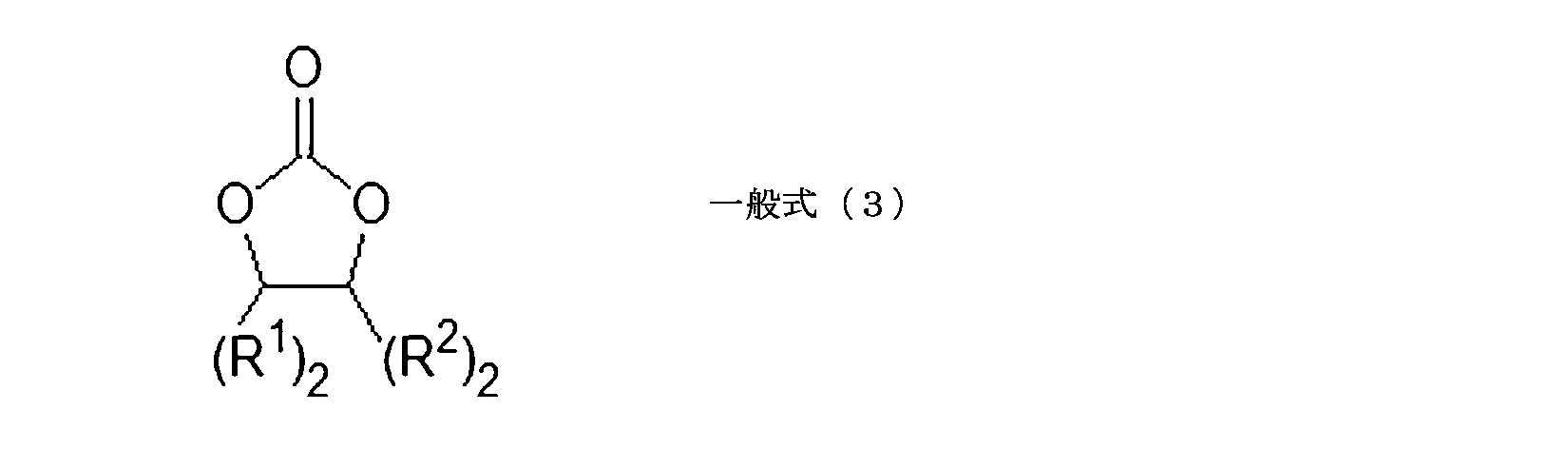
(R1、R2はそれぞれ独立に、水素、アルキル基、ハロゲン置換アルキル基又はハロゲンである。ただし、各R1及び各R2のうち、少なくとも一つはFを含む。)
一般式(3)で表されるフッ素含有環状カーボネートを具体的な化合物名で示すと、フルオロエチレンカーボネート、4-(トリフルオロメチル)-1,3-ジオキソラン-2-オン、4,4-ジフルオロ-1,3-ジオキソラン-2-オン、4-フルオロ-4-メチル-1,3-ジオキソラン-2-オン、4-(フルオロメチル)-1,3-ジオキソラン-2-オン、4,5-ジフルオロ-1,3-ジオキソラン-2-オン、4-フルオロ-5-メチル-1,3-ジオキソラン-2-オン、4,5-ジフルオロ-4,5-ジメチル-1,3-ジオキソラン-2-オンが挙げられ、中でもフルオロエチレンカーボネートが好ましい。
Si含有負極活物質と、フッ素含有環状カーボネートの関係について説明する。
まず、フッ素含有環状カーボネートを含まず、第二リチウム塩及び鎖状カーボネートを含む電解液と、Si含有負極活物質とを具備するリチウムイオン二次電池においては、充放電に伴い、一部の第二リチウム塩が分解して、Si含有負極活物質の表面に被膜を形成する。当該被膜には、第二リチウム塩の化学構造に由来するSO2構造物が含まれると推定される。従って、Si含有負極活物質とSO2構造物とは、直接的に接触している状態となる。ここで、SO2構造物は酸化能を有するため、経時的にSiの酸化が進行することとなり、その結果、Si含有負極活物質が劣化する。
しかしながら、好適な本発明の電解液はフッ素含有環状カーボネートを含む。フッ素含有環状カーボネートは、耐酸化能に優れるが、還元条件下でたやすく分解する。従って、フッ素含有環状カーボネートは、本発明のリチウムイオン二次電池の充放電条件下において、負極と電解液との界面で優先的に分解する。その結果、Si含有負極活物質の表面に、フッ素含有環状カーボネートの分解物に由来する被膜が形成される。その後、第二リチウム塩が分解してSO2構造物が生成したとしても、フッ素含有環状カーボネートの分解物に由来する被膜の存在に因り、Si含有負極活物質とSO2構造物との直接的な接触を妨げることができるため、Si含有負極活物質の劣化を抑制できる。
また、フッ素含有環状カーボネートは、比較的極性が高い有機溶媒であるため、リチウムイオンとの親和性やリチウムイオンの伝導性に優れると考えられる。そうすると、フッ素含有環状カーボネートを含む好適な本発明の電解液は、電解液と正極活物質及び/又は負極活物質との間で生じるリチウムイオンの授受を、円滑に実施できると推定される。
加えて、負極活物質の表面に形成されるフッ素含有環状カーボネートの分解物に由来する被膜には、フッ化リチウムや炭酸リチウムが存在することが想定される。すなわち、負極付近には多くのリチウムイオンが存在する状態にある。そうすると、フッ素含有環状カーボネートを含む好適な本発明の電解液は、特に、電解液と負極活物質との間で生じるリチウムイオンの授受を、円滑に実施できると推定される。
加えて、負極活物質の表面に形成されるフッ素含有環状カーボネートの分解物に由来する被膜には、フッ化リチウムや炭酸リチウムが存在することが想定される。すなわち、負極付近には多くのリチウムイオンが存在する状態にある。そうすると、フッ素含有環状カーボネートを含む好適な本発明の電解液は、特に、電解液と負極活物質との間で生じるリチウムイオンの授受を、円滑に実施できると推定される。
本発明の電解液においては、上記鎖状カーボネート及びフッ素含有環状カーボネート以外に、リチウムイオン二次電池などの電解液に使用可能である他の有機溶媒(以下、単に「他の有機溶媒」ということがある。)が含まれていてもよい。
本発明の電解液には、フッ素含有環状カーボネート以外の本発明の電解液に含まれる全有機溶媒に対し、上記鎖状カーボネートが、70体積%、70質量%以上若しくは70モル%以上で含まれるのが好ましく、80体積%、80質量%以上若しくは80モル%以上で含まれるのがより好ましく、90体積%、90質量%以上若しくは90モル%以上で含まれるのがさらに好ましく、95体積%、95質量%以上若しくは95モル%以上で含まれるのが特に好ましい。フッ素含有環状カーボネート以外の本発明の電解液に含まれる有機溶媒すべてが上記鎖状カーボネートであってもよい。
なお、他の有機溶媒を含む本発明の電解液は、他の有機溶媒を含まない本発明の電解液と比較して、粘度が上昇する場合や、イオン伝導度が低下する場合がある。さらに、他の有機溶媒を含む本発明の電解液を用いた二次電池は、その反応抵抗が増大する場合がある。
他の有機溶媒を具体的に例示すると、アセトニトリル、プロピオニトリル、アクリロニトリル、マロノニトリル等のニトリル類、1,2-ジメトキシエタン、1,2-ジエトキシエタン、テトラヒドロフラン、1,2-ジオキサン、1,3-ジオキサン、1,4-ジオキサン、2,2-ジメチル-1,3-ジオキソラン、2-メチルテトラヒドロピラン、2-メチルテトラヒドロフラン、クラウンエーテル等のエーテル類、エチレンカーボネート、プロピレンカーボネート等のフッ素非含有環状カーボネート類、ホルムアミド、N,N-ジメチルホルムアミド、N,N-ジメチルアセトアミド、N-メチルピロリドン等のアミド類、イソプロピルイソシアネート、n-プロピルイソシアネート、クロロメチルイソシアネート等のイソシアネート類、酢酸メチル、酢酸エチル、酢酸ブチル、酢酸プロピル、プロピオン酸メチル、蟻酸メチル、蟻酸エチル、酢酸ビニル、メチルアクリレート、メチルメタクリレート等のエステル類、グリシジルメチルエーテル、エポキシブタン、2-エチルオキシラン等のエポキシ類、オキサゾール、2-エチルオキサゾール、オキサゾリン、2-メチル-2-オキサゾリン等のオキサゾール類、アセトン、メチルエチルケトン、メチルイソブチルケトン等のケトン類、無水酢酸、無水プロピオン酸等の酸無水物、ジメチルスルホン、スルホラン等のスルホン類、ジメチルスルホキシド等のスルホキシド類、1-ニトロプロパン、2-ニトロプロパン等のニトロ類、フラン、フルフラール等のフラン類、γ-ブチロラクトン、γ-バレロラクトン、δ-バレロラクトン等の環状エステル類、チオフェン、ピリジン等の芳香族複素環類、テトラヒドロ-4-ピロン、1-メチルピロリジン、N-メチルモルフォリン等の複素環類、リン酸トリメチル、リン酸トリエチル等のリン酸エステル類を挙げることができる。
また、本発明の電解液をポリマーや無機フィラーと混合し混合物とすると、当該混合物が電解液を封じ込め、擬似固体電解質となる。擬似固体電解質を電池の電解液として用いることで、電池における電解液の液漏れを抑制することができる。
上記ポリマーとしては、リチウムイオン二次電池などの電池に使用されるポリマーや一般的な化学架橋したポリマーを採用することができる。特に、ポリフッ化ビニリデンやポリヘキサフルオロプロピレンなど電解液を吸収しゲル化し得るポリマーや、ポリエチレンオキシドなどのポリマーにイオン導電性基を導入したものが好適である。
具体的なポリマーとしては、ポリメチルアクリレート、ポリメチルメタクリレート、ポリエチレンオキシド、ポリプロピレンオキシド、ポリアクリロニトリル、ポリフッ化ビニリデン、ポリエチレングリコールジメタクリレート、ポリエチレングリコールアクリレート、ポリグリシドール、ポリテトラフルオロエチレン、ポリヘキサフルオロプロピレン、ポリシロキサン、ポリ酢酸ビニル、ポリビニルアルコール、ポリアクリル酸、ポリメタクリル酸、ポリイタコン酸、ポリフマル酸、ポリクロトン酸、ポリアンゲリカ酸、カルボキシメチルセルロースなどのポリカルボン酸、スチレン-ブタジエンゴム、ニトリル-ブタジエンゴム、ポリスチレン、ポリカーボネート、無水マレイン酸とグリコール類を共重合した不飽和ポリエステル、置換基を有するポリエチレンオキシド誘導体、フッ化ビニリデンとヘキサフルオロプロピレンとの共重合体を例示できる。また、上記ポリマーとして、上記具体的なポリマーを構成する二種類以上のモノマーを共重合させた共重合体を選択しても良い。
上記ポリマーとして、多糖類も好適である。具体的な多糖類として、グリコーゲン、セルロース、キチン、アガロース、カラギーナン、ヘパリン、ヒアルロン酸、ペクチン、アミロペクチン、キシログルカン、アミロースを例示できる。また、これら多糖類を含む材料を上記ポリマーとして採用してもよく、当該材料として、アガロースなどの多糖類を含む寒天を例示することができる。
上記無機フィラーとしては、酸化物や窒化物などの無機セラミックスが好ましい。
無機セラミックスはその表面に親水性及び疎水性の官能基を有している。そのため、当該官能基が電解液を引き付けることにより、無機セラミックス内に伝導性通路が形成され得る。さらに、電解液に分散した無機セラミックスは前記官能基により無機セラミックス同士のネットワークを形成し、電解液を封じ込める役割を果たし得る。無機セラミックスのこのような機能により、電池における電解液の液漏れをさらに好適に抑制することができる。無機セラミックスの上記機能を好適に発揮するために、無機セラミックスは粒子形状のものが好ましく、特にその粒子径がナノ水準のものが好ましい。
無機セラミックスの種類としては、一般的なアルミナ、シリカ、チタニア、ジルコニア、リチウムリン酸塩などを挙げることができる。また、無機セラミックス自体にリチウム伝導性があるものでも良く、具体的には、Li3N、LiI、LiI-Li3N-LiOH、LiI-Li2S-P2O5、LiI-Li2S-P2S5、LiI-Li2S-B2S3、Li2O-B2S3、Li2O-V2O3-SiO2、Li2O-B2O3-P2O5、Li2O-B2O3-ZnO、Li2O-Al2O3-TiO2-SiO2-P2O5、LiTi2(PO4)3、Li-βAl2O3、LiTaO3を例示することができる。
無機フィラーとしてガラスセラミックスを採用してもよい。ガラスセラミックスはイオン性液体を封じ込めることができるので、本発明の電解液に対しても同様の効果を期待できる。ガラスセラミックスとしては、xLi2S-(1-x)P2S5(ただし、0<x<1)で表される化合物、並びに、当該化合物のSの一部を他の元素で置換したもの、及び、当該化合物のPの一部をゲルマニウムに置換したものを例示できる。
また、本発明の電解液には、本発明の趣旨を逸脱しない範囲で、公知の添加剤を加えてもよい。公知の添加剤の一例として、ビニレンカーボネート(VC)、ビニルエチレンカーボネート(VEC)、メチルビニレンカーボネート(MVC)、エチルビニレンカーボネート(EVC)に代表される不飽和結合を有する環状カーボネート;フェニルエチレンカーボネート及びエリスリタンカーボネートに代表されるカーボネート化合物;無水コハク酸、無水グルタル酸、無水マレイン酸、無水シトラコン酸、無水グルタコン酸、無水イタコン酸、無水ジグリコール酸、シクロヘキサンジカルボン酸無水物、シクロペンタンテトラカルボン酸二無水物、フェニルコハク酸無水物に代表されるカルボン酸無水物;γ-ブチロラクトン、γ-バレロラクトン、γ-カプロラクトン、δ-バレロラクトン、δ-カプロラクトン、ε-カプロラクトンに代表されるラクトン;1,4-ジオキサンに代表される環状エーテル;エチレンサルファイト、1,3-プロパンスルトン、1,4-ブタンスルトン、メタンスルホン酸メチル、ブサルファン、スルホラン、スルホレン、ジメチルスルホン、テトラメチルチウラムモノスルフィドに代表される含硫黄化合物;1-メチル-2-ピロリジノン、1-メチル-2-ピペリドン、3-メチル-2-オキサゾリジノン、1,3-ジメチル-2-イミダゾリジノン、N-メチルスクシンイミドに代表される含窒素化合物;モノフルオロリン酸塩、ジフルオロリン酸塩に代表されるリン酸塩;ヘプタン、オクタン、シクロヘプタンに代表される飽和炭化水素化合物;ビフェニル、アルキルビフェニル、ターフェニル、ターフェニルの部分水素化体、シクロヘキシルベンゼン、t-ブチルベンゼン、t-アミルベンゼン、ジフェニルエーテル、ジベンゾフランに代表される不飽和炭化水素化合物等が挙げられる。
以下、本発明の電解液を具備する本発明のリチウムイオン二次電池について説明する。本発明のリチウムイオン二次電池は、アルミニウム製の集電体を具備する正極と、Si含有負極活物質を具備する負極とを備える。
負極における負極活物質としては、Si含有負極活物質のみを用いても良いし、黒鉛などの公知の負極活物質とSi含有負極活物質とを併用しても良い。
Si含有負極活物質としては、Siを含有し、負極活物質として機能するものであればよい。具体的なSi含有負極活物質としては、ケイ素単体、SiOx(0.3≦x≦1.6)、Siと他の金属との合金、特許文献8に記載のシリコン材料を例示できる。Si含有負極活物質は炭素で被覆されていてもよい。炭素で被覆されたSi含有負極活物質は導電性に優れる。
Si含有負極活物質の平均粒子径(D50)は、一般的なレーザー回折式粒度分布測定装置で測定した場合に、0.6~30μmの範囲内が好ましく、1~20μmの範囲内がより好ましく、2~10μmの範囲内がさらに好ましく、3~8μmの範囲内が特に好ましい。
特許文献8に記載のシリコン材料(以下、単に「シリコン材料」ということがある。)について詳細に説明する。シリコン材料は、例えば、CaSi2と酸とを反応させてポリシランを主成分とする層状シリコン化合物を合成する工程、さらに、当該層状シリコン化合物を300℃以上で加熱して水素を離脱させる工程を経て製造されるものである。
特許文献8に記載のシリコン材料の製造方法を、酸として塩化水素を用いた場合の理想的な反応式で示すと以下のとおりとなる。
3CaSi2+6HCl → Si6H6+3CaCl2
Si6H6 → 6Si+3H2↑
3CaSi2+6HCl → Si6H6+3CaCl2
Si6H6 → 6Si+3H2↑
ただし、ポリシランであるSi6H6を合成する上段の反応では、副生物や不純物除去の観点から、通常、反応溶媒として水が用いられる。そして、Si6H6は水と反応し得るため、上段の反応を含む層状シリコン化合物を合成する工程において、層状シリコン化合物がSi6H6のみを含むものとして製造されることはほとんどなく、層状シリコン化合物はSi6Hs(OH)tXu(Xは酸のアニオン由来の元素若しくは基、s+t+u=6、0<s<6、0<t<6、0<u<6)で表されるものとして製造される。なお、上記の化学式においては、残存し得るCaなどの不可避不純物については、考慮していない。そして、当該層状シリコン化合物を加熱して得られるシリコン材料も、酸素や酸のアニオン由来の元素を含む。
シリコン材料は、複数枚の板状シリコン体が厚さ方向に積層されてなる構造を有する。リチウムイオン等の電荷担体が効率的に吸蔵及び放出を行うためには、板状シリコン体は厚さが10nm~100nmの範囲内のものが好ましく、20nm~50nmの範囲内のものがより好ましい。板状シリコン体の長手方向の長さは、0.1μm~50μmの範囲内のものが好ましい。また、板状シリコン体は、(長手方向の長さ)/(厚さ)が2~1000の範囲内であるのが好ましい。板状シリコン体の積層構造は走査型電子顕微鏡などによる観察で確認できる。また、この積層構造は、原料のCaSi2におけるSi層の名残りであると考えられる。
シリコン材料には、アモルファスシリコン及び/又はシリコン結晶子が含まれるのが好ましい。特に、上記板状シリコン体において、アモルファスシリコンをマトリックスとし、シリコン結晶子が当該マトリックス中に点在している状態が好ましい。シリコン結晶子のサイズは、0.5nm~300nmの範囲内が好ましく、1nm~100nmの範囲内がより好ましく、1nm~50nmの範囲内がさらに好ましく、1nm~10nmの範囲内が特に好ましい。なお、シリコン結晶子のサイズは、シリコン材料に対してX線回折測定を行い、得られたX線回折チャートのSi(111)面の回折ピークの半値幅を用いたシェラーの式から算出される。
シリコン材料に含まれる板状シリコン体、アモルファスシリコン及びシリコン結晶子の存在量や大きさは、主に加熱温度や加熱時間に左右される。加熱温度は、350℃~950℃の範囲内が好ましく、400℃~900℃の範囲内がより好ましい。
負極は、負極用の集電体と、集電体の表面に形成された負極活物質層を有する。
上記の集電体は、リチウムイオン二次電池の放電又は充電の間、電極に電流を流し続けるための化学的に不活性な電子伝導体をいう。集電体としては、銀、銅、金、アルミニウム、タングステン、コバルト、亜鉛、ニッケル、鉄、白金、錫、インジウム、チタン、ルテニウム、タンタル、クロム、モリブデンから選ばれる少なくとも一種、並びにステンレス鋼などの金属材料を例示することができる。集電体は公知の保護層で被覆されていても良い。集電体の表面を公知の方法で処理したものを集電体として用いても良い。
集電体は箔、シート、フィルム、線状、棒状、メッシュなどの形態をとることができる。そのため、集電体として、例えば、銅箔、ニッケル箔、アルミニウム箔、ステンレス箔などの金属箔を好適に用いることができる。集電体が箔、シート、フィルム形態の場合は、その厚みが1μm~100μmの範囲内であることが好ましい。
負極活物質層は負極活物質、並びに必要に応じて結着剤及び/又は導電助剤を含む。
結着剤は活物質や導電助剤などを集電体の表面に繋ぎ止める役割を果たすものである。
結着剤としては、ポリフッ化ビニリデン、ポリテトラフルオロエチレン、フッ素ゴム等の含フッ素樹脂、ポリプロピレン、ポリエチレン等の熱可塑性樹脂、ポリイミド、ポリアミドイミド等のイミド系樹脂、アルコキシシリル基含有樹脂、スチレンブタジエンゴムなどの公知のものを採用すればよい。
また、結着剤として、親水基を有するポリマーを採用してもよい。親水基を有するポリマーを結着剤として具備する本発明のリチウムイオン二次電池は、より好適に容量を維持できる。親水基を有するポリマーの親水基としては、カルボキシル基、スルホ基、シラノール基、アミノ基、水酸基、リン酸基などリン酸系の基などが例示される。中でも、ポリアクリル酸、カルボキシメチルセルロース、ポリメタクリル酸などの分子中にカルボキシル基を含むポリマー、又は、ポリ(p-スチレンスルホン酸)などのスルホ基を含むポリマーが好ましい。
ポリアクリル酸、あるいはアクリル酸とビニルスルホン酸との共重合体など、カルボキシル基及び/又はスルホ基を多く含むポリマーは水溶性となる。親水基を有するポリマーは、水溶性ポリマーであることが好ましく、化学構造でいうと、一分子中に複数のカルボキシル基及び/又はスルホ基を含むポリマーが好ましい。
分子中にカルボキシル基を含むポリマーは、例えば、酸モノマーを重合する方法や、ポリマーにカルボキシル基を付与する方法などで製造することができる。酸モノマーとしては、アクリル酸、メタクリル酸、ビニル安息香酸、クロトン酸、ペンテン酸、アンジェリカ酸、チグリン酸など分子中に一つのカルボキシル基をもつ酸モノマー、イタコン酸、メサコン酸、シトラコン酸、フマル酸、マレイン酸、2-ペンテン二酸、メチレンコハク酸、アリルマロン酸、イソプロピリデンコハク酸、2,4-ヘキサジエン二酸、アセチレンジカルボン酸など分子内に二つ以上のカルボキシル基をもつ酸モノマーなどが例示される。
上記の酸モノマーから選ばれる二種以上の酸モノマーを重合してなる共重合ポリマーを結着剤として用いてもよい。
また、例えば特開2013―065493号公報に記載されたような、アクリル酸とイタコン酸との共重合体のカルボキシル基どうしが縮合して形成された酸無水物基を分子中に含んでいるポリマーを結着剤として用いることも好ましい。一分子中にカルボキシル基を二つ以上有する酸性度の高いモノマー由来の構造が結着剤にあることにより、充電時に電解液分解反応が起こる前にリチウムイオンなどを結着剤がトラップし易くなると考えられている。さらに、当該ポリマーは、ポリアクリル酸やポリメタクリル酸に比べてモノマーあたりのカルボキシル基が多いため、酸性度が高まるものの、所定量のカルボキシル基が酸無水物基に変化しているため、酸性度が高まりすぎることもない。そのため、当該ポリマーを結着剤として用いた負極をもつ二次電池は、初期効率が向上し、入出力特性が向上する。
また、国際公開第2016/063882号に開示される、ポリアクリル酸やポリメタクリル酸などのカルボキシル基含有ポリマーを、ジアミンで架橋した架橋ポリマーを結着剤として用いてもよい。
架橋ポリマーに用いられるジアミンとしては、エチレンジアミン、プロピレンジアミン、ヘキサメチレンジアミン等のアルキレンジアミン、1,4-ジアミノシクロヘキサン、1,3-ジアミノシクロヘキサン、イソホロンジアミン、ビス(4-アミノシクロヘキシル)メタン等の含飽和炭素環ジアミン、m-フェニレンジアミン、p-フェニレンジアミン、4,4’-ジアミノジフェニルメタン、4,4’-ジアミノジフェニルエーテル、ビス(4-アミノフェニル)スルホン、ベンジジン、o-トリジン、2,4-トリレンジアミン、2,6-トリレンジアミン、キシリレンジアミン、ナフタレンジアミン等の芳香族ジアミンが挙げられる。
また、ポリアクリル酸やポリメタクリル酸などのカルボキシル基含有ポリマーと、ポリアミドイミドとの混合物又は反応物を結着剤として用いてもよい。
ポリアミドイミドとは、分子内にアミド結合とイミド結合をそれぞれ2つ以上有する化合物を意味する。ポリアミドイミドは、アミド結合及びイミド結合におけるカルボニル部分となる酸成分と、アミド結合及びイミド結合における窒素部分となるジアミン成分又はジイソシアネート成分を反応させることで製造される。ポリアミドイミドを得るには、当該方法で製造しても良いし、また、市販のポリアミドイミドを購入しても良い。
ポリアミドイミドの製造に用いられる酸成分としては、トリメリット酸、ピロメリット酸、ビフェニルテトラカルボン酸、ジフェニルスルホンテトラカルボン酸、ベンゾフェノンテトラカルボン酸、ジフェニルエーテルテトラカルボン酸、シュウ酸、アジピン酸、マロン酸、セバチン酸、アゼライン酸、ドデカンジカルボン酸、ジカルボキシポリブタジエン、ジカルボキシポリ(アクリロニトリル-ブタジエン)、ジカルボキシポリ(スチレン-ブタジエン)、シクロヘキサン-1,4-ジカルボン酸、シクロヘキサン-1,3-ジカルボン酸、ジシクロヘキシルメタン-4,4’-ジカルボン酸、テレフタル酸、イソフタル酸、ビス(カルボキシフェニル)スルホン、ビス(カルボキシフェニル)エーテル、ナフタレンジカルボン酸、及び、これらの無水物、酸ハロゲン化物、誘導体を挙げることができる。酸成分としては、上記の化合物を単独で又は複数で採用すればよいが、ただし、イミド結合を形成させる点から、カルボキシル基が結合している炭素の隣接炭素にカルボキシル基が存在する酸成分又はその同等物が、必須となる。酸成分としては、反応性、耐熱性などの点から、トリメリット酸無水物が好ましい。また、ポリアミドイミドの引っ張り強度、引っ張り弾性率、電解液耐性の点から、トリメリット酸無水物に加えて、酸成分の一部として、ピロメリット酸無水物、ベンゾフェノンテトラカルボン酸無水物、ビフェニルテトラカルボン酸無水物を採用するのが好ましい。
ポリアミドイミドの製造に用いられるジアミン成分としては、上述した架橋ポリマーに用いられるジアミンを採用すればよい。耐熱性、溶解性の観点から、4,4’-ジアミノジフェニルメタン、2,4-トリレンジアミン、o-トリジン、ナフタレンジアミン、イソホロンジアミンが好ましい。ポリアミドイミドの引っ張り強度、引っ張り弾性率の点からはo-トリジン、ナフタレンジアミンが好ましい。
ポリアミドイミドの製造に用いられるジイソシアネート成分としては、上記ジアミン成分のアミンをイソシアネートで置き換えたものを挙げることができる。
負極活物質層中の結着剤の配合割合は、質量比で、負極活物質:結着剤=1:0.005~1:0.3であるのが好ましい。結着剤が少なすぎると電極の成形性が低下し、また、結着剤が多すぎると電極のエネルギー密度が低くなるためである。
導電助剤は、電極の導電性を高めるために添加される。そのため、導電助剤は、電極の導電性が不足する場合に任意に加えればよく、電極の導電性が十分に優れている場合には加えなくても良い。導電助剤としては化学的に不活性な電子高伝導体であれば良く、炭素質微粒子であるカーボンブラック、黒鉛、気相法炭素繊維(Vapor Grown Carbon Fiber)、および各種金属粒子などが例示される。カーボンブラックとしては、アセチレンブラック、ケッチェンブラック(登録商標)、ファーネスブラック、チャンネルブラックなどが例示される。これらの導電助剤を単独又は二種以上組み合わせて活物質層に添加することができる。負極活物質層中の導電助剤の配合割合は、質量比で、負極活物質:導電助剤=1:0.01~1:0.5であるのが好ましい。導電助剤が少なすぎると効率のよい導電パスを形成できず、また、導電助剤が多すぎると負極活物質層の成形性が悪くなるとともに電極のエネルギー密度が低くなるためである。
本発明のリチウムイオン二次電池に用いられる正極は、アルミニウム製の集電体と、集電体の表面に形成された正極活物質層を有する。正極活物質層は正極活物質、並びに必要に応じて結着剤及び/又は導電助剤を含む。
アルミニウム製の集電体は、アルミニウム又はアルミニウム合金を材料とする。ここでアルミニウムは、純アルミニウムを指し、純度99.0%以上のアルミニウムを純アルミニウムと称する。純アルミニウムに種々の元素を添加して合金としたものをアルミニウム合金と称する。アルミニウム合金としては、Al-Cu系、Al-Mn系、Al-Fe系、Al-Si系、Al-Mg系、Al-Mg-Si系、Al-Zn-Mg系が挙げられる。
また、アルミニウム又はアルミニウム合金として、具体的には、例えばJIS A1085、A1N30等のA1000系合金(純アルミニウム系)、JIS A3003、A3004等のA3000系合金(Al-Mn系)、JIS A8079、A8021等のA8000系合金(Al-Fe系)が挙げられる。
集電体は公知の保護層で被覆されていても良い。集電体の表面を公知の方法で処理したものを集電体として用いても良い。
集電体は箔、シート、フィルム、線状、棒状、メッシュなどの形態をとることができる。集電体が箔、シート、フィルム形態の場合は、その厚みが1μm~100μmの範囲内であることが好ましい。
正極の結着剤及び導電助剤は負極で説明したものを同様の配合割合で採用すればよい。
正極活物質としては、層状岩塩構造の一般式:LiaNibCocMndDeOf(0.2≦a≦2、b+c+d+e=1、0≦e<1、DはW、Mo、Re、Pd、Ba、Cr、B、Sb、Sr、Pb、Ga、Al、Nb、Mg、Ta、Ti、La、Zr、Cu、Ca、Ir、Hf、Rh、Fe、Ge、Zn、Ru、Sc、Sn、In、Y、Bi、S、Si、Na、K、P、Vから選ばれる少なくとも1の元素、1.7≦f≦3) で表されるリチウム複合金属酸化物、Li2MnO3を挙げることができる。また、正極活物質として、LiMn2O4等のスピネル構造の金属酸化物、スピネル構造の金属酸化物と層状化合物の混合物で構成される固溶体、LiMPO4、LiMVO4又はLi2MSiO4(式中のMはCo、Ni、Mn、Feのうちの少なくとも一種から選択される)などで表されるポリアニオン系化合物を挙げることができる。さらに、正極活物質として、LiFePO4FなどのLiMPO4F(Mは遷移金属)で表されるタボライト系化合物、LiFeBO3などのLiMBO3(Mは遷移金属)で表されるボレート系化合物を挙げることができる。正極活物質として用いられるいずれの金属酸化物も上記の組成式を基本組成とすればよく、基本組成に含まれる金属元素を他の金属元素で置換したものも使用可能である。また、正極活物質として、電荷担体(例えば充放電に寄与するリチウムイオン)を含まないものを用いても良い。例えば、硫黄単体、硫黄と炭素を複合化した化合物、TiS2などの金属硫化物、V2O5、MnO2などの酸化物、ポリアニリン及びアントラキノン並びにこれら芳香族を化学構造に含む化合物、共役二酢酸系有機物などの共役系材料、その他公知の材料を用いることもできる。さらに、ニトロキシド、ニトロニルニトロキシド、ガルビノキシル、フェノキシルなどの安定なラジカルを有する化合物を正極活物質として採用してもよい。リチウム等の電荷担体を含まない正極活物質材料を用いる場合には、正極及び/又は負極に、公知の方法により、予め電荷担体を添加しておく必要がある。電荷担体は、イオンの状態で添加しても良いし、金属等の非イオンの状態で添加しても良い。例えば、電荷担体がリチウムである場合には、リチウム箔を正極及び/又は負極に貼り付けるなどして一体化しても良い。
高容量及び耐久性などに優れる点から、正極活物質として、層状岩塩構造の一般式:LiaNibCocMndDeOf(0.2≦a≦2、b+c+d+e=1、0≦e<1、DはW、Mo、Re、Pd、Ba、Cr、B、Sb、Sr、Pb、Ga、Al、Nb、Mg、Ta、Ti、La、Zr、Cu、Ca、Ir、Hf、Rh、Fe、Ge、Zn、Ru、Sc、Sn、In、Y、Bi、S、Si、Na、K、P、Vから選ばれる少なくとも1の元素、1.7≦f≦3) で表されるリチウム複合金属酸化物を採用することが好ましい。
上記一般式において、b、c、dの値は、上記条件を満足するものであれば特に制限はないが、0<b<1、0<c<1、0<d<1であるものが良く、また、b、c、dの少なくともいずれか一つが10/100<b<90/100、10/100<c<90/100、5/100<d<70/100の範囲であることが好ましく、20/100<b<80/100、12/100<c<70/100、10/100<d<60/100の範囲であることがより好ましく、30/100<b<70/100、15/100<c<50/100、12/100<d<50/100の範囲であることがさらに好ましい。
a、e、fについては、上記一般式で規定する範囲内の数値であればよく、好ましくは0.5≦a≦1.5、0≦e<0.2、1.8≦f≦2.5、より好ましくは0.8≦a≦1.3、0≦e<0.1、1.9≦f≦2.1をそれぞれ例示することができる。
具体的な正極活物質として、スピネル構造のLixAyMn2―yO4(Aは、Ca、Mg、S、Si、Na、K、Al、P、Ga、Geから選ばれる少なくとも1の元素、及び遷移金属元素から選ばれる少なくとも1種の金属元素、0<x≦2.2、0≦y≦1)を例示できる。より具体的には、LiMn2O4、LiNi0.5Mn1.5O4を例示できる。
具体的な正極活物質として、LiFePO4、Li2FeSiO4、LiCoPO4、Li2CoPO4、Li2MnPO4、Li2MnSiO4、Li2CoPO4Fを例示できる。他の具体的な正極活物質として、Li2MnO3-LiCoO2を例示できる。
正極活物質は1種類を用いても良いし、複数種類を併用しても良い。正極活物質の併用例として、層状岩塩構造の一般式:LiaNibCocMndDeOf(0.2≦a≦2、b+c+d+e=1、0≦e<1、DはW、Mo、Re、Pd、Ba、Cr、B、Sb、Sr、Pb、Ga、Al、Nb、Mg、Ta、Ti、La、Zr、Cu、Ca、Ir、Hf、Rh、Fe、Ge、Zn、Ru、Sc、Sn、In、Y、Bi、S、Si、Na、K、P、Vから選ばれる少なくとも1の元素、1.7≦f≦3) で表されるリチウム複合金属酸化物と、LiMPO4、LiMVO4又はLi2MSiO4(式中のMはCo、Ni、Mn、Feのうちの少なくとも一種から選択される)で表されるポリアニオン系化合物との併用を挙げることができる。リチウム複合金属酸化物とポリアニオン系化合物との併用において、これらの質量比は、リチウム複合金属酸化物:ポリアニオン系化合物=90:10~50:50の範囲内が好ましく、80:20~60:40の範囲内がより好ましい。また、正極活物質は炭素で被覆されていてもよい。
集電体の表面に活物質層を形成させるには、ロールコート法、ダイコート法、ディップコート法、ドクターブレード法、スプレーコート法、カーテンコート法などの従来から公知の方法を用いて、集電体の表面に活物質を塗布すればよい。具体的には、活物質、溶剤、並びに必要に応じて結着剤及び導電助剤を混合してスラリーにしてから、当該スラリーを集電体の表面に塗布後、乾燥する。溶剤としては、N-メチル-2-ピロリドン、メタノール、メチルイソブチルケトン、水を例示できる。電極密度を高めるべく、乾燥後のものを圧縮しても良い。
本発明のリチウムイオン二次電池には必要に応じてセパレータが用いられる。セパレータは、正極と負極とを隔離し、両極の接触による短絡を防止しつつ、リチウムイオンを通過させるものである。セパレータとしては、公知のものを採用すればよく、ポリテトラフルオロエチレン、ポリプロピレン、ポリエチレン、ポリイミド、ポリアミド、ポリアラミド(Aromatic polyamide)、ポリエステル、ポリアクリロニトリル等の合成樹脂、セルロース、アミロース等の多糖類、フィブロイン、ケラチン、リグニン、スベリン等の天然高分子、セラミックスなどの電気絶縁性材料を1種若しくは複数用いた多孔体、不織布、織布などを挙げることができる。また、セパレータは多層構造としてもよい。
本発明のリチウムイオン二次電池の具体的な製造方法について述べる。
正極と負極とでセパレータを挟持して電極体とする。電極体は、正極、セパレータ及び負極を重ねた積層型、又は、正極、セパレータ及び負極の積層体を捲いた捲回型のいずれの型にしても良い。正極の集電体及び負極の集電体から外部に通ずる正極端子及び負極端子までを、集電用リード等を用いて接続した後に、電極体に本発明の電解液を加えてリチウムイオン二次電池とするとよい。本発明のリチウムイオン二次電池は、電極に含まれる活物質の種類に適した電圧範囲で充放電を実行できる。
正極と負極とでセパレータを挟持して電極体とする。電極体は、正極、セパレータ及び負極を重ねた積層型、又は、正極、セパレータ及び負極の積層体を捲いた捲回型のいずれの型にしても良い。正極の集電体及び負極の集電体から外部に通ずる正極端子及び負極端子までを、集電用リード等を用いて接続した後に、電極体に本発明の電解液を加えてリチウムイオン二次電池とするとよい。本発明のリチウムイオン二次電池は、電極に含まれる活物質の種類に適した電圧範囲で充放電を実行できる。
本発明のリチウムイオン二次電池の形状は特に限定されるものでなく、円筒型、角型、コイン型、ラミネート型等、種々の形状を採用することができる。
本発明のリチウムイオン二次電池は、車両に搭載してもよい。車両は、その動力源の全部あるいは一部にリチウムイオン二次電池による電気エネルギーを使用している車両であればよく、例えば、電気車両、ハイブリッド車両などであるとよい。車両にリチウムイオン二次電池を搭載する場合には、リチウムイオン二次電池を複数直列に接続して組電池とするとよい。リチウムイオン二次電池を搭載する機器としては、車両以外にも、パーソナルコンピュータ、携帯通信機器など、電池で駆動される各種の家電製品、オフィス機器、産業機器などが挙げられる。さらに、本発明のリチウムイオン二次電池は、風力発電、太陽光発電、水力発電その他電力系統の蓄電装置及び電力平滑化装置、船舶等の動力及び/又は補機類の電力供給源、航空機、宇宙船等の動力及び/又は補機類の電力供給源、電気を動力源に用いない車両の補助用電源、移動式の家庭用ロボットの電源、システムバックアップ用電源、無停電電源装置の電源、電動車両用充電ステーションなどにおいて充電に必要な電力を一時蓄える蓄電装置に用いてもよい。
以上、本発明の実施形態を説明したが、本発明は、上記実施形態に限定されるものではない。本発明の要旨を逸脱しない範囲において、当業者が行い得る変更、改良等を施した種々の形態にて実施することができる。
以下に、実施例及び比較例などを示し、本発明を具体的に説明する。なお、本発明は、これらの実施例によって限定されるものではない。
(実施例1)
鎖状カーボネートであるジメチルカーボネート及びエチルメチルカーボネートを9:1のモル比で混合した混合溶媒に、第一リチウム塩であるLiPF6及び第二リチウム塩である(FSO2)2NLiを溶解させて、さらにフッ素含有環状カーボネートであるフルオロエチレンカーボネートを加えて、LiPF6の濃度が1.2mol/Lであり、(FSO2)2NLiの濃度が1.2mol/Lであって、フルオロエチレンカーボネートを3質量%で含む実施例1の電解液を製造した。実施例1の電解液においては、リチウム塩の濃度は2.4mol/Lであり、リチウム塩に対して鎖状カーボネートがモル比4で含まれる。
鎖状カーボネートであるジメチルカーボネート及びエチルメチルカーボネートを9:1のモル比で混合した混合溶媒に、第一リチウム塩であるLiPF6及び第二リチウム塩である(FSO2)2NLiを溶解させて、さらにフッ素含有環状カーボネートであるフルオロエチレンカーボネートを加えて、LiPF6の濃度が1.2mol/Lであり、(FSO2)2NLiの濃度が1.2mol/Lであって、フルオロエチレンカーボネートを3質量%で含む実施例1の電解液を製造した。実施例1の電解液においては、リチウム塩の濃度は2.4mol/Lであり、リチウム塩に対して鎖状カーボネートがモル比4で含まれる。
実施例1の電解液を用いて、以下のとおり、実施例1のリチウムイオン二次電池を製造した。
正極活物質としてLi1.1Ni5/10Co3/10Mn2/10O2を69質量部、正極活物質として炭素被覆したLiFePO4を25質量部、導電助剤としてアセチレンブラック3質量部、結着剤としてポリフッ化ビニリデン3質量部、及び、適量のN-メチル-2-ピロリドンを混合して、スラリーを製造した。正極用集電体としてアルミニウム箔を準備した。このアルミニウム箔の表面に、ドクターブレードを用いて上記スラリーを膜状に塗布した。スラリーが塗布されたアルミニウム箔を乾燥することで、N-メチル-2-ピロリドンを除去した。その後、当該アルミニウム箔をプレスし接合物を得た。得られた接合物を真空乾燥機で加熱乾燥して、正極活物質層が形成されたアルミニウム箔からなる正極を製造した。
負極活物質として炭素被覆したシリコン材料72.5質量部、導電助剤としてアセチレンブラック13.5質量部、結着剤としてポリアクリル酸と4,4’-ジアミノジフェニルメタンとの混合物14質量部、及び、適量のN-メチル-2-ピロリドンを混合して、スラリーを製造した。負極用集電体として銅箔を準備した。この銅箔の表面に、ドクターブレードを用いて、上記スラリーを膜状に塗布した。スラリーが塗布された銅箔を乾燥することで、N-メチル-2-ピロリドンを除去した。その後、銅箔をプレスし、接合物を得た。得られた接合物を真空乾燥機で加熱乾燥して、負極活物質層が形成された銅箔からなる負極を製造した。なお、結着剤として用いたポリアクリル酸と4,4’-ジアミノジフェニルメタンとの混合物は、上記加熱乾燥にて脱水反応が進行して、ポリアクリル酸を4,4’-ジアミノジフェニルメタンで架橋した架橋ポリマーに変化する。
セパレータとして、片面にセラミックス層を有する、厚さ20μmのポリエチレン製多孔質膜を準備した。正極と負極とでセパレータを挟持し、極板群とした。この極板群を二枚一組のラミネートフィルムで覆い、三辺をシールした後、袋状となったラミネートフィルムに実施例1の電解液を注入した。その後、残りの一辺をシールすることで、四辺が気密にシールされ、極板群および電解液が密閉された実施例1のリチウムイオン二次電池を製造した。
(実施例2)
(FSO2)2NLiを用いず、LiPF6を増量した以外は、実施例1と同様の方法で、LiPF6の濃度が2.4mol/Lであって、フルオロエチレンカーボネートを3質量%で含む実施例2の電解液を製造した。実施例2の電解液においては、リチウム塩に対して鎖状カーボネートがモル比4で含まれる。
以下、実施例2の電解液を用いた以外は、実施例1と同様の方法で、実施例2のリチウムイオン二次電池を製造した。
(FSO2)2NLiを用いず、LiPF6を増量した以外は、実施例1と同様の方法で、LiPF6の濃度が2.4mol/Lであって、フルオロエチレンカーボネートを3質量%で含む実施例2の電解液を製造した。実施例2の電解液においては、リチウム塩に対して鎖状カーボネートがモル比4で含まれる。
以下、実施例2の電解液を用いた以外は、実施例1と同様の方法で、実施例2のリチウムイオン二次電池を製造した。
(比較例1)
LiPF6を用いず、(FSO2)2NLiを増量した以外は、実施例1と同様の方法で、(FSO2)2NLiの濃度が2.4mol/Lであって、フルオロエチレンカーボネートを3質量%で含む比較例1の電解液を製造した。比較例1の電解液においては、リチウム塩に対して鎖状カーボネートがモル比4で含まれる。
以下、比較例1の電解液を用いた以外は、実施例1と同様の方法で、比較例1のリチウムイオン二次電池を製造した。
LiPF6を用いず、(FSO2)2NLiを増量した以外は、実施例1と同様の方法で、(FSO2)2NLiの濃度が2.4mol/Lであって、フルオロエチレンカーボネートを3質量%で含む比較例1の電解液を製造した。比較例1の電解液においては、リチウム塩に対して鎖状カーボネートがモル比4で含まれる。
以下、比較例1の電解液を用いた以外は、実施例1と同様の方法で、比較例1のリチウムイオン二次電池を製造した。
(比較例2)
フッ素含有環状カーボネートであるフルオロエチレンカーボネート、環状カーボネートであるエチレンカーボネート、鎖状カーボネートであるエチルメチルカーボネート及びジメチルカーボネートを、15:15:30:40の体積比で混合した混合溶媒に、LiPF6を加えて溶解させて、比較例2の電解液を製造した。比較例2の電解液においては、LiPF6の濃度が1mol/Lである。また、比較例2の電解液はフルオロエチレンカーボネートを19質量%で含む。
以下、比較例2の電解液を用いた以外は、実施例1と同様の方法で、比較例2のリチウムイオン二次電池を製造した。
フッ素含有環状カーボネートであるフルオロエチレンカーボネート、環状カーボネートであるエチレンカーボネート、鎖状カーボネートであるエチルメチルカーボネート及びジメチルカーボネートを、15:15:30:40の体積比で混合した混合溶媒に、LiPF6を加えて溶解させて、比較例2の電解液を製造した。比較例2の電解液においては、LiPF6の濃度が1mol/Lである。また、比較例2の電解液はフルオロエチレンカーボネートを19質量%で含む。
以下、比較例2の電解液を用いた以外は、実施例1と同様の方法で、比較例2のリチウムイオン二次電池を製造した。
実施例1、実施例2、比較例1及び比較例2の電解液の一覧を表1に示す。

表1及び以下の表における略号の意味は以下のとおりである。
LiFSA:(FSO2)2NLi
DMC:ジメチルカーボネート
EMC:エチルメチルカーボネート
FEC:フルオロエチレンカーボネート
EC:エチレンカーボネート
LiFSA:(FSO2)2NLi
DMC:ジメチルカーボネート
EMC:エチルメチルカーボネート
FEC:フルオロエチレンカーボネート
EC:エチレンカーボネート
(評価例1)
電圧3.05Vに調整した実施例1、実施例2、比較例1、比較例2の各リチウムイオン二次電池につき、25℃、1Cレートの定電流にて、10秒間放電させた。放電前後の電圧変化量及び電流値から、オームの法則により、放電時の直流抵抗を算出した。結果を表2に示す。
電圧3.05Vに調整した実施例1、実施例2、比較例1、比較例2の各リチウムイオン二次電池につき、25℃、1Cレートの定電流にて、10秒間放電させた。放電前後の電圧変化量及び電流値から、オームの法則により、放電時の直流抵抗を算出した。結果を表2に示す。

表2の結果から、リチウム塩濃度の高い電解液を用いたリチウムイオン二次電池が、低い直流抵抗を示したことがわかる。本発明の電解液を用いたリチウムイオン二次電池は、好適な抵抗を示すといえる。
(評価例2)
実施例1、実施例2、比較例1、比較例2の各リチウムイオン二次電池につき、温度25℃の条件下、0.3Cレートの定電流にて、4.24Vまで充電した後に2.5Vまで放電した際の放電容量を測定した。これらの放電容量を各リチウムイオン二次電池の初期容量とした。
実施例1、実施例2、比較例1、比較例2の各リチウムイオン二次電池につき、温度25℃の条件下、0.3Cレートの定電流にて、4.24Vまで充電した後に2.5Vまで放電した際の放電容量を測定した。これらの放電容量を各リチウムイオン二次電池の初期容量とした。
次いで、各リチウムイオン二次電池につき、温度60℃の条件下、2Cレートの定電流にて、4.24Vまで充電し3.05Vまで放電を行う4.05V-3.05Vの充放電サイクルを250サイクル行った。250サイクルの充放電後の各リチウムイオン二次電池につき、初期容量の測定と同様の条件で、放電容量を測定した。これらの放電容量を各リチウムイオン二次電池のサイクル後容量とした。容量維持率(%)を以下の式で求めた。結果を表3に示す。
容量維持率(%)=(サイクル後容量/初期容量)×100
容量維持率(%)=(サイクル後容量/初期容量)×100
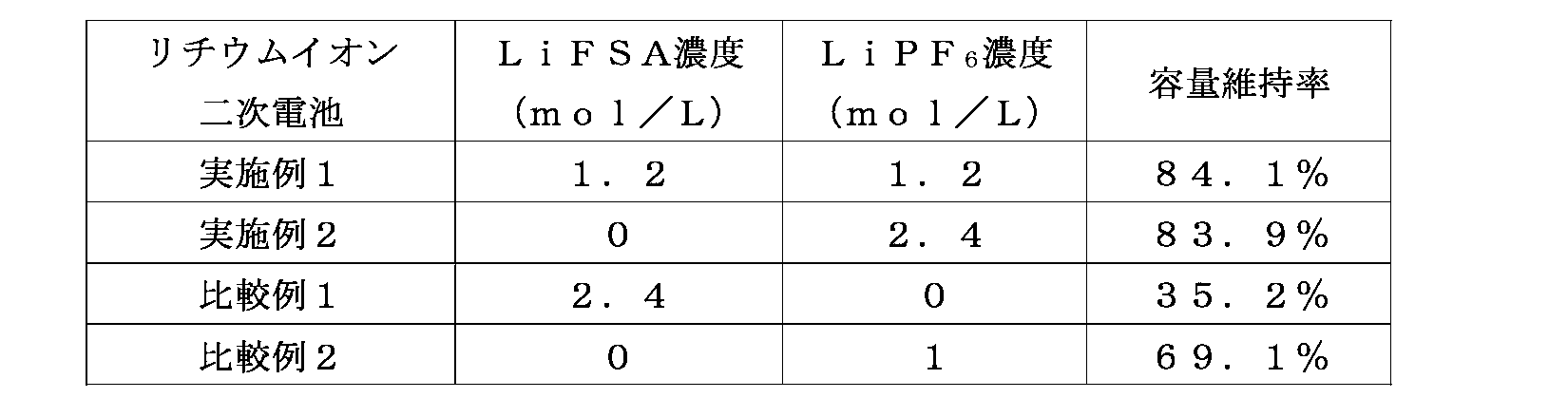
また、評価例2の試験後の実施例1、実施例2、比較例1の各リチウムイオン二次電池につき、以下の分析を行った。各リチウムイオン二次電池を解体して負極を取出し、当該負極をジメチルカーボネートに10分間浸漬する操作を3回繰り返して洗浄し、その後乾燥して、分析対象の負極とした。なお、リチウムイオン二次電池の解体から分析対象としての負極を分析装置に搬送するまでの全ての工程を、Arガス雰囲気下で行った。X線光電子分光法を用いて、以下の条件で、分析対象の負極表面を分析した。
装置:アルバックファイ社 PHI5000 VersaProbeII
X線源:単色AlKα線、電圧15kV、電流10mA
X線源:単色AlKα線、電圧15kV、電流10mA
実施例1、実施例2、比較例1のリチウムイオン二次電池の負極表面について、アルミニウムに関して分析した結果のチャートを図1に示す。
図1において、実施例1及び実施例2のリチウムイオン二次電池の負極からは、アルミニウムに由来するピークが観察されなかったが、比較例1のリチウムイオン二次電池の負極からは、アルミニウムに由来するピークが観察された。第一リチウム塩を含む本発明の電解液を用いることで、正極からのアルミニウムの溶出を抑制できたことが裏付けられた。
表3及び図1の結果から、本発明のリチウムイオン二次電池は、正極からのアルミニウムの溶出を抑制できた結果、著しく優れた容量維持率を示したといえる。
比較例1のリチウムイオン二次電池の容量維持率が著しく低かった原因は、正極から溶出したアルミニウムが負極表面で析出したことに因り、電解液の構成成分が分解したことにあると推察される。
また、比較例2のリチウムイオン二次電池の容量維持率が低かった原因は、還元分解されやすいエチレンカーボネート及びフルオロエチレンカーボネートが過剰に存在したことに因り、エチレンカーボネート及びフルオロエチレンカーボネートの分解物が負極表面で過剰に生成した結果、負極の劣化が促進されたことにあると考えられる。
比較例1のリチウムイオン二次電池の容量維持率が著しく低かった原因は、正極から溶出したアルミニウムが負極表面で析出したことに因り、電解液の構成成分が分解したことにあると推察される。
また、比較例2のリチウムイオン二次電池の容量維持率が低かった原因は、還元分解されやすいエチレンカーボネート及びフルオロエチレンカーボネートが過剰に存在したことに因り、エチレンカーボネート及びフルオロエチレンカーボネートの分解物が負極表面で過剰に生成した結果、負極の劣化が促進されたことにあると考えられる。
(評価例3)
電圧3.05Vに調整した実施例1、実施例2、比較例1、比較例2の各リチウムイオン二次電池につき、-20℃での条件下、電圧2.8Vまで一定出力にて放電させた場合の放電時間を測定した。当該測定は、出力を変えた複数の条件下で行った。得られた結果から、各リチウムイオン二次電池につき、3.05Vから2.8Vまでの放電時間が3分間となる一定出力(mW)を算出した。結果を表4に示す。
電圧3.05Vに調整した実施例1、実施例2、比較例1、比較例2の各リチウムイオン二次電池につき、-20℃での条件下、電圧2.8Vまで一定出力にて放電させた場合の放電時間を測定した。当該測定は、出力を変えた複数の条件下で行った。得られた結果から、各リチウムイオン二次電池につき、3.05Vから2.8Vまでの放電時間が3分間となる一定出力(mW)を算出した。結果を表4に示す。

表4の結果から、リチウム塩濃度が高く、かつ(FSO2)2NLi及びLiPF6を併用した電解液を用いた実施例1のリチウムイオン二次電池が、低温条件下でも優れた出力を示したことがわかる。本発明のリチウムイオン二次電池のうち、第一リチウム塩及び第二リチウム塩を併用する電解液を具備するものは、特に優れた電池特性を示すといえる。
(実施例3-1)
鎖状カーボネートであるジメチルカーボネート及びエチルメチルカーボネートを7:3のモル比で混合した混合溶媒に、第一リチウム塩であるLiPF6及び第二リチウム塩である(FSO2)2NLiを溶解させて、LiPF6の濃度が1.0mol/Lであり、(FSO2)2NLiの濃度が1.0mol/Lである実施例3-1の電解液を製造した。実施例3-1の電解液においては、リチウム塩の濃度は2.0mol/Lであり、また、第一リチウム塩及び第二リチウム塩の合計モルに対する、第一リチウム塩のモルの比Pは、0.5である。
鎖状カーボネートであるジメチルカーボネート及びエチルメチルカーボネートを7:3のモル比で混合した混合溶媒に、第一リチウム塩であるLiPF6及び第二リチウム塩である(FSO2)2NLiを溶解させて、LiPF6の濃度が1.0mol/Lであり、(FSO2)2NLiの濃度が1.0mol/Lである実施例3-1の電解液を製造した。実施例3-1の電解液においては、リチウム塩の濃度は2.0mol/Lであり、また、第一リチウム塩及び第二リチウム塩の合計モルに対する、第一リチウム塩のモルの比Pは、0.5である。
層状岩塩構造のリチウム複合金属酸化物を94質量部、導電助剤としてアセチレンブラック3質量部、及び結着剤であるポリフッ化ビニリデン3質量部を混合した。この混合物を適量のN-メチル-2-ピロリドンに分散させて、スラリーを作製した。正極集電体として厚み15μmのアルミニウム箔を準備した。このアルミニウム箔の両面に上記スラリーが膜状になるように塗布した。スラリーが塗布されたアルミニウム箔を120℃の炉内で乾燥することでN-メチル-2-ピロリドンを揮発により除去した。その後、このアルミニウム箔をプレスし接合物を得た。得られた接合物を真空乾燥機で120℃、6時間加熱乾燥して、正極活物質層が形成されたアルミニウム箔を得た。これを正極とした。
炭素被覆されたシリコン材料を72.5質量部、導電助剤としてアセチレンブラックを13.5質量部、結着剤としてポリアクリル酸と4,4’-ジアミノジフェニルメタンとの混合物14質量部を混合した。この混合物を適量のN-メチル-2-ピロリドンに分散させて、スラリーを作製した。負極集電体として厚み10μmの銅箔を準備した。この銅箔の両面に、上記スラリーを膜状に塗布した。スラリーが塗布された銅箔を乾燥してN-メチル-2-ピロリドンを除去し、その後、銅箔をプレスし、接合物を得た。得られた接合物を真空乾燥機で乾燥し、負極活物質層が形成された銅箔を得た。これを負極とした。
なお、結着剤として用いたポリアクリル酸と4,4’-ジアミノジフェニルメタンとの混合物は、乾燥にて脱水反応が進行して、ポリアクリル酸を4,4’-ジアミノジフェニルメタンで架橋した架橋ポリマーに変化する。
なお、結着剤として用いたポリアクリル酸と4,4’-ジアミノジフェニルメタンとの混合物は、乾燥にて脱水反応が進行して、ポリアクリル酸を4,4’-ジアミノジフェニルメタンで架橋した架橋ポリマーに変化する。
セパレータとして、厚さ20μmのポリオレフィン製微多孔膜を準備した。
上述の正極、負極及びセパレータを用いて、負極-セパレータ-正極-セパレータ-負極-セパレータ-正極-セパレータ-負極との極板群を製造した。この極板群を二枚一組のラミネートフィルムで覆い、三辺をシールした後、袋状となったラミネートフィルムに実施例3-1の電解液を注入した。その後、残りの一辺をシールすることで、四辺が気密にシールされ、極板群及び電解液が密閉されたリチウムイオン二次電池を得た。この電池を、実施例3-1のリチウムイオン二次電池とした。
(実施例3-2)
鎖状カーボネートであるジメチルカーボネート及びエチルメチルカーボネートを9:1のモル比で混合した混合溶媒に、第一リチウム塩であるLiPF6及び第二リチウム塩である(FSO2)2NLiを溶解させて、LiPF6の濃度が1.2mol/Lであり、(FSO2)2NLiの濃度が1.2mol/Lである実施例3-2の電解液を製造した。実施例3-2の電解液においては、リチウム塩の濃度は2.4mol/Lであり、また、第一リチウム塩及び第二リチウム塩の合計モルに対する、第一リチウム塩のモルの比Pは、0.5である。
以下、実施例3-2の電解液を用いた以外は実施例3-1と同様の方法で、実施例3-2のリチウムイオン二次電池を製造した。
鎖状カーボネートであるジメチルカーボネート及びエチルメチルカーボネートを9:1のモル比で混合した混合溶媒に、第一リチウム塩であるLiPF6及び第二リチウム塩である(FSO2)2NLiを溶解させて、LiPF6の濃度が1.2mol/Lであり、(FSO2)2NLiの濃度が1.2mol/Lである実施例3-2の電解液を製造した。実施例3-2の電解液においては、リチウム塩の濃度は2.4mol/Lであり、また、第一リチウム塩及び第二リチウム塩の合計モルに対する、第一リチウム塩のモルの比Pは、0.5である。
以下、実施例3-2の電解液を用いた以外は実施例3-1と同様の方法で、実施例3-2のリチウムイオン二次電池を製造した。
(実施例3-3)
鎖状カーボネートであるジメチルカーボネート及びエチルメチルカーボネート、並びに、フッ素含有環状カーボネートであるフルオロエチレンカーボネートを63:27:10のモル比で混合した混合溶媒に、第一リチウム塩であるLiPF6及び第二リチウム塩である(FSO2)2NLiを溶解させて、LiPF6の濃度が1.0mol/Lであり、(FSO2)2NLiの濃度が1.0mol/Lである実施例3-3の電解液を製造した。実施例3-3の電解液においては、リチウム塩の濃度は2.0mol/Lであり、また、第一リチウム塩及び第二リチウム塩の合計モルに対する、第一リチウム塩のモルの比Pは、0.5である。
以下、実施例3-3の電解液を用いた以外は実施例3-1と同様の方法で、実施例3-3のリチウムイオン二次電池を製造した。
鎖状カーボネートであるジメチルカーボネート及びエチルメチルカーボネート、並びに、フッ素含有環状カーボネートであるフルオロエチレンカーボネートを63:27:10のモル比で混合した混合溶媒に、第一リチウム塩であるLiPF6及び第二リチウム塩である(FSO2)2NLiを溶解させて、LiPF6の濃度が1.0mol/Lであり、(FSO2)2NLiの濃度が1.0mol/Lである実施例3-3の電解液を製造した。実施例3-3の電解液においては、リチウム塩の濃度は2.0mol/Lであり、また、第一リチウム塩及び第二リチウム塩の合計モルに対する、第一リチウム塩のモルの比Pは、0.5である。
以下、実施例3-3の電解液を用いた以外は実施例3-1と同様の方法で、実施例3-3のリチウムイオン二次電池を製造した。
(実施例3-4)
鎖状カーボネートであるジメチルカーボネート及びエチルメチルカーボネート、並びに、フッ素含有環状カーボネートであるフルオロエチレンカーボネートを63:27:10のモル比で混合した混合溶媒に、第一リチウム塩であるLiPF6及びLiPF2(OCOCOO)2、並びに、第二リチウム塩である(FSO2)2NLiを溶解させて、LiPF6の濃度が1.0mol/Lであり、LiPF2(OCOCOO)2の濃度が0.05mol/Lであり、(FSO2)2NLiの濃度が1.0mol/Lである実施例3-4の電解液を製造した。実施例3-4の電解液においては、リチウム塩の濃度は2.05mol/Lであり、また、第一リチウム塩及び第二リチウム塩の合計モルに対する、第一リチウム塩のモルの比Pは、0.51である。
以下、実施例3-4の電解液を用いた以外は実施例3-1と同様の方法で、実施例3-4のリチウムイオン二次電池を製造した。
鎖状カーボネートであるジメチルカーボネート及びエチルメチルカーボネート、並びに、フッ素含有環状カーボネートであるフルオロエチレンカーボネートを63:27:10のモル比で混合した混合溶媒に、第一リチウム塩であるLiPF6及びLiPF2(OCOCOO)2、並びに、第二リチウム塩である(FSO2)2NLiを溶解させて、LiPF6の濃度が1.0mol/Lであり、LiPF2(OCOCOO)2の濃度が0.05mol/Lであり、(FSO2)2NLiの濃度が1.0mol/Lである実施例3-4の電解液を製造した。実施例3-4の電解液においては、リチウム塩の濃度は2.05mol/Lであり、また、第一リチウム塩及び第二リチウム塩の合計モルに対する、第一リチウム塩のモルの比Pは、0.51である。
以下、実施例3-4の電解液を用いた以外は実施例3-1と同様の方法で、実施例3-4のリチウムイオン二次電池を製造した。
(実施例3-5)
鎖状カーボネートであるジメチルカーボネート及びエチルメチルカーボネートを7:3のモル比で混合した混合溶媒に、第一リチウム塩であるLiPF6及び第二リチウム塩である(FSO2)2NLiを溶解させて、LiPF6の濃度が1.0mol/Lであり、(FSO2)2NLiの濃度が1.4mol/Lである実施例3-5の電解液を製造した。実施例3-5の電解液においては、リチウム塩の濃度は2.4mol/Lであり、また、第一リチウム塩及び第二リチウム塩の合計モルに対する、第一リチウム塩のモルの比Pは、0.42である。
以下、実施例3-5の電解液を用いた以外は実施例3-1と同様の方法で、実施例3-5のリチウムイオン二次電池を製造した。
鎖状カーボネートであるジメチルカーボネート及びエチルメチルカーボネートを7:3のモル比で混合した混合溶媒に、第一リチウム塩であるLiPF6及び第二リチウム塩である(FSO2)2NLiを溶解させて、LiPF6の濃度が1.0mol/Lであり、(FSO2)2NLiの濃度が1.4mol/Lである実施例3-5の電解液を製造した。実施例3-5の電解液においては、リチウム塩の濃度は2.4mol/Lであり、また、第一リチウム塩及び第二リチウム塩の合計モルに対する、第一リチウム塩のモルの比Pは、0.42である。
以下、実施例3-5の電解液を用いた以外は実施例3-1と同様の方法で、実施例3-5のリチウムイオン二次電池を製造した。
(実施例3-6)
鎖状カーボネートであるジメチルカーボネート及びエチルメチルカーボネートを7:3のモル比で混合した混合溶媒に、第一リチウム塩であるLiPF6及び第二リチウム塩である(FSO2)2NLiを溶解させて、LiPF6の濃度が1.5mol/Lであり、(FSO2)2NLiの濃度が0.5mol/Lである実施例3-6の電解液を製造した。実施例3-6の電解液においては、リチウム塩の濃度は2.0mol/Lであり、また、第一リチウム塩及び第二リチウム塩の合計モルに対する、第一リチウム塩のモルの比Pは、0.75である。
以下、実施例3-6の電解液を用いた以外は実施例3-1と同様の方法で、実施例3-6のリチウムイオン二次電池を製造した。
鎖状カーボネートであるジメチルカーボネート及びエチルメチルカーボネートを7:3のモル比で混合した混合溶媒に、第一リチウム塩であるLiPF6及び第二リチウム塩である(FSO2)2NLiを溶解させて、LiPF6の濃度が1.5mol/Lであり、(FSO2)2NLiの濃度が0.5mol/Lである実施例3-6の電解液を製造した。実施例3-6の電解液においては、リチウム塩の濃度は2.0mol/Lであり、また、第一リチウム塩及び第二リチウム塩の合計モルに対する、第一リチウム塩のモルの比Pは、0.75である。
以下、実施例3-6の電解液を用いた以外は実施例3-1と同様の方法で、実施例3-6のリチウムイオン二次電池を製造した。
(比較例3-1)
鎖状カーボネートであるジメチルカーボネート及びエチルメチルカーボネートを7:3のモル比で混合した混合溶媒に、第二リチウム塩である(FSO2)2NLiを溶解させて、(FSO2)2NLiの濃度が3.0mol/Lである比較例3-1の電解液を製造した。
以下、比較例3-1の電解液を用いた以外は実施例3-1と同様の方法で、比較例3-1のリチウムイオン二次電池を製造した。
鎖状カーボネートであるジメチルカーボネート及びエチルメチルカーボネートを7:3のモル比で混合した混合溶媒に、第二リチウム塩である(FSO2)2NLiを溶解させて、(FSO2)2NLiの濃度が3.0mol/Lである比較例3-1の電解液を製造した。
以下、比較例3-1の電解液を用いた以外は実施例3-1と同様の方法で、比較例3-1のリチウムイオン二次電池を製造した。
(評価例4)
各リチウムイオン二次電池に対して、25℃、0.05Cレートで3.9Vまで充電した。次に、60℃まで昇温し20時間保持させた。次に、25℃、0.05Cレートで4.28Vまで充電し、当該電圧を1時間保持させた。次に、25℃、1Cレートで2.8Vまで放電し、当該電圧を4時間保持させた。その後、各リチウムイオン二次電池を解体し、正極集電体であるアルミニウム箔の様子を観察した。結果を表5に示す。表5においては、腐食されて孔が生じたアルミニウム箔が観察された場合、Al腐食を有りとした。
各リチウムイオン二次電池に対して、25℃、0.05Cレートで3.9Vまで充電した。次に、60℃まで昇温し20時間保持させた。次に、25℃、0.05Cレートで4.28Vまで充電し、当該電圧を1時間保持させた。次に、25℃、1Cレートで2.8Vまで放電し、当該電圧を4時間保持させた。その後、各リチウムイオン二次電池を解体し、正極集電体であるアルミニウム箔の様子を観察した。結果を表5に示す。表5においては、腐食されて孔が生じたアルミニウム箔が観察された場合、Al腐食を有りとした。

本発明のリチウムイオン二次電池において、第一リチウム塩の濃度が少なくとも1.0mol/L以上であるか、又は、第一リチウム塩及び第二リチウム塩の合計モルに対する、第一リチウム塩のモルの比Pの値が少なくとも0.5以上の電解液を採用すれば、アルミニウム腐食は好適に抑制されるといえる。
Claims (12)
- アルミニウム製の集電体を具備する正極と、Si含有負極活物質を具備する負極と、電解液とを備えるリチウムイオン二次電池であって、
前記電解液が、
リチウム塩と下記一般式(1)で表される鎖状カーボネートとを含有し、前記リチウム塩に対する前記鎖状カーボネートのモル比が2~6の範囲内であり、かつ、前記リチウム塩が下記一般式(A)~一般式(D)から選択される第一リチウム塩を含む、
及び/又は、
前記電解液が、
リチウム塩と下記一般式(1)で表される鎖状カーボネートとを含有し、前記リチウム塩の濃度が1.5~3.5mol/Lであり、かつ、前記リチウム塩が下記一般式(A)~一般式(D)から選択される第一リチウム塩を含む、
ことを特徴とするリチウムイオン二次電池。
R10OCOOR11 一般式(1)
(R10、R11は、それぞれ独立に、鎖状アルキルであるCnHaFbClcBrdIe、又は、環状アルキルを化学構造に含むCmHfFgClhBriIjのいずれかから選択される。nは1以上の整数、mは3以上の整数、a、b、c、d、e、f、g、h、i、jはそれぞれ独立に0以上の整数であり、2n+1=a+b+c+d+e、2m-1=f+g+h+i+jを満たす。)
LiPF6―y(X)y(ただし、yは0~5の整数。) 一般式(A)
LiBF4-y(X)y(ただし、yは0~3の整数。) 一般式(B)
LiAsF6-y(X)y(ただし、yは0~5の整数。) 一般式(C)
Li2SiF6-y(X)y(ただし、yは0~5の整数。) 一般式(D)
(一般式(A)~一般式(D)において、Xはそれぞれ独立にCl、Br、I、CN、(OCOCOO)1/2、CnF2n+1(nは1~3の整数。)から選択される。) - 前記リチウム塩が下記一般式(2)で表される第二リチウム塩を含む請求項1に記載のリチウムイオン二次電池。
(R21X1)(R22SO2)NLi 一般式(2)
(R21は、水素、ハロゲン、置換基で置換されていても良いアルキル基、置換基で置換されていても良いシクロアルキル基、置換基で置換されていても良い不飽和アルキル基、置換基で置換されていても良い不飽和シクロアルキル基、置換基で置換されていても良い芳香族基、置換基で置換されていても良い複素環基、置換基で置換されていても良いアルコキシ基、置換基で置換されていても良い不飽和アルコキシ基、置換基で置換されていても良いチオアルコキシ基、置換基で置換されていても良い不飽和チオアルコキシ基、CN、SCN、OCNから選択される。
R22は、水素、ハロゲン、置換基で置換されていても良いアルキル基、置換基で置換されていても良いシクロアルキル基、置換基で置換されていても良い不飽和アルキル基、置換基で置換されていても良い不飽和シクロアルキル基、置換基で置換されていても良い芳香族基、置換基で置換されていても良い複素環基、置換基で置換されていても良いアルコキシ基、置換基で置換されていても良い不飽和アルコキシ基、置換基で置換されていても良いチオアルコキシ基、置換基で置換されていても良い不飽和チオアルコキシ基、CN、SCN、OCNから選択される。
また、R21とR22は、互いに結合して環を形成しても良い。
X1は、SO2、C=O、C=S、RaP=O、RbP=S、S=O、Si=Oから選択される。
Ra、Rbは、それぞれ独立に、水素、ハロゲン、置換基で置換されていても良いアルキル基、置換基で置換されていても良いシクロアルキル基、置換基で置換されていても良い不飽和アルキル基、置換基で置換されていても良い不飽和シクロアルキル基、置換基で置換されていても良い芳香族基、置換基で置換されていても良い複素環基、置換基で置換されていても良いアルコキシ基、置換基で置換されていても良い不飽和アルコキシ基、置換基で置換されていても良いチオアルコキシ基、置換基で置換されていても良い不飽和チオアルコキシ基、OH、SH、CN、SCN、OCNから選択される。
また、Ra、Rbは、R21又はR22と結合して環を形成しても良い。) - 前記第二リチウム塩が下記一般式(2-1)で表される請求項2に記載のリチウムイオン二次電池。
(R23X2)(R24SO2)NLi 一般式(2-1)
(R23、R24は、それぞれ独立に、CnHaFbClcBrdIe(CN)f(SCN)g(OCN)hである。
n、a、b、c、d、e、f、g、hはそれぞれ独立に0以上の整数であり、2n+1=a+b+c+d+e+f+g+hを満たす。
また、R23とR24は、互いに結合して環を形成しても良く、その場合は、2n=a+b+c+d+e+f+g+hを満たす。
X2は、SO2、C=O、C=S、RcP=O、RdP=S、S=O、Si=Oから選択される。
Rc、Rdは、それぞれ独立に、水素、ハロゲン、置換基で置換されていても良いアルキル基、置換基で置換されていても良いシクロアルキル基、置換基で置換されていても良い不飽和アルキル基、置換基で置換されていても良い不飽和シクロアルキル基、置換基で置換されていても良い芳香族基、置換基で置換されていても良い複素環基、置換基で置換されていても良いアルコキシ基、置換基で置換されていても良い不飽和アルコキシ基、置換基で置換されていても良いチオアルコキシ基、置換基で置換されていても良い不飽和チオアルコキシ基、OH、SH、CN、SCN、OCNから選択される。
また、Rc、Rdは、R23又はR24と結合して環を形成しても良い。) - 前記第二リチウム塩が下記一般式(2-2)で表される請求項2に記載のリチウムイオン二次電池。
(R25SO2)(R26SO2)NLi 一般式(2-2)
(R25、R26は、それぞれ独立に、CnHaFbClcBrdIeである。
n、a、b、c、d、eはそれぞれ独立に0以上の整数であり、2n+1=a+b+c+d+eを満たす。
また、R25とR26は、互いに結合して環を形成しても良く、その場合は、2n=a+b+c+d+eを満たす。) - 前記第二リチウム塩が(CF3SO2)2NLi、(FSO2)2NLi、(C2F5SO2)2NLi、FSO2(CF3SO2)NLi、(SO2CF2CF2SO2)NLi、(SO2CF2CF2CF2SO2)NLi、FSO2(CH3SO2)NLi、FSO2(C2F5SO2)NLi、又はFSO2(C2H5SO2)NLiから選択される請求項2に記載のリチウムイオン二次電池。
- 前記第一リチウム塩及び前記第二リチウム塩の合計モルに対する、前記第一リチウム塩のモルの比Pが、0.5≦P<1であるか、又は、前記第一リチウム塩の濃度が1.0mol/L以上である、請求項2~5のいずれか1項に記載のリチウムイオン二次電池。
- 前記電解液がフッ素含有環状カーボネートを含む請求項1~6のいずれか1項に記載のリチウムイオン二次電池。
- 前記電解液には、フッ素含有環状カーボネート以外の全有機溶媒に対し、前記鎖状カーボネートが70体積%、70質量%以上若しくは70モル%以上で含まれる請求項1~7のいずれか1項に記載のリチウムイオン二次電池。
- 前記電解液が2種類以上の前記鎖状カーボネートを含む請求項1~8のいずれか1項に記載のリチウムイオン二次電池。
- 前記Si含有負極活物質が、複数枚の板状シリコン体が厚さ方向に積層されてなる構造を有するシリコン材料である請求項1~9のいずれか1項に記載のリチウムイオン二次電池。
- 前記負極が、カルボキシル基含有ポリマーをジアミンで架橋した架橋ポリマーを含有する負極活物質層を具備する請求項1~10のいずれか1項に記載のリチウムイオン二次電池。
- 前記正極が、層状岩塩構造の一般式:LiaNibCocMndDeOf(0.2≦a≦2、b+c+d+e=1、0≦e<1、DはW、Mo、Re、Pd、Ba、Cr、B、Sb、Sr、Pb、Ga、Al、Nb、Mg、Ta、Ti、La、Zr、Cu、Ca、Ir、Hf、Rh、Fe、Ge、Zn、Ru、Sc、Sn、In、Y、Bi、S、Si、Na、K、P、Vから選ばれる少なくとも1の元素、1.7≦f≦3) で表されるリチウム複合金属酸化物と、LiMPO4、LiMVO4若しくはLi2MSiO4(式中のMはCo、Ni、Mn、Feのうちの少なくとも一種から選択される)で表されるポリアニオン系化合物とを含有する正極活物質層を具備する請求項1~11のいずれかに1項に記載のリチウムイオン二次電池。
Applications Claiming Priority (2)
| Application Number | Priority Date | Filing Date | Title |
|---|---|---|---|
| JP2016-155454 | 2016-08-08 | ||
| JP2016155454 | 2016-08-08 |
Publications (1)
| Publication Number | Publication Date |
|---|---|
| WO2018029907A1 true WO2018029907A1 (ja) | 2018-02-15 |
Family
ID=61162062
Family Applications (1)
| Application Number | Title | Priority Date | Filing Date |
|---|---|---|---|
| PCT/JP2017/015219 Ceased WO2018029907A1 (ja) | 2016-08-08 | 2017-04-14 | リチウムイオン二次電池 |
Country Status (1)
| Country | Link |
|---|---|
| WO (1) | WO2018029907A1 (ja) |
Cited By (4)
| Publication number | Priority date | Publication date | Assignee | Title |
|---|---|---|---|---|
| CN113471433A (zh) * | 2020-03-30 | 2021-10-01 | 荒川化学工业株式会社 | 锂离子电池用粘合剂水溶液、锂离子电池用负极浆料、锂离子电池用负极以及锂离子电池 |
| CN114270571A (zh) * | 2019-09-23 | 2022-04-01 | 株式会社Lg新能源 | 电池系统以及使用其的方法和包含其的电池组 |
| JP2023183307A (ja) * | 2022-06-15 | 2023-12-27 | 株式会社Gsユアサ | 非水電解質蓄電素子 |
| CN117682487A (zh) * | 2023-12-12 | 2024-03-12 | 珠海市赛纬电子材料股份有限公司 | 含氟磺酰亚胺锂的制备方法及其非水电解液和锂离子电池 |
Citations (8)
| Publication number | Priority date | Publication date | Assignee | Title |
|---|---|---|---|---|
| JPH05326016A (ja) * | 1992-05-15 | 1993-12-10 | Sanyo Electric Co Ltd | 非水系電解液二次電池 |
| JP2004319390A (ja) * | 2003-04-18 | 2004-11-11 | Matsushita Electric Ind Co Ltd | 非水電解質二次電池 |
| JP2009163971A (ja) * | 2008-01-07 | 2009-07-23 | Panasonic Corp | 非水電解液二次電池 |
| WO2013128559A1 (ja) * | 2012-02-28 | 2013-09-06 | 株式会社日立製作所 | リチウムイオン二次電池 |
| WO2014080608A1 (ja) * | 2012-11-21 | 2014-05-30 | 株式会社豊田自動織機 | ナノシリコン材料及び負極活物質とその製造方法及び蓄電装置 |
| WO2015056412A1 (ja) * | 2013-10-17 | 2015-04-23 | 株式会社豊田自動織機 | リチウムイオン二次電池 |
| WO2016063882A1 (ja) * | 2014-10-21 | 2016-04-28 | 株式会社 豊田自動織機 | 高分子化合物、中間組成物、負極電極、蓄電装置、負極電極用スラリー、高分子化合物の製造方法、及び負極電極の製造方法 |
| JP2016085838A (ja) * | 2014-10-24 | 2016-05-19 | Tdk株式会社 | リチウムイオン二次電池 |
-
2017
- 2017-04-14 WO PCT/JP2017/015219 patent/WO2018029907A1/ja not_active Ceased
Patent Citations (8)
| Publication number | Priority date | Publication date | Assignee | Title |
|---|---|---|---|---|
| JPH05326016A (ja) * | 1992-05-15 | 1993-12-10 | Sanyo Electric Co Ltd | 非水系電解液二次電池 |
| JP2004319390A (ja) * | 2003-04-18 | 2004-11-11 | Matsushita Electric Ind Co Ltd | 非水電解質二次電池 |
| JP2009163971A (ja) * | 2008-01-07 | 2009-07-23 | Panasonic Corp | 非水電解液二次電池 |
| WO2013128559A1 (ja) * | 2012-02-28 | 2013-09-06 | 株式会社日立製作所 | リチウムイオン二次電池 |
| WO2014080608A1 (ja) * | 2012-11-21 | 2014-05-30 | 株式会社豊田自動織機 | ナノシリコン材料及び負極活物質とその製造方法及び蓄電装置 |
| WO2015056412A1 (ja) * | 2013-10-17 | 2015-04-23 | 株式会社豊田自動織機 | リチウムイオン二次電池 |
| WO2016063882A1 (ja) * | 2014-10-21 | 2016-04-28 | 株式会社 豊田自動織機 | 高分子化合物、中間組成物、負極電極、蓄電装置、負極電極用スラリー、高分子化合物の製造方法、及び負極電極の製造方法 |
| JP2016085838A (ja) * | 2014-10-24 | 2016-05-19 | Tdk株式会社 | リチウムイオン二次電池 |
Cited By (9)
| Publication number | Priority date | Publication date | Assignee | Title |
|---|---|---|---|---|
| CN114270571A (zh) * | 2019-09-23 | 2022-04-01 | 株式会社Lg新能源 | 电池系统以及使用其的方法和包含其的电池组 |
| JP2022547282A (ja) * | 2019-09-23 | 2022-11-11 | エルジー エナジー ソリューション リミテッド | 電池システム、その使用方法、およびそれを含む電池パック |
| JP7507849B2 (ja) | 2019-09-23 | 2024-06-28 | エルジー エナジー ソリューション リミテッド | 電池システム、その使用方法、およびそれを含む電池パック |
| EP4002546A4 (en) * | 2019-09-23 | 2024-07-24 | Lg Energy Solution, Ltd. | BATTERY SYSTEM, METHOD OF MAKING SAME AND BATTERY PACK THEREOF |
| US12374727B2 (en) | 2019-09-23 | 2025-07-29 | Lg Energy Solution, Ltd. | Battery system including control unit configured to set driving voltage range for charging and discharging of secondary battery to specific range, and method of using same and battery pack including same |
| CN114270571B (zh) * | 2019-09-23 | 2025-08-15 | 株式会社Lg新能源 | 电池系统以及使用其的方法和包含其的电池组 |
| CN113471433A (zh) * | 2020-03-30 | 2021-10-01 | 荒川化学工业株式会社 | 锂离子电池用粘合剂水溶液、锂离子电池用负极浆料、锂离子电池用负极以及锂离子电池 |
| JP2023183307A (ja) * | 2022-06-15 | 2023-12-27 | 株式会社Gsユアサ | 非水電解質蓄電素子 |
| CN117682487A (zh) * | 2023-12-12 | 2024-03-12 | 珠海市赛纬电子材料股份有限公司 | 含氟磺酰亚胺锂的制备方法及其非水电解液和锂离子电池 |
Similar Documents
| Publication | Publication Date | Title |
|---|---|---|
| JP6569883B2 (ja) | 電解液及びリチウムイオン二次電池 | |
| JP6575027B2 (ja) | リチウムイオン二次電池 | |
| JP6450395B2 (ja) | 電解液 | |
| WO2017179411A1 (ja) | リチウムイオン二次電池 | |
| WO2017104145A1 (ja) | リチウムイオン二次電池 | |
| JP6402957B2 (ja) | 電極表面に被膜を具備する二次電池の製造方法 | |
| EP3742537A2 (en) | Non-aqueous electrolyte solution for lithium secondary battery and lithium secondary battery including the same | |
| JP2018085221A (ja) | リチウムイオン二次電池 | |
| JPWO2016079919A1 (ja) | 電解液 | |
| JP2017191744A (ja) | リチウムイオン二次電池 | |
| JP2019046689A (ja) | リチウムイオン二次電池 | |
| JP2018106975A (ja) | 電解液及びそれを具備するリチウムイオン二次電池 | |
| JP6776682B2 (ja) | リチウムイオン二次電池 | |
| JP2018200855A (ja) | リチウムイオン二次電池 | |
| JP6825311B2 (ja) | リチウムイオン二次電池 | |
| JP6769222B2 (ja) | 電解液及びリチウムイオン二次電池 | |
| JP7139582B2 (ja) | リチウムイオン二次電池 | |
| JP7087294B2 (ja) | リチウムイオン二次電池 | |
| JP2019021393A (ja) | リチウムイオン二次電池 | |
| JP6996172B2 (ja) | リチウムイオン二次電池の製造方法 | |
| JP2018147694A (ja) | リチウムイオン二次電池 | |
| JP2015088473A (ja) | アルカリ金属、アルカリ土類金属又はアルミニウムをカチオンとする塩と、ヘテロ元素を有する有機溶媒とを含む電解液の製造方法 | |
| JP5817000B2 (ja) | アルカリ金属、アルカリ土類金属又はアルミニウムをカチオンとする塩と、ヘテロ元素を有する有機溶媒とを含む電解液群 | |
| JP2019200977A (ja) | 電解液 | |
| JP7021466B2 (ja) | リチウムイオン二次電池 |
Legal Events
| Date | Code | Title | Description |
|---|---|---|---|
| 121 | Ep: the epo has been informed by wipo that ep was designated in this application |
Ref document number: 17838983 Country of ref document: EP Kind code of ref document: A1 |
|
| NENP | Non-entry into the national phase |
Ref country code: DE |
|
| 122 | Ep: pct application non-entry in european phase |
Ref document number: 17838983 Country of ref document: EP Kind code of ref document: A1 |
|
| NENP | Non-entry into the national phase |
Ref country code: JP |