WO2017195586A1 - 光インプリント用硬化性組成物及びそれを用いたパターン転写方法 - Google Patents
光インプリント用硬化性組成物及びそれを用いたパターン転写方法 Download PDFInfo
- Publication number
- WO2017195586A1 WO2017195586A1 PCT/JP2017/016300 JP2017016300W WO2017195586A1 WO 2017195586 A1 WO2017195586 A1 WO 2017195586A1 JP 2017016300 W JP2017016300 W JP 2017016300W WO 2017195586 A1 WO2017195586 A1 WO 2017195586A1
- Authority
- WO
- WIPO (PCT)
- Prior art keywords
- curable composition
- formula
- group
- pattern
- mold
- Prior art date
- Legal status (The legal status is an assumption and is not a legal conclusion. Google has not performed a legal analysis and makes no representation as to the accuracy of the status listed.)
- Ceased
Links
Classifications
-
- C—CHEMISTRY; METALLURGY
- C08—ORGANIC MACROMOLECULAR COMPOUNDS; THEIR PREPARATION OR CHEMICAL WORKING-UP; COMPOSITIONS BASED THEREON
- C08G—MACROMOLECULAR COMPOUNDS OBTAINED OTHERWISE THAN BY REACTIONS ONLY INVOLVING UNSATURATED CARBON-TO-CARBON BONDS
- C08G77/00—Macromolecular compounds obtained by reactions forming a linkage containing silicon with or without sulfur, nitrogen, oxygen or carbon in the main chain of the macromolecule
- C08G77/04—Polysiloxanes
- C08G77/20—Polysiloxanes containing silicon bound to unsaturated aliphatic groups
-
- G—PHYSICS
- G03—PHOTOGRAPHY; CINEMATOGRAPHY; ANALOGOUS TECHNIQUES USING WAVES OTHER THAN OPTICAL WAVES; ELECTROGRAPHY; HOLOGRAPHY
- G03F—PHOTOMECHANICAL PRODUCTION OF TEXTURED OR PATTERNED SURFACES, e.g. FOR PRINTING, FOR PROCESSING OF SEMICONDUCTOR DEVICES; MATERIALS THEREFOR; ORIGINALS THEREFOR; APPARATUS SPECIALLY ADAPTED THEREFOR
- G03F7/00—Photomechanical, e.g. photolithographic, production of textured or patterned surfaces, e.g. printing surfaces; Materials therefor, e.g. comprising photoresists; Apparatus specially adapted therefor
- G03F7/0002—Lithographic processes using patterning methods other than those involving the exposure to radiation, e.g. by stamping
-
- C—CHEMISTRY; METALLURGY
- C08—ORGANIC MACROMOLECULAR COMPOUNDS; THEIR PREPARATION OR CHEMICAL WORKING-UP; COMPOSITIONS BASED THEREON
- C08F—MACROMOLECULAR COMPOUNDS OBTAINED BY REACTIONS ONLY INVOLVING CARBON-TO-CARBON UNSATURATED BONDS
- C08F2/00—Processes of polymerisation
- C08F2/46—Polymerisation initiated by wave energy or particle radiation
- C08F2/48—Polymerisation initiated by wave energy or particle radiation by ultraviolet or visible light
-
- C—CHEMISTRY; METALLURGY
- C08—ORGANIC MACROMOLECULAR COMPOUNDS; THEIR PREPARATION OR CHEMICAL WORKING-UP; COMPOSITIONS BASED THEREON
- C08F—MACROMOLECULAR COMPOUNDS OBTAINED BY REACTIONS ONLY INVOLVING CARBON-TO-CARBON UNSATURATED BONDS
- C08F283/00—Macromolecular compounds obtained by polymerising monomers on to polymers provided for in subclass C08G
- C08F283/12—Macromolecular compounds obtained by polymerising monomers on to polymers provided for in subclass C08G on to polysiloxanes
- C08F283/126—Macromolecular compounds obtained by polymerising monomers on to polymers provided for in subclass C08G on to polysiloxanes on to polysiloxanes being the result of polycondensation and radical polymerisation reactions
-
- C—CHEMISTRY; METALLURGY
- C08—ORGANIC MACROMOLECULAR COMPOUNDS; THEIR PREPARATION OR CHEMICAL WORKING-UP; COMPOSITIONS BASED THEREON
- C08F—MACROMOLECULAR COMPOUNDS OBTAINED BY REACTIONS ONLY INVOLVING CARBON-TO-CARBON UNSATURATED BONDS
- C08F299/00—Macromolecular compounds obtained by interreacting polymers involving only carbon-to-carbon unsaturated bond reactions, in the absence of non-macromolecular monomers
- C08F299/02—Macromolecular compounds obtained by interreacting polymers involving only carbon-to-carbon unsaturated bond reactions, in the absence of non-macromolecular monomers from unsaturated polycondensates
- C08F299/08—Macromolecular compounds obtained by interreacting polymers involving only carbon-to-carbon unsaturated bond reactions, in the absence of non-macromolecular monomers from unsaturated polycondensates from polysiloxanes
-
- C—CHEMISTRY; METALLURGY
- C08—ORGANIC MACROMOLECULAR COMPOUNDS; THEIR PREPARATION OR CHEMICAL WORKING-UP; COMPOSITIONS BASED THEREON
- C08K—Use of inorganic or non-macromolecular organic substances as compounding ingredients
- C08K5/00—Use of organic ingredients
- C08K5/04—Oxygen-containing compounds
- C08K5/06—Ethers; Acetals; Ketals; Ortho-esters
-
- C—CHEMISTRY; METALLURGY
- C08—ORGANIC MACROMOLECULAR COMPOUNDS; THEIR PREPARATION OR CHEMICAL WORKING-UP; COMPOSITIONS BASED THEREON
- C08L—COMPOSITIONS OF MACROMOLECULAR COMPOUNDS
- C08L53/00—Compositions of block copolymers containing at least one sequence of a polymer obtained by reactions only involving carbon-to-carbon unsaturated bonds; Compositions of derivatives of such polymers
-
- C—CHEMISTRY; METALLURGY
- C08—ORGANIC MACROMOLECULAR COMPOUNDS; THEIR PREPARATION OR CHEMICAL WORKING-UP; COMPOSITIONS BASED THEREON
- C08L—COMPOSITIONS OF MACROMOLECULAR COMPOUNDS
- C08L71/00—Compositions of polyethers obtained by reactions forming an ether link in the main chain; Compositions of derivatives of such polymers
- C08L71/02—Polyalkylene oxides
-
- C—CHEMISTRY; METALLURGY
- C08—ORGANIC MACROMOLECULAR COMPOUNDS; THEIR PREPARATION OR CHEMICAL WORKING-UP; COMPOSITIONS BASED THEREON
- C08L—COMPOSITIONS OF MACROMOLECULAR COMPOUNDS
- C08L83/00—Compositions of macromolecular compounds obtained by reactions forming in the main chain of the macromolecule a linkage containing silicon with or without sulfur, nitrogen, oxygen or carbon only; Compositions of derivatives of such polymers
- C08L83/04—Polysiloxanes
-
- C—CHEMISTRY; METALLURGY
- C08—ORGANIC MACROMOLECULAR COMPOUNDS; THEIR PREPARATION OR CHEMICAL WORKING-UP; COMPOSITIONS BASED THEREON
- C08L—COMPOSITIONS OF MACROMOLECULAR COMPOUNDS
- C08L83/00—Compositions of macromolecular compounds obtained by reactions forming in the main chain of the macromolecule a linkage containing silicon with or without sulfur, nitrogen, oxygen or carbon only; Compositions of derivatives of such polymers
- C08L83/10—Block- or graft-copolymers containing polysiloxane sequences
-
- G—PHYSICS
- G03—PHOTOGRAPHY; CINEMATOGRAPHY; ANALOGOUS TECHNIQUES USING WAVES OTHER THAN OPTICAL WAVES; ELECTROGRAPHY; HOLOGRAPHY
- G03F—PHOTOMECHANICAL PRODUCTION OF TEXTURED OR PATTERNED SURFACES, e.g. FOR PRINTING, FOR PROCESSING OF SEMICONDUCTOR DEVICES; MATERIALS THEREFOR; ORIGINALS THEREFOR; APPARATUS SPECIALLY ADAPTED THEREFOR
- G03F7/00—Photomechanical, e.g. photolithographic, production of textured or patterned surfaces, e.g. printing surfaces; Materials therefor, e.g. comprising photoresists; Apparatus specially adapted therefor
- G03F7/004—Photosensitive materials
- G03F7/027—Non-macromolecular photopolymerisable compounds having carbon-to-carbon double bonds, e.g. ethylenic compounds
-
- G—PHYSICS
- G03—PHOTOGRAPHY; CINEMATOGRAPHY; ANALOGOUS TECHNIQUES USING WAVES OTHER THAN OPTICAL WAVES; ELECTROGRAPHY; HOLOGRAPHY
- G03F—PHOTOMECHANICAL PRODUCTION OF TEXTURED OR PATTERNED SURFACES, e.g. FOR PRINTING, FOR PROCESSING OF SEMICONDUCTOR DEVICES; MATERIALS THEREFOR; ORIGINALS THEREFOR; APPARATUS SPECIALLY ADAPTED THEREFOR
- G03F7/00—Photomechanical, e.g. photolithographic, production of textured or patterned surfaces, e.g. printing surfaces; Materials therefor, e.g. comprising photoresists; Apparatus specially adapted therefor
- G03F7/004—Photosensitive materials
- G03F7/075—Silicon-containing compounds
- G03F7/0755—Non-macromolecular compounds containing Si-O, Si-C or Si-N bonds
-
- G—PHYSICS
- G03—PHOTOGRAPHY; CINEMATOGRAPHY; ANALOGOUS TECHNIQUES USING WAVES OTHER THAN OPTICAL WAVES; ELECTROGRAPHY; HOLOGRAPHY
- G03F—PHOTOMECHANICAL PRODUCTION OF TEXTURED OR PATTERNED SURFACES, e.g. FOR PRINTING, FOR PROCESSING OF SEMICONDUCTOR DEVICES; MATERIALS THEREFOR; ORIGINALS THEREFOR; APPARATUS SPECIALLY ADAPTED THEREFOR
- G03F9/00—Registration or positioning of originals, masks, frames, photographic sheets or textured or patterned surfaces, e.g. automatically
- G03F9/70—Registration or positioning of originals, masks, frames, photographic sheets or textured or patterned surfaces, e.g. automatically for microlithography
- G03F9/7003—Alignment type or strategy, e.g. leveling, global alignment
- G03F9/7042—Alignment for lithographic apparatus using patterning methods other than those involving the exposure to radiation, e.g. by stamping or imprinting
-
- H—ELECTRICITY
- H10—SEMICONDUCTOR DEVICES; ELECTRIC SOLID-STATE DEVICES NOT OTHERWISE PROVIDED FOR
- H10P—GENERIC PROCESSES OR APPARATUS FOR THE MANUFACTURE OR TREATMENT OF DEVICES COVERED BY CLASS H10
- H10P76/00—Manufacture or treatment of masks on semiconductor bodies, e.g. by lithography or photolithography
- H10P76/20—Manufacture or treatment of masks on semiconductor bodies, e.g. by lithography or photolithography of masks comprising organic materials
-
- H—ELECTRICITY
- H10—SEMICONDUCTOR DEVICES; ELECTRIC SOLID-STATE DEVICES NOT OTHERWISE PROVIDED FOR
- H10P—GENERIC PROCESSES OR APPARATUS FOR THE MANUFACTURE OR TREATMENT OF DEVICES COVERED BY CLASS H10
- H10P76/00—Manufacture or treatment of masks on semiconductor bodies, e.g. by lithography or photolithography
- H10P76/20—Manufacture or treatment of masks on semiconductor bodies, e.g. by lithography or photolithography of masks comprising organic materials
- H10P76/204—Manufacture or treatment of masks on semiconductor bodies, e.g. by lithography or photolithography of masks comprising organic materials of organic photoresist masks
-
- B—PERFORMING OPERATIONS; TRANSPORTING
- B82—NANOTECHNOLOGY
- B82Y—SPECIFIC USES OR APPLICATIONS OF NANOSTRUCTURES; MEASUREMENT OR ANALYSIS OF NANOSTRUCTURES; MANUFACTURE OR TREATMENT OF NANOSTRUCTURES
- B82Y10/00—Nanotechnology for information processing, storage or transmission, e.g. quantum computing or single electron logic
-
- B—PERFORMING OPERATIONS; TRANSPORTING
- B82—NANOTECHNOLOGY
- B82Y—SPECIFIC USES OR APPLICATIONS OF NANOSTRUCTURES; MEASUREMENT OR ANALYSIS OF NANOSTRUCTURES; MANUFACTURE OR TREATMENT OF NANOSTRUCTURES
- B82Y40/00—Manufacture or treatment of nanostructures
-
- C—CHEMISTRY; METALLURGY
- C08—ORGANIC MACROMOLECULAR COMPOUNDS; THEIR PREPARATION OR CHEMICAL WORKING-UP; COMPOSITIONS BASED THEREON
- C08F—MACROMOLECULAR COMPOUNDS OBTAINED BY REACTIONS ONLY INVOLVING CARBON-TO-CARBON UNSATURATED BONDS
- C08F212/00—Copolymers of compounds having one or more unsaturated aliphatic radicals, each having only one carbon-to-carbon double bond, and at least one being terminated by an aromatic carbocyclic ring
- C08F212/02—Monomers containing only one unsaturated aliphatic radical
- C08F212/04—Monomers containing only one unsaturated aliphatic radical containing one ring
- C08F212/14—Monomers containing only one unsaturated aliphatic radical containing one ring substituted by heteroatoms or groups containing heteroatoms
-
- C—CHEMISTRY; METALLURGY
- C08—ORGANIC MACROMOLECULAR COMPOUNDS; THEIR PREPARATION OR CHEMICAL WORKING-UP; COMPOSITIONS BASED THEREON
- C08F—MACROMOLECULAR COMPOUNDS OBTAINED BY REACTIONS ONLY INVOLVING CARBON-TO-CARBON UNSATURATED BONDS
- C08F220/00—Copolymers of compounds having one or more unsaturated aliphatic radicals, each having only one carbon-to-carbon double bond, and only one being terminated by only one carboxyl radical or a salt, anhydride ester, amide, imide or nitrile thereof
- C08F220/02—Monocarboxylic acids having less than ten carbon atoms; Derivatives thereof
- C08F220/10—Esters
- C08F220/20—Esters of polyhydric alcohols or phenols, e.g. 2-hydroxyethyl (meth)acrylate or glycerol mono-(meth)acrylate
-
- C—CHEMISTRY; METALLURGY
- C08—ORGANIC MACROMOLECULAR COMPOUNDS; THEIR PREPARATION OR CHEMICAL WORKING-UP; COMPOSITIONS BASED THEREON
- C08F—MACROMOLECULAR COMPOUNDS OBTAINED BY REACTIONS ONLY INVOLVING CARBON-TO-CARBON UNSATURATED BONDS
- C08F220/00—Copolymers of compounds having one or more unsaturated aliphatic radicals, each having only one carbon-to-carbon double bond, and only one being terminated by only one carboxyl radical or a salt, anhydride ester, amide, imide or nitrile thereof
- C08F220/02—Monocarboxylic acids having less than ten carbon atoms; Derivatives thereof
- C08F220/10—Esters
- C08F220/26—Esters containing oxygen in addition to the carboxy oxygen
- C08F220/28—Esters containing oxygen in addition to the carboxy oxygen containing no aromatic rings in the alcohol moiety
- C08F220/281—Esters containing oxygen in addition to the carboxy oxygen containing no aromatic rings in the alcohol moiety and containing only one oxygen, e.g. furfuryl (meth)acrylate or 2-methoxyethyl (meth)acrylate
-
- C—CHEMISTRY; METALLURGY
- C08—ORGANIC MACROMOLECULAR COMPOUNDS; THEIR PREPARATION OR CHEMICAL WORKING-UP; COMPOSITIONS BASED THEREON
- C08F—MACROMOLECULAR COMPOUNDS OBTAINED BY REACTIONS ONLY INVOLVING CARBON-TO-CARBON UNSATURATED BONDS
- C08F220/00—Copolymers of compounds having one or more unsaturated aliphatic radicals, each having only one carbon-to-carbon double bond, and only one being terminated by only one carboxyl radical or a salt, anhydride ester, amide, imide or nitrile thereof
- C08F220/02—Monocarboxylic acids having less than ten carbon atoms; Derivatives thereof
- C08F220/52—Amides or imides
- C08F220/54—Amides, e.g. N,N-dimethylacrylamide or N-isopropylacrylamide
- C08F220/58—Amides, e.g. N,N-dimethylacrylamide or N-isopropylacrylamide containing oxygen in addition to the carbonamido oxygen, e.g. N-methylolacrylamide, N-(meth)acryloylmorpholine
-
- C—CHEMISTRY; METALLURGY
- C08—ORGANIC MACROMOLECULAR COMPOUNDS; THEIR PREPARATION OR CHEMICAL WORKING-UP; COMPOSITIONS BASED THEREON
- C08F—MACROMOLECULAR COMPOUNDS OBTAINED BY REACTIONS ONLY INVOLVING CARBON-TO-CARBON UNSATURATED BONDS
- C08F222/00—Copolymers of compounds having one or more unsaturated aliphatic radicals, each having only one carbon-to-carbon double bond, and at least one being terminated by a carboxyl radical and containing at least one other carboxyl radical in the molecule; Salts, anhydrides, esters, amides, imides, or nitriles thereof
- C08F222/36—Amides or imides
- C08F222/38—Amides
- C08F222/385—Monomers containing two or more (meth)acrylamide groups, e.g. N,N'-methylenebisacrylamide
-
- C—CHEMISTRY; METALLURGY
- C08—ORGANIC MACROMOLECULAR COMPOUNDS; THEIR PREPARATION OR CHEMICAL WORKING-UP; COMPOSITIONS BASED THEREON
- C08F—MACROMOLECULAR COMPOUNDS OBTAINED BY REACTIONS ONLY INVOLVING CARBON-TO-CARBON UNSATURATED BONDS
- C08F226/00—Copolymers of compounds having one or more unsaturated aliphatic radicals, each having only one carbon-to-carbon double bond, and at least one being terminated by a single or double bond to nitrogen or by a heterocyclic ring containing nitrogen
- C08F226/02—Copolymers of compounds having one or more unsaturated aliphatic radicals, each having only one carbon-to-carbon double bond, and at least one being terminated by a single or double bond to nitrogen or by a heterocyclic ring containing nitrogen by a single or double bond to nitrogen
-
- C—CHEMISTRY; METALLURGY
- C08—ORGANIC MACROMOLECULAR COMPOUNDS; THEIR PREPARATION OR CHEMICAL WORKING-UP; COMPOSITIONS BASED THEREON
- C08G—MACROMOLECULAR COMPOUNDS OBTAINED OTHERWISE THAN BY REACTIONS ONLY INVOLVING UNSATURATED CARBON-TO-CARBON BONDS
- C08G77/00—Macromolecular compounds obtained by reactions forming a linkage containing silicon with or without sulfur, nitrogen, oxygen or carbon in the main chain of the macromolecule
- C08G77/42—Block-or graft-polymers containing polysiloxane sequences
- C08G77/442—Block-or graft-polymers containing polysiloxane sequences containing vinyl polymer sequences
Definitions
- the present invention relates to a curable composition for imprints having excellent substrate adhesion, no pattern defects and pattern collapse at the time of mold release, and very little pattern mold contamination, and a pattern forming method using the same.
- the nanoimprint method is a technology that develops an embossing technique that is well-known in the production of optical discs, and presses a mold on which a concave / convex pattern is formed into a resin and mechanically deforms it to precisely transfer a fine pattern.
- the optical nanoimprint method is a technology that irradiates light through a transparent mold or a transparent substrate, photocures the photocurable composition, and transfers it. Since imprinting at room temperature is possible, dimensional stability is improved. Improvements and throughput improvements are expected. Once a mold is manufactured, it is economical because nanostructures with a level of 10 to several hundreds of nanometers can be easily and repeatedly formed, and it is a nano-processing technology with little harmful disposal and discharge. Application to the field is expected.
- the fine concavo-convex pattern formed by the optical nanoimprint method requires performance such as transparency, heat resistance, weather resistance, and durability for optical applications such as an antireflection film, and for resist applications, acid resistance, solvent resistance, It is required to have excellent dry etching resistance.
- the polysiloxane component exhibits characteristic properties not found in organic materials, application of a photocurable composition containing the polysiloxane component to nanoimprint is being studied. For example, application as a nanoimprint resin mold that requires transparency, durability, and low surface energy, or a nanoimprint resist used for plasma etching mainly containing oxygen gas has been reported (Patent Document 1). 2).
- the biggest problem of the photo nanoimprint method is a problem of mold release defects that occur when the mold is pressed against the photocurable composition and photocured and then peeled off from the mold.
- As the mold release defect there are a pattern collapse, a pattern defect, a substrate peeling, a filling defect, a defect due to dust / bubble, and the like.
- the mold release becomes worse as the mold pattern becomes finer and the aspect ratio becomes larger.
- the pattern density is an ultra-fine transfer pattern of 20 nm or less, and the required defect density is set to a very high target value of 1 piece / cm 2 . Investigation is in progress (Non-Patent Document 1).
- Non-Patent Document 2 reports a method for improving mold releasability by subjecting a mold surface to a mold release treatment with a fluorine-based silane coupling agent and reducing adhesion work with a cured nanoimprint resin.
- Patent Document 3 reports an imprint material in which a fluorosurfactant is internally added for the purpose of reducing the adhesive force with a mold.
- Patent Document 4 discloses a method of adding a lubricant to the curable composition for imprints.
- the wettability of the photocurable composition to the mold is deteriorated, and it takes time to fill the mold, which is disadvantageous for the throughput.
- the mold release process to an ultrafine mold causes a filling failure or uneven transfer pattern dimensions, the mold release process is not practical.
- the surfactant adheres to the mold side during continuous transfer, contamination proceeds, and the wettability to the mold gradually deteriorates. Problems arise.
- the method of adding a lubricant is not only a problem of mold contamination at the time of continuous release, but also a sufficient method such that the adhesion to the lower layer film of the curable composition is deteriorated and pattern peeling is likely to occur. I can't say that.
- the curable composition containing a polysiloxane component as a main component has a low elastic modulus due to the high flexibility of the siloxane bond, the pattern collapses when forming a fine pattern of 100 nm or less or a pattern with a high aspect ratio. There was a problem of getting up easily.
- the problem to be solved by the present invention is that it contains a polymerizable compound containing a silicon atom such as polysiloxane, is excellent in adhesion to a substrate and mold releasability in a fine pattern mold, and mold contamination is extremely high. It is to provide a curable composition for imprinting with less amount.
- a curable composition for photoimprint comprising a polymerizable compound (A) containing a silicon atom in a molecule, a photopolymerization initiator (B), and an additive (C), wherein the additive (C ) Is a compound represented by the following formula (C1) or (C2), a curable composition for photoimprints.
- [R 1 in Formula (C1) is an alkyl group having 12 to 30 carbon atoms, X 1 is a hydrogen atom or an acyl group, and n is an integer of 0 to 50.
- X 2 and X 3 in formula (C2) each independently represent a hydrogen atom or an acyl group, and p, q, and r are each independently an integer of 1 to 50.
- Item 2. The curable composition for optical imprints according to Item 1, wherein in the formula (C1), R 1 is an alkyl group having 16 to 30 carbon atoms.
- the HLB value as used herein means that when the formula weight of the group represented by R 1 in the compound represented by the formula (C1) is M R1 and the formula weight of the polyethylene oxide unit is M EO , (Refers to a value represented by (M EO / (M R1 + M EO )) ⁇ 20) Item 4.
- Item 4. The curable composition for optical imprints according to any one of Items 1 to 3, wherein n is 0 in the formula (C1).
- the curable composition for optical imprints according to Item 1 wherein the compound represented by the formula (C2) has a value represented by M EO / (M EO + M PO ) of 0.1 to 0.4.
- M EO represents the formula amount of the polyethylene oxide unit in the above formula (C2)
- M PO represents the formula amount of the polypropylene oxide unit in the above formula (C2).
- Item 7. Item 7.
- Item 9. Item 2. The curable composition for optical imprints according to Item 1, wherein the polymerizable compound (A) is a polysiloxane having two or more polymerizable functional groups.
- Item 10. Item 10. The curable composition for optical imprints according to Item 9, wherein the polymerizable functional group of the polymerizable compound (A) is an ethylenically unsaturated bond.
- Item 11 Item 11.
- a curable composition for optical imprint, which is used in an imprint pattern forming method comprising a step of curing a curable composition for printing and a step of releasing the mold for imprint.
- Item 13 Item 13.
- a pattern transfer method comprising a step of etching a workpiece and a step of transferring a pattern to the workpiece.
- the curable composition for optical imprinting of the present invention is excellent in adhesion to a substrate, exhibits no significant pattern defects and pattern collapse at the time of mold release, and exhibits extremely remarkable effects such as very little pattern mold contamination.
- the polymerizable compound (A) of the present invention can be used without particular limitation as long as it is a polymerizable compound containing a silicon atom in the molecule, but has two or more polymerizable functional groups from the viewpoint of curability. Those having a polysiloxane structure are preferable, and those in which the polymerizable functional group is an ethylenically unsaturated bond are more preferable. Further, as an example of an application that provides the characteristic performance of the polysiloxane component, for example, in order to be suitably used as a resist for dry etching, the amount of silicon atoms in the compound is preferably 15% by weight or more, More preferably, it is 20% by weight or more. Examples of the polymerizable compound (A) of the present invention are described below.
- the polymerizable compound (A) of the present invention is commercially available, and specific examples thereof include X-22-174ASX, X-22-174BX, KF-2012, X-22-2426, X-22-2. 2475, X-22-2445, X-22-1602, X-22-164, X-22-164AS, X-22-164A, X-22-164B, X-22-164C, X-22-164E, KR-513, X-40-2672B, X-40-9272B (manufactured by Shin-Etsu Chemical Co., Ltd.), AC-SQ TA-100, MAC-SQ TM-100, AC-SQ SI-20, MAC-SQ SI-20, MAC-SQ HDM (above, manufactured by Toagosei Co., Ltd.) and the like.
- the polymerizable compound (A) of the present invention can also be synthesized using a commercially available raw material having a (meth) acrylate group.
- a commercially available raw material having the (meth) acrylate group include 3-acryloyloxypropyltrimethoxysilane, 3-acryloyloxypropyltriethoxysilane, 3-methacryloyloxypropyltrimethoxysilane, and 3-acryloyloxypropyltrichlorosilane.
- 2-methacryloyloxypropylmethyldimethoxysilane 2-hydroxyethyl acrylate, 2-hydroxyethyl methacrylate, 2-hydroxyethyl acrylate, hydroxypropyl acrylate, 4-hydroxybutyl acrylate, allyl acrylate, allyl methacrylate, and the like.
- the method for synthesizing the polymerizable compound (A) of the present invention is not particularly limited, and a known and commonly used method can be used.
- a method of forming a polysiloxane structure by a sol-gel reaction using a compound having a polymerizable unsaturated group and an alkoxysilane group as a raw material, a compound having a polymerizable unsaturated group and a hydroxyl group, and a silicone compound having a SiCl group as a raw material As a method of synthesizing by dehydrochlorination reaction, a method of synthesizing by transesterification using a compound having a polymerizable unsaturated group and a hydroxyl group and a silicone compound having an alkoxysilane group as a raw material, a compound having a plurality of vinyl groups, and a SiH group Examples thereof include a method of synthesizing by a hydrosilylation reaction using a silicone compound as a raw material.
- the polymerizable compound (A) of the present invention may be chemically bonded to a segment not containing silicon as long as it contains a silicon atom in the molecule.
- a compound having a graft structure in which a polysiloxane segment is chemically bonded as a side chain of a vinyl polymer segment a compound having a block structure in which a vinyl polymer segment and a polysiloxane segment are chemically bonded, etc.
- a compound in which a vinyl polymer segment and a polysiloxane segment are bonded by a structure represented by the general formula (1) can be given.
- vinyl polymer segment examples include vinyl polymer segments such as acrylic polymers, vinyl ester polymers, aromatic vinyl polymers, and polyolefin polymers.
- the vinyl polymer segment is obtained by polymerizing or copolymerizing a general-purpose (meth) acryl monomer.
- the (meth) acrylic monomer is not particularly limited, and vinyl monomers can also be copolymerized.
- the vinyl polymer segment is copolymerized with a compound having an organic functional group having a vinyl group in the molecule and a hydrolyzable group bonded to silicon, and the hydrolyzable group bonded to silicon is grafted. It may be used as a point.
- a compound bonded to the polysiloxane segment by the structure represented by the general formula (1) is obtained.
- the compound having an organic functional group having a vinyl group in the molecule and a hydrolyzable group bonded to silicon is not particularly limited.
- vinyltrimethoxysilane, vinyltriethoxysilane, p-styryltrimethoxysilane, 3-methacryloxypropyldimethoxysilane, 3-methacryloxypropyltrimethoxysilane, 3-methacryloxypropylmethyldiethoxysilane, 3-methacryloxypropyltriethoxysilane, 3-acryloxypropyltrimethoxysilane, etc. can be used. .
- the polymerization method there is no particular limitation on the polymerization method, the solvent, or the polymerization initiator for copolymerizing the monomers, and the vinyl polymer segment can be obtained by a known method.
- 2,2′-azobis (isobutyronitrile), 2,2′-azobis (2,4-) can be obtained by various polymerization methods such as bulk radical polymerization, solution radical polymerization, and non-aqueous dispersion radical polymerization.
- a vinyl polymer segment can be obtained by using a polymerization initiator such as tert-butyl peroxide, cumene hydroperoxide, or diisopropyl peroxycarbonate.
- the polysiloxane segment is obtained, for example, by a hydrolysis reaction and a subsequent dehydration condensation reaction of a compound having an organic functional group and a detachable or hydrolyzable group bonded to silicon in the molecule.
- a hydrolysis reaction and a subsequent dehydration condensation reaction of a compound having an organic functional group and a detachable or hydrolyzable group bonded to silicon in the molecule.
- a general-purpose compound having an organic functional group and a leaving or hydrolyzable group bonded to silicon in the molecule There is no particular limitation as a general-purpose compound having an organic functional group and a leaving or hydrolyzable group bonded to silicon in the molecule.
- the polymerizable compound (A) has polymerizability, in order to introduce a polymerizable functional group into the molecule, vinyltrimethoxysilane, vinyltriethoxysilane, 2- (3,4-epoxycyclohexyl) ethyltrimethoxy Silane, 3-glycidoxypropylmethyldimethoxysilane, 3-glycidoxypropyltrimethoxysilane, 3-glycidoxypropylmethyldiethoxysilane, 3-glycidoxypropyltriethoxysilane, p-styryltrimethoxysilane, Copolymerizing 3-methacryloxypropyldimethoxysilane, 3-methacryloxypropyltrimethoxysilane, 3-methacryloxypropylmethyldiethoxysilane, 3-methacryloxypropyltriethoxysilane, 3-acryloxypropyltrimethoxysilane, etc. Preferred There.
- the polymerizable compound (A) of the present invention may be a compound containing a group Q having a polymerizable functional group represented by the following general formula (2) and containing a silicon atom in the molecule.
- an oxygen atom is bonded to a silicon atom
- Y represents a polymerizable functional group
- R 2 is an unsubstituted or substituted alkyl group having 1 to 25 carbon atoms which may contain a hetero atom, (Or represents a direct bond)
- Examples of the polymerizable functional group in the group Q having the polymerizable functional group include a radical polymerizable functional group.
- Specific examples of the radical polymerizable functional group include a vinyl group, a (meth) acryloyl group, an allyl group, an isopropenyl group, a styryl group, a vinyloxy group, a vinyloxycarbonyl group, a vinylcarbonyl group, and an N-vinylamino group.
- a (meth) acryloyl group is particularly preferable.
- the group Q having a polymerizable functional group may be a group having the polymerizable functional group.
- Examples of the group Q having a polymerizable functional group represented by the general formula (2) include the following structures.
- polymerizable compound (A) of the present invention it may be linear or branched.
- the following structures are mentioned.
- the polymerizable compound (A) has a structure having 5 or more silicon atoms. preferable. This is because the detachment and volatilization of products generated on the surface by dry etching are suppressed by having five or more silicon atoms in the molecule.
- the curable composition of the present invention contains, in addition to the polymerizable compound (A) containing a silicon atom in the molecule, the characteristic performance (for example, dry etching resistance) of the polysiloxane component in the molecule. You may contain the polymeric compound which does not contain a silicon atom.
- the polymerizable group of the polymerizable compound not containing a silicon atom in the molecule is preferably a group that reacts with the polymerizable group of the polymerizable compound (A) containing a silicon atom in the molecule.
- the polymerizable group of the polymerizable compound (A) containing a silicon atom is a (meth) acryloyl group
- the polymerizable group of a polymerizable compound not containing a silicon atom in the molecule is also a (meth) acryloyl group. It is preferable that
- (meth) acryloyl when “(meth) acryloyl” is described, it means one or both of “acryloyl” and “methacryloyl”.
- the content of the polymerizable compound not containing a silicon atom in the molecule is preferably 20% by weight or less, more preferably 10% by weight or less based on the polymerizable compound (A). If it is 20% by weight or less, the acid resistance, weather resistance, and dry etching resistance, which are the characteristics of the polymerizable compound containing a silicon atom in the molecule, are not impaired.
- Photopolymerization initiator (B) used in the present invention include 2,2-dimethoxy-1,2-diphenylethane-1-one, 1-hydroxy-cyclohexyl-phenyl-ketone, 1- [4- (2-hydroxyethoxy) -phenyl] -2-hydroxy-2-methyl-1-propan-1-one, 2-methyl-1- [4- (methylthio) phenyl] -2-morpholinopropan-1-one 2-benzyl-2-dimethylamino-1- (4-morpholinophenyl) -butanone-1, bis (2,4,6-trimethylbenzoyl) -phenylphosphine oxide, 2-hydroxy-1- ⁇ 4- [4- (2-Hydroxy-2-methyl-propionyl) -benzyl] -phenyl ⁇ -2-methyl-propane, 1,2-octanedione, 1- [4- (pheny Thio)-, 2- (O)
- the above-mentioned compounds are commercially available, IRGACURE (registered trademark) 651, 184, 2959, 907, 369, 379, 819, 127, OXE01, 02, DAROCUR (registered trademark) 1173, MBF, TPO (above, manufactured by BASF Japan Ltd.), ESACURE (registered trademark) KIP150, TZT, KTO46, 1001M, KB1, KS300, KL200, TPO, ITX, EDB (The above is made by Nippon Shibel Hegner Co., Ltd.).
- the content of the photopolymerization initiator (B) in the curable composition of the present invention is preferably 0.5 to 20% by weight with respect to the polymerizable compound (A), and is 1 to 10% by weight. More preferably it is. If it is 0.5 weight% or more, curability will improve and it will be excellent in pattern formation property.
- additive (C) used in the present invention a compound represented by the following formula (C1) or (C2) can be preferably used, and a compound represented by the following formula (C1) is more preferably used. Can be used.
- R 1 represents an alkyl group having 12 to 30 carbon atoms
- X 1 represents a hydrogen atom or an acyl group
- n represents an integer of 0 to 50.
- [X 2 and X 3 in the formula are each independently a hydrogen atom or an acyl group, and p, q, and r are each independently an integer of 1 to 50. ]
- R 1 is an alkyl group having 12 to 30 carbon atoms, preferably an alkyl group having 16 to 30 carbon atoms.
- X 1 is a hydrogen atom or an acyl group, preferably an acyl group, and more preferably, the acyl group is a group having a polymerizable functional group. The case where X 1 is an acryloyl group or a methacryloyl group is particularly preferable.
- n is an integer of 0 to 50, preferably 0 to 20, more preferably 0 to 10, and particularly preferably 0.
- a compound represented by the above formula (C1) has an HLB value of 10 or less.
- the alkyl groups represented by R 1 are easily arranged in a dense manner due to the molecular fastener effect, and an additive (C1) layer is formed at the interface between the curable composition and the mold. Is formed densely, and the release energy at the time of mold release becomes small, so that a curable composition having excellent release properties can be obtained.
- the HLB value referred to here is when the formula weight of the group represented by R 1 in the compound represented by the formula (C1) is M R1 and the formula weight of the polyethylene oxide unit is M EO ( M EO / (M R1 + M EO )) ⁇ 20.
- X 2 and X 3 each independently represent a hydrogen atom or an acyl group, preferably an acyl group, and more preferably the acyl group is a group having a polymerizable functional group.
- X 2 and X 3 are particularly preferably each independently an acryloyl group or a methacryloyl group.
- M EO represents formula weight of polyethylene oxide units in the formula (C2)
- M PO represents a formula weight of polypropylene oxide units in the formula (C2).
- the content of the additive (C) in the curable composition of the present invention is preferably 0.1 to 5% by weight, more preferably 0.2 to 3% by weight in the curable composition. More preferably, the content is 0.3 to 2% by weight. If it is 0.1 weight% or more, an additive (C) fully segregates in the interface of a curable composition and a mold, and the curable composition excellent in mold release property is obtained.
- the curable composition of the present invention may further contain a solvent (D).
- the viscosity of the curable composition can be adjusted by adding a solvent.
- the solvent include aliphatic or alicyclic hydrocarbons such as n-hexane, n-heptane, n-octane, cyclohexane and cyclopentane; aromatic carbonization such as toluene, xylene, ethylbenzene and anisole.
- Alcohols such as methanol, ethanol, n-butanol, ethylene glycol monomethyl ether, propylene glycol monomethyl ether, propylene glycol monoethyl ether; ethyl acetate, n-butyl acetate, isobutyl acetate, ethylene glycol monomethyl ether acetate, propylene glycol Esters such as monomethyl ether acetate; Ketones such as acetone, methyl ethyl ketone, methyl isobutyl ketone, and cyclohexanone; Alkyl ethers; 1,2-dimethoxyethane, Tet Hydrofuran, dioxane and the like; N- methylpyrrolidone, dimethylformamide, dimethylacetamide can be used in combination singly or two or more kinds.
- the solvent (D) When the solvent (D) is used, it can be used in such an amount that the content of components other than the solvent is in the range of 0.1 to 100% by weight in the curable composition.
- the curable composition of the present invention may be blended with other blends as long as the effects of the present invention are not impaired.
- other blends include organic pigments, inorganic pigments, extender pigments, organic fillers, inorganic fillers, photosensitizers, ultraviolet absorbers, antioxidants, and adhesion aids.
- the curable composition of the present invention can be used for resists.
- a resist film is obtained by curing the resist material containing the curable composition of the present invention.
- a resist film having a pattern formed thereon can be obtained through a step of forming a pattern in a resist material containing the curable composition of the present invention and a step of irradiating the pattern forming layer with light.
- the resist material containing the curable composition of the present invention forms a pattern after being applied on a substrate.
- the method for coating on the substrate is not particularly limited, and is a spray method, spin coating method, dipping method, roll coating method, blade coating method, doctor roll method, doctor blade method, curtain coating method, slit coating method, screen.
- Various methods such as a printing method and an inkjet method may be used.
- a resist film on which a pattern is formed is obtained by pressing a mold on which a pattern has been formed in advance to the film produced by the above method and curing it in a contact state.
- the obtained resist material can be suitably used particularly for pattern formation of 100 nm or less.
- the material for the imprint mold examples include quartz, ultraviolet transmissive glass, silicone materials such as sapphire, diamond, polydimethylsiloxane, cycloolefin resin, and other resin materials that transmit light.
- the base material to be used is a material that transmits light
- the imprint mold may be a material that does not transmit light. Examples of materials that do not transmit light include metals, SiC, and mica.
- a quartz mold is particularly preferable because it transmits ultraviolet rays well, has high hardness, and high surface smoothness.
- the imprint mold can be of any shape such as a flat shape, a belt shape, a roll shape, and a roll belt shape.
- the curing method of the curable composition includes a method of irradiating light from the mold side when the mold is a material that transmits light, and a method of irradiating light from the substrate side when the substrate is a material that transmits light.
- the light used for the light irradiation may be light that reacts with the photopolymerization initiator. Among them, light with a wavelength of 450 nm or less (from the viewpoint that the photopolymerization initiator can easily react and be cured at a lower temperature) Active energy rays such as ultraviolet rays, X rays and ⁇ rays) are preferred.
- the pattern may be heated to a temperature at which sufficient fluidity can be obtained during light irradiation.
- the temperature for heating is preferably 0 to 300 ° C., more preferably 0 to 200 ° C., further preferably 0 to 150 ° C., and particularly preferably 25 to 80 ° C. In the said temperature range, the pattern shape formed from a curable composition is hold
- the mold release step is preferably a method in which the mold is lifted in the direction perpendicular to the substrate and the mold is peeled while precisely controlling the mold release speed to about 1 to 10000 ⁇ m / sec.
- cleaning is performed when a resist residue is confirmed in the mold. Since the mold is used repeatedly, if there is a resist residue in the mold, the pattern formation in the next step is adversely affected.
- cleaning liquid used for cleaning the mold include acid, alkali, and hot water.
- the acid cleaning liquid examples include sulfuric acid, hydrochloric acid, nitric acid, carbonic acid, acetic acid, phosphoric acid, aqua regia, dilute hydrofluoric acid, sulfuric acid hydrogen peroxide, hydrochloric acid hydrogen peroxide, etc.
- alkali cleaning liquids include caustic alkalis such as caustic soda and caustic potash, Not only inorganic alkalis such as various silicates, phosphates and carbonates, but also organic alkalis such as tetramethylammonium hydroxide, ammonia water, ammonia hydrogen water, ammonia perwater, and the like.
- the alkaline cleaning solution may dissolve SiO 2
- an acid cleaning solution is preferable when the mold is made of glass or quartz, and sulfuric acid / hydrogen peroxide is particularly preferable.
- the mold is cleaned without damaging the fine pattern by using an acid cleaning liquid.
- the cleaning method is not particularly limited, and includes spraying, showering, dipping, warming dipping, ultrasonic dipping, spin method, bubbling, rocking method, brushing, steam, polishing, etc.
- the spin method is particularly preferable for preventing reattachment.
- the obtained resist film is laminated on a substrate to form a laminate.
- the base material for forming the laminate can be selected depending on various applications, for example, quartz, sapphire, glass, plastic, ceramic material, deposited film (CVD, PVD, sputtering), magnetic film, reflective film, Ni, Metal substrate such as Cu, Cr, Fe, stainless steel, paper, SOG (Spin On Glass), SOC (Spin On Carbon), polyester film, polycarbonate film, polymer film such as polyimide film, TFT array substrate, PDP electrode plate, Examples thereof include conductive base materials such as ITO and metal, insulating base materials, semiconductor fabrication substrates such as silicon, silicon nitride, polysilicon, silicon oxide, and amorphous silicon.
- the material of the second resist layer is a metal mask such as Cr, Al, Ni, a phenol resin such as a novolac resin, a hydroxyvinyl naphthalene copolymer, Polyvinyl aromatic copolymer such as polyvinyl phenol copolymer, nortricyclene copolymer, indene copolymer, acenaphthylene copolymer, polycyclic aromatic resins such as fullerene derivatives, SOC layer composed of cured products of these resins, etc., formed by CVD An amorphous carbon film or the like to be used.
- stacked may be sufficient, and the resist film obtained using the curable composition of this invention can also be used as a lower layer
- the shape of the substrate is not particularly limited, and may be any shape according to the purpose, such as a flat plate, a sheet, or a three-dimensional shape having an entire surface or a part of curvature. Moreover, there is no restriction
- a resist material may be applied on a substrate and cured in situ to form a resist film, or formed on a temporary substrate.
- the formed resist film may be peeled off and attached to a base material to form a laminate. If the resist film is patterned, a pattern formed product in which the pattern is transferred to the substrate by dry etching can be obtained by dry etching the laminate. Since the obtained resist film is excellent in dry etching resistance, the pattern or the like does not collapse even during dry etching, and even a nano-sized fine etching pattern can be transferred to a substrate.
- a gas used for dry etching a known gas may be used, for example, oxygen atom-containing gas such as oxygen, carbon monoxide and carbon dioxide, inert gas such as helium, nitrogen and argon, chlorine and boron trichloride.
- oxygen atom-containing gas such as oxygen, carbon monoxide and carbon dioxide
- inert gas such as helium, nitrogen and argon
- chlorine and boron trichloride a chlorine-based gas such as, a fluorine gas, a fluorocarbon-based gas, a hydrogen gas, an ammonia gas, or the like can be used, and these gases may be used alone or in combination as appropriate.
- oxygen gas alone or a mixed gas containing oxygen gas as a main component.
- a vinyl polymer which was a reaction product having a residual amount of TBPEH of 0.1% or less was obtained.
- 162.5 parts of methyl silicone resin KR-515 (trade name, manufactured by Shin-Etsu Chemical Co., Ltd.) was added to 307 parts of the obtained vinyl polymer, and the mixture was stirred for 5 minutes. 5 parts were added, and the mixture was stirred at 80 ° C. for 4 hours to conduct a hydrolysis condensation reaction between the reaction product and polysiloxane.
- the obtained reaction product was distilled under reduced pressure of 10 to 300 kPa at 40 to 60 ° C.
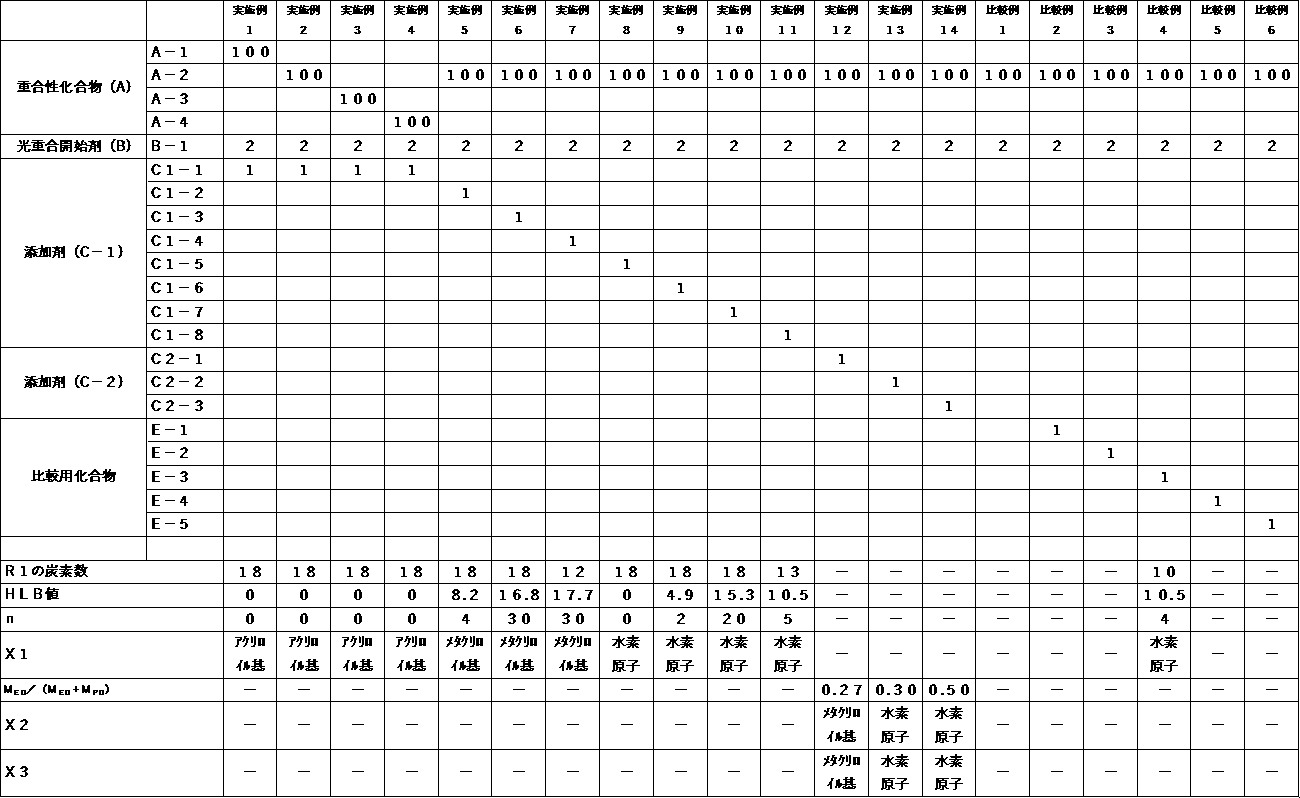
- composition of the present invention and the comparative composition were added based on the formulation shown in Table 1 described below, and 4-methoxyphenol as a polymerization inhibitor was added to 200 ppm with respect to the polymerizable monomer. Prepared. This was filtered through a tetrafluoroethylene membrane filter having a pore diameter of 0.2 ⁇ m to prepare a curable composition.
- Table 1 shows the formulation shown in Table 1 described below.
- A-1 Compound obtained in Synthesis Example 1
- A-2 Compound obtained in Synthesis Example 2
- A-3 AC-SQ TA-100 (manufactured by Toagosei Co., Ltd.)
- A-4 X-22-164 (Shin-Etsu Chemical Co., Ltd.)
- C1-1 Bremmer SA (stearyl acrylate, manufactured by NOF Corporation)
- C1-2 Blemmer PSE-200 (stearoxy-polyethylene glycol-methacrylate, manufactured by NOF Corporation)
- C1-3 Bremer PSE-1300 (stearoxy-polyethylene glycol-methacrylate, manufactured by NOF Corporation)
- C1-4 Blemmer PLE-1300 (Lauroxy-polyethylene glycol-methacrylate, manufactured by NOF Corporation)
- C1-5 Octadecanol (Wako Pure Chemical Industries, Ltd.)
- C1-6 Nonion S-202 (polyoxyethylene-stearyl ether, manufactured by NOF Corporation)
- C1-7 Nonion S-220 (polyoxyethylene-stearyl ether, manufactured by NOF Corporation)
- C1-8 Neugen TDS-50 (polyoxyethylene-tridecyl ether, manufactured by Daiichi Kogyo Seiyaku Co., Ltd.)
- C2-1 Fancryl FA-023M (polymethacrylate-polypropylene glycol-polyethylene glycol-block copolymer dimethacryloyl compound, manufactured by Hitachi Chemical Co., Ltd.)
- C2-2 Epan U-103 (polyethylene glycol-polypropylene glycol-polyethylene glycol-block copolymer, manufactured by Daiichi Kogyo Seiyaku Co., Ltd.)
- C2-3 Epan U-105 (polyethylene glycol-polypropylene glycol-polyethylene glycol block copolymer, manufactured by Daiichi Kogyo Seiyaku Co., Ltd.)
- E-1 PEG # 1000 (polyethylene glycol, manufactured by NOF Corporation)
- E-2 Megafac F-554 (fluorinated group / lipophilic group-containing oligomer, manufactured by DIC Corporation)
- E-3 Neugen XL-40 (polyoxyethylene-decyl ether, manufactured by Daiichi Kogyo Seiyaku Co., Ltd.)
- E-4 Uniol D-1000 (polypropylene glycol, manufactured by NOF Corporation)
- E-5 KF-4001 (long chain alkyl-modified silicone oil, manufactured by Shin-Etsu Chemical Co., Ltd.)
- the upper surface stage of the above apparatus is lowered to bring the mold into contact with the curable composition, pressurized to 100 N at room temperature for 10 seconds, held for 30 seconds to remove bubbles in the film, and then the peak wavelength from the back surface of the mold. Exposure was performed under the condition of 500 mJ / cm 2 using an LED light source of 365 ⁇ 5 nm, the upper surface stage was raised at a speed of 1 mm / min, the mold was peeled off, and a pattern was formed on the substrate. Using the same mold, the repeated pattern was transferred to 10 silicon wafer substrates by the above method, and the mold after the second transfer and the 10th transfer and the obtained pattern were evaluated by the following method.
- Pattern collapse Of the patterns obtained by the pattern forming method, the pattern collapse was observed with a scanning electron microscope for the 45 nm line / space pattern region, and evaluated as follows. ⁇ : No pattern collapse is observed at all. ⁇ : Pattern collapse is observed in an area of less than 2% with respect to the total pattern area. ⁇ : Pattern collapse with an area of 2% or more and less than 5% with respect to the entire pattern area. X: Pattern collapse is observed in an area of 5% or more of the entire pattern area
- the curable composition of the present invention can be used for various imprint techniques, and in particular, can be preferably used as a curable composition for forming a nano-sized fine pattern.
- semiconductor integrated circuits microelectromechanical systems (MEMS), sensor elements, optical recording media such as optical disks and high-density memory disks, optical components such as diffraction gratings and relief holograms, nanodevices, optical devices, flat panels
- Optical films and polarizing elements for display production thin film transistors for liquid crystal displays, organic transistors, color filters, overcoat layers, microlens arrays, immunoassay chips, DNA separation chips, microreactors, nanobiodevices, optical waveguides, optical filters, It can be used for production of a photonic liquid crystal or a modeled article by 3D printing.
Landscapes
- Chemical & Material Sciences (AREA)
- Health & Medical Sciences (AREA)
- Chemical Kinetics & Catalysis (AREA)
- Medicinal Chemistry (AREA)
- Polymers & Plastics (AREA)
- Organic Chemistry (AREA)
- Physics & Mathematics (AREA)
- General Physics & Mathematics (AREA)
- Spectroscopy & Molecular Physics (AREA)
- Exposure Of Semiconductors, Excluding Electron Or Ion Beam Exposure (AREA)
- Macromonomer-Based Addition Polymer (AREA)
- Addition Polymer Or Copolymer, Post-Treatments, Or Chemical Modifications (AREA)
Abstract
Description
ナノインプリントの離型性を改良する方法として、光硬化性組成物を硬化して得られたナノインプリント樹脂硬化物と、接触するモールド表面との親和性の調整が報告されている。例えば、非特許論文2では、モールド表面をフッ素系シランカップリング剤により離型処理を施し、接触するナノインプリント樹脂硬化物との接着仕事を低減することによって離型性を向上させる方法が報告されている。また、特許文献3では、モールドとの接着力を低減することを目的に、フッ素系界面活性剤を内添したインプリント材料が報告されている。また、特許文献4では、インプリント用硬化性組成物に潤滑剤を添加する方法が開示されている。
しかしながら、モールド表面に離型処理を施す方法では、光硬化性組成物のモールドへの濡れ性が悪くなり、モールドへの充填に時間がかかり、スループットに不利となる。また、超微細なモールドへの離型処理は、充填不良又は転写パターン寸法の不均一化の原因となるため、モールドへの離型処理は実用的ではない。また、インプリント材料にフッ素系界面活性剤を内添する方法では、連続転写を行う際に界面活性剤がモールド側へ付着して汚染が進み、モールドへの濡れ性が徐々に悪くなる等の問題が生じる。また、潤滑剤を添加する方法でも、連続離型時のモールド汚染の問題だけでなく、硬化性組成物の下層膜に対する密着性が悪くなりパターン剥がれが発生しやすくなるなど、十分な方法とはいえない。さらに、ポリシロキサン成分を主成分とする硬化性組成物は、シロキサン結合の高い柔軟性により弾性率が低いため、100nm以下の微細なパターン又はアスペクト比の高いパターンを形成する際に、パターン倒れが起きやすくなってしまうという問題が生じていた。
項1.分子中にケイ素原子を含有する重合性化合物(A)と、光重合開始剤(B)と、添加剤(C)とを含む光インプリント用硬化性組成物であって、前記添加剤(C)が、下記式(C1)又は(C2)で表される化合物であることを特徴とする、光インプリント用硬化性組成物。


項2.上記式(C1)において、R1が炭素数16~30のアルキル基である、項1に記載の光インプリント用硬化性組成物。
項3.上記式(C1)で表される化合物のHLB値が10以下である、項1又は2に記載の光インプリント用硬化性組成物。
(但し、ここでいうHLB値とは、上記式(C1)で表される化合物中のR1で表される基の式量をMR1、ポリエチレンオキシドユニットの式量をMEOとしたとき、(MEO/(MR1+MEO))×20で表される値をいう。)
項4.上記式(C1)において、nが0である項1~3の何れか一項に記載の光インプリント用硬化性組成物。
項5.上記式(C1)において、X1がアクリロイル基又はメタクリロイル基である、項1~4の何れか一項に記載の光インプリント用硬化性組成物。
項6.上記式(C2)で表される化合物のMEO/(MEO+MPO)で表される値が0.1~0.4である、項1に記載の光インプリント用硬化性組成物。
(但し、MEOは上記式(C2)におけるポリエチレンオキシドユニットの式量を表し、MPOは上記式(C2)におけるポリプロピレンオキシドユニットの式量を表す。)
項7.上記式(C2)において、X2がアクリロイル基又はメタクリロイル基であり、X3が、アクリロイル基又はメタクリロイル基である、項1又は6に記載の光インプリント用硬化性組成物。
項8.前記添加剤(C)の含有量が0.1~5重量%である、項1~7何れか一項に記載の光インプリント用硬化性組成物。
項9.前記重合性化合物(A)が、2つ以上の重合性官能基を有するポリシロキサンである項1に記載の光インプリント用硬化性組成物。
項10.前記重合性化合物(A)が有する重合性官能基が、エチレン性不飽和結合である項9に記載の光インプリント用硬化性組成物。
項11.溶剤(D)を更に含む、項1~10何れか一項に記載の光インプリント用硬化性組成物。
項12.前記項1~11の何れか一項に記載の光インプリント用硬化性組成物を基板上に塗布する工程と、表面に凹凸パターンが形成されたインプリント用モールドを押圧する工程と、光インプリント用硬化性組成物を硬化する工程と、前記インプリント用モールドを離型する工程とを有するインプリントパターン形成方法に用いられる、光インプリント用硬化性組成物。
項13.前記インプリント用モールドのパターン表面が、離型層で被覆されていないことを特徴とする、項12に記載の光インプリント用硬化性組成物。
項14.レジスト用である、項1~13の何れか一項に記載の光インプリント用硬化性組成物。
項15.前記項1~14の何れか一項に記載の光インプリント用硬化性組成物の硬化物を含有するパターン形成物を被加工体の上に設置する工程と、前記硬化物をエッチングマスクとして被加工体をエッチングする工程と、パターンを被加工体に転写する工程とを有することを特徴とする、パターン転写方法。
本発明の重合性化合物(A)としては、分子中にケイ素原子を含有する重合性化合物であれば特に制限なく用いることができるが、硬化性の観点では2つ以上の重合性官能基を有するポリシロキサン構造を有するものが好ましく、当該重合性官能基がエチレン性不飽和結合であるものがより好ましい。また、ポリシロキサン成分の特徴的な性能を提供する用途の例として、例えばドライエッチング用レジストとして好適に用いられるためには、化合物中のケイ素原子の量は、好ましくは15重量%以上であり、より好ましくは20重量%以上である。本発明の重合性化合物(A)の例を以下に述べる。
本発明の重合性化合物(A)は、分子中にケイ素原子を含有していれば、ケイ素を含有しないセグメントと化学的に結合していてもよい。例えば、ビニル系重合体セグメントの側鎖としてポリシロキサンセグメントを化学的に結合したグラフト構造を有する化合物や、ビニル系重合体セグメントとポリシロキサンセグメントとが化学的に結合したブロック構造を有する化合物等が挙げれられる。例えば、ビニル系重合体セグメントとポリシロキサンセグメントとが一般式(1)で表される構造により結合された化合物が挙げられる。

本発明の重合性化合物(A)は、下記一般式(2)で表される重合性官能基を有する基Qを含有し、分子中にケイ素原子を含有する化合物であってもよい。

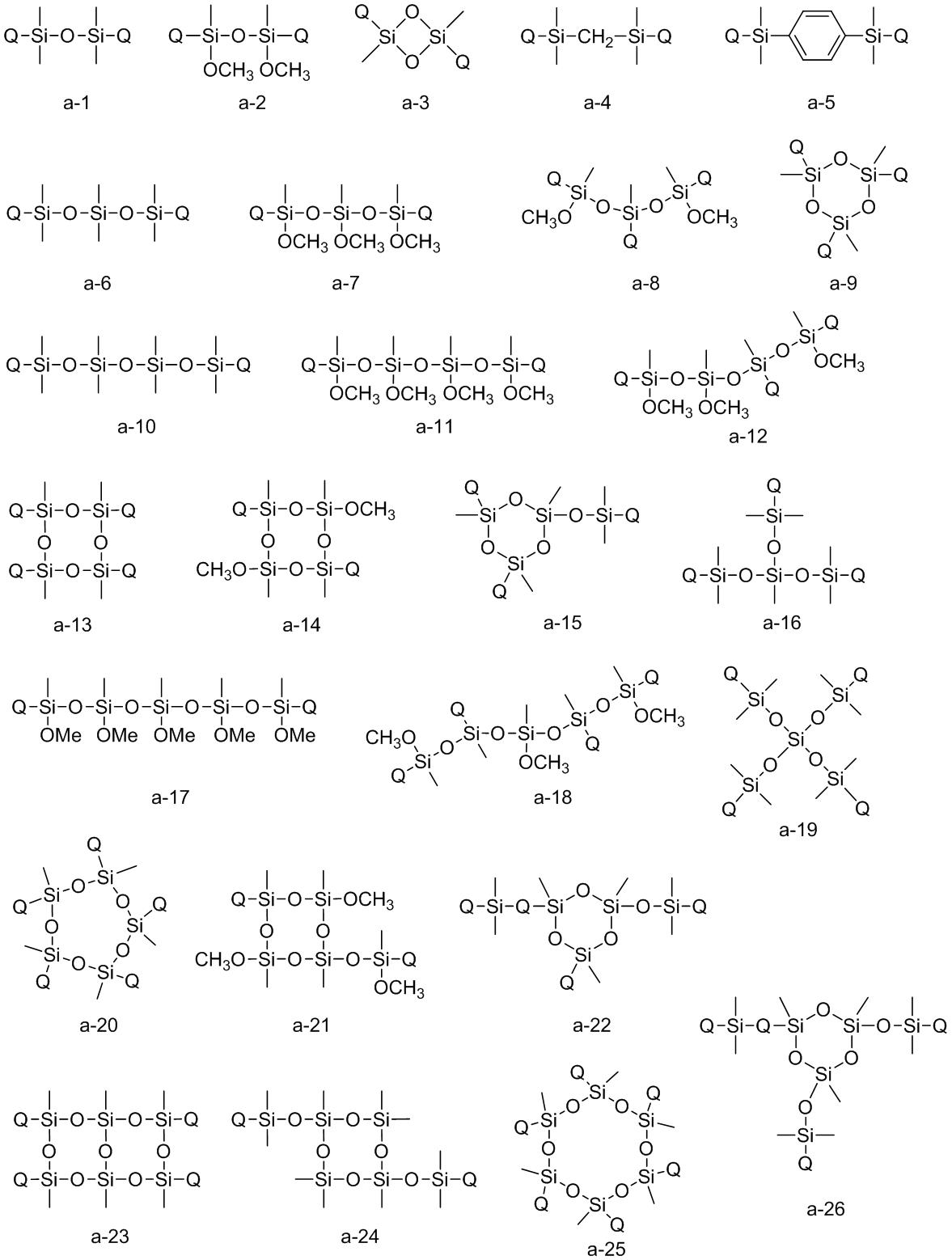
本発明の硬化性組成物は、分子中にケイ素原子を含有する重合性化合物(A)とは別に、ポリシロキサン成分の特徴的な性能(例えばドライエッチング耐性)を損なわない範囲で、分子中にケイ素原子を含有しない重合性化合物を含有しても構わない。分子中にケイ素原子を含有しない重合性化合物が有する重合性基は、前記分子中にケイ素原子を含有する重合性化合物(A)の有する重合性基と反応する基であることが好ましく、例えば分子中にケイ素原子を含有する重合性化合物(A)の有する重合性基が(メタ)アクリロイル基である場合、分子中にケイ素原子を含有しない重合性化合物の有する重合性基も(メタ)アクリロイル基であることが好ましい。
本発明で用いる光重合開始剤(B)としては、具体的には2,2-ジメトキシ-1,2-ジフェニルエタン-1-オン、1-ヒドロキシ-シクロヘキシル-フェニル-ケトン、1-[4-(2-ヒドロキシエトキシ)-フェニル]-2-ヒドロキシ-2-メチル-1-プロパン-1-オン、2-メチル-1-[4-(メチルチオ)フェニル]-2-モルフォリノプロパン-1-オン、2-ベンジル-2-ジメチルアミノ-1-(4-モルフォリノフェニル)-ブタノン-1、ビス(2,4,6-トリメチルベンゾイル)-フェニルフォスフィンオキサイド、2-ヒドロキシ-1-{4-[4-(2-ヒドロキシ-2-メチル-プロピオニル)-ベンジル]-フェニル}-2-メチル-プロパン、1,2-オクタンジオン,1-[4-(フェニルチオ)-,2-(O-ベンゾイルオキシム)]、2-ヒドロキシ-2-メチル-1-フェニル-プロパン-1-オン、フェニルグリオキシリックアシッドメチルエステル、2,4,6-トリメチルベンゾイル-ジフェニル-フォスフィンオキサイド等が挙げられるが、光硬化時に使用する光源に吸収をもつものであれば、特に限定されるものではない。これらは、単独でも二種類以上を併用して用いることもできる。
本発明で用いる添加剤(C)としては、下記式(C1)又は式(C2)で表される化合物を好適に用いることができ、より好適には下記式(C1)で表される化合物を用いることができる。


X1は水素原子又はアシル基であり、好ましくはアシル基であり、該アシル基が重合性官能基を有する基であることがより好ましい。X1がアクリロイル基又はメタクリロイル基である場合が特に好ましい。
nは0~50の整数であり、好ましくは0~20であり、より好ましくは0~10であり、特に好ましくは0である。
本発明の硬化性組成物はレジスト用として使用することができる。本発明の硬化性組成物を含有するレジスト材料を硬化することで、レジスト膜が得られる。本発明の硬化性組成物を含有するレジスト材料にパターンを形成する工程と、前記パターン形成層に光を照射する工程を経てパターンを形成されたレジスト膜を得ることができる。
モールドの洗浄に用いる洗浄液としては、酸、アルカリ、熱水等が挙げられる。酸洗浄液としては、硫酸、塩酸、硝酸、炭酸、酢酸、リン酸、王水、希フッ酸、硫酸過水、塩酸過水等が挙げられ、アルカリ洗浄液としては苛性ソーダ、苛性カリなどの苛性アルカリや、各種のケイ酸塩、リン酸塩、炭酸塩等の無機アルカリだけでなく、テトラメチルアンモニウムヒドロキサイドなどの有機アルカリ、アンモニア水、アンモニア水素水、アンモニア過水等が挙げられる。アルカリ洗浄液はSiO2を溶解する恐れがあるため、モールドがガラスや石英の場合には酸洗浄液が好ましく、特に好ましくは硫酸過水である。特に100nm以下の微細パターンをもつ石英モールドの洗浄においては、アルカリ洗浄液にSiO2の溶解作用によりモールドの矩形性を損なう恐れがあるため、酸洗浄液を用いることで微細パターンの損傷無くモールドが洗浄され、繰り返し用いることが出来る。
洗浄方法としては、特に限定は無いが、スプレー、シャワー、浸漬、加温浸漬、超音波浸漬、スピン法、バブリング、揺動法、ブラッシング、スチーム、研磨等が挙げられ、洗浄された汚染物の再付着防止のためには、スピン法が特に好ましい。
また、第二レジスト層と下層基板とを有する二層レジスト用の基材であってもかまわない。二層レジスト用の基材の組み合わせとしては特に限定は無いが、第二レジスト層の材質としてはCr、Al、Ni等のメタルマスクや、ノボラック樹脂等のフェノール樹脂、ヒドロキシビニルナフタレン共重合体、ポリビニルフェノール協重合体等のビニル樹脂、ノルトリシクレン共重合体、インデン共重合体、アセナフチレン共重合、フラーレン誘導体等の多環芳香族系樹脂、これら樹脂の硬化物等からなるSOC層や、CVDで形成されるアモルファスカーボン膜等が挙げられる。また、3層、4層と異なる材料が積層された多層基材であってもよく、本発明の硬化性組成物を用いて得られたレジスト膜を下層膜として用いることもできる。
得られたレジスト膜は、ドライエッチング耐性に優れるため、ドライエッチングの際にもパターン等の崩れがなく、ナノサイズの微細なエッチングパターンであっても、基材に転写が可能である。
〔重合性化合物(A-1)の調製〕
攪拌機、温度計、滴下ロート、冷却管及び窒素ガス導入口を備えた反応容器に、フェニルトリメトキシシラン20.1部、ジメチルジメトキシシラン24.4部、酢酸n-ブチル107.7部を仕込んで、窒素ガスの通気下、攪拌しながら、80℃まで昇温した。次いで、メチルメタクリレート14.5部、n-ブチルメタクリレート2部、シクロヘキシルメタクリレート105部、アクリル酸7.5部、3-メタクリロイルオキシプロピルトリメトキシシラン4.5部、2-ヒドロキシエチルメタクリレート15部、酢酸n-ブチル15部、tert-ブチルパーオキシ-2-エチルヘキサノエート6部を含有する混合物を、同温度で、窒素ガスの通気下、攪拌しながら、前記反応容器中へ4時間で滴下した。さらに同温度で2時間撹拌したのち、前記反応容器中に、リン酸イソプロピル0.05部と脱イオン水 12.8部の混合物を、5分間をかけて滴下し、同温度で4時間攪拌することにより、フェニルトリメトキシシラン、ジメチルジメトキシシラン、3-メタクリロイルオキシプロピルトリメトキシシランの加水分解縮合反応を進行させた。反応生成物を、1H-NMRで分析したところ、前記反応容器中のシランモノマーが有するトリメトキシシリル基のほぼ100%が加水分解していた。次いで、同温度にて10時間攪拌することにより、TBPEHの残存量が0.1%以下の反応生成物であるビニル系重合体が得られた。次いで、得られたビニル系重合体307部に、メチル系シリコーンレジンKR-515(商品名、信越化学工業社製)162.5部を添加して、5分間攪拌したのち、脱イオン水27.5部を加え、80℃で4時間攪拌を行い、前記反応生成物とポリシロキサンの加水分解縮合反応を行った。得られた反応生成物を、10~300kPaの減圧下で、40~60℃の条件で2時間蒸留することにより、生成したメタノール及び水を除去し、次いで、メチルエチルケトン(MEK) 150部、酢酸n-ブチル 27.3部を添加し、不揮発分が50.0%である重合性化合物(A-1)600部を得た。
〔重合性化合物(A-2)の調製〕
メチル系シリコーンレジンKR-500(商品名、信越化学工業社製)(110.8部)、2-ヒドロキシエチルアクリレート(58.1部)、パラトルエンスルホン酸一水和物(0.034部)を混合、120℃に昇温し、縮合反応により生成したメタノールを留去しながら3時間撹拌して反応させ、重合性単量体(A-2)153.9部を得た。
得られた化合物の物性値は、以下の通りであったことから、分子中にケイ素原子を含有する重合性化合物であることが確認できた。1H-NMR(300MHz,CDCl3)δ(ppm):6.43(m,CH=C),6.13(m,C=CH-C=O),5.83(m,CH=C),4.25(br,CH2-O-C=O),3.96(br,CH2-O-Si),3.50(s,Si-OCH3),0.15(s,Si-CH3).重量平均分子量を測定したところ、1650であった。
後述する表1に示す配合表に基づいて配合し、さらに重合禁止剤として4-メトキシフェノールが重合性単量体に対して200ppmとなるように加えて本発明の組成物及び比較用組成物を調製した。これを孔径0.2μmのテトラフルオロエチレン製のメンブレンフィルターでろ過し、硬化性組成物を調製した。なお、表は、重量比で示している。
A-1:合成例1で得た化合物
A-2:合成例2で得た化合物
A-3:AC-SQ TA-100(東亞合成株式会社製)
A-4:X-22-164(信越化学工業株式会社製)
B-1:BASF製イルガキュア369
C1-1:ブレンマーSA(ステアリルアクリレート、日油株式会社製)
C1-2:ブレンマーPSE-200(ステアロキシ-ポリエチレングリコール-メタクリレート、日油株式会社製)
C1-3:ブレンマーPSE-1300(ステアロキシ-ポリエチレングリコール-メタクリレート、日油株式会社製)
C1-4:ブレンマーPLE-1300(ラウロキシ-ポリエチレングリコール-メタクリレート、日油株式会社製)
C1-5:オクタデカノール(和光純薬工業株式会社製)
C1-6:ノニオンS-202(ポリオキシエチレン-ステアリルエーテル、日油株式会社製)
C1-7:ノニオンS-220(ポリオキシエチレン-ステアリルエーテル、日油株式会社製)
C1-8:ノイゲンTDS-50(ポリオキシエチレン-トリデシルエーテル、第一工業製薬株式会社製)
C2-1:ファンクリルFA-023M(ポリエチレングリコール-ポリプロピレングリコール-ポリエチレングリコール-ブロックコポリマーのジメタクリロイル化合物、日立化成株式会社製)
C2-2:エパンU-103(ポリエチレングリコール-ポリプロピレングリコール-ポリエチレングリコール-ブロックコポリマー、第一工業製薬株式会社製)
C2-3:エパンU-105(ポリエチレングリコール-ポリプロピレングリコール-ポリエチレングリコール-ブロックコポリマー、第一工業製薬株式会社製)
E-1:PEG#1000(ポリエチレングリコール、日油株式会社製)
E-2:メガファックF-554(含フッ素基・親油性基含有オリゴマー、DIC株式会社製)
E-3:ノイゲンXL-40(ポリオキシエチレン-デシルエーテル、第一工業製薬株式会社製)
E-4:ユニオールD-1000(ポリプロピレングリコール、日油株式会社製)
E-5:KF-4001(長鎖アルキル変性シリコーンオイル、信越化学工業株式会社製)
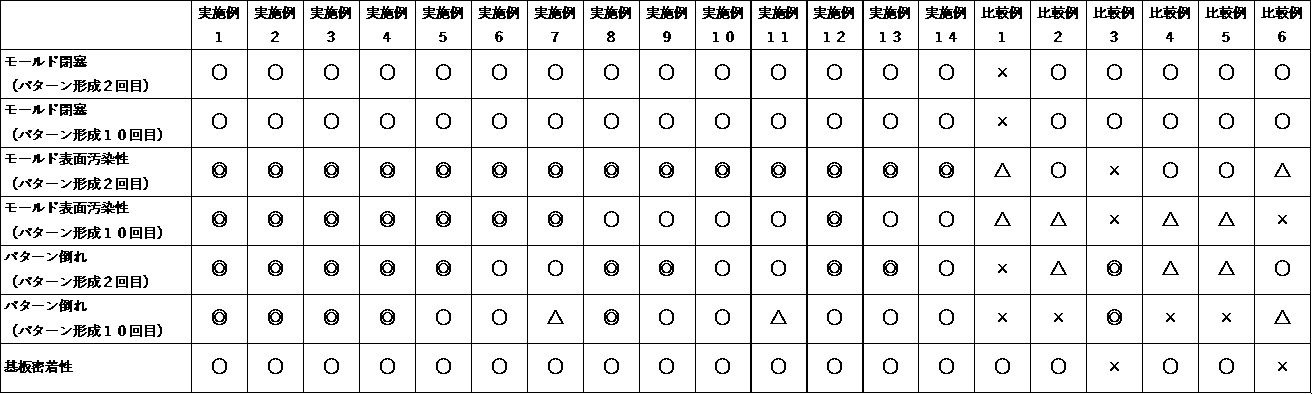
得られた実施例及び比較例の硬化性組成物について、以下の評価を行った。結果を表2に示す。
実施例1~14及び比較例1~6で得られた硬化性組成物を、プロピレングリコールモノメチルエーテルアセテート溶剤を用いて希釈し、膜厚1.0μmとなるようにシリコンウエハ基板上にスピンコート塗布した後、SCIVAX社製ナノインプリント装置X300の下面ステージにセットした。45~100nmのライン/スペースパターンを有し、溝深さが100nmの石英を材質とするモールド(NTTアドバンストテクノロジ社製、NIM PHL-45)をUVオゾンクリーナーにより表面を洗浄し、モールド表面の水に対する接触角が10°未満になったことを確認した後、上記装置の上面ステージにセットした。上記装置の上面ステージを下降させてモールドを硬化性組成物に接触させ、室温で10秒間かけて100Nまで加圧し、30秒間保持して膜中の気泡を除去した後、モールドの裏面からピーク波長365±5nmのLED光源を用いて500mJ/cm2の条件で露光し、1mm/minの速度で上面ステージを上昇させてモールドを剥離し基板上にパターンを形成させた。同一のモールドを用いて10枚のシリコンウエハ基板に前記方法により繰返しパターンを転写し、2回目および10回目の転写後のモールドおよび得られたパターンについて以下の方法で評価を行った。
上記パターン形成を行った後のモールドを、45nmのライン/スペースパターンの領域について、走査型電子顕微鏡で観察し、以下のように評価した。
○:ライン/スペースパターンの閉塞が全く観察されない
×:1箇所以上のライン/スペースパターンの閉塞が観察された
上記パターン形成を行った後のモールドを、協和界面科学社製の接触角計Drop Master DM-500にセットし、室温で2μLの脱イオン水の液滴を滴下し、1秒後の接触角をθ/2法で測定した。同様の測定法で5回測定し、その平均値を接触角とし、以下のように評価した。
◎:接触角が10°未満である
○:接触角が10°以上30°未満である
△:接触角が30°以上60°未満である
×:接触角が60°以上である
上記パターン形成方法により得られたパターンのうち、45nmのライン/スペースパターンの領域について、パターンの倒れを走査型電子顕微鏡で観察し、以下のように評価した。
◎:パターン倒れが全く見られない
○:全パターン面積に対して、2%未満の領域でパターン倒れが見られる
△:全パターン面積に対して、2%以上、5%未満の領域でパターン倒れが見られる
×:全パターン面積に対して、5%以上の領域でパターン倒れが見られる
実施例1~14及び比較例1~6で作成した硬化性組成物を、プロピレングリコールモノメチルエーテルアセテート溶剤を用いて希釈し、膜厚1.0μmとなるようにシリコンウエハ基板上にスピンコート塗布した後、窒素雰囲気中(酸素濃度が0.1%以下)でピーク波長365±5nmのLED光源を用いて500mJ/cm2の条件で露光し、硬化性組成物の硬化膜を得た。得られた硬化膜の基板密着性をクロスカット法(JIS K5600)で評価した。硬化膜に25マスの格子パターンを切り込み、粘着テープを貼り付け、粘着テープを引き剥がして試験面を観察し、以下のように評価した。
○:25マスすべてが剥離しなかった
×:25マスのうち1マス以上が剥離した
Claims (15)
- 分子中にケイ素原子を含有する重合性化合物(A)と、光重合開始剤(B)と、添加剤(C)とを含む光インプリント用硬化性組成物であって、前記添加剤(C)が、下記式(C1)又は(C2)で表される化合物であることを特徴とする、光インプリント用硬化性組成物。


- 上記式(C1)において、R1が炭素数16~30のアルキル基である、請求項1に記載の光インプリント用硬化性組成物。
- 上記式(C1)で表される化合物のHLB値が10以下である、請求項1又は2に記載の光インプリント用硬化性組成物。
(但し、ここでいうHLB値とは、上記式(C1)で表される化合物中のR1で表される基の式量をMR1、ポリエチレンオキシドユニットの式量をMEOとしたとき、(MEO/(MR1+MEO))×20で表される値をいう。) - 上記式(C1)において、nが0である請求項1~3の何れか一項に記載の光インプリント用硬化性組成物。
- 上記式(C1)において、X1がアクリロイル基又はメタクリロイル基である、請求項1~4の何れか一項に記載の光インプリント用硬化性組成物。
- 上記式(C2)で表される化合物のMEO/(MEO+MPO)で表される値が0.1~0.4である、請求項1に記載の光インプリント用硬化性組成物。
(但し、MEOは上記式(C2)におけるポリエチレンオキシドユニットの式量を表し、MPOは上記式(C2)におけるポリプロピレンオキシドユニットの式量を表す。) - 上記式(C2)において、X2がアクリロイル基又はメタクリロイル基であり、X3が、アクリロイル基又はメタクリロイル基である、請求項1又は6に記載の光インプリント用硬化性組成物。
- 前記添加剤(C)の含有量が0.1~5重量%である、請求項1~7に記載の光インプリント用硬化性組成物。
- 前記重合性化合物(A)が、2つ以上の重合性官能基を有するポリシロキサンである請求項1に記載の光インプリント用硬化性組成物。
- 前記重合性化合物(A)が有する重合性官能基が、エチレン性不飽和結合である請求項9に記載の光インプリント用硬化性組成物。
- 溶剤(D)を更に含む、請求項1~10何れか一項に記載の光インプリント用硬化性組成物。
- 請求項1~11に記載の光インプリント用硬化性組成物を基板上に塗布する工程と、表面に凹凸パターンが形成されたインプリント用モールドを押圧する工程と、光インプリント用硬化性組成物を硬化する工程と、前記インプリント用モールドを離型する工程とを有するインプリントパターン形成方法に用いられる、光インプリント用硬化性組成物。
- 前記インプリント用モールドのパターン表面が、離型層で被覆されていないことを特徴とする、請求項12に記載の光インプリント用硬化性組成物。
- レジスト用である、請求項1~13に記載の光インプリント用硬化性組成物。
- 請求項1~14に記載の光インプリント用硬化性組成物の硬化物を含有するパターン形成物を被加工体の上に設置する工程と、前記硬化物をエッチングマスクとして被加工体をエッチングする工程と、パターンを被加工体に転写する工程とを有することを特徴とする、パターン転写方法。
Priority Applications (4)
| Application Number | Priority Date | Filing Date | Title |
|---|---|---|---|
| US16/077,265 US11226553B2 (en) | 2016-05-11 | 2017-04-25 | Photo-imprinting curable composition and pattern transferring method using the same |
| JP2017548495A JP6332717B2 (ja) | 2016-05-11 | 2017-04-25 | 光インプリント用硬化性組成物及びそれを用いたパターン転写方法 |
| KR1020187022251A KR102263373B1 (ko) | 2016-05-11 | 2017-04-25 | 광 임프린트용 경화성 조성물 및 그것을 사용한 패턴 전사 방법 |
| CN201780029089.6A CN109195999B (zh) | 2016-05-11 | 2017-04-25 | 光压印用固化性组合物及使用其的图案形成方法 |
Applications Claiming Priority (2)
| Application Number | Priority Date | Filing Date | Title |
|---|---|---|---|
| JP2016095302 | 2016-05-11 | ||
| JP2016-095302 | 2016-05-11 |
Publications (1)
| Publication Number | Publication Date |
|---|---|
| WO2017195586A1 true WO2017195586A1 (ja) | 2017-11-16 |
Family
ID=60267065
Family Applications (1)
| Application Number | Title | Priority Date | Filing Date |
|---|---|---|---|
| PCT/JP2017/016300 Ceased WO2017195586A1 (ja) | 2016-05-11 | 2017-04-25 | 光インプリント用硬化性組成物及びそれを用いたパターン転写方法 |
Country Status (6)
| Country | Link |
|---|---|
| US (1) | US11226553B2 (ja) |
| JP (1) | JP6332717B2 (ja) |
| KR (1) | KR102263373B1 (ja) |
| CN (1) | CN109195999B (ja) |
| TW (1) | TWI728108B (ja) |
| WO (1) | WO2017195586A1 (ja) |
Cited By (7)
| Publication number | Priority date | Publication date | Assignee | Title |
|---|---|---|---|---|
| JP2018083942A (ja) * | 2016-11-17 | 2018-05-31 | 三洋化成工業株式会社 | 硬化性組成物及び硬化物 |
| JP2019157081A (ja) * | 2018-03-16 | 2019-09-19 | 東京応化工業株式会社 | 光硬化性組成物及びパターン形成方法 |
| WO2019188882A1 (ja) * | 2018-03-27 | 2019-10-03 | 富士フイルム株式会社 | インプリント用硬化性組成物、離型剤、硬化物、パターン形成方法およびリソグラフィー方法 |
| JP2021501906A (ja) * | 2018-09-14 | 2021-01-21 | エルジー・ケム・リミテッド | ホログラム媒体 |
| JP2021523424A (ja) * | 2018-09-27 | 2021-09-02 | エルジー・ケム・リミテッド | ホログラム媒体 |
| KR20210148133A (ko) | 2019-03-29 | 2021-12-07 | 다이니폰 인사츠 가부시키가이샤 | 임프린트용 광경화성 수지 조성물, 임프린트용 광경화성 수지 조성물의 제조 방법 및 패턴 형성체의 제조 방법 |
| JP2023032397A (ja) * | 2021-08-27 | 2023-03-09 | 富士フイルム株式会社 | インプリント用硬化性組成物、塗布膜、膜の製造方法、硬化物、インプリントパターンの製造方法及びデバイスの製造方法 |
Families Citing this family (2)
| Publication number | Priority date | Publication date | Assignee | Title |
|---|---|---|---|---|
| CN115210853B (zh) * | 2020-02-27 | 2025-06-03 | Dic株式会社 | 层间绝缘膜制造用涂布组合物、层间绝缘膜、及半导体元件、以及层间绝缘膜的制造方法 |
| JP2026052527A (ja) * | 2024-09-11 | 2026-03-24 | キヤノン株式会社 | 硬化性組成物、膜形成方法及び物品の製造方法 |
Citations (7)
| Publication number | Priority date | Publication date | Assignee | Title |
|---|---|---|---|---|
| JP2006110997A (ja) * | 2004-09-16 | 2006-04-27 | Asahi Glass Co Ltd | 転写体の製造方法、光硬化性組成物、および微細構造体の製造方法 |
| JP2006114882A (ja) * | 2004-09-16 | 2006-04-27 | Asahi Glass Co Ltd | パターンの形成方法およびパターンを有する物品 |
| JP2009209245A (ja) * | 2008-03-03 | 2009-09-17 | Bridgestone Corp | インプリント成形用組成物 |
| WO2010064609A1 (ja) * | 2008-12-05 | 2010-06-10 | 旭硝子株式会社 | 光硬化性組成物および表面に微細パターンを有する成形体の製造方法 |
| WO2011013630A1 (ja) * | 2009-07-29 | 2011-02-03 | 日産化学工業株式会社 | ナノインプリント用レジスト下層膜形成組成物 |
| WO2012141238A1 (ja) * | 2011-04-15 | 2012-10-18 | 三菱レイヨン株式会社 | 活性エネルギー線硬化性樹脂組成物、成形品、微細凹凸構造体、撥水性物品、モールド、及び微細凹凸構造体の製造方法 |
| JP2014140016A (ja) * | 2012-12-17 | 2014-07-31 | Daikin Ind Ltd | インプリント用レジスト組成物 |
Family Cites Families (34)
| Publication number | Priority date | Publication date | Assignee | Title |
|---|---|---|---|---|
| US8603386B2 (en) * | 1995-11-15 | 2013-12-10 | Stephen Y. Chou | Compositions and processes for nanoimprinting |
| AU4318800A (en) * | 1999-05-12 | 2000-12-05 | Menicon Co., Ltd | Ocular lens materials and process for producing the same |
| US8076386B2 (en) | 2004-02-23 | 2011-12-13 | Molecular Imprints, Inc. | Materials for imprint lithography |
| US8147728B2 (en) * | 2004-04-01 | 2012-04-03 | Novartis Ag | Pad transfer printing of silicone hydrogel lenses using colored ink |
| JP4782508B2 (ja) * | 2004-09-30 | 2011-09-28 | 株式会社シード | 高酸素透過含水性眼用レンズ |
| WO2007064565A1 (en) * | 2005-11-29 | 2007-06-07 | Bausch & Lomb Incorporated | Method for coating lens material |
| US8231218B2 (en) * | 2006-06-15 | 2012-07-31 | Coopervision International Holding Company, Lp | Wettable silicone hydrogel contact lenses and related compositions and methods |
| US20080073804A1 (en) * | 2006-09-21 | 2008-03-27 | Yasuo Matsuzawa | Method for producing contact lenses |
| US20080176049A1 (en) * | 2007-01-24 | 2008-07-24 | Samsung Electronics Co., Ltd. | PHOTO-CURABLE COMPOSITION HAVING INHERENTLY EXCELLENT RELEASING PROPERtY AND PATTERN TRANSFER PROPERTY, METHOD FOR TRANSFERRING PATTERN USING THE COMPOSITION AND LIGHT RECORDING MEDIUM HAVING POLYMER PATTERN LAYER PRODUCED USING THE COMPOSITION |
| US7891636B2 (en) * | 2007-08-27 | 2011-02-22 | 3M Innovative Properties Company | Silicone mold and use thereof |
| WO2009029438A1 (en) * | 2007-08-31 | 2009-03-05 | 3M Innovative Properties Company | Hardcoats |
| CN101809055B (zh) * | 2007-09-27 | 2013-10-23 | 株式会社日本触媒 | 成型体用固化性树脂组合物、成型体及其制造方法 |
| JP2009084395A (ja) * | 2007-09-28 | 2009-04-23 | Mitsubishi Chemicals Corp | 重合体、組成物、硬化物および光記録媒体 |
| DE102007051482A1 (de) * | 2007-10-25 | 2009-04-30 | Evonik Röhm Gmbh | Verfahren zur Herstellung von beschichteten Formkörpern |
| JP2010018666A (ja) | 2008-07-09 | 2010-01-28 | Fujifilm Corp | ナノインプリント用組成物、パターンおよびパターン形成方法 |
| EP2332391A2 (en) * | 2008-08-22 | 2011-06-15 | 3M Innovative Properties Company | Combination dry erase board/projection screen |
| JP5611519B2 (ja) * | 2008-10-29 | 2014-10-22 | 富士フイルム株式会社 | ナノインプリント用組成物、パターンおよびその形成方法 |
| TWI506333B (zh) * | 2008-12-05 | 2015-11-01 | Novartis Ag | 用以傳遞疏水性舒適劑之眼用裝置及其製造方法 |
| JP2011018399A (ja) * | 2009-07-09 | 2011-01-27 | Teijin Chem Ltd | 樹脂スタンパ |
| JP2011077251A (ja) * | 2009-09-30 | 2011-04-14 | Toray Ind Inc | ディスプレイ用部材および製造方法 |
| WO2011049078A1 (ja) * | 2009-10-22 | 2011-04-28 | 日産化学工業株式会社 | ケイ素化合物を用いる膜形成組成物 |
| KR101730577B1 (ko) | 2010-08-06 | 2017-04-26 | 소켄 케미칼 앤드 엔지니어링 캄파니, 리미티드 | 나노 임프린트용 수지제 몰드 |
| DE112012000833T8 (de) | 2011-02-15 | 2014-01-02 | Dic Corporation | Aushärtbare Nanoprägezusammensetzung, mittels Nanoprägelithografie hergestelltes Formprodukt und Verfahren zur Ausbildung einer Strukturierung |
| JP5327341B2 (ja) | 2011-02-15 | 2013-10-30 | Dic株式会社 | ナノインプリント用硬化性組成物、ナノインプリント成形体及びパターン形成方法 |
| KR101592997B1 (ko) | 2012-04-27 | 2016-02-11 | 닛산 가가쿠 고교 가부시키 가이샤 | 임프린트 재료 |
| KR20150004406A (ko) | 2012-04-27 | 2015-01-12 | 닛산 가가쿠 고교 가부시키 가이샤 | 저이형력성을 가지는 임프린트 재료 |
| JP6061073B2 (ja) * | 2012-09-27 | 2017-01-18 | 日産化学工業株式会社 | インプリント材料 |
| US20140175685A1 (en) * | 2012-12-20 | 2014-06-26 | Novartis Ag | Method for Making Silicone Hydrogel Contact Lenses |
| JP6238026B2 (ja) * | 2013-04-18 | 2017-11-29 | 日産化学工業株式会社 | インプリント材料 |
| JP6460672B2 (ja) * | 2013-09-18 | 2019-01-30 | キヤノン株式会社 | 膜の製造方法、光学部品の製造方法、回路基板の製造方法及び電子部品の製造方法 |
| JP6429031B2 (ja) * | 2013-10-30 | 2018-11-28 | 日産化学株式会社 | シルセスキオキサン化合物及び変性シリコーン化合物を含むインプリント材料 |
| JP6624808B2 (ja) * | 2014-07-25 | 2019-12-25 | キヤノン株式会社 | 光硬化性組成物、これを用いた硬化物パターンの製造方法、光学部品の製造方法、回路基板の製造方法 |
| CN107075017B (zh) * | 2014-11-07 | 2019-11-05 | Dic株式会社 | 固化性组合物、抗蚀材料及抗蚀膜 |
| TWI545158B (zh) * | 2015-06-18 | 2016-08-11 | 明基材料股份有限公司 | 隱形眼鏡材料、隱形眼鏡及其製造方法 |
-
2017
- 2017-04-25 KR KR1020187022251A patent/KR102263373B1/ko active Active
- 2017-04-25 CN CN201780029089.6A patent/CN109195999B/zh active Active
- 2017-04-25 WO PCT/JP2017/016300 patent/WO2017195586A1/ja not_active Ceased
- 2017-04-25 JP JP2017548495A patent/JP6332717B2/ja active Active
- 2017-04-25 US US16/077,265 patent/US11226553B2/en active Active
- 2017-05-08 TW TW106115090A patent/TWI728108B/zh active
Patent Citations (7)
| Publication number | Priority date | Publication date | Assignee | Title |
|---|---|---|---|---|
| JP2006110997A (ja) * | 2004-09-16 | 2006-04-27 | Asahi Glass Co Ltd | 転写体の製造方法、光硬化性組成物、および微細構造体の製造方法 |
| JP2006114882A (ja) * | 2004-09-16 | 2006-04-27 | Asahi Glass Co Ltd | パターンの形成方法およびパターンを有する物品 |
| JP2009209245A (ja) * | 2008-03-03 | 2009-09-17 | Bridgestone Corp | インプリント成形用組成物 |
| WO2010064609A1 (ja) * | 2008-12-05 | 2010-06-10 | 旭硝子株式会社 | 光硬化性組成物および表面に微細パターンを有する成形体の製造方法 |
| WO2011013630A1 (ja) * | 2009-07-29 | 2011-02-03 | 日産化学工業株式会社 | ナノインプリント用レジスト下層膜形成組成物 |
| WO2012141238A1 (ja) * | 2011-04-15 | 2012-10-18 | 三菱レイヨン株式会社 | 活性エネルギー線硬化性樹脂組成物、成形品、微細凹凸構造体、撥水性物品、モールド、及び微細凹凸構造体の製造方法 |
| JP2014140016A (ja) * | 2012-12-17 | 2014-07-31 | Daikin Ind Ltd | インプリント用レジスト組成物 |
Cited By (16)
| Publication number | Priority date | Publication date | Assignee | Title |
|---|---|---|---|---|
| JP2018083942A (ja) * | 2016-11-17 | 2018-05-31 | 三洋化成工業株式会社 | 硬化性組成物及び硬化物 |
| JP2019157081A (ja) * | 2018-03-16 | 2019-09-19 | 東京応化工業株式会社 | 光硬化性組成物及びパターン形成方法 |
| JP7175092B2 (ja) | 2018-03-16 | 2022-11-18 | 東京応化工業株式会社 | 光硬化性組成物及びパターン形成方法 |
| WO2019188882A1 (ja) * | 2018-03-27 | 2019-10-03 | 富士フイルム株式会社 | インプリント用硬化性組成物、離型剤、硬化物、パターン形成方法およびリソグラフィー方法 |
| JPWO2019188882A1 (ja) * | 2018-03-27 | 2021-02-25 | 富士フイルム株式会社 | インプリント用硬化性組成物、離型剤、硬化物、パターン形成方法およびリソグラフィー方法 |
| JP7057421B2 (ja) | 2018-03-27 | 2022-04-19 | 富士フイルム株式会社 | インプリント用硬化性組成物、離型剤、硬化物、パターン形成方法およびリソグラフィー方法 |
| US11307494B2 (en) | 2018-09-14 | 2022-04-19 | Lg Chem, Ltd. | Hologram medium and optical element |
| JP7009018B2 (ja) | 2018-09-14 | 2022-01-25 | エルジー・ケム・リミテッド | ホログラム媒体 |
| JP2021501906A (ja) * | 2018-09-14 | 2021-01-21 | エルジー・ケム・リミテッド | ホログラム媒体 |
| JP2021523424A (ja) * | 2018-09-27 | 2021-09-02 | エルジー・ケム・リミテッド | ホログラム媒体 |
| JP7357992B2 (ja) | 2018-09-27 | 2023-10-10 | エルジー・ケム・リミテッド | ホログラム媒体 |
| US11994704B2 (en) | 2018-09-27 | 2024-05-28 | Lg Chem, Ltd. | Hologram medium |
| KR20210148133A (ko) | 2019-03-29 | 2021-12-07 | 다이니폰 인사츠 가부시키가이샤 | 임프린트용 광경화성 수지 조성물, 임프린트용 광경화성 수지 조성물의 제조 방법 및 패턴 형성체의 제조 방법 |
| US12344694B2 (en) | 2019-03-29 | 2025-07-01 | Dai Nippon Printing Co., Ltd. | Photocurable resin composition for imprinting, method for producing photocurable resin composition for imprinting, and method for producing pattern formed body |
| JP2023032397A (ja) * | 2021-08-27 | 2023-03-09 | 富士フイルム株式会社 | インプリント用硬化性組成物、塗布膜、膜の製造方法、硬化物、インプリントパターンの製造方法及びデバイスの製造方法 |
| JP7709336B2 (ja) | 2021-08-27 | 2025-07-16 | 富士フイルム株式会社 | インプリント用硬化性組成物、塗布膜、膜の製造方法、硬化物、インプリントパターンの製造方法及びデバイスの製造方法 |
Also Published As
| Publication number | Publication date |
|---|---|
| TWI728108B (zh) | 2021-05-21 |
| KR102263373B1 (ko) | 2021-06-11 |
| US11226553B2 (en) | 2022-01-18 |
| CN109195999A (zh) | 2019-01-11 |
| JPWO2017195586A1 (ja) | 2018-06-07 |
| JP6332717B2 (ja) | 2018-05-30 |
| US20190041745A1 (en) | 2019-02-07 |
| TW201819442A (zh) | 2018-06-01 |
| KR20190005821A (ko) | 2019-01-16 |
| CN109195999B (zh) | 2021-04-16 |
Similar Documents
| Publication | Publication Date | Title |
|---|---|---|
| JP6332717B2 (ja) | 光インプリント用硬化性組成物及びそれを用いたパターン転写方法 | |
| JP6090547B2 (ja) | 硬化性組成物、レジスト材料及びレジスト膜 | |
| JP6038261B2 (ja) | 樹脂モールド及びその製造方法 | |
| CN103392221B (zh) | 纳米压印用固化性组合物、纳米压印成形体以及图案形成方法 | |
| CN104220224B (zh) | 压印用树脂模具材料组合物 | |
| JP5362186B2 (ja) | ナノインプリント用樹脂組成物 | |
| WO2016152600A1 (ja) | 下層膜形成用樹脂組成物、積層体、パターン形成方法、インプリント形成用キットおよびデバイスの製造方法 | |
| CN106104753A (zh) | 氧等离子体蚀刻用抗蚀材料、抗蚀膜和使用抗蚀膜的层叠体 | |
| CN105378893B (zh) | 压印用固化性组合物 | |
| JP7111274B2 (ja) | 層間絶縁膜製造用塗布組成物、層間絶縁膜、及び半導体素子、並びに層間絶縁膜の製造方法 | |
| JP2015185798A (ja) | 光インプリント用硬化性組成物、パターン形成方法およびパターン | |
| JP2026017017A (ja) | 光硬化性樹脂組成物、その硬化物、永久膜、当該永久膜の製造方法 | |
| KR20240166910A (ko) | 광경화성 오르가노폴리실록산, 광경화성 오르가노폴리실록산 조성물 및 경화물 |
Legal Events
| Date | Code | Title | Description |
|---|---|---|---|
| ENP | Entry into the national phase |
Ref document number: 2017548495 Country of ref document: JP Kind code of ref document: A |
|
| ENP | Entry into the national phase |
Ref document number: 20187022251 Country of ref document: KR Kind code of ref document: A |
|
| WWE | Wipo information: entry into national phase |
Ref document number: 1020187022251 Country of ref document: KR |
|
| NENP | Non-entry into the national phase |
Ref country code: DE |
|
| 121 | Ep: the epo has been informed by wipo that ep was designated in this application |
Ref document number: 17795947 Country of ref document: EP Kind code of ref document: A1 |
|
| 122 | Ep: pct application non-entry in european phase |
Ref document number: 17795947 Country of ref document: EP Kind code of ref document: A1 |