WO2017170244A1 - 二軸配向ポリプロピレンフィルム - Google Patents
二軸配向ポリプロピレンフィルム Download PDFInfo
- Publication number
- WO2017170244A1 WO2017170244A1 PCT/JP2017/012073 JP2017012073W WO2017170244A1 WO 2017170244 A1 WO2017170244 A1 WO 2017170244A1 JP 2017012073 W JP2017012073 W JP 2017012073W WO 2017170244 A1 WO2017170244 A1 WO 2017170244A1
- Authority
- WO
- WIPO (PCT)
- Prior art keywords
- film
- polypropylene
- molecular weight
- polypropylene resin
- biaxially oriented
- Prior art date
- Legal status (The legal status is an assumption and is not a legal conclusion. Google has not performed a legal analysis and makes no representation as to the accuracy of the status listed.)
- Ceased
Links
Classifications
-
- C—CHEMISTRY; METALLURGY
- C08—ORGANIC MACROMOLECULAR COMPOUNDS; THEIR PREPARATION OR CHEMICAL WORKING-UP; COMPOSITIONS BASED THEREON
- C08J—WORKING-UP; GENERAL PROCESSES OF COMPOUNDING; AFTER-TREATMENT NOT COVERED BY SUBCLASSES C08B, C08C, C08F, C08G or C08H
- C08J5/00—Manufacture of articles or shaped materials containing macromolecular substances
- C08J5/18—Manufacture of films or sheets
-
- B—PERFORMING OPERATIONS; TRANSPORTING
- B32—LAYERED PRODUCTS
- B32B—LAYERED PRODUCTS, i.e. PRODUCTS BUILT-UP OF STRATA OF FLAT OR NON-FLAT, e.g. CELLULAR OR HONEYCOMB, FORM
- B32B27/00—Layered products comprising a layer of synthetic resin
- B32B27/32—Layered products comprising a layer of synthetic resin comprising polyolefins
-
- B—PERFORMING OPERATIONS; TRANSPORTING
- B29—WORKING OF PLASTICS; WORKING OF SUBSTANCES IN A PLASTIC STATE IN GENERAL
- B29C—SHAPING OR JOINING OF PLASTICS; SHAPING OF MATERIAL IN A PLASTIC STATE, NOT OTHERWISE PROVIDED FOR; AFTER-TREATMENT OF THE SHAPED PRODUCTS, e.g. REPAIRING
- B29C55/00—Shaping by stretching, e.g. drawing through a die; Apparatus therefor
- B29C55/02—Shaping by stretching, e.g. drawing through a die; Apparatus therefor of plates or sheets
- B29C55/10—Shaping by stretching, e.g. drawing through a die; Apparatus therefor of plates or sheets multiaxial
- B29C55/12—Shaping by stretching, e.g. drawing through a die; Apparatus therefor of plates or sheets multiaxial biaxial
-
- B—PERFORMING OPERATIONS; TRANSPORTING
- B32—LAYERED PRODUCTS
- B32B—LAYERED PRODUCTS, i.e. PRODUCTS BUILT-UP OF STRATA OF FLAT OR NON-FLAT, e.g. CELLULAR OR HONEYCOMB, FORM
- B32B27/00—Layered products comprising a layer of synthetic resin
- B32B27/06—Layered products comprising a layer of synthetic resin as the main or only constituent of a layer, which is next to another layer of the same or of a different material
- B32B27/08—Layered products comprising a layer of synthetic resin as the main or only constituent of a layer, which is next to another layer of the same or of a different material of synthetic resin
-
- B—PERFORMING OPERATIONS; TRANSPORTING
- B32—LAYERED PRODUCTS
- B32B—LAYERED PRODUCTS, i.e. PRODUCTS BUILT-UP OF STRATA OF FLAT OR NON-FLAT, e.g. CELLULAR OR HONEYCOMB, FORM
- B32B2250/00—Layers arrangement
- B32B2250/02—2 layers
-
- B—PERFORMING OPERATIONS; TRANSPORTING
- B32—LAYERED PRODUCTS
- B32B—LAYERED PRODUCTS, i.e. PRODUCTS BUILT-UP OF STRATA OF FLAT OR NON-FLAT, e.g. CELLULAR OR HONEYCOMB, FORM
- B32B2250/00—Layers arrangement
- B32B2250/24—All layers being polymeric
- B32B2250/242—All polymers belonging to those covered by group B32B27/32
-
- B—PERFORMING OPERATIONS; TRANSPORTING
- B32—LAYERED PRODUCTS
- B32B—LAYERED PRODUCTS, i.e. PRODUCTS BUILT-UP OF STRATA OF FLAT OR NON-FLAT, e.g. CELLULAR OR HONEYCOMB, FORM
- B32B2307/00—Properties of the layers or laminate
- B32B2307/30—Properties of the layers or laminate having particular thermal properties
- B32B2307/306—Resistant to heat
-
- B—PERFORMING OPERATIONS; TRANSPORTING
- B32—LAYERED PRODUCTS
- B32B—LAYERED PRODUCTS, i.e. PRODUCTS BUILT-UP OF STRATA OF FLAT OR NON-FLAT, e.g. CELLULAR OR HONEYCOMB, FORM
- B32B2307/00—Properties of the layers or laminate
- B32B2307/50—Properties of the layers or laminate having particular mechanical properties
-
- B—PERFORMING OPERATIONS; TRANSPORTING
- B32—LAYERED PRODUCTS
- B32B—LAYERED PRODUCTS, i.e. PRODUCTS BUILT-UP OF STRATA OF FLAT OR NON-FLAT, e.g. CELLULAR OR HONEYCOMB, FORM
- B32B2307/00—Properties of the layers or laminate
- B32B2307/50—Properties of the layers or laminate having particular mechanical properties
- B32B2307/514—Oriented
- B32B2307/518—Oriented bi-axially
-
- B—PERFORMING OPERATIONS; TRANSPORTING
- B32—LAYERED PRODUCTS
- B32B—LAYERED PRODUCTS, i.e. PRODUCTS BUILT-UP OF STRATA OF FLAT OR NON-FLAT, e.g. CELLULAR OR HONEYCOMB, FORM
- B32B2307/00—Properties of the layers or laminate
- B32B2307/70—Other properties
- B32B2307/732—Dimensional properties
- B32B2307/734—Dimensional stability
-
- B—PERFORMING OPERATIONS; TRANSPORTING
- B32—LAYERED PRODUCTS
- B32B—LAYERED PRODUCTS, i.e. PRODUCTS BUILT-UP OF STRATA OF FLAT OR NON-FLAT, e.g. CELLULAR OR HONEYCOMB, FORM
- B32B2323/00—Polyalkenes
- B32B2323/10—Polypropylene
-
- C—CHEMISTRY; METALLURGY
- C08—ORGANIC MACROMOLECULAR COMPOUNDS; THEIR PREPARATION OR CHEMICAL WORKING-UP; COMPOSITIONS BASED THEREON
- C08J—WORKING-UP; GENERAL PROCESSES OF COMPOUNDING; AFTER-TREATMENT NOT COVERED BY SUBCLASSES C08B, C08C, C08F, C08G or C08H
- C08J2323/00—Characterised by the use of homopolymers or copolymers of unsaturated aliphatic hydrocarbons having only one carbon-to-carbon double bond; Derivatives of such polymers
- C08J2323/02—Characterised by the use of homopolymers or copolymers of unsaturated aliphatic hydrocarbons having only one carbon-to-carbon double bond; Derivatives of such polymers not modified by chemical after treatment
- C08J2323/10—Homopolymers or copolymers of propene
- C08J2323/12—Polypropene
Definitions
- the present invention relates to a biaxially stretched laminated polypropylene film. Specifically, the present invention relates to a biaxially stretched polypropylene film having excellent heat resistance and mechanical properties.
- stretched polypropylene films have been widely used in a wide range of applications such as packaging for food and various products, electrical insulation, and surface protection films.
- the conventional polypropylene film has a shrinkage rate of several tens of percent at 150 ° C., and has low heat resistance and low rigidity as compared with a polyethylene terephthalate (PET) film or the like.
- PET polyethylene terephthalate
- the present invention has been aimed at providing a biaxially stretched laminated polypropylene film having higher heat resistance and rigidity.
- the present invention that has solved the above problems is characterized in that the polypropylene resin constituting the film satisfies the following conditions 1) to 4), and the lower limit of the plane orientation coefficient of the film is 0.0125. It is a biaxially oriented polypropylene film. 1) The lower limit of the mesopentad fraction is 96%. 2) The upper limit of the amount of copolymerization monomers other than propylene is 0.1 mol%. 3) The mass average molecular weight (Mw) / number average molecular weight (Mn) is 3.0 or more and 5.4 or less. 4) The melt flow rate (MFR) measured at 230 ° C. and 2.16 kgf is 6.2 g / 10 min or more and 9.0 g / 10 min or less.
- the second aspect of the present invention capable of solving the above-mentioned problems is that the polypropylene resin is a main component on at least one surface of the base material layer (A) and the base material layer (A) whose main component is a polypropylene resin.
- the polypropylene layer constituting the base material layer (A) satisfies the following conditions 1) to 4), and the lower limit of the plane orientation coefficient of the film is 0.0125.
- a biaxially oriented polypropylene film characterized by that. 1) The lower limit of the mesopentad fraction is 96%. 2) The upper limit of the amount of copolymerization monomers other than propylene is 0.1 mol%.
- the mass average molecular weight (Mw) / number average molecular weight (Mn) is 3.0 or more and 5.4 or less.
- the melt flow rate (MFR) measured at 230 ° C. and 2.16 kgf is 6.2 g / 10 min or more and 9.0 g / 10 min or less.
- the thermal shrinkage rate at 150 ° C. in the vertical and horizontal directions of the film is 8% or less.
- the tensile modulus in the longitudinal direction of the film is 2.0 GPa or more and the tensile modulus in the transverse direction of the film is 4.5 GPa or more.
- the haze value of the film is preferably 5% or less.
- the biaxially oriented polypropylene film of the present invention has a smaller molecular weight distribution and less entanglement of molecular chains, so the orientation is stronger, it has higher thermal dimensional stability and lateral rigidity, and less heat loss wrinkles. Since it is difficult to break, it has excellent film processability.
- the biaxially oriented polypropylene film of the first invention is characterized in that the polypropylene resin constituting the film satisfies the following conditions 1) to 4), and the lower limit of the plane orientation coefficient of the film is 0.0125. And 1) The lower limit of the mesopentad fraction is 96%. 2) The upper limit of the amount of copolymerization monomers other than propylene is 0.1 mol%. 3) The mass average molecular weight (Mw) / number average molecular weight (Mn) is 3.0 or more and 5.4 or less. 4) The melt flow rate (MFR) measured at 230 ° C. and 2.16 kgf is 6.2 g / 10 min or more and 9.0 g / 10 min or less.
- the biaxially oriented polypropylene film of the second invention is a surface mainly comprising a polypropylene resin on the surface of at least one of a base material layer (A) and a base material layer (A) mainly comprising a polypropylene resin.
- the polypropylene resin having the layer (B) and constituting the base material layer (A) satisfies the following conditions 1) to 4), and the lower limit of the plane orientation coefficient of the film is 0.0125.
- the lower limit of the mesopentad fraction is 96%.
- the upper limit of the amount of copolymerization monomers other than propylene is 0.1 mol%.
- the mass average molecular weight (Mw) / number average molecular weight (Mn) is 3.0 or more and 5.4 or less.
- the melt flow rate (MFR) measured at 230 ° C. and 2.16 kgf is 6.2 g / 10 min or more and 9.0 g / 10 min or less. Further details will be described below.
- polypropylene resin used in the first invention a polypropylene resin obtained by copolymerizing ethylene and / or an ⁇ -olefin having 4 or more carbon atoms at 0.5 mol% or less can also be used. Such a copolymerized polypropylene resin is also included in the polypropylene resin of the present invention (hereinafter referred to as polypropylene resin).
- the copolymerization component is preferably 0.3 mol% or less, more preferably 0.1 mol% or less, and most preferably a complete homopolypropylene resin containing no copolymerization component.
- the mesopentad fraction ([mmmm]%) measured by 13C-NMR, which is an index of stereoregularity of polypropylene resin, is preferably 96 to 99.5%. More preferably, it is 97% or more, and more preferably 98% or more.
- the mesopentad ratio of the polypropylene of the base material layer (A) is small, the elastic modulus is low and the heat resistance may be insufficient. 99.5% is a realistic upper limit.
- Mw / Mn which is an index of molecular weight distribution, is preferably 3.0 to 5.4 for polypropylene resin. More preferably, it is 3.0 to 5.0, still more preferably 3.2 to 4.5, and particularly preferably 3.3 to 4.0.
- Mw / Mn of the entire polypropylene resin constituting the biaxially oriented polypropylene film of the present invention exceeds 5.4, if the Mw / Mn is too large, the high molecular weight component increases and the thermal shrinkage rate may increase. Or the tensile modulus (Young's modulus) in the width direction (TD) tends to be small.
- the high molecular weight component promotes the crystallization of the low molecular weight component, but the entanglement between the molecules becomes strong, and the thermal shrinkage tends to increase even if the crystallinity is high.
- Mw / Mn of the entire polypropylene resin constituting the biaxially oriented polypropylene film of the present invention is less than 3.0, film formation becomes difficult.
- Mw means mass average molecular weight
- Mn means number average molecular weight.
- the mass average molecular weight (Mw) of the polypropylene resin is preferably 180,000 to 500,000.
- the lower limit of Mw is more preferably 190,000, still more preferably 200,000, and the upper limit of more preferable Mw is 320,000, more preferably 300,000, particularly preferably 250,000.
- the number average molecular weight (Mn) of the polypropylene resin is preferably 20,000 to 200,000.
- the lower limit of Mn is more preferably 30,000, more preferably 40,000, particularly preferably 50,000, and the upper limit of Mn is more preferably 80,000, still more preferably 70,000, particularly preferably 60,000. is there.
- the lower limit of the amount of the component having a molecular weight of 100,000 or less is preferably 35% by mass. More preferably, it is 38 mass%, More preferably, it is 40 mass%, Especially preferably, it is 41 mass%, Most preferably, it is 42 mass%.
- the upper limit of the amount of the component having a molecular weight of 100,000 or less in the GPC integration curve is preferably 65% by mass, more preferably 60% by mass, still more preferably 58% by mass, and particularly preferably 56% by mass. And most preferably 55% by weight.
- the melt flow rate (MFR; 230 ° C., 2.16 kgf) of the polypropylene resin is preferably 6.2 g / 10 min to 10.0 g / 10 min.
- the lower limit of the MFR of the polypropylene resin is more preferably 6.5 g / 10 minutes, further preferably 7 g / 10 minutes, and particularly preferably 7.5 g / 10 minutes.
- the upper limit of the MFR of the polypropylene resin is more preferably 9 g / 10 minutes, further preferably 8.5 g / 10 minutes, and particularly preferably 8.2 g / 10 minutes.
- melt flow rate MFR; 230 ° C., 2.16 kgf
- the thermal contraction rate at a high temperature can be further reduced.
- the degree of orientation of the film generated by stretching becomes strong, the rigidity of the film, particularly the tensile modulus (Young's modulus) in the width (TD) direction is increased.
- the melt flow rate (MFR; 230 ° C., 2.16 kgf) is 9.0 g / 10 min or less, it is easy to form a film without breaking.
- the molecular weight distribution of polypropylene resin is such that components with different molecular weights are polymerized in a series of plants in multiple stages, components with different molecular weights are blended offline in a kneader, or catalysts with different performances are blended for polymerization. Or by using a catalyst capable of realizing a desired molecular weight distribution.
- the polypropylene resin used in the present invention is obtained by polymerizing propylene as a raw material using a known catalyst such as a Ziegler-Natta catalyst or a metallocene catalyst.
- a known catalyst such as a Ziegler-Natta catalyst or a metallocene catalyst.
- a polymerization method of propylene a known method may be employed.
- a method of polymerizing in an inert solvent such as hexane, heptane, toluene, xylene, a method of polymerizing in a liquid monomer, a catalyst for a gas monomer And a method of polymerizing in a gas phase state, or a method of polymerizing these in combination.
- the polypropylene resin may contain additives and other resins.
- the additive include an antioxidant, an ultraviolet absorber, a nucleating agent, an adhesive, an antifogging agent, a flame retardant, and an inorganic or organic filler.
- the other resin include polypropylene resins other than the polypropylene resin used in the present invention, random copolymers that are copolymers of propylene and ethylene and / or ⁇ -olefins having 4 or more carbon atoms, and various elastomers.
- polypropylene resin used for the base material layer (A) of the second invention a polypropylene resin obtained by copolymerizing ethylene and / or ⁇ -olefin having 4 or more carbon atoms at 0.5 mol% or less can also be used. .
- a copolymerized polypropylene resin is also included in the polypropylene resin of the present invention (hereinafter referred to as polypropylene resin).
- the copolymerization component is preferably 0.3 mol% or less, more preferably 0.1 mol% or less, and most preferably a complete homopolypropylene resin containing no copolymerization component.
- the mesopentad fraction ([mmmm]%) measured by 13C-NMR, which is an index of stereoregularity of polypropylene resin, is preferably 96 to 99.5%. More preferably, it is 97% or more, and more preferably 98% or more.
- the mesopentad ratio of the polypropylene of the base material layer (A) is small, the elastic modulus is low and the heat resistance may be insufficient. 99.5% is a realistic upper limit.
- Mw / Mn which is an index of molecular weight distribution, is preferably 3.0 to 5.4 for polypropylene resin. More preferably, it is 3.0 to 5.0, still more preferably 3.2 to 4.5, and particularly preferably 3.3 to 4.0.
- Mw / Mn of the entire polypropylene resin constituting the base material layer (A) exceeds 5.4, if Mw / Mn is too large, the high molecular weight component is increased, and the thermal shrinkage rate may be increased.
- the tensile modulus (Young's modulus) in the width direction (TD) tends to be small.
- the high molecular weight component promotes the crystallization of the low molecular weight component, but the entanglement between the molecules becomes strong, and the thermal shrinkage tends to increase even if the crystallinity is high.
- Mw / Mn of the entire polypropylene resin constituting the biaxially oriented polypropylene film of the present invention is less than 3.0, film formation becomes difficult.
- Mw means mass average molecular weight
- Mn means number average molecular weight.
- the mass average molecular weight (Mw) of the polypropylene resin is preferably 180,000 to 500,000.
- the lower limit of Mw is more preferably 190,000, still more preferably 200,000, and the upper limit of more preferable Mw is 320,000, more preferably 300,000, particularly preferably 250,000.
- the number average molecular weight (Mn) of the polypropylene resin is preferably 20,000 to 200,000.
- the lower limit of Mn is more preferably 30,000, more preferably 40,000, particularly preferably 50,000, and the upper limit of Mn is more preferably 80,000, still more preferably 70,000, particularly preferably 60,000. is there.
- the lower limit of the amount of the component having a molecular weight of 100,000 or less is preferably 35% by mass, more preferably It is 38% by mass, more preferably 40% by mass, particularly preferably 41% by mass, and most preferably 42% by mass.
- the upper limit of the amount of the component having a molecular weight of 100,000 or less in the GPC integration curve is preferably 65% by mass, more preferably 60% by mass, still more preferably 58% by mass, and particularly preferably 56% by mass. And most preferably 55% by weight.
- the melt flow rate (MFR; 230 ° C., 2.16 kgf) of the polypropylene resin is preferably 6.2 g / 10 min to 10.0 g / 10 min.
- the lower limit of the MFR of the polypropylene resin is more preferably 6.5 g / 10 minutes, further preferably 7 g / 10 minutes, and particularly preferably 7.5 g / 10 minutes.
- the upper limit of the MFR of the polypropylene resin is more preferably 9 g / 10 minutes, further preferably 8.5 g / 10 minutes, and particularly preferably 8.2 g / 10 minutes.
- melt flow rate MFR; 230 ° C., 2.16 kgf
- the thermal contraction rate at a high temperature can be further reduced.
- the degree of orientation of the film generated by stretching becomes strong, the rigidity of the film, particularly the tensile modulus (Young's modulus) in the width (TD) direction is increased.
- the melt flow rate (MFR; 230 ° C., 2.16 kgf) is 9.0 g / 10 min or less, it is easy to form a film without breaking.
- the molecular weight distribution of polypropylene resin is such that components with different molecular weights are polymerized in a series of plants in multiple stages, components with different molecular weights are blended offline in a kneader, or catalysts with different performances are blended for polymerization. Or by using a catalyst capable of realizing a desired molecular weight distribution.
- the polypropylene resin used in the base material layer (A) can be obtained by polymerizing propylene as a raw material using a known catalyst such as a Ziegler-Natta catalyst or a metallocene catalyst. Among these, in order to eliminate the heterogeneous bond, it is preferable to use a Ziegler-Natta catalyst and a catalyst capable of polymerization with high stereoregularity. As a polymerization method of propylene, a known method may be employed.
- a method of polymerizing in an inert solvent such as hexane, heptane, toluene, xylene, a method of polymerizing in a liquid monomer, a catalyst for a gas monomer And a method of polymerizing in a gas phase state, or a method of polymerizing these in combination.
- the polypropylene resin may contain additives and other resins.
- the additive include an antioxidant, an ultraviolet absorber, a nucleating agent, an adhesive, an antifogging agent, a flame retardant, and an inorganic or organic filler.
- the other resin include polypropylene resins other than the polypropylene resin used in the present invention, random copolymers that are copolymers of propylene and ethylene and / or ⁇ -olefins having 4 or more carbon atoms, and various elastomers.
- the surface roughness of the surface layer (B) of the second invention is preferably 0.027 ⁇ m or more and 0.40 ⁇ m or less. If it is less than 0.027 ⁇ m, the adhesion to the printing ink and the adhesive used for laminating with other member films are not sufficient, and if it exceeds 0.40 ⁇ m, there are problems of color developability and color fading. Arise.
- the melt flow rate (MFR) as the polypropylene resin composition forming the surface layer (B) is It is preferable to use a mixture of two or more different polypropylene resins.
- the MFR difference is preferably 3 g / 10 min or more, and more preferably 3.5 g / 10 min or more.
- the surface roughness of the surface layer (B) is estimated to be 0.027 ⁇ m or more due to the difference in crystallization speed.
- the polypropylene resin having a larger MFR polypropylene obtained by copolymerizing ethylene and / or an ⁇ -olefin having 4 or more carbon atoms can also be used.
- the ⁇ -olefin having 4 or more carbon atoms include 1-butene, 1-hexene, 4-methyl / 1-pentene, 1-octene and the like.
- polypropylene resin having a smaller MFR polypropylene obtained by copolymerizing ethylene and / or an ⁇ -olefin having 4 or more carbon atoms can also be used.
- the ⁇ -olefin having 4 or more carbon atoms include 1-butene, 1-hexene, 4-methyl / 1-pentene, 1-octene and the like.
- the total of the ⁇ -olefin having 4 or more ethylene atoms and other copolymerization components is preferably 8.0 mol% or less.
- the film When the copolymerization exceeds 8.0 mol%, the film may be whitened to have a poor appearance, or may become sticky and film formation may be difficult.
- These resins may be used in a blend of two or more. When blending, individual resins may be copolymerized in excess of 8.0 mol%, but the blend is preferably monomer units and monomers other than propylene at 8.0 mol% or less. .
- the polypropylene resin composition of the surface layer (B) preferably has an MFR of 1.0 g / 10 min to 8 g / 10 min.
- the lower limit of the MFR of the polypropylene resin composition of the surface layer (B) is more preferably 2 g / 10 minutes, and further preferably 3 g / 10 minutes.
- the upper limit of the MFR of the polypropylene resin composition of the surface layer (B) is more preferably 7 g / 10 minutes, and further preferably 6.0 g / 10 minutes. Within this range, the film-forming property is good and the heat shrinkage rate at high temperatures can be kept small.
- the MFR of the polypropylene resin composition of the surface layer (B) is smaller than 1.0 g / 10 min, the base layer (A) and the surface layer (B) Since the viscosity difference becomes large, unevenness (raw fabric unevenness) is likely to occur during film formation. If the MFR of the polypropylene resin composition of the surface layer (B) exceeds 8 g / 10 minutes, the adhesion to the cooling roll will be poor, air will be involved, the smoothness will be poor, and there will be many drawbacks starting from it. There is a fear.
- the polypropylene resin used in the surface layer (B) is obtained by polymerizing propylene as a raw material using a known catalyst such as a Ziegler-Natta catalyst or a metallocene catalyst.
- a known catalyst such as a Ziegler-Natta catalyst or a metallocene catalyst.
- a polymerization method of propylene a known method may be employed.
- a method of polymerizing in an inert solvent such as hexane, heptane, toluene, xylene, a method of polymerizing in a liquid monomer, a catalyst for a gas monomer And a method of polymerizing in a gas phase state, or a method of polymerizing these in combination.
- the surface layer (B) may contain additives and other resins.
- the additive include an antioxidant, an ultraviolet absorber, a nucleating agent, an adhesive, an antifogging agent, a flame retardant, and an inorganic or organic filler.
- the other resin include polypropylene resins other than the polypropylene resin used in the present invention, random copolymers that are copolymers of propylene and ethylene and / or ⁇ -olefins having 4 or more carbon atoms, and various elastomers.
- the surface layer (B) has a surface wetting tension of 38 mN / m or more.
- the wetting tension is more preferably 16 Log ⁇ or more.
- additives such as antistatic agents and surfactants.
- the corona treatment is preferably performed in the air using a preheating roll and a treatment roll.
- the center plane peak height SR) + center plane valley depth SRv of the surface layer (B) of the biaxially oriented polypropylene film of the present invention is preferably 1.0 ⁇ m or more and 2.0 ⁇ m or less.
- the surface roughness of the surface of the surface layer (B), the center plane peak height SRp, and the center plane valley depth SRv are measured using a three-dimensional roughness meter at a stylus pressure of 20 mg in the X direction.
- the center plane peak height SRp + center plane valley depth SRv of the surface layer (B) is an index of the state of the large unevenness formed by the lubricant, and in the state of the roll film, the base layer (A) and This is related to the slipperiness at the time of contact.
- the center plane peak height SRp + center surface valley depth SRv of the surface layer (B) is 1.0 ⁇ m or more, the unwinding property from the roll film is improved, and when it is 2.0 ⁇ m or less, the transparency is maintained. Is done.
- the center plane peak height SRp + center plane valley depth SRv of the surface layer (B) is preferably 1.0 ⁇ m to 1.1 ⁇ m or more, more preferably 1.2 ⁇ m or more, and particularly preferably 1.3 ⁇ m or more.
- an antiblocking agent is added to the polypropylene resin composition forming the surface layer (B). It is a suitable method to mix
- an anti-blocking agent it can be used by appropriately selecting from inorganic anti-blocking agents such as silica, calcium carbonate, kaolin and zeolite, and organic anti-blocking agents such as acrylic, polymethacrylic and polystyrene. can do. Among these, it is particularly preferable to use silica.
- the average particle diameter of the antiblocking agent is preferably 1.0 to 2.0 ⁇ m, more preferably 1.0 to 1.5 ⁇ m. It is preferable that the anti-blocking agent has a mass of 3000 ppm in the polypropylene resin composition.
- the measurement method of the average particle diameter here is a method in which a photograph is taken with a scanning electron microscope, the ferret diameter in the horizontal direction is measured using an image analyzer, and the average value is displayed.
- the total thickness of the biaxially oriented polypropylene film of the present invention is preferably 9 to 200 m, more preferably 10 to 150 ⁇ m, further preferably 12 to 100 ⁇ m, and particularly preferably 12 to 80 ⁇ m.
- the ratio of the thickness of the surface layer (B) to the base material layer (A) in the biaxially oriented polypropylene film of the second invention is such that the total surface layer (B) / total base material layer (A) is 0.01 to 0. 0.5, more preferably 0.03 to 0.4, and even more preferably 0.05 to 0.3.
- the total thickness of the base layer (A) is preferably 50 to 99%, more preferably 60 to 97%, and particularly preferably 70 to 95% with respect to the total thickness of the film.
- the remainder becomes the surface layer (B) or the surface layer (B) and other layers (for example, C layer).
- the substantial thickness of the entire surface layer (B) is preferably 0.5 to 4 ⁇ m, more preferably 1 to 3.5 ⁇ m, and even more preferably 1.5 to 3 ⁇ m.
- the ratio of the thickness of the surface layer (B) to the base material layer (A) in the biaxially oriented polypropylene film of the second invention is such that the total surface layer (B) / total base material layer (A) is 0.01 to 0. 0.5, more preferably 0.03 to 0.4, and even more preferably 0.05 to 0.3.
- the total thickness of the base layer (A) is preferably 50 to 99%, more preferably 60 to 97%, and particularly preferably 70 to 95% with respect to the total thickness of the film. The remainder becomes the surface layer (B) or the surface layer (B) and other layers (for example, C layer).
- the substantial thickness of the entire surface layer (B) is preferably 0.5 to 4 ⁇ m, more preferably 1 to 3.5 ⁇ m, and even more preferably 1.5 to 3 ⁇ m.
- the biaxially oriented polypropylene film film of the second invention may be a two-layer film having a base layer (A) and a surface layer (B) one by one, but may have a structure of three or more layers. .
- a two-layer structure of base material layer (A) / surface layer (B) is preferable.
- the compositions may be different as long as each layer satisfies the characteristics.
- the biaxially oriented biaxially oriented polypropylene film of the present invention preferably has a heat shrinkage rate of 150% at 150 ° C in the machine direction and the transverse direction, more preferably 7% or less, It is particularly preferably 8% or less. When the heat shrinkage rate is 8% or less, heat loss wrinkles during processing can be reduced.
- the thermal shrinkage in the longitudinal direction at 150 ° C. is preferably 0.2 to 8%, more preferably 0.3 to 7%. If the heat shrinkage rate is in the above range, it can be said that the film has excellent heat resistance, and can be used in applications that may be exposed to high temperatures. If the thermal shrinkage at 150 ° C. is up to about 1.5%, for example, it is possible to increase the low molecular weight component, adjust the stretching conditions and the heat setting conditions, but in order to lower it below, anneal offline. It is preferable to perform the treatment.
- the thermal shrinkage in the transverse direction at 150 ° C. is preferably 0.2 to 8%, more preferably 0.3 to 7%, and 0.4 to 6%. Is more preferable, and 0.5 to 5% is particularly preferable. If the heat shrinkage ratio is in the above range, it can be said that the film is particularly excellent in heat resistance and can be used in applications that may be exposed to high temperatures. If the thermal shrinkage at 150 ° C. is up to about 1.5%, for example, it is possible to increase the low molecular weight component, adjust the stretching conditions and the heat setting conditions, but in order to lower it below, anneal offline. It is preferable to perform the treatment.
- the tensile elastic modulus in the machine direction of the biaxially oriented polypropylene film of the present invention is preferably 1.8 to 4 GPa, more preferably 2.1 to 3.7 GPa, and 2.2 to 3.5 GPa. More preferably, it is preferably 2.3 to 3.4 GPa. The measuring method will be described later.
- the tensile modulus in the transverse direction of the biaxially oriented polypropylene film of the present invention is preferably 4.5 to 8 GPa, more preferably 4.6 to 7.5 GPa, and 4.7 to 7 GPa. Is more preferable, and 4.8 to 6.5 GPa is particularly preferable. If the tensile modulus in the transverse direction is in the above range, it is possible to form a film that is difficult to break.
- the difficulty of folding the biaxially oriented polypropylene film of the present invention was evaluated by a ring crush measurement value detected by a load cell by holding the film in a ring shape and compressing the film. The measuring method will be described later.
- the haze of the biaxially oriented polypropylene film of the present invention is preferably 5% or less, more preferably 0.2 to 5%, still more preferably 0.3 to 4.5%, and particularly preferably 0.4 to 4%. If it is within the above range, it may be easy to use in applications requiring transparency. For example, when the stretching temperature and heat setting temperature are too high, the haze tends to be worse when the cooling roll (CR) temperature is high and the stretching speed of the stretched raw sheet is slow, or when there are too many low molecular weight components. By doing so, it can be within the above range. A method for measuring haze will be described later.
- the lower limit of the plane orientation coefficient of the biaxially stretched laminated polypropylene film of the present invention is preferably 0.011, more preferably 0.012, and even more preferably 0.013. Within the above range, the heat resistance and rigidity of the film tend to increase.
- the stretched laminated polypropylene film generally has a crystal orientation, and its direction and degree greatly affect the physical properties of the film. The degree of crystal orientation tends to vary depending on the molecular structure of the polypropylene used, the process and conditions in film production, and can be adjusted to the above range by adjusting these. The measuring method will be described later.
- the evaluation of the ink adhesion of the biaxially oriented polypropylene film of the present invention was carried out by performing a peel test of gravure-printed printing ink and performing the number of peeled portions out of the total 25 locations.
- the number of peeled portions is preferably 15 or less, more preferably 5 or less, and most preferably 0. If the number is 15 or more, the degree of ink peeling becomes large, which is a problem. A method for evaluating ink adhesion will be described later.
- the laminating strength in the longitudinal direction after lamination to the biaxially oriented polypropylene film of the present invention is preferably 1.2 to 2.5 N / 15 mm, more preferably 1.3 to 2.5 N / mm, and 1.4 to 2 More preferably, 5 N / mm. A method for measuring the laminate strength will be described later.
- the dynamic friction coefficient of the biaxially oriented polypropylene film of the present invention is preferably 0.5 or less, more preferably 0.48 or less, and particularly preferably 0.45 or less.
- the dynamic friction coefficient is 0.5 or less, the film can be smoothly unwound from the roll film, and printing is easy. A method for measuring the dynamic friction coefficient will be described later.
- the biaxially stretched laminated polypropylene film of the present invention is formed by melting and extruding a polypropylene resin with an extruder to form an unstretched sheet, and stretching and heat-treating the unstretched sheet by a predetermined method. Obtainable.
- the polypropylene material for the base layer (A) polypropylene resin composition for the base layer (A)
- the surface layer (B) polypropylene material (polypropylene resin composition for the surface layer (B))
- Each of the products can be obtained by melt-extrusion with another extruder to form a laminated unstretched sheet, and the unstretched sheet is stretched and heat-treated by a predetermined method.
- the unstretched sheet can be obtained by using a plurality of extruders, feed blocks, and multi-manifolds.
- the melt extrusion temperature is preferably about 200 to 280 ° C.
- the difference in viscosity (MFR) between the polypropylene raw material for the base layer (A) and the polypropylene raw material for the surface layer (B) is preferably 6 g / 10 min or less. When the viscosity difference is larger than 6 g / 10 min, the layer is disturbed and the appearance is liable to be poor. More preferably, it is 5.5 g / 10 minutes or less, More preferably, it is 5 g / 10 minutes or less.
- the chill roll surface temperature is preferably 25 to 35 ° C, more preferably 27 to 33 ° C.
- the film is stretched 3 to 8 times, preferably 3 to 7 times in the length (MD) direction with a stretching roll of 120 to 165 ° C., and subsequently 155 to 175 ° C., more preferably 160 to 163 ° C. in the TD direction. Is stretched 4 to 20 times, preferably 6 to 12 times. Further, heat fixation is performed at 165 to 176 ° C., more preferably 170 to 176 ° C., and further preferably 172 to 175 ° C. while relaxing 2 to 10%.
- the biaxially stretched laminated polypropylene film thus obtained can be subjected to corona discharge, plasma treatment, flame treatment, etc., if necessary, and then wound with a winder to obtain a film roll.
- the lower limit of the MD draw ratio is preferably 3 times, more preferably 3.5 times. If it is less than the above, film thickness unevenness may occur.
- the upper limit of the MD draw ratio is preferably 8 times, more preferably 7 times. When the above is exceeded, it may be difficult to carry out TD stretching continuously.
- the lower limit of the MD stretching temperature is preferably 120 ° C, more preferably 125 ° C, and even more preferably 130 ° C. If it is less than the above, the mechanical load may increase, the thickness unevenness may increase, or the film surface may be roughened.
- the upper limit of the MD stretching temperature is preferably 160 ° C, more preferably 155 ° C, and even more preferably 150 ° C. A higher temperature is preferable for lowering the thermal shrinkage, but it may adhere to the roll and cannot be stretched, or surface roughness may occur.
- the lower limit of the stretching ratio of TD is preferably 4 times, more preferably 5 times, and further preferably 6 times. If it is less than the above, thickness unevenness may occur.
- the upper limit of the TD stretch ratio is preferably 20 times, more preferably 17 times, still more preferably 15 times, and particularly preferably 12 times. If the above is exceeded, the thermal shrinkage rate may be increased or the film may be broken during stretching.
- the preheating temperature in TD stretching is preferably set to 5 to 15 ° C. higher than the stretching temperature in order to quickly raise the film temperature in the vicinity of the stretching temperature. The TD stretching is performed at a higher temperature than the conventional biaxially oriented polypropylene film.
- the lower limit of the TD stretching temperature is preferably 155 ° C, more preferably 157 ° C, still more preferably 158 ° C, and particularly preferably 160 ° C. If it is less than the above, it may break without being sufficiently softened, or the thermal shrinkage rate may be increased.
- the upper limit of the TD stretching temperature is preferably 170 ° C, more preferably 168 ° C, and further preferably 163 ° C. In order to lower the thermal shrinkage rate, it is preferable that the temperature is higher. However, if the temperature is higher than the above, the low molecular component is melted and recrystallized to lower the orientation, and the surface may be roughened or the film may be whitened.
- the stretched film is heat-set.
- the heat setting can be performed at a higher temperature than the conventional biaxially oriented polypropylene film.
- the lower limit of the heat setting temperature is preferably 165 ° C, more preferably 166 ° C. If it is less than the above, the thermal shrinkage rate may increase. In addition, a long time treatment is required to lower the heat shrinkage rate, and productivity may be inferior.
- the upper limit of the heat setting temperature is preferably 176 ° C, more preferably 175 ° C. When the above is exceeded, the low molecular component may melt and recrystallize, and the surface roughness or the film may be whitened.
- the lower limit of relaxation is preferably 2%, more preferably 3%. If it is less than the above, the thermal shrinkage rate may increase.
- the upper limit of relaxation is preferably 10%, more preferably 8%. When the above is exceeded, the thickness unevenness may increase.
- the film produced in the above process can be once wound into a roll and then annealed offline.
- the lower limit of the offline annealing temperature is preferably 160 ° C, more preferably 162 ° C, and even more preferably 163 ° C. If it is less than the above, the effect of annealing may not be obtained.
- the upper limit of the offline annealing temperature is preferably 175 ° C., more preferably 174 ° C., and further preferably 173 ° C. When the above is exceeded, the transparency may decrease, or the thickness unevenness may increase.
- the lower limit of the offline annealing time is preferably 0.1 minutes, more preferably 0.5 minutes, and even more preferably 1 minute. If it is less than the above, the effect of annealing may not be obtained.
- the upper limit of the offline annealing time is preferably 30 minutes, more preferably 25 minutes, and further preferably 20 minutes. When the above is exceeded, productivity may be reduced.
- the measuring method of the film physical property obtained by the Example and the comparative example is as follows.
- the mesopentad fraction ([mmmm]%) was measured using 13C-NMR.
- the mesopentad fraction was calculated according to the method described in “Zambelli et al., Macromolecules, Vol. 6, 925 (1973)”.
- the 13C-NMR measurement was performed at 110 ° C. by using “AVANCE 500” manufactured by BRUKER, and dissolving 200 mg of a sample in an 8: 2 (volume ratio) mixture of o-dichlorobenzene and heavy benzene at 135 ° C.
- the number average molecular weight (Mn), the mass average molecular weight (Mw), and the molecular weight distribution are respectively expressed by the following formulas depending on the molecular number (Ni) of the molecular weight (Mi) at each elution position of the GPC curve obtained through the molecular weight calibration curve. Defined.
- each of the base layer (A) and the surface layer (B) was measured by cutting a cross section of a biaxially stretched laminated polypropylene film solidified with a modified urethane resin with a microtome and observing with a differential interference microscope. .
- Thermal shrinkage (%) Based on JIS Z1712, it measured by the following method. The film was cut into a width of 20 mm and a length of 200 mm in each of the MD direction and the TD direction, suspended in a hot air oven at 150 ° C. and heated for 5 minutes. The length after heating was measured, and the thermal contraction rate was determined by the ratio of the contracted length to the original length.
- the surface roughness of the obtained film was evaluated using a three-dimensional roughness meter (manufactured by Kosaka Laboratory, Model No. ET-30HK) at a stylus pressure of 20 mg and measured length in the X direction. Measurement was performed with 1 mm, feed rate of 100 ⁇ m / second, feed pitch of 2 ⁇ m in the Y direction, 99 recording lines, magnification in the height direction of 20000 times, and cutoff of 80 ⁇ m. Three-dimensional roughness was measured three times, and the arithmetic average roughness (SRa), center plane peak height (SRp), and center plane valley depth (SRv) were evaluated by the average values.
- SRa arithmetic average roughness
- SRp center plane peak height
- SRv center plane valley depth
- the amount of liquid should be such that a thin layer is formed without creating a pool.
- the wetting tension is determined by observing the liquid film of the test liquid mixture in a bright place and after 3 seconds. It is wet that it keeps the state when applied for 3 seconds or more without tearing the liquid film. If the wetting is maintained for 3 seconds or more, the process proceeds to the liquid mixture having the next highest surface tension. Conversely, if the liquid film is broken in 3 seconds or less, the process proceeds to the next liquid mixture having the lower surface tension. Repeat this procedure and select a mixture that can wet the surface of the specimen accurately in 3 seconds. 3) Use a new cotton swab for each test.
- Brushes or wire bars are washed with methanol and dried after each use because residual liquid changes composition and surface tension by evaporation. 4) Perform an operation of selecting a mixed solution that can wet the surface of the test piece in 3 seconds at least three times. The surface tension of the mixture thus selected is reported as the wetting tension of the film.
- Laminate strength The laminate strength was measured by the following procedure. 1) Preparation of a laminate film with a sealant film A continuous dry laminating machine was used as follows. The corona surface of the biaxially oriented polypropylene film obtained in Examples and Comparative Examples was gravure coated with an adhesive so that the coating amount upon drying was 3.0 g / m 2, and then led to a drying zone at 80 ° C. for 5 seconds. And dried. Subsequently, it was bonded to a sealant film between rolls provided on the downstream side (roll pressure 0.2 MP, roll temperature: 60 ° C.). The obtained laminate film was subjected to an aging treatment at 40 ° C. for 3 days while being wound up.
- the adhesive was obtained by mixing 17.9% by mass of a main agent (manufactured by Toyo Morton, TM329), 17.9% by mass of a curing agent (CAT8B, manufactured by Toyo Morton) and 64.2% by mass of ethyl acetate.
- a main agent manufactured by Toyo Morton, TM329
- a curing agent CAring agent
- ethyl acetate An ether-based adhesive was used, and a non-biaxially oriented polypropylene film (Pyrene (registered trademark) CTP1128, thickness 30 ⁇ m) manufactured by Toyobo Co., Ltd. was used as the sealant film.
- the laminate film obtained above was cut into a strip shape (length 200 mm, width 15 mm) having a long side in the longitudinal direction of a biaxially oriented polypropylene film, and a tensile tester (Tensilon, manufactured by Orientec Co., Ltd.) ) was used to measure the peel strength (N / 15 mm) when peeled T-shaped at a tensile rate of 200 mm / min in an environment of 23 ° C. The measurement was performed three times, and the average value was taken as the laminate strength.
- Example 1 A mixture of 99% by weight of polypropylene homopolymer PP-1 shown in Table 1 and 1% by weight of antistatic agent (stearyl diethanolamine stearate (KYM-4K), KYM-4K) was used. This mixture was melted at 250 ° C. using a 60 mm extruder, the raw resin was coextruded from a T-die into a sheet shape, cooled and solidified with a 30 ° C. cooling roll, and then 4. in the longitudinal direction (MD) at 135 ° C. Stretched 5 times.
- antistatic agent stearyl diethanolamine stearate (KYM-4K), KYM-4K
- both ends in the film width direction are sandwiched between clips, preheated at 175 ° C., stretched 8.2 times in the width direction (TD) at 160 ° C., and relaxed by 6.7% in the width direction (TD). And heat-fixed at 170 ° C.
- the film-forming conditions at this time were set as film-forming conditions a and are shown in Table 2.
- Table 3 shows the physical properties of the obtained film.
- Example 2 The polypropylene homopolymer PP-1 shown in Table 1 was changed to polypropylene resin PP-2, and using a 60 mm extruder, the mixed raw material was melted at 250 ° C., and co-extruded into a sheet form from a T-die. After cooling and solidifying with a cooling roll, the film was stretched 4.5 times in the longitudinal direction (MD) at 125 ° C. Next, in the tenter, the film width direction both ends are clipped, preheated at 170 ° C., stretched 8.2 times in the width direction (TD) at 158 ° C., and relaxed by 6.7% in the width direction (TD).
- MD longitudinal direction
- TD width direction
- a biaxially stretched monolayer polypropylene film was obtained in the same manner as in Example 1 except that the film was heat-set at 165 ° C.
- the film forming conditions at this time were set as film forming conditions b and are shown in Table 2.
- Table 3 shows the physical properties of the obtained film.
- Example 3 In the base material layer (A), 99% by weight of the polypropylene homopolymer PP-1 shown in Table 1 and 1% by weight of the antistatic agent (stearyl diethanolamine stearate (MATMOTO KYM-4K)) are mixed. What was done was used.
- the surface layer (B) was 99.7% by weight of the polypropylene homopolymer PP-1 shown in Table 1, and 0.3% of an antiblocking agent (commercially available silica particles (average particle size: 1.3 ⁇ m)). What was blended by mass% was used.
- the mixed raw material used for the base material layer (A) is a 60 mm extruder, and the mixed raw material used for the surface layer (B) is a 65 mm extruder.
- the surface of the surface layer (B) of the obtained biaxially oriented polypropylene film is subjected to corona treatment using a corona treatment machine manufactured by Sophthal Corona & Plasma GmbH under the condition of applied current value: 0.75A. After the application, the one wound with a winder was used as the biaxially stretched single layer polypropylene film of the present invention. Table 3 shows the physical properties of the obtained film.
- Example 4 A biaxially stretched laminated polypropylene film was obtained in the same manner as in Example 3 except that the raw material used for the base material layer (A) did not contain an antistatic agent. Table 3 shows the physical properties of the obtained film.
- Example 5 In the base material layer (A), 99% by mass of the polypropylene homopolymer PP-1 shown in Table 1 and 1% by mass of (stearyl diethanolamine stearate (Matsumoto Yushi Co., Ltd. KYM-4K)) as an antistatic agent are added. A mixture was used. Further, the surface layer (B) contains 48.7% by weight of the polypropylene homopolymer PP-6 shown in Table 1, 51% by weight of the ethylene copolymer polypropylene polymer PP-7 shown in Table 1, as an antiblocking agent. In the same manner as in Example 3, except that a commercially available silica particle (average particle size: 1.3 ⁇ m) was mixed with a composition mixed at a ratio of 0.3% by mass, A biaxially oriented laminated polypropylene film was obtained.
- stearyl diethanolamine stearate Matsumoto Yushi Co., Ltd. KYM-4K
- Example 6 A biaxially stretched single layer polypropylene film was obtained in the same manner as in Example 1 except that the film thickness was 30 ⁇ m. Table 3 shows the physical properties of the obtained film.
- Example 7 A biaxially stretched single layer polypropylene film was obtained in the same manner as in Example 1 except that the film thickness was 40 ⁇ m. Table 3 shows the physical properties of the obtained film.
- Example 1 A biaxially stretched single-layer polypropylene film was obtained in the same manner as in Example 1 except that the polypropylene resin PP-1 shown in Table 1 was changed to the polypropylene resin PP-3 shown in Table 1. The physical properties of the obtained film are as shown in Table 4.
- Example 2 A biaxially stretched single-layer polypropylene film was produced in the same manner as in Example 1 except that the polypropylene resin PP-1 shown in Table 1 was changed to the polypropylene resin PP-4 shown in Table 1. I could't get a film.
- Example 3 A biaxially stretched single-layer polypropylene film was obtained in the same manner as in Example 1 except that the polypropylene resin PP-1 shown in Table 1 was changed to the polypropylene resin PP-5 shown in Table 1. The physical properties of the obtained film are as shown in Table 4.
- a biaxially stretched single-layer polypropylene film was obtained in the same manner as in Example 1 except that it was heat-set at 168 ° C.
- the film forming conditions at this time were set as film forming conditions c and are shown in Table 2.
- the physical properties of the obtained film are as shown in Table 4.
- a biaxially stretched single-layer polypropylene film was obtained in the same manner as in Example 1 except that it was heat-set at 168 ° C.
- the film forming conditions at this time are shown as Table 2 as film forming conditions d.
- the physical properties of the obtained film are as shown in Table 4.
- the biaxially oriented polypropylene films obtained in Examples 1 to 5 had a small heat shrinkage rate and a large Young's modulus.
- the laminated films obtained in Examples 3 to 5 were films having better laminate strength and ink adhesion.
- the film obtained in Comparative Example 1 had a large thermal contraction rate in the width direction (TD).
- the film obtained in Comparative Example 3 had a large thermal shrinkage in the width direction (TD) and a small Young's modulus in the width direction (TD).
- the film obtained in Comparative Example 4 is a film having a large thermal contraction rate and a small Young's modulus in the width direction (TD) and the longitudinal direction (MD).
- the film obtained in Comparative Example 5 had a small Young's modulus in the width direction (TD).
- the film obtained in Comparative Example 6 had a large thermal shrinkage in the width direction (TD).
- the biaxially stretched laminated polypropylene film of the present invention has higher heat resistance and rigidity, heat loss wrinkles are smaller, and it is difficult to break, it is excellent in workability.
- the biaxially oriented polypropylene film of the present invention can be used for labeling as well as food packaging used for standing pouches and the like.
Landscapes
- Chemical & Material Sciences (AREA)
- Engineering & Computer Science (AREA)
- Manufacturing & Machinery (AREA)
- Chemical Kinetics & Catalysis (AREA)
- Health & Medical Sciences (AREA)
- Medicinal Chemistry (AREA)
- Polymers & Plastics (AREA)
- Organic Chemistry (AREA)
- Materials Engineering (AREA)
- Mechanical Engineering (AREA)
- Laminated Bodies (AREA)
- Shaping By String And By Release Of Stress In Plastics And The Like (AREA)
- Manufacture Of Macromolecular Shaped Articles (AREA)
Abstract
より高い耐熱性と剛性を有する二軸延伸積層ポリプロピレンフィルムを提供すること。 フィルムを構成するポリプロピレン樹脂が下記1)~4)の条件を満たすこと、及び、フィルムの面配向係数の下限が0.0125であることを特徴とする二軸配向ポリプロピレンフィルムである。
1)メソペンタッド分率の下限が96%である。
2)プロピレン以外の共重合モノマー量の上限が0.1mol%である。
3)質量平均分子量(Mw)/数平均分子量(Mn)が3.0以上、5.4以下である。4)230℃、2.16kgfで測定されるメルトフローレート(MFR)が6.2g/10min以上、9.0g/10min以下である。
Description
本発明は、二軸延伸積層ポリプロピレンフィルムに関する。詳細には、耐熱性、機械特性に優れる二軸延伸ポリプロピレンフィルムに関する。
従来、ポリプロピレンの延伸フィルムは、食品や様々な商品の包装用、電気絶縁用、表面保護フィルム等、広範囲な用途で汎用的に用いられていた。しかし、従来のポリプロピレンフィルムは、150℃での収縮率が数十%あり、ポリエチレンテレフタレート(PET)フィルム等と比べると、耐熱性が低く、また、剛性も低いため、用途が制限されていた。
ポリプロピレンフィルムの物性を改良する技術は種々提案されている。例えば、高分子量成分と低分子量成分をほぼ同量含み(もしくは低分子量成分が少ない)、分子量分布が広く、デカリン可溶分の少ないポリプロピレンを用いてフィルムとすることにより、剛性と加工性とのバランスを取るという技術が知られている(特許文献1)。しかしながら、の技術では、未だに150℃を超えるような高温での耐熱性は充分なものとはいえず、高い耐熱性を持ち、耐衝撃性、透明性に優れたポリプロピレンフィルムは知られていなかった。
本願出願人は、上記の従来技術を踏まえて鋭意検討した結果、メソペンタッド分率が96%以上のポリプロピレン系重合体を用いることで、高剛性で、耐熱性の高い延伸ポリプロピレンフィルムを提供することに成功した(特許文献2)。しかし、このフィルムは、耐熱性に改善の余地があった。
本発明は、上記の事情に鑑み、より高い耐熱性と剛性を有する二軸延伸積層ポリプロピレンフィルムの提供を課題として掲げた。
上記課題を解決し得た本発明は、フィルムを構成するポリプロピレン樹脂が下記1)~4)の条件を満たすこと、及び、フィルムの面配向係数の下限が0.0125であることを特徴とする二軸配向ポリプロピレンフィルムである。
1)メソペンタッド分率の下限が96%である。
2)プロピレン以外の共重合モノマー量の上限が0.1mol%である。
3)質量平均分子量(Mw)/数平均分子量(Mn)が3.0以上、5.4以下である。4)230℃、2.16kgfで測定されるメルトフローレート(MFR)が6.2g/10min以上、9.0g/10min以下である。
1)メソペンタッド分率の下限が96%である。
2)プロピレン以外の共重合モノマー量の上限が0.1mol%である。
3)質量平均分子量(Mw)/数平均分子量(Mn)が3.0以上、5.4以下である。4)230℃、2.16kgfで測定されるメルトフローレート(MFR)が6.2g/10min以上、9.0g/10min以下である。
また、上記課題を解決し得た第2の本発明は、ポリプロピレン系樹脂を主成分とする基材層(A)と基材層(A)の少なくとも一方の表面にポリプロピレン系樹脂を主成分とする表面層(B)とを有し、基材層(A)を構成するポリプロピレン樹脂が下記1)~4)の条件を満たすこと、及び、フィルムの面配向係数の下限が0.0125であることを特徴とする二軸配向ポリプロピレンフィルム。
1)メソペンタッド分率の下限が96%である。
2)プロピレン以外の共重合モノマー量の上限が0.1mol%である。
3)質量平均分子量(Mw)/数平均分子量(Mn)が3.0以上、5.4以下である。4)230℃、2.16kgfで測定されるメルトフローレート(MFR)が6.2g/10min以上、9.0g/10min以下である。
1)メソペンタッド分率の下限が96%である。
2)プロピレン以外の共重合モノマー量の上限が0.1mol%である。
3)質量平均分子量(Mw)/数平均分子量(Mn)が3.0以上、5.4以下である。4)230℃、2.16kgfで測定されるメルトフローレート(MFR)が6.2g/10min以上、9.0g/10min以下である。
この場合において、前記フィルムの縦方向および横方向の150℃での熱収縮率が8%以下であることが好適である。
この場合において、前記フィルムの縦方向の引張弾性率が2.0GPa以上であり、フィルムの横方向の引張弾性率が4.5GPa以上であることが好適である。
この場合において、前記フィルムのヘイズ値が5%以下であることが好適である。
本発明の二軸配向ポリプロピレンフィルムは、分子量分布が小さく、分子鎖の絡み合いが少ないため、より配向が強くなり、より高い熱寸法安定性と横方向の剛性を有し、より熱負けシワが小さく、折れにくいため、フィルム加工性に
非常に優れる。
非常に優れる。
第1の発明の二軸配向ポリプロピレン系フィルムは、フィルムを構成するポリプロピレン樹脂が下記1)~4)の条件を満たすこと、及び、フィルムの面配向係数の下限が0.0125であることを特徴とする。
1)メソペンタッド分率の下限が96%である。
2)プロピレン以外の共重合モノマー量の上限が0.1mol%である。
3)質量平均分子量(Mw)/数平均分子量(Mn)が3.0以上、5.4以下である。4)230℃、2.16kgfで測定されるメルトフローレート(MFR)が6.2g/10min以上、9.0g/10min以下である。
また、第2の発明の二軸配向ポリプロピレンフィルムは、ポリプロピレン系樹脂を主成分とする基材層(A)と基材層(A)の少なくとも一方の表面にポリプロピレン系樹脂を主成分とする表面層(B)とを有し、基材層(A)を構成するポリプロピレン樹脂が下記1)~4)の条件を満たすこと、及び、フィルムの面配向係数の下限が0.0125であることを特徴とする。
1)メソペンタッド分率の下限が96%である。
2)プロピレン以外の共重合モノマー量の上限が0.1mol%である。
3)質量平均分子量(Mw)/数平均分子量(Mn)が3.0以上、5.4以下である。4)230℃、2.16kgfで測定されるメルトフローレート(MFR)が6.2g/10min以上、9.0g/10min以下である。
さらに下記で詳細に説明する。
1)メソペンタッド分率の下限が96%である。
2)プロピレン以外の共重合モノマー量の上限が0.1mol%である。
3)質量平均分子量(Mw)/数平均分子量(Mn)が3.0以上、5.4以下である。4)230℃、2.16kgfで測定されるメルトフローレート(MFR)が6.2g/10min以上、9.0g/10min以下である。
また、第2の発明の二軸配向ポリプロピレンフィルムは、ポリプロピレン系樹脂を主成分とする基材層(A)と基材層(A)の少なくとも一方の表面にポリプロピレン系樹脂を主成分とする表面層(B)とを有し、基材層(A)を構成するポリプロピレン樹脂が下記1)~4)の条件を満たすこと、及び、フィルムの面配向係数の下限が0.0125であることを特徴とする。
1)メソペンタッド分率の下限が96%である。
2)プロピレン以外の共重合モノマー量の上限が0.1mol%である。
3)質量平均分子量(Mw)/数平均分子量(Mn)が3.0以上、5.4以下である。4)230℃、2.16kgfで測定されるメルトフローレート(MFR)が6.2g/10min以上、9.0g/10min以下である。
さらに下記で詳細に説明する。
(1)第1の発明に用いるポリプロピレン樹脂は、エチレンおよび/または炭素数4以上のα-オレフィンを0.5モル%以下で共重合したポリプロピレン樹脂も用いることができる。このような共重合ポリプロピレン樹脂も本発明のポリプロピレン樹脂(以下、ポリプロピレン樹脂)に含まれるものとする。共重合成分は0.3モル%以下が好ましく、0.1モル%以下がより好ましく、共重合成分を含まない完全ホモポリプロピレン樹脂が最も好ましい。
エチレンおよび/または炭素数4以上のα-オレフィンは、0.5モル%を超えて共重合すると、結晶性や剛性が低下し過ぎて、高温での熱収縮率が大きくなることがある。この様な樹脂をブレンドして用いても良い。
エチレンおよび/または炭素数4以上のα-オレフィンは、0.5モル%を超えて共重合すると、結晶性や剛性が低下し過ぎて、高温での熱収縮率が大きくなることがある。この様な樹脂をブレンドして用いても良い。
ポリプロピレン樹脂の立体規則性の指標である13C-NMRで測定されるメソペンタッド分率([mmmm]%)は、96~99.5%であることが好ましい。より好ましくは、97%以上であり、さらに好ましくは98%以上である。基材層(A)のポリプロピレンのメソペンタッド率が小さいと、弾性率が低くなり、耐熱性が不充分となるおそれがある。99.5%が現実的な上限である。
また、分子量分布の指標であるMw/Mnは、ポリプロピレン樹脂では3.0~5.4が好ましい。より好ましくは3.0~5.0、さらに好ましくは3.2~4.5であり、特に好ましくは3.3~4.0である。
本発明の二軸配向ポリプロピレンフィルムを構成するポリプロピレン樹脂全体のMw/Mnが5.4を超えると、Mw/Mnが大きくなりすぎると高分子量成分が多くなり、熱収縮率が大きくなる場合があったり、幅方向(TD)の引張弾性率(ヤング率)が小さくなる場合がある傾向にある。分子量成分が存在すると、高分子量成分が低分子量成分の結晶化を促進する面があるが、分子同士の絡み合いが強くなり、結晶性が高くても熱収縮率が大きくなる傾向もある。
本発明の二軸配向ポリプロピレンフィルムを構成するポリプロピレン樹脂全体のMw/Mnが3.0未満であると、製膜が困難になる。
Mwは質量平均分子量を意味し、Mnは数平均分子量を意味する。
本発明の二軸配向ポリプロピレンフィルムを構成するポリプロピレン樹脂全体のMw/Mnが5.4を超えると、Mw/Mnが大きくなりすぎると高分子量成分が多くなり、熱収縮率が大きくなる場合があったり、幅方向(TD)の引張弾性率(ヤング率)が小さくなる場合がある傾向にある。分子量成分が存在すると、高分子量成分が低分子量成分の結晶化を促進する面があるが、分子同士の絡み合いが強くなり、結晶性が高くても熱収縮率が大きくなる傾向もある。
本発明の二軸配向ポリプロピレンフィルムを構成するポリプロピレン樹脂全体のMw/Mnが3.0未満であると、製膜が困難になる。
Mwは質量平均分子量を意味し、Mnは数平均分子量を意味する。
ポリプロピレン樹脂の質量平均分子量(Mw)は、180,000~500,000が好ましい。より好ましいMwの下限は190,000、さらに好ましくは200,000であり、より好ましいMwの上限は320,000、さらに好ましくは300,000、特に好ましくは250,000である。
ポリプロピレン樹脂の数平均分子量(Mn)は、20,000~200,000が好ましい。より好ましいMnの下限は30,000、さらに好ましくは40,000、特に好ましくは50,000であり、より好ましいMnの上限は80,000、さらに好ましくは70,000、特に好ましくは60,000である。
第1の発明の二軸配向ポリプロピレンフィルムを構成するポリプロピレン樹脂全体のゲルパーミエーションクロマトグラフィー(GPC)積算カーブを測定した場合、分子量10万以下の成分の量の下限は好ましくは35質量%であり、より好ましくは38質量%であり、さらに好ましくは40質量%であり、特に好ましくは41質量%であり、最も好ましくは42質量%である。
一方、GPC積算カーブでの分子量10万以下の成分の量の上限は好ましくは65質量%であり、より好ましくは60質量%であり、さらに好ましくは58質量%であり、特に好ましくは56質量%であり、最も好ましくは55質量%である。上記範囲であると延伸が容易となったり、厚み斑が小さくなったり、延伸温度や熱固定温度が上げられやすく熱収縮率をより低く抑えることができる。
一方、GPC積算カーブでの分子量10万以下の成分の量の上限は好ましくは65質量%であり、より好ましくは60質量%であり、さらに好ましくは58質量%であり、特に好ましくは56質量%であり、最も好ましくは55質量%である。上記範囲であると延伸が容易となったり、厚み斑が小さくなったり、延伸温度や熱固定温度が上げられやすく熱収縮率をより低く抑えることができる。
このときのポリプロピレン樹脂のメルトフローレート(MFR;230℃、2.16kgf)が6.2g/10分~10.0g/10分であることが好ましい。
ポリプロピレン樹脂のMFRの下限は、6.5g/10分であることがより好ましく、7g/10分であることがさらに好ましく、7.5g/10分であることが特に好ましい。ポリプロピレン樹脂のMFRの上限は、9g/10分であることがより好ましく、8.5g/10分であることがさらに好ましく、8.2g/10分であることが特に好ましい。
メルトフローレート(MFR;230℃、2.16kgf)が6.2g/10分以上であると、高温での熱収縮率もより小さくすることができる。さらに、延伸により生じるフィルムの配向の程度が強くなるため、フィルムの剛性、特に幅(TD)方向の引張弾性率(ヤング率)が高くなる。また、メルトフローレート(MFR;230℃、2.16kgf)が9.0g/10分以下であると破断なく製膜を行いやすい。
なお、ポリプロピレン樹脂の分子量分布は、異なる分子量の成分を多段階に一連のプラントで重合したり、異なる分子量の成分をオフラインで混錬機でブレンドしたり、異なる性能をもつ触媒をブレンドして重合したり、所望の分子量分布を実現できる触媒を用いたりすることで調整することが可能である。
ポリプロピレン樹脂のMFRの下限は、6.5g/10分であることがより好ましく、7g/10分であることがさらに好ましく、7.5g/10分であることが特に好ましい。ポリプロピレン樹脂のMFRの上限は、9g/10分であることがより好ましく、8.5g/10分であることがさらに好ましく、8.2g/10分であることが特に好ましい。
メルトフローレート(MFR;230℃、2.16kgf)が6.2g/10分以上であると、高温での熱収縮率もより小さくすることができる。さらに、延伸により生じるフィルムの配向の程度が強くなるため、フィルムの剛性、特に幅(TD)方向の引張弾性率(ヤング率)が高くなる。また、メルトフローレート(MFR;230℃、2.16kgf)が9.0g/10分以下であると破断なく製膜を行いやすい。
なお、ポリプロピレン樹脂の分子量分布は、異なる分子量の成分を多段階に一連のプラントで重合したり、異なる分子量の成分をオフラインで混錬機でブレンドしたり、異なる性能をもつ触媒をブレンドして重合したり、所望の分子量分布を実現できる触媒を用いたりすることで調整することが可能である。
本発明で用いるポリプロピレン樹脂は、チーグラー・ナッタ触媒やメタロセン触媒等の公知の触媒を用いて、原料のプロピレンを重合させることにより得られる。中でも、異種結合をなくすためにはチーグラー・ナッタ触媒を用い、立体規則性の高い重合が可能な触媒を用いることが好ましい。
プロピレンの重合方法としては、公知の方法を採用すればよく、例えば、ヘキサン、ヘプタン、トルエン、キシレン等の不活性溶剤中で重合する方法、液状のモノマー中で重合する方法、気体のモノマーに触媒を添加し、気相状態で重合する方法、または、これらを組み合わせて重合する方法等が挙げられる。
プロピレンの重合方法としては、公知の方法を採用すればよく、例えば、ヘキサン、ヘプタン、トルエン、キシレン等の不活性溶剤中で重合する方法、液状のモノマー中で重合する方法、気体のモノマーに触媒を添加し、気相状態で重合する方法、または、これらを組み合わせて重合する方法等が挙げられる。
ポリプロピレン樹脂には、添加剤やその他の樹脂を含有させてもよい。添加剤としては、例えば、酸化防止剤、紫外線吸収剤、造核剤、粘着剤、防曇剤、難燃剤、無機または有機の充填剤等が挙げられる。その他の樹脂としては、本発明で用いられるポリプロピレン樹脂以外のポリプロピレン樹脂、プロピレンとエチレンおよび/または炭素数4以上のα-オレフィンとの共重合体であるランダムコポリマーや、各種エラストマー等が挙げられる。これらは、多段の反応器を用いて逐次重合するか、ポリプロピレン樹脂とヘンシェルミキサーでブレンドするか、事前に溶融混錬機を用いて作製したマスターペレットを所定の濃度になるようにポリプロピレンで希釈するか、予め全量を溶融混練して使用してもよい。
(2)第2の発明の基材層(A)に用いるポリプロピレン樹脂は、エチレンおよび/または炭素数4以上
のα-オレフィンを0.5モル%以下で共重合したポリプロピレン樹脂も用いることができる。このような共重合ポリプロピレン樹脂も本発明のポリプロピレン樹脂(以下、ポリプロピレン樹脂)に含まれるものとする。共重合成分は0.3モル%以下が好ましく、0.1モル%以下がより好ましく、共重合成分を含まない完全ホモポリプロピレン樹脂が最も好ましい。
エチレンおよび/または炭素数4以上のα-オレフィンは、0.5モル%を超えて共重合すると、結晶性や剛性が低下し過ぎて、高温での熱収縮率が大きくなることがある。この様な樹脂をブレンドして用いても良い。
のα-オレフィンを0.5モル%以下で共重合したポリプロピレン樹脂も用いることができる。このような共重合ポリプロピレン樹脂も本発明のポリプロピレン樹脂(以下、ポリプロピレン樹脂)に含まれるものとする。共重合成分は0.3モル%以下が好ましく、0.1モル%以下がより好ましく、共重合成分を含まない完全ホモポリプロピレン樹脂が最も好ましい。
エチレンおよび/または炭素数4以上のα-オレフィンは、0.5モル%を超えて共重合すると、結晶性や剛性が低下し過ぎて、高温での熱収縮率が大きくなることがある。この様な樹脂をブレンドして用いても良い。
ポリプロピレン樹脂の立体規則性の指標である13C-NMRで測定されるメソペンタッド分率([mmmm]%)は、96~99.5%であることが好ましい。より好ましくは、97%以上であり、さらに好ましくは98%以上である。基材層(A)のポリプロピレンのメソペンタッド率が小さいと、弾性率が低くなり、耐熱性が不充分となるおそれがある。99.5%が現実的な上限である。
また、分子量分布の指標であるMw/Mnは、ポリプロピレン樹脂では3.0~5.4が好ましい。より好ましくは3.0~5.0、さらに好ましくは3.2~4.5であり、特に好ましくは3.3~4.0である。
基材層(A)を構成するポリプロピレン樹脂全体のMw/Mnが5.4を超えると、Mw/Mnが大きくなりすぎると高分子量成分が多くなり、熱収縮率が大きくなる場合があったり、幅方向(TD)の引張弾性率(ヤング率)が小さくなる場合がある傾向にある。
分子量成分が存在すると、高分子量成分が低分子量成分の結晶化を促進する面があるが、分子同士の絡み合いが強くなり、結晶性が高くても熱収縮率が大きくなる傾向もある。
本発明の二軸配向ポリプロピレンフィルムを構成するポリプロピレン樹脂全体のMw/Mnが3.0未満であると、製膜が困難になる。Mwは質量平均分子量を意味し、Mnは数平均分子量を意味する。
基材層(A)を構成するポリプロピレン樹脂全体のMw/Mnが5.4を超えると、Mw/Mnが大きくなりすぎると高分子量成分が多くなり、熱収縮率が大きくなる場合があったり、幅方向(TD)の引張弾性率(ヤング率)が小さくなる場合がある傾向にある。
分子量成分が存在すると、高分子量成分が低分子量成分の結晶化を促進する面があるが、分子同士の絡み合いが強くなり、結晶性が高くても熱収縮率が大きくなる傾向もある。
本発明の二軸配向ポリプロピレンフィルムを構成するポリプロピレン樹脂全体のMw/Mnが3.0未満であると、製膜が困難になる。Mwは質量平均分子量を意味し、Mnは数平均分子量を意味する。
ポリプロピレン樹脂の質量平均分子量(Mw)は、180,000~500,000が好ましい。より好ましいMwの下限は190,000、さらに好ましくは200,000であり、より好ましいMwの上限は320,000、さらに好ましくは300,000、特に好ましくは250,000である。
ポリプロピレン樹脂の数平均分子量(Mn)は、20,000~200,000が好ましい。より好ましいMnの下限は30,000、さらに好ましくは40,000、特に好ましくは50,000であり、より好ましいMnの上限は80,000、さらに好ましくは70,000、特に好ましくは60,000である。
基材層(A)を構成するポリプロピレン樹脂全体のゲルパーミエーションクロマトグラフィー(GPC)積算カーブを測定した場合、分子量10万以下の成分の量の下限は好ましくは35質量%であり、より好ましくは38質量%であり、さらに好ましくは40質量%であり、特に好ましくは41質量%であり、最も好ましくは42質量%である。
一方、GPC積算カーブでの分子量10万以下の成分の量の上限は好ましくは65質量%であり、より好ましくは60質量%であり、さらに好ましくは58質量%であり、特に好ましくは56質量%であり、最も好ましくは55質量%である。上記範囲であると延伸が容易となったり、厚み斑が小さくなったり、延伸温度や熱固定温度が上げられやすく熱収縮率をより低く抑えることができる。
一方、GPC積算カーブでの分子量10万以下の成分の量の上限は好ましくは65質量%であり、より好ましくは60質量%であり、さらに好ましくは58質量%であり、特に好ましくは56質量%であり、最も好ましくは55質量%である。上記範囲であると延伸が容易となったり、厚み斑が小さくなったり、延伸温度や熱固定温度が上げられやすく熱収縮率をより低く抑えることができる。
このときのポリプロピレン樹脂のメルトフローレート(MFR;230℃、2.16kgf)が6.2g/10分~10.0g/10分であることが好ましい。
ポリプロピレン樹脂のMFRの下限は、6.5g/10分であることがより好ましく、7g/10分であることがさらに好ましく、7.5g/10分であることが特に好ましい。ポリプロピレン樹脂のMFRの上限は、9g/10分であることがより好ましく、8.5g/10分であることがさらに好ましく、8.2g/10分であることが特に好ましい。
メルトフローレート(MFR;230℃、2.16kgf)が6.2g/10分以上であると、高温での熱収縮率もより小さくすることができる。さらに、延伸により生じるフィルムの配向の程度が強くなるため、フィルムの剛性、特に幅(TD)方向の引張弾性率(ヤング率)が高くなる。また、メルトフローレート(MFR;230℃、2.16kgf)が9.0g/10分以下であると破断なく製膜を行いやすい。
なお、ポリプロピレン樹脂の分子量分布は、異なる分子量の成分を多段階に一連のプラントで重合したり、異なる分子量の成分をオフラインで混錬機でブレンドしたり、異なる性能をもつ触媒をブレンドして重合したり、所望の分子量分布を実現できる触媒を用いたりすることで調整することが可能である。
ポリプロピレン樹脂のMFRの下限は、6.5g/10分であることがより好ましく、7g/10分であることがさらに好ましく、7.5g/10分であることが特に好ましい。ポリプロピレン樹脂のMFRの上限は、9g/10分であることがより好ましく、8.5g/10分であることがさらに好ましく、8.2g/10分であることが特に好ましい。
メルトフローレート(MFR;230℃、2.16kgf)が6.2g/10分以上であると、高温での熱収縮率もより小さくすることができる。さらに、延伸により生じるフィルムの配向の程度が強くなるため、フィルムの剛性、特に幅(TD)方向の引張弾性率(ヤング率)が高くなる。また、メルトフローレート(MFR;230℃、2.16kgf)が9.0g/10分以下であると破断なく製膜を行いやすい。
なお、ポリプロピレン樹脂の分子量分布は、異なる分子量の成分を多段階に一連のプラントで重合したり、異なる分子量の成分をオフラインで混錬機でブレンドしたり、異なる性能をもつ触媒をブレンドして重合したり、所望の分子量分布を実現できる触媒を用いたりすることで調整することが可能である。
基材層(A)で用いるポリプロピレン樹脂は、チーグラー・ナッタ触媒やメタロセン触媒等の公知の触媒を用いて、原料のプロピレンを重合させることにより得られる。中でも、異種結合をなくすためにはチーグラー・ナッタ触媒を用い、立体規則性の高い重合が可能な触媒を用いることが好ましい。
プロピレンの重合方法としては、公知の方法を採用すればよく、例えば、ヘキサン、ヘプタン、トルエン、キシレン等の不活性溶剤中で重合する方法、液状のモノマー中で重合する方法、気体のモノマーに触媒を添加し、気相状態で重合する方法、または、これらを組み合わせて重合する方法等が挙げられる。
プロピレンの重合方法としては、公知の方法を採用すればよく、例えば、ヘキサン、ヘプタン、トルエン、キシレン等の不活性溶剤中で重合する方法、液状のモノマー中で重合する方法、気体のモノマーに触媒を添加し、気相状態で重合する方法、または、これらを組み合わせて重合する方法等が挙げられる。
ポリプロピレン樹脂には、添加剤やその他の樹脂を含有させてもよい。添加剤としては、例えば、酸化防止剤、紫外線吸収剤、造核剤、粘着剤、防曇剤、難燃剤、無機または有機の充填剤等が挙げられる。その他の樹脂としては、本発明で用いられるポリプロピレン樹脂以外のポリプロピレン樹脂、プロピレンとエチレンおよび/または炭素数4以上のα-オレフィンとの共重合体であるランダムコポリマーや、各種エラストマー等が挙げられる。これらは、多段の反応器を用いて逐次重合するか、ポリプロピレン樹脂とヘンシェルミキサーでブレンドするか、事前に溶融混錬機を用いて作製したマスターペレットを所定の濃度になるようにポリプロピレンで希釈するか、予め全量を溶融混練して使用してもよい。
(3)第2の発明の表面層(B)の表面の表面粗さが0.027μm以上、0.40μm以下であることが好適である。0.027μm未満であると、印刷インキとの密着性や他部材フィルムとのラミネートに使用する接着剤との密着性が十分でなく、0.40μmを越えると、発色性、色落ちという問題が生じる。
表面層(B)の表面の表面粗さが0.027μm以上、0.40μm以下とするためには、表面層(B)を形成するポリプロピレン系樹脂組成物として、のメルトフローレート(MFR)が異なる2種以上のポリプロピレン系樹脂の混合物を使用することが好ましい。この場合、のMFRの差は3g/10分以上であることが好ましく、3.5g/10分以上であることがより好ましい。
このような混合物を使用することにより、結晶化速度の差異の理由により、表面層(B)の表面の表面粗さが0.027μm以上となるものと推測している。
MFRが大きい方のポリプロピレン系樹脂としては、エチレンおよび/または炭素数4以上のα-オレフィンを共重合したポリプロピレンも用いることができる。炭素数4以上のα-オレフィンとしては、1-ブテン、1-ヘキセン、4-メチル・1-ペンテン、1-オクテンなどが挙げられる。
また、MFRが小さい方のポリプロピレン系樹脂としては、エチレンおよび/または炭素数4以上のα-オレフィンを共重合したポリプロピレンも用いることができる。炭素数4以上のα-オレフィンとしては、1-ブテン、1-ヘキセン、4-メチル・1-ペンテン、1-オクテンなどが挙げられる。
また、その他の共重合成分として極性を有するマレイン酸等を使用しても良い。
エチレンヤ炭素数4以上のα-オレフィン、その他の共重合成分は合計で8.0モル%以下であることが好ましい。8.0モル%を超えて共重合すると、フィルムが白化して外観不良となったり、粘着性が生じて製膜が困難となったりする場合がある。
また、これらの樹脂は2種以上をブレンドして用いても良い。ブレンドする場合、個々の樹脂は8.0モル%を超えて共重合されたものであっても良いが、ブレンド物はモノマー単位でプロピレン以外のモノマーは8.0モル%以下であることが好ましい。
表面層(B)の表面の表面粗さが0.027μm以上、0.40μm以下とするためには、表面層(B)を形成するポリプロピレン系樹脂組成物として、のメルトフローレート(MFR)が異なる2種以上のポリプロピレン系樹脂の混合物を使用することが好ましい。この場合、のMFRの差は3g/10分以上であることが好ましく、3.5g/10分以上であることがより好ましい。
このような混合物を使用することにより、結晶化速度の差異の理由により、表面層(B)の表面の表面粗さが0.027μm以上となるものと推測している。
MFRが大きい方のポリプロピレン系樹脂としては、エチレンおよび/または炭素数4以上のα-オレフィンを共重合したポリプロピレンも用いることができる。炭素数4以上のα-オレフィンとしては、1-ブテン、1-ヘキセン、4-メチル・1-ペンテン、1-オクテンなどが挙げられる。
また、MFRが小さい方のポリプロピレン系樹脂としては、エチレンおよび/または炭素数4以上のα-オレフィンを共重合したポリプロピレンも用いることができる。炭素数4以上のα-オレフィンとしては、1-ブテン、1-ヘキセン、4-メチル・1-ペンテン、1-オクテンなどが挙げられる。
また、その他の共重合成分として極性を有するマレイン酸等を使用しても良い。
エチレンヤ炭素数4以上のα-オレフィン、その他の共重合成分は合計で8.0モル%以下であることが好ましい。8.0モル%を超えて共重合すると、フィルムが白化して外観不良となったり、粘着性が生じて製膜が困難となったりする場合がある。
また、これらの樹脂は2種以上をブレンドして用いても良い。ブレンドする場合、個々の樹脂は8.0モル%を超えて共重合されたものであっても良いが、ブレンド物はモノマー単位でプロピレン以外のモノマーは8.0モル%以下であることが好ましい。
また、表面層(B)のポリプロピレン樹脂組成物は、MFRが1.0g/10分~8g/10分であることが好ましい。表面層(B)のポリプロピレン樹脂組成物のMFRの下限は、2g/10分であることがより好ましく、3g/10分であることがさらに好ましい。表面層(B)のポリプロピレン樹脂組成物のMFRの上限は、7g/10分であることがより好ましく、6.0g/10分であることがさらに好ましい。この範囲であると製膜性も良好で、高温での熱収縮率も小さく保つことができる。表面層(B)のポリプロピレン樹脂組成物のMFRが1.0g/10分より小さいと、基材層(A)のポリプロピレンのMFRが大きい場合に基材層(A)と表面層(B)の粘度差が大きくなるので、製膜の際にムラ(原反ムラ)が発生しやすくなる。表面層(B)のポリプロピレン樹脂組成物のMFRが8g/10分を超えると、冷却ロールへの密着性が悪くなって、空気を巻き込み、平滑性が悪く、それが起点となる欠点が多くなるおそれがある。
表面層(B)で用いるポリプロピレン樹脂は、チーグラー・ナッタ触媒やメタロセン触媒等の公知の触媒を用いて、原料のプロピレンを重合させることにより得られる。中でも、異種結合をなくすためにはチーグラー・ナッタ触媒を用い、立体規則性の高い重合が可能な触媒を用いることが好ましい。
プロピレンの重合方法としては、公知の方法を採用すればよく、例えば、ヘキサン、ヘプタン、トルエン、キシレン等の不活性溶剤中で重合する方法、液状のモノマー中で重合する方法、気体のモノマーに触媒を添加し、気相状態で重合する方法、または、これらを組み合わせて重合する方法等が挙げられる。
プロピレンの重合方法としては、公知の方法を採用すればよく、例えば、ヘキサン、ヘプタン、トルエン、キシレン等の不活性溶剤中で重合する方法、液状のモノマー中で重合する方法、気体のモノマーに触媒を添加し、気相状態で重合する方法、または、これらを組み合わせて重合する方法等が挙げられる。
表面層(B)には、添加剤やその他の樹脂を含有させてもよい。添加剤としては、例えば、酸化防止剤、紫外線吸収剤、造核剤、粘着剤、防曇剤、難燃剤、無機または有機の充填剤等が挙げられる。その他の樹脂としては、本発明で用いられるポリプロピレン樹脂以外のポリプロピレン樹脂、プロピレンとエチレンおよび/または炭素数4以上のα-オレフィンとの共重合体であるランダムコポリマーや、各種エラストマー等が挙げられる。これらは、多段の反応器を用いて逐次重合するか、ポリプロピレン樹脂とヘンシェルミキサーでブレンドするか、事前に溶融混錬機を用いて作製したマスターペレットを所定の濃度になるようにポリプロピレンで希釈するか、予め全量を溶融混練して使用してもよい。
表面層(B)の表面の濡れ張力が38mN/m以上であることが好ましい。
濡れ張力は38mN/m以上であると、印刷インキや接着剤との密着性が向上する。
濡れ張力は16LogΩ以上であるのがより好ましい。濡れ張力は38mN/m以上とするには、帯電防止剤や界面活性剤などの添加剤を使用することが通常行われているが、表面固有抵抗を下げる効果があるため、コロナ処理、火炎処理などの表面処理を行うことが挙げられる。
例えば、コロナ処理では、予熱ロール、処理ロールを用い、空中で行うことが好ましい。
濡れ張力は38mN/m以上であると、印刷インキや接着剤との密着性が向上する。
濡れ張力は16LogΩ以上であるのがより好ましい。濡れ張力は38mN/m以上とするには、帯電防止剤や界面活性剤などの添加剤を使用することが通常行われているが、表面固有抵抗を下げる効果があるため、コロナ処理、火炎処理などの表面処理を行うことが挙げられる。
例えば、コロナ処理では、予熱ロール、処理ロールを用い、空中で行うことが好ましい。
本発明の二軸配向ポリプロピレン系フィルムの表面層(B)の表面の中心面山高さSR)+中心面谷深さSRvが1.0μm以上2.0μm以下であることが好ましい。
ここで、表面層(B)の表面の表面粗さ中心面山高さSRp、中心面谷深さSRvとは、三次元粗さ計を使用し、触針圧20mgにて、X方向の測定長さ1mm、Y方向の送りピッチ2μmで収録ライン数99本、高さ方向倍率20000倍、カットオフ80μmの測定を行い、JISB0601(1994)に記載の算術平均粗さの定義に準じて、求められる。
ここで、表面層(B)の表面の表面粗さ中心面山高さSRp、中心面谷深さSRvとは、三次元粗さ計を使用し、触針圧20mgにて、X方向の測定長さ1mm、Y方向の送りピッチ2μmで収録ライン数99本、高さ方向倍率20000倍、カットオフ80μmの測定を行い、JISB0601(1994)に記載の算術平均粗さの定義に準じて、求められる。
表面層(B)の表面の中心面山高さSRp+中心面谷深さSRvは、滑剤により形成された大きな凹凸の部分の状態の指標であり、ロールフィルムの状態において、基材層(A)との接触の際の滑り性に関係する。
表面層(B)の表面の中心面山高さSRp+中心面谷深さSRvが1.0μm以上であると、ロールフィルムからの巻き出し性が向上し、2.0μm以下であると透明性が維持される。
表面層(B)の表面の中心面山高さSRp+中心面谷深さSRvは1.0μm1.1μm以上が好ましく、1.2μm以上がより好ましく、1.3μm以上が特に好ましい。
表面層(B)の表面の中心面山高さSRp+中心面谷深さSRvが1.0μm以上であると、ロールフィルムからの巻き出し性が向上し、2.0μm以下であると透明性が維持される。
表面層(B)の表面の中心面山高さSRp+中心面谷深さSRvは1.0μm1.1μm以上が好ましく、1.2μm以上がより好ましく、1.3μm以上が特に好ましい。
表面層(B)の表面の中心面山高さSRp+中心面谷深さSRvが1.0μm以上2.0μm以下とするには、表面層(B)を形成するポリプロピレン樹脂組成物にアンチブロッキング剤を配合するのが好適な方法である。
アンチブロッキング剤としては、シリカ、炭酸カルシウム、カオリン、ゼオライト等の無機系のアンチブロッキング剤やアクリル系、ポリメタアクリル系、ポリスチレン系等の有機系アンチブロッキング剤等の中から、適宜選択して使用することができる。これらの中でも、シリカを用いるのが特に好ましい。
アンチブロッキング剤の好ましい平均粒子径は1.0~2.0μmであり、より好ましくは1.0~1.5μmである。
アンチブロッキング剤は、ポリプロピレン樹脂組成物中質量3000ppmとすることが好ましい。ここでいう平均粒径の測定法は、走査電子顕微鏡で写真撮影し、イメージアナライザー装置を用いて水平方向のフェレ径を測定し、その平均値で表示したものである。
アンチブロッキング剤としては、シリカ、炭酸カルシウム、カオリン、ゼオライト等の無機系のアンチブロッキング剤やアクリル系、ポリメタアクリル系、ポリスチレン系等の有機系アンチブロッキング剤等の中から、適宜選択して使用することができる。これらの中でも、シリカを用いるのが特に好ましい。
アンチブロッキング剤の好ましい平均粒子径は1.0~2.0μmであり、より好ましくは1.0~1.5μmである。
アンチブロッキング剤は、ポリプロピレン樹脂組成物中質量3000ppmとすることが好ましい。ここでいう平均粒径の測定法は、走査電子顕微鏡で写真撮影し、イメージアナライザー装置を用いて水平方向のフェレ径を測定し、その平均値で表示したものである。
(4)二軸配向ポリプロピレンフィルム
本発明の二軸配向ポリプロピレンフィルム全体の厚みは9~200mが好ましく、10~150μmがより好ましく、12~100μmがさらに好ましく、12~80μmが特に好ましい。
本発明の二軸配向ポリプロピレンフィルム全体の厚みは9~200mが好ましく、10~150μmがより好ましく、12~100μmがさらに好ましく、12~80μmが特に好ましい。
第2の発明の二軸配向ポリプロピレンフィルムにおける表面層(B)と基材層(A)の厚みの比率としては、全表面層(B)/全基材層(A)が0.01~0.5であることが好ましく、0.03~0.4であることがより好ましく、0.05~0.3であることがさらに好ましい。全表面層(B)/全基材層(A)が0.5を超えると、収縮率が大きくなる傾向を示す。また、フィルム全体の厚みに対する全基材層(A)の厚みは50~99%であることが好ましく、さらに好ましくは60~97%、特に好ましくは70~95%である。残部は、表面層(B)または表面層(B)とその他の層(例えばC層)となる。全表面層(B)の実質的な厚みは、0.5~4μmが好ましく、1~3.5μmがより好ましく、1.5~3μmがさらに好ましい。
第2の発明の二軸配向ポリプロピレンフィルムにおける表面層(B)と基材層(A)の厚みの比率としては、全表面層(B)/全基材層(A)が0.01~0.5であることが好ましく、0.03~0.4であることがより好ましく、0.05~0.3であることがさらに好ましい。全表面層(B)/全基材層(A)が0.5を超えると、収縮率が大きくなる傾向を示す。また、フィルム全体の厚みに対する全基材層(A)の厚みは50~99%であることが好ましく、さらに好ましくは60~97%、特に好ましくは70~95%である。残部は、表面層(B)または表面層(B)とその他の層(例えばC層)となる。
全表面層(B)の実質的な厚みは、0.5~4μmが好ましく、1~3.5μmがより好ましく、1.5~3μmがさらに好ましい。
第2の発明の二軸配向ポリプロピレンフィルムフィルムは、基材層(A)と表面層(B)とを1層ずつ有する2層構造のフィルムであってもよいが3層以上の構成としてもよい。好ましいのは基材層(A)/表面層(B)の2層構造である。また、表面層(B)/A層/表面層(B)、/基材層(A)/中間層(C)/表面層(B)の3層構造やそれ以上の多層構造であってもよい。
なお、基材層(A)や表面層(B)が複数ある場合、それぞれの層がその特性を満たすものであれば、組成は異なっていてもよい。
全表面層(B)の実質的な厚みは、0.5~4μmが好ましく、1~3.5μmがより好ましく、1.5~3μmがさらに好ましい。
第2の発明の二軸配向ポリプロピレンフィルムフィルムは、基材層(A)と表面層(B)とを1層ずつ有する2層構造のフィルムであってもよいが3層以上の構成としてもよい。好ましいのは基材層(A)/表面層(B)の2層構造である。また、表面層(B)/A層/表面層(B)、/基材層(A)/中間層(C)/表面層(B)の3層構造やそれ以上の多層構造であってもよい。
なお、基材層(A)や表面層(B)が複数ある場合、それぞれの層がその特性を満たすものであれば、組成は異なっていてもよい。
(5)フィルム特性
本発明の二軸配向二軸配向ポリプロピレンフィルムの縦方向および横方向の150℃での熱収縮率が8%以下であることが好ましく、7%以下であることがより好ましく、8%以下であることが特に好ましい。熱収縮率が8%以下とすることで、加工時の熱負けシワを低減することができる。
本発明の二軸配向二軸配向ポリプロピレンフィルムの縦方向および横方向の150℃での熱収縮率が8%以下であることが好ましく、7%以下であることがより好ましく、8%以下であることが特に好ましい。熱収縮率が8%以下とすることで、加工時の熱負けシワを低減することができる。
本発明の二軸配向ポリプロピレンフィルムにおいては、150℃での縦方向の熱収縮率は0.2~8%であることが好ましく、0.3~7%がより好ましい。熱収縮率が上記範囲であれば、耐熱性に優れたフィルムということができ、高温にさらされる可能性のある用途でも使用できる。なお、150℃熱収縮率は1.5%程度までなら、例えば低分子量成分を多くする、延伸条件、熱固定条件を調整することで可能であるが、それ以下に下げるには、オフラインでアニール処理をすること等が好ましい。
本発明の二軸配向ポリプロピレンフィルムにおいては、150℃での横方向の熱収縮率は0.2~8%であることが好ましく、0.3~7%がより好ましく、0.4~6%がさらに好ましく、0.5~5%が特に好ましい。熱収縮率が上記範囲であれば、特に耐熱性に優れたフィルムということができ、高温にさらされる可能性のある用途でも使用できる。なお、150℃熱収縮率は1.5%程度までなら、例えば低分子量成分を多くする、延伸条件、熱固定条件を調整することで可能であるが、それ以下に下げるには、オフラインでアニール処理をすること等が好ましい。
本発明の二軸配向ポリプロピレンフィルムの縦方向の引張弾性率は、1.8~4GPaであることが好ましく、2.1~3.7GPaであることがより好ましく、2.2~3.5GPaであることがさらに好ましく、2.3~3.4GPaが特に好ましい。測定方法は後述する。
本発明の二軸配向ポリプロピレンフィルムの横方向の引張弾性率は、4.5~8GPaであることが好ましく、4.6~7.5GPaであることがより好ましく、4.7~7GPaであることがさらに好ましく、4.8~6.5GPaが特に好ましい。横方向の引張弾性率が上記範囲であれば、折れにくいフィルムにすることが可能となる。
本発明の二軸配向ポリプロピレンフィルムの折れにくさは、フィルムをリング状にホールドして圧縮し、その抗力をロードセルで検出されるリングクラッシュ測定値で評価した。測定方法は後述する。
本発明の二軸配向ポリプロピレンフィルムのヘイズは、5%以下が好ましく、0.2~5%がより好ましく、0.3~4.5%がさらに好ましく、0.4~4%が特に好ましい。上記範囲であると透明が要求される用途で使いやすくなることがある。ヘイズは例えば延伸温度、熱固定温度が高すぎる場合、冷却ロール(CR)温度が高く延伸原反シートの冷却速度が遅い場合、低分子量成分が多すぎる場合に悪くなる傾向があり、これらを調節することで上記の範囲内とすることが出来る。ヘイズの測定方法は後述する。
本発明の二軸延伸積層ポリプロピレンフィルムの面配向係数の下限は、0.011が好ましく、0.012がより好ましく、0.013がさらに好ましい。上記範囲であると、フィルムの耐熱性、剛性を大きくなりやすい。
延伸された積層ポリプロピレンフィルムは、一般的に結晶配向を有し、その方向や程度がフィルム物性に大きな影響を及ぼす。結晶配向の程度は、用いられるポリプロピレンの分子構造や、フィルム製造におけるプロセスや条件によって変化する傾向であり、これらを調節することで上記の範囲内とすることが出来る。測定方法は後述する。
延伸された積層ポリプロピレンフィルムは、一般的に結晶配向を有し、その方向や程度がフィルム物性に大きな影響を及ぼす。結晶配向の程度は、用いられるポリプロピレンの分子構造や、フィルム製造におけるプロセスや条件によって変化する傾向であり、これらを調節することで上記の範囲内とすることが出来る。測定方法は後述する。
本発明の二軸配向ポリプロピレンフィルムのインキ密着性の評価は、グラビア印刷した印刷インキの剥離試験を行い、全体25箇所のうち、剥離する部分の個数で行った。剥離箇所が15個以下が好ましく、5個以下がより好ましく、0個が最も好ましい。15個以上であると、インキの剥がれる程度が大きくなり、問題である。インキ密着性の評価方法は後述する。
本発明の二軸配向ポリプロピレンフィルムへのラミネート後の縦方向のラミネート強度は、1.2~2.5N/15mmが好ましく、1.3~2.5N/mmがより好ましく、1.4~2.5N/mmがさらに好ましい。ラミネート強度の測定方法は後述する。
本発明の二軸配向ポリプロピレンフィルムの動摩擦係数は、0.5以下であることが好ましく、0.48以下であるのがより好ましく、0.45以下が特にこのましい。動摩擦係数は、0.5以下であるとロールフィルムからのフィルムの巻き出しがスムーズに行え、印刷加工しやすい。動摩擦係数の測定方法は後述する。
(4)製造方法
本発明の二軸延伸積層ポリプロピレンフィルムは、ポリプロピレン樹脂を押出機により溶融押し出しして未延伸シートを形成し、その未延伸シートを所定の方法により、延伸して熱処理することによって得ることができる。
第2の発明の場合は、基材層(A)用ポリプロピレン原料(基材層(A)用ポリプロピレン系樹脂組成物)と表面層(B)ポリプロピレン原料(表面層(B)用ポリプロピレン系樹脂組成物をそれぞれ、別の押出機により溶融押し出しして積層された未延伸シートを形成し、その未延伸シートを所定の方法により、延伸して熱処理することによって得ることができる。
未延伸シートは、複数の押出機やフィードブロック、マルチマニホールドを用いることで得られる。溶融押出し温度は200~280℃程度が好ましい。
第2の発明において、この温度範囲内で層を乱さずに良好な外観の積層フィルムを得るには、基材層(A)用ポリプロピレン原料と表面層(B)用ポリプロピレン原料の粘度差(MFR差)が6g/10分以下となるようにすることが好ましい。粘度差が6g/10分より大きいと、層が乱れて外観不良となりやすい。より好ましくは5.5g/10分以下、さらに好ましくは5g/10分以下である。
本発明の二軸延伸積層ポリプロピレンフィルムは、ポリプロピレン樹脂を押出機により溶融押し出しして未延伸シートを形成し、その未延伸シートを所定の方法により、延伸して熱処理することによって得ることができる。
第2の発明の場合は、基材層(A)用ポリプロピレン原料(基材層(A)用ポリプロピレン系樹脂組成物)と表面層(B)ポリプロピレン原料(表面層(B)用ポリプロピレン系樹脂組成物をそれぞれ、別の押出機により溶融押し出しして積層された未延伸シートを形成し、その未延伸シートを所定の方法により、延伸して熱処理することによって得ることができる。
未延伸シートは、複数の押出機やフィードブロック、マルチマニホールドを用いることで得られる。溶融押出し温度は200~280℃程度が好ましい。
第2の発明において、この温度範囲内で層を乱さずに良好な外観の積層フィルムを得るには、基材層(A)用ポリプロピレン原料と表面層(B)用ポリプロピレン原料の粘度差(MFR差)が6g/10分以下となるようにすることが好ましい。粘度差が6g/10分より大きいと、層が乱れて外観不良となりやすい。より好ましくは5.5g/10分以下、さらに好ましくは5g/10分以下である。
チルロール表面温度は25~35℃が好ましく、27~33℃がより好ましい。次いで、120~165℃の延伸ロールでフィルムを長さ(MD)方向に3~8倍、好ましくは3~7倍に延伸し、引き続きTD方向に155~175℃、より好ましくは160~163℃で4~20倍、好ましくは6~12倍延伸を行う。さらに、165~176℃、より好ましくは170~176℃、さらに好ましくは172~175℃で、2~10%のリラックスを施しながら、熱固定を行う。こうして得られた二軸延伸積層ポリプロピレンフィルムに、必要に応じて、コロナ放電、プラズマ処理、火炎処理等を施した後、ワインダーで巻き取ることによりフィルムロールを得ることができる。
MDの延伸倍率の下限は、好ましくは3倍であり、より好ましくは3.5倍である。上記未満であると膜厚ムラとなることがある。MDの延伸倍率の上限は好ましくは8倍であり、より好ましくは7倍である。上記を超えると引き続き行うTD延伸がしにくくなることがある。MDの延伸温度の下限は好ましくは120℃であり、より好ましくは125℃であり、さらに好ましくは130℃である。上記未満であると機械的負荷が大きくなったり、厚みムラが大きくなったり、フィルムの表面荒れが起こることがある。MDの延伸温度の上限は好ましくは160℃であり、より好ましくは155℃であり、さらに好ましくは150℃である。温度が高い方が熱収縮率の低下には好ましいが、ロールに付着し延伸できなくなったり、表面荒れが起こることがある。
TDの延伸倍率の下限は好ましくは4倍であり、より好ましくは5倍であり、さらに好ましくは6倍である。上記未満であると厚みムラとなることがある。TD延伸倍率の上限は好ましくは20倍であり、より好ましくは17倍であり、さらに好ましくは15倍であり、特に好ましくは12倍である。上記を超えると熱収縮率が高くなったり、延伸時に破断することがある。TD延伸での予熱温度は速やかに延伸温度付近にフィルム温度を上げるため、好ましくは延伸温度より5~15℃高く設定する。TDの延伸では従来の二軸配向ポリプロピレンフィルムより高温で行う。TDの延伸温度の下限は好ましくは155℃であり、より好ましくは157℃であり、さらに好ましくは158℃、特に好ましくは160℃である。上記未満であると充分に軟化せずに破断したり、熱収縮率が高くなることがある。TD延伸温度の上限は好ましくは170℃であり、より好ましくは168℃であり、さらに好ましくは163℃である。熱収縮率を低くするためには温度は高い方が好ましいが、上記を超えると低分子成分が融解、再結晶化して配向が低下するだけでなく、表面荒れやフィルムが白化することがある。
延伸後のフィルムは熱固定される。熱固定は従来の二軸配向ポリプロピレンフィルムより高温で行うことが可能である。熱固定温度の下限は好ましくは165℃であり、より好ましくは166℃である。上記未満であると熱収縮率が高くなることがある。また、熱収縮率を低くするために長時間の処理が必要になり、生産性が劣ることがある。熱固定温度の上限は好ましくは176℃であり、より好ましくは175℃である。上記を超えると低分子成分が融解、再結晶化して表面荒れやフィルムが白化することがある。
熱固定時にはリラックス(緩和)させることが好ましい。リラックスの下限は好ましくは2%であり、より好ましくは3%である。上記未満であると熱収縮率が高くなることがある。リラックスの上限は好ましくは10%であり、より好ましくは8%である。上記を超えると厚みムラが大きくなることがある。
さらに、熱収縮率を低下させるために、上記の工程で製造されたフィルムを一旦ロール状に巻き取った後、オフラインでアニールさせることもできる。オフラインアニールの温度の下限は好ましくは160℃であり、より好ましくは162℃であり、さらに好ましくは163℃である。上記未満であるとアニールの効果が得られないことがある。オフラインアニール温度の上限は好ましくは175℃であり、より好ましくは174℃であり、さらに好ましくは173℃である。上記を超えると透明性が低下したり、厚みムラが大きくなったりすることがある。
オフラインアニール時間の下限は好ましくは0.1分であり、より好ましくは0.5分であり、さらに好ましくは1分である。上記未満であるとアニールの効果が得られないことがある。オフラインアニール時間の上限は好ましくは30分であり、より好ましくは25分であり、さらに好ましくは20分である。上記を超えると生産性が低下することがある。
以下、実施例によって本発明をさらに詳述するが、下記実施例は本発明を制限するものではなく、本発明の趣旨を逸脱しない範囲で変更実施する場合は、本発明に含まれる。なお、実施例および比較例で得られたフィルム物性の測定方法は、以下の通りである。
1)立体規則性
メソペンタッド分率([mmmm]%)の測定は、13C-NMRを用いて行った。メソペンタッド分率は、「Zambelliら、Macromolecules,第6巻,925頁(1973)」に記載の方法に従って算出した。13C-NMR測定は、BRUKER社製「AVANCE500」を用い、試料200mgをo-ジクロロベンゼンと重ベンゼンの8:2(体積比)の混合液に135℃で溶解し、110℃で行った。
メソペンタッド分率([mmmm]%)の測定は、13C-NMRを用いて行った。メソペンタッド分率は、「Zambelliら、Macromolecules,第6巻,925頁(1973)」に記載の方法に従って算出した。13C-NMR測定は、BRUKER社製「AVANCE500」を用い、試料200mgをo-ジクロロベンゼンと重ベンゼンの8:2(体積比)の混合液に135℃で溶解し、110℃で行った。
2)メルトフローレート(MFR;g/10分)
JIS K7210に準拠し、温度230℃、荷重2.16kgfで測定した。
樹脂はペレット(パウダー)をそのまま必要量量り取り用いた。
フィルムは必要量切り出した後、約5mm角にカットしたサンプルを用いた。
JIS K7210に準拠し、温度230℃、荷重2.16kgfで測定した。
樹脂はペレット(パウダー)をそのまま必要量量り取り用いた。
フィルムは必要量切り出した後、約5mm角にカットしたサンプルを用いた。
3)分子量および分子量分布
分子量および分子量分布は、ゲルパーミエーションクロマトグラフィー(GPC)を用いて単分散ポリスチレン基準により求め、ポリプリピレン値に換算した。GPC測定での使用カラム、溶媒等の測定条
件は以下のとおりである。
溶媒:1,2,4-トリクロロベンゼン
カラム:TSKgel GMHHR-H(20)HT×3
流量:1.0ml/min
検出器:RI
測定温度:140℃
分子量および分子量分布は、ゲルパーミエーションクロマトグラフィー(GPC)を用いて単分散ポリスチレン基準により求め、ポリプリピレン値に換算した。GPC測定での使用カラム、溶媒等の測定条
件は以下のとおりである。
溶媒:1,2,4-トリクロロベンゼン
カラム:TSKgel GMHHR-H(20)HT×3
流量:1.0ml/min
検出器:RI
測定温度:140℃
数平均分子量(Mn)、質量平均分子量(Mw)、分子量分布は、それぞれ、分子量校正曲線を介して得られたGPC曲線の各溶出位置の分子量(Mi)の分子数(Ni)により次式で定義される。
数平均分子量:Mn=Σ(Ni・Mi)/ΣNi
質量平均分子量:Mw=Σ(Ni・Mi2)/Σ(Ni・Mi)
分子量分布:Mw/Mn
ベースラインが明確でないときは、標準物質の溶出ピークに最も近い高分子量側の溶出ピークの高分子量側のすそ野の最も低い位置までの範囲でベースラインを設定することとした。
数平均分子量:Mn=Σ(Ni・Mi)/ΣNi
質量平均分子量:Mw=Σ(Ni・Mi2)/Σ(Ni・Mi)
分子量分布:Mw/Mn
ベースラインが明確でないときは、標準物質の溶出ピークに最も近い高分子量側の溶出ピークの高分子量側のすそ野の最も低い位置までの範囲でベースラインを設定することとした。
4)厚み
基材層(A)と表面層(B)各層の厚みは、二軸延伸積層ポリプロピレンフィルムを変性ウレタン樹脂で固めたものの断面をミクロトームで切り出し、微分干渉顕微鏡で観察して、測定した。
基材層(A)と表面層(B)各層の厚みは、二軸延伸積層ポリプロピレンフィルムを変性ウレタン樹脂で固めたものの断面をミクロトームで切り出し、微分干渉顕微鏡で観察して、測定した。
5)熱収縮率(%)
JIS Z1712に準拠して、以下の方法で測定した。フィルムを、MD方向とTD方向のそれぞれにおいて、幅20mm、長さ200mmにカットし、150℃の熱風オーブン中に吊して5分間加熱した。加熱後の長さを測定し、元の長さに対する収縮した長さの割合で熱収縮率を求めた。
JIS Z1712に準拠して、以下の方法で測定した。フィルムを、MD方向とTD方向のそれぞれにおいて、幅20mm、長さ200mmにカットし、150℃の熱風オーブン中に吊して5分間加熱した。加熱後の長さを測定し、元の長さに対する収縮した長さの割合で熱収縮率を求めた。
6)引張弾性率(ヤング率(単位:GPa))
JIS K7127に準拠してフィルムのMD方向およびTD方向のヤング率を23℃にて測定した。
7)リングクラッシュ(g)
デジタル式リングクラッシュテスター(テスター産業社製)で、フィルムサンプルサイズ12.7mm×152mmを準備し、試料テーブルの上に、フィルムサンプルの厚みに合わせて、アタッチメントのスペーサーをセットし、MD、TD方向それぞれで、フィルムサンプルを円周に添って差し込む。23℃にて、圧縮版を下降速度12mm/min.で圧縮した際の最大荷重をリングクラッシュ測定値とした。
JIS K7127に準拠してフィルムのMD方向およびTD方向のヤング率を23℃にて測定した。
7)リングクラッシュ(g)
デジタル式リングクラッシュテスター(テスター産業社製)で、フィルムサンプルサイズ12.7mm×152mmを準備し、試料テーブルの上に、フィルムサンプルの厚みに合わせて、アタッチメントのスペーサーをセットし、MD、TD方向それぞれで、フィルムサンプルを円周に添って差し込む。23℃にて、圧縮版を下降速度12mm/min.で圧縮した際の最大荷重をリングクラッシュ測定値とした。
8)ヘイズ(単位:%)
JIS K7105に従って測定した。
JIS K7105に従って測定した。
9)動摩擦係数
JIS K7125に準拠して、フィルムのコロナ処理を実施した面同士を重ね合わせ、23℃で測定した。
JIS K7125に準拠して、フィルムのコロナ処理を実施した面同士を重ね合わせ、23℃で測定した。
10)屈折率、面配向係数
JIS K7142-1996 5.1(A法)により、アタゴ製アッベ屈折計を用いて測定した。MD、TD方向に沿った屈折率をそれぞれNx、Nyとし、厚み方向の屈折率をNzとした。面配向係数(ΔP)は、(Nx+Ny)/2-Nzで求めた。
JIS K7142-1996 5.1(A法)により、アタゴ製アッベ屈折計を用いて測定した。MD、TD方向に沿った屈折率をそれぞれNx、Nyとし、厚み方向の屈折率をNzとした。面配向係数(ΔP)は、(Nx+Ny)/2-Nzで求めた。
11)表面粗さ
得られたフィルムの表面粗さ評価は、三次元粗さ計(小坂研究所社製、型番ET-30HK)を使用し、触針圧20mgにて、X方向の測定長さ1mm、送り速さ100μm/秒、Y方向の送りピッチ2μmで収録ライン数99本、高さ方向倍率20000倍、カットオフ80μmの測定を行った。
三次元粗さの測定は、3回の試行を行い、算術平均粗さ(SRa)、中心面山高さ(SRp)、中心面谷深さ(SRv)に関して、その平均値で評価した。
得られたフィルムの表面粗さ評価は、三次元粗さ計(小坂研究所社製、型番ET-30HK)を使用し、触針圧20mgにて、X方向の測定長さ1mm、送り速さ100μm/秒、Y方向の送りピッチ2μmで収録ライン数99本、高さ方向倍率20000倍、カットオフ80μmの測定を行った。
三次元粗さの測定は、3回の試行を行い、算術平均粗さ(SRa)、中心面山高さ(SRp)、中心面谷深さ(SRv)に関して、その平均値で評価した。
12)表面固有抵抗値(LogΩ)
JIS K6911に準拠し、フィルムを23℃、24時間エージング後、フィルムのコロナ処理面を測定した。
JIS K6911に準拠し、フィルムを23℃、24時間エージング後、フィルムのコロナ処理面を測定した。
13)濡れ張力(mN/m)
JIS K6768:1999に順じて、フィルムを23℃、相対湿度50%で24時間エージング後、下記手順でフィルムのコロナ処理面を測定した。
1)測定は,温度23℃,相対湿度50%の標準試験室雰囲気(JIS K7100参照)で行う。
2)試験片をハンドコータ(4.1)の基板の上に置き,試験片の上に試験用混合液を数滴滴下して,直ちにワイヤバーを引いて広げる。
綿棒又はブラシを使用して試験用混合液を広げる場合は,液体は少なくとも6cm2以上の面積に速やかに広げる。液体の量は,たまりを作らないで,薄層を形成する程度にする。
濡れ張力の判定は,試験用混合液の液膜を明るいところで観察し,3秒後の液膜の状態で行う。液膜破れを生じないで,3秒以上,塗布されたときの状態を保っているのは,ぬれていることになる。濡れが3秒以上保つ場合は,さらに,次に表面張力の高い混合液に進み,また逆に、3秒以下で液膜が破れる場合は,次の表面張力の低い混合液に進む。
この操作を繰り返し,試験片の表面を正確に、3秒間で濡らすことができる混合液を選ぶ。
3)各々の試験には,新しい綿棒を使用する。ブラシ又はワイヤバーは,残留する液体が蒸発によって組成及び表面張力を変化させるので,使用ごとにメタノールで洗浄し,乾燥させる。
4)試験片の表面を3秒間でぬらすことができる混合液を選ぶ操作を少なくとも3回行う。このようにして選ばれた混合液の表面張力をフィルムの濡れ張力として報告する。
JIS K6768:1999に順じて、フィルムを23℃、相対湿度50%で24時間エージング後、下記手順でフィルムのコロナ処理面を測定した。
1)測定は,温度23℃,相対湿度50%の標準試験室雰囲気(JIS K7100参照)で行う。
2)試験片をハンドコータ(4.1)の基板の上に置き,試験片の上に試験用混合液を数滴滴下して,直ちにワイヤバーを引いて広げる。
綿棒又はブラシを使用して試験用混合液を広げる場合は,液体は少なくとも6cm2以上の面積に速やかに広げる。液体の量は,たまりを作らないで,薄層を形成する程度にする。
濡れ張力の判定は,試験用混合液の液膜を明るいところで観察し,3秒後の液膜の状態で行う。液膜破れを生じないで,3秒以上,塗布されたときの状態を保っているのは,ぬれていることになる。濡れが3秒以上保つ場合は,さらに,次に表面張力の高い混合液に進み,また逆に、3秒以下で液膜が破れる場合は,次の表面張力の低い混合液に進む。
この操作を繰り返し,試験片の表面を正確に、3秒間で濡らすことができる混合液を選ぶ。
3)各々の試験には,新しい綿棒を使用する。ブラシ又はワイヤバーは,残留する液体が蒸発によって組成及び表面張力を変化させるので,使用ごとにメタノールで洗浄し,乾燥させる。
4)試験片の表面を3秒間でぬらすことができる混合液を選ぶ操作を少なくとも3回行う。このようにして選ばれた混合液の表面張力をフィルムの濡れ張力として報告する。
14)インキ密着性
フィルム上に、グラビア印刷機(三谷鉄工所社製)を使用して速度50m/minでグラビア全面印刷(印刷インキ量2g/m2)を実施した。このときのインキは、水性インキ(大日本インキ化学工業社製:商品名エコファイン709白)である。この印刷サンプルを用い、碁盤目剥離(2mmマス×25個、ニチバン社製セロテープ(登録商標)18mm幅使用しての、90°剥離法)により評価し(もう少し詳しく)実用性から判断して次のランク別けを行った。
碁盤目剥離部分 0個・・・・◎:印刷インキ密着性に優れる。
〃 1~5個・・・・○:印刷インキ密着性が良好。
〃 6~15個・・・・△:印刷インキ密着性に劣る。
〃 1個以上・・・・×:印刷インキ密着性がない。
フィルム上に、グラビア印刷機(三谷鉄工所社製)を使用して速度50m/minでグラビア全面印刷(印刷インキ量2g/m2)を実施した。このときのインキは、水性インキ(大日本インキ化学工業社製:商品名エコファイン709白)である。この印刷サンプルを用い、碁盤目剥離(2mmマス×25個、ニチバン社製セロテープ(登録商標)18mm幅使用しての、90°剥離法)により評価し(もう少し詳しく)実用性から判断して次のランク別けを行った。
碁盤目剥離部分 0個・・・・◎:印刷インキ密着性に優れる。
〃 1~5個・・・・○:印刷インキ密着性が良好。
〃 6~15個・・・・△:印刷インキ密着性に劣る。
〃 1個以上・・・・×:印刷インキ密着性がない。
15)ラミネート強度
ラミネート強度は以下のような手順により測定した。
1)シーラントフィルムとのラミネートフィルムの作成
連続式のドライラミネート機を用いて以下の様に行った。
実施例、比較例で得られた二軸配向ポリプロピレンフィルムのコロナ面に接着剤を乾燥時塗布量が3.0g/m2となるようにグラビアコートした後、乾燥ゾーンに導き80℃、5秒で乾燥した。引き続き下流側に設けられたロール間でシーラントフィルムと貼り合わせた(ロール圧力0.2MP、ロール温度:60℃)。得られたラミネートフィルムは巻き取った状態で40℃、3日間のエージング処理を行った。
なお、接着剤は主剤(東洋モートン社製、TM329)17.9質量%、硬化剤(東洋モートン社製、CAT8B)17.9質量%および酢酸エチル64.2質量%を混合して得られたエーテル系接着剤を使用し、シーラントフィルムは東洋紡社製無二軸配向ポリプロピレンフィルム(パイレン(登録商標)CT P1128、厚み30μm)を使用した。
2)ラミネート強度の測定
上記で得られたラミネートフィルムを二軸配向ポリプロピレンフィルムの縦方向に長辺を持つ短冊状(長さ200mm、幅15mm)に切り出し、引張試験機(テンシロン、オリエンテック社製)を用いて、23℃の環境下200mm/分の引張速度でT字剥離した際の剥離強度(N/15mm)を測定した。測定は3回行い、その平均値をラミネート強度とした。
ラミネート強度は以下のような手順により測定した。
1)シーラントフィルムとのラミネートフィルムの作成
連続式のドライラミネート機を用いて以下の様に行った。
実施例、比較例で得られた二軸配向ポリプロピレンフィルムのコロナ面に接着剤を乾燥時塗布量が3.0g/m2となるようにグラビアコートした後、乾燥ゾーンに導き80℃、5秒で乾燥した。引き続き下流側に設けられたロール間でシーラントフィルムと貼り合わせた(ロール圧力0.2MP、ロール温度:60℃)。得られたラミネートフィルムは巻き取った状態で40℃、3日間のエージング処理を行った。
なお、接着剤は主剤(東洋モートン社製、TM329)17.9質量%、硬化剤(東洋モートン社製、CAT8B)17.9質量%および酢酸エチル64.2質量%を混合して得られたエーテル系接着剤を使用し、シーラントフィルムは東洋紡社製無二軸配向ポリプロピレンフィルム(パイレン(登録商標)CT P1128、厚み30μm)を使用した。
2)ラミネート強度の測定
上記で得られたラミネートフィルムを二軸配向ポリプロピレンフィルムの縦方向に長辺を持つ短冊状(長さ200mm、幅15mm)に切り出し、引張試験機(テンシロン、オリエンテック社製)を用いて、23℃の環境下200mm/分の引張速度でT字剥離した際の剥離強度(N/15mm)を測定した。測定は3回行い、その平均値をラミネート強度とした。
(実施例1)
表1に示すポリプロピレン単独重合体PP-1を99重量%と帯電防止剤(ステアリルジエタノールアミンステアレート(松本油脂(株)KYM-4K))1重量%を混合しものを用いた。
この混合物を60mm押出機を用いて、原料樹脂を250℃で溶融し、Tダイからシート状に共押し出しし、30℃の冷却ロールで冷却固化した後、135℃縦方向(MD)に4.5倍に延伸した。次いでテンター内で、フィルム幅方向両端をクリップで挟み、175℃で予熱後、160℃で幅方向(TD)に8.2倍に延伸し、幅方向(TD)に6.7%緩和させながら、170℃で熱固定した。このときの製膜条件を製膜条件aとし、表2に示した。
得られた二軸配向ポリプロピレンフィルムの片側表面側にソフタル・コロナ・アンド・プラズマGmbH社製のコロナ処理機を用いて、印加電流値:0.75Aの条件で、コロナ処理を施した後、ワインダーで巻き取ったものを本発明の二軸延伸単層ポリプロピレンフィルムとした。得られたフィルムの物性は、表3に示すとおりである。
表1に示すポリプロピレン単独重合体PP-1を99重量%と帯電防止剤(ステアリルジエタノールアミンステアレート(松本油脂(株)KYM-4K))1重量%を混合しものを用いた。
この混合物を60mm押出機を用いて、原料樹脂を250℃で溶融し、Tダイからシート状に共押し出しし、30℃の冷却ロールで冷却固化した後、135℃縦方向(MD)に4.5倍に延伸した。次いでテンター内で、フィルム幅方向両端をクリップで挟み、175℃で予熱後、160℃で幅方向(TD)に8.2倍に延伸し、幅方向(TD)に6.7%緩和させながら、170℃で熱固定した。このときの製膜条件を製膜条件aとし、表2に示した。
得られた二軸配向ポリプロピレンフィルムの片側表面側にソフタル・コロナ・アンド・プラズマGmbH社製のコロナ処理機を用いて、印加電流値:0.75Aの条件で、コロナ処理を施した後、ワインダーで巻き取ったものを本発明の二軸延伸単層ポリプロピレンフィルムとした。得られたフィルムの物性は、表3に示すとおりである。
(実施例2)
表1に示すポリプロピレン単独重合体PP-1をポリプロピレン樹脂PP-2に変更し、60mm押出機を用いて、混合原料を250℃で溶融し、Tダイからシート状に共押し出しし、30℃の冷却ロールで冷却固化した後、125℃縦方向(MD)に4.5倍に延伸した。次いでテンター内で、フィルム幅方向両端をクリップで挟み、170℃で予熱後、158℃で幅方向(TD)に8.2倍に延伸し、幅方向(TD)に6.7%緩和させながら、165℃で熱固定した以外は、実施例1と同様にして二軸延伸単層ポリプロピレンフィルムを得た。このときの製膜条件を製膜条件bとし、表2に示した。得られたフィルムの物性は、表3に示すとおりである。
表1に示すポリプロピレン単独重合体PP-1をポリプロピレン樹脂PP-2に変更し、60mm押出機を用いて、混合原料を250℃で溶融し、Tダイからシート状に共押し出しし、30℃の冷却ロールで冷却固化した後、125℃縦方向(MD)に4.5倍に延伸した。次いでテンター内で、フィルム幅方向両端をクリップで挟み、170℃で予熱後、158℃で幅方向(TD)に8.2倍に延伸し、幅方向(TD)に6.7%緩和させながら、165℃で熱固定した以外は、実施例1と同様にして二軸延伸単層ポリプロピレンフィルムを得た。このときの製膜条件を製膜条件bとし、表2に示した。得られたフィルムの物性は、表3に示すとおりである。
(実施例3)
基材層(A)には、表1に示すポリプロピレン単独重合体PP-1を99重量%と耐電防止剤(ステアリルジエタノールアミンステアレート(松本油脂(株) KYM-4K))を1重量%を混合したものを用いた。また、表面層(B)には、表1に示すポリプロピレン単独重合体PP-1を99.7重量%、アンチブロッキング剤(市販のシリカ粒子(平均粒子径:1.3μm))を0.3質量%配合したものを使用した。
基材層(A)に使用する混合原料は60mm押出機、表面層(B)に使用する混合原料は65mm押出機を用いて、それぞれ原料樹脂を250℃で溶融し、Tダイからシート状に共押し出しし、30℃の冷却ロールで冷却固化した後、135℃縦方向(MD)に4.5倍に延伸した。次いでテンター内で、フィルム幅方向両端をクリップで挟み、175℃で予熱後、160℃で幅方向(TD)に8.2倍に延伸し、幅方向(TD)に6.7%緩和させながら、170℃で熱固定した。表2に示す製膜条件aで製膜し、ワインダーで巻き取って、基材層(A)と表面層(B)が1層ずつ積層された本発明の二軸配向積層ポリプロピレンフィルムを得た。得られた二軸配向ポリプロピレンフィルムの表面層(B)の表面側にソフタル・コロナ・アンド・プラズマGmbH社製のコロナ処理機を用いて、印加電流値:0.75Aの条件で、コロナ処理を施した後、ワインダーで巻き取ったものを本発明の二軸延伸単層ポリプロピレンフィルムとした。得られたフィルムの物性は、表3に示すとおりである。
基材層(A)には、表1に示すポリプロピレン単独重合体PP-1を99重量%と耐電防止剤(ステアリルジエタノールアミンステアレート(松本油脂(株) KYM-4K))を1重量%を混合したものを用いた。また、表面層(B)には、表1に示すポリプロピレン単独重合体PP-1を99.7重量%、アンチブロッキング剤(市販のシリカ粒子(平均粒子径:1.3μm))を0.3質量%配合したものを使用した。
基材層(A)に使用する混合原料は60mm押出機、表面層(B)に使用する混合原料は65mm押出機を用いて、それぞれ原料樹脂を250℃で溶融し、Tダイからシート状に共押し出しし、30℃の冷却ロールで冷却固化した後、135℃縦方向(MD)に4.5倍に延伸した。次いでテンター内で、フィルム幅方向両端をクリップで挟み、175℃で予熱後、160℃で幅方向(TD)に8.2倍に延伸し、幅方向(TD)に6.7%緩和させながら、170℃で熱固定した。表2に示す製膜条件aで製膜し、ワインダーで巻き取って、基材層(A)と表面層(B)が1層ずつ積層された本発明の二軸配向積層ポリプロピレンフィルムを得た。得られた二軸配向ポリプロピレンフィルムの表面層(B)の表面側にソフタル・コロナ・アンド・プラズマGmbH社製のコロナ処理機を用いて、印加電流値:0.75Aの条件で、コロナ処理を施した後、ワインダーで巻き取ったものを本発明の二軸延伸単層ポリプロピレンフィルムとした。得られたフィルムの物性は、表3に示すとおりである。
(実施例4)
基材層(A)に使用する原料に耐電防止剤を含有しないこと以外は、実施例3と同様にして二軸延伸積層ポリプロピレンフィルムを得た。得られたフィルムの物性は、表3に示すとおりである。
基材層(A)に使用する原料に耐電防止剤を含有しないこと以外は、実施例3と同様にして二軸延伸積層ポリプロピレンフィルムを得た。得られたフィルムの物性は、表3に示すとおりである。
(実施例5)
基材層(A)には、表1に示すポリプロピレン単独重合体PP-1を99質量%と耐電防止剤に(ステアリルジエタノールアミンステアレート(松本油脂(株) KYM-4K))を1質量%を混合したものを用いた。また、表面層(B)には、表1に示すポリプロピレン単独重合体PP-6が48.7重量%、表1に示すエチレン共重合ポリプロピレン重合体PP-7を51重量%、アンチブロッキング剤として、市販のシリカ粒子(平均粒子径:1.3μm)を0.3質量%部の割合で混合された組成物に対して、配合したものを使用した以外は、実施例3と同様にして、二軸配向積層ポリプロピレンフィルムを得た。
基材層(A)には、表1に示すポリプロピレン単独重合体PP-1を99質量%と耐電防止剤に(ステアリルジエタノールアミンステアレート(松本油脂(株) KYM-4K))を1質量%を混合したものを用いた。また、表面層(B)には、表1に示すポリプロピレン単独重合体PP-6が48.7重量%、表1に示すエチレン共重合ポリプロピレン重合体PP-7を51重量%、アンチブロッキング剤として、市販のシリカ粒子(平均粒子径:1.3μm)を0.3質量%部の割合で混合された組成物に対して、配合したものを使用した以外は、実施例3と同様にして、二軸配向積層ポリプロピレンフィルムを得た。
(実施例6)
フィルム厚みを30μmとした以外は、実施例1と同様にして二軸延伸単層ポリプロピレンフィルムを得た。得られたフィルムの物性は、表3に示すとおりである。
フィルム厚みを30μmとした以外は、実施例1と同様にして二軸延伸単層ポリプロピレンフィルムを得た。得られたフィルムの物性は、表3に示すとおりである。
(実施例7)
フィルム厚みを40μmとした以外は、実施例1と同様にして二軸延伸単層ポリプロピレンフィルムを得た。得られたフィルムの物性は、表3に示すとおりである。
フィルム厚みを40μmとした以外は、実施例1と同様にして二軸延伸単層ポリプロピレンフィルムを得た。得られたフィルムの物性は、表3に示すとおりである。
(比較例1)
表1に示すポリプロピレン樹脂PP-1を表1に示すポリプロピレン樹脂PP-3に変更した以外は、実施例1と同様にして二軸延伸単層ポリプロピレンフィルムを得た。得られたフィルムの物性は、表4に示すとおりである。
表1に示すポリプロピレン樹脂PP-1を表1に示すポリプロピレン樹脂PP-3に変更した以外は、実施例1と同様にして二軸延伸単層ポリプロピレンフィルムを得た。得られたフィルムの物性は、表4に示すとおりである。
(比較例2)
表1に示すポリプロピレン樹脂PP-1を表1に示すポリプロピレン樹脂PP-4に変更した以外は、実施例1と同様にして二軸延伸単層ポリプロピレンフィルムの製膜を行ったが、延伸時に破断してしまい、フィルムを得ることは出来なかった。
表1に示すポリプロピレン樹脂PP-1を表1に示すポリプロピレン樹脂PP-4に変更した以外は、実施例1と同様にして二軸延伸単層ポリプロピレンフィルムの製膜を行ったが、延伸時に破断してしまい、フィルムを得ることは出来なかった。
(比較例3)
表1に示すポリプロピレン樹脂PP-1を表1に示すポリプロピレン樹脂PP-5に変更した以外は、実施例1と同様にして二軸延伸単層ポリプロピレンフィルムを得た。得られたフィルムの物性は、表4に示すとおりである。
表1に示すポリプロピレン樹脂PP-1を表1に示すポリプロピレン樹脂PP-5に変更した以外は、実施例1と同様にして二軸延伸単層ポリプロピレンフィルムを得た。得られたフィルムの物性は、表4に示すとおりである。
(比較例4)
表1に示すポリプロピレン樹脂PP-1を表1に示すポリプロピレン樹脂PP-6に変更し、60mm押出機を用いて、原料樹脂を250℃で溶融し、Tダイからシート状に共押し出しし、30℃の冷却ロールで冷却固化した後、125℃縦方向(MD)に4.5倍に延伸した。次いでテンター内で、フィルム幅方向両端をクリップで挟み、170℃で予熱後、158℃で幅方向(TD)に8.2倍に延伸し、幅方向(TD)に6.7%緩和させながら、165℃で熱固定した以外は、実施例1と同様にして二軸延伸単層ポリプロピレンフィルムを得た。得られたフィルムの物性は、表4に示すとおりである。
表1に示すポリプロピレン樹脂PP-1を表1に示すポリプロピレン樹脂PP-6に変更し、60mm押出機を用いて、原料樹脂を250℃で溶融し、Tダイからシート状に共押し出しし、30℃の冷却ロールで冷却固化した後、125℃縦方向(MD)に4.5倍に延伸した。次いでテンター内で、フィルム幅方向両端をクリップで挟み、170℃で予熱後、158℃で幅方向(TD)に8.2倍に延伸し、幅方向(TD)に6.7%緩和させながら、165℃で熱固定した以外は、実施例1と同様にして二軸延伸単層ポリプロピレンフィルムを得た。得られたフィルムの物性は、表4に示すとおりである。
(比較例5)
表1に示すポリプロピレン樹脂PP-1を表1に示すポリプロピレン樹脂PP-8に変更し、60mm押出機を用いて、原料樹脂を250℃で溶融し、Tダイからシート状に共押し出しし、30℃の冷却ロールで冷却固化した後、140℃縦方向(MD)に4.5倍に延伸した。次いでテンター内で、フィルム幅方向両端をクリップで挟み、170℃で予熱後、160℃で幅方向(TD)に8.2倍に延伸し、幅方向(TD)に6.7%緩和させながら、168℃で熱固定した以外は、実施例1と同様にして二軸延伸単層ポリプロピレンフィルムを得た。このときの製膜条件を製膜条件cとし、表2に示した。得られたフィルムの物性は、表4に示すとおりである。
表1に示すポリプロピレン樹脂PP-1を表1に示すポリプロピレン樹脂PP-8に変更し、60mm押出機を用いて、原料樹脂を250℃で溶融し、Tダイからシート状に共押し出しし、30℃の冷却ロールで冷却固化した後、140℃縦方向(MD)に4.5倍に延伸した。次いでテンター内で、フィルム幅方向両端をクリップで挟み、170℃で予熱後、160℃で幅方向(TD)に8.2倍に延伸し、幅方向(TD)に6.7%緩和させながら、168℃で熱固定した以外は、実施例1と同様にして二軸延伸単層ポリプロピレンフィルムを得た。このときの製膜条件を製膜条件cとし、表2に示した。得られたフィルムの物性は、表4に示すとおりである。
(比較例6)
表1に示すポリプロピレン樹脂PP-1を表1に示すポリプロピレン樹脂PP-9に変更し、60mm押出機を用いて、原料樹脂を250℃で溶融し、Tダイからシート状に共押し出しし、30℃の冷却ロールで冷却固化した後、135℃縦方向(MD)に4.5倍に延伸した。次いでテンター内で、フィルム幅方向両端をクリップで挟み、170℃で予熱後、160℃で幅方向(TD)に8.2倍に延伸し、幅方向(TD)に6.7%緩和させながら、168℃で熱固定した以外は、実施例1と同様にして二軸延伸単層ポリプロピレンフィルムを得た。このときの製膜条件を製膜条件dとし、表2に示した。得られたフィルムの物性は、表4に示すとおりである。
表1に示すポリプロピレン樹脂PP-1を表1に示すポリプロピレン樹脂PP-9に変更し、60mm押出機を用いて、原料樹脂を250℃で溶融し、Tダイからシート状に共押し出しし、30℃の冷却ロールで冷却固化した後、135℃縦方向(MD)に4.5倍に延伸した。次いでテンター内で、フィルム幅方向両端をクリップで挟み、170℃で予熱後、160℃で幅方向(TD)に8.2倍に延伸し、幅方向(TD)に6.7%緩和させながら、168℃で熱固定した以外は、実施例1と同様にして二軸延伸単層ポリプロピレンフィルムを得た。このときの製膜条件を製膜条件dとし、表2に示した。得られたフィルムの物性は、表4に示すとおりである。
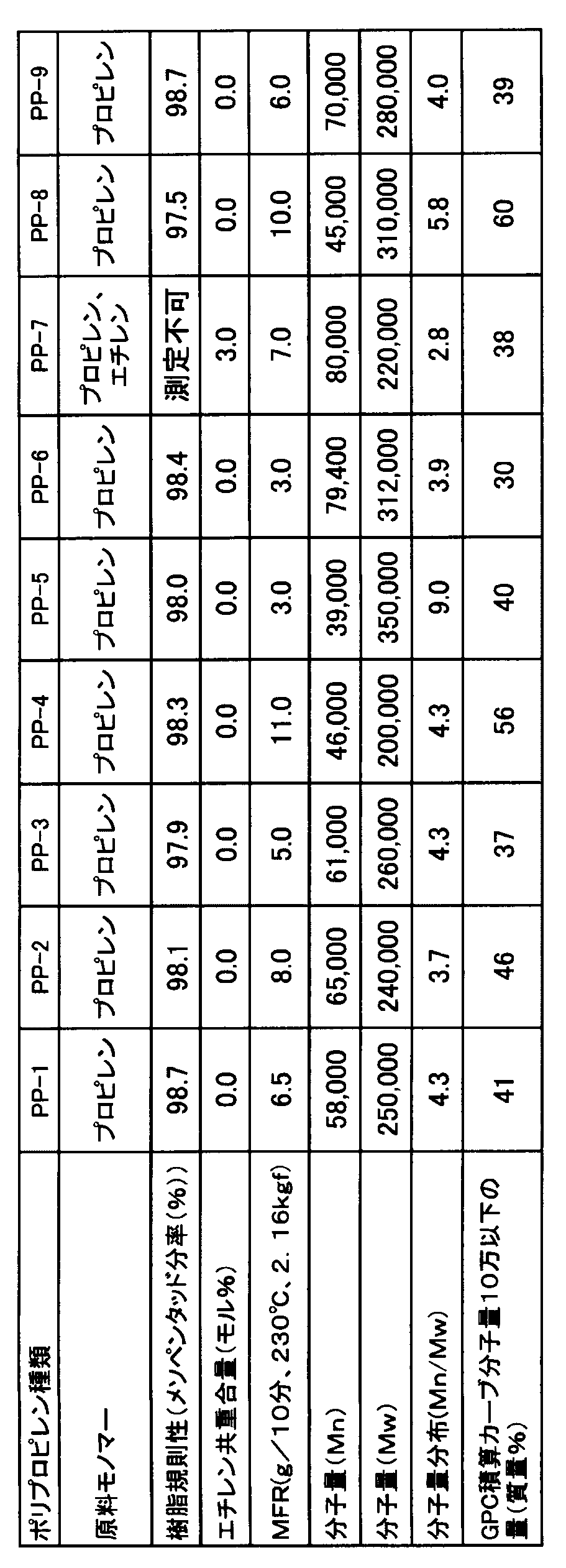
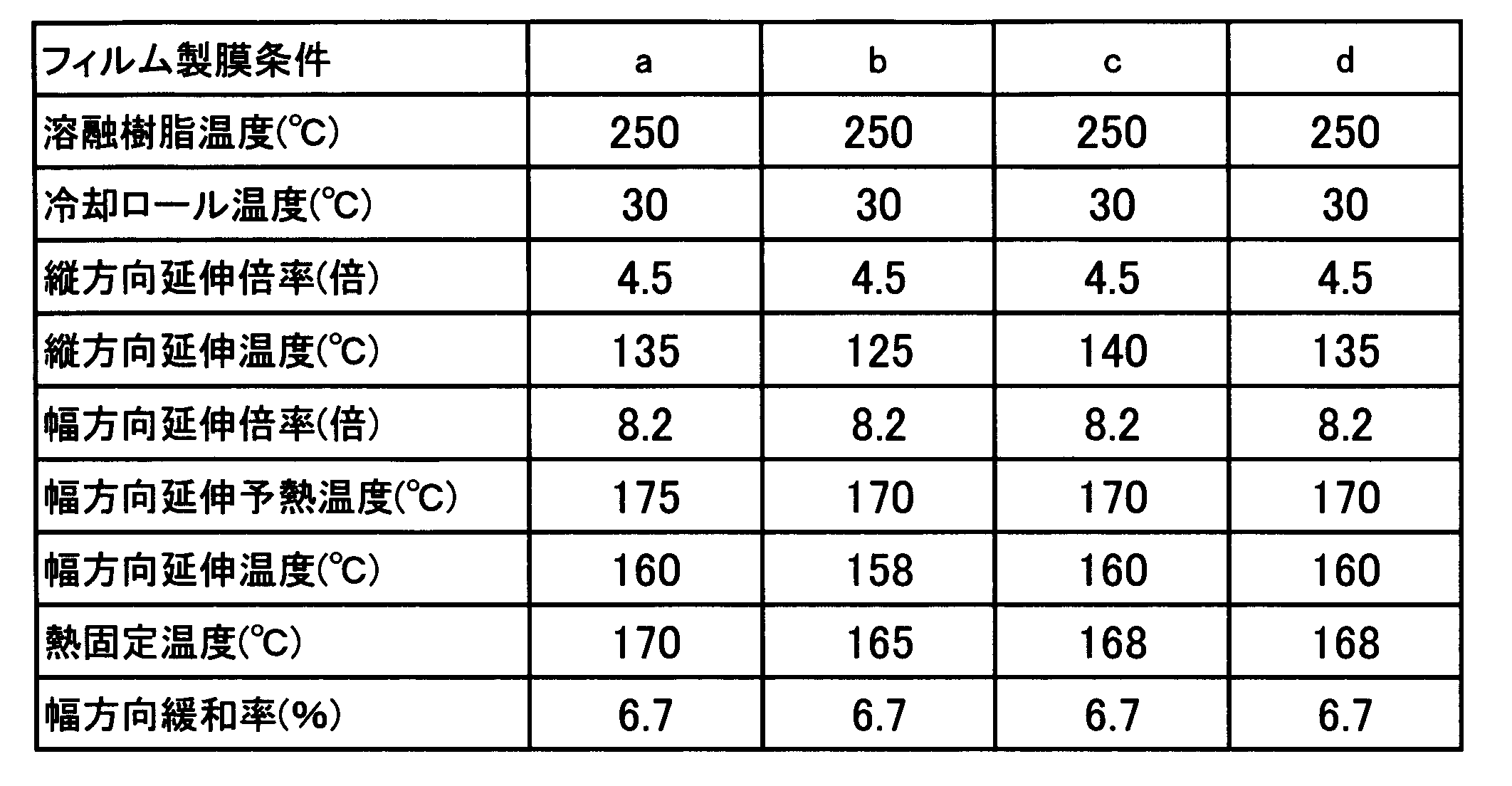

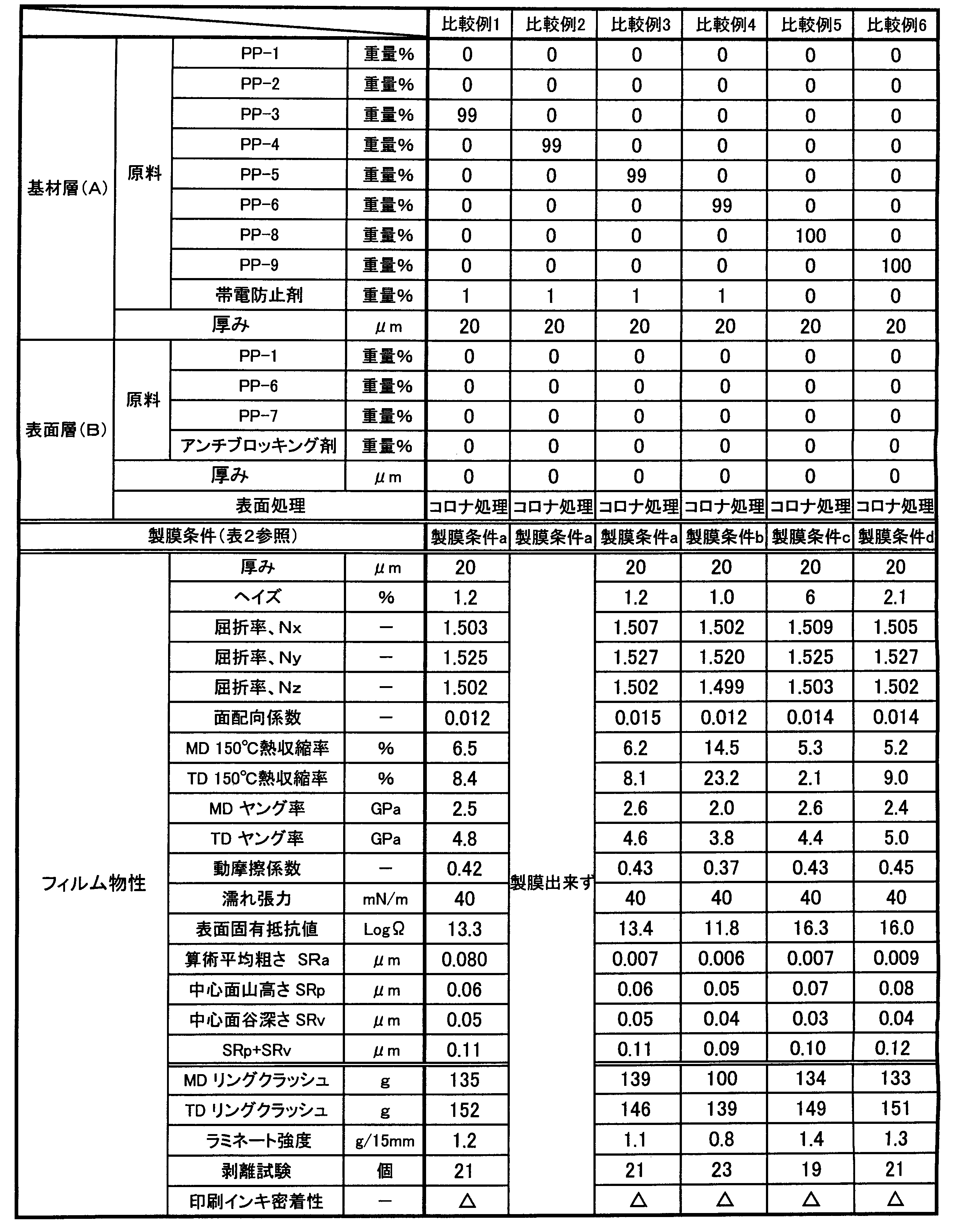
実施例1~5で得られた二軸配向ポリプロピレンフィルムは、熱収縮率が小さく、ヤング率は大きかった。中でも、実施例3~5で得られた積層フィルムは、さらにラミネート強度、インキ密着性が良好なフィルムとなった。
それに対して、比較例1で得られたフィルムは、幅方向(TD)の熱収縮率が大きかった。比較例3で得られたフィルムは、幅方向(TD)の熱収縮率が大きく、しかも幅方向(TD)のヤング率が小さかった。比較例4で得られたフィルムは、幅方向(TD)及び縦方向(MD)において、熱収縮率が大きく、ヤング率が小さいフィルムとなっている。
比較例5で得られたフィルムは、幅方向(TD)のヤング率が小さかった。比較例6で得られたフィルムは、幅方向(TD)の熱収縮率が大きかった。
それに対して、比較例1で得られたフィルムは、幅方向(TD)の熱収縮率が大きかった。比較例3で得られたフィルムは、幅方向(TD)の熱収縮率が大きく、しかも幅方向(TD)のヤング率が小さかった。比較例4で得られたフィルムは、幅方向(TD)及び縦方向(MD)において、熱収縮率が大きく、ヤング率が小さいフィルムとなっている。
比較例5で得られたフィルムは、幅方向(TD)のヤング率が小さかった。比較例6で得られたフィルムは、幅方向(TD)の熱収縮率が大きかった。
本発明の二軸延伸積層ポリプロピレンフィルムは、より高い耐熱性と剛性を有し、より熱負けシワが小さくなり、折れにくいため、加工性に優れる。
本発明の二軸配向ポリプロピレン系フィルムは、スタンディングパウチなどに使用される食品包装用はもちろんのこと、ラベル用途等にも使用可能である。
本発明の二軸配向ポリプロピレン系フィルムは、スタンディングパウチなどに使用される食品包装用はもちろんのこと、ラベル用途等にも使用可能である。
Claims (5)
- フィルムを構成するポリプロピレン樹脂が下記1)~4)の条件を満たすこと、及び、フィルムの面配向係数の下限が0.0125であることを特徴とする二軸配向ポリプロピレンフィルム。
1)メソペンタッド分率の下限が96%である。
2)プロピレン以外の共重合モノマー量の上限が0.1mol%である。
3)質量平均分子量(Mw)/数平均分子量(Mn)が3.0以上、5.4以下である。4)230℃、2.16kgfで測定されるメルトフローレート(MFR)が6.5g/10min以上、9.0g/10min以下である。 - ポリプロピレン系樹脂を主成分とする基材層(A)と基材層(A)の少なくとも一方の表面にポリプロピレン系樹脂を主成分とする表面層(B)とを有し、基材層(A)を構成するポリプロピレン樹脂が下記1)~4)の条件を満たすこと、
及び、フィルムの面配向係数の下限が0.0125であることを特徴とする二軸配向ポリプロピレンフィルム。
1)メソペンタッド分率の下限が96%である。
2)プロピレン以外の共重合モノマー量の上限が0.1mol%である。
3)質量平均分子量(Mw)/数平均分子量(Mn)が3.0以上、5.4以下である。4)230℃、2.16kgfで測定されるメルトフローレート(MFR)が6.2g/10min以上、9.0g/10min以下である。 - フィルムの縦方向および横方向の150℃での熱収縮率が8%以下である請求項1あるいは2に記載の二軸配向ポリプロピレンフィルム。
- フィルムの縦方向の引張弾性率が2.0GPa以上であり、フィルムの横方向の引張弾性率が4.5GPa以上である請求項1~3のいずれかに記載の二軸配向ポリプロピレンフィルム。
- フィルムのヘイズ値が5%以下である請求項1~4のいずれかに記載の二軸配向ポリプロピレンフィルム。
Priority Applications (5)
| Application Number | Priority Date | Filing Date | Title |
|---|---|---|---|
| KR1020227023318A KR20220101758A (ko) | 2016-03-28 | 2017-03-24 | 2축 배향 폴리프로필렌 필름 |
| CN202410614013.1A CN118457000A (zh) | 2016-03-28 | 2017-03-24 | 双轴取向聚丙烯薄膜 |
| KR1020247013252A KR20240058955A (ko) | 2016-03-28 | 2017-03-24 | 2축 배향 폴리프로필렌 필름 |
| KR1020187030709A KR20180128027A (ko) | 2016-03-28 | 2017-03-24 | 2축 배향 폴리프로필렌 필름 |
| CN201780020214.7A CN108884246A (zh) | 2016-03-28 | 2017-03-24 | 双轴取向聚丙烯薄膜 |
Applications Claiming Priority (6)
| Application Number | Priority Date | Filing Date | Title |
|---|---|---|---|
| JP2016-064051 | 2016-03-28 | ||
| JP2016064051 | 2016-03-28 | ||
| JP2017016802 | 2017-02-01 | ||
| JP2017-016802 | 2017-02-01 | ||
| JP2017-037206 | 2017-02-28 | ||
| JP2017037206 | 2017-02-28 |
Publications (1)
| Publication Number | Publication Date |
|---|---|
| WO2017170244A1 true WO2017170244A1 (ja) | 2017-10-05 |
Family
ID=59964523
Family Applications (1)
| Application Number | Title | Priority Date | Filing Date |
|---|---|---|---|
| PCT/JP2017/012073 Ceased WO2017170244A1 (ja) | 2016-03-28 | 2017-03-24 | 二軸配向ポリプロピレンフィルム |
Country Status (4)
| Country | Link |
|---|---|
| KR (3) | KR20180128027A (ja) |
| CN (2) | CN118457000A (ja) |
| TW (1) | TWI773665B (ja) |
| WO (1) | WO2017170244A1 (ja) |
Cited By (21)
| Publication number | Priority date | Publication date | Assignee | Title |
|---|---|---|---|---|
| WO2018142983A1 (ja) * | 2017-02-01 | 2018-08-09 | 東洋紡株式会社 | 二軸配向ポリプロピレン系フィルム |
| WO2019065306A1 (ja) * | 2017-09-26 | 2019-04-04 | 東洋紡株式会社 | ポリプロピレン系積層フィルム |
| WO2019244708A1 (ja) * | 2018-06-19 | 2019-12-26 | 東洋紡株式会社 | ポリプロピレン系積層フィルム |
| WO2020255643A1 (ja) * | 2019-06-20 | 2020-12-24 | 東洋紡株式会社 | ポリオレフィン系樹脂フィルム、及びそれを用いた積層体 |
| WO2020255642A1 (ja) * | 2019-06-20 | 2020-12-24 | 東洋紡株式会社 | ポリオレフィン系樹脂フィルム、及びそれを用いた積層体 |
| CN112368126A (zh) * | 2018-07-26 | 2021-02-12 | 三菱化学株式会社 | 热收缩性塑料制部件、复合预成型体和复合容器 |
| JPWO2021070672A1 (ja) * | 2019-10-10 | 2021-10-21 | 東レ株式会社 | ポリオレフィンフィルム |
| JPWO2021070671A1 (ja) * | 2019-10-10 | 2021-10-21 | 東レ株式会社 | ポリオレフィンフィルム |
| US20210388193A1 (en) * | 2018-12-28 | 2021-12-16 | Toyobo Co., Ltd. | Biaxially oriented polypropylene film |
| WO2022004340A1 (ja) * | 2020-07-03 | 2022-01-06 | 東洋紡株式会社 | 二軸配向ポリプロピレン系フィルム |
| CN114096416A (zh) * | 2019-07-10 | 2022-02-25 | 东洋纺株式会社 | 双轴取向聚丙烯系树脂膜及使用了其的包装体 |
| US20220073690A1 (en) * | 2018-12-28 | 2022-03-10 | Toyobo Co., Ltd. | Biaxially oriented polypropylene film |
| JPWO2022153906A1 (ja) * | 2021-01-12 | 2022-07-21 | ||
| CN115042490A (zh) * | 2022-05-26 | 2022-09-13 | 苏州昆岭薄膜工业有限公司 | 一种透明光泽的双向拉伸聚丙烯bopp耐热薄膜及其制备方法 |
| JPWO2023286541A1 (ja) * | 2021-07-16 | 2023-01-19 | ||
| CN115697705A (zh) * | 2020-06-17 | 2023-02-03 | 东洋纺株式会社 | 双轴取向聚丙烯薄膜 |
| WO2024070981A1 (ja) * | 2022-09-28 | 2024-04-04 | 三井化学東セロ株式会社 | 二軸延伸ポリプロピレンフィルム、食品用包装体および食品包装体 |
| EP4169973A4 (en) * | 2020-06-17 | 2024-06-19 | Toyobo Co., Ltd. | BIAXIAL ORIENTED POLYPROPYLENE FILM |
| US12104025B2 (en) | 2018-12-28 | 2024-10-01 | Toyobo Co., Ltd. | Biaxially oriented polypropylene film |
| US12384892B2 (en) | 2018-12-28 | 2025-08-12 | Toyobo Co., Ltd. | Biaxially oriented polypropylene film |
| US12600830B2 (en) | 2020-06-25 | 2026-04-14 | Toyobo Co., Ltd. | Biaxially oriented polypropylene film |
Families Citing this family (9)
| Publication number | Priority date | Publication date | Assignee | Title |
|---|---|---|---|---|
| JP7014291B2 (ja) * | 2018-04-12 | 2022-02-01 | 信越化学工業株式会社 | 光触媒転写フィルム及びその製造方法 |
| KR20210109570A (ko) * | 2018-12-28 | 2021-09-06 | 도요보 가부시키가이샤 | 2축 배향 폴리프로필렌 필름 |
| TWI871450B (zh) * | 2020-03-24 | 2025-02-01 | 日商東洋紡股份有限公司 | 雙軸配向聚丙烯膜 |
| TWI868371B (zh) * | 2020-06-25 | 2025-01-01 | 日商東洋紡股份有限公司 | 雙軸配向聚丙烯膜 |
| TWI868370B (zh) * | 2020-06-25 | 2025-01-01 | 日商東洋紡股份有限公司 | 雙軸配向聚丙烯膜 |
| EP4186689A4 (en) * | 2020-07-21 | 2024-07-24 | Toyobo Co., Ltd. | Laminated film |
| KR20230109133A (ko) * | 2020-11-17 | 2023-07-19 | 오지 홀딩스 가부시키가이샤 | 폴리프로필렌 필름, 금속층 일체형 폴리프로필렌 필름 및 필름 콘덴서 |
| CN117651643A (zh) * | 2021-07-16 | 2024-03-05 | 东洋纺株式会社 | 双轴取向层叠聚丙烯薄膜 |
| CN116176081B (zh) * | 2022-12-19 | 2025-04-08 | 广东开放大学(广东理工职业学院) | 一种双向拉伸聚丙烯隔水膜及其制备方法 |
Citations (6)
| Publication number | Priority date | Publication date | Assignee | Title |
|---|---|---|---|---|
| JPS63149149A (ja) * | 1986-12-15 | 1988-06-21 | 東レ株式会社 | 熱接着性2軸配向ポリプロピレンフイルム |
| JPH06297659A (ja) * | 1993-04-13 | 1994-10-25 | Chisso Corp | 二軸延伸複層フィルム |
| JP2001040111A (ja) * | 1999-07-26 | 2001-02-13 | Toray Ind Inc | 強力化二軸配向ポリプロピレンフィルム |
| JP2007508423A (ja) * | 2003-10-07 | 2007-04-05 | ダウ グローバル テクノロジーズ インコーポレイティド | 空気急冷ブロンフィルム用のポリプロピレン組成物 |
| JP2014055276A (ja) * | 2012-01-24 | 2014-03-27 | Toyobo Co Ltd | 延伸ポリプロピレンフィルム |
| US20140121340A1 (en) * | 2011-07-01 | 2014-05-01 | Basell Poliolefine Italia S.R.I | Polypropylene films and sheets |
Family Cites Families (6)
| Publication number | Priority date | Publication date | Assignee | Title |
|---|---|---|---|---|
| EP1702761B1 (en) * | 2003-12-26 | 2009-04-22 | Toray Industries, Inc. | Biaxially oriented white polypropylene film for thermal transfer recording and receiving sheet for thermal transfer recording therefrom |
| EP1726602A1 (en) | 2005-05-27 | 2006-11-29 | Borealis Technology Oy | Propylene polymer with high crystallinity |
| WO2007132826A1 (ja) * | 2006-05-16 | 2007-11-22 | Toray Industries, Inc. | 二軸配向白色ポリプロピレンフィルム、反射板および感熱転写記録用受容シート |
| DE112008002985B4 (de) * | 2007-11-07 | 2020-07-02 | Oji Paper Co. Ltd. | Biaxial orientierter Polypropylenfilm für einen Kondensator, ein bedampfter Film und ein Kondensator, der diesen verwendet |
| WO2015012165A1 (ja) * | 2013-07-23 | 2015-01-29 | 東洋紡株式会社 | ヒートシール性ポリプロピレン積層延伸フィルム |
| KR102352439B1 (ko) | 2013-07-23 | 2022-01-18 | 도요보 가부시키가이샤 | 연신 폴리프로필렌 필름 |
-
2017
- 2017-03-24 CN CN202410614013.1A patent/CN118457000A/zh active Pending
- 2017-03-24 KR KR1020187030709A patent/KR20180128027A/ko not_active Ceased
- 2017-03-24 KR KR1020247013252A patent/KR20240058955A/ko active Pending
- 2017-03-24 KR KR1020227023318A patent/KR20220101758A/ko not_active Ceased
- 2017-03-24 WO PCT/JP2017/012073 patent/WO2017170244A1/ja not_active Ceased
- 2017-03-24 CN CN201780020214.7A patent/CN108884246A/zh active Pending
- 2017-03-27 TW TW106110148A patent/TWI773665B/zh active
Patent Citations (6)
| Publication number | Priority date | Publication date | Assignee | Title |
|---|---|---|---|---|
| JPS63149149A (ja) * | 1986-12-15 | 1988-06-21 | 東レ株式会社 | 熱接着性2軸配向ポリプロピレンフイルム |
| JPH06297659A (ja) * | 1993-04-13 | 1994-10-25 | Chisso Corp | 二軸延伸複層フィルム |
| JP2001040111A (ja) * | 1999-07-26 | 2001-02-13 | Toray Ind Inc | 強力化二軸配向ポリプロピレンフィルム |
| JP2007508423A (ja) * | 2003-10-07 | 2007-04-05 | ダウ グローバル テクノロジーズ インコーポレイティド | 空気急冷ブロンフィルム用のポリプロピレン組成物 |
| US20140121340A1 (en) * | 2011-07-01 | 2014-05-01 | Basell Poliolefine Italia S.R.I | Polypropylene films and sheets |
| JP2014055276A (ja) * | 2012-01-24 | 2014-03-27 | Toyobo Co Ltd | 延伸ポリプロピレンフィルム |
Cited By (64)
| Publication number | Priority date | Publication date | Assignee | Title |
|---|---|---|---|---|
| WO2018142983A1 (ja) * | 2017-02-01 | 2018-08-09 | 東洋紡株式会社 | 二軸配向ポリプロピレン系フィルム |
| WO2019065306A1 (ja) * | 2017-09-26 | 2019-04-04 | 東洋紡株式会社 | ポリプロピレン系積層フィルム |
| EP3812152A4 (en) * | 2018-06-19 | 2022-03-16 | Toyobo Co., Ltd. | POLYPROPYLENE-BASED MULTI-LAYER FILM |
| WO2019244708A1 (ja) * | 2018-06-19 | 2019-12-26 | 東洋紡株式会社 | ポリプロピレン系積層フィルム |
| JP7230911B2 (ja) | 2018-06-19 | 2023-03-01 | 東洋紡株式会社 | ポリプロピレン系積層フィルム |
| US11420430B2 (en) | 2018-06-19 | 2022-08-23 | Toyobo Co., Ltd. | Polypropylene-based laminated film |
| CN112351885A (zh) * | 2018-06-19 | 2021-02-09 | 东洋纺株式会社 | 聚丙烯系层叠薄膜 |
| JPWO2019244708A1 (ja) * | 2018-06-19 | 2021-06-24 | 東洋紡株式会社 | ポリプロピレン系積層フィルム |
| CN112368126B (zh) * | 2018-07-26 | 2022-09-30 | 三菱化学株式会社 | 热收缩性塑料制部件、复合预成型体和复合容器 |
| CN112368126A (zh) * | 2018-07-26 | 2021-02-12 | 三菱化学株式会社 | 热收缩性塑料制部件、复合预成型体和复合容器 |
| TWI869164B (zh) * | 2018-12-28 | 2025-01-01 | 日商東洋紡股份有限公司 | 雙軸配向聚丙烯膜 |
| US20220073690A1 (en) * | 2018-12-28 | 2022-03-10 | Toyobo Co., Ltd. | Biaxially oriented polypropylene film |
| US20210388193A1 (en) * | 2018-12-28 | 2021-12-16 | Toyobo Co., Ltd. | Biaxially oriented polypropylene film |
| US12384892B2 (en) | 2018-12-28 | 2025-08-12 | Toyobo Co., Ltd. | Biaxially oriented polypropylene film |
| US12384907B2 (en) * | 2018-12-28 | 2025-08-12 | Toyobo Co., Ltd. | Biaxially oriented polypropylene film |
| US12104025B2 (en) | 2018-12-28 | 2024-10-01 | Toyobo Co., Ltd. | Biaxially oriented polypropylene film |
| EP3988279A4 (en) * | 2019-06-20 | 2023-10-25 | Toyobo Co., Ltd. | POLYOLEFIN-BASED RESIN FILM AND LAMINATE WITH IT |
| JP7484908B2 (ja) | 2019-06-20 | 2024-05-16 | 東洋紡株式会社 | ポリオレフィン系樹脂フィルム、及びそれを用いた積層体 |
| US11866572B2 (en) | 2019-06-20 | 2024-01-09 | Toyobo Co., Ltd. | Polyolefin-based resin film and laminate including the same |
| TWI869405B (zh) * | 2019-06-20 | 2025-01-11 | 日商東洋紡股份有限公司 | 聚烯烴系樹脂膜、使用有聚烯烴系樹脂膜之積層體以及包裝體 |
| WO2020255642A1 (ja) * | 2019-06-20 | 2020-12-24 | 東洋紡株式会社 | ポリオレフィン系樹脂フィルム、及びそれを用いた積層体 |
| WO2020255643A1 (ja) * | 2019-06-20 | 2020-12-24 | 東洋紡株式会社 | ポリオレフィン系樹脂フィルム、及びそれを用いた積層体 |
| EP3988280A4 (en) * | 2019-06-20 | 2023-10-25 | Toyobo Co., Ltd. | POLYOLEFIN-BASED RESIN FILM, AND LAMINATE USING THE SAME |
| JPWO2020255642A1 (ja) * | 2019-06-20 | 2020-12-24 | ||
| JP7559908B2 (ja) | 2019-06-20 | 2024-10-02 | 東洋紡株式会社 | ポリオレフィン系樹脂フィルム、及びそれを用いた積層体 |
| JP2024028700A (ja) * | 2019-06-20 | 2024-03-05 | 東洋紡株式会社 | ポリオレフィン系樹脂フィルム、及びそれを用いた積層体 |
| JP7392718B2 (ja) | 2019-06-20 | 2023-12-06 | 東洋紡株式会社 | ポリオレフィン系樹脂フィルム、及びそれを用いた積層体 |
| JPWO2020255643A1 (ja) * | 2019-06-20 | 2020-12-24 | ||
| US12098269B2 (en) | 2019-06-20 | 2024-09-24 | Toyobo Co., Ltd. | Polyolefin-based resin film and laminate including the same |
| CN114096416A (zh) * | 2019-07-10 | 2022-02-25 | 东洋纺株式会社 | 双轴取向聚丙烯系树脂膜及使用了其的包装体 |
| CN114096416B (zh) * | 2019-07-10 | 2024-01-02 | 东洋纺株式会社 | 双轴取向聚丙烯系树脂膜及使用了其的包装体 |
| CN114502375A (zh) * | 2019-10-10 | 2022-05-13 | 东丽株式会社 | 聚烯烃膜 |
| JP2022140475A (ja) * | 2019-10-10 | 2022-09-26 | 東レ株式会社 | ポリオレフィンフィルム |
| CN114502375B (zh) * | 2019-10-10 | 2024-04-26 | 东丽株式会社 | 聚烯烃膜 |
| JP7355172B2 (ja) | 2019-10-10 | 2023-10-03 | 東レ株式会社 | ポリオレフィンフィルム |
| JP7355173B2 (ja) | 2019-10-10 | 2023-10-03 | 東レ株式会社 | ポリオレフィンフィルム |
| JP2022140476A (ja) * | 2019-10-10 | 2022-09-26 | 東レ株式会社 | ポリオレフィンフィルム |
| JP7107384B2 (ja) | 2019-10-10 | 2022-07-27 | 東レ株式会社 | ポリオレフィンフィルム |
| JP7107383B2 (ja) | 2019-10-10 | 2022-07-27 | 東レ株式会社 | ポリオレフィンフィルム |
| JPWO2021070671A1 (ja) * | 2019-10-10 | 2021-10-21 | 東レ株式会社 | ポリオレフィンフィルム |
| JPWO2021070672A1 (ja) * | 2019-10-10 | 2021-10-21 | 東レ株式会社 | ポリオレフィンフィルム |
| EP4169973A4 (en) * | 2020-06-17 | 2024-06-19 | Toyobo Co., Ltd. | BIAXIAL ORIENTED POLYPROPYLENE FILM |
| EP4169716A4 (en) * | 2020-06-17 | 2024-06-19 | Toyobo Co., Ltd. | BIAXIAL ORIENTED POLYPROPYLENE FILM |
| US12404379B2 (en) | 2020-06-17 | 2025-09-02 | Toyobo Co., Ltd. | Biaxially oriented polypropylene film |
| US12391811B2 (en) | 2020-06-17 | 2025-08-19 | Toyobo Co., Ltd. | Biaxially oriented polypropylene film |
| CN115697705A (zh) * | 2020-06-17 | 2023-02-03 | 东洋纺株式会社 | 双轴取向聚丙烯薄膜 |
| US12600830B2 (en) | 2020-06-25 | 2026-04-14 | Toyobo Co., Ltd. | Biaxially oriented polypropylene film |
| US12269243B2 (en) * | 2020-07-03 | 2025-04-08 | Toyobo Co., Ltd. | Biaxially-oriented polypropylene film |
| WO2022004340A1 (ja) * | 2020-07-03 | 2022-01-06 | 東洋紡株式会社 | 二軸配向ポリプロピレン系フィルム |
| JP2023086787A (ja) * | 2020-07-03 | 2023-06-22 | 東洋紡株式会社 | 二軸配向ポリプロピレン系フィルム |
| JP2023116754A (ja) * | 2020-07-03 | 2023-08-22 | 東洋紡株式会社 | 二軸配向ポリプロピレン系フィルム |
| US20230330977A1 (en) * | 2020-07-03 | 2023-10-19 | Toyobo Co., Ltd. | Biaxially-oriented polypropylene film |
| CN115916537A (zh) * | 2020-07-03 | 2023-04-04 | 东洋纺株式会社 | 双轴取向聚丙烯系薄膜 |
| JPWO2022004340A1 (ja) * | 2020-07-03 | 2022-01-06 | ||
| JP7631345B2 (ja) | 2020-07-03 | 2025-02-18 | 東洋紡株式会社 | 二軸配向ポリプロピレン系フィルム |
| JP2025019264A (ja) * | 2020-07-03 | 2025-02-06 | 東洋紡株式会社 | 二軸配向ポリプロピレン系フィルム |
| JPWO2022153906A1 (ja) * | 2021-01-12 | 2022-07-21 | ||
| JP7380916B2 (ja) | 2021-01-12 | 2023-11-15 | 東洋紡株式会社 | 積層フィルム |
| WO2022153906A1 (ja) * | 2021-01-12 | 2022-07-21 | 東洋紡株式会社 | 積層フィルム |
| JP7708187B2 (ja) | 2021-07-16 | 2025-07-15 | 東洋紡株式会社 | 二軸配向積層ポリプロピレンフィルム |
| JPWO2023286541A1 (ja) * | 2021-07-16 | 2023-01-19 | ||
| CN115042490A (zh) * | 2022-05-26 | 2022-09-13 | 苏州昆岭薄膜工业有限公司 | 一种透明光泽的双向拉伸聚丙烯bopp耐热薄膜及其制备方法 |
| CN115042490B (zh) * | 2022-05-26 | 2024-02-27 | 苏州昆岭薄膜工业有限公司 | 一种透明光泽的双向拉伸聚丙烯bopp耐热薄膜及其制备方法 |
| WO2024070981A1 (ja) * | 2022-09-28 | 2024-04-04 | 三井化学東セロ株式会社 | 二軸延伸ポリプロピレンフィルム、食品用包装体および食品包装体 |
Also Published As
| Publication number | Publication date |
|---|---|
| TWI773665B (zh) | 2022-08-11 |
| CN108884246A (zh) | 2018-11-23 |
| CN118457000A (zh) | 2024-08-09 |
| KR20240058955A (ko) | 2024-05-03 |
| KR20220101758A (ko) | 2022-07-19 |
| TW201801928A (zh) | 2018-01-16 |
| KR20180128027A (ko) | 2018-11-30 |
Similar Documents
| Publication | Publication Date | Title |
|---|---|---|
| JP7803840B2 (ja) | 二軸配向ポリプロピレンフィルム | |
| WO2017170244A1 (ja) | 二軸配向ポリプロピレンフィルム | |
| JP7459919B2 (ja) | 二軸延伸積層ポリプロピレンフィルム | |
| JP7548346B2 (ja) | 二軸配向ポリプロピレン系フィルムの製造方法 | |
| JP7298751B2 (ja) | 二軸配向ポリプロピレンフィルム | |
| JP7238779B2 (ja) | ポリプロピレン系積層フィルム | |
| JP7631345B2 (ja) | 二軸配向ポリプロピレン系フィルム |
Legal Events
| Date | Code | Title | Description |
|---|---|---|---|
| NENP | Non-entry into the national phase |
Ref country code: DE |
|
| ENP | Entry into the national phase |
Ref document number: 20187030709 Country of ref document: KR Kind code of ref document: A |
|
| 121 | Ep: the epo has been informed by wipo that ep was designated in this application |
Ref document number: 17774781 Country of ref document: EP Kind code of ref document: A1 |
|
| 122 | Ep: pct application non-entry in european phase |
Ref document number: 17774781 Country of ref document: EP Kind code of ref document: A1 |