WO2017169808A1 - 研磨用組成物 - Google Patents
研磨用組成物 Download PDFInfo
- Publication number
- WO2017169808A1 WO2017169808A1 PCT/JP2017/010521 JP2017010521W WO2017169808A1 WO 2017169808 A1 WO2017169808 A1 WO 2017169808A1 JP 2017010521 W JP2017010521 W JP 2017010521W WO 2017169808 A1 WO2017169808 A1 WO 2017169808A1
- Authority
- WO
- WIPO (PCT)
- Prior art keywords
- polishing
- group
- carbon atoms
- alkyl group
- polishing composition
- Prior art date
- Legal status (The legal status is an assumption and is not a legal conclusion. Google has not performed a legal analysis and makes no representation as to the accuracy of the status listed.)
- Ceased
Links
Classifications
-
- B—PERFORMING OPERATIONS; TRANSPORTING
- B24—GRINDING; POLISHING
- B24B—MACHINES, DEVICES, OR PROCESSES FOR GRINDING OR POLISHING; DRESSING OR CONDITIONING OF ABRADING SURFACES; FEEDING OF GRINDING, POLISHING, OR LAPPING AGENTS
- B24B37/00—Lapping machines or devices; Accessories
- B24B37/04—Lapping machines or devices; Accessories designed for working plane surfaces
- B24B37/042—Lapping machines or devices; Accessories designed for working plane surfaces operating processes therefor
- B24B37/044—Lapping machines or devices; Accessories designed for working plane surfaces operating processes therefor characterised by the composition of the lapping agent
-
- C—CHEMISTRY; METALLURGY
- C09—DYES; PAINTS; POLISHES; NATURAL RESINS; ADHESIVES; COMPOSITIONS NOT OTHERWISE PROVIDED FOR; APPLICATIONS OF MATERIALS NOT OTHERWISE PROVIDED FOR
- C09G—POLISHING COMPOSITIONS; SKI WAXES
- C09G1/00—Polishing compositions
- C09G1/02—Polishing compositions containing abrasives or grinding agents
-
- C—CHEMISTRY; METALLURGY
- C09—DYES; PAINTS; POLISHES; NATURAL RESINS; ADHESIVES; COMPOSITIONS NOT OTHERWISE PROVIDED FOR; APPLICATIONS OF MATERIALS NOT OTHERWISE PROVIDED FOR
- C09K—MATERIALS FOR MISCELLANEOUS APPLICATIONS, NOT PROVIDED FOR ELSEWHERE
- C09K3/00—Materials not provided for elsewhere
- C09K3/14—Anti-slip materials; Abrasives
- C09K3/1436—Composite particles, e.g. coated particles
-
- H—ELECTRICITY
- H10—SEMICONDUCTOR DEVICES; ELECTRIC SOLID-STATE DEVICES NOT OTHERWISE PROVIDED FOR
- H10P—GENERIC PROCESSES OR APPARATUS FOR THE MANUFACTURE OR TREATMENT OF DEVICES COVERED BY CLASS H10
- H10P52/00—Grinding, lapping or polishing of wafers, substrates or parts of devices
- H10P52/40—Chemomechanical polishing [CMP]
- H10P52/402—Chemomechanical polishing [CMP] of semiconductor materials
-
- H—ELECTRICITY
- H10—SEMICONDUCTOR DEVICES; ELECTRIC SOLID-STATE DEVICES NOT OTHERWISE PROVIDED FOR
- H10P—GENERIC PROCESSES OR APPARATUS FOR THE MANUFACTURE OR TREATMENT OF DEVICES COVERED BY CLASS H10
- H10P52/00—Grinding, lapping or polishing of wafers, substrates or parts of devices
- H10P52/40—Chemomechanical polishing [CMP]
- H10P52/403—Chemomechanical polishing [CMP] of conductive or resistive materials
-
- H—ELECTRICITY
- H10—SEMICONDUCTOR DEVICES; ELECTRIC SOLID-STATE DEVICES NOT OTHERWISE PROVIDED FOR
- H10P—GENERIC PROCESSES OR APPARATUS FOR THE MANUFACTURE OR TREATMENT OF DEVICES COVERED BY CLASS H10
- H10P95/00—Generic processes or apparatus for manufacture or treatments not covered by the other groups of this subclass
- H10P95/06—Planarisation of inorganic insulating materials
- H10P95/062—Planarisation of inorganic insulating materials involving a dielectric removal step
-
- H—ELECTRICITY
- H10—SEMICONDUCTOR DEVICES; ELECTRIC SOLID-STATE DEVICES NOT OTHERWISE PROVIDED FOR
- H10P—GENERIC PROCESSES OR APPARATUS FOR THE MANUFACTURE OR TREATMENT OF DEVICES COVERED BY CLASS H10
- H10P95/00—Generic processes or apparatus for manufacture or treatments not covered by the other groups of this subclass
- H10P95/06—Planarisation of inorganic insulating materials
- H10P95/062—Planarisation of inorganic insulating materials involving a dielectric removal step
- H10P95/064—Planarisation of inorganic insulating materials involving a dielectric removal step the removal being chemical etching
Definitions
- the present invention relates to a polishing composition.
- CMP chemical mechanical polishing
- the CMP has been applied to each process in semiconductor manufacturing, and one aspect thereof is, for example, application to a gate formation process in transistor fabrication.
- materials such as metal, silicon, silicon oxide, polycrystalline silicon (polysilicon), and silicon nitride (silicon nitride) may be polished.
- the polishing rate of each material may be polished. There is a need to control.
- Patent Document 1 discloses a polishing composition containing an oxidizing agent and a nonionic compound having a weight average molecular weight of 1000 or less.
- Patent Document 1 does not disclose a technique for selectively polishing a material containing a silicon-nitrogen bond such as a silicon nitride film, and the polishing rate of a material containing a silicon-nitrogen bond such as a silicon nitride film. The high selectivity of was not able to be demonstrated.
- the present invention provides (a) the above-mentioned (a) for the polishing rate of the material (b) when polishing an object to be polished, comprising (a) a material having a silicon-nitrogen bond; and (b) other materials.
- An object of the present invention is to provide a technique capable of improving the ratio of polishing rates of materials.
- a polishing composition used for polishing a polishing object comprising: (a) a material having a silicon-nitrogen bond; and (b) other materials; and an organic acid-fixed silica; b) a selective ratio improver that improves the ratio of the polishing rate of the material to the polishing rate of the material; and (i) the following formula 1 and the following formula 2:
- R 1 , R 2 , R 3 and R 4 are each independently a substituted or unsubstituted alkyl group having 1 to 20 carbon atoms, or a substituted or unsubstituted carbon number of 6 Or (ii) a polymer having a structural unit derived from an unsaturated carboxylic acid represented by at least one of ⁇ 20 aryl groups, or (iii) the following formula 3:
- R 5 represents a substituted or unsubstituted branched alkyl group having 3 to 20 carbon atoms, or
- E is an alkylene group having 1 to 3 carbon atoms
- R 6 is a substituted or unsubstituted branched alkyl group having 3 to 20 carbon atoms or a branched alkyl group having 3 to 20 carbon atoms.
- N is 2-100, wherein a plurality of E may be the same or different, and the selectivity improver may be in the form of a salt. It has been found that the above problems are solved by the composition.
- a material containing a silicon-nitrogen bond such as a silicon nitride film
- X to Y indicating a range means “X or more and Y or less”.
- operations and physical properties are measured under conditions of room temperature (20 to 25 ° C.) / Relative humidity 40 to 50% RH.
- the present invention provides a polishing composition used for polishing a polishing object, comprising: (a) a material having a silicon-nitrogen bond; and (b) other materials; and an organic acid-fixed silica; (B) a selection ratio improver that improves the ratio of the polishing rate of the material to the polishing rate of the material; and (i) the following formula 1 and the following formula 2:
- R 1 , R 2 , R 3 and R 4 are each independently a substituted or unsubstituted alkyl group having 1 to 20 carbon atoms, or a substituted or unsubstituted carbon number of 6 Or (ii) a polymer having a structural unit derived from an unsaturated carboxylic acid represented by at least one of ⁇ 20 aryl groups, or (iii) the following formula 3:
- R 5 represents a substituted or unsubstituted branched alkyl group having 3 to 20 carbon atoms, or
- E is an alkylene group having 1 to 3 carbon atoms
- R 6 is a substituted or unsubstituted branched alkyl group having 3 to 20 carbon atoms or a branched alkyl group having 3 to 20 carbon atoms.
- N is 2-100, wherein a plurality of E may be the same or different, and the selectivity improver may be in the form of a salt. It is a composition.
- polishing an object to be polished including (a) a material having a silicon-nitrogen bond; (b) other materials; and (b) the material (a) with respect to the polishing rate of the material (b)
- the polishing rate ratio can be improved.
- a material containing a silicon-nitrogen bond such as a silicon nitride film, exhibits high selectivity in polishing rate with respect to (b) other materials (for example, metal materials, insulating materials, low dielectric constant materials, etc.) Therefore, processing in the device manufacturing process can be brought into a desired state.
- the polishing object of the present invention includes (a) a material having a silicon-nitrogen bond; and (b) other materials.
- (a) Material having silicon-nitrogen bond examples include silicon nitride and SiCN (silicon carbonitride).
- (B) Other materials) are not particularly limited as long as they are other than materials having silicon-nitrogen bonds, and silicon-containing materials (having silicon-nitrogen bonds) Other materials), various insulating materials, various metal materials, and the like.
- examples of the material having a silicon-silicon bond include polysilicon, amorphous silicon, single crystal silicon, n-type doped single crystal silicon, and p-type doped single crystal silicon.
- SiOC silicon oxide containing methyl group
- fluorinated silicon oxide (SiOF) benzocyclobutene (BCB)
- HSQ hydrogen silsesquioxane
- MSQ methyl silsesquioxane
- HMSQ hydrogen silsesquioxane
- HMSQ hydrogen silsesquioxane
- polyimide-based polymer arylene ether-based polymer
- cyclobutene-based polymer cyclobutene-based polymer
- perfluorocyclobutene (PFCB) perfluorocyclobutene
- the insulating material is a material having a volume resistivity of 1 ⁇ 10 10 ⁇ ⁇ cm or more, and means a material other than the above, for example, an acrylic resin, a phenol resin, a fluorine resin, an epoxy resin, a cardo type Examples thereof include organic materials such as resins, vinyl resins, imide resins, novolac resins, and polyparaxylene, and inorganic materials such as TEOS (silicon oxide) and Al 2 O 3 .
- TEOS silicon oxide
- the selection ratio of the material (a) is improved by including a selection ratio improver in the polishing composition.
- the selection ratio improver is the following (i), (ii) or (iii), and these may be used in appropriate combination.
- R 1 , R 2 , R 3 and R 4 are each independently a substituted or unsubstituted alkyl group having 1 to 20 carbon atoms, or a substituted or unsubstituted carbon number of 6 At least one of ⁇ 20 aryl groups.
- the mechanism by which the selectivity of the material (a) is improved by adding the selectivity improver to the polishing composition is not clear, but is presumed as follows. That is, the affinity between the phosphorus atom of the selectivity improver and the nitrogen atom in the material (a), and the alkyl group or aryl group of the selectivity improver and the silicon atom in the material (a) This may be because the affinity is high. At this time, when R 1 and R 2 and R 3 and R 4 are, for example, at least one hydrogen atom, the affinity is not improved and the desired effect of the present invention cannot be obtained. However, it goes without saying that the technical scope of the present invention is not limited by such a mechanism.
- the alkyl group preferably has 2 to 15 carbon atoms, more preferably 2 to 14 carbon atoms, and still more preferably 2 to 13 carbon atoms. According to this embodiment, the high selectivity of the polishing rate can be exhibited more effectively.
- alkyl group having 1 to 20 carbon atoms are not particularly limited, but are methyl group, ethyl group, propyl group, isopropyl group, n-butyl group, isobutyl group, sec-butyl group, tert-butyl group.
- pentyl group isopentyl group, neopentyl group, 2-ethylhexyl group, hexyl group, heptyl group, octyl group, nonyl group, decyl group, undecyl group, dodecyl group (lauryl group), tridecyl group, tetradecyl group (myristyl group) , Pentadecyl group, hexadecyl group (palmityl group), heptadecyl group, octadecyl group (stearyl group), nonadecyl group, icosyl group and the like.
- R 1 , R 2 , R 3 and R 4 are an unsubstituted alkyl group having 1 to 20 carbon atoms
- the carbon number of the alkyl group is more preferably 3 to 14; More preferably, it is 4-13.
- R 1 , R 2 , R 3 and R 4 are a substituted alkyl group having 1 to 20 carbon atoms
- the substituent is an alkoxy group having 1 to 10 carbon atoms or 6 carbon atoms.
- An aryl group of ⁇ 20 is preferred. According to this embodiment, the high selectivity of the polishing rate can be exhibited more effectively.
- the number of carbon atoms of the alkoxy group is preferably 2 to 8, more preferably 3 to 6, and still more preferably 4 to 6 from the viewpoint of more effectively exhibiting high selectivity of the polishing rate.
- the aryl group include a phenyl group, a naphthyl group, and an anthracenyl group (anthryl group).
- the alkyl group preferably has 1 to 4 carbon atoms, more preferably 2 to 3 carbon atoms.
- R 1 , R 2 , R 3 and R 4 are substituted alkyl groups having 1 to 20 carbon atoms, for example, methoxymethyl group, ethoxymethyl group, propoxymethyl group, methoxyethyl group, ethoxy Alkoxyalkyl groups such as ethyl group, propoxyethyl group, isopropoxyethyl group, butoxyethyl group, hexyloxyethyl group, heptyloxyethyl group, octyloxyethyl group, cyclohexyloxyethyl group, benzyl group, phenethyl group, naphthylmethyl And an aralkyl group such as an anthrylmethyl group is preferred.
- the chain structure or alicyclic structure may have an aromatic ring structure.
- R 1 , R 2 , R 3 and R 4 are an unsubstituted aryl group having 6 to 20 carbon atoms
- the aryl groups described above are preferably applied. it can.
- R 1 , R 2 , R 3 and R 4 are a substituted aryl group having 6 to 20 carbon atoms
- the substituent is an alkyl group having 1 to 20 carbon atoms or a carbon number A 1 to 10 alkoxy group is preferred.
- R 1 , R 2 , R 3 and R 4 are a substituted aryl group having 6 to 20 carbon atoms, for example, a tolyl group, a xylyl group, a mesityl group, a methylnaphthyl group, a methylanthryl group Etc., a methoxyphenyl group, an ethoxyphenyl group and the like are preferable.
- a tolyl group for example, a tolyl group, a xylyl group, a mesityl group, a methylnaphthyl group, a methylanthryl group Etc.
- a methoxyphenyl group, an ethoxyphenyl group and the like are preferable.
- the aromatic ring structure not only the aromatic ring structure but also a part thereof may include a chain structure or an alicyclic structure.
- the selectivity improver comprises bis (2-ethylhexyl) phosphate, dilauryl hydrogen phosphate, butyl acid phosphate, monobutoxyethyl acid phosphate and diphenyl hydrogen phosphite. It is at least one selected from the group. According to this embodiment, the high selectivity of the polishing rate can be exhibited more effectively.
- the selectivity improver of a preferred embodiment of the present invention is a polymer having a structural unit derived from an unsaturated carboxylic acid (also referred to herein simply as “polymer”).
- the polymer of the present invention may be a homopolymer (single polymer) or a copolymer (copolymer) as long as it contains a structural unit derived from an unsaturated carboxylic acid.
- a copolymer is preferable.
- the structure of the copolymer is not particularly limited, and may be any of a random copolymer, an alternating copolymer, a periodic copolymer, and a block copolymer.
- the type of structural unit is not particularly limited as long as it is two or more types, and may be three types, four types, or more.
- Examples of the unsaturated carboxylic acid include (meth) acrylic acid, crotonic acid, fumaric acid, (anhydrous) maleic acid, itaconic acid and the like.
- the unsaturated carboxylic acid may be in the form of an ester.
- Examples of the unsaturated carboxylic acid ester include (meth) acrylic acid ester, crotonic acid ester, fumaric acid ester, maleic acid ester, and itaconic acid ester. Is mentioned.
- Such an unsaturated carboxylic acid ester is a form in which an alkyl group, a hydroxyalkyl group, a group derived from polyalkylene glycol, or the like is introduced into the carboxyl group of the unsaturated carboxylic acid.
- the number of carbon atoms of the alkyl group in the alkyl group or hydroxyalkyl group is not particularly limited, but is preferably 1 to 10.
- the alkyl group include methyl group, ethyl group, propyl group, isopropyl group, n-butyl group, isobutyl group, sec-butyl group, tert-butyl group, pentyl group, isopentyl group, neopentyl group, 2-ethylhexyl group, A hexyl group, heptyl group, octyl group, nonyl group, decyl group and the like are preferable.
- the polyalkylene glycol can be synthesized by addition polymerization of alkylene oxide, and examples of the alkylene oxide include ethylene oxide, propylene oxide, butylene oxide and the like.
- the structural unit derived from the unsaturated carboxylic acid is a structural unit derived from (meth) acrylic acid, or , A structural unit derived from maleic acid.
- the polymer of the present invention may contain other structural units in addition to the structural unit derived from unsaturated carboxylic acid, such as a structural unit derived from ⁇ -olefin; a structural unit derived from unsaturated nitrile; an unsaturated amide.
- ⁇ -olefins include ethylene, propylene, butadiene and the like; Unsaturated nitriles include acrylonitrile and methacrylonitrile; Unsaturated amides include acrylamide, dimethylacrylamide, methacrylamide, N-methylolacrylamide; Aromatic vinyls include styrene and ⁇ -methylstyrene; Aliphatic vinyl includes vinyl acetate; Examples of the unsaturated heterocyclic ring containing an unsaturated bond include N-vinylpyrrolidone and acryloylmorpholine.
- the polymer of the present invention is preferably a copolymer, and preferably contains a structural unit derived from aromatic vinyl.
- the selectivity improver of the present invention is preferably not a single polymer of maleic acid (polymaleic acid).
- the carboxyl group in the structural unit derived from unsaturated carboxylic acid may be neutralized with a basic substance.
- a basic substance for example, a known basic substance such as a carbonate (hydrogen) salt, an alkali metal hydroxide such as sodium, ammonia, an organic amine or the like may be used as appropriate.
- the neutralization rate is not particularly limited, and may be adjusted to an arbitrary neutralization rate, for example, an arbitrary value of 30 to 100 mol% or 50 to 80 mol%.
- the neutralization method may be performed by adding a basic substance to the polymer, or may be performed by polymerization using a partially or completely neutralized monomer.
- the weight average molecular weight of the polymer of the present invention is not particularly limited, but is preferably 2,000 or more, more preferably 4,000 or more, further preferably 8,000 or more, 000 or more, or 80,000 or more. Moreover, it is preferable that it is 600,000 or less, It is more preferable that it is 400,000 or less, It is more preferable that it is 200,000 or less, It is more preferable that it is 150,000 or less.
- the measuring method of a weight average molecular weight follows the method of an Example.
- R 5 represents a substituted or unsubstituted branched alkyl group having 3 to 20 carbon atoms, or
- E is an alkylene group having 1 to 3 carbon atoms
- R 6 is a substituted or unsubstituted branched alkyl group having 3 to 20 carbon atoms or a branched alkyl group having 3 to 20 carbon atoms.
- N is represented by 2 to 100.
- a plurality of E may be the same or different.
- n is preferably 3 to 50, and more preferably 4 to 25.
- the branched alkyl group preferably has 3 to 15 carbon atoms, more preferably 4 to 13 carbon atoms, still more preferably 5 to 11 carbon atoms, and 6 to 6 carbon atoms. 10 is even more preferable, and 7 to 10 is particularly preferable. According to this embodiment, the high selectivity of the polishing rate can be exhibited more effectively.
- the substituent in the substituted or unsubstituted branched alkyl group having 3 to 20 carbon atoms is not particularly limited, and examples thereof include an alkoxy group having 1 to 10 carbon atoms and an aryl group having 6 to 20 carbon atoms.
- the branched alkyl group having 3 to 20 carbon atoms are not particularly limited, but isopropyl group, isobutyl group, sec-butyl group, tert-butyl group, isopentyl group, neopentyl group, 2-ethylhexyl group And an isodecyl group.
- 2-ethylhexyl group and isodecyl group are preferable.
- the alkylene group having 1 to 3 carbon atoms includes a methylene group, an ethylene group, and a propylene group, and an ethylene group and a propylene group are preferable.
- the above-described branched alkyl group having 3 to 20 carbon atoms in the aryl group having a branched alkyl group having 3 to 20 carbon atoms is preferably the above-described aryl group.
- Examples thereof include a phenyl group and a naphthyl group.
- the selectivity improver may be in the form of a salt.
- a salt There are no particular restrictions on the type of salt, but sodium salts, potassium salts, ammonium salts, and primary to quaternary amine salts are preferred, but the type of salt is not limited.
- the lower limit of the content of the selection ratio improver is preferably 1 mass ppm or more, more preferably 10 mass ppm or more, and further preferably 80 mass ppm or more. Preferably, it is still more preferable that it is 90 mass ppm or more. When the lower limit is like this, the effect of the present invention is more effectively exhibited.
- the upper limit of the content of the selectivity improver is preferably 10,000 ppm by mass or less, more preferably 1000 ppm by mass or less, and 500 ppm by mass or less. Is more preferable, and 300 mass ppm or less is even more preferable. Such an upper limit is advantageous from the viewpoint of cost and prevention of remaining on the wafer.
- the organic acid-fixed silica that acts as the abrasive grains of the polishing composition is formed by fixing an organic acid on silica (in this specification, “organic acid-fixed silica” is simply referred to as “abrasive grains”). May also be referred to).
- a silica it is preferable to use colloidal silica from a viewpoint of suppressing generation
- the abrasive is organic acid-fixed silica.
- the intended object of the present invention cannot be achieved even if abrasive grains such as silica to which an organic acid is not immobilized are used.
- the colloidal silica may be produced by, for example, a sol-gel method.
- Colloidal silica produced by the sol-gel method is preferable because it contains less diffusible metal impurities and corrosive ions such as chloride ions in the semiconductor.
- Colloidal silica can be produced by a sol-gel method using a conventionally known method. Specifically, hydrolysis / condensation reaction is performed using a hydrolyzable silicon compound (for example, alkoxysilane or a derivative thereof) as a raw material. By carrying out, colloidal silica can be obtained.
- a hydrolyzable silicon compound for example, alkoxysilane or a derivative thereof
- the immobilization of the organic acid cannot be achieved simply by coexisting silica and the organic acid.
- silica for example, “Sulphonic acid-functionalized silica through of thiol groups”, Chem. Commun. 246-247 (2003).
- a silane coupling agent having a thiol group such as 3-mercaptopropyltrimethoxysilane is coupled to silica, and then the sulfonic acid is immobilized on the surface by oxidizing the thiol group with hydrogen peroxide.
- Silica can be obtained.
- the colloidal silica used in the examples is also modified with sulfonic acid groups in this manner.
- silica which is a kind of organic acid
- silica for example, “Novel Silane Coupling Agents Containing A Phosphorylated 2-Nitrobenzoyl SterfotrophicCarbosophylsulfateCarbosulfideCarbosphere 3, 228-229 (2000).
- silica having a carboxylic acid immobilized on the surface can be obtained by coupling a silane coupling agent containing a photoreactive 2-nitrobenzyl ester to silica, followed by light irradiation.
- the organic acid-fixed silica is sulfonic acid-fixed silica.
- the dispersibility of silica is more excellent.
- the lower limit of the average primary particle diameter of the abrasive grains is preferably 5 nm or more, more preferably 7 nm or more, and further preferably 10 nm or more.
- the upper limit of the average primary particle diameter of the abrasive grains is preferably 60 nm or less, more preferably 40 nm or less, further preferably 25 nm or less, and further preferably 20 nm or less. If it is such a range, defects, such as a scratch, can be suppressed on the surface of the object to be polished after polishing with the polishing composition.
- the average primary particle diameter of an abrasive grain is calculated based on the specific surface area of the abrasive grain measured by BET method, for example.
- the lower limit of the average secondary particle diameter of the abrasive grains is preferably 15 nm or more, more preferably 18 nm or more, and further preferably 26 nm or more.
- the upper limit of the average secondary particle diameter of the abrasive grains is preferably 90 nm or less, more preferably 70 nm or less, further preferably 50 nm or less, and further preferably 45 nm or less. If it is such a range, it can suppress more that a surface defect arises on the surface of the grinding
- the secondary particles refer to particles formed by association of abrasive grains in the polishing composition
- the average secondary particle diameter of the secondary particles is represented by, for example, a laser diffraction scattering method. It can be measured by a dynamic light scattering method.
- the particle diameter D90 when the accumulated particle mass reaches 90% of the total particle mass from the fine particle side is preferably 1.3 or more, and 1.4 or more. Is more preferably 1.5 or more, still more preferably 1.9 or more.
- the upper limit of D90 / D10 is not particularly limited, but is preferably 5.0 or less, more preferably 4.0 or less, still more preferably 3.0 or less, and 2.3 or less. Even more preferably. If it is such a range, it can suppress more that a surface defect arises on the surface of the grinding
- the lower limit of the content of abrasive grains is preferably 0.01% by mass or more, more preferably 0.05% by mass or more, and 0.1% by mass or more. More preferably it is.
- the upper limit of the content of abrasive grains is preferably 20% by mass or less, more preferably 10% by mass or less, and further preferably 5% by mass or less. Preferably, it is more preferably 1% by mass or less, and further preferably 0.5% by mass or less.
- a dispersion medium in the polishing composition of the present invention, can be used for dispersing each component constituting the polishing composition.
- a dispersion medium an organic solvent and water are conceivable, and it is preferable to include water among them.
- water containing as little impurities as possible is preferable. Specifically, pure water, ultrapure water, or distilled water from which foreign ions are removed through a filter after removing impurity ions with an ion exchange resin is preferable.
- the polishing composition of the present invention can be adjusted to any of an acidic region, a neutral region, and a basic region, but is prepared in the acidic region from the viewpoint of improving the polishing rate of the material (a) such as a nitride film. Preferably it is.
- the acidic region means that the pH is less than 7.0, preferably 0.5 to 6.0, more preferably 1.5 to 4.5, and even more preferably 2.0 to 4.0. Therefore, according to a preferred embodiment of the present invention, the pH is 0.5 to 6.0. According to this embodiment, the high selectivity of the polishing rate can be exhibited more effectively.
- the neutral region means pH 7.0.
- the basic region means that the pH is over 7.0, and preferably pH 8.0 to 13.0.
- the value of pH in this invention shall say the value measured on the conditions as described in an Example.
- pH adjusting agent for adjusting to an acidic region may be any of an inorganic compound and an organic compound.
- inorganic acids such as phosphoric acid; such as citric acid, formic acid, acetic acid, propionic acid, benzoic acid, salicylic acid, glyceric acid, oxalic acid, malonic acid, succinic acid, maleic acid, phthalic acid, malic acid, tartaric acid, and lactic acid
- carboxylic acids and organic acids such as methanesulfonic acid, ethanesulfonic acid and isethionic acid, and other organic sulfuric acids.
- the above acid is a divalent or higher acid (for example, sulfuric acid, carbonic acid, phosphoric acid, oxalic acid, etc.), it may be in a salt state as long as one or more protons (H + ) can be released.
- a divalent or higher acid for example, sulfuric acid, carbonic acid, phosphoric acid, oxalic acid, etc.
- it may be in a salt state as long as one or more protons (H + ) can be released.
- H + protons
- ammonium hydrogen carbonate, ammonium hydrogen phosphate the type of the counter cation may be basically anything, but a weakly basic cation (ammonium, triethanolamine, etc.) is preferred).
- pH adjusting agent for adjusting to the basic region may be any of an inorganic compound and an organic compound, but alkali metal hydroxides or salts thereof, quaternary ammonium, hydroxide hydroxide Quaternary ammonium or a salt thereof, ammonia, amine and the like can be mentioned.
- alkali metal examples include potassium and sodium.
- Specific examples of the salt include carbonate, hydrogen carbonate, sulfate, acetate, and the like.
- quaternary ammonium examples include tetramethylammonium, tetraethylammonium, tetrabutylammonium and the like.
- quaternary ammonium hydroxide or a salt thereof examples include tetramethylammonium hydroxide, tetraethylammonium hydroxide, tetrabutylammonium hydroxide, and the like.
- the polishing composition preferably further contains ammonia, amine, and potassium as a base from the viewpoint of preventing metal contamination and ease of diffusion of metal ions into the semiconductor device structure.
- ammonia, amine, and potassium as a base from the viewpoint of preventing metal contamination and ease of diffusion of metal ions into the semiconductor device structure.
- Specific examples include potassium hydroxide, potassium carbonate, potassium hydrogen carbonate, potassium sulfate, potassium acetate, and potassium chloride.
- the present invention is a method for producing a polishing composition used for polishing a polishing object comprising the material (a) and the material (b), wherein the organic acid-fixed silica and the selection are selected. There is also provided a production method comprising containing a ratio improver in a dispersion medium.
- the method for producing the polishing composition is not particularly limited, but can be obtained by stirring and mixing the organic acid-fixed silica, the selectivity improver, and other components as necessary in a dispersion medium. it can.
- examples of other components include components such as a pH adjuster, an oxidizing agent, a reducing agent, a surfactant, a water-soluble polymer, and an antifungal agent.
- the temperature at the time of mixing each component is not particularly limited, but is preferably 10 to 40 ° C., and may be heated to increase the dissolution rate. Further, the mixing time is not particularly limited.
- polishing method which grind
- polishing method is also provided.
- a polishing apparatus As a polishing apparatus, a general holder having a polishing surface plate on which a holder for holding a substrate having a polishing object and a motor capable of changing the number of rotations are attached and a polishing pad (polishing cloth) can be attached.
- a polishing apparatus can be used.
- polishing pad a general nonwoven fabric, polyurethane, porous fluororesin, or the like can be used without particular limitation. It is preferable that the polishing pad is grooved so that the polishing composition accumulates.
- the polishing conditions are not particularly limited.
- the rotation speed of the polishing platen is preferably 10 to 500 rpm
- the carrier rotation speed is preferably 10 to 500 rpm
- the pressure applied to the substrate having the object to be polished is 0.1 to 10 psi is preferred.
- the method of supplying the polishing composition to the polishing pad is not particularly limited, and for example, a method of continuously supplying with a pump or the like is employed. Although the supply amount is not limited, it is preferable that the surface of the polishing pad is always covered with the polishing composition of the present invention.
- selection ratio improvement method when polishing an object to be polished, comprising: (a) a material having a silicon-nitrogen bond; and (b) another material, using the polishing composition, b) A method for improving the ratio of the polishing rate of the material (a) to the polishing rate of the material, wherein the polishing composition comprises an organic acid-fixed silica and a selection ratio improver. A method is provided.
- the selection ratio of the material (a) to the material (b) does not contain the selection ratio improver of the present invention as described in the column of Examples. Compared with.
- a preferred selection ratio is 10 or more, more preferably 11 or more, still more preferably 15 or more, and still more preferably 20 That's it.
- the preferred selection ratio is 23 or more, more preferably 25 or more, further preferably 35 or more, and still more preferably 50 or more. is there.
- the preferred selection ratio is 3.2 or more, more preferably 4 or more, and further preferably 6 or more, more More preferably, it is 8 or more, More preferably, it is 12 or more, More preferably, it is 30 or more.
- the value of the material selection ratio can vary depending on the type of the material (b). Therefore, whether or not the selection ratio is improved by containing the selection ratio improver can be determined by comparing with the case of not containing the selection ratio improver for each type of (b) material. it can.
- the selection ratio can be improved with respect to two or more kinds of (b) materials by including the selection ratio improver in the polishing composition. More preferably, the selectivity can be improved with respect to (b) the material of 3 types or more, more preferably 4 types or more. The fact that the selectivity of the material (a) can be improved with respect to such a large number of materials (b) can be said that the selectivity improver is highly versatile.
- the polishing composition comprises abrasive grains (sulfonic acid-fixed colloidal silica; average primary particle size: 14 nm, average secondary particle size: 34 nm, D90 / D10: about 2.1); pH adjuster; A dispersion medium (so that the abrasive grains are 0.2% by mass, the various additives are at the concentrations shown in the following table, and the pH is 3.0). (Mixed temperature: about 25 ° C., mixing time: about 10 minutes).
- polishing compositions were adjusted to pH 3.0 by selecting and adding appropriate amounts of citric acid and potassium hydroxide (KOH).
- the pH of the polishing composition (liquid temperature: 25 ° C.) was confirmed with a pH meter (manufactured by Horiba, Ltd., model number: LAQUA). Moreover, the value of polystyrene conversion measured by GPC (gel permeation chromatography) method is employ
- ⁇ Polishing performance evaluation> As an object to be polished, ⁇ 200 mm wafer (Poly-Si (polysilicon film): deposited by CVD method), ⁇ 200 mm wafer (SiN (silicon nitride film): formed by CVD method), ⁇ 200 mm wafer (TEOS (silicon oxide film): deposited by CVD method), ⁇ 200 mm wafer (Low-k material (silicon oxide film containing methyl group): formed by SOD method), Were prepared, and each wafer was polished under the following polishing conditions using the polishing composition obtained above, and the polishing rate was measured. The selectivity was calculated.
- Polishing machine CMP single-side polishing machine for 200 mm wafers
- Polishing pad Polyurethane pad (IC1010: manufactured by Rohm and Haas) Pressure: 3 psi (about 20.7 kPa) Platen (surface plate) rotation speed: 90rpm Head (carrier) rotation speed: 87 rpm Flow rate of polishing composition: 130 ml / min Polishing time: 1 minute (polishing rate)
- the polishing rate was calculated by the following formula.
- the film thickness was evaluated by determining with a light interference type film thickness measuring device (model number: ASET manufactured by KLA Tencor (KLA) Co., Ltd.) and dividing the difference by the polishing time.
- a light interference type film thickness measuring device model number: ASET manufactured by KLA Tencor (KLA) Co., Ltd.
- the selection ratio is a ratio between the polishing rate ( ⁇ / min) of the film type (a) (SiN (silicon nitride film)) and the polishing rate ( ⁇ / min) of the film type (b). It calculated
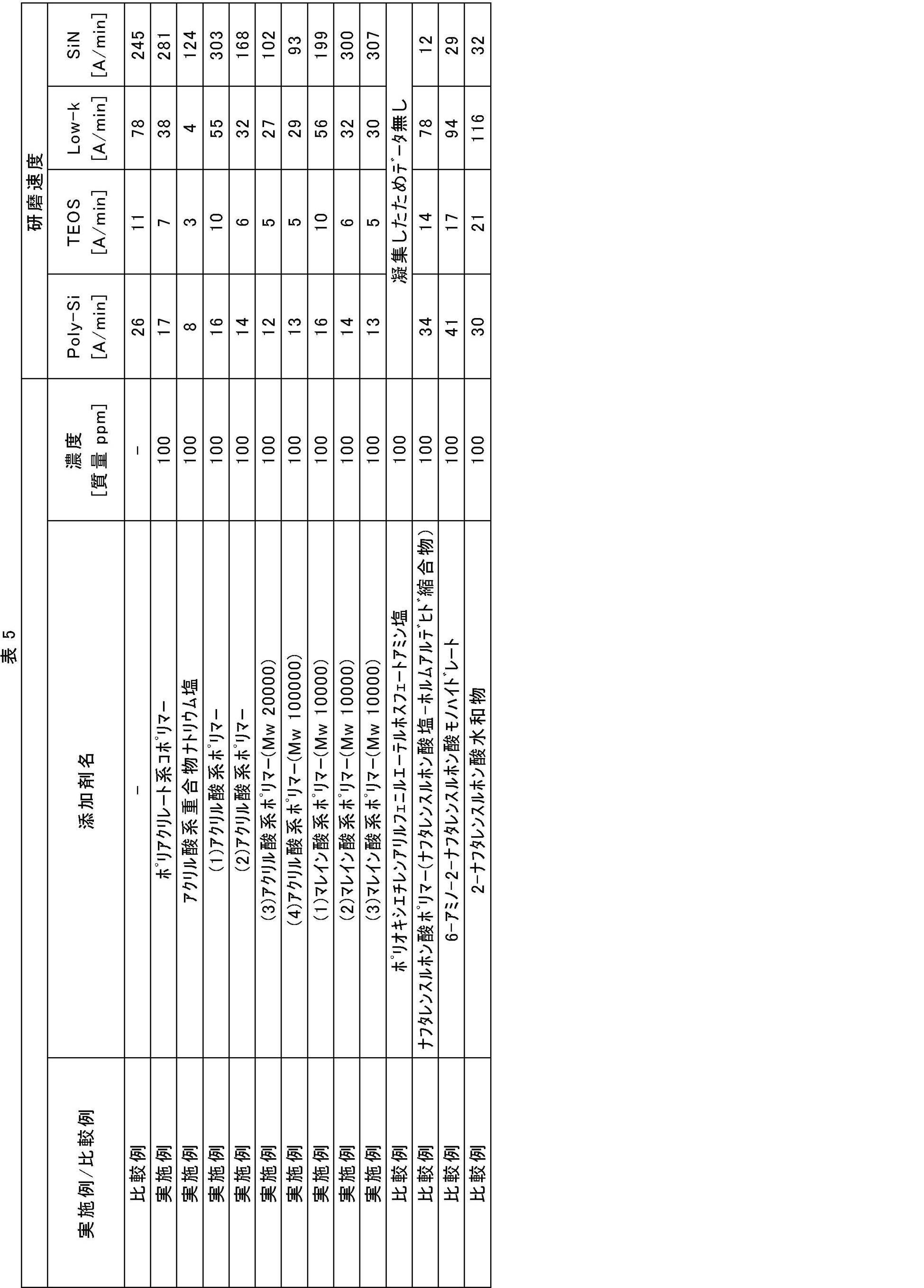
- the measurement results of the polishing rate and the selection ratio are shown in the following tables, respectively.
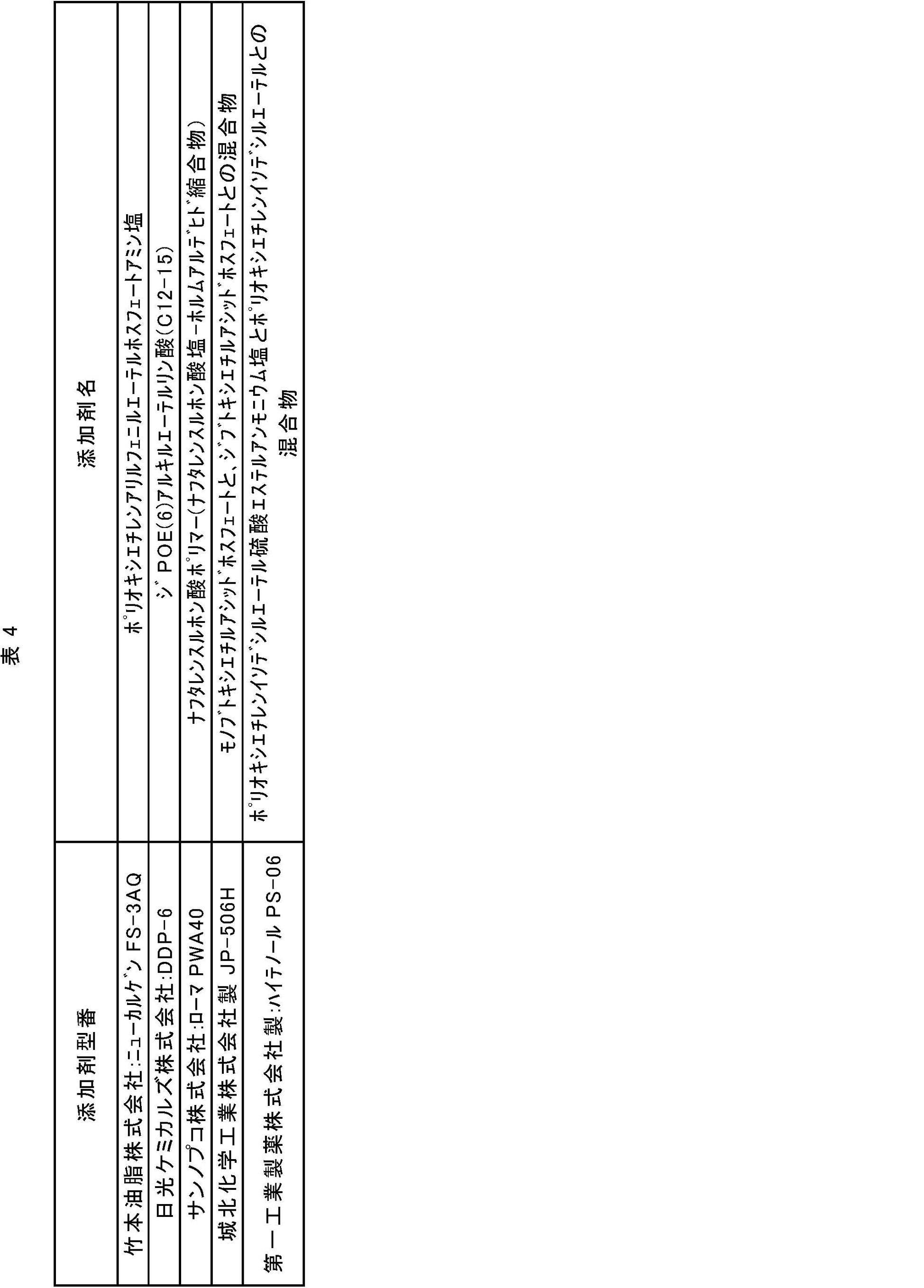
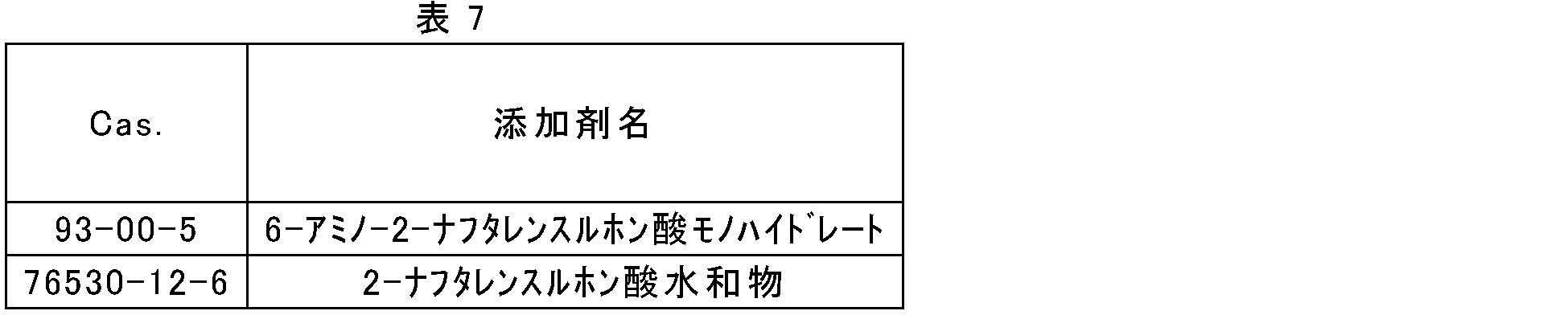
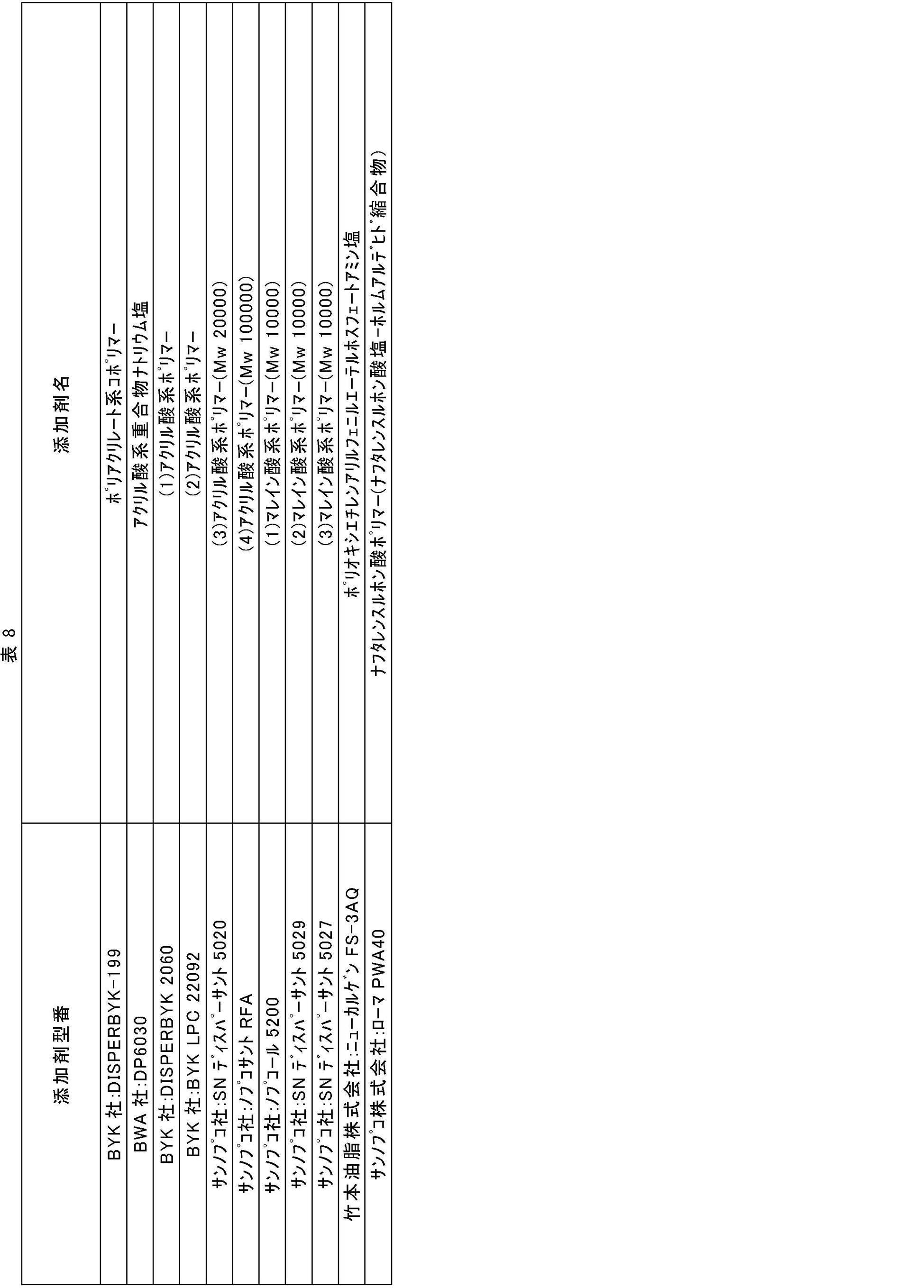
- the CAS registration number of the additive, and the manufacturer name and model number are listed in the table below.
- polishing composition of the comparative example could not improve the selectivity of the material (a) relative to the material (b).
Landscapes
- Chemical & Material Sciences (AREA)
- Organic Chemistry (AREA)
- Engineering & Computer Science (AREA)
- Mechanical Engineering (AREA)
- Composite Materials (AREA)
- Materials Engineering (AREA)
- Finish Polishing, Edge Sharpening, And Grinding By Specific Grinding Devices (AREA)
- Mechanical Treatment Of Semiconductor (AREA)
- Chemical Kinetics & Catalysis (AREA)
- General Chemical & Material Sciences (AREA)
Abstract
【課題】(a)ケイ素-窒素結合を有する材料と;(b)その他材料と;を含む、研磨対象物を研磨するにあたり、前記(b)材料の研磨速度に対する、前記(a)材料の研磨速度の比を向上させることができる技術を提供することを目的とする。 【解決手段】(a)ケイ素-窒素結合を有する材料と;(b)その他材料と;を含む研磨対象物を研磨するために用いられる研磨用組成物であって、有機酸固定シリカと;前記(b)材料の研磨速度に対する、前記(a)材料の研磨速度の比を向上させる、特定の選択比向上剤と;を含む、研磨用組成物。
Description
本発明は、研磨用組成物に関する。
近年、LSI(Large Scale Integration)の高集積化、高性能化に伴って新たな微細加工技術が開発されている。化学機械研磨(chemical mechanical polishing;CMP)法もその一つであり、LSI製造工程、特に多層配線形成工程における層間絶縁膜の平坦化、金属プラグ形成、埋め込み配線(ダマシン配線)形成において頻繁に利用される技術である。
当該CMPは、半導体製造における各工程に適用されてきており、その一態様として、例えばトランジスタ作製におけるゲート形成工程への適用が挙げられる。トランジスタ作製の際には、金属、シリコン、酸化ケイ素、多結晶シリコン(ポリシリコン)、シリコン窒化物(窒化ケイ素)といった材料を研磨することがあり、トランジスタの構造によっては、各材料の研磨レートを制御することが求められている。
例えば、近年、より低誘電率で強度の小さい膜(Low-k膜)が使用されるようになってきた。これは、最先端のデバイスでは配線間の距離が近いために、誘電率の高い絶縁膜を使用した際には配線間での電気的な不良が発生することがあるためである。しかし、このようなLow-k膜は強度が非常に小さいため、CMPの加工時に過剰に削られてしまう問題があった。そこで、バリア層を研磨する際の被研磨膜に対する研磨速度を高く維持し、かつLow-k膜に対しての研磨速度を十分に抑制しうる技術が求められてきた。
かような要求に応える技術として、特許文献1がある。特許文献1には、酸化剤と、重量平均分子量が1000以下である非イオン性化合物とを含む研磨用組成物が開示されている。
他方、Low-k膜等の各材料の研磨レートを制御したいとの要求の中には、他にも、窒化ケイ素膜などのケイ素-窒素結合を含む材料を選択的に研磨する方がよい場合があることを着想した。
しかしながら、特許文献1には、窒化ケイ素膜などのケイ素-窒素結合を含む材料を選択的に研磨する技術についての開示はなく、また、窒化ケイ素膜などのケイ素-窒素結合を含む材料の研磨速度の高選択性を発揮することはできなかった。
よって、本発明は、(a)ケイ素-窒素結合を有する材料と;(b)その他材料と;を含む、研磨対象物を研磨するにあたり、前記(b)材料の研磨速度に対する、前記(a)材料の研磨速度の比を向上させることができる技術を提供することを目的とする。
本発明者らは、上記課題を解決すべく鋭意研究を積み重ねた。その結果、(a)ケイ素-窒素結合を有する材料と;(b)その他材料と;を含む研磨対象物を研磨するために用いられる研磨用組成物であって、有機酸固定シリカと;前記(b)材料の研磨速度に対する、前記(a)材料の研磨速度の比を向上させる、選択比向上剤と;を含み、前記選択比向上剤が、(i)下記式1および下記式2:


上記式1、式2中、R1、R2、R3およびR4は、それぞれ独立して、置換または非置換の炭素数1~20のアルキル基、あるいは、置換または非置換の炭素数6~20のアリール基である、の少なくとも一方で示される、(ii)不飽和カルボン酸由来の構成単位を有するポリマーである、または、(iii)下記式3:

上記式3中、R5は、置換または非置換の炭素数3~20の分岐状アルキル基、あるいは、

であり、Eは、炭素数1~3のアルキレン基であり、R6は、置換もしくは非置換の炭素数3~20の分岐状アルキル基、または、炭素数3~20の分岐状アルキル基を有するアリール基であり、nが、2~100で示される、ただし、複数のEは、それぞれ同一でも異なっていてもよく、前記選択比向上剤は、塩の形態であってもよい、研磨用組成物によって上記課題が解決されることを見出した。
本発明によれば、(a)ケイ素-窒素結合を有する材料と;(b)その他材料と;を含む、研磨対象物を研磨するにあたり、前記(b)材料の研磨速度に対する、前記(a)材料の研磨速度の比を向上させることができる技術を提供することができる。
また、本発明によれば、窒化ケイ素膜などの(a)ケイ素-窒素結合を含む材料の、(b)その他材料(例えば、金属材料、絶縁材料、低誘電率材料など)に対する研磨速度の高選択性を発揮することができるので、デバイス製造工程における加工を所望の状態にせしめることが可能となる。
以下、本発明を説明する。なお、本発明は、以下の実施の形態のみには限定されない。また、本明細書において、範囲を示す「X~Y」は「X以上Y以下」を意味する。また、特記しない限り、操作および物性等の測定は室温(20~25℃)/相対湿度40~50%RHの条件で測定する。
(研磨用組成物)
本発明は、(a)ケイ素-窒素結合を有する材料と;(b)その他材料と;を含む研磨対象物を研磨するために用いられる研磨用組成物であって、有機酸固定シリカと;前記(b)材料の研磨速度に対する、前記(a)材料の研磨速度の比を向上させる、選択比向上剤と;を含み、前記選択比向上剤が、(i)下記式1および下記式2:
本発明は、(a)ケイ素-窒素結合を有する材料と;(b)その他材料と;を含む研磨対象物を研磨するために用いられる研磨用組成物であって、有機酸固定シリカと;前記(b)材料の研磨速度に対する、前記(a)材料の研磨速度の比を向上させる、選択比向上剤と;を含み、前記選択比向上剤が、(i)下記式1および下記式2:


上記式1、式2中、R1、R2、R3およびR4は、それぞれ独立して、置換または非置換の炭素数1~20のアルキル基、あるいは、置換または非置換の炭素数6~20のアリール基である、の少なくとも一方で示される、(ii)不飽和カルボン酸由来の構成単位を有するポリマーである、または、(iii)下記式3:

上記式3中、R5は、置換または非置換の炭素数3~20の分岐状アルキル基、あるいは、

であり、Eは、炭素数1~3のアルキレン基であり、R6は、置換もしくは非置換の炭素数3~20の分岐状アルキル基、または、炭素数3~20の分岐状アルキル基を有するアリール基であり、nが、2~100で示される、ただし、複数のEは、それぞれ同一でも異なっていてもよく、前記選択比向上剤は、塩の形態であってもよい、研磨用組成物である。
かかる構成によって、(a)ケイ素-窒素結合を有する材料と;(b)その他材料と;を含む、研磨対象物を研磨するにあたり、前記(b)材料の研磨速度に対する、前記(a)材料の研磨速度の比を向上させることができる。また、窒化ケイ素膜などの(a)ケイ素-窒素結合を含む材料の、(b)その他材料(例えば、金属材料、絶縁材料、低誘電率材料など)に対する研磨速度の高選択性を発揮することができるので、デバイス製造工程における加工を所望の状態にせしめることが可能となる。
(研磨対象物)
本発明の研磨対象物は、(a)ケイ素-窒素結合を有する材料と;(b)その他材料と;を含む。
本発明の研磨対象物は、(a)ケイ素-窒素結合を有する材料と;(b)その他材料と;を含む。
((a)ケイ素-窒素結合を有する材料)
(a)ケイ素-窒素結合を有する材料(本明細書中、単に「(a)材料」とも称する)としては、窒化ケイ素、SiCN(炭窒化ケイ素)などが挙げられる。
(a)ケイ素-窒素結合を有する材料(本明細書中、単に「(a)材料」とも称する)としては、窒化ケイ素、SiCN(炭窒化ケイ素)などが挙げられる。
((b)その他材料)
(b)その他材料(本明細書中、単に「(b)材料」とも称する)としては、ケイ素-窒素結合を有する材料以外であれば特に制限されず、含ケイ素材料(ケイ素-窒素結合を有する材料以外)、各種絶縁材料、各種金属材料等などが挙げられる。
(b)その他材料(本明細書中、単に「(b)材料」とも称する)としては、ケイ素-窒素結合を有する材料以外であれば特に制限されず、含ケイ素材料(ケイ素-窒素結合を有する材料以外)、各種絶縁材料、各種金属材料等などが挙げられる。
本発明の好ましい実施形態によれば、(b)その他の材料が、タングステン、タンタル、チタン、コバルト、ルテニウム、ハフニウムまたはアルミニウムである金属材料;前記金属材料と、窒素、酸素、ケイ素、炭素またはリンとを複合させてなる合金材料;ケイ素-ケイ素結合を有する材料;低誘電率材料(Low-k材料);および絶縁材料;からなる群から選択される少なくとも一種である。かかる研磨対象物であれば研磨速度の高選択性をより効果的に発揮できる。
ここで、ケイ素-ケイ素結合を有する材料としては、ポリシリコン、アモルファスシリコン、単結晶シリコン、n型ドープ単結晶シリコン、p型ドープ単結晶シリコンなどが挙げられる。
低誘電率材料(Low-k材料)は、酸化ケイ素(k=4.0)よりも比誘電率kが低い材料であり、好ましくは比誘電率kが3.0以下の材料であり、具体的には、SiOC、メチル基を含有する酸化ケイ素、フッ素化酸化ケイ素(SiOF)、ベンゾシクロブテン(BCB)、HSQ(ハイドロゲンシルセスキオキサン)、MSQ(メチルシルセスキオキサン)、HMSQ(ハイドライド-メチルシルセスキオキサン)、ポリイミド系ポリマー、アリレンエーテル系ポリマー、シクロブテン系ポリマーおよびパーフロロシクロブテン(PFCB)からなる群から選ばれる少なくとも1種である。
絶縁材料は、1×10¹⁰Ω・cm以上の体積抵抗率を有する材料であって、上記以外の材料を言い、例えば、アクリル系樹脂、フェノール系樹脂、フッ素系樹脂、エポキシ系樹脂、カルド系樹脂、ビニル系樹脂、イミド系樹脂、ノボラック系樹脂、ポリパラキシレン等の有機材料や、TEOS(酸化ケイ素)、Al2O3等の無機材料を挙げることができる。
(選択比向上剤)
本発明では、研磨用組成物に、選択比向上剤を含有させることによって、(a)材料の選択比を向上させる。
本発明では、研磨用組成物に、選択比向上剤を含有させることによって、(a)材料の選択比を向上させる。
当該選択比向上剤は、以下の(i)、(ii)または(iii)であり、これらは適宜組み合わせて用いてもよい。
(i)
本発明の好ましい実施形態の選択比向上剤は、下記式1および下記式2:
本発明の好ましい実施形態の選択比向上剤は、下記式1および下記式2:


上記式1、式2中、R1、R2、R3およびR4は、それぞれ独立して、置換または非置換の炭素数1~20のアルキル基、あるいは、置換または非置換の炭素数6~20のアリール基である、の少なくとも一方で示される。
当該選択比向上剤を、研磨用組成物に添加することによって、(a)材料の選択比が向上するメカニズムは明らかではないが、以下のように推測される。すなわち、当該選択比向上剤が有するリン原子と(a)材料中の窒素原子との親和性、および、当該選択比向上剤が有するアルキル基またはアリール基と(a)材料中のケイ素原子との親和性が高いからではないか等が考えられる。この際、R1およびR2ならびにR3およびR4が、例えば、1つでも水素原子であると、親和性が向上せず本発明の所期の効果を有することはできない。ただし、かかるメカニズムによって本発明の技術的範囲が制限されないのは言うまでもない。
本発明の実施形態によれば、前記アルキル基の炭素数は、2~15であることが好ましく、2~14であることがより好ましく、2~13であることがさらに好ましい。かかる実施形態によれば、研磨速度の高選択性をより効果的に発揮できる。
ここで、炭素数1~20のアルキル基の具体例については特に制限はないが、メチル基、エチル基、プロピル基、イソプロピル基、n-ブチル基、イソブチル基、sec-ブチル基、tert-ブチル基、ペンチル基、イソペンチル基、ネオペンチル基、2-エチルヘキシル基、ヘキシル基、ヘプチル基、オクチル基、ノニル基、デシル基、ウンデシル基、ドデシル基(ラウリル基)、トリデシル基、テトラデシル基(ミリスチル基)、ペンタデシル基、ヘキサデシル基(パルミチル基)、ヘプタデシル基、オクタデシル基(ステアリル基)、ノナデシル基、イコシル基などを挙げることができる。
一実施形態において、R1、R2、R3およびR4が、非置換の炭素数1~20のアルキル基である場合、当該アルキル基の炭素数は、より好ましくは3~14であり、さらに好ましくは4~13である。このような範囲であることによって、研磨速度の高選択性をより効果的に発揮できる。
他方、一実施形態において、R1、R2、R3およびR4が、置換の炭素数1~20のアルキル基である場合、置換基は、炭素数1~10のアルコキシ基または炭素数6~20のアリール基であると好ましい。かかる実施形態によれば、研磨速度の高選択性をより効果的に発揮できる。
ここで、当該アルコキシ基の炭素数は、研磨速度の高選択性をより効果的に発揮できる観点から、2~8が好ましく、3~6がより好ましく、4~6であることがさらに好ましい。また、当該アリール基としては、フェニル基、ナフチル基、アントラセニル基(アントリル基)などが挙げられる。このように、当該置換基が、アルコキシ基、アリール基などの炭素原子を有するとき、前記アルキル基の炭素数は、好ましくは1~4であり、より好ましくは2~3である。
本形態で、R1、R2、R3およびR4が、置換の炭素数1~20のアルキル基である場合、例えば、メトキシメチル基、エトキシメチル基、プロポキシメチル基、メトキシエチル基、エトキシエチル基、プロポキシエチル基、イソプロポキシエチル基、ブトキシエチル基、ヘキシルオキシエチル基、ヘプチルオキシエチル基、オクチルオキシエチル基、シクロヘキシルオキシエチル基等のアルコキシアルキル基や、ベンジル基、フェネチル基、ナフチルメチル基、アントリルメチル基等のアラルキル基が好適である。このように、鎖状構造や脂環構造に、芳香環構造を有していてもよい。
一方、一実施形態において、R1、R2、R3およびR4が、非置換の炭素数6~20のアリール基である場合、当該アリール基としては、上記で掲げたものが好適に適用できる。
他方、一実施形態において、R1、R2、R3およびR4が、置換の炭素数6~20のアリール基である場合、当該置換基は、炭素数1~20のアルキル基または炭素数1~10のアルコキシ基であることが好ましい。
当該炭素数1~20のアルキル基、当該炭素数1~10のアルコキシ基についての具体的説明は、上記が同様に妥当する。
本形態で、R1、R2、R3およびR4が、置換の炭素数6~20のアリール基である場合、例えば、トリル基、キシリル基、メシチル基、メチルナフチル基、メチルアントリル基等、メトキシフェニル基、エトキシフェニル基等が好適である。このように、芳香環構造のみならず、その一部に鎖状構造や脂環構造を含んでいてもよい。
以上を鑑みると、本発明の好ましい実施形態は、前記選択比向上剤が、ビス(2-エチルヘキシル)ホスフェート、ジラウリルハイドロゲンホスファイト、ブチルアシッドホスフェート、モノブトキシエチルアシッドホスフェートおよびジフェニルハイドロゲンホスファイトからなる群から選択される少なくとも一種である。かかる実施形態によれば、研磨速度の高選択性をより効果的に発揮できる。
(ii)
本発明の好ましい実施形態の選択比向上剤は、不飽和カルボン酸由来の構成単位を有するポリマーである(本明細書において、単に「ポリマー」とも称する。)。
本発明の好ましい実施形態の選択比向上剤は、不飽和カルボン酸由来の構成単位を有するポリマーである(本明細書において、単に「ポリマー」とも称する。)。
当該選択比向上剤を研磨用組成物に添加することによって、メカニズムは明らかではないが、(a)材料の選択比が向上する。
本発明のポリマーは、不飽和カルボン酸由来の構成単位を含めば、ホモポリマー(単一重合体)であっても、コポリマー(共重合体)であってもよい。ただし、本発明の所期の目的を効率よく達成する観点から、共重合体であることが好ましい。
ここで、当該共重合体の構造も特に制限されず、ランダム共重合体、交互共重合体、周期的共重合体、ブロック共重合体のいずれであってもよい。また、構成単位の種類も2種類以上であれば特に制限されず、3種類であっても、4種類であっても、それ以上であってもよい。
不飽和カルボン酸としては、(メタ)アクリル酸、クロトン酸、フマル酸、(無水)マレイン酸、イタコン酸等が挙げられる。また、当該不飽和カルボン酸は、エステルの形態となっていてもよく、不飽和カルボン酸エステルとしては、(メタ)アクリル酸エステル、クロトン酸エステル、フマル酸エステル、マレイン酸エステル、イタコン酸エステル等が挙げられる。かかる不飽和カルボン酸エステルは、上記不飽和カルボン酸のカルボキシル基に、アルキル基、ヒドロキシアルキル基、ポリアルキレングリコール由来の基等が導入されている形態を言う。
ここで、アルキル基、ヒドロキシアルキル基におけるアルキル基の炭素数にも特に制限はないが、好ましくは1~10である。かかるアルキル基としては、メチル基、エチル基、プロピル基、イソプロピル基、n-ブチル基、イソブチル基、sec-ブチル基、tert-ブチル基、ペンチル基、イソペンチル基、ネオペンチル基、2-エチルヘキシル基、ヘキシル基、ヘプチル基、オクチル基、ノニル基、デシル基などが好ましい。
また、ポリアルキレングリコールは、アルキレンオキサイドを付加重合して合成することができ、アルキレンオキサイドとしては、エチレンオキサイド、プロピレンオキサイド、ブチレンオキサイドなどが挙げられる。
上記のうち、本発明の所期の効果を効率よく奏するために、本発明の好ましい実施形態によれば、前記不飽和カルボン酸由来の構成単位が、(メタ)アクリル酸由来の構成単位、あるいは、マレイン酸由来の構成単位である。
また、本発明のポリマーは、不飽和カルボン酸由来の構成単位の他に、他の構成単位を含んでもよく、例えば、α-オレフィン由来の構成単位;不飽和ニトリル由来の構成単位;不飽和アミド由来の構成単位;芳香族ビニル由来の構成単位;脂肪族ビニル由来の構成単位;および不飽和結合含有複素環類由来の構成単位等が挙げられる。
α-オレフィンとしては、エチレン、プロピレン、ブタジエン等が挙げられ;
不飽和ニトリルとしては、アクリロニトリル、メタクリロニトリルが挙げられ;
不飽和アミドとしては、アクリルアミド、ジメチルアクリルアミド、メタクリルアミド、N-メチロールアクリルアミドが挙げられ;
芳香族ビニルとしては、スチレン、α-メチルスチレンが挙げられ;
脂肪族ビニルとしては、酢酸ビニルが挙げられ;
不飽和結合含有飽和複素環としては、N-ビニルピロリドン、アクリロイルモルホリンが挙げられる。
不飽和ニトリルとしては、アクリロニトリル、メタクリロニトリルが挙げられ;
不飽和アミドとしては、アクリルアミド、ジメチルアクリルアミド、メタクリルアミド、N-メチロールアクリルアミドが挙げられ;
芳香族ビニルとしては、スチレン、α-メチルスチレンが挙げられ;
脂肪族ビニルとしては、酢酸ビニルが挙げられ;
不飽和結合含有飽和複素環としては、N-ビニルピロリドン、アクリロイルモルホリンが挙げられる。
本発明の好ましい実施形態によれば、本発明のポリマーは共重合体であることが好ましく、芳香族ビニル由来の構成単位を含むことが好ましい。
なお、本発明の所期の効果を効率的に発揮する観点から、本発明の選択比向上剤は、マレイン酸の単一重合体(ポリマレイン酸)ではないことが好ましい。
なお、不飽和カルボン酸由来の構成単位におけるカルボキシル基は、塩基性物質によって中和されていてもよい。かかる塩基性物質としては、例えば炭酸(水素)塩、ナトリウム等のアルカリ金属の水酸化物、アンモニア、有機アミン等の公知の塩基性物質を適宜用いればよい。また中和率についても特に限定されず、任意の中和率、例えば30~100モル%、あるいは50~80モル%の任意の値となるように調整すればよい。中和の方法は、ポリマーに塩基性物質を添加することによって行ってもよいし、一部または全部中和のモノマーを用いて重合させることによって行ってもよい。
本発明のポリマーの重量平均分子量については特に制限はないが、2,000以上であることが好ましく、4,000以上であることがより好ましく、8,000以上であることがさらに好ましく、15,000以上であってもよく、80,000以上であってもよい。また、60万以下であることが好ましく、40万以下であることがより好ましく、20万以下であることがさらに好ましく、15万以下であることがよりさらに好ましい。
なお、重量平均分子量の測定方法は、実施例の方法に従う。
(iii)
本発明の好ましい実施形態の選択比向上剤は、下記式3:
本発明の好ましい実施形態の選択比向上剤は、下記式3:

上記式3中、R5は、置換または非置換の炭素数3~20の分岐状アルキル基、あるいは、

であり、Eは、炭素数1~3のアルキレン基であり、R6は、置換もしくは非置換の炭素数3~20の分岐状アルキル基、または、炭素数3~20の分岐状アルキル基を有するアリール基であり、nが、2~100、で示される。複数のEは、それぞれ同一でも異なっていてもよい。ここで、nは、好ましくは3~50であり、より好ましくは4~25である。
本発明の実施形態によれば、前記分岐状アルキル基の炭素数は、3~15であることが好ましく、4~13であることがより好ましく、5~11であることがさらに好ましく、6~10であることがよりさらに好ましく、7~10であることが特に好ましい。かかる実施形態によれば、研磨速度の高選択性をより効果的に発揮できる。前記置換もしくは非置換の炭素数3~20の分岐状アルキル基における置換基としては、特に制限はないが、炭素数1~10のアルコキシ基または炭素数6~20のアリール基などが挙げられる。
ここで、炭素数3~20の分岐状アルキル基の具体例については特に制限はないが、イソプロピル基、イソブチル基、sec-ブチル基、tert-ブチル基、イソペンチル基、ネオペンチル基、2-エチルヘキシル基、イソデシル基などが挙げられる。これらの中でも、2-エチルヘキシル基、イソデシル基が好ましい。本発明の実施形態によれば、炭素数1~3のアルキレン基としては、メチレン基、エチレン基、プロピレン基が挙げられ、エチレン基、プロピレン基が好ましい。
本発明の実施形態によれば、炭素数3~20の分岐状アルキル基を有するアリール基における、炭素数3~20の分岐状アルキル基は、上記で掲げたものが好適であり、アリール基としては、例えばフェニル基、ナフチル基などが挙げられる。
なお、直鎖状のアルキル基を有する添加剤を使用したとしても、本発明の所期の効果を期待することができないと考えられる。その理由は不明であるが、研磨環境は研磨中の瞬間毎に変わり得り、例えば添加剤の濃度分布等を含めた環境が変動し得る。分岐状アルキル基を持たない添加剤(直鎖状アルキル基や分岐型置換基を持たないアリール基を有するもの)では、その環境毎に効果を発揮できる瞬間が存在し得るとも推測されるが、その時点が極めて限定的かつ狭小だからではないかと考えられる。
なお、前記選択比向上剤は、塩の形態であってもよい。塩の種類にも特に制限はないが、ナトリウム塩、カリウム塩、アンモニウム塩、また、1~4級のアミン塩などが好適ではあるが、塩の種類に限定はない。
本発明の研磨用組成物中、選択比向上剤の含有量の下限は、1質量ppm以上であることが好ましく、10質量ppm以上であることがより好ましく、80質量ppm以上であることがさらに好ましく、90質量ppm以上であることはよりさらに好ましい。下限がこのようであると、本発明の効果をより効果的に発揮する。
また、本発明の研磨用組成物中、選択比向上剤の含有量の上限は、10000質量ppm以下であることが好ましく、1000質量ppm以下であることがより好ましく、500質量ppm以下であることがさらに好ましく、300質量ppm以下がよりさらに好ましい。上限がこのようであると、コスト面、ウェハへの残留防止の観点から有利である。
(砥粒:有機酸固定シリカ)
本発明において、研磨用組成物の砥粒として作用する有機酸固定シリカは、シリカに有機酸が固定化されてなるものである(本明細書中、「有機酸固定シリカ」を単に「砥粒」とも称する場合がある)。また、シリカとしては、研磨傷の発生を抑制する観点から、コロイダルシリカを用いることが好ましい。
本発明において、研磨用組成物の砥粒として作用する有機酸固定シリカは、シリカに有機酸が固定化されてなるものである(本明細書中、「有機酸固定シリカ」を単に「砥粒」とも称する場合がある)。また、シリカとしては、研磨傷の発生を抑制する観点から、コロイダルシリカを用いることが好ましい。
本発明において、砥粒は、有機酸固定シリカであることを必須とする。ここで、有機酸が固定化されていないシリカなどの砥粒を使用しても、本発明の所期の目的は達成できない。
ここで、コロイダルシリカは、例えば、ゾルゲル法によって製造されたものでありうる。ゾルゲル法によって製造されたコロイダルシリカは、半導体中に拡散性のある金属不純物や塩化物イオン等の腐食性イオンの含有量が少ないため好ましい。ゾルゲル法によるコロイダルシリカの製造は、従来公知の手法を用いて行うことができ、具体的には、加水分解可能なケイ素化合物(例えば、アルコキシシランまたはその誘導体)を原料とし、加水分解・縮合反応を行うことにより、コロイダルシリカを得ることができる。
ところで、有機酸の固定化は、シリカと有機酸とを単に共存させただけでは果たされない。例えば、有機酸の一種であるスルホン酸をシリカに固定化するのであれば、例えば、 “Sulfonic acid-functionalized silica through of thiol groups”, Chem. Commun. 246-247 (2003)に記載の方法で行うことができる。具体的には、3-メルカプトプロピルトリメトキシシランなどのチオール基を有するシランカップリング剤をシリカにカップリングさせた後に過酸化水素でチオール基を酸化することにより、スルホン酸が表面に固定化されたシリカを得ることができる。実施例で使用したコロイダルシリカも、このようにしてスルホン酸基が修飾されている。
あるいは、有機酸の一種であるカルボン酸をシリカに固定化するのであれば、例えば、 “Novel Silane Coupling Agents Containing a Photolabile 2-Nitrobenzyl Ester for Introduction of a Carboxy Group on the Surface of Silica Gel”, Chemistry Letters,3, 228-229 (2000)に記載の方法で行うことができる。具体的には、光反応性2-ニトロベンジルエステルを含むシランカップリング剤をシリカにカップリングさせた後に光照射することにより、カルボン酸が表面に固定化されたシリカを得ることができる。
本発明の好ましい実施形態によれば、前記有機酸固定シリカが、スルホン酸固定シリカである。かかる実施形態によって、シリカの分散性がより優れる。
本発明の研磨用組成物中、砥粒の平均一次粒子径の下限は、5nm以上であることが好ましく、7nm以上であることがより好ましく、10nm以上であることがさらに好ましい。また、本発明の研磨用組成物中、砥粒の平均一次粒子径の上限は、60nm以下が好ましく、40nm以下がより好ましく、25nm以下がさらに好ましく、20nm以下がよりさらに好ましい。このような範囲であれば、研磨用組成物を用いて研磨した後の研磨対象物の表面にスクラッチなどのディフェクトを抑えることができる。なお、砥粒の平均一次粒子径は、例えば、BET法で測定される砥粒の比表面積に基づいて算出される。
本発明の研磨用組成物中、砥粒の平均二次粒子径の下限は、15nm以上であることが好ましく、18nm以上であることがより好ましく、26nm以上であることがさらに好ましい。また、砥粒の平均二次粒子径の上限は、90nm以下であることが好ましく、70nm以下であることがより好ましく、50nm以下であることがさらに好ましく、45nm以下であることがよりさらに好ましい。このような範囲であれば、研磨用組成物を用いて研磨した後の研磨対象物の表面に表面欠陥が生じるのをより抑えることができる。なお、ここでいう二次粒子とは、砥粒が研磨用組成物中で会合して形成する粒子をいい、この二次粒子の平均二次粒子径は、例えばレーザー回折散乱法に代表される動的光散乱法により測定することができる。
本発明の研磨用組成物中の砥粒における、レーザー回折散乱法により求められる粒度分布において、微粒子側から積算粒子質量が全粒子質量の90%に達するときの粒子の直径D90と、全粒子の全粒子質量の10%に達するときの粒子の直径D10との比(本明細書中、単に「D90/D10」とも称する)の下限は、1.3以上であることが好ましく、1.4以上であることがより好ましく、1.5以上であることがさらに好ましく、1.9以上であることがよりさらに好ましい。また、D90/D10の上限は特に制限はないが、5.0以下であることが好ましく、4.0以下であることがより好ましく、3.0以下であることがさらに好ましく、2.3以下であることがよりさらに好ましい。このような範囲であれば、研磨用組成物を用いて研磨した後の研磨対象物の表面に表面欠陥が生じるのをより抑えることができる。
本発明の研磨用組成物中、砥粒の含有量の下限は、0.01質量%以上であることが好ましく、0.05質量%以上であることがより好ましく、0.1質量%以上であることがさらに好ましい。また、本発明の研磨用組成物中、砥粒の含有量の上限は、20質量%以下であることが好ましく、10質量%以下であることがより好ましく、5質量%以下であることがさらに好ましく、1質量%以下であることがよりさらに好ましく、0.5質量%以下であることがよりさらに好ましい。上限がこのようであると、研磨用組成物のコストを抑えることができ、研磨用組成物を用いて研磨した後の研磨対象物の表面に表面欠陥が生じるのをより抑えることができる。
(分散媒)
本発明の研磨用組成物は、研磨用組成物を構成する各成分の分散のために分散媒が用いられうる。分散媒としては、有機溶媒、水が考えられるが、その中でも水を含むことが好ましい。
本発明の研磨用組成物は、研磨用組成物を構成する各成分の分散のために分散媒が用いられうる。分散媒としては、有機溶媒、水が考えられるが、その中でも水を含むことが好ましい。
研磨対象物の汚染や他の成分の作用を阻害するという観点から、不純物をできる限り含有しない水が好ましい。具体的には、イオン交換樹脂にて不純物イオンを除去した後フィルタを通して異物を除去した純水や超純水、または蒸留水が好ましい。
(pH調整剤)
本発明の研磨用組成物は、酸性領域、中性領域、塩基性領域のいずれかに調整されうるが、窒化膜等の(a)材料の研磨速度向上の観点から、酸性領域に調製されていることが好ましい。
本発明の研磨用組成物は、酸性領域、中性領域、塩基性領域のいずれかに調整されうるが、窒化膜等の(a)材料の研磨速度向上の観点から、酸性領域に調製されていることが好ましい。
本発明において酸性領域とは、pHが7.0未満を意味し、好ましくはpH0.5~6.0であり、より好ましくは1.5~4.5であり、さらに好ましくは2.0~4.0である。よって、本発明の好ましい実施形態によれば、pHが、0.5~6.0である。かかる実施形態によれば、研磨速度の高選択性をより効果的に発揮できる。また、中性領域とは、pH7.0を意味する。また、塩基性領域とは、pH7.0超を意味し、好ましくはpH8.0~13.0である。なお、本発明におけるpHの値は、実施例に記載の条件で測定した値を言うものとする。
酸性の領域に調整するためのpH調整剤の具体例としては、無機化合物および有機化合物のいずれであってもよいが、例えば、硫酸、硝酸、ホウ酸、炭酸、次亜リン酸、亜リン酸およびリン酸等の無機酸;クエン酸、ギ酸、酢酸、プロピオン酸、安息香酸、サリチル酸、グリセリン酸、シュウ酸、マロン酸、コハク酸、マレイン酸、フタル酸、リンゴ酸、酒石酸、および乳酸などのカルボン酸、ならびにメタンスルホン酸、エタンスルホン酸およびイセチオン酸等の有機硫酸等の有機酸等が挙げられる。また、上記の酸で2価以上の酸(たとえば、硫酸、炭酸、リン酸、シュウ酸など)の場合、プロトン(H+)が1つ以上放出できるようであれば、塩の状態でもよい。具体的には、例えば、炭酸水素アンモニウム、リン酸水素アンモニウム(カウンター陽イオンの種類は基本的に何でもよいが、弱塩基の陽イオン(アンモニウム、トリエタノールアミンなど)が好ましい)。
塩基性の領域に調整するためのpH調整剤の具体例としては、無機化合物および有機化合物のいずれであってもよいが、アルカリ金属の水酸化物またはその塩、第四級アンモニウム、水酸化第四級アンモニウムまたはその塩、アンモニア、アミン等が挙げられる。
アルカリ金属の具体例としては、カリウム、ナトリウム等が挙げられる。塩の具体例としては、炭酸塩、炭酸水素塩、硫酸塩、酢酸塩等が挙げられる。
第四級アンモニウムの具体例としては、テトラメチルアンモニウム、テトラエチルアンモニウム、テトラブチルアンモニウム等が挙げられる。
水酸化第四級アンモニウムまたはその塩としては、具体例としては、水酸化テトラメチルアンモニウム、水酸化テトラエチルアンモニウム、水酸化テトラブチルアンモニウム等が挙げられる。
中でも、研磨用組成物には、塩基として、金属汚染防止や半導体デバイス構造中への金属イオンの拡散のしやすさの観点から、アンモニア、アミン、カリウムを含むことがさらに好ましい。具体的には水酸化カリウム、炭酸カリウム、炭酸水素カリウム、硫酸カリウム、酢酸カリウム、塩化カリウム等が挙げられる。
(研磨用組成物の製造方法)
本発明は、前記(a)材料と;前記(b)材料と;を含む研磨対象物を研磨するために用いられる研磨用組成物の製造方法であって、前記有機酸固定シリカと、前記選択比向上剤とを、分散媒に含有することを有する、製造方法も提供される。
本発明は、前記(a)材料と;前記(b)材料と;を含む研磨対象物を研磨するために用いられる研磨用組成物の製造方法であって、前記有機酸固定シリカと、前記選択比向上剤とを、分散媒に含有することを有する、製造方法も提供される。
研磨用組成物の製造方法は、特に制限されないが、前記有機酸固定シリカと、前記選択比向上剤と、必要に応じて他の成分とを、分散媒中で攪拌混合することにより得ることができる。
(a)材料、(b)材料、有機酸固定シリカ、選択比向上剤、分散媒の具体的な説明は、上記の説明が妥当する。
なお、他の成分としては、pH調整剤、酸化剤、還元剤、界面活性剤、水溶性高分子、防カビ剤等の成分が挙げられる。
各成分を混合する際の温度は特に制限されないが、10~40℃が好ましく、溶解速度を上げるために加熱してもよい。また、混合時間も特に制限されない。
(研磨方法、基板の製造方法)
本発明においては、本発明の研磨用組成物を使って研磨対象物を研磨する、研磨方法も提供される。また、本発明においては、当該研磨方法を有する、基板の製造方法も提供される。
本発明においては、本発明の研磨用組成物を使って研磨対象物を研磨する、研磨方法も提供される。また、本発明においては、当該研磨方法を有する、基板の製造方法も提供される。
研磨装置としては、研磨対象物を有する基板等を保持するホルダーと回転数を変更可能なモータ等とが取り付けてあり、研磨パッド(研磨布)を貼り付け可能な研磨定盤を有する一般的な研磨装置を使用することができる。
前記研磨パッドとしては、一般的な不織布、ポリウレタン、および多孔質フッ素樹脂等を特に制限なく使用することができる。研磨パッドには、研磨用組成物が溜まるような溝加工が施されていることが好ましい。
研磨条件にも特に制限はなく、例えば、研磨定盤の回転速度は、10~500rpmが好ましく、キャリア回転速度は、10~500rpmが好ましく、研磨対象物を有する基板にかける圧力(研磨圧力)は、0.1~10psiが好ましい。研磨パッドに研磨用組成物を供給する方法も特に制限されず、例えば、ポンプ等で連続的に供給する方法が採用される。この供給量に制限はないが、研磨パッドの表面が常に本発明の研磨用組成物で覆われていることが好ましい。
(選択比の向上方法)
本発明の好ましい実施形態によれば、研磨用組成物を用いて、(a)ケイ素-窒素結合を有する材料と;(b)その他材料と;を含む、研磨対象物を研磨するにあたり、前記(b)材料の研磨速度に対する、前記(a)材料の研磨速度の比を向上させる方法であって、前記研磨用組成物に、有機酸固定シリカと;選択比向上剤と;を含ませることを有する、方法が提供される。
本発明の好ましい実施形態によれば、研磨用組成物を用いて、(a)ケイ素-窒素結合を有する材料と;(b)その他材料と;を含む、研磨対象物を研磨するにあたり、前記(b)材料の研磨速度に対する、前記(a)材料の研磨速度の比を向上させる方法であって、前記研磨用組成物に、有機酸固定シリカと;選択比向上剤と;を含ませることを有する、方法が提供される。
(a)材料、(b)材料、有機酸固定シリカ、選択比向上剤の具体的な説明は、上記の説明が妥当する。
本発明の選択比の向上方法によれば、前記(b)材料に対する、前記(a)材料の選択比が、実施例の欄に記載のように、本発明の選択比向上剤を含有させない場合と比較して、向上する。
本発明の好ましい実施形態において、前記(b)材料が、ケイ素-ケイ素結合を有する場合、好ましい選択比は、10以上であり、より好ましくは11以上、さらに好ましくは15以上、よりさらに好ましくは20以上である。
本発明の好ましい実施形態において、前記(b)材料が、絶縁材料である場合、好ましい選択比は、23以上であり、より好ましくは25以上、さらに好ましくは35以上、よりさらに好ましくは50以上である。
本発明の好ましい実施形態において、前記(b)材料が、Low-k材料である場合、好ましい選択比は、3.2以上であり、より好ましくは4以上であり、さらに好ましくは6以上、よりさらに好ましくは8以上、よりさらに好ましくは12以上であり、よりさらに好ましくは30以上である。
ここで、同じ選択比向上剤を使用したとしても、(b)材料の種類に応じて、(a)材料の選択比の数値は変わりうる。そのため、選択比向上剤を含有することによって選択比が向上しているかどうかは、各(b)材料の種類毎に、選択比向上剤を含有させなかったときと比較することによって判断することができる。
本発明の好ましい実施形態によれば、前記選択比向上剤を、研磨用組成物に含有させることによって、2種類以上の(b)材料に対して、選択比を向上することができる。より好ましくは3種類以上、さらに好ましくは4種類以上の(b)材料に対して、選択比を向上することができる。このように多くの(b)材料に対して(a)材料の選択比を向上させることができるということは、その選択比向上剤は汎用性が高いと言える。
本発明を、以下の実施例および比較例を用いてさらに詳細に説明する。ただし、本発明の技術的範囲が以下の実施例のみに制限されるわけではない。また、下記実施例において、特記しない限り、操作は室温(25℃)/相対湿度40~50%RHの条件下で行われた。
<研磨用組成物の調製>
研磨用組成物を、砥粒(スルホン酸固定コロイダルシリカ;平均一次粒子径:14nm、平均二次粒子径:34nm、D90/D10:約2.1)と;pH調整剤と;下記表に示される各種の添加剤と;を、砥粒が0.2質量%となるように、また各種の添加剤が下記表に示される濃度となるように、またpH3.0となるように分散媒(純水)中で混合することにより調製した(混合温度:約25℃、混合時間:約10分)。
研磨用組成物を、砥粒(スルホン酸固定コロイダルシリカ;平均一次粒子径:14nm、平均二次粒子径:34nm、D90/D10:約2.1)と;pH調整剤と;下記表に示される各種の添加剤と;を、砥粒が0.2質量%となるように、また各種の添加剤が下記表に示される濃度となるように、またpH3.0となるように分散媒(純水)中で混合することにより調製した(混合温度:約25℃、混合時間:約10分)。
なお、クエン酸、水酸化カリウム(KOH)を適量選択して添加することによって、すべての研磨用組成物を、pH3.0に調製した。
研磨用組成物(液温:25℃)のpHは、pHメータ(株式会社 堀場製作所製 型番:LAQUA)により確認した。また、下記表に示される添加剤の重量平均分子量(Mw)は、GPC(ゲル透過クロマトグラフィー)法により測定したポリスチレン換算の値を採用している。
<研磨性能評価>
研磨対象物として、
・200mmウェハ(Poly-Si(ポリシリコン膜):CVD法で成膜)、
・200mmウェハ(SiN(窒化ケイ素膜):CVD法で成膜)、
・200mmウェハ(TEOS(酸化ケイ素膜):CVD法で成膜)、
・200mmウェハ(Low-k材料(メチル基を含有する酸化ケイ素膜):SOD法で成膜)、
を準備し、上記で得られた研磨用組成物を用いて、各ウェハを以下の研磨条件で研磨し、研磨速度を測定した。また選択比を算出した。
研磨対象物として、
・200mmウェハ(Poly-Si(ポリシリコン膜):CVD法で成膜)、
・200mmウェハ(SiN(窒化ケイ素膜):CVD法で成膜)、
・200mmウェハ(TEOS(酸化ケイ素膜):CVD法で成膜)、
・200mmウェハ(Low-k材料(メチル基を含有する酸化ケイ素膜):SOD法で成膜)、
を準備し、上記で得られた研磨用組成物を用いて、各ウェハを以下の研磨条件で研磨し、研磨速度を測定した。また選択比を算出した。
(研磨条件)
研磨機:200mmウェハ用CMP片面研磨機
研磨パッド:ポリウレタン製パッド(IC1010:ロームアンドハース社製)
圧力:3psi(約20.7kPa)
プラテン(定盤)回転数:90rpm
ヘッド(キャリア)回転数:87rpm
研磨用組成物の流量:130ml/min
研磨時間:1分間
(研磨速度)
研磨速度(研磨レート)は、以下の式により計算した。
研磨機:200mmウェハ用CMP片面研磨機
研磨パッド:ポリウレタン製パッド(IC1010:ロームアンドハース社製)
圧力:3psi(約20.7kPa)
プラテン(定盤)回転数:90rpm
ヘッド(キャリア)回転数:87rpm
研磨用組成物の流量:130ml/min
研磨時間:1分間
(研磨速度)
研磨速度(研磨レート)は、以下の式により計算した。

膜厚は、光干渉式膜厚測定装置(ケーエルエー・テンコール(KLA)株式会社製 型番:ASET)によって求めて、その差を研磨時間で除することにより評価した。
(選択比)
選択比は、膜種(a)(SiN(窒化ケイ素膜))の研磨速度(Å/min)と、膜種(b)の研磨速度(Å/min)との割合をとったもので、(a)÷(b)の計算式にて求めた。研磨速度および選択比の測定結果を、それぞれ下記の表に示す。
選択比は、膜種(a)(SiN(窒化ケイ素膜))の研磨速度(Å/min)と、膜種(b)の研磨速度(Å/min)との割合をとったもので、(a)÷(b)の計算式にて求めた。研磨速度および選択比の測定結果を、それぞれ下記の表に示す。
なお、添加剤のCAS登録番号、ならびに、メーカ名および型番を下記の表に記載した。



<考察>
実施例の研磨用組成物によれば、特定の選択比向上剤が含有されているため、各(b)材料毎に選択比を見ると、添加剤を何も含有させなかった比較例と比較し、選択比を向上させることができている。
実施例の研磨用組成物によれば、特定の選択比向上剤が含有されているため、各(b)材料毎に選択比を見ると、添加剤を何も含有させなかった比較例と比較し、選択比を向上させることができている。
これに対し、比較例の研磨用組成物では、すべての(b)材料に対し、(a)材料の選択比を向上することができなかった。
本出願は、2016年3月30日に出願された、日本国特許出願第2016-067146号、日本国特許出願第2016-067158号に基づいており、その開示内容は、参照により全体として引用されている。
Claims (11)
- (a)ケイ素-窒素結合を有する材料と;(b)その他材料と;を含む研磨対象物を研磨するために用いられる研磨用組成物であって、
有機酸固定シリカと;
前記(b)材料の研磨速度に対する、前記(a)材料の研磨速度の比を向上させる、選択比向上剤と;
を含み、
前記選択比向上剤が、
(i)下記式1および下記式2:


(ii)不飽和カルボン酸由来の構成単位を有するポリマーである、または
(iii)下記式3:


- 前記アルキル基の炭素数が、2~15である、請求項1に記載の研磨用組成物。
- 前記アルキル基における置換基が、炭素数1~10のアルコキシ基または炭素数6~20のアリール基である、請求項1または2に記載の研磨用組成物。
- 前記不飽和カルボン酸由来の構成単位が、(メタ)アクリル酸由来の構成単位、あるいは、マレイン酸由来の構成単位である、請求項1~3のいずれか1項に記載の研磨用組成物。
- 前記分岐状アルキル基の炭素数が、5~11である、請求項1~4のいずれか1項に記載の研磨用組成物。
- 前記有機酸固定シリカが、スルホン酸固定シリカである、請求項1~5のいずれか1項に記載の研磨用組成物。
- 前記(b)その他の材料が、
タングステン、タンタル、チタン、コバルト、ルテニウム、ハフニウムまたはアルミニウムである金属材料;
前記金属材料と、窒素、酸素、ケイ素、炭素またはリンとを複合させてなる合金材料;
ケイ素-ケイ素結合を有する材料;
低誘電率材料;および
絶縁材料;
からなる群から選択される少なくとも一種である、請求項1~6のいずれか1項に記載の研磨用組成物。 - pHが、0.5~6.0である、請求項1~7のいずれか1項に記載の研磨用組成物。
- 研磨用組成物を用いて、(a)ケイ素-窒素結合を有する材料と;(b)その他材料と;を含む、研磨対象物を研磨するにあたり、前記(b)材料の研磨速度に対する、前記(a)材料の研磨速度の比を向上させる方法であって、
前記研磨用組成物に、
有機酸固定シリカと;
前記(b)材料の研磨速度に対する、前記(a)材料の研磨速度の比を向上させる、選択比向上剤と;
を含有させることを有し、
前記選択比向上剤が、
(i)下記式1および下記式2:


(ii)不飽和カルボン酸由来の構成単位を有するポリマーである、または
(iii)下記式3:


- 請求項1~8のいずれか1項に記載の研磨用組成物を使って、(a)ケイ素-窒素結合を有する材料と;(b)その他材料と;を含む研磨対象物を研磨することを有する、研磨方法。
- 請求項10に記載の研磨方法を有する、基板の製造方法。
Priority Applications (2)
| Application Number | Priority Date | Filing Date | Title |
|---|---|---|---|
| US16/089,935 US10703936B2 (en) | 2016-03-30 | 2017-03-15 | Polishing composition |
| JP2018509000A JP6849662B2 (ja) | 2016-03-30 | 2017-03-15 | 研磨用組成物 |
Applications Claiming Priority (4)
| Application Number | Priority Date | Filing Date | Title |
|---|---|---|---|
| JP2016-067158 | 2016-03-30 | ||
| JP2016-067146 | 2016-03-30 | ||
| JP2016067158 | 2016-03-30 | ||
| JP2016067146 | 2016-03-30 |
Publications (1)
| Publication Number | Publication Date |
|---|---|
| WO2017169808A1 true WO2017169808A1 (ja) | 2017-10-05 |
Family
ID=59964292
Family Applications (1)
| Application Number | Title | Priority Date | Filing Date |
|---|---|---|---|
| PCT/JP2017/010521 Ceased WO2017169808A1 (ja) | 2016-03-30 | 2017-03-15 | 研磨用組成物 |
Country Status (4)
| Country | Link |
|---|---|
| US (1) | US10703936B2 (ja) |
| JP (1) | JP6849662B2 (ja) |
| TW (1) | TWI719176B (ja) |
| WO (1) | WO2017169808A1 (ja) |
Cited By (6)
| Publication number | Priority date | Publication date | Assignee | Title |
|---|---|---|---|---|
| KR20190106712A (ko) * | 2018-03-07 | 2019-09-18 | 가부시키가이샤 후지미인코퍼레이티드 | 연마용 조성물 |
| JP2019157121A (ja) * | 2018-03-07 | 2019-09-19 | 株式会社フジミインコーポレーテッド | 研磨用組成物 |
| WO2019181437A1 (ja) * | 2018-03-23 | 2019-09-26 | 富士フイルム株式会社 | 研磨液および化学的機械的研磨方法 |
| JP2019169589A (ja) * | 2018-03-23 | 2019-10-03 | 株式会社フジミインコーポレーテッド | 研磨用組成物、研磨用組成物の製造方法、研磨方法、および半導体基板の製造方法 |
| JP2020053677A (ja) * | 2018-09-25 | 2020-04-02 | 株式会社フジミインコーポレーテッド | 中間原料、ならびにこれを用いた研磨用組成物および表面処理組成物 |
| WO2022075413A1 (ja) * | 2020-10-09 | 2022-04-14 | 花王株式会社 | 研磨液組成物 |
Families Citing this family (1)
| Publication number | Priority date | Publication date | Assignee | Title |
|---|---|---|---|---|
| US20200095467A1 (en) * | 2018-09-25 | 2020-03-26 | Fujimi Incorporated | Intermediate raw material, and polishing composition and composition for surface treatment using the same |
Citations (9)
| Publication number | Priority date | Publication date | Assignee | Title |
|---|---|---|---|---|
| JPH0820765A (ja) * | 1994-07-06 | 1996-01-23 | Ipposha Oil Ind Co Ltd | 研磨・研削液 |
| JP2000265159A (ja) * | 1999-03-15 | 2000-09-26 | Tokyo Magnetic Printing Co Ltd | 遊離砥粒研磨スラリー組成物 |
| JP2002313760A (ja) * | 2001-04-05 | 2002-10-25 | Samsung Electronics Co Ltd | 化学機械的研磨スラリー、化学機械的研磨方法及びこれを採用する浅いトレンチ素子分離方法 |
| JP2004079984A (ja) * | 2002-08-16 | 2004-03-11 | Samsung Electronics Co Ltd | 化学機械的ポリシングスラリー及びこれを用いた化学機械的ポリシング方法 |
| JP2005179421A (ja) * | 2003-12-17 | 2005-07-07 | Nissan Chem Ind Ltd | 研磨用組成物 |
| WO2014119301A1 (ja) * | 2013-02-01 | 2014-08-07 | 株式会社フジミインコーポレーテッド | 表面選択性研磨組成物 |
| JP2015096619A (ja) * | 2015-01-05 | 2015-05-21 | 株式会社フジミインコーポレーテッド | 研磨用組成物及びそれを用いた研磨方法 |
| JP2015174953A (ja) * | 2014-03-17 | 2015-10-05 | 日立化成株式会社 | 研磨方法及びcmp研磨液 |
| JP2015201644A (ja) * | 2014-04-04 | 2015-11-12 | フジフイルム プラナー ソリューションズ エルエルシー | シリコン酸化膜上のシリコン窒化膜を選択的に研磨するための研磨組成物及び方法 |
Family Cites Families (7)
| Publication number | Priority date | Publication date | Assignee | Title |
|---|---|---|---|---|
| SG108221A1 (en) | 1999-03-15 | 2005-01-28 | Tokyo Magnetic Printing | Free abrasive slurry compositions and a grinding method using the same |
| JP5927806B2 (ja) * | 2011-08-16 | 2016-06-01 | Jsr株式会社 | 化学機械研磨用水系分散体およびそれを用いた化学機械研磨方法 |
| JP5957292B2 (ja) * | 2012-05-18 | 2016-07-27 | 株式会社フジミインコーポレーテッド | 研磨用組成物並びにそれを用いた研磨方法及び基板の製造方法 |
| JP2014060205A (ja) | 2012-09-14 | 2014-04-03 | Fujimi Inc | 研磨用組成物 |
| TWI608089B (zh) * | 2012-11-02 | 2017-12-11 | 福吉米股份有限公司 | Grinding composition |
| SG11201502768UA (en) * | 2012-11-02 | 2015-05-28 | Fujimi Inc | Polishing composition |
| KR20190106679A (ko) * | 2018-03-07 | 2019-09-18 | 가부시키가이샤 후지미인코퍼레이티드 | 연마용 조성물 |
-
2017
- 2017-03-15 JP JP2018509000A patent/JP6849662B2/ja active Active
- 2017-03-15 US US16/089,935 patent/US10703936B2/en active Active
- 2017-03-15 WO PCT/JP2017/010521 patent/WO2017169808A1/ja not_active Ceased
- 2017-03-24 TW TW106109996A patent/TWI719176B/zh active
Patent Citations (9)
| Publication number | Priority date | Publication date | Assignee | Title |
|---|---|---|---|---|
| JPH0820765A (ja) * | 1994-07-06 | 1996-01-23 | Ipposha Oil Ind Co Ltd | 研磨・研削液 |
| JP2000265159A (ja) * | 1999-03-15 | 2000-09-26 | Tokyo Magnetic Printing Co Ltd | 遊離砥粒研磨スラリー組成物 |
| JP2002313760A (ja) * | 2001-04-05 | 2002-10-25 | Samsung Electronics Co Ltd | 化学機械的研磨スラリー、化学機械的研磨方法及びこれを採用する浅いトレンチ素子分離方法 |
| JP2004079984A (ja) * | 2002-08-16 | 2004-03-11 | Samsung Electronics Co Ltd | 化学機械的ポリシングスラリー及びこれを用いた化学機械的ポリシング方法 |
| JP2005179421A (ja) * | 2003-12-17 | 2005-07-07 | Nissan Chem Ind Ltd | 研磨用組成物 |
| WO2014119301A1 (ja) * | 2013-02-01 | 2014-08-07 | 株式会社フジミインコーポレーテッド | 表面選択性研磨組成物 |
| JP2015174953A (ja) * | 2014-03-17 | 2015-10-05 | 日立化成株式会社 | 研磨方法及びcmp研磨液 |
| JP2015201644A (ja) * | 2014-04-04 | 2015-11-12 | フジフイルム プラナー ソリューションズ エルエルシー | シリコン酸化膜上のシリコン窒化膜を選択的に研磨するための研磨組成物及び方法 |
| JP2015096619A (ja) * | 2015-01-05 | 2015-05-21 | 株式会社フジミインコーポレーテッド | 研磨用組成物及びそれを用いた研磨方法 |
Cited By (21)
| Publication number | Priority date | Publication date | Assignee | Title |
|---|---|---|---|---|
| JP7766391B2 (ja) | 2018-03-07 | 2025-11-10 | 株式会社フジミインコーポレーテッド | 研磨用組成物 |
| JP2019157121A (ja) * | 2018-03-07 | 2019-09-19 | 株式会社フジミインコーポレーテッド | 研磨用組成物 |
| KR102728465B1 (ko) * | 2018-03-07 | 2024-11-12 | 가부시키가이샤 후지미인코퍼레이티드 | 연마용 조성물 |
| KR20190106712A (ko) * | 2018-03-07 | 2019-09-18 | 가부시키가이샤 후지미인코퍼레이티드 | 연마용 조성물 |
| KR20200131220A (ko) * | 2018-03-23 | 2020-11-23 | 가부시키가이샤 후지미인코퍼레이티드 | 연마용 조성물, 연마용 조성물의 제조 방법, 연마 방법 및 반도체 기판의 제조 방법 |
| CN111902514A (zh) * | 2018-03-23 | 2020-11-06 | 福吉米株式会社 | 研磨用组合物、研磨用组合物的制造方法、研磨方法、及半导体基板的制造方法 |
| JP2019169589A (ja) * | 2018-03-23 | 2019-10-03 | 株式会社フジミインコーポレーテッド | 研磨用組成物、研磨用組成物の製造方法、研磨方法、および半導体基板の製造方法 |
| JPWO2019181437A1 (ja) * | 2018-03-23 | 2021-03-18 | 富士フイルム株式会社 | 研磨液および化学的機械的研磨方法 |
| JP7002635B2 (ja) | 2018-03-23 | 2022-01-20 | 富士フイルム株式会社 | 研磨液および化学的機械的研磨方法 |
| US11267989B2 (en) | 2018-03-23 | 2022-03-08 | Fujifilm Corporation | Polishing liquid and chemical mechanical polishing method |
| WO2019181437A1 (ja) * | 2018-03-23 | 2019-09-26 | 富士フイルム株式会社 | 研磨液および化学的機械的研磨方法 |
| KR102718091B1 (ko) | 2018-03-23 | 2024-10-17 | 가부시키가이샤 후지미인코퍼레이티드 | 연마용 조성물, 연마용 조성물의 제조 방법, 연마 방법 및 반도체 기판의 제조 방법 |
| JP7141837B2 (ja) | 2018-03-23 | 2022-09-26 | 株式会社フジミインコーポレーテッド | 研磨用組成物、研磨用組成物の製造方法、研磨方法、および半導体基板の製造方法 |
| US11518911B2 (en) | 2018-03-23 | 2022-12-06 | Fujimi Incorporated | Polishing composition, manufacturing method of polishing composition, polishing method, and manufacturing method of semiconductor substrate |
| US11692137B2 (en) | 2018-09-25 | 2023-07-04 | Fujimi Corporation | Intermediate raw material, and polishing composition and composition for surface treatment using the same |
| JP7299102B2 (ja) | 2018-09-25 | 2023-06-27 | 株式会社フジミインコーポレーテッド | 中間原料、ならびにこれを用いた研磨用組成物および表面処理組成物 |
| TWI842349B (zh) * | 2018-09-25 | 2024-05-11 | 日商福吉米股份有限公司 | 中間原料以及使用此的研磨用組成物及表面處理組成物 |
| JP2020053677A (ja) * | 2018-09-25 | 2020-04-02 | 株式会社フジミインコーポレーテッド | 中間原料、ならびにこれを用いた研磨用組成物および表面処理組成物 |
| JP7324817B2 (ja) | 2020-10-09 | 2023-08-10 | 花王株式会社 | 研磨液組成物 |
| JP2022063246A (ja) * | 2020-10-09 | 2022-04-21 | 花王株式会社 | 研磨液組成物 |
| WO2022075413A1 (ja) * | 2020-10-09 | 2022-04-14 | 花王株式会社 | 研磨液組成物 |
Also Published As
| Publication number | Publication date |
|---|---|
| US10703936B2 (en) | 2020-07-07 |
| JP6849662B2 (ja) | 2021-03-24 |
| US20190112505A1 (en) | 2019-04-18 |
| JPWO2017169808A1 (ja) | 2019-02-14 |
| TWI719176B (zh) | 2021-02-21 |
| TW201738340A (zh) | 2017-11-01 |
Similar Documents
| Publication | Publication Date | Title |
|---|---|---|
| JP6849662B2 (ja) | 研磨用組成物 | |
| KR101302585B1 (ko) | 연마액 | |
| JP7331191B2 (ja) | 研磨用組成物 | |
| KR102649656B1 (ko) | 연마용 조성물 | |
| CN102559063B (zh) | 具有可调介电抛光选择性的浆料组合物及抛光基材的方法 | |
| CN101012356A (zh) | 阻挡层用抛光液 | |
| JP2011216582A (ja) | 研磨方法、および研磨液 | |
| TWI882986B (zh) | 研磨用組成物 | |
| TWI722138B (zh) | 研磨用組合物 | |
| TWI779169B (zh) | 研磨用組合物 | |
| JP7480384B2 (ja) | 研磨用組成物 | |
| KR20150014957A (ko) | 슬러리, 연마액 세트, 연마액, 기체의 연마 방법 및 기체 | |
| KR102005254B1 (ko) | 기판의 폴리싱 방법 | |
| US20200095468A1 (en) | Tungsten dissolution inhibitor, and polishing composition and composition for surface treatment using the same | |
| KR20200131220A (ko) | 연마용 조성물, 연마용 조성물의 제조 방법, 연마 방법 및 반도체 기판의 제조 방법 | |
| US10414019B2 (en) | Polishing composition | |
| TWI470068B (zh) | 金屬用研磨液 | |
| TW202229478A (zh) | 研磨用組成物及其製造方法、研磨方法以及基板的製造方法 | |
| KR20130048163A (ko) | 가변형 폴리싱 제제를 이용하는 폴리싱 방법 | |
| WO2018012175A1 (ja) | 研磨用組成物の製造方法および研磨方法 | |
| TWI844518B (zh) | 研磨用組合物、研磨用組合物的製造方法、研磨方法及半導體基板的製造方法 | |
| TW202116968A (zh) | 高氧化物移除速率的淺溝隔離化學機械平坦化組合物 | |
| JP7727430B2 (ja) | 研磨用組成物およびその製造方法、研磨方法ならびに基板の製造方法 | |
| TW201634654A (zh) | 研磨用組成物 | |
| WO2024162160A1 (ja) | 化学機械研磨用組成物および研磨方法 |
Legal Events
| Date | Code | Title | Description |
|---|---|---|---|
| WWE | Wipo information: entry into national phase |
Ref document number: 2018509000 Country of ref document: JP |
|
| NENP | Non-entry into the national phase |
Ref country code: DE |
|
| 121 | Ep: the epo has been informed by wipo that ep was designated in this application |
Ref document number: 17774352 Country of ref document: EP Kind code of ref document: A1 |
|
| 122 | Ep: pct application non-entry in european phase |
Ref document number: 17774352 Country of ref document: EP Kind code of ref document: A1 |