WO2017138641A1 - 耐熱性塩素含有架橋樹脂成形体及びその製造方法、シランマスターバッチ、マスターバッチ混合物及びその成形体、並びに、耐熱性製品 - Google Patents
耐熱性塩素含有架橋樹脂成形体及びその製造方法、シランマスターバッチ、マスターバッチ混合物及びその成形体、並びに、耐熱性製品 Download PDFInfo
- Publication number
- WO2017138641A1 WO2017138641A1 PCT/JP2017/004945 JP2017004945W WO2017138641A1 WO 2017138641 A1 WO2017138641 A1 WO 2017138641A1 JP 2017004945 W JP2017004945 W JP 2017004945W WO 2017138641 A1 WO2017138641 A1 WO 2017138641A1
- Authority
- WO
- WIPO (PCT)
- Prior art keywords
- heat
- mass
- silane
- resistant
- parts
- Prior art date
- Legal status (The legal status is an assumption and is not a legal conclusion. Google has not performed a legal analysis and makes no representation as to the accuracy of the status listed.)
- Ceased
Links
Classifications
-
- C—CHEMISTRY; METALLURGY
- C08—ORGANIC MACROMOLECULAR COMPOUNDS; THEIR PREPARATION OR CHEMICAL WORKING-UP; COMPOSITIONS BASED THEREON
- C08L—COMPOSITIONS OF MACROMOLECULAR COMPOUNDS
- C08L23/00—Compositions of homopolymers or copolymers of unsaturated aliphatic hydrocarbons having only one carbon-to-carbon double bond; Compositions of derivatives of such polymers
- C08L23/26—Compositions of homopolymers or copolymers of unsaturated aliphatic hydrocarbons having only one carbon-to-carbon double bond; Compositions of derivatives of such polymers modified by chemical after-treatment
- C08L23/28—Compositions of homopolymers or copolymers of unsaturated aliphatic hydrocarbons having only one carbon-to-carbon double bond; Compositions of derivatives of such polymers modified by chemical after-treatment by reaction with halogens or halogen-containing compounds
- C08L23/286—Chlorinated polyethylene
-
- B—PERFORMING OPERATIONS; TRANSPORTING
- B29—WORKING OF PLASTICS; WORKING OF SUBSTANCES IN A PLASTIC STATE IN GENERAL
- B29B—PREPARATION OR PRETREATMENT OF THE MATERIAL TO BE SHAPED; MAKING GRANULES OR PREFORMS; RECOVERY OF PLASTICS OR OTHER CONSTITUENTS OF WASTE MATERIAL CONTAINING PLASTICS
- B29B7/00—Mixing; Kneading
- B29B7/74—Mixing; Kneading using other mixers or combinations of mixers, e.g. of dissimilar mixers ; Plant
- B29B7/7476—Systems, i.e. flow charts or diagrams; Plants
- B29B7/7495—Systems, i.e. flow charts or diagrams; Plants for mixing rubber
-
- B—PERFORMING OPERATIONS; TRANSPORTING
- B29—WORKING OF PLASTICS; WORKING OF SUBSTANCES IN A PLASTIC STATE IN GENERAL
- B29B—PREPARATION OR PRETREATMENT OF THE MATERIAL TO BE SHAPED; MAKING GRANULES OR PREFORMS; RECOVERY OF PLASTICS OR OTHER CONSTITUENTS OF WASTE MATERIAL CONTAINING PLASTICS
- B29B7/00—Mixing; Kneading
- B29B7/80—Component parts, details or accessories; Auxiliary operations
- B29B7/88—Adding charges, i.e. additives
- B29B7/90—Fillers or reinforcements, e.g. fibres
-
- B—PERFORMING OPERATIONS; TRANSPORTING
- B29—WORKING OF PLASTICS; WORKING OF SUBSTANCES IN A PLASTIC STATE IN GENERAL
- B29B—PREPARATION OR PRETREATMENT OF THE MATERIAL TO BE SHAPED; MAKING GRANULES OR PREFORMS; RECOVERY OF PLASTICS OR OTHER CONSTITUENTS OF WASTE MATERIAL CONTAINING PLASTICS
- B29B7/00—Mixing; Kneading
- B29B7/80—Component parts, details or accessories; Auxiliary operations
- B29B7/88—Adding charges, i.e. additives
- B29B7/90—Fillers or reinforcements, e.g. fibres
- B29B7/905—Fillers or reinforcements, e.g. fibres with means for pretreatment of the charges or fibres
-
- C—CHEMISTRY; METALLURGY
- C08—ORGANIC MACROMOLECULAR COMPOUNDS; THEIR PREPARATION OR CHEMICAL WORKING-UP; COMPOSITIONS BASED THEREON
- C08J—WORKING-UP; GENERAL PROCESSES OF COMPOUNDING; AFTER-TREATMENT NOT COVERED BY SUBCLASSES C08B, C08C, C08F, C08G or C08H
- C08J3/00—Processes of treating or compounding macromolecular substances
- C08J3/18—Plasticising macromolecular compounds
-
- C—CHEMISTRY; METALLURGY
- C08—ORGANIC MACROMOLECULAR COMPOUNDS; THEIR PREPARATION OR CHEMICAL WORKING-UP; COMPOSITIONS BASED THEREON
- C08J—WORKING-UP; GENERAL PROCESSES OF COMPOUNDING; AFTER-TREATMENT NOT COVERED BY SUBCLASSES C08B, C08C, C08F, C08G or C08H
- C08J3/00—Processes of treating or compounding macromolecular substances
- C08J3/20—Compounding polymers with additives, e.g. colouring
- C08J3/22—Compounding polymers with additives, e.g. colouring using masterbatch techniques
-
- C—CHEMISTRY; METALLURGY
- C08—ORGANIC MACROMOLECULAR COMPOUNDS; THEIR PREPARATION OR CHEMICAL WORKING-UP; COMPOSITIONS BASED THEREON
- C08J—WORKING-UP; GENERAL PROCESSES OF COMPOUNDING; AFTER-TREATMENT NOT COVERED BY SUBCLASSES C08B, C08C, C08F, C08G or C08H
- C08J3/00—Processes of treating or compounding macromolecular substances
- C08J3/20—Compounding polymers with additives, e.g. colouring
- C08J3/22—Compounding polymers with additives, e.g. colouring using masterbatch techniques
- C08J3/226—Compounding polymers with additives, e.g. colouring using masterbatch techniques using a polymer as a carrier
-
- C—CHEMISTRY; METALLURGY
- C08—ORGANIC MACROMOLECULAR COMPOUNDS; THEIR PREPARATION OR CHEMICAL WORKING-UP; COMPOSITIONS BASED THEREON
- C08J—WORKING-UP; GENERAL PROCESSES OF COMPOUNDING; AFTER-TREATMENT NOT COVERED BY SUBCLASSES C08B, C08C, C08F, C08G or C08H
- C08J3/00—Processes of treating or compounding macromolecular substances
- C08J3/24—Crosslinking, e.g. vulcanising, of macromolecules
-
- C—CHEMISTRY; METALLURGY
- C08—ORGANIC MACROMOLECULAR COMPOUNDS; THEIR PREPARATION OR CHEMICAL WORKING-UP; COMPOSITIONS BASED THEREON
- C08K—Use of inorganic or non-macromolecular organic substances as compounding ingredients
- C08K3/00—Use of inorganic substances as compounding ingredients
- C08K3/18—Oxygen-containing compounds, e.g. metal carbonyls
- C08K3/24—Acids; Salts thereof
- C08K3/26—Carbonates; Bicarbonates
-
- C—CHEMISTRY; METALLURGY
- C08—ORGANIC MACROMOLECULAR COMPOUNDS; THEIR PREPARATION OR CHEMICAL WORKING-UP; COMPOSITIONS BASED THEREON
- C08K—Use of inorganic or non-macromolecular organic substances as compounding ingredients
- C08K5/00—Use of organic ingredients
- C08K5/04—Oxygen-containing compounds
- C08K5/14—Peroxides
-
- C—CHEMISTRY; METALLURGY
- C08—ORGANIC MACROMOLECULAR COMPOUNDS; THEIR PREPARATION OR CHEMICAL WORKING-UP; COMPOSITIONS BASED THEREON
- C08L—COMPOSITIONS OF MACROMOLECULAR COMPOUNDS
- C08L11/00—Compositions of homopolymers or copolymers of chloroprene
-
- C—CHEMISTRY; METALLURGY
- C08—ORGANIC MACROMOLECULAR COMPOUNDS; THEIR PREPARATION OR CHEMICAL WORKING-UP; COMPOSITIONS BASED THEREON
- C08L—COMPOSITIONS OF MACROMOLECULAR COMPOUNDS
- C08L23/00—Compositions of homopolymers or copolymers of unsaturated aliphatic hydrocarbons having only one carbon-to-carbon double bond; Compositions of derivatives of such polymers
- C08L23/26—Compositions of homopolymers or copolymers of unsaturated aliphatic hydrocarbons having only one carbon-to-carbon double bond; Compositions of derivatives of such polymers modified by chemical after-treatment
- C08L23/28—Compositions of homopolymers or copolymers of unsaturated aliphatic hydrocarbons having only one carbon-to-carbon double bond; Compositions of derivatives of such polymers modified by chemical after-treatment by reaction with halogens or halogen-containing compounds
-
- C—CHEMISTRY; METALLURGY
- C08—ORGANIC MACROMOLECULAR COMPOUNDS; THEIR PREPARATION OR CHEMICAL WORKING-UP; COMPOSITIONS BASED THEREON
- C08L—COMPOSITIONS OF MACROMOLECULAR COMPOUNDS
- C08L27/00—Compositions of homopolymers or copolymers of compounds having one or more unsaturated aliphatic radicals, each having only one carbon-to-carbon double bond, and at least one being terminated by a halogen; Compositions of derivatives of such polymers
- C08L27/02—Compositions of homopolymers or copolymers of compounds having one or more unsaturated aliphatic radicals, each having only one carbon-to-carbon double bond, and at least one being terminated by a halogen; Compositions of derivatives of such polymers not modified by chemical after-treatment
- C08L27/04—Compositions of homopolymers or copolymers of compounds having one or more unsaturated aliphatic radicals, each having only one carbon-to-carbon double bond, and at least one being terminated by a halogen; Compositions of derivatives of such polymers not modified by chemical after-treatment containing chlorine atoms
- C08L27/06—Homopolymers or copolymers of vinyl chloride
-
- H—ELECTRICITY
- H01—ELECTRIC ELEMENTS
- H01B—CABLES; CONDUCTORS; INSULATORS; SELECTION OF MATERIALS FOR THEIR CONDUCTIVE, INSULATING OR DIELECTRIC PROPERTIES
- H01B3/00—Insulators or insulating bodies characterised by the insulating materials; Selection of materials for their insulating or dielectric properties
- H01B3/18—Insulators or insulating bodies characterised by the insulating materials; Selection of materials for their insulating or dielectric properties mainly consisting of organic substances
- H01B3/30—Insulators or insulating bodies characterised by the insulating materials; Selection of materials for their insulating or dielectric properties mainly consisting of organic substances plastics; resins; waxes
- H01B3/44—Insulators or insulating bodies characterised by the insulating materials; Selection of materials for their insulating or dielectric properties mainly consisting of organic substances plastics; resins; waxes vinyl resins; acrylic resins
- H01B3/443—Insulators or insulating bodies characterised by the insulating materials; Selection of materials for their insulating or dielectric properties mainly consisting of organic substances plastics; resins; waxes vinyl resins; acrylic resins from vinylhalogenides or other halogenoethylenic compounds
- H01B3/445—Insulators or insulating bodies characterised by the insulating materials; Selection of materials for their insulating or dielectric properties mainly consisting of organic substances plastics; resins; waxes vinyl resins; acrylic resins from vinylhalogenides or other halogenoethylenic compounds from vinylfluorides or other fluoroethylenic compounds
-
- B—PERFORMING OPERATIONS; TRANSPORTING
- B29—WORKING OF PLASTICS; WORKING OF SUBSTANCES IN A PLASTIC STATE IN GENERAL
- B29B—PREPARATION OR PRETREATMENT OF THE MATERIAL TO BE SHAPED; MAKING GRANULES OR PREFORMS; RECOVERY OF PLASTICS OR OTHER CONSTITUENTS OF WASTE MATERIAL CONTAINING PLASTICS
- B29B7/00—Mixing; Kneading
- B29B7/02—Mixing; Kneading non-continuous, with mechanical mixing or kneading devices, i.e. batch type
- B29B7/06—Mixing; Kneading non-continuous, with mechanical mixing or kneading devices, i.e. batch type with movable mixing or kneading devices
- B29B7/10—Mixing; Kneading non-continuous, with mechanical mixing or kneading devices, i.e. batch type with movable mixing or kneading devices rotary
- B29B7/18—Mixing; Kneading non-continuous, with mechanical mixing or kneading devices, i.e. batch type with movable mixing or kneading devices rotary with more than one shaft
- B29B7/183—Mixing; Kneading non-continuous, with mechanical mixing or kneading devices, i.e. batch type with movable mixing or kneading devices rotary with more than one shaft having a casing closely surrounding the rotors, e.g. of Banbury type
-
- B—PERFORMING OPERATIONS; TRANSPORTING
- B29—WORKING OF PLASTICS; WORKING OF SUBSTANCES IN A PLASTIC STATE IN GENERAL
- B29B—PREPARATION OR PRETREATMENT OF THE MATERIAL TO BE SHAPED; MAKING GRANULES OR PREFORMS; RECOVERY OF PLASTICS OR OTHER CONSTITUENTS OF WASTE MATERIAL CONTAINING PLASTICS
- B29B7/00—Mixing; Kneading
- B29B7/30—Mixing; Kneading continuous, with mechanical mixing or kneading devices
- B29B7/34—Mixing; Kneading continuous, with mechanical mixing or kneading devices with movable mixing or kneading devices
- B29B7/38—Mixing; Kneading continuous, with mechanical mixing or kneading devices with movable mixing or kneading devices rotary
- B29B7/40—Mixing; Kneading continuous, with mechanical mixing or kneading devices with movable mixing or kneading devices rotary with single shaft
- B29B7/42—Mixing; Kneading continuous, with mechanical mixing or kneading devices with movable mixing or kneading devices rotary with single shaft with screw or helix
-
- B—PERFORMING OPERATIONS; TRANSPORTING
- B29—WORKING OF PLASTICS; WORKING OF SUBSTANCES IN A PLASTIC STATE IN GENERAL
- B29B—PREPARATION OR PRETREATMENT OF THE MATERIAL TO BE SHAPED; MAKING GRANULES OR PREFORMS; RECOVERY OF PLASTICS OR OTHER CONSTITUENTS OF WASTE MATERIAL CONTAINING PLASTICS
- B29B7/00—Mixing; Kneading
- B29B7/30—Mixing; Kneading continuous, with mechanical mixing or kneading devices
- B29B7/34—Mixing; Kneading continuous, with mechanical mixing or kneading devices with movable mixing or kneading devices
- B29B7/38—Mixing; Kneading continuous, with mechanical mixing or kneading devices with movable mixing or kneading devices rotary
- B29B7/46—Mixing; Kneading continuous, with mechanical mixing or kneading devices with movable mixing or kneading devices rotary with more than one shaft
-
- B—PERFORMING OPERATIONS; TRANSPORTING
- B29—WORKING OF PLASTICS; WORKING OF SUBSTANCES IN A PLASTIC STATE IN GENERAL
- B29B—PREPARATION OR PRETREATMENT OF THE MATERIAL TO BE SHAPED; MAKING GRANULES OR PREFORMS; RECOVERY OF PLASTICS OR OTHER CONSTITUENTS OF WASTE MATERIAL CONTAINING PLASTICS
- B29B7/00—Mixing; Kneading
- B29B7/80—Component parts, details or accessories; Auxiliary operations
- B29B7/82—Heating or cooling
-
- C—CHEMISTRY; METALLURGY
- C08—ORGANIC MACROMOLECULAR COMPOUNDS; THEIR PREPARATION OR CHEMICAL WORKING-UP; COMPOSITIONS BASED THEREON
- C08J—WORKING-UP; GENERAL PROCESSES OF COMPOUNDING; AFTER-TREATMENT NOT COVERED BY SUBCLASSES C08B, C08C, C08F, C08G or C08H
- C08J2311/00—Characterised by the use of homopolymers or copolymers of chloroprene
-
- C—CHEMISTRY; METALLURGY
- C08—ORGANIC MACROMOLECULAR COMPOUNDS; THEIR PREPARATION OR CHEMICAL WORKING-UP; COMPOSITIONS BASED THEREON
- C08J—WORKING-UP; GENERAL PROCESSES OF COMPOUNDING; AFTER-TREATMENT NOT COVERED BY SUBCLASSES C08B, C08C, C08F, C08G or C08H
- C08J2327/00—Characterised by the use of homopolymers or copolymers of compounds having one or more unsaturated aliphatic radicals, each having only one carbon-to-carbon double bond, and at least one being terminated by a halogen; Derivatives of such polymers
- C08J2327/02—Characterised by the use of homopolymers or copolymers of compounds having one or more unsaturated aliphatic radicals, each having only one carbon-to-carbon double bond, and at least one being terminated by a halogen; Derivatives of such polymers not modified by chemical after-treatment
- C08J2327/04—Characterised by the use of homopolymers or copolymers of compounds having one or more unsaturated aliphatic radicals, each having only one carbon-to-carbon double bond, and at least one being terminated by a halogen; Derivatives of such polymers not modified by chemical after-treatment containing chlorine atoms
- C08J2327/06—Homopolymers or copolymers of vinyl chloride
-
- C—CHEMISTRY; METALLURGY
- C08—ORGANIC MACROMOLECULAR COMPOUNDS; THEIR PREPARATION OR CHEMICAL WORKING-UP; COMPOSITIONS BASED THEREON
- C08J—WORKING-UP; GENERAL PROCESSES OF COMPOUNDING; AFTER-TREATMENT NOT COVERED BY SUBCLASSES C08B, C08C, C08F, C08G or C08H
- C08J2423/00—Characterised by the use of homopolymers or copolymers of unsaturated aliphatic hydrocarbons having only one carbon-to-carbon double bond; Derivatives of such polymers
- C08J2423/26—Characterised by the use of homopolymers or copolymers of unsaturated aliphatic hydrocarbons having only one carbon-to-carbon double bond; Derivatives of such polymers modified by chemical after-treatment
- C08J2423/28—Characterised by the use of homopolymers or copolymers of unsaturated aliphatic hydrocarbons having only one carbon-to-carbon double bond; Derivatives of such polymers modified by chemical after-treatment by reaction with halogens or halogen-containing compounds
-
- C—CHEMISTRY; METALLURGY
- C08—ORGANIC MACROMOLECULAR COMPOUNDS; THEIR PREPARATION OR CHEMICAL WORKING-UP; COMPOSITIONS BASED THEREON
- C08K—Use of inorganic or non-macromolecular organic substances as compounding ingredients
- C08K3/00—Use of inorganic substances as compounding ingredients
- C08K3/18—Oxygen-containing compounds, e.g. metal carbonyls
- C08K3/20—Oxides; Hydroxides
- C08K3/22—Oxides; Hydroxides of metals
- C08K2003/2217—Oxides; Hydroxides of metals of magnesium
- C08K2003/2224—Magnesium hydroxide
-
- C—CHEMISTRY; METALLURGY
- C08—ORGANIC MACROMOLECULAR COMPOUNDS; THEIR PREPARATION OR CHEMICAL WORKING-UP; COMPOSITIONS BASED THEREON
- C08K—Use of inorganic or non-macromolecular organic substances as compounding ingredients
- C08K3/00—Use of inorganic substances as compounding ingredients
- C08K3/18—Oxygen-containing compounds, e.g. metal carbonyls
- C08K3/20—Oxides; Hydroxides
- C08K3/22—Oxides; Hydroxides of metals
- C08K2003/2227—Oxides; Hydroxides of metals of aluminium
-
- C—CHEMISTRY; METALLURGY
- C08—ORGANIC MACROMOLECULAR COMPOUNDS; THEIR PREPARATION OR CHEMICAL WORKING-UP; COMPOSITIONS BASED THEREON
- C08K—Use of inorganic or non-macromolecular organic substances as compounding ingredients
- C08K3/00—Use of inorganic substances as compounding ingredients
- C08K3/18—Oxygen-containing compounds, e.g. metal carbonyls
- C08K3/24—Acids; Salts thereof
- C08K3/26—Carbonates; Bicarbonates
- C08K2003/265—Calcium, strontium or barium carbonate
-
- C—CHEMISTRY; METALLURGY
- C08—ORGANIC MACROMOLECULAR COMPOUNDS; THEIR PREPARATION OR CHEMICAL WORKING-UP; COMPOSITIONS BASED THEREON
- C08K—Use of inorganic or non-macromolecular organic substances as compounding ingredients
- C08K3/00—Use of inorganic substances as compounding ingredients
- C08K3/18—Oxygen-containing compounds, e.g. metal carbonyls
- C08K3/20—Oxides; Hydroxides
- C08K3/22—Oxides; Hydroxides of metals
-
- C—CHEMISTRY; METALLURGY
- C08—ORGANIC MACROMOLECULAR COMPOUNDS; THEIR PREPARATION OR CHEMICAL WORKING-UP; COMPOSITIONS BASED THEREON
- C08K—Use of inorganic or non-macromolecular organic substances as compounding ingredients
- C08K3/00—Use of inorganic substances as compounding ingredients
- C08K3/34—Silicon-containing compounds
- C08K3/36—Silica
-
- C—CHEMISTRY; METALLURGY
- C08—ORGANIC MACROMOLECULAR COMPOUNDS; THEIR PREPARATION OR CHEMICAL WORKING-UP; COMPOSITIONS BASED THEREON
- C08K—Use of inorganic or non-macromolecular organic substances as compounding ingredients
- C08K5/00—Use of organic ingredients
- C08K5/54—Silicon-containing compounds
- C08K5/541—Silicon-containing compounds containing oxygen
- C08K5/5425—Silicon-containing compounds containing oxygen containing at least one C=C bond
-
- C—CHEMISTRY; METALLURGY
- C08—ORGANIC MACROMOLECULAR COMPOUNDS; THEIR PREPARATION OR CHEMICAL WORKING-UP; COMPOSITIONS BASED THEREON
- C08L—COMPOSITIONS OF MACROMOLECULAR COMPOUNDS
- C08L2203/00—Applications
- C08L2203/20—Applications use in electrical or conductive gadgets
- C08L2203/206—Applications use in electrical or conductive gadgets use in coating or encapsulating of electronic parts
-
- C—CHEMISTRY; METALLURGY
- C08—ORGANIC MACROMOLECULAR COMPOUNDS; THEIR PREPARATION OR CHEMICAL WORKING-UP; COMPOSITIONS BASED THEREON
- C08L—COMPOSITIONS OF MACROMOLECULAR COMPOUNDS
- C08L2312/00—Crosslinking
- C08L2312/02—Crosslinking with dienes
-
- C—CHEMISTRY; METALLURGY
- C08—ORGANIC MACROMOLECULAR COMPOUNDS; THEIR PREPARATION OR CHEMICAL WORKING-UP; COMPOSITIONS BASED THEREON
- C08L—COMPOSITIONS OF MACROMOLECULAR COMPOUNDS
- C08L2312/00—Crosslinking
- C08L2312/08—Crosslinking by silane
Definitions
- the present invention relates to a heat-resistant chlorine-containing crosslinked resin molded product and a method for producing the same, a silane masterbatch, a masterbatch mixture and a molded product thereof, and a heat-resistant product.
- these wiring materials and cables may be used outdoors, or may be used by being immersed in oil (in a state where they can come into contact with machine oil or the like).
- the wiring material used for such applications is required to have weather resistance or oil resistance.
- a resin material or a cross-linked resin material excellent in oil resistance or weather resistance can be cited as the outermost layer.
- a polyolefin resin such as polyethylene, or a chlorine-containing resin such as chlorinated polyethylene resin or chloroprene rubber is widely used as a material having excellent weather resistance or oil resistance. .
- a chemical cross-linking method is generally used, and when a cross-linked material is produced, an electron beam cross-linking method or a chemical cross-linking method is used.
- a polyolefin resin such as polyethylene
- the silane crosslinking method refers to a silane graft resin obtained by graft reaction of a silane coupling agent having an unsaturated group in the presence of an organic peroxide, and then the silane graft resin in the presence of a silanol condensation catalyst. This is a method of obtaining a crosslinked resin by contacting with moisture.
- the silane crosslinking method often does not require special equipment, and thus can be used in a wide range of fields.
- silane cross-linking method of polyolefin resin for example, in Patent Document 1, an inorganic filler, a silane coupling agent, an organic peroxide, and a cross-linking catalyst obtained by surface treatment of a polyolefin resin with a silane coupling agent are sufficiently used in a kneader.
- a method of forming with a single screw extruder after melt-kneading has been proposed.
- a chlorine-containing resin when crosslinked, it is conventionally crosslinked by a chemical crosslinking method using an organic peroxide. It is more difficult to silane-crosslink a chlorine-containing resin by the silane cross-linking method than to silane-crosslink the above polyolefin resin, simply to chlorinate silane coupling agents having unsaturated groups in the presence of organic peroxide Even if the silane graft resin is obtained by subjecting the containing resin to a silane graft resin and then brought into contact with moisture in the presence of a silanol condensation catalyst, a crosslinked product of the chlorine-containing resin cannot be obtained.
- the silane coupling agent having an unsaturated group is generally highly volatile and volatilizes before the silane grafting reaction. There is a problem that it ends up. Therefore, it was difficult to produce a desired silane cross-linking masterbatch containing a silane graft resin.
- the resin may be cross-linked during melt-kneading with a kneader or the like.
- the silane coupling agent other than the silane coupling agent that is treating the surface of the inorganic filler may volatilize or condense with each other. Therefore, it is not possible to obtain a covered electric wire having desired heat resistance.
- the condensation reaction between the silane coupling agents due to the condensation reaction between the silane coupling agents, the appearance of a molded article such as an electric wire obtained by coating the conductor by extrusion molding (hereinafter sometimes referred to as “extruded appearance”) may be deteriorated.
- chlorinated polyethylene generally exhibits adhesiveness in a non-crosslinked state. Therefore, when uncrosslinked chlorinated polyethylene molded articles are brought into contact with each other, they may stick to each other and cause rough appearance.
- the silane cross-linking method since the cross-linking reaction is performed after molding, the non-cross-linked chlorinated polyethylene molded product is cross-linked in a state where it is adhered (for example, in the case of a wire, wound around a bobbin). When the body is peeled off, the above-mentioned pressure-sensitive adhesive portion is broken, and the surface of the molded body is damaged or broken.
- An object of the present invention is to solve at least one of the above problems and to provide a heat-resistant chlorine-containing crosslinked resin molded article having an excellent appearance and a method for producing the same.
- the present invention exhibits excellent oil resistance and weather resistance, is excellent in heat resistance, and does not melt even at high temperatures (not particularly limited, but preferably 150 ° C. or higher).
- Another object is to provide a heat-resistant chlorine-containing crosslinked resin molded article excellent in appearance and a method for producing the same.
- this invention makes it another subject to provide the silane masterbatch which can form this heat resistant chlorine containing crosslinked resin molded object, a masterbatch mixture, and its molded object.
- this invention makes it another subject to provide the heat resistant product containing the heat resistant chlorine containing crosslinked resin molded object obtained with the manufacturing method of the heat resistant chlorine containing crosslinked resin molded object.
- the present invention relates to a heat-resistant chlorine-containing crosslinked resin molded article having an excellent appearance, in particular, having a reduced appearance and a poor appearance (rough appearance) due to the adhesiveness of the base resin, among the appearance defects.
- Another object is to provide a manufacturing method.
- this invention makes it another subject to provide the silane masterbatch which can form this heat resistant chlorine containing crosslinked resin molded object, a masterbatch mixture, and its molded object.
- this invention makes it another subject to provide the heat resistant product containing said heat resistant chlorine containing crosslinked resin molded object.
- the present inventors have prepared a silane master batch prepared by melt-mixing a base resin containing chlorinated polyethylene and chloroprene rubber, an inorganic filler, and a silane coupling agent at a specific ratio, and silanol condensation.
- Heat-resistant chlorine-containing crosslinked resin molding that exhibits excellent oil resistance and weather resistance, excellent heat resistance, does not melt even at high temperatures, and has excellent extrusion appearance by a specific manufacturing method that mixes with a catalyst in a specific mixing mode It was found that the body can be manufactured with high productivity.
- the present inventors in the silane crosslinking method, a silane masterbatch prepared by melt-mixing a base resin containing chlorinated polyethylene and polyvinyl chloride, an inorganic filler, and a silane coupling agent at a specific ratio;
- the specific production method of mixing the silanol condensation catalyst with a specific mixing mode reduces the appearance defect of the extrusion, and also makes it difficult to adhere to each other even when contacting at a stage where the crosslinking reaction of the base resin is not sufficiently advanced
- the present inventors have found that a heat-resistant chlorine-containing crosslinked resin molded product having no external damage or the like can be produced.
- the present inventors have further studied based on these findings, and have come to make the present invention.
- the subject of this invention was achieved by the following means.
- a base resin containing chlorinated polyethylene and chloroprene rubber 0.003 to 0.2 parts by mass of an organic peroxide, 0.5 to 400 parts by mass of an inorganic filler, and silane coupling
- a silane masterbatch used for the production of a masterbatch mixture formed by mixing 25.0 parts by weight of the agent and 15.0 parts by weight or less with a silanol condensation catalyst A silane master batch obtained by melting and mixing all or part of the base resin, the organic peroxide, the inorganic filler, and the silane coupling agent at a temperature equal to or higher than the decomposition temperature of the organic peroxide.
- a heat-resistant product comprising the heat-resistant chlorine-containing crosslinked resin molded product according to [14] or [15].
- the method for producing a heat-resistant chlorine-containing crosslinked resin molded product according to [3] to [17], a silane masterbatch, a master batch mixture, a molded product, a heat-resistant chlorine-containing crosslinked resin molded product, and a heat-resistant product Also referred to as the first embodiment of the present invention.
- the heat-resistant chlorine-containing crosslinked resin molded product according to [33] wherein the base resin is crosslinked with the inorganic filler through a silanol bond.
- a heat-resistant product comprising the heat-resistant chlorine-containing crosslinked resin molded product according to [33] or [34].
- the method for producing a heat-resistant chlorine-containing crosslinked resin molded product according to [18] to [36] a silane masterbatch, a masterbatch mixture, a molded product, a heat-resistant chlorine-containing crosslinked resin molded product, and a heat-resistant product.
- Also referred to as a second embodiment of the present invention the present invention is meant to include both the first embodiment and the second embodiment. In the present specification, the description made without specifying the embodiment is a description of an aspect common to both the first embodiment and the second embodiment.
- a numerical range represented by using “to” means a range including numerical values described before and after “to” as a lower limit value and an upper limit value.
- the heat-resistant chlorine-containing crosslinked resin molded article excellent in appearance and heat resistance and the heat-resistant product including the same overcoming the problems of the conventional method described above and / or before kneading with the base resin and / or
- an inorganic filler and a silane coupling agent at the time of kneading, it can be produced while suppressing volatilization of the silane coupling agent at the time of kneading.
- a highly heat-resistant crosslinked resin molded product can be produced without using special equipment for chemical crosslinking, electron beam crosslinking, or the like.
- a heat-resistant chlorine-containing crosslinked resin molded article excellent in all of oil resistance, weather resistance, extrusion appearance and heat resistance, which does not melt even at high temperatures, and the same The heat-resistant product can be produced with good productivity by suppressing volatilization of the silane coupling agent during kneading by the above-described method. Therefore, according to the present invention, particularly the first embodiment of the present invention, heat-resistant chlorine-containing crosslinked resin molding that exhibits excellent oil resistance and weather resistance, excellent heat resistance, does not melt even at high temperatures, and has excellent extrusion appearance Body and method for producing the same can be provided.
- the silane masterbatch which can form this heat resistant chlorine containing crosslinked resin molded object, a masterbatch mixture, and its molded object can be provided. Furthermore, the heat resistant product containing the said heat resistant chlorine containing crosslinked resin molding can be provided.
- a heat-resistant chlorine-containing crosslinked resin molded article having an excellent appearance with reduced extrusion appearance defects and appearance roughness and a heat-resistant product including the same.
- the second embodiment of the present invention it is possible to provide a heat-resistant chlorine-containing crosslinked resin molded article having an excellent appearance with reduced extrusion failure and rough appearance, and a method for producing the same.
- the silane masterbatch which can form this heat resistant chlorine containing crosslinked resin molded object, a masterbatch mixture, and its molded object can be provided. Furthermore, the heat resistant product containing the said heat resistant chlorine containing crosslinked resin molding can be provided.
- the production method of the present invention is a method for obtaining a heat-resistant chlorine-containing crosslinked resin molded article using a base resin containing chlorinated polyethylene in a silane crosslinking method.
- the production method of the present invention includes steps (a) to (c) described later, and at least one of the melt mixing in step (a) and the mixing in step (b) is performed in the presence of chloroprene rubber or polyvinyl chloride.
- a preferred embodiment of the method for producing a heat-resistant chlorine-containing crosslinked resin molded article of the present invention includes a first embodiment in which the mixing is performed in the presence of the chloroprene rubber, and a second embodiment in which the mixing is performed in the presence of the polyvinyl chloride. It can be classified into the embodiment.
- the base resin used in the present invention includes chlorinated polyethylene and chloroprene rubber or polyvinyl chloride among chlorine-containing resins.
- the base resin used in the first embodiment will be described.
- the base resin used in the first embodiment includes chlorinated polyethylene and chloroprene rubber among chlorine-containing resins.
- chlorinated polyethylene and chloroprene rubber are contained as the base resin, excellent oil resistance and weather resistance can be imparted to the heat-resistant chlorine-containing crosslinked resin molded body in addition to heat resistance and extrusion appearance.
- the chlorinated polyethylene is not particularly limited as long as the hydrogen atom bonded to the polyethylene main chain is substituted with a chlorine atom, and examples thereof include those obtained by chlorinating an ethylene (co) polymer. .
- the chlorinated polyethylene preferably has a chlorine content of 20% by mass or more, more preferably 25% by mass or more, and further preferably 30% by mass or more. A higher chlorine content makes it possible to obtain a molded article having excellent oil resistance and weather resistance and also excellent rubber elasticity.
- the upper limit of the chlorine content is the mass ratio when all of the hydrogen atoms that can be substituted with chlorine atoms in the polyethylene before chlorination are replaced with chlorine atoms, and is the molecular weight of the polyethylene before chlorination and the chlorine atoms.
- the chlorine content refers to the mass ratio of chlorine atoms to the total amount of chlorinated polyethylene, and can be quantified by potentiometric titration described in JIS K 7229.
- the chloroprene rubber is not particularly limited as long as it is a polymer (homopolymer or copolymer) of chloroprene rubber.
- the oil resistance and weather resistance are reinforced, and the elasticity and heat deformation (heat resistance) of the molded body are further improved. be able to.
- it is highly effective in improving the productivity of heat-resistant chlorine-containing crosslinked resin molded products. That is, the time for silane crosslinking (silanol condensation reaction) necessary to obtain a molded product exhibiting a predetermined heat resistance can be greatly reduced as compared with the case of using chlorinated polyethylene alone. Therefore, the silane crosslinking time when the extruded uncrosslinked molded body is allowed to stand at room temperature or silane crosslinked at high temperature and high humidity can be greatly shortened. Moreover, the silane crosslinking conditions can be more relaxed.
- the base resin may further contain other resins, oil components, and plasticizers.
- the other resin is not particularly limited, but has a graft reaction site of the silane coupling agent and a site capable of grafting reaction in the presence of an organic peroxide, such as an unsaturated bond site of a carbon chain or a hydrogen atom.
- examples thereof include a polymer resin having a carbon atom in the main chain or at its terminal.
- examples include thermoplastic elastomers, ethylene copolymer resins, modified polyethylene, polyolefin resins, polyesters, and various rubbers.
- the base resin contains an aspect containing at least one of a chlorine-containing resin other than chlorinated polyethylene and chloroprene rubber, and a fluorine-containing resin, and the chlorine-containing resin and the fluorine-containing resin. The mode which does not do is mentioned.
- thermoplastic elastomer is not particularly limited, and examples thereof include polyester elastomers, styrene elastomers, polyurethane elastomers, olefin elastomers, and polyamide elastomers.
- a base resin contains the aspect which does not contain a thermoplastic elastomer, and the aspect which contains a thermoplastic elastomer.
- the resin of the ethylene-based copolymer is not particularly limited, and examples thereof include an ethylene- ⁇ -olefin copolymer, a polyolefin copolymer having an acid copolymerization component or an acid ester copolymerization component.
- modified polyethylene is not particularly limited as long as it is other than chlorinated polyethylene, and for example, any modified polyethylene may be used.
- ethylene-vinyl acetate copolymer resin modified with polyorganosiloxane polyolefin resin modified with unsaturated carboxylic acid
- ethylene-vinyl acetate copolymer resin modified with unsaturated carboxylic acid and unsaturated carboxylic acid
- the polyolefin resin is not particularly limited as long as it is a polymer obtained by polymerizing or copolymerizing a compound having an ethylenically unsaturated bond and is a resin of a polymer other than the ethylene copolymer and the modified polyethylene.
- What is conventionally used for the heat resistant resin composition can be used.
- polyethylene, polypropylene, etc. are mentioned.
- rubber include ethylene rubber, acrylic rubber, nitrile rubber, and styrene rubber.
- Specific examples of the ethylene rubber include ethylene-propylene rubber, ethylene-butene rubber, ethylene-octene rubber, ethylene-propylene-diene rubber, and ethylene-butene-diene rubber.
- organic oils or mineral oils include soybean oil, paraffin oil, and naphthenic oil.
- the plasticizer is not particularly limited, and examples thereof include various types that are usually used for chlorinated polyethylene, chloroprene rubber, and the like. Examples thereof include trialkyl trimellitic acid (C8, C10), pyromellitic acid ester plasticizer, phthalic acid ester plasticizer, adipic acid ester plasticizer, and polyester plasticizer.
- the total number of components contained in the base resin such as chlorinated polyethylene and chloroprene rubber, and other resins, oil components, and plasticizers contained as necessary is 100.
- the content of each component is appropriately determined so as to be mass%, and is preferably selected from the following range.
- the content of chlorinated polyethylene in the base resin used in the first embodiment is not particularly limited, but is preferably 30 to 95% by mass, more preferably 35 to 85% by mass, and further 45 to 85% by mass. preferable. If this content is too low, the inherent flame retardancy, oil resistance, weather resistance, etc. of chlorinated polyethylene may not be imparted. Moreover, when there is too much content, it will become difficult to bridge
- the content of the chloroprene rubber in the base resin used in the first embodiment is not particularly limited, but is preferably 3 to 50% by mass, more preferably 5 to 45% by mass, in 100% by mass of the resin component. More preferably, it is 7 to 40% by mass. If the content is too small, the effect of using the chloroprene rubber in combination is substantially lost. If the content is too large, the heat deformability and rubber elasticity are improved, but an extrusion appearance defect may occur.
- the content of other resins in the base resin used in the first embodiment is not particularly limited, but is preferably 0 to 45% by mass, and more preferably 0 to 25% by mass.
- the content of oil in the base resin used in the first embodiment is not particularly limited, but when the base resin contains oil, it is preferably 0 to 75% by mass in 100% by mass of the base resin. 0 to 60% by mass is more preferable. If the oil content is too high, bleeding may occur and strength may decrease.
- the content of the plasticizer in the base resin used in the first embodiment is not particularly limited, but when the base resin contains a plasticizer, it is 0 to 75% by mass in 100% by mass of the base resin. Is preferable, and 0 to 60% by mass is more preferable. If the content of the plasticizer is too large, bleeding occurs and strength decreases.
- the base resin used in the second embodiment includes chlorinated polyethylene and polyvinyl chloride among chlorine-containing resins.
- chlorinated polyethylene and polyvinyl chloride are contained as the base resin, high heat resistance and excellent appearance can be imparted to the heat-resistant chlorine-containing crosslinked resin molded article, and further excellent oil resistance and weather resistance are imparted. You can also.
- Chlorinated polyethylene is synonymous with the chlorinated polyethylene used in the first embodiment, and its preferred range is also the same.
- the polyvinyl chloride is not particularly limited as long as it is a polymer (homopolymer or copolymer) of vinyl chloride.
- the adhesiveness (tackiness) of the molded (uncrosslinked) molded article surface can be reduced.
- it is highly effective in improving the productivity of heat-resistant chlorine-containing crosslinked resin molded products.
- even if it increases content of a silane coupling agent the extrusion external appearance characteristic of a heat resistant chlorine containing crosslinkable resin composition can be improved. Therefore, it becomes possible to obtain a heat-resistant chlorine-containing crosslinked resin molded article having a good appearance.
- the molecular weight of polyvinyl chloride is preferably 400 to 3000, more preferably 700 to 2600. When the molecular weight is in the above range, the appearance during molding becomes good, and excellent oil resistance or high strength can be imparted to the heat-resistant chlorine-containing crosslinked resin molded product.
- the base resin may further contain at least one of a plasticizer and an oil as a plasticizer component.
- a plasticizer is not specifically limited, Organic oil or mineral oil is mentioned.
- soybean oil, paraffin oil, naphthenic oil, and aroma oil can be mentioned. Of these, soybean oil, paraffin oil, and naphthenic oil are preferable.
- the plasticizer include various types commonly used for polyvinyl chloride. Examples thereof include trialkyl trimellitic acid (C8, C10), pyromellitic acid ester plasticizer, phthalic acid ester plasticizer, adipic acid ester plasticizer, and polyester plasticizer.
- the base resin may further contain other resins.
- the other resin in the second embodiment is synonymous with the other resin in the first embodiment except that a chlorine-containing resin (for example, chloroprene) other than chlorinated polyethylene and polyvinyl chloride can be used.
- the preferred range is the same as the preferred range in the first embodiment except that the type of rubber is not particularly limited.
- the total amount of each component contained in the base resin of chlorinated polyethylene and polyvinyl chloride, and if necessary, the plasticizer component and other resins is 100% by mass.
- the content of each component is appropriately determined, and is preferably selected from the following range.
- the content of chlorinated polyethylene in the base resin used in the second embodiment is not particularly limited, but is preferably 30 to 95% by mass, more preferably 35 to 85% by mass, and further 45 to 85% by mass. preferable.
- the content of the chlorinated polyethylene is in the range of 30 to 95% by mass, the heat resistance and the appearance are excellent. Moreover, the inherent flame retardancy, oil resistance, weather resistance, etc. of chlorinated polyethylene can be imparted.
- the content of polyvinyl chloride in the base resin used in the second embodiment is not particularly limited, but is preferably 3 to 60% by mass, more preferably 5 to 50% by mass, and still more preferably 10 to 40%. % By mass.
- the content of the plasticizer and oil in the base resin used in the second embodiment is not particularly limited, but is below the content of the polyvinyl chloride. It is preferable.
- the content is more preferably 0 to 35% by mass, further preferably 2 to 30% by mass, and particularly preferably 5 to 20% by mass.
- the content of other resins in the base resin used in the second embodiment is not particularly limited, but is preferably 0 to 45% by mass, and more preferably 0 to 25% by mass.
- Organic peroxide generates radicals by at least thermal decomposition, and serves as a catalyst to cause a graft reaction by radical reaction to the resin component of the silane coupling agent.
- a graft reaction is caused by a radical reaction between the ethylenically unsaturated group and the resin component (including a hydrogen radical abstraction reaction from the resin component).
- the organic peroxide is not particularly limited as long as it generates radicals.
- a compound represented by ( ⁇ O) —OO (C ⁇ O) R 6 is preferred.
- R 1 to R 6 each independently represents an alkyl group, an aryl group, or an acyl group.
- R 1 to R 6 of each compound those in which all are alkyl groups or those in which any one is an alkyl group and the remaining is an acyl group are preferable.
- organic peroxides examples include dicumyl peroxide (DCP), di-tert-butyl peroxide, 2,5-dimethyl-2,5-di- (tert-butylperoxy) hexane, , 5-Dimethyl-2,5-di (tert-butylperoxy) hexyne-3, 1,3-bis (tert-butylperoxyisopropyl) benzene, 1,1-bis (tert-butylperoxy) -3 , 3,5-trimethylcyclohexane, n-butyl-4,4-bis (tert-butylperoxy) valerate, benzoyl peroxide, p-chlorobenzoyl peroxide, 2,4-dichlorobenzoyl peroxide, tert-butyl peroxide Oxybenzoate, tert-butyl peroxyisopropyl carbonate, dia Chill peroxide, lauroyl peroxide,
- dicumyl peroxide 2,5-dimethyl-2,5-di- (tert-butylperoxy) hexane, 2,5-dimethyl-2 are preferable in terms of odor, colorability, and scorch stability.
- 5-Di (tert-butylperoxy) hexyne-3 is preferred.
- the decomposition temperature of the organic peroxide is preferably from 80 to 195 ° C, particularly preferably from 125 to 180 ° C.
- the decomposition temperature of an organic peroxide means a temperature at which a decomposition reaction occurs in two or more compounds at a certain temperature or temperature range when an organic peroxide having a single composition is heated. means. Specifically, it refers to the temperature at which heat absorption or heat generation starts when heated from room temperature in a nitrogen gas atmosphere at a rate of temperature increase of 5 ° C./min by thermal analysis such as DSC method.
- the inorganic filler is not particularly limited as long as the inorganic filler has a site capable of chemically bonding with a reactive site such as a silanol group of the silane coupling agent and a hydrogen bond or a covalent bond, or an intermolecular bond.
- a reactive site such as a silanol group of the silane coupling agent and a hydrogen bond or a covalent bond, or an intermolecular bond.
- a reactive site such as a silanol group of the silane coupling agent and a hydrogen bond or a covalent bond, or an intermolecular bond.
- a reactive site such as a silanol group of the silane coupling agent and a hydrogen bond or a covalent bond, or an intermolecular bond.
- Examples of the site that can be chemically bonded to the reaction site of the silane coupling agent in this inorganic filler include OH groups (hydroxy groups, water molecules containing water or water of crystal water, OH groups such as carboxy groups
- the inorganic filler is not particularly limited, for example, aluminum hydroxide, magnesium hydroxide, calcium carbonate, magnesium carbonate, calcium silicate, magnesium silicate, calcium oxide, magnesium oxide, aluminum oxide, aluminum nitride, aluminum borate whisker, Examples thereof include metal hydrates such as hydrated aluminum silicate, hydrated magnesium silicate, basic magnesium carbonate, hydrotalcite, and talc, such as a compound having a hydroxyl group or crystal water.
- a surface-treated inorganic filler surface-treated with a silane coupling agent or the like can be used as the inorganic filler.
- Kisuma 5L, Kisuma 5P (both trade names, magnesium hydroxide, manufactured by Kyowa Chemical Industry Co., Ltd., etc.) and the like are exemplified as the silane coupling agent surface treatment inorganic filler.
- the surface treatment amount of the inorganic filler by the silane coupling agent is not particularly limited, but is, for example, 3% by mass or less.
- silica aluminum hydroxide, magnesium hydroxide, calcium carbonate, or combinations thereof are preferred.
- An inorganic filler may be used individually by 1 type, and may use 2 or more types together.
- the average particle size of the inorganic filler is preferably 0.2 to 10 ⁇ m, more preferably 0.3 to 8 ⁇ m, further preferably 0.4 to 5 ⁇ m, particularly 0.4 to 3 ⁇ m. preferable.
- the average particle size is within the above range, the retention effect of the silane coupling agent is high and the heat resistance is excellent.
- the inorganic filler hardly aggregates during mixing with the silane coupling agent, and the extrusion appearance is excellent.
- the average particle size is obtained by an optical particle size measuring device such as a laser diffraction / scattering type particle size distribution measuring device in which an inorganic filler is dispersed with alcohol or water.
- the silane coupling agent used in the present invention comprises a grafting reaction site (group or atom) capable of grafting to a base resin, particularly a chlorine-containing resin in the presence of radicals generated by the decomposition of an organic peroxide, and an inorganic filler. It is sufficient if it has at least a reactive site capable of silanol condensation (including a site generated by hydrolysis, such as a silyl ester group).
- a silane coupling agent the silane coupling agent conventionally used for the silane crosslinking method is mentioned.
- silane coupling agent for example, a compound represented by the following general formula (1) can be used.
- R a11 is a group containing an ethylenically unsaturated group
- R b11 is an aliphatic hydrocarbon group, a hydrogen atom, or Y 13 .
- Y 11 , Y 12 and Y 13 are hydrolyzable organic groups. Y 11 , Y 12 and Y 13 may be the same as or different from each other.
- R a11 is a grafting reaction site and is preferably a group containing an ethylenically unsaturated group.
- the group containing an ethylenically unsaturated group include a vinyl group, a (meth) acryloyloxyalkylene group, and a p-styryl group. Of these, a vinyl group is preferable.
- R b11 represents an aliphatic hydrocarbon group, a hydrogen atom, or Y 13 described later.
- the aliphatic hydrocarbon group include monovalent aliphatic hydrocarbon groups having 1 to 8 carbon atoms excluding the aliphatic unsaturated hydrocarbon group.
- R b11 is preferably Y 13 described later.
- Y 11 , Y 12 and Y 13 each represent a reactive site capable of silanol condensation (an organic group that can be hydrolyzed).
- examples include an alkoxy group having 1 to 6 carbon atoms, an aryloxy group having 6 to 10 carbon atoms, and an acyloxy group having 1 to 4 carbon atoms, and an alkoxy group is preferable.
- Specific examples of the hydrolyzable organic group include methoxy, ethoxy, butoxy, acyloxy and the like. Of these, methoxy or ethoxy is more preferable from the viewpoint of the reactivity of the silane coupling agent.
- the silane coupling agent is preferably a silane coupling agent having a high hydrolysis rate, more preferably a silane cup in which R b11 is Y 13 and Y 11 , Y 12 and Y 13 are the same.
- the silane coupling agent examples include vinyltrimethoxysilane, vinyltriethoxysilane, vinyltributoxysilane, vinyldimethoxyethoxysilane, vinyldimethoxybutoxysilane, vinyldiethoxybutoxysilane, allyltrimethoxysilane, allyltrimethoxysilane.
- examples thereof include vinyl silanes such as ethoxysilane and vinyltriacetoxysilane, and (meth) acryloxysilanes such as methacryloxypropyltrimethoxysilane, methacryloxypropyltriethoxysilane, and methacryloxypropylmethyldimethoxysilane.
- a silane coupling agent having a vinyl group and an alkoxy group at the terminal is more preferable, and vinyltrimethoxysilane or vinyltriethoxysilane is particularly preferable.
- the silane coupling agent may be used alone or in combination of two or more. Further, it may be used as it is or diluted with a solvent or the like.
- the silanol condensation catalyst functions to cause a condensation reaction of the silane coupling agent grafted on the base resin in the presence of moisture. Based on the action of this silanol condensation catalyst, the base resins are cross-linked through a silane coupling agent. As a result, a heat resistant chlorine-containing crosslinked resin molded article having excellent heat resistance is obtained.
- silanol condensation catalyst used in the present invention examples include organotin compounds, metal soaps, platinum compounds and the like.
- Common silanol condensation catalysts include, for example, dibutyltin dilaurate, dioctyltin dilaurate, dibutyltin dioctate, dibutyltin diacetate, zinc stearate, lead stearate, barium stearate, calcium stearate, sodium stearate, lead naphthenate, Lead sulfate, zinc sulfate, organic platinum compounds and the like are used.
- organotin compounds such as dibutyltin dilaurate, dioctyltin dilaurate, dibutyltin dioctiate, and dibutyltin diacetate.
- the silanol condensation catalyst is used by mixing with a resin if desired.
- a resin also referred to as carrier resin
- the carrier resin preferably contains chloroprene rubber.
- the carrier resin may contain polyvinyl chloride. It is preferable that the carrier resin contains one or two or more types of resin components used in the silane masterbatch in view of compatibility with the silane masterbatch.
- the heat-resistant chlorine-containing crosslinked resin molded article is an electric wire, an electric cable, an electric cord, a sheet, a foam, a tube, a pipe, and various additives that are generally used within a range that does not impair the effects of the present invention. You may contain. Examples of such additives include crosslinking aids, antioxidants, lubricants, metal deactivators, and fillers (including flame retardant (auxiliary) agents).
- crosslinking aid refers to a material that forms a partially crosslinked structure with the base resin in the presence of an organic peroxide.
- examples thereof include (meth) acrylate compounds such as polypropylene glycol diacrylate and trimethylolpropane triacrylate, allyl compounds such as triallyl cyanurate, polyfunctional compounds such as maleimide compounds and divinyl compounds.
- the antioxidant is not particularly limited, and examples thereof include amine antioxidants, phenol antioxidants, and sulfur antioxidants.
- amine antioxidant include a polymer of 4,4′-dioctyldiphenylamine, N, N′-diphenyl-p-phenylenediamine, 2,2,4-trimethyl-1,2-dihydroquinoline, and the like.
- phenol antioxidant include pentaerythrityl-tetrakis (3- (3,5-di-tert-butyl-4-hydroxyphenyl) propionate), octadecyl-3- (3,5-di-tert-butyl).
- sulfur antioxidants include bis (2-methyl-4- (3-n-alkylthiopropionyloxy) -5-tert-butylphenyl) sulfide, 2-mercaptobenzimidazole and its zinc salt, pentaerythritol-tetrakis. (3-lauryl-thiopropionate) and the like.
- the antioxidant can be added in an amount of preferably 0.1 to 15.0 parts by mass, more preferably 0.1 to 10 parts by mass with respect to 100 parts by mass of the base resin.
- metal deactivators examples include N, N′-bis (3- (3,5-di-t-butyl-4-hydroxyphenyl) propionyl) hydrazine, 3- (N-salicyloyl) amino-1,2,4. -Triazole, 2,2'-oxamidobis (ethyl 3- (3,5-di-t-butyl-4-hydroxyphenyl) propionate) and the like.
- Flame retardant (auxiliary) and filler include carbon, clay, zinc oxide, tin oxide, titanium oxide, magnesium oxide, molybdenum oxide, antimony trioxide, silicone compound, quartz, talc, calcium carbonate, magnesium carbonate, zinc borate , White carbon and the like. These fillers may be used when a silane coupling agent is mixed as a filler, or may be added to a carrier resin.
- lubricant examples include hydrocarbons, siloxanes, fatty acids, fatty acid amides, esters, alcohols, metal soaps and the like. These lubricants should be added to the carrier resin.
- the method for producing a heat-resistant chlorine-containing crosslinked resin molded article of the present invention includes the following steps (a) to (c).
- the silane master batch of the present invention is produced by the following step (a), and the master batch mixture of the present invention is produced by the following step (a) and step (b).
- Step (b) Step of molding after mixing the silane masterbatch obtained in step (a) and the silanol condensation catalyst
- mixing means obtaining a uniform mixture.
- the method for producing a heat-resistant chlorine-containing crosslinked resin molded product according to the first embodiment includes the following steps (a) to (c).
- the silane masterbatch which concerns on 1st Embodiment is manufactured by the following process (a)
- the masterbatch mixture which concerns on 1st Embodiment is manufactured by the following process (a) and process (b).
- At least the mixing in step (b) is performed in the presence of chloroprene rubber. That is, chlorinated polyethylene and chloroprene are used as the base resin in step (a), and chlorinated polyethylene and chloroprene are used as the carrier resin in step (b), or chlorinated polyethylene is used as the base resin, and the carrier in step (b).
- chlorinated polyethylene and chloroprene are used as the base resin in step (a)
- chlorinated polyethylene and chloroprene are used as the carrier resin in step (b)
- chlorinated polyethylene is used as the base resin, and the carrier in step (b).
- the following steps (a) to (c) are performed.
- the silane masterbatch which concerns on 2nd Embodiment is manufactured by the following process (a), and the masterbatch mixture of this invention is manufactured by the following process (a) and process (b).
- step (a) is performed in the presence of polyvinyl chloride. That is, chlorinated polyethylene and polyvinyl chloride are used as the base resin in step (a), chlorinated polyethylene or polyvinyl chloride is used as the carrier resin in step (b), or chlorinated polyethylene is used as the base resin in step (a).
- polyvinyl chloride using chlorinated polyethylene and polyvinyl chloride as a carrier resin in step (b), using chlorinated polyethylene as a base resin, and using polyvinyl chloride as a carrier resin in step (b),
- Examples of the method include using chlorinated polyethylene as the base resin in the step (a) and using chlorinated polyethylene and polyvinyl chloride as the carrier resin in the step (b).
- the compounding amount of the organic peroxide is 0.003 to 0.3 parts by mass with respect to 100 parts by mass of the base resin. 005 to 0.3 parts by mass is preferable, and 0.005 to 0.1 parts by mass is more preferable.
- the compounding amount of the organic peroxide is 0.003 to 0.2 parts by mass with respect to 100 parts by mass of the base resin, and 0.005 to 0 2 parts by mass is preferable, and 0.005 to 0.1 parts by mass is more preferable.
- the amount of the organic peroxide is less than 0.003 parts by mass, the graft reaction does not proceed, the unreacted silane coupling agents are condensed with each other or the unreacted silane coupling agent is volatilized, and the heat resistance is sufficient. You may not be able to get to.
- it is more than 0.3 parts by mass (in the first embodiment, more than 0.2 parts by mass)
- many of the resin components are directly cross-linked by side reactions to form blisters, resulting in poor extrusion appearance. May occur.
- the silane masterbatch etc. which were excellent in extrusion property may not be obtained.
- the graft reaction can be carried out within an appropriate range, and a silane master excellent in extrudability without causing gel-like lumps (agglomerates). Batch etc. can be obtained.
- the compounding amount of the inorganic filler is 0.5 to 400 parts by mass, preferably 30 to 280 parts by mass with respect to 100 parts by mass of the base resin. If the blending amount of the inorganic filler is less than 0.5 parts by mass, the graft reaction of the silane coupling agent becomes non-uniform, and it may not be possible to impart excellent heat resistance to the heat-resistant chlorine-containing crosslinked resin molded product. In addition, the graft reaction of the silane coupling agent becomes non-uniform, and the extrusion appearance of the heat-resistant chlorine-containing crosslinked resin molded product may deteriorate. On the other hand, when it exceeds 400 parts by mass, the load during molding or melt mixing becomes very large, and secondary molding may be difficult. Moreover, heat resistance and extrusion appearance may be deteriorated.
- the compounding quantity of a silane coupling agent exceeds 2.0 mass parts with respect to 100 mass parts of base resins, and is 15.0 mass parts or less.
- the compounding amount of the silane coupling agent is 2.0 parts by mass or less, the crosslinking reaction does not proceed sufficiently and the excellent heat resistance may not be exhibited.
- the amount exceeds 15.0 parts by mass the silane coupling agent cannot be completely adsorbed on the surface of the inorganic filler, and the silane coupling agent volatilizes during melt mixing, which is not economical.
- the silane coupling agent which does not adsorb
- the blending amount of the silane coupling agent is preferably 3 to 12.0 parts by mass, and more preferably 4 to 12.0 parts by mass with respect to 100 parts by mass of the base resin.
- the compounding amount of the silanol condensation catalyst is not particularly limited, and is preferably 0.0001 to 0.5 parts by mass, more preferably 0.001 to 0.2 parts by mass with respect to 100 parts by mass of the base resin.
- the blending amount of the silanol condensation catalyst is within the above range, the crosslinking reaction by the condensation reaction of the silane coupling agent is likely to proceed almost uniformly, and the heat resistance, extrusion appearance and physical properties of the heat resistant chlorine-containing crosslinked resin molded article are excellent. , Productivity is also improved.
- the amount of the silanol condensation catalyst is too small, the crosslinking due to the condensation reaction of the silane coupling agent is difficult to proceed, and the heat resistance of the heat-resistant chlorine-containing crosslinked resin molded product does not readily improve, resulting in a decrease in productivity. Or the cross-linking may be non-uniform.
- the amount is too large, the silanol condensation reaction proceeds very rapidly, resulting in partial gelation, which may deteriorate the extruded appearance.
- the physical properties of the heat-resistant chlorine-containing crosslinked resin molded product (resin) may deteriorate.
- “melting and mixing an organic peroxide, an inorganic filler, and a silane coupling agent with respect to a base resin” does not specify a mixing order in melt mixing, but in any order. It means that they may be mixed.
- the mixing order in the step (a) is not particularly limited.
- the inorganic filler is preferably used by mixing with a silane coupling agent. That is, in the present invention, it is preferable that the above components are (melted) mixed by the following steps (a-1) and (a-2).
- Step (a-1) Step of preparing a mixture by mixing at least an inorganic filler and a silane coupling agent
- Step (a-2) All or one of the base resin and the mixture obtained in Step (a-1) Melt mixing at a temperature equal to or higher than the decomposition temperature of the organic peroxide in the presence of the organic peroxide.
- the step (a-2) includes “an aspect in which the total amount (100 parts by mass) of the base resin is blended” and “an aspect in which a part of the base resin is blended”.
- the step (a-2) when a part of the base resin is blended, the remainder of the base resin is preferably blended in the step (b).
- 100 parts by mass of the blended amount of the base resin in the step (a) and the step (b) is mixed in the step (a-2) and the step (b). This is the total amount of base resin to be processed.
- the base resin is preferably blended in the step (a-2), preferably 55 to 99% by mass, more preferably 60 to 95% by mass, In the step (b), preferably 1 to 45% by mass, more preferably 5 to 40% by mass is blended.
- the silane coupling agent is preferably premixed with an inorganic filler as described above (step (a-1)).
- a method of mixing the inorganic filler and the silane coupling agent is not particularly limited, and examples thereof include a mixing method such as a wet process and a dry process.
- a wet treatment in which an inorganic filler is dispersed in a solvent such as alcohol or water a wet treatment in which a silane coupling agent is added, an untreated inorganic filler, or stearic acid, oleic acid, phosphate ester or Examples thereof include a dry treatment in which a silane coupling agent is heated or non-heated and mixed in an inorganic filler whose surface is treated with a silane coupling agent, and both.
- dry processing is preferred in which a silane coupling agent is added to an inorganic filler, preferably a dried inorganic filler, with heating or non-heating and mixed.
- the silane coupling agent premixed in this manner exists so as to surround the surface of the inorganic filler, and a part or all of the silane coupling agent is adsorbed or bonded to the inorganic filler. Thereby, volatilization of the silane coupling agent can be reduced during subsequent melt mixing. Moreover, it is possible to prevent the silane coupling agent that is not adsorbed or bonded to the inorganic filler from condensing and becoming difficult to melt and mix. Furthermore, a desired shape can be obtained during extrusion molding.
- the inorganic filler and the silane coupling agent are preferably mixed in a dry or wet manner at a temperature lower than the decomposition temperature of the organic peroxide, preferably at room temperature (25 ° C.) for several minutes to several hours.
- a method of melting and mixing the mixture and the resin in the presence of an organic peroxide after (dispersing) is mentioned. This mixing is preferably performed with a mixer-type mixer such as a Banbury mixer or a kneader. If it does in this way, the excessive crosslinking reaction of resin components can be prevented, and an extrusion external appearance will be excellent.
- a resin may be present as long as a temperature lower than the decomposition temperature is maintained. In this case, it is preferable that the metal oxide and the silane coupling agent together with the resin are mixed at the above temperature (step (a-1)) and then melt mixed.
- the method of mixing the organic peroxide is not particularly limited, and it may be present when the mixture and the base resin are melt-mixed.
- the organic peroxide for example, may be mixed simultaneously with the inorganic filler or the like, or may be mixed in any of the mixing stages of the inorganic filler and the silane coupling agent, to form a mixture of the inorganic filler and the silane coupling agent. It may be mixed.
- the organic peroxide may be mixed with the inorganic filler after being mixed with the silane coupling agent, or may be separately mixed with the inorganic filler separately from the silane coupling agent.
- only the silane coupling agent may be mixed with the inorganic filler, and then the organic peroxide may be mixed.
- the organic peroxide may be mixed with other components or may be a simple substance.
- the silane coupling agent in the wet mixing, since the bonding force between the silane coupling agent and the inorganic filler becomes strong, volatilization of the silane coupling agent can be effectively suppressed. The condensation reaction may be difficult to proceed. On the other hand, in dry mixing, the silane coupling agent tends to volatilize, but since the bonding strength between the inorganic filler and the silane coupling agent becomes relatively weak, the silanol condensation reaction easily proceeds efficiently.
- step (a-2) the whole or a part of the obtained mixture and the base resin and the remaining components not mixed in step (a-1) are then organically added in the presence of an organic peroxide. While being heated to a temperature equal to or higher than the decomposition temperature of the peroxide, melt mixing is performed (step (a-2)).
- step (a-2) the temperature at which the above components are melt-mixed is equal to or higher than the decomposition temperature of the organic peroxide, preferably the decomposition temperature of the organic peroxide + (25 to 110) ° C.
- This decomposition temperature is preferably set after the resin component has melted.
- the above components melt, the organic peroxide decomposes and acts, and the necessary silane graft reaction proceeds sufficiently in step (a-2).
- Other conditions such as the mixing time can be set as appropriate.
- the mixing method is not particularly limited as long as it is a method usually used for rubber, plastic and the like.
- the mixing device is appropriately selected according to, for example, the blending amount of the inorganic filler.
- a single screw extruder, a twin screw extruder, a roll, a Banbury mixer, or various kneaders are used as a mixing apparatus.
- a closed mixer such as a Banbury mixer or various kneaders is preferred.
- a closed mixer such as a continuous mixer, a pressure kneader, or a Banbury mixer. It is good.
- the mixing method of the base resin is not particularly limited.
- base resins prepared and mixed in advance may be mixed as they are, or each component, for example, a resin component such as chlorinated polyethylene, an oil component, or a plasticizer may be mixed separately.
- the melt-mixing conditions are not particularly limited, but the conditions of the step (a-2) can be adopted.
- part or all of the silane coupling agent is adsorbed or bonded to the inorganic filler during melt mixing.
- step (a) particularly in step (a-2) in the first embodiment, chloroprene rubber is preferably used as the base resin.
- step (a) in the second embodiment it is preferable to use polyvinyl chloride as the base resin.
- step (a) in the present invention it is preferable to melt and mix the above-mentioned components without substantially mixing the silanol condensation catalyst. Thereby, the condensation reaction of a silane coupling agent can be suppressed, it is easy to melt and mix, and a desired shape can be obtained during extrusion molding.
- the silanol condensation catalyst may be present as long as it is 0.01 part by mass or less with respect to 100 parts by mass of the base resin.
- step (a) other resins that can be used in addition to the above components and the blending amounts of the above additives are appropriately set within a range that does not impair the object of the present invention.
- the above additives particularly antioxidants and metal deactivators, may be mixed in any step or component, but the silane coupling agent mixed in the inorganic filler is grafted to the resin. It is good to mix with carrier resin at the point which does not inhibit reaction.
- the crosslinking aid is not substantially mixed. If the crosslinking aid is not substantially mixed, the cross-linking reaction between the resin components hardly occurs due to the organic peroxide during the melt mixing, and the extrusion appearance is excellent.
- the graft reaction of the silane coupling agent to the resin hardly occurs, and the heat resistance is excellent.
- the fact that it is not substantially mixed does not exclude the unavoidable crosslinking aid, and means that it may be present to such an extent that the above-mentioned problems do not occur.
- the step (a) is performed to prepare a silane master batch (also referred to as silane MB) used for manufacturing the master batch mixture.
- This silane MB contains a silane crosslinkable resin in which a silane coupling agent is grafted to the base resin to such an extent that it can be molded by the step (b) described later.
- the step (b) of forming after mixing the silane MB obtained in the step (a) and the silanol condensation catalyst is performed.
- the step (b) when a part of the base resin is melt-mixed in the step (a-2), the remainder of the base resin and the silanol condensation catalyst are melt-mixed, and a catalyst master batch (also referred to as catalyst MB) is obtained. It is preferable to prepare and use. In addition to the remainder of the base resin, other resins can be used.
- chloroprene rubber in the mixing in the step (b) in the second embodiment, as described above, polyvinyl chloride can be used as the remainder of the base resin.
- the mixing ratio of the remainder of the base resin as the carrier resin and the silanol condensation catalyst is not particularly limited, but is preferably set so as to satisfy the blending amount in the step (a).
- the mixing may be a method capable of uniformly mixing, and includes mixing (melting mixing) performed under melting of the base resin.
- the melt mixing can be performed in the same manner as the melt mixing in the above step (a-2).
- the mixing temperature can be 80 to 250 ° C., more preferably 100 to 240 ° C. Other conditions such as the mixing time can be set as appropriate.
- the catalyst MB thus prepared is a mixture of a silanol condensation catalyst, a carrier resin, and a filler that is optionally added.
- step (b) when all of the base resin is melt-mixed in step (a-2), in step (b), the silanol condensation catalyst itself or a mixture of another resin and a silanol condensation catalyst is used.
- the mixing method of the other resin and the silanol condensation catalyst is the same as that of the catalyst MB.
- the blending amount of the other resin is preferably 1 to 60 masses with respect to 100 mass parts of the base resin from the viewpoint that the graft reaction can be promoted in the step (a-2), and that no blisters occur during molding. Part, more preferably 2 to 50 parts by weight, still more preferably 2 to 40 parts by weight.
- silane MB and silanol condensation catalyst are mixed.
- the mixing method may be any mixing method as long as a uniform mixture can be obtained as described above.
- the mixing is basically the same as the melt mixing in step (a-2).
- Some resin components, such as elastomers, whose melting points cannot be measured by DSC or the like, are melt-mixed at least at a temperature at which the base resin melts.
- the melting temperature is appropriately selected according to the melting temperature of the base resin or carrier resin, and is preferably 80 to 250 ° C., more preferably 100 to 240 ° C., for example.
- step (b) in order to avoid a silanol condensation reaction, it is preferable that the silane MB and the silanol condensation catalyst are not mixed and kept at a high temperature for a long time.
- silane MB and silanol condensation catalyst may be mixed, and silane MB and catalyst MB are preferably melt-mixed.
- dry blending can be performed before the silane MB and the silanol condensation catalyst are melt-mixed.
- the method and conditions for dry blending are not particularly limited, and examples thereof include dry mixing in step (a-1) and the conditions thereof.
- an inorganic filler may be used.
- the compounding quantity of an inorganic filler is not specifically limited, 350 mass parts or less are preferable with respect to 100 mass parts of carrier resins. This is because if the amount of the inorganic filler is too large, the silanol condensation catalyst is difficult to disperse and cross-linking is difficult to proceed. On the other hand, when there are too few compounding quantities of an inorganic filler, the crosslinking degree of a molded object falls and sufficient heat resistance may not be obtained.
- the mixing of the step (a) and the step (b) can be performed simultaneously or continuously.
- step (b) the mixture thus obtained is molded.
- the molding step is not limited as long as the mixture can be molded, and a molding method and molding conditions are appropriately selected according to the form of the heat-resistant product of the present invention.
- the molding method include extrusion molding using an extruder, extrusion molding using an injection molding machine, and molding using other molding machines. Extrusion molding is preferred when the heat-resistant product of the present invention is an electric wire or an optical fiber cable.
- the forming step can be performed simultaneously with or continuously with the mixing step. That is, as an embodiment of the melt mixing in the mixing step, there is an embodiment in which the forming raw material is melt-mixed at the time of melt-molding, for example, at the time of extrusion molding or just before that.
- pellets such as dry blends may be mixed together at room temperature or high temperature and introduced into a molding machine (melt mixing), or mixed and then melt mixed, pelletized again, and then introduced into the molding machine. Also good.
- a molded body of a heat-resistant crosslinkable chlorine-containing resin composition prepared by dry blending a silane masterbatch and a silanol condensation catalyst to prepare a masterbatch mixture and introducing the masterbatch mixture into a molding machine. Is obtained.
- the molten mixture of the master batch mixture contains silane crosslinkable resins having different crosslinking methods.
- the reaction site of the silane coupling agent may be bonded or adsorbed to the inorganic filler, but is not silanol condensed as described later. Therefore, the silane crosslinkable resin binds or adsorbs to the base resin, particularly chlorinated polyethylene, chloroprene rubber or polyvinyl chloride, grafted to the crosslinkable resin and the inorganic filler.
- the silane crosslinkable resin may have a silane coupling agent to which an inorganic filler is bonded or adsorbed and a silane coupling agent to which an inorganic filler is not bonded or adsorbed. Furthermore, a silane coupling agent and an unreacted resin component may be included. As described above, the silane crosslinkable resin is an uncrosslinked product in which the silane coupling agent is not silanol condensed. In practice, when melt-mixed in step (b), partial cross-linking (partial cross-linking) is unavoidable, but the heat-resistant cross-linkable chlorine-containing resin composition obtained retains at least the moldability during molding. It shall be assumed.
- the molded product obtained in the step (b) is partially crosslinked as in the case of the above mixture, but is in a partially crosslinked state that retains the moldability that can be molded in the step (b). Therefore, the heat-resistant chlorine-containing crosslinked resin molded product of the present invention is formed into a molded product that is crosslinked or finally crosslinked by carrying out the step (c). Moreover, the molded object obtained by the process (b) in 2nd Embodiment has the property (adhesion resistance) which is hard to adhere even if it is in the state which has low adhesiveness and mutually contacts.
- the process (c) which contacts the molded object obtained at the process (b) with water is performed.
- the reaction site of the silane coupling agent is hydrolyzed to become silanol, and the hydroxyl groups of silanol are condensed with each other by the silanol condensation catalyst present in the molded article, thereby causing a crosslinking reaction.
- a heat-resistant chlorine-containing crosslinked resin molded product obtained by crosslinking the silane coupling agent by silanol condensation can be obtained.
- the process itself of this process (c) can be performed by a normal method. Condensation between silane coupling agents proceeds only by storage at room temperature.
- the silane crosslinking (condensation) proceeds rapidly as described above. Therefore, in the step (c), it is not necessary to positively contact the molded body with water.
- the molded body can be brought into contact with moisture.
- a method of positively contacting water such as immersion in warm water, charging into a wet heat tank, exposure to high-temperature steam, and the like. In this case, pressure may be applied to allow moisture to penetrate inside.
- This heat-resistant chlorine-containing crosslinked resin molded product includes a crosslinked resin obtained by condensing a (silane crosslinkable) resin via a silanol bond (siloxane bond).
- a silane crosslinked resin molding contains a silane crosslinked resin and an inorganic filler.
- the inorganic filler may be bonded to the silane coupling agent of the silane cross-linked resin. Therefore, it includes an embodiment in which the base resin is crosslinked with an inorganic filler via a silanol bond.
- the silane cross-linked resin includes a cross-linked resin in which a plurality of cross-linked resins are bonded or adsorbed to an inorganic filler by a silane coupling agent and bonded (cross-linked) via the inorganic filler and the silane coupling agent,
- the reaction site of the silane coupling agent grafted on the crosslinkable resin hydrolyzes and undergoes silanol condensation reaction with each other, thereby containing at least a crosslinked resin crosslinked via the silane coupling agent.
- a bond (crosslinking) via an inorganic filler and a silane coupling agent and a crosslinking via a silane coupling agent may be mixed.
- crosslinked may be included.
- the manufacturing method of the present invention can be expressed as follows.
- a method for producing a heat-resistant chlorine-containing crosslinked resin molded article having the following step (A), step (B) and step (C), wherein the step (A) comprises the following steps (A1) to (A4) Of producing a crosslinked chlorine-containing crosslinked resin molded article.
- the organic peroxide in the first embodiment is 0.0003 to 0.2 parts by mass.
- the chloroprene rubber in the first embodiment is preferably mixed in any of the steps (A2), (A3) and (A4), and mixed in the step (A2) or (A4). It is preferable to mix at least in the step (A4).
- the polyvinyl chloride in the second embodiment is preferably mixed in any of the steps (A2), (A3) and (A4), and in step (A2) or (A4) It is preferable to mix, and it is preferable to mix at least by the said process (A2).
- the step (A) corresponds to the mixing of the step (a) and the step (b)
- the step (B) corresponds to the molding step of the step (b)
- the step (C) is the above. This corresponds to step (c).
- the step (A1) is the step (a-1)
- the step (A2) is the step (a-2)
- the steps (A3) and (A4) are mixed until the step (b) is mixed. Each corresponds.
- step (a) a large amount of a silane coupling agent is blended, and the silane coupling agent is previously bonded to the inorganic filler by silanol bonds, hydrogen bonds, or intermolecular bonds.
- the process for generating the bonding and the melt mixing process are performed separately.
- the melt mixing in the step (a) is performed in the presence of polyvinyl chloride. That is, in the step (a), a base resin containing chlorinated polyethylene and polyvinyl chloride is used.
- chlorinated polyethylene is relatively easy to undergo a crosslinking reaction with an organic peroxide
- polyvinyl chloride is dominated by a decomposition reaction rather than a crosslinking reaction. Therefore, in the above preferred embodiment, when the organic peroxide is decomposed in the presence of such a large amount of the silane coupling agent, the silane coupling described above is caused by the coexistence of chlorinated polyethylene and polyvinyl chloride.
- the grafting reaction of the ring agent and the decomposition reaction of the polyvinyl chloride are dominant, and the crosslinking reaction of the polyvinyl chloride is considered to be extremely small. Therefore, it is possible to suppress the occurrence of side reactions such as cross-linking and gel.
- step (a) a silane crosslinking reaction to the base resin is possible, and further, during this reaction (step (a)), the base resin, particularly chlorinated polyethylene (in the first embodiment, chlorinated polyethylene). And chloroprene rubber) are not deteriorated or cross-linked, and thus it is difficult to generate burrs and physical properties, and it is possible to obtain a heat-resistant chlorine-containing cross-linked resin molded article having a good extrusion appearance.
- the base resin particularly chlorinated polyethylene (in the first embodiment, chlorinated polyethylene).
- chloroprene rubber are not deteriorated or cross-linked, and thus it is difficult to generate burrs and physical properties, and it is possible to obtain a heat-resistant chlorine-containing cross-linked resin molded article having a good extrusion appearance.
- step (a) when these were melt-mixed, they were bonded or adsorbed with the inorganic filler by weak bonds (interaction by hydrogen bonds, interaction between ions, partial charges or dipoles, action by adsorption, etc.).
- the silane coupling agent is desorbed from the inorganic filler, resulting in a graft reaction to the base resin.
- the silane coupling agent thus graft-reacted then undergoes a condensation reaction (crosslinking reaction) at a reactive site capable of silanol condensation to form a crosslinked base resin via silanol condensation.
- the heat resistance of the heat-resistant chlorine-containing crosslinked resin molded product obtained by this crosslinking reaction is increased, and for example, a heat-resistant chlorine-containing crosslinked resin molded product that does not melt even at high temperatures can be obtained.
- a silane coupling agent bonded with an inorganic filler by a strong bond is unlikely to cause a condensation reaction in the presence of water by this silanol condensation catalyst, and bonds with the inorganic filler. Is retained. Therefore, the bond (crosslinking) between the resin and the inorganic filler occurs via the silane coupling agent.
- the adhesion between the base resin and the inorganic filler is strengthened, and a molded article having good mechanical strength (strength) and wear resistance and being hardly damaged can be obtained.
- a plurality of silane coupling agents can be bonded to the surface of one inorganic filler particle, and high mechanical strength (strength) can be obtained. It is estimated that these silane graft resins can be molded together with a silanol condensation catalyst and then brought into contact with moisture to obtain a heat-resistant chlorine-containing crosslinked resin molded body having high heat resistance.
- the organic peroxide is 0.003 parts by mass or more, preferably 0.005 parts by mass or more, and 0.3 parts by mass or less, preferably 0.2 parts by mass with respect to 100 parts by mass of the base resin.
- the mixture is mixed at a ratio of 0.1 parts by mass or less, and the silane coupling agent is further mixed at a ratio of more than 2 parts by mass and 15 parts by mass or less in the presence of the inorganic filler, High heat-resistant chlorine-containing crosslinked resin molded product can be obtained.
- the base resin contains chlorinated polyethylene and chloroprene rubber or polyvinyl chloride. Therefore, a high heat resistant chlorine-containing crosslinked resin molded article exhibits excellent weather resistance and oil resistance. Moreover, in this invention, the heat resistant chlorine containing crosslinked resin molding which has the above-mentioned outstanding characteristic can be manufactured with sufficient productivity.
- the reason why the above effect is obtained is considered as follows. That is, in the first embodiment, at least one of the melt mixing in the step (a) and the mixing in the step (b) is performed in the presence of chloroprene rubber.
- chloroprene rubber as the carrier resin of the step (b), that is, the silanol condensation catalyst
- the molded body has high heat resistance, Weatherability and oil resistance can be obtained, and a molded article having excellent extrusion appearance, heat resistance, weather resistance and oil resistance can be obtained.
- silane-grafted chlorinated polyethylene and chloroprene rubber can be partially bonded by melt mixing to obtain heat resistance and reinforcement.
- step (a) polyvinyl chloride is used as the base resin, preferably in step (a).
- the graft reaction of the silane coupling agent can be made slow and uniform due to the difference in reactivity between chlorinated polyethylene and polyvinyl chloride due to the organic peroxide.
- the cross-linking reaction between chlorinated polyethylenes which is a side reaction, can be significantly suppressed.
- Polyvinyl chloride has low tackiness and adhesiveness, and a part of low molecular weight is formed by organic peroxide. Since this low molecular weight product is easily exposed to the surface during extrusion molding, it is considered that the tackiness of the surface of the molded product is greatly reduced. Polyvinyl chloride has a high Young's modulus and excellent toughness. Therefore, even when the base resins (the heat-resistant chlorine-containing crosslinkable resin composition of the present invention and the molded product thereof) are in contact with each other at the stage where the cross-linking reaction of the base resins is not sufficiently progressed, Is difficult to stick, and can maintain the state before contact (for example, shape).
- the second embodiment can solve the poor appearance of extrusion due to the occurrence of irregularities and the rough appearance due to the adhesiveness of the base resin.
- the production method of the present invention includes products that require heat resistance (including semi-finished products, parts, and members), and products that require any of weather resistance, oil resistance, strength, and flame retardancy, and rubber.
- the present invention can be applied to manufacture of a component part of a product such as a material or a member thereof. Therefore, the heat-resistant product of the present invention is a product as described above having heat resistance and further having excellent weather resistance and / or oil resistance.
- the heat-resistant product may be a product including a heat-resistant chlorine-containing crosslinked resin molded product, or may be a product composed only of a heat-resistant chlorine-containing crosslinked resin molded product.
- Examples of the heat-resistant product of the present invention include, for example, a heat-resistant flame-retardant insulated electric wire, a heat-resistant flame-retardant cable or a coating material for an optical fiber cable, a rubber substitute electric wire / cable material, other heat-resistant flame-resistant electric wire components, flame-resistant heat Examples thereof include a sheet and a flame-resistant heat-resistant film.
- power supply plugs, connectors, sleeves, boxes, tape base materials, tubes, sheets, packing materials, cushioning materials, anti-vibration materials, wiring materials used for internal and external wiring of electrical and electronic equipment, especially electric wires and optical fiber cables. Can be mentioned.
- the production method of the present invention can be suitably applied to the production of electric wires and optical fiber cables, among these products, and can form these coating materials (insulators, sheaths).
- a heat-resistant crosslinkable chlorine-containing resin composition is prepared by melting and mixing the molding material in an extruder (extrusion coating apparatus).
- this heat-resistant crosslinkable chlorine-containing resin composition can be produced by extruding the outer periphery of a conductor or the like to cover the conductor or the like.
- Such a heat-resistant product of the present invention uses a general-purpose extrusion coating apparatus without using a special machine such as an electron beam crosslinking machine, even if a large amount of an inorganic filler is added. Then, it can be molded by extrusion coating around the conductor or around the conductor in which the tensile strength fibers are added or twisted together.
- a soft copper single wire or a stranded wire can be used as the conductor.
- a conductor plated with tin or an enameled insulating layer can be used as the conductor.
- the thickness of the insulating layer (the coating layer made of the heat-resistant crosslinkable chlorine-containing resin composition of the present invention) formed around the conductor is not particularly limited, but is usually about 0.15 to 5 mm.
- Test example 1 The detail of each compound shown in Table 1 and Table 2 is shown below.
- the chlorine content of chlorinated polyethylene is determined by the above measurement method.
- ⁇ Resin> Chlorinated polyethylene
- "Elaslene 401A” trade name, manufactured by Showa Denko KK, chlorinated polyethylene, chlorine content 40% by mass
- "Elaslene 402NA-X5" trade name, manufactured by Showa Denko KK, chlorinated polyethylene, chlorine content 40% by mass
- Elaslene 351A (trade name, manufactured by Showa Denko KK, chlorinated polyethylene, chlorine content 35% by mass)
- Elaslene 353 (trade name, manufactured by Showa Denko KK, chlorinated polyethylene, chlorine content 35% by mass)
- Chloroprene rubber "Skyprene E-33” (trade name, manufactured by Tosoh Corporation, chloroprene rubber, chlorine content 40% by mass)
- “Skyprene Y-31” trade name, manufactured by To
- ⁇ Inorganic filler> "DHT-4A” (trade name, manufactured by Kyowa Chemical Industry Co., Ltd., hydrotalcite) "Kisuma 5L” (trade name, manufactured by Kyowa Chemical Industry Co., Ltd., silane coupling agent pretreated magnesium hydroxide) “Crystalite 5X” (trade name, manufactured by Tatsumori, crystalline silica) "Softon 2200” (Brand name, manufactured by Bihoku Powder Chemical Co., Ltd., calcium carbonate) “Aerosil 200” (trade name, manufactured by Nippon Aerosil Co., Ltd., hydrophilic fumed silica, amorphous silica)
- Antioxidant “Irganox 1010” (trade name, manufactured by BASF, pentaerythritol tetrakis [3- (3,5-di-tert-butyl-4-hydroxyphenyl) propionate])
- Example 1A to 12A and Comparative Examples 1A to 8A In Examples 1A to 12A and Comparative Examples 1A to 8A, a part of the base resin was used as a carrier resin for catalyst MB.
- an inorganic filler and a silane coupling agent are put into a 10 L Henschel mixer manufactured by Toyo Seiki at a mass ratio shown in Tables 1 and 2, and mixed at room temperature (25 ° C.) for 1 hour to obtain a powder mixture. It was.
- the powder mixture obtained in this way, and the components and organic peroxides shown in the base resin column of Tables 1 and 2 are manufactured by Nippon Roll at the mass ratio shown in Tables 1 and 2.
- the mixture was put into a 2 L Banbury mixer, melted and mixed at a temperature equal to or higher than the decomposition temperature of the organic peroxide, specifically 190 ° C. for 10 minutes, and then discharged at a material discharge temperature of 190 ° C. to obtain Silane MB.
- the obtained silane MB contains a silane crosslinkable resin obtained by grafting a silane coupling agent to the base resin.
- the carrier resin, the silanol condensation catalyst and the antioxidant are melt-mixed by a Banbury mixer at a mass ratio shown in Tables 1 and 2 at 180 to 190 ° C. and discharged at a material discharge temperature of 180 to 190 ° C.
- Catalyst MB was obtained.
- the catalyst MB is a mixture of a carrier resin and a silanol condensation catalyst.
- silane MB and catalyst MB were charged into a closed ribbon blender and dry blended at room temperature (25 ° C.) for 5 minutes to obtain a dry blend (master batch mixture).
- the mixing ratio of the silane MB and the catalyst MB is a mass ratio shown in Tables 1 and 2.
- a heat-resistant crosslinkable chlorine-containing resin composition is prepared by melt-mixing the dry blend in an extruder before extrusion.
- This heat-resistant crosslinkable chlorine-containing resin composition is a molten mixture of silane MB and catalyst MB, and contains the above-mentioned silane crosslinkable resin.
- the coated conductor thus obtained was brought into contact with moisture under the following ⁇ crosslinking condition 1> or ⁇ crosslinking condition 2> conditions.
- the electric wire which has the coating layer which consists of a heat resistant chlorine containing crosslinked resin molding on the outer peripheral surface of the said conductor was manufactured.
- the heat-resistant chlorine-containing crosslinked resin molded body as the coating layer has the above-mentioned silane crosslinked resin.
- ⁇ Crosslinking condition 1> The coated conductor was left in an atmosphere of a temperature of 40 ° C. and a relative humidity of 95% for 4 hours.
- ⁇ Crosslinking condition 2> The coated conductor was left in an atmosphere of a temperature of 40 ° C. and a relative humidity of 95% for 1 week.
- ⁇ Heating deformation test> Each electric wire manufactured under the conditions of ⁇ crosslinking condition 1> and ⁇ crosslinking condition 2> was subjected to a heat deformation test at a measurement temperature of 150 ° C. and a load of 5 N based on UL1581. In this test, the heat deformation was determined to be acceptable when the deformation rate was 50% or less.
- Example 11 The extrusion appearance test was evaluated by observing the appearance of the obtained coated conductor when the coated conductor was produced by extrusion molding. “A” indicates that the outer surface of the coated conductor has no irregularities and can be formed into an electric wire shape. “C” indicates that there was no problem, and “D” indicates that the wire could not be formed into a wire shape due to a significant appearance defect. In the extrusion appearance test, an evaluation “C” or higher is a passing level of this test. ⁇ Oil resistance> A conductor was extracted from each of the electric wires produced in Examples 1A, 6A, 7A and Comparative Example 8A to prepare a wire-coated tubular piece sample having a length of 50 mm, and its mass was measured.
- the heat resistant chlorine containing crosslinked resin molding of this invention containing a chlorinated polyethylene and a chloroprene rubber is excellent in a weather resistance and oil resistance.
- the electric wires of Examples 1A to 12A have heat resistance that satisfies the pass level of the heat deformation test even in the crosslinking step (c), in which the crosslinking condition is mild and the crosslinking time is short as in the crosslinking condition 1. Was showing. Therefore, according to the present invention, the heat-resistant chlorine-containing crosslinked resin molded article having the above excellent characteristics can be produced with high productivity.
- Comparative Examples 1A and 8A not containing chloroprene rubber the electric wire produced under ⁇ Crosslinking condition 1> did not pass the heat deformation test, and the productivity improvement effect was not recognized. Further, Comparative Example 2A having too much organic peroxide could not be extruded. In Comparative Example 3A in which the content of the organic peroxide is too small, even when the electric wire was produced under ⁇ Crosslinking conditions 2>, the heat deformation test failed. Comparative Example 4A having too little inorganic filler content could not be extruded.
- Comparative Example 6A with too much content of silane coupling agent does not pass the appearance test, and Comparative Example 7A with too little content of silane coupling agent is heated and deformed even if it is an electric wire produced under ⁇ Crosslinking condition 2>. I did not pass the exam.
- ⁇ Inorganic filler> "DHT4A” (trade name, manufactured by Kyowa Chemical Industry Co., Ltd., hydrotalcite) "Kisuma 5L” (trade name, manufactured by Kyowa Chemical Industry Co., Ltd., silane coupling agent pretreated magnesium hydroxide) “Crystalite 5X” (trade name, manufactured by Tatsumori, crystalline silica) "Softon 2200” (Brand name, manufactured by Bihoku Powder Chemical Co., Ltd., calcium carbonate) “Aerosil 200” (trade name, manufactured by Nippon Aerosil Co., Ltd., hydrophilic fumed silica, amorphous silica)
- Antioxidant “Irganox 1010” (trade name, manufactured by BASF, pentaerythritol tetrakis [3- (3,5-di-tert-butyl-4-hydroxyphenyl) propionate])
- Example 1B to 14B and Comparative Examples 1B to 5B Coated conductors of Examples 1B to 14B and Comparative Examples 1B to 5B were prepared in the same manner as in Test Example 1 except that the materials shown in Table 3 and Table 4 were used.
- the coated conductor thus obtained was wound up 100 m on a bobbin having a trunk diameter of 250 mm.
- the coated conductor (a molded body of the heat-resistant crosslinkable chlorine-containing resin composition) was brought into contact with water by leaving it in an atmosphere of a temperature of 40 ° C. and a relative humidity of 95% for 1 week.
- an electric wire having a coating layer made of a heat-resistant chlorine-containing crosslinked resin molded body on the outer peripheral surface of the conductor was manufactured.
- the heat-resistant chlorine-containing crosslinked resin molded body as the coating layer has the above-mentioned silane crosslinked resin.
- ⁇ Appearance test> 1 Adhesion resistance test between wires (Rough appearance test) The electric wire was rolled back from the bobbin, the adhesion state between the electric wires was confirmed, and the appearance of the heat-resistant chlorine-containing crosslinked resin molded product was evaluated. Specifically, by observing the surface of the wound electric wire, “A” indicates that no damage was confirmed on the coating layer, and “B” indicates that a slight adhesion (adhesion) trace was confirmed only on the surface. The thing which confirmed the injury was set to "D". In this test, an evaluation “B” or higher is an acceptable level.
- Extrusion appearance test The extrusion appearance test was evaluated by observing the appearance of the coated conductor when the coated conductor was produced. “A” indicates that the outer surface of the coated conductor has no irregularities and can be formed into a wire shape. “B” indicates that the outer surface of the coated conductor has no irregularities but the surface is slightly rough. “C” indicates that there was no problem, and “D” indicates that the wire could not be formed into a wire shape due to a significant appearance defect. In this test, an evaluation “C” or higher is an acceptable level.
- ⁇ Hot set test> A hot set test was performed using a tubular piece prepared by extracting a conductor from each electric wire. In the hot set test, after marking the tubular piece to a length of 50 mm, a 117 g weight was placed in a constant temperature bath at 170 ° C. and left for 15 minutes. Asked. An elongation rate of 70% or less was designated as “A”, an elongation rate exceeding 70% and 100% or less as “B”, and a case of exceeding 100% as “D”. In this test, an evaluation “B” or higher is an acceptable level.
- ⁇ Tensile strength test> A tensile test was performed by using a tubular piece prepared by extracting a conductor from each electric wire, based on JIS C 3005, and performing a tensile test at a distance between marked lines of 20 mm and a tensile speed of 200 mm / min. Although this test is a reference test, the case where the tensile strength is 11 MPa or more is accepted, and 14 MPa or more is preferable.
- the coating layer has no coating and no damage. Electric wires could be manufactured (Examples 1B, 2B, 4B-7B and 11B-13B).
Landscapes
- Chemical & Material Sciences (AREA)
- Organic Chemistry (AREA)
- Health & Medical Sciences (AREA)
- Chemical Kinetics & Catalysis (AREA)
- Medicinal Chemistry (AREA)
- Polymers & Plastics (AREA)
- Engineering & Computer Science (AREA)
- Mechanical Engineering (AREA)
- General Chemical & Material Sciences (AREA)
- Physics & Mathematics (AREA)
- Spectroscopy & Molecular Physics (AREA)
- Compositions Of Macromolecular Compounds (AREA)
- Processes Of Treating Macromolecular Substances (AREA)
Abstract
塩素化ポリエチレンを含有するベース樹脂と有機過酸化物と無機フィラーとシランカップリング剤とを特定の割合で有機過酸化物の分解温度以上の温度で溶融混合し、シランマスターバッチを調製する工程(a)と、工程(a)で得られたシランマスターバッチとシラノール縮合触媒とを混合した後に成形する工程(b)とを有し、工程(a)の溶融混合又は工程(b)の混合をクロロプレンゴム又はポリ塩化ビニルの共存下で行う製造方法、これにより製造される耐熱性架橋フッ素ゴム成形体、シランマスターバッチ、その混合物及び成形体、並びに、耐熱性製品。
Description
本発明は、耐熱性塩素含有架橋樹脂成形体及びその製造方法、シランマスターバッチ、マスターバッチ混合物及びその成形体、並びに、耐熱性製品に関する。
電気・電子機器分野や産業分野に使用される絶縁電線、ケーブル、コード、光ファイバー心線又は光ファイバーコード(光ファイバーケーブル)等の配線材には、難燃性、耐熱性、機械特性(例えば、引張特性、耐摩耗性)等種々の特性が要求されている。
また、これらの配線材やケーブルは屋外で使用され、また油に浸されて(機械油等に接触しうる状態で)使用されることがある。このような用途に使用される配線材等には、上記特性に加えて、耐候性又は耐油性が要求される。この電線に使用される配線材として最外層に耐油性又は耐候性に優れた樹脂材料又は架橋樹脂材料が挙げられる。
上記の配線材等としては、具体的には、ポリエチレン等のポリオレフィン樹脂、又は、耐候性又は耐油性に優れた材料として、塩素化ポリエチレン樹脂やクロロプレンゴム等の塩素含有樹脂が幅広く用いられている。
上記の配線材等としては、具体的には、ポリエチレン等のポリオレフィン樹脂、又は、耐候性又は耐油性に優れた材料として、塩素化ポリエチレン樹脂やクロロプレンゴム等の塩素含有樹脂が幅広く用いられている。
樹脂又はゴムを架橋する方法としては、一般に化学架橋法が挙げられ、また、架橋材料を製造する場合には電子線架橋法又は化学架橋法が挙げられる。
例えば、ポリエチレン等のポリオレフィン樹脂を架橋する方法として、電子線を照射して架橋させる電子線架橋法、また、成形後に熱を加えることにより有機過酸化物等を分解させて架橋反応させる架橋法やシラン架橋法等の化学架橋法が挙げられる。
ここで、シラン架橋法とは、有機過酸化物の存在下で不飽和基を有するシランカップリング剤をグラフト反応させたシラングラフト樹脂を得た後に、シラノール縮合触媒の存在下でシラングラフト樹脂を水分と接触させることにより、架橋した樹脂を得る方法である。
上記の架橋法のなかでも、特にシラン架橋法は特殊な設備を要しないことが多いため、幅広い分野で使用することができる。
例えば、ポリエチレン等のポリオレフィン樹脂を架橋する方法として、電子線を照射して架橋させる電子線架橋法、また、成形後に熱を加えることにより有機過酸化物等を分解させて架橋反応させる架橋法やシラン架橋法等の化学架橋法が挙げられる。
ここで、シラン架橋法とは、有機過酸化物の存在下で不飽和基を有するシランカップリング剤をグラフト反応させたシラングラフト樹脂を得た後に、シラノール縮合触媒の存在下でシラングラフト樹脂を水分と接触させることにより、架橋した樹脂を得る方法である。
上記の架橋法のなかでも、特にシラン架橋法は特殊な設備を要しないことが多いため、幅広い分野で使用することができる。
ポリオレフィン樹脂のシラン架橋法としては、例えば、特許文献1には、ポリオレフィン系樹脂にシランカップリング剤で表面処理した無機フィラー、シランカップリング剤、有機過酸化物、架橋触媒をニーダーにて十分に溶融混練した後に、単軸押出機にて成形する方法が提案されている。
一方、塩素含有樹脂を架橋する場合、従来、有機過酸化物を用いた化学架橋法で架橋されている。
シラン架橋法により、塩素含有樹脂をシラン架橋させることは、上記のポリオレフィン樹脂をシラン架橋させることよりも難しく、ただ単に、有機過酸化物の存在下で不飽和基を有するシランカップリング剤を塩素含有樹脂にシラングラフト反応させてシラングラフト樹脂を得た後に、シラノール縮合触媒の存在下で水分と接触させても、塩素含有樹脂の架橋体を得ることはできない。
シラン架橋法により、塩素含有樹脂をシラン架橋させることは、上記のポリオレフィン樹脂をシラン架橋させることよりも難しく、ただ単に、有機過酸化物の存在下で不飽和基を有するシランカップリング剤を塩素含有樹脂にシラングラフト反応させてシラングラフト樹脂を得た後に、シラノール縮合触媒の存在下で水分と接触させても、塩素含有樹脂の架橋体を得ることはできない。
ポリオレフィン樹脂の上記シラン架橋法において、ニーダーやバンバリーミキサーを用いてシラングラフト反応を行う場合には、不飽和基を有するシランカップリング剤は、一般に揮発性が高く、シラングラフト反応する前に揮発してしまうという問題がある。そのため、シラングラフト樹脂を含有する、所望のシラン架橋マスターバッチを作製することが困難であった。
また、特許文献1に記載された方法では、ニーダー等での溶融混練中に樹脂が架橋することがある。さらに、無機フィラーを表面処理しているシランカップリング剤以外のシランカップリング剤の大部分が揮発し、又は互いに縮合することがある。そのため、所望の耐熱性を有する被覆電線を得ることができない。加えて、シランカップリング剤同士の縮合反応により、押出し成形により導体を被覆して得られる電線等の成形体の外観(以下「押出外観」ということがある。)が悪化することがある。
また、特許文献1に記載された方法では、ニーダー等での溶融混練中に樹脂が架橋することがある。さらに、無機フィラーを表面処理しているシランカップリング剤以外のシランカップリング剤の大部分が揮発し、又は互いに縮合することがある。そのため、所望の耐熱性を有する被覆電線を得ることができない。加えて、シランカップリング剤同士の縮合反応により、押出し成形により導体を被覆して得られる電線等の成形体の外観(以下「押出外観」ということがある。)が悪化することがある。
ところで、塩素含有樹脂のなかでも塩素化ポリエチレンは、一般に、非架橋状態では粘着性を示す。したがって、未架橋の塩素化ポリエチレン成形体同士を接触させると、互いに粘着して、外観荒れを引き起こすことがある。特に、シラン架橋法においては、架橋反応を成形後に行うため、未架橋の塩素化ポリエチレン成形体を粘着した状態(例えば、電線の場合、ボビンに巻き取った状態)で架橋させた後に、架橋成形体を引き剥がすと、上述の粘着部が破断して、成形体の表面に外傷又は破れが生じる。
本発明は、上記の問題点の少なくとも一つを解決し、優れた外観を有する耐熱性塩素含有架橋樹脂成形体及びその製造方法を提供することを課題とする。
本発明は、優れた耐油性及び耐候性を示し、耐熱性に優れ、高温(特に限定されないが、好ましくは150℃以上)においても溶融しない、外観不良のなかでも特に押出外観の不良が低減された、外観にも優れた耐熱性塩素含有架橋樹脂成形体及びその製造方法を提供することを、別の課題とする。
また、本発明は、この耐熱性塩素含有架橋樹脂成形体を形成可能な、シランマスターバッチ、マスターバッチ混合物及びその成形体を提供することを、別の課題とする。
さらに、本発明は、耐熱性塩素含有架橋樹脂成形体の製造方法で得られた耐熱性塩素含有架橋樹脂成形体を含む耐熱性製品を提供することを、別の課題とする。
また、本発明は、この耐熱性塩素含有架橋樹脂成形体を形成可能な、シランマスターバッチ、マスターバッチ混合物及びその成形体を提供することを、別の課題とする。
さらに、本発明は、耐熱性塩素含有架橋樹脂成形体の製造方法で得られた耐熱性塩素含有架橋樹脂成形体を含む耐熱性製品を提供することを、別の課題とする。
本発明は、外観不良のなかでも特に押出外観の不良とベース樹脂の粘着性に起因する外観不良(外観荒れ)とが低減された、優れた外観を有する耐熱性塩素含有架橋樹脂成形体及びその製造方法を提供することを、また別の課題とする。
また、本発明は、この耐熱性塩素含有架橋樹脂成形体を形成可能な、シランマスターバッチ、マスターバッチ混合物及びその成形体を提供することを、また別の課題とする。
さらに、本発明は、上記の耐熱性塩素含有架橋樹脂成形体を含む耐熱性製品を提供することを、また別の課題とする。
また、本発明は、この耐熱性塩素含有架橋樹脂成形体を形成可能な、シランマスターバッチ、マスターバッチ混合物及びその成形体を提供することを、また別の課題とする。
さらに、本発明は、上記の耐熱性塩素含有架橋樹脂成形体を含む耐熱性製品を提供することを、また別の課題とする。
本発明者らは、シラン架橋法において、塩素化ポリエチレン及びクロロプレンゴムを含むベース樹脂と無機フィラーとシランカップリング剤とを、特定の割合で、溶融混合して調製したシランマスターバッチと、シラノール縮合触媒とを特定の混合態様で混合する特定の製造方法により、優れた耐油性及び耐候性を示し、耐熱性に優れ、高温においても溶融しない、押出外観にも優れた耐熱性塩素含有架橋樹脂成形体を、生産性良く、製造できることを見出した。
また、本発明者らは、シラン架橋法において、塩素化ポリエチレン及びポリ塩化ビニルを含むベース樹脂と無機フィラーとシランカップリング剤とを、特定の割合で、溶融混合して調製したシランマスターバッチと、シラノール縮合触媒とを特定の混合態様で混合する特定の製造方法により、押出外観の不良が低減され、さらにベース樹脂の架橋反応が十分に進行していない段階で接触しても互いに粘着しにくく、外観に外傷等のない耐熱性塩素含有架橋樹脂成形体を製造できることを見出した。
本発明者らはこれらの知見に基づきさらに研究を重ね、本発明をなすに至った。
本発明者らはこれらの知見に基づきさらに研究を重ね、本発明をなすに至った。
すなわち、本発明の課題は以下の手段によって達成された。
〔1〕塩素化ポリエチレンを含有するベース樹脂100質量部に対して、有機過酸化物0.003~0.3質量部と、無機フィラー0.5~400質量部と、シランカップリング剤2質量部を越え15.0質量部以下とを、前記有機過酸化物の分解温度以上の温度で溶融混合し、シランマスターバッチを調製する工程(a)と、
前記工程(a)で得られたシランマスターバッチとシラノール縮合触媒とを混合した後に成形する工程(b)と、
前記工程(b)で得られた成形体を水分と接触させて架橋させる工程(c)と、
を有し、
かつ、前記工程(a)の溶融混合及び前記工程(b)の混合の少なくとも一方の混合をクロロプレンゴム又はポリ塩化ビニルの共存下で行う、耐熱性塩素含有架橋樹脂成形体の製造方法。
〔2〕塩素化ポリエチレンとクロロプレンゴム又はポリ塩化ビニルとを含有するベース樹脂100質量部に対して、有機過酸化物0.003~0.3質量部と、無機フィラー0.5~400質量部と、シランカップリング剤2質量部を越え15.0質量部以下と、シラノール縮合触媒とを混合してなるマスターバッチ混合物の製造に用いられるシランマスターバッチであって、
前記ベース樹脂の全部又は一部、前記有機過酸化物、前記無機フィラー及び前記シランカップリング剤を前記有機過酸化物の分解温度以上の温度で溶融混合してなるシランマスターバッチ。
〔1〕塩素化ポリエチレンを含有するベース樹脂100質量部に対して、有機過酸化物0.003~0.3質量部と、無機フィラー0.5~400質量部と、シランカップリング剤2質量部を越え15.0質量部以下とを、前記有機過酸化物の分解温度以上の温度で溶融混合し、シランマスターバッチを調製する工程(a)と、
前記工程(a)で得られたシランマスターバッチとシラノール縮合触媒とを混合した後に成形する工程(b)と、
前記工程(b)で得られた成形体を水分と接触させて架橋させる工程(c)と、
を有し、
かつ、前記工程(a)の溶融混合及び前記工程(b)の混合の少なくとも一方の混合をクロロプレンゴム又はポリ塩化ビニルの共存下で行う、耐熱性塩素含有架橋樹脂成形体の製造方法。
〔2〕塩素化ポリエチレンとクロロプレンゴム又はポリ塩化ビニルとを含有するベース樹脂100質量部に対して、有機過酸化物0.003~0.3質量部と、無機フィラー0.5~400質量部と、シランカップリング剤2質量部を越え15.0質量部以下と、シラノール縮合触媒とを混合してなるマスターバッチ混合物の製造に用いられるシランマスターバッチであって、
前記ベース樹脂の全部又は一部、前記有機過酸化物、前記無機フィラー及び前記シランカップリング剤を前記有機過酸化物の分解温度以上の温度で溶融混合してなるシランマスターバッチ。
〔3〕塩素化ポリエチレンを含有するベース樹脂100質量部に対して、有機過酸化物0.003~0.2質量部と、無機フィラー0.5~400質量部と、シランカップリング剤2質量部を越え15.0質量部以下とを、前記有機過酸化物の分解温度以上の温度で溶融混合し、シランマスターバッチを調製する工程(a)と、
前記工程(a)で得られたシランマスターバッチとシラノール縮合触媒とを混合した後に成形する工程(b)と、
前記工程(b)で得られた成形体を水分と接触させて架橋させる工程(c)と、
を有し、
かつ、前記工程(a)の溶融混合及び前記工程(b)の混合の少なくとも一方の混合をクロロプレンゴムの共存下で行う、耐熱性塩素含有架橋樹脂成形体の製造方法。
〔4〕前記工程(b)の混合を、クロロプレンゴムの共存下で行う〔1〕又は〔2〕に記載の耐熱性塩素含有架橋樹脂成形体の製造方法。
〔5〕前記有機過酸化物の含有量が、0.005~0.2質量部である〔1〕、〔3〕~〔4〕のいずれか1つに記載の耐熱性塩素含有架橋樹脂成形体の製造方法。
〔6〕前記シランカップリング剤の含有量が、3~12.0質量部である〔1〕、〔3〕~〔5〕のいずれか1つに記載の耐熱性塩素含有架橋樹脂成形体の製造方法。
〔7〕前記シランカップリング剤の含有量が、4~12.0質量部である〔1〕、〔3〕~〔6〕のいずれか1つに記載の耐熱性塩素含有架橋樹脂成形体の製造方法。
〔8〕前記シランカップリング剤が、ビニルトリメトキシシラン又はビニルトリエトキシシランである〔1〕、〔3〕~〔7〕のいずれか1つに記載の耐熱性塩素含有架橋樹脂成形体の製造方法。
〔9〕前記無機フィラーが、シリカ、水酸化アルミニウム、水酸化マグネシウム若しくは炭酸カルシウム又はこれらの組合せである〔1〕、〔3〕~〔8〕のいずれか1つに記載の耐熱性塩素含有架橋樹脂成形体の製造方法。
〔10〕前記工程(a)における溶融混合が、密閉型のミキサーを用いて行われる〔1〕、〔3〕~〔9〕のいずれか1つに記載の耐熱性塩素含有架橋樹脂成形体の製造方法。
〔11〕塩素化ポリエチレン及びクロロプレンゴムを含有するベース樹脂100質量部に対して、有機過酸化物0.003~0.2質量部と、無機フィラー0.5~400質量部と、シランカップリング剤2質量部を越え15.0質量部以下と、シラノール縮合触媒とを混合してなるマスターバッチ混合物の製造に用いられるシランマスターバッチであって、
前記ベース樹脂の全部又は一部、前記有機過酸化物、前記無機フィラー及び前記シランカップリング剤を前記有機過酸化物の分解温度以上の温度で溶融混合してなるシランマスターバッチ。
〔12〕上記〔2〕又は〔11〕に記載のシランマスターバッチとシラノール縮合触媒とを含有するマスターバッチ混合物。
〔13〕上記〔2〕又は〔11〕に記載のシランマスターバッチとシラノール縮合触媒とをドライブレンドしてなるマスターバッチ混合物を成型機に導入して成形した成形体。
〔14〕上記〔1〕、〔3〕~〔10〕のいずれか1つに記載の耐熱性塩素含有架橋樹脂成形体の製造方法により製造された耐熱性塩素含有架橋樹脂成形体。
〔15〕前記ベース樹脂が、シラノール結合を介して前記無機フィラーと架橋してなる〔14〕に記載の耐熱性塩素含有架橋樹脂成形体。
〔16〕上記〔14〕又は〔15〕に記載の耐熱性塩素含有架橋樹脂成形体を含む耐熱性製品。
〔17〕前記耐熱性塩素含有架橋樹脂成形体が、電線あるいは光ファイバーケーブルの被覆である〔16〕に記載の耐熱性製品。
(以下、前記〔3〕~〔17〕に記載の耐熱性塩素含有架橋樹脂成形体の製造方法、シランマスターバッチ、マスターバッチ混合物、成形体、耐熱性塩素含有架橋樹脂成形体、及び耐熱性製品を併せて本発明の第1の実施形態という。)
前記工程(a)で得られたシランマスターバッチとシラノール縮合触媒とを混合した後に成形する工程(b)と、
前記工程(b)で得られた成形体を水分と接触させて架橋させる工程(c)と、
を有し、
かつ、前記工程(a)の溶融混合及び前記工程(b)の混合の少なくとも一方の混合をクロロプレンゴムの共存下で行う、耐熱性塩素含有架橋樹脂成形体の製造方法。
〔4〕前記工程(b)の混合を、クロロプレンゴムの共存下で行う〔1〕又は〔2〕に記載の耐熱性塩素含有架橋樹脂成形体の製造方法。
〔5〕前記有機過酸化物の含有量が、0.005~0.2質量部である〔1〕、〔3〕~〔4〕のいずれか1つに記載の耐熱性塩素含有架橋樹脂成形体の製造方法。
〔6〕前記シランカップリング剤の含有量が、3~12.0質量部である〔1〕、〔3〕~〔5〕のいずれか1つに記載の耐熱性塩素含有架橋樹脂成形体の製造方法。
〔7〕前記シランカップリング剤の含有量が、4~12.0質量部である〔1〕、〔3〕~〔6〕のいずれか1つに記載の耐熱性塩素含有架橋樹脂成形体の製造方法。
〔8〕前記シランカップリング剤が、ビニルトリメトキシシラン又はビニルトリエトキシシランである〔1〕、〔3〕~〔7〕のいずれか1つに記載の耐熱性塩素含有架橋樹脂成形体の製造方法。
〔9〕前記無機フィラーが、シリカ、水酸化アルミニウム、水酸化マグネシウム若しくは炭酸カルシウム又はこれらの組合せである〔1〕、〔3〕~〔8〕のいずれか1つに記載の耐熱性塩素含有架橋樹脂成形体の製造方法。
〔10〕前記工程(a)における溶融混合が、密閉型のミキサーを用いて行われる〔1〕、〔3〕~〔9〕のいずれか1つに記載の耐熱性塩素含有架橋樹脂成形体の製造方法。
〔11〕塩素化ポリエチレン及びクロロプレンゴムを含有するベース樹脂100質量部に対して、有機過酸化物0.003~0.2質量部と、無機フィラー0.5~400質量部と、シランカップリング剤2質量部を越え15.0質量部以下と、シラノール縮合触媒とを混合してなるマスターバッチ混合物の製造に用いられるシランマスターバッチであって、
前記ベース樹脂の全部又は一部、前記有機過酸化物、前記無機フィラー及び前記シランカップリング剤を前記有機過酸化物の分解温度以上の温度で溶融混合してなるシランマスターバッチ。
〔12〕上記〔2〕又は〔11〕に記載のシランマスターバッチとシラノール縮合触媒とを含有するマスターバッチ混合物。
〔13〕上記〔2〕又は〔11〕に記載のシランマスターバッチとシラノール縮合触媒とをドライブレンドしてなるマスターバッチ混合物を成型機に導入して成形した成形体。
〔14〕上記〔1〕、〔3〕~〔10〕のいずれか1つに記載の耐熱性塩素含有架橋樹脂成形体の製造方法により製造された耐熱性塩素含有架橋樹脂成形体。
〔15〕前記ベース樹脂が、シラノール結合を介して前記無機フィラーと架橋してなる〔14〕に記載の耐熱性塩素含有架橋樹脂成形体。
〔16〕上記〔14〕又は〔15〕に記載の耐熱性塩素含有架橋樹脂成形体を含む耐熱性製品。
〔17〕前記耐熱性塩素含有架橋樹脂成形体が、電線あるいは光ファイバーケーブルの被覆である〔16〕に記載の耐熱性製品。
(以下、前記〔3〕~〔17〕に記載の耐熱性塩素含有架橋樹脂成形体の製造方法、シランマスターバッチ、マスターバッチ混合物、成形体、耐熱性塩素含有架橋樹脂成形体、及び耐熱性製品を併せて本発明の第1の実施形態という。)
〔18〕塩素化ポリエチレンを含有するベース樹脂100質量部に対して、有機過酸化物0.003~0.3質量部と、無機フィラー0.5~400質量部と、シランカップリング剤2質量部を越え15.0質量部以下とを、前記有機過酸化物の分解温度以上の温度で溶融混合し、シランマスターバッチを調製する工程(a)と、
前記工程(a)で得られたシランマスターバッチとシラノール縮合触媒とを混合した後に成形する工程(b)と、
前記工程(b)で得られた成形体を水分と接触させて架橋させる工程(c)と、
を有し、
かつ、前記工程(a)の溶融混合及び前記工程(b)の混合の少なくとも一方の混合をポリ塩化ビニルの共存下で行う、耐熱性塩素含有架橋樹脂成形体の製造方法。
〔19〕前記工程(a)の溶融混合を、ポリ塩化ビニルの共存下で行う〔1〕又は〔18〕に記載の耐熱性塩素含有架橋樹脂成形体の製造方法。
〔20〕前記ベース樹脂中の、ポリ塩化ビニルの含有率が5~50質量%である〔1〕、〔18〕及び〔19〕のいずれか1つに記載の耐熱性塩素含有架橋樹脂成形体の製造方法。
〔21〕前記ベース樹脂中の、ポリ塩化ビニルの含有率が10~40質量%である〔1〕、〔18〕~〔20〕のいずれか1つに記載の耐熱性塩素含有架橋樹脂成形体の製造方法。
〔22〕前記ベース樹脂が、可塑剤及びオイルの少なくとも1種を、前記ベース樹脂中に0~35質量%の含有率で、含有する〔1〕、〔18〕~〔21〕のいずれか1つに記載の耐熱性塩素含有架橋樹脂成形体の製造方法。
〔23〕前記可塑剤及びオイルの含有率が、ポリ塩化ビニルの含有率以下である〔22〕に記載の耐熱性塩素含有架橋樹脂成形体の製造方法。
〔24〕前記有機過酸化物の含有量が、0.005~0.3質量部である〔1〕、〔18〕~〔23〕のいずれか1つに記載の耐熱性塩素含有架橋樹脂成形体の製造方法。
〔25〕前記シランカップリング剤の含有量が、3~12.0質量部である〔1〕、〔18〕~〔24〕のいずれか1つに記載の耐熱性塩素含有架橋樹脂成形体の製造方法。
〔26〕前記シランカップリング剤の含有量が、4~12.0質量部である〔1〕、〔18〕~〔25〕のいずれか1つに記載の耐熱性塩素含有架橋樹脂成形体の製造方法。
〔27〕前記シランカップリング剤が、ビニルトリメトキシシラン又はビニルトリエトキシシランである〔1〕、〔18〕~〔26〕のいずれか1つに記載の耐熱性塩素含有架橋樹脂成形体の製造方法。
〔28〕前記無機フィラーが、シリカ、水酸化アルミニウム、水酸化マグネシウム若しくは炭酸カルシウム又はこれらの組合せである〔1〕、〔18〕~〔27〕のいずれか1つに記載の耐熱性塩素含有架橋樹脂成形体の製造方法。
〔29〕前記工程(a)における溶融混合が、密閉型のミキサーを用いて行われる〔1〕、〔18〕~〔28〕のいずれか1つに記載の耐熱性塩素含有架橋樹脂成形体の製造方法。
〔30〕塩素化ポリエチレン及びポリ塩化ビニルを含有するベース樹脂100質量部に対して、有機過酸化物0.003~0.3質量部と、無機フィラー0.5~400質量部と、シランカップリング剤2質量部を越え15.0質量部以下と、シラノール縮合触媒とを混合してなるマスターバッチ混合物の製造に用いられるシランマスターバッチであって、
前記ベース樹脂の全部又は一部、前記有機過酸化物、前記無機フィラー及び前記シランカップリング剤を前記有機過酸化物の分解温度以上の温度で溶融混合してなるシランマスターバッチ。
〔31〕上記〔2〕又は〔30〕に記載のシランマスターバッチとシラノール縮合触媒とを含有するマスターバッチ混合物。
〔32〕上記〔2〕又は〔30〕に記載のシランマスターバッチとシラノール縮合触媒とをドライブレンドしてなるマスターバッチ混合物を成型機に導入して成形した成形体。
〔33〕上記〔1〕、〔18〕~〔29〕のいずれか1つに記載の耐熱性塩素含有架橋樹脂成形体の製造方法により製造された耐熱性塩素含有架橋樹脂成形体。
〔34〕前記ベース樹脂が、シラノール結合を介して前記無機フィラーと架橋してなる〔33〕に記載の耐熱性塩素含有架橋樹脂成形体。
〔35〕上記〔33〕又は〔34〕に記載の耐熱性塩素含有架橋樹脂成形体を含む耐熱性製品。
〔36〕前記耐熱性塩素含有架橋樹脂成形体が、電線あるいは光ファイバーケーブルの被覆である〔35〕に記載の耐熱性製品。
(以下、前記〔18〕~〔36〕に記載の耐熱性塩素含有架橋樹脂成形体の製造方法、シランマスターバッチ、マスターバッチ混合物、成形体、耐熱性塩素含有架橋樹脂成形体、及び耐熱性製品を併せて本発明の第2の実施形態という。)
ここで、特に断わらない限り、本発明とは前記第1の実施形態及び第2の実施形態のいずれも包含する意味である。本明細書において、実施形態を特定せずになされた説明は、第1の実施形態及び第2の実施形態の双方に共通する態様の説明である。
前記工程(a)で得られたシランマスターバッチとシラノール縮合触媒とを混合した後に成形する工程(b)と、
前記工程(b)で得られた成形体を水分と接触させて架橋させる工程(c)と、
を有し、
かつ、前記工程(a)の溶融混合及び前記工程(b)の混合の少なくとも一方の混合をポリ塩化ビニルの共存下で行う、耐熱性塩素含有架橋樹脂成形体の製造方法。
〔19〕前記工程(a)の溶融混合を、ポリ塩化ビニルの共存下で行う〔1〕又は〔18〕に記載の耐熱性塩素含有架橋樹脂成形体の製造方法。
〔20〕前記ベース樹脂中の、ポリ塩化ビニルの含有率が5~50質量%である〔1〕、〔18〕及び〔19〕のいずれか1つに記載の耐熱性塩素含有架橋樹脂成形体の製造方法。
〔21〕前記ベース樹脂中の、ポリ塩化ビニルの含有率が10~40質量%である〔1〕、〔18〕~〔20〕のいずれか1つに記載の耐熱性塩素含有架橋樹脂成形体の製造方法。
〔22〕前記ベース樹脂が、可塑剤及びオイルの少なくとも1種を、前記ベース樹脂中に0~35質量%の含有率で、含有する〔1〕、〔18〕~〔21〕のいずれか1つに記載の耐熱性塩素含有架橋樹脂成形体の製造方法。
〔23〕前記可塑剤及びオイルの含有率が、ポリ塩化ビニルの含有率以下である〔22〕に記載の耐熱性塩素含有架橋樹脂成形体の製造方法。
〔24〕前記有機過酸化物の含有量が、0.005~0.3質量部である〔1〕、〔18〕~〔23〕のいずれか1つに記載の耐熱性塩素含有架橋樹脂成形体の製造方法。
〔25〕前記シランカップリング剤の含有量が、3~12.0質量部である〔1〕、〔18〕~〔24〕のいずれか1つに記載の耐熱性塩素含有架橋樹脂成形体の製造方法。
〔26〕前記シランカップリング剤の含有量が、4~12.0質量部である〔1〕、〔18〕~〔25〕のいずれか1つに記載の耐熱性塩素含有架橋樹脂成形体の製造方法。
〔27〕前記シランカップリング剤が、ビニルトリメトキシシラン又はビニルトリエトキシシランである〔1〕、〔18〕~〔26〕のいずれか1つに記載の耐熱性塩素含有架橋樹脂成形体の製造方法。
〔28〕前記無機フィラーが、シリカ、水酸化アルミニウム、水酸化マグネシウム若しくは炭酸カルシウム又はこれらの組合せである〔1〕、〔18〕~〔27〕のいずれか1つに記載の耐熱性塩素含有架橋樹脂成形体の製造方法。
〔29〕前記工程(a)における溶融混合が、密閉型のミキサーを用いて行われる〔1〕、〔18〕~〔28〕のいずれか1つに記載の耐熱性塩素含有架橋樹脂成形体の製造方法。
〔30〕塩素化ポリエチレン及びポリ塩化ビニルを含有するベース樹脂100質量部に対して、有機過酸化物0.003~0.3質量部と、無機フィラー0.5~400質量部と、シランカップリング剤2質量部を越え15.0質量部以下と、シラノール縮合触媒とを混合してなるマスターバッチ混合物の製造に用いられるシランマスターバッチであって、
前記ベース樹脂の全部又は一部、前記有機過酸化物、前記無機フィラー及び前記シランカップリング剤を前記有機過酸化物の分解温度以上の温度で溶融混合してなるシランマスターバッチ。
〔31〕上記〔2〕又は〔30〕に記載のシランマスターバッチとシラノール縮合触媒とを含有するマスターバッチ混合物。
〔32〕上記〔2〕又は〔30〕に記載のシランマスターバッチとシラノール縮合触媒とをドライブレンドしてなるマスターバッチ混合物を成型機に導入して成形した成形体。
〔33〕上記〔1〕、〔18〕~〔29〕のいずれか1つに記載の耐熱性塩素含有架橋樹脂成形体の製造方法により製造された耐熱性塩素含有架橋樹脂成形体。
〔34〕前記ベース樹脂が、シラノール結合を介して前記無機フィラーと架橋してなる〔33〕に記載の耐熱性塩素含有架橋樹脂成形体。
〔35〕上記〔33〕又は〔34〕に記載の耐熱性塩素含有架橋樹脂成形体を含む耐熱性製品。
〔36〕前記耐熱性塩素含有架橋樹脂成形体が、電線あるいは光ファイバーケーブルの被覆である〔35〕に記載の耐熱性製品。
(以下、前記〔18〕~〔36〕に記載の耐熱性塩素含有架橋樹脂成形体の製造方法、シランマスターバッチ、マスターバッチ混合物、成形体、耐熱性塩素含有架橋樹脂成形体、及び耐熱性製品を併せて本発明の第2の実施形態という。)
ここで、特に断わらない限り、本発明とは前記第1の実施形態及び第2の実施形態のいずれも包含する意味である。本明細書において、実施形態を特定せずになされた説明は、第1の実施形態及び第2の実施形態の双方に共通する態様の説明である。
本明細書において「~」を用いて表される数値範囲は、「~」前後に記載される数値を下限値及び上限値として含む範囲を意味する。
本発明によれば、従来の上記方法が有する課題を克服し、外観及び耐熱性に優れた耐熱性塩素含有架橋樹脂成形体及びそれを含む耐熱性製品を、ベース樹脂と混練り前及び/又は混練り時に、無機フィラー及びシランカップリング剤を混合することにより、混練り時のシランカップリング剤の揮発を抑えて製造することができる。さらに無機フィラーを大量に加えても高耐熱性の架橋樹脂成形体を化学架橋や電子線架橋等のための特別な設備を使用することなく、製造することができる。
本発明、特に本発明の第1の実施形態によれば、耐油性、耐候性、押出外観及び耐熱性のいずれにも優れ、高温においても溶融しない耐熱性塩素含有架橋樹脂成形体及びそれを含む耐熱性製品を上述の方法により、混練り時のシランカップリング剤の揮発を抑え、生産性良く、製造することができる。
したがって、本発明、特に本発明の第1の実施形態により、優れた耐油性及び耐候性を示し、耐熱性に優れ、高温においても溶融しない、押出外観にも優れた耐熱性塩素含有架橋樹脂成形体及びその製造方法を提供できる。また、この耐熱性塩素含有架橋樹脂成形体を形成可能な、シランマスターバッチ、マスターバッチ混合物及びその成形体を提供できる。さらには、上記耐熱性塩素含有架橋樹脂成形体を含む耐熱性製品を提供できる。
したがって、本発明、特に本発明の第1の実施形態により、優れた耐油性及び耐候性を示し、耐熱性に優れ、高温においても溶融しない、押出外観にも優れた耐熱性塩素含有架橋樹脂成形体及びその製造方法を提供できる。また、この耐熱性塩素含有架橋樹脂成形体を形成可能な、シランマスターバッチ、マスターバッチ混合物及びその成形体を提供できる。さらには、上記耐熱性塩素含有架橋樹脂成形体を含む耐熱性製品を提供できる。
また、本発明、特に本発明の第2の実施形態によれば、上記押出外観不良及び外観荒れの低減された優れた外観を有する耐熱性塩素含有架橋樹脂成形体及びそれを含む耐熱性製品を上述の方法により、溶融混合時のシランカップリング剤の揮発を抑えて製造することができる。
本発明、特に本発明の第2の実施形態により、上記押出不良及び外観荒れの低減された優れた外観を有する耐熱性塩素含有架橋樹脂成形体及びその製造方法を提供できる。また、この耐熱性塩素含有架橋樹脂成形体を形成可能な、シランマスターバッチ、マスターバッチ混合物及びその成形体を提供できる。さらには、上記耐熱性塩素含有架橋樹脂成形体を含む耐熱性製品を提供できる。
本発明の上記及び他の特徴及び利点は、下記の記載からより明らかになるであろう。
本発明、特に本発明の第2の実施形態により、上記押出不良及び外観荒れの低減された優れた外観を有する耐熱性塩素含有架橋樹脂成形体及びその製造方法を提供できる。また、この耐熱性塩素含有架橋樹脂成形体を形成可能な、シランマスターバッチ、マスターバッチ混合物及びその成形体を提供できる。さらには、上記耐熱性塩素含有架橋樹脂成形体を含む耐熱性製品を提供できる。
本発明の上記及び他の特徴及び利点は、下記の記載からより明らかになるであろう。
本発明の製造方法は、シラン架橋法において、塩素化ポリエチレンを含有するベース樹脂を用いて、耐熱性塩素含有架橋樹脂成形体を得る方法である。本発明の製造方法は、後述する工程(a)~(c)を有し、工程(a)の溶融混合及び工程(b)の混合の少なくとも一方の混合をクロロプレンゴム又はポリ塩化ビニルの存在下で行う。
本発明の耐熱性塩素含有架橋樹脂成形体の製造方法の好ましい実施形態は、上記混合を、上記クロロプレンゴムの存在下で行う第1の実施形態と、上記ポリ塩化ビニルの存在下で行う第2の実施形態とに分類することができる。
本発明の耐熱性塩素含有架橋樹脂成形体の製造方法の好ましい実施形態は、上記混合を、上記クロロプレンゴムの存在下で行う第1の実施形態と、上記ポリ塩化ビニルの存在下で行う第2の実施形態とに分類することができる。
まず、本発明において用いる各成分について説明する。
<ベース樹脂>
本発明に用いられるベース樹脂は、塩素含有樹脂のうち、塩素化ポリエチレンとクロロプレンゴム又はポリ塩化ビニルとを含む。
<ベース樹脂>
本発明に用いられるベース樹脂は、塩素含有樹脂のうち、塩素化ポリエチレンとクロロプレンゴム又はポリ塩化ビニルとを含む。
第1の実施形態に用いられるベース樹脂について説明する。
第1の実施形態に用いられるベース樹脂は、塩素含有樹脂のうち、塩素化ポリエチレンとクロロプレンゴムとを含む。ベース樹脂として塩素化ポリエチレンとクロロプレンゴムを含有すると、耐熱性塩素含有架橋樹脂成形体に、耐熱性及び押出外観に加えて、優れた、耐油性及び耐候性を付与することができる。
第1の実施形態に用いられるベース樹脂は、塩素含有樹脂のうち、塩素化ポリエチレンとクロロプレンゴムとを含む。ベース樹脂として塩素化ポリエチレンとクロロプレンゴムを含有すると、耐熱性塩素含有架橋樹脂成形体に、耐熱性及び押出外観に加えて、優れた、耐油性及び耐候性を付与することができる。
塩素化ポリエチレンとしては、ポリエチレン主鎖に結合する水素原子が塩素原子で置換されているポリエチレンであれば特に限定されず、例えば、エチレン(共)重合体を塩素化して得られるもの等が挙げられる。塩素化ポリエチレンは、塩素含有量が20質量%以上のものが好ましく、さらに好ましくは25質量%以上のもの、さらに好ましくは30質量%以上のものである。塩素含有量が多い方が、耐油性及び耐候性に優れ、またゴム弾性にも優れた成形体を得ることが可能となる。塩素含有率の上限は、塩素化する前のポリエチレンが有する、塩素原子で置換可能な水素原子のすべてを塩素原子で置換した場合の質量割合となり、塩素化する前のポリエチレンの分子量、塩素原子で置換可能な水素原子の数等により、一義的に決定できない。例えば、75質量%程度である。塩素含有量は、塩素化ポリエチレン全量に対する塩素原子の質量割合をいい、JIS K 7229に記載の電位差滴定法により、定量できる。
クロロプレンゴムとしては、クロロプレンゴムの重合体(単独重合体又は共重合体)であれば特に限定されない。
第1の実施形態において、ベース樹脂として、塩素化ポリエチレンに加えてクロロプレンゴムを用いると、耐油性及び耐候性を補強し、しかも、成形体の弾性及び加熱変形性(耐熱性)をさらに向上させることができる。特に、耐熱性塩素含有架橋樹脂成形体の生産性向上に高い効果を示す。すなわち、所定の耐熱性を示す成形体を得るのに必要なシラン架橋(シラノール縮合反応)の時間を、塩素化ポリエチレン単独で用いた場合に比べて、大幅に短縮することができる。そのため、押出成形した未架橋成形体を室温放置や高温高湿でシラン架橋する際のシラン架橋時間を大幅に短縮することができる。また、シラン架橋条件をより緩和することもできる。
第1の実施形態において、ベース樹脂として、塩素化ポリエチレンに加えてクロロプレンゴムを用いると、耐油性及び耐候性を補強し、しかも、成形体の弾性及び加熱変形性(耐熱性)をさらに向上させることができる。特に、耐熱性塩素含有架橋樹脂成形体の生産性向上に高い効果を示す。すなわち、所定の耐熱性を示す成形体を得るのに必要なシラン架橋(シラノール縮合反応)の時間を、塩素化ポリエチレン単独で用いた場合に比べて、大幅に短縮することができる。そのため、押出成形した未架橋成形体を室温放置や高温高湿でシラン架橋する際のシラン架橋時間を大幅に短縮することができる。また、シラン架橋条件をより緩和することもできる。
第1の実施形態において、ベース樹脂は、さらに他の樹脂、オイル成分や可塑剤を含有していてもよい。
他の樹脂としては、特に限定されないが、シランカップリング剤のグラフト化反応部位と有機過酸化物の存在下でグラフト化反応可能な部位、例えば炭素鎖の不飽和結合部位や、水素原子を有する炭素原子を主鎖中又はその末端に有する重合体の樹脂が挙げられる。例えば、熱可塑性エラストマー、エチレン系共重合体の樹脂、変性ポリエチレン、ポリオレフィン樹脂、ポリエステル及び各種ゴム等が挙げられる。
また、他の樹脂として、塩素化ポリエチレン及びクロロプレンゴム以外の塩素含有樹脂(JIS K 7229-1995に規定する樹脂)、又は、フッ素ゴム等のフッ素含有樹脂も挙げられる。すなわち、第1の実施形態において、ベース樹脂は、塩素化ポリエチレン以外及びクロロプレンゴム以外の塩素含有樹脂、及び、フッ素含有樹脂の少なくとも一方を含有する態様と、上記塩素含有樹脂及びフッ素含有樹脂を含有しない態様が挙げられる。
熱可塑性エラストマーとしては、特に限定されないが、例えば、ポリエステル系エラストマー、スチレン系エラストマー、ポリウレタンエラストマー、オレフィン系エラストマー、ポリアミドエラストマーが挙げられる。本発明において、ベース樹脂は、熱可塑性エラストマーを含有しない態様と、熱可塑性エラストマーを含有する態様とを含む。
エチレン系共重合体の樹脂としては、特に限定されないが、エチレン-α-オレフィン共重合体、酸共重合成分又は酸エステル共重合成分を有するポリオレフィン共重合体が挙げられる。具体的には、エチレン-酢酸ビニル共重合体、エチレン-(メタ)アクリル酸共重合体、エチレン-(メタ)アクリル酸アルキル共重合体等が挙げられる。
変性ポリエチレンは、塩素化ポリエチレン以外であれば特に限定されないが、例えば、上記エチレン系共重合体の樹脂を変性したものであればよい。例えば、ポリオルガノシロキサンで変性したエチレン-酢酸ビニル共重合体の樹脂、不飽和カルボン酸で変性したポリオレフィン樹脂、不飽和カルボン酸で変性したエチレン-酢酸ビニル共重合体の樹脂、及び不飽和カルボン酸で変性したエチレン-(メタ)アクリル酸エステル共重合体の樹脂等が挙げられる。
ポリオレフィン樹脂としては、エチレン性不飽和結合を有する化合物を重合又は共重合して得られる重合体であって、上記エチレン系共重合体及び上記変性ポリエチレン以外の重合体の樹脂であれば特に限定されるものではなく、従来、耐熱性樹脂組成物に使用されているものを使用することができる。例えば、ポリエチレン、ポリプロピレン等が挙げられる。
ゴムとしては、エチレンゴム、アクリルゴム、ニトリルゴム、スチレンゴムが挙げられる。エチレンゴムとしては、具体的には、エチレン-プロピレンゴム、エチレン-ブテンゴム、エチレン-オクテンゴム、エチレン-プロピレン-ジエンゴム、エチレン-ブテン-ジエンゴム等が挙げられる。
他の樹脂としては、特に限定されないが、シランカップリング剤のグラフト化反応部位と有機過酸化物の存在下でグラフト化反応可能な部位、例えば炭素鎖の不飽和結合部位や、水素原子を有する炭素原子を主鎖中又はその末端に有する重合体の樹脂が挙げられる。例えば、熱可塑性エラストマー、エチレン系共重合体の樹脂、変性ポリエチレン、ポリオレフィン樹脂、ポリエステル及び各種ゴム等が挙げられる。
また、他の樹脂として、塩素化ポリエチレン及びクロロプレンゴム以外の塩素含有樹脂(JIS K 7229-1995に規定する樹脂)、又は、フッ素ゴム等のフッ素含有樹脂も挙げられる。すなわち、第1の実施形態において、ベース樹脂は、塩素化ポリエチレン以外及びクロロプレンゴム以外の塩素含有樹脂、及び、フッ素含有樹脂の少なくとも一方を含有する態様と、上記塩素含有樹脂及びフッ素含有樹脂を含有しない態様が挙げられる。
熱可塑性エラストマーとしては、特に限定されないが、例えば、ポリエステル系エラストマー、スチレン系エラストマー、ポリウレタンエラストマー、オレフィン系エラストマー、ポリアミドエラストマーが挙げられる。本発明において、ベース樹脂は、熱可塑性エラストマーを含有しない態様と、熱可塑性エラストマーを含有する態様とを含む。
エチレン系共重合体の樹脂としては、特に限定されないが、エチレン-α-オレフィン共重合体、酸共重合成分又は酸エステル共重合成分を有するポリオレフィン共重合体が挙げられる。具体的には、エチレン-酢酸ビニル共重合体、エチレン-(メタ)アクリル酸共重合体、エチレン-(メタ)アクリル酸アルキル共重合体等が挙げられる。
変性ポリエチレンは、塩素化ポリエチレン以外であれば特に限定されないが、例えば、上記エチレン系共重合体の樹脂を変性したものであればよい。例えば、ポリオルガノシロキサンで変性したエチレン-酢酸ビニル共重合体の樹脂、不飽和カルボン酸で変性したポリオレフィン樹脂、不飽和カルボン酸で変性したエチレン-酢酸ビニル共重合体の樹脂、及び不飽和カルボン酸で変性したエチレン-(メタ)アクリル酸エステル共重合体の樹脂等が挙げられる。
ポリオレフィン樹脂としては、エチレン性不飽和結合を有する化合物を重合又は共重合して得られる重合体であって、上記エチレン系共重合体及び上記変性ポリエチレン以外の重合体の樹脂であれば特に限定されるものではなく、従来、耐熱性樹脂組成物に使用されているものを使用することができる。例えば、ポリエチレン、ポリプロピレン等が挙げられる。
ゴムとしては、エチレンゴム、アクリルゴム、ニトリルゴム、スチレンゴムが挙げられる。エチレンゴムとしては、具体的には、エチレン-プロピレンゴム、エチレン-ブテンゴム、エチレン-オクテンゴム、エチレン-プロピレン-ジエンゴム、エチレン-ブテン-ジエンゴム等が挙げられる。
オイル成分は、特に限定されないが、有機油又は鉱物油が挙げられる。
有機油又は鉱物油として、大豆油、パラフィンオイル、ナフテンオイルが挙げられる。
可塑剤は、特に限定されず、塩素化ポリエチレンやクロロプレンゴム等に通常用いられる各種のものが挙げられる。例えば、トリメリット酸トリアルキル(C8、C10)、ピロメリット酸エステル系可塑剤、フタル酸エステル系可塑剤、アジピン酸エステル可塑剤、ポリエステル系可塑剤等が挙げられる。
有機油又は鉱物油として、大豆油、パラフィンオイル、ナフテンオイルが挙げられる。
可塑剤は、特に限定されず、塩素化ポリエチレンやクロロプレンゴム等に通常用いられる各種のものが挙げられる。例えば、トリメリット酸トリアルキル(C8、C10)、ピロメリット酸エステル系可塑剤、フタル酸エステル系可塑剤、アジピン酸エステル可塑剤、ポリエステル系可塑剤等が挙げられる。
第1の実施形態に用いられるベース樹脂においては、塩素化ポリエチレン及びクロロプレンゴム、必要により、含有される、他の樹脂、オイル成分や可塑剤等の、ベース樹脂に含まれる各成分の総計が100質量%となるように、各成分の含有率が適宜に決定され、好ましくは下記範囲内から選択される。
第1の実施形態に用いられるベース樹脂中の、塩素化ポリエチレンの含有率は、特に限定されないが、30~95質量%が好ましく、35~85質量%がより好ましく、45~85質量%がさらに好ましい。この含有率が少なすぎると、塩素化ポリエチレン本来の難燃性、耐油性、耐候性等を付与することができないことがある。また含有量が多すぎると架橋しにくくなり、耐熱性を損なうおそれがある。
第1の実施形態に用いられるベース樹脂中の、クロロプレンゴムの含有率は、特には限定されないが、樹脂成分100質量%中、好ましくは3~50質量%、より好ましくは5~45質量%、さらに好ましくは7~40質量%である。この含有率が少なすぎると、クロロプレンゴムを併用する効果が実質的になくなり、また多すぎると加熱変形性やゴム弾性は良好になるものの、押出外観不良が発生することがある。
第1の実施形態に用いられるベース樹脂中の、クロロプレンゴムの含有率は、特には限定されないが、樹脂成分100質量%中、好ましくは3~50質量%、より好ましくは5~45質量%、さらに好ましくは7~40質量%である。この含有率が少なすぎると、クロロプレンゴムを併用する効果が実質的になくなり、また多すぎると加熱変形性やゴム弾性は良好になるものの、押出外観不良が発生することがある。
第1の実施形態に用いられるベース樹脂中の、他の樹脂の含有量は、特に限定されないが、0~45質量%が好ましく、0~25質量%がより好ましい。
第1の実施形態に用いられるベース樹脂中の、オイルの含有率は、特に限定されないが、ベース樹脂がオイルを含有する場合、ベース樹脂100質量%中、0~75質量%であることが好ましく、0~60質量%であることがより好ましい。オイルの含有量があまり多すぎるとブリードしたり、強度が低下したりする。
第1の実施形態に用いられるベース樹脂中の、可塑剤の含有率は、特に限定されないが、ベース樹脂が可塑剤を含有する場合、ベース樹脂100質量%中、0~75質量%であることが好ましく、0~60質量%であることがより好ましい。可塑剤の含有量が多すぎるとブリードしたり、強度が低下したりする。
第1の実施形態に用いられるベース樹脂中の、オイルの含有率は、特に限定されないが、ベース樹脂がオイルを含有する場合、ベース樹脂100質量%中、0~75質量%であることが好ましく、0~60質量%であることがより好ましい。オイルの含有量があまり多すぎるとブリードしたり、強度が低下したりする。
第1の実施形態に用いられるベース樹脂中の、可塑剤の含有率は、特に限定されないが、ベース樹脂が可塑剤を含有する場合、ベース樹脂100質量%中、0~75質量%であることが好ましく、0~60質量%であることがより好ましい。可塑剤の含有量が多すぎるとブリードしたり、強度が低下したりする。
次に、第2の実施形態に用いられるベース樹脂について説明する。
第2の実施形態に用いられるベース樹脂は、塩素含有樹脂のうち、塩素化ポリエチレンとポリ塩化ビニルとを含む。ベース樹脂として塩素化ポリエチレンとポリ塩化ビニルを含有すると、耐熱性塩素含有架橋樹脂成形体に、高い耐熱性と優れた外観を付与することができ、さらには優れた耐油性及び耐候性を付与することもできる。
第2の実施形態に用いられるベース樹脂は、塩素含有樹脂のうち、塩素化ポリエチレンとポリ塩化ビニルとを含む。ベース樹脂として塩素化ポリエチレンとポリ塩化ビニルを含有すると、耐熱性塩素含有架橋樹脂成形体に、高い耐熱性と優れた外観を付与することができ、さらには優れた耐油性及び耐候性を付与することもできる。
塩素化ポリエチレンは、第1の実施形態に用いられる塩素化ポリエチレンと同義であり、その好ましい範囲も同じである。
ポリ塩化ビニルとしては、塩化ビニルの重合体(単独重合体又は共重合体)であれば、特に限定されない。
第2の実施形態において、ベース樹脂として、塩素化ポリエチレンに加えてポリ塩化ビニルを用いると、成形後の(未架橋)成形体表面の粘着性(タック性)を低減できる。特に、耐熱性塩素含有架橋樹脂成形体の生産性向上に高い効果を示す。また、シランカップリング剤の含有量を増やしても、耐熱性塩素含有架橋性樹脂組成物の押出外観特性を改善できる。そのため、良好な外観を有する耐熱性塩素含有架橋樹脂成形体を得ることが可能となる。
ベース樹脂として、ポリ塩化ビニルを用いると、さらに、耐熱性塩素含有架橋樹脂成形体の強度を向上させることもできる。
ポリ塩化ビニルの分子量としては、好ましくは400~3000、さらに好ましくは700~2600である。分子量が上記範囲にあると、成形時の外観が良好となり、また、耐熱性塩素含有架橋樹脂成形体に優れた耐油性又は大きな強度を付与できる。
第2の実施形態において、ベース樹脂として、塩素化ポリエチレンに加えてポリ塩化ビニルを用いると、成形後の(未架橋)成形体表面の粘着性(タック性)を低減できる。特に、耐熱性塩素含有架橋樹脂成形体の生産性向上に高い効果を示す。また、シランカップリング剤の含有量を増やしても、耐熱性塩素含有架橋性樹脂組成物の押出外観特性を改善できる。そのため、良好な外観を有する耐熱性塩素含有架橋樹脂成形体を得ることが可能となる。
ベース樹脂として、ポリ塩化ビニルを用いると、さらに、耐熱性塩素含有架橋樹脂成形体の強度を向上させることもできる。
ポリ塩化ビニルの分子量としては、好ましくは400~3000、さらに好ましくは700~2600である。分子量が上記範囲にあると、成形時の外観が良好となり、また、耐熱性塩素含有架橋樹脂成形体に優れた耐油性又は大きな強度を付与できる。
第2の実施形態において、ベース樹脂は、さらに、可塑剤成分として、可塑剤及びオイルの少なくとも1種を含有していてもよい。
オイルは、特に限定されないが、有機油又は鉱物油が挙げられる。例えば、大豆油、パラフィンオイル、ナフテンオイル、アロマオイルが挙げられる。なかでも、大豆油、パラフィンオイル、ナフテンオイルが好ましい。
可塑剤としては、ポリ塩化ビニルに通常用いられる各種のものが挙げられる。例えば、トリメリット酸トリアルキル(C8、C10)、ピロメリット酸エステル系可塑剤、フタル酸エステル系可塑剤、アジピン酸エステル可塑剤、ポリエステル系可塑剤等が挙げられる。
オイルは、特に限定されないが、有機油又は鉱物油が挙げられる。例えば、大豆油、パラフィンオイル、ナフテンオイル、アロマオイルが挙げられる。なかでも、大豆油、パラフィンオイル、ナフテンオイルが好ましい。
可塑剤としては、ポリ塩化ビニルに通常用いられる各種のものが挙げられる。例えば、トリメリット酸トリアルキル(C8、C10)、ピロメリット酸エステル系可塑剤、フタル酸エステル系可塑剤、アジピン酸エステル可塑剤、ポリエステル系可塑剤等が挙げられる。
第2の実施形態において、ベース樹脂は、さらに他の樹脂を含有していてもよい。
第2の実施形態における他の樹脂は、塩素化ポリエチレン及びポリ塩化ビニル以外の塩素含有樹脂(例えば、クロロプレン)を用いることができること以外は、第1の実施形態における他の樹脂と同義である。また、その好ましい範囲は、ゴムの種類が特に限定されないこと以外は、第1の実施形態における好ましい範囲と同じである。
第2の実施形態における他の樹脂は、塩素化ポリエチレン及びポリ塩化ビニル以外の塩素含有樹脂(例えば、クロロプレン)を用いることができること以外は、第1の実施形態における他の樹脂と同義である。また、その好ましい範囲は、ゴムの種類が特に限定されないこと以外は、第1の実施形態における好ましい範囲と同じである。
第2の実施形態に用いられるベース樹脂においては、塩素化ポリエチレン及びポリ塩化ビニル、必要により、含有される、可塑剤成分及び他の樹脂の、ベース樹脂に含まれる各成分の総計が100質量%となるように、各成分の含有率が適宜に決定され、好ましくは下記範囲内から選択される。
第2の実施形態に用いられるベース樹脂中の、塩素化ポリエチレンの含有率は、特に限定されないが、30~95質量%が好ましく、35~85質量%がより好ましく、45~85質量%がさらに好ましい。塩素化ポリエチレンの含有率が30~95質量%の範囲にあると、耐熱性及び外観に優れたものとなる。また、塩素化ポリエチレン本来の難燃性、耐油性又は耐候性等を付与することができる。
第2の実施形態に用いられるベース樹脂中の、ポリ塩化ビニルの含有率は、特には限定されないが、好ましくは3~60質量%、より好ましくは5~50質量%、さらに好ましくは10~40質量%である。ポリ塩化ビニルの含有率が3%より小さくなると実質的な効果が小さくなり、60%を超えると耐熱性が劣ってくる傾向がある。特に5~50質量%の範囲にあると、耐熱性、耐油性及び外観に優れたものとなる。
第2の実施形態に用いられるベース樹脂中の、ポリ塩化ビニルの含有率は、特には限定されないが、好ましくは3~60質量%、より好ましくは5~50質量%、さらに好ましくは10~40質量%である。ポリ塩化ビニルの含有率が3%より小さくなると実質的な効果が小さくなり、60%を超えると耐熱性が劣ってくる傾向がある。特に5~50質量%の範囲にあると、耐熱性、耐油性及び外観に優れたものとなる。
第2の実施形態に用いられるベース樹脂中の、可塑剤及びオイルの含有率(2種以上含有する場合は合計含有率)は、特には限定されないが、上記ポリ塩化ビニルの含有率以下であることが好ましい。この含有率は、0~35質量%であることがより好ましく、2~30質量%であることがさらに好ましく、5~20質量%であることが特に好ましい。可塑剤成分の含有率が多すぎると、耐熱性塩素含有架橋樹脂成形体の強度が低下する傾向がある。
第2の実施形態に用いられるベース樹脂中の、他の樹脂の含有率は、特に限定されないが、0~45質量%が好ましく、0~25質量%がより好ましい。
第2の実施形態に用いられるベース樹脂中の、他の樹脂の含有率は、特に限定されないが、0~45質量%が好ましく、0~25質量%がより好ましい。
<有機過酸化物>
有機過酸化物は、少なくとも熱分解によりラジカルを発生して、触媒として、シランカップリング剤の樹脂成分へのラジカル反応によるグラフト反応を生起させる働きをする。特にシランカップリング剤の反応部位が例えばエチレン性不飽和基を含む場合、エチレン性不飽和基と樹脂成分とのラジカル反応(樹脂成分からの水素ラジカルの引き抜き反応を含む)によるグラフト反応を生起させる働きをする。
有機過酸化物としては、ラジカルを発生させるものであれば、特に制限はなく、例えば、一般式:R1-OO-R2、R3-OO-C(=O)R4、R5C(=O)-OO(C=O)R6で表される化合物が好ましい。ここで、R1~R6は各々独立にアルキル基、アリール基又はアシル基を表す。各化合物のR1~R6のうち、いずれもアルキル基であるもの、又は、いずれかがアルキル基で残りがアシル基であるものが好ましい。
有機過酸化物は、少なくとも熱分解によりラジカルを発生して、触媒として、シランカップリング剤の樹脂成分へのラジカル反応によるグラフト反応を生起させる働きをする。特にシランカップリング剤の反応部位が例えばエチレン性不飽和基を含む場合、エチレン性不飽和基と樹脂成分とのラジカル反応(樹脂成分からの水素ラジカルの引き抜き反応を含む)によるグラフト反応を生起させる働きをする。
有機過酸化物としては、ラジカルを発生させるものであれば、特に制限はなく、例えば、一般式:R1-OO-R2、R3-OO-C(=O)R4、R5C(=O)-OO(C=O)R6で表される化合物が好ましい。ここで、R1~R6は各々独立にアルキル基、アリール基又はアシル基を表す。各化合物のR1~R6のうち、いずれもアルキル基であるもの、又は、いずれかがアルキル基で残りがアシル基であるものが好ましい。
このような有機過酸化物としては、例えば、ジクミルパーオキサイド(DCP)、ジ-tert-ブチルパーオキサイド、2,5-ジメチル-2,5-ジ-(tert-ブチルパーオキシ)ヘキサン、2,5-ジメチル-2,5-ジ(tert-ブチルパーオキシ)ヘキシン-3、1,3-ビス(tert-ブチルパーオキシイソプロピル)ベンゼン、1,1-ビス(tert-ブチルパーオキシ)-3,3,5-トリメチルシクロヘキサン、n-ブチル-4,4-ビス(tert-ブチルパーオキシ)バレレート、ベンゾイルパーオキサイド、p-クロロベンゾイルパーオキサイド、2,4-ジクロロベンゾイルパーオキサイド、tert-ブチルパーオキシベンゾエート、tert-ブチルパーオキシイソプロピルカーボネート、ジアセチルパーオキサイド、ラウロイルパーオキサイド、tert-ブチルクミルパーオキサイド等を挙げることができる。これらのうち、臭気性、着色性、スコーチ安定性の点で、ジクミルパーオキサイド、2,5-ジメチル-2,5-ジ-(tert-ブチルパーオキシ)ヘキサン、2,5-ジメチル-2,5-ジ(tert-ブチルパーオキシ)ヘキシン-3が好ましい。
有機過酸化物の分解温度は、80~195℃が好ましく、125~180℃が特に好ましい。
本発明において、有機過酸化物の分解温度とは、単一組成の有機過酸化物を加熱したとき、ある一定の温度又は温度域でそれ自身が2種類以上の化合物に分解反応を起こす温度を意味する。具体的には、DSC法等の熱分析により、窒素ガス雰囲気下で5℃/分の昇温速度で、室温から加熱したとき、吸熱又は発熱を開始する温度をいう。
本発明において、有機過酸化物の分解温度とは、単一組成の有機過酸化物を加熱したとき、ある一定の温度又は温度域でそれ自身が2種類以上の化合物に分解反応を起こす温度を意味する。具体的には、DSC法等の熱分析により、窒素ガス雰囲気下で5℃/分の昇温速度で、室温から加熱したとき、吸熱又は発熱を開始する温度をいう。
<無機フィラー>
本発明において、無機フィラーは、その表面に、シランカップリング剤のシラノール基等の反応部位と水素結合若しくは共有結合等、又は分子間結合により、化学結合しうる部位を有するものであれば特に制限なく用いることができる。この無機フィラーにおける、シランカップリング剤の反応部位と化学結合しうる部位としては、OH基(水酸基、含水若しくは結晶水の水分子、カルボキシ基等のOH基)、アミノ基、SH基等が挙げられる。
本発明において、無機フィラーは、その表面に、シランカップリング剤のシラノール基等の反応部位と水素結合若しくは共有結合等、又は分子間結合により、化学結合しうる部位を有するものであれば特に制限なく用いることができる。この無機フィラーにおける、シランカップリング剤の反応部位と化学結合しうる部位としては、OH基(水酸基、含水若しくは結晶水の水分子、カルボキシ基等のOH基)、アミノ基、SH基等が挙げられる。
無機フィラーとしては、特に限定されず、例えば、水酸化アルミニウム、水酸化マグネシウム、炭酸カルシウム、炭酸マグネシウム、ケイ酸カルシウム、ケイ酸マグネシウム、酸化カルシウム、酸化マグネシウム、酸化アルミニウム、窒化アルミニウム、ほう酸アルミニウムウイスカ、水和ケイ酸アルミニウム、水和ケイ酸マグネシウム、塩基性炭酸マグネシウム、ハイドロタルサイト、タルク等の水酸基あるいは結晶水を有する化合物のような金属水和物が挙げられる。また、窒化ほう素、シリカ(結晶質シリカ、非晶質シリカ等)、カーボン、クレー、酸化亜鉛、酸化錫、酸化チタン、酸化モリブデン、三酸化アンチモン、シリコーン化合物、石英、ほう酸亜鉛、ホワイトカーボン、硼酸亜鉛、ヒドロキシスズ酸亜鉛、スズ酸亜鉛等が挙げられる。
無機フィラーは、シランカップリング剤等で表面処理した表面処理無機フィラーを使用することができる。例えば、シランカップリング剤表面処理無機フィラーとして、キスマ5L、キスマ5P(いずれも商品名、水酸化マグネシウム、協和化学工業社製等)等が挙げられる。シランカップリング剤による無機フィラーの表面処理量は、特に限定されないが、例えば、3質量%以下である。
これらの無機フィラーのうち、シリカ、水酸化アルミニウム、水酸化マグネシウム、若しくは炭酸カルシウム又はこれらの組合せが好ましい。
無機フィラーは、1種類を単独で用いてもよいし、2種類以上を併用してもよい。
無機フィラーは、1種類を単独で用いてもよいし、2種類以上を併用してもよい。
無機フィラーが粉体である場合、無機フィラーの平均粒径は、0.2~10μmが好ましく、0.3~8μmがより好ましく、0.4~5μmがさらに好ましく、0.4~3μmが特に好ましい。平均粒径が上記範囲内にあると、シランカップリング剤の保持効果が高く、耐熱性に優れたものとなる。また、シランカップリング剤との混合時に無機フィラーが2次凝集しにくく、押出外観に優れたものとなる。平均粒径は、無機フィラーをアルコールや水で分散させて、レーザ回折/散乱式粒子径分布測定装置等の光学式粒径測定器によって求められる。
<シランカップリング剤>
本発明に用いられるシランカップリング剤は、有機過酸化物の分解により生じたラジカルの存在下でベース樹脂、特に塩素含有樹脂にグラフト反応しうるグラフト化反応部位(基又は原子)と、無機フィラーの化学結合しうる部位と反応し、シラノール縮合可能な反応部位(加水分解して生成する部位を含む。例えばシリルエステル基等)とを、少なくとも有するものであればよい。このようなシランカップリング剤として、従来、シラン架橋法に使用されているシランカップリング剤が挙げられる。
本発明に用いられるシランカップリング剤は、有機過酸化物の分解により生じたラジカルの存在下でベース樹脂、特に塩素含有樹脂にグラフト反応しうるグラフト化反応部位(基又は原子)と、無機フィラーの化学結合しうる部位と反応し、シラノール縮合可能な反応部位(加水分解して生成する部位を含む。例えばシリルエステル基等)とを、少なくとも有するものであればよい。このようなシランカップリング剤として、従来、シラン架橋法に使用されているシランカップリング剤が挙げられる。
シランカップリング剤としては、例えば下記の一般式(1)で表される化合物を用いることができる。

一般式(1)中、Ra11はエチレン性不飽和基を含有する基、Rb11は脂肪族炭化水素基、水素原子又はY13である。Y11、Y12及びY13は加水分解しうる有機基である。Y11、Y12及びY13は互いに同じでも異なっていてもよい。
Ra11は、グラフト化反応部位であり、エチレン性不飽和基を含有する基が好ましい。エチレン性不飽和基を含有する基としては、例えば、ビニル基、(メタ)アクリロイルオキシアルキレン基、p-スチリル基を挙げることができる。なかでも、ビニル基が好ましい。
Rb11は、脂肪族炭化水素基、水素原子又は後述のY13を示す。脂肪族炭化水素基としては、脂肪族不飽和炭化水素基を除く炭素数1~8の1価の脂肪族炭化水素基が挙げられる。Rb11は、好ましくは後述のY13である。
Y11、Y12及びY13は、シラノール縮合可能な反応部位(加水分解しうる有機基)を示す。例えば、炭素数1~6のアルコキシ基、炭素数6~10のアリールオキシ基、炭素数1~4のアシルオキシ基が挙げられ、アルコキシ基が好ましい。加水分解しうる有機基としては、具体的には例えば、メトキシ、エトキシ、ブトキシ、アシルオキシ等を挙げることができる。このなかでも、シランカップリング剤の反応性の点から、メトキシ又はエトキシがさらに好ましい。
シランカップリング剤としては、好ましくは、加水分解速度の速いシランカップリング剤であり、より好ましくは、Rb11がY13であり、かつY11、Y12及びY13が互いに同じであるシランカップリング剤、又は、Y11、Y12及びY13の少なくとも1つがメトキシ基であるシランカップリング剤である。
シランカップリング剤としては、具体的には、ビニルトリメトキシシラン、ビニルトリエトキシシラン、ビニルトリブトキシシラン、ビニルジメトキシエトキシシラン、ビニルジメトキシブトキシシラン、ビニルジエトキシブトキシシラン、アリルトリメトキシシラン、アリルトリエトキシシラン、ビニルトリアセトキシシラン等のビニルシラン、メタクリロキシプロピルトリメトキシシラン、メタクリロキシプロピルトリエトキシシラン、メタクリロキシプロピルメチルジメトキシシラン等の(メタ)アクリロキシシランを挙げることができる。
上記シランカップリング剤のなかでも、末端にビニル基とアルコキシ基を有するシランカップリング剤がさらに好ましく、ビニルトリメトキシシラン又はビニルトリエトキシシランが特に好ましい。
上記シランカップリング剤のなかでも、末端にビニル基とアルコキシ基を有するシランカップリング剤がさらに好ましく、ビニルトリメトキシシラン又はビニルトリエトキシシランが特に好ましい。
シランカップリング剤は、1種類を単独で用いてもよいし、2種類以上を併用してもよい。また、そのままで用いても、溶媒等で希釈して用いてもよい。
<シラノール縮合触媒>
シラノール縮合触媒は、ベース樹脂にグラフトしたシランカップリング剤を水分の存在下で縮合反応させる働きがある。このシラノール縮合触媒の働きに基づき、シランカップリング剤を介して、ベース樹脂同士が架橋される。その結果、優れた耐熱性を有する耐熱性塩素含有架橋樹脂成形体が得られる。
シラノール縮合触媒は、ベース樹脂にグラフトしたシランカップリング剤を水分の存在下で縮合反応させる働きがある。このシラノール縮合触媒の働きに基づき、シランカップリング剤を介して、ベース樹脂同士が架橋される。その結果、優れた耐熱性を有する耐熱性塩素含有架橋樹脂成形体が得られる。
本発明に用いられるシラノール縮合触媒としては、有機スズ化合物、金属石けん、白金化合物等が挙げられる。一般的なシラノール縮合触媒としては、例えば、ジブチルスズジラウレート、ジオクチルスズジラウレート、ジブチルスズジオクチエート、ジブチルスズジアセテート、ステアリン酸亜鉛、ステアリン酸鉛、ステアリン酸バリウム、ステアリン酸カルシウム、ステアリン酸ナトリウム、ナフテン酸鉛、硫酸鉛、硫酸亜鉛、有機白金化合物等が用いられる。これらのなかでも、特に好ましくは、ジブチルスズジラウレート、ジオクチルスズジラウレート、ジブチルスズジオクチエート、ジブチルスズジアセテート等の有機スズ化合物である。
<キャリア樹脂>
シラノール縮合触媒は、所望により樹脂に混合されて、用いられる。このような樹脂(キャリア樹脂ともいう)としては、特に限定されないが、ベース樹脂で説明した各樹脂成分又はゴム成分を用いることができる。
第1の実施形態において、キャリア樹脂は、クロロプレンゴムを含有していることが好ましい。キャリア樹脂がクロロプレンゴムを含有していると、ゴム弾性及び加熱変形性が優れ、しかも押出外観の良好な耐熱性塩素含有架橋樹脂成形体を生産性良く製造することができる。また、外観不良を発生させることなく、加熱変形性をより良好にするとともに、常温放置や高温高湿にさらした際の架橋時間を短縮すること等ができる。
第2の実施形態において、キャリア樹脂は、ポリ塩化ビニルを含有していてもよい。
キャリア樹脂は、シランマスターバッチとの相溶性の兼ね合いで、シランマスターバッチに使用されている樹脂成分の1種類又は2種類以上の樹脂成分を含有していることが好ましい。
シラノール縮合触媒は、所望により樹脂に混合されて、用いられる。このような樹脂(キャリア樹脂ともいう)としては、特に限定されないが、ベース樹脂で説明した各樹脂成分又はゴム成分を用いることができる。
第1の実施形態において、キャリア樹脂は、クロロプレンゴムを含有していることが好ましい。キャリア樹脂がクロロプレンゴムを含有していると、ゴム弾性及び加熱変形性が優れ、しかも押出外観の良好な耐熱性塩素含有架橋樹脂成形体を生産性良く製造することができる。また、外観不良を発生させることなく、加熱変形性をより良好にするとともに、常温放置や高温高湿にさらした際の架橋時間を短縮すること等ができる。
第2の実施形態において、キャリア樹脂は、ポリ塩化ビニルを含有していてもよい。
キャリア樹脂は、シランマスターバッチとの相溶性の兼ね合いで、シランマスターバッチに使用されている樹脂成分の1種類又は2種類以上の樹脂成分を含有していることが好ましい。
<添加剤>
耐熱性塩素含有架橋樹脂成形体等は、電線、電気ケーブル、電気コード、シート、発泡体、チューブ、パイプにおいて、一般的に使用されている各種の添加剤を本発明の効果を損なわない範囲で含有してもよい。このような添加剤として、例えば、架橋助剤、酸化防止剤、滑剤、金属不活性剤、又は、充填剤(難燃(助)剤を含む。)等が挙げられる。
耐熱性塩素含有架橋樹脂成形体等は、電線、電気ケーブル、電気コード、シート、発泡体、チューブ、パイプにおいて、一般的に使用されている各種の添加剤を本発明の効果を損なわない範囲で含有してもよい。このような添加剤として、例えば、架橋助剤、酸化防止剤、滑剤、金属不活性剤、又は、充填剤(難燃(助)剤を含む。)等が挙げられる。
架橋助剤とは、有機過酸化物の存在下において、ベース樹脂との間に部分架橋構造を形成するものをいう。例えば、ポリプロピレングリコールジアクリレート、トリメチロールプロパントリアクリレート等の(メタ)アクリレート系化合物、トリアリルシアヌレート等のアリル系化合物、マレイミド系化合物、ジビニル系化合物等の多官能性化合物が挙げられる。
酸化防止剤としては、特に限定されないが、例えば、アミン酸化防止剤、フェノール酸化防止剤又は硫黄酸化防止剤等が挙げられる。アミン酸化防止剤としては、例えば、4,4’-ジオクチルジフェニルアミン、N,N’-ジフェニル-p-フェニレンジアミン、2,2,4-トリメチル-1,2-ジヒドロキノリンの重合物等が挙げられる。フェノール酸化防止剤としては、例えば、ペンタエリスリチル-テトラキス(3-(3,5-ジ-tert-ブチル-4-ヒドロキシフェニル)プロピオネート)、オクタデシル-3-(3,5-ジ-tert-ブチル-4-ヒドロキシフェニル)プロピオネート、1,3,5-トリメチル-2,4,6-トリス(3,5-ジ-tert-ブチル-4-ヒドロキシベンジル)ベンゼン等が挙げられる。硫黄酸化防止剤としては、例えば、ビス(2-メチル-4-(3-n-アルキルチオプロピオニルオキシ)-5-tert-ブチルフェニル)スルフィド、2-メルカプトベンズイミダゾール及びその亜鉛塩、ペンタエリスリトール-テトラキス(3-ラウリル-チオプロピオネート)等が挙げられる。酸化防止剤は、ベース樹脂100質量部に対して、好ましくは0.1~15.0質量部、さらに好ましくは0.1~10質量部で加えることができる。
金属不活性剤としては、N,N’-ビス(3-(3,5-ジ-t-ブチル-4-ヒドロキシフェニル)プロピオニル)ヒドラジン、3-(N-サリチロイル)アミノ-1,2,4-トリアゾール、2,2’-オキサミドビス(エチル3-(3,5-ジ-t-ブチル-4-ヒドロキシフェニル)プロピオネート)等が挙げられる。
難燃(助)剤、充填剤としては、カーボン、クレー、酸化亜鉛、酸化錫、酸化チタン、酸化マグネシウム、酸化モリブデン、三酸化アンチモン、シリコーン化合物、石英、タルク、炭酸カルシウム、炭酸マグネシウム、ほう酸亜鉛、ホワイトカーボン等が挙げられる。これらの充填剤はフィラーとしてシランカップリング剤を混合させる際に使用してもよいし、キャリア樹脂に加えてもよい。
滑剤としては、炭化水素系、シロキサン系、脂肪酸系、脂肪酸アミド系、エステル系、アルコール系、金属石けん系等が挙げられる。これらの滑剤はキャリア樹脂に加えた方がよい。
次に、本発明の製造方法を具体的に説明する。
本発明の耐熱性塩素含有架橋樹脂成形体の製造方法は、下記工程(a)~工程(c)を行う。
本発明のシランマスターバッチは下記工程(a)により製造され、本発明のマスターバッチ混合物は下記工程(a)及び工程(b)により製造される。
本発明の耐熱性塩素含有架橋樹脂成形体の製造方法は、下記工程(a)~工程(c)を行う。
本発明のシランマスターバッチは下記工程(a)により製造され、本発明のマスターバッチ混合物は下記工程(a)及び工程(b)により製造される。
工程(a):塩素化ポリエチレンを含有するベース樹脂100質量部に対して、有機過酸化物0.003~0.3質量部と、無機フィラー0.5~400質量部と、シランカップリング剤2質量部を越え15.0質量部以下とを、前記有機過酸化物の分解温度以上の温度で溶融混合し(溶融混練、混練りともいう)、シランマスターバッチを調製する工程
工程(b):工程(a)で得られたシランマスターバッチとシラノール縮合触媒とを混合した後に成形する工程
工程(c):工程(b)で得られた成形体を水分と接触させて架橋させる工程
上記工程(a)及び(b)において、工程(a)の溶融混合及び工程(b)の混合の少なくとも一方の混合をクロロプレンゴム又はポリ塩化ビニルの共存下で行う。
ここで、混合するとは、均一な混合物を得ることをいう。
工程(b):工程(a)で得られたシランマスターバッチとシラノール縮合触媒とを混合した後に成形する工程
工程(c):工程(b)で得られた成形体を水分と接触させて架橋させる工程
上記工程(a)及び(b)において、工程(a)の溶融混合及び工程(b)の混合の少なくとも一方の混合をクロロプレンゴム又はポリ塩化ビニルの共存下で行う。
ここで、混合するとは、均一な混合物を得ることをいう。
第1の実施形態に係る耐熱性塩素含有架橋樹脂成形体の製造方法は、下記工程(a)~工程(c)を行う。
第1の実施形態に係るシランマスターバッチは下記工程(a)により製造され、第1の実施形態に係るマスターバッチ混合物は下記工程(a)及び工程(b)により製造される。
第1の実施形態に係るシランマスターバッチは下記工程(a)により製造され、第1の実施形態に係るマスターバッチ混合物は下記工程(a)及び工程(b)により製造される。
工程(a):塩素化ポリエチレンを含有するベース樹脂100質量部に対して、有機過酸化物0.003~0.2質量部と、無機フィラー0.5~400質量部と、シランカップリング剤2質量部を越え15.0質量部以下とを、前記有機過酸化物の分解温度以上の温度で溶融混合し、シランマスターバッチを調製する工程
工程(b):工程(a)で得られたシランマスターバッチとシラノール縮合触媒とを混合した後に成形する工程
工程(c):工程(b)で得られた成形体を水分と接触させて架橋させる工程
上記工程(a)及び(b)において、工程(a)の溶融混合及び工程(b)の混合の少なくとも一方の混合をクロロプレンゴムの共存下で行う。好ましくは、少なくとも工程(b)の混合をクロロプレンゴムの共存下で行う。すなわち、工程(a)においてベース樹脂として塩素化ポリエチレンとクロロプレンを用い、工程(b)においてキャリア樹脂として塩素化ポリエチレンとクロロプレンを用いるか、ベース樹脂として塩素化ポリエチレンを用い、工程(b)においてキャリア樹脂としてクロロプレンを用いるか、工程(a)においてベース樹脂として塩素化ポリエチレンを用い、工程(b)においてキャリア樹脂として塩素化ポリエチレンとクロロプレンを用いる方法が挙げられる。
工程(b):工程(a)で得られたシランマスターバッチとシラノール縮合触媒とを混合した後に成形する工程
工程(c):工程(b)で得られた成形体を水分と接触させて架橋させる工程
上記工程(a)及び(b)において、工程(a)の溶融混合及び工程(b)の混合の少なくとも一方の混合をクロロプレンゴムの共存下で行う。好ましくは、少なくとも工程(b)の混合をクロロプレンゴムの共存下で行う。すなわち、工程(a)においてベース樹脂として塩素化ポリエチレンとクロロプレンを用い、工程(b)においてキャリア樹脂として塩素化ポリエチレンとクロロプレンを用いるか、ベース樹脂として塩素化ポリエチレンを用い、工程(b)においてキャリア樹脂としてクロロプレンを用いるか、工程(a)においてベース樹脂として塩素化ポリエチレンを用い、工程(b)においてキャリア樹脂として塩素化ポリエチレンとクロロプレンを用いる方法が挙げられる。
第2の実施形態に係る耐熱性塩素含有架橋樹脂成形体の製造方法は、下記工程(a)~工程(c)を行う。
第2の実施形態に係るシランマスターバッチは下記工程(a)により製造され、本発明のマスターバッチ混合物は下記工程(a)及び工程(b)により製造される。
第2の実施形態に係るシランマスターバッチは下記工程(a)により製造され、本発明のマスターバッチ混合物は下記工程(a)及び工程(b)により製造される。
工程(a):塩素化ポリエチレンを含有するベース樹脂100質量部に対して、有機過酸化物0.003~0.3質量部と、無機フィラー0.5~400質量部と、シランカップリング剤2質量部を越え15.0質量部以下とを、前記有機過酸化物の分解温度以上の温度で溶融混合し、シランマスターバッチを調製する工程
工程(b):工程(a)で得られたシランマスターバッチとシラノール縮合触媒とを混合した後に成形する工程
工程(c):工程(b)で得られた成形体を水分と接触させて架橋させる工程
上記工程(a)及び(b)において、工程(a)の溶融混合及び工程(b)の混合の少なくとも一方の混合をポリ塩化ビニルの共存下で行う。好ましくは、少なくとも工程(a)の混合をポリ塩化ビニルの共存下で行う。すなわち、工程(a)においてベース樹脂として塩素化ポリエチレンとポリ塩化ビニルを用い、工程(b)においてキャリア樹脂として塩素化ポリエチレン又はポリ塩化ビニルを用いるか、工程(a)においてベース樹脂として塩素化ポリエチレンとポリ塩化ビニルを用い、工程(b)においてキャリア樹脂として塩素化ポリエチレン及びポリ塩化ビニルを用いるか、ベース樹脂として塩素化ポリエチレンを用い、工程(b)においてキャリア樹脂としてポリ塩化ビニルを用いるか、工程(a)においてベース樹脂として塩素化ポリエチレンを用い、工程(b)においてキャリア樹脂として塩素化ポリエチレンとポリ塩化ビニルを用いる方法が挙げられる。
工程(b):工程(a)で得られたシランマスターバッチとシラノール縮合触媒とを混合した後に成形する工程
工程(c):工程(b)で得られた成形体を水分と接触させて架橋させる工程
上記工程(a)及び(b)において、工程(a)の溶融混合及び工程(b)の混合の少なくとも一方の混合をポリ塩化ビニルの共存下で行う。好ましくは、少なくとも工程(a)の混合をポリ塩化ビニルの共存下で行う。すなわち、工程(a)においてベース樹脂として塩素化ポリエチレンとポリ塩化ビニルを用い、工程(b)においてキャリア樹脂として塩素化ポリエチレン又はポリ塩化ビニルを用いるか、工程(a)においてベース樹脂として塩素化ポリエチレンとポリ塩化ビニルを用い、工程(b)においてキャリア樹脂として塩素化ポリエチレン及びポリ塩化ビニルを用いるか、ベース樹脂として塩素化ポリエチレンを用い、工程(b)においてキャリア樹脂としてポリ塩化ビニルを用いるか、工程(a)においてベース樹脂として塩素化ポリエチレンを用い、工程(b)においてキャリア樹脂として塩素化ポリエチレンとポリ塩化ビニルを用いる方法が挙げられる。
本発明及び好ましくは第2の実施形態に係る工程(a)において、有機過酸化物の配合量は、ベース樹脂100質量部に対して、0.003~0.3質量部であり、0.005~0.3質量部が好ましく、0.005~0.1質量部がより好ましい。また、第1の実施形態に係る工程(a)において、有機過酸化物の配合量は、ベース樹脂100質量部に対して、0.003~0.2質量部であり、0.005~0.2質量部が好ましく、0.005~0.1質量部がより好ましい。有機過酸化物の配合量が0.003質量部未満では、グラフト反応が進行せず、未反応のシランカップリング剤同士が縮合又は未反応のシランカップリング剤が揮発して、耐熱性を十分に得ることができないことがある。一方、0.3質量部超(第1の実施形態では0.2質量部超)であると、副反応によって樹脂成分の多くが直接的に架橋してブツを形成し、押出外観の不良が生じることがある。また、押し出し性に優れたシランマスターバッチ等が得られないことがある。すなわち、有機過酸化物の配合量をこの範囲内にすることにより、適切な範囲でグラフト反応を行うことができ、ゲル状のブツ(凝集塊)も発生することなく押し出し性に優れたシランマスターバッチ等を得ることができる。
無機フィラーの配合量は、ベース樹脂100質量部に対して、0.5~400質量部であり、30~280質量部が好ましい。無機フィラーの配合量が0.5質量部未満では、シランカップリング剤のグラフト反応が不均一となり、耐熱性塩素含有架橋樹脂成形体に優れた耐熱性を付与できないことがある。また、シランカップリング剤のグラフト反応が不均一となり、耐熱性塩素含有架橋樹脂成形体の押出外観が低下することがある。一方、400質量部を超えると、成形時や溶融混合時の負荷が非常に大きくなり、2次成形が難しくなることがある。また、耐熱性や押出外観が低下することがある。
シランカップリング剤の配合量は、ベース樹脂100質量部に対して、2.0質量部を超え15.0質量部以下である。シランカップリング剤の配合量が2.0質量部以下では、架橋反応が十分に進行せず、優れた耐熱性を発揮しないことがある。また、シラノール縮合触媒とともに成形する際に、押出外観の不良やブツを生じ、また押出機を止めた際にブツが多く生じることがある。一方、15.0質量部を超えると、それ以上の無機フィラー表面にシランカップリング剤が吸着しきれず、シランカップリング剤は溶融混合中に揮発してしまい、経済的でない。また、吸着しないシランカップリング剤が縮合してしまい、成形体に架橋ゲルブツや焼けが生じて押出外観が悪化するおそれがある。
上記観点により、このシランカップリング剤の配合量は、ベース樹脂100質量部に対して、3~12.0質量部が好ましく、4~12.0質量部がより好ましい。
上記観点により、このシランカップリング剤の配合量は、ベース樹脂100質量部に対して、3~12.0質量部が好ましく、4~12.0質量部がより好ましい。
シラノール縮合触媒の配合量は、特に限定されず、ベース樹脂100質量部に対して、好ましくは0.0001~0.5質量部、より好ましくは0.001~0.2質量部である。シラノール縮合触媒の配合量が上述の範囲内にあると、シランカップリング剤の縮合反応による架橋反応がほぼ均一に進みやすく、耐熱性塩素含有架橋樹脂成形体の耐熱性、押出外観及び物性が優れ、生産性も向上する。すなわち、シラノール縮合触媒の配合量が少なすぎると、シランカップリング剤の縮合反応による架橋が進みにくくなり、耐熱性塩素含有架橋樹脂成形体の耐熱性がなかなか向上せずに生産性が低下し、又は架橋が不均一になることがある。一方、多すぎると、シラノール縮合反応が非常に速く進行し、部分的なゲル化が生じて、押出外観が低下することがある。また、耐熱性塩素含有架橋樹脂成形体(樹脂)の物性が低下することがある。
本発明において、「ベース樹脂に対して、有機過酸化物、無機フィラー及びシランカップリング剤を溶融混合する」とは、溶融混合する際の混合順を特定するものではなく、どのような順で混合してもよいことを意味する。工程(a)における混合順は特に限定されない。本発明においては、無機フィラーは、シランカップリング剤と混合して用いることが好ましい。すなわち、本発明においては、上記各成分を、下記工程(a-1)及び(a-2)により、(溶融)混合することが好ましい。
工程(a-1):少なくとも無機フィラー及びシランカップリング剤を混合して混合物を調製する工程
工程(a-2):工程(a-1)で得られた混合物と、ベース樹脂の全部又は一部とを、有機過酸化物の存在下で有機過酸化物の分解温度以上の温度において、溶融混合する工程
工程(a-1):少なくとも無機フィラー及びシランカップリング剤を混合して混合物を調製する工程
工程(a-2):工程(a-1)で得られた混合物と、ベース樹脂の全部又は一部とを、有機過酸化物の存在下で有機過酸化物の分解温度以上の温度において、溶融混合する工程
上記工程(a-2)においては、「ベース樹脂の全量(100質量部)が配合される態様」と、「ベース樹脂の一部が配合される態様」とを含む。工程(a-2)において、ベース樹脂の一部が配合される場合、ベース樹脂の残部は、好ましくは工程(b)で配合される。
工程(a-2)でベース樹脂の一部を配合する場合、工程(a)及び工程(b)におけるベース樹脂の配合量100質量部は、工程(a-2)及び工程(b)で混合されるベース樹脂の合計量である。
ここで、工程(b)でベース樹脂の残部が配合される場合、ベース樹脂は、工程(a-2)において、好ましくは55~99質量%、より好ましくは60~95質量%が配合され、工程(b)において、好ましくは1~45質量%、より好ましくは5~40質量%が配合される。
工程(a-2)でベース樹脂の一部を配合する場合、工程(a)及び工程(b)におけるベース樹脂の配合量100質量部は、工程(a-2)及び工程(b)で混合されるベース樹脂の合計量である。
ここで、工程(b)でベース樹脂の残部が配合される場合、ベース樹脂は、工程(a-2)において、好ましくは55~99質量%、より好ましくは60~95質量%が配合され、工程(b)において、好ましくは1~45質量%、より好ましくは5~40質量%が配合される。
本発明においては、シランカップリング剤は、上記のように、無機フィラーと前混合等されることが好ましい(工程(a-1))。
無機フィラーとシランカップリング剤を混合する方法としては、特に限定されないが、湿式処理、乾式処理等の混合方法が挙げられる。具体的には、アルコールや水等の溶媒に無機フィラーを分散させた状態でシランカップリング剤を加える湿式処理、無処理の無機フィラー中に、又は予めステアリン酸やオレイン酸、リン酸エステル若しくは一部をシランカップリング剤で表面処理した無機フィラー中に、シランカップリング剤を、加熱又は非加熱で加え混合する乾式処理、及び、その両方が挙げられる。本発明においては、無機フィラー、好ましくは乾燥させた無機フィラー中にシランカップリング剤を、加熱又は非加熱で加え混合する乾式処理が好ましい。
このようにして前混合されたシランカップリング剤は、無機フィラーの表面を取り囲むように存在し、その一部又は全部が無機フィラーに吸着又は結合する。これにより、後の溶融混合の際にシランカップリング剤の揮発を低減できる。また、無機フィラーに吸着又は結合しないシランカップリング剤が縮合して溶融混合が困難になることも防止できる。さらに、押出成形の際に所望の形状を得ることもできる。
無機フィラーとシランカップリング剤を混合する方法としては、特に限定されないが、湿式処理、乾式処理等の混合方法が挙げられる。具体的には、アルコールや水等の溶媒に無機フィラーを分散させた状態でシランカップリング剤を加える湿式処理、無処理の無機フィラー中に、又は予めステアリン酸やオレイン酸、リン酸エステル若しくは一部をシランカップリング剤で表面処理した無機フィラー中に、シランカップリング剤を、加熱又は非加熱で加え混合する乾式処理、及び、その両方が挙げられる。本発明においては、無機フィラー、好ましくは乾燥させた無機フィラー中にシランカップリング剤を、加熱又は非加熱で加え混合する乾式処理が好ましい。
このようにして前混合されたシランカップリング剤は、無機フィラーの表面を取り囲むように存在し、その一部又は全部が無機フィラーに吸着又は結合する。これにより、後の溶融混合の際にシランカップリング剤の揮発を低減できる。また、無機フィラーに吸着又は結合しないシランカップリング剤が縮合して溶融混合が困難になることも防止できる。さらに、押出成形の際に所望の形状を得ることもできる。
このような混合方法として、好ましくは、有機過酸化物の分解温度未満の温度、好ましくは室温(25℃)で無機フィラーとシランカップリング剤を、数分~数時間程度、乾式又は湿式で混合(分散)した後に、この混合物と樹脂とを、有機過酸化物の存在下で、溶融混合させる方法が挙げられる。この混合は、好ましくは、バンバリーミキサーやニーダー等のミキサー型混合機で行われる。このようにすると、樹脂成分同士の過剰な架橋反応を防止することができ、押出外観が優れたものとなる。
この混合方法においては、上記分解温度未満の温度が保持されている限り、樹脂が存在していてもよい。この場合、樹脂とともに金属酸化物及びシランカップリング剤を上記温度で混合(工程(a-1))した後に溶融混合することが好ましい。
この混合方法においては、上記分解温度未満の温度が保持されている限り、樹脂が存在していてもよい。この場合、樹脂とともに金属酸化物及びシランカップリング剤を上記温度で混合(工程(a-1))した後に溶融混合することが好ましい。
有機過酸化物を混合する方法としては、特に限定されず、上記混合物とベース樹脂とを溶融混合する際に、存在していればよい。有機過酸化物は、例えば、無機フィラー等と同時に混合されても、また無機フィラーとシランカップリング剤との混合段階のいずれにおいて混合されてもよく、無機フィラーとシランカップリング剤との混合物に混合されてもよい。例えば、有機過酸化物は、シランカップリング剤と混合した後に無機フィラーと混合されてもよいし、シランカップリング剤と分けて別々に無機フィラーに混合されてもよい。生産条件によっては、シランカップリング剤のみを無機フィラーに混合し、次いで有機過酸化物を混合してもよい。
また、有機過酸化物は、他の成分と混合させたものでもよいし、単体でもよい。
また、有機過酸化物は、他の成分と混合させたものでもよいし、単体でもよい。
無機フィラーとシランカップリング剤との混合方法において、湿式混合では、シランカップリング剤と無機フィラーとの結合力が強くなるため、シランカップリング剤の揮発を効果的に抑えることができるが、シラノール縮合反応が進みにくくなることがある。一方、乾式混合では、シランカップリング剤が揮発しやすいが、無機フィラーとシランカップリング剤の結合力が比較的弱くなるため、効率的にシラノール縮合反応が進みやすくなる。
本発明の製造方法においては、次いで、得られた混合物とベース樹脂の全部又は一部と、工程(a-1)で混合されていない残余の成分とを、有機過酸化物の存在下で有機過酸化物の分解温度以上の温度に加熱しながら、溶融混合する(工程(a-2))。
工程(a-2)において、上記成分を溶融混合する温度は、有機過酸化物の分解温度以上、好ましくは有機過酸化物の分解温度+(25~110)℃の温度である。この分解温度は樹脂成分が溶融してから設定することが好ましい。上記混合温度であれば、上記成分が溶融し、有機過酸化物が分解、作用して必要なシラングラフト反応が工程(a-2)において十分に進行する。その他の条件、例えば混合時間は適宜設定することができる。
混合方法としては、ゴム、プラスチック等で通常用いられる方法であれば、特に限定されない。混合装置は、例えば無機フィラーの配合量に応じて適宜に選択される。混合装置として、一軸押出機、二軸押出機、ロール、バンバリーミキサー又は各種のニーダー等が用いられる。樹脂成分の分散性、及び架橋反応の安定性の面で、バンバリーミキサー又は各種のニーダー等の密閉型のミキサーが好ましい。
また、通常、このような無機フィラーが、ベース樹脂100質量部に対して100質量部を超える量で混合される場合、連続混合機、加圧式ニーダー、バンバリーミキサー等の密閉型ミキサーで溶融混合するのがよい。
ベース樹脂の混合方法は、特に限定されない。例えば、予め混合調製されたベース樹脂をそのまま混合してもよく、各成分、例えば塩素化ポリエチレン等の樹脂成分、オイル成分、又は可塑剤それぞれを別々に混合してもよい。
混合方法としては、ゴム、プラスチック等で通常用いられる方法であれば、特に限定されない。混合装置は、例えば無機フィラーの配合量に応じて適宜に選択される。混合装置として、一軸押出機、二軸押出機、ロール、バンバリーミキサー又は各種のニーダー等が用いられる。樹脂成分の分散性、及び架橋反応の安定性の面で、バンバリーミキサー又は各種のニーダー等の密閉型のミキサーが好ましい。
また、通常、このような無機フィラーが、ベース樹脂100質量部に対して100質量部を超える量で混合される場合、連続混合機、加圧式ニーダー、バンバリーミキサー等の密閉型ミキサーで溶融混合するのがよい。
ベース樹脂の混合方法は、特に限定されない。例えば、予め混合調製されたベース樹脂をそのまま混合してもよく、各成分、例えば塩素化ポリエチレン等の樹脂成分、オイル成分、又は可塑剤それぞれを別々に混合してもよい。
本発明において、上記各成分を一度に溶融混合する場合、溶融混合の条件は、特に限定されないが、工程(a-2)の条件を採用できる。
この場合、溶融混合時にシランカップリング剤の一部又は全部が無機フィラーに吸着又は結合する。
この場合、溶融混合時にシランカップリング剤の一部又は全部が無機フィラーに吸着又は結合する。
第1の実施形態における工程(a)、特に工程(a-2)においては、ベース樹脂として、クロロプレンゴムを用いることが好ましい。
第2の実施形態における工程(a)、特に工程(a-2)においては、ベース樹脂としてポリ塩化ビニルを用いることが好ましい。
本発明における工程(a)、特に工程(a-2)においては、シラノール縮合触媒を実質的に混合せずに上述の各成分を溶融混合することが好ましい。これにより、シランカップリング剤の縮合反応を抑えることができ、溶融混合しやすく、また押出成形の際に所望の形状を得ることができる。ここで、「実質的に混合せず」とは、不可避的に存在するシラノール縮合触媒をも排除するものではなく、シランカップリング剤のシラノール縮合による上述の問題が生じない程度に存在していてもよいことを意味する。例えば、工程(a-2)において、シラノール縮合触媒は、ベース樹脂100質量部に対して0.01質量部以下であれば、存在していてもよい。
第2の実施形態における工程(a)、特に工程(a-2)においては、ベース樹脂としてポリ塩化ビニルを用いることが好ましい。
本発明における工程(a)、特に工程(a-2)においては、シラノール縮合触媒を実質的に混合せずに上述の各成分を溶融混合することが好ましい。これにより、シランカップリング剤の縮合反応を抑えることができ、溶融混合しやすく、また押出成形の際に所望の形状を得ることができる。ここで、「実質的に混合せず」とは、不可避的に存在するシラノール縮合触媒をも排除するものではなく、シランカップリング剤のシラノール縮合による上述の問題が生じない程度に存在していてもよいことを意味する。例えば、工程(a-2)において、シラノール縮合触媒は、ベース樹脂100質量部に対して0.01質量部以下であれば、存在していてもよい。
工程(a)においては、上記成分の他に用いることができる他の樹脂や上記添加物の配合量は、本発明の目的を損なわない範囲で、適宜に設定される。
工程(a)において、上記添加剤、特に酸化防止剤や金属不活性剤は、いずれの工程で又は成分に混合されてもよいが、無機フィラーに混合されたシランカップリング剤の樹脂へのグラフト反応を阻害しない点で、キャリア樹脂に混合されるのがよい。
工程(a)、特に工程(a-2)において、架橋助剤は実質的に混合されないことが好ましい。架橋助剤が実質的に混合されないと、溶融混合中に有機過酸化物により樹脂成分同士の架橋反応が生じにくく、押出外観が優れたものになる。また、シランカップリング剤の樹脂へのグラフト反応が生じにくく、耐熱性が優れたものになる。ここで、実質的に混合されないとは、不可避的に存在する架橋助剤をも排除するものではなく、上述の問題が生じない程度に存在していてもよいことを意味する。
工程(a)において、上記添加剤、特に酸化防止剤や金属不活性剤は、いずれの工程で又は成分に混合されてもよいが、無機フィラーに混合されたシランカップリング剤の樹脂へのグラフト反応を阻害しない点で、キャリア樹脂に混合されるのがよい。
工程(a)、特に工程(a-2)において、架橋助剤は実質的に混合されないことが好ましい。架橋助剤が実質的に混合されないと、溶融混合中に有機過酸化物により樹脂成分同士の架橋反応が生じにくく、押出外観が優れたものになる。また、シランカップリング剤の樹脂へのグラフト反応が生じにくく、耐熱性が優れたものになる。ここで、実質的に混合されないとは、不可避的に存在する架橋助剤をも排除するものではなく、上述の問題が生じない程度に存在していてもよいことを意味する。
このようにして、工程(a)を行い、マスターバッチ混合物の製造に用いられるシランマスターバッチ(シランMBともいう)が調製される。このシランMBは、後述の工程(b)により成形可能な程度にシランカップリング剤がベース樹脂にグラフトしたシラン架橋性樹脂を含有している。
本発明の製造方法において、次いで、工程(a)で得られたシランMBとシラノール縮合触媒とを混合した後に成形する工程(b)を行う。
工程(b)においては、上記工程(a-2)でベース樹脂の一部を溶融混合した場合、ベース樹脂の残部とシラノール縮合触媒とを溶融混合し、触媒マスターバッチ(触媒MBともいう)を調製して、用いることが好ましい。なお、ベース樹脂の残部に加えて他の樹脂を用いることもできる。
第1の実施形態における工程(b)の混合においては、上述のように、ベース樹脂の残部としてクロロプレンゴムを用いることが好ましい。
第2の実施形態における工程(b)の混合においては、上述のように、ベース樹脂の残部としてポリ塩化ビニルを用いることができる。
工程(b)においては、上記工程(a-2)でベース樹脂の一部を溶融混合した場合、ベース樹脂の残部とシラノール縮合触媒とを溶融混合し、触媒マスターバッチ(触媒MBともいう)を調製して、用いることが好ましい。なお、ベース樹脂の残部に加えて他の樹脂を用いることもできる。
第1の実施形態における工程(b)の混合においては、上述のように、ベース樹脂の残部としてクロロプレンゴムを用いることが好ましい。
第2の実施形態における工程(b)の混合においては、上述のように、ベース樹脂の残部としてポリ塩化ビニルを用いることができる。
キャリア樹脂としての上記ベース樹脂の残部とシラノール縮合触媒との混合割合は、特に限定されないが、好ましくは、工程(a)における上記配合量を満たすように、設定される。
混合は、均一に混合できる方法であればよく、ベース樹脂の溶融下で行う混合(溶融混合)が挙げられる。溶融混合は上記工程(a-2)の溶融混合と同様に行うことができる。例えば、混合温度は、80~250℃、より好ましくは100~240℃で行うことができる。その他の条件、例えば混合時間は適宜設定することができる。
このようにして調製される触媒MBは、シラノール縮合触媒及びキャリア樹脂、所望により添加されるフィラーの混合物である。
混合は、均一に混合できる方法であればよく、ベース樹脂の溶融下で行う混合(溶融混合)が挙げられる。溶融混合は上記工程(a-2)の溶融混合と同様に行うことができる。例えば、混合温度は、80~250℃、より好ましくは100~240℃で行うことができる。その他の条件、例えば混合時間は適宜設定することができる。
このようにして調製される触媒MBは、シラノール縮合触媒及びキャリア樹脂、所望により添加されるフィラーの混合物である。
一方、工程(a-2)でベース樹脂の全部を溶融混合する場合、工程(b)では、シラノール縮合触媒そのもの、又は、他の樹脂とシラノール縮合触媒との混合物を用いる。他の樹脂とシラノール縮合触媒との混合方法は、上記触媒MBと同様である。
他の樹脂の配合量は、工程(a-2)においてグラフト反応を促進させることができるうえ、成形中にブツが生じにくい点で、ベース樹脂100質量部に対して、好ましくは1~60質量部、より好ましくは2~50質量部、さらに好ましくは2~40質量部である。
他の樹脂の配合量は、工程(a-2)においてグラフト反応を促進させることができるうえ、成形中にブツが生じにくい点で、ベース樹脂100質量部に対して、好ましくは1~60質量部、より好ましくは2~50質量部、さらに好ましくは2~40質量部である。
本発明の製造方法においては、シランMBと、シラノール縮合触媒(シラノール縮合触媒そのもの、準備した触媒MB、又は、シラノール縮合触媒と他の樹脂との混合物)とを混合する。
混合方法は、上述のように均一な混合物を得ることができれば、どのような混合方法でもよい。例えば、混合は、工程(a-2)の溶融混合と基本的に同様である。DSC等で融点が測定できない樹脂成分、例えばエラストマーもあるが、少なくともベース樹脂が溶融する温度で溶融混合する。溶融温度は、ベース樹脂又はキャリア樹脂の溶融温度に応じて適宜に選択され、例えば、好ましくは80~250℃、より好ましくは100~240℃である。その他の条件、例えば混合時間は適宜設定することができる。
工程(b)においては、シラノール縮合反応を避けるため、シランMBとシラノール縮合触媒が混合された状態で高温状態に長時間保持されないことが好ましい。
混合方法は、上述のように均一な混合物を得ることができれば、どのような混合方法でもよい。例えば、混合は、工程(a-2)の溶融混合と基本的に同様である。DSC等で融点が測定できない樹脂成分、例えばエラストマーもあるが、少なくともベース樹脂が溶融する温度で溶融混合する。溶融温度は、ベース樹脂又はキャリア樹脂の溶融温度に応じて適宜に選択され、例えば、好ましくは80~250℃、より好ましくは100~240℃である。その他の条件、例えば混合時間は適宜設定することができる。
工程(b)においては、シラノール縮合反応を避けるため、シランMBとシラノール縮合触媒が混合された状態で高温状態に長時間保持されないことが好ましい。
工程(b)においては、シランMBとシラノール縮合触媒とを混合すればよく、シランMBと触媒MBとを溶融混合するのが好ましい。
本発明においては、シランMBとシラノール縮合触媒とを溶融混合する前に、ドライブレンドすることができる。ドライブレンドの方法及び条件は、特に限定されず、例えば、工程(a-1)での乾式混合及びその条件が挙げられる。このドライブレンドにより、シランMBとシラノール縮合触媒とを含有するマスターバッチ混合物が得られる。
工程(b)において、無機フィラーを用いてもよい。この場合、無機フィラーの配合量は、特には限定されないが、キャリア樹脂100質量部に対し、350質量部以下が好ましい。無機フィラーの配合量が多すぎるとシラノール縮合触媒が分散しにくく、架橋が進行しにくくなるためである。一方、無機フィラーの配合量が少なすぎると、成形体の架橋度が低下して、十分な耐熱性が得られない場合がある。
本発明において、上記工程(a)及び工程(b)の混合は、同時又は連続して行うことができる。
工程(b)においては、このようにして得られた混合物を成形する。
この成形工程は、混合物を成形できればよく、本発明の耐熱性製品の形態に応じて、適宜に成形方法及び成形条件が選択される。成形方法は、押出機を用いた押出成形、射出成形機を用いた押出成形、その他の成形機を用いた成形が挙げられる。押出成形は、本発明の耐熱性製品が電線又は光ファイバーケーブルである場合に、好ましい。
この成形工程は、混合物を成形できればよく、本発明の耐熱性製品の形態に応じて、適宜に成形方法及び成形条件が選択される。成形方法は、押出機を用いた押出成形、射出成形機を用いた押出成形、その他の成形機を用いた成形が挙げられる。押出成形は、本発明の耐熱性製品が電線又は光ファイバーケーブルである場合に、好ましい。
工程(b)において、成形工程は、上記混合工程と同時に又は連続して、行うことができる。すなわち、混合工程における溶融混合の一実施態様として、溶融成形の際、例えば押出成形の際に、又は、その直前に、成形原料を溶融混合する態様が挙げられる。例えば、ドライブレンド等のペレット同士を常温又は高温で混ぜ合わせて成形機に導入(溶融混合)してもよいし、混ぜ合わせた後に溶融混合し、再度ペレット化をして成形機に導入してもよい。より具体的には、シランMBとシラノール縮合触媒との混合物(成形材料)を被覆装置内で溶融混合し、次いで、導体等の外周面に押出被覆して、所望の形状に成形する一連の工程を採用できる。
このようにして、シランマスターバッチとシラノール縮合触媒とをドライブレンドしてマスターバッチ混合物を調製し、マスターバッチ混合物を成型機に導入して成形した、耐熱性架橋性塩素含有樹脂組成物の成形体が得られる。
このようにして、シランマスターバッチとシラノール縮合触媒とをドライブレンドしてマスターバッチ混合物を調製し、マスターバッチ混合物を成型機に導入して成形した、耐熱性架橋性塩素含有樹脂組成物の成形体が得られる。
ここで、マスターバッチ混合物の溶融混合物は、架橋方法の異なるシラン架橋性樹脂を含有する。このシラン架橋性樹脂において、シランカップリング剤の反応部位は、無機フィラーと結合又は吸着していてもよいが、後述するようにシラノール縮合していない。したがって、シラン架橋性樹脂は、無機フィラーと結合又は吸着したシランカップリング剤がベース樹脂、特に塩素化ポリエチレンやクロロプレンゴム又はポリ塩化ビニルに、グラフトした架橋性樹脂と、無機フィラーと結合又は吸着していないシランカップリング剤がベース樹脂にグラフトした架橋性樹脂とを少なくとも含む。また、シラン架橋性樹脂は、無機フィラーが結合又は吸着したシランカップリング剤と、無機フィラーが結合又は吸着していないシランカップリング剤とを有していてもよい。さらに、シランカップリング剤と未反応の樹脂成分を含んでいてもよい。
上記のように、シラン架橋性樹脂は、シランカップリング剤がシラノール縮合していない未架橋体である。実際的には、工程(b)で溶融混合されると、一部架橋(部分架橋)は避けられないが、得られる耐熱性架橋性塩素含有樹脂組成物について、少なくとも成形時の成形性が保持されたものとする。
工程(b)により得られる成形体は、上記混合物と同様に、一部架橋は避けられないが、工程(b)で成形可能な成形性を保持する部分架橋状態にある。したがって、この発明の耐熱性塩素含有架橋樹脂成形体は、工程(c)を実施することによって、架橋又は最終架橋された成形体とされる。
また、第2の実施形態における工程(b)により得られる成形体は、粘着性が小さく、互いに接触した状態にあっても、粘着しにくい特性(耐粘着性)を有する。
上記のように、シラン架橋性樹脂は、シランカップリング剤がシラノール縮合していない未架橋体である。実際的には、工程(b)で溶融混合されると、一部架橋(部分架橋)は避けられないが、得られる耐熱性架橋性塩素含有樹脂組成物について、少なくとも成形時の成形性が保持されたものとする。
工程(b)により得られる成形体は、上記混合物と同様に、一部架橋は避けられないが、工程(b)で成形可能な成形性を保持する部分架橋状態にある。したがって、この発明の耐熱性塩素含有架橋樹脂成形体は、工程(c)を実施することによって、架橋又は最終架橋された成形体とされる。
また、第2の実施形態における工程(b)により得られる成形体は、粘着性が小さく、互いに接触した状態にあっても、粘着しにくい特性(耐粘着性)を有する。
本発明の耐熱性塩素含有架橋樹脂成形体の製造方法においては、工程(b)で得られた成形体を水と接触させる工程(c)を行う。これにより、シランカップリング剤の反応部位が加水分解されてシラノールとなり、成形体中に存在するシラノール縮合触媒によりシラノールの水酸基同士が縮合して架橋反応が起こる。こうして、シランカップリング剤がシラノール縮合して架橋した耐熱性塩素含有架橋樹脂成形体を得ることができる。
この工程(c)の処理自体は、通常の方法によって行うことができる。シランカップリング剤同士の縮合は、常温で保管するだけで進行する。特にベース樹脂としてクロロプレンゴム又はポリ塩化ビニルを含有する耐熱性架橋性塩素含有樹脂組成物は、上述のように、このシラン架橋(縮合)が速やかに進行する。したがって、工程(c)において、成形体を水に積極的に接触させる必要はない。
この架橋反応を促進させるために、成形体を水分と接触させることもできる。例えば、温水への浸水、湿熱槽への投入、高温の水蒸気への暴露等の積極的に水に接触させる方法を採用できる。また、その際に水分を内部に浸透させるために圧力をかけてもよい。
この工程(c)の処理自体は、通常の方法によって行うことができる。シランカップリング剤同士の縮合は、常温で保管するだけで進行する。特にベース樹脂としてクロロプレンゴム又はポリ塩化ビニルを含有する耐熱性架橋性塩素含有樹脂組成物は、上述のように、このシラン架橋(縮合)が速やかに進行する。したがって、工程(c)において、成形体を水に積極的に接触させる必要はない。
この架橋反応を促進させるために、成形体を水分と接触させることもできる。例えば、温水への浸水、湿熱槽への投入、高温の水蒸気への暴露等の積極的に水に接触させる方法を採用できる。また、その際に水分を内部に浸透させるために圧力をかけてもよい。
このようにして、本発明の耐熱性塩素含有架橋樹脂成形体の製造方法が実施され、耐熱性塩素含有架橋樹脂成形体が製造される。この耐熱性塩素含有架橋樹脂成形体は、(シラン架橋性)樹脂がシラノール結合(シロキサン結合)を介して縮合した架橋樹脂を含んでいる。このシラン架橋樹脂成形体の一形態は、シラン架橋樹脂と無機フィラーとを含有する。ここで、無機フィラーはシラン架橋樹脂のシランカップリング剤に結合していてもよい。したがって、ベース樹脂が、シラノール結合を介して無機フィラーと架橋してなる態様を含む。具体的には、このシラン架橋樹脂は、複数の架橋樹脂がシランカップリング剤により無機フィラーに結合又は吸着して、無機フィラー及びシランカップリング剤を介して結合(架橋)した架橋樹脂と、上記架橋性樹脂にグラフトしたシランカップリング剤の反応部位が加水分解して互いにシラノール縮合反応することにより、シランカップリング剤を介して架橋した架橋樹脂とを少なくとも含む。また、シラン架橋樹脂は、無機フィラー及びシランカップリング剤を介した結合(架橋)と、シランカップリング剤を介した架橋とが混在していてもよい。さらに、シランカップリング剤と未反応の樹脂成分及び/又は架橋していないシラン架橋性樹脂を含んでいてもよい。
上記本発明の製造方法は、以下のように、表現できる。
下記工程(A)、工程(B)及び工程(C)を有する耐熱性塩素含有架橋樹脂成形体の製造方法であって、工程(A)が下記工程(A1)~工程(A4)を有する耐熱性塩素含有架橋樹脂成形体の製造方法。
工程(A):塩素化ポリエチレンとクロロプレンゴム又はポリ塩化ビニルとを含有するベース樹脂100質量部に対して、有機過酸化物0.003~0.3質量部と、無機フィラー0.5~400質量部と、シランカップリング剤2質量部を越え15.0質量部以下と、シラノール縮合触媒とを混合して混合物を得る工程
工程(B):工程(A)で得られた混合物を成形して成形体を得る工程
工程(C):工程(B)で得られた成形体を水と接触させて耐熱性塩素含有架橋樹脂成形体を得る工程
工程(A1):少なくとも無機フィラー及びシランカップリング剤を混合する工程
工程(A2):工程(A1)で得られた混合物とベース樹脂の全部又は一部を有機過酸化物の存在下で有機過酸化物の分解温度以上の温度で溶融混合する工程
工程(A3):シラノール縮合触媒とキャリア樹脂としてベース樹脂と異なる樹脂又はベース樹脂の残部とを混合する工程
工程(A4):工程(A2)で得られた溶融混合物と、工程(A3)で得られた混合物とを混合する工程
上記方法において、第1の実施形態における有機過酸化物は、0.0003~0.2質量部である。
上記方法において、第1の実施形態におけるクロロプレンゴムは、上記工程(A2)、(A3)及び(A4)のいずれかの工程で混合されることが好ましく、工程(A2)又は(A4)で混合されることが好ましく、少なくとも上記工程(A4)で混合されることが好ましい。
上記方法において、第2の実施形態におけるポリ塩化ビニルは、上記工程(A2)、(A3)及び(A4)のいずれかの工程で混合されることが好ましく、工程(A2)又は(A4)で混合されることが好ましく、少なくとも上記工程(A2)で混合されることが好ましい。
上記方法において、工程(A)は、上記工程(a)及び工程(b)の混合までに対応し、工程(B)は上記工程(b)の成形工程に対応し、工程(C)は上記工程(c)に対応する。また、工程(A1)は上記工程(a-1)に、工程(A2)は上記工程(a-2)に、工程(A3)及び工程(A4)は上記工程(b)の混合までに、それぞれ、対応する。
下記工程(A)、工程(B)及び工程(C)を有する耐熱性塩素含有架橋樹脂成形体の製造方法であって、工程(A)が下記工程(A1)~工程(A4)を有する耐熱性塩素含有架橋樹脂成形体の製造方法。
工程(A):塩素化ポリエチレンとクロロプレンゴム又はポリ塩化ビニルとを含有するベース樹脂100質量部に対して、有機過酸化物0.003~0.3質量部と、無機フィラー0.5~400質量部と、シランカップリング剤2質量部を越え15.0質量部以下と、シラノール縮合触媒とを混合して混合物を得る工程
工程(B):工程(A)で得られた混合物を成形して成形体を得る工程
工程(C):工程(B)で得られた成形体を水と接触させて耐熱性塩素含有架橋樹脂成形体を得る工程
工程(A1):少なくとも無機フィラー及びシランカップリング剤を混合する工程
工程(A2):工程(A1)で得られた混合物とベース樹脂の全部又は一部を有機過酸化物の存在下で有機過酸化物の分解温度以上の温度で溶融混合する工程
工程(A3):シラノール縮合触媒とキャリア樹脂としてベース樹脂と異なる樹脂又はベース樹脂の残部とを混合する工程
工程(A4):工程(A2)で得られた溶融混合物と、工程(A3)で得られた混合物とを混合する工程
上記方法において、第1の実施形態における有機過酸化物は、0.0003~0.2質量部である。
上記方法において、第1の実施形態におけるクロロプレンゴムは、上記工程(A2)、(A3)及び(A4)のいずれかの工程で混合されることが好ましく、工程(A2)又は(A4)で混合されることが好ましく、少なくとも上記工程(A4)で混合されることが好ましい。
上記方法において、第2の実施形態におけるポリ塩化ビニルは、上記工程(A2)、(A3)及び(A4)のいずれかの工程で混合されることが好ましく、工程(A2)又は(A4)で混合されることが好ましく、少なくとも上記工程(A2)で混合されることが好ましい。
上記方法において、工程(A)は、上記工程(a)及び工程(b)の混合までに対応し、工程(B)は上記工程(b)の成形工程に対応し、工程(C)は上記工程(c)に対応する。また、工程(A1)は上記工程(a-1)に、工程(A2)は上記工程(a-2)に、工程(A3)及び工程(A4)は上記工程(b)の混合までに、それぞれ、対応する。
本発明の製造方法における反応機構の詳細についてはまだ定かではないが、以下のように考えられる。
まず、耐熱性塩素含有架橋樹脂成形体における、押出外観不良の改善及び物性低下防止と、耐熱性の発現について、説明する。
一般に、ベース樹脂、特に塩素化ポリエチレン、クロロプレンゴム、及びポリ塩化ビニルに対して有機過酸化物を加えると急激にラジカルが発生し、ベース樹脂同士の架橋反応や分解反応が生じやすくなる。これにより、得られる耐熱性塩素含有架橋樹脂成形体には、ブツが発生し、物性が低下する。
しかし、本発明においては、工程(a)において、シランカップリング剤を多く配合し、さらにそのシランカップリング剤を無機フィラーとシラノール結合や水素結合、分子間結合によって予め結合させる。特に工程(a)の好ましい形態においては、この結合を生じる処理と、溶融混合処理とは、別に行う。これらにより、シランカップリング剤のグラフト化反応部位とベース樹脂、特に塩素化ポリエチレン、クロロプレンゴム、及び好ましく用いられるポリ塩化ビニルとがグラフト反応する機会が増やされているものと考えられる。この保持されたシランカップリング剤とベース樹脂に生じるラジカルの結合反応は、上記ベース樹脂同士の架橋反応や分解反応よりも、優勢になると考えられる。
まず、耐熱性塩素含有架橋樹脂成形体における、押出外観不良の改善及び物性低下防止と、耐熱性の発現について、説明する。
一般に、ベース樹脂、特に塩素化ポリエチレン、クロロプレンゴム、及びポリ塩化ビニルに対して有機過酸化物を加えると急激にラジカルが発生し、ベース樹脂同士の架橋反応や分解反応が生じやすくなる。これにより、得られる耐熱性塩素含有架橋樹脂成形体には、ブツが発生し、物性が低下する。
しかし、本発明においては、工程(a)において、シランカップリング剤を多く配合し、さらにそのシランカップリング剤を無機フィラーとシラノール結合や水素結合、分子間結合によって予め結合させる。特に工程(a)の好ましい形態においては、この結合を生じる処理と、溶融混合処理とは、別に行う。これらにより、シランカップリング剤のグラフト化反応部位とベース樹脂、特に塩素化ポリエチレン、クロロプレンゴム、及び好ましく用いられるポリ塩化ビニルとがグラフト反応する機会が増やされているものと考えられる。この保持されたシランカップリング剤とベース樹脂に生じるラジカルの結合反応は、上記ベース樹脂同士の架橋反応や分解反応よりも、優勢になると考えられる。
さらに、本発明の第2の実施形態の好ましい態様では、工程(a)の溶融混合をポリ塩化ビニルの存在下で行う。すなわち、工程(a)において、塩素化ポリエチレンとポリ塩化ビニルとを含有するベース樹脂を用いる。
塩素化ポリエチレンは、有機過酸化物によって比較的架橋反応をしやすいが、ポリ塩化ビニルは架橋反応よりもむしろ分解反応が支配的となる。したがって、上記好ましい態様において、このような大量のシランカップリング剤が存在するなかで、有機過酸化物を分解させると、塩素化ポリエチレンとポリ塩化ビニルとが共存することにより、上述した、シランカップリング剤のグラフト反応と、ポリ塩化ビニルの分解反応が支配的となり、ポリ塩化ビニルの架橋反応は極めて小さくなるものと考えられる。したがって、副反応の架橋分やゲル分の発生を抑えることができる。
塩素化ポリエチレンは、有機過酸化物によって比較的架橋反応をしやすいが、ポリ塩化ビニルは架橋反応よりもむしろ分解反応が支配的となる。したがって、上記好ましい態様において、このような大量のシランカップリング剤が存在するなかで、有機過酸化物を分解させると、塩素化ポリエチレンとポリ塩化ビニルとが共存することにより、上述した、シランカップリング剤のグラフト反応と、ポリ塩化ビニルの分解反応が支配的となり、ポリ塩化ビニルの架橋反応は極めて小さくなるものと考えられる。したがって、副反応の架橋分やゲル分の発生を抑えることができる。
このように、本発明においては、ベース樹脂へのシラン架橋反応が可能となり、さらに、本反応中(工程(a))においてベース樹脂、特に塩素化ポリエチレン(第1の実施形態においては塩素化ポリエチレンとクロロプレンゴム)の劣化や架橋反応が生じないため、ブツの発生や物性の低下が生じにくく、押出外観の良好な耐熱性塩素含有架橋樹脂成形体を得ることが可能となる。
工程(a)において、これらが溶融混合される際に、無機フィラーと弱い結合(水素結合による相互作用、イオン、部分電荷若しくは双極子間での相互作用、吸着による作用等)で結合又は吸着したシランカップリング剤は、無機フィラーから脱離し、結果的にベース樹脂にグラフト反応する。このようにしてグラフト反応したシランカップリング剤は、その後、シラノール縮合可能な反応部位が縮合反応(架橋反応)して、シラノール縮合を介して架橋したベース樹脂を形成する。この架橋反応により得られた耐熱性塩素含有架橋樹脂成形体の耐熱性は高くなり、例えば高温でも溶融しない耐熱性塩素含有架橋樹脂成形体を得ることが可能となる。
一方、無機フィラーと強い結合(無機フィラー表面の水酸基等との化学結合等)で結合したシランカップリング剤は、このシラノール縮合触媒による水存在下での縮合反応が生じにくく、無機フィラーとの結合が保持される。そのため、シランカップリング剤を介した樹脂と無機フィラーの結合(架橋)が生じる。これによりベース樹脂と無機フィラーの密着性が強固になり、機械強さ(強度)、耐摩耗性が良好で、傷つきにくい成形体が得られる。特に、1つの無機フィラー粒子表面に複数のシランカップリング剤を複数結合でき、高い機械強さ(強度)を得ることができる。
これらのシラングラフト樹脂を、シラノール縮合触媒とともに成形し、次いで水分と接触させることで、高い耐熱性を有する耐熱性塩素含有架橋樹脂成形体を得ることが可能となると推定される。
一方、無機フィラーと強い結合(無機フィラー表面の水酸基等との化学結合等)で結合したシランカップリング剤は、このシラノール縮合触媒による水存在下での縮合反応が生じにくく、無機フィラーとの結合が保持される。そのため、シランカップリング剤を介した樹脂と無機フィラーの結合(架橋)が生じる。これによりベース樹脂と無機フィラーの密着性が強固になり、機械強さ(強度)、耐摩耗性が良好で、傷つきにくい成形体が得られる。特に、1つの無機フィラー粒子表面に複数のシランカップリング剤を複数結合でき、高い機械強さ(強度)を得ることができる。
これらのシラングラフト樹脂を、シラノール縮合触媒とともに成形し、次いで水分と接触させることで、高い耐熱性を有する耐熱性塩素含有架橋樹脂成形体を得ることが可能となると推定される。
本発明においては、ベース樹脂100質量部に対して、有機過酸化物を0.003質量部以上、好ましくは0.005質量部以上、また0.3質量部以下、好ましくは0.2質量部以下、より好ましくは0.1質量部以下の割合で混合し、さらに、シランカップリング剤を、2質量部を超え15質量部以下の割合で無機フィラーの存在下に混合することにより、耐熱性の高い耐熱性塩素含有架橋樹脂成形体を得ることができる。
本発明においては、ベース樹脂に、塩素化ポリエチレンとクロロプレンゴムまたはポリ塩化ビニルとを含有している。そのため、高い耐熱性塩素含有架橋樹脂成形体は、優れた耐候性及び耐油性を示す。また、本発明においては、上述の優れた特性を有する耐熱性塩素含有架橋樹脂成形体を生産性よく製造できる。
第1の実施形態において、上記効果が得られる理由は、以下のように、考えられる。
すなわち、第1の実施形態においては、工程(a)の溶融混合及び工程(b)の混合のうち、少なくとも一方の混合をクロロプレンゴムの共存下で行う。特に、工程(b)すなわちシラノール縮合触媒のキャリア樹脂としてクロロプレンゴムを用いることにより、工程(a)におけるベース樹脂へのシラングラフト反応が十分に進行していないとしても、成形体として高い耐熱性、耐候性及び耐油性を得ることができ、優れた押出外観、耐熱性、耐候性及び耐油性を具備する成形体を得ることが可能となる。この理由についてはよくわかっていないが、シラングラフト反応した塩素化ポリエチレンとクロロプレンゴムは溶融混合することにより部分的に結合し、耐熱性、補強性を得ることができると考えられる。このように、工程(a)におけるベース樹脂へのシラングラフト反応が十分に進行していないとしても、高い耐熱性を有する成形体を得ることができる。そのため、工程(a)におけるシランカップリング剤同士の反応等の副反応を抑えることができるため、押出外観の優れた成形体を得つつ、耐熱性、耐候性及び耐油性を得ることが可能となると考えられる。
第1の実施形態において、上記効果が得られる理由は、以下のように、考えられる。
すなわち、第1の実施形態においては、工程(a)の溶融混合及び工程(b)の混合のうち、少なくとも一方の混合をクロロプレンゴムの共存下で行う。特に、工程(b)すなわちシラノール縮合触媒のキャリア樹脂としてクロロプレンゴムを用いることにより、工程(a)におけるベース樹脂へのシラングラフト反応が十分に進行していないとしても、成形体として高い耐熱性、耐候性及び耐油性を得ることができ、優れた押出外観、耐熱性、耐候性及び耐油性を具備する成形体を得ることが可能となる。この理由についてはよくわかっていないが、シラングラフト反応した塩素化ポリエチレンとクロロプレンゴムは溶融混合することにより部分的に結合し、耐熱性、補強性を得ることができると考えられる。このように、工程(a)におけるベース樹脂へのシラングラフト反応が十分に進行していないとしても、高い耐熱性を有する成形体を得ることができる。そのため、工程(a)におけるシランカップリング剤同士の反応等の副反応を抑えることができるため、押出外観の優れた成形体を得つつ、耐熱性、耐候性及び耐油性を得ることが可能となると考えられる。
次に、耐熱性塩素含有架橋樹脂成形体における、樹脂の粘着性に起因する被覆電線被膜の外傷や破れ(外観荒れ)の改善について、説明する。
第2の実施形態においては、ベース樹脂としてポリ塩化ビニルを、好ましくは工程(a)において、用いる。これにより、上述のように、有機過酸化物による、塩素化ポリエチレンとポリ塩化ビニルと反応性の相違により、シランカップリング剤のグラフト反応を遅く、しかも均一にするこができる。さらには、副反応である塩素化ポリエチレン同士の架橋反応を大幅に抑制することができる。
また、ポリ塩化ビニルはタック性や接着性が小さく、さらには有機過酸化物により一部低分子量物が形成される。この低分子量物が押出成形時に表面に露出しやすいことから、成形体表面のタック性を大幅に低減していると考えられる。また、ポリ塩化ビニルはヤング率が高く強じん性にも優れている。
したがって、ベース樹脂の架橋反応が十分に進行していない段階において、ベース樹脂(本発明の耐熱性塩素含有架橋性樹脂組成物及びその成形体)同士が接触した状態にあっても、ベース樹脂同士が粘着しにくく、接触する前の状態(例えば形状)を維持できる。これにより、ベース樹脂の外観荒れ(外傷や破れ)を防止できる。
例えば、電線を製造する場合、導体の周囲に耐熱性塩素含有架橋性樹脂組成物の成形体を有する電線前駆体を巻き取っても粘着しにくい。そのため、この状態で水分と接触させても、さらにはその後に巻き替えても、外観荒れのない電線を製造できる。
第2の実施形態は、上述のように、ブツの発生に起因する押出外観不良と、ベース樹脂の粘着性に起因する外観荒れとを、解決することができる。
第2の実施形態においては、ベース樹脂としてポリ塩化ビニルを、好ましくは工程(a)において、用いる。これにより、上述のように、有機過酸化物による、塩素化ポリエチレンとポリ塩化ビニルと反応性の相違により、シランカップリング剤のグラフト反応を遅く、しかも均一にするこができる。さらには、副反応である塩素化ポリエチレン同士の架橋反応を大幅に抑制することができる。
また、ポリ塩化ビニルはタック性や接着性が小さく、さらには有機過酸化物により一部低分子量物が形成される。この低分子量物が押出成形時に表面に露出しやすいことから、成形体表面のタック性を大幅に低減していると考えられる。また、ポリ塩化ビニルはヤング率が高く強じん性にも優れている。
したがって、ベース樹脂の架橋反応が十分に進行していない段階において、ベース樹脂(本発明の耐熱性塩素含有架橋性樹脂組成物及びその成形体)同士が接触した状態にあっても、ベース樹脂同士が粘着しにくく、接触する前の状態(例えば形状)を維持できる。これにより、ベース樹脂の外観荒れ(外傷や破れ)を防止できる。
例えば、電線を製造する場合、導体の周囲に耐熱性塩素含有架橋性樹脂組成物の成形体を有する電線前駆体を巻き取っても粘着しにくい。そのため、この状態で水分と接触させても、さらにはその後に巻き替えても、外観荒れのない電線を製造できる。
第2の実施形態は、上述のように、ブツの発生に起因する押出外観不良と、ベース樹脂の粘着性に起因する外観荒れとを、解決することができる。
本発明の製造方法は、耐熱性が要求される製品(半製品、部品、部材も含む。)、さらには、耐候性、耐油性、強度及び難燃性のいずれかが要求される製品、ゴム材料等の製品の構成部品又はその部材の製造に適用することができる。したがって、本発明の耐熱性製品は、耐熱性を有し、さらには、優れた耐候性及び/又は耐油性等を有する、上記のような製品とされる。このとき、耐熱性製品は、耐熱性塩素含有架橋樹脂成形体を含む製品でもよく、耐熱性塩素含有架橋樹脂成形体のみからなる製品でもよい。
本発明の耐熱性製品として、例えば、耐熱性難燃絶縁電線等の電線、耐熱難燃ケーブル又は光ファイバーケーブルの被覆材料、ゴム代替電線・ケーブルの材料、その他、耐熱難燃電線部品、難燃耐熱シート、難燃耐熱フィルム等が挙げられる。また、電源プラグ、コネクター、スリーブ、ボックス、テープ基材、チューブ、シート、パッキン、クッション材、防震材、電気・電子機器の内部配線及び外部配線に使用される配線材、特に電線や光ファイバーケーブルが挙げられる。
本発明の耐熱性製品として、例えば、耐熱性難燃絶縁電線等の電線、耐熱難燃ケーブル又は光ファイバーケーブルの被覆材料、ゴム代替電線・ケーブルの材料、その他、耐熱難燃電線部品、難燃耐熱シート、難燃耐熱フィルム等が挙げられる。また、電源プラグ、コネクター、スリーブ、ボックス、テープ基材、チューブ、シート、パッキン、クッション材、防震材、電気・電子機器の内部配線及び外部配線に使用される配線材、特に電線や光ファイバーケーブルが挙げられる。
本発明の製造方法は、上記製品のなかでも、特に電線及び光ファイバーケーブルの製造に好適に適用され、これらの被覆材料(絶縁体、シース)を形成することができる。
本発明の耐熱性製品が電線又は光ファイバーケーブル等の押出成形品である場合、好ましくは、成形材料を押出機(押出被覆装置)内で溶融混合して耐熱性架橋性塩素含有樹脂組成物を調製しながら、この耐熱性架橋性塩素含有樹脂組成物を導体等の外周に押し出して、導体等を被覆する等により、製造できる。特に、第2の実施形態によれば、このようにして製造した電線前駆体をボビン等に巻き付けた状態で最終的な架橋工程(c)を行っても、外観に優れた電線を製造できる。このように、長尺の電線前駆体を接触させた状態で保存でき、また架橋工程を行うことができるため、生産性が向上する。
このような本発明の耐熱性製品は、無機フィラーを大量に加えても耐熱性架橋性塩素含有樹脂組成物を電子線架橋機等の特殊な機械を使用することなく汎用の押出被覆装置を用いて、導体の周囲に、又は抗張力繊維を縦添え若しくは撚り合わせた導体の周囲に押出被覆することにより、成形することができる。例えば、導体としては軟銅の単線又は撚り線等を用いることができる。また、導体としては裸線の他に、錫メッキしたものやエナメル被覆絶縁層を有するものを用いることもできる。導体の周りに形成される絶縁層(本発明の耐熱性架橋性塩素含有樹脂組成物からなる被覆層)の肉厚は特に限定しないが、通常、0.15~5mm程度である。
本発明の耐熱性製品が電線又は光ファイバーケーブル等の押出成形品である場合、好ましくは、成形材料を押出機(押出被覆装置)内で溶融混合して耐熱性架橋性塩素含有樹脂組成物を調製しながら、この耐熱性架橋性塩素含有樹脂組成物を導体等の外周に押し出して、導体等を被覆する等により、製造できる。特に、第2の実施形態によれば、このようにして製造した電線前駆体をボビン等に巻き付けた状態で最終的な架橋工程(c)を行っても、外観に優れた電線を製造できる。このように、長尺の電線前駆体を接触させた状態で保存でき、また架橋工程を行うことができるため、生産性が向上する。
このような本発明の耐熱性製品は、無機フィラーを大量に加えても耐熱性架橋性塩素含有樹脂組成物を電子線架橋機等の特殊な機械を使用することなく汎用の押出被覆装置を用いて、導体の周囲に、又は抗張力繊維を縦添え若しくは撚り合わせた導体の周囲に押出被覆することにより、成形することができる。例えば、導体としては軟銅の単線又は撚り線等を用いることができる。また、導体としては裸線の他に、錫メッキしたものやエナメル被覆絶縁層を有するものを用いることもできる。導体の周りに形成される絶縁層(本発明の耐熱性架橋性塩素含有樹脂組成物からなる被覆層)の肉厚は特に限定しないが、通常、0.15~5mm程度である。
以下、本発明を実施例に基づきさらに詳細に説明するが、本発明はこれらに限定されない。
表1~表4において、各例の配合量に関する数値は特に断らない限り質量部を表す。
表1~表4において、各例の配合量に関する数値は特に断らない限り質量部を表す。
試験例1
表1及び表2中に示す各化合物の詳細を以下に示す。
塩素化ポリエチレンの塩素含有量は上記測定方法による。
<樹脂>
(塩素化ポリエチレン)
「エラスレン401A」(商品名、昭和電工社製、塩素化ポリエチレン、塩素含有量40質量%)
「エラスレン402NA-X5」(商品名、昭和電工社製、塩素化ポリエチレン、塩素含有量40質量%)
「エラスレン351A」(商品名、昭和電工社製、塩素化ポリエチレン、塩素含有量35質量%)
「エラスレン353」(商品名、昭和電工社製、塩素化ポリエチレン、塩素含有量35質量%)
(クロロプレンゴム)
「スカイプレンE-33」(商品名、東ソー社製、クロロプレンゴム、塩素含有量40質量%)
「スカイプレンY-31」(商品名、東ソー社製、クロロプレンゴム、塩素含有量40質量%)
「スカイプレンTSR-48」(商品名、東ソー社製、クロロプレンゴム、塩素含有量40質量%)
(その他の成分)
「EV180」(商品名:エバフレックスEV180、三井・デュポンポリケミカル社製、エチレン酢酸ビニル共重合体樹脂)
「レザミンP-2288」(商品名、大日精化工業社製、熱可塑性ポリウレタン系エラストマー)
「ハイトレル2401」(商品名、東レ・デュポン社製、ポリエステルエラストマー)
「BY27-220」(商品名、東レ・ダウコーニング社製、ポリオルガノシロキサンで変性したエチレン-酢酸ビニル共重合体の樹脂)
表1及び表2中に示す各化合物の詳細を以下に示す。
塩素化ポリエチレンの塩素含有量は上記測定方法による。
<樹脂>
(塩素化ポリエチレン)
「エラスレン401A」(商品名、昭和電工社製、塩素化ポリエチレン、塩素含有量40質量%)
「エラスレン402NA-X5」(商品名、昭和電工社製、塩素化ポリエチレン、塩素含有量40質量%)
「エラスレン351A」(商品名、昭和電工社製、塩素化ポリエチレン、塩素含有量35質量%)
「エラスレン353」(商品名、昭和電工社製、塩素化ポリエチレン、塩素含有量35質量%)
(クロロプレンゴム)
「スカイプレンE-33」(商品名、東ソー社製、クロロプレンゴム、塩素含有量40質量%)
「スカイプレンY-31」(商品名、東ソー社製、クロロプレンゴム、塩素含有量40質量%)
「スカイプレンTSR-48」(商品名、東ソー社製、クロロプレンゴム、塩素含有量40質量%)
(その他の成分)
「EV180」(商品名:エバフレックスEV180、三井・デュポンポリケミカル社製、エチレン酢酸ビニル共重合体樹脂)
「レザミンP-2288」(商品名、大日精化工業社製、熱可塑性ポリウレタン系エラストマー)
「ハイトレル2401」(商品名、東レ・デュポン社製、ポリエステルエラストマー)
「BY27-220」(商品名、東レ・ダウコーニング社製、ポリオルガノシロキサンで変性したエチレン-酢酸ビニル共重合体の樹脂)
<有機過酸化物>
「パーヘキサ25B」(商品名、日本油脂社製、2,5-ジメチル-2,5-ジ(tert-ブチルパーオキシ)ヘキサン、分解温度149℃)
「パーヘキサ25B」(商品名、日本油脂社製、2,5-ジメチル-2,5-ジ(tert-ブチルパーオキシ)ヘキサン、分解温度149℃)
<無機フィラー>
「DHT-4A」(商品名、協和化学工業社製、ハイドロタルサイト)
「キスマ5L」(商品名、協和化学工業社製、シランカップリング剤前処理水酸化マグネシウム)
「クリスタライト5X」(商品名、龍森社製、結晶性シリカ)
「ソフトン2200」(商品名、備北粉化工業社製、炭酸カルシウム)
「アエロジル200」(商品名、日本アエロジル社製、親水性フュームドシリカ、非結晶性シリカ)
「DHT-4A」(商品名、協和化学工業社製、ハイドロタルサイト)
「キスマ5L」(商品名、協和化学工業社製、シランカップリング剤前処理水酸化マグネシウム)
「クリスタライト5X」(商品名、龍森社製、結晶性シリカ)
「ソフトン2200」(商品名、備北粉化工業社製、炭酸カルシウム)
「アエロジル200」(商品名、日本アエロジル社製、親水性フュームドシリカ、非結晶性シリカ)
<シランカップリング剤>
「KBM-1003」(商品名、信越化学工業社製、ビニルトリメトキシシラン)
「KBE-1003」(商品名、信越化学工業社製、ビニルトリエトキシシラン)
「KBM-1003」(商品名、信越化学工業社製、ビニルトリメトキシシラン)
「KBE-1003」(商品名、信越化学工業社製、ビニルトリエトキシシラン)
<シラノール縮合触媒>
「アデカスタブOT-1」(商品名、ADEKA社製、ジオクチルスズジラウレート)
「アデカスタブOT-1」(商品名、ADEKA社製、ジオクチルスズジラウレート)
<酸化防止剤>
「イルガノックス1010」(商品名、BASF社製、ペンタエリスリトールテトラキス[3-(3,5-ジ-tert-ブチル-4-ヒドロキシフェニル)プロピオネート])
「イルガノックス1010」(商品名、BASF社製、ペンタエリスリトールテトラキス[3-(3,5-ジ-tert-ブチル-4-ヒドロキシフェニル)プロピオネート])
(実施例1A~12A及び比較例1A~8A)
実施例1A~12A及び比較例1A~8Aにおいて、ベース樹脂の一部を触媒MBのキャリア樹脂として用いた。
実施例1A~12A及び比較例1A~8Aにおいて、ベース樹脂の一部を触媒MBのキャリア樹脂として用いた。
まず、無機フィラーとシランカップリング剤とを、表1及び表2に示す質量比で、東洋精機製10Lヘンシェルミキサーに投入し、室温(25℃)で1時間混合して、粉体混合物を得た。次に、このようにして得られた粉体混合物と、表1及び表2のベース樹脂欄に示す各成分及び有機過酸化物とを、表1及び表2に示す質量比で、日本ロール製2Lバンバリーミキサー内に投入し、有機過酸化物の分解温度以上の温度、具体的には190℃において10分溶融混合した後、材料排出温度190℃で排出し、シランMBを得た。得られたシランMBは、ベース樹脂にシランカップリング剤がグラフト反応したシラン架橋性樹脂を含有している。
一方、キャリア樹脂とシラノール縮合触媒と酸化防止剤とを、表1及び表2に示す質量比で、180~190℃でバンバリーミキサーにて溶融混合し、材料排出温度180~190℃で排出して、触媒MBを得た。この触媒MBは、キャリア樹脂及びシラノール縮合触媒の混合物である。
次いで、シランMBと触媒MBを密閉型のリボンブレンダーに投入し、室温(25℃)で5分間ドライブレンドしてドライブレンド物(マスターバッチ混合物)を得た。このとき、シランMBと触媒MBとの混合比は、表1及び表2に示す質量比である。
次いで、シランMBと触媒MBを密閉型のリボンブレンダーに投入し、室温(25℃)で5分間ドライブレンドしてドライブレンド物(マスターバッチ混合物)を得た。このとき、シランMBと触媒MBとの混合比は、表1及び表2に示す質量比である。
次いで、得られたドライブレンド物を、L/D(スクリュー有効長Lと直径Dとの比)=24、スクリュー直径30mmのスクリューを備えた押出機(圧縮部スクリュー温度170℃、ヘッド温度200℃)に導入した。この押出機内でドライブレンド物を溶融混合しながら、1/0.8TA導体の外側に肉厚1mmで被覆し、外径2.8mmの被覆導体を得た。
上記ドライブレンド物を押出機内で押出成形前に溶融混合することにより、耐熱性架橋性塩素含有樹脂組成物が調製される。この耐熱性架橋性塩素含有樹脂組成物は、シランMBと触媒MBとの溶融混合物であって、上述のシラン架橋性樹脂を含有している。
上記ドライブレンド物を押出機内で押出成形前に溶融混合することにより、耐熱性架橋性塩素含有樹脂組成物が調製される。この耐熱性架橋性塩素含有樹脂組成物は、シランMBと触媒MBとの溶融混合物であって、上述のシラン架橋性樹脂を含有している。
このようにして得られた被覆導体を下記の<架橋条件1>又は<架橋条件2>の条件で、水分と接触させた。このようにして、上記導体の外周面に、耐熱性塩素含有架橋樹脂成形体からなる被覆層を有する電線を製造した。被覆層としての耐熱性塩素含有架橋樹脂成形体は上述のシラン架橋樹脂を有している。
<架橋条件1>上記被覆導体を温度40℃、相対湿度95%の雰囲気に4時間放置した。
<架橋条件2>上記被覆導体を温度40℃、相対湿度95%の雰囲気に1週間放置した。
<架橋条件1>上記被覆導体を温度40℃、相対湿度95%の雰囲気に4時間放置した。
<架橋条件2>上記被覆導体を温度40℃、相対湿度95%の雰囲気に1週間放置した。
製造した各電線について、下記試験をし、その結果を表1及び表2に示した。
<加熱変形試験>
<架橋条件1>及び<架橋条件2>の条件で製造した各電線において、UL1581に基づいて、測定温度150℃、荷重5Nで、加熱変形試験を行った。
本試験において、加熱変形は、変形率が50%以下である場合を合格とした。
<架橋条件1>及び<架橋条件2>の条件で製造した各電線において、UL1581に基づいて、測定温度150℃、荷重5Nで、加熱変形試験を行った。
本試験において、加熱変形は、変形率が50%以下である場合を合格とした。
<押出外観試験>
押出外観試験は、被覆導体を押出し成形で製造した際に、得られた被覆導体の外観を観察して評価した。
被覆導体の外観にブツがなく電線形状に成形できたものを「A」、被覆導体の外観にブツはないものの表面が少し肌荒れしたものを「B」、ブツの発生を確認できたが外観に問題がない程度であり、電線形状に成形できたものを「C」、著しく外観不良が発生して電線形状に成形できなかったものを「D」とした。押出外観試験は、評価「C」以上が本試験の合格レベルである。
<耐油性>
実施例1A、6A、7A及び比較例8Aで製造した電線それぞれから導体を抜き出して長さ50mmの電線被覆管状片サンプルを作成し、その質量を測定した。
その後、各電線被覆管状片サンプルを90℃のJIS2号油に18時間浸せきした後、JIS2号油を拭き取って、質量を測定した。各電線被覆管状片サンプルについて、浸漬前の質量と浸漬後の質量との質量変化を求めた。
本耐油性試験は、浸漬前後での質量増加が15質量%未満であったものを、耐油性に優れるものとして、合格とした。
押出外観試験は、被覆導体を押出し成形で製造した際に、得られた被覆導体の外観を観察して評価した。
被覆導体の外観にブツがなく電線形状に成形できたものを「A」、被覆導体の外観にブツはないものの表面が少し肌荒れしたものを「B」、ブツの発生を確認できたが外観に問題がない程度であり、電線形状に成形できたものを「C」、著しく外観不良が発生して電線形状に成形できなかったものを「D」とした。押出外観試験は、評価「C」以上が本試験の合格レベルである。
<耐油性>
実施例1A、6A、7A及び比較例8Aで製造した電線それぞれから導体を抜き出して長さ50mmの電線被覆管状片サンプルを作成し、その質量を測定した。
その後、各電線被覆管状片サンプルを90℃のJIS2号油に18時間浸せきした後、JIS2号油を拭き取って、質量を測定した。各電線被覆管状片サンプルについて、浸漬前の質量と浸漬後の質量との質量変化を求めた。
本耐油性試験は、浸漬前後での質量増加が15質量%未満であったものを、耐油性に優れるものとして、合格とした。
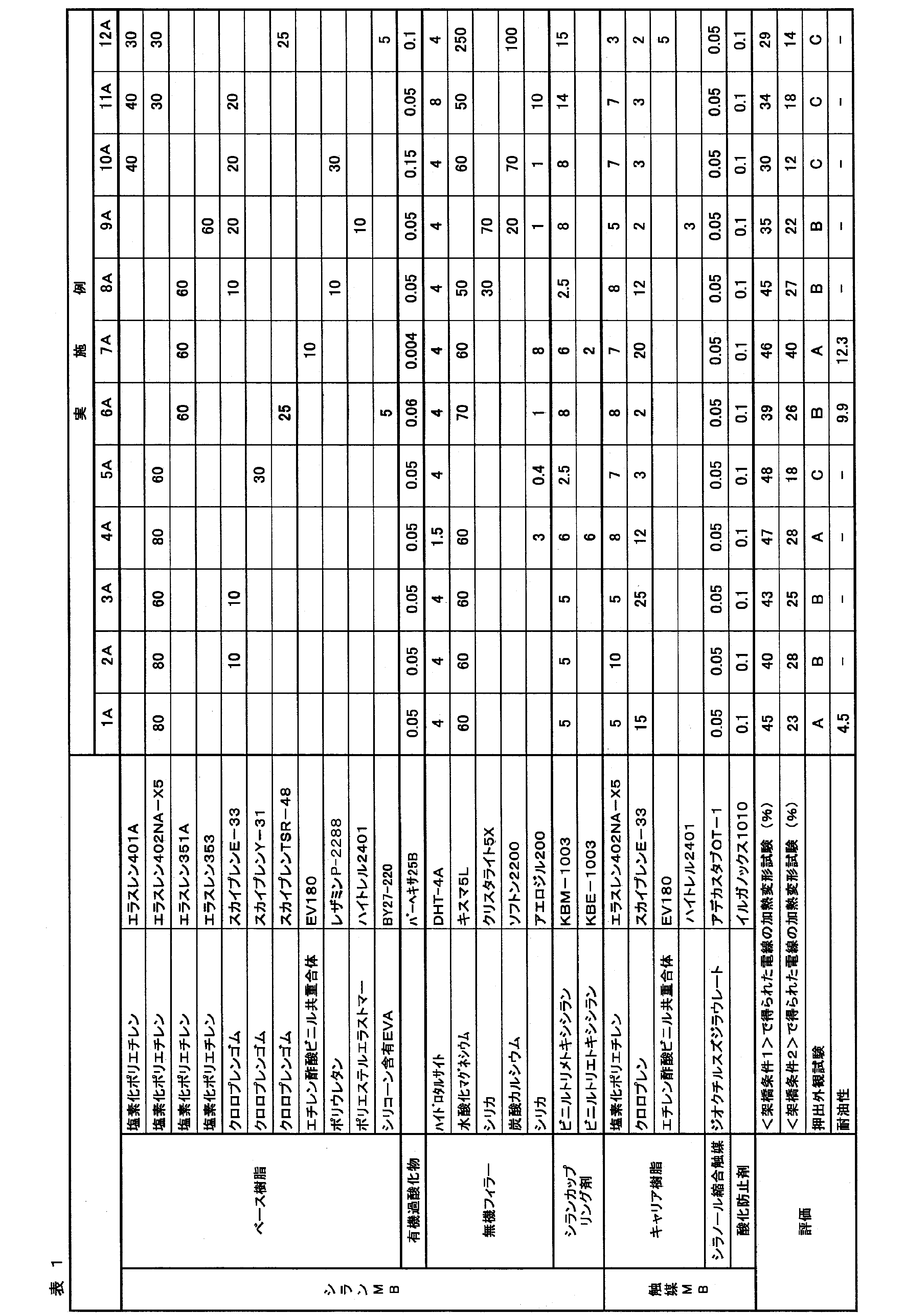

表1及び表2に示す結果から明らかなように、実施例1A~12Aは、<架橋条件1>及び<架橋条件2>で作製した電線のいずれも加熱変形試験及び押出外観試験に合格した。このように、本発明によれば、外観及び耐熱性に優れ、高温においても溶融しない耐熱性塩素含有架橋樹脂成形体を被覆として有する電線を製造できた。また、実施例1A、6A及び7Aに具体的に示されるように、塩素化ポリエチレン及びクロロプレンゴムを含有する耐熱性塩素含有架橋樹脂成形体は、耐油性にも優れていた。よって、塩素化ポリエチレン及びクロロプレンゴムを含有する本発明の耐熱性塩素含有架橋樹脂成形体は、耐候性及び耐油性に優れることが分かる。さらに、実施例1A~12Aの電線は、架橋工程(c)において、架橋条件1のように、架橋条件が穏やかで、しかも架橋時間が短くても、加熱変形試験の合格レベルを満たす耐熱性を示していた。よって、本発明によれば、上記優れた特性を有する耐熱性塩素含有架橋樹脂成形体を生産性良く製造できる。
これに対して、クロロプレンゴムを含まない比較例1A及び8Aは、<架橋条件1>で作製した電線が加熱変形試験に合格せず、生産性の改善効果が認められなかった。また、有機過酸化物の含有量が多すぎる比較例2Aは押出成形すらできなかった。有機過酸化物の含有量が少なすぎる比較例3Aは<架橋条件2>で作製した電線であっても加熱変形試験が不合格であった。無機フィラーの含有量が少なすぎる比較例4Aは押出成形できなかった。無機フィラーの含有量が多すぎる比較例5Aは<架橋条件2>で作製した電線であっても加熱変形試験に合格しなかった。シランカップリング剤の含有量が多すぎる比較例6Aは外観試験に合格せず、シランカップリング剤の含有量が少なすぎる比較例7Aは<架橋条件2>で作製した電線であっても加熱変形試験に合格しなかった。
試験例2
表3及び表4中に示す各化合物の詳細を以下に示す。
塩素化ポリエチレンの塩素含有量は上記測定方法による。
<樹脂>
(塩素化ポリエチレン)
「エラスレン401A」(商品名、昭和電工社製、塩素化ポリエチレン、塩素含有量40質量%)
「エラスレン402NA-X5」(商品名、昭和電工社製、塩素化ポリエチレン、塩素含有量40質量%)
「エラスレン351A」(商品名、昭和電工社製、塩素化ポリエチレン、塩素含有量35質量%)
「エラスレン301A」(商品名、昭和電工社製、塩素化ポリエチレン、塩素含有量30質量%)
(ポリ塩化ビニル)
「ZEST 1400」(商品名、新第一塩ビ社製、ポリ塩化ビニル)
「ZEST 1000」(商品名、新第一塩ビ社製、ポリ塩化ビニル)
「ZEST 2500」(商品名、新第一塩ビ社製、ポリ塩化ビニル)
(その他の成分)
「スカイプレンE-33」(商品名、東ソー社製、クロロプレンゴム、塩素含有量40質量%)
「アデカサイザーC-9N」(商品名、ADECA製、トリメリット酸系可塑剤)
「アデカサイザーPN-650」(商品名、ADECA製、ポリエステル系可塑剤)
「シェルDL911P」(商品名、シェル化学製、フタル酸系可塑剤)
「EV180」(商品名:エバフレックスEV180、三井・デュポンポリケミカル社製、エチレン酢酸ビニル共重合体樹脂)
「ハイトレル2401」(商品名、東レ・デュポン社製、ポリエステルエラストマー)
「BY27-220」(商品名、東レ・ダウコーニング社製、ポリオルガノシロキサンで変性したエチレン-酢酸ビニル共重合体の樹脂)
表3及び表4中に示す各化合物の詳細を以下に示す。
塩素化ポリエチレンの塩素含有量は上記測定方法による。
<樹脂>
(塩素化ポリエチレン)
「エラスレン401A」(商品名、昭和電工社製、塩素化ポリエチレン、塩素含有量40質量%)
「エラスレン402NA-X5」(商品名、昭和電工社製、塩素化ポリエチレン、塩素含有量40質量%)
「エラスレン351A」(商品名、昭和電工社製、塩素化ポリエチレン、塩素含有量35質量%)
「エラスレン301A」(商品名、昭和電工社製、塩素化ポリエチレン、塩素含有量30質量%)
(ポリ塩化ビニル)
「ZEST 1400」(商品名、新第一塩ビ社製、ポリ塩化ビニル)
「ZEST 1000」(商品名、新第一塩ビ社製、ポリ塩化ビニル)
「ZEST 2500」(商品名、新第一塩ビ社製、ポリ塩化ビニル)
(その他の成分)
「スカイプレンE-33」(商品名、東ソー社製、クロロプレンゴム、塩素含有量40質量%)
「アデカサイザーC-9N」(商品名、ADECA製、トリメリット酸系可塑剤)
「アデカサイザーPN-650」(商品名、ADECA製、ポリエステル系可塑剤)
「シェルDL911P」(商品名、シェル化学製、フタル酸系可塑剤)
「EV180」(商品名:エバフレックスEV180、三井・デュポンポリケミカル社製、エチレン酢酸ビニル共重合体樹脂)
「ハイトレル2401」(商品名、東レ・デュポン社製、ポリエステルエラストマー)
「BY27-220」(商品名、東レ・ダウコーニング社製、ポリオルガノシロキサンで変性したエチレン-酢酸ビニル共重合体の樹脂)
<有機過酸化物>
「パーヘキサ25B」(商品名、日本油脂社製、2,5-ジメチル-2,5-ジ(tert-ブチルパーオキシ)ヘキサン、分解温度149℃)
「パークミルD」(日油社製、ジクミルパーオキサイド、分解温度151℃)
「パーヘキサ25B」(商品名、日本油脂社製、2,5-ジメチル-2,5-ジ(tert-ブチルパーオキシ)ヘキサン、分解温度149℃)
「パークミルD」(日油社製、ジクミルパーオキサイド、分解温度151℃)
<無機フィラー>
「DHT4A」(商品名、協和化学工業社製、ハイドロタルサイト)
「キスマ5L」(商品名、協和化学工業社製、シランカップリング剤前処理水酸化マグネシウム)
「クリスタライト5X」(商品名、龍森社製、結晶性シリカ)
「ソフトン2200」(商品名、備北粉化工業社製、炭酸カルシウム)
「アエロジル200」(商品名、日本アエロジル社製、親水性フュームドシリカ、非結晶性シリカ)
「DHT4A」(商品名、協和化学工業社製、ハイドロタルサイト)
「キスマ5L」(商品名、協和化学工業社製、シランカップリング剤前処理水酸化マグネシウム)
「クリスタライト5X」(商品名、龍森社製、結晶性シリカ)
「ソフトン2200」(商品名、備北粉化工業社製、炭酸カルシウム)
「アエロジル200」(商品名、日本アエロジル社製、親水性フュームドシリカ、非結晶性シリカ)
<シランカップリング剤>
「KBM-1003」(商品名、信越化学工業社製、ビニルトリメトキシシラン)
「KBE-1003」(商品名、信越化学工業社製、ビニルトリエトキシシラン)
「KBM-1003」(商品名、信越化学工業社製、ビニルトリメトキシシラン)
「KBE-1003」(商品名、信越化学工業社製、ビニルトリエトキシシラン)
<シラノール縮合触媒>
「アデカスタブOT-1」(商品名、ADEKA社製、ジオクチルスズジラウレート)
「アデカスタブOT-1」(商品名、ADEKA社製、ジオクチルスズジラウレート)
<酸化防止剤>
「イルガノックス1010」(商品名、BASF社製、ペンタエリスリトールテトラキス[3-(3,5-ジ-tert-ブチル-4-ヒドロキシフェニル)プロピオネート])
「イルガノックス1010」(商品名、BASF社製、ペンタエリスリトールテトラキス[3-(3,5-ジ-tert-ブチル-4-ヒドロキシフェニル)プロピオネート])
(実施例1B~14B及び比較例1B~5B)
表3及び表4に示した材料を用いた以外は、試験例1と同様にして、実施例1B~14B及び比較例1B~5Bの被覆導体を調製した。
表3及び表4に示した材料を用いた以外は、試験例1と同様にして、実施例1B~14B及び比較例1B~5Bの被覆導体を調製した。
このようにして得られた被覆導体を胴経250mmのボビンに100m巻き取った。この状態で、温度40℃、相対湿度95%の雰囲気に1週間放置して、被覆導体(耐熱性架橋性塩素含有樹脂組成物の成形体)を水と接触させた。こうして、上記導体の外周面に、耐熱性塩素含有架橋樹脂成形体からなる被覆層を有する電線を製造した。
被覆層としての耐熱性塩素含有架橋樹脂成形体は上述のシラン架橋樹脂を有している。
被覆層としての耐熱性塩素含有架橋樹脂成形体は上述のシラン架橋樹脂を有している。
製造した各電線について、下記試験をし、その結果を表3及び表4に示した。
<外観試験>
1.電線同士の耐粘着性試験(外観荒れの試験)
電線をボビンから巻き返し、電線同士の粘着状態を確認して、耐熱性塩素含有架橋樹脂成形体の外観を評価した。具体的には、巻き返した電線の表面を観察し、被覆層に外傷を確認できなかったものを「A」、表面にのみうっすらとした粘着(接着)跡を確認できたものを「B」、外傷を確認できたものを「D」とした。
本試験において、評価「B」以上が合格レベルである。
1.電線同士の耐粘着性試験(外観荒れの試験)
電線をボビンから巻き返し、電線同士の粘着状態を確認して、耐熱性塩素含有架橋樹脂成形体の外観を評価した。具体的には、巻き返した電線の表面を観察し、被覆層に外傷を確認できなかったものを「A」、表面にのみうっすらとした粘着(接着)跡を確認できたものを「B」、外傷を確認できたものを「D」とした。
本試験において、評価「B」以上が合格レベルである。
2.押出外観試験
押出外観試験は、被覆導体を製造する際に、被覆導体の外観を観察して評価した。
被覆導体の外観にブツがなく電線形状に成形できたものを「A」、被覆導体の外観にブツはないものの表面が少し肌荒れしたものを「B」、ブツの発生を確認できたが外観に問題がない程度であり、電線形状に成形できたものを「C」、著しく外観不良が発生して電線形状に成形できなかったものを「D」とした。本試験において、評価「C」以上が合格レベルである。
押出外観試験は、被覆導体を製造する際に、被覆導体の外観を観察して評価した。
被覆導体の外観にブツがなく電線形状に成形できたものを「A」、被覆導体の外観にブツはないものの表面が少し肌荒れしたものを「B」、ブツの発生を確認できたが外観に問題がない程度であり、電線形状に成形できたものを「C」、著しく外観不良が発生して電線形状に成形できなかったものを「D」とした。本試験において、評価「C」以上が合格レベルである。
<加熱変形試験>
各電線において、UL1581に基づいて、測定温度150℃、荷重5Nで、加熱変形試験を行った。
本試験において、変形率が50%以下である場合を合格とした。
各電線において、UL1581に基づいて、測定温度150℃、荷重5Nで、加熱変形試験を行った。
本試験において、変形率が50%以下である場合を合格とした。
<ホットセット試験>
各電線から導体を抜き取って作製した管状片を用いて、ホットセット試験を行った。ホットセット試験は、この管状片に、長さ50mmの評線を付けた後に、170℃の恒温槽の中に117gのおもりを取り付け15分間放置し、放置後の長さを測定して伸び率を求めた。
伸び率が、70%以下を「A」、伸び率70%を超え100%以下を「B」、100%を超えた場合を「D」とした。本試験において、評価「B」以上が合格レベルである。
各電線から導体を抜き取って作製した管状片を用いて、ホットセット試験を行った。ホットセット試験は、この管状片に、長さ50mmの評線を付けた後に、170℃の恒温槽の中に117gのおもりを取り付け15分間放置し、放置後の長さを測定して伸び率を求めた。
伸び率が、70%以下を「A」、伸び率70%を超え100%以下を「B」、100%を超えた場合を「D」とした。本試験において、評価「B」以上が合格レベルである。
<引張強度試験>
各電線から導体を抜き取って作製した管状片を用いて、JIS C 3005に基づき、標線間20mm、引張速度200mm/分で引張試験を行い、引張強度を測定した。
本試験は、参考試験であるが、引張強度が11MPa以上である場合を合格とし、14MPa以上が好ましい。
各電線から導体を抜き取って作製した管状片を用いて、JIS C 3005に基づき、標線間20mm、引張速度200mm/分で引張試験を行い、引張強度を測定した。
本試験は、参考試験であるが、引張強度が11MPa以上である場合を合格とし、14MPa以上が好ましい。
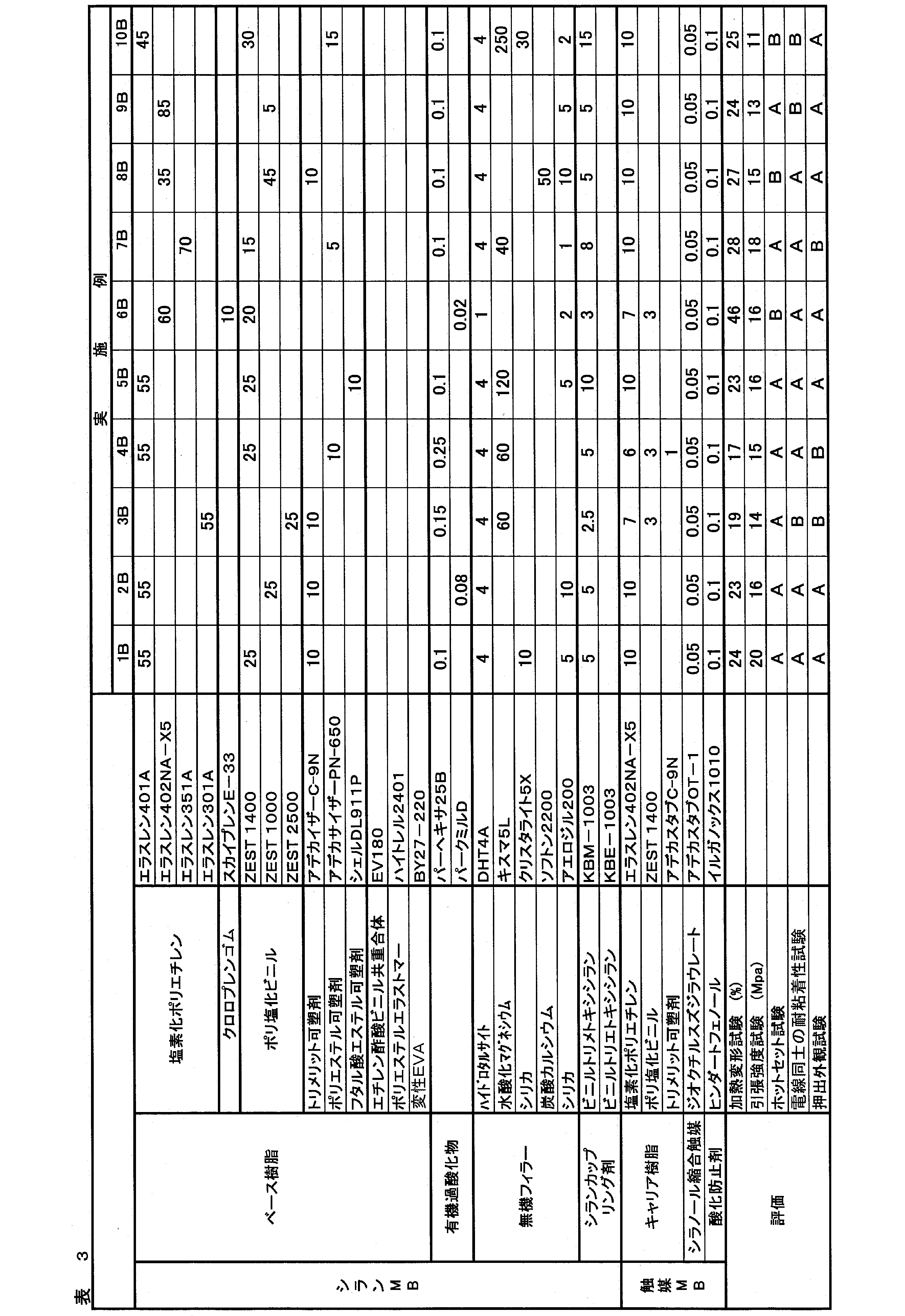
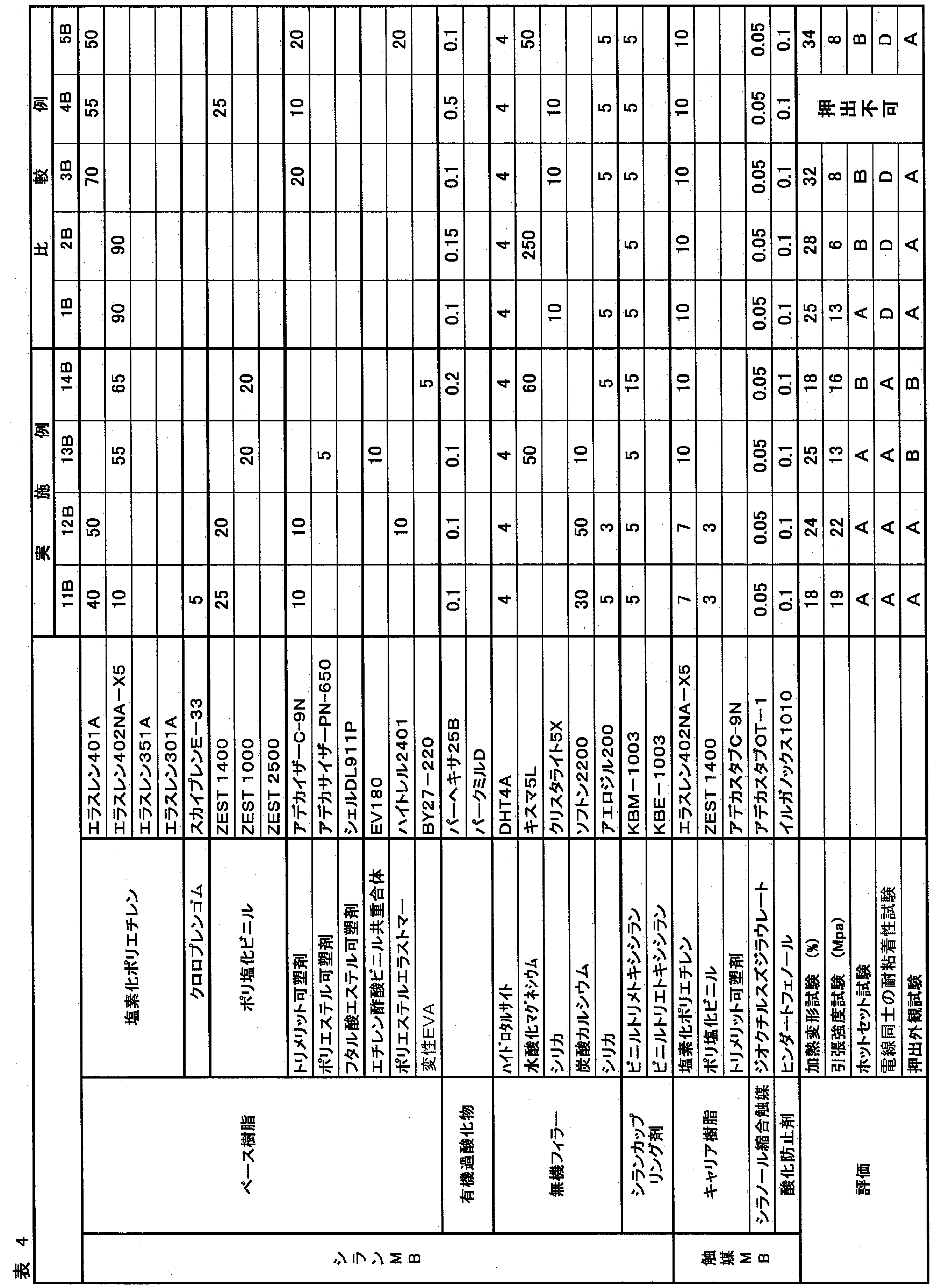
表3及び表4の結果から、以下のことが分かる。
ポリ塩化ビニルを含有しないベース樹脂を用いた比較例1B~3B及び5Bは、いずれも、耐熱性架橋性塩素含有樹脂組成物の成形体同士が粘着して、被覆層に外傷が生じ外観荒れが見られた。また、有機過酸化物の含有量が多すぎる比較例4Bは押出成形することができなかった。
これに対して、ポリ塩化ビニルを含有するベース樹脂を用いた実施例1B~14Bは、いずれも、優れた外観を有していた。すなわち、電線は、いずれも、被覆層に外傷を確認できず、押出外観にも優れていた。特に、ベース樹脂中の、ポリ塩化ビニルの含有率が10~40質量%であると、またシランカップリング剤の含有量が3B~12B質量部であると、ブツも外傷もない被覆層を有する電線を製造できた(実施例1B、2B、4B~7B及び11B~13B)。
ポリ塩化ビニルを含有しないベース樹脂を用いた比較例1B~3B及び5Bは、いずれも、耐熱性架橋性塩素含有樹脂組成物の成形体同士が粘着して、被覆層に外傷が生じ外観荒れが見られた。また、有機過酸化物の含有量が多すぎる比較例4Bは押出成形することができなかった。
これに対して、ポリ塩化ビニルを含有するベース樹脂を用いた実施例1B~14Bは、いずれも、優れた外観を有していた。すなわち、電線は、いずれも、被覆層に外傷を確認できず、押出外観にも優れていた。特に、ベース樹脂中の、ポリ塩化ビニルの含有率が10~40質量%であると、またシランカップリング剤の含有量が3B~12B質量部であると、ブツも外傷もない被覆層を有する電線を製造できた(実施例1B、2B、4B~7B及び11B~13B)。
本発明をその実施態様とともに説明したが、我々は特に指定しない限り我々の発明を説明のどの細部においても限定しようとするものではなく、添付の請求の範囲に示した発明の精神と範囲に反することなく幅広く解釈されるべきであると考える。
本願は、2016年2月12日に日本国で特許出願された特願2016-024491及び2016年3月31日に日本国で特許出願された特願2016-071733に基づく優先権を主張するものであり、これらはここに参照してその内容を本明細書の記載の一部として取り込む。
Claims (25)
- 塩素化ポリエチレンを含有するベース樹脂100質量部に対して、有機過酸化物0.003~0.3質量部と、無機フィラー0.5~400質量部と、シランカップリング剤2質量部を越え15.0質量部以下とを、前記有機過酸化物の分解温度以上の温度で溶融混合し、シランマスターバッチを調製する工程(a)と、
前記工程(a)で得られたシランマスターバッチとシラノール縮合触媒とを混合した後に成形する工程(b)と、
前記工程(b)で得られた成形体を水分と接触させて架橋させる工程(c)と、
を有し、
かつ、前記工程(a)の溶融混合及び前記工程(b)の混合の少なくとも一方の混合をクロロプレンゴム又はポリ塩化ビニルの共存下で行う、耐熱性塩素含有架橋樹脂成形体の製造方法。 - 前記有機過酸化物の含有量が0.003~0.2質量部であり、かつ、前記工程(a)の溶融混合及び前記工程(b)の混合の少なくとも一方の混合をクロロプレンゴムの共存下で行う、請求項1に記載の耐熱性塩素含有架橋樹脂成形体の製造方法。
- 前記工程(b)の混合を、クロロプレンゴムの共存下で行う請求項2に記載の耐熱性塩素含有架橋樹脂成形体の製造方法。
- 前記有機過酸化物の含有量が、0.005~0.2質量部である請求項1~3のいずれか1項に記載の耐熱性塩素含有架橋樹脂成形体の製造方法。
- 前記工程(a)の溶融混合及び前記工程(b)の混合の少なくとも一方の混合をポリ塩化ビニルの共存下で行う、請求項1に記載の耐熱性塩素含有架橋樹脂成形体の製造方法。
- 前記工程(a)の溶融混合を、ポリ塩化ビニルの共存下で行う請求項5に記載の耐熱性塩素含有架橋樹脂成形体の製造方法。
- 前記ベース樹脂中の、ポリ塩化ビニルの含有率が5~50質量%である請求項5又は6に記載の耐熱性塩素含有架橋樹脂成形体の製造方法。
- 前記ベース樹脂中の、ポリ塩化ビニルの含有率が10~40質量%である請求項5~7のいずれか1項に記載の耐熱性塩素含有架橋樹脂成形体の製造方法。
- 前記ベース樹脂が、可塑剤及びオイルの少なくとも1種を、前記ベース樹脂中に0~35質量%の含有率で、含有する請求項5~8のいずれか1項に記載の耐熱性塩素含有架橋樹脂成形体の製造方法。
- 前記可塑剤及びオイルの含有率が、ポリ塩化ビニルの含有率以下である請求項9に記載の耐熱性塩素含有架橋樹脂成形体の製造方法。
- 前記有機過酸化物の含有量が、0.005~0.3質量部である請求項1及び5~10のいずれか1項に記載の耐熱性塩素含有架橋樹脂成形体の製造方法。
- 前記シランカップリング剤の含有量が、3~12.0質量部である請求項1~11のいずれか1項に記載の耐熱性塩素含有架橋樹脂成形体の製造方法。
- 前記シランカップリング剤の含有量が、4~12.0質量部である請求項1~12のいずれか1項に記載の耐熱性塩素含有架橋樹脂成形体の製造方法。
- 前記シランカップリング剤が、ビニルトリメトキシシラン又はビニルトリエトキシシランである請求項1~13のいずれか1項に記載の耐熱性塩素含有架橋樹脂成形体の製造方法。
- 前記無機フィラーが、シリカ、水酸化アルミニウム、水酸化マグネシウム若しくは炭酸カルシウム又はこれらの組合せである請求項1~14のいずれか1項に記載の耐熱性塩素含有架橋樹脂成形体の製造方法。
- 前記工程(a)における溶融混合が、密閉型のミキサーを用いて行われる請求項1~15のいずれか1項に記載の耐熱性塩素含有架橋樹脂成形体の製造方法。
- 塩素化ポリエチレンとクロロプレンゴム又はポリ塩化ビニルとを含有するベース樹脂100質量部に対して、有機過酸化物0.003~0.3質量部と、無機フィラー0.5~400質量部と、シランカップリング剤2質量部を越え15.0質量部以下と、シラノール縮合触媒とを混合してなるマスターバッチ混合物の製造に用いられるシランマスターバッチであって、
前記ベース樹脂の全部又は一部、前記有機過酸化物、前記無機フィラー及び前記シランカップリング剤を前記有機過酸化物の分解温度以上の温度で溶融混合してなるシランマスターバッチ。 - 前記ベース樹脂にクロロプレンゴムを含有し、有機過酸化物の含有量が0.003~0.2質量部である請求項17に記載のシランマスターバッチ。
- 前記ベース樹脂にポリ塩化ビニルを含有する請求項17に記載のシランマスターバッチ。
- 請求項17~19のいずれか1項に記載のシランマスターバッチとシラノール縮合触媒とを含有するマスターバッチ混合物。
- 請求項17~19のいずれか1項に記載のシランマスターバッチとシラノール縮合触媒とをドライブレンドしてなるマスターバッチ混合物を成型機に導入して成形した成形体。
- 請求項1~16のいずれか1項に記載の耐熱性塩素含有架橋樹脂成形体の製造方法により製造された耐熱性塩素含有架橋樹脂成形体。
- 前記ベース樹脂が、シラノール結合を介して前記無機フィラーと架橋してなる請求項22に記載の耐熱性塩素含有架橋樹脂成形体。
- 請求項22又は23に記載の耐熱性塩素含有架橋樹脂成形体を含む耐熱性製品。
- 前記耐熱性塩素含有架橋樹脂成形体が、電線あるいは光ファイバーケーブルの被覆である請求項24に記載の耐熱性製品。
Priority Applications (1)
| Application Number | Priority Date | Filing Date | Title |
|---|---|---|---|
| US16/059,266 US11242453B2 (en) | 2016-02-12 | 2018-08-09 | Heat-resistant chlorine-containing crosslinked resin formed body and method for producing the same, silane master batch, master batch mixture and formed body thereof, and heat-resistant product |
Applications Claiming Priority (4)
| Application Number | Priority Date | Filing Date | Title |
|---|---|---|---|
| JP2016-024491 | 2016-02-12 | ||
| JP2016024491A JP6706855B2 (ja) | 2016-02-12 | 2016-02-12 | 耐熱性塩素含有架橋樹脂成形体及びその製造方法、並びに、耐熱性製品 |
| JP2016-071733 | 2016-03-31 | ||
| JP2016071733A JP6706858B2 (ja) | 2016-03-31 | 2016-03-31 | 耐熱性塩素含有架橋樹脂成形体及びその製造方法、シランマスターバッチ、マスターバッチ混合物及びその成形体、並びに、耐熱性製品 |
Related Child Applications (1)
| Application Number | Title | Priority Date | Filing Date |
|---|---|---|---|
| US16/059,266 Continuation US11242453B2 (en) | 2016-02-12 | 2018-08-09 | Heat-resistant chlorine-containing crosslinked resin formed body and method for producing the same, silane master batch, master batch mixture and formed body thereof, and heat-resistant product |
Publications (1)
| Publication Number | Publication Date |
|---|---|
| WO2017138641A1 true WO2017138641A1 (ja) | 2017-08-17 |
Family
ID=59563055
Family Applications (1)
| Application Number | Title | Priority Date | Filing Date |
|---|---|---|---|
| PCT/JP2017/004945 Ceased WO2017138641A1 (ja) | 2016-02-12 | 2017-02-10 | 耐熱性塩素含有架橋樹脂成形体及びその製造方法、シランマスターバッチ、マスターバッチ混合物及びその成形体、並びに、耐熱性製品 |
Country Status (2)
| Country | Link |
|---|---|
| US (1) | US11242453B2 (ja) |
| WO (1) | WO2017138641A1 (ja) |
Cited By (3)
| Publication number | Priority date | Publication date | Assignee | Title |
|---|---|---|---|---|
| CN109535589A (zh) * | 2018-10-31 | 2019-03-29 | 广东威立瑞科技有限公司 | 一种抗冲击阻燃电缆保护管材料及其制备方法 |
| JP2019179689A (ja) * | 2018-03-30 | 2019-10-17 | 古河電気工業株式会社 | キャブタイヤケーブル及びその製造方法 |
| EP3757152A1 (en) | 2019-06-28 | 2020-12-30 | Borealis AG | Controlled rheology modified mixed-plastic polyethylene blend |
Families Citing this family (10)
| Publication number | Priority date | Publication date | Assignee | Title |
|---|---|---|---|---|
| JP6706854B2 (ja) * | 2016-02-12 | 2020-06-10 | 古河電気工業株式会社 | 耐熱性架橋樹脂成形体及びその製造方法、並びに、耐熱性製品 |
| WO2017138641A1 (ja) | 2016-02-12 | 2017-08-17 | 古河電気工業株式会社 | 耐熱性塩素含有架橋樹脂成形体及びその製造方法、シランマスターバッチ、マスターバッチ混合物及びその成形体、並びに、耐熱性製品 |
| JP6638630B2 (ja) | 2016-11-30 | 2020-01-29 | 株式会社オートネットワーク技術研究所 | 電線被覆材用組成物および絶縁電線 |
| JP6762341B2 (ja) | 2018-07-10 | 2020-09-30 | 古河電気工業株式会社 | 耐熱性架橋フッ素ゴム成形体及びその製造方法、シランマスターバッチ、マスターバッチ混合物、並びに、耐熱性製品 |
| CN112111111A (zh) * | 2019-06-21 | 2020-12-22 | 亿利生态科技有限责任公司 | 一种pvc耐热发泡制品专用料、制品及其制备方法 |
| CN111363260B (zh) * | 2020-03-24 | 2023-04-07 | 惠州市美林电线电缆有限公司 | 电缆护套用组合物、电缆及其制备方法 |
| WO2022113896A1 (ja) * | 2020-11-26 | 2022-06-02 | デンカ株式会社 | ゴム組成物、該ゴム組成物の加硫物、および該ゴム組成物の加硫成形体 |
| CN112778668B (zh) * | 2021-01-11 | 2022-06-21 | 慈溪市寅升电器有限公司 | 适用于插头支架的高强度聚氯乙烯复合塑料及其制备方法 |
| CN115558280A (zh) * | 2022-11-10 | 2023-01-03 | 苏州亨利通信材料有限公司 | 布电线用b1级硅烷交联阻燃聚烯烃电缆料及制备方法 |
| CN118027544B (zh) * | 2024-01-24 | 2024-07-16 | 广州崇泰科技有限公司 | 含艾草的发泡材料及其制备方法及应用 |
Citations (7)
| Publication number | Priority date | Publication date | Assignee | Title |
|---|---|---|---|---|
| JPS60144315A (ja) * | 1984-01-09 | 1985-07-30 | Hitachi Cable Ltd | 塩素化ポリエチレン組成物の架橋方法 |
| JPH06168629A (ja) * | 1992-11-27 | 1994-06-14 | Hitachi Cable Ltd | 電線・ケーブル |
| JP2008184613A (ja) * | 1999-07-30 | 2008-08-14 | Nok Corp | 二酸化炭素冷媒用成形材料 |
| WO2013147148A1 (ja) * | 2012-03-30 | 2013-10-03 | 古河電気工業株式会社 | 耐熱性樹脂組成物の製造方法、並びに、その製造方法で製造された耐熱性樹脂組成物及び該耐熱性樹脂組成物を用いた成形品 |
| JP2014136752A (ja) * | 2013-01-17 | 2014-07-28 | Hitachi Metals Ltd | シラングラフト塩素化ポリエチレン並びにそれを用いた電線及びケーブル |
| WO2015046476A1 (ja) * | 2013-09-27 | 2015-04-02 | 古河電気工業株式会社 | 耐熱性シラン架橋樹脂成形体及びその製造方法、耐熱性シラン架橋性樹脂組成物及びその製造方法、シランマスターバッチ、並びに耐熱性シラン架橋樹脂成形体を用いた耐熱性製品 |
| JP2015146303A (ja) * | 2014-02-04 | 2015-08-13 | 日立金属株式会社 | 多層ゴムケーブル |
Family Cites Families (10)
| Publication number | Priority date | Publication date | Assignee | Title |
|---|---|---|---|---|
| JP3224015B2 (ja) | 1996-09-06 | 2001-10-29 | 矢崎総業株式会社 | 電線被覆用架橋性塩化ビニル樹脂組成物及び電線被覆用塩化ビニル樹脂架橋物の製造方法 |
| JP3464410B2 (ja) | 1998-04-27 | 2003-11-10 | リケンテクノス株式会社 | 絶縁樹脂組成物およびそれを用いた絶縁電線と絶縁部材 |
| JP3515439B2 (ja) | 1998-08-31 | 2004-04-05 | リケンテクノス株式会社 | 難燃性樹脂組成物とそれを用いた成形部品 |
| JP2001101928A (ja) | 1999-09-29 | 2001-04-13 | Yazaki Corp | 難燃性樹脂組成物 |
| JP3515469B2 (ja) | 2000-02-29 | 2004-04-05 | リケンテクノス株式会社 | 難燃性樹脂組成物とそれを用いた成形部品 |
| IL156870A0 (en) * | 2003-07-10 | 2004-02-08 | Carmel Olefines Ltd | Process for making thermoplastic vulcanizates |
| US20120128906A1 (en) * | 2005-05-11 | 2012-05-24 | Shawcor Ltd. | Crosslinked chlorinated polyolefin compositions |
| JP5896626B2 (ja) | 2011-06-08 | 2016-03-30 | リケンテクノス株式会社 | シラン架橋性難燃ポリオレフィンとシラノール触媒樹脂組成物からなる電線成形体の製造方法 |
| WO2017138642A1 (ja) | 2016-02-12 | 2017-08-17 | 古河電気工業株式会社 | 耐熱性架橋フッ素ゴム成形体及びその製造方法、シランマスターバッチ、マスターバッチ混合物及びその成形体、並びに、耐熱性製品 |
| WO2017138641A1 (ja) | 2016-02-12 | 2017-08-17 | 古河電気工業株式会社 | 耐熱性塩素含有架橋樹脂成形体及びその製造方法、シランマスターバッチ、マスターバッチ混合物及びその成形体、並びに、耐熱性製品 |
-
2017
- 2017-02-10 WO PCT/JP2017/004945 patent/WO2017138641A1/ja not_active Ceased
-
2018
- 2018-08-09 US US16/059,266 patent/US11242453B2/en active Active
Patent Citations (7)
| Publication number | Priority date | Publication date | Assignee | Title |
|---|---|---|---|---|
| JPS60144315A (ja) * | 1984-01-09 | 1985-07-30 | Hitachi Cable Ltd | 塩素化ポリエチレン組成物の架橋方法 |
| JPH06168629A (ja) * | 1992-11-27 | 1994-06-14 | Hitachi Cable Ltd | 電線・ケーブル |
| JP2008184613A (ja) * | 1999-07-30 | 2008-08-14 | Nok Corp | 二酸化炭素冷媒用成形材料 |
| WO2013147148A1 (ja) * | 2012-03-30 | 2013-10-03 | 古河電気工業株式会社 | 耐熱性樹脂組成物の製造方法、並びに、その製造方法で製造された耐熱性樹脂組成物及び該耐熱性樹脂組成物を用いた成形品 |
| JP2014136752A (ja) * | 2013-01-17 | 2014-07-28 | Hitachi Metals Ltd | シラングラフト塩素化ポリエチレン並びにそれを用いた電線及びケーブル |
| WO2015046476A1 (ja) * | 2013-09-27 | 2015-04-02 | 古河電気工業株式会社 | 耐熱性シラン架橋樹脂成形体及びその製造方法、耐熱性シラン架橋性樹脂組成物及びその製造方法、シランマスターバッチ、並びに耐熱性シラン架橋樹脂成形体を用いた耐熱性製品 |
| JP2015146303A (ja) * | 2014-02-04 | 2015-08-13 | 日立金属株式会社 | 多層ゴムケーブル |
Cited By (4)
| Publication number | Priority date | Publication date | Assignee | Title |
|---|---|---|---|---|
| JP2019179689A (ja) * | 2018-03-30 | 2019-10-17 | 古河電気工業株式会社 | キャブタイヤケーブル及びその製造方法 |
| JP7007978B2 (ja) | 2018-03-30 | 2022-01-25 | 古河電気工業株式会社 | キャブタイヤケーブル及びその製造方法 |
| CN109535589A (zh) * | 2018-10-31 | 2019-03-29 | 广东威立瑞科技有限公司 | 一种抗冲击阻燃电缆保护管材料及其制备方法 |
| EP3757152A1 (en) | 2019-06-28 | 2020-12-30 | Borealis AG | Controlled rheology modified mixed-plastic polyethylene blend |
Also Published As
| Publication number | Publication date |
|---|---|
| US11242453B2 (en) | 2022-02-08 |
| US20180346700A1 (en) | 2018-12-06 |
Similar Documents
| Publication | Publication Date | Title |
|---|---|---|
| US11242453B2 (en) | Heat-resistant chlorine-containing crosslinked resin formed body and method for producing the same, silane master batch, master batch mixture and formed body thereof, and heat-resistant product | |
| JP6523171B2 (ja) | 耐熱性シラン架橋樹脂成形体及びその製造方法、耐熱性シラン架橋性樹脂組成物及びその製造方法、シランマスターバッチ、並びに耐熱性シラン架橋樹脂成形体を用いた耐熱性製品 | |
| JP6391580B2 (ja) | 耐熱性シラン架橋樹脂成形体及びその製造方法、耐熱性シラン架橋性樹脂組成物及びその製造方法、シランマスターバッチ、並びに耐熱性シラン架橋樹脂成形体を用いた耐熱性製品 | |
| JP6858139B2 (ja) | 耐熱性架橋フッ素ゴム成形体及びその製造方法、シランマスターバッチ、マスターバッチ混合物及びその成形体、並びに、耐熱性製品 | |
| JP7060582B2 (ja) | 耐熱性塩素含有架橋樹脂成形体及びその製造方法、シランマスターバッチ及びマスターバッチ混合物、並びに、耐熱性製品 | |
| JP6407339B2 (ja) | 耐熱性シラン架橋樹脂成形体及びその製造方法、耐熱性シラン架橋性樹脂組成物及びその製造方法、並びに、耐熱性シラン架橋樹脂成形体を用いた耐熱性製品 | |
| US10703894B2 (en) | Heat-resistant crosslinked resin formed body and method for producing the same, silane master batch, master batch mixture and formed body thereof, and heat-resistant product | |
| WO2014084047A1 (ja) | 耐熱性シラン架橋性樹脂組成物を用いた成形体の製造方法 | |
| JPWO2016056634A1 (ja) | 難燃性架橋樹脂成形体及び難燃性架橋性樹脂組成物とそれらの製造方法、難燃性シランマスターバッチ、並びに、成形品 | |
| JP6706858B2 (ja) | 耐熱性塩素含有架橋樹脂成形体及びその製造方法、シランマスターバッチ、マスターバッチ混合物及びその成形体、並びに、耐熱性製品 | |
| JP6706855B2 (ja) | 耐熱性塩素含有架橋樹脂成形体及びその製造方法、並びに、耐熱性製品 | |
| JP6567589B2 (ja) | 塩素含有架橋樹脂成形体及びその製造方法、シランマスターバッチ、マスターバッチ混合物及びその成形体、並びに、成形品 | |
| JP2017141386A (ja) | 耐熱性シラン架橋樹脂成形体及びその製造方法、並びに、シランマスターバッチ及び耐熱性製品 | |
| JP6895920B2 (ja) | 耐熱性シラン架橋ポリオレフィン樹脂成形体の製造方法、シラン架橋性ポリオレフィン樹脂組成物、耐熱性シラン架橋ポリオレフィン樹脂成形体、耐熱性製品、電線及び光ファイバケーブル | |
| JP6219307B2 (ja) | 耐熱性シラン架橋性樹脂組成物を用いた成形体の製造方法 | |
| JP6639937B2 (ja) | 耐熱性シラン架橋熱可塑性エラストマー成形体の製造方法、シランマスターバッチ、並びに、耐熱性製品 | |
| JP6582012B2 (ja) | 耐熱性塩素含有架橋樹脂成形体及びその製造方法、シランマスターバッチ及びマスターバッチ混合物、並びに、耐熱性製品 | |
| JP6782222B2 (ja) | シラン架橋アクリルゴム成形体及びその製造方法、シラン架橋性アクリルゴム組成物、並びに耐油性製品 | |
| JP7203782B2 (ja) | 耐熱性架橋フッ素ゴム成形体及びその製造方法、並びに、耐熱性製品 | |
| JP2019179627A (ja) | 配線材 |
Legal Events
| Date | Code | Title | Description |
|---|---|---|---|
| 121 | Ep: the epo has been informed by wipo that ep was designated in this application |
Ref document number: 17750362 Country of ref document: EP Kind code of ref document: A1 |
|
| NENP | Non-entry into the national phase |
Ref country code: DE |
|
| 122 | Ep: pct application non-entry in european phase |
Ref document number: 17750362 Country of ref document: EP Kind code of ref document: A1 |