WO2017078087A1 - 接着剤組成物及び構造体 - Google Patents
接着剤組成物及び構造体 Download PDFInfo
- Publication number
- WO2017078087A1 WO2017078087A1 PCT/JP2016/082645 JP2016082645W WO2017078087A1 WO 2017078087 A1 WO2017078087 A1 WO 2017078087A1 JP 2016082645 W JP2016082645 W JP 2016082645W WO 2017078087 A1 WO2017078087 A1 WO 2017078087A1
- Authority
- WO
- WIPO (PCT)
- Prior art keywords
- mass
- group
- adhesive composition
- parts
- silane compound
- Prior art date
- Legal status (The legal status is an assumption and is not a legal conclusion. Google has not performed a legal analysis and makes no representation as to the accuracy of the status listed.)
- Ceased
Links
Images
Classifications
-
- C—CHEMISTRY; METALLURGY
- C09—DYES; PAINTS; POLISHES; NATURAL RESINS; ADHESIVES; COMPOSITIONS NOT OTHERWISE PROVIDED FOR; APPLICATIONS OF MATERIALS NOT OTHERWISE PROVIDED FOR
- C09J—ADHESIVES; NON-MECHANICAL ASPECTS OF ADHESIVE PROCESSES IN GENERAL; ADHESIVE PROCESSES NOT PROVIDED FOR ELSEWHERE; USE OF MATERIALS AS ADHESIVES
- C09J4/00—Adhesives based on organic non-macromolecular compounds having at least one polymerisable carbon-to-carbon unsaturated bond ; adhesives, based on monomers of macromolecular compounds of groups C09J183/00 - C09J183/16
-
- C—CHEMISTRY; METALLURGY
- C09—DYES; PAINTS; POLISHES; NATURAL RESINS; ADHESIVES; COMPOSITIONS NOT OTHERWISE PROVIDED FOR; APPLICATIONS OF MATERIALS NOT OTHERWISE PROVIDED FOR
- C09J—ADHESIVES; NON-MECHANICAL ASPECTS OF ADHESIVE PROCESSES IN GENERAL; ADHESIVE PROCESSES NOT PROVIDED FOR ELSEWHERE; USE OF MATERIALS AS ADHESIVES
- C09J11/00—Features of adhesives not provided for in group C09J9/00, e.g. additives
-
- C—CHEMISTRY; METALLURGY
- C09—DYES; PAINTS; POLISHES; NATURAL RESINS; ADHESIVES; COMPOSITIONS NOT OTHERWISE PROVIDED FOR; APPLICATIONS OF MATERIALS NOT OTHERWISE PROVIDED FOR
- C09J—ADHESIVES; NON-MECHANICAL ASPECTS OF ADHESIVE PROCESSES IN GENERAL; ADHESIVE PROCESSES NOT PROVIDED FOR ELSEWHERE; USE OF MATERIALS AS ADHESIVES
- C09J11/00—Features of adhesives not provided for in group C09J9/00, e.g. additives
- C09J11/02—Non-macromolecular additives
- C09J11/04—Non-macromolecular additives inorganic
-
- C—CHEMISTRY; METALLURGY
- C09—DYES; PAINTS; POLISHES; NATURAL RESINS; ADHESIVES; COMPOSITIONS NOT OTHERWISE PROVIDED FOR; APPLICATIONS OF MATERIALS NOT OTHERWISE PROVIDED FOR
- C09J—ADHESIVES; NON-MECHANICAL ASPECTS OF ADHESIVE PROCESSES IN GENERAL; ADHESIVE PROCESSES NOT PROVIDED FOR ELSEWHERE; USE OF MATERIALS AS ADHESIVES
- C09J11/00—Features of adhesives not provided for in group C09J9/00, e.g. additives
- C09J11/02—Non-macromolecular additives
- C09J11/06—Non-macromolecular additives organic
-
- C—CHEMISTRY; METALLURGY
- C09—DYES; PAINTS; POLISHES; NATURAL RESINS; ADHESIVES; COMPOSITIONS NOT OTHERWISE PROVIDED FOR; APPLICATIONS OF MATERIALS NOT OTHERWISE PROVIDED FOR
- C09J—ADHESIVES; NON-MECHANICAL ASPECTS OF ADHESIVE PROCESSES IN GENERAL; ADHESIVE PROCESSES NOT PROVIDED FOR ELSEWHERE; USE OF MATERIALS AS ADHESIVES
- C09J9/00—Adhesives characterised by their physical nature or the effects produced, e.g. glue sticks
- C09J9/02—Electrically-conducting adhesives
-
- H—ELECTRICITY
- H01—ELECTRIC ELEMENTS
- H01B—CABLES; CONDUCTORS; INSULATORS; SELECTION OF MATERIALS FOR THEIR CONDUCTIVE, INSULATING OR DIELECTRIC PROPERTIES
- H01B1/00—Conductors or conductive bodies characterised by the conductive materials; Selection of materials as conductors
- H01B1/20—Conductive material dispersed in non-conductive organic material
- H01B1/22—Conductive material dispersed in non-conductive organic material the conductive material comprising metals or alloys
-
- H—ELECTRICITY
- H05—ELECTRIC TECHNIQUES NOT OTHERWISE PROVIDED FOR
- H05K—PRINTED CIRCUITS; CASINGS OR CONSTRUCTIONAL DETAILS OF ELECTRIC APPARATUS; MANUFACTURE OF ASSEMBLAGES OF ELECTRICAL COMPONENTS
- H05K1/00—Printed circuits
- H05K1/02—Details
- H05K1/14—Structural association of two or more printed circuits
-
- H—ELECTRICITY
- H05—ELECTRIC TECHNIQUES NOT OTHERWISE PROVIDED FOR
- H05K—PRINTED CIRCUITS; CASINGS OR CONSTRUCTIONAL DETAILS OF ELECTRIC APPARATUS; MANUFACTURE OF ASSEMBLAGES OF ELECTRICAL COMPONENTS
- H05K3/00—Apparatus or processes for manufacturing printed circuits
- H05K3/10—Apparatus or processes for manufacturing printed circuits in which conductive material is applied to the insulating support in such a manner as to form the desired conductive pattern
- H05K3/20—Apparatus or processes for manufacturing printed circuits in which conductive material is applied to the insulating support in such a manner as to form the desired conductive pattern by affixing prefabricated conductor pattern
-
- H—ELECTRICITY
- H05—ELECTRIC TECHNIQUES NOT OTHERWISE PROVIDED FOR
- H05K—PRINTED CIRCUITS; CASINGS OR CONSTRUCTIONAL DETAILS OF ELECTRIC APPARATUS; MANUFACTURE OF ASSEMBLAGES OF ELECTRICAL COMPONENTS
- H05K3/00—Apparatus or processes for manufacturing printed circuits
- H05K3/30—Assembling printed circuits with electric components, e.g. with resistors
- H05K3/32—Assembling printed circuits with electric components, e.g. with resistors electrically connecting electric components or wires to printed circuits
Definitions
- the present invention relates to an adhesive composition and a structure.
- adhesives are conventionally used in semiconductor elements and liquid crystal display elements (display display elements) for the purpose of bonding various members in the elements.
- the properties required for adhesives are diverse, including adhesiveness, heat resistance, reliability in high temperature and high humidity conditions, and the like.
- adherend used for adhesion printed wiring boards, organic base materials (polyimide base materials, etc.), metals (titanium, copper, aluminum, etc.), ITO, IZO, IGZO, SiN x , SiO 2, etc.
- a substrate having a surface state or the like is used, and molecular design of an adhesive suitable for each adherend is required.
- thermosetting resins epoxy resins, acrylic resins, etc.
- a latent curing agent that generates an epoxy resin and a cationic species or anionic species having reactivity with the epoxy resin by heat or light
- the latent curing agent is an important factor for determining the curing temperature and the curing rate, and various compounds have been used from the viewpoint of storage stability at normal temperature and curing rate during heating. In the actual process, for example, desired adhesiveness was obtained by curing under a curing condition of a temperature of 170 to 250 ° C. for 10 seconds to 3 hours.
- radical curing adhesives using a (meth) acrylate derivative and a peroxide as a radical polymerization initiator in combination.
- radicals that are reactive species are very reactive, so they can be cured for a short time, and the peroxide is stable below the decomposition temperature of the radical polymerization initiator.
- a curing system that achieves both low-temperature short-time curing and storage stability (for example, storage stability near room temperature).
- a radical curable adhesive composition containing a silane compound such as a silane coupling agent having a functional group capable of radical polymerization ((meth) acryloyl group, vinyl group, etc.) is known (for example, See Patent Document 1 below).
- An object of the present invention is to provide an adhesive composition having excellent storage stability and a structure using the same.
- the present inventor presumes that the cause of the deterioration of the characteristics of the silane compound in the conventional adhesive composition is as follows. That is, during the storage of the adhesive composition, when another initiator different from the silane compound starts the polymerization reaction, the silane compound is incorporated into the polymerization reaction, so that the constituent material of the adhesive composition (resin etc.) It is taken in inside. Thereby, since the number of molecules that can act on the interface between the adhesive composition and the adherend is decreased, it is estimated that the characteristics are deteriorated.
- the present inventor used a radical polymerization type (for example, (meth) acrylate radical type) adhesive composition using a highly active peroxide having a 1 minute half-life temperature of 120 ° C. or less (that is, In the case of low-temperature short-time curing such as 130 ° C. for 5 seconds, where demand has been increasing in recent years), it has been found that the above-mentioned characteristic deterioration is particularly remarkable.
- a radical polymerization type for example, (meth) acrylate radical type
- the present inventor has found that an adhesive containing a radical polymerizable compound and a peroxide having a 1-minute half-life temperature of 120 ° C. or less.
- the adhesive composition when the first silane compound having a radical polymerizable functional group and the second silane compound that reacts with the first silane compound are used in combination, the storage stability of the adhesive composition is improved. It has been found that it is significantly improved.
- the adhesive composition of the present invention includes a first silane compound having a radical polymerizable functional group, a second silane compound that reacts with the first silane compound, and a radical polymerizable compound (first silane compound). And a peroxide having a one-minute half-life temperature of 120 ° C. or lower.
- the adhesive composition of the present invention has excellent storage stability as compared with the conventional one. Such an adhesive composition can suppress the adhesiveness of the adhesive composition from decreasing over time during storage.
- the present inventor presumes the following factors for obtaining such an effect. That is, the first silane compound having a functional group capable of radical polymerization and the second silane compound that reacts with the first silane compound are present in the adhesive composition. Even when the silane compound is radically polymerized and incorporated into the polymer, the second silane compound crosslinks the first silane compound in the polymer and the adherend, so that the adhesive composition or It is estimated that the adhesiveness between the cured product and the adherend can be maintained.
- the silane coupling agent is used in the radical hardening system for the purpose of the adhesive initial stage and the adhesive improvement after a reliability test.
- a peroxide having a high half-life temperature of 1 minute such as 125 ° C. (in other words, a peroxide having high stability) is used. It has been found that the effect of the silane coupling agent on the properties may not be fully confirmed. Further, in Patent Document 2, it has been found that the connection condition is 150 ° C. for 10 seconds, and the connection reaction such as 130 ° C. for 5 seconds required recently may not cause a sufficient curing reaction.
- the adhesive composition of the present invention it is possible to achieve low temperature short time curing (90 to 170 ° C., within 1 hour, preferably within 10 seconds, more preferably within 5 seconds). Curing can be sufficiently achieved even at connection conditions such as 130 ° C. for 5 seconds.
- the functional group of the first silane compound preferably contains at least one selected from the group consisting of a (meth) acryloyl group and a vinyl group.
- the second silane compound preferably has an epoxy group.
- the adhesive composition of the present invention may further contain conductive particles.
- the adhesive composition of the present invention may be for circuit connection (adhesive composition for circuit connection).
- the structure of the present invention includes the adhesive composition or a cured product thereof.
- the structure of the present invention includes a first circuit member having a first circuit electrode, a second circuit member having a second circuit electrode, and between the first circuit member and the second circuit member. And the first circuit electrode and the second circuit electrode are electrically connected, and the circuit connection member includes the adhesive composition or a cured product thereof. An aspect may be sufficient.
- an application of an adhesive composition or a cured product thereof to a structure or its production.
- ADVANTAGE OF THE INVENTION According to this invention, the application of the adhesive composition or its hardened
- ADVANTAGE OF THE INVENTION According to this invention, the application of the adhesive composition or its hardened
- (meth) acrylate means at least one of acrylate and methacrylate corresponding thereto.
- the materials exemplified below may be used alone or in combination of two or more unless otherwise specified.
- the content of each component in the composition means the total amount of the plurality of substances present in the composition unless there is a specific notice when there are a plurality of substances corresponding to each component in the composition.
- the numerical range indicated by using “to” indicates a range including the numerical values described before and after “to” as the minimum value and the maximum value, respectively. “A or B” only needs to include either A or B, and may include both.
- Normal temperature means 25 ° C.
- the upper limit value or lower limit value of a numerical range of a certain step may be replaced with the upper limit value or lower limit value of the numerical range of another step. Further, in the numerical ranges described in this specification, the upper limit value or the lower limit value of the numerical range may be replaced with the values shown in the examples.
- the adhesive composition of this embodiment contains a silane compound, a radical polymerizable compound (radical polymerizable substance), and a curing agent.
- the adhesive composition of the present embodiment is a first silane compound having a functional group capable of radical polymerization (functional group involved in curing radical polymerization reaction; functional group capable of being polymerized in the radical polymerization system) as a silane compound.
- a second silane compound that reacts with the first silane compound (excluding a compound corresponding to the first silane compound).
- the adhesive composition of this embodiment contains a peroxide having a 1 minute half-life temperature of 120 ° C. or less as the curing agent.
- the adhesive composition of the present embodiment is a radical curing (radical polymerization) adhesive composition.
- the adhesive composition of this embodiment can be suitably used as an adhesive composition for circuit connection.
- each component will be described.
- the adhesive composition of the present embodiment contains a first silane compound having a radical polymerizable functional group and a second silane compound that reacts with the first silane compound.
- the second silane compound is a compound not corresponding to the first silane compound and does not have a radical polymerizable functional group.
- the silane compound may be a silane coupling agent.
- radical polymerizable functional groups examples include ethylenically unsaturated bond-containing groups such as (meth) acryloyl groups, vinyl groups, styryl groups, and maleimide groups.
- the functional group capable of radical polymerization is preferably at least one selected from the group consisting of a (meth) acryloyl group and a vinyl group, and more preferably a (meth) acryloyl group, from the viewpoint of obtaining excellent storage stability and adhesiveness. .
- the second silane compound may have a functional group that does not participate in the radical polymerization reaction.
- Functional groups not involved in the radical polymerization reaction include alkyl groups, phenyl groups, alkoxysilyl groups, amino groups, alkylamino groups (such as methylamino groups), benzylamino groups, phenylamino groups, cycloalkylamino groups (cyclohexylamino groups) Etc.), morpholino group, piperazino group, isocyanate group, imidazole group, ureido group, dialkylamino group (dimethylamino group etc.), epoxy group and the like.
- the epoxy group may be contained in an epoxy group-containing group (group containing an epoxy group) such as a glycidyl group or a glycidoxy group.
- group containing an epoxy group such as a glycidyl group or a glycidoxy group.
- the second silane compound preferably has at least one selected from the group consisting of an alkyl group and an epoxy group, and more preferably has an epoxy group, from the viewpoint of obtaining further excellent storage stability.
- silane compound a compound represented by the following general formula (I) can be used.
- the compound represented by the formula (I) can be synthesized by, for example, a method of reacting an organochlorosilane and an alcohol.
- X represents an organic group
- R 1 and R 2 each independently represents an alkyl group
- m represents an integer of 0 to 2
- s represents an integer of 0 or more.
- each R 1 may be the same as or different from each other.
- each R 2 may be the same as or different from each other.
- Each of R 1 , R 2 and C s H 2s may be branched.
- an ethylenically unsaturated bond-containing group (a group containing an ethylenically unsaturated bond), a nitrogen atom-containing group (a group containing a nitrogen atom), a sulfur atom-containing group (a group containing a sulfur atom), an epoxy group Etc.
- the ethylenically unsaturated bond-containing group include a (meth) acryloyl group, a vinyl group, and a styryl group.
- Examples of the nitrogen atom-containing group include an amino group, a mono-substituted amino group, a di-substituted amino group, an isocyanate group, an imidazole group, a ureido group, and a maleimide group.
- Examples of the mono-substituted amino group include an alkylamino group (such as a methylamino group), a benzylamino group, a phenylamino group, and a cycloalkylamino group (such as a cyclohexylamino group).
- Examples of the disubstituted amino group include an acyclic disubstituted amino group and a cyclic disubstituted amino group.
- Examples of the acyclic disubstituted amino group include a dialkylamino group (such as a dimethylamino group).
- Examples of the cyclic disubstituted amino group include a morpholino group and a piperazino group.
- a mercapto group etc. are mentioned as a sulfur atom containing group.
- the epoxy group may be contained in an epoxy group-containing group (group containing an epoxy group) such as a glycidyl group or a glycidoxy group.
- the (meth) acryloyl group may be contained in the (meth) acryloyloxy group.
- the carbon number of the alkyl group of R 1 and R 2 is, for example, 1-20.
- Specific examples of the alkyl group include methyl group, ethyl group, propyl group, butyl group, pentyl group, hexyl group, heptyl group, octyl group, nonyl group, decyl group, undecyl group, dodecyl group, tridecyl group, tetradecyl group.
- each structural isomer of the alkyl group can be used.
- the number of carbon atoms of the alkyl group represented by R 1 is preferably 1 to 10 from the viewpoint of preventing steric hindrance when the alkoxysilyl group portion reacts with the adherend and obtaining further excellent adhesion to the adherend. ⁇ 5 is more preferred.
- the number of carbon atoms of the alkyl group represented by R 2 is preferably 1 to 10 and more preferably 1 to 5 from the viewpoint of obtaining further excellent adhesion to the adherend.
- M is an integer from 0 to 2.
- m is preferably steric hindrance when the alkoxysilyl group moiety reacts with the adherend, and is preferably 0 to 1, more preferably 0 from the viewpoint of obtaining further excellent adhesion to the adherend.
- s is an integer of 0 or more.
- s is preferably an integer of 1 to 20 and more preferably an integer of 1 to 10 from the viewpoint of obtaining further excellent storage stability.
- the first silane compound (meth) acryloxyalkyltrialkoxysilane, (meth) acryloxydialkyldialkoxysilane, (meth) acryloxytrialkylalkoxysilane, alkenyltrialkoxysilane, styryltrialkoxysilane, styrylalkyl Examples include trialkoxysilane.
- the first silane compound is at least one selected from the group consisting of (meth) acryloxyalkyltrialkoxysilane and (meth) acryloxydialkyldialkoxysilane from the viewpoint of obtaining excellent storage stability and adhesiveness. Is preferred.
- Examples of (meth) acryloxyalkyltrialkoxysilane include 3- (meth) acryloxypropyltrimethoxysilane, 3- (meth) acryloxypropyltriethoxysilane, 8- (meth) acryloxyoctyltrimethoxysilane, 8- (Meth) acryloxyoctyltriethoxysilane and the like.
- Examples of (meth) acryloxydialkyldialkoxysilane include 3- (meth) acryloxypropylmethyldimethoxysilane, 3- (meth) acryloxypropylmethyldiethoxysilane, 8- (meth) acryloxyoctylmethyldimethoxysilane, 8 -(Meth) acryloxyoctylmethyldiethoxysilane and the like.
- Examples of the alkenyl trialkoxysilane include vinyl trialkoxysilane, octenyl trialkoxysilane, octenylalkyl dialkoxysilane and the like.
- Examples of vinyltrialkoxysilane include vinyltrimethoxysilane and vinyltriethoxysilane.
- Examples of octenyltrialkoxysilane include 7-octenyltrimethoxysilane and 7-octenyltriethoxysilane.
- Examples of the octenylalkyl dialkoxysilane include 7-octenylmethyldimethoxysilane and 7-octenylmethyldiethoxysilane.
- Examples of styryltrialkoxysilane include p-styryltrimethoxysilane.
- Examples of the styrylalkyltrialkoxysilane include p-styryloctyltrimethoxysilane.
- a 1st silane compound may be used individually by 1 type, and may be used in combination of 2 or more type.
- Examples of the second silane compound include glycidoxyalkyltrialkoxysilane (3-glycidoxypropyltrimethoxysilane, 3-glycidoxypropyltriethoxysilane, 8-glycidoxyoctyltrimethoxysilane, 8-glycid Xyloctyltriethoxysilane, etc.), glycidoxydialkyldialkoxysilane (3-glycidoxypropylmethyldimethoxysilane, 3-glycidoxypropylmethyldiethoxysilane, 8-glycidoxyoctylmethyldimethoxysilane, 8-glycidoxysilane Sidoxyoctylmethyldiethoxysilane, etc.), N-2- (aminoethyl) -3-aminopropylmethyldimethoxysilane, N-2- (aminoethyl) -3-aminopropyltrimethoxysilane, N
- the second silane compound is preferably at least one selected from the group consisting of glycidoxyalkyltrialkoxysilane and glycidoxydialkyldialkoxysilane from the viewpoint of obtaining further excellent storage stability. More preferred is at least one selected from the group consisting of propyltrimethoxysilane and 3-glycidoxypropylmethyldimethoxysilane.
- a 2nd silane compound may be used individually by 1 type, and may be used in combination of 2 or more type.
- Examples of the second silane compound other than the compound represented by the formula (I) include tetraalkoxysilane, alkyltrialkoxysilane, and dialkyl dialkoxysilane.
- Examples of the second silane compound include methyltrimethoxysilane, methyltriethoxysilane, n-propyltrimethoxysilane, n-propyltriethoxysilane, dimethyldimethoxysilane, tetramethoxysilane, tetraethoxysilane, and phenyltrimethoxy. Examples thereof include silane and phenyltriethoxysilane.
- the second silane compound other than the compound represented by the formula (I) at least one selected from the group consisting of alkyltrialkoxysilane and tetraalkoxysilane is preferable from the viewpoint of obtaining further excellent storage stability. More preferred is at least one selected from the group consisting of methyltrimethoxysilane, ethyltriethoxysilane, tetramethoxysilane and tetraethoxysilane.
- Silane compounds other than the second compound represented by formula (I) may be used alone or in combination of two or more.
- a silane compound (a 1st silane compound, a 2nd silane compound, and another silane compound are included) is not specifically limited, A to-be-adhered body (circuit member etc.), an adhesive composition, or its hardened
- the content of the silane compound is preferably 0.1% by mass or more, more preferably 0.25% by mass or more, further preferably 0.5% by mass or more, and 1% by mass or more.
- the content of the silane compound is preferably 20% by mass or less, more preferably 15% by mass or less, still more preferably 10% by mass or less, and particularly preferably 5% by mass or less. From these viewpoints, the content of the silane compound is preferably 0.1 to 20% by mass, more preferably 0.25 to 15% by mass, and 0.5 to 10% by mass. More preferably, it is 1 to 5% by mass, particularly preferably 2 to 5% by mass, and most preferably 3 to 5% by mass.
- the content of the first silane compound is the adhesive from the viewpoint of easily suppressing the generation of exfoliated bubbles at the interface between the adherend (circuit member or the like) and the adhesive composition or the cured product thereof (circuit connection member or the like).
- the following ranges are preferred based on the total mass of the adhesive component of the composition.
- the content of the first silane compound is preferably 0.1% by mass or more, more preferably 0.25% by mass or more, further preferably 0.5% by mass or more, and 1% by mass. % Or more is particularly preferable, and 1.5% by mass or more is extremely preferable.
- the content of the first silane compound is preferably 20% by mass or less, more preferably 15% by mass or less, still more preferably 10% by mass or less, and further preferably 5% by mass or less. Particularly preferred is 3% by mass or less. From these viewpoints, the content of the first silane compound is preferably 0.1 to 20% by mass, more preferably 0.25 to 15% by mass, and 0.5 to 10% by mass. More preferably, it is 1 to 5% by mass, particularly preferably 1.5 to 3% by mass.
- the content of the second silane compound is the adhesive from the viewpoint of easily suppressing the generation of exfoliated bubbles at the interface between the adherend (circuit member or the like) and the adhesive composition or its cured product (circuit connection member or the like).
- the following ranges are preferred based on the total mass of the adhesive component of the composition.
- the content of the second silane compound is preferably 0.1% by mass or more, more preferably 0.25% by mass or more, further preferably 0.5% by mass or more, and 1% by mass. % Or more is particularly preferable, and 1.5% by mass or more is extremely preferable.
- the content of the second silane compound is preferably 20% by mass or less, more preferably 15% by mass or less, still more preferably 10% by mass or less, and further preferably 5% by mass or less.
- the content of the second silane compound is preferably 0.1 to 20% by mass, more preferably 0.25 to 15% by mass, and 0.5 to 10% by mass. More preferably, it is 1 to 5% by mass, particularly preferably 1.5 to 3% by mass.
- the ratio of the content of the first silane compound to the content of the second silane compound is a viewpoint of obtaining further excellent storage stability and adhesiveness. Therefore, 0.01 or more is preferable, 0.1 or more is more preferable, 0.2 or more is further preferable, 0.5 or more is particularly preferable, and 1 or more is extremely preferable.
- the ratio is preferably 100 or less, more preferably 10 or less, still more preferably 5 or less, particularly preferably 3 or less, and extremely preferably 2 or less from the viewpoint of obtaining further excellent storage stability and adhesiveness.
- the radical polymerizable compound is a compound having a functional group capable of radical polymerization, and does not correspond to the first silane compound.
- examples of such radically polymerizable compounds include (meth) acrylate compounds, maleimide compounds, citraconic imide resins, and nadiimide resins.
- “(Meth) acrylate compound” means a compound having a (meth) acryloyl group.
- a radically polymerizable compound may be used in the state of a monomer or an oligomer, and can also use a monomer and an oligomer together.
- a radically polymerizable compound may be used individually by 1 type, and may be used in combination of 2 or more type.
- the (meth) acrylate compound examples include methyl (meth) acrylate, ethyl (meth) acrylate, isopropyl (meth) acrylate, isobutyl (meth) acrylate, ethylene glycol di (meth) acrylate, diethylene glycol di (meth) acrylate, Trimethylolpropane tri (meth) acrylate, tetramethylolmethanetetra (meth) acrylate, 2-hydroxy-1,3-di (meth) acryloxypropane, 2,2-bis [4-((meth) acryloxymethoxy) Phenyl] propane, 2,2-bis [4-((meth) acryloxypolyethoxy) phenyl] propane, dicyclopentenyl (meth) acrylate, tricyclodecanyl (meth) acrylate, tris ((meth) acryloyloxy D Le) isocyanurate, urethane (meth)
- radically polymerizable compounds other than (meth) acrylate compounds for example, compounds described in Patent Document 3 (International Publication No. 2009/063827) can be preferably used.
- a (meth) acrylate compound may be used individually by 1 type, and may be used in combination of 2 or more type.
- a (meth) acrylate compound is preferable and urethane (meth) acrylate is more preferable from the viewpoint of obtaining further excellent storage stability.
- the (meth) acrylate compound preferably has at least one substituent selected from the group consisting of a dicyclopentenyl group, a tricyclodecanyl group, and a triazine ring.
- radical polymerizable compound a radical polymerizable compound having a phosphate ester structure represented by the following general formula (II) is preferably used, and the radical polymerizable compound such as a (meth) acrylate compound and the formula ( It is more preferable to use together with the radically polymerizable compound which has the phosphate ester structure represented by II).
- the adhesive strength with respect to the surface of an inorganic substance (metal etc.) improves, it is suitable for adhesion
- p represents an integer of 1 to 3
- R represents a hydrogen atom or a methyl group.
- the radical polymerizable compound having a phosphoric ester structure can be obtained by reacting, for example, phosphoric anhydride with 2-hydroxyethyl (meth) acrylate.
- Specific examples of the radical polymerizable compound having a phosphoric ester structure include mono (2- (meth) acryloyloxyethyl) acid phosphate, di (2- (meth) acryloyloxyethyl) acid phosphate, and the like.
- the radically polymerizable compound having a phosphate ester structure represented by the formula (II) may be used alone or in combination of two or more.
- the content of the radical polymerizable compound having a phosphate ester structure represented by the formula (II) is a radical polymerizable compound (total amount of components corresponding to the radical polymerizable compound. From the viewpoint of obtaining further excellent adhesiveness. Similarly) 1 to 100 parts by mass is preferable with respect to 100 parts by mass, more preferably 1 to 50 parts by mass, and still more preferably 1 to 10 parts by mass.
- the content of the radically polymerizable compound having a phosphate ester structure represented by the formula (II) is that of the radically polymerizable compound and the film forming material (components used as necessary) from the viewpoint of obtaining further excellent adhesiveness.
- the total amount is 100 parts by mass, preferably 0.01 to 50 parts by mass, more preferably 0.5 to 10 parts by mass, and still more preferably 0.5 to 5 parts by mass.
- the radical polymerizable compound may contain allyl (meth) acrylate.
- the content of allyl (meth) acrylate is preferably 0.1 to 10 parts by mass with respect to 100 parts by mass in total of the radical polymerizable compound and the film forming material (components used as necessary). 5 to 5 parts by mass is more preferable.
- the content of the radical polymerizable compound is preferably in the following range based on the total mass of the adhesive component of the adhesive composition from the viewpoint of obtaining further excellent adhesiveness.
- the content of the radical polymerizable compound is preferably 10% by mass or more, more preferably 20% by mass or more, still more preferably 30% by mass or more, and particularly preferably 40% by mass or more.
- the content of the radically polymerizable compound is preferably 90% by mass or less, more preferably 80% by mass or less, further preferably 70% by mass or less, and particularly preferably 60% by mass or less. Preferably, it is very preferably 50% by mass or less.
- the content of the radical polymerizable compound is preferably 10 to 90% by mass, more preferably 20 to 80% by mass, still more preferably 30 to 70% by mass, It is particularly preferably from 60 to 60% by weight, and very preferably from 40 to 50% by weight.
- the curing agent As the curing agent, a curing agent that generates free radicals by heat (heating), a curing agent that generates free radicals by light, a curing agent that generates free radicals by ultrasonic waves, electromagnetic waves, or the like can be used.
- the curing agent that generates free radicals by heat is a curing agent that decomposes by heat to generate free radicals.
- a curing agent examples include peroxides (such as organic peroxides) and azo compounds.
- the curing agent is appropriately selected depending on the intended connection temperature, connection time, pot life, and the like.
- the adhesive composition of this embodiment contains a peroxide (hereinafter referred to as “peroxide A”) having a one-minute half-life temperature of 120 ° C. or less as the curing agent.
- the one-minute half-life temperature of the peroxide A is preferably 40 ° C. or higher from the viewpoint that low-temperature connection is more easily achieved.
- the half-life is a time until the peroxide concentration is reduced to half of the initial value, and the 1-minute half-life temperature indicates a temperature at which the half-life is 1 minute.
- the 1-minute half-life temperature a value published in a catalog (organic peroxide (10th edition, February 2015)) issued by NOF Corporation can be used.
- the curing agent is preferably a curing agent in which the concentration of contained chlorine ions and organic acid is 5000 ppm or less from the viewpoint of suppressing corrosion of electrodes (circuit electrodes, etc.), and a curing agent that generates less organic acid after thermal decomposition. More preferred. Specific examples of such curing agents include peroxyesters, dialkyl peroxides, hydroperoxides, silyl peroxides, and the like, and peroxyesters are more preferable from the viewpoint of obtaining high reactivity.
- Peroxyesters include cumylperoxyneodecanoate, 1,1,3,3-tetramethylbutylperoxyneodecanoate, 1-cyclohexyl-1-methylethylperoxyneodecanoate, and t-hexyl.
- Peroxyneodecanoate t-butylperoxypivalate, 1,1,3,3-tetramethylbutylperoxy-2-ethylhexanoate, 2,5-dimethyl-2,5-di (2- Ethylhexanoylperoxy) hexane, 1-cyclohexyl-1-methylethylperoxy-2-ethylhexanoate, t-hexylperoxy-2-ethylhexanoate, t-butylperoxy-2-ethylhexanoate Ate, t-butylperoxyisobutyrate, 1,1-bis (t-butylperoxy) cyclohexane t-hexylperoxyisopropyl monocarbonate, t-butylperoxy-3,5,5-trimethylhexanoate, t-butylperoxylaurate, 2,5-dimethyl-2,5-di (m-tolu
- a peroxy ester may be used individually by 1 type, and may be used in combination of 2 or more type.
- di-n-propyl peroxydicarbonate half-life temperature of 1 minute: 94.0 ° C.
- diisopropyl peroxydicarbonate half-life temperature of 1 minute: 88.3 ° C.
- di (4 -T-butylcyclohexyl) peroxydicarbonate (1 minute half-life temperature: 92.1 ° C)
- di (2-ethylhexyl) peroxydicarbonate (1 minute half-life temperature: 90.6 ° C)
- t-hexylperper Oxyneodecanoate (1 minute half-life temperature: 100.9 ° C
- t-butylperoxyneoheptanoate (1 minute half-life temperature: 104.6 ° C
- t-hexylperoxypivalate (1 minute)
- t-butyl peroxypivalate 1 minute half-life temperature: 110.3 ° C.
- the adhesive composition of this embodiment may further contain a curing agent other than peroxide A. That is, you may use combining the peroxide A and the peroxide whose 1 minute half-life temperature exceeds 120 degreeC. In this case, better low-temperature activity and storage stability tend to be obtained.
- Curing agents other than peroxide A have a half-life temperature of 40 ° C. or higher and a 1-minute half-life temperature of 180 ° C. or lower from the viewpoint of obtaining high reactivity and further improving pot life.
- An organic peroxide having a 10-minute half-life temperature of 40 ° C. or higher and a 1-minute half-life temperature of 160 ° C. or lower is more preferable.
- the curing agent that generates free radicals by light is a curing agent that decomposes by light to generate free radicals.
- a compound that generates free radicals upon irradiation with light having a wavelength of 150 to 750 nm can be used. Examples of such a compound include Photoinitiation, Photopolymerization, and Photocuring, J.A. -P. ⁇ -Acetaminophenone derivatives and phosphine oxide derivatives described in Fouassier, Hanser Publishers (1995), p17 to p35 are preferred.
- One curing agent may be used alone, or two or more curing agents may be used in combination. You may use together a hardening
- the curing agent may be coated with a polyurethane-based or polyester-based polymer substance to form microcapsules. A microencapsulated curing agent is preferred because the pot life is extended.
- the content of peroxide A is preferably in the following range from the viewpoint that a sufficient reaction rate can be easily obtained when the connection time is 25 seconds or less.
- the content of the peroxide A is preferably 0.1 parts by mass or more, more preferably 1 part by mass or more, with respect to 100 parts by mass of the radical polymerizable compound, and 3 parts by mass or more. Is more preferably 5 parts by mass or more, and particularly preferably 10 parts by mass or more.
- the content of the peroxide A is preferably 100 parts by mass or less, more preferably 50 parts by mass or less, and further preferably 30 parts by mass or less with respect to 100 parts by mass of the radical polymerizable compound.
- the amount is particularly preferably 20 parts by mass or less, and particularly preferably 15 parts by mass or less.
- the content of the peroxide A is preferably 0.1 to 100 parts by mass, more preferably 1 to 50 parts by mass with respect to 100 parts by mass of the radical polymerizable compound.
- the amount is more preferably 3 to 30 parts by mass, particularly preferably 5 to 20 parts by mass, and particularly preferably 10 to 15 parts by mass.
- the content of peroxide A is preferably in the following range from the viewpoint that a sufficient reaction rate can be easily obtained when the connection time is 25 seconds or less.
- the content of the peroxide A is preferably 2 parts by mass or more, preferably 3 parts by mass or more with respect to 100 parts by mass in total of the radical polymerizable compound and the film forming material (components used as necessary). More preferably, it is more preferably 4 parts by mass or more, and particularly preferably 5 parts by mass or more.
- the content of the peroxide A is preferably 10 parts by mass or less, and 8 parts by mass or less with respect to a total of 100 parts by mass of the radical polymerizable compound and the film forming material (components used as necessary).
- the content of the peroxide A is preferably 2 to 10 parts by mass with respect to a total of 100 parts by mass of the radical polymerizable compound and the film forming material (components used as necessary), It is more preferably 3 to 10 parts by mass, still more preferably 4 to 8 parts by mass, particularly preferably 5 to 7 parts by mass, and extremely preferably 5 to 6 parts by mass.
- the content of peroxide A when the connection time is not limited is preferably in the following range from the viewpoint that a sufficient reaction rate can be easily obtained.
- the content of the peroxide A is preferably 0.01 parts by mass or more, more preferably 0.1 parts by mass or more with respect to 100 parts by mass of the radical polymerizable compound, and 1 part by mass or more. More preferably, it is more preferably 3 parts by mass or more, particularly preferably 5 parts by mass or more, and very preferably 10 parts by mass or more.
- the content of the peroxide A is preferably 100 parts by mass or less, more preferably 50 parts by mass or less, and further preferably 30 parts by mass or less with respect to 100 parts by mass of the radical polymerizable compound.
- the amount is particularly preferably 20 parts by mass or less, and particularly preferably 15 parts by mass or less.
- the content of the peroxide A is preferably 0.01 to 100 parts by mass and more preferably 0.1 to 50 parts by mass with respect to 100 parts by mass of the radical polymerizable compound. It is preferably 1 to 30 parts by weight, more preferably 3 to 20 parts by weight, particularly preferably 5 to 15 parts by weight, and very preferably 10 to 15 parts by weight. .
- the content of peroxide A when the connection time is not limited is preferably in the following range from the viewpoint that a sufficient reaction rate can be easily obtained.
- the content of the peroxide A is preferably 0.01 parts by mass or more with respect to 100 parts by mass in total of the radical polymerizable compound and the film-forming material (components used as necessary), and is 0.1 parts by mass. More preferably, it is more preferably 2 parts by mass or more, particularly preferably 3 parts by mass or more, particularly preferably 4 parts by mass or more, and more preferably 5 parts by mass or more. Highly preferred.
- the content of the peroxide A is preferably 100 parts by mass or less and 50 parts by mass or less with respect to 100 parts by mass in total of the radical polymerizable compound and the film forming material (components used as necessary). More preferably, it is further preferably 10 parts by mass or less, particularly preferably 8 parts by mass or less, extremely preferably 7 parts by mass or less, and very preferably 6 parts by mass or less. From these viewpoints, the content of the peroxide A is 0.01 to 100 parts by mass with respect to 100 parts by mass in total of the radical polymerizable compound and the film forming material (components used as necessary). It is preferably 0.1 to 50 parts by mass, more preferably 2 to 10 parts by mass, particularly preferably 3 to 8 parts by mass, and extremely preferably 4 to 7 parts by mass. The amount is preferably 5 to 6 parts by mass.
- the adhesive composition of the present embodiment may contain a film forming material as necessary.
- Film-forming material improves the handling of the film under normal conditions (normal temperature and normal pressure) when the liquid adhesive composition is solidified into a film, and is difficult to tear, hard to break, and sticky Can be imparted to the film.
- the film forming material include phenoxy resin, polyvinyl formal, polystyrene, polyvinyl butyral, polyester, polyamide, xylene resin, and polyurethane.
- a phenoxy resin is preferable from the viewpoint of excellent adhesiveness, compatibility, heat resistance, and mechanical strength.
- a film forming material may be used individually by 1 type, and may be used in combination of 2 or more type.
- the phenoxy resin examples include a resin obtained by polyaddition of a bifunctional epoxy resin and a bifunctional phenol, and a resin obtained by reacting the bifunctional phenol and epihalohydrin until they are polymerized.
- the phenoxy resin contains 1 mol of a bifunctional phenol and 0.985 to 1.015 mol of epihalohydrin in the presence of a catalyst such as an alkali metal hydroxide at a temperature of 40 to 120 ° C. in a non-reactive solvent. It can be obtained by reacting.
- An organic solvent amide type, ether type, ketone type, lactone type, alcohol type
- a catalyst such as an alkali metal compound, an organic phosphorus type compound, a cyclic amine type compound, etc. Etc.
- a phenoxy resin may be used individually by 1 type, and may be used in combination of 2 or more type.
- bifunctional epoxy resin examples include bisphenol A type epoxy resin, bisphenol F type epoxy resin, bisphenol AD type epoxy resin, bisphenol S type epoxy resin, biphenyl diglycidyl ether, methyl substituted biphenyl diglycidyl ether, and the like.
- Bifunctional phenols are compounds having two phenolic hydroxyl groups. Examples of the bifunctional phenols include hydroquinones, bisphenol A, bisphenol F, bisphenol AD, bisphenol S, bisphenol fluorene, methyl substituted bisphenol fluorene, dihydroxy biphenyl, and methyl substituted dihydroxy biphenyl.
- the phenoxy resin may be modified (for example, epoxy-modified) with a radical polymerizable functional group or other reactive compound.
- the content of the film forming material is preferably 10 to 90 parts by weight, more preferably 20 to 60 parts by weight, and more preferably 30 to 50 parts by weight with respect to 100 parts by weight of the adhesive component of the adhesive composition. More preferably, it is part.
- the adhesive composition of this embodiment may further contain conductive particles.
- conductive particles examples include gold (Au), silver (Ag), nickel (Ni), copper (Cu), metals such as solder, carbon, and the like.
- coated conductive particles in which a nonconductive resin, glass, ceramic, plastic, or the like is used as a core and the metal (metal particles or the like) or carbon is coated on the core may be used. Because coated conductive particles or hot-melt metal particles are deformable by heating and pressurization, the height variation of the circuit electrode is eliminated at the time of connection, and the contact area with the electrode is increased at the time of connection, thereby improving the reliability. preferable.
- the average particle diameter of the conductive particles is preferably 1 to 30 ⁇ m from the viewpoint of excellent dispersibility and conductivity.
- the average particle diameter of the conductive particles can be measured using instrumental analysis such as laser diffraction.
- the content of the conductive particles is preferably 0.1% by volume or more and more preferably 1% by volume or more based on the total volume of the adhesive component of the adhesive composition from the viewpoint of excellent conductivity.
- the content of the conductive particles is preferably 50% by volume or less, more preferably 20% by volume or less, based on the total volume of the adhesive component of the adhesive composition, from the viewpoint of easily suppressing a short circuit of the electrode (circuit electrode or the like).
- the content of the conductive particles is preferably 0.1 to 50% by volume, more preferably 0.1 to 20% by volume, still more preferably 1 to 20% by volume, and particularly preferably 1 to 10% by volume. 1 to 5% by volume is very preferable, and 1 to 3% by volume is very preferable.
- the “volume%” is determined based on the volume of each component before curing at 23 ° C., but the volume of each component can be converted from mass to volume using specific gravity.
- the volume of the target component is increased by adding the target component to a container in which a suitable solvent (water, alcohol, etc.) that does not dissolve or swell the target component and wets the target component well is placed in a graduated cylinder. Can also be sought.
- a suitable solvent water, alcohol, etc.
- the adhesive composition of this embodiment may contain a polymerization inhibitor such as hydroquinone and methyl ether hydroquinone as needed.
- the adhesive composition of this embodiment is a homopolymer or copolymer obtained by polymerizing at least one monomer component selected from the group consisting of (meth) acrylic acid, (meth) acrylic acid ester and acrylonitrile. Furthermore, you may contain.
- the adhesive composition of the present embodiment preferably contains acrylic rubber or the like, which is a copolymer obtained by polymerizing glycidyl (meth) acrylate having a glycidyl ether group, from the viewpoint of excellent stress relaxation.
- the weight average molecular weight of the acrylic rubber is preferably 200,000 or more from the viewpoint of increasing the cohesive force of the adhesive composition.
- the adhesive composition of the present embodiment may contain coated fine particles obtained by coating the surfaces of the conductive particles with a polymer resin or the like.
- coated fine particles obtained by coating the surfaces of the conductive particles with a polymer resin or the like.
- the coated fine particles may be used alone without using conductive particles, or the coated fine particles and conductive particles may be used in combination.
- the adhesive composition of the present embodiment can also contain rubber fine particles, fillers (silica particles, etc.), softeners, accelerators, anti-aging agents, colorants, flame retardants, thixotropic agents, and the like.
- the adhesive composition of the present embodiment may appropriately contain additives such as a thickener, a leveling agent, a colorant, and a weather resistance improver.
- the rubber fine particles have an average particle size not more than twice the average particle size of the conductive particles, and the storage elastic modulus at normal temperature is 1/2 of the storage elastic modulus at normal temperature of the conductive particles and the adhesive composition.
- the following particles are preferred.
- the material of the rubber fine particles is silicone, acrylic emulsion, SBR, NBR or polybutadiene rubber, the rubber fine particles are preferably used alone or in admixture of two or more.
- the three-dimensionally cross-linked rubber fine particles have excellent solvent resistance and are easily dispersed in the adhesive composition.
- the filler can improve the electrical characteristics (connection reliability, etc.) between the circuit electrodes.
- the filler for example, particles having an average particle size of 1/2 or less of the average particle size of the conductive particles can be suitably used.
- particles having no conductivity are used in combination with a filler, particles having an average particle size not more than the particles having no conductivity can be used as the filler.
- the content of the filler is preferably 0.1 to 60 parts by mass with respect to 100 parts by mass of the adhesive component of the adhesive composition. When the content is 60 parts by mass or less, the effect of improving connection reliability tends to be obtained more sufficiently. When the content is 0.1 part by mass or more, there is a tendency that the effect of adding the filler can be sufficiently obtained.
- the adhesive composition of this embodiment can be used in the form of a paste when it is liquid at room temperature.
- the adhesive composition When the adhesive composition is solid at room temperature, it may be heated and used, or may be made into a paste using a solvent.
- the solvent that can be used is not particularly limited as long as it is not reactive with the components in the adhesive composition and exhibits sufficient solubility.
- the solvent is preferably a solvent having a boiling point of 50 to 150 ° C. at normal pressure. When the boiling point is 50 ° C. or higher, the solvent is poorly volatile at room temperature, and can be used even in an open system. When the boiling point is 150 ° C. or lower, it is easy to volatilize the solvent, and thus good reliability can be obtained after bonding.
- the adhesive composition of the present embodiment may be in the form of a film. If necessary, an adhesive composition containing a solvent or the like is applied onto a fluororesin film, a polyethylene terephthalate film, a peelable substrate (release paper, etc.), and then the solvent is removed to remove the solvent. A composition can be obtained. Moreover, after making a base material, such as a nonwoven fabric, impregnate the above solution and placing it on a peelable base material, a film-like adhesive composition can be obtained by removing the solvent and the like. When the adhesive composition is used in the form of a film, the handleability is excellent.
- the thickness of the film adhesive composition may be 1 to 100 ⁇ m or 5 to 50 ⁇ m.
- the adhesive composition of this embodiment can be adhered by applying pressure together with heating or light irradiation. By using heating and light irradiation in combination, it can be bonded at a lower temperature in a shorter time.
- the light irradiation is preferably performed in the wavelength region of 150 to 750 nm.
- As the light source a low-pressure mercury lamp, a medium-pressure mercury lamp, a high-pressure mercury lamp (extra-high-pressure mercury lamp, etc.), a xenon lamp, a metal halide lamp, or the like can be used.
- the irradiation dose may be 0.1-10 J / cm 2 .
- the heating temperature is not particularly limited, but a temperature of 50 to 170 ° C. is preferable.
- the pressure is not particularly limited as long as it does not damage the adherend, but is preferably 0.1 to 10 MPa. Heating and pressurization are preferably performed in the range of 0.5 seconds to 3 hours.
- the adhesive composition of the present embodiment may be used as an adhesive for the same type of adherend, or as an adhesive for different types of adherends having different thermal expansion coefficients. Specifically, it is used as a circuit connecting material represented by anisotropic conductive adhesive, silver paste, silver film, etc .; semiconductor device adhesive material represented by CSP elastomer, CSP underfill material, LOC tape, etc. be able to.
- the structure of this embodiment includes the adhesive composition of this embodiment or a cured product thereof.
- the structure of this embodiment is a semiconductor device such as a circuit connection structure.
- the circuit connection structure includes a first circuit member having a first circuit electrode, a second circuit member having a second circuit electrode, and a first circuit member. And a circuit connecting member disposed between the second circuit members.
- the first circuit member includes, for example, a first substrate and a first circuit electrode disposed on the first substrate.
- the second circuit member includes, for example, a second substrate and a second circuit electrode disposed on the second substrate. The first circuit electrode and the second circuit electrode face each other and are electrically connected.
- the circuit connection member includes the adhesive composition of the present embodiment or a cured product thereof.
- the structure which concerns on this embodiment should just be equipped with the adhesive composition which concerns on this embodiment, or its hardened
- the structure manufacturing method of the present embodiment includes a step of curing the adhesive composition of the present embodiment.
- the circuit connection structure manufacturing method includes a first circuit member having a first circuit electrode, and a second circuit member having a second circuit electrode. Between the step of arranging the adhesive composition of the present embodiment, and pressurizing the first circuit member and the second circuit member to electrically connect the first circuit electrode and the second circuit electrode. And a heating and pressing step of heating and curing the adhesive composition. In the arranging step, the first circuit electrode and the second circuit electrode can be arranged to face each other. In the heating and pressurizing step, the first circuit member and the second circuit member can be pressurized in the opposite directions.
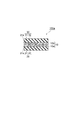
- FIG. 1 is a schematic cross-sectional view showing an embodiment of a structure.
- a circuit connection structure 100 a shown in FIG. 1 includes a circuit member (first circuit member) 20 and a circuit member (second circuit member) 30 that are opposed to each other, and between the circuit member 20 and the circuit member 30.
- the circuit connection member 10 which connects these is arrange
- the circuit connection member 10 includes a cured product of the adhesive composition of the present embodiment.
- the circuit member 20 includes a substrate (first substrate) 21 and a circuit electrode (first circuit electrode) 22 disposed on the main surface 21 a of the substrate 21.
- An insulating layer (not shown) may be disposed on the main surface 21a of the substrate 21 as the case may be.
- the circuit member 30 includes a substrate (second substrate) 31 and a circuit electrode (second circuit electrode) 32 disposed on the main surface 31 a of the substrate 31.
- An insulating layer (not shown) may be disposed on the main surface 31a of the substrate 31 in some cases.
- the circuit connecting member 10 contains an insulating substance (cured product of components excluding conductive particles) 10a and conductive particles 10b.
- the conductive particles 10b are disposed at least between the circuit electrode 22 and the circuit electrode 32 facing each other. In the circuit connection structure 100a, the circuit electrode 22 and the circuit electrode 32 are electrically connected via the conductive particles 10b.
- the circuit members 20 and 30 have one or a plurality of circuit electrodes (connection terminals).
- a chip component such as a semiconductor chip (IC chip), a resistor chip, or a capacitor chip; a substrate such as a printed board or a semiconductor mounting board can be used.
- Examples of the combination of the circuit members 20 and 30 include a semiconductor chip and a semiconductor mounting substrate.
- the material of the substrate include inorganic substances such as semiconductor, glass, and ceramic; organic substances such as polyimide, polyethylene terephthalate, polycarbonate, (meth) acrylic resin, and cyclic olefin resin; and composites of glass and epoxy.
- the substrate may be a plastic substrate.
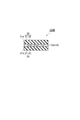
- FIG. 2 is a schematic cross-sectional view showing another embodiment of the structure.
- the circuit connection structure 100b shown in FIG. 2 has the same configuration as the circuit connection structure 100a except that the circuit connection member 10 does not contain the conductive particles 10b.
- the circuit electrode 22 and the circuit electrode 32 are in direct contact and are electrically connected without interposing conductive particles.
- the circuit connection structures 100a and 100b can be manufactured, for example, by the following method. First, when the adhesive composition is in a paste form, the resin layer containing the adhesive composition is disposed on the circuit member 20 by applying and drying the adhesive composition. When the adhesive composition is in the form of a film, the resin layer containing the adhesive composition is disposed on the circuit member 20 by sticking the film-like adhesive composition to the circuit member 20. Subsequently, the circuit member 30 is placed on the resin layer disposed on the circuit member 20 so that the circuit electrode 22 and the circuit electrode 32 are opposed to each other. And a heat treatment or light irradiation is performed to the resin layer containing an adhesive composition, an adhesive composition hardens
- a nickel layer having a thickness of 0.2 ⁇ m was formed on the surface of the polystyrene particles. Further, a gold layer having a thickness of 0.04 ⁇ m was formed outside the nickel layer. Thereby, conductive particles having an average particle diameter of 4 ⁇ m were produced.
- the phenoxy resins shown in Tables 2 and 3 were used in the form of a 40 mass% solution prepared by dissolving 40 g of PKHC (trade name, weight average molecular weight 45000, manufactured by Union Carbide Corporation) in 60 g of methyl ethyl ketone.
- PKHC weight average molecular weight 45000, manufactured by Union Carbide Corporation
- the radical polymerizable compound A urethane acrylate synthesized as described above was used.
- radical polymerizable compound B isocyanuric acid EO-modified diacrylate (trade name: M-215, manufactured by Toa Gosei Co., Ltd.) was used.
- radical polymerizable compound C phosphate ester
- 2-methacryloyloxyethyl acid phosphate (trade name: Light Ester P-2M, manufactured by Kyoeisha Chemical Co., Ltd.) was used.
- radical polymerizable compound D 9,9-bis- [4- (2-acryloyloxyethoxy) phenyl] fluorene (trade name: A-BPEF, manufactured by Shin-Nakamura Chemical Co., Ltd.) was used.
- silane compound having a functional group capable of radical polymerization (a functional group involved in a curing radical polymerization reaction).
- silane compound A1 3-Methacryloxypropylmethyldimethoxysilane (trade name: KBM-502, manufactured by Shin-Etsu Chemical Co., Ltd.) as the silane compound A1
- 3-methacryloxypropyltrimethoxysilane trade name: KBM-503, Shin-Etsu Chemical
- silane compound A3 3-acryloxypropyltrimethoxysilane (trade name: KBM-5103, manufactured by Shin-Etsu Chemical Co., Ltd.) was used as the silane compound A3.
- silane compound B As a silane compound (second silane compound) that has a functional group that does not participate in a curing radical polymerization reaction and does not have a functional group capable of radical polymerization (a functional group that participates in a curing radical polymerization reaction)
- silane compound B1 3-Glycidoxypropylmethyldimethoxysilane (trade name: KBM-402, manufactured by Shin-Etsu Chemical Co., Ltd.) as silane compound B1
- 3-glycidoxypropyltrimethoxysilane (trade name: KBM-403) as silane compound B2.
- Methyltrimethoxysilane (trade name: KBM-13, manufactured by Shin-Etsu Chemical Co., Ltd.) was used as the silane compound B3.
- radical polymerization initiators dilauroyl peroxide (peroxide A1, trade name: Parroyl L, manufactured by NOF Corporation, 1 minute half-life temperature: 116.4 ° C.), t-butyl peroxypivalate (peroxidation) Product A2, trade name: Perbutyl PV, manufactured by NOF Corporation, 1 minute half-life temperature: 110.3 ° C.) and 1,1,3,3-tetramethylbutylperoxy-2-ethylhexanoate ( Peroxide B, trade name: Perocta O, manufactured by NOF Corporation, 1 minute half-life temperature: 124.3 ° C.) was used.
- silica particles (trade name: R104, manufactured by Nippon Aerosil Co., Ltd.), which are inorganic particles, are dispersed in a mixed solvent of 45 g of toluene and 45 g of ethyl acetate to prepare a 10 mass% dispersion, and this is added to the coating liquid. Blended.
- a flexible circuit board having 2200 copper circuits having a line width of 75 ⁇ m, a pitch of 150 ⁇ m (space 75 ⁇ m), and a thickness of 18 ⁇ m, a glass substrate, and glass A SiN x substrate (thickness 0.7 mm) having a thin layer of 0.2 ⁇ m thick silicon nitride (SiN x ) formed on the substrate was connected.
- the connection was performed by heating and pressurizing using a thermocompression bonding apparatus (heating method: constant heat type, manufactured by Toray Engineering Co., Ltd.) at 130 ° C. and 3 MPa for 5 seconds, or 170 ° C.
- connection body in which the FPC and the SiN x substrate were connected by the cured product of the film adhesive over a width of 1.5 mm was produced.
- the pressure of the pressurization was calculated with the crimping area as 0.495 cm 2 .
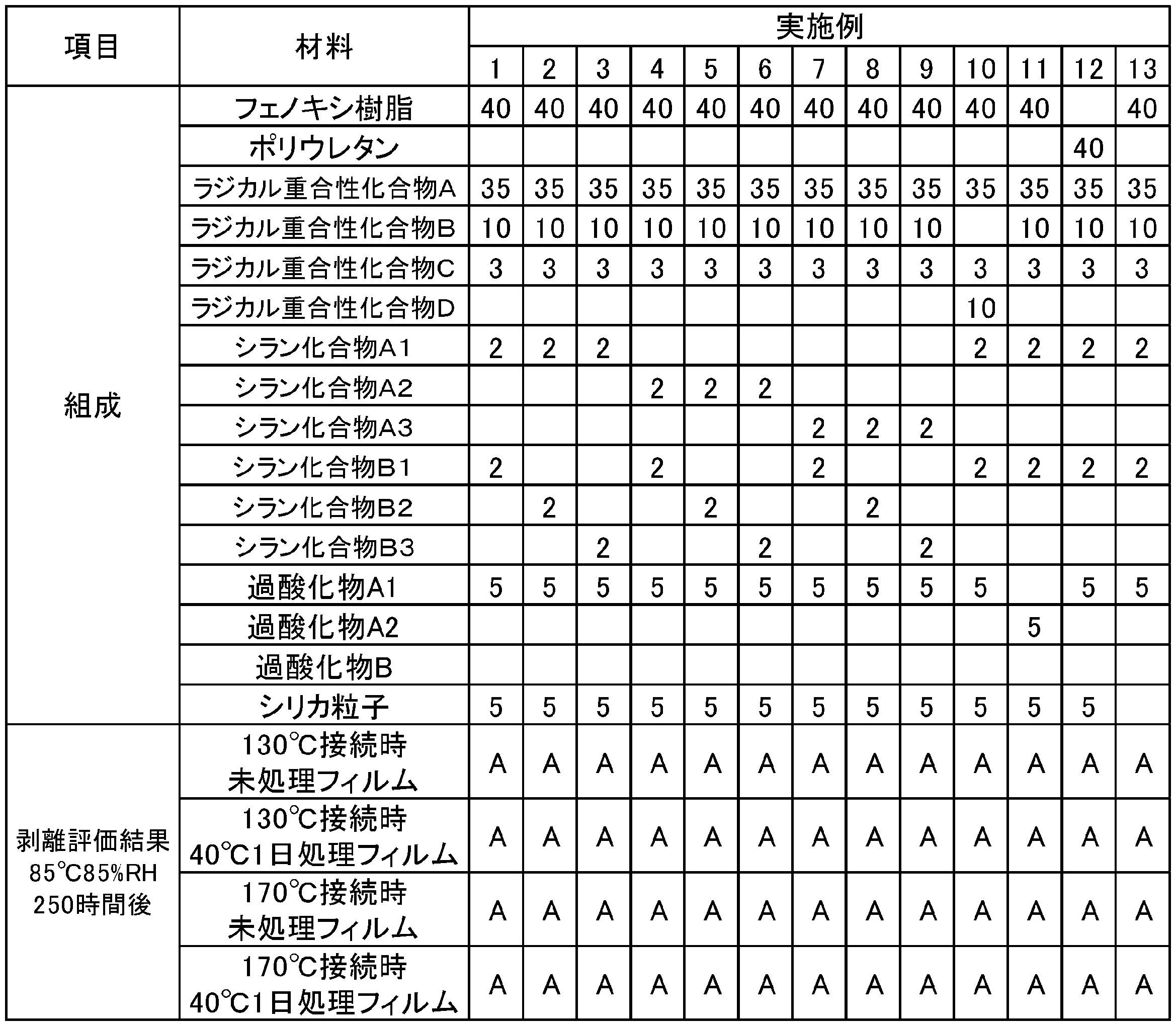
- connection evaluation Using an optical microscope, the connection appearance immediately after the connection body was prepared and the connection appearance after the connection body was left in a constant temperature and humidity chamber at 85 ° C. and 85% RH for 250 hours (after the high temperature and high humidity test) were used. And observed. The area (peeling area) where peeling occurred at the interface between the SiN x substrate and the cured product in the space was measured, and the presence or absence of peeling was evaluated. The case where the ratio of the peeled area occupying the entire space exceeded 30% was evaluated as “B” (with peeling), and the case where the peeled area ratio was 30% or less was evaluated as “A” (without peeling). The evaluation results are shown in Tables 2 and 3. In addition, about the connection external appearance immediately after preparation of a connection body, there was no peeling in all the Examples and the comparative examples.
- the film-like adhesives of the examples were capable of low-temperature and short-time connection (particularly, connection at 130 ° C. for 5 seconds) as compared with the comparative example.
- the film-like adhesives of the examples can maintain good adhesion to the substrate (inorganic substrate) surface even after the high-temperature and high-humidity treatment as compared with the comparative examples, and have excellent storage stability.
Landscapes
- Chemical & Material Sciences (AREA)
- Organic Chemistry (AREA)
- Engineering & Computer Science (AREA)
- Microelectronics & Electronic Packaging (AREA)
- Manufacturing & Machinery (AREA)
- Physics & Mathematics (AREA)
- Dispersion Chemistry (AREA)
- Spectroscopy & Molecular Physics (AREA)
- Inorganic Chemistry (AREA)
- Adhesives Or Adhesive Processes (AREA)
- Adhesive Tapes (AREA)
- Combinations Of Printed Boards (AREA)
Abstract
Description
本実施形態の接着剤組成物は、シラン化合物と、ラジカル重合性化合物(ラジカル重合性物質)と、硬化剤と、を含有する。本実施形態の接着剤組成物は、シラン化合物として、ラジカル重合可能な官能基(硬化系のラジカル重合反応に関与する官能基。ラジカル重合系において重合し得る官能基)を有する第1のシラン化合物と、前記第1のシラン化合物と反応する第2のシラン化合物(前記第1のシラン化合物に該当する化合物を除く)とを含有する。本実施形態の接着剤組成物は、前記硬化剤として、1分間半減期温度が120℃以下である過酸化物を含有する。本実施形態の接着剤組成物は、ラジカル硬化系(ラジカル重合系)の接着剤組成物である。本実施形態の接着剤組成物は、回路接続用接着剤組成物として好適に用いることができる。以下、各成分について説明する。
本実施形態の接着剤組成物は、ラジカル重合可能な官能基を有する第1のシラン化合物と、前記第1のシラン化合物と反応する第2のシラン化合物とを含有する。第2のシラン化合物は、第1のシラン化合物に該当しない化合物であり、ラジカル重合可能な官能基を有していない。シラン化合物は、シランカップリング剤であってもよい。

ラジカル重合性化合物は、ラジカル重合可能な官能基を有する化合物であり、第1のシラン化合物に該当しない化合物である。このようなラジカル重合性化合物としては、(メタ)アクリレート化合物、マレイミド化合物、シトラコンイミド樹脂、ナジイミド樹脂等が挙げられる。「(メタ)アクリレート化合物」とは、(メタ)アクリロイル基を有する化合物を意味する。ラジカル重合性化合物は、モノマー又はオリゴマーの状態で用いてもよく、モノマーとオリゴマーとを併用することもできる。ラジカル重合性化合物は、1種単独で用いてもよく、2種以上を組み合わせて用いてもよい。

硬化剤としては、熱(加熱)により遊離ラジカルを発生する硬化剤、光により遊離ラジカルを発生する硬化剤、超音波、電磁波等により遊離ラジカルを発生する硬化剤などを用いることができる。
なお、半減期とは、過酸化物の濃度が初期の半分に減ずるまでの時間であり、1分間半減期温度は、半減期が1分間になる温度を示す。1分間半減期温度としては、日油株式会社発行のカタログ(有機過酸化物(第10版、2015年2月))掲載の値を用いることができる。
本実施形態の接着剤組成物は、必要に応じて、フィルム形成材を含有してもよい。フィルム形成材は、液状の接着剤組成物をフィルム状に固形化した場合に、通常の状態(常温常圧)でのフィルムの取扱い性を向上させ、裂け難い、割れ難い、べたつき難い等の特性をフィルムに付与することができる。フィルム形成材としては、フェノキシ樹脂、ポリビニルホルマール、ポリスチレン、ポリビニルブチラール、ポリエステル、ポリアミド、キシレン樹脂、ポリウレタン等が挙げられる。これらの中でも、接着性、相溶性、耐熱性及び機械的強度に優れる観点から、フェノキシ樹脂が好ましい。フィルム形成材は、1種単独で用いてもよく、2種以上を組み合わせて用いてもよい。
本実施形態の接着剤組成物は、導電粒子を更に含有していてもよい。導電粒子の構成材料としては、金(Au)、銀(Ag)、ニッケル(Ni)、銅(Cu)、はんだ等の金属、カーボンなどが挙げられる。また、非導電性の樹脂、ガラス、セラミック、プラスチック等を核とし、この核に前記金属(金属粒子等)又はカーボンを被覆した被覆導電粒子でもよい。被覆導電粒子又は熱溶融金属粒子は、加熱加圧により変形性を有するため、接続時に回路電極の高さばらつきを解消し、接続時に電極との接触面積が増加することから信頼性が向上するため好ましい。
本実施形態の接着剤組成物は、必要に応じて、ハイドロキノン、メチルエーテルハイドロキノン類等の重合禁止剤を適宜含有してもよい。
本実施形態の構造体は、本実施形態の接着剤組成物又はその硬化物を備える。本実施形態の構造体は、例えば、回路接続構造体等の半導体装置である。本実施形態の構造体の一態様として、回路接続構造体は、第一の回路電極を有する第一の回路部材と、第二の回路電極を有する第二の回路部材と、第一の回路部材及び第二の回路部材の間に配置された回路接続部材と、を備える。第一の回路部材は、例えば、第一の基板と、当該第一の基板上に配置された第一の回路電極と、を有する。第二の回路部材は、例えば、第二の基板と、当該第二の基板上に配置された第二の回路電極と、を有する。第一の回路電極及び第二の回路電極は、相対向すると共に電気的に接続されている。回路接続部材は、本実施形態の接着剤組成物又はその硬化物を含んでいる。本実施形態に係る構造体は、本実施形態に係る接着剤組成物又はその硬化物を備えていればよく、前記回路接続構造体の回路部材に代えて、回路電極を有していない部材(基板等)を用いてもよい。
還流冷却器、温度計及び撹拌機を備えたセパラブルフラスコに、エーテル結合を有するジオールであるポリプロピレングリコール(和光純薬工業株式会社製、数平均分子量Mn=2000)1000質量部、及び、メチルエチルケトン(溶剤)4000質量部を加えた後、40℃で30分間撹拌して反応液を調製した。前記反応液を70℃まで昇温した後、ジメチル錫ラウレート(触媒)0.0127質量部を加えた。次いで、この反応液に対して、4,4’-ジフェニルメタンジイソシアネート125質量部をメチルエチルケトン125質量部に溶解して調製した溶液を、1時間かけて滴下した。その後、赤外分光光度計(日本分光株式会社製)によってイソシアネート基由来の吸収ピーク(2270cm-1)が見られなくなるまで前記温度で撹拌を続けて、ポリウレタンのメチルエチルケトン溶液を得た。次いで、この溶液の固形分濃度(ポリウレタンの濃度)が30質量%となるように溶剤量を調整した。得られたポリウレタン(ウレタン樹脂)の重量平均分子量は、GPC(ゲルパーミエーションクロマトグラフィー)による測定の結果、320000(標準ポリスチレン換算値)であった。GPCの測定条件を表1に示す。

温度計、撹拌機、不活性ガス導入口及び還流冷却器を装着した2L(リットル)の四つ口フラスコに、ポリカーボネートジオール(アルドリッチ社製、数平均分子量2000)4000質量部と、2-ヒドロキシエチルアクリレート238質量部と、ハイドロキノンモノメチルエーテル0.49質量部と、スズ系触媒4.9質量部とを仕込んで反応液を調製した。70℃に加熱した反応液に対して、イソホロンジイソシアネート(IPDI)666質量部を3時間かけて均一に滴下し、反応させた。滴下完了後、15時間反応を継続し、NCO%(NCO含有量)が0.2質量%以下となった時点を反応終了とみなし、ウレタンアクリレートを得た。NCO%は、電位差自動滴定装置(商品名:AT-510、京都電子工業株式会社製)によって確認した。GPCによる分析の結果、ウレタンアクリレートの重量平均分子量は8500(標準ポリスチレン換算値)であった。なお、GPCによる分析は、前記ポリウレタンの重量平均分子量の分析と同様の条件で行った。
ポリスチレン粒子の表面に厚さ0.2μmのニッケル層を形成した。さらに、このニッケル層の外側に厚さ0.04μmの金層を形成させた。これにより、平均粒径4μmの導電粒子を作製した。
表2及び表3に示す成分を、表2及び表3に示す質量比(固形分)で混合して混合物を得た。この混合物に前記導電粒子を1.5体積%の割合(基準:接着剤組成物の接着剤成分の全体積)で分散させて、フィルム状接着剤を形成するための塗工液を得た。この塗工液を厚み50μmのポリエチレンテレフタレート(PET)フィルムに、塗工装置を用いて塗布した。塗膜を70℃で10分熱風乾燥して、厚み18μmのフィルム状接着剤を形成させた。
表2及び表3に示すフィルム状接着剤を用いて、ライン幅75μm、ピッチ150μm(スペース75μm)及び厚さ18μmの銅回路を2200本有するフレキシブル回路基板(FPC)と、ガラス基板、及び、ガラス基板上に形成された厚さ0.2μmの窒化珪素(SiNx)の薄層を有するSiNx基板(厚さ0.7mm)とを接続した。接続は、熱圧着装置(加熱方式:コンスタントヒート型、東レエンジニアリング株式会社製)を用い、130℃、3MPaで5秒間、又は、170℃、3MPaで5秒間の加熱及び加圧により行った。これにより、幅1.5mmにわたりFPCとSiNx基板とがフィルム状接着剤の硬化物により接続された接続体を作製した。加圧の圧力は、圧着面積を0.495cm2として計算した。
前記接続体の作製直後の接続外観と、前記接続体を85℃、85%RHの恒温恒湿槽中に250時間放置した後(高温高湿試験後)の接続外観とを、光学顕微鏡を用いて観察した。スペース部分におけるSiNx基板と硬化物との界面において剥離が発生している面積(剥離面積)を測定し、剥離の有無を評価した。スペース全体に占める剥離面積の割合が30%を超える場合を「B」(剥離有り)と評価し、剥離面積の割合が30%以下の場合を「A」(剥離なし)と評価した。評価結果を表2及び表3に示す。なお、接続体の作製直後の接続外観については、全ての実施例及び比較例において剥離なしであった。
前記フィルム状接着剤を40℃の恒温槽にて1日処理した。このフィルム状接着剤を用いて、前記と同様の方法で接続体を作製した後に高温高湿試験を行った。評価結果を表2及び表3に示す。

Claims (7)
- ラジカル重合可能な官能基を有する第1のシラン化合物と、
前記第1のシラン化合物と反応する第2のシラン化合物と、
ラジカル重合性化合物(前記第1のシラン化合物に該当する化合物を除く)と、
1分間半減期温度が120℃以下である過酸化物と、を含有する、接着剤組成物。 - 前記第1のシラン化合物の前記官能基が、(メタ)アクリロイル基及びビニル基からなる群より選ばれる少なくとも1種を含む、請求項1に記載の接着剤組成物。
- 前記第2のシラン化合物がエポキシ基を有する、請求項1又は2に記載の接着剤組成物。
- 導電粒子を更に含有する、請求項1~3のいずれか一項に記載の接着剤組成物。
- 回路接続用である、請求項1~4のいずれか一項に記載の接着剤組成物。
- 請求項1~5のいずれか一項に記載の接着剤組成物又はその硬化物を備える、構造体。
- 第一の回路電極を有する第一の回路部材と、
第二の回路電極を有する第二の回路部材と、
前記第一の回路部材及び前記第二の回路部材の間に配置された回路接続部材と、を備え、
前記第一の回路電極及び前記第二の回路電極が電気的に接続されており、
前記回路接続部材が、請求項1~5のいずれか一項に記載の接着剤組成物又はその硬化物を含む、構造体。
Priority Applications (3)
| Application Number | Priority Date | Filing Date | Title |
|---|---|---|---|
| KR1020187014964A KR102608218B1 (ko) | 2015-11-04 | 2016-11-02 | 접착제 조성물 및 구조체 |
| CN201680062847.XA CN108350320B (zh) | 2015-11-04 | 2016-11-02 | 粘接剂组合物和结构体 |
| JP2017548820A JP6915544B2 (ja) | 2015-11-04 | 2016-11-02 | 接着剤組成物及び構造体 |
Applications Claiming Priority (2)
| Application Number | Priority Date | Filing Date | Title |
|---|---|---|---|
| JP2015-216516 | 2015-11-04 | ||
| JP2015216516 | 2015-11-04 |
Publications (1)
| Publication Number | Publication Date |
|---|---|
| WO2017078087A1 true WO2017078087A1 (ja) | 2017-05-11 |
Family
ID=58662435
Family Applications (1)
| Application Number | Title | Priority Date | Filing Date |
|---|---|---|---|
| PCT/JP2016/082645 Ceased WO2017078087A1 (ja) | 2015-11-04 | 2016-11-02 | 接着剤組成物及び構造体 |
Country Status (5)
| Country | Link |
|---|---|
| JP (2) | JP6915544B2 (ja) |
| KR (1) | KR102608218B1 (ja) |
| CN (1) | CN108350320B (ja) |
| TW (1) | TWI786036B (ja) |
| WO (1) | WO2017078087A1 (ja) |
Cited By (1)
| Publication number | Priority date | Publication date | Assignee | Title |
|---|---|---|---|---|
| JP2023547934A (ja) * | 2020-11-05 | 2023-11-14 | ヘンケル・アクチェンゲゼルシャフト・ウント・コムパニー・コマンディットゲゼルシャフト・アウフ・アクチェン | アンチフラッター接着剤組成物 |
Families Citing this family (1)
| Publication number | Priority date | Publication date | Assignee | Title |
|---|---|---|---|---|
| TWI671921B (zh) * | 2018-09-14 | 2019-09-11 | 頎邦科技股份有限公司 | 晶片封裝構造及其晶片 |
Citations (6)
| Publication number | Priority date | Publication date | Assignee | Title |
|---|---|---|---|---|
| JP2002285103A (ja) * | 2001-03-26 | 2002-10-03 | Sumitomo Bakelite Co Ltd | 異方導電性接着剤 |
| JP2004067908A (ja) * | 2002-08-07 | 2004-03-04 | Sumitomo Bakelite Co Ltd | 異方導電性接着剤 |
| JP2006022231A (ja) * | 2004-07-08 | 2006-01-26 | Sumitomo Bakelite Co Ltd | 異方導電性接着剤および異方導電性接着剤フィルム |
| JP2013028733A (ja) * | 2011-07-29 | 2013-02-07 | Sumitomo Bakelite Co Ltd | 液状樹脂組成物および半導体装置 |
| JP2013253151A (ja) * | 2012-06-06 | 2013-12-19 | Hitachi Chemical Co Ltd | 回路接続用接着フィルム、並びに回路部材の接続構造体及びその製造方法 |
| JP2015167223A (ja) * | 2014-02-14 | 2015-09-24 | デクセリアルズ株式会社 | 接続構造体の製造方法、及び回路接続材料 |
Family Cites Families (15)
| Publication number | Priority date | Publication date | Assignee | Title |
|---|---|---|---|---|
| JP4004333B2 (ja) * | 2001-06-05 | 2007-11-07 | 松下電器産業株式会社 | 半導体モジュール |
| JP4146747B2 (ja) * | 2003-03-26 | 2008-09-10 | 積水化学工業株式会社 | 硬化性組成物 |
| CN101437914B (zh) * | 2006-05-09 | 2012-12-12 | 日立化成工业株式会社 | 粘接片、使用其的电路构件的连接结构及半导体器件 |
| CN101675715B (zh) * | 2007-05-09 | 2011-06-08 | 日立化成工业株式会社 | 膜状电路连接材料及电路部件的连接结构 |
| CN101849266A (zh) | 2007-11-12 | 2010-09-29 | 日立化成工业株式会社 | 电路连接材料以及电路部件的连接结构 |
| WO2010110107A1 (ja) * | 2009-03-23 | 2010-09-30 | セメダイン株式会社 | 硬化性組成物 |
| JP2011199097A (ja) * | 2010-03-23 | 2011-10-06 | Sumitomo Bakelite Co Ltd | 半導体装置の製造方法 |
| JP2012072305A (ja) * | 2010-09-29 | 2012-04-12 | Hitachi Chemical Co Ltd | 樹脂ペースト組成物 |
| CN103764776A (zh) * | 2011-09-06 | 2014-04-30 | 日立化成株式会社 | 粘接剂组合物和连接体 |
| JP5934528B2 (ja) | 2012-03-12 | 2016-06-15 | デクセリアルズ株式会社 | 回路接続材料、及びそれを用いた実装体の製造方法 |
| JP6250265B2 (ja) * | 2012-03-16 | 2017-12-20 | リンテック株式会社 | 接着剤組成物、接着シートおよび半導体装置の製造方法 |
| KR20150005516A (ko) * | 2012-04-25 | 2015-01-14 | 히타치가세이가부시끼가이샤 | 회로 접속 재료, 회로 접속 구조체, 접착 필름 및 권중체 |
| CN103131336B (zh) * | 2013-03-22 | 2015-06-10 | 苏州度辰新材料有限公司 | 一种硅烷交联的乙烯醋酸乙烯共聚物胶膜的制备方法 |
| CN103360956B (zh) * | 2013-06-18 | 2015-06-03 | 明基材料有限公司 | 一种用于电子元件间电性导通的粘着剂 |
| JP6398570B2 (ja) * | 2013-10-09 | 2018-10-03 | 日立化成株式会社 | 回路接続材料、回路部材の接続構造体、及び回路部材の接続構造体の製造方法 |
-
2016
- 2016-11-02 WO PCT/JP2016/082645 patent/WO2017078087A1/ja not_active Ceased
- 2016-11-02 JP JP2017548820A patent/JP6915544B2/ja active Active
- 2016-11-02 KR KR1020187014964A patent/KR102608218B1/ko active Active
- 2016-11-02 CN CN201680062847.XA patent/CN108350320B/zh active Active
- 2016-11-03 TW TW105135632A patent/TWI786036B/zh active
-
2021
- 2021-07-01 JP JP2021110078A patent/JP7124936B2/ja active Active
Patent Citations (6)
| Publication number | Priority date | Publication date | Assignee | Title |
|---|---|---|---|---|
| JP2002285103A (ja) * | 2001-03-26 | 2002-10-03 | Sumitomo Bakelite Co Ltd | 異方導電性接着剤 |
| JP2004067908A (ja) * | 2002-08-07 | 2004-03-04 | Sumitomo Bakelite Co Ltd | 異方導電性接着剤 |
| JP2006022231A (ja) * | 2004-07-08 | 2006-01-26 | Sumitomo Bakelite Co Ltd | 異方導電性接着剤および異方導電性接着剤フィルム |
| JP2013028733A (ja) * | 2011-07-29 | 2013-02-07 | Sumitomo Bakelite Co Ltd | 液状樹脂組成物および半導体装置 |
| JP2013253151A (ja) * | 2012-06-06 | 2013-12-19 | Hitachi Chemical Co Ltd | 回路接続用接着フィルム、並びに回路部材の接続構造体及びその製造方法 |
| JP2015167223A (ja) * | 2014-02-14 | 2015-09-24 | デクセリアルズ株式会社 | 接続構造体の製造方法、及び回路接続材料 |
Cited By (3)
| Publication number | Priority date | Publication date | Assignee | Title |
|---|---|---|---|---|
| JP2023547934A (ja) * | 2020-11-05 | 2023-11-14 | ヘンケル・アクチェンゲゼルシャフト・ウント・コムパニー・コマンディットゲゼルシャフト・アウフ・アクチェン | アンチフラッター接着剤組成物 |
| JP7639131B2 (ja) | 2020-11-05 | 2025-03-04 | ヘンケル・アクチェンゲゼルシャフト・ウント・コムパニー・コマンディットゲゼルシャフト・アウフ・アクチェン | アンチフラッター接着剤組成物 |
| US12540261B2 (en) | 2020-11-05 | 2026-02-03 | Henkel Ag & Co. Kgaa | Anti-flutter adhesive composition |
Also Published As
| Publication number | Publication date |
|---|---|
| KR102608218B1 (ko) | 2023-11-30 |
| JP7124936B2 (ja) | 2022-08-24 |
| KR20180079370A (ko) | 2018-07-10 |
| JP6915544B2 (ja) | 2021-08-04 |
| JP2021165397A (ja) | 2021-10-14 |
| CN108350320B (zh) | 2021-11-26 |
| JPWO2017078087A1 (ja) | 2018-09-06 |
| TWI786036B (zh) | 2022-12-11 |
| CN108350320A (zh) | 2018-07-31 |
| TW201724924A (zh) | 2017-07-01 |
Similar Documents
| Publication | Publication Date | Title |
|---|---|---|
| KR101970376B1 (ko) | 접착제 조성물 및 접속체 | |
| JP2020109173A (ja) | 接着剤組成物及び接続体 | |
| JP7173258B2 (ja) | 接着剤組成物及び構造体 | |
| JP6870618B2 (ja) | 回路接続用接着剤組成物及び構造体 | |
| JPWO2018181536A1 (ja) | 接着剤組成物及び構造体 | |
| JP7124936B2 (ja) | 接着剤組成物及び構造体 | |
| JP7172991B2 (ja) | 接着剤組成物及び構造体 | |
| KR20190058614A (ko) | 접속 구조체, 회로 접속 부재 및 접착제 조성물 | |
| JP7000857B2 (ja) | 接着剤組成物及び構造体 | |
| WO2023195398A1 (ja) | 接着剤組成物、回路接続用接着剤フィルム、回路接続構造体及びその製造方法 | |
| WO2023276889A1 (ja) | 回路接続用接着剤フィルム、回路接続構造体及びその製造方法 | |
| JP7537218B2 (ja) | 回路接続用接着剤フィルム、回路接続構造体及びその製造方法 | |
| JP2024085094A (ja) | 接着剤組成物、構造体及びその製造方法 | |
| WO2025041839A1 (ja) | 接着剤組成物、回路接続用接着剤フィルム、回路接続構造体及びその製造方法 | |
| JP2024161731A (ja) | 接着剤組成物、構造体及びその製造方法 |
Legal Events
| Date | Code | Title | Description |
|---|---|---|---|
| 121 | Ep: the epo has been informed by wipo that ep was designated in this application |
Ref document number: 16862147 Country of ref document: EP Kind code of ref document: A1 |
|
| ENP | Entry into the national phase |
Ref document number: 2017548820 Country of ref document: JP Kind code of ref document: A |
|
| NENP | Non-entry into the national phase |
Ref country code: DE |
|
| ENP | Entry into the national phase |
Ref document number: 20187014964 Country of ref document: KR Kind code of ref document: A |
|
| 122 | Ep: pct application non-entry in european phase |
Ref document number: 16862147 Country of ref document: EP Kind code of ref document: A1 |