WO2017057563A1 - 水中油中粉体型組成物 - Google Patents
水中油中粉体型組成物 Download PDFInfo
- Publication number
- WO2017057563A1 WO2017057563A1 PCT/JP2016/078802 JP2016078802W WO2017057563A1 WO 2017057563 A1 WO2017057563 A1 WO 2017057563A1 JP 2016078802 W JP2016078802 W JP 2016078802W WO 2017057563 A1 WO2017057563 A1 WO 2017057563A1
- Authority
- WO
- WIPO (PCT)
- Prior art keywords
- oil
- acid
- water
- powder
- hydrophobic
- Prior art date
- Legal status (The legal status is an assumption and is not a legal conclusion. Google has not performed a legal analysis and makes no representation as to the accuracy of the status listed.)
- Ceased
Links
Classifications
-
- A—HUMAN NECESSITIES
- A61—MEDICAL OR VETERINARY SCIENCE; HYGIENE
- A61K—PREPARATIONS FOR MEDICAL, DENTAL OR TOILETRY PURPOSES
- A61K8/00—Cosmetics or similar toiletry preparations
- A61K8/02—Cosmetics or similar toiletry preparations characterised by special physical form
- A61K8/04—Dispersions; Emulsions
-
- A—HUMAN NECESSITIES
- A61—MEDICAL OR VETERINARY SCIENCE; HYGIENE
- A61K—PREPARATIONS FOR MEDICAL, DENTAL OR TOILETRY PURPOSES
- A61K8/00—Cosmetics or similar toiletry preparations
- A61K8/02—Cosmetics or similar toiletry preparations characterised by special physical form
- A61K8/04—Dispersions; Emulsions
- A61K8/06—Emulsions
- A61K8/062—Oil-in-water emulsions
-
- A—HUMAN NECESSITIES
- A61—MEDICAL OR VETERINARY SCIENCE; HYGIENE
- A61K—PREPARATIONS FOR MEDICAL, DENTAL OR TOILETRY PURPOSES
- A61K8/00—Cosmetics or similar toiletry preparations
- A61K8/18—Cosmetics or similar toiletry preparations characterised by the composition
- A61K8/19—Cosmetics or similar toiletry preparations characterised by the composition containing inorganic ingredients
- A61K8/29—Titanium; Compounds thereof
-
- A—HUMAN NECESSITIES
- A61—MEDICAL OR VETERINARY SCIENCE; HYGIENE
- A61K—PREPARATIONS FOR MEDICAL, DENTAL OR TOILETRY PURPOSES
- A61K8/00—Cosmetics or similar toiletry preparations
- A61K8/18—Cosmetics or similar toiletry preparations characterised by the composition
- A61K8/72—Cosmetics or similar toiletry preparations characterised by the composition containing organic macromolecular compounds
- A61K8/81—Cosmetics or similar toiletry preparations characterised by the composition containing organic macromolecular compounds obtained by reactions involving only carbon-to-carbon unsaturated bonds
-
- A—HUMAN NECESSITIES
- A61—MEDICAL OR VETERINARY SCIENCE; HYGIENE
- A61Q—SPECIFIC USE OF COSMETICS OR SIMILAR TOILETRY PREPARATIONS
- A61Q17/00—Barrier preparations; Preparations brought into direct contact with the skin for affording protection against external influences, e.g. sunlight, X-rays or other harmful rays, corrosive materials, bacteria or insect stings
- A61Q17/04—Topical preparations for affording protection against sunlight or other radiation; Topical sun tanning preparations
Definitions
- the present invention relates to an oil-in-water powder-type composition in which oil droplets in which hydrophobic powder is dispersed are further dispersed in an aqueous phase, and particularly to an improvement in a dispersant for dispersing oil droplets in an aqueous phase.
- Hydrophobic powder is usually used as a powder cosmetic or as a powder-in-oil cosmetic in which a hydrophobic powder is dispersed in an oil phase. If it is a phase, it is difficult to obtain a refreshing feel when applied to the skin. Therefore, a powder-in-oil-in-water composition in which oil droplets in which hydrophobic powder is dispersed is further dispersed in an aqueous phase may be used, and the continuous phase is an aqueous phase, so that it has excellent usability and is hydrophobic. Water resistance due to functional powder is also expected. However, the powder-in-oil-in-water composition has a problem that the water resistance inherent in the hydrophobic powder cannot be exhibited, although high improvement in the usability is recognized.
- the present invention has been made in view of the prior art, and the problem to be solved is to provide a composition that does not impair the water resistance of hydrophobic powder while taking the form of an oil-in-water powder type. There is to do.
- the use of a core-corona type microgel as a dispersant makes the powder-in-oil-in-water composition highly stable, and the composition
- the present inventors have found that the hydrophobic powder on the coating film to which has been applied has high water resistance, and completed the present invention.
- an oil-in-water powder-type composition is Hydrophobic powder, An oil phase in which the hydrophobic powder is dispersed; An aqueous phase in which the oil phase is dispersed; With As a dispersant for dispersing the oil phase in the aqueous phase, It is characterized in that a core-corona type microgel in which hydrophilic groups are partially provided on the surface of hydrophobic gel fine particles is used. Further, in the composition, as a core-corona type microgel, a (polymer) / (methacrylic acid methoxy PEG) crosspolymer and / or a specific acrylamide derivative and an acrylate derivative are subjected to radical polymerization under specific conditions without crosslinking.
- a crosslinked acrylamide polymer It is preferable to use 0.5 to 10% by mass of a crosslinked acrylamide polymer.
- a nonionic surfactant in the said composition it is suitable to set it as 0.5 mass% or less in a composition.
- the core-corona microgel characteristic of the present invention can be used as a dispersant in so-called Pickering emulsion (powder emulsification) (Patent Documents 1 to 11, Non-Patent Documents 1 to 4).
- this core-corona type microgel is new in that it has high dispersion stability in a powder-in-oil-in-water composition and improves the water resistance of the hydrophobic powder in the coating film when the composition is applied. We have obtained knowledge.
- the core-corona type microgel is used as the dispersant for the powder-in-oil-in-water composition, the use of other surfactants can be suppressed, and the water resistance of the hydrophobic powder is sufficiently improved. It will be possible to demonstrate.
- the hydrophobic powder used in the present invention is not particularly limited as long as the surface of the powder has hydrophobicity.
- the powder itself such as silicone resin powder and fluororesin powder is used.
- the surface of the inorganic powder particles is treated with silicones such as methyl hydrogen polysiloxane and dimethyl polysiloxane, dextrin fatty acid ester, higher fatty acid, higher alcohol, fatty acid ester, metal soap, alkyl phosphate ether, Hydrophobic treatments using a fluorine compound, or a hydrocarbon such as squalane and paraffin, by a wet method using a solvent, a gas phase method, a mechanochemical method, and the like can be given.
- the average particle diameter of hydrophobic powder needs to be smaller than the emulsified particles that are the oil phase of the present invention.
- the average particle size after crushing with a wet disperser is 100 nm or less.
- the inorganic powder particles to be hydrophobized include titanium oxide, zinc oxide, talc, mica, sericite, kaolin, titanium mica, black iron oxide, yellow iron oxide, bengara, ultramarine blue, bitumen, chromium oxide, water. Examples include chromium oxide.
- hydrophobic powders particularly when hydrophobized fine particle titanium dioxide and hydrophobized fine particle zinc oxide are blended together, it is known that remarkable emulsification particles are likely to aggregate and coalesce.
- the dispersion stability and emulsification stability of the powder can be remarkably improved by blending the microgel as a dispersant. Become. For this reason, in the present invention, it is particularly useful when the hydrophobized fine particle titanium dioxide and the hydrophobized fine particle zinc oxide are contained as the hydrophobic powder.
- the blending amount of the hydrophobized powder in the oil-in-water powder-type composition of the present invention is preferably 0.1 to 20% by mass relative to the total amount of the composition. If it is less than 0.1% by mass, the effect of the blending is not sufficient, and if it exceeds 20% by mass, the emulsion stability may be deteriorated.
- Oil phase component examples include hydrocarbon oils, higher fatty acids, higher alcohols, synthetic ester oils, silicone oils, liquid fats and oils, solid fats and oils, waxes, and fragrances that are usually used in cosmetics, quasi drugs and the like.
- hydrocarbon oil examples include isododecane, isohexadecane, isoparaffin, liquid paraffin, ozokerite, squalane, pristane, paraffin, ceresin, squalene, petrolatum, microcrystalline wax, and the like.
- higher fatty acids examples include lauric acid, myristic acid, palmitic acid, stearic acid, behenic acid, oleic acid, undecylenic acid, toluic acid, isostearic acid, linoleic acid, linolenic acid, eicosapentaenoic acid (EPA), docosahexaenoic acid ( DHA) and the like.
- Examples of the higher alcohol include straight chain alcohols (for example, lauryl alcohol, cetyl alcohol, stearyl alcohol, behenyl alcohol, myristyl alcohol, oleyl alcohol, cetostearyl alcohol), branched chain alcohols (for example, monostearyl glycerol ether (batyl alcohol) ) -2-decyltetradecinol, lanolin alcohol, cholesterol, phytosterol, hexyl decanol, isostearyl alcohol, octyldodecanol, etc.).
- straight chain alcohols for example, lauryl alcohol, cetyl alcohol, stearyl alcohol, behenyl alcohol, myristyl alcohol, oleyl alcohol, cetostearyl alcohol
- branched chain alcohols for example, monostearyl glycerol ether (batyl alcohol) ) -2-decyltetradecinol, lanolin alcohol, cholesterol, phytosterol, hexyl decano
- Synthetic ester oils include, for example, octyl octoate, nonyl nonanoate, cetyl octanoate, isopropyl myristate, octyldodecyl myristate, isopropyl palmitate, butyl stearate, hexyl laurate, myristyl myristate, decyl oleate, dimethyl Hexyldecyl octoate, cetyl lactate, myristyl lactate, lanolin acetate, isocetyl stearate, isocetyl isostearate, cholesteryl 12-hydroxystearate, ethylene glycol di-2-ethylhexanoate, dipentaerythritol fatty acid ester, monoisostearic acid N- Alkyl glycol, neopentyl glycol dicaprate, tripropylene glycol pivalate, diisosteary
- silicone oil examples include chain polysiloxanes (for example, dimethylpolysiloxane, methylphenylpolysiloxane, diphenylpolysiloxane, etc.), cyclic polysiloxanes (for example, octamethylcyclotetrasiloxane, decamethylcyclopentasiloxane, dodecamethylcyclohexane).
- chain polysiloxanes for example, dimethylpolysiloxane, methylphenylpolysiloxane, diphenylpolysiloxane, etc.
- cyclic polysiloxanes for example, octamethylcyclotetrasiloxane, decamethylcyclopentasiloxane, dodecamethylcyclohexane.
- Silicone resins, silicone rubber, various modified polysiloxanes as amino-modified polysiloxane, polyether-modified polysiloxane, alkyl
- liquid oils examples include avocado oil, camellia oil, turtle oil, macadamia nut oil, corn oil, mink oil, olive oil, rapeseed oil, egg yolk oil, sesame oil, persic oil, wheat germ oil, southern castor oil, castor oil, linseed oil , Safflower oil, cottonseed oil, eno oil, soybean oil, peanut oil, tea seed oil, kaya oil, rice bran oil, cinnagiri oil, Japanese kiri oil, jojoba oil, germ oil, triglycerin and the like.
- solid fat examples include cacao butter, palm oil, horse fat, hydrogenated palm oil, palm oil, beef tallow, sheep fat, hydrogenated beef tallow, palm kernel oil, pork fat, beef bone fat, owl kernel oil, hydrogenated oil, cattle Leg fats, moles, hydrogenated castor oil and the like.
- waxes examples include beeswax, candelilla wax, cotton wax, carnauba wax, bayberry wax, ibota wax, whale wax, montan wax, nuka wax, lanolin, kapok wax, lanolin acetate, liquid lanolin, sugarcane wax, lanolin fatty acid isopropyl, hexyl laurate, Examples include reduced lanolin, jojoballow, hard lanolin, shellac wax, POE lanolin alcohol ether, POE lanolin alcohol acetate, POE cholesterol ether, lanolin fatty acid polyethylene glycol, and POE hydrogenated lanolin alcohol ether.
- fragrances examples include natural fragrances obtained from animals or plants, synthetic fragrances produced by chemical synthesis means, and blended fragrances that are mixtures thereof, and are not particularly limited. By blending a fragrance, it is possible to obtain a cosmetic with excellent fragrance sustainability.
- fragrances include acetylenol, anisaldehyde, anethole, amyl acetate, amyl salicylate, allyl amyl glycolate, allyl caproate, aldehyde C6-20, ambretride, ambretlide, ambroxan, ionone, ISOE Super, Eugenol, Auranthiol, Galaxolide, Calone, Coumarin, Geraniol, Geranyl acetate, Sandaroa, Santalol, Sandera, Cyclamenaldehyde, Cis-3-hexenyl acetate, Cis-3-hexenol, Citral, Citronellyl acetate, Citronellol , Cineol, Dihydromyrcenol, Jasmolactone, Cinamic Alcohol, Cinamic Aldehyde, Styraryl Acetate, Cedryl Acetate , Cedrol, damascon, damassenone, decalact
- the powder-in-oil-in-water composition of the present invention is a pickering emulsion using a core-corona type microgel as a dispersant, it is less affected by the type of oil, such as emulsifiability and stability, and is wider than before.
- Various types of oil can be blended.
- Water phase component As the water phase component, water, water-soluble alcohols, thickeners and the like that are usually used in cosmetics, quasi drugs, and the like can be blended. Further, if desired, a humectant, chelating agent, preservative , Pigments and the like can be appropriately blended.
- the water contained in the powder-in-oil-in-water composition of the present invention is not particularly limited, and examples thereof include purified water, ion exchange water, and tap water.
- water-soluble alcohols include lower alcohols, polyhydric alcohols, polyhydric alcohol polymers, divalent alcohol alkyl ethers, dihydric alcohol alkyl ethers, dihydric alcohol ether esters, glycerin monoalkyl ethers, sugar alcohols, Examples thereof include monosaccharides, oligosaccharides, polysaccharides, and derivatives thereof.
- lower alcohols examples include ethanol, propanol, isopropanol, isobutyl alcohol, t-butyl alcohol and the like.
- polyhydric alcohol examples include dihydric alcohols (eg, dipropylene glycol, 1,3-butylene glycol, ethylene glycol, trimethylene glycol, 1,2-butylene glycol, tetramethylene glycol, 2,3-butylene glycol, Pentamethylene glycol, 2-butene-1,4-diol, hexylene glycol, octylene glycol, etc.), trihydric alcohol (eg, glycerin, trimethylolpropane, etc.), tetrahydric alcohol (eg, diglycerin, 1,2, , 6-hexanetriol, etc.), pentahydric alcohol (eg, xylitol, triglycerin, etc.), hexahydric alcohol (eg, sorbitol, mannitol, etc.), polyhydric alcohol polymer (eg, diethylene glycol) Dipropylene glycol-triethylene glycol, polypropylene glycol, tetra
- monosaccharides include tricarbon sugars (for example, D-glyceryl aldehyde, dihydroxyacetone, etc.), tetracarbon sugars (for example, D-erythrose, D-erythrose, D-threoose, erythritol, etc.), Pentose sugars (for example, L-arabinose, D-xylos, L-lyxose, D-arabinose, D-ribose, D-ribose, D-xylulose, L- Xylose, etc.), hexose (eg D-glucose, D-talose, D-bucikose, D-galactose, D-fructose, L-galactose, L- Mannose, D-tagatose, etc.), heptose sugar (eg, aldoheptose, heproose, etc.), octose sugar (eg
- Oligosaccharides include, for example, sucrose, guntianose, umbelliferose, lactose, planteose, isoliquinoses, ⁇ , ⁇ -trehalose, raffinose, lycnose, umbilicin, stachyose verbus courses, and the like.
- polysaccharide examples include cellulose, quince seed, starch, galactan, dermatan sulfate, glycogen, gum arabic, heparan sulfate-tragacanth gum, keratan sulfate, chondroitin, xanthan gum, guar gum, dextran, kerato sulfate, locust bean gum, saxino glucan, etc. Is mentioned.
- polystyrene resin examples include polyoxyethylene methyl glucoside (Glucam E-10), polyoxypropylene methyl glucoside (Glucam P-10) and the like.
- thickeners examples include gum arabic, carrageenan, colored gum, tragacanth gum, carob gum, quince seed (malmello), casein, dextrin, gelatin, sodium pectate, sodium alginate, methylcellulose, ethylcellulose, CMC, hydroxyethylcellulose, hydroxypropyl Cellulose, PVA, PVM, PVP, sodium polyacrylate, carboxyvinyl polymer, locust bean gum, guar gum, tamarind gum, cellulose dialkyldimethylammonium sulfate, xanthan gum, magnesium aluminum silicate, bentonite, hectorite, silicate A1Mg (bee gum), Examples thereof include laponite and silicic anhydride.
- natural water-soluble polymers include plant-based polymers (for example, gum arabic, gum tragacanth, galactan, guar gum, carob gum, colored yam, carrageenan, pectin, agar, quince seed (malmello), alge colloid (guckweed extract), starch (Rice, corn, potato, wheat), glycyrrhizic acid), microbial polymers (eg, xanthan gum, dextran, succinoglucan, pullulan, etc.), animal polymers (eg, collagen, casein, albumin, gelatin, etc.), etc. Is mentioned.
- plant-based polymers for example, gum arabic, gum tragacanth, galactan, guar gum, carob gum, colored yam, carrageenan, pectin, agar, quince seed (malmello), alge colloid (guckweed extract), starch (Rice, corn, potato, wheat), glycyrrhizic acid),
- semi-synthetic water-soluble polymers include starch polymers (eg, carboxymethyl starch, methylhydroxypropyl starch, etc.), cellulose polymers (methylcellulose, ethylcellulose, methylhydroxypropylcellulose, hydroxyethylcellulose, sodium cellulose sulfate). Hydroxypropylcellulose, carboxymethylcellulose, sodium carboxymethylcellulose, crystalline cellulose, cellulose powder, etc.), alginic acid polymers (for example, sodium alginate, propylene glycol alginate, etc.) and the like.
- starch polymers eg, carboxymethyl starch, methylhydroxypropyl starch, etc.
- cellulose polymers methylcellulose, ethylcellulose, methylhydroxypropylcellulose, hydroxyethylcellulose, sodium cellulose sulfate. Hydroxypropylcellulose, carboxymethylcellulose, sodium carboxymethylcellulose, crystalline cellulose, cellulose powder, etc.
- alginic acid polymers for example, sodium alginate
- Examples of the synthetic water-soluble polymer include vinyl polymers (for example, polyvinyl alcohol, polyvinyl methyl ether, polyvinyl pyrrolidone, carboxyvinyl polymer, etc.) and polyoxyethylene polymers (for example, polyethylene glycol 20,000, 40). , 000, 60,000, etc.), acrylic polymers (for example, sodium polyacrylate, polyethyl acrylate, polyacrylamide, etc.), polyethyleneimine, cationic polymers and the like.
- vinyl polymers for example, polyvinyl alcohol, polyvinyl methyl ether, polyvinyl pyrrolidone, carboxyvinyl polymer, etc.
- polyoxyethylene polymers for example, polyethylene glycol 20,000, 40. , 000, 60,000, etc.
- acrylic polymers for example, sodium polyacrylate, polyethyl acrylate, polyacrylamide, etc.
- polyethyleneimine for example, sodium polyacrylate, polyethyl acrylate, polyacrylamide, etc.
- humectant examples include chondroitin sulfate, hyaluronic acid, mucoitin sulfate, caronic acid, atelocollagen, cholesteryl-12-hydroxystearate, sodium lactate, bile salt, DL-pyrrolidone carboxylate, short chain soluble collagen, Diglycerin (EO) PO adduct, Izayoi rose extract, Achillea millefolium extract, Merirot extract and the like can be mentioned.
- EO Diglycerin
- sequestering agent examples include 1-hydroxyethane-1,1-diphosphonic acid, 1-hydroxyethane-1,1-diphosphonic acid tetrasodium salt, disodium edetate, trisodium edetate, and tetrasodium edetate.
- amino acids examples include neutral amino acids (eg, threonine, cysteine, etc.), basic amino acids (eg, hydroxylysine, etc.), and the like.
- amino acid derivatives include acyl sarcosine sodium (lauroyl sarcosine sodium), acyl glutamate, acyl ⁇ -alanine sodium, glutathione and the like.
- Examples of the pH adjuster include buffers such as lactic acid-sodium lactate, citric acid-sodium citrate, and succinic acid-sodium succinate.
- buffers such as lactic acid-sodium lactate, citric acid-sodium citrate, and succinic acid-sodium succinate.
- core-corona type microgel both a crosslinked type and a non-crosslinked type can be used.
- core-corona type microgels as shown below, (acrylates / methoxymethacrylate PEG) crosspolymer [crosslinked core-corona type microgel] and acrylamide-based core corona type microgel [non-crosslinked type core-corona type microgel] ] Is exemplified. 1.
- cross-linked core-corona-type microgel [(Acrylates / Methoxymethacrylate PEG-90) crosspolymer]]
- the crosslinked core-corona microgel according to the present invention can be obtained by radical polymerization of monomers represented by the following formulas (1) to (3) under specific conditions.
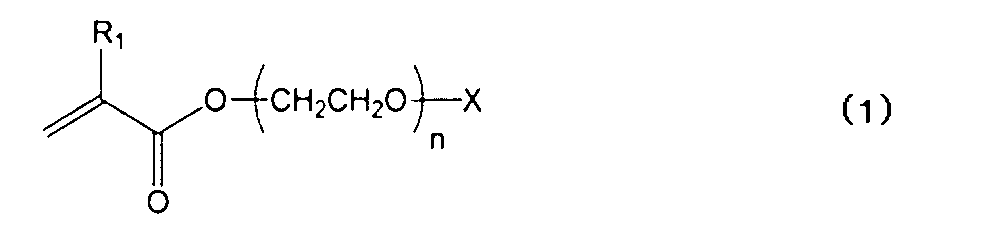
- polyethylene oxide macromonomer represented by the formula (1) for example, a commercially available product commercially available from Aldrich, or a commercially available product such as BLEMMER (registered trademark) sold by NOF Corporation may be used.
- Examples of such a macromonomer include Blemmer (registered trademark) PME-400, Blemmer (registered trademark) PME-1000, and Blemmer (registered trademark) PME-4000 manufactured by NOF Corporation.
- R 1 is an alkyl group having 1 to 3 carbon atoms, and n is a number of 8 to 200.
- X is H or CH 3 .
- hydrophobic monomer represented by the formula (2) for example, a commercially available product commercially available from Aldrich or Tokyo Kasei can be used.
- R 2 is an alkyl group having 1 to 3 carbon atoms.
- R 3 is an alkyl group having 1 to 12 carbon atoms, and more preferably an alkyl group having 1 to 8 carbon atoms.
- hydrophobic monomer examples include methyl acrylate, ethyl acrylate, propyl acrylate, butyl acrylate, pentyl acrylate, hexyl acrylate, heptyl acrylate, octyl acrylate, decyl acrylate, dodecyl acrylate, methacryl
- examples include methyl acid, ethyl methacrylate, propyl methacrylate, butyl methacrylate, pentyl methacrylate, hexyl methacrylate, heptyl methacrylate, octyl methacrylate, decyl methacrylate, dodecyl methacrylate, and the like.
- These hydrophobic monomers are general-purpose raw materials and can be easily obtained as general industrial raw materials.
- the crosslinkable monomer represented by the formula (3) can be obtained as a commercial product or an industrial raw material.
- This crosslinkable monomer is preferably hydrophobic.
- the value of m is preferably 0-2.
- EGDMA ethylene glycol dimethacrylate
- Blemmer registered trademark
- R 4 and R 5 each independently represents an alkyl group having 1 to 3 carbon atoms, and m is a number from 0 to 2.
- the core-corona microgel according to the present invention is obtained by radical polymerization of the above monomers under the following conditions (A) to (E).
- (A) The molar ratio represented by the charged molar amount of the polyethylene oxide macromonomer / the charged molar amount of the hydrophobic monomer is 1:10 to 1: 250.
- (B) The charge amount of the crosslinkable monomer is 0.1 to 1.5% by mass with respect to the charge amount of the hydrophobic monomer.
- the hydrophobic monomer represented by the formula (2) has a monomer composition in which one or more methacrylic acid derivatives having an alkyl group having 1 to 8 carbon atoms are mixed.
- the polymerization solvent is a mixed solvent of water and an organic solvent
- a polyol is used as the organic solvent
- one or more selected from dipropylene glycol, 1,3-butylene glycol, and isoprene glycol are used.
- the charged amount of the crosslinkable monomer relative to the charged amount of the hydrophobic monomer is defined as a crosslinking density (mass%).
- the crosslinking density of the core-corona type microgel used in the present invention is such that the amount of the crosslinkable monomer charged is 0.1 to 1.5% by mass based on the amount of the hydrophobic monomer, depending on the condition (B). Must.
- the dispersion stabilization by the polyethylene oxide macromonomer becomes incomplete, and the hydrophobic polymer by the insoluble hydrophobic monomer aggregates and precipitates.
- composition (B) By copolymerizing the crosslinkable monomer, it is possible to polymerize the microgel in which the hydrophobic polymer in the core portion is crosslinked.
- the charge amount of the crosslinkable monomer is less than 0.1% by mass of the charge amount of the hydrophobic monomer, the crosslink density is low, and the microgel collapses when swollen.
- the charged amount exceeds 1.5% by mass, aggregation of microgel particles occurs, and suitable microgel particles having a narrow particle size distribution cannot be polymerized.
- the amount of the crosslinkable monomer charged is preferably 0.2 to 1.0, more preferably 0.2 to 0.8, and most preferably 0.2 to 0.5% by mass.
- the hydrophobic monomer represented by the formula (2) needs to have a monomer composition in which one or more methacrylic acid derivatives having an alkyl group having 1 to 8 carbon atoms are mixed. If the number of carbon atoms is 0 (a monomer having no terminal ester bond), the monomer may be too hydrophilic to perform emulsion polymerization well. On the other hand, when the number of carbon atoms is 9 or more, there may be a steric hindrance during polymerization, and a crosslinked structure may not be successfully constructed.
- the polymerization solvent needs to be a mixed solvent of water-organic solvent.
- the organic solvent ethanol, propanol, butanol, polyol, and the like can be used.
- the polyol is used, the hydrophobic monomer represented by the formula (2) and the crosslinkable monomer represented by the formula (3) are dissolved. What can be done is preferred.
- the polyol used in the present invention needs to be dipropylene glycol, 1,3-butylene glycol, or isoprene glycol.
- the solvent mixed with water is ethanol, propanol, butanol, etc. when applied to the skin It is preferably an polyol that can be blended into cosmetics for general purposes, not an organic solvent in which irritation is a concern.
- the mixing ratio of the organic solvent is 10 to 90 volume ratio.
- the mixing ratio of the organic solvent When the mixing ratio of the organic solvent is lower than 10 volume ratio, the dissolving ability of the hydrophobic monomer becomes extremely low, polymerization proceeds in a monomer droplet state, and a huge mass is formed, and a microgel is not generated.
- the mixing ratio of the organic solvent exceeds 90 volume ratio, an emulsion of a hydrophobic monomer due to hydrophobic interaction is not generated, emulsion polymerization does not proceed, and a microgel cannot be obtained.
- the core-corona-type microgel according to the present invention obtained by using a polyol is a water-polyol mixed solvent as a polymerization solvent, and does not contain ethanol. Can get to.
- polymerization initiator used in the polymerization system a commercially available polymerization initiator used for usual water-soluble thermal radical polymerization can be used. In this polymerization system, even if the polymerization is carried out without strictly controlling the stirring conditions, it is possible to obtain a polymer having a very narrow particle size distribution.
- Non-crosslinked core-corona microgel [acrylamide core corona]
- a non-crosslinked core corona microgel suitably used in the present invention is a dispersion of core-corona microparticles obtained by radical polymerization of monomers represented by the following formulas (1) to (3) under specific conditions. is there.
- R 1 is an alkyl group having 1 to 3 carbon atoms, and n (molecular weight of the polyethylene oxide portion) is a number of 8 to 200.
- X is H or CH 3 .
- the polyethylene oxide macromonomer represented by the above formula (1) is preferably an acrylic acid derivative or a methacrylic acid derivative.
- a commercial product commercially available from Aldrich or a commercial product such as Bremer (registered trademark) marketed by NOF Corporation may be used.
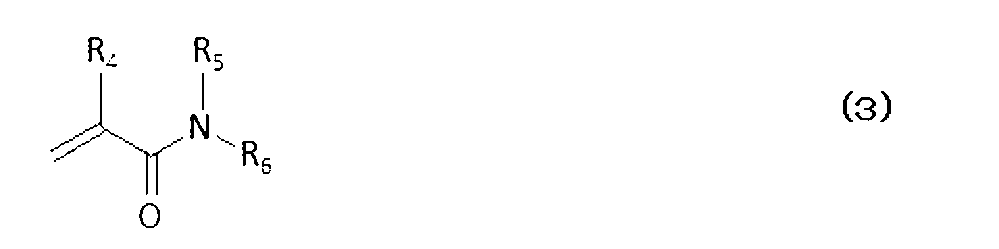
- R 2 represents an alkyl group having 1 to 3 carbon atoms
- R 3 represents a substituent containing an alkyl group having 1 to 12 carbon atoms.
- the hydrophobic monomer represented by the above formula (2) is preferably an acrylic acid derivative or a methacrylic acid derivative.
- methyl acrylate, ethyl acrylate, propyl acrylate, butyl acrylate, pentyl acrylate, acrylic Hexyl acrylate, heptyl acrylate, octyl acrylate, decyl acrylate, dodecyl acrylate, methyl methacrylate, ethyl methacrylate, propyl methacrylate, butyl methacrylate, pentyl methacrylate, hexyl methacrylate, heptyl methacrylate, methacryl Octyl acid, decyl methacrylate, dodecyl methacrylate and the like can be used.
- methyl methacrylate also known as methyl methacrylate
- butyl methacrylate also known as butyl methacrylate
- octyl methacrylate are particularly suitable.
- These hydrophobic monomers are general-purpose raw materials and can be easily obtained as general industrial raw materials. For example, you may use the commercial item marketed from Aldrich or Tokyo Kasei.
- R 4 represents H or an alkyl group having 1 to 3 carbon atoms
- R 5 and R 6 represent H or a substituent containing an alkyl group having 1 to 12 carbon atoms.
- the hydrophobic monomer represented by the above formula (3) is preferably an acrylamide derivative or a methacrylamide derivative.
- t-butylacrylamide, N, N-dimethylacrylamide, N- [3- (dimethylamino) propyl] acrylamide, t-butylmethacrylamide, octylacrylamide, octylmethacrylamide, octadecylacrylamide and the like can be suitably used.
- t-butylacrylamide, N, N-dimethylacrylamide, and N- [3- (dimethylamino) propyl] acrylamide are particularly preferable.
- These hydrophobic monomers are available as commercial products or industrial raw materials.
- the copolymer constituting the core-corona type microparticles according to the present invention comprises a macromonomer represented by the above formula (1) by any radical polymerization method according to the following conditions (A) to (D): One or two or more selected from the hydrophobic monomers represented by the above formulas (2) and (3) are copolymerized.
- A) The molar ratio represented by the charged molar amount of the polyethylene oxide macromonomer / (the acrylate derivative monomer and / or acrylamide derivative monomer) is 1:10 to 1: 250.
- the macromonomer represented by the following formula (1) is an acrylic acid derivative or a methacrylic acid derivative having a polyethylene glycol group having a repeating unit of 8 to 200
- the acrylate derivative monomer represented by the following formula (2) is an acrylic acid derivative or a methacrylic acid derivative having a substituent containing an alkyl group having 1 to 12 carbon atoms
- the acrylamide derivative monomer represented by the following formula (3) is an acrylamide derivative or a methacrylamide derivative having a substituent containing an alkyl group having 1 to 12 carbon atoms
- the polymerization solvent is a water-alcohol mixed solvent, and the alcohol is one or more selected from ethanol, dipropylene glycol, 1,3-butylene glycol, and isoprene glycol.
- the charged molar amount is preferably 1:10 to 1: 200, more preferably 1:25 to 1: 100.
- the molar amount of the hydrophobic monomer is less than 10 times the molar amount of the polyethylene oxide macromonomer, the polymer to be polymerized becomes water-soluble and does not form core-corona type particles.
- the dispersion stabilization by the polyethylene oxide macromonomer becomes incomplete, and the hydrophobic polymer by the insoluble hydrophobic monomer aggregates and precipitates. To do.
- Condition (B) consists of the following three conditions (B-1) to (B-3).
- the macromonomer represented by the formula (1) is an acrylic acid derivative or a methacrylic acid derivative having a polyethylene glycol group having 8 to 200 repeating units. When the repeating unit is 7 or less, particles stably dispersed in the solvent may not be obtained, and when it exceeds 200, the particles may be made fine and unstable when blended in a cosmetic.
- the acrylate derivative monomer represented by the formula (2) is an acrylic acid derivative or a methacrylic acid derivative having a substituent containing an alkyl group having 1 to 12 carbon atoms.
- the acrylamide derivative monomer represented by the formula (3) is an acrylamide derivative or a methacrylamide derivative having a substituent containing an alkyl group having 1 to 18 carbon atoms.
- the hydrophobic monomer according to the present invention has a monomer composition in which one or more selected from the acrylate derivative monomer represented by the above formula (2) and the acrylamide derivative monomer represented by the formula (3) are mixed. is required.
- hydrophobic monomers methacrylate and butyl methacrylate, or four types of methacrylate, t-butylacrylamide, N, N-dimethylacrylamide, and N- [3- (dimethylamino) propyl] acrylamide are used. It is particularly preferable to use In the combination of these hydrophobic monomers, it is further preferable to use methoxypolyethylene glycol monometalate as a macromonomer.
- Methoxypolyethylene glycol monometalates having a repeating unit of polyethylene glycol groups of 8 to 200, most preferably 90, methacrylate, t-butylacrylamide, N, N-dimethylacrylamide, and N- [3- (dimethylamino) propyl Acrylamide, t-butyl methacrylamide, octyl acrylamide, octyl methacrylamide, and octadecyl acrylamide.
- the polymerization solvent needs to be a water-alcohol mixed solvent.
- alcohol what can melt
- one or more selected from ethanol, dipropylene glycol, 1,3-butylene glycol, and isoprene glycol are preferable.
- the mixing ratio of alcohol is lower than 10 volume ratio, the dissolving ability of the hydrophobic monomer becomes extremely low, and microparticles may not be generated.
- the mixing ratio of alcohol exceeds 90 volume ratio, an emulsion of a hydrophobic monomer due to hydrophobic interaction may not be generated, and emulsion polymerization may not proceed and microparticles may not be obtained.
- the core-corona type microgel according to the present invention is a microgel stabilized with a polyethylene oxide chain which is a nonionic polymer, and its dispersion stability in water can be expected to have acid resistance and salt resistance.
- the microgel used in the present invention is a core-corona type in which hydrophilic macromonomer and hydrophobic monomer are ordered in a solvent, the particle diameter is almost constant, and the core part is crosslinked or non-crosslinked. It is thought that a polymer microgel is formed.
- the blending amount of the core-corona microgel of the present invention in cosmetics is preferably 0.01 to 10% by mass (pure content, hereinafter simply expressed as%) with respect to the total amount of the composition. If the blending amount is less than 0.01% (pure content), it may be difficult to obtain a stable cosmetic. If the blending amount exceeds 10% (pure content), it may not be preferable as a composition from the viewpoint of stability during long-term storage under high temperature conditions, or it may be inferior in usability.
- the core-corona type microgel of the present invention has a structure in which an oil phase component and an aqueous phase component are emulsified, and the core-corona type microgel emulsifier is adsorbed on oil droplets of the oil phase component dispersed in the aqueous phase component.
- a powder-in-oil-in-water composition is formed. Therefore, the core-corona type microgel emulsifier of the present invention is excellent in emulsifying power, and if the core-corona type microgel of the present invention is used as an emulsifier, a powder-in-oil-in-water composition having extremely excellent emulsification stability can be obtained. Can be manufactured.
- the core-corona type microgel can obtain sufficient strength against the behavior of the hydrophobic powder having a large specific gravity present in the oil phase.
- a core-corona type microgel is mixed and dispersed in water or an aqueous phase component, and an oil phase component and other components in which hydrophobic powder is dispersed by a conventional method are added. It is produced by emulsifying by applying stirring and shearing force.
- the blending amount of the oil phase component and the water phase component blended in the powder-in-oil-in-water composition of the present invention is not particularly limited.
- A By using a core-corona type microgel as an emulsifier, an embodiment having a small oil phase component / water phase component ratio, that is, an embodiment having a small amount of oil phase component blended (beauty liquid, emulsion, etc.) It is possible to obtain a powder-in-oil-in-water composition having a wide oil phase component / water phase component ratio (cleansing cream, sunscreen, hair cream, sheet, aerosol, foundation, etc.).
- composition according to the present invention includes other components usually used in cosmetics, quasi-drugs and the like, for example, ultraviolet absorbers, powders, organic amines, polymer emulsions, as long as the effects of the present invention are not impaired. , Vitamins, antioxidants and the like can be appropriately blended.
- water-soluble ultraviolet absorber examples include 2,4-dihydroxybenzophenone, 2,2′-dihydroxy-4-methoxybenzophenone, 2,2′-dihydroxy-4,4′-dimethoxybenzophenone, 2,2 ′, 4, 4′-tetrahydroxybenzophenone, 2-hydroxy-4-methoxybenzophenone, 2-hydroxy-4-methoxy-4′-methylbenzophenone, 2-hydroxy-4-methoxybenzophenone-5-sulfonate, 4-phenylbenzophenone, Benzophenone ultraviolet absorbers such as 2-ethylhexyl-4′-phenyl-benzophenone-2-carboxylate, 2-hydroxy-4-n-octoxybenzophenone, 4-hydroxy-3-carboxybenzophenone, phenylbenzimidazole-5- Sulfonic acid and Benzimidazole ultraviolet absorbers such as salts thereof, phenylene-bis-benzimidazole-tetrasulfonic acid and salts thereof,
- oil-soluble ultraviolet absorber examples include paraaminobenzoic acid (PABA), PABA monoglycerin ester, N, N-dipropoxy PABA ethyl ester, N, N-diethoxy PABA ethyl ester, N, N-dimethyl PABA ethyl ester, N Benzoic acid UV absorbers such as N-dimethyl PABA butyl ester; Anthranilic acid UV absorbers such as homomenthyl-N-acetylanthranilate; Amyl salicylate, menthyl salicylate, homomenthyl salicylate, octyl salicylate, phenyl salicylate, benzyl Salicylic acid UV absorbers such as salicylate and p-isopropanolphenyl salicylate; octylcinnamate, ethyl-4-isopropylcinnamate, methyl-2,5-diisopropylcin Mate,
- the powder component examples include inorganic powders (for example, talc, kaolin, mica, sericite (sericite), muscovite, phlogopite, synthetic mica, saucite, biotite, permiculite, magnesium carbonate, calcium carbonate, silicic acid.
- inorganic powders for example, talc, kaolin, mica, sericite (sericite), muscovite, phlogopite, synthetic mica, saucite, biotite, permiculite, magnesium carbonate, calcium carbonate, silicic acid.
- Organic pigment Red No. 3, Red No. 104, Red No. 106, Red No. 227, Red No. 230, Red No. 401, Red No. 505, Orange No. 205, Yellow No. 4, Yellow No. 5, Yellow No. 202, Yellow No. 203 , Green No. 3 and Blue No. 1
- natural pigments for example, chlorophyll, ⁇ -carotene, etc.
- organic amine examples include monoethanolamine, diethanolamine, triethanolamine, morpholine, tetrakis (2-hydroxypropyl) ethylenediamine, triisopropanolamine, 2-amino-2-methyl-1,3-propanediol, 2-amino Examples include -2-methyl-1-propanol.
- polymer emulsion examples include acrylic resin emulsion, polyethyl acrylate emulsion, acrylic resin liquid, polyacryl alkyl ester emulsion, polyvinyl acetate resin emulsion, natural rubber latex, and the like.
- vitamins examples include vitamins A, B1, B2, B6, C, E and derivatives thereof, pantothenic acid and derivatives thereof, and biotin.
- antioxidants examples include tocopherols, dibutylhydroxytoluene, butylhydroxyanisole, gallic acid esters and the like.
- antioxidant assistant examples include phosphoric acid, citric acid, ascorbic acid, maleic acid, malonic acid, succinic acid, fumaric acid, kephalin, hexametaphosphate, phytic acid, and ethylenediaminetetraacetic acid.
- ingredients that can be blended include, for example, preservatives (methylparaben, ethylparaben, butylparaben, phenoxyethanol, etc.), anti-inflammatory agents (for example, glycyrrhizic acid derivatives, glycyrrhetinic acid derivatives, salicylic acid derivatives, hinokitiol, zinc oxide, allantoin, etc.), Whitening agents (eg, placenta extract, yukinoshita extract, arbutin, etc.), various extracts (eg, buckwheat, auren, shikon, peonies, assembly, birch, sage, loquat, carrot, aloe, mallow, iris, grape, yokoinin , Loofah, lily, saffron, senkyu, ginger, hypericum, onionis, garlic, pepper, chimpanchi, seaweed, etc.), activator (eg, royal jelly, photosensitizer
- oil-in-water-in-oil powder type composition of the present invention is not intended as an emulsifier, but is controlled for use feeling, control of drug penetration, etc., or cleansing properties when blended with a skin or hair cleaning agent.
- a surfactant can be blended as an aqueous phase or oil phase component.
- the amphoteric surfactant has at least one cationic functional group and one anionic functional group, becomes cationic when the solution is acidic, and anionic when the solution is alkaline, and is close to a nonionic surfactant near the isoelectric point. It has properties.
- Amphoteric surfactants are classified into carboxylic acid type, sulfate ester type, sulfonic acid type and phosphate ester type depending on the type of anionic group.
- the carboxylic acid type, sulfate type and sulfonic acid type are preferred in the present invention.
- Carboxylic acid types are further classified into amino acid types and betaine types. Particularly preferred is a betaine type.
- imidazoline-based amphoteric surfactants for example, 2-undecyl-N, N, N- (hydroxyethylcarboxymethyl) -2-imidazoline sodium, 2-cocoyl-2-imidazolinium hydroxide) 1-carboxyethyloxy disodium salt
- betaine surfactants for example, 2-heptadecyl-N-carboxymethyl-N-hydroxyethylimidazolinium betaine, lauryldimethylaminoacetic acid betaine, alkylbetaine, amide betaine, sulfone) Betaine
- cationic surfactant examples include quaternary ammonium salts such as cetyltrimethylammonium chloride, stearyltrimethylammonium chloride, behenyltrimethylammonium chloride, behenyldimethylhydroxyethylammonium chloride, stearyldimethylbenzylammonium chloride, and cetyltriethylammonium methylsulfate. Is mentioned.
- stearic acid diethylaminoethylamide stearic acid dimethylaminoethylamide, palmitic acid diethylaminoethylamide, palmitic acid dimethylaminoethylamide, myristic acid diethylaminoethylamide, myristic acid dimethylaminoethylamide, behenic acid diethylaminoethylamide, behenic acid dimethyl Aminoethylamide, stearic acid diethylaminopropylamide, stearic acid dimethylaminopropylamide, palmitic acid diethylaminopropylamide, palmitic acid dimethylaminopropylamide, myristic acid diethylaminopropylamide, myristic acid dimethylaminopropylamide, behenic acid diethylaminopropylamide, behenine Amidoamino such as dimethylaminopropylamide Compounds
- Anionic surfactants include fatty acid soap, N-acyl glutamate, carboxylate type such as alkyl ether acetic acid, sulfonic acid type such as ⁇ -olefin sulfonate, alkane sulfonate, alkylbenzene sulfonic acid, higher alcohol sulfuric acid It is classified into a sulfate ester salt type such as an ester salt and a phosphate ester salt type. Carboxylate type, sulfonic acid type and sulfate ester type are preferred, and sulfate ester type is particularly preferred.
- fatty acid soap eg, sodium laurate, sodium palmitate, etc.
- higher alkyl sulfate ester salt eg, sodium lauryl sulfate, potassium lauryl sulfate
- alkyl ether sulfate ester salt eg, POE- Lauryl sulfate triethanolamine, POE-sodium lauryl sulfate, etc.
- N-acyl sarcosine acid eg, sodium lauroyl sarcosine, etc.
- higher fatty acid amide sulfonate eg, sodium N-myristoyl-N-methyltaurine, coconut oil fatty acid
- phosphoric acid ester salts POE-oleyl ether sodium phosphate, POE-stearyl ether phosphoric acid etc.
- sulfosuccinates eg di-2-ethy
- the nonionic surfactant is a surfactant that is ionized in an aqueous solution and has no charge.
- a type using alkyl and a type using dimethyl silicone are known.
- the former for example, glycerin fatty acid ester, ethylene oxide derivative of glycerin fatty acid ester, polyglycerin fatty acid ester, propylene glycol fatty acid ester, ethylene oxide derivative of propylene glycol fatty acid ester, polyethylene glycol fatty acid ester, polyethylene glycol alkyl ether, Examples include polyethylene glycol alkylphenyl ether, polyethylene glycol castor oil derivatives, polyethylene glycol hydrogenated castor oil derivatives, and the like. Examples of the latter include polyether-modified silicone and polyglycerin-modified silicone.
- a type using alkyl as a hydrophobic group is preferred.
- sorbitan fatty acid esters for example, sorbitan monooleate, sorbitan monoisostearate, sorbitan monolaurate, sorbitan monopalmitate, sorbitan monostearate, Sorbitan sesquioleate, sorbitan trioleate, diglycerol sorbitan penta-2-ethylhexylate, diglycerol sorbitan tetra-2-ethylhexylate), glycerin polyglycerin fatty acids (eg mono cottonseed oil fatty acid glycerin, glyceryl monoerucate, sesquiolein) Acid glycerin, glyceryl monostearate, ⁇ , ⁇ '-oleic acid pyroglutamate glycerin, monostearate glycerin malate, etc.), propylene glycol fatty acid ester And the like (
- hydrophilic nonionic surfactants include POE-sorbitan fatty acid esters (for example, POE-sorbitan monooleate, POE-sorbitan monostearate, POE-sorbitan monooleate, POE-sorbitan tetraoleate).
- POE-sorbitan fatty acid esters for example, POE-sorbitan monooleate, POE-sorbitan monostearate, POE-sorbitan monooleate, POE-sorbitan tetraoleate.
- POE sorbite fatty acid esters eg, POE-sorbite monolaurate, POE-sorbite monooleate, POE-sorbite pentaoleate, POE-sorbite monostearate, etc.
- POE-glycerin fatty acid esters eg, POE- Glycerol monostearate, POE-glycerol monoisostearate, POE-monooleate such as POE-glycerol triisostearate
- POE-fatty acid esters for example, POE-distearate, OE-monodiolate, ethylene glycol distearate, etc.
- POE-alkyl ethers for example, POE-lauryl ether, POE-oleyl ether, POE-stearyl ether, POE-behenyl ether, POE-2-octyldodecyl ether, POE-core
- Stanol ether etc.
- oil-in-water powder-in-water composition of the present invention is not limited, but since the stability is high and the water resistance of the hydrophobic powder is not easily affected, skin cosmetics such as sunscreen cosmetics and emulsion foundations, It can be commercialized as a hair cosmetic, a skin external preparation, or the like.
- skin cosmetics such as sunscreen cosmetics and emulsion foundations, It can be commercialized as a hair cosmetic, a skin external preparation, or the like.
- the present inventors examined oil-in-water powder-in-water cosmetics mainly with respect to the blending form of hydrophobic powder, system stability, and water resistance during application. The results are shown in Table 1. Evaluation was performed as follows. [water resistant] Apply 2mg / cm 2 of sample to resin plate and measure UV spectrum from 290 to 400nm.
- the plate is attached to the wall of a 20L container containing water with double-sided tape, exposed to a water flow of 30min at 500rpm, and the spectrum is measured again in the same way.
- the ratio% of the integral value of the spectrum before and after bathing is water resistance, and if it is 100%, it indicates that the protective effect is not lowered at all even if bathing.
- each test example is as follows.
- Component 27 is dispersed and emulsified in components 18, 19, and 20.
- Oil phases A and B are mixed in water phase.
- Aqueous components 1, 2, 3, 4, 5, 8, 30, 33, 34, 35 are mixed into the liquid oil of mixed oil phase A components 14, 15, 16, 17, and components 11, 12, 13, 21, 22, 22. 23, 24 solid oil component dissolved oil phase B component 18, 19, 20 component 27 dispersed emulsified water phase mixed with oil phase B, A in this order
- emulsion stability and water resistance can be obtained by selecting an appropriate surfactant, but the continuous phase is the oil phase. Therefore, it is not possible to obtain a fresh feeling of use.
- Core-corona emulsification is also considered as a kind of so-called powder emulsification (Pickering emulsion), and is considered to be a similar technique in terms of stabilizing the emulsification by adhesion of fine particles to the oil / water interface. "And compared.
- Emulsification was attempted using PEG-10 hydrogenated castor oil that forms vesicles, which is one of the particles used for three-phase emulsification (1-6), but hydrophobic powder popped out of the inner phase and aggregated. Therefore, it was difficult to prepare a stable emulsion composition.
- the present inventors proceeded with the study of a POW emulsified composition by core-corona emulsification. First, the present inventors examined the amount of core-corona dispersant added. The results are shown in Table 2.
- the core-corona type microgel exhibits excellent stability at 0.5% by mass or more (pure content) in the composition, although it depends on the blending amount of the oil phase containing the hydrophobic powder. .
- the dispersant is up to about 2% by mass, but 10% by mass. % Blending is also possible.
- the present inventors examined addition of a nonionic surfactant. The results are shown in Table 3.
- Nonionic surfactants may improve emulsification stability by appropriate blending even in core-corona emulsification, but there is no problem with the stability when the blending amount is 0.8% by mass or more. However, the water resistance is significantly reduced. For this reason, the nonionic surfactant is not necessarily blended, but is preferably 0.5% by mass or less even when blended.
- Method 1 The production method conformed to Test Example 1-1.
- Nonionic surfactants may improve emulsification stability by appropriate blending even in core-corona emulsification, but there is no problem with the stability when the blending amount is 0.8% by mass or more. However, the water resistance is significantly reduced. For this reason, the nonionic surfactant is not necessarily blended, but is preferably 0.5% by mass or less even when blended.
- Method 1 The macromonomer and hydrophobic monomer described in Table 4 were radically polymerized under the polymerization conditions described in Table 4 and Table 5 according to the following production method (Method 1). The appearance of
- ⁇ Method 1 Manufacturing method of core-corona type microparticle> Polyethylene oxide macromonomer and hydrophobic monomer were added to 90 g of a water-alcohol mixed solvent in a three-necked flask equipped with a reflux tube and a nitrogen introduction tube. After sufficiently dissolving or dispersing, 1 mol% of the polymerization initiator 2,2′-azobis (2-methylpropionamidine dihydrochloride) is dissolved in a small amount of water and added to the total amount of monomers, and further dissolved or dispersed. Dispersed.
- the uniformly dissolved or dispersed polymerization solution was purged with nitrogen for 20 minutes to remove dissolved oxygen, and then stirred at a magnetic stirrer and kept at 65 to 70 ° C. for 8 hours in an oil bath to carry out a polymerization reaction. After completion of the polymerization, the polymerization solution was returned to room temperature to obtain a core-corona type microparticle dispersion.
- BLEMMER PME-4000 manufactured by NOF Corporation
- Hydrophobic monomers include methyl methacrylate (MMA), butyl methacrylate (n-BMA), t-butyl acrylamide (t-BAA), N, N-dimethylacrylamide (DMAA), N- [3- (dimethylamino).
- DMAPA Propyl] acrylamide
- ⁇ Method 2 Measuring method of particle diameter and degree of dispersion>
- the particle size of the copolymer was measured using a Zetasizer manufactured by Malvern.
- a measurement sample having a microparticle concentration of about 0.1% in the microparticle dispersion was prepared by dilution with water, and after removing dust with a 0.45 micrometer filter, the scattering intensity at 25 ° C was measured with a scattering angle of 173 ° (backward).
- the average particle size and the degree of dispersion were calculated using analysis software installed in the measuring device.
- the particle diameter is analyzed by a cumulant analysis method, and the degree of dispersion is a numerical value obtained by standardizing the value of the secondary cumulant obtained by the cumulant analysis.
- This degree of dispersion is a commonly used parameter and can be automatically analyzed by using a commercially available dynamic light scattering measurement device.
- the viscosity of the solvent necessary for the particle size analysis the viscosity of pure water at 25 ° C., that is, a value of 0.89 mPa ⁇ s was used.
- methoxypolyethylene glycol monometalate (macromonomer) and methyl methacrylate, butyl methacrylate, t-butylacrylamide, N, N-dimethyl having a substituent containing an alkyl group having 1 to 4 carbon atoms
- the diameter and degree of dispersion could be evaluated. That is, formation of particulate polymer (core-corona type microparticle) was confirmed.
- the core-corona type microparticles of Production Examples 1 to 10 were shown to have a particle diameter of 150 to 250 nm and a uniform particle diameter.
- the macromonomer represented by the formula (1) is an acrylic acid derivative or a methacrylic acid derivative having a polyethylene glycol group having a repeating unit of 8 to 200
- the acrylate derivative monomer represented by the formula (2) is an acrylic acid derivative or a methacrylic acid derivative having a substituent containing an alkyl group having 1 to 12 carbon atoms
- the acrylamide derivative monomer represented by the formula (3) is an acrylamide derivative or a methacrylamide derivative having a substituent containing an alkyl group having 1 to 12 carbon atoms
Landscapes
- Health & Medical Sciences (AREA)
- Life Sciences & Earth Sciences (AREA)
- Animal Behavior & Ethology (AREA)
- Veterinary Medicine (AREA)
- Public Health (AREA)
- General Health & Medical Sciences (AREA)
- Birds (AREA)
- Epidemiology (AREA)
- Chemical & Material Sciences (AREA)
- Dispersion Chemistry (AREA)
- Dermatology (AREA)
- Inorganic Chemistry (AREA)
- Oil, Petroleum & Natural Gas (AREA)
- Cosmetics (AREA)
- Macromonomer-Based Addition Polymer (AREA)
- Compositions Of Macromolecular Compounds (AREA)
- Emulsifying, Dispersing, Foam-Producing Or Wetting Agents (AREA)
Abstract
Description
そこで、疎水性粉体を分散した油滴を、さらに水相に分散した水中油中粉体型組成物が用いられることもあり、連続相が水相であるため、使用感に優れ、しかも疎水性粉体による耐水性も期待される。
しかしながら、水中油中粉体型組成物は、使用感については高い改善性が認められるものの、疎水性粉体が本来有する耐水性を発揮できないという問題があった。
すなわち、本発明にかかる水中油中粉体型組成物は、
疎水性粉体と、
前記疎水性粉体が分散した油相と、
前記油相が分散した水相と、
を備え、
前記油相を水相に分散させる分散剤として、
疎水性ゲル微粒子表面に、部分的に親水基を設けたコア-コロナ型ミクロゲルを用いたことを特徴とする。
また、前記組成物において、コア-コロナ型ミクロゲルとして、(アクリレーツ/メタクリル酸メトキシPEG)クロスポリマー及び/又は特定のアクリルアミド誘導体とアクリレート誘導体を、架橋せずに特定の条件下でラジカル重合させた非架橋アクリルアミド系ポリマーを0.5~10質量%用いることが好適である。
また、前記組成物において、非イオン性界面活性剤を用いる場合には、組成物中0.5質量%以下とすることが好適である。
なお、本願明細書に言う「分散」ないし「分散剤」は、それぞれ「乳化」ないし「乳化剤」を含む概念である。
本発明において特徴的なコア-コロナ型ミクロゲルは、いわゆるピッカリングエマルション(粉体乳化)において、分散剤として用いることができる(特許文献1~11、非特許文献1~4)。しかしながら、このコア-コロナ型ミクロゲルが、水中油中粉体型組成物において、高い分散安定性とともに、該組成物が適用された際の塗膜における疎水粉体の耐水性を高める点について、新知見を得たものである。
[疎水性粉体]
本発明に用いられる疎水性粉体は、粉体の表面が疎水性を有するものであれば特に限定されるものではないが、例えば、シリコーン樹脂粉体、フッ素樹脂粉体など、粉体自体が疎水性を有するもののほか、無機粉体粒子の表面を、メチルハイドロジェンポリシロキサン、ジメチルポリシロキサン等のシリコーン類、デキストリン脂肪酸エステル、高級脂肪酸、高級アルコール、脂肪酸エステル、金属石鹸、アルキルリン酸エーテル、フッ素化合物、またはスクワラン、パラフィン等の炭化水素類を用いて、溶媒を使用する湿式法、気相法、メカノケミカル法等により疎水化処理したものが挙げられる。なお、疎水性粉体の平均粒子径は本発明の油相である乳化粒子よりも小さい必要がある。特に、粉体を紫外線散乱剤として使用する場合には、湿式分散機で破砕後の平均粒子径が100nm以下のものが好ましい。疎水化処理される無機粉体粒子としては、例えば、酸化チタン、酸化亜鉛、タルク、マイカ、セリサイト、カオリン、雲母チタン、黒酸化鉄、黄酸化鉄、ベンガラ、群青、紺青、酸化クロム、水酸化クロム等が挙げられる。
[油相成分]
油相成分としては、通常化粧料、医薬部外品等に用いられる炭化水素油、高級脂肪酸、高級アルコール、合成エステル油、シリコーン油、液体油脂、固体油脂、ロウ、香料等が挙げられる。
[水相成分]
水相成分としては、通常化粧料、医薬部外品等に使用される水、水溶性アルコール、増粘剤等を配合することができ、さらに所望に応じて、保湿剤、キレート剤、防腐剤、色素等を適宜配合することができる。
[コア-コロナ型ミクロゲル]
本発明において、コア-コロナ型ミクロゲルとしては、架橋型及び非架橋型のいずれも用いることができる。
特に好適なコア-コロナ型ミクロゲルとしては、以下に示すように(アクリレーツ/メタクリル酸メトキシPEG)クロスポリマー[架橋型コア-コロナ型ミクロゲル]及びアクリルアミド系コアコロナ型ミクロゲル[非架橋型コア-コロナ型ミクロゲル]が例示される。
1.架橋型コア-コロナ型ミクロゲル[(アクリレーツ/メタクリル酸メトキシPEG-90)クロスポリマー)]
本発明にかかる架橋型コア-コロナ型ミクロゲルは、下記式(1)~(3)で示されるモノマーを特定の条件下でラジカル重合して得ることができる。
このようなマクロモノマーとしては、例えば、日油社製ブレンマー(登録商標)PME-400、ブレンマー(登録商標)PME-1000、ブレンマー(登録商標)PME-4000等が挙げられる。

R1は炭素数1~3のアルキル基であり、nは8~200の数である。XはHまたはCH3である。
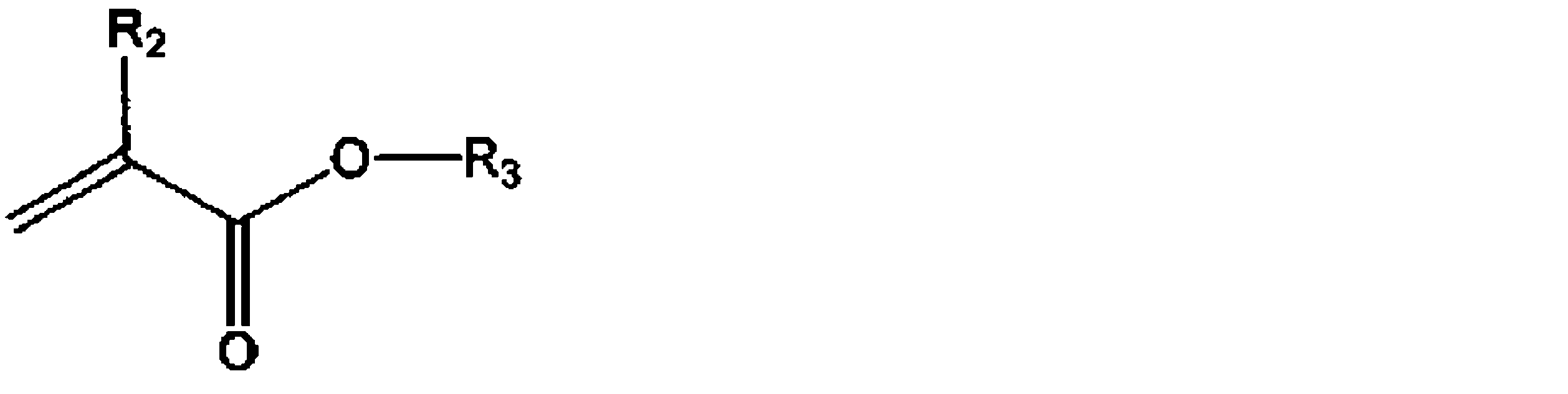
R2は炭素数1~3のアルキル基である。
R3は炭素数1~12のアルキル基であって、炭素数1~8のアルキル基であることがより好ましい。
これらの疎水性モノマーは汎用原料であり、一般工業原料としても容易に入手することができる。
mの値は0~2であることが好ましい。具体的には、Aldrich社から発売されているエチレングリコールジメタクリレート(以下、EGDMAと略すことがある)、日油社から発売されているブレンマー(登録商標)PDE-50等を用いることが好ましい。
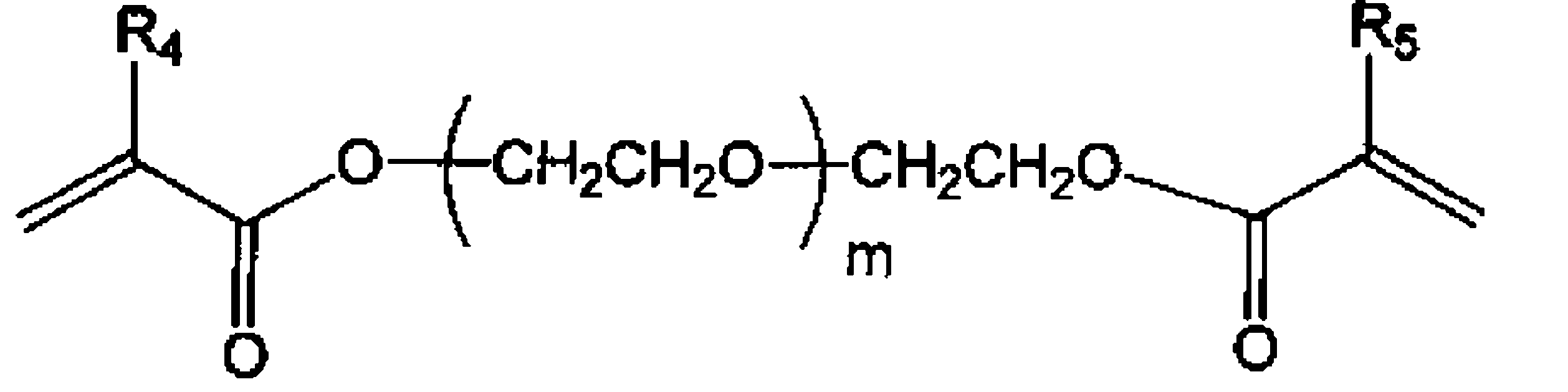
R4とR5はそれぞれ独立に炭素数1~3のアルキル基を表し、mは0~2の数である。
(A)前記ポリエチレンオキシドマクロモノマーの仕込みモル量/前記疎水性モノマーの仕込みモル量で表されるモル比が1:10~1:250であること。
(B)前記架橋性モノマーの仕込み量が、前記疎水性モノマーの仕込み量に対して、0.1~1.5質量%であること。
(C)式(2)で示される疎水性モノマーは、炭素数1~8のアルキル基を有するメタクリル酸誘導体の1種又は2種以上を混合したモノマー組成であること。
(D)重合溶媒が水-有機溶媒の混合溶媒であり、有機溶媒としてポリオールを用いる場合には、ジプロピレングリコール、1,3-ブチレングリコール、イソプレングリコールから選択される1種または2種以上であること。
(E)水-有機溶媒の混合溶媒の溶媒組成が、20℃の質量比で、水:有機溶媒=90~10:10~90であること。
ポリエチレンオキサイドマクロモノマーと疎水性モノマーの仕込みモル量は、ポリエチレンオキサイドマクロモノマー:疎水性モノマー=1:10~1:250(モル比)の範囲で重合可能である。前記仕込みモル量は、1:10~1:200が好ましく、1:25~1:100がより好ましい。
ポリエチレンオキサイドマクロモノマーのモル量に対して疎水性モノマーのモル量が10倍以下になると、重合されるポリマーは水溶性になりコア-コロナ型ポリマーミクロゲルは形成しない。またポリエチレンオキサイドマクロモノマーのモル量に対して疎水性モノマーのモル量が250倍以上になるとポリエチレンオキサイドマクロモノマーによる分散安定化が不完全になり不溶性の疎水性モノマーによる疎水性ポリマーが凝集、沈殿する。
架橋性モノマーを共重合することでコア部分の疎水性ポリマーが架橋されたミクロゲルを重合することができる。
架橋性モノマーの仕込み量が疎水性モノマーの仕込み量の0.1質量%未満であると、架橋密度が低く、ミクロゲルは膨潤時に崩壊してしまう。また仕込み量が1.5質量%を上回ると、ミクロゲル粒子同士の凝集が生じ、粒度分布の狭い好適なミクロゲル粒子を重合することはできない。架橋性モノマーの仕込み量は、0.2~1.0が好ましく、0.2~0.8がより好ましく、0.2~0.5質量%が最も好ましい。
式(2)で示される疎水性モノマーは、炭素数1~8のアルキル基を有するメタクリル酸誘導体の1種または2種以上を混合したモノマー組成であることが必要である。炭素数が0である(末端エステル結合がないモノマーである)と、モノマーが親水的すぎてうまく乳化重合をすることができない場合がある。一方、炭素数が9以上であると、重合の際の立体障害となり、うまく架橋構造を構築できない場合がある。
重合溶媒は、水-有機溶媒の混合溶媒であることが必要である。有機溶媒としては、エタノール、プロパノール、ブタノール、ポリオールなどを用いることができるが、ポリオールを用いる場合には、式(2)で示される疎水性モノマーおよび式(3)で示される架橋性モノマーを溶解できるものが好ましい。本発明に用いられるポリオールとしては、ジプロピレングリコール、1,3-ブチレングリコール、イソプレングリコールであることが必要である。
工業的に製造可能である、すなわち透析等の精製工程を要さず重合液をそのまま原料体として用いることを考えた場合、水と混合する溶媒はエタノールやプロパノール、ブタノール等、肌への塗布時に刺激性が懸念される有機溶剤ではなく、汎用的に化粧料へ配合できるポリオールであることが好適である。
重合溶媒である水-有機溶媒の混合溶媒の溶媒組成は、20℃の質量比で、水:有機溶媒=90~10:10~90であることが必要である。水-有機溶媒の混合溶媒の溶媒組成が、水:有機溶媒=90~10:10~90(20℃の容積比)であることが好ましく、水:有機溶媒=80~20:20~80(20℃の容積比)であることがより好ましい。
重合溶媒は疎水性モノマーを均一溶解するために有機溶媒を加えることが必要である。有機溶媒の混合比は10~90容量比である。有機溶媒の混合比が10容量比より低い場合は疎水性モノマーの溶解能が極めて低くなり、モノマー滴状態で重合が進行し巨大塊となり、ミクロゲルが生成しない。また有機溶媒の混合比が90容量比を上回ると、疎水性相互作用による疎水性モノマーのエマルションが生成せず、乳化重合が進行せずミクロゲルは得られない。
本発明において好適に用いられる非架橋型コアコロナ型ミクロゲルは、下記式(1)~(3)で示されるモノマーを特定の条件下でラジカル重合して得られるコア-コロナ型ミクロ粒子の分散液である。

これらの疎水性モノマーは汎用原料であり、一般工業原料としても容易に入手することができる。例えば、Aldrich社もしくは東京化成社から市販されている市販品を用いてもよい。
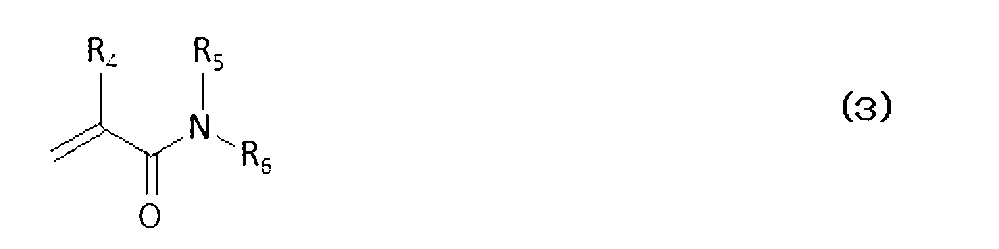
これらの疎水性モノマーは、市販品あるいは工業用原料として入手が可能である。
(A)前記ポリエチレンオキサイドマクロモノマーの仕込みモル量/(前記アクリレート誘導体モノマー及び/またはアクリルアミド誘導体モノマー)の仕込みモル量で表されるモル比が1:10~1:250であること。
(B)下記式(1)で示されるマクロモノマーは、繰り返し単位が8~200のポリエチレングリコール基を有するアクリル酸誘導体またはメタクリル酸誘導体であり、
下記式(2)で示されるアクリレート誘導体モノマーは、炭素数1~12のアルキル基を含む置換基を有するアクリル酸誘導体またはメタクリル酸誘導体であり、
下記式(3)で示されるアクリルアミド誘導体モノマーは、炭素数1~12のアルキル基を含む置換基を有するアクリルアミド誘導体またはメタクリルアミド誘導体であること、
(C)重合溶媒が水-アルコール混合溶媒であり、アルコールがエタノール、ジプロピレングリコール、1,3-ブチレングリコール、イソプレングリコールから選択される1種または2種以上であること。
(D)水-アルコール混合溶媒の溶媒組成が、20℃の質量比で、水:アルコール=90~10:10~90であること。
(条件(A))
前記ポリエチレンオキサイドマクロモノマーと、前記疎水性モノマー(すなわち、アクリレート誘導体モノマー及び/またはアクリルアミド誘導体モノマーの総和)の仕込みモル量は、ポリエチレンオキサイドマクロモノマー:疎水性モノマー=1:10~1:250(モル比)の範囲内で重合可能である。前記仕込みモル量は、1:10~1:200が好ましく、1:25~1:100がより好ましい。
ポリエチレンオキサイドマクロモノマーのモル量に対する疎水性モノマーのモル量が10倍未満になると、重合されるポリマーは水溶性になり、コア-コロナ型の粒子は形成しない。また、ポリエチレンオキサイドマクロモノマーのモル量に対する疎水性モノマーのモル量が250倍以上になると、ポリエチレンオキサイドマクロモノマーによる分散安定化が不完全になり、不溶性の疎水性モノマーによる疎水性ポリマーが凝集、沈殿する。
条件(B)は、下記(B-1)~(B-3)の3条件からなる。
(B-1)
式(1)で表されるマクロモノマーは、繰り返し単位が8~200のポリエチレングリコール基を有するアクリル酸誘導体またはメタクリル酸誘導体である。繰り返し単位が7以下であると、溶媒に安定分散した粒子が得られない場合があり、200を超えると、粒子が微細化し化粧料に配合した際に不安定になる場合がある。
(B-2)
前記式(2)で示されるアクリレート誘導体モノマーは、炭素数1~12のアルキル基を含む置換基を有するアクリル酸誘導体またはメタクリル酸誘導体である。炭素数が0である(末端エステル結合がないモノマーである)と、モノマーが親水的すぎてうまく乳化重合をすることができない場合がある。一方、炭素数が13以上であると好ましい使用感が得られない場合がある。
(B-3)
前記式(3)で示されるアクリルアミド誘導体モノマーは、炭素数1~18のアルキル基を含む置換基を有するアクリルアミド誘導体またはメタクリルアミド誘導体である。
これによって限定されるものではないが、本発明において最も好ましいマクロモノマー及び疎水性モノマーの組み合わせとして、
・ポリエチレングリコール基の繰り返し単位が8~90、最も好ましくは15であるメトキシポリエチレングリコールモノメタレート、メタクリレート、及びブチルメタクリレート、
・ポリエチレングリコール基の繰り返し単位が8~200、最も好ましくは90であるメトキシポリエチレングリコールモノメタレート、メタクリレート、t-ブチルアクリルアミド、N,N-ジメチルアクリルアミド、及びN-[3-(ジメチルアミノ)プロピル]アクリルアミド、t-ブチルメタクリルアミド、オクチルアクリルアミド、オクチルメタクリルアミド、オクタデシルアクリルアミドが挙げられる。
重合溶媒は、水-アルコール混合溶媒であることが必要である。アルコールとしては、式(2)及び(3)で示される疎水性モノマーを溶解できるものが好ましい。よって、エタノール、ジプロピレングリコール、1,3-ブチレングリコール、イソプレングリコールから選択される1種または2種以上が好適である。
重合溶媒である水-アルコール混合溶媒の溶媒組成は、20℃の質量比で、水:アルコール=90~10:10~90であることが好ましく、さらに好ましくは水:アルコール=80~20:20~80である。アルコールの混合比が10容量比より低い場合には、疎水性モノマーの溶解能が極めて低くなり、ミクロ粒子が生成しない場合がある。また、アルコールの混合比が90容量比を上回る場合には、疎水性相互作用による疎水性モノマーのエマルションが生成せず、乳化重合が進行せずミクロ粒子が得られない場合がある。
なお、従来の合成高分子によるミクロゲルは、いずれも高分子電解質、例えばポリアクリル酸を応用したものであり、その水への分散性に耐酸性や耐塩性がないものであった。しかしながら、医薬品や化粧料の配合成分として応用を考える際、生理的条件下での適応においては耐酸性や耐塩性は非常に重要な性能である。本発明にかかるコア-コロナ型ミクロゲルは、非イオン性高分子であるポリエチレンオキサイド鎖で安定化されたミクロゲルであり、その水中での分散安定性は耐酸性や耐塩性が期待できる。
本発明で使用するミクロゲルは、親水性マクロモノマーと疎水性モノマーとが溶媒中にて秩序化が起り、粒子径がほぼ一定で、かつコア部分が架橋された、或いは非架橋のコア-コロナ型高分子ミクロゲルが生成すると考えられる。
本発明の水中油中粉体型組成物は、コア-コロナ型ミクロゲルを、水または水相成分中に混合分散させ、常法により疎水性粉体を分散した油相成分およびその他の成分を添加、攪拌およびせん断力を加えて乳化することによって製造される。
本発明にかかる組成物には、本発明の効果を損なわない範囲内で、通常化粧料や医薬部外品等に用いられる他の成分、例えば、紫外線吸収剤、粉末、有機アミン、高分子エマルジョン、ビタミン類、酸化防止剤等を適宜配合することができる。
油溶性紫外線吸収剤としては、例えば、パラアミノ安息香酸(PABA)、PABAモノグリセリンエステル、N,N-ジプロポキシPABAエチルエステル、N,N-ジエトキシPABAエチルエステル、N,N-ジメチルPABAエチルエステル、N,N-ジメチルPABAブチルエステル等の安息香酸系紫外線吸収剤;ホモメンチル-N-アセチルアントラニレート等のアントラニル酸系紫外線吸収剤;アミルサリシレート、メンチルサリシレート、ホモメンチルサリシレート、オクチルサリシレート、フェニルサリシレート、ベンジルサリシレート、p-イソプロパノールフェニルサリシレート等のサリチル酸系紫外線吸収剤;オクチルシンナメート、エチル-4-イソプロピルシンナメート、メチル-2,5-ジイソプロピルシンナメート、エチル-2,4-ジイソプロピルシンナメート、メチル-2,4-ジイソプロピルシンナメート、プロピル-p-メトキシシンナメート、イソプロピル-p-メトキシシンナメート、イソアミル-p-メトキシシンナメート、オクチル-p-メトキシシンナメート、2-エチルヘキシル-p-メトキシシンナメート、2-エトキシエチル-p-メトキシシンナメート、シクロヘキシル-p-メトキシシンナメート、エチル-α-シアノ-β-フェニルシンナメート、2-エチルヘキシル-α-シアノ-β-フェニルシンナメート、グリセリルモノ-2-エチルヘキサノイル-ジパラメトキシシンナメート、3,4,5-トリメトキシケイ皮酸3-メチル-4-[メチルビス(トリメチルシリキシ)シリル]ブチル等のケイ皮酸系紫外線吸収剤;2-フェニル-5-メチルベンゾキサゾール、2,2’-ヒドロキシ-5-メチルフェニルベンゾトリアゾール、2-(2’-ヒドロキシ-5’-t-オクチルフェニル)ベンゾトリアゾール、2-(2’-ヒドロキシ-5’-メチルフェニルベンゾトリアゾール、ジベンザラジン、ジアニソイルメタン、4-メトキシ-4’-t-ブチルジベンゾイルメタン、5-(3,3-ジメチル-2-ノルボルニリデン)-3-ペンタン-2-オン、オクトクリレン等が挙げられる。
酸化防止助剤としては、例えば、リン酸、クエン酸、アスコルビン酸、マレイン酸、マロン酸、コハク酸、フマル酸、ケファリン、ヘキサメタフォスフェイト、フィチン酸、エチレンジアミン四酢酸等が挙げられる。
両性界面活性剤は、アニオン基の種類により、カルボン酸型、硫酸エステル型、スルホン酸型およびリン酸エステル型に分類される。本発明に好ましくはカルボン酸型、硫酸エステル型およびスルホン酸型である。カルボン酸型はさらにアミノ酸型とベタイン型に分類される。特に好ましくはベタイン型である。
具体的には、例えば、イミダゾリン系両性界面活性剤(例えば、2-ウンデシル-N,N,N-(ヒドロキシエチルカルボキシメチル)-2-イミダゾリンナトリウム、2-ココイル-2-イミダゾリニウムヒドロキサイド-1-カルボキシエチロキシ2ナトリウム塩等);ベタイン系界面活性剤(例えば、2-ヘプタデシル-N-カルボキシメチル-N-ヒドロキシエチルイミダゾリニウムベタイン、ラウリルジメチルアミノ酢酸ベタイン、アルキルベタイン、アミドベタイン、スルホベタイン等)等が挙げられる。
具体的には、例えば、脂肪酸石鹸(例えば、ラウリン酸ナトリウム、パルミチン酸ナトリウム等)、高級アルキル硫酸エステル塩(例えば、ラウリル硫酸ナトリウム、ラウリル硫酸カリウム等)、アルキルエーテル硫酸エステル塩(例えば、POE-ラウリル硫酸トリエタノールアミン、POE-ラウリル硫酸ナトリウム等)、N-アシルサルコシン酸(例えば、ラウロイルサルコシンナトリウム等)、高級脂肪酸アミドスルホン酸塩(例えば、N-ミリストイル-N-メチルタウリンナトリウム、ヤシ油脂肪酸メチルタウリッドナトリウム、ラウリルメチルタウリッドナトリウム等)、リン酸エステル塩(POE-オレイルエーテルリン酸ナトリウム、POE-ステアリルエーテルリン酸等)、スルホコハク酸塩(例えば、ジ-2-エチルヘキシルスルホコハク酸ナトリウム、モノラウロイルモノエタノールアミドポリオキシエチレンスルホコハク酸ナトリウム、ラウリルポリプロピレングリコールスルホコハク酸ナトリウム等)、アルキルベンゼンスルホン酸塩(例えば、リニアドデシルベンゼンスルホン酸ナトリウム、リニアドデシルベンゼンスルホン酸トリエタノールアミン、リニアドデシルベンゼンスルホン酸等)、高級脂肪酸エステル硫酸エステル塩(例えば、硬化ヤシ油脂肪酸グリセリン硫酸ナトリウム等)、N-アシルグルタミン酸塩(例えば、N-ラウロイルグルタミン酸モノナトリウム、N-ステアロイルグルタミン酸ジナトリウム、N-ミリストイル-L-グルタミン酸モノナトリウム等)、硫酸化油(例えば、ロート油等)、POE-アルキルエーテルカルボン酸、POE-アルキルアリルエーテルカルボン酸塩、α-オレフィンスルホン酸塩、高級脂肪酸エステルスルホン酸塩、二級アルコール硫酸エステル塩、高級脂肪酸アルキロールアミド硫酸エステル塩、ラウロイルモノエタノールアミドコハク酸ナトリウム、N-パルミトイルアスパラギン酸ジトリエタノールアミン、カゼインナトリウム等が挙げられる。
まず、本発明者らは、水中油中粉体型化粧料について、疎水性粉体の配合形態と系の安定性、塗布時の耐水性を主体として検討を行った。結果を表1に示す。
なお、評価は以下のように行った。
[耐水性]
樹脂プレートにサンプルを2mg/cm2塗布し、290~400nmのUVスペクトルを測定。そのプレートを水の入った20L程度の容器壁面に両面テープで貼って、500rpmで30minの水流にさらしたのち、再度スペクトルを同様に測定。水浴前後のスペクトルの積分値の比率%を耐水性とし、100%であれば水浴してもまったく防御効果が低下しないことを示す

なお、各試験例の製造方法は以下の通りである。
<製造工程(1-1、2、3、4)>
水相 成分1,2,3,4,5,7,9,30、33,34,35を混合
油相A 成分14,15,16,17の液状油分に成分11,12,13、21,22,23,24の固形油分を溶解
油相B 成分18,19,20に成分27を分散
乳化 水相に油相A、Bを混合
<製造工程(1-5)>
油相 成分10,14,17,18,19,25,26を混合し、まず成分6、その後に28、31,32を分散する。
水相 成分1に33を混合し、よく分散させ、さらに成分2,4を混合する
乳化 油相に水相を混合
<製造工程(1-6)>
水相 成分1,2,3,4,5、8,30、33,34,35を混合
油相A 成分14,15,16,17の液状油分に成分11,12,13、21,22,23,24の固形油分を溶解
油相B 成分18,19,20に成分27を分散
乳化 水相に、油相B,Aの順番で混合
これに対し、ノニオン界面活性剤を用いてもPOWサンスクリーン化粧料を調製することはできる(1-2,1-3)が、いずれも耐水性の大きな低下が認められた。
また、コア-コロナ乳化サンスクリーン化粧料であっても、疎水性粉体を抜去したO/W型の場合(1-4)には、耐水性は発揮されない。
また、通常の油中水型サンスクリーン化粧料を調製した場合(1-5)には、適切な界面活性剤の選択により乳化安定性、耐水性を得ることができるが、連続相が油相であり、みずみずしい使用感触を得ることはできない。
なお、コア-コロナ乳化は、いわゆる粉体乳化(ピッカリングエマルション)の一種とも考えられ、油・水界面への微粒子の付着で乳化を安定化するという点で類似技術と考えられる「三相乳化」と比較を行った。三相乳化に用いられる粒子の1つであるベシクルを形成するPEG-10水添ヒマシ油を用いて乳化を試みた(1-6)が、疎水性粉体が内相より飛び出して凝集してしまい、安定な乳化組成物の調製が困難であった。
以上の結果より、本発明者らはコア-コロナ乳化によるPOW乳化組成物の検討を進めた。
まず、本発明者らはコア-コロナ分散剤の添加量について検討を行った。結果を表2に示す。
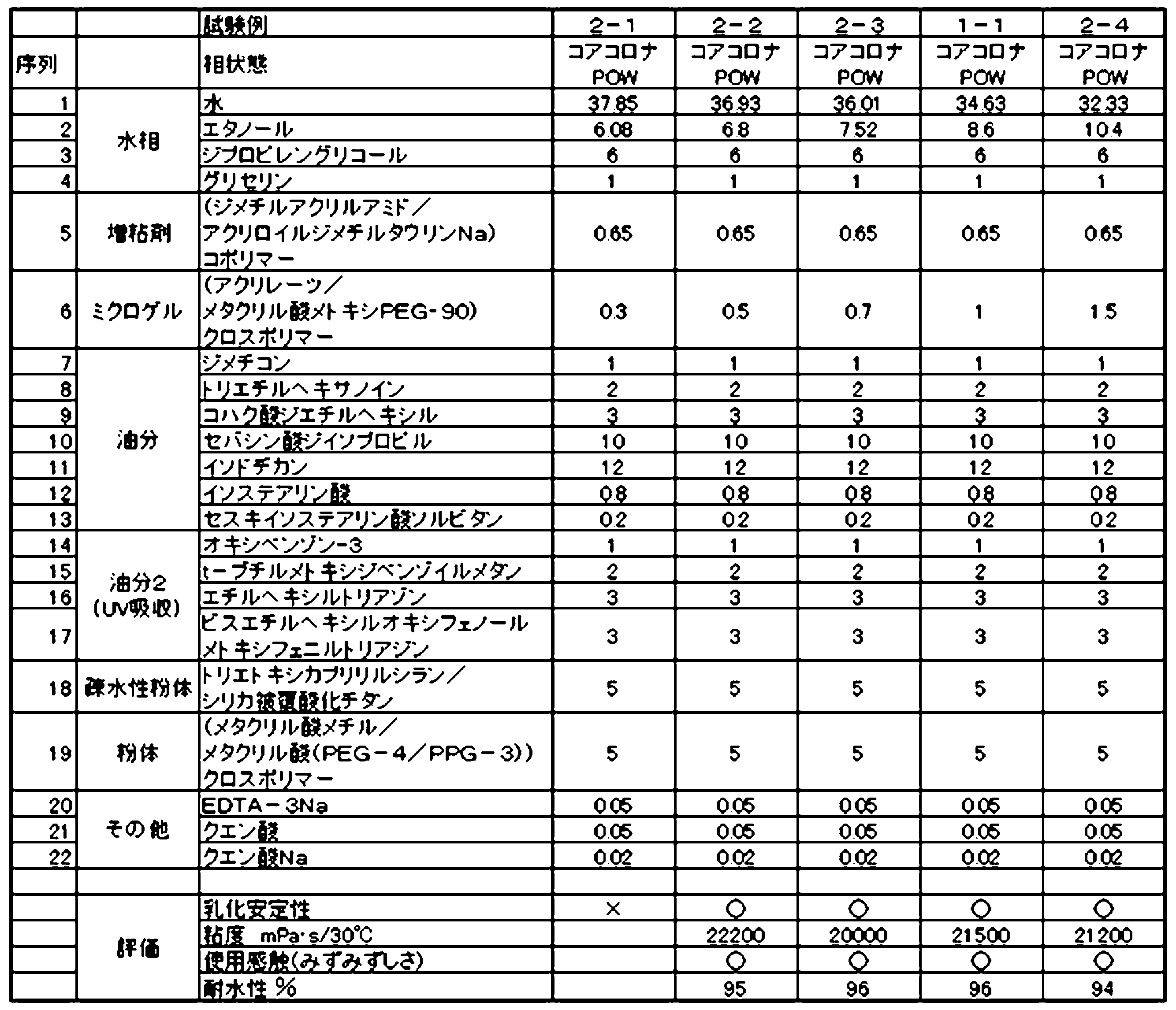
なお、製造方法は、試験例1-1に準じた。
表2に示す結果より、コア-コロナ型ミクロゲルは、疎水性粉体を含む油相の配合量にもよるが、組成物中0.5質量%以上(純分)で優れた安定性を示す。なお、常識的な範囲で配合量を増量した場合にも、安定性、使用感、耐水性等に悪影響を及ぼすことはほとんどなく、分散剤として2質量%程度までが好適であるが、10質量%程度の配合も可能である。
さらに本発明者らは非イオン性界面活性剤の添加について検討を行った。結果を表3に示す。
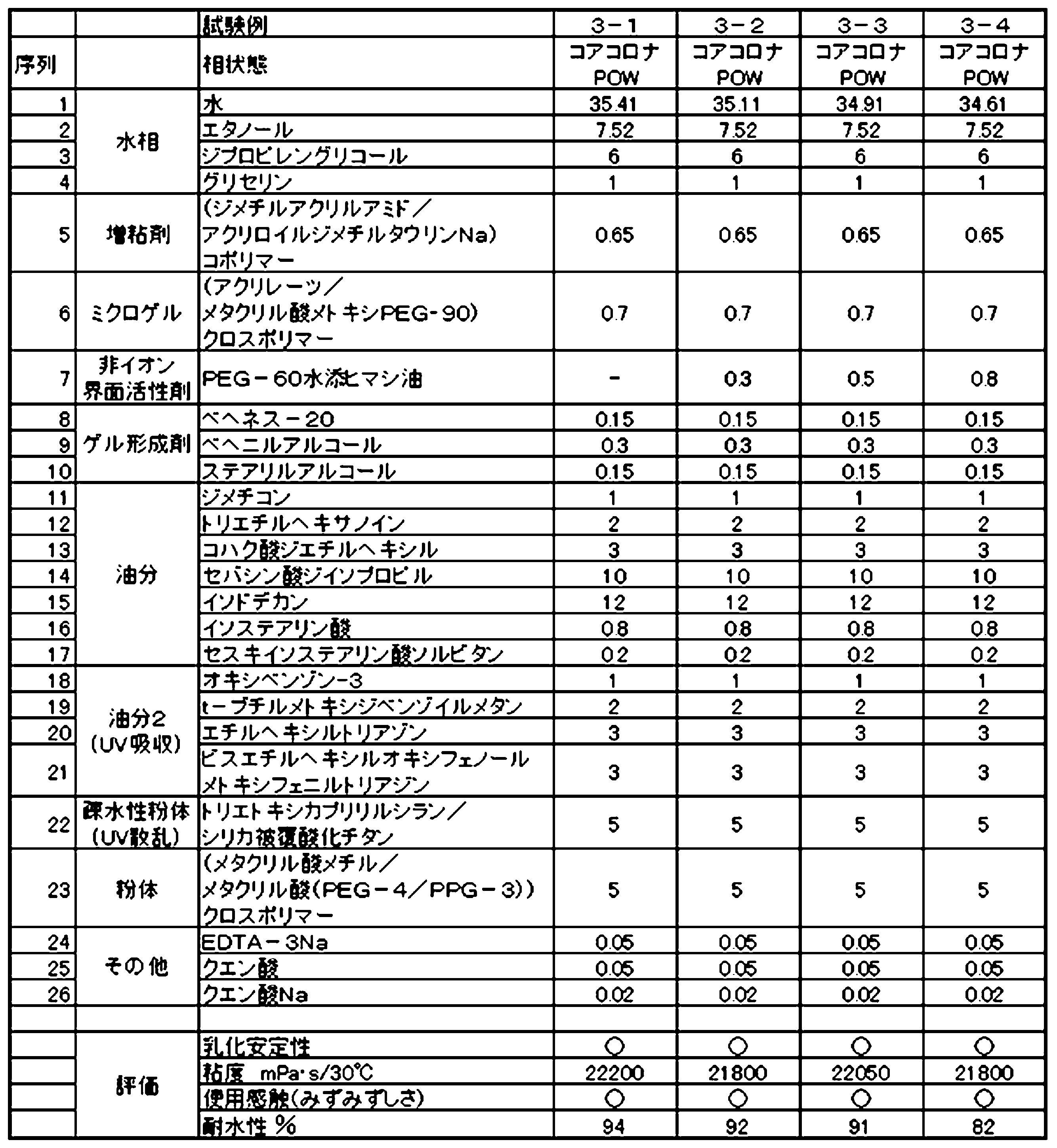
非イオン性界面活性剤は、コア-コロナ乳化においても適度の配合により乳化安定性の向上が図られることがあるが、その配合量が0.8質量%以上となる安定性には何ら問題ないものの、耐水性の顕著な低下がみられる。このため、非イオン性界面活性剤は配合が必須ではないが、配合する場合にも0.5質量%以下とすることが好ましい。
[非架橋型コア-コロナ型ミクロ粒子分散液の製造例]
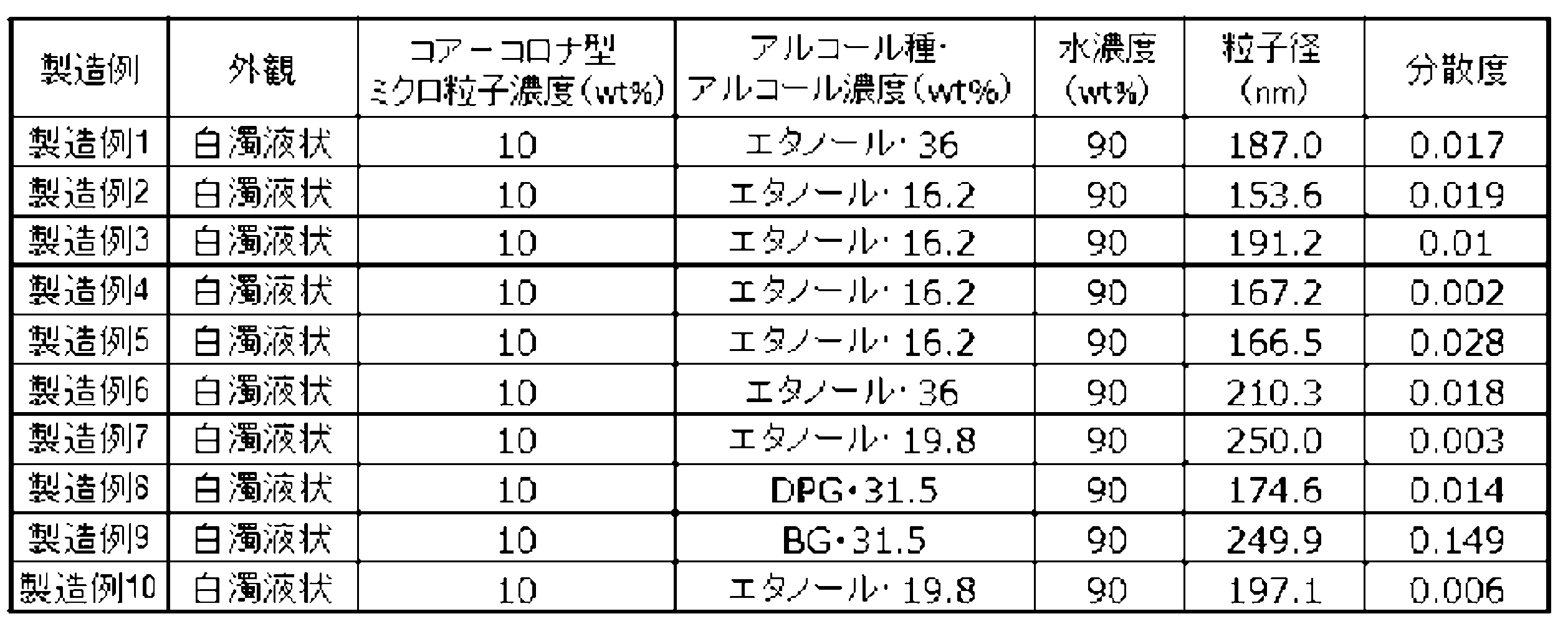
表4に記載したマクロモノマー及び疎水性モノマーを、表4及び表5に記載した重合条件で、下記製造方法(手法1)に従ってラジカル重合した。得られたコポリマー分散液の外観を目視によって評価し、コポリマーの粒子径及び分散度を手法2に従って評価した。結果を表3に示す。
還流管と窒素導入管を備えた三口フラスコに水-アルコール混合溶媒90gにポリエチレンオキサイドマクロモノマー、疎水性モノマーを添加した。十分溶解または分散させた後、全モノマー量に対して1mol%の重合開始剤2,2’-アゾビス(2-メチルプロピオンアミジン2塩酸塩)を少量の水に溶解させて添加し、さらに溶解または分散させた。均一溶解または分散させた重合溶液を20分間窒素置換して溶存酸素を除いた後、マグネチックスターラーで攪拌しながら、オイルバスにて65~70℃に8時間保って重合反応を行った。重合終了後、重合液を室温に戻すことにより、コア-コロナ型ミクロ粒子分散液を得た。
コポリマーの粒子径の測定は、マルバーン社製ゼータサイザーを用いて測定した。水希釈によりミクロ粒子分散液のミクロ粒子濃度約0.1%の測定サンプルを調製し、0.45マイクロメーターのフィルターでごみを除去した後、25℃での散乱強度を散乱角度173°(後方散乱光)で測定し、測定装置に搭載されている解析ソフトで平均粒子径及び分散度を算出した。粒子径はキュムラント解析法により解析し、分散度はキュムラント解析で得られる2次キュムラントの値を規格化した数値である。この分散度は一般的に用いられているパラメーターであり、市販の動的光散乱測定装置を用いることで自動的に解析が可能である。粒子径解析に必要な溶媒の粘度は25℃の純水の粘度、即ち0.89mPa・sの値を用いた。


(A)前記ポリエチレンオキサイドマクロモノマーの仕込みモル量/(前記アクリレート誘導体モノマー及び/またはアクリルアミド誘導体モノマー)の仕込みモル量で表されるモル比が1:10~1:250、
(B)前記式(1)で示されるマクロモノマーは、繰り返し単位が8~200のポリエチレングリコール基を有するアクリル酸誘導体またはメタクリル酸誘導体であり、
前記式(2)で示されるアクリレート誘導体モノマーは、炭素数1~12のアルキル基を含む置換基を有するアクリル酸誘導体またはメタクリル酸誘導体であり、
前記式(3)で示されるアクリルアミド誘導体モノマーは、炭素数1~12のアルキル基を含む置換基を有するアクリルアミド誘導体またはメタクリルアミド誘導体であり、
(C)重合溶媒が水-アルコール混合溶媒であり、アルコールがエタノール、ジプロピレングリコール、1,3-ブチレングリコール、イソプレングリコールから選択される1種または2種以上であり、
(D)水-アルコール混合溶媒の溶媒組成が、20℃の質量比で、水:アルコール=90~10:10~90である、
という条件((A)~(D))に則ってラジカル重合することにより、粒子径の揃ったコア-コロナ型ミクロ粒子が得られることが明らかとなった。
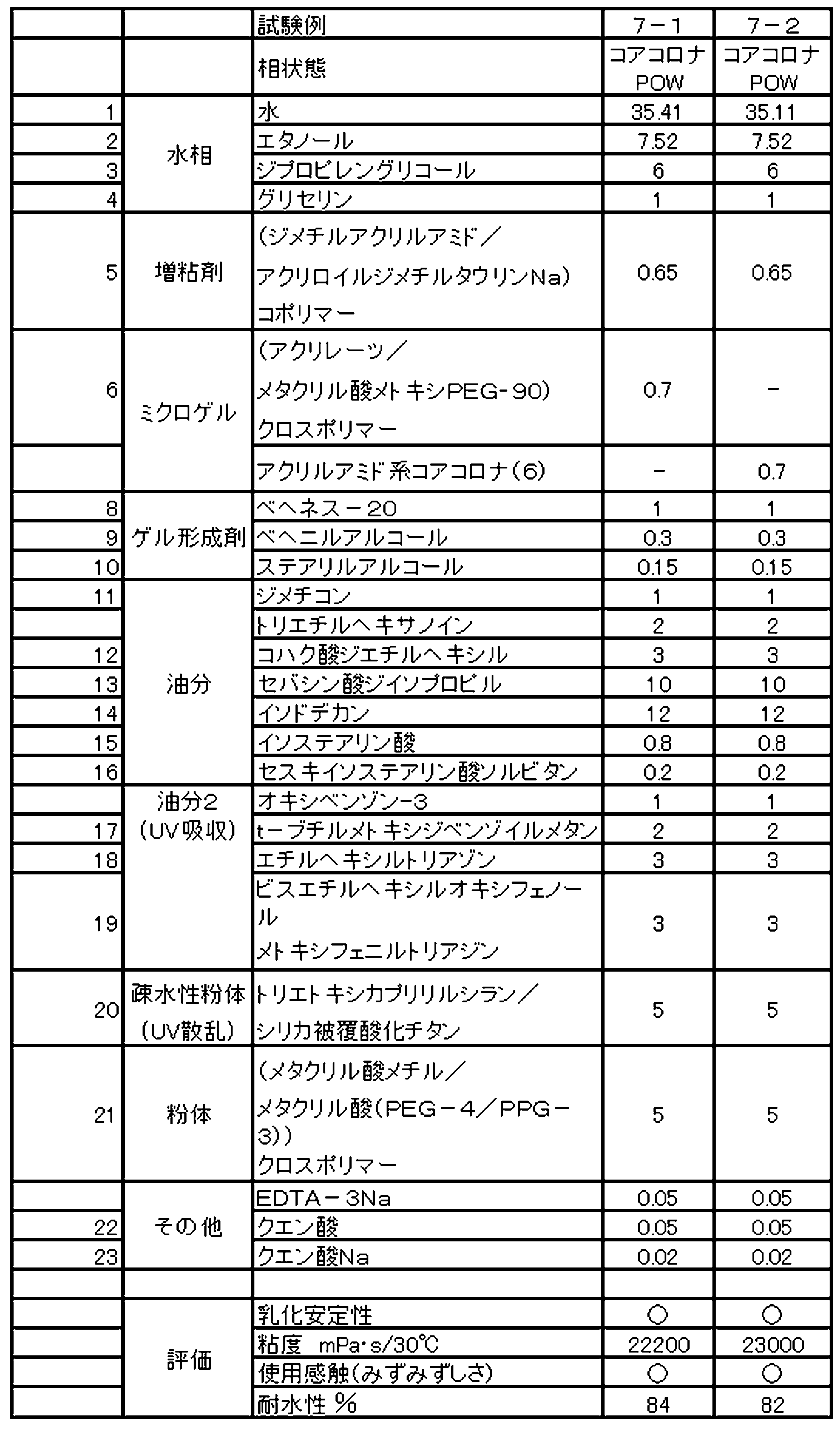
次の表7に架橋型コアコロナ型ミクロゲルを用いた組成物と非架橋型コアコロナ型ミクロゲルを用いた組成物の比較を示す。
Claims (4)
- 疎水性粉体と、
前記疎水性粉体が分散した油相と、
前記油相が分散した水相と、
を備え、
前記油相を水相に分散させる分散剤として、
疎水性ゲル微粒子表面に、部分的に親水基を設けたコア-コロナ型ミクロゲルを用いたことを特徴とする水中油中粉体型組成物。 - 請求項1記載の組成物において、コア-コロナ型ミクロゲルとして、(アクリレーツ/メタクリル酸メトキシPEG)クロスポリマー及び/又は非架橋アクリルアミド系ポリマーを0.5~10質量%用いることを特徴とする水中油中粉体型組成物。
- 請求項1または2記載の組成物において、非イオン性界面活性剤が配合され、その配合量は、組成物中0.5質量%以下であることを特徴とする水中油中粉体型組成物。
- 請求項1記載の組成物において、コア-コロナ型ミクロゲルは、
下記式(1)で表されるポリエチレンオキサイドマクロモノマーと、下記式(2)で表されるアクリレート誘導体モノマー及び下記式(3)で表されるアクリルアミド誘導体モノマーから選ばれる1種または2種以上の疎水性モノマーとを、下記(A)~(D)の条件でラジカル重合して得られる非架橋アクリルアミド系ポリマーからなるコア-コロナ型ミクロ粒子であることを特徴とする水中油中粉体型組成物;
(A)前記ポリエチレンオキサイドマクロモノマーの仕込みモル量/(前記アクリレート誘導体モノマー及び/またはアクリルアミド誘導体モノマー)の仕込みモル量で表されるモル比が1:10~1:250であること、
(B)下記式(1)で示されるマクロモノマーは、繰り返し単位が8~200のポリエチレングリコール基を有するアクリル酸誘導体またはメタクリル酸誘導体であり、
下記式(2)で示されるアクリレート誘導体モノマーは、炭素数1~12のアルキル基を含む置換基を有するアクリル酸誘導体またはメタクリル酸誘導体であり、
下記式(3)で示されるアクリルアミド誘導体モノマーは、炭素数1~12のアルキル基を含む置換基を有するアクリルアミド誘導体またはメタクリルアミド誘導体であること、
(C)重合溶媒が水-アルコール混合溶媒であり、アルコールがエタノール、ジプロピレングリコール、1,3-ブチレングリコール、イソプレングリコールから選択される1種または2種以上であること、
(D)水-アルコール混合溶媒の溶媒組成が、20℃の質量比で、水:アルコール=90~10:10~90であること。


Priority Applications (4)
| Application Number | Priority Date | Filing Date | Title |
|---|---|---|---|
| KR1020187008672A KR20180058727A (ko) | 2015-09-30 | 2016-09-29 | 수중유중 분체형 조성물 |
| HK19100193.4A HK1257838A1 (zh) | 2015-09-30 | 2016-09-29 | 水包油包粉体型组合物 |
| JP2017543553A JP6949714B2 (ja) | 2015-09-30 | 2016-09-29 | 水中油中粉体型組成物 |
| CN201680057118.5A CN108348443B (zh) | 2015-09-30 | 2016-09-29 | 水包油包粉体型组合物 |
Applications Claiming Priority (2)
| Application Number | Priority Date | Filing Date | Title |
|---|---|---|---|
| JP2015192893 | 2015-09-30 | ||
| JP2015-192893 | 2015-09-30 |
Publications (1)
| Publication Number | Publication Date |
|---|---|
| WO2017057563A1 true WO2017057563A1 (ja) | 2017-04-06 |
Family
ID=58423987
Family Applications (1)
| Application Number | Title | Priority Date | Filing Date |
|---|---|---|---|
| PCT/JP2016/078802 Ceased WO2017057563A1 (ja) | 2015-09-30 | 2016-09-29 | 水中油中粉体型組成物 |
Country Status (6)
| Country | Link |
|---|---|
| JP (1) | JP6949714B2 (ja) |
| KR (1) | KR20180058727A (ja) |
| CN (1) | CN108348443B (ja) |
| HK (1) | HK1257838A1 (ja) |
| TW (1) | TW201717892A (ja) |
| WO (1) | WO2017057563A1 (ja) |
Cited By (12)
| Publication number | Priority date | Publication date | Assignee | Title |
|---|---|---|---|---|
| WO2018061755A1 (ja) * | 2016-09-27 | 2018-04-05 | 株式会社 資生堂 | コア-コロナ型ミクロ粒子を用いた化粧料原料及び水中油型乳化化粧料 |
| WO2018180179A1 (ja) * | 2017-03-29 | 2018-10-04 | 株式会社 資生堂 | 水中油型化粧料 |
| JP2019094273A (ja) * | 2017-11-20 | 2019-06-20 | エア・ウォーター・ゾル株式会社 | エアゾール式泡沫状日焼け止め化粧料 |
| JP2020033313A (ja) * | 2018-08-31 | 2020-03-05 | 株式会社マンダム | 皮膚化粧料 |
| US20200069541A1 (en) * | 2016-10-20 | 2020-03-05 | Shiseido Company, Ltd. | Oil-in-water type emulsion composition |
| CN111902441A (zh) * | 2018-03-23 | 2020-11-06 | 株式会社资生堂 | 使用核-壳型聚合物颗粒的化妆品用原料和水包油型乳化化妆品 |
| CN111918895A (zh) * | 2018-03-23 | 2020-11-10 | 株式会社资生堂 | 使用核-壳型聚合物颗粒的化妆品用原料和水包油型乳化化妆品 |
| CN112460488A (zh) * | 2020-12-09 | 2021-03-09 | 鞍钢集团矿业有限公司 | 一种用于矿浆输送的复合药剂及其制法与应用 |
| JP2021075488A (ja) * | 2019-11-08 | 2021-05-20 | 株式会社 資生堂 | 水中油型組成物 |
| US20220151884A1 (en) * | 2019-03-04 | 2022-05-19 | Shiseido Company, Ltd. | Cosmetic emulsion for self-tanning |
| WO2023105363A1 (en) | 2021-12-09 | 2023-06-15 | Shiseido Company, Ltd. | Cosmetic composition |
| CN116322629A (zh) * | 2020-10-21 | 2023-06-23 | 株式会社资生堂 | 油包水型组合物 |
Families Citing this family (4)
| Publication number | Priority date | Publication date | Assignee | Title |
|---|---|---|---|---|
| CN108043324B (zh) * | 2017-12-29 | 2020-01-07 | 中国矿业大学 | 一种从褐煤蜡、泥炭蜡制备有机微粒的方法 |
| KR102221666B1 (ko) * | 2018-07-31 | 2021-03-02 | 주식회사 엘지생활건강 | 공융 혼합물을 포함하는 화장료 조성물 |
| CN111437436B (zh) * | 2020-05-25 | 2020-12-04 | 绽妍生物科技有限公司 | 一种用于皮肤浅表损伤高效修复的膏体伤口敷料及其制备方法 |
| CN117430962B (zh) * | 2023-10-26 | 2024-06-21 | 郑州市欧普士科技有限公司 | 一种opgw光缆用填充膏及其制备方法 |
Citations (7)
| Publication number | Priority date | Publication date | Assignee | Title |
|---|---|---|---|---|
| JP2005015623A (ja) * | 2003-06-26 | 2005-01-20 | Shiseido Co Ltd | 有機溶媒膨潤性ミクロゲル及びその製造方法 |
| JP2006161026A (ja) * | 2004-11-09 | 2006-06-22 | Shiseido Co Ltd | 有機溶媒膨潤性ミクロゲル及びその製造方法 |
| JP2006160725A (ja) * | 2004-11-09 | 2006-06-22 | Shiseido Co Ltd | 化粧料 |
| JP2012241004A (ja) * | 2011-05-24 | 2012-12-10 | Kao Corp | 水中油型メイクアップ化粧料 |
| JP5207424B1 (ja) * | 2011-12-22 | 2013-06-12 | 株式会社 資生堂 | コロナ−コア型ミクロゲル乳化剤及び水中油型乳化組成物 |
| JP2014534275A (ja) * | 2011-09-13 | 2014-12-18 | ルブリゾル アドバンスド マテリアルズ, インコーポレイテッド | 界面活性剤応答性ミクロゲル |
| JP2015091964A (ja) * | 2009-09-11 | 2015-05-14 | ソシエテ・デクスプロワタシオン・デ・プロデュイ・プール・レ・アンデュストリー・シミック・セピックSociete D’Exploitation De Produits Pour Les Industries Chimiques Seppic | 新規の粉末状ポリマー、その調製方法および増粘剤としてのその使用 |
Family Cites Families (20)
| Publication number | Priority date | Publication date | Assignee | Title |
|---|---|---|---|---|
| JPS527424A (en) | 1975-07-01 | 1977-01-20 | Nippon Chem Ind Co Ltd:The | Fungi preventive agent for industry |
| FR2720644B1 (fr) | 1994-06-06 | 1996-07-05 | Oreal | Emulsion eau-dans-huile sans tensioactif. |
| WO1998042301A1 (de) | 1997-03-25 | 1998-10-01 | Beiersdorf Ag | Emulgatorfreie feindisperse systeme vom typ wasser-in-öl |
| FR2768926B1 (fr) | 1997-10-01 | 2000-01-28 | Oreal | Composition topique stable contenant un organopolysiloxane elastomerique solide et des particules spheriques |
| US6635702B1 (en) * | 2000-04-11 | 2003-10-21 | Noveon Ip Holdings Corp. | Stable aqueous surfactant compositions |
| EP1505139B2 (en) * | 2002-05-14 | 2014-06-18 | Shiseido Company, Ltd. | Thickener, cosmetic preparation containing the same, and process for producing the same |
| JP4033295B2 (ja) * | 2002-09-02 | 2008-01-16 | 株式会社資生堂 | 皮膚化粧料 |
| JP2006036763A (ja) | 2004-06-25 | 2006-02-09 | Kao Corp | 水中油型乳化組成物 |
| FR2872423B1 (fr) * | 2004-07-02 | 2006-09-22 | Oreal | Compositions cosmetiques contenant au moins un agent conditionneur et au moins un copolymere ethylenique a greffons polyethyleneglycol |
| US7846970B2 (en) * | 2004-09-24 | 2010-12-07 | Showa Denko K.K. | Hydroxycitric acid derivatives and skin external preparations containing the same |
| JP2006161027A (ja) | 2004-11-09 | 2006-06-22 | Shiseido Co Ltd | 有機溶媒膨潤性ミクロゲル及びその製造方法 |
| DE102005033002A1 (de) | 2005-07-14 | 2007-01-18 | Basf Ag | Wässrige Monomeremulsionen enthaltend Hydrophobin |
| JP5506130B2 (ja) | 2006-06-12 | 2014-05-28 | 株式会社 資生堂 | 水中油型エマルション |
| CN1899264A (zh) * | 2006-07-20 | 2007-01-24 | 上海交通大学 | 温度敏感型水凝胶释药体系及其制备方法 |
| JP5352116B2 (ja) | 2007-04-26 | 2013-11-27 | 株式会社 資生堂 | 水中油型乳化組成物及びその製造方法 |
| JP5053887B2 (ja) * | 2008-02-28 | 2012-10-24 | 株式会社 資生堂 | 水中油型乳化組成物 |
| EP3031444B1 (en) * | 2011-08-02 | 2018-10-10 | Shiseido Company, Ltd. | Oil-in-water-type emulsion cosmetic |
| CN102670415A (zh) * | 2012-04-20 | 2012-09-19 | 费兰克·K·高 | 一种纳米纤维面膜纸 |
| FR2996133B1 (fr) * | 2012-10-02 | 2015-06-26 | Oreal | Nouvelles utilisations cosmetiques de polymeres dispersants en association avec au moins un actif |
| CN103387806B (zh) * | 2013-07-18 | 2015-09-09 | 东莞市芙蓉化工有限公司 | 一种具有反应性微凝胶结构的聚丙烯酸酯乳液压敏胶及其制备方法 |
-
2016
- 2016-09-29 HK HK19100193.4A patent/HK1257838A1/zh unknown
- 2016-09-29 CN CN201680057118.5A patent/CN108348443B/zh active Active
- 2016-09-29 KR KR1020187008672A patent/KR20180058727A/ko not_active Withdrawn
- 2016-09-29 WO PCT/JP2016/078802 patent/WO2017057563A1/ja not_active Ceased
- 2016-09-29 JP JP2017543553A patent/JP6949714B2/ja active Active
- 2016-09-30 TW TW105131580A patent/TW201717892A/zh unknown
Patent Citations (7)
| Publication number | Priority date | Publication date | Assignee | Title |
|---|---|---|---|---|
| JP2005015623A (ja) * | 2003-06-26 | 2005-01-20 | Shiseido Co Ltd | 有機溶媒膨潤性ミクロゲル及びその製造方法 |
| JP2006161026A (ja) * | 2004-11-09 | 2006-06-22 | Shiseido Co Ltd | 有機溶媒膨潤性ミクロゲル及びその製造方法 |
| JP2006160725A (ja) * | 2004-11-09 | 2006-06-22 | Shiseido Co Ltd | 化粧料 |
| JP2015091964A (ja) * | 2009-09-11 | 2015-05-14 | ソシエテ・デクスプロワタシオン・デ・プロデュイ・プール・レ・アンデュストリー・シミック・セピックSociete D’Exploitation De Produits Pour Les Industries Chimiques Seppic | 新規の粉末状ポリマー、その調製方法および増粘剤としてのその使用 |
| JP2012241004A (ja) * | 2011-05-24 | 2012-12-10 | Kao Corp | 水中油型メイクアップ化粧料 |
| JP2014534275A (ja) * | 2011-09-13 | 2014-12-18 | ルブリゾル アドバンスド マテリアルズ, インコーポレイテッド | 界面活性剤応答性ミクロゲル |
| JP5207424B1 (ja) * | 2011-12-22 | 2013-06-12 | 株式会社 資生堂 | コロナ−コア型ミクロゲル乳化剤及び水中油型乳化組成物 |
Cited By (20)
| Publication number | Priority date | Publication date | Assignee | Title |
|---|---|---|---|---|
| WO2018061755A1 (ja) * | 2016-09-27 | 2018-04-05 | 株式会社 資生堂 | コア-コロナ型ミクロ粒子を用いた化粧料原料及び水中油型乳化化粧料 |
| US11964043B2 (en) | 2016-09-27 | 2024-04-23 | Shiseido Company, Ltd. | Method of emulsification using core-corona type microparticles |
| US20200069541A1 (en) * | 2016-10-20 | 2020-03-05 | Shiseido Company, Ltd. | Oil-in-water type emulsion composition |
| WO2018180179A1 (ja) * | 2017-03-29 | 2018-10-04 | 株式会社 資生堂 | 水中油型化粧料 |
| JP2018168087A (ja) * | 2017-03-29 | 2018-11-01 | 株式会社 資生堂 | 水中油型化粧料 |
| JP2019094273A (ja) * | 2017-11-20 | 2019-06-20 | エア・ウォーター・ゾル株式会社 | エアゾール式泡沫状日焼け止め化粧料 |
| JP7005308B2 (ja) | 2017-11-20 | 2022-02-10 | エア・ウォーター・ゾル株式会社 | エアゾール式泡沫状日焼け止め化粧料 |
| EP3770194A4 (en) * | 2018-03-23 | 2021-12-15 | Shiseido Company, Ltd. | COSMETIC INGREDIENT WITH CORE-CROWN POLYMER PARTICLES AND COSMETIC OIL-IN-WATER EMULSION |
| CN111918895A (zh) * | 2018-03-23 | 2020-11-10 | 株式会社资生堂 | 使用核-壳型聚合物颗粒的化妆品用原料和水包油型乳化化妆品 |
| CN111902441A (zh) * | 2018-03-23 | 2020-11-06 | 株式会社资生堂 | 使用核-壳型聚合物颗粒的化妆品用原料和水包油型乳化化妆品 |
| CN111918895B (zh) * | 2018-03-23 | 2023-07-14 | 株式会社资生堂 | 使用核-壳型聚合物颗粒的化妆品用原料和水包油型乳化化妆品 |
| JP7228978B2 (ja) | 2018-08-31 | 2023-02-27 | 株式会社マンダム | 皮膚化粧料 |
| JP2020033313A (ja) * | 2018-08-31 | 2020-03-05 | 株式会社マンダム | 皮膚化粧料 |
| US20220151884A1 (en) * | 2019-03-04 | 2022-05-19 | Shiseido Company, Ltd. | Cosmetic emulsion for self-tanning |
| JP2021075488A (ja) * | 2019-11-08 | 2021-05-20 | 株式会社 資生堂 | 水中油型組成物 |
| JP7370820B2 (ja) | 2019-11-08 | 2023-10-30 | 株式会社 資生堂 | 水中油型組成物 |
| CN116322629A (zh) * | 2020-10-21 | 2023-06-23 | 株式会社资生堂 | 油包水型组合物 |
| CN112460488A (zh) * | 2020-12-09 | 2021-03-09 | 鞍钢集团矿业有限公司 | 一种用于矿浆输送的复合药剂及其制法与应用 |
| CN112460488B (zh) * | 2020-12-09 | 2023-05-09 | 鞍钢集团矿业有限公司 | 一种用于矿浆输送的复合药剂及其制法与应用 |
| WO2023105363A1 (en) | 2021-12-09 | 2023-06-15 | Shiseido Company, Ltd. | Cosmetic composition |
Also Published As
| Publication number | Publication date |
|---|---|
| TW201717892A (zh) | 2017-06-01 |
| CN108348443A (zh) | 2018-07-31 |
| JPWO2017057563A1 (ja) | 2018-08-30 |
| HK1257838A1 (zh) | 2019-11-01 |
| CN108348443B (zh) | 2021-08-03 |
| JP6949714B2 (ja) | 2021-10-13 |
| KR20180058727A (ko) | 2018-06-01 |
Similar Documents
| Publication | Publication Date | Title |
|---|---|---|
| JP5207424B1 (ja) | コロナ−コア型ミクロゲル乳化剤及び水中油型乳化組成物 | |
| JP6949714B2 (ja) | 水中油中粉体型組成物 | |
| JP5913475B2 (ja) | 化粧料用原料 | |
| JP6403854B2 (ja) | コア−コロナ型ミクロ粒子を用いた化粧料原料及び水中油型乳化化粧料 | |
| JP6985025B2 (ja) | 水中油型化粧料 | |
| JP6061594B2 (ja) | 水中油型乳化組成物 | |
| KR102251072B1 (ko) | 수중유형 유화 조성물 | |
| JP7356998B2 (ja) | 油中水型乳化組成物 | |
| WO2022210144A1 (ja) | 水中油型化粧料 | |
| HK40009630A (en) | Oil-in-water-type emulsion composition | |
| HK40008220A (zh) | 使用了核-壳型微粒的化妆品原料和水包油型乳化化妆品 | |
| HK1238535A1 (en) | Starting material for cosmetics | |
| HK1200397B (en) | Core-corona type microgel emulsifier, and oil-in-water emulsion composition | |
| HK1238535B (zh) | 化妆品用原料 |
Legal Events
| Date | Code | Title | Description |
|---|---|---|---|
| 121 | Ep: the epo has been informed by wipo that ep was designated in this application |
Ref document number: 16851734 Country of ref document: EP Kind code of ref document: A1 |
|
| ENP | Entry into the national phase |
Ref document number: 20187008672 Country of ref document: KR Kind code of ref document: A |
|
| ENP | Entry into the national phase |
Ref document number: 2017543553 Country of ref document: JP Kind code of ref document: A |
|
| NENP | Non-entry into the national phase |
Ref country code: DE |
|
| 122 | Ep: pct application non-entry in european phase |
Ref document number: 16851734 Country of ref document: EP Kind code of ref document: A1 |