WO2017043544A1 - 感光性樹脂組成物 - Google Patents
感光性樹脂組成物 Download PDFInfo
- Publication number
- WO2017043544A1 WO2017043544A1 PCT/JP2016/076342 JP2016076342W WO2017043544A1 WO 2017043544 A1 WO2017043544 A1 WO 2017043544A1 JP 2016076342 W JP2016076342 W JP 2016076342W WO 2017043544 A1 WO2017043544 A1 WO 2017043544A1
- Authority
- WO
- WIPO (PCT)
- Prior art keywords
- photosensitive resin
- mass
- resin composition
- meth
- component
- Prior art date
- Legal status (The legal status is an assumption and is not a legal conclusion. Google has not performed a legal analysis and makes no representation as to the accuracy of the status listed.)
- Ceased
Links
Classifications
-
- C—CHEMISTRY; METALLURGY
- C08—ORGANIC MACROMOLECULAR COMPOUNDS; THEIR PREPARATION OR CHEMICAL WORKING-UP; COMPOSITIONS BASED THEREON
- C08F—MACROMOLECULAR COMPOUNDS OBTAINED BY REACTIONS ONLY INVOLVING CARBON-TO-CARBON UNSATURATED BONDS
- C08F212/00—Copolymers of compounds having one or more unsaturated aliphatic radicals, each having only one carbon-to-carbon double bond, and at least one being terminated by an aromatic carbocyclic ring
- C08F212/02—Monomers containing only one unsaturated aliphatic radical
- C08F212/04—Monomers containing only one unsaturated aliphatic radical containing one ring
- C08F212/06—Hydrocarbons
- C08F212/08—Styrene
-
- C—CHEMISTRY; METALLURGY
- C08—ORGANIC MACROMOLECULAR COMPOUNDS; THEIR PREPARATION OR CHEMICAL WORKING-UP; COMPOSITIONS BASED THEREON
- C08F—MACROMOLECULAR COMPOUNDS OBTAINED BY REACTIONS ONLY INVOLVING CARBON-TO-CARBON UNSATURATED BONDS
- C08F220/00—Copolymers of compounds having one or more unsaturated aliphatic radicals, each having only one carbon-to-carbon double bond, and only one being terminated by only one carboxyl radical or a salt, anhydride ester, amide, imide or nitrile thereof
- C08F220/02—Monocarboxylic acids having less than ten carbon atoms; Derivatives thereof
- C08F220/04—Acids; Metal salts or ammonium salts thereof
- C08F220/06—Acrylic acid; Methacrylic acid; Metal salts or ammonium salts thereof
-
- C—CHEMISTRY; METALLURGY
- C08—ORGANIC MACROMOLECULAR COMPOUNDS; THEIR PREPARATION OR CHEMICAL WORKING-UP; COMPOSITIONS BASED THEREON
- C08F—MACROMOLECULAR COMPOUNDS OBTAINED BY REACTIONS ONLY INVOLVING CARBON-TO-CARBON UNSATURATED BONDS
- C08F222/00—Copolymers of compounds having one or more unsaturated aliphatic radicals, each having only one carbon-to-carbon double bond, and at least one being terminated by a carboxyl radical and containing at least one other carboxyl radical in the molecule; Salts, anhydrides, esters, amides, imides, or nitriles thereof
- C08F222/10—Esters
- C08F222/1006—Esters of polyhydric alcohols or polyhydric phenols
- C08F222/106—Esters of polycondensation macromers
- C08F222/1063—Esters of polycondensation macromers of alcohol terminated polyethers
-
- C—CHEMISTRY; METALLURGY
- C08—ORGANIC MACROMOLECULAR COMPOUNDS; THEIR PREPARATION OR CHEMICAL WORKING-UP; COMPOSITIONS BASED THEREON
- C08F—MACROMOLECULAR COMPOUNDS OBTAINED BY REACTIONS ONLY INVOLVING CARBON-TO-CARBON UNSATURATED BONDS
- C08F285/00—Macromolecular compounds obtained by polymerising monomers on to preformed graft polymers
-
- G—PHYSICS
- G03—PHOTOGRAPHY; CINEMATOGRAPHY; ANALOGOUS TECHNIQUES USING WAVES OTHER THAN OPTICAL WAVES; ELECTROGRAPHY; HOLOGRAPHY
- G03F—PHOTOMECHANICAL PRODUCTION OF TEXTURED OR PATTERNED SURFACES, e.g. FOR PRINTING, FOR PROCESSING OF SEMICONDUCTOR DEVICES; MATERIALS THEREFOR; ORIGINALS THEREFOR; APPARATUS SPECIALLY ADAPTED THEREFOR
- G03F7/00—Photomechanical, e.g. photolithographic, production of textured or patterned surfaces, e.g. printing surfaces; Materials therefor, e.g. comprising photoresists; Apparatus specially adapted therefor
- G03F7/004—Photosensitive materials
-
- G—PHYSICS
- G03—PHOTOGRAPHY; CINEMATOGRAPHY; ANALOGOUS TECHNIQUES USING WAVES OTHER THAN OPTICAL WAVES; ELECTROGRAPHY; HOLOGRAPHY
- G03F—PHOTOMECHANICAL PRODUCTION OF TEXTURED OR PATTERNED SURFACES, e.g. FOR PRINTING, FOR PROCESSING OF SEMICONDUCTOR DEVICES; MATERIALS THEREFOR; ORIGINALS THEREFOR; APPARATUS SPECIALLY ADAPTED THEREFOR
- G03F7/00—Photomechanical, e.g. photolithographic, production of textured or patterned surfaces, e.g. printing surfaces; Materials therefor, e.g. comprising photoresists; Apparatus specially adapted therefor
- G03F7/004—Photosensitive materials
- G03F7/027—Non-macromolecular photopolymerisable compounds having carbon-to-carbon double bonds, e.g. ethylenic compounds
-
- G—PHYSICS
- G03—PHOTOGRAPHY; CINEMATOGRAPHY; ANALOGOUS TECHNIQUES USING WAVES OTHER THAN OPTICAL WAVES; ELECTROGRAPHY; HOLOGRAPHY
- G03F—PHOTOMECHANICAL PRODUCTION OF TEXTURED OR PATTERNED SURFACES, e.g. FOR PRINTING, FOR PROCESSING OF SEMICONDUCTOR DEVICES; MATERIALS THEREFOR; ORIGINALS THEREFOR; APPARATUS SPECIALLY ADAPTED THEREFOR
- G03F7/00—Photomechanical, e.g. photolithographic, production of textured or patterned surfaces, e.g. printing surfaces; Materials therefor, e.g. comprising photoresists; Apparatus specially adapted therefor
- G03F7/004—Photosensitive materials
- G03F7/027—Non-macromolecular photopolymerisable compounds having carbon-to-carbon double bonds, e.g. ethylenic compounds
- G03F7/028—Non-macromolecular photopolymerisable compounds having carbon-to-carbon double bonds, e.g. ethylenic compounds with photosensitivity-increasing substances, e.g. photoinitiators
- G03F7/031—Organic compounds not covered by group G03F7/029
-
- G—PHYSICS
- G03—PHOTOGRAPHY; CINEMATOGRAPHY; ANALOGOUS TECHNIQUES USING WAVES OTHER THAN OPTICAL WAVES; ELECTROGRAPHY; HOLOGRAPHY
- G03F—PHOTOMECHANICAL PRODUCTION OF TEXTURED OR PATTERNED SURFACES, e.g. FOR PRINTING, FOR PROCESSING OF SEMICONDUCTOR DEVICES; MATERIALS THEREFOR; ORIGINALS THEREFOR; APPARATUS SPECIALLY ADAPTED THEREFOR
- G03F7/00—Photomechanical, e.g. photolithographic, production of textured or patterned surfaces, e.g. printing surfaces; Materials therefor, e.g. comprising photoresists; Apparatus specially adapted therefor
- G03F7/004—Photosensitive materials
- G03F7/027—Non-macromolecular photopolymerisable compounds having carbon-to-carbon double bonds, e.g. ethylenic compounds
- G03F7/032—Non-macromolecular photopolymerisable compounds having carbon-to-carbon double bonds, e.g. ethylenic compounds with binders
- G03F7/033—Non-macromolecular photopolymerisable compounds having carbon-to-carbon double bonds, e.g. ethylenic compounds with binders the binders being polymers obtained by reactions only involving carbon-to-carbon unsaturated bonds, e.g. vinyl polymers
-
- G—PHYSICS
- G03—PHOTOGRAPHY; CINEMATOGRAPHY; ANALOGOUS TECHNIQUES USING WAVES OTHER THAN OPTICAL WAVES; ELECTROGRAPHY; HOLOGRAPHY
- G03F—PHOTOMECHANICAL PRODUCTION OF TEXTURED OR PATTERNED SURFACES, e.g. FOR PRINTING, FOR PROCESSING OF SEMICONDUCTOR DEVICES; MATERIALS THEREFOR; ORIGINALS THEREFOR; APPARATUS SPECIALLY ADAPTED THEREFOR
- G03F7/00—Photomechanical, e.g. photolithographic, production of textured or patterned surfaces, e.g. printing surfaces; Materials therefor, e.g. comprising photoresists; Apparatus specially adapted therefor
- G03F7/20—Exposure; Apparatus therefor
-
- H—ELECTRICITY
- H05—ELECTRIC TECHNIQUES NOT OTHERWISE PROVIDED FOR
- H05K—PRINTED CIRCUITS; CASINGS OR CONSTRUCTIONAL DETAILS OF ELECTRIC APPARATUS; MANUFACTURE OF ASSEMBLAGES OF ELECTRICAL COMPONENTS
- H05K3/00—Apparatus or processes for manufacturing printed circuits
- H05K3/02—Apparatus or processes for manufacturing printed circuits in which the conductive material is applied to the surface of the insulating support and is thereafter removed from such areas of the surface which are not intended for current conducting or shielding
- H05K3/06—Apparatus or processes for manufacturing printed circuits in which the conductive material is applied to the surface of the insulating support and is thereafter removed from such areas of the surface which are not intended for current conducting or shielding the conductive material being removed chemically or electrolytically, e.g. by photo-etch process
Definitions
- the first embodiment of the present invention relates to a photosensitive resin composition.
- the second embodiment of the present invention relates to a photosensitive resin composition and the like.
- the third embodiment of the present invention relates to a photosensitive resin composition and the like.
- the fourth embodiment of the present invention relates to a photosensitive resin composition.
- a printed wiring board is generally manufactured by photolithography.
- photolithography a layer made of a photosensitive resin composition is formed on a substrate, a resist pattern is formed by pattern exposure and development on the coating film, and then a conductor pattern is formed by etching or plating, In this method, a desired wiring pattern is formed on the substrate by removing the resist pattern on the substrate.
- a photosensitive resin composition layer is formed on a substrate, a method of removing the solvent after applying the composition solution; a photosensitive element formed by laminating a support and a photosensitive resin composition layer A method of peeling the support after laminating a dry film resist on a substrate is known.
- Photosensitive elements are often used in the production of printed wiring boards.
- a method for forming a wiring pattern using this photosensitive element and a photosensitive resin composition suitable for this method discloses a method capable of easily forming a copper wiring pattern having a good cross-sectional shape, and a photosensitive resin composition used in the method;
- Patent Document 2 discloses a photosensitive resin composition containing an addition polymerizable monomer having a specific ethylenic double bond.
- Patent Document 3 discloses a photosensitive resin composition containing a binder polymer having a low degree of dispersion (Mw / Mn), a photopolymerizable compound, and an acridine compound. It is described that a resist film having excellent tenting properties can be formed.
- a printed wiring board is generally manufactured by photolithography.
- photolithography a coating film including a layer made of a photosensitive resin composition is formed on a substrate, the coating film is subjected to pattern exposure and development to form a resist pattern, and then a conductor pattern is formed by etching or plating treatment. Thereafter, a desired wiring pattern is formed on the substrate by removing the resist pattern on the substrate.
- Photosensitive elements are often used in the production of printed wiring boards.
- a method for forming a wiring pattern using this photosensitive element and a photosensitive resin composition suitable for this method For example, Patent Document 1 discloses a method for easily forming a copper wiring pattern having a good cross-sectional shape, and a photosensitive resin composition used in the method.
- Patent Document 4 discloses a specific ethylenic double layer. A photosensitive resin composition containing an addition polymerizable monomer having a bond is disclosed.
- a printed wiring board is generally manufactured by a photolithography method.
- the photolithography method first, pattern exposure is performed on the photosensitive resin composition layer laminated on the substrate.
- the exposed portion of the photosensitive resin composition is polymerized and cured (in the case of a negative type) or solubilized in a developer (in the case of a positive type).
- the unexposed portion (in the case of negative type) or the exposed portion (in the case of positive type) is removed with a developer to form a resist pattern on the substrate.
- the resist pattern is peeled off from the substrate. Through these steps, a conductor pattern is formed on the substrate.
- the photolithography method is a method in which a solution of a photosensitive resin composition is applied to a substrate and dried, or a dry film resist (photosensitive resin laminate in which a photosensitive resin composition layer is laminated on a support). Any method of laminating the conductive resin composition layer on the substrate is used. The latter is frequently used in the production of printed wiring boards.
- a printed wiring board is generally manufactured by photolithography.
- photolithography a layer made of a photosensitive resin composition is formed on a substrate, a resist pattern is formed by pattern exposure and development on the coating film, and then a conductor pattern is formed by etching or plating, In this method, a desired wiring pattern is formed on the substrate by removing the resist pattern on the substrate.
- Patent Documents 1 and 2 A method for forming a wiring pattern using this photosensitive element and a photosensitive resin composition suitable for this method are known (Patent Documents 1 and 2).
- Patent Document 1 describes a general method for forming a copper wiring pattern having a good cross-sectional shape and a photosensitive resin composition used therefor.
- Patent Document 2 describes a photosensitive resin composition containing an addition polymerizable monomer having a specific ethylenically unsaturated bond.
- JP 2011-233769 A International Publication No. 2009/022724 JP 2013-109321 A Japanese Patent Laid-Open No. 2015-60120 International Publication No. 2015/098870 JP 2014-048340 A
- the manufacture of a wiring board is usually performed by a line process in which processing is sequentially performed while a substrate is conveyed in a certain direction.
- a conductor pattern of a line / space pattern is formed on a substrate
- the conductor line is parallel (MD direction line) or perpendicular to the substrate transport direction (TD direction) Line) and an oblique case.
- MD direction line parallel
- TD direction substrate transport direction
- the wiring width is different between the MD direction line and the TD direction line, and a so-called vertical / horizontal difference in wiring width occurs.
- the MD direction line is more easily affected by the etchant than the TD direction line, and thus the etching amount increases and the wiring width tends to be narrow.
- the wiring width difference between the MD wiring and the TD wiring is reduced.
- an object of the first embodiment of the present invention is to provide a resist material in which a vertical and horizontal difference in wiring width is suppressed when a fine conductor pattern is formed by a line process.
- a development process is performed.
- a resist pattern is formed by dissolving and removing the composition in the exposed region in the positive composition and the composition in the exposed region in the negative composition.
- not all of the composition in the unnecessary region is “dissolved” in the developer, but at least a part of the composition is removed from the substrate by being dispersed in the developer while remaining insoluble. Therefore, each time the development process is repeated, the amount of unnecessary substances in the developer increases, and finally insoluble components with poor dispersibility may form aggregates. Such agglomerates may remain attached to a substrate to be developed later, which may cause a short circuit failure. Accordingly, it is strongly desired that the photosensitive resin composition to be used has good developer dispersibility from the viewpoint of improving the product yield in the development process and reducing the production cost of the printed wiring board.
- the second embodiment of the present invention has been made in view of such a current situation. Therefore, the object of the second embodiment of the present invention is to provide a novel photosensitivity that has a high level of performance such as resolution, which is generally required for photosensitive materials, and is excellent in development dispersibility and fine pattern adhesion. Is to provide a sex material.
- Patent Document 5 from the viewpoint of developability of the photosensitive resin composition and resolution, adhesion, and flexibility of the resist pattern, in the photosensitive resin composition, a structural unit of (meth) acrylic acid, styrene or ⁇ - A binder polymer having a structural unit of methylstyrene and a structural unit of a hydroxyalkyl ester of (meth) acrylic acid having a hydroxyalkyl group having 1 to 12 carbon atoms, an ethyleneoxy group having 1 to 20 structural units, and A combination with a bisphenol-type di (meth) acrylate monomer having a propyleneoxy group having 0 to 7 structural units has been studied.
- Patent Document 6 proposes a content of a structural unit of styrene or a styrene derivative in the alkali-soluble polymer of 30% by mass or more from the viewpoint of the space width and tent property of the positive resist pattern, and addition polymerization is proposed. A weight average molecular weight of 1,100 or more has been proposed.
- Patent Documents 5 and 6 focus on a photosensitive resin composition containing a polymer having a specific proportion of styrene structural units and a specific monomer, but are described in Patent Documents 5 and 6.
- the photosensitive resin composition that has been used still has room for improvement from the viewpoint of achieving both a tent property of the resist pattern and a water residue short-circuit defect suppressing property.
- the problem to be solved by the third embodiment of the present invention is to provide a photosensitive resin composition capable of satisfying both the tent property of a resist pattern and the water residue short-circuit defect suppressing property.
- the manufacture of a wiring board is usually performed by a line process in which processing is sequentially performed while a substrate is conveyed in a certain direction.
- the processing of the developing solution or the etching solution on the substrate is performed by spraying.
- the developing time is a time during which the substrate stays in the developing tank and is developed, and is determined as, for example, a time twice as long as the minimum developing time.
- the minimum development time is the minimum time required for the unexposed part of the photosensitive resin layer to be completely dissolved and removed.
- the developer concentration or temperature, spray direction or spray amount, pressure, and oscillation frequency It changes depending on etc.
- the dissolution reaction of the resist by development is considered to occur almost at the diffusion-limited rate of the developer. Therefore, from the viewpoint of promoting development, it is necessary to positively supply the developer onto the substrate by spraying or the like. Since this supply takes some time, it is considered that when the development time is short, the supply of the developer does not sufficiently spread over the entire surface of the substrate, and the variation of the resist line width becomes remarkably large. On the other hand, when the development time is long, it is considered that the supply of the developer on the substrate becomes uniform, and therefore the variation in line width is also reduced. Therefore, it is considered effective to use a photosensitive resin composition having a slow minimum development time itself from the viewpoint of suppressing variation in line width.
- Patent Document 5 from the viewpoint of developability of the photosensitive resin composition and resolution, adhesion, and flexibility of the resist pattern, in the photosensitive resin composition, a structural unit of (meth) acrylic acid, styrene or ⁇ - A binder polymer having a structural unit of methylstyrene and a structural unit of a hydroxyalkyl ester of (meth) acrylic acid having a hydroxyalkyl group having 1 to 12 carbon atoms, an ethyleneoxy group having 1 to 20 structural units, and A combination with a bisphenol-type di (meth) acrylate monomer having a propyleneoxy group having 0 to 7 structural units has been studied.
- Patent Document 6 proposes a content of a structural unit of styrene or a styrene derivative in the alkali-soluble polymer of 30% by mass or more from the viewpoint of the space width and tent property of the positive resist pattern, and addition polymerization is proposed. A weight average molecular weight of 1,100 or more has been proposed.
- Patent Documents 5 and 6 focus on a photosensitive resin composition containing a polymer having a specific proportion of styrene structural units and a specific monomer, but are described in Patent Documents 5 and 6.
- the photosensitive resin composition described above still has room for improvement from the viewpoint of achieving both good resolution of the resist pattern and extending the minimum development time.
- the problem to be solved by the fourth embodiment of the present invention is to provide a photosensitive resin composition capable of achieving both good resolution of a resist pattern and extension of the minimum development time.
- the present inventors have found that the above object can be achieved by the following technical means, and have reached the first embodiment of the present invention.
- a cured resist pattern is formed through the treatment, and after performing a copper etching process at 50 ° C. for 55 seconds, the bottom width of the copper line pattern obtained by removing the cured resist pattern is 38 ⁇ m or more.
- the photosensitive resin composition [2] The photosensitive resin composition according to [1], wherein the component (A) is a copolymer having a (meth) acrylic acid unit content of 10% by mass to 24% by mass. [3] The photosensitive resin composition according to [1] or [2], wherein the component (A) is a copolymer having a styrene unit content of 32% by mass to 60% by mass.
- the following components (A) to (C) (A) component: alkali-soluble polymer, (B) component: a compound having an ethylenic double bond, and (C) component: a photosensitive resin composition containing a photopolymerization initiator,
- the component (A) includes a copolymer having a (meth) acrylic acid unit content of 10% by mass to 24% by mass and a styrene unit content of 32% by mass or more.
- the component (C) is a photosensitive resin composition containing an acridine compound.
- the component (A) includes a copolymer having a (meth) acrylic acid unit content of 10% by mass to 24% by mass and a styrene unit content of 32% by mass to 60% by mass.
- the photosensitive resin composition according to [8]. [10] The photosensitive resin composition according to [8] or [9], wherein the component (B) contains a pentaerythritol compound. [11] The photosensitive resin composition according to any one of [8] to [10], wherein the component (B) contains a trimethylolpropane compound. [12] The photosensitive resin composition according to any one of [8] to [11], wherein the component (B) contains a bisphenol A compound.
- a method of forming a resist pattern comprising: [15] The method for forming a resist pattern according to [14], wherein the laminating step is a step of laminating a photosensitive resin layer of a photosensitive element on a conductor substrate via a wetting agent.
- the present inventors have found that the above object can be achieved by the following technical means, and have reached the second embodiment of the present invention.
- the second embodiment of the present invention is as follows. [1] The following components (A) to (C) (A) component: an alkali-soluble polymer having an acid equivalent of 100 to 600, (B) component: a compound having an ethylenic double bond, and (C) component: a photosensitive resin composition containing a photopolymerization initiator,
- the component (A) contains a copolymer containing 50% by mass or more of styrene units,
- the component (B) is represented by the following general formula (I): ⁇ Wherein R is independently a hydrogen atom or an alkyl group having 1 to 4 carbon atoms, and n1, n2 and n3 are each independently an integer of 0 to 30, provided that n1 + n2 + n3 ⁇ 6 Meet the conditions.
- the content of the compound represented by the general formula (I) is 5% by mass or more based on the solid content of the photosensitive resin composition, and the component (C) Contains the acridine compound.
- a photosensitive element wherein a photosensitive resin layer made of the photosensitive resin composition according to any one of [4] is laminated on a support.
- a method of forming a resist pattern comprising: [7] A laminating step of laminating the photosensitive resin layer of the photosensitive element according to [5] on a conductive substrate; An exposure step of exposing the laminated photosensitive resin layer; A developing step of removing the unexposed portion after the exposure with a developer; A conductor pattern forming step of etching or plating a conductive substrate on which a resist pattern is formed by the development; and a peeling step of peeling the resist pattern;
- a method for producing a wiring board comprising:
- the third embodiment of the present invention is as follows. [1] (A) an alkali-soluble polymer; (B) an ethylenically unsaturated bond-containing compound; and (C) a photopolymerization initiator; A photosensitive resin composition comprising: The (A) alkali-soluble polymer comprises 10% by mass to 24% by mass of (meth) acrylic structural unit and 35% by mass based on the total mass of the monomers constituting the (A) alkali-soluble polymer.
- the photosensitive resin composition comprising ⁇ 90% by mass of styrene structural units, and wherein the (B) ethylenically unsaturated bond-containing compound has a weight average molecular weight of 1,200 or more.
- the (B) ethylenically unsaturated bond-containing compound has the following general formula (III): ⁇ Wherein R 5 , R 6 and R 7 each independently represent a hydrogen atom or a methyl group, X represents an alkylene group having 2 to 6 carbon atoms, m 2 , m 3 and m 4 are Each independently represents an integer of 0 to 40, m 2 + m 3 + m 4 is 1 to 40, and when m 2 + m 3 + m 4 is 2 or more, the plurality of Xs are the same as each other May or may be different ⁇
- the (B) ethylenically unsaturated bond-containing compound has the following general formula (IV): ⁇ Wherein R 8 and R 9 each independently represent a hydrogen atom or a methyl group, Y represents an alkylene group having 2 to 6 carbon atoms, Z represents a divalent organic group, s and t is each independently an integer of 0 to 40, and s + t ⁇ 1 ⁇
- the photosensitive resin composition according to any one of [1] to [7], wherein the (A) alkali-soluble polymer further includes a structural unit of butyl (meth) acrylate.
- a resist pattern forming method including: [11] [1] to [9] a laminating step of laminating a photosensitive resin layer comprising the photosensitive resin composition according to any one of [9] on a substrate; An exposure step of exposing the photosensitive resin layer; A development step of developing the exposed photosensitive resin layer to obtain a substrate on which a resist pattern is formed; A conductor pattern forming step of etching or plating the substrate on which the resist pattern is formed; and a peeling step of peeling off the resist pattern;
- a method of manufacturing a wiring board including:
- the fourth embodiment of the present invention is as follows. [1] (A) an alkali-soluble polymer; (B) an ethylenically unsaturated bond-containing compound; and (C) a photopolymerization initiator; A photosensitive resin composition comprising: The (A) alkali-soluble polymer contains a first copolymer having an acid monomer unit content of less than 25% by mass and an aromatic monomer unit content of 30% by mass or more, and the (B) ethylene The weight average molecular weight of the unsaturated unsaturated bond-containing compound is 900 or less, The photosensitive resin composition.
- the photoinitiator is the photosensitive resin composition as described in [1] containing an acridine compound.
- the (B) ethylenically unsaturated bond-containing compound has the following general formula (III): ⁇ Wherein R 5 , R 6 and R 7 each independently represent a hydrogen atom or a methyl group, X represents an alkylene group having 2 to 6 carbon atoms, m 2 , m 3 and m 4 are Each independently represents an integer of 0 to 40, m 2 + m 3 + m 4 is 0 to 40, and when m 2 + m 3 + m 4 is 2 or more, the plurality of Xs are the same as each other May or may be different ⁇
- the photosensitive resin composition according to any one of [1] to [3], comprising a tri (meth) acrylate compound represented by: [5]
- the (B) ethylenically unsaturated bond-containing compound has the following general formula (II): ⁇ In the formula, R 3 and R 4 each independently represent a hydrogen atom or a methyl group, A is C 2 H 4 , B is
- a branched alkyl group, a cyclohexyl group via a divalent linking group or an aryl group via a divalent linking group, and R 52 , R 53 and R 54 are each independently hydrogen or substituted.
- a linear alkyl group, a branched alkyl group, an aryl group, a cyclohexyl group, a linear alkyl group via a divalent linking group, a branched alkyl group via a divalent linking group, or a divalent linking group. Represents an aryl group via a cyclohexyl group or a divalent linking group.
- a method for forming a resist pattern comprising: [10] A laminating step of laminating the photosensitive resin layer of the photosensitive element according to [8] on a conductive substrate; An exposure step of exposing the laminated photosensitive resin layer; A development step of developing the exposed photosensitive resin layer to form a resist pattern on the conductive substrate; A conductor pattern forming step of etching or plating the conductor substrate on which the resist pattern is formed; and a peeling step of peeling the resist pattern;
- a method for manufacturing a wiring board comprising:
- a resist material in which a vertical and horizontal difference in wiring width is suppressed when a fine conductor pattern is formed by a line process.
- the photosensitive resin composition which can make compatible the tent property of a resist pattern, and water residue short defect inhibitory property is provided.
- a photosensitive resin composition capable of ensuring good resolution of a resist pattern and extending a minimum development time, and a resist pattern or a wiring board using the same A forming method is provided.
- the first embodiment a mode for carrying out the first embodiment of the present invention (hereinafter abbreviated as “the first embodiment”) will be specifically described.
- the photosensitive resin composition comprises the following components (A) to (C): (A) component: alkali-soluble polymer, (B) component: a compound having an ethylenic double bond, and (C) component: a photopolymerization initiator, Containing.
- the component (A) is not particularly limited as long as it is soluble in the developer described later.
- it is a copolymer of (meth) acrylic acid and other monomers.
- the degree of dispersion of the copolymer represented by the ratio of the weight average molecular weight (described later) and the number average molecular weight of the copolymer is preferably 1 or more and 6 or less.
- (meth) acrylic acid include (meth) acrylic acid, pentenoic acid, unsaturated dicarboxylic acid anhydride, and hydroxystyrene.
- the unsaturated dicarboxylic acid anhydride include maleic acid anhydride, itaconic acid anhydride, fumaric acid, citraconic acid anhydride, and the like. Of these, (meth) acrylic acid is preferred.
- the copolymerization ratio of the (meth) acrylic acid unit in the component (A) is preferably 10% by mass to 24% by mass, and 15% by mass to 23% by mass with respect to the total mass of all monomer units. More preferably.
- the content ratio of the (meth) acrylic acid unit within this range means that the etching rate when the conductor pattern is formed is suppressed (the bottom width of the conductor line pattern described above is maintained above a certain level), and the wiring width. It is preferable from the viewpoint of suppressing the aspect ratio.
- Examples of other monomers include unsaturated aromatic compounds (sometimes referred to as “aromatic monomers”), (meth) acrylic acid alkyl esters, (meth) acrylic acid aralkyl esters, conjugated diene compounds, polar monomers, A crosslinkable monomer etc. can be mentioned.
- unsaturated aromatic compound include styrene, ⁇ -methylstyrene, vinylnaphthalene and the like. Of these, styrene is preferred.
- the (meth) acrylic acid alkyl ester is a concept including both a chain alkyl ester and a cyclic alkyl ester. Specifically, for example, methyl (meth) acrylate, ethyl (meth) acrylate, n-propyl (meta) ) Acrylate, isopropyl (meth) acrylate, n-butyl (meth) acrylate, t-butyl (meth) acrylate, pentyl (meth) acrylate, hexyl (meth) acrylate, heptyl (meth) acrylate, octyl (meth) acrylate, 2 -Ethylhexyl (meth) acrylate, nonyl (meth) acrylate, decyl (meth) acrylate, lauryl (meth) acrylate, n-tetradecyl (meth) acrylate, stearyl (meth)
- Examples of (meth) acrylic acid aralkyl esters include benzyl (meth) acrylate and the like;
- Examples of the conjugated diene compound include 1,3-butadiene, isoprene, 2,3-dimethyl-1,3-butadiene, 2-phenyl-1,3-butadiene, 1,3-pentadiene, 2-methyl-1, Examples thereof include 3-pentadiene, 1,3-hexadiene, 4,5-diethyl-1,3-octadiene, 3-butyl-1,3-octadiene, and the like.
- polar monomers examples include: Hydroxy group-containing monomers such as hydroxyethyl (meth) acrylate, hydroxypropyl (meth) acrylate, hydroxybutyl (meth) acrylate, pentenol; Amino group-containing monomers such as 2-aminoethyl methacrylate; Amide group-containing monomers such as (meth) acrylamide and N-methylol (meth) acrylamide; Cyano group-containing monomers such as acrylonitrile, methacrylonitrile, ⁇ -chloroacrylonitrile, ⁇ -cyanoethyl acrylate; Epoxy group-containing monomers such as glycidyl (meth) acrylate and (meth) acrylic acid 3,4-epoxycyclohexyl; Etc.
- Hydroxy group-containing monomers such as hydroxyethyl (meth) acrylate, hydroxypropyl (meth) acrylate, hydroxybutyl (meth)
- crosslinkable monomer examples include trimethylolpropane triacrylate and divinylbenzene.
- the component (A) is particularly preferably a copolymer of (meth) acrylic acid, styrene, and other monomers.
- the copolymerization ratio of styrene units in the component (A) is preferably 32% by mass or more, and more preferably 35% by mass or more with respect to the total mass of all monomer units.
- the copolymerization ratio of styrene units in the component (A) is preferably 60% by mass or less, more preferably 55% by mass or less, based on the total mass of all monomer units. Setting the copolymerization ratio of styrene, which is highly hydrophobic and hardly compatible with the developer and the washing water for developing water, in the above range is preferable from the viewpoint of suppressing the vertical and horizontal differences in the wiring width.
- the weight average molecular weight of the component (A) (when the component (A) includes a plurality of types of copolymers, the weight average molecular weight of the whole mixture) is 5,000 to 1,000,000. Is preferably 10,000 to 500,000, more preferably 15,000 to 100,000. It is preferable to adjust the weight average molecular weight of the component (A) within this range from the viewpoint of adapting the development time in forming the resist pattern to the operating state of the line process to be used.
- the content of the component (A) in the photosensitive resin composition is based on the total solid content of the photosensitive resin composition (hereinafter, unless otherwise specified, the same for each component). 10% by mass to 90% by mass, more preferably 20% by mass to 80% by mass, and still more preferably 40% by mass to 60% by mass. This content is preferably 10% by mass or more from the viewpoint of maintaining alkali developability, while 90% by mass from the viewpoint that the resist pattern formed by exposure sufficiently exhibits the performance as a resist. The following is preferable.
- a copolymer having a (meth) acrylic acid unit content of 10% to 24% by mass and a styrene unit content of 32% to 60% by mass is based on the total solid content of the photosensitive resin composition. Is preferably 8% or more, more preferably 10% by mass or more, and particularly preferably 13.5 / 99.19 ⁇ 100% by mass or more.
- a copolymer having a (meth) acrylic acid unit content of 10% to 24% by mass and a styrene unit content of 32% to 60% by mass is based on the total solid content of the photosensitive resin composition. 50 mass% or less, 40 mass% or less, 30 mass% or less, 27 / 99.19 ⁇ 100 mass% or less, and 20 mass % Or less.
- Component (B) Compound having an ethylenic double bond
- the component (B) only needs to have one or more ethylenic double bonds. It is preferable to use a compound having two or more ethylenic double bonds.
- Examples of the (B) compound having two ethylenic double bonds include, for example, a bisphenol A compound, particularly a polyalkylene glycol di (meta) having an average of 2 to 15 moles of alkylene oxide added to both ends of bisphenol A. ) Acrylate or the like is preferably used.
- the (B) compound having three ethylenic double bonds is, for example, a trimethylolpropane compound, particularly a polyalkylenetriol trimethylolpropane obtained by adding an average of 3 to 25 mol of alkylene oxide to trimethylolpropane.
- Acrylate or the like is preferably used.
- the (B) compound having four ethylenic double bonds for example, a pentaerythritol compound, in particular, a tetra (meth) acrylate of a polyol obtained by adding an average of 4 mol to 35 mol of alkylene oxide to pentaerythritol, etc.
- a pentaerythritol compound in particular, a tetra (meth) acrylate of a polyol obtained by adding an average of 4 mol to 35 mol of alkylene oxide to pentaerythritol, etc.
- a pentaerythritol compound in particular
- Examples of these commercially available products include “BPE-500”, “A-TMPT-3EO”, “A-9300-1CL” and the like (all of which are manufactured by Shin-Nakamura Chemical Co., Ltd.): “Aronix M-327” (manufactured by Toagosei Co., Ltd.) and the like.
- the content of the component (B) in the photosensitive resin composition of the first embodiment is preferably 1% by mass to 70% by mass, more preferably 5% by mass to 60% by mass, and 10% by mass to 50% by mass. Is more preferable. This content is preferably 1% by mass or more from the viewpoint of suppressing poor curing and delay in development time, and on the other hand, it is 70% by mass or less from the viewpoint of suppressing cold flow and delayed peeling of the cured resist. Is preferred.
- the component (B) it is preferable to use a high molecular weight compound having a molecular weight of 1,000 or more.
- the molecular weight of the high molecular weight compound is more preferably 1,300 or more and 3,000 or less. It is preferable to contain such a high molecular weight compound from the viewpoints of suppressing the etching rate when forming the conductor pattern and suppressing the vertical / horizontal difference of the wiring width.
- the proportion of such a high molecular weight compound in the component (B) is preferably 20% by mass or more, and more preferably 20 to 50% by mass.
- a DD value is defined as an index of the double bond concentration of the component (B).
- the DD value is the number of double bonds per weight average molecular weight of the monomer, and has a unique value for each monomer.
- the photocured film tends to be flexible.
- the component (B) comprises a plurality of types
- the DD value of each ethylenically unsaturated bond-containing compound and the weighted average of the blending ratio are considered as the DD value of the composition.
- the DD value range of the preferred composition is 0.10 to 0.13. More preferably, it is 0.10 to 0.125.
- the component (C) is a component that generates a radical capable of initiating polymerization of the component (B) by light irradiation.
- Examples of such component (C) include aromatic ketone compounds, quinone compounds, benzoin ether compounds, benzoin compounds, benzyl compounds, hexaarylbisimidazole compounds, and acridine compounds. Among these, it is preferable to use an acridine compound from the viewpoint of high resolution and good tenting properties.
- the content of the acridine compound in the photosensitive resin composition of the first embodiment is preferably 0.05% by mass or more, more preferably 0.1% by mass or more, more preferably 0.2% by mass, and 3 mass% is more preferable, and 0.4 mass% is more preferable.
- the content of the acridine compound in the photosensitive resin composition of the first embodiment is preferably 2.0% by mass or less, more preferably 1.8% by mass or less, and more preferably 1.7% by mass or less. .6% by mass or less is more preferable. Within the above range, it is possible to provide a resist material that suppresses the vertical and horizontal differences in the wiring width, which is preferable.
- acridine compound examples include acridine, 9-phenylacridine, 1,6-bis (9-acridinyl) hexane, 1,7-bis (9-acridinyl) heptane, 1,8-bis (9-acridinyl) octane, 1,9-bis (9-acridinyl) nonane, 1,10-bis (9-acridinyl) decane, 1,11-bis (9-acridinyl) undecane, 1,12-bis (9-acridinyl) dodecane, etc. be able to.
- an acridine compound and a hexaarylbisimidazole compound as the component (C).
- the hexaarylbisimidazole compound include 2- (o-chlorophenyl) -4,5-diphenylimidazolyl dimer, 2,2 ′, 5-tris- (o-chlorophenyl) -4- (3,4 -Dimethoxyphenyl) -4 ', 5'-diphenylimidazolyl dimer, 2,4-bis- (o-chlorophenyl) -5- (3,4-dimethoxyphenyl) -diphenylimidazolyl dimer, 2,4, 5-tris- (o-chlorophenyl) -diphenylimidazolyl dimer, 2- (o-chlorophenyl) -bis-4,5- (3,4-dimethoxyphenyl) -imidazolyl dimer, 2,2′-bis -(2-F
- the content of the component (C) in the photosensitive resin composition of the first embodiment is preferably 0.1% by mass to 2% by mass, and is in the range of 0.2% by mass to 1.8% by mass. Is more preferably in the range of 0.3% by mass to 1.7% by mass, and particularly preferably in the range of 0.4% by mass to 1.6% by mass. Setting the content of the component (C) in such a range is preferable from the viewpoint of obtaining good photosensitivity and peeling characteristics.
- the component (C) can further contain a sensitizer from the viewpoint of improving sensitivity and resolution.
- sensitizers include N-aryl amino acids, organic halogen compounds, and other sensitizers.
- the N-aryl amino acid include N-phenylglycine, N-methyl-N-phenylglycine, N-ethyl-N-phenylglycine and the like;
- the organic halogen compound include amyl bromide, isoamyl bromide, isobutylene bromide, ethylene bromide, diphenylmethyl bromide, benzyl bromide, methylene bromide, tribromomethylphenyl sulfone, carbon tetrabromide, tris ( 2,3-dibromopropyl) phosphate, trichloroacetamide, amyl iodide, isobutyl iodide, 1,1,1-trichloro-2,2-bis (p-chloroph
- Examples of the other sensitizers include 2-ethylanthraquinone, octaethylanthraquinone, 1,2-benzanthraquinone, 2,3-benzanthraquinone, 2-phenylanthraquinone, 2,3-diphenylanthraquinone, 1-chloroanthraquinone.
- Quinone compounds such as 1,4-naphthoquinone, 9,10-phenanthraquinone, 2-methyl-1,4-naphthoquinone, 2,3-dimethylanthraquinone, 3-chloro-2-methylanthraquinone; Aromatic ketone compounds such as benzophenone, Michler's ketone [4,4′-bis (dimethylamino) benzophenone], 4,4′-bis (diethylamino) benzophenone; Benzoin ether compounds such as benzoin, benzoin ethyl ether, benzoin phenyl ether, methyl benzoin, ethyl benzoin; Oxime esters such as benzyl dimethyl ketal, benzyl diethyl ketal, 1-phenyl-1,2-propanedione-2-O-benzoin oxime, 1-phenyl-1,2-propanedione-2- (O-ethoxy
- the content of the sensitizer in the first embodiment is preferably 0.01% by mass to 5% by mass, and preferably 0.05% by mass to 3% from the viewpoints of the photosensitivity of the composition and the peelability of the resist cured film. % By mass is more preferable, and 0.1% by mass to 2% by mass is still more preferable.
- an acridine compound and an N-aryl amino acid are used as the component (C), and these may be used in combination within the above usage ratio range. It is preferable from the viewpoints of suppressing the etching rate when forming the film and suppressing the vertical and horizontal differences of the wiring width.
- the photosensitive resin composition of the first embodiment may contain other components in addition to the components (A) to (C) described above.
- other components include leuco dyes, base dyes, plasticizers, antioxidants, stabilizers, radical polymerization inhibitors, solvents, and the like.
- the leuco dye can be blended in the photosensitive resin composition of the first embodiment in order to impart suitable color developability and excellent peeling properties to the resist cured film.
- Specific examples of the leuco dye include leuco crystal violet (tris [4- (dimethylamino) phenyl] methane), 3,3-bis (p-dimethylaminophenyl) -6-dimethylaminophthalide, 3- ( 4-diethylaminophenyl) -3- (1-ethyl-2-methylindol-3-yl) phthalide, 3- (4-diethylamino-2-ethoxyphenyl) -3- (1-ethyl-2-methylindole-3) -Yl) -4-azaphthalide, 1,3-dimethyl-6-diethylaminofluorane, 2-chloro-3-methyl-6-dimethylaminofluorane, 3-dibutylamino-6-methyl-7-anilinofluoran
- the content of the leuco dye in the photosensitive resin composition of the first embodiment is preferably 0.6% by mass to 1.6% by mass, and 0.7% by mass to 1.2% by mass. It is more preferable. By setting the use ratio of the leuco dye within this range, it is possible to realize good color developability and good peelability.
- Base dye examples include basic green 1 [CAS number (hereinafter the same): 633-03-4] (for example, Aizen Diamond Green GH, trade name, manufactured by Hodogaya Chemical Co., Ltd.), malachite green oxalate [ 2437-29-8] (for example, Aizen Malachite Green, trade name, manufactured by Hodogaya Chemical Co., Ltd.), brilliant green [633-03-4], fuchsin [632-99-5], methyl violet [603-47-4] , Methyl violet 2B [8004-87-3], crystal violet [548-62-9], methyl green [82-94-0], Victoria Blue B [2580-56-5], basic blue 7 [2390-60 -5] (for example, Aizen Victoria Pur e Blue BOH, trade name, manufactured by Hodogaya Chemical Co., Ltd.), rhodamine B [81-88-9], rhodamine 6G [989-38-8], basic yellow 2 [2465
- the content of the base dye in the photosensitive resin composition of the first embodiment is preferably 0.001% by mass to 3% by mass, more preferably 0.01% by mass to 2% by mass, and further Preferably, it is in the range of 0.01% by mass to 1.2% by mass. By setting the use ratio within this range, both good color developability and high sensitivity can be achieved.
- the photosensitive resin composition of the first embodiment can be a mixture of the above components (A) to (C) and other components optionally used, or a suitable solvent for these components. You may use as a photosensitive resin composition formulation liquid comprised by adding.
- a solvent used here for example, Ketone compounds such as methyl ethyl ketone (MEK); Alcohols such as ethanol, ethanol, and isopropyl alcohol; Etc.
- the proportion of the solvent used is preferably such that the viscosity of the photosensitive resin composition preparation liquid at 25 ° C. is 500 to 4,000 mPa ⁇ sec.
- the photosensitive element is a laminate (photosensitive resin laminate) in which a photosensitive resin layer made of the above-described photosensitive resin composition is laminated on a support. If necessary, a protective layer may be provided on the surface of the photosensitive resin layer opposite to the support.
- a transparent substrate that transmits light emitted from the exposure light source is preferable.
- a support examples include a polyethylene terephthalate film, a polyvinyl alcohol film, a polyvinyl chloride film, a vinyl chloride copolymer film, a polyvinylidene chloride film, a vinylidene chloride copolymer film, a polymethyl methacrylate copolymer film, Examples thereof include a polystyrene film, a polyacrylonitrile film, a styrene copolymer film, a polyamide film, and a cellulose derivative film. As these films, those stretched as necessary can be used.
- the haze of the support is preferably 5 or less. A thinner support is advantageous in terms of image formation and economy, but it is necessary to maintain strength. Considering both of these, a support of 10 ⁇ m to 30 ⁇ m can be preferably used.
- the photosensitive resin composition used for forming the photosensitive resin composition layer contains a solvent
- the solvent is preferably removed in the photosensitive resin composition layer, but the solvent remains. It doesn't matter.
- the thickness of the photosensitive resin composition layer is preferably 5 ⁇ m to 100 ⁇ m, more preferably 7 ⁇ m to 60 ⁇ m. The thinner the thickness, the higher the resolution, and the thicker the film strength. Therefore, the thickness of the composition layer can be appropriately selected within the above range depending on the application.
- the protective layer An important characteristic of the protective layer is that the adhesive strength with the photosensitive resin composition layer is sufficiently smaller than the adhesive strength between the support and the photosensitive resin composition layer and can be easily peeled off.
- the protective layer for example, a polyethylene film, a polypropylene film and the like can be preferably used, and for example, a film having excellent peelability disclosed in JP-A-59-202457 can be used.
- the thickness of the protective layer is preferably 10 ⁇ m to 100 ⁇ m, more preferably 10 ⁇ m to 50 ⁇ m.
- the photosensitive element can be produced by sequentially laminating a support, a photosensitive resin layer, and, if necessary, a protective layer.
- a method for laminating the support, the photosensitive resin layer, and the protective layer a known method can be employed.
- a photosensitive resin composition is prepared as the above-mentioned photosensitive resin composition preparation liquid, first, coated on a support using a bar coater or a roll coater and dried, and then the photosensitive resin composition is formed on the support. A photosensitive resin composition layer is formed.
- a photosensitive element can be produced by laminating a protective layer on the formed photosensitive resin composition layer.
- a resist pattern can be formed on a substrate using the photosensitive element as described above.
- the resist pattern formation method is: A laminating step of laminating a photosensitive resin layer of a photosensitive element on a conductive substrate; An exposure step of exposing the laminated photosensitive resin composition layer, and a development step of removing an unexposed portion after the exposure with a developer, Are preferably included in the order described above.
- a lamination process is a process of laminating
- wetting agent one or more selected from pure water, deionized water, and electrolyzed water, and a copper chelating agent (for example, one selected from the group consisting of imidazole compounds, triazole compounds, pyridine compounds, and pyrazole compounds).
- a copper chelating agent for example, one selected from the group consisting of imidazole compounds, triazole compounds, pyridine compounds, and pyrazole compounds.
- the above compound is preferably included.
- a photosensitive resin composition layer is formed on a substrate using a laminator.
- the photosensitive element has a protective layer
- the photosensitive resin composition layer is heat-pressed and laminated on the substrate surface using a laminator.
- the substrate an insulating substrate having a metal plate or a metal film is used.
- the metal material include copper, stainless steel (SUS), glass, and indium tin oxide (ITO). These substrates may have through holes for accommodating multilayer substrates.
- the photosensitive resin composition layer may be laminated on only one surface of the substrate surface, or may be laminated on both surfaces of the substrate as necessary.
- the heating temperature at this time is preferably 40 ° C. to 160 ° C. It is preferable to perform the thermocompression bonding twice or more from the viewpoint of further improving the adhesion of the obtained resist pattern to the substrate.
- a two-stage laminator equipped with two rolls may be used, or a laminate of the substrate and the photosensitive resin composition layer is repeated several times to form a roll. It may be crimped through.
- the photosensitive resin composition layer is exposed using an exposure machine. This exposure may be performed through the support without peeling off the support, or may be performed after peeling off the support, if necessary.
- a resist film (resist pattern) having a desired pattern can be obtained after a development process described later.
- the pattern exposure may be performed by either a method of exposing through a photomask or a maskless exposure method.
- the exposure amount is determined by the light source illuminance and the exposure time.
- the exposure amount may be measured using a light meter.
- a photomask is not used and exposure is performed directly on the substrate by a drawing apparatus.
- a semiconductor laser having a wavelength of 350 nm to 410 nm, an ultrahigh pressure mercury lamp, or the like is used.
- the drawing pattern is controlled by a computer, and the exposure amount is determined by the illuminance of the exposure light source and the moving speed of the substrate.
- the unexposed part of the photosensitive resin composition layer is removed with a developer.
- a development step after removing the support.
- the unexposed area is developed and removed using a developer comprising an alkaline aqueous solution to obtain a resist image.
- an alkaline aqueous solution for example, an aqueous solution of Na 2 CO 3 , K 2 CO 3 or the like is preferably used.
- the alkaline aqueous solution is selected according to the characteristics of the photosensitive resin composition layer, but an aqueous Na 2 CO 3 solution having a concentration of 0.2% by mass to 2% by mass is preferably used.
- a surfactant In the alkaline aqueous solution, a surfactant, an antifoaming agent, a small amount of an organic solvent for accelerating development, and the like may be mixed.
- the temperature of the developer in the development step is preferably maintained at a constant temperature in the range of 20 ° C to 40 ° C.
- a resist pattern is obtained by the above-described process.
- a heating step of 100 ° C. to 300 ° C. may be further performed. It is preferable to perform this heating step from the viewpoint of further improving chemical resistance.
- a heating furnace of an appropriate system such as hot air, infrared rays, far infrared rays or the like can be used.
- the method of forming the wiring board of the first embodiment is as follows: A laminating step of laminating the photosensitive resin composition layer of the photosensitive element on the conductor substrate; An exposure step of exposing the laminated photosensitive resin composition layer; A developing step of removing the unexposed portion after the exposure with a developer; A conductor pattern forming step of etching or plating a conductive substrate on which a resist pattern is formed by the development; and a peeling step of peeling the resist pattern; Are preferably included in the order described above. Moreover, it is preferable that a lamination process is a process of laminating
- wetting agent one or more selected from pure water, deionized water, and electrolyzed water, and a copper chelating agent (for example, one selected from the group consisting of imidazole compounds, triazole compounds, pyridine compounds, and pyrazole compounds).
- a copper chelating agent for example, one selected from the group consisting of imidazole compounds, triazole compounds, pyridine compounds, and pyrazole compounds.
- the above compound is preferably included.
- the conductor pattern can be formed on the substrate surface (for example, a copper surface) exposed by the developing step on the substrate on which the resist pattern is formed by using a known etching method or plating method.
- the stripping solution used in the stripping step is preferably an alkaline aqueous solution.
- This alkaline aqueous solution it is preferable to use, for example, a 2% by mass to 5% by mass NaOH aqueous solution or a KOH aqueous solution.
- a small amount of a water-soluble solvent such as alcohol may be added to the stripping solution.
- the temperature of the stripping solution in the stripping step is preferably 40 ° C to 70 ° C.
- the etching time for a desired wiring width can be adjusted regardless of the etching rate, for example, by adjusting the conveyance speed of the etching line.
- the transfer rate becomes too high, which may cause a problem that the etching time cannot be set practically.
- the production of wiring boards is usually performed by a line process in which processing is performed sequentially while a substrate is conveyed in a certain direction, and conductor lines are parallel to the substrate conveyance direction. Case (MD direction line), vertical (TD direction line), and diagonal.
- the etching rate is high, the vertical and horizontal differences in the wiring width tend to become more prominent.
- the photosensitive resin composition of the first embodiment is obtained by laminating a photosensitive resin layer made of the photosensitive resin composition with a thickness of 25 ⁇ m on a copper clad laminate on which a copper foil with a thickness of 18 ⁇ m is laminated.
- Line / space 50 ⁇ m / 30 ⁇ m patterned light irradiation and development treatment to form a cured resist pattern, and after performing a copper etching treatment at 50 ° C. for 55 seconds, the cured resist pattern is removed.
- the bottom width of the copper line pattern is 38 ⁇ m or more (preferably 38 ⁇ m to 50 ⁇ m, more preferably 40 ⁇ m to 45 ⁇ m).
- the resist pattern swells / shrinks in each of the development, the washing step, and the etching step, and particularly, the swelling / shrinkage in the washing step is large.
- This swelling / shrinkage of the resist pattern is considered to reduce the adhesion between the wiring and the resist pattern.
- the resist pattern formed from the photosensitive resin composition of the first embodiment has small swelling / shrinkage in any of the development, washing step, and etching step, and etching proceeds at the interface between the resist pattern and the wiring. It is difficult to suppress vertical and horizontal differences in wiring width.
- the specific photosensitive resin composition is discriminated by paying attention to the characteristics (the bottom width of the conductor line width is not less than a certain value) when a specific analysis method (specific etching condition) is used.
- This is a means for producing the effects of the invention.
- Such adjustment of the bottom width of the conductor line width can be adjusted by appropriately setting the composition of the photosensitive resin composition.
- the conductor pattern (wiring) formed by the wiring board forming method of the first embodiment as described above can have a very small vertical / horizontal difference in the wiring width of the conductor pattern.
- the vertical / horizontal difference in the wiring width is a difference between the wiring width (TD) of the conductor line in the TD direction and the wiring width (MD) of the conductor line in the MD direction, which is expressed by TD ⁇ MD.
- the absolute value of the vertical / horizontal difference of the wiring width in the conductor pattern formed by the conductor pattern forming method of the first embodiment is preferably 0 ⁇ m to 5 ⁇ m, more preferably 0 ⁇ m to 3 ⁇ m.
- the photosensitive resin composition, the photosensitive element, and the method for forming the wiring board in the first embodiment are extremely suitable for the production of, for example, a printed wiring board, a lead frame, a substrate having a concavo-convex pattern, and a semiconductor package. Can be applied to.
- the measurement methods for the various parameters described above are measured according to the measurement methods in the examples described later unless otherwise specified.
- the second embodiment a mode for carrying out the second embodiment of the present invention (hereinafter abbreviated as “the second embodiment”) will be specifically described.
- the photosensitive resin composition comprises the following components (A) to (C): (A) component: an alkali-soluble polymer having an acid equivalent of 100 to 600, (B) component: a compound having an ethylenic double bond, and (C) component: a photopolymerization initiator, Containing.
- the component (A) contains a copolymer having an acid equivalent of 100 to 600 (preferably 200 to 500, more preferably 250 to 450) and containing 50% by mass or more of styrene units.
- the styrene unit means substituted or unsubstituted styrene.
- an alkyl group, a halogen group, a hydroxyl group etc. are mentioned, for example.
- the component (A) is a copolymer of a styrene derivative and preferably another monomer such as an acid monomer.
- the acid monomer include (meth) acrylic acid, pentenoic acid, unsaturated dicarboxylic acid anhydride, and hydroxystyrene.
- the unsaturated dicarboxylic acid anhydride include maleic acid anhydride, itaconic acid anhydride, fumaric acid, citraconic acid anhydride, and the like. Of these, (meth) acrylic acid is preferred.
- Examples of other monomers include unsaturated aromatic compounds (sometimes referred to as “aromatic monomers”), (meth) acrylic acid alkyl esters, (meth) acrylic acid aralkyl esters, conjugated diene compounds, polar monomers, A crosslinkable monomer etc. can be mentioned.
- the (meth) acrylic acid alkyl ester is a concept including both a chain alkyl ester and a cyclic alkyl ester. Specifically, for example, methyl (meth) acrylate, ethyl (meth) acrylate, n-propyl (meta) ) Acrylate, isopropyl (meth) acrylate, n-butyl (meth) acrylate, t-butyl (meth) acrylate, pentyl (meth) acrylate, hexyl (meth) acrylate, heptyl (meth) acrylate, octyl (meth) acrylate, 2 -Ethylhexyl (meth) acrylate, nonyl (meth) acrylate, decyl (meth) acrylate, lauryl (meth) acrylate, n
- Examples of (meth) acrylic acid aralkyl esters include benzyl (meth) acrylate and the like;
- Examples of the conjugated diene compound include 1,3-butadiene, isoprene, 2,3-dimethyl-1,3-butadiene, 2-phenyl-1,3-butadiene, 1,3-pentadiene, 2-methyl-1, 3-pentadiene, 1,3-hexadiene, 4,5-diethyl-1,3-octadiene, 3-butyl-1,3-octadiene, etc .; Each can be mentioned.
- polar monomers examples include: Hydroxy group-containing monomers such as hydroxyethyl (meth) acrylate, hydroxypropyl (meth) acrylate, hydroxybutyl (meth) acrylate, pentenol; Amino group-containing monomers such as 2-aminoethyl methacrylate; Amide group-containing monomers such as (meth) acrylamide and N-methylol (meth) acrylamide; Cyano group-containing monomers such as acrylonitrile, methacrylonitrile, ⁇ -chloroacrylonitrile, ⁇ -cyanoethyl acrylate; Epoxy group-containing monomers such as glycidyl (meth) acrylate and (meth) acrylic acid 3,4-epoxycyclohexyl; Etc.
- Hydroxy group-containing monomers such as hydroxyethyl (meth) acrylate, hydroxypropyl (meth) acrylate, hydroxybutyl (meth)
- crosslinkable monomer examples include trimethylolpropane triacrylate and divinylbenzene.
- the component (A) is particularly preferably a copolymer of (meth) acrylic acid, styrene, and other monomers.
- a component contains the copolymer 1 which contains 50 mass% or more of styrene units.
- the amount of styrene units in the copolymer 1 is preferably 50% by mass to 80% by mass, and more preferably 51% by mass to 70% by mass.
- the component (A) in the second embodiment may be composed only of the copolymer 1 or may be a mixture of the copolymer 1 and other polymers.
- the content of the copolymer 1 in the component (A) is preferably 5% by mass to 90% by mass, more preferably 10% by mass to 80% by mass, and still more preferably 20% by mass to 70% by mass.
- copolymer 2 a copolymer of the acid monomer and the other monomer described above and not corresponding to the copolymer 1 (copolymer 2) is preferable.
- the weight average molecular weight of the component (A) (when the component (A) includes a plurality of types of copolymers, the weight average molecular weight of the mixture as a whole) is 5,000 to 1,000,000. It is preferably 10,000 to 500,000, more preferably 15,000 to 100,000. It is preferable to adjust the weight average molecular weight of the component (A) within this range from the viewpoint of adapting the development time in forming the resist pattern to the operating state of the line process to be used.
- the degree of dispersion of the copolymer represented by the ratio of the weight average molecular weight and the number average molecular weight of the component (A) is preferably 1 or more and 6 or less.
- the content of the component (A) in the photosensitive resin composition is based on the total solid content of the photosensitive resin composition (hereinafter, unless otherwise specified, the same for each component). 10% by mass to 90% by mass, more preferably 20% by mass to 80% by mass, and still more preferably 40% by mass to 60% by mass. This content is preferably 10% by mass or more from the viewpoint of maintaining alkali developability, while 90% by mass from the viewpoint that the resist pattern formed by exposure sufficiently exhibits the performance as a resist. The following is preferable.
- Component (B) Compound having an ethylenic double bond
- the component (B) is not particularly limited as long as it has one or more ethylenic double bonds.
- the component (B) in the second embodiment is represented by the following general formula (I) as the essential compound (B1): ⁇ Wherein R is independently a hydrogen atom or an alkyl group having 1 to 4 carbon atoms, and n1, n2 and n3 are each independently an integer of 0 to 30, provided that n1 + n2 + n3 ⁇ 6 Meet the conditions. ⁇ Is included.
- each R is preferably independently a hydrogen atom or a methyl group, more preferably a hydrogen atom.
- n1, n2 and n3 are each independently preferably an integer of 1 to 30, more preferably an integer of 3 to 21.
- n1 + n2 + n3 is preferably more than 9 and 20 or less, more preferably 15 or more and 20 or less, from the viewpoint of improving development dispersibility.
- At least one R is preferably a hydrogen atom, and more preferably all R are hydrogen atoms.
- the compound represented by the formula (I) is synthesized by using a known method. For example, an adduct obtained by adding 6 equivalents or more of ethylene oxide to trimethylolpropane is further added with 3 mol of (meth) acrylic. It can be obtained by addition or transesterification of the acid.
- Preferable specific examples of the compound represented by the formula (I) include ethylene oxide (EO) -modified trimethylolpropane tri (meth) acrylate (the total number of added EO is 6 to 20).
- the component (B) in the second embodiment may be composed only of the compound (B1), or may be a mixture of the compound (B1) and another component (B).
- the content of the compound (B1) in the mixture is preferably 10% by mass or more, more preferably based on the total mass of the mixture. It is 10% by mass to 50% by mass, and more preferably 15% by mass to 35% by mass.
- the content of the compound (B1) in the photosensitive resin composition of the second embodiment is preferably 5% by mass or more, more preferably 5.5%, based on the total solid content of the photosensitive resin composition.
- the content is from 30% by mass to 30% by mass, and more preferably from 6% by mass to 20% by mass.
- an alkali-soluble polymer having a specific acid equivalent and a specific amount of styrene units, the component (B1), and acridine both development dispersibility and fine pattern adhesion are achieved.
- the component (B) preferably contains a pentaerythritol-modified monomer (hereinafter referred to as “compound (B2)”) together with the compound (B1). .
- compound (B2) a tetra (meth) acrylate of a polyol obtained by adding an average of 4 mol to 35 mol, more preferably 8 mol to 28 mol, more preferably 12 mol to 20 mol of alkylene oxide to pentaerythritol. Is used.
- the content of the compound (B2) in the component (B) is preferably 10% by mass to 40% by mass, more preferably 15% by mass to 30% by mass, based on the total mass of the component (B).
- the content of the compound (B2) in the photosensitive resin composition of the second embodiment is preferably 1% by mass or more, more preferably 1% by mass to 20% by mass, and further preferably 5% by mass. To 15% by mass.
- the component (B) may include a compound having an ethylenic double bond other than the compounds (B1) and (B2).
- (B) component is the following components: Bisphenol A compounds, for example, di (meth) acrylates of polyalkylene glycol obtained by adding an average of 2 to 15 moles of alkylene oxide to both ends of bisphenol A; Compounds having three ethylenic double bonds (excluding B1), for example, tri (meth) acrylate of polyalkylenetriol obtained by adding an average of 3 to 25 mol of alkylene oxide to trimethylolpropane; May be included.
- Bisphenol A compounds for example, di (meth) acrylates of polyalkylene glycol obtained by adding an average of 2 to 15 moles of alkylene oxide to both ends of bisphenol A
- Compounds having three ethylenic double bonds (excluding B1) for example, tri (meth) acrylate of polyalkylenetriol obtained by adding an average of 3 to 25 mol of alkylene oxide to trimethylolpropane; May be included.
- the content of the component (B) in the photosensitive resin composition of the second embodiment is preferably 1% by mass to 70% by mass, more preferably 5% by mass to 60% by mass, and 10% by mass to 50% by mass. Is more preferable. This content is preferably 1% by mass or more from the viewpoint of suppressing poor curing and delay in development time, and on the other hand, it is 70% by mass or less from the viewpoint of suppressing generation of aggregates in the developer. Is preferred.
- the component (C) is a component that generates a radical capable of initiating polymerization of the component (B) by light irradiation.
- an acridine compound can be used as the (B) photopolymerization initiator.
- the acridine compound is preferably used for improving the sensitivity and resolution of the photosensitive resin composition of the second embodiment.
- acridine compound examples include 1,7-bis (9,9′-acridinyl) heptane, 9-phenylacridine, 9-methylacridine, 9-ethylacridine, 9-chloroethylacridine, 9-methoxyacridine, 9- Ethoxyacridine, 9- (4-methylphenyl) acridine, 9- (4-ethylphenyl) acridine, 9- (4-n-propylphenyl) acridine, 9- (4-n-butylphenyl) acridine, 9- ( 4-tert-butylphenyl) acridine, 9- (4-methoxyphenyl) acridine, 9- (4-ethoxyphenyl) acridine, 9- (4- (4-acetylphenyl) acridine, 9- (4-dimethylaminophenyl) acridine, 9- (4
- photopolymerization initiators include, for example, 2- (o-chlorophenyl) -4,5-diphenylimidazolyl dimer, 2,2 ′, 5-tris- (o-chlorophenyl) -4- (3,4-dimethoxyphenyl) -4 ′, 5′- Diphenylimidazolyl dimer, 2,4-bis- (o-chlorophenyl) -5- (3,4-dimethoxyphenyl) -diphenylimidazolyl dimer, 2,4,5-tris- (o-chlorophenyl) -diphenyl Imidazolyl dimer, 2- (o-chlorophenyl) -bis-4,5- (3,4-dimethoxyphenyl) -imidazolyl dimer, 2,2′-bis- (2-fluorophenyl) -4,4 ', 5,5'-Tetrakis- (3-methoxyphenyl) -imidazolyl
- Benzophenone N, N′-tetramethyl-4,4′-dimethylaminobenzophenone (Michler ketone), N, N′-tetraethyl-4,4′-diaminobenzophenone, 4-methoxy-4′-dimethylaminobenzophenone, 2- Aromatic ketones such as benzyl-2-dimethylamino-1- (4-monofornophenyl) -butanone-1,2-methyl-1- [4- (methylthio) phenyl] -2-morpholino-propanone-1; 2-ethylanthraquinone, phenanthrenequinone, 2-tert-butylanthraquinone, octamethylanthraquinone, 1,2-benzanthraquinone, 2,3-benzanthraquinon
- the content of the acridine compound in the photosensitive resin composition of the second embodiment is preferably 0.001% by mass to 2% by mass, more preferably 0.01% by mass to 1.5% by mass, and still more preferably. It is within the range of 0.1% by mass to 1% by mass.
- the content of the component (C) in the photosensitive resin composition of the second embodiment is 0.1% by mass to 2% by mass. It is preferably 0.2% by mass to 1.8% by mass, more preferably 0.3% by mass to 1.7% by mass, and further preferably 0.4% by mass to 1.6% by mass. It is particularly preferred.
- the component (C) can further contain a sensitizer from the viewpoint of improving sensitivity and resolution.
- a sensitizer examples include N-aryl amino acids, organic halogen compounds, and other sensitizers.
- N-aryl amino acid examples include N-phenylglycine, N-methyl-N-phenylglycine, N-ethyl-N-phenylglycine and the like;
- organic halogen compound examples include amyl bromide, isoamyl bromide, isobutylene bromide, ethylene bromide, diphenylmethyl bromide, benzyl bromide, methylene bromide, tribromomethylphenyl sulfone, carbon tetrabromide, tris ( 2,3-dibromopropyl) phosphate, trichloroacetamide, amyl iodide, isobutyl iodide, 1,1,1-trichloro-2,2-bis (p-chlorophenyl) ethane, chlorinated triazine compounds and the like; Each can be mentioned.
- Examples of the other sensitizers include: 2-ethylanthraquinone, octaethylanthraquinone, 1,2-benzanthraquinone, 2,3-benzanthraquinone, 2-phenylanthraquinone, 2,3-diphenylanthraquinone, 1-chloroanthraquinone, 1,4-naphthoquinone, 9,10- Quinone compounds such as phenanthraquinone, 2-methyl-1,4-naphthoquinone, 2,3-dimethylanthraquinone, 3-chloro-2-methylanthraquinone; Aromatic ketone compounds such as benzophenone, Michler's ketone [4,4′-bis (dimethylamino) benzophenone], 4,4′-bis (diethylamino) benzophenone; Benzoin ether compounds such as benzoin, benzoin ethyl ether
- the content of the sensitizer in the photosensitive resin composition of the second embodiment is preferably 0.01% by mass to 5% by mass from the viewpoint of the photosensitivity of the composition and the peelability of the resist cured film, and is preferably 0%. 0.05 mass% to 3 mass% is more preferable, and 0.1 mass% to 2 mass% is still more preferable.
- the photosensitive resin composition of the second embodiment may contain other components in addition to the components (A) to (C) described above.
- other components include coloring substances, halogen compounds, stabilizers, solvents, and the like.
- Coloring substances include leuco dyes and other coloring substances;
- stabilizers include radical polymerization inhibitors, benzotriazole compounds, carboxybenzotriazole compounds, and the like; Each can be mentioned.
- leuco dye examples include tris (4-dimethylaminophenyl) methane [leuco crystal violet], bis (4-dimethylaminophenyl) phenylmethane [leucomalachite green], and the like. In particular, it is preferable to use leuco crystal violet from the viewpoint of good contrast.
- the content of the leuco dye in the photosensitive resin composition is preferably 0.1% by mass to 10% by mass. Adjusting the content of the leuco dye to 0.1% by mass or more is preferable from the viewpoint of obtaining the contrast between the exposed part and the unexposed part, while adjusting the content to 10% by mass or less, It is preferable from the viewpoint of maintaining storage stability.
- ⁇ Other coloring substances examples include fuchsin, phthalocyanine green, auramin base, paramadienta, crystal violet, methyl orange, Nile Blue 2B, Victoria Blue, Malachite Green (Eizen (registered trademark) MALACHITE GREEN manufactured by Hodogaya Chemical Co., Ltd.), Basic Blue 20, Diamond Green (Eizen (registered trademark) DIAMOND GREEN GH manufactured by Hodogaya Chemical Co., Ltd.) and the like.
- the content of other coloring substances in the photosensitive resin composition is preferably 0.001% by mass to 1% by mass. Adjusting the content to 0.001% by mass or more is preferable from the viewpoint of improving the handleability, while adjusting the content to 1% by mass or less maintains storage stability. It is preferable from the viewpoint.
- halogen compounds Using a combination of a leuco dye and the following halogen compound in the photosensitive resin composition is a preferred embodiment from the viewpoint of adhesion and contrast.
- the halogen compound include amyl bromide, isoamyl bromide, isobutylene bromide, ethylene bromide, diphenylmethyl bromide, benzyl bromide, methylene bromide, tribromomethylphenyl sulfone, carbon tetrabromide, tris (2 , 3-dibromopropyl) phosphate, trichloroacetamide, amyl iodide, isobutyl iodide, 1,1,1-trichloro-2,2-bis (p-chlorophenyl) ethane, chlorinated triazine compounds and the like. Tribromomethylphenyl sulfone is particularly preferable.
- the content of the halogen compound in the photosensitive resin composition is preferably
- radical polymerization inhibitor examples include p-methoxyphenol, hydroquinone, pyrogallol, naphthylamine, tert-butylcatechol, cuprous chloride, 2,6-di-tert-butyl-p-cresol, 2,2′-methylenebis. (4-methyl-6-tert-butylphenol), 2,2′-methylenebis (4-ethyl-6-tert-butylphenol), nitrosophenylhydroxyamine aluminum salt, diphenylnitrosamine and the like.
- benzotriazole compound examples include 1,2,3-benzotriazole, 1-chloro-1,2,3-benzotriazole, bis (N-2-ethylhexyl) aminomethylene-1,2,3-benzotriazole, Examples thereof include bis (N-2-ethylhexyl) aminomethylene-1,2,3-tolyltriazole, bis (N-2-hydroxyethyl) aminomethylene-1,2,3-benzotriazole.
- carboxybenzotriazole compound examples include 4-carboxy-1,2,3-benzotriazole, 5-carboxy-1,2,3-benzotriazole, and N- (N, N-di-2-ethylhexyl) aminomethylene. Examples thereof include carboxybenzotriazole, N- (N, N-di-2-hydroxyethyl) aminomethylenecarboxybenzotriazole, N- (N, N-di-2-ethylhexyl) aminoethylenecarboxybenzotriazole and the like.
- the total content of the radical polymerization inhibitor, benzotriazole compound and carboxybenzotriazole compound in the photosensitive resin composition is preferably 0.01% by mass to 3% by mass, more preferably 0.05% by mass to 1%. % By mass. Adjusting this content to 0.01% by mass or more is preferable from the viewpoint of imparting storage stability to the photosensitive resin composition, while adjusting this content to 3% by mass or less, It is preferable from the viewpoint of maintaining sensitivity and suppressing decolorization of the dye.
- the photosensitive resin composition may contain a plasticizer as necessary.
- the plasticizer include phthalic acid esters such as diethyl phthalate, o-toluenesulfonic acid amide, p-toluenesulfonic acid amide, tributyl citrate, triethyl citrate, acetyl triethyl citrate, and tri-n-propyl acetyl citrate.
- Acetyl citrate tri-n-butyl, polyethylene glycol, polypropylene glycol, polyethylene glycol alkyl ether, polypropylene glycol alkyl ether, and the like.
- the content of the plasticizer in the photosensitive resin composition is preferably 1% by mass to 50% by mass, more preferably 1% by mass to 30% by mass. Adjusting this content to 1% by mass or more is preferable from the viewpoint of suppressing delay in development time and imparting flexibility to the cured film, while adjusting this content to 50% by mass or less. From the viewpoint of suppressing insufficient curing and edge fuse.
- the photosensitive resin composition may contain a solvent.
- the solvent include ketones typified by methyl ethyl ketone (MEK); alcohols typified by methanol, ethanol, and isopropanol.
- MEK methyl ethyl ketone
- the solvent is preferably added to the photosensitive resin composition so that the viscosity of the solution of the photosensitive resin composition applied on the support film is 500 mPa ⁇ s to 4,000 mPa ⁇ s at 25 ° C.
- the photosensitive element is a laminate (photosensitive resin laminate) in which a photosensitive resin layer made of the above-described photosensitive resin composition is laminated on a support. If necessary, the photosensitive element may have a protective layer on the surface of the photosensitive resin layer opposite to the support.
- the support a transparent substrate that transmits light emitted from the exposure light source is preferable.
- the support for example, polyethylene terephthalate film, polyvinyl alcohol film, polyvinyl chloride film, vinyl chloride copolymer film, polyvinylidene chloride film, vinylidene chloride copolymer film, polymethyl methacrylate copolymer film, polystyrene film, Examples include polyacrylonitrile films, styrene copolymer films, polyamide films, and cellulose derivative films. As these films, those stretched as necessary can be used.
- the haze of the support is preferably 5 or less. A thinner support is advantageous in terms of image formation and economy, but it is necessary to maintain strength. Considering both of these, a support of 10 ⁇ m to 30 ⁇ m can be preferably used.
- Photosensitive resin layer When the photosensitive resin composition used for forming the photosensitive resin layer contains a solvent, the solvent is preferably removed from the photosensitive resin layer, but may remain in the photosensitive resin layer.
- the thickness of the photosensitive resin layer is preferably 5 ⁇ m to 100 ⁇ m, more preferably 7 ⁇ m to 60 ⁇ m. The thinner the thickness, the higher the resolution, and the thicker the film strength. Therefore, the thickness of the photosensitive resin layer can be appropriately selected within the range of 5 ⁇ m to 100 ⁇ m depending on the application.
- the protective layer An important characteristic of the protective layer is that the adhesive force with the photosensitive resin layer is sufficiently smaller than the adhesive force between the support and the photosensitive resin layer and can be easily peeled off.
- the protective layer for example, a polyethylene film, a polypropylene film and the like can be preferably used, and a film having excellent peelability disclosed in, for example, JP-A-59-202457 can also be used.
- the thickness of the protective layer is preferably 10 ⁇ m to 100 ⁇ m, more preferably 10 ⁇ m to 50 ⁇ m.
- the photosensitive element can be produced by sequentially laminating a support, a photosensitive resin layer, and, if necessary, a protective layer.
- a method for laminating the support, the photosensitive resin layer, and the protective layer a known method can be employed. For example, a solvent is added to the photosensitive resin composition and mixed to prepare a preparation solution, which is further coated on a support using a bar coater or roll coater and dried, and then the photosensitive resin composition is formed on the support. A photosensitive resin layer is formed. Next, if necessary, a photosensitive element can be produced by laminating a protective layer on the formed photosensitive resin layer.
- a resist pattern can be formed on a substrate using the photosensitive element as described above.
- the resist pattern formation method is: A laminating step of laminating a photosensitive resin layer of a photosensitive element on a conductive substrate; An exposure step of exposing the laminated photosensitive resin layer; and a development step of removing the unexposed portion after the exposure with a developer; Are preferably included in the order described above.
- the laminating step is preferably a step of laminating the photosensitive resin layer of the photosensitive element on the conductor substrate via a wetting agent.
- a wetting agent one or more selected from pure water, deionized water, and electrolyzed water, and a copper chelating agent (for example, one selected from the group consisting of imidazole compounds, triazole compounds, pyridine compounds, and pyrazole compounds). The above compound) is preferably included.
- a photosensitive resin layer is formed on a substrate using a laminator. Specifically, when the photosensitive element has a protective layer, the protective layer is peeled off, and then the photosensitive resin layer is heat-pressed and laminated to the substrate surface using a laminator.
- an insulating substrate having a metal plate or a metal film is used as the substrate.
- the metal material include copper, stainless steel (SUS), glass, and indium tin oxide (ITO). These substrates may have through holes for accommodating multilayer substrates.
- the photosensitive resin layer may be laminated only on one side of the substrate surface, or may be laminated on both sides of the substrate as necessary.
- the heating temperature during lamination is preferably 40 ° C to 160 ° C. It is preferable to perform the thermocompression bonding twice or more from the viewpoint of further improving the adhesion of the obtained resist pattern to the substrate.
- a two-stage laminator equipped with two rolls may be used, or the laminate of the substrate and the photosensitive resin layer is repeatedly passed through the roll. You may crimp.
- the photosensitive resin layer is exposed using an exposure machine.
- the exposure may be performed through the support without peeling off the support, or may be performed after peeling off the support if necessary.
- a resist film (resist pattern) having a desired pattern can be obtained after a development process described later.
- the pattern exposure may be performed by any of a method of exposing through a photomask and a maskless exposure method.
- the exposure amount is determined by the light source illuminance and the exposure time. The exposure amount may be measured using a light meter.
- a photomask is not used and exposure is performed directly on the substrate with a drawing apparatus.
- a semiconductor laser having a wavelength of 350 nm to 410 nm, an ultrahigh pressure mercury lamp, or the like is used.
- the drawing pattern is controlled by a computer, and the exposure amount is determined by the illuminance of the exposure light source and the moving speed of the substrate.
- the unexposed portion of the photosensitive resin layer is removed with a developer. After exposure, when there is a support on the photosensitive resin layer, it is preferable to use it for the development step after removing it.
- the unexposed area is developed and removed using a developer comprising an alkaline aqueous solution to obtain a resist image.
- an alkaline aqueous solution for example, an aqueous solution of Na 2 CO 3 , K 2 CO 3 or the like is preferably used.
- the alkaline aqueous solution is selected in accordance with the characteristics of the photosensitive resin layer, but it is preferable to use an aqueous Na 2 CO 3 solution having a concentration of 0.2% by mass to 2% by mass.
- a surfactant In the alkaline aqueous solution, a surfactant, an antifoaming agent, a small amount of an organic solvent for promoting development, and the like may be mixed.
- the temperature of the developer in the development step is preferably maintained at a constant temperature in the range of 20 ° C to 40 ° C.
- a resist pattern is obtained by the above-described process.
- a heating step of 100 ° C. to 300 ° C. may be further performed.
- the implementation of this heating step is suitable from the viewpoint of further improving chemical resistance.
- a heating furnace of an appropriate system such as hot air, infrared rays, far infrared rays or the like can be used.
- the method of forming the wiring board of the second embodiment is as follows: A laminating step of laminating a photosensitive resin layer of a photosensitive element on a conductive substrate; An exposure step of exposing the laminated photosensitive resin layer; A developing step of removing the unexposed portion after the exposure with a developer; A conductor pattern forming step of etching or plating a conductive substrate on which a resist pattern is formed by the development; and a peeling step of peeling the resist pattern; Are preferably included in the order described above.
- the laminating step is preferably a step of laminating the photosensitive resin layer of the photosensitive element on the conductor substrate via a wetting agent.
- a wetting agent one or more selected from pure water, deionized water, and electrolyzed water, and a copper chelating agent (for example, one selected from the group consisting of imidazole compounds, triazole compounds, pyridine compounds, and pyrazole compounds). The above compound) is preferably included.
- the conductor pattern can be formed on the substrate surface (for example, a copper surface) exposed by the developing step on the substrate on which the resist pattern is formed by using a known etching method or plating method.
- the resist pattern is stripped and removed by bringing the substrate on which the conductor pattern is formed into contact with an appropriate stripping solution. By this step, a desired wiring board is obtained.
- the stripping solution used in the stripping step is preferably an alkaline aqueous solution.
- this alkaline aqueous solution it is preferable to use, for example, a 2% by mass to 5% by mass NaOH aqueous solution or a KOH aqueous solution.
- a small amount of a water-soluble solvent such as alcohol may be added to the stripping solution.
- the temperature of the stripping solution in the stripping step is preferably 40 ° C to 70 ° C.
- the photosensitive resin composition, the photosensitive element, and the method for forming the wiring board in the second embodiment are extremely suitable for the production of, for example, a printed wiring board, a lead frame, a substrate having a concavo-convex pattern, and a semiconductor package. Can be applied to.
- the measurement methods for the various parameters described above are measured according to the measurement methods in the examples described later unless otherwise specified.
- the third embodiment a mode for carrying out the third embodiment of the present invention (hereinafter abbreviated as “the third embodiment”) will be specifically described.
- the photosensitive resin composition includes (A) an alkali-soluble polymer, (B) an ethylenically unsaturated bond-containing compound, and (C) a photopolymerization initiator. If desired, the photosensitive resin composition may further contain other components such as (D) an additive.
- (meth) acrylic acid means acrylic acid or methacrylic acid
- (meth) acryloyl group means acryloyl group or methacryloyl group
- (meth) acrylate "Means” acrylate "or” methacrylate ".
- Alkali-soluble polymer (A) An alkali-soluble polymer is a polymer that can be dissolved in an alkaline substance.
- the alkali-soluble polymer is (A) the whole of the monomers constituting the alkali-soluble polymer. It is preferable to contain 10% by mass to 24% by mass of (meth) acrylic acid structural units and 35% by mass to 90% by mass of styrene structural units based on the mass.
- the content of the structural unit of (meth) acrylic acid in the alkali-soluble polymer is that the shortage of water short-circuit is suppressed based on the total mass of the monomer constituting the (A) alkali-soluble polymer. From a viewpoint, it is preferable that it is 24 mass% or less, and it is preferable that it is 10 mass% or more from a viewpoint of ensuring alkali developability and alkali peelability.
- the upper limit of this content is more preferably 23% by mass or 22.5% by mass, and the lower limit is more preferably 11% by mass, 15% by mass, 18% by mass or 20% by mass. .
- the remaining water short circuit has a strong correlation with the hydrophobicity of the cured resist, and it is possible to suppress the remaining water short circuit by increasing the hydrophobicity of the resist, that is, the water contact angle.
- (A) In relation to the content of structural units of (meth) acrylic acid in alkali-soluble polymer, (A) acid equivalent of alkali-soluble polymer (when component (A) contains a plurality of types of copolymers)
- the acid equivalent of the whole mixture) is preferably 100 or more from the viewpoint of the development resistance of the photosensitive resin layer and the development resistance, resolution, and adhesion of the resist pattern. It is preferable that it is 900 or less from a viewpoint of developability of this and peelability.
- the acid equivalent of the alkali-soluble polymer is more preferably from 250 to 600, and even more preferably from 350 to 500.
- An acid equivalent means the mass of the linear polymer which has a 1 equivalent carboxyl group in it.
- the content of the structural unit of styrene in the (A) alkali-soluble polymer is 90% by mass or less from the viewpoint of developability, based on the total mass of the monomer constituting the (A) alkali-soluble polymer. It is preferable that the content is 35% by mass or more from the viewpoint of resolution and water residue short circuit defect suppression.
- the upper limit of this content is more preferably 85% by mass, 80% by mass, 70% by mass, or 60% by mass from the viewpoint of developability and prevention of delay in peeling time, and the lower limit is resolution and water. From the viewpoint of suppressing the remaining short circuit failure, it is more preferably 36% by mass, 38% by mass, 40% by mass, or 42% by mass.
- the alkali-soluble polymer preferably further contains a structural unit of butyl (meth) acrylate from the viewpoint of improving the tent property of the resist pattern.
- the structural unit of butyl (meth) acrylate includes a repeating unit derived from at least one selected from the group consisting of n-butyl (meth) acrylate, isobutyl (meth) acrylate and tert-butyl (meth) acrylate. Good.
- the content of the structural unit of butyl (meth) acrylate in the alkali-soluble polymer is a single amount constituting the (A) alkali-soluble polymer from the viewpoint of achieving both a tent property and a water residue short-circuit defect suppressing property. It is preferably in the range of 0.1% to 5% by weight, more preferably 0.3% to 1% by weight, based on the total weight of the body.
- the (A) alkali-soluble polymer comprises (A) 10% by mass to 24% by mass of (meth) acrylic structural unit and 35% by mass to 90% by mass based on the total mass of the monomers constituting the alkali-soluble polymer.
- it may be a single kind of copolymer, a mixture of plural kinds of copolymers and / or a mixture of plural kinds of homopolymers.
- Alkali-soluble polymer is poly (meth) acrylic acid, poly (meth) butyl acrylate, polystyrene, (meth) acrylic acid and / or styrene and one or more of the first monomers described below and / or Or the copolymer etc. which are obtained by copolymerizing the copolymerization component which consists of 1 or more types of the 2nd monomer mentioned later may be included.
- the first monomer is a monomer containing a carboxyl group in the molecule (excluding (meth) acrylic acid).
- examples of the first monomer include fumaric acid, cinnamic acid, crotonic acid, itaconic acid, maleic anhydride, and maleic acid half ester.
- the second monomer is a non-acidic monomer (excluding styrene) having at least one polymerizable unsaturated group in the molecule.
- examples of the second monomer include methyl (meth) acrylate, ethyl (meth) acrylate, n-propyl (meth) acrylate, isopropyl (meth) acrylate, n-butyl (meth) acrylate, and isobutyl (meth) acrylate.
- n-butyl (meth) acrylate, isobutyl (meth) acrylate, or tert-butyl (meth) acrylate is preferable from the viewpoint of improving the tent property of the resist pattern, and n-butyl (meth) acrylate is preferable from the viewpoint of tent property.
- (Meth) acrylate is more preferable, and a polymerizable styrene derivative is preferable from the viewpoint of improving the resolution and suppressing the residual short circuit failure.
- polymerizable styrene derivative examples include methyl styrene, vinyl toluene, tert-butoxy styrene, acetoxy styrene, 4-vinyl benzoic acid, styrene dimer, styrene trimer and the like.
- the alkali-soluble polymer is prepared by mixing the above monomers and diluting with a solvent such as acetone, methyl ethyl ketone, methanol, ethanol, normal propyl alcohol, or isopropanol, to a radical polymerization initiator such as benzoyl peroxide,
- a solvent such as acetone, methyl ethyl ketone, methanol, ethanol, normal propyl alcohol, or isopropanol
- a radical polymerization initiator such as benzoyl peroxide
- the synthesis is preferably carried out by adding an appropriate amount of azoisobutyronitrile and stirring with heating. In some cases, the synthesis is performed while a part of the mixture is dropped into the reaction solution. After completion of the reaction, a solvent may be further added to adjust to a desired concentration.
- synthesis means bulk polymerization, suspension polymerization, or emulsion polymerization may be used in addition to solution polymerization.
- the weight average molecular weight of the alkali-soluble polymer (when the component (A) includes a plurality of types of copolymers, the weight average molecular weight of the entire mixture) is preferably 5,000 to 500,000. .
- the weight average molecular weight of the alkali-soluble polymer is preferably 5,000 or more from the viewpoint of maintaining the thickness of the dry film resist uniformly and obtaining resistance to the developer. It is preferable that it is 500,000 or less from a viewpoint of maintaining.
- the weight average molecular weight of the alkali-soluble polymer is more preferably 10,000 to 200,000, and further preferably 20,000 to 100,000.
- the degree of dispersion of the alkali-soluble polymer is preferably 1.0 to 6.0.
- the content of the (A) alkali-soluble polymer in the photosensitive resin composition is based on the total solid content of the photosensitive resin composition (hereinafter, unless otherwise specified) In the range of 10% by mass to 90% by mass, more preferably 20% by mass to 80% by mass, and still more preferably 40% by mass to 60% by mass.
- the content of the alkali-soluble polymer is preferably 10% by mass or more from the viewpoint of maintaining the alkali developability of the photosensitive resin layer, and the resist pattern formed by exposure has performance as a resist material. It is preferable that it is 90 mass% or less from a viewpoint of fully exhibiting.
- Ethylenically unsaturated bond-containing compound (B) An ethylenically unsaturated bond-containing compound is a compound having polymerizability by having an ethylenically unsaturated group in its structure.
- the ethylenically unsaturated bond is preferably a terminal ethylenically unsaturated group from the viewpoint of addition polymerization.
- the weight average molecular weight of the saturated bond-containing compound is preferably 1,200 or more.
- the weight average molecular weight of the (B) ethylenically unsaturated bond-containing compound is defined as (B) when the ethylenically unsaturated bond-containing compound is a single species, Means the weight average molecular weight derived from the structural formula.
- the ethylenically unsaturated bond-containing compound comprises a plurality of types, it means the weighted average of the weight average molecular weight and blending ratio of each ethylenically unsaturated bond-containing compound. To do.
- the weight average molecular weight of the ethylenically unsaturated bond-containing compound is more preferably 1,300 or more, still more preferably 1,400 or more, from the viewpoint of further improving the tent property of the resist pattern. From the viewpoint of resolution and peelability, it is more preferably 5,000 or less, further preferably 4,000 or less, and particularly preferably 3,000 or less.
- the ethylenically unsaturated bond-containing compound includes the following (b 1 ) to (b 5 ): (B 1 ) The following general formula (I): ⁇ Wherein R 1 and R 2 each independently represent a hydrogen atom or a methyl group, and m 1 is a number satisfying 2 to 40.
- R 3 and R 4 each independently represent a hydrogen atom or a methyl group
- A is C 2 H 4
- B is C 3 H 6
- the arrangement of the repeating units of — (A—O) — and — (B—O) — is random
- either-(AO)-or-(BO)- may be on the bisphenyl group side.
- m 1 is preferably 2 or more from the viewpoint of peeling time and peeling piece size, and is preferably 40 or less from the viewpoint of resolution, plating resistance, and etching resistance. m 1 is more preferably 4 to 20, and further preferably 6 to 12.
- the ethylenically unsaturated bond-containing compound contains an alkylene oxide-modified bisphenol A type di (meth) acrylate compound represented by (b 2 ) general formula (II) from the viewpoint of resolution and tentability. Is preferred. B in the general formula (II) may be —CH 2 CH 2 CH 2 — or —CH (CH 3 ) CH 2 —.
- the hydrogen atom on the aromatic ring in the general formula (II) may be substituted with a hetero atom and / or a substituent.
- the hetero atom include a halogen atom
- the substituent include an alkyl group having 1 to 20 carbon atoms, a cycloalkyl group having 3 to 10 carbon atoms, an aryl group having 6 to 18 carbon atoms, and a phenacyl group.
- substituents may form a condensed ring, or a hydrogen atom in these substituents may be substituted with a hetero atom such as a halogen atom.
- the aromatic ring in the general formula (II) has a plurality of substituents, the plurality of substituents may be the same or different.
- R 3 and R 4 in the general formula (II) may be each independently a hydrogen atom or a methyl group, but from the viewpoint of ensuring contrast immediately after exposure of the photosensitive resin layer comprising the photosensitive resin composition,
- One or both of R 3 and R 4 are preferably hydrogen atoms, and both R 3 and R 4 are more preferably hydrogen atoms.
- 40% by mass or more of the (B) ethylenically unsaturated bond-containing compound is preferably (b 2 ) an alkylene oxide-modified bisphenol A type di (meta) represented by the general formula (II) )
- (B) 50% by mass, more preferably 55% by mass or more, most preferably 60% by mass of the ethylenically unsaturated bond-containing compound is (b 2 ) an alkylene represented by the general formula (II) It is an oxide-modified bisphenol A di (meth) acrylate compound.
- (B 2 ) As a preferred specific example of the alkylene oxide-modified bisphenol A type di (meth) acrylate compound represented by the general formula (II), polyethylene glycol obtained by adding an average of 1 unit of ethylene oxide to both ends of bisphenol A is used.
- poly (alkylene glycol) di (meth) acrylates each having an average of 15 units of ethylene oxide and an average of 2 units of propylene oxide.
- X in the general formula (III) is an alkylene group having 2 to 6 carbon atoms, such as —CH 2 CH 2 —, —CH 2 CH 2 CH 2 —, —CH (CH 3 ) CH 2 —, etc. Good.
- the tri (meth) acrylate compound represented by the general formula (III) preferably has a relatively long chain alkylene oxide moiety from the viewpoint of tent properties. More specifically, in the general formula (III), m 2 + m 3 + m 4 is preferably 10 to 40, more preferably 20 to 40.
- Preferred specific examples of the tri (meth) acrylate compound represented by the general formula (III) include ethylene oxide (EO) -modified trimethylolpropane tri (meth) acrylate (EO average added mole number: 10 to 40). ), Propylene oxide (PO) -modified trimethylolpropane tri (meth) acrylate (PO average added mole number: 10 to 40), and the like.
- an ethylenically unsaturated bond-containing compound from the viewpoint of tent properties, preferably contains (b 4) urethane di represented by the general formula (IV) (meth) acrylate compound.
- Z represents a divalent organic group, for example, an alkylene group having 1 to 10 carbon atoms, an alkylene oxide group having 2 to 10 carbon atoms, or an optionally substituted carbon number. It may be a 3 to 10 divalent alicyclic group or the like.
- Y represents an alkylene group having 2 to 6 carbon atoms, such as —CH 2 CH 2 —, —CH 2 CH 2 CH 2 —, —CH (CH 3 ) CH 2 —, etc. Good.
- the — (YO) s — moiety and the — (YO) t — moiety in the general formula (IV) are each independently — (C 2 H 5 O). -(C 3 H 6 O) 9 It is also preferred that it is substituted with-.
- urethane di (meth) acrylate compound represented by the general formula (IV) include a (meth) acryl monomer having a hydroxyl group at the ⁇ -position, isophorone diisocyanate, 2,6-toluene diisocyanate, 2, Addition reaction products with 4-isocyanate compounds such as 4-toluene diisocyanate and 1,6-hexamethylene diisocyanate, tris ((meth) acryloxytetraethylene glycol isocyanate) hexamethylene isocyanurate, EO-modified urethane di (meth) acrylate and EO, PO Modified urethane di (meth) acrylate is mentioned.
- EO represents ethylene oxide
- PO represents propylene oxide
- PO-modified compound has a block structure of propylene oxide groups.
- examples of the EO-modified urethane di (meth) acrylate include a product name “UA-11” manufactured by Shin-Nakamura Chemical Co., Ltd.
- Examples of the EO and PO-modified urethane di (meth) acrylates include trade name “UA-13” manufactured by Shin-Nakamura Chemical Co., Ltd. These are used singly or in combination of two or more.
- the (B) ethylenically unsaturated bond-containing compound may contain an addition polymerizable monomer other than the components (b 1 ) to (b 4 ) as the component (b 5 ).
- Tri (meth) acrylates other than (b 3 ) component for example, trimethylolpropane tri (meth) acrylate, ethoxylated glycerin tri (meth) acrylate, ethoxylated isocyanuric acid tri (meth) acrylate, pentaerythritol tri (meth) acrylate etc; Tetra (meth) acrylates such as ditrimethylolpropane tetra (meth) acrylate, pentaerythritol tetra (meth) acrylate, dipentaerythritol tetra (meth) acrylate, pentaerythritol (poly) alkoxytetra (meth) acrylate, etc .; Penta (meth) acrylate, such as dipentaerythritol penta (meth) acrylate; Hexa (meth) acrylate,
- the total content of all the (B) ethylenically unsaturated bond-containing compounds in the photosensitive resin composition is preferably 1% by mass from the viewpoint of tent properties and adhesion of the resist pattern. It is in the range of ⁇ 70% by mass, more preferably 2% by mass to 60% by mass, and further preferably 4% by mass to 50% by mass.
- Photoinitiator is a compound which polymerizes a monomer by light.
- the photosensitive resin composition contains a compound generally known in the art as a photopolymerization initiator.
- the content of the (C) photopolymerization initiator in the photosensitive resin composition is preferably 0.01 to 20% by mass, more preferably 0.05 to 10% by mass, and still more preferably 0.1% by mass. Within the range of ⁇ 7% by mass.
- the content of the photopolymerization initiator is preferably 0.01% by mass or more from the viewpoint of obtaining sufficient sensitivity, and sufficiently transmits light to the bottom surface of the resist to provide good high resolution. It is preferable that it is 20 mass% or less from a viewpoint of obtaining.
- Photopolymerization initiators include quinones, aromatic ketones, acetophenones, acylphosphine oxides, benzoin or benzoin ethers, dialkyl ketals, thioxanthones, dialkylaminobenzoic acid esters, oxime esters And acridines, and further include hexaarylbiimidazole, pyrazoline compounds, N-aryl amino acids or ester compounds thereof (for example, N-phenylglycine), and organic halogen compounds. These can be used alone or in combination of two or more. Among these, acridines are particularly suitable for direct imaging exposure.
- acridines examples include acridine, 9-phenylacridine, 1,6-bis (9-acridinyl) hexane, 1,7-bis (9-acridinyl) heptane, 1,8-bis (9-acridinyl) octane, Acridine such as 1,9-bis (9-acridinyl) nonane, 1,10-bis (9-acridinyl) decane, 1,11-bis (9-acridinyl) undecane, 1,12-bis (9-acridinyl) dodecane Derivatives.
- the content of acridines in the photosensitive resin composition is preferably 0.1% by mass to 5% by mass, more preferably 0.3% by mass to 3% by mass, and still more preferably. Is in the range of 0.5% to 2% by weight.
- aromatic ketones examples include benzophenone, Michler's ketone [4,4′-bis (dimethylamino) benzophenone], 4,4′-bis (diethylamino) benzophenone, 4-methoxy-4′-dimethylaminobenzophenone. Can do. These can be used alone or in combination of two or more. Among these, 4,4'-bis (diethylamino) benzophenone is preferable from the viewpoint of adhesion. Furthermore, from the viewpoint of transmittance, the content of aromatic ketones in the photosensitive resin composition is preferably 0.01% by mass to 0.5% by mass, more preferably 0.02% by mass to 0.3%. It is in the range of mass%.
- hexaarylbiimidazole examples include 2- (o-chlorophenyl) -4,5-diphenylbiimidazole, 2,2 ′, 5-tris- (o-chlorophenyl) -4- (3,4-dimethoxyphenyl) -4 ', 5'-diphenylbiimidazole, 2,4-bis- (o-chlorophenyl) -5- (3,4-dimethoxyphenyl) -diphenylbiimidazole, 2,4,5-tris- (o-chlorophenyl) ) -Diphenylbiimidazole, 2- (o-chlorophenyl) -bis-4,5- (3,4-dimethoxyphenyl) -biimidazole, 2,2′-bis- (2-fluorophenyl) -4,4 ′ , 5,5′-tetrakis- (3-methoxyphenyl) -biimid
- the content of the hexaarylbisimidazole compound in the photosensitive resin composition is preferably 0.05% by mass from the viewpoint of improving the peeling characteristics and / or sensitivity of the photosensitive resin layer. -7% by mass, more preferably 0.1% by mass to 6% by mass, and still more preferably 1% by mass to 4% by mass.
- N-aryl amino acid examples include N-phenylglycine, N-methyl-N-phenylglycine, N-ethyl-N-phenylglycine and the like. Of these, N-phenylglycine is particularly preferred.
- the content of the N-aryl amino acid in the photosensitive resin composition is 0.05% by mass to 5% by mass with respect to the total solid content of the photosensitive resin composition from the viewpoint of improving the peeling characteristics and / or sensitivity. % Is preferable, and 0.1 to 2% by mass is more preferable.
- organic halogen compound examples include amyl bromide, isoamyl bromide, isobutylene bromide, ethylene bromide, diphenylmethyl bromide, benzyl bromide, methylene bromide, tribromomethylphenyl sulfone, carbon tetrabromide, tris ( 2,3-dibromopropyl) phosphate, trichloroacetamide, amyl iodide, isobutyl iodide, 1,1,1-trichloro-2,2-bis (p-chlorophenyl) ethane, and chlorinated triazine compounds, among others
- tribromomethylphenylsulfone is preferably used.
- the content of the organic halogen compound in the photosensitive resin composition is 0.05% by mass to 5% by mass with respect to the total solid content of the photosensitive resin composition from the viewpoint of improving the peeling characteristics and / or sensitivity.
- the content is 0.1% by mass to 3% by mass.
- photosensitizers examples include 2-ethylanthraquinone, octaethylanthraquinone, 1,2-benzanthraquinone, 2,3-benzanthraquinone, 2-phenylanthraquinone, 2,3-diphenylanthraquinone, 1-chloroanthraquinone.
- Quinones such as 1,4-naphthoquinone, 9,10-phenanthraquinone, 2-methyl-1,4-naphthoquinone, 2,3-dimethylanthraquinone, and 3-chloro-2-methylanthraquinone, benzoin, benzoin Benzoin ethers such as ethyl ether, benzoin phenyl ether, methyl benzoin, and ethyl benzoin, benzyl dimethyl ketal, benzyl diethyl ketal, and 1-phenyl-1,2-propanedione-2-O-benzoin oxime, and Oxime esters such as 1-phenyl-1,2-propane-dione-2-(O-ethoxycarbonyl) oxime and the like.
- the content of the photosensitizer in the photosensitive resin composition is 0.05% by mass to 5% by mass with respect to the total solid content of the photosensitive resin composition from the viewpoint of improving the peeling characteristics and / or sensitivity. %, Preferably 0.1% by mass to 3% by mass.
- the photosensitive resin composition preferably also contains a pyrazoline compound as a photosensitizer.
- pyrazoline compounds include 1-phenyl-3- (4-tert-butyl-styryl) -5- (4-tert-butyl-phenyl) -pyrazoline, 1- (4- (benzoxazol-2-yl) phenyl) -3- (4-tert-butyl-styryl) -5- (4-tert-butyl-phenyl) -pyrazoline, 1-phenyl-3- (4-biphenyl) -5- (4-tert-butyl-phenyl) -Pyrazolin and 1-phenyl-3- (4-biphenyl) -5- (4-tert-octyl-phenyl) -pyrazoline are preferred.
- the photosensitive resin composition may contain additives such as a color changing agent, a dye, a plasticizer, an antioxidant, and a stabilizer, as desired.
- additives such as a color changing agent, a dye, a plasticizer, an antioxidant, and a stabilizer, as desired.
- the additives listed in JP2013-156369A and International Publication No. 2009/093706 may be used.
- the color changing agent examples include leuco dyes and fluoran dyes.
- the use of the color changing agent is preferable from the viewpoint of visibility due to coloration of the exposed portion. Further, when an inspection machine or the like reads an alignment marker for exposure, it is advantageous that the position of the exposed portion and the unexposed portion has a higher contrast because the position can be easily recognized.
- the leuco dye examples include tris (4-dimethylaminophenyl) methane [leuco crystal violet], bis (4-dimethylaminophenyl) phenylmethane [leucomalachite green], and the like.
- leuco crystal violet as the leuco dye.
- the content of the leuco dye in the photosensitive resin composition is preferably 0.1% by mass to 10% by mass. This content is preferably 0.1% by mass or more from the viewpoint of the contrast between the exposed part and the unexposed part, and preferably 10% by mass or less from the viewpoint of maintaining storage stability.
- Examples of the base dye include Basic Green 1 [CAS number (hereinafter the same): 633-03-4] (for example, Aizen Diamond Green GH, trade name, manufactured by Hodogaya Chemical Co., Ltd.), Malachite Green Oxalate [2437 -29-8] (for example, Aizen Malachite Green, trade name, manufactured by Hodogaya Chemical Industry), Brilliant Green [633-03-4], Fuchsin [632-99-5], Methyl Violet [603-47-4], Methyl violet 2B [8004-87-3], Crystal violet [548-62-9], Methyl green [82-94-0], Victoria blue B [2580-56-5], Basic blue 7 [2390-60- 5] (for example, Aizen Victoria Pure Blue BOH, trade name, manufactured by Hodogaya Chemical), rhodamine B [81-88-9], rhodamine 6G [989-38-8], Basic Yellow 2 [2465-27-2], and the like. Of these, basic green 1, mal
- the content of the base dye in the photosensitive resin composition is preferably 0.001% by mass to 3% by mass, more preferably 0.01% by mass to 2% by mass, and still more preferably. It is within the range of 0.01% by mass to 1% by mass.
- the content of the dye is preferably 0.001% by mass or more from the viewpoint of obtaining good colorability, and preferably 3% by mass or less from the viewpoint of maintaining the sensitivity of the photosensitive resin layer.
- the delay of the resist pattern peeling due to the alkali-soluble polymer whose content of the structural unit of (meth) acrylic acid is 10% by mass to 24% by mass is suppressed and the peeling time is shortened. Therefore, it is preferable that toluene sulfonic acid amide such as o-toluenesulfonic acid amide and p-toluenesulfonic acid amide is contained in the photosensitive resin composition as a plasticizer.
- the content of toluenesulfonic amide in the photosensitive resin composition is preferably in the range of 0.1% by mass to 5% by mass, more preferably 1% by mass to 4% by mass.
- plasticizers examples include polyethylene glycol, polypropylene glycol, polyoxypropylene polyoxyethylene ether, polyoxyethylene monomethyl ether, polyoxypropylene monomethyl ether, polyoxyethylene polyoxypropylene monomethyl ether, and polyoxyethylene monoethyl ether.
- Glycol esters such as polyoxypropylene monoethyl ether and polyoxyethylene polyoxypropylene monoethyl ether
- phthalic acid esters such as diethyl phthalate
- propylene oxide on each side of bisphenol A Adding propylene glycol, ethylene glycol, and the like obtained by adding each of ethylene oxide on either side of the Bisphenol A.
- the photosensitive resin composition is used as a stabilizer, for example, a radical polymerization inhibitor such as p-methoxyphenol, hydroquinone, pyrogallol, naphthylamine, tert-butyl.
- a radical polymerization inhibitor such as p-methoxyphenol, hydroquinone, pyrogallol, naphthylamine, tert-butyl.
- Epolight 4000 1,6-hexanediol diglycidyl ether (e.g., Kyoeisha Chemical Co., Ltd. Epolight 1600) and the like; It is preferable to include at least one selected from the group consisting of:
- the total content of all stabilizers in the photosensitive resin composition is preferably 0.001% by mass to 3% by mass, more preferably 0.01% by mass to 1% by mass. More preferably, it is in the range of 0.05% by mass to 0.7% by mass.
- the total content of the stabilizer is preferably 0.001% by mass or more from the viewpoint of imparting good storage stability to the photosensitive resin composition, and from the viewpoint of maintaining the sensitivity of the photosensitive resin layer. It is preferable that it is 3 mass% or less.
- a photosensitive resin composition preparation liquid can be formed by adding a solvent to the photosensitive resin composition.
- Suitable solvents include ketones such as acetone, methyl ethyl ketone (MEK) and the like; and alcohols such as methanol, ethanol, isopropyl alcohol and the like. It is preferable to add a solvent to the photosensitive resin composition so that the viscosity of the photosensitive resin composition preparation liquid is 500 mPa ⁇ sec to 4000 mPa ⁇ sec at 25 ° C.
- a photosensitive resin laminate having a support and a photosensitive resin layer made of the photosensitive resin composition and laminated on the support.
- the photosensitive resin laminate may have a protective layer on the side opposite to the support side of the photosensitive resin layer, if desired.
- the support is not particularly limited, but is preferably a transparent one that transmits light emitted from the exposure light source.
- a support include a polyethylene terephthalate film, a polyvinyl alcohol film, a polyvinyl chloride film, a vinyl chloride copolymer film, a polyvinylidene chloride film, a vinylidene chloride copolymer film, a polymethyl methacrylate copolymer film, Examples include polystyrene film, polyacrylonitrile film, styrene copolymer film, polyamide film, and cellulose derivative film. These films may be stretched as necessary.
- the haze is preferably 0.01% to 5.0%, more preferably 0.01% to 2.5%, and still more preferably 0.01% to 1.0%.
- an important characteristic of the protective layer used in the photosensitive resin laminate is that the protective layer is smaller than the support in terms of adhesion to the photosensitive resin layer and can be easily peeled off.
- a protective layer a polyethylene film, a polypropylene film, etc. are preferable, for example.
- a film having excellent peelability described in JP-A-59-202457 can be used.
- the thickness of the protective layer is preferably 10 ⁇ m to 100 ⁇ m, more preferably 10 ⁇ m to 50 ⁇ m.
- the thickness of the photosensitive resin layer in the photosensitive resin laminate is preferably 5 ⁇ m to 100 ⁇ m, more preferably 7 ⁇ m to 60 ⁇ m. As the thickness of the photosensitive resin layer is smaller, the resolution of the resist pattern is improved. On the other hand, the larger the thickness is, the more the strength of the cured film is improved.
- a known method may be used as a method for preparing a photosensitive resin laminate by sequentially laminating a support, a photosensitive resin layer, and if desired, a protective layer.
- the photosensitive resin composition preparation liquid is prepared, and then coated on the support using a bar coater or a roll coater and dried, and the photosensitive resin comprising the photosensitive resin composition preparation liquid on the support. Laminate the layers. Furthermore, if desired, a photosensitive resin laminate can be produced by laminating a protective layer on the photosensitive resin layer.
- the resist pattern is formed by laminating a photosensitive resin layer composed of the above-described photosensitive resin composition on a support, an exposure step of exposing the photosensitive resin layer, and developing the exposed photosensitive resin layer. Development steps are preferably included in this order. An example of a specific method for forming a resist pattern in the third embodiment will be described below.
- a photosensitive resin layer is formed on a substrate using a laminator. Specifically, when the photosensitive resin laminate has a protective layer, the protective layer is peeled off, and then the photosensitive resin layer is heat-pressed and laminated on the substrate surface with a laminator.
- the material of the substrate include copper, stainless steel (SUS), glass, indium tin oxide (ITO), and the like.
- the photosensitive resin layer may be laminated only on one side of the substrate surface, or may be laminated on both sides as necessary.
- the heating temperature during lamination is generally 40 ° C to 160 ° C.
- substrate of the resist pattern obtained can be improved by performing the thermocompression bonding at the time of lamination twice or more.
- a two-stage laminator provided with two rolls may be used, or the lamination of the substrate and the photosensitive resin layer may be repeated several times and passed through the roll.
- the photosensitive resin assembly layer is exposed to active light using an exposure machine.
- the exposure can be performed after peeling the support, if desired.
- the exposure amount is determined by the light source illuminance and the exposure time, and may be measured using a light meter.
- direct imaging exposure may be performed.
- direct imaging exposure exposure is performed directly on a substrate by a drawing apparatus without using a photomask.
- the light source a semiconductor laser having a wavelength of 350 nm to 410 nm or an ultrahigh pressure mercury lamp is used.
- the drawing pattern is controlled by a computer, the exposure amount is determined by the illuminance of the exposure light source and the moving speed of the substrate.
- the unexposed or exposed portion of the exposed photosensitive resin layer is removed with a developer using a developing device. If there is a support on the photosensitive resin layer after exposure, this is excluded. Subsequently, an unexposed portion or an exposed portion is developed and removed using a developer composed of an alkaline aqueous solution to obtain a resist image.
- an aqueous solution of Na 2 CO 3 , K 2 CO 3 or the like is preferable.
- the alkaline aqueous solution is selected according to the characteristics of the photosensitive resin layer, and an aqueous Na 2 CO 3 solution having a concentration of 0.2% by mass to 2% by mass is generally used.
- a surfactant, an antifoaming agent, a small amount of an organic solvent for accelerating development, and the like may be mixed.
- the temperature of the developer in the development process is preferably kept constant within a range of 20 ° C. to 40 ° C.
- a heating process can be further performed at 100 ° C. to 300 ° C. if desired. By performing this heating step, the chemical resistance of the resist pattern can be improved.
- a heating furnace using hot air, infrared rays, or far infrared rays can be used for the heating step.
- the photosensitive resin composition of the third embodiment can be suitably used for forming a printed circuit board.
- a subtractive process and a semi-additive process (SAP) are used as a circuit formation method for a printed circuit board.
- the subtractive process is a method of forming a circuit by removing only a non-circuit portion from a conductor disposed on the entire surface of a substrate by etching.
- SAP is a method in which a resist is formed on a non-circuit portion on a conductor seed layer disposed on the entire surface of a substrate, and then only a circuit portion is formed by plating.
- the method for producing a conductor pattern includes a lamination step of laminating a photosensitive resin layer composed of the above-described photosensitive resin composition on a substrate such as a metal plate or a metal film insulating plate, an exposure step of exposing the photosensitive resin layer, and an exposure step.
- the conductor pattern manufacturing method is performed by using a metal plate or a metal film insulating plate as a substrate, forming a resist pattern by the above-described resist pattern forming method, and then performing a conductor pattern forming step. Is called.
- a conductor pattern is formed on a substrate surface (for example, a copper surface) exposed by development using a known etching method or plating method.
- the third embodiment is suitably applied in the following applications, for example.
- the resist pattern is further separated from the substrate with an aqueous solution having alkalinity stronger than that of the developer, whereby a wiring board having a desired wiring pattern (for example, Printed wiring board).
- the alkaline aqueous solution for stripping (hereinafter, also referred to as “stripping solution”) is not particularly limited, but an aqueous solution of NaOH or KOH having a concentration of 2% by mass to 5% by mass, or an organic amine-based stripping solution is used. Generally used. A small amount of a water-soluble solvent may be added to the stripping solution. As a water-soluble solvent, alcohol etc. are mentioned, for example.
- the temperature of the stripping solution in the stripping step is preferably within the range of 40 ° C to 70 ° C.
- a lead frame can be manufactured by forming a resist pattern by a resist pattern forming method using a metal plate such as copper, copper alloy, or iron-based alloy as a substrate, and then performing the following steps. First, a step of etching the substrate exposed by development to form a conductor pattern is performed. Thereafter, a desired lead frame can be obtained by performing a peeling process for peeling the resist pattern by a method similar to the method for manufacturing a wiring board.
- the resist pattern formed by the resist pattern forming method can be used as a protective mask member when processing the substrate by the sandblasting method.
- the substrate include glass, silicon wafer, amorphous silicon, polycrystalline silicon, ceramic, sapphire, and metal material.
- a resist pattern is formed on these substrates by the same method as the resist pattern forming method. Thereafter, a blasting material is sprayed from the formed resist pattern to cut to a desired depth, and a resist pattern remaining on the substrate is removed from the substrate with an alkali stripping solution or the like.
- substrate can be manufactured.
- a known blasting material may be used.
- fine particles having a particle diameter of 2 ⁇ m to 100 ⁇ m including SiC, SiO 2 , Al 2 O 3 , CaCO 3 , ZrO, glass, stainless steel and the like are generally used.
- a semiconductor package can be manufactured by forming a resist pattern on a wafer by a resist pattern forming method using a wafer on which a large-scale integrated circuit (LSI) has been formed as a substrate, and then performing the following steps. .
- LSI large-scale integrated circuit
- a step of forming a conductor pattern by performing columnar plating such as copper or solder on the opening exposed by development is performed.
- a peeling process for peeling the resist pattern is performed by a method similar to the method for manufacturing the wiring board, and further, a thin metal layer other than the columnar plating is removed by etching, thereby obtaining a desired semiconductor package.
- the photosensitive resin composition is used for the manufacture of printed wiring boards; the manufacture of lead frames for mounting IC chips; the precision processing of metal foils such as the manufacture of metal masks; ball grid arrays (BGA), Manufacturing of packages such as size packages (CSP); Manufacturing of tape substrates such as chip-on-film (COF) and tape automated bonding (TAB); Manufacturing of semiconductor bumps; and ITO electrodes, address electrodes, electromagnetic wave shields, etc. It can be used for manufacturing a partition wall of a flat panel display. In addition, unless otherwise indicated, the value of each parameter mentioned above is measured according to the measuring method in the Example mentioned later.
- the fourth embodiment a mode for carrying out the fourth embodiment of the present invention (hereinafter abbreviated as “the fourth embodiment”) will be specifically described.
- the photosensitive resin composition contains (A) an alkali-soluble polymer, (B) an ethylenically unsaturated bond-containing compound, and (C) a photopolymerization initiator. If desired, the photosensitive resin composition may further contain other components such as (D) a stabilizer.
- (meth) acrylic acid means acrylic acid or methacrylic acid
- (meth) acryloyl group means acryloyl group or methacryloyl group
- (meth) acrylate "Means” acrylate "or” methacrylate ".
- the (A) alkali-soluble polymer is a first polymer having an acid monomer unit content of less than 25% by mass and an aromatic monomer unit content of 30% by mass or more from the viewpoint of resolution and extension of the minimum development time.
- the first copolymer may contain other monomer units in addition to acid monomer units and aromatic monomer units, if desired.
- the degree of dispersion of the copolymer represented by the ratio of the weight average molecular weight (described later) and the number average molecular weight of the copolymer is preferably 1 or more and 6 or less.
- Examples of the acid monomer include (meth) acrylic acid, pentenoic acid, unsaturated dicarboxylic acid anhydride, and hydroxystyrene.
- Examples of the unsaturated dicarboxylic acid anhydride include maleic acid anhydride, itaconic acid anhydride, fumaric acid, citraconic acid anhydride, and the like. Of these, (meth) acrylic acid is preferred.
- the copolymerization ratio of the acid monomer units in the component (A) is preferably less than 25% by mass, more preferably 10% by mass to 24% by mass, with respect to the total mass of all monomer units. More preferably, it is 15% by mass to 23% by mass.
- the content ratio of the acid monomer unit within this range is preferable from the viewpoint of improving the resolution and extending the minimum development time.
- Aromatic monomers are also called unsaturated aromatic compounds.
- the aromatic monomer include styrene, ⁇ -methylstyrene, vinyl naphthalene and the like; (meth) acrylic acid aralkyl ester and the like.
- (meth) acrylic acid aralkyl esters include benzyl (meth) acrylate.
- the copolymerization ratio of aromatic monomer units (preferably styrene units) in the component (A) is preferably 30% by mass or more, and 32% by mass to 60% by mass with respect to the total mass of all monomer units. It is more preferable that the content is 35% by mass to 55% by mass. Setting the copolymerization ratio of the aromatic monomer, which is highly hydrophobic and difficult to be combined with the developing solution and the washing water with the developing water, in the above range is preferable from the viewpoint of improving the resolution and extending the minimum developing time.
- Examples of other monomers include (meth) acrylic acid alkyl esters, conjugated diene compounds, polar monomers, crosslinkable monomers, and the like.
- the (meth) acrylic acid alkyl ester is a concept including both a chain alkyl ester and a cyclic alkyl ester. Specifically, for example, methyl (meth) acrylate, ethyl (meth) acrylate, n-propyl (meta) ) Acrylate, isopropyl (meth) acrylate, n-butyl (meth) acrylate, t-butyl (meth) acrylate, pentyl (meth) acrylate, hexyl (meth) acrylate, heptyl (meth) acrylate, octyl (meth) acrylate, 2 -Ethylhexyl (meth) acrylate, nonyl (meth) acrylate, decyl (meth) acrylate, lauryl (meth) acrylate, n-tetradecyl (meth) acrylate, stearyl (meth)
- Examples of the conjugated diene compound include 1,3-butadiene, isoprene, 2,3-dimethyl-1,3-butadiene, 2-phenyl-1,3-butadiene, 1,3-pentadiene, 2-methyl-1, Examples include 3-pentadiene, 1,3-hexadiene, 4,5-diethyl-1,3-octadiene, 3-butyl-1,3-octadiene, and the like.
- polar monomers include: Hydroxy group-containing monomers such as hydroxyethyl (meth) acrylate, hydroxypropyl (meth) acrylate, hydroxybutyl (meth) acrylate, pentenol; amino group-containing monomers such as 2-aminoethyl methacrylate; Amide group-containing monomers such as (meth) acrylamide and N-methylol (meth) acrylamide; Cyano group-containing monomers such as acrylonitrile, methacrylonitrile, ⁇ -chloroacrylonitrile, ⁇ -cyanoethyl acrylate; Epoxy group-containing monomers such as glycidyl (meth) acrylate and (meth) acrylic acid 3,4-epoxycyclohexyl; Etc.
- Hydroxy group-containing monomers such as hydroxyethyl (meth) acrylate, hydroxypropyl (meth) acrylate, hydroxybutyl (meth) acrylate,
- crosslinkable monomer examples include trimethylolpropane triacrylate and divinylbenzene.
- the first copolymer is particularly preferably a copolymer of (meth) acrylic acid, styrene, and other monomers.
- the second copolymer having the aromatic monomer unit content described above of 45% by mass to 90% by mass is included. It is also preferable.
- the content of the aromatic monomer unit is 45% by mass, the hydrophobicity of the resist pattern including the second copolymer tends to be ensured.
- the weight ratio of the second copolymer to the total weight of all the copolymers is preferably 25% by mass or more from the viewpoint of improving the cohesiveness.
- the second copolymer may contain the acid monomer unit described above and other monomer units.
- an aromatic monomer for polymerizing the second copolymer styrene is preferable from the viewpoint of hydrophobicity.
- the upper limit of the content ratio of the aromatic monomer unit in the second copolymer is more preferably 80% by mass or 70% by mass from the viewpoint of developability.
- the second copolymer may contain the acid monomer unit described above and other monomer units. From the viewpoint of resolution, developability, and aggregation, the content ratio of the acid monomer unit described above is The content is preferably 25% by mass to 50% by mass, and more preferably 25% by mass to 40% by mass.
- the acid monomer for polymerizing the second copolymer is preferably (meth) acrylic acid from the viewpoint of developability.
- the weight average molecular weight of the component (A) (when the component (A) includes a plurality of types of copolymers, the weight average molecular weight of the whole mixture) is 5,000 to 1,000,000. Is preferably 10,000 to 500,000, more preferably 15,000 to 100,000. It is preferable to adjust the weight average molecular weight of the component (A) within this range from the viewpoint of adapting the development time in forming the resist pattern to the operating state of the line process to be used.
- the content of the component (A) in the photosensitive resin composition is based on the total solid content of the photosensitive resin composition (hereinafter, unless otherwise specified, the same for each component). 10% by mass to 90% by mass, more preferably 20% by mass to 80% by mass, and still more preferably 40% by mass to 60% by mass. This content is preferably 10% by mass or more from the viewpoint of maintaining alkali developability, while 90% by mass from the viewpoint that the resist pattern formed by exposure sufficiently exhibits the performance as a resist. The following is preferable.
- the first copolymer having an acid monomer unit content of less than 25% by mass and an aromatic monomer unit content of 30% by mass or more is 5% by mass to 50% based on the total solid content of the photosensitive resin composition. It is preferable that it is below mass%. More preferably, it is 10 mass% or more and 40 mass% or less.
- An ethylenically unsaturated bond containing compound is a compound which has polymerizability by having an ethylenically unsaturated group in the structure.
- the ethylenically unsaturated bond is preferably a terminal ethylenically unsaturated group from the viewpoint of addition polymerization.
- the resist pattern has good resolution and the minimum development time is extended.
- the weight average molecular weight of the (B) ethylenically unsaturated bond-containing compound is preferably 900 or less.
- the average molecular weight of the (B) ethylenically unsaturated bond-containing compound is the structure of a single type of ethylenically unsaturated bond-containing compound when the (B) ethylenically unsaturated bond-containing compound is a single type.
- the weight average molecular weight of the ethylenically unsaturated bond-containing compound is more preferably 850 or less, and still more preferably 800 or less, from the viewpoint of improving the resolution and extending the minimum development time. From the viewpoint of suppressing edge fuse properties in the body, it is preferably 50 or more, more preferably 100 or more.
- the edge fuse property is a phenomenon in which the photosensitive resin composition layer protrudes from the end face of the roll when the photosensitive resin laminate is rolled up.
- the ethylenically unsaturated bond-containing compound includes the following (b 1 ) to (b 6 ): (B 1 ) The following general formula (I): ⁇ Wherein R 1 and R 2 each independently represent a hydrogen atom or a methyl group, and m 1 is a number satisfying 2 to 40.
- R 3 and R 4 each independently represent a hydrogen atom or a methyl group
- A is C 2 H 4
- B is C 3 H 6
- the arrangement of the repeating units of — (A—O) — and — (B—O) — is random
- either-(AO)-or-(BO)- may be on the bisphenyl group side.
- m 1 is preferably 2 or more from the viewpoint of peeling time and peeling piece size, and is preferably 40 or less from the viewpoint of resolution, plating resistance, and etching resistance. m 1 is more preferably 4 to 20, and further preferably 6 to 12.
- the ethylenically unsaturated bond-containing compound is represented by (b 2 ) general formula (II) from the viewpoint of suppressing the generation of aggregates during development of the photosensitive resin layer comprising the photosensitive resin composition. It is preferable that an alkylene oxide modified bisphenol A type di (meth) acrylate compound is included. B in the general formula (II) may be —CH 2 CH 2 CH 2 — or —CH (CH 3 ) CH 2 —.
- the hydrogen atom on the aromatic ring in the general formula (II) may be substituted with a hetero atom and / or a substituent.
- the hetero atom include a halogen atom
- the substituent include an alkyl group having 1 to 20 carbon atoms, a cycloalkyl group having 3 to 10 carbon atoms, an aryl group having 6 to 18 carbon atoms, and a phenacyl group.
- substituents may form a condensed ring, or a hydrogen atom in these substituents may be substituted with a hetero atom such as a halogen atom.
- the aromatic ring in the general formula (II) has a plurality of substituents, the plurality of substituents may be the same or different.
- R 3 and R 4 in the general formula (II) may be each independently a hydrogen atom or a methyl group, but from the viewpoint of ensuring contrast immediately after exposure of the photosensitive resin layer comprising the photosensitive resin composition,
- One or both of R 3 and R 4 are preferably hydrogen atoms, and both R 3 and R 4 are more preferably hydrogen atoms.
- the alkylene oxide-modified bisphenol A type di (meth) acrylate compound represented by the general formula (II) includes a relatively short chain alkylene oxide from the viewpoint of improving resolution and extending the minimum development time. Is preferably added.
- 40% by mass or more of the (B) ethylenically unsaturated bond-containing compound is preferably represented by (b 2 ) the general formula (II).
- (B) 50% by mass, more preferably 55% by mass or more, most preferably 60% by mass of the ethylenically unsaturated bond-containing compound is (b 2 ) an alkylene represented by the general formula (II) It is an oxide-modified bisphenol A di (meth) acrylate compound.
- (B 2 ) As a preferred specific example of the alkylene oxide-modified bisphenol A type di (meth) acrylate compound represented by the general formula (II), polyethylene glycol obtained by adding an average of 1 unit of ethylene oxide to both ends of bisphenol A is used.
- poly (alkylene glycol) di (meth) acrylates each having an average of 15 units of ethylene oxide and an average of 2 units of propylene oxide.
- (B) an ethylenically unsaturated bond-containing compound, from the viewpoint of suppressing the occurrence of aggregates during development of the photosensitive resin layer made of a photosensitive resin composition is represented by (b 3) the general formula (III) It is preferable that a tri (meth) acrylate compound is included.
- X in the general formula (III) is an alkylene group having 2 to 6 carbon atoms, such as —CH 2 CH 2 —, —CH 2 CH 2 CH 2 —, —CH (CH 3 ) CH 2 —, etc. Good.
- the tri (meth) acrylate compound represented by the general formula (III) preferably has a relatively short-chain alkylene oxide moiety from the viewpoint of resolution. More specifically, in the general formula (III), m 2 + m 3 + m 4 is preferably 8 to 40, more preferably 9 to 25.
- Preferred specific examples of the tri (meth) acrylate compound represented by the general formula (III) include ethylene oxide (EO) -modified trimethylolpropane tri (meth) acrylate (EO average added mole number: 1 to 40). ), Propylene oxide (PO) -modified trimethylolpropane tri (meth) acrylate (PO average added mole number: 1 to 40), and the like.
- Z represents a divalent organic group, for example, an alkylene group having 1 to 10 carbon atoms, an alkylene oxide group having 2 to 10 carbon atoms, or an optionally substituted carbon number. It may be a 3 to 10 divalent alicyclic group or the like.
- Y represents an alkylene group having 2 to 6 carbon atoms, such as —CH 2 CH 2 —, —CH 2 CH 2 CH 2 —, —CH (CH 3 ) CH 2 —, etc. Good.
- the — (Y—O) s — moiety and the — (Y—O) t — moiety in the general formula (IV) are each independently — (C 2 H 5 O )-(C 3 H 6 O) 9- It is also preferable that it is substituted with.
- urethane di (meth) acrylate compound represented by the general formula (IV) include a (meth) acryl monomer having a hydroxyl group at the ⁇ -position, isophorone diisocyanate, 2,6-toluene diisocyanate, 2, Addition reaction products with 4-isocyanate compounds such as 4-toluene diisocyanate and 1,6-hexamethylene diisocyanate, tris ((meth) acryloxytetraethylene glycol isocyanate) hexamethylene isocyanurate, EO-modified urethane di (meth) acrylate and EO, PO Modified urethane di (meth) acrylate is mentioned.
- EO represents ethylene oxide
- PO represents propylene oxide
- PO-modified compound has a block structure of propylene oxide groups.
- examples of the EO-modified urethane di (meth) acrylate include a product name “UA-11” manufactured by Shin-Nakamura Chemical Co., Ltd.
- Examples of the EO and PO-modified urethane di (meth) acrylates include trade name “UA-13” manufactured by Shin-Nakamura Chemical Co., Ltd. These are used singly or in combination of two or more.
- the ethylenically unsaturated bond-containing compound is represented by (b 5 ) general formula (XI) from the viewpoint of suppressing the generation of aggregates during development of the photosensitive resin layer comprising the photosensitive resin composition. It is preferable to contain a tetra (meth) acrylate compound.
- X in the general formula (XI) is an alkylene group having 2 to 6 carbon atoms, such as —CH 2 CH 2 —, —CH 2 CH 2 CH 2 —, —CH (CH 3 ) CH 2 —, etc. Good.
- Preferred specific examples of the tetra (meth) acrylate compound represented by the general formula (XI) include pentaerythritol tetra (meth) acrylate, pentaerythritol (poly) alkoxytetra (meth) acrylate and the like.
- the (B) ethylenically unsaturated bond-containing compound may contain an addition polymerizable monomer other than the components (b 1 ) to (b 5 ) as the component (b 6 ).
- Tri (meth) acrylates other than (b 3 ) component for example, trimethylolpropane tri (meth) acrylate, ethoxylated glycerin tri (meth) acrylate, ethoxylated isocyanuric acid tri (meth) acrylate, pentaerythritol tri (meth) acrylate etc;
- B 5 tetra (meth) acrylates other than the component, for example, ditrimethylolpropane tetra (meth) acrylate, dipentaerythritol tetra (meth) acrylate, etc .
- penta (meth) acrylate for example, dipentaerythritol penta (meth) acrylate etc
- Hexa (meth) acrylate for example, dipentaerythritol hexa (meth) acrylate, hexapenta (me
- the total content of all (B) ethylenically unsaturated bond-containing compounds in the photosensitive resin composition is preferably from the viewpoint of edge fuse property and adhesion in the photosensitive resin laminate. Is in the range of 1% to 70% by weight, more preferably 2% to 60% by weight, and still more preferably 4% to 50% by weight.
- the component (C) is a component that generates a radical capable of initiating polymerization of the component (B) by light irradiation.
- component (C) for example, aromatic ketone compounds, quinone compounds, benzoin ether compounds, benzoin compounds, benzyl compounds, hexaarylbisimidazole compounds, acridine compounds, and the like can be used.
- aromatic ketone compounds, quinone compounds, benzoin ether compounds, benzoin compounds, benzyl compounds, hexaarylbisimidazole compounds, acridine compounds, and the like can be used.
- the component (C) preferably contains an acridine compound.
- Examples of the hexaarylbisimidazole compound include 2- (o-chlorophenyl) -4,5-diphenylimidazolyl dimer, 2,2 ′, 5-tris- (o-chlorophenyl) -4- (3,4 -Dimethoxyphenyl) -4 ', 5'-diphenylimidazolyl dimer, 2,4-bis- (o-chlorophenyl) -5- (3,4-dimethoxyphenyl) -diphenylimidazolyl dimer, 2,4, 5-tris- (o-chlorophenyl) -diphenylimidazolyl dimer, 2- (o-chlorophenyl) -bis-4,5- (3,4-dimethoxyphenyl) -imidazolyl dimer, 2,2′-bis -(2-Fluorophenyl) -4,4 ', 5,5'-tetrakis- (3-methoxyphenyl
- Examples of the acridine compound include: Acridine, 9-phenylacridine, 1,6-bis (9-acridinyl) hexane, 1,7-bis (9-acridinyl) heptane, 1,8-bis (9-acridinyl) octane, 1,9-bis (9 -Acridinyl) nonane, 1,10-bis (9-acridinyl) decane, 1,11-bis (9-acridinyl) undecane, 1,12-bis (9-acridinyl) dodecane and the like.
- the content of the component (C) in the photosensitive resin composition of the fourth embodiment is preferably 0.1% by mass to 2% by mass, and is in the range of 0.2% by mass to 1.8% by mass. Is more preferably in the range of 0.3% by mass to 1.7% by mass, and particularly preferably in the range of 0.4% by mass to 1.6% by mass. Setting the content of the component (C) in such a range is preferable from the viewpoint of obtaining good photosensitivity and peeling characteristics.
- the component (C) can further contain a sensitizer from the viewpoint of improving sensitivity and resolution.
- sensitizers include N-aryl amino acids, organic halogen compounds, and other sensitizers.
- the N-aryl amino acid include: N-phenylglycine, N-methyl-N-phenylglycine, N-ethyl-N-phenylglycine and the like;
- an organic halogen compound for example, Amyl bromide, isoamyl bromide, isobutylene bromide, ethylene bromide, diphenylmethyl bromide, benzyl bromide, methylene bromide, tribromomethylphenyl sulfone, carbon tetrabromide, tris (2,3-dibromopropyl) phosphate Trichloroacetamide, amyl iodide, isobutyl iodide, 1,1,1-trichloro-2,2-bis (p-chloroph
- Examples of the other sensitizers include: 2-ethylanthraquinone, octaethylanthraquinone, 1,2-benzanthraquinone, 2,3-benzanthraquinone, 2-phenylanthraquinone, 2,3-diphenylanthraquinone, 1-chloroanthraquinone, 1,4-naphthoquinone, 9,10- Quinone compounds such as phenanthraquinone, 2-methyl-1,4-naphthoquinone, 2,3-dimethylanthraquinone, 3-chloro-2-methylanthraquinone; Aromatic ketone compounds such as benzophenone, Michler's ketone [4,4′-bis (dimethylamino) benzophenone], 4,4′-bis (diethylamino) benzophenone; Benzoin ether compounds such as benzoin, benzoin ethyl ether
- the content of the sensitizer in the fourth embodiment is preferably 0.01% by mass to 5% by mass, and preferably 0.05% by mass to 3% from the viewpoint of the photosensitivity of the composition and the peelability of the resist cured film. % By mass is more preferable, and 0.1% by mass to 2% by mass is still more preferable.
- the photosensitive resin composition of the fourth embodiment it is possible to use an acridine compound and an N-aryl amino acid as the component (C), and to use these together within the range of the above usage ratio. It is preferable from the viewpoints of suppressing the etching rate when forming the film and suppressing the vertical / horizontal difference of the wiring width.
- the photosensitive resin composition may contain a stabilizer, if desired.
- a stabilizer it is preferable to use hindered phenol as the stabilizer from the viewpoint of improving the resolution.
- hindered phenol refers to phenol with large steric hindrance.
- the photosensitive resin composition has the following general formula (V) as a hindered phenol: ⁇ Wherein R 51 is an optionally substituted linear alkyl group, branched alkyl group, aryl group, cyclohexyl group, linear alkyl group via a divalent linking group, via a divalent linking group.
- a branched alkyl group, a cyclohexyl group via a divalent linking group or an aryl group via a divalent linking group, and R 52 , R 53 and R 54 are each independently hydrogen or substituted.
- the compound represented by the general formula (V) is excellent from the viewpoint of improving the resolution of the photosensitive resin composition and suppressing the decrease in sensitivity of the photosensitive resin composition.
- the compound represented by the general formula (V) does not have two or more phenolic hydroxyl groups in one aromatic ring, and is substituted only in one ortho position of both ortho positions of the phenolic hydroxyl group. And has a feature in controlling steric hindrance around the phenolic hydroxyl group. With such a structure, it is considered that the above-described excellent performance is exhibited.
- the compound represented by the general formula (V) is R 51 or R in the formula (V) from the viewpoint of improving the resolution of the photosensitive resin composition and suppressing the decrease in sensitivity of the photosensitive resin composition. It is preferable that at least one of 52 , R 53 and R 54 has an aromatic ring. From the same viewpoint, the hydroxyl group concentration of the hindered phenol is preferably 0.10 mol / 100 g to 0.75 mol / 100 g. From the same viewpoint, in the general formula (V), at least one of R 51 , R 52 , R 53 and R 54 is a linear or branched alkyl group or an aryl group via a divalent linking group.
- Preferred alkyl groups include, for example, methyl group, ethyl group, n-propyl group, isopropyl group, n-butyl group, sec-butyl group, isobutyl group, tert-butyl group and the like.
- the preferable divalent linking group include a thioether group, a substituted or unsubstituted alkylene group, and the aryl group may be substituted with a hydroxyl group or an alkyl group.
- examples of the compound represented by the general formula (V) include the following general formula (VI): ⁇ In the formula, R 55 represents the general formula (VII): [Wherein, R 59 and R 60 each independently represent hydrogen or an optionally substituted linear alkyl group, branched alkyl group, aryl group, or cyclohexyl group. And R 56 , R 57 and R 58 each independently represent hydrogen or the above general formula (VII). ⁇ , The following general formula (VIII): ⁇ Wherein R 61 and R 64 each independently represent a linear or branched alkyl group, and R 62 , R 63 , R 65 and R 66 are each independently hydrogen or a linear or branched alkyl group.
- ⁇ The following general formula (IX): ⁇ Wherein R 67 , R 70 and R 73 each independently represents a linear or branched alkyl group, and R 68 , R 69 , R 71 , R 72 , R 74 and R 75 are each independently , Hydrogen, or a linear or branched alkyl group, Y 1 represents a trivalent linking group.
- R 76 , R 79 , R 82 and R 85 each independently represents a linear or branched alkyl group
- R 77 , R 78 , R 80 , R 81 , R 83 , R 84 , R 86 and R 87 each independently represent hydrogen or a linear or branched alkyl group
- Z 1 represents a tetravalent linking group.
- X 1 in formula (VIII) a thioether group, and a substituted or unsubstituted alkylene group.
- the compound represented by the general formula (V) has a molecular weight of about 130 to about 1,000 from the viewpoint of improving the resolution of the photosensitive resin composition and suppressing the decrease in sensitivity of the photosensitive resin composition. And preferably has a molecular weight of about 200 to about 800, more preferably about 300 to about 500, and most preferably about 300 to about 400. In addition, it has a specific gravity of about 1.02 to about 1.12 or a melting point of about 155 ° C. or higher (eg, about 208 ° C. or higher), or is hardly soluble in water, and methanol, acetone, toluene, etc. It is preferable that it is easily soluble in an organic solvent, or is solid (eg, powder, crystal, etc.) or liquid when used.
- Examples of the compound represented by the general formula (V) include 4,4′-thiobis (6-tert-butyl-m-cresol) and 4,4′-butylidenebis (3-methyl-6-tert-butylphenol). And styrenated phenol (manufactured by Kawaguchi Chemical Industry Co., Ltd., Antage SP), tribenzylphenol (manufactured by Kawaguchi Chemical Industry Co., Ltd., TBP, phenol having 1 to 3 benzyl groups), and the like.
- the ratio of the compound represented by the general formula (V) to the total mass of the photosensitive resin composition is 0.001% by mass to 10% by mass.
- This ratio is 0.001% by mass or more, preferably 0.01% by mass or more, more preferably 0.05% by mass or more, from the viewpoint of improving resolution.
- the content is more preferably at least 0.5% by mass, particularly preferably at least 0.5% by mass, and most preferably at least 0.7% by mass.
- this ratio is 10% by mass or less, preferably 5% by mass or less, more preferably 3% by mass or less, in terms of less sensitivity reduction and improved resolution.
- the content is more preferably 2% by mass or less, and particularly preferably 1.5% by mass or less.
- the hindered phenol may further contain a compound other than the compound represented by the general formula (V).
- compounds other than the compound represented by the general formula (V) include 2,6-di-tert-butyl-4-methylphenol, 2,5-di-tert-amylhydroquinone, 2,5-di- tert-butylhydroquinone, 2,2′-methylenebis (4-methyl-6-tert-butylphenol), bis (2-hydroxy-3-tert-butyl-5-ethylphenyl) methane, triethylene glycol-bis [3- (3-t-butyl-5-methyl-4-hydroxyphenyl) propionate], 1,6-hexanediol-bis [3- (3,5-di-t-butyl-4-hydroxyphenyl) propionate], penta Erythrityl tetrakis [3- (3,5-di-tert-butyl-4-hydroxyphenyl) propionate
- the total content of all hindered phenols in the photosensitive resin composition is 0.001% by mass to 10% by mass with respect to the total mass of the photosensitive resin composition. Is preferred.
- the photosensitive resin composition may include a stabilizer other than the hindered phenol.
- Stabilizers other than hindered phenols include radical polymerization inhibitors such as p-methoxyphenol, hydroquinone, pyrogallol, naphthylamine, tert-butylcatechol, cuprous chloride, 2,6-di-tert-butyl-p.
- the total content of all the stabilizers in the photosensitive resin composition is preferably 0.001% by mass to 3% by mass, more preferably 0.01% by mass to 1% by mass. More preferably, it is in the range of 0.05% by mass to 0.7% by mass.
- the total content of the stabilizer is preferably 0.001% by mass or more from the viewpoint of imparting good storage stability to the photosensitive resin composition, and from the viewpoint of maintaining the sensitivity of the photosensitive resin layer. It is preferable that it is 3 mass% or less.
- the photosensitive resin composition of the fourth embodiment may contain other components in addition to the components (A) to (D) described above.
- other components include leuco dyes, base dyes, plasticizers, antioxidants, radical polymerization inhibitors, solvents, and the like.
- the leuco dye can be blended in the photosensitive resin composition of the fourth embodiment in order to impart suitable color developability and excellent release properties to the resist cured film.
- Specific examples of the leuco dye include leuco crystal violet (tris [4- (dimethylamino) phenyl] methane), 3,3-bis (p-dimethylaminophenyl) -6-dimethylaminophthalide, 3- ( 4-diethylaminophenyl) -3- (1-ethyl-2-methylindol-3-yl) phthalide, 3- (4-diethylamino-2-ethoxyphenyl) -3- (1-ethyl-2-methylindole-3) -Yl) -4-azaphthalide, 1,3-dimethyl-6-diethylaminofluorane, 2-chloro-3-methyl-6-dimethylaminofluorane, 3-dibutylamino-6-methyl-7-anilinofluorane
- the content of the leuco dye in the photosensitive resin composition of the fourth embodiment is preferably 0.6% by mass to 1.6% by mass, and more preferably 0.7% by mass to 1.2% by mass. It is more preferable. By setting the use ratio of the leuco dye within this range, it is possible to realize good color developability and good peelability.
- Base dye examples include basic green 1 [CAS number (hereinafter the same): 633-03-4] (for example, Aizen Diamond Green GH, trade name, manufactured by Hodogaya Chemical Co., Ltd.), malachite green oxalate [ 2437-29-8] (for example, Aizen Malachite Green, trade name, manufactured by Hodogaya Chemical Co., Ltd.), brilliant green [633-03-4], fuchsin [632-99-5], methyl violet [603-47-4] , Methyl violet 2B [8004-87-3], crystal violet [548-62-9], methyl green [82-94-0], Victoria Blue B [2580-56-5], basic blue 7 [2390-60 -5] (for example, Aizen Victoria Pur e Blue BOH, trade name, manufactured by Hodogaya Chemical Co., Ltd.), rhodamine B [81-88-9], rhodamine 6G [989-38-8], basic yellow 2 [2465
- the content of the base dye in the photosensitive resin composition of the fourth embodiment is preferably 0.001% by mass to 3% by mass, more preferably 0.01% by mass to 2% by mass, and further Preferably, it is in the range of 0.01% by mass to 1.2% by mass. By setting the use ratio within this range, both good color developability and high sensitivity can be achieved.
- the photosensitive resin composition of the fourth embodiment can be a mixture of the above components (A) to (C) and other components optionally used, or a suitable solvent for these components. You may use as a photosensitive resin composition formulation liquid comprised by adding.
- the solvent used here include ketone compounds such as methyl ethyl ketone (MEK); alcohols such as ethanol, ethanol, and isopropyl alcohol;
- the proportion of the solvent used is preferably such that the viscosity of the photosensitive resin composition preparation at 25 ° C. is 500 to 4,000 mPa ⁇ s.
- the photosensitive element is a laminate (photosensitive resin laminate) in which a photosensitive resin layer made of the above-described photosensitive resin composition is laminated on a support. If necessary, a protective layer may be provided on the surface of the photosensitive resin layer opposite to the support.
- a transparent substrate that transmits light emitted from the exposure light source is preferable.
- a support examples include a polyethylene terephthalate film, a polyvinyl alcohol film, a polyvinyl chloride film, a vinyl chloride copolymer film, a polyvinylidene chloride film, a vinylidene chloride copolymer film, a polymethyl methacrylate copolymer film, Examples thereof include a polystyrene film, a polyacrylonitrile film, a styrene copolymer film, a polyamide film, and a cellulose derivative film. As these films, those stretched as necessary can be used.
- the haze of the support is preferably 5 or less. A thinner support is advantageous in terms of image formation and economy, but it is necessary to maintain strength. Considering both of these, a support of 10 ⁇ m to 30 ⁇ m can be preferably used.
- the photosensitive resin composition used for forming the photosensitive resin layer contains a solvent
- the solvent may remain in the photosensitive resin layer, but it is preferably removed.
- the thickness of the photosensitive resin layer is preferably 5 ⁇ m to 100 ⁇ m, more preferably 7 ⁇ m to 60 ⁇ m. The thinner the thickness, the higher the resolution, and the thicker the film strength. Therefore, the thickness of the composition layer can be appropriately selected within the above range depending on the application.
- the protective layer An important characteristic of the protective layer is that the adhesive force with the photosensitive resin layer is sufficiently smaller than the adhesive force between the support and the photosensitive resin layer and can be easily peeled off.
- the protective layer for example, a polyethylene film, a polypropylene film and the like can be preferably used, and for example, a film having excellent peelability disclosed in JP-A-59-202457 can be used.
- the thickness of the protective layer is preferably 10 ⁇ m to 100 ⁇ m, more preferably 10 ⁇ m to 50 ⁇ m.
- the photosensitive element can be produced by sequentially laminating a support, a photosensitive resin layer, and, if necessary, a protective layer.
- a method for laminating the support, the photosensitive resin layer, and the protective layer a known method can be employed.
- a photosensitive resin composition is prepared as the above-mentioned photosensitive resin composition preparation liquid, first, coated on a support using a bar coater or a roll coater and dried, and then the photosensitive resin composition is formed on the support. A photosensitive resin layer is formed.
- a photosensitive element can be produced by laminating a protective layer on the formed photosensitive resin layer.
- a resist pattern can be formed on a substrate using the photosensitive element as described above.
- the resist pattern formation method includes the following steps: A laminating step of laminating the photosensitive resin layer of the photosensitive element on the conductor substrate; An exposure step of exposing the laminated photosensitive resin layer; and a development step of developing the exposed photosensitive resin layer; Are preferably included in the order described above.
- a photosensitive resin layer is formed on a substrate using a laminator in a laminating step. Specifically, when the photosensitive element has a protective layer, the protective layer is peeled off, and then the photosensitive resin layer is heat-pressed and laminated to the substrate surface using a laminator.
- the substrate an insulating substrate having a metal plate or a metal film is used. Examples of the metal material include copper, stainless steel (SUS), glass, and indium tin oxide (ITO). These substrates may have through holes for accommodating multilayer substrates.
- the photosensitive resin layer may be laminated on only one surface of the substrate surface, or may be laminated on both surfaces of the substrate as necessary.
- the heating temperature at this time is preferably 40 ° C. to 160 ° C. It is preferable to perform the thermocompression bonding twice or more from the viewpoint of further improving the adhesion of the obtained resist pattern to the substrate.
- a two-stage laminator equipped with two rolls may be used, or the laminate of the substrate and the photosensitive resin layer is repeatedly passed through the roll. You may crimp.
- the photosensitive resin layer of the photosensitive element can be laminated on the conductor substrate via a wetting agent.
- a wetting agent one or more selected from pure water, deionized water, and electrolyzed water, and a copper chelating agent (for example, one selected from the group consisting of imidazole compounds, triazole compounds, pyridine compounds, and pyrazole compounds). The above compound) is preferably included.
- the photosensitive resin layer is exposed using an exposure machine. This exposure may be performed through the support without peeling off the support, or may be performed after peeling off the support, if necessary.
- a resist film (resist pattern) having a desired pattern can be obtained after a development process described later.
- the pattern exposure may be performed by either a method of exposing through a photomask or a maskless exposure method.
- the exposure amount is determined by the light source illuminance and the exposure time.
- the exposure amount may be measured using a light meter.
- a photomask is not used and exposure is performed directly on the substrate by a drawing apparatus.
- a semiconductor laser having a wavelength of 350 nm to 410 nm, an ultrahigh pressure mercury lamp, or the like is used.
- the drawing pattern is controlled by a computer, and the exposure amount is determined by the illuminance of the exposure light source and the moving speed of the substrate.
- the exposed photosensitive resin layer is developed.
- the unexposed portion of the photosensitive resin layer is removed with a developer.
- the unexposed area is developed and removed using a developer comprising an alkaline aqueous solution to obtain a resist image.
- an alkaline aqueous solution for example, an aqueous solution of Na 2 CO 3 , K 2 CO 3 or the like is preferably used.
- the alkaline aqueous solution is selected in accordance with the characteristics of the photosensitive resin layer, but it is preferable to use an aqueous Na 2 CO 3 solution having a concentration of 0.2% by mass to 2% by mass.
- a surfactant, an antifoaming agent, a small amount of an organic solvent for accelerating development, and the like may be mixed.
- the temperature of the developer in the development step is preferably maintained at a constant temperature in the range of 20 ° C to 40 ° C.
- a resist pattern is obtained by the above-described process.
- a heating step of 100 ° C. to 300 ° C. may be further performed. It is preferable to perform this heating step from the viewpoint of further improving chemical resistance.
- a heating furnace of an appropriate system such as hot air, infrared rays, far infrared rays or the like can be used.
- the method for forming a wiring board according to the fourth embodiment includes the following steps: A laminating step of laminating the photosensitive resin layer of the photosensitive element on the conductor substrate; An exposure step of exposing the laminated photosensitive resin layer; A development step of developing the exposed photosensitive resin layer; A conductor pattern forming step of etching or plating a conductive substrate on which a resist pattern is formed by development; and a peeling step of peeling the resist pattern; Are preferably included in the order described above.
- the conductor pattern can be formed on the substrate surface (for example, a copper surface) exposed by the developing step on the substrate on which the resist pattern is formed by using a known etching method or plating method.
- the stripping solution used in the stripping step is preferably an alkaline aqueous solution.
- This alkaline aqueous solution it is preferable to use, for example, a 2% by mass to 5% by mass NaOH aqueous solution or a KOH aqueous solution.
- a small amount of a water-soluble solvent such as alcohol may be added to the stripping solution.
- the temperature of the stripping solution in the stripping step is preferably 40 ° C to 70 ° C.
- the photosensitive resin composition, photosensitive element, resist pattern forming method and wiring board manufacturing method according to the fourth embodiment are, for example, a printed wiring board, a lead frame, a substrate having a concavo-convex pattern, a semiconductor package, etc.
- the present invention can be applied extremely favorably.
- it measures according to the measuring method in the below-mentioned Example.
- moving bed solvent tetrahydrofuran
- polystyrene standard sample use of calibration curve by Shodex STANDARD SM-105 manufactured by Showa Denko KK
- an acid equivalent means the mass (gram) of the polymer which has a 1 equivalent carboxyl group in a molecule
- the acid equivalent was measured by a potentiometric titration method using a 0.1 mol / L sodium hydroxide aqueous solution using a Hiranuma automatic titrator (COM-555) manufactured by Hiranuma Sangyo Co., Ltd.
- Methyl ethyl ketone (MEK) was added to prepare a photosensitive resin composition having a solid content concentration of 53% by mass.
- the numbers in each component column in Table 1 are amounts (parts by mass) of the respective components used for the preparation of the composition.
- a substrate for evaluation of tenting properties a substrate in which 1,008 through-holes having a diameter of 6 mm are formed on a copper-clad laminated substrate having a thickness of 1.6 mm obtained by laminating a copper foil having a thickness of 35 ⁇ m;
- a substrate for evaluation other than the tenting property a copper clad laminated substrate having a thickness of 0.4 mm in which a copper foil having a thickness of 18 ⁇ m is laminated; Each was used.
- the substrate for evaluation of tenting properties was subjected to evaluation after being leveled by surface treatment using a jet scrub polishing machine.
- the substrate for evaluation other than the tenting property was prepared by sequentially performing a surface treatment using a soft etching agent (manufactured by Hishoe Chemical Co., Ltd., CPE-900) and a surface cleaning with a 10 mass% H 2 SO 4 aqueous solution. After facing, it was used for evaluation.
- a soft etching agent manufactured by Hishoe Chemical Co., Ltd., CPE-900
- the unexposed portion of the photosensitive resin composition layer was dissolved and removed by spraying twice as long as.
- the substrate was washed with pure water for 1.5 times the development time, drained with an air knife, and then dried with warm air to obtain a substrate having a cured film for evaluation.
- the minimum development time refers to the minimum time required until the unexposed portion of the photosensitive resin composition layer is completely dissolved and removed.
- the measurement location of the resist line was the fifth line from the end of the 10 lines and the position of about 5 mm from the end in the length direction, and the average value of three measurements was used as the measurement value.
- the line width differs between the edge and the center of the pattern due to the diffusion of the developer and the rinsing water, and the edge-side resist line tends to be thin.
- ⁇ Adhesion> For the evaluation of adhesion, a laminate substrate after 15 minutes had elapsed after the above ⁇ laminate> was used. The laminate substrate was directly drawn and exposed to patterns of independent lines of various sizes, and then developed by the method described in ⁇ Development> above. The obtained pattern was observed with an optical microscope, and adhesion was evaluated according to the following criteria.
- etching rate (wiring bottom width)>
- a laminate substrate after 15 minutes had elapsed after the above ⁇ laminate> was used.
- a pattern having 10 lines at a line / space 50 ⁇ m / 30 ⁇ m was directly drawn and exposed on the laminate substrate.
- the support was peeled from the photosensitive resin composition layer, and a 1% by mass Na 2 CO 3 aqueous solution at 30 ° C. using an alkali developing machine (Fuji Kiko Co., Ltd., dry film developing machine).
- an alkali developing machine Fluji Kiko Co., Ltd., dry film developing machine
- the film was washed with pure water for 1.5 times the development time.
- the direction of the line / space of the substrate is perpendicular to the transport direction (MD) in a copper chloride etching apparatus (NLE-2000, manufactured by Tokyo Chemical Industry Co., Ltd.).
- MD transport direction
- NLE-2000 copper chloride etching apparatus
- a bottom width of the wiring pattern in the MD direction of the copper line obtained by peeling off and removing the cured film on the substrate at a temperature of 50 ° C. using a NaOH aqueous solution having a concentration of 3.0% by mass as a stripping solution was measured with an optical microscope. It was measured by.
- the measurement place of the line of the wiring pattern was the fifth line from the end of the ten lines and the position of about 5 mm from the end in the length direction, and the average value of the three measurements was used as the measurement value. Since the influence on the resist due to the diffusion of the developer and the washing water is different between the end and the center of the pattern, the line width of the finished wiring is different and the end side wiring width tends to be narrow.
- the film was washed with pure water for 1.5 times the development time.
- the direction of the line / space of the substrate is perpendicular to the transport direction (MD), and a copper chloride vacuum etching apparatus (Fuji Kiko Co., Ltd., inlet width 750 mm) , Introduced into the tank length 2.6m), 14 rows in the etching solution piping MD direction (pipe interval about 18cm), 14 spray nozzles per pipe in the TD direction (slit nozzle, injection direction is parallel to the TD direction) Nozzle spacing: about 14 cm, distance to substrate: about 5 cm), no oscillation, hydrochloric acid concentration 2.85 mol / L, cupric chloride concentration 2.0 mol / L, etching spray pressure 0.3 MPa, vacuum pressure 0. Etching was performed for 71 seconds at a line speed of 2.2 m
- Examples 1 to 23 and Comparative Examples 1 to 8 The composition of the photosensitive resin composition used in Examples and Comparative Examples is shown in Table 1. Details of each component name described in Table 1 are shown in Table 2, respectively. The amount of each component in Table 1 is in mass parts in terms of solid content. The results of evaluation performed using each composition are shown in Table 1.
- the acid equivalent means the mass of the alkali-soluble polymer having 1 equivalent of a carboxyl group therein.
- the acid equivalent is measured by potentiometric titration using an automatic titrator (for example, Hiranuma Auto titrator (COM-555) manufactured by Hiranuma Sangyo Co., Ltd.) and using 0.1 mol / L sodium hydroxide aqueous solution. .
- an automatic titrator for example, Hiranuma Auto titrator (COM-555) manufactured by Hiranuma Sangyo Co., Ltd.
- the weight average molecular weight of the polymer was determined by gel permeation chromatography (GPC) manufactured by JASCO Corporation (pump: Gulliver, PU-1580 type, column: Shodex (registered trademark) (KF-807, manufactured by Showa Denko KK). Using KF-806M, KF-806M, KF-802.5) in series, moving bed solvent: tetrahydrofuran, polystyrene standard sample (use of calibration curve by Shodex STANDARD SM-105 manufactured by Showa Denko KK), polystyrene conversion Obtained as a value.
- GPC gel permeation chromatography
- ⁇ Substrate used for evaluation> As the substrate for evaluation, a 1.6 mm thick copper clad laminate on which 35 ⁇ m rolled copper foil was laminated was used to adjust the surface by wet buffalo polishing. Polishing was performed twice using Scotch Bright (registered trademark) HD # 600 manufactured by 3M Co., Ltd.
- ⁇ Development> After peeling the support from the photosensitive resin layer after exposure, alkali development machine (Fuji Kiko Co., Ltd., dry film developing machine) using a minimum developing time to 1 wt% Na 2 CO 3 aqueous solution 30 ° C. 2 The unexposed portion of the photosensitive resin layer was dissolved and removed by spraying for twice the time. After development, the substrate was washed with pure water for 1.5 times the development time, drained with an air knife, and then dried with warm air to obtain a substrate having a cured film for evaluation.
- the minimum development time refers to the minimum time required until the unexposed portion of the photosensitive resin layer is completely dissolved and removed.
- a composition having good developer cohesiveness does not generate such aggregates at all, or even if they are generated, they can be easily washed away with water.
- the state of occurrence of aggregates was ranked by visual observation as follows. A (remarkably good): no aggregates are generated. ⁇ (Good): There is no aggregate on the bottom or side of the spray device, and a very small amount of aggregate that can be visually confirmed is observed in the developer, but it is easily washed away when washed with water. ⁇ (possible): Aggregates are floating in the bottom or part of the side surface of the spray device and in the developer. Even if washed with water, not all of the aggregates can be washed away. X (defect): Aggregates are observed in the entire spray apparatus, and aggregates are floating in the developer. It is impossible to wash away all the aggregates even with water washing, and most of them remain.
- Examples 1 to 6 and Comparative Examples 1 to 5 The composition of the photosensitive resin composition used in Examples and Comparative Examples is shown in Table 3, and details of each component name in Table 3 are shown in Table 4. The compounding amounts of the components in Table 4 are all parts by mass in terms of solid content. Table 4 also shows the results of evaluation performed using each composition.
- the weight average molecular weight or number average molecular weight of the polymer is determined by gel permeation chromatography (GPC) manufactured by JASCO Corporation (pump: Gulliver, PU-1580 type, column: Shodex (registered trademark) manufactured by Showa Denko KK). KF-807, KF-806M, KF-806M, KF-802.5) in series, moving bed solvent: tetrahydrofuran, polystyrene standard sample (use of calibration curve with Shodex STANDARD SM-105 manufactured by Showa Denko KK) It calculated
- an acid equivalent means the mass (gram) of the polymer which has a 1 equivalent carboxyl group in a molecule
- Hiranuma automatic titrator (COM-555) was used, and the acid equivalent was measured by potentiometric titration using a 0.1 mol / L aqueous sodium hydroxide solution.
- a 19 ⁇ m-thick polyethylene film (manufactured by Tamapoly Co., Ltd., GF-818) was bonded as a protective layer on the surface of the photosensitive resin composition layer on which the polyethylene terephthalate film was not laminated. A laminate was obtained.
- ⁇ Laminate> Using a hot roll laminator (ALA-700, manufactured by Asahi Kasei Co., Ltd.), the photosensitive resin laminate was applied to a copper clad laminate that had been leveled and preheated to 60 ° C. while peeling the polyethylene film of the photosensitive resin laminate. A test piece was obtained by laminating at a roll temperature of 105 ° C. The air pressure was 0.35 MPa, and the laminating speed was 1.5 m / min.
- ALA-700 manufactured by Asahi Kasei Co., Ltd.
- Exposure was performed at an exposure amount of 15 mJ / cm 2 using a direct drawing type exposure apparatus (DE-1DH, manufactured by Via Mechanics, Inc., main wavelength 405 nm).
- DE-1DH direct drawing type exposure apparatus
- ⁇ Contact angle (residual short circuit defect suppression)> In the evaluation of the contact angle (water remaining short circuit defect suppression property), after laminating by the method described in ⁇ Laminate> above, the entire surface development is performed by the method described in ⁇ Exposure>, and then in ⁇ Development> above. Development was carried out by the method described. Samples were subjected to contact angle measurements within 30 minutes after development. The contact angle is measured according to the JIS R3257 sessile drop method, using an optical microscope contact angle meter “LSE-B100” manufactured by Nick Co., Ltd., on the cured film in an environment of a temperature of 23 ° C. and a humidity of 50 RH%.
- the contact angle is 35 ° or more.
- the weight average molecular weight of the polymer was determined by gel permeation chromatography (GPC) manufactured by JASCO Corporation (pump: Gulliver, PU-1580 type, column: Shodex (registered trademark) (KF-807, manufactured by Showa Denko KK).
- moving bed solvent tetrahydrofuran
- polystyrene standard sample use of calibration curve by Shodex STANDARD SM-105 manufactured by Showa Denko KK
- an acid equivalent means the mass (gram) of the polymer which has a 1 equivalent carboxyl group in a molecule
- the acid equivalent was measured by a potentiometric titration method using a 0.1 mol / L sodium hydroxide aqueous solution using a Hiranuma automatic titrator (COM-555) manufactured by Hiranuma Sangyo Co., Ltd.
- the photosensitive resin layer having a thickness of 33 ⁇ m was formed on the support by heating and drying for 3 minutes and 20 seconds in a drier adjusted to 95 ° C.
- ⁇ Substrate used for evaluation> As the substrate for evaluation, a 1.6 mm thick copper clad laminate on which 35 ⁇ m rolled copper foil was laminated was used to adjust the surface by wet buffalo polishing. Polishing was performed twice using Scotch Bright (registered trademark) HD # 600 manufactured by 3M Co., Ltd.
- ⁇ Development> After peeling off the support from the photosensitive resin layer after exposure, a minimum development time of 0.8 mass% Na 2 CO 3 aqueous solution at 29 ° C. using an alkali developer (produced by Fuji Kiko Co., Ltd., dry film developer). The unexposed portion of the photosensitive resin layer was dissolved and removed by spraying twice as long as. After development, the substrate was washed with pure water for the same time as the development time, and after washing with water, the substrate was naturally dried without performing hot air drying, thereby obtaining a substrate having a cured film for evaluation.
- the minimum development time is the minimum time required for the unexposed portion of the photosensitive resin layer to be completely dissolved and removed.
- the developer concentration or temperature, spray direction or spray amount, pressure, and oscillation It varies depending on the frequency.
- the minimum development time was ranked as follows: ⁇ : Minimum development time exceeds 30 seconds.
- X Minimum development time is 30 seconds or less.
- the measurement location of the resist line was the fifth line from the end of the 10 lines and the position of about 5 mm from the end in the length direction, and the average value of three measurements was used as the measurement value. It is important to specify the measurement position because the line width differs between the edge and the center of the pattern due to the influence of the diffusion of the developing solution and washing water, and the resist line on the edge side tends to be thin.
- the sensitivity was ranked according to the exposure amount as follows: ⁇ : The exposure amount at which the line width is 39 ⁇ m is 28 mJ / cm 2 or less. X: The exposure amount with a 39 ⁇ m line width exceeds 28 mJ / cm 2 .
- ⁇ Evaluation of adhesion> For the evaluation of adhesion, a laminate substrate after 15 minutes had elapsed after the above ⁇ laminate> was used. The laminate substrate was directly drawn and exposed to patterns of independent lines of various sizes, and then developed by the method described in ⁇ Development> above. The obtained pattern was observed with an optical microscope, and adhesion was evaluated according to the following criteria.
- the case where the line pattern is not normally formed means that the line pattern is tilted, the line pattern is meandering, or the line pattern is not present on the substrate.
- A The minimum pattern width formed is 28 ⁇ m or less.
- X The minimum pattern width formed exceeds 28 ⁇ m.
- a photosensitive layer (resist layer) having a thickness of 50 ⁇ m and an area of 0.6 m 2 in the photopolymerizable resin laminate is dissolved in 200 ml of a 1% by mass Na 2 CO 3 aqueous solution, and the spray pressure is 0 using a circulating spray device. Spraying was performed at 1 MPa for 3 hours. Thereafter, the developer was allowed to stand for 1 day, and the generation of aggregates was observed. When a large amount of aggregates are generated, powdery or oily substances are observed on the bottom and side surfaces of the spray device. In a composition having good developer cohesiveness, the above aggregates are not generated at all.
- Aggregability was ranked as follows based on the state of occurrence of aggregates: ⁇ : Aggregates are not generated at all. ⁇ : Agglomerates are seen at the bottom or part of the side of the spray device. X: Aggregates are observed in the entire spray device.
- Examples 1 to 7 and Comparative Examples 1 to 4 The composition of the photosensitive resin composition used in Examples and Comparative Examples is shown in Table 8, and the details of each component name shown in Table 8 are shown in Table 9, respectively. All the compounding amounts of the components in Table 8 are parts by mass in terms of solid content. Table 8 also shows the results of evaluation performed using each composition.
Landscapes
- Physics & Mathematics (AREA)
- General Physics & Mathematics (AREA)
- Chemical & Material Sciences (AREA)
- Spectroscopy & Molecular Physics (AREA)
- Chemical Kinetics & Catalysis (AREA)
- Medicinal Chemistry (AREA)
- Organic Chemistry (AREA)
- Polymers & Plastics (AREA)
- Health & Medical Sciences (AREA)
- Engineering & Computer Science (AREA)
- Microelectronics & Electronic Packaging (AREA)
- Manufacturing & Machinery (AREA)
- Materials For Photolithography (AREA)
- Manufacturing Of Printed Circuit Boards (AREA)
- Photosensitive Polymer And Photoresist Processing (AREA)
- Exposure And Positioning Against Photoresist Photosensitive Materials (AREA)
- Macromonomer-Based Addition Polymer (AREA)
- Polymerisation Methods In General (AREA)
- Manufacturing Of Printed Wiring (AREA)
- Addition Polymer Or Copolymer, Post-Treatments, Or Chemical Modifications (AREA)
Abstract
Description
本発明の第一の実施形態は感光性樹脂組成物に関する。
本発明の第二の実施形態は、感光性樹脂組成物等に関する。
本発明の第三の実施形態は、感光性樹脂組成物、等に関する。
本発明の第四の実施形態は感光性樹脂組成物に関する。
プリント配線板は、一般的にはフォトリソグラフィーによって製造される。フォトリソグラフィーとは、基板上に感光性の樹脂組成物から成る層を形成し、該塗膜にパターン露光及び現像してレジストパターンを形成し、次いでエッチング又はめっき処理により導体パターンを形成した後、基板上のレジストパターンを除去することによって、基板上に所望の配線パターンを形成する方法である。
このフォトリソグラフィーにおいては、基板上に感光性樹脂組成物層を形成する際、組成物溶液を塗布した後に溶媒を除去する方法;支持体及び感光性樹脂組成物層を積層して成る感光性エレメント乃至ドライフィルムレジストを、基板上にラミネートした後に前記支持体を剥離する方法、等が知られている。
例えば、特許文献1には、良好な断面形状を有する銅配線パターンを容易に形成し得る方法、及び該方法に用いられる感光性樹脂組成物が;
特許文献2には、特定のエチレン性二重結合を有する付加重合性モノマーを含有する感光性樹脂組成物が、それぞれ開示されている。
この点、特許文献3には、分散度(Mw/Mn)の小さいバインダーポリマーと、光重合性化合物と、アクリジン化合物と、を含有する感光性樹脂組成物が開示されており、該組成物によってテンティング性に優れるレジスト膜を形成することができると説明されている。
プリント配線板は、一般的にはフォトリソグラフィーによって製造される。フォトリソグラフィーとは、基板上に感光性樹脂組成物から成る層を含む塗膜を形成し、塗膜をパターン露光及び現像してレジストパターンを形成し、次いでエッチング又はめっき処理により導体パターンを形成した後、基板上のレジストパターンを除去することによって、基板上に所望の配線パターンを形成する方法である。
フォトリソグラフィーにおいては、基板上に感光性樹脂層を形成する際、組成物溶液を塗布した後に溶媒を除去する方法;支持体及び感光性樹脂層を積層して成る感光性エレメント乃至ドライフィルムレジストを、基板上にラミネートした後に前記支持体を剥離する方法、等が知られている。
例えば、特許文献1には、良好な断面形状を有する銅配線パターンを容易に形成し得る方法、及び該方法に用いられる感光性樹脂組成物が、特許文献4には、特定のエチレン性二重結合を有する付加重合性モノマーを含有する感光性樹脂組成物が、それぞれ開示されている。
従来、プリント配線板は一般に、フォトリソグラフィー法によって製造されていた。フォトリソグラフィー法においては、まず、基板上に積層された感光性樹脂組成物層に対し、パターン露光する。感光性樹脂組成物の露光部は、重合硬化(ネガ型の場合)又は現像液に対して可溶化(ポジ型の場合)する。次に、未露光部(ネガ型の場合)又は露光部(ポジ型の場合)を現像液で除去して基板上にレジストパターンを形成する。更に、エッチング又はめっき処理を施して導体パターンを形成した後、レジストパターンを基板から剥離除去する。これらの工程を経ることによって、基板上に導体パターンが形成される。
また、レジストパターンを現像する際に、パターン間に残留した水分により、レジスト成分がパターン間に溶出し、水残りショート不良を発生させる。この水残りショート不良を低減させるためには、硬化レジストの疎水性を向上させる必要がある。
レジストの特性を向上させるために、様々な感光性樹脂組成物が提案されている(特許文献5及び6)。
プリント配線板は、一般的にはフォトリソグラフィーによって製造される。フォトリソグラフィーとは、基板上に感光性の樹脂組成物から成る層を形成し、該塗膜にパターン露光及び現像してレジストパターンを形成し、次いでエッチング又はめっき処理により導体パターンを形成した後、基板上のレジストパターンを除去することによって、基板上に所望の配線パターンを形成する方法である。
近年では、配線板の製造は、基板を一定の方向に搬送しつつ順次に処理を行うラインプロセスによって行われるのが通常である。ここで、基板上に、例えばライン/スペースパターンの導体パターンを形成する場合、基板の搬送方向に対して、導体のラインが平行である場合(MD方向のライン)、垂直である場合(TD方向のライン)、及び斜めである場合が考えられる。従来技術のレジスト材料を用いてラインプロセスによってライン/スペースパターンの導体パターンを形成すると、MD方向のラインとTD方向のラインとで、配線幅が相異なり、いわゆる配線幅の縦横差が生じる。多くの場合、MD方向のラインの方がTD方向のラインよりもエッチング液によって侵され易く、従ってエッチング量が多くなり配線幅が細くなる傾向にある。ラインプロセスによって微細な導体パターンを形成するためには、このようなMD方向の配線とTD方向の配線の配線幅差が低減されていることが好ましい。
本発明の第一の実施形態は上記の現状に鑑みてなされたものである。従って、本発明の第一の実施形態の目的は、ラインプロセスによって微細な導体パターンを形成するに際し、配線幅の縦横差が抑制されたレジスト材料を提供することである。
感光性樹脂組成物を用いてレジストパターンを形成するためには、現像工程を経由する。この現像工程においては、ポジ型の組成物においては露光領域の組成物が、ネガ型の組成物においては露光領域の組成物が、それぞれ溶解除去されることによって、レジストパターンが形成される。この現像工程においては、不要領域の組成物の全てが現像液に「溶解」するわけではなく、少なくともその一部は不溶のまま現像液中に分散することにより、基板上から除去される。従って、現像工程を重ねるごとに、現像液中の不要物の量が増加し、遂には分散性の悪い不溶解成分が凝集物を形成する場合がある。このような凝集物は、後に現像される基板上に付着して残留し、ショート不良等の原因となる場合がある。
従って、使用する感光性樹脂組成物の現像液分散性が良いことは、現像工程における製品歩留まりの向上、更にはプリント配線板の製造コスト削減の観点から、強く望まれるところである。
従って、微細なプリント配線板を形成するためには、微細パターンの密着性が高い感光性樹脂組成物が必要となる。
従って本発明の第二の実施形態の目的は、解像度等の、感光性材料に一般的に要求される性能を高いレベルで具備するとともに、現像分散性及び微細パターンの密着性に優れる新規な感光性材料を提供することである。
特許文献5では、感光性樹脂組成物の現像性並びにレジストパターンの解像性、密着性及び屈曲性の観点から、感光性樹脂組成物において、(メタ)アクリル酸の構造単位、スチレン又はα―メチルスチレンの構造単位及び炭素数1~12のヒドロキシアルキル基を有する(メタ)アクリル酸ヒドロキシアルキルエステルの構造単位を有するバインダー高分子と、エチレンオキシ基の構造単位数が1~20であり、かつプロピレンオキシ基の構造単位数が0~7であるビスフェノール型ジ(メタ)アクリレート単量体との組み合わせが検討されている。
近年では、配線板の製造は、基板を一定の方向に搬送しつつ順次に処理を行うラインプロセスによって行われるのが通常である。この際、基板への現像液又はエッチング液の処理はスプレーによって行われる。フォトリソグラフィーによるレジストパターンの形成においては、現像後のレジスト線幅にばらつきが生じないことが重要である。しかし、スプレー現像によるレジストパターンの形成では、現像時間が短い場合に現像液の基板面内ばらつきが生じ易く、上記の問題が生じることがあるため、現像時間の延長化が求められている。
ここで現像時間とは、基板が現像槽に滞留し現像処理される時間であり、例えば最小現像時間の2倍の時間などのように決定する。最小現像時間とは、感光性樹脂層の未露光部分が完全に溶解除去されるまでに要する最小の時間をいい、現像液の濃度又は温度、スプレーの向き又は噴霧量、圧力、オシレーションの周波数などに依存して変化する。
本発明者らは、以下の技術的手段によって、上記の目的を達成できることを見出し、本発明の第一の実施形態に至った。本発明の第一の実施形態は以下のとおりのものである。
[1]
下記(A)~(C)の各成分、
(A)成分:アルカリ可溶性高分子、
(B)成分:エチレン性二重結合を有する化合物、及び
(C)成分:光重合開始剤
を含有する感光性樹脂組成物であって、
18μm厚みの銅箔が積層された銅張積層板上に、前記感光性樹脂組成物から成る感光性樹脂層を25μm厚みで積層し、ライン/スペース=50μm/30μmのパターン状の光照射及び現像処理を経て硬化レジストパターンを形成し、50℃において55秒間の銅エッチング処理を施した後に、前記硬化レジストパターンを除去して得られる銅ラインパターンのボトム幅が38μm以上であることを特徴とする、前記感光性樹脂組成物。
[2]
前記(A)成分が、(メタ)アクリル酸単位の含有割合が10質量%以上24質量%以下の共重合体である、[1]に記載の感光性樹脂組成物。
[3]
前記(A)成分が、スチレン単位の含有割合が32質量%以上60質量%以下の共重合体である、[1]または[2]に記載の感光性樹脂組成物。
[4]
前記(C)成分がアクリジン化合物を含有する、[1]~[3]のいずれか一項に記載の感光性樹脂組成物。
[5]
前記(B)成分がペンタエリスリトール化合物を含有する、[1]~[4]のいずれか一項に記載の感光性樹脂組成物。
[6]
前記(B)成分がトリメチロールプロパン化合物を含有する、[1]~[5]のいずれか一項に記載の感光性樹脂組成物。
[7]
前記(B)成分がビスフェノールA化合物を含有する、[1]~[6]のいずれか一項に記載の感光性樹脂組成物。
[8]
下記(A)~(C)の各成分、
(A)成分:アルカリ可溶性高分子、
(B)成分:エチレン性二重結合を有する化合物、及び
(C)成分:光重合開始剤
を含有する感光性樹脂組成物であって、
前記(A)成分は、(メタ)アクリル酸単位の含有割合が10質量%以上24質量%以下で且つスチレン単位の含有割合が32質量%以上である共重合体を含み、
前記(C)成分は、アクリジン化合物を含む
感光性樹脂組成物。
[9]
前記(A)成分は、(メタ)アクリル酸単位の含有割合が10質量%以上24質量%以下で且つスチレン単位の含有割合が32質量%以上60質量%以下である共重合体を含む、[8]に記載の感光性樹脂組成物。
[10]
前記(B)成分がペンタエリスリトール化合物を含有する、[8]又は[9]に記載の感光性樹脂組成物。
[11]
前記(B)成分がトリメチロールプロパン化合物を含有する、[8]~[10]のいずれか一項に記載の感光性樹脂組成物。
[12]
前記(B)成分がビスフェノールA化合物を含有する、[8]~[11]のいずれか一項に記載の感光性樹脂組成物。
[13]
[1]~[12]のいずれか一項に記載の感光性樹脂組成物から成る感光性樹脂層が支持体上に積層された、感光性エレメント。
[14]
[13]に記載の感光性エレメントの感光性樹脂層を導体基板上に積層するラミネート工程、
前記積層された感光性樹脂組成物層を露光する露光工程、及び
前記露光後の未露光部を現像液で除去する現像工程、
を含むことを特徴とする、レジストパターンの形成方法。
[15]
前記ラミネート工程が、感光性エレメントの感光性樹脂層を、湿潤剤を介して導体基板上に積層する工程である、[14]に記載のレジストパターンの形成方法。
[16]
[13]に記載の感光性エレメントの感光性樹脂組成物層を導体基板上に積層するラミネート工程、
前記積層された感光性樹脂組成物層を露光する露光工程、
前記露光後の未露光部を現像液で除去する現像工程、
前記現像によりレジストパターンが形成された導体基板をエッチング又はめっきする導体パターン形成工程、及び
前記レジストパターンを剥離する剥離工程、
を含むことを特徴とする、配線板の製造方法。
[17]
前記ラミネート工程が、感光性エレメントの感光性樹脂層を、湿潤剤を介して導体基板上に積層する工程である、[16]に記載の配線板の製造方法。
本発明者らは、以下の技術的手段によって、上記の目的を達成できることを見出し、本発明の第二の実施形態に至った。本発明の第二の実施形態は以下の通りのものである。
[1]
下記(A)~(C)の各成分、
(A)成分:酸当量100~600のアルカリ可溶性高分子、
(B)成分:エチレン性二重結合を有する化合物、及び
(C)成分:光重合開始剤
を含有する感光性樹脂組成物であって、
前記(A)成分が、スチレン単位を50質量%以上含む共重合体を含有し、
前記(B)成分が、下記一般式(I):

[2]
前記一般式(I)中のn1、n2及びn3は、20≧n1+n2+n3>9を満たす、[1]に記載の感光性樹脂組成物。
[3]
前記一般式(I)中のRの全ては、水素原子である、[1]又は[2]に記載の感光性樹脂組成物。
[4]
前記(B)成分が、ペンタエリスリトール変性モノマーを更に含有する、[1]~[3]のいずれか1項に記載の感光性樹脂組成物。
[5]
[1]~[4]のいずれか1項に記載の感光性樹脂組成物から成る感光性樹脂層が支持体上に積層された、感光性エレメント。
[6]
[5]に記載の感光性エレメントの感光性樹脂層を導体基板上に積層するラミネート工程、
前記積層された感光性樹脂層を露光する露光工程、及び
前記露光後の未露光部を現像液で除去する現像工程、
を含むことを特徴とする、レジストパターンの形成方法。
[7]
[5]に記載の感光性エレメントの感光性樹脂層を導体基板上に積層するラミネート工程、
前記積層された感光性樹脂層を露光する露光工程、
前記露光後の未露光部を現像液で除去する現像工程、
前記現像によりレジストパターンが形成された導体基板をエッチング又はめっきする導体パターン形成工程、及び
前記レジストパターンを剥離する剥離工程、
を含むことを特徴とする、配線板の製造方法。
本発明者は、以下の技術的手段によって上記課題を解決することができることを見出した。本発明の第三の実施形態は以下のとおりのものである。
[1]
(A)アルカリ可溶性高分子;
(B)エチレン性不飽和結合含有化合物;及び
(C)光重合開始剤;
を含む感光性樹脂組成物であって、
前記(A)アルカリ可溶性高分子は、前記(A)アルカリ可溶性高分子を構成する単量体の全質量を基準として10質量%~24質量%の(メタ)アクリル酸の構造単位及び35質量%~90質量%のスチレンの構造単位を含み、かつ
前記(B)エチレン性不飽和結合含有化合物の重量平均分子量が、1,200以上である、前記感光性樹脂組成物。
[2]
前記(B)エチレン性不飽和結合含有化合物の前記重量平均分子量が、1,300以上である、[1]に記載の感光性樹脂組成物。
[3]
前記(B)エチレン性不飽和結合含有化合物のうちの40質量%以上が、下記一般式(II):
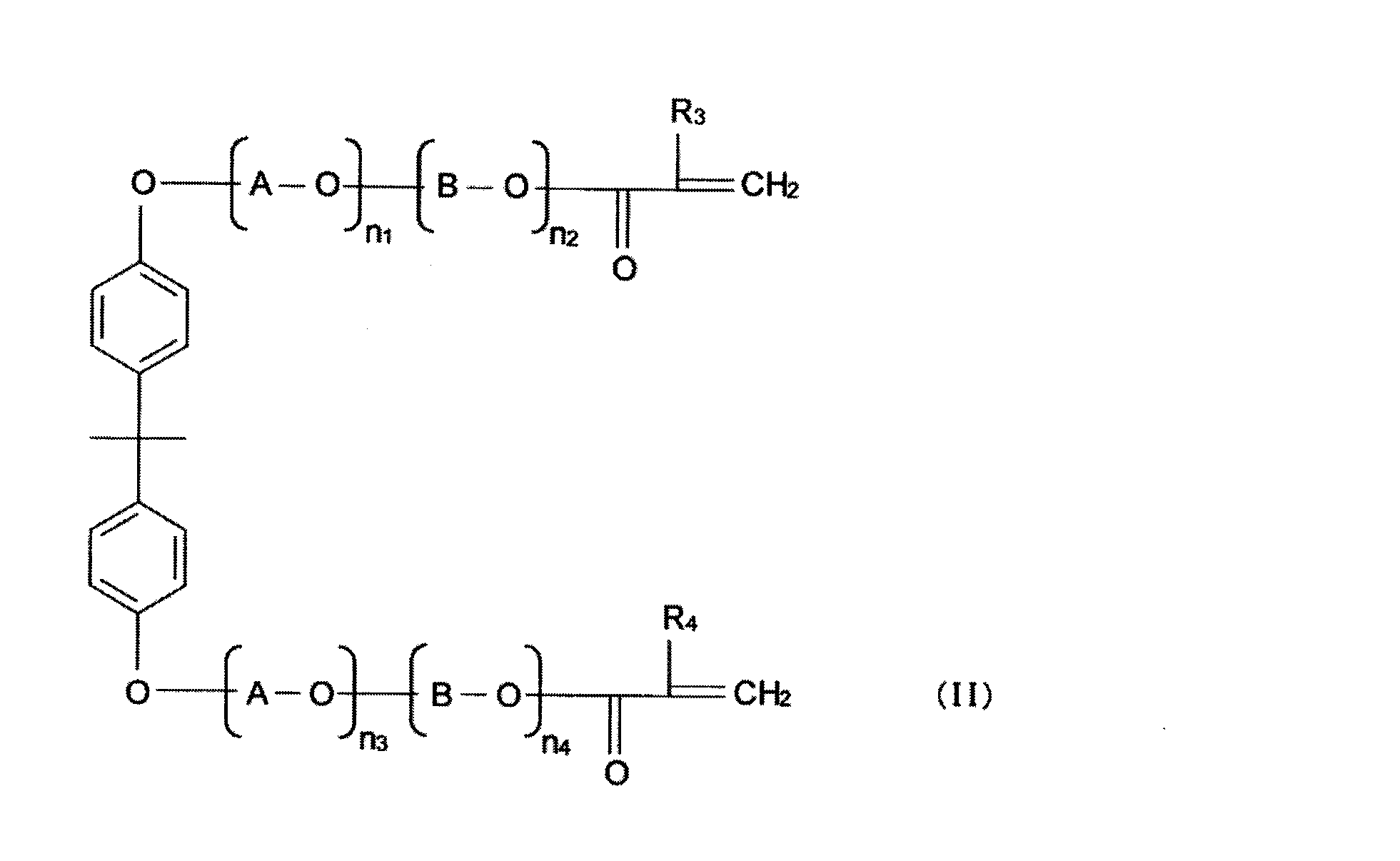
で表されるアルキレンオキサイド変性ビスフェノールA型ジ(メタ)アクリレート化合物である、[1]又は[2]に記載の感光性樹脂組成物。
[4]
前記一般式(II)中のn1、n2、n3及びn4は、n1+n2+n3+n4=30~50の関係を満たす、[3]に記載の感光性樹脂組成物。
[5]
前記一般式(II)中のn1、n2、n3及びn4は、n1+n2+n3+n4=2~10の関係を満たす、[3]に記載の感光性樹脂組成物。
[6]
前記(B)エチレン性不飽和結合含有化合物は、下記一般式(III):
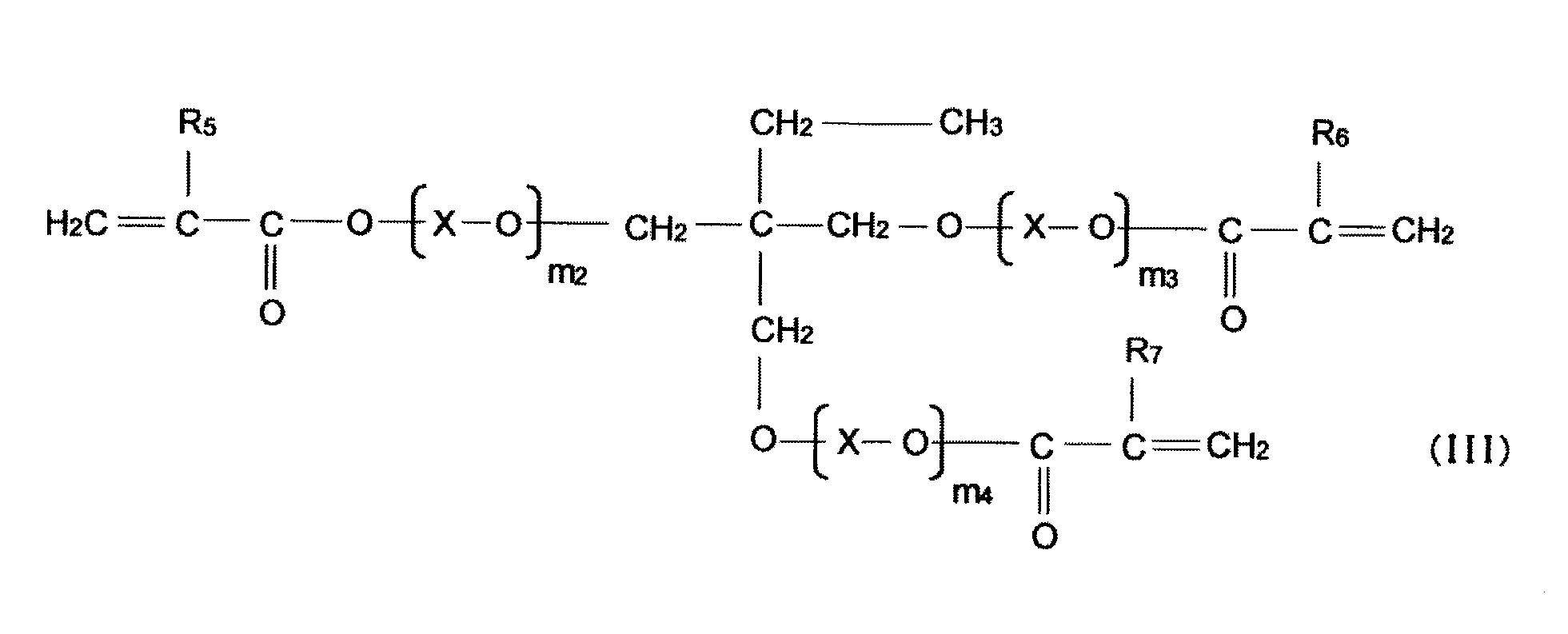
で表されるトリ(メタ)アクリレート化合物を含む、[1]又は[2]に記載の感光性樹脂組成物。
[7]
前記(B)エチレン性不飽和結合含有化合物は、下記一般式(IV):

で表されるウレタンジ(メタ)アクリレート化合物を含む、[1]又は[2]に記載の感光性樹脂組成物。
[8]
前記(A)アルカリ可溶性高分子は、(メタ)アクリル酸ブチルの構造単位をさらに含む、[1]~[7]のいずれか1項に記載の感光性樹脂組成物。
[9]
ダイレクトイメージング露光用である、[1]~[8]のいずれか1項に記載の感光性樹脂組成物。
[10]
[1]~[9]のいずれか1項に記載の感光性樹脂組成物から成る感光性樹脂層を支持体に積層するラミネート工程;
該感光性樹脂層を露光する露光工程;及び
該露光された感光性樹脂層を現像する現像工程;
を含むレジストパターンの形成方法。
[11]
[1]~[9]のいずれか1項に記載の感光性樹脂組成物から成る感光性樹脂層を基板に積層するラミネート工程;
該感光性樹脂層を露光する露光工程;
該露光された感光性樹脂層を現像して、レジストパターンが形成された基板を得る現像工程;
該レジストパターンが形成された基板をエッチング又はめっきする導体パターン形成工程;及び
該レジストパターンを剥離する剥離工程;
を含む配線板の製造方法。
本発明者らは、以下の技術的手段によって、上記の目的を達成できることを見出し、本発明の第四の実施形態に至った。本発明の第四の実施形態は以下のとおりのものである。
[1]
(A)アルカリ可溶性高分子;
(B)エチレン性不飽和結合含有化合物;及び
(C)光重合開始剤;
を含む感光性樹脂組成物であって、
前記(A)アルカリ可溶性高分子は、酸モノマー単位の含有割合が25質量%未満かつ芳香族モノマー単位の含有割合が30質量%以上の第一の共重合体を含み、かつ
前記(B)エチレン性不飽和結合含有化合物の重量平均分子量が、900以下である、
前記感光性樹脂組成物。
[2]
前記(C)光重合開始剤は、アクリジン化合物を含む、[1]に記載の感光性樹脂組成物。
[3]
前記(A)アルカリ可溶性高分子は、芳香族モノマー単位の含有割合が45質量%~90質量%である第二の共重合体を含む、[1]又は[2]に記載の感光性樹脂組成物。
[4]
前記(B)エチレン性不飽和結合含有化合物は、下記一般式(III):

で表されるトリ(メタ)アクリレート化合物を含む、[1]~[3]のいずれか1項に記載の感光性樹脂組成物。
[5]
前記(B)エチレン性不飽和結合含有化合物は、下記一般式(II):
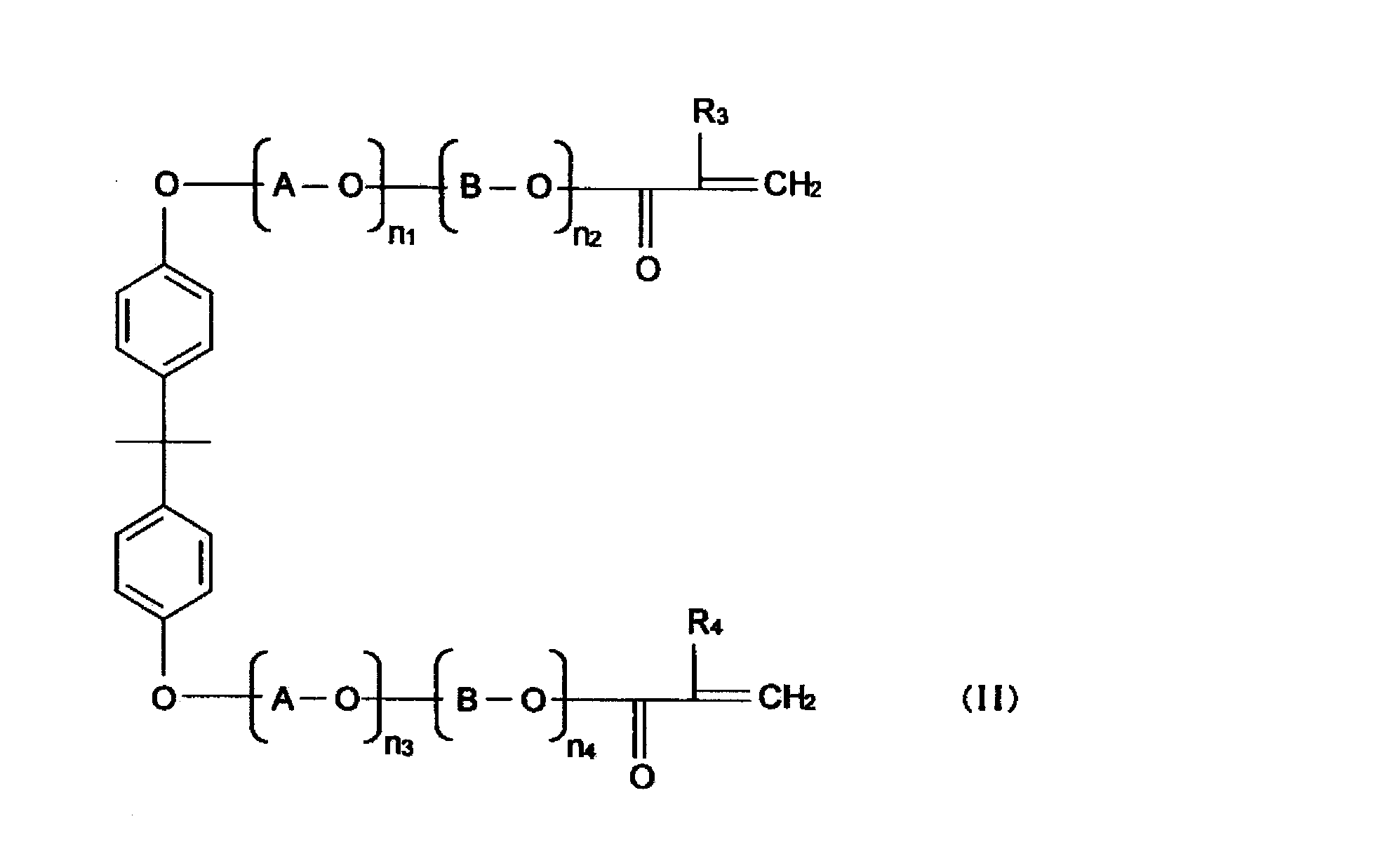
で表されるアルキレンオキサイド変性ビスフェノールA型ジ(メタ)アクリレート化合物を含む、[1]~[4]のいずれか1項に記載の感光性樹脂組成物。
[6]
ヒンダードフェノールとして、下記一般式(V):

[7]
ダイレクトイメージング露光用である、[1]~[6]のいずれか1項に記載の感光性樹脂組成物。
[8]
[1]~[7]のいずれか1項に記載の感光性樹脂組成物から成る感光性樹脂層が支持体上に積層された、感光性エレメント。
[9]
[8]に記載の感光性エレメントの前記感光性樹脂層を導体基板上に積層するラミネート工程;
積層された前記感光性樹脂層を露光する露光工程;及び
露光された前記感光性樹脂層を現像する現像工程;
を含む、レジストパターンの形成方法。
[10]
[8]に記載の感光性エレメントの前記感光性樹脂層を導体基板上に積層するラミネート工程;
積層された前記感光性樹脂層を露光する露光工程;
露光された前記感光性樹脂層を現像して、前記導体基板上にレジストパターンを形成する現像工程;
前記レジストパターンが形成された前記導体基板をエッチング又はめっきする導体パターン形成工程;及び
前記レジストパターンを剥離する剥離工程;
を含む、配線板の製造方法。
本発明の第一の実施形態によれば、ラインプロセスによって微細な導体パターンを形成するに際し、配線幅の縦横差が抑制されたレジスト材料が提供される。
本発明の第二の実施形態によれば、感度、解像度等の、感光性材料に一般的に要求される性能を高いレベルで具備するとともに、現像分散性と微細パターンの密着性の双方に優れる新規な感光性材料が提供される。
本発明の第三の実施形態によれば、レジストパターンのテント性と水残りショート不良抑制性を両立することができる感光性樹脂組成物が提供される。
本発明の第四の実施形態によれば、レジストパターンの良好な解像性を確保し、かつ最小現像時間を延長することができる感光性樹脂組成物、及びそれを用いたレジストパターン又は配線板の形成方法が提供される。
以下、本発明の第一の実施形態を実施するための形態(以下、「本第一の実施形態」と略記する)について具体的に説明する。
本第一の実施形態において、感光性樹脂組成物は、下記(A)~(C)の各成分、
(A)成分:アルカリ可溶性高分子、
(B)成分:エチレン性二重結合を有する化合物、及び
(C)成分:光重合開始剤、
を含有する。
前記(A)成分は、後述する現像液に溶解するものである限り、特に限定されるものではない。好ましくは、(メタ)アクリル酸と、その他のモノマーとの共重合体である。共重合体の重量平均分子量(後述)と数平均分子量との比で表される共重合体の分散度は、1以上6以下であることが好ましい。
(メタ)アクリル酸としては、例えば、(メタ)アクリル酸、ペンテン酸、不飽和ジカルボン酸無水物、ヒドロキシスチレン等を挙げることができる。上記不飽和ジカルボン酸無水物としては、例えば、マレイン酸無水物、イタコン酸無水物、フマル酸、シトラコン酸無水物等を挙げることができる。中でも、(メタ)アクリル酸が好ましい。
不飽和芳香族化合物としては、例えば、スチレン、α-メチルスチレン、ビニルナフタレン等を挙げることができる。中でも、スチレンが好ましい。
共役ジエン化合物としては、例えば、1,3-ブタジエン、イソプレン、2,3-ジメチル-1,3-ブタジエン、2-フェニル-1,3-ブタジエン、1,3-ペンタジエン、2-メチル-1,3-ペンタジエン、1,3-ヘキサジエン、4,5-ジエチル-1,3-オクタジエン、3-ブチル-1,3-オクタジエン等を、それぞれ挙げることができる。
極性モノマーとしては、例えば、
ヒドロキシエチル(メタ)アクリレート、ヒドロキシプロピル(メタ)アクリレート、ヒドロキシブチル(メタ)アクリレート、ペンテンオール等のヒドロキシ基含有モノマー;
メタクリル酸2-アミノエチル等のアミノ基含有モノマー;
(メタ)アクリルアミド、N-メチロール(メタ)アクリルアミド等のアミド基含有モノマー;
アクリロニトリル、メタクリロニトリル、α-クロロアクリロニトリル、α-シアノエチルアクリレート等のシアノ基含有モノマー;
グリシジル(メタ)アクリレート、(メタ)アクリル酸3,4-エポキシシクロヘキシル等のエポキシ基含有モノマー;
等を挙げることができる。
(B)成分は、エチレン性二重結合を1個以上有していればよい。エチレン性二重結合を2個以上有する化合物を用いることが好ましい。
エチレン性二重結合を2個有する(B)化合物としては、例えば、ビスフェノールA化合物、特に、ビスフェノールAの両端にそれぞれ平均2モル~15モルずつのアルキレンオキサイドを付加したポリアルキレングリコールのジ(メタ)アクリレート等が好ましく用いられる。
また、エチレン性二重結合を3個有する(B)化合物としては、例えば、トリメチロールプロパン化合物、特に、トリメチロールプロパンに平均3モル~25モルのアルキレンオキサイドを付加したポリアルキレントリオールのトリ(メタ)アクリレート等が好ましく用いられる。
更に、エチレン性二重結合を4個有する(B)化合物としては、例えば、ペンタエリスリトール化合物、特に、ペンタエリスリトールに平均4モル~35モルのアルキレンオキサイドを付加したポリオールのテトラ(メタ)アクリレート等が好ましく用いられる。
これらの市販品としては、例えば、「BPE-500」、「A-TMPT-3EO」、「A-9300-1CL」等(以上、何れも新中村化学社製):
「アロニックスM-327」等(東亞合成社製)等を挙げることができる。
なお、このような高分子量化合物の、(B)成分中に占める割合は、20質量%以上とすることが好ましく、20~50質量%とすることがより好ましい。
DD値が小さいモノマーを感光性樹脂組成物に使用すると、光硬化後の膜が柔軟になりやすい傾向がある。
(B)成分が複数種から成るときには、それぞれのエチレン性不飽和結合含有化合物のDD値と配合割合の加重平均をその組成物のDD値と考える。
配線幅の縦横差抑制やテンティング性向上の観点から、好ましい組成物のDD値の範囲は0.10~0.13である。さらに好ましくは0.10~0.125である。
(C)成分は、光の照射により前記(B)成分の重合を開始し得るラジカルを発生する成分である。
このような(C)成分としては、例えば、芳香族ケトン化合物、キノン化合物、ベンゾインエーテル化合物、ベンゾイン化合物、ベンジル化合物、ヘキサアリールビスイミダゾール化合物、アクリジン化合物等が挙げられる。
これらのうち、高度の解像性及び良好なテンティング性の観点から、アクリジン化合物を使用することが好ましい。
本第一の実施形態の感光性樹脂組成物におけるアクリジン化合物の含有量は、0.05質量%以上が好ましく、0.1質量%以上がより好ましく、0.2質量%がより好ましく、0.3質量%がより好ましく、0.4質量%がより好ましい。
本第一の実施形態の感光性樹脂組成物におけるアクリジン化合物の含有量は、2.0質量%以下が好ましく、1.8質量%以下がより好ましく、1.7質量%以下がより好ましく、1.6質量%以下がより好ましい。上記範囲であると、配線幅の縦横差を抑制するレジスト材料を提供することが可能となり、好ましい。
上記ヘキサアリールビスイミダゾール化合物としては、例えば、2-(o-クロロフェニル)-4,5-ジフェニルイミダゾリル二量体、2,2’,5-トリス-(o-クロロフェニル)-4-(3,4-ジメトキシフェニル)-4’,5’-ジフェニルイミダゾリル二量体、2,4-ビス-(o-クロロフェニル)-5-(3,4-ジメトキシフェニル)-ジフェニルイミダゾリル二量体、2,4,5-トリス-(o-クロロフェニル)-ジフェニルイミダゾリル二量体、2-(o-クロロフェニル)-ビス-4,5-(3,4-ジメトキシフェニル)-イミダゾリル二量体、2,2’-ビス-(2-フルオロフェニル)-4,4’,5,5’-テトラキス-(3-メトキシフェニル)-イミダゾリル二量体、2,2’-ビス-(2,3-ジフルオロメチルフェニル)-4,4’,5,5’-テトラキス-(3-メトキシフェニル)-イミダゾリル二量体、2,2’-ビス-(2,4-ジフルオロフェニル)-4,4’,5,5’-テトラキス-(3-メトキシフェニル)-イミダゾリル二量体、2,2’-ビス-(2,5-ジフルオロフェニル)-4,4’,5,5’-テトラキス-(3-メトキシフェニル)-イミダゾリル二量体、2,2’-ビス-(2,6-ジフルオロフェニル)-4,4’,5,5’-テトラキス-(3-メトキシフェニル)-イミダゾリル二量体、2,2’-ビス-(2,3,4-トリフルオロフェニル)-4,4’,5,5’-テトラキス-(3-メトキシフェニル)-イミダゾリル二量体、2,2’-ビス-(2,3,5-トリフルオロフェニル)-4,4’,5,5’-テトラキス-(3-メトキシフェニル)-イミダゾリル二量体、2,2’-ビス-(2,3,6-トリフルオロフェニル)-4,4’,5,5’-テトラキス-(3-メトキシフェニル)-イミダゾリル二量体、2,2’-ビス-(2,4,5-トリフルオロフェニル)-4,4’,5,5’-テトラキス-(3-メトキシフェニル)-イミダゾリル二量体、2,2’-ビス-(2,4,6-トリフルオロフェニル)-4,4’,5,5’-テトラキス-(3-メトキシフェニル)-イミダゾリル二量体、2,2’-ビス-(2,3,4,5-テトラフルオロフェニル)-4,4’,5,5’-テトラキス-(3-メトキシフェニル)-イミダゾリル二量体、2,2’-ビス-(2,3,4,6-テトラフルオロフェニル)-4,4’,5,5’-テトラキス-(3-メトキシフェニル)-イミダゾリル二量体、2,2’-ビス-(2,3,4,5,6-ペンタフルオロフェニル)-4,4’,5,5’-テトラキス-(3-メトキシフェニル)-イミダゾリル二量体等を挙げることができる。
上記N-アリールアミノ酸としては、例えば、N-フェニルグリシン、N-メチル-N-フェニルグリシン、N-エチル-N-フェニルグリシン等を;
有機ハロゲン化合物としては、例えば、臭化アミル、臭化イソアミル、臭化イソブチレン、臭化エチレン、臭化ジフェニルメチル、臭化ベンジル、臭化メチレン、トリブロモメチルフェニルスルフォン、四臭化炭素、トリス(2,3-ジブロモプロピル)ホスフェート、トリクロロアセトアミド、ヨウ化アミル、ヨウ化イソブチル、1,1,1-トリクロロ-2,2-ビス(p-クロロフェニル)エタン、クロル化トリアジン化合物等を;
それぞれ挙げることができる。
ベンゾフェノン、ミヒラーズケトン[4,4’-ビス(ジメチルアミノ)ベンゾフェノン]、4,4’-ビス(ジエチルアミノ)ベンゾフェノン等の芳香族ケトン化合物;
ベンゾイン、ベンゾインエチルエーテル、ベンゾインフェニルエーテル、メチルベンゾイン、エチルベンゾイン等のベンゾインエーテル化合物;
ベンジルジメチルケタール、ベンジルジエチルケタール、1-フェニル-1,2-プロパンジオン-2-O-ベンゾインオキシム、1-フェニル-1,2-プロパンジオン-2-(O-エトキシカルボニル)オキシム等のオキシムエステル化合物;
等を、挙げることができる。
なお、本第一の実施形態の感光性樹脂組成物においては、(C)成分としてアクリジン化合物及びN-アリールアミノ酸を使用し、これらを上記の使用割合の範囲内で併用することが、導体パターンを形成する際のエッチング速度抑制、及び配線幅の縦横差抑制の観点から好ましい。
本第一の実施形態の感光性樹脂組成物は、上記に説明した(A)~(C)成分に加え、その他の成分を含有していてもよい。このようなその他の成分としては、例えば、ロイコ染料、ベース染料、可塑剤、酸化防止剤、安定化剤、ラジカル重合禁止剤、溶媒等を挙げることができる。
上記ロイコ染料は、レジスト硬化膜に対して、好適な発色性と、優れた剥離特性とを付与するために、本第一の実施形態の感光性樹脂組成物に配合することができる。
ロイコ染料の具体例としては、例えば、ロイコクリスタルバイオレット(トリス[4-(ジメチルアミノ)フェニル]メタン)、3,3-ビス(p-ジメチルアミノフェニル)-6-ジメチルアミノフタリド、3-(4-ジエチルアミノフェニル)-3-(1-エチル-2-メチルインドール-3-イル)フタリド、3-(4-ジエチルアミノ-2-エトキシフェニル)-3-(1-エチル-2-メチルインドール-3-イル)-4-アザフタリド、1,3-ジメチル-6-ジエチルアミノフルオラン、2-クロロ-3-メチル-6-ジメチルアミノフルオラン、3-ジブチルアミノ-6-メチル-7-アニリ ノフルオラン、3-ジエチルアミノ-6-メチル-7-アニリノフルオラン、3-ジエチルアミノ-6-メチル-7-キシリジノフルオラン、2-(2-クロロアニリノ)-6-ジブチルアミノフルオラン、3,6-ジメトキシフルオラン、3,6-ジ-n-ブトキシフルオラン、1,2-ベンツ-6-ジエチルアミノフルオラン、1,2-ベンツ-6-ジブチルアミノフルオラン、1,2-ベンツ-6-エチルイソアミルアミノフルオラン、2-メチル-6-(N-p-トリル-N-エチルアミノ)フルオラン、2-(N-フェニル-N-メチルアミノ)-6-(N-p-トリル-N-エチルアミノ)フルオラン、2-(3’-トリフ ルオロメチルアニリノ)-6-ジエチルアミノフルオラン、3-クロロ-6-シクロヘキシルアミノフルオラン、2-メチル-6-シクロヘキシルアミノフルオ ラン、3-メトキシ-4-ドデコキシスチリノキノリン等を挙げることができる。これらのうち、ロイコクリスタルバイオレットが好ましい。
上記ベース染料としては、例えば、ベーシックグリーン1[CAS番号(以下、同じ):633-03-4](例えば、Aizen Diamond Green GH、商品名、保土谷化学工業製)、マラカイトグリーンシュウ酸塩[2437-29-8](例えばAizen Malachite Green、商品名、保土谷化学工業製)、ブリリアントグリーン[633-03-4]、フクシン[632-99-5]、メチルバイオレット[603-47-4]、メチルバイオレット2B[8004-87-3]、クリスタルバイオレット[548-62-9]、メチルグリーン[82-94-0]、ビクトリアブルーB[2580-56-5]、ベーシックブルー7[2390-60-5](例えば、Aizen Victoria Pure Blue BOH、商品名、保土谷化学工業製)、ローダミンB[81-88-9]、ローダミン6G[989-38-8]、ベーシックイエロー2[2465-27-2]、ダイアモンドグリーン等が挙げられる。これらのうち、ベーシックグリーン1、マラカイトグリーンシュウ酸塩、ベーシックブルー7、及びダイアモンドグリーンから選択される1種以上が好ましく、色相安定性及び露光コントラストの観点から、ベーシックグリーン1が特に好ましい。
本第一の実施形態の感光性樹脂組成物は、上記の(A)~(C)成分及び任意的に使用されるその他の成分の混合物であることができ、又はこれらの成分に適当な溶媒を添加して構成される感光性樹脂組成物調合液として用いてもよい。
ここで使用される溶媒としては、例えば、
メチルエチルケトン(MEK)等のケトン化合物;
エタノール、エタノール、及びイソプロピルアルコール等のアルコール;
等が挙げられる。
溶媒の使用割合としては、感光性樹脂組成物調合液の25℃における粘度が500~4,000mPa・secとなるような割合とすることが好ましい。
本第一の実施形態において、感光性エレメントは、上述した感光性樹脂組成物から成る感光性樹脂層が、支持体上に積層された積層体(感光性樹脂積層体)である。必要により、前記感光性樹脂層の支持体と反対側の表面に保護層を有していてもよい。
支持体としては、露光光源から放射される光を透過する透明な基材が好ましい。このような支持体としては、例えば、ポリエチレンテレフタレートフィルム、ポリビニルアルコールフィルム、ポリ塩化ビニルフィルム、塩化ビニル共重合体フィルム、ポリ塩化ビニリデンフィルム、塩化ビニリデン共重合フィルム、ポリメタクリル酸メチル共重合体フィルム、ポリスチレンフィルム、ポリアクリロニトリルフィルム、スチレン共重合体フィルム、ポリアミドフィルム、セルロース誘導体フィルム等が挙げられる。これらのフィルムとしては、必要に応じ延伸されたものも使用可能である。
支持体のヘーズは、5以下であることが好ましい。
支持体の厚みは、薄い方が画像形成性及び経済性の面で有利であるが、強度を維持する必要がある。これら双方を考慮すると、10μm~30μmの支持体を好ましく用いることができる。
感光性樹脂組成物層の形成に使用する感光性樹脂組成物が溶媒を含有している場合、溶媒は感光性樹脂組成物層においては除去されていることが好ましいが、溶媒が残存していてもかまわない。
感光性樹脂組成物層の厚みは、好ましくは5μm~100μmであり、より好ましくは7μm~60μmである。この厚みが薄いほど解像度は向上し、厚いほど膜強度が向上する。従って、該組成物層の厚みは、用途に応じて上記の範囲内で適宜選択することができる。
保護層の重要な特性は、感光性樹脂組成物層との密着力が、支持体と感光性樹脂組成物層との密着力よりも十分に小さく、容易に剥離できることである。保護層としては、例えば、ポリエチレンフィルム、ポリプロピレンフィルム等が好ましく使用できる他、例えば特開昭59-202457号公報に開示された剥離性の優れたフィルムを用いることができる。
保護層の厚みは、10μm~100μmが好ましく、10μm~50μmがより好ましい。
感光性エレメントは、支持体及び感光性樹脂層、並びに必要により保護層を順次積層することにより、製造することができる。支持体、感光性樹脂層、及び保護層の積層方法としては、公知の方法を採用することができる。
例えば、感光性樹脂組成物を前述の感光性樹脂組成物調合液として調製し、先ず、支持体上にバーコーター又はロールコーターを用いて塗布して乾燥させ、支持体上に感光性樹脂組成物から成る感光性樹脂組成物層を形成する。次いで、必要により、形成された感光性樹脂組成物層上に保護層を積層することにより、感光性エレメントを製造することができる。
上記のような感光性エレメントを用いて、基板上にレジストパターンを形成することができる。
レジストパターンの形成方法は、
感光性エレメントの感光性樹脂層を導体基板上に積層するラミネート工程、
前記積層された感光性樹脂組成物層を露光する露光工程、及び
前記露光後の未露光部を現像液で除去する現像工程、
を、上記に記載の順に含むことが好ましい。
また、ラミネート工程が、感光性エレメントの感光性樹脂層を、湿潤剤を介して導体基板上に積層する工程であることが好ましい。湿潤剤としては、純水、脱イオン水、及び電解水から選ばれる1種以上と、銅キレート化剤(例えば、イミダゾール化合物、トリアゾール化合物、ピリジン化合物、及びピラゾール化合物から成る群から選ばれる1種以上の化合物)とを含むことが好ましい。
基板としては、金属板又は金属皮膜を有する絶縁性基板が用いられる。金属の材質としては、例えば、銅、ステンレス鋼(SUS)、ガラス、酸化インジウムスズ(ITO)等が挙げられる。これらの基板は、多層基板に対応するためのスルーホールを有していてもよい。
次に、露光工程において、露光機を用いて感光性樹脂組成物層を露光する。この露光は、支持体を剥離せずに該支持体を介して行ってもよいし、必要ならば支持体を剥離した後に行ってもよい。
現像工程においては、アルカリ水溶液から成る現像液を用いて、未露光部を現像除去し、レジスト画像を得る。アルカリ水溶液としては、例えば、Na2CO3、K2CO3等の水溶液を用いることが好ましい。アルカリ水溶液は、感光性樹脂組成物層の特性に合わせて選択されるが、0.2質量%~2質量%の濃度のNa2CO3水溶液を用いることが好ましい。該アルカリ水溶液中には、界面活性剤、消泡剤、現像を促進させるための少量の有機溶剤等を混入させてもよい。
現像工程における現像液の温度は、20℃~40℃の範囲で一定温度に保つことが好ましい。
本第一の実施形態の配線板の形成方法は、
感光性エレメントの感光性樹脂組成物層を導体基板上に積層するラミネート工程、
前記積層された感光性樹脂組成物層を露光する露光工程、
前記露光後の未露光部を現像液で除去する現像工程、
前記現像によりレジストパターンが形成された導体基板をエッチング又はめっきする導体パターン形成工程、及び
前記レジストパターンを剥離する剥離工程、
を、好ましくは上記に記載の順に含む。
また、ラミネート工程が、感光性エレメントの感光性樹脂層を、湿潤剤を介して導体基板上に積層する工程であることが好ましい。湿潤剤としては、純水、脱イオン水、及び電解水から選ばれる1種以上と、銅キレート化剤(例えば、イミダゾール化合物、トリアゾール化合物、ピリジン化合物、及びピラゾール化合物から成る群から選ばれる1種以上の化合物)とを含むことが好ましい。
剥離工程において使用される剥離液は、アルカリ水溶液であることが好ましい。このアルカリ水溶液としては、例えば、2質量%~5質量%のNaOH水溶液又はKOH水溶液を使用することが好ましい。剥離液には、少量の水溶性溶媒、例えばアルコール等、を加えてもよい。剥離工程における剥離液の温度は、40℃~70℃とすることが好ましい。
しかも近年では、配線板の製造は、基板を一定の方向に搬送しつつ順次に処理を行うラインプロセスによって行われるのが通常であり、基板の搬送方向に対して、導体のラインが平行である場合(MD方向のライン)、垂直である場合(TD方向のライン)、及び斜めである場合がある。特にエッチング速度が速い場合、配線幅の縦横差がより顕著となる傾向にある。
即ち、本第一の実施形態の感光性樹脂組成物は、18μm厚みの銅箔が積層された銅張積層板上に、前記感光性樹脂組成物から成る感光性樹脂層を25μm厚みで積層し、ライン/スペース=50μm/30μmのパターン状の光照射及び現像処理を経て硬化レジストパターンを形成し、50℃において55秒間の銅エッチング処理を施した後に、前記硬化レジストパターンを除去して得られる銅ラインパターンのボトム幅が38μm以上(好ましくは38μm~50μm、より好ましくは40μm~45μm)である、という特徴を有するものである。
なお、このような導体ライン幅のボトム幅の調整は、感光性樹脂組成物の組成を適宜に設定することで調整可能である。
本第一の実施形態の導体パターンの形成方法によって形成された導体パターンにおける配線幅の縦横差の絶対値は、好ましくは0μm~5μmであり、より好ましくは0μm~3μmである。
なお、上述した各種パラメータの測定方法については特に断りのない限り、後述の実施例における測定方法に準じて測定される。
以下、本発明の第二の実施形態を実施するための形態(以下、「本第二の実施形態」と略記する)について具体的に説明する。
本第二の実施形態において、感光性樹脂組成物は、下記(A)~(C)の各成分、
(A)成分:酸当量100~600のアルカリ可溶性高分子、
(B)成分:エチレン性二重結合を有する化合物、及び
(C)成分:光重合開始剤、
を含有する。
前記(A)成分は、酸当量が100~600(好ましくは、200~500、より好ましくは、250~450)であって、スチレン単位を50質量%以上含む共重合体を含有する。ここで、本明細書において、スチレン単位とは、置換または非置換のスチレンを意味する。なお、置換基としては、特に限定されないが、例えば、アルキル基、ハロゲン基、水酸基等が挙げられる。
酸モノマーとしては、例えば、(メタ)アクリル酸、ペンテン酸、不飽和ジカルボン酸無水物、ヒドロキシスチレン等を挙げることができる。不飽和ジカルボン酸無水物としては、例えば、マレイン酸無水物、イタコン酸無水物、フマル酸、シトラコン酸無水物等を挙げることができる。中でも、(メタ)アクリル酸が好ましい。
(メタ)アクリル酸アルキルエステルは、鎖状アルキルエステル及び環状アルキルエステルの双方を包含する概念であり、具体的には、例えば、メチル(メタ)アクリレート、エチル(メタ)アクリレート、n-プロピル(メタ)アクリレート、イソプロピル(メタ)アクリレート、n-ブチル(メタ)アクリレート、t-ブチル(メタ)アクリレート、ペンチル(メタ)アクリレート、ヘキシル(メタ)アクリレート、ヘプチル(メタ)アクリレート、オクチル(メタ)アクリレート、2-エチルヘキシル(メタ)アクリレート、ノニル(メタ)アクリレート、デシル(メタ)アクリレート、ラウリル(メタ)アクリレート、n-テトラデシル(メタ)アクリレート、ステアリル(メタ)アクリレート、シクロヘキシル(メタ)アクリレート等を挙げることができる。
共役ジエン化合物としては、例えば、1,3-ブタジエン、イソプレン、2,3-ジメチル-1,3-ブタジエン、2-フェニル-1,3-ブタジエン、1,3-ペンタジエン、2-メチル-1,3-ペンタジエン、1,3-ヘキサジエン、4,5-ジエチル-1,3-オクタジエン、3-ブチル-1,3-オクタジエン等を;
それぞれ挙げることができる。
ヒドロキシエチル(メタ)アクリレート、ヒドロキシプロピル(メタ)アクリレート、ヒドロキシブチル(メタ)アクリレート、ペンテンオール等のヒドロキシ基含有モノマー;
メタクリル酸2-アミノエチル等のアミノ基含有モノマー;
(メタ)アクリルアミド、N-メチロール(メタ)アクリルアミド等のアミド基含有モノマー;
アクリロニトリル、メタクリロニトリル、α-クロロアクリロニトリル、α-シアノエチルアクリレート等のシアノ基含有モノマー;
グリシジル(メタ)アクリレート、(メタ)アクリル酸3,4-エポキシシクロヘキシル等のエポキシ基含有モノマー;
等を挙げることができる。
(A)成分は、スチレン単位を50質量%以上含む共重合体1を含有する。この共重合体1におけるスチレン単位の量は、50質量%~80質量%であることが好ましく、51質量%~70質量%であることがより好ましい。
(B)成分は、エチレン性二重結合を1個以上有していれば、特に限定されるものではない。ただし、本第二の実施形態における(B)成分は、必須的に含有する化合物(B1)として、下記一般式(I):

本第二の実施形態の(B)成分が混合物であるとき、混合物中の化合物(B1)の含有量は、その混合物の総質量を基準として、好ましくは10質量%以上であり、より好ましくは10質量%~50質量%であり、更に好ましくは15質量%~35質量%である。
ここで、特定の酸当量を有し、かつ、スチレン単位を特定量有するアルカリ可溶性高分子と、前記(B1)成分と、アクリジンとを含むことにより、現像分散性と微細パターンの密着性の双方に優れる感光性樹脂組成物が実現させるメカニズムは定かではないが、スチレン単位とアクリジン成分との相互作用(π電子スタッキングによる)、および、酸モノマーと前記(B1)成分との相互作用(水素結合による)が、良好に発現され、全体として相溶性が向上することが、上記特性に寄与するものと推察される。
ビスフェノールA化合物、例えば、ビスフェノールAの両端にそれぞれ平均2モル~15モルずつのアルキレンオキサイドを付加したポリアルキレングリコールのジ(メタ)アクリレート等;
エチレン性二重結合を3個有する化合物(B1を除く)、例えば、トリメチロールプロパンに平均3モル~25モルのアルキレンオキサイドを付加したポリアルキレントリオールのトリ(メタ)アクリレート等;
を含んでもよい。
(C)成分は、光の照射により前記(B)成分の重合を開始し得るラジカルを発生する成分である。
本第二の実施形態では、(B)光重合開始剤として、アクリジン化合物を用いることができる。更に、アクリジン化合物とその他の光重合開始剤とを併用してもよい。アクリジン系化合物は、本第二の実施形態の感光性樹脂組成物の感度及び解像度を向上するために使用することが好ましい。
2-(o-クロロフェニル)-4,5-ジフェニルイミダゾリル二量体、2,2’,5-トリス-(o-クロロフェニル)-4-(3,4-ジメトキシフェニル)-4’,5’-ジフェニルイミダゾリル二量体、2,4-ビス-(o-クロロフェニル)-5-(3,4-ジメトキシフェニル)-ジフェニルイミダゾリル二量体、2,4,5-トリス-(o-クロロフェニル)-ジフェニルイミダゾリル二量体、2-(o-クロロフェニル)-ビス-4,5-(3,4-ジメトキシフェニル)-イミダゾリル二量体、2,2’-ビス-(2-フルオロフェニル)-4,4’,5,5’-テトラキス-(3-メトキシフェニル)-イミダゾリル二量体、2,2’-ビス-(2,3-ジフルオロメチルフェニル)-4,4’,5,5’-テトラキス-(3-メトキシフェニル)-イミダゾリル二量体、2,2’-ビス-(2,4-ジフルオロフェニル)-4,4’,5,5’-テトラキス-(3-メトキシフェニル)-イミダゾリル二量体、2,2’-ビス-(2,5-ジフルオロフェニル)-4,4’,5,5’-テトラキス-(3-メトキシフェニル)-イミダゾリル二量体、2,2’-ビス-(2,6-ジフルオロフェニル)-4,4’,5,5’-テトラキス-(3-メトキシフェニル)-イミダゾリル二量体、2,2’-ビス-(2,3,4-トリフルオロフェニル)-4,4’,5,5’-テトラキス-(3-メトキシフェニル)-イミダゾリル二量体、2,2’-ビス-(2,3,5-トリフルオロフェニル)-4,4’,5,5’-テトラキス-(3-メトキシフェニル)-イミダゾリル二量体、2,2’-ビス-(2,3,6-トリフルオロフェニル)-4,4’,5,5’-テトラキス-(3-メトキシフェニル)-イミダゾリル二量体、2,2’-ビス-(2,4,5-トリフルオロフェニル)-4,4’,5,5’-テトラキス-(3-メトキシフェニル)-イミダゾリル二量体、2,2’-ビス-(2,4,6-トリフルオロフェニル)-4,4’,5,5’-テトラキス-(3-メトキシフェニル)-イミダゾリル二量体、2,2’-ビス-(2,3,4,5-テトラフルオロフェニル)-4,4’,5,5’-テトラキス-(3-メトキシフェニル)-イミダゾリル二量体、2,2’-ビス-(2,3,4,6-テトラフルオロフェニル)-4,4’,5,5’-テトラキス-(3-メトキシフェニル)-イミダゾリル二量体、2,2’-ビス-(2,3,4,5,6-ペンタフルオロフェニル)-4,4’,5,5’-テトラキス-(3-メトキシフェニル)-イミダゾリル二量体等のヘキサアリールビスイミダゾール化合物;
ベンゾフェノン、N,N’-テトラメチル-4,4’-ジメチルアミノベンゾフェノン(ミヒラーケトン)、N,N’-テトラエチル-4,4’-ジアミノベンゾフェノン、4-メトキシ-4’-ジメチルアミノベンゾフェノン、2-ベンジル-2-ジメチルアミノ-1-(4-モノホルノフェニル)―ブタノン-1、2-メチル-1-[4-(メチルチオ)フェニル]-2-モルフォリノ-プロパノン-1等の芳香族ケトン;
2-エチルアントラキノン、フェナントレンキノン、2-tert-ブチルアントラキノン、オクタメチルアントラキノン、1,2-ベンズアントラキノン、2,3-ベンズアントラキノン、2-フェニルアントラキノン、2,3-ジフェニルアントラキノン、1-クロロアントラキノン、2-メチルアントラキノン、1,4-ナフトキノン、9,10-フェナントラキノン、2-メチル-1,4-ナフトキノン、2,3-ジメチルアントラキノン等のキノン化合物;
ベンゾインメチルエーテル、ベンゾインエチルエーテル、ベンゾインフェニルエーテル等のベンゾインエーテル化合物;
ベンジルメチルケタール等のベンジル誘導体;
N-フェニルグリシン誘導体、クマリン系化合物、4,4’-ビス(ジエチルアミノ)ベンゾフェノン等が挙げられる。
有機ハロゲン化合物としては、例えば、臭化アミル、臭化イソアミル、臭化イソブチレン、臭化エチレン、臭化ジフェニルメチル、臭化ベンジル、臭化メチレン、トリブロモメチルフェニルスルフォン、四臭化炭素、トリス(2,3-ジブロモプロピル)ホスフェート、トリクロロアセトアミド、ヨウ化アミル、ヨウ化イソブチル、1,1,1-トリクロロ-2,2-ビス(p-クロロフェニル)エタン、クロル化トリアジン化合物等を;
それぞれ挙げることができる。
2-エチルアントラキノン、オクタエチルアントラキノン、1,2-ベンズアントラキノン、2,3-ベンズアントラキノン、2-フェニルアントラキノン、2,3-ジフェニルアントラキノン、1-クロロアントラキノン、1,4-ナフトキノン、9,10-フェナントラキノン、2-メチル-1,4-ナフトキノン、2,3-ジメチルアントラキノン、3-クロロ-2-メチルアントラキノン等のキノン化合物;
ベンゾフェノン、ミヒラーズケトン[4,4’-ビス(ジメチルアミノ)ベンゾフェノン]、4,4’-ビス(ジエチルアミノ)ベンゾフェノン等の芳香族ケトン化合物;
ベンゾイン、ベンゾインエチルエーテル、ベンゾインフェニルエーテル、メチルベンゾイン、エチルベンゾイン等のベンゾインエーテル化合物;
ベンジルジメチルケタール、ベンジルジエチルケタール、1-フェニル-1,2-プロパンジオン-2-O-ベンゾインオキシム、1-フェニル-1,2-プロパンジオン-2-(O-エトキシカルボニル)オキシム等のオキシムエステル化合物;
等を挙げることができる。
本第二の実施形態の感光性樹脂組成物は、上記に説明した(A)~(C)成分に加え、その他の成分を含有していてもよい。その他の成分としては、例えば、着色物質、ハロゲン化合物、安定化剤、溶剤等を挙げることができる。
着色物質としては、ロイコ染料及びその他の着色物質を;
安定化剤としては、例えばラジカル重合禁止剤、ベンゾトリアゾール化合物、カルボキシベンゾトリアゾール化合物等を;
それぞれ挙げることができる。
ロイコ染料としては、例えば、トリス(4-ジメチルアミノフェニル)メタン[ロイコクリスタルバイオレット]、ビス(4-ジメチルアミノフェニル)フェニルメタン[ロイコマラカイトグリーン]等が挙げられる。とりわけ、良好なコントラストの観点から、ロイコクリスタルバイオレットを用いることが好ましい。
その他の着色物質としては、例えば、フクシン、フタロシアニングリーン、オーラミン塩基、パラマジエンタ、クリスタルバイオレット、メチルオレンジ、ナイルブルー2B、ビクトリアブルー、マラカイトグリーン(保土ヶ谷化学(株)製 アイゼン(登録商標) MALACHITE GREEN)、ベイシックブルー20、ダイアモンドグリーン(保土ヶ谷化学(株)製 アイゼン(登録商標) DIAMOND GREEN GH)等が挙げられる。
感光性樹脂組成物中にロイコ染料と下記ハロゲン化合物を組み合わせて用いることは、密着性及びコントラストの観点から、好ましい態様である。
ハロゲン化合物としては、例えば、臭化アミル、臭化イソアミル、臭化イソブチレン、臭化エチレン、臭化ジフェニルメチル、臭化ベンジル、臭化メチレン、トリブロモメチルフェニルスルフォン、四臭化炭素、トリス(2,3-ジブロモプロピル)ホスフェート、トリクロロアセトアミド、ヨウ化アミル、ヨウ化イソブチル、1,1,1-トリクロロ-2,2-ビス(p-クロロフェニル)エタン、クロル化トリアジン化合物等が挙げられる。とりわけトリブロモメチルフェニルスルフォンが好ましい。感光性樹脂組成物中のハロゲン化合物の含有量は、0.01質量%~3質量%であることが、感光層における色相の保存安定性を維持するという観点から好ましい。
ラジカル重合禁止剤としては、例えば、p-メトキシフェノール、ハイドロキノン、ピロガロール、ナフチルアミン、tert-ブチルカテコール、塩化第一銅、2,6-ジ-tert-ブチル-p-クレゾール、2,2’-メチレンビス(4-メチル-6-tert-ブチルフェノール)、2,2’-メチレンビス(4-エチル-6-tert-ブチルフェノール)、ニトロソフェニルヒドロキシアミンアルミニウム塩、ジフェニルニトロソアミン等が挙げられる。
感光性樹脂組成物は、必要に応じて可塑剤を含有してもよい。可塑剤として、例えば、ジエチルフタレート等のフタル酸エステル類、o-トルエンスルホン酸アミド、p-トルエンスルホン酸アミド、クエン酸トリブチル、クエン酸トリエチル、アセチルクエン酸トリエチル、アセチルクエン酸トリ-n-プロピル、アセチルクエン酸トリ-n-ブチル、ポリエチレングリコール、ポリプロピレングリコール、ポリエチレングリコールアルキルエーテル、ポリプロプレンレングリコールアルキルエーテル等が挙げられる。
感光性樹脂組成物は溶剤を含んでもよい。溶剤としては、例えば、メチルエチルケトン(MEK)に代表されるケトン;メタノール、エタノール、及びイソプロパノールに代表されるアルコール等が挙げられる。溶剤は、支持フィルム上に塗布する感光性樹脂組成物の溶液の粘度が、25℃で500mPa・s~4,000mPa・sとなるように、感光性樹脂組成物に添加されることが好ましい。
本第二の実施形態において、感光性エレメントは、上述した感光性樹脂組成物から成る感光性樹脂層が、支持体上に積層された積層体(感光性樹脂積層体)である。感光性エレメントは、必要により、感光性樹脂層の支持体と反対側の表面に保護層を有していてもよい。
支持体としては、露光光源から放射される光を透過する透明な基材が好ましい。支持体としては、例えば、ポリエチレンテレフタレートフィルム、ポリビニルアルコールフィルム、ポリ塩化ビニルフィルム、塩化ビニル共重合体フィルム、ポリ塩化ビニリデンフィルム、塩化ビニリデン共重合フィルム、ポリメタクリル酸メチル共重合体フィルム、ポリスチレンフィルム、ポリアクリロニトリルフィルム、スチレン共重合体フィルム、ポリアミドフィルム、セルロース誘導体フィルム等が挙げられる。これらのフィルムとしては、必要に応じ延伸されたものも使用可能である。
支持体のヘーズは、5以下であることが好ましい。
支持体の厚みは、薄い方が画像形成性及び経済性の面で有利であるが、強度を維持する必要がある。これら双方を考慮すると、10μm~30μmの支持体を好ましく用いることができる。
感光性樹脂層の形成に使用する感光性樹脂組成物が、溶媒を含む場合、溶媒は、感光性樹脂層から除去されていることが好ましいが、感光性樹脂層に残存していてもよい。
保護層の重要な特性は、感光性樹脂層との密着力が、支持体と感光性樹脂層との密着力よりも十分に小さく、容易に剥離できることである。保護層としては、例えば、ポリエチレンフィルム、ポリプロピレンフィルム等を好ましく使用できるだけでなく、例えば特開昭59-202457号公報に開示された剥離性の優れたフィルムも用いることができる。
保護層の厚みは、10μm~100μmが好ましく、10μm~50μmがより好ましい。
感光性エレメントは、支持体及び感光性樹脂層、並びに必要により保護層を順次積層することにより、製造することができる。支持体、感光性樹脂層、及び保護層の積層方法としては、公知の方法を採用することができる。
例えば、感光性樹脂組成物に溶媒を加えて混合して、調合液を調製し、さらに支持体上にバーコーター又はロールコーターを用いて塗布して乾燥させ、支持体上に感光性樹脂組成物から成る感光性樹脂層を形成する。次いで、必要により、形成された感光性樹脂層上に保護層を積層することにより、感光性エレメントを製造することができる。
上記のような感光性エレメントを用いて、基板上にレジストパターンを形成することができる。
レジストパターンの形成方法は、
感光性エレメントの感光性樹脂層を導体基板上に積層するラミネート工程、
前記積層された感光性樹脂層を露光する露光工程、及び
前記露光後の未露光部を現像液で除去する現像工程、
を、上記に記載の順に含むことが好ましい。
この露光をパターン状に行うことにより、後述の現像工程を経由した後、所望のパターンを有するレジスト膜(レジストパターン)を得ることができる。パターン状の露光は、フォトマスクを介して露光する方法、及びマスクレス露光法の何れにより行ってもよい。フォトマスクを介して露光する場合、露光量は、光源照度及び露光時間により決定される。露光量は、光量計を用いて測定してもよい。
現像工程においては、アルカリ水溶液から成る現像液を用いて、未露光部を現像除去し、レジスト画像を得る。アルカリ水溶液としては、例えば、Na2CO3、K2CO3等の水溶液を用いることが好ましい。アルカリ水溶液は、感光性樹脂層の特性に合わせて選択されるが、0.2質量%~2質量%の濃度のNa2CO3水溶液を用いることが好ましい。アルカリ水溶液中には、界面活性剤、消泡剤、現像を促進させるための少量の有機溶剤等を混入させてもよい。
現像工程における現像液の温度は、20℃~40℃の範囲で一定温度に保つことが好ましい。
本第二の実施形態の配線板の形成方法は、
感光性エレメントの感光性樹脂層を導体基板上に積層するラミネート工程、
前記積層された感光性樹脂層を露光する露光工程、
前記露光後の未露光部を現像液で除去する現像工程、
前記現像によりレジストパターンが形成された導体基板をエッチング又はめっきする導体パターン形成工程、及び
前記レジストパターンを剥離する剥離工程、
を、好ましくは上記に記載の順に含む。
なお、上述した各種パラメータの測定方法については特に断りのない限り、後述の実施例における測定方法に準じて測定される。
以下、本発明の第三の実施形態を実施するための形態(以下、「本第三の実施形態」と略記する)について具体的に説明する。
本実第三の施形態では、感光性樹脂組成物が、(A)アルカリ可溶性高分子、(B)エチレン性不飽和結合含有化合物、及び(C)光重合開始剤を含む。所望により、感光性樹脂組成物は、(D)添加剤、といったその他の成分をさらに含んでよい。
(A)アルカリ可溶性高分子は、アルカリ物質に溶解可能な高分子である。本第三の実施形態では、レジストパターンのテント性と水残りショート不良抑制性を両立する観点から、(A)アルカリ可溶性高分子は、(A)アルカリ可溶性高分子を構成する単量体の全質量を基準として10質量%~24質量%の(メタ)アクリル酸の構造単位及び35質量%~90質量%のスチレンの構造単位を含むことが好ましい。
これらの中でも、レジストパターンのテント性を向上させるという観点から、n-ブチル(メタ)アクリレート、イソブチル(メタ)アクリレート、又はtert-ブチル(メタ)アクリレートが好ましく、テント性の観点からn-ブチル(メタ)アクリレートがより好ましく、そして解像性及び水残りショート不良抑制性を向上させるという観点から、重合可能なスチレン誘導体が好ましい。
重合可能なスチレン誘導体としては、例えば、メチルスチレン、ビニルトルエン、tert-ブトキシスチレン、アセトキシスチレン、4-ビニル安息香酸、スチレンダイマー、スチレントリマー等が挙げられる。
(B)エチレン性不飽和結合含有化合物は、その構造中にエチレン性不飽和基を有することによって重合性を有する化合物である。エチレン性不飽和結合は、付加重合性の観点から、末端エチレン性不飽和基であることが好ましい。
(b1)下記一般式(I):
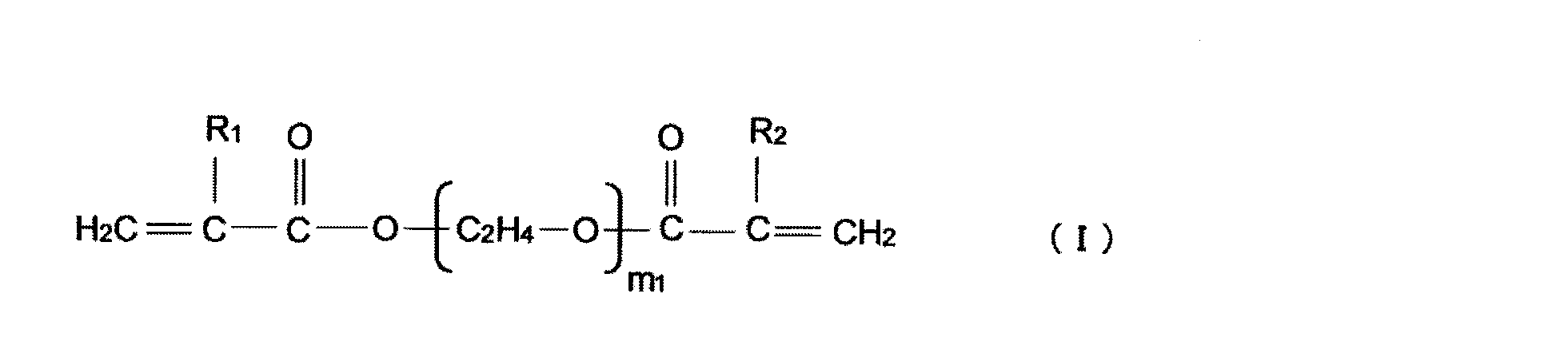
で表されるエチレングリコールジ(メタ)アクリレート化合物;
(b2)下記一般式(II):
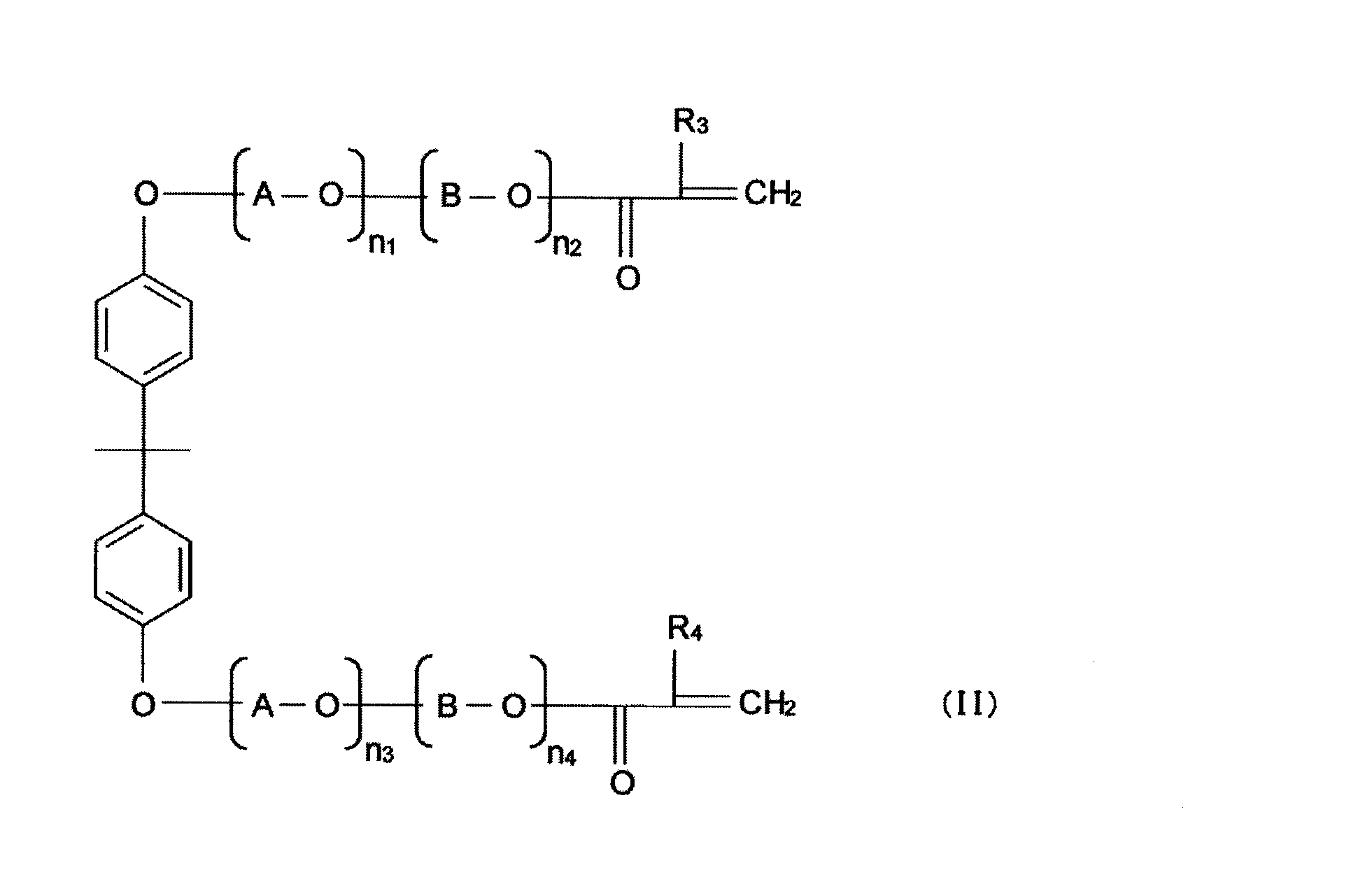
で表されるアルキレンオキシド変性ビスフェノールA型ジ(メタ)アクリレート化合物;
(b3)下記一般式(III):
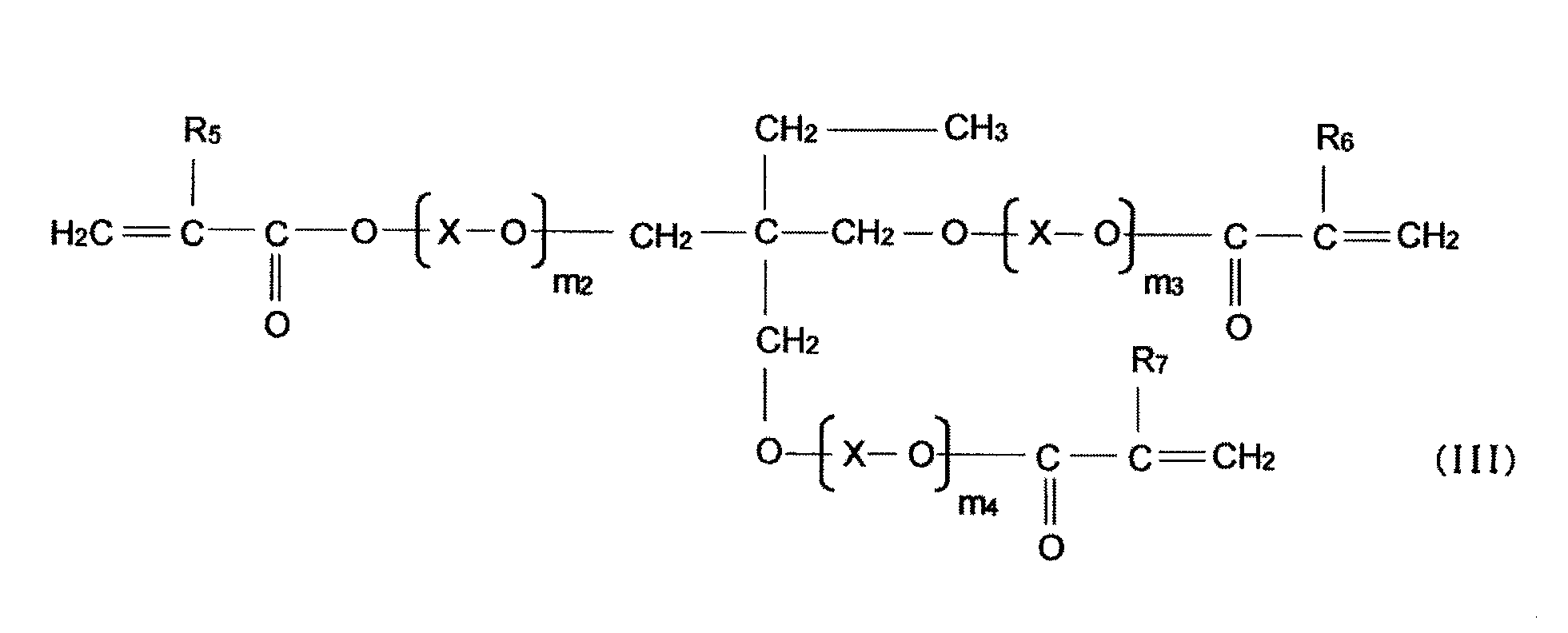
で表されるトリ(メタ)アクリレート化合物;
(b4)下記一般式(IV):
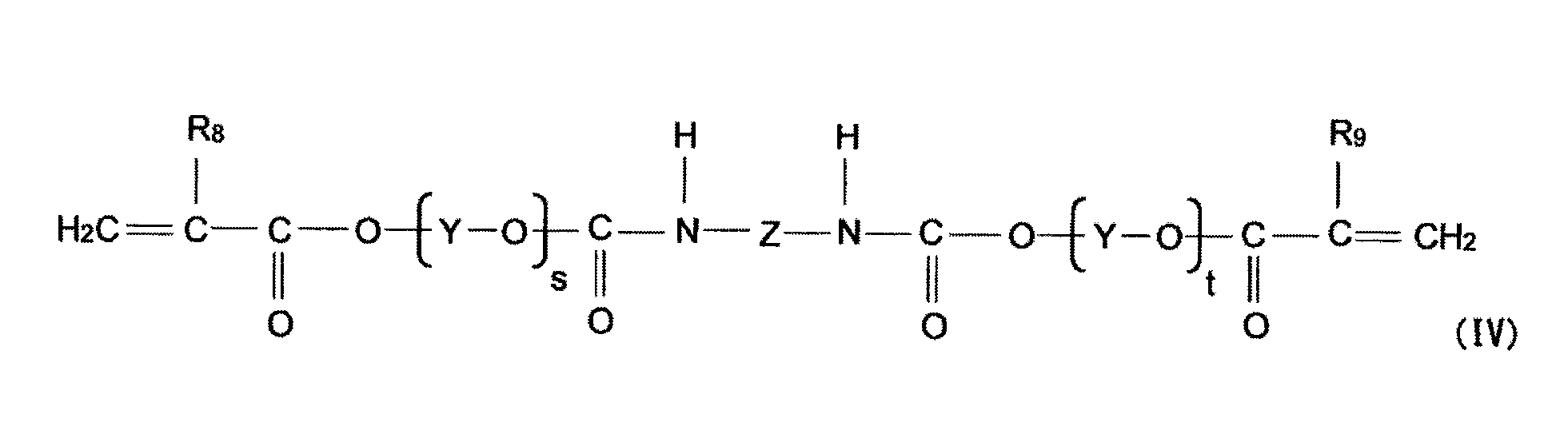
で表されるウレタンジ(メタ)アクリレート化合物;及び
(b5)上記(b1)~(b4)以外の付加重合性単量体;
から成る群から選択される少なくとも1つを含んでよい。
ヘテロ原子としては、例えば、ハロゲン原子等が挙げられ、そして置換基としては、炭素数1~20のアルキル基、炭素数3~10のシクロアルキル基、炭素数6~18のアリール基、フェナシル基、アミノ基、炭素数1~10のアルキルアミノ基、炭素数2~20のジアルキルアミノ基、ニトロ基、シアノ基、カルボニル基、メルカプト基、炭素数1~10のアルキルメルカプト基、アリール基、水酸基、炭素数1~20のヒドロキシアルキル基、カルボキシル基、アルキル基の炭素数が1~10のカルボキシアルキル基、アルキル基の炭素数が1~10のアシル基、炭素数1~20のアルコキシ基、炭素数1~20のアルコキシカルボニル基、炭素数2~10のアルキルカルボニル基、炭素数2~10のアルケニル基、炭素数2~10のN-アルキルカルバモイル基若しくは複素環を含む基、又はこれらの置換基で置換されたアリール基等が挙げられる。これらの置換基は縮合環を形成しているか、又はこれらの置換基中の水素原子がハロゲン原子等のヘテロ原子に置換されていてもよい。一般式(II)中の芳香環が複数の置換基を有する場合には、複数の置換基は同一であるか、又は異なっていてよい。
-で置換されていることも好ましい。
(b3)成分以外のトリ(メタ)アクリレート、例えば、トリメチロールプロパントリ(メタ)アクリレート、エトキシ化グリセリントリ(メタ)アクリレート、エトキシ化イソシアヌル酸トリ(メタ)アクリレート、ペンタエリスリトールトリ(メタ)アクリレート等;
テトラ(メタ)アクリレート、例えば、ジトリメチロールプロパンテトラ(メタ)アクリレート、ペンタエリスリトールテトラ(メタ)アクリレート、ジペンタエリスリトールテトラ(メタ)アクリレート、ペンタエリスリトール(ポリ)アルコキシテトラ(メタ)アクリレート等;
ペンタ(メタ)アクリレート、例えば、ジペンタエリスリトールペンタ(メタ)アクリレート等;
ヘキサ(メタ)アクリレート、例えば、ジペンタエリスリトールヘキサ(メタ)アクリレート、ジペンタエリスリトールの6つの末端に合計1~24モルのエチレンオキサイドが付加されたヘキサ(メタ)アクリレート、ジペンタエリスリトールの6つの末端に合計1~10モルのε-カプロラクトンが付加されたヘキサ(メタ)アクリレート等;
1つの(メタ)アクリロイル基を有するアクリレート化合物;
多価アルコールにα,β-不飽和カルボン酸を反応させて得られる化合物;
グリシジル基含有化合物にα,β-不飽和カルボン酸を反応させて得られる化合物;及び
フタル酸系化合物、例えば、γ-クロロ-2-ヒロドキシプロピル-β’-(メタ)アクリロイルオキシエリル-o-フタレート及びβ-ヒドロキシアルキル-β’-(メタ)アクリロルオキシアルキル-o-フタレート等;
が挙げられる。
(C)光重合開始剤は、光により単量体を重合させる化合物である。感光性樹脂組成物は、光重合開始剤として本技術分野において一般に知られている化合物を含む。
感光性樹脂組成物は、所望により、変色剤、染料、可塑剤、酸化防止剤、安定化剤、等の添加剤を含んでよい。例えば、特開2013-156369号公報及び国際公開第2009/093706号に列挙されている添加剤を使用してよい。
から成る群から選ばれる少なくとも1つを含むことが好ましい。
本第三の実施形態では、感光性樹脂組成物に溶媒を添加することにより感光性樹脂組成物調合液を形成することができる。好適な溶媒としては、ケトン類、例えば、アセトン、メチルエチルケトン(MEK)等;及びアルコール類、例えば、メタノール、エタノール、イソプロピルアルコール等が挙げられる。感光性樹脂組成物調合液の粘度が25℃で500mPa・秒~4000mPa・秒となるように、溶媒を感光性樹脂組成物に添加することが好ましい。
本第三の実施形態では、支持体と、支持体上に積層された、上記感光性樹脂組成物から成る感光性樹脂層とを有する感光性樹脂積層体が提供されることができる。感光性樹脂積層体は、所望により、感光性樹脂層の支持体側と反対側に保護層を有していてもよい。
レジストパターンの形成方法は、支持体に上述の感光性樹脂組成物から成る感光性樹脂層を積層するラミネート工程、感光性樹脂層を露光する露光工程、及び露光された感光性樹脂層を現像する現像工程を、好ましくはこの順に、含む。本第三の実施形態においてレジストパターンを形成する具体的な方法の一例を以下に示す。
SAPは、基板全面に配置された導体シード層上の非回路部分にレジストを形成してから、回路部分のみをめっきで形成する方法である。
導体パターンの製造方法は、金属板、金属皮膜絶縁板等の基板に上述の感光性樹脂組成物から成る感光性樹脂層を積層するラミネート工程、感光性樹脂層を露光する露光工程、露光された感光性樹脂層の未露光部又は露光部を現像液で除去することによって、レジストパターンが形成された基板を得る現像工程、及びレジストパターンが形成された基板をエッチング又はめっきする導体パターン形成工程を、好ましくはこの順に、含む。
導体パターンの製造方法により導体パターンを製造した後に、レジストパターンを、現像液よりも強いアルカリ性を有する水溶液により基板から剥離する剥離工程を更に行うことにより、所望の配線パターンを有する配線板(例えば、プリント配線板)を得ることができる。
基板として銅、銅合金、又は鉄系合金等の金属板を用いて、レジストパターン形成方法によってレジストパターンを形成した後に、以下の工程を経ることにより、リードフレームを製造できる。先ず、現像により露出した基板をエッチングして導体パターンを形成する工程を行う。その後、配線板の製造方法と同様の方法でレジストパターンを剥離する剥離工程を行って、所望のリードフレームを得ることができる。
レジストパターン形成方法により形成されるレジストパターンは、サンドブラスト工法により基板に加工を施す時の保護マスク部材として使用することができる。この場合、基板としては、例えば、ガラス、シリコンウエハー、アモルファスシリコン、多結晶シリコン、セラミック、サファイア、金属材料等が挙げられる。これらの基板上に、レジストパターン形成方法と同様の方法によって、レジストパターンを形成する。その後、形成されたレジストパターン上からブラスト材を吹き付けて、目的の深さに切削するサンドブラスト処理工程、及び基板上に残存したレジストパターン部分をアルカリ剥離液等で基板から除去する剥離工程を行って、基板上に微細な凹凸パターンを有する基材を製造できる。
基板として大規模集積化回路(LSI)の形成が終了したウエハを用いて、レジストパターン形成方法によりウエハにレジストパターンを形成した後に、以下の工程を経ることによって、半導体パッケージを製造することができる。先ず、現像により露出した開口部に銅、はんだ等の柱状めっきを施して、導体パターンを形成する工程を行う。その後、配線板の製造方法と同様の方法でレジストパターンを剥離する剥離工程を行って、更に、柱状めっき以外の部分の薄い金属層をエッチングにより除去する工程を行うことにより、所望の半導体パッケージを得ることができる。
なお、上述した各パラメータの値については特に断りのない限り、後述する実施例での測定方法に準じて測定される。
以下、本発明の第四の実施形態を実施するための形態(以下、「本第四の実施形態」と略記する)について具体的に説明する。
本第四の実施形態において、感光性樹脂組成物は、(A)アルカリ可溶性高分子、(B)エチレン性不飽和結合含有化合物、及び(C)光重合開始剤を含有する。所望により、感光性樹脂組成物は、(D)安定化剤といったその他の成分をさらに含んでよい。
前記(A)アルカリ可溶性高分子は、解像性及び最小現像時間の延長の観点から、酸モノマー単位の含有割合が25質量%未満かつ芳香族モノマー単位の含有割合が30質量%以上の第一の共重合体を含む。第一の共重合体は、所望により、酸モノマー単位及び芳香族モノマー単位に加えて、その他のモノマー単位を含んでもよい。共重合体の重量平均分子量(後述)と数平均分子量との比で表される共重合体の分散度は、1以上6以下であることが好ましい。
酸モノマーとしては、例えば、(メタ)アクリル酸、ペンテン酸、不飽和ジカルボン酸無水物、ヒドロキシスチレン等を挙げることができる。上記不飽和ジカルボン酸無水物としては、例えば、マレイン酸無水物、イタコン酸無水物、フマル酸、シトラコン酸無水物等を挙げることができる。中でも、(メタ)アクリル酸が好ましい。
ヒドロキシエチル(メタ)アクリレート、ヒドロキシプロピル(メタ)アクリレート、ヒドロキシブチル(メタ)アクリレート、ペンテンオール等のヒドロキシ基含有モノマー;メタクリル酸2-アミノエチル等のアミノ基含有モノマー;
(メタ)アクリルアミド、N-メチロール(メタ)アクリルアミド等のアミド基含有モノマー;
アクリロニトリル、メタクリロニトリル、α-クロロアクリロニトリル、α-シアノエチルアクリレート等のシアノ基含有モノマー;
グリシジル(メタ)アクリレート、(メタ)アクリル酸3,4-エポキシシクロヘキシル等のエポキシ基含有モノマー;
等を挙げることができる。
(B)エチレン性不飽和結合含有化合物は、その構造中にエチレン性不飽和基を有することによって重合性を有する化合物である。エチレン性不飽和結合は、付加重合性の観点から、末端エチレン性不飽和基であることが好ましい。
(b1)下記一般式(I):

で表されるエチレングリコールジ(メタ)アクリレート化合物;
(b2)下記一般式(II):

で表されるアルキレンオキシド変性ビスフェノールA型ジ(メタ)アクリレート化合物;
(b3)下記一般式(III):

で表されるトリ(メタ)アクリレート化合物;
(b4)下記一般式(IV):
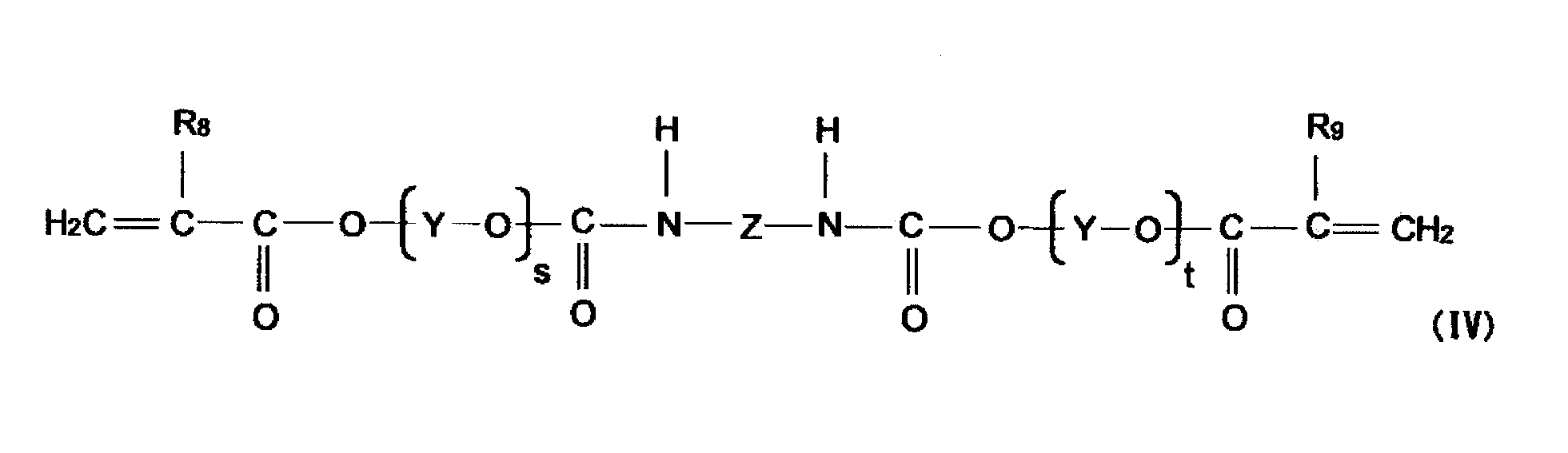
で表されるウレタンジ(メタ)アクリレート化合物;
(b5)下記一般式(XI):
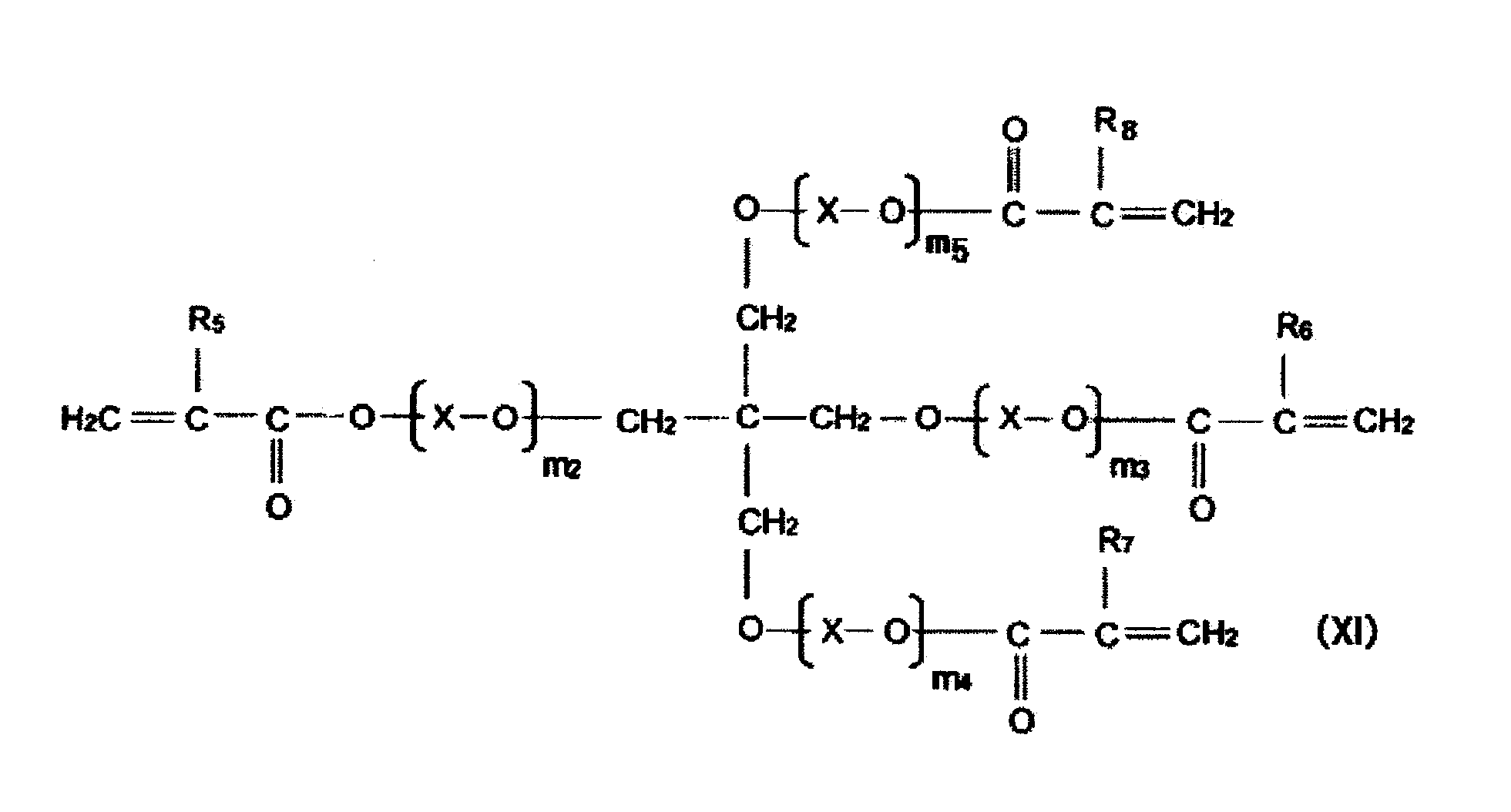
で表されるテトラ(メタ)アクリレート化合物;及び
(b6)上記(b1)~(b5)以外の付加重合性単量体;
から成る群から選択される少なくとも1つを含んでよい。
ヘテロ原子としては、例えば、ハロゲン原子等が挙げられ、そして置換基としては、炭素数1~20のアルキル基、炭素数3~10のシクロアルキル基、炭素数6~18のアリール基、フェナシル基、アミノ基、炭素数1~10のアルキルアミノ基、炭素数2~20のジアルキルアミノ基、ニトロ基、シアノ基、カルボニル基、メルカプト基、炭素数1~10のアルキルメルカプト基、アリール基、水酸基、炭素数1~20のヒドロキシアルキル基、カルボキシル基、アルキル基の炭素数が1~10のカルボキシアルキル基、アルキル基の炭素数が1~10のアシル基、炭素数1~20のアルコキシ基、炭素数1~20のアルコキシカルボニル基、炭素数2~10のアルキルカルボニル基、炭素数2~10のアルケニル基、炭素数2~10のN-アルキルカルバモイル基若しくは複素環を含む基、又はこれらの置換基で置換されたアリール基等が挙げられる。これらの置換基は縮合環を形成しているか、又はこれらの置換基中の水素原子がハロゲン原子等のヘテロ原子に置換されていてもよい。一般式(II)中の芳香環が複数の置換基を有する場合には、複数の置換基は同一であるか、又は異なっていてよい。
で置換されていることも好ましい。
(b3)成分以外のトリ(メタ)アクリレート、例えば、トリメチロールプロパントリ(メタ)アクリレート、エトキシ化グリセリントリ(メタ)アクリレート、エトキシ化イソシアヌル酸トリ(メタ)アクリレート、ペンタエリスリトールトリ(メタ)アクリレート等;
(b5)成分以外のテトラ(メタ)アクリレート、例えば、ジトリメチロールプロパンテトラ(メタ)アクリレート、ジペンタエリスリトールテトラ(メタ)アクリレート等; ペンタ(メタ)アクリレート、例えば、ジペンタエリスリトールペンタ(メタ)アクリレート等;
ヘキサ(メタ)アクリレート、例えば、ジペンタエリスリトールヘキサ(メタ)アクリレート、ジペンタエリスリトールの6つの末端に合計1~24モルのエチレンオキサイドが付加されたヘキサ(メタ)アクリレート、ジペンタエリスリトールの6つの末端に合計1~10モルのε-カプロラクトンが付加されたヘキサ(メタ)アクリレート等;
1つの(メタ)アクリロイル基を有するアクリレート化合物;
多価アルコールにα,β-不飽和カルボン酸を反応させて得られる化合物;
グリシジル基含有化合物にα,β-不飽和カルボン酸を反応させて得られる化合物;及び
フタル酸系化合物、例えば、γ-クロロ-2-ヒロドキシプロピル-β’-(メタ)アクリロイルオキシエリル-o-フタレート及びβ-ヒドロキシアルキル-β’-(メタ)アクリロルオキシアルキル-o-フタレート等;
が挙げられる。
(C)成分は、光の照射により前記(B)成分の重合を開始し得るラジカルを発生する成分である。
このような(C)成分としては、例えば、芳香族ケトン化合物、キノン化合物、ベンゾインエーテル化合物、ベンゾイン化合物、ベンジル化合物、ヘキサアリールビスイミダゾール化合物、アクリジン化合物等を使用することができる。これらのうち、高度の解像性及び良好なテンティング性の観点から、ヘキサアリールビスイミダゾール化合物及びアクリジン化合物から選択される1種以上を使用することが好ましい。また、感光性樹脂組成物の感度の観点から、(C)成分は、アクリジン化合物を含むことが好ましい。
アクリジン、9-フェニルアクリジン、1,6-ビス(9-アクリジニル)ヘキサン、1,7-ビス(9-アクリジニル)ヘプタン、1,8-ビス(9-アクリジニル)オクタン、1,9-ビス(9-アクリジニル)ノナン、1,10-ビス(9-アクリジニル)デカン、1,11-ビス(9-アクリジニル)ウンデカン、1,12-ビス(9-アクリジニル)ドデカン等を挙げることができる。
上記N-アリールアミノ酸としては、例えば、
N-フェニルグリシン、N-メチル-N-フェニルグリシン、N-エチル-N-フェニルグリシン等を;
有機ハロゲン化合物としては、例えば、
臭化アミル、臭化イソアミル、臭化イソブチレン、臭化エチレン、臭化ジフェニルメチル、臭化ベンジル、臭化メチレン、トリブロモメチルフェニルスルフォン、四臭化炭素、トリス(2,3-ジブロモプロピル)ホスフェート、トリクロロアセトアミド、ヨウ化アミル、ヨウ化イソブチル、1,1,1-トリクロロ-2,2-ビス(p-クロロフェニル)エタン、クロル化トリアジン化合物等を;
それぞれ挙げることができる。
2-エチルアントラキノン、オクタエチルアントラキノン、1,2-ベンズアントラキノン、2,3-ベンズアントラキノン、2-フェニルアントラキノン、2,3-ジフェニルアントラキノン、1-クロロアントラキノン、1,4-ナフトキノン、9,10-フェナントラキノン、2-メチル-1,4-ナフトキノン、2,3-ジメチルアントラキノン、3-クロロ-2-メチルアントラキノン等のキノン化合物;
ベンゾフェノン、ミヒラーズケトン[4,4’-ビス(ジメチルアミノ)ベンゾフェノン]、4,4’-ビス(ジエチルアミノ)ベンゾフェノン等の芳香族ケトン化合物;
ベンゾイン、ベンゾインエチルエーテル、ベンゾインフェニルエーテル、メチルベンゾイン、エチルベンゾイン等のベンゾインエーテル化合物;
ベンジルジメチルケタール、ベンジルジエチルケタール、1-フェニル-1,2-プロパンジオン-2-O-ベンゾインオキシム、1-フェニル-1,2-プロパンジオン-2-(O-エトキシカルボニル)オキシム等のオキシムエステル化合物;
等を、挙げることができる。
なお、本第四の実施形態の感光性樹脂組成物においては、(C)成分としてアクリジン化合物及びN-アリールアミノ酸を使用し、これらを上記の使用割合の範囲内で併用することが、導体パターンを形成する際のエッチング速度抑制、及び配線幅の縦横差抑制の観点から好ましい。
感光性樹脂組成物は、所望により、安定化剤を含んでよい。本第四の実施形態では、解像性向上の観点からは、安定化剤としては、ヒンダードフェノールを使用することが好ましい。一般に、ヒンダードフェノールとは、立体障害の大きいフェノールをいう。感光性樹脂組成物は、ヒンダードフェノールとして下記一般式(V):

また、同様の観点から、上記一般式(V)で表される化合物としては、例えば、下記一般式(VI):
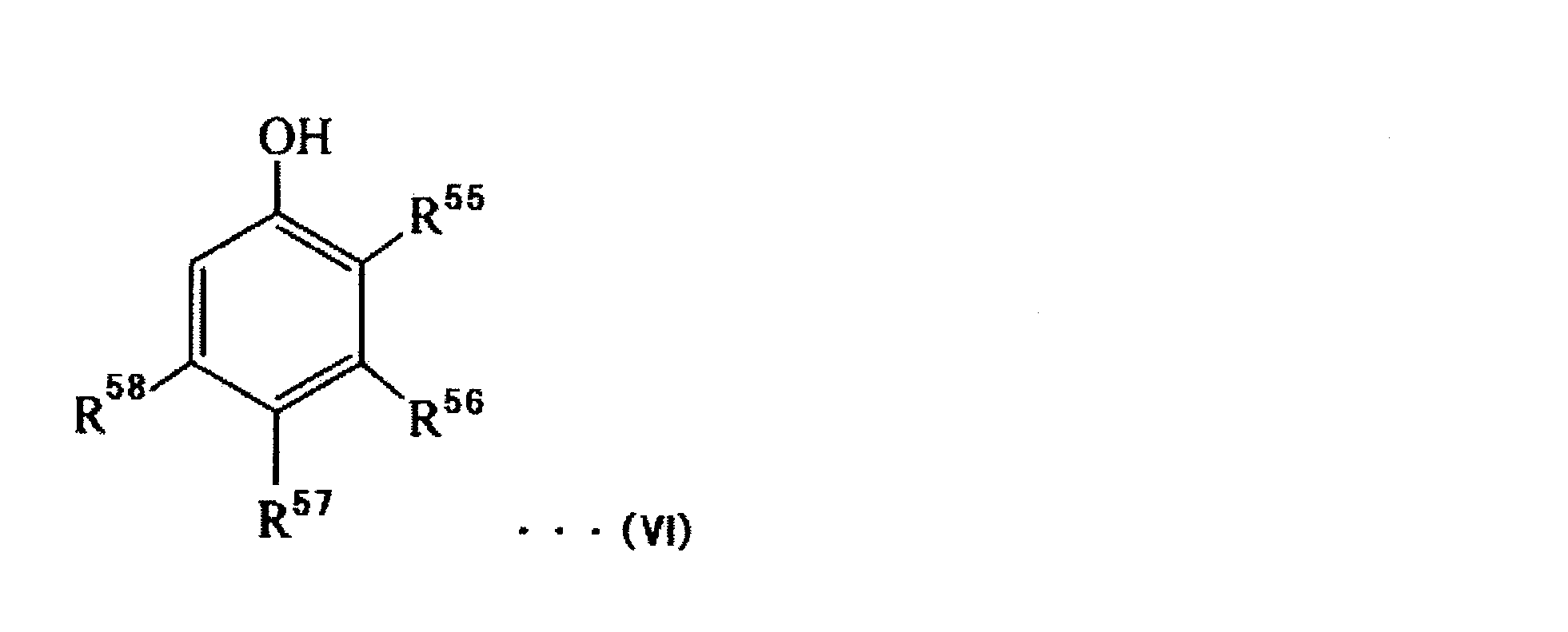
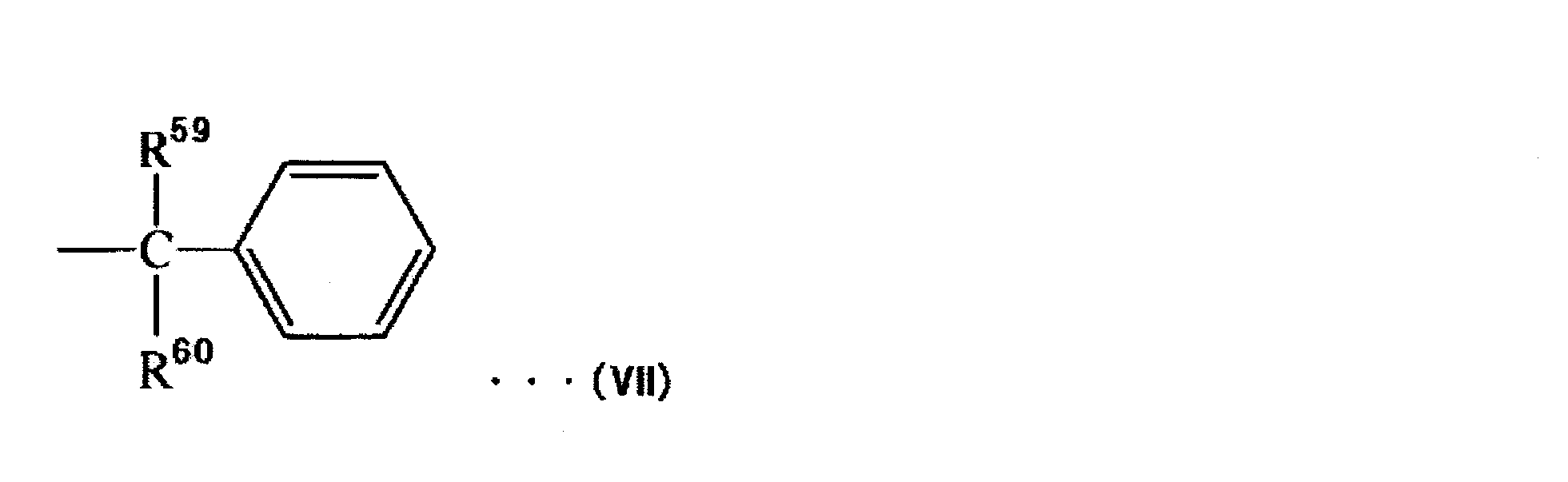
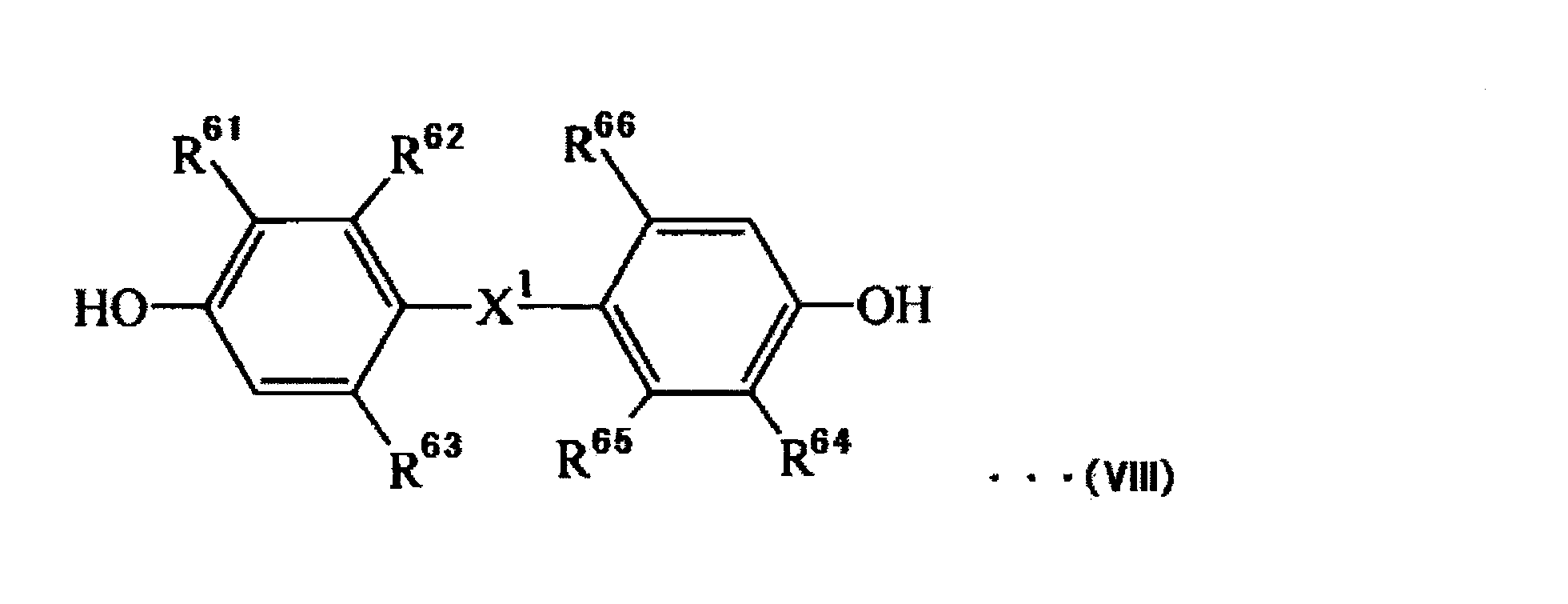

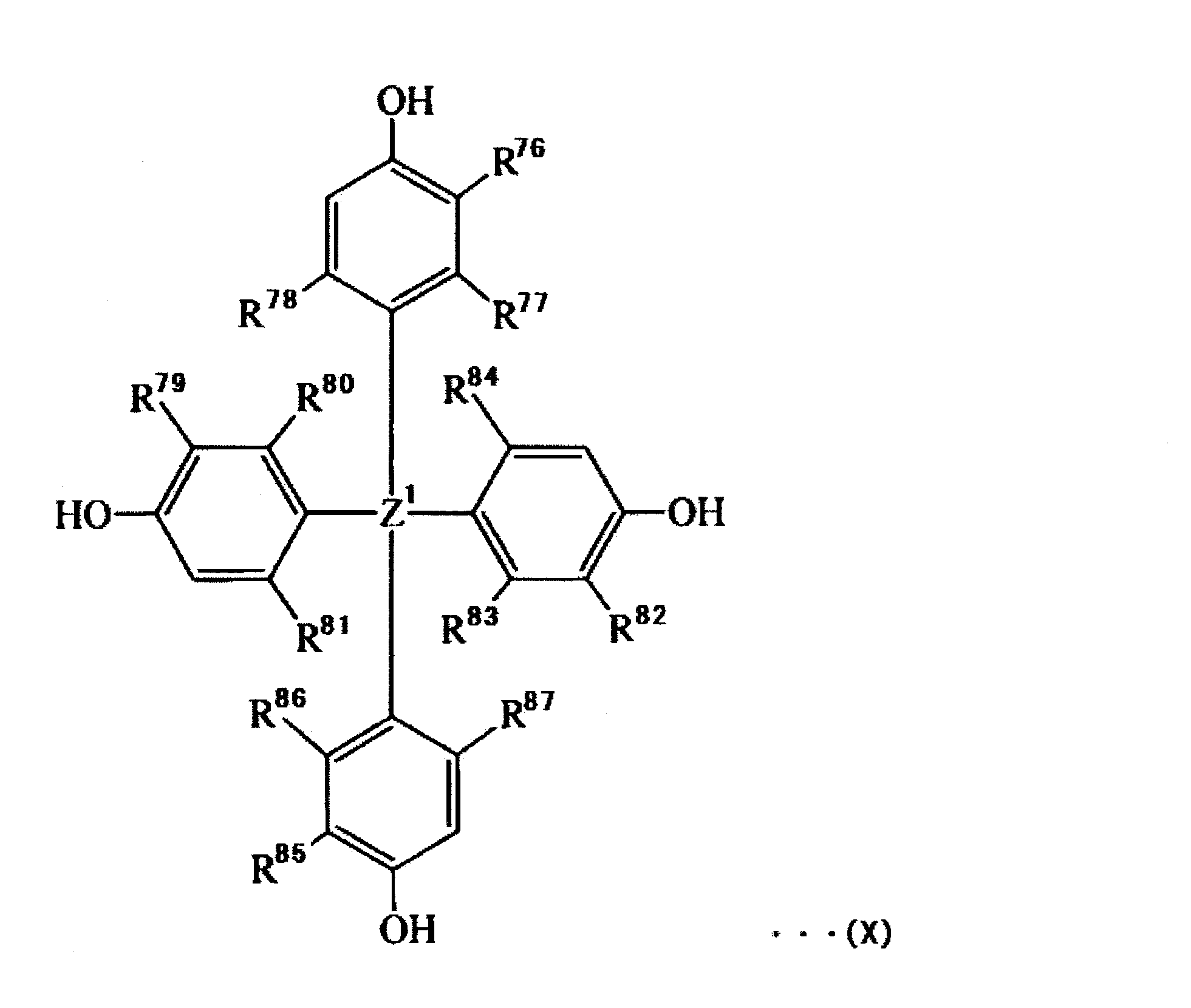
本第四の実施形態の感光性樹脂組成物は、上記に説明した(A)~(D)成分に加え、その他の成分を含有していてもよい。このようなその他の成分としては、例えば、ロイコ染料、ベース染料、可塑剤、酸化防止剤、ラジカル重合禁止剤、溶媒等を挙げることができる。
上記ロイコ染料は、レジスト硬化膜に対して、好適な発色性と、優れた剥離特性とを付与するために、本第四の実施形態の感光性樹脂組成物に配合することができる。
ロイコ染料の具体例としては、例えば、ロイコクリスタルバイオレット(トリス[4-(ジメチルアミノ)フェニル]メタン)、3,3-ビス(p-ジメチルアミノフェニル)-6-ジメチルアミノフタリド、3-(4-ジエチルアミノフェニル)-3-(1-エチル-2-メチルインドール-3-イル)フタリド、3-(4-ジエチルアミノ-2-エトキシフェニル)-3-(1-エチル-2-メチルインドール-3-イル)-4-アザフタリド、1,3-ジメチル-6-ジエチルアミノフルオラン、2-クロロ-3-メチル-6-ジメチルアミノフルオラン、3-ジブチルアミノ-6-メチル-7-アニリノフルオラン、3-ジエチルアミノ-6-メチル-7-アニリノフルオラン、3-ジエチルアミノ-6-メチル-7-キシリジノフルオラン、2-(2-クロロアニリノ)-6-ジブチルアミノフルオラン、3,6-ジメトキシフルオラン、3,6-ジ-n-ブトキシフルオラン、1,2-ベンツ-6-ジエチルアミノフルオラン、1,2-ベンツ-6-ジブチルアミノフルオラン、1,2-ベンツ-6-エチルイソアミルアミノフルオラン、2-メチル-6-(N-p-トリル-N-エチルアミノ)フルオラン、2-(N-フェニル-N-メチルアミノ)-6-(N-p-トリル-N-エチルアミノ)フルオラン、2-(3’-トリフ ルオロメチルアニリノ)-6-ジエチルアミノフルオラン、3-クロロ-6-シクロヘキシルアミノフルオラン、2-メチル-6-シクロヘキシルアミノフルオラン、3-メトキシ-4-ドデコキシスチリノキノリン等を挙げることができる。これらのうち、ロイコクリスタルバイオレットが好ましい。
上記ベース染料としては、例えば、ベーシックグリーン1[CAS番号(以下、同じ):633-03-4](例えば、Aizen Diamond Green GH、商品名、保土谷化学工業製)、マラカイトグリーンシュウ酸塩[2437-29-8](例えばAizen Malachite Green、商品名、保土谷化学工業製)、ブリリアントグリーン[633-03-4]、フクシン[632-99-5]、メチルバイオレット[603-47-4]、メチルバイオレット2B[8004-87-3]、クリスタルバイオレット[548-62-9]、メチルグリーン[82-94-0]、ビクトリアブルーB[2580-56-5]、ベーシックブルー7[2390-60-5](例えば、Aizen Victoria Pure Blue BOH、商品名、保土谷化学工業製)、ローダミンB[81-88-9]、ローダミン6G[989-38-8]、ベーシックイエロー2[2465-27-2]、ダイアモンドグリーン等が挙げられる。これらのうち、ベーシックグリーン1、マラカイトグリーンシュウ酸塩、ベーシックブルー7、及びダイアモンドグリーンから選択される1種以上が好ましく、色相安定性及び露光コントラストの観点から、ベーシックグリーン1が特に好ましい。
本第四の実施形態の感光性樹脂組成物は、上記の(A)~(C)成分及び任意的に使用されるその他の成分の混合物であることができ、又はこれらの成分に適当な溶媒を添加して構成される感光性樹脂組成物調合液として用いてもよい。
ここで使用される溶媒としては、例えば、メチルエチルケトン(MEK)等のケトン化合物;エタノール、エタノール、及びイソプロピルアルコール等のアルコール;等が挙げられる。
溶媒の使用割合としては、感光性樹脂組成物調合液の25℃における粘度が500~4,000mPa・秒となるような割合とすることが好ましい。
本第四の実施形態において、感光性エレメントは、上述した感光性樹脂組成物から成る感光性樹脂層が、支持体上に積層された積層体(感光性樹脂積層体)である。必要により、前記感光性樹脂層の支持体と反対側の表面に保護層を有していてもよい。
支持体としては、露光光源から放射される光を透過する透明な基材が好ましい。このような支持体としては、例えば、ポリエチレンテレフタレートフィルム、ポリビニルアルコールフィルム、ポリ塩化ビニルフィルム、塩化ビニル共重合体フィルム、ポリ塩化ビニリデンフィルム、塩化ビニリデン共重合フィルム、ポリメタクリル酸メチル共重合体フィルム、ポリスチレンフィルム、ポリアクリロニトリルフィルム、スチレン共重合体フィルム、ポリアミドフィルム、セルロース誘導体フィルム等が挙げられる。これらのフィルムとしては、必要に応じ延伸されたものも使用可能である。
支持体のヘーズは、5以下であることが好ましい。
支持体の厚みは、薄い方が画像形成性及び経済性の面で有利であるが、強度を維持する必要がある。これら双方を考慮すると、10μm~30μmの支持体を好ましく用いることができる。
感光性樹脂層の形成に使用する感光性樹脂組成物が溶媒を含有している場合、感光性樹脂層においては、溶媒は、残存していてもよいが、除去されていることが好ましい。
感光性樹脂層の厚みは、好ましくは5μm~100μmであり、より好ましくは7μm~60μmである。この厚みが薄いほど解像度は向上し、厚いほど膜強度が向上する。従って、該組成物層の厚みは、用途に応じて上記の範囲内で適宜選択することができる。
保護層の重要な特性は、感光性樹脂層との密着力が、支持体と感光性樹脂層との密着力よりも十分に小さく、容易に剥離できることである。保護層としては、例えば、ポリエチレンフィルム、ポリプロピレンフィルム等が好ましく使用できる他、例えば特開昭59-202457号公報に開示された剥離性の優れたフィルムを用いることができる。
保護層の厚みは、10μm~100μmが好ましく、10μm~50μmがより好ましい。
感光性エレメントは、支持体及び感光性樹脂層、並びに必要により保護層を順次積層することにより、製造することができる。支持体、感光性樹脂層、及び保護層の積層方法としては、公知の方法を採用することができる。
例えば、感光性樹脂組成物を前述の感光性樹脂組成物調合液として調製し、先ず、支持体上にバーコーター又はロールコーターを用いて塗布して乾燥させ、支持体上に感光性樹脂組成物から成る感光性樹脂層を形成する。次いで、必要により、形成された感光性樹脂層上に保護層を積層することにより、感光性エレメントを製造することができる。
上記のような感光性エレメントを用いて、基板上にレジストパターンを形成することができる。
レジストパターンの形成方法は、以下の工程:
感光性エレメントの感光性樹脂層を導体基板上に積層するラミネート工程;
積層された感光性樹脂層を露光する露光工程;及び
露光された感光性樹脂層を現像する現像工程;
を、上記に記載の順に含むことが好ましい。
基板としては、金属板又は金属皮膜を有する絶縁性基板が用いられる。金属の材質としては、例えば、銅、ステンレス鋼(SUS)、ガラス、酸化インジウムスズ(ITO)等が挙げられる。これらの基板は、多層基板に対応するためのスルーホールを有していてもよい。
現像工程においては、アルカリ水溶液から成る現像液を用いて、未露光部を現像除去し、レジスト画像を得る。アルカリ水溶液としては、例えば、Na2CO3、K2CO3等の水溶液を用いることが好ましい。アルカリ水溶液は、感光性樹脂層の特性に合わせて選択されるが、0.2質量%~2質量%の濃度のNa2CO3水溶液を用いることが好ましい。該アルカリ水溶液中には、界面活性剤、消泡剤、現像を促進させるための少量の有機溶剤等を混入させてもよい。
現像工程における現像液の温度は、20℃~40℃の範囲で一定温度に保つことが好ましい。
本第四の実施形態に係る配線板の形成方法は、以下の工程:
感光性エレメントの感光性樹脂層を導体基板上に積層するラミネート工程;
積層された感光性樹脂層を露光する露光工程;
露光された感光性樹脂層を現像する現像工程;
現像によりレジストパターンが形成された導体基板をエッチング又はめっきする導体パターン形成工程;及び
レジストパターンを剥離する剥離工程、
を、好ましくは上記に記載の順に含む。
剥離工程において使用される剥離液は、アルカリ水溶液であることが好ましい。このアルカリ水溶液としては、例えば、2質量%~5質量%のNaOH水溶液又はKOH水溶液を使用することが好ましい。剥離液には、少量の水溶性溶媒、例えばアルコール等、を加えてもよい。剥離工程における剥離液の温度は、40℃~70℃とすることが好ましい。
なお、上述した各種パラメータの測定方法については、特に断りのない限り、後述の実施例における測定方法に準じて測定される。
以下、本第一の実施形態の感光性樹脂組成物について、実施例の形式により具体的に説明する。
(1)原料物性値の測定
<重量平均分子量の測定>
高分子の重量平均分子量は、日本分光(株)製ゲルパーミエーションクロマトグラフィー(GPC)(ポンプ:Gulliver、PU-1580型、カラム:昭和電工(株)製Shodex(登録商標)(KF-807、KF-806M、KF-806M、KF-802.5)4本直列、移動層溶媒:テトラヒドロフラン、ポリスチレン標準サンプル(昭和電工(株)製Shodex STANDARD SM-105)による検量線使用)を用い、ポリスチレン換算値として求めた。
本明細書において、酸当量とは、分子中に1当量のカルボキシル基を有する重合体の質量(グラム)を意味する。平沼産業(株)製平沼自動滴定装置(COM-555)を使用し、0.1mol/Lの水酸化ナトリウム水溶液を用いる電位差滴定法により酸当量を測定した。
<感光性エレメントの作製>
表1に示した各成分、並びに以下の各成分:
着色物質として、ダイヤモンドグリーン0.04質量部;
ロイコ染料として、ロイコクリスタルバイオレット0.6質量部;
ハロゲン化合物として、トリモブロモメチルフェニルスルフォン0.7質量部;
可塑剤として、p-トルエンスルホンアミド2質量部;
ベンゾトリアゾール類として、カルボキシルベンゾトリアゾール0.05質量部;
ベンゾトリアゾール類として、1-(2-ジ-n-オクチルアミノメチル)-ベンゾトリアゾール0.15質量部;
酸化防止剤として、水添ビスフェノールAジグリシジルエーテル(共栄社化学、エポライト4000)0.05質量部;及び
ラジカル重合禁止剤として、トリス(ニトロソフェニルヒドロキシアミン)アルミニウム0.004質量部
を混合し、更にメチルエチルケトン(MEK)を追加して、固形分濃度53質量%の感光性樹脂組成物を調製した。表1における各成分欄の数字は、組成物の調製に供した各成分の量(質量部)である。
得られた感光性樹脂組成物を、支持体である厚み16μmのポリエチレンテレフタレートフィルム(三菱樹脂(株)製R310、ヘーズ値2.1%)上に、バーコーターを用いて均一に塗布した後、95℃に調温した乾燥機中で2.5分間加熱乾燥させて、支持体上に厚み25μmの感光性樹脂組成物層を形成した。
次いで、上記感光性樹脂組成物層の支持体と反対側の面上に、保護層である厚み19μmのポリエチレンフィルム(タマポリ(株)製GF-18)を貼付することにより、感光性エレメントを得た。
テンティング性評価用の基板としては、厚み35μmの銅箔を積層した厚み1.6mmの銅張積層基板に、直径6mmのスルーホールを1,008孔形成した基板を;
テンティング性以外の評価用基板としては、厚み18μmの銅箔を積層した厚み0.4mmの銅張積層基板を;
それぞれ用いた。
テンティング性評価用の基板は、ジェットスクラブ研磨機を用いた表面処理により整面した後に評価に供した。
テンティング性以外の評価用の基板は、ソフトエッチング剤(菱江化学(株)製、CPE-900)を用いた表面処理、及び10質量%H2SO4水溶液による表面洗浄を順次に行って整面した後に評価に供した。
整面後の基板上に、各実施例又は比較例で得た感光性エレメントのポリエチレンフィルムを剥がしながら、ホットロールラミネーター(旭化成(株)製、AL-70)により、ロール温度105℃、エアー圧力0.35MPa、及びラミネート速度1.5m/minの条件でラミネートした。
直接描画式露光装置(日本オルボテック株式会社製、Paragon Ultra 200、主波長355nm)を用いて、直接描画式露光方法にて露光した。
露光パターンについては、各評価項目の項で後述する。
露光後の感光性樹脂組成物層から支持体を剥離した後、アルカリ現像機(フジ機工製、ドライフィルム用現像機)を用いて、30℃の1質量%Na2CO3水溶液を最小現像時間の2倍の時間スプレーして、感光性樹脂組成物層の未露光部分を溶解除去した。現像後、現像時間の1.5倍の時間で純水で洗浄し、エアーナイフで水切り処理後温風乾燥を行うことによって、評価用硬化膜を有する基板を得た。
上記最小現像時間とは、感光性樹脂組成物層の未露光部分が完全に溶解除去されるまでに要する最小の時間をいう。
感度の評価には、上記<ラミネート>後、15分経過後のラミネート基板を用いた。
該ラミネート基板に対し、ライン/スペース=40μm/40μmのライン10本のマスクパターンを直接描画露光した後、上記<現像>に記載の方法によって現像した。得られたレジストパターンの、レジストトップ幅を光学顕微鏡により測定し、以下の基準によって感度を評価した。
レジストトップ幅が39.0μmとなる露光量が28mJ以下:感度「○(良好)」
レジストトップ幅が39.0μmとなる露光量が28mJを超える:感度「×(不良)」
ここで、レジストラインの測定場所は、10本あるラインのうちの端から5本目のライン、長さ方向の端から約5mmの位置とし、測定値として3回測定の平均値を用いた。パターンの端と中央部とでは、現像液及び水洗水の拡散の影響で線幅が異なり、端側のレジストラインが細くなる傾向がある。
解像性の評価には、上記<ラミネート>後、15分経過後のラミネート基板を用いた。
該ラミネート基板に対し、種々のサイズのライン/スペース=1/1のパターンを直接描画露光した後、上記<現像>に記載の方法によって現像した。
得られたパターンについて、形成されていた最小のパターン幅を光学顕微鏡により観察し、以下の基準によって解像性を評価した。
最小パターン幅が20μm以下であった場合:解像性「○(良好)」
最小パターン幅が20μmを超え、24μm以下であった場合:解像性「△(可)」
最小パターン幅が24μmを超えた場合:解像性「×(不良)」
密着性の評価には、上記<ラミネート>後、15分経過後のラミネート基板を用いた。
該ラミネート基板に対し、種々のサイズの独立ラインのパターンを直接描画露光した後、上記<現像>に記載の方法によって現像した。
得られたパターンを光学顕微鏡により観察し、以下の基準によって密着性を評価した。
正常に形成された最小パターン幅が18μm以下であった場合:密着性「○(良好)」
正常に形成された最小パターン幅が18μmを超え、22μm以下であった場合:密着性「△(可)」
正常に形成された最小パターン幅が22μmを超える:密着性「×(不良)」
ここで、ラインパターンが正常に形成されなかった場合とは、該ラインパターンが倒れていた場合、該ラインパターンが蛇行していた場合、又は基板上に該ラインパターンが存在していなかった場合をいう。
テンティング性の評価は、スルーホールを有する基板を用いて得られた上記<ラミネート>後のラミネート基板を観察して行った。
スルーホール上に形成された感光性樹脂組成物層(テント膜)が破れていた孔数を計測し、全部の孔に対する割合(テント膜破れ率)を算出し、以下の基準により評価した。
テント膜破れ率が0.1%未満であった場合:テンティング性「◎(極めて良好)」
テント膜破れ率が0.1%以上2%未満であった場合:テンティング性「○(良好)」
テント膜破れ率が2%以上であった場合:テンティング性「×(不良)」
エッチング速度(配線ボトム幅)の評価は、上記<ラミネート>後、15分経過後のラミネート基板を用いた。
ラミネート基板に対し、ライン/スペース=50μm/30μmで、ラインが10本あるパターンを直接描画露光した。露光から15分経過した後、感光性樹脂組成物層から支持体を剥離し、アルカリ現像機(フジ機工製、ドライフィルム用現像機)を用いて、30℃の1質量%Na2CO3水溶液を最小現像時間の2倍の時間スプレーして、感光性樹脂組成物層の未露光部分を溶解除去した。現像後、現像時間の1.5倍の時間で純水にて洗浄した。
次いで、このライン/スペースパターンを有する水洗後の基板を乾燥せずに、該基板のライン/スペースの向きを搬送方向に直交(MD)として塩化銅エッチング装置(東京化工機製、NLE-2000)に導入し、塩酸濃度3.2モル/L、塩化第二銅濃度2.0モル/L、エッチングスプレー圧力0.2MPa、及びエッチング液温度50℃の条件で、ライン速度2.0m/分にて55秒間エッチングした。
上記エッチング後、剥離液として濃度3.0質量%のNaOH水溶液を用い、温度50℃において基板上の硬化膜を剥離除去して得られた銅ラインのMD方向の配線パターンのボトム幅を光学顕微鏡により測定した。
ここで、配線パターンのラインの測定場所は、10本あるラインの端から5本目のライン、長さ方向の端から約5mmの位置とし、測定値として3回測定の平均値を用いた。パターンの端と中央部では現像液及び水洗水の拡散によるレジストへの影響が異なるために仕上がり配線の線幅が異なり、端側の配線幅が細くなる傾向がある。
配線幅の縦横差の評価は、上記<ラミネート>後、15分経過後のラミネート基板を用いた。
ラミネート基板に対し、ライン/スペース=50μm/30μmのライン10本のパターンがMD方向及びTD方向にタイル状に配置された露光パターンを直接描画露光した。
露光から15分経過した後、感光性樹脂組成物層から支持体を剥離し、アルカリ現像機(フジ機工製、ドライフィルム用現像機)を用いて、30℃の1質量%Na2CO3水溶液を最小現像時間の2倍の時間スプレーして、感光性樹脂組成物層の未露光部分を溶解除去した。現像後、現像時間の1.5倍の時間で純水にて洗浄した。
次いで、このライン/スペースパターンを有する水洗後の基板を乾燥せずに、該基板のライン/スペースの向きを搬送方向に直交(MD)として塩化銅バキュームエッチング装置(フジ機工製、投入口幅750mm、槽長2.6m)に導入し、エッチング液配管MD方向に14列(配管間隔 約18cm)、配管1本あたりのスプレーノズル数TD方向に14本(スリットノズル、噴射方向はTD方向に平行、ノズル間隔 約14cm、基板との距離 約5cm)、オシレーションなし、塩酸濃度2.85モル/L、塩化第二銅濃度2.0モル/L、エッチングスプレー圧力0.3MPa、バキューム圧力0.15MPa、及びエッチング液温度48℃の条件で、ライン速度2.2m/分にて71秒間エッチングした。
ここで、配線パターンのラインの測定場所は、10本あるラインの端から5本目のライン、長さ方向の端から約5mmの位置とし、測定値として3回測定値の平均値を用いた。パターンの端と中央部では現像液、水洗水の拡散によるレジストへの影響が異なるために仕上がり配線の線幅が異なり、端側の配線幅が細くなる傾向がある。
そして、下記数式:
配線幅の縦横差(μm)=TD-MD
により配線幅の縦横差を計算し、以下の基準により評価した。
配線幅の縦横差が1μm以下であった場合:配線ボトム幅 縦横差「◎(極めて良好)」
配線幅の縦横差が1μmを超え2μm以下であった場合:配線ボトム幅 縦横差「○(良好)」
配線幅の縦横差が2μmを超え4μm以下であった場合:配線ボトム幅 縦横差「△(可)」
配線幅の縦横差が4μmを超えた場合:配線ボトム幅 縦横差「×(不良)」
実施例及び比較例で用いた感光性樹脂組成物の組成を表1に、
表1に記載の各成分名の詳細を表2に、それぞれ示した。表1における各成分の配合量は、いずれも、固形分換算の質量部である。
各組成物を用いて行った評価結果を、表1に合わせて示した。
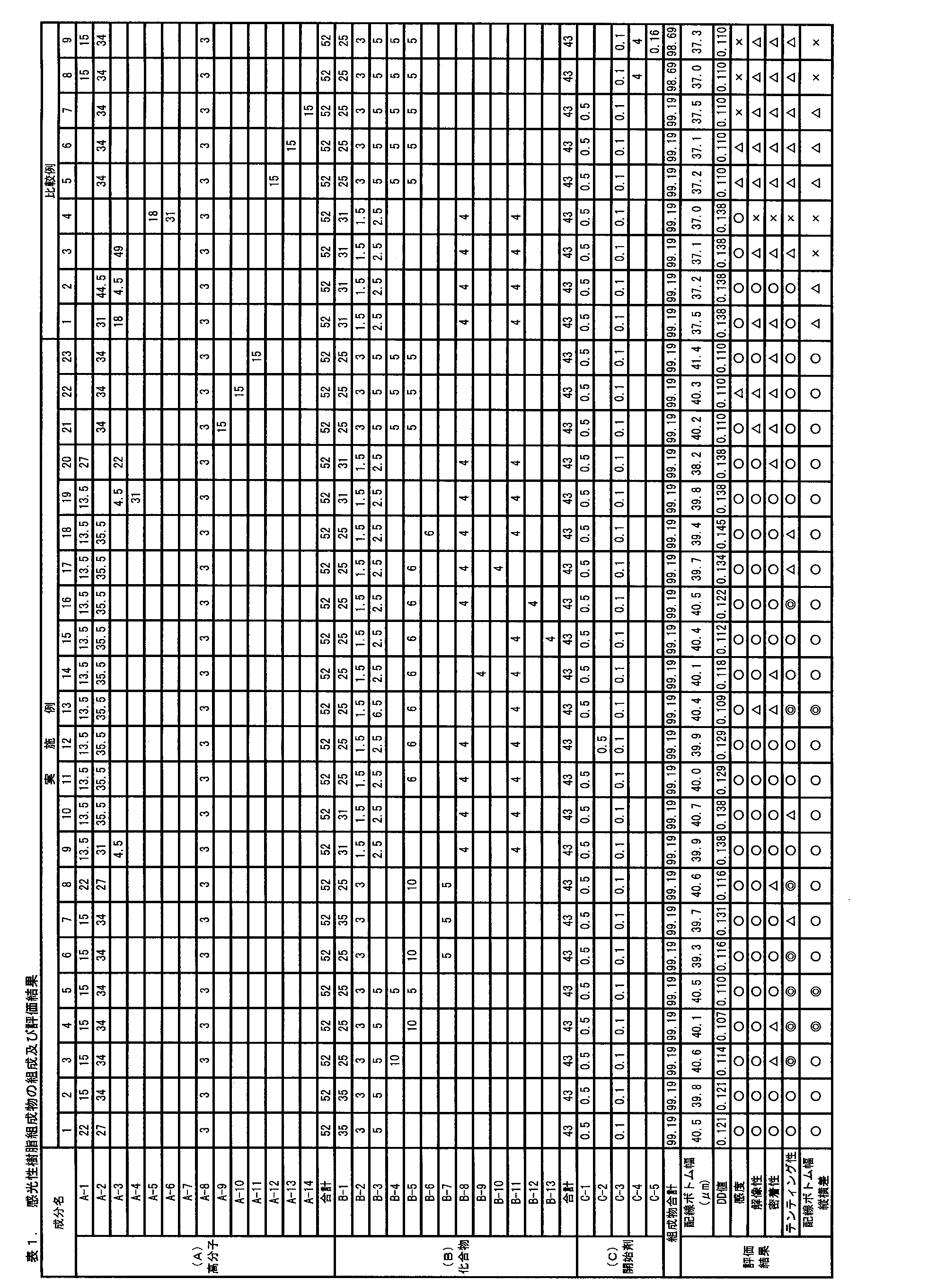


以下、本第二の実施形態の感光性樹脂組成物について、実施例の形式により具体的に説明する。
(1)原料物性値の測定
<酸当量>
酸当量とは、その中に1当量のカルボキシル基を有するアルカリ可溶性高分子の質量をいう。酸当量の測定は、自動滴定装置(例えば平沼産業(株)製平沼自動滴定装置(COM-555))を使用し、0.1mol/Lの水酸化ナトリウム水溶液を用いて電位差滴定法により行われる。
高分子の重量平均分子量は、日本分光(株)製ゲルパーミエーションクロマトグラフィー(GPC)(ポンプ:Gulliver、PU-1580型、カラム:昭和電工(株)製Shodex(登録商標)(KF-807、KF-806M、KF-806M、KF-802.5)4本直列、移動層溶媒:テトラヒドロフラン、ポリスチレン標準サンプル(昭和電工(株)製Shodex STANDARD SM-105)による検量線使用)を用い、ポリスチレン換算値として求めた。
<感光性エレメントの作製>
表3に示した各成分を混合し、更にメチルエチルケトン(MEK)を追加して、固形分濃度55質量%の感光性樹脂組成物を調製した。
得られた感光性樹脂組成物を、支持体である厚み16μmのポリエチレンテレフタレートフィルム(帝人デュポンフィルム(株)製、GR-16)上に、バーコーターを用いて均一に塗布した後、95℃に調温した乾燥機中で4分間加熱乾燥させて、支持体上に厚み33μmの感光性樹脂層を形成した。
次いで、上記感光性樹脂層の支持体と反対側の面上に、保護層である厚み19μmのポリエチレンフィルム(タマポリ(株)製GF-18)を貼付することにより、感光性エレメントを得た。
評価用基板としては、35μm圧延銅箔を積層した1.6mm厚の銅張積層板の表面を湿式バフロール研磨により整面した物を用いた。研磨は、スリーエム(株)製、スコッチブライト(登録商標)HD♯600を用い、2回通しにより行った。
整面して60℃に予熱した基板上に、各実施例又は比較例で得た感光性エレメントのポリエチレンフィルムを剥がしながら、ホットロールラミネーター(旭化成(株)製、AL-70)により、ロール温度105℃、エアー圧力0.35MPa、及びラミネート速度1.5m/minの条件下でラミネートした。
直接描画露光機(日立ビアメカニクス(株)製、DE-1DH、光源:GaN青紫ダイオード、主波長405±5nm)により、ストウファ41段ステップタブレット又は所定のDI露光用のマスクパターンを用いて、照度80mW/cm2の条件下で、ストウファ41段ステップタブレットにおいて14段を与えるのに相当する露光量で露光した。
露光後の感光性樹脂層から支持体を剥離した後、アルカリ現像機(フジ機工製、ドライフィルム用現像機)を用いて、30℃の1質量%Na2CO3水溶液を最小現像時間の2倍の時間スプレーして、感光性樹脂層の未露光部分を溶解除去した。現像後、現像時間の1.5倍の時間に亘って純水で洗浄し、エアーナイフによる水切り処理後、温風乾燥を行うことによって、評価用硬化膜を有する基板を得た。
最小現像時間とは、感光性樹脂層の未露光部分が完全に溶解除去されるまでに要する最小の時間をいう。
現像によって、レジストパターンが形成された評価基板に、塩銅エッチング装置(東京化工機(株)社製、塩銅エッチング装置)を用いて、50℃の塩化第二銅エッチング液(塩化第二銅濃度250g/L、HCl濃度3mol/L)を60秒間スプレーすることにより、銅張積層板上のレジストパターンにより被覆されていない部分の銅箔を溶解除去した。
エッチング後の評価用基板に、50℃に加温した3質量%の水酸化ナトリウム水溶液をスプレーすることにより、硬化したレジストを剥離した。
(i)現像凝集性試験
光重合性樹脂積層体中の厚さ50μm、面積0.6m2の感光層(レジスト層)を、200mlの1質量%Na2CO3水溶液に溶解させ、循環式スプレー装置を用いてスプレー圧0.1MPaで3時間スプレーを行った。その後、現像液を1日放置し、凝集物の発生を観察した。凝集物が多量に発生するとスプレー装置の底部及び側面に粉状物又は油状物が観察される。また、現像液に凝集物が浮遊することもある。現像液凝集性が良好な組成は、このような凝集物が全く発生しないか、又は発生しても極微量で水洗により簡単に洗い流すことが可能である。凝集物の発生状態を目視観察により以下のようにランク分けした。
◎(著しく良好):凝集物が全く発生しない。
○(良好):スプレー装置の底部又は側面には凝集物がなく、現像液に目視で確認可能な極微量の凝集物の浮遊が観察されるが水洗すると簡単に洗い流される。
△(可):スプレー装置の底部又は側面の一部及び現像液に凝集物が浮遊している。水洗しても凝集物の全てを洗い流すことはできない。
×(不良):スプレー装置全体に凝集物が見られ且つ現像液に凝集物が浮遊している。水洗でも凝集物の全てを洗い流すことは不可能であり、その大半が残留する。
各実施例及び比較例で得た感光性エレメントを用いて上記の方法に従ってラミネート及び露光を行って、各露光量及び現像後に残った段数により、ストウファ41段ステップタブレットにおいて14段を与えるのに相当する露光量(mj/cm2、14/41ST露光量)を調べ、以下の基準により評価した。
感度「〇」(良好):14/41ST露光量が25mj/cm2以下であった場合
感度「×」(不良):14/41ST露光量が25mj/cm2を超えた場合
各実施例及び比較例で得た感光性エレメントを用いて上記の方法に従ってラミネートを行った後、15分経過した試料を用い、ライン/スペースを1/1に設定し、さらに上記の方法に従って直接描画露光を行った。次いで、上記の方法に従って現像を行なった。
さらに、硬化レジストラインが正常に形成されている最小のマスクライン幅を調べ、以下の基準で評価した。
解像度「〇」(良好):最小ライン幅が25μm未満であった場合
解像度「△」(可):最小ライン幅が25μm以上30μm未満であった場合
解像度「×」(不良):最小ライン幅が30μm以上であった場合
各実施例及び比較例で得た感光性エレメントを用いて上記の方法に従ってラミネートを行った後、15分経過した試料を用い、上記の方法に従って直接描画露光を行った。次いで、上記の方法に従って現像した。
さらに、ライン/スペース=X/200としたときに、Xとして、正常に形成されている最小のマスクライン幅を調べ、以下の基準で評価した。
密着性「〇」(良好):最小ライン幅が25μm未満であった場合
密着性「△」(可):最小ライン幅が25μm以上30μm未満であった場合
密着性「×」(不良):最小ライン幅が30μm以上であった場合
実施例及び比較例で用いた感光性樹脂組成物の組成を表3に示し、かつ表3中の各成分名の詳細を表4に示した。表4中の各成分の配合量は、いずれも、固形分換算の質量部である。
各組成物を用いて行った評価結果も表4に示した。
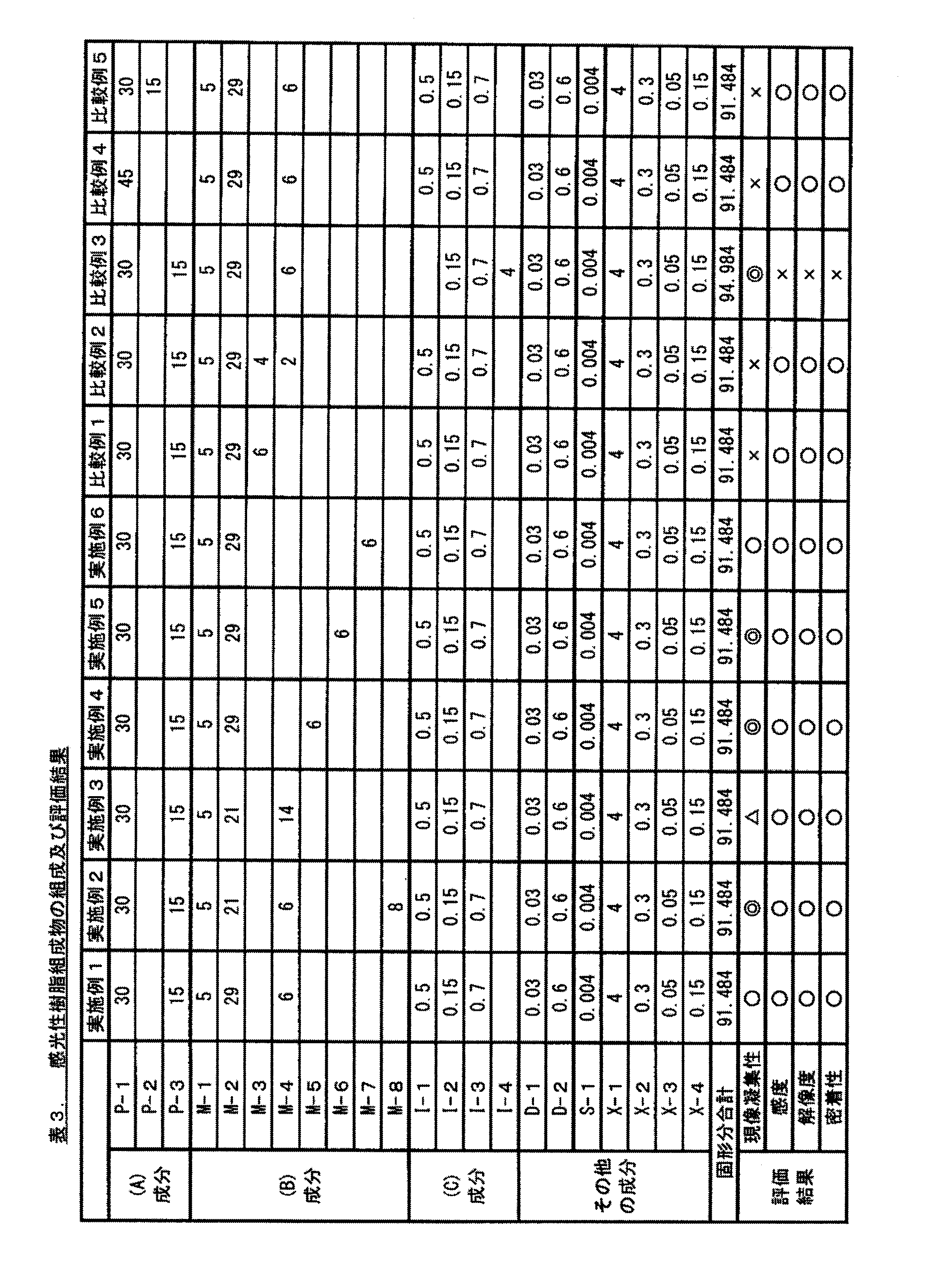
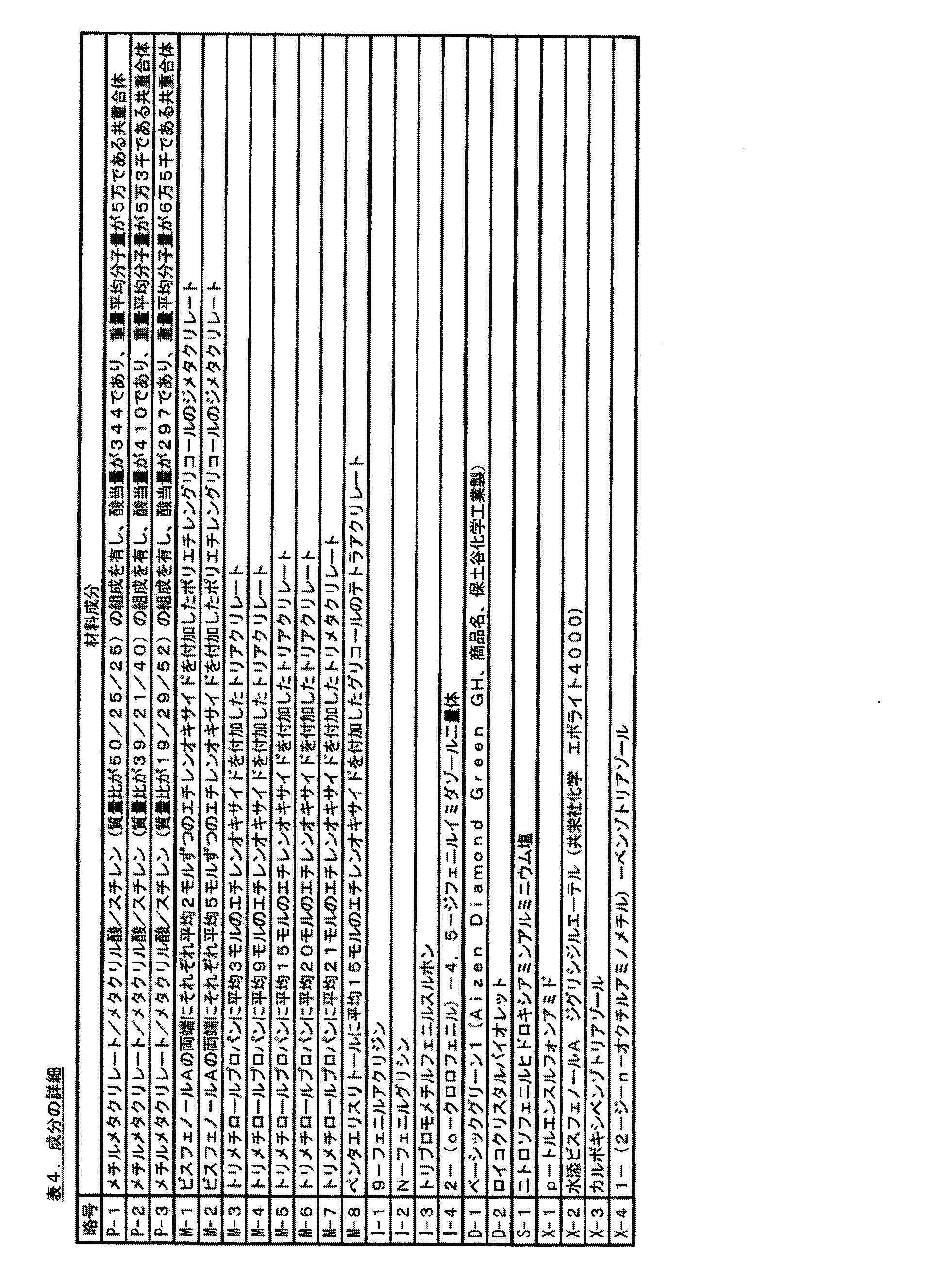
以下、本第三の実施形態の感光性樹脂組成物について、実施例の形式により具体的に説明する。
高分子及び単量体の物性値の測定、並びに実施例及び比較例の評価用サンプルの作製方法を説明し、次いで、得られたサンプルについての評価方法及びその評価結果を示す。
<高分子の重量平均分子量又は数平均分子量の測定>
高分子の重量平均分子量又は数平均分子量は、日本分光(株)製ゲルパーミエーションクロマトグラフィー(GPC)(ポンプ:Gulliver、PU-1580型、カラム:昭和電工(株)製Shodex(登録商標)(KF-807、KF-806M、KF-806M、KF-802.5)4本直列、移動層溶媒:テトラヒドロフラン、ポリスチレン標準サンプル(昭和電工(株)製Shodex STANDARD SM-105)による検量線使用)によりポリスチレン換算として求めた。
さらに、高分子の分散度は、数平均分子量に対する重量平均分子量の比(重量平均分子量/数平均分子量)として算出された。
本明細書において、酸当量とは、分子中に1当量のカルボキシル基を有する重合体の質量(グラム)を意味する。平沼産業(株)製平沼自動滴定装置(COM-555)を使用し、0.1mol/Lの水酸化ナトリウム水溶液を用いて電位差滴定法により酸当量を測定した。
実施例1~12及び比較例1~5における評価用サンプルは以下のように作製した。
下記表5又は6に示す成分(但し、各成分の数字は固形分としての配合量(質量部)を示す)及び溶媒を十分に攪拌、混合して、感光性樹脂組成物調合液を得た。表5及び6中に略号で表した成分の名称を下記表7に示す。支持フィルムとして16μm厚のポリエチレンテレフタラートフィルム(三菱樹脂(株)製、R310-16B)を用い、その表面にバーコーターを用いて、この調合液を均一に塗布し、95℃の乾燥機中で3分間乾燥して、感光性樹脂組成物層を形成した。感光性樹脂組成物層の乾燥厚みは30μmであった。
研削材(日本カーリット(株)製、サクランダムR(登録商標#220))を用いて、35μm圧延銅箔を積層した0.4mm厚の銅張積層板をスプレー圧0.2MPaでジェットスクラブ研磨することにより、評価用基板を作製した。
感光性樹脂積層体のポリエチレンフィルムを剥がしながら、整面して60℃に予熱した銅張積層板に、ホットロールラミネーター(旭化成(株)社製、AL-700)により、感光性樹脂積層体をロール温度105℃でラミネートして試験片を得た。エアー圧は0.35MPaとし、ラミネート速度は1.5m/分とした。
直接描画式露光装置(ビアメカニクス株式会社製、DE-1DH、主波長405nm)により15mJ/cm2の露光量で露光を行った。
感光性樹脂積層体からポリエチレンテレフタレートフィルムを剥離した後、(株)フジ機工製現像装置を用い、フルコーンタイプのノズルにて、現像スプレー圧0.15MPaで、30℃の1質量%Na2CO3水溶液を所定時間スプレーして現像し、感光性樹脂層の未露光部分を溶解除去した。このとき、未露光部分の感光性樹脂層が完全に溶解するのに要する最も少ない時間を最小現像時間として測定し、最小現像時間の2倍の時間で現像してレジストパターンを作製した。その際、水洗工程は、フラットタイプのノズルにて水洗スプレー圧0.15MPaで、現像工程と同時間処理した。
<テント性>
幅2.0mm×長さ15mmのスルーホールを有する0.6mm厚の両面銅張積層板を、ジェットスクラブ研磨機により表面処理した。上記<ラミネート>において説明した方法により両面にラミネートを行い、直接描画式露光装置(ビアメカニクス株式会社製、DE-1DH、主波長405nm)により両面を全面露光した。上記<現像>において説明した方法によって現像したときに、破れたテント穴数を計測し、全テント穴に対する破れ率を算出して、以下の基準によりランク分けした。
◎◎(最良):現像後の膜破れ率が、2%以下である。
◎(極めて良好):現像後の膜破れ率が、2%を超え、かつ4%以下である。
○(良好):現像後の膜破れ率が、4%を超え、かつ10%以下である。
×(不良):現像後の膜破れ率が、10%を超える。
接触角(水残りショート不良抑制性)の評価では、上記<ラミネート>において説明した方法によりラミネートを行なった後、上記<露光>において説明した方法によって全面現像を行い、続いて上記<現像>において説明した方法によって現像を行なった。
現像後、30分以内にサンプルを接触角の測定に供した。
接触角の測定はJIS R3257の静滴法に準拠し、株式会社ニック製の光学顕微鏡式接触角計「LSE-B100」を用い、温度23℃、湿度50RH%の環境下で硬化膜上に0.5μLの純水を滴下した後、接触角の測定を開始し、120秒後の値を採用して、以下の基準によりランク分けした。接触角の値が大きい場合、硬化レジストの疎水性が高いことを示し、水残りショート不良を抑制することができる。
◎(極めて良好):接触角が、35°以上である。
○(良好):接触角が、30°以上35°未満である。
△(許容):接触角が、25°以上30°未満である。
×(不良):接触角が、25°未満である。
実施例1~12の評価結果を下記表5に示し、かつ比較例1~5の評価結果を下記表6に示す。

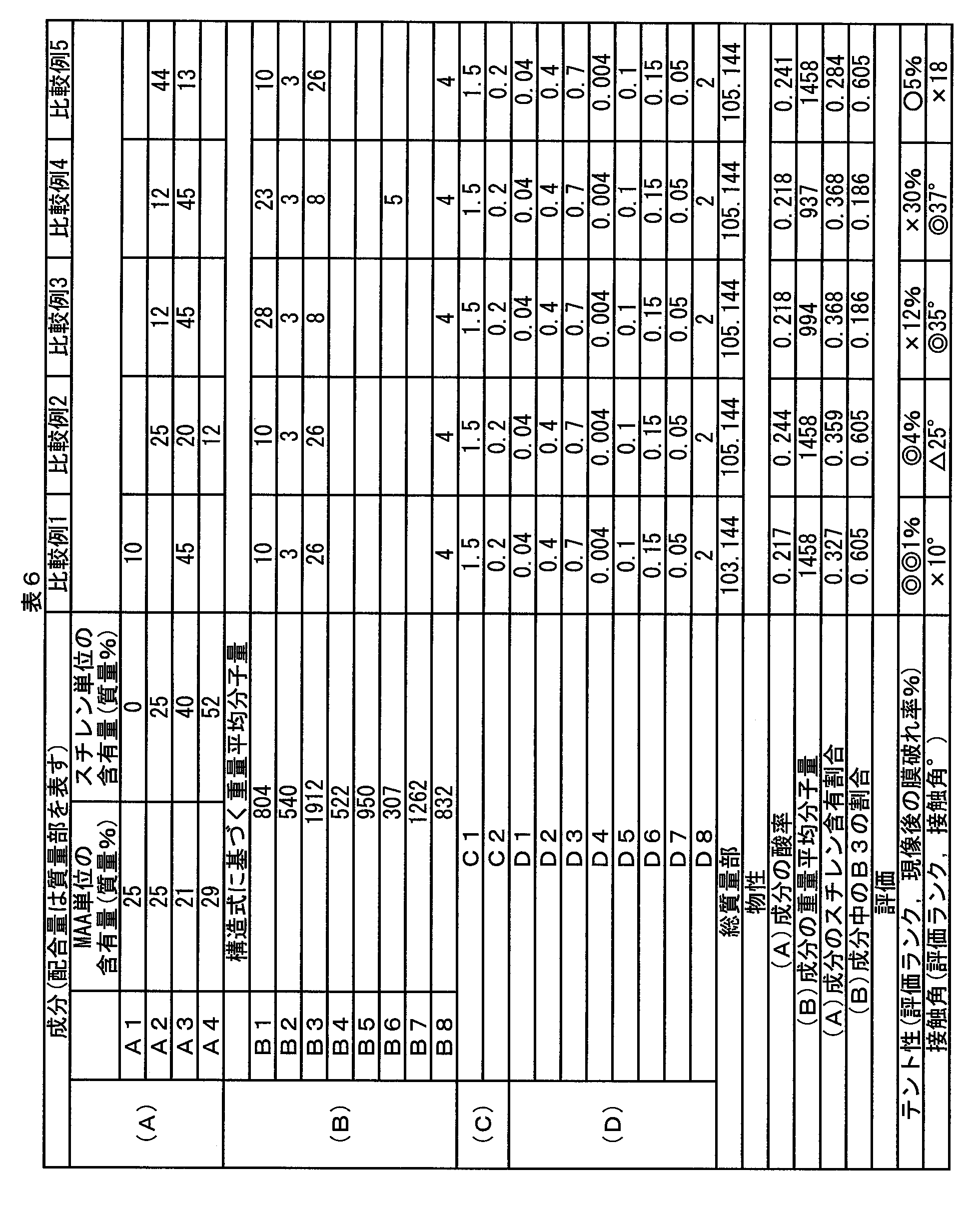
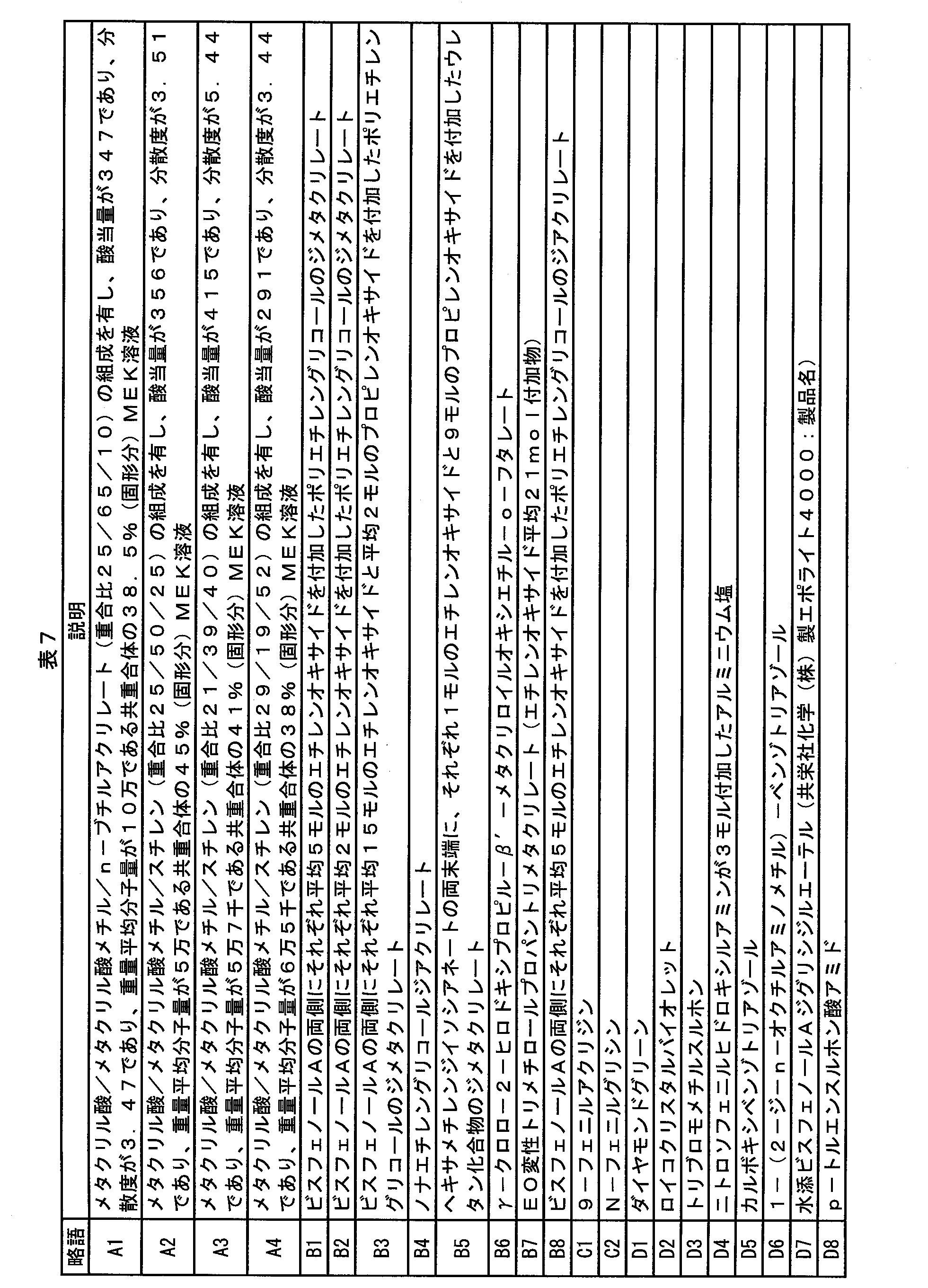
(1)原料物性値の測定
<重量平均分子量の測定>
高分子の重量平均分子量は、日本分光(株)製ゲルパーミエーションクロマトグラフィー(GPC)(ポンプ:Gulliver、PU-1580型、カラム:昭和電工(株)製Shodex(登録商標)(KF-807、KF-806M、KF-806M、KF-802.5)4本直列、移動層溶媒:テトラヒドロフラン、ポリスチレン標準サンプル(昭和電工(株)製Shodex STANDARD SM-105)による検量線使用)を用い、ポリスチレン換算値として求めた。
本明細書において、酸当量とは、分子中に1当量のカルボキシル基を有する重合体の質量(グラム)を意味する。平沼産業(株)製平沼自動滴定装置(COM-555)を使用し、0.1mol/Lの水酸化ナトリウム水溶液を用いる電位差滴定法により酸当量を測定した。
<感光性エレメントの作製>
表8に示した各成分を混合し、更にメチルエチルケトン(MEK)を追加して、固形分濃度56質量%の感光性樹脂組成物を調製した。表8における各成分欄の数字は、組成物の調製に供した各成分の量(質量部)である。
得られた感光性樹脂組成物を、支持体である厚み16μmのポリエチレンテレフタレートフィルム(帝人デュポンフィルム(株)製GR-16、ヘーズ値2.7%)上に、バーコーターを用いて均一に塗布した後、95℃に調温した乾燥機中で3分20秒加熱乾燥させて、支持体上に厚み33μmの感光性樹脂層を形成した。
次いで、上記感光性樹脂層の支持体と反対側の面上に、保護層である厚み19μmのポリエチレンフィルム(タマポリ(株)製GF-18)を貼付することにより、感光性エレメントを得た。
評価用基板としては、35μm圧延銅箔を積層した1.6mm厚の銅張積層板の表面を湿式バフロール研磨により整面した物を用いた。研磨は、スリーエム(株)製、スコッチブライト(登録商標)HD♯600を用い、2回通しにより行った。
整面後の基板上に、各実施例又は比較例で得た感光性エレメントのポリエチレンフィルムを剥がしながら、ホットロールラミネーター(旭化成(株)製、AL-70)により、ロール温度105℃、エアー圧力0.35MPa、及びラミネート速度1.5m/分の条件下でラミネートした。
直接描画露光機(日立ビアメカニクス(株)製、DE-1AH、光源:GaN青紫ダイオード、主波長405±5nm)により、所定のDI露光用のマスクパターンを用いて、照度15mW/cm2の条件下で露光した。
露光パターンおよび露光量については、各評価項目の項で後述する。
露光後の感光性樹脂層から支持体を剥離した後、アルカリ現像機(フジ機工製、ドライフィルム用現像機)を用いて、29℃の0.8質量%Na2CO3水溶液を最小現像時間の2倍の時間スプレーして、感光性樹脂層の未露光部分を溶解除去した。現像後、現像時間と同じ時間純水で洗浄し、水洗後は温風乾燥処理を行わず基板を自然乾燥させることによって、評価用硬化膜を有する基板を得た。
上記最小現像時間とは、感光性樹脂層の未露光部分が完全に溶解除去されるまでに要する最小の時間をいい、現像液の濃度又は温度、スプレーの向き又は噴霧量、圧力、オシレーションの周波数などに依存して変化する。
ここで、最小現像時間を以下のようにランク分けした:
○:最小現像時間が30秒を超える。
×:最小現像時間が30秒以下。
感度の評価には、上記<ラミネート>後、15分経過後のラミネート基板を用いた。
該ラミネート基板に対し、ライン/スペース=40μm/40μmのライン10本のマスクパターンを直接描画露光した後、上記<現像>に記載の方法によって現像した。得られたレジストパターンの、レジストトップ幅を光学顕微鏡により測定し、レジストトップ幅が39μmとなる露光量を感度の評価とした。
ここで、レジストラインの測定場所は、10本あるラインのうちの端から5本目のライン、長さ方向の端から約5mmの位置とし、測定値として3回測定の平均値を用いた。パターンの端と中央部とでは、現像液及び水洗水の拡散の影響で線幅が異なり、端側のレジストラインが細くなる傾向があるため、測定位置を特定することは重要である。
○:39μm線幅となる露光量が28mJ/cm2以下。
×:39μm線幅となる露光量が28mJ/cm2を超える。
解像性の評価には、上記<ラミネート>後、15分経過後のラミネート基板を用いた。
該ラミネート基板に対し、種々のサイズのライン/スペース=1/1のパターンを直接描画露光した後、上記<現像>に記載の方法によって現像した。
得られたパターンについて、形成されていた最小のパターン幅を光学顕微鏡により観察し、以下の基準によって解像性を評価した。
○:形成されていた最小のパターン幅が28μm以下。
×:形成されていた最小のパターン幅が28μmを超える。
密着性の評価には、上記<ラミネート>後、15分経過後のラミネート基板を用いた。
該ラミネート基板に対し、種々のサイズの独立ラインのパターンを直接描画露光した後、上記<現像>に記載の方法によって現像した。
得られたパターンを光学顕微鏡により観察し、以下の基準によって密着性を評価した。
ここで、ラインパターンが正常に形成されなかった場合とは、該ラインパターンが倒れていた場合、該ラインパターンが蛇行していた場合、又は基板上に該ラインパターンが存在していなかった場合をいう。
○:形成されていた最小のパターン幅が28μm以下。
×:形成されていた最小のパターン幅が28μmを超える。
光重合性樹脂積層体中の厚さ50μm、面積0.6m2の感光層(レジスト層)を、200mlの1質量%Na2CO3水溶液に溶解させ、循環式スプレー装置を用いてスプレー圧0.1MPaで3時間スプレーを行った。その後、現像液を1日静置し、凝集物の発生を観察した。凝集物が多量に発生するとスプレー装置の底面及び側面に粉状物又は油状物が観察される。現像液凝集性が良好な組成物においては、上記のような凝集物が全く発生しない。凝集性を、凝集物の発生状態に基づき、以下のようにランク分けした:
○:凝集物が全く発生しない。
△:スプレー装置の底部又は側面の一部に凝集物が見られる。
×:スプレー装置全体に凝集物が見られる。
上記<ラミネート>において説明した処理の後15分経過した基板を用い、該ラミネート基板に対し、4cm×6cmの長方形パターンを直接描画露光した後、上記<現像>に記載の方法によって現像した。
得られた基板上の硬化レジストを50℃、3質量%のNaOHに浸し、レジストが基板から完全に剥離するまでの時間を測定し、剥離時間とした。
ここで、剥離性を以下のようにランク分けした:
○:完全に剥離するまでの時間が40秒以下。
×:完全に剥離するまでの時間が40秒を超える。
実施例及び比較例で用いた感光性樹脂組成物の組成を表8に、表8に記載の各成分名の詳細を表9に、それぞれ示した。表8における各成分の配合量は、いずれも、固形分換算の質量部である。
各組成物を用いて行った評価結果も表8に示した。
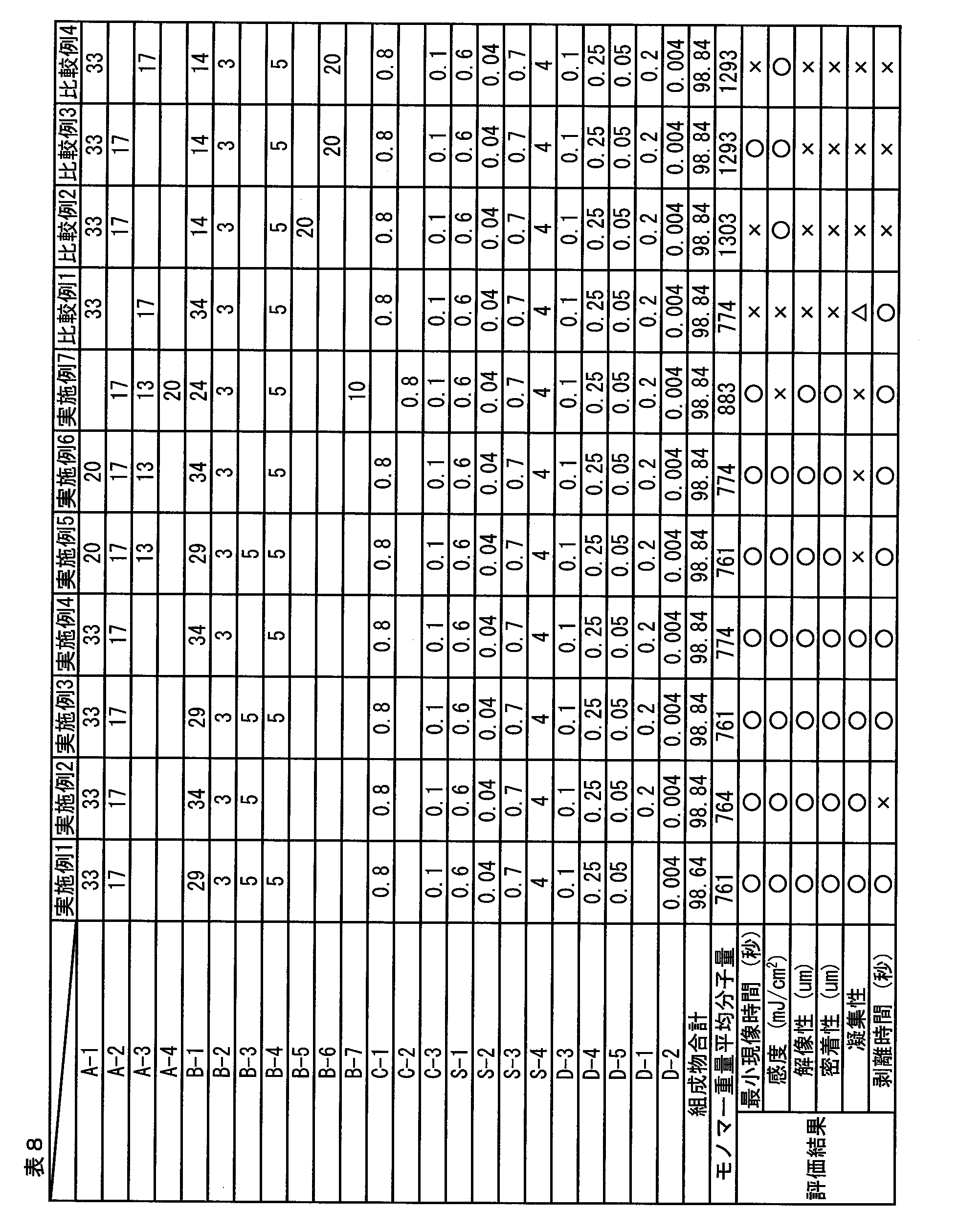

Claims (17)
- 下記(A)~(C)の各成分、
(A)成分:アルカリ可溶性高分子、
(B)成分:エチレン性二重結合を有する化合物、及び
(C)成分:光重合開始剤
を含有する感光性樹脂組成物であって、
18μm厚みの銅箔が積層された銅張積層板上に、前記感光性樹脂組成物から成る感光性樹脂層を25μm厚みで積層し、ライン/スペース=50μm/30μmのパターン状の光照射及び現像処理を経て硬化レジストパターンを形成し、50℃において55秒間の銅エッチング処理を施した後に、前記硬化レジストパターンを除去して得られる銅ラインパターンのボトム幅が38μm以上であることを特徴とする、前記感光性樹脂組成物。 - 前記(A)成分が、(メタ)アクリル酸単位の含有割合が10質量%以上24質量%以下の共重合体である、請求項1に記載の感光性樹脂組成物。
- 前記(A)成分が、スチレン単位の含有割合が32質量%以上60質量%以下の共重合体である、請求項1または2に記載の感光性樹脂組成物。
- 前記(C)成分がアクリジン化合物を含有する、請求項1~3のいずれか一項に記載の感光性樹脂組成物。
- 前記(B)成分がペンタエリスリトール化合物を含有する、請求項1~4のいずれか一項に記載の感光性樹脂組成物。
- 前記(B)成分がトリメチロールプロパン化合物を含有する、請求項1~5のいずれか一項に記載の感光性樹脂組成物。
- 前記(B)成分がビスフェノールA化合物を含有する、請求項1~6のいずれか一項に記載の感光性樹脂組成物。
- 下記(A)~(C)の各成分、
(A)成分:アルカリ可溶性高分子、
(B)成分:エチレン性二重結合を有する化合物、及び
(C)成分:光重合開始剤
を含有する感光性樹脂組成物であって、
前記(A)成分は、(メタ)アクリル酸単位の含有割合が10質量%以上24質量%以下で且つスチレン単位の含有割合が32質量%以上である共重合体を含み、
前記(C)成分は、アクリジン化合物を含む
感光性樹脂組成物。 - 前記(A)成分は、(メタ)アクリル酸単位の含有割合が10質量%以上24質量%以下で且つスチレン単位の含有割合が32質量%以上60質量%以下である共重合体を含む、請求項8に記載の感光性樹脂組成物。
- 前記(B)成分がペンタエリスリトール化合物を含有する、請求項8又は9に記載の感光性樹脂組成物。
- 前記(B)成分がトリメチロールプロパン化合物を含有する、請求項8~10のいずれか一項に記載の感光性樹脂組成物。
- 前記(B)成分がビスフェノールA化合物を含有する、請求項8~11のいずれか一項に記載の感光性樹脂組成物。
- 請求項1~12のいずれか一項に記載の感光性樹脂組成物から成る感光性樹脂層が支持体上に積層された、感光性エレメント。
- 請求項13に記載の感光性エレメントの感光性樹脂層を導体基板上に積層するラミネート工程、
前記積層された感光性樹脂組成物層を露光する露光工程、及び
前記露光後の未露光部を現像液で除去する現像工程、
を含むことを特徴とする、レジストパターンの形成方法。 - 前記ラミネート工程が、感光性エレメントの感光性樹脂層を、湿潤剤を介して導体基板上に積層する工程である、請求項14に記載のレジストパターンの形成方法。
- 請求項13に記載の感光性エレメントの感光性樹脂組成物層を導体基板上に積層するラミネート工程、
前記積層された感光性樹脂組成物層を露光する露光工程、
前記露光後の未露光部を現像液で除去する現像工程、
前記現像によりレジストパターンが形成された導体基板をエッチング又はめっきする導体パターン形成工程、及び
前記レジストパターンを剥離する剥離工程、
を含むことを特徴とする、配線板の製造方法。 - 前記ラミネート工程が、感光性エレメントの感光性樹脂層を、湿潤剤を介して導体基板上に積層する工程である、請求項16に記載の配線板の製造方法。
Priority Applications (8)
| Application Number | Priority Date | Filing Date | Title |
|---|---|---|---|
| KR1020197026060A KR102443749B1 (ko) | 2015-09-11 | 2016-09-07 | 감광성 수지 조성물 |
| KR1020187003696A KR20180042842A (ko) | 2015-09-11 | 2016-09-07 | 감광성 수지 조성물 |
| CN201680052525.7A CN108027559B (zh) | 2015-09-11 | 2016-09-07 | 感光性树脂组合物 |
| CN202510195163.8A CN120044756A (zh) | 2015-09-11 | 2016-09-07 | 感光性树脂组合物 |
| JP2017539202A JP6514346B2 (ja) | 2015-09-11 | 2016-09-07 | 感光性樹脂組成物 |
| CN202111430178.6A CN114296315B (zh) | 2015-09-11 | 2016-09-07 | 感光性树脂组合物 |
| MYUI2018700667A MY186932A (en) | 2015-09-11 | 2016-09-07 | Photosensitive resin composition |
| KR1020227031231A KR102600211B1 (ko) | 2015-09-11 | 2016-09-07 | 감광성 수지 조성물 |
Applications Claiming Priority (10)
| Application Number | Priority Date | Filing Date | Title |
|---|---|---|---|
| JP2015179888 | 2015-09-11 | ||
| JP2015-179888 | 2015-09-11 | ||
| JP2015-195984 | 2015-10-01 | ||
| JP2015195984 | 2015-10-01 | ||
| JP2015-199434 | 2015-10-07 | ||
| JP2015199434 | 2015-10-07 | ||
| JP2015-218912 | 2015-11-06 | ||
| JP2015218912 | 2015-11-06 | ||
| JP2015-257519 | 2015-12-28 | ||
| JP2015257519 | 2015-12-28 |
Publications (1)
| Publication Number | Publication Date |
|---|---|
| WO2017043544A1 true WO2017043544A1 (ja) | 2017-03-16 |
Family
ID=58239851
Family Applications (1)
| Application Number | Title | Priority Date | Filing Date |
|---|---|---|---|
| PCT/JP2016/076342 Ceased WO2017043544A1 (ja) | 2015-09-11 | 2016-09-07 | 感光性樹脂組成物 |
Country Status (6)
| Country | Link |
|---|---|
| JP (3) | JP6514346B2 (ja) |
| KR (3) | KR20180042842A (ja) |
| CN (3) | CN120044756A (ja) |
| MY (3) | MY199738A (ja) |
| TW (3) | TWI709815B (ja) |
| WO (1) | WO2017043544A1 (ja) |
Cited By (7)
| Publication number | Priority date | Publication date | Assignee | Title |
|---|---|---|---|---|
| CN108205240A (zh) * | 2018-02-01 | 2018-06-26 | 浙江福斯特新材料研究院有限公司 | 一种高光敏性和优异掩孔性能的感光性树脂组合物 |
| CN110095937A (zh) * | 2018-01-30 | 2019-08-06 | 旭化成株式会社 | 感光性树脂层叠体和抗蚀图案的制造方法 |
| JP2020076945A (ja) * | 2018-09-21 | 2020-05-21 | 旭化成株式会社 | 感光性樹脂組成物 |
| JP2020190735A (ja) * | 2020-07-14 | 2020-11-26 | 旭化成株式会社 | 感光性樹脂組成物、感光性樹脂積層体、レジストパターン形成方法及び導体パターン製造方法 |
| WO2021220980A1 (ja) * | 2020-04-28 | 2021-11-04 | 富士フイルム株式会社 | 感光性転写材料、樹脂パターンの製造方法、回路配線の製造方法及びタッチパネルの製造方法 |
| JPWO2022186389A1 (ja) * | 2021-03-05 | 2022-09-09 | ||
| JP2024103496A (ja) * | 2019-11-11 | 2024-08-01 | 旭化成株式会社 | 感光性樹脂組成物及び感光性樹脂積層体 |
Families Citing this family (8)
| Publication number | Priority date | Publication date | Assignee | Title |
|---|---|---|---|---|
| JP6809873B2 (ja) * | 2015-12-28 | 2021-01-06 | 旭化成株式会社 | 積層体 |
| KR102655468B1 (ko) * | 2018-06-22 | 2024-04-05 | 아사히 가세이 가부시키가이샤 | 감광성 수지 조성물 및 레지스트 패턴의 형성 방법 |
| JP7422664B2 (ja) * | 2018-08-09 | 2024-01-26 | 旭化成株式会社 | 感光性樹脂組成物及びレジストパターンの形成方法 |
| WO2021049241A1 (ja) * | 2019-09-13 | 2021-03-18 | 旭化成株式会社 | 感光性樹脂組成物、及び感光性エレメント |
| JP7769468B2 (ja) * | 2019-12-13 | 2025-11-13 | 旭化成株式会社 | 感光性樹脂組成物、感光性樹脂組成物を用いた転写フィルム |
| JP7631907B2 (ja) | 2021-03-08 | 2025-02-19 | 株式会社レゾナック | 感光性樹脂フィルム、感光性エレメント、及び、積層体の製造方法 |
| WO2023073799A1 (ja) * | 2021-10-26 | 2023-05-04 | 株式会社レゾナック | 感光性樹脂組成物、感光性エレメント、及び、積層体の製造方法 |
| KR102882784B1 (ko) * | 2022-03-31 | 2025-11-06 | 아사히 가세이 가부시키가이샤 | 감광성 수지 조성물 및 감광성 엘리먼트 |
Citations (4)
| Publication number | Priority date | Publication date | Assignee | Title |
|---|---|---|---|---|
| JP2007226158A (ja) * | 2006-02-27 | 2007-09-06 | Asahi Kasei Electronics Co Ltd | ドライフィルムレジスト |
| JP2014182305A (ja) * | 2013-03-19 | 2014-09-29 | Hitachi Chemical Co Ltd | 感光性樹脂組成物、感光性エレメント、レジストパターン付き基板の製造方法及びプリント配線板の製造方法 |
| JP2015060120A (ja) * | 2013-09-19 | 2015-03-30 | 旭化成イーマテリアルズ株式会社 | 感光性樹脂組成物及び感光性樹脂積層体 |
| JP2015152854A (ja) * | 2014-02-18 | 2015-08-24 | 旭化成イーマテリアルズ株式会社 | 感光性樹脂組成物、感光性樹脂積層体及びレジストパターン形成方法 |
Family Cites Families (17)
| Publication number | Priority date | Publication date | Assignee | Title |
|---|---|---|---|---|
| JP4646759B2 (ja) * | 2005-09-20 | 2011-03-09 | 旭化成イーマテリアルズ株式会社 | パターン形成材料、並びにパターン形成装置及びパターン形成方法 |
| JP4761909B2 (ja) * | 2005-10-05 | 2011-08-31 | 旭化成イーマテリアルズ株式会社 | 感光性樹脂組成物及び積層体 |
| CN101568883B (zh) * | 2006-12-27 | 2012-01-18 | 日立化成工业株式会社 | 感光性树脂组合物、感光性元件、抗蚀图案的形成方法以及印刷电路板的制造方法 |
| JP2008197160A (ja) * | 2007-02-08 | 2008-08-28 | Hitachi Chem Co Ltd | 半導体素子の層間絶縁膜用感光性樹脂組成物、それを用いた層間絶縁膜及び層間絶縁膜の製造方法 |
| CN101779165B (zh) | 2007-08-15 | 2014-09-24 | 旭化成电子材料株式会社 | 感光性树脂组合物及其层压体 |
| JP2011233769A (ja) | 2010-04-28 | 2011-11-17 | Mec Co Ltd | 銅配線パターンの形成方法 |
| CN106918991A (zh) * | 2010-07-13 | 2017-07-04 | 日立化成工业株式会社 | 感光性元件、抗蚀图案的形成方法、印刷电路布线板的制造方法及印刷电路布线板 |
| KR101444044B1 (ko) * | 2010-12-16 | 2014-09-23 | 히타치가세이가부시끼가이샤 | 감광성 엘리먼트, 레지스트 패턴의 형성 방법 및 프린트 배선판의 제조 방법 |
| MY179988A (en) * | 2010-12-24 | 2020-11-19 | Asahi Kasei E Mat Corporation | Photosensitive resin composition |
| JP2012226254A (ja) * | 2011-04-22 | 2012-11-15 | Asahi Kasei E-Materials Corp | ドライフィルムレジストロール |
| JP6064480B2 (ja) | 2011-10-26 | 2017-01-25 | 日立化成株式会社 | 感光性樹脂組成物、感光性エレメント、レジストパターンの形成方法及びプリント配線板の製造方法 |
| JP6113976B2 (ja) | 2012-08-29 | 2017-04-12 | 旭化成株式会社 | 感光性樹脂組成物 |
| JP5673763B2 (ja) * | 2013-09-17 | 2015-02-18 | 日立化成株式会社 | 感光性樹脂組成物、並びにこれを用いた感光性エレメント、レジストパターンの形成方法及びプリント配線板の製造方法 |
| JP6486672B2 (ja) * | 2013-12-20 | 2019-03-20 | 旭化成株式会社 | 感光性エレメント、及びその製造方法 |
| US10104781B2 (en) | 2013-12-27 | 2018-10-16 | Hitachi Chemical Company, Ltd. | Photosensitive resin composition, photosensitive element, method for forming resist pattern, and method for producing printed wiring board |
| US10338468B2 (en) * | 2014-09-24 | 2019-07-02 | Asahi Kasei Kabushiki Kaisha | Photosensitive resin composition, photosensitive resin laminate, resin pattern production method, cured film, and display device |
| US20180051183A1 (en) * | 2016-08-17 | 2018-02-22 | Xerox Corporation | Seven-color ink set for a digital advanced lithographic imaging process |
-
2016
- 2016-09-07 KR KR1020187003696A patent/KR20180042842A/ko not_active Ceased
- 2016-09-07 KR KR1020197026060A patent/KR102443749B1/ko active Active
- 2016-09-07 WO PCT/JP2016/076342 patent/WO2017043544A1/ja not_active Ceased
- 2016-09-07 MY MYUI2021001392A patent/MY199738A/en unknown
- 2016-09-07 KR KR1020227031231A patent/KR102600211B1/ko active Active
- 2016-09-07 MY MYUI2018700667A patent/MY186932A/en unknown
- 2016-09-07 JP JP2017539202A patent/JP6514346B2/ja active Active
- 2016-09-07 CN CN202510195163.8A patent/CN120044756A/zh active Pending
- 2016-09-07 CN CN201680052525.7A patent/CN108027559B/zh active Active
- 2016-09-07 CN CN202111430178.6A patent/CN114296315B/zh active Active
- 2016-09-07 MY MYUI2021001391A patent/MY200333A/en unknown
- 2016-09-09 TW TW108118424A patent/TWI709815B/zh active
- 2016-09-09 TW TW105129243A patent/TWI691793B/zh active
- 2016-09-09 TW TW107132088A patent/TWI684067B/zh active
-
2018
- 2018-12-10 JP JP2018231215A patent/JP7026606B2/ja active Active
-
2021
- 2021-11-16 JP JP2021186549A patent/JP7340581B2/ja active Active
Patent Citations (4)
| Publication number | Priority date | Publication date | Assignee | Title |
|---|---|---|---|---|
| JP2007226158A (ja) * | 2006-02-27 | 2007-09-06 | Asahi Kasei Electronics Co Ltd | ドライフィルムレジスト |
| JP2014182305A (ja) * | 2013-03-19 | 2014-09-29 | Hitachi Chemical Co Ltd | 感光性樹脂組成物、感光性エレメント、レジストパターン付き基板の製造方法及びプリント配線板の製造方法 |
| JP2015060120A (ja) * | 2013-09-19 | 2015-03-30 | 旭化成イーマテリアルズ株式会社 | 感光性樹脂組成物及び感光性樹脂積層体 |
| JP2015152854A (ja) * | 2014-02-18 | 2015-08-24 | 旭化成イーマテリアルズ株式会社 | 感光性樹脂組成物、感光性樹脂積層体及びレジストパターン形成方法 |
Cited By (9)
| Publication number | Priority date | Publication date | Assignee | Title |
|---|---|---|---|---|
| CN110095937A (zh) * | 2018-01-30 | 2019-08-06 | 旭化成株式会社 | 感光性树脂层叠体和抗蚀图案的制造方法 |
| CN110095937B (zh) * | 2018-01-30 | 2023-02-28 | 旭化成株式会社 | 感光性树脂层叠体和抗蚀图案的制造方法 |
| CN108205240A (zh) * | 2018-02-01 | 2018-06-26 | 浙江福斯特新材料研究院有限公司 | 一种高光敏性和优异掩孔性能的感光性树脂组合物 |
| CN108205240B (zh) * | 2018-02-01 | 2021-05-07 | 浙江福斯特新材料研究院有限公司 | 一种高光敏性和优异掩孔性能的感光性树脂组合物及应用 |
| JP2020076945A (ja) * | 2018-09-21 | 2020-05-21 | 旭化成株式会社 | 感光性樹脂組成物 |
| JP2024103496A (ja) * | 2019-11-11 | 2024-08-01 | 旭化成株式会社 | 感光性樹脂組成物及び感光性樹脂積層体 |
| WO2021220980A1 (ja) * | 2020-04-28 | 2021-11-04 | 富士フイルム株式会社 | 感光性転写材料、樹脂パターンの製造方法、回路配線の製造方法及びタッチパネルの製造方法 |
| JP2020190735A (ja) * | 2020-07-14 | 2020-11-26 | 旭化成株式会社 | 感光性樹脂組成物、感光性樹脂積層体、レジストパターン形成方法及び導体パターン製造方法 |
| JPWO2022186389A1 (ja) * | 2021-03-05 | 2022-09-09 |
Also Published As
| Publication number | Publication date |
|---|---|
| TW201843527A (zh) | 2018-12-16 |
| KR20180042842A (ko) | 2018-04-26 |
| CN108027559A (zh) | 2018-05-11 |
| JP7340581B2 (ja) | 2023-09-07 |
| TWI684067B (zh) | 2020-02-01 |
| KR102600211B1 (ko) | 2023-11-08 |
| MY186932A (en) | 2021-08-26 |
| CN120044756A (zh) | 2025-05-27 |
| KR102443749B1 (ko) | 2022-09-15 |
| MY200333A (en) | 2023-12-20 |
| CN114296315B (zh) | 2025-09-05 |
| TWI691793B (zh) | 2020-04-21 |
| TW201712433A (zh) | 2017-04-01 |
| CN108027559B (zh) | 2021-10-26 |
| JP2022027767A (ja) | 2022-02-14 |
| CN114296315A (zh) | 2022-04-08 |
| JP6514346B2 (ja) | 2019-05-15 |
| JP7026606B2 (ja) | 2022-02-28 |
| JPWO2017043544A1 (ja) | 2018-03-15 |
| MY199738A (en) | 2023-11-21 |
| JP2019105841A (ja) | 2019-06-27 |
| KR20220127382A (ko) | 2022-09-19 |
| TWI709815B (zh) | 2020-11-11 |
| TW201944171A (zh) | 2019-11-16 |
| KR20190105142A (ko) | 2019-09-11 |
Similar Documents
| Publication | Publication Date | Title |
|---|---|---|
| JP7340581B2 (ja) | 感光性樹脂組成物 | |
| TWI392967B (zh) | Photosensitive resin composition and laminate | |
| JP6809873B2 (ja) | 積層体 | |
| JP5948539B2 (ja) | 感光性樹脂組成物 | |
| CN102144189B (zh) | 感光性树脂组合物、层压体、抗蚀图案形成方法以及导体图案、印刷电路板的制造方法 | |
| JP5117233B2 (ja) | 感光性樹脂組成物および積層体 | |
| JP6486672B2 (ja) | 感光性エレメント、及びその製造方法 | |
| JP5117234B2 (ja) | 感光性樹脂組成物および積層体 | |
| JP2010113349A (ja) | 感光性樹脂組成物 | |
| JP5117235B2 (ja) | 感光性樹脂組成物および積層体 | |
| KR20080023352A (ko) | 감광성 수지 조성물 및 적층체 |
Legal Events
| Date | Code | Title | Description |
|---|---|---|---|
| 121 | Ep: the epo has been informed by wipo that ep was designated in this application |
Ref document number: 16844405 Country of ref document: EP Kind code of ref document: A1 |
|
| ENP | Entry into the national phase |
Ref document number: 2017539202 Country of ref document: JP Kind code of ref document: A |
|
| ENP | Entry into the national phase |
Ref document number: 20187003696 Country of ref document: KR Kind code of ref document: A |
|
| NENP | Non-entry into the national phase |
Ref country code: DE |
|
| 122 | Ep: pct application non-entry in european phase |
Ref document number: 16844405 Country of ref document: EP Kind code of ref document: A1 |