WO2017026499A1 - 樹脂粉粒体群、樹脂フィルム、セパレータ、選別装置及び選別方法 - Google Patents
樹脂粉粒体群、樹脂フィルム、セパレータ、選別装置及び選別方法 Download PDFInfo
- Publication number
- WO2017026499A1 WO2017026499A1 PCT/JP2016/073510 JP2016073510W WO2017026499A1 WO 2017026499 A1 WO2017026499 A1 WO 2017026499A1 JP 2016073510 W JP2016073510 W JP 2016073510W WO 2017026499 A1 WO2017026499 A1 WO 2017026499A1
- Authority
- WO
- WIPO (PCT)
- Prior art keywords
- resin
- magnet
- magnetic
- transfer path
- magnetic foreign
- Prior art date
- Legal status (The legal status is an assumption and is not a legal conclusion. Google has not performed a legal analysis and makes no representation as to the accuracy of the status listed.)
- Ceased
Links
Images

Classifications
-
- B—PERFORMING OPERATIONS; TRANSPORTING
- B29—WORKING OF PLASTICS; WORKING OF SUBSTANCES IN A PLASTIC STATE IN GENERAL
- B29B—PREPARATION OR PRETREATMENT OF THE MATERIAL TO BE SHAPED; MAKING GRANULES OR PREFORMS; RECOVERY OF PLASTICS OR OTHER CONSTITUENTS OF WASTE MATERIAL CONTAINING PLASTICS
- B29B9/00—Making granules
- B29B9/16—Auxiliary treatment of granules
-
- B—PERFORMING OPERATIONS; TRANSPORTING
- B32—LAYERED PRODUCTS
- B32B—LAYERED PRODUCTS, i.e. PRODUCTS BUILT-UP OF STRATA OF FLAT OR NON-FLAT, e.g. CELLULAR OR HONEYCOMB, FORM
- B32B27/00—Layered products comprising a layer of synthetic resin
- B32B27/06—Layered products comprising a layer of synthetic resin as the main or only constituent of a layer, which is next to another layer of the same or of a different material
- B32B27/08—Layered products comprising a layer of synthetic resin as the main or only constituent of a layer, which is next to another layer of the same or of a different material of synthetic resin
-
- B—PERFORMING OPERATIONS; TRANSPORTING
- B32—LAYERED PRODUCTS
- B32B—LAYERED PRODUCTS, i.e. PRODUCTS BUILT-UP OF STRATA OF FLAT OR NON-FLAT, e.g. CELLULAR OR HONEYCOMB, FORM
- B32B27/00—Layered products comprising a layer of synthetic resin
- B32B27/18—Layered products comprising a layer of synthetic resin characterised by the use of special additives
- B32B27/20—Layered products comprising a layer of synthetic resin characterised by the use of special additives using fillers, pigments, thixotroping agents
- B32B27/205—Layered products comprising a layer of synthetic resin characterised by the use of special additives using fillers, pigments, thixotroping agents the fillers creating voids or cavities, e.g. by stretching
-
- B—PERFORMING OPERATIONS; TRANSPORTING
- B32—LAYERED PRODUCTS
- B32B—LAYERED PRODUCTS, i.e. PRODUCTS BUILT-UP OF STRATA OF FLAT OR NON-FLAT, e.g. CELLULAR OR HONEYCOMB, FORM
- B32B27/00—Layered products comprising a layer of synthetic resin
- B32B27/28—Layered products comprising a layer of synthetic resin comprising synthetic resins not wholly covered by any one of the sub-groups B32B27/30 - B32B27/42
- B32B27/281—Layered products comprising a layer of synthetic resin comprising synthetic resins not wholly covered by any one of the sub-groups B32B27/30 - B32B27/42 comprising polyimides
-
- B—PERFORMING OPERATIONS; TRANSPORTING
- B32—LAYERED PRODUCTS
- B32B—LAYERED PRODUCTS, i.e. PRODUCTS BUILT-UP OF STRATA OF FLAT OR NON-FLAT, e.g. CELLULAR OR HONEYCOMB, FORM
- B32B27/00—Layered products comprising a layer of synthetic resin
- B32B27/28—Layered products comprising a layer of synthetic resin comprising synthetic resins not wholly covered by any one of the sub-groups B32B27/30 - B32B27/42
- B32B27/285—Layered products comprising a layer of synthetic resin comprising synthetic resins not wholly covered by any one of the sub-groups B32B27/30 - B32B27/42 comprising polyethers
-
- B—PERFORMING OPERATIONS; TRANSPORTING
- B32—LAYERED PRODUCTS
- B32B—LAYERED PRODUCTS, i.e. PRODUCTS BUILT-UP OF STRATA OF FLAT OR NON-FLAT, e.g. CELLULAR OR HONEYCOMB, FORM
- B32B27/00—Layered products comprising a layer of synthetic resin
- B32B27/28—Layered products comprising a layer of synthetic resin comprising synthetic resins not wholly covered by any one of the sub-groups B32B27/30 - B32B27/42
- B32B27/286—Layered products comprising a layer of synthetic resin comprising synthetic resins not wholly covered by any one of the sub-groups B32B27/30 - B32B27/42 comprising polysulphones; polysulfides
-
- B—PERFORMING OPERATIONS; TRANSPORTING
- B32—LAYERED PRODUCTS
- B32B—LAYERED PRODUCTS, i.e. PRODUCTS BUILT-UP OF STRATA OF FLAT OR NON-FLAT, e.g. CELLULAR OR HONEYCOMB, FORM
- B32B27/00—Layered products comprising a layer of synthetic resin
- B32B27/30—Layered products comprising a layer of synthetic resin comprising vinyl (co)polymers; comprising acrylic (co)polymers
- B32B27/302—Layered products comprising a layer of synthetic resin comprising vinyl (co)polymers; comprising acrylic (co)polymers comprising aromatic vinyl (co)polymers, e.g. styrenic (co)polymers
-
- B—PERFORMING OPERATIONS; TRANSPORTING
- B32—LAYERED PRODUCTS
- B32B—LAYERED PRODUCTS, i.e. PRODUCTS BUILT-UP OF STRATA OF FLAT OR NON-FLAT, e.g. CELLULAR OR HONEYCOMB, FORM
- B32B27/00—Layered products comprising a layer of synthetic resin
- B32B27/30—Layered products comprising a layer of synthetic resin comprising vinyl (co)polymers; comprising acrylic (co)polymers
- B32B27/304—Layered products comprising a layer of synthetic resin comprising vinyl (co)polymers; comprising acrylic (co)polymers comprising vinyl halide (co)polymers, e.g. PVC, PVDC, PVF, PVDF
-
- B—PERFORMING OPERATIONS; TRANSPORTING
- B32—LAYERED PRODUCTS
- B32B—LAYERED PRODUCTS, i.e. PRODUCTS BUILT-UP OF STRATA OF FLAT OR NON-FLAT, e.g. CELLULAR OR HONEYCOMB, FORM
- B32B27/00—Layered products comprising a layer of synthetic resin
- B32B27/30—Layered products comprising a layer of synthetic resin comprising vinyl (co)polymers; comprising acrylic (co)polymers
- B32B27/306—Layered products comprising a layer of synthetic resin comprising vinyl (co)polymers; comprising acrylic (co)polymers comprising vinyl acetate or vinyl alcohol (co)polymers
-
- B—PERFORMING OPERATIONS; TRANSPORTING
- B32—LAYERED PRODUCTS
- B32B—LAYERED PRODUCTS, i.e. PRODUCTS BUILT-UP OF STRATA OF FLAT OR NON-FLAT, e.g. CELLULAR OR HONEYCOMB, FORM
- B32B27/00—Layered products comprising a layer of synthetic resin
- B32B27/30—Layered products comprising a layer of synthetic resin comprising vinyl (co)polymers; comprising acrylic (co)polymers
- B32B27/308—Layered products comprising a layer of synthetic resin comprising vinyl (co)polymers; comprising acrylic (co)polymers comprising acrylic (co)polymers
-
- B—PERFORMING OPERATIONS; TRANSPORTING
- B32—LAYERED PRODUCTS
- B32B—LAYERED PRODUCTS, i.e. PRODUCTS BUILT-UP OF STRATA OF FLAT OR NON-FLAT, e.g. CELLULAR OR HONEYCOMB, FORM
- B32B27/00—Layered products comprising a layer of synthetic resin
- B32B27/32—Layered products comprising a layer of synthetic resin comprising polyolefins
-
- B—PERFORMING OPERATIONS; TRANSPORTING
- B32—LAYERED PRODUCTS
- B32B—LAYERED PRODUCTS, i.e. PRODUCTS BUILT-UP OF STRATA OF FLAT OR NON-FLAT, e.g. CELLULAR OR HONEYCOMB, FORM
- B32B27/00—Layered products comprising a layer of synthetic resin
- B32B27/34—Layered products comprising a layer of synthetic resin comprising polyamides
-
- B—PERFORMING OPERATIONS; TRANSPORTING
- B32—LAYERED PRODUCTS
- B32B—LAYERED PRODUCTS, i.e. PRODUCTS BUILT-UP OF STRATA OF FLAT OR NON-FLAT, e.g. CELLULAR OR HONEYCOMB, FORM
- B32B27/00—Layered products comprising a layer of synthetic resin
- B32B27/36—Layered products comprising a layer of synthetic resin comprising polyesters
-
- B—PERFORMING OPERATIONS; TRANSPORTING
- B32—LAYERED PRODUCTS
- B32B—LAYERED PRODUCTS, i.e. PRODUCTS BUILT-UP OF STRATA OF FLAT OR NON-FLAT, e.g. CELLULAR OR HONEYCOMB, FORM
- B32B27/00—Layered products comprising a layer of synthetic resin
- B32B27/36—Layered products comprising a layer of synthetic resin comprising polyesters
- B32B27/365—Layered products comprising a layer of synthetic resin comprising polyesters comprising polycarbonates
-
- B—PERFORMING OPERATIONS; TRANSPORTING
- B32—LAYERED PRODUCTS
- B32B—LAYERED PRODUCTS, i.e. PRODUCTS BUILT-UP OF STRATA OF FLAT OR NON-FLAT, e.g. CELLULAR OR HONEYCOMB, FORM
- B32B5/00—Layered products characterised by the non- homogeneity or physical structure, i.e. comprising a fibrous, filamentary, particulate or foam layer; Layered products characterised by having a layer differing constitutionally or physically in different parts
- B32B5/22—Layered products characterised by the non- homogeneity or physical structure, i.e. comprising a fibrous, filamentary, particulate or foam layer; Layered products characterised by having a layer differing constitutionally or physically in different parts characterised by the presence of two or more layers which are next to each other and are fibrous, filamentary, formed of particles or foamed
- B32B5/32—Layered products characterised by the non- homogeneity or physical structure, i.e. comprising a fibrous, filamentary, particulate or foam layer; Layered products characterised by having a layer differing constitutionally or physically in different parts characterised by the presence of two or more layers which are next to each other and are fibrous, filamentary, formed of particles or foamed at least two layers being foamed and next to each other
-
- C—CHEMISTRY; METALLURGY
- C08—ORGANIC MACROMOLECULAR COMPOUNDS; THEIR PREPARATION OR CHEMICAL WORKING-UP; COMPOSITIONS BASED THEREON
- C08J—WORKING-UP; GENERAL PROCESSES OF COMPOUNDING; AFTER-TREATMENT NOT COVERED BY SUBCLASSES C08B, C08C, C08F, C08G or C08H
- C08J5/00—Manufacture of articles or shaped materials containing macromolecular substances
- C08J5/18—Manufacture of films or sheets
-
- C—CHEMISTRY; METALLURGY
- C08—ORGANIC MACROMOLECULAR COMPOUNDS; THEIR PREPARATION OR CHEMICAL WORKING-UP; COMPOSITIONS BASED THEREON
- C08L—COMPOSITIONS OF MACROMOLECULAR COMPOUNDS
- C08L23/00—Compositions of homopolymers or copolymers of unsaturated aliphatic hydrocarbons having only one carbon-to-carbon double bond; Compositions of derivatives of such polymers
- C08L23/02—Compositions of homopolymers or copolymers of unsaturated aliphatic hydrocarbons having only one carbon-to-carbon double bond; Compositions of derivatives of such polymers not modified by chemical after-treatment
- C08L23/04—Homopolymers or copolymers of ethene
- C08L23/06—Polyethylene
-
- C—CHEMISTRY; METALLURGY
- C08—ORGANIC MACROMOLECULAR COMPOUNDS; THEIR PREPARATION OR CHEMICAL WORKING-UP; COMPOSITIONS BASED THEREON
- C08L—COMPOSITIONS OF MACROMOLECULAR COMPOUNDS
- C08L23/00—Compositions of homopolymers or copolymers of unsaturated aliphatic hydrocarbons having only one carbon-to-carbon double bond; Compositions of derivatives of such polymers
- C08L23/02—Compositions of homopolymers or copolymers of unsaturated aliphatic hydrocarbons having only one carbon-to-carbon double bond; Compositions of derivatives of such polymers not modified by chemical after-treatment
- C08L23/10—Homopolymers or copolymers of propene
- C08L23/12—Polypropene
-
- H—ELECTRICITY
- H01—ELECTRIC ELEMENTS
- H01G—CAPACITORS; CAPACITORS, RECTIFIERS, DETECTORS, SWITCHING DEVICES, LIGHT-SENSITIVE OR TEMPERATURE-SENSITIVE DEVICES OF THE ELECTROLYTIC TYPE
- H01G11/00—Hybrid capacitors, i.e. capacitors having different positive and negative electrodes; Electric double-layer [EDL] capacitors; Processes for the manufacture thereof or of parts thereof
- H01G11/52—Separators
-
- H—ELECTRICITY
- H01—ELECTRIC ELEMENTS
- H01M—PROCESSES OR MEANS, e.g. BATTERIES, FOR THE DIRECT CONVERSION OF CHEMICAL ENERGY INTO ELECTRICAL ENERGY
- H01M50/00—Constructional details or processes of manufacture of the non-active parts of electrochemical cells other than fuel cells, e.g. hybrid cells
- H01M50/40—Separators; Membranes; Diaphragms; Spacing elements inside cells
- H01M50/409—Separators, membranes or diaphragms characterised by the material
- H01M50/411—Organic material
-
- H—ELECTRICITY
- H01—ELECTRIC ELEMENTS
- H01M—PROCESSES OR MEANS, e.g. BATTERIES, FOR THE DIRECT CONVERSION OF CHEMICAL ENERGY INTO ELECTRICAL ENERGY
- H01M50/00—Constructional details or processes of manufacture of the non-active parts of electrochemical cells other than fuel cells, e.g. hybrid cells
- H01M50/40—Separators; Membranes; Diaphragms; Spacing elements inside cells
- H01M50/409—Separators, membranes or diaphragms characterised by the material
- H01M50/411—Organic material
- H01M50/414—Synthetic resins, e.g. thermoplastics or thermosetting resins
- H01M50/417—Polyolefins
-
- H—ELECTRICITY
- H01—ELECTRIC ELEMENTS
- H01M—PROCESSES OR MEANS, e.g. BATTERIES, FOR THE DIRECT CONVERSION OF CHEMICAL ENERGY INTO ELECTRICAL ENERGY
- H01M50/00—Constructional details or processes of manufacture of the non-active parts of electrochemical cells other than fuel cells, e.g. hybrid cells
- H01M50/40—Separators; Membranes; Diaphragms; Spacing elements inside cells
- H01M50/409—Separators, membranes or diaphragms characterised by the material
- H01M50/446—Composite material consisting of a mixture of organic and inorganic materials
-
- B—PERFORMING OPERATIONS; TRANSPORTING
- B29—WORKING OF PLASTICS; WORKING OF SUBSTANCES IN A PLASTIC STATE IN GENERAL
- B29B—PREPARATION OR PRETREATMENT OF THE MATERIAL TO BE SHAPED; MAKING GRANULES OR PREFORMS; RECOVERY OF PLASTICS OR OTHER CONSTITUENTS OF WASTE MATERIAL CONTAINING PLASTICS
- B29B9/00—Making granules
- B29B9/16—Auxiliary treatment of granules
- B29B2009/166—Deforming granules to give a special form, e.g. spheroidizing, rounding
-
- B—PERFORMING OPERATIONS; TRANSPORTING
- B29—WORKING OF PLASTICS; WORKING OF SUBSTANCES IN A PLASTIC STATE IN GENERAL
- B29B—PREPARATION OR PRETREATMENT OF THE MATERIAL TO BE SHAPED; MAKING GRANULES OR PREFORMS; RECOVERY OF PLASTICS OR OTHER CONSTITUENTS OF WASTE MATERIAL CONTAINING PLASTICS
- B29B9/00—Making granules
- B29B9/16—Auxiliary treatment of granules
- B29B2009/168—Removing undesirable residual components, e.g. solvents, unreacted monomers; Degassing
-
- B—PERFORMING OPERATIONS; TRANSPORTING
- B29—WORKING OF PLASTICS; WORKING OF SUBSTANCES IN A PLASTIC STATE IN GENERAL
- B29B—PREPARATION OR PRETREATMENT OF THE MATERIAL TO BE SHAPED; MAKING GRANULES OR PREFORMS; RECOVERY OF PLASTICS OR OTHER CONSTITUENTS OF WASTE MATERIAL CONTAINING PLASTICS
- B29B9/00—Making granules
- B29B9/02—Making granules by dividing preformed material
- B29B9/06—Making granules by dividing preformed material in the form of filamentary material, e.g. combined with extrusion
-
- B—PERFORMING OPERATIONS; TRANSPORTING
- B29—WORKING OF PLASTICS; WORKING OF SUBSTANCES IN A PLASTIC STATE IN GENERAL
- B29B—PREPARATION OR PRETREATMENT OF THE MATERIAL TO BE SHAPED; MAKING GRANULES OR PREFORMS; RECOVERY OF PLASTICS OR OTHER CONSTITUENTS OF WASTE MATERIAL CONTAINING PLASTICS
- B29B9/00—Making granules
- B29B9/02—Making granules by dividing preformed material
- B29B9/06—Making granules by dividing preformed material in the form of filamentary material, e.g. combined with extrusion
- B29B9/065—Making granules by dividing preformed material in the form of filamentary material, e.g. combined with extrusion under-water, e.g. underwater pelletizers
-
- B—PERFORMING OPERATIONS; TRANSPORTING
- B32—LAYERED PRODUCTS
- B32B—LAYERED PRODUCTS, i.e. PRODUCTS BUILT-UP OF STRATA OF FLAT OR NON-FLAT, e.g. CELLULAR OR HONEYCOMB, FORM
- B32B2250/00—Layers arrangement
- B32B2250/24—All layers being polymeric
- B32B2250/242—All polymers belonging to those covered by group B32B27/32
-
- B—PERFORMING OPERATIONS; TRANSPORTING
- B32—LAYERED PRODUCTS
- B32B—LAYERED PRODUCTS, i.e. PRODUCTS BUILT-UP OF STRATA OF FLAT OR NON-FLAT, e.g. CELLULAR OR HONEYCOMB, FORM
- B32B2270/00—Resin or rubber layer containing a blend of at least two different polymers
-
- B—PERFORMING OPERATIONS; TRANSPORTING
- B32—LAYERED PRODUCTS
- B32B—LAYERED PRODUCTS, i.e. PRODUCTS BUILT-UP OF STRATA OF FLAT OR NON-FLAT, e.g. CELLULAR OR HONEYCOMB, FORM
- B32B2307/00—Properties of the layers or laminate
- B32B2307/70—Other properties
- B32B2307/724—Permeability to gases, adsorption
-
- B—PERFORMING OPERATIONS; TRANSPORTING
- B32—LAYERED PRODUCTS
- B32B—LAYERED PRODUCTS, i.e. PRODUCTS BUILT-UP OF STRATA OF FLAT OR NON-FLAT, e.g. CELLULAR OR HONEYCOMB, FORM
- B32B2307/00—Properties of the layers or laminate
- B32B2307/70—Other properties
- B32B2307/732—Dimensional properties
-
- B—PERFORMING OPERATIONS; TRANSPORTING
- B32—LAYERED PRODUCTS
- B32B—LAYERED PRODUCTS, i.e. PRODUCTS BUILT-UP OF STRATA OF FLAT OR NON-FLAT, e.g. CELLULAR OR HONEYCOMB, FORM
- B32B2307/00—Properties of the layers or laminate
- B32B2307/70—Other properties
- B32B2307/732—Dimensional properties
- B32B2307/734—Dimensional stability
-
- B—PERFORMING OPERATIONS; TRANSPORTING
- B32—LAYERED PRODUCTS
- B32B—LAYERED PRODUCTS, i.e. PRODUCTS BUILT-UP OF STRATA OF FLAT OR NON-FLAT, e.g. CELLULAR OR HONEYCOMB, FORM
- B32B2457/00—Electrical equipment
- B32B2457/10—Batteries
-
- C—CHEMISTRY; METALLURGY
- C08—ORGANIC MACROMOLECULAR COMPOUNDS; THEIR PREPARATION OR CHEMICAL WORKING-UP; COMPOSITIONS BASED THEREON
- C08J—WORKING-UP; GENERAL PROCESSES OF COMPOUNDING; AFTER-TREATMENT NOT COVERED BY SUBCLASSES C08B, C08C, C08F, C08G or C08H
- C08J2323/00—Characterised by the use of homopolymers or copolymers of unsaturated aliphatic hydrocarbons having only one carbon-to-carbon double bond; Derivatives of such polymers
- C08J2323/02—Characterised by the use of homopolymers or copolymers of unsaturated aliphatic hydrocarbons having only one carbon-to-carbon double bond; Derivatives of such polymers not modified by chemical after treatment
- C08J2323/04—Homopolymers or copolymers of ethene
- C08J2323/06—Polyethene
-
- C—CHEMISTRY; METALLURGY
- C08—ORGANIC MACROMOLECULAR COMPOUNDS; THEIR PREPARATION OR CHEMICAL WORKING-UP; COMPOSITIONS BASED THEREON
- C08J—WORKING-UP; GENERAL PROCESSES OF COMPOUNDING; AFTER-TREATMENT NOT COVERED BY SUBCLASSES C08B, C08C, C08F, C08G or C08H
- C08J2323/00—Characterised by the use of homopolymers or copolymers of unsaturated aliphatic hydrocarbons having only one carbon-to-carbon double bond; Derivatives of such polymers
- C08J2323/02—Characterised by the use of homopolymers or copolymers of unsaturated aliphatic hydrocarbons having only one carbon-to-carbon double bond; Derivatives of such polymers not modified by chemical after treatment
- C08J2323/10—Homopolymers or copolymers of propene
- C08J2323/12—Polypropene
-
- C—CHEMISTRY; METALLURGY
- C08—ORGANIC MACROMOLECULAR COMPOUNDS; THEIR PREPARATION OR CHEMICAL WORKING-UP; COMPOSITIONS BASED THEREON
- C08L—COMPOSITIONS OF MACROMOLECULAR COMPOUNDS
- C08L2203/00—Applications
- C08L2203/16—Applications used for films
-
- Y—GENERAL TAGGING OF NEW TECHNOLOGICAL DEVELOPMENTS; GENERAL TAGGING OF CROSS-SECTIONAL TECHNOLOGIES SPANNING OVER SEVERAL SECTIONS OF THE IPC; TECHNICAL SUBJECTS COVERED BY FORMER USPC CROSS-REFERENCE ART COLLECTIONS [XRACs] AND DIGESTS
- Y02—TECHNOLOGIES OR APPLICATIONS FOR MITIGATION OR ADAPTATION AGAINST CLIMATE CHANGE
- Y02E—REDUCTION OF GREENHOUSE GAS [GHG] EMISSIONS, RELATED TO ENERGY GENERATION, TRANSMISSION OR DISTRIBUTION
- Y02E60/00—Enabling technologies; Technologies with a potential or indirect contribution to GHG emissions mitigation
- Y02E60/10—Energy storage using batteries
-
- Y—GENERAL TAGGING OF NEW TECHNOLOGICAL DEVELOPMENTS; GENERAL TAGGING OF CROSS-SECTIONAL TECHNOLOGIES SPANNING OVER SEVERAL SECTIONS OF THE IPC; TECHNICAL SUBJECTS COVERED BY FORMER USPC CROSS-REFERENCE ART COLLECTIONS [XRACs] AND DIGESTS
- Y02—TECHNOLOGIES OR APPLICATIONS FOR MITIGATION OR ADAPTATION AGAINST CLIMATE CHANGE
- Y02W—CLIMATE CHANGE MITIGATION TECHNOLOGIES RELATED TO WASTEWATER TREATMENT OR WASTE MANAGEMENT
- Y02W30/00—Technologies for solid waste management
- Y02W30/50—Reuse, recycling or recovery technologies
- Y02W30/62—Plastics recycling; Rubber recycling
Definitions
- the present invention relates to a resin particle group, a resin film, a separator, a sorting device, and a sorting method.
- Resin processed products are produced using resin raw materials.
- resin materials resin particles and resin particles are known.
- resin particles resin pellets of about 2 to 3 mm are widely used.
- Resin pellets can be obtained, for example, by the methods described in Patent Documents 1 to 3.
- resin in a molten state is extruded from a strand die into a strand shape and cut with a pelletizer to obtain resin pellets.
- the method described in Patent Document 3 is obtained by extruding a molten resin from a die into water, cutting and processing using a rotary blade provided near the surface of the die or in contact with the die, thereby obtaining a resin pellet. ing.
- a part of the worn blade may adhere to or mix in the resin pellet.
- This mixed foreign material such as a metallic foreign material is called a magnetic foreign material.
- the size of the magnetic foreign material varies from several ⁇ m to several hundred ⁇ m. Some magnetic foreign objects are of a size that is difficult to identify visually. If a magnetic foreign substance adheres to or mixes in the resin pellet, it adversely affects the quality of the product produced by melting the resin pellet. Therefore, it is necessary to remove magnetic foreign substances from the resin pellets or to remove pellets mixed with magnetic foreign substances from the resin powder group.
- resin pellets are generally packed and shipped in a flexible container. Therefore, it is not efficient and industrial to check the presence or absence of magnetic foreign matter for each resin pellet.
- Patent Document 4 describes a device including a transport belt for transporting resin pellets, a drive roll around which the transport belt is wound to give a driving force, and a driven roll that forms a pair with the drive roll and has a magnetic force.
- This apparatus adsorbs and removes resin pellets mixed with magnetic foreign matters by the magnetic force of a magnet roll.
- Patent Document 5 describes a method in which a magnet is disposed so as to satisfy a predetermined condition for a flow path through which resin pellets flow, and resin pellets mixed with magnetic foreign matters are removed.
- Patent Document 6 describes a method of removing fine powder by supplying a transport gas from below the granular material and using a residence time in the apparatus that varies depending on the granular material.
- Patent Document 7 describes a method of capturing an image of a falling granular material and separating defective products using a color difference.
- the apparatus described in Patent Document 4 can remove only magnetic foreign matters of 400 ⁇ m or more, and the apparatus described in Patent Document 5 can remove only magnetic foreign substances of 300 ⁇ m or more.
- the apparatus of patent document 6 rubs resin pellets in the conveyance process of a granular material, there exists a possibility that a magnetic foreign material may adhere again by generated static electricity.
- the apparatus described in Patent Document 7 has a limit on the determination of foreign matter on the order of several hundred ⁇ m due to the resolution of the detector.
- separator films are used for power storage devices such as lithium ion secondary batteries and lithium ion capacitors.
- power storage devices such as lithium ion secondary batteries and lithium ion capacitors.
- a conductive foreign substance is mixed into the separator film, a short circuit occurs, and in the worst case, a very serious trouble such as ignition may occur.
- These power storage devices are also used for automobiles and the like, and the required management level of magnetic foreign substances is increasing.
- the present invention has been made in view of the above circumstances, and it is possible to remove minute magnetic foreign substances from resin powder particles, or to remove resin powder particles mixed with magnetic foreign substances from resin powder groups.
- the purpose is to provide. Moreover, it aims at obtaining the resin particle body group with a high non-defective rate using a sorting device.
- Another object of the present invention is to obtain a high-quality battery separator film for a lithium ion secondary battery from a group of resin particles having a high yield rate.
- the present invention provides the following means in order to solve the above problems.
- the resin particle group according to the first aspect is a resin particle group including a plurality of resin particles, and among the plurality of resin particles, a magnetic foreign matter of 50 ⁇ m or more adheres.
- the ratio of the obtained resin particles is 30% or less.
- the resin particle body may include a polyolefin resin.
- the polyolefin resin may be polyethylene or polypropylene.
- the resin film according to the first aspect is a resin film obtained from the resin particle group according to the aspect, and the detection rate of magnetic foreign matters of 50 ⁇ m or more is 1 m in terms of thickness per 10 ⁇ m. 140 mm 2 per 2 or less.
- the separator concerning a 1st aspect contains the resin film concerning the said aspect.
- the magnetic foreign matter detection rate of 50 ⁇ m or more may be 170 mm 2 or less per 1 m 2 in terms of thickness per 20 ⁇ m.
- the sorting device is disposed along the transfer path for transferring the resin powder and the transfer path, and supplies ions to the transfer path to remove the charge from the resin powder.
- the magnetic foreign matter contained in the resin granular material is magnetized by being arranged along the transfer path upstream of the attracting magnet and forming a magnetic field in the transfer path.
- a magnetized magnet may be further provided.
- the static eliminator may be disposed downstream of the magnetized magnet.
- the magnetic flux density of the attracting magnet may be the same as or larger than the magnetic flux density of the magnetized magnet.
- the transfer path may be provided with a movement control function capable of moving a substantially constant amount of resin powder per unit time.
- the attracting magnet may extend in a width direction that is substantially perpendicular to a transfer direction of the transfer path to form a substantially uniform magnetic field in the width direction.
- the sorting device may be configured such that when the transfer path extends in the vertical direction and the resin particles fall on the transfer path, the magnetic foreign matter is attracted to the attracting magnet.
- the sorting method according to the first aspect is performed using the sorting apparatus according to the above aspect.
- the wind pressure of air containing ions supplied from the static eliminator in the sorting device may be 0.5 MPa or less.
- the magnetic foreign matter in the resin particle group can be adhered or mixed foreign matter adhering product (defective product) can be removed. Moreover, a high quality resin film is obtained by using the resin particle group with few foreign material adhesion products.
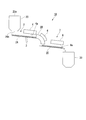
- FIG. 1 is a schematic diagram of a sorting apparatus according to the first embodiment.
- the sorting device 10 includes a transfer path 2, a magnetized magnet (hereinafter referred to as a first magnet) 4, a static eliminator 6, and an attracting magnet (hereinafter referred to as a second magnet) 8.
- a raw material hopper 20 is disposed on one end side of the sorting apparatus 10, and a temporary storage hopper 30 disposed on the processing apparatus side is disposed on the other end side.
- the raw material hopper 20 has an opening 20a at one end and a discharge port 20b at the other end.
- the temporary storage hopper 30 stores the resin powder particles that have passed through the sorting device 10.
- the flexible container is an example of the temporary storage hopper 30.
- a processing device may be provided instead of the temporary storage hopper 30.
- the side on which the raw material hopper 20 is disposed may be referred to as an upstream side, and the side on which the processing apparatus or temporary storage hopper 30 is disposed may be referred to as a downstream side.
- the transfer path 2 is a path for transferring the resin pellets (resin particles) 3 from the raw material hopper 20 toward the temporary storage hopper 30 or the processing apparatus.
- the transfer path 2 includes a trough (first transfer path) 2A, a transfer pipe (second transfer path) 2B, and a slope (third transfer path) 2C.
- FIG. 1 is an example of the transfer path 2 and does not necessarily have to be divided into multiple stages. For example, it may consist of a series of slopes.
- the resin pellet is produced by a known method.
- the raw material resin is heated and kneaded, extruded into a strand shape or a rod shape through a strand die, and cut with a cutter such as a cutter to produce resin pellets.
- a cutter such as a cutter to produce resin pellets.
- the magnetic foreign matter may adhere to or mix in the resin pellets.
- Resin kneading is performed using, for example, a mixer, a single / biaxial kneader, a Brabender, or the like.
- the resin temperature at the time of kneading is typically 20 to 150 ° C. higher than the higher one of the glass transition temperature and the melting point of the resin.
- the pellet When extruded into a strand shape, the pellet has a circular or oval cross section and an average diameter of 0.1 to 15 mm.
- the length of the pellet is 0.1 to 15 mm and can be appropriately changed according to the purpose.
- the strand cutting mode includes, for example, a cold cutting method in which a rod-like strand extruded from a die hole is solidified by water cooling and a hot cutting method in which cutting is performed immediately after being extruded from a die hole. .
- the strands and the resin pellets may be simply neutralized.
- An example of the static elimination method is an ion shower.
- an ion shower there is a method in which oxygen molecules, nitrogen molecules, and the like in the air are ionized and ions are blown against the object.
- Examples of the timing of the ion shower include when a strand before cutting is formed, when a strand is cut to produce a resin pellet, and when the produced resin pellet 3 is accommodated in a flexible container. In practice, ion showers are often omitted from the viewpoint of cost.
- Resin pellets include, for example, polyvinyl chloride, ethylene / vinyl acetate copolymer, ethylene / vinyl chloride copolymer, polystyrene ethylene / vinyl chloride copolymer, ethylene / vinyl acetate copolymer, polystyrene, AS resin, MBS resin.
- ABS resin other aromatic vinyl compound resins, nylon 6, polyacetal / nylon 6, nylon 6.6, acrylic resins, other polyamides, polybutylene terephthalate, polyethylene terephthalate, other polyesters, polycarbonate, polyphenylene sulfide, Polyetherimide, polyarylate, polyethylene, polypropylene, a mixture thereof and the like can be used.
- polyolefins such as polyethylene and polypropylene are highly versatile.
- the transfer path 2 preferably has a vibration feeder (movement control mechanism).
- the vibration feeder vibrates the transfer path 2 and makes the transfer amount of the resin pellets 3 transferred along the transfer path 2 substantially constant.
- an electromagnetic solenoid or the like can give vibration to the transfer path 2.
- the transfer amount per unit time of the resin pellet 3 transferred on the transfer path 2 becomes substantially constant by this vibration.
- the vibration feeder is preferably disposed on the trough 2A that first receives the resin pellet 3 supplied from the raw material hopper 20.
- the sorting device 10 adsorbs and removes magnetic foreign matter adhering to the resin pellet 3 with a second magnet 8 described later.
- magnetic foreign matters that cannot be separated and mixed into the resin pellets 3 are adsorbed and removed together with the resin pellets. Therefore, the function to adjust the transfer amount of the resin pellet 3 in the slope 2C where the second magnet 8 is disposed is required.
- the transfer amount of the resin pellet 3 in the trough 2A substantially constant, the transfer amount of the resin pellet 3 in the slope 2C can be adjusted to be substantially constant.
- the vibration feeder is not limited to the mechanism such as the electromagnetic solenoid described above. Any mechanism can be used as long as it can transfer the resin pellet 3 to a substantially constant amount.
- a mechanism using a screw feeder or a rotary valve may be used. Even with such a mechanism, a substantially constant amount of the resin pellets 3 can be transferred per unit time.
- the first magnet 4 is disposed on the trough 2A. Although the 1st magnet 4 is not essential, if the 1st magnet 4 is provided, the removal precision of a magnetic foreign material will increase more.
- the first magnet 4 magnetizes the magnetic foreign matter adhering to or mixed in the resin pellet 3.
- the first magnet 4 forms a magnetic field in the trough 2A. When the magnetic foreign matter attached to or mixed in the resin pellet 3 passes through the formed magnetic field, the magnetization in the magnetic foreign matter is directed in a certain direction and magnetized.
- the shape of the first magnet 4 is not particularly limited.
- the first magnet 4 is preferably one that can form a uniform magnetic field in the width direction of the trough 2A.
- the first magnet 4 may be formed in an elongated rectangular shape and may have a magnetized surface that generates a substantially uniform magnetic flux density in the longitudinal direction.
- the first magnet 4 that forms a substantially uniform magnetic flux density in the longitudinal direction can form a uniform magnetic field.
- the longitudinal direction of the first magnet 4 is aligned with a direction substantially perpendicular to the transfer direction of the resin pellet 3.
- the magnetized surface 4a of the first magnet 4 is opposed to the trough 2A.
- the magnetized surface 4a and the trough 2A are arranged at a predetermined interval, and the resin pellet 3 passes between the magnetized surface 4a and the trough 2A.
- the gap between the magnetized surface 4a and the trough 2A is preferably as narrow as possible while being separated so that the first magnet 4 does not contact the resin pellet 3.
- the first magnet 4 may be a permanent magnet or an electromagnet.
- an electromagnet power supply is required, but the magnetic field strength to be formed can be freely controlled.
- a permanent magnet eliminates the need for electric power to form a magnetic field, and the running cost can be reduced.
- the distance between the trough 2A and the magnetized surface 4a is appropriately adjusted in consideration of the surface magnetic flux density necessary for magnetization, the size of the resin pellet 3 to be transferred, and the like.
- the first magnet 4 having a surface magnetic flux density of 5000 to 30000 Gauss is separated from the trough 2A by 10 to 12 mm through which the resin pellet 3 can pass, and the resin pellet 3 passing between the trough 2A and the first magnet 4 is formed.
- the surface magnetic flux density generated on the surface of the trough 2A for magnetization is determined in accordance with the type and amount of magnetic foreign matters considered to be attached to or mixed in the resin pellet 3 and the required removal accuracy.
- the distance between the trough 2A and the magnetized surface 4a can be adjusted as appropriate.
- the first magnet 4 having a surface magnetic flux density of 10,000 Gauss (1.0 Tesla) is separated from the trough 2A by 10 to 12 mm through which the resin pellet 3 can pass, and passes between the trough 2A and the first magnet 4.
- a magnetic field of about 0.5 Tesla (5000 gauss) may be applied to the resin pellet 3.
- the surface magnetic flux density of 1.5 Tesla, 2.0 Tesla, 2.5 Tesla, 2.7 Tesla, and 3.0 Tesla is stronger while the distance between the trough 2A and the first magnet 4 is 10 to 12 mm.
- a stronger magnetic field may be formed using the first magnet 4 having the following.
- the distance between the slope 2A and the magnetized surface 4a is preferably set to an appropriate interval according to the size of the resin pellet 3 so that the resin pellet 3 does not contact the magnetized surface 4a.
- the first magnet 4 preferably has a magnetic flux density of 0.5 Tesla or higher.
- the magnetic flux density is more preferably 1.0 Tesla or more, further preferably 1.5 Tesla or more, and particularly preferably 2.0 Tesla or more. Since the first magnet 4 has a sufficient magnetic flux density, even a minute magnetic foreign matter is surely magnetized.
- the static eliminator 6 is provided in the transfer pipe 2B.
- the upper surface of the transfer pipe 2B is opened and an ionizer or the like is provided.
- an ionizer which is an example of the static eliminator 6 is used will be described as an example.
- the ionizer 6 supplies ions.
- the ionizer 6 can supply positive (positive) ions and negative (negative) ions, and the supply amount of positive ions and negative ions is controlled by a controller (not shown).
- the ionizer 6 includes a positive ion discharge needle and a negative ion discharge needle, and generates a corona discharge by applying a voltage to each discharge needle.
- the positive ions or negative ions generated thereby are supplied through an ion supply port (not shown).
- the supply port of the ionizer 6 is directed to the transfer pipe 2B.
- the ions supplied from the ion supply port neutralize the transferred resin pellets 3.
- the positive ion concentration or negative ion concentration may be adjusted manually or automatically.
- the ion concentration supplied from the ionizer 6 is adjusted from the required ion supply amount according to the charge amount of the resin pellet 3.
- the ionizer 6 neutralizes the resin pellet 3 when the resin pellet 3 is transferred through the transfer pipe 2B. Therefore, static electricity is removed from the resin pellet 3 supplied to the slope 2C. When static electricity is removed, it is possible to avoid that magnetic adsorption is hindered or reduced in the second magnet 8 described later.
- a sensor for detecting the charge level may be provided in the transfer path.
- a signal from this sensor is processed to determine the charge level of the resin pellet 3 by a detection circuit, and the supply amount of positive and negative ions is adjusted based on the charge level determined by the detection circuit.
- the transfer tube 2B In order to disperse ions as uniformly as possible in the transfer tube 2B, it is preferable to supply air containing ions (air) at a predetermined wind pressure.
- the wind pressure is not particularly limited, but if the resin pellets 3 move, they may collide with each other and generate static electricity. Therefore, the wind pressure at which the resin pellet 3 is stationary is preferable.
- the resin pellet 3 moves in the atmosphere filled with this air. As a result, the resin pellets can be neutralized in a relatively short time. This method makes it possible to remove electricity in a shorter time than a method of removing electricity by grounding, thereby improving the yield.
- the sorting device becomes compact.
- the second magnet 8 constructs the magnetic adsorption region 7 on the slope 2C.
- the magnetic adsorption region 7 is formed, for example, in a housing (not shown) surrounding the slope 2C through which the resin pellet 3 flows down and the second magnet 8 arranged on the slope 2C at a predetermined interval.
- the slope 2C has, for example, an inclined surface (moving surface) having an inclination of 15 ° to 30 ° from the horizontal direction, and the resin pellet 3 flows down on the inclined surface.
- the magnetic adsorption region 7 constructed by the second magnet 8 adsorbs magnetic foreign matters adhering to or mixed with the resin pellets 3 flowing down the slope 2C.
- the second magnet 8 adsorbs the magnetic foreign matter, the magnetic foreign matter is removed from the resin pellet 3 supplied to the temporary storage hopper 30 or the like. Further, since the magnetic foreign matter is magnetized by the first magnet 4, it is removed without leakage by the second magnet 8.
- the magnetic foreign matter mixed in the resin pellet 3 flowing down on the slope 2C is adsorbed on the adsorption surface of the second magnet 8.
- the user periodically removes and collects the magnetic foreign matter adsorbed on the adsorption surface. Thereby, the 2nd magnet 8 can be used continuously.
- the separation interval between the slope 2C and the second magnet 8 may be an interval that allows the resin pellets to pass therethrough. If it is too far apart, the strength of the magnetic field acting on the resin pellet 3 will decrease. Therefore, it is preferable that the second magnet 8 be as close to the slope 2C as possible so as not to contact the resin pellet 3.
- the second magnet 8 may be formed in an elongated rectangular shape, and a magnetic attraction surface 8a that generates a substantially uniform magnetic flux density in the longitudinal direction may be provided.
- the second magnet 8 that forms a substantially uniform magnetic flux density in the longitudinal direction can form a uniform magnetic field.
- the longitudinal direction of the second magnet 8 is aligned with a direction substantially perpendicular to the transfer direction of the resin pellet 3. Further, the magnetic attracting surface 8a of the second magnet 8 is disposed to face the slope 2C.
- the magnetic adsorption surface 8a and the slope 2C are arranged at a predetermined interval, and the resin pellet 3 passes between the magnetic adsorption surface 8a and the slope 2C.
- the distance between the magnetic adsorption surface 8a and the slope 2C is preferably as narrow as possible from the viewpoint of the magnetic strength applied to the resin pellet 3.
- the second magnet 8 may be a permanent magnet or an electromagnet.
- an electromagnet power supply is required, but the magnetic field strength to be formed can be freely controlled. Permanent magnets do not require electric power to form a magnetic field, and running costs can be reduced.
- the distance between the slope 2C and the magnetic adsorption surface 8a can be adjusted as appropriate.
- the second magnet 8 having a surface magnetic flux density of 10,000 Gauss (1.0 Tesla) is separated from the slope 2C by 10 mm through which the resin pellet 3 can pass, and the resin pellet that passes between the slope 2C and the second magnet 8 is passed. 3 may be provided with a magnetic field of about 0.5 Tesla (5000 Gauss).
- the distance between the slope 2C and the second magnet 8 is 10 mm, and the surface magnetic flux density is 1.5 tesla, 2.0 tesla, 2.5 tesla, 2.7 tesla, and 3.0 tesla.
- the second magnet 8 may be used to form a stronger magnetic field.
- the distance between the slope 2C and the magnetic adsorption surface 8a is preferably set to an appropriate interval according to the size of the resin pellet 3 so that the resin pellet 3 does not contact the magnetic adsorption surface 8a.
- the second magnet 8 preferably has a magnetic flux density of, for example, 0.5 Tesla or more as described above.
- the magnetic flux density is more preferably 0.8 Tesla or more, further preferably 1.0 Tesla or more, still more preferably 1.5 Tesla or more, and 2.5 to 2.7 Tesla or more. Is particularly preferred.
- an appropriate magnetic field is formed on the slope 2C. As a result, the accuracy of removing the magnetic foreign matter adhering to the resin pellet or the resin pellet mixed with the magnetic foreign matter is increased.
- the magnetic flux density of the second magnet 8 is preferably equal to or greater than the magnetic flux density of the first magnet 4.
- the magnetic foreign matter adhering to or mixed in the resin pellet 3 is suitably removed. Further, by eliminating the charge with the static eliminator 6, the influence of electrostatic force is avoided and the magnetic foreign matter adsorption accuracy is further increased. Furthermore, before the magnetic foreign matter is attracted by the second magnet 8, the magnetic foreign matter is magnetized by the first magnet 4, thereby increasing the accuracy of removing the magnetic foreign matter.
- the size of the magnetic foreign matter that can be removed by the sorting apparatus 10 according to the above aspect varies from 20 ⁇ m to several hundred ⁇ m, and in particular, magnetic foreign matter having a size of 20 ⁇ m to 100 ⁇ m can be removed. In particular, magnetic foreign matters having a size of 50 ⁇ m or less can be removed with high accuracy.
- Whether magnetic foreign matter is attached to the resin pellet or whether it is mixed can be determined by monitoring the fluctuation of the magnetic field due to the magnetic foreign matter moving in the magnetic field. .
- Examples of means for detecting a magnetic field include magnetic field detection devices such as a gauss meter, a loop coil, and a magnetometer using a magnetic impedance element (MI element).
- magnetic field detection devices such as a gauss meter, a loop coil, and a magnetometer using a magnetic impedance element (MI element).
- MI element magnetic impedance element
- a microscopic image of the resin pellet is acquired, and the acquired image is compared with a foreign object image created in advance.
- the slope angle steeper if you want to increase the transfer speed of the resin pellet 3, make the slope angle steeper.
- the amount of ions supplied from the ionizer is preferably increased as the slope angle is changed to a steeper angle.
- the resin pellet 3 put into the opening 20a of the raw material hopper 20 is discharged from the outlet 20b of the raw material hopper 20 to the trough 2A.
- the discharged resin pellets 3 are transferred from the upstream to the downstream of the trough 2A while the transfer amount per unit time is made substantially uniform by the vibration feeder.
- a first magnet 4 is disposed on the trough 2A. The first magnet 4 magnetizes magnetic foreign matter adhering to or mixed in the resin pellet 3 to be transferred.
- the resin pellet 3 transferred to the downstream side of the trough 2A is sent to the slope 2C through the transfer pipe 2B.
- the resin pellet 3 is neutralized by positive ions or negative ions supplied from the ion supply port of the ionizer 6.
- the discharged resin pellet 3 is sent to the upstream side of the slope 2C and flows down on the slope 2C from the upstream side to the downstream side.
- a second magnet 8 is disposed on the slope 2C.
- the second magnet 8 applies a magnetic field to the resin pellet 3 flowing down the slope 2C.
- the magnetic foreign matter adhering to or mixed in the resin pellet 3 is adsorbed by the second magnet 8 when the resin pellet 3 passes through a clearance of a predetermined interval provided between the second magnet 8 and the slope 2C. Removed.
- the resin pellet 3 from which the magnetic foreign matter has been removed is stored in the temporary storage hopper 30.
- the sorting apparatus neutralizes the resin pellet 3 with the ionizer 6 in advance. Then, the magnetic foreign matter is magnetically adsorbed by the second magnet 8 from the resin pellet 3 that has been neutralized. Therefore, the influence of the electrostatic force applied to the resin pellet 3 can be reduced, and magnetic foreign matters having a size of around 50 ⁇ m can be more reliably removed. In addition, it is possible to avoid reattachment of magnetic foreign matters due to electrostatic force.
- the first magnet 4 magnetizes a magnetic foreign object. By magnetizing the magnetic foreign matter before reaching the second magnet 8, the magnetic foreign matter can be attracted and removed more reliably in the second magnet 8.
- the present invention is not necessarily limited to the configuration of the sorting apparatus 10 shown as the first embodiment. Various modifications can be made without departing from the spirit of the present invention.
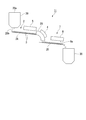
- the arrangement order of the first magnet 4 and the ionizer 6 may be changed as in the sorting device 11 shown in FIG. Even in this case, magnetization by the first magnet 4 and static elimination by the ionizer 6 are performed before reaching the second magnet 8. However, if the resin pellet 3 is transported for a long distance after being neutralized by the ionizer 6, there is a risk that charging due to static electricity will occur again. Therefore, the distance between the ionizer 6 and the second magnet 8 is preferably as short as possible.
- first magnet 4 and the ionizer 6 may be present on the trough 2A as in the sorting device 12 shown in FIG. Even in this case, magnetization by the first magnet 4 and static elimination by the ionizer 6 are performed before reaching the second magnet 8.
- first magnet 4, the ionizer 6 and the second magnet 8 are all disposed on the trough 2A, or the first magnet 4, the ionizer 6 and the second magnet 8 are all disposed on the slope 2C. May be.
- the number of ionizers 6 is not necessarily one, and may be arranged on the downstream side of the trough 2A, the upstream side of the transfer pipe 2B, and the slope 2C, for example.
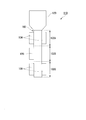
- FIG. 4 is a schematic diagram of a sorting apparatus according to the second embodiment.
- the sorting device 110 includes a transfer path 102, a first magnet 104, a static eliminator 106, and a second magnet 108.
- a raw material hopper 120 is disposed on one end side of the sorting device 110, and a temporary storage hopper (not shown) is disposed on the other end side.
- the transfer path 102 includes a first area 102A, a second area 102B, and a third area 102C.
- a first magnet 104 is disposed along the transfer path 102 in the first region 102A
- an ionizer 106 is disposed in the second region 102B
- a second magnet 108 is disposed in the third region 102C.
- Each of the first magnet 104, the ionizer 106, and the second magnet 108 can be the same as the first magnet 4, the ionizer 6, and the second magnet 8 in the first embodiment.
- the resin pellets discharged from the lower part of the raw material hopper 120 are freely dropped by gravity. In the process of free fall, the resin pellets enter the first region 102A.
- the magnetic foreign matter adhering to or mixed in the resin pellet that has entered the first region 102A is magnetized when passing through the magnetic field generated by the first magnet 104.
- the resin pellets that have passed through the first region 102A enter the second region 102B and are neutralized by positive or negative ions supplied from the ionizer 106.
- the discharged resin pellet enters the third region 102 ⁇ / b> C and passes through the magnetic field generated by the second magnet 108.
- the magnetic foreign matter or the pellet mixed with the magnetic foreign matter is adsorbed by the second magnet 108.
- the resin pellet from which the magnetic foreign matter has been removed is stored in a temporary storage hopper or the like (not shown).
- the first magnet 104 and the second magnet 108 are disposed so as to surround the transfer path 102.
- the magnetic foreign matter adhering to or mixed in the resin pellet that freely falls in the transfer path 102 can be more reliably magnetized.
- the transfer path 102 with the second magnet 108 it is possible to more reliably adsorb magnetic foreign substances adhering to or mixed in the resin pellets that freely fall within the transfer path 102.
- the air containing ions supplied from the ionizer 106 preferably reaches the entire surface intersecting the transfer direction of the transfer path 102.
- the air containing the ions can reach the entire surface, so that the resin pellets can be discharged without unevenness.
- the magnetic foreign matter adhering to or mixed in the resin pellet can be suitably removed.
- the static eliminator 106 eliminates static electricity, the magnetic foreign matter can be adsorbed and removed from the resin pellet without being affected by electrostatic force.
- the magnetic foreign matter can be removed more accurately by being magnetized by the first magnet 104 before the magnetic foreign matter is attracted by the second magnet 108. As a result, high quality resin pellets can be provided.
- the size of the magnetic foreign matter that can be removed by the sorting device 110 according to the second embodiment varies from 20 ⁇ m to several hundred ⁇ m. Particularly, the magnetic foreign matter having a size of 20 ⁇ m to 100 ⁇ m can be removed. Magnetic foreign matter can be accurately removed.
- the resin particle group according to the present embodiment includes a plurality of resin powder bodies.
- the resin granular material contained in the bag is regarded as one resin granular material group.
- resin particles constituting the resin particle group examples include the resin pellets and resin powders described above.
- Resin pellets and resin powder are shipping forms when shipping the raw resin, and are generally specified by size.
- a resin pellet is a lump of resin having a size of about 2 to 3 mm, and a powder often refers to a lump of resin having a size equal to or smaller than the pellet size.
- resin pellets are not specified by size, but refer to a general shipping form of resin that has been processed after the resin has been melted, but it can be used properly by size for convenience. Many.
- Magnetic foreign substances are those in which foreign substances accumulated in the process of manufacturing resin particles and the inside of flexible containers that are used repeatedly adhere.
- the metal foreign matter includes one in which a part of the metal blade is mixed when cutting the strand, and one adsorbed by static electricity generated when the resin powder particles collide with each other.
- the proportion of resin particles (hereinafter referred to as foreign material-attached product) to which a magnetic foreign material of 50 ⁇ m or more is attached is 30% or less.
- the ratio of the foreign matter adhered product is preferably 20% or less, and more preferably 10% or less.
- Resin particles in the resin powder group affect the quality of the manufactured product. Large magnetic foreign matters having a size of 50 ⁇ m or more, and a large number of magnetic foreign matters having a size of 50 ⁇ m or less deteriorate the product quality.
- the resin particle group according to the present embodiment has a low ratio of foreign matter-adhered products or foreign-contaminated products, and the size of magnetic foreign matter adhering to foreign-adhered products or foreign-contaminated products is also small. Used for. In particular, in the case of a resin film, the adhered foreign matter causes molding defects such as fish eyes. Therefore, in production of a resin film, the resin particle group according to the present embodiment is suitably used.
- the resin particle group according to the present embodiment is very valuable in terms of mass productivity of products such as resin films.
- the total weight of the flexible container in which the resin particles are packed is 500 kg to 1000 kg. That is, the number of resin particles packed in one flexible container becomes enormous. For this reason, it is not practical to evaluate each individual resin particle in the normal mass production process, and the group of resin particles is used collectively for product processing.
- the resin particle group in which the ratio of foreign matter adhered products or foreign matter contaminated products is reduced is obtained using the above-described sorting apparatus.
- the above sorter can also remove magnetic foreign matters having a size of around 50 ⁇ m. Therefore, among the plurality of resin powder particles included in the resin powder particle group, the ratio of the resin powder particles to which magnetic foreign matters of 50 ⁇ m or more are attached or mixed can be set to 30% or less. Depending on the conditions of the sorting apparatus, the ratio of resin particles with a magnetic foreign matter of 50 ⁇ m or more adhering or mixed among a plurality of resin particles may be 20% or less, or 10% or less. it can.
- Patent Documents 4 to 7 cannot remove magnetic foreign matters with an accuracy of a size of 50 ⁇ m. Also these devices.
- the processing capacity per unit time is low and there are many problems.
- a high-quality resin product can be obtained by using the resin particle group according to the present embodiment.
- the resin film concerning this embodiment is obtained from the above-mentioned resin granular material group.
- the resin film has a magnetic foreign matter detection rate of 50 ⁇ m or more, 140 mm 2 or less per 1 m 2 in terms of thickness per 10 ⁇ m.
- the “magnetic foreign matter detection rate” is obtained as follows. First, in the in-plane direction of the resin film, a magnetic foreign matter detection area per unit area (1 m 2 ) is obtained. And since the amount of resin to be used differs depending on the thickness of the resin film, it is converted by the detection area per 10 ⁇ m thickness.
- the resin film is obtained by melting the resin particle group. For this reason, the adhering foreign matter of the resin powder group is mixed in the resin film. As described above, since the ratio of foreign matter adhered products in the resin particle group is reduced, the amount of magnetic foreign matter detected in the resin film is also reduced.
- the ratio of whether magnetic foreign matter is mixed in the resin film can be determined by monitoring the fluctuation of the magnetic field due to the magnetic foreign matter moving in the magnetic field.
- Examples of means for detecting a magnetic field include magnetic field detection devices such as a gauss meter, a loop coil, and a magnetometer using a magnetic impedance element (MI element).
- magnetic field detection devices such as a gauss meter, a loop coil, and a magnetometer using a magnetic impedance element (MI element).
- MI element magnetic impedance element
- the magnetic foreign substance in the resin pellet can be monitored by arranging the magnetic field detection device in the vicinity of the resin film transfer path.
- the location and number of magnetic field detection devices are changed as appropriate to obtain an optimal mode.
- the detection accuracy is increased.
- the resin film can be obtained by a known method. For example, film forming with a T die, inflation forming with an annular die, or the like can be used.
- the resin film may be a resin film obtained by molding a single resin into a single layer, or a resin film in which a plurality of resins are stacked. A resin film in which a plurality of layers are overlapped is obtained by molding using a feed block or molding using a multi-manifold die.
- a separator used for an electricity storage device such as a lithium ion secondary battery.
- the separator is a microporous membrane provided with fine holes.
- the method of forming micropores in the resin film can be roughly classified into a wet method and a dry method from the method of making the pores.
- wet methods include the following methods.
- a mixture obtained by adding and mixing a resin such as polyethylene or polypropylene, which is a matrix resin constituting the microporous film, and an additive is formed into a sheet.
- a resin such as polyethylene or polypropylene
- an additive is extracted from the film which consists of matrix resin and an additive, and a space
- a microporous film is manufactured by extending
- additives solvents, plasticizers, inorganic fine particles and the like that are miscible with the resin have been proposed.
- the dry method there is the following method.
- the lamella structure in the film before stretching formed into a sheet is controlled. And when this sheet
- the separator is obtained from the resin film described above. Therefore, it is a microporous film with a low content of magnetic foreign matter. Specifically, the detection rate of 50 ⁇ m or more magnetic foreign matter, the thickness in terms of per 20 [mu] m, is 1 m 2 per 170 mm 2 or less.
- the resin film before stretching was converted with a thickness of 10 ⁇ m, but the separator after stretching was converted with a thickness of 20 ⁇ m.
- Such a separator can be suitably used for an electricity storage device such as a lithium ion battery. Since the content of magnetic foreign matter is small, the risk of occurrence of troubles such as short circuit and ignition is reduced or eliminated. That is, a high quality power storage device can be obtained.
- the detection sensitivity of the magnetic foreign matter reaction was adjusted to 100% detectable conditions by inspecting iron particles having a diameter of 50 ⁇ m.
- Ratio (%) of resin powder particles to which magnetic foreign matters are attached N (pieces) / 2000 (pieces) ⁇ 100 It means that the lower the proportion of the resin powder particles to which magnetic foreign substances are attached, the fewer pellets in which magnetic foreign substances are mixed and attached. By processing pellets with a small amount of magnetic powder adhered, it is possible to provide processed products such as films with less magnetic foreign matter.
- the inspection was conducted at 5 locations with an area of 20 cm ⁇ 10 cm.
- the total area was 0.1 m 2 .
- Area magnetic foreign object is detected, expressed in units of mm 2. By dividing by the area of the inspected film, the detection area mm 2 / m 2 of magnetic foreign matter per unit area is obtained.
- the average value of the measured values was calculated and evaluated as the average value of the detection areas. Furthermore, since the amount of resin used varies depending on the thickness of the film, the unstretched film has a detection area per thickness of 10 ⁇ m, and the stretched microporous film has a thickness of about 20 ⁇ m. Evaluation was based on the detection area.
- Example 1 The difference from Example 1 is that the static eliminator was not used. Other conditions were the same as in Example 1. About the resin particle body group after removal, the amount of magnetic foreign materials was investigated using the highly sensitive metal foreign material detector. The ratio of the resin powder particles to which the magnetic foreign matter was attached was 43.8% by number. That is, the yield rate was 56.2%.
- Example 2 The point which changed resin which comprises a resin granular material into polyethylene (PE) differs from Example 1.
- FIG. Other conditions were the same as in Example 1.
- the ratio of the resin powder particles to which the magnetic foreign matter was attached was 9.3% by number. That is, the yield rate was 90.7%.
- Comparative Example 3 The point which changed resin which comprises a resin granular material into polyethylene (PE) differs from the comparative example 1.
- FIG. Other conditions were the same as in Example 1.
- the ratio of the resin powder particles to which the magnetic foreign matter was attached was 47.6% by number. That is, the yield rate was 52.4%.
- Comparative Example 4 The point which changed resin which comprises a resin granular material into polyethylene (PE) differs from the comparative example 2. Other conditions were the same as in Example 1. The ratio of the resin powder particles to which the magnetic foreign matter was attached was 53.9% by number. That is, the yield rate was 46.1%.
- Example 3 The conditions were the same as in Example 2 except that the surface magnetic flux density of the second magnet was 15000 gauss (1.5 Tesla). About the resin particle body group after removal, the amount of magnetic foreign materials was investigated using the highly sensitive metal foreign material detector. The ratio of the resin powder particles to which the magnetic foreign matter was attached was 6.8% by number. That is, the yield rate was 93.2%.
- Comparative Example 5 The conditions were the same as in Comparative Example 3 except that the surface magnetic flux density of the second magnet was 15000 gauss (1.5 Tesla). About the resin particle body group after removal, the amount of magnetic foreign materials was investigated using the highly sensitive metal foreign material detector. The ratio of the resin powder particles to which the magnetic foreign matter was attached was 49.6% by number. That is, the yield rate was 50.4%.
- Example 4 The point where the first magnet (magnetization magnet) for magnetizing the resin foreign matter adhering to the resin pellet is provided, and the surface magnetic flux density of the second magnet (adsorption magnet) for adsorbing the resin foreign matter is 10,000 gauss (1.0 Tesla). Except for the points described above, the conditions were the same as in Example 1.
- each device magnetic flux density of the first magnet, ionizer, second magnet and first magnet (magnetized magnet: electromagnet) from the upstream side: 10000 gauss (1.0 Tesla) -Ionizer: Panasonic device SUNX ER-X016 -Wind pressure of air containing positive / negative ions from ionizer: 0.5 MPa ⁇
- the magnetic flux density of the second magnet is 10,000 Gauss (1.0 Tesla) -Clearance between moving surface of resin pellet and magnet: 10mm -Resin pellets used: Polypropylene (PP)
- the amount of magnetic foreign materials was investigated using the highly sensitive metal foreign material detector.
- the ratio of the resin powder particles to which the magnetic foreign matter was attached was 9% by number. That is, the yield rate was 91%.
- Example 5 The difference from Example 4 is that the resin constituting the resin powder is changed to polyethylene (PE). Other conditions were the same as in Example 4. The ratio of the resin powder particles to which the magnetic foreign matter was attached was 5% by number. That is, the yield rate was 95%.
- PE polyethylene
- Example 6 The difference from Example 4 is that the surface magnetic flux density of the second magnet (adsorption magnet) that adsorbs the resin foreign matter is 20000 Gauss (2.0 Tesla), and the wind pressure of the air supplied from the ionizer is 0.3 MPa. Other conditions were the same as in Example 4. It was confirmed that the charge level of the resin pellets discharged from the transfer tube was 0V.
- the ratio of the resin powder particles to which the magnetic foreign matter was attached was 3% by number. That is, the yield rate was 97%.
- Example 7 The difference from Example 4 is that the resin constituting the resin powder is changed to polyethylene (PE). Other conditions were the same as in Example 6. The ratio of the resin powder particles to which the magnetic foreign matter was adhered was 2% by number. That is, the yield rate was 98%.
- Example 8 The surface magnetic flux density of the first magnet (adsorption magnet) that adsorbs resin foreign matter is 20000 gauss (2.0 tesla), the surface magnetic flux density of the second magnet (adsorption magnet) is 27000 gauss (2.7 tesla), and the ionizer Example 4 is different from Example 4 in that the wind pressure of the air supplied from is set to 0.2 MPa. Other conditions were the same as in Example 4.
- the ratio of the resin powder particles to which the magnetic foreign matter was attached was 2% by number. That is, the yield rate was 98%.
- Example 9 The difference from Example 4 is that the resin constituting the resin powder is changed to polyethylene (PE). Other conditions were the same as in Example 8. The ratio of the resin powder particles to which the magnetic foreign matter was adhered was 2% by number. That is, the yield rate was 98%.
- Example 10 The difference from Example 4 is that the wind pressure of the air supplied from the ionizer is 0.2 MPa. Other conditions were the same as in Example 4. The ratio of the resin powder particles to which the magnetic foreign matter was attached was 5% by number. That is, the yield rate was 95%.
- Example 11 The difference from Example 4 is that the resin constituting the resin powder is changed to polyethylene (PE). Other conditions were the same as in Example 10. The ratio of the resin powder particles to which the magnetic foreign matter was adhered was 2% by number. That is, the yield rate was 98%.
- Example 12 A film was formed using the PP pellets of Example 1. PP was melt extruded at a T die temperature of 200 ° C. The discharged film was guided to a cooling roll at 90 ° C., cooled with 37.2 ° C. cold air, and then cooled to 40 m / min. I picked it up. The film thickness of the obtained unstretched polypropylene film was 8.1 ⁇ m.
- the average value of the detection area of the magnetic foreign substances was 71 mm 2 / m 2 .
- Example 6 A film was obtained in the same manner as in Example 12 except that the PP pellets of Comparative Example 2 were used. The obtained PP film was investigated with magnetic foreign objects using alternating current gauss meter, the average value of the detection area of the magnetic foreign object was 232mm 2 / m 2.
- Example 13 A film was formed using the PE pellets of Example 2. PE was melt extruded at a T die temperature of 173 ° C. The discharged film was guided to a 115 ° C. cooling roll, cooled by blowing cold air of 39 ° C., and then 20 m / min. I picked it up. The film thickness of the obtained unstretched polyethylene film was 9.4 ⁇ m.
- the average value of the detection area of the magnetic foreign substances was 66 mm 2 / m 2 .
- Example 7 A film was obtained in the same manner as in Example 12 except that the PE pellet of Comparative Example 4 was used. When the obtained PE film was examined for magnetic foreign substances using an alternating current gauss meter, the average value of the magnetic foreign substance detection area was 139 mm 2 / m 2 .
- Example 14 The PP film of Example 12 and the PE film of Example 13 were thermocompression bonded, and then thermally stretched to produce a separator film for an electricity storage device comprising a microporous film having a three-layer structure of PP / PE / PP. .
- Table 3 summarizes the physical properties of the produced separator film. The obtained separator film, was examined with magnetic foreign objects using alternating current gauss meter, the average value of the detection area of the magnetic foreign object was 110mm 2 / m 2.
- Example 15 A separator having a thickness of about 12 ⁇ m was prepared in the same manner as in Example 14 except that the film thicknesses of the PP film (Example 12) and the PE film (Example 13) were adjusted.
- Example 16 A separator having a thickness of about 16 ⁇ m was produced in the same manner as in Example 14 except for the PP film (Example 12) and the PE film (Example 13).
- Example 17 A separator having a thickness of about 25 ⁇ m was produced in the same manner as in Example 14 except for the PP film (Example 12) and the PE film (Example 13).
- Example 18 A separator having a thickness of about 30 ⁇ m was produced in the same manner as in Example 14 except for the PP film (Example 12) and the PE film (Example 13).
- Example 19 A separator having a thickness of about 40 ⁇ m was prepared in the same manner as in Example 14 except that the thicknesses of the PP film (Example 12) and the PE film (Example 13) were adjusted.
Landscapes
- Chemical & Material Sciences (AREA)
- Engineering & Computer Science (AREA)
- Chemical Kinetics & Catalysis (AREA)
- Electrochemistry (AREA)
- General Chemical & Material Sciences (AREA)
- Polymers & Plastics (AREA)
- Organic Chemistry (AREA)
- Health & Medical Sciences (AREA)
- Medicinal Chemistry (AREA)
- Manufacturing & Machinery (AREA)
- Power Engineering (AREA)
- Materials Engineering (AREA)
- Mechanical Engineering (AREA)
- Microelectronics & Electronic Packaging (AREA)
- Composite Materials (AREA)
- Inorganic Chemistry (AREA)
- Processing And Handling Of Plastics And Other Materials For Molding In General (AREA)
- Processes Of Treating Macromolecular Substances (AREA)
- Manufacture Of Macromolecular Shaped Articles (AREA)
- Cell Separators (AREA)
Abstract
Description
特許文献1及び2に記載の方法は、溶融状態の樹脂をストランドダイからストランド状に押し出し、ペレタイザーでカッティングして樹脂ペレットを得ている。また特許文献3に記載の方法は、溶融状態の樹脂を水中にダイスから押出、ダイスの表面近傍又はダイスに接触して設けられた回転刃を用いて切断、加工することで、樹脂ペレットを得ている。
(第1実施形態)
図1は、第1実施形態に係る選別装置の概略図である。
図1に示すように、選別装置10は、移送路2と、着磁磁石(以下、第1磁石という)4と、除電器6と、吸着磁石(以下、第2磁石という)8とを有する。選別装置10の一端側には原料ホッパ20が配設され、他端側には加工装置側に配置された一時貯留ホッパ30が配設されている。
例えば、原料樹脂を加熱混練し、ストランドダイを通してストランド状または棒状に押出し、カッターなどの切断器で切断して、樹脂ペレットは作製される。この切断器により切断される際に、磁性異物が樹脂ペレットに付着又は混入することがある。
ストランドの切断態様としては、例えば、ダイの孔から押し出された棒状のストランドを水冷固化して切断する冷間切断や、ダイの孔から押し出された直後に切断する熱間切断などの方式がある。
原料ホッパ20の開口20aに投入された樹脂ペレット3は、原料ホッパ20の排出口20bからトラフ2Aに排出される。排出された樹脂ペレット3は、振動フィーダにより単位時間当たりの移送量を略均一にされながら、トラフ2Aの上流から下流に向けて移送される。トラフ2A上には、第1磁石4が配置されている。この第1磁石4は、移送される樹脂ペレット3に付着または混入している磁性異物を着磁する。
図4は、第2実施形態に係る選別装置の概略図である。図4に示すように、第2実施形態に係る選別装置110は、移送路102と、第1磁石104と、除電器106と、第2磁石108とを有する。選別装置110の一端側には原料ホッパ120が配設され、他端側には図示略の一時貯留ホッパ等が配設される。
本実施形態にかかる樹脂粉粒体群は、複数の樹脂粉粒体を含む。一つの袋体(フレキシブルコンテナ等)に樹脂粉粒体を梱包する場合は、袋体内に含まれた樹脂粉粒体を一つの樹脂粉粒体群とみなす。
本実施形態にかかる樹脂フィルムは、上述の樹脂粉粒体群から得られる。樹脂フィルムは、50μm以上の磁性異物の検出率が、10μmあたりの厚み換算で、1m2当り140mm2以下である。
上記、湿式法、乾式法を問わず、リチウムイオン2次電池等の蓄電デバイスに用いられるセパレータにおいては、磁性異物の付着を低減した樹脂原料を用いることが重要である。
実施例において樹脂粉粒体群の樹脂粉粒体に混入した磁性異物を、高感度な金属異物探知機を用いて検査した。
金属異物探知機として、ジー・エヌ・エス有限会社製の高感度金属異物探知機「ビッター」を用いて、ペレット粒子を2000粒検査した際に、磁性異物反応が検出された個数(N)を調査し、以下式により、磁性異物が付着している樹脂粉粒体の割合を調査した。この金属異物探知機は、100μm以下の磁性異物についても精度良く検出できる。
磁性異物が付着している樹脂粉粒体の割合(%)=N(個)/2000(個)×100
磁性異物が付着している樹脂粉粒体の割合が低ければ低い程、磁性異物が混入・付着しているペレットが少ない事を意味する。磁性粉体の付着量の少ないペレットを加工することで、磁性異物の混入が少ないフイルム等の加工品を提供できる。
樹脂ペレット等を加工した樹脂フィルムおよび、樹脂フィルムを延伸加工したセパレータフィルムに含まれる磁性異物を、ジー・エヌ・エス有限会社製の超高感度交流式ガウスメータ(J-ACMG2型)を用いて検査した。検査感度は、直径50μmの鉄の粒子を100%検出可能な条件にて、0.1m2の試験片について検査し、磁性異物反応が検出された面積を算出した。
検出面積(mm2/m2)
=(5mm2(磁性異物反応面積))/(20cm×10cm(試験片面積))
=250mm2/m2
さらに、フィルムの厚みにより、使用する樹脂の量が異なる為、未延伸フィルムについては、厚さ10μmあたりの検出面積にて、また、延伸し微多孔が空いたフィルムについては、厚さ20μmあたりの検出面積にて評価した。
[実施例1]
振動フィーダで単位時間当たりに一定量の樹脂ペレットを供給しつつ移動面(平面)上の磁石で金属異物を磁気吸着させた。実施条件は以下のとおり:
・イオナイザ:パナソニックデバイスSUNX社製 ER-X016
・イオナイザの配置場所:振動フィーダのトラフ上
・第2磁石(吸着磁石:電磁石)の表面磁束密度:27000ガウス(2.7テスラ)
・樹脂ペレットの移動面と磁石とのクリアランス:10mm
・使用した樹脂ペレット:ポリプロピレン(PP)
・正/負イオンを含有したエアの風圧:0.5MPa
除去後の樹脂粉粒体群について高感度金属異物探知機を用いて異物付着品の比率を調査した。磁性異物が付着している樹脂粉粒体の割合は15.8個数%であった。すなわち、良品率は84.2%であった。
除電器を用いなかった点が実施例1と異なる。その他の条件は実施例1と同一とした。
除去後の樹脂粉粒体群について高感度金属異物探知機を用いて磁性異物量を調査した。磁性異物が付着している樹脂粉粒体の割合は43.8個数%であった。すなわち、良品率は56.2%であった。
市販のPPペレットを選別装置にかけずに、樹脂粉粒体群に含有する異物付着品の量について高感度金属異物探知機を用いて調査した。
磁性異物が付着している樹脂粉粒体の割合は51.9個数%であった。すなわち、良品率は48.1%であった。
樹脂粉粒体を構成する樹脂をポリエチレン(PE)に変えた点が実施例1と異なる。その他の条件は、実施例1と同一とした。
除去後の樹脂粉粒体群について高感度金属異物探知機を用いて磁性異物量を調査した。磁性異物が付着している樹脂粉粒体の割合は9.3個数%であった。すなわち、良品率は90.7%であった。
樹脂粉粒体を構成する樹脂をポリエチレン(PE)に変えた点が比較例1と異なる。その他の条件は、実施例1と同一とした。
除去後の樹脂粉粒体群について高感度金属異物探知機を用いて磁性異物量を調査した。磁性異物が付着している樹脂粉粒体の割合は47.6個数%であった。すなわち、良品率は52.4%であった。
樹脂粉粒体を構成する樹脂をポリエチレン(PE)に変えた点が比較例2と異なる。その他の条件は、実施例1と同一とした。
磁性異物が付着している樹脂粉粒体の割合は53.9個数%であった。すなわち、良品率は46.1%であった。
第2磁石の表面磁束密度を15000ガウス(1.5テスラ)とした点以外は、実施例2と同一の条件とした。
除去後の樹脂粉粒体群について高感度金属異物探知機を用いて磁性異物量を調査した。磁性異物が付着している樹脂粉粒体の割合は6.8個数%であった。すなわち、良品率は93.2%であった。
第2磁石の表面磁束密度を15000ガウス(1.5テスラ)とした点以外は、比較例3と同一の条件とした。
除去後の樹脂粉粒体群について高感度金属異物探知機を用いて磁性異物量を調査した。磁性異物が付着している樹脂粉粒体の割合は49.6個数%であった。すなわち、良品率は50.4%であった。
樹脂ペレットに付着した樹脂異物を着磁する第1磁石(着磁磁石)を設けた点と、樹脂異物を吸着する第2磁石(吸着磁石)の表面磁束密度を10000ガウス(1.0テスラ)とした点以外は、実施例1と同一の条件とした。
・各装置の配置:上流側から第1磁石、イオナイザ、第2磁石
・第1磁石(着磁磁石:電磁石)の磁束密度:10000ガウス(1.0テスラ)
・イオナイザ:パナソニックデバイスSUNX社製 ER-X016
・イオナイザからの正/負イオンを含有したエアの風圧:0.5MPa
・第2磁石(吸着磁石:電磁石)の磁束密度は10000ガウス(1.0テスラ)
・樹脂ペレットの移動面と磁石とのクリアランス:10mm
・使用した樹脂ペレット:ポリプロピレン(PP)
樹脂粉粒体を構成する樹脂をポリエチレン(PE)に変えた点が実施例4と異なる。その他の条件は、実施例4と同一とした。
磁性異物が付着している樹脂粉粒体の割合は5個数%であった。すなわち、良品率は95%であった。
樹脂異物を吸着する第2磁石(吸着磁石)の表面磁束密度を20000ガウス(2.0テスラ)とし、イオナイザから供給されるエアの風圧を0.3MPaとした点が実施例4と異なる。その他の条件は、実施例4と同一とした。移送管から排出される樹脂ペレットの帯電レベルが0Vであることを確認した。
樹脂粉粒体を構成する樹脂をポリエチレン(PE)に変えた点が実施例4と異なる。その他の条件は、実施例6と同一とした。
磁性異物が付着している樹脂粉粒体の割合は2個数%であった。すなわち、良品率は98%であった。
樹脂異物を吸着する第1磁石(吸着磁石)の表面磁束密度を20000ガウス(2.0テスラ)とし、第2磁石(吸着磁石)の表面磁束密度を27000ガウス(2.7テスラ)とし、イオナイザから供給されるエアの風圧を0.2MPaとした点が実施例4と異なる。その他の条件は、実施例4と同一とした。
樹脂粉粒体を構成する樹脂をポリエチレン(PE)に変えた点が実施例4と異なる。その他の条件は、実施例8と同一とした。
磁性異物が付着している樹脂粉粒体の割合は2個数%であった。すなわち、良品率は98%であった。
イオナイザから供給されるエアの風圧を0.2MPaとした点が実施例4と異なる。その他の条件は、実施例4と同一とした。
磁性異物が付着している樹脂粉粒体の割合は5個数%であった。すなわち、良品率は95%であった。
樹脂粉粒体を構成する樹脂をポリエチレン(PE)に変えた点が実施例4と異なる。その他の条件は、実施例10と同一とした。
磁性異物が付着している樹脂粉粒体の割合は2個数%であった。すなわち、良品率は98%であった。

[実施例12]
実施例1のPPペレットを用い、フィルムを成形した。
PPをTダイ温度200℃で溶融押出した。吐出フィルムは90℃の冷却ロ-ルに導かれ、37.2℃の冷風が吹きつけられて冷却された後、40m/min.で引き取った。得られた未延伸ポリプロピレンフイルムの膜厚は8.1μmであった。
比較例2のPPペレットを用いた以外は、実施例12と同様にしてフィルムを得た。得られたPPフィルムについて、交流式ガウスメータを用いて磁性異物ついて調査したところ、磁性異物の検出面積の平均値は、232mm2/m2であった。
実施例2のPEペレットを用い、フィルムを成形した。
PEをTダイ温度173℃で溶融押出した。吐出フィルムは115℃の冷却ロ-ルに導かれ、39℃の冷風を吹きつけて冷却した後、20m/min.で引き取った。得られた未延伸ポリエチレンフイルムの膜厚は9.4μmであった。
比較例4のPEペレットを用いた以外は、実施例12と同様にしてフィルムを得た。得られたPEフィルムについて、交流式ガウスメータを用いて磁性異物ついて調査したところ、磁性異物の検出面積の平均値は、139mm2/m2であった。

実施例12のPPフィルムと、実施例13のPEフィルムを熱圧着した後、熱延伸することで、PP/PE/PPの3層構造の微多孔膜からなる蓄電デバイス用のセパレータフィルムを作製した。作製したセパレータフィルムの物性を表3にまとめた。得られたセパレータフィルムについて、交流式ガウスメータを用いて磁性異物ついて調査したところ、磁性異物の検出面積の平均値は、110mm2/m2であった。
比較例6のPPフィルムと、比較例7のPEフィルムを熱圧着した後、実施例14と同様の手法にて、PP/PE/PPの3層構造の微多孔膜からなる蓄電デバイス用のセパレータフィルムを作製した。得られたセパレータフィルムについて、交流式ガウスメータを用いて磁性異物ついて調査したところ、磁性異物の検出面積の平均値は、186mm2/m2であった。
PPフィルム(実施例12)とPEフィルム(実施例13)の膜厚を調整した以外は、実施例14同様にして、膜厚約12μm厚のセパレータを作製した。
PPフィルム(実施例12)とPEフィルム(実施例13)の以外は、実施例14と同様にして、膜厚約16μm厚のセパレータを作製した。
PPフィルム(実施例12)とPEフィルム(実施例13)の以外は、実施例14と同様にして、膜厚約25μm厚のセパレータを作製した。
PPフィルム(実施例12)とPEフィルム(実施例13)の以外は、実施例14と同様にして、膜厚約30μm厚のセパレータを作製した。
PPフィルム(実施例12)とPEフィルム(実施例13)の膜厚を調整した以外は、実施例14と同様にして、膜厚約40μm厚のセパレータを作製した。

Claims (16)
- 複数の樹脂粉粒体を含む樹脂粉粒体群であって、
前記複数の樹脂粉粒体のうち、50μm以上の磁性異物が付着した樹脂粉粒体の割合が30%以下である、樹脂粉粒体群。 - 前記樹脂粉粒体は、ポリオレフィン樹脂を含む請求項1に記載の樹脂粉粒体群。
- 前記ポリオレフィン樹脂は、ポリエチレン又はポリプロピレンである請求項2に記載の樹脂粉粒体群。
- 請求項1~3のいずれか一項に記載の樹脂粉粒体群から得られた樹脂フィルムであって、
50μm以上の磁性異物の検出率が、10μmあたりの厚み換算で、1m2当り140mm2以下である樹脂フィルム。 - 請求項4に記載の樹脂フィルムを含むセパレータ。
- 50μm以上の磁性異物の検出率が、20μmあたりの厚み換算で、1m2当り170mm2以下である請求項5に記載のセパレータ。
- 樹脂粉粒体を移送する移送路と、
前記移送路に沿って配置され、前記移送路にイオンを供給して前記樹脂粉粒体を除電する除電器と、
前記除電器よりも下流側で、前記移送路に沿って配置され、前記移送路に磁場を形成して磁性異物を吸着する吸着磁石と、を備える選別装置。 - 前記吸着磁石より上流側の前記移送路に沿って配置され、前記移送路に磁場を形成して前記樹脂粉粒体に含まれる磁性異物を着磁する着磁磁石をさらに備える、請求項7に記載の選別装置。
- 前記除電器を、前記着磁磁石より下流側に配置した請求項8に記載の選別装置。
- 前記吸着磁石の磁束密度が、前記着磁磁石の磁束密度と同じか、もしくはより大きい請求項8または9のいずれかに記載の選別装置。
- 前記移送路に、単位時間当たり略一定量の樹脂粉粒体を移動させることができる移動制御機能を備えた請求項7~10のいずれか一項に記載の選別装置。
- 前記吸着磁石が、前記移送路の移送方向と略垂直をなす幅方向に延在して前記幅方向で略均一な磁場を形成する請求項7~11のいずれか一項に記載の選別装置。
- 前記移送路が斜面を形成し、
前記樹脂粉粒体が前記斜面を流下する際に、前記吸着磁石に磁性異物が吸着する請求項7~12のいずれか一項に記載の選別装置。 - 前記移送路が鉛直方向に延在し、
前記樹脂粉粒体が前記移送路を落下する際に、前記吸着磁石に磁性異物が吸着する請求項7~12のいずれか一項に記載の選別装置。 - 請求項7~14のいずれか一項に記載の選別装置を用いた樹脂粉粒体の選別方法。
- 前記選別装置における前記除電器から供給されるイオンを含有したエアの風圧が、0.5MPa以下である請求項15に記載の選別方法。
Priority Applications (4)
| Application Number | Priority Date | Filing Date | Title |
|---|---|---|---|
| CN201680046768.XA CN107922628B (zh) | 2015-08-12 | 2016-08-10 | 树脂粉粒群、树脂膜、间隔体、分选装置以及分选方法 |
| JP2017534478A JP6252712B2 (ja) | 2015-08-12 | 2016-08-10 | 樹脂ペレットの選別方法、蓄電デバイス用セパレータ及び樹脂粉粒体群 |
| US15/751,046 US20180229398A1 (en) | 2015-08-12 | 2016-08-10 | Resin granule mass, resin film, separator, sorting device, and sorting method |
| US16/912,451 US11577430B2 (en) | 2015-08-12 | 2020-06-25 | Sorting method |
Applications Claiming Priority (4)
| Application Number | Priority Date | Filing Date | Title |
|---|---|---|---|
| JP2015-159421 | 2015-08-12 | ||
| JP2015159421 | 2015-08-12 | ||
| JP2015-208952 | 2015-10-23 | ||
| JP2015208952 | 2015-10-23 |
Related Child Applications (2)
| Application Number | Title | Priority Date | Filing Date |
|---|---|---|---|
| US15/751,046 A-371-Of-International US20180229398A1 (en) | 2015-08-12 | 2016-08-10 | Resin granule mass, resin film, separator, sorting device, and sorting method |
| US16/912,451 Continuation US11577430B2 (en) | 2015-08-12 | 2020-06-25 | Sorting method |
Publications (1)
| Publication Number | Publication Date |
|---|---|
| WO2017026499A1 true WO2017026499A1 (ja) | 2017-02-16 |
Family
ID=57983585
Family Applications (1)
| Application Number | Title | Priority Date | Filing Date |
|---|---|---|---|
| PCT/JP2016/073510 Ceased WO2017026499A1 (ja) | 2015-08-12 | 2016-08-10 | 樹脂粉粒体群、樹脂フィルム、セパレータ、選別装置及び選別方法 |
Country Status (4)
| Country | Link |
|---|---|
| US (2) | US20180229398A1 (ja) |
| JP (1) | JP6252712B2 (ja) |
| CN (1) | CN107922628B (ja) |
| WO (1) | WO2017026499A1 (ja) |
Cited By (7)
| Publication number | Priority date | Publication date | Assignee | Title |
|---|---|---|---|---|
| WO2019087892A1 (ja) * | 2017-10-30 | 2019-05-09 | 住友化学株式会社 | 非水電解液二次電池用セパレータフィルム搬送装置及び非水電解液二次電池用セパレータフィルム製造方法 |
| JP2019104873A (ja) * | 2017-12-14 | 2019-06-27 | Dic株式会社 | ポリアリーレンスルフィド樹脂組成物のペレット、成形体およびそれらの製造方法 |
| CN113912089A (zh) * | 2021-10-09 | 2022-01-11 | 万华化学集团股份有限公司 | 一种盐湖卤水的除磁方法 |
| JP2023137127A (ja) * | 2022-03-17 | 2023-09-29 | 三菱エンジニアリングプラスチックス株式会社 | 樹脂組成物の製造方法 |
| JP2024008254A (ja) * | 2022-07-07 | 2024-01-19 | 株式会社ExtraBold | 工作機械装置 |
| JP2024547174A (ja) * | 2021-12-30 | 2024-12-26 | テレフレックス メディカル インコーポレイテッド | 熱可塑性ポリマー組成物中の配合活性薬剤および製造方法 |
| WO2025159014A1 (ja) * | 2024-01-25 | 2025-07-31 | 株式会社村田製作所 | 樹脂材料自動供給装置 |
Families Citing this family (4)
| Publication number | Priority date | Publication date | Assignee | Title |
|---|---|---|---|---|
| WO2017073788A1 (ja) * | 2015-10-30 | 2017-05-04 | 住友化学株式会社 | フィルム製造方法、フィルム製造装置、およびフィルム |
| CN109862681A (zh) * | 2019-03-18 | 2019-06-07 | 董江平 | 塑料颗粒除静电装置 |
| CA3052301A1 (en) * | 2019-08-16 | 2021-02-16 | Nova Chemicals Corporation | Detection / removal of metal contamination |
| CN113510088B (zh) * | 2021-06-16 | 2022-11-22 | 山东电力设备有限公司 | 一种硅钢片碎片自动检测吸附的装置 |
Citations (7)
| Publication number | Priority date | Publication date | Assignee | Title |
|---|---|---|---|---|
| JPH0474546A (ja) * | 1990-07-17 | 1992-03-09 | Mitsubishi Gas Chem Co Inc | 永久磁石式ロールセパレータ |
| JP2000136289A (ja) * | 1998-11-02 | 2000-05-16 | Fujitsu Ltd | 半導体封止用樹脂組成物、その製造方法及び製造装置ならびにそれを使用した半導体装置 |
| JP2001122985A (ja) * | 1999-10-26 | 2001-05-08 | Canon Inc | 再生フィルムおよびその製造方法 |
| JP2003002981A (ja) * | 2001-06-26 | 2003-01-08 | Teijin Chem Ltd | 熱可塑性樹脂組成物のペレットおよび該ペレットから形成された成形品 |
| JP2004009005A (ja) * | 2002-06-10 | 2004-01-15 | Seihoo:Kk | 磁力選別装置および選別システム |
| JP2005021761A (ja) * | 2003-06-30 | 2005-01-27 | Sumitomo Bakelite Co Ltd | 不純物の除去装置 |
| WO2011105504A1 (ja) * | 2010-02-24 | 2011-09-01 | 旭化成ケミカルズ株式会社 | ポリフェニレンエーテル及びその製造方法 |
Family Cites Families (15)
| Publication number | Priority date | Publication date | Assignee | Title |
|---|---|---|---|---|
| US5992335A (en) * | 1996-09-13 | 1999-11-30 | Nkk Corporation | Method of blowing synthetic resin into furnace and apparatus therefor |
| JP2000313745A (ja) | 1999-04-30 | 2000-11-14 | Nippon Zeon Co Ltd | ペレットおよびその製造方法 |
| JP4229547B2 (ja) | 1999-11-15 | 2009-02-25 | 帝人化成株式会社 | 熱可塑性樹脂ペレットの製造方法 |
| JP4156473B2 (ja) | 2003-08-28 | 2008-09-24 | 住友化学株式会社 | ペレット混入防止用フィルター |
| TW200517184A (en) * | 2003-11-21 | 2005-06-01 | Nippon Magnetic Dressing | Method and device for removing magnetic foreign objects from liquid |
| JP4758757B2 (ja) * | 2005-12-22 | 2011-08-31 | 旭化成ケミカルズ株式会社 | 押出しフィルム成形方法 |
| WO2008143196A1 (ja) * | 2007-05-17 | 2008-11-27 | Asahi Kasei Chemicals Corporation | ポリフェニレンエーテル系樹脂組成物 |
| CA2676961A1 (en) * | 2009-08-26 | 2011-02-26 | Carlo Fascio | Resin pellet from recycled waste |
| JP5401392B2 (ja) | 2010-04-09 | 2014-01-29 | 株式会社カワタ | 微粉除去装置 |
| JP5569799B2 (ja) | 2010-06-18 | 2014-08-13 | 株式会社サタケ | 色彩選別機 |
| US8951456B2 (en) * | 2010-08-31 | 2015-02-10 | National University Corporation Gunma University | Method for producing ultra-high-molecular-weight polyethylene porous membrane, method for producing ultra-high-molecular-weight polytheylene film, and porous membrane and film obtained by these methods |
| CN104736249A (zh) * | 2012-10-16 | 2015-06-24 | 杰富意钢铁株式会社 | 磁力分选装置、磁力分选方法及铁源的制造方法 |
| CN203210556U (zh) * | 2013-04-25 | 2013-09-25 | 浙江铧淳塑料有限公司 | 塑料颗粒除铁装置 |
| JP6127831B2 (ja) * | 2013-08-23 | 2017-05-17 | Dic株式会社 | ポリアリーレンスルフィド樹脂多孔質体およびその製造方法 |
| CN204093560U (zh) * | 2014-05-21 | 2015-01-14 | 朱小林 | 一种尾矿充磁回收系统以及矿浆充磁机 |
-
2016
- 2016-08-10 JP JP2017534478A patent/JP6252712B2/ja active Active
- 2016-08-10 US US15/751,046 patent/US20180229398A1/en not_active Abandoned
- 2016-08-10 WO PCT/JP2016/073510 patent/WO2017026499A1/ja not_active Ceased
- 2016-08-10 CN CN201680046768.XA patent/CN107922628B/zh active Active
-
2020
- 2020-06-25 US US16/912,451 patent/US11577430B2/en active Active
Patent Citations (7)
| Publication number | Priority date | Publication date | Assignee | Title |
|---|---|---|---|---|
| JPH0474546A (ja) * | 1990-07-17 | 1992-03-09 | Mitsubishi Gas Chem Co Inc | 永久磁石式ロールセパレータ |
| JP2000136289A (ja) * | 1998-11-02 | 2000-05-16 | Fujitsu Ltd | 半導体封止用樹脂組成物、その製造方法及び製造装置ならびにそれを使用した半導体装置 |
| JP2001122985A (ja) * | 1999-10-26 | 2001-05-08 | Canon Inc | 再生フィルムおよびその製造方法 |
| JP2003002981A (ja) * | 2001-06-26 | 2003-01-08 | Teijin Chem Ltd | 熱可塑性樹脂組成物のペレットおよび該ペレットから形成された成形品 |
| JP2004009005A (ja) * | 2002-06-10 | 2004-01-15 | Seihoo:Kk | 磁力選別装置および選別システム |
| JP2005021761A (ja) * | 2003-06-30 | 2005-01-27 | Sumitomo Bakelite Co Ltd | 不純物の除去装置 |
| WO2011105504A1 (ja) * | 2010-02-24 | 2011-09-01 | 旭化成ケミカルズ株式会社 | ポリフェニレンエーテル及びその製造方法 |
Cited By (12)
| Publication number | Priority date | Publication date | Assignee | Title |
|---|---|---|---|---|
| WO2019087892A1 (ja) * | 2017-10-30 | 2019-05-09 | 住友化学株式会社 | 非水電解液二次電池用セパレータフィルム搬送装置及び非水電解液二次電池用セパレータフィルム製造方法 |
| JPWO2019087892A1 (ja) * | 2017-10-30 | 2020-11-26 | 住友化学株式会社 | 非水電解液二次電池用セパレータフィルム搬送装置及び非水電解液二次電池用セパレータフィルム製造方法 |
| US11491494B2 (en) | 2017-10-30 | 2022-11-08 | Sumitomo Chemical Company, Limited | Separator film conveyance device for nonaqueous electrolytic-solution secondary battery and method for manufacturing separator film for nonaqueous electrolytic-solution secondary battery |
| JP7325330B2 (ja) | 2017-10-30 | 2023-08-14 | 住友化学株式会社 | 非水電解液二次電池用セパレータフィルム搬送装置 |
| JP2019104873A (ja) * | 2017-12-14 | 2019-06-27 | Dic株式会社 | ポリアリーレンスルフィド樹脂組成物のペレット、成形体およびそれらの製造方法 |
| JP7069683B2 (ja) | 2017-12-14 | 2022-05-18 | Dic株式会社 | ポリアリーレンスルフィド樹脂組成物のペレット、成形体およびそれらの製造方法 |
| CN113912089A (zh) * | 2021-10-09 | 2022-01-11 | 万华化学集团股份有限公司 | 一种盐湖卤水的除磁方法 |
| CN113912089B (zh) * | 2021-10-09 | 2023-05-30 | 万华化学集团股份有限公司 | 一种盐湖卤水的除磁方法 |
| JP2024547174A (ja) * | 2021-12-30 | 2024-12-26 | テレフレックス メディカル インコーポレイテッド | 熱可塑性ポリマー組成物中の配合活性薬剤および製造方法 |
| JP2023137127A (ja) * | 2022-03-17 | 2023-09-29 | 三菱エンジニアリングプラスチックス株式会社 | 樹脂組成物の製造方法 |
| JP2024008254A (ja) * | 2022-07-07 | 2024-01-19 | 株式会社ExtraBold | 工作機械装置 |
| WO2025159014A1 (ja) * | 2024-01-25 | 2025-07-31 | 株式会社村田製作所 | 樹脂材料自動供給装置 |
Also Published As
| Publication number | Publication date |
|---|---|
| US20200324438A1 (en) | 2020-10-15 |
| CN107922628A (zh) | 2018-04-17 |
| CN107922628B (zh) | 2021-07-30 |
| JP6252712B2 (ja) | 2017-12-27 |
| US11577430B2 (en) | 2023-02-14 |
| JPWO2017026499A1 (ja) | 2017-12-07 |
| US20180229398A1 (en) | 2018-08-16 |
Similar Documents
| Publication | Publication Date | Title |
|---|---|---|
| JP6252712B2 (ja) | 樹脂ペレットの選別方法、蓄電デバイス用セパレータ及び樹脂粉粒体群 | |
| CN104203421B (zh) | 磁选机 | |
| US7802685B2 (en) | Multistep separation of plastics | |
| CA2577038A1 (en) | Separation of plastic and elastomers for food and pharmaceutical products | |
| US20030010681A1 (en) | Method and apparatus for magnetically separating integrated circuit devices | |
| US20140367312A1 (en) | Apparatus and a method for sorting a particulate material | |
| JP2019048282A (ja) | 材料選別装置 | |
| JPWO1984002980A1 (ja) | 小片状の導電性物質に夾雑した絶縁性物質片の検出分離法 | |
| JP6574115B2 (ja) | 選別装置 | |
| CA2468354C (en) | Moulding composition | |
| JP4097068B2 (ja) | 磁力選別装置および選別システム | |
| JP2005028285A (ja) | 微小磁性物除去装置 | |
| SE526412C2 (sv) | Arrangemang för avskiljning av partiklar, avskiljningsmetod samt arrangemang för optisk avsyning i samband med en process för tillverkning av elektriska kraftkablar | |
| JP5320901B2 (ja) | 磁性金属異物の除去方法 | |
| JP2021154289A (ja) | ペレット選別方法、ペレット製造方法、ペレット選別装置及びペレット製造システム | |
| JP2017189732A (ja) | フィルムの異物除去機構及びフィルム製造装置 | |
| US3452865A (en) | Apparatus for discharging particulate materials | |
| JP7155363B2 (ja) | ペレットの選別方法 | |
| CN210545677U (zh) | 分离磁性杂质的设备 | |
| JP7285038B1 (ja) | 廃プラスチックのリサイクルシステム | |
| JP5152623B2 (ja) | 電子写真用キャリアの磁選機 | |
| JP5258675B2 (ja) | 篩装置 | |
| US2256728A (en) | Magnetic separator | |
| JP2008128941A (ja) | 異物の検出方法及び異物の検出装置 | |
| JP2005028286A (ja) | 微小磁性物除去装置 |
Legal Events
| Date | Code | Title | Description |
|---|---|---|---|
| 121 | Ep: the epo has been informed by wipo that ep was designated in this application |
Ref document number: 16835196 Country of ref document: EP Kind code of ref document: A1 |
|
| ENP | Entry into the national phase |
Ref document number: 2017534478 Country of ref document: JP Kind code of ref document: A |
|
| WWE | Wipo information: entry into national phase |
Ref document number: 15751046 Country of ref document: US |
|
| NENP | Non-entry into the national phase |
Ref country code: DE |
|
| 122 | Ep: pct application non-entry in european phase |
Ref document number: 16835196 Country of ref document: EP Kind code of ref document: A1 |