WO2017013976A1 - 白色反射フィルム - Google Patents
白色反射フィルム Download PDFInfo
- Publication number
- WO2017013976A1 WO2017013976A1 PCT/JP2016/068064 JP2016068064W WO2017013976A1 WO 2017013976 A1 WO2017013976 A1 WO 2017013976A1 JP 2016068064 W JP2016068064 W JP 2016068064W WO 2017013976 A1 WO2017013976 A1 WO 2017013976A1
- Authority
- WO
- WIPO (PCT)
- Prior art keywords
- reflective film
- white reflective
- surface layer
- film
- edge
- Prior art date
- Legal status (The legal status is an assumption and is not a legal conclusion. Google has not performed a legal analysis and makes no representation as to the accuracy of the status listed.)
- Ceased
Links
Classifications
-
- F—MECHANICAL ENGINEERING; LIGHTING; HEATING; WEAPONS; BLASTING
- F21—LIGHTING
- F21V—FUNCTIONAL FEATURES OR DETAILS OF LIGHTING DEVICES OR SYSTEMS THEREOF; STRUCTURAL COMBINATIONS OF LIGHTING DEVICES WITH OTHER ARTICLES, NOT OTHERWISE PROVIDED FOR
- F21V7/00—Reflectors for light sources
- F21V7/22—Reflectors for light sources characterised by materials, surface treatments or coatings, e.g. dichroic reflectors
- F21V7/28—Reflectors for light sources characterised by materials, surface treatments or coatings, e.g. dichroic reflectors characterised by coatings
-
- G—PHYSICS
- G02—OPTICS
- G02B—OPTICAL ELEMENTS, SYSTEMS OR APPARATUS
- G02B5/00—Optical elements other than lenses
- G02B5/08—Mirrors
-
- B—PERFORMING OPERATIONS; TRANSPORTING
- B32—LAYERED PRODUCTS
- B32B—LAYERED PRODUCTS, i.e. PRODUCTS BUILT-UP OF STRATA OF FLAT OR NON-FLAT, e.g. CELLULAR OR HONEYCOMB, FORM
- B32B5/00—Layered products characterised by the non- homogeneity or physical structure, i.e. comprising a fibrous, filamentary, particulate or foam layer; Layered products characterised by having a layer differing constitutionally or physically in different parts
- B32B5/18—Layered products characterised by the non- homogeneity or physical structure, i.e. comprising a fibrous, filamentary, particulate or foam layer; Layered products characterised by having a layer differing constitutionally or physically in different parts characterised by features of a layer of foamed material
-
- F—MECHANICAL ENGINEERING; LIGHTING; HEATING; WEAPONS; BLASTING
- F21—LIGHTING
- F21K—NON-ELECTRIC LIGHT SOURCES USING LUMINESCENCE; LIGHT SOURCES USING ELECTROCHEMILUMINESCENCE; LIGHT SOURCES USING CHARGES OF COMBUSTIBLE MATERIAL; LIGHT SOURCES USING SEMICONDUCTOR DEVICES AS LIGHT-GENERATING ELEMENTS; LIGHT SOURCES NOT OTHERWISE PROVIDED FOR
- F21K2/00—Non-electric light sources using luminescence; Light sources using electrochemiluminescence
-
- F—MECHANICAL ENGINEERING; LIGHTING; HEATING; WEAPONS; BLASTING
- F21—LIGHTING
- F21S—NON-PORTABLE LIGHTING DEVICES; SYSTEMS THEREOF; VEHICLE LIGHTING DEVICES SPECIALLY ADAPTED FOR VEHICLE EXTERIORS
- F21S2/00—Systems of lighting devices, not provided for in main groups F21S4/00 - F21S10/00 or F21S19/00, e.g. of modular construction
-
- F—MECHANICAL ENGINEERING; LIGHTING; HEATING; WEAPONS; BLASTING
- F21—LIGHTING
- F21V—FUNCTIONAL FEATURES OR DETAILS OF LIGHTING DEVICES OR SYSTEMS THEREOF; STRUCTURAL COMBINATIONS OF LIGHTING DEVICES WITH OTHER ARTICLES, NOT OTHERWISE PROVIDED FOR
- F21V7/00—Reflectors for light sources
-
- F—MECHANICAL ENGINEERING; LIGHTING; HEATING; WEAPONS; BLASTING
- F21—LIGHTING
- F21V—FUNCTIONAL FEATURES OR DETAILS OF LIGHTING DEVICES OR SYSTEMS THEREOF; STRUCTURAL COMBINATIONS OF LIGHTING DEVICES WITH OTHER ARTICLES, NOT OTHERWISE PROVIDED FOR
- F21V7/00—Reflectors for light sources
- F21V7/22—Reflectors for light sources characterised by materials, surface treatments or coatings, e.g. dichroic reflectors
- F21V7/24—Reflectors for light sources characterised by materials, surface treatments or coatings, e.g. dichroic reflectors characterised by the material
Definitions
- the present invention relates to a white reflective film for improving luminance unevenness of a liquid crystal backlight. More particularly, the present invention relates to a white reflective film suitably used for backlights for edge light type liquid crystal displays and surface light sources for lighting such as signboards and vending machines.
- Liquid crystal displays use backlights that illuminate liquid crystal cells, and are divided into direct and edge light systems.
- direct type many cold cathode fluorescent lamps and light emitting diodes (LEDs) are arranged directly under the screen and are mainly used for TV applications that require high brightness.
- edge light type the light source is arranged at the edge of the screen. Since a light source plate is used as a surface light source, it can be thinned, and is used for tablets, notebook computers, desktop monitors, and TV applications that require thinning.
- a porous white film formed of bubbles is generally used (Patent Document 1).
- the reflection film used for the edge light type is required not only to have high reflection performance but also to be compatible with the light guide plate.
- an object of the present invention is to provide a film having impact resistance durability, excellent reflectivity, and surface shape, which could not be achieved by the above-described conventional studies, at low cost.
- a white reflective film for an edge-type backlight that satisfies the following (i) to (iii): (I) It is a laminated film of two or more layers including at least a surface layer (A) and a base material layer (B) containing bubbles. (Ii) The center plane average roughness (SRa) of the surface of the surface layer (A) is 90 nm or more and less than 300 nm. (Iii) The surface layer (A) has a domain composed of a polymer different from the polymer constituting the matrix.
- the ratio of the length in the thickness direction to the length in the longitudinal direction when the shape of the domain described in (1) or (2) is a cross section of the surface layer (A) is 1: 3 or more
- the surface layer (A) is composed of two or more kinds of polymers, and the difference in temperature-falling crystallization temperature (Tmc) is 10 ° C. or more and less than 40 ° C., according to any one of (1) to (6) White reflective film for edge type backlight.
- a backlight for a liquid crystal display comprising the film according to any one of (1) to (7).
- a polymer having a special structure is selected without adding particles to the surface layer (A) on the side of the white reflective film in contact with the light guide plate (the reflective surface side in use, the side facing the light guide plate).
- the surface roughness within a specific range, it is possible to provide a white reflective film that suppresses scratches on the light guide plate in the impact test of the backlight.
- the white reflective film obtained in the present invention suppresses scratches on the light guide plate when used in an edge light type backlight provided with an LED light source and a surface light source for illumination, and thereby more uneven brightness than before. Can be reduced, which is preferable.
- the present invention as a result of intensive studies on the white reflection film that suppresses scratches on the light guide plate in the impact test in the edge light type backlight, the side that contacts the light guide plate of the white reflection film (the reflective surface side in use)
- the side that contacts the light guide plate of the white reflection film the reflective surface side in use
- the above problems can be solved all at once.
- the brightness unevenness means the following unevenness that is visually observed when the backlight is turned on.
- white spot unevenness is an ellipsoid having a major axis of less than 5 cm that is visually observed when the backlight is turned on. This means a spot-like unevenness.
- the white reflective film of the present invention is composed of a surface layer (A) and a base material layer (B) containing bubbles, and in view of the ease and effect of film formation, a structure of two or more layers is necessary, and a three-layer structure is required. preferable.
- a form in which the base layer (B) is protected by the surface layer (A) that is, a three-layer structure of the surface layer (A) / base layer (B) / surface layer (A) is preferable.
- a core layer part is a base material layer (B)
- the surface layer part of one side or both sides is a surface layer (A).
- the white reflective film of the present invention needs to have bubbles inside the base material layer (B) for whiteness and reflection characteristics, but is incompatible with the polyester or polypropylene constituting the base material layer (B). Bubbles can be formed by containing various components and biaxially stretching.
- polyesters using barium sulfate as an incompatible component described in Japanese Patent No. 3734172 and polypropylenes using titanium oxide as an incompatible component described in Japanese Patent Application Laid-Open No. 2012-158167 are disclosed.
- organic incompatible resins specific examples of organic substances include linear, branched, or cyclic polyolefins such as polyethylene, polypropylene, polybutene, polymethylpentene, and cyclopentadiene.
- the polyolefin may be a homopolymer or a copolymer, and may be used in combination of two or more.
- polypropylene and polymethylpentene are preferably used as crystalline polyolefins, and cycloolefin copolymers and the like are preferably used as amorphous polyolefins. .
- the amount of the incompatible component added is preferably 5 to 50% by mass when the total mass of the base layer (B) containing bubbles is 100% by mass, and preferably 5 to 30% by mass. % Is more preferable. If the content of the incompatible component is less than 5% by mass, sufficient bubbles are not generated inside the film, and the whiteness and light reflection characteristics may be inferior. On the other hand, if the content of incompatible components exceeds 50% by mass, the strength of the film is reduced, breakage during stretching tends to occur, and inconvenience such as generation of powder may occur during post-processing. . By setting the content within this range, sufficient whiteness, reflectivity, and lightness can be exhibited.
- the center plane average roughness (SRa) of the surface of the surface layer (A) must be 90 nm or more and less than 300 nm, preferably 120 to 300 nm, most preferably 120 to 250 nm. is there.
- the thickness is less than 90 nm, the glossiness becomes high, dust adhering to the surface is easily visible, and uneven brightness, particularly white spots, easily occur in the edge light type backlight.
- the thickness is 300 nm or more, the surface of the surface layer (A) is shaved during a vibration test with the light guide plate, and a problem of transferring to the light guide plate dots is likely to occur.
- the center plane average roughness of the surface of the surface layer (A) is a value measured by the following method. Based on JIS B0601 (2001), the center surface average roughness (SRa) was measured using a stylus type surface roughness meter (model number: ET 4000A) manufactured by Kosaka Laboratory. The conditions were as follows, and the average value of five measurements was taken as the value.
- the surface layer (A) has a domain composed of a polymer different from the polymer constituting the matrix]
- the surface layer (A) needs to have a domain composed of a polymer different from the polymer constituting the matrix so that luminance unevenness that occurs when contacting the light guide plate or luminance unevenness after the impact test does not occur.
- the domain can be easily recognized from the contrast of the cross section SEM of the surface layer (A).
- the polymer domain when the polymer domain is not provided, for example, when the center surface average roughness (SRa) of the present application is achieved with inorganic particles, the light guide plate is scratched in an impact test, and luminance unevenness occurs. Further, when the center surface average roughness (SRa) is achieved with the organic particles, the organic particles drop off and adhere to the light guide plate in an impact test, and uneven brightness occurs.
- SRa center surface average roughness
- the domain interface thickness is preferably 20 nm or more and 1,000 nm or less.
- the thickness is less than 20 nm, voids are likely to be generated between the matrix and the domain, and the matrix may be rubbed and adhered to the light guide plate in an impact test, resulting in luminance unevenness.
- it is larger than 1,000 nm, it may become too compatible and a sufficient surface roughness may not be obtained.
- a more preferable range of the domain thickness is 50 nm or more and 1,000 nm or less, and more preferably 50 nm or more and 500 nm or less.
- the shape of the domain in the present invention is preferably a substantially flat shape co-stretched together with the matrix.
- the ratio is preferably from 1: 3 to 1:50.
- the ratio is less than 1: 3, the domains are not co-stretched, and voids are likely to be generated.
- the impact test may cause the matrix to turn and adhere to the light guide plate, resulting in uneven brightness.
- larger than 1:50 it may be extended
- a more preferable range of the domain shape is 1: 5 or more and 1:50 or less, and more preferably 1:10 or more and 1:50 or less.
- the Tg difference between the polymer constituting each of the matrix and the domain there is a method of controlling the Tg difference between the polymer constituting each of the matrix and the domain. Specifically, it is preferable to control the Tg difference between the polymers constituting the matrix and the domain to be 10 ° C. or more and less than 40 ° C.
- the surface roughness shape formed by having a domain composed of a polymer different from the polymer constituting the matrix is not a steep protrusion formed by particles or the like, but a gentle protrusion. It is low, and the brightness unevenness and the brightness unevenness after the impact test can be greatly suppressed.
- the thickness of the surface layer (A) is preferably 4 ⁇ m or more and 12 ⁇ m or less. If it is less than 4 ⁇ m, there are many tears at the time of film formation, and handling properties may be lowered, or sufficient surface irregularities may not be formed. On the other hand, if it is thicker than 12 ⁇ m, the luminance may be lowered. More preferably, it is 6 ⁇ m or more and 12 ⁇ m or less.
- main protrusions have a polymer as a nucleus so that luminance unevenness after an impact test does not occur.
- a state in which the layer (A) is formed without being compatible with each other in an extruder or a film forming process is preferable.
- the standard for not being compatible is, for example, that a temperature drop crystallization temperature (Tmc) difference of the surface layer (A) is observed.
- the cooling crystallization temperature (Tmc) is preferably 10 ° C. or higher and 40 ° C. or lower. If the temperature exceeds 40 ° C., cold crystallization is promoted, resulting in hard surface irregularities, which may cause a problem of scraping the light guide plate. More preferably, it is 15 degreeC or more and less than 35 degreeC.
- Examples of the method for suppressing the compatibility include, in the case of polyester, a method of adding a so-called transesterification inhibitor that suppresses the activity of the polymer polymerization catalyst, or a method of suppressing the thermal history during the film forming process.
- polyester or polyolefin with alicyclic structure Of the two or more types of polymers in the present invention, at least one type preferably contains a polyester or polyolefin having an alicyclic structure.
- a polyester or polyolefin having an alicyclic structure when polyesters or polyolefins having alicyclic structures with different compatibility are used, appropriate surface irregularities are easily formed.
- an alicyclic structure a cyclopropane ring, a cyclobutane ring, a cyclopentane ring, and a cyclohexane ring are preferable.
- Dimethyl terephthalate as the acid component
- 1,3-cyclopropanediol 1,3-cyclobutanediol
- 1,3-cyclopentanediol 1,4-cyclohexanedimethanol
- 200 ppm of butyltin tris 2- Polyester pellets or polyolefin pellets having an alicyclic structure can be obtained by performing a polycondensation reaction in the presence of ethylhexanoate).
- polyester having a cyclobutane ring “TRITAN” (registered trademark) (manufactured by Eastman Chemical Company), as a polyester having a cyclohexane ring, EASTAL ”(registered trademark) (manufactured by Eastman Chemical Company), as a polyolefin having a cyclopentane ring “Zeonor” (registered trademark) (manufactured by Nippon Zeon Co., Ltd.) and the like can be preferably used.
- the addition amount of the polyester (B) having an alicyclic structure is not particularly limited, but is preferably 10% by mass or more and 40% by mass or less with respect to 100% by mass of the total mass of the surface layer (A). Especially preferably, it is 15 to 35 mass%. If it is less than 10% by mass, luminance unevenness, particularly white spots, easily occur in the edge light type backlight.
- a diol such as ethylene glycol or butanediol and a dicarboxylic acid component such as terephthalic acid or isophthalic acid are copolymerized.
- Polyester can be used.
- PET polyethylene terephthalate
- PET-I copolymerized PET
- ethylene glycol, isophthalic acid and terephthalic acid can be used for the purpose of imparting film forming stability and facilitating the formation of surface irregularities.
- the addition amount of PET-I is preferably 20% by weight or more and less than 50% by weight when the surface layer (A) is 100% by weight. If it is less than 20% by weight, the effect of film formation stability may be low, or the effect of forming surface irregularities may be low. On the other hand, if it is 50% by weight or more, the heat resistance may decrease.
- the particles of the present invention refer to inorganic particles or organic particles.
- inorganic particles include titanium dioxide, calcium carbonate, barium sulfate, and silica.
- organic particles include acrylic, polystyrene, and nylon.
- the gloss difference between 20 ° and 85 ° of the surface layer (A) in the present invention is preferably 50% or more. Since the difference in glossiness is large, light can be efficiently returned to the front of the display as a light reflecting film. More preferably, it is 65% or more, More preferably, it is 80% or more.
- the example is demonstrated about the manufacturing method of the biaxially stretched film of this invention, this invention is not limited only to this example.
- polyester or polypropylene and polyester (B) having an alicyclic structure and a mixture containing various additives as necessary are sufficiently vacuum-dried and supplied to a heated extruder.
- the addition of the polyester (B) having an alicyclic structure may be performed using a master chip prepared by uniform melt melting and kneading in advance, or may be directly supplied to a kneading extruder.
- the base material layer (B) containing a bubble, the mixture containing a component incompatible with polyester or polypropylene, and a dispersing agent as needed is fully vacuum-dried, and is supplied to the heated extruder.
- the incompatible component may be added using a master chip prepared by melt-kneading uniformly in advance, or directly supplied to a kneading extruder.
- melt-extrude after filtering through a filter having a mesh of 40 ⁇ m or less, to introduce into a T-die die and obtain a molten sheet by extrusion molding.
- the melted sheet is closely cooled and solidified by static electricity on a drum cooled to a surface temperature of 10 to 60 ° C. to produce an unstretched A / B / A three-layer film.
- the unstretched three-layer film is led to a roll group heated to 70 to 120 ° C., preferably 70 to 100 ° C., and stretched 2.5 to 4 times in the longitudinal direction (longitudinal direction, that is, the traveling direction of the film), 20 Cool with rolls at a temperature of ⁇ 50 ° C.
- the film is guided to a tenter while holding both ends of the film with clips, and stretched 2.5 to 4 times in a direction (width direction) perpendicular to the longitudinal direction in an atmosphere heated to a temperature of 90 to 150 ° C. .
- the draw ratio is 2.5 to 4 times in each of the longitudinal direction and the width direction, but the area ratio (longitudinal draw ratio ⁇ lateral draw ratio) needs to be 9 to 16 times, and is 10 to 12 times. More preferably.
- the area magnification is less than 9 times, formation of air bubbles and irregularities in the resulting white reflective film and film strength are insufficient, and when the area magnification exceeds 16 times, tearing tends to occur during stretching.
- the white reflective film of the present invention can be obtained by cooling to room temperature, and then, if necessary, performing corona discharge treatment or the like in order to further improve the adhesion to other materials and winding.
- the white reflective film of this invention is used suitably for an edge light type backlight.
- the edge light type backlight is incorporated in a housing having irregularities, and the white reflective film and the light guide plate of the present invention are incorporated in this order, and the white film is incorporated so that the surface layer (A) side faces the light guide plate. It is.
- a light source such as an LED is installed at the edge portion of the light guide plate.
- a diffusion plate, a prism, or the like may be installed on the front surface of the light guide plate (on the side opposite to the white reflective film).
- the white reflective film of the present invention is used for a backlight, and among others, it can be suitably used for an edge light type liquid crystal display backlight and an illumination surface light source such as a signboard or a vending machine.
- paper substitutes, ie cards, labels, stickers, home delivery slips, video printer paper, inkjet, barcode printer paper, posters, maps, dust-free paper, display boards, white boards, thermal transfer, offset printing, telephones
- Receiving sheet base materials used for various printing records such as cards and IC cards, building materials such as wallpaper, lighting equipment and indirect lighting equipment used indoors and outdoors, members mounted on automobiles, railways, aircraft, etc., circuit materials, etc. It can also be used as an electronic component.
- Measurement Method The physical property value evaluation method and effect evaluation method of the present invention are as follows.
- Tmc Temperature drop crystallization temperature
- the mixture was heated from 25 ° C. to 300 ° C. at a temperature increase rate of 20 ° C./min, held in that state for 5 minutes, and then rapidly cooled to 25 ° C. or lower. Immediately thereafter, the temperature was raised again from room temperature to 300 ° C. at a rate of temperature increase of 20 ° C./minute, held in that state for 5 minutes, and then lowered from 300 ° C. to 25 ° C. at a rate of 20 ° C./minute, Endothermic / exothermic peaks were measured in each temperature increase and decrease process, excluding the rapid cooling process. The exothermic peak temperature in the process of lowering the temperature from 300 ° C. to 25 ° C.
- Tmc temperature lowering crystallization temperature
- Tmc1 the temperature-falling crystallization temperature
- Tmc2 the temperature-falling crystallization temperature
- the size of the light emitting surface was 89 cm ⁇ 50 cm, and the diagonal length was 102.2 cm.
- the light guide plate is taken out from this backlight, the light guide plate is cut into a 5 cm square, the uneven portion of the light guide plate and the surface layer (A) of the white reflective film of the present invention are overlaid, and 500 g on the opposite side of the surface layer (A).
- the weight is placed, and 3 cm ⁇ 5 is reciprocated so as to rub the surface layer (A) of the white reflective film of the present invention. Thereafter, the surface (A) surface of the 5 cm square light guide plate that was in contact with the surface of the white reflective film of the present invention was observed with a microscope, and the following evaluation results were obtained.
- A Excellent (Luminance unevenness is not visible in both a 500 Lx illumination environment and a dark environment.)
- B Good (Luminance unevenness is visible in a dark environment of 500 Lx, but no luminance unevenness is visible in an illumination environment.)
- F Inferior (Brightness unevenness is visible both in a 500 Lx illumination environment and in a dark environment.) Said A and B were set as the pass.
- ⁇ Copolymerization is carried out by polycondensation reaction of dimethyl terephthalate as the polyester acid component with alicyclic structure and CHDM (cyclohexanedimethanol) as the diol component in the presence of 200 ppm butyltin tris (2-ethylhexanoate). Polyester was obtained.
- Examples 1 to 8 57 parts by mass of PET, 5 parts by mass of a (PBT / PTMG) copolymer of polybutylene terephthalate and polytetramethylene glycol (trade name: Hytrel manufactured by Toray DuPont), 33 mol% of 1,4-cyclohexanedimethanol with respect to ethylene glycol 8 parts by mass of copolymerized polyethylene terephthalate (33 mol% CHDM copolymerized PET), 20 parts by mass of poly (5-methyl) norbornene, and 10 parts by weight of rutile-type titanium oxide were mixed and dried at 180 ° C. for 3 hours. After that, it was fed to Extruder B heated to 270 to 300 ° C. (B layer).
- B layer rutile-type titanium oxide
- layer (A) PET, PET-I, alicyclic structure a “TRITAN” (manufactured by Eastman Chemical Company), alicyclic structure b “EASTAR” (registered trademark) (manufactured by Eastman Chemical Company), particles Using a particle size of 0.6 ⁇ m silica for a, a particle size of 3.5 ⁇ m silica for particle b, and a sulfur burr with a particle size of 0.6 ⁇ m for particle c were mixed in the proportions shown in Table 1 and vacuum dried at 180 ° C. for 3 hours.
- the film was stretched by 3.6 times in a direction perpendicular to the longitudinal direction in an atmosphere heated to 120 ° C. while being guided to a tenter while holding both ends of the longitudinally stretched film with clips. Thereafter, the film was heat-set at 200 ° C. in a tenter, uniformly cooled, cooled to room temperature, and a biaxially stretched laminated film was obtained.
- the physical properties of the light reflecting substrate are shown in Table 1. As described above, the white reflective film of the present invention was able to be stably formed, and exhibited excellent characteristics in the surface shape (heavy load spot test, light guide plate contamination, luminance unevenness reduction).
- Example 9 (Surface (A)) Amorphous cycloolefin-based resin A (manufactured by Nippon Zeon Co., Ltd., trade name “ZEONOR 1430R”, density (ASTM D792): 1.01 g / cm 3 , glass transition temperature Tg (JISK7121): 133 ° C. pellets and polypropylene resin ( A mixture of pellets of Nippon Polypro Co., Ltd., trade name “NOVATEC PPEA9” at a mass ratio of 30:70 was supplied to Extruder A by the above method.
- Example 10 to 12 57 parts by mass of PET, 5 parts by mass of a (PBT / PTMG) copolymer of polybutylene terephthalate and polytetramethylene glycol (trade name: Hytrel manufactured by Toray DuPont), 33 mol% of 1,4-cyclohexanedimethanol with respect to ethylene glycol 8 parts by mass of copolymerized polyethylene terephthalate (33 mol% CHDM copolymerized PET), 20 parts by mass of poly (5-methyl) norbornene, and 10 parts by weight of rutile-type titanium oxide were mixed and dried at 180 ° C. for 3 hours. After that, it was fed to Extruder B heated to 270 to 300 ° C. (B layer).
- PET, PET-I, and alicyclic structure b “EASTAR” (registered trademark) (manufactured by Eastman Chemical Company) were used as the layer (A), and mixed at a ratio shown in Table 1 at 180 ° C. for 3 hours.
- the polymer was supplied to an extruder A heated to 280 ° C., and these polymers were laminated through a laminating apparatus so as to be A layer / B layer / A layer, and formed into a sheet form from a T die. Further, the unstretched film obtained by cooling and solidifying this film with a cooling drum having a surface temperature of 25 ° C.
- the film was led to a roll group heated to 85 to 98 ° C., longitudinally stretched 3.4 times in the longitudinal direction, and cooled by a roll group at 21 ° C. . Subsequently, the film was stretched by 3.6 times in a direction perpendicular to the longitudinal direction in an atmosphere heated to 120 ° C. while being guided to a tenter while holding both ends of the longitudinally stretched film with clips. Thereafter, heat setting was performed at 200 ° C. in a tenter, and after uniform cooling, the film was cooled to room temperature and a biaxially stretched 150 ⁇ m thick laminated film was obtained. Further, by adjusting the discharge amounts of the extruder A and the extruder B, the surface thickness was adjusted to 8 ⁇ m to 12 ⁇ m while maintaining the overall thickness of 150 ⁇ m.
- Table 1 shows the physical properties of the obtained laminated film as a light reflecting substrate.
- the white reflective film of the present invention was able to be stably formed, and exhibited excellent characteristics in the surface shape (heavy load spot test, light guide plate contamination, luminance unevenness reduction).
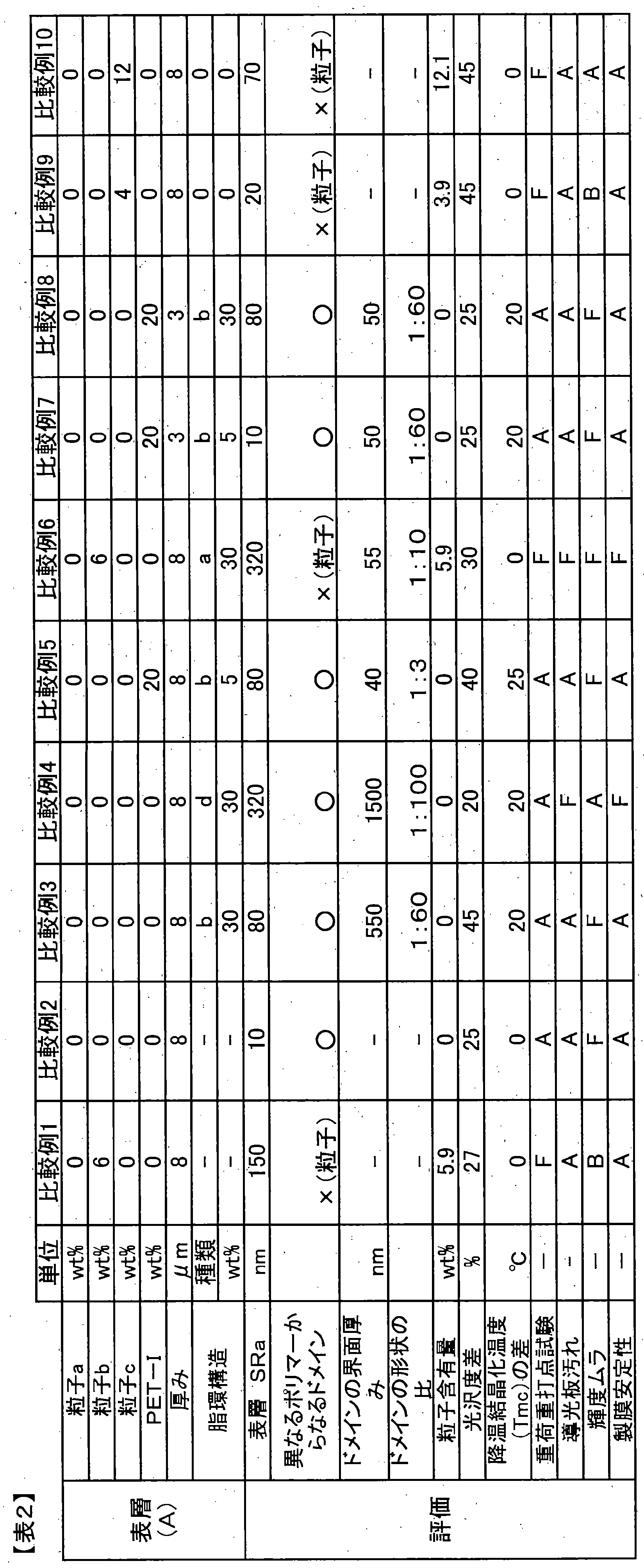
- Comparative Examples 1 to 6 In a composite film-forming apparatus having a main extruder and a sub-extruder, film formation was performed by changing to the composition shown in Table 2. In Comparative Examples 1 and 6, since the main protrusions were particles, the light guide plate was scratched.
- PET, PET-I, and alicyclic structure b “EASTAR” (registered trademark) (manufactured by Eastman Chemical Company) were used as the layer (A), and mixed at a ratio shown in Table 1 at 180 ° C. for 3 hours.
- the polymer was supplied to an extruder A heated to 280 ° C., and these polymers were laminated through a laminating apparatus so as to be A layer / B layer / A layer, and formed into a sheet form from a T die. Further, the unstretched film obtained by cooling and solidifying this film with a cooling drum having a surface temperature of 25 ° C.
- Table 2 shows the physical properties of the obtained laminated film as a light reflecting substrate. SRa was small and uneven brightness occurred.
- the white reflective film of the present invention is used for a backlight, and among others, it can be suitably used for an edge light type liquid crystal display backlight, and an illumination surface light source such as a signboard or a vending machine. In addition, it can be suitably used as a reflection plate constituting various surface light sources, a sealing film for solar cell modules that require reflection characteristics, and a back sheet.
- paper substitutes ie cards, labels, stickers, home delivery slips, video printer paper, inkjet, barcode printer paper, posters, maps, dust-free paper, display boards, white boards, thermal transfer, offset printing, telephones
- Receiving sheet base materials used for various printing records such as cards and IC cards, building materials such as wallpaper, lighting equipment and indirect lighting equipment used indoors and outdoors, members mounted on automobiles, railways, aircraft, etc., circuit materials, etc. It can also be used as an electronic component.
Landscapes
- Engineering & Computer Science (AREA)
- General Engineering & Computer Science (AREA)
- Physics & Mathematics (AREA)
- General Physics & Mathematics (AREA)
- Optics & Photonics (AREA)
- Electromagnetism (AREA)
- Planar Illumination Modules (AREA)
- Liquid Crystal (AREA)
- Laminated Bodies (AREA)
- Optical Elements Other Than Lenses (AREA)
Abstract
Description
特許文献2、3に記載の従来技術では、白点ムラ(点状に明るく視認される部分)や振動により導光板上印刷層へのキズ発生を抑制できていたが、近年要求されているタブレットやノートパソコンでの衝撃耐久性を十分に満足することはできない。
(1)次の(i)~(iii)を満たす、エッジ型バックライト用白色反射フィルム。
(i)表層(A)と気泡を含有する基材層(B)を少なくとも含む2層以上の積層フィルムであること。
(ii)表層(A)の表面の中心面平均粗さ(SRa)が90nm以上300nm未満であること。
(iii)表層(A)が、マトリックス構成するポリマーと異なるポリマーからなるドメインを有してなること。
(2)前記、ドメインの界面厚みが、20nm以上1,000nm以下である、(1)記載のエッジ型バックライト用白色反射フィルム。
(3)(1)または(2)に記載のドメインの形状が、表層(A)の断面を観察した場合の、厚み方向の長さ:長手方向の長さ、の比が、1:3以上1:50以下であることを特徴とする、(1)または(2)に記載のエッジ型バックライト用白色反射フィルム。
(4)表層(A)が粒子を含み、その粒子含有量が5質量%未満である、(1)~(3)のいずれかに記載のエッジ型バックライト用白色反射フィルム。
(5)表層(A)の20°と85°の光沢度差が50%以上である、(1)~(4)のいずれかに記載のエッジ型バックライト用白色反射フィルム。
(6)表層(A)中に脂環構造を持つポリエステルまたはポリオレフィンを少なくとも含有する、(1)~(5)のいずれかに記載のエッジ型バックライト用白色反射フィルム。
(7)表層(A)が2種類以上のポリマーから構成され、その降温結晶化温度(Tmc)の差が10℃以上40℃未満である、(1)~(6)のいずれかに記載のエッジ型バックライト用白色反射フィルム。
(8)(1)~(7)のいずれかに記載のフィルムを用いて構成される液晶ディスプレイ用バックライト。
(9)光源が発光ダイオードである、(8)記載の液晶ディスプレイ用バックライト。
なお、輝度ムラとは、バックライトを点灯した際に目視にて観察される下記に記載するムラを意味する。
(i)スジ状のムラ
(ii)水たまり状のムラ
(iii)暗部となって見えるムラ
また、白点ムラとは、バックライトを点灯した際に目視にて観察される長径5cm未満の楕円体の点状のムラを意味する。
本発明の白色反射フィルムは、表層(A)と気泡を含有する基材層(B)とからなり、製膜の容易さと効果を考慮すると2層以上の構成が必要であり、3層構成が好ましい。特に表層(A)にて基材層(B)を保護する形態、すなわち、表層(A)/基材層(B)/表層(A)の3層構成が好ましい。また、さらに多層となる場合、芯層部が基材層(B)であり、片側または両側の表層部が表層(A)であることが好ましい。
本発明の白色反射フィルムは、基材層(B)内部に気泡を有することが白色性、反射特性のために必要であるが、基材層(B)を構成するポリエステルあるいはポリプロピレンと非相溶な成分を含有させ2軸延伸することによって、気泡を形成させることができる。
本発明の白色反射フィルムにおいて、表層(A)表面の中心面平均粗さ(SRa)が90nm以上であり300nm未満であることが必要であり、好ましくは120~300nm、最も好ましくは120~250nmである。90nm未満の場合、光沢度が高くなり、表面に付着する埃が視認しやすくなり、また、エッジライト型バックライトでの輝度ムラ、特に白点が発生しやすくなる。一方、300nm以上の場合、導光板との振動試験時に表層(A)の表面が削れて、導光板ドットに転写する問題が発生しやすくなる。
JIS B0601(2001)に基づき、中心面平均粗さ(SRa)を小坂研究所製、触針式表面粗さ計(型番:ET 4000A)を用いて測定した。条件は下記の通りであり、5回の測定の平均値をもって値とした。
・触針先端半径:0.1μm
・触針荷重 :100μN
・測定長 :1.0mm
・カットオフ値:0.25mm
[表層(A)がマトリックスを構成するポリマーと異なるポリマーからなるドメインを有する]
表層(A)は導光板と接した際に発生する輝度ムラや衝撃試験後の輝度ムラが発生しないよう、マトリックスを構成するポリマーと異なるポリマーからなるドメインを有する必要がある。ドメインは、表層(A)の断面SEMのコントラストから容易に視認することができる。
本発明における表層(A)は衝撃試験後の輝度ムラが発生しないよう、主たる突起がポリマーを核としてなる、ことが好ましい。ポリマーを核とした突起を形成するには、2種類以上のポリマーから構成され、かつ、それらが押出機や製膜過程において相溶することなく、層(A)を形成された状態が好ましい。
本発明における2種類以上のポリマーのうち、少なくとも1種類に脂環構造をもつポリエステルまたはポリオレフィンを含有することが好ましい。中でも、相溶性の異なる脂環構造を持つポリエステルまたはポリオレフィンを使用すると、適切な表面凹凸が形成されやすくなる。このような脂環構造としては、シクロプロパン環、シクロブタン環、シクロペンタン環、シクロヘキサン環が好ましい。酸成分としてテレフタル酸ジメチルを、ジオール成分として1,3-シクロプロパンジオール、1,3-シクロブタンジオール、1,3ーシクロペンタンジオール、1,4―シクロヘキサンジメタノールを、200ppmのブチルスズトリス(2-エチルヘキサノエート)の存在下で重縮合反応を行い、脂環構造を有するポリエステルペレットまたはポリオレフィンペレットを得ることが出来る。
本発明の効果を損なわない範囲で、粒子を5質量%未満含有していてもよい。粒子が5質量%以上含有すると、導光板を傷つけたり、粒子を起点としてポリマーが剥がれたり、粒子自体が脱落して導光板を汚染する場合がある。より好ましい粒子含有量の範囲は、4質量%以下、さらに好ましくは3質量%以下である。
本発明の粒子とは、無機粒子または有機粒子をさす。無機粒子としては、二酸化チタン、炭酸カルシウム、硫酸バリウム、シリカなどを挙げることができる。有機粒子としては、アクリル、ポリスチレン、ナイロンなどが挙げられる。
[光沢度差]
本発明における表層(A)の20°と85°の光沢度差が、50%以上であることが好ましい。光沢度の差が大きいことで、光反射フィルムとして効率良く光をディスプレイ前方に返すことができる。より好ましくは65%以上、さらに好ましくは80%以上である。
[製膜方法]
本発明の2軸延伸フィルムの製造方法について、その一例を説明するが、本発明は、かかる例のみに限定されるものではない。
気泡を含有する基材層(B)については、ポリエステルあるいはポリプロピレンと非相溶な成分、及び必要に応じて分散剤を含む混合物を、十分真空乾燥を行い、加熱された押出機に供給する。非相溶な成分の添加は、事前に均一に溶融混練して作製されたマスターチップを用いても、もしくは直接混練押出機に供給してもよい。
本発明の白色反射フィルムは、エッジライト型バックライトに好適に用いられる。エッジライト型バックライトは、例えば凹凸を有する筐体に、本発明の白色反射フィルム、導光板がこの順に組み込まれてなり、白色フィルムは、表層(A)の側が導光板に対向するように組み込まれる。また、導光板のエッジ部分には、LEDなどの光源が設置される。さらに、導光板の前面(白色反射フィルムとは反対側)には、拡散板、プリズムなどが設置されても良い。
本発明の白色反射フィルムは、バックライトに用いられるが、中でも、エッジライト方式の液晶ディスプレイ用バックライト、及び、看板や自動販売機等の照明用面光源に好適に使用することができる。
測定方法
本発明の物性値の評価方法ならびに効果の評価方法は次の通りである。
JIS B0601(2001)に基づき、中心面平均粗さ(SRa)を小坂研究所製、触針式表面粗さ計(型番:ET 4000A)を用いて測定した。条件は下記の通りであり、5回の測定の平均値をもって値とした。
・触針先端半径:0.1μm
・触針荷重 :100μN
・測定長 :1.0mm
・カットオフ値:0.25mm
B.ドメイン
白色反射フィルムサンプルの断面を切り出し、電界放射走査型電子顕微鏡”JSM-6700F”(日本電子(株)製)を用いて、表層(A)を2,000~10,000倍に拡大観察して撮影した断面写真より、ドメインを観察した。明確な界面を持たず、共延伸された略扁平状の濃淡部分がある場合をマトリックスを構成するポリマーと異なるポリマーからなるドメインを持つ、と判断した。一方、周囲にボイドが形成されているものは、粒子と判断した。
次に、ポリマーからなるドメインであった場合、表層(A)の超薄切片を作成し、OsO4で染色したのち、透過型電子顕微鏡TEMで、ドメインの形状およびドメインの界面厚みを観察した。
ドメインの形状は、厚み方向の長さ:長手方向の長さを二点間距離で測定し、比率を求めた。同様にドメインの界面(濃淡部分の幅)を二点間距離で測定し、界面厚みとした。ドメインの形状とドメインの界面厚みは、5箇所を測定した平均値を用いた。
白色反射フィルム表面をテーパーで削ってでた小片をサンプルとし、JISK7250-1:2006に基づいて得られた灰分量を測定した。同様の操作を別の5つの白色反射フィルムで測定し、その5つの平均値をもって、粒子含有量、とした。
白色反射フィルム表面をテーパーで削ってでた小片を、サンプルパンに5mg秤量し、JIS K7122(1987)に準じて、セイコー電子工業(株)製示差走査熱量測定装置“ロボットDSC-RDC220”を、データ解析にはディスクセッション“SSC/5200”を用いて、下記の要領にて、測定を実施した。ちなみに、以下に挙げる温度は、5つのフィルムサンプルを用いて測定を行った平均値を用いた。
前記、20℃/分の速度で300℃から25℃まで降温する過程における、発熱ピーク温度を降温結晶化温度(Tmc)とした。
降温結晶化温度の中で、高い温度の発熱ピーク温度をTmc1、低い方の発熱ピーク温度をTmc2とし、次式により、降温結晶化温度(Tmc)の差とした。
降温結晶化温度(Tmc)の差=Tmc1-Tmc2
E.導光板との相性
(i)導光板汚れ
40インチ液晶テレビ(ソニー社製、KDL-40EX700)を分解し、LEDを光源とするエッジライト型のバックライトを取り出した。発光面の大きさは、89cm×50cmであり、対角の長さは102.2cmであった。このバックライトから導光板を取り出し、該導光板を5cm角に切り出し、導光板の凹凸部分と本発明の白色反射フィルムの表層(A)を重ね合わせ、表層(A)の反対側の上に500gの分銅を載せ、本発明の白色反射フィルムの表層(A)を擦るように3cm×5往復させる。その後、5cm角の導光板の、本発明の白色反射フィルム表面に接触していた表層(A)面を顕微鏡にて観察し、下記の通りの評価結果とした。
A:優良 (付着物が見えない)
B:良好 (よく観察すると付着物が見える)
F:劣る (付着物が見える)
上記のAおよびBを合格とした。
上記バックライトから取り出した導光板を5cm角に切り出し、導光板の凹凸部分と本発明の白色反射フィルムの表層(A)を重ね合わせ、表層(A)の反対側の上に直径1mmのSUS製の円柱状の棒にて200gの加重で、1000回打点試験を行う。その後、白色反射フィルムの表層(A)が接触していた導光板の面を顕微鏡にて観察し、下記の通りの評価結果とした。
A:優良 (傷が見えない)
B:良好 (よく観察すると傷が見える)
F:劣る (傷が見える)
上記のAおよびBを合格とした。
新品のハイセンスジャパン株式会社製32型液晶TV LHD32K15JPバックライト内に張り合わせてある反射フィルムを、本発明の白色反射フィルムに変更し、点灯させた。その状態で1時間待機して光源を安定化させた後、500Lxの照明環境下または暗所環境下において目視で輝度ムラとして認識できるものを観察し、下記の通りの評価結果とした。なお、ここでいう輝度ムラとは、反射フィルムと導光板が接触することによる輝点によるものである。
A:優良 (500Lxの照明環境下、暗所環境下ともに、輝度ムラが見えない。)
B:良好 (500Lxの暗所環境下においては、輝度ムラが見えるが、照明環境下においては、輝度ムラが見えない。)
F:劣る (500Lxの照明環境下、暗所環境下ともに、輝度ムラが見える。)
上記のAおよびBを合格とした。
実施例・比較例において製膜した際に、フィルム破れが1回/日以下しか生じず、かつ粒子脱落などによる工程汚染ないものをA、フィルム破れは1回/日以下しか生じないが、ロール表面への汚れの蓄積が肉眼で確認できるものをB、フィルム破れが2回/日以上3回/日以下発生するものをF、大量生産にはB以上の製膜性が必要であり、A以上であるとさらにコスト低減効果がある。
G.光沢度
デジタル変角光沢度計UGV-5B(スガ試験機(株)製)を用いて、白色反射フィルムの表層(A)側よりJIS Z-8741(1997)に準じて測定した。なお、測定条件は、60°光沢度は、測定条件を入射角=60°、受光角=60°としたときの値であり、同様に20°光沢度は入射角=20°、受光角=20°、85°光沢度は入射角=85°、受光角=85°としたときの値である。
・表層(A)
酸成分としてテレフタル酸を、ジオール成分としてエチレングリコールを用い、三酸化アンチモン(重合触媒)を得られるポリエステルペレットに対してアンチモン原子換算で300ppmとなるように添加し、重縮合反応を行い、極限粘度0.63dl/g、カルボキシル末端基量40当量/トンのポリエチレンテレフタレートペレット(PET)を得た。
同様の方法でイソフタル酸を添加することでポリエチレンテレフタレート/イソフタレート共重合物(PET-I)を得た。
同様の方法でブタンジオールを添加することでポリブチレンテレフタレート(PBT)を得た。
酸成分としてテレフタル酸ジメチルを、ジオール成分としてCHDM(シクロヘキサンジメタノール)を、200ppmのブチルスズトリス(2-エチルヘキサノエート)の存在下で重縮合反応を行い、共重合ポリエステルを得た。
また、上市されている商品(例えば、脂環構造aとして、“TRITAN” (Eastman Chemical Company社製)、脂環構造bとして“EASTAR”(登録商標)(Eastman Chemical Company社製))、脂環構造cとして“ゼオノア”(登録商標)(日本ゼオン(株)製))を用いた。
これらは、ジオール成分を構成する共重合成分が特徴的であり、例えば、EASTARはシクロヘキサン環、TRITANはシクロブタン環成分をそれぞれ有する。
PET57質量部、ポリブチレンテレフタレートとポリテトラメチレングリコールの(PBT/PTMG)共重合物を5質量部(商品名:東レデュポン社製ハイトレル)、エチレングリコールに対し1,4-シクロヘキサンジメタノールが33mol%共重合された共重合ポリエチレンテレフタレート(33mol%CHDM共重合PET)8質量部、ポリ(5-メチル)ノルボルネン20質量部、ルチル型酸化チタン10重量部を調整混合し、180℃で3時間乾燥させた後、270~300℃に加熱された押出機Bに供給(B層)した。
このように本発明の白色反射フィルムは安定に製膜でき、表面形状(重荷重打点試験、導光板汚れ、輝度ムラ低減)に優れた特性を示した。
(表層(A))
非晶性シクロオレフィン系樹脂A(日本ゼオン株式会社製、商品名「ZEONOR 1430R」、密度(ASTMD792):1.01g/cm3、ガラス転移温度Tg(JISK7121):133℃のペレットとポリプロピレン樹脂(日本ポリプロ株式会社製、商品名「ノバテックPPEA9」のペレットを、30:70の質量割合で混合したものを上記方法で押出機Aに供給した。
ポリプロピレン樹脂(日本ポリプロ株式会社製、商品名「ノバテックPP FY6HA」のペレットと、酸化チタン(KRONOS社製、商品名「KRONOS2230」、ルチル型酸化チタン、Al,Si表面処理、TiO2含有量96.0%、製造法:塩素法)とを、50:50の質量割合で混合したものを上記方法で押出機Bに供給した。
各押出機において、200℃および230℃で溶融混練した後、2種3層用のTダイに合流させ、層(A)/層(B)/層(A)の3層構成になるようにシート状に押出し、冷却固化して積層シートを形成した。 得られた積層シートを、温度130℃でMDに2倍ロール延伸した後、さらに130℃
でTDに3倍テンター延伸することで二軸延伸を行い、厚さ150μm(樹脂層(A):8μm、樹脂層(B):134μm)の白色反射フィルムを得た。光反射用基材としての物性は表1に示した。
このように本発明の白色反射フィルムは安定に製膜でき、表面形状(重荷重打点試験、導光板汚れ、輝度ムラ低減)に優れた特性を示した。
PET57質量部、ポリブチレンテレフタレートとポリテトラメチレングリコールの(PBT/PTMG)共重合物を5質量部(商品名:東レデュポン社製ハイトレル)、エチレングリコールに対し1,4-シクロヘキサンジメタノールが33mol%共重合された共重合ポリエチレンテレフタレート(33mol%CHDM共重合PET)8質量部、ポリ(5-メチル)ノルボルネン20質量部、ルチル型酸化チタン10重量部を調整混合し、180℃で3時間乾燥させた後、270~300℃に加熱された押出機Bに供給(B層)した。
主押出機と副押出機を有する複合製膜装置において、表2に示した配合に変更して製膜を行った。
比較例1、6では、主たる突起が粒子であるため、導光板にキズが発生した。比較例3~6では、脂環構造a“TRITAN” (Eastman Chemical Company社製)、脂環構造bとして“EASTAR”(登録商標)(Eastman Chemical Company社製)、脂環構造dとして“ECOZEN”(SK chemicals社製))を表2に示す割合で混合し、実施例1と同様な原料・条件で押出機Aに供給し、白色反射フィルムを作製したところ、比較例2、3、5では、SRaが小さく輝度ムラが発生し、比較例4ではSRaが大きく導光板汚れが発生した。
PET57質量部、ポリブチレンテレフタレートとポリテトラメチレングリコールの(PBT/PTMG)共重合物を5質量部(商品名:東レデュポン社製ハイトレル)、エチレングリコールに対し1,4-シクロヘキサンジメタノールが33mol%共重合された共重合ポリエチレンテレフタレート(33mol%CHDM共重合PET)8質量部、ポリ(5-メチル)ノルボルネン20質量部、ルチル型酸化チタン10重量部を調整混合し、180℃で3時間乾燥させた後、270~300℃に加熱された押出機Bに供給(B層)した。
主押出機と副押出機を有する複合製膜装置において、表2に示した配合に変更して製膜を行った。
主たる突起が粒子cであるため、導光板にキズが発生した。

Claims (9)
- 次の(i)~(iii)を満たす、エッジ型バックライト用白色反射フィルム。
(i)表層(A)と気泡を含有する基材層(B)を少なくとも含む2層以上の積層フィルムであること。
(ii)表層(A)の表面の中心面平均粗さ(SRa)が90nm以上300nm未満であること。
(iii)表層(A)が、マトリックスを構成するポリマーと異なるポリマーからなるドメインを有してなること。 - 前記、ドメインの界面厚みが、20nm以上1,000nm以下である、請求項1記載のエッジ型バックライト用白色反射フィルム。
- 請求項1または2に記載のドメインの形状が、表層(A)の断面を観察した場合の、厚み方向の長さ:長手方向の長さ、の比が、1:3以上1:50以下であることを特徴とする、請求項1または2に記載のエッジ型バックライト用白色反射フィルム。
- 表層(A)が粒子を含み、その粒子含有量が5質量%未満である、請求項1または2に記載のエッジ型バックライト用白色反射フィルム。
- 表層(A)の20°と85°の光沢度差が50%以上である、請求項1に記載のエッジ型バックライト用白色反射フィルム。
- 表層(A)中に脂環構造を持つポリエステルまたはポリオレフィンを少なくとも含有する、請求項1に記載のエッジ型バックライト用白色反射フィルム。
- 表層(A)が2種類以上のポリマーから構成され、その降温結晶化温度(Tmc)の差が10℃以上40℃未満である、請求項1に記載のエッジ型バックライト用白色反射フィルム。
- 請求項1に記載のフィルムを用いて構成される液晶ディスプレイ用バックライト。
- 光源が発光ダイオードである、請求項7記載の液晶ディスプレイ用バックライト。
Priority Applications (3)
| Application Number | Priority Date | Filing Date | Title |
|---|---|---|---|
| CN201680032741.5A CN107615109B (zh) | 2015-07-21 | 2016-06-17 | 白色反射膜 |
| KR1020177030152A KR102590694B1 (ko) | 2015-07-21 | 2016-06-17 | 백색 반사 필름 |
| JP2016554755A JP6862829B2 (ja) | 2015-07-21 | 2016-06-17 | 白色反射フィルム |
Applications Claiming Priority (2)
| Application Number | Priority Date | Filing Date | Title |
|---|---|---|---|
| JP2015-143701 | 2015-07-21 | ||
| JP2015143701 | 2015-07-21 |
Publications (1)
| Publication Number | Publication Date |
|---|---|
| WO2017013976A1 true WO2017013976A1 (ja) | 2017-01-26 |
Family
ID=57833858
Family Applications (1)
| Application Number | Title | Priority Date | Filing Date |
|---|---|---|---|
| PCT/JP2016/068064 Ceased WO2017013976A1 (ja) | 2015-07-21 | 2016-06-17 | 白色反射フィルム |
Country Status (5)
| Country | Link |
|---|---|
| JP (1) | JP6862829B2 (ja) |
| KR (1) | KR102590694B1 (ja) |
| CN (1) | CN107615109B (ja) |
| TW (1) | TWI697698B (ja) |
| WO (1) | WO2017013976A1 (ja) |
Cited By (1)
| Publication number | Priority date | Publication date | Assignee | Title |
|---|---|---|---|---|
| CN112297552A (zh) * | 2019-07-31 | 2021-02-02 | 宁波长阳科技股份有限公司 | 一种白色反射聚酯薄膜 |
Families Citing this family (3)
| Publication number | Priority date | Publication date | Assignee | Title |
|---|---|---|---|---|
| CN115516650A (zh) * | 2020-05-22 | 2022-12-23 | 东丽株式会社 | Led基板、叠层体及led基板的制造方法 |
| CN114754336B (zh) * | 2021-11-02 | 2024-12-24 | 广东皇智照明科技有限公司 | 一种传感器控制的发光设备 |
| CN114428416B (zh) * | 2021-12-31 | 2023-09-19 | 宁波长阳科技股份有限公司 | 一种手机背光模块用高抗压高亮度涂布型聚酯反射膜 |
Citations (6)
| Publication number | Priority date | Publication date | Assignee | Title |
|---|---|---|---|---|
| JP2008158134A (ja) * | 2006-12-22 | 2008-07-10 | Asahi Kasei Corp | 反射シート |
| WO2009001670A1 (ja) * | 2007-06-05 | 2008-12-31 | Teijin Limited | ポリカーボネート樹脂組成物 |
| JP2012158167A (ja) * | 2010-07-16 | 2012-08-23 | Mitsubishi Plastics Inc | 反射材 |
| JP2014186319A (ja) * | 2013-02-19 | 2014-10-02 | Mitsubishi Plastics Inc | 反射フィルム、及びこれを備えてなる液晶表示装置、照明装置、装飾用物品 |
| WO2015046176A1 (ja) * | 2013-09-25 | 2015-04-02 | 旭硝子株式会社 | 含フッ素エラストマー組成物、その製造方法、成形体、架橋物、及び被覆電線 |
| JP2015230351A (ja) * | 2014-06-04 | 2015-12-21 | 三菱樹脂株式会社 | 反射フィルム、及びこれを備えてなる液晶表示装置、照明装置、装飾用物品 |
Family Cites Families (6)
| Publication number | Priority date | Publication date | Assignee | Title |
|---|---|---|---|---|
| JPS5578177U (ja) | 1978-11-22 | 1980-05-29 | ||
| JP3683965B2 (ja) | 1995-01-27 | 2005-08-17 | 三井化学株式会社 | 光反射体及びそれを用いた光反射装置 |
| JP4712252B2 (ja) | 2001-09-19 | 2011-06-29 | 恵和株式会社 | 反射シート及びこれを用いたバックライトユニット |
| JP4967274B2 (ja) * | 2004-08-06 | 2012-07-04 | 東レ株式会社 | 光反射フィルムおよびそれを用いた面光源 |
| JP2010237670A (ja) * | 2009-03-13 | 2010-10-21 | Toray Ind Inc | 白色フィルムおよびそれを用いた面光源 |
| CN105008968B (zh) * | 2013-02-19 | 2018-06-19 | 三菱化学株式会社 | 反射膜、以及具备该反射膜的液晶表示装置、照明装置、装饰用物品 |
-
2016
- 2016-06-17 CN CN201680032741.5A patent/CN107615109B/zh active Active
- 2016-06-17 KR KR1020177030152A patent/KR102590694B1/ko active Active
- 2016-06-17 JP JP2016554755A patent/JP6862829B2/ja not_active Expired - Fee Related
- 2016-06-17 WO PCT/JP2016/068064 patent/WO2017013976A1/ja not_active Ceased
- 2016-07-20 TW TW105122822A patent/TWI697698B/zh active
Patent Citations (6)
| Publication number | Priority date | Publication date | Assignee | Title |
|---|---|---|---|---|
| JP2008158134A (ja) * | 2006-12-22 | 2008-07-10 | Asahi Kasei Corp | 反射シート |
| WO2009001670A1 (ja) * | 2007-06-05 | 2008-12-31 | Teijin Limited | ポリカーボネート樹脂組成物 |
| JP2012158167A (ja) * | 2010-07-16 | 2012-08-23 | Mitsubishi Plastics Inc | 反射材 |
| JP2014186319A (ja) * | 2013-02-19 | 2014-10-02 | Mitsubishi Plastics Inc | 反射フィルム、及びこれを備えてなる液晶表示装置、照明装置、装飾用物品 |
| WO2015046176A1 (ja) * | 2013-09-25 | 2015-04-02 | 旭硝子株式会社 | 含フッ素エラストマー組成物、その製造方法、成形体、架橋物、及び被覆電線 |
| JP2015230351A (ja) * | 2014-06-04 | 2015-12-21 | 三菱樹脂株式会社 | 反射フィルム、及びこれを備えてなる液晶表示装置、照明装置、装飾用物品 |
Cited By (1)
| Publication number | Priority date | Publication date | Assignee | Title |
|---|---|---|---|---|
| CN112297552A (zh) * | 2019-07-31 | 2021-02-02 | 宁波长阳科技股份有限公司 | 一种白色反射聚酯薄膜 |
Also Published As
| Publication number | Publication date |
|---|---|
| JP6862829B2 (ja) | 2021-04-21 |
| TWI697698B (zh) | 2020-07-01 |
| CN107615109A (zh) | 2018-01-19 |
| JPWO2017013976A1 (ja) | 2018-04-26 |
| TW201708851A (zh) | 2017-03-01 |
| CN107615109B (zh) | 2020-05-08 |
| KR102590694B1 (ko) | 2023-10-18 |
| KR20180033118A (ko) | 2018-04-02 |
Similar Documents
| Publication | Publication Date | Title |
|---|---|---|
| JP5082951B2 (ja) | 反射板用ポリエステルフィルム | |
| JP5970815B2 (ja) | 白色積層フィルムの製造方法および白色積層ポリエステルフィルム | |
| JP6756387B2 (ja) | ポリエステルフィルム | |
| JP2019101142A (ja) | 光反射シートおよび光学部材 | |
| JP6862829B2 (ja) | 白色反射フィルム | |
| JP6597306B2 (ja) | ポリエステルフィルム | |
| JP2013120313A (ja) | 白色ポリエステルフィルム | |
| JP2018072496A (ja) | エッジライト型バックライト用白色反射フィルム及びそれを用いた液晶ディスプレイ用バックライト | |
| JP5338963B2 (ja) | 液晶反射用白色積層ポリエステルフイルム | |
| JP2019045779A (ja) | エッジライト型バックライト用白色反射フィルム及びそれを用いた液晶ディスプレイ用バックライト | |
| JP2018125117A (ja) | エッジライト型バックライト用白色反射フィルム及びそれを用いた液晶ディスプレイ用バックライト | |
| KR102350562B1 (ko) | 에지 라이트형 백라이트용 반사 필름 및 그것을 사용한 백라이트 | |
| JP2007072429A (ja) | 液晶ディスプレー反射板用白色ポリエステルフイルム | |
| JP2017027035A (ja) | エッジライト型バックライト用白色反射フィルム及び液晶ディスプレイ用バックライト | |
| JP2006168313A (ja) | 共押出し積層ポリエテルフィルム | |
| JP2017027034A (ja) | エッジライト型バックライト用白色反射フィルム及びそれを用いた液晶ディスプレイ用バックライト | |
| JP2018072497A (ja) | エッジライト型バックライト用白色反射フィルム及び液晶ディスプレイ用バックライト | |
| JP5211508B2 (ja) | 液晶反射用白色積層ポリエステルフイルム | |
| JP2020034672A (ja) | エッジライト型バックライト用白色反射フィルム及びそれを用いた液晶ディスプレイ用バックライト | |
| JP2012207153A (ja) | 白色フィルム | |
| JP2022111430A (ja) | フィルムおよびバックライト構成部材 | |
| JP2008068497A (ja) | 積層二軸延伸ポリエテルフィルム | |
| JP2017134146A (ja) | エッジライト型バックライト用反射フィルム及びそれを用いた液晶ディスプレイ用バックライト | |
| JP2018169456A (ja) | 白色反射フィルム |
Legal Events
| Date | Code | Title | Description |
|---|---|---|---|
| ENP | Entry into the national phase |
Ref document number: 2016554755 Country of ref document: JP Kind code of ref document: A |
|
| 121 | Ep: the epo has been informed by wipo that ep was designated in this application |
Ref document number: 16827540 Country of ref document: EP Kind code of ref document: A1 |
|
| ENP | Entry into the national phase |
Ref document number: 20177030152 Country of ref document: KR Kind code of ref document: A |
|
| NENP | Non-entry into the national phase |
Ref country code: DE |
|
| 122 | Ep: pct application non-entry in european phase |
Ref document number: 16827540 Country of ref document: EP Kind code of ref document: A1 |