WO2016181641A1 - 樹脂組成物、及びこれを用いた合成木材 - Google Patents
樹脂組成物、及びこれを用いた合成木材 Download PDFInfo
- Publication number
- WO2016181641A1 WO2016181641A1 PCT/JP2016/002263 JP2016002263W WO2016181641A1 WO 2016181641 A1 WO2016181641 A1 WO 2016181641A1 JP 2016002263 W JP2016002263 W JP 2016002263W WO 2016181641 A1 WO2016181641 A1 WO 2016181641A1
- Authority
- WO
- WIPO (PCT)
- Prior art keywords
- resin
- compatibilizer
- resin composition
- polyolefin wax
- polymer
- Prior art date
- Legal status (The legal status is an assumption and is not a legal conclusion. Google has not performed a legal analysis and makes no representation as to the accuracy of the status listed.)
- Ceased
Links
Images

Classifications
-
- C—CHEMISTRY; METALLURGY
- C08—ORGANIC MACROMOLECULAR COMPOUNDS; THEIR PREPARATION OR CHEMICAL WORKING-UP; COMPOSITIONS BASED THEREON
- C08L—COMPOSITIONS OF MACROMOLECULAR COMPOUNDS
- C08L1/00—Compositions of cellulose, modified cellulose or cellulose derivatives
-
- C—CHEMISTRY; METALLURGY
- C08—ORGANIC MACROMOLECULAR COMPOUNDS; THEIR PREPARATION OR CHEMICAL WORKING-UP; COMPOSITIONS BASED THEREON
- C08L—COMPOSITIONS OF MACROMOLECULAR COMPOUNDS
- C08L101/00—Compositions of unspecified macromolecular compounds
-
- C—CHEMISTRY; METALLURGY
- C08—ORGANIC MACROMOLECULAR COMPOUNDS; THEIR PREPARATION OR CHEMICAL WORKING-UP; COMPOSITIONS BASED THEREON
- C08L—COMPOSITIONS OF MACROMOLECULAR COMPOUNDS
- C08L23/00—Compositions of homopolymers or copolymers of unsaturated aliphatic hydrocarbons having only one carbon-to-carbon double bond; Compositions of derivatives of such polymers
-
- C—CHEMISTRY; METALLURGY
- C08—ORGANIC MACROMOLECULAR COMPOUNDS; THEIR PREPARATION OR CHEMICAL WORKING-UP; COMPOSITIONS BASED THEREON
- C08L—COMPOSITIONS OF MACROMOLECULAR COMPOUNDS
- C08L97/00—Compositions of lignin-containing materials
Definitions
- the present invention relates to a resin composition having a specific composition and a synthetic wood obtained from the resin composition.
- composition for synthetic wood a composition composed of wood powder and a thermoplastic resin such as polyethylene and polypropylene is known.
- Synthetic wood can be obtained by molding the composition for synthetic wood into a desired shape by a molding method such as extrusion molding or injection molding.
- Patent Document 1 discloses a composition for synthetic wood that can obtain a synthetic wood having a good appearance and less stickiness on the surface by using a specific wax.
- the problem of the present invention is that the synthetic wood has excellent balance of workability, appearance, tensile strength, bending strength, impact property, thermal stability, etc., in which the resin and the natural fiber are uniformly dispersed. It is providing the resin composition for obtaining.
- the present inventors have intensively studied to solve the above problems. As a result, it has been found that the above problem can be solved by using a resin composition having a specific composition, and the present invention has been completed. That is, the present invention relates to the following [1] to [22].
- the resin (A) is 1 to 90 parts by weight
- the natural fiber (C) is 10 to 99 parts by weight
- the compatibilizer (B ) In a proportion of 0.1 to 50 parts by mass.
- the density measured by the density gradient tube method is in the range of 830 to 1200 kg / m 3
- the ratio of the weight average molecular weight to the number average molecular weight measured by gel permeation chromatography (GPC) Mw / Mn
- the polyolefin wax (B1) is an ethylene homopolymer, a propylene homopolymer, a copolymer of ethylene and an ⁇ -olefin having 3 to 12 carbon atoms, and ⁇ having 4 to 12 carbon atoms.
- the polyolefin wax (B1) is an unsaturated carboxylic acid derivative monomer modified product of the polymer or an air oxide of the polymer and has an acid value of 1 to 100 mgKOH / g.
- the polyolefin wax (B1) is an unsaturated carboxylic acid derivative monomer modified product of the polymer or an air oxide of the polymer and has an acid value of 30 to 87 mgKOH / g.
- the polyolefin wax (B1) is an unsaturated carboxylic acid derivative monomer modified product of the polymer or an air oxide of the polymer and has an acid value of 40 to 100 mgKOH / g.
- the resin composition as described.
- the compatibilizer (B) comprises two or more compounds, and among the two or more compounds, the softening point of the compatibilizer (BH) having the highest softening point, and the softening point The resin composition according to [1] or [2], wherein the difference from the softening point of the lowest compatibilizer (BL) is 5 ° C or higher.
- the compatibilizer (B) comprises two or more compounds, and the softening point of the compatibilizer (BH) having the highest softening point among the two or more compounds, The resin composition according to [1] or [2], wherein the difference from the softening point of the lowest compatibilizer (BL) is 20 ° C or higher.
- the compatibilizer (BH) is an unsaturated carboxylic acid derivative monomer modified product of the polymer or an air oxide of the polymer, and an acid value is 60 to 90 mg KOH / g. [8] ] Or the resin composition as described in [9].
- Mn polystyrene-equivalent number average molecular weight
- the resin (A) is at least one resin selected from the group consisting of an olefin polymer, polystyrene, acrylonitrile / butadiene / styrene copolymer resin (ABS resin), and polyvinyl chloride.
- ABS resin acrylonitrile / butadiene / styrene copolymer resin
- polyvinyl chloride polyvinyl chloride
- the maximum torque expression time when the resin (A), the compatibilizer (B), and the natural fiber (C) are kneaded in a batch plast mill is T2, and the resin (A) and the resin
- the ratio (T1 / T2) of T1 and T2 (T1 / T2) is 0.5 or more, where T1 is the maximum torque expression time when only natural fibers (C) are kneaded with a batch plast mill.
- [21] A synthetic wood obtained by molding the resin composition according to any one of [1] to [20].
- the synthetic wood according to [21] which is a wood deck or flooring.
- the resin and the natural fiber are uniformly dispersed. Therefore, according to the resin composition, a synthetic wood having an excellent balance of workability, appearance, tensile strength, bending strength, impact property, thermal stability, and the like is provided.
- the processability of the resin composition is particularly high, it becomes possible to efficiently mold the resin composition or to efficiently process the synthetic wood. Furthermore, it is possible to improve the low-temperature formability of the synthetic wood, reduce the defective rate generated by burning, and the like.
- the resin composition since the resin composition has high mechanical properties, it is possible to reduce the thickness and weight of the molded product, improve workability, improve designability, and suppress water-resistant deterioration.
- FIG. 1 is an external view photograph of strands produced in Examples and Comparative Examples.
- the resin composition of the present invention contains at least one resin (A) selected from thermoplastic resins and thermosetting resins, a compatibilizer (B), and natural fibers (C). To do.
- the amount of the resin (A) is 1 to 90 parts by weight, preferably 10 to 80 parts by weight. More preferably, it is 25 to 75 parts by mass.
- the upper limit is preferably 70 parts by mass, more preferably 60 parts by mass, and particularly preferably 55 parts by mass.
- the lower limit is preferably 30 parts by mass, more preferably 55 parts by mass, and particularly preferably Is 60 parts by mass.
- the amount of the natural fiber (C) is 10 to 99 parts by weight, preferably 20 to 90 parts by weight. More preferably, it is 25 to 75 parts by mass.
- the lower limit thereof is preferably 30 parts by mass, more preferably 40 parts by mass, and particularly preferably 45 parts by mass.
- the upper limit is preferably 70 parts by mass, more preferably 45 parts by mass, and particularly preferably Is 40 parts by mass.
- the amount of the compatibilizer (B) when the total of the resin (A) and the natural fiber (C) is 100 parts by weight is 0.1 to 50 parts by weight, preferably 0.1 to 20 parts by mass, more preferably 0.2 to 9 parts by mass, still more preferably 0.3 to 7 parts by mass, and particularly preferably 0.4 to 5 parts by mass.
- the amount is preferably 1 to 3 parts by mass.
- the amount of the resin (A) is preferably 50 to 99.9 parts by mass when the total of the resin (A) and the compatibilizer (B) is 100 parts by weight.
- the amount is preferably 80 to 99.9 parts by mass, more preferably 91 to 99.8 parts by mass, particularly preferably 93 to 99.7 parts by mass, and most preferably 95 to 99.6 parts by mass.
- the amount of the compatibilizer (B) is 0.1 to 50 parts by mass.
- it is 0.1 to 20 parts by mass, more preferably 0.2 to 9 parts by mass, particularly preferably 0.3 to 7 parts by mass, and most preferably 0.4 to 5 parts by mass. Part.
- the amount of the natural fiber (C) is preferably 1 to 300 parts by mass, more preferably 100 parts by weight of the total of the resin (A) and the compatibilizer (B). Is 1 to 150 parts by mass, more preferably 50 to 150 parts by mass, and particularly preferably 70 to 120 parts by mass.
- the compatibilizer (B) when the amount of the compatibilizer (B) is increased, the processability of the resin composition is improved, but when the amount is excessive, the kneadability and heat resistance stability tend to deteriorate.
- the compatibilizer (B) when the compatibilizer (B) is contained in the above ratio, the balance between the kneadability and processability of the resin (A) and the natural fiber (C) becomes good. Specifically, not only the kneading and processing of the resin composition is facilitated, but the influence on the molding work environment such as smoke and odor generated during the molding process is small. There is little thermal deterioration such as generation of burnt resin, low molecular weight substances, additives, etc.) and scorch. Furthermore, since the dispersibility of the natural fiber (C) is increased, it is preferable in that the influence on the appearance is small and the balance between mechanical strength and heat resistance is good.
- the natural fiber (C) functions as a modifier or reinforcing agent for the resin (A) and the compatibilizer (B).
- the natural fiber (C) 10 parts by mass or more with respect to a total of 100 parts by mass of the resin (A) and the natural fiber (C)
- the resin (A) is at least one resin selected from thermoplastic resins and thermosetting resins. These may be used alone or in combination of two or more. Definitions and production methods for thermoplastic resins or thermosetting resins are well known, and are described in publications such as “Practical Plastics Dictionary” (edited by the Practical Plastics Dictionary Editorial Board, published by Industrial Research Co., Ltd.). In the present invention, the resin (A) is more preferably a thermoplastic resin.
- thermosetting resin examples include polyurethane, epoxy resin, thermosetting unsaturated polyester resin, urea resin, melamine resin and phenol resin, and mixed resins thereof. Among these, (1) epoxy resin, (2) thermosetting unsaturated polyester resin, and (3) phenol resin are preferable. Preferred examples of these resins are shown below. In the following description, the thermosetting resin before thermosetting is described.
- Epoxy resin is typically a resin obtained by reacting an aromatic diol (for example, bisphenol A) and epichlorohydrin in the presence of an alkali.
- a bisphenol A type epoxy resin, a bisphenol F type epoxy resin, or a bisphenol S type epoxy resin having an epoxy equivalent of 170 to 5000 is preferable.
- Such epoxy resins are commercially available, and examples include the brand name Epomic (Mitsui Chemicals Co., Ltd.), Epicron (Dainippon Ink Chemical Co., Ltd.), Sumi Epoxy (Sumitomo Chemical Co., Ltd.), etc. These can be preferably used in the present invention.
- thermosetting unsaturated polyester resin is typically a resin obtained by an esterification reaction between an aliphatic unsaturated dicarboxylic acid and an aliphatic diol.
- a resin obtained by esterifying an unsaturated dicarboxylic acid such as maleic acid or fumaric acid and a diol such as ethylene glycol or diethylene glycol is preferred.
- Such thermosetting unsaturated polyester resins are commercially available. Examples thereof include Rigolac (Showa High Polymer Co., Ltd.), Sumicon (Sumitomo Bakelite Co., Ltd.), and the like. It can be preferably used for the composition.
- the phenolic resin includes both so-called novolak type and resol type, and the phenolic resin used in the resin composition of the present invention includes novolak type and dimethylene cured with hexamethylenetetramine.
- a solid resol type resin mainly composed of an ether bond is preferred.
- Such a phenol resin is commercially available, and examples thereof include trade name Sumicon PM (Sumitomo Bakelite Co., Ltd.), Nikkaline (Nippon Synthetic Chemical Industry Co., Ltd.), etc., which are preferably used in the present invention. Can do.
- thermoplastic resins As typical thermoplastic resins, the following (1) to (16) can be mentioned. These may be used alone or in combination of two or more.
- Olefin polymers include olefin homopolymers such as polyethylene, polypropylene, poly-1-butene, poly-4-methyl-1-pentene, and polymethylbutene; ethylene- ⁇ -olefin random copolymer Polymer, propylene-ethylene random copolymer, ethylene / ⁇ -olefin / non-conjugated polyene copolymer, olefin copolymer such as 4-methyl-1-pentene / ⁇ -olefin copolymer; and the like. it can.
- the olefin polymer can be, for example, an ethylene (co) polymer.
- the ethylene (co) polymer is preferably an ethylene homopolymer or a copolymer of ethylene and an ⁇ -olefin having 3 to 12 carbon atoms.
- Specific examples of the ethylene homopolymer include ultra high molecular weight polyethylene, high density polyethylene, medium density polyethylene, low density polyethylene, linear low density polyethylene, and the like.
- the ethylene (co) polymer is a copolymer of ethylene and an ⁇ -olefin having 3 to 12 carbon atoms
- the amount of the structural unit (a) derived from ethylene is 91.0 to 99.9 mol. %, More preferably 93.0 to 99.9 mol%, still more preferably 95.0 to 99.9 mol%, particularly preferably 95.0 to 99.0 mol%. is there.
- the amount of the structural unit (b) derived from the ⁇ -olefin having 3 or more carbon atoms is preferably 0.1 to 9.0 mol%, more preferably 0.1 to 7.0 mol.
- the content of the structural unit of the olefin polymer can be determined by analysis of 13 C-NMR spectrum.
- examples of the ⁇ -olefin having 3 to 12 carbon atoms include propylene, 1-butene, 1-pentene, 3-methyl-1-butene, 1-hexene, 4-methyl-1-pentene and 3-methyl.
- examples thereof include linear or branched ⁇ -olefins such as 1-pentene, 1-octene, 1-decene and 1-dodecene.
- Preferred are propylene, 1-butene, 1-hexene, 4-methyl-1-pentene and 1-octene, more preferred are ⁇ -olefins having 3 to 8 carbon atoms, and particularly preferred are propylene, 1 -Butene.
- ethylene and propylene or 1-butene are copolymerized, the balance of processability, appearance, and mechanical strength of the resin composition is improved.
- the ⁇ -olefins may be used alone or in combination of two or more.
- the olefin polymer may be a propylene homopolymer (polypropylene) or a propylene (co) polymer of propylene and ethylene or an ⁇ -olefin having 4 to 12 carbon atoms.
- the propylene (co) polymer is a copolymer of propylene and ethylene
- the amount of the structural unit derived from propylene may be 60 to 99.5 mol%.
- the amount of the structural unit derived from propylene is preferably 80 to 99 mol%, more preferably 90 to 98.5 mol%, still more preferably 95 to 98 mol%.
- the sum total of the quantity of the structural unit derived from propylene and the quantity of the structural unit derived from ethylene is 100 mol%.
- a propylene (co) polymer having a large amount of structural units derived from propylene is used, a resin composition having a good balance of appearance, mechanical strength, and heat resistance can be obtained.
- the propylene (co) polymer is a copolymer of propylene and an ⁇ -olefin having 4 to 12 carbon atoms
- examples of the ⁇ -olefin having 4 to 12 carbon atoms include 1-butene and 1-pentene. Linear or branched ⁇ such as 3-methyl-1-butene, 1-hexene, 4-methyl-1-pentene, 3-methyl-1-pentene, 1-octene, 1-decene, 1-dodecene, etc. Olefins. Of these, 1-butene is particularly preferred.
- the propylene / ⁇ -olefin copolymer may contain olefins other than those having 4 to 12 carbon atoms.
- the propylene / ⁇ -olefin copolymer contains a small amount of structural units derived from ethylene or the like, for example, in an amount of 10 mol% or less. Also good.
- a structural unit derived from ethylene is not included is also one of preferred embodiments from the viewpoint of improving the balance between heat resistance and mechanical strength of the resin composition.
- ⁇ -olefins may be used alone or in combination of two or more.
- the amount of the structural unit (a ′) derived from propylene is preferably 60 to 90 mol%, more preferably 65 to 88.
- the mol% is more preferably 70 to 85 mol%, particularly preferably 75 to 82 mol%.
- the amount of the structural unit (b ′) derived from ⁇ -olefin having 4 or more carbon atoms is preferably 10 to 40 mol%, more preferably 12 to 35 mol%, still more preferably 15 to 30 mol%, particularly preferably 18 to 25 mol%.
- (a ′) + (b ′) 100 mol%.
- the melting point Tm obtained from the result of DSC of the propylene / ⁇ -olefin copolymer is usually 60 to 120 ° C., preferably 65 to 100 ° C., more preferably 70 to 90 ° C.
- the olefin polymer may be an ethylene / ⁇ -olefin / non-conjugated polyene copolymer.
- the copolymer is preferably a copolymer of ethylene [A], an ⁇ -olefin [B] having 3 to 12 carbon atoms and a non-conjugated polyene [C], which is a polymer obtained by random copolymerization. Is more preferable.
- ⁇ -olefins include ⁇ -olefins having 3 to 12 carbon atoms, such as propylene, 1-butene, 1-pentene, 3-methyl-1-butene, 1-hexene, 4-methyl-1-pentene.
- a linear or branched ⁇ -olefin having 3 to 12 carbon atoms such as 3-methyl-1-pentene, 1-octene, 1-decene, 1-dodecene and the like is used.
- the nonconjugated polyene a cyclic or chain nonconjugated polyene is used.
- the cyclic non-conjugated polyene include cyclopentene, cycloheptene, norbornene, 5-ethylidene-2-norbornene, dicyclopentadiene, 5-vinyl-2-norbornene, norbornadiene, methyltetrahydroindene, and tetracyclododecene.
- chain non-conjugated polyenes examples include 1,4-hexadiene, 7-methyl-1,6-octadiene, 4-ethylidene-8-methyl-1,7-nonadiene, and 4-ethylidene-1,7-undecadiene. Is mentioned. Of these, 5-ethylidene-2-norbornene, dicyclopentadiene, and 5-vinyl-2-norbornene are preferable. These cyclic or chain nonconjugated polyenes may be used alone or in combination of two or more.
- Examples of the ethylene / ⁇ -olefin / non-conjugated polyene random copolymer include ethylene / propylene / diene terpolymer (EPDM).
- olefin polymer a propylene / ⁇ -olefin / non-conjugated polyene copolymer, a 1-butene / ⁇ -olefin / non-conjugated polyene copolymer, or the like can also be used.
- 4-methyl-1-pentene / ⁇ -olefin copolymer may be used as the olefin polymer.
- Specific examples of the 4-methyl-1-pentene / ⁇ -olefin copolymer include polymers disclosed in International Publication No. 2011/055803.
- the amount of the structural unit derived from 4-methyl-1-pentene in the 4-methyl-1-pentene / ⁇ -olefin copolymer is preferably 5 to 95 mol%.
- the amount of structural units derived from at least one ⁇ -olefin selected from ⁇ -olefins having 2 to 20 carbon atoms to be excluded is preferably 5 to 95 mol%.
- a part of the 4-methyl-1-pentene / ⁇ -olefin copolymer may contain a non-conjugated polyene, and the amount of structural units derived from the non-conjugated polyene is 0 to 10 mol%. Preferably there is. The total amount of these is 100 mol%.
- the stereoregularity of the olefin polymer is not particularly limited, but when the olefin polymer is a propylene (co) polymer, the propylene (co) polymer is substantially syndiotactic. It preferably has a tick structure. For example, if the propylene-based (co) polymer has a substantially syndiotactic structure, the molecular weight (Me) between the entanglement points becomes small at the same molecular weight, and the entanglement of the molecules increases. It becomes difficult to wake up anyone.
- the propylene-based (co) polymer having a syndiotactic structure has a slow crystallization rate compared to a general isotactic polypropylene-based (co) polymer, and cooling with a mold or roll is slow.
- the adhesion is improved.
- the gloss of the surface of the molded product is increased, and the wear resistance, scratch resistance, impact resistance and the like are increased.
- the propylene-based (co) polymer has a substantially syndiotactic structure when the peak area corresponding to 19.5 to 20.3 ppm in the 13 C-NMR spectrum is relatively 0.5 or more. It means that. When the syndiotacticity is within the above range, the crystallization speed becomes slow enough to allow molding, and the processability becomes very good.
- propylene-based (co) polymers whose structural units derived from propylene have a substantially syndiotactic structure are more resistant to abrasion and scratches than polyethylene, block polypropylene, and isotactic polypropylene, which are general-purpose polyolefin resins. The stickiness is very good.
- the propylene-type (co) polymer which has a syndiotactic structure can be manufactured with a various well-known manufacturing method.
- the olefin polymer may be unmodified, but as described below, the olefin polymer is graft-modified with a polar compound containing a double bond. May be.
- the compatibility between the resin (A) and the natural fiber (C) increases, and a resin composition having excellent heat resistance and mechanical strength is obtained.
- the graft modification of the olefin polymer can be performed by a known method.
- an olefin polymer is dissolved in an organic solvent, and then a polar compound containing a double bond such as an unsaturated carboxylic acid and a radical initiator are added to the resulting solution, usually at 60 to 350 ° C., preferably 80 to A method of reacting at a temperature of 190 ° C. for 0.5 to 15 hours, preferably 1 to 10 hours can be exemplified.
- the above organic solvent can be used without particular limitation as long as it is an organic solvent capable of dissolving the olefin polymer.
- organic solvent examples include aromatic hydrocarbon solvents such as benzene, toluene and xylene; aliphatic hydrocarbon solvents such as pentane, hexane and heptane.
- a method of reacting an olefin polymer with a polar compound containing a double bond such as an unsaturated carboxylic acid without using a solvent, preferably using an extruder or the like is mentioned.
- the reaction conditions in this case are such that the reaction temperature is usually not lower than the melting point of the olefin polymer, specifically 100 to 350 ° C.
- the reaction time can usually be 0.5 to 10 minutes.
- organic peroxides and organic peroxides for example, benzoyl peroxide, dichlorobenzoyl peroxide, dicumyl peroxide, di-t-butyl peroxide, 2,5-dimethyl-2,5-di (peroxidebenzoate) hexyne- 3,1,4-bis (t-butylperoxyisopropyl) benzene, lauroyl peroxide, t-butylperoxyacetate, 2,5-dimethyl-2,5-di (t-butylperoxy) hexyne-3,2,5- Dimethyl-2,5-di (t-butylperoxy) hexane, t-butylperoxybenzoate, t-butylperoxyphenyl acetate, t-butylperoxyisobutyrate, t-butylperoxy-sec-octoate, t-butylperoxy Valates, cumylperoxide, dichlor
- dicumyl peroxide, di-t-butyl peroxide, 2,5-dimethyl-2,5-di (t-butylperoxy) hexyne-3,2,5-dimethyl-2,5-di (t Dialkyl peroxides such as -butylperoxy) hexane and 1,4-bis (t-butylperoxyisopropyl) benzene are preferred.
- the radical initiator is usually used in a ratio of 0.001 to 1 part by weight with respect to 100 parts by weight of the olefin polymer before modification.
- the shape of the graft-modified olefin polymer is not particularly limited, and may be, for example, particulate.
- a suitable method for obtaining a particulate graft-modified olefin polymer it is composed of one or more ⁇ -olefins selected from ⁇ -olefins having 2 to 18 carbon atoms and has a melting point of 50 ° C. Examples thereof include a method in which a particle having a temperature lower than 250 ° C. and a monomer having an ethylenically unsaturated group and a polar functional group in the same molecule are subjected to a graft reaction.
- the graft reaction can be performed at a temperature below the melting point (Tm) of the polyolefin particles using the above-described radical initiator.
- Tm melting point
- the average particle size of the graft-modified olefin polymer particles can be, for example, 0.2 mm to 2.5 mm, but is not limited thereto.
- the melting point of the polyolefin particles used for the preparation of the particulate graft-modified olefin polymer is 50 ° C. or more and less than 250 ° C. in one exemplary embodiment of the present invention, but is not limited thereto.
- the graft reaction can be carried out without a solvent, but is preferably carried out in the presence of an organic solvent.
- Polyamide Polyamides include aliphatic polyamides such as nylon-6, nylon-66, nylon-10, nylon-11, nylon-12, nylon-46, nylon 66, nylon-610, nylon-612, and aromatic.
- An aromatic polyamide produced from a dicarboxylic acid and an aliphatic diamine can be mentioned, and nylon-6 is preferred.
- polyesters examples include aromatic polyesters such as polyethylene terephthalate, polyethylene naphthalate, and polybutylene terephthalate; polycaprolactone, polyhydroxybutyrate, and polyester elastomers. Polyethylene terephthalate is preferable.
- polyacetal examples include polyformaldehyde (polyoxymethylene), polyacetaldehyde, polypropionaldehyde, and polybutyraldehyde, and polyformaldehyde is particularly preferable.
- the styrene resin may be a homopolymer of styrene, and is a binary copolymer of styrene and acrylonitrile, methyl methacrylate, ⁇ -methylstyrene, etc., for example, acrylonitrile-styrene copolymer. It may be a coalescence. Further, acrylonitrile-butadiene-styrene resin, acrylonitrile-acrylic rubber-styrene resin, acrylonitrile-ethylene rubber-styrene resin, (meth) acrylic ester-styrene resin, or various styrene elastomers may be used.
- ABS acrylonitrile-butadiene-styrene
- the structural unit derived from acrylonitrile is contained in an amount of 20 to 35 mol%
- the structural unit derived from butadiene is contained in an amount of 20 to 30 mol%
- Those containing a constituent unit derived from styrene in an amount of 40 to 60 mol% are preferably used.
- the total of these structural units is 100 mol%.
- styrene elastomer a known styrene elastomer having a polystyrene phase as a hard segment can also be used.
- SBR styrene / butadiene copolymer
- SIS styrene / isoprene / styrene copolymer
- SBS styrene / butadiene / styrene copolymer
- SEBS styrene / ethylene / butadiene / styrene copolymer
- SIBS styrene / isobutylene / styrene triblock copolymer
- SIB styrene / isobutylene diblock copolymer
- SIB styrene / isobutylene diblock copolymer
- Acrylic resin fat examples include polymethacrylate and polyethyl methacrylate, and polymethyl methacrylate (PMMA) is preferable.
- Polycarbonate As the polycarbonate, bis (4-hydroxyphenyl) methane, 1,1-bis (4-hydroxyphenyl) ethane, 2,2-bis (4-hydroxyphenyl) propane, 2,2-bis (4 Examples thereof include those obtained from -hydroxyphenyl) butane, and polycarbonates obtained from 2,2-bis (4-hydroxyphenyl) propane are preferred.
- Polyphenylene oxide Poly (2,6-dimethyl-1,4-phenylene oxide) is preferred as the polyphenylene oxide.
- Chlorine resins such as polyvinyl chloride and polyvinylidene chloride
- Polyvinyl chloride may be a homopolymer of vinyl chloride, or a copolymer of vinyl chloride and vinylidene chloride, acrylate ester, acrylonitrile, propylene, etc. It may be.
- polyvinylidene chloride is usually a resin containing 85% or more of vinylidene chloride units.
- vinylidene chloride is co-polymerized with vinyl chloride, acrylonitrile, (meth) acrylic acid ester, allyl ester, unsaturated ether, styrene, etc. Coalescence is used.
- a vinyl chloride elastomer may be used.
- Vinyl acetate-based resins such as polyvinyl acetate and ethylene-vinyl acetate resin
- Polyvinyl acetate may be a homopolymer of vinyl acetate, or a copolymer of vinyl acetate, ethylene, and vinyl chloride. May be. Of these, ethylene-vinyl acetate copolymer is preferred. Further, it may be a modified ethylene-vinyl acetate copolymer such as a saponified ethylene-vinyl acetate copolymer or a graft-modified ethylene-vinyl acetate copolymer.
- Ethylene- (meth) acrylic acid ester copolymer includes ethylene-methyl acrylate copolymer, ethylene-ethyl acrylate copolymer, ethylene-methyl methacrylate copolymer Polymers and ethylene-ethyl methacrylate copolymers are preferred.
- Ethylene-acrylic acid resins ethylene-methacrylic acid resins and their ionomer resins.
- Ethylene-acrylic acid copolymers and ethylene-methacrylic acid copolymers are copolymers of ethylene and various (meth) acrylic acids. It can be. These may be further metallized to form metal salts (ionomers).
- the metal element of the metal salt is preferably at least one selected from K, Na, Ca and Zn. It is more preferable that the metal element is K, Na, Ca or Zn because modification is easy.
- Vinyl alcohol resins such as polyvinyl alcohol and ethylene-vinyl alcohol resin
- Polyvinyl alcohol, ethylene-vinyl alcohol resin and the like can be mentioned, and ethylene-vinyl alcohol resin is preferred.
- the ethylene-vinyl alcohol resin is obtained by hydrolysis of a copolymer of ethylene and vinyl acetate.
- the ethylene-vinyl alcohol resin has high gas barrier properties, oil resistance, and transparency of polyvinyl alcohol, and also has characteristics such as moisture resistance and melt extrusion processability of the ethylene component.
- the ethylene-vinyl alcohol copolymer resin binds well to the natural fiber (C) and has an excellent balance of heat resistance and mechanical strength.
- Cellulose resin A typical example of the cellulose resin is acetylcellulose. By using a plasticizer such as dibutyl phthalate in combination, it has the characteristics of a thermoplastic resin.
- thermoplastic polyurethane material mentioned as a thermoplastic urethane type elastomer is demonstrated.
- the structure of the thermoplastic polyurethane material is composed of a soft segment made of a polymer polyol (polymeric glycol), a chain extender constituting the hard segment, and a diisocyanate.
- the polymer polyol used as a raw material any of those conventionally used in the technology relating to thermoplastic polyurethane materials can be used, and is not particularly limited.
- there are a polyester type and a polyether type and the polyether type is preferable to the polyester type in that a thermoplastic polyurethane material having high rebound resilience and excellent low temperature characteristics can be synthesized.
- polyether polyol examples include polytetramethylene glycol and polypropylene glycol.
- Polytetramethylene glycol is particularly preferable from the viewpoint of the resilience modulus and low temperature characteristics.
- the average molecular weight of the polymer polyol is preferably 1000 to 5000, and particularly preferably 2000 to 4000 in order to synthesize a thermoplastic polyurethane material having high resilience.
- chain extender those used in the conventional technology relating to thermoplastic polyurethane materials can be suitably used.
- These chain extenders preferably have an average molecular weight of 20 to 15000.
- diisocyanate those used in the conventional technology relating to thermoplastic polyurethane materials can be suitably used.
- aromatic compounds such as 4,4′-diphenylmethane diisocyanate, 2,4-toluene diisocyanate, and 2,6-toluene diisocyanate can be used.
- Aliphatic diisocyanates aliphatic diisocyanates such as hexamethylene diisocyanate, and the like, but are not limited thereto.
- 4,4′-diphenylmethane diisocyanate which is an aromatic diisocyanate is particularly preferred.
- thermoplastic polyurethane material composed of the above-mentioned materials, commercially available products can be suitably used.
- Pandex T-8290, T-8295, T8260 manufactured by DIC Bayer Polymer Co., Ltd., Daiichi Seika Kogyo Co., Ltd. ) Resamine 2593, 2597 and the like.
- elastomers examples include polybutadiene rubber, polyisoprene rubber, neoprene rubber, nitrile rubber, butyl rubber, halogenated butyl rubber, polyisobutylene rubber, natural rubber, and silicone rubber. These rubbers may be used alone or in combination of two or more.
- resin (A) examples include olefin polymers, acid graft modified products of olefin polymers, styrene resins, chlorine resins, ethylene-acrylic acid resins, ethylene-methacrylic acid resins, and ionomer resins thereof. It is preferably at least one resin selected from the group consisting of thermoplastic elastomers and various copolymer rubbers, from olefin polymers, polystyrene, acrylonitrile / butadiene / styrene copolymer resins (ABS resins), and polyvinyl chloride.
- ABS resins acrylonitrile / butadiene / styrene copolymer resins
- it is at least one resin selected from the group consisting of polyethylene, polypropylene, poly-1-butene, poly-4-methyl-1-pentene, polyvinyl chloride, polystyrene, and acrylonitrile-butadiene-styrene copolymer. More preferred to be chosen Arbitrariness.
- an ethylene (co) polymer or a propylene (co) polymer is particularly preferable.
- the resin (A) it is preferable since the working environment is good during the molding process of the resin composition with less odor and fuming. In addition, it is possible to obtain a good molded product with less scorching.
- the ethylene (co) polymer is excellent in low-temperature characteristics and processability, and the propylene (co) polymer is excellent in heat resistance and rigidity.
- the resin (A) preferably has a melting point (Tm) measured by a differential scanning calorimeter (DSC) of 250 ° C. or lower or is not observed.
- Tm melting point measured by a differential scanning calorimeter
- the upper limit of the melting point is more preferably 230 ° C, still more preferably 200 ° C, and particularly preferably 170 ° C.
- the lower limit of the melting point is preferably 50 ° C., more preferably 70 ° C., still more preferably 90 ° C., particularly preferably 130 ° C., and most preferably 150 ° C.
- the melting point is in the range between the above upper limit and lower limit
- the production of the resin composition by melt kneading or the synthetic wood by melt molding has little influence on the molding work environment such as smoke, odor, natural fiber (C), especially It is also preferable because the burning problem of wood powder is reduced.
- the resin (A) preferably has a glass transition temperature (Tg) measured by a differential scanning calorimeter (DSC) in the range of ⁇ 140 ° C. to 50 ° C., more preferably in the range of ⁇ 120 ° C. to 40 ° C. More preferably, it is in the range of ⁇ 50 ° C. to ⁇ 10 ° C.
- Tg glass transition temperature measured by a differential scanning calorimeter
- the density of the resin (A) measured according to the density gradient tube method is preferably in the range of 800 to 1800 kg / m 3 .
- the lower limit of the density of the resin (A) is more preferably from 810kg / m 3, more preferably from 830 kg / m 3, particularly preferably from 860 kg / m 3, is 900 kg / m 3 Is most preferred.
- the upper limit of the density of the resin (A) is more preferably 1300 kg / m 3 , further preferably 1100 kg / m 3 , particularly preferably 1000 kg / m 3 , and 940 kg / m 3 . Is more preferable, and 905 kg / m 3 is most preferable.
- the density of the resin (A) When the density of the resin (A) is in the above range, the dimensional stability and mechanical strength are excellent. As the mechanism, the resin having the above density tends to be excellent in water resistance because of relatively few polar groups, and it is considered that the water absorption of the natural fiber (C) can be suppressed. Therefore, it is considered that the load at the interface between the natural fiber (C) and the resin (A) is reduced, resulting in excellent dimensional stability and increased mechanical strength. Moreover, it becomes possible to obtain the mechanical strength equivalent to the conventional one by a lighter resin composition. Furthermore, the resin composition excellent in antifouling property can be obtained. In addition, a resin composition having a good balance of workability, heat resistance, mechanical strength, impact strength, and impact absorption can be obtained.
- the flexural modulus of the resin (A) measured according to JIS K7171: 94 is preferably 1 to 10,000 MPa.
- the bending elastic modulus is 500 MPa or more, the bending elastic modulus is preferably 500 to 7000 MPa, more preferably 700 to 5000 MPa, particularly preferably 900 to 3000 MPa, and further preferably 1000 to 2000 MPa. It is.
- the flexural modulus falls within the above range, a resin composition having not only excellent workability but also a good balance of scratch resistance, heat resistance and mechanical strength can be obtained.
- the said bending elastic modulus is less than 500 MPa, Preferably it is less than 300 MPa, More preferably, it is less than 100 MPa, More preferably, it is less than 50 MPa.
- the flexural modulus falls within the above range, it is possible to obtain a resin composition excellent not only in flexibility but also in impact absorption, light weight, vibration proofing, vibration damping and sound damping. Furthermore, it is possible to obtain a resin composition excellent in design properties such as mold transfer properties, texture transfer properties, and surface grip properties.
- the compatibilizer (B) is a resin different from the resin (A) and is a compound for compatibilizing the resin (A) and the natural fiber (C).
- the compatibilizer (B) is preferably a polyolefin wax (B1) or a petroleum resin (B2), which will be described later.
- the compatibility of the resin (A) and the natural fiber (C) may be poor and uniform kneading may not be possible.
- the blending amount of the natural fiber (C) with respect to the resin (A) is high or the surface area of the natural fiber (C) is large (natural fiber is fine), it is often difficult to achieve compatibility.
- the compatibilizer (B) in the resin composition of the present invention improves the compatibility between the resin (A) and the natural fiber (C), so that not only the processability of the resin composition, but also the appearance and heat resistance. , The balance of mechanical strength can be improved.
- the compatibilizer (B) has a bulky skeleton in the molecular chain, there is an effect of improving the balance of appearance, heat resistance, and mechanical strength.
- the compatibilizer (B) is selected from the group consisting of polyolefin wax (B1) and petroleum resin (B2), it has been found that these effects are high.
- the compatibilizer having a bulky skeleton in the molecular chain is easily compatible with natural fibers (C) having a generally bulky skeleton such as cellulose. Therefore, when molding the resin composition of the present invention, the compatibilizer (B) can be localized on the surface of the natural fiber (C), and the dispersibility of the natural fiber (C) in the resin composition Is expected to increase. On the other hand, if the compatibility of the compatibilizer (B) and the natural fiber (C) is poor or excessive in the step of solidifying the resin composition from the molten state, the low molecular weight product is a resin composition. May bleed out and cause appearance deterioration.
- the compatibilizer (B) added to the resin composition is natural fiber (C). It is thought that it can exist uniformly on the surface. Therefore, it is considered that the balance of appearance, heat resistance, processability, and mechanical strength is improved without the compatibilizer (B) and the natural fiber (C) being unevenly distributed in the resin composition.
- Examples of the compound having a bulky skeleton in the molecular chain include petroleum resins (B2) and terpene resins described later.
- B2 petroleum resins
- terpene resins described later examples of the compound having a bulky skeleton in the molecular chain.
- a wax composed of a polyolefin having no bulky skeleton can be obtained by introducing a bulky structural unit into the molecular chain by modification such as acid modification or styrene modification described later. It can be set as the compound which has.
- the compatibilizer (B) is an unsaturated carboxylic acid derivative monomer modified product of polyolefin wax (for example, maleic anhydride modified product) or air oxide (a kind of polyolefin wax (B1) described later), natural fibers This is preferable because the compatibility with (C) is particularly increased. Further, a styrene-modified product of polyolefin wax (a kind of polyolefin wax (B1) described later) is also preferable because it is considered to be easily compatible with natural fibers (C) having a bulky skeleton such as cellulose.
- the compatibilizer (B) When the above-mentioned polyolefin wax-modified unsaturated carboxylic acid derivative-modified product, air oxide, or styrene-modified product is used as the compatibilizer (B), the balance of appearance, heat resistance, workability, and mechanical strength is further improved.
- Polyolefin Wax (B1) and Petroleum Resin (B2) preferably satisfy the following requirements (i) to (iv) It is preferable.
- the number average molecular weight (Mn) in terms of polystyrene measured by gel permeation chromatography (GPC) of the polyolefin wax (B1) and petroleum resin (B2) is preferably in the range of 300 to 20000. More preferably, it is 500 to 18000, more preferably 1000 to 12000, still more preferably 1500 to 12000, still more preferably 3700 to 12000, particularly preferably 6000 to 12000, and most preferably 8000 to 10,000.
- the number average molecular weight is within the above range, the dispersibility of the natural fiber (C) in the resin composition is increased, and the appearance, heat resistance, and mechanical strength are excellent. Moreover, the workability and kneadability of the resin composition tend to be good.
- the softening point of the polyolefin wax (B1) and petroleum resin (B2) measured in accordance with JISK 2207 is preferably in the range of 70 to 170 ° C.
- the upper limit of the softening point is more preferably 160 ° C, still more preferably 150 ° C, and particularly preferably 145 ° C.
- the lower limit is more preferably 80 ° C., still more preferably 90 ° C., particularly preferably 95 ° C., and most preferably 105 ° C.
- the density of the polyolefin wax (B1) and petroleum resin (B2) measured by the density gradient tube method is preferably in the range of 830 to 1200 kg / m 3 . More preferably, it is 860 to 1100 kg / m 3 , further preferably 890 to 1000 kg / m 3 , particularly preferably 895 to 960 kg / m 3 , and further preferably 895 to 935 kg / m 3 .
- the density is in the above range, the dispersibility of natural fibers is enhanced and the appearance, heat resistance, and mechanical strength of the resin composition are excellent. In addition, processability and kneadability tend to be good.
- the density of the natural fiber (C) is 1000 kg / m 3 or more.
- the surface tension of the natural fiber (C) surface is lowered when the compatibilizer (B) is localized on the natural fiber (C) surface.
- the cohesive force of a natural fiber (C) can be reduced.
- natural fiber can be disperse
- the difference between the density of the density and the compatibilizer resin (A) (B) is preferably smaller than 50 kg / m 3, more preferably less than 30kg / m 3, less than 15 kg / m 3 Particularly preferred.
- the density difference is in the above range, the processability, appearance, heat resistance, and mechanical strength are excellent. For this reason, it is considered that substances having similar densities tend to be mixed with each other. That is, since the compatibility of the resin (A) and the compatibilizer (B) is high, as a result, the dispersibility of the natural fiber (C) coated with the compatibilizer (B) is increased. It is thought that workability is improved. At the same time, bleeding out due to the compatibilizing agent (B) from the resin (A) is suppressed, so that it is considered that the appearance, heat resistance, and mechanical strength can be compatible.
- the ratio of the weight average molecular weight to the number average molecular weight (Mw / Mn) measured by gel permeation chromatography (GPC) of the polyolefin wax (B1) and petroleum resin (B2) is preferably 7.0 or less. . More preferably, it is 5.0 or less, More preferably, it is 3.0 or less.
- Mw / Mn is included in the above range, the appearance, heat resistance, and mechanical strength are excellent because there are few low molecular weight components that cause deterioration in physical properties.
- any two or more compatibilizers may be selected from the polyolefin wax (B1), petroleum resin (B2), and other compatibilizer (B) described later. These may be selected and used in combination. At this time, if the melting point and the softening point of the compatibilizer used in combination are different from each other, it becomes easy to achieve both the workability and the mechanical strength of the resin composition.
- the softening point of the compatibilizer (BH) having the highest softening point and the softening point of the compatibilizer (BL) having the lowest softening point is preferably 5 ° C. or more, more preferably 10 ° C. or more, still more preferably 20 ° C. or more, still more preferably 30 ° C. or more, and particularly preferably 40 ° C. or more.
- the softening point of the compatibilizer (BH) and the softening point of the compatibilizer (BL) are in the above range, it is preferable because the processability and mechanical strength of the resulting resin composition are excellent. In particular, the torque of the extruder can be reduced and shearing heat generation can be suppressed. The reason is not clear, but for example, when an acid-modified polypropylene wax (BH) having a high softening point and a polyethylene wax (BL) having a low softening point are used in combination as the compatibilizer (B), the softening point is lower.
- BH acid-modified polypropylene wax
- BL polyethylene wax
- the dispersibility of the natural fiber (C) in the resin (A) is increased and the torque of the extruder is effectively reduced by melting the polyethylene wax (BL) earlier in the system. Furthermore, since the melted polyethylene wax (BL) suppresses shearing heat generation in the system, it is considered that scorching of natural fibers is suppressed as a result. That is, it is considered that excellent processability is exhibited by the compatibilizer (BL) having a low softening point.
- the acid-modified polypropylene (BH) having a high softening point melts, so that the contact efficiency between the acid-modified polypropylene wax (BH) and the natural fiber (C) is good.
- the modification effect of the natural fiber (C) by the acid-modified polypropylene wax (BH) is enhanced. Therefore, it is considered that the mechanical properties can be effectively improved while improving the processability of the resin composition.
- the softening point of the compatibilizer (BH) having the highest softening point is preferably in the range of 100 to 180 ° C, and more preferably in the range of 110 to 175 ° C. Further, the softening point of the compatibilizer (BL) having the lowest softening point is preferably in the range of 80 to 150 ° C., and more preferably in the range of 90 to 145 ° C.
- the compatibilizer (BH) having the highest softening point and the compatibilizer (BL) having the lowest softening point are both selected from the olefin wax (B1), the compatibilizer (BH) having the highest softening point is selected.
- the melting point of the compatibilizer (BL) having the lowest softening point is preferably in the range of 70 to 140 ° C, more preferably in the range of 80 to 135 ° C.
- the dispersibility of the natural fiber (C) tends to increase as the amount of the compatibilizer (BL) having the lowest softening point increases.
- the mass ratio (BH) / (BL) between (BH) and (BL) is preferably in the range of 1/200 to 1/1, and 1/50 to 1 / 1.1. More preferably, it is 1/20 to 1 / 1.3, particularly preferably 1/10 to 1 / 1.5.
- compatibilizers are selected from the group consisting of polyolefin wax (B1) and they are used in combination, the balance between processability and mechanical strength tends to be particularly good.
- the compatibilizer (BH) having the highest softening point is preferably a modified polyolefin wax (B1) described later, and the compatibilizer (BH) having the highest softening point and the compatibilization having the lowest softening point.
- the agent (BL) is preferably selected from polyolefin wax (B1).
- the polyolefin wax (B1) is preferably an unsaturated carboxylic acid derivative monomer modified product of an olefin wax.
- the compatibilizer (BH) having the highest softening point is an unsaturated carboxylic acid derivative monomer modified product (for example, a maleic anhydride modified product) or an oxide (described later polyolefin wax (B1)) of a polyolefin wax.
- the acid value of the compatibilizer (BH) having the highest softening point is preferably 40 to 100 mgKOH / g, more preferably 50 to 100 mgKOH / g, and still more preferably It is 60 to 100 mgKOH / g, more preferably 60 to 95 mgKOH / g, still more preferably 60 to 90 mgKOH / g, and particularly preferably 80 to 90 mgKOH / g.
- the compatibilizer (BL) having the lowest softening point is an unsaturated carboxylic acid derivative monomer modified product (for example, a maleic anhydride modified product) or an oxide (described later polyolefin wax (described later) of the polyolefin wax described later.
- the acid value is preferably 90 mgKOH / g or less, and more preferably 65 mgKOH / g or less.
- the lower limit is preferably 15 mgKOH / g or more.
- the compatibilizer (BL) having the lowest softening point is the natural fiber (C) because the acid value is in the above range even when the resin composition is subjected to a temperature higher than the softening point. It is easy to localize and immobilize on the surface. As a result, it is considered that the heat resistance of the resin composition is increased without increasing the molecular mobility even at high temperatures.
- the processability of the resin composition is particularly good.
- the acid value is preferably 3 mgKOH / g or less, and the acid value is more preferably 1 mgKOH / g or less.
- the compatibilizer (BL) having the lowest softening point is particularly preferably an unmodified polyolefin wax (B1).
- polyolefin wax (B1) and the petroleum resin (B2) are also preferable to use.
- polyolefin wax (B1) in the present invention, the concept of “polyolefin wax” includes not only a general polyolefin wax (hereinafter also referred to as “unmodified polyolefin wax”) but also a modified product thereof (hereinafter also referred to as “modified polyolefin wax”).
- Preferred polyolefin wax (B1) as compatibilizer (B) for the resin composition of the present invention is at least one homopolymer or copolymer selected from ethylene or an ⁇ -olefin having 3 to 12 carbon atoms, Or the unsaturated carboxylic acid derivative monomer modified product (for example, maleic anhydride modified product), air oxide, or styrene modified product.
- the polyolefin wax (B1) can also be used for toner additives, hot melt additives, pigment dispersants, molding processing aids, electrical cable compound additives, 3D printer resin compounding agents, and the like.
- Examples of the ⁇ -olefin having 3 to 12 carbon atoms (or 4 to 12 carbon atoms) to be polymerized with ethylene or propylene include propylene having 3 carbon atoms, 1-butene having 4 carbon atoms, and 5 carbon atoms.
- unmodified polyolefin wax As described above, unmodified polyolefin wax can be used as the polyolefin wax (B1).
- polyethylene wax, polypropylene wax, and 4-methyl-1-pentene wax will be described as specific examples of the unmodified polyolefin wax.
- the unmodified polyolefin wax is not limited thereto.
- polyethylene wax (B1) is a polyethylene wax
- examples of preferable polyethylene wax are described in, for example, JP-A-2009-144146, but are briefly described below.
- the polyolefin wax (B1) is a polyethylene wax, an ethylene homopolymer or a copolymer of ethylene and an ⁇ -olefin having 3 to 12 carbon atoms is preferred.
- the ethylene homopolymer include high density polyethylene wax, medium density polyethylene wax, low density polyethylene wax, and linear low density polyethylene wax.
- the amount of the structural unit (a) derived from ethylene is 91.0 to 99.9 mol%. More preferably, it is 93.0 to 99.9 mol%, still more preferably 95.0 to 99.9 mol%, and particularly preferably 95.0 to 99.0 mol%.
- the amount of the structural unit (b) derived from ⁇ -olefin having 3 or more carbon atoms is preferably 0.1 to 9.0 mol%, preferably 0.1 to 7.0 mol%. More preferably, it is 0.1 to 5.0 mol%, and particularly preferably 1.0 to 5.0 mol%.
- (a) + (b) 100 mol%.
- the content of the structural unit of the olefin polymer can be determined by analysis of 13 C-NMR spectrum.
- examples of the ⁇ -olefin having 3 to 12 carbon atoms include propylene, 1-butene, 1-pentene, 3-methyl-1-butene, 1-hexene, 4-methyl-1-pentene and 3-methyl.
- Linear or branched ⁇ -olefins such as 1-pentene, 1-octene, 1-decene, 1-dodecene and the like, preferably propylene, 1-butene, 1-hexene, 4-methyl-1- Pentene and 1-octene are more preferred, ⁇ -olefins having 3 to 8 carbon atoms, particularly preferred are propylene and 1-butene, and most preferred is 1-butene.
- the compatibilizing agent (B) becomes hard and tends to be less sticky, so that the surface property of the molded article is improved. Moreover, it is preferable also from the point which improves mechanical strength and heat resistance.
- the combination of ethylene and propylene or 1-butene makes the compatibilizer (B) harder and less sticky, but propylene and 1-butene are not as good as other ⁇ -olefins.
- the degree of crystallinity tends to be higher than that at the same melting point, which is assumed to be a factor.
- ⁇ -olefins may be used alone or in combination of two or more.
- the polyethylene wax is particularly preferably used when the resin (A) is a polyethylene resin.
- the compatibility between the resin (A) and the compatibilizer (B) increases, and the resulting molded article has a good balance of appearance, workability, mechanical strength, and heat resistance.
- the polyolefin wax (B1) may be a polypropylene wax.
- Polypropylene wax is a homopolymer of propylene obtained by copolymerizing propylene and other monomers as required in the presence of a stereospecific catalyst, or a copolymer mainly composed of propylene. It may be obtained by thermally decomposing high molecular weight polypropylene.
- the polypropylene wax may be purified by a method such as solvent fractionation that is fractionated based on a difference in solubility in a solvent, or molecular distillation that is fractionated based on a difference in boiling point.
- the polypropylene wax may be a propylene homopolymer, a polymer of propylene and ethylene, or a copolymer of propylene and an ⁇ -olefin having 4 to 12 carbon atoms.
- the structural unit derived from propylene may be 60 to 99.5 mol%.
- the constituent unit amount derived from propylene is preferably 80 to 99 mol%, more preferably 90 to 98.5 mol%, and still more preferably 95 to 98 mol%.
- the polypropylene wax is a copolymer of propylene and an ⁇ -olefin having 4 to 12 carbon atoms
- examples of the ⁇ -olefin having 4 to 12 carbon atoms include 1-butene, 1-pentene, 3- Linear or branched ⁇ -olefins such as methyl-1-butene, 1-hexene, 4-methyl-1-pentene, 3-methyl-1-pentene, 1-octene, 1-decene and 1-dodecene Can be mentioned. Of these, 1-butene is particularly preferred.
- the amount of the structural unit (a ′) derived from propylene is preferably 60 to 90 mol%, more preferably 65 to 88 mol%. More preferably 70 to 85 mol%, particularly preferably 75 to 82 mol%.
- the polypropylene wax is a propylene / ⁇ -olefin copolymer and the composition is in the above range, a resin composition having excellent appearance can be obtained.
- the reason is that it takes time for the compatibilizer to crystallize, so that a long time during which the resin composition can flow can be secured on the mold or in the cooling step. As a result, it is considered that the surface property of the obtained molded product is improved. Also, heat resistance and mechanical strength tend to be excellent.
- the above polypropylene wax is particularly preferably used when the resin (A) is a polypropylene resin.
- the compatibility between the resin (A) and the compatibilizer (B) increases, and the resulting molded article has a good balance of appearance, workability, mechanical strength, and heat resistance.
- 4-methyl-1-pentene wax Polyolefin wax (B1) was obtained by thermally decomposing 4-methyl-1-pentene / ⁇ -olefin copolymer disclosed in International Publication No. 2011/055803 Alternatively, 4-methyl-1-pentene polymer may be used as disclosed in JP-A-2015-028187.
- Unmodified polyolefin waxes such as the above-described polyethylene wax and polypropylene wax may be obtained by directly polymerizing ethylene or ⁇ -olefin, etc., and obtained by pyrolyzing a high molecular weight copolymer. May be used. In the case of thermal decomposition, it is preferable to perform thermal decomposition at 300 to 450 ° C. for 5 minutes to 10 hours. In this case, the unmodified polyolefin wax has an unsaturated end.
- the number of vinylidene groups per 1000 carbon atoms, as measured by 1 H-NMR, is particularly preferably 0.5 to 5 because the compatibilizing effect on the natural fiber (C) is enhanced.
- the unmodified polyolefin wax may be purified by a method such as solvent fractionation that is fractionated based on a difference in solubility in a solvent, or distillation.
- solvent fractionation that is fractionated based on a difference in solubility in a solvent, or distillation.
- what consists of a single type of polymer may be sufficient, and the thing formed by mixing 2 or more types of polymers may be sufficient.
- the monomer for polymerization and its polymer are present as particles in an inert hydrocarbon medium such as hexane, suspension polymerization for polymerizing them, gas phase polymerization for polymerizing without using a solvent, etc. Can be applied.
- the solution polymerization method etc. which superpose
- the solution polymerization method is particularly preferable in terms of both economy and quality.
- the polymerization reaction can be performed by any method such as a batch method or a continuous method.
- the polymerization can also be carried out in two or more stages having different reaction conditions.
- Examples of the inert hydrocarbon medium used in the suspension polymerization method and the solution polymerization method include aliphatic hydrocarbons such as propane, butane, pentane, hexane, heptane, octane, decane, dodecane, and kerosene; cyclopentane, cyclohexane, Examples include alicyclic hydrocarbons such as methylcyclopentane; aromatic hydrocarbons such as benzene, toluene and xylene; halogenated hydrocarbons such as ethylene chloride, chlorobenzene and dichloromethane.
- An inert hydrocarbon medium may be used individually by 1 type, and 2 or more types may be mixed and used for it.
- a so-called bulk polymerization method using ⁇ -olefin itself as a solvent can also be used.
- a metallocene catalyst is preferable.
- the metallocene catalyst it reacts with (a) a metallocene compound of a transition metal selected from Group 4 of the periodic table, (b) (b-1) an organoaluminum oxy compound, and (b-2) a metallocene compound (a). And (b-3) at least one compound selected from organoaluminum compounds, and a catalyst that forms an ion pair (hereinafter sometimes abbreviated as “ionized ionic compound”).
- ionized ionic compound See Japanese Patent Application Laid-Open No. 08-239414, pamphlet of International Publication No. 2007/114102).
- transition metal metallocene compounds (a) selected from Group 4 of the periodic table include metallocene compounds described in JP-A-08-239414 and International Publication No. 2007/114102 pamphlet.
- (N-Butylcyclopentadienyl) zirconium dichloride and bis (n-butylcyclopentadienyl) zirconium dimethyl are particularly preferably used.
- organoaluminum oxy compound (b-1) a conventionally known aluminoxane can be used as it is. Examples thereof include organoaluminum oxy compounds described in Japanese Patent Application Laid-Open No. 08-239414 and International Publication No. 2007/114102.
- organoaluminum oxy compound (b-1) methylaluminoxane which is easily available for commercial products and modified methylaluminoxane (MMAO) prepared using trimethylaluminum and triisobutylaluminum are preferable.
- MMAO modified methylaluminoxane
- Examples of the ionized ionic compound (b-2) include ionized ionic compounds described in JP-A No. 08-239414 and International Publication No. 2007/114102. Since the ionized ionic compound (b-2) is easily available as a commercial product and greatly contributes to the improvement of polymerization activity, triphenylcarbenium tetrakis (pentafluorophenyl) borate and N, N-dimethyl are used. Anilinium tetrakis (pentafluorophenyl) borate is preferred.
- organoaluminum compound (b-3) examples include an organoaluminum compound described in International Publication No. 2007/114102 pamphlet.
- organoaluminum compound (b-3) examples include trimethylaluminum, triethylaluminum and triisobutylaluminum that are easily available for commercial products are preferable. Of these, triisobutylaluminum that is easy to handle is particularly preferred.
- the content of each component can be set as follows.
- the metallocene compound (a) can be used in an amount of 10 ⁇ 9 to 10 ⁇ 1 mol, preferably 10 ⁇ 8 to 10 ⁇ 2 mol, per liter of reaction volume.
- the compound (b-1) is composed of an aluminum atom (Al) in the compound (b-1) and
- the metallocene compound (a) can be used in such an amount that the molar ratio [Al / M] with respect to all transition metal atoms (M) is 0.01 to 5000, preferably 0.05 to 2000.
- the compound (b-2) is composed of all of the compound (b-2) and the metallocene compound (a). It can be used in such an amount that the molar ratio [(b-2) / M] to the transition metal atom (M) is 1 to 10, preferably 1 to 5.
- the molar ratio [(b-3) / M] is usually 0.01 to 50000, preferably 0.05 to 10000.
- the polymerization temperature is usually in the range of 10 to 200 ° C., but the polymerization temperature is preferably in the range of 60 to 180 ° C. from the viewpoint of producing the unmodified polyolefin wax having the above-mentioned preferred structural unit amount. More preferably, it is in the range of 75 to 170 ° C.
- the polymerization pressure can be from normal pressure to 7.8 MPa-G (G is gauge pressure) or less, more preferably from normal pressure to 4.9 MPa-G (G is gauge pressure) or less.
- ethylene and ⁇ -olefin are supplied to the polymerization system in such an amount that the unmodified polyolefin wax having the specific composition described above can be obtained.
- a molecular weight regulator such as hydrogen can be added.
- An unmodified polyolefin wax can be obtained by treating the polymerization solution thus polymerized by a conventional method.
- the polymer obtained by the above method is degassed under vacuum at a temperature equal to or higher than the melting point, for example, once dissolved in a solvent such as toluene, xylene, hexane or heptane, and then a polar solvent such as methanol or acetone is added. Further purification may be performed by a method of filtering and removing the low molecular weight part or a method of dissolving the whole amount in a solvent and then precipitating at a specific temperature to remove the high molecular weight part or the low molecular weight part.
- a solvent such as toluene, xylene, hexane or heptane
- a polar solvent such as methanol or acetone
- the polyolefin wax (B1) is an unmodified polyolefin wax
- its number average molecular weight (Mn) and intrinsic viscosity [ ⁇ ] tend to decrease when the polymerization temperature during polymerization is increased or when the hydrogen concentration is increased.
- Mn number average molecular weight
- ⁇ intrinsic viscosity
- the content of units derived from ethylene and each ⁇ -olefin can be controlled by adjusting the blending amount during polymerization, as well as by the catalyst type and polymerization temperature.
- Mw / Mn of the polyolefin wax (B1) can be controlled by the catalyst type, polymerization temperature and the like.
- a Ziegler-Natta catalyst or a metallocene catalyst is used for the polymerization, but a metallocene catalyst is preferably used in order to obtain a suitable range of Mw / Mn.
- it can also be made a suitable range by refine
- the softening point of the polyolefin wax (B1) can be adjusted by the composition of ethylene or ⁇ -olefin.
- the content of ⁇ -olefin in the case of a copolymer of ethylene and ⁇ -olefin By increasing the number, the tendency to lower the softening point can be obtained. It can also be controlled by the catalyst type, polymerization temperature and the like. Further, it can be adjusted by purification after polymerization.
- the density of the polyolefin wax (B1) (unmodified polyolefin wax) can be adjusted by the composition of ethylene or ⁇ -olefin, the polymerization temperature during polymerization, and the hydrogen concentration.
- the polyolefin wax (B1) is a modified polyolefin wax, that is, a graft modified product of the above-described polyolefin wax (for example, an unsaturated carboxylic acid derivative monomer modified product (maleic anhydride modified product, etc.) or a styrene modified product). It may be an air oxide of the above-mentioned polyolefin wax.
- the unmodified polyolefin wax used as these raw materials the unmodified polyolefin wax having the above-mentioned physical properties is preferably used.
- the air oxide of polyolefin wax is obtained by bringing an unmodified polyolefin wax as a raw material into contact with oxygen or an oxygen-containing gas under stirring in a molten state.
- the unmodified polyolefin wax used as a raw material is usually melted at a temperature of 130 to 200 ° C., preferably 140 to 170 ° C.
- the unmodified polyolefin wax is brought into contact with oxygen or an oxygen-containing gas while stirring in a molten state to carry out an oxidation reaction.
- oxygen or oxygen-containing gas not only pure oxygen (oxygen obtained by ordinary liquid air fractionation or electrolysis of water, which may contain other components to the extent of impurities), but also a mixed gas of pure oxygen and other gases, such as air And ozone are also included.
- the method of contacting the unmodified polyolefin wax with oxygen or the like is preferably a method in which an oxygen-containing gas is continuously supplied from the lower part of the reactor and brought into contact with the unmodified polyolefin wax.
- the oxygen-containing gas is preferably supplied so that the amount of oxygen is equivalent to 1.0 to 8.0 NL per minute per 1 kg of the raw material mixture.
- the air oxide acid value (JIS K5902) of the polyolefin wax thus obtained is preferably 1 to 100 mgKOH / g, more preferably 20 to 90 mgKOH / g, more preferably 30 to 87 mgKOH / g. is there.
- the acid value indicates the number of mg of potassium hydroxide required for neutralization per 1 g of the sample.
- the acid value of the polyolefin oxide air oxide is in the above range, the appearance, workability, appearance, heat resistance, and mechanical strength are particularly excellent. This is probably because the balance of the compatibilizing effect between the natural fiber (C) and the resin (A) is excellent.
- the affinity between the natural fiber (C) and the compatibilizer (B) is moderately increased, and the familiarity with the resin (A) is increased. Therefore, as a result, the uniformity of the entire system is increased, the dispersibility of the natural fiber (C) is improved, the appearance and workability are improved, and the appearance is considered to be improved.
- the heat resistance and mechanical strength of the resin composition are increased despite the addition of a low molecular weight wax.
- the acid value range of the polyolefin oxide air oxide is preferably 1 to 55 mgKOH / g, and the lower limit is more preferably 20 mgKOH / g. Yes, particularly preferably 30 mg KOH / g, most preferably 42 mg KOH / g.
- the upper limit is more preferably 50 mgKOH / g, particularly preferably 48 mgKOH / g, and most preferably 46 mgKOH / g.
- the range of the acid value of the polyolefin wax air oxide is preferably 40 to 100 mgKOH / g, more preferably 50 to 100 mgKOH / g. More preferably 60 to 100 mg KOH / g, still more preferably 60 to 95 mg KOH / g, still more preferably 60 to 90 mg KOH / g, and particularly preferably 80 to 90 mg KOH / g.
- the graft-modified product of polyolefin wax is, for example, modified polyolefin wax obtained by acid-grafting unmodified polyolefin wax (hereinafter also referred to as acid-modified polyolefin wax (B1 ')) or styrene graft-modified with styrene. It may be a modified polyolefin wax, a polyolefin wax graft-modified with a mixture thereof, or the like. These can be prepared by a conventionally known method.
- an unmodified polyolefin wax used as a raw material and (2) an unsaturated carboxylic acid or derivative thereof, styrenes, or sulfonate, and (3) in the presence of a polymerization initiator such as an organic peroxide.
- a polymerization initiator such as an organic peroxide.
- melt-kneading for example, an autoclave, a Henschel mixer, a V-type blender, a tumbler blender, a ribbon blender, a single screw extruder, a multi-screw extruder, a kneader, a Banbury mixer and the like are used.
- an apparatus excellent in batch type melt kneading performance such as an autoclave is used, a polyolefin wax in which each component is more uniformly dispersed and reacted can be obtained.
- the batch method is easy to adjust the residence time, and since the residence time can be made longer, it is relatively easy to increase the modification rate and modification efficiency, and is the most preferred embodiment in the present invention.
- the acid-modified polyolefin wax (B1 ′) is a wax graft-modified with an unsaturated carboxylic acid derivative monomer and a styrene monomer
- the graft amount ratio “(unsaturated carboxylic acid derivative monomer) / (styrene type) Monomer) ” is preferably from 0.01 to 1, more preferably from 0.03 to 0.8, and particularly preferably from 0.05 to 0.6.
- the graft ratio is less than 0.01, the interaction with the surface of the natural fiber (C) of the unsaturated carboxylic acid derivative monomer is reduced, so that the impact resistance is hardly improved.
- the graft amount ratio is larger than 1, the melt viscosity of the acid-modified polyolefin wax (B1 ′) becomes high, making it difficult to produce.
- Examples of unsaturated carboxylic acids or derivatives thereof used for acid graft modification include methyl acrylate, ethyl acrylate, butyl acrylate, acrylate-sec-butyl, isobutyl acrylate, propyl acrylate, isopropyl acrylate, acrylic 2-octyl acid, dodecyl acrylate, stearyl acrylate, hexyl acrylate, isohexyl acrylate, phenyl acrylate, 2-chlorophenyl acrylate, diethylaminoethyl acrylate, 3-methoxybutyl acrylate, diethylene glycol ethoxy acrylate Rate, acrylic acid esters such as acrylic acid-2,2,2-trifluoroethyl; methyl methacrylate, ethyl methacrylate, butyl methacrylate, methacrylic acid-sec-butyl, meta Isobutyl toluate, propyl methacryl
- maleic anhydride is preferable.
- Maleic anhydride has a relatively high reactivity with the unmodified polyolefin wax that is a raw material, and itself has a small structural change due to polymerization and tends to be stable as a basic structure.
- the compatibilizer (B) is a maleic anhydride-modified polyolefin wax
- the maleic anhydride-modified polyolefin wax remains stable even in a high temperature environment during molding, It becomes possible to act on the fiber (C) surface efficiently.
- the resin composition has a good balance of appearance, heat resistance, workability, and mechanical strength.
- the acid value (JIS K5902) of the acid-modified polyolefin wax (B1 ′) thus obtained is preferably 1 to 100 mgKOH / g, more preferably 20 to 90 mgKOH / g, more preferably 30 to 87 mg KOH / g.
- the acid value refers to the number of mg of potassium hydroxide required for neutralization per 1 g of the sample.
- the acid value of the acid-modified polyolefin wax (B1 ′) is in the above range, the appearance, workability, appearance, heat resistance, and mechanical strength are particularly excellent. This is probably because the balance of the compatibilizing effect between the natural fiber (C) and the resin (A) is excellent.
- the affinity between the natural fiber (C) and the compatibilizer (B) is moderately increased, and the familiarity with the resin (A) is increased. Therefore, as a result, the uniformity of the entire system is increased, the dispersibility of the natural fiber (C) is improved, the appearance and workability are improved, and the appearance is considered to be improved.
- the heat resistance and mechanical strength of the resin composition are increased despite the addition of a low molecular weight wax.
- the acid value range of the acid-modified polyolefin wax (B1 ′) is preferably 1 to 55 mgKOH / g, and the lower limit is more preferably 20 mgKOH / g. g, particularly preferably 30 mg KOH / g, most preferably 42 mg KOH / g.
- the upper limit is more preferably 50 mgKOH / g, particularly preferably 48 mgKOH / g, and most preferably 46 mgKOH / g.
- the acid value range of the acid-modified polyolefin wax (B1 ′) is preferably 40 to 100 mgKOH / g, more preferably 50 to 100 mgKOH / g. g, more preferably 60 to 100 mg KOH / g, still more preferably 60 to 95 mg KOH / g, still more preferably 60 to 90 mg KOH / g, and particularly preferably 80 to 90 mg KOH / g.
- styrenes when the polyolefin wax is graft-modified with styrenes include styrene, ⁇ -methylstyrene, o-methylstyrene, p-methylstyrene, m-methylstyrene, p-chlorostyrene, m-chloro.
- Styrene and p-chloromethylstyrene 4-vinylpyridine, 2-vinylpyridine, 5-ethyl-2-vinylpyridine, 2-methyl-5-vinylpyridine, 2-isopropenylpyridine, 2-vinylquinoline, 3-vinyl Examples thereof include isoquinoline, N-vinyl carbazole, N-vinyl pyrrolidone and the like.
- the content of styrenes when the polyolefin wax is graft-modified with styrenes is preferably 1 to 500 parts by mass, more preferably 5 to 200 parts by mass when the polyolefin wax is 100 parts by mass. More preferred is 20 to 160 parts by mass, and particularly preferred is 22 to 30 parts by mass.
- the content of styrenes in the modified polyolefin wax is within the above range, the compatibility between the modified polyolefin wax and the natural fiber (C) is improved, and excessive interaction that causes an increase in viscosity is suppressed. Therefore, it is excellent in balance of workability, appearance, heat resistance, and mechanical strength.
- the polyolefin wax or the above graft-modified polyolefin wax may be modified with a sulfonate.
- the amount of modification is preferably from 0.1 to 100 mmol, and more preferably from 5 to 50 mmol, per gram of polymer.
- the modification amount with the sulfonate is within the above range, the dispersibility of the natural fiber (C) is improved, and the mechanical strength of the molded product obtained from the resin composition is improved.
- the acid-modified polyolefin wax (B1 ′) may be a commercially available product.
- Examples of commercially available acid-modified polyolefin wax (B1 ′) include Diacarna-PA30 (Mitsubishi Chemical Corporation), high wax acid-treated type 2203A (Mitsui Chemicals) and oxidized paraffin (Nippon Seiwa ( Etc.)).
- Petroleum resin (B2) may be a petroleum resin (B2) as described above.
- the petroleum resin (B2) include, for example, an aliphatic petroleum resin whose main raw material is a C5 fraction of tarnaphtha, an aromatic petroleum resin whose main raw material is a C9 fraction, and a copolymer petroleum resin thereof. It is. That is, C5 petroleum resin (resin obtained by polymerizing C5 fraction of naphtha cracked oil), C9 petroleum resin (resin obtained by polymerizing C9 fraction of naphtha cracked oil), C5C9 copolymerized petroleum resin (C5 fraction of naphtha cracked oil) And a C9 fraction copolymerized resin).
- the compatibilizing agent is petroleum resin (B2), kneadability with other components becomes good.
- the petroleum resin (B2) as the compatibilizer (B) is preferably not hydrotreated (hydrogenated). Petroleum resins that have not been hydrotreated are generally excellent in heat resistance. Therefore, the function as a compatibilizing agent is not impaired even after the thermal process of molding.
- Examples of petroleum resins (B2) include coumarone indene resins containing styrenes, indenes, coumarone, other dicyclopentadiene, etc. of tar naphtha fractions; condensates of p-tertiarybutylphenol and acetylene And xylene-based resins obtained by reacting ⁇ -xylene, p-xylene or m-xylene with formalin.
- vinyl aromatic petroleum resins are preferable.
- vinyl aromatic petroleum resins include vinyl aromatic hydrocarbon homopolymers; or vinyl aromatic hydrocarbons and fractions of 4 and 5 carbon atoms that are by-produced during petroleum refining and petroleum decomposition. Copolymer resins with any fraction selected, etc. are included.
- vinyl aromatic hydrocarbons in vinyl aromatic petroleum resins include isopropenyltoluene, styrene, vinyltoluene, ⁇ -methylstyrene, etc., and these are used alone or in combination of two or more. Among these, isopropenyltoluene is particularly preferable. In the vinyl aromatic petroleum resin, when the vinyl aromatic hydrocarbon is isopropenyltoluene, the kneadability of the resin composition is particularly good.
- C4 fraction and C5 fraction The fractions having 4 and 5 carbon atoms that are copolymerized with vinyl aromatic hydrocarbons (hereinafter referred to as C4 fraction and C5 fraction) are by-produced during petroleum refining, petroleum cracking, etc .; Boiling point is ⁇ 15 ° C. to + 45 ° C., 1-butene, 2-butene, isobutene, butadiene, 1-pentene, 2-pentene, cyclopentene, 1,3-piperylene, isoprene, cyclopentadiene, 2-methyl-1 It may contain a polymerizable monomer such as -butene, 2-methyl-2-butene, 3-methyl-1-butene.
- the fractions having 4 and 5 carbon atoms to be copolymerized with the vinyl aromatic hydrocarbon are arbitrary fractions selected from C4 and C5 fractions, except for butadiene as well as C4 fraction and C5 fraction. It may be a C4 fraction, a C5 fraction excluding isoprene, a C5 fraction excluding cyclopentadiene, and the like.
- the polymerization reaction for obtaining the vinyl aromatic petroleum resin may be performed in the presence of a polymerization catalyst.
- the polymerization catalyst is, for example, a commonly used Friedel-Crafts catalyst. Examples of Friedel-Crafts catalysts include aluminum chloride, aluminum bromide, ethyldichloroaluminum, boron trifluoride, boron trifluoride complexes, and the like. Is included.
- the polymerization reaction may be performed in a suitable solvent.
- suitable solvents include hydrocarbon solvents such as pentane, hexane, octane, kerosene, cyclopentane, cyclohexane, methylcyclohexane, toluene, xylene, ethylbenzene, mesitylene.
- the polymerization reaction temperature is usually ⁇ 50 ° C. to + 80 ° C.
- the vinyl aromatic petroleum resin may be graft-modified with an unsaturated carboxylic acid derivative monomer or the like, like the polyolefin wax.
- compatibilizers In addition to the polyolefin wax (B1) and the petroleum resin (B2), a rosin resin and a terpene resin may be used as the compatibilizer (B).
- the rosin resin include natural rosin, polymerized rosin, modified rosin and rosin derivatives modified with maleic acid, fumaric acid, (meth) acrylic acid, and the like.
- the rosin derivative include the above-mentioned natural rosin, polymerized rosin or esterified product of modified rosin, phenol-modified product and esterified product thereof. Furthermore, these hydrogenated products can also be mentioned as rosin derivatives.
- terpene resin examples include resins composed of ⁇ -pinene, ⁇ -pinene, limonene, dipentene, terpene phenol, terpene alcohol, terpene aldehyde, etc., and ⁇ -pinene, ⁇ -pinene, limonene, dipentene, etc. Further, aromatic modified terpene resins obtained by polymerizing aromatic monomers such as ⁇ -methylstyrene and isopropenyltoluene are also included. Moreover, these hydrogenated substances can also be mentioned.
- One or more resins selected from the group consisting of rosin resins, terpene resins and petroleum resins are preferably hydrogenated derivatives from the viewpoint of excellent weather resistance and discoloration resistance.
- these petroleum resins, rosin resins, and terpene resins may be acid graft modified or oxidized modified as in the case of the polyolefin wax (B1).
- the compatibilizer (B) may be a solid such as a powder, a tablet, or a block, and is dispersed in water or a solvent. Or it may be dissolved.
- the method of dissolving or dispersing the compatibilizer (B) in water or an organic solvent is not particularly limited, but the method of dissolving and dispersing the compatibilizer (B) in water or an organic solvent under stirring, And a method in which a mixture of the compatibilizer (B) and water or an organic solvent is heated and gradually cooled or finely divided from a completely or incompletely dissolved state.
- the solvent composition is set so as to precipitate in advance at 60 to 100 ° C., and the average cooling rate during this period is adjusted to 1 to 20 ° C./hour, preferably 2 to 10 ° C./hour.
- the compatibilizer (B) may be dissolved in a parent solvent, and then the poor solvent may be added to the solution to cause precipitation.
- the compatibilizer (B) may be used after being dissolved and dispersed in an arbitrary solvent.
- Natural fiber (C) is preferably wood flour, wood fiber, bamboo, bamboo fiber, cotton, cellulose, nanocellulose, wool, or agricultural fiber (straw, hemp, flax, kenaf, kapok, jute, ramie, sisal) , Henkenken, corn fiber or coir, or nut shells or rice husks), NBKP (conifer bleached kraft pulp), LBKP (hardwood bleached kraft pulp), and non-wood such as manila hemp, straw, cocoon, husk Examples include natural pulp such as pulp, rayon, and cotton. More preferably, it is wood powder, wood fiber, bamboo, bamboo fiber, or nanocellulose, and considering the production cost and performance balance, wood powder and wood fiber are particularly preferred, and wood powder is most preferred. .
- Wood powder, wood fiber, etc. are not particularly limited to raw wood or tree species, and wood powder produced from industrial waste in the wood industry or wood powder, wood fiber obtained from unused wood material can be used.
- the wood powder may be a wood powder obtained from one kind of tree species, or may be a mixed powder comprising two or more kinds of tree species. Since wood powder easily absorbs moisture in the air, it is desirable to reduce the moisture in the wood powder by heating and drying in advance, for example, 20% by mass or less, preferably 1% by mass or less. By reducing the moisture concentration in the wood flour, the mixability (kneading property) between the wood flour and the resin (A) can be improved, a more uniform resin composition can be obtained, and good performance as a synthetic wood Can be demonstrated.
- As the heating and drying conditions a temperature of 100 to 130 ° C. and a condition of 30 minutes to 4 hours are preferably employed.
- the resin composition of the present invention may contain a polymer other than the resin (A) as an optional component as long as the object of the present invention is not impaired.
- a polymer other than the resin (A) As an optional component as long as the object of the present invention is not impaired.
- a polymer other than the resin (A) it is preferable that it is about 0.1-30 mass parts with respect to 100 mass parts of resin (A).
- the resin composition may contain a foaming agent (D).
- a foaming agent (D) can be used individually by 1 type or in combination of 2 or more types.
- foaming agents generally used for foam molding can be widely used. Specifically, inorganic materials such as sodium bicarbonate, sodium carbonate, ammonium bicarbonate, ammonium carbonate, and ammonium nitrite are used.
- Foaming agents nitroso compounds such as N, N′-dimethyl-N, N′-dinitrosoterephthalamide, N, N′-dinitrosopentamethylenetetramine (DPT); azodicarboxylic acid amide (ADCA), azobisisobuty Azo compounds such as rhonitrile (AIBN), azocyclohexyl nitrile, azodiaminobenzene, barium azodicarboxylate; benzenesulfonyl hydrazide, toluenesulfonyl hydrazide, p, p'-oxybis (benzenesulfonyl hydrazide) (OBSH), diphenylsulfone- 3,3'-di Sulfonyl hydrazide compounds such as sulfo hydrazide; calcium azide, 4,4-diphenyl disulfonyl azide, azide compounds such as p- to
- the resin composition contains a foaming agent (D)
- a foaming agent (D) it is 1 to 20 parts by weight, preferably, preferably 100 parts by weight of the total amount of the thermoplastic resin (A) and the compatibilizer (B). Is 1 to 15 parts by weight, more preferably 1 to 10 parts by weight.
- the foaming agent (D) is contained in the above ratio, a molded article having a high compressive strength with a high cell ratio can be obtained.
- the resin composition of the present invention can contain a filler for the purpose of improving the rigidity of the resulting synthetic wood.
- the filler include glass fiber, carbon fiber, silica fiber, metal (stainless steel, aluminum, titanium, copper, etc.) fiber, carbon black, graphite, silica, glass beads, silicate (calcium silicate, talc, clay, etc.). , Metal oxides (iron oxide, titanium oxide, magnesium oxide, alumina, etc.), metal carbonates (calcium sulfate, barium sulfate) and various metals (magnesium, silicon, aluminum, titanium, copper, etc.) powder, mica, glass flakes Etc.
- pumice powder pumice balun, aluminum hydroxide, magnesium hydroxide, basic magnesium carbonate, dolomite, calcium titanate, calcium sulfite, asbestos, montmorillonite, bentonite, molybdenum sulfide and the like can be mentioned.
- it may be an organic filler, and examples of the organic filler include lignin, starch, and products containing the same.
- fillers can be used alone or in combination of two or more.
- the addition amount of these fillers is not particularly limited, but is generally 70 parts by mass or less, more preferably 30 parts by mass or less in total with respect to 100 parts by mass of the total mass of the resin (A) and the compatibilizer (B). It is.
- the resin composition of the present invention may contain additives other than the foaming agent and filler described above.
- additives include those known in the field of polyolefins, for example, nucleating agents, anti-blocking agents, pigments, dyes, lubricants, plasticizers, mold release agents, antioxidants, flame retardants, UV absorbers.
- Agent antibacterial agent, surfactant, antistatic agent, weather stabilizer, heat stabilizer, anti-slip agent, foaming agent, crystallization aid, anti-fogging agent, anti-aging agent, hydrochloric acid absorbent, impact modifier, crosslinking Agents, co-crosslinking agents, crosslinking aids, pressure-sensitive adhesives, softeners, processing aids and the like.
- additives may be used alone or in combination of two or more.
- the content of these additives is not particularly limited depending on the use within the range not impairing the object of the present invention, but with respect to 100 parts by mass of the total mass of the resin (A) and the compatibilizer (B),
- the amount of each additive added is preferably about 0.05 to 70 parts by mass.
- the upper limit is more preferably 30 parts by mass.
- the nucleating agent when the resin (A) is an olefin polymer, a known nucleating agent is used to further improve the moldability of the olefin polymer, that is, to increase the crystallization temperature and increase the crystallization speed.
- a known nucleating agent is used to further improve the moldability of the olefin polymer, that is, to increase the crystallization temperature and increase the crystallization speed.
- the blending amount of the nucleating agent is not particularly limited, but is preferably 0.1 to 1 part by mass with respect to 100 parts by mass of the total mass of the resin (A) and the compatibilizer (B).
- the nucleating agent can be appropriately added during polymerization, after polymerization, or during molding.
- antiblocking agent known antiblocking agents can be used. Specifically, fine powder silica, fine powder aluminum oxide, fine powder clay, powdered or liquid silicon resin, tetrafluoroethylene resin, fine powder cross-linked resin, for example, cross-linked acrylic, methacrylic resin powder and the like can be mentioned. Of these, fine powder silica and crosslinked acrylic and methacrylic resin powders are preferred.
- the pigment examples include inorganic contents (titanium oxide, iron oxide, chromium oxide, cadmium sulfide, etc.) and organic pigments (azo lake, thioindigo, phthalocyanine, anthraquinone).
- the dye examples include azo series, anthraquinone series, and triphenylmethane series.
- the addition amount of these pigments and dyes is not particularly limited, but is generally 5 parts by mass or less, preferably 0.1 parts by mass with respect to 100 parts by mass of the total mass of the resin (A) and the compatibilizer (B). ⁇ 3 parts by mass.
- lubricants examples include waxes other than the above-mentioned compatibilizers (Vaseline, tall oil, castor oil, rapeseed oil, soybean oil, coconut oil, beeswax, paraffin, liquid paraffin, carnauba wax, montanic acid wax, microcrystalline wax. Etc.), higher fatty acids (such as stearic acid), and metal salts thereof (such as zinc stearate and calcium stearate), higher alcohols (such as stearyl alcohol), esters thereof (such as butyl stearate), higher fatty acid amides (such as stearic acid amide) ), Process oil and various lubricants.
- Viscoseline tall oil, castor oil, rapeseed oil, soybean oil, coconut oil, beeswax, paraffin, liquid paraffin, carnauba wax, montanic acid wax, microcrystalline wax. Etc.
- higher fatty acids such as stearic acid
- metal salts thereof such as zinc ste
- Lucant manufactured by Mitsui Chemicals
- the lubricant is preferably used at a ratio of 0.05 to 10 parts by mass with respect to 100 parts by mass of the total mass of the resin (A) and the compatibilizer (B). More preferably, it is used at a ratio of 0.05 to 2 parts by mass, and more preferably 0.05 to 1 part by mass.
- plasticizer examples include aromatic carboxylic acid esters (such as dibutyl phthalate), aliphatic carboxylic acid esters (such as methylacetylricinoleate), aliphatic dialcolic acid esters (such as adipic acid-propylene glycol polyester), and aliphatics.
- aromatic carboxylic acid esters such as dibutyl phthalate
- aliphatic carboxylic acid esters such as methylacetylricinoleate
- aliphatic dialcolic acid esters such as adipic acid-propylene glycol polyester
- aliphatics examples include tricarboxylic acid esters (such as triethyl citrate), phosphoric acid triesters (such as triphenyl phosphate), epoxy fatty acid esters (such as epoxybutyl stearate), and petroleum resins.
- antioxidants known antioxidants can be used. Specifically, phenolic (2,6-di-t-butyl-4-methylphenol, etc.), polycyclic phenolic (2,2′-methylenebis (4-methyl-6-t-butylphenol, etc.), phosphorus System (tetrakis (2,4-di-t-butylphenyl) -4,4-biphenylenediphosphonate etc.), sulfur system (dilauryl thiodipropionate etc.), amine system (N, N-diisopropyl-p-) Phenylenediamine, etc.) and lactone antioxidants.
- phenolic 2,6-di-t-butyl-4-methylphenol, etc.
- phosphorus System tetrakis (2,4-di-t-butylphenyl) -4,4-biphenylened
- flame retardants examples include organic flame retardants (nitrogen-containing, sulfur-containing, silicon-containing, phosphorus-containing, etc.), inorganic flame retardants (antimony trioxide, magnesium hydroxide, zinc borate, red phosphorus, etc.) ).
- ultraviolet absorbers examples include benzotriazole, benzophenone, salicylic acid, and acrylate ultraviolet absorbers.
- antibacterial agent examples include quaternary ammonium salts, pyridine compounds, organic acids, organic acid esters, halogenated phenols, and organic iodine.
- surfactants include nonionic, anionic, cationic or amphoteric surfactants.
- nonionic surfactant include polyethylene glycol type nonionic surfactants such as higher alcohol ethylene oxide adduct, fatty acid ethylene oxide adduct, higher alkylamine ethylene oxide adduct, polypropylene glycol ethylene oxide adduct, polyethylene oxide, and glycerin.
- Polyhydric alcohol type nonionic surfactants such as fatty acid ester, fatty acid ester of pentaerythritol, fatty acid ester of sorbit or sorbitan, alkyl ether of polyhydric alcohol, aliphatic amide of alkanolamine, and the like.
- anionic surfactant examples include sulfate salts such as alkali metal salts of higher fatty acids, sulfonate salts such as alkylbenzene sulfonates, alkyl sulfonates, and paraffin sulfonates, higher alcohol phosphate salts, and the like. Examples thereof include phosphate ester salts. Examples of the cationic surfactant include quaternary ammonium salts such as alkyltrimethylammonium salts.
- amphoteric surfactant examples include amino acid-type double-sided surfactants such as higher alkylaminopropionate, and betaine-type amphoteric surfactants such as higher alkyldimethylbetaine and higher alkyl hydroxyethylbetaine.
- antistatic agent examples include the above-mentioned surfactants, fatty acid esters, and polymer type antistatic agents.
- polymer type antistatic agent examples include polyether ester amide.
- an organic peroxide is used as the crosslinking agent.
- the organic peroxide include dicumyl organic peroxide, di-tert-butyl organic peroxide, 2,5-dimethyl-2,5-di- (tert-butylperoxy) hexane, and 2,5-dimethyl-2,5-dioxide.
- the organic peroxide is preferably used at a ratio of 0.05 to 10 parts by mass with respect to 100 parts by mass of the total mass of the resin (A) and the compatibilizer (B) of the present invention.
- divinylbenzene is preferably used in the present invention.
- Divinylbenzene is easy to handle, has good compatibility with the polymer, has an action of solubilizing the organic peroxide, and acts as a dispersant for the organic peroxide. For this reason, a homogeneous cross-linking effect is obtained, and a dynamic heat-treated product having a balance between fluidity and physical properties is obtained.
- the crosslinking aid is preferably used in a proportion of 0.05 to 10 parts by mass with respect to 100 parts by mass of the total mass of the resin (A) and the compatibilizer (B).
- softener examples include coal tar softeners such as coal tar and coal tar pitch, synthetic polymer substances such as atactic polypropylene, ester plasticizers such as dioctyl phthalate, dioctyl adipate and dioctyl sebacate, diisododecyl Examples thereof include carbonate plasticizers such as carbonate.
- the amount of the softening agent is not particularly limited, but is preferably 1 to 200 parts by mass with respect to 100 parts by mass of the total mass of the resin (A) and the compatibilizer (B).
- the softening agent facilitates processing and aids dispersion of carbon black and the like when preparing the resin composition.
- the resin composition of the present invention can be produced by dry blending or melt blending using any of various methods.
- a resin (A), a compatibilizer (B), a natural fiber (C) and other optional components may be added simultaneously or in any order in a tumbler, V-type blender, or Nauta mixer.
- a method of blending with a Banbury mixer, a kneading roll, a single-screw or twin-screw extruder, or the like is appropriately used.
- the resin (A), the compatibilizer (B), the natural fiber (C), and other optional components are once dispersed or dissolved in an arbitrary solvent, and then appropriately dried, such as natural drying or heat forced drying. You may blend by drying by the method of.
- melt blending is preferable in terms of appearance and impact resistance over dry blending, and appearance and impact resistance tend to be excellent by sufficiently kneading in melt blending.
- compatibilizer (B) it is preferable in terms of handling that two or more compatibilizers (B) are dry blended or melt blended in advance.
- a method of melt blending the above method, a method using a batch kettle, or the like is appropriately used.
- the MFR of the resin composition of the present invention measured by JIS K7210; 230 ° C. and a test load of 10 kgf is preferably 0.01 to 100 g / 10 min, more preferably 0.1 to 50 g / 10 min, still more preferably. It is 0.5 to 30 g / 10 min, particularly preferably 1 to 20 g / 10 min, and further preferably 3 to 15 g / 10 min.
- the MFR of the resin composition is in the above range, the balance between processability, heat resistance, and mechanical strength is excellent.
- the maximum torque expression time when the resin (A), the compatibilizer (B) and the natural fiber (C) are kneaded in a batch plast mill is T2, and the compatibilization is performed.
- the ratio of T1 and T2 (T1 / T2) is It is preferably 0.5 or more, more preferably 0.8 or more, still more preferably 1.1 or more, and particularly preferably 1.4 or more.
- the compatibilizer (B) has an effect of enhancing the dispersibility of the natural fiber.
- T1 / T2 is lowered. That is, the kneadability is deteriorated.
- the compatibility of the resin (A), the natural fiber (C) and the compatibilizer (B) is good at the time of compounding, the rise of the maximum torque is quickened, and as a result, T1 / T2 is high Tend to be.
- T1 / T2 can be set to the above or more by using the above-described composition ratio.
- the synthetic wood according to the present invention can be produced by molding the resin composition into a desired shape by a conventionally known method such as coating, extrusion molding, compression molding, injection molding or the like.
- the shape of the synthetic wood is not particularly limited, and is, for example, a film shape, a plate shape, a prismatic shape, a cylindrical shape, or the like.
- Synthetic wood which is a foam
- a resin composition containing a foaming agent (D) (hereinafter also referred to as “composition for synthetic wood”) and foam molding.
- D foaming agent
- the composition for synthetic wood is supplied to a melt extruder, a gas is generated by thermally decomposing the foaming agent (D) while melt kneading at an appropriate temperature, and a molten state containing this gas is generated.
- a foam can be obtained by discharging the composition from a die.
- the melt kneading temperature and melt kneading time in this method may be appropriately selected depending on the foaming agent used and the kneading conditions, and the melt kneading temperature is usually 150 to 230 ° C. and the melt kneading time is 1 to 60 minutes.
- the expansion ratio is not particularly limited, but is usually in the range of 1.3 to 10 times, particularly 1.6 to 6 times, in terms of lightness, buffering of external stress or compressive strength.
- the closed cell ratio is preferably 50% by volume or more, and more preferably 70% by volume or more from the viewpoint of good external force buffering properties and suitable compressive strength.
- the synthetic wood according to the present invention can be used in applications where wood is conventionally used.
- it is used as an exterior fence for buildings, wood decks, parola (grape racks), exterior members such as lattices, interior members such as inner wall materials, flooring materials, ceiling materials, furniture materials, and other play equipment.
- the impact absorbing member can also be used as an impact absorbing member.
- the impact absorbing member include health supplies, care products (eg, fall prevention film, mat, sheet), impact absorbing pads, protectors / protectors (eg, helmets, Guards), sports equipment (eg sports grips), sports armor, rackets, balls, transport equipment (eg transport shock absorbing grips, shock absorbing sheets), industrial materials (eg vibration damping pallets, shock absorbing dampers) , Impact-absorbing members for footwear, impact-absorbing foams, impact-absorbing films), impact-absorbing members for automobiles (for example, bumper impact-absorbing members, cushion members) and the like.
- health supplies eg, fall prevention film, mat, sheet
- impact absorbing pads eg, protectors / protectors (eg, helmets, Guards), sports equipment (eg sports grips), sports armor, rackets, balls, transport equipment (eg transport shock absorbing grips, shock absorbing sheets), industrial materials (eg vibration damping pallets, shock absorbing dampers)
- Surface decoration materials such as buttons and emblems; various parts such as mobile phone housings, display windows, buttons, etc .; furniture exterior materials; construction of walls, ceilings, floors, etc.
- Interior materials Exterior walls for siding, fences, roofs, gates, windbreak boards, etc .; surface decorations for furniture such as window frames, doors, handrails, sills, duck; various displays, lenses, mirrors, goggles Optical members such as window glass; members for interior and exterior of various vehicles other than automobiles such as trains, airplanes and ships; and various packaging containers such as bottles, cosmetic containers, accessory cases, and miscellaneous goods such as packaging materials, prizes, accessories, etc. It can be suitably used for various other applications.
- the present invention has an advantage that it is possible to effectively use a wood material or an unused wood material as an industrial waste in the wood industry, and is extremely effective industrially. Furthermore, it can be used as a member for the following applications.
- bicycles small mobility means such as electric assist bicycles, escalators, elevators, manned aircraft, unmanned aircraft, ultra-high speed passenger aircraft, rockets, satellites and other aviation materials, fuel cell vehicles, hydrogen battery vehicles , Linear motor car and other moving means, various playground equipment, various members of robots, traffic lights, electric wires, water pipes, gas pipes, various infrastructures including optical fibers, liquid crystal panels, solar cells, antennas, transistors, OA equipment interiors, OA equipment Cases, toilet lighting equipment, umbrellas, rain feathers, heat insulating materials, flooring, paints, barrier agents, hydrophilicity / hydrophobicity control agents, papermaking materials, tires, dampers, hoses, anti-vibration rubber, various rubber materials, food and beverage containers, 3D Materials for printers, agricultural films, liquid
- Resin (A) The following (A1) to (A5) were used as the resin (A).
- (A1) Homopolypropylene (230 ° C., melt flow rate 1.5 g / 10 min at 2.16 kgf, melting point 165 ° C., density 910 kg / m 3 , flexural modulus 1200 MPa) was used.
- (A2) Novatec PP EA6A (manufactured by Nippon Polypro, 230 ° C., melt flow rate 1.9 g / 10 min at 2.16 kgf, melting point 165 ° C., density 900 kg / m 3 , flexural modulus 2200 MPa) was used.
- Tafmer DF605 manufactured by Mitsui Chemicals, 230 ° C., melt flow rate 0.9 g / 10 min at 2.16 kgf, melting point ⁇ 50 ° C., density 861 kg / m 3 , flexural modulus 20 MPa was used. These physical properties were measured under the following conditions.
- MFR Melt flow rate
- ⁇ Melting point> It was measured by DSC-20 (manufactured by Seiko Denshi Kogyo Co., Ltd.) according to differential scanning calorimetry (DSC). About 10 mg of a sample was sealed in an aluminum pan, heated from ⁇ 30 ° C. to 200 ° C. at 10 ° C./min, and the endothermic peak of the obtained curve was obtained as the melting point. Prior to this temperature rise measurement, the sample was once heated to about 200 ° C., held for 5 minutes, and then lowered to ⁇ 30 ° C. at 10 ° C./min to unify the thermal history of the sample. When there were a plurality of endothermic peaks in the obtained curve, the peak temperature at which the endothermic amount at the endothermic peak was the largest was taken as the melting point (Tm).
- Compatibilizer (B) As compatibilizers (B), polyolefin waxes W1 to W8 and W10 to W15 shown in Tables 1 and 2 and the following petroleum resin W9 and calcium stearate W16 were used. The melting point of W1 was 129 ° C., and the melting point of W3 was 136 ° C. Melting
- each compatibilizer (B) does not correspond to the compatibilizer (B) in the present invention.
- the composition and physical property values of each compatibilizer (B) are shown in Table 1 and Table 2. Moreover, a composition and the measuring method of each physical-property value are described below.
- the weight ratio of isopropenyltoluene to C5 fraction was 90/10, the feed rate of the monomer and toluene mixture was 1.0 liter / hour, and the feed rate of the diluted catalyst was 80 milliliter / hour.
- the total residence time in the first and second stage autoclaves was 2 hours.
- the reaction mixture was continuously discharged, and 1 liter of the reaction mixture was collected when the residence time was three times the residence time, and the polymerization reaction was terminated. After completion of the polymerization, 1N NaOH aqueous solution was added to the collected reaction mixture to deash the catalyst residue.
- reaction mixture was washed 5 times with a large amount of water, and then the solvent and unreacted monomers were distilled off under reduced pressure using an evaporator to obtain an isopropenyltoluene / C5 fraction copolymer (W9).
- ⁇ Polymer composition The content ratio of the structural unit derived from ethylene and the structural unit derived from ⁇ -olefin having 3 to 4 carbon atoms in the compatibilizer (B) was determined by analysis of 13 C-NMR spectrum.
- C3 means propylene
- C2 means ethylene
- C4 means 1-butene.
- ⁇ Mn and Mw / Mn> The number average molecular weight Mn and molecular weight distribution (Mw / Mn) of the polyolefin waxes W1 to W8 and W10 to W15 were determined from GPC measurement. The measurement was performed under the following conditions. The number average molecular weight Mn and the weight average molecular weight Mw were determined by preparing a calibration curve using a commercially available monodisperse standard polystyrene.
- Apparatus Gel permeation chromatograph Alliance GPC2000 (manufactured by Waters) Solvent: o-dichlorobenzene Column: TSKgel GMH6-HT ⁇ 2, TSKgel GMH6-HTL column ⁇ 2 (both manufactured by Tosoh Corporation) Flow rate: 1.0 ml / min Sample: 0.15 mg / mL o-dichlorobenzene solution Temperature: 140 ° C
- the number average molecular weight Mn and the molecular weight distribution (Mw / Mn) of the petroleum resin W9 were also determined from the GPC measurement. The measurement was performed under the following conditions. The number average molecular weight Mn and the weight average molecular weight Mw were determined by preparing a calibration curve using a commercially available monodisperse standard polystyrene.
- Natural fiber (C) As natural fiber (C), wood flour controlled to an average particle size of 300 ⁇ m was used.
- the MFR of the obtained resin composition was measured under the conditions of 230 ° C. and 10 kgf according to JIS K7210.
- Examples 1 and 2 and Comparative Example 1 Compared to Comparative Example 1 that does not contain the compatibilizer (B), Examples 1 and 2 that contain the compatibilizer (B) have a lower MFR and a slight increase in torque and resin pressure. There was no problem in fluidity in curve measurement, and the appearance was excellent. This is considered because the fluidity
- Comparative Example 2 Preparation of resin composition
- the strands of the resin compositions X1 to X3 obtained in Examples 1 and 2 and Comparative Example 1 were cut to produce pellets. These were dry blended at the ratios shown in Table 4 to obtain a resin composition.
- Comparative Example 2 did not blend the compatibilizer (B).
- ⁇ Tensile test (tensile strength, elongation)> Based on JIS K-7162, tensile strength and tensile elongation were measured under conditions of a load range of 2 kN and a test speed of 50 mm / min. Tensile strength and tensile elongation were evaluated according to the following criteria. ⁇ Tensile strength ⁇ : Tensile strength is 39 MPa or more ⁇ : Tensile strength is 37 MPa or more and less than 39 MPa ⁇ : Tensile strength is 25 MPa or more and less than 37 MPa ⁇ : Tensile strength is less than 25 MPa
- Bending strength is 58 MPa or more
- Bending strength is 55 MPa or more and less than 58 MPa
- Bending strength is 37 MPa or more and less than 55 MPa
- Bending strength is less than 37 MPa
- Bending elastic modulus is 3700 MPa or more x: Bending elastic modulus is less than 3700 MPa
- ⁇ Charpy impact test> According to JIS K7111, a Charpy impact test was performed at room temperature and -30 ° C. The notch was machined, and the test piece was 10 mm (width) ⁇ 4 mm (thickness) ⁇ 80 mm (length). These were evaluated according to the following criteria.
- Charpy impact value (room temperature) (kJ / m 2 )
- Charpy impact value is 4.1kJ / m 2 or more
- Charpy impact value is less than 3.8kJ / m 2 or more
- Less than 3.8 ⁇ Charpy impact value is less than 3.0 kJ / m 2
- Charpy impact value (-30 °C) ⁇ : Charpy impact value is 2.0 kJ / m 2 or more ⁇ : Charpy impact value is 1.5 kJ / m 2 or more and less than 2.0 kJ / m 2 ⁇ : Charpy impact value is 1.5 kJ / m 2 Is less than
- Deflection temperature under load is 149 ° C or more
- Deflection temperature under load is 145 ° C or more and less than 149 ° C
- Deflection temperature under load is 142 ° C or more and less than 145 ° C
- Deflection temperature under load is less than 142 ° C
- TC TA-TB
- TA a numerical value (N ⁇ m) of the torque of the twin screw extruder when the operation state is stabilized 30 minutes after the start of melt kneading
- TB a numerical value (N ⁇ m) of the torque of the twin-screw extruder when no compatibilizer is added in Comparative Example 1.
- a lower TC value indicates that kneading was easier when the compatibilizer was added.
- PC PA-PB
- PA is a numerical value (MPa) of the resin pressure of the twin screw extruder when the operation state is stabilized 30 minutes after the start of melt kneading.
- PB is a numerical value (MPa) of the resin pressure of the twin screw extruder when no compatibilizer is added in Comparative Example 1.
- a lower PC (MPa) value indicates that kneading was easier when the compatibilizer was added.
- Example 7 contained much wood powder (C) with respect to Example 8, it was excellent in tensile strength, bending strength, and heat resistance. Further, in contrast to Example 7 containing 1 part by weight of W1 as the compatibilizer (B), Examples 11 and 13 containing 1 part by weight of W10 or W11 as the compatibilizer (B) have a deflection temperature under load. It was excellent. W10 has a higher acid value than W1, and W11 has a higher molecular weight than W1. On the other hand, Example 7 was superior to Examples 11 and 13 in terms of torque change, resin pressure change, and appearance. Moreover, although Example 7 differs in the manufacturing method of Example 4 and the resin composition, the composition is the same and the external appearance and physical property of the obtained test piece (molded object) were equivalent.
- Examples 10 and 12 using 0.5 parts by mass of W10 or W11 as the compatibilizer (B) are different from Example 3 using 0.5 parts by mass of W1 as the compatibilizer (B).
- the load deflection temperature was excellent, and when W10 was used (Example 10), the tensile strength was also excellent.
- Examples 14 and 15 using W12 as the compatibilizer (B) have various strengths compared to Examples 3 and 4 (or Example 7) using W1 as the compatibilizer (B). Tended to be inferior. This is considered to be because the acid value of W12 used as the compatibilizer (B) is relatively low.
- Examples 16 and 17 using W13 as the compatibilizer (B) have various strengths compared to Examples 3 and 4 (or Example 7) using W1 as the compatibilizer (B). However, it was slightly inferior. This is probably because the molecular weight and acid value of W13 are slightly lower than W1. Further, in Example 8 using 3 parts by mass of W1 as the compatibilizer (B), the deflection temperature under load was reduced compared to Example 7 using 1 part by mass of W1 as the compatibilizer (B). .
- Example 18 using W15 as the compatibilizer (B) had a higher deflection temperature under load than Example 7 using W1 as the compatibilizer (B). It is considered that the molecular weight and acid value of W15 are higher than W1, respectively.
- Examples 19 to 26 and Comparative Example 3 In all of Examples 19 to 26, the resin pressure at the time of obtaining the resin composition did not increase and was excellent in this respect.
- Examples 19 to 25 in which two kinds of polyolefin waxes were combined were excellent in appearance and various physical properties. This is considered to be caused by a temperature difference between the compatibilizer (BH) W1 or W10 having a high softening point and the compatibilizer (BL) having a low softening point (W4, W6, W8, W9, or W14). It is done.
- BH compatibilizer
- BL compatibilizer
- the compatibilizer (BL) having a low softening point is melted first at the time of molding to improve the dispersibility of the wood flour. Therefore, the contact efficiency between the compatibilizer (BH) having a high softening point that is melted later and the surface of the wood powder is improved. As a result, it is considered that the balance between workability and mechanical properties is excellent.
- Example 22 in which the compatibilizer W1 and the compatibilizer W8 are combined is more workable (torque change) than the Example 20 in which the compatibilizer W1 and the compatibilizer W6 are combined. ) was excellent. This is presumably because the softening point temperature difference between the compatibilizers was in a more preferable range (20 ° C. or more).
- Example 19 acid-modified wax W4 was used as a compatibilizer (BL) having a low softening point, and thus the deflection temperature under load was excellent. Further, Example 23 using W10 and W8 as the compatibilizer (B) has a deflection temperature under load with respect to Example 22 using W1 and the compatibilizer W8 as the compatibilizer (B). It was excellent. The high acid value of W10 used as the compatibilizer (B) is considered as a factor.
- ⁇ Charpy impact test> According to JIS K7111, a Charpy impact test was performed at room temperature and -30 ° C. The notch was machined, and the test piece was 10 mm (width) ⁇ 4 mm (thickness) ⁇ 80 mm (length).
- Example 27 it is considered that the appearance and impact value were improved with respect to Comparative Example 4 due to the effect of adding W1 as the compatibilizer (B).
- Example 28 since the content of the resin (A) was increased, the balance between appearance and impact value was further improved.
- Examples 29 and 30 have good workability (torque), appearance, impact value, and impact absorption, and Example 30 is particularly excellent in processability (torque), appearance, impact value, and impact absorption. It was. This is considered to be because the resin (A3) was used as the resin (A).
- Examples 31 and 32 had a relatively good balance of appearance, impact value, and impact absorption. This is considered to be due to the combination of the resin (A4) and the resin (A5) with the resin (A2).
- T1 / T2 The ratio between T1 and T2 (T1 / T2) was used as an index of kneadability and evaluated according to the following criteria.
- the maximum torque value was used as an index of workability, and evaluation was performed according to the following criteria.
- Examples 33 to 46 were superior to Comparative Example 5 in workability. This is considered to be due to the addition effect of the compatibilizer (B).
- Examples 33 and 34 were superior to Comparative Example 5 not only in processability but also in kneadability. This is presumably because the compatibilizer (B) used is an acid-modified product of polypropylene wax, and thus has a large compatibilizing effect with the resin (A) (polypropylene).
- Example 33 was more excellent in workability than Example 34. This is probably because W1 used as the compatibilizer (B) has a higher molecular weight than W2, and thus the compatibilizing effect is even greater.
- Example 40 since the amount of the compatibilizer (B) added was small compared to Example 41, the kneadability and heat resistance tended to be excellent. However, the workability of Example 41 was observed to be superior. This is considered due to the amount of the compatibilizer (B). Examples 45 and 46 were better in processability than Example 44. This is considered due to the amount of the compatibilizer (B). On the other hand, in terms of kneadability, Examples 44 and 45 tended to be superior to Example 46. In Example 47, kneadability is particularly good, which is presumably because W9 used as the compatibilizer (B) has a bulky skeleton and is easily compatible with the surface of the wood flour (C).
- the resin composition of the present invention a resin and natural fiber are uniformly dispersed, and a synthetic wood having an excellent balance of processability, appearance, tensile strength, bending strength, impact properties, thermal stability, etc. can be obtained. . Therefore, the resin composition is very useful for various applications.
Landscapes
- Chemical & Material Sciences (AREA)
- Health & Medical Sciences (AREA)
- Chemical Kinetics & Catalysis (AREA)
- Medicinal Chemistry (AREA)
- Polymers & Plastics (AREA)
- Organic Chemistry (AREA)
- Engineering & Computer Science (AREA)
- Materials Engineering (AREA)
- Compositions Of Macromolecular Compounds (AREA)
Abstract
本発明は、樹脂と天然繊維とが均一に分散されており、加工性、外観、引張強度、曲げ強度、衝撃性、熱安定性などのバランスに優れる合成木材を提供することを課題とする。 上記課題を解決するため、熱可塑性樹脂及び熱硬化性樹脂から選択される少なくとも1種の樹脂(A)と、相容化剤(B)と、天然繊維(C)とを含有し、前記樹脂(A)と前記天然繊維(C)との合計を100重量部としたときに、前記樹脂(A)を1~90質量部、前記天然繊維(C)を10~99質量部、前記相容化剤(B)を0.1~50質量部の割合で含有する樹脂組成物を用いる。
Description
本発明は、特定の組成を有する樹脂組成物、及び前記の樹脂組成物から得られる合成木材に関する。
従来、合成木材用組成物としては、木粉とポリエチレン、ポリプロピレンなどの熱可塑性樹脂とからなるものが知られている。この合成木材用組成物を、押出成形法、射出成形法などの成形法によって目的とする形状に成形することにより合成木材が得られる。
ところが、合成木材用組成物を成形して合成木材を製造する際に、成形時の熱により木粉が焼け焦げて合成木材の外観不良が発生することがある。また、合成木材用組成物にワックス等の流動性改良材を配合すると、組成物の流動性が向上し、成形温度を下げることができるため、上記のような焼け焦げの発生を防止することができる一方、合成木材の表面がベタつくなどの不具合が発生することがあった。これに対して特許文献1には、特定のワックスを用いることで、外観が良好で、かつ、表面にベタつきが少ない合成木材が得られるような合成木材用組成物が開示されている。しかし、樹脂と木粉の均一分散性、得られる合成木材の外観、機械強度においてはさらに高い要求があった。
上記の背景技術を鑑み、本発明の課題は、樹脂と天然繊維とが均一に分散されており、加工性、外観、引張強度、曲げ強度、衝撃性、熱安定性などのバランスに優れる合成木材を得るための樹脂組成物を提供することである。
本発明者らは上記課題を解決すべく鋭意検討を行った。その結果、特定の組成を有する樹脂組成物を用いることによって、上記課題を解決できることを見出し、本発明を完成するに至った。
すなわち本発明は、以下の[1]~[22]に関する。
[1]熱可塑性樹脂及び熱硬化性樹脂から選択される少なくとも1種の樹脂(A)と、相容化剤(B)と、天然繊維(C)とを含有し、前記樹脂(A)と前記天然繊維(C)との合計を100重量部としたときに、前記樹脂(A)を1~90質量部、前記天然繊維(C)を10~99質量部、前記相容化剤(B)を0.1~50質量部の割合で含有する、樹脂組成物。
すなわち本発明は、以下の[1]~[22]に関する。
[1]熱可塑性樹脂及び熱硬化性樹脂から選択される少なくとも1種の樹脂(A)と、相容化剤(B)と、天然繊維(C)とを含有し、前記樹脂(A)と前記天然繊維(C)との合計を100重量部としたときに、前記樹脂(A)を1~90質量部、前記天然繊維(C)を10~99質量部、前記相容化剤(B)を0.1~50質量部の割合で含有する、樹脂組成物。
[2]前記相容化剤(B)が、下記(i)~(iv)を満たすポリオレフィンワックス(B1)または石油樹脂(B2)である、[1]に記載の樹脂組成物。
(i)ゲルパーミエーションクロマトグラフィー(GPC)で測定したポリスチレン換算の数平均分子量(Mn)が300~20000の範囲にある
(ii)JIS K2207に従って測定した軟化点が70~170℃の範囲にある
(iii)密度勾配管法で測定した密度が830~1200kg/m3の範囲にある
(iv)ゲルパーミエーションクロマトグラフィー(GPC)で測定した重量平均分子量と数平均分子量の比(Mw/Mn)が7.0以下である
[3]前記相容化剤(B)が、ポリオレフィンワックス(B1)である、[1]または[2]に記載の樹脂組成物。
[4]前記ポリオレフィンワックス(B1)が、エチレン単独重合体、プロピレン単独重合体、エチレンと炭素原子数3~12のα-オレフィンとの共重合体、及びプロピレンと炭素原子数4~12のα-オレフィンとの共重合体、からなる群から選ばれる少なくとも1種の重合体の不飽和カルボン酸誘導体モノマー変性物、前記共重合体のスチレン変性物、または前記共重合体の空気酸化物である、[2]または[3]に記載の樹脂組成物。
(i)ゲルパーミエーションクロマトグラフィー(GPC)で測定したポリスチレン換算の数平均分子量(Mn)が300~20000の範囲にある
(ii)JIS K2207に従って測定した軟化点が70~170℃の範囲にある
(iii)密度勾配管法で測定した密度が830~1200kg/m3の範囲にある
(iv)ゲルパーミエーションクロマトグラフィー(GPC)で測定した重量平均分子量と数平均分子量の比(Mw/Mn)が7.0以下である
[3]前記相容化剤(B)が、ポリオレフィンワックス(B1)である、[1]または[2]に記載の樹脂組成物。
[4]前記ポリオレフィンワックス(B1)が、エチレン単独重合体、プロピレン単独重合体、エチレンと炭素原子数3~12のα-オレフィンとの共重合体、及びプロピレンと炭素原子数4~12のα-オレフィンとの共重合体、からなる群から選ばれる少なくとも1種の重合体の不飽和カルボン酸誘導体モノマー変性物、前記共重合体のスチレン変性物、または前記共重合体の空気酸化物である、[2]または[3]に記載の樹脂組成物。
[5]前記ポリオレフィンワックス(B1)が、前記重合体の不飽和カルボン酸誘導体モノマー変性物または前記重合体の空気酸化物であり、かつ酸価が1~100mgKOH/gである、[4]に記載の樹脂組成物。
[6]前記ポリオレフィンワックス(B1)が、前記重合体の不飽和カルボン酸誘導体モノマー変性物または前記重合体の空気酸化物であり、かつ酸価が30~87mgKOH/gである、[4]に記載の樹脂組成物。
[7]前記ポリオレフィンワックス(B1)が、前記重合体の不飽和カルボン酸誘導体モノマー変性物または前記重合体の空気酸化物であり、かつ酸価が40~100mgKOH/gである、[4]に記載の樹脂組成物。
[6]前記ポリオレフィンワックス(B1)が、前記重合体の不飽和カルボン酸誘導体モノマー変性物または前記重合体の空気酸化物であり、かつ酸価が30~87mgKOH/gである、[4]に記載の樹脂組成物。
[7]前記ポリオレフィンワックス(B1)が、前記重合体の不飽和カルボン酸誘導体モノマー変性物または前記重合体の空気酸化物であり、かつ酸価が40~100mgKOH/gである、[4]に記載の樹脂組成物。
[8]前記相容化剤(B)が、2種以上の化合物からなり、前記2種以上の化合物のうち、軟化点の最も高い相容化剤(BH)の軟化点と、軟化点の最も低い相容化剤(BL)の軟化点との差異が5℃以上である、[1]または[2]に記載の樹脂組成物。
[9]前記相容化剤(B)が、2種以上の化合物からなり、前記2種以上の化合物のうち、軟化点の最も高い相容化剤(BH)の軟化点と、軟化点の最も低い相容化剤(BL)の軟化点との差異が20℃以上である、[1]または[2]に記載の樹脂組成物。
[10]前記相容化剤(BH)及び前記相容化剤(BL)が、ポリオレフィンワックス(B1)である、[8]または[9]に記載の樹脂組成物。
[11]前記相容化剤(BH)が、前記重合体の不飽和カルボン酸誘導体モノマー変性物または前記重合体の空気酸化物であり、かつ酸価が60~90mgKOH/gである、[8]または[9]に記載の樹脂組成物。
[12]前記ポリオレフィンワックス(B1)の、ゲルパーミエーションクロマトグラフィー(GPC)で測定したポリスチレン換算の数平均分子量(Mn)が6000~12000の範囲にある、[2]~[11]のいずれかに記載の樹脂組成物。
[9]前記相容化剤(B)が、2種以上の化合物からなり、前記2種以上の化合物のうち、軟化点の最も高い相容化剤(BH)の軟化点と、軟化点の最も低い相容化剤(BL)の軟化点との差異が20℃以上である、[1]または[2]に記載の樹脂組成物。
[10]前記相容化剤(BH)及び前記相容化剤(BL)が、ポリオレフィンワックス(B1)である、[8]または[9]に記載の樹脂組成物。
[11]前記相容化剤(BH)が、前記重合体の不飽和カルボン酸誘導体モノマー変性物または前記重合体の空気酸化物であり、かつ酸価が60~90mgKOH/gである、[8]または[9]に記載の樹脂組成物。
[12]前記ポリオレフィンワックス(B1)の、ゲルパーミエーションクロマトグラフィー(GPC)で測定したポリスチレン換算の数平均分子量(Mn)が6000~12000の範囲にある、[2]~[11]のいずれかに記載の樹脂組成物。
[13]前記ポリオレフィンワックス(B1)のMw/Mnが5.0以下である、[2]~[12]のいずれかに記載の樹脂組成物。
[14]前記樹脂(A)の示差走査熱量計(DSC)で測定した融点(Tm)が250℃以下または観測されない、[1]~[13]のいずれかに記載の樹脂組成物。
[15]前記樹脂(A)の密度勾配管法に従って測定した密度が、830~1800kg/m3の範囲にある、[1]~[14]のいずれかに記載の樹脂組成物。
[14]前記樹脂(A)の示差走査熱量計(DSC)で測定した融点(Tm)が250℃以下または観測されない、[1]~[13]のいずれかに記載の樹脂組成物。
[15]前記樹脂(A)の密度勾配管法に従って測定した密度が、830~1800kg/m3の範囲にある、[1]~[14]のいずれかに記載の樹脂組成物。
[16]前記樹脂(A)の曲げ弾性率が1~10000MPaである、[1]~[15]のいずれかに記載の樹脂組成物。
[17]前記樹脂(A)が、オレフィン系重合体、ポリスチレン、アクリロニトリル・ブタジエン・スチレン共重合樹脂(ABS樹脂)、及びポリ塩化ビニルからなる群から選ばれる少なくとも一種の樹脂である、[1]~[16]のいずれかに記載の樹脂組成物。
[18]前記天然繊維(C)が、木粉、木質繊維、竹、綿花、セルロース、及びナノセルロース系繊維からなる群から選ばれる少なくとも一種の繊維である、[1]~[17]のいずれかに記載の樹脂組成物。
[19]JIS K7210に準拠し、230℃、試験荷重10kgfで測定したメルトフローレート(MFR)が、0.01~100g/10minである、[1]~[18]のいずれかに記載の樹脂組成物。
[17]前記樹脂(A)が、オレフィン系重合体、ポリスチレン、アクリロニトリル・ブタジエン・スチレン共重合樹脂(ABS樹脂)、及びポリ塩化ビニルからなる群から選ばれる少なくとも一種の樹脂である、[1]~[16]のいずれかに記載の樹脂組成物。
[18]前記天然繊維(C)が、木粉、木質繊維、竹、綿花、セルロース、及びナノセルロース系繊維からなる群から選ばれる少なくとも一種の繊維である、[1]~[17]のいずれかに記載の樹脂組成物。
[19]JIS K7210に準拠し、230℃、試験荷重10kgfで測定したメルトフローレート(MFR)が、0.01~100g/10minである、[1]~[18]のいずれかに記載の樹脂組成物。
[20]前記樹脂(A)、前記相容化剤(B)、及び前記天然繊維(C)をバッチプラストミルにて混練した際の最大トルク発現時間をT2とし、前記樹脂(A)及び前記天然繊維(C)のみをバッチプラストミルにて混練した際の最大トルク発現時間をT1としたとき、T1とT2との比(T1/T2)が0.5以上である、[1]~[19]のいずれかに記載の樹脂組成物。
[21]前記[1]~[20]のいずれかに記載の樹脂組成物を成形して得られた、合成木材。
[22]ウッドデッキまたは床材である、[21]に記載の合成木材。
[21]前記[1]~[20]のいずれかに記載の樹脂組成物を成形して得られた、合成木材。
[22]ウッドデッキまたは床材である、[21]に記載の合成木材。
本発明の樹脂組成物では、樹脂と天然繊維とが均一に分散されている。したがって、当該樹脂組成物によれば、加工性、外観、引張強度、曲げ強度、衝撃性、熱安定性などのバランスに優れる合成木材が提供される。また特に樹脂組成物の加工性が高いことから、樹脂組成物を効率良く成形したり、合成木材を効率良く加工することが可能となる。さらに、合成木材の低温成形性の向上や焼焦げ等により発生する不良率の低減等も実現できる。また、当該樹脂組成物は力学特性が高いことから、成形品の薄肉軽量化や、施工性の改善、意匠性の向上、耐水劣化の抑制等も実現できる。
以下、本発明の樹脂組成物及びそれから得られる合成木材について詳説する。
A.樹脂組成物
本発明の樹脂組成物は、熱可塑性樹脂及び熱硬化性樹脂から選択される少なくとも1種の樹脂(A)と、相容化剤(B)と、天然繊維(C)とを含有する。
前記樹脂(A)と前記天然繊維(C)との合計を100重量部としたときの、前記樹脂(A)の量は、1~90質量部であり、好ましくは、10~80質量部であり、より好ましくは25~75質量部である。樹脂組成物の成形品に引張強度や曲げ強度、耐熱性が求められる場合、その上限は、好ましくは70質量部であり、より好ましくは60質量部であり、特に好ましくは55質量部である。また、樹脂組成物の成形品に耐衝撃性、柔軟性、グリップ性、衝撃吸収性が求められる場合、その下限は、好ましくは30質量部であり、より好ましくは55質量部であり、特に好ましくは60質量部である。
本発明の樹脂組成物は、熱可塑性樹脂及び熱硬化性樹脂から選択される少なくとも1種の樹脂(A)と、相容化剤(B)と、天然繊維(C)とを含有する。
前記樹脂(A)と前記天然繊維(C)との合計を100重量部としたときの、前記樹脂(A)の量は、1~90質量部であり、好ましくは、10~80質量部であり、より好ましくは25~75質量部である。樹脂組成物の成形品に引張強度や曲げ強度、耐熱性が求められる場合、その上限は、好ましくは70質量部であり、より好ましくは60質量部であり、特に好ましくは55質量部である。また、樹脂組成物の成形品に耐衝撃性、柔軟性、グリップ性、衝撃吸収性が求められる場合、その下限は、好ましくは30質量部であり、より好ましくは55質量部であり、特に好ましくは60質量部である。
前記樹脂(A)と前記天然繊維(C)との合計を100重量部としたときの、前記天然繊維(C)の量は、10~99質量部であり、好ましくは、20~90質量部であり、より好ましくは25~75質量部である。樹脂組成物の成形品に引張強度や曲げ強度、耐熱性が求められる場合、その下限は、好ましくは30質量部であり、より好ましくは40質量部であり、特に好ましくは45質量部である。また、樹脂組成物の成形品に耐衝撃性、柔軟性、グリップ性、衝撃吸収性が求められる場合、その上限は、好ましくは70質量部であり、より好ましくは45質量部であり、特に好ましくは40質量部である。
また、前記樹脂(A)と前記天然繊維(C)との合計を100重量部としたときの、前記相容化剤(B)の量は、0.1~50質量部であり、好ましくは0.1~20質量部であり、より好ましくは0.2~9質量部であり、さらに好ましくは0.3~7質量部であり、特に好ましくは0.4~5質量部であり、最も好ましくは、1~3質量部である。
また、前記樹脂(A)と前記相容化剤(B)との合計を100重量部としたときの、前記樹脂(A)の量は50~99.9質量部であることが好ましく、より好ましくは80~99.9質量部であり、さらに好ましくは91~99.8質量部であり、特に好ましくは93~99.7質量部であり、最も好ましくは95~99.6質量部である。一方、前記樹脂(A)と前記相容化剤(B)との合計を100重量部としたときの前記相容化剤(B)の量は、0.1~50質量部であることが好ましく、より好ましくは0.1~20質量部であり、さらに好ましくは0.2~9質量部であり、特に好ましくは0.3~7質量部であり、最も好ましくは0.4~5質量部である。また、前記樹脂(A)と前記相容化剤(B)との合計を100重量部としたときの前記天然繊維(C)の量は、1~300質量部であることが好ましく、より好ましくは1~150質量部であり、さらに好ましくは50~150質量部であり、特に好ましくは70~120質量部である。
通常、相容化剤(B)の量が多くなると、樹脂組成物の加工性が改善されるものの、その量が過剰であると混練性や耐熱安定性が悪化する傾向がある。これに対し、相容化剤(B)を上記割合で含有すると、樹脂(A)と天然繊維(C)との混練性、加工性のバランスが良好となる。具体的には、樹脂組成物の混練や加工が容易になるだけでなく、成形加工時に生じる発煙や臭気等、成形作業環境への影響が小さく、メヤニ(成形時間の経過とともにダイリップ等成形機出口付近に付着蓄積する焼け樹脂、低分子量物、添加剤等)の発生や焼け焦げといった熱劣化も少ない。さらに天然繊維(C)の分散性が高まるため、外観への影響が少なく、機械強度と耐熱性のバランスが良好となる点で好ましい。
また、天然繊維(C)の量が比較的少ない範囲であると、燃焼後にスラッジが残りにくくなる。またこのような場合、当該天然繊維(C)は、樹脂(A)と相容化剤(B)との改質剤や強化剤として機能する。一方で、樹脂(A)と天然繊維(C)との合計100質量部に対して天然繊維(C)を10質量部以上とすることで、機械強度と耐熱性のバランスに優れる樹脂組成物を得ることができる。
以下、各成分及び各要件について説明する。
以下、各成分及び各要件について説明する。
1.樹脂(A)
樹脂(A)は熱可塑性樹脂及び熱硬化性樹脂から選択される少なくとも1種の樹脂である。これらは1種単独で用いてもよく、2種以上を組み合わせて用いてもよい。熱可塑性樹脂または熱硬化性樹脂についての定義、製法は周知であり、たとえば「実用プラスチック事典」(実用プラスチック事典編集委員会編、株式会社産業調査会発行)等の刊行物に記載されている。本発明では、樹脂(A)が熱可塑性樹脂であることがより好ましい。
樹脂(A)は熱可塑性樹脂及び熱硬化性樹脂から選択される少なくとも1種の樹脂である。これらは1種単独で用いてもよく、2種以上を組み合わせて用いてもよい。熱可塑性樹脂または熱硬化性樹脂についての定義、製法は周知であり、たとえば「実用プラスチック事典」(実用プラスチック事典編集委員会編、株式会社産業調査会発行)等の刊行物に記載されている。本発明では、樹脂(A)が熱可塑性樹脂であることがより好ましい。
1-1.熱硬化性樹脂
熱硬化性樹脂としては、例えば、ポリウレタン、エポキシ樹脂、熱硬化性不飽和ポリエステル樹脂、尿素樹脂、メラミン樹脂及びフェノール樹脂、ならびにこれらの混合樹脂等が挙げられる。これらの中で、(1)エポキシ樹脂、(2)熱硬化性不飽和ポリエステル樹脂、(3)フェノール樹脂が好ましい。これらの樹脂の好ましい例を下記に示す。なお以下の説明では、熱硬化前の熱硬化性樹脂について記載する。
熱硬化性樹脂としては、例えば、ポリウレタン、エポキシ樹脂、熱硬化性不飽和ポリエステル樹脂、尿素樹脂、メラミン樹脂及びフェノール樹脂、ならびにこれらの混合樹脂等が挙げられる。これらの中で、(1)エポキシ樹脂、(2)熱硬化性不飽和ポリエステル樹脂、(3)フェノール樹脂が好ましい。これらの樹脂の好ましい例を下記に示す。なお以下の説明では、熱硬化前の熱硬化性樹脂について記載する。
(1)エポキシ樹脂
エポキシ樹脂は、典型的には、芳香族ジオール(例えばビスフェノールA)とエピクロルヒドリンとをアルカリの存在下に反応させることにより得られる樹脂である。本発明においては、エポキシ当量170~5000のビスフェノールA型エポキシ樹脂、ビスフェノールF型エポキシ樹脂、またはビスフェノールS型エポキシ樹脂が好ましい。このようなエポキシ樹脂は市販されており、例えば商品名エポミック(三井化学(株))、エピクロン(大日本インキ化学工業(株))、スミエポキシ(住友化学(株))等を挙げることができ、これらは本発明において好ましく用いることができる。
エポキシ樹脂は、典型的には、芳香族ジオール(例えばビスフェノールA)とエピクロルヒドリンとをアルカリの存在下に反応させることにより得られる樹脂である。本発明においては、エポキシ当量170~5000のビスフェノールA型エポキシ樹脂、ビスフェノールF型エポキシ樹脂、またはビスフェノールS型エポキシ樹脂が好ましい。このようなエポキシ樹脂は市販されており、例えば商品名エポミック(三井化学(株))、エピクロン(大日本インキ化学工業(株))、スミエポキシ(住友化学(株))等を挙げることができ、これらは本発明において好ましく用いることができる。
(2)熱硬化性不飽和ポリエステル樹脂
熱硬化性不飽和ポリエステル樹脂は、典型的には、脂肪族不飽和ジカルボン酸と脂肪族ジオールとをエステル化反応させることにより得られる樹脂である。本発明においては、マレイン酸やフマル酸等の不飽和ジカルボン酸と、エチレングリコールやジエチレングリコール等のジオールとをエステル化反応して得られる樹脂が好ましい。このような熱硬化性不飽和ポリエステル樹脂は市販されており、例えば商品名リゴラック(昭和高分子(株))、スミコン(住友ベークライト(株))等を挙げることができ、これらは本発明の樹脂組成物に好ましく用いることができる。
熱硬化性不飽和ポリエステル樹脂は、典型的には、脂肪族不飽和ジカルボン酸と脂肪族ジオールとをエステル化反応させることにより得られる樹脂である。本発明においては、マレイン酸やフマル酸等の不飽和ジカルボン酸と、エチレングリコールやジエチレングリコール等のジオールとをエステル化反応して得られる樹脂が好ましい。このような熱硬化性不飽和ポリエステル樹脂は市販されており、例えば商品名リゴラック(昭和高分子(株))、スミコン(住友ベークライト(株))等を挙げることができ、これらは本発明の樹脂組成物に好ましく用いることができる。
(3)フェノール樹脂
本発明では、フェノール樹脂にいわゆるノボラック型及びレゾール型のいずれをも包含するが、本発明の樹脂組成物に用いるフェノール樹脂としては、ヘキサメチレンテトラミンで硬化させるノボラック型やジメチレンエーテル結合を主体とする固形レゾール型の樹脂が好ましい。このようなフェノール樹脂は市販されており、例えば商品名スミコンPM(住友ベークライト(株))、ニッカライン(日本合成化学工業(株))等を挙げることができ、これらは本発明において好ましく用いることができる。
本発明では、フェノール樹脂にいわゆるノボラック型及びレゾール型のいずれをも包含するが、本発明の樹脂組成物に用いるフェノール樹脂としては、ヘキサメチレンテトラミンで硬化させるノボラック型やジメチレンエーテル結合を主体とする固形レゾール型の樹脂が好ましい。このようなフェノール樹脂は市販されており、例えば商品名スミコンPM(住友ベークライト(株))、ニッカライン(日本合成化学工業(株))等を挙げることができ、これらは本発明において好ましく用いることができる。
1-2.熱可塑性樹脂
熱可塑性樹脂として代表的なものとして以下の(1)~(16)が挙げられる。これらは、1種単独で用いてもよく、2種以上を組み合わせて用いてもよい。
(1)オレフィン系重合体
(2)ポリアミド
(3)ポリエステル
(4)ポリアセタール
(5)ポリスチレン、アクリロニトリル-ブタジエン-スチレン樹脂、アクリロニトリル-アクリルゴム-スチレン樹脂、アクリロニトリル-エチレンゴム-スチレン樹脂、(メタ)アクリル酸エステル-スチレン樹脂、スチレン-ブタジエン-スチレン樹脂などのスチレン系樹脂
(6)ポリメチルメタクリレートやポリエチルメタクリレートなどのアクリル系樹脂
(7)ポリカーボネート
(8)ポリフェニレンオキサイド
(9)ポリ塩化ビニル、ポリ塩化ビニリデンなどの塩素樹脂
(10)ポリ酢酸ビニル、エチレン-酢酸ビニル樹脂などの酢酸ビニル系樹脂
(11)エチレン-(メタ)アクリル酸エステル共重合体
(12)エチレン-アクリル酸樹脂、エチレン-メタクリル酸樹脂やこれらのアイオノマー樹脂
(13)ポリビニルアルコール、エチレン-ビニルアルコール樹脂などのビニルアルコール系樹脂
(14)セルロース樹脂
(15)塩化ビニル系エラストマー、ウレタン系エラストマー、ポリエステル系エラストマー等の熱可塑性エラストマー
(16)各種共重合ゴム
熱可塑性樹脂として代表的なものとして以下の(1)~(16)が挙げられる。これらは、1種単独で用いてもよく、2種以上を組み合わせて用いてもよい。
(1)オレフィン系重合体
(2)ポリアミド
(3)ポリエステル
(4)ポリアセタール
(5)ポリスチレン、アクリロニトリル-ブタジエン-スチレン樹脂、アクリロニトリル-アクリルゴム-スチレン樹脂、アクリロニトリル-エチレンゴム-スチレン樹脂、(メタ)アクリル酸エステル-スチレン樹脂、スチレン-ブタジエン-スチレン樹脂などのスチレン系樹脂
(6)ポリメチルメタクリレートやポリエチルメタクリレートなどのアクリル系樹脂
(7)ポリカーボネート
(8)ポリフェニレンオキサイド
(9)ポリ塩化ビニル、ポリ塩化ビニリデンなどの塩素樹脂
(10)ポリ酢酸ビニル、エチレン-酢酸ビニル樹脂などの酢酸ビニル系樹脂
(11)エチレン-(メタ)アクリル酸エステル共重合体
(12)エチレン-アクリル酸樹脂、エチレン-メタクリル酸樹脂やこれらのアイオノマー樹脂
(13)ポリビニルアルコール、エチレン-ビニルアルコール樹脂などのビニルアルコール系樹脂
(14)セルロース樹脂
(15)塩化ビニル系エラストマー、ウレタン系エラストマー、ポリエステル系エラストマー等の熱可塑性エラストマー
(16)各種共重合ゴム
次に、それぞれの熱可塑性樹脂について具体例を挙げる。
(1)オレフィン系重合体
オレフィン系重合体としては、ポリエチレン、ポリプロピレン、ポリ-1-ブテン、ポリ4-メチル-1-ペンテン、ポリメチルブテンなどのオレフィン単独重合体;エチレン-α-オレフィンランダム共重合体、プロピレン-エチレンランダム共重合体、エチレン・α-オレフィン・非共役ポリエン共重合体、4-メチル-1-ペンテン・α-オレフィン共重合体などのオレフィン共重合体;などを挙げることができる。
(1)オレフィン系重合体
オレフィン系重合体としては、ポリエチレン、ポリプロピレン、ポリ-1-ブテン、ポリ4-メチル-1-ペンテン、ポリメチルブテンなどのオレフィン単独重合体;エチレン-α-オレフィンランダム共重合体、プロピレン-エチレンランダム共重合体、エチレン・α-オレフィン・非共役ポリエン共重合体、4-メチル-1-ペンテン・α-オレフィン共重合体などのオレフィン共重合体;などを挙げることができる。
オレフィン系重合体は、例えばエチレン(共)重合体とすることができる。エチレン(共)重合体は、エチレン単独重合体、またはエチレンと炭素原子数3~12のα-オレフィンとの共重合体であることが好ましい。エチレン単独重合体の具体例には、超高分子量ポリエチレン、高密度ポリエチレン、中密度ポリエチレン、低密度ポリエチレン、直鎖状低密度ポリエチレン等が含まれる。
一方、エチレン(共)重合体が、エチレンと炭素原子数3~12のα-オレフィンとの共重合体である場合、エチレン由来の構成単位(a)の量は91.0~99.9モル%であることが好ましく、より好ましくは93.0~99.9モル%であり、更に好ましくは95.0~99.9モル%であり、特に好ましくは95.0~99.0モル%である。一方、炭素原子数3以上のα-オレフィン由来の構成単位(b)の量は、好ましくは0.1~9.0モル%であることが好ましく、より好ましくは0.1~7.0モル%であり、更に好ましくは0.1~5.0モル%であり、特に好ましくは1.0~5.0モル%である。ただし、(a)+(b)=100モル%である。上記オレフィン系重合体の構成単位の含有割合は、13C-NMRスペクトルの解析により求めることができる。
ここで、炭素原子数3~12のα-オレフィンとしては、例えばプロピレン、1-ブテン、1-ペンテン、3-メチル-1-ブテン、1-ヘキセン、4-メチル-1-ペンテン、3-メチル-1-ペンテン、1-オクテン、1-デセン、1-ドデセンなどの直鎖状または分岐状のα-オレフィンが挙げられる。好ましくは、プロピレン、1-ブテン、1-ヘキセン、4-メチル-1-ペンテン、1-オクテンであり、更に好ましくは炭素原子数が3~8のα-オレフィンであり、特に好ましくはプロピレン、1-ブテンである。エチレンとプロピレンや1-ブテンとを共重合すると、樹脂組成物の加工性、外観、機械強度のバランスが良好となる。なお、α-オレフィンは1種単独で用いてもよく、2種以上を併用してもよい。
また、オレフィン系重合体を、プロピレン単独重合体(ポリプロピレン)や、プロピレンと、エチレンもしくは炭素原子数4~12のα-オレフィンとのプロピレン(共)重合体としてもよい。プロピレン(共)重合体をプロピレンとエチレンとの共重合体とする場合、プロピレン由来の構成単位の量を60~99.5モル%としてもよい。この場合のプロピレン由来の構成単位の量は、好ましくは80~99モル%、より好ましくは90~98.5モル%、更に好ましくは95~98モル%である。ただし、プロピレン由来の構成単位の量とエチレン由来の構成単位の量との合計は100モル%である。プロピレン由来の構成単位量が多いプロピレン(共)重合体を用いると、外観、機械強度、耐熱性のバランスが良好な樹脂組成物を得ることができる。
プロピレン(共)重合体を、プロピレンと炭素原子数4~12のα-オレフィンとの共重合体とする場合、炭素原子数4~12のα-オレフィンとしては、例えば1-ブテン、1-ペンテン、3-メチル-1-ブテン、1-ヘキセン、4-メチル-1-ペンテン、3-メチル-1-ペンテン、1-オクテン、1-デセン、1-ドデセンなどの直鎖状または分岐状のα-オレフィンが挙げられる。その中でも、1-ブテンが特に好ましい。また、プロピレン・α-オレフィン共重合体は、炭素原子数4~12以外のオレフィンを含んでいてもよく、例えばエチレンなどから導かれる構成単位を少量、例えば10モル%以下の量で含んでいてもよい。一方で、エチレンから誘導される構成単位が含まれないことも、樹脂組成物の耐熱性と機械強度のバランスを高めるとの観点では好ましい態様の一つである。α-オレフィンは1種単独で用いてもよく、2種以上を併用してもよい。
上記プロピレン(共)重合体がプロピレン・α-オレフィン共重合体である場合、プロピレン由来の構成単位(a’)の量は、60~90モル%であることが好ましく、より好ましくは65~88モル%であり、さらに好ましくは70~85モル%、特に好ましくは75~82モル%である。一方、炭素原子数4以上のα-オレフィン由来の構成単位(b’)の量は、10~40モル%であることが好ましく、より好ましくは12~35モル%であり、さらに好ましくは15~30モル%、特に好ましくは18~25モル%である。ただし、(a’)+(b’)=100モル%である。
プロピレン・α-オレフィン共重合体の組成が上記範囲にあると、外観が優れる樹脂組成物を得ることができる。その理由は明らかではないが、結晶化速度が遅いために、金型上、あるいは冷却工程において、樹脂組成物が流動出来得る時間が長くなる。そしてその結果、表面性が良好になると考えられる。また、組成が上記範囲にあると、機械強度と耐熱性が良好となる。プロピレン・α-オレフィン共重合体のDSCの結果により得られる融点Tmは通常60~120℃であり、好ましくは65~100℃であり、更に好ましくは70~90℃である。
またさらに、オレフィン系重合体は、エチレン・α-オレフィン・非共役ポリエン共重合体であってもよい。この場合、エチレン[A]と、炭素原子数3~12のα-オレフィン[B]と非共役ポリエン[C]との共重合であることが好ましく、これらがランダムに共重合したポリマーであることがより好ましい。α-オレフィンとしては、炭素原子数3~12のα-オレフィンが挙げられ、例えばプロピレン、1-ブテン、1-ペンテン、3-メチル-1-ブテン、1-ヘキセン、4-メチル-1-ペンテン、3-メチル-1-ペンテン、1-オクテン、1-デセン、1-ドデセンなどの炭素原子数が3~12の直鎖状または分岐状のα-オレフィンが用いられる。また、非共役ポリエンとしては、環状または鎖状の非共役ポリエンが用いられる。環状の非共役ポリエンとしては、例えばシクロペンテン、シクロヘプテン、ノルボルネン、5-エチリデン-2-ノルボルネン、ジシクロペンタジエン、5-ビニル-2-ノルボルネン、ノルボルナジエン及びメチルテトラヒドロインデン、テトラシクロドデセンなどが挙げられる。鎖状の非共役ポリエンとしては、例えば1,4-ヘキサジエン、7-メチル-1,6-オクタジエン、4-エチリデン-8-メチル-1,7-ノナジエン及び4-エチリデン-1,7-ウンデカジエンなどが挙げられる。なかでも、5-エチリデン-2-ノルボルネン、ジシクロペンタジエン、及び5-ビニル-2-ノルボルネンが好ましい。これらの環状または鎖状の非共役ポリエンは、単独で用いてもよく、2種以上を組み合わせて用いてもよい。
上記エチレン・α-オレフィン・非共役ポリエンランダム共重合体の例としては、エチレン・プロピレン・ジエン三元共重合体(EPDM)などが挙げられる。
また、オレフィン系重合体として、プロピレン・α-オレフィン・非共役ポリエン共重合体や、1-ブテン・α-オレフィン・非共役ポリエン共重合体等を用いることもできる。
さらに、オレフィン系重合体として、4-メチル-1-ペンテン・α-オレフィン共重合体を用いることもできる。4-メチル-1-ペンテン・α-オレフィン共重合体の具体例としては、例えば国際公開第2011/055803号公報に開示の重合体が挙げられる。4-メチル-1-ペンテン・α-オレフィン共重合体における4-メチル-1-ペンテンから導かれる構成単位の量は、5~95モル%であることが好ましく、4-メチル-1-ペンテンを除く炭素原子数2~20のα-オレフィンから選ばれる少なくとも1種以上のα-オレフィンから導かれる構成単位の量は5~95モル%であることが好ましい。また、4-メチル-1-ペンテン・α-オレフィン共重合体の一部には、非共役ポリエンが含まれていてもよく、非共役ポリエンから導かれる構成単位の量は0~10モル%であることが好ましい。これらの合計量は100モル%である。
なお、オレフィン系重合体の立体規則性に関しては、特に制限はないが、オレフィン系重合体がプロピレン系(共)重合体である場合には、プロピレン系(共)重合体が実質的にシンジオタクティック構造を有することが好ましい。例えば、プロピレン系(共)重合体が、実質的にシンジオタクティック構造を有すると、同一分子量において絡み合い点間分子量(Me)が小さくなり、分子の絡み合いが多くなるため、溶融張力が大きくなり液だれを起こし難くなる。また、プロピレン系(共)重合体を含む樹脂組成物を用いて成形体を製造する際、成形用の金型やロールに、適度に密着しやすくなる。また、一般的なアイソタクティックポリプロピレン系(共)重合体と比較してシンジオタクティック構造を有するプロピレン系(共)重合体は、結晶化速度が遅いため、金型やロールでの冷却がゆっくりとなり、密着性が向上する。その結果、成形品の表面の光沢性が高まったり、耐摩耗性や、耐傷付性、耐衝撃性等が高まると推察される。なお、プロピレン系(共)重合体が、実質的にシンジオタクティック構造を有するとは、13C-NMRスペクトルにおける19.5~20.3ppmに相当するピーク面積が、相対的に0.5以上であることをいう。シンジオタクティシティーが上記範囲にあると、成形できる程度に結晶化速度が遅くなり、加工性が非常に良好になる。また、プロピレンから導かれる構成単位が、実質的にシンジオタクティック構造を有するプロピレン系(共)重合体は、汎用ポリオレフィン系樹脂であるポリエチレン、ブロックポリプロピレン、アイソタクティックポリプロピレンよりも耐摩耗性や耐傷付性が非常に良好となる。なお、シンジオタクティック構造を有するプロピレン系(共)重合体は、種々公知の製造方法で製造し得る。
<グラフト変性>
樹脂(A)が上記オレフィン系重合体であるとき、オレフィン系重合体は未変性であってもよいが、以下の通り、オレフィン系重合体は、二重結合を含む極性化合物でグラフト変性されていてもよい。オレフィン系重合体が、グラフト変性されていると、樹脂(A)と天然繊維(C)との相容性が高まり、優れた耐熱性と機械強度を有する樹脂組成物が得られる。
樹脂(A)が上記オレフィン系重合体であるとき、オレフィン系重合体は未変性であってもよいが、以下の通り、オレフィン系重合体は、二重結合を含む極性化合物でグラフト変性されていてもよい。オレフィン系重合体が、グラフト変性されていると、樹脂(A)と天然繊維(C)との相容性が高まり、優れた耐熱性と機械強度を有する樹脂組成物が得られる。
オレフィン系重合体のグラフト変性は、公知の方法で行うことができる。例えば、オレフィン系重合体を有機溶媒に溶解し、次いで得られた溶液に不飽和カルボン酸等の二重結合を含む極性化合物及びラジカル開始剤などを加え、通常60~350℃、好ましくは80~190℃の温度で、0.5~15時間、好ましくは1~10時間反応させる方法を例示することが出来る。
上記の有機溶媒は、オレフィン系重合体を溶解することができる有機溶媒であれば特に制限なく使用することができる。このような有機溶媒としては、ベンゼン、トルエン、キシレン等の芳香族炭化水素系溶媒;ペンタン、ヘキサン、ヘプタン等の脂肪族炭化水素系溶媒などが挙げられる。
また、別のグラフト変性方法としては、押出機などを使用し、好ましくは溶媒を併用せずに、オレフィン系重合体と、不飽和カルボン酸等の二重結合を含む極性化合物とを反応させる方法が挙げられる。この場合の反応条件は、反応温度が、通常、オレフィン系重合体の融点以上、具体的には100~350℃とすることができる。反応時間は、通常、0.5~10分間とすることができる。
二重結合を含む極性化合物を、効率よくグラフト共重合させるために、ラジカル開始剤の存在下に反応を実施することが好ましい。
ラジカル開始剤としては、有機ペルオキシドや有機ペルオキシエステル(例えばベンゾイルペルオキシド、ジクロルベンゾイルペルオキシド、ジクミルペルオキシド、ジ-t-ブチルペルオキシド、2,5-ジメチル-2,5-ジ(ペルオキシドベンゾエート)ヘキシン-3,1,4-ビス(t-ブチルペルオキシイソプロピル)ベンゼン、ラウロイルペルオキシド、t-ブチルペルオキシアセテート、2,5-ジメチル-2,5-ジ(t-ブチルペルオキシ)ヘキシン-3,2,5-ジメチル-2,5-ジ(t-ブチルペルオキシ)ヘキサン、t-ブチルペルオキシベンゾエート、t-ブチルペルオキシフェニルアセテート、t-ブチルペルオキシイソブチレート、t-ブチルペルオキシ-sec-オクトエート、t-ブチルペルオキシピバレート、クミルペルオキシピバレート、t-ブチルペルオキシジエチルアセテート、t-ブチルペルオキシイソプロピルモノカーボネート及びt-ブチルペルオキシ-2-エチルヘキシルモノカーボネート)、アゾ化合物(例えばアゾビスイソブチロニトリル、ジメチルアゾイソブチレート)などが用いられる。これらの中では、ジクミルペルオキシド、ジ-t-ブチルペルオキシド、2,5-ジメチル-2,5-ジ(t-ブチルペルオキシ)ヘキシン-3,2,5-ジメチル-2,5-ジ(t-ブチルペルオキシ)ヘキサン、1,4-ビス(t-ブチルペルオキシイソプロピル)ベンゼンなどのジアルキルペルオキシドが好ましい。ラジカル開始剤は、変性前のオレフィン系重合体100重量部に対して、通常、0.001~1重量部の割合で用いられる。
なお、グラフト変性オレフィン系重合体の形状は特に制限されず、例えば粒子状であってもよい。粒子状のグラフト変性オレフィン系重合体を得るための好適な方法の一例として、炭素数2~18のα-オレフィンから選ばれる1種類または2種類以上のα-オレフィンからなり、かつ融点が50℃以上250℃未満である粒子と、エチレン性不飽和基及び極性官能基を同一分子内に有する単量体とをグラフト反応させる方法が挙げられる。当該グラフト反応は、上述のラジカル開始剤を用い、ポリオレフィン粒子の融点(Tm)以下の温度で行うことができる。グラフト変性オレフィン系重合体の粒子の平均粒径は、例えば0.2mm~2.5mmとすることができるが、これに限られるものではない。また粒子状のグラフト変性オレフィン系重合体の調製に用いるポリオレフィン粒子の融点は、本発明の例示的な態様の1つにおいては50℃以上250℃未満であるが、これに限定されるわけでない。上記グラフト反応は、無溶媒で行うこともできるが、有機溶媒の存在下で行うことが好ましい。
(2)ポリアミド
ポリアミドとしては、ナイロン-6、ナイロン-66、ナイロン-10、ナイロン-11、ナイロン-12、ナイロン-46、ナイロン66、ナイロン-610、ナイロン-612等の脂肪族ポリアミド、芳香族ジカルボン酸と脂肪族ジアミンより製造される芳香族ポリアミドなどを挙げることができ、ナイロン-6が好ましい。
ポリアミドとしては、ナイロン-6、ナイロン-66、ナイロン-10、ナイロン-11、ナイロン-12、ナイロン-46、ナイロン66、ナイロン-610、ナイロン-612等の脂肪族ポリアミド、芳香族ジカルボン酸と脂肪族ジアミンより製造される芳香族ポリアミドなどを挙げることができ、ナイロン-6が好ましい。
(3)ポリエステル
ポリエステルとしては、ポリエチレンテレフタレート、ポリエチレンナフタレート、ポリブチレンテレフタレートなどの芳香族系ポリエステル;ポリカプロラクトン、ポリヒドロキシブチレート、ポリエステル系エラストマー;などを挙げることができ、ポリエチレンテレフタレートが好ましい。
ポリエステルとしては、ポリエチレンテレフタレート、ポリエチレンナフタレート、ポリブチレンテレフタレートなどの芳香族系ポリエステル;ポリカプロラクトン、ポリヒドロキシブチレート、ポリエステル系エラストマー;などを挙げることができ、ポリエチレンテレフタレートが好ましい。
(4)ポリアセタール
ポリアセタールとしては、ポリホルムアルデヒド(ポリオキシメチレン)、ポリアセトアルデヒド、ポリプロピオンアルデヒド、ポリブチルアルデヒドなどを挙げることができ、ポリホルムアルデヒドが特に好ましい。
ポリアセタールとしては、ポリホルムアルデヒド(ポリオキシメチレン)、ポリアセトアルデヒド、ポリプロピオンアルデヒド、ポリブチルアルデヒドなどを挙げることができ、ポリホルムアルデヒドが特に好ましい。
(5)スチレン系樹脂
スチレン系樹脂は、スチレンの単独重合体であってもよく、スチレンと、アクリロニトリル、メタクリル酸メチル、α-メチルスチレンなどとの二元共重合体、たとえばアクリロニトリル-スチレン共重合体であってもよい。また、アクリロニトリル-ブタジエン-スチレン樹脂、アクリロニトリル-アクリルゴム-スチレン樹脂、アクリロニトリル-エチレンゴム-スチレン樹脂、(メタ)アクリル酸エステル-スチレン樹脂、あるいは各種スチレン系エラストマーであっても良い。アクリロニトリル-ブタジエン-スチレン(ABS)樹脂としては、アクリロニトリルから誘導される構成単位を20~35モル%の量で含有し、ブタジエンから誘導される構成単位を20~30モル%の量で含有し、スチレンから誘導される構成単位を40~60モル%の量で含有するものが好ましく用いられる。これらの構成単位の合計は100モル%である。
スチレン系樹脂は、スチレンの単独重合体であってもよく、スチレンと、アクリロニトリル、メタクリル酸メチル、α-メチルスチレンなどとの二元共重合体、たとえばアクリロニトリル-スチレン共重合体であってもよい。また、アクリロニトリル-ブタジエン-スチレン樹脂、アクリロニトリル-アクリルゴム-スチレン樹脂、アクリロニトリル-エチレンゴム-スチレン樹脂、(メタ)アクリル酸エステル-スチレン樹脂、あるいは各種スチレン系エラストマーであっても良い。アクリロニトリル-ブタジエン-スチレン(ABS)樹脂としては、アクリロニトリルから誘導される構成単位を20~35モル%の量で含有し、ブタジエンから誘導される構成単位を20~30モル%の量で含有し、スチレンから誘導される構成単位を40~60モル%の量で含有するものが好ましく用いられる。これらの構成単位の合計は100モル%である。
また、スチレン系エラストマーとしては、ポリスチレン相をハードセグメントとして有する公知のスチレン系エラストマーも使用できる。具体的には、スチレン・ブタジエン共重合体(SBR)、スチレン・イソプレン・スチレン共重合体(SIS)、スチレン・ブタジエン・スチレン共重合体(SBS)、スチレン・エチレン・ブタジエン・スチレン共重合体(SEBS)、及びこれらの水素化物、スチレン・イソブチレン・スチレントリブロック共重合体(SIBS)、スチレン・イソブチレンジブロック共重合体(SIB)を挙げることができる。好ましくはスチレン・イソブチレン・スチレントリブロック共重合体(SIBS)、スチレン・イソブチレンジブロック共重合体(SIB)である。
(6)アクリル系樹脂
アクリル樹系脂としては、ポリメタクリレートやポリエチルメタクリレートが挙げられ、ポリメチルメタクリレート(PMMA)が好ましい。
アクリル樹系脂としては、ポリメタクリレートやポリエチルメタクリレートが挙げられ、ポリメチルメタクリレート(PMMA)が好ましい。
(7)ポリカーボネート
ポリカーボネートとしては、ビス(4-ヒドロキシフェニル)メタン、1,1-ビス(4-ヒドロキシフェニル)エタン、2,2-ビス(4-ヒドロキシフェニル)プロパン、2,2-ビス(4-ヒドロキシフェニル)ブタンなどから得られるものを挙げることができ、2,2-ビス(4-ヒドロキシフェニル)プロパンから得られるポリカーボネートが好ましい。
ポリカーボネートとしては、ビス(4-ヒドロキシフェニル)メタン、1,1-ビス(4-ヒドロキシフェニル)エタン、2,2-ビス(4-ヒドロキシフェニル)プロパン、2,2-ビス(4-ヒドロキシフェニル)ブタンなどから得られるものを挙げることができ、2,2-ビス(4-ヒドロキシフェニル)プロパンから得られるポリカーボネートが好ましい。
(8)ポリフェニレンオキサイド
ポリフェニレンオキサイドとしては、ポリ(2,6-ジメチル-1,4-フェニレンオキサイド)が好ましい。
ポリフェニレンオキサイドとしては、ポリ(2,6-ジメチル-1,4-フェニレンオキサイド)が好ましい。
(9)ポリ塩化ビニル、ポリ塩化ビニリデンなどの塩素樹脂
ポリ塩化ビニルは、塩化ビニルの単独重合体であってもよく、塩化ビニルと塩化ビニリデン、アクリル酸エステル、アクリロニトリル、プロピレンなどとの共重合体であってもよい。一方、ポリ塩化ビニリデンは、通常塩化ビニリデン単位を85%以上含む樹脂であり、例えば塩化ビニリデンと、塩化ビニル、アクリロニトリル、(メタ)アクリル酸エステル、アリルエステル、不飽和エーテル、スチレンなどとの共重合体が用いられる。また、塩化ビニル系エラストマーが用いられることもある。
ポリ塩化ビニルは、塩化ビニルの単独重合体であってもよく、塩化ビニルと塩化ビニリデン、アクリル酸エステル、アクリロニトリル、プロピレンなどとの共重合体であってもよい。一方、ポリ塩化ビニリデンは、通常塩化ビニリデン単位を85%以上含む樹脂であり、例えば塩化ビニリデンと、塩化ビニル、アクリロニトリル、(メタ)アクリル酸エステル、アリルエステル、不飽和エーテル、スチレンなどとの共重合体が用いられる。また、塩化ビニル系エラストマーが用いられることもある。
(10)ポリ酢酸ビニル、エチレン-酢酸ビニル樹脂などの酢酸ビニル系樹脂
ポリ酢酸ビニルは、酢酸ビニルの単独重合体であってもよく、酢酸ビニルと、エチレン、塩化ビニルとの共重合体であってもよい。これらのうち、エチレン-酢酸ビニル共重合体が好ましい。また、ケン化エチレン-酢酸ビニル共重合体、グラフト変性エチレン-酢酸ビニル共重合体等の変性エチレン-酢酸ビニル共重合体であっても良い。
ポリ酢酸ビニルは、酢酸ビニルの単独重合体であってもよく、酢酸ビニルと、エチレン、塩化ビニルとの共重合体であってもよい。これらのうち、エチレン-酢酸ビニル共重合体が好ましい。また、ケン化エチレン-酢酸ビニル共重合体、グラフト変性エチレン-酢酸ビニル共重合体等の変性エチレン-酢酸ビニル共重合体であっても良い。
(11)エチレン-(メタ)アクリル酸エステル共重合体
エチレン-(メタ)アクリル酸エステル共重合体としては、エチレン-メチルアクリレート共重合体、エチレン-エチルアクリレート共重合体、エチレン-メチルメタクリレート共重合体、エチレン-エチルメタクリレート共重合体が好ましい。
エチレン-(メタ)アクリル酸エステル共重合体としては、エチレン-メチルアクリレート共重合体、エチレン-エチルアクリレート共重合体、エチレン-メチルメタクリレート共重合体、エチレン-エチルメタクリレート共重合体が好ましい。
(12)エチレン-アクリル酸樹脂、エチレン-メタクリル酸樹脂やこれらのアイオノマー樹脂
エチレン-アクリル酸共重合体、エチレン-メタアクリル酸共重合体は、エチレンと各種(メタ)アクリル酸との共重合体でありうる。これらは、さらに金属塩化させて、金属塩(アイオノマー)としてもよい。金属塩の金属元素は、K、Na、Ca及びZnから選ばれる、少なくとも1種類であることが好ましい。金属元素がK、Na、CaまたはZnであると、変性が容易であるためより好ましい。
エチレン-アクリル酸共重合体、エチレン-メタアクリル酸共重合体は、エチレンと各種(メタ)アクリル酸との共重合体でありうる。これらは、さらに金属塩化させて、金属塩(アイオノマー)としてもよい。金属塩の金属元素は、K、Na、Ca及びZnから選ばれる、少なくとも1種類であることが好ましい。金属元素がK、Na、CaまたはZnであると、変性が容易であるためより好ましい。
(13)ポリビニルアルコール、エチレン-ビニルアルコール樹脂等のビニルアルコール系樹脂
ポリビニルアルコール、エチレン-ビニルアルコール樹脂などが挙げられ、エチレン-ビニルアルコール樹脂が好ましい。エチレン-ビニルアルコール樹脂は、エチレンと酢酸ビニルとの共重合物の加水分解により得られる。エチレン-ビニルアルコール樹脂は、ポリビニルアルコールのハイガスバリア性や耐油性、透明性を有するとともに、エチレン成分の耐湿性や溶融押出加工性等の特性を併せ持っている。またエチレン-ビニルアルコール共重合樹脂は天然繊維(C)とよく結合し、耐熱性や機械強度のバランスに優れる。
ポリビニルアルコール、エチレン-ビニルアルコール樹脂などが挙げられ、エチレン-ビニルアルコール樹脂が好ましい。エチレン-ビニルアルコール樹脂は、エチレンと酢酸ビニルとの共重合物の加水分解により得られる。エチレン-ビニルアルコール樹脂は、ポリビニルアルコールのハイガスバリア性や耐油性、透明性を有するとともに、エチレン成分の耐湿性や溶融押出加工性等の特性を併せ持っている。またエチレン-ビニルアルコール共重合樹脂は天然繊維(C)とよく結合し、耐熱性や機械強度のバランスに優れる。
(14)セルロース樹脂
セルロース樹脂の代表例としてアセチルセルロースが挙げられる。フタル酸ジブチル等の可塑剤を併用することにより、熱可塑性樹脂の特徴を有する。
セルロース樹脂の代表例としてアセチルセルロースが挙げられる。フタル酸ジブチル等の可塑剤を併用することにより、熱可塑性樹脂の特徴を有する。
(15)熱可塑性エラストマー
熱可塑性ウレタン系エラストマーとして挙げられる熱可塑性ポリウレタン材料について説明する。熱可塑性ポリウレタン材料の構造は、高分子ポリオール(ポリメリックグリコール)からなるソフトセグメントと、ハードセグメントを構成する鎖延長剤及びジイソシアネートからなる。ここで、原料となる高分子ポリオールとしては、従来から熱可塑性ポリウレタン材料に関する技術において使用されるものはいずれも使用でき、特に制限されるものではない。例えばポリエステル系とポリエーテル系があり、反発弾性率が高く、低温特性に優れた熱可塑性ポリウレタン材料を合成できる点で、ポリエーテル系の方がポリエステル系に比べて好ましい。ポリエーテルポリオールとしてはポリテトラメチレングリコール、ポリプロピレングリコール等が挙げられるが、反発弾性率と低温特性の点でポリテトラメチレングリコールが特に好ましい。また、高分子ポリオールの平均分子量は1000~5000であることが好ましく、特に反発弾性の高い熱可塑性ポリウレタン材料を合成するためには2000~4000であることが好ましい。鎖延長剤としては、従来の熱可塑性ポリウレタン材料に関する技術において使用されるものを好適に用いることができ、例えば1,4-ブチレングリコール、1,2-エチレングリコール、1,3-ブタンジオール、1,6-ヘキサンジオール、2,2-ジメチル-1,3-プロパンジオール等が挙げられるが、これらに限定されるものではない。これら鎖延長剤の平均分子量は20~15000であることが好ましい。ジイソシアネートとしては、従来の熱可塑性ポリウレタン材料に関する技術において使用されるものを好適に用いることができ、例えば4,4’-ジフェニルメタンジイソシアネート、2,4-トルエンジイソシアネート、2,6-トルエンジイソシアネートなどの芳香族ジイソシアネートや、ヘキサメチレンジイソシアネートなどの脂肪族ジイソシアネート等が挙げられるが、これらに限定されるものではない。本発明では、芳香族ジイソシアネートである4,4’-ジフェニルメタンジイソシアネートが特に好ましい。上述した材料からなる熱可塑性ポリウレタン材料としては、市販品を好適に用いることができ、例えばディーアイシーバイエルポリマー(株)製パンデックスT-8290、T-8295、T8260や、大日精化工業(株)製レザミン2593、2597などが挙げられる。
熱可塑性ウレタン系エラストマーとして挙げられる熱可塑性ポリウレタン材料について説明する。熱可塑性ポリウレタン材料の構造は、高分子ポリオール(ポリメリックグリコール)からなるソフトセグメントと、ハードセグメントを構成する鎖延長剤及びジイソシアネートからなる。ここで、原料となる高分子ポリオールとしては、従来から熱可塑性ポリウレタン材料に関する技術において使用されるものはいずれも使用でき、特に制限されるものではない。例えばポリエステル系とポリエーテル系があり、反発弾性率が高く、低温特性に優れた熱可塑性ポリウレタン材料を合成できる点で、ポリエーテル系の方がポリエステル系に比べて好ましい。ポリエーテルポリオールとしてはポリテトラメチレングリコール、ポリプロピレングリコール等が挙げられるが、反発弾性率と低温特性の点でポリテトラメチレングリコールが特に好ましい。また、高分子ポリオールの平均分子量は1000~5000であることが好ましく、特に反発弾性の高い熱可塑性ポリウレタン材料を合成するためには2000~4000であることが好ましい。鎖延長剤としては、従来の熱可塑性ポリウレタン材料に関する技術において使用されるものを好適に用いることができ、例えば1,4-ブチレングリコール、1,2-エチレングリコール、1,3-ブタンジオール、1,6-ヘキサンジオール、2,2-ジメチル-1,3-プロパンジオール等が挙げられるが、これらに限定されるものではない。これら鎖延長剤の平均分子量は20~15000であることが好ましい。ジイソシアネートとしては、従来の熱可塑性ポリウレタン材料に関する技術において使用されるものを好適に用いることができ、例えば4,4’-ジフェニルメタンジイソシアネート、2,4-トルエンジイソシアネート、2,6-トルエンジイソシアネートなどの芳香族ジイソシアネートや、ヘキサメチレンジイソシアネートなどの脂肪族ジイソシアネート等が挙げられるが、これらに限定されるものではない。本発明では、芳香族ジイソシアネートである4,4’-ジフェニルメタンジイソシアネートが特に好ましい。上述した材料からなる熱可塑性ポリウレタン材料としては、市販品を好適に用いることができ、例えばディーアイシーバイエルポリマー(株)製パンデックスT-8290、T-8295、T8260や、大日精化工業(株)製レザミン2593、2597などが挙げられる。
(16)各種共重合ゴム
上述エラストマー以外のゴムとして、ポリブタジエンゴム、ポリイソプレンゴム、ネオプレンゴム、ニトリルゴム、ブチルゴム、ハロゲン化ブチルゴム、ポリイソブチレンゴム、天然ゴム、シリコーンゴム等が例示される。これらのゴムは、1種単独で使用してもよく、2種以上を組み合せて使っても良い。
上述エラストマー以外のゴムとして、ポリブタジエンゴム、ポリイソプレンゴム、ネオプレンゴム、ニトリルゴム、ブチルゴム、ハロゲン化ブチルゴム、ポリイソブチレンゴム、天然ゴム、シリコーンゴム等が例示される。これらのゴムは、1種単独で使用してもよく、2種以上を組み合せて使っても良い。
1-3.好ましい樹脂(A)
樹脂(A)としては、以上に例示した中でも、オレフィン系重合体、オレフィン系重合体の酸グラフト変性体、スチレン樹脂、塩素樹脂、エチレン-アクリル酸樹脂、エチレン-メタクリル酸樹脂やこれらのアイオノマー樹脂、熱可塑性エラストマー、各種共重合ゴムからなる群から選ばれる少なくとも一種の樹脂であることが好ましく、オレフィン系重合体、ポリスチレン、アクリロニトリル・ブタジエン・スチレン共重合樹脂(ABS樹脂)、及びポリ塩化ビニルからなる群から選ばれる少なくとも一種の樹脂であることがより好ましく、ポリエチレン、ポリプロピレン、ポリ-1-ブテン、ポリ4-メチル-1-ペンテン、ポリ塩化ビニル、ポリスチレン、アクリロニトリル-ブタジエン-スチレン共重合体から選ばれることが更に好ましい。また、エチレン(共)重合体またはプロピレン(共)重合体であることが特に好ましい。樹脂(A)としてエチレン(共)重合体またはプロピレン(共)重合体を用いると、樹脂組成物の成形加工の際、臭気、発煙等が少なく、作業環境が良好であるため好ましい。また、焼け焦げの少なく良好な成形品を得ることができる。なお、エチレン(共)重合体は、低温特性、加工性に優れ、プロピレン(共)重合体は、耐熱性、剛性に優れる。
樹脂(A)としては、以上に例示した中でも、オレフィン系重合体、オレフィン系重合体の酸グラフト変性体、スチレン樹脂、塩素樹脂、エチレン-アクリル酸樹脂、エチレン-メタクリル酸樹脂やこれらのアイオノマー樹脂、熱可塑性エラストマー、各種共重合ゴムからなる群から選ばれる少なくとも一種の樹脂であることが好ましく、オレフィン系重合体、ポリスチレン、アクリロニトリル・ブタジエン・スチレン共重合樹脂(ABS樹脂)、及びポリ塩化ビニルからなる群から選ばれる少なくとも一種の樹脂であることがより好ましく、ポリエチレン、ポリプロピレン、ポリ-1-ブテン、ポリ4-メチル-1-ペンテン、ポリ塩化ビニル、ポリスチレン、アクリロニトリル-ブタジエン-スチレン共重合体から選ばれることが更に好ましい。また、エチレン(共)重合体またはプロピレン(共)重合体であることが特に好ましい。樹脂(A)としてエチレン(共)重合体またはプロピレン(共)重合体を用いると、樹脂組成物の成形加工の際、臭気、発煙等が少なく、作業環境が良好であるため好ましい。また、焼け焦げの少なく良好な成形品を得ることができる。なお、エチレン(共)重合体は、低温特性、加工性に優れ、プロピレン(共)重合体は、耐熱性、剛性に優れる。
1-4.樹脂(A)の性質
樹脂(A)は好ましくは示差走査熱量計(DSC)で測定した融点(Tm)が250℃以下または観測されないことが好ましい。融点が観測される場合、融点の上限は、より好ましくは230℃であり、更に好ましくは200℃であり、特に好ましくは170℃である。また、融点の下限は、好ましくは50℃であり、より好ましくは70℃であり、更に好ましくは90℃であり、特に好ましくは130℃、最も好ましくは150℃である。融点が上記上限と下限の範囲にあると、溶融混練による樹脂組成物の作製や、溶融成形による合成木材の作製時に発煙、臭気等成形作業環境への影響が小さく、天然繊維(C)、特に木粉の焼け焦げトラブルも減り好ましい。また、ベタつきが少なく、耐熱性、機械強度、衝撃強度、衝撃吸収性のバランスに優れる樹脂組成物を得ることができる。
樹脂(A)は好ましくは示差走査熱量計(DSC)で測定した融点(Tm)が250℃以下または観測されないことが好ましい。融点が観測される場合、融点の上限は、より好ましくは230℃であり、更に好ましくは200℃であり、特に好ましくは170℃である。また、融点の下限は、好ましくは50℃であり、より好ましくは70℃であり、更に好ましくは90℃であり、特に好ましくは130℃、最も好ましくは150℃である。融点が上記上限と下限の範囲にあると、溶融混練による樹脂組成物の作製や、溶融成形による合成木材の作製時に発煙、臭気等成形作業環境への影響が小さく、天然繊維(C)、特に木粉の焼け焦げトラブルも減り好ましい。また、ベタつきが少なく、耐熱性、機械強度、衝撃強度、衝撃吸収性のバランスに優れる樹脂組成物を得ることができる。
樹脂(A)は好ましくは示差走査熱量計(DSC)で測定したガラス転移温度(Tg)が、-140℃~50℃の範囲にあることが好ましく、より好ましくは-120℃~40℃の範囲であり、更に好ましくは-50℃~-10℃の範囲である。ガラス転移温度が上記範囲にあると、樹脂組成物は、長期安定性、耐熱性、衝撃性、機械強度のバランスに優れる傾向にある。
上記樹脂(A)の密度勾配管法に従って測定される密度は、800~1800kg/m3の範囲にあることが好ましい。樹脂(A)の密度の下限は、810kg/m3であることがより好ましく、830kg/m3であることが更に好ましく、860kg/m3であることが特に好ましく、900kg/m3であることが最も好ましい。また樹脂(A)の密度の上限は、1300kg/m3であることがより好ましく、1100kg/m3であることが更に好ましく、1000kg/m3であることが特に好ましく、940kg/m3であることが更に好ましく、905kg/m3であることが最も好ましい。
樹脂(A)の密度が上記範囲にあると、寸法安定性と機械強度が優れる。その機構としては、上記密度に入る樹脂は、相対的に極性基が少ないため耐水性に優れる傾向にあり、天然繊維(C)の吸水を抑制することが可能であると考えられる。そのため、天然繊維(C)と樹脂(A)との界面における負荷が小さくなり、結果として寸法安定性に優れるとともに、機械強度が高まると考えられる。また、従来と同等の機械強度を、より軽量の樹脂組成物によって得ることが可能となる。さらには防汚性に優れた樹脂組成物を得ることができる。また、加工性、耐熱性、機械強度、衝撃強度、衝撃吸収性のバランスが良好な樹脂組成物を得ることもできる。
樹脂(A)のJIS K7171:94に準拠して測定した曲げ弾性率は、1~10000MPaであることが好ましい。ここで上記曲げ弾性率が、500MPa以上である場合、曲げ弾性率は好ましくは500~7000MPaであり、より好ましくは700~5000MPaであり、特に好ましくは900~3000MPaであり、さらに好ましくは1000~2000MPaである。曲げ弾性率が上記範囲に入ると、加工性に優れるだけでなく、耐傷付き性、耐熱性、機械強度のバランスに優れた樹脂組成物を得ることができる。また、上記曲げ弾性率が500MPa未満の場合、好ましくは300MPa未満であり、より好ましくは100MPa未満であり、更に好ましくは50MPa未満である。曲げ弾性率が上記範囲に入ると、柔軟性に優れるだけでなく、衝撃吸収性、軽量性、防振性、制振性、制音性に優れた樹脂組成物を得ることができる。さらには、金型転写性、シボ転写性等の意匠性、表面グリップ性に優れた樹脂組成物を得ることができる。
2.相容化剤(B)
相容化剤(B)は、上記樹脂(A)とは異なる樹脂であり、樹脂(A)及び天然繊維(C)を相容させるための化合物である。相容化剤(B)は、好ましくは後述する、ポリオレフィンワックス(B1)または石油樹脂(B2)である。
樹脂組成物のベースとなる樹脂(A)に天然繊維(C)を配合すると、樹脂(A)と天然繊維(C)の相容性が悪く、均一に混練できないことがある。特に、樹脂(A)に対する天然繊維(C)の配合量が高めであったり、天然繊維(C)の表面積が大きめ(天然繊維が微細)であったりすると、相容しにくいことが多い。そのため、樹脂(A)と天然繊維(C)を含む樹脂組成物及びその成形品を成形する際、加工性が悪化したり、成形品の均一性が不足したりするために、外観悪化、あるいは耐熱性や機械強度の低下、あるいは柔軟性(伸び)の低下を引き起こすことが多かった。
相容化剤(B)は、上記樹脂(A)とは異なる樹脂であり、樹脂(A)及び天然繊維(C)を相容させるための化合物である。相容化剤(B)は、好ましくは後述する、ポリオレフィンワックス(B1)または石油樹脂(B2)である。
樹脂組成物のベースとなる樹脂(A)に天然繊維(C)を配合すると、樹脂(A)と天然繊維(C)の相容性が悪く、均一に混練できないことがある。特に、樹脂(A)に対する天然繊維(C)の配合量が高めであったり、天然繊維(C)の表面積が大きめ(天然繊維が微細)であったりすると、相容しにくいことが多い。そのため、樹脂(A)と天然繊維(C)を含む樹脂組成物及びその成形品を成形する際、加工性が悪化したり、成形品の均一性が不足したりするために、外観悪化、あるいは耐熱性や機械強度の低下、あるいは柔軟性(伸び)の低下を引き起こすことが多かった。
本発明の樹脂組成物における相容化剤(B)は、樹脂(A)と天然繊維(C)との相容性を向上させるため、樹脂組成物の加工性だけでなく、外観、耐熱性、機械強度のバランスを改善することができる。
本発明者らの検討により、相容化剤(B)が、分子鎖中に嵩高い骨格を有すると、外観、耐熱性、機械強度のバランスを改善効果があることが分かった。また特に、相容化剤(B)がポリオレフィンワックス(B1)及び石油樹脂(B2)からなる群から選ばれると、それらの効果が高いことが分かった。
その詳細な機構は明らかでないが、分子鎖中に嵩高い骨格を有する相容化剤は、セルロース等、一般的に嵩高骨格を有する天然繊維(C)と馴染み易いと考えられる。そのため、本発明の樹脂組成物を成形加工する際に、天然繊維(C)表面に相容化剤(B)を局在化させることができ、樹脂組成物における天然繊維(C)の分散性が高まると考えられる。一方、樹脂組成物が溶融状態から固化する工程において、相容化剤(B)と天然繊維(C)との相性が悪かったり、その量が過剰だったりした場合、低分子量体が樹脂組成物からブリードアウトし、それに伴う外観悪化が引き起こされることがある。これに対し、本発明の樹脂組成物では、相容化剤(B)の量が前述の範囲であるため、樹脂組成物に添加された相容化剤(B)が、天然繊維(C)表面に均一に存在することができると考えられる。そのため、最終的に樹脂組成物中において、相容化剤(B)も天然繊維(C)も偏在することなく、外観、耐熱性、加工性、機械強度のバランスが良好になると考えられる。
なお分子鎖中に嵩高い骨格を有する化合物としては、例えば後述する石油樹脂(B2)やテルペン系樹脂等が挙げられる。また、一般的には嵩高い骨格を有しないポリオレフィンからなるワックスであっても、後述する酸変性やスチレン変性等の変性によって分子鎖中に嵩高い構造単位を導入することで、嵩高い骨格を有する化合物とすることができる。
相容化剤(B)が、ポリオレフィンワックスの不飽和カルボン酸誘導体モノマー変性物(例えば、無水マレイン酸変性物)もしくは空気酸化物(後述のポリオレフィンワックス(B1)の一種)であると、天然繊維(C)との相容が特に高まるため好ましい。また、ポリオレフィンワックスのスチレン変性物(後述のポリオレフィンワックス(B1)の一種)もセルロース等、嵩高骨格を有する天然繊維(C)と馴染み易いと考えられるため、好ましい。上記ポリオレフィンワックスの不飽和カルボン酸誘導体変性物、空気酸化物、スチレン変性物を相容化剤(B)として用いると、更に外観、耐熱性、加工性、機械強度のバランスが良好となる。
2-1.ポリオレフィンワックス(B1)及び石油樹脂(B2)の物性
相容化剤(B)として用いられる後述のポリオレフィンワックス(B1)及び石油樹脂(B2)は好ましくは下記要件(i)~(iv)を満たすことが好ましい。
相容化剤(B)として用いられる後述のポリオレフィンワックス(B1)及び石油樹脂(B2)は好ましくは下記要件(i)~(iv)を満たすことが好ましい。
(i)ポリオレフィンワックス(B1)及び石油樹脂(B2)のゲルパーミエーションクロマトグラフィー(GPC)で測定したポリスチレン換算の数平均分子量(Mn)は300~20000の範囲にあることが好ましい。より好ましくは500~18000であり、さらに好ましくは1000~12000であり、さらに好ましくは1500~12000であり、さらに好ましくは3700~12000であり、特に好ましくは6000~12000であり、最も好ましくは8000~10000である。数平均分子量が上記範囲内にあると、樹脂組成物中の天然繊維(C)の分散性が高まり、外観、耐熱性、機械強度に優れる。また、樹脂組成物の加工性、混練性も良好な傾向にある。
(ii)ポリオレフィンワックス(B1)及び石油樹脂(B2)のJISK 2207に従って測定した軟化点は70~170℃の範囲にあることが好ましい。軟化点の上限は、より好ましくは160℃であり、さらに好ましくは150℃であり、特に好ましくは145℃である。また、下限は、より好ましくは80℃であり、更に好ましくは90℃であり、特に好ましくは95℃であり、最も好ましくは105℃である。軟化点が上記範囲にあると、樹脂組成物の外観、加工性、耐熱性、機械強度に優れる。
(iii)ポリオレフィンワックス(B1)及び石油樹脂(B2)の密度勾配管法で測定した密度は、830~1200kg/m3の範囲にあることが好ましい。より好ましくは860~1100kg/m3であり、さらに好ましくは890~1000kg/m3であり、特に好ましくは895~960kg/m3であり、さらに好ましくは895~935kg/m3である。密度が上記範囲にあると、天然繊維の分散性が高まるとともに、樹脂組成物の外観、耐熱性、機械強度に優れる。また、加工性、混練性も良好な傾向にある。その理由は明らかではないが、一般に天然繊維(C)の密度は1000kg/m3以上である。一方、それより低い密度の相容化剤(B)を用いると、相容化剤(B)が天然繊維(C)表面に局在化した際、天然繊維(C)表面の表面張力を下げる効果を奏し、結果として、天然繊維(C)の凝集力を低下させることができる。そして、天然繊維を均一分散させることができ、加工性や混練性に優れ、樹脂組成物の外観、耐熱性、機械強度に優れると考えられる。
さらに、樹脂(A)の密度と相容化剤(B)の密度との差は、50kg/m3より小さいことが好ましく、30kg/m3より小さいことが更に好ましく、15kg/m3未満であると特に好ましい。密度差が上述範囲にあると、加工性、外観、耐熱性、機械強度に優れる。この理由として、密度が近似する物質同士は、互いに混ざり易い傾向にあると考えられる。すなわち、樹脂(A)と相容化剤(B)との相容性が高いために、結果として、相容化剤(B)で被覆された天然繊維(C)の分散性が高まるために加工性が向上すると考えられる。それとともに、樹脂(A)からの相容化剤(B)に起因するブリードアウトが抑制されるため、外観、耐熱性、機械強度を両立できると考えられる。
(iv)ポリオレフィンワックス(B1)及び石油樹脂(B2)のゲルパーミエーションクロマトグラフィー(GPC)で測定した重量平均分子量と数平均分子量の比(Mw/Mn)は7.0以下であることが好ましい。より好ましくは5.0以下であり、更に好ましくは3.0以下である。Mw/Mnが上記範囲に含まれると、物性低下を引き起こす低分子量成分が少ないために、外観、耐熱性、機械強度に優れる。
ここで、相容化剤(B)として、後述のポリオレフィンワックス(B1)、石油樹脂(B2)、その他の相容化剤(B)の中から、任意の2種以上の相容化剤を選択し、これらを併用してもよい。このとき、併用する相容化剤の融点や軟化点が互いに異なると特に樹脂組成物の加工性と機械強度とが両立しやすくなる。
2種類以上の相容化剤(B)を併用する場合、軟化点の最も高い相容化剤(BH)の軟化点と、軟化点の最も低い相容化剤(BL)の軟化点との差異が5℃以上であることが好ましく、より好ましくは10℃以上であり、更に好ましくは20℃以上であり、更に好ましくは30℃以上であり、特に好ましくは40℃以上である。
相容化剤(BH)の軟化点と相容化剤(BL)の軟化点との差異が上記範囲にあると、得られる樹脂組成物の加工性と機械強度に優れることから好ましい。また特に、押出機のトルクの低減やせん断発熱の抑制が可能となる。その理由は明らかではないが、例えば、相容化剤(B)として軟化点の高い酸変性ポリプロピレンワックス(BH)と軟化点の低いポリエチレンワックス(BL)とを併用した場合、より軟化点の低いポリエチレンワックス(BL)が系内でより早いタイミングで溶融することにより、樹脂(A)中における天然繊維(C)の分散性が高まったり、押出機のトルクが効果的に低減すると考えられる。さらには、溶融したポリエチレンワックス(BL)が系内のせん断発熱を抑制するために、結果として天然繊維の焼焦げが抑制されると考えられる。つまり、軟化点が低い相容化剤(BL)によって、優れた加工性が発現すると考えられる。一方、天然繊維(C)の分散性が高まった後に、軟化点が高い酸変性ポリプロピレン(BH)が溶融することにより、酸変性ポリプロピレンワックス(BH)と天然繊維(C)との接触効率が良くなり、天然繊維(C)の酸変性ポリプロピレンワックス(BH)による改質効果が高くなる。したがって、樹脂組成物の加工性を高めつつ、力学特性も効果的に向上させることができると考えられる。
軟化点の最も高い相容化剤(BH)の軟化点は100~180℃の範囲にあることが好ましく、110~175℃の範囲にあることがより好ましい。また、軟化点が最も低い相容化剤(BL)の軟化点は80~150℃の範囲にあることが好ましく、90~145℃の範囲にあることがより好ましい。
軟化点の最も高い相容化剤(BH)と、軟化点の最も低い相容化剤(BL)がいずれもオレフィンワックス(B1)から選ばれる場合、軟化点の最も高い相容化剤(BH)の融点は90~170℃の範囲にあることが好ましく、100~165℃の範囲にあることがより好ましい。また、軟化点が最も低い相容化剤(BL)の融点は70~140℃の範囲にあることが好ましく、80~135℃の範囲にあることがより好ましい。
また、軟化点が最も低い相容化剤(BL)の添加量が多いほど、天然繊維(C)の分散性が高まりやすい。具体的には、(BH)と(BL)との質量比(BH)/(BL)が、1/200~1/1の範囲にあることが好ましく、1/50~1/1.1であることがより好ましく、1/20~1/1.3であることが特に好ましく、1/10~1/1.5であることが最も好ましい。なお、ポリオレフィンワックス(B1)からなる群から任意の2種以上の相容化剤を選択し、これらを併用した場合、特に加工性と機械強度のバランスが良好になりやすい。
軟化点の最も高い相容化剤(BH)が、後述する変性ポリオレフィンワックス(B1)であることが好ましく、軟化点の最も高い相容化剤(BH)と、軟化点の最も低い相容化剤(BL)がいずれもポリオレフィンワックス(B1)から選ばれることが好ましい。また特に、ポリオレフィンワックス(B1)が、オレフィンワックスの不飽和カルボン酸誘導体モノマー変性物であることが好ましい。
上記軟化点の最も高い相容化剤(BH)が、後述するポリオレフィンワックスの不飽和カルボン酸誘導体モノマー変性物(例えば、無水マレイン酸変性物)もしくは空気酸化物(後述のポリオレフィンワックス(B1)の一種)である場合、軟化点の最も高い相容化剤(BH)の酸価の範囲は、40~100mgKOH/gであることが好ましく、より好ましくは50~100mgKOH/gであり、更に好ましくは60~100mgKOH/gであり、更に好ましくは60~95mgKOH/gであり、更に好ましくは60~90mgKOH/gであり、とりわけ好ましくは80~90mgKOH/gである。軟化点の最も高い相容化剤(BH)の酸価が上記範囲に入ると耐熱性や機械強度が優れた樹脂組成物を得ることができる。
ここで、上記軟化点の最も低い相容化剤(BL)が、後述するポリオレフィンワックスの不飽和カルボン酸誘導体モノマー変性物(例えば、無水マレイン酸変性物)もしくは空気酸化物(後述のポリオレフィンワックス(B1)の一種)である場合、その酸価は90mgKOH/g以下であることが好ましく、65mgKOH/g以下であることがより好ましい。この場合、下限は15mgKOH/g以上であることが好ましい。軟化点の最も低い相容化剤(BL)が上記範囲の酸価を有すると、加工性が維持されつつ、樹脂組成物としての荷重たわみ温度や軟化点等が高くなり、耐熱性に優れた樹脂組成物とすることができる。その理由は明らかではないが、樹脂組成物に軟化点以上の温度がかかっても、酸価が上記範囲であることから、軟化点の最も低い相容化剤(BL)が天然繊維(C)表面に局在化、固定化されやすい。その結果、高温においても分子運動性が高まらずに、樹脂組成物の耐熱性が高まると考えられる。
一方、軟化点の最も低い相容化剤(BL)の酸価が低いと、特に樹脂組成物の加工性が良好となる。具体的には、酸価が3mgKOH/g以下であることが好ましく、酸価が1mgKOH/g以下であることがより好ましい。軟化点の最も低い相容化剤(BL)は、未変性のポリオレフィンワックス(B1)であることが特に好ましい。軟化点の最も低い相容化剤(BL)であるポリオレフィンワックス(B1)の酸価が小さいほど、樹脂組成物の押出加工温度において、ポリオレフィンワックス(B1)と天然繊維(C)との相互作用が小さくなり、加工性が優位になると考えられる。
また、ポリオレフィンワックス(B1)と石油樹脂(B2)とを併用することも好ましく、この場合には、ポリオレフィンワックス(B1)の比率が多いほど、天然繊維(C)の分散性、外観、力学特性、加工性、耐熱性が優れやすい。一方、石油樹脂(B2)の比率が多いほど、樹脂(A)と天然繊維(C)との混練性が著しく改善されやすい。
2-2.ポリオレフィンワックス(B1)
本発明では、「ポリオレフィンワックス」の概念に、一般的なポリオレフィンワックス(以下、「未変性ポリオレフィンワックス」とも称する)だけでなく、その変性物(以下「変性ポリオレフィンワックス」とも称する)を含むものとする。本発明の樹脂組成物の相容化剤(B)として好ましいポリオレフィンワックス(B1)は、エチレンまたは炭素原子数3~12のα-オレフィンから選ばれる少なくとも1種の単独重合体もしくは共重合体、またはその不飽和カルボン酸誘導体モノマー変性物(例えば無水マレイン酸変性物)、空気酸化物、もしくはスチレン変性物である。より好ましくは、エチレン単独重合体、プロピレン単独重合体、エチレンと炭素原子数3~12のα-オレフィンから選ばれる少なくとも1種のα-オレフィンとの共重合体、及びプロピレンと炭素原子数4~12のα-オレフィンから選ばれる少なくとも1種のα-オレフィンとの共重合体からなる群から選ばれる重合体、もしくは当該重合体の不飽和カルボン酸誘導体モノマー変性物(例えば無水マレイン酸変性物)やスチレン変性物、空気酸化物である。なおポリオレフィンワックス(B1)は、トナー用添加剤、ホットメルト用添加剤、顔料分散剤、成形加工助剤、電気ケーブルコンパウンド用添加剤、3Dプリンター用樹脂配合剤等にも用いられうる。
本発明では、「ポリオレフィンワックス」の概念に、一般的なポリオレフィンワックス(以下、「未変性ポリオレフィンワックス」とも称する)だけでなく、その変性物(以下「変性ポリオレフィンワックス」とも称する)を含むものとする。本発明の樹脂組成物の相容化剤(B)として好ましいポリオレフィンワックス(B1)は、エチレンまたは炭素原子数3~12のα-オレフィンから選ばれる少なくとも1種の単独重合体もしくは共重合体、またはその不飽和カルボン酸誘導体モノマー変性物(例えば無水マレイン酸変性物)、空気酸化物、もしくはスチレン変性物である。より好ましくは、エチレン単独重合体、プロピレン単独重合体、エチレンと炭素原子数3~12のα-オレフィンから選ばれる少なくとも1種のα-オレフィンとの共重合体、及びプロピレンと炭素原子数4~12のα-オレフィンから選ばれる少なくとも1種のα-オレフィンとの共重合体からなる群から選ばれる重合体、もしくは当該重合体の不飽和カルボン酸誘導体モノマー変性物(例えば無水マレイン酸変性物)やスチレン変性物、空気酸化物である。なおポリオレフィンワックス(B1)は、トナー用添加剤、ホットメルト用添加剤、顔料分散剤、成形加工助剤、電気ケーブルコンパウンド用添加剤、3Dプリンター用樹脂配合剤等にも用いられうる。
ここでエチレンやプロピレンと重合する炭素原子数3~12(もしくは炭素原子数4~12)のα-オレフィンとしては、炭素原子数3のプロピレン、炭素原子数4の1-ブテン、炭素原子数5の1-ペンテン、炭素原子数6の1-ヘキセン、4-メチル-1-ペンテン、炭素原子数8の1-オクテンなどが挙げられ、より好ましくはプロピレン、1-ブテン、1-ヘキセン、4-メチル-1-ペンテンである。
以下、未変性のポリオレフィンワックス及びその製造方法について先に説明し、その後、これらを変性した変性ポリオレフィンワックスについて説明する。
(未変性ポリオレフィンワックス)
上述のように、ポリオレフィンワックス(B1)として、未変性のポリオレフィンワックスを用いることができる。以下、未変性のポリオレフィンワックスの具体例として、ポリエチレン系ワックス、ポリプロピレン系ワックス、4-メチル-1-ペンテン系ワックスについて説明するが、未変性ポリオレフィンワックスは、これらに限定されない。
上述のように、ポリオレフィンワックス(B1)として、未変性のポリオレフィンワックスを用いることができる。以下、未変性のポリオレフィンワックスの具体例として、ポリエチレン系ワックス、ポリプロピレン系ワックス、4-メチル-1-ペンテン系ワックスについて説明するが、未変性ポリオレフィンワックスは、これらに限定されない。
・ポリエチレン系ワックス
ポリオレフィンワックス(B1)がポリエチレン系ワックスである場合、好ましいポリエチレン系ワックスの例は、例えば特開2009-144146などに記載されているが、以下簡単に記載する。
ポリオレフィンワックス(B1)がポリエチレン系ワックスである場合、好ましいポリエチレン系ワックスの例は、例えば特開2009-144146などに記載されているが、以下簡単に記載する。
ポリオレフィンワックス(B1)がポリエチレン系ワックスである場合、エチレン単独重合体またはエチレンと炭素原子数3~12のα-オレフィンとの共重合体が好ましい。エチレン単独重合体の具体例には、高密度ポリエチレンワックス、中密度ポリエチレンワックス、低密度ポリエチレンワックス、直鎖状低密度ポリエチレンワックスなどがある。
一方、ポリエチレン系ワックスがエチレンと炭素原子数3~12のα-オレフィンとの共重合体である場合、エチレン由来の構成単位(a)量が91.0~99.9モル%であることが好ましく、より好ましくは93.0~99.9モル%であり、更に好ましくは95.0~99.9モル%であり、特に好ましくは95.0~99.0モル%である。一方、炭素原子数3以上のα-オレフィン由来の構成単位(b)の量は0.1~9.0モル%であることが好ましく、好ましくは0.1~7.0モル%であり、更に好ましくは0.1~5.0モル%であり、特に好ましくは1.0~5.0モル%である。ただし、(a)+(b)=100モル%である。上記オレフィン系重合体の構成単位の含有割合は、13C-NMRスペクトルの解析により求めることができる。
ここで、炭素原子数3~12のα-オレフィンの例にはプロピレン、1-ブテン、1-ペンテン、3-メチル-1-ブテン、1-ヘキセン、4-メチル-1-ペンテン、3-メチル-1-ペンテン、1-オクテン、1-デセン、1-ドデセンなどの直鎖状または分岐状のα-オレフィンが含まれ、好ましくはプロピレン、1-ブテン、1-ヘキセン、4-メチル-1-ペンテン、1-オクテンであり、更に好ましくは炭素原子数が3~8のα-オレフィンであり、特に好ましくはプロピレン、1-ブテンであり、最も好ましくは1-ブテンである。エチレンとプロピレンや1-ブテンとを共重合すると、相容化剤(B)が硬くなり、べたが少なくなる傾向にあるため、成形品の表面性が良好となる。また機械強度や耐熱性を高める点でも好ましい。エチレンとプロピレンや1-ブテンを組み合わせることで、相容化剤(B)が硬くなり、べたが少なくなる理由は明らかではないが、プロピレンや1-ブテンは、他のα-オレフィンと比較して、少量の共重合で効率的に融点を下げるため、同じ融点で比べると結晶化度が高い傾向にあり、このことが要因と推察する。α-オレフィンは1種単独で用いてもよく、2種以上を併用してもよい。
上記ポリエチレン系ワックスは、樹脂(A)がポリエチレン系樹脂である場合に特に好適に用いられる。これらを組み合わせると、樹脂(A)と相容化剤(B)との相容性が高まり、得られる成形品の外観、加工性、機械強度、耐熱性のバランスが良好となる。
・ポリプロピレン系ワックス
ポリオレフィンワックス(B1)は、ポリプロピレン系ワックスであってもよい。ポリプロピレン系ワックスは、立体特異性触媒の存在下、プロピレンと必要に応じて他の単量体とを共重合させて得られたプロピレンの単独重合体、あるいはプロピレンを主体とする共重合体であってもよく、高分子量のポリプロピレンを熱分解して得られるものであってもよい。また、ポリプロピレン系ワックスは、溶媒に対する溶解度の差で分別する溶媒分別、あるいは沸点の差で分取する分子蒸留などの方法を用いて精製したものであってもよい。ポリプロピレン系ワックスは、プロピレン単独重合体、プロピレンとエチレンの重合体、あるいは、プロピレンと炭素原子数4~12のα-オレフィンとの共重合体であってもよい。
ポリオレフィンワックス(B1)は、ポリプロピレン系ワックスであってもよい。ポリプロピレン系ワックスは、立体特異性触媒の存在下、プロピレンと必要に応じて他の単量体とを共重合させて得られたプロピレンの単独重合体、あるいはプロピレンを主体とする共重合体であってもよく、高分子量のポリプロピレンを熱分解して得られるものであってもよい。また、ポリプロピレン系ワックスは、溶媒に対する溶解度の差で分別する溶媒分別、あるいは沸点の差で分取する分子蒸留などの方法を用いて精製したものであってもよい。ポリプロピレン系ワックスは、プロピレン単独重合体、プロピレンとエチレンの重合体、あるいは、プロピレンと炭素原子数4~12のα-オレフィンとの共重合体であってもよい。
ポリプロピレン系ワックスが、プロピレンとエチレンとの共重合体である場合、プロピレン由来の構成単位を60~99.5モル%としてもよい。プロピレン由来の構成単位量は、好ましくは80~99モル%であり、より好ましくは90~98.5モル%であり、更に好ましくは95~98モル%である。上記プロピレン共重合体を用いることで、外観、機械強度、耐熱性のバランスに優れる樹脂組成物を得ることができる。
ポリプロピレン系ワックスが、プロピレンと炭素原子数4~12のα-オレフィンとの共重合体である場合、炭素原子数4~12のα-オレフィンとしては、例えば1-ブテン、1-ペンテン、3-メチル-1-ブテン、1-ヘキセン、4-メチル-1-ペンテン、3-メチル-1-ペンテン、1-オクテン、1-デセン、1-ドデセンなどの直鎖状または分岐状のα-オレフィンが挙げられる。その中でも、1-ブテンが特に好ましい。
また、ポリプロピレン系ワックスがプロピレン・α-オレフィン共重合体である場合、プロピレン由来の構成単位(a’)の量は60~90モル%であることが好ましく、より好ましくは65~88モル%であり、更に好ましくは70~85モル%、特に好ましくは75~82モル%である。一方、炭素原子数4以上のα-オレフィン由来の構成単位(b’)の量は10~40モル%であることが好ましく、より好ましくは12~35モル%、更に好ましくは15~30モル%であり、特に好ましくは18~25モル%である。ただし、(a’)+(b’)=100モル%である。
ポリプロピレン系ワックスがプロピレン・α-オレフィン共重合体である場合に、その組成が上記範囲にあると、外観に優れる樹脂組成物を得ることができる。その理由として、相容化剤が結晶化するまでに時間がかかるため、金型上、あるいは冷却工程において、樹脂組成物が流動出来得る時間を長く確保できる。その結果、得られる成形品の表面性が良好になると考えられる。また、耐熱性、機械強度も優れる傾向がある。
上記ポリプロピレン系ワックスは、樹脂(A)がポリプロピレン系樹脂である場合に特に好適に用いられる。これらを組み合わせると、樹脂(A)と相容化剤(B)との相容性が高まり、得られる成形品の外観、加工性、機械強度、耐熱性のバランスが良好となる。
・4-メチル-1-ペンテン系ワックス
ポリオレフィンワックス(B1)は、国際公開第2011/055803号公報に開示の4-メチル-1-ペンテン・α-オレフィン共重合体を熱分解して得たものや特開2015-028187に示すような、4-メチル-1-ペンテン系重合体であってもよい。
ポリオレフィンワックス(B1)は、国際公開第2011/055803号公報に開示の4-メチル-1-ペンテン・α-オレフィン共重合体を熱分解して得たものや特開2015-028187に示すような、4-メチル-1-ペンテン系重合体であってもよい。
(未変性ポリオレフィンワックスの製造方法)
上述したポリエチレン系ワックスや、ポリプロピレン系ワックス等の未変性ポリオレフィンワックスは、エチレンまたはα-オレフィン等を直接重合して得られるものであってもよく、高分子量の共重合体を熱分解して得られるものであってもよい。熱分解する場合、300~450℃で5分~10時間熱分解することが好ましい。この場合、未変性ポリオレフィンワックスには、不飽和末端が存在する。具体的には、1H-NMRにより測定した、1000個の炭素原子あたりのビニリデン基の個数が0.5~5個であると天然繊維(C)に対する相容化効果が高まるため特に好ましい。また未変性ポリオレフィンワックスは、溶媒に対する溶解度の差で分別する溶媒分別、または蒸留などの方法で精製されていてもよい。また1種単独の重合体からなるものでもよいし、2種以上の重合体を混合してなるものであってもよい。
上述したポリエチレン系ワックスや、ポリプロピレン系ワックス等の未変性ポリオレフィンワックスは、エチレンまたはα-オレフィン等を直接重合して得られるものであってもよく、高分子量の共重合体を熱分解して得られるものであってもよい。熱分解する場合、300~450℃で5分~10時間熱分解することが好ましい。この場合、未変性ポリオレフィンワックスには、不飽和末端が存在する。具体的には、1H-NMRにより測定した、1000個の炭素原子あたりのビニリデン基の個数が0.5~5個であると天然繊維(C)に対する相容化効果が高まるため特に好ましい。また未変性ポリオレフィンワックスは、溶媒に対する溶解度の差で分別する溶媒分別、または蒸留などの方法で精製されていてもよい。また1種単独の重合体からなるものでもよいし、2種以上の重合体を混合してなるものであってもよい。
エチレンやα-オレフィンを直接重合する場合、種々公知の製造方法、例えば、エチレンやα-オレフィンをチーグラー/ナッタ触媒またはメタロセン系触媒により重合する製造方法等を適用することができる。
例えば、重合用モノマーやその重合体をヘキサン等の不活性炭化水素媒体中に粒子として存在させた状態で、これらを重合する懸濁重合法、溶媒を用いないで重合する気相重合法等を適用することができる。また、重合用モノマーやその重合体を、不活性炭化水素媒に溶融させた状態で重合する溶液重合法等も適用可能である。これらの中でも特に、溶液重合法が経済性と品質の両面で好ましい。重合反応は、バッチ法あるいは連続法等、いずれの方法で行うこともできる。また、重合は、反応条件の異なる二段以上に分けて行うこともできる。
懸濁重合法や溶液重合法に用いられる不活性炭化水素媒体としては、例えば、プロパン、ブタン、ペンタン、ヘキサン、ヘプタン、オクタン、デカン、ドデカン、灯油等の脂肪族炭化水素;シクロペンタン、シクロヘキサン、メチルシクロペンタン等の脂環族炭化水素;ベンゼン、トルエン、キシレン等の芳香族炭化水素;エチレンクロリド、クロルベンゼン、ジクロロメタン等のハロゲン化炭化水素等が挙げられる。不活性炭化水素媒体は1種単独で用いてもよく、2種以上を混合して用いてもよい。また、α-オレフィン自身を溶媒として用いる、いわゆるバルク重合法を用いることもできる。
上記触媒としては、メタロセン系触媒が好ましい。メタロセン系触媒としては、(a)周期表第4族から選ばれる遷移金属のメタロセン化合物と、(b)(b-1)有機アルミニウムオキシ化合物、(b-2)メタロセン化合物(a)と反応してイオン対を形成する化合物(以下、「イオン化イオン性化合物」と略称する場合がある。)、及び(b-3)有機アルミニウム化合物から選ばれる少なくとも1種以上の化合物と、からなる触媒が挙げられる(特開平08-239414号公報、国際公開第2007/114102号パンフレット参照)。
周期表第4族から選ばれる遷移金属のメタロセン化合物(a)としては、特開平08-239414号公報及び国際公開第2007/114102号パンフレットに記載されたメタロセン化合物を挙げることができ、中でも、ビス(n-ブチルシクロペンタジエニル)ジルコニウムジクロリド、ビス(n-ブチルシクロペンタジエニル)ジルコニウムジメチルが特に好適に用いられる。
有機アルミニウムオキシ化合物(b-1)としては、従来公知のアルミノキサンをそのまま使用することができる。例えば、特開平08-239414号公報及び国際公開第2007/114102号パンフレットに記載された有機アルミニウムオキシ化合物を挙げることができる。有機アルミニウムオキシ化合物(b-1)としては、市販品のために入手が容易なメチルアルミノキサン、及びトリメチルアルミニウムとトリイソブチルアルミニウムを用いて調製した修飾メチルアルミノキサン(MMAO)が好ましい。
イオン化イオン性化合物(b-2)としては、例えば、特開平08-239414号公報及び国際公開第2007/114102号パンフレットに記載されたイオン化イオン性化合物を挙げることができる。イオン化イオン性化合物(b-2)としては、市販品として入手が容易であり、かつ重合活性向上への寄与が大きいことから、トリフェニルカルベニウムテトラキス(ペンタフルオロフェニル)ボレート及びN,N-ジメチルアニリニウムテトラキス(ペンタフルオロフェニル)ボレートが好ましい。
有機アルミニウム化合物(b-3)としては、例えば、国際公開第2007/114102号パンフレットに記載された有機アルミニウム化合物を挙げることができる。有機アルミニウム化合物(b-3)としては、市販品のために入手が容易なトリメチルアルミニウム、トリエチルアルミニウム及びトリイソブチルアルミニウムが好ましい。このうち、取り扱いが容易なトリイソブチルアルミニウムが特に好ましい。
(b-1)から(b-3)の化合物から選ばれる化合物(b)を組み合わせる場合、重合活性が大きく向上することから、トリイソブチルアルミニウムとトリフェニルカルベニウムテトラキス(ペンタフルオロフェニル)ボレートとの組合せ、及びトリイソブチルアルミニウムとN,N-ジメチルアニリニウムテトラキス(ペンタフルオロフェニル)ボレートとの組合せが特に好ましい。
上記メタロセン系触媒を用いてモノマーの重合を行う場合、各成分の含有量を以下のとおりに設定することができる。
(1)メタロセン化合物(a)は、反応容積1リットル当り、10-9~10-1モル、好ましくは10-8~10-2モルとなるような量で用いることができる。
(2)メタロセン化合物(a)と有機アルミニウムオキシ化合物(b-1)とを含む触媒を用いる場合には、化合物(b-1)は、化合物(b-1)中のアルミニウム原子(Al)とメタロセン化合物(a)中の全遷移金属原子(M)とのモル比〔Al/M〕が、0.01~5000、好ましくは0.05~2000となるような量で用いることができる。
(3)メタロセン化合物(a)とイオン性化合物(b-2)とを含む触媒を用いる場合には、化合物(b-2)は、化合物(b-2)とメタロセン化合物(a)中の全遷移金属原子(M)とのモル比〔(b-2)/M〕が、1~10、好ましくは1~5となるような量で用いることができる。
(4)メタロセン化合物(a)と有機アルミニウム化合物(b-3)とを含む触媒を用いる場合には、化合物(b-3)と、メタロセン化合物(a)中の全遷移金属原子(M)とのモル比〔(b-3)/M〕が通常0.01~50000、好ましくは0.05~10000となるような量で用いられる。
(2)メタロセン化合物(a)と有機アルミニウムオキシ化合物(b-1)とを含む触媒を用いる場合には、化合物(b-1)は、化合物(b-1)中のアルミニウム原子(Al)とメタロセン化合物(a)中の全遷移金属原子(M)とのモル比〔Al/M〕が、0.01~5000、好ましくは0.05~2000となるような量で用いることができる。
(3)メタロセン化合物(a)とイオン性化合物(b-2)とを含む触媒を用いる場合には、化合物(b-2)は、化合物(b-2)とメタロセン化合物(a)中の全遷移金属原子(M)とのモル比〔(b-2)/M〕が、1~10、好ましくは1~5となるような量で用いることができる。
(4)メタロセン化合物(a)と有機アルミニウム化合物(b-3)とを含む触媒を用いる場合には、化合物(b-3)と、メタロセン化合物(a)中の全遷移金属原子(M)とのモル比〔(b-3)/M〕が通常0.01~50000、好ましくは0.05~10000となるような量で用いられる。
また、重合温度は通常10~200℃の範囲であるが、上述した好適なの構成単位量を有する未変性ポリオレフィンワックスを製造する観点から、重合温度は、好ましくは60~180℃の範囲であり、より好ましくは75~170℃の範囲である。重合圧力は、常圧~7.8MPa-G(Gはゲージ圧)以下とすることができ、より好ましくは常圧~4.9MPa-G(Gはゲージ圧)以下である。
重合の際には、エチレンやα-オレフィンは、前記した特定組成の未変性ポリオレフィンワックスが得られるような量割合で重合系に供給される。また重合の際、水素などの分子量調節剤を添加することもできる。
このように重合させた重合液を、常法により処理することで、未変性ポリオレフィンワックスが得られる。
また、前記方法で得られた重合体を、融点以上の温度で真空下に脱気する方法、例えばトルエン、キシレン、ヘキサン、ヘプタン等溶媒にいったん溶解させた後にメタノールやアセトン等極性溶媒を投入して濾過し低分子量部を除く方法、あるいは溶媒に全量溶解させた後特定の温度で析出させて高分子量部または低分子量部を取り除く方法等によって、さらに精製してもよい。
ポリオレフィンワックス(B1)を未変性ポリオレフィンワックスとする場合、その数平均分子量(Mn)及び極限粘度[η]は、重合時の重合温度を上げるか、水素濃度を上げると低くなる傾向となり、上記範囲内に制御できる。または共触媒として用いる有機アルミニウムオキシ化合物及び/またはイオン化イオン性化合物の使用量により調節することができる。さらに、重合後の精製により調節することもできる。
エチレンや各α-オレフィンから誘導される単位の含有量は、重合時に配合量を調整するほか、触媒種や重合温度などにより制御できる。
ポリオレフィンワックス(B1)(未変性ポリオレフィンワックス)のMw/Mnは、触媒種や重合温度などにより制御できる。一般に重合にはチーグラー・ナッタ触媒やメタロセン触媒が用いられるが、好適範囲のMw/Mnにするためには、メタロセン触媒を用いるのが好ましい。また溶媒に対する溶解度の差で分別する溶媒分別、または蒸留などの方法で精製することによっても好適範囲にすることができる。
ポリオレフィンワックス(B1)(未変性ポリオレフィンワックス)の軟化点は、エチレンやα-オレフィンの組成により調整することができ、たとえばエチレンとα-オレフィンとの共重合体であればα-オレフィンの含有量を多くすることで、軟化点が下がる傾向が得られる。また、触媒種や重合温度などによって制御することもできる。さらに、重合後の精製により調節することもできる。
ポリオレフィンワックス(B1)(未変性ポリオレフィンワックス)の密度はエチレンやα-オレフィンの組成及び重合時の重合温度、水素濃度によって調節することができる。
(変性ポリオレフィンワックス)
前述のように、ポリオレフィンワックス(B1)は、変性ポリオレフィンワックス、すなわち上述のポリオレフィンワックスのグラフト変性物(例えば不飽和カルボン酸誘導体モノマー変性物(無水マレイン酸変性物等)や、スチレン変性物)であってもよく、上述のポリオレフィンワックスの空気酸化物であってもよい。これらの原料となる未変性ポリオレフィンワックスとしては、上述の物性を有する未変性ポリオレフィンワックスが好適に用いられる。
前述のように、ポリオレフィンワックス(B1)は、変性ポリオレフィンワックス、すなわち上述のポリオレフィンワックスのグラフト変性物(例えば不飽和カルボン酸誘導体モノマー変性物(無水マレイン酸変性物等)や、スチレン変性物)であってもよく、上述のポリオレフィンワックスの空気酸化物であってもよい。これらの原料となる未変性ポリオレフィンワックスとしては、上述の物性を有する未変性ポリオレフィンワックスが好適に用いられる。
・ポリオレフィンワックスの空気酸化物
ポリオレフィンワックスの空気酸化物は、原料となる未変性ポリオレフィンワックスを溶融状態で攪拌下、酸素または酸素含有ガスと接触させて得られる。原料となる未変性ポリオレフィンワックスは、通常130~200℃、好ましくは140~170℃の温度で溶融状態にする。
ポリオレフィンワックスの空気酸化物は、原料となる未変性ポリオレフィンワックスを溶融状態で攪拌下、酸素または酸素含有ガスと接触させて得られる。原料となる未変性ポリオレフィンワックスは、通常130~200℃、好ましくは140~170℃の温度で溶融状態にする。
酸化変性する際には、未変性ポリオレフィンワックスを溶融状態で攪拌下、酸素または酸素含有ガスと接触させて酸化反応を行うが、本明細書における「酸素または酸素含有ガス」との記載には、純酸素(通常の液体空気分留や水の電解によって得られる酸素であって、他成分を不純物程度含んでいても差し支えない)だけでなく、純酸素と他のガスとの混合ガス、例えば空気やオゾン等も含まれる。
未変性ポリオレフィンワックスと酸素等との接触方法としては、具体的には、酸素含有ガスを反応器下部より連続的に供給して、未変性ポリオレフィンワックスと接触させる方法が好ましい。またこの場合、酸素含有ガスは、原料混合物1kgに対して1分間当たり1.0~8.0NL相当の酸素量となるように供給することが好ましい。
このようにして得られるポリオレフィンワックスの空気酸化物の酸価(JIS K5902)は、好ましくは1~100mgKOH/gであるが、より好ましくは20~90mgKOH/g、より好ましくは30~87mgKOH/gである。ここに、酸価とは、試料1g当たりの中和に要する水酸化カリウムのmg数を指す。
ポリオレフィンワックスの空気酸化物の酸価が上述範囲にあると、特に外観、加工性、外観、耐熱性、機械強度に優れる。理由として、天然繊維(C)との樹脂(A)との相容化効果のバランスが優れるためと考えられる。詳細な機構は明らかではないが、上述範囲に酸価があると、天然繊維(C)と相容化剤(B)との親和性が適度に高まった上で、樹脂(A)との馴染みも維持されるため、結果として系全体の均一性が高まり、天然繊維(C)の分散性が良好となり外観や加工性が良好となるとともに、外観が改善されると考えられる。このことにより、低分子量のワックスを添加しているにも関わらず、樹脂組成物として耐熱性や機械強度が高くなると考えられる。
また、特に加工性や外観が優れた樹脂組成物を得る場合、ポリオレフィンワックスの空気酸化物の酸価の範囲は、1~55mgKOH/gであることが好ましく、下限はより好ましくは20mgKOH/gであり、特に好ましくは30mgKOH/gであり、最も好ましくは42mgKOH/gである。また、上限はより好ましくは50mgKOH/gであり、特に好ましくは48mgKOH/gであり、最も好ましくは46mgKOH/gである。
一方、耐熱性や機械強度が優れた樹脂組成物を得る場合、ポリオレフィンワックスの空気酸化物の酸価の範囲は、40~100mgKOH/gであることが好ましく、より好ましくは50~100mgKOH/gであり、さらに好ましくは60~100mgKOH/gであり、さらに好ましくは60~95mgKOH/gであり、さらに好ましくは60~90mgKOH/gであり、とりわけ好ましくは80~90mgKOH/gである。
・ポリオレフィンワックスのグラフト変性物
ポリオレフィンワックスのグラフト変性物は、例えば未変性ポリオレフィンワックスを酸グラフト変性した変性ポリオレフィンワックス(以下、酸変性ポリオレフィンワックス(B1’)とも称する)や、スチレンでグラフト変性したスチレン変性ポリオレフィンワックス、これらの混合物でグラフト変性したポリオレフィンワックス等でありうる。これらは、従来公知の方法で調製することができる。例えば(1)原料となる未変性ポリオレフィンワックスと、(2)不飽和カルボン酸もしくはその誘導体、スチレン類、またはスルフォン酸塩とを、(3)有機過酸化物などの重合開始剤の存在下に溶融混練するか、または(1)原料となる未変性ポリオレフィンワックスと、(2)不飽和カルボン酸もしくはその誘導体、スチレン類またはスルフォン酸塩とを有機溶媒に溶解した溶液中で(3)有機過酸化物などの重合開始剤の存在下に混練することにより得られる。
ポリオレフィンワックスのグラフト変性物は、例えば未変性ポリオレフィンワックスを酸グラフト変性した変性ポリオレフィンワックス(以下、酸変性ポリオレフィンワックス(B1’)とも称する)や、スチレンでグラフト変性したスチレン変性ポリオレフィンワックス、これらの混合物でグラフト変性したポリオレフィンワックス等でありうる。これらは、従来公知の方法で調製することができる。例えば(1)原料となる未変性ポリオレフィンワックスと、(2)不飽和カルボン酸もしくはその誘導体、スチレン類、またはスルフォン酸塩とを、(3)有機過酸化物などの重合開始剤の存在下に溶融混練するか、または(1)原料となる未変性ポリオレフィンワックスと、(2)不飽和カルボン酸もしくはその誘導体、スチレン類またはスルフォン酸塩とを有機溶媒に溶解した溶液中で(3)有機過酸化物などの重合開始剤の存在下に混練することにより得られる。
溶融混練には、例えば、オートクレーブ、ヘンシェルミキサー、V型ブレンダー、タンブラーブレンダー、リボンブレンダー、単軸押出機、多軸押出機、ニーダー、バンバリーミキサーなどが用いられる。これらのうちでも、オートクレーブなどのバッチ式溶融混練性能に優れた装置を使用すると、各成分がより均一に分散・反応したポリオレフィンワックスを得ることができる。連続式に比べ、バッチ式は滞留時間を調整しやすく、また滞留時間を長く取れるため変性率及び変性効率を高めることが比較的容易であり、本発明においては最も好ましい態様である。
酸変性ポリオレフィンワックス(B1’)が、不飽和カルボン酸誘導体系モノマーとスチレン系モノマーとでグラフト変性されたワックスである場合、そのグラフト量比「(不飽和カルボン酸誘導体系モノマー)/(スチレン系モノマー)」は0.01~1であることが好ましく、0.03~0.8であることがより好ましく、0.05~0.6であることが特に好ましい。グラフト量比が0.01より小さい場合、不飽和カルボン酸誘導体系モノマーの天然繊維(C)表面への相互作用が少なくなるため耐衝撃性が向上しにくい。またグラフト量比が1より大きい場合、酸変性ポリオレフィンワックス(B1’)の溶融粘度が高くなるため製造が困難である。
酸グラフト変性に用いられる不飽和カルボン酸またはその誘導体としては、例えば、アクリル酸メチル、アクリル酸エチル、アクリル酸ブチル、アクリル酸-sec-ブチル、アクリル酸イソブチル、アクリル酸プロピル、アクリル酸イソプロピル、アクリル酸-2-オクチル、アクリル酸ドデシル、アクリル酸ステアリル、アクリル酸ヘキシル、アクリル酸イソヘキシル、アクリル酸フェニル、アクリル酸-2-クロロフェニル、アクリル酸ジエチルアミノエチル、アクリル酸-3-メトキシブチル、アクリル酸ジエチレングリコールエトキシレート、アクリル酸-2,2,2-トリフルオロエチルなどのアクリル酸エステル類;メタクリル酸メチル、メタアクリル酸エチル、メタクリル酸ブチル、メタクリル酸-sec-ブチル、メタクリル酸イソブチル、メタクリル酸プロピル、メタクリル酸イソプロピル、メタクリル酸-2-オクチル、メタクリル酸ドデシル、メタクリル酸ステアリル、メタクリル酸ステアリル、メタクリル酸ヘキシル、メタクリル酸デシル、メタクリル酸フェニル、メタクリル酸-2-クロロヘキシル、メタクリル酸ジエチルアミノエチル、メタクリル酸-2-ヘキシルエチル、メタクリル酸-2,2,2-トリフルオロエチル等のメタクリル酸エステル類;マレイン酸エチル、マレイン酸プロピル、マレイン酸ブチル、マレイン酸ジエチル、マレイン酸ジプロピル、マレイン酸ジブチル等のマレイン酸エステル類;フマル酸エチル、フマル酸ブチル、フマル酸ジブチル等のフマル酸エステル類;マレイン酸、フマル酸、イタコン酸、クロトン酸、ナジック酸、メチルヘキサヒドロフタル酸等のジカルボン酸類;無水マレイン酸、無水イタコン酸、無水シトラコン酸、無水アリルコハク酸、無水グルタコン酸、無水ナジック酸などの無水物などが挙げられる。これらの中でも好ましくは無水マレイン酸である。無水マレイン酸は、原料である未変性ポリオレフィンワックスとの反応性が比較的高く、それ自身が重合等による大きな構造変化が少なく、基本構造として安定な傾向がある。このため、相容化剤(B)が無水マレイン酸変性されたポリオレフィンワックスである場合、当該無水マレイン酸変性されたポリオレフィンワックスが、成形加工中の高温環境下においても安定な状態を保ち、天然繊維(C)表面に効率よく作用することが可能となる。その結果、樹脂組成物として、外観、耐熱性、加工性、機械強度のバランスが良好になると考えられる。
このようにして得られる酸変性ポリオレフィンワックス(B1’)の酸価(JIS K5902)は、好ましくは1~100mgKOH/gであるが、より好ましくは20~90mgKOH/gであり、より好ましくは30~87mgKOH/gである。ここで、酸価とは、試料1g当たりの中和に要する水酸化カリウムのmg数を指す。
酸変性ポリオレフィンワックス(B1’)の酸価が上述範囲にあると、特に外観、加工性、外観、耐熱性、機械強度に優れる。理由として、天然繊維(C)との樹脂(A)との相容化効果のバランスが優れるためと考えられる。詳細な機構は明らかではないが、上述範囲に酸価があると、天然繊維(C)と相容化剤(B)との親和性が適度に高まった上で、樹脂(A)との馴染みも維持されるため、結果として系全体の均一性が高まり、天然繊維(C)の分散性が良好となり外観や加工性が良好となるとともに、外観が改善されると考えられる。このことにより、低分子量のワックスを添加しているにも関わらず、樹脂組成物として耐熱性や機械強度が高くなると考えられる。
また、特に加工性や外観が優れた樹脂組成物を得る場合、酸変性ポリオレフィンワックス(B1’)の酸価の範囲は、1~55mgKOH/gであることが好ましく、下限はより好ましくは20mgKOH/gであり、特に好ましくは30mgKOH/gであり、最も好ましくは42mgKOH/gである。また、上限はより好ましくは50mgKOH/gであり、特に好ましくは48mgKOH/gであり、最も好ましくは46mgKOH/gである。
一方、耐熱性や機械強度が優れた樹脂組成物を得る場合、酸変性ポリオレフィンワックス(B1’)の酸価の範囲は、40~100mgKOH/gであることが好ましく、より好ましくは50~100mgKOH/gであり、さらに好ましくは60~100mgKOH/gであり、さらに好ましくは60~95mgKOH/gであり、さらに好ましくは60~90mgKOH/gであり、とりわけ好ましくは80~90mgKOH/gである。
ポリオレフィンワックスが、スチレン類でグラフト変性されている場合のスチレン類の例として、スチレン、α-メチルスチレン、o-メチルスチレン、p-メチルスチレン、m-メチルスチレン、p-クロロスチレン、m-クロロスチレン及びp-クロロメチルスチレン、4-ビニルピリジン、2-ビニルピリジン、5-エチル-2-ビニルピリジン、2-メチル-5-ビニルピリジン、2-イソプロペニルピリジン、2-ビニルキノリン、3-ビニルイソキノリン、N-ビニルカルバゾール、N-ビニルピロリドンなどが挙げられる。
ポリオレフィンワックスが、スチレン類でグラフト変性されている場合のスチレン類の含量としては、ポリオレフィンワックスを100質量部とした場合、好ましくは1~500質量部、より好ましくは5~200質量部であり、より好ましくは、20~160質量部であり、特に好ましくは22~30質量部である。変性ポリオレフィンワックスのスチレン類の含量が上述範囲にあると、変性ポリオレフィンワックスと天然繊維(C)との相容性が良好となるとともに、粘度増大等の原因となる過度の相互作用が抑制されるために、加工性、外観、耐熱性、機械強度のバランスに優れる。
また、ポリオレフィンワックス、もしくは上記のグラフト変性されたポリオレフィンワックスはスルフォン酸塩で変性されていてもよい。この場合、変性量が重合体1g当たり0.1~100ミリモルであることが好ましく、5~50ミリモルであることがさらに好ましい。スルフォン酸塩での変性量が上記範囲内にあると、天然繊維(C)の分散性がよくなり、樹脂組成物から得られる成形体の機械的強度が向上する。
酸変性ポリオレフィンワックス(B1’)は市販品であってもよい。市販品の酸変性ポリオレフィンワックス(B1’)の例には、ダイヤカルナ-PA30(三菱化学(株))、ハイワックス酸処理タイプの2203A(三井化学(株))及び酸化パラフィン(日本精蝋(株))などが含まれる。
2-3.石油樹脂(B2)
相容化剤(B)は、前述のように、石油樹脂(B2)であってもよい。石油樹脂(B2)の例には、たとえばタールナフサのC5留分を主原料とする脂肪族系石油樹脂、C9留分を主原料とする芳香族系石油樹脂、及びそれらの共重合石油樹脂が含まれる。すなわち、C5系石油樹脂(ナフサ分解油のC5留分を重合した樹脂)、C9系石油樹脂(ナフサ分解油のC9留分を重合した樹脂)、C5C9共重合石油樹脂(ナフサ分解油のC5留分とC9留分とを共重合した樹脂)が挙げられる。相容化剤が石油樹脂(B2)である場合、他の成分との混練性が良好となる。
相容化剤(B)は、前述のように、石油樹脂(B2)であってもよい。石油樹脂(B2)の例には、たとえばタールナフサのC5留分を主原料とする脂肪族系石油樹脂、C9留分を主原料とする芳香族系石油樹脂、及びそれらの共重合石油樹脂が含まれる。すなわち、C5系石油樹脂(ナフサ分解油のC5留分を重合した樹脂)、C9系石油樹脂(ナフサ分解油のC9留分を重合した樹脂)、C5C9共重合石油樹脂(ナフサ分解油のC5留分とC9留分とを共重合した樹脂)が挙げられる。相容化剤が石油樹脂(B2)である場合、他の成分との混練性が良好となる。
相容化剤(B)としての石油樹脂(B2)は、水素化処理(水添処理)されていないことが好ましい。水素化処理されていない石油樹脂は、一般的に耐熱性に優れる。そのため、成形加工の熱工程を経ても相容化剤としての機能を損なわない。
また、石油樹脂(B2)の例には、タールナフサ留分のスチレン類、インデン類、クマロン、その他ジシクロペンタジエンなどを含有しているクマロンインデン系樹脂;p-ターシャリブチルフェノールとアセチレンの縮合物に代表されるアルキルフェノール類樹脂;ο-キシレン、p-キシレンまたはm-キシレンをホルマリンと反応させてなるキシレン系樹脂なども含まれる。
石油樹脂(B2)のなかでも、ビニル芳香族系石油樹脂が好ましい。ビニル芳香族系石油樹脂の例には、ビニル芳香族炭化水素の単独重合体;あるいはビニル芳香族炭化水素と、石油精製、石油分解のときなどに副生する炭素原子数4及び5の留分から選ばれる任意の留分との共重合樹脂、等が含まれる。
ビニル芳香族系石油樹脂において、ビニル芳香族炭化水素の例には、イソプロペニルトルエン、スチレン、ビニルトルエン、α-メチルスチレン等が含まれ、これらは1種のみ、もしくは2種以上組み合わせて使用されるが、これらの中でもイソプロペニルトルエンが特に好ましい。ビニル芳香族系石油樹脂において、ビニル芳香族炭化水素がイソプロペニルトルエンである場合、樹脂組成物の混練性が特に良好となる。
ビニル芳香族炭化水素と共重合する炭素原子数4及び5の留分(以下C4留分及びC5留分という)は、石油精製、石油分解等の際に副生するものであり;常圧下における沸点が-15℃~+45℃であって、1-ブテン、2-ブテン、イソブテン、ブタジエン、1-ペンテン、2-ペンテン、シクロペンテン、1,3-ピペリレン、イソプレン、シクロペンタジエン、2-メチル-1-ブテン、2-メチル-2-ブテン、3-メチル-1-ブテンなどの重合性単量体を含むものでありうる。
ビニル芳香族炭化水素と共重合する炭素原子数4及び5の留分は、C4及びC5留分から選ばれる任意の留分であり、C4留分及びC5留分はもちろんのこと、ブタジエンを除いたC4留分、イソプレンを除いたC5留分、シクロペンタジエンを除いたC5留分などであってもよい。
ビニル芳香族系石油樹脂を得るための重合反応は、重合触媒存在下で行えばよい。重合触媒は、例えば通常用いられているフリーデルクラフツ触媒であり、フリーデルクラフツ触媒の例には塩化アルミニウム、臭化アルミニウム、エチルジクロルアルミニウム、三弗化硼素、三弗化硼素の各種錯体などが含まれる。重合反応は、適当な溶媒中で行ってもよい。適当な溶媒の例には、ペンタン、ヘキサン、オクタン、灯油、シクロペンタン、シクロヘキサン、メチルシクロヘキサン、トルエン、キシレン、エチルベンゼン、メシチレン等の炭化水素溶剤が含まれる。重合反応温度は、通常-50℃~+80℃である。なお、ビニル芳香族系石油樹脂は、ポリオレフィンワックスと同様に、不飽和カルボン酸誘導体系モノマー等でグラフト変性されていても良い。
2-4.その他の相容化剤(B)
また、相容化剤(B)としては、ポリオレフィンワックス(B1)、石油樹脂(B2)以外にも、以下、ロジン系樹脂、テルペン系樹脂を用いてもよい。前記ロジン系樹脂としては、天然ロジン、重合ロジン、マレイン酸、フマル酸、(メタ)アクリル酸などで変性した変性ロジン、ロジン誘導体が挙げられる。また、このロジン誘導体としては、前記の天然ロジン、重合ロジンまたは変性ロジンのエステル化物、フェノール変性物及びそのエステル化物などが挙げられる。さらに、ロジン誘導体として、これらの水素添加物も挙げることができる。
また、相容化剤(B)としては、ポリオレフィンワックス(B1)、石油樹脂(B2)以外にも、以下、ロジン系樹脂、テルペン系樹脂を用いてもよい。前記ロジン系樹脂としては、天然ロジン、重合ロジン、マレイン酸、フマル酸、(メタ)アクリル酸などで変性した変性ロジン、ロジン誘導体が挙げられる。また、このロジン誘導体としては、前記の天然ロジン、重合ロジンまたは変性ロジンのエステル化物、フェノール変性物及びそのエステル化物などが挙げられる。さらに、ロジン誘導体として、これらの水素添加物も挙げることができる。
前記テルペン系樹脂としては、α-ピネン、β-ピネン、リモネン、ジペンテン、テルペンフェノール、テルペンアルコール、テルペンアルデヒドなどからなる樹脂が挙げられ、α-ピネン、β-ピネン、リモネン、ジペンテン、などにスチレン、α-メチルスチレン、イソプロペニルトルエンなどの芳香族モノマーを重合させた芳香族変性のテルペン系樹脂なども挙げられる。また、これらの水素添加物も挙げることができる。
なお、ロジン系樹脂、テルペン系樹脂及び石油樹脂からなる群より選ばれる1つ以上の樹脂は、耐候性及び耐変色性に優れるとの観点から、水素添加誘導体であることが好ましい。
なお、ロジン系樹脂、テルペン系樹脂及び石油樹脂からなる群より選ばれる1つ以上の樹脂は、耐候性及び耐変色性に優れるとの観点から、水素添加誘導体であることが好ましい。
また、これら石油樹脂、ロジン系樹脂、テルペン系樹脂は、ポリオレフィンワックス(B1)と同様、酸グラフト変性、酸化変性されていても良い。
2-5.相容化剤(B)の形態
樹脂組成物の調製時、相容化剤(B)は、粉体、タブレット、ブロック等の固形物であってもよく、水、または溶媒中に分散したものや、溶解したものであってもよい。相容化剤(B)を水または有機溶媒に溶解または分散させる方法は、特に限定されないが、攪拌下、相容化剤(B)を水または有機溶媒に溶解、分散させる方法や、攪拌下、相容化剤(B)と水または有機溶媒の混合物を昇温、完全もしくは不完全に溶解した状態から、徐々に冷却し微粒子化させる方法などが挙げられる。微粒子化させる方法としては、例えば、予め60~100℃で析出するように溶媒組成を設定し、この間の平均冷却速度を1~20℃/時間、好ましくは2~10℃/時間に調節し冷却し析出させる方法が挙げられる。また、相容化剤(B)を親溶媒に溶解させた後、当該溶液に貧溶媒を加えて、析出させてもよい。また、相容化剤(B)が水や溶媒に分散された溶液から、水または有機溶媒を除去した後、任意の溶媒で溶解、及び分散させて使用してもよい。
樹脂組成物の調製時、相容化剤(B)は、粉体、タブレット、ブロック等の固形物であってもよく、水、または溶媒中に分散したものや、溶解したものであってもよい。相容化剤(B)を水または有機溶媒に溶解または分散させる方法は、特に限定されないが、攪拌下、相容化剤(B)を水または有機溶媒に溶解、分散させる方法や、攪拌下、相容化剤(B)と水または有機溶媒の混合物を昇温、完全もしくは不完全に溶解した状態から、徐々に冷却し微粒子化させる方法などが挙げられる。微粒子化させる方法としては、例えば、予め60~100℃で析出するように溶媒組成を設定し、この間の平均冷却速度を1~20℃/時間、好ましくは2~10℃/時間に調節し冷却し析出させる方法が挙げられる。また、相容化剤(B)を親溶媒に溶解させた後、当該溶液に貧溶媒を加えて、析出させてもよい。また、相容化剤(B)が水や溶媒に分散された溶液から、水または有機溶媒を除去した後、任意の溶媒で溶解、及び分散させて使用してもよい。
3.天然繊維(C)
天然繊維(C)は、好ましくは、木粉、木質繊維、竹、竹繊維、綿花、セルロース、ナノセルロース、羊毛、または農産物繊維(麦わら、麻、亜麻、ケナフ、カポック、ジュート、ラミー、サイザル麻、ヘネッケン、トウモロコシ繊維若しくはコイア、若しくは木の実の殻若しくはもみ殻等)、NBKP(針葉樹晒しクラフトパルプ)、LBKP(広葉樹晒しクラフトパルプ)の木材パルプに加え、マニラ麻、楮、三椏、雁皮などの非木材パルプ等の天然パルプ、レーヨン、コットン等が挙げられる。より好ましくは、木粉、木質繊維、竹、竹繊維、またはナノセルロースであり、製造コスト、性能バランスを考慮すれば、特に好ましくは、木粉、木質繊維であり、最も好ましくは木粉である。
天然繊維(C)は、好ましくは、木粉、木質繊維、竹、竹繊維、綿花、セルロース、ナノセルロース、羊毛、または農産物繊維(麦わら、麻、亜麻、ケナフ、カポック、ジュート、ラミー、サイザル麻、ヘネッケン、トウモロコシ繊維若しくはコイア、若しくは木の実の殻若しくはもみ殻等)、NBKP(針葉樹晒しクラフトパルプ)、LBKP(広葉樹晒しクラフトパルプ)の木材パルプに加え、マニラ麻、楮、三椏、雁皮などの非木材パルプ等の天然パルプ、レーヨン、コットン等が挙げられる。より好ましくは、木粉、木質繊維、竹、竹繊維、またはナノセルロースであり、製造コスト、性能バランスを考慮すれば、特に好ましくは、木粉、木質繊維であり、最も好ましくは木粉である。
木粉、木質繊維等は、原木や樹種には特に制限されず、木材工業における工業廃棄物として生じる木質材、あるいは未利用の木質材から得られる木粉、木質繊維を使用することができる。木粉は、1種類の樹種から得られる木粉であってもよく、2種以上の樹種からなる混合粉末であってもよい。木粉は、空気中の水分を吸収しやすいので、予め加熱乾燥して木粉中の水分を低減させ、例えば20質量%以下、好ましくは1質量%以下にしておくことが望ましい。木粉中の水分濃度を低下させることにより、木粉と樹脂(A)との混合性(混練性)を良好にでき、より均一な樹脂組成物を得ることができ、合成木材として良好な性能を発揮させることができる。加熱乾燥条件としては、好ましくは100~130℃の温度、30分~4時間の条件が採用される。
4.その他の樹脂
さらに本発明の樹脂組成物は、樹脂(A)以外の他の重合体を、本発明の目的を損なわない範囲で任意成分として含んでいても良い。配合量には特に制限はないが、樹脂(A)100質量部に対して、0.1~30質量部程度であることが好ましい。
さらに本発明の樹脂組成物は、樹脂(A)以外の他の重合体を、本発明の目的を損なわない範囲で任意成分として含んでいても良い。配合量には特に制限はないが、樹脂(A)100質量部に対して、0.1~30質量部程度であることが好ましい。
5.発泡剤
樹脂組成物には発泡剤(D)を含むことができる。発泡剤(D)は、1種単独でまたは2種以上組み合わせて用いることができる。発泡剤(D)としては、一般に発泡成形する際に用いられる発泡剤を広く使用することができ、具体的には、重炭酸ナトリウム、炭酸ナトリウム、重炭酸アンモニウム、炭酸アンモニウム、亜硝酸アンモニウムなどの無機発泡剤;N,N’-ジメチル-N,N’-ジニトロソテレフタルアミド、N,N’-ジニトロソペンタメチレンテトラミン(DPT)などのニトロソ化合物;アゾジカルボン酸アミド(ADCA)、アゾビスイソブチロニトリル(AIBN)、アゾシクロヘキシルニトリル、アゾジアミノベンゼン、バリウムアゾジカルボキシレートなどのアゾ化合物;ベンゼンスルホニルヒドラジド、トルエンスルホニルヒドラジド、p,p’-オキシビス(ベンゼンスルホニルヒドラジド)(OBSH)、ジフェニルスルホン-3,3’-ジスルホニルヒドラジドなどのスルホニルヒドラジド化合物;カルシウムアジド、4,4-ジフェニルジスルホニルアジド、p-トルエンスルホルニルアジドなどのアジド化合物が挙げられる。これらのうちでは、ニトロソ化合物、アゾ化合物、アジド化合物が好ましい。
樹脂組成物には発泡剤(D)を含むことができる。発泡剤(D)は、1種単独でまたは2種以上組み合わせて用いることができる。発泡剤(D)としては、一般に発泡成形する際に用いられる発泡剤を広く使用することができ、具体的には、重炭酸ナトリウム、炭酸ナトリウム、重炭酸アンモニウム、炭酸アンモニウム、亜硝酸アンモニウムなどの無機発泡剤;N,N’-ジメチル-N,N’-ジニトロソテレフタルアミド、N,N’-ジニトロソペンタメチレンテトラミン(DPT)などのニトロソ化合物;アゾジカルボン酸アミド(ADCA)、アゾビスイソブチロニトリル(AIBN)、アゾシクロヘキシルニトリル、アゾジアミノベンゼン、バリウムアゾジカルボキシレートなどのアゾ化合物;ベンゼンスルホニルヒドラジド、トルエンスルホニルヒドラジド、p,p’-オキシビス(ベンゼンスルホニルヒドラジド)(OBSH)、ジフェニルスルホン-3,3’-ジスルホニルヒドラジドなどのスルホニルヒドラジド化合物;カルシウムアジド、4,4-ジフェニルジスルホニルアジド、p-トルエンスルホルニルアジドなどのアジド化合物が挙げられる。これらのうちでは、ニトロソ化合物、アゾ化合物、アジド化合物が好ましい。
樹脂組成物が発泡剤(D)を含有する場合には、熱可塑性樹脂(A)と相容化剤(B)との合計量100重量部に対して1~20重量部、好ましくは、好ましくは1~15重量部、より好ましくは1~10重量部の割合である。発泡剤(D)を上記の割合で含有すると、気泡率が高い良好な圧縮強度を有する成形体が得られる。
6.充填剤
本発明の樹脂組成物は、得られる合成木材の剛性を向上させるなどの目的で、充填剤を含むことができる。
充填剤としては、例えば、ガラス繊維、炭素繊維、シリカ繊維、金属(ステンレス、アルミニウム、チタン、銅等)繊維、カーボンブラック、グラファイト、シリカ、ガラスビーズ、珪酸塩(珪酸カルシウム、タルク、クレー等)、金属酸化物(酸化鉄、酸化チタン、酸化マグネシウム、アルミナ等)、金属の炭酸塩(硫酸カルシウム、硫酸バリウム)及び各種金属(マグネシウム、珪素、アルミニウム、チタン、銅等)粉末、マイカ、ガラスフレークなどが挙げられる。さらに、軽石粉、軽石バルン、水酸化アルミニウム、水酸化マグネシウム、塩基性炭酸マグネシウム、ドロマイト、チタン酸カルシウム、亜硫酸カルシウム、アスベスト、モンモリロナイト、ベントナイト、硫化モリブデンなどが挙げられる。
また、有機充填材であってもよく、有機充填剤の例としては、リグニン、スターチ、及びその含有製品等が挙げられる。
本発明の樹脂組成物は、得られる合成木材の剛性を向上させるなどの目的で、充填剤を含むことができる。
充填剤としては、例えば、ガラス繊維、炭素繊維、シリカ繊維、金属(ステンレス、アルミニウム、チタン、銅等)繊維、カーボンブラック、グラファイト、シリカ、ガラスビーズ、珪酸塩(珪酸カルシウム、タルク、クレー等)、金属酸化物(酸化鉄、酸化チタン、酸化マグネシウム、アルミナ等)、金属の炭酸塩(硫酸カルシウム、硫酸バリウム)及び各種金属(マグネシウム、珪素、アルミニウム、チタン、銅等)粉末、マイカ、ガラスフレークなどが挙げられる。さらに、軽石粉、軽石バルン、水酸化アルミニウム、水酸化マグネシウム、塩基性炭酸マグネシウム、ドロマイト、チタン酸カルシウム、亜硫酸カルシウム、アスベスト、モンモリロナイト、ベントナイト、硫化モリブデンなどが挙げられる。
また、有機充填材であってもよく、有機充填剤の例としては、リグニン、スターチ、及びその含有製品等が挙げられる。
これら充填剤は、1種単独でまたは2種以上組み合わせて用いることができる。これら充填剤の添加量は特に限定されないが、樹脂(A)及び相容化剤(B)の総質量100質量部に対して、合計で、通常70質量部以下、より好ましくは30質量部以下である。
7.その他の添加剤
本発明の樹脂組成物には、上述した発泡剤及び充填剤以外の添加剤を含んでいてもよい。その他の添加剤としては、ポリオレフィンの分野において公知の添加剤が挙げられ、例えば、核剤、アンチブロッキング剤、顔料、染料、滑剤、可塑剤、離型剤、酸化防止剤、難燃剤、紫外線吸収剤、抗菌剤、界面活性剤、帯電防止剤、耐候安定剤、耐熱安定剤、スリップ防止剤、発泡剤、結晶化助剤、防曇剤、老化防止剤、塩酸吸収剤、衝撃改良剤、架橋剤、共架橋剤、架橋助剤、粘着剤、軟化剤、加工助剤などが挙げられる。
本発明の樹脂組成物には、上述した発泡剤及び充填剤以外の添加剤を含んでいてもよい。その他の添加剤としては、ポリオレフィンの分野において公知の添加剤が挙げられ、例えば、核剤、アンチブロッキング剤、顔料、染料、滑剤、可塑剤、離型剤、酸化防止剤、難燃剤、紫外線吸収剤、抗菌剤、界面活性剤、帯電防止剤、耐候安定剤、耐熱安定剤、スリップ防止剤、発泡剤、結晶化助剤、防曇剤、老化防止剤、塩酸吸収剤、衝撃改良剤、架橋剤、共架橋剤、架橋助剤、粘着剤、軟化剤、加工助剤などが挙げられる。
これら添加剤は1種単独で用いてもよく、2種以上を併用してもよい。これら添加剤の含有量は、本発明の目的を損なわない範囲内で用途に応じて、特に限定されないが、樹脂(A)及び相容化剤(B)の総質量100質量部に対して、配合される添加剤それぞれについて、好ましくは0.05~70質量部程度である。上限は、より好ましくは30質量部である。
核剤としては、樹脂(A)がオレフィン系重合体である場合、当該オレフィン系重合体の成形性をさらに改善させる、すなわち結晶化温度を高め結晶化速度を速めるために公知の核剤が使用可能である。具体的には、ジベンジリデンソルビトール系核剤、リン酸エステル塩系核剤、ロジン系核剤、安息香酸金属塩系核剤、フッ素化ポリエチレン、2,2-メチレンビス(4,6-ジ-t-ブチルフェニル)リン酸ナトリウム、ピメリン酸やその塩、2,6-ナフタレン酸ジカルボン酸ジシクロヘキシルアミド等が挙げられる。
核剤の配合量は、特に限定されないが、樹脂(A)及び相容化剤(B)の総質量100質量部に対して、好ましくは0.1~1質量部である。核剤は、重合中、重合後、あるいは成形加工時など適宜添加が可能である。
アンチブロッキング剤としては、公知のアンチブロッキング剤が使用可能である。具体的には、微粉末シリカ、微粉末酸化アルミニウム、微粉末クレー、粉末状もしくは液状のシリコン樹脂、テトラフロロエチレン樹脂、微粉末架橋樹脂、例えば架橋されたアクリル、メタクリル樹脂粉末等が挙げられる。これらのうちでは、微粉末シリカ及び架橋されたアクリル、メタクリル樹脂粉末が好ましい。
顔料としては、無機含量(酸化チタン、酸化鉄、酸化クロム、硫化カドミウム等)、有機顔料(アゾレーキ系、チオインジゴ系、フタロシアニン系、アントラキノン系)が挙げられる。染料としてはアゾ系、アントラキノン系、トリフェニルメタン系等が挙げられる。これら顔料及び染料の添加量は、特に限定されないが、樹脂(A)及び相容化剤(B)の総質量100質量部に対して、合計で、通常5質量部以下、好ましくは0.1~3質量部である。
滑剤としては、例えば、上記相容化剤以外のワックス(ワセリン、トール油、ヒマシ油、ナタネ油、大豆油、ヤシ油、蜜ロウ、パラフィン、流動パラフィン、カルナバロウワックス、モンタン酸ワックス、マイクロクリスタリンワックス等)、高級脂肪酸(ステアリン酸等)、及びその金属塩(ステアリン酸亜鉛、ステアリン酸カルシウム等)、高級アルコール(ステアリルアルコール等)、そのエステル(ステアリン酸ブチル等)、高級脂肪酸アミド(ステアリン酸アミド等)、プロセスオイル、各種潤滑剤が挙げられる。潤滑剤としては、例えば、ルーカント(三井化学製)が用いられる。ルーカントは変性されていても良い。上記滑材は、樹脂(A)及び相容化剤(B)総質量100質量部に対して、好ましくは0.05~10質量部の割合で用いられる。より好ましくは0.05~2質量部の割合で用いられ、さらに好ましくは0.05~1質量部の割合で用いられる。
可塑剤としては、例えば、芳香族カルボン酸エステル(フタル酸ジブチル等)、脂肪族カルボン酸エステル(メチルアセチルリシノレート等)、脂肪族ジアルボン酸エステル(アジピン酸-プロピレングリコール系ポリエステル等)、脂肪族トリカルボン酸エステル(クエン酸トリエチル等)、リン酸トリエステル(リン酸トリフェニル等)、エポキシ脂肪酸エステル(ステアリン酸エポキシブチル等)、石油樹脂が挙げられる。
酸化防止剤としては、公知の酸化防止剤が使用可能である。具体的には、フェノール系(2,6-ジ-t-ブチル-4-メチルフェノール等)、多環フェノール系(2,2’-メチレンビス(4-メチル-6-t-ブチルフェノール等)、リン系(テトラキス(2,4-ジ-t-ブチルフェニル)-4,4-ビフェニレンジホスフォネート等)、イオウ系(チオジプロピオン酸ジラウリル等)、アミン系(N,N-ジイソプロピル-p-フェニレンジアミン等)、ラクトン系の酸化防止剤等が挙げられる。
難燃剤としては、例えば、有機系難燃剤(含窒素系、含硫黄系、含珪素系、含リン系等)、無機系難燃剤(三酸化アンチモン、水酸化マグネシウム、ホウ酸亜鉛、赤リン等)が挙げられる。
紫外線吸収剤としては、例えば、ベンゾトリアゾール系、ベンゾフェノン系、サリチル酸系、アクリレート系の紫外線吸収剤が挙げられる。
抗菌剤としては、例えば、4級アンモニウム塩、ピリジン系化合物、有機酸、有機酸エステル、ハロゲン化フェノール、有機ヨウ素が挙げられる。
界面活性剤としては、非イオン性、アニオン性、カチオン性または両性の界面活性剤を挙げることができる。非イオン性界面活性剤としては、例えば、高級アルコールエチレンオキシド付加物、脂肪酸エチレンオキシド付加物、高級アルキルアミンエチレンオキシド付加物、ポリプロピレングリコールエチレンオキシド付加物等のポリエチレングリコール型非イオン界面活性剤、ポリエチレンオキシド、グリセリンの脂肪酸エステル、ペンタエリスリトールの脂肪酸エステル、ソルビットもしくはソルビタンの脂肪酸エステル、多価アルコールのアルキルエーテル、アルカノールアミンの脂肪族アミド等の多価アルコール型非イオン性界面活性剤が挙げられる。アニオン性界面活性剤としては、例えば、高級脂肪酸のアルカリ金属塩等の硫酸エステル塩、アルキルベンゼンスルホン酸塩、アルキルスルホン酸塩、パラフィンスルホン酸塩等のスルホン酸塩、高級アルコールリン酸エステル塩等のリン酸エステル塩が挙げられる。カチオン性界面活性剤としては、例えば、アルキルトリメチルアンモニウム塩等の第4級アンモニウム塩が挙げられる。両性界面活性剤としては、例えば、高級アルキルアミノプロピオン酸塩等のアミノ酸型両面界面活性剤、高級アルキルジメチルベタイン、高級アルキル時ヒドロキシエチルベタイン等のベタイン型両性界面活性剤が挙げられる。
帯電防止剤としては、例えば、上記の界面活性剤、脂肪酸エステル、高分子型帯電防止剤が挙げられる。高分子型帯電防止剤としては、例えば、ポリエーテルエステルアミドが挙げられる。
架橋剤としては、例えば、有機ペルオキシドが用いられる。
有機ペルオキシドとしては、例えば、ジクミル有機ペルオキシド、ジ-tert-ブチル有機ペルオキシド、2,5-ジメチル-2,5-ジ-(tert-ブチルペルオキシ)ヘキサン、2,5-ジメチル-2,5-ジ-(tert-ブチルペルオキシ)ヘキシン-3、1,3-ビス(tert-ブチルペルオキシイソプロピル)ベンゼン、1,1-ビス(tert-ブチルペルオキシ)-3,3,5-トリメチルシクロヘキサン、n-ブチル-4,4-ビス(tert-ブチルペルオキシ)バレレート、ベンゾイル有機ペルオキシド、p-クロロベンゾイルペルオキシド、2,4-ジクロロベンゾイル有機ペルオキシド、tert-ブチルペルオキシベンゾエート、tert-ブチルペルベンゾエート、tert-ブチルペルオキシイソプロピルカーボネート、ジアセチル有機ペルオキシド、ラウロイル有機ペルオキシド、tert-ブチルクミル有機ペルオキシドが挙げられる。
有機ペルオキシドとしては、例えば、ジクミル有機ペルオキシド、ジ-tert-ブチル有機ペルオキシド、2,5-ジメチル-2,5-ジ-(tert-ブチルペルオキシ)ヘキサン、2,5-ジメチル-2,5-ジ-(tert-ブチルペルオキシ)ヘキシン-3、1,3-ビス(tert-ブチルペルオキシイソプロピル)ベンゼン、1,1-ビス(tert-ブチルペルオキシ)-3,3,5-トリメチルシクロヘキサン、n-ブチル-4,4-ビス(tert-ブチルペルオキシ)バレレート、ベンゾイル有機ペルオキシド、p-クロロベンゾイルペルオキシド、2,4-ジクロロベンゾイル有機ペルオキシド、tert-ブチルペルオキシベンゾエート、tert-ブチルペルベンゾエート、tert-ブチルペルオキシイソプロピルカーボネート、ジアセチル有機ペルオキシド、ラウロイル有機ペルオキシド、tert-ブチルクミル有機ペルオキシドが挙げられる。
これらの中では、臭気性、スコーチ安定性の点で、臭気性、スコーチ安定性の点で、2,5-ジメチル-2,5-ジ-(tert-ブチルペルオキシ)ヘキサン、2,5-ジメチル-2,5-ジ-(tert-ブチルペルオキシ)ヘキシン-3,1,3-ビス(tert-ブチルペルオキシイソプロピル)ベンゼン、1,1-ビス(tert-ブチルペルオキシ)-3,3,5-トリメチルシクロヘキサン、n-ブチル-4,4-ビス(tert-ブチルペルオキシ)バレレートがより好適に用いられ、1,3-ビス(tert-ブチルペルオキシイソプロピル)ベンゼンがさらに好適に用いられる。
有機ペルオキシドは、本発明の樹脂(A)及び相容化剤(B)の総質量100質量部に対して、好ましくは0.05~10質量部の割合で用いられる。
有機ペルオキシドは、本発明の樹脂(A)及び相容化剤(B)の総質量100質量部に対して、好ましくは0.05~10質量部の割合で用いられる。
有機ペルオキシドによる架橋処理に際し、架橋助剤として、硫黄、p-キノンジオキシム、p,p'-ジベンゾイルキノンジオキシム、N-メチル-N-4-ジニトロソアニリン、ニトロソベンゼン、ジフェニルグアニジン、トリメチロールプロパン-N,N'-m-フェニレンジマレイミドのようなペルオキシ架橋助剤、あるいはジビニルベンゼン、トリアリルシアヌレート、エチレングリコールジメタクリレート、ジエチレングリコールジメタクリレート、ポリエチレングリコールジメタクリレート、トリメチロールプロパントリメタクリレート、アリルメタクリレートのような多官能性メタクリレートモノマー、ビニルブチラート、ビニルステアレートのような多官能性ビニルモノマーを配合することができる。
上記化合物を用いることにより、均一かつ緩和な架橋反応が期待できる。特に、本発明においては、ジビニルベンゼンが好適に用いられる。ジビニルベンゼンは、取扱い易く、重合体との相容性が良好であり、かつ、有機ペルオキシドを可溶化する作用を有し、有機ペルオキシドの分散剤として働く。このため、均質な架橋効果が得られ、流動性と物性とのバランスのとれた動的熱処理物が得られる。上記架橋助剤は、樹脂(A)及び相容化剤(B)総質量100質量部に対して、好ましくは0.05~10質量部の割合で用いられる。
軟化剤としては、例えば、コールタール、コールタールピッチ等のコールタール系軟化剤、アタクチックポリプロピレン等の合成高分子物質、ジオクチルフタレート、ジオクチルアジペート、ジオクチルセバケート等のエステル系可塑剤、ジイソドデシルカーボネート等の炭酸エステル系可塑剤などが挙げられる。
軟化剤の量は、特に限定されないが、樹脂(A)及び相容化剤(B)の総質量100質量部に対して、1~200質量部の量であることが好ましい。軟化剤は、樹脂組成物を調製する際に加工を容易にするとともにカーボンブラック等の分散を助ける。
8.樹脂組成物の製法
本発明の樹脂組成物は、任意の種々の方法を利用して、ドライブレンド、あるいは溶融ブレンドして製造することができる。具体的な方法としては、例えば、樹脂(A)、相容化剤(B)、天然繊維(C)及び他の任意成分を、同時にまたは任意の順序で、タンブラー、V型ブレンダー、ナウターミキサー、バンバリーミキサー、混練ロール、単軸或いは二軸の押出機などでブレンドする方法が適宜用いられる。あるいは、樹脂(A)、相容化剤(B)、天然繊維(C)及び他の任意成分を、一度、任意の溶媒に分散、あるいは溶解させた後に、自然乾燥や加熱強制乾燥等、適宜の方法で乾燥することにより、ブレンドしても良い。
本発明の樹脂組成物は、任意の種々の方法を利用して、ドライブレンド、あるいは溶融ブレンドして製造することができる。具体的な方法としては、例えば、樹脂(A)、相容化剤(B)、天然繊維(C)及び他の任意成分を、同時にまたは任意の順序で、タンブラー、V型ブレンダー、ナウターミキサー、バンバリーミキサー、混練ロール、単軸或いは二軸の押出機などでブレンドする方法が適宜用いられる。あるいは、樹脂(A)、相容化剤(B)、天然繊維(C)及び他の任意成分を、一度、任意の溶媒に分散、あるいは溶解させた後に、自然乾燥や加熱強制乾燥等、適宜の方法で乾燥することにより、ブレンドしても良い。
一般的にはドライブレンドよりも溶融ブレンドが外観、耐衝撃性において好ましく、また溶融ブレンドにおいても混練を十分に行うことで外観と耐衝撃性が優れる傾向となる。特に相容化剤(B)として2種類以上の化合物を併用する場合は、2種以上の相容化剤(B)を予めドライブレンド、あるいは溶融ブレンドすることがハンドリング上好ましい。溶融ブレンドの方法としては、上記方法やバッチ釜を使用する方法などが適宜用いられる。
本発明の樹脂組成物のJIS K7210;230℃ 試験荷重10kgfで測定したMFRは、0.01~100g/10minであることが好ましく、より好ましくは0.1~50g/10minであり、さらに好ましくは0.5~30g/10min、特に好ましくは1~20g/10min、さらに好ましくは3~15g/10minである。樹脂組成物のMFRが上記範囲にあると、加工性と耐熱性、機械強度のバランスに優れる。
本発明の樹脂組成物では、樹脂(A)、相容化剤(B)及び天然繊維(C)をバッチプラストミルにて混練した際の最大トルク発現時間をT2とし、また、前記相容化剤(B)を含まず、樹脂(A)及び天然繊維(C)のみをバッチプラストミルにて混練した際の最大トルク発現時間をT1としたとき、T1とT2の比(T1/T2)は0.5以上であることが好ましく、より好ましくは0.8以上であり、さらに好ましくは1.1以上であり、特に好ましくは1.4以上である。相容化剤(B)は、天然繊維の分散性を高める作用を有するが、過剰に添加すると、混練(コンパウンド)時に相容化剤(B)がオイル化することにより、最大トルクの発生が遅延し、結果として、T1/T2が低くなる。すなわち、混練性が悪化する方向である。一方、本発明では、コンパウンド時に樹脂(A)と天然繊維(C)と相容化剤(B)との相性が良好であるため、最大トルクの立ち上がりが早くなり、結果としてT1/T2が高くなる傾向になる。今回、鋭意検討した結果、前述の組成比とすることで、T1/T2を上記以上とすることができる。
B.合成木材
本発明に係る合成木材は、上記樹脂組成物を従来公知の方法、例えばコーティング、押出成形、圧縮成形、射出成形等により所望の形状に成形することにより製造することができる。合成木材の形状は、特に限定されず、例えばフィルム状、板状、角柱状、円柱状等である。
本発明に係る合成木材は、上記樹脂組成物を従来公知の方法、例えばコーティング、押出成形、圧縮成形、射出成形等により所望の形状に成形することにより製造することができる。合成木材の形状は、特に限定されず、例えばフィルム状、板状、角柱状、円柱状等である。
発泡体である合成木材は、発泡剤(D)を含有する樹脂組成物(以下、「合成木材用組成物」とも称する)を溶融加熱し、発泡成形することにより製造することができる。具体的には、合成木材用組成物を溶融押出機に供給し、適宜の温度で溶融混練しながら発泡剤(D)を熱分解させることにより気体を発生させ、この気体を含有する溶融状態の組成物をダイより吐出することで、発泡体とすることができる。この方法における溶融混練温度及び溶融混練時間は、用いられる発泡剤及び混練条件により適宜選択すればよく、通常溶融混練温度が150~230℃、溶融混練時間が1~60分間である。
発泡倍率は、特に限定されないが、軽量性、外部からの応力の緩衝性または圧縮強度が好適であるという点から、通常1.3~10倍、特に1.6~6倍発泡の範囲である。また、外力の緩衝性がよく、好適な圧縮強度を有するという点から、その独立気泡率が50体積%以上であることが好ましく、70体積%以上であることがさらに好ましい。
[合成木材の用途]
本発明に係る合成木材は、従来木材が使用されている用途に用いることができる。
例えば建築物の屋外フェンス、ウッドデッキ、パーボラ(ぶどう棚)、ラチスなどのエクステリア部材、内壁材、床材、天井材、家具材などのインテリア部材、その他遊具などとして利用される。
本発明に係る合成木材は、従来木材が使用されている用途に用いることができる。
例えば建築物の屋外フェンス、ウッドデッキ、パーボラ(ぶどう棚)、ラチスなどのエクステリア部材、内壁材、床材、天井材、家具材などのインテリア部材、その他遊具などとして利用される。
また、衝撃吸収部材として用いることができ、衝撃吸収部材の具体例としては、健康用品、介護用品(例:転倒防止フィルム・マット・シート)、衝撃吸収パッド、プロテクター・保護具(例:ヘルメット、ガード)、スポーツ用品(例:スポーツ用グリップ)、スポーツ用防具、ラケット、ボール、運搬用具(例:運搬用衝撃吸収グリップ、衝撃吸収シート)、産業用材料(例:制振パレット、衝撃吸収ダンパー、履物用衝撃吸収部材、衝撃吸収発泡体、衝撃吸収フィルム)、自動車用衝撃吸収部材(例:バンパー衝撃吸収部材、クッション部材)などが挙げられる。
さらに、インストルメントパネル、コンソールボックス、メーターカバー、ドアロックペゼル、ステアリングホイール、パワーウィンドウスイッチベース、センタークラスター、ダッシュボード等の自動車内装用部材;ウェザーストリップ、バンパー、バンパーガード、サイドマッドガード、ボディーパネル、スポイラー、フロントグリル、ストラットマウント、ホイールキャップ、センターピラー、ドアミラー、センターオーナメント、サイドモール、ドアモール、ウインドモール、窓、ヘッドランプカバー、テールランプカバー、風防部品等の自動車外装用部材;AV機器等の各種フロントパネル;ボタン、エンブレム等の表面化粧材;携帯電話等のハウジング、表示窓、ボタン等の各種部品;家具用外装材;壁面、天井、床等の建築用内装材;サイディング等の外壁、塀、屋根、門扉、破風板等の建築用外装材;窓枠、扉、手すり、敷居、鴨居等の家具類の表面化粧材;各種ディスプレイ、レンズ、ミラー、ゴーグル、窓ガラス等の光学部材;電車、航空機、船舶等の自動車以外の各種乗り物の内外装用部材;及び瓶、化粧品容器、小物入れ等の各種包装容器、包装材料、景品、小物等の雑貨等のその他各種用途に好適に使用することができる。
また、電気絶縁材料、工業用部品材料、建築用材料等に多くの分野で利用に好適である。特に、住宅部材、建築材料としての、巾木、表面化粧板、ドア材、外壁材、洗面化粧台、カウンター材、基礎受け板、窓枠、壁材、廻り縁木、手すり、取っ手、構造材、土木角材、柱、床柱、飾り柱、耐震材、壁紙建具天井材、下地材、畳、床、コンクリートパネル、足場材、遮蔽板、遮音板、家具の箱天井、扉、前板裏板、棚板、袖板、幕板、甲板、背板、座板、厨房部材、防水材、防かび材、防腐材、雨戸板、袖板、腰板、側板、バスユニット、床パン、バス天井、バス壁、バス、桶、衛陶機器、便座、便蓋、家電製品、ラジオテレビ受信機、キャビネット、ステレオキャビネット、アンプキャビネット、スピーカー、ピアノオルガンの親板、大屋根、巻き屋根、上下巻物板、等に有用である。
本発明は木材工業における工業廃棄物としての木質材や未利用の木質材等の有効利用が図れるという利点を有しており工業的にきわめて有効である。
さらには、以下に示す用途の部材等としても用いることができる。具体的には自転車、電動アシスト自転車をはじめとする小型移動手段、エスカレーター、エレベーター等、有人航空機、無人航空機、超高速旅客機、ロケット、人工衛星を始めとする航空材料、燃料電池車、水素電池車、リニアモーターカー等移動手段、各種遊具、ロボットの各種部材、信号機、電線、水道管、ガス管、光ファイバーをはじめとする各種インフラ、液晶パネル、太陽電池、アンテナ、トランジスタ、OA機器内装、OA機器筐体、トイレ照明器具、傘、雨合羽、断熱材、敷板、塗料、バリヤー剤、親疎水コントロール剤、製紙材料、タイヤ、ダンパー、ホース、防振ゴム等、各種ゴム材料、食品・飲料容器、3Dプリンター用材料、農業用フィルム、液体フィルタ、エアフィルタ、半導体フィルタ、各種不織布材料、楽器、スピーカー、音響材料、かつら、ウィッグ、時計、墓標、メガネ、サングラス、ウェラブル端末等が挙げられる。
さらには、以下に示す用途の部材等としても用いることができる。具体的には自転車、電動アシスト自転車をはじめとする小型移動手段、エスカレーター、エレベーター等、有人航空機、無人航空機、超高速旅客機、ロケット、人工衛星を始めとする航空材料、燃料電池車、水素電池車、リニアモーターカー等移動手段、各種遊具、ロボットの各種部材、信号機、電線、水道管、ガス管、光ファイバーをはじめとする各種インフラ、液晶パネル、太陽電池、アンテナ、トランジスタ、OA機器内装、OA機器筐体、トイレ照明器具、傘、雨合羽、断熱材、敷板、塗料、バリヤー剤、親疎水コントロール剤、製紙材料、タイヤ、ダンパー、ホース、防振ゴム等、各種ゴム材料、食品・飲料容器、3Dプリンター用材料、農業用フィルム、液体フィルタ、エアフィルタ、半導体フィルタ、各種不織布材料、楽器、スピーカー、音響材料、かつら、ウィッグ、時計、墓標、メガネ、サングラス、ウェラブル端末等が挙げられる。
本発明を実施例に基づき詳細に説明するが、本発明はこれらの実施例に限定されない。
1.樹脂(A)
樹脂(A)として、以下の(A1)~(A5)を用いた。
(A1)ホモポリプロピレン(230℃、2.16kgfにおけるメルトフローレート1.5g/10分、融点165℃、密度910kg/m3、曲げ弾性率1200MPa)を用いた。
(A2)ノバテックPP EA6A(日本ポリプロ製、230℃、2.16kgfにおけるメルトフローレート1.9g/10分、融点165℃、密度900kg/m3、曲げ弾性率2200MPa)を用いた。
(A3)ノティオSN0285(三井化学社製、230℃、2.16kgfにおけるメルトフローレート1.4g/10分、融点154℃、密度864kg/m3、曲げ弾性率30MPa)を用いた。
(A4)ミラストマー6030NS(三井化学社製、230℃、10kgfにおけるメルトフローレート30g/10分、融点165℃、密度890kg/m3、曲げ弾性率20MPa)を用いた。
(A5)タフマーDF605(三井化学社製、230℃、2.16kgfにおけるメルトフローレート0.9g/10分、融点<50℃、密度861kg/m3、曲げ弾性率20MPa)を用いた。
なお、これらの物性はそれぞれ下記条件で測定した。
樹脂(A)として、以下の(A1)~(A5)を用いた。
(A1)ホモポリプロピレン(230℃、2.16kgfにおけるメルトフローレート1.5g/10分、融点165℃、密度910kg/m3、曲げ弾性率1200MPa)を用いた。
(A2)ノバテックPP EA6A(日本ポリプロ製、230℃、2.16kgfにおけるメルトフローレート1.9g/10分、融点165℃、密度900kg/m3、曲げ弾性率2200MPa)を用いた。
(A3)ノティオSN0285(三井化学社製、230℃、2.16kgfにおけるメルトフローレート1.4g/10分、融点154℃、密度864kg/m3、曲げ弾性率30MPa)を用いた。
(A4)ミラストマー6030NS(三井化学社製、230℃、10kgfにおけるメルトフローレート30g/10分、融点165℃、密度890kg/m3、曲げ弾性率20MPa)を用いた。
(A5)タフマーDF605(三井化学社製、230℃、2.16kgfにおけるメルトフローレート0.9g/10分、融点<50℃、密度861kg/m3、曲げ弾性率20MPa)を用いた。
なお、これらの物性はそれぞれ下記条件で測定した。
<メルトフローレート(MFR)>
JIS K7210に従い、230℃、2.16kgfの条件で測定した。(A4)ミラストマー6030NSのみ、JIS K7210に従い、230℃、10kgfの条件で測定した。
JIS K7210に従い、230℃、2.16kgfの条件で測定した。(A4)ミラストマー6030NSのみ、JIS K7210に従い、230℃、10kgfの条件で測定した。
<融点>
示差走査型熱量測定法(DSC)に従い、DSC-20(セイコー電子工業社製)によって測定した。試料約10mgをアルミパンに封じ、-30℃から200℃まで10℃/分で昇温し、得られたカーブの吸熱ピークを融点として求めた。この昇温測定の前に、一旦、試料を200℃程度まで昇温し、5分間保持した後、10℃/分で-30℃まで降温する操作を行い、試料の熱履歴を統一した。得られたカーブの吸熱ピークが複数存在する場合は、吸熱ピークにおける吸熱量が最も大きいピーク温度を融点(Tm)とした。
示差走査型熱量測定法(DSC)に従い、DSC-20(セイコー電子工業社製)によって測定した。試料約10mgをアルミパンに封じ、-30℃から200℃まで10℃/分で昇温し、得られたカーブの吸熱ピークを融点として求めた。この昇温測定の前に、一旦、試料を200℃程度まで昇温し、5分間保持した後、10℃/分で-30℃まで降温する操作を行い、試料の熱履歴を統一した。得られたカーブの吸熱ピークが複数存在する場合は、吸熱ピークにおける吸熱量が最も大きいピーク温度を融点(Tm)とした。
<密度>
JIS K7112の密度勾配管法に従って測定した。
JIS K7112の密度勾配管法に従って測定した。
<曲げ弾性率>
JIS K7171:94に準拠し測定した。
JIS K7171:94に準拠し測定した。
2.相容化剤(B)
相容化剤(B)として、表1及び表2に示すポリオレフィンワックスW1~W8及びW10~W15、並びに以下の石油樹脂W9及びステアリン酸カルシウムW16を使用した。W1の融点は129℃であり、W3の融点は136℃であった。融点は、樹脂(A)と同様の方法で測定した。W14は、ポリオレフィンワックス100質量部に対しスチレンを20質量部グラフト変性したワックスである。
上記石油樹脂W9(イソプロペニルトルエン・C5留分共重合体)およびW15は、以下の方法により合成した。
また、ステアリン酸カルシウムW16(融点149℃(軟化点測定不可))は、本願発明でいう相容化剤(B)には相当しない。
各相容化剤(B)の組成及び物性値を表1及び表2にあわせて示す。また、組成及び各物性値の測定方法を以下に記載する。
相容化剤(B)として、表1及び表2に示すポリオレフィンワックスW1~W8及びW10~W15、並びに以下の石油樹脂W9及びステアリン酸カルシウムW16を使用した。W1の融点は129℃であり、W3の融点は136℃であった。融点は、樹脂(A)と同様の方法で測定した。W14は、ポリオレフィンワックス100質量部に対しスチレンを20質量部グラフト変性したワックスである。
上記石油樹脂W9(イソプロペニルトルエン・C5留分共重合体)およびW15は、以下の方法により合成した。
また、ステアリン酸カルシウムW16(融点149℃(軟化点測定不可))は、本願発明でいう相容化剤(B)には相当しない。
各相容化剤(B)の組成及び物性値を表1及び表2にあわせて示す。また、組成及び各物性値の測定方法を以下に記載する。
<石油樹脂W9の合成方法>
攪拌翼を備えた実容量1270mlのオートクレーブに、イソプロペニルトルエン、石油ナフサの熱分解によって得られるC5留分及び脱水精製したトルエンの混合物(容量比:モノマーの合計/トルエン=1/1)と、脱水精製したトルエンで10倍に希釈したボロントリフロライドフェノラート錯体(フェノール1.7倍当量)とを連続的に供給し、反応温度を5℃で重合反応させた。イソプロペニルトルエンとC5留分との重量比は90/10の割合とし、モノマー及びトルエンの混合物の供給量は1.0リットル/時間、希釈した触媒の供給量は80ミリリットル/時間とした。引き続き、この反応混合物を2段目のオートクレーブに移送し、5℃で重合反応を続けさせた後、1段目と2段目のオートクレーブ中での合計滞留時間が2時間になった所で、連続的に反応混合物を排出し、滞留時間の3倍となった所で1リットルの反応混合物を採取し、重合反応を終了させた。重合終了後、採取した反応混合物に1規定のNaOH水溶液を添加し、触媒残さを脱灰した。更に得られた反応混合物を多量の水で5回洗浄した後、エバポレーターで溶媒及び未反応モノマーを減圧留去して、イソプロペニルトルエン・C5留分共重合体(W9)を得た。
攪拌翼を備えた実容量1270mlのオートクレーブに、イソプロペニルトルエン、石油ナフサの熱分解によって得られるC5留分及び脱水精製したトルエンの混合物(容量比:モノマーの合計/トルエン=1/1)と、脱水精製したトルエンで10倍に希釈したボロントリフロライドフェノラート錯体(フェノール1.7倍当量)とを連続的に供給し、反応温度を5℃で重合反応させた。イソプロペニルトルエンとC5留分との重量比は90/10の割合とし、モノマー及びトルエンの混合物の供給量は1.0リットル/時間、希釈した触媒の供給量は80ミリリットル/時間とした。引き続き、この反応混合物を2段目のオートクレーブに移送し、5℃で重合反応を続けさせた後、1段目と2段目のオートクレーブ中での合計滞留時間が2時間になった所で、連続的に反応混合物を排出し、滞留時間の3倍となった所で1リットルの反応混合物を採取し、重合反応を終了させた。重合終了後、採取した反応混合物に1規定のNaOH水溶液を添加し、触媒残さを脱灰した。更に得られた反応混合物を多量の水で5回洗浄した後、エバポレーターで溶媒及び未反応モノマーを減圧留去して、イソプロペニルトルエン・C5留分共重合体(W9)を得た。
<W15の合成方法>
MFR(230℃、2.16kg荷重下)0.6g/10分、融点160℃、平均粒径380μmのプロピレン単独重合体粒子100質量部を容量2リットルのプラネタリーミキサー(井上製作所製、PLM-2)に仕込み、窒素雰囲気下で攪拌しつつ、125℃のオイルバスで加熱した。この状態で、プラネタリーミキサー内に、無水マレイン酸15質量部をトルエン35質量部に溶解させた溶液を4時間かけて滴下させた。同時に有機過酸化物としてt-ブチルパーオキシイソプロピルモノカーボネート(日油株式会社・パーブチルI)12.3質量部をトルエン3.5質量部に溶解させた溶液を2時間40分かけて滴下させた。無水マレイン酸のトルエン溶液の滴下終了後、さらに1時間、加熱・攪拌を継続し、反応終了とした。反応中、プラネタリーミキサー内は、常に窒素雰囲気下とした。反応終了後、冷却してプラネタリーミキサーの内容物を抜き出した。これにアセトンを加えて合計の体積を1リットルとし、室温で10分間攪拌した後、濾過を行った。同様の操作を合計で4回繰り返し、70℃で5時間、真空乾燥を行い、W15を得た。
MFR(230℃、2.16kg荷重下)0.6g/10分、融点160℃、平均粒径380μmのプロピレン単独重合体粒子100質量部を容量2リットルのプラネタリーミキサー(井上製作所製、PLM-2)に仕込み、窒素雰囲気下で攪拌しつつ、125℃のオイルバスで加熱した。この状態で、プラネタリーミキサー内に、無水マレイン酸15質量部をトルエン35質量部に溶解させた溶液を4時間かけて滴下させた。同時に有機過酸化物としてt-ブチルパーオキシイソプロピルモノカーボネート(日油株式会社・パーブチルI)12.3質量部をトルエン3.5質量部に溶解させた溶液を2時間40分かけて滴下させた。無水マレイン酸のトルエン溶液の滴下終了後、さらに1時間、加熱・攪拌を継続し、反応終了とした。反応中、プラネタリーミキサー内は、常に窒素雰囲気下とした。反応終了後、冷却してプラネタリーミキサーの内容物を抜き出した。これにアセトンを加えて合計の体積を1リットルとし、室温で10分間攪拌した後、濾過を行った。同様の操作を合計で4回繰り返し、70℃で5時間、真空乾燥を行い、W15を得た。
<重合体の組成>
相容化剤(B)のエチレン由来の構成単位、及び炭素原子数3~4のα-オレフィン由来の構成単位の含有割合は、13C-NMRスペクトルの解析により求めた。なお、表1及び表2においてC3はプロピレン、C2はエチレン、C4は1-ブテンを意味する。
相容化剤(B)のエチレン由来の構成単位、及び炭素原子数3~4のα-オレフィン由来の構成単位の含有割合は、13C-NMRスペクトルの解析により求めた。なお、表1及び表2においてC3はプロピレン、C2はエチレン、C4は1-ブテンを意味する。
<Mn及びMw/Mn>
ポリオレフィンワックスW1~W8及びW10~W15の数平均分子量Mn、及び分子量分布(Mw/Mn)は、GPC測定から求めた。測定は以下の条件で行った。また、数平均分子量Mn、及び重量平均分子量Mwは、市販の単分散標準ポリスチレンを用いて検量線を作成して求めた。
装置:ゲル浸透クロマトグラフAlliance GPC2000型(Waters社製)
溶剤:o-ジクロロベンゼン
カラム:TSKgel GMH6-HT×2、TSKgel GMH6-HTLカラム×2(何れも東ソー社製)
流速:1.0 ml/分
試料:0.15mg/mL o-ジクロロベンゼン溶液
温度:140℃
ポリオレフィンワックスW1~W8及びW10~W15の数平均分子量Mn、及び分子量分布(Mw/Mn)は、GPC測定から求めた。測定は以下の条件で行った。また、数平均分子量Mn、及び重量平均分子量Mwは、市販の単分散標準ポリスチレンを用いて検量線を作成して求めた。
装置:ゲル浸透クロマトグラフAlliance GPC2000型(Waters社製)
溶剤:o-ジクロロベンゼン
カラム:TSKgel GMH6-HT×2、TSKgel GMH6-HTLカラム×2(何れも東ソー社製)
流速:1.0 ml/分
試料:0.15mg/mL o-ジクロロベンゼン溶液
温度:140℃
また、石油樹脂W9の数平均分子量Mn、及び分子量分布(Mw/Mn)についても、GPC測定から求めた。測定は以下の条件で行った。また、数平均分子量Mn、及び重量平均分子量Mwは、市販の単分散標準ポリスチレンを用いて検量線を作成して求めた。
装置:GPC HLC-8320(東ソー株式会社製)
溶剤:テトラヒドロフラン
カラム:TSKgel G7000×1、TSKgel G4000×2、TSKgel G2000×1(何れも東ソー社製)
流速:1.0 ml/分
試料:20mg/mL テトラヒドロフラン溶液
温度:室温
装置:GPC HLC-8320(東ソー株式会社製)
溶剤:テトラヒドロフラン
カラム:TSKgel G7000×1、TSKgel G4000×2、TSKgel G2000×1(何れも東ソー社製)
流速:1.0 ml/分
試料:20mg/mL テトラヒドロフラン溶液
温度:室温
<軟化点>
JIS K2207に従って測定した。
JIS K2207に従って測定した。
<密度>
JIS K7112の密度勾配管法で測定した。
JIS K7112の密度勾配管法で測定した。
<酸価>
JIS K5902に従って測定した。
JIS K5902に従って測定した。

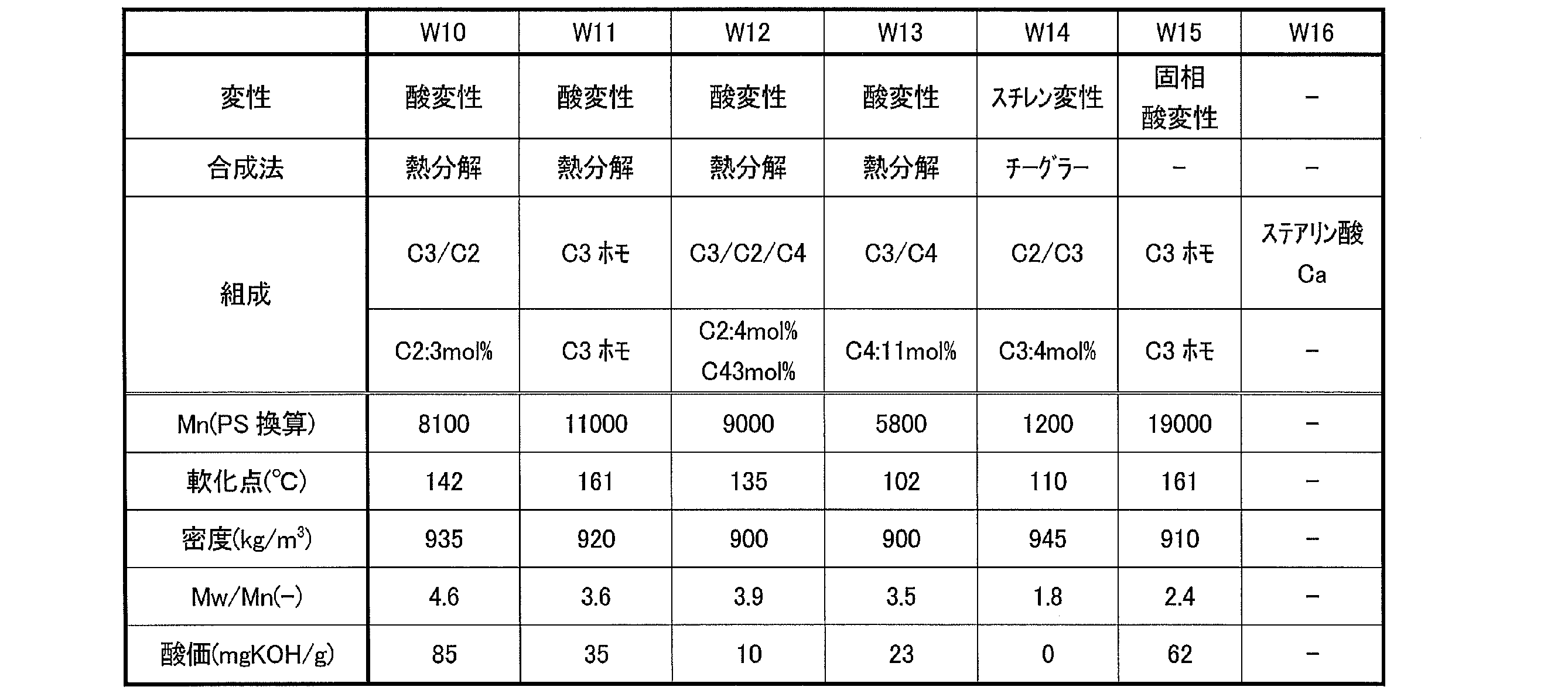
3.天然繊維(C)
天然繊維(C)として、平均粒径300μmに制御した木粉を使用した。
天然繊維(C)として、平均粒径300μmに制御した木粉を使用した。
[実施例1~2、比較例1]
(樹脂組成物の作製)
樹脂(A)(A1:ホモポリプロピレン)50質量部、及び天然繊維(C)(木粉)50質量部、表3に示す相容化剤(B)(W1またはW2)2質量部を添加しドライブレンドした。ただし、比較例1については、相容化剤(B)を添加しなかった。
その後、パーカーコーポレーション社製同方向回転二軸押出機、HK25D(φ25mm、L/D=41)を用いて溶融混練した。スクリュー回転数150rpm、フィード量2kg/h、出口温度210℃とし、ベルトコンベア上で空冷してストランドとした。
(樹脂組成物の作製)
樹脂(A)(A1:ホモポリプロピレン)50質量部、及び天然繊維(C)(木粉)50質量部、表3に示す相容化剤(B)(W1またはW2)2質量部を添加しドライブレンドした。ただし、比較例1については、相容化剤(B)を添加しなかった。
その後、パーカーコーポレーション社製同方向回転二軸押出機、HK25D(φ25mm、L/D=41)を用いて溶融混練した。スクリュー回転数150rpm、フィード量2kg/h、出口温度210℃とし、ベルトコンベア上で空冷してストランドとした。
(樹脂組成物の評価)
得られた樹脂組成物のMFR、トルク、樹脂圧力、メヤニ、発煙、及びフローカーブ(粘度)について、以下の方法で評価した。結果を表3に示す。また、当該樹脂組成物から得られたストランドの外観写真を図1に示した。図1において左から実施例1、実施例2、及び比較例1におけるストランドを示している。実施例1のストランドは平滑性に優れ(○と評価)、実施例2のストランドはやや表面荒れがあり(△と評価)、比較例1のストランドは大きな表面荒れが認められた(×と評価)。
得られた樹脂組成物のMFR、トルク、樹脂圧力、メヤニ、発煙、及びフローカーブ(粘度)について、以下の方法で評価した。結果を表3に示す。また、当該樹脂組成物から得られたストランドの外観写真を図1に示した。図1において左から実施例1、実施例2、及び比較例1におけるストランドを示している。実施例1のストランドは平滑性に優れ(○と評価)、実施例2のストランドはやや表面荒れがあり(△と評価)、比較例1のストランドは大きな表面荒れが認められた(×と評価)。
<MFR>
得られた樹脂組成物のMFRをJIS K7210に従い、230℃、10kgfの条件で測定した。
得られた樹脂組成物のMFRをJIS K7210に従い、230℃、10kgfの条件で測定した。
<トルク>
溶融混練開始30分後、運転状況が安定した際の二軸押出機の数値を読み取った。
溶融混練開始30分後、運転状況が安定した際の二軸押出機の数値を読み取った。
<樹脂圧力>
溶融混練開始30分後、運転状況が安定した際の二軸押出機の数値を読み取った。
溶融混練開始30分後、運転状況が安定した際の二軸押出機の数値を読み取った。
<メヤニ>
溶融混練開始から30分後、二軸混練機出口に、メヤニ(焼け樹脂、低分子量物、添加剤)が生じたかを目視にて確認し、以下のように評価した。
○:コンパウンド開始30分後、二軸混練機出口にメヤニ蓄積なし
×:コンパウンド開始30分後、二軸混練機出口にメヤニ蓄積あり
溶融混練開始から30分後、二軸混練機出口に、メヤニ(焼け樹脂、低分子量物、添加剤)が生じたかを目視にて確認し、以下のように評価した。
○:コンパウンド開始30分後、二軸混練機出口にメヤニ蓄積なし
×:コンパウンド開始30分後、二軸混練機出口にメヤニ蓄積あり
<発煙>
溶融混練開始後、終了までに発生する煙を目視にて確認した。
○:ほとんど発生しない
×:多量に発生した
溶融混練開始後、終了までに発生する煙を目視にて確認した。
○:ほとんど発生しない
×:多量に発生した
<フローカーブ>
得られた樹脂組成物について、JIS K7199に従い、キャピラリーサイズ、L=30mm、D=1.00mmを用い、230℃、押出速度2mm/minの条件における、粘度(Pa・s)を求めた。ただし、相容化剤を添加しない系(比較例1)は、流動不良につき、ノズルからストランドが出てこなかったため、数値を得ることができなかった。
得られた樹脂組成物について、JIS K7199に従い、キャピラリーサイズ、L=30mm、D=1.00mmを用い、230℃、押出速度2mm/minの条件における、粘度(Pa・s)を求めた。ただし、相容化剤を添加しない系(比較例1)は、流動不良につき、ノズルからストランドが出てこなかったため、数値を得ることができなかった。
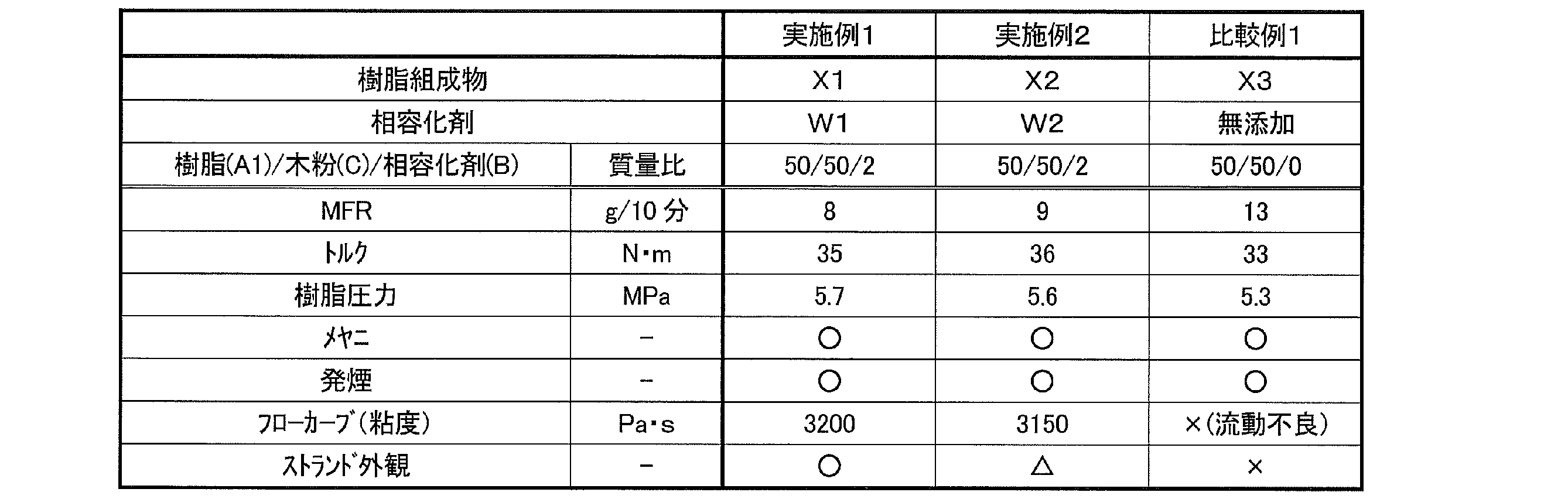
[実施例1~2、比較例1の評価]
相容化剤(B)を含まない比較例1に比べ、相容化剤(B)を含む実施例1及び2はMFRが低くなり、トルクと樹脂圧力にやや増大傾向が認められるが、フローカーブ測定における流動性は問題なく、外観も優れていた。これは、相容化剤(B)が木粉(C)に作用することにより、加熱下における樹脂組成物の流動性が均一になるためと考えられる。また、実施例2に対して実施例1はストランド外観がより優れており、これは、相容化剤(B)であるW1のMnが特に好ましい範囲にあるためと考えられる。
相容化剤(B)を含まない比較例1に比べ、相容化剤(B)を含む実施例1及び2はMFRが低くなり、トルクと樹脂圧力にやや増大傾向が認められるが、フローカーブ測定における流動性は問題なく、外観も優れていた。これは、相容化剤(B)が木粉(C)に作用することにより、加熱下における樹脂組成物の流動性が均一になるためと考えられる。また、実施例2に対して実施例1はストランド外観がより優れており、これは、相容化剤(B)であるW1のMnが特に好ましい範囲にあるためと考えられる。
[実施例3~6、比較例2]
(樹脂組成物の作製)
実施例1、2、及び比較例1で得られた樹脂組成物X1~X3のストランドをカッティングしてペレットを作製した。そして、これらを表4に示す比率でドライブレンドし樹脂組成物を得た。ただし、比較例2は相容化剤(B)をブレンドしなかった。
(樹脂組成物の作製)
実施例1、2、及び比較例1で得られた樹脂組成物X1~X3のストランドをカッティングしてペレットを作製した。そして、これらを表4に示す比率でドライブレンドし樹脂組成物を得た。ただし、比較例2は相容化剤(B)をブレンドしなかった。
[実施例7~18]
(樹脂組成物の作製)
樹脂(A)(A1:ホモポリプロピレン)50質量部または70質量部、及び天然繊維(C)(木粉)50質量部または30質量部、相容化剤(B)を表5及び6に示す質量比でドライブレンドした。
その後、パーカーコーポレーション社製同方向回転二軸押出機、HK25D(φ25mm、L/D=41)を用いて溶融混練した。スクリュー回転数150rpm、フィード量2kg/h、出口温度210℃とし、ベルトコンベア上で空冷してストランドとした。カッティングしてペレットを作製した。
(樹脂組成物の作製)
樹脂(A)(A1:ホモポリプロピレン)50質量部または70質量部、及び天然繊維(C)(木粉)50質量部または30質量部、相容化剤(B)を表5及び6に示す質量比でドライブレンドした。
その後、パーカーコーポレーション社製同方向回転二軸押出機、HK25D(φ25mm、L/D=41)を用いて溶融混練した。スクリュー回転数150rpm、フィード量2kg/h、出口温度210℃とし、ベルトコンベア上で空冷してストランドとした。カッティングしてペレットを作製した。
[実施例19~25]
樹脂(A)(A1:ホモポリプロピレン)50質量部、及び天然繊維(C)(木粉)50質量部に、2種の相容化剤を表7に示す質量比で添加し、ドライブレンドした。その後、パーカーコーポレーション社製同方向回転二軸押出機、HK25D(φ25mm、L/D=41)を用いて溶融混練した。スクリュー回転数150rpm、フィード量2kg/h、出口温度210℃とし、ベルトコンベア上で空冷してストランドとした。カッティングしてペレットを作製した。
樹脂(A)(A1:ホモポリプロピレン)50質量部、及び天然繊維(C)(木粉)50質量部に、2種の相容化剤を表7に示す質量比で添加し、ドライブレンドした。その後、パーカーコーポレーション社製同方向回転二軸押出機、HK25D(φ25mm、L/D=41)を用いて溶融混練した。スクリュー回転数150rpm、フィード量2kg/h、出口温度210℃とし、ベルトコンベア上で空冷してストランドとした。カッティングしてペレットを作製した。
[実施例26及び比較例3]
樹脂(A)(A1:ホモポリプロピレン)50質量部、及び天然繊維(C)(木粉)50質量部に、表8に示される相容化剤(B)((W8)または(W16))を2質量部添加し、ドライブレンドした。その後、パーカーコーポレーション社製同方向回転二軸押出機、HK25D(φ25mm、L/D=41)を用いて溶融混練した。スクリュー回転数150rpm、フィード量2kg/h、出口温度210℃とし、ベルトコンベア上で空冷してストランドとした。カッティングしてペレットを作製した。
樹脂(A)(A1:ホモポリプロピレン)50質量部、及び天然繊維(C)(木粉)50質量部に、表8に示される相容化剤(B)((W8)または(W16))を2質量部添加し、ドライブレンドした。その後、パーカーコーポレーション社製同方向回転二軸押出機、HK25D(φ25mm、L/D=41)を用いて溶融混練した。スクリュー回転数150rpm、フィード量2kg/h、出口温度210℃とし、ベルトコンベア上で空冷してストランドとした。カッティングしてペレットを作製した。
(樹脂組成物の評価)
[試験片の作成]
実施例3~26、比較例2、3において得られたペレット状の樹脂組成物を、100℃、4時間乾燥後、射出成形機(ニイガタNN100、ニイガタマシンテクノ社製)を用いて、シリンダー温度190℃、スクリュー回転数60rpm、射出圧力180MPa、金型温度60℃の条件で射出成形し、試験片を作製した。
[試験片の作成]
実施例3~26、比較例2、3において得られたペレット状の樹脂組成物を、100℃、4時間乾燥後、射出成形機(ニイガタNN100、ニイガタマシンテクノ社製)を用いて、シリンダー温度190℃、スクリュー回転数60rpm、射出圧力180MPa、金型温度60℃の条件で射出成形し、試験片を作製した。
[試験片の評価]
得られた試験片について、以下のように外観、引張試験(引張強度、伸び)、曲げ試験(曲げ強度、たわみ、曲げ弾性率)、シャルピー衝撃試験(室温及び-30℃)、荷重たわみ温度測定、木粉分散性の評価を行った。評価結果を表4~8に示す。
得られた試験片について、以下のように外観、引張試験(引張強度、伸び)、曲げ試験(曲げ強度、たわみ、曲げ弾性率)、シャルピー衝撃試験(室温及び-30℃)、荷重たわみ温度測定、木粉分散性の評価を行った。評価結果を表4~8に示す。
<外観>
◎:射出成形品の表面が均一である
○:射出成形品の表面にムラが少ない
△:射出成形品の表面にムラが多い
×:射出成形品の表面にムラが多く、成形品が変色している
◎:射出成形品の表面が均一である
○:射出成形品の表面にムラが少ない
△:射出成形品の表面にムラが多い
×:射出成形品の表面にムラが多く、成形品が変色している
<引張試験(引張強度、伸び)>
JIS K-7162に基づき、荷重レンジ2kN、試験速度50mm/minの条件で引張強度、引張伸び率を測定した。引張強度及び引張伸び率は、それぞれ以下の基準で評価した。
・引張強度
◎:引張強度が39MPa以上である
○:引張強度が37MPa以上、39MPa未満である
△:引張強度が25MPa以上、37MPa未満である
×:引張強度が25MPa未満である
JIS K-7162に基づき、荷重レンジ2kN、試験速度50mm/minの条件で引張強度、引張伸び率を測定した。引張強度及び引張伸び率は、それぞれ以下の基準で評価した。
・引張強度
◎:引張強度が39MPa以上である
○:引張強度が37MPa以上、39MPa未満である
△:引張強度が25MPa以上、37MPa未満である
×:引張強度が25MPa未満である
・引張伸び率
○:引張伸び率が、2.8%以上である
△:引張伸び率が2.0%以上、2.8未満である
×:引張伸び率が2.0%未満である
○:引張伸び率が、2.8%以上である
△:引張伸び率が2.0%以上、2.8未満である
×:引張伸び率が2.0%未満である
<曲げ試験(曲げ強度、たわみ、曲げ弾性率)>
JIS K-7171に基づき、荷重レンジ200N、試験速度2mm/min、曲げスパン64mmの条件で曲げ強度、たわみ、曲げ弾性率を測定した。これらは、それぞれ以下の基準で評価した。
・曲げ強度
◎:曲げ強度が58MPa以上である
○:曲げ強度が55MPa以上、58MPa未満である
△:曲げ強度が37MPa以上、55MPa未満である
×:曲げ強度が37MPa未満である
JIS K-7171に基づき、荷重レンジ200N、試験速度2mm/min、曲げスパン64mmの条件で曲げ強度、たわみ、曲げ弾性率を測定した。これらは、それぞれ以下の基準で評価した。
・曲げ強度
◎:曲げ強度が58MPa以上である
○:曲げ強度が55MPa以上、58MPa未満である
△:曲げ強度が37MPa以上、55MPa未満である
×:曲げ強度が37MPa未満である
・たわみ
○:たわみが5.0%以上である
△:たわみが3.0%以上5.0%未満である
×:たわみが3.0%未満である
○:たわみが5.0%以上である
△:たわみが3.0%以上5.0%未満である
×:たわみが3.0%未満である
・曲げ弾性率
○:曲げ弾性率が3700MPa以上である
×:曲げ弾性率が3700MPa未満である
○:曲げ弾性率が3700MPa以上である
×:曲げ弾性率が3700MPa未満である
<シャルピー衝撃試験>
JIS K7111に従い、室温及び-30℃におけるシャルピー衝撃試験を行った。ノッチは機械加工とし、試験片は、10mm(幅)×4mm(厚さ)×80mm(長さ)とした。これらはそれぞれ以下の基準で評価した。
JIS K7111に従い、室温及び-30℃におけるシャルピー衝撃試験を行った。ノッチは機械加工とし、試験片は、10mm(幅)×4mm(厚さ)×80mm(長さ)とした。これらはそれぞれ以下の基準で評価した。
・シャルピー衝撃値(室温)(kJ/m2)
◎:シャルピー衝撃値が4.1kJ/m2以上である
○:シャルピー衝撃値が3.8kJ/m2以上4.1kJ/m2未満である
△:シャルピー衝撃値が3.0kJ/m2以上3.8未満である
×:シャルピー衝撃値が3.0kJ/m2未満である
◎:シャルピー衝撃値が4.1kJ/m2以上である
○:シャルピー衝撃値が3.8kJ/m2以上4.1kJ/m2未満である
△:シャルピー衝撃値が3.0kJ/m2以上3.8未満である
×:シャルピー衝撃値が3.0kJ/m2未満である
・シャルピー衝撃値(-30℃)
○:シャルピー衝撃値が2.0kJ/m2以上である
△:シャルピー衝撃値が1.5kJ/m2以上、2.0kJ/m2未満である
×:シャルピー衝撃値が1.5kJ/m2未満である
○:シャルピー衝撃値が2.0kJ/m2以上である
△:シャルピー衝撃値が1.5kJ/m2以上、2.0kJ/m2未満である
×:シャルピー衝撃値が1.5kJ/m2未満である
<荷重たわみ温度>
ISO75に従って、下記の条件で荷重たわみ温度を測定した。試験片は、10mm(幅)×4mm(厚さ)×80mm(長さ)とし、荷重は0.45MPaとした。荷重たわみ温度は、以下の基準で評価した。
◎:荷重たわみ温度が149℃以上である
○:荷重たわみ温度が145℃以上149℃未満である
△:荷重たわみ温度が142℃以上145℃未満である
×:荷重たわみ温度が142℃未満である
ISO75に従って、下記の条件で荷重たわみ温度を測定した。試験片は、10mm(幅)×4mm(厚さ)×80mm(長さ)とし、荷重は0.45MPaとした。荷重たわみ温度は、以下の基準で評価した。
◎:荷重たわみ温度が149℃以上である
○:荷重たわみ温度が145℃以上149℃未満である
△:荷重たわみ温度が142℃以上145℃未満である
×:荷重たわみ温度が142℃未満である
<木粉分散性>
走査型電子顕微鏡(SEM)にて射出試験片中の木粉の分散状態を観察し、下記基準にて評価した。
○:木粉が均一に分散しており、1mm以上の粗大な木粉が認められない
×:木粉の分散が不均一であり、1mm以上の粗大な木粉が存在する
走査型電子顕微鏡(SEM)にて射出試験片中の木粉の分散状態を観察し、下記基準にて評価した。
○:木粉が均一に分散しており、1mm以上の粗大な木粉が認められない
×:木粉の分散が不均一であり、1mm以上の粗大な木粉が存在する
[トルク変化及び樹脂圧力変化]
実施例7~26及び比較例3については、樹脂組成物を得る際の、二軸押出機のトルク変化、樹脂圧力変化を以下の方法で評価した。結果を表5~8に示す。
実施例7~26及び比較例3については、樹脂組成物を得る際の、二軸押出機のトルク変化、樹脂圧力変化を以下の方法で評価した。結果を表5~8に示す。
<トルク変化>
相容化剤を添加した際のトルク変化TC(N・m)を以下式により評価した。
TC = TA - TB
TAは、溶融混練開始30分後、運転状況が安定した際の二軸押出機のトルクの数値(N・m)である。また、TBは、比較例1で相容化剤を添加しなかった際の二軸押出機のトルクの数値(N・m)である。TCの数値が低いほど、相容化剤を添加した際に混練が容易であったことを示す。
相容化剤を添加した際のトルク変化TC(N・m)を以下式により評価した。
TC = TA - TB
TAは、溶融混練開始30分後、運転状況が安定した際の二軸押出機のトルクの数値(N・m)である。また、TBは、比較例1で相容化剤を添加しなかった際の二軸押出機のトルクの数値(N・m)である。TCの数値が低いほど、相容化剤を添加した際に混練が容易であったことを示す。
<樹脂圧力変化>
相容化剤を添加した際の樹脂圧力変化PC(MPa)を以下式により評価した。
PC = PA - PB
PAは、溶融混練開始30分後、運転状況が安定した際の二軸押出機の樹脂圧力の数値(MPa)である。また、PBは、比較例1で相容化剤を添加しなかった際の二軸押出機の樹脂圧力の数値(MPa)である。PC(MPa)の数値が低いほど、相容化剤を添加した際に混練が容易であったことを示す。
相容化剤を添加した際の樹脂圧力変化PC(MPa)を以下式により評価した。
PC = PA - PB
PAは、溶融混練開始30分後、運転状況が安定した際の二軸押出機の樹脂圧力の数値(MPa)である。また、PBは、比較例1で相容化剤を添加しなかった際の二軸押出機の樹脂圧力の数値(MPa)である。PC(MPa)の数値が低いほど、相容化剤を添加した際に混練が容易であったことを示す。

[実施例3~6、比較例2の評価]
相容化剤(B)を含まない比較例2に対して、相容化剤(B)を含む実施例3~6は、得られた試験片(成形体)の外観及び各種物性が優れていた。また、相容化剤(B)を0.5質量部含む実施例3及び5に対して、相容化剤(B)を1質量部含む実施例4及び6は、外観や各種物性が優れていた。
相容化剤(B)を含まない比較例2に対して、相容化剤(B)を含む実施例3~6は、得られた試験片(成形体)の外観及び各種物性が優れていた。また、相容化剤(B)を0.5質量部含む実施例3及び5に対して、相容化剤(B)を1質量部含む実施例4及び6は、外観や各種物性が優れていた。
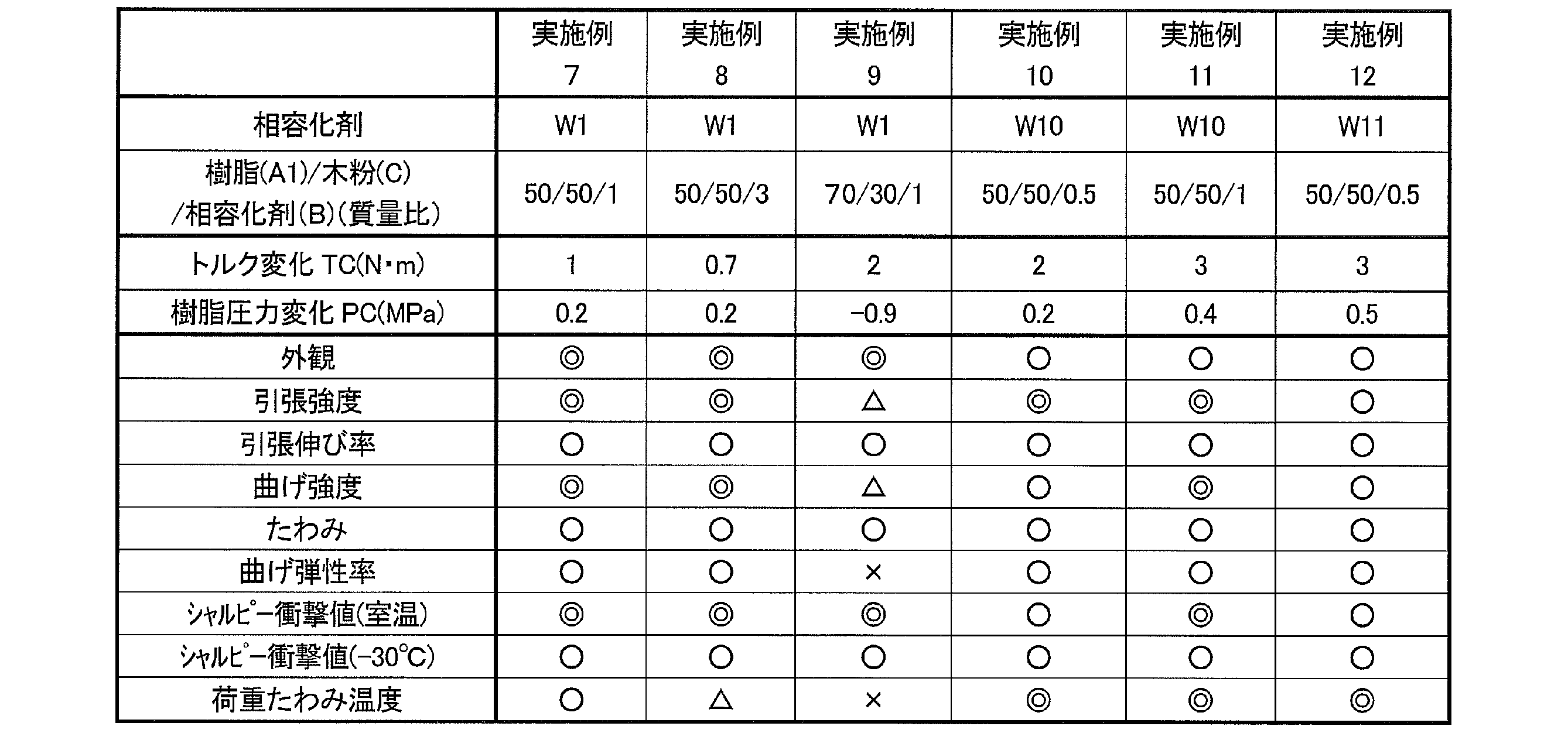
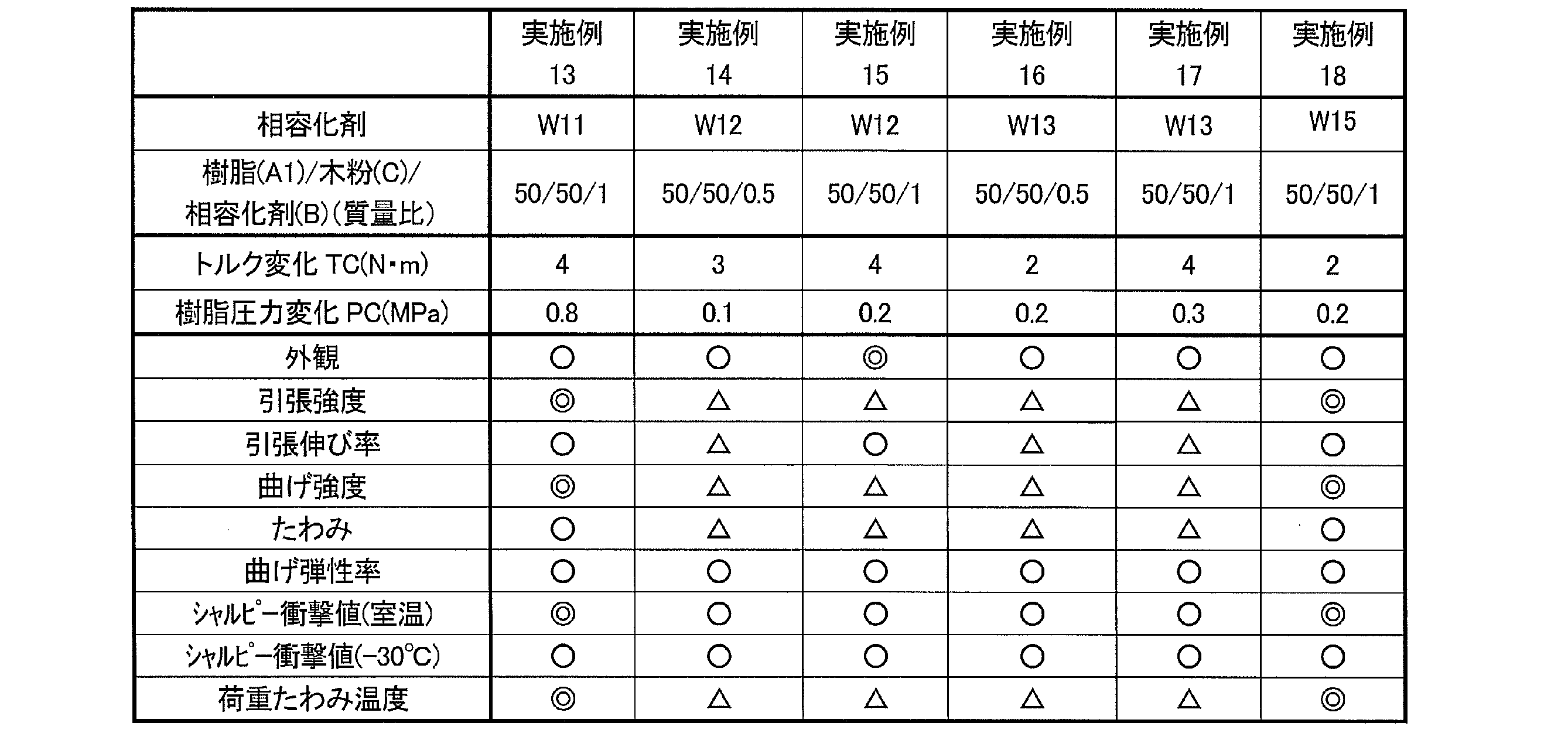
[実施例7~18の評価]
実施例7は、実施例8に対して、木粉(C)を多く含むため、引張強度や曲げ強度、耐熱性が優れていた。また、相容化剤(B)としてW1を1質量部含む実施例7に対して、相容化剤(B)としてW10あるいはW11を1質量部含む実施例11及び13は、荷重たわみ温度が優れていた。W10はW1より酸価が高いこと、W11はW1より分子量が高いこと、が要因として考えられる。一方でトルク変化や樹脂圧力変化及び外観については実施例11及び13よりも実施例7のほうが優れていた。
また、実施例7は実施例4と樹脂組成物の製法が異なるものの、その組成は同じであり、得られた試験片(成形体)の外観及び物性は同等であった。
実施例7は、実施例8に対して、木粉(C)を多く含むため、引張強度や曲げ強度、耐熱性が優れていた。また、相容化剤(B)としてW1を1質量部含む実施例7に対して、相容化剤(B)としてW10あるいはW11を1質量部含む実施例11及び13は、荷重たわみ温度が優れていた。W10はW1より酸価が高いこと、W11はW1より分子量が高いこと、が要因として考えられる。一方でトルク変化や樹脂圧力変化及び外観については実施例11及び13よりも実施例7のほうが優れていた。
また、実施例7は実施例4と樹脂組成物の製法が異なるものの、その組成は同じであり、得られた試験片(成形体)の外観及び物性は同等であった。
一方、相容化剤(B)としてW10あるいはW11を0.5質量部用いた実施例10及び12は、相容化剤(B)としてW1を0.5質量部用いた実施例3に対して、荷重撓み温度が優れており、W10を用いた場合(実施例10)には引張強度も優れていた。また、相容化剤(B)としてW12を用いた実施例14及び15は、相容化剤(B)としてW1を用いた実施例3及び4(あるいは実施例7)に対して、各種強度が劣る傾向にあった。これは相容化剤(B)として用いたW12の酸価が比較的低いためであると考えられる。
また、相容化剤(B)としてW13を用いた実施例16及び17は、相容化剤(B)としてW1を用いた実施例3及び4(あるいは実施例7)に対して、各種強度がやや劣る傾向にあった。これは、W1に比べるとW13の分子量と酸価がやや低いことによると考えられる。
また、相容化剤(B)としてW1を3質量部用いた実施例8は、相容化剤(B)としてW1を1質量部用いた実施例7に対して、荷重たわみ温度が低減した。
また、相容化剤(B)としてW1を3質量部用いた実施例8は、相容化剤(B)としてW1を1質量部用いた実施例7に対して、荷重たわみ温度が低減した。
さらに、相容化剤(B)としてW15を用いた実施例18は、相容化剤(B)としてW1を用いた実施例7に対して、荷重たわみ温度が高かった。W15の分子量及び酸価がW1よりそれぞれ高いことが要因として考えられる。
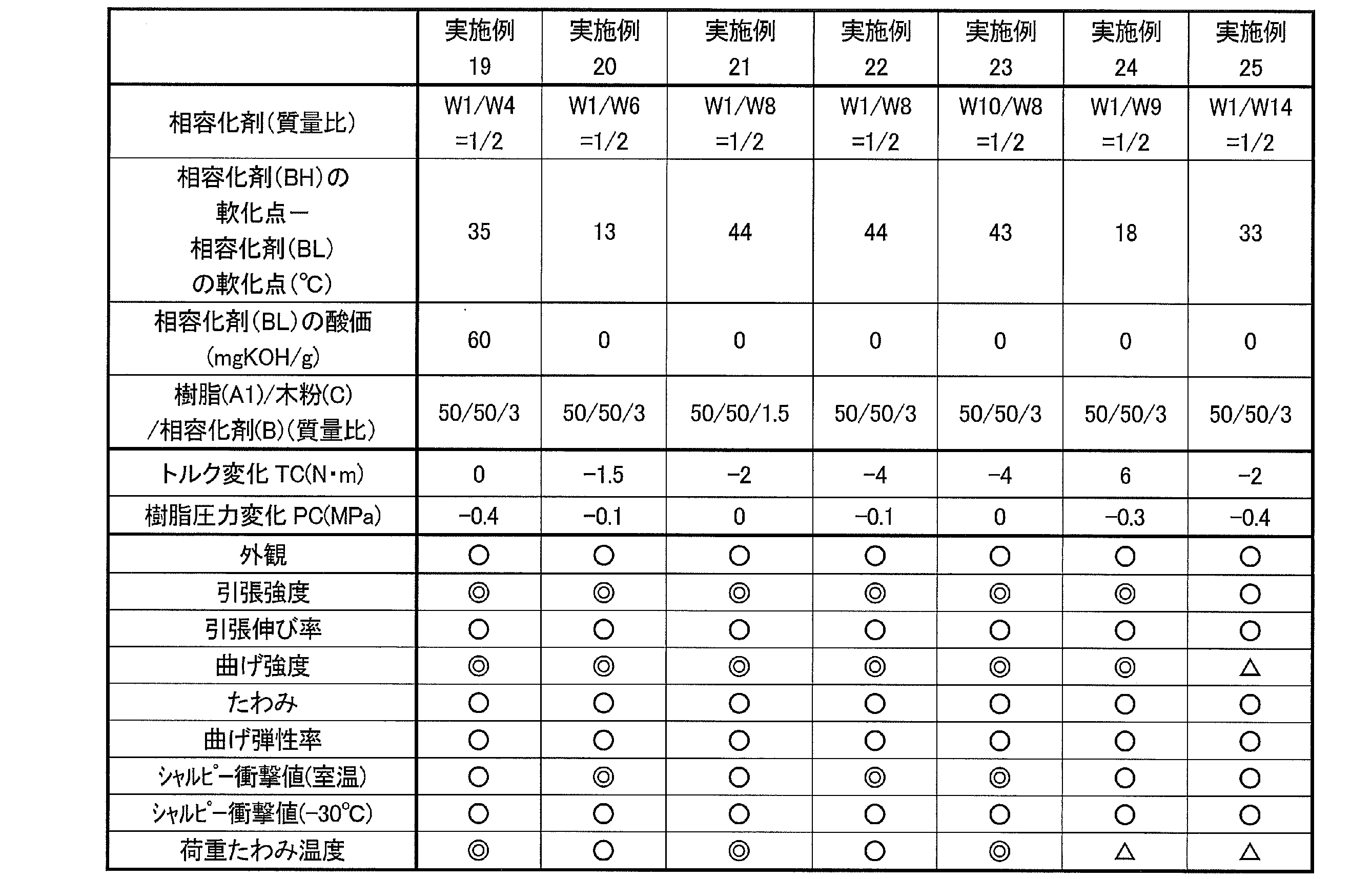
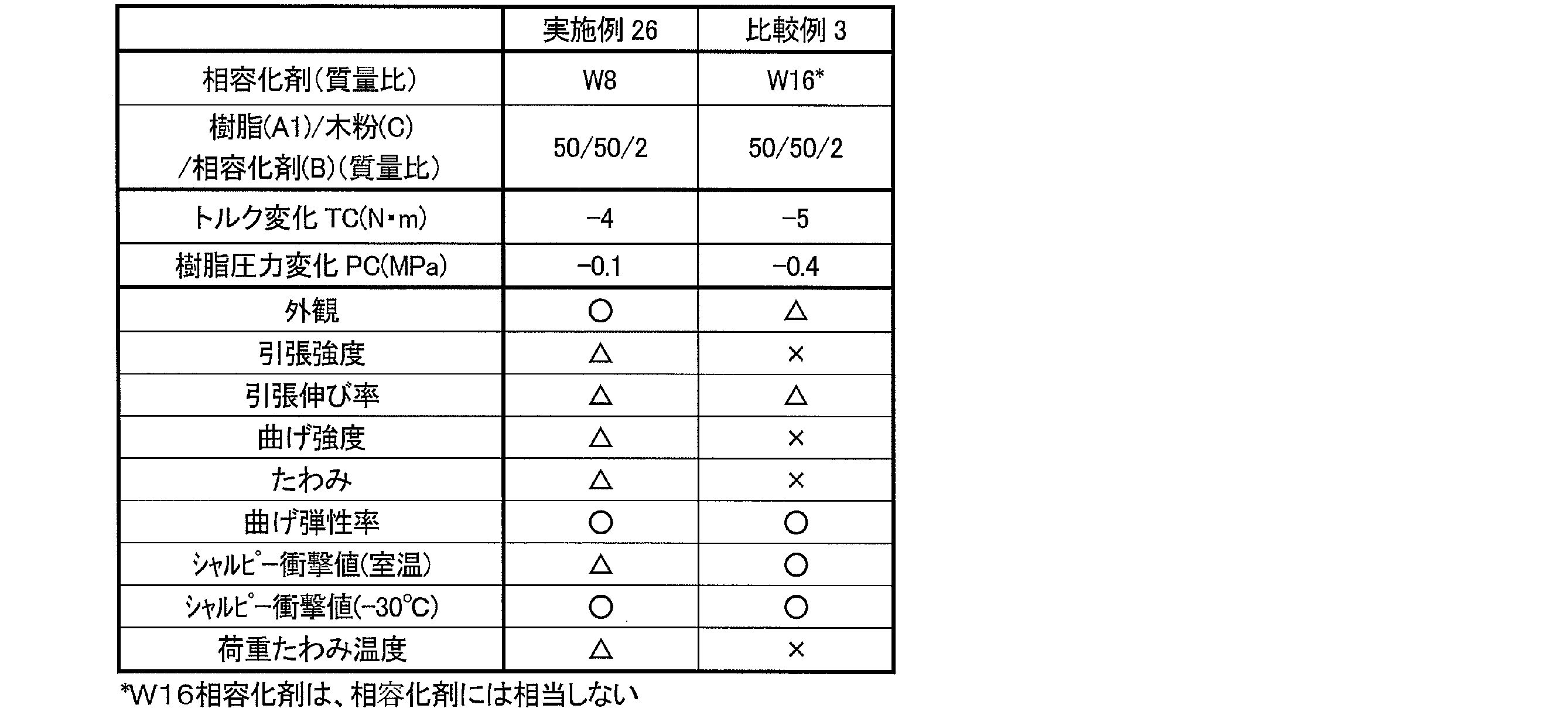
[実施例19~26、及び比較例3の評価]
実施例19~26はいずれも、樹脂組成物を得る際の樹脂圧力が高まらず、この点で優れていた。また特に、ポリオレフィンワックス2種を組み合わせた実施例19~25は外観や各種物性においても優れていた。これは、軟化点の高い相容化剤(BH)W1またはW10と、軟化点の低い相容化剤(BL)(W4、W6、W8、W9、またはW14)との温度差によって生じたと考えられる。具体的には、相容化剤(B)を2種類組み合わせた樹脂組成物では、軟化点の低い相容化剤(BL)が、成形時に先に溶融して木粉の分散性を高める。したがって、後に溶融する軟化点の高い相容化剤(BH)と木粉表面の接触効率が向上する。その結果、加工性及び力学特性のバランスが優れたと考えられる。
実施例19~26はいずれも、樹脂組成物を得る際の樹脂圧力が高まらず、この点で優れていた。また特に、ポリオレフィンワックス2種を組み合わせた実施例19~25は外観や各種物性においても優れていた。これは、軟化点の高い相容化剤(BH)W1またはW10と、軟化点の低い相容化剤(BL)(W4、W6、W8、W9、またはW14)との温度差によって生じたと考えられる。具体的には、相容化剤(B)を2種類組み合わせた樹脂組成物では、軟化点の低い相容化剤(BL)が、成形時に先に溶融して木粉の分散性を高める。したがって、後に溶融する軟化点の高い相容化剤(BH)と木粉表面の接触効率が向上する。その結果、加工性及び力学特性のバランスが優れたと考えられる。
また特に、相容化剤W1と相容化剤W8とを組み合わせた実施例22は、相容化剤W1と相容化剤W6とを組み合わせた実施例20に対して、加工性(トルク変化)が優れていた。これは相容化剤どうしの軟化点温度差がより好ましい範囲(20℃以上)にあったためであると推察される。
また、実施例19は軟化点の低い相容化剤(BL)として酸変性ワックスW4を用いたため、荷重たわみ温度に優れていた。
また、相容化剤(B)としてW10及びW8を用いた実施例23は、相容化剤(B)としてW1及び相容化剤W8を用いた実施例22に対して、荷重たわみ温度が優れていた。相容化剤(B)として用いたW10の酸価が高いことが要因として考えられる。
また、相容化剤(B)としてW10及びW8を用いた実施例23は、相容化剤(B)としてW1及び相容化剤W8を用いた実施例22に対して、荷重たわみ温度が優れていた。相容化剤(B)として用いたW10の酸価が高いことが要因として考えられる。
[実施例27~32、比較例4]
(樹脂組成物の作製)
表9に示す樹脂(A)を50質量部または70質量部、及び天然繊維(C)(木粉)50質量部、相容化剤(B)としてW1を1質量部ドライブレンドした。ただし比較例4では相容化剤(B)を用いなかった。また、実施例29、31及び32は2種の樹脂(A)を1:1の比率で用いた。その後、ラボプラストミル(ムサシノキカイ社、NT-16-129)を用い、混練温度190℃、スクリュー回転数10rpm、10分間溶融混練を行った。その後、ベルトコンベア上で空冷してストランドとした。カッティングしてペレットを作製した。
(樹脂組成物の作製)
表9に示す樹脂(A)を50質量部または70質量部、及び天然繊維(C)(木粉)50質量部、相容化剤(B)としてW1を1質量部ドライブレンドした。ただし比較例4では相容化剤(B)を用いなかった。また、実施例29、31及び32は2種の樹脂(A)を1:1の比率で用いた。その後、ラボプラストミル(ムサシノキカイ社、NT-16-129)を用い、混練温度190℃、スクリュー回転数10rpm、10分間溶融混練を行った。その後、ベルトコンベア上で空冷してストランドとした。カッティングしてペレットを作製した。
(樹脂組成物の評価)
<トルク>
ラボプラストミルにて溶融混練開始5分後、運転状況が安定した際のトルク値を読み取った。
<トルク>
ラボプラストミルにて溶融混練開始5分後、運転状況が安定した際のトルク値を読み取った。
[試験片の作成]
得られたペレット状の樹脂組成物を、100℃、4時間乾燥後、射出成形機(ニイガタNN100、ニイガタマシンテクノ社製)を用いて、シリンダー温度190℃、スクリュー回転数65rpm、射出圧力160MPa、金型温度40℃の条件で射出成形し、試験片を作製した。
得られたペレット状の樹脂組成物を、100℃、4時間乾燥後、射出成形機(ニイガタNN100、ニイガタマシンテクノ社製)を用いて、シリンダー温度190℃、スクリュー回転数65rpm、射出圧力160MPa、金型温度40℃の条件で射出成形し、試験片を作製した。
[試験片の評価]
得られた試験片について、以下のように外観、シャルピー衝撃試験(室温及び-30℃)の評価を行った。評価結果を表9に示す。
得られた試験片について、以下のように外観、シャルピー衝撃試験(室温及び-30℃)の評価を行った。評価結果を表9に示す。
<外観>
◎:射出成形品の表面が均一である
○:射出成形品の表面にムラが少ない
△:射出成形品の表面にムラが多い
×:射出成形品の表面にムラが多く、成形品が変色している
◎:射出成形品の表面が均一である
○:射出成形品の表面にムラが少ない
△:射出成形品の表面にムラが多い
×:射出成形品の表面にムラが多く、成形品が変色している
<シャルピー衝撃試験>
JIS K7111に従い、室温及び-30℃におけるシャルピー衝撃試験を行った。ノッチは機械加工とし、試験片は、10mm(幅)×4mm(厚さ)×80mm(長さ)とした。
JIS K7111に従い、室温及び-30℃におけるシャルピー衝撃試験を行った。ノッチは機械加工とし、試験片は、10mm(幅)×4mm(厚さ)×80mm(長さ)とした。
<衝撃吸収性>
上記ラボプラストミル加工性評価で溶融混練を行ったサンプルを下記条件でプレス成形し厚み2mmシートを作製した。
プレス成形条件
予熱:190℃×10min
プレス:190℃×10MPa×3min
冷却:18℃×10MPa×3min
上記ラボプラストミル加工性評価で溶融混練を行ったサンプルを下記条件でプレス成形し厚み2mmシートを作製した。
プレス成形条件
予熱:190℃×10min
プレス:190℃×10MPa×3min
冷却:18℃×10MPa×3min
得られたシート上に、10cmの高さより、直径15mm、重さ13.7gのスチールボールを落下させ、以下基準により、衝撃吸収性(反撥性)を評価した。
◎:音が小さく、ほとんど反撥しない
○:やや音が発生し、僅かに反撥する
△:音が発生し、反撥しやすい
×:大きな音が発生し、反撥が大きい
◎:音が小さく、ほとんど反撥しない
○:やや音が発生し、僅かに反撥する
△:音が発生し、反撥しやすい
×:大きな音が発生し、反撥が大きい
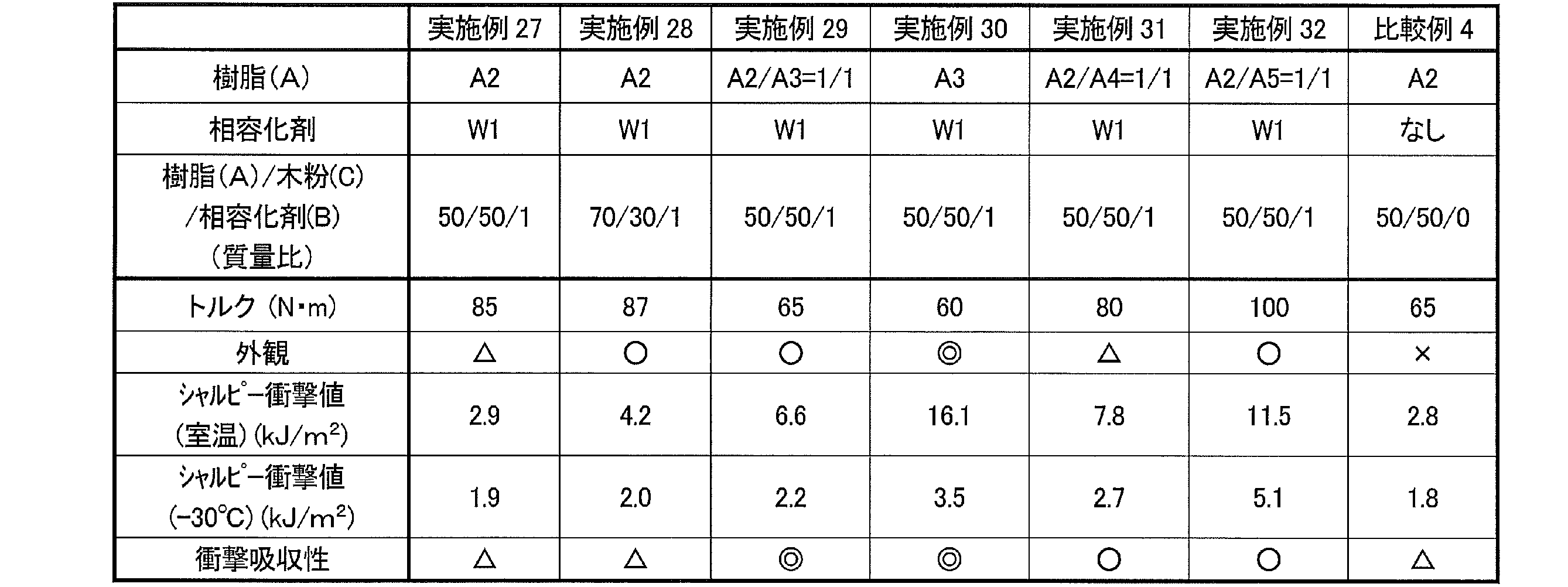
[実施例27~32、比較例4の評価]
実施例27は、相容化剤(B)としてW1を添加した効果により、比較例4に対し、外観と衝撃値が向上したと考えられる。また実施例28は、樹脂(A)の含有量が増えたため、外観、衝撃値のバランスがさらに良好となった。
更に、実施例29及び30は、加工性(トルク)と外観、衝撃値、衝撃吸収性が良好であり、特に実施例30は、加工性(トルク)と外観、衝撃値、衝撃吸収性に優れていた。これは樹脂(A)として樹脂(A3)を用いたことによると考えられる。
実施例31及び32は、外観、衝撃値、衝撃吸収性のバランスが比較的良好であった。これは樹脂(A2)に、樹脂(A4)または樹脂(A5)を組み合わせたことによると考えられる。
実施例27は、相容化剤(B)としてW1を添加した効果により、比較例4に対し、外観と衝撃値が向上したと考えられる。また実施例28は、樹脂(A)の含有量が増えたため、外観、衝撃値のバランスがさらに良好となった。
更に、実施例29及び30は、加工性(トルク)と外観、衝撃値、衝撃吸収性が良好であり、特に実施例30は、加工性(トルク)と外観、衝撃値、衝撃吸収性に優れていた。これは樹脂(A)として樹脂(A3)を用いたことによると考えられる。
実施例31及び32は、外観、衝撃値、衝撃吸収性のバランスが比較的良好であった。これは樹脂(A2)に、樹脂(A4)または樹脂(A5)を組み合わせたことによると考えられる。
[実施例33~43、比較例5]
まず、比較例1のX3からなるペレットを、混練温度190℃、スクリュー回転数50rpm、5分間溶融混練を行った。最大トルク発現時間をT1(s)とした(比較例5)。
一方、比較例1のX3からなるペレットに、各相容化剤(B)を表10または11に示す添加量配合し、ドライブレンドした(実施例29~43)。当該混合物を、混練温度190℃、スクリュー回転数50rpm、5分間溶融混練を行い、最大トルク発生時間T2を求めた。そして、以下判断基準により、混練性と加工性を評価した。なお、ラボプラストミルは東洋精機(株)製ラボプラストミル4C150型を用いた。また、得られたサンプルの耐熱安定性を評価した。評価結果を表10及び11に併せて示す。
まず、比較例1のX3からなるペレットを、混練温度190℃、スクリュー回転数50rpm、5分間溶融混練を行った。最大トルク発現時間をT1(s)とした(比較例5)。
一方、比較例1のX3からなるペレットに、各相容化剤(B)を表10または11に示す添加量配合し、ドライブレンドした(実施例29~43)。当該混合物を、混練温度190℃、スクリュー回転数50rpm、5分間溶融混練を行い、最大トルク発生時間T2を求めた。そして、以下判断基準により、混練性と加工性を評価した。なお、ラボプラストミルは東洋精機(株)製ラボプラストミル4C150型を用いた。また、得られたサンプルの耐熱安定性を評価した。評価結果を表10及び11に併せて示す。
<混練性>
T1とT2との比(T1/T2)を混練性の指標とし、以下の基準で評価した。
◎:T1/T2が1.1以上である(特に練りやすい)
○:T1/T2が0.8以上、1.1未満である(練りやすい)
△:T1/T2が0.5以上、0.8未満である(やや練りにくい)
×:T1/T2が0.5未満である(練りにくい)
T1とT2との比(T1/T2)を混練性の指標とし、以下の基準で評価した。
◎:T1/T2が1.1以上である(特に練りやすい)
○:T1/T2が0.8以上、1.1未満である(練りやすい)
△:T1/T2が0.5以上、0.8未満である(やや練りにくい)
×:T1/T2が0.5未満である(練りにくい)
<加工性>
最大トルクの値を加工性の指標とし、以下の基準で評価した。
◎:最大トルクが34N・m未満である
○:最大トルクが34N・m以上、43N・m未満である
△:最大トルクが43N・m以上、50N・m未満である
×:最大トルクが50N・m以上である
最大トルクの値を加工性の指標とし、以下の基準で評価した。
◎:最大トルクが34N・m未満である
○:最大トルクが34N・m以上、43N・m未満である
△:最大トルクが43N・m以上、50N・m未満である
×:最大トルクが50N・m以上である
<耐熱安定性の評価>
上記ラボプラストミル加工性評価で溶融混練を行ったサンプルを下記条件でプレス成形し厚み2mmシートを作製した。
上記ラボプラストミル加工性評価で溶融混練を行ったサンプルを下記条件でプレス成形し厚み2mmシートを作製した。
<プレス成形条件>
予熱:190℃×10min
プレス:190℃×10MPa×3min
冷却:18℃×10MPa×3min
得られたシートを120℃恒温器に2時間放置後、表面状態を目視にて観察し、下記の基準で評価した。
○:ワックス無添加と同等の表面状態
△:ワックス無添加に対しやや白化
×:白化顕著、ムラ大
予熱:190℃×10min
プレス:190℃×10MPa×3min
冷却:18℃×10MPa×3min
得られたシートを120℃恒温器に2時間放置後、表面状態を目視にて観察し、下記の基準で評価した。
○:ワックス無添加と同等の表面状態
△:ワックス無添加に対しやや白化
×:白化顕著、ムラ大

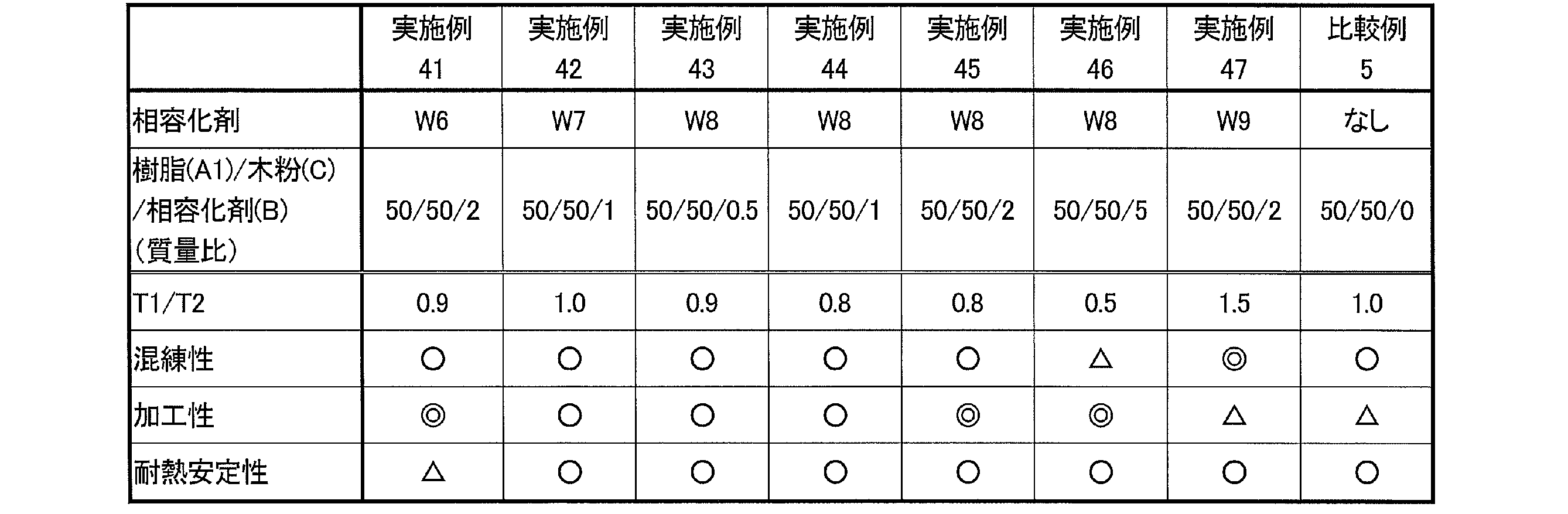
[実施例33~47、比較例5の評価]
実施例33~46は、比較例5に対して、加工性が優れていた。これは相容化剤(B)の添加効果によると考えられる。
実施例33、及び34は、比較例5に対して、加工性のみでなく混練性も優れていた。これは、用いた相容化剤(B)が、ポリプロピレン系ワックスの酸変性物であるため、樹脂(A)(ポリプロピレン)との相容化効果が大きいためと考えられる。また、実施例33は、実施例34よりも加工性がさらに優れていた。これは、相容化剤(B)として用いたW1がW2よりも高分子量であることから、相容化効果が更に大きいためと考えられる。
実施例40は、実施例41に対し、相容化剤(B)の添加量が少ないため、混練性、耐熱性が優れる傾向にあった。ただし、加工性は実施例41のほうが優れる傾向が認められた。これは相容化剤(B)の量によるものと考えられる。
実施例45および46は、実施例44に対して、加工性が良好であった。これは相容化剤(B)の量によるものと考えられる。一方で混練性は実施例46よりも、実施例44及び45のほうが優れる傾向にあった。
実施例47は混練性が特に良好であり、これは相容化剤(B)として用いたW9が嵩高い骨格を有し、木粉(C)表面と相容し易いためと考えられる。
実施例33~46は、比較例5に対して、加工性が優れていた。これは相容化剤(B)の添加効果によると考えられる。
実施例33、及び34は、比較例5に対して、加工性のみでなく混練性も優れていた。これは、用いた相容化剤(B)が、ポリプロピレン系ワックスの酸変性物であるため、樹脂(A)(ポリプロピレン)との相容化効果が大きいためと考えられる。また、実施例33は、実施例34よりも加工性がさらに優れていた。これは、相容化剤(B)として用いたW1がW2よりも高分子量であることから、相容化効果が更に大きいためと考えられる。
実施例40は、実施例41に対し、相容化剤(B)の添加量が少ないため、混練性、耐熱性が優れる傾向にあった。ただし、加工性は実施例41のほうが優れる傾向が認められた。これは相容化剤(B)の量によるものと考えられる。
実施例45および46は、実施例44に対して、加工性が良好であった。これは相容化剤(B)の量によるものと考えられる。一方で混練性は実施例46よりも、実施例44及び45のほうが優れる傾向にあった。
実施例47は混練性が特に良好であり、これは相容化剤(B)として用いたW9が嵩高い骨格を有し、木粉(C)表面と相容し易いためと考えられる。
本出願は、2015年5月12日出願の特願2015-097482号、及び2015年11月30日出願の特願2015-233309号に基づく優先権を主張する。これらの出願明細書及び図面に記載された内容は、すべて本願明細書に援用される。
本発明の樹脂組成物によれば、樹脂と天然繊維とが均一に分散されており、加工性、外観、引張強度、曲げ強度、衝撃性、熱安定性などのバランスに優れる合成木材が得られる。したがって、当該樹脂組成物は、各種用途に非常に有用である。
Claims (22)
- 熱可塑性樹脂及び熱硬化性樹脂から選択される少なくとも1種の樹脂(A)と、相容化剤(B)と、天然繊維(C)とを含有し、
前記樹脂(A)と前記天然繊維(C)との合計を100重量部としたときに、前記樹脂(A)を1~90質量部、前記天然繊維(C)を10~99質量部、前記相容化剤(B)を0.1~50質量部の割合で含有する、樹脂組成物。 - 前記相容化剤(B)が、下記(i)~(iv)を満たすポリオレフィンワックス(B1)または石油樹脂(B2)である、請求項1に記載の樹脂組成物。
(i)ゲルパーミエーションクロマトグラフィー(GPC)で測定したポリスチレン換算の数平均分子量(Mn)が300~20000の範囲にある
(ii)JIS K2207に従って測定した軟化点が70~170℃の範囲にある
(iii)密度勾配管法で測定した密度が830~1200kg/m3の範囲にある
(iv)ゲルパーミエーションクロマトグラフィー(GPC)で測定した重量平均分子量と数平均分子量の比(Mw/Mn)が7.0以下である - 前記相容化剤(B)が、ポリオレフィンワックス(B1)である、請求項1または2に記載の樹脂組成物。
- 前記ポリオレフィンワックス(B1)が、エチレン単独重合体、プロピレン単独重合体、エチレンと炭素原子数3~12のα-オレフィンとの共重合体、及びプロピレンと炭素原子数4~12のα-オレフィンとの共重合体、からなる群から選ばれる少なくとも1種の重合体の不飽和カルボン酸誘導体モノマー変性物、前記共重合体のスチレン変性物、または前記共重合体の空気酸化物である、請求項2または3に記載の樹脂組成物。
- 前記ポリオレフィンワックス(B1)が、前記重合体の不飽和カルボン酸誘導体モノマー変性物または前記重合体の空気酸化物であり、かつ酸価が1~100mgKOH/gである、請求項4に記載の樹脂組成物。
- 前記ポリオレフィンワックス(B1)が、前記重合体の不飽和カルボン酸誘導体モノマー変性物または前記重合体の空気酸化物であり、かつ酸価が30~87mgKOH/gである、請求項4に記載の樹脂組成物。
- 前記ポリオレフィンワックス(B1)が、前記重合体の不飽和カルボン酸誘導体モノマー変性物または前記重合体の空気酸化物であり、かつ酸価が40~100mgKOH/gである、請求項4に記載の樹脂組成物。
- 前記相容化剤(B)が、2種以上の化合物からなり、
前記2種以上の化合物のうち、軟化点の最も高い相容化剤(BH)の軟化点と、軟化点の最も低い相容化剤(BL)の軟化点との差異が5℃以上である、請求項1または2に記載の樹脂組成物。 - 前記相容化剤(B)が、2種以上の化合物からなり、
前記2種以上の化合物のうち、軟化点の最も高い相容化剤(BH)の軟化点と、軟化点の最も低い相容化剤(BL)の軟化点との差異が20℃以上である、請求項1または2に記載の樹脂組成物。 - 前記相容化剤(BH)及び前記相容化剤(BL)が、前記ポリオレフィンワックス(B1)である、請求項8または9に記載の樹脂組成物。
- 前記相容化剤(BH)が、前記重合体の不飽和カルボン酸誘導体モノマー変性物または前記重合体の空気酸化物であり、かつ酸価が60~90mgKOH/gである、請求項8または9に記載の樹脂組成物。
- 前記ポリオレフィンワックス(B1)の、ゲルパーミエーションクロマトグラフィー(GPC)で測定したポリスチレン換算の数平均分子量(Mn)が6000~12000の範囲にある、請求項2~11のいずれか一項に記載の樹脂組成物。
- 前記ポリオレフィンワックス(B1)のMw/Mnが5.0以下である、請求項2~12のいずれか一項に記載の樹脂組成物。
- 前記樹脂(A)の示差走査熱量計(DSC)で測定した融点(Tm)が250℃以下または観測されない、請求項1~13のいずれか一項に記載の樹脂組成物。
- 前記樹脂(A)の密度勾配管法に従って測定した密度が、830~1800kg/m3の範囲にある、請求項1~14のいずれか一項に記載の樹脂組成物。
- 前記樹脂(A)の曲げ弾性率が1~10000MPaである、請求項1~15のいずれか一項に記載の樹脂組成物。
- 前記樹脂(A)が、オレフィン系重合体、ポリスチレン、アクリロニトリル・ブタジエン・スチレン共重合樹脂、及びポリ塩化ビニルからなる群から選ばれる少なくとも一種の樹脂である、請求項1~16のいずれか一項に記載の樹脂組成物。
- 前記天然繊維(C)が、木粉、木質繊維、竹、綿花、セルロース、及びナノセルロース系繊維からなる群から選ばれる少なくとも一種の繊維である、請求項1~17のいずれか一項に記載の樹脂組成物。
- JIS K7210に準拠し、230℃、試験荷重10kgfで測定したメルトフローレート(MFR)が、0.01~100g/10minである、請求項1~18のいずれか一項に記載の樹脂組成物。
- 前記樹脂(A)、前記相容化剤(B)、及び前記天然繊維(C)をバッチプラストミルにて混練した際の最大トルク発現時間をT2とし、前記樹脂(A)及び前記天然繊維(C)のみをバッチプラストミルにて混練した際の最大トルク発現時間をT1としたとき、
T1とT2との比(T1/T2)が0.5以上である、請求項1~19のいずれか一項に記載の樹脂組成物。 - 請求項1~20のいずれか一項に記載の樹脂組成物を成形して得られる、合成木材。
- ウッドデッキまたは床材である、請求項21に記載の合成木材。
Priority Applications (1)
| Application Number | Priority Date | Filing Date | Title |
|---|---|---|---|
| JP2017517609A JP6470402B2 (ja) | 2015-05-12 | 2016-05-09 | 樹脂組成物、及びこれを用いた合成木材 |
Applications Claiming Priority (4)
| Application Number | Priority Date | Filing Date | Title |
|---|---|---|---|
| JP2015-097482 | 2015-05-12 | ||
| JP2015097482 | 2015-05-12 | ||
| JP2015233309 | 2015-11-30 | ||
| JP2015-233309 | 2015-11-30 |
Publications (1)
| Publication Number | Publication Date |
|---|---|
| WO2016181641A1 true WO2016181641A1 (ja) | 2016-11-17 |
Family
ID=57248997
Family Applications (1)
| Application Number | Title | Priority Date | Filing Date |
|---|---|---|---|
| PCT/JP2016/002263 Ceased WO2016181641A1 (ja) | 2015-05-12 | 2016-05-09 | 樹脂組成物、及びこれを用いた合成木材 |
Country Status (3)
| Country | Link |
|---|---|
| JP (1) | JP6470402B2 (ja) |
| TW (1) | TWI689541B (ja) |
| WO (1) | WO2016181641A1 (ja) |
Cited By (14)
| Publication number | Priority date | Publication date | Assignee | Title |
|---|---|---|---|---|
| JP2020111690A (ja) * | 2019-01-15 | 2020-07-27 | 三井化学株式会社 | 樹脂組成物、およびこれを用いた合成木材 |
| JP2020111689A (ja) * | 2019-01-15 | 2020-07-27 | 三井化学株式会社 | 樹脂組成物、およびこれを用いた合成木材 |
| WO2020218389A1 (ja) * | 2019-04-26 | 2020-10-29 | 三井化学株式会社 | 導電性樹脂組成物、その製造方法、およびそれから得られる成形体 |
| CN112694734A (zh) * | 2020-12-15 | 2021-04-23 | 上海金发科技发展有限公司 | 一种降噪、耐低温冲击、耐湿热老化的pc/asa树脂组合物及其制备方法 |
| CN113527596A (zh) * | 2021-07-31 | 2021-10-22 | 福建农林大学 | 一种光固化3d打印竹纤维增强棕榈油基复合材料 |
| JP2022012572A (ja) * | 2020-07-01 | 2022-01-17 | 日本ポリエチレン株式会社 | バイオマスコンパウンド用樹脂材料及びそれを用いたバイオマスコンパウンド |
| US20220340742A1 (en) * | 2019-09-25 | 2022-10-27 | Mitsui Chemicals, Inc. | Material for 3d printing, 3d printed object, and method of manufacturing 3d printed object |
| JP2022175397A (ja) * | 2021-05-13 | 2022-11-25 | 荒川化学工業株式会社 | 樹脂組成物、成形体及びポリオレフィン樹脂/デンプン複合組成物用改質剤 |
| US20220380629A1 (en) * | 2019-11-26 | 2022-12-01 | Sika Technology Ag | An acoustic damping material comprising renewable raw materials |
| JP2023064943A (ja) * | 2021-10-27 | 2023-05-12 | 大王製紙株式会社 | 繊維状セルロース複合樹脂 |
| WO2023176788A1 (ja) * | 2022-03-17 | 2023-09-21 | 三井化学株式会社 | 熱可塑性樹脂組成物 |
| JP7474539B1 (ja) | 2023-09-27 | 2024-04-25 | ヴァス ネットワークス (エイチケー) リミテッド | バイオベース複合材料及びその製造方法 |
| EP4357411A4 (en) * | 2021-06-16 | 2025-05-21 | Mitsui Chemicals, Inc. | Resin composition |
| EP4541860A4 (en) * | 2022-06-14 | 2025-09-10 | Panasonic Ip Man Co Ltd | COMPOSITE RESIN COMPOSITION AND COMPOSITE RESIN MOLDED BODY |
Families Citing this family (3)
| Publication number | Priority date | Publication date | Assignee | Title |
|---|---|---|---|---|
| CN115734989B (zh) * | 2020-07-28 | 2024-04-16 | 三菱工程塑料株式会社 | 树脂组合物、成型品及带镀敷物的成型品的制造方法 |
| KR102220885B1 (ko) * | 2020-08-20 | 2021-03-02 | 주식회사 우드코리아 | 유리섬유와 발포를 이용한 데크부재 및 이의 제조 방법 |
| CN112724590A (zh) * | 2020-12-30 | 2021-04-30 | 句容协鑫光伏科技有限公司 | 一种abs改良镂空板及其制备方法 |
Citations (7)
| Publication number | Priority date | Publication date | Assignee | Title |
|---|---|---|---|---|
| JPH10330552A (ja) * | 1997-06-05 | 1998-12-15 | Asahi Chem Ind Co Ltd | 樹脂組成物 |
| JPH11293070A (ja) * | 1998-04-08 | 1999-10-26 | Asahi Chem Ind Co Ltd | スチレン系樹脂組成物 |
| JP2004026886A (ja) * | 2002-06-21 | 2004-01-29 | Mitsui Chemicals Inc | 合成木材用組成物および合成木材 |
| JP2008274257A (ja) * | 2007-03-30 | 2008-11-13 | Sanyo Chem Ind Ltd | 難接着基材用ホットメルト接着剤 |
| CN102604404A (zh) * | 2012-03-13 | 2012-07-25 | 深圳市科聚新材料有限公司 | 一种木粉填充聚丙烯与聚乙烯的复合材料及制备方法 |
| JP2014231603A (ja) * | 2013-04-30 | 2014-12-11 | 旭化成ケミカルズ株式会社 | ポリアミド樹脂組成物及び成形品 |
| JP2014235400A (ja) * | 2013-06-05 | 2014-12-15 | 株式会社リコー | 画像形成装置及び画像形成方法 |
Family Cites Families (4)
| Publication number | Priority date | Publication date | Assignee | Title |
|---|---|---|---|---|
| JP4166212B2 (ja) * | 2004-11-19 | 2008-10-15 | ライオン株式会社 | 歯ブラシハンドルおよびその成形方法 |
| JP2013057045A (ja) * | 2011-09-06 | 2013-03-28 | Kee:Kk | 耐熱性改良ポリオレフィン微多孔膜及びその製造方法。 |
| JP2014156574A (ja) * | 2013-02-14 | 2014-08-28 | Kee:Kk | 耐熱性改良ポリオレフィン微多孔膜及びその製造方法。 |
| JP6500337B2 (ja) * | 2014-03-28 | 2019-04-17 | 大日本印刷株式会社 | 鏡面化粧シート、及びこれを用いた鏡面化粧板 |
-
2016
- 2016-05-09 WO PCT/JP2016/002263 patent/WO2016181641A1/ja not_active Ceased
- 2016-05-09 JP JP2017517609A patent/JP6470402B2/ja active Active
- 2016-05-11 TW TW105114495A patent/TWI689541B/zh active
Patent Citations (7)
| Publication number | Priority date | Publication date | Assignee | Title |
|---|---|---|---|---|
| JPH10330552A (ja) * | 1997-06-05 | 1998-12-15 | Asahi Chem Ind Co Ltd | 樹脂組成物 |
| JPH11293070A (ja) * | 1998-04-08 | 1999-10-26 | Asahi Chem Ind Co Ltd | スチレン系樹脂組成物 |
| JP2004026886A (ja) * | 2002-06-21 | 2004-01-29 | Mitsui Chemicals Inc | 合成木材用組成物および合成木材 |
| JP2008274257A (ja) * | 2007-03-30 | 2008-11-13 | Sanyo Chem Ind Ltd | 難接着基材用ホットメルト接着剤 |
| CN102604404A (zh) * | 2012-03-13 | 2012-07-25 | 深圳市科聚新材料有限公司 | 一种木粉填充聚丙烯与聚乙烯的复合材料及制备方法 |
| JP2014231603A (ja) * | 2013-04-30 | 2014-12-11 | 旭化成ケミカルズ株式会社 | ポリアミド樹脂組成物及び成形品 |
| JP2014235400A (ja) * | 2013-06-05 | 2014-12-15 | 株式会社リコー | 画像形成装置及び画像形成方法 |
Non-Patent Citations (2)
| Title |
|---|
| KUNIAKI KAWABE ET AL.: "Application of Low Molecular Weight Polyethylene Based on Metallocene Technology for Polymer Processing: Effect of Reduced Extrusion Torque", SEIKEI KAKO, vol. 19, no. 6, 2007, pages 355 - 357, XP055328538 * |
| KUNIAKI KAWABE ET AL.: "Improvement of Polymer Processing Properties by Adding of Low Molecular Weight Polyethylene based on Metallocene Technology", JOURNAL OF THE SOCIETY OF RHEOLOGY, vol. 36, no. 5, 2008, pages 213 - 217, XP055328544 * |
Cited By (23)
| Publication number | Priority date | Publication date | Assignee | Title |
|---|---|---|---|---|
| JP2020111689A (ja) * | 2019-01-15 | 2020-07-27 | 三井化学株式会社 | 樹脂組成物、およびこれを用いた合成木材 |
| JP7211824B2 (ja) | 2019-01-15 | 2023-01-24 | 三井化学株式会社 | 樹脂組成物、およびこれを用いた合成木材 |
| JP7183050B2 (ja) | 2019-01-15 | 2022-12-05 | 三井化学株式会社 | 樹脂組成物、およびこれを用いた合成木材 |
| JP2020111690A (ja) * | 2019-01-15 | 2020-07-27 | 三井化学株式会社 | 樹脂組成物、およびこれを用いた合成木材 |
| WO2020218389A1 (ja) * | 2019-04-26 | 2020-10-29 | 三井化学株式会社 | 導電性樹脂組成物、その製造方法、およびそれから得られる成形体 |
| US20220340742A1 (en) * | 2019-09-25 | 2022-10-27 | Mitsui Chemicals, Inc. | Material for 3d printing, 3d printed object, and method of manufacturing 3d printed object |
| US20220380629A1 (en) * | 2019-11-26 | 2022-12-01 | Sika Technology Ag | An acoustic damping material comprising renewable raw materials |
| JP2022012572A (ja) * | 2020-07-01 | 2022-01-17 | 日本ポリエチレン株式会社 | バイオマスコンパウンド用樹脂材料及びそれを用いたバイオマスコンパウンド |
| CN112694734A (zh) * | 2020-12-15 | 2021-04-23 | 上海金发科技发展有限公司 | 一种降噪、耐低温冲击、耐湿热老化的pc/asa树脂组合物及其制备方法 |
| CN112694734B (zh) * | 2020-12-15 | 2023-02-14 | 上海金发科技发展有限公司 | 一种降噪、耐低温冲击、耐湿热老化的pc/asa树脂组合物及其制备方法 |
| JP2022175397A (ja) * | 2021-05-13 | 2022-11-25 | 荒川化学工業株式会社 | 樹脂組成物、成形体及びポリオレフィン樹脂/デンプン複合組成物用改質剤 |
| JP7830844B2 (ja) | 2021-05-13 | 2026-03-17 | 荒川化学工業株式会社 | 樹脂組成物、成形体及びポリオレフィン樹脂/デンプン複合組成物用改質剤 |
| EP4357411A4 (en) * | 2021-06-16 | 2025-05-21 | Mitsui Chemicals, Inc. | Resin composition |
| CN113527596B (zh) * | 2021-07-31 | 2022-09-06 | 福建农林大学 | 一种光固化3d打印竹纤维增强棕榈油基复合材料 |
| CN113527596A (zh) * | 2021-07-31 | 2021-10-22 | 福建农林大学 | 一种光固化3d打印竹纤维增强棕榈油基复合材料 |
| JP2023064943A (ja) * | 2021-10-27 | 2023-05-12 | 大王製紙株式会社 | 繊維状セルロース複合樹脂 |
| JP7748255B2 (ja) | 2021-10-27 | 2025-10-02 | 大王製紙株式会社 | 繊維状セルロース複合樹脂 |
| WO2023176788A1 (ja) * | 2022-03-17 | 2023-09-21 | 三井化学株式会社 | 熱可塑性樹脂組成物 |
| JP7793753B2 (ja) | 2022-03-17 | 2026-01-05 | 三井化学株式会社 | 熱可塑性樹脂組成物 |
| JPWO2023176788A1 (ja) * | 2022-03-17 | 2023-09-21 | ||
| EP4541860A4 (en) * | 2022-06-14 | 2025-09-10 | Panasonic Ip Man Co Ltd | COMPOSITE RESIN COMPOSITION AND COMPOSITE RESIN MOLDED BODY |
| JP2025056851A (ja) * | 2023-09-27 | 2025-04-09 | ヴァス ネットワークス (エイチケー) リミテッド | バイオベース複合材料及びその製造方法 |
| JP7474539B1 (ja) | 2023-09-27 | 2024-04-25 | ヴァス ネットワークス (エイチケー) リミテッド | バイオベース複合材料及びその製造方法 |
Also Published As
| Publication number | Publication date |
|---|---|
| TW201700621A (zh) | 2017-01-01 |
| JP6470402B2 (ja) | 2019-02-13 |
| JPWO2016181641A1 (ja) | 2017-11-09 |
| TWI689541B (zh) | 2020-04-01 |
Similar Documents
| Publication | Publication Date | Title |
|---|---|---|
| JP6470402B2 (ja) | 樹脂組成物、及びこれを用いた合成木材 | |
| CN1630669B (zh) | 改性氢化共聚物 | |
| JP5513503B2 (ja) | 改質ポリプロピレン組成物を調製するプロセス | |
| JP2011528733A5 (ja) | ||
| JP7211824B2 (ja) | 樹脂組成物、およびこれを用いた合成木材 | |
| JP2792205B2 (ja) | 熱可塑性樹脂組成物 | |
| JP4477245B2 (ja) | ゴム組成物 | |
| JPWO2000061681A1 (ja) | ゴム組成物 | |
| JP7183050B2 (ja) | 樹脂組成物、およびこれを用いた合成木材 | |
| JP2836161B2 (ja) | 熱可塑性樹脂組成物 | |
| WO2022244879A1 (ja) | 樹脂組成物及びその用途ならびに製造方法 | |
| JP2000344975A (ja) | シンジオタクティックポリプロピレン組成物 | |
| JP7853432B2 (ja) | 樹脂組成物、成形体および樹脂組成物の製造方法 | |
| JP2002285009A (ja) | 無機物含有熱可塑性重合体組成物 | |
| JP2000143896A (ja) | 官能化エラストマー組成物の製造方法 | |
| JP4615232B2 (ja) | ポリプロピレン系樹脂組成物 | |
| JPH06128429A (ja) | プロピレン系重合体組成物 | |
| JP4758588B2 (ja) | 架橋オレフィン系ゴム組成物 | |
| WO2025211370A1 (ja) | 成形体およびその製造方法 | |
| JP2004217913A (ja) | 水酸基変性エチレン−α−オレフィン系共重合体及びその組成物並びに水酸基変性エチレン−α−オレフィン系共重合体の製造方法 | |
| JPH0689186B2 (ja) | 成形体および塗装された成形体 | |
| JPH0692496B2 (ja) | 成形体および塗装された成形体 | |
| JPWO2001064783A1 (ja) | オレフィン系ゴム組成物 | |
| CN120677063A (zh) | 片状表皮材料及具有该表皮材料的层叠体 | |
| JP5148938B2 (ja) | 変性ポリオレフィン系樹脂組成物およびその製造方法 |
Legal Events
| Date | Code | Title | Description |
|---|---|---|---|
| 121 | Ep: the epo has been informed by wipo that ep was designated in this application |
Ref document number: 16792370 Country of ref document: EP Kind code of ref document: A1 |
|
| ENP | Entry into the national phase |
Ref document number: 2017517609 Country of ref document: JP Kind code of ref document: A |
|
| NENP | Non-entry into the national phase |
Ref country code: DE |
|
| 122 | Ep: pct application non-entry in european phase |
Ref document number: 16792370 Country of ref document: EP Kind code of ref document: A1 |