WO2016147856A1 - 非水電解液二次電池用正極活物質およびその製造方法、前記正極活物質を含む電池、ならびに電池の充放電方法 - Google Patents
非水電解液二次電池用正極活物質およびその製造方法、前記正極活物質を含む電池、ならびに電池の充放電方法 Download PDFInfo
- Publication number
- WO2016147856A1 WO2016147856A1 PCT/JP2016/056293 JP2016056293W WO2016147856A1 WO 2016147856 A1 WO2016147856 A1 WO 2016147856A1 JP 2016056293 W JP2016056293 W JP 2016056293W WO 2016147856 A1 WO2016147856 A1 WO 2016147856A1
- Authority
- WO
- WIPO (PCT)
- Prior art keywords
- positive electrode
- active material
- electrode active
- electrolyte secondary
- battery
- Prior art date
- Legal status (The legal status is an assumption and is not a legal conclusion. Google has not performed a legal analysis and makes no representation as to the accuracy of the status listed.)
- Ceased
Links
Images










Classifications
-
- H—ELECTRICITY
- H01—ELECTRIC ELEMENTS
- H01M—PROCESSES OR MEANS, e.g. BATTERIES, FOR THE DIRECT CONVERSION OF CHEMICAL ENERGY INTO ELECTRICAL ENERGY
- H01M4/00—Electrodes
- H01M4/02—Electrodes composed of, or comprising, active material
- H01M4/36—Selection of substances as active materials, active masses, active liquids
- H01M4/58—Selection of substances as active materials, active masses, active liquids of inorganic compounds other than oxides or hydroxides, e.g. sulfides, selenides, tellurides, halogenides or LiCoFy; of polyanionic structures, e.g. phosphates, silicates or borates
- H01M4/582—Halogenides
-
- C—CHEMISTRY; METALLURGY
- C01—INORGANIC CHEMISTRY
- C01G—COMPOUNDS CONTAINING METALS NOT COVERED BY SUBCLASSES C01D OR C01F
- C01G45/00—Compounds of manganese
- C01G45/12—Complex oxides containing manganese and at least one other metal element
- C01G45/1221—Manganates or manganites with trivalent manganese, tetravalent manganese or mixtures thereof
-
- C—CHEMISTRY; METALLURGY
- C01—INORGANIC CHEMISTRY
- C01G—COMPOUNDS CONTAINING METALS NOT COVERED BY SUBCLASSES C01D OR C01F
- C01G45/00—Compounds of manganese
- C01G45/12—Complex oxides containing manganese and at least one other metal element
- C01G45/1221—Manganates or manganites with trivalent manganese, tetravalent manganese or mixtures thereof
- C01G45/1242—Manganates or manganites with trivalent manganese, tetravalent manganese or mixtures thereof of the type (Mn2O4)-, e.g. LiMn2O4 or Li(MxMn2-x)O4
-
- C—CHEMISTRY; METALLURGY
- C01—INORGANIC CHEMISTRY
- C01G—COMPOUNDS CONTAINING METALS NOT COVERED BY SUBCLASSES C01D OR C01F
- C01G51/00—Compounds of cobalt
- C01G51/40—Complex oxides containing cobalt and at least one other metal element
- C01G51/42—Complex oxides containing cobalt and at least one other metal element containing alkali metals, e.g. LiCoO2
-
- C—CHEMISTRY; METALLURGY
- C01—INORGANIC CHEMISTRY
- C01G—COMPOUNDS CONTAINING METALS NOT COVERED BY SUBCLASSES C01D OR C01F
- C01G53/00—Compounds of nickel
- C01G53/40—Complex oxides containing nickel and at least one other metal element
- C01G53/42—Complex oxides containing nickel and at least one other metal element containing alkali metals, e.g. LiNiO2
-
- C—CHEMISTRY; METALLURGY
- C01—INORGANIC CHEMISTRY
- C01G—COMPOUNDS CONTAINING METALS NOT COVERED BY SUBCLASSES C01D OR C01F
- C01G53/00—Compounds of nickel
- C01G53/40—Complex oxides containing nickel and at least one other metal element
- C01G53/42—Complex oxides containing nickel and at least one other metal element containing alkali metals, e.g. LiNiO2
- C01G53/44—Complex oxides containing nickel and at least one other metal element containing alkali metals, e.g. LiNiO2 containing manganese
-
- C—CHEMISTRY; METALLURGY
- C01—INORGANIC CHEMISTRY
- C01G—COMPOUNDS CONTAINING METALS NOT COVERED BY SUBCLASSES C01D OR C01F
- C01G53/00—Compounds of nickel
- C01G53/40—Complex oxides containing nickel and at least one other metal element
- C01G53/42—Complex oxides containing nickel and at least one other metal element containing alkali metals, e.g. LiNiO2
- C01G53/44—Complex oxides containing nickel and at least one other metal element containing alkali metals, e.g. LiNiO2 containing manganese
- C01G53/50—Complex oxides containing nickel and at least one other metal element containing alkali metals, e.g. LiNiO2 containing manganese of the type (MnO2)n-, e.g. Li(NixMn1-x)O2 or Li(MyNixMn1-x-y)O2
-
- C—CHEMISTRY; METALLURGY
- C01—INORGANIC CHEMISTRY
- C01G—COMPOUNDS CONTAINING METALS NOT COVERED BY SUBCLASSES C01D OR C01F
- C01G53/00—Compounds of nickel
- C01G53/40—Complex oxides containing nickel and at least one other metal element
- C01G53/42—Complex oxides containing nickel and at least one other metal element containing alkali metals, e.g. LiNiO2
- C01G53/44—Complex oxides containing nickel and at least one other metal element containing alkali metals, e.g. LiNiO2 containing manganese
- C01G53/54—Complex oxides containing nickel and at least one other metal element containing alkali metals, e.g. LiNiO2 containing manganese of the type (Mn2O4)-, e.g. Li(NixMn2-x)O4 or Li(MyNixMn2-x-y)O4
-
- H—ELECTRICITY
- H01—ELECTRIC ELEMENTS
- H01M—PROCESSES OR MEANS, e.g. BATTERIES, FOR THE DIRECT CONVERSION OF CHEMICAL ENERGY INTO ELECTRICAL ENERGY
- H01M10/00—Secondary cells; Manufacture thereof
- H01M10/42—Methods or arrangements for servicing or maintenance of secondary cells or secondary half-cells
- H01M10/44—Methods for charging or discharging
-
- H—ELECTRICITY
- H01—ELECTRIC ELEMENTS
- H01M—PROCESSES OR MEANS, e.g. BATTERIES, FOR THE DIRECT CONVERSION OF CHEMICAL ENERGY INTO ELECTRICAL ENERGY
- H01M4/00—Electrodes
- H01M4/02—Electrodes composed of, or comprising, active material
- H01M4/13—Electrodes for accumulators with non-aqueous electrolyte, e.g. for lithium-accumulators; Processes of manufacture thereof
- H01M4/131—Electrodes based on mixed oxides or hydroxides, or on mixtures of oxides or hydroxides, e.g. LiCoOx
-
- H—ELECTRICITY
- H01—ELECTRIC ELEMENTS
- H01M—PROCESSES OR MEANS, e.g. BATTERIES, FOR THE DIRECT CONVERSION OF CHEMICAL ENERGY INTO ELECTRICAL ENERGY
- H01M4/00—Electrodes
- H01M4/02—Electrodes composed of, or comprising, active material
- H01M4/13—Electrodes for accumulators with non-aqueous electrolyte, e.g. for lithium-accumulators; Processes of manufacture thereof
- H01M4/136—Electrodes based on inorganic compounds other than oxides or hydroxides, e.g. sulfides, selenides, tellurides, halogenides or LiCoFy
-
- H—ELECTRICITY
- H01—ELECTRIC ELEMENTS
- H01M—PROCESSES OR MEANS, e.g. BATTERIES, FOR THE DIRECT CONVERSION OF CHEMICAL ENERGY INTO ELECTRICAL ENERGY
- H01M4/00—Electrodes
- H01M4/02—Electrodes composed of, or comprising, active material
- H01M4/13—Electrodes for accumulators with non-aqueous electrolyte, e.g. for lithium-accumulators; Processes of manufacture thereof
- H01M4/139—Processes of manufacture
- H01M4/1391—Processes of manufacture of electrodes based on mixed oxides or hydroxides, or on mixtures of oxides or hydroxides, e.g. LiCoOx
-
- H—ELECTRICITY
- H01—ELECTRIC ELEMENTS
- H01M—PROCESSES OR MEANS, e.g. BATTERIES, FOR THE DIRECT CONVERSION OF CHEMICAL ENERGY INTO ELECTRICAL ENERGY
- H01M4/00—Electrodes
- H01M4/02—Electrodes composed of, or comprising, active material
- H01M4/13—Electrodes for accumulators with non-aqueous electrolyte, e.g. for lithium-accumulators; Processes of manufacture thereof
- H01M4/139—Processes of manufacture
- H01M4/1397—Processes of manufacture of electrodes based on inorganic compounds other than oxides or hydroxides, e.g. sulfides, selenides, tellurides, halogenides or LiCoFy
-
- H—ELECTRICITY
- H01—ELECTRIC ELEMENTS
- H01M—PROCESSES OR MEANS, e.g. BATTERIES, FOR THE DIRECT CONVERSION OF CHEMICAL ENERGY INTO ELECTRICAL ENERGY
- H01M4/00—Electrodes
- H01M4/02—Electrodes composed of, or comprising, active material
- H01M4/36—Selection of substances as active materials, active masses, active liquids
- H01M4/362—Composites
- H01M4/364—Composites as mixtures
-
- H—ELECTRICITY
- H01—ELECTRIC ELEMENTS
- H01M—PROCESSES OR MEANS, e.g. BATTERIES, FOR THE DIRECT CONVERSION OF CHEMICAL ENERGY INTO ELECTRICAL ENERGY
- H01M4/00—Electrodes
- H01M4/02—Electrodes composed of, or comprising, active material
- H01M4/36—Selection of substances as active materials, active masses, active liquids
- H01M4/48—Selection of substances as active materials, active masses, active liquids of inorganic oxides or hydroxides
- H01M4/485—Selection of substances as active materials, active masses, active liquids of inorganic oxides or hydroxides of mixed oxides or hydroxides for inserting or intercalating light metals, e.g. LiTi2O4 or LiTi2OxFy
-
- H—ELECTRICITY
- H01—ELECTRIC ELEMENTS
- H01M—PROCESSES OR MEANS, e.g. BATTERIES, FOR THE DIRECT CONVERSION OF CHEMICAL ENERGY INTO ELECTRICAL ENERGY
- H01M4/00—Electrodes
- H01M4/02—Electrodes composed of, or comprising, active material
- H01M4/36—Selection of substances as active materials, active masses, active liquids
- H01M4/48—Selection of substances as active materials, active masses, active liquids of inorganic oxides or hydroxides
- H01M4/50—Selection of substances as active materials, active masses, active liquids of inorganic oxides or hydroxides of manganese
- H01M4/502—Selection of substances as active materials, active masses, active liquids of inorganic oxides or hydroxides of manganese for non-aqueous cells
-
- H—ELECTRICITY
- H01—ELECTRIC ELEMENTS
- H01M—PROCESSES OR MEANS, e.g. BATTERIES, FOR THE DIRECT CONVERSION OF CHEMICAL ENERGY INTO ELECTRICAL ENERGY
- H01M4/00—Electrodes
- H01M4/02—Electrodes composed of, or comprising, active material
- H01M4/36—Selection of substances as active materials, active masses, active liquids
- H01M4/48—Selection of substances as active materials, active masses, active liquids of inorganic oxides or hydroxides
- H01M4/50—Selection of substances as active materials, active masses, active liquids of inorganic oxides or hydroxides of manganese
- H01M4/505—Selection of substances as active materials, active masses, active liquids of inorganic oxides or hydroxides of manganese of mixed oxides or hydroxides containing manganese for inserting or intercalating light metals, e.g. LiMn2O4 or LiMn2OxFy
-
- H—ELECTRICITY
- H01—ELECTRIC ELEMENTS
- H01M—PROCESSES OR MEANS, e.g. BATTERIES, FOR THE DIRECT CONVERSION OF CHEMICAL ENERGY INTO ELECTRICAL ENERGY
- H01M4/00—Electrodes
- H01M4/02—Electrodes composed of, or comprising, active material
- H01M4/36—Selection of substances as active materials, active masses, active liquids
- H01M4/48—Selection of substances as active materials, active masses, active liquids of inorganic oxides or hydroxides
- H01M4/52—Selection of substances as active materials, active masses, active liquids of inorganic oxides or hydroxides of nickel, cobalt or iron
- H01M4/523—Selection of substances as active materials, active masses, active liquids of inorganic oxides or hydroxides of nickel, cobalt or iron for non-aqueous cells
-
- H—ELECTRICITY
- H01—ELECTRIC ELEMENTS
- H01M—PROCESSES OR MEANS, e.g. BATTERIES, FOR THE DIRECT CONVERSION OF CHEMICAL ENERGY INTO ELECTRICAL ENERGY
- H01M4/00—Electrodes
- H01M4/02—Electrodes composed of, or comprising, active material
- H01M4/36—Selection of substances as active materials, active masses, active liquids
- H01M4/48—Selection of substances as active materials, active masses, active liquids of inorganic oxides or hydroxides
- H01M4/52—Selection of substances as active materials, active masses, active liquids of inorganic oxides or hydroxides of nickel, cobalt or iron
- H01M4/525—Selection of substances as active materials, active masses, active liquids of inorganic oxides or hydroxides of nickel, cobalt or iron of mixed oxides or hydroxides containing iron, cobalt or nickel for inserting or intercalating light metals, e.g. LiNiO2, LiCoO2 or LiCoOxFy
-
- C—CHEMISTRY; METALLURGY
- C01—INORGANIC CHEMISTRY
- C01P—INDEXING SCHEME RELATING TO STRUCTURAL AND PHYSICAL ASPECTS OF SOLID INORGANIC COMPOUNDS
- C01P2002/00—Crystal-structural characteristics
- C01P2002/70—Crystal-structural characteristics defined by measured X-ray, neutron or electron diffraction data
- C01P2002/72—Crystal-structural characteristics defined by measured X-ray, neutron or electron diffraction data by d-values or two theta-values, e.g. as X-ray diagram
-
- C—CHEMISTRY; METALLURGY
- C01—INORGANIC CHEMISTRY
- C01P—INDEXING SCHEME RELATING TO STRUCTURAL AND PHYSICAL ASPECTS OF SOLID INORGANIC COMPOUNDS
- C01P2002/00—Crystal-structural characteristics
- C01P2002/80—Crystal-structural characteristics defined by measured data other than those specified in group C01P2002/70
- C01P2002/85—Crystal-structural characteristics defined by measured data other than those specified in group C01P2002/70 by XPS, EDX or EDAX data
-
- C—CHEMISTRY; METALLURGY
- C01—INORGANIC CHEMISTRY
- C01P—INDEXING SCHEME RELATING TO STRUCTURAL AND PHYSICAL ASPECTS OF SOLID INORGANIC COMPOUNDS
- C01P2004/00—Particle morphology
- C01P2004/60—Particles characterised by their size
- C01P2004/61—Micrometer sized, i.e. from 1-100 micrometer
-
- C—CHEMISTRY; METALLURGY
- C01—INORGANIC CHEMISTRY
- C01P—INDEXING SCHEME RELATING TO STRUCTURAL AND PHYSICAL ASPECTS OF SOLID INORGANIC COMPOUNDS
- C01P2006/00—Physical properties of inorganic compounds
- C01P2006/40—Electric properties
-
- H—ELECTRICITY
- H01—ELECTRIC ELEMENTS
- H01M—PROCESSES OR MEANS, e.g. BATTERIES, FOR THE DIRECT CONVERSION OF CHEMICAL ENERGY INTO ELECTRICAL ENERGY
- H01M4/00—Electrodes
- H01M4/02—Electrodes composed of, or comprising, active material
- H01M2004/021—Physical characteristics, e.g. porosity, surface area
-
- H—ELECTRICITY
- H01—ELECTRIC ELEMENTS
- H01M—PROCESSES OR MEANS, e.g. BATTERIES, FOR THE DIRECT CONVERSION OF CHEMICAL ENERGY INTO ELECTRICAL ENERGY
- H01M4/00—Electrodes
- H01M4/02—Electrodes composed of, or comprising, active material
- H01M2004/026—Electrodes composed of, or comprising, active material characterised by the polarity
- H01M2004/028—Positive electrodes
-
- Y—GENERAL TAGGING OF NEW TECHNOLOGICAL DEVELOPMENTS; GENERAL TAGGING OF CROSS-SECTIONAL TECHNOLOGIES SPANNING OVER SEVERAL SECTIONS OF THE IPC; TECHNICAL SUBJECTS COVERED BY FORMER USPC CROSS-REFERENCE ART COLLECTIONS [XRACs] AND DIGESTS
- Y02—TECHNOLOGIES OR APPLICATIONS FOR MITIGATION OR ADAPTATION AGAINST CLIMATE CHANGE
- Y02E—REDUCTION OF GREENHOUSE GAS [GHG] EMISSIONS, RELATED TO ENERGY GENERATION, TRANSMISSION OR DISTRIBUTION
- Y02E60/00—Enabling technologies; Technologies with a potential or indirect contribution to GHG emissions mitigation
- Y02E60/10—Energy storage using batteries
-
- Y—GENERAL TAGGING OF NEW TECHNOLOGICAL DEVELOPMENTS; GENERAL TAGGING OF CROSS-SECTIONAL TECHNOLOGIES SPANNING OVER SEVERAL SECTIONS OF THE IPC; TECHNICAL SUBJECTS COVERED BY FORMER USPC CROSS-REFERENCE ART COLLECTIONS [XRACs] AND DIGESTS
- Y02—TECHNOLOGIES OR APPLICATIONS FOR MITIGATION OR ADAPTATION AGAINST CLIMATE CHANGE
- Y02P—CLIMATE CHANGE MITIGATION TECHNOLOGIES IN THE PRODUCTION OR PROCESSING OF GOODS
- Y02P70/00—Climate change mitigation technologies in the production process for final industrial or consumer products
- Y02P70/50—Manufacturing or production processes characterised by the final manufactured product
Definitions
- the present invention relates to a positive electrode active material for a non-aqueous electrolyte secondary battery and a method for producing the same, a battery containing the positive electrode active material, and a method for charging and discharging the battery.
- Secondary batteries such as lithium ion secondary batteries are widely used for small portable devices (Patent Document 1).
- Patent Document 1 Secondary batteries such as lithium ion secondary batteries are widely used for small portable devices.
- the present inventors have found that by using lithium halide (LiX) as the positive electrode active material, a battery having low cost, high capacity, high voltage, and high energy density can be obtained.
- LiX lithium halide
- the present invention provides a positive electrode active material for a non-aqueous electrolyte secondary battery that can be used for manufacturing a low-cost, high-capacity, high-voltage, and high-energy density battery, a method for manufacturing the same, and the positive electrode active material.
- a battery including the battery and a method for charging and discharging the battery are provided.
- the positive electrode active material for a non-aqueous electrolyte secondary battery according to one embodiment of the present invention contains LiX (wherein X represents a halogen atom).
- the positive electrode active material for a non-aqueous electrolyte secondary battery described in 1 above includes LiX (wherein X represents a halogen atom) and M x O y (wherein M is an alkali metal atom, alkaline earth).
- LiX represents a halogen atom
- M x O y wherein M is an alkali metal atom, alkaline earth.
- LiX / M x O y (molar ratio) may be 0.1 or more and 100 or less.
- an average particle size of the mixture may be 100 ⁇ m or less.
- M x O y is B a A b O c (where A is an alkali metal atom, alkaline earth metal At least one selected from an atom, a transition metal other than B, a group 12 element metal, and a group 13 element metal, B is a transition metal, and 0 ⁇ a ⁇ 1, 0 ⁇ b ⁇ 1 , 0 ⁇ c ⁇ 2.).
- M x O y is B a A b D d O c (where A is an alkali metal atom, alkaline earth It is at least one selected from a group metal atom, a transition metal other than B, a group 12 element metal, and a group 13 element metal, B is a transition metal, and D is a transition other than A and B. It is a metal, and 0 ⁇ a ⁇ 1, 0 ⁇ b ⁇ 1, 0 ⁇ c ⁇ 2, and 0 ⁇ d ⁇ 1).
- the positive electrode active material for a non-aqueous electrolyte secondary battery according to any one of 1 to 6 above, the mixture can be contained in an amount of 50% to 100%.
- the method for producing a positive electrode active material for a non-aqueous electrolyte secondary battery according to one embodiment of the present invention includes a step of blending LiX (wherein X represents a halogen atom).
- the blending step includes first particles composed of LiX (wherein X represents a halogen atom), M x O y (wherein M represents at least one selected from an alkali metal atom, an alkaline earth metal atom, a transition metal, a group 12 element metal, and a group 13 element metal, and 0 ⁇ x ⁇ 1, 0 ⁇ y ⁇ 2)) and a second particle.
- LiX wherein X represents a halogen atom
- M x O y wherein M represents at least one selected from an alkali metal atom, an alkaline earth metal atom, a transition metal, a group 12 element metal, and a group 13 element metal, and 0 ⁇ x ⁇ 1, 0 ⁇ y ⁇ 2
- the mixing step can be performed at a rotation speed of 100 rpm or more.
- a mixture having an average particle diameter of 100 ⁇ m or less can be obtained by the mixing step.
- M x O y is B a A b O c (where A is an alkali metal atom, an alkali It is at least one selected from an earth metal atom, a transition metal other than B, a metal of a Group 12 element, and a metal of a Group 13 element, B is a transition metal, and 0 ⁇ a ⁇ 1, 0 ⁇ b ⁇ 1, 0 ⁇ c ⁇ 2.).
- M x O y is B a A b D d O c (where A is an alkali metal atom) , An alkaline earth metal atom, a transition metal other than B, a group 12 element metal, and a group 13 element metal, B is a transition metal, D is A and B Other transition metals, and 0 ⁇ a ⁇ 1, 0 ⁇ b ⁇ 1, 0 ⁇ c ⁇ 2, and 0 ⁇ d ⁇ 1).
- the battery which concerns on 1 aspect of this invention is equipped with the positive electrode and the negative electrode,
- the said positive electrode contains the positive electrode active material for nonaqueous electrolyte secondary batteries in any one of said 1 thru
- a battery charging / discharging method is a charging / discharging method of a battery including a positive electrode and a negative electrode.
- LiX (wherein X represents a halogen atom) is ionized.
- Li + , X ⁇ and electrons are generated, and the electrons move to the negative electrode.
- Li + and X ⁇ combine to generate LiX, and electrons are generated from the negative electrode.
- the generated X ⁇ is combined with the M x O y in the charging step, and the combined substance of the X ⁇ and the M x O y in the discharging step. From which X ⁇ is separated.
- the positive electrode active material for a non-aqueous electrolyte secondary battery according to any one of 1 to 7 above contains LiX
- LiX functions as a positive electrode active material.
- X ⁇ an anion of a halogen atom
- Cost reduction is achieved, and an electrode having high voltage, high capacity, and high energy density can be formed.
- a positive electrode active material for a non-aqueous electrolyte secondary battery can be obtained by a simple method.
- the charging / discharging method of the battery according to 16 or 17 is a charging / discharging method of a battery including a positive electrode and a negative electrode, wherein LiX is ionized and Li + , X ⁇ , and electrons are generated in the positive electrode.
- FIG. 1 is a formula showing a reaction at a positive electrode in a battery according to an embodiment of the present invention.
- FIG. 2 is a schematic diagram illustrating a reaction mechanism in a positive electrode in a battery according to an embodiment of the present invention.
- FIG. 3 shows an XRD (X-ray diffraction method) pattern of the positive electrode active material for a nonaqueous electrolyte secondary battery according to Example 1 of the present invention.
- FIG. 4 shows a discharge curve (0.1 C) of a battery using a positive electrode active material for a nonaqueous electrolyte secondary battery according to Example 1 of the present invention (a mixture of LiF and NiO, pulverization time: 72 hours) as a positive electrode. ).
- FIG. 1 is a formula showing a reaction at a positive electrode in a battery according to an embodiment of the present invention.
- FIG. 2 is a schematic diagram illustrating a reaction mechanism in a positive electrode in a battery according to an embodiment of the present invention.
- FIG. 5 is a charge / discharge curve of a battery using a positive electrode active material for a nonaqueous electrolyte secondary battery according to Example 1 of the present invention (a mixture of LiF and NiO, pulverization time: 12 hours, 72 hours) as a positive electrode. (0.1 C).
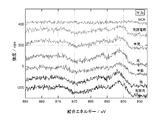
- FIG. 6 shows the positive electrode before and after charging and discharging of a battery using the positive electrode active material for a nonaqueous electrolyte secondary battery according to Example 1 of the present invention (mixture of LiF and NiO, pulverization time: 72 hours) as the positive electrode. It is a figure which shows the XPS measurement result of Ni (2p) contained in an active material.
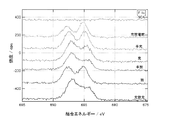
- FIG. 7 shows the positive electrode before and after charging and discharging of a battery using the positive electrode active material for a non-aqueous electrolyte secondary battery according to Example 1 of the present invention (mixture of LiF and NiO, pulverization time: 72 hours) as the positive electrode. It is a figure which shows the XPS measurement result of O (1s) contained in an active material.
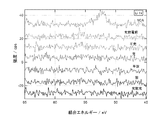
- FIG. 8 shows the positive electrode before and after charging and discharging of a battery using the positive electrode active material for a non-aqueous electrolyte secondary battery according to Example 1 of the present invention (mixture of LiF and NiO, pulverization time: 72 hours) as the positive electrode. It is a figure which shows the XPS measurement result of F (1s) contained in an active material.
- FIG. 9 shows the positive electrode before and after charging / discharging of the battery using the positive electrode active material for non-aqueous electrolyte secondary battery according to Example 1 of the present invention (mixture of LiF and NiO, pulverization time: 72 hours) as the positive electrode. It is a figure which shows the XPS measurement result of Li (1s) contained in an active material.
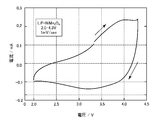
- FIG. 10 shows cyclic voltammetry of a battery using a positive electrode active material for a nonaqueous electrolyte secondary battery according to Example 2 of the present invention (a mixture of LiF and NiMn 2 O 4 , pulverization time 72 hours) as a positive electrode. Show.
- FIG. 10 shows cyclic voltammetry of a battery using a positive electrode active material for a nonaqueous electrolyte secondary battery according to Example 2 of the present invention (a mixture of LiF and NiMn 2 O 4 , pulverization time 72 hours) as a positive electrode. Show.
- FIG. 11 shows a cathode active material for a non-aqueous electrolyte secondary battery according to Example 2 of the present invention (a mixture of LiF and NiO, NiMn 2 O 4 , MnO, CoO, or Mn 2 O 3 , grinding time 72
- the discharge curve (0.1C) of the battery which used time for the positive electrode is shown.
- FIG. 12 is a diagram schematically showing a battery according to an embodiment of the present invention.
- the charge / discharge curve (FIG. 17 (a)) and rate comparison (FIG. 17 (b)) of the battery which used the mixture shown in FIG. 16 for the positive electrode are shown.
- FIG. 21 (b) shows the charge / discharge measurement results of the mixture (LiF—NiMn 2 O 4 ) according to Example 7 of the present invention.
- FIG. 23 shows the charge / discharge measurement results of the battery according to Example 8 of the present application (a lithium ion battery having a positive electrode using the mixture according to Example 1 of the present invention and a negative electrode using graphitic carbon).
- FIG. 24 is a diagram for explaining a reaction mechanism of a battery using the positive electrode active material of the present invention.
- parts means “parts by mass” and “%” means “mass%” unless otherwise specified.
- a cathode active material according to an embodiment of the present invention is a cathode active material for a non-aqueous electrolyte secondary battery (hereinafter, also simply referred to as “cathode active material”), which is LiX (wherein X represents a halogen atom).
- cathode active material LiX (wherein X represents a halogen atom).
- the positive electrode active material according to this embodiment includes LiX (wherein X represents a halogen atom) and M x O y (wherein M is an alkali metal atom, an alkaline earth metal atom, a transition metal, And a mixture of the following: 0 ⁇ x ⁇ 1, 0 ⁇ y ⁇ 2).
- M constituting M x O y may be one type or a plurality of types.
- the positive electrode active material according to the present embodiment contains LiX that generates an anion (X ⁇ ) of a halogen atom that has high electronegativity due to ionization, the positive electrode active material according to the present embodiment is used as the positive electrode active material. As a result, a battery having a high capacity, a high voltage and a high energy density can be produced.
- the positive electrode active material according to the present embodiment includes first particles (powdered particulate solid) made of LiX and second particles (powdered particles) made of M x O y. And a mixture obtained by mixing with a solid solid). A method of mixing the first particles and the second particles will be described later.
- the positive electrode active material according to the present embodiment can be suitably used as a positive electrode active material for secondary batteries, and in particular, can be suitably used as a positive electrode active material for nonaqueous electrolyte secondary batteries.
- a battery (secondary battery, for example, a nonaqueous electrolyte secondary battery) used as a positive electrode as the positive electrode active material according to the present embodiment is charged / discharged by the reaction mechanism shown in FIG. 1 and FIG. Can do.
- a battery charge / discharge method is a battery charge / discharge method including a positive electrode and a negative electrode.
- FIG. Represents a halogen atom.
- Li + and the X - and is LiX is generated by coupling, including a discharge step of the electrons move to the positive electrode from the negative electrode.
- the charging step and the discharging step are repeated.
- the generated X ⁇ can be combined with the M x O y in the charging step, in the discharge step, the X - can be separated - the X from the coupling of the said M x O y.
- the generated X ⁇ is combined with the M x O y so that the generated X ⁇ can be captured by the M x O y . Therefore, in the subsequent discharging step, In addition to being able to recombine Li + and X ⁇ , it is possible to prevent the generated X ⁇ from being released to the outside or from being bound to other substances. Further, the conductivity can be improved by combining the generated X ⁇ with the M x O y .
- FIG. 24 is a diagram for explaining a reaction mechanism of a battery using the positive electrode active material of the present invention.
- LiX is LiF
- FIG. 24 the case where LiX is LiF will be described as an example.
- M x O y is F during discharge - a stably trapped, is presumed to have a role to promote the re-formation of LiF.
- the distance between LiX and M x O y can be shortened, so that X ⁇ can be stably captured and LiX can be easily re-formed during discharge. Can do.
- X ⁇ (particularly F ⁇ ) has a high ionization tendency, it can exist stably as X ⁇ . Therefore, if X ⁇ can be supplemented stably, LiX can be easily re-formed during discharge.
- LiX / M x O y (molar ratio) in the mixture is 0.1 or more in that a battery having a higher capacity, higher density, and higher energy density can be manufactured. 100 or less, and preferably 10 or less.
- the conversion from LiX to Li + and X ⁇ can be performed uniformly and smoothly, so that the positive electrode active material according to the present embodiment (
- the average particle size (primary particle size) of the mixture) is preferably 100 ⁇ m or less, and may be, for example, 100 nm or more and 100 ⁇ m or less, or may be less than 100 nm.
- the average particle size (primary particle size) of the mixture is less than 100 nm in that the distance between LiX and MxOy is shortened to stably capture X ⁇ and easily re-form LiX during discharge. Is more preferable, it is more preferable that it is less than 50 nm, and it is still more preferable that it is less than 30 nm.
- the mixture having a particle diameter of less than 100 nm can be obtained by adjusting the particle diameter of the balls used in the ball mill.
- LiX As a halogen atom which comprises LiX, a fluorine atom, a chlorine atom, a bromine atom, and an iodine atom are mentioned, for example. Since the anion of the halogen atom has a high electronegativity, a battery having a high energy density can be obtained, and a bond is easily formed with the metal oxide (M x O y ). Therefore, when the battery using the positive electrode active material according to the present embodiment as an electrode (positive electrode) is operated, the anion of the halogen atom combines with the metal oxide in the positive electrode, so that the halogen atom can be obtained even under high temperature conditions. Can be stably held at the positive electrode. In particular, since the electronegativity is higher, it is preferable that X is a fluorine atom in that a battery having a higher energy density can be obtained with higher operational stability under high temperature conditions.
- Metal oxide (M x O y ) M constituting the metal oxide M x O y is an alkali metal atom (for example, Li, Na, K), an alkaline earth metal atom (for example, Mg, Ca, Sr, Ba), a transition metal (Ni, Co, Ru, Ir, V, Fe, Ti, Cr, Mo, W, Zr, Mn, Pd, Pt, Fe, Cu, Ag, Au), Group 12 element metal (for example, Zn, Cd, Hf) , And at least one selected from Group 13 element metals (for example, Al, Ga, In, Tl).
- M constituting M x O y that is a metal oxide is a high-capacity battery.
- Ni is preferably included, for example, M more preferably includes Ni and Co and / or Mn.
- x constituting M x O y is preferably 0 ⁇ x, and y is preferably 0 ⁇ y.
- M x O y is B a A b O c (wherein A is an alkali metal atom, an alkaline earth metal atom, a transition metal other than B, a group 12 element metal, and It is preferably at least one selected from Group 13 element metals, and B is a transition metal, and 0 ⁇ a ⁇ 1, 0 ⁇ b ⁇ 1, and 0 ⁇ c ⁇ 2.
- M x O y is Ni a A b O c (where A is an alkali metal atom, an alkaline earth metal atom, a transition metal other than Ni, a group 12 element metal, and a group 13 element It is preferably at least one selected from metals, and 0 ⁇ a ⁇ 1, 0 ⁇ b ⁇ 1, and 0 ⁇ c ⁇ 2.)
- M x O y is B a Ab D d O c (where A is an alkali metal atom, an alkaline earth metal atom, a transition metal other than B, a metal of a Group 12 element, and It is at least one selected from group 13 element metals, B is a transition metal, D is a transition metal other than A and B, and 0 ⁇ a ⁇ 1, 0 ⁇ b ⁇ 1, 0 ⁇ c ⁇ 2, 0 ⁇ d ⁇ 1).
- A is an alkali metal atom, an alkaline earth metal atom, a transition metal other than B, a metal of a Group 12 element, and It is at least one selected from group 13 element metals
- B is a transition metal
- D is a transition metal other than A and B
- specific examples of various metals represented as A, B, and D are as described above.
- the positive electrode active material according to the present embodiment preferably includes a mixture of LiX and M x O y at 50% or more and 100% or less.
- the positive electrode active material according to the present embodiment includes a mixture of LiX and M x O y , so that when the positive electrode active material is used for a positive electrode, for example, LiX functions as the positive electrode active material.
- X ⁇ an anion of a halogen atom
- X ⁇ has a high electronegativity.
- the positive electrode active material which concerns on the said embodiment can be obtained with the following manufacturing methods. That is, a method for producing a positive electrode active material according to an embodiment of the present invention (hereinafter also simply referred to as “manufacturing method”) mixes (uses) LiX (wherein X represents a halogen atom). Process.
- the step of blending may be a step of blending LiX as a solid. Also, in this case, LiX can be particulate.
- the blending step includes first particles composed of LiX (where X represents a halogen atom), M x O y (wherein M is an alkali metal atom, alkaline earth).
- a second particle composed of at least one selected from a metal atom, a transition metal, a Group 12 element metal, and a Group 13 element metal, and 0 ⁇ x ⁇ 1, 0 ⁇ y ⁇ 2.
- a step of mixing By the mixing step, a mixture of the first particles and the second particles (average particle size of 100 ⁇ m or less, preferably 100 nm or more and 100 ⁇ m or less) can be obtained.
- the mixing step is performed at 100 rpm or more, preferably 100 rpm or more and 1,500 rpm or less (more preferably) in that the first particles and the second particles can be uniformly dispersed.
- the rotation is preferably performed at a rotation speed of 1,000 rpm or less.
- the first particle / second particle (mass ratio) is 0.001 or more and 1 in that the first particle and the second particle can be uniformly dispersed. 1,000 or less.
- the average particle diameter of the first particles is preferably 100 nm or more and 100 ⁇ m or less in that the first particles can be uniformly dispersed in the mixture.
- the average particle diameter of the second particles is preferably 100 nm or more and 100 ⁇ m or less in that the second particles can be uniformly dispersed in the mixture.
- the mixing time in the mixing step is usually 1 hour to 500 hours, and the mixing temperature in the mixing step is usually 10 ° C. to 60 ° C. (however, the environment Temperature).
- cost reduction is achieved by including a step of blending LiX (wherein X represents a halogen atom) into the positive electrode material, and A positive electrode active material for forming an electrode having high voltage, high capacity, and high energy density can be obtained by a simple method. More specifically, the step of the formulation, since it contains a first particle made of LiX, and second particles consisting of M x O y, a step of mixing a mixture of LiX and M x O y Can be obtained by a simpler method.
- FIG. 12 is a diagram schematically showing an example of a battery according to an embodiment of the present invention using the positive electrode active material according to the embodiment.
- the battery according to the present embodiment includes a positive electrode 2 and a negative electrode 3, and the positive electrode 3 includes the positive electrode active material according to the above-described embodiment.
- the battery according to this embodiment is preferably a secondary battery in that it can be charged and discharged, and more preferably a non-aqueous electrolyte secondary battery in that the positive electrode active material contains LiX.
- the battery according to the present embodiment can include the positive electrode active material according to the above embodiment as a positive electrode active material in the positive electrode.
- FIG. 12 schematically shows a lithium ion secondary battery as an example of the battery according to the present embodiment.
- a lithium ion secondary battery (hereinafter simply referred to as “battery”) 1 includes a positive electrode layer (positive electrode) 2, a negative electrode layer (negative electrode) 3, a separator 4, a positive electrode side current collector 5, And a negative electrode side current collector 6.
- the positive electrode layer 2 includes an electrode material (positive electrode material) 21 containing the positive electrode active material according to the above embodiment, and an electrolyte solution 7 that fills the space between the positive electrode materials 21.
- the positive electrode layer 2 may contain a conductive material in addition to the positive electrode material 21.
- a conductive material a known substance is used.
- carbon black and acetylene black are used as the carbon-based conductive material.
- the positive electrode layer 2 can contain one or more kinds of conductive materials.
- the positive electrode layer 2 may further contain a binder.
- a binder various polymers conventionally used as binders are applied. Specific examples of the polymer include polyvinyl alcohol, polyethylene terephthalate, polypropylene glycol, and styrene butadiene rubber.
- the positive electrode layer 2 can contain one kind or plural kinds of binders.
- the negative electrode layer 3 includes an electrode material (negative electrode material) 31 containing a negative electrode active material and an electrolyte solution 7 that fills between the negative electrode materials 31.
- the negative electrode active material a material known as a material used in a lithium ion secondary battery can be used. Specifically, carbon (graphite etc.), metallic lithium, Sn, SiO, etc. are mentioned.
- the negative electrode layer 3 may further contain the binder described above as a material that can be used for the positive electrode layer 2.
- the electrolytic solution 7 contains a solvent and an electrolyte dissolved in the solvent.
- the solvent a known solvent used for a lithium ion secondary battery is applicable.
- a non-aqueous solvent that is, an organic solvent is used.
- the non-aqueous solvent include carbonates such as ethylene carbonate, dimethyl carbonate, ethyl methyl carbonate, diethyl carbonate, and propylene carbonate, and one or more of these solvents may be mixed.
- the electrolyte a substance used as an electrolyte in a conventional lithium ion secondary battery is applicable. More specifically, examples of the electrolyte include LiPF 6 , LiClO 4 , LiBF 4, and the like.
- the electrolytic solution 7 can contain one kind or plural kinds of electrolytes.
- additives such as an overcharge inhibitor may be added to the electrolyte solution 7 in order to improve the stability of the battery performance and the electrical characteristics.
- the separator 4 is disposed between the positive electrode layer 2 and the negative electrode layer 3. By disposing the separator 4 between the electrode layer 2 and the negative electrode layer 3, a short circuit between the positive electrode and the negative electrode can be prevented. Moreover, the electrolyte solution 7 and lithium ion can be permeate
- the material for the separator 4 include resins (specifically, polyolefin polymers such as polyethylene, polypropylene, and polystyrene).
- the positive electrode side current collector 5 for example, a metal foil such as aluminum or an aluminum alloy can be used.
- metal foil such as copper or a copper alloy, can be used, for example.
- the battery 1 may include a battery case, a positive electrode side terminal, a negative electrode side terminal (all not shown), and the like.
- a battery case a positive electrode side terminal, a negative electrode side terminal (all not shown), and the like.
- the wound body formed by winding the laminated body structure shown in FIG. 12 several times may be accommodated in the battery case.
- the positive terminal is connected to the positive current collector 5 and the negative terminal is connected to the negative current collector 6.
- the battery according to the present embodiment is low in cost and has high capacity, high voltage, and high energy density, for example, not only batteries for small portable devices but also large bicycles, motorcycles, vehicles, ships, etc. It can be suitably used as a battery for equipment.
- Example 1 LiF (average particle size: 1 ⁇ m) and NiO (average particle size: 10 ⁇ m) were used as raw materials, and the raw materials (LiF: 1 g, NiO: 2.3 g) (molar ratio of about 1: 1) were mixed by a planetary ball mill and A mixture was prepared by grinding. Here, the grinding conditions were 650 rpm, 1 to 144 hours (h), and the heat-treated sample was fired at 200 to 800 ° C. in the atmosphere.
- the obtained mixture was evaluated by XRD, XPS (X-ray photoelectron spectroscopy), SEM (scanning electron microscope), CV (cyclic voltammetry), and charge / discharge measurement.
- Metal lithium was used for the counter electrode (negative electrode), 1M LiPF 6 EC: DEC (1: 1) was used for the electrolyte, and a cell was fabricated using a stainless steel two-electrode cell.
- FIG. 3 shows XRD patterns of the positive electrode active material according to this example, which were produced at different pulverization times. As shown in FIG. 3, all of the observed diffraction peaks coincided with the diffraction peak of NiO as a raw material, and the LiF peak disappeared. Further, since no diffraction peak other than NiO was observed, it can be understood that no new crystalline compound was formed.
- the NiO diffraction peak becomes broader as the grinding time increases, indicating that the NiO particle size has decreased, but the peak shift is slight. From this, it is presumed that no clear solid solution of LiF in NiO occurs.
- FIG. 4 shows a charge / discharge curve (0.1 C) of a battery using the positive electrode active material according to this example as a positive electrode.
- the discharge capacity was about 116 mAh / g, but by increasing the pulverization time, the charge / discharge characteristics were improved, and when the pulverization time was 144 hours, The average voltage was 3.53 V, and the discharge capacity was 217 mAh / g corresponding to 81% of the theoretical capacity.
- the charge / discharge characteristics can be improved by increasing the pulverization time.
- the particle diameter (primary particle diameter) of the obtained sample can be reduced by increasing the pulverization time.
- FIG. 5 shows a charge / discharge curve (0.1 C) of a battery using the positive electrode active material (mixture of LiF and NiO, pulverization time: 72 hours) according to this example for the positive electrode.
- the positive electrode active material mixture of LiF and NiO, pulverization time: 72 hours
- “a” and “b” indicate the cases where a mixture obtained at a pulverization time of 12 hours and 72 hours was used as the positive electrode active material.
- the charge curve is from the lower left to the upper right, and the discharge curve is from the upper left to the lower right.
- an operation starting from charging can be performed as in a general lithium secondary battery.
- FIGS. 6 to 9 show charging of batteries using the positive electrode active material for a nonaqueous electrolyte secondary battery according to Example 1 of the present invention (mixture of LiF and NiO, pulverization time: 72 hours) as the positive electrode. It is a figure which shows the result of having measured XPS (X-ray Photoelectron Spectroscopy) of Ni (2p), O (1s), F (1s), and Li (1s) which are contained in this positive electrode active material before and after discharge. . 6 to 10, “half charge” means “after half charge”, “charge” means “after charge”, “half release” means “after half discharge”, and “release”. Means “after discharge”, and “charging / discharging” means “charging, then discharging, then after charging”.
- the results of the cycle test are shown (cut-off: 5.0-2 V, rate: 0.1 C).
- the horizontal axis represents the capacity retention rate (%)
- the vertical axis represents the cell voltage (V)
- “30”, “50”, “100”, and “200” represent the number of cycles, respectively. Indicates. According to FIG. 13A, it can be seen that even when the number of charge / discharge cycles is 200, the battery has a capacity of 70% or more of the initial capacity.
- FIG. 13 (b) shows the change in capacity when the number of charge / discharge cycles of the battery shown in FIG. 13 (a) is 0 to 60 times (cut-off: 4.4-2V, rate: 0.1C, horizontal axis is (The number of cycles represents the vertical axis, and the capacity represents the capacity.)
- the battery maintains a capacity exceeding the initial 95%.
- NiO 10 g (average particle size: 100 ⁇ m) and Mn 2 O 3 21 g (average particle size: 300 ⁇ m) were mixed in a mortar at a molar ratio of 1: 1, fired at 800 ° C., and then mixed and fired again under the same conditions.
- NiMn 2 O 4 was synthesized.
- the obtained mixture was combined with Ketjen Black (KB) at 300 rpm for 30 minutes, mixed with PVdF to obtain a positive electrode active material according to this example, and the positive electrode active material applied on an aluminum foil.
- a battery was produced as an electrode (positive electrode).
- a metal lithium was used for the counter electrode (negative electrode)
- 1M LiPF 6 EC ethylene carbonate
- DEC diethyl carbonate
- (1: 1) was used for the electrolyte, and a cell was made using a stainless steel two-electrode cell.
- the obtained mixture was evaluated by CV and charge / discharge measurement.
- NiMn 2 O 4 , CoO, MnO, or a mixture (Molar ratio 1: 1) of Mn 2 O 3 and LiF was prepared and evaluated in the same manner as in Example 1.
- a positive current increase is confirmed from around 3V. The increase is considered to be an oxidation current peak corresponding to the charging reaction of the battery.
- a negative current flows, and this current cycle does not change even if it is repeated, so that it is reversible. Conceivable.
- FIG. 11 the discharge curve of the battery using each positive electrode active material which concerns on a present Example is shown.
- NiO When NiO is used when the grinding time is 72 hours, a discharge capacity of 187 mAh / g is obtained, whereas CoO and MnO, which are the same divalent oxides as NiO, are used. Then, it became 75 mAh / g and 118 mAh / g, respectively, and the discharge voltage was also lower than NiO.
- Mn 2 O 3 was used, the discharge capacity was 53 mAh / g.
- spinel type NiMn 2 O 4 was used, the discharge capacity was 211 mAh / g, and a high discharge capacity was obtained.
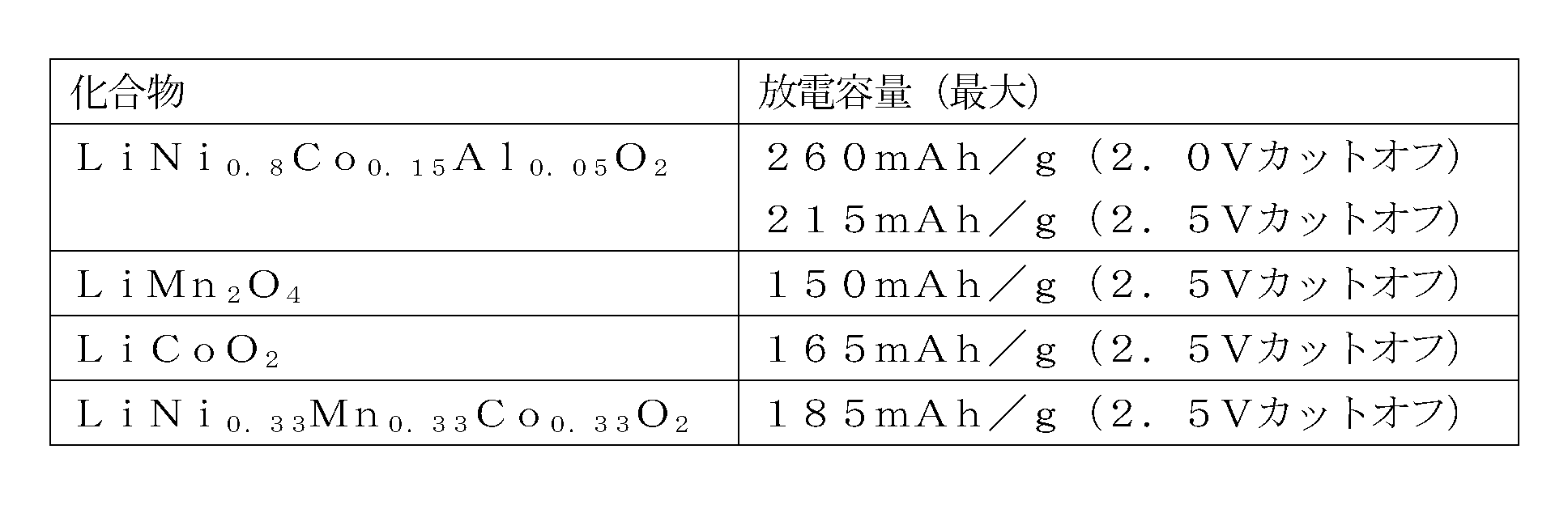
- Example 3 A compound shown in Table 2 below was mixed with LiF to prepare a mixture, and an electrode was prepared using the mixture in the same manner as in Example 2. Table 2 shows the maximum discharge capacity in each example.
- Example 4 Except that the ratio (molar ratio) of LiF and NiO as raw materials was changed, the mixture (average particle size (primary particle size): 100 to 100 in the same manner as Example 1 (pulverization time 72 hours) 500 nm) was prepared. The results are shown in FIG. 14 and FIG.
- 15A to 15C (1) is before charging and discharging, (2) is after 1/10 charging, (3) is when the first charging is completed, and (4) is the first charging. After completion, after the first 3 discharge, (5) when the first discharge is completed, and (6) when the second charge is completed after the first discharge is completed.
- the discharge curve (the horizontal axis indicates the capacity, the vertical axis indicates the cell voltage) and the rate capacity ratio to the capacity (the horizontal axis indicates the Li doping ratio, and the vertical axis indicates the capacity). Show.
- Figure 16 is a raw material NiO and LiF, obtained by mixing and grinding Li obtained by air annealing at NiO and LiF, a predetermined molar ratio m Ni n O, and LiF, Li m Ni n O It shows sample, and the diffraction pattern of the sample alone ground to the Li m Ni n O obtained by air annealing without addition of LiF.
- the LiF peak disappears and becomes only the NiO peak after firing in the air, so that it is presumed that no new compound was generated. Also, Li m Ni n as the amount of Li in O is large (higher m is large) it can be seen that the peak shift to the high angle side is larger.
- FIG. 17A it can be seen that, when a metal compound doped with Li (Li m N n O) is used, the potential increases as compared with the undoped sample.
- FIG. 17B shows the capacity when the discharge capacity of 0.05C with respect to the Li doping amount is 100%. According to FIG. 17B, at 0.5 C and 1 C, the decrease in the capacity of the sample not doped with Li is significant. This shows that the characteristics of the battery can be improved by using NiO doped with Li as a raw material.
- Example 6 LiF (average particle diameter: 1 ⁇ m), NiO (average particle diameter: 10 ⁇ m) and MnO (average particle diameter: 10 ⁇ m) were used as raw materials, and the raw materials (LiF to NiO molar ratio: 1: 1, Ni and Mn and The mixture was prepared by mixing and pulverizing (Milling conditions: 650 rpm, 3 hours (h)) with a planetary ball mill at a molar ratio of 5: 5, 6: 4, 7: 3, 8: 2. The mixture was then vacuum annealed at 800 ° C. for 6 hours. Thereafter, the mixture was mixed and ground with a planetary ball mill (grinding conditions: 650 rpm, 72 hours (h)) to prepare a final product mixture (average particle size (primary particle size): 100 to 300 nm).
- a planetary ball mill grinding conditions: 650 rpm, 72 hours (h)
- the obtained mixture was evaluated by XRD, charge / discharge measurement, and STEM.
- Metal lithium was used for the counter electrode (negative electrode), 1M LiPF 6 EC: DEC (1: 1) was used for the electrolyte, and a cell was fabricated using a stainless steel two-electrode cell.
- FIG. 19 shows the STEM measurement results of the mixture according to this example. As shown in FIG. 19, no deviation was observed in any of Ni, O, and F. From this, it is presumed that a solid solution of LiF and Ni x M 1-x O (where 0 ⁇ x ⁇ 1) is formed.
- the charging / discharging curve of the battery was shown.
- a dotted line indicated as LiF—NiO is a sample obtained by mixing LiF and NiO with a planetary ball mill for 72 hours, and a dotted line indicated as LiF—NiO is 72% of LiF and MnO. It is a sample obtained by mixing with a time planetary ball mill.
- Ni 2+ and Mn 3+ peaks appear before charge / discharge (1), and Ni 3+ and Mn 3+ peaks appear after charge (2).
- Ni 3+ after discharge (3) the peak of the Mn 3+ disappears, then, Ni 3+ after recharging (4), the peak of the Mn 3+ is expressed again. From this, it is presumed that a reaction between Ni 2+ and Mn 2+ (divalent) and Ni 3+ and Mn 3+ (trivalent) occurs in charge and discharge.
- Example 7 The mixture according to the present example was processed in the same manner as in Example 6 above, with the ratio (molar ratio) of NiO (average particle size: 10 ⁇ m) and MnO (average particle size: 10 ⁇ m) being 1/2 as the raw material. Was prepared. A cell was fabricated by the same process as in Example 6 described above. The obtained mixture was evaluated by charge / discharge measurement.
- FIG. 22 shows the charge / discharge measurement results of the mixture (LiF—NiMn 2 O 4 ) according to this example.
- the charge / discharge measurement shown in FIG. 22 shows the results obtained for a battery using Li 4 Ti 5 O 12 as the negative electrode.
- “1” indicates the first discharge (charge)
- “2” indicates the second discharge (charge).
- Example 8 A cell using a positive electrode using the mixture according to Example 1 and a negative electrode using graphite carbon was produced.
- the positive electrode was produced by the same method as that produced in Example 1 above.
- FIG. 23 shows a charge / discharge measurement result of a lithium ion battery having a positive electrode using the mixture according to Example 1 of the present invention and a negative electrode using graphite carbon. It can be understood from FIG. 23 that good charge / discharge characteristics can be exhibited even when graphitic carbon is used for the negative electrode.
- Example 9 LiF (average particle size: 100 nm to 100 ⁇ m), NiO (average particle size: 100 nm to 100 ⁇ m) and MnO (average particle size: 10 nm to 100 ⁇ m) were used as raw materials, and the raw material (LiF to NiO molar ratio 0.5) : 1 to 5: 1) by mixing and pulverizing in a ball mill or wet ball mill under an argon atmosphere (grinding conditions: 300 to 1,500 rpm, 0.5 to 96 hours (h)). Diameter (primary particle diameter): 10 nm to 1000 nm).
- the positive electrode active material of the present invention it is possible to manufacture a low-cost, high-capacity, high-voltage, and high-energy-density battery.
- a positive electrode active material for example, not only small portable devices but also electric bicycles, two-wheeled vehicles, vehicles, It can be suitably used as a positive electrode active material in an electrode (positive electrode) included in a battery for large equipment such as a ship.
Landscapes
- Chemical & Material Sciences (AREA)
- Inorganic Chemistry (AREA)
- Organic Chemistry (AREA)
- Chemical Kinetics & Catalysis (AREA)
- Electrochemistry (AREA)
- General Chemical & Material Sciences (AREA)
- Engineering & Computer Science (AREA)
- Materials Engineering (AREA)
- Manufacturing & Machinery (AREA)
- Composite Materials (AREA)
- Battery Electrode And Active Subsutance (AREA)
- Secondary Cells (AREA)
Abstract
非水電解液二次電池用正極活物質は、LiX(式中、Xはハロゲン原子を表す。)を含む。
Description
本発明は、非水電解液二次電池用正極活物質およびその製造方法、前記正極活物質を含む電池、ならびに電池の充放電方法に関する。
リチウムイオン二次電池等の二次電池は、小型携帯機器用途で幅広く使用されている(特許文献1)。近年、より低コストでかつ高エネルギー密度、高容量の二次電池の開発が求められている。
本発明者らは、ハロゲン化リチウム(LiX)を正極活物質に用いることにより、低コストでかつ、高容量、高電圧および高エネルギー密度である電池が得られることを見出した。
本発明は、低コストでかつ、高容量、高電圧および高エネルギー密度である電池の製造に使用することができる非水電解液二次電池用正極活物質およびその製造方法、前記正極活物質を含む電池、ならびに電池の充放電方法を提供する。
1.本発明の一態様に係る非水電解液二次電池用正極活物質は、LiX(式中、Xはハロゲン原子を表す。)を含む。
2.上記1に記載の非水電解液二次電池用正極活物質は、前記LiX(式中、Xはハロゲン原子を表す。)と、MxOy(式中、Mはアルカリ金属原子、アルカリ土類金属原子、遷移金属、第12族元素の金属、および第13族元素の金属から選ばれる少なくとも1種を表し、0<x≦1、0<y≦2である。)と、の混合物を含む。
3.上記1または2に記載の非水電解液二次電池用正極活物質では、前記混合物において、LiX/MxOy(モル比)が0.1以上100以下であることができる。
4.上記1ないし3のいずれかに記載の非水電解液二次電池用正極活物質では、前記混合物の平均粒子径が100μm以下であることができる。
5.上記1ないし4のいずれかに記載の非水電解液二次電池用正極活物質において、MxOyは、BaAbOc(式中、Aは、アルカリ金属原子、アルカリ土類金属原子、B以外の遷移金属、第12族元素の金属、および第13族元素の金属から選ばれる少なくとも1種であり、Bは、遷移金属であり、0<a≦1、0≦b≦1、0<c≦2である。)であることができる。
6.上記1ないし4のいずれかに記載の非水電解液二次電池用正極活物質において、MxOyは、BaAbDdOc(式中、Aは、アルカリ金属原子、アルカリ土類金属原子、B以外の遷移金属、第12族元素の金属、および第13族元素の金属から選ばれる少なくとも1種であり、Bは、遷移金属であり、Dは、AおよびB以外の遷移金属であり、0<a≦1、0≦b≦1、0<c≦2、0≦d≦1である。)であることができる。
7.上記1ないし6のいずれかに記載の非水電解液二次電池用正極活物質において、前記混合物を50%以上100%以下含むことができる。
8.本発明の一態様に係る非水電解液二次電池用正極活物質の製造方法は、LiX(式中、Xはハロゲン原子を表す。)を配合する工程を含む。
9.上記8に記載の非水電解液二次電池用正極活物質の製造方法において、前記配合する工程は、LiX(式中、Xはハロゲン原子を表す。)からなる第1の粒子と、MxOy(式中、Mはアルカリ金属原子、アルカリ土類金属原子、遷移金属、第12族元素の金属、および第13族元素の金属から選ばれる少なくとも1種を表し、0<x≦1、0<y≦2である。)からなる第2の粒子と、を混合する工程を含む。
10.上記9に記載の非水電解液二次電池用正極活物質の製造方法において、前記混合する工程は、100rpm以上の回転数で行われることができる。
11.上記9または10に記載の非水電解液二次電池用正極活物質の製造方法において、前記混合する工程により、平均粒子径が100μm以下である混合物を得ることができる。
12.上記9ないし11のいずれかに記載の非水電解液二次電池用正極活物質の製造方法において、前記第1の粒子/前記第2の粒子(質量比)が0.1以上100以下であることができる。
13.上記9ないし12のいずれかに記載の非水電解液二次電池用正極活物質の製造方法において、MxOyは、BaAbOc(式中、Aは、アルカリ金属原子、アルカリ土類金属原子、B以外の遷移金属、第12族元素の金属、および第13族元素の金属から選ばれる少なくとも1種であり、Bは、遷移金属であり、0<a≦1、0≦b≦1、0<c≦2である。)であることができる。
14.上記9ないし13のいずれかに記載の非水電解液二次電池用正極活物質の製造方法において、MxOyは、BaAbDdOc(式中、Aは、アルカリ金属原子、アルカリ土類金属原子、B以外の遷移金属、第12族元素の金属、および第13族元素の金属から選ばれる少なくとも1種であり、Bは、遷移金属であり、Dは、AおよびB以外の遷移金属であり、0<a≦1、0≦b≦1、0<c≦2、0≦d≦1である。)であることができる。
15.本発明の一態様に係る電池は、正極および負極を備え、前記正極は、上記1ないし7のいずれかに記載の非水電解液二次電池用正極活物質を含む。
16.本発明の一態様に係る電池の充放電方法は、正極および負極を備えた電池の充放電方法であって、前記正極において、LiX(式中、Xはハロゲン原子を表す。)が電離して、Li+、X-、および電子が生成し、該電子が前記負極に移動する充電工程と、前記正極において、前記Li+と前記X-とが結合してLiXが生成し、前記負極から電子が該正極に移動する放電工程と、を含む。
17.上記16に記載の電池の充放電方法では、前記充電工程において、生成した前記X-が前記MxOyと結合し、前記放電工程において、前記X-と前記MxOyとの結合物から前記X-が分離する。
上記1ないし7のいずれかに記載の非水電解液二次電池用正極活物質は、LiXを含むことにより、LiXが正極活物質として機能する。X-(ハロゲン原子の陰イオン)は電気陰性度が高い。このため、上記15に記載の電池によれば、上記1ないし7のいずれかに記載の非水電解液二次電池用正極活物質を含むことにより、LiXを正極活物質として機能するため、低コスト化が達成され、かつ、高電圧、高容量および高エネルギー密度である電極を形成することができる。
上記8ないし14のいずれかに記載の非水電解液二次電池用正極活物質の製造方法によれば、LiX(式中、Xはハロゲン原子を表す。)を配合する工程を含むことにより、非水電解液二次電池用正極活物質を簡便な方法で得ることができる。
上記16または17に記載の電池の充放電方法は、正極および負極を含む電池の充放電方法であって、前記正極において、LiXが電離して、Li+、X-、および電子が生成し、該電子が前記負極に移動する充電工程と、前記正極において、前記Li+と前記X-とが結合してLiXが生成し、前記負極から電子が該正極に移動する放電工程と、を含むことにより、低コストで、かつ、高電圧、高容量および高エネルギー密度の電池を達成することができる。
以下、図面を参照して本発明を詳細に説明する。なお、本発明において、格別に断らない限り、「部」は「質量部」を意味し、「%」は「質量%」を意味する。
1.正極活物質
本発明の一実施形態に係る正極活物質は、非水電解液二次電池用正極活物質(以下、単に「正極活物質」とも記載する。)であって、LiX(式中、Xはハロゲン原子を表す。)を含む。本実施形態に係る正極活物質がLiXを含むことにより、該正極活物質を正極に使用した電池において、放電の際にLiXが電離してリチウムイオンおよびX-が生じ、また、充電の際にリチウムイオンがX-と結合してLiXとなることができる。
本発明の一実施形態に係る正極活物質は、非水電解液二次電池用正極活物質(以下、単に「正極活物質」とも記載する。)であって、LiX(式中、Xはハロゲン原子を表す。)を含む。本実施形態に係る正極活物質がLiXを含むことにより、該正極活物質を正極に使用した電池において、放電の際にLiXが電離してリチウムイオンおよびX-が生じ、また、充電の際にリチウムイオンがX-と結合してLiXとなることができる。
本実施形態に係る正極活物質は、LiX(式中、Xはハロゲン原子を表す。)と、MxOy(式中、Mはアルカリ金属原子、アルカリ土類金属原子、遷移金属、第12族元素の金属、および第13族元素の金属から選ばれる少なくとも1種を表し、0<x≦1、0<y≦2である。)と、の混合物を含む。MxOyを構成するMは、1種類であってもよいし、または複数種類であってもよい。
本実施形態に係る正極活物質は、電離により、電気陰性度が高い、ハロゲン原子の陰イオン(X-)を生成するLiXを含有することから、本実施形態に係る正極活物質を正極活物質として使用することにより、高容量、高電圧および高エネルギー密度の電池を製造することができる。
より具体的には、本実施形態に係る正極活物質は、前記LiXからなる第1の粒子(粉末状の粒子状固体)と、前記MxOyからなる第2の粒子(粉末状の粒子状固体)とを混合して得られる混合物を含む。第1の粒子と第2の粒子とを混合する方法については後述する。
本実施形態に係る正極活物質は、二次電池用正極活物質として好適に使用することができ、特に、非水電解質二次電池用正極活物質として好適に使用することができる。
1.1.電池の充放電方法
本実施形態に係る正極活物質として正極で用いる電池(二次電池、例えば非水電解液二次電池)は、図1および図2に示される反応機構によって充放電を行うことができる。
本実施形態に係る正極活物質として正極で用いる電池(二次電池、例えば非水電解液二次電池)は、図1および図2に示される反応機構によって充放電を行うことができる。
例えば、本発明の一実施形態に係る電池の充放電方法は、正極および負極を備えた電池の充放電方法であって、図1に示されるように、前記正極において、LiX(式中、Xはハロゲン原子を表す。)が電離して、Li+(リチウムイオン)、X-、および電子が生成し、該電子が前記負極に移動する充電工程と、前記正極において、前記Li+と前記X-とが結合してLiXが生成し、前記負極から電子が該正極に移動する放電工程と、を含む。本実施形態に係る電池の充放電方法において、前記充電工程と前記放電工程とが繰り返される。
より具体的には、本実施形態に係る電池の充放電方法では、図2に示されるように、前記充電工程において、生成した前記X-が前記MxOyと結合することができ、前記放電工程において、前記X-と前記MxOyとの結合物から前記X-が分離することができる。
このように、前記充電工程では、生成した前記X-が前記MxOyと結合することによって、生成した前記X-を前記MxOyに捕捉させることができるため、続く放電工程において、Li+とX-とを再び結合させることができるのに加えて、生成した前記X-が外部に放出されたり、他の物質と結合したりすることを防止することができる。また、生成した前記X-を前記MxOyと結合させることにより、導電性を向上させることができる。
図24は、本発明の正極活物質を用いた電池の反応機構を説明する図である。図24では、LiXがLiFである場合を例にとり説明する。
図24に示されるように、MxOyは放電時にF-を安定に捕捉し、LiFの再形成を促進させる役割を有すると推測される。例えば、本実施形態に係る混合物の平均粒子径を小さくすることで、LiXとMxOyとの距離を短くすることにより、X-を安定に補足し、放電時にLiXを再形成しやすくことができる。X-(特にF-)はイオン化傾向が高いため、X-として安定に存在することができる。このため、X-を安定に補足することができれば、放電時にLiXを再形成しやすい。
本実施形態に係る正極活物質では、より高容量、より高密度、かつより高エネルギー密度の電池を製造できる点で、前記混合物におけるLiX/MxOy(モル比)は、0.1以上100以下であることができ、10以下であることが好ましい。
また、本実施形態に係る正極活物質を用いて製造された電池において、LiXからLi+およびX-への変換を均一かつスムーズに進めることができる点で、本実施形態に係る正極活物質(前記混合物)の平均粒子径(一次粒子径)が100μm以下であることが好ましく、例えば、100nm以上100μm以下であることができ、または、100nm未満であってもよい。また、LiXとMxOyとの距離を短くすることで、X-を安定に補足し、放電時にLiXを再形成しやすい点で、該混合物の平均粒子径(一次粒子径)は100nm未満であることが好ましく、50nm未満であることがより好ましく、30nm未満であることがさらに好ましい。
例えば、ボールミルに使用するボールの粒径を調整することによって、粒子径100nm未満の前記混合物を得ることができる。
1.2.LiX
LiXを構成するハロゲン原子としては、例えば、フッ素原子、塩素原子、臭素原子、およびヨウ素原子が挙げられる。ハロゲン原子の陰イオンは電気陰性度が高いため、高エネルギー密度の電池を得ることができ、かつ、金属酸化物(MxOy)との間に結合を形成しやすい。よって、本実施形態に係る正極活物質を電極(正極)に用いた電池の作動時において、正極において、ハロゲン原子の陰イオンが金属酸化物と結合することにより、高温条件下においても、ハロゲン原子の陰イオンを正極にて安定して保持させることができる。特に、電気陰性度がより高いため、高温条件下での動作安定性により優れ、かつ、より高いエネルギー密度の電池を得ることができる点で、Xはフッ素原子であることが好ましい。
LiXを構成するハロゲン原子としては、例えば、フッ素原子、塩素原子、臭素原子、およびヨウ素原子が挙げられる。ハロゲン原子の陰イオンは電気陰性度が高いため、高エネルギー密度の電池を得ることができ、かつ、金属酸化物(MxOy)との間に結合を形成しやすい。よって、本実施形態に係る正極活物質を電極(正極)に用いた電池の作動時において、正極において、ハロゲン原子の陰イオンが金属酸化物と結合することにより、高温条件下においても、ハロゲン原子の陰イオンを正極にて安定して保持させることができる。特に、電気陰性度がより高いため、高温条件下での動作安定性により優れ、かつ、より高いエネルギー密度の電池を得ることができる点で、Xはフッ素原子であることが好ましい。
1.3.金属酸化物(MxOy)
金属酸化物であるMxOyを構成するMは、アルカリ金属原子(例えば、Li、Na、K)、アルカリ土類金属原子(例えば、Mg、Ca、Sr、Ba)、遷移金属(Ni、Co、Ru、Ir、V、Fe、Ti、Cr、Mo、W,Zr、Mn、Pd、Pt、Fe、Cu、Ag、Au)、第12族元素の金属(例えば、Zn、Cd、Hf)、および第13族元素の金属(例えば、Al、Ga、In、Tl)から選ばれる少なくとも1種であり、なかでも、金属酸化物であるMxOyを構成するMは、高容量の電池を得ることができる点で、Niを含むことが好ましく、例えば、Mは、Niと、Coおよび/またはMnと、を含むことがより好ましい。また、MxOyを構成するxは0<xであることが好ましく、また、yは0<yであることが好ましい。)
金属酸化物であるMxOyを構成するMは、アルカリ金属原子(例えば、Li、Na、K)、アルカリ土類金属原子(例えば、Mg、Ca、Sr、Ba)、遷移金属(Ni、Co、Ru、Ir、V、Fe、Ti、Cr、Mo、W,Zr、Mn、Pd、Pt、Fe、Cu、Ag、Au)、第12族元素の金属(例えば、Zn、Cd、Hf)、および第13族元素の金属(例えば、Al、Ga、In、Tl)から選ばれる少なくとも1種であり、なかでも、金属酸化物であるMxOyを構成するMは、高容量の電池を得ることができる点で、Niを含むことが好ましく、例えば、Mは、Niと、Coおよび/またはMnと、を含むことがより好ましい。また、MxOyを構成するxは0<xであることが好ましく、また、yは0<yであることが好ましい。)
より具体的には、MxOyは、BaAbOc(式中、Aは、アルカリ金属原子、アルカリ土類金属原子、B以外の遷移金属、第12族元素の金属、および第13族元素の金属から選ばれる少なくとも1種であり、Bは、遷移金属であり、0<a≦1、0≦b≦1、0<c≦2である。)であることが好ましい。例えば、MxOyは、NiaAbOc(式中、Aは、アルカリ金属原子、アルカリ土類金属原子、Ni以外の遷移金属、第12族元素の金属、および第13族元素の金属から選ばれる少なくとも1種であり、0<a≦1、0≦b≦1、0<c≦2である。)であることが好ましい。
また、例えば、MxOyは、BaAbDdOc(式中、Aは、アルカリ金属原子、アルカリ土類金属原子、B以外の遷移金属、第12族元素の金属、および第13族元素の金属から選ばれる少なくとも1種であり、Bは、遷移金属であり、Dは、AおよびB以外の遷移金属であり、0<a≦1、0≦b≦1、0<c≦2、0≦d≦1である。)であることが好ましい。ここで、A,B,Dとして表される各種金属の具体例は上述した通りである。
本実施形態に係る正極活物質は、LiXとMxOyとの混合物を50%以上100%以下含むことが好ましい。
1.4.作用効果
本実施形態に係る正極活物質は、LiXとMxOyとの混合物を含むことにより、上記正極活物質を例えば正極に用いた場合、LiXが正極活物質として機能する。X-(ハロゲン原子の陰イオン)は電気陰性度が高い。このため、LiXを正極活物質として用いることにより、低コスト化が達成され、かつ、高電圧、高容量および高エネルギー密度である電極を形成することができる。
本実施形態に係る正極活物質は、LiXとMxOyとの混合物を含むことにより、上記正極活物質を例えば正極に用いた場合、LiXが正極活物質として機能する。X-(ハロゲン原子の陰イオン)は電気陰性度が高い。このため、LiXを正極活物質として用いることにより、低コスト化が達成され、かつ、高電圧、高容量および高エネルギー密度である電極を形成することができる。
2.正極活物質の製造方法
上記実施形態に係る正極活物質は、以下の製造方法により得ることができる。すなわち、本発明の一実施形態に係る正極活物質の製造方法(以下、単に「製造方法」ともいう。)は、LiX(式中、Xはハロゲン原子を表す。)を配合する(使用する)工程を含む。この場合、前記配合する工程は、LiXを固体として配合する工程であることができる。また、この場合、LiXは粒子状であることができる。
上記実施形態に係る正極活物質は、以下の製造方法により得ることができる。すなわち、本発明の一実施形態に係る正極活物質の製造方法(以下、単に「製造方法」ともいう。)は、LiX(式中、Xはハロゲン原子を表す。)を配合する(使用する)工程を含む。この場合、前記配合する工程は、LiXを固体として配合する工程であることができる。また、この場合、LiXは粒子状であることができる。
より具体的には、前記配合する工程は、LiX(式中、Xはハロゲン原子を表す。)からなる第1の粒子と、MxOy(式中、Mはアルカリ金属原子、アルカリ土類金属原子、遷移金属、第12族元素の金属、および第13族元素の金属から選ばれる少なくとも1種を表し、0<x≦1、0<y≦2である。)からなる第2の粒子と、を混合する工程を含む。該混合する工程により、該第1の粒子と該第2の粒子との混合物(平均粒子径100μm以下、好ましくは100nm以上100μm以下)を得ることができる。
本実施形態に係る製造方法では、前記第1の粒子と前記第2の粒子とを均一に分散できる点で、前記混合する工程は、100rpm以上、好ましくは100rpm以上1,500rpm以下(より好ましくは1,000rpm以下)の回転数で行われるのが好ましい。上記回転数で前記第1の粒子と前記第2の粒子とを混合することにより、前記第1の粒子および前記第2の粒子を粉砕させることができる。
本実施形態に係る製造方法において、前記第1の粒子と前記第2の粒子とを均一に分散できる点で、前記第1の粒子/前記第2の粒子(質量比)が0.001以上1,000以下であることが好ましい。
本実施形態に係る製造方法において、前記第1の粒子を前記混合物中で均一に分散できる点で、該第1の粒子の平均粒子径は、100nm以上100μm以下であることが好ましい。
本実施形態に係る製造方法において、前記第2の粒子を前記混合物中で均一に分散できる点で、該第2の粒子の平均粒子径は、100nm以上100μm以下であることが好ましい。
また、本実施形態に係る製造方法において、前記混合する工程における混合時間は通常1時間以上500時間以下であり、また、前記混合する工程における混合温度は通常10℃以上60℃以下(但し、環境温度)である。
本実施形態に係る正極活物質の製造方法によれば、LiX(式中、Xはハロゲン原子を表す。)を正極材料中に配合する工程を含むことにより、低コスト化が達成され、かつ、高電圧、高容量および高エネルギー密度である電極を形成するための正極活物質を簡便な方法で得ることができる。より具体的には、前記配合する工程は、LiXからなる第1の粒子と、MxOyからなる第2の粒子と、を混合する工程を含むため、LiXとMxOyとの混合物を含む正極活物質をより簡便な方法で得ることができる。
2.電池
図12は、上記実施形態に係る正極活物質を用いた、本発明の一実施形態に係る電池の一例を模式的に示す図である。本実施形態に係る電池は図12に示すように、正極2および負極3を備え、正極3は、上記実施形態に係る正極活物質を含む。
図12は、上記実施形態に係る正極活物質を用いた、本発明の一実施形態に係る電池の一例を模式的に示す図である。本実施形態に係る電池は図12に示すように、正極2および負極3を備え、正極3は、上記実施形態に係る正極活物質を含む。
本実施形態に係る電池は、充放電可能である点で二次電池であることが好ましく、該正極活物質がLiXを含む点で、非水電解液二次電池であることがより好ましい。本実施形態に係る電池は、上記実施形態に係る正極活物質を正極活物質として正極に含むことができる。
本実施形態に係る電池の一例として、リチウムイオン二次電池を図12に模式的に示す。図12に示されるように、リチウムイオン二次電池(以下、単に「電池」と称する)1は、正極層(正極)2、負極層(負極)3、セパレータ4、正極側集電体5、および負極側集電体6を備える。
2.1.正極
正極層2は、上記実施形態に係る正極活物質を含有する電極材料(正極材料)21と、正極材料21間を満たす電解液7と、を備える。
正極層2は、上記実施形態に係る正極活物質を含有する電極材料(正極材料)21と、正極材料21間を満たす電解液7と、を備える。
正極層2は、正極材料21に加えて、導電材を含有していてもよい。導電材としては、公知の物質が用いられ、例えば炭素系導電材として、カーボンブラック及びアセチレンブラック等が用いられる。正極層2は、1種又は複数種の導電材を含有することができる。
正極層2はさらに、バインダを含有してもよい。バインダとしては、従来バインダとして用いられてきた種々のポリマーが適用される。前記ポリマーとしては、具体的には、ポリビニルアルコール、ポリエチレンテレフタレート、ポリプロピレングリコール、スチレンブタジエンゴム等が挙げられる。正極層2は、1種又は複数種のバインダを含有することができる。
2.2.負極
負極層3は、負極活物質を含有する電極材料(負極材料)31と、その負極材料31の間を満たす電解液7と、を備える。
負極層3は、負極活物質を含有する電極材料(負極材料)31と、その負極材料31の間を満たす電解液7と、を備える。
負極活物質としては、リチウムイオン二次電池に用いられる物質として公知である物質が適用可能である。具体的には、炭素(黒鉛等)、金属リチウム、Sn、SiO等が挙げられる。
負極層3はさらに、正極層2に使用可能な材料として上述したバインダを含有してもよい。
電解液7は、溶媒と、溶媒中に溶解した電解質と、を含有する。
溶媒は、リチウムイオン二次電池に用いられる公知の溶媒が適用可能である。溶媒としては、非水溶媒、すなわち有機溶媒が用いられる。非水溶媒として、エチレンカーボネート、ジメチルカーボネート、エチルメチルカーボネート、ジエチルカーボネート、プロピレンカーボネート等のカーボネート類が挙げられ、これらの溶媒のうち、1種または複数種類が混合されてもよい。
電解質としては、従来のリチウムイオン二次電池において電解質として用いられる物質が適用可能である。より具体的には、電解質として、例えば、LiPF6、LiClO4、LiBF4等が挙げられる。電解液7は、1種又は複数種の電解質を含有することができる。
なお、電池の性能の安定性及び電気特性の向上のために、電解液7には過充電防止剤等の種々の添加剤が添加されてもよい。
2.3.セパレータ
セパレータ4は、正極層2および負極層3の間に配置される。セパレータ4を、電極層2と負極層3との間に配置することにより、正極と負極との間の短絡を防止することができる。また、セパレータ4が多孔性であることで、電解液7及びリチウムイオンを透過させることができる。セパレータ4の材料としては、例えば、樹脂(具体的には、ポリエチレン、ポリプロピレン、ポリスチレン等のポリオレフィン系ポリマー)が挙げられる。
セパレータ4は、正極層2および負極層3の間に配置される。セパレータ4を、電極層2と負極層3との間に配置することにより、正極と負極との間の短絡を防止することができる。また、セパレータ4が多孔性であることで、電解液7及びリチウムイオンを透過させることができる。セパレータ4の材料としては、例えば、樹脂(具体的には、ポリエチレン、ポリプロピレン、ポリスチレン等のポリオレフィン系ポリマー)が挙げられる。
正電極側集電体5としては、例えば、アルミニウム又はアルミニウム合金等の金属箔を用いることができる。また、負極側集電体6としては、例えば、銅又は銅合金等の金属箔を用いることができる。
電池1は、上述の構成の他に、電池ケース、正極側端子及び負極側端子(いずれも図示しない)等の構成を備え得る。例えば、図12に示される積層体構造が何重にも巻かれることで形成された巻回体が、電池ケース中に収容されていてもよい。また、正極側端子は正極側集電体5と接続され、負極側端子は負極側集電体6と接続される。
2.4.用途
本実施形態に係る電池は、低コストでかつ高容量、高電圧、および高エネルギー密度であるため、例えば、小型携帯機器用の電池のみならず、電動自転車、二輪車、車両、船舶等の大型機器用電池として好適に使用することができる。
本実施形態に係る電池は、低コストでかつ高容量、高電圧、および高エネルギー密度であるため、例えば、小型携帯機器用の電池のみならず、電動自転車、二輪車、車両、船舶等の大型機器用電池として好適に使用することができる。
3.実施例
以下、図面を参照して、実施例によって本発明をさらに詳細に説明するが、本発明は以下の実施例に限定されない。
以下、図面を参照して、実施例によって本発明をさらに詳細に説明するが、本発明は以下の実施例に限定されない。
3.1.実施例1
原料としてLiF(平均粒子径:1μm)およびNiO(平均粒子径:10μm)を使用し、該原料(LiF:1g、NiO:2.3g)(モル比約1:1)を遊星ボールミルによって混合および粉砕することにより、混合物を調製した。ここで、粉砕条件は、650rpm、1~144時間(h)とし、熱処理試料に関しては,200~800℃にて,大気下で焼成した。
原料としてLiF(平均粒子径:1μm)およびNiO(平均粒子径:10μm)を使用し、該原料(LiF:1g、NiO:2.3g)(モル比約1:1)を遊星ボールミルによって混合および粉砕することにより、混合物を調製した。ここで、粉砕条件は、650rpm、1~144時間(h)とし、熱処理試料に関しては,200~800℃にて,大気下で焼成した。
得られた混合物は、XRD、XPS(X線光電子分光)、SEM(走査型電子顕微鏡)、CV(サイクリックボルタンメトリー)、充放電測定により評価した。CVおよび充放電測定では、得られた混合物(90g)を、ケッチェンブラック(KB)(5g)と複合化した後,PVdF(ポリビニリデンジフルオライド)を混合して正極活物質とし(混合物:KB:PVdF=70:20:10(質量比))、この正極活物質をアルミニウム箔上に塗布して作用極(正極)とした。対極(負極)に金属リチウム、電解液に1M LiPF6EC:DEC(1:1)を使用し、ステンレス製の2極セルを用いてセルを作製した。
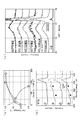
図3に、異なる粉砕時間で作製された、本実施例に係る正極活物質のXRDパターンを示す。図3に示されるように、観測された回折ピークはいずれも、原料であるNiOの回折ピークと一致しており、LiFのピークは消失していた。また、NiO以外の回折ピークが観測されなかったことから、新たな結晶性化合物が生成していないことが理解できる。
また、図3に示されるように、NiOの回折ピークは、粉砕時間の増加とともにブロードになっており、NiOの粒子径が小さくなったことを示しているが、ピークのシフトは僅かであることから、NiO中へのLiFの明確な固溶は生じていないと推測される。
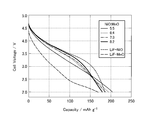
図4に、本実施例に係る正極活物質を正極として用いた電池の充放電曲線(0.1C)を示す。図4に示されるように、粉砕時間が12時間の場合、116mAh/g程度の放電容量であったが、粉砕時間を長くすることで充放電特性が向上し、粉砕時間が144時間の場合、平均電圧が3.53V、放電容量は、理論容量の81%に相当する217mAh/gの値を得ることができた。
本実施例によれば、粉砕時間を長くすることにより、充放電特性を向上させることができることが理解できる。なお、表1の結果から、粉砕時間を長くすることにより、得られる試料の粒子径(一次粒子径)を小さくできることが理解できる。

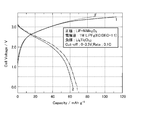
また、図5に、本実施例に係る正極活物質(LiFとNiOとの混合物、粉砕時間:72時間)を正極に用いた電池の充放電曲線(0.1C)を示す。図5において、「a」はおよび「b」はそれぞれ、粉砕時間が12時間、72時間にて得られた混合物を正極活物質として使用した場合を示す。また、図5において、左下から右上に向かうのは充電曲線であり、左上から右下に向かうのは放電曲線である。
本実施例に係る電池によれば、LiXおよびMxOyの混合物を正極活物質として使用することにより、一般的なリチウム二次電池と同様、充電からスタートする動作が可能となった。
また、図6ないし9はそれぞれ、本発明の実施例1に係る非水電解液二次電池用正極活物質(LiFとNiOとの混合物、粉砕時間:72時間)を正極に用いた電池の充放電およびその前後において該正極活物質に含まれるNi(2p)、O(1s)、F(1s)、およびLi(1s)のXPS(X-ray Photoelectron Spectroscopy)を測定した結果を示す図である。図6ないし図10において、「半充」は「半充電後」を意味し、「充」は「充電後」を意味し、「半放」は「半放電後」を意味し、「放」は「放電後」を意味し、「充放充」は「充電、次いで放電、次いで充電後」を意味する。
図6ないし図9によれば、図6、7および9に示すNi(2p)、O(1s)、およびLi(1s)のXPSでは、充放電およびその前後においてスペクトルに大きなシフトは確認されなかったのに対して、図8に示すF(1s)のXPSでは、充放電およびその前後でスペクトルにシフトが確認された。この結果から、本実施例に係る電池の正極において充放電およびその前後で、図1および図2に示す反応が生じており、これにより、フッ素イオン(ハロゲン原子の陰イオン)の状態が変化していることが示唆される。
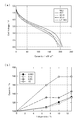
図13(a)は、本発明の実施例1に係る混合物(LiF:NiO=1:1、粉砕時間:72時間、平均粒子径(一次粒径):100~300nm)を正極に用いた電池のサイクル試験の結果を示す(カットオフ:5.0-2V、レート:0.1C)。図13(a)中、横軸は容量保持率(%)を表し、縦軸はセル電圧(V)を表し、「30」、「50」、「100」、「200」はそれぞれ、サイクル数を示す。図13(a)によれば、充放電のサイクル数が200回の時点でも、前記電池は、当初の70%以上の容量を保持していたことがわかる。
図13(b)は、図13(a)に示す電池の充放電サイクル数が0~60回における容量の変化を示す(カットオフ:4.4-2V、レート:0.1C、横軸はサイクル数を表し、縦軸は容量を表す。)図13(b)に示すように、前記電池の充放電サイクル数が60回の時点において、前記電池は、当初の95%を超える容量を維持していることがわかる。
3.2.実施例2
NiO10g(平均粒子径:100μm)とMn2O321g(平均粒子径:300μm)とを1:1のモル比で乳鉢混合し、800℃で焼成した後、同条件で混合および焼成を再度行い、NiMn2O4を合成した.得られたNiMn2O4にLiFを加え(NiMn2O4:LiF=1:4(モル比))、遊星ボールミルを用いて、650rpmにて72時間混合および粉砕することにより、本実施例に係る混合物(平均粒子径(一次粒子径):200μm)を得た。
NiO10g(平均粒子径:100μm)とMn2O321g(平均粒子径:300μm)とを1:1のモル比で乳鉢混合し、800℃で焼成した後、同条件で混合および焼成を再度行い、NiMn2O4を合成した.得られたNiMn2O4にLiFを加え(NiMn2O4:LiF=1:4(モル比))、遊星ボールミルを用いて、650rpmにて72時間混合および粉砕することにより、本実施例に係る混合物(平均粒子径(一次粒子径):200μm)を得た。
得られた混合物をケッチェンブラック(KB)と300rpmにて30分間複合化し、PVdFと混合して、本実施例に係る正極活物質とし、該正極活物質をアルミニウム箔上に塗布したものを作用極(正極)として電池を作製した。対極(負極)に金属リチウム、電解液に1M LiPF6EC(エチレンカーボネート):DEC(ジエチルカーボネート)(1:1)を使用し、ステンレス製の2極セルを用いてセルを作製した。
得られた混合物を、CVおよび充放電測定にて評価した。また、NiMn2O4の他に、実施例1と同様の手法で、CoO、MnO、またはMn2O3とLiFとの混合物(モル比1:1)を作製して、評価を行った。
図10に、NiMn2O4:LiF=1:4(モル比)の電極シートを作用極(正極)としたCV測定の結果を示す。図10を参照すると、電位を正方向に掃引すると、3V付近から正の電流の増加が確認される。当該増加は、電池の充電反応に対応する酸化電流ピークであると考えられる。また、電位を4.3Vから負方向に掃引した場合、負の電流が流れており、この電流サイクルは繰り返しても変化せず可逆的であることから、電池の放電反応に対応した負電流と考えられる。
図11に、本実施例に係る各正極活物質を用いた電池の放電曲線を示す。粉砕時間が72時間の条件で比較すると、NiOを用いた場合、187mAh/gの放電容量が得られているのに対して、NiOと同じ二価の酸化物であるCoOおよびMnOを用いた場合では、それぞれ75mAh/g、118mAh/gとなり、放電電圧もNiOより低かった。また、Mn2O3を用いた場合は、53mAh/gの放電容量であった。これに対して、スピネル型のNiMn2O4を用いた場合は、放電容量211mAh/gであり、高い放電容量が得られた。
図11に示される結果から、ニッケルを含む酸化物が高い放電容量を示していることが確認された。また、NiMn2O4での放電容量は、Ni3+→Ni2+による放電だけでは説明できず、Ni4+→Ni2+の寄与が考えられる。
3.3.実施例3
下記の表2に示す化合物をLiFと混合して混合物を調製し、上記実施例2と同様の方法にて、該混合物を用いて電極を作製した。各例における最大放電容量を表2に合わせて示す。
下記の表2に示す化合物をLiFと混合して混合物を調製し、上記実施例2と同様の方法にて、該混合物を用いて電極を作製した。各例における最大放電容量を表2に合わせて示す。
3.4.実施例4
原料であるLiFとNiOの比率(モル比)を変更した以外は、実施例1と同様の方法(粉砕時間72時間)で本実施例に係る混合物(平均粒子径(一次粒子径):100~500nm)を調製した。その結果を図14および図15に示す。
原料であるLiFとNiOの比率(モル比)を変更した以外は、実施例1と同様の方法(粉砕時間72時間)で本実施例に係る混合物(平均粒子径(一次粒子径):100~500nm)を調製した。その結果を図14および図15に示す。
図14は、本発明の実施例1に係る混合物(LiF:NiO=70:30、60:40,50:50,40:60,30:70、粉砕時間72時間、平均粒子径(一次粒径):100nm)を正極に用いた電池のレート特性の結果を示す(カットオフ:2-5V、横軸は容量、縦軸はセル電圧を示す)。図14において、1Cが87%であり、5Cが62%であった。
図14によれば、MxOy(NiO)に対するLiXの割合が1/1を下回る場合および6/4以上の場合、容量が低下する傾向があることがわかる。
また、図15は、本実施例に係る混合物(LiF:NiO=70:30、粉砕時間72時間)を正極に用いた電池の充放電曲線(図15(a))、XPSスペクトル(図15(b))およびXRDパターン(図15(c))を示す。図15(a)~(c)において、(1)は充放電前、(2)は1/10充電後、(3)は第1回目の充電完了時、(4)は第1回目の充電完了後で第1回目の1/3放電後、(5)第1回目の放電完了時、(6)は第1回目の放電完了後で第2回目の充電完了時を表す。
図15(b)(横軸は結合エネルギーを表し、縦軸は強度を表す。)によれば、(3)の第1回目の充電完了時および(6)の第2回目の充電完了時にピークが出現した(図15(b)の矢印で示す箇所)。この矢印で示されるピークは、NiOであると推測される。
3.5.実施例5
炭酸リチウムと酸化ニッケル(NiO)とを所定のモル比で秤量、混合し、大気焼成することで、LimNinO(ここでn=1-mである。)を得た。このLimNinOとLiFとを所定のモル比で混合し、遊星ボールミルにて混合および粉砕することで、本実施例に係る混合物(平均粒子径(一次粒子径):100nm)を調製した。その結果を図16、図17(a)および図17(b)に示す。
炭酸リチウムと酸化ニッケル(NiO)とを所定のモル比で秤量、混合し、大気焼成することで、LimNinO(ここでn=1-mである。)を得た。このLimNinOとLiFとを所定のモル比で混合し、遊星ボールミルにて混合および粉砕することで、本実施例に係る混合物(平均粒子径(一次粒子径):100nm)を調製した。その結果を図16、図17(a)および図17(b)に示す。
また、本実施例の混合物と導電材のケッチェンブラックとの比が85:10となるように秤量し、乳鉢で20分間混合した後、結着材である溶媒に溶解したPVDFを5質量%加えてスラリー状にし、アルミニウム箔上に塗布し、室温にて真空乾燥することで正極を作製した。
図16は、本実施例に係る混合物(LiFとLimNinOとの混合物(LiF:LimNinO=1:1(モル比)、m:n=0.13:0.87,0.10:0.90,0.07:0.93(モル比))を正極に用いた電池のXRD測定結果を示す。図17(a)および図17(b)はそれぞれ、本実施例に係る混合物の放電曲線(横軸は容量を示し、縦軸はセル電圧を示す。)ならびに容量に対する各レート容量比率(横軸はLiドープ比率を示し、縦軸は、容量を示す。)を示す。
図16には、原料であるNiOとLiF、NiOとLiFとを所定のモル比で大気焼成して得られたLimNinO、LiFとLimNinOとを混合粉砕して得られた試料、および大気焼成して得られたLimNinOをLiFを加えずに単独粉砕した試料の回折パターンを示す。
図16によれば、大気焼成後、LiFのピークは消失し、NiOピークのみとなっていることから、新たな化合物の生成はなかったと推測される。また、LimNinO中のLiの量が多いほど(mが大きいほど)高角側へのピークシフトが大きくなっていることがわかる。
一方、LiFを加えて混合粉砕した試料の回折ピークでは、NiOピークのみが生じていることから、新たな化合物の生成はなかったと推測される。また、LimNinOのみを単独粉砕した場合、ピークシフトが生じなかったのに対して、LimNinOにLiFを加えて混合粉砕したものはピークシフトが生じた。このピークシフトは、LiFの固溶に起因すると推測される。
図17(a)によれば、金属化合物としてLiでドープしたもの(LimNinO)を使用した場合、ドープしていない試料と比較して電位が上昇することがわかる。
また、図17(b)は、Liのドープ量に対する0.05Cの放電容量を100%としたときの容量を示す。図17(b)によれば、0.5Cおよび1Cにおいて、Liをドープしていない試料の容量の低下が顕著である。このことから、LiをドープされたNiOを原料として用いることにより、電池の特性を高めることができることがわかる。
3.6.実施例6
原料としてLiF(平均粒子径:1μm)、NiO(平均粒子径:10μm)およびMnO(平均粒子径:10μm)を使用し、該原料(LiFとNiOのモル比:1:1、NiとMnとのモル比:5:5、6:4、7:3、8:2)を遊星ボールミルにて、混合および粉砕(粉砕条件:650rpm、3時間(h))することにより、混合物を調製した。次いで、該混合物を800℃にて6時間、真空アニールした。その後、該混合物を遊星ボールミルで混合および粉砕(粉砕条件:650rpm、72時間(h))して、最終生成物である混合物(平均粒子径(一次粒子径):100~300nm)を調製した。
原料としてLiF(平均粒子径:1μm)、NiO(平均粒子径:10μm)およびMnO(平均粒子径:10μm)を使用し、該原料(LiFとNiOのモル比:1:1、NiとMnとのモル比:5:5、6:4、7:3、8:2)を遊星ボールミルにて、混合および粉砕(粉砕条件:650rpm、3時間(h))することにより、混合物を調製した。次いで、該混合物を800℃にて6時間、真空アニールした。その後、該混合物を遊星ボールミルで混合および粉砕(粉砕条件:650rpm、72時間(h))して、最終生成物である混合物(平均粒子径(一次粒子径):100~300nm)を調製した。
得られた混合物は、XRD、充放電測定、およびSTEMにより評価した。得られた混合物(90g)を、ケッチェンブラック(KB)(5g)と複合化した後,PVdF(ポリビニリデンジフルオライド)を混合して正極材料とし(混合物:KB:PVdF=70:20:10(質量比))、この正極材料をアルミニウム箔上に塗布した後、室温にて真空乾燥させて、作用極(正極)とした。対極(負極)に金属リチウム、電解液に1M LiPF6EC:DEC(1:1)を使用し、ステンレス製の2極セルを用いてセルを作製した。
図18は、本実施例に係る混合物(LiF:(NiO+MnO)=1:1(モル比)、Ni:Mn=5:5,6:4,7:3,8:2(モル比))のXRD測定結果を示す。
なお、図示しないが、NiOとMnOとを単に3時間混合した試料は、原料であるNiOとMnOのピークとほぼ同じピークが検出された。また、真空アニール後の混合物において、固溶体の形成が確認された。また、図18において、72時間の混合粉砕後の混合物では、LiFのピークが消失し、高角度側へのシフトが確認された。このことから、LiFとNixM1-xO(ここで、0<x<1)との固溶体が形成されていると推測される。
図19は、本実施例に係る混合物のSTEM測定結果を示す。図19に示すように、Ni,O,Fのいずれについても偏りがみられなかった。このことからも、LiFとNixM1-xO(ここで、0<x<1)との固溶体が形成されていることが推測される。
図20は、本実施例に係る混合物(LiFとNiOとMnOとの混合物、粉砕時間:72時間、NiO:MnO=5:5,6:4,7:3,8:2)を正極に用いた電池の充放電曲線を示す。なお、図20において、LiF-NiOとして示される点線は、LiFとNiOとを72時間遊星ボールミルで混合して得られた試料であり、LiF-NiOとして示される点線は、LiFとMnOとを72時間遊星ボールミルで混合して得られた試料である。
図20によれば、該混合物におけるMnの割合が高いと容量が高い傾向があり、該混合物におけるNiの割合が高いと電位が高い傾向があることが理解できる。
図21は、本実施例に係る混合物(原料として、LiF:(NiO+MnO)=1:1、NiO:MnO=70:30を使用)を正極に用いた電池のXPSスペクトル(Ni)(図21(a))、XPSスペクトル(Mn)(図21(b))および充放電曲線(図21(c))を示す。
図21(a)および図21(b)によれば、充放電前(1)ではNi2+、Mn3+のピークのみが発現し、充電後(2)においてNi3+、Mn3+のピークが発現し、放電後(3)においてNi3+、Mn3+のピークが消失し、次いで、再充電後(4)においてNi3+、Mn3+のピークが再び発現する。このことから、充放電において、Ni2+、Mn2+(2価)とNi3+、Mn3+(3価)との間の反応が生じていると推測される。
3.7.実施例7
原料であるNiO(平均粒子径:10μm)およびMnO(平均粒子径:10μm)の比率(モル比)を1/2として、上述の実施例6と同様の処理を行い、本実施例に係る混合物を調製した。また、上述の実施例6と同様の処理にてセルを作製した。得られた混合物を充放電測定により評価した。
原料であるNiO(平均粒子径:10μm)およびMnO(平均粒子径:10μm)の比率(モル比)を1/2として、上述の実施例6と同様の処理を行い、本実施例に係る混合物を調製した。また、上述の実施例6と同様の処理にてセルを作製した。得られた混合物を充放電測定により評価した。
図22は、本実施例に係る混合物(LiF-NiMn2O4)の充放電測定結果を示す。図22に示す充放電測定は、負極にLi4Ti5O12を用いた電池に対して行われた結果を示している。図22において、「1」は第1回目の放電(充電)を示し、「2」は第2回目の放電(充電)を示す。
3.8.実施例8
上記実施例1に係る混合物を用いた正極と、黒鉛炭素を用いた負極とを用いたセルを作製した。正極は、上記実施例1で作製された方法と同様の方法にて作製された。
上記実施例1に係る混合物を用いた正極と、黒鉛炭素を用いた負極とを用いたセルを作製した。正極は、上記実施例1で作製された方法と同様の方法にて作製された。
図23は、本発明の実施例1に係る混合物を用いた正極と、黒鉛炭素を用いた負極とを有するリチウムイオン電池の充放電測定結果を示す。図23によれば、負極に黒鉛炭素を用いた場合であっても、良好な充放電特性を発揮できることが理解できる。
3.9.実施例9
原料としてLiF(平均粒子径:100nm~100μm)、NiO(平均粒子径:100nm~100μm)およびMnO(平均粒子径:10nm~100μm)を使用し、該原料(LiFとNiOのモル比0.5:1~5:1)をアルゴン雰囲気下でボールミル、湿式ボールミルにて、混合および粉砕(粉砕条件:300~1,500rpm、0.5~96時間(h))することにより、混合物(平均粒子径(一次粒子径):10nm~1000nm)を調製する。
原料としてLiF(平均粒子径:100nm~100μm)、NiO(平均粒子径:100nm~100μm)およびMnO(平均粒子径:10nm~100μm)を使用し、該原料(LiFとNiOのモル比0.5:1~5:1)をアルゴン雰囲気下でボールミル、湿式ボールミルにて、混合および粉砕(粉砕条件:300~1,500rpm、0.5~96時間(h))することにより、混合物(平均粒子径(一次粒子径):10nm~1000nm)を調製する。
本発明の正極活物質によれば、低コストでかつ高容量、高電圧、および高エネルギー密度の電池を製造することができるため、例えば、小型携帯機器のみならず、電動自転車、二輪車、車両、船舶等の大型機器用の電池に含まれる電極(正極)内の正極活物質として好適に使用することができる。
Claims (17)
- LiX(式中、Xはハロゲン原子を表す。)を含む、非水電解液二次電池用正極活物質。
- 請求項1において、
前記LiXと、
MxOy(式中、Mは、アルカリ金属原子、アルカリ土類金属原子、遷移金属、第12族元素の金属、および第13族元素の金属から選ばれる少なくとも1種を表し、0<x≦1、0<y≦2である。)と、の混合物を含む、非水電解液二次電池用正極活物質。 - 請求項1または2において、
前記混合物において、LiX/MxOy(モル比)が0.1以上100以下である、非水電解液二次電池用正極活物質。 - 請求項1ないし3のいずれか1項において、
前記混合物の平均粒子径が100μm以下である、非水電解液二次電池用正極活物質。 - 請求項1ないし4のいずれか1項において、
MxOyは、NiaAbOc(式中、Bは、アルカリ金属原子、アルカリ土類金属原子、B以外の遷移金属、第12族元素の金属、および第13族元素の金属から選ばれる少なくとも1種であり、Bは、遷移金属であり、0<a≦1、0≦b≦1、0<c≦2である。)である、非水電解液二次電池用正極活物質。 - 請求項1ないし4のいずれか1項において、
MxOyは、BaAbDdOc(式中、Aは、アルカリ金属原子、アルカリ土類金属原子、B以外の遷移金属、第12族元素の金属、および第13族元素の金属から選ばれる少なくとも1種であり、Bは、遷移金属であり、Dは、Bは、AおよびB以外の遷移金属であり、0<a≦1、0≦b≦1、0<c≦2、0≦d≦1である。)である、非水電解液二次電池用正極活物質。 - 請求項1ないし6のいずれか1項において、
前記混合物を50%以上100%以下含む、非水電解液二次電池用正極活物質。 - LiX(式中、Xはハロゲン原子を表す。)を配合する工程を含む、非水電解液二次電池用正極活物質の製造方法。
- 請求項8において、
前記配合する工程は、
LiX(式中、Xはハロゲン原子を表す。)からなる第1の粒子と、
MxOy(式中、Mはアルカリ金属原子、アルカリ土類金属原子、遷移金属、第12族金属、および第13族元素の金属から選ばれる少なくとも1種を表し、0<x≦1、0<y≦2である。)からなる第2の粒子と、を混合する工程を含む、非水電解液二次電池用正極活物質の製造方法。 - 請求項9において、
前記混合する工程は、100rpm以上の回転数で行われる、非水電解液二次電池用正極活物質の製造方法。 - 請求項9または10において、
前記混合する工程により、平均粒子径が100μm以下である混合物が得られる、非水電解液二次電池用正極活物質の製造方法。 - 請求項9ないし11のいずれか1項において、
前記第1の粒子/前記第2の粒子(質量比)が0.1以上100以下である、非水電解液二次電池用正極活物質の製造方法。 - 請求項9ないし12のいずれか1項において、
MxOyは、BaAbOc(式中、Aは、アルカリ金属原子、アルカリ土類金属原子、B以外の遷移金属、第12族元素の金属、および第13族元素の金属から選ばれる少なくとも1種であり、Bは、遷移金属であり、0<a≦1、0≦b≦1、0<c≦2である。)である、非水電解液二次電池用正極活物質の製造方法。 - 請求項9ないし13のいずれか1項において、
MxOyは、BaAbDdOc(式中、Aは、アルカリ金属原子、アルカリ土類金属原子、B以外の遷移金属、第12族元素の金属、および第13族元素の金属から選ばれる少なくとも1種であり、Bは、遷移金属であり、Dは、AおよびB以外の遷移金属であり、0<a≦1、0≦b≦1、0<c≦2、0≦d≦1である。)である、非水電解液二次電池用正極活物質の製造方法。 - 正極および負極を備え、
前記正極は、請求項1ないし7のいずれか1項に記載の非水電解液二次電池用正極活物質を含む、電池。 - 正極および負極を備えた電池の充放電方法であって、
前記正極において、LiX(式中、Xはハロゲン原子を表す。)が電離して、Li+、X-、および電子が生成し、該電子が前記負極に移動する充電工程と、
前記正極において、前記Li+と前記X-とが結合してLiXが生成し、前記負極から電子が該正極に移動する放電工程と、を含む、電池の充放電方法。 - 請求項16において、
前記充電工程において、生成した前記X-が前記MxOyと結合し、
前記放電工程において、前記X-と前記MxOyとの結合物から前記X-が分離する、電池の充放電方法。
Priority Applications (2)
| Application Number | Priority Date | Filing Date | Title |
|---|---|---|---|
| JP2017506187A JPWO2016147856A1 (ja) | 2015-03-13 | 2016-03-01 | 非水電解液二次電池用正極活物質およびその製造方法、前記正極活物質を含む電池、ならびに電池の充放電方法 |
| US15/699,072 US20170373313A1 (en) | 2015-03-13 | 2017-09-08 | Positive electrode active material for non-aqueous electrolyte secondary cell, method for manufacturing said positive electrode active material, cell containing said positive electrode active material, and method for charging cell |
Applications Claiming Priority (2)
| Application Number | Priority Date | Filing Date | Title |
|---|---|---|---|
| JP2015-051398 | 2015-03-13 | ||
| JP2015051398 | 2015-03-13 |
Related Child Applications (1)
| Application Number | Title | Priority Date | Filing Date |
|---|---|---|---|
| US15/699,072 Continuation US20170373313A1 (en) | 2015-03-13 | 2017-09-08 | Positive electrode active material for non-aqueous electrolyte secondary cell, method for manufacturing said positive electrode active material, cell containing said positive electrode active material, and method for charging cell |
Publications (1)
| Publication Number | Publication Date |
|---|---|
| WO2016147856A1 true WO2016147856A1 (ja) | 2016-09-22 |
Family
ID=56918853
Family Applications (1)
| Application Number | Title | Priority Date | Filing Date |
|---|---|---|---|
| PCT/JP2016/056293 Ceased WO2016147856A1 (ja) | 2015-03-13 | 2016-03-01 | 非水電解液二次電池用正極活物質およびその製造方法、前記正極活物質を含む電池、ならびに電池の充放電方法 |
Country Status (3)
| Country | Link |
|---|---|
| US (1) | US20170373313A1 (ja) |
| JP (1) | JPWO2016147856A1 (ja) |
| WO (1) | WO2016147856A1 (ja) |
Cited By (1)
| Publication number | Priority date | Publication date | Assignee | Title |
|---|---|---|---|---|
| JP2023111822A (ja) * | 2022-01-29 | 2023-08-10 | テクニカル インスティテュート オブ フィジクス アンド ケミストリー,チャイニーズ アカデミー オブ サイエンシーズ | 正極材料及び当該材料を含む二次イオン電池 |
Families Citing this family (1)
| Publication number | Priority date | Publication date | Assignee | Title |
|---|---|---|---|---|
| JP7357499B2 (ja) * | 2019-09-26 | 2023-10-06 | パナソニックホールディングス株式会社 | 非水電解質二次電池用正極活物質、及び非水電解質二次電池 |
Citations (4)
| Publication number | Priority date | Publication date | Assignee | Title |
|---|---|---|---|---|
| JP2004047416A (ja) * | 2002-05-23 | 2004-02-12 | Sanyo Electric Co Ltd | 非水電解質電池 |
| JP2004207210A (ja) * | 2002-05-23 | 2004-07-22 | Sanyo Electric Co Ltd | 非水電解質電池 |
| JP2009146788A (ja) * | 2007-12-14 | 2009-07-02 | Panasonic Corp | リチウム二次電池用正極形成用塗工液、リチウム二次電池用正極およびリチウム二次電池 |
| JP2013197091A (ja) * | 2012-03-22 | 2013-09-30 | Samsung Corning Precision Materials Co Ltd | リチウムイオン2次電池用正極活物質およびそれを含むリチウムイオン2次電池 |
Family Cites Families (7)
| Publication number | Priority date | Publication date | Assignee | Title |
|---|---|---|---|---|
| JP3141858B2 (ja) * | 1998-10-19 | 2001-03-07 | 宇部興産株式会社 | リチウム遷移金属系ハロゲン化酸化物とその製造方法及びその用途 |
| JP4356127B2 (ja) * | 1998-12-04 | 2009-11-04 | ソニー株式会社 | リチウム二次電池 |
| JP2002184404A (ja) * | 2000-12-15 | 2002-06-28 | Sony Corp | 正極材料および非水電解質電池 |
| KR100822013B1 (ko) * | 2005-04-15 | 2008-04-14 | 주식회사 에너세라믹 | 불소화합물코팅 리튬이차전지 양극 활물질 및 그 제조방법 |
| JP2011150986A (ja) * | 2010-01-25 | 2011-08-04 | Sumitomo Electric Ind Ltd | 正極体とその製造方法、ならびに非水電解質電池 |
| CN106159255A (zh) * | 2011-04-14 | 2016-11-23 | 户田工业株式会社 | Li‑Ni复合氧化物颗粒粉末以及非水电解质二次电池 |
| JPWO2012176903A1 (ja) * | 2011-06-24 | 2015-02-23 | 旭硝子株式会社 | リチウムイオン二次電池用正極活物質の製造方法 |
-
2016
- 2016-03-01 JP JP2017506187A patent/JPWO2016147856A1/ja active Pending
- 2016-03-01 WO PCT/JP2016/056293 patent/WO2016147856A1/ja not_active Ceased
-
2017
- 2017-09-08 US US15/699,072 patent/US20170373313A1/en not_active Abandoned
Patent Citations (4)
| Publication number | Priority date | Publication date | Assignee | Title |
|---|---|---|---|---|
| JP2004047416A (ja) * | 2002-05-23 | 2004-02-12 | Sanyo Electric Co Ltd | 非水電解質電池 |
| JP2004207210A (ja) * | 2002-05-23 | 2004-07-22 | Sanyo Electric Co Ltd | 非水電解質電池 |
| JP2009146788A (ja) * | 2007-12-14 | 2009-07-02 | Panasonic Corp | リチウム二次電池用正極形成用塗工液、リチウム二次電池用正極およびリチウム二次電池 |
| JP2013197091A (ja) * | 2012-03-22 | 2013-09-30 | Samsung Corning Precision Materials Co Ltd | リチウムイオン2次電池用正極活物質およびそれを含むリチウムイオン2次電池 |
Cited By (2)
| Publication number | Priority date | Publication date | Assignee | Title |
|---|---|---|---|---|
| JP2023111822A (ja) * | 2022-01-29 | 2023-08-10 | テクニカル インスティテュート オブ フィジクス アンド ケミストリー,チャイニーズ アカデミー オブ サイエンシーズ | 正極材料及び当該材料を含む二次イオン電池 |
| JP7763488B2 (ja) | 2022-01-29 | 2025-11-04 | テクニカル インスティテュート オブ フィジクス アンド ケミストリー,チャイニーズ アカデミー オブ サイエンシーズ | 正極材料及び当該材料を含む二次イオン電池 |
Also Published As
| Publication number | Publication date |
|---|---|
| US20170373313A1 (en) | 2017-12-28 |
| JPWO2016147856A1 (ja) | 2017-12-07 |
Similar Documents
| Publication | Publication Date | Title |
|---|---|---|
| CN114930574B (zh) | 正极活性材料、所述正极活性材料的制备方法以及具有包括所述正极活性材料的正极的锂二次电池 | |
| CN108807864B (zh) | 复合正极活性材料、含复合正极活性材料的正极和锂电池、及制备复合正极活性材料的方法 | |
| JP6414589B2 (ja) | 非水電解質二次電池 | |
| US10938036B2 (en) | Method of preparing positive electrode material for lithium secondary battery, positive electrode material for lithium secondary battery, and lithium secondary battery including the positive electrode material | |
| CN108352564B (zh) | 非水电解质二次电池 | |
| US20190044179A1 (en) | Nonaqueous electrolyte secondary battery | |
| JP2020504416A (ja) | リチウム二次電池用正極活物質、その製造方法、それを含む電極、及び該電極を含むリチウム二次電池 | |
| CN103140962A (zh) | 锂离子电池组正电极材料上的金属卤化物涂层和相应的电池组 | |
| KR20150000564A (ko) | 복합양극활물질, 그 제조방법 및 이를 채용한 양극과 리튬전지 | |
| KR20170090196A (ko) | 전기화학 성능이 우수한 양극활물질 및 이를 포함하는 리튬 이차 전지 | |
| JP2017045633A (ja) | 非水系電解質二次電池用正極活物質とその製造方法、および非水系電解質二次電池 | |
| KR20140053451A (ko) | 복합양극활물질, 그 제조방법 및 이를 채용한 양극과 리튬전지 | |
| JP2025503022A (ja) | 正極活物質、正極活物質の製造方法、正極極板、二次電池、電池モジュール、電池パック及び電力消費装置 | |
| CN108352562B (zh) | 非水电解质二次电池 | |
| CN105977481A (zh) | 活性物质、非水电解质电池、电池组及组电池 | |
| JP2011129442A (ja) | リチウムイオン二次電池用正極及びリチウムイオン二次電池 | |
| JP2018006331A (ja) | 非水電解質二次電池用負極材料及びその製造方法 | |
| JP5997087B2 (ja) | リチウム二次電池用正極材料の製造方法 | |
| KR20160144831A (ko) | 음극 활물질 복합체, 상기 음극 활물질 복합체를 포함하는 음극, 상기 음극을 포함하는 리튬 이차전지, 및 상기 음극 활물질 복합체의 제조방법 | |
| JP6266481B2 (ja) | リチウムイオン二次電池用活物質、リチウムイオン二次電池、電池パック及び車 | |
| JP6294219B2 (ja) | リチウムコバルト系複合酸化物の製造方法 | |
| JP5387631B2 (ja) | 元素置換リチウムマンガン複合酸化物粒子状組成物とその製造方法とその二次電池への利用 | |
| JP7781906B2 (ja) | 非水電解質二次電池用の電極、非水電解質二次電池、及び電池パック | |
| JP7262418B2 (ja) | 非水系電解質二次電池用正極活物質、および非水系電解質二次電池 | |
| JP5733550B2 (ja) | リチウムイオン二次電池 |
Legal Events
| Date | Code | Title | Description |
|---|---|---|---|
| 121 | Ep: the epo has been informed by wipo that ep was designated in this application |
Ref document number: 16764686 Country of ref document: EP Kind code of ref document: A1 |
|
| ENP | Entry into the national phase |
Ref document number: 2017506187 Country of ref document: JP Kind code of ref document: A |
|
| NENP | Non-entry into the national phase |
Ref country code: DE |
|
| 122 | Ep: pct application non-entry in european phase |
Ref document number: 16764686 Country of ref document: EP Kind code of ref document: A1 |