WO2016143835A1 - アシロキシシラン類の製造方法、それにより得られるアシロキシシラン類、およびその用途 - Google Patents
アシロキシシラン類の製造方法、それにより得られるアシロキシシラン類、およびその用途 Download PDFInfo
- Publication number
- WO2016143835A1 WO2016143835A1 PCT/JP2016/057466 JP2016057466W WO2016143835A1 WO 2016143835 A1 WO2016143835 A1 WO 2016143835A1 JP 2016057466 W JP2016057466 W JP 2016057466W WO 2016143835 A1 WO2016143835 A1 WO 2016143835A1
- Authority
- WO
- WIPO (PCT)
- Prior art keywords
- group
- acyloxysilanes
- reaction
- carbon atoms
- hydrocarbon group
- Prior art date
- Legal status (The legal status is an assumption and is not a legal conclusion. Google has not performed a legal analysis and makes no representation as to the accuracy of the status listed.)
- Ceased
Links
- 0 C*(C)(CC(O1)=O)*C1=O Chemical compound C*(C)(CC(O1)=O)*C1=O 0.000 description 1
Classifications
-
- C—CHEMISTRY; METALLURGY
- C07—ORGANIC CHEMISTRY
- C07F—ACYCLIC, CARBOCYCLIC OR HETEROCYCLIC COMPOUNDS CONTAINING ELEMENTS OTHER THAN CARBON, HYDROGEN, HALOGEN, OXYGEN, NITROGEN, SULFUR, SELENIUM OR TELLURIUM
- C07F7/00—Compounds containing elements of Groups 4 or 14 of the Periodic Table
- C07F7/02—Silicon compounds
- C07F7/08—Compounds having one or more C—Si linkages
- C07F7/18—Compounds having one or more C—Si linkages as well as one or more C—O—Si linkages
- C07F7/1896—Compounds having one or more Si-O-acyl linkages
-
- C—CHEMISTRY; METALLURGY
- C07—ORGANIC CHEMISTRY
- C07F—ACYCLIC, CARBOCYCLIC OR HETEROCYCLIC COMPOUNDS CONTAINING ELEMENTS OTHER THAN CARBON, HYDROGEN, HALOGEN, OXYGEN, NITROGEN, SULFUR, SELENIUM OR TELLURIUM
- C07F7/00—Compounds containing elements of Groups 4 or 14 of the Periodic Table
- C07F7/02—Silicon compounds
- C07F7/025—Silicon compounds without C-silicon linkages
-
- C—CHEMISTRY; METALLURGY
- C07—ORGANIC CHEMISTRY
- C07F—ACYCLIC, CARBOCYCLIC OR HETEROCYCLIC COMPOUNDS CONTAINING ELEMENTS OTHER THAN CARBON, HYDROGEN, HALOGEN, OXYGEN, NITROGEN, SULFUR, SELENIUM OR TELLURIUM
- C07F7/00—Compounds containing elements of Groups 4 or 14 of the Periodic Table
- C07F7/02—Silicon compounds
- C07F7/08—Compounds having one or more C—Si linkages
- C07F7/18—Compounds having one or more C—Si linkages as well as one or more C—O—Si linkages
Definitions
- the present invention relates to an efficient method for producing acyloxysilanes and the like, acyloxysilanes obtained thereby, and uses thereof.
- Acyloxysilanes are used as precision synthesis reagents and synthetic intermediates for medicine, agricultural chemicals, electronic materials, etc., and as surface modifiers, raw materials for sol / gel materials, nanomaterials, organic-inorganic hybrid materials, etc. It is a functional chemical used.
- General methods for producing acyloxysilanes include, for example, (A) a method in which chlorosilane and carboxylic acid are reacted directly or in the presence of a base (Patent Documents 1 and 2), and (B) chlorosilane and carboxylic acid metal salt.
- Patent Document 3 Method of reacting (Patent Document 3), (C) Method of reacting acyloxysilane and carboxylic acid (Patent Document 4), (D) Method of reacting hydrosilane and carboxylic acid in the presence of a transition metal catalyst (Patent Document 5) , (E) Method of reacting chlorosilane and carboxylic acid anhydride (Patent Document 6), (F) Method of reacting silanol and carboxylic acid anhydride (Non-Patent Document 1), (G) Alkoxysilane and carboxylic acid anhydride There is known a method (Non-patent Document 2) for reacting.
- Method E There were problems such as (Method E).
- the methods (Methods C, D, and F) using acyloxysilane, hydrosilane, or silanol have problems such as that it is not always easy to obtain such silicon compounds, or that they are expensive.
- the method using alkoxysilane (Method G) has problems such as the need to heat a mixture of raw materials at a high reflux temperature for a long time, and an industrially more advantageous method has been demanded.
- acyloxysilane and related silicon compounds as one of the surface treatment methods for solid materials, trialkoxysilane such as triethoxy or trimethoxysilane, triacetoxysilane having higher reactivity, etc.
- a method used as a silane coupling agent has been known (Non-patent Document 3).
- they hardly react directly with the surface of the solid material, and generally it is necessary to hydrolyze the alkoxy group in the presence of water to form a silanol structure.
- JP 54-103500 A European Patent No. 0837067 US Pat. No. 4,379,766 JP-A-7-70152 Japanese Patent Laid-Open No. 10-182666 German Patent No. 882401
- the present invention has been made in view of the circumstances as described above, and provides a method for producing acyloxysilanes more efficiently, novel acyloxysilanes obtained thereby, and uses thereof. It is intended.
- the present inventors have made it possible for the reaction between readily available alkoxysilanes and carboxylic acid anhydrides to proceed smoothly in the presence of a specific catalyst, and to produce acyloxysilanes. Has been found to be efficiently obtained, and the obtained acyloxysilanes can be used as a surface treatment agent for a solid material, and the present invention has been completed.
- a method for producing an acyloxysilane comprising a reaction step in which an alkoxysilane and a carboxylic acid anhydride are reacted in the presence of a catalyst, wherein the alkoxysilane is an alkoxy represented by the following general formula (I) Silanes, the carboxylic acid anhydride is a carboxylic acid anhydride represented by the following general formula (IIA) or (IIB), the catalyst is an acid catalyst, and the acyloxy obtained in the reaction step
- a method for producing an acyloxysilane characterized in that the silane is an acyloxysilane represented by the following general formula (IIIA) or (IIIB).
- R 1 p R 2 q R 3 r Si (OR 4) 4- (p + q + r) (I) (In the formula, p, q, r, and p + q + r are each an integer of 0 or more and 3 or less.
- R 1 , R 2 , and R 3 are each independently a hydrocarbon group having 1 to 24 carbon atoms or a hydrogen atom.
- R 4 is an alkyl group having 1 to 6 carbon atoms, and when R 1 , R 2 , and R 3 are hydrocarbon groups, a group in which some of the hydrogen atoms of the hydrocarbon group do not participate in the reaction May be substituted with.)
- R 5 CO) 2 O (IIA)
- R 5 is a hydrocarbon group having 1 to 24 carbon atoms, and a part of hydrogen atoms of the hydrocarbon group may be substituted with a group that does not participate in the reaction.
- R 6 is a divalent hydrocarbon group having 2 to 24 carbon atoms, and a part of hydrogen atoms of the hydrocarbon group may be substituted with a group not participating in the reaction.
- R 1 p R 2 q R 3 r Si OR 4
- 4- (p + q + r + s) OCOR 5
- s IIIA
- p, q, r, R 1 , R 2 , R 3 , R 4 , and R 5 are each as defined above, and s is an integer of 1 to 4- (p + q + r).
- ⁇ 2> The method for producing acyloxysilanes according to ⁇ 1>, wherein the acid catalyst is an inorganic or organic acid.
- the inorganic acid is an inorganic solid acid having regular pores and / or a layered structure.
- the inorganic solid acid is zeolite and / or montmorillonite.
- ⁇ 5> The method for producing acyloxysilanes according to ⁇ 4>, wherein the zeolite has a silica / alumina ratio (substance ratio) of 3 to 1000.
- ⁇ 6> The acyloxysilane according to ⁇ 4> or ⁇ 5>, wherein the zeolite is at least one selected from the group consisting of USY type, beta type, Y type, ZSM-5 type, and mordenite type. Manufacturing method.
- ⁇ 7> The acyloxy according to ⁇ 2>, wherein the inorganic acid is a chloride, bromide, or perchlorate containing an element selected from iron, ruthenium, aluminum, scandium, tin, or indium.
- the inorganic or organic acid is a sulfonic acid, a sulfonylimide, or a salt generated from such an acid and an element selected from iron, ruthenium, aluminum, scandium, tin, or indium.
- R 7 s R 8 t Si OR 9 ) 4- (s + t + u) (OCOR 10 ) u (IIIC)
- R 7 , R 8 , R 9 and R 10 are each independently a hydrocarbon group having 1 to 12 carbon atoms or a carbon atom having 1 to 12 carbon atoms in which a part of the hydrogen atoms is substituted with a halogen atom
- s, t, and s + t are integers of 0 or more and 2 or less.
- ⁇ 11> A surface treatment agent containing acyloxysilanes produced by the method according to any one of ⁇ 1> to ⁇ 9>.
- ⁇ 12> A surface treatment agent comprising an acyloxysilane represented by the general formula (IIIC) or (IIID) according to ⁇ 10>.
- ⁇ 13> A method for performing a surface treatment of a solid material using the surface treatment agent according to ⁇ 11> or ⁇ 12>.
- R 11 , R 12 , R 13 , and R 14 are each independently a hydrocarbon group having 1 to 12 carbon atoms, and R 15 is a divalent hydrocarbon group having 2 to 8 carbon atoms.
- V, w, x, and v + w + x are integers of 0 or more and 3 or less, and y is an integer of 1 or more and 4- (v + w + x) or less.
- acyloxysilanes can be produced more efficiently than conventional methods, and novel acyloxysilanes can be provided.
- the production method of the present invention has the following characteristics. (1) Raw materials and catalysts are easy to obtain, easy to handle and high in safety. (2) In a reaction system using a solid catalyst, it is easy to separate and recover the catalyst. (3) By controlling the reaction conditions, some or all of the plurality of alkoxy groups can be selectively converted into acyloxy groups. (4) By using a cyclic carboxylic acid anhydride, acyloxysilanes having an alkoxycarbonyl group at the terminal of the acyloxy group can be produced. (5) The reaction can be promoted by microwave irradiation. (6) A novel acyloxysilane can be provided by the production method of the present invention. The production method of the present invention enables cost reduction and high efficiency of the production process, and is considered to have great advantages in terms of economic efficiency, environmental load, and the like as compared with the prior art.
- the production method of the present invention includes a reaction step of reacting an alkoxylane silane with a carboxylic acid anhydride in the presence of a catalyst.
- alkoxysilanes used as a raw material are represented by the following general formula (I): R 1 p R 2 q R 3 r Si (OR 4) 4- (p + q + r) (I) It is represented by
- R 1 , R 2 , and R 3 are each independently a hydrocarbon group having 1 to 24 carbon atoms or a hydrogen atom, and R 4 is an alkyl group having 1 to 6 carbon atoms.
- R 1 , R 2 , and R 3 are hydrocarbon groups, some of the hydrogen atoms of the hydrocarbon group may be substituted with groups that do not participate in the reaction.
- Specific examples of the hydrocarbon group include an alkyl group, an aryl group, an aralkyl group, and an alkenyl group.
- the number of carbon atoms is preferably 1-20, more preferably 1-18, and some or all of the hydrogen atoms on the carbon may be substituted with groups that do not participate in the reaction. .
- the group not involved in the reaction include an alkoxy group having 1 to 6 carbon atoms, an alkoxycarbonyl group having 1 to 6 carbon atoms, a dialkylamino group having 1 to 6 carbon atoms, a cyano group, a nitro group, a halogen atom More specifically, an alkoxy group, an alkoxycarbonyl group, a dialkylamino group, a halogen atom, an alkoxy group such as a methoxy group, an ethoxy group, and a hexoxy group; an alkoxy group such as a methoxycarbonyl group and a propoxycarbonyl group; Examples thereof include dialkylamino groups such as carbonyl group, dimethylamino group and diethylamino group, and halogen atoms such as fluorine atom, chlorine atom and bromine atom.
- alkyl groups having such groups include methyl group, ethyl group, propyl group, butyl group, sec-butyl group, pentyl group, hexyl group, cyclohexyl group, octyl group, decyl group, 2-methoxyethyl.
- the hydrocarbon group is an aryl group
- a hydrocarbon ring system or a heterocyclic monovalent aromatic organic group can be used.
- the aryl group is a hydrocarbon ring system
- the number of carbon atoms is preferably 6 to 22, more preferably 6 to 14, and specific examples of the aryl group include phenyl group, naphthyl group, anthryl group, phenanthryl group, pyrenyl Group, perylenyl group, pentacenyl group and the like.
- the hetero atom in the heterocyclic ring is a sulfur, oxygen atom or the like, and preferably has 4 to 12 carbon atoms, more preferably 4 to 8 carbon atoms.
- aryl groups examples thereof include thienyl group, benzothienyl group, dibenzothienyl group, furyl group, benzofuryl group, dibenzofuryl group and the like.
- a part of the hydrogen atoms of the aryl group may be substituted with a group that does not participate in the reaction.
- Specific examples of the group not involved in the reaction include those shown for the above alkyl group.
- Examples of other groups not involved in the reaction include an oxyethylene group and an oxyethyleneoxy group, which are divalent groups for bonding two carbon atoms on the ring.
- aryl group having such a group examples include a methylphenyl group, an ethylphenyl group, a hexylphenyl group, a methoxyphenyl group, an ethoxyphenyl group, a butoxyphenyl group, an octoxyphenyl group, a methyl (methoxy) phenyl group, Examples include fluoro (methyl) phenyl group, chloro (methoxy) phenyl group, bromo (methoxy) phenyl group, 2,3-dihydrobenzofuranyl group, 1,4-benzodioxanyl group and the like.
- the hydrocarbon group is an aralkyl group
- the number of carbon atoms is preferably 7 to 23, more preferably 7 to 16, and some or all of the hydrogen atoms on the carbon are substituted with groups that do not participate in the reaction. It may be.
- Specific examples of the group not involved in the reaction include those shown for the above alkyl group.
- Specific examples of aralkyl groups having such groups include benzyl group, phenethyl group, 2-naphthylmethyl group, 9-anthrylmethyl group, (4-chlorophenyl) methyl group, 1- (4-methoxyphenyl) ethyl Groups and the like.
- the number of carbon atoms is preferably 2 to 23, more preferably 2 to 20, and part or all of the hydrogen atoms on the carbon are substituted with groups that do not participate in the reaction. It may be. Specific examples of the group not involved in the reaction include those shown for the above alkyl group, the aryl group shown above, and the like.
- alkenyl groups having such groups include vinyl group, 2-propenyl group, 3-butenyl group, 5-hexenyl group, 9-decenyl group, 2-phenylethenyl group, 2- (methoxyphenyl) Examples include ethenyl group, 2-naphthylethenyl group, 2-anthrylethenyl group and the like.
- the carboxylic acid anhydride to be reacted with the alkoxysilane is represented by the following general formula (IIA) (R 5 CO) 2 O (IIA) Or the following general formula (IIB)
- R 5 is a hydrocarbon group having 1 to 24 carbon atoms, and a part of the hydrogen atoms of the hydrocarbon group may be substituted with a group that does not participate in the reaction.
- these hydrocarbon groups include alkyl groups, aryl groups, aralkyl groups, alkenyl groups, and the like, and specific examples of groups not involved in the reaction include R 1 and R 2 in the above general formula (I). Or those shown in the description of R 3 .
- the hydrocarbon group when the hydrocarbon group is an alkyl group, it is preferably 1-20, more preferably 1-18, and when the hydrocarbon group is an aryl group, preferably 4-20, more In the case of an aralkyl group, it is preferably from 5 to 21, more preferably from 5 to 19, and in the case of an alkenyl group, preferably from 2 to 20, more preferably from 2 to 18. is there. Specific examples of these groups include those shown in the description of R 1 , R 2 , or R 3 in the general formula (I).
- carboxylic acid anhydrides (IIA) having such hydrocarbon groups include acetic anhydride, propionic anhydride, butyric anhydride, isobutyric anhydride, valeric anhydride, isovaleric anhydride.
- R 6 is a divalent hydrocarbon group having 2 to 24 carbon atoms, and part of the hydrogen atoms of the hydrocarbon group may be substituted with a group that does not participate in the reaction.
- the divalent hydrocarbon group include an alkylene group, an arylene group, and an alkenylene group.
- Specific examples of the group that does not participate in the reaction include R 1 , R 2 , or the like can be exemplified those shown in the description of R 3.
- the number of carbon atoms in the divalent hydrocarbon group is preferably 1 to 20, more preferably 1 to 18 when the divalent hydrocarbon group is an alkylene group, and more preferably 1 to 18 when it is an arylene group.
- Specific examples of these groups include ethylene group, trimethylene group, tetramethylene group, pentamethylene group, hexamethylene group, cyclohexane-1,2-diyl group, 4-methylcyclo-1,2-diyl group, 1,2 Examples include -phenylene group, 4-methyl-1,2-phenylene group, 4-bromo-1,2-phenylene group, vinylene group, 2-methylpropenylene group and the like.
- carboxylic acid anhydrides (IIB) having such hydrocarbon groups and the like include succinic anhydride, octyl succinic anhydride, 2,2-dimethyl succinic anhydride, glutaric anhydride, 3 -Methylglutaric anhydride, cyclohexane-1,2-dicarboxylic anhydride, 4-methylcyclohexane-1,2-dicarboxylic anhydride, phthalic anhydride, 4-methylphthalic anhydride, 4-bromophthalic anhydride 4-nitrophthalic anhydride, biphenyl-2,2′-dicarboxylic anhydride, naphthalene-1,8-dicarboxylic anhydride, maleic anhydride, itaconic anhydride, 5-norbornene-2,3-dicarboxylic acid An acid anhydride etc. are mentioned.
- the molar ratio of the carboxylic acid anhydride to the raw material alkoxysilanes can be arbitrarily selected, but considering the yield of the acyloxysilanes relative to the alkoxysilanes, it is usually 0.4 or more and 300 or less, more preferably Is 0.5 or more and 200 or less, more preferably 0.5 or more and 150 or less.
- the following general formula (IIIA) is obtained by reacting the alkoxysilane of the general formula (I) with the carboxylic acid anhydride of the general formula (IIA) or (IIB).
- IIIB the following general formula (IIIB)
- p, q, r, R 1 , R 2 , R 3 , R 4 , R 5 , and R 6 have the same meanings as described above, and specific examples thereof include the above Examples thereof include those represented by the general formulas (I) (IIA) and (IIB). Further, s is an integer of 1 to 4- (p + q + r).
- the production method of the present invention can provide acyloxysilanes represented by the following general formulas (IIIC) and (IIID).
- R 7 , R 8 , R 9 , and R 10 are each independently a hydrocarbon group having 1 to 12 carbon atoms or a carbon atom having 1 to 12 carbon atoms in which some of the hydrogen atoms are substituted with halogen atoms.
- 12 hydrocarbon groups at least one of which is an alkenyl group having 3 or more carbon atoms, or contains a halogen atom.
- s, t, and s + t are integers of 0 or more and 2 or less
- u and 4- (s + t + u) are integers of 1 or more and 3 or less.
- R 11 , R 12 , R 13 and R 14 are each independently a hydrocarbon group having 1 to 12 carbon atoms, and R 15 is a divalent having 2 to 8 carbon atoms.
- V, w, x, and v + w + x are integers of 0 or more and 3 or less, and y is an integer of 1 or more and 4- (v + w + x) or less.
- Examples of the hydrocarbon group having 1 to 12 carbon atoms in the general formula (IIIC) and the general formula (IIID) include an alkyl group, an aryl group, an aralkyl group, and an alkenyl group. Specific examples thereof include methyl Group, ethyl group, propyl group, butyl group, pentyl group, hexyl group, octyl group, decyl group, dodecyl group, phenyl group, benzyl group, vinyl group, allyl group and the like.
- Examples of the hydrocarbon group having 1 to 12 carbon atoms in which a part of hydrogen atoms in the general formula (IIIC) are substituted with halogen atoms include chloromethyl group, dichloromethyl group, trichloromethyl group, chlorodifluoromethyl group, penta Examples thereof include a fluorophenyl group, a 3,3,3-trifluoropropyl group, a 1H, 1H, 2H, 2H-tridecafluorooctyl group, a 1H, 1H, 2H, 2H-heptadecafluorodecyl group, and the like.
- R 7 , R 8 , R 9 and R 10 at least one hydrocarbon group having 3 or more carbon atoms, an alkenyl group, or containing a halogen atom
- hydrocarbon group having 3 or more carbon atoms an alkenyl group, or containing a halogen atom
- Specific examples include propyl group, butyl group, phenyl group, vinyl group, allyl group, chloromethyl group, dichloromethyl group, trichloromethyl group, chlorodifluoromethyl group, pentafluorophenyl group, 3,3,3-trifluoro.
- Examples include a propyl group, 1H, 1H, 2H, 2H-tridecafluorooctyl group, 1H, 1H, 2H, 2H-heptadecafluorodecyl group, and the like.
- examples of the divalent hydrocarbon group having 2 to 8 carbon atoms in the general formula (IIID) include an alkylene group, an arylene group, and an alkenylene group. Specific examples thereof include an ethylene group and a trimethylene group. , Tetramethylene group, 1,2-phenylene group, vinylene group and the like.
- preferred examples of the combination of (R 7 , R 8 , R 9 , R 10 , s, t, u) are (methyl group, phenyl group, methyl group, methyl group, 1, 1, 1), (methyl group, phenyl group, methyl group, ethyl group, 1, 1, 1), (phenyl group,-, methyl group, methyl group, 1, 0, 1), (phenyl group, -, Methyl group, methyl group, 1, 0, 2), (phenyl group, vinyl group, ethyl group, 1, 1, 1), (vinyl group,-, ethyl group, methyl group, 1, 0, 1) , (Vinyl group,-, ethyl group, methyl group, 1, 0, 2), (vinyl group,-, methyl group, methyl group, 1, 0, 1), (vinyl group,-, methyl group, methyl group 1, 0, 2), (hexyl group,-, ethyl group,
- preferred examples of the combination of (R 11 , R 12 , R 13 , R 14 , R 15 , v, w, x, y) are (methyl group, methyl group, methyl group) Group, ethyl group, ethylene group, 1, 1, 1, 1), (methyl group, methyl group, methyl group, ethyl group, trimethylene group, 1, 1, 1, 1), (methyl group, methyl group, methyl Group, ethyl group, cyclohexane-1,2-diyl group, 1, 1, 1, 1), (methyl group, methyl group, methyl group, ethyl group, 1,2-phenylene group, 1, 1, 1, 1 ), (Methyl group, methyl group, methyl group, ethyl group, vinylene group, 1, 1, 1, 1) and the like.
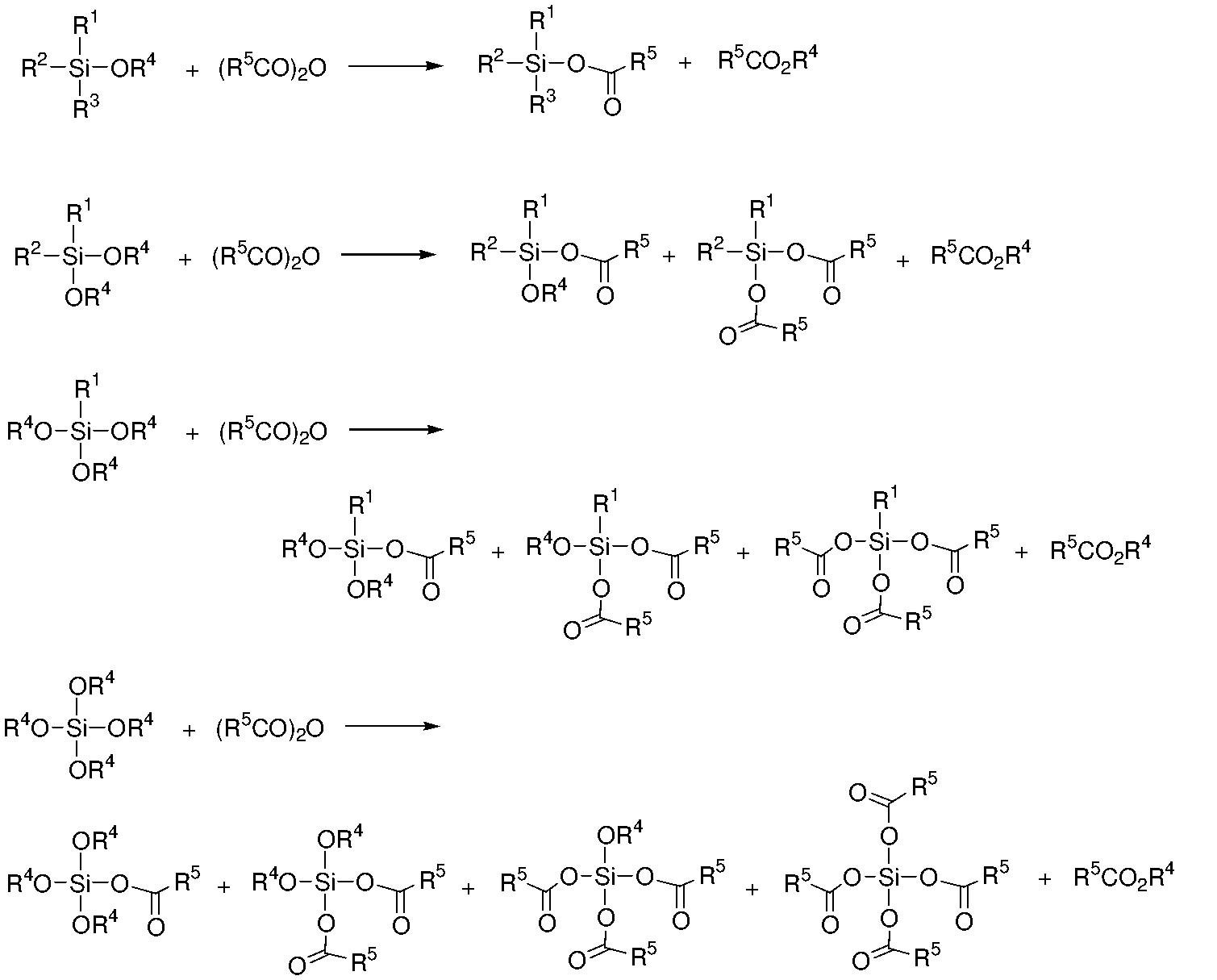
- the reaction step in the present invention is a reaction step involving a nucleophilic substitution reaction with a carboxylic acid anhydride with respect to the alkoxysilane having a raw material having an alkoxy group. Therefore, when the acyclic carboxylic acid anhydride represented by the general formula (IIA) is used, the reaction in the present invention is a reaction accompanied by elimination of the carboxylic acid ester.
- the reaction can be represented by the following reaction formula.
- reaction in the present invention does not involve elimination of the carboxylic acid ester, unlike the case of the non-cyclic carboxylic acid anhydride.
- the reaction step can be expressed by, for example, the following reaction formula.
- acyloxysilanes having a structure in which the cyclic carboxylic acid anhydride is inserted into the silicon-oxygen bond of the starting alkoxysilanes are obtained.
- the raw material alkoxysilanes may be monoalkoxysilanes, dialkoxysilanes, trialkoxysilanes, or tetraalkoxysilanes. Therefore, for example, in a reaction using an acyclic carboxylic acid anhydride, acyloxysilanes as shown in the following reaction formula can be obtained.
- the acyloxysilanes obtained in the reaction step of the present invention are one type when monoalkoxysilanes are used as raw materials, but dialkoxysilanes, trialkoxysilanes, and tetraalkoxysilanes are used as raw materials.
- the case is not limited to one type of acyloxysilanes.
- dialkoxysilanes are used as raw materials, acyloxysilanes substituted with one alkoxy group and acyloxysilanes substituted with two alkoxy groups are used. It means that it may be siloxysilanes or a mixture thereof.
- acyloxysilanes substituted with one alkoxy group when trialkoxysilanes are used as raw materials, acyloxysilanes substituted with one alkoxy group, acyloxysilanes substituted with two alkoxy groups, acyloxysilanes substituted with three alkoxy groups, Or a mixture thereof, and in addition, when tetraalkoxysilanes are used as raw materials, acyloxysilanes substituted with one alkoxy group, acyloxysilanes substituted with two alkoxy groups, alkoxy groups May be acyloxysilanes substituted with three, acyloxysilanes substituted with four alkoxy groups, or a mixture thereof.
- the acyloxysilanes provided by the production method of the present invention have an acyloxy group having a higher reactivity than an alkoxy group, they generally have a higher reactivity than the raw material alkoxysilanes. Therefore, the reaction when used as a synthetic intermediate and the reaction when used as a surface treatment agent, a sol / gel material, etc. are performed more efficiently under milder conditions than when using raw material alkoxysilanes. It has a high utility value as a functional chemical.
- various conventionally known acid catalysts can be used to accelerate the reaction.
- the acid catalyst a solid acid catalyst that can be easily separated and recovered can be used.
- the solid acid catalyst include solid inorganic substances such as metal salts and metal oxides, and more specifically, protic hydrogen atoms or metal cations (aluminum, titanium, gallium, iron, cerium, scandium).
- protic hydrogen atoms or metal cations aluminum, titanium, gallium, iron, cerium, scandium.
- zeolite, mesoporous silica, montmorillonite, and the like silica gel, heteropolyacid, and inorganic solid acid using a carbon-based material as a carrier.
- solid acids such as zeolite, mesoporous silica, and montmorillonite, which are inorganic solid acids having regular pores and / or a layered structure, are preferable in terms of catalytic activity and selectivity for products.
- Zeolite and montmorillonite-based solid acids are more preferably used.
- the solid acid catalyst having a pore structure The pore diameter range is 0.2 to 20 nm, preferably 0.3 to 15 nm, more preferably 0.3 to 10 nm.
- the distance between layers is 0.2 to 20 nm, preferably 0.3 to 15 nm, more preferably 0.3 to 10 nm.
- zeolites having basic skeletons such as Y-type, beta-type, ZSM-5-type, mordenite-type, and SAPO-type are available. It can be used. Further, USY type known as SUSY type (Super Ultrastable Y), VUSY type (Very Ultrastable Y), SDUSY type (Super deluminated ultrastable Y), etc.
- Y type zeolite Na-Y
- Ultrastable Y, ultra-stable Y type can also be used preferably (for USY type, see, for example, “Molecular Sieves”, Advances in Chemistry, Volume 121, American Chemical Society, 1973, Chapter etc.).
- USY type, beta type, Y type, ZSM-5 type, and mordenite type are preferable, USY type, beta type, and Y type are more preferable, and USY type and beta type are preferable among these zeolites. Is more preferable. Also, USY type and beta type are preferable as the zeolite for selectively converting some or all of the plurality of alkoxy groups to acyloxy groups.
- zeolites various types of zeolites such as Bronsted acid type having a protonic hydrogen atom and Lewis acid type having a metal cation can be used.
- the proton type having a protonic hydrogen atom is represented by HY type, H-SDUSY type, H-SUSY type, H-beta type, H-mordenite type, H-ZSM-5 type, etc. Is done.
- those of ammonium type, NH 4 -Y type, NH 4 -VUSY type, NH 4 - beta, NH 4 - mordenite, by firing the NH 4 -ZSM-5 type or the like of the zeolite, the proton type Those converted to can also be used.
- silica / alumina ratio (substance ratio) of zeolite various ratios can be selected depending on the reaction conditions, but it is usually 3 to 1000, preferably 3 to 800, more preferably 5 to 600, More preferably, it is 5 to 400.
- zeolites various types including commercially available products can be used. Specific examples of commercially available products include USY type zeolites such as CBV760, CBV780, CBV720, CBV712, and CBV600, which are commercially available from Zeolis Corporation. Examples of Y type zeolites are HSZ- 360HOA and HSZ-320HOA.
- beta-type zeolite CP811C, CP814N, CP7119, CP814E, CP7105, CP814CN, CP811TL, CP814T, CP814Q, CP811Q, CP811E-75, CP811E, and CP811C-300, etc., commercially available from Zeolist, Tosoh Corporation HSZ-930HOA and HSZ-940HOA that are commercially available, UOP-Beta that is commercially available from UOP, and the like.
- mordenite type zeolite examples include CBV21A and CBV90A commercially available from Zeolis Corporation, HSZ-660HOA, HSZ-620HOA, HSZ-690HOA and the like commercially available from Tosoh Corporation.
- ZSM-5 type zeolite Examples thereof include CBV5524G, CBV8020, and CBV8014N, which are commercially available from Zeolist.
- organic solid acids having acidic functional groups can also be used effectively.
- the organic solid acid is a polymer having an acidic functional group.
- the acidic functional group include a sulfo group, a carboxy group, and a phosphoryl group.
- the polymer include Teflon having a perfluoro side chain. (Registered trademark) backbone polymer, styrene-divinylbenzene copolymer, and the like. Specific examples include Nafion (Nafion, registered trademark, available from DuPont), Dowex (registered trademark, available from Dow Chemical), Amberlite (Amberlite, registered trademark) having a sulfo group.
- Amberlyst Amberlyst, registered trademark, available from Dow Chemical Company
- Nafion NR50, Dowex 50WX2, Dowex 50WX4, Dowex 50WX8, Amberlite IR120, Amberlite IRP-64, Amberlist 15, Amberlist 36, and the like can be given.
- a catalyst for example, Nafion SAC-13 in which an organic solid acid such as Nafion is supported on an inorganic material such as silica can be used, or a combination of a plurality of inorganic solid acids and organic solid acids can be used. it can.
- inorganic or organic acids other than solid acids having Bronsted acidity or Lewis acidity can also be used as catalysts.
- Bronsted acidic compounds such as sulfuric acid, nitric acid, and hydrochloric acid, scandium chloride (III), yttrium chloride (III), titanium chloride (III or IV), and iron chloride.
- Lewis acidic compounds such as aluminum (III) bromide, gallium (III) chloride, indium (III) chloride, tin (IV) chloride, and bismuth (III) chloride. These compounds may be used in the form of hydrates.
- organic compounds include trifluoromethanesulfonic acid, pentafluoroethanesulfonic acid, nonafluorobutanesulfonic acid, methanesulfonic acid, p-toluenesulfonic acid, bis (trifluoromethanesulfonyl) imide, bis (nonafluorobutanesulfonyl) ) Bronsted acidic compounds such as imides.
- Lewis acidic compounds such as metal salts of these Bronsted acidic compounds and tris (pentafluorophenyl) borane can be used.
- Types of metal cations in Lewis acid metal salts include scandium (III), yttrium (III), iron (III), cobalt (II), copper (II), silver (I), zinc (II), tin
- lanthanoid elements such as lanthanum (III), prasedium (III), samarium (III), neodymium (III), ytterbium (III) and the like can be mentioned.
- inorganic acids include chloride, bromide, perchlorate, and the like containing an element selected from iron, ruthenium, aluminum, scandium, tin, or indium.
- specific examples thereof include iron (III) chloride, iron (III) bromide, iron (III) perchlorate, ruthenium (III) chloride, indium (III) chloride, tin (IV) chloride and the like. It is done. It is also preferable to add silver perchlorate or the like to the chloride or bromide of these elements and convert the chloride or bromide to perchlorate for use. Furthermore, in the organic acids, sulfonic acids, sulfonylimides and the like are preferable, and salts generated from these acids and elements selected from iron, ruthenium, aluminum, scandium, tin, indium and the like are also preferably used.
- these sulfonic acids and sulfonylimides include trifluoromethanesulfonic acid, nonafluorobutanesulfonic acid, methanesulfonic acid, bis (trifluoromethanesulfonyl) imide, and the like, and cation species of elements that form salts with them. Examples thereof include scandium (III), iron (III), ruthenium (III), aluminum (III), gallium (III), indium (III), bismuth (III), tin (IV), and the like.
- a plurality of inorganic and organic acids other than solid acids can be used in combination, or they can be used in combination with the above solid acids.
- the amount of catalyst relative to the raw material can be arbitrarily determined, but the weight ratio is usually about 0.0001 to 10, preferably about 0.001 to 8, more preferably about 0.001 to 6.
- the reaction of the present invention can be carried out in a liquid phase or gas phase depending on the reaction temperature and reaction pressure. Moreover, as a form of a reaction apparatus, it can carry out with various forms conventionally known, such as a batch type and a flow type.
- the reaction temperature is usually ⁇ 20 ° C. or higher, preferably ⁇ 10 to 300 ° C., more preferably ⁇ 10 to 200 ° C.
- the temperature range at room temperature is usually 0 to 40 ° C., preferably 5 to 40 ° C., more preferably 10 to 35 ° C. is there.
- reaction pressure is usually 0.1 to 100 atm, preferably 0.1 to 50 atm, and more preferably 0.1 to 10 atm.
- the reaction time depends on the amount of the raw material and catalyst, the reaction temperature, the form of the reactor, etc., but considering productivity and efficiency, it is usually 0.1 to 1200 minutes, preferably 0.1 to 600 minutes. Preferably, it is about 0.1 to 300 minutes.
- reaction When the reaction is carried out in a liquid phase system, it can be carried out with or without a solvent.
- a solvent hydrocarbons such as decalin (decahydronaphthalene) and decane, chlorobenzene, 1,2- or 1,
- halogenated hydrocarbons such as 3-dichlorobenzene, 1,2,3- or 1,2,4-trichlorobenzene, ethers such as tert-butyl methyl ether and dibutyl ether
- a solvent can be used and it can also be used in mixture of 2 or more types.
- inert gas such as nitrogen.
- the reaction of the present invention can also be performed under microwave irradiation.
- the dielectric loss coefficient of the raw material carboxylic acid anhydride or acid catalyst is relatively large, and the microwave is efficiently absorbed, so that the carboxylic acid anhydride or catalyst is activated under microwave irradiation, The reaction can be performed more efficiently.
- microwave irradiation reaction various commercially available devices equipped with contact-type or non-contact-type temperature sensors can be used.
- the output of microwave irradiation, the type of cavity (multimode, single mode), the form of irradiation (continuous, intermittent), etc. can be arbitrarily determined according to the scale and type of reaction.
- the frequency of the microwave is usually 0.3 to 30 GHz.
- the IMS frequency band allocated for use in the industrial, scientific, and medical fields is preferable, and among them, the 2.45 GHz band, the 5.8 GHz band, and the like are more preferable.
- a heating material that absorbs microwaves and generates heat
- various conventionally known materials such as activated carbon, graphite, silicon carbide, titanium carbide and the like can be used.
- a molded catalyst obtained by mixing the catalyst described above and the heating material powder and calcining using an appropriate binder such as sepiolite or holmite can also be used.
- reaction process of the present invention proceeds even in a closed reaction apparatus, the reaction can be made more efficient by making the reaction apparatus an open system and continuously removing reaction products out of the reaction system. You can also.
- acyloxysilanes When a solid acid catalyst is used in the production method of the present invention, separation and recovery of the catalyst after the reaction step can be easily performed by methods such as filtration and centrifugation. Further, purification of the produced acyloxysilanes can be easily achieved by means usually used in organic chemistry such as distillation, recrystallization, column chromatography and the like. Since the acyloxysilanes provided by the production method of the present invention have an acyloxy group that is more reactive than an alkoxy group, the acyloxysilane has a higher reactivity than the raw material alkoxysilanes, and is a synthetic intermediate. Useful value as functional chemicals such as surface treatment agents.
- the surface treatment agent it is possible to quickly perform surface treatment on a solid material such as glass under a mild condition of about several minutes at room temperature, depending on the type of acyloxysilane used.
- the hydrophilicity / hydrophobicity of the surface of the solid material can be easily controlled.
- the surface treatment agent of the present invention contains acyloxysilanes produced by the above reaction, and uses a mixed solution containing not only isolated and purified acyloxysilanes but also a plurality of acyloxysilanes.
- acyloxysilanes since various acyloxysilanes can be easily produced under mild conditions using readily available alkoxysilanes as a raw material, a reaction solution containing acyloxysilanes A surface treatment method using the same as it is is a method showing the features of the present invention.
- acyloxysilanes When acyloxysilanes are used as a surface treatment agent, they can be diluted with an organic solvent that does not react with acyloxysilanes such as toluene and hexane, if necessary.
- a dip method dipping method
- a casting method a spin coat method
- a spray coat method a spray coat method.
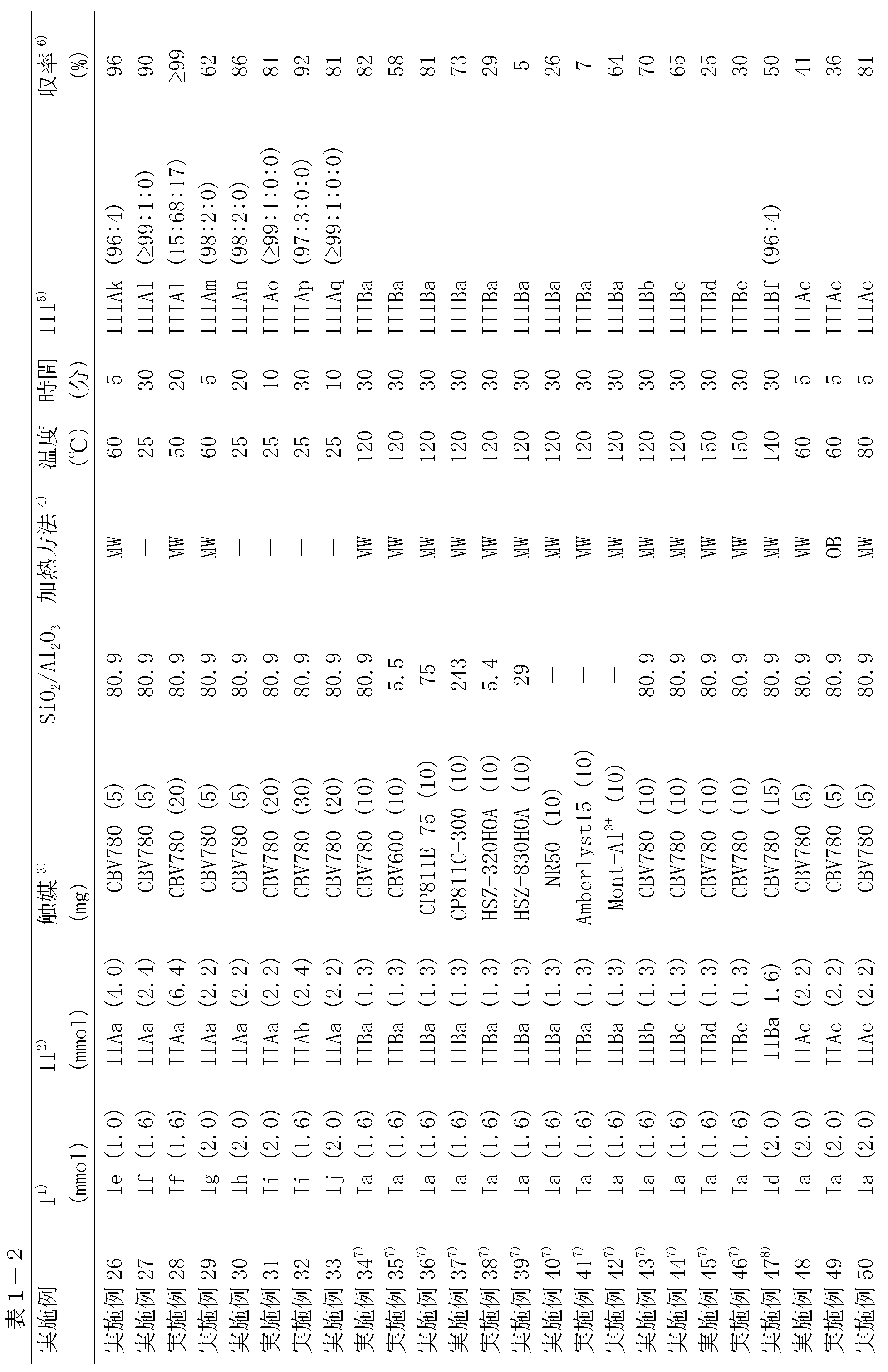
- Example 1 (Ethoxy) trimethylsilane (Ia) 3.2 mmol, acetic anhydride (IIAa) 6.4 mmol, zeolite CBV780 (manufactured by Zeolis) 5 mg was put in a reaction tube, and a microwave irradiation apparatus (Biotage Initiator) was used. , And stirred at 110 ° C. for 5 minutes. The product was analyzed with a gas chromatograph and a gas chromatograph mass spectrometer, and the yield of the product was measured by gas chromatographic analysis. As a result, it was found that (acetoxy) trimethylsilane (IIIAa) was produced in a yield of 89%. (See Table 1-1).
- Examples 2 to 85 Comparative Examples 1 and 2
- the reaction conditions (catalyst, raw material, temperature, time, etc.) were changed, and the reaction and analysis were carried out in the same manner as in Example 1.
- the results of measuring the product yield by gas chromatographic analysis or nuclear magnetic resonance spectral analysis are shown in Table 1. -1 to Table 1-7.
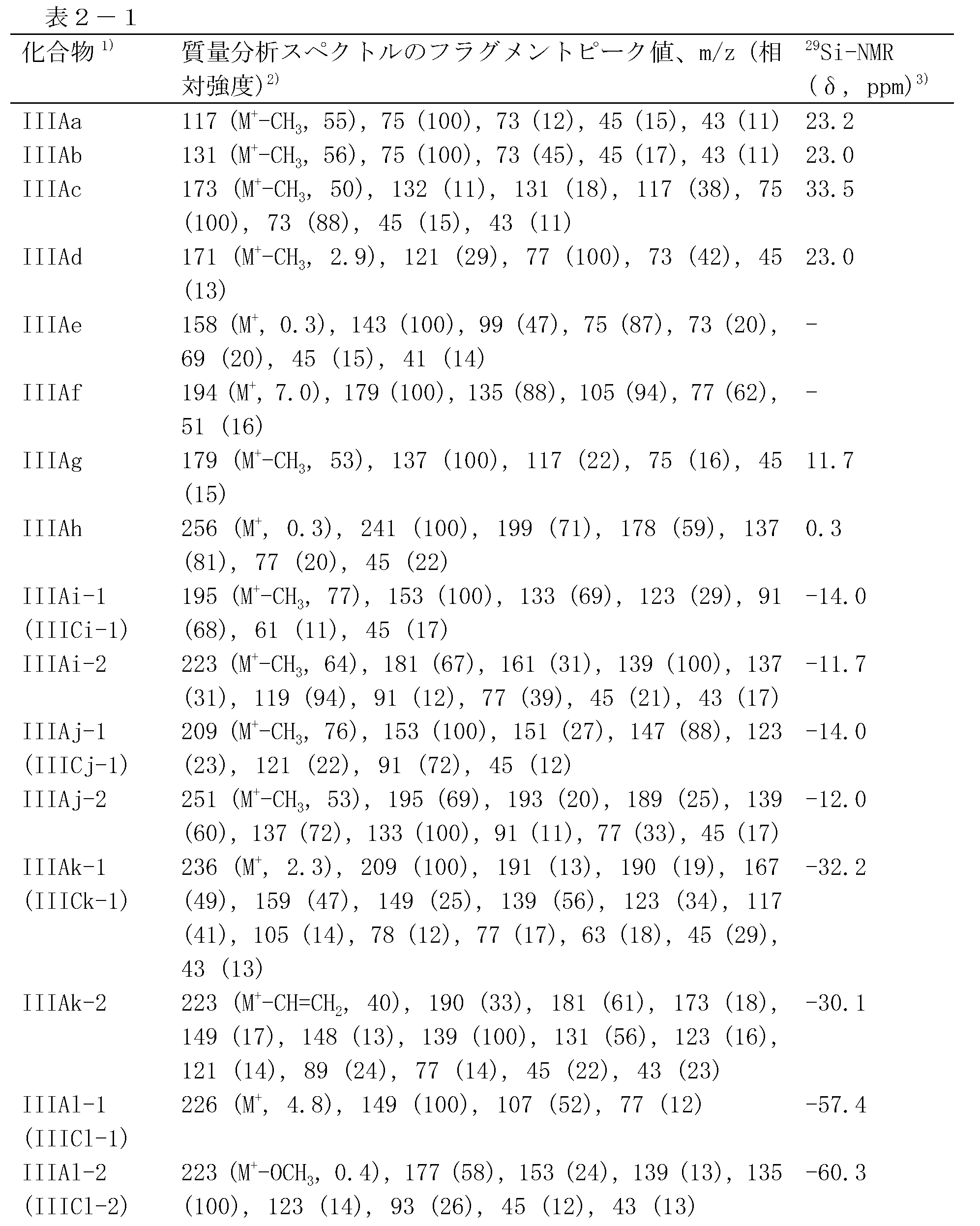
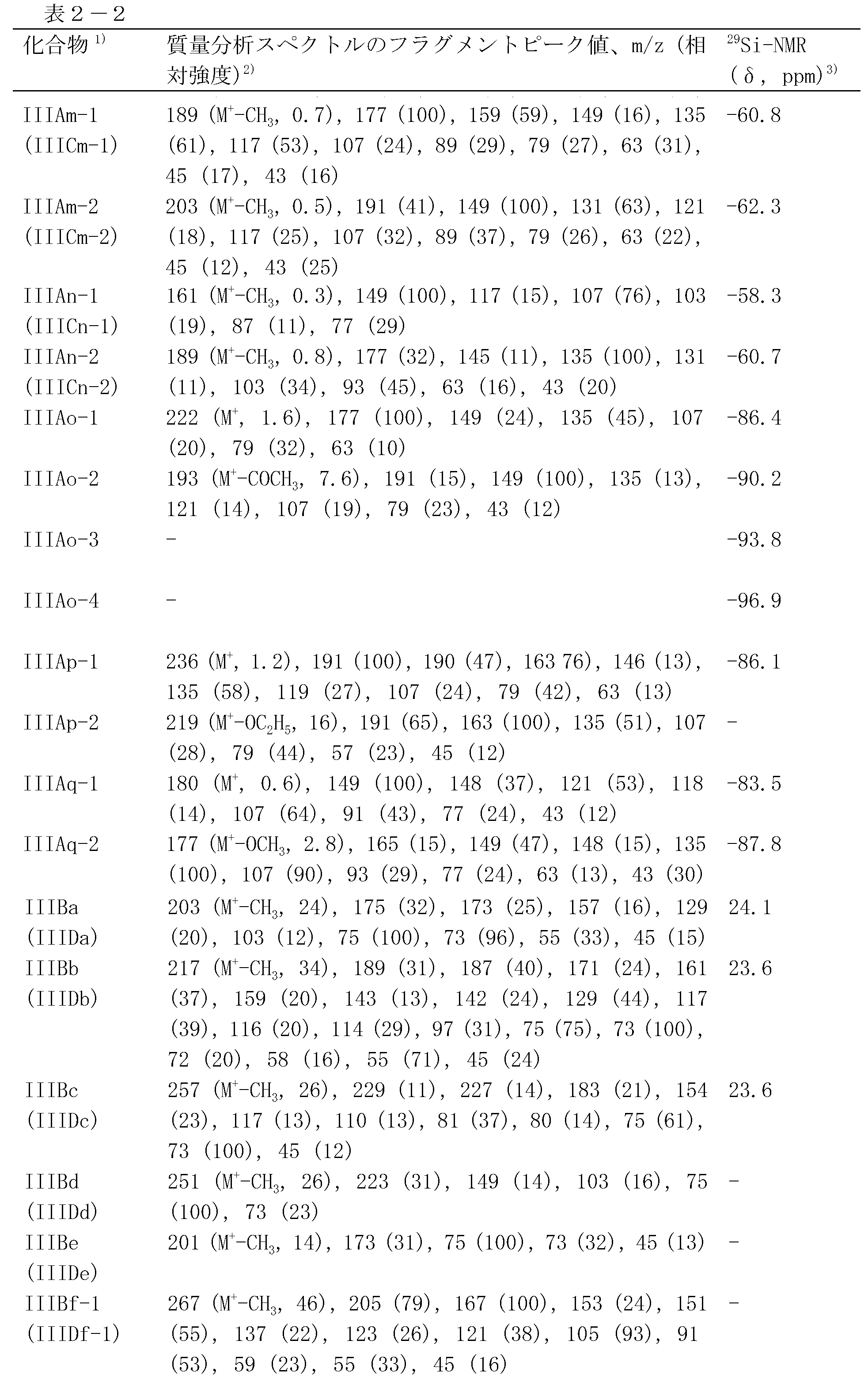
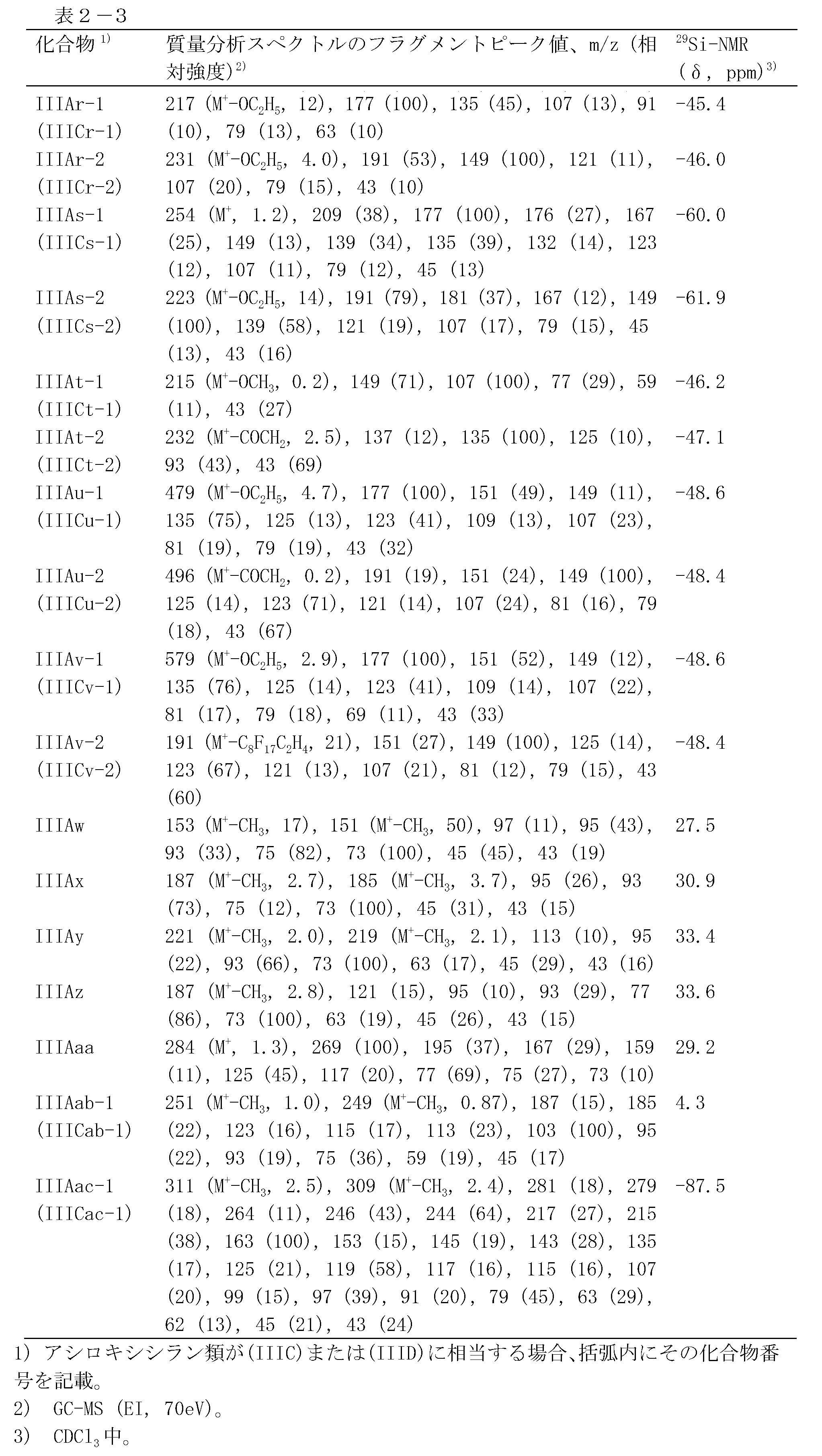
- the mass spectrometry spectrum and 29 Si nuclear magnetic resonance spectrum ( 29 Si-NMR) data of the acyloxysilanes (IIIA) or (IIIB) obtained in the above examples are shown in Tables 2-1 to 2-3.
- Tables 2-1 to 2-3 when the acyloxysilane corresponds to the acyloxysilane of the general formula (IIIC) or (IIID), the compound number of (IIIA) or (IIIB) The compound number as (IIIC) or (IIID) is shown in parentheses after.
- the present invention by controlling the type of catalyst and the reaction conditions, it is possible to selectively convert some or all of the plurality of alkoxy groups in the raw material alkoxysilane to acyloxy groups.
- alkoxysilane (Id) and carboxylic acid anhydride (IIAa) as shown in Examples 20 and 22 of Table 1-1, CBV780 is used as a catalyst under the conditions of stirring at 25 ° C. for 5 minutes, or And a compound (IIIAi-1) in which one of the two methoxy groups in the raw material alkoxysilane was converted to an acetoxy group by carrying out the reaction at 110 ° C. for 5 minutes using CBV600 as a catalyst.
- alkoxysilane (Ii) and carboxylic acid anhydride (IIAa) the amount of acyloxy group introduced depends on the type of catalyst, etc., as shown in Examples 67 to 72 in Table 1-3 to Table 1-4.
- the reaction can be accelerated by heating using microwave irradiation.
- alkoxysilane (Ia) and carboxylic acid anhydride (IIAc) as shown in Examples 48 and 50 of Table 1-2, acyloxysilane when the reaction is performed using a microwave irradiation apparatus
- the yield of (IIIAc) was 41% or 81% under the reaction conditions of stirring at 60 ° C. for 5 minutes or stirring at 80 ° C. for 5 minutes, respectively.
- the yield of (IIIAc) was 36% when the reaction was carried out at the same reaction temperature and time using an oil bath heating device instead of the microwave irradiation device. Or 73%.
- the acyloxysilanes obtained by the above production method can be easily isolated and purified by operations such as distillation and recrystallization after separating the catalyst by centrifugation, filtration, etc. Can do.
- Example 87 (Ethoxy) methyldi (phenyl) silane (Ic) 4.0 mmol, acetic anhydride (IIAa) 16.1 mmol, CBV780 (manufactured by Zeolis) 50 mg in a reaction tube and sealed, microwave irradiation apparatus (manufactured by Biotage) The mixture was stirred at 110 ° C. for 10 minutes using an initiator. As a result of post-treatment and distillation as in Example 86, 3.24 mmol (yield 81%) of (acetoxy) methyldi (phenyl) silane (IIIAh) was obtained.
- Example 88 A mixture of methyldi (methoxy) (phenyl) silane (Id) 5.0 mmol, acetic anhydride (IIAa) 7.5 mmol, CBV780 (Zeolist) 15 mg was placed in a reaction tube and sealed, and the mixture was sealed at room temperature (25 ° C.) for 7 minutes. Stir. As a result of post-treatment and distillation as in Example 86, 3.25 mmol (yield 65%) of (acetoxy) methyl (methoxy) (phenyl) silane (IIIAi-1) was obtained.
- Example 89 A mixture of methyldi (methoxy) (phenyl) silane (Id) 3.3 mmol, acetic anhydride (IIAa) 13.2 mmol, CBV780 (Zeolist) 10 mg was placed in a reaction tube and sealed, and a microwave irradiation apparatus (Biotage) The mixture was stirred at 110 ° C. for 5 minutes using an initiator. As a result of post-treatment and distillation in the same manner as in Example 86, 2.67 mmol (yield 81%) of di (acetoxy) methyl (phenyl) silane (IIIAi-2) was obtained.
- Example 90 Methyldi (methoxy) (phenyl) silane (Id) 7.5 mmol, propionic anhydride (IIAb) 11.3 mmol, CBV780 (manufactured by Zeolis) 45 mg in a reaction tube was sealed and sealed at room temperature (25 ° C.) 15 Stir for minutes. As a result of post-treatment and distillation in the same manner as in Example 86, 5.78 mmol (yield 77%) of methyl (methoxy) (phenyl) (propanoyloxy) silane (IIIAj-1) was obtained.
- Example 91 Methyldi (methoxy) (phenyl) silane (Id) 5.0 mmol, propionic anhydride (IIAb) 14.9 mmol, CBV780 (manufactured by Zeolis) 30 mg in a reaction tube was sealed and microwave irradiation apparatus (Biotage) The mixture was stirred at 110 ° C. for 30 minutes using an Initiator). As a result of post-treatment and distillation in the same manner as in Example 86, 4.05 mmol (yield 81%) of methyl (phenyl) di (propanoyloxy) silane (IIIAj-2) was obtained.
- Example 92 A mixture of 4.9 mmol of tri (methoxy) (phenyl) silane (If), 7.3 mmol of acetic anhydride (IIAa) and CBV 780 (manufactured by Zeolis Co., Ltd.) was placed in a reaction tube and sealed, and 30 minutes at room temperature (25 ° C.) Stir. As a result of post-treatment and distillation in the same manner as in Example 86, 2.45 mmol (yield 50%) of (acetoxy) di (methoxy) (phenyl) silane (IIIAl-1) was obtained.
- Example 93 A mixture of 4.9 mmol of tri (methoxy) (phenyl) silane (If), 19.4 mmol of acetic anhydride (IIAa), CBV780 (manufactured by Zeolis) 60 mg was put in a reaction tube and sealed, and a microwave irradiation apparatus (manufactured by Biotage) The mixture was stirred at 50 ° C. for 20 minutes using an initiator. As a result of post-treatment and distillation in the same manner as in Example 86, 2.45 mmol (yield 50%) of di (acetoxy) (methoxy) (phenyl) silane (IIIAl-2) was obtained.
- Example 96 (Ethoxy) trimethylsilane (Ia) 3.4 mmol, glutaric anhydride (IIBb) 2.6 mmol, CBV780 (manufactured by Zeolis) 20 mg, 1,2-dichlorobenzene 4 mL was placed in a reaction tube, sealed, and irradiated with microwaves. It stirred for 60 minutes at 120 degreeC using the apparatus (Initiator by Biotage). As a result of post-treatment and distillation in the same manner as in Example 86, 1.61-mmol (yield 62%) of (3-ethoxycarbonyl) propanoyloxy] trimethylsilane (IIIBb) was obtained.
- the acyloxysilane obtained by the above method can be used as a surface treatment agent for solid materials such as glass.
- a composition containing acyloxysilane obtained by the reaction of alkoxysilane and carboxylic acid anhydride is diluted with a suitable solvent to obtain a solid. It can be performed by a method of immersing the material.
- Example 98 A mixture of 2.0 mmol of tri (ethoxy) (phenyl) silane (Il), 2.2 mmol of acetic anhydride (IIAa), CBV780 (Zeolist) 10 mg was put in a reaction tube and sealed, and then at room temperature (25 ° C.) for 20 minutes. Stir. The catalyst solid was separated by centrifugation, and the supernatant was measured by gas chromatographic analysis or nuclear magnetic resonance spectral analysis.
- a solution for surface treatment was prepared by dissolving 0.04 mL of this supernatant containing acyloxysilane in 0.96 mL of toluene.
- a glass plate (1.8 ⁇ 1.8 cm) was immersed in the prepared solution at room temperature for 2 minutes, washed sequentially with 3 mL of toluene and 3 mL of acetone, and dried at 80 ° C. for 5 minutes.
- a contact angle meter (automatic contact angle meter DMe-201 manufactured by Kyowa Interface Science)
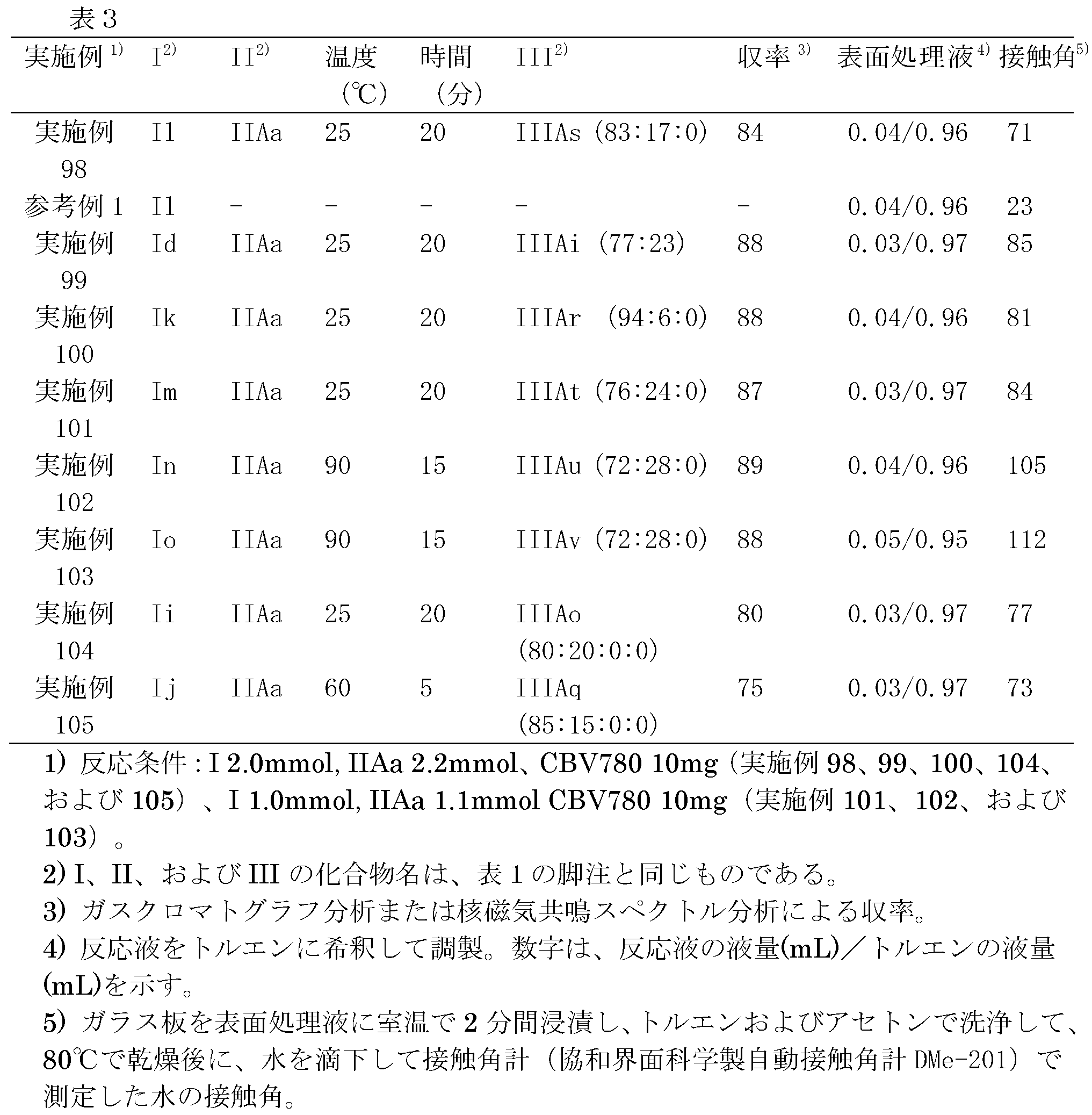
- Example 99 to 105 The reaction conditions (raw materials, temperature, time, etc.) were changed, and the reaction and analysis of alkoxysilane were conducted in the same manner as in Example 98. The results of surface treatment of the glass plate using the resulting acyloxysilane are shown in Table 3. Show.
- Examples 98 to 105 were obtained by a simple method in which the composition containing acyloxysilane obtained by the method of the present invention was immersed in a solution containing the composition at room temperature for a short time. It is shown that the contact angle with respect to the water on the surface of the glass plate can be controlled in a range of 71 to 112 ° with respect to 20 ° which is not treated.
- the production method of the present invention can produce acyloxysilanes useful as functional chemicals more efficiently and safely, and can provide novel acyloxysilanes and their uses. It has a high industrial significance.
Landscapes
- Chemical & Material Sciences (AREA)
- Organic Chemistry (AREA)
- Low-Molecular Organic Synthesis Reactions Using Catalysts (AREA)
- Materials Applied To Surfaces To Minimize Adherence Of Mist Or Water (AREA)
Abstract
Description
アシロキシシラン類の一般的な製造方法としては、たとえば、(A)クロロシランとカルボン酸を直接あるいは塩基存在下で反応させる方法(特許文献1、2)、(B)クロロシランとカルボン酸金属塩を反応させる方法(特許文献3)、(C)アシロキシシランとカルボン酸を反応させる方法(特許文献4)、(D)ヒドロシランとカルボン酸を遷移金属触媒存在下で反応させる方法(特許文献5)、(E)クロロシランとカルボン酸無水物を反応させる方法(特許文献6)、(F)シラノールとカルボン酸無水物を反応させる方法(非特許文献1)、(G)アルコキシシランとカルボン酸無水物を反応させる方法(非特許文献2)が知られている。
一方、アシロキシシランや関連するケイ素化合物の応用に関しては、固体材料の表面処理方法の一つとして、トリエトキシまたはトリメトキシシラン等のトリアルコキシシランや、反応性がより高いトリアセトキシシラン等を、いわゆるシランカップリング剤として用いる方法が知られていた(非特許文献3)。
しかしながら、トリアルコキシシランを用いる方法では、それらが固体材料表面と直接には反応しにくく、一般的には水が存在する条件下でアルコキシ基の加水分解を行い、シラノールの構造にする必要があるため、作業工程が簡便でない等の問題があるほか、表面との反応以外にシラノール同士のカップリング反応が同時に進行するため、表面処理の効率が必ずしも高くない、等の問題点があった。それに対して、トリアセトキシシランを用いる方法では、固体材料表面との反応性は高いものの、従来法では製造コストが高い、あるいは、トリアセトキシシランが湿気や水に不安定で保管安定性が低い、等の理由で、市販されている入手容易なトリアセトキシシランの種類が特定のものに限定されている、等の問題点があった。
〈1〉アルコキシシラン類とカルボン酸無水物を触媒存在下で反応させる反応工程を含むアシロキシシラン類の製造方法であって、前記アルコキシシラン類が、下記一般式(I)で表されるアルコキシシラン類であり、前記カルボン酸無水物が、下記一般式(IIA)または(IIB)で表されるカルボン酸無水物であり、前記触媒が、酸触媒であり、前記反応工程で得られるアシロキシシラン類が、下記一般式(IIIA)または(IIIB)で表されるアシロキシシラン類であることを特徴とする、アシロキシシラン類の製造方法。
R1 pR2 qR3 rSi(OR4)4-(p+q+r) (I)
(式中、p、q、r、およびp+q+rは、0以上3以下の整数である。R1、R2、およびR3は、それぞれ独立に炭素数1~24の炭化水素基または水素原子であり、R4は、炭素数1~6のアルキル基である。R1、R2、およびR3が、炭化水素基である場合、炭化水素基の水素原子の一部が反応に関与しない基で置換されていてもよい。)
(R5CO)2O (IIA)
(式中、R5は、炭素数1~24の炭化水素基であり、炭化水素基の水素原子の一部が反応に関与しない基で置換されていてもよい。)

R1 pR2 qR3 rSi(OR4)4-(p+q+r+s)(OCOR5)s (IIIA)
(式中、p、q、r、R1、R2、R3、R4、およびR5は、それぞれ前記と同義であり、sは、1以上4-(p+q+r)以下の整数である。)

〈2〉前記酸触媒が、無機系または有機系の酸である、〈1〉に記載のアシロキシシラン類の製造方法。
〈3〉前記無機系の酸が、規則的細孔および/または層状構造を有する無機系固体酸である、〈2〉に記載のアシロキシシラン類の製造方法。
〈4〉前記無機系固体酸が、ゼオライトおよび/またはモンモリロナイトである、〈3〉に記載のアシロキシシラン類の製造方法。
〈5〉前記ゼオライトのシリカ/アルミナ比(物質量比)が3~1000である、〈4〉に記載のアシロキシシラン類の製造方法。
〈6〉前記ゼオライトが、USY型、ベータ型、Y型、ZSM-5型、およびモルデナイト型からなる群より選ばれる少なくとも1種である、〈4〉又は〈5〉に記載のアシロキシシラン類の製造方法。
〈7〉前記無機系の酸が、鉄、ルテニウム、アルミニウム、スカンジウム、スズ、またはインジウムから選ばれる元素を含む、塩化物、臭化物、または過塩素酸塩である、〈2〉に記載のアシロキシシラン類の製造方法。
〈8〉前記無機系または有機系の酸が、スルホン酸、スルホニルイミド、または、それらの酸と、鉄、ルテニウム、アルミニウム、スカンジウム、スズ、またはインジウムから選ばれる元素から生成する塩である、〈2〉に記載のアシロキシシラン類の製造方法。
〈9〉前記反応工程がマイクロ波照射下で行われる、〈1〉~〈8〉の何れかに記載のアシロキシシラン類の製造方法。
〈10〉下記一般式(IIIC)または(IIID)で表されるアシロキシシラン類。
R7 sR8 tSi(OR9)4-(s+t+u)(OCOR10)u (IIIC)
(式中、R7、R8、R9、およびR10は、それぞれ独立に炭素数1~12の炭化水素基または水素原子の一部がハロゲン原子で置換された炭素数1~12の炭化水素基であり、それらのうち少なくとも一つは、炭素数3以上である、アルケニル基である、あるいは、ハロゲン原子を含む。s、t、およびs+tは、0以上2以下の整数である。uおよび4-(s+t+u)は、1以上3以下の整数である。)
〈11〉〈1〉~〈9〉の何れかに記載の方法で製造されるアシロキシシラン類を含む表面処理剤。
〈12〉〈10〉に記載の一般式(IIIC)または(IIID)で表されるアシロキシシラン類を含む表面処理剤。
〈13〉〈11〉または〈12〉に記載の表面処理剤を用いて、固体材料の表面処理を行う方法。

(1)原料や触媒が入手し易く、取り扱いが容易で安全性も高い。
(2)固体触媒を使用する反応系では、触媒の分離・回収等も容易である。
(3)反応条件を制御することにより、複数のアルコキシ基の一部または全部を選択的にアシロキシ基に変換することが可能である。
(4)環状カルボン酸無水物の使用により、アルコキシカルボニル基をアシロキシ基の末端に有するアシロキシシラン類を製造することができる。
(5)マイクロ波照射により、反応を促進することができる。
(6)本発明の製造方法により新規なアシロキシシラン類を提供できる。
本発明の製造方法は、製造プロセスの低コスト化、高効率化を可能にするもので、従来技術に比べて経済性、環境負荷等の面で大きな利点を有すると考える。
本発明の製造方法は、アルコキシランシラン類を、触媒の存在下で、カルボン酸無水物と反応させる反応工程を含むことを特徴とする。
R1 pR2 qR3 rSi(OR4)4-(p+q+r) (I)
で表される。
炭化水素基の具体例としては、アルキル基、アリール基、アラルキル基、アルケニル基等が挙げられる。
アリール基の水素原子の一部は、反応に関与しない基で置換されていてもよい。反応に関与しない基の具体例としては、上記のアルキル基の場合に示したもの等を挙げることができる。また、その他の反応に関与しない基として、環上の2つの炭素原子を結合させる2価の基であるオキシエチレン基やオキシエチレンオキシ基等が挙げられる。それらの基等を有するアリール基の具体例としては、メチルフェニル基、エチルフェニル基、ヘキシルフェニル基、メトキシフェニル基、エトキシフェニル基、ブトキシフェニル基、オクトキシフェニル基、メチル(メトキシ)フェニル基、フルオロ(メチル)フェニル基、クロロ(メトキシ)フェニル基、ブロモ(メトキシ)フェニル基、2,3-ジヒドロベンゾフラニル基、1,4-ベンゾジオキサニル基等が挙げられる。
反応に関与しない基の具体例としては、上記のアルキル基の場合について示したもの等を挙げることができる。
それらの基等を有するアラルキル基の具体例としては、ベンジル基、フェネチル基、2-ナフチルメチル基、9-アントリルメチル基、(4-クロロフェニル)メチル基、1-(4-メトキシフェニル)エチル基等が挙げられる。
反応に関与しない基の具体例としては、上記のアルキル基の場合について示したもの等の他、上記に示したアリール基等を挙げることができる。
それらの基等を有するアルケニル基の具体例としては、ビニル基、2-プロペニル基、3-ブテニル基、5-ヘキセニル基、9-デセニル基、2-フェニルエテニル基、2-(メトキシフェニル)エテニル基、2-ナフチルエテニル基、2-アントリルエテニル基等が挙げられる。
(R5CO)2O (IIA)
または、下記一般式(IIB)

それら炭化水素基の具体例としては、アルキル基、アリール基、アラルキル基、アルケニル基等が挙げられ、反応に関与しない基の具体例としては、上記の一般式(I)のR1、R2、またはR3の説明において示したもの等を挙げることができる。
炭化水素基中の炭素数に関しては、炭化水素基がアルキル基の場合には、好ましくは1~20、より好ましくは1~18であり、アリール基の場合には、好ましくは4~20、より好ましくは4~18であり、アラルキル基の場合には、好ましくは5~21、より好ましくは5~19であり、アルケニル基の場合には、好ましくは2~20、より好ましくは2~18である。
それらの基の具体例としては、上記の一般式(I)のR1、R2、またはR3の説明において示したもの等を挙げることができる。
2価の炭化水素基の具体例としては、アルキレン基、アリーレン基、アルケニレン基等が挙げられ、反応に関与しない基の具体例としては、上記の一般式(I)のR1、R2、またはR3の説明において示したもの等を挙げることができる。
また、2価の炭化水素基中の炭素数に関しては、2価の炭化水素基がアルキレン基の場合には、好ましくは1~20、より好ましくは1~18であり、アリーレン基の場合には、好ましくは4~20、より好ましくは4~18であり、アルケニレン基の場合には、好ましくは2~20、より好ましくは2~18である。
それらの基の具体例としては、エチレン基、トリメチレン基、テトラメチレン基、ペンタメチレン基、ヘキサメチレン基、シクロヘキサン-1,2-ジイル基、4-メチルシクロ-1,2-ジイル基、1,2-フェニレン基、4-メチル-1,2-フェニレン基、4-ブロモ-1,2-フェニレン基、ビニレン基、2-メチルプロペニレン基等を挙げることができる。
R1 pR2 qR3 rSi(OR4)4-(p+q+r+s)(OCOR5)s (IIIA)
または下記一般式(IIIB)

R7 sR8 tSi(OR9)4-(s+t+u)(OCOR10)u (IIIC)

また、一般式(IIID)において、R11、R12、R13、およびR14は、それぞれ独立に炭素数1~12の炭化水素基であり、R15は、炭素数2~8の2価の炭化水素基であり、v、w、x、およびv+w+xは、0以上3以下の整数であり、yは、1以上4-(v+w+x)以下の整数である。
さらに、一般式(IIIC)において、R7、R8、R9、およびR10のうち、炭素数3以上である、アルケニル基である、あるいは、ハロゲン原子を含む、少なくとも一つの炭化水素基の具体例としては、プロピル基、ブチル基、フェニル基、ビニル基、アリル基、クロロメチル基、ジクロロメチル基、トリクロロメチル基、クロロジフルオロメチル基、ペンタフルオロフェニル基、3,3,3-トリフルオロプロピル基、1H,1H,2H,2H-トリデカフルオロオクチル基、1H,1H,2H,2H-ヘプタデカフルオロデシル基等を挙げることができる。
一方、一般式(IIID)における炭素数2~8の2価の炭化水素基としては、アルキレン基、アリーレン基、アルケニレン基等を挙げることができ、それらの具体例としては、エチレン基、トリメチレン基、テトラメチレン基、1,2-フェニレン基、ビニレン基等を挙げることができる。
したがって、上記一般式(IIA)で表される非環状のカルボン酸無水物を用いた場合、本発明における反応はカルボン酸エステルの脱離を伴う反応となり、その反応工程は、モノアルコキシシラン類の反応ではたとえば下記反応式で表すことができる。


したがって、たとえば、非環状のカルボン酸無水物を用いる反応では、下記反応式に示すようなアシロキシシラン類を得ることができる。
本発明の製造方法により提供されるアシロキシシラン類は、アルコキシ基よりも反応性が高いアシロキシ基を有しているため、原料のアルコキシシラン類に比べて一般に高い反応性を有する。そのため、合成中間体として利用する際の反応や、表面処理剤、ゾル・ゲル材料等として利用する際の反応を、原料のアルコキシシラン類を用いる場合よりも温和な条件で、より効率的に行うことができると考えられ、機能性化学品として高い利用価値を有する。
酸触媒としては、触媒の分離・回収等が容易な固体酸触媒を用いることができる。
固体酸触媒の具体例としては、金属塩、金属酸化物等の固体無機物等が挙げられ、より具体的に示せば、プロトン性水素原子あるいは金属カチオン(アルミニウム、チタン、ガリウム、鉄、セリウム、スカンジウム等)を有する、ゼオライト、メソポーラスシリカ、モンモリロナイトなどのほか、シリカゲル、ヘテロポリ酸や、カーボン系素材を担体とする無機系固体酸が挙げられる。
さらに、ゼオライトのシリカ/アルミナ比(物質量比)については、反応条件に応じて各種の比を選択できるが、通常は3~1000であり、好ましくは3~800、より好ましくは5~600、さらに好ましくは5~400である。
さらに、ブレンステッド酸性またはルイス酸性を有する、固体酸以外の無機系または有機系の酸も触媒として使用できる。それらの具体例としては、無機系のものとしては、硫酸、硝酸、塩酸等のブレンステッド酸性の化合物や、塩化スカンジウム(III)、塩化イットリウム(III)、塩化チタン(IIIまたはIV)、塩化鉄(III)、臭化鉄(III)、過塩素酸鉄(III)、塩化ルテニウム(III)、塩化亜鉛(II)、フッ化ホウ素(III)、塩化ホウ素(III)、塩化アルミニウム(III)、臭化アルミニウム(III)、塩化ガリウム(III)、塩化インジウム(III)、塩化スズ(IV)、塩化ビスマス(III)等のルイス酸性の化合物が挙げられる。それらの化合物は、水和物の形態で使用してもよい。また、有機系のものとしては、トリフルオロメタンスルホン酸、ペンタフルオロエタンスルホン酸、ノナフルオロブタンスルホン酸、メタンスルホン酸、p-トルエンスルホン酸、ビス(トリフルオロメタンスルホニル)イミド、ビス(ノナフルオロブタンスルホニル)イミド等のブレンステッド酸性の化合物が挙げられる。加えて、有機系のものとしては、それらブレンステッド酸性の化合物の金属塩やトリス(ペンタフルオロフェニル)ボラン等でルイス酸性の化合物も使用できる。ルイス酸性の金属塩中の金属カチオンの種類としては、スカンジウム(III)、イットリウム(III)、鉄(III)、コバルト(II)、銅(II)、銀(I)、亜鉛(II)、スズ(II)、ビスマス(III)等の他、ランタノイド系元素のランタン(III)、プラセジウム(III)、サマリウム(III)、ネオジム(III)、イッテリビウム(III)等が挙げられる。
それらの中で、触媒活性の点では、無機系の酸においては、鉄、ルテニウム、アルミニウム、スカンジウム、スズ、またはインジウムから選ばれる元素を含む、塩化物、臭化物、または、過塩素酸塩等が好ましく、それらの具体例としては、塩化鉄(III)、臭化鉄(III)、過塩素酸鉄(III)、塩化ルテニウム(III)、塩化インジウム(III)、塩化スズ(IV)等が挙げられる。また、それらの元素の塩化物や臭化物に、過塩素酸銀等を添加し、塩化物や臭化物を過塩素酸塩に変換して使用することも、好ましい方法である。
さらに、有機系の酸においては、スルホン酸、スルホニルイミド等が好ましく、それらの酸と、鉄、ルテニウム、アルミニウム、スカンジウム、スズ、またはインジウム等から選ばれる元素から生成する塩も好ましく使用される。それらのスルホン酸、スルホニルイミドの具体例としては、トリフルオロメタンスルホン酸、ノナフルオロブタンスルホン酸、メタンスルホン酸、ビス(トリフルオロメタンスルホニル)イミド等が挙げられ、それらと塩を形成する元素のカチオン種としては、スカンジウム(III)、鉄(III)、ルテニウム(III)、アルミニウム(III)、ガリウム(III)、インジウム(III)、ビスマス(III)、スズ(IV)等が挙げられる。固体酸以外の無機系と有機系の酸は、それらを複数組み合わせて使用することもでき、上記の固体酸と組み合わせて使用することもできる。
反応温度は、通常は-20℃以上、好ましくは-10~300℃、より好ましくは、-10~200℃である。また、アルコールの反応性を制御するために、室温で反応を行う場合には、室温の温度範囲としては、通常は0~40℃、好ましくは5~40℃、より好ましくは10~35℃である。
さらに、反応圧力は、通常は0.1~100気圧で、好ましくは0.1~50気圧、より好ましくは0.1~10気圧である。
反応時間は、原料や触媒の量、反応温度、反応装置の形態等に依存するが、生産性や効率を考慮すると、通常は0.1~1200分、好ましくは0.1~600分、より好ましくは0.1~300分程度である。
また、生成したアシロキシシラン類の精製も、蒸留、再結晶、カラムクロマトグラフィー等の有機化学上通常用いられる手段により容易に達せられる。
本発明の製造方法により提供されるアシロキシシラン類は、アルコキシ基よりも反応性が高いアシロキシ基を有しているため、原料のアルコキシシラン類に比べて高い反応性を有し、合成中間体や表面処理剤等の機能性化学品として利用価値が高い。
たとえば、表面処理剤に関しては、ガラス等の固体材料に対して、室温で数分程度の温和な条件下で迅速に表面処理を行うことが可能で、使用するアシロキシシラン類の種類に応じて、固体材料表面の親水性・疎水性を容易に制御することができる。
また、本発明の表面処理剤は、上記の反応で製造されるアシロキシシラン類を含むもので、単離精製したアシロキシシラン類だけでなく、複数のアシロキシシラン類を含む混合溶液を使用することもできる。
さらに、本発明によるアシロキシシラン類の製造方法では、入手容易なアルコキシシラン類を原料として、さまざまなアシロキシシラン類を温和な条件下で簡便に製造できるため、アシロキシシラン類を含む反応液をそのまま使用する表面処理方法も、本発明の特長を示す方法である。
アシロキシシラン類を表面処理剤として用いる場合は、必要に応じて、トルエン、ヘキサン等のアシロキシシラン類と反応しない有機溶剤で希釈して用いることもできる。
固体材料の表面処理の方法については、ディップ法(浸漬法)、キャスト法、スピンコート法、スプレーコート法等、従来公知の各種の方法により行うことができる。
(エトキシ)トリメチルシラン(Ia) 3.2mmol、酢酸無水物(IIAa) 6.4mmol、ゼオライト CBV780(ゼオリスト社製) 5mgの混合物を反応管に入れ、マイクロ波照射装置(Biotage社Initiator)を用いて、110℃で5分攪拌した。生成物をガスクロマトグラフおよびガスクロマトグラフ質量分析計で分析し、生成物の収率をガスクロマトグラフ分析で測定した結果、(アセトキシ)トリメチルシラン(IIIAa)が89%の収率で生成したことがわかった(表1-1参照)。
反応条件(触媒、原料、温度、時間等)を変えて、実施例1と同様に反応および分析を行い、生成物の収率をガスクロマトグラフ分析または核磁気共鳴スペクトル分析で測定した結果を表1-1~表1-7に示す。

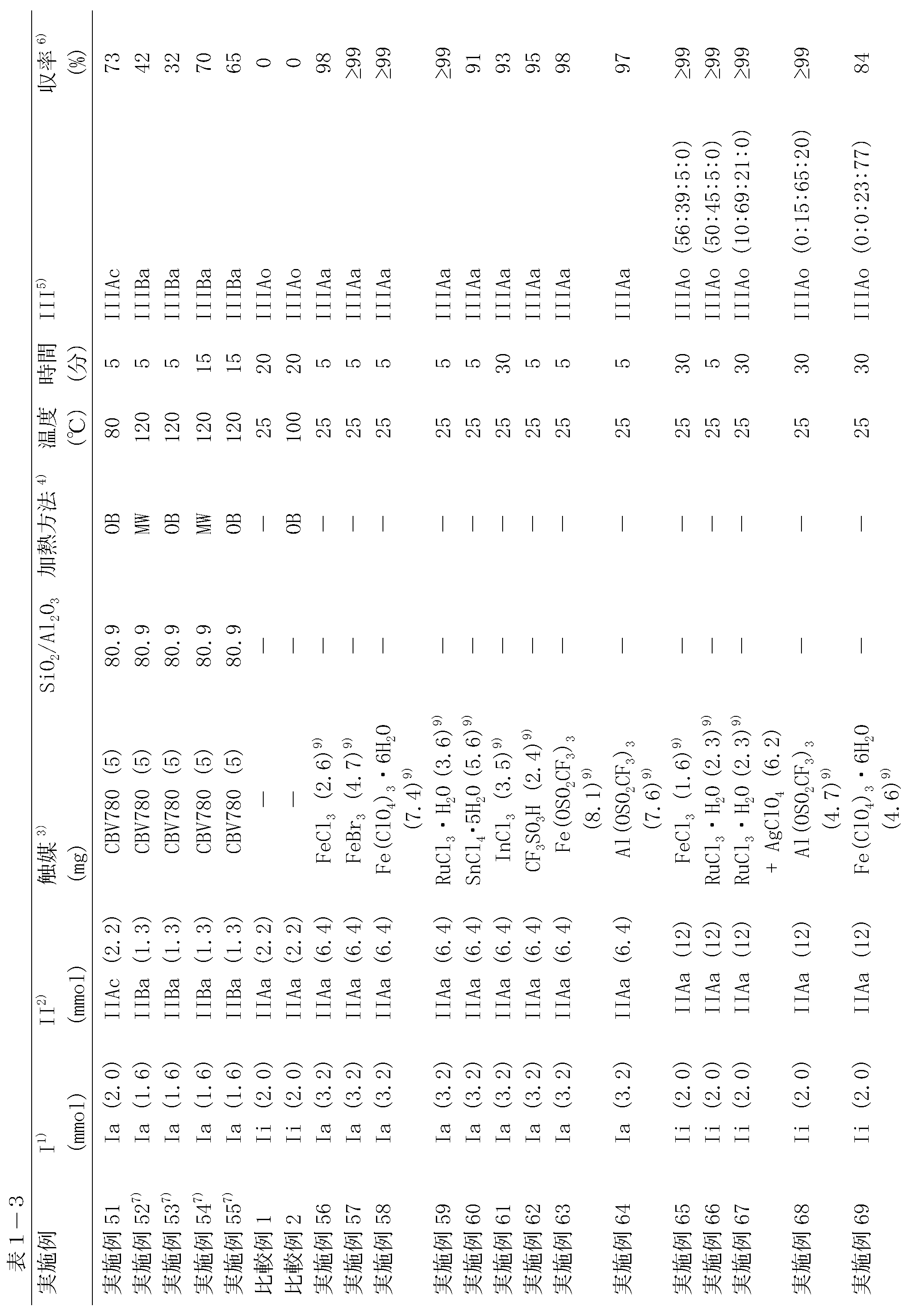


たとえば、(Ii)と(IIAa)の反応では、触媒が存在しない場合、表1-3の比較例1および2に示すように、25℃または100℃で20分撹拌の条件では、アシロキシシランはまったく得られなかったが、触媒を用いる本発明の方法では、実施例31に示すように、25℃で10分撹拌の条件でも、アシロキシシラン(IIIAo)を81%の良好な収率で得ることができた。
この結果は、本発明の方法による触媒を用いることにより、アシロキシシランを低温でも効率的に製造できることを示している。
たとえば、アルコキシシラン(Id)とカルボン酸無水物(IIAa)の反応では、表1-1の実施例20および22に示すように、触媒としてCBV780を用いて25℃で5分撹拌の条件、または、触媒としてCBV600を用いて110℃で5分撹拌の条件で反応を行うことにより、原料のアルコキシシラン中の2個のメトキシ基の1個がアセトキシ基に変換された化合物(IIIAi-1)と2個が変換された化合物(IIIAi-2)を、(≧99:1)の比で得ることができ、2個のメトキシ基のうちの1個だけを変換した化合物を選択的に得ることができた。一方、実施例21に示すように、触媒としてCBV780を用いて110℃で5分撹拌の条件で反応を行うことにより、(IIIAi-1)と(IIIAi-2)を(≦1:99)の比で得ることができ、2個のメトキシ基を全部アセトキシ基に変換した化合物を選択的に得ることができた。
また、アルコキシシラン(Ii)とカルボン酸無水物(IIAa)の反応では、表1-3~表1-4の実施例67~72に示すように、触媒の種類等によってアシロキシ基の導入量を制御でき、触媒として塩化ルテニウム(III)を使用する場合は、原料のアルコキシシラン中の2個のエトキシ基がアセトキシ基に変換された化合物(IIIAo-2)が主に得られ(実施例67)、触媒としてトリフルオロメタンスルホン酸アルミニウム(III)またはトリフルオロメタンスルホン酸を使用する場合は、原料のアルコキシシラン中の3個のエトキシ基がアセトキシ基に変換された化合物(IIIAo-3)が主に得られ(実施例68、72)、触媒として過塩素酸鉄(III)、ビス(トリフルオロメタンスルホニル)イミドスカンジウム(III)、またはビス(トリフルオロメタンスルホニル)イミドインジウム(III)を使用する場合は、原料のアルコキシシラン中の4個のエトキシ基がアセトキシ基に変換された化合物(IIIAo-4)が主に得られた(実施例69~71)。さらに、触媒として過塩素酸鉄(III)を使用する場合に、溶媒としてアセトニトリルを使用して反応を行うと、原料のアルコキシシラン中の2個のエトキシ基がアセトキシ基に変換された化合物(IIIAo-2)を選択的に得ることができた(実施例72)。
これらの結果は、反応温度、触媒の種類、溶媒等の反応条件を適切に制御することにより、原料のアルコキシシラン中の複数のアルコキシ基の一部または全部を選択的にアシロキシ基に変換できることを示している。
たとえば、アルコキシシラン(Ia)とカルボン酸無水物(IIAc)の反応では、表1-2の実施例48および50に示すように、マイクロ波照射装置を用いて反応を行った場合のアシロキシシラン(IIIAc)の収率は、60℃で5分撹拌または80℃で5分撹拌の反応条件の場合、それぞれ41%または81%であった。一方、実施例49および51に示すように、マイクロ波照射装置の代わりにオイルバス加熱装置を用いて、同じ反応温度と時間で反応を行った場合の(IIIAc)の収率は、それぞれ36%または73%であった。
これらの結果は、本発明の製造方法が、オイルバス加熱等の通常加熱を用いる方法でも十分効率よく行うことができるが、マイクロ波加熱を用いることによりさらに効率よく行うことができることを示している。
(エトキシ)ジメチル(フェニル)シラン(Ib) 4.8mmol、酢酸無水物(IIAa) 19.3mmol、CBV780(ゼオリスト社製) 15mgの混合物を反応管に入れ密閉し、マイクロ波照射装置(バイオタージ製Initiator)を用いて、110℃で10分攪拌した。触媒の固体を遠心分離で分離し、上澄み液を分離した後、触媒をトルエンで洗浄し(1mLで1回)、先の上澄み液と洗浄液を合わせて減圧下濃縮して、ショートパス蒸留装置で蒸留を行った結果、(アセトキシ)ジメチル(フェニル)シラン(IIIAg)が、3.26mmol(収率68%)得られた。
沸点:95-100℃/3mmHg(ショートパス蒸留での留出温度)
IR (液膜): 1722, 1429, 1370, 1251, 1122, 1018, 936, 840, 821, 796, 733, 698, 471, 407 cm-1
1H-NMR (CDCl3): δ 0.58 (s, 6H, SiCH3), 2.09 (s, 3H, CH3CO), 7.38-7.45 and 7.63-7.66 (each m, 5H, C6H5)
13C-NMR (CDCl3): δ -1.7, 22.8, 127.9, 130.1, 133.6, 135.6, 171.6
29Si-NMR (CDCl3): δ 11.7
(エトキシ)メチルジ(フェニル)シラン(Ic) 4.0mmol、酢酸無水物(IIAa) 16.1mmol、CBV780(ゼオリスト社製) 50mgの混合物を反応管に入れ密閉し、マイクロ波照射装置(バイオタージ製Initiator)を用いて、110℃で10分攪拌した。実施例86と同様に後処理および蒸留を行った結果、(アセトキシ)メチルジ(フェニル)シラン(IIIAh)が、3.24mmol(収率81%)得られた。
沸点:135-140℃/1mmHg(ショートパス蒸留での留出温度)
IR (液膜): 1726, 1429, 1369, 1247, 1122, 1018, 935, 797, 767, 737, 698, 476, 445 cm-1
1H-NMR (CDCl3): δ 0.88 (s, 3H, SiCH3), 2.16 (s, 3H, CH3CO), 7.38-7.47 and 7.63-7.66 (each m, 10H, C6H5)
13C-NMR (CDCl3): δ -2.7, 22.9, 127.9, 130.3, 133.9, 134.5, 171.4
29Si-NMR (CDCl3): δ 0.3
メチルジ(メトキシ)(フェニル)シラン(Id) 5.0mmol、酢酸無水物(IIAa) 7.5mmol、CBV780(ゼオリスト社製) 15mgの混合物を反応管に入れ密閉し、室温(25℃)で7分攪拌した。実施例86と同様に後処理および蒸留を行った結果、(アセトキシ)メチル(メトキシ)(フェニル)シラン(IIIAi-1)が、3.25mmol(収率65%)得られた。
沸点:95-105℃/3.5mmHg(ショートパス蒸留での留出温度)
IR (液膜): 1729, 1430, 1371, 1250, 1192, 1124, 1092, 1019, 938, 829, 798, 777, 740, 699, 476, 431 cm-1
1H-NMR (CDCl3): δ 0.58 (s, 3H, SiCH3), 2.15 (s, 3H, CH3CO), 3.64 (s, 3H. CH3O), 7.38-7.47 and 7.64-7.68 (each m, 5H, C6H5)
13C-NMR (CDCl3): δ -4.0, 22.7, 51.6, 128.0, 130.7, 132.5, 133.8, 171.0
29Si-NMR (CDCl3): δ -14.0
メチルジ(メトキシ)(フェニル)シラン(Id) 3.3mmol、酢酸無水物(IIAa) 13.2mmol、CBV780(ゼオリスト社製) 10mgの混合物を反応管に入れ密閉し、マイクロ波照射装置(バイオタージ製Initiator)を用いて、110℃で5分攪拌した。実施例86と同様に後処理および蒸留を行った結果、ジ(アセトキシ)メチル(フェニル)シラン(IIIAi-2)が、2.67mmol(収率81%)得られた。
沸点:95-105℃/0.9mmHg(ショートパス蒸留での留出温度)
IR (液膜): 1736, 1431, 1371, 1237, 1125, 1018, 940, 801, 741, 698, 597, 474, 432 cm-1
1H-NMR (CDCl3): δ 0.82 (s, 3H, SiCH3), 2.14 (s, 6H, CH3CO), 7.39-7.50 and 7.70-7.73 (each m, 5H, C6H5)
13C-NMR (CDCl3): δ -3.0, 22.6, 128.0, 130.9, 131.3, 133.9, 170.6
29Si-NMR (CDCl3): δ -11.7
メチルジ(メトキシ)(フェニル)シラン(Id) 7.5mmol、プロピオン酸無水物(IIAb) 11.3mmol、CBV780(ゼオリスト社製) 45mgの混合物を反応管に入れ密閉し、室温(25℃)で15分攪拌した。実施例86と同様に後処理および蒸留を行った結果、メチル(メトキシ)(フェニル)(プロパノイロキシ)シラン(IIIAj-1)が、5.78mmol(収率77%)得られた。
沸点:100-105℃/4mmHg(ショートパス蒸留での留出温度)
IR (液膜): 1727, 1430, 1361, 1261, 1189, 1124, 1084, 997, 892, 829, 799, 741, 699, 478, 441 cm-1
1H-NMR (CDCl3): δ 0.58 (s, 3H, SiCH3), 1.15 (t, J = 7.5 Hz, 3H, CH3CCO), 2.429 and 2.430 (each q, each J = 7.5 Hz, 2H, CH2CO), 3.64 (s, 3H. CH3O), 7.38-7.47 and 7.64-7.68 (each m, 5H, C6H5)
13C-NMR (CDCl3): δ -4.0, 9.1, 29.0, 51.5, 128.0, 130.7, 132.6, 133.8, 174.3
29Si-NMR (CDCl3): δ -14.0
メチルジ(メトキシ)(フェニル)シラン(Id) 5.0mmol、プロピオン酸無水物(IIAb) 14.9mmol、CBV780(ゼオリスト社製) 30mgの混合物を反応管に入れ密閉し、マイクロ波照射装置(バイオタージ製Initiator)を用いて、110℃で30分攪拌した。実施例86と同様に後処理および蒸留を行った結果、メチル(フェニル)ジ(プロパノイロキシ)シラン(IIIAj-2)が、4.05mmol(収率81%)得られた。
沸点:120-130℃/2.5mmHg(ショートパス蒸留での留出温度)
IR (液膜): 1735, 1463, 1430, 1360, 1263, 1172, 1125, 1082, 997, 897, 809, 741, 698, 476, 439 cm-1
1H-NMR (CDCl3): δ 0.82 (s, 3H, SiCH3), 1.13 (t, J = 7.5 Hz, 3H, CH3CCO), 2.429 and 2.433 (each q, each J = 7.5 Hz, 2H, CH2CO), 7.39-7.50 and 7.70-7.74 (each m, 5H, C6H5)
13C-NMR (CDCl3): δ -2.9, 8.9, 28.9, 128.0, 131.18, 131.25, 133.9, 173.9
29Si-NMR (CDCl3): δ -12.0
トリ(メトキシ)(フェニル)シラン(If) 4.9mmol、酢酸無水物(IIAa) 7.3mmol、CBV780(ゼオリスト社製) 30mgの混合物を反応管に入れ密閉し、室温(25℃)で30分攪拌した。実施例86と同様に後処理および蒸留を行った結果、(アセトキシ)ジ(メトキシ)(フェニル)シラン(IIIAl-1)が、2.45mmol(収率50%)得られた。
沸点:120-130℃/2.5mmHg(ショートパス蒸留での留出温度)
IR (液膜): 1741, 1431, 1372, 1253, 1193, 1132, 1095, 1020, 942, 826, 778, 742, 700, 483 cm-1
1H-NMR (CDCl3): δ 2.15 (s, 3H, CH3CO), 3.70 (s, 6H, CH3O), 7.38-7.50 and 7.70-7.73 (each m, 5H, C6H5)
13C-NMR (CDCl3): δ 22.5, 51.6, 128.03, 128.05, 131.2, 134.8, 170.0
29Si-NMR (CDCl3): δ -57.4
トリ(メトキシ)(フェニル)シラン(If) 4.9mmol、酢酸無水物(IIAa) 19.4mmol、CBV780(ゼオリスト社製) 60mgの混合物を反応管に入れ密閉し、マイクロ波照射装置(バイオタージ製Initiator)を用いて、50℃で20分攪拌した。実施例86と同様に後処理および蒸留を行った結果、ジ(アセトキシ)(メトキシ)(フェニル)シラン(IIIAl-2)が、2.45mmol(収率50%)得られた。
沸点:115-120℃/1mmHg(ショートパス蒸留での留出温度)
1H-NMR (CDCl3): δ 2.17 (s, 6H, CH3CO), 3.80 (s, 3H, CH3O), 7.40-7.52 and 7.76-7.79 (each m, 5H, C6H5)
13C-NMR (CDCl3): δ 22.4, 52.5, 126.8, 128.0, 131.7, 134.9, 169.6
29Si-NMR (CDCl3): δ -60.3
テトラ(エトキシ)シラン(Ii) 7.5mmol、プロピオン酸無水物(IIAb) 11.3mmol、CBV780(ゼオリスト社製) 45mgの混合物を反応管に入れ密閉し、室温(25℃)で15分攪拌した。実施例86と同様に後処理および蒸留を行った結果、トリ(エトキシ)(プロパノイロキシ)シラン(IIIAp-1)が、6.75mmol(収率90%)得られた。
沸点:80-90℃/9mmHg(ショートパス蒸留での留出温度)
IR (液膜): 1739, 1392, 1362, 1279, 1205, 1169, 1107, 1085, 1002, 972, 898, 797, 471 cm-1
1H-NMR (CDCl3): δ 1.14 (t, J = 7.5 Hz, 3H, CH3CCO), 1.25 (t, J = 7.0 Hz, 9H, CH3CO, 2.41 (q, J = 7.5 Hz, 2H, CH2CO), 3.93 (q, J = 7.0 Hz, 6H, CH2O)
13C-NMR (CDCl3): δ 9.0, 17.9, 28.8, 59.9, 173.0
29Si-NMR (CDCl3): δ -86.1
(エトキシ)トリメチルシラン(Ia) 3.2mmol、コハク酸無水物(IIBa) 2.6mmol、CBV780(ゼオリスト社製) 20mg、1,2-ジクロロベンゼン 4mLの混合物を反応管に入れ密閉し、マイクロ波照射装置(バイオタージ製Initiator)を用いて、120℃で60分攪拌した。実施例86と同様に後処理および蒸留を行った結果、[(3-エトキシカルボニル)プロパノイロキシ]トリメチルシラン(IIIBa)が、1.56mmol(収率60%)得られた。
沸点:90-100℃/2.5mmHg(ショートパス蒸留での留出温度)
IR (液膜): 1738, 1720, 1415, 1372, 1351, 1322, 1254, 1213, 1166, 1025, 890, 852, 764, 736 cm-1
1H-NMR (CDCl3): δ 0.28 (s, 9H, SiCH3), 1.26 (t, J = 7.2 Hz, 3H, CCH3), 2.56-2.65 (m, 4H, CH2CH2), 4.15 (q, J = 7.2 Hz, 2H, OCH2)
13C-NMR (CDCl3): δ -0.3, 14.2, 29.4, 30.7, 60.6, 172.4, 172.7
29Si-NMR (CDCl3): δ 24.1
(エトキシ)トリメチルシラン(Ia) 3.4mmol、グルタル酸無水物(IIBb) 2.6mmol、CBV780(ゼオリスト社製) 20mg、1,2-ジクロロベンゼン 4mLの混合物を反応管に入れ密閉しマイクロ波照射装置(バイオタージ製Initiator)を用いて、120℃で60分攪拌した。実施例86と同様に後処理および蒸留を行った結果、(3-エトキシカルボニル)プロパノイロキシ]トリメチルシラン(IIIBb)が、1.61mmol(収率62%)得られた。
沸点:85-95℃/1.8mmHg(ショートパス蒸留での留出温度)
IR (液膜): 1737, 1717, 1419, 1375, 1318, 1254, 1198, 1155, 1030, 906, 851, 764 cm-1
1H-NMR (CDCl3): δ 0.28 (s, 9H, SiCH3), 1.26 (t, J = 7.2 Hz, 3H, CCH3), 1.92 (quint, J = 7.5 Hz, 2H, CH2CCO), 2.36 and 2.37 (each t, J = 7.5 Hz, each 2H, CH2CO), 4.13 (q, J = 7.2 Hz, 2H, OCH2)
13C-NMR (CDCl3): δ -0.3, 14.2, 20.2, 33.3, 34.9, 60.3, 173.0, 173.5
29Si-NMR (CDCl3): δ 23.6
(エトキシ)トリメチルシラン(Ia) 3.2mmol、シクロヘキサン-1,2-ジカルボン酸無水物(IIBc) 2.6mmol、CBV780(ゼオリスト社製) 60mg、1,2-ジクロロベンゼン 2mLの混合物を反応管に入れ密閉しマイクロ波照射装置(バイオタージ製Initiator)を用いて、90℃で45分攪拌した。実施例86と同様に後処理および蒸留を行った結果、(2-エトキシカルボニル)シクロヘキサニルカルボニルオキシ]トリメチルシラン(IIIBc)が、1.56mmol(収率60%)得られた。
沸点:125-130℃/5mmHg(ショートパス蒸留での留出温度)
1H-NMR (CDCl3): δ 0.25 (s, 9H, SiCH3), 1.22 (t, J = 7.2 Hz, 3H, CCH3), 1.32-1.55, 1.67-1.80, and 1.90-2.03 (each m, each 2H, (CH2)4), 2.70-2.85 (m, 2H, CHCH), 4.07-4.17 (m, 2H, OCH2)
13C-NMR (CDCl3): δ -0.4, 14.2, 23.7, 23.9, 26.2, 26.5, 42.7, 43.7, 60.2, 173.7, 174.2
29Si-NMR (CDCl3): δ 23.6
トリ(エトキシ)(フェニル)シラン(Il) 2.0mmol、酢酸無水物(IIAa) 2.2mmol、CBV780(ゼオリスト社製) 10mgの混合物を反応管に入れ密閉し、室温(25℃)で20分攪拌した。触媒の固体を遠心分離で分離し、上澄み液をガスクロマトグラフ分析または核磁気共鳴スペクトル分析で測定した結果、アシロキシシラン((アセトキシ)ジ(エトキシ)(フェニル)シラン(IIIAs-1)およびジ(アセトキシ)(エトキシ)(フェニル)シラン(IIIAs-2)、(IIIAs-1):(IIIAs-2)=83:17)が、1.7mmol(収率84%)生成していることがわかった。
このアシロキシシランを含む上澄み液0.04mLをトルエン0.96mLに溶解して、表面処理用の溶液を調製した。調製溶液にガラス板(1.8×1.8cm)を室温で2分間浸漬し、トルエン3mLおよびアセトン3mLで順次洗浄し、80℃で5分間乾燥させた。ガラス板の水に対する接触角を、接触角計(協和界面科学製 自動接触角計 DMe-201)で測定した結果、未処理の状態の20°から処理後の状態の71°に変化したことがわかった。このことは、ガラス板の表面が、アシロキシシランにより修飾され、撥水性が高くなったことを示している(表3)。
トリ(エトキシ)(フェニル)シラン(Il) 0.04mlをトルエン0.96mLに溶解して、表面処理用の溶液を調製した。この溶液にガラス板(1.8×1.8cm)を室温で2分間浸漬し、実施例98と同様に、ガラス板を洗浄、乾燥後、水の接触角を測定した結果、接触角は23°で、未処理の状態の20°とほとんど同じであった。このことは、実施例98のアセトキシシランによる表面処理の場合とは異なり、原料のアルコキシシランのままでは固体材料表面との反応性が低く、同じ処理条件ではガラス板表面がほとんど修飾されないことを示している(表3)
反応条件(原料、温度、時間等)を変えて、実施例98と同様に、アルコキシシランの反応と分析を行い、得られたアシロキシランを用いてガラス板の表面処理を行った結果を表3に示す。
Claims (13)
- アルコキシシラン類とカルボン酸無水物を触媒存在下で反応させる反応工程を含むアシロキシシラン類の製造方法であって、前記アルコキシシラン類が、下記一般式(I)で表されるアルコキシシラン類であり、前記カルボン酸無水物が、下記一般式(IIA)または(IIB)で表されるカルボン酸無水物であり、前記触媒が、酸触媒であり、前記反応工程で得られるアシロキシシラン類が、下記一般式(IIIA)または(IIIB)で表されるアシロキシシラン類であることを特徴とする、アシロキシシラン類の製造方法。
R1 pR2 qR3 rSi(OR4)4-(p+q+r) (I)
(式中、p、q、r、およびp+q+rは、0以上3以下の整数である。R1、R2、およびR3は、それぞれ独立に炭素数1~24の炭化水素基または水素原子であり、R4は、炭素数1~6のアルキル基である。R1、R2、およびR3が、炭化水素基である場合、炭化水素基の水素原子の一部が反応に関与しない基で置換されていてもよい。)
(R5CO)2O (IIA)
(式中、R5は、炭素数1~24の炭化水素基であり、炭化水素基の水素原子の一部が反応に関与しない基で置換されていてもよい。)

(式中、R6は、炭素数2~24の2価の炭化水素基であり、炭化水素基の水素原子の一部が反応に関与しない基で置換されていてもよい。)
R1 pR2 qR3 rSi(OR4)4-(p+q+r+s)(OCOR5)s (IIIA)
(式中、p、q、r、R1、R2、R3、R4、およびR5は、それぞれ前記と同義であり、sは、1以上4-(p+q+r)以下の整数である。)

(式中、p、q、r、R1、R2、R3、R4、およびR6は、それぞれ前記と同義であり、sは、1以上4-(p+q+r)以下の整数である。) - 前記酸触媒が、無機系または有機系の酸である、請求項1に記載のアシロキシシラン類の製造方法。
- 前記無機系の酸が、規則的細孔および/または層状構造を有する無機系固体酸である、請求項2に記載のアシロキシシラン類の製造方法。
- 前記無機系固体酸が、ゼオライトおよび/またはモンモリロナイトである、請求項3に記載のアシロキシシラン類の製造方法。
- 前記ゼオライトのシリカ/アルミナ比(物質量比)が3~1000である、請求項4に記載のアシロキシシラン類の製造方法。
- 前記ゼオライトが、USY型、ベータ型、Y型、ZSM-5型、およびモルデナイト型からなる群より選ばれる少なくとも1種である、請求項4又は5に記載のアシロキシシラン類の製造方法。
- 前記無機系の酸が、鉄、ルテニウム、アルミニウム、スカンジウム、スズ、またはインジウムから選ばれる元素を含む、塩化物、臭化物、または過塩素酸塩である、請求項2に記載のアシロキシシラン類の製造方法。
- 前記無機系または有機系の酸が、スルホン酸、スルホニルイミド、または、それらの酸と、鉄、ルテニウム、アルミニウム、スカンジウム、スズ、またはインジウムから選ばれる元素から生成する塩である、請求項2に記載のアシロキシシラン類の製造方法。
- 前記反応工程がマイクロ波照射下で行われる、請求項1~8の何れか1項に記載のアシロキシシラン類の製造方法。
- 下記一般式(IIIC)または(IIID)で表されるアシロキシシラン類。
R7 sR8 tSi(OR9)4-(s+t+u)(OCOR10)u (IIIC)
(式中、R7、R8、R9、およびR10は、それぞれ独立に炭素数1~12の炭化水素基または水素原子の一部がハロゲン原子で置換された炭素数1~12の炭化水素基であり、それらのうち少なくとも一つは、炭素数3以上である、アルケニル基である、あるいは、ハロゲン原子を含む。s、t、およびs+tは、0以上2以下の整数である。uおよび4-(s+t+u)は、1以上3以下の整数である。)

(式中、R11、R12、R13、およびR14は、それぞれ独立に炭素数1~12の炭化水素基であり、R15は、炭素数2~8の2価の炭化水素基である。v、w、x、およびv+w+xは、0以上3以下の整数である。yは、1以上4-(v+w+x)以下の整数である。) - 請求項1~9の何れかに記載の方法で製造されるアシロキシシラン類を含む表面処理剤。
- 請求項10に記載の一般式(IIIC)または(IIID)で表されるアシロキシシラン類を含む表面処理剤。
- 請求項11または12に記載の表面処理剤を用いて、固体材料の表面処理を行う方法。
Priority Applications (2)
| Application Number | Priority Date | Filing Date | Title |
|---|---|---|---|
| US15/556,808 US10316046B2 (en) | 2015-03-10 | 2016-03-09 | Method for producing acyloxysilanes, acyloxysilanes obtained thereby, and use of same |
| JP2017505386A JP6739733B2 (ja) | 2015-03-10 | 2016-03-09 | アシロキシシラン類の製造方法、それにより得られるアシロキシシラン類、およびその用途 |
Applications Claiming Priority (2)
| Application Number | Priority Date | Filing Date | Title |
|---|---|---|---|
| JP2015-046808 | 2015-03-10 | ||
| JP2015046808 | 2015-03-10 |
Publications (1)
| Publication Number | Publication Date |
|---|---|
| WO2016143835A1 true WO2016143835A1 (ja) | 2016-09-15 |
Family
ID=56879489
Family Applications (1)
| Application Number | Title | Priority Date | Filing Date |
|---|---|---|---|
| PCT/JP2016/057466 Ceased WO2016143835A1 (ja) | 2015-03-10 | 2016-03-09 | アシロキシシラン類の製造方法、それにより得られるアシロキシシラン類、およびその用途 |
Country Status (3)
| Country | Link |
|---|---|
| US (1) | US10316046B2 (ja) |
| JP (1) | JP6739733B2 (ja) |
| WO (1) | WO2016143835A1 (ja) |
Cited By (5)
| Publication number | Priority date | Publication date | Assignee | Title |
|---|---|---|---|---|
| JP2019218305A (ja) * | 2018-06-20 | 2019-12-26 | 国立研究開発法人産業技術総合研究所 | アルコキシ基とアシロキシ基を有するシラン類の製造方法、新規なシラン類、およびそれらの用途 |
| JP2021155337A (ja) * | 2020-03-25 | 2021-10-07 | 国立研究開発法人産業技術総合研究所 | カルボシランの製造方法 |
| JP2021169417A (ja) * | 2020-04-15 | 2021-10-28 | 国立研究開発法人産業技術総合研究所 | アシロキシシランの製造方法 |
| JP2023079049A (ja) * | 2021-11-26 | 2023-06-07 | 国立研究開発法人産業技術総合研究所 | チオノアシロキシシラン類の製造方法 |
| JP2023083771A (ja) * | 2021-12-06 | 2023-06-16 | 国立研究開発法人産業技術総合研究所 | アシロキシシラン類の製造方法 |
Families Citing this family (3)
| Publication number | Priority date | Publication date | Assignee | Title |
|---|---|---|---|---|
| CN108358963A (zh) * | 2018-03-14 | 2018-08-03 | 广州雷斯曼新材料科技有限公司 | 一种应用于硅酮密封胶的酸性交联剂及其制备方法 |
| WO2021058263A1 (de) * | 2019-09-27 | 2021-04-01 | Evonik Operations Gmbh | Silikon(meth)acrylate, verfahren zu ihrer herstellung und ihre verwendung in härtbaren zusammensetzungen |
| CN114315890B (zh) * | 2022-01-05 | 2023-11-17 | 湖北江瀚新材料股份有限公司 | 一种甲基丙烯酰氧丙基三乙酰氧基硅烷的制备方法 |
Citations (6)
| Publication number | Priority date | Publication date | Assignee | Title |
|---|---|---|---|---|
| JPS49133331A (ja) * | 1973-05-02 | 1974-12-21 | ||
| JPS5761052A (en) * | 1980-09-30 | 1982-04-13 | Nippon Synthetic Chem Ind Co Ltd:The | Molding composition |
| JPH03156468A (ja) * | 1989-11-15 | 1991-07-04 | Ricoh Co Ltd | 静電潜像現像用トナー |
| JPH04295486A (ja) * | 1991-03-25 | 1992-10-20 | Nippon Shokubai Co Ltd | 有機珪素化合物におけるモノ交換体化合物の製造方法 |
| JP2003073383A (ja) * | 2001-07-06 | 2003-03-12 | Atofina | シラン化(メタ)アクリレートの製造方法 |
| JP2012008440A (ja) * | 2010-06-28 | 2012-01-12 | Konica Minolta Business Technologies Inc | 電子写真感光体 |
Family Cites Families (12)
| Publication number | Priority date | Publication date | Assignee | Title |
|---|---|---|---|---|
| DE882401C (de) | 1946-11-29 | 1953-07-09 | Rhone Poulenc Sa | Verfahren zur Herstellung von Mono- und Dimethylacetoxysilanen |
| US3470942A (en) * | 1966-12-10 | 1969-10-07 | Sanyo Electric Co | Microwave heating apparatus and method |
| DE2801780A1 (de) | 1978-01-17 | 1979-07-19 | Wacker Chemie Gmbh | Verfahren zum herstellen von acyloxysilanen und gegebenenfalls acyloxysiloxanen |
| US4379766A (en) | 1982-06-01 | 1983-04-12 | Conoco Inc. | Silyl esters of carboxylic acids by phase transfer catalysts |
| JPH0770152A (ja) | 1993-09-03 | 1995-03-14 | Yokohama Rubber Co Ltd:The | アシロキシシランの製造方法 |
| US5902892A (en) | 1996-10-17 | 1999-05-11 | Sivento Inc. | Preparation of acyloxysilanes |
| JPH10182666A (ja) | 1996-12-20 | 1998-07-07 | Chisso Corp | アシルオキシシランの製造方法 |
| JPH10230166A (ja) * | 1997-02-20 | 1998-09-02 | Asahi Chem Ind Co Ltd | 固定化ビスパーフルオロアルキルスルホニルイミド金属塩を含有する触媒 |
| JP2002275140A (ja) * | 2001-03-15 | 2002-09-25 | Sumitomo Chem Co Ltd | β−アミノカルボニル化合物の製造方法 |
| JP4030313B2 (ja) * | 2002-01-18 | 2008-01-09 | 三菱レイヨン株式会社 | アダマンタン誘導体の製造方法 |
| US8679711B2 (en) | 2010-06-28 | 2014-03-25 | Konica Minolta Business Technologies, Inc. | Electrophotographic photoreceptor |
| DE112014001149B4 (de) * | 2013-03-07 | 2019-05-23 | National Institute Of Advanced Industrial Science And Technology | Verfahren zur Herstellung von Alkoxysilanen |
-
2016
- 2016-03-09 US US15/556,808 patent/US10316046B2/en active Active
- 2016-03-09 JP JP2017505386A patent/JP6739733B2/ja active Active
- 2016-03-09 WO PCT/JP2016/057466 patent/WO2016143835A1/ja not_active Ceased
Patent Citations (6)
| Publication number | Priority date | Publication date | Assignee | Title |
|---|---|---|---|---|
| JPS49133331A (ja) * | 1973-05-02 | 1974-12-21 | ||
| JPS5761052A (en) * | 1980-09-30 | 1982-04-13 | Nippon Synthetic Chem Ind Co Ltd:The | Molding composition |
| JPH03156468A (ja) * | 1989-11-15 | 1991-07-04 | Ricoh Co Ltd | 静電潜像現像用トナー |
| JPH04295486A (ja) * | 1991-03-25 | 1992-10-20 | Nippon Shokubai Co Ltd | 有機珪素化合物におけるモノ交換体化合物の製造方法 |
| JP2003073383A (ja) * | 2001-07-06 | 2003-03-12 | Atofina | シラン化(メタ)アクリレートの製造方法 |
| JP2012008440A (ja) * | 2010-06-28 | 2012-01-12 | Konica Minolta Business Technologies Inc | 電子写真感光体 |
Cited By (10)
| Publication number | Priority date | Publication date | Assignee | Title |
|---|---|---|---|---|
| JP2019218305A (ja) * | 2018-06-20 | 2019-12-26 | 国立研究開発法人産業技術総合研究所 | アルコキシ基とアシロキシ基を有するシラン類の製造方法、新規なシラン類、およびそれらの用途 |
| JP7129693B2 (ja) | 2018-06-20 | 2022-09-02 | 国立研究開発法人産業技術総合研究所 | アルコキシ基とアシロキシ基を有するシラン類の製造方法、新規なシラン類、およびそれらの用途 |
| JP2021155337A (ja) * | 2020-03-25 | 2021-10-07 | 国立研究開発法人産業技術総合研究所 | カルボシランの製造方法 |
| JP7497011B2 (ja) | 2020-03-25 | 2024-06-10 | 国立研究開発法人産業技術総合研究所 | カルボシランの製造方法 |
| JP2021169417A (ja) * | 2020-04-15 | 2021-10-28 | 国立研究開発法人産業技術総合研究所 | アシロキシシランの製造方法 |
| JP7497014B2 (ja) | 2020-04-15 | 2024-06-10 | 国立研究開発法人産業技術総合研究所 | アシロキシシランの製造方法 |
| JP2023079049A (ja) * | 2021-11-26 | 2023-06-07 | 国立研究開発法人産業技術総合研究所 | チオノアシロキシシラン類の製造方法 |
| JP7699813B2 (ja) | 2021-11-26 | 2025-06-30 | 国立研究開発法人産業技術総合研究所 | チオノアシロキシシラン類の製造方法 |
| JP2023083771A (ja) * | 2021-12-06 | 2023-06-16 | 国立研究開発法人産業技術総合研究所 | アシロキシシラン類の製造方法 |
| JP7796399B2 (ja) | 2021-12-06 | 2026-01-09 | 国立研究開発法人産業技術総合研究所 | アシロキシシラン類の製造方法 |
Also Published As
| Publication number | Publication date |
|---|---|
| US20180044359A1 (en) | 2018-02-15 |
| JP6739733B2 (ja) | 2020-08-12 |
| JPWO2016143835A1 (ja) | 2018-03-22 |
| US10316046B2 (en) | 2019-06-11 |
Similar Documents
| Publication | Publication Date | Title |
|---|---|---|
| JP6739733B2 (ja) | アシロキシシラン類の製造方法、それにより得られるアシロキシシラン類、およびその用途 | |
| JP7157998B2 (ja) | シロキサン化合物の製造方法、新規なシロキサン化合物、およびそれらの用途 | |
| US9657039B2 (en) | Production method for alkoxysilanes | |
| JP7129693B2 (ja) | アルコキシ基とアシロキシ基を有するシラン類の製造方法、新規なシラン類、およびそれらの用途 | |
| JP7497011B2 (ja) | カルボシランの製造方法 | |
| JP7497014B2 (ja) | アシロキシシランの製造方法 | |
| CN101460537B (zh) | 新型环氧化合物及其制备方法 | |
| JP7796399B2 (ja) | アシロキシシラン類の製造方法 | |
| JP7560857B2 (ja) | スルホン酸シリルエステルの製造方法および新規なケイ素化合物 | |
| JP7539140B2 (ja) | アシロキシシランの製造方法 | |
| JP2022022505A (ja) | アルキニルシランの製造方法 | |
| JP7699813B2 (ja) | チオノアシロキシシラン類の製造方法 | |
| KR101123101B1 (ko) | 신규 에폭시 화합물 및 그 제조방법 | |
| JP6631907B2 (ja) | アルコキシシラン類、オリゴシロキサン類およびその製造方法 | |
| JP7551100B2 (ja) | スルホン酸シリルエステルの製造方法および新規なケイ素化合物 | |
| JP7784711B2 (ja) | ハロシラン類の製造方法 | |
| JP7370053B2 (ja) | シラノール類の製造方法および新規なシラノール類 | |
| JP5052209B2 (ja) | 新規エポキシ化合物とその製造方法 | |
| JP2022124640A (ja) | アルキニルシランの製造方法 | |
| JP2021130642A (ja) | シロキサン化合物の製造方法、新規なシロキサン化合物、およびそれらの用途 | |
| JP7489711B2 (ja) | ジメチルシリル基を有する有機ケイ素化合物の製造方法 | |
| Bříza et al. | Synthesis of polyfluorinated alkynes, novel building blocks for fluorous chemistry | |
| CN118852230A (zh) | 一种多取代氢硅烷类化合物的制备方法 | |
| CN102822182A (zh) | 硅氧杂环化合物的生产方法 | |
| PL165181B1 (pl) | Sposób otrzymywania 3-podstawlonych trl{alkoksy,alkllo} slllloalkllowych pochodnych /ddiketnóów |
Legal Events
| Date | Code | Title | Description |
|---|---|---|---|
| 121 | Ep: the epo has been informed by wipo that ep was designated in this application |
Ref document number: 16761802 Country of ref document: EP Kind code of ref document: A1 |
|
| ENP | Entry into the national phase |
Ref document number: 2017505386 Country of ref document: JP Kind code of ref document: A |
|
| WWE | Wipo information: entry into national phase |
Ref document number: 15556808 Country of ref document: US |
|
| NENP | Non-entry into the national phase |
Ref country code: DE |
|
| 122 | Ep: pct application non-entry in european phase |
Ref document number: 16761802 Country of ref document: EP Kind code of ref document: A1 |