WO2015156244A1 - 炭酸飲料用の感覚刺激物質を含有する乳化組成物 - Google Patents
炭酸飲料用の感覚刺激物質を含有する乳化組成物 Download PDFInfo
- Publication number
- WO2015156244A1 WO2015156244A1 PCT/JP2015/060714 JP2015060714W WO2015156244A1 WO 2015156244 A1 WO2015156244 A1 WO 2015156244A1 JP 2015060714 W JP2015060714 W JP 2015060714W WO 2015156244 A1 WO2015156244 A1 WO 2015156244A1
- Authority
- WO
- WIPO (PCT)
- Prior art keywords
- spirantol
- carbonated beverage
- carbonated
- oil
- emulsion
- Prior art date
- Legal status (The legal status is an assumption and is not a legal conclusion. Google has not performed a legal analysis and makes no representation as to the accuracy of the status listed.)
- Ceased
Links
Classifications
-
- A—HUMAN NECESSITIES
- A23—FOODS OR FOODSTUFFS; TREATMENT THEREOF, NOT COVERED BY OTHER CLASSES
- A23L—FOODS, FOODSTUFFS OR NON-ALCOHOLIC BEVERAGES, NOT OTHERWISE PROVIDED FOR; PREPARATION OR TREATMENT THEREOF
- A23L2/00—Non-alcoholic beverages; Dry compositions or concentrates therefor; Preparation or treatment thereof
- A23L2/52—Adding ingredients
- A23L2/56—Flavouring or bittering agents
-
- A—HUMAN NECESSITIES
- A23—FOODS OR FOODSTUFFS; TREATMENT THEREOF, NOT COVERED BY OTHER CLASSES
- A23L—FOODS, FOODSTUFFS OR NON-ALCOHOLIC BEVERAGES, NOT OTHERWISE PROVIDED FOR; PREPARATION OR TREATMENT THEREOF
- A23L2/00—Non-alcoholic beverages; Dry compositions or concentrates therefor; Preparation or treatment thereof
- A23L2/52—Adding ingredients
-
- C—CHEMISTRY; METALLURGY
- C12—BIOCHEMISTRY; BEER; SPIRITS; WINE; VINEGAR; MICROBIOLOGY; ENZYMOLOGY; MUTATION OR GENETIC ENGINEERING
- C12C—BEER; PREPARATION OF BEER BY FERMENTATION; PREPARATION OF MALT FOR MAKING BEER; PREPARATION OF HOPS FOR MAKING BEER
- C12C5/00—Other raw materials for the preparation of beer
- C12C5/02—Additives for beer
- C12C5/026—Beer flavouring preparations
Definitions
- the present invention is characterized by adding an emulsified composition containing a sensory stimulant and having an average particle size of emulsified particles of 500 nm or less, an additive for carbonated beverages comprising the emulsified composition, and the emulsified composition.
- the present invention relates to a method for improving the sustainability of a carbonated beverage.
- Carbonated beverages have a distinctive carbonic feeling that other soft drinks do not have (a refreshing feeling (fresh feeling) created through the exhilaration and intense stimulation of carbon dioxide gas or a combination of carbon dioxide and flavor. The same applies hereinafter).
- a refreshing feeling fresh feeling
- intense stimulation of carbon dioxide gas or a combination of carbon dioxide and flavor.
- Soothes thirst depending on the combination of various fruit juices, sweeteners, colorants, fragrances and other raw materials added to carbonated beverages, there may be a case where the feeling of carbonation is not sufficiently felt.
- the rapid degassing of the carbon dioxide gas after opening makes the so-called “spiky” state, and the refreshing and intense stimulation of the carbon dioxide gas essential for carbonated beverages weakens, reducing the feeling of carbonation, and after opening There was a problem that the preference decreased rapidly.
- beer-based beverages such as beer and sparkling liquor tend to be preferred for those that excel in throat irritation (carbonic feeling over the throat) when the beverage passes through the throat.
- throat irritation carbonic feeling over the throat
- Increasing the carbonic acid feeling has also become an issue.
- Patent Document 1 For carbonated beverages, a rich flavor derived from plant ingredients and stimulation by carbon dioxide gas, which has been formulated with a certain proportion of high-sweetness sweeteners in a prescription that contains relatively high amounts of plant ingredients such as fruit juice and carbon dioxide.
- Patent Document 2 A refreshing and refreshing carbonated beverage with the addition of DE6-30 starch degradation product to the carbonated beverage, improving taste, such as irritation, creaminess, and richness Proposed carbonated beverage production method (Patent Document 2), Spirantol, a method of enhancing or maintaining the carbonated feeling of carbonated beverage by adding a plant extract or plant essential oil containing spirantol (Patent Document 3), etc. Yes.
- any of the conventional methods is a method for enhancing or maintaining the carbonaceous sensation felt in the oral cavity when a carbonated beverage is drunk, and a method for enhancing the carbonic sensation over the throat has not been known so far. It was. Accordingly, an object of the present invention is to enhance the feeling of carbonation over the throat without adversely affecting the flavor of the carbonated beverage.
- the inventors have added a composition emulsified with spirantol to the carbonated beverage, and compared with the case of adding non-emulsified spirantol, the carbonic acid feeling over the throat is more It was found that the feeling of carbonation was felt more strongly as the particle size of the emulsion composition was reduced. Furthermore, the present invention was completed by finding that the same effect was observed in an emulsified composition of a sensory stimulant other than spirantol.
- the present invention is as follows.
- An emulsified composition comprising an organoleptic substance, an emulsifier, water and, if necessary, an oily substance, and an average particle diameter of the emulsified particles is 500 nm or less.
- the emulsion composition according to (1) further comprising a polyhydric alcohol and / or liquid sugar.
- the sensory stimulant comprises (a) a ginger extract, (b) a ginger essential oil, (c) a spirantol, (d) a plant extract containing spirantol, and (e) a plant essential oil containing spirantol.
- the emulsified composition according to (1) or (2) which is at least one selected.
- An additive for carbonated beverages comprising an emulsified composition containing a sensory stimulating substance, an emulsifier, water and, if necessary, an oily substance.
- a carbonated beverage comprising the emulsion composition according to any one of (1) to (6).
- the carbonated beverage according to (8), wherein the content of the sensory stimulant in the carbonated beverage is 1 ppb to 5 ppm.
- a carbonated beverage comprising the carbonated beverage additive according to (7).
- a method for improving the feeling of carbonation over the throat of a carbonated beverage comprising adding the emulsified composition according to any one of (1) to (6). (13) The method for improving carbonation over the throat as described in (12), wherein the emulsified composition is added so that the content of the sensory stimulant in the carbonated beverage is 1 ppb to 5 ppm. (14) A method for improving carbonation feeling over the throat of a carbonated beverage, comprising adding the additive for carbonated beverage according to (7). (15) The method for improving carbonation over the throat as described in (14), wherein an additive for carbonated beverages is added so that the content of the sensory stimulant in the carbonated beverage is 1 ppb to 5 ppm.
- Addition of the emulsified composition of the present invention to a carbonated beverage makes it possible to strongly feel irritation to the throat due to carbon dioxide gas during drinking. According to the present invention, it is possible to obtain a carbonated beverage excellent in the feeling of carbonation over the throat, and therefore it can be widely applied to carbonated beverages that enjoy a sense of throat over, such as beer-based beverages.
- the emulsified composition of the present invention contains a sensory stimulating substance, an emulsifier, water and, if necessary, an oily substance.
- the oily substance is not particularly required when the sensory stimulating substance is oily, but when the sensory stimulating substance is water-soluble, an oily ingredient is used as a component constituting the oil phase of the emulsion.
- the emulsion composition may contain a polyhydric alcohol and / or a liquid sugar.
- the sensory stimulant substance in the present invention refers to a substance that acts on the tongue and oral mucosa to stimulate temperature sensation and pain sensation.
- menthol menthyl acetate, menthyl lactate, menthyl 3-hydroxybutyrate, menthoxypropane-1,2-diol, menthone, menthone ketal, isomenton, isopulegol, camphor, sabinene hydrate, piperitol, n-ethyl Compounds such as p-menthane-3-carboxamide, capsaicin, capsaicinoid, vanillyl alkanoate, vanillyl alkyl ether, piperine, gingerone, gingerol, sanshool, alkenyl isothiocyanate, p-hydroxybenzyl isothiocyanate, spiranthol and the like
- the plant extract and essential oil containing are illustrated. Among them, spiranthol, spiranthol-containing holl
- Spiranthol is an N-isobutyl-2,6,8-decatrienamide represented by the following chemical formula, and the asteraceae Spilanthes acmella, Spilanthes acmella var. oleracea) and the like.
- Spirantol can be obtained by collecting and purifying from the plant, and can also be chemically synthesized.
- spirantol obtained by any method can be used and does not have to be highly purified.
- a plant extract or essential oil containing spirantol may be used without purification.
- an extract or essential oil obtained from a plant with experience of eating and from the viewpoint of practicality such as supply, price, etc. It is particularly preferred to use an extract or an essential oil.
- the extract marketed as jambu oleoresin can also be used.
- Spirantol can be extracted, for example, by extraction or distillation from whole or flower heads of Dutch sennici or Kivana holland sennici having a high spirantol content.
- the flower heads of Dutch sennici or Kibana holland sennici are dried and ground, and then extracted with an organic solvent to obtain an extract containing spiranthol.
- the organic solvent used for the extraction is not particularly limited, and alcohols such as methanol, ethanol, propanol and propylene glycol, ketones such as acetone, esters such as ethyl acetate, ethers such as diethyl ether, hexane, heptane, etc. Hydrocarbons can be used alone or in combination as appropriate. Polar organic solvents such as alcohols are preferred, and ethanol is particularly preferred from the viewpoint of safety.
- the solvent is distilled off from the obtained extract to obtain a spirantol-containing extract.
- a ginger extract used in the present invention a ginger root, stem and / or leaf that is a perennial herb belonging to the family Ginger is used as a raw material, and an extract obtained by extracting it as it is or after pulverized (raw or dried), Either a purified product of this extract or a juice obtained by squeezing and extracting itself can be used.
- ginger extract used in the present invention is a known one and is not particularly limited.
- ginger extract includes ginger oil, ginger oleoresin, ginger extract and the like.
- a general extraction method can be used, for example, a method of immersing a dried product or a dried pulverized product in a solvent, under heating (room temperature to the boiling point of the solvent). Range) A method of stirring can be mentioned.
- the obtained extract may be used as it is after removing solids by filtration or centrifugation, if necessary, or may be used after concentration of the solvent or drying by spray drying or the like.
- Solvents used to obtain the extract include water, lower alcohols such as methanol, ethanol, propanol, and butanol, esters such as ethyl acetate, ethylene glycol, butylene glycol, propylene glycol, and 1,3-butylene alcohol. , Glycols such as glycerin, ethers such as diethyl ether and petroleum ether, polar solvents such as acetone and acetic acid, hydrocarbons such as benzene, hexane and xylene, among which water or alcohol is preferable. These solvents may be used alone or in combination of two or more.
- the ginger extract obtained by the above extraction method may be further purified.
- known methods for separating and purifying natural organic compounds can be used. Specific examples include adsorption / desorption using activated carbon, silica gel, a polymer carrier, column chromatography, liquid-liquid extraction, fractional precipitation, and the like.
- ginger essential oil may be used instead of the above extract.
- compounds naturally products, synthetic products
- 6-gingerol and gingerol which are main pungent components of ginger extract, may be used.
- Emulsifier used in the present invention is not particularly limited, and either a synthetic emulsifier or a natural emulsifier can be used.
- synthetic emulsifier glycerin fatty acid ester, polyglycerin fatty acid ester, sorbitan fatty acid ester, sucrose fatty acid ester, polyglycerin condensed ricinoleic acid ester, propylene glycol fatty acid ester, stearoyl calcium lactate, sodium stearoyl lactate, polyoxyethylene sorbitan monoglyceride, octenyl succinic acid
- modified starch such as esterified starch.
- thickening polysaccharides such as gum arabic, xanthan gum, gellan gum, guar gum, tamarind gum, carrageenan, pectin, tragacanth gum, saponins obtained from soybeans, tea seeds, kiraya, enju, soy lecithin, egg yolk lecithin And lecithins such as soybean lysolecithin and egg yolk lysolecithin, enzyme-treated egg yolk, plant sterols, milk fat globule membrane and the like.
- polysaccharides such as gum arabic, xanthan gum, gellan gum, guar gum, tamarind gum, carrageenan, pectin, tragacanth gum, saponins obtained from soybeans, tea seeds, kiraya, enju, soy lecithin, egg yolk lecithin And lecithins such as soybean lysolecithin and egg yolk lysolecithin, enzyme-treated egg yolk, plant sterols,
- an emulsifier having hydrophilicity higher than lipophilicity that is, an emulsifier having an HLB (hydrophilic-lypophilic balance) value of 12 to 19 is preferable.
- Polyglycerin fatty acid esters and sucrose fatty acid esters are preferred as synthetic emulsifiers, and thickening polysaccharides and saponins are preferred as natural emulsifiers.
- fatty acids such as palmitic acid have 8 to 18 carbon atoms and a monoester content of 70% or more.
- Sucrose fatty acid esters and polyglycerin fatty acid esters which are esters of glycerin polyglycerin having an average polymerization degree of 6 to 10 and fatty acids having 8 to 18 carbon atoms (such as myristic acid, lauric acid and stearic acid) are preferred.
- Particularly preferred emulsifiers are decaglycerin monomyristate (HLB value 14 to 16), decaglycerin monolaurate (HLB value 15 to 17), decaglycerin monostearate (HLB value 12 to 16), sucrose monopalmitate ( HLB value 15-19), kiraya extract.
- Water constituting most of the water phase, it can be appropriately used depending on the type of food or drink such as tap water, distilled water, ion exchange water, mineral water.
- Oily substance is not particularly required when the sensory stimulating substance is oily, but when the sensory stimulating substance is water-soluble, an oily component is used as a component constituting the oil phase of the emulsion. Alternatively, even if the sensory stimulating substance is oil-soluble, it can be used as necessary as a component for dissolving and diluting it.
- citrus essential oils such as orange, lemon, lime and grapefruit, flower essential oils, peppermint oil, spearmint oil, spice oil, etc.
- Plant oils, cola nut extract, coffee extract, vanilla extract, cocoa extract, tea extract, spice extract, and other oily extracts and their oleo oranges can be used.
- Animal and vegetable oils and fats are not particularly limited, and any of those conventionally known and commercially available can be suitably used.
- the emulsion composition can be further refined by adding polyhydric alcohol or liquid sugar, and the stability of the emulsified state can be improved.
- the polyhydric alcohol include sugar alcohols such as maltitol, xylitol, sorbitol, erythritol, lactitol, and reduced palatinose in addition to polyhydric alcohols such as glycerin and propylene glycol.
- the liquid sugar include glucose fructose liquid sugar, fructose glucose liquid sugar, high fructose liquid sugar, sugar mixed isomerized liquid sugar, and the like.
- a polyhydric alcohol and liquid sugar can be used individually or in combination of 2 or more types as appropriate.
- the emulsified composition of the present invention may further contain a fragrance component constituting a fragrance composition generally used in carbonated beverages, a coloring agent, an antioxidant, a preservative, and the like. It can.
- Flavoring ingredients include cola, lemon, lime, orange, grapefruit, cider, ramune, grape, muscat, apple, cream soda, plum, plum, apricot, cherry, strawberry, peach, pineapple, melon, watermelon, banana, ginger ale, etc.
- the method for producing the emulsified composition of the present invention is not particularly limited, and can be performed by generally used methods such as normal phase emulsification method, liquid crystal emulsification method, inversion emulsification method, and D phase emulsification method.
- An emulsified composition can be obtained.
- a water phase in which an emulsifier is dissolved and a sensory stimulant are mixed well using a propeller type agitator, a homomixer, a homodisper, or a homogenizer of a pressure emulsifier.
- the emulsion composition of the present invention can be obtained.
- an oil-in-water type (O / W type) emulsified composition in which oil is dispersed in water as an emulsification type is shown below.
- an emulsifier, water, and optionally a liquid sugar and a polyhydric alcohol solution are obtained.
- an oil phase component containing a sensory stimulating substance such as Dutch Sennichi extract oil is mixed with the obtained solution (aqueous phase).
- the mixing ratio of the aqueous phase component: oil phase component is preferably 70:30 to 99.9: 0.1, particularly preferably 95: 5 to 99.5: 0.5.
- the rotational speed is 4000-15000 rpm for 1-60 minutes, the temperature is 20-60 ° C., and preferably the rotational speed is 8000-12000 rpm, for 10-30 minutes.
- An oil-in-water emulsion composition in which the average particle size of oil droplets is 500 nm or less can be produced by emulsifying under conditions of a temperature of 45 to 55 ° C.
- a homogenizer may be used and further refined at 10 to 100 MPa, preferably 30 to 50 MPa.
- the particle size range of the emulsified particles can be controlled by changing the blending ratio of the water phase component and the oil phase component, the number of revolutions of the homomixer or homodisper, the pressure of the homogenizer, the treatment time and the temperature.
- the resulting emulsified composition can be added as it is to a carbonated beverage as an additive for carbonated beverages to improve the sustainability of the carbonic acid feeling of the carbonated beverage. The feeling can be enhanced and the sustainability can be increased.
- the emulsified particle size is 500 nm or less, but 300 nm or less is preferable, 150 nm or less is more preferable, and 100 nm or less is more preferable.
- the particle size can be reduced to about 10 nm.
- the emulsified composition becomes nearly transparent, and is suitable for use in a transparent carbonated beverage.
- the average particle size of the emulsion is measured by a zeta potential / particle measurement system (for example, model: ELS-Z manufactured by Otsuka Electronics Co., Ltd.) by a laser Doppler method (dynamic / electrophoretic light scattering method).
- a zeta potential / particle measurement system for example, model: ELS-Z manufactured by Otsuka Electronics Co., Ltd.
- a laser Doppler method dynamic / electrophoretic light scattering method
- the emulsion composition of the present invention can improve the sustainability of the carbonated drink by adding it to the carbonated drink.
- the amount added is not particularly limited, but in general, if the content of the sensory stimulating substance in the beverage exceeds 5 ppm, the taste and irritation of the sensory stimulating substance itself can be felt, which may affect the flavor of the beverage.
- the emulsified composition of the present invention is preferably added to the carbonated beverage so that the concentration of the sensory stimulating substance in the beverage is 5 ppm or less, generally 1 ppb to 5 ppm, preferably 0.1 ppm to 1 ppm.
- the carbonated beverage generally refers to a product obtained by injecting carbon dioxide into water and a product obtained by adding a sweetener, a sour agent, a flavoring agent, and the like.
- a carbonated beverage is also included in the carbonated beverage.
- Examples include carbonated water, lemon, lemon lime, lime, orange, grapefruit, grape, apple and other carbonated beverages (cider, ramune, etc.), ginger ale, cola carbonated beverage, carbonated beverage with fruit juice, milk
- Examples include, but are not limited to, carbonated beverages, carbonated liqueurs such as can chu-hi, sparkling wine, beer, sparkling liquor, non-alcoholic beer-flavored beverages, and can chu-hi flavored soft drinks.
- the carbonic acid feeling in the present invention means, as described above, the refreshing and intense stimulation by carbon dioxide gas or the refreshing feeling (fresh feeling) produced by the combination of carbon dioxide gas and flavor. Since the composition is excellent in the effect of maintaining and enhancing the carbonic feeling over the throat, it is preferably used for beer-based beverages such as beer, sparkling liquor, and non-alcohol beer-flavored drinks that particularly require a feeling over the throat.
- the average particle diameter of this emulsion was 59 nm as measured by a zeta potential / particle measurement system (model: ELS-Z, manufactured by Otsuka Electronics Co., Ltd.) by a laser Doppler method (dynamic / electrophoretic light scattering method).
- the spirantol emulsion SP3 was obtained by this method.
- the average particle size of this emulsion was 55 nm as measured by a zeta potential / particle measurement system (model: ELS-Z, manufactured by Otsuka Electronics Co., Ltd.) by the laser Doppler method (dynamic / electrophoretic light scattering method).
- the amount of emulsifier and the average particle size of the emulsion prepared in the above production example are as shown in Table 1.
- Test Example 1 About the simple carbonated drink of Example 1, and the simple carbonated drink of the comparative example 1, sensory evaluation was performed about the irritation
- Cola drink 15.8 g of distilled water, 129.2 g of fructose-glucose liquid sugar, 0.2 g of citric acid, 0.8 g of phosphoric acid, 2.5 g of caramel, 0.1 g of caffeine, 1.0 g of cola flavor (made by Ogawa Fragrance Co., Ltd.) and 0.4 g of spirantol emulsion DGMM1 of Production Example 3 was added and dissolved uniformly. The solution was cooled to 5 ° C. with ice water, and 37.5 g was weighed into a 250 ml can. Cola drink of the present invention was prepared by adding 212.5 g of carbonated water to this solution.
- Test Example 6 About the cola drink of Example 6 and the cola drink of the comparative example 6, sensory evaluation was performed by 20 skilled panels. The evaluation was based on a seven-point evaluation of irritation in the oral cavity with 4 points of irritation intensity of the cola drink without addition of spirantol, and irritation of 3 hours with irritation of the cola drink without addition of spirantol. The evaluation was made on a five-point scale. The scoring standard was the same as in Test Example 1. The evaluation results are as shown in Table 7.
- Test Example 7 About the diet cola drink of Example 7 and the diet cola drink of the comparative example 3, sensory evaluation was performed by 20 skilled panels. The evaluation is based on a 7-point evaluation of the stimulation intensity of the diet cola drink with no addition of spirantol for irritation in the oral cavity, and the stimulation intensity of the diet cola drink with no addition of spirantol for the stimulation of the throat is 3 points. It was performed by the five-step evaluation. The scoring standard was the same as in Test Example 1. The evaluation results are shown in Table 8.
- Test Example 8 About the fine carbonated beverage containing 10% orange fruit juice of Example 8 and the fine carbonated beverage containing 10% orange fruit juice of Comparative Example 4, sensory evaluation was performed by 20 skilled panels. The evaluation is based on a 7-point evaluation based on the strength of stimulation of a fine carbonated beverage containing 10% orange juice without spiranthol added to the oral cavity, and the stimulation of the throat with 10% orange juice added without spirantol added. The evaluation was carried out by a five-step evaluation with the intensity of the carbonated beverage stimulation as 3 points. The scoring standard was the same as in Test Example 1. The evaluation results are shown in Table 9.
- Cider drink 46.4 g of distilled water, 100 g of fructose-glucose liquid sugar, 0.8 g of citric acid, 0.6 g of malic acid, 0.4 g of sodium citrate, 0.4 g of vitamin C, 1.0 g of cider fragrance (manufactured by Ogawa Fragrance Co., Ltd.) and 0.4 g of spirantol emulsion DGMM1 of Production Example 3 was added and dissolved uniformly. The solution was cooled to 5 ° C. with ice water, and 37.5 g was weighed into a 250 ml can. Cider drink of the present invention was prepared by adding 212.5 g of carbonated water to this solution.
- Test Example 9 About the flavor of the cider drink of Example 9 and the cider drink of the comparative example 5, sensory evaluation was performed by 20 skilled panels. Evaluation was made on a 7-point scale for irritation to the oral cavity with 4 points of irritation for cider drinks without addition of spirantol, and for irritation with 3 points of irritation for cider drinks without addition of spirantol. The evaluation was made on a five-point scale. The scoring standard was the same as in Test Example 1. The evaluation results are as shown in Table 10.
- Test Example 10 About the flavor of the ginger ale drink of Example 10 and the ginger ale drink of the comparative example 6, sensory evaluation was performed by 20 skilled panels. Evaluation is based on a 7-point evaluation of irritation in the oral cavity with 4 points of irritation strength of ginger ale beverages without spirantol, and 3 times the irritation level of beverages with no addition of spirantol. The five-step evaluation was performed. The scoring standard was the same as in Test Example 1. The evaluation results are as shown in Table 11.
- Test Example 11 About the flavor of the lemon chu-hi drink of Example 11 and the lemon chu-hi drink of the comparative example 7, sensory evaluation was performed by 20 skilled panels. Evaluation is based on a 7-point evaluation of the irritation in the oral cavity with 4 points of stimulation strength of lemon chu-hi beverages without addition of spirantol, and irritation of the throat with 3 points of stimulation strength of lemon chu-hi beverages without addition of spirantol. It was performed by the five-step evaluation. The scoring standard was the same as in Test Example 1. The evaluation results are shown in Table 12.
- Non-alcoholic beer drink 370 g of distilled water, 15 g of dextrin, 10 g of fructose-glucose liquid sugar, 2 g of soybean peptide, 0.4 g of phosphoric acid, 0.4 g of sodium citrate, 0.2 g of lactic acid, 0.3 g of caramel, 0.1 g of bitterness, 0.1 g of malic acid 0.08 g, 0.06 g of tartaric acid, 0.06 g of vitamin C, 1 g of beer fragrance (manufactured by Ogawa Fragrance Co., Ltd.) and 0.4 g of spirantol emulsion DGMM1 of Production Example 3 were added and dissolved uniformly. This solution was cooled to 5 ° C. with ice water, and 100 g was weighed into a 250 ml can. The non-alcohol beer beverage of the present invention was prepared by adding 150 g of carbonated water to this solution.
- a non-alcohol beer beverage of Comparative Example 8 was prepared by adding 150 g of carbonated water to this solution. Moreover, the non-alcohol beer drink without the addition of spirantol added with distilled water instead of the non-emulsified spirantol was prepared as a control.
- Test Example 12 About the flavor of the non-alcohol beer drink of Example 12 and the non-alcohol beer drink of Comparative Example 8, sensory evaluation was performed by 20 skilled panels. The evaluation is based on a seven-point evaluation of the stimulation intensity of the non-alcohol beer beverage without spirantol for the stimulation in the mouth, and the stimulation intensity of the non-alcohol beer beverage without spirantol for the stimulation of the throat. The evaluation was carried out by a 5-point evaluation with 3 points. The scoring standard was the same as in Test Example 1. The evaluation results are as shown in Table 13.
- Comparative Example 9 Commercially available happoshu (alcohol 5.5%, malt less than 25%: hops, barley, rice, corn, starch, sugar, red wine extract, fragrance, caramel color) 0.08 g was added and dissolved uniformly. This solution was cooled to 5 ° C. with ice water to prepare the sparkling liquor of Comparative Example 9. In addition, a sparkling liquor with no added spirantol added with distilled water instead of the non-emulsified spirantol was prepared as a control.
- Test Example 13 About the flavor of the happoshu of Example 13 and the happoshu of the comparative example 9, sensory evaluation was performed by 20 skilled panels. The evaluation was based on a 7-point evaluation for the stimulation of the oral cavity with 4 points of the stimulation strength of the happan sake without addition of spirantol, and the stimulation of the throat with 3 points of the stimulation strength of the sparkling sake without addition of spirantol. The evaluation was made on a five-point scale. The scoring standard was the same as in Test Example 1. The evaluation results are as shown in Table 14.
- Test Example 14 About the flavor of carbonated water of Example 14 and the carbonated water of Comparative Example 10, sensory evaluation was performed by 20 skilled panels. Evaluation is carbonated water with no ginger extract oil added cooled to 5 ° C with ice water as a control, and irritation to the oral cavity is a 7-point evaluation with 4 points of the intensity of carbonated water with no ginger extract oil added, throat The irritation was evaluated by a 5-point evaluation based on 3 points of irritation strength of carbonated water without ginger extract oil added. The scoring criteria were the same as in Test Example 1. The evaluation results are as shown in Table 15.
- Test Example 15 About the flavor of the ginger ale drink of Example 15 and the ginger ale drink of the comparative example 11, sensory evaluation was performed by 20 skilled panels. The evaluation is based on a seven-point evaluation of the irritation to the oral cavity based on the strength of stimulation of the ginger ale beverage without ginger extract oil added, and the stimulation of the throat is the strength of stimulation of the ginger ale beverage without ginger extract oil added. A five-point evaluation was performed with 3 points. The scoring standard was the same as in Test Example 1. The evaluation results are shown in Table 16.
- a carbonated beverage excellent in carbonation feeling over the throat By adding the emulsified composition of the present invention to a carbonated beverage, it is possible to obtain a carbonated beverage excellent in carbonation feeling over the throat, so that it can be widely applied to carbonated beverages that enjoy a sense of feeling over the throat such as beer-based beverages. It becomes possible.
Landscapes
- Engineering & Computer Science (AREA)
- Chemical & Material Sciences (AREA)
- Food Science & Technology (AREA)
- Health & Medical Sciences (AREA)
- Life Sciences & Earth Sciences (AREA)
- Polymers & Plastics (AREA)
- Nutrition Science (AREA)
- Organic Chemistry (AREA)
- General Health & Medical Sciences (AREA)
- Genetics & Genomics (AREA)
- General Engineering & Computer Science (AREA)
- Wood Science & Technology (AREA)
- Zoology (AREA)
- Bioinformatics & Cheminformatics (AREA)
- Biochemistry (AREA)
- Non-Alcoholic Beverages (AREA)
- General Preparation And Processing Of Foods (AREA)
Abstract
炭酸飲料の香味に悪影響を及ぼすことなく、のど越しの炭酸感を増強する方法を提供することである。感覚刺激物質と乳化剤と水と必要に応じて油性物質を含有し、乳化粒子の平均粒子径が500nm以下であることを特徴とする乳化組成物である。
Description
本発明は、感覚刺激物質を含有し乳化粒子の平均粒子径が500nm以下である乳化組成物、前記乳化組成物からなる炭酸飲料用添加剤、及び前記乳化組成物を添加することを特徴とする炭酸飲料の炭酸感の持続性を改善する方法に関する。
サイダー、コーラ、ジンジャーエールなどに代表される炭酸飲料は、日々の生活に潤いを与え、子供から大人に至るまで清涼飲料として長年愛されてきたものであり、さらに最近ではアルコールフリーのいわゆるノンアルコールビールも登場して売り上げを伸ばしている。
こうしたノンアルコール系の炭酸飲料は、リフレッシュ時に爽快感を得たい場合や、夏の暑い時期や運動の後の汗をかいたときなどには止渇用の飲料として特に好まれている。
また、最近では発泡酒などのビール系飲料が注目を浴び、これらが伝統的なビールの代わりに飲まれることも多くなってきている。
こうしたノンアルコール系の炭酸飲料は、リフレッシュ時に爽快感を得たい場合や、夏の暑い時期や運動の後の汗をかいたときなどには止渇用の飲料として特に好まれている。
また、最近では発泡酒などのビール系飲料が注目を浴び、これらが伝統的なビールの代わりに飲まれることも多くなってきている。
炭酸飲料は他の清涼飲料にはない特有の炭酸感(炭酸ガスによる爽快で強烈な刺激とのど越し或いは炭酸ガスとフレーバーが相俟って生み出される清涼感(フレッシュ感)をいう。以下同じ。)がのどの渇きを癒すものである。
しかしながら、炭酸飲料に添加される種々の果汁、甘味料、着色料、香料等の原料の組み合わせによっては炭酸感が十分に感じられない場合がある。
さらに、開栓後の炭酸ガスの急速な脱気によっていわゆる「気の抜けた」状態となり、炭酸飲料に不可欠な炭酸ガスの爽快で強烈な刺激が弱まり、炭酸感が低下して、開栓後は急速に嗜好性が下がるという問題があった。
しかしながら、炭酸飲料に添加される種々の果汁、甘味料、着色料、香料等の原料の組み合わせによっては炭酸感が十分に感じられない場合がある。
さらに、開栓後の炭酸ガスの急速な脱気によっていわゆる「気の抜けた」状態となり、炭酸飲料に不可欠な炭酸ガスの爽快で強烈な刺激が弱まり、炭酸感が低下して、開栓後は急速に嗜好性が下がるという問題があった。
また、ビールや発泡酒などのビール系飲料では、飲料がのどを通過するときの炭酸感ガスによるのどへの刺激(のど越しの炭酸感)に優れたものが好まれる傾向があるため、のど越しの炭酸感を増強することも課題となってきている。
炭酸飲料についてはこれまでに、果汁等の植物成分と炭酸ガスを比較的多く含む処方に、高甘味度甘味料を特定の割合で配合した、植物成分に由来する豊かな味わいと炭酸ガスによる刺激を有しながらも爽やかで清涼感を備えた炭酸飲料(特許文献1)、炭酸飲料にDE6~30の澱粉分解物を添加することにより、刺激性、クリーミー性、コク味などの味質を改善した炭酸飲料の製造法(特許文献2)、スピラントール又はスピラントールを含有する植物抽出物若しくは植物精油を添加することによる炭酸飲料の炭酸感を増強又は維持する方法(特許文献3)などが提案されている。
しかし、従来の方法はいずれも炭酸飲料を飲用したときに口腔内で感じられる炭酸感を増強又は維持する方法であり、のど越しの炭酸感増強を目的とした方法はこれまでに知られていなかった。
従って、本発明の課題は炭酸飲料の香味に悪影響を及ぼすことなく、のど越しの炭酸感を増強することである。
従って、本発明の課題は炭酸飲料の香味に悪影響を及ぼすことなく、のど越しの炭酸感を増強することである。
本発明者らは炭酸飲料の炭酸感を増強する素材を検討した結果、スピラントールを乳化した組成物を炭酸飲料に添加すると乳化していないスピラントールを添加した場合に比べ、のど越しの炭酸感がより強く感じられ、乳化組成物の粒子径を小さくするほど炭酸感がより強く感じられるようになることを見出した。
さらに、スピラントール以外の感覚刺激物質の乳化組成物にも同様の効果が認められることを見出し、本発明を完成した。
さらに、スピラントール以外の感覚刺激物質の乳化組成物にも同様の効果が認められることを見出し、本発明を完成した。
すなわち本発明は、以下の通りである。
(1)感覚刺激物質と乳化剤と水と必要に応じて油性物質を含有し、乳化粒子の平均粒子径が500nm以下であることを特徴とする乳化組成物。
(2)さらに多価アルコール及び/又は液糖を含有する(1)記載の乳化組成物。
(3)感覚刺激物質が、(a)ジンジャー抽出物、(b)ジンジャー精油、(c)スピラントール、(d)スピラントールを含有する植物抽出物及び (e)スピラントールを含有する植物精油からなる群より選択された少なくとも1種以上である(1)又は(2)記載の乳化組成物。
(4)乳化剤が、HLB値12~19の合成乳化剤である(1)~(3)のいずれかに記載の乳化組成物。
(5)合成乳化剤がグリセリンの平均重合度6~10のポリグリセリンと炭素数8~18の脂肪酸とのエステルである(4)記載の乳化組成物。
(6)乳化剤が、キラヤ抽出物、アラビアガム、加工でんぷん及びレシチンからなる群より選択された少なくとも1種以上である(1)~(3)のいずれかに記載の乳化組成物。
(1)感覚刺激物質と乳化剤と水と必要に応じて油性物質を含有し、乳化粒子の平均粒子径が500nm以下であることを特徴とする乳化組成物。
(2)さらに多価アルコール及び/又は液糖を含有する(1)記載の乳化組成物。
(3)感覚刺激物質が、(a)ジンジャー抽出物、(b)ジンジャー精油、(c)スピラントール、(d)スピラントールを含有する植物抽出物及び (e)スピラントールを含有する植物精油からなる群より選択された少なくとも1種以上である(1)又は(2)記載の乳化組成物。
(4)乳化剤が、HLB値12~19の合成乳化剤である(1)~(3)のいずれかに記載の乳化組成物。
(5)合成乳化剤がグリセリンの平均重合度6~10のポリグリセリンと炭素数8~18の脂肪酸とのエステルである(4)記載の乳化組成物。
(6)乳化剤が、キラヤ抽出物、アラビアガム、加工でんぷん及びレシチンからなる群より選択された少なくとも1種以上である(1)~(3)のいずれかに記載の乳化組成物。
(7)感覚刺激物質と乳化剤と水と必要に応じて油性物質を含有する乳化組成物からなる炭酸飲料用添加剤。
(8)(1)~(6)のいずれかに記載の乳化組成物を添加したことを特徴とする炭酸飲料。
(9)炭酸飲料中の感覚刺激物質の含量が1ppb~5ppmである(8)記載の炭酸飲料。
(10)(7)記載の炭酸飲料用添加剤を添加したことを特徴とする炭酸飲料。
(11)炭酸飲料中の感覚刺激物質の含量が1ppb~5ppmである(10)記載の炭酸飲料。
(8)(1)~(6)のいずれかに記載の乳化組成物を添加したことを特徴とする炭酸飲料。
(9)炭酸飲料中の感覚刺激物質の含量が1ppb~5ppmである(8)記載の炭酸飲料。
(10)(7)記載の炭酸飲料用添加剤を添加したことを特徴とする炭酸飲料。
(11)炭酸飲料中の感覚刺激物質の含量が1ppb~5ppmである(10)記載の炭酸飲料。
(12)(1)~(6)のいずれかに記載の乳化組成物を添加することを特徴とする炭酸飲料ののど越しの炭酸感を改善する方法。
(13)炭酸飲料中の感覚刺激物質の含量が1ppb~5ppmとなるように乳化組成物を添加することを特徴とする(12)記載ののど越しの炭酸感を改善する方法。
(14)(7)記載の炭酸飲料用添加剤を添加することを特徴とする炭酸飲料ののど越しの炭酸感を改善する方法。
(15)炭酸飲料中の感覚刺激物質の含量が1ppb~5ppmとなるように炭酸飲料用添加剤を添加することを特徴とする(14)記載ののど越しの炭酸感を改善する方法。
(13)炭酸飲料中の感覚刺激物質の含量が1ppb~5ppmとなるように乳化組成物を添加することを特徴とする(12)記載ののど越しの炭酸感を改善する方法。
(14)(7)記載の炭酸飲料用添加剤を添加することを特徴とする炭酸飲料ののど越しの炭酸感を改善する方法。
(15)炭酸飲料中の感覚刺激物質の含量が1ppb~5ppmとなるように炭酸飲料用添加剤を添加することを特徴とする(14)記載ののど越しの炭酸感を改善する方法。
本発明の乳化組成物を炭酸飲料に添加することにより、飲用時の炭酸ガスによるのどへの刺激が強く感じられるようになる。本発明により、のど越しの炭酸感に優れた炭酸飲料を得ることができるので、ビール系飲料などのど越しの感覚を楽しむ炭酸飲料に幅広く適用することが可能となる。
〔A〕乳化組成物の構成成分
本発明の乳化組成物は、感覚刺激物質と乳化剤と水と必要に応じて油性物質を含有する。油性物質は、感覚刺激物質が油性であるときは特段必要とされないが、感覚刺激物質が水溶性であるときは乳化物の油相を構成する成分として油性成分を使用する。さらに、乳化組成物には多価アルコール及び/又は液糖を含有させることができる。
本発明の乳化組成物は、感覚刺激物質と乳化剤と水と必要に応じて油性物質を含有する。油性物質は、感覚刺激物質が油性であるときは特段必要とされないが、感覚刺激物質が水溶性であるときは乳化物の油相を構成する成分として油性成分を使用する。さらに、乳化組成物には多価アルコール及び/又は液糖を含有させることができる。
(1)感覚刺激物質
本発明における感覚刺激物質とは、舌や口腔粘膜に作用し温度感覚、疼痛感覚を刺激する物質をいう。
具体的にはメントール、メンチルアセテート、メンチルラクテート、メンチル3-ヒドロキシブチレート、メントキシプロパン-1,2-ジオール、メントン、メントンケタール、イソメントン、イソプレゴール、カンファー、サビネンハイドレート、ピペリトール、n-エチル-p-メンタン-3-カルボキシアミド、カプサイシン、カプサイシノイド、バニリルアルカノエート、バニリルアルキルエーテル、ピペリン、ジンゲロン、ジンゲロール、サンショール、アルケニルイソチオシアネート、p-ヒドロキシベンジルイソチオシアネート、スピラントールなどの化合物及びこれらを含有する植物抽出物や精油が例示される。
中でも、好ましくはスピラントール、スピラントールを含有するオランダセンニチやキバナオランダセンニチの抽出物又は精油、ジンジャーの抽出物又は精油を挙げることができる。
本発明における感覚刺激物質とは、舌や口腔粘膜に作用し温度感覚、疼痛感覚を刺激する物質をいう。
具体的にはメントール、メンチルアセテート、メンチルラクテート、メンチル3-ヒドロキシブチレート、メントキシプロパン-1,2-ジオール、メントン、メントンケタール、イソメントン、イソプレゴール、カンファー、サビネンハイドレート、ピペリトール、n-エチル-p-メンタン-3-カルボキシアミド、カプサイシン、カプサイシノイド、バニリルアルカノエート、バニリルアルキルエーテル、ピペリン、ジンゲロン、ジンゲロール、サンショール、アルケニルイソチオシアネート、p-ヒドロキシベンジルイソチオシアネート、スピラントールなどの化合物及びこれらを含有する植物抽出物や精油が例示される。
中でも、好ましくはスピラントール、スピラントールを含有するオランダセンニチやキバナオランダセンニチの抽出物又は精油、ジンジャーの抽出物又は精油を挙げることができる。
スピラントール(spilanthol)は、下記の化学式で表されるN-イソブチル-2,6,8-デカトリエンアミドであり、キク科オランダセンニチ
(Spilanthes acmella)、キバナオランダセンニチ(Spilanthes
acmella var. oleracea)等に含まれる辛味成分である。

(Spilanthes acmella)、キバナオランダセンニチ(Spilanthes
acmella var. oleracea)等に含まれる辛味成分である。
スピラントールは前記植物から採取、精製することにより得られる他、化学的に合成することも可能である。
本発明ではいずれの方法により得られたスピラントールであっても使用でき、また、純度が高いものである必要はない。他の成分の味やにおいが炭酸飲料の香味に影響を与えない場合は、スピラントールを含有する植物の抽出物や精油等を精製することなく使用してもよい。
安全性の観点からは食経験のある植物から得られる抽出物又は精油を使用することが好ましく、また、供給、価格等の実用性の観点から、スピラントール含量の多いオランダセンニチ又はキバナオランダセンニチの抽出物又は精油を使用するのが特に好ましい。また、ジャンブーオレオレジンとして市販されている抽出物を使用することもできる。
本発明ではいずれの方法により得られたスピラントールであっても使用でき、また、純度が高いものである必要はない。他の成分の味やにおいが炭酸飲料の香味に影響を与えない場合は、スピラントールを含有する植物の抽出物や精油等を精製することなく使用してもよい。
安全性の観点からは食経験のある植物から得られる抽出物又は精油を使用することが好ましく、また、供給、価格等の実用性の観点から、スピラントール含量の多いオランダセンニチ又はキバナオランダセンニチの抽出物又は精油を使用するのが特に好ましい。また、ジャンブーオレオレジンとして市販されている抽出物を使用することもできる。
スピラントールは、例えば、スピラントール含量の高いオランダセンニチ又はキバナオランダセンニチの全草又は花頭から抽出又は蒸留により採取することができる。抽出による採取法を例示すると、オランダセンニチ又はキバナオランダセンニチの花頭を乾燥・粉砕した後、有機溶媒で抽出してスピラントールを含有する抽出液を得る。
抽出に使用する有機溶媒は特に制限はなく、メタノール、エタノール、プロパノール、プロピレングリコール等のアルコール類、アセトン等のケトン類、酢酸エチル等のエステル類、ジエチルエーテル等のエーテル類、ヘキサン、ヘプタン等の炭化水素類を適宜単独で、又は混合して使用することができる。アルコール類のような極性有機溶媒が好ましく、安全性の観点から特にエタノールが好ましい。得られた抽出液から溶媒を留去し、スピラントール含有抽出物が得られる。
抽出に使用する有機溶媒は特に制限はなく、メタノール、エタノール、プロパノール、プロピレングリコール等のアルコール類、アセトン等のケトン類、酢酸エチル等のエステル類、ジエチルエーテル等のエーテル類、ヘキサン、ヘプタン等の炭化水素類を適宜単独で、又は混合して使用することができる。アルコール類のような極性有機溶媒が好ましく、安全性の観点から特にエタノールが好ましい。得られた抽出液から溶媒を留去し、スピラントール含有抽出物が得られる。
本発明で用いるジンジャー抽出物としては、ショウガ科に属する多年生草本である生姜の根、茎および/または葉を原料とし、これをそのまま或いは粉砕物(生もしくは乾燥)して抽出した抽出物や、この抽出物の精製物またはそれら自身を圧搾抽出することにより得られる搾汁などのいずれをも使用できる。
本発明に用いられるジンジャー抽出物は公知のものであり、特に限定はない。例えばジンジャー抽出物とは、ジンジャーオイル、ジンジャーオレオレジン、ジンジャーエクストラクトなどが挙げられる。
上記ジンジャー抽出物を得るための抽出方法としては、一般的な抽出方法を使用することができ、例えば、溶媒に乾燥物又乾燥粉砕物を浸漬する方法、加温下(常温~溶媒の沸点の範囲)攪拌する方法などを挙げることができる。得られた抽出物は、必要に応じて濾過または遠心分離によって固形物を除いた後、そのまま用いるかまたは溶媒を濃縮してもしくはスプレードライなどにより乾燥して用いてもよい。
上記抽出物を得るために使用する溶媒としては、水、またはメタノール、エタノール、プロパノール、ブタノールなどの低級アルコール、酢酸エチルなどのエステル類、エチレングリコール、ブチレングリコール、プロピレングリコール、1,3-ブチレンアルコール、グリセリンなどのグリコール類、ジエチルエーテル、石油エーテルなどのエーテル類、アセトン、酢酸などの極性溶媒、ベンゼン、ヘキサン、キシレンなどの炭化水素などを挙げることができ、なかでも水またはアルコールが好ましい。これら溶媒は、単独で用いてもよく、二種類以上を組み合わせて用いてもよい。
また、上記抽出方法により得られたジンジャー抽出物は、更に、精製してもよい。この精製には、公知の天然有機化合物の分離や精製に用いる方法を使用できる。具体的には、活性炭、シリカゲル、ポリマー系担体などを用いた吸脱着、カラムクロマトグラフィー、液-液抽出、分別沈殿などの方法を挙げることができる。
または、上記抽出物の代わりに、ジンジャーの精油を用いても良い。また、ジンジャー抽出物の主要な辛味成分である6-ジンゲロールやショウガオールなどの化合物(天然物、合成物)などを用いても良い。
(2)乳化剤
本発明に使用する乳化剤は特に制限なく、合成乳化剤、天然乳化剤のいずれも使用することができる。
合成乳化剤として、グリセリン脂肪酸エステル、ポリグリセリン脂肪酸エステル、ソルビタン脂肪酸エステル、ショ糖脂肪酸エステル、ポリグリセリン縮合リシノレイン酸エステル、プロピレングリコール脂肪酸エステル、ステアロイル乳酸カルシウム、ステアロイル乳酸ナトリウム、ポリオキシエチレンソルビタンモノグリセリド、オクテニルコハク酸エステル化デンプン等の加工デンプン等を挙げることができる。
本発明に使用する乳化剤は特に制限なく、合成乳化剤、天然乳化剤のいずれも使用することができる。
合成乳化剤として、グリセリン脂肪酸エステル、ポリグリセリン脂肪酸エステル、ソルビタン脂肪酸エステル、ショ糖脂肪酸エステル、ポリグリセリン縮合リシノレイン酸エステル、プロピレングリコール脂肪酸エステル、ステアロイル乳酸カルシウム、ステアロイル乳酸ナトリウム、ポリオキシエチレンソルビタンモノグリセリド、オクテニルコハク酸エステル化デンプン等の加工デンプン等を挙げることができる。
また、天然乳化剤として、アラビアガム、キサンタンガム、ジェランガム、グアーガム、タマリンドガム、カラギーナン、ペクチン、トラガントガム等の増粘多糖類、大豆、茶種子、キラヤ、エンジュ等から得られるサポニン類、大豆レシチン、卵黄レシチン、大豆リゾレシチン、卵黄リゾレシチン等のレシチン類、酵素処理卵黄、植物ステロール類、乳脂肪球皮膜等を挙げることができる。
乳化粒子径をできるだけ微粒子にする観点からは、親油性よりも親水性が高い乳化剤、すなわちHLB(hydrophilic-lypophilic balance)値が12~19である乳化剤が好ましい。また、合成乳化剤としてはポリグリセリン脂肪酸エステルやショ糖脂肪酸エステル、天然乳化剤としては増粘多糖類やサポニン類が好ましく、特にパルミチン酸など脂肪酸の炭素数8~18でモノエステル含量が70%以上のショ糖脂肪酸エステル、グリセリンの平均重合度6~10のポリグリセリンと炭素数8~18の脂肪酸(ミリスチン酸、ラウリン酸、ステアリン酸など)のエステルであるポリグリセリン脂肪酸エステルが好ましい。
特に好ましい乳化剤は、デカグリセリンモノミリステート(HLB値14~16)、デカグリセリンモノラウレート(HLB値15~17)、デカグリセリンモノステアレート(HLB値12~16)、ショ糖モノパルミテート(HLB値15~19)、キラヤ抽出物である。
特に好ましい乳化剤は、デカグリセリンモノミリステート(HLB値14~16)、デカグリセリンモノラウレート(HLB値15~17)、デカグリセリンモノステアレート(HLB値12~16)、ショ糖モノパルミテート(HLB値15~19)、キラヤ抽出物である。
(3)水
水相の大部分を構成する水としては、水道水、蒸留水、イオン交換水、ミネラルウォーターなど飲食品の種類に応じて適宜使用することができる。
水相の大部分を構成する水としては、水道水、蒸留水、イオン交換水、ミネラルウォーターなど飲食品の種類に応じて適宜使用することができる。
(4)油性物質
油性物質は感覚刺激物質が油性であるときは特段必要とされないが、感覚刺激物質が水溶性であるときは乳化物の油相を構成する成分として油性成分を使用する。或いは、感覚刺激物質が油溶性であっても、それを溶解し希釈する成分として必要に応じて使用することができる。
油性物質は感覚刺激物質が油性であるときは特段必要とされないが、感覚刺激物質が水溶性であるときは乳化物の油相を構成する成分として油性成分を使用する。或いは、感覚刺激物質が油溶性であっても、それを溶解し希釈する成分として必要に応じて使用することができる。
油性物質としては、以下に述べるような動植物油脂類の他、通常着香料として使用されるような、オレンジ、レモン、ライム、グレープフルーツなどの柑橘類精油、花精油、ペパーミント油、スペアミント油、スパイス油などの植物精油、コーラナッツエキストラクト、コーヒーエキストラクト、ワニラエキストラクト、ココアエキストラクト、紅茶エキストラクト、スパイス類エキストラクトなどの油性のエキストラクト及びこれらのオレオレンジ類を使用することができる。
動植物油脂類としては、特に限定するものではなく、従来公知とされているもの及び今後市販されるものであれば、どのようなものでも好適に使用できる。例えば、豚脂、牛脂、鶏油、鯨油、マグロ油、イワシ油、サバ油、サンマ油、カツオ油、ニシン油、肝油、大豆油、綿実油、サフラワー油、米油、コーン油、ナタネ油、パーム油、シソ油、エゴマ油、カカオ脂、落花生油、ヤシ油、月見草油、ボラージ油、アボガド油、アマニン油、アーモンド油、オリーブ油、オレンジラフィー油、カロット油、キューカンバー油、牛脂、ククイナッツ油、グレープシード油、ゴマ油、小麦胚芽油、コメヌカ油、サザンカ油、シア脂、ダイズ油、タートル油、チョウジ油、茶油、ツバキ油、トウモロコシ油、パーシック油、ハトムギ油、パーム核油、ピーナッツ油、ヒマシ油、ヒマワリ油、ヘーゼルナッツ油、マカデミアナッツ油、ミンク油、メドウフォーム油、綿実油、ローズヒップ油、乳脂、ハトムギ油、ホホバ油、ラベンダー油、卵黄油、ラノリン、ローズマリー油、さらに、中鎖脂肪酸トリグリセリドなどの合成トリグリセリドも使用できる。
(5)多価アルコール、液糖
乳化組成物はさらに多価アルコール又は液糖を加えることにより乳化粒子径を微細化でき、乳化状態の安定性を高めることができる。
多価アルコールとしてはグリセリン、プロピレングリコール等の多価アルコールの他、マルチトール、キシリトール、ソルビトール、エリスリトール、ラクチトール、還元パラチノース等の糖アルコールを挙げることができる。
また、液糖としてはブドウ糖果糖液糖、果糖ブドウ糖液糖、高果糖液糖、砂糖混合異性化液糖等を挙げることができる。
多価アルコールと液糖は単独で又は2種以上を適宜組み合わせて使用することができる。
乳化組成物はさらに多価アルコール又は液糖を加えることにより乳化粒子径を微細化でき、乳化状態の安定性を高めることができる。
多価アルコールとしてはグリセリン、プロピレングリコール等の多価アルコールの他、マルチトール、キシリトール、ソルビトール、エリスリトール、ラクチトール、還元パラチノース等の糖アルコールを挙げることができる。
また、液糖としてはブドウ糖果糖液糖、果糖ブドウ糖液糖、高果糖液糖、砂糖混合異性化液糖等を挙げることができる。
多価アルコールと液糖は単独で又は2種以上を適宜組み合わせて使用することができる。
(6)その他の付加的成分
本発明の乳化組成物にはさらに炭酸飲料に一般的に用いられる香料組成物を構成する香料成分や、着色料、酸化防止剤、保存料等を添加することもできる。
香料成分としてはコーラ、レモン、ライム、オレンジ、グレープフルーツ、サイダー、ラムネ、グレープ、マスカット、アップル、クリームソーダ、ウメ、プラム、アプリコット、チェリー、ストロベリー、ピーチ、パイナップル、メロン、スイカ、バナナ、ジンジャーエール等の炭酸飲料や、ビール、スパークリングワイン等のアルコール入り炭酸飲料の香料に使用される成分として、特許庁「周知慣用技術集(香料)第II部 食品用香料」(2000年1月14日発行)等に記載されている各種天然香料、合成香料を特に制限なく使用することができる。
本発明の乳化組成物にはさらに炭酸飲料に一般的に用いられる香料組成物を構成する香料成分や、着色料、酸化防止剤、保存料等を添加することもできる。
香料成分としてはコーラ、レモン、ライム、オレンジ、グレープフルーツ、サイダー、ラムネ、グレープ、マスカット、アップル、クリームソーダ、ウメ、プラム、アプリコット、チェリー、ストロベリー、ピーチ、パイナップル、メロン、スイカ、バナナ、ジンジャーエール等の炭酸飲料や、ビール、スパークリングワイン等のアルコール入り炭酸飲料の香料に使用される成分として、特許庁「周知慣用技術集(香料)第II部 食品用香料」(2000年1月14日発行)等に記載されている各種天然香料、合成香料を特に制限なく使用することができる。
〔B〕乳化組成物の製造方法
本発明の乳化組成物の製法には特に制限はなく、順相乳化法、液晶乳化法、反転乳化法、D相乳化法など、一般的に用いられる方法により乳化組成物を得ることができる。例えば、乳化剤を溶解した水相と感覚刺激物質をプロペラ式撹拌機やホモミキサー、ホモディスパー等の撹拌機を用いてよく混合したり、さらにその混合物を圧力式乳化機器のホモジナイザーなどを使用することで、本発明の乳化組成物を得ることができる。
本発明の乳化組成物の製法には特に制限はなく、順相乳化法、液晶乳化法、反転乳化法、D相乳化法など、一般的に用いられる方法により乳化組成物を得ることができる。例えば、乳化剤を溶解した水相と感覚刺激物質をプロペラ式撹拌機やホモミキサー、ホモディスパー等の撹拌機を用いてよく混合したり、さらにその混合物を圧力式乳化機器のホモジナイザーなどを使用することで、本発明の乳化組成物を得ることができる。
具体例として、乳化の型として油が水中に分散する水中油滴型(O/W型)乳化組成物の製造方法を次に示す。
まず、乳化剤、水及び場合により液糖、多価アルコールの溶解物を得る。次いで、得られた溶解液(水相)にオランダセンニチ抽出オイル等の感覚刺激物質を含む油相成分を混合する。混合割合は、水相成分:油相成分が好ましくは70:30~99.9:0.1、特に好ましくは95:5~99.5:0.5である。
混合した後、ホモミキサーやホモディスパーなどの乳化機を用いて、4000~15000rpmの回転数で、1~60分間、温度20~60℃、好ましくは8000~12000rpmの回転数で、10~30分間、温度45~55℃の条件下で乳化処理を行い、油滴の平均粒子径が500nm以下の水中油滴型乳化組成物を製造することができる。場合によってはホモジナイザーを使用し、10~100MPa、好ましくは30~50MPaでさらに微細化してもよい。
まず、乳化剤、水及び場合により液糖、多価アルコールの溶解物を得る。次いで、得られた溶解液(水相)にオランダセンニチ抽出オイル等の感覚刺激物質を含む油相成分を混合する。混合割合は、水相成分:油相成分が好ましくは70:30~99.9:0.1、特に好ましくは95:5~99.5:0.5である。
混合した後、ホモミキサーやホモディスパーなどの乳化機を用いて、4000~15000rpmの回転数で、1~60分間、温度20~60℃、好ましくは8000~12000rpmの回転数で、10~30分間、温度45~55℃の条件下で乳化処理を行い、油滴の平均粒子径が500nm以下の水中油滴型乳化組成物を製造することができる。場合によってはホモジナイザーを使用し、10~100MPa、好ましくは30~50MPaでさらに微細化してもよい。
水相成分と油相成分の配合割合、ホモミキサーやホモディスパーの回転数、ホモジナイザーの圧力、処理時間や温度を変えることによって乳化粒子の粒径範囲をコントロールすることができる。
得られた乳化組成物はそのまま炭酸飲料用添加剤として炭酸飲料に添加することにより、炭酸飲料の炭酸感の持続性を改善することができるが、乳化粒子径を一定以下とすることにより、炭酸感がより増強し持続性を高めることができる。
得られた乳化組成物はそのまま炭酸飲料用添加剤として炭酸飲料に添加することにより、炭酸飲料の炭酸感の持続性を改善することができるが、乳化粒子径を一定以下とすることにより、炭酸感がより増強し持続性を高めることができる。
一般的に乳化粒子径が500nm以下でこの効果が認められるが、300nm以下が好ましく、150nm以下がより好ましく、100nm以下がさらに好ましい。粒子径は小さいほど好ましく、一般的な装置では10nm程度まで微細化できる。粒子径が500nm以下では乳化組成物は透明に近くなり、透明な炭酸飲料への使用に適したものとなる。
ここで、乳化物の平均粒子径は、レーザードップラー法(動的・電気泳動光散乱法)によるゼータ電位・粒子測定システム(例えば、大塚電子株式会社製の型式:ELS-Z)で測定される粒子径である。
ここで、乳化物の平均粒子径は、レーザードップラー法(動的・電気泳動光散乱法)によるゼータ電位・粒子測定システム(例えば、大塚電子株式会社製の型式:ELS-Z)で測定される粒子径である。
〔C〕炭酸飲料への使用
本発明の乳化組成物は前記のとおり、炭酸飲料に添加することにより炭酸飲料の炭酸感の持続性を改善することができる。
添加方法は特に制限はなく、炭酸飲料製造の各段階で適宜添加することができる。添加量は特に制限はないが、一般に飲料中の感覚刺激物質の含有量が5ppmを超えると感覚刺激物質自体の味や刺激が感じられ、飲料の風味に影響を与える可能性があることから、飲料中の感覚刺激物質の濃度が5ppm以下となるように本発明の乳化組成物を炭酸飲料に添加することが好ましく、一般的には1ppb~5ppm、好ましくは0.1ppm~1ppmである。
本発明の乳化組成物は前記のとおり、炭酸飲料に添加することにより炭酸飲料の炭酸感の持続性を改善することができる。
添加方法は特に制限はなく、炭酸飲料製造の各段階で適宜添加することができる。添加量は特に制限はないが、一般に飲料中の感覚刺激物質の含有量が5ppmを超えると感覚刺激物質自体の味や刺激が感じられ、飲料の風味に影響を与える可能性があることから、飲料中の感覚刺激物質の濃度が5ppm以下となるように本発明の乳化組成物を炭酸飲料に添加することが好ましく、一般的には1ppb~5ppm、好ましくは0.1ppm~1ppmである。
炭酸飲料とは一般には水に炭酸ガスを圧入したもの及びこれに甘味料、酸味料、香味料等を加えたものをいうが、本発明においてはさらに炭酸入りアルコール飲料も炭酸飲料に含まれる。例としては、炭酸水、レモン、レモンライム、ライム、オレンジ、グレープフルーツ、グレープ、アップル等の香味を付与した炭酸飲料(サイダー、ラムネ等)、ジンジャーエール、コーラ炭酸飲料、果汁入り炭酸飲料、乳類入り炭酸飲料、缶チューハイ等の炭酸入りリキュール類、スパークリングワイン、ビール、発泡酒、ノンアルコールのビール風味飲料、缶チューハイ風味の清涼飲料などが挙げられるが、これに限定されるものではない。
本発明における炭酸感とは、前記のとおり、炭酸ガスによる爽快で強烈な刺激とのど越し或いは炭酸ガスとフレーバーが相俟って生み出される清涼感(フレッシュ感)を意味するが、本発明の乳化組成物はのど越しの炭酸感を維持・増強する効果に優れることから、のど越しの感触が特に求められるビール、発泡酒、ノンアルコールのビール風味飲料等のビール系飲料への使用が好ましい。
以下、実施例を挙げて本発明を具体的に説明するが、本発明は実施例の記載に限定されるものではない。
〔乳化組成物の製造で使用した原材料〕
(1)粗スピラントール溶液:特開2006-166870の製造例1記載の方法で製造
(2)中鎖脂肪酸トリグリセライド:P.T. Musim Mas製、「MASESTER-E7000」
(3)デカグリセリンモノミリステート(DGMM):日光ケミカルズ株式会社製、「NIKKOL(登録商標) DECAGLYN 1-MV EX」
(4)デカグリセリンモノラウレート(DGML):日光ケミカルズ株式会社製、「NIKKOL(登録商標) DECAGLYN 1-LV EX」
(5)デカグリセリンモノステアレート(DGMS):日光ケミカルズ株式会社製、「NIKKOL(登録商標) DECAGLYN 1-SV EX」
(6)ショ糖モノパルミテート(SP):COMPASS FOODS pte ltd.製、「Habo Monoester P90」
(7)キラヤ抽出物:丸善製薬株式会社製、「キラヤニン(登録商標)C-100」(キラヤ抽出物含量25%)
(8)果糖ぶどう糖液糖:日本食品化工株式会社製、「フジフラクト(登録商標)H-100」
(9)ジンジャーオイル:アイエフエフ日本株式会社製
(1)粗スピラントール溶液:特開2006-166870の製造例1記載の方法で製造
(2)中鎖脂肪酸トリグリセライド:P.T. Musim Mas製、「MASESTER-E7000」
(3)デカグリセリンモノミリステート(DGMM):日光ケミカルズ株式会社製、「NIKKOL(登録商標) DECAGLYN 1-MV EX」
(4)デカグリセリンモノラウレート(DGML):日光ケミカルズ株式会社製、「NIKKOL(登録商標) DECAGLYN 1-LV EX」
(5)デカグリセリンモノステアレート(DGMS):日光ケミカルズ株式会社製、「NIKKOL(登録商標) DECAGLYN 1-SV EX」
(6)ショ糖モノパルミテート(SP):COMPASS FOODS pte ltd.製、「Habo Monoester P90」
(7)キラヤ抽出物:丸善製薬株式会社製、「キラヤニン(登録商標)C-100」(キラヤ抽出物含量25%)
(8)果糖ぶどう糖液糖:日本食品化工株式会社製、「フジフラクト(登録商標)H-100」
(9)ジンジャーオイル:アイエフエフ日本株式会社製
〔製造例1〕<オランダセンニチ抽出オイル>
以下の通り製造した粗スピラントール溶液を中鎖脂肪酸トリグリセライドでスピラントール含量15質量%に希釈し、オランダセンニチ抽出オイルとした。
以下の通り製造した粗スピラントール溶液を中鎖脂肪酸トリグリセライドでスピラントール含量15質量%に希釈し、オランダセンニチ抽出オイルとした。
(粗スピラントール溶液の製造)
オランダセンニチの花頭乾燥品10kg(約5mmに粉砕したもの)に99容量%エタノール100kgを加え75℃~還流温度で5時間抽出した。抽出液を40℃まで冷却後、遠心分離装置により固液分離し、その抽出液を減圧下20kgまで濃縮した。濃縮液に活性炭0.2kg加え1時間攪拌後、珪藻土を加え加圧ろ過し活性炭を除去し、さらに減圧下で濃縮し0.43kgのオランダセンニチ濃縮物を得た。この濃縮物に蒸留水2kgを加え、酢酸エチル2kgで3回抽出した。抽出した酢酸エチル層をまとめ珪藻土を加え加圧ろ過後、減圧で濃縮することにより0.31kgのオランダセンニチ粗抽出物を得た。収率3.1%。スピラントール含量12.4%。上記オランダセンニチ粗抽出物100gを脂肪酸トリグリセライド100gと混合し、減圧薄膜蒸留装置を使用し、真空度:3~5Pa、蒸発面温度:110~150℃で蒸留し、留出液33.3gを得た。収率33%。スピラントール含量:38.0質量%。この留出液0.1gを50質量%のエタノール水溶液760gで希釈し、5℃まで冷却後、珪藻土を加えろ過を行いスピラントール濃度50ppm(w/w)の粗スピラントール溶液を調製した。
オランダセンニチの花頭乾燥品10kg(約5mmに粉砕したもの)に99容量%エタノール100kgを加え75℃~還流温度で5時間抽出した。抽出液を40℃まで冷却後、遠心分離装置により固液分離し、その抽出液を減圧下20kgまで濃縮した。濃縮液に活性炭0.2kg加え1時間攪拌後、珪藻土を加え加圧ろ過し活性炭を除去し、さらに減圧下で濃縮し0.43kgのオランダセンニチ濃縮物を得た。この濃縮物に蒸留水2kgを加え、酢酸エチル2kgで3回抽出した。抽出した酢酸エチル層をまとめ珪藻土を加え加圧ろ過後、減圧で濃縮することにより0.31kgのオランダセンニチ粗抽出物を得た。収率3.1%。スピラントール含量12.4%。上記オランダセンニチ粗抽出物100gを脂肪酸トリグリセライド100gと混合し、減圧薄膜蒸留装置を使用し、真空度:3~5Pa、蒸発面温度:110~150℃で蒸留し、留出液33.3gを得た。収率33%。スピラントール含量:38.0質量%。この留出液0.1gを50質量%のエタノール水溶液760gで希釈し、5℃まで冷却後、珪藻土を加えろ過を行いスピラントール濃度50ppm(w/w)の粗スピラントール溶液を調製した。
〔製造例2〕<スピラントール非乳化物>
1000ml容ステンレス製ビーカーに95%アルコール990gをとり、オランダセンニチ抽出オイル10gを混合し、完全に溶解してスピラントール非乳化物を得た。
1000ml容ステンレス製ビーカーに95%アルコール990gをとり、オランダセンニチ抽出オイル10gを混合し、完全に溶解してスピラントール非乳化物を得た。
〔製造例3〕<スピラントール乳化物DGMM1>
1000ml容ステンレス製ビーカーに、乳化剤としてデカグリセリンモノミリステート(DGMM)15g、液糖類として果糖ぶどう糖液糖875g及び水100gをとり、完全に溶解した。
その溶解液にオランダセンニチ抽出オイル10gを混合し、次いでホモミキサー(プライミクス株式会社製、型式:T.K.ROBOMICS)により12000rpm、40~50℃で乳化処理を行い、スピラントール乳化物DGMM1を得た。
この乳化物の平均粒子径をレーザードップラー法(動的・電気泳動光散乱法)によるゼータ電位・粒子測定システム(大塚電子株式会社製、型式:ELS-Z)で測定したところ59nmであった。
1000ml容ステンレス製ビーカーに、乳化剤としてデカグリセリンモノミリステート(DGMM)15g、液糖類として果糖ぶどう糖液糖875g及び水100gをとり、完全に溶解した。
その溶解液にオランダセンニチ抽出オイル10gを混合し、次いでホモミキサー(プライミクス株式会社製、型式:T.K.ROBOMICS)により12000rpm、40~50℃で乳化処理を行い、スピラントール乳化物DGMM1を得た。
この乳化物の平均粒子径をレーザードップラー法(動的・電気泳動光散乱法)によるゼータ電位・粒子測定システム(大塚電子株式会社製、型式:ELS-Z)で測定したところ59nmであった。
〔製造例4〕<スピラントール乳化物DGMM2>
乳化剤としてデカグリセリンモノミリステート5g、液糖類として果糖ぶどう糖液糖885g及び水100gを用い、オランダセンニチ抽出オイル10gを混合し、製造例3と同様の方法でスピラントール乳化物DGMM2を得た。
レーザードップラー法により測定したこの乳化物の平均粒子径は109nmであった。
乳化剤としてデカグリセリンモノミリステート5g、液糖類として果糖ぶどう糖液糖885g及び水100gを用い、オランダセンニチ抽出オイル10gを混合し、製造例3と同様の方法でスピラントール乳化物DGMM2を得た。
レーザードップラー法により測定したこの乳化物の平均粒子径は109nmであった。
〔製造例5〕<スピラントール乳化物DGMM3>
乳化剤としてデカグリセリンモノミリステート1g、液糖類として果糖ぶどう糖液糖889g及び水100gを用い、オランダセンニチ抽出オイル10gを混合し、製造例3と同様の方法でスピラントール乳化物DGMM3を得た。
レーザードップラー法により測定したこの乳化物の平均粒子径は255nmであった。
乳化剤としてデカグリセリンモノミリステート1g、液糖類として果糖ぶどう糖液糖889g及び水100gを用い、オランダセンニチ抽出オイル10gを混合し、製造例3と同様の方法でスピラントール乳化物DGMM3を得た。
レーザードップラー法により測定したこの乳化物の平均粒子径は255nmであった。
〔製造例6〕<スピラントール乳化物DGMM4>
乳化剤としてデカグリセリンモノミリステート0.5g、液糖類として果糖ぶどう糖液糖889.5g及び水100gを用い、オランダセンニチ抽出オイル10gを混合し、製造例3と同様の方法でスピラントール乳化物DGMM4を得た。
レーザードップラー法により測定したこの乳化物の平均粒子径は345nmであった。
乳化剤としてデカグリセリンモノミリステート0.5g、液糖類として果糖ぶどう糖液糖889.5g及び水100gを用い、オランダセンニチ抽出オイル10gを混合し、製造例3と同様の方法でスピラントール乳化物DGMM4を得た。
レーザードップラー法により測定したこの乳化物の平均粒子径は345nmであった。
〔製造例7〕<スピラントール乳化物DGML1>
乳化剤としてデカグリセリンモノラウレート10g、液糖類として果糖ぶどう糖液糖880g及び水100gを用い、オランダセンニチ抽出オイル10gを混合し、製造例3と同様の方法でスピラントール乳化物DGML1を得た。
レーザードップラー法により測定したこの乳化物の平均粒子径は85nmであった。
乳化剤としてデカグリセリンモノラウレート10g、液糖類として果糖ぶどう糖液糖880g及び水100gを用い、オランダセンニチ抽出オイル10gを混合し、製造例3と同様の方法でスピラントール乳化物DGML1を得た。
レーザードップラー法により測定したこの乳化物の平均粒子径は85nmであった。
〔製造例8〕<スピラントール乳化物DGML2>
乳化剤としてデカグリセリンモノラウレート5g、液糖類として果糖ぶどう糖液糖885g及び水100gを用い、オランダセンニチ抽出オイル10gを混合し、製造例3と同様の方法でスピラントール乳化物DGML2を得た。
レーザードップラー法により測定したこの乳化物の平均粒子径は148nmであった。
乳化剤としてデカグリセリンモノラウレート5g、液糖類として果糖ぶどう糖液糖885g及び水100gを用い、オランダセンニチ抽出オイル10gを混合し、製造例3と同様の方法でスピラントール乳化物DGML2を得た。
レーザードップラー法により測定したこの乳化物の平均粒子径は148nmであった。
〔製造例9〕<スピラントール乳化物DGML3>
乳化剤としてデカグリセリンモノラウレート1g、液糖類として果糖ぶどう糖液糖889g及び水100gを用い、オランダセンニチ抽出オイル10gを混合し、製造例3と同様の方法でスピラントール乳化物DGML3を得た。
レーザードップラー法により測定したこの乳化物の平均粒子径は275nmであった。
乳化剤としてデカグリセリンモノラウレート1g、液糖類として果糖ぶどう糖液糖889g及び水100gを用い、オランダセンニチ抽出オイル10gを混合し、製造例3と同様の方法でスピラントール乳化物DGML3を得た。
レーザードップラー法により測定したこの乳化物の平均粒子径は275nmであった。
〔製造例10〕<スピラントール乳化物DGML4>
乳化剤としてデカグリセリンモノラウレート0.5g、液糖類として果糖ぶどう糖液糖889.5g及び水100gを用い、オランダセンニチ抽出オイル10gを混合し、製造例3と同様の方法でスピラントール乳化物DGML4を得た。
レーザードップラー法により測定したこの乳化物の平均粒子径は449nmであった。
乳化剤としてデカグリセリンモノラウレート0.5g、液糖類として果糖ぶどう糖液糖889.5g及び水100gを用い、オランダセンニチ抽出オイル10gを混合し、製造例3と同様の方法でスピラントール乳化物DGML4を得た。
レーザードップラー法により測定したこの乳化物の平均粒子径は449nmであった。
〔製造例11〕<スピラントール乳化物DGMS1>
乳化剤としてデカグリセリンモノステアレート15g、液糖類として果糖ぶどう糖液糖875g及び水100gを用い、オランダセンニチ抽出オイル10gを混合し、製造例3と同様の方法でスピラントール乳化物DGMS1を得た。
レーザードップラー法により測定したこの乳化物の平均粒子径は73nmであった。
乳化剤としてデカグリセリンモノステアレート15g、液糖類として果糖ぶどう糖液糖875g及び水100gを用い、オランダセンニチ抽出オイル10gを混合し、製造例3と同様の方法でスピラントール乳化物DGMS1を得た。
レーザードップラー法により測定したこの乳化物の平均粒子径は73nmであった。
〔製造例12〕<スピラントール乳化物DGMS2>
乳化剤としてデカグリセリンモノステアレート5g、液糖類として果糖ぶどう糖液糖885g及び水100gを用い、オランダセンニチ抽出オイル10gを混合し、製造例3と同様の方法でスピラントール乳化物DGMS2を得た。
レーザードップラー法により測定したこの乳化物の平均粒子径は155nmであった。
乳化剤としてデカグリセリンモノステアレート5g、液糖類として果糖ぶどう糖液糖885g及び水100gを用い、オランダセンニチ抽出オイル10gを混合し、製造例3と同様の方法でスピラントール乳化物DGMS2を得た。
レーザードップラー法により測定したこの乳化物の平均粒子径は155nmであった。
〔製造例13〕<スピラントール乳化物DGMS3>
乳化剤としてデカグリセリンモノステアレート1g、液糖類として果糖ぶどう糖液糖889g及び水100gを用い、オランダセンニチ抽出オイル10gを混合し、製造例3と同様の方法でスピラントール乳化物DGMS3を得た。
レーザードップラー法により測定したこの乳化物の平均粒子径は289nmであった。
乳化剤としてデカグリセリンモノステアレート1g、液糖類として果糖ぶどう糖液糖889g及び水100gを用い、オランダセンニチ抽出オイル10gを混合し、製造例3と同様の方法でスピラントール乳化物DGMS3を得た。
レーザードップラー法により測定したこの乳化物の平均粒子径は289nmであった。
〔製造例14〕<スピラントール乳化物DGMS4>
乳化剤としてデカグリセリンモノステアレート0.5g、液糖類として果糖ぶどう糖液糖889.5g及び水100gを用い、オランダセンニチ抽出オイル10gを混合し、製造例3と同様の方法でスピラントール乳化物DGMS4を得た。
レーザードップラー法により測定したこの乳化物の平均粒子径は391nmであった。
乳化剤としてデカグリセリンモノステアレート0.5g、液糖類として果糖ぶどう糖液糖889.5g及び水100gを用い、オランダセンニチ抽出オイル10gを混合し、製造例3と同様の方法でスピラントール乳化物DGMS4を得た。
レーザードップラー法により測定したこの乳化物の平均粒子径は391nmであった。
〔製造例15〕<スピラントール乳化物SP1>
乳化剤としてショ糖モノパルミテート(SP)10g、液糖類として果糖ぶどう糖液糖500g、多価アルコールとしてグリセリン250g、プロピレングリコール100g及び水130gを用い、オランダセンニチ抽出オイル10gを混合し、製造例3と同様の方法でスピラントール乳化物SP1を得た。
レーザードップラー法により測定したこの乳化物の平均粒子径は54nmであった。
乳化剤としてショ糖モノパルミテート(SP)10g、液糖類として果糖ぶどう糖液糖500g、多価アルコールとしてグリセリン250g、プロピレングリコール100g及び水130gを用い、オランダセンニチ抽出オイル10gを混合し、製造例3と同様の方法でスピラントール乳化物SP1を得た。
レーザードップラー法により測定したこの乳化物の平均粒子径は54nmであった。
〔製造例16〕<スピラントール乳化物SP2>
乳化剤としてショ糖モノパルミテート5g、液糖類として果糖ぶどう糖液糖535g、多価アルコールとしてグリセリン250g、プロピレングリコール100g及び水100gを用い、オランダセンニチ抽出オイル10gを混合し、製造例3と同様の方法でスピラントール乳化物SP2を得た。
レーザードップラー法により測定したこの乳化物の平均粒子径は90nmであった。
乳化剤としてショ糖モノパルミテート5g、液糖類として果糖ぶどう糖液糖535g、多価アルコールとしてグリセリン250g、プロピレングリコール100g及び水100gを用い、オランダセンニチ抽出オイル10gを混合し、製造例3と同様の方法でスピラントール乳化物SP2を得た。
レーザードップラー法により測定したこの乳化物の平均粒子径は90nmであった。
〔製造例17〕<スピラントール乳化物SP3>
乳化剤としてショ糖モノパルミテート1g、液糖類として果糖ぶどう糖液糖539g、多価アルコールとしてグリセリン250g、プロピレングリコール100g及び水100gを用い、オランダセンニチ抽出オイル10gを混合し、製造例3と同様の方法でスピラントール乳化物SP3を得た。
レーザードップラー法により測定したこの乳化物の平均粒子径は235nmであった。
乳化剤としてショ糖モノパルミテート1g、液糖類として果糖ぶどう糖液糖539g、多価アルコールとしてグリセリン250g、プロピレングリコール100g及び水100gを用い、オランダセンニチ抽出オイル10gを混合し、製造例3と同様の方法でスピラントール乳化物SP3を得た。
レーザードップラー法により測定したこの乳化物の平均粒子径は235nmであった。
〔製造例18〕<スピラントール乳化物SP4>
乳化剤としてショ糖モノパルミテート0.5g、液糖類として果糖ぶどう糖液糖539.5g、多価アルコールとしてグリセリン250g、プロピレングリコール100g及び水100gを用い、オランダセンニチ抽出オイル10gを混合し、製造例3と同様の方法でスピラントール乳化物SP4を得た。
レーザードップラー法により測定したこの乳化物の平均粒子径は359nmであった。
乳化剤としてショ糖モノパルミテート0.5g、液糖類として果糖ぶどう糖液糖539.5g、多価アルコールとしてグリセリン250g、プロピレングリコール100g及び水100gを用い、オランダセンニチ抽出オイル10gを混合し、製造例3と同様の方法でスピラントール乳化物SP4を得た。
レーザードップラー法により測定したこの乳化物の平均粒子径は359nmであった。
〔製造例19〕<スピラントール乳化物QE1>
乳化剤としてキラヤ抽出物10g、多価アルコールとしてグリセリン950g及び水30gを用い、オランダセンニチ抽出オイル10gを混合し、製造例3と同様の方法でスピラントール乳化物QE1を得た。
レーザードップラー法により測定したこの乳化物の平均粒子径は192nmであった。
乳化剤としてキラヤ抽出物10g、多価アルコールとしてグリセリン950g及び水30gを用い、オランダセンニチ抽出オイル10gを混合し、製造例3と同様の方法でスピラントール乳化物QE1を得た。
レーザードップラー法により測定したこの乳化物の平均粒子径は192nmであった。
〔製造例20〕<スピラントール乳化物QE2>
乳化剤としてキラヤ抽出物5g、液糖類として果糖ぶどう糖液糖600g、多価アルコールとしてグリセリン250g及び水135gを用い、オランダセンニチ抽出オイル10gを混合し、製造例3と同様の方法でスピラントール乳化物QE2を得た。
レーザードップラー法により測定したこの乳化物の平均粒子径は274nmであった。
乳化剤としてキラヤ抽出物5g、液糖類として果糖ぶどう糖液糖600g、多価アルコールとしてグリセリン250g及び水135gを用い、オランダセンニチ抽出オイル10gを混合し、製造例3と同様の方法でスピラントール乳化物QE2を得た。
レーザードップラー法により測定したこの乳化物の平均粒子径は274nmであった。
〔製造例21〕<スピラントール乳化物QE3>
乳化剤としてキラヤ抽出物2g、液糖類として果糖ぶどう糖液糖600g、多価アルコールとしてグリセリン250g及び水138gを用い、オランダセンニチ抽出オイル10gを混合し、製造例3と同様の方法でスピラントール乳化物QE3を得た。
レーザードップラー法により測定したこの組成物の平均粒子径は348nmであった。
乳化剤としてキラヤ抽出物2g、液糖類として果糖ぶどう糖液糖600g、多価アルコールとしてグリセリン250g及び水138gを用い、オランダセンニチ抽出オイル10gを混合し、製造例3と同様の方法でスピラントール乳化物QE3を得た。
レーザードップラー法により測定したこの組成物の平均粒子径は348nmであった。
〔製造例22〕<ジンジャー抽出オイル非乳化物>
1000ml容ステンレス製ビーカーに95%アルコール990gをとり、ジンジャーオイル10gを混合し、完全に溶解してジンジャー抽出オイル非乳化物を得た。
1000ml容ステンレス製ビーカーに95%アルコール990gをとり、ジンジャーオイル10gを混合し、完全に溶解してジンジャー抽出オイル非乳化物を得た。
〔製造例23〕<ジンジャー抽出オイル乳化物DGMM1>
1000ml容ステンレス製ビーカーに、乳化剤としてデカグリセリンモノミリステート(DGMM)15g、液糖類として果糖ぶどう糖液糖875g及び水100gをとり、完全に溶解した。その溶解液にジンジャーオイル10gを混合し、次いでホモミキサー(プライミクス株式会社製、型式:T.K.ROBOMICS)により12000rpm、40~50℃で乳化処理を行い、ジンジャー抽出オイル乳化物DGMM1を得た。
この乳化物の平均粒子径をレーザードップラー法(動的・電気泳動光散乱法)によるゼータ電位・粒子測定システム(大塚電子株式会社製、型式:ELS-Z)で測定したところ55nmであった。
1000ml容ステンレス製ビーカーに、乳化剤としてデカグリセリンモノミリステート(DGMM)15g、液糖類として果糖ぶどう糖液糖875g及び水100gをとり、完全に溶解した。その溶解液にジンジャーオイル10gを混合し、次いでホモミキサー(プライミクス株式会社製、型式:T.K.ROBOMICS)により12000rpm、40~50℃で乳化処理を行い、ジンジャー抽出オイル乳化物DGMM1を得た。
この乳化物の平均粒子径をレーザードップラー法(動的・電気泳動光散乱法)によるゼータ電位・粒子測定システム(大塚電子株式会社製、型式:ELS-Z)で測定したところ55nmであった。
上記製造例で作製した乳化物の乳化剤量及び平均粒子径は表1のとおりである。

(炭酸水)
炭酸水199.92gにスピラントール乳化物DGMM1を0.08g添加し均一に溶解させた。この溶液を氷水で5℃まで冷却し、本発明の簡易炭酸飲料を調製した。スピラントール乳化物DGMM2、DGMM3、DGMM4を添加した簡易炭酸飲料についても同様に調製した。
炭酸水199.92gにスピラントール乳化物DGMM1を0.08g添加し均一に溶解させた。この溶液を氷水で5℃まで冷却し、本発明の簡易炭酸飲料を調製した。スピラントール乳化物DGMM2、DGMM3、DGMM4を添加した簡易炭酸飲料についても同様に調製した。
〔比較例1〕(炭酸水)
炭酸水199.92gに製造例2のスピラントール非乳化物を0.08g添加し均一に溶解させた。この溶液を氷水で5℃まで冷却し、比較例1の簡易炭酸飲料を調整した。
炭酸水199.92gに製造例2のスピラントール非乳化物を0.08g添加し均一に溶解させた。この溶液を氷水で5℃まで冷却し、比較例1の簡易炭酸飲料を調整した。
〔試験例1〕
実施例1の簡易炭酸飲料と比較例1の簡易炭酸飲料について、熟練したパネル20名により炭酸による口腔内への刺激及びのどへの刺激について官能評価を行った。評価は氷水で5℃まで冷却したスピラントール無添加の炭酸水を対照とし、口腔内への刺激はスピラントール無添加の炭酸水の刺激の強さを4点とした7段階評価、のどへの刺激はスピラントール無添加の炭酸水の刺激の強さを3点とした5段階評価で行った。それぞれの採点基準を以下に示す。
評価結果は表2のとおりである。
実施例1の簡易炭酸飲料と比較例1の簡易炭酸飲料について、熟練したパネル20名により炭酸による口腔内への刺激及びのどへの刺激について官能評価を行った。評価は氷水で5℃まで冷却したスピラントール無添加の炭酸水を対照とし、口腔内への刺激はスピラントール無添加の炭酸水の刺激の強さを4点とした7段階評価、のどへの刺激はスピラントール無添加の炭酸水の刺激の強さを3点とした5段階評価で行った。それぞれの採点基準を以下に示す。
評価結果は表2のとおりである。
(採点基準:口腔内への刺激)
非常に強く感じる(非常に望ましい):7点
強く感じる(望ましい) :6点
若干強く感じる(やや望ましい) :5点
変化なし(対照) :4点
若干弱く感じる(若干悪い) :2点
弱く感じる(悪い) :2点
非常に弱く感じる(非常に悪い) :1点
非常に強く感じる(非常に望ましい):7点
強く感じる(望ましい) :6点
若干強く感じる(やや望ましい) :5点
変化なし(対照) :4点
若干弱く感じる(若干悪い) :2点
弱く感じる(悪い) :2点
非常に弱く感じる(非常に悪い) :1点
(採点基準:のどへの刺激)
非常に強く感じる(非常に望ましい):5点
強く感じる(望ましい) :4点
変化なし(対照) :3点
弱く感じる(悪い) :2点
非常に弱く感じる(非常に悪い) :1点
非常に強く感じる(非常に望ましい):5点
強く感じる(望ましい) :4点
変化なし(対照) :3点
弱く感じる(悪い) :2点
非常に弱く感じる(非常に悪い) :1点
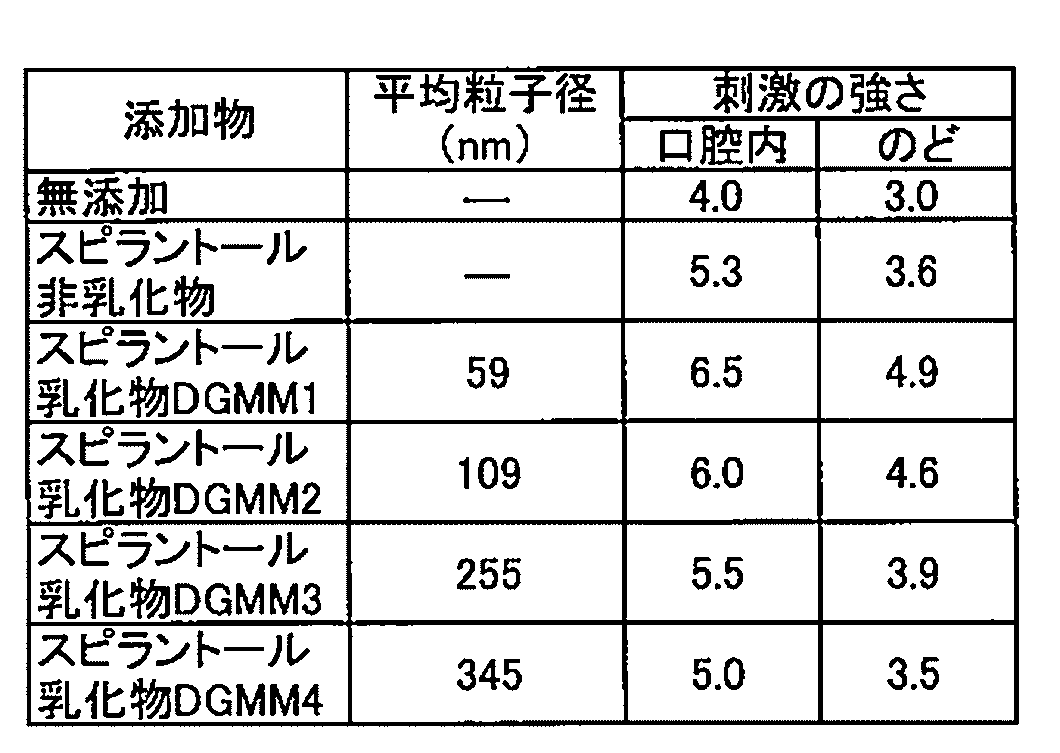
表2から明らかなように、簡易炭酸飲料にスピラントール乳化物DGMM1~DGMM4を添加すると、無添加の場合に比べ口腔内及びのどへの炭酸による刺激が強く感じられるようになり、粒子径が小さくなるほどその効果は高くなった。特にのどへの刺激感を強める効果は粒子径が小さくなるほど顕著に認められた。一方、スピラントール非乳化物を添加した場合も無添加の場合に比べ炭酸による刺激が強く感じられたが、のどで感じる刺激は口腔内で感じる刺激ほど強くは感じられなかった。この結果を基に、以降の実施例で飲料生地違いの検討を行う際は、粒子径が最も小さいスピラントール乳化物DGMM1で検討を行うこととした。
(炭酸水)
スピラントール乳化物DGML1~4について実施例1と同じ方法で簡易炭酸飲料を調製した。
スピラントール乳化物DGML1~4について実施例1と同じ方法で簡易炭酸飲料を調製した。
〔試験例2〕
実施例2の簡易炭酸飲料と比較例1の簡易炭酸飲料について、熟練したパネル20名により試験例1と同じ方法で官能評価を行った。評価結果は表3のとおりである。
実施例2の簡易炭酸飲料と比較例1の簡易炭酸飲料について、熟練したパネル20名により試験例1と同じ方法で官能評価を行った。評価結果は表3のとおりである。
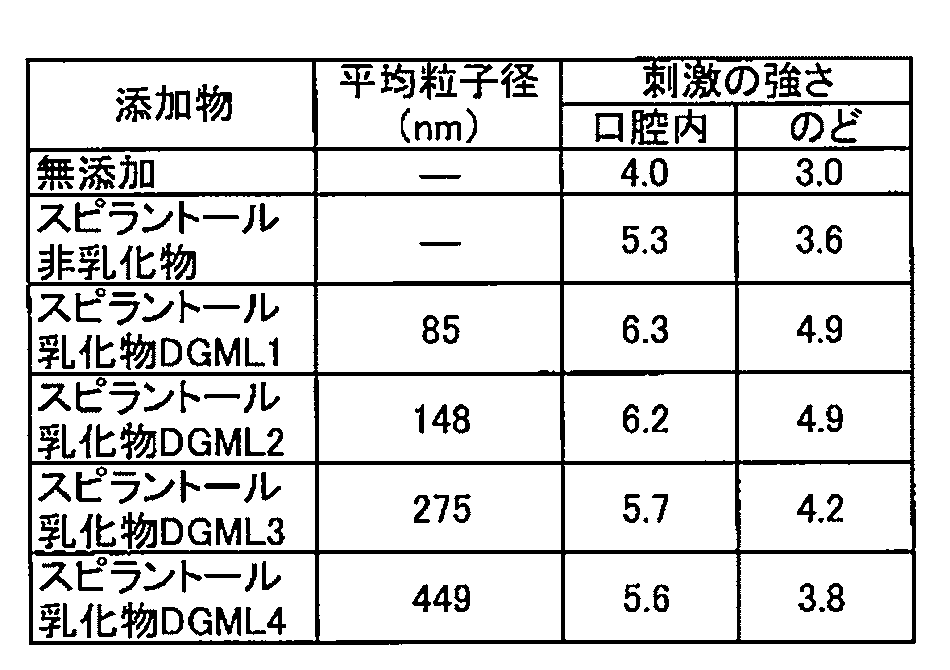
表3から明らかなように、簡易炭酸飲料にスピラントール乳化物DGML1~DGML4を添加すると、無添加の場合に比べ口腔内及びのどへの炭酸による刺激が強く感じられるようになり、粒子径が小さくなるほどその効果は高くなった。特にのどへの刺激感を強める効果は粒子径が小さくなるほど顕著に認められた。一方、スピラントール非乳化物を添加した場合も無添加の場合に比べ炭酸による刺激が強く感じられたが、のどで感じる刺激は口腔内で感じる刺激ほど強くは感じられなかった。また、試験例1と同様の結果が得られたことから、乳化剤の種類が異なっていてもスピラントール乳化物を添加することによる炭酸による口腔内及びのどへの刺激が強くなることが確認された。また、粒子径が小さいほど炭酸による口腔内及びのどへの刺激が強くなることが確認された。
(炭酸水)
スピラントール乳化物DGMS1~4について実施例1と同じ方法で簡易炭酸飲料を調製した。
スピラントール乳化物DGMS1~4について実施例1と同じ方法で簡易炭酸飲料を調製した。
〔試験例3〕
実施例3の簡易炭酸飲料と比較例1の簡易炭酸飲料について、熟練したパネル20名により試験例1と同じ方法で官能評価を行った。評価結果は表4のとおりである。
実施例3の簡易炭酸飲料と比較例1の簡易炭酸飲料について、熟練したパネル20名により試験例1と同じ方法で官能評価を行った。評価結果は表4のとおりである。
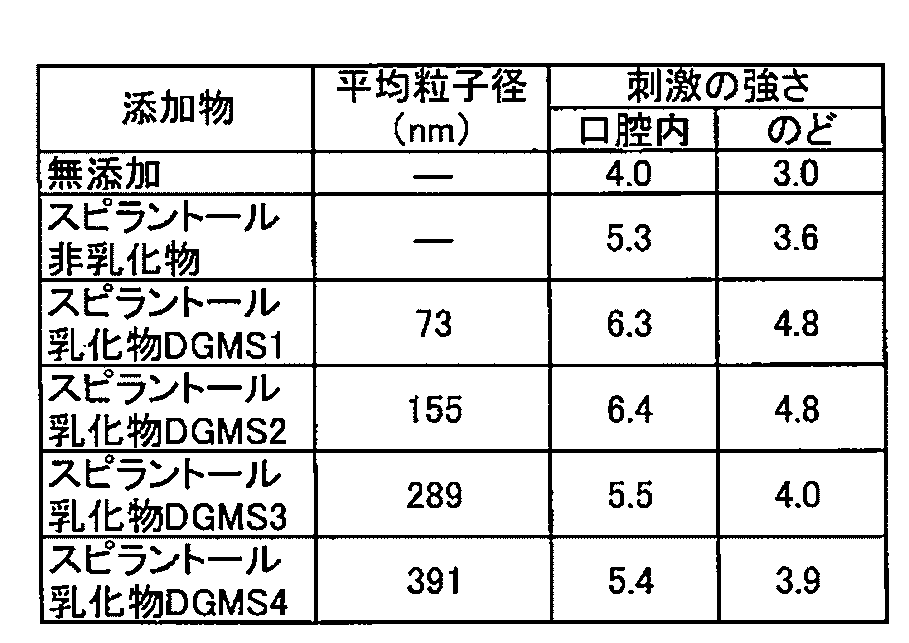
表4から明らかなように、簡易炭酸飲料にスピラントール乳化物DGMS1~DGMS4を添加すると、無添加の場合に比べ口腔内及びのどへの炭酸による刺激が強く感じられるようになり、粒子径が小さくなるほどその効果は高くなった。特にのどへの刺激感を強める効果は粒子径が小さくなるほど顕著に認められた。一方、スピラントール非乳化物を添加した場合も無添加の場合に比べ炭酸による刺激が強く感じられたが、のどで感じる刺激は口腔内で感じる刺激ほど強くは感じられなかった。また、試験例1、2と同様の結果が得られたことから、乳化剤の種類が異なっていてもスピラントール乳化物を添加することによる炭酸による口腔内及びのどへの刺激の効果が高くなることが確認された。また、粒子径が小さいほど炭酸による口腔内及びのどへの刺激が強くなった。
(炭酸水)
スピラントール乳化物SP1~4について実施例1と同じ方法で簡易炭酸飲料を調製した。
スピラントール乳化物SP1~4について実施例1と同じ方法で簡易炭酸飲料を調製した。
〔試験例4〕
実施例4の簡易炭酸飲料と比較例1の簡易炭酸飲料について、熟練したパネル20名により試験例1と同じ方法で官能評価を行った。評価結果は表5のとおりである。
実施例4の簡易炭酸飲料と比較例1の簡易炭酸飲料について、熟練したパネル20名により試験例1と同じ方法で官能評価を行った。評価結果は表5のとおりである。
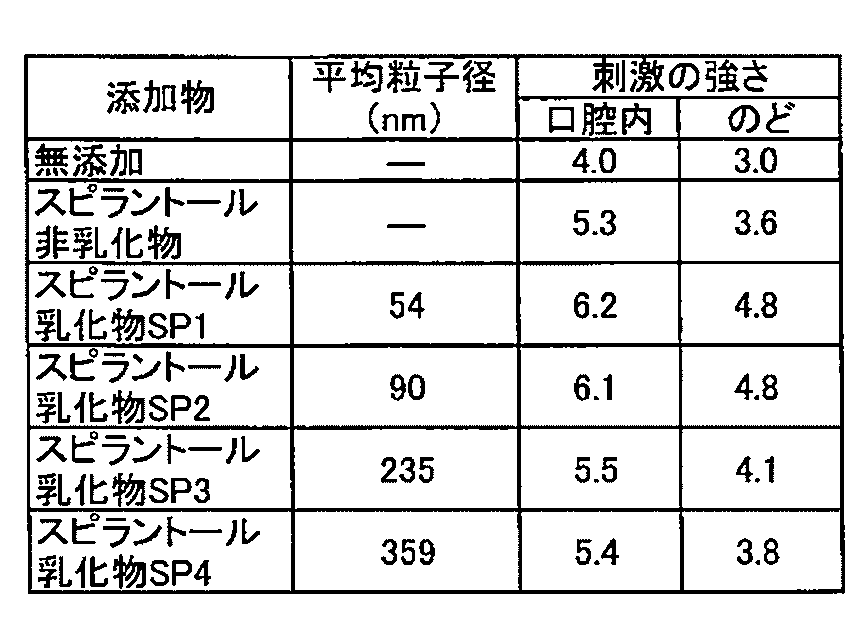
表5から明らかなように、簡易炭酸飲料にスピラントール乳化物SP1~SP4を添加すると、無添加の場合に比べ口腔内及びのどへの炭酸による刺激が強く感じられるようになり、粒子径が小さくなるほどその効果は高くなった。特にのどへの刺激感を強める効果は粒子径が小さくなるほど顕著に認められた。一方、スピラントール非乳化物を添加した場合も無添加の場合に比べ炭酸による刺激が強く感じられたが、のどで感じる刺激は口腔内で感じる刺激ほど強くは感じられなかった。また、試験例1、2、3と同様に、乳化剤の種類が異なっていてもスピラントール乳化物を添加することによる炭酸による口腔内及びのどへの刺激の効果が高くなることが確認された。また、粒子径が小さいほど炭酸による口腔内及びのどへの刺激の効果が強くなった。
(炭酸水)
スピラントール乳化物QE1~3について実施例1と同じ方法で簡易炭酸飲料を調製した。
スピラントール乳化物QE1~3について実施例1と同じ方法で簡易炭酸飲料を調製した。
〔試験例5〕
実施例5の簡易炭酸飲料と比較例1の簡易炭酸飲料について、熟練したパネル20名により試験例1と同じ方法で官能評価を行った。評価結果は表6のとおりである。
実施例5の簡易炭酸飲料と比較例1の簡易炭酸飲料について、熟練したパネル20名により試験例1と同じ方法で官能評価を行った。評価結果は表6のとおりである。
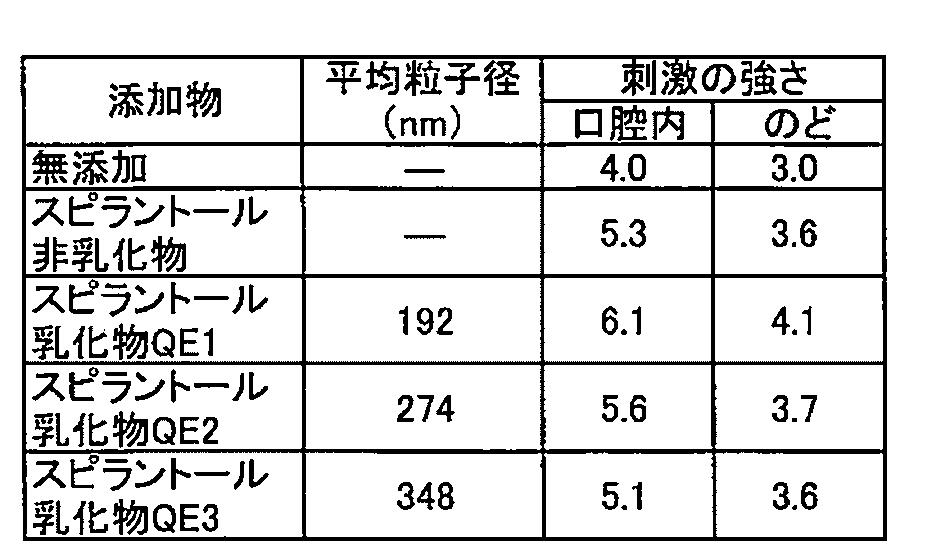
表6から明らかなように、簡易炭酸飲料にスピラントール乳化物QE1~QE3を添加すると、無添加の場合に比べ口腔内及びのどへの炭酸による刺激が強く感じられるようになり、粒子径が小さくなるほどその効果は高くなった。特にのどへの刺激感を強める効果は粒子径が小さくなるほど顕著に認められた。一方、スピラントール非乳化物を添加した場合も無添加の場合に比べ炭酸による刺激が強く感じられたが、のどで感じる刺激は口腔内で感じる刺激ほど強くは感じられなかった。また、試験例1~4と同様に、乳化剤の種類が異なっていてもスピラントール乳化物を添加することによる炭酸による口腔内及びのどへの刺激の効果が高くなることが確認された。また、粒子径が小さいほど炭酸による口腔内及びのどへの刺激の効果が強くなった。
(コーラ飲料)
蒸留水15.8gに果糖ブドウ糖液糖129.2g、クエン酸0.2g、リン酸0.8g、カラメル2.5g、カフェイン0.1g、コーラ香料1.0g(小川香料株式会社製)及び製造例3のスピラントール乳化物DGMM1を0.4g添加し均一に溶解させた。この溶液を氷水で5℃まで冷却し、250ml容量の缶に37.5g量りとった。この溶液に炭酸水212.5gを加えることにより本発明のコーラ飲料を調製した。
蒸留水15.8gに果糖ブドウ糖液糖129.2g、クエン酸0.2g、リン酸0.8g、カラメル2.5g、カフェイン0.1g、コーラ香料1.0g(小川香料株式会社製)及び製造例3のスピラントール乳化物DGMM1を0.4g添加し均一に溶解させた。この溶液を氷水で5℃まで冷却し、250ml容量の缶に37.5g量りとった。この溶液に炭酸水212.5gを加えることにより本発明のコーラ飲料を調製した。
〔比較例2〕(コーラ飲料)
蒸留水15.8gに果糖ブドウ糖液糖129.2g、クエン酸0.2g、リン酸0.8g、カラメル2.5g、カフェイン0.1g、コーラ香料1.0g(小川香料株式会社製)及び製造例2のスピラントール非乳化物を0.4g添加し均一に溶解させた。この溶液を氷水で5℃まで冷却し、250ml容量の缶に37.5g量りとった。この溶液に炭酸水212.5gを加えることにより比較例2のコーラ飲料を調製した。また、スピラントール非乳化物の代わりに蒸留水を添加したスピラントール無添加のコーラ飲料を対照として作製した。
蒸留水15.8gに果糖ブドウ糖液糖129.2g、クエン酸0.2g、リン酸0.8g、カラメル2.5g、カフェイン0.1g、コーラ香料1.0g(小川香料株式会社製)及び製造例2のスピラントール非乳化物を0.4g添加し均一に溶解させた。この溶液を氷水で5℃まで冷却し、250ml容量の缶に37.5g量りとった。この溶液に炭酸水212.5gを加えることにより比較例2のコーラ飲料を調製した。また、スピラントール非乳化物の代わりに蒸留水を添加したスピラントール無添加のコーラ飲料を対照として作製した。
〔試験例6〕
実施例6のコーラ飲料と比較例6のコーラ飲料について、熟練したパネル20名により官能評価を行った。評価は、口腔内への刺激はスピラントール無添加のコーラ飲料の刺激の強さを4点とした7段階評価、のどへの刺激はスピラントール無添加のコーラ飲料の刺激の強さを3点とした5段階評価で行った。採点基準は試験例1と同一とした。評価結果は表7のとおりである。
実施例6のコーラ飲料と比較例6のコーラ飲料について、熟練したパネル20名により官能評価を行った。評価は、口腔内への刺激はスピラントール無添加のコーラ飲料の刺激の強さを4点とした7段階評価、のどへの刺激はスピラントール無添加のコーラ飲料の刺激の強さを3点とした5段階評価で行った。採点基準は試験例1と同一とした。評価結果は表7のとおりである。

表7から明らかなように、コーラ飲料にスピラントール乳化物DGMM1を添加することにより、無添加の場合に比べ、炭酸による口腔内及びのどへの刺激が強く感じられた。一方、スピラントール非乳化物を添加した場合も炭酸による刺激は無添加の場合より強く感じられたが、のどへの刺激はスピラントール乳化物DGMM1ほどには強まらなかった。
(ダイエットコーラ飲料)
蒸留水143.75gにアスパルテーム0.45g、クエン酸0.6g、リン酸1g、カフェイン0.1g、カラメル2.7g、コーラ香料1g(小川香料株式会社製)及び製造例3のスピラントール乳化物DGMM1を0.4g添加し均一に溶解させた。この溶液を氷水で5℃まで冷却し、250ml容量の缶に37.5g量りとった。この溶液に炭酸水212.5gを加えることにより本発明のダイエットコーラ飲料を調製した。
蒸留水143.75gにアスパルテーム0.45g、クエン酸0.6g、リン酸1g、カフェイン0.1g、カラメル2.7g、コーラ香料1g(小川香料株式会社製)及び製造例3のスピラントール乳化物DGMM1を0.4g添加し均一に溶解させた。この溶液を氷水で5℃まで冷却し、250ml容量の缶に37.5g量りとった。この溶液に炭酸水212.5gを加えることにより本発明のダイエットコーラ飲料を調製した。
〔比較例3〕
蒸留水143.75gにアスパルテーム0.45g、クエン酸0.6g、リン酸1g、カフェイン0.1g、カラメル2.7g、コーラ香料1g(小川香料株式会社製)及び製造例2のスピラントール非乳化物を0.4g添加し均一に溶解させた。この溶液を氷水で5℃まで冷却し、250ml容量の缶に37.5g量りとった。この溶液に炭酸水212.5gを加えることにより比較例3のダイエットコーラ飲料を調製した。また、スピラントール非乳化物の代わりに蒸留水を添加したスピラントール無添加のダイエットコーラ飲料を対照として作製した。
蒸留水143.75gにアスパルテーム0.45g、クエン酸0.6g、リン酸1g、カフェイン0.1g、カラメル2.7g、コーラ香料1g(小川香料株式会社製)及び製造例2のスピラントール非乳化物を0.4g添加し均一に溶解させた。この溶液を氷水で5℃まで冷却し、250ml容量の缶に37.5g量りとった。この溶液に炭酸水212.5gを加えることにより比較例3のダイエットコーラ飲料を調製した。また、スピラントール非乳化物の代わりに蒸留水を添加したスピラントール無添加のダイエットコーラ飲料を対照として作製した。
〔試験例7〕
実施例7のダイエットコーラ飲料と、比較例3のダイエットコーラ飲料について、熟練したパネル20名により官能評価を行った。評価は、口腔内への刺激はスピラントール無添加のダイエットコーラ飲料の刺激の強さを4点とした7段階評価、のどへの刺激はスピラントール無添加のダイエットコーラ飲料の刺激の強さを3点とした5段階評価で行った。採点基準は試験例1と同一とした。評価結果は表8のとおりである。
実施例7のダイエットコーラ飲料と、比較例3のダイエットコーラ飲料について、熟練したパネル20名により官能評価を行った。評価は、口腔内への刺激はスピラントール無添加のダイエットコーラ飲料の刺激の強さを4点とした7段階評価、のどへの刺激はスピラントール無添加のダイエットコーラ飲料の刺激の強さを3点とした5段階評価で行った。採点基準は試験例1と同一とした。評価結果は表8のとおりである。

表8から明らかなように、ダイエットコーラ飲料にスピラントール乳化物DGMM1を添加することにより、無添加の場合に比べ、炭酸による口腔内及びのどへの刺激が強く感じられた。一方、スピラントール非乳化物を添加した場合も炭酸による刺激は無添加の場合より強く感じられたが、のどへの刺激はスピラントール乳化物DGMM1ほどには強まらなかった。
(10%オレンジ果汁入り微炭酸飲料)
蒸留水462.7gにオレンジ5倍濃縮果汁20g、果糖ブドウ糖液糖114.3g、クエン酸1.5g、ビタミンC 0.1g、オレンジ香料1.0g(小川香料株式会社製)及び製造例3のスピラントール乳化物DGMM1を0.4g添加し均一に溶解させた。この溶液を氷水で5℃まで冷却し、250ml容量の缶に150g量りとった。この溶液に炭酸水100gを加えることにより本発明の10%オレンジ果汁入り微炭酸飲料を調製した。
蒸留水462.7gにオレンジ5倍濃縮果汁20g、果糖ブドウ糖液糖114.3g、クエン酸1.5g、ビタミンC 0.1g、オレンジ香料1.0g(小川香料株式会社製)及び製造例3のスピラントール乳化物DGMM1を0.4g添加し均一に溶解させた。この溶液を氷水で5℃まで冷却し、250ml容量の缶に150g量りとった。この溶液に炭酸水100gを加えることにより本発明の10%オレンジ果汁入り微炭酸飲料を調製した。
〔比較例4〕(10%オレンジ果汁入り微炭酸飲料)
蒸留水462.7gにオレンジ5倍濃縮果汁20g、果糖ブドウ糖液糖114.3g、クエン酸1.5g、ビタミンC 0.1g、オレンジ香料1.0g(小川香料株式会社製)及び製造例2のスピラントール非乳化物を0.4g添加し均一に溶解させた。この溶液を氷水で5℃まで冷却し、250ml容量の缶に150g量りとった。この溶液に炭酸水100gを加えることにより比較例4の10%オレンジ果汁入り微炭酸飲料を調製した。また、スピラントール非乳化物の代わりに蒸留水を添加したスピラントール無添加の10%オレンジ果汁入り微炭酸飲料を対照として作製した。
蒸留水462.7gにオレンジ5倍濃縮果汁20g、果糖ブドウ糖液糖114.3g、クエン酸1.5g、ビタミンC 0.1g、オレンジ香料1.0g(小川香料株式会社製)及び製造例2のスピラントール非乳化物を0.4g添加し均一に溶解させた。この溶液を氷水で5℃まで冷却し、250ml容量の缶に150g量りとった。この溶液に炭酸水100gを加えることにより比較例4の10%オレンジ果汁入り微炭酸飲料を調製した。また、スピラントール非乳化物の代わりに蒸留水を添加したスピラントール無添加の10%オレンジ果汁入り微炭酸飲料を対照として作製した。
〔試験例8〕
実施例8の10%オレンジ果汁入り微炭酸飲料と、比較例4の10%オレンジ果汁入り微炭酸飲料について、熟練したパネル20名により官能評価を行った。評価は、口腔内への刺激はスピラントール無添加の10%オレンジ果汁入り微炭酸飲料の刺激の強さを4点とした7段階評価、のどへの刺激はスピラントール無添加の10%オレンジ果汁入り微炭酸飲料の刺激の強さを3点とした5段階評価で行った。採点基準は試験例1と同一とした。評価結果は表9のとおりである。
実施例8の10%オレンジ果汁入り微炭酸飲料と、比較例4の10%オレンジ果汁入り微炭酸飲料について、熟練したパネル20名により官能評価を行った。評価は、口腔内への刺激はスピラントール無添加の10%オレンジ果汁入り微炭酸飲料の刺激の強さを4点とした7段階評価、のどへの刺激はスピラントール無添加の10%オレンジ果汁入り微炭酸飲料の刺激の強さを3点とした5段階評価で行った。採点基準は試験例1と同一とした。評価結果は表9のとおりである。
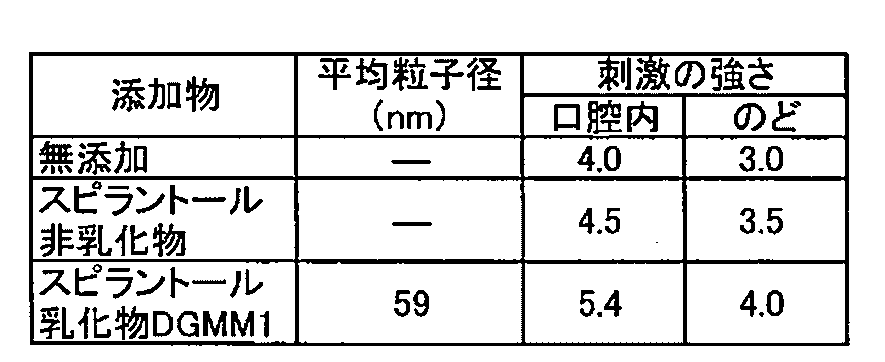
表9から明らかなように、10%オレンジ果汁入り微炭酸飲料にスピラントール乳化物DGMM1を添加することにより、無添加の場合に比べ、炭酸による口腔内及びのどへの刺激が強く感じられた。一方、スピラントール非乳化物を添加した場合も炭酸による刺激は無添加の場合より強く感じられたが、のどへの刺激はスピラントール乳化物DGMM1ほどには強まらなかった。
(サイダー飲料)
蒸留水46.4gに果糖ブドウ糖液糖100g、クエン酸0.8g、リンゴ酸0.6g、クエン酸ナトリウム0.4g、ビタミンC 0.4g、サイダー香料1.0g(小川香料株式会社製)及び製造例3のスピラントール乳化物DGMM1を0.4g添加し均一に溶解させた。この溶液を氷水で5℃まで冷却し、250ml容量の缶に37.5g量りとった。この溶液に炭酸水212.5gを加えることにより本発明のサイダー飲料を調製した。
蒸留水46.4gに果糖ブドウ糖液糖100g、クエン酸0.8g、リンゴ酸0.6g、クエン酸ナトリウム0.4g、ビタミンC 0.4g、サイダー香料1.0g(小川香料株式会社製)及び製造例3のスピラントール乳化物DGMM1を0.4g添加し均一に溶解させた。この溶液を氷水で5℃まで冷却し、250ml容量の缶に37.5g量りとった。この溶液に炭酸水212.5gを加えることにより本発明のサイダー飲料を調製した。
〔比較例5〕
蒸留水46.4gに果糖ブドウ糖液糖100g、クエン酸0.8g、リンゴ酸0.6g、クエン酸ナトリウム0.4g、ビタミンC 0.4g、サイダー香料1.0g(小川香料株式会社製)及び製造例2のスピラントール非乳化物を0.4g添加し均一に溶解させた。この溶液を氷水で5℃まで冷却し、250ml容量の缶に37.5g量りとった。この溶液に炭酸水212.5gを加えることにより比較例5のサイダー飲料を調製した。また、スピラントール非乳化物の代わりに蒸留水を添加したスピラントール無添加のサイダー飲料を対照として作製した。
蒸留水46.4gに果糖ブドウ糖液糖100g、クエン酸0.8g、リンゴ酸0.6g、クエン酸ナトリウム0.4g、ビタミンC 0.4g、サイダー香料1.0g(小川香料株式会社製)及び製造例2のスピラントール非乳化物を0.4g添加し均一に溶解させた。この溶液を氷水で5℃まで冷却し、250ml容量の缶に37.5g量りとった。この溶液に炭酸水212.5gを加えることにより比較例5のサイダー飲料を調製した。また、スピラントール非乳化物の代わりに蒸留水を添加したスピラントール無添加のサイダー飲料を対照として作製した。
〔試験例9〕
実施例9のサイダー飲料と、比較例5のサイダー飲料の香味について、熟練したパネル20名により官能評価を行った。評価は、口腔内への刺激はスピラントール無添加のサイダー飲料の刺激の強さを4点とした7段階評価、のどへの刺激はスピラントール無添加のサイダー飲料の刺激の強さを3点とした5段階評価で行った。採点基準は試験例1と同一とした。評価結果は表10のとおりである。
実施例9のサイダー飲料と、比較例5のサイダー飲料の香味について、熟練したパネル20名により官能評価を行った。評価は、口腔内への刺激はスピラントール無添加のサイダー飲料の刺激の強さを4点とした7段階評価、のどへの刺激はスピラントール無添加のサイダー飲料の刺激の強さを3点とした5段階評価で行った。採点基準は試験例1と同一とした。評価結果は表10のとおりである。
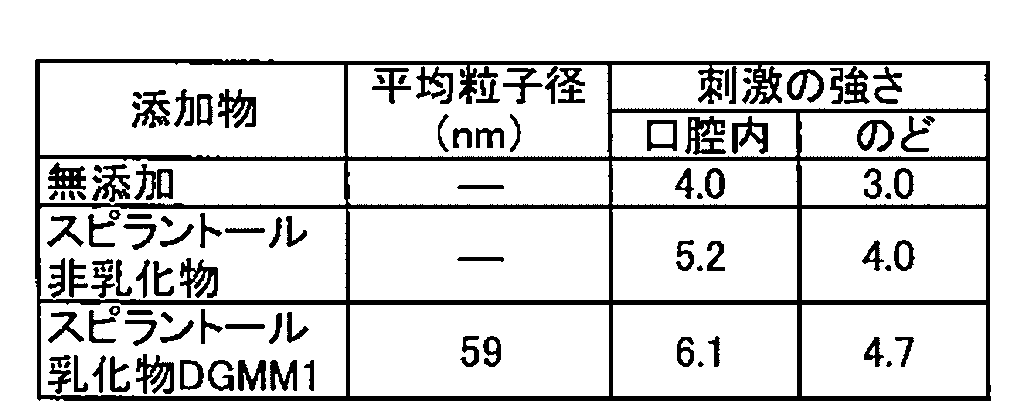
表10から明らかなように、サイダー飲料にスピラントール乳化物DGMM1を添加することにより、無添加の場合に比べ、炭酸による口腔内及びのどへの刺激が強く感じられた。一方、スピラントール非乳化物を添加した場合も炭酸による刺激は無添加の場合より強く感じられたが、のどへの刺激はスピラントール乳化物DGMM1ほどには強まらなかった。
(ジンジャーエール飲料)
蒸留水15.51gに果糖ブドウ糖液糖131.4g、クエン酸0.7g、リン酸0.8g、カラメル0.14g、カフェイン0.05g、ジンジャーエール香料1.0g(小川香料株式会社製)及び製造例3のスピラントール乳化物DGMM1を0.4g添加し均一に溶解させた。この溶液を氷水で5℃まで冷却し、250ml容量の缶に37.5g量りとった。この溶液に炭酸水212.5gを加えることにより本発明のジンジャーエール飲料を調製した。
蒸留水15.51gに果糖ブドウ糖液糖131.4g、クエン酸0.7g、リン酸0.8g、カラメル0.14g、カフェイン0.05g、ジンジャーエール香料1.0g(小川香料株式会社製)及び製造例3のスピラントール乳化物DGMM1を0.4g添加し均一に溶解させた。この溶液を氷水で5℃まで冷却し、250ml容量の缶に37.5g量りとった。この溶液に炭酸水212.5gを加えることにより本発明のジンジャーエール飲料を調製した。
〔比較例6〕
蒸留水15.51gに果糖ブドウ糖液糖131.4g、クエン酸0.7g、リン酸0.8g、カラメル0.14g、カフェイン0.05g、ジンジャーエール香料1.0g(小川香料株式会社製)及び製造例2のスピラントール非乳化物を0.4g添加し均一に溶解させた。この溶液を氷水で5℃まで冷却し、250ml容量の缶に37.5g量りとった。この溶液に炭酸水212.5gを加えることにより比較例6のジンジャーエール飲料を調製した。また、スピラントール非乳化物の代わりに蒸留水を添加したスピラントール無添加のジンジャーエール飲料を対照として作製した。
蒸留水15.51gに果糖ブドウ糖液糖131.4g、クエン酸0.7g、リン酸0.8g、カラメル0.14g、カフェイン0.05g、ジンジャーエール香料1.0g(小川香料株式会社製)及び製造例2のスピラントール非乳化物を0.4g添加し均一に溶解させた。この溶液を氷水で5℃まで冷却し、250ml容量の缶に37.5g量りとった。この溶液に炭酸水212.5gを加えることにより比較例6のジンジャーエール飲料を調製した。また、スピラントール非乳化物の代わりに蒸留水を添加したスピラントール無添加のジンジャーエール飲料を対照として作製した。
〔試験例10〕
実施例10のジンジャーエール飲料と、比較例6のジンジャーエール飲料の香味について、熟練したパネル20名により官能評価を行った。評価は、口腔内への刺激はスピラントール無添加のジンジャーエール飲料の刺激の強さを4点とした7段階評価、のどへの刺激はスピラントール無添加のー飲料の刺激の強さを3点とした5段階評価で行った。採点基準は試験例1と同一とした。評価結果は表11のとおりである。
実施例10のジンジャーエール飲料と、比較例6のジンジャーエール飲料の香味について、熟練したパネル20名により官能評価を行った。評価は、口腔内への刺激はスピラントール無添加のジンジャーエール飲料の刺激の強さを4点とした7段階評価、のどへの刺激はスピラントール無添加のー飲料の刺激の強さを3点とした5段階評価で行った。採点基準は試験例1と同一とした。評価結果は表11のとおりである。

表11から明らかなように、ジンジャーエール飲料にスピラントール乳化物DGMM1を添加することにより、無添加の場合に比べ、炭酸による口腔内及びのどへの刺激が強く感じられた。一方、スピラントール非乳化物を添加した場合も炭酸による刺激は無添加の場合より強く感じられたが、のどへの刺激はスピラントール乳化物DGMM1ほどには強まらなかった。
(レモンチューハイ飲料)
蒸留水168.6gにウォッカ180g、レモン透明5倍濃縮果汁6.1g、果糖ブドウ糖液糖42g、クエン酸0.9g、レモン香料2g(小川香料株式会社製)及び製造例3のスピラントール乳化物DGMM1を0.4g添加し均一に溶解させた。この溶液を氷水で5℃まで冷却し、250ml容量の缶に100g量りとった。この溶液に炭酸水150gを加えることにより本発明のレモンチューハイ飲料を調製した。
蒸留水168.6gにウォッカ180g、レモン透明5倍濃縮果汁6.1g、果糖ブドウ糖液糖42g、クエン酸0.9g、レモン香料2g(小川香料株式会社製)及び製造例3のスピラントール乳化物DGMM1を0.4g添加し均一に溶解させた。この溶液を氷水で5℃まで冷却し、250ml容量の缶に100g量りとった。この溶液に炭酸水150gを加えることにより本発明のレモンチューハイ飲料を調製した。
〔比較例7〕
蒸留水168.6gにウォッカ180g、レモン透明5倍濃縮果汁6.1g、果糖ブドウ糖液糖42g、クエン酸0.9g、レモン香料2g(小川香料社株式会社製)及び製造例2のスピラントール非乳化物を0.4g添加し均一に溶解させた。この溶液を氷水で5℃まで冷却し、250ml容量の缶に100g量りとった。この溶液に炭酸水150gを加えることにより比較例7のレモンチューハイ飲料を調製した。また、スピラントール非乳化物の代わりに蒸留水を添加したスピラントール無添加のレモンチューハイ飲料を対照として作製した。
蒸留水168.6gにウォッカ180g、レモン透明5倍濃縮果汁6.1g、果糖ブドウ糖液糖42g、クエン酸0.9g、レモン香料2g(小川香料社株式会社製)及び製造例2のスピラントール非乳化物を0.4g添加し均一に溶解させた。この溶液を氷水で5℃まで冷却し、250ml容量の缶に100g量りとった。この溶液に炭酸水150gを加えることにより比較例7のレモンチューハイ飲料を調製した。また、スピラントール非乳化物の代わりに蒸留水を添加したスピラントール無添加のレモンチューハイ飲料を対照として作製した。
〔試験例11〕
実施例11のレモンチューハイ飲料と、比較例7のレモンチューハイ飲料の香味について、熟練したパネル20名により官能評価を行った。評価は、口腔内への刺激はスピラントール無添加のレモンチューハイ飲料の刺激の強さを4点とした7段階評価、のどへの刺激はスピラントール無添加のレモンチューハイ飲料の刺激の強さを3点とした5段階評価で行った。採点基準は試験例1と同一とした。評価結果は表12のとおりである。
実施例11のレモンチューハイ飲料と、比較例7のレモンチューハイ飲料の香味について、熟練したパネル20名により官能評価を行った。評価は、口腔内への刺激はスピラントール無添加のレモンチューハイ飲料の刺激の強さを4点とした7段階評価、のどへの刺激はスピラントール無添加のレモンチューハイ飲料の刺激の強さを3点とした5段階評価で行った。採点基準は試験例1と同一とした。評価結果は表12のとおりである。
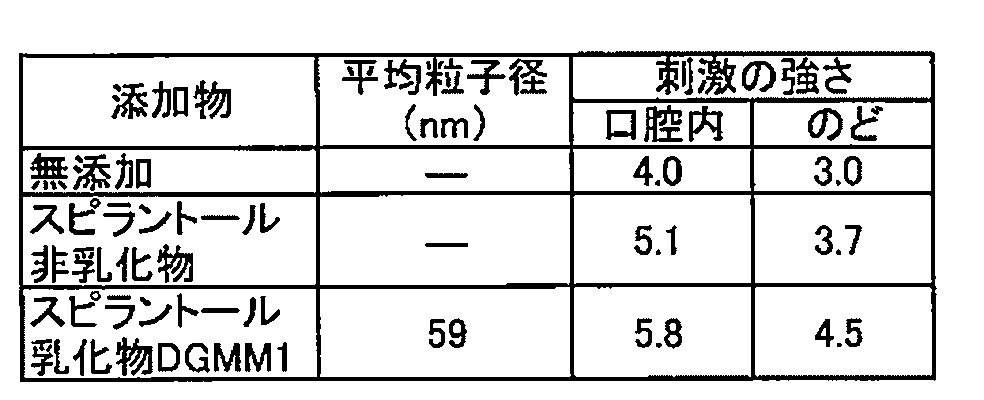
表12から明らかなように、レモンチューハイ飲料にスピラントール乳化物DGMM1を添加することにより、無添加の場合に比べ、炭酸による口腔内及びのどへの刺激が強く感じられた。一方、スピラントール非乳化物を添加した場合も炭酸による刺激は無添加の場合より強く感じられたが、のどへの刺激はスピラントール乳化物DGMM1ほどには強まらなかった。
(ノンアルコールビール飲料)
蒸留水370gに、デキストリン15g、果糖ブドウ糖液糖10g、大豆ペプチド2g、リン酸0.4g、クエン酸ナトリウム0.4g、乳酸0.2g、カラメル0.3g、苦味量0.1g、リンゴ酸0.08g、酒石酸0.06g、ビタミンC 0.06g、ビール香料1g(小川香料株式会社製)及び製造例3のスピラントール乳化物DGMM1を0.4g添加し均一に溶解させた。この溶液を氷水で5℃まで冷却し、250ml容量の缶に100g量りとった。この溶液に炭酸水150gを加えることにより本発明のノンアルコールビール飲料を調製した。
蒸留水370gに、デキストリン15g、果糖ブドウ糖液糖10g、大豆ペプチド2g、リン酸0.4g、クエン酸ナトリウム0.4g、乳酸0.2g、カラメル0.3g、苦味量0.1g、リンゴ酸0.08g、酒石酸0.06g、ビタミンC 0.06g、ビール香料1g(小川香料株式会社製)及び製造例3のスピラントール乳化物DGMM1を0.4g添加し均一に溶解させた。この溶液を氷水で5℃まで冷却し、250ml容量の缶に100g量りとった。この溶液に炭酸水150gを加えることにより本発明のノンアルコールビール飲料を調製した。
〔比較例8〕
蒸留水370gに、デキストリン15g、果糖ブドウ糖液糖10g、大豆ペプチド2g、リン酸0.4g、クエン酸ナトリウム0.4g、乳酸0.2g、カラメル0.3g、苦味量0.1g、リンゴ酸0.08g、酒石酸0.06g、ビタミンC 0.06g、ビール香料1g(小川香料株式会社製)及び製造例2のスピラントール非乳化物を0.4g添加し均一に溶解させた。この溶液を氷水で5℃まで冷却し、250ml容量の缶に100g量りとった。この溶液に炭酸水150gを加えることにより比較例8のノンアルコールビール飲料を調製した。また、スピラントール非乳化物の代わりに蒸留水を添加したスピラントール無添加のノンアルコールビール飲料を対照として作製した。
蒸留水370gに、デキストリン15g、果糖ブドウ糖液糖10g、大豆ペプチド2g、リン酸0.4g、クエン酸ナトリウム0.4g、乳酸0.2g、カラメル0.3g、苦味量0.1g、リンゴ酸0.08g、酒石酸0.06g、ビタミンC 0.06g、ビール香料1g(小川香料株式会社製)及び製造例2のスピラントール非乳化物を0.4g添加し均一に溶解させた。この溶液を氷水で5℃まで冷却し、250ml容量の缶に100g量りとった。この溶液に炭酸水150gを加えることにより比較例8のノンアルコールビール飲料を調製した。また、スピラントール非乳化物の代わりに蒸留水を添加したスピラントール無添加のノンアルコールビール飲料を対照として作製した。
〔試験例12〕
実施例12のノンアルコールビール飲料と、比較例8のノンアルコールビール飲料の香味について、熟練したパネル20名により官能評価を行った。評価は、口腔内への刺激はスピラントール無添加のノンアルコールビール飲料の刺激の強さを4点とした7段階評価、のどへの刺激はスピラントール無添加のノンアルコールビール飲料の刺激の強さを3点とした5段階評価で行った。採点基準は試験例1と同一とした。評価結果は表13のとおりである。
実施例12のノンアルコールビール飲料と、比較例8のノンアルコールビール飲料の香味について、熟練したパネル20名により官能評価を行った。評価は、口腔内への刺激はスピラントール無添加のノンアルコールビール飲料の刺激の強さを4点とした7段階評価、のどへの刺激はスピラントール無添加のノンアルコールビール飲料の刺激の強さを3点とした5段階評価で行った。採点基準は試験例1と同一とした。評価結果は表13のとおりである。

表13から明らかなように、ノンアルコールビール飲料にスピラントール乳化物DGMM1を添加することにより、無添加の場合に比べ、炭酸による口腔内及びのどへの刺激が強く感じられた。一方、スピラントール非乳化物を添加した場合も炭酸による刺激は無添加の場合より強く感じられたが、のどへの刺激はスピラントール乳化物DGMM1ほどには強まらなかった。
(発泡酒)
市販の発泡酒(アルコール5.5%、麦芽25%未満:ホップ、大麦、米、コーン、スターチ、糖類、赤ワインエキス、香料、カラメル色素)199.92gに製造例3のスピラントール乳化物DGMM1を0.08g添加し均一に溶解させた。この溶液を氷水で5℃まで冷却し、本発明の発泡酒を調整した。
市販の発泡酒(アルコール5.5%、麦芽25%未満:ホップ、大麦、米、コーン、スターチ、糖類、赤ワインエキス、香料、カラメル色素)199.92gに製造例3のスピラントール乳化物DGMM1を0.08g添加し均一に溶解させた。この溶液を氷水で5℃まで冷却し、本発明の発泡酒を調整した。
〔比較例9〕
市販の発泡酒(アルコール5.5%、麦芽25%未満:ホップ、大麦、米、コーン、スターチ、糖類、赤ワインエキス、香料、カラメル色素)199.92gに製造例2のスピラントール非乳化物を0.08g添加し均一に溶解させた。この溶液を氷水で5℃まで冷却し、比較例9の発泡酒を調整した。また、スピラントール非乳化物の代わりに蒸留水を添加したスピラントール無添加の発泡酒を対照として作製した。
市販の発泡酒(アルコール5.5%、麦芽25%未満:ホップ、大麦、米、コーン、スターチ、糖類、赤ワインエキス、香料、カラメル色素)199.92gに製造例2のスピラントール非乳化物を0.08g添加し均一に溶解させた。この溶液を氷水で5℃まで冷却し、比較例9の発泡酒を調整した。また、スピラントール非乳化物の代わりに蒸留水を添加したスピラントール無添加の発泡酒を対照として作製した。
〔試験例13〕
実施例13の発泡酒と、比較例9の発泡酒の香味について、熟練したパネル20名により官能評価を行った。評価は、口腔内への刺激はスピラントール無添加の発泡酒の刺激の強さを4点とした7段階評価、のどへの刺激はスピラントール無添加の発泡酒の刺激の強さを3点とした5段階評価で行った。採点基準は試験例1と同一とした。評価結果は表14のとおりである。
実施例13の発泡酒と、比較例9の発泡酒の香味について、熟練したパネル20名により官能評価を行った。評価は、口腔内への刺激はスピラントール無添加の発泡酒の刺激の強さを4点とした7段階評価、のどへの刺激はスピラントール無添加の発泡酒の刺激の強さを3点とした5段階評価で行った。採点基準は試験例1と同一とした。評価結果は表14のとおりである。

表14から明らかなように、発泡酒にスピラントール乳化物DGMM1を添加することにより、無添加の場合に比べ、炭酸による口腔内及びのどへの刺激が強く感じられた。一方、スピラントール非乳化物を添加した場合も炭酸による刺激は無添加の場合より強く感じられたが、のどへの刺激はスピラントール乳化物DGMM1ほどには強まらなかった。
(炭酸水)
炭酸水199.92gに製造例23のジンジャー抽出オイル乳化物DGMM1を0.08g添加し均一に溶解させた。この溶液を氷水で5℃まで冷却し、本発明の簡易炭酸飲料を調整した。
炭酸水199.92gに製造例23のジンジャー抽出オイル乳化物DGMM1を0.08g添加し均一に溶解させた。この溶液を氷水で5℃まで冷却し、本発明の簡易炭酸飲料を調整した。
〔比較例10〕
炭酸水199.92gに製造例22のジンジャー抽出オイル非乳化物を0.08g添加し均一に溶解させた。この溶液を氷水で5℃まで冷却し、比較例10の簡易炭酸飲料を調整した。スピラントール非乳化物1を添加せずに水に置き換えたものを添加した簡易炭酸飲料についても同様に調整した。
炭酸水199.92gに製造例22のジンジャー抽出オイル非乳化物を0.08g添加し均一に溶解させた。この溶液を氷水で5℃まで冷却し、比較例10の簡易炭酸飲料を調整した。スピラントール非乳化物1を添加せずに水に置き換えたものを添加した簡易炭酸飲料についても同様に調整した。
〔試験例14〕
実施例14の炭酸水と、比較例10の炭酸水の香味について、熟練したパネル20名により官能評価を行った。評価は氷水で5℃まで冷却したジンジャー抽出オイル無添加の炭酸水を対照とし、口腔内への刺激はジンジャー抽出オイル無添加の炭酸水の刺激の強さを4点とした7段階評価、のどへの刺激はジンジャー抽出オイル無添加の炭酸水の刺激の強さを3点とした5段階評価で行った。なお採点基準は試験例1と同一とした。評価結果は表15のとおりである。
実施例14の炭酸水と、比較例10の炭酸水の香味について、熟練したパネル20名により官能評価を行った。評価は氷水で5℃まで冷却したジンジャー抽出オイル無添加の炭酸水を対照とし、口腔内への刺激はジンジャー抽出オイル無添加の炭酸水の刺激の強さを4点とした7段階評価、のどへの刺激はジンジャー抽出オイル無添加の炭酸水の刺激の強さを3点とした5段階評価で行った。なお採点基準は試験例1と同一とした。評価結果は表15のとおりである。

表15から明らかなように、炭酸水にジンジャー抽出オイル乳化物DGMM1を添加することにより、無添加の場合に比べ、炭酸による口腔内及びのどへの刺激が強く感じられた。一方、ジンジャー抽出オイル非乳化物を添加した場合も炭酸による刺激は無添加の場合より強く感じられたが、のどへの刺激はジンジャー抽出オイルDGMM1ほどには強まらなかった。
(ジンジャーエール飲料)
蒸留水15.51gに果糖ブドウ糖液糖131.4g、クエン酸0.7g、リン酸0.8g、カラメル0.14g、カフェイン0.05g、ジンジャーエール香料1.0g(小川香料株式会社製)及び製造例23のジンジャー抽出オイル乳化物DGMM1を0.4g添加し均一に溶解させた。この溶液を氷水で5℃まで冷却し、250ml容量の缶に37.5g量りとった。この溶液に炭酸水212.5gを加えることにより本発明のジンジャーエール飲料を調製した。
蒸留水15.51gに果糖ブドウ糖液糖131.4g、クエン酸0.7g、リン酸0.8g、カラメル0.14g、カフェイン0.05g、ジンジャーエール香料1.0g(小川香料株式会社製)及び製造例23のジンジャー抽出オイル乳化物DGMM1を0.4g添加し均一に溶解させた。この溶液を氷水で5℃まで冷却し、250ml容量の缶に37.5g量りとった。この溶液に炭酸水212.5gを加えることにより本発明のジンジャーエール飲料を調製した。
〔比較例11〕
蒸留水15.51gに果糖ブドウ糖液糖131.4g、クエン酸0.7g、リン酸0.8g、カラメル0.14g、カフェイン0.05g、ジンジャーエール香料1.0g(小川香料株式会社製)及び製造例22のジンジャー抽出オイル非乳化物を0.4g添加し均一に溶解させた。この溶液を氷水で5℃まで冷却し、250ml容量の缶に37.5g量りとった。この溶液に炭酸水212.5gを加えることにより比較例11のジンジャーエール飲料を調製した。また、ジンジャー抽出オイル非乳化物の代わりに蒸留水を添加したジンジャー抽出オイル無添加のジンジャーエール飲料を対照として作製した。
蒸留水15.51gに果糖ブドウ糖液糖131.4g、クエン酸0.7g、リン酸0.8g、カラメル0.14g、カフェイン0.05g、ジンジャーエール香料1.0g(小川香料株式会社製)及び製造例22のジンジャー抽出オイル非乳化物を0.4g添加し均一に溶解させた。この溶液を氷水で5℃まで冷却し、250ml容量の缶に37.5g量りとった。この溶液に炭酸水212.5gを加えることにより比較例11のジンジャーエール飲料を調製した。また、ジンジャー抽出オイル非乳化物の代わりに蒸留水を添加したジンジャー抽出オイル無添加のジンジャーエール飲料を対照として作製した。
〔試験例15〕
実施例15のジンジャーエール飲料と、比較例11のジンジャーエール飲料の香味について、熟練したパネル20名により官能評価を行った。評価は、口腔内への刺激はジンジャー抽出オイル無添加のジンジャーエール飲料の刺激の強さを4点とした7段階評価、のどへの刺激はジンジャー抽出オイル無添加のジンジャーエール飲料の刺激の強さを3点とした5段階評価で行った。採点基準は試験例1と同一とした。評価結果は表16のとおりである。
実施例15のジンジャーエール飲料と、比較例11のジンジャーエール飲料の香味について、熟練したパネル20名により官能評価を行った。評価は、口腔内への刺激はジンジャー抽出オイル無添加のジンジャーエール飲料の刺激の強さを4点とした7段階評価、のどへの刺激はジンジャー抽出オイル無添加のジンジャーエール飲料の刺激の強さを3点とした5段階評価で行った。採点基準は試験例1と同一とした。評価結果は表16のとおりである。
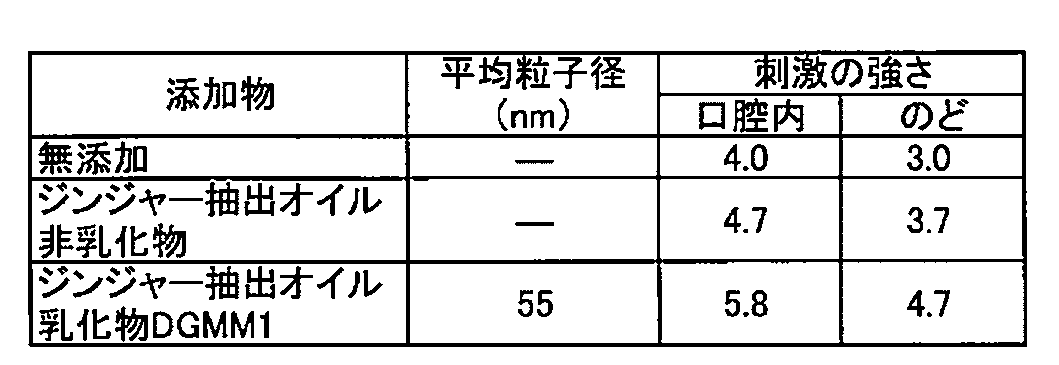
表16から明らかなように、ジンジャーエール飲料にジンジャー抽出オイル乳化物DGMM1を添加することにより、無添加の場合に比べ、炭酸による口腔内及びのどへの刺激が強く感じられた。一方、ジンジャー抽出オイル非乳化物を添加した場合も炭酸による刺激は無添加の場合より強く感じられたが、のどへの刺激はジンジャー抽出オイルDGMM1ほどには強まらなかった。
本発明の乳化組成物を炭酸飲料に添加することにより、のど越しの炭酸感に優れた炭酸飲料を得ることができるので、ビール系飲料などのど越しの感覚を楽しむ炭酸飲料に幅広く適用することが可能となる。
Claims (15)
- 感覚刺激物質と乳化剤と水と必要に応じて油性物質を含有し、乳化粒子の平均粒子径が500nm以下であることを特徴とする乳化組成物。
- さらに多価アルコール及び/又は液糖を含有する請求項1記載の乳化組成物。
- 感覚刺激物質が、(a)ジンジャー抽出物、(b)ジンジャー精油、(c)スピラントール、(d)スピラントールを含有する植物抽出物及び(e)スピラントールを含有する植物精油からなる群より選択された少なくとも1種以上である請求項1又は2記載の乳化組成物。
- 乳化剤が、HLB値12~19の合成乳化剤である請求項1~3のいずれかに記載の乳化組成物。
- 合成乳化剤が、グリセリンの平均重合度6~10のポリグリセリンと炭素数8~18の脂肪酸とのエステルである請求項4記載の乳化組成物。
- 乳化剤が、キラヤ抽出物、アラビアガム、加工でんぷん及びレシチンからなる群より選択された少なくとも1種以上である請求項1~3のいずれかに記載の乳化組成物。
- 感覚刺激物質と乳化剤と水と必要に応じて油性物質を含有する乳化組成物からなる炭酸飲料用添加剤。
- 請求項1~6のいずれかに記載の乳化組成物を添加したことを特徴とする炭酸飲料。
- 炭酸飲料中の感覚刺激物質の含量が1ppb~5ppmである請求項8記載の炭酸飲料。
- 請求項7記載の炭酸飲料用添加剤を添加したことを特徴とする炭酸飲料。
- 炭酸飲料中の感覚刺激物質の含量が1ppb~5ppmである請求項10記載の炭酸飲料。
- 請求項1~6のいずれかに記載の乳化組成物を添加することを特徴とする炭酸飲料ののど越しの炭酸感を改善する方法。
- 炭酸飲料中の感覚刺激物質の含量が1ppb~5ppmとなるように乳化組成物を添加することを特徴とする請求項12記載ののど越しの炭酸感を改善する方法。
- 請求項7記載の炭酸飲料用添加剤を添加することを特徴とする炭酸飲料ののど越しの炭酸感を改善する方法。
- 炭酸飲料中の感覚刺激物質の含量が1ppb~5ppmとなるように炭酸飲料用添加剤を添加することを特徴とする請求項14記載ののど越しの炭酸感を改善する方法。
Priority Applications (1)
| Application Number | Priority Date | Filing Date | Title |
|---|---|---|---|
| JP2016512707A JP6585585B2 (ja) | 2014-04-08 | 2015-04-06 | 炭酸飲料用の感覚刺激物質を含有する乳化組成物 |
Applications Claiming Priority (2)
| Application Number | Priority Date | Filing Date | Title |
|---|---|---|---|
| JP2014-079298 | 2014-04-08 | ||
| JP2014079298 | 2014-04-08 |
Publications (1)
| Publication Number | Publication Date |
|---|---|
| WO2015156244A1 true WO2015156244A1 (ja) | 2015-10-15 |
Family
ID=54287820
Family Applications (1)
| Application Number | Title | Priority Date | Filing Date |
|---|---|---|---|
| PCT/JP2015/060714 Ceased WO2015156244A1 (ja) | 2014-04-08 | 2015-04-06 | 炭酸飲料用の感覚刺激物質を含有する乳化組成物 |
Country Status (2)
| Country | Link |
|---|---|
| JP (1) | JP6585585B2 (ja) |
| WO (1) | WO2015156244A1 (ja) |
Cited By (14)
| Publication number | Priority date | Publication date | Assignee | Title |
|---|---|---|---|---|
| JP2016199484A (ja) * | 2015-04-08 | 2016-12-01 | 三栄源エフ・エフ・アイ株式会社 | 経口組成物用添加剤 |
| JP2017099371A (ja) * | 2015-12-04 | 2017-06-08 | アサヒビール株式会社 | 容器入り炭酸アルコール飲料及びその製造方法 |
| JP2017112965A (ja) * | 2015-12-25 | 2017-06-29 | アサヒビール株式会社 | ビール様発泡性飲料 |
| JP2017118861A (ja) * | 2015-12-25 | 2017-07-06 | アサヒビール株式会社 | アルコールテイスト発泡性飲料 |
| JP2017153460A (ja) * | 2016-03-04 | 2017-09-07 | キリン株式会社 | 辛味刺激が低減されたアミド誘導体含有酸性炭酸飲料 |
| JP2018057300A (ja) * | 2016-10-04 | 2018-04-12 | 小川香料株式会社 | ビールテイスト飲料の香味劣化抑制剤、及び香味劣化抑制方法 |
| JP2018102278A (ja) * | 2016-12-28 | 2018-07-05 | サントリーホールディングス株式会社 | アスパラギン酸を含有する炭酸アルコール飲料 |
| JP2018121591A (ja) * | 2017-02-02 | 2018-08-09 | サッポロビール株式会社 | ビールテイスト飲料及びビールテイスト飲料の製造方法 |
| JP2019201614A (ja) * | 2018-05-25 | 2019-11-28 | サッポロビール株式会社 | ビールテイスト飲料 |
| WO2020022179A1 (ja) * | 2018-07-27 | 2020-01-30 | 小川香料株式会社 | 炭酸刺激飲食品用の炭酸感増強剤 |
| JP2021029232A (ja) * | 2019-08-29 | 2021-03-01 | サッポロビール株式会社 | 果実風味炭酸飲料、及び、果実風味炭酸飲料の香味向上方法 |
| WO2021049074A1 (ja) | 2019-09-13 | 2021-03-18 | サントリーホールディングス株式会社 | 炭酸飲料、その製造方法及び炭酸飲料の清涼感向上方法 |
| JP2021083357A (ja) * | 2019-11-27 | 2021-06-03 | アサヒビール株式会社 | ビール様発泡性飲料用乳酸菌増殖抑制剤 |
| WO2021131551A1 (ja) * | 2019-12-27 | 2021-07-01 | サントリーホールディングス株式会社 | 分散された植物オイルを含有する飲料 |
Citations (4)
| Publication number | Priority date | Publication date | Assignee | Title |
|---|---|---|---|---|
| JP2001279227A (ja) * | 2000-02-04 | 2001-10-10 | Takasago Internatl Corp | 接触時に初期感覚を付与する新規な感覚剤組成物 |
| JP2006166870A (ja) * | 2004-12-20 | 2006-06-29 | Ogawa & Co Ltd | 炭酸飲料用添加剤 |
| JP2008194613A (ja) * | 2007-02-13 | 2008-08-28 | Sanei Gen Ffi Inc | 乳化剤組成物、乳化組成物及びその安定性の改良方法 |
| JP2013005781A (ja) * | 2011-06-27 | 2013-01-10 | Suntory Holdings Ltd | 飲料における精油の分散安定化方法、及びそれを利用した飲料の製造方法 |
-
2015
- 2015-04-06 WO PCT/JP2015/060714 patent/WO2015156244A1/ja not_active Ceased
- 2015-04-06 JP JP2016512707A patent/JP6585585B2/ja active Active
Patent Citations (4)
| Publication number | Priority date | Publication date | Assignee | Title |
|---|---|---|---|---|
| JP2001279227A (ja) * | 2000-02-04 | 2001-10-10 | Takasago Internatl Corp | 接触時に初期感覚を付与する新規な感覚剤組成物 |
| JP2006166870A (ja) * | 2004-12-20 | 2006-06-29 | Ogawa & Co Ltd | 炭酸飲料用添加剤 |
| JP2008194613A (ja) * | 2007-02-13 | 2008-08-28 | Sanei Gen Ffi Inc | 乳化剤組成物、乳化組成物及びその安定性の改良方法 |
| JP2013005781A (ja) * | 2011-06-27 | 2013-01-10 | Suntory Holdings Ltd | 飲料における精油の分散安定化方法、及びそれを利用した飲料の製造方法 |
Cited By (23)
| Publication number | Priority date | Publication date | Assignee | Title |
|---|---|---|---|---|
| JP2016199484A (ja) * | 2015-04-08 | 2016-12-01 | 三栄源エフ・エフ・アイ株式会社 | 経口組成物用添加剤 |
| JP2017099371A (ja) * | 2015-12-04 | 2017-06-08 | アサヒビール株式会社 | 容器入り炭酸アルコール飲料及びその製造方法 |
| JP2017112965A (ja) * | 2015-12-25 | 2017-06-29 | アサヒビール株式会社 | ビール様発泡性飲料 |
| JP2017118861A (ja) * | 2015-12-25 | 2017-07-06 | アサヒビール株式会社 | アルコールテイスト発泡性飲料 |
| JP2017153460A (ja) * | 2016-03-04 | 2017-09-07 | キリン株式会社 | 辛味刺激が低減されたアミド誘導体含有酸性炭酸飲料 |
| JP2021112209A (ja) * | 2016-10-04 | 2021-08-05 | 小川香料株式会社 | ビールテイスト飲料の香味劣化抑制剤、及び香味劣化抑制方法 |
| JP7212715B2 (ja) | 2016-10-04 | 2023-01-25 | 小川香料株式会社 | ビールテイスト飲料の香味劣化抑制剤、及び香味劣化抑制方法 |
| JP2018057300A (ja) * | 2016-10-04 | 2018-04-12 | 小川香料株式会社 | ビールテイスト飲料の香味劣化抑制剤、及び香味劣化抑制方法 |
| JP2018102278A (ja) * | 2016-12-28 | 2018-07-05 | サントリーホールディングス株式会社 | アスパラギン酸を含有する炭酸アルコール飲料 |
| JP2018121591A (ja) * | 2017-02-02 | 2018-08-09 | サッポロビール株式会社 | ビールテイスト飲料及びビールテイスト飲料の製造方法 |
| JP2019201614A (ja) * | 2018-05-25 | 2019-11-28 | サッポロビール株式会社 | ビールテイスト飲料 |
| JP7152188B2 (ja) | 2018-05-25 | 2022-10-12 | サッポロビール株式会社 | ビールテイスト飲料 |
| JPWO2020022179A1 (ja) * | 2018-07-27 | 2021-08-02 | 小川香料株式会社 | 炭酸刺激飲食品用の炭酸感増強剤 |
| WO2020022179A1 (ja) * | 2018-07-27 | 2020-01-30 | 小川香料株式会社 | 炭酸刺激飲食品用の炭酸感増強剤 |
| JP7382322B2 (ja) | 2018-07-27 | 2023-11-16 | 小川香料株式会社 | 炭酸刺激飲食品用の炭酸感増強剤 |
| US12102104B2 (en) | 2018-07-27 | 2024-10-01 | Ogawa & Co., Ltd. | Carbonation sensation enhancing agent for foods and beverages having carbonate stimulation |
| JP2021029232A (ja) * | 2019-08-29 | 2021-03-01 | サッポロビール株式会社 | 果実風味炭酸飲料、及び、果実風味炭酸飲料の香味向上方法 |
| JP7430997B2 (ja) | 2019-08-29 | 2024-02-14 | サッポロビール株式会社 | 果実風味炭酸飲料、及び、果実風味炭酸飲料の香味向上方法 |
| WO2021049074A1 (ja) | 2019-09-13 | 2021-03-18 | サントリーホールディングス株式会社 | 炭酸飲料、その製造方法及び炭酸飲料の清涼感向上方法 |
| KR20220059540A (ko) | 2019-09-13 | 2022-05-10 | 산토리 홀딩스 가부시키가이샤 | 탄산음료, 그 제조 방법 및 탄산음료의 청량감 향상 방법 |
| JP2021083357A (ja) * | 2019-11-27 | 2021-06-03 | アサヒビール株式会社 | ビール様発泡性飲料用乳酸菌増殖抑制剤 |
| JP7544475B2 (ja) | 2019-11-27 | 2024-09-03 | アサヒビール株式会社 | ビール様発泡性飲料用乳酸菌増殖抑制剤 |
| WO2021131551A1 (ja) * | 2019-12-27 | 2021-07-01 | サントリーホールディングス株式会社 | 分散された植物オイルを含有する飲料 |
Also Published As
| Publication number | Publication date |
|---|---|
| JP6585585B2 (ja) | 2019-10-02 |
| JPWO2015156244A1 (ja) | 2017-04-13 |
Similar Documents
| Publication | Publication Date | Title |
|---|---|---|
| JP6585585B2 (ja) | 炭酸飲料用の感覚刺激物質を含有する乳化組成物 | |
| AU2011259436B2 (en) | Essential oil-containing beverages | |
| JP7633803B2 (ja) | 炭酸刺激飲食品用の炭酸感増強剤、香料組成物及び炭酸感が増強された炭酸刺激飲食品 | |
| WO2003105610A1 (ja) | 泡保持剤およびその利用 | |
| WO2006009252A1 (ja) | アルコール浸漬物またはそれを用いた食品もしくは飲料およびその製造方法 | |
| TWI700045B (zh) | 高度含有萜系烴香料化合物之水中油型乳化香料組成物 | |
| JP4294606B2 (ja) | 乳化香料組成物 | |
| JP2741093B2 (ja) | 飲食品用乳化液組成物の製法 | |
| CN114761530A (zh) | 容器包装饮料以及其制造方法 | |
| EP4009799A1 (en) | Flavor compositions for beverage and personal care applications | |
| JP7382322B2 (ja) | 炭酸刺激飲食品用の炭酸感増強剤 | |
| JP5738154B2 (ja) | ミント風味香料組成物 | |
| JPH07107927A (ja) | 乳化組成物 | |
| JP2009060800A (ja) | 食品組成物 | |
| JP4512022B2 (ja) | 酸性飲料配合用乳化組成物の製造方法 | |
| JP2024008796A (ja) | アルコール感増強方法 | |
| JP4473765B2 (ja) | リグナン類化合物を含有する乳飲料 | |
| JPH11178551A (ja) | 柑橘系飲料用乳化物 | |
| JP2007269714A (ja) | カプシノイド含有乳化組成物の製造方法 | |
| JP2015156848A (ja) | 冷涼感の増強方法 | |
| JP6664900B2 (ja) | 粉末酒および粉末酒の味質改善方法 | |
| JP7771041B2 (ja) | 炭酸刺激増強剤 | |
| JP7548719B2 (ja) | 容器詰飲料の製造方法 | |
| JP2024090556A (ja) | 炭酸感増強剤 | |
| JP2024143942A (ja) | 風味改善剤 |
Legal Events
| Date | Code | Title | Description |
|---|---|---|---|
| 121 | Ep: the epo has been informed by wipo that ep was designated in this application |
Ref document number: 15776771 Country of ref document: EP Kind code of ref document: A1 |
|
| ENP | Entry into the national phase |
Ref document number: 2016512707 Country of ref document: JP Kind code of ref document: A |
|
| NENP | Non-entry into the national phase |
Ref country code: DE |
|
| 122 | Ep: pct application non-entry in european phase |
Ref document number: 15776771 Country of ref document: EP Kind code of ref document: A1 |