WO2015083585A1 - 化合物、熱硬化性樹脂組成物、及び熱硬化性シート - Google Patents
化合物、熱硬化性樹脂組成物、及び熱硬化性シート Download PDFInfo
- Publication number
- WO2015083585A1 WO2015083585A1 PCT/JP2014/081161 JP2014081161W WO2015083585A1 WO 2015083585 A1 WO2015083585 A1 WO 2015083585A1 JP 2014081161 W JP2014081161 W JP 2014081161W WO 2015083585 A1 WO2015083585 A1 WO 2015083585A1
- Authority
- WO
- WIPO (PCT)
- Prior art keywords
- group
- general formula
- carbon atoms
- resin composition
- ammonium salt
- Prior art date
- Legal status (The legal status is an assumption and is not a legal conclusion. Google has not performed a legal analysis and makes no representation as to the accuracy of the status listed.)
- Ceased
Links
Classifications
-
- C—CHEMISTRY; METALLURGY
- C08—ORGANIC MACROMOLECULAR COMPOUNDS; THEIR PREPARATION OR CHEMICAL WORKING-UP; COMPOSITIONS BASED THEREON
- C08F—MACROMOLECULAR COMPOUNDS OBTAINED BY REACTIONS ONLY INVOLVING CARBON-TO-CARBON UNSATURATED BONDS
- C08F2/00—Processes of polymerisation
- C08F2/44—Polymerisation in the presence of compounding ingredients, e.g. plasticisers, dyestuffs, fillers
-
- C—CHEMISTRY; METALLURGY
- C07—ORGANIC CHEMISTRY
- C07C—ACYCLIC OR CARBOCYCLIC COMPOUNDS
- C07C211/00—Compounds containing amino groups bound to a carbon skeleton
- C07C211/62—Quaternary ammonium compounds
- C07C211/64—Quaternary ammonium compounds having quaternised nitrogen atoms bound to carbon atoms of six-membered aromatic rings
-
- C—CHEMISTRY; METALLURGY
- C07—ORGANIC CHEMISTRY
- C07C—ACYCLIC OR CARBOCYCLIC COMPOUNDS
- C07C215/00—Compounds containing amino and hydroxy groups bound to the same carbon skeleton
- C07C215/74—Compounds containing amino and hydroxy groups bound to the same carbon skeleton having hydroxy groups and amino groups bound to carbon atoms of six-membered aromatic rings of the same carbon skeleton
- C07C215/90—Compounds containing amino and hydroxy groups bound to the same carbon skeleton having hydroxy groups and amino groups bound to carbon atoms of six-membered aromatic rings of the same carbon skeleton with quaternised amino groups bound to the carbon skeleton
-
- C—CHEMISTRY; METALLURGY
- C08—ORGANIC MACROMOLECULAR COMPOUNDS; THEIR PREPARATION OR CHEMICAL WORKING-UP; COMPOSITIONS BASED THEREON
- C08J—WORKING-UP; GENERAL PROCESSES OF COMPOUNDING; AFTER-TREATMENT NOT COVERED BY SUBCLASSES C08B, C08C, C08F, C08G or C08H
- C08J5/00—Manufacture of articles or shaped materials containing macromolecular substances
- C08J5/18—Manufacture of films or sheets
-
- C—CHEMISTRY; METALLURGY
- C08—ORGANIC MACROMOLECULAR COMPOUNDS; THEIR PREPARATION OR CHEMICAL WORKING-UP; COMPOSITIONS BASED THEREON
- C08K—Use of inorganic or non-macromolecular organic substances as compounding ingredients
- C08K5/00—Use of organic ingredients
- C08K5/04—Oxygen-containing compounds
- C08K5/14—Peroxides
-
- C—CHEMISTRY; METALLURGY
- C08—ORGANIC MACROMOLECULAR COMPOUNDS; THEIR PREPARATION OR CHEMICAL WORKING-UP; COMPOSITIONS BASED THEREON
- C08K—Use of inorganic or non-macromolecular organic substances as compounding ingredients
- C08K5/00—Use of organic ingredients
- C08K5/16—Nitrogen-containing compounds
- C08K5/17—Amines; Quaternary ammonium compounds
Definitions
- the present invention relates to a thermosetting resin composition, a thermosetting sheet, a novel compound usable for them, and a precursor thereof.
- Patent Document 3 a technique for generating a tertiary amine by UV irradiation has been disclosed (see Patent Document 3).
- a tertiary amine is generated by UV irradiation using a quaternary ammonium salt derivative.
- the means using UV irradiation is always required to be shielded during storage, and the work environment also requires UV cut.
- the infrastructure for UV irradiation must be improved, which is disadvantageous in terms of cost.
- sufficient adhesive strength cannot be obtained without UV irradiation, and curing cannot be performed with heat alone. Therefore, it can be said that a technique that can be cured at a low temperature in a short time and that can ensure storage stability before curing is still insufficient.
- thermosetting resin composition that can be cured at a low temperature and in a short time, and that can ensure storage stability before curing, a thermosetting sheet, a novel compound that can be used for them, and a precursor thereof. Is currently required.
- JP 2004-224819 A JP-A-2-281018 Japanese Patent No. 4967276 JP 2013-1654 A JP-A-4-222879 JP-A-8-283657 Japanese Patent No. 3218345
- thermosetting resin composition that can be cured at a low temperature and in a short time, and that can ensure storage stability before curing, a thermosetting sheet, a novel compound that can be used for them, and a An object is to provide a precursor.
- thermosetting resin composition containing a radical polymerization component, a thermal polymerization initiator, and an ammonium salt
- the thermosetting resin composition is characterized in that the thermal dissociation start temperature of the ammonium salt is 60 ° C to 140 ° C.
- the ammonium salt is a compound represented by the following general formula (1).
- R 1 to R 4 each independently represents an alkyl group having 1 to 4 carbon atoms, a cycloalkyl group having 3 to 8 carbon atoms, a substituted or unsubstituted aryl group, and It represents either a substituted or unsubstituted aralkyl group.
- X ⁇ represents an anion.
- R 1 and R 2 each independently represents an alkyl group having 1 to 4 carbon atoms
- R 3 represents a substituted or unsubstituted aryl group
- R 4 represents The thermosetting resin composition according to ⁇ 3>, which represents a substituted or unsubstituted aralkyl group.
- R 5 represents either a hydrogen atom or an alkyl group having 1 to 4 carbon atoms.
- R 6 represents an alkyl group having 1 to 4 carbon atoms.
- m represents 0-3.
- n represents 0 to 3.
- m + n is 0 to 5.
- R 5 may be different.
- n is 2 or 3, R 6 may be different.
- X ⁇ in the general formula (1) is a carboxylic acid anion.
- thermosetting resin composition according to any one of ⁇ 1> to ⁇ 7>, wherein the thermal polymerization initiator is an organic peroxide thermal polymerization initiator.
- the organic peroxide thermal polymerization initiator contains at least one of diacyl peroxide and peroxydicarbonate.
- thermosetting sheet comprising the thermosetting resin composition according to any one of ⁇ 1> to ⁇ 9>.
- ⁇ 11> A compound represented by the following general formula (1).
- R 1 and R 2 each independently represents an alkyl group having 1 to 4 carbon atoms
- R 3 represents a substituted aryl group
- R 4 represents a substituted or Represents an unsubstituted aralkyl group.
- X ⁇ represents an anion.
- R 3 is the compound according to the above ⁇ 11>, which is a group represented by the following general formula (2).
- R 5 represents either a hydrogen atom or an alkyl group having 1 to 4 carbon atoms.
- R 6 represents an alkyl group having 1 to 4 carbon atoms.
- m represents 0-3.
- n represents 0 to 3.
- m + n is 1 to 5.
- R 5 may be different.
- n is 2 or 3, R 6 may be different.
- X ⁇ in the general formula (1) is any one of a halogen anion, an anion of naphthalenecarboxylic acids, a diphenylacetic acid anion, and a 1-adamantanecarboxylic acid anion The described compounds.
- ⁇ 14> A compound represented by the following general formula (1).
- R 1 and R 2 each independently represents an alkyl group having 1 to 4 carbon atoms
- R 3 represents a substituted or unsubstituted aryl group
- R 4 represents Represents a substituted or unsubstituted aralkyl group.
- X ⁇ represents a halogen anion.
- R 3 is a compound according to the above ⁇ 14>, which is a group represented by the following general formula (2).
- R 5 represents either a hydrogen atom or an alkyl group having 1 to 4 carbon atoms.
- R 6 represents an alkyl group having 1 to 4 carbon atoms.
- m represents 0-3.
- n represents 0 to 3.
- m + n is 0 to 5. When m is 2 or 3, R 5 may be different. When n is 2 or 3, R 6 may be different.
- thermosetting resin composition that can solve the above-described problems and can achieve the above-described object, can be cured at a low temperature in a short time, and can ensure storage stability before curing.
- thermosetting sheet, and a novel compound usable in them, and a precursor thereof can be provided.
- thermosetting resin composition contains at least a radical polymerization component, a thermopolymerization initiator, and an ammonium salt, preferably contains a film-forming resin, and further contains other components as necessary. To do.
- the radical polymerization component is not particularly limited as long as it is a component that undergoes radical polymerization by the action of the thermal polymerization initiator, and can be appropriately selected according to the purpose.
- (meth) acrylates, vinyl ester resins , Unsaturated polyester resin, diallyl phthalate, vinyl ethers, dicyclopentadiene, and the like may be used individually by 1 type and may use 2 or more types together.
- Examples of the (meth) acrylates include monofunctional (meth) acrylates and polyfunctional (meth) acrylates.
- (meth) acrylate means acrylate and methacrylate.
- Examples of the monofunctional (meth) acrylates include alkyl (meth) acrylates, hydroxyalkyl (meth) acrylates, and aromatics. And monofunctional (meth) acrylates having a ring.
- alkyl (meth) acrylates examples include methyl (meth) acrylate, ethyl (meth) acrylate, propyl (meth) acrylate, isopropyl (meth) acrylate, butyl (meth) acrylate, isobutyl (meth) acrylate, 2- Examples include ethylhexyl (meth) acrylate, octyl (meth) acrylate, isooctyl (meth) acrylate, lauryl (meth) acrylate, stearyl (meth) acrylate, and the like.
- Examples of the hydroxyalkyl (meth) acrylates include 2-hydroxyethyl (meth) acrylate, 2-hydroxypropyl (meth) acrylate, 4-hydroxybutyl (meth) acrylate, and the like.
- Examples of the monofunctional (meth) acrylates having an aromatic ring include benzyl (meth) acrylate, (meth) acrylate of p-cumylphenol alkylene oxide adduct, and (meth) acrylate of o-phenylphenol alkylene oxide adduct.
- Acrylate (meth) acrylate of phenol alkylene oxide adduct, (meth) acrylate of nonylphenol alkylene oxide adduct, and the like.
- examples of the alkylene oxide include ethylene oxide (EO) and propylene oxide (PO).
- Examples of the polyfunctional (meth) acrylates include di (meth) acrylates of alkylene glycol, di (meth) acrylate having an alicyclic ring ( And (meth) acrylates and di (meth) acrylates having an aromatic ring.
- Examples of the di (meth) acrylates of alkylene glycol include ethylene glycol di (meth) acrylate, propylene glycol di (meth) acrylate, pentanediol di (meth) acrylate, and hexanediol di (meth) acrylate.
- di (meth) acrylate having an alicyclic ring examples include tricyclodecane dimethylol di (meth) acrylate, 1,4-cyclohexane dimethylol di (meth) acrylate, and norbornane dimethylol di (meth) acrylate. And di (meth) acrylate of hydrogenated bisphenol A.
- di (meth) acrylate having an aromatic ring examples include di (meth) acrylate of a bisphenol A alkylene oxide adduct, di (meth) acrylate of bisphenol A diglycidyl ether, and the like.
- the (meth) acrylates for example, isocyanuric acid ethylene oxide (EO) modified polyfunctional (meth) acrylate, pentaerythritol triacrylate and the like can be used.
- isocyanuric acid EO-modified polyfunctional (meth) acrylate include isocyanuric acid EO-modified di- and triacrylate (for example, Aronix M-315 manufactured by Toagosei Co., Ltd.).
- (meth) acrylates for example, urethane (meth) acrylate can be used.
- the (meth) acrylates may be used alone or in combination of two or more.
- thermosetting resin composition There is no restriction
- the thermal polymerization initiator is not particularly limited as long as it is decomposed by heat to radically polymerize the radical polymerization component, and can be appropriately selected according to the purpose.
- an azo thermal polymerization initiator And organic peroxide thermal polymerization initiators are examples of organic peroxide thermal polymerization initiators.
- an organic peroxide thermal polymerization initiator is preferable in terms of excellent low-temperature curability.
- the organic peroxide thermal polymerization initiator is not particularly limited and may be appropriately selected depending on the intended purpose.
- diacyl peroxide and peroxydioxide are preferred because they can easily enjoy the decomposition promoting effect of the ammonium salt. Carbonate is preferred.
- diacyl peroxide include diisobutyryl peroxide, di (3,5,5-trimethylhexanoyl) peroxide, dilauroyl peroxide, disuccinic acid peroxide, dibenzoyl peroxide, and di (4-methylbenzoyl). ) Peroxide.
- peroxydicarbonate examples include di-n-propyl peroxydicarbonate, diisopropyl peroxydicarbonate, di-sec-butyl peroxydicarbonate, di (2-ethylhexyl) peroxydicarbonate, di (4 -T-butylcyclohexyl) peroxydicarbonate and the like.
- the content of the thermal polymerization initiator in the thermosetting resin composition is not particularly limited and may be appropriately selected depending on the intended purpose, but with respect to the nonvolatile content of the thermosetting resin composition, 0.5% by mass to 20% by mass is preferable, and 1% by mass to 15% by mass is more preferable.
- the ammonium salt is not particularly limited as long as the thermal dissociation start temperature is 60 ° C. to 140 ° C., and can be appropriately selected according to the purpose.
- the thermal dissociation start temperature is less than 60 ° C., the low temperature curability is excellent, but the storage stability is insufficient, and when it exceeds 140 ° C., the low temperature curability is insufficient.
- the thermal dissociation start temperature is a temperature at which thermal dissociation starts when a sufficiently dried ammonium salt is heated, and specifically, N using a differential thermothermal gravimetric simultaneous measurement device (TG / DTA).
- TG / DTA differential thermothermal gravimetric simultaneous measurement device
- the ammonium salt is preferably an ammonium salt having a pKa of 3 or more at 25 ° C. in the water of the conjugate acid of the anion in the ammonium salt in that the thermal dissociation starting temperature is easily adjusted to 60 ° C. to 140 ° C. If the pKa is less than 3, the thermal dissociation start temperature may increase, and the thermosetting acceleration effect may be reduced.
- the said pKa has 7 or less preferable.
- Examples of the conjugate acid having a pKa of 3 or more include p. Of Electrochemical Handbook 5th Edition (Electrical Society of Japan: Maruzen). 102-p. The pKa data in water can be referred to from 104 or the following URL address. http: // www. chem. wsc. edu / areas / organic / index-chem. htm
- a carboxylic acid anion is preferable from the viewpoint of easy availability of raw materials and easy synthesis.
- the ammonium salt is preferably a compound represented by the following general formula (1) in terms of easy availability of raw materials and ease of synthesis.
- R 1 to R 4 each independently represents an alkyl group having 1 to 4 carbon atoms, a cycloalkyl group having 3 to 8 carbon atoms, a substituted or unsubstituted aryl group, and It represents either a substituted or unsubstituted aralkyl group.
- X ⁇ represents an anion.
- Examples of the alkyl group having 1 to 4 carbon atoms of R 1 to R 4 in the general formula (1) include, for example, methyl group, ethyl group, n-propyl group, iso-propyl group, n-butyl group, tert- A butyl group etc. are mentioned. Among these, a methyl group and an ethyl group are preferable from the viewpoint of thermal stability and ease of synthesis.
- the thermal dissociation start temperature of the ammonium salt may be excessively lowered, and the thermal stability may be lowered.
- the steric hindrance increases, the synthesis of the ammonium salt may be difficult.
- Examples of the cycloalkyl group having 3 to 8 carbon atoms of R 1 to R 4 in the general formula (1) include a cyclopropyl group, a cyclobutyl group, a cyclopentyl group, a cyclohexyl group, a cycloheptyl group, and a cyclooctyl group. Can be mentioned. Among these, a cyclohexyl group is preferable from the viewpoint of easy availability of raw materials.
- Examples of the substituted or unsubstituted aryl group of R 1 to R 4 in the general formula (1) include an unsubstituted aromatic hydrocarbon group and a substituted aromatic hydrocarbon group.
- Examples of the unsubstituted aromatic hydrocarbon group include a phenyl group and a naphthyl group.
- Examples of the substituted aromatic hydrocarbon group include a substituted phenyl group and a substituted naphthyl group.
- Examples of the substituted phenyl group include an alkyl-substituted phenyl group, a hydroxy-substituted phenyl group, and an alkoxy-substituted phenyl group.
- Examples of the alkyl substituent in the alkyl-substituted phenyl group include an alkyl group having 1 to 4 carbon atoms.
- Examples of the alkyl group having 1 to 4 carbon atoms include a methyl group, an ethyl group, an n-propyl group, an iso-propyl group, an n-butyl group, and a tert-butyl group.
- Examples of the substituted or unsubstituted aralkyl group of R 1 to R 4 in the general formula (1) include an aralkyl group having 7 to 15 carbon atoms.
- Examples of the aryl group in the aralkyl group include an aromatic hydrocarbon group.
- Examples of the aromatic hydrocarbon group include a phenyl group, a naphthyl group, and an anthracenyl group.
- Examples of the substituent include an alkyl group having 1 to 4 carbon atoms.
- Examples of the alkyl group having 1 to 4 carbon atoms include a methyl group, an ethyl group, an n-propyl group, an iso-propyl group, an n-butyl group, and a tert-butyl group.
- Examples of the alkylene group in the aralkyl group include a methylene group and an ethylene group.
- Examples of the aralkyl group include benzyl group, o-methylbenzyl group, p-methylbenzyl group, 2,5-dimethylbenzyl group, (1-naphthyl) methyl group, and phenethyl group.
- R 1 and R 2 each independently represents an alkyl group having 1 to 4 carbon atoms
- R 3 represents a substituted or unsubstituted aryl group
- R 4 represents a substituted group. Or it preferably represents an unsubstituted aralkyl group.
- R 3 is preferably a group represented by the following general formula (2) from the viewpoint that the thermal dissociation start temperature is easily adjusted and the synthesized product is easily crystallized.
- R 5 represents either a hydrogen atom or an alkyl group having 1 to 4 carbon atoms.
- R 6 represents an alkyl group having 1 to 4 carbon atoms.
- m represents 0-3.
- n represents 0 to 3.
- m + n is 0 to 5.
- R 5 may be different.
- R 6 may be different.
- m + n is preferably 1 to 5.
- R 5 is preferably a hydrogen atom.
- R 6 is preferably a methyl group.
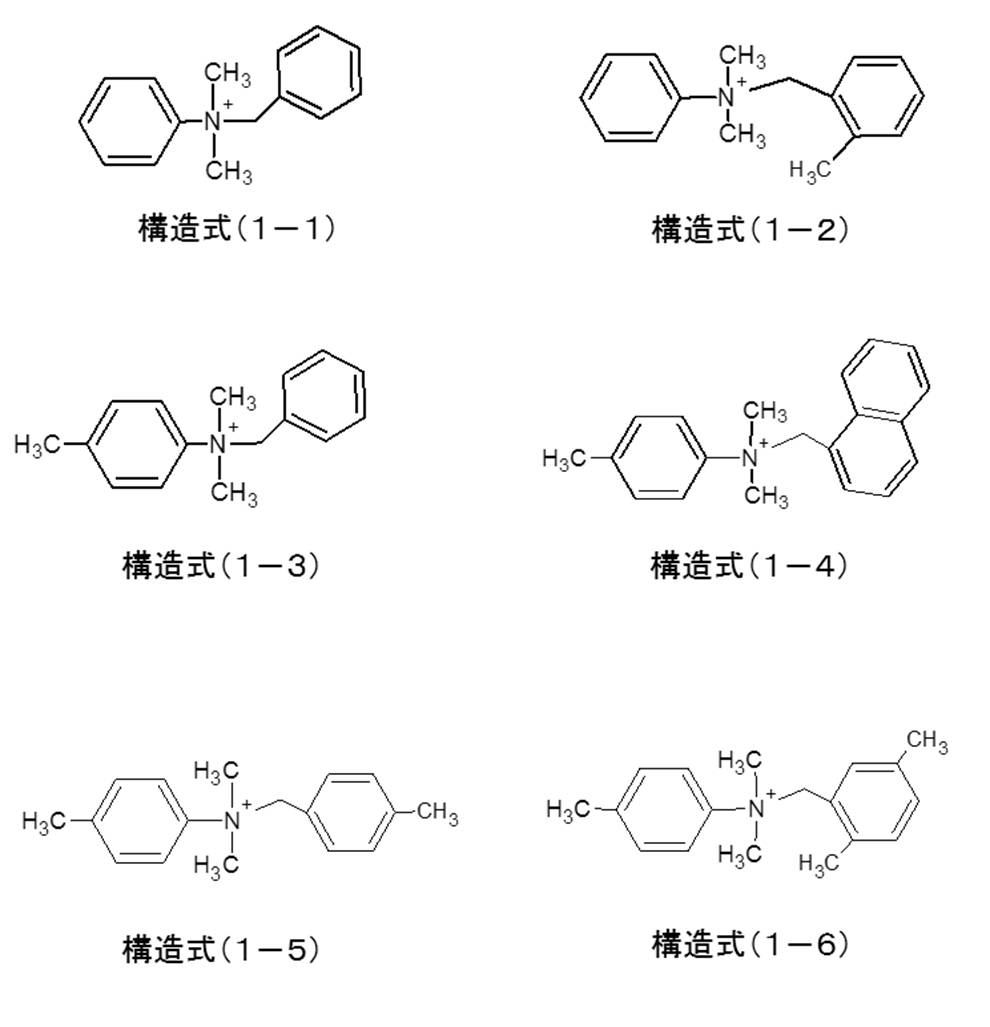
- Examples of the cation of the ammonium salt represented by the general formula (1) include cations represented by the following structural formulas (1-1) to (1-12).
- X - - X ⁇ in the general formula (1) is an anion.
- the anion an anion having a pKa of 3 or more at 25 ° C. in water of the conjugate acid is preferable.
- X ⁇ is preferably a carboxylate anion from the viewpoint of easy availability of raw materials and easy synthesis.
- Examples of the carboxylate anion include anions represented by the following general formula (3).
- R 21 represents a hydrocarbon group.
- the hydrocarbon group may have a halogen atom.
- the halogen atom include a fluorine atom and a chlorine atom.
- hydrocarbon group examples include a hydrocarbon group having a cyclic structure.
- hydrocarbon group having a cyclic structure examples include an aromatic hydrocarbon group and a hydrocarbon group having an alicyclic structure.
- the number of carbon atoms of the hydrocarbon group is not particularly limited and may be appropriately selected depending on the intended purpose, but is preferably 1 to 15, and more preferably 6 to 13.
- carboxylic acid examples include saturated fatty acids, unsaturated fatty acids, carboxylic acids having an aromatic ring, carboxylic acids having an alicyclic structure, acrylic acid, and trifluoroacetic acid.
- Examples of the saturated fatty acid include acetic acid, propionic acid, decanoic acid, myristic acid, stearic acid, 2-ethylhexanoic acid and the like.
- Examples of the unsaturated fatty acid include oleic acid and linoleic acid.
- Examples of the carboxylic acid having an alicyclic structure include 1-adamantane carboxylic acid and cyclohexane carboxylic acid.
- Examples of the carboxylic acid having an aromatic ring include substitution of benzoic acid, 2-methylbenzenecarboxylic acid, 2-phenylbenzenecarboxylic acid, 2,6-dimethylbenzenecarboxylic acid, 2-hydroxybenzenecarboxylic acid, and the like.
- Substituted benzoic acid (benzoic acid optionally having substituent); 1-naphthalene carboxylic acid, 2-naphthalene carboxylic acid, 2-hydroxy-1-naphthalene carboxylic acid, 3-hydroxy-2-naphthalene carboxylic acid, etc.
- carboxylic acid anion naphthalenecarboxylic acid anions, diphenylacetic acid anions, and 1-adamantanecarboxylic acid anions are preferable from the viewpoint that crystals are easily obtained.
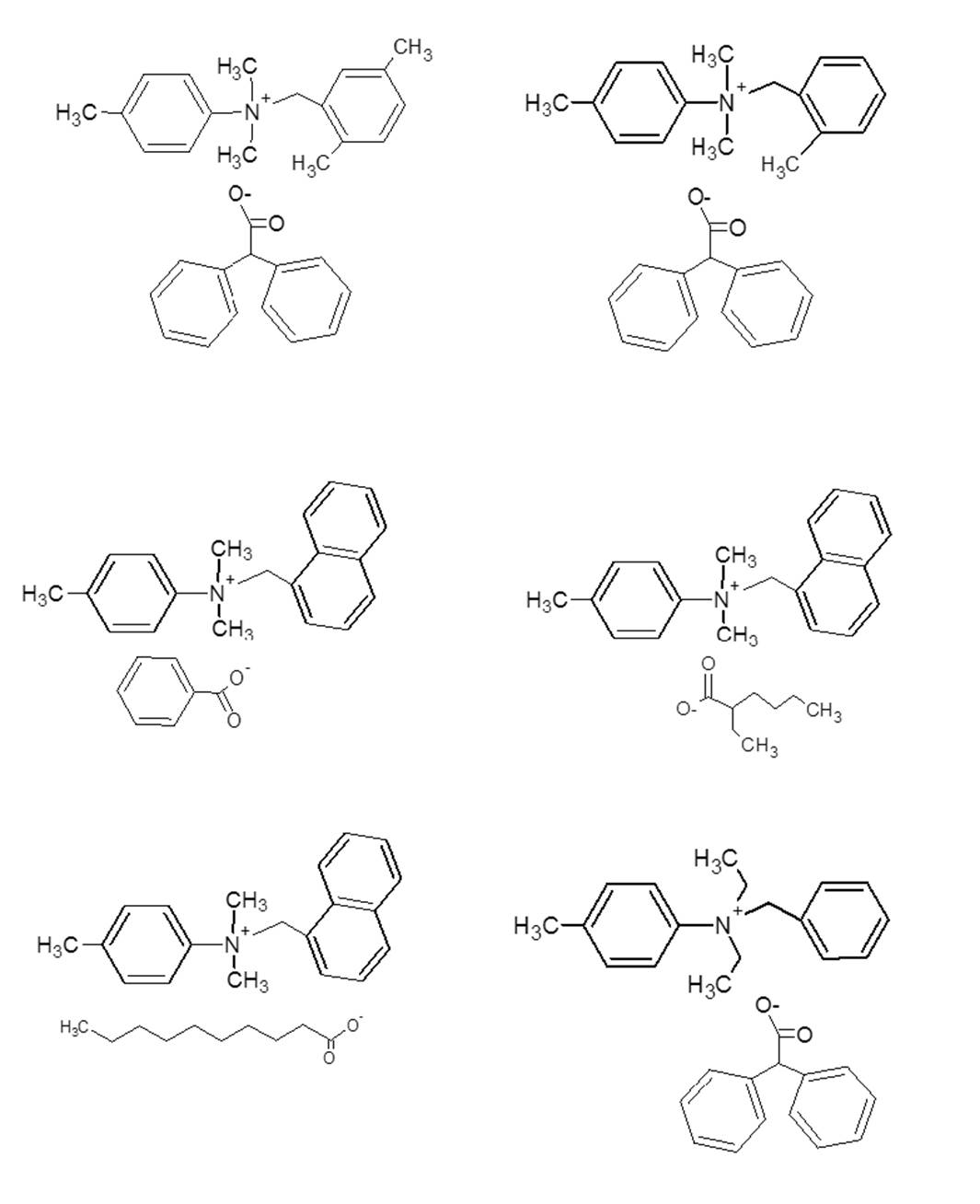
- ammonium salt examples include the following ammonium salts.
- thermosetting resin composition There is no restriction
- the film-forming resin is not particularly limited and can be appropriately selected depending on the purpose.
- polyacrylic resin, phenoxy resin, polyester resin, polyurethane resin, polyester urethane resin, polyvinyl butyral resin, polyvinyl formal resin examples thereof include polyamide resin and polyimide resin. These may be used individually by 1 type and may use 2 or more types together. Among these, a phenoxy resin is particularly preferable from the viewpoint of film formability and processability.
- phenoxy resin examples include those obtained by reacting a bifunctional phenol with epichlorohydrin to increase the molecular weight, or a resin obtained by polyaddition of a bifunctional epoxy resin and a bifunctional phenol.
- the bifunctional epoxy resin used include bisphenol A type epoxy resin, bisphenol F type epoxy resin, bisphenol AD type epoxy resin, bisphenol S type epoxy resin, biphenyl diglycidyl ether, and methyl-substituted biphenyl diglycidyl ether. It is done.
- bifunctional phenols examples include hydroquinones, bisphenol A, bisphenol F, bisphenol AD, bisphenol S, bisphenol fluorene, methyl-substituted bisphenol fluorene, bisphenols such as dihydroxybiphenyl and methyl-substituted dihydroxybiphenyl.
- thermosetting resin composition there is no restriction
- % By mass to 90% by mass is preferable, 20% by mass to 80% by mass is more preferable, and 30% by mass to 60% by mass is particularly preferable.
- the other components are not particularly limited and may be appropriately selected depending on the intended purpose. Examples thereof include thixotropic agents, fillers, leveling agents, antioxidants, colorants, conductivity-imparting agents, and adhesion-imparting agents. Is mentioned.
- thermosetting sheet The said thermosetting sheet
- the thermosetting sheet is formed, for example, by forming a thermosetting adhesive layer made of the thermosetting resin composition on a base film (peeling base).
- the base film include a polyethylene terephthalate film and a polyimide film.
- the thermosetting sheet is obtained by applying the thermosetting resin composition to a base film that is peel-treated with silicone or the like as necessary for a polyethylene terephthalate film, a polyimide film, or the like.
- the thermosetting adhesive layer is preferably formed with an average thickness of 10 ⁇ m to 50 ⁇ m.
- thermosetting resin composition and the thermosetting sheet can be preferably applied to the electronic component field.
- the thermosetting sheet adhesively fixes a terminal portion of a flexible printed wiring board and a reinforcing sheet having a thickness of 50 ⁇ m to 2 mm such as polyethylene terephthalate, polyimide, glass epoxy, stainless steel, and aluminum for lining it.
- the terminal portion of the flexible printed wiring board and the reinforcing sheet can be bonded with the thermosetting material of the thermosetting adhesive layer excluding the base film of the thermosetting sheet of the present invention.
- a reinforced flexible printed wiring board that is fixed is obtained.
- the compound of the present invention (first compound) is represented by the following general formula (1).
- the compound is useful as a curing accelerator or a precursor thereof that promotes low temperature curing by the thermal polymerization initiator while maintaining the storage stability of the thermosetting resin composition.
- R 1 and R 2 each independently represents an alkyl group having 1 to 4 carbon atoms
- R 3 represents a substituted aryl group
- R 4 represents a substituted or Represents an unsubstituted aralkyl group.
- X ⁇ represents an anion.
- Examples of the alkyl group having 1 to 4 carbon atoms of R 1 and R 2 in the general formula (1) of the compound (first compound) include, for example, a methyl group, an ethyl group, an n-propyl group, and iso-propyl. Group, n-butyl group, tert-butyl group and the like. Among these, a methyl group and an ethyl group are preferable from the viewpoint of thermal stability and ease of synthesis.
- the alkyl group has 3 or more carbon atoms, the thermal dissociation start temperature of the ammonium salt may be excessively lowered, and the thermal stability may be lowered. In addition, since the steric hindrance increases, the synthesis of the ammonium salt may be difficult.
- Examples of the substituted aryl group of R 3 in the general formula (1) of the compound (first compound) include a substituted aromatic hydrocarbon group.
- Examples of the substituted aromatic hydrocarbon group include a substituted phenyl group and a substituted naphthyl group.
- Examples of the substituted phenyl group include an alkyl-substituted phenyl group, a hydroxy-substituted phenyl group, and an alkoxy-substituted phenyl group.
- Examples of the alkyl substituent in the alkyl-substituted phenyl group include an alkyl group having 1 to 4 carbon atoms.
- alkyl group having 1 to 4 carbon atoms examples include a methyl group, an ethyl group, an n-propyl group, an iso-propyl group, an n-butyl group, and a tert-butyl group.
- Examples of the substituted or unsubstituted aralkyl group of R 4 in the general formula (1) of the compound (first compound) include an aralkyl group having 7 to 15 carbon atoms.
- Examples of the aryl group in the aralkyl group include an aromatic hydrocarbon group.
- Examples of the aromatic hydrocarbon group include a phenyl group, a naphthyl group, and an anthracenyl group.
- the substituent include an alkyl group having 1 to 4 carbon atoms.
- Examples of the alkyl group having 1 to 4 carbon atoms include a methyl group, an ethyl group, an n-propyl group, an iso-propyl group, an n-butyl group, and a tert-butyl group.
- Examples of the alkylene group in the aralkyl group include a methylene group and an ethylene group.
- Examples of the aralkyl group include benzyl group, o-methylbenzyl group, p-methylbenzyl group, 2,5-dimethylbenzyl group, (1-naphthyl) methyl group, and phenethyl group.
- the R 3 is a group represented by the following general formula (2), and it is easy to adjust the thermal dissociation start temperature, and synthesis It is preferable from the point that an object tends to become a crystal.
- R 5 represents either a hydrogen atom or an alkyl group having 1 to 4 carbon atoms.
- R 6 represents an alkyl group having 1 to 4 carbon atoms.
- m represents 0-3.
- n represents 0 to 3.
- m + n is 1 to 5. When m is 2 or 3, R 5 may be different. When n is 2 or 3, R 6 may be different.
- R 5 is preferably a hydrogen atom.
- R 6 is preferably a methyl group.
- Examples of the cation of the compound represented by the general formula (1) include cations represented by the following structural formulas (1-3) to (1-12).
- X - >> X ⁇ in the general formula (1) of the compound (first compound) is an anion.
- the anion is preferably a halogen anion or an anion having a pKa of 3 or more of its conjugate acid at 25 ° C. in water.
- the anion is an anion having a pKa of 3 or more at 25 ° C. in water of the conjugate acid
- the compound depends on the thermal polymerization initiator while maintaining the storage stability of the thermosetting resin composition. It is useful as a curing accelerator that promotes low temperature curing.
- the compound is useful as a precursor of the curing accelerator.
- the upper limit of the pKa is not particularly limited and may be appropriately selected depending on the intended purpose. However, the pKa is preferably 7 or less.
- halogen anion examples include chlorine ion, fluorine ion, bromine ion and iodine ion.
- X ⁇ is preferably a carboxylate anion from the viewpoint of easy availability of raw materials and easy synthesis.
- Examples of the carboxylate anion include anions represented by the following general formula (3).
- R 21 represents a hydrocarbon group.
- the hydrocarbon group may have a halogen atom.
- the halogen atom include a fluorine atom and a chlorine atom.
- hydrocarbon group examples include a hydrocarbon group having a cyclic structure.
- hydrocarbon group having a cyclic structure examples include an aromatic hydrocarbon group and a hydrocarbon group having an alicyclic structure.
- the number of carbon atoms of the hydrocarbon group is not particularly limited and may be appropriately selected depending on the intended purpose, but is preferably 1 to 15, and more preferably 6 to 13.
- carboxylic acid examples include saturated fatty acids, unsaturated fatty acids, carboxylic acids having an aromatic ring, carboxylic acids having an alicyclic structure, acrylic acid, and trifluoroacetic acid.
- Examples of the saturated fatty acid include acetic acid, propionic acid, decanoic acid, myristic acid, stearic acid, 2-ethylhexanoic acid and the like.
- Examples of the unsaturated fatty acid include oleic acid and linoleic acid.
- Examples of the carboxylic acid having an alicyclic structure include 1-adamantane carboxylic acid and cyclohexane carboxylic acid.
- Examples of the carboxylic acid having an aromatic ring include substitution of benzoic acid, 2-methylbenzenecarboxylic acid, 2-phenylbenzenecarboxylic acid, 2,6-dimethylbenzenecarboxylic acid, 2-hydroxybenzenecarboxylic acid, and the like.
- Substituted benzoic acid (benzoic acid optionally having substituent); 1-naphthalene carboxylic acid, 2-naphthalene carboxylic acid, 2-hydroxy-1-naphthalene carboxylic acid, 3-hydroxy-2-naphthalene carboxylic acid, etc.
- carboxylic acid anion naphthalenecarboxylic acid anions, diphenylacetic acid anions, and 1-adamantanecarboxylic acid anions are preferable from the viewpoint that crystals are easily obtained.
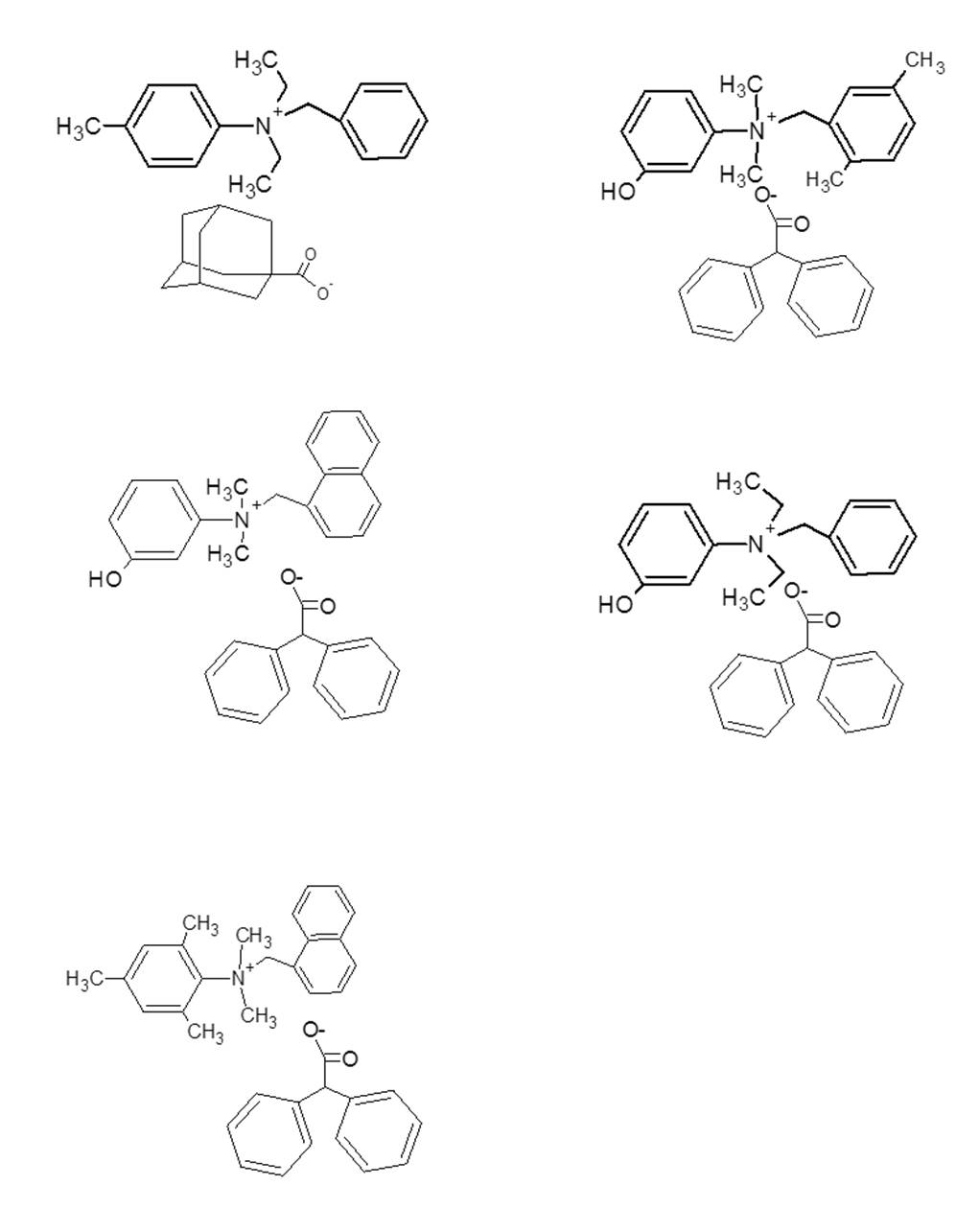
- Examples of the compound (first compound) include the following compounds.
- the compound of the present invention (second compound) is represented by the following general formula (1).
- the said compound is useful as a precursor for synthesize
- R 1 and R 2 each independently represents an alkyl group having 1 to 4 carbon atoms
- R 3 represents a substituted or unsubstituted aryl group
- R 4 represents Represents a substituted or unsubstituted aralkyl group.
- X ⁇ represents a halogen anion.
- This tertiary amine contributes to the promotion of decomposition of the thermal polymerization initiator (for example, organic peroxide thermal polymerization initiator), and effectively enhances the curing of the radical polymerization component.
- the thermal polymerization initiator for example, organic peroxide thermal polymerization initiator
- Examples of the alkyl group having 1 to 4 carbon atoms of R 1 and R 2 in the general formula (1) of the compound (second compound) include a methyl group, an ethyl group, an n-propyl group, and iso-propyl. Group, n-butyl group, tert-butyl group and the like. Among these, a methyl group and an ethyl group are preferable from the viewpoint of thermal stability and ease of synthesis.
- the alkyl group has 3 or more carbon atoms, the thermal dissociation start temperature of the ammonium salt may be excessively lowered, and the thermal stability may be lowered. In addition, since the steric hindrance increases, the synthesis of the ammonium salt may be difficult.
- Examples of the substituted aryl group of R 3 in the general formula (1) of the compound (second compound) include a substituted aromatic hydrocarbon group.
- Examples of the substituted aromatic hydrocarbon group include a substituted phenyl group and a substituted naphthyl group.
- Examples of the substituted phenyl group include an alkyl-substituted phenyl group, a hydroxy-substituted phenyl group, and an alkoxy-substituted phenyl group.
- Examples of the alkyl substituent in the alkyl-substituted phenyl group include an alkyl group having 1 to 4 carbon atoms.
- alkyl group having 1 to 4 carbon atoms examples include a methyl group, an ethyl group, an n-propyl group, an iso-propyl group, an n-butyl group, and a tert-butyl group.
- Examples of the substituted or unsubstituted aralkyl group of R 4 in the general formula (1) of the compound (second compound) include an aralkyl group having 7 to 15 carbon atoms.
- Examples of the aryl group in the aralkyl group include an aromatic hydrocarbon group.
- Examples of the aromatic hydrocarbon group include a phenyl group, a naphthyl group, and an anthracenyl group.
- the substituent include an alkyl group having 1 to 4 carbon atoms.
- Examples of the alkyl group having 1 to 4 carbon atoms include a methyl group, an ethyl group, an n-propyl group, an iso-propyl group, an n-butyl group, and a tert-butyl group.
- Examples of the alkylene group in the aralkyl group include a methylene group and an ethylene group.
- Examples of the aralkyl group include benzyl group, o-methylbenzyl group, p-methylbenzyl group, 2,5-dimethylbenzyl group, (1-naphthyl) methyl group, and phenethyl group.
- the R 3 is a group represented by the following general formula (2), and it is easy to adjust the thermal dissociation start temperature, and synthesis It is preferable from the point that an object tends to become a crystal.
- R 5 represents either a hydrogen atom or an alkyl group having 1 to 4 carbon atoms.
- R 6 represents an alkyl group having 1 to 4 carbon atoms.
- m represents 0-3.
- n represents 0 to 3.
- m + n is 0 to 5. When m is 2 or 3, R 5 may be different. When n is 2 or 3, R 6 may be different.
- m + n is preferably 1 to 5.
- R 5 is preferably a hydrogen atom.
- R 6 is preferably a methyl group.
- Examples of the cation of the compound represented by the general formula (1) include cations represented by the following structural formulas (1-1) to (1-12).
- halogen anion examples include chlorine ion, fluorine ion, bromine ion and iodine ion. Among these, chlorine ions are preferable.
- Examples of the compound (second compound) include the following compounds.
- Example A2 ⁇ Synthesis of ammonium salt A2>
- Example A1 was the same as Example A1 except that N, N-dimethylaniline was changed to 5.58 g (0.0413 mol) of N, N-dimethyl-p-toluidine (manufactured by Wako Pure Chemical Industries, Ltd.). As a result, 9.82 g (yield: 86.2%) of white crystals of ammonium salt A2 represented by the following structural formula (A2) were obtained.
- Example A3 ⁇ Synthesis of ammonium salt A3> Except that ⁇ -chloro-o-xylene was changed to 5.23 g (0.0413 mol) of benzyl chloride (manufactured by Tokyo Chemical Industry Co., Ltd.) in Example A2, the following structural formula (A3 9.03 g (yield 83.5%) of ammonium salt A3 represented by the following formula:
- Example A4 ⁇ Synthesis of ammonium salt A4>
- 10.0 g (0.0740 mol) 1- (chloromethyl) N, N-dimethyl-p-toluidine (manufactured by Wako Pure Chemical Industries, Ltd.) Naphthalene (manufactured by Tokyo Chemical Industry Co., Ltd.) 13.07 g (0.0740 mol) and 60 g of methanol were added, and the mixture was reacted at 50 ° C. for 8 hours with stirring. After cooling, the methanol was distilled off under reduced pressure to precipitate crystals.
- Example A5 ⁇ Synthesis of ammonium salt A5> In the same manner as in Example A2, except that ⁇ -chloro-o-xylene was changed to 6.39 g (0.0413 mol) of 2,5-dimethylbenzyl chloride (manufactured by Tokyo Chemical Industry Co., Ltd.) in Example A2. 8.99 g (yield 75.2%) of white crystals of ammonium salt A5 represented by the following structural formula (A5) was obtained.
- Example A6 ⁇ Synthesis of ammonium salt A6> In the same manner as in Example A2, except that ⁇ -chloro-o-xylene was changed to 5.81 g (0.0431 mol) of ⁇ -chloro-p-xylene (manufactured by Tokyo Chemical Industry Co., Ltd.) in Example A2. 8.91 g (yield 78.2%) of white crystals of ammonium salt A6 represented by the following structural formula (A6) were obtained.
- Example A7 ⁇ Synthesis of ammonium salt (stabilizer) A7>
- Example A5 was the same as Example A5 except that N, N-dimethyl-p-toluidine was changed to 5.91 g (0.0431 mol) of 3- (dimethylamino) phenol (manufactured by Tokyo Chemical Industry Co., Ltd.). Thus, 7.64 g (yield 62.1%) of reddish brown crystals of ammonium salt A7 represented by the following structural formula (A7) was obtained.
- Example B1 ⁇ Synthesis of ammonium salt B1> While keeping a 100 mL three-necked flask equipped with a stirrer in a light-shielded state, 2.42 g (0.0076 mol) of silver diphenylacetate synthesized in Synthesis Example 1 and 10 g of acetonitrile were put into the suspension state by stirring at room temperature. A solution prepared by dissolving 2.00 g (0.0076 mol) of the ammonium salt A1 synthesized in A1 in 20 g of acetonitrile and 2 g of methanol was added.
- Example B2 ⁇ Synthesis of ammonium salt B2>
- the ammonium salt A1 was changed to 2.10 g (0.0076 mol) of the ammonium salt A2 synthesized in Example A2, it is represented by the following structural formula (B2) in the same manner as in Example B1. 3.04 g (yield 88.5%) of white crystals of ammonium salt B2 was obtained.
- Example B3 ⁇ Synthesis of ammonium salt B3>
- the ammonium salt A1 was changed to 1.99 g (0.0076 mol) of the ammonium salt A3 synthesized in Example A3, it was represented by the following structural formula (B3) in the same manner as in Example B1. 3.07 g (yield 92.3%) of white crystals of ammonium salt B3 was obtained.
- Example B4 ⁇ Synthesis of ammonium salt B4>
- the ammonium salt A1 was changed to 2.37 g (0.0076 mol) of the ammonium salt A4 synthesized in Example A4, it was represented by the following structural formula (B4) in the same manner as in Example B1. 3.53 g (yield 95.3%) of white crystals of ammonium salt B4 were obtained.
- Example B5 ⁇ Synthesis of ammonium salt B5>
- the ammonium salt A1 was changed to 2.20 g (0.0076 mol) of the ammonium salt A5 synthesized in Example A5, it was represented by the following structural formula (B5) in the same manner as in Example B1. 3.23 g (yield 91.2%) of white crystals of ammonium salt B5 were obtained.
- Example B6 ⁇ Synthesis of ammonium salt B6>
- the ammonium salt A1 was changed to 2.10 g (0.0076 mol) of the ammonium salt A6 synthesized in Example A6, it was represented by the following structural formula (B6) in the same manner as in Example B1. 2.99 g (yield 87.1%) of white crystals of ammonium salt B6 was obtained.
- Example B7 ⁇ Synthesis of ammonium salt B7>
- ammonium salt A1 was changed to 2.22 g (0.0076 mol) of ammonium salt A7 synthesized in Example A7, it was represented by the following structural formula (B7) in the same manner as in Example B1. 3.02 g (yield 85.1%) of white crystals of ammonium salt B7 was obtained.
- Example B8 ⁇ Synthesis of ammonium salt B8>
- ammonium salt A1 was changed to 2.20 g (0.0076 mol) of ammonium salt A8 synthesized in Example A8, it was represented by the following structural formula (B8) in the same manner as in Example B1. 2.49 g (yield 70.3%) of white crystals of ammonium salt B8 were obtained.
- Example B9 ⁇ Synthesis of ammonium salt B9>
- silver diphenylacetate was changed to 2.18 g (0.0076 mol) of silver 1-adamantanecarboxylate synthesized in Synthesis Example 2, the following structural formula (B9) was used. 1.39 g (yield 42.3%) of white crystals of the ammonium salt B9 represented were obtained.
- Example B10 ⁇ Synthesis of ammonium salt B10>
- silver diphenylacetate was changed to 2.18 g (0.0076 mol) of silver 1-adamantanecarboxylate synthesized in Synthesis Example 2, the following structural formula (B10) was used. 2.50 g (yield 72.1%) of white crystals of ammonium salt B10 represented were obtained.
- Example B11 ⁇ Synthesis of ammonium salt B11>
- silver diphenyl acetate was changed to 1.74 g (0.0076 mol) of silver benzoate synthesized in Synthesis Example 3, it was represented by the following structural formula (B11) in the same manner as in Example B4. 2.15 g (yield 71.1%) of white crystals of ammonium salt B11 was obtained.
- Tables 1-1 and 1-2 show the pKa values at 25 ° C. in water of conjugate acids of ammonium salts B1 to B12 anions.
- Thermal dissociation start temperature of ammonium salts B1 to B13 Thermal dissociation of ammonium salts B1 to B13 is started using a TG / DTA6200 differential thermal thermogravimetric simultaneous measurement device manufactured by SII Nanotechnology Co., Ltd. under a nitrogen gas atmosphere at a heating rate of 10 ° C./min and 200 mL / min. The temperature was evaluated. The results are shown in Table 2-1 and Table 2-2. In addition, since the peak of DTA accompanying the thermal dissociation start was obtained except ammonium salt B7, the peak temperature was made into thermal dissociation start temperature.
- thermosetting resin compositions were prepared according to the formulations shown in Table 3-1 and Table 3-2.
- the prepared thermosetting resin composition is coated on release PET (polyethylene terephthalate) that has been subjected to silicone-based mold release treatment, and is dried in a hot-air circulating oven set at 60 ° C. for 5 minutes, thereby thermosetting with an average thickness of 15 ⁇ m. Sheet was prepared.
- the blending of phenoxy resin in Table 3-1 and Table 3-2 is the blending amount excluding the solvent, and the unit is parts by mass.
- the radical polymerization component, the thermal polymerization initiator, and the ammonium salt are also compounded in amounts excluding the solvent, and the unit is parts by mass.
- each material in Table 3 is as follows.
- YP70 manufactured by Nippon Steel & Sumikin Chemical Co., Ltd.
- bisphenol A / bisphenol F copolymerized phenoxy resin FX-316 manufactured by Nippon Steel & Sumikin Chemical Co., Ltd.
- bisphenol F-type phenoxy resin Aronix M-315 manufactured by Toagosei Co., Ltd.
- Isocyanuric acid EO modified di and triacrylate NK ester A-TMM-3L Shin-Nakamura Chemical Co., Ltd., pentaerythritol triacrylate Art Resin UN-5500: Negami Kogyo Co., Ltd., urethane acrylate oligomer Parroyl L: NOF Corporation Manufactured by Organic peroxide NIPPER BW: NOF Corporation, Organic peroxide
- YP70 and FX-316 used a 45 mass% solid content solution of methyl ethyl ketone.
- Aronix M-315 used a 50% by mass solid solution of toluene
- NK ester A-TMM-3L used the stock solution as it was.
- Art Resin UN-5500 was a 50% by weight solid solution of methyl ethyl ketone.
- Parroyl L was a 20% by weight solid solution of toluene.
- Nyper BW used a 20% by weight solid solution of acetone.
- ammonium salts B1 to B13 those dissolved in methanol to a solid content of 10% by mass were used.
- Niper BW 3.04 parts by mass and Parroyl L5 parts by mass are equimolar amounts.
- the ammonium salt was blended so as to be 30 mol% with respect to Parroyl L or Nyper BW.
- thermosetting sheets of Examples 1 to 16 and Comparative Examples 1 to 5 The initial low temperature curability and storage stability of the produced thermosetting sheets of Examples 1 to 16 and Comparative Examples 1 to 5 (average thickness: 15 ⁇ m) were determined by using a differential scanning calorimeter DSC6200 manufactured by SII NanoTechnology. It was evaluated by. Storage stability was evaluated by calculating the rate of decrease from the calorific value change in DSC before and after standing for 2 weeks in a dark environment of 25 ° C./65% Rh.
- the exothermic behavior by differential scanning calorimetry reflects the curing reaction behavior of the radical polymerization component. Therefore, it can be said that the lower the curing start temperature and the curing end temperature, the lower the curability of the composition.
- the low temperature curability was evaluated using as an index the temperature at which 2% of the total heat generation in the DSC chart reaches the curing start temperature and the temperature at which the curing end temperature reaches 98% of the total heat generation in the DSC chart. In either case, the lower temperature has low-temperature curing activity, but the exothermic (curing) end temperature, which is an indicator of the completion of the reaction, is a more important indicator.
- the amount of change in the total calorific value before and after being left reflects the amount of progress of the reaction during being left. It can be said that the smaller the change in calorific value before and after being left, the higher the storage stability. Specifically, the function as an adhesive sheet can be maintained by suppressing the decrease to 10% or less.
- thermosetting sheets of Examples 1 to 16 of the present invention both the curing start temperature and the curing end temperature can be lowered compared to Comparative Examples 1 and 2 in which no ammonium salt is added.
- Comparative Examples 1 and 2 in which no ammonium salt is added.
- Comparative Examples 3 to 5 to which an ammonium salt having a high thermal dissociation start temperature was added had almost no difference from those to which no ammonium salt was added (Comparative Examples 1 and 2), and no effect was observed. This result proved the usefulness of the present invention.
- thermosetting resin composition of the present invention can be cured at a low temperature in a short time and can ensure storage stability before curing, it can be suitably used as an adhesive for joining electronic components.
Landscapes
- Chemical & Material Sciences (AREA)
- Organic Chemistry (AREA)
- Health & Medical Sciences (AREA)
- Chemical Kinetics & Catalysis (AREA)
- Medicinal Chemistry (AREA)
- Polymers & Plastics (AREA)
- Engineering & Computer Science (AREA)
- Manufacturing & Machinery (AREA)
- Materials Engineering (AREA)
- Adhesives Or Adhesive Processes (AREA)
- Organic Low-Molecular-Weight Compounds And Preparation Thereof (AREA)
- Compositions Of Macromolecular Compounds (AREA)
- Polymerisation Methods In General (AREA)
- Addition Polymer Or Copolymer, Post-Treatments, Or Chemical Modifications (AREA)
Abstract
ラジカル重合成分と、熱重合開始剤と、アンモニウム塩とを含有し、前記アンモニウム塩の熱解離開始温度が、60℃~140℃である熱硬化性樹脂組成物である。
Description
本発明は、熱硬化性樹脂組成物、及び熱硬化性シート、並びにそれらに使用可能な新規化合物、及びその前駆体に関する。
近年、電子部品あるいは電子基板材料のコストダウン化が顕著であり、そのためにより安価な樹脂を材料とした部材設計が進められている。また、ディスプレイ関連材料においては、依然として軽薄短小を求められており、より薄く、より安価な部材の使用が必須となってきている。このため、必然として部材は耐熱性に劣るようになり、それら部材を接合するための接着剤はより低温で硬化できるものを要求されている。
ラジカル重合性樹脂、特にアクリル樹脂系の熱硬化を低温で行うために、3級アミンを併用する技術が、いくつか開示されている。特に、常温硬化を目的としての使用例は多く、例えば、特定の3級アミン、コバルト金属石鹸、及び有機過酸化物を併用する技術が開示されている(例えば、特許文献1参照)。また、3級アミン、ナフテン酸スズ、及び有機過酸化物を併用する技術が開示されている(例えば、特許文献2参照)。
これらは、いずれも有機過酸化物と3級アミンとを分けた2液の系であり、これらの例の通り、有機過酸化物と3級アミンの組合せは、そのままでは室温で反応が進行してしまい使用しづらいという問題がある。
これらは、いずれも有機過酸化物と3級アミンとを分けた2液の系であり、これらの例の通り、有機過酸化物と3級アミンの組合せは、そのままでは室温で反応が進行してしまい使用しづらいという問題がある。
この問題を解決するため、UV照射により3級アミンを生成させる技術が開示されている(特許文献3参照)。この技術では、4級アンモニウム塩誘導体を用いてUV照射により3級アミンを生成させている。
しかし、UV照射を併用する手段は、保存時には常に遮光を余儀なくされ、また、作業環境もUVカットが必要となる。さらに、UV照射のためのインフラを整備しなければならないためコスト面において不利となる。また、この技術では、UV照射しない場合には十分な接着強度が得られず、熱単独では硬化できない。
よって、低温かつ短時間で硬化が可能で、かつ硬化前の保存安定性が確保できる技術はまだ不十分といえる。
しかし、UV照射を併用する手段は、保存時には常に遮光を余儀なくされ、また、作業環境もUVカットが必要となる。さらに、UV照射のためのインフラを整備しなければならないためコスト面において不利となる。また、この技術では、UV照射しない場合には十分な接着強度が得られず、熱単独では硬化できない。
よって、低温かつ短時間で硬化が可能で、かつ硬化前の保存安定性が確保できる技術はまだ不十分といえる。
また、上記技術の他にも、種々の目的で、熱硬化性樹脂組成物にアンモニウム塩を配合する技術が提案されている(例えば、特許文献4~7参照)。
しかし、これらの技術においても、低温かつ短時間で硬化が可能で、かつ硬化前の保存安定性が確保できる技術はまだ不十分といえる。
しかし、これらの技術においても、低温かつ短時間で硬化が可能で、かつ硬化前の保存安定性が確保できる技術はまだ不十分といえる。
したがって、低温かつ短時間で硬化が可能で、かつ硬化前の保存安定性が確保できる熱硬化性樹脂組成物、及び熱硬化性シート、並びにそれらに使用可能な新規化合物、及びその前駆体の提供が求められているのが現状である。
本発明は、従来における前記諸問題を解決し、以下の目的を達成することを課題とする。即ち、本発明は、低温かつ短時間で硬化が可能で、かつ硬化前の保存安定性が確保できる熱硬化性樹脂組成物、及び熱硬化性シート、並びにそれらに使用可能な新規化合物、及びその前駆体を提供することを目的とする。
前記課題を解決するための手段としては、以下の通りである。即ち、
<1> ラジカル重合成分と、熱重合開始剤と、アンモニウム塩とを含有し、
前記アンモニウム塩の熱解離開始温度が、60℃~140℃であることを特徴とする熱硬化性樹脂組成物である。
<2> アンモニウム塩におけるアニオンの共役酸の水中25℃でのpKaが、3以上である前記<1>に記載の熱硬化性樹脂組成物である。
<3> アンモニウム塩が、下記一般式(1)で表される化合物である前記<1>から<2>のいずれかに記載の熱硬化性樹脂組成物である。

ただし、前記一般式(1)中、R1~R4は、それぞれ独立して、炭素数1~4のアルキル基、炭素数3~8のシクロアルキル基、置換又は無置換のアリール基、及び置換又は無置換のアラルキル基のいずれかを表す。X-は、アニオンを表す。
<4> 一般式(1)において、R1及びR2が、それぞれ独立して、炭素数1~4のアルキル基を表し、R3が、置換又は無置換のアリール基を表し、R4が、置換又は無置換のアラルキル基を表す、前記<3>に記載の熱硬化性樹脂組成物である。
<5> 一般式(1)において、R3が、下記一般式(2)で表される基である前記<3>から<4>のいずれかに記載の熱硬化性樹脂組成物である。

ただし、前記一般式(2)中、R5は、水素原子、及び炭素数1~4のアルキル基のいずれかを表す。R6は、炭素数1~4のアルキル基を表す。mは、0~3を表す。nは、0~3を表す。m+nは、0~5である。mが2又は3のとき、R5は、異なっていてもよい。nが2又は3のとき、R6は、異なっていてもよい。
<6> 一般式(1)におけるX-が、カルボン酸のアニオンである前記<3>から<5>のいずれかに記載の熱硬化性樹脂組成物である。
<7> 一般式(1)におけるX-が、ナフタレンカルボン酸類のアニオン、ジフェニル酢酸アニオン、及び1-アダマンタンカルボン酸アニオンのいずれかである前記<3>から<6>のいずれかに記載の熱硬化性樹脂組成物である。
<8> 熱重合開始剤が、有機過酸化物熱重合開始剤である前記<1>から<7>のいずれかに記載の熱硬化性樹脂組成物である。
<9> 有機過酸化物熱重合開始剤が、ジアシルパーオキサイド及びパーオキシジカーボネートの少なくともいずれかを含有する前記<8>に記載の熱硬化性樹脂組成物である。
<10> 前記<1>から<9>のいずれかに記載の熱硬化性樹脂組成物を含有することを特徴とする熱硬化性シートである。
<11> 下記一般式(1)で表されることを特徴とする化合物である。
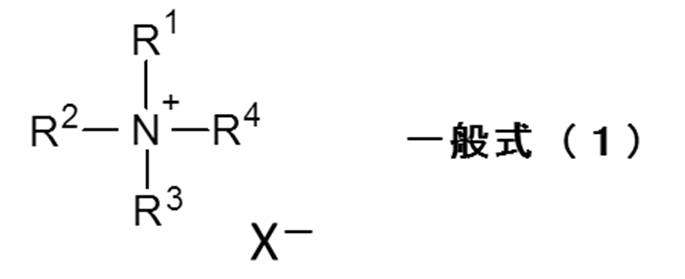
ただし、前記一般式(1)中、R1及びR2は、それぞれ独立して、炭素数1~4のアルキル基を表し、R3は、置換のアリール基を表し、R4は、置換又は無置換のアラルキル基を表す。X-は、アニオンを表す。
<12> 一般式(1)において、R3が、下記一般式(2)で表される基である前記<11>に記載の化合物である。
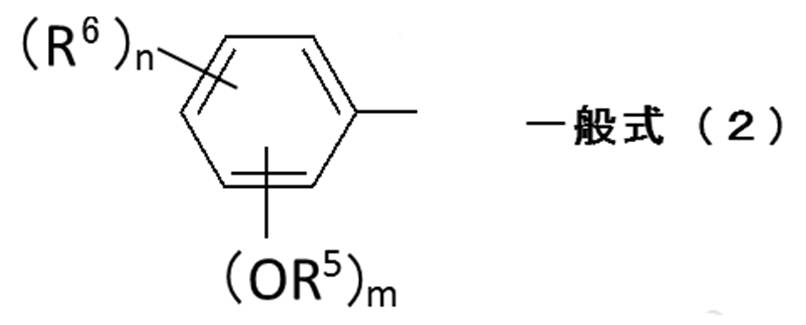
ただし、前記一般式(2)中、R5は、水素原子、及び炭素数1~4のアルキル基のいずれかを表す。R6は、炭素数1~4のアルキル基を表す。mは、0~3を表す。nは、0~3を表す。m+nは、1~5である。mが2又は3のとき、R5は、異なっていてもよい。nが2又は3のとき、R6は、異なっていてもよい。
<13> 一般式(1)におけるX-が、ハロゲンアニオン、ナフタレンカルボン酸類のアニオン、ジフェニル酢酸アニオン、及び1-アダマンタンカルボン酸アニオンのいずれかである前記<11>から<12>のいずれかに記載の化合物である。
<14> 下記一般式(1)で表されることを特徴とする化合物である。
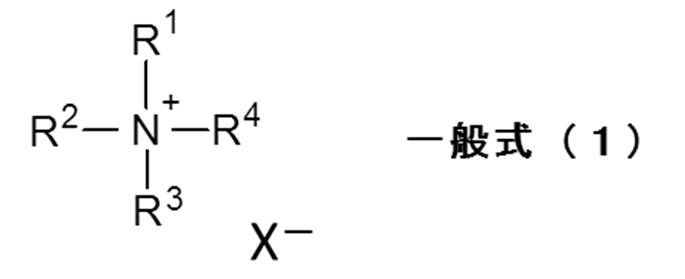
ただし、前記一般式(1)中、R1及びR2は、それぞれ独立して、炭素数1~4のアルキル基を表し、R3は、置換又は無置換のアリール基を表し、R4は、置換又は無置換のアラルキル基を表す。X-は、ハロゲンアニオンを表す。
<15> 一般式(1)において、R3が、下記一般式(2)で表される基である前記<14>に記載の化合物である。
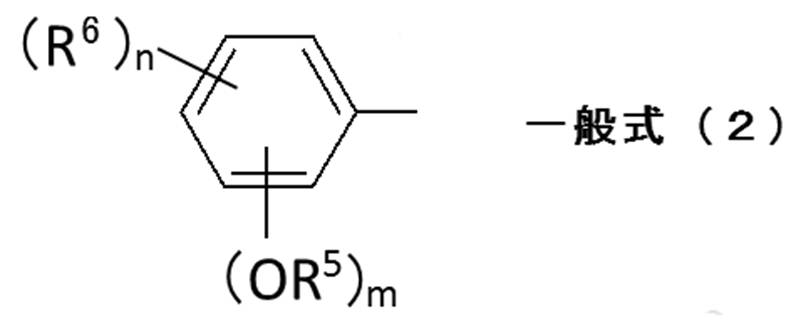
ただし、前記一般式(2)中、R5は、水素原子、及び炭素数1~4のアルキル基のいずれかを表す。R6は、炭素数1~4のアルキル基を表す。mは、0~3を表す。nは、0~3を表す。m+nは、0~5である。mが2又は3のとき、R5は、異なっていてもよい。nが2又は3のとき、R6は、異なっていてもよい。
<1> ラジカル重合成分と、熱重合開始剤と、アンモニウム塩とを含有し、
前記アンモニウム塩の熱解離開始温度が、60℃~140℃であることを特徴とする熱硬化性樹脂組成物である。
<2> アンモニウム塩におけるアニオンの共役酸の水中25℃でのpKaが、3以上である前記<1>に記載の熱硬化性樹脂組成物である。
<3> アンモニウム塩が、下記一般式(1)で表される化合物である前記<1>から<2>のいずれかに記載の熱硬化性樹脂組成物である。
<4> 一般式(1)において、R1及びR2が、それぞれ独立して、炭素数1~4のアルキル基を表し、R3が、置換又は無置換のアリール基を表し、R4が、置換又は無置換のアラルキル基を表す、前記<3>に記載の熱硬化性樹脂組成物である。
<5> 一般式(1)において、R3が、下記一般式(2)で表される基である前記<3>から<4>のいずれかに記載の熱硬化性樹脂組成物である。
<6> 一般式(1)におけるX-が、カルボン酸のアニオンである前記<3>から<5>のいずれかに記載の熱硬化性樹脂組成物である。
<7> 一般式(1)におけるX-が、ナフタレンカルボン酸類のアニオン、ジフェニル酢酸アニオン、及び1-アダマンタンカルボン酸アニオンのいずれかである前記<3>から<6>のいずれかに記載の熱硬化性樹脂組成物である。
<8> 熱重合開始剤が、有機過酸化物熱重合開始剤である前記<1>から<7>のいずれかに記載の熱硬化性樹脂組成物である。
<9> 有機過酸化物熱重合開始剤が、ジアシルパーオキサイド及びパーオキシジカーボネートの少なくともいずれかを含有する前記<8>に記載の熱硬化性樹脂組成物である。
<10> 前記<1>から<9>のいずれかに記載の熱硬化性樹脂組成物を含有することを特徴とする熱硬化性シートである。
<11> 下記一般式(1)で表されることを特徴とする化合物である。
<12> 一般式(1)において、R3が、下記一般式(2)で表される基である前記<11>に記載の化合物である。
<13> 一般式(1)におけるX-が、ハロゲンアニオン、ナフタレンカルボン酸類のアニオン、ジフェニル酢酸アニオン、及び1-アダマンタンカルボン酸アニオンのいずれかである前記<11>から<12>のいずれかに記載の化合物である。
<14> 下記一般式(1)で表されることを特徴とする化合物である。
<15> 一般式(1)において、R3が、下記一般式(2)で表される基である前記<14>に記載の化合物である。
本発明によれば、従来における前記諸問題を解決し、前記目的を達成することができ、低温かつ短時間で硬化が可能で、かつ硬化前の保存安定性が確保できる熱硬化性樹脂組成物、及び熱硬化性シート、並びにそれらに使用可能な新規化合物、及びその前駆体を提供することができる。
(熱硬化性樹脂組成物)
本発明の熱硬化性樹脂組成物は、ラジカル重合成分と、熱重合開始剤と、アンモニウム塩とを少なくとも含有し、好ましくは膜形成樹脂を含有し、更に必要に応じて、その他の成分を含有する。
本発明の熱硬化性樹脂組成物は、ラジカル重合成分と、熱重合開始剤と、アンモニウム塩とを少なくとも含有し、好ましくは膜形成樹脂を含有し、更に必要に応じて、その他の成分を含有する。
<ラジカル重合成分>
前記ラジカル重合成分としては、前記熱重合開始剤の作用によりラジカル重合する成分であれば、特に制限はなく、目的に応じて適宜選択することができ、例えば、(メタ)アクリレート類、ビニルエステル樹脂、不飽和ポリエステル樹脂、ジアリルフタレート、ビニルエーテル類、ジシクロペンタジエンなどが挙げられる。これらは、1種単独で使用してもよいし、2種以上を併用してもよい。
前記ラジカル重合成分としては、前記熱重合開始剤の作用によりラジカル重合する成分であれば、特に制限はなく、目的に応じて適宜選択することができ、例えば、(メタ)アクリレート類、ビニルエステル樹脂、不飽和ポリエステル樹脂、ジアリルフタレート、ビニルエーテル類、ジシクロペンタジエンなどが挙げられる。これらは、1種単独で使用してもよいし、2種以上を併用してもよい。
前記(メタ)アクリレート類としては、例えば、単官能(メタ)アクリレート類、多官能(メタ)アクリレート類などが挙げられる。
ここで、(メタ)アクリレートは、アクリレート及びメタクリレートを意味する。
ここで、(メタ)アクリレートは、アクリレート及びメタクリレートを意味する。
前記単官能(メタ)アクリレート類〔分子内に1個の(メタ)アクリロイル基を有する(メタ)アクリレート類〕としては、例えば、アルキル(メタ)アクリレート類、ヒドロキシアルキル(メタ)アクリレート類、芳香族環を有する単官能(メタ)アクリレート類などが挙げられる。
前記アルキル(メタ)アクリレート類としては、例えば、メチル(メタ)アクリレート、エチル(メタ)アクリレート、プロピル(メタ)アクリレート、イソプロピル(メタ)アクリレート、ブチル(メタ)アクリレート、イソブチル(メタ)アクリレート、2-エチルヘキシル(メタ)アクリレート、オクチル(メタ)アクリレート、イソオクチル(メタ)アクリレート、ラウリル(メタ)アクリレート、ステアリル(メタ)アクリレートなどが挙げられる。
前記ヒドロキシアルキル(メタ)アクリレート類としては、例えば、2-ヒドロキシエチル(メタ)アクリレ-ト、2-ヒドロキシプロピル(メタ)アクリレ-ト、4-ヒドロキシブチル(メタ)アクリレートなどが挙げられる。
前記芳香族環を有する単官能(メタ)アクリレート類としては、例えば、ベンジル(メタ)アクリレート、p-クミルフェノールアルキレンオキサイド付加物の(メタ)アクリレート、o-フェニルフェノールアルキレンオキサイド付加物の(メタ)アクリレート、フェノールアルキレンオキサイド付加物の(メタ)アクリレート、ノニルフェノールアルキレンオキサイド付加物の(メタ)アクリレートなどが挙げられる。ここで、前記アルキレンオキサイドとしては、例えば、エチレンオキサイド(EO)、プロピレンオキサイド(PO)などが挙げられる。
前記アルキル(メタ)アクリレート類としては、例えば、メチル(メタ)アクリレート、エチル(メタ)アクリレート、プロピル(メタ)アクリレート、イソプロピル(メタ)アクリレート、ブチル(メタ)アクリレート、イソブチル(メタ)アクリレート、2-エチルヘキシル(メタ)アクリレート、オクチル(メタ)アクリレート、イソオクチル(メタ)アクリレート、ラウリル(メタ)アクリレート、ステアリル(メタ)アクリレートなどが挙げられる。
前記ヒドロキシアルキル(メタ)アクリレート類としては、例えば、2-ヒドロキシエチル(メタ)アクリレ-ト、2-ヒドロキシプロピル(メタ)アクリレ-ト、4-ヒドロキシブチル(メタ)アクリレートなどが挙げられる。
前記芳香族環を有する単官能(メタ)アクリレート類としては、例えば、ベンジル(メタ)アクリレート、p-クミルフェノールアルキレンオキサイド付加物の(メタ)アクリレート、o-フェニルフェノールアルキレンオキサイド付加物の(メタ)アクリレート、フェノールアルキレンオキサイド付加物の(メタ)アクリレート、ノニルフェノールアルキレンオキサイド付加物の(メタ)アクリレートなどが挙げられる。ここで、前記アルキレンオキサイドとしては、例えば、エチレンオキサイド(EO)、プロピレンオキサイド(PO)などが挙げられる。
前記多官能(メタ)アクリレート類〔分子内に2個以上の(メタ)アクリロイル基を有する(メタ)アクリレート類〕としては、アルキレングリコールのジ(メタ)アクリレート類、脂環式環を有するジ(メタ)アクリレート類、芳香族環を有するジ(メタ)アクリレート類などが挙げられる。
前記アルキレングリコールのジ(メタ)アクリレート類としては、例えば、エチレングリコールジ(メタ)アクリレート、プロピレングリコールジ(メタ)アクリレート、ペンタンジオールジ(メタ)アクリレート、ヘキサンジオールジ(メタ)アクリレートなどが挙げられる。
前記脂環式環を有するジ(メタ)アクリレート類としては、例えば、トリシクロデカンジメチロールジ(メタ)アクリレート、1,4-シクロヘキサンジメチロールジ(メタ)アクリレート、ノルボルナンジメチロールジ(メタ)アクリレート、水素添加ビスフェノールAのジ(メタ)アクリレートなどが挙げられる。
前記芳香族環を有するジ(メタ)アクリレート類としては、例えば、ビスフェノールAアルキレンオキサイド付加物のジ(メタ)アクリレート、ビスフェノールAジグリシジルエーテルのジ(メタ)アクリレートなどが挙げられる。
前記アルキレングリコールのジ(メタ)アクリレート類としては、例えば、エチレングリコールジ(メタ)アクリレート、プロピレングリコールジ(メタ)アクリレート、ペンタンジオールジ(メタ)アクリレート、ヘキサンジオールジ(メタ)アクリレートなどが挙げられる。
前記脂環式環を有するジ(メタ)アクリレート類としては、例えば、トリシクロデカンジメチロールジ(メタ)アクリレート、1,4-シクロヘキサンジメチロールジ(メタ)アクリレート、ノルボルナンジメチロールジ(メタ)アクリレート、水素添加ビスフェノールAのジ(メタ)アクリレートなどが挙げられる。
前記芳香族環を有するジ(メタ)アクリレート類としては、例えば、ビスフェノールAアルキレンオキサイド付加物のジ(メタ)アクリレート、ビスフェノールAジグリシジルエーテルのジ(メタ)アクリレートなどが挙げられる。
また、前記(メタ)アクリレート類としては、例えば、イソシアヌル酸エチレンオキサイド(EO)変性多官能(メタ)アクリレート、ペンタエリスリトールトリアクリレートなども用いることができる。前記イソシアヌル酸EO変性多官能(メタ)アクリレートとしては、例えば、イソシアヌル酸EO変性ジ及びトリアクリレート(例えば、東亞合成株式会社製のアロニックスM-315)などが挙げられる。
また、前記(メタ)アクリレート類としては、例えば、ウレタン(メタ)アクリレートなども用いることができる。
前記(メタ)アクリレート類は、1種単独で使用してもよいし、2種以上を併用してもよい。
前記熱硬化性樹脂組成物における前記ラジカル重合成分の含有量としては、特に制限はなく、目的に応じて適宜選択することができるが、前記熱硬化性樹脂組成物の不揮発分に対して、10質量%~90質量%が好ましく、20質量%~80質量%がより好ましく、30質量%~80質量%が特に好ましい。
<熱重合開始剤>
前記熱重合開始剤としては、熱により分解し、前記ラジカル重合成分をラジカル重合させるものであれば、特に制限はなく、目的に応じて適宜選択することができ、例えば、アゾ系熱重合開始剤、有機過酸化物熱重合開始剤などが挙げられる。これらの中でも、低温硬化性に優れる点で、有機過酸化物熱重合開始剤が好ましい。
前記熱重合開始剤としては、熱により分解し、前記ラジカル重合成分をラジカル重合させるものであれば、特に制限はなく、目的に応じて適宜選択することができ、例えば、アゾ系熱重合開始剤、有機過酸化物熱重合開始剤などが挙げられる。これらの中でも、低温硬化性に優れる点で、有機過酸化物熱重合開始剤が好ましい。
前記有機過酸化物熱重合開始剤としては、特に制限はなく、目的に応じて適宜選択することができるが、前記アンモニウム塩による分解促進効果を享受しやすい点で、ジアシルパーオキサイド、パーオキシジカーボネートが好ましい。
前記ジアシルパーオキサイドとしては、例えば、ジイソブチリルパーオキサイド、ジ(3,5,5-トリメチルヘキサノイル)パーオキサイド、ジラウロイルパーオキサイド、ジスクシン酸パーオキサイド、ジベンゾイルパーオキサイド、ジ(4-メチルベンゾイル)パーオキサイドなどが挙げられる。
前記パーオキシジカーボネートとしては、例えば、ジ-n-プロピルパーオキシジカーボネート、ジイソプロピルパーオキシジカーボネート、ジ-sec-ブチルパーオキシジカーボネート、ジ(2-エチルヘキシル)パーオキシジカーボネート、ジ(4-t-ブチルシクロへキシル)パーオキシジカーボネートなどが挙げられる。
前記ジアシルパーオキサイドとしては、例えば、ジイソブチリルパーオキサイド、ジ(3,5,5-トリメチルヘキサノイル)パーオキサイド、ジラウロイルパーオキサイド、ジスクシン酸パーオキサイド、ジベンゾイルパーオキサイド、ジ(4-メチルベンゾイル)パーオキサイドなどが挙げられる。
前記パーオキシジカーボネートとしては、例えば、ジ-n-プロピルパーオキシジカーボネート、ジイソプロピルパーオキシジカーボネート、ジ-sec-ブチルパーオキシジカーボネート、ジ(2-エチルヘキシル)パーオキシジカーボネート、ジ(4-t-ブチルシクロへキシル)パーオキシジカーボネートなどが挙げられる。
前記熱硬化性樹脂組成物における前記熱重合開始剤の含有量としては、特に制限はなく、目的に応じて適宜選択することができるが、前記熱硬化性樹脂組成物の不揮発分に対して、0.5質量%~20質量%が好ましく、1質量%~15質量%がより好ましい。
<アンモニウム塩>
前記アンモニウム塩としては、熱解離開始温度が、60℃~140℃であれば、特に制限はなく、目的に応じて適宜選択することができる。
前記熱解離開始温度が、60℃未満であると、低温硬化性は優れるが、保存安定性が不十分となり、140℃を超えると、低温硬化性が不十分となる。
前記アンモニウム塩としては、熱解離開始温度が、60℃~140℃であれば、特に制限はなく、目的に応じて適宜選択することができる。
前記熱解離開始温度が、60℃未満であると、低温硬化性は優れるが、保存安定性が不十分となり、140℃を超えると、低温硬化性が不十分となる。
前記熱解離開始温度とは、充分乾燥させたアンモニウム塩単体を加熱した場合に熱解離を起こし始める温度であり、具体的には、示差熱熱重量同時測定装置(TG/DTA)を用いたN2ガス雰囲気中での昇温速度10℃/minにおける熱重量減少の開始に伴うDTAピーク温度である。DTAのピークが明瞭でない場合には、TGチャートにおける5%重量減少点の接線と重量減少0%のベースラインの交点の温度を前記熱解離開始温度とする。
前記アンモニウム塩の前記熱解離開始温度が60℃~140℃であることにより、効果的に前記熱硬化性樹脂組成物の熱硬化を促進し、かつ前記熱硬化性樹脂組成物は保存安定性に優れたものとなる。
前記アンモニウム塩の前記熱解離開始温度が60℃~140℃であることにより、効果的に前記熱硬化性樹脂組成物の熱硬化を促進し、かつ前記熱硬化性樹脂組成物は保存安定性に優れたものとなる。
前記アンモニウム塩は、熱解離開始温度を60℃~140℃に調整しやすい点で、前記アンモニウム塩におけるアニオンの共役酸の水中25℃でのpKaが、3以上であるアンモニウム塩が好ましい。前記pKaが、3未満であると、熱解離開始温度が上がり、熱硬化の促進効果が低くなることがある。
前記pKaの上限値としては、特に制限はなく、目的に応じて適宜選択することができるが、前記pKaは、7以下が好ましい。
前記pKaの上限値としては、特に制限はなく、目的に応じて適宜選択することができるが、前記pKaは、7以下が好ましい。
前記pKaが3以上である共役酸としては、例えば、電気化学便覧第5版(電気化学会編:丸善)のp.102~p.104、または、以下のURLアドレスより水中におけるpKaデータを参照することができる。
http://www.chem.wisc.edu/areas/organic/index-chem.htm
http://www.chem.wisc.edu/areas/organic/index-chem.htm
前記アンモニウム塩のアニオンとしては、カルボン酸のアニオンが、原料が入手しやすい点、及び合成がしやすい点から好ましい。
<<一般式(1)で表される化合物>>
また、前記アンモニウム塩は、原料の入手のし易さ、及び合成のし易さの点で、下記一般式(1)で表される化合物が好ましい。
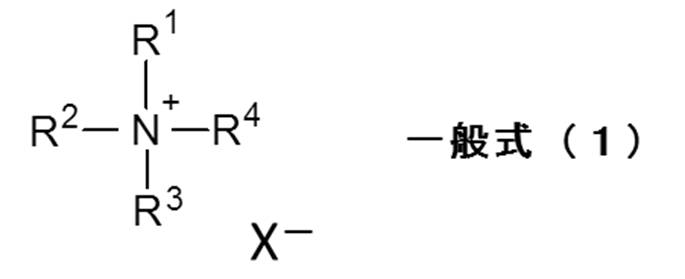
ただし、前記一般式(1)中、R1~R4は、それぞれ独立して、炭素数1~4のアルキル基、炭素数3~8のシクロアルキル基、置換又は無置換のアリール基、及び置換又は無置換のアラルキル基のいずれかを表す。X-は、アニオンを表す。
また、前記アンモニウム塩は、原料の入手のし易さ、及び合成のし易さの点で、下記一般式(1)で表される化合物が好ましい。
前記一般式(1)における前記R1~R4の炭素数1~4のアルキル基としては、例えば、メチル基、エチル基、n-プロピル基、iso-プロピル基、n-ブチル基、tert-ブチル基などが挙げられる。これらの中でも、メチル基、エチル基が、熱安定性の点、及び合成の容易性の点で好ましい。前記アルキル基の炭素数が、3以上であると、前記アンモニウム塩の熱解離開始温度が過度に下がり、熱安定性が低下することがある。また、立体障害が大きくなるため、前記アンモニウム塩の合成が困難になることがある。
前記一般式(1)における前記R1~R4の炭素数3~8のシクロアルキル基としては、例えば、シクロプロピル基、シクロブチル基、シクロペンチル基、シクロヘキシル基、シクロヘプチル基、シクロオクチル基などが挙げられる。これらの中でも、シクロヘキシル基が、原料の入手のし易さの点で好ましい。
前記一般式(1)における前記R1~R4の置換又は無置換のアリール基としては、例えば、無置換の芳香族炭化水素基、置換の芳香族炭化水素基などが挙げられる。前記無置換の芳香族炭化水素基としては、例えば、フェニル基、ナフチル基などが挙げられる。前記置換の芳香族炭化水素基としては、例えば、置換のフェニル基、置換のナフチル基などが挙げられる。前記置換のフェニル基としては、例えば、アルキル置換のフェニル基、ヒドロキシ置換のフェニル基、アルコキシ置換のフェニル基などが挙げられる。前記アルキル置換のフェニル基におけるアルキル置換基としては、例えば、炭素数1~4のアルキル基などが挙げられる。前記炭素数1~4のアルキル基としては、例えば、メチル基、エチル基、n-プロピル基、iso-プロピル基、n-ブチル基、tert-ブチル基などが挙げられる。
前記一般式(1)における前記R1~R4の置換又は無置換のアラルキル基としては、例えば、炭素数7~15のアラルキル基などが挙げられる。
前記アラルキル基におけるアリール基としては、例えば、芳香族炭化水素基などが挙げられる。前記芳香族炭化水素基としては、例えば、フェニル基、ナフチル基、アントラセニル基などが挙げられる。前記置換基としては、例えば、炭素数1~4のアルキル基などが挙げられる。前記炭素数1~4のアルキル基としては、例えば、メチル基、エチル基、n-プロピル基、iso-プロピル基、n-ブチル基、tert-ブチル基などが挙げられる。
前記アラルキル基におけるアルキレン基としては、例えば、メチレン基、エチレン基などが挙げられる。
前記アラルキル基としては、例えば、ベンジル基、o-メチルベンジル基、p-メチルベンジル基、2,5-ジメチルベンジル基、(1-ナフチル)メチル基、フェネチル基などが挙げられる。
前記アラルキル基におけるアリール基としては、例えば、芳香族炭化水素基などが挙げられる。前記芳香族炭化水素基としては、例えば、フェニル基、ナフチル基、アントラセニル基などが挙げられる。前記置換基としては、例えば、炭素数1~4のアルキル基などが挙げられる。前記炭素数1~4のアルキル基としては、例えば、メチル基、エチル基、n-プロピル基、iso-プロピル基、n-ブチル基、tert-ブチル基などが挙げられる。
前記アラルキル基におけるアルキレン基としては、例えば、メチレン基、エチレン基などが挙げられる。
前記アラルキル基としては、例えば、ベンジル基、o-メチルベンジル基、p-メチルベンジル基、2,5-ジメチルベンジル基、(1-ナフチル)メチル基、フェネチル基などが挙げられる。
前記一般式(1)は、R1及びR2が、それぞれ独立して、炭素数1~4のアルキル基を表し、R3が、置換又は無置換のアリール基を表し、R4が、置換又は無置換のアラルキル基を表すことが好ましい。そうすることで、N位のベンジル炭素が熱により速やかに脱離し、3級アミンが生成される。この3級アミンが熱重合開始剤(例えば、有機過酸化物熱重合開始剤)の分解促進に寄与し、ラジカル重合成分の硬化を効果的に高める。
前記一般式(1)において、前記R3は、下記一般式(2)で表される基であることが、熱解離開始温度を調整しやすい点、及び合成物が結晶となりやすい点から好ましい。

ただし、前記一般式(2)中、R5は、水素原子、及び炭素数1~4のアルキル基のいずれかを表す。R6は、炭素数1~4のアルキル基を表す。mは、0~3を表す。nは、0~3を表す。m+nは、0~5である。mが2又は3のとき、R5は、異なっていてもよい。nが2又は3のとき、R6は、異なっていてもよい。
前記一般式(2)において、m+nは、1~5が好ましい。
前記一般式(2)において、R5は、水素原子が好ましい。
前記一般式(2)において、R6は、メチル基が好ましい。
前記一般式(2)において、R5は、水素原子が好ましい。
前記一般式(2)において、R6は、メチル基が好ましい。
前記一般式(1)で表されるアンモニウム塩のカチオンとしては、例えば、下記構造式(1-1)~(1-12)で表されるカチオンなどが挙げられる。

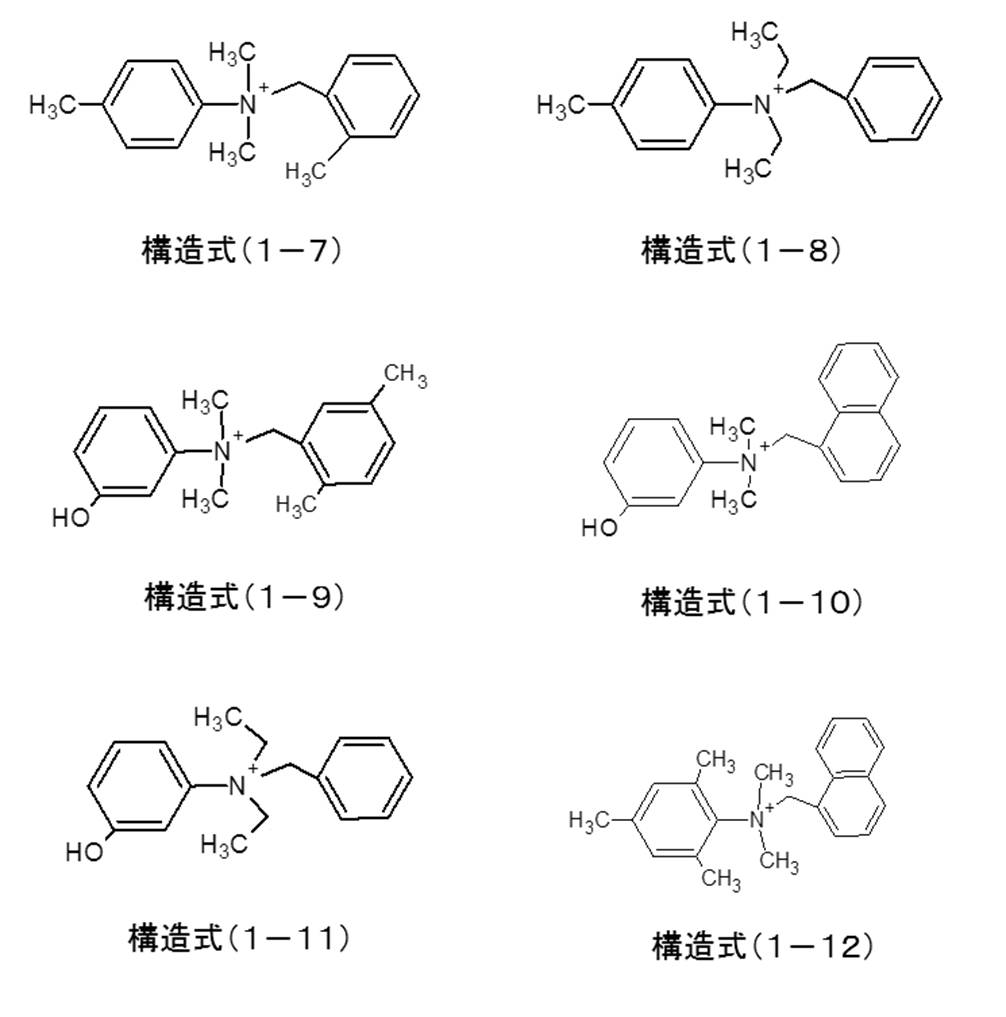
-一般式(1)のX--
前記一般式(1)におけるX-は、アニオンである。
前記アニオンとしては、その共役酸の水中25℃でのpKaが3以上であるアニオンが好ましい。
前記一般式(1)におけるX-は、アニオンである。
前記アニオンとしては、その共役酸の水中25℃でのpKaが3以上であるアニオンが好ましい。
前記X-としては、カルボン酸アニオンが、原料が入手しやすい点、及び合成がしやすい点から好ましい。
前記カルボン酸アニオンとしては、例えば、下記一般式(3)で表されるアニオンなどが挙げられる。

前記一般式(3)中、R21は、炭化水素基を表す。
前記炭化水素基は、ハロゲン原子を有していてもよい。前記ハロゲン原子としては、例えば、フッ素原子、塩素原子などが挙げられる。
前記炭化水素基としては、例えば、環状構造を有する炭化水素基などが挙げられる。
前記環状構造を有する炭化水素基としては、例えば、芳香族を有する炭化水素基、脂環構造を有する炭化水素基などが挙げられる。
前記炭化水素基の炭素数としては、特に制限はなく、目的に応じて適宜選択することができるが、1~15が好ましく、6~13がより好ましい。
前記カルボン酸としては、飽和脂肪酸、不飽和脂肪酸、芳香環を有するカルボン酸、脂環構造を有するカルボン酸、アクリル酸、トリフルオロ酢酸などが挙げられる。
前記飽和脂肪酸としては、例えば、酢酸、プロピオン酸、デカン酸、ミリスチン酸、ステアリン酸、2-エチルヘキサン酸などが挙げられる。
前記不飽和脂肪酸としては、例えば、オレイン酸、リノール酸などが挙げられる。
前記脂環構造を有するカルボン酸としては、例えば、1-アダマンタンカルボン酸、シクロヘキサンカルボン酸などが挙げられる。
前記芳香環を有するカルボン酸としては、例えば、安息香酸、2-メチルベンゼンカルボン酸、2-フェニルベンゼンカルボン酸、2,6-ジメチルベンゼンカルボン酸、2-ヒドロキシベンゼンカルボン酸等の置換、又は無置換の安息香酸類(置換基を有していてもよい安息香酸);1-ナフタレンカルボン酸、2-ナフタレンカルボン酸、2-ヒドロキシ-1-ナフタレンカルボン酸、3-ヒドロキシ-2-ナフタレンカルボン酸等のナフタレンカルボン酸類;ナフタレン酢酸、フェニルプロピオン酸、ジフェニル酢酸、トリフェニル酢酸などが挙げられる。
前記不飽和脂肪酸としては、例えば、オレイン酸、リノール酸などが挙げられる。
前記脂環構造を有するカルボン酸としては、例えば、1-アダマンタンカルボン酸、シクロヘキサンカルボン酸などが挙げられる。
前記芳香環を有するカルボン酸としては、例えば、安息香酸、2-メチルベンゼンカルボン酸、2-フェニルベンゼンカルボン酸、2,6-ジメチルベンゼンカルボン酸、2-ヒドロキシベンゼンカルボン酸等の置換、又は無置換の安息香酸類(置換基を有していてもよい安息香酸);1-ナフタレンカルボン酸、2-ナフタレンカルボン酸、2-ヒドロキシ-1-ナフタレンカルボン酸、3-ヒドロキシ-2-ナフタレンカルボン酸等のナフタレンカルボン酸類;ナフタレン酢酸、フェニルプロピオン酸、ジフェニル酢酸、トリフェニル酢酸などが挙げられる。
前記カルボン酸アニオンとしては、ナフタレンカルボン酸類のアニオン、ジフェニル酢酸アニオン、1-アダマンタンカルボン酸アニオンが、結晶が得られやすい点から好ましい。
前記アンモニウム塩としては、例えば、以下のアンモニウム塩などが挙げられる。
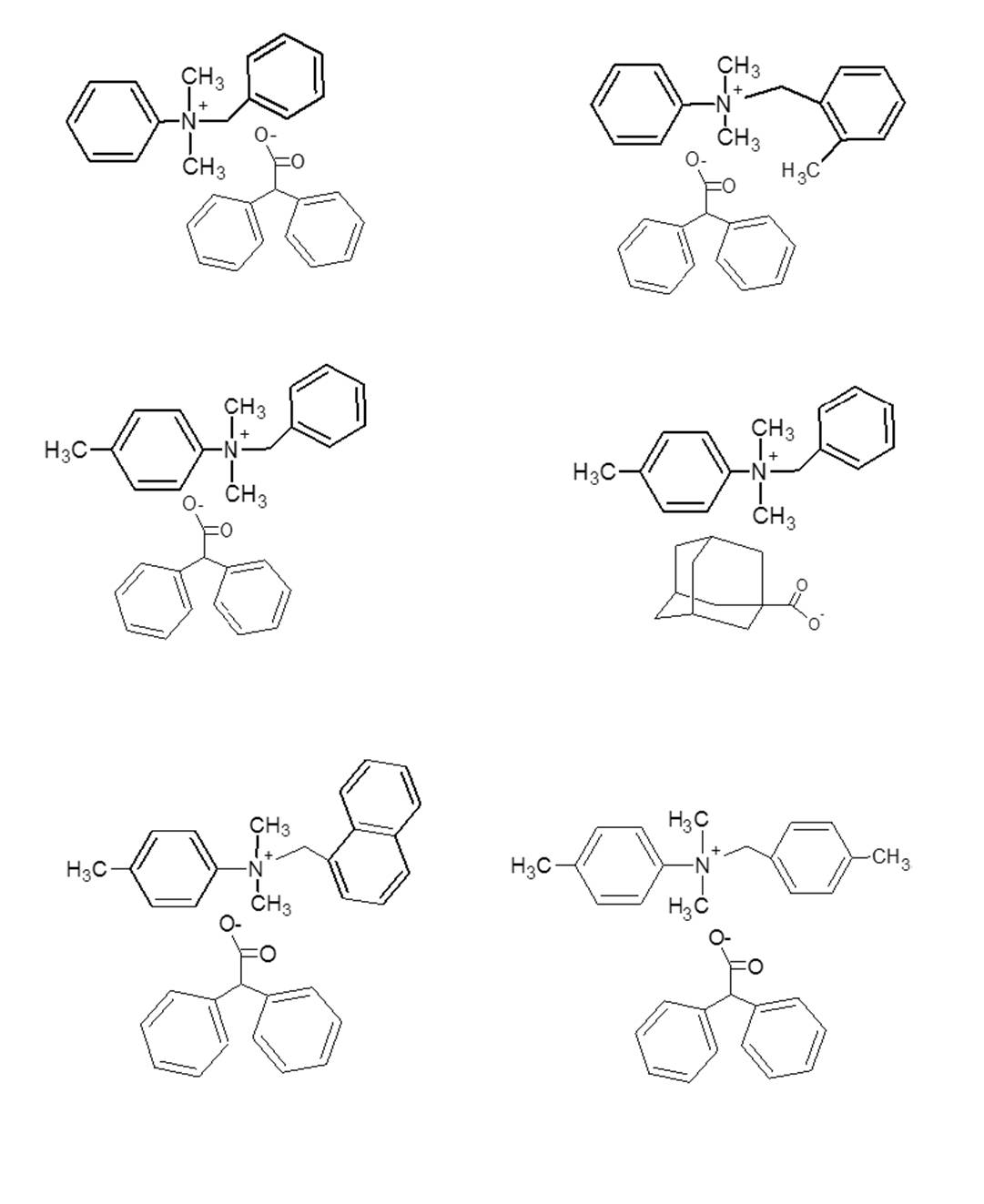


前記熱硬化性樹脂組成物における前記アンモニウム塩の含有量としては、特に制限はなく、目的に応じて適宜選択することができるが、前記熱硬化性樹脂組成物の不揮発分に対して、0.1質量%~10質量%が好ましく、0.5質量%~7.0質量%がより好ましく、0.5質量%~5.0質量%が特に好ましい。前記含有量が、0.1質量%未満であると、所望の分解促進効果が得られなくなることがあり、10質量%を超えると、前記熱硬化性樹脂組成物の保存安定性が低下することがある。前記含有量が、前記特に好ましい範囲内であると、前記熱重合開始剤(特に前記有機過酸化物熱重合開始剤)の分解促進と、前記熱硬化性樹脂組成物の保存安定性とを両立しやすい点で有利である。
<膜形成樹脂>
前記膜形成樹脂としては、特に制限はなく、目的に応じて適宜選択することができ、例えば、ポリアクリル樹脂、フェノキシ樹脂、ポリエステル樹脂、ポリウレタン樹脂、ポリエステルウレタン樹脂、ポリビニルブチラール樹脂、ポリビニルホルマール樹脂、ポリアミド樹脂、ポリイミド樹脂などが挙げられる。これらは、1種単独で使用してもよいし、2種以上を併用してもよい。これらの中でも、製膜性、加工性の点からフェノキシ樹脂が特に好ましい。
前記膜形成樹脂としては、特に制限はなく、目的に応じて適宜選択することができ、例えば、ポリアクリル樹脂、フェノキシ樹脂、ポリエステル樹脂、ポリウレタン樹脂、ポリエステルウレタン樹脂、ポリビニルブチラール樹脂、ポリビニルホルマール樹脂、ポリアミド樹脂、ポリイミド樹脂などが挙げられる。これらは、1種単独で使用してもよいし、2種以上を併用してもよい。これらの中でも、製膜性、加工性の点からフェノキシ樹脂が特に好ましい。
前記フェノキシ樹脂としては、例えば、2官能フェノール類とエピクロルヒドリンとを反応させ高分子量化したもの、あるいは2官能エポキシ樹脂と2官能フェノール類とを重付加することにより得られる樹脂などが挙げられる。
使用される2官能エポキシ樹脂としては、例えば、ビスフェノールA型エポキシ樹脂、ビスフェノールF型エポキシ樹脂、ビスフェノールAD型エポキシ樹脂、ビスフェノールS型エポキシ樹脂、ビフェニルジグリシジルエーテル、メチル置換ビフェニルジグリシジルエーテルなどが挙げられる。
また、2官能フェノール類としては、例えば、ハイドロキノン類、ビスフェノールA、ビスフェノールF、ビスフェノールAD、ビスフェノールS、ビスフェノールフルオレン、メチル置換ビスフェノールフルオレン、ジヒドロキシビフェニル、メチル置換ジヒドロキシビフェニル等のビスフェノール類などが挙げられる。
使用される2官能エポキシ樹脂としては、例えば、ビスフェノールA型エポキシ樹脂、ビスフェノールF型エポキシ樹脂、ビスフェノールAD型エポキシ樹脂、ビスフェノールS型エポキシ樹脂、ビフェニルジグリシジルエーテル、メチル置換ビフェニルジグリシジルエーテルなどが挙げられる。
また、2官能フェノール類としては、例えば、ハイドロキノン類、ビスフェノールA、ビスフェノールF、ビスフェノールAD、ビスフェノールS、ビスフェノールフルオレン、メチル置換ビスフェノールフルオレン、ジヒドロキシビフェニル、メチル置換ジヒドロキシビフェニル等のビスフェノール類などが挙げられる。
前記熱硬化性樹脂組成物における前記膜形成樹脂の含有量としては、特に制限はなく、目的に応じて適宜選択することができるが、前記熱硬化性樹脂組成物の不揮発分に対して、10質量%~90質量%が好ましく、20質量%~80質量%がより好ましく、30質量%~60質量%が特に好ましい。
<その他の成分>
前記その他の成分としては、特に制限はなく、目的に応じて適宜選択することができ、例えば、チキソトロピー剤、充填剤、レベリング剤、酸化防止剤、着色剤、導電性付与剤、接着付与剤などが挙げられる。
前記その他の成分としては、特に制限はなく、目的に応じて適宜選択することができ、例えば、チキソトロピー剤、充填剤、レベリング剤、酸化防止剤、着色剤、導電性付与剤、接着付与剤などが挙げられる。
(熱硬化性シート)
本発明の前記熱硬化性シートは、本発明の前記熱硬化性樹脂組成物を含有し、更に必要に応じて、その他の成分を含有する。
本発明の前記熱硬化性シートは、本発明の前記熱硬化性樹脂組成物を含有し、更に必要に応じて、その他の成分を含有する。
前記熱硬化性シートは、例えば、基材フィルム(剥離基材)上に前記熱硬化性樹脂組成物からなる熱硬化性接着層が形成されてなるものである。前記基材フィルムとしては、例えば、ポリエチレンテレフタレートフィルム、ポリイミドフィルムなどが挙げられる。
前記熱硬化性シートは、保管性、使用時のハンドリング性などの観点から、ポリエチレンテレフタレートフィルム、ポリイミドフィルム等に必要に応じてシリコーン等で剥離処理した基材フィルムに、前記熱硬化性樹脂組成物からなる熱硬化性接着層が10μm~50μmの平均厚みで形成されていることが好ましい。
前記熱硬化性シートは、保管性、使用時のハンドリング性などの観点から、ポリエチレンテレフタレートフィルム、ポリイミドフィルム等に必要に応じてシリコーン等で剥離処理した基材フィルムに、前記熱硬化性樹脂組成物からなる熱硬化性接着層が10μm~50μmの平均厚みで形成されていることが好ましい。
前記熱硬化性樹脂組成物、及び前記熱硬化性シートは、電子部品分野に好ましく適用できる。特に、前記熱硬化性シートは、フレキシブルプリント配線板の端子部等と、それを裏打ちするためのポリエチレンテレフタレート、ポリイミド、ガラスエポキシ、ステンレス、アルミニウム等の厚み50μm~2mmの補強用シートとを接着固定するために好ましく適用でき、その適用により、フレキシブルプリント配線板の端子部と補強用シートとが、本発明の熱硬化性シートの基材フィルムを除いた熱硬化性接着層の熱硬化物で接着固定されてなる補強フレキシブルプリント配線板が得られる。
(化合物)
<第1の化合物>
本発明の化合物(第1の化合物)は、下記一般式(1)で表される。前記化合物は、前記熱硬化性樹脂組成物の保存安定性を維持しつつ、前記熱重合開始剤による低温硬化を促進させる硬化促進剤、又はその前駆体として有用である。
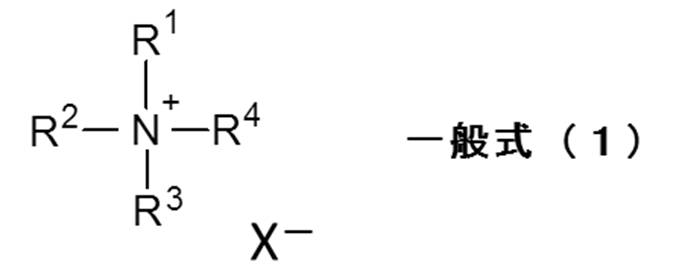
ただし、前記一般式(1)中、R1及びR2は、それぞれ独立して、炭素数1~4のアルキル基を表し、R3は、置換のアリール基を表し、R4は、置換又は無置換のアラルキル基を表す。X-は、アニオンを表す。
前記一般式(1)が、前記R1~R4を有することで、N位のベンジル炭素が熱により速やかに脱離し、3級アミンが生成される。この3級アミンが熱重合開始剤(例えば、有機過酸化物熱重合開始剤)の分解促進に寄与し、ラジカル重合成分の硬化を効果的に高める。
<第1の化合物>
本発明の化合物(第1の化合物)は、下記一般式(1)で表される。前記化合物は、前記熱硬化性樹脂組成物の保存安定性を維持しつつ、前記熱重合開始剤による低温硬化を促進させる硬化促進剤、又はその前駆体として有用である。
前記一般式(1)が、前記R1~R4を有することで、N位のベンジル炭素が熱により速やかに脱離し、3級アミンが生成される。この3級アミンが熱重合開始剤(例えば、有機過酸化物熱重合開始剤)の分解促進に寄与し、ラジカル重合成分の硬化を効果的に高める。
前記化合物(第1の化合物)の前記一般式(1)における前記R1及びR2の炭素数1~4のアルキル基としては、例えば、メチル基、エチル基、n-プロピル基、iso-プロピル基、n-ブチル基、tert-ブチル基などが挙げられる。これらの中でも、メチル基、エチル基が、熱安定性の点、及び合成の容易性の点で好ましい。前記アルキル基の炭素数が、3以上であると、前記アンモニウム塩の熱解離開始温度が過度に下がり、熱安定性が低下することがある。また、立体障害が大きくなるため、前記アンモニウム塩の合成が困難になることがある。
前記化合物(第1の化合物)の前記一般式(1)における前記R3の置換のアリール基としては、例えば、置換の芳香族炭化水素基などが挙げられる。前記置換の芳香族炭化水素基としては、例えば、置換のフェニル基、置換のナフチル基などが挙げられる。前記置換のフェニル基としては、例えば、例えば、アルキル置換のフェニル基、ヒドロキシ置換のフェニル基、アルコキシ置換のフェニル基などが挙げられる。前記アルキル置換のフェニル基におけるアルキル置換基としては、例えば、炭素数1~4のアルキル基などが挙げられる。前記炭素数1~4のアルキル基としては、例えば、メチル基、エチル基、n-プロピル基、iso-プロピル基、n-ブチル基、tert-ブチル基などが挙げられる。
前記化合物(第1の化合物)の前記一般式(1)における前記R4の置換又は無置換のアラルキル基としては、例えば、炭素数7~15のアラルキル基などが挙げられる。
前記アラルキル基におけるアリール基としては、例えば、芳香族炭化水素基などが挙げられる。前記芳香族炭化水素基としては、例えば、フェニル基、ナフチル基、アントラセニル基などが挙げられる。前記置換基としては、例えば、炭素数1~4のアルキル基などが挙げられる。前記炭素数1~4のアルキル基としては、例えば、メチル基、エチル基、n-プロピル基、iso-プロピル基、n-ブチル基、tert-ブチル基などが挙げられる。
前記アラルキル基におけるアルキレン基としては、例えば、メチレン基、エチレン基などが挙げられる。
前記アラルキル基としては、例えば、ベンジル基、o-メチルベンジル基、p-メチルベンジル基、2,5-ジメチルベンジル基、(1-ナフチル)メチル基、フェネチル基などが挙げられる。
前記アラルキル基におけるアリール基としては、例えば、芳香族炭化水素基などが挙げられる。前記芳香族炭化水素基としては、例えば、フェニル基、ナフチル基、アントラセニル基などが挙げられる。前記置換基としては、例えば、炭素数1~4のアルキル基などが挙げられる。前記炭素数1~4のアルキル基としては、例えば、メチル基、エチル基、n-プロピル基、iso-プロピル基、n-ブチル基、tert-ブチル基などが挙げられる。
前記アラルキル基におけるアルキレン基としては、例えば、メチレン基、エチレン基などが挙げられる。
前記アラルキル基としては、例えば、ベンジル基、o-メチルベンジル基、p-メチルベンジル基、2,5-ジメチルベンジル基、(1-ナフチル)メチル基、フェネチル基などが挙げられる。
前記化合物(第1の化合物)の前記一般式(1)において、前記R3は、下記一般式(2)で表される基であることが、熱解離開始温度を調整しやすい点、及び合成物が結晶となりやすい点から好ましい。

ただし、前記一般式(2)中、R5は、水素原子、及び炭素数1~4のアルキル基のいずれかを表す。R6は、炭素数1~4のアルキル基を表す。mは、0~3を表す。nは、0~3を表す。m+nは、1~5である。mが2又は3のとき、R5は、異なっていてもよい。nが2又は3のとき、R6は、異なっていてもよい。
前記一般式(2)において、R5は、水素原子が好ましい。
前記一般式(2)において、R6は、メチル基が好ましい。
前記一般式(2)において、R6は、メチル基が好ましい。
前記一般式(1)で表される化合物のカチオンとしては、例えば、下記構造式(1-3)~(1-12)で表されるカチオンなどが挙げられる。
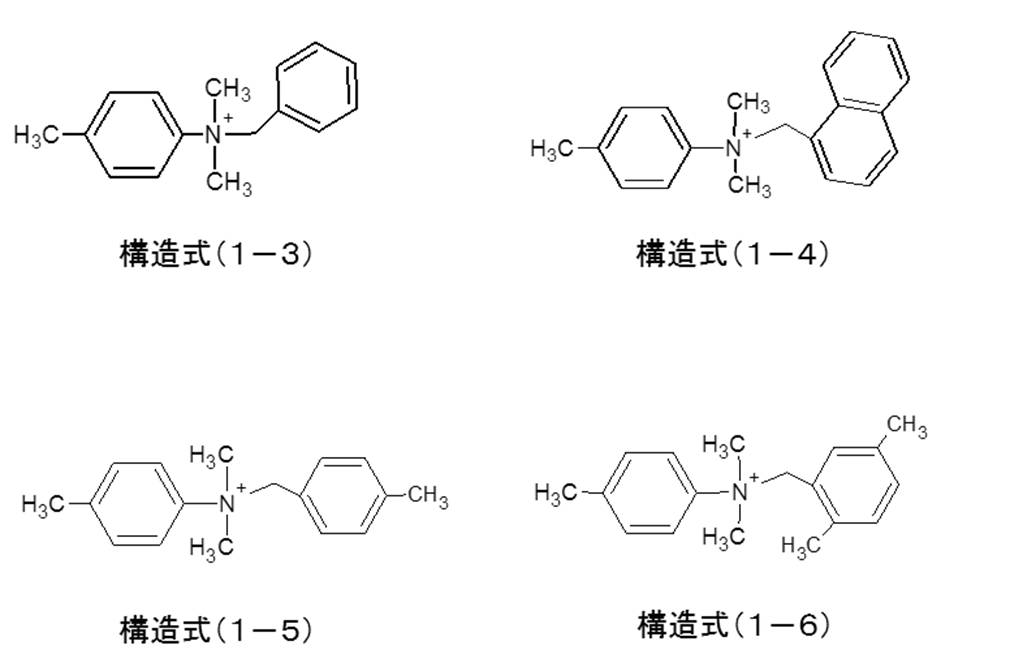

<<一般式(1)のX->>
前記化合物(第1の化合物)の前記一般式(1)におけるX-は、アニオンである。
前記アニオンとしては、ハロゲンアニオン、その共役酸の水中25℃でのpKaが3以上であるアニオンであることが好ましい。
前記化合物(第1の化合物)の前記一般式(1)におけるX-は、アニオンである。
前記アニオンとしては、ハロゲンアニオン、その共役酸の水中25℃でのpKaが3以上であるアニオンであることが好ましい。
前記アニオンが、その共役酸の水中25℃でのpKaが3以上であるアニオンである場合、前記化合物は、前記熱硬化性樹脂組成物の保存安定性を維持しつつ、前記熱重合開始剤による低温硬化を促進させる硬化促進剤として有用である。
前記X-がハロゲンアニオンである場合、前記化合物は、前記硬化促進剤の前駆体として有用である。
前記pKaの上限値としては、特に制限はなく、目的に応じて適宜選択することができるが、前記pKaは、7以下が好ましい。
前記ハロゲンアニオンとしては、例えば、塩素イオン、フッ素イオン、臭素イオン、ヨウ素イオンなどが挙げられる。
前記X-としては、カルボン酸アニオンが、原料が入手しやすい点、及び合成がしやすい点から好ましい。
前記カルボン酸アニオンとしては、例えば、下記一般式(3)で表されるアニオンなどが挙げられる。
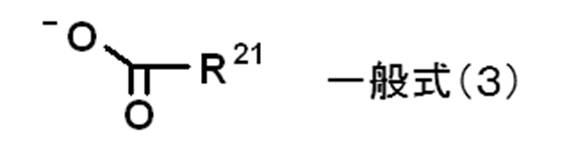
前記一般式(3)中、R21は、炭化水素基を表す。
前記炭化水素基は、ハロゲン原子を有していてもよい。前記ハロゲン原子としては、例えば、フッ素原子、塩素原子などが挙げられる。
前記炭化水素基としては、例えば、環状構造を有する炭化水素基などが挙げられる。
前記環状構造を有する炭化水素基としては、例えば、芳香族を有する炭化水素基、脂環構造を有する炭化水素基などが挙げられる。
前記炭化水素基の炭素数としては、特に制限はなく、目的に応じて適宜選択することができるが、1~15が好ましく、6~13がより好ましい。
前記カルボン酸としては、飽和脂肪酸、不飽和脂肪酸、芳香環を有するカルボン酸、脂環構造を有するカルボン酸、アクリル酸、トリフルオロ酢酸などが挙げられる。
前記飽和脂肪酸としては、例えば、酢酸、プロピオン酸、デカン酸、ミリスチン酸、ステアリン酸、2-エチルヘキサン酸などが挙げられる。
前記不飽和脂肪酸としては、例えば、オレイン酸、リノール酸などが挙げられる。
前記脂環構造を有するカルボン酸としては、例えば、1-アダマンタンカルボン酸、シクロヘキサンカルボン酸などが挙げられる。
前記芳香環を有するカルボン酸としては、例えば、安息香酸、2-メチルベンゼンカルボン酸、2-フェニルベンゼンカルボン酸、2,6-ジメチルベンゼンカルボン酸、2-ヒドロキシベンゼンカルボン酸等の置換、又は無置換の安息香酸類(置換基を有していてもよい安息香酸);1-ナフタレンカルボン酸、2-ナフタレンカルボン酸、2-ヒドロキシ-1-ナフタレンカルボン酸、3-ヒドロキシ-2-ナフタレンカルボン酸等のナフタレンカルボン酸類;ナフタレン酢酸、フェニルプロピオン酸、ジフェニル酢酸、トリフェニル酢酸などが挙げられる。
前記不飽和脂肪酸としては、例えば、オレイン酸、リノール酸などが挙げられる。
前記脂環構造を有するカルボン酸としては、例えば、1-アダマンタンカルボン酸、シクロヘキサンカルボン酸などが挙げられる。
前記芳香環を有するカルボン酸としては、例えば、安息香酸、2-メチルベンゼンカルボン酸、2-フェニルベンゼンカルボン酸、2,6-ジメチルベンゼンカルボン酸、2-ヒドロキシベンゼンカルボン酸等の置換、又は無置換の安息香酸類(置換基を有していてもよい安息香酸);1-ナフタレンカルボン酸、2-ナフタレンカルボン酸、2-ヒドロキシ-1-ナフタレンカルボン酸、3-ヒドロキシ-2-ナフタレンカルボン酸等のナフタレンカルボン酸類;ナフタレン酢酸、フェニルプロピオン酸、ジフェニル酢酸、トリフェニル酢酸などが挙げられる。
前記カルボン酸アニオンとしては、ナフタレンカルボン酸類のアニオン、ジフェニル酢酸アニオン、1-アダマンタンカルボン酸アニオンが、結晶が得られやすい点から好ましい。
前記化合物(第1の化合物)としては、例えば、以下の化合物などが挙げられる。
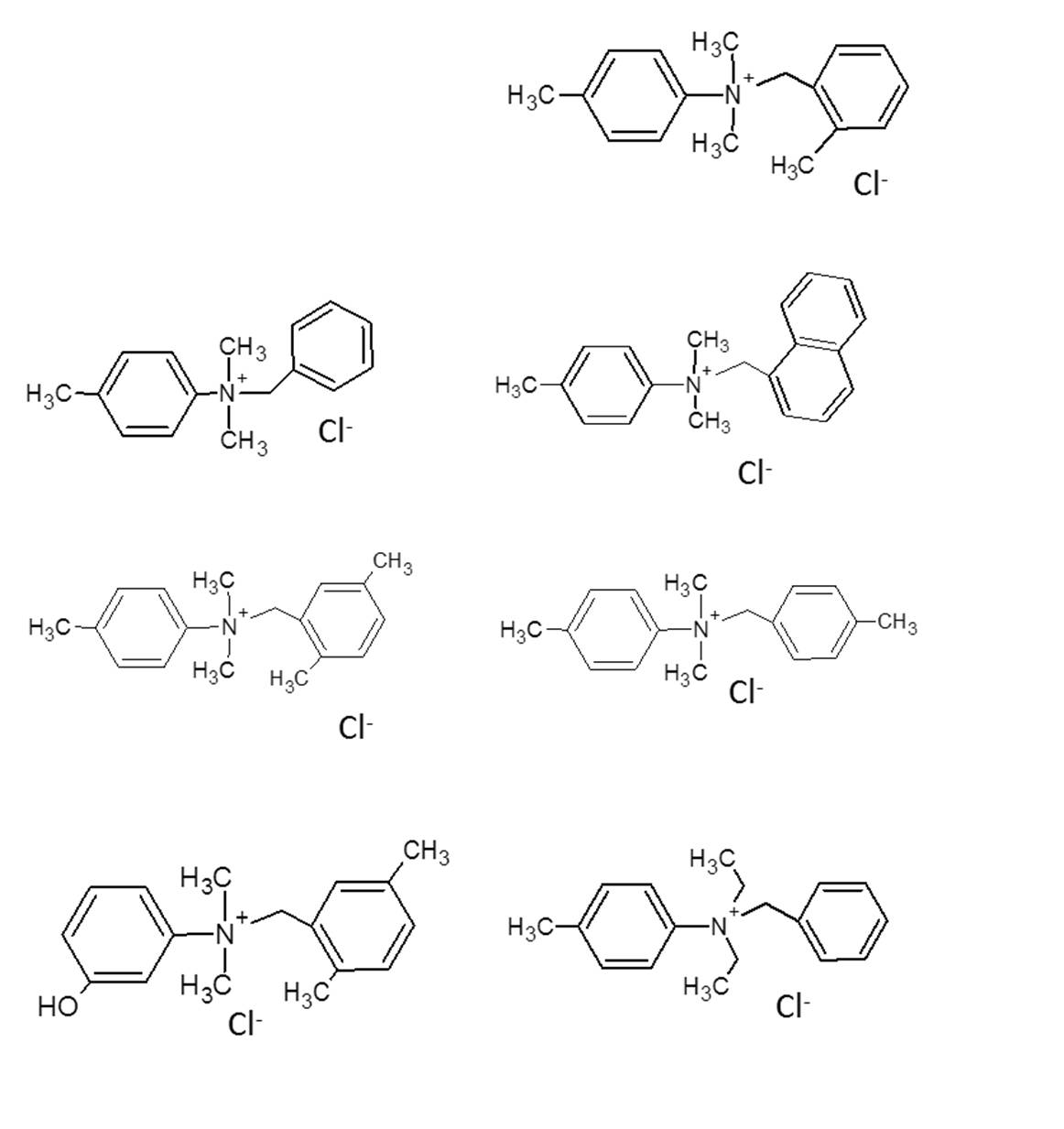
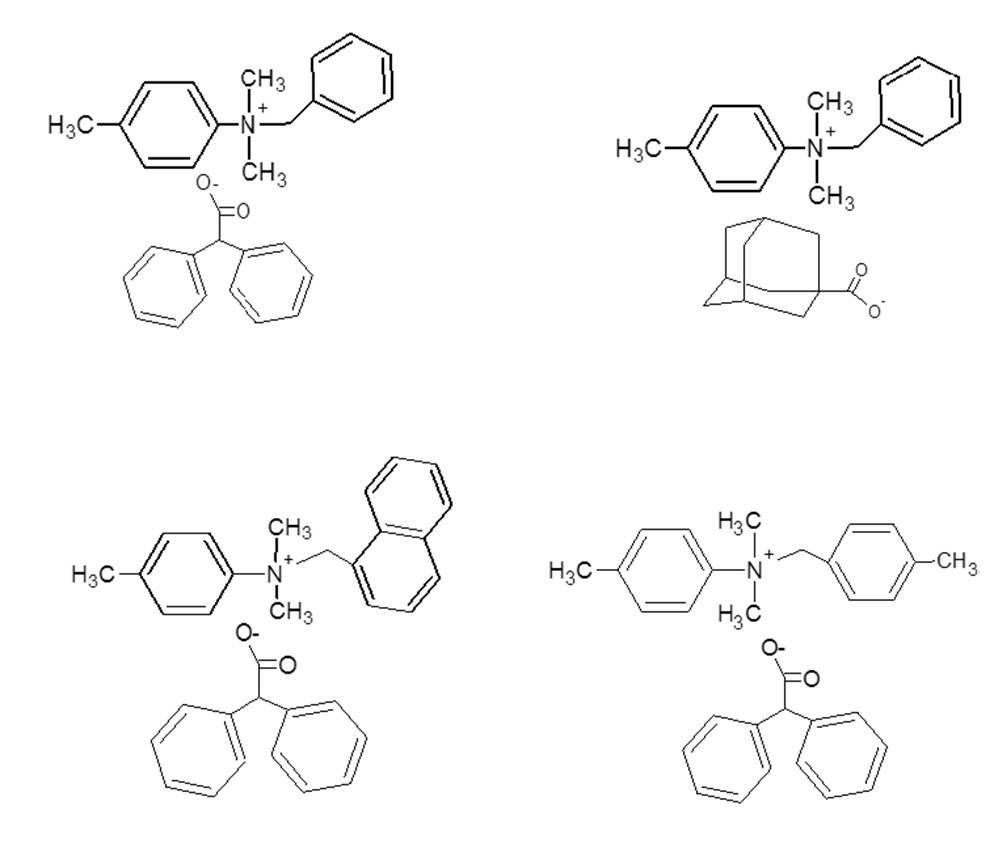
<第2の化合物>
本発明の化合物(第2の化合物)は、下記一般式(1)で表される。前記化合物は、本発明の前記熱硬化性樹脂組成物に含有されるアンモニウム塩を合成するための前駆体として有用である。

ただし、前記一般式(1)中、R1及びR2は、それぞれ独立して、炭素数1~4のアルキル基を表し、R3は、置換又は無置換のアリール基を表し、R4は、置換又は無置換のアラルキル基を表す。X-は、ハロゲンアニオンを表す。
前記一般式(1)が、前記R1~R4を有することで、この化合物を用いて得られ前記熱硬化性樹脂組成物に使用されるアンモニウム塩において、N位のベンジル炭素が熱により速やかに脱離し、3級アミンが生成される。この3級アミンが熱重合開始剤(例えば、有機過酸化物熱重合開始剤)の分解促進に寄与し、ラジカル重合成分の硬化を効果的に高める。
本発明の化合物(第2の化合物)は、下記一般式(1)で表される。前記化合物は、本発明の前記熱硬化性樹脂組成物に含有されるアンモニウム塩を合成するための前駆体として有用である。
前記一般式(1)が、前記R1~R4を有することで、この化合物を用いて得られ前記熱硬化性樹脂組成物に使用されるアンモニウム塩において、N位のベンジル炭素が熱により速やかに脱離し、3級アミンが生成される。この3級アミンが熱重合開始剤(例えば、有機過酸化物熱重合開始剤)の分解促進に寄与し、ラジカル重合成分の硬化を効果的に高める。
前記化合物(第2の化合物)の前記一般式(1)における前記R1及びR2の炭素数1~4のアルキル基としては、例えば、メチル基、エチル基、n-プロピル基、iso-プロピル基、n-ブチル基、tert-ブチル基などが挙げられる。これらの中でも、メチル基、エチル基が、熱安定性の点、及び合成の容易性の点で好ましい。前記アルキル基の炭素数が、3以上であると、前記アンモニウム塩の熱解離開始温度が過度に下がり、熱安定性が低下することがある。また、立体障害が大きくなるため、前記アンモニウム塩の合成が困難になることがある。
前記化合物(第2の化合物)の前記一般式(1)における前記R3の置換のアリール基としては、例えば、置換の芳香族炭化水素基などが挙げられる。前記置換の芳香族炭化水素基としては、例えば、置換のフェニル基、置換のナフチル基などが挙げられる。前記置換のフェニル基としては、例えば、例えば、アルキル置換のフェニル基、ヒドロキシ置換のフェニル基、アルコキシ置換のフェニル基などが挙げられる。前記アルキル置換のフェニル基におけるアルキル置換基としては、例えば、炭素数1~4のアルキル基などが挙げられる。前記炭素数1~4のアルキル基としては、例えば、メチル基、エチル基、n-プロピル基、iso-プロピル基、n-ブチル基、tert-ブチル基などが挙げられる。
前記化合物(第2の化合物)の前記一般式(1)における前記R4の置換又は無置換のアラルキル基としては、例えば、炭素数7~15のアラルキル基などが挙げられる。
前記アラルキル基におけるアリール基としては、例えば、芳香族炭化水素基などが挙げられる。前記芳香族炭化水素基としては、例えば、フェニル基、ナフチル基、アントラセニル基などが挙げられる。前記置換基としては、例えば、炭素数1~4のアルキル基などが挙げられる。前記炭素数1~4のアルキル基としては、例えば、メチル基、エチル基、n-プロピル基、iso-プロピル基、n-ブチル基、tert-ブチル基などが挙げられる。
前記アラルキル基におけるアルキレン基としては、例えば、メチレン基、エチレン基などが挙げられる。
前記アラルキル基としては、例えば、ベンジル基、o-メチルベンジル基、p-メチルベンジル基、2,5-ジメチルベンジル基、(1-ナフチル)メチル基、フェネチル基などが挙げられる。
前記アラルキル基におけるアリール基としては、例えば、芳香族炭化水素基などが挙げられる。前記芳香族炭化水素基としては、例えば、フェニル基、ナフチル基、アントラセニル基などが挙げられる。前記置換基としては、例えば、炭素数1~4のアルキル基などが挙げられる。前記炭素数1~4のアルキル基としては、例えば、メチル基、エチル基、n-プロピル基、iso-プロピル基、n-ブチル基、tert-ブチル基などが挙げられる。
前記アラルキル基におけるアルキレン基としては、例えば、メチレン基、エチレン基などが挙げられる。
前記アラルキル基としては、例えば、ベンジル基、o-メチルベンジル基、p-メチルベンジル基、2,5-ジメチルベンジル基、(1-ナフチル)メチル基、フェネチル基などが挙げられる。
前記化合物(第2の化合物)の前記一般式(1)において、前記R3は、下記一般式(2)で表される基であることが、熱解離開始温度を調整しやすい点、及び合成物が結晶となりやすい点から好ましい。
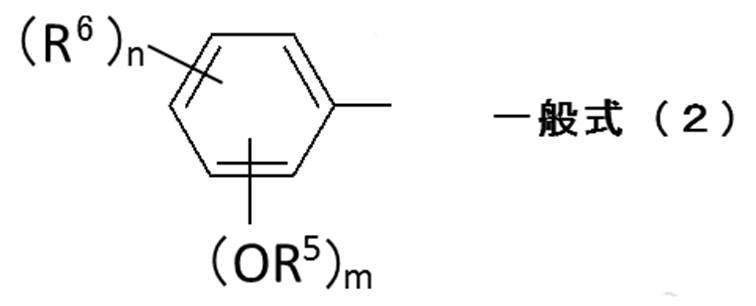
ただし、前記一般式(2)中、R5は、水素原子、及び炭素数1~4のアルキル基のいずれかを表す。R6は、炭素数1~4のアルキル基を表す。mは、0~3を表す。nは、0~3を表す。m+nは、0~5である。mが2又は3のとき、R5は、異なっていてもよい。nが2又は3のとき、R6は、異なっていてもよい。
前記一般式(2)において、m+nは、1~5が好ましい。
前記一般式(2)において、R5は、水素原子が好ましい。
前記一般式(2)において、R6は、メチル基が好ましい。
前記一般式(2)において、R5は、水素原子が好ましい。
前記一般式(2)において、R6は、メチル基が好ましい。
前記一般式(1)で表される化合物のカチオンとしては、例えば、下記構造式(1-1)~(1-12)で表されるカチオンなどが挙げられる。
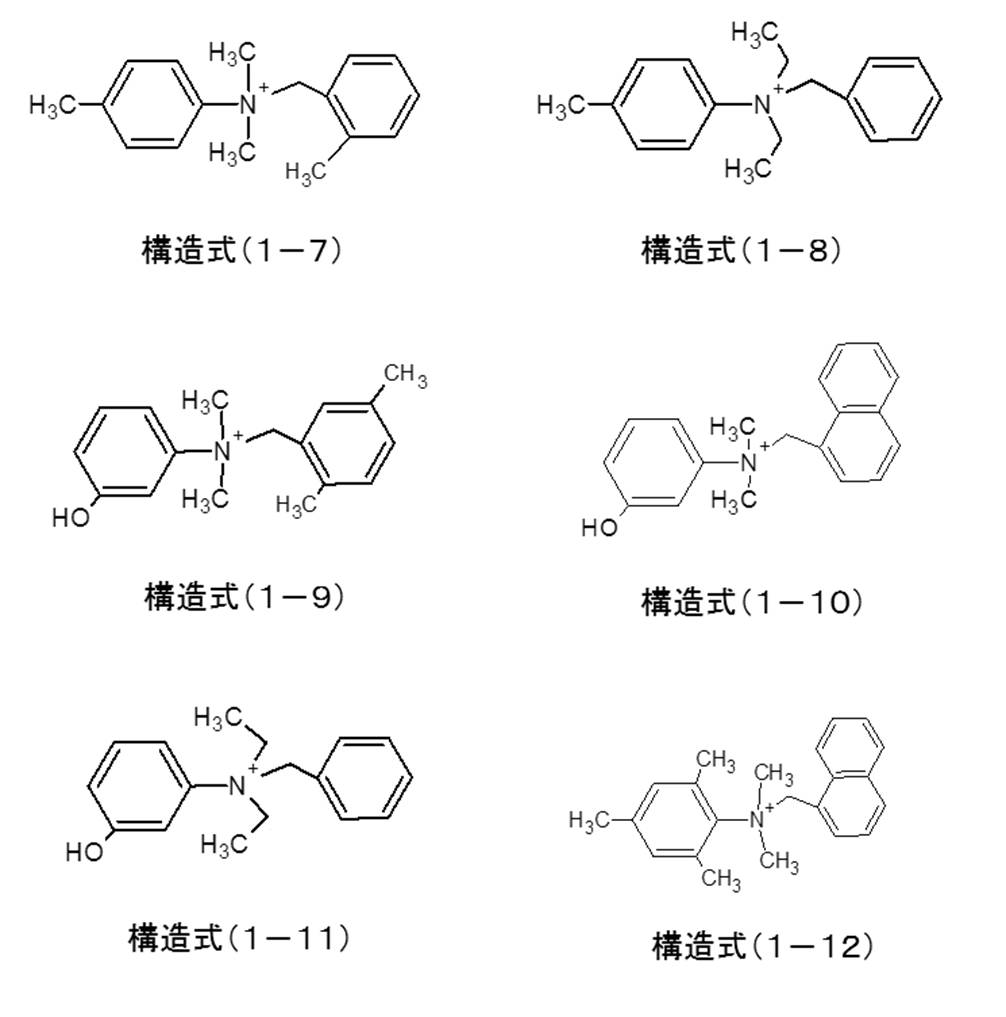
<<一般式(1)のX->>
前記化合物(第2の化合物)の前記一般式(1)における前記X-は、ハロゲンアニオンである。
前記化合物(第2の化合物)の前記一般式(1)における前記X-は、ハロゲンアニオンである。
前記ハロゲンアニオンとしては、例えば、塩素イオン、フッ素イオン、臭素イオン、ヨウ素イオンなどが挙げられる。これらの中でも、塩素イオンが好ましい。
前記化合物(第2の化合物)としては、例えば、以下の化合物などが挙げられる。
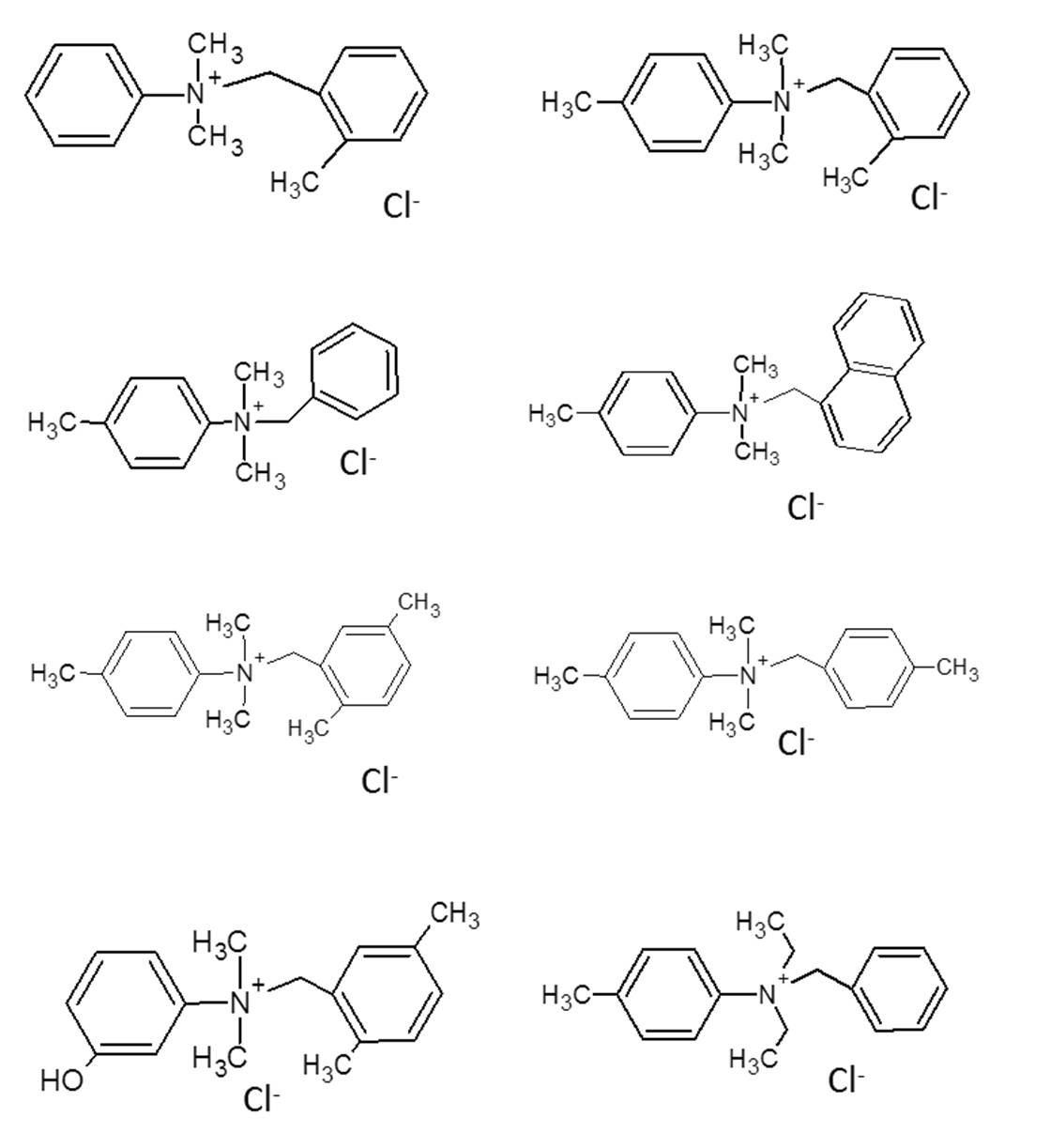
以下、本発明の実施例を説明するが、本発明は、これらの実施例に何ら限定されるものではない。
(合成例1)
<ジフェニル酢酸銀の合成>
攪拌器、及び温度計を設置した500mL三口フラスコに、水酸化ナトリウム 2.00g(0.050mol)及びメタノール200gを入れて撹拌後、さらにジフェニル酢酸(東京化成工業株式会社製)10.61g(0.050mol)を入れ、室温にて固形分が無くなるまで撹拌した。そこに、別途調製した硝酸銀5質量%水溶液169.87g(硝酸銀として0.050mol)をフラスコを遮光状態にしてから室温にて撹拌しながら10分間で滴下した。滴下直後より白色の析出物が生成した。滴下終了後さらに30分間撹拌を行った後、析出物を濾別し、さらにメタノールで洗浄を行った後、24時間減圧乾燥することでジフェニル酢酸銀の白色結晶 15.72g(収率98.5%)を得た。
<ジフェニル酢酸銀の合成>
攪拌器、及び温度計を設置した500mL三口フラスコに、水酸化ナトリウム 2.00g(0.050mol)及びメタノール200gを入れて撹拌後、さらにジフェニル酢酸(東京化成工業株式会社製)10.61g(0.050mol)を入れ、室温にて固形分が無くなるまで撹拌した。そこに、別途調製した硝酸銀5質量%水溶液169.87g(硝酸銀として0.050mol)をフラスコを遮光状態にしてから室温にて撹拌しながら10分間で滴下した。滴下直後より白色の析出物が生成した。滴下終了後さらに30分間撹拌を行った後、析出物を濾別し、さらにメタノールで洗浄を行った後、24時間減圧乾燥することでジフェニル酢酸銀の白色結晶 15.72g(収率98.5%)を得た。
(合成例2)
<1-アダマンタンカルボン酸銀の合成>
合成例1において、ジフェニル酢酸を1-アダマンタンカルボン酸(東京化成工業株式会社製)9.01g(0.050mol)に変えた以外は、合成例1と同様にして、1-アダマンタンカルボン酸銀の白色結晶 14.04g(収率97.8%)を得た。
<1-アダマンタンカルボン酸銀の合成>
合成例1において、ジフェニル酢酸を1-アダマンタンカルボン酸(東京化成工業株式会社製)9.01g(0.050mol)に変えた以外は、合成例1と同様にして、1-アダマンタンカルボン酸銀の白色結晶 14.04g(収率97.8%)を得た。
(合成例3)
<安息香酸銀の合成>
合成例1において、ジフェニル酢酸を安息香酸(東京化成工業株式会社製)6.11g(0.050mol)に変えた以外は、合成例1と同様にして、安息香酸銀の白色結晶 11.36g(収率99.2%)を得た。
<安息香酸銀の合成>
合成例1において、ジフェニル酢酸を安息香酸(東京化成工業株式会社製)6.11g(0.050mol)に変えた以外は、合成例1と同様にして、安息香酸銀の白色結晶 11.36g(収率99.2%)を得た。
(合成例4)
<p-トルエンスルホン酸銀の合成>
攪拌器、及び温度計を設置した200mL三口フラスコを遮光状態にしながら、炭酸銀(和光純薬工業株式会社製)4.14g(0.015mol)及びアセトニトリル60gを入れて撹拌して懸濁状態とし、そこにp-トルエンスルホン酸1水和物(和光純薬工業株式会社製)5.43g(0.0285mol)をアセトニトリル10gと水0.7gの混合液に溶解させた液を、10分間で滴下し、滴下終了後さらに30分間撹拌を行った。その後、残った炭酸銀をフィルター除去し、濾液を減圧により溶媒を除去することで結晶を析出させた。この結晶をメチルエチルケトンで洗浄後、24時間減圧乾燥することでp-トルエンスルホン酸銀の白色結晶 7.57g(収率95.2%)を得た。
<p-トルエンスルホン酸銀の合成>
攪拌器、及び温度計を設置した200mL三口フラスコを遮光状態にしながら、炭酸銀(和光純薬工業株式会社製)4.14g(0.015mol)及びアセトニトリル60gを入れて撹拌して懸濁状態とし、そこにp-トルエンスルホン酸1水和物(和光純薬工業株式会社製)5.43g(0.0285mol)をアセトニトリル10gと水0.7gの混合液に溶解させた液を、10分間で滴下し、滴下終了後さらに30分間撹拌を行った。その後、残った炭酸銀をフィルター除去し、濾液を減圧により溶媒を除去することで結晶を析出させた。この結晶をメチルエチルケトンで洗浄後、24時間減圧乾燥することでp-トルエンスルホン酸銀の白色結晶 7.57g(収率95.2%)を得た。
(実施例A1)
<アンモニウム塩A1の合成>
攪拌器、冷却管、及び温度計を設置した100mL三口フラスコに、N,N-ジメチルアニリン(東京化成工業株式会社製)5.0g(0.0413mol)、α-クロロ-o-キシレン(東京化成工業株式会社製)5.81g(0.0413mol)、及びメタノール30gを入れ、50℃にて8時間撹拌及び反応させた。冷却後、減圧によりメタノールを留去することで結晶を析出させた。この結晶を酢酸エチル50gで3回撹拌及び洗浄後、24時間減圧乾燥することで、下記構造式(A1)で表されるアンモニウム塩A1の白色結晶 8.98g(収率83.1%)を得た。
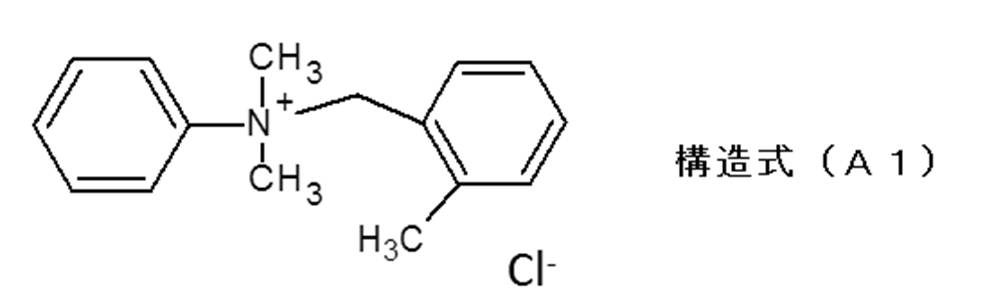
<アンモニウム塩A1の合成>
攪拌器、冷却管、及び温度計を設置した100mL三口フラスコに、N,N-ジメチルアニリン(東京化成工業株式会社製)5.0g(0.0413mol)、α-クロロ-o-キシレン(東京化成工業株式会社製)5.81g(0.0413mol)、及びメタノール30gを入れ、50℃にて8時間撹拌及び反応させた。冷却後、減圧によりメタノールを留去することで結晶を析出させた。この結晶を酢酸エチル50gで3回撹拌及び洗浄後、24時間減圧乾燥することで、下記構造式(A1)で表されるアンモニウム塩A1の白色結晶 8.98g(収率83.1%)を得た。
(実施例A2)
<アンモニウム塩A2の合成>
実施例A1において、N,N-ジメチルアニリンをN,N-ジメチル-p-トルイジン(和光純薬工業株式会社製)5.58g(0.0413mol)に変えた以外は、実施例A1と同様にして、下記構造式(A2)で表されるアンモニウム塩A2の白色結晶 9.82g(収率86.2%)を得た。
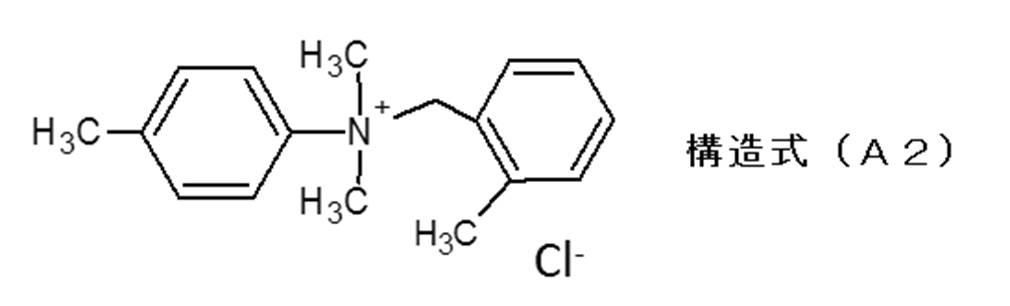
<アンモニウム塩A2の合成>
実施例A1において、N,N-ジメチルアニリンをN,N-ジメチル-p-トルイジン(和光純薬工業株式会社製)5.58g(0.0413mol)に変えた以外は、実施例A1と同様にして、下記構造式(A2)で表されるアンモニウム塩A2の白色結晶 9.82g(収率86.2%)を得た。
(実施例A3)
<アンモニウム塩A3の合成>
実施例A2において、α-クロロ-o-キシレンをベンジルクロライド(東京化成工業株式会社製)5.23g(0.0413mol)に変えた以外は、実施例A2と同様にして、下記構造式(A3)で表されるアンモニウム塩A3の白色結晶 9.03g(収率83.5%)を得た。

<アンモニウム塩A3の合成>
実施例A2において、α-クロロ-o-キシレンをベンジルクロライド(東京化成工業株式会社製)5.23g(0.0413mol)に変えた以外は、実施例A2と同様にして、下記構造式(A3)で表されるアンモニウム塩A3の白色結晶 9.03g(収率83.5%)を得た。
(実施例A4)
<アンモニウム塩A4の合成>
攪拌器、冷却管、及び温度計を設置した100mL三口フラスコに、N,N-ジメチル-p-トルイジン(和光純薬工業株式会社製)10.0g(0.0740mol)、1-(クロロメチル)ナフタレン(東京化成工業株式会社製)13.07g(0.0740mol)、及びメタノール60gを入れ、50℃にて8時間撹拌して反応させた。冷却後、減圧によりメタノールを留去することで結晶を析出させた。この結晶を酢酸エチル50gで3回撹拌及び洗浄後、24時間減圧乾燥することで、下記構造式(A4)で表されるアンモニウム塩A4の白色結晶 18.25g(収率79.1%)を得た。
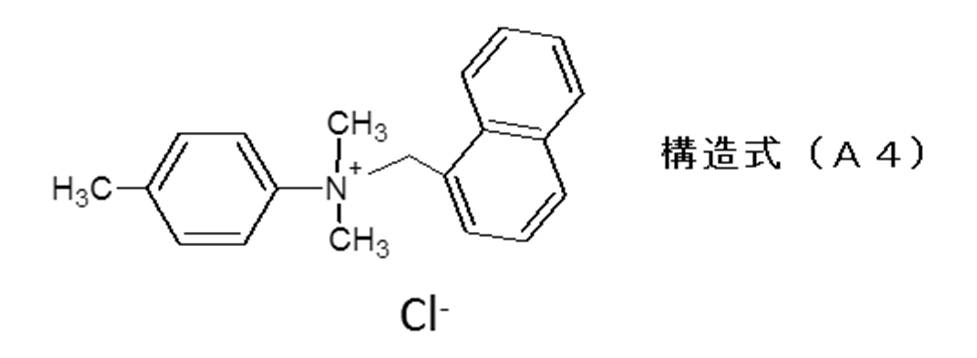
<アンモニウム塩A4の合成>
攪拌器、冷却管、及び温度計を設置した100mL三口フラスコに、N,N-ジメチル-p-トルイジン(和光純薬工業株式会社製)10.0g(0.0740mol)、1-(クロロメチル)ナフタレン(東京化成工業株式会社製)13.07g(0.0740mol)、及びメタノール60gを入れ、50℃にて8時間撹拌して反応させた。冷却後、減圧によりメタノールを留去することで結晶を析出させた。この結晶を酢酸エチル50gで3回撹拌及び洗浄後、24時間減圧乾燥することで、下記構造式(A4)で表されるアンモニウム塩A4の白色結晶 18.25g(収率79.1%)を得た。
(実施例A5)
<アンモニウム塩A5の合成>
実施例A2において、α-クロロ-o-キシレンを2,5-ジメチルベンジルクロライド(東京化成工業株式会社製)6.39g(0.0413mol)に変えた以外は、実施例A2と同様にして、下記構造式(A5)で表されるアンモニウム塩A5の白色結晶 8.99g(収率75.2%)を得た。

<アンモニウム塩A5の合成>
実施例A2において、α-クロロ-o-キシレンを2,5-ジメチルベンジルクロライド(東京化成工業株式会社製)6.39g(0.0413mol)に変えた以外は、実施例A2と同様にして、下記構造式(A5)で表されるアンモニウム塩A5の白色結晶 8.99g(収率75.2%)を得た。
(実施例A6)
<アンモニウム塩A6の合成>
実施例A2において、α-クロロ-o-キシレンをα-クロロ-p-キシレン(東京化成工業株式会社製)5.81g(0.0431mol)に変えた以外は、実施例A2と同様にして、下記構造式(A6)で表されるアンモニウム塩A6の白色結晶 8.91g(収率78.2%)を得た。
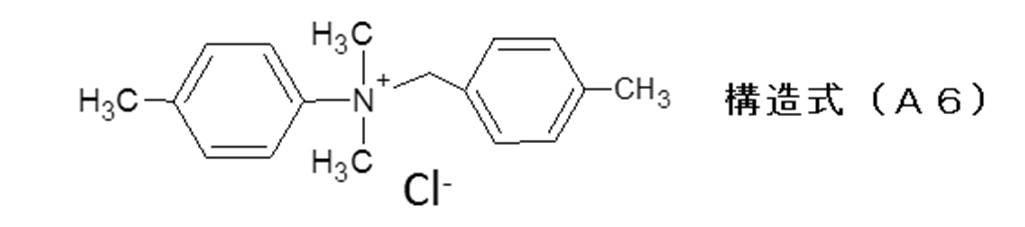
<アンモニウム塩A6の合成>
実施例A2において、α-クロロ-o-キシレンをα-クロロ-p-キシレン(東京化成工業株式会社製)5.81g(0.0431mol)に変えた以外は、実施例A2と同様にして、下記構造式(A6)で表されるアンモニウム塩A6の白色結晶 8.91g(収率78.2%)を得た。
(実施例A7)
<アンモニウム塩(安定剤)A7の合成>
実施例A5において、N,N-ジメチル-p-トルイジンを3-(ジメチルアミノ)フェノール(東京化成工業株式会社製)5.91g(0.0431mol)に変えた以外は、実施例A5と同様にして、下記構造式(A7)で表されるアンモニウム塩A7の赤褐色結晶 7.64g(収率62.1%)を得た。
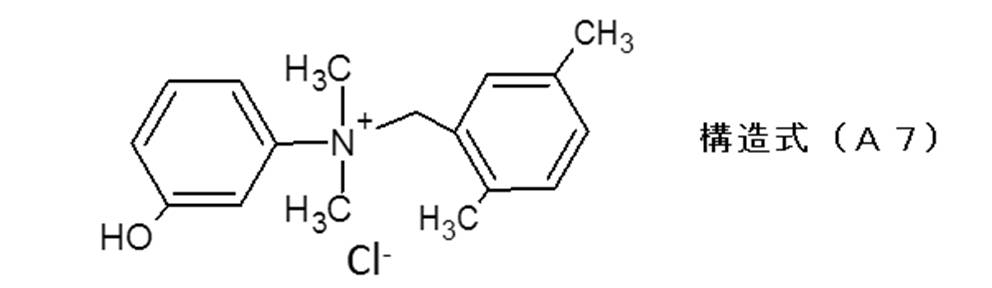
<アンモニウム塩(安定剤)A7の合成>
実施例A5において、N,N-ジメチル-p-トルイジンを3-(ジメチルアミノ)フェノール(東京化成工業株式会社製)5.91g(0.0431mol)に変えた以外は、実施例A5と同様にして、下記構造式(A7)で表されるアンモニウム塩A7の赤褐色結晶 7.64g(収率62.1%)を得た。
(実施例A8)
<アンモニウム塩A8の合成>
攪拌器、冷却管、及び温度計を設置した100mL三口フラスコに、N,N-ジエチル-p-トルイジン(東京化成工業株式会社製)5.0g(0.0306mol)、ベンジルクロライド3.87g(0.0306mol)、及びメタノール30gを入れ、40℃にて48時間撹拌して反応させた。冷却後、減圧によりメタノールを留去することで結晶を析出させた。この結晶を酢酸エチル50gで3回撹拌及び洗浄後、24時間減圧乾燥することで、下記構造式(A8)で表されるアンモニウム塩A8の白色結晶 4.01g(収率45.2%)を得た。
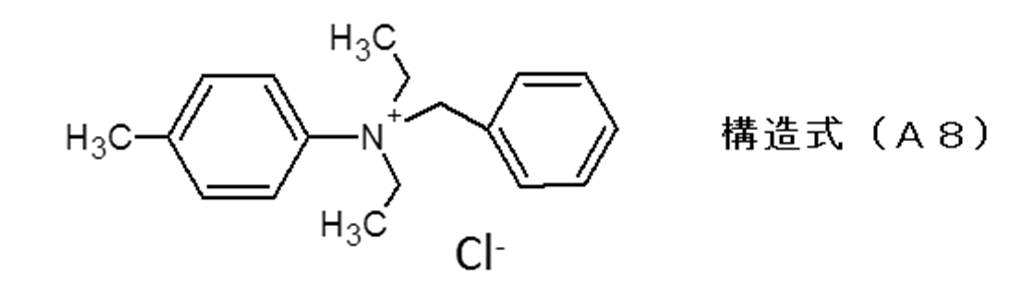
<アンモニウム塩A8の合成>
攪拌器、冷却管、及び温度計を設置した100mL三口フラスコに、N,N-ジエチル-p-トルイジン(東京化成工業株式会社製)5.0g(0.0306mol)、ベンジルクロライド3.87g(0.0306mol)、及びメタノール30gを入れ、40℃にて48時間撹拌して反応させた。冷却後、減圧によりメタノールを留去することで結晶を析出させた。この結晶を酢酸エチル50gで3回撹拌及び洗浄後、24時間減圧乾燥することで、下記構造式(A8)で表されるアンモニウム塩A8の白色結晶 4.01g(収率45.2%)を得た。
(実施例B1)
<アンモニウム塩B1の合成>
攪拌器を設置した100mL三口フラスコを遮光状態にしながら、合成例1で合成したジフェニル酢酸銀2.42g(0.0076mol)とアセトニトリル10gを入れ、室温で撹拌して懸濁状態にしながら、実施例A1で合成したアンモニウム塩A1 2.00g(0.0076mol)をアセトニトリル20gとメタノール2gに溶解させた液を、添加した。添加後室温にて30分間撹拌した後、フィルターにて析出した塩化銀を除去し、濾液を減圧濃縮して透明粘調液を得た。これを撹拌しながら酢酸エチルを添加することにより結晶の析出を得た。さらに酢酸エチルで洗浄後、ろ過し、24時間減圧乾燥することで、下記構造式(B1)で表されるアンモニウム塩B1の白色結晶 3.00g(収率90.3%)を得た。
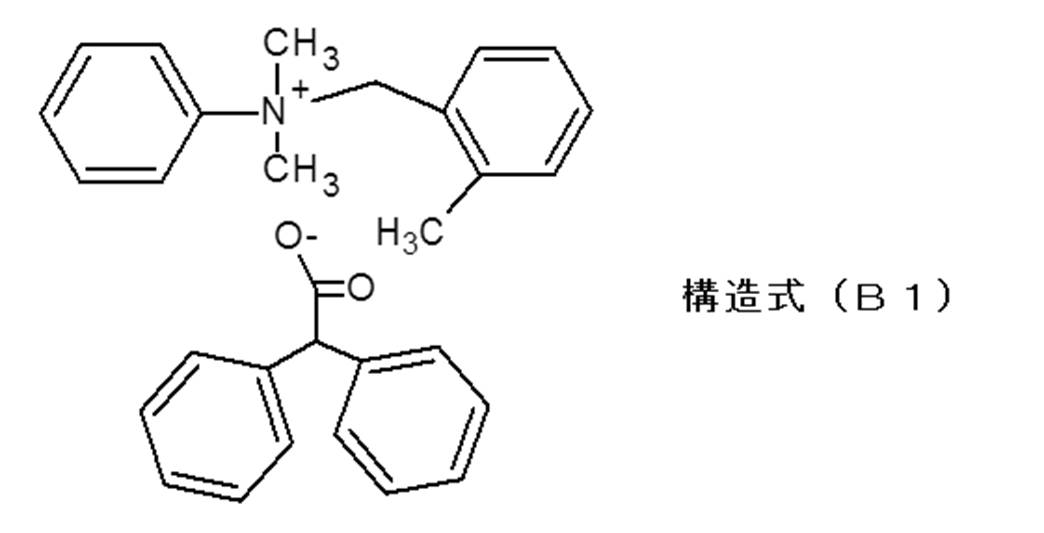
<アンモニウム塩B1の合成>
攪拌器を設置した100mL三口フラスコを遮光状態にしながら、合成例1で合成したジフェニル酢酸銀2.42g(0.0076mol)とアセトニトリル10gを入れ、室温で撹拌して懸濁状態にしながら、実施例A1で合成したアンモニウム塩A1 2.00g(0.0076mol)をアセトニトリル20gとメタノール2gに溶解させた液を、添加した。添加後室温にて30分間撹拌した後、フィルターにて析出した塩化銀を除去し、濾液を減圧濃縮して透明粘調液を得た。これを撹拌しながら酢酸エチルを添加することにより結晶の析出を得た。さらに酢酸エチルで洗浄後、ろ過し、24時間減圧乾燥することで、下記構造式(B1)で表されるアンモニウム塩B1の白色結晶 3.00g(収率90.3%)を得た。
(実施例B2)
<アンモニウム塩B2の合成>
実施例B1において、アンモニウム塩A1を実施例A2で合成したアンモニウム塩A2 2.10g(0.0076mol)に変えた以外は、実施例B1と同様にして、下記構造式(B2)で表されるアンモニウム塩B2の白色結晶 3.04g(収率88.5%)を得た。
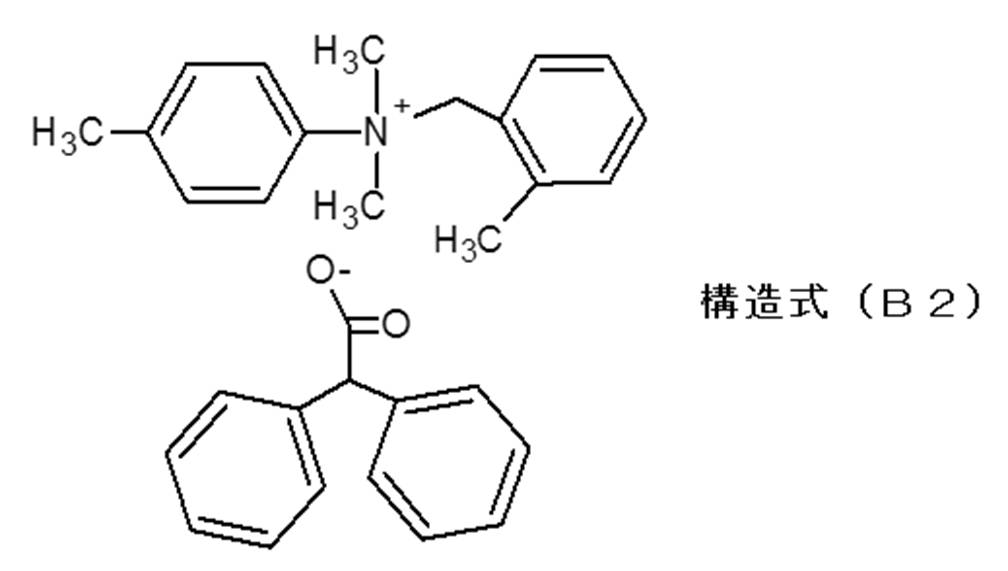
<アンモニウム塩B2の合成>
実施例B1において、アンモニウム塩A1を実施例A2で合成したアンモニウム塩A2 2.10g(0.0076mol)に変えた以外は、実施例B1と同様にして、下記構造式(B2)で表されるアンモニウム塩B2の白色結晶 3.04g(収率88.5%)を得た。
(実施例B3)
<アンモニウム塩B3の合成>
実施例B1において、アンモニウム塩A1を実施例A3で合成したアンモニウム塩A3 1.99g(0.0076mol)に変えた以外は、実施例B1と同様にして、下記構造式(B3)で表されるアンモニウム塩B3の白色結晶 3.07g(収率92.3%)を得た。
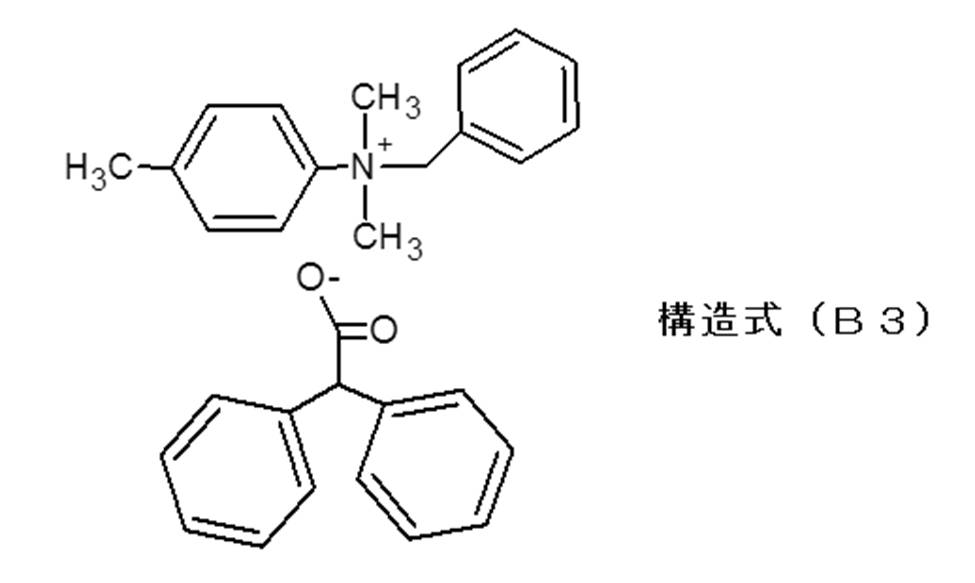
<アンモニウム塩B3の合成>
実施例B1において、アンモニウム塩A1を実施例A3で合成したアンモニウム塩A3 1.99g(0.0076mol)に変えた以外は、実施例B1と同様にして、下記構造式(B3)で表されるアンモニウム塩B3の白色結晶 3.07g(収率92.3%)を得た。
(実施例B4)
<アンモニウム塩B4の合成>
実施例B1において、アンモニウム塩A1を実施例A4で合成したアンモニウム塩A4 2.37g(0.0076mol)に変えた以外は、実施例B1と同様にして、下記構造式(B4)で表されるアンモニウム塩B4の白色結晶 3.53g(収率95.3%)を得た。

<アンモニウム塩B4の合成>
実施例B1において、アンモニウム塩A1を実施例A4で合成したアンモニウム塩A4 2.37g(0.0076mol)に変えた以外は、実施例B1と同様にして、下記構造式(B4)で表されるアンモニウム塩B4の白色結晶 3.53g(収率95.3%)を得た。
(実施例B5)
<アンモニウム塩B5の合成>
実施例B1において、アンモニウム塩A1を実施例A5で合成したアンモニウム塩A5 2.20g(0.0076mol)に変えた以外は、実施例B1と同様にして、下記構造式(B5)で表されるアンモニウム塩B5の白色結晶 3.23g(収率91.2%)を得た。

<アンモニウム塩B5の合成>
実施例B1において、アンモニウム塩A1を実施例A5で合成したアンモニウム塩A5 2.20g(0.0076mol)に変えた以外は、実施例B1と同様にして、下記構造式(B5)で表されるアンモニウム塩B5の白色結晶 3.23g(収率91.2%)を得た。
(実施例B6)
<アンモニウム塩B6の合成>
実施例B1において、アンモニウム塩A1を実施例A6で合成したアンモニウム塩A6 2.10g(0.0076mol)に変えた以外は、実施例B1と同様にして、下記構造式(B6)で表されるアンモニウム塩B6の白色結晶 2.99g(収率87.1%)を得た。

<アンモニウム塩B6の合成>
実施例B1において、アンモニウム塩A1を実施例A6で合成したアンモニウム塩A6 2.10g(0.0076mol)に変えた以外は、実施例B1と同様にして、下記構造式(B6)で表されるアンモニウム塩B6の白色結晶 2.99g(収率87.1%)を得た。
(実施例B7)
<アンモニウム塩B7の合成>
実施例B1において、アンモニウム塩A1を実施例A7で合成したアンモニウム塩A7 2.22g(0.0076mol)に変えた以外は、実施例B1と同様にして、下記構造式(B7)で表されるアンモニウム塩B7の白色結晶 3.02g(収率85.1%)を得た。
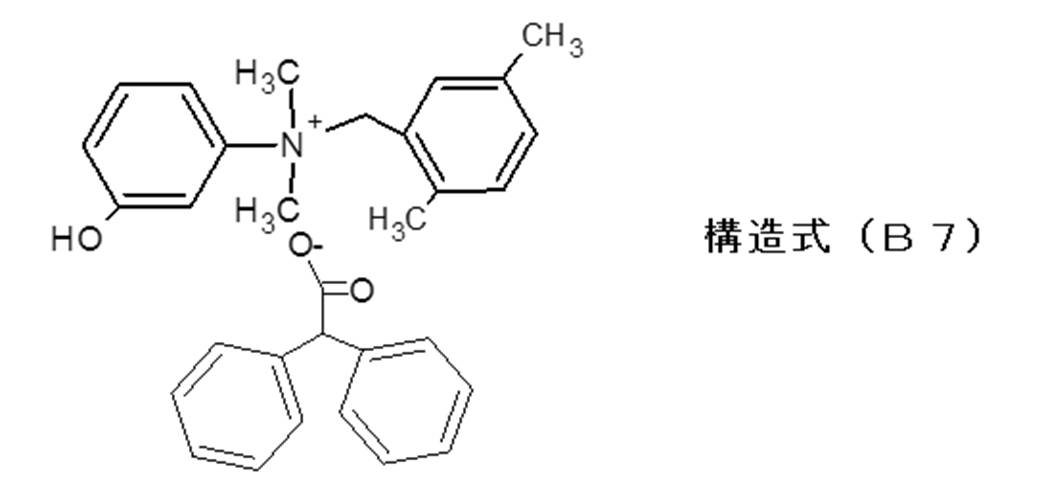
<アンモニウム塩B7の合成>
実施例B1において、アンモニウム塩A1を実施例A7で合成したアンモニウム塩A7 2.22g(0.0076mol)に変えた以外は、実施例B1と同様にして、下記構造式(B7)で表されるアンモニウム塩B7の白色結晶 3.02g(収率85.1%)を得た。
(実施例B8)
<アンモニウム塩B8の合成>
実施例B1において、アンモニウム塩A1を実施例A8で合成したアンモニウム塩A8 2.20g(0.0076mol)に変えた以外は、実施例B1と同様にして、下記構造式(B8)で表されるアンモニウム塩B8の白色結晶 2.49g(収率70.3%)を得た。
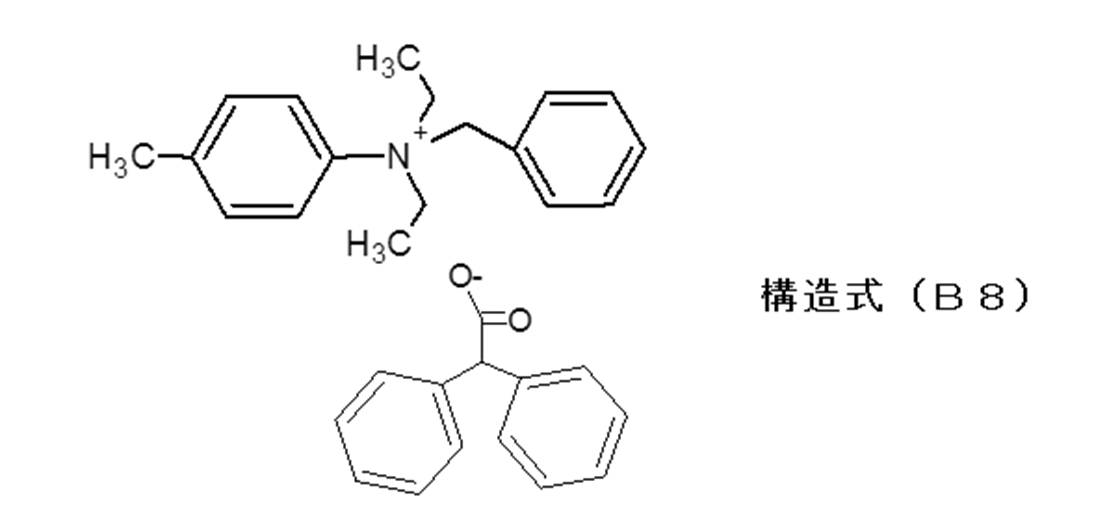
<アンモニウム塩B8の合成>
実施例B1において、アンモニウム塩A1を実施例A8で合成したアンモニウム塩A8 2.20g(0.0076mol)に変えた以外は、実施例B1と同様にして、下記構造式(B8)で表されるアンモニウム塩B8の白色結晶 2.49g(収率70.3%)を得た。
(実施例B9)
<アンモニウム塩B9の合成>
実施例B8において、ジフェニル酢酸銀を合成例2で合成した1-アダマンタンカルボン酸銀 2.18g(0.0076mol)に変えた以外は、実施例B8と同様にして、下記構造式(B9)で表されるアンモニウム塩B9の白色結晶 1.39g(収率42.3%)を得た。

<アンモニウム塩B9の合成>
実施例B8において、ジフェニル酢酸銀を合成例2で合成した1-アダマンタンカルボン酸銀 2.18g(0.0076mol)に変えた以外は、実施例B8と同様にして、下記構造式(B9)で表されるアンモニウム塩B9の白色結晶 1.39g(収率42.3%)を得た。
(実施例B10)
<アンモニウム塩B10の合成>
実施例B4において、ジフェニル酢酸銀を合成例2で合成した1-アダマンタンカルボン酸銀 2.18g(0.0076mol)に変えた以外は、実施例B4と同様にして、下記構造式(B10)で表されるアンモニウム塩B10の白色結晶 2.50g(収率72.1%)を得た。

<アンモニウム塩B10の合成>
実施例B4において、ジフェニル酢酸銀を合成例2で合成した1-アダマンタンカルボン酸銀 2.18g(0.0076mol)に変えた以外は、実施例B4と同様にして、下記構造式(B10)で表されるアンモニウム塩B10の白色結晶 2.50g(収率72.1%)を得た。
(実施例B11)
<アンモニウム塩B11の合成>
実施例B4において、ジフェニル酢酸銀を合成例3で合成した安息香酸銀 1.74g(0.0076mol)に変えた以外は、実施例B4と同様にして、下記構造式(B11)で表されるアンモニウム塩B11の白色結晶 2.15g(収率71.1%)を得た。
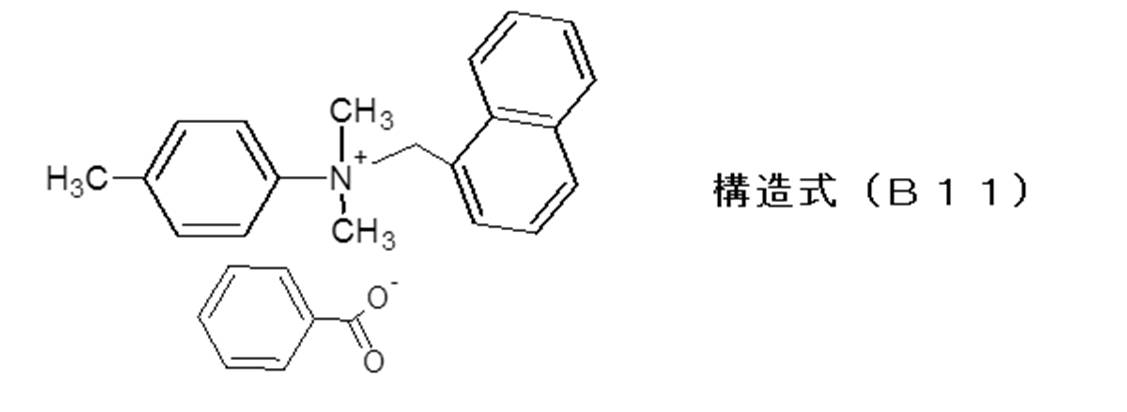
<アンモニウム塩B11の合成>
実施例B4において、ジフェニル酢酸銀を合成例3で合成した安息香酸銀 1.74g(0.0076mol)に変えた以外は、実施例B4と同様にして、下記構造式(B11)で表されるアンモニウム塩B11の白色結晶 2.15g(収率71.1%)を得た。
(比較例B1)
<アンモニウム塩B12の合成>
攪拌器を設置した100mL三口フラスコを遮光状態にしながら、合成例4で合成したp-トルエンスルホン酸銀2.12g(0.0076mol)及びアセトニトリル10gを入れ、室温で撹拌して、溶解させた。そこに、実施例A4で合成したアンモニウム塩A4 2.37g(0.0076mol)をアセトニトリル20gとメタノール2gの混合溶媒に溶解させた液を添加した。添加後室温にて30分間撹拌した後、フィルターにて析出した塩化銀を除去し、濾液を減圧濃縮することで結晶を得た。これを酢酸エチルで洗浄後、ろ過し、24時間減圧乾燥することで、下記構造式(B12)で表されるアンモニウム塩B12の白色結晶 3.18g(収率93.5%)を得た。
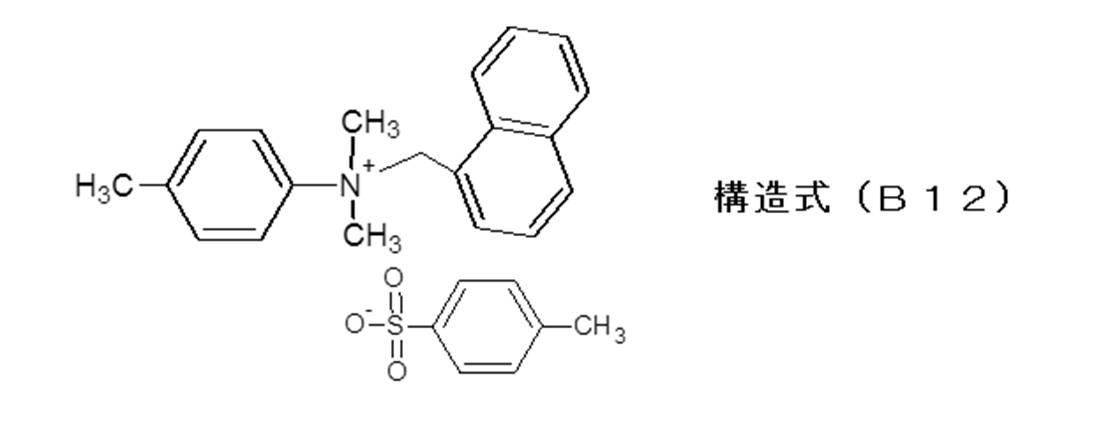
<アンモニウム塩B12の合成>
攪拌器を設置した100mL三口フラスコを遮光状態にしながら、合成例4で合成したp-トルエンスルホン酸銀2.12g(0.0076mol)及びアセトニトリル10gを入れ、室温で撹拌して、溶解させた。そこに、実施例A4で合成したアンモニウム塩A4 2.37g(0.0076mol)をアセトニトリル20gとメタノール2gの混合溶媒に溶解させた液を添加した。添加後室温にて30分間撹拌した後、フィルターにて析出した塩化銀を除去し、濾液を減圧濃縮することで結晶を得た。これを酢酸エチルで洗浄後、ろ過し、24時間減圧乾燥することで、下記構造式(B12)で表されるアンモニウム塩B12の白色結晶 3.18g(収率93.5%)を得た。
(比較例B2)
<アンモニウム塩B13の合成>
攪拌器を設置した300mL三口フラスコに、実施例A4で合成したアンモニウム塩A4 2.37g(0.0076mol)を入れ、さらに水100gを入れて撹拌して溶解させた。そこに、テトラフェニルホウ酸ナトリウム(東京化成工業株式会社製)2.60g(0.0076mol)の10質量%水溶液をゆっくり添加した。添加直後より白色の結晶が析出した。添加後、室温にてさらに2時間撹拌したのち、フィルターにて濾別し、さらに水洗した後、24時間減圧乾燥することで、下記構造式(B13)で表されるアンモニウム塩B13の白色結晶 2.95g(収率65.2%)を得た。
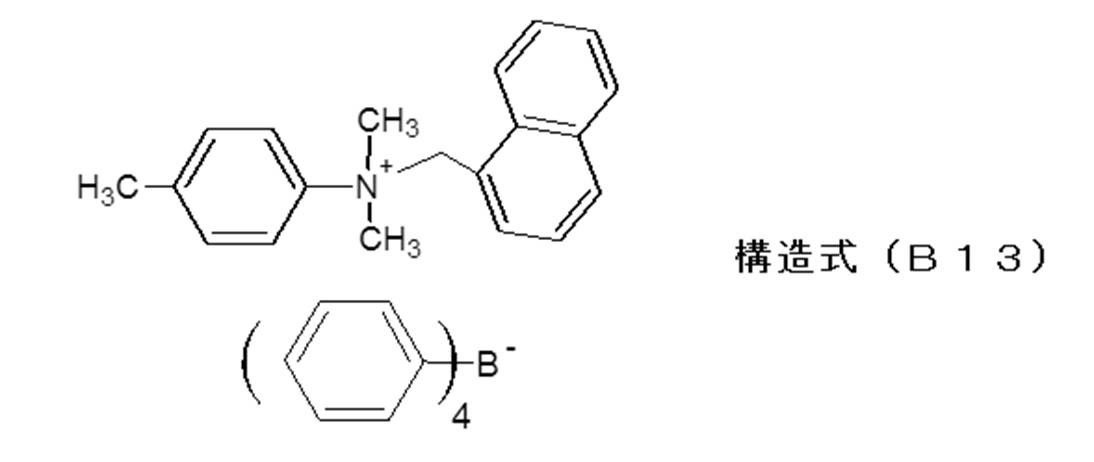
<アンモニウム塩B13の合成>
攪拌器を設置した300mL三口フラスコに、実施例A4で合成したアンモニウム塩A4 2.37g(0.0076mol)を入れ、さらに水100gを入れて撹拌して溶解させた。そこに、テトラフェニルホウ酸ナトリウム(東京化成工業株式会社製)2.60g(0.0076mol)の10質量%水溶液をゆっくり添加した。添加直後より白色の結晶が析出した。添加後、室温にてさらに2時間撹拌したのち、フィルターにて濾別し、さらに水洗した後、24時間減圧乾燥することで、下記構造式(B13)で表されるアンモニウム塩B13の白色結晶 2.95g(収率65.2%)を得た。
表1-1及び表1-2に、アンモニウム塩B1~B12のアニオンの共役酸の水中25℃でのpKaを示した。


(アンモニウム塩B1~B13の熱解離開始温度の測定)
エスアイアイ・ナノテクノロジー株式会社製の示差熱熱重量同時測定装置 TG/DTA6200を使用して、昇温速度10℃/min、200mL/min窒素ガス雰囲気下にてアンモニウム塩B1~B13の熱解離開始温度を評価した。結果を表2-1、及び表2-2に示した。
なお、アンモニウム塩B7以外は熱解離開始に伴うDTAのピークが得られたため、そのピーク温度を熱解離開始温度とした。アンモニウム塩B7は明瞭なDTAピークが得られなかったため重量減少チャートの熱解離開始前の平坦部と5%重量減少点の接線の外挿交点の温度を熱解離開始温度とした。
エスアイアイ・ナノテクノロジー株式会社製の示差熱熱重量同時測定装置 TG/DTA6200を使用して、昇温速度10℃/min、200mL/min窒素ガス雰囲気下にてアンモニウム塩B1~B13の熱解離開始温度を評価した。結果を表2-1、及び表2-2に示した。
なお、アンモニウム塩B7以外は熱解離開始に伴うDTAのピークが得られたため、そのピーク温度を熱解離開始温度とした。アンモニウム塩B7は明瞭なDTAピークが得られなかったため重量減少チャートの熱解離開始前の平坦部と5%重量減少点の接線の外挿交点の温度を熱解離開始温度とした。


(実施例1~16及び比較例1~5)
表3-1及び表3-2に示す配合にしたがって熱硬化性樹脂組成物を作製した。
作製した熱硬化性樹脂組成物をシリコーン系離型処理された剥離PET(ポリエチレンテレフタレート)にコーティングし、60℃に設定された熱風循環オーブン中で5分間乾燥することにより、平均厚み15μmの熱硬化性シートを作製した。
表3-1及び表3-2に示す配合にしたがって熱硬化性樹脂組成物を作製した。
作製した熱硬化性樹脂組成物をシリコーン系離型処理された剥離PET(ポリエチレンテレフタレート)にコーティングし、60℃に設定された熱風循環オーブン中で5分間乾燥することにより、平均厚み15μmの熱硬化性シートを作製した。
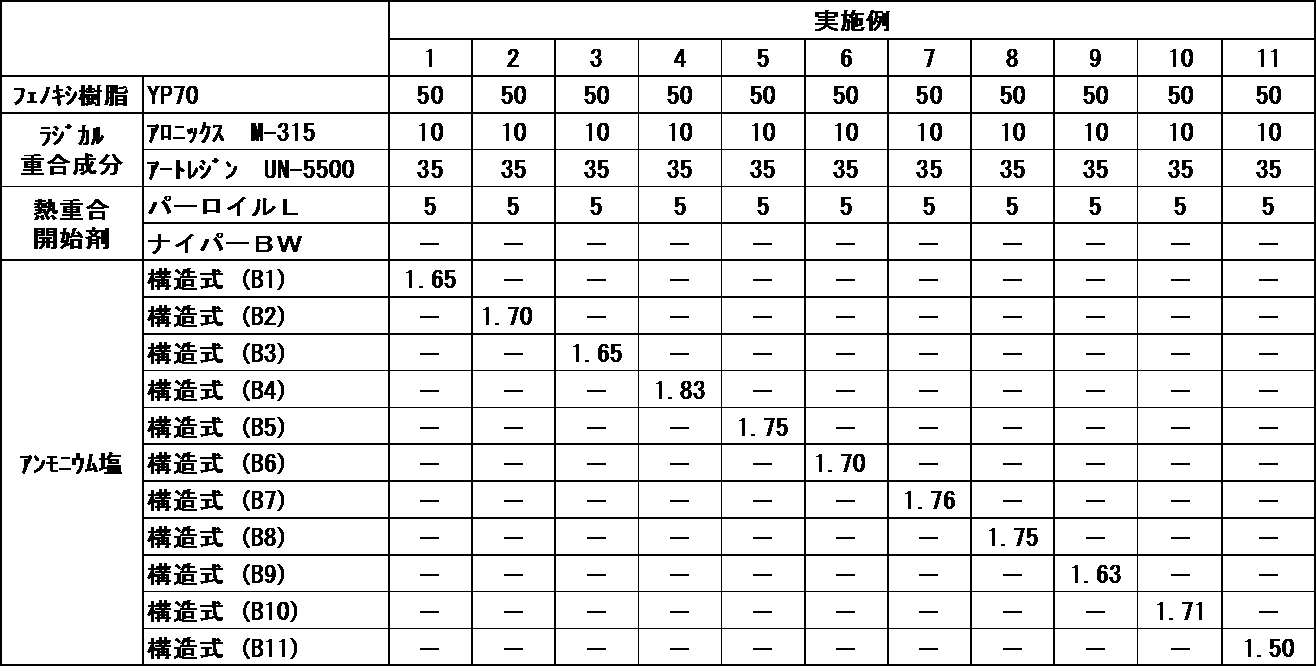
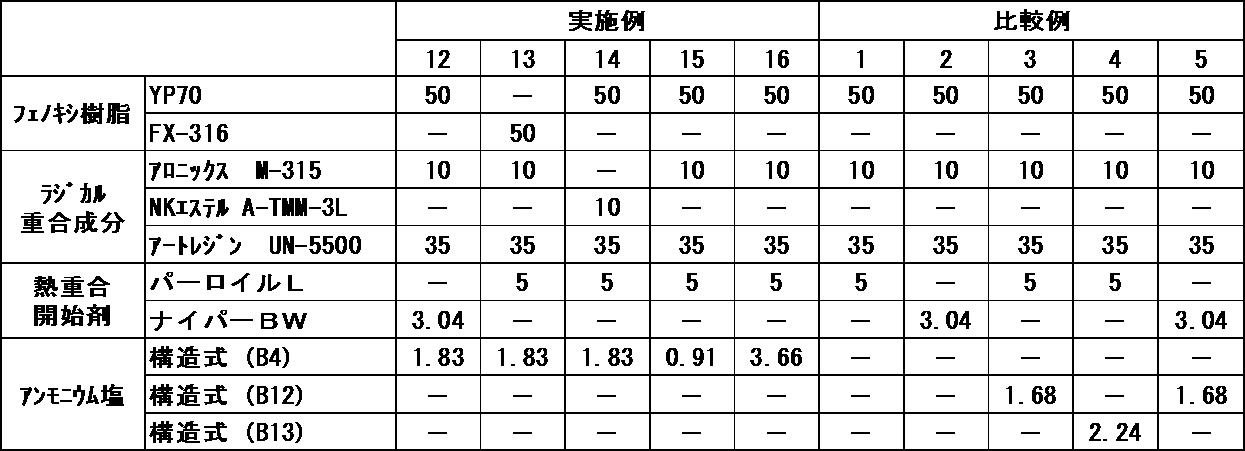
表3-1及び表3-2におけるフェノキシ樹脂の配合は、溶剤分を除いた配合量であり、単位は、質量部である。ラジカル重合成分、熱重合開始剤、及びアンモニウム塩の配合も、溶剤分を除いた配合量であり、単位は、質量部である。
なお、表3における各材料は、以下のとおりである。
YP70:新日鐵住金化学株式会社製、ビスフェノールA/ビスフェノールF共重合型フェノキシ樹脂
FX-316:新日鐵住金化学株式会社製、ビスフェノールF型フェノキシ樹脂
アロニックスM-315:東亞合成株式会社製、イソシアヌル酸EO 変性ジ及びトリアクリレート
NKエステル A-TMM-3L:新中村化学工業株式会社製、ペンタエリスリトールトリアクリレート
アートレジンUN-5500:根上工業株式会社製、ウレタンアクリレートオリゴマー
パーロイルL:日油株式会社製、有機過酸化物
ナイパーBW:日油株式会社製、有機過酸化物
YP70:新日鐵住金化学株式会社製、ビスフェノールA/ビスフェノールF共重合型フェノキシ樹脂
FX-316:新日鐵住金化学株式会社製、ビスフェノールF型フェノキシ樹脂
アロニックスM-315:東亞合成株式会社製、イソシアヌル酸EO 変性ジ及びトリアクリレート
NKエステル A-TMM-3L:新中村化学工業株式会社製、ペンタエリスリトールトリアクリレート
アートレジンUN-5500:根上工業株式会社製、ウレタンアクリレートオリゴマー
パーロイルL:日油株式会社製、有機過酸化物
ナイパーBW:日油株式会社製、有機過酸化物
なお、配合する際、YP70及びFX-316は、メチルエチルケトンの45質量%固形分溶液を用いた。アロニックスM-315は、トルエンの50質量%固形分溶液を用い、NKエステル A-TMM-3Lは原液をそのまま用いた。アートレジンUN-5500は、メチルエチルケトンの50質量%固形分溶液を用いた。パーロイルLは、トルエンの20質量%固形分溶液を用いた。ナイパーBWは、アセトンの20質量%固形分溶液を用いた。また、アンモニウム塩B1~B13は、メタノールに溶解し10質量%固形分としたものを用いた。
ナイパーBW3.04質量部と、パーロイルL5質量部とは、等モル量である。
実施例1~14、比較例2~5において、アンモニウム塩は、パーロイルL又はナイパーBWに対して30mol%となるように配合した。
ナイパーBW3.04質量部と、パーロイルL5質量部とは、等モル量である。
実施例1~14、比較例2~5において、アンモニウム塩は、パーロイルL又はナイパーBWに対して30mol%となるように配合した。
(実施例1~16及び比較例1~5の熱硬化性シートの低温硬化性及び保存安定性評価)
作製した実施例1~16及び比較例1~5の熱硬化性シート(平均厚み15μm)の初期の低温硬化性及び保存安定性を、エスアイアイ・ナノテクノロジー株式会社製の示差走査熱量測定装置DSC6200により評価した。
保存安定性は25℃/65%Rhの暗所環境下にて2週間放置前後のDSCにおける発熱量変化から減少率を算出することで評価した。
作製した実施例1~16及び比較例1~5の熱硬化性シート(平均厚み15μm)の初期の低温硬化性及び保存安定性を、エスアイアイ・ナノテクノロジー株式会社製の示差走査熱量測定装置DSC6200により評価した。
保存安定性は25℃/65%Rhの暗所環境下にて2週間放置前後のDSCにおける発熱量変化から減少率を算出することで評価した。
当業界で良く知られているように、示差走査熱量測定による発熱挙動はラジカル重合成分の硬化反応挙動を反映している。よってその結果による硬化開始温度及び硬化終了温度がより低いほど、その組成物が低温硬化性を有すると言える。
本発明では、硬化開始温度としてDSCチャートにおけるトータル発熱の2%に到達する温度、及び硬化終了温度はDSCチャートにおけるトータル発熱の98%に到達する温度を指標として低温硬化性を評価した。いずれも、より低温である方が低温硬化活性を有することになるが、反応の完結の指標となる発熱(硬化)終了温度がより重要な指標となる。
また、放置前後のトータル発熱量の変化量は、放置中での反応進行量を反映する。放置前後で発熱量の変化が少ないほど保存安定性が高いと言える。具体的には、10%以下の減少に抑えることで接着シートとしての機能は維持できる。
結果を表4-1及び表4-2に示した。
<測定条件>
昇温速度 10℃/min
N2ガス 100ml/min
サンプル重量 約10mg
本発明では、硬化開始温度としてDSCチャートにおけるトータル発熱の2%に到達する温度、及び硬化終了温度はDSCチャートにおけるトータル発熱の98%に到達する温度を指標として低温硬化性を評価した。いずれも、より低温である方が低温硬化活性を有することになるが、反応の完結の指標となる発熱(硬化)終了温度がより重要な指標となる。
また、放置前後のトータル発熱量の変化量は、放置中での反応進行量を反映する。放置前後で発熱量の変化が少ないほど保存安定性が高いと言える。具体的には、10%以下の減少に抑えることで接着シートとしての機能は維持できる。
結果を表4-1及び表4-2に示した。
<測定条件>
昇温速度 10℃/min
N2ガス 100ml/min
サンプル重量 約10mg


上記の結果より、本発明の実施例1~16の熱硬化性シートは、アンモニウム塩を添加をしていない比較例1及び2に対し硬化開始温度及び硬化終了温度のいずれも低温化が図れていることがわかる。また、25℃/65%Rh下での保存安定性も十分有していることが確認できた。
また、熱解離開始温度の高いアンモニウム塩を添加した比較例3~5は添加していないもの(比較例1及び2)とほとんど差が無く、効果が見られないことが確認できた。
本結果により、本発明の有用性が証明された。
また、熱解離開始温度の高いアンモニウム塩を添加した比較例3~5は添加していないもの(比較例1及び2)とほとんど差が無く、効果が見られないことが確認できた。
本結果により、本発明の有用性が証明された。
本発明の熱硬化性樹脂組成物は、低温かつ短時間で硬化が可能で、かつ硬化前の保存安定性が確保できるため、電子部品を接合する接着剤として、好適に用いることができる。
Claims (15)
- ラジカル重合成分と、熱重合開始剤と、アンモニウム塩とを含有し、
前記アンモニウム塩の熱解離開始温度が、60℃~140℃であることを特徴とする熱硬化性樹脂組成物。 - アンモニウム塩におけるアニオンの共役酸の水中25℃でのpKaが、3以上である請求項1に記載の熱硬化性樹脂組成物。
- アンモニウム塩が、下記一般式(1)で表される化合物である請求項1から2のいずれかに記載の熱硬化性樹脂組成物。

- 一般式(1)において、R1及びR2が、それぞれ独立して、炭素数1~4のアルキル基を表し、R3が、置換又は無置換のアリール基を表し、R4が、置換又は無置換のアラルキル基を表す、請求項3に記載の熱硬化性樹脂組成物。
- 一般式(1)において、R3が、下記一般式(2)で表される基である請求項3から4のいずれかに記載の熱硬化性樹脂組成物。
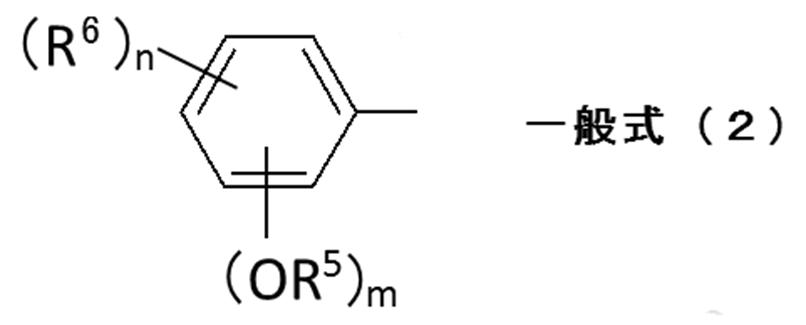
- 一般式(1)におけるX-が、カルボン酸のアニオンである請求項3から5のいずれかに記載の熱硬化性樹脂組成物。
- 一般式(1)におけるX-が、ナフタレンカルボン酸類のアニオン、ジフェニル酢酸アニオン、及び1-アダマンタンカルボン酸アニオンのいずれかである請求項3から6のいずれかに記載の熱硬化性樹脂組成物。
- 熱重合開始剤が、有機過酸化物熱重合開始剤である請求項1から7のいずれかに記載の熱硬化性樹脂組成物。
- 有機過酸化物熱重合開始剤が、ジアシルパーオキサイド及びパーオキシジカーボネートの少なくともいずれかを含有する請求項8に記載の熱硬化性樹脂組成物。
- 請求項1から9のいずれかに記載の熱硬化性樹脂組成物を含有することを特徴とする熱硬化性シート。
- 下記一般式(1)で表されることを特徴とする化合物。
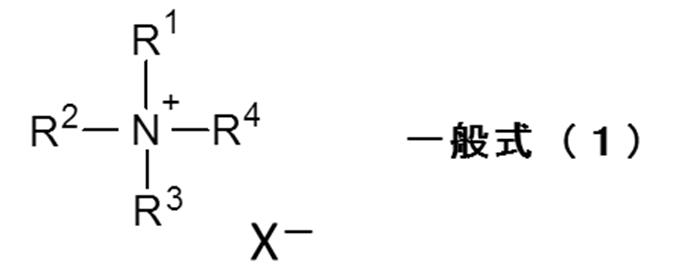
- 一般式(1)において、R3が、下記一般式(2)で表される基である請求項11に記載の化合物。
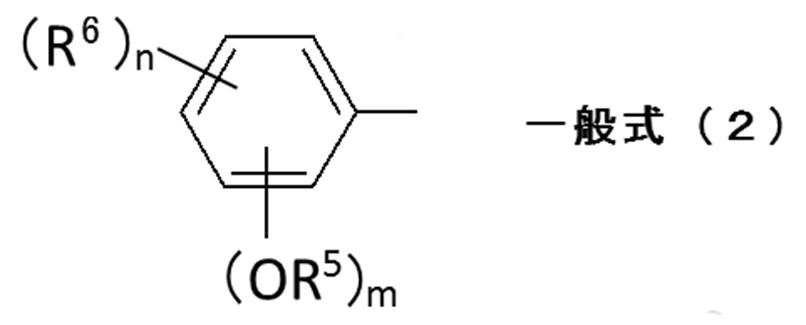
- 一般式(1)におけるX-が、ハロゲンアニオン、ナフタレンカルボン酸類のアニオン、ジフェニル酢酸アニオン、及び1-アダマンタンカルボン酸アニオンのいずれかである請求項11から12のいずれかに記載の化合物。
- 下記一般式(1)で表されることを特徴とする化合物。
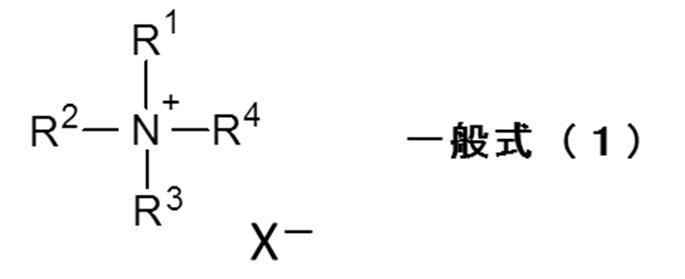
- 一般式(1)において、R3が、下記一般式(2)で表される基である請求項14に記載の化合物。
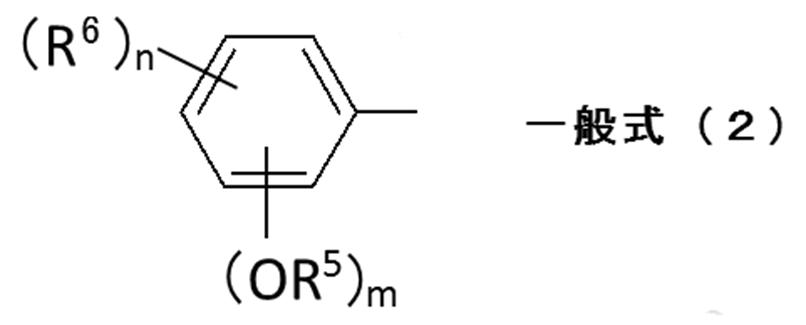
Priority Applications (2)
| Application Number | Priority Date | Filing Date | Title |
|---|---|---|---|
| CN201480066345.5A CN105814090B (zh) | 2013-12-05 | 2014-11-26 | 化合物、热固化性树脂组合物和热固化性片材 |
| KR1020167017393A KR102239537B1 (ko) | 2013-12-05 | 2014-11-26 | 화합물, 열경화성 수지 조성물 및 열경화성 시트 |
Applications Claiming Priority (2)
| Application Number | Priority Date | Filing Date | Title |
|---|---|---|---|
| JP2013-252247 | 2013-12-05 | ||
| JP2013252247A JP6285164B2 (ja) | 2013-12-05 | 2013-12-05 | 化合物、熱硬化性樹脂組成物、及び熱硬化性シート |
Publications (1)
| Publication Number | Publication Date |
|---|---|
| WO2015083585A1 true WO2015083585A1 (ja) | 2015-06-11 |
Family
ID=53273348
Family Applications (1)
| Application Number | Title | Priority Date | Filing Date |
|---|---|---|---|
| PCT/JP2014/081161 Ceased WO2015083585A1 (ja) | 2013-12-05 | 2014-11-26 | 化合物、熱硬化性樹脂組成物、及び熱硬化性シート |
Country Status (5)
| Country | Link |
|---|---|
| JP (1) | JP6285164B2 (ja) |
| KR (1) | KR102239537B1 (ja) |
| CN (1) | CN105814090B (ja) |
| TW (1) | TWI641639B (ja) |
| WO (1) | WO2015083585A1 (ja) |
Cited By (2)
| Publication number | Priority date | Publication date | Assignee | Title |
|---|---|---|---|---|
| JP2016166306A (ja) * | 2015-03-10 | 2016-09-15 | デクセリアルズ株式会社 | 熱硬化性樹脂組成物、及び熱硬化性シート |
| JP2016172813A (ja) * | 2015-03-17 | 2016-09-29 | デクセリアルズ株式会社 | 化合物、熱硬化性樹脂組成物、及び熱硬化性シート |
Families Citing this family (1)
| Publication number | Priority date | Publication date | Assignee | Title |
|---|---|---|---|---|
| JP7721991B2 (ja) * | 2021-07-09 | 2025-08-13 | デクセリアルズ株式会社 | 硬化性組成物及び硬化物 |
Citations (9)
| Publication number | Priority date | Publication date | Assignee | Title |
|---|---|---|---|---|
| JPS59139326A (ja) * | 1982-10-13 | 1984-08-10 | ハ−ネマン・ユニバ−シテイ− | 心筋層用ラジオイメ−ジング剤 |
| JPS60103065A (ja) * | 1983-11-09 | 1985-06-07 | 株式会社日本触媒 | 人工大理石調物品の製法 |
| JPS6253311A (ja) * | 1985-08-28 | 1987-03-09 | Sumitomo Chem Co Ltd | メタクリル酸エステル系重合体の製造方法 |
| JPH05310850A (ja) * | 1992-01-09 | 1993-11-22 | Degussa Ag | (メト)アクリレート含有の重合可能な混合物、(メト)アクリル系樹脂の製造法、黄変の減少方法、樹脂および該樹脂を含有する複合ガラス |
| JP2006506466A (ja) * | 2002-07-23 | 2006-02-23 | アテニュオン,リミティド ライアビリティー カンパニー | チオモリブデン酸類似物及びそれらの使用 |
| WO2009093872A2 (ko) * | 2008-01-24 | 2009-07-30 | Korea Research Institute Of Bioscience And Biotechnology | 신규한 디아민 화합물 또는 이의 약학적으로 허용가능한 염, 이의 제조방법 및 이를 포함하는 암 치료용 약학 조성물 |
| JP2011074190A (ja) * | 2009-09-30 | 2011-04-14 | Sanyo Chem Ind Ltd | 活性エネルギー線硬化型帯電防止性組成物 |
| WO2012051912A1 (zh) * | 2010-10-20 | 2012-04-26 | 中国科学院昆明植物研究所 | 含氮类联苯化合物,含其的药物组合物,其制备方法及其在抗hiv-1中的应用 |
| CN103113251A (zh) * | 2013-01-28 | 2013-05-22 | 威海东宝制药有限公司 | N,n-对苯羧基羟苯基甲基季铵盐及其制备方法 |
Family Cites Families (11)
| Publication number | Priority date | Publication date | Assignee | Title |
|---|---|---|---|---|
| US3845010A (en) * | 1971-12-17 | 1974-10-29 | Ford Motor Co | Thermoset molding powders employing glycidyl methacrylate functional polymer and dibasic acid crosslinking agent and moldings thereof |
| JPH0832750B2 (ja) | 1989-04-21 | 1996-03-29 | 積水化学工業株式会社 | 接着剤組成物 |
| EP0448154A1 (en) | 1990-03-20 | 1991-09-25 | Akzo Nobel N.V. | Coating composition including a blocked basic catalyst |
| JPH08283657A (ja) | 1995-04-12 | 1996-10-29 | Nippon Paint Co Ltd | 塗料用硬化性樹脂組成物 |
| JP4090898B2 (ja) | 2003-01-20 | 2008-05-28 | 昭和高分子株式会社 | ラジカル重合性樹脂組成物 |
| JP4967276B2 (ja) | 2005-08-09 | 2012-07-04 | 日立化成工業株式会社 | 回路接続材料並びに回路端子の接続構造体及び接続方法 |
| TWI347337B (en) * | 2006-04-14 | 2011-08-21 | Otsuka Chemical Co Ltd | Resin composition and heat resistant adhesive |
| WO2008088160A1 (en) * | 2007-01-15 | 2008-07-24 | Lg Chem, Ltd. | New polymer resin compounds and photoresist composition including new polymer resin compounds |
| KR101832319B1 (ko) * | 2011-02-21 | 2018-02-27 | 주식회사 동진쎄미켐 | 수용성 코팅막 조성물 및 이를 이용한 스컴 제거 방법 |
| JP5881317B2 (ja) | 2011-06-14 | 2016-03-09 | Kjケミカルズ株式会社 | 不飽和第4級アンモニウム塩化合物の製造方法及びそれからなる帯電防止剤と帯電防止組成物 |
| JP3218345U (ja) | 2018-07-26 | 2018-10-04 | 株式会社スパイラルの田中 | くびまき |
-
2013
- 2013-12-05 JP JP2013252247A patent/JP6285164B2/ja active Active
-
2014
- 2014-11-26 WO PCT/JP2014/081161 patent/WO2015083585A1/ja not_active Ceased
- 2014-11-26 CN CN201480066345.5A patent/CN105814090B/zh active Active
- 2014-11-26 KR KR1020167017393A patent/KR102239537B1/ko active Active
- 2014-12-02 TW TW103141855A patent/TWI641639B/zh active
Patent Citations (9)
| Publication number | Priority date | Publication date | Assignee | Title |
|---|---|---|---|---|
| JPS59139326A (ja) * | 1982-10-13 | 1984-08-10 | ハ−ネマン・ユニバ−シテイ− | 心筋層用ラジオイメ−ジング剤 |
| JPS60103065A (ja) * | 1983-11-09 | 1985-06-07 | 株式会社日本触媒 | 人工大理石調物品の製法 |
| JPS6253311A (ja) * | 1985-08-28 | 1987-03-09 | Sumitomo Chem Co Ltd | メタクリル酸エステル系重合体の製造方法 |
| JPH05310850A (ja) * | 1992-01-09 | 1993-11-22 | Degussa Ag | (メト)アクリレート含有の重合可能な混合物、(メト)アクリル系樹脂の製造法、黄変の減少方法、樹脂および該樹脂を含有する複合ガラス |
| JP2006506466A (ja) * | 2002-07-23 | 2006-02-23 | アテニュオン,リミティド ライアビリティー カンパニー | チオモリブデン酸類似物及びそれらの使用 |
| WO2009093872A2 (ko) * | 2008-01-24 | 2009-07-30 | Korea Research Institute Of Bioscience And Biotechnology | 신규한 디아민 화합물 또는 이의 약학적으로 허용가능한 염, 이의 제조방법 및 이를 포함하는 암 치료용 약학 조성물 |
| JP2011074190A (ja) * | 2009-09-30 | 2011-04-14 | Sanyo Chem Ind Ltd | 活性エネルギー線硬化型帯電防止性組成物 |
| WO2012051912A1 (zh) * | 2010-10-20 | 2012-04-26 | 中国科学院昆明植物研究所 | 含氮类联苯化合物,含其的药物组合物,其制备方法及其在抗hiv-1中的应用 |
| CN103113251A (zh) * | 2013-01-28 | 2013-05-22 | 威海东宝制药有限公司 | N,n-对苯羧基羟苯基甲基季铵盐及其制备方法 |
Cited By (2)
| Publication number | Priority date | Publication date | Assignee | Title |
|---|---|---|---|---|
| JP2016166306A (ja) * | 2015-03-10 | 2016-09-15 | デクセリアルズ株式会社 | 熱硬化性樹脂組成物、及び熱硬化性シート |
| JP2016172813A (ja) * | 2015-03-17 | 2016-09-29 | デクセリアルズ株式会社 | 化合物、熱硬化性樹脂組成物、及び熱硬化性シート |
Also Published As
| Publication number | Publication date |
|---|---|
| KR102239537B1 (ko) | 2021-04-14 |
| JP2015108091A (ja) | 2015-06-11 |
| TW201522448A (zh) | 2015-06-16 |
| JP6285164B2 (ja) | 2018-02-28 |
| CN105814090A (zh) | 2016-07-27 |
| KR20160096116A (ko) | 2016-08-12 |
| TWI641639B (zh) | 2018-11-21 |
| CN105814090B (zh) | 2018-06-26 |
Similar Documents
| Publication | Publication Date | Title |
|---|---|---|
| CN102633994B (zh) | 环氧树脂组合物 | |
| JP7200130B2 (ja) | 不飽和二重結合含有化合物、それを用いた酸素吸収剤、及び樹脂組成物 | |
| TW201229181A (en) | Pressure-sensitive adhesive composition, pressure-sensitive adhesive, and pressure-sensitive adhesive sheet using same | |
| JP6442333B2 (ja) | 化合物、熱硬化性樹脂組成物、及び熱硬化性シート | |
| CN102958974A (zh) | 固化性树脂组合物 | |
| TW201239055A (en) | Removable water-dispersible acrylic pressure-sensitive adhesive composition and pressure-sensitive adhesive sheet | |
| JP6793474B2 (ja) | 液晶滴下工法用シール材、液晶表示パネル及び液晶表示パネルの製造方法 | |
| JP2011052131A5 (ja) | ||
| JP6285164B2 (ja) | 化合物、熱硬化性樹脂組成物、及び熱硬化性シート | |
| JP6251557B2 (ja) | 化合物、熱硬化性樹脂組成物、及び熱硬化性シート | |
| JP4961458B2 (ja) | ヒドラジド化合物及びその製造方法、並びにそれを用いた硬化剤、樹脂組成物及び硬化体 | |
| JP6031405B2 (ja) | ベンゾトリアゾール化合物 | |
| JP6166988B2 (ja) | 化合物、熱硬化性樹脂組成物、及び熱硬化性シート | |
| KR20150139843A (ko) | 수지 조성물 | |
| JP6397784B2 (ja) | 熱硬化性樹脂組成物、及び熱硬化性シート | |
| WO2015151814A1 (ja) | 熱硬化性芳香族エステルの製造方法、及び熱硬化性芳香族エステル | |
| JP5805969B2 (ja) | 水性コーティング用樹脂組成物およびその製造方法 | |
| JP5895715B2 (ja) | チオエーテル含有ウレア誘導体、およびその用途 | |
| JP7086444B2 (ja) | 架橋性組成物 | |
| JP6442271B2 (ja) | 化合物、熱硬化性樹脂組成物、及び熱硬化性シート | |
| JP6781596B2 (ja) | オニウム化合物の製造方法、及び硬化性樹脂組成物の製造方法 | |
| TWI384045B (zh) | 含有雙唑啉之可固化液體組成物 | |
| KR20260045671A (ko) | 수지 조성물 | |
| JP2025047377A (ja) | 化合物、組成物、硬化膜及び硬化膜の製造方法 | |
| WO2025187447A1 (ja) | 樹脂組成物、接着剤、封止材、硬化物、半導体装置及び電子部品 |
Legal Events
| Date | Code | Title | Description |
|---|---|---|---|
| 121 | Ep: the epo has been informed by wipo that ep was designated in this application |
Ref document number: 14866847 Country of ref document: EP Kind code of ref document: A1 |
|
| NENP | Non-entry into the national phase |
Ref country code: DE |
|
| ENP | Entry into the national phase |
Ref document number: 20167017393 Country of ref document: KR Kind code of ref document: A |
|
| 122 | Ep: pct application non-entry in european phase |
Ref document number: 14866847 Country of ref document: EP Kind code of ref document: A1 |