WO2015064563A1 - 易重合性化合物の減圧蒸留の方法およびアクリル酸の製造方法 - Google Patents
易重合性化合物の減圧蒸留の方法およびアクリル酸の製造方法 Download PDFInfo
- Publication number
- WO2015064563A1 WO2015064563A1 PCT/JP2014/078603 JP2014078603W WO2015064563A1 WO 2015064563 A1 WO2015064563 A1 WO 2015064563A1 JP 2014078603 W JP2014078603 W JP 2014078603W WO 2015064563 A1 WO2015064563 A1 WO 2015064563A1
- Authority
- WO
- WIPO (PCT)
- Prior art keywords
- steam ejector
- steam
- acrylic acid
- ejector
- polymerizable compound
- Prior art date
- Legal status (The legal status is an assumption and is not a legal conclusion. Google has not performed a legal analysis and makes no representation as to the accuracy of the status listed.)
- Ceased
Links
Images


Classifications
-
- C—CHEMISTRY; METALLURGY
- C07—ORGANIC CHEMISTRY
- C07C—ACYCLIC OR CARBOCYCLIC COMPOUNDS
- C07C51/00—Preparation of carboxylic acids or their salts, halides or anhydrides
- C07C51/42—Separation; Purification; Stabilisation; Use of additives
- C07C51/43—Separation; Purification; Stabilisation; Use of additives by change of the physical state, e.g. crystallisation
- C07C51/44—Separation; Purification; Stabilisation; Use of additives by change of the physical state, e.g. crystallisation by distillation
- C07C51/445—Separation; Purification; Stabilisation; Use of additives by change of the physical state, e.g. crystallisation by distillation by steam distillation
-
- B—PERFORMING OPERATIONS; TRANSPORTING
- B01—PHYSICAL OR CHEMICAL PROCESSES OR APPARATUS IN GENERAL
- B01D—SEPARATION
- B01D3/00—Distillation or related exchange processes in which liquids are contacted with gaseous media, e.g. stripping
- B01D3/10—Vacuum distillation
-
- B—PERFORMING OPERATIONS; TRANSPORTING
- B01—PHYSICAL OR CHEMICAL PROCESSES OR APPARATUS IN GENERAL
- B01D—SEPARATION
- B01D3/00—Distillation or related exchange processes in which liquids are contacted with gaseous media, e.g. stripping
- B01D3/34—Distillation or related exchange processes in which liquids are contacted with gaseous media, e.g. stripping with one or more auxiliary substances
- B01D3/38—Steam distillation
-
- F—MECHANICAL ENGINEERING; LIGHTING; HEATING; WEAPONS; BLASTING
- F04—POSITIVE - DISPLACEMENT MACHINES FOR LIQUIDS; PUMPS FOR LIQUIDS OR ELASTIC FLUIDS
- F04F—PUMPING OF FLUID BY DIRECT CONTACT OF ANOTHER FLUID OR BY USING INERTIA OF FLUID TO BE PUMPED; SIPHONS
- F04F5/00—Jet pumps, i.e. devices in which flow is induced by pressure drop caused by velocity of another fluid flow
- F04F5/14—Jet pumps, i.e. devices in which flow is induced by pressure drop caused by velocity of another fluid flow the inducing fluid being elastic fluid
- F04F5/16—Jet pumps, i.e. devices in which flow is induced by pressure drop caused by velocity of another fluid flow the inducing fluid being elastic fluid displacing elastic fluids
- F04F5/20—Jet pumps, i.e. devices in which flow is induced by pressure drop caused by velocity of another fluid flow the inducing fluid being elastic fluid displacing elastic fluids for evacuating
Definitions
- the present invention relates to a method for distillation of an easily polymerizable compound under reduced pressure and a method for producing acrylic acid. More specifically, the present invention relates to a method for preventing polymerization of an easily polymerizable compound inside a steam ejector by using a steam ejector as a pressure reducing device in vacuum distillation of the easily polymerizable compound. Moreover, it is related with the manufacturing method of acrylic acid which is one of the easily polymerizable compounds using this method.
- an acrylic acid-containing gas produced by a gas phase catalytic oxidation reaction using propane, propylene or acrolein as a raw material is collected in a collection solvent such as water, and acrylic acid is obtained from the resulting acrylic acid solution.
- a method for separating an acid and purifying the separated acrylic acid by distillation under reduced pressure is generally known.
- a crude acrylate ester is obtained by an esterification reaction between purified acrylic acid and an alcohol, and the crude acrylate ester is distilled and purified, or an ester exchange between an acrylate ester and an alcohol is performed.
- a method is known in which a crude acrylate is obtained by reaction, and the resulting crude acrylate is distilled and purified.
- Acrylic acid is an easily polymerizable compound, and polymerization is likely to occur in a purification process of an acrylic acid solution, particularly in a distillation process involving a lot of heating. Therefore, as a countermeasure against polymerization of acrylic acid in the distillation column, a method of supplying a polymerization inhibitor, molecular oxygen, or the like and reducing the pressure in the column to lower the temperature in the distillation column is used.
- Distilled gas from the distillation tower is cooled and condensed by the heat exchanger, but some uncondensed gas is sucked into the decompression device.
- a liquid ring vacuum pump or a steam ejector is generally used as the pressure reducing device.
- this uncondensed gas also contains acrylic acid, polymerization of acrylic acid can occur around the decompression device.
- Patent Document 1 Japanese Patent Laid-Open No. 2000-344711 discloses a method of supplying a polymerization inhibitor-containing liquid when the gas sucked into the steam ejector is discharged from the steam ejector together with the driving steam and then cooled. Has been.
- Patent Document 2 Japanese Patent Laid-Open No. 2005-289927
- the vapor and suction gas discharged from the steam ejector are cooled to less than 40 ° C. without adding a polymerization inhibitor, so that A method for preventing polymerization of acrylic acid is disclosed.
- Patent Documents 1 and 2 use a steam ejector, they use a method of preventing polymerization of an easily polymerizable compound by adding a polymerization inhibitor or cooling the steam ejector. However, it does not prevent the polymerization of the easily polymerizable compound by special operation. For this reason, when the reduced pressure cannot be maintained due to the blockage of the steam ejector, the operation of the vacuum distillation column must be stopped.
- the steam ejector itself is a small piece of equipment. When the steam ejector is closed, switching to a spare unit can prevent the distillation tower from shutting down. The liquid flow is disturbed and triggers polymerization blockage in the distillation column. In addition, since there is a problem that a heavy load is imposed on the operator such as cleaning of the obstruction site and restoration of dismantling, a fundamental solution is desired.
- an object of the present invention is to provide a method for preventing blockage of a steam ejector due to polymerization of a readily polymerizable compound when a steam ejector is used as a pressure reducing device in a vacuum distillation step of the easily polymerizable compound.
- Another object of the present invention is to provide a method for producing acrylic acid, which is one of easily polymerizable compounds, using this method.
- the present inventor found that when the outer surface of the steam ejector was heated, unlike the assumption, the generation of the polymer was suppressed. As a result of diligent examination based on this fact, when performing vacuum distillation of an easily polymerizable compound using a steam ejector, heating of the outer surface of the steam ejector ensures that the polymer adheres to the inside of the steam ejector. As a result, the present invention has been completed.
- a first invention of the present invention is a method for producing acrylic acid, comprising a step of subjecting acrylic acid obtained by a gas phase catalytic oxidation reaction using propane, propylene or acrolein as a raw material to vacuum distillation with a steam ejector. It is a manufacturing method of acrylic acid in which a distillation process includes the process of heating the outer surface of this steam ejector.
- the outer surface of the steam ejector in the first invention is preferably heated using a steam trace, and is also preferably heated using a heat transfer heater.
- the outer surface of the steam ejector is preferably heated to 50 ° C. or higher.
- the steam ejector is preferably multi-staged, and a liquid ring vacuum pump is preferably disposed downstream of the steam ejector.
- the second invention of the present invention is a method for vacuum distillation of an easily polymerizable compound using a steam ejector, which includes a step of heating the outer surface of the steam ejector.
- the readily polymerizable compound in the second invention is preferably acrylic acid or an acrylic ester, and is also preferably acrylic acid obtained by a gas phase catalytic oxidation reaction using propane, propylene or acrolein as a raw material.
- the outer surface of the steam ejector is preferably heated using a steam trace, and is preferably heated using a heat transfer heater.
- the outer surface of the steam ejector is preferably heated to 50 ° C. or higher.
- the steam ejector is preferably multi-staged, and a liquid ring vacuum pump is preferably disposed downstream of the steam ejector.
- a method for preventing blockage of the steam ejector due to polymerization of the easily polymerizable compound can be provided.
- the manufacturing method of acrylic acid which is one of the easily polymerizable compounds using this method can be provided.
- FIG. 1 is a flow sheet showing an example of the vacuum distillation method of the present invention.
- Raw material (1) is a crude easily polymerizable compound-containing liquid containing an easily polymerizable compound, and is supplied to the distillation column (I).
- the easily polymerizable compound include acrylic acids, methacrylic acids, and styrenes.
- Acrylic acid is a general term for acrylic acid and acrylic acid esters obtained from acrylic acid and alcohol, and indicates at least one of them. Examples include acrylic acid, methyl acrylate, ethyl acrylate, butyl acrylate, isobutyl acrylate, tertiary butyl acrylate, methoxyethyl acrylate, and the like. Of these, acrylic acid is preferably acrylic acid obtained by a gas phase catalytic oxidation reaction using propane, propylene or acrolein as a raw material.
- methacrylic acid is a general term for methacrylic acid and methacrylic acid esters obtained from methacrylic acid and alcohol, and indicates at least one of them. Examples include methacrylic acid, methyl methacrylate, ethyl methacrylate, butyl methacrylate and the like.
- styrenes are a general term for styrene and styrene compounds having a substituent, and at least one of them is indicated.
- styrene, ⁇ -methylstyrene, parachloroethylene, paramethoxystyrene and the like can be mentioned.
- Examples of the type of distillation column include a plate column, a packed column, or a combination type thereof (a packed column and a stacked column, a plurality of types of columns, a plurality of types of packing), and the like.
- Shelf types include the most general sheave trays, dual flow trays that do not have downcomers, and have little liquid or gas retention, disk-and-doughnut trays, and turbo grid trays.
- the shelves with few staying parts have the advantage that they are less likely to be clogged by the polymer, but due to their simple structure, the efficiency of gas-liquid contact tends to be low, so that they are preferably multistage.
- the number of plate stages is usually 3 or more, preferably 5 or more, more preferably 10 or more, from the viewpoint of obtaining the number of theoretical plates necessary for distillation separation.
- the gas gathers in the center, and conversely, the liquid gathers outside and the efficiency of gas-liquid contact decreases, so it is usually 60 or less, preferably 40 or less, more Preferably it is 30 or less.
- the packing used in the packed column is roughly divided into regular packing and irregular packing.
- regular packing include gauze-type regular packing such as Sulzer Packing (manufactured by Sulzer Chemtech), Techno Pack (manufactured by Sanken Techno), Mela Pack (manufactured by Sulzer Chemtech), Techno Pack (Sancool Techno) Manufactured), MC type pack (manufactured by Mitsubishi Chemical Engineering Co., Ltd.), etc., and regular grid type packing such as flexi grid (Coke Glitch Co., Ltd.).
- examples of the irregular packing include cascade mini rings, IMTP, interlocks (manufactured by Coke Glitch), terralet (manufactured by Tsukishima Environmental Engineering), flexi ring (manufactured by JGC Corporation), and the like.
- a part of the liquid (2) extracted from the bottom of the distillation column (I) is supplied to the reboiler (II), heated, and then returned to the distillation column (I).
- the reboiler (II) include a multi-tube heat exchanger and a spiral heat exchanger. It is also possible to use a thin film evaporator instead of the reboiler or in combination with the reboiler.
- a polymerization inhibitor or a polymerization inhibitor solution is supplied from a supply liquid, a reflux liquid, an intermediate part of the tower, and the like.
- polymerization inhibitors used include phenol compounds such as hydroquinone and methoquinone, copper or manganese complexes of dialkyldithiocarbamic acid such as 2,2-dibutyldithiocarbamic acid, 4-hydroxy-2,2,6,6-tetramethylpyridyl oxide.
- Nitroxyl radical compounds such as phenothiazine and the like.
- an oxygen-containing gas such as air or air diluted with nitrogen is also supplied. The oxygen-containing gas is also used as a purge gas for protecting an instrument such as a pressure gauge from the process fluid in the tower.
- the tower top distillate gas (3) from the distillation tower (I) is condensed by the condenser (III) and then transferred to the drum (IV). A part of the condensate in the drum (IV) may be circulated to the distillation column (I) as the reflux liquid (4).
- the condenser (III) is generally air-cooled or water-cooled, and can be cooled to a temperature close to outside air, rivers, seawater, or the like to which direct or indirect heat is released.
- the uncondensed component (5) in the condenser (III) is further condensed in the vent condenser (V).
- the uncondensed component (5) is a low-boiling component contained in the feed liquid (1) to the distillation column (I), an oxygen-containing gas supplied to the distillation column for the purpose of preventing polymerization, a purge gas for instrumentation, a flange It consists of outside air, etc. that entered the negative pressure device from the equal connection part.
- the refrigerant of the vent condenser (V) is adjusted by a refrigerator or the like, but the cooling and waste heat from the process, such as that generated when the liquefied gas is volatilized or the crystallization solid is melted, is not directly. It may be used indirectly as a refrigerant.
- the vent condenser (V) may not be used when further condensation on the uncondensed component (5) causes little condensation.
- the uncondensed component (6) in the vent condenser (V), or the uncondensed component (5) of the condenser (III) when the vent condenser (V) is not used, is generated by the steam ejector (VI) as a decompression device. Guided to the suction port. Depressurization is performed to lower the bottom temperature of the distillation column (I). Therefore, when the pressure loss in the distillation column is large, it is necessary to lower the pressure with the steam ejector (VI).
- the distillation tower becomes larger as the pressure drops, the condensation temperature of the distillate gas becomes lower, the condenser (III) cannot be condensed, and the ratio of condensation in the vent condenser (V) increases.
- the condensation amount in the condenser (III) is larger than the condensation amount in the vent condenser (V).
- the bottom temperature of the distillation column is preferably at most the boiling point of the compound under normal pressure, more preferably at least 10 ° C. lower than the boiling point.
- 100 ° C. or lower is preferable for acrylic acid, and 90 ° C. or lower is more preferable.
- acrylic esters the boiling point varies greatly depending on the type of the ester, so it is not determined within the same numerical range.
- the tower bottom temperature is 10 with respect to the boiling point of acrylic acids under normal pressure. It is preferably ⁇ 100 ° C. lower, more preferably 15 to 90 ° C. lower.
- methyl methacrylate is preferably 95 ° C. or lower, and more preferably 85 ° C. or lower.
- the easily polymerizable compounds if it is styrene, it is preferably 130 ° C. or lower, more preferably 115 ° C. or lower.
- the distillate gas is condensed by a condenser and a vent condenser different from those at the top of the tower, and then the uncondensed components are steamed. Guided to the suction port of the ejector.
- the uncondensed component (6) sucked into the steam ejector (VI) is discharged from the outlet of the steam ejector (VI) together with the driving steam (7).
- the pressure of the driving steam (7) is usually about 0.5 to 2 MPaG, and is in a superheated state that is several to tens of degrees Celsius higher than the saturation temperature. Although it is possible to drive with steam at lower pressure, it is not economical because the required amount of steam increases significantly. The higher the steam, the higher the efficiency, but the higher pressure resistance performance is required for equipment and piping, so the economic efficiency is reduced in terms of capital investment.
- the discharged mixed gas is cooled by the condenser (VII), and the condensed gas is stored in the tank (VIII). In particular, when the liquid temperature in the tank (VIII) is 40 ° C. or higher and / or when the concentration of the easily polymerizable compound in the liquid in the tank is high, a polymerization inhibitor can be added thereto.
- the uncondensed component (8) in the condenser (VII) is sent to an exhaust gas treatment facility or further sent to a steam ejector (VIb) or a suction port of a liquid ring vacuum pump (IX) as necessary.
- a steam ejector VIb
- a suction port of a liquid ring vacuum pump IX
- steam ejectors are used in multiple stages, cooling the mixed gas discharged from the first-stage ejector and condensing part of it reduces the amount of gas sucked into the second-stage and subsequent ejectors.
- the condensation temperature is lower than the outside air temperature, the mixed gas discharged from the ejector is sucked into the next ejector without being cooled and condensed. Sometimes it is done.
- liquid ring vacuum pumps are not suitable for high vacuum, such as the sealing liquid having a vapor pressure and the capacity determined by the volume of gas to be sucked, and are suitable for relatively low vacuum conditions. It is preferably arranged downstream of the steam ejector. Further, when the steam ejectors are used in multiple stages, a mode in which a liquid ring vacuum pump is arranged downstream of the steam ejector at the final stage can be mentioned.
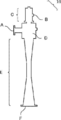
- FIG. 2 shows an example of the steam ejector (10).
- the number of stages of the steam ejector may be one stage when the compression ratio is small.
- the required drive steam volume increases rapidly as the compression ratio increases.
- an aspect of reducing consumption of driving steam can be given.
- the number of incidental facilities such as capacitors increases, it is not desirable to increase the number of stages excessively. Taking these into account, the number of stages of the steam ejector is suitably 1 to 4.
- the outer surface of the steam ejector is heated.
- the heating site is preferably the outer surface of the suction port (A) and the outer surface of the vacuum chamber (D), more preferably the outer surface of the diffuser (E) added thereto.
- the concentration of the easily polymerizable compound contained in the sucked gas becomes higher on the upstream side. Therefore, usually, the outer surface of at least the first stage steam ejector is heated, and more steam ejectors from the upstream side are used. It is preferable to heat the outer surface of the steam ejector, and it is more preferable to heat the outer surfaces of all the steam ejectors.
- the preferable temperature range by heating is based on actual results, and it is preferable that the outer surface temperature of the steam ejector is usually 50 ° C. or higher, preferably 60 ° C. or higher, more preferably 70 ° C. or higher.
- the outer surface temperature of the steam ejector means the outer surface temperature of the lowest temperature portion of the outer surfaces of the suction port, the vacuum chamber, and the diffuser of the steam ejector.
- the location where the temperature is measured does not include a location where the distance from the space inside the steam ejector exceeds 25 mm, such as a column welded to a joint portion with a flange portion or a support member.
- the temperature can be measured, for example, by inserting a thermometer from the gap or end of the installed heat source or using a non-contact type thermometer such as a radiation temperature system.
- the sucked gas expands in volume as the temperature rises and increases the load of the steam ejector.
- the outer surface temperature of the ejector is usually less than 150 ° C., preferably 140 ° C. or less, more preferably 130 ° C. or less.
- heating method For example, winding steam piping (steam trace), winding the heating wire of a heat-transfer heater, etc. are mentioned. At this time, it is preferable to wind a heating wire of a heat transfer heater because precise temperature control is possible, and it is more preferable to wind a steam trace because a heat source can be easily obtained and temperature control is easy.
- one steam trace or a heating wire of a ribbon-shaped heat transfer heater may be wound around the steam ejector, or several may be wound.
- the steam trace pipe wound around the steam ejector and the heating wire of the ribbon heat transfer heater may or may not be spaced from each other as shown in FIG. In short, it is only necessary that the outer surface of the steam ejector can be heated to a predetermined temperature.
- the outer surface of the steam ejector may be heated in advance before the operation period of the steam ejector. Further, it is preferable to continuously heat the outer surface during the operation period of the steam ejector, but even if the heating of the outer surface is temporarily interrupted for some reason, the effect of the present invention is not lost.
- the cold condenser at 16 ° C. was supplied to the vent condenser as a refrigerant, and the uncondensed components were led to the suction port of the first stage steam ejector.
- a steam ejector as shown in FIG. 2 was used as the steam ejector.
- the gas piping from the vent condenser to the steam ejector was kept warm with steam trace and heat insulating material. Air was supplied to the middle of the gas pipe with a control valve (CV) so that the top pressure of the distillation column was constant.
- the mixed exhaust gas from the steam ejector was cooled by cooling water at 28 ° C. and 16 ° C.
- the mixed exhaust gas from the steam ejector was cooled by cooling water at 28 ° C. with a heat exchanger, and the uncondensed components were led to the suction port of a liquid ring vacuum pump.
- the driving steam of the steam ejector was 1.2 MPaG in both the first and second stages.
- the external temperature of the first stage steam ejector suction port was confirmed by a radiation thermometer, and it was 40 to 46 ° C. This is apparently higher than the temperature of the non-condensed component in the vent condenser, and at least higher than the dew point of the suction gas.
- Example 1 Except for operating the distillation column while heating the outer surface of the suction port of the first and second stage steam ejectors, the outer surface of the vacuum section, and the outer surface of the diffuser using a steam trace as shown in FIG. was the same as in Comparative Example 1 above.
- the steam used for the steam trace was 0.3 MPaG.
- the outer surface temperature of the suction port of the steam ejector was 70 to 85 ° C.
- the steam for the trace was stopped for 2 days, the steam for the trace was stopped, and then the supply of the steam was restarted.
- no significant difference was confirmed before and after that. From the above, it has been clarified that heating the outer surface of the steam ejector is particularly effective in continuing operation for a long period of time, and heating can be stopped for a relatively short time.
Landscapes
- Chemical & Material Sciences (AREA)
- Organic Chemistry (AREA)
- Engineering & Computer Science (AREA)
- Chemical Kinetics & Catalysis (AREA)
- Crystallography & Structural Chemistry (AREA)
- Oil, Petroleum & Natural Gas (AREA)
- Physics & Mathematics (AREA)
- Fluid Mechanics (AREA)
- Mechanical Engineering (AREA)
- General Engineering & Computer Science (AREA)
- Organic Low-Molecular-Weight Compounds And Preparation Thereof (AREA)
- Vaporization, Distillation, Condensation, Sublimation, And Cold Traps (AREA)
Priority Applications (4)
| Application Number | Priority Date | Filing Date | Title |
|---|---|---|---|
| CN201480059285.4A CN105683145B (zh) | 2013-10-29 | 2014-10-28 | 易聚合性化合物的减压蒸馏方法及丙烯酸的制造方法 |
| EP14857447.8A EP3064485B2 (en) | 2013-10-29 | 2014-10-28 | Vacuum distillation method for easily polymerizable compound and method for producing acrylic acid |
| BR112016009448-4A BR112016009448B1 (pt) | 2013-10-29 | 2014-10-28 | Método para a produção de ácido acrílico |
| US15/134,980 US9738586B2 (en) | 2013-10-29 | 2016-04-21 | Vacuum distillation method for easily polymerizable compound and method for producing acrylic acid |
Applications Claiming Priority (2)
| Application Number | Priority Date | Filing Date | Title |
|---|---|---|---|
| JP2013224082 | 2013-10-29 | ||
| JP2013-224082 | 2013-10-29 |
Related Child Applications (1)
| Application Number | Title | Priority Date | Filing Date |
|---|---|---|---|
| US15/134,980 Continuation US9738586B2 (en) | 2013-10-29 | 2016-04-21 | Vacuum distillation method for easily polymerizable compound and method for producing acrylic acid |
Publications (1)
| Publication Number | Publication Date |
|---|---|
| WO2015064563A1 true WO2015064563A1 (ja) | 2015-05-07 |
Family
ID=53004165
Family Applications (1)
| Application Number | Title | Priority Date | Filing Date |
|---|---|---|---|
| PCT/JP2014/078603 Ceased WO2015064563A1 (ja) | 2013-10-29 | 2014-10-28 | 易重合性化合物の減圧蒸留の方法およびアクリル酸の製造方法 |
Country Status (6)
| Country | Link |
|---|---|
| US (1) | US9738586B2 (https=) |
| EP (1) | EP3064485B2 (https=) |
| JP (3) | JP2015110551A (https=) |
| CN (1) | CN105683145B (https=) |
| BR (1) | BR112016009448B1 (https=) |
| WO (1) | WO2015064563A1 (https=) |
Families Citing this family (2)
| Publication number | Priority date | Publication date | Assignee | Title |
|---|---|---|---|---|
| DE202015106097U1 (de) * | 2015-11-11 | 2016-02-01 | Holger Blum | Fördereinrichtung für eine Vakuumdestillationsanlage |
| JP7147567B2 (ja) * | 2018-01-19 | 2022-10-05 | 三菱ケミカル株式会社 | (メタ)アクリル酸又はそのエステルの製造方法 |
Citations (7)
| Publication number | Priority date | Publication date | Assignee | Title |
|---|---|---|---|---|
| JPH01105000A (ja) * | 1987-10-15 | 1989-04-21 | Hitachi Ltd | 真空エゼクタ装置 |
| JP2000256221A (ja) * | 1999-03-04 | 2000-09-19 | Mitsubishi Chemicals Corp | 易重合性化合物の精製方法 |
| JP2000344711A (ja) | 1999-06-03 | 2000-12-12 | Nippon Shokubai Co Ltd | 易重合性化合物の精製方法 |
| WO2003018162A1 (en) * | 2001-08-22 | 2003-03-06 | Mitsubishi Chemical Corporation | Distilling equipment for lase-of-polymerization compound |
| JP2005289927A (ja) | 2004-04-01 | 2005-10-20 | Mitsubishi Chemicals Corp | (メタ)アクリル酸誘導体の製造方法 |
| JP2007217401A (ja) * | 2006-01-20 | 2007-08-30 | Nippon Shokubai Co Ltd | (メタ)アクリル酸の製造方法 |
| JP2007255805A (ja) * | 2006-03-24 | 2007-10-04 | Chugoku Electric Power Co Inc:The | 真空ポンプ装置用ヒータの配線構造 |
Family Cites Families (21)
| Publication number | Priority date | Publication date | Assignee | Title |
|---|---|---|---|---|
| JPS4833057Y1 (https=) * | 1970-07-01 | 1973-10-08 | ||
| US3702346A (en) * | 1971-06-30 | 1972-11-07 | Universal Oil Prod Co | Conversion of ethylbenzene to styrene |
| JPH10204030A (ja) * | 1997-01-24 | 1998-08-04 | Toagosei Co Ltd | (メタ)アクリル酸エステルの精製方法及び製造方法並びにその製造装置 |
| JP2000344688A (ja) * | 1999-06-04 | 2000-12-12 | Mitsubishi Chemicals Corp | 易重合性化合物の精製方法 |
| JP3948855B2 (ja) | 1999-06-10 | 2007-07-25 | 株式会社日本触媒 | (メタ)アクリル酸の製造方法 |
| JP2001131116A (ja) | 1999-11-08 | 2001-05-15 | Nippon Shokubai Co Ltd | 易重合性物質含有液の蒸留方法 |
| US6739288B1 (en) * | 2000-01-14 | 2004-05-25 | Tvl Co., Ltd. | Steam heating device |
| JP2001213839A (ja) | 2000-02-03 | 2001-08-07 | Nippon Shokubai Co Ltd | (メタ)アクリル酸の製造方法 |
| JP3875471B2 (ja) * | 2000-08-28 | 2007-01-31 | 株式会社日立製作所 | 復水器真空ポンプシステム |
| JP4074455B2 (ja) * | 2001-11-27 | 2008-04-09 | 三菱化学株式会社 | (メタ)アクリル酸の製造方法 |
| JP2003073327A (ja) * | 2001-09-03 | 2003-03-12 | Nippon Shokubai Co Ltd | 有機酸の製造方法 |
| JP4783530B2 (ja) * | 2001-09-28 | 2011-09-28 | 住友化学株式会社 | 易重合性物質の蒸留方法およびこれに使用する蒸留装置 |
| JP2003103105A (ja) * | 2001-09-28 | 2003-04-08 | Sumitomo Chem Co Ltd | 易重合性物質の蒸留方法およびこれに使用する蒸留装置 |
| JP4095471B2 (ja) | 2003-02-28 | 2008-06-04 | 株式会社日本触媒 | 易重合性物質の蒸留方法 |
| JP2004269417A (ja) * | 2003-03-07 | 2004-09-30 | Mitsubishi Rayon Co Ltd | (メタ)アクリル酸エステルの製造方法 |
| JP2007162975A (ja) * | 2005-12-09 | 2007-06-28 | Miura Co Ltd | 食品機械 |
| KR100999428B1 (ko) | 2006-01-20 | 2010-12-09 | 니폰 쇼쿠바이 컴파니 리미티드 | (메타)아크릴산의 제조 방법 |
| JP5097533B2 (ja) | 2007-12-21 | 2012-12-12 | 三菱レイヨン株式会社 | 易重合性物質取扱装置 |
| JP2009249314A (ja) † | 2008-04-03 | 2009-10-29 | Mitsubishi Rayon Co Ltd | (メタ)アクリル酸ヒドロキシアルキルエステルの製造装置 |
| WO2010107284A2 (ko) * | 2009-03-19 | 2010-09-23 | 주식회사 엘지화학 | 고순도 아크릴산 생산을 위한 분리벽형 증류탑 및 이를 이용한 분별증류방법 |
| JP5513279B2 (ja) * | 2010-06-24 | 2014-06-04 | 日本エゼクターエンジニアリング株式会社 | 製鋼用二次精錬における真空脱ガス用の不純物および排ガス処理装置 |
-
2014
- 2014-10-28 WO PCT/JP2014/078603 patent/WO2015064563A1/ja not_active Ceased
- 2014-10-28 BR BR112016009448-4A patent/BR112016009448B1/pt active IP Right Grant
- 2014-10-28 CN CN201480059285.4A patent/CN105683145B/zh active Active
- 2014-10-28 EP EP14857447.8A patent/EP3064485B2/en active Active
- 2014-10-28 JP JP2014219226A patent/JP2015110551A/ja active Pending
-
2016
- 2016-04-21 US US15/134,980 patent/US9738586B2/en active Active
-
2018
- 2018-10-22 JP JP2018198260A patent/JP6777131B2/ja active Active
-
2020
- 2020-10-05 JP JP2020168277A patent/JP2020203957A/ja not_active Withdrawn
Patent Citations (8)
| Publication number | Priority date | Publication date | Assignee | Title |
|---|---|---|---|---|
| JPH01105000A (ja) * | 1987-10-15 | 1989-04-21 | Hitachi Ltd | 真空エゼクタ装置 |
| JP2000256221A (ja) * | 1999-03-04 | 2000-09-19 | Mitsubishi Chemicals Corp | 易重合性化合物の精製方法 |
| JP2000344711A (ja) | 1999-06-03 | 2000-12-12 | Nippon Shokubai Co Ltd | 易重合性化合物の精製方法 |
| WO2003018162A1 (en) * | 2001-08-22 | 2003-03-06 | Mitsubishi Chemical Corporation | Distilling equipment for lase-of-polymerization compound |
| JP2005289927A (ja) | 2004-04-01 | 2005-10-20 | Mitsubishi Chemicals Corp | (メタ)アクリル酸誘導体の製造方法 |
| WO2005100295A1 (ja) * | 2004-04-01 | 2005-10-27 | Mitsubishi Chemical Corporation | (メタ)アクリル酸誘導体の製造方法 |
| JP2007217401A (ja) * | 2006-01-20 | 2007-08-30 | Nippon Shokubai Co Ltd | (メタ)アクリル酸の製造方法 |
| JP2007255805A (ja) * | 2006-03-24 | 2007-10-04 | Chugoku Electric Power Co Inc:The | 真空ポンプ装置用ヒータの配線構造 |
Non-Patent Citations (1)
| Title |
|---|
| See also references of EP3064485A4 |
Also Published As
| Publication number | Publication date |
|---|---|
| EP3064485B2 (en) | 2021-02-24 |
| JP2020203957A (ja) | 2020-12-24 |
| CN105683145B (zh) | 2017-11-14 |
| US9738586B2 (en) | 2017-08-22 |
| EP3064485A1 (en) | 2016-09-07 |
| BR112016009448B1 (pt) | 2021-07-13 |
| EP3064485A4 (en) | 2016-11-09 |
| EP3064485B1 (en) | 2017-11-29 |
| BR112016009448A2 (pt) | 2017-08-01 |
| CN105683145A (zh) | 2016-06-15 |
| US20160237017A1 (en) | 2016-08-18 |
| JP2019014750A (ja) | 2019-01-31 |
| JP6777131B2 (ja) | 2020-10-28 |
| JP2015110551A (ja) | 2015-06-18 |
Similar Documents
| Publication | Publication Date | Title |
|---|---|---|
| US7566804B2 (en) | Process for preparing acrylic acid | |
| US7368602B2 (en) | Process for producing (meth) acrylic acid | |
| JP6716597B2 (ja) | (メタ)アクリル酸の改良された製造方法 | |
| JP6290460B2 (ja) | アクリル酸の製造方法 | |
| TW201802063A (zh) | 用於生產(甲基)丙烯酸之改良方法 | |
| WO2019142862A1 (ja) | (メタ)アクリル酸又はそのエステルの製造方法 | |
| JP6777131B2 (ja) | 易重合性化合物の減圧蒸留の方法およびアクリル酸の製造方法 | |
| JP2018115155A (ja) | アクリル酸の製造方法 | |
| US8044238B2 (en) | Method for production of purified (meth)acrylic acid | |
| EP1459794A2 (en) | Apparatus and process for purification of acrylic acid family | |
| CN100447122C (zh) | 防止(甲基)丙烯酸或其酯的处理装置堵塞的方法 | |
| JP5368673B2 (ja) | (メタ)アクリル酸の製造方法 | |
| JP7630225B2 (ja) | 不飽和カルボン酸エステルの製造方法 | |
| RU2352379C2 (ru) | Емкость для легко полимеризуемого соединения | |
| JP4437930B2 (ja) | アクリル酸類の蒸留精製方法 | |
| JP2025526043A (ja) | 重合性物質のための蒸留プラントにおけるヒートポンプ回路の統合 | |
| US20240343667A1 (en) | Process for preparing acrylic acid | |
| JP2019127480A (ja) | (メタ)アクリル酸又はそのエステルの製造方法 | |
| JP2023050471A (ja) | アクリル酸製造プロセス廃水の回収・再利用方法 | |
| JP2005230584A (ja) | 易重合性化合物用の塔設備 | |
| JP2014144943A (ja) | 蒸留塔の運転停止方法 | |
| JP2008266159A (ja) | アクリル酸ブチルの精製方法 |
Legal Events
| Date | Code | Title | Description |
|---|---|---|---|
| 121 | Ep: the epo has been informed by wipo that ep was designated in this application |
Ref document number: 14857447 Country of ref document: EP Kind code of ref document: A1 |
|
| WWE | Wipo information: entry into national phase |
Ref document number: 139550140003001154 Country of ref document: IR |
|
| WWE | Wipo information: entry into national phase |
Ref document number: 122020021543 Country of ref document: BR |
|
| NENP | Non-entry into the national phase |
Ref country code: DE |
|
| REG | Reference to national code |
Ref country code: BR Ref legal event code: B01A Ref document number: 112016009448 Country of ref document: BR |
|
| REEP | Request for entry into the european phase |
Ref document number: 2014857447 Country of ref document: EP |
|
| WWE | Wipo information: entry into national phase |
Ref document number: 2014857447 Country of ref document: EP |
|
| ENP | Entry into the national phase |
Ref document number: 112016009448 Country of ref document: BR Kind code of ref document: A2 Effective date: 20160428 |