WO2015025910A1 - 水溶性潤滑油 - Google Patents
水溶性潤滑油 Download PDFInfo
- Publication number
- WO2015025910A1 WO2015025910A1 PCT/JP2014/071850 JP2014071850W WO2015025910A1 WO 2015025910 A1 WO2015025910 A1 WO 2015025910A1 JP 2014071850 W JP2014071850 W JP 2014071850W WO 2015025910 A1 WO2015025910 A1 WO 2015025910A1
- Authority
- WO
- WIPO (PCT)
- Prior art keywords
- water
- lubricating oil
- carbon atoms
- soluble
- soluble lubricating
- Prior art date
- Legal status (The legal status is an assumption and is not a legal conclusion. Google has not performed a legal analysis and makes no representation as to the accuracy of the status listed.)
- Ceased
Links
Classifications
-
- C—CHEMISTRY; METALLURGY
- C10—PETROLEUM, GAS OR COKE INDUSTRIES; TECHNICAL GASES CONTAINING CARBON MONOXIDE; FUELS; LUBRICANTS; PEAT
- C10M—LUBRICATING COMPOSITIONS; USE OF CHEMICAL SUBSTANCES EITHER ALONE OR AS LUBRICATING INGREDIENTS IN A LUBRICATING COMPOSITION
- C10M133/00—Lubricating compositions characterised by the additive being an organic non-macromolecular compound containing nitrogen
- C10M133/02—Lubricating compositions characterised by the additive being an organic non-macromolecular compound containing nitrogen having a carbon chain of less than 30 atoms
- C10M133/04—Amines, e.g. polyalkylene polyamines; Quaternary amines
- C10M133/06—Amines, e.g. polyalkylene polyamines; Quaternary amines having amino groups bound to acyclic or cycloaliphatic carbon atoms
- C10M133/08—Amines, e.g. polyalkylene polyamines; Quaternary amines having amino groups bound to acyclic or cycloaliphatic carbon atoms containing hydroxy groups
-
- C—CHEMISTRY; METALLURGY
- C10—PETROLEUM, GAS OR COKE INDUSTRIES; TECHNICAL GASES CONTAINING CARBON MONOXIDE; FUELS; LUBRICANTS; PEAT
- C10M—LUBRICATING COMPOSITIONS; USE OF CHEMICAL SUBSTANCES EITHER ALONE OR AS LUBRICATING INGREDIENTS IN A LUBRICATING COMPOSITION
- C10M105/00—Lubricating compositions characterised by the base-material being a non-macromolecular organic compound
- C10M105/08—Lubricating compositions characterised by the base-material being a non-macromolecular organic compound containing oxygen
- C10M105/18—Ethers, e.g. epoxides
-
- C—CHEMISTRY; METALLURGY
- C10—PETROLEUM, GAS OR COKE INDUSTRIES; TECHNICAL GASES CONTAINING CARBON MONOXIDE; FUELS; LUBRICANTS; PEAT
- C10M—LUBRICATING COMPOSITIONS; USE OF CHEMICAL SUBSTANCES EITHER ALONE OR AS LUBRICATING INGREDIENTS IN A LUBRICATING COMPOSITION
- C10M105/00—Lubricating compositions characterised by the base-material being a non-macromolecular organic compound
- C10M105/08—Lubricating compositions characterised by the base-material being a non-macromolecular organic compound containing oxygen
- C10M105/32—Esters
- C10M105/36—Esters of polycarboxylic acids
-
- C—CHEMISTRY; METALLURGY
- C10—PETROLEUM, GAS OR COKE INDUSTRIES; TECHNICAL GASES CONTAINING CARBON MONOXIDE; FUELS; LUBRICANTS; PEAT
- C10M—LUBRICATING COMPOSITIONS; USE OF CHEMICAL SUBSTANCES EITHER ALONE OR AS LUBRICATING INGREDIENTS IN A LUBRICATING COMPOSITION
- C10M105/00—Lubricating compositions characterised by the base-material being a non-macromolecular organic compound
- C10M105/08—Lubricating compositions characterised by the base-material being a non-macromolecular organic compound containing oxygen
- C10M105/32—Esters
- C10M105/40—Esters containing free hydroxy or carboxyl groups
-
- C—CHEMISTRY; METALLURGY
- C10—PETROLEUM, GAS OR COKE INDUSTRIES; TECHNICAL GASES CONTAINING CARBON MONOXIDE; FUELS; LUBRICANTS; PEAT
- C10M—LUBRICATING COMPOSITIONS; USE OF CHEMICAL SUBSTANCES EITHER ALONE OR AS LUBRICATING INGREDIENTS IN A LUBRICATING COMPOSITION
- C10M105/00—Lubricating compositions characterised by the base-material being a non-macromolecular organic compound
- C10M105/56—Lubricating compositions characterised by the base-material being a non-macromolecular organic compound containing nitrogen
- C10M105/68—Amides; Imides
-
- C—CHEMISTRY; METALLURGY
- C10—PETROLEUM, GAS OR COKE INDUSTRIES; TECHNICAL GASES CONTAINING CARBON MONOXIDE; FUELS; LUBRICANTS; PEAT
- C10M—LUBRICATING COMPOSITIONS; USE OF CHEMICAL SUBSTANCES EITHER ALONE OR AS LUBRICATING INGREDIENTS IN A LUBRICATING COMPOSITION
- C10M119/00—Lubricating compositions characterised by the thickener being a macromolecular compound
- C10M119/04—Lubricating compositions characterised by the thickener being a macromolecular compound containing oxygen
- C10M119/06—Macromolecular compounds obtained by reactions only involving carbon-to-carbon unsaturated bonds
- C10M119/08—Macromolecular compounds obtained by reactions only involving carbon-to-carbon unsaturated bonds containing monomers having an unsaturated radical bound to an alcohol, aldehdo, ketonic, ether, ketal or acetal radical
-
- C—CHEMISTRY; METALLURGY
- C10—PETROLEUM, GAS OR COKE INDUSTRIES; TECHNICAL GASES CONTAINING CARBON MONOXIDE; FUELS; LUBRICANTS; PEAT
- C10M—LUBRICATING COMPOSITIONS; USE OF CHEMICAL SUBSTANCES EITHER ALONE OR AS LUBRICATING INGREDIENTS IN A LUBRICATING COMPOSITION
- C10M169/00—Lubricating compositions characterised by containing as components a mixture of at least two types of ingredient selected from base-materials, thickeners or additives, covered by the preceding groups, each of these compounds being essential
- C10M169/02—Mixtures of base-materials and thickeners
-
- C—CHEMISTRY; METALLURGY
- C10—PETROLEUM, GAS OR COKE INDUSTRIES; TECHNICAL GASES CONTAINING CARBON MONOXIDE; FUELS; LUBRICANTS; PEAT
- C10M—LUBRICATING COMPOSITIONS; USE OF CHEMICAL SUBSTANCES EITHER ALONE OR AS LUBRICATING INGREDIENTS IN A LUBRICATING COMPOSITION
- C10M169/00—Lubricating compositions characterised by containing as components a mixture of at least two types of ingredient selected from base-materials, thickeners or additives, covered by the preceding groups, each of these compounds being essential
- C10M169/04—Mixtures of base-materials and additives
-
- C—CHEMISTRY; METALLURGY
- C10—PETROLEUM, GAS OR COKE INDUSTRIES; TECHNICAL GASES CONTAINING CARBON MONOXIDE; FUELS; LUBRICANTS; PEAT
- C10M—LUBRICATING COMPOSITIONS; USE OF CHEMICAL SUBSTANCES EITHER ALONE OR AS LUBRICATING INGREDIENTS IN A LUBRICATING COMPOSITION
- C10M173/00—Lubricating compositions containing more than 10% water
- C10M173/02—Lubricating compositions containing more than 10% water not containing mineral or fatty oils
-
- C—CHEMISTRY; METALLURGY
- C10—PETROLEUM, GAS OR COKE INDUSTRIES; TECHNICAL GASES CONTAINING CARBON MONOXIDE; FUELS; LUBRICANTS; PEAT
- C10M—LUBRICATING COMPOSITIONS; USE OF CHEMICAL SUBSTANCES EITHER ALONE OR AS LUBRICATING INGREDIENTS IN A LUBRICATING COMPOSITION
- C10M2207/00—Organic non-macromolecular hydrocarbon compounds containing hydrogen, carbon and oxygen as ingredients in lubricant compositions
- C10M2207/02—Hydroxy compounds
- C10M2207/021—Hydroxy compounds having hydroxy groups bound to acyclic or cycloaliphatic carbon atoms
- C10M2207/022—Hydroxy compounds having hydroxy groups bound to acyclic or cycloaliphatic carbon atoms containing at least two hydroxy groups
- C10M2207/0225—Hydroxy compounds having hydroxy groups bound to acyclic or cycloaliphatic carbon atoms containing at least two hydroxy groups used as base material
-
- C—CHEMISTRY; METALLURGY
- C10—PETROLEUM, GAS OR COKE INDUSTRIES; TECHNICAL GASES CONTAINING CARBON MONOXIDE; FUELS; LUBRICANTS; PEAT
- C10M—LUBRICATING COMPOSITIONS; USE OF CHEMICAL SUBSTANCES EITHER ALONE OR AS LUBRICATING INGREDIENTS IN A LUBRICATING COMPOSITION
- C10M2207/00—Organic non-macromolecular hydrocarbon compounds containing hydrogen, carbon and oxygen as ingredients in lubricant compositions
- C10M2207/04—Ethers; Acetals; Ortho-esters; Ortho-carbonates
- C10M2207/0406—Ethers; Acetals; Ortho-esters; Ortho-carbonates used as base material
-
- C—CHEMISTRY; METALLURGY
- C10—PETROLEUM, GAS OR COKE INDUSTRIES; TECHNICAL GASES CONTAINING CARBON MONOXIDE; FUELS; LUBRICANTS; PEAT
- C10M—LUBRICATING COMPOSITIONS; USE OF CHEMICAL SUBSTANCES EITHER ALONE OR AS LUBRICATING INGREDIENTS IN A LUBRICATING COMPOSITION
- C10M2207/00—Organic non-macromolecular hydrocarbon compounds containing hydrogen, carbon and oxygen as ingredients in lubricant compositions
- C10M2207/28—Esters
- C10M2207/287—Partial esters
- C10M2207/289—Partial esters containing free hydroxy groups
- C10M2207/2895—Partial esters containing free hydroxy groups used as base material
-
- C—CHEMISTRY; METALLURGY
- C10—PETROLEUM, GAS OR COKE INDUSTRIES; TECHNICAL GASES CONTAINING CARBON MONOXIDE; FUELS; LUBRICANTS; PEAT
- C10M—LUBRICATING COMPOSITIONS; USE OF CHEMICAL SUBSTANCES EITHER ALONE OR AS LUBRICATING INGREDIENTS IN A LUBRICATING COMPOSITION
- C10M2209/00—Organic macromolecular compounds containing oxygen as ingredients in lubricant compositions
- C10M2209/10—Macromolecular compoundss obtained otherwise than by reactions only involving carbon-to-carbon unsaturated bonds
- C10M2209/103—Polyethers, i.e. containing di- or higher polyoxyalkylene groups
- C10M2209/107—Polyethers, i.e. containing di- or higher polyoxyalkylene groups of two or more specified different alkylene oxides covered by groups C10M2209/104 - C10M2209/106
- C10M2209/1075—Polyethers, i.e. containing di- or higher polyoxyalkylene groups of two or more specified different alkylene oxides covered by groups C10M2209/104 - C10M2209/106 used as base material
-
- C—CHEMISTRY; METALLURGY
- C10—PETROLEUM, GAS OR COKE INDUSTRIES; TECHNICAL GASES CONTAINING CARBON MONOXIDE; FUELS; LUBRICANTS; PEAT
- C10M—LUBRICATING COMPOSITIONS; USE OF CHEMICAL SUBSTANCES EITHER ALONE OR AS LUBRICATING INGREDIENTS IN A LUBRICATING COMPOSITION
- C10M2215/00—Organic non-macromolecular compounds containing nitrogen as ingredients in lubricant Compositions
- C10M2215/02—Amines, e.g. polyalkylene polyamines; Quaternary amines
- C10M2215/04—Amines, e.g. polyalkylene polyamines; Quaternary amines having amino groups bound to acyclic or cycloaliphatic carbon atoms
- C10M2215/042—Amines, e.g. polyalkylene polyamines; Quaternary amines having amino groups bound to acyclic or cycloaliphatic carbon atoms containing hydroxy groups; Alkoxylated derivatives thereof
-
- C—CHEMISTRY; METALLURGY
- C10—PETROLEUM, GAS OR COKE INDUSTRIES; TECHNICAL GASES CONTAINING CARBON MONOXIDE; FUELS; LUBRICANTS; PEAT
- C10M—LUBRICATING COMPOSITIONS; USE OF CHEMICAL SUBSTANCES EITHER ALONE OR AS LUBRICATING INGREDIENTS IN A LUBRICATING COMPOSITION
- C10M2215/00—Organic non-macromolecular compounds containing nitrogen as ingredients in lubricant Compositions
- C10M2215/02—Amines, e.g. polyalkylene polyamines; Quaternary amines
- C10M2215/04—Amines, e.g. polyalkylene polyamines; Quaternary amines having amino groups bound to acyclic or cycloaliphatic carbon atoms
- C10M2215/042—Amines, e.g. polyalkylene polyamines; Quaternary amines having amino groups bound to acyclic or cycloaliphatic carbon atoms containing hydroxy groups; Alkoxylated derivatives thereof
- C10M2215/0425—Amines, e.g. polyalkylene polyamines; Quaternary amines having amino groups bound to acyclic or cycloaliphatic carbon atoms containing hydroxy groups; Alkoxylated derivatives thereof used as base material
-
- C—CHEMISTRY; METALLURGY
- C10—PETROLEUM, GAS OR COKE INDUSTRIES; TECHNICAL GASES CONTAINING CARBON MONOXIDE; FUELS; LUBRICANTS; PEAT
- C10N—INDEXING SCHEME ASSOCIATED WITH SUBCLASS C10M RELATING TO LUBRICATING COMPOSITIONS
- C10N2020/00—Specified physical or chemical properties or characteristics, i.e. function, of component of lubricating compositions
- C10N2020/01—Physico-chemical properties
- C10N2020/04—Molecular weight; Molecular weight distribution
-
- C—CHEMISTRY; METALLURGY
- C10—PETROLEUM, GAS OR COKE INDUSTRIES; TECHNICAL GASES CONTAINING CARBON MONOXIDE; FUELS; LUBRICANTS; PEAT
- C10N—INDEXING SCHEME ASSOCIATED WITH SUBCLASS C10M RELATING TO LUBRICATING COMPOSITIONS
- C10N2030/00—Specified physical or chemical properties which is improved by the additive characterising the lubricating composition, e.g. multifunctional additives
- C10N2030/06—Oiliness; Film-strength; Anti-wear; Resistance to extreme pressure
-
- C—CHEMISTRY; METALLURGY
- C10—PETROLEUM, GAS OR COKE INDUSTRIES; TECHNICAL GASES CONTAINING CARBON MONOXIDE; FUELS; LUBRICANTS; PEAT
- C10N—INDEXING SCHEME ASSOCIATED WITH SUBCLASS C10M RELATING TO LUBRICATING COMPOSITIONS
- C10N2030/00—Specified physical or chemical properties which is improved by the additive characterising the lubricating composition, e.g. multifunctional additives
- C10N2030/12—Inhibition of corrosion, e.g. anti-rust agents or anti-corrosives
-
- C—CHEMISTRY; METALLURGY
- C10—PETROLEUM, GAS OR COKE INDUSTRIES; TECHNICAL GASES CONTAINING CARBON MONOXIDE; FUELS; LUBRICANTS; PEAT
- C10N—INDEXING SCHEME ASSOCIATED WITH SUBCLASS C10M RELATING TO LUBRICATING COMPOSITIONS
- C10N2040/00—Specified use or application for which the lubricating composition is intended
- C10N2040/02—Bearings
-
- C—CHEMISTRY; METALLURGY
- C10—PETROLEUM, GAS OR COKE INDUSTRIES; TECHNICAL GASES CONTAINING CARBON MONOXIDE; FUELS; LUBRICANTS; PEAT
- C10N—INDEXING SCHEME ASSOCIATED WITH SUBCLASS C10M RELATING TO LUBRICATING COMPOSITIONS
- C10N2040/00—Specified use or application for which the lubricating composition is intended
- C10N2040/04—Oil-bath; Gear-boxes; Automatic transmissions; Traction drives
-
- C—CHEMISTRY; METALLURGY
- C10—PETROLEUM, GAS OR COKE INDUSTRIES; TECHNICAL GASES CONTAINING CARBON MONOXIDE; FUELS; LUBRICANTS; PEAT
- C10N—INDEXING SCHEME ASSOCIATED WITH SUBCLASS C10M RELATING TO LUBRICATING COMPOSITIONS
- C10N2040/00—Specified use or application for which the lubricating composition is intended
- C10N2040/08—Hydraulic fluids, e.g. brake-fluids
Definitions
- the present invention relates to a water-soluble lubricating oil.
- polyethers such as mineral oil, polyolefin, or an alkylene oxide adduct of alcohol have been used as a lubricating base oil such as hydraulic oil, gear oil, and bearing oil.
- a lubricating base oil such as hydraulic oil, gear oil, and bearing oil.
- these hydrocarbon base oils and polyether base oils are still insufficient in biodegradability, and as biodegradable base oils, natural fats and oils such as vegetable oils and derivatives thereof, synthetic ester base oils, etc.
- Has been used as a base oil see Patent Documents 1 and 2).
- these natural fats and oils and synthetic ester base oils are prone to hydrolysis when mixed with water and have a problem in stability during use of the lubricating oil.
- these base oils have low solubility in water, if the lubricating oil leaks, the oil contamination on the water surface increases the surrounding contamination and is difficult to remove by washing.
- Polyether base oils with high degradability have been used (see Patent Document 3).
- the present invention provides a lubricating oil that exhibits rust prevention and lubricity equivalent to conventional mineral oil-based lubricating oils, has high solubility in water, and is excellent in biodegradability and low toxicity. Objective.
- the present invention includes a water-soluble base (A) comprising at least one polyether (A1) and a rust inhibitor (B), and the surface tension of a 0.1% by weight aqueous solution of a water-soluble lubricating oil. It is a water-soluble lubricating oil of 31 mN / m or more.
- the water-soluble lubricating oil of the present invention has the following effects. (1) Since it is water-soluble, it can be easily removed by washing. (2) It is stable because it is difficult to hydrolyze. (3) Excellent biodegradability. (4) Low toxicity. (5) Lubricity and rust prevention equivalent to or higher than those of conventional mineral oil-based lubricants. (6) Little impact on the environment. (7) Low accumulation.
- the water-soluble lubricating oil in the present invention contains a water-soluble base (A) composed of at least one polyether (A1) and a rust inhibitor (B).
- water-soluble means that the solubility in water at 25 ° C. is 20 g or more with respect to 100 g of water.
- the water-soluble lubricating oil of the present invention preferably has a degree of biodegradation of 60% or more. More preferably, it is 65% or more, More preferably, it is 70% or more.
- the degree of biodegradation is a value measured according to the OECD test method 301C, with the test period being 28 days. When the degree of biodegradation is 60% or more, it is possible to prevent environmental pollution in soil, rivers, oceans, etc. when lubricating oil leaks.
- the polyether (A1) is not particularly limited, but is preferably an active hydrogen compound or an alkylene oxide adduct thereof, and an alkylene oxide adduct of the active hydrogen compound. It is more preferable that Examples of the active hydrogen compound include a hydroxyl group-containing compound, an amino group-containing compound having a number average molecular weight of 10,000 or more, a carboxyl group-containing compound, a thiol group-containing compound, and a phosphate compound.
- Examples of the active hydrogen compound or an alkylene oxide adduct thereof include (A1-1) represented by the following general formula (1), (A1-2) represented by the following general formula (2), and the following general formula It is desirable that it is at least one selected from the group consisting of (A1-3) represented by formula (3) and a water-soluble polyether thickener (A1-4).
- R 1 is hydrogen or a k-valent hydrocarbon group having 1 to 12 carbon atoms
- a 1 is an alkylene group having 2 to 4 carbon atoms
- R 2 is hydrogen or a hydrocarbon having 1 to 8 carbon atoms Group
- k is an integer of 1 to 6
- j is an integer of 1 or more satisfying a number average molecular weight of (A1-1) of 62 to 10,000.
- R 3 is a hydrocarbon group having 1 to 24 carbon atoms and may have one or more double bonds
- a 2 is an alkylene group having 2 to 4 carbon atoms
- R 2 4 is a residue obtained by removing a hydroxyl group from sorbitan
- q is an integer of 1 to 3
- n is an integer of 1 or more satisfying the number average molecular weight of (A1-2) of 500 to 10,000.
- R 5 is a hydrocarbon group having 2 to 36 carbon atoms, and may have one or more double bonds, or may have one or more benzene rings.
- a 3 is an alkylene group having 2 to 4 carbon atoms, m is an integer of 1 to 100, and p is an integer of 1 to 10.
- (A1-1) is represented by the following general formula (1).
- R 1 is hydrogen or a k-valent hydrocarbon group having 1 to 12 carbon atoms
- a 1 is an alkylene group having 2 to 4 carbon atoms
- R 2 is hydrogen or a hydrocarbon having 1 to 8 carbon atoms Group
- k is an integer of 1 to 6
- j is an integer of 1 or more satisfying a number average molecular weight of (A1-1) of 62 to 10,000.
- a 1 is an alkylene group having 2 to 4 carbon atoms.
- Examples of the alkylene group having 2 to 4 carbon atoms include an ethylene group, a 1,2- or 1,3-propylene group, and a 1,2-, 1,3- or 1,4-butylene group.
- j is an integer of 1 or more satisfying the number average molecular weight of (A1-1) of 62 to 10,000.
- a 1 may be the same or different.
- (A 1 O) j may be a block addition or a random addition.
- (A1-1) has a number average molecular weight of 62 to 10,000, preferably 62 to 8,000.
- the number average molecular weight can be measured by a known method such as gel permeation chromatography.
- Examples of (A1-1) include 1,2-propylene glycol, 1,3-propylene glycol, ethylene glycol, di-1,2-propylene glycol, diethylene glycol, triethylene glycol, polyethylene glycol, ethylene glycol monomethyl ether, Ethylene glycol dimethyl ether, ethylene glycol methyl ethyl ether, polyethylene glycol dimethyl ether, block copolymer or random copolymer of ethylene oxide and propylene oxide (degree of polymerization 2 to 20), and a compound having a monovalent to hexavalent hydroxyl group (for example, Methanol, ethanol, propanol, butanol, hexanol, heptanol, octanol, nonanol, decanol, undecanol, dodecanol, ethylene glycol Coal, 1,2-propylene glycol, 1,3-propylene glycol, 1,4-butanediol, 1,6-hexylene glycol
- the number average molecular weight (hereinafter abbreviated as Mn) and the weight average molecular weight are measured by gel permeation chromatography at 40 ° C. using polyethylene oxide as a reference substance. An example of measurement conditions is shown.
- Device body HLC-8120 (manufactured by Tosoh Corporation)
- Detector Differential refractometer detector built in the device body
- Eluent 0.5% sodium acetate / water / methanol (volume ratio 70/30)
- Eluent flow rate 1.0 ml / min
- Sample 0.25% eluent solution injection volume: 200 ⁇ l
- Reference material TSK TANDARD POLYETHYLENE OXIDE manufactured by Tosoh Corporation
- Data processing software GPC-8020 model II (manufactured by Tosoh Corporation)]
- R 3 is a hydrocarbon group having 1 to 24 carbon atoms and may have one or more double bonds
- a 2 is an alkylene group having 2 to 4 carbon atoms
- R 2 4 is a residue obtained by removing a hydroxyl group from sorbitan
- q is an integer of 1 to 3
- n is an integer of 1 or more satisfying the number average molecular weight of (A1-2) of 500 to 10,000.
- a 2 is an alkylene group having 2 to 4 carbon atoms.
- alkylene group having 2 to 4 carbon atoms include an ethylene group, a 1,2- or 1,3-propylene group, and a 1,2-, 1,3- or 1,4-butylene group.
- n is an integer of 1 or more that satisfies the number average molecular weight of (A1-2) of 500 to 10,000.
- a 2 may be the same or different, and when A 2 is 2 or more, (OA 2 ) n may be block addition or random addition.
- (A1-2) includes sorbitan mono- or di-fatty acid esters (sorbitan and saturated fatty acids (eg caprylic acid, lauric acid, myristic acid, palmitic acid, stearic acid) and / or unsaturated fatty acids (eg oleic acid, linoleic acid) Acid, ester with linolenic acid), and alkylene oxide (for example, EO, PO, BO, THF) adducts thereof.
- alkylene oxide for example, EO, PO, BO, THF
- EO adduct of sorbitan monoester and EO / PO adduct of sorbitan monoester are preferable.
- the number average molecular weight of (A1-2) is 500 to 10,000. More preferably, it is 750 to 5,000, and still more preferably 1,000 to 4,000.
- the above (A1-2) may be used alone or in combination of two or more.
- R 5 is a hydrocarbon group having 2 to 36 carbon atoms, and may have one or more double bonds, or may have one or more benzene rings.
- a 3 is an alkylene group having 2 to 4 carbon atoms, m is an integer of 1 to 100, and p is an integer of 1 to 10.
- a 3 is an alkylene group having 2 to 4 carbon atoms.
- Examples of the alkylene group having 2 to 4 carbon atoms include an ethylene group, a 1,2- or 1,3-propylene group, and a 1,2-, 1,3- or 1,4-butylene group.
- n is an integer of 1 to 100.
- a 3 may be the same or different, and when A 3 is 2 or more, (A 3 O) m may be block addition or random addition.
- Examples of (A1-3) include esterified products of glycols and dibasic acids.
- Examples of glycols include ethylene glycol, 1,2-propylene glycol, polyethylene glycol, polypropylene glycol, propylene glycol EO block copolymer, ethylene glycol PO block copolymer, and 1,4-butanediol EO addition.
- 1,2-propylene glycol polyethylene glycol, polypropylene glycol, EO block copolymer of propylene glycol, and PO block copolymer of ethylene glycol are preferable.
- the glycols may be used alone or in combination of two or more.
- dibasic acid examples include alkane dicarboxylic acid having 4 to 36 carbon atoms, alkene dicarboxylic acid having 4 to 36 carbon atoms, aromatic dicarboxylic acid having 8 to 36 carbon atoms, and alicyclic having 6 to 40 carbon atoms. And dicarboxylic acid. Of these, preferred are alkane dicarboxylic acids having 4 to 20 carbon atoms, alkene dicarboxylic acids having 4 to 20 carbon atoms, and aromatic dicarboxylic acids having 8 to 20 carbon atoms, and more preferred are succinic acid, adipic acid, and sebacin. Acid, maleic acid, fumaric acid, phthalic acid, isophthalic acid, terephthalic acid. The above dibasic acids may be used alone or in combination of two or more.
- esterified products of glycols and dibasic acids include esterified products of polyethylene glycol and adipic acid, EO block copolymer of propylene glycol and fumaric acid, polyethylene glycol and 1,2-propylene glycol. And an esterified product of polyethylene glycol and polypropylene glycol with sebacic acid and isophthalic acid, an esterified product of a PO block copolymer of ethylene glycol with adipic acid and terephthalic acid, and the like.
- the water-soluble polyether thickener (A1-4) is a water-soluble polyether thickener excluding the above (A1-1), and is an alkylene oxide adduct of polyhydric alcohol and AO addition of polyamine. Products, and polycarboxylic acids (salts). Of these, polyhydric alcohol AO adducts and polyamine AO adducts are preferred.
- the above (A1-4) may be used alone or in combination of two or more.
- the Mn of (A1-4) is preferably 10,000 or more, more preferably 10,000 to 500,000, and further preferably 15,000 to 200,000. When Mn is 10,000 or more, the lubricity is further improved.
- the polyhydric alcohol constituting the AO adduct of the polyhydric alcohol is a dihydric or higher polyol, such as ethylene glycol, 1,2-propylene glycol, 1,3-propylene glycol, 1,6-hexylene glycol. Glycerin, trimethylolpropane, pentaerythritol, sorbitan, sorbitol and the like.
- polys constituting AO adducts of polyamines (poly) alkylene polyamines (for example, ethylenediamine, diethylenetriamine, tetraethylenepentamine, pentaethylenehexamine, etc.) and polyamide polyamines (for example, oleic acid or linoleic acid) are polymerized. Dimer acid, or a polyamide polyamine having a weight average molecular weight of 600 to 6,000 obtained by a condensation reaction of a dibasic acid such as sebacic acid or adipic acid and the above (poly) alkylene polyamine).
- a dibasic acid such as sebacic acid or adipic acid
- AO examples include alkylene oxides having 2 to 4 carbon atoms such as EO, PO, BO, and THF.
- alkylene oxides having 2 to 4 carbon atoms such as EO, PO, BO, and THF.
- Examples of the addition mode when two or more types of AO are used in combination include block, random, and combinations thereof.
- (A1-4) includes EO / PO adduct of 1,6-hexylene glycol, EO / PO adduct of polyamide polyamine composed of dimer acid of linoleic acid and pentaethylenehexamine, and EO / PO of glycerin.
- An adduct is preferable.
- the above (A1-4) may be used alone or in combination of two or more.
- the water-soluble base (A) may contain one or more selected from the group consisting of cellulose derivatives (A2), starch (A3), and polyvinyl alcohol (A4).
- Examples of the cellulose derivative (A2) include carboxymethyl cellulose, acetyl cellulose, cellulose phosphate, ethyl cellulose, and oxyethyl cellulose.
- the starch (A3) is not particularly limited, and examples thereof include potato-derived, wheat-derived, and corn-derived starch.
- Examples of the polyvinyl alcohol (A4) include polyvinyl alcohol having a polymerization degree of 300 to 3,000.
- alkanolamine (monoethanolamine, diethanolamine, triethanolamine, monoisopropanolamine, diisopropanolamine, triisopropanolamine, etc.), C1-24 Alkylamine having an alkyl group, EO (1 to 20 mol) adduct of alkylamine having an alkyl group having 1 to 24 carbon atoms, EO (1 to 20 mol) of a cyclic amine composed of 6 to 24 carbon atoms ) Adducts, amines having 2 or more nitrogen atoms (ethylenediamine, diethylenetriamine, triethylenetetramine, tetraethylenepentamine, etc.) and their EO (1 to 60 mol) adducts, and alkenyl succinic acid.
- alkanolamine is preferable from the viewpoint of low toxicity, and diethanolamine, triethanolamine, and the like are more preferable.
- the surface tension in the water-soluble lubricating oil of the present invention is a value measured by a pendant drop method using a 0.1% by weight aqueous water-soluble lubricating oil solution.
- the measurement conditions are shown below.
- Main unit Fully automatic contact angle meter DM700 (manufactured by Kyowa Interface Science Co., Ltd.)
- Measurement solution 0.10 g of water-soluble lubricating oil was weighed in a 200 mL beaker at room temperature, 99.90 g of dilution water was added thereto, and stirred for 15 minutes using a stirrer piece, and 0.1 wt% water solution The measurement liquid of the basic lubricating oil aqueous solution was prepared.
- Measurement temperature 27 ° C
- Dilution water Ion-exchange water needle tip with electric conductivity of 0.2 ⁇ S / cm or less
- Material Teflon (registered trademark) coated needle 18G (Kyowa Interface Science Co., Ltd.)
- Hanging drop volume 8 ⁇ L
- Measured value The surface tension every 10 seconds immediately after hanging drops was measured over time, and the measured value when the change in the surface tension for 10 seconds was less than 0.1 mN / m was defined as the surface tension.
- the surface tension of a 0.1 wt% aqueous water-soluble lubricating oil solution in the water-soluble lubricating oil of the present invention is 31 mN / m or more, preferably 35 mN / m or more, more preferably 40 mN / m or more. If the surface tension is less than 31 mN / m, the toxicity becomes worse.
- the water-soluble base (A) is preferably a polyether (A1).
- the rusting agent (B) the rust-preventing agents mentioned above are preferable.
- an antioxidant (C) from the viewpoint of influence on the environment (long life).
- the antioxidant (C) include phenolic antioxidants such as 2,4-dimethyl-6-tert-butylphenol and 4,4′-butylidenebis (6-tert-butylmetacresol); Inhibitors such as N-phenyl-4-octylphenylamine and bis (4-octylphenyl) amine; zinc dihydrocarbyl dithiophosphate and zinc diallyldithiophosphate having a carbyl group having 1 to 36 carbon atoms, Can be mentioned.
- the content of (A) is preferably 88.0 to 98.9 weight based on the total weight of (A), (B), and (C) from the viewpoint of lubricity and biodegradation. %, More preferably 90.0 to 97.8% by weight, still more preferably 91.3 to 95.7% by weight.
- the content of (B) is preferably 1.0 to 10.0% by weight based on the total weight of (A), (B), and (C) from the viewpoint of rust prevention and low toxicity.
- the amount is preferably 2.0 to 9.0% by weight, more preferably 4.0 to 8.0% by weight.
- the content of (C) is preferably 0.1 to 2.0% by weight based on the total weight of (A), (B), and (C) from the viewpoint of lubricity and environmental impact. More preferably, it is 0.2 to 1.0% by weight, and still more preferably 0.3 to 0.7% by weight.
- the water-soluble lubricating oil of the present invention has a kinematic viscosity at 40 ° C. of preferably 30 to 200 mm 2 / s, more preferably 40 to 150 mm 2 / s from the viewpoint of lubricity.
- the kinematic viscosity of the water-soluble lubricating oil is measured with an Ubbelohde viscometer based on JIS K2283: 2000 (crude oil and petroleum products-kinematic viscosity test method and viscosity index calculation method).
- the water-soluble lubricating oil of the present invention may be used by suitably adding one or more selected from the group consisting of a water-insoluble polyether (D), an antifoaming agent, and a pH adjusting agent.
- water-insoluble means that the solubility in water at 25 ° C. is less than 20 g with respect to 100 g of water.
- water-insoluble polyether (D) examples include polypropylene glycol, polypropylene glycol monoalkyl ether, 1,4-butanediol EO / THF (molar ratio 80/20, number average molecular weight 2,000) adduct, etc. Is mentioned.
- antifoaming agent examples include silicone-based antifoaming agents.
- pH adjusters include organic acids (formic acid, acetic acid, lactic acid, malic acid, citric acid, tartaric acid, etc.), inorganic acids (hydrochloric acid, phosphoric acid, sulfuric acid, etc.), alkali metal hydroxides (lithium hydroxide, hydroxide) Sodium, potassium hydroxide, etc.).
- the contents of the pH adjusting agent and the antifoaming agent are each preferably 10% by weight or less, more preferably 5% by weight or less, based on the total weight of the water-soluble lubricating oil. .
- the water content is preferably 10% by weight or less, more preferably 5% by weight or less based on the total weight of the water-soluble lubricating oil from the viewpoint of rust prevention and lubricity. is there.
- the fish toxicity in the water-soluble lubricating oil of the present invention is preferably 500 mg / L or more, more preferably 1,000 mg / L or more, and further preferably 2,000 mg / L or more.
- the method for measuring fish toxicity of water-soluble lubricating oil is calculated by LC50 in accordance with OECD test method 203 with a test period of 96 hours.
- (A), (B) and other raw materials are usually stirred and mixed at 40 ° C. to 60 ° C. for 1 to 4 hours, and if necessary, a pH adjuster (caustic soda (NaOH) and caustic potash). (KOH), etc.) to adjust the pH [water solution obtained by diluting water-soluble lubricating oil with ion-exchanged water twice using a pH meter “M-12” (Horiba Seisakusho)] be able to.
- the pH range is preferably 6 to 12 and more preferably 7 to 11 from the viewpoint of rust prevention.
- the water-soluble lubricating oil of the present invention can be preferably used for applications such as marine bearing oil, hydraulic oil, or gear oil.
- Examples 1 to 30, Comparative Examples 1 to 10 The raw materials of the number of parts listed in Tables 1 to 3 are mixed by stirring at a temperature suitable for each of Examples and Comparative Examples from 50 to 60 ° C., and the water-soluble lubricating oils (S1) to (S30) and 1,000 parts of each of the comparative water-soluble lubricating oils (H1) to (H10) were obtained.
- Tables 1 to 3 show the kinematic viscosity (mm 2 / s) at 40 ° C. and the surface tension (mN / m) in a 0.1 wt% aqueous solution. The kinematic viscosity was measured under the following conditions.
- Tables 1 to 3 represent the following compositions.
- (A1-1-4) to (A1-1-13), (A1-1-16) to (A1-1-18), (A1-1-20), (A1-2-1), (A1 -2-2), (B-3), and (D-1) are produced by using 4 to 20 at a suitable temperature of 100 to 150 ° C. using potassium hydroxide as a catalyst and using a pressure reactor. An alkylene oxide addition reaction was performed over a suitable period of time to produce.
- (A1-1-19) is prepared by reacting methyl chloride with EO adduct of methanol using potassium hydroxide as a catalyst, reacting methyl chloride at 50 ° C. for 8 hours, and washing with water. did.
- (A1-3-1) to (A1-3-3) use glycols and dibasic acids using a titanium-containing catalyst (described in JP-A-2006-243715) and a reactor capable of reducing pressure.
- a dehydration condensation reaction was carried out at a suitable temperature of 180 to 230 ° C. for a suitable time of 1 to 8 hours.
- (A1-4-1) is a polyamide polyamine obtained by subjecting Halidimer 216 (manufactured by Harima Chemical Co., Ltd.) and pentaethylenehexamine to a dehydration condensation reaction under reduced pressure at 150 ° C. for 7 hours, using potassium hydroxide as a catalyst, Using a pressure reactor, an addition reaction was carried out with a mixture of ethylene oxide and propylene oxide at 120 ° C. for 10 hours to produce. In addition, the other compound used the commercial item.
- Rust-proof lubricating oil Rust prevention performance test method JIS K2510 was measured. After the polished and washed steel bar (S20C) is immersed in a mixed solution containing 10% by weight of seawater based on the weight of the water-soluble lubricating oil at 60 ° C. for 3 days, the state of occurrence of rust is observed, and the following evaluation criteria The rust resistance was evaluated according to During the immersion, the mixed solution continued to be stirred.
- A No rust (when rust is not observed, or rust is recognized within a range of 5% or less of the surface of the test piece, the rust diameter is 1 mm or less, and the number of rust spots is 6) In the following cases) ⁇ : Some rust (when rust is observed in 5% or less of test piece surface and does not correspond to the above “ ⁇ ”) X: Rust (when rust is observed in a range exceeding 5% of the surface of the test piece)
- LC50 was calculated by using medaka as a test fish and an exposure time of 96 hours. And toxicity was evaluated according to the following evaluation criteria. ⁇ : LC50 is 500 mg / L or more ⁇ : LC50 is less than 500 mg / L
- the water-soluble lubricating oils of the examples are excellent in all of biodegradability, lubricity, rust prevention and low toxicity.
- the lubricating oil of the comparative example is inferior to the water-soluble lubricating oil of the example in any one or more of biodegradability, lubricity, rust prevention and toxicity.
- the water-soluble lubricating oil of the present invention is soluble in water and excellent in lubricity and rust prevention properties, and automobiles, construction machines, ships and metalworking machines with the compounded liquid obtained as described above as they are. Can be suitably used as a water-soluble hydraulic oil, water-soluble bearing oil, or water-soluble gear oil.
- the water-soluble lubricating oil of the present invention is particularly suitable as a water-soluble lubricating oil for ships because it has good biodegradability and water-solubility even if it leaks into seawater and has low toxicity.
Landscapes
- Chemical & Material Sciences (AREA)
- Chemical Kinetics & Catalysis (AREA)
- General Chemical & Material Sciences (AREA)
- Oil, Petroleum & Natural Gas (AREA)
- Organic Chemistry (AREA)
- Health & Medical Sciences (AREA)
- Emergency Medicine (AREA)
- Lubricants (AREA)
Abstract
Description
しかしながら、これらの天然油脂や合成エステル系潤滑油基油は、水が混入した場合に加水分解しやすく潤滑油の使用中の安定性に問題がある。また、これらの基油は水への溶解性が低いため、潤滑油が漏洩した場合に水面での油滴により周辺汚染が大きくなり、洗浄除去も困難であるため、水への溶解性及び生分解性の高いポリエーテル系基油が使用されてきている(特許文献3参照)。
本発明は、従来の鉱物油系の潤滑油と同等の防錆性、潤滑性を示し、水への溶解性が大きく、かつ、生分解性及び低毒性に優れた潤滑油を提供することを目的とする。
(1)水溶性なので洗浄除去が容易である。
(2)加水分解しにくいので安定である。
(3)生分解性に優れている。
(4)低毒性である。
(5)従来の鉱物油系の潤滑油と同等又はそれ以上の潤滑性及び防錆性を有する。
(6)環境への影響が少ない。
(7)低蓄積性である。
生分解度は、OECD試験法301Cに準じて、試験期間を28日間として測定した値である。生分解度が60%以上である場合、潤滑油が漏洩した場合の土壌、河川、海洋等における環境汚染を防止することができる。




これらのうち好ましいものはエチレングリコール、1,2-プロピレングリコール、ポリエチレングリコール、メタノールのEO付加物、エタノールのEO付加物、プロパノールのEO付加物、ブタノールのEO付加物、グリセリンのEO付加物、トリメチロールプロパンのEO付加物、ペンタエリスリトールのEO付加物、ソルビトールのEO付加物、メタノールのEO/PO付加物、エタノールのEO/PO付加物、プロパノールのEO/PO付加物、ブタノールのEO/PO付加物、1,6-ヘキシレングリコールのEO/PO付加物、グリセリンのEO/PO付加物、トリメチロールプロパンのEO/PO付加物、ペンタエリスリトールのEO/PO付加物、ソルビトールのEO/PO付加物、エチレングリコールのEO/THF付加物、及び、ソルビトールのEO/THF付加物である。
上記(A1-1)は、単独で用いても、2種以上を組み合わせて用いても良い。
装置本体:HLC-8120(東ソー株式会社製)
カラム:東ソー株式会社製TSKgel α6000、G3000 PWXL
検出器:装置本体内蔵の示差屈折計検出器
溶離液:0.5%酢酸ソーダ・水/メタノール(体積比70/30)
溶離液流量:1.0ml/分
カラム温度:40℃
試料:0.25%の溶離液溶液
注入量:200μl
標準物質:東ソー株式会社製TSK TANDARD POLYETHYLENE OXIDE
データ処理ソフト:GPC-8020modelII(東ソー株式会社製)]

上記(A1-2)は、単独で用いても、2種以上を組み合わせて用いても良い。

グリコール類としては、例えば、エチレングリコール、1,2-プロピレングリコール、ポリエチレングリコール、ポリプロピレングリコール、プロピレングリコールのEOブロック共重合物、エチレングリコールのPOブロック共重合物、1,4-ブタンジオールのEO付加物、1,4-ブタンジオールのEO/PO付加物、1,4-ブタンジオールのEO/BO付加物、1,4-ブタンジオールのEO/THF付加物、1,6-ヘキシレングリコールのEO付加物、1,6-ヘキシレングリコールのEO/PO付加物、1,6-ヘキシレングリコールのEO/BO付加物、及び、1,6-ヘキシレングリコールのEO/THF付加物等が挙げられる。これらのうち好ましくは、1,2-プロピレングリコール、ポリエチレングリコール、ポリプロピレングリコール、プロピレングリコールのEOブロック共重合物、及び、エチレングリコールのPOブロック共重合物である。上記グリコール類は、単独で用いても、2種以上を組み合わせて用いても良い。
上記(A1-4)は、単独で用いても、2種以上を組み合わせて用いても良い。
上記デンプン(A3)としては、特に限定されるものではなく、馬鈴薯由来、小麦由来、及び、とうもろこし由来のデンプン等が挙げられる。
上記ポリビニルアルコール(A4)としては、重合度300~3,000のポリビニルアルコール等が挙げられる。
装置本体:全自動接触角計DM700(協和界面科学社製)
測定液:室温下で、200mLのビーカーに水溶性潤滑油を0.10g秤量し、ここに希釈水を99.90g投入し、スターラーピースを用いて15分間撹拌し、0.1重量%の水溶性潤滑油水溶液の測定液を調整した。
測定温度:27℃
希釈水:電気伝導率0.2μS/cm以下のイオン交換水
針先素材:テフロン(登録商標)コート針18G(協和界面科学社製)
懸滴液量:8μL
測定値:懸滴直後から10秒間毎の表面張力を経時的に測定し、10秒間の表面張力の変化が0.1mN/m未満になった時の測定値を表面張力とした。
本発明の水溶性潤滑油における0.1重量%の水溶性潤滑油水溶液表面張力が31mN/m以上を満足するには、水溶性基剤(A)としてはポリエーテル(A1)が好ましく、防錆剤(B)としては上記で挙げた防錆剤が好ましい。
酸化防止剤(C)としては、フェノール系酸化防止剤、例えば、2,4-ジメチル-6-tert-ブチルフェノール、及び、4,4’-ブチリデンビス(6-tert-ブチルメタクレゾール);アミン系酸化防止剤、例えば、N-フェニル-4-オクチルフェニルアミン、及び、ビス(4-オクチルフェニル)アミン;炭素数1~36のカルビル基を有するジハイドロカルビルジチオリン酸亜鉛及びジアリルジチオリン酸亜鉛等が挙げられる。
(B)の含有量は、防錆性及び低毒性の観点から、(A)、(B)、及び(C)の合計重量に基づいて、好ましくは1.0~10.0重量%、より好ましくは2.0~9.0重量%、さらに好ましくは4.0~8.0重量%である。
(C)の含有量は、潤滑性及び環境への影響の観点から、(A)、(B)、及び(C)の合計重量に基づいて、好ましくは0.1~2.0重量%、より好ましくは0.2~1.0重量%、さらに好ましくは0.3~0.7重量%である。
なお、水溶性潤滑油の動粘度は、JIS K2283:2000(原油及び石油製品-動粘度試験方法及び粘度指数算出方法)に基づき、ウベローデ粘度計により測定する。
水溶性潤滑油の魚毒性の測定方法は、OECD試験法203に準じて、試験期間を96時間として、LC50により算出したものである。
<実施例1~30、比較例1~10>
表1~3に記載の部数の配合原料を50~60℃のうち各実施例及び比較例に適した温度で攪拌して混合し、本発明の水溶性潤滑油(S1)~(S30)及び比較の水溶性潤滑油(H1)~(H10)を、それぞれ1,000部得た。
これらの40℃での動粘度(mm2/s)、及び、0.1重量%水溶液での表面張力(mN/m)、を表1~3に示す。なお、動粘度は以下の条件で測定した。
装置:自動粘度測定装置(VMC-252型);株式会社離合社製
粘度計:ウベローデ粘度計(粘度計番号2番)
測定温度:40℃
(A1-1-1)PEG-200(三洋化成工業株式会社製);ポリエチレングリコール(数平均分子量=200)
(A1-1-2)PEG-300(三洋化成工業株式会社製);ポリエチレングリコール(数平均分子量=300)
(A1-1-3)PEG-1000(三洋化成工業株式会社製);ポリエチレングリコール(数平均分子量=1,000)
(A1-1-4)メタノールのEO付加物(数平均分子量=500)
(A1-1-5)プロパノールのEO/PO付加物(数平均分子量=1,000、モル比EO/PO=79/21)
(A1-1-6)ブタノールのEO/PO付加物(数平均分子量=1,500、モル比EO/PO=79/21)
(A1-1-7)ブタノールのEO/PO付加物(数平均分子量=4,000、モル比EO/PO=56/44)
(A1-1-8)グリセリンのEO付加物(数平均分子量=500)
(A1-1-9)グリセリンのEO/PO付加物(数平均分子量=2,000、モル比EO/PO=79/21)
(A1-1-10)トリメチロールプロパンのEO/PO付加物(数平均分子量=1,000、モル比EO/PO=56/44)
(A1-1-11)ペンタエリスリトールのEO/PO付加物(数平均分子量=5,000、モル比EO/PO=79/21)
(A1-1-12)ソルビトールのEO/PO付加物(数平均分子量=1,500、モル比EO/PO=79/21)
(A1-1-13)ソルビトールのEO/PO付加物(数平均分子量=6,000、モル比EO/PO=56/44)
(A1-1-14)PG;1,2-プロピレングリコール
(A1-1-15)EG-M;エチレングリコールモノメチルエーテル
(A1-1-16)EG-EO/THF;エチレングリコールのEO/THF付加物(数平均分子量=5,000、モル比EO/THF=80/20)
(A1-1-17)ソルビトールのEO/THF付加物(数平均分子量=9,000、モル比EO/THF=80/20)
(A1-1-18)ソルビトールのEO付加物(数平均分子量=2,000)
(A1-1-19)ポリエチレングリコールジメチルエーテル;PEG-300(三洋化成工業株式会社製)の両末端メチルエーテル化物(数平均分子量=500)
(A1-1-20)1,6-ヘキシレングリコールのEO/PO付加物(数平均分子量=18,000、モル比EO/PO=75/25)
(A1-2-1)ソルビタンモノ脂肪酸エステルのEO付加物;イオネットS20(三洋化成工業株式会社製;ソルビタンモノ脂肪酸エステル)のEO付加物(数平均分子量=1,300、脂肪酸の炭素数=6~18)
(A1-2-2)ソルビタンモノ脂肪酸エステルのEO/PO付加物;イオネットS80(三洋化成工業株式会社製;ソルビタンモノ脂肪酸エステル)のEO/PO付加物(数平均分子量=4,000、モル比EO/PO=65/35、脂肪酸の炭素数=14~22)
(A1-3-1)ポリエーテルポリエステル;PEG-300(三洋化成工業株式会社製)とアジピン酸とのエステル化物(数平均分子量=1,000、モル比PEG/アジピン酸=61/39)
(A1-3-2)ポリエーテルポリエステル;PEG-300(三洋化成工業株式会社製)及びPGとコハク酸とのエステル化物(数平均分子量=8,000、モル比PEG/PG/アジピン酸=2/49/49)
(A1-3-3)ポリエーテルポリエステル;PE-68(三洋化成工業株式会社製;プロピレングリコールのEOブロック共重合物)とアジピン酸及びテレフタル酸とのエステル化物(数平均分子量=24,300、モル比PE-68/アジピン酸/テレフタル酸=60/20/20)
(A1-4-1)ポリアミドポリアミンのEO/PO付加物;リノール酸のダイマー酸(ハリダイマー216、ハリマ化成株式会社製)とペンタエチレンヘキサミンとからなるポリアミドポリアミン(重量平均分子量1,900)のEO/PO付加物(数平均分子量=190,000、モル比EO/PO=80/20
(A-2)カルボキシメチルセルロース(数平均分子量=90,000)
(A-3)デンプン(とうもろこし由来)
(A-4)ポリビニルアルコール(重合度=約500)
(B-1)トリエタノールアミン
(B-2)ジエタノールアミン
(B-3)シクロヘキシルアミンのEO付加物(EO付加モル数=2)
(B-4)DSA;ドデセニルコハク酸
(C-1)フェノール系酸化防止剤;4,4’-ブチリデンビス(6-tert-ブチルメタクレゾール)
(C-2)アミン系酸化防止剤;N-フェニル-4-オクチルフェニルアミン
(D-1)1,4-ブタンジオールのEO/THF付加物(数平均分子量=2,000、モル比EO/THF=40/60)
(D-2)PPG-1000;サンニックスPP-1000(三洋化成工業株式会社製;ポリオキシプロピレングリコール)(数平均分子量=1,000)
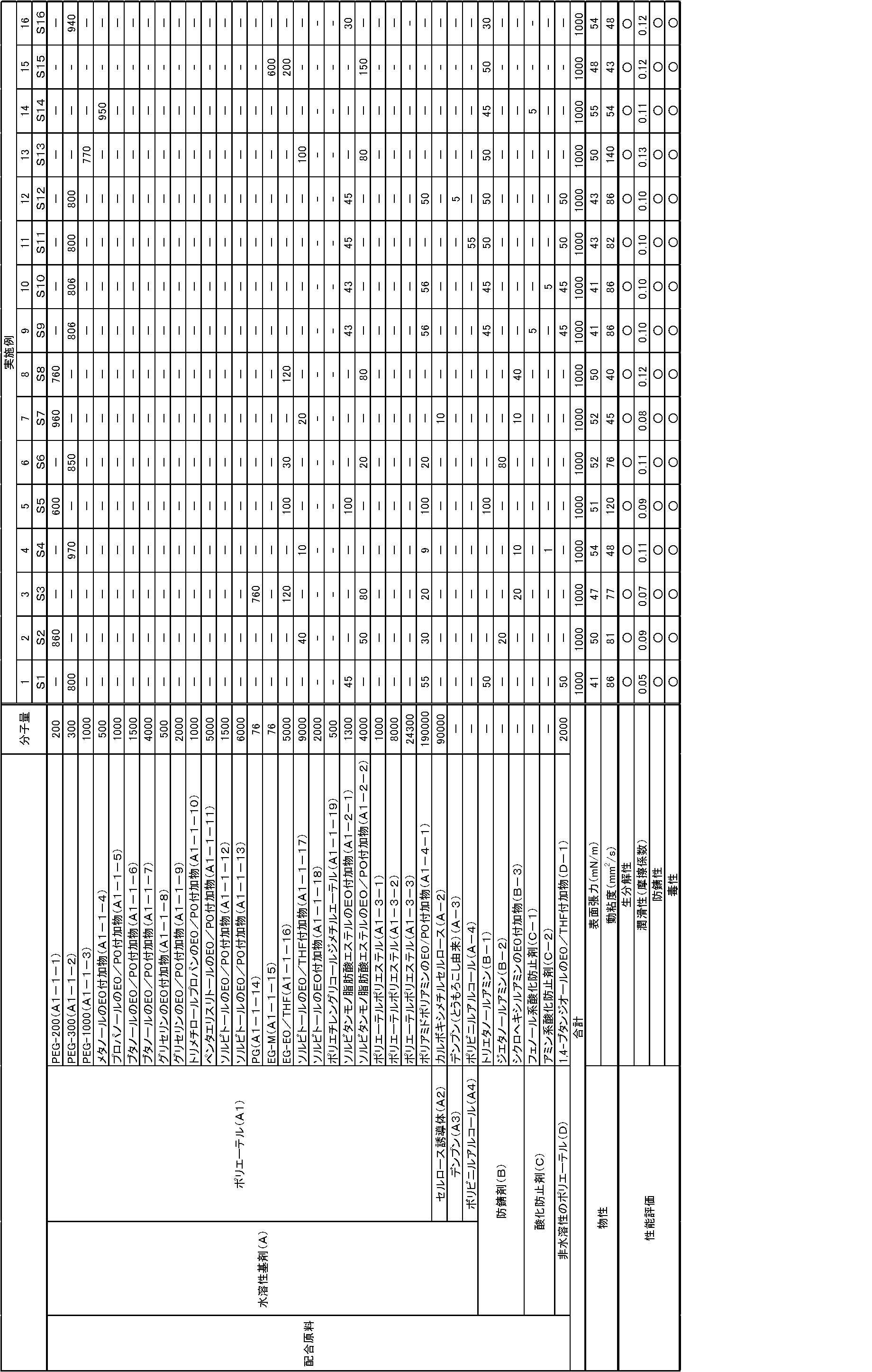
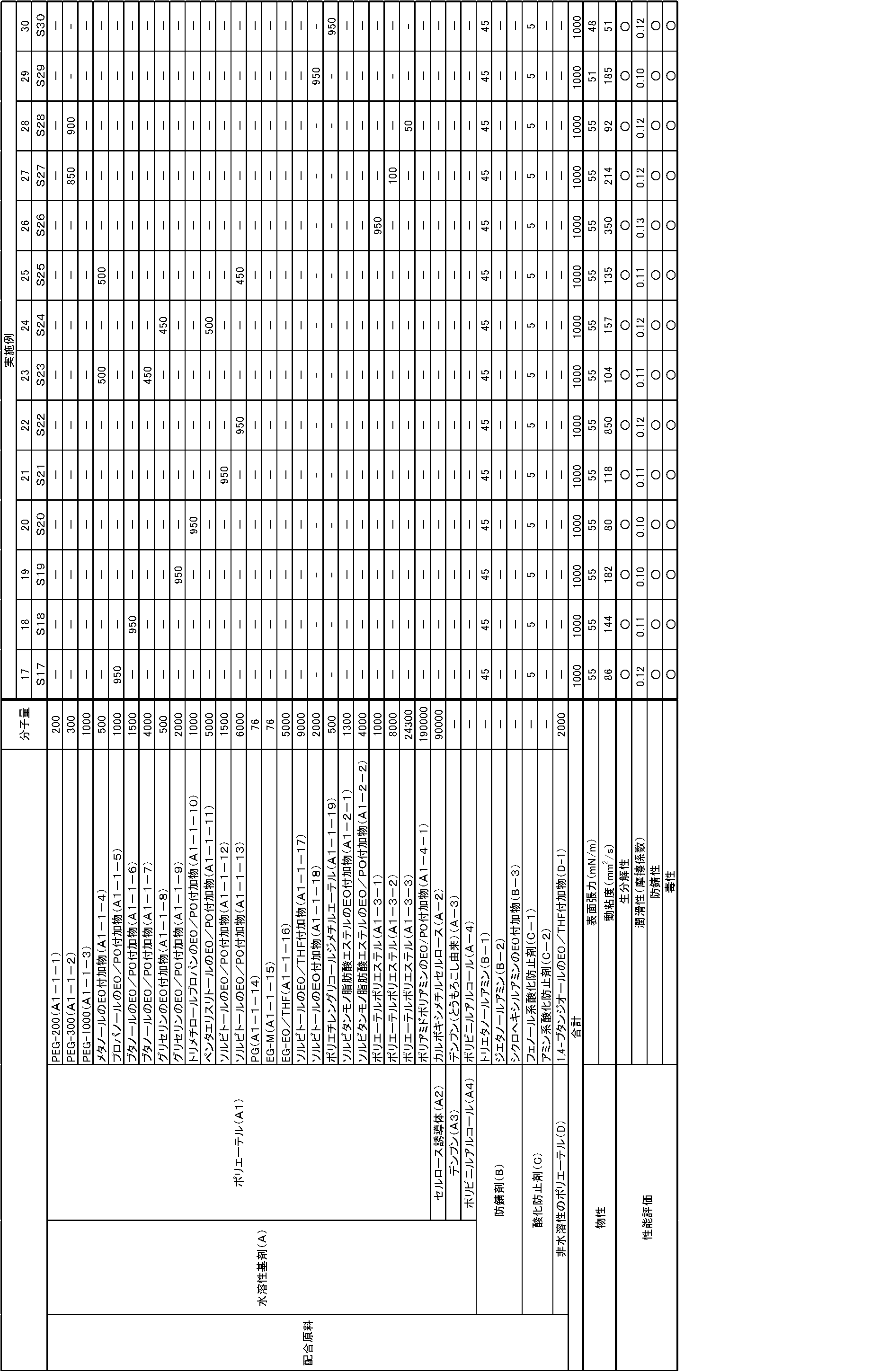

得られた水溶性潤滑油の生分解性、潤滑性、防錆性及び毒性を試験した。
試験方法は、以下のとおりである。結果を表1~3に示す。
(1)生分解性
OECD試験法301Cに準じて、28日間培養前後のTOCを測定することで、生分解度を測定した。活性汚泥は(財)化学物質評価機構の購入汚泥を使用した。
○:生分解度60%以上、×:生分解度60%未満
振動摩擦摩耗試験機(オプチモール社製 SRV試験機)を用い、鋼球と平面の鋼ディスクとの点接触(荷重100N)における摩擦係数及び鋼球上の摩耗直径を観察することにより評価した。試験条件を下記に示す。
振幅:2mm、 振動数:50Hz、 温度:30℃
時間:10分間
摩擦係数:時間10分間の平均
潤滑油錆止め性能試験方法(JIS K2510)に準じて、測定を行った。
水溶性潤滑油の重量に基づいて10重量%の海水を添加した混合液に、研磨洗浄した棒鋼(S20C)を60℃、3日間浸漬した後、錆の発生状態を観察し、以下の評価基準に従って、防錆性を評価した。なお浸漬中、混合液は撹拌し続けた。
◎:錆なし(錆が認められない場合、又は、試験片表面の5%以下の範囲に錆が認められ、上記錆の直径は1mm以下であり、かつ、上記錆のはん点が6個以下の場合)
○:若干の錆あり(試験片表面の5%以下の範囲に錆が認められ、かつ、上記「◎」に該当しない場合)
×:錆あり(試験片表面の5%を超える範囲に錆が認められる場合)
OECD試験法203「魚類急性毒性試験」に準じて、測定を行った。
試験魚としてメダカを用い、暴露時間を96時間として、LC50を算出した。そして、以下の評価基準に従って、毒性を評価した。
○:LC50が500mg/L以上
×:LC50が500mg/L未満
また、本発明の水溶性潤滑油は、海水に漏れたとしても生分解性及び水溶性が良く、低毒性という特徴を有するので、特に船舶用の水溶性潤滑油として好適である。
Claims (11)
- 少なくとも1種のポリエーテル(A1)からなる水溶性基剤(A)と防錆剤(B)とを含み、水溶性潤滑油の0.1重量%水溶液の表面張力が31mN/m以上である水溶性潤滑油。
- 前記(A1)が活性水素化合物のアルキレンオキサイド付加物である請求項1記載の水溶性潤滑油。
- 前記(A1)が下記一般式(1)で表される(A1-1)、下記一般式(2)で表される(A1-2)、下記一般式(3)で表される(A1-3)、及び、水溶性のポリエーテル系増粘剤(A1-4)からなる群から選ばれる1種以上である請求項1又は2記載の水溶性潤滑油。



- 前記(A1-1)が、1~6価の水酸基を有する化合物の炭素数2~4のアルキレンオキサイド付加物である請求項3記載の水溶性潤滑油。
- 前記(A1-2)が、ソルビタンモノ又はジ脂肪酸エステルのアルキレンオキサイド付加物である請求項3又は4記載の水溶性潤滑油。
- 前記(A1-3)が、グリコール類と二塩基酸とのエステル化物である請求項3~5のいずれか記載の水溶性潤滑油。
- 前記(A1-4)が、多価アルコールのアルキレンオキサイド付加物、及び/又は、ポリアミンのアルキレンオキサイド付加物である請求項3~6のいずれか記載の水溶性潤滑油。
- 前記(B)が、アルカノールアミンである請求項1~7のいずれか記載の水溶性潤滑油。
- さらに酸化防止剤(C)を含有する請求項1~8のいずれか記載の水溶性潤滑油。
- 前記(A)、前記(B)、及び、前記(C)の合計重量に基づいて、前記(A)を88.0~98.9重量%、前記(B)を1.0~10.0重量%、及び、前記(C)を0.1~2.0重量%含有してなる請求項1~9のいずれか記載の水溶性潤滑油。
- 船舶用の軸受け油、作動油、又はギア油である請求項1~10のいずれか記載の水溶性潤滑油。
Priority Applications (4)
| Application Number | Priority Date | Filing Date | Title |
|---|---|---|---|
| US14/910,755 US10138437B2 (en) | 2013-08-21 | 2014-08-21 | Water-soluble lubricant oil |
| KR1020167004904A KR102189564B1 (ko) | 2013-08-21 | 2014-08-21 | 수용성 윤활유 |
| CN201480042248.2A CN105431508B (zh) | 2013-08-21 | 2014-08-21 | 水溶性润滑油 |
| JP2015513935A JP6007318B2 (ja) | 2013-08-21 | 2014-08-21 | 水溶性潤滑油 |
Applications Claiming Priority (4)
| Application Number | Priority Date | Filing Date | Title |
|---|---|---|---|
| JP2013-171664 | 2013-08-21 | ||
| JP2013171664 | 2013-08-21 | ||
| JP2014-022848 | 2014-02-07 | ||
| JP2014022848 | 2014-02-07 |
Publications (1)
| Publication Number | Publication Date |
|---|---|
| WO2015025910A1 true WO2015025910A1 (ja) | 2015-02-26 |
Family
ID=52483681
Family Applications (1)
| Application Number | Title | Priority Date | Filing Date |
|---|---|---|---|
| PCT/JP2014/071850 Ceased WO2015025910A1 (ja) | 2013-08-21 | 2014-08-21 | 水溶性潤滑油 |
Country Status (5)
| Country | Link |
|---|---|
| US (1) | US10138437B2 (ja) |
| JP (1) | JP6007318B2 (ja) |
| KR (1) | KR102189564B1 (ja) |
| CN (1) | CN105431508B (ja) |
| WO (1) | WO2015025910A1 (ja) |
Cited By (4)
| Publication number | Priority date | Publication date | Assignee | Title |
|---|---|---|---|---|
| JP2019529658A (ja) * | 2016-09-23 | 2019-10-17 | ビーエーエスエフ ソシエタス・ヨーロピアBasf Se | 潤滑剤組成物 |
| JP2019183132A (ja) * | 2018-04-06 | 2019-10-24 | 三洋化成工業株式会社 | 金属加工用基油 |
| JP2020055948A (ja) * | 2018-10-02 | 2020-04-09 | 株式会社ユーテック | 液圧駆動装置のための水系作動液 |
| JP2020066693A (ja) * | 2018-10-25 | 2020-04-30 | 株式会社ユーテック | 歯車装置のための水系潤滑液 |
Families Citing this family (7)
| Publication number | Priority date | Publication date | Assignee | Title |
|---|---|---|---|---|
| CN107011962A (zh) * | 2017-06-08 | 2017-08-04 | 苏州瑞奇丽新材料有限公司 | 一种水性润滑油 |
| CN110205193B (zh) * | 2018-02-28 | 2022-02-01 | 中国石油天然气股份有限公司 | 耐气相腐蚀的水-乙二醇难燃液压液组合物及其制备方法 |
| CN109135880B (zh) * | 2018-09-19 | 2020-01-03 | 山东奇士登润滑科技有限公司 | 一种合成容水性工业齿轮油及其制备方法 |
| JP7332170B2 (ja) * | 2018-12-18 | 2023-08-23 | サンノプコ株式会社 | フラッシュラスト防止剤 |
| CN113337326B (zh) * | 2020-06-10 | 2023-05-23 | 沙索(中国)化学有限公司 | 一种包含水溶性的基于甘油的聚亚烷基二醇的水性组合物及其用途 |
| US11820952B2 (en) * | 2021-01-06 | 2023-11-21 | Vantage Santolubes Research Llc | Process to produce low shear strength base oils |
| CN113586923A (zh) * | 2021-07-27 | 2021-11-02 | 武汉理工大学 | 一种低速工况下船舶水润滑尾轴承的润滑剂自动供给系统 |
Citations (4)
| Publication number | Priority date | Publication date | Assignee | Title |
|---|---|---|---|---|
| JPS5938295A (ja) * | 1982-08-27 | 1984-03-02 | Toyota Motor Corp | 水−グリコ−ル型作動油 |
| JPS6317994A (ja) * | 1986-07-10 | 1988-01-25 | Cosmo Co Ltd | 難燃性潤滑油 |
| JP2007246684A (ja) * | 2006-03-16 | 2007-09-27 | Cosmo Sekiyu Lubricants Kk | 含水系潤滑油組成物 |
| JP2012087297A (ja) * | 2010-09-22 | 2012-05-10 | Sanyo Chem Ind Ltd | シリコンインゴット用含水切削液 |
Family Cites Families (18)
| Publication number | Priority date | Publication date | Assignee | Title |
|---|---|---|---|---|
| JP2604166B2 (ja) | 1987-07-31 | 1997-04-30 | 日清製油株式会社 | 潤滑油 |
| JPH05331481A (ja) | 1992-05-29 | 1993-12-14 | Tonen Corp | 2サイクルエンジン用潤滑油組成物 |
| JP3453061B2 (ja) | 1998-05-22 | 2003-10-06 | 株式会社クボタ | 植物を枯死させない作動油 |
| JP2001200285A (ja) * | 2000-01-21 | 2001-07-24 | Japan Energy Corp | アンモニア冷媒を使用する冷凍機用潤滑剤 |
| JP2001214186A (ja) * | 2000-01-31 | 2001-08-07 | Asahi Denka Kogyo Kk | 潤滑性組成物 |
| US6855676B2 (en) * | 2002-02-11 | 2005-02-15 | Ecolab., Inc. | Lubricant for conveyor system |
| WO2004053031A2 (en) * | 2002-12-09 | 2004-06-24 | Union Carbide Chemicals & Plastics Technology Cor Poration | Alkoxylates as such or as base oils for hydraulic compositions |
| WO2004092312A1 (ja) * | 2003-03-24 | 2004-10-28 | Sanyo Chemical Industries Ltd. | 水系金属加工油用潤滑剤 |
| JP4388513B2 (ja) | 2004-08-18 | 2009-12-24 | 三洋化成工業株式会社 | 水溶性潤滑油 |
| US7612024B2 (en) * | 2004-12-22 | 2009-11-03 | Ecolab Inc. | Polyalkylene glycol based solutions with enhanced high temperature stability |
| JP2006265345A (ja) * | 2005-03-23 | 2006-10-05 | Sanyo Chem Ind Ltd | 船舶軸受け推進器用潤滑油 |
| US20080280791A1 (en) * | 2007-05-01 | 2008-11-13 | Chip Hewette | Lubricating Oil Composition for Marine Applications |
| WO2010134583A1 (ja) | 2009-05-22 | 2010-11-25 | 新日本製鐵株式会社 | 切削工具寿命に優れた機械構造用鋼及びその切削方法 |
| CN101696368A (zh) * | 2009-10-26 | 2010-04-21 | 益田润石(北京)化工有限公司 | 一种水溶性高温链条润滑剂组合物 |
| JP2012008442A (ja) * | 2010-06-28 | 2012-01-12 | Elmo Co Ltd | 露出制御装置および露出制御方法 |
| CN103052701B (zh) * | 2010-07-12 | 2014-10-22 | 狮王株式会社 | 金属加工油基础油 |
| CN102295975B (zh) * | 2011-07-26 | 2013-08-14 | 天津市东方特种润滑油有限公司 | 一种水溶性切削油及其制备方法 |
| DE102011113158B4 (de) * | 2011-09-14 | 2020-03-26 | Raziol Zibulla & Sohn Gmbh | Verfahren zur Bearbeitung eines Werkstücks |
-
2014
- 2014-08-21 JP JP2015513935A patent/JP6007318B2/ja active Active
- 2014-08-21 WO PCT/JP2014/071850 patent/WO2015025910A1/ja not_active Ceased
- 2014-08-21 KR KR1020167004904A patent/KR102189564B1/ko active Active
- 2014-08-21 US US14/910,755 patent/US10138437B2/en active Active
- 2014-08-21 CN CN201480042248.2A patent/CN105431508B/zh active Active
Patent Citations (4)
| Publication number | Priority date | Publication date | Assignee | Title |
|---|---|---|---|---|
| JPS5938295A (ja) * | 1982-08-27 | 1984-03-02 | Toyota Motor Corp | 水−グリコ−ル型作動油 |
| JPS6317994A (ja) * | 1986-07-10 | 1988-01-25 | Cosmo Co Ltd | 難燃性潤滑油 |
| JP2007246684A (ja) * | 2006-03-16 | 2007-09-27 | Cosmo Sekiyu Lubricants Kk | 含水系潤滑油組成物 |
| JP2012087297A (ja) * | 2010-09-22 | 2012-05-10 | Sanyo Chem Ind Ltd | シリコンインゴット用含水切削液 |
Cited By (8)
| Publication number | Priority date | Publication date | Assignee | Title |
|---|---|---|---|---|
| JP2019529658A (ja) * | 2016-09-23 | 2019-10-17 | ビーエーエスエフ ソシエタス・ヨーロピアBasf Se | 潤滑剤組成物 |
| JP2019183132A (ja) * | 2018-04-06 | 2019-10-24 | 三洋化成工業株式会社 | 金属加工用基油 |
| JP2020055948A (ja) * | 2018-10-02 | 2020-04-09 | 株式会社ユーテック | 液圧駆動装置のための水系作動液 |
| JP7246683B2 (ja) | 2018-10-02 | 2023-03-28 | 株式会社ユーテック | 液圧駆動装置のための水系作動液 |
| JP2020066693A (ja) * | 2018-10-25 | 2020-04-30 | 株式会社ユーテック | 歯車装置のための水系潤滑液 |
| JP7179322B2 (ja) | 2018-10-25 | 2022-11-29 | 株式会社ユーテック | 減速装置のための水系潤滑液 |
| JP2023001301A (ja) * | 2018-10-25 | 2023-01-04 | 株式会社ユーテック | 減速装置のための水系潤滑液 |
| JP7402561B2 (ja) | 2018-10-25 | 2023-12-21 | 株式会社ユーテック | 減速装置のための水系潤滑液 |
Also Published As
| Publication number | Publication date |
|---|---|
| US10138437B2 (en) | 2018-11-27 |
| US20160186085A1 (en) | 2016-06-30 |
| JPWO2015025910A1 (ja) | 2017-03-02 |
| CN105431508A (zh) | 2016-03-23 |
| CN105431508B (zh) | 2018-11-30 |
| KR20160044490A (ko) | 2016-04-25 |
| JP6007318B2 (ja) | 2016-10-12 |
| KR102189564B1 (ko) | 2020-12-11 |
Similar Documents
| Publication | Publication Date | Title |
|---|---|---|
| JP6007318B2 (ja) | 水溶性潤滑油 | |
| JP2006265345A (ja) | 船舶軸受け推進器用潤滑油 | |
| JP5394691B2 (ja) | 水溶性金属加工油剤および金属加工用クーラント | |
| TWI493027B (zh) | 聚伸烷基二醇潤滑劑組成物 | |
| US3992312A (en) | Non-inflammable hydraulic fluid | |
| WO2011001554A1 (ja) | さび止め油組成物 | |
| US10961479B2 (en) | Lubricating oil composition | |
| JP4388513B2 (ja) | 水溶性潤滑油 | |
| WO2017170868A1 (ja) | さび止め油組成物 | |
| CN109312245A (zh) | 润滑油基油 | |
| JP4531882B2 (ja) | 水溶性金属加工油剤 | |
| JP6296943B2 (ja) | 含水系作動液 | |
| JP6208266B2 (ja) | 水溶性潤滑油 | |
| US20250346826A1 (en) | Lubricant composition | |
| JPH04136097A (ja) | 新規水―グリコール系作動液 | |
| JP2000178576A (ja) | 水溶性作動液 | |
| JPH10245581A (ja) | 水溶性加工油剤 | |
| JP2002053891A (ja) | 水溶性潤滑剤 | |
| JP2023161564A (ja) | 潤滑油組成物 | |
| JPH04106196A (ja) | 水―グリコール系作動液 | |
| JPH04202598A (ja) | 水―グルコール系作動液 | |
| JPH1060468A (ja) | 水溶性金属加工油 | |
| JPH05125385A (ja) | 水−グリコール系作動液 | |
| JP2022084050A (ja) | 生分解性水可溶性潤滑油組成物 | |
| JP2013087220A (ja) | 水系潤滑液組成物 |
Legal Events
| Date | Code | Title | Description |
|---|---|---|---|
| WWE | Wipo information: entry into national phase |
Ref document number: 201480042248.2 Country of ref document: CN |
|
| ENP | Entry into the national phase |
Ref document number: 2015513935 Country of ref document: JP Kind code of ref document: A |
|
| 121 | Ep: the epo has been informed by wipo that ep was designated in this application |
Ref document number: 14838123 Country of ref document: EP Kind code of ref document: A1 |
|
| WWE | Wipo information: entry into national phase |
Ref document number: 14910755 Country of ref document: US |
|
| NENP | Non-entry into the national phase |
Ref country code: DE |
|
| ENP | Entry into the national phase |
Ref document number: 20167004904 Country of ref document: KR Kind code of ref document: A |
|
| 122 | Ep: pct application non-entry in european phase |
Ref document number: 14838123 Country of ref document: EP Kind code of ref document: A1 |